






‘Tis the Season… to Test for Radon
Radon gas isn’t a new issue for REALTORS®, but during this time of the year it gains importance as fall and winter are the ideal seasons to test for radon.
Understanding and helping mitigate radon risks is more than just a professional responsibility for REALTORS®. It's also an opportunity to provide clients with valuable information to help them make informed decisions.
There are many resources available to help support REALTORS® in building knowledge and awareness on radon, including an updated and accredited self-paced professional development course, BCFSA’s Radon Checklists for Buyers' Agents, Sellers' Agents, and Property Managers, a Radon FAQ and Testing Checklist, and some other online resources to incorporate into their practice.
Radon: Frequently Asked Questions and Checklists
Get a basic understanding of what radon is and how can you protect consumers in our blog, REALTORS® and Radon: Protecting Buyers and Sellers.
BCREA has also created a FAQ document on Radon with the support of Dr. Noah Quastel from the BC Lung Foundation. The document addresses common questions and provides external resources on the topic, including:
- what is radon;
- where radon is found in BC;
- which kind of homes need to be tested;
- and more.
And as a joint effort with the BC Lung Foundation and the Canadian National Radon Proficiency Program (C-NRPP), BCREA has designed a checklist for REALTORS® and the public to help ensure they follow the correct procedures in testing for radon.
Also, BCFSA provides guidance to help discuss the importance of radon with clients depending on the side of the transaction you’re in. See the checklists below:
- Radon Checklist for Sellers’ Agents
- Radon Checklist for Buyers’ Agents
- Radon Checklist for Rental Property Managers
Learn More About Radon and Your Responsibilities as a REALTOR®
Radon is an important consideration when buying a home. REALTORS® are expected to demonstrate competency and show skills when providing real estate services to their clients. Having knowledge about environmental conditions and signs of alert can help ensure you are taking the right steps to provide an exceptional experience.
BCREA has created a Radon for REALTORS® course, in which REALTORS® can deepen their understanding of radon and how it relates to the real estate transaction. By the end of this course, learners will be able to:
- understand and identify how radon enters a dwelling,
- know what influences radon levels,
- recognize the effects of radon on human health,
- understand Canada’s radon awareness initiatives,
- identify applicable laws and emergent policies on radon in BC and,
- much more
Demonstrate Your Radon Knowledge and You Could WIN!
In the spirit of inspiring and supporting REALTORS® to educate themselves about radon, BCREA is holding a contest. All you have to do is take and submit a short quiz demonstrating your radon knowledge, and you could win one of five lüft® Long-term Radon & Indoor Air Quality Monitors.
Deadline to complete: Friday, November 28, 2025, at 5 pm PT
Join the BC Lung Workshop: Radon: Collaboration for Healthy Communities
The BC Lung Foundation is hosting its annual virtual workshop to discuss the various actions individuals, families, researchers, communities, and government can do to address and prevent radon.
This webinar is eligible for two self-directed Professional Development hours.
Date: Tuesday, November 25, 2025
Time: 10 am to 11:30 am PT
“Limited Dual Agency Or No Agency,” There Is A Different #446
A recent case illustrates the pitfalls awaiting brokerages and REALTORS® when choosing to act as a limited dual agent.1
A couple engaged a brokerage and REALTOR® to assist them in the purchase of a house (the Grandview property). The Contract of Purchase and Sale for the Grandview property was subject to the sale of their existing house (the Carter property). The Contract of Purchase and Sale also contained a clause enabling the seller to require the couple to remove all of the subjects in the event the seller received another bona fide offer. After the acceptance of their conditional offer to purchase, the couple listed the Carter property with the same brokerage and REALTOR® that represented them in the acquisition of the Grandview property.
The REALTOR® was approached by an unrepresented prospective buyer who was interested in purchasing the Carter property. The REALTOR® had the prospective buyer sign a Limited Dual Agency Agreement and then prepared an offer to purchase the Carter property. The offer was delivered to the couple together with the Limited Dual Agency Agreement. The couple signed the Limited Dual Agency Agreement, as well as accepted the offer.
For unrelated reasons, the sale did not complete and the Carter property was eventually purchased by another buyer represented by the brokerage. Upon closing, the couple withheld a portion of the brokerage's commission alleging, among other things, a breach of fiduciary duty by the brokerage and the REALTOR®.
The court found that the REALTOR® had acted as a limited dual agent in preparing the offer to purchase before the concept of limited dual agency had been discussed with the couple and before they had consented to the brokerage and REALTOR® acting as limited dual agents. The court concluded that the REALTOR® should have obtained the informed consent of the seller prior to the preparation of the offer. This breach resulted in the brokerage's claim for commission being reduced by half.
Interestingly, the REALTOR® attempted to claim, at trial, that he did not act as the agent of the prospective buyer in preparing the offer to purchase and that the Limited Dual Agency Agreement was entered into "out of an abundance of caution." The court understandably rejected that argument given the wording of the Limited Dual Agency Agreement in which the brokerage acknowledged that it was the agent for both the seller and the buyer.
In addition to the court's finding as to the timing of obtaining the seller's consent to limited dual agency, this case further illustrates the practical challenges associated with limited dual agency.
In this case, limited dual agency could have been avoided as the buyer was unrepresented when the REALTOR® was first approached. The brokerage and REALTOR® could have declined to provide agency representation to the buyer and continued to act as the sole agent of the seller. Given the submissions of the REALTOR® at trial, it is possible that is what was intended.
However, by entering into the Limited Dual Agency Agreement, the brokerage and the REALTOR® became the agent for the buyer as well as the seller. This fundamentally changed the legal relationship the brokerage and REALTOR® had with both the buyer and the seller.
Licensees must be aware of the difference between, and the implications of, acting as a limited dual agent for an unrepresented buyer and not providing agency representation to that buyer.
| 1. |
|
To subscribe to receive BCREA publications such as this one, or to update your email address or current subscriptions, click here.
“Time is of the Essence” Means “Time is of the Essence” #412
By Edward L. Wilson
Lawson Lundell LLP
Many REALTORS® assist buyers in locating and negotiating the purchase of new condominiums in pre-build situations. The developer’s form of contract is generally used and such contracts often provide for staged deposits, often over long periods, which invariably contain “time is of the essence” clauses.
A buyer entered into a typical developer’s form of contract in August 2004 to purchase a condominium in a complex to be built by the developer.1 The contract provided for a purchase price of $1.26 million and a deposit of 25 per cent, payable in three instalments.
The buyer paid the first instalment of $62,750, but paid $75,000 toward the December (second) instalment of $125,500 one month late. The developer wrote to the buyer in early March 2005 demanding payment of the balance of the December instalment by mid-March, but the buyer failed to pay. A further written demand followed in May, insisting on payment of the balance of the December instalment with interest, plus the third instalment of $125,000, by June 15, 2005.
The buyer made no payment in June and the developer's lawyers sent a letter in late June demanding full payment of the outstanding balance of the deposit by early July. The buyer said he did not receive that letter, but paid $50,500 on July 16.
A further letter was sent by the developer’s lawyers on August 17 acknowledging receipt of the $50,500, stating that a balance of $138,416 remained owing and extending the payment date to August 24. That letter also stated: “This is absolutely the last extension offered to you. If you fail to make the payment by such time, our client has instructed us to terminate the Contract immediately and retain the deposit you have paid on account of damages, without further notice to you.” The buyer said he did not receive that letter, either, and that he was shocked when he learned the developer had purported to terminate the contract on August 30. The buyer said he had understood from discussions with the developer that the July payment of $50,500, with payment of the balance in the fall of 2005, was acceptable. The buyer sued for a declaration that the contract was valid and subsisting.
In reversing the trial decision, the Court of Appeal found the right of the developer to cancel the contract on August 30 was governed by clause 7.7 of the purchase contract, which provided that time was of the essence and that the developer had the option of cancelling or electing to complete the transaction in the event of the buyer’s default.2 Unless all amounts were paid when due, the developer could cancel the contract and do so at any time during the continuance of the default, even if the developer had previously elected to complete the transaction. Clause 7.7 was perhaps harsh from a buyer’s perspective, but it was not commercially unsustainable and the parties had agreed to it. The contract was properly brought to an end.
The message for buyers (and their REALTORS®) is simple: deposits must be paid on time. The dates established for payment of deposits are not mere suggestions, but must be complied with strictly; otherwise, the deposit and the contract are at risk. When advising developers, REALTORS® should carefully administer the receipt of deposits and document any late payments, discussions about extensions or waivers of strict compliance of the terms of the contract and demands for payment.
| 1. | Hinkson Holdings Ltd. v. Silver Sea Developments Limited Partnership, 2007 BCSC 118. | |
| 2. | Hinkson Holdings Ltd. v. Silver Sea Developments Limited Partnership, 2007 BCCA 408. |
To subscribe to receive BCREA publications such as this one, or to update your email address or current subscriptions, click here.
“And/or Nominee” and “And/or Assignee” #65
By Gerry Neely
B.A. LL.B.
A request has been received for an update of the current law relating to the use of the above phrases in the preparation and enforcement of interim agreements.
Column No. 3 written March, 1981, referred to a case where an offer to purchase made by "the undersigned, Century 21 Real Estate Ltd. or nominee" was held to be unenforceable. One reason for this decision was the uncertainty as to who was the intended purchaser. The transaction was quite unusual in that the vendor retained the right to arrange the first and second mortgage financing required to pay out the vendor. This meant that the identification of the purchaser was important since it was his financial strength or creditworthiness that would determine whether the financing would be made available.
Since that case, there have been five reported decisions in British Columbia of which I am aware, in which one party to an agreement to purchase land has argued that these phrases render the agreements void for uncertainty. The uncertainty cases appear to have sprung from a case in which a proposed tenant entered into an agreement to lease with the landlord. The tenant stated that he did not intend to be personally liable, but that the liability would be that of a company to be incorporated by him. The landlord had a different understanding as to the liability of the tenant, and the Court concluded that the uncertainty created by these difference understandings meant that no contract had been concluded and the tenant was absolved from any personal liability.1
A general rule seems to be evolving from the most recent decisions in the cases where the argument was unsuccessful. That rule is that if it can be established that the purchaser's decision to nominate someone else to take title is not intended to relieve the purchaser of his obligations toward the vendor, then the agreement is not void for uncertainty.2
An example would be circumstances in which the purchaser intends to incorporate a company to take title, but understands that he remains liable personally until that happens.If, however, the evidence establishes that the purchaser never intended to bind himself in contract to the vendor personally, but instead intended that the vendor and a third party to be nominated by the purchaser were to contract with each other, then the contract would probably be void for uncertainty. An example of this is the landlord/tenant case referred to above.
The problem in putting this rule into practice is the difficulty in proving the intentions of the purchaser. If a purchaser wishes to have a nominee take title, then to avoid the uncertainty argument, the agreement should contain a sentence similar to the following:
"The purchaser agrees to remain liable to the vendor under this agreement notwithstanding that the purchaser may nominate a third party to complete this purchase."
If the vendor intends to take back a mortgage, then the sentence could be amended as follows:
"The purchaser agrees to remain liable to the vendor not only under this agreement but also as a guarantor under the said (first) (second) mortgage notwithstanding that the purchaser may nominate a third party to complete this purchase."
| 1. | Causeway Shopping Centre Ltd. v. Muise, (1967) 63 D.L.R. (2d) 26, affirmed 70 D.L.R. (2d) 720. | |
| 2. | Kemp v. Lee, 44 B.C.L.R. p. 172. |
To subscribe to receive BCREA publications such as this one, or to update your email address or current subscriptions, click here.
“Best Efforts” Cases #9
By Gerry Neely
B.A. LL.B.
Very occasionally a prospective purchaser for whom an offer to purchase is being prepared, asks for the insertion of a condition in the agreement such as "subject to financing..." because he is not entirely certain whether he wants to buy the property. The reasoning of course is that if he decides that he doesn't want it, the condition precedent prevents the contract from becoming binding, even though financing would be available. This stratagem may not be used as much or at least will be used more carefully, if knowledge of two decisions of the Supreme Court of British Columbia becomes more widespread.
In one, prospective purchasers sought the return of a $50,000.00 deposit paid under a letter of agreement between the parties. The deposit was paid on condition that it would be refunded should the proposed sale fail "due to no fault" of the purchasers. They claimed the sale fell through because they could not obtain financing, and that this was due to no fault on their part. The Court interpreted "fault" as meaning that the purchasers had to use their "best efforts" to meet all of the conditions which would have enabled the sale to be completed. The onus was on the purchasers to show why their efforts to obtain financing had failed. Their own evidence of their attempt to obtain financing through the Federal Business Development Bank satisfied the Court that their failure to obtain financing was due to their failure to present an unusual proposition in a business-like way.1
The second case dealt with a complicated agreement involving a land assembly by a developer for the expansion of an existing shopping centre owned by the developer. There were a number of conditions in the agreement, including obtaining zoning approval, a building permit and final approvals from the municipality and Province for the expansion of the shopping centre by July 31st, 1979. Failing satisfaction of these conditions, the land developer had the option of declaring the agreement null and void. In mid-April 1979, the land developer decided to abandon the idea of the expansion, primarily because of his difficulty in finding an anchor tenant. That had not been one of the conditions to which the agreement was subject. In August, the land developer declared the agreement null and void and the vendor sued for specific performance or in the alternative, for damages.
The vendor was successful, the Court holding that there was an implied obligation on the part of the land developer to use its "best efforts" to bring about the fulfillment of the conditions in the agreement of purchase and sale. By failing to take any bona fide action from mid-April on, to bring about the proposed development, the land developer breached this implied obligation. The agreement was subject to the purchase by the land developer of properties from two owners of lands other than the Vendor who was sued. The Court found that the land developer had not made any concerted effort to purchase those properties. It held that the land developer could not rely on its own failure to use its best efforts to purchase, as an excuse for non-fulfillment of its obligation.2
| 1. | Thorsten and Tate v. Gill,19 B.C.L.R. 389. | |
| 2. | BEM Enterprises Ltd. v. Campeau Corporation, 24 B.C.L.R. 244. |
To subscribe to receive BCREA publications such as this one, or to update your email address or current subscriptions, click here.
“Cooling Off Period” With No Details Creates Uncertainty and Concern in Real Estate Sector
In November, the BC Government announced it will be introducing a “cooling off period” for real estate transactions involving residential resale properties and newly built homes in BC beginning next spring. BC Minister of Finance Selina Robinson announced the policy without any details or advanced consultation with the public or real estate sector, resulting in significant confusion and uncertainty both within the sector and amongst the public. This lack of advance planning has led to concerns that this policy and others under consideration could result in unintended negative consequences for buyers and sellers.
“From the day this measure was announced, real estate brokers and real estate boards in BC have been inundated with questions about how this upcoming measure is going to affect their day-to-day work and their clients,” says British Columbia Real Estate Association (BCREA) Chief Executive Officer Darlene K. Hyde. “While we would have liked to answer these questions clearly and concisely, we simply can’t because of the way this decision was made. There really are no answers yet and that’s causing a lot of concern.”
Recent media reports have erroneously made suggestions that the new “cooling off period,” also known as a recission period, will adopt the same parameters as the seven-day period already in place for pre-construction condominium sales, adding to the uncertainty caused by this announcement.
“The assumptions we are seeing are untrue and are purely a result of the lack of information out there about what could be a substantial change to the real estate transaction,” Hyde adds. “Instead of educating Realtors and the public, we now have to focus on stopping rumours . All this could have been avoided if proper processes were followed prior to this decision being made.”
BCREA supports thoughtfully designed, properly-vettedand evidence-based policy that protects consumers and enhances professionalism and transparency within the real estate sector. Policies addressing market conditions should consider the interests of all parties in a transaction, changing market conditions, regional nuances, potential unintended consequences and should also include a defined process to monitor efficacy of the measures introduced.
Prior to further decisions being made on a “cooling off period” or any other measures related to the real estate transaction or market, it is imperative that thorough consultation with the real estate sector and research is conducted in advance to address factors that may negatively impact home buyers and sellers in BC.
-30-
For more information:
Shaheed Devji
BCREA Senior Communications Specialist
778.847.7424
“The Unusual World of Pandemic Economics” – Why BC’s Housing Market Remains Strong Despite COVID-19
Vancouver, BC – September 9, 2020. The British Columbia Real Estate Association’s (BCREA) latest Market Intelligence report, The Unusual World of Pandemic Economics, points to uneven job losses across sectors, an increase in many households’ rate of savings, swift government aid, a tighter-than-ever housing supply and low interest rates as the drivers behind BC’s recent housing market highs.
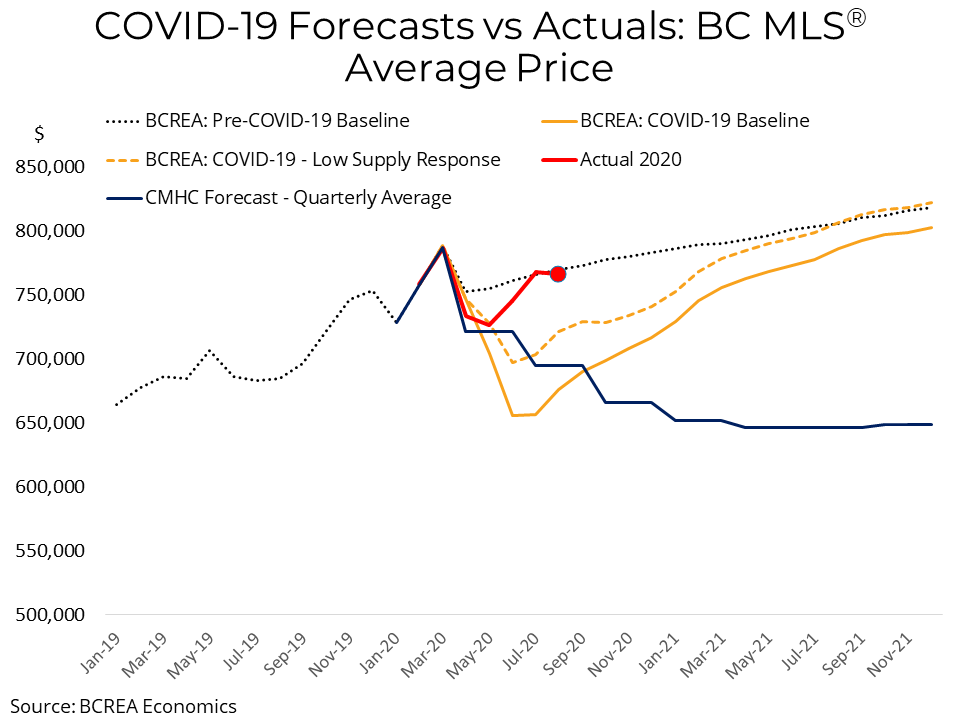
“The COVID-19 recession has battered many sectors of the BC economy. However, looking at recent data in the housing market, it would be difficult to tell there was a recession at all,” says BCREA Chief Economist Brendon Ogmundson. “In a typical recession, we would see falling demand and rising supply, but this recession is anything but typical.”
Previous BCREA forecasts anticipated housing prices would return to the pre-COVID-19 baseline in early 2021. However, a surge of pent-up demand into an undersupplied market has prices at pre-COVID-19 levels well ahead of schedule.
“Pandemic economics are proving to be very unusual. Many of the trends we are seeing are without precedent and significant uncertainty remains, but we are cautiously optimistic that this housing recovery will continue,” notes Ogmundson.
To read the full report, click here.
-30-
For the PDF of this news release click here.
For media enquiries:
Shaheed Devji
Marketing Communications Specialist
[email protected]
604.757.7260
To subscribe to receive BCREA publications, or to update your email address or current subscriptions, click here.
<em>Heritage Conservation Act</em> Transformation Project Survey
The following letter was emailed to all BC REALTORS® on Friday, September 19, 2025.
Dear BC REALTORS®,
As you may be aware, the provincial government has begun the public phase of engagement on the Heritage Conservation Act Transformation Project (HCATP). The stated aim is to update the Heritage Conservation Act (HCA) to ensure it is consistent with the United Nations Declaration on the Rights of Indigenous Peoples and improve its implementation in a way that benefits all people in BC.
For years, First Nations and stakeholders have raised challenges with the HCA and its administration. Significant changes have not been made to the HCA since 1996. Several concerns have been raised within BC’s real estate sector regarding the province’s current heritage conservation approach as well as the proposed changes that this stage of engagement centres upon.
Reconciliation is an important process that we support, but it’s essential to conduct this work in parallel with the development of much-needed housing in this province. We are concerned with a variety of aspects related to the proposed HCA changes to the degree that we believe the HCATP process should be paused immediately, and a plan put in place to increase consultation and examination of these potential issues.
We would urge you to review and echo these concerns within the framework of the public consultation, which includes an easy-to-access survey (more on that at the bottom of this email).
Broadly, we are adamantly opposed to archaeological data checks being conducted by REALTORS® before property sales because:
- REALTORS® are responsible only for a fraction of all property sales in the province,
- the majority of property sales, including apartment and townhouse stratas, would not benefit from an archaeological data check, and
- the sale of a property does not automatically suggest that an archaeological data check will be of any benefit at all.
Proposed HCA Changes and BCREA’s Top Concerns
We have outlined our additional concerns in point form below:
- Questionable Necessity of the Project: At the outset, we question the necessity of this “transformative” project and suggest the rationale for it has not been adequately established. There are a number of checks and balances already in place to ensure the protection of heritage and cultural assets. While most would agree that these can be strengthened, streamlined, and otherwise improved, we do not see the need for a “transformative” approach.
Specifically, an array of tools and processes already exists to manage heritage considerations within real estate transactions. REALTORS® and consumers can, and in many cases do, already request archaeological information as part of their due diligence; buyers can include conditions in contracts to allow for further investigation; and those with clear development intentions can commission their own archaeological assessments. Local governments also have the authority to require these assessments as part of subdivision or development approvals. We would ask that the specific shortcomings of the existing process be clearly identified, and a thorough, thoughtful discussion take place to address these issues. - Lack of Government Capacity: In response to direct questioning during the consultation sessions, Ministry of Forests staff responded that there are no plans to add additional staff capacity in order to facilitate the anticipated changes to the process. Given the expanded range of factors that will be considered in each application, the need for heightened enforcement, and the expected level of public and sector communication, engagement, and training, delays in permit processing would increase to untenable levels without significant expansion of staff capacity. In the consultation, there were no indications of advance research into a market-practical manner to develop and enact this initiative, which, as structured, seems poised to cause major issues for the housing sector.
- Point of Sale Issues: The above point is particularly significant if archaeological assessments are made mandatory at the time of sale. This would be a problematic policy for several reasons. It places an excessive burden on property sellers, particularly if the transaction represents a distress sale where the property must be sold quickly. As an alternate approach, if an accurate, easily accessible mapping tool or database were available, the data check could be undertaken at a time when it makes the most sense, when a buyer is looking to acquire the property as part of their due diligence, or where a permit for development (a new project, or an expansion / renovation) is being considered. If accurate intelligence is available at any time via a map / database, then the need to provide a check at transaction becomes moot, and there is no threat to the timeliness of a transaction due to any potential delays in completing the data check. We suggest abandoning the “point of sale” completely as it is neither efficient nor does it make use of existing technology.
- Unintended Housing Supply Consequences: The need to create additional housing supply has been a priority of the provincial government for several years, as part of the solution to BC’s affordability issues. Several major pieces of legislation have been enacted to help accelerate the approval and development of new housing projects. Amendments to the HCA could easily have the unintended consequence of causing extended permitting delays and cancelled property transactions. This would undo much of the positive gains from other housing legislation.
- Policy Abuse and Avoidance Risks: The amendments proposed need to be given a “real world” test. In our experience, in situations where a process is seen by end users as overly onerous, complex, costly, or time-consuming, they will seek loopholes or purposely bypass the process, often resulting in challenging situations for future property owners and First Nations. In the case at hand, some vendors may opt to ignore the advice of their REALTOR® and list the property on their own, choosing to sidestep regulations for identification and disclosure of heritage assets.
- Regulatory Review: Any proposed legislative or regulatory requirements anticipated to involve real estate professionals should be reviewed by the BC Financial Services Authority, the regulator of real estate licensees in the province, as well as BCREA and the province’s eight real estate boards and associations.
- Lack of Archaeology Professional Capacity: There are serious concerns about the capacity of the archaeological profession within the province and their ability to meet the requirements anticipated by the proposed legislation. This situation is analogous to one several years ago during the implementation of the BC Energy Step Code, when concerns were raised by sector stakeholders about the number (and geographic distribution) of Certified Energy Advisors in the province, and their capacity to conduct the energy modelling necessary for the rollout of the Step Code. This concern is not only related to the number of archaeologists, but also their geographic distribution. If remote areas of the province require specialists to be flown in, costs will be escalated for those properties.
Without some type of fee regulation, a shortage of experts could also result in increased fees, simply due to demand for their services exceeding the supply. Based on a ten-year average, there are approximately 45,000 annual sales of detached homes and duplexes in the province. In addition, there are commercial and industrial sales, and leases of crown land for resource development. If each of these transactions were to require an archaeological assessment, it is doubtful that the current supply of qualified professionals would be able to accomplish this task on a timely and cost-effective basis. - Engagement and Education Needed: In order to prevent pushback from property vendors, a comprehensive engagement, communication, and education program explaining the impacts of the HCATP will need to be undertaken. The stakeholder session did not mention an investment in such a plan, without which the rollout of changes will be easily misconstrued and misunderstood, and result in inevitable delays and additional costs, which will likely lead to substantial resentment.
- Problematic Intangible Heritage Definition: It is an absolute necessity that a clear and practical definition of “intangible heritage” be developed along with a transparent process to identify and disclose its presence on properties. Property owners and potential purchasers need access to this information when considering development. In today’s market, many housing proposals are already being withdrawn due to high development costs and financial infeasibility. Housing providers rely on accurate financial pro formas to assess project viability. If the financial obligations tied to “intangible heritage” are unknown until after permit applications – or, worse, only discovered once construction is underway – projects face significant risk of collapse, adding further strain to housing supply.
- Practical Application Needed: The overall structure of the HCATP needs to undergo a process in which the proposed changes are viewed from the perspective of a typical development project. With the understanding that the provincial government has identified improving housing affordability as a key policy objective, a balance must be struck between the objectives of HCATP and housing goals to examine how the changes will impact the approval timeline, development costs, and potential viability of housing projects (including non-market housing).
Make Your Voice Heard!
One of the main reasons I’m writing today is to strongly encourage all BC REALTORS® to respond directly to the government’s public consultation to use your voice to help amplify our concerns around this consequential initiative. Feel free to echo BCREA’s concerns as well as any others you may have. Particularly if you have first-hand experience with the HCA’s implementation, your insights are vital.
You can browse this website for more information about the proposed changes and to access the Heritage Conservation Act Survey. The deadline to complete the survey is Friday, November 14, 2025, at 4 pm PT.
BCREA and various member boards and associations are monitoring these policy changes and actively engaging with the government to ensure REALTORS®’ perspectives are heard in this consultation process. We will share relevant updates and any future engagement opportunities with you as they become available.
Should you have questions, concerns, or general feedback about this topic, please don’t hesitate to contact our department at [email protected].
Sincerely,
Trevor Hargreaves
BCREA Senior VP Government Relations, Policy Research, Marketing & Communications
<em>Heritage Conservation Act</em>: Update on Proposed Changes
In 2025, the provincial government announced a series of intended changes to the Heritage Conservation Act (HCA), which the BC Real Estate Association (BCREA) quickly identified as problematic. BCREA promptly submitted a detailed consultation response and engaged directly with the senior executives and policy staff helming the initiative.
Numerous other organizations voiced their own concerns, with many echoing the same issues we had raised. We worked in close collaboration with a variety of housing organizations to amplify and align our advocacy efforts.
As a result of this collective feedback, the government postponed the introduction of its proposed HCA amendments that had originally been anticipated for spring 2026 to allow for additional time to review feedback and chart a revised course.
On Thursday, March 26, 2026, the Ministry of Forests released a technical policy paper outlining updated proposals for change to the HCA. The revised proposals reflect substantive changes informed by stakeholder feedback, and, to the Ministry’s credit, many of BCREA’s prior concerns have been addressed. Most significantly, the paper does not include the prior references to “intangible heritage.” Protections for culturally significant sites will be addressed through existing agreements or designation processes that require thorough documentation, analysis, and consultation before government decisions are made. This addresses one of the primary issues we identified.
We continue to have concerns regarding the potential application of archaeological checks at point of sale. The originally proposed mandatory archaeological checks at the time of sale would be inefficient and overly burdensome, creating a high risk of delays and transaction uncertainty. Instead of this approach, BCREA has recommended an accessible mapping tool or database that supports due diligence at a time when it makes the most sense.
The technical policy paper outlines the intention to move forward with targeted archaeological data checks that would apply only to building permits or property sales involving ground disturbance, not unaffected properties like upper-floor condos. That said, regulations could still require checks at point of sale or land transfer for certain entities and circumstances, with the intention of improving access to heritage data through third-party systems. BCREA intends to meet with the project team shortly to discuss this proposal in further detail, including how remaining point-of-sale risks can be mitigated in practice.
Another potentially problematic issue was the lack of government capacity to effectively deliver changes as originally proposed. The technical policy paper makes the case that the newly proposed project-based permit model would streamline HCA approvals by reducing duplication and enabling conditional and concurrent authorizations. We will be following up to discuss additional practical specifics on this topic.
We previously raised the need for additional engagement and education, which was acknowledged at various points in the updated proposed changes, with a commitment to further engagement on specific items of interest, such as archaeological data checks.
We also have ongoing concerns around unintended housing supply consequences, policy abuse, and avoidance risks, the need for regulatory review, and the lack of archaeology professional capacity that could cause process constraints.
Although engagement on this file is ongoing, the positive news is that the revised proposals are far less onerous for our sector and more practically designed. We will continue to keep you updated on this file as it evolves, but we’re optimistic about the current direction.
BCREA and organized real estate continue to work diligently to ensure the government takes our concerns seriously as it modernizes the HCA. In particular, we are focused on ensuring that any mandatory archaeological data checks at point of sale are as non-cumbersome as possible. We know this is a concern for you and your clients, as it places an undue burden on sellers, especially in distress sales where properties must be sold quickly.
Please stay tuned for further updates in the coming weeks.
<em>Mortgage Rate Forecast</em>
To download the PDF, click here.
Highlights
- Canadian fixed mortgage rates are climbing as the oil price shock persists.
- Global conflict and trade uncertainty are pushing growth and inflation in opposite directions.
- The Bank of Canada remains resolute amidst double-sided risks.

Mortgage Rate Outlook
Canadian borrowers were effectively denied a period of lower rates that should have extended through much of 2026. The drop in bond yields seen earlier this year has been erased, as the Iran conflict and ensuing oil shock have driven yields back to early‑2025 levels.

With the Strait of Hormuz remaining under contest, bond markets continue facing upward risks and pressure, pushing fixed mortgage rates to 4.7 per cent. However, a tentative peace agreement between the United States and Iran has unwound some of this pressure. Yields have cooled in recent weeks, underpinned both by the recent peace talks and shifting central bank sentiment, helping to quell inflation concerns.
Given the lack of pass-through so far from spiking energy prices into broader consumer prices, alongside a recovering but still weak Canadian labour market, we may not see a change in the overnight rate this year, despite current expectations of rate increases priced into financial markets. With this in mind, uninsured fixed rates may temporarily retrace to under 4.5 per cent in the short term as yields fall before rising next year as the Bank of Canada returns its overnight rate to 2.75 per cent.
Variable mortgage rates have ticked up after remaining steady across five consecutive rate holds from the Bank of Canada. Lenders have slightly reduced their discounts to protect their margins, pushing rates to 4.2 per cent, roughly 25 basis points below the prime business rate. Overall, the trajectory of variable rates depends on the Bank of Canada’s response to the double-sided risks facing the economy. Given our cautious outlook of the Bank holding throughout the year, we expect variable rates to fall back to 4.1 per cent in 2026 as lenders increase their discounts to levels seen in the spring.
Economic Outlook
The Canadian economy contracted in the first quarter of 2026 by 0.1 per cent on an annualized basis, falling well short of the Bank of Canada’s forecast of 1.5 per cent growth. This contraction was driven by an anomalous surge in non-monetary gold imports and a more concerning drawdown in final domestic demand. Ongoing resilience in household consumption continues to be overpowered by weakening private sector investment.
Recently, tariff and trade uncertainty has been overtaken by the Iran conflict and its oil price shock as the largest concern facing the Canadian economy. The cumulative effect of this shock has raised costs for households and businesses, placing a drag on output. That said, as an oil exporter, Canada may benefit in the short term from higher prices in the global market. Discussions of a resolution may also mitigate some of the impacts from the shock, which would significantly shift the forces driving monetary policy expectations.
Paired with these global challenges is a continued pivot in immigration policy, which has led to a decline in Canada’s population over the past two quarters. Combined with headwinds to domestic demand and trade, the Canadian economy has limited avenues for growth over the forecast horizon. However, the implementation of large-scale federal projects, normalized immigration, and (hopeful) resolutions to trade and the Iran conflicts should steer the Canadian economy onto its traditional growth trajectory in 2028. After contracting for two straight quarters, we expect the economy to rebound modestly over the rest of the year, with about 1 per cent real GDP growth this year and 1.8 per cent in 2027.
Bank of Canada Outlook
Rising inflation stemming from the Iran war has placed the Bank of Canada in an increasingly difficult position. Supply shocks like the closing of the Strait of Hormuz are particularly challenging for central banks because they cannot easily be “looked through” when they are both large in magnitude and persistent. While temporary spikes in commodity prices can often be ignored if policymakers believe inflation expectations will remain anchored and the effects will fade quickly, sustained increases in energy and input costs risk spreading more broadly through the economy via wages, transportation costs, and inflation expectations. In that environment, central banks may feel compelled to tighten monetary policy even as economic growth slows, raising the possibility of a stagflationary economic backdrop.
The Bank of Canada enters this period with considerable institutional credibility earned over decades of successful inflation targeting. Since adopting its inflation-targeting framework in the early 1990s, the Bank has generally maintained confidence that growth in consumer prices would return to target over the medium term. That credibility was tested during the post-pandemic inflation surge, when the Bank was widely perceived to have waited too long to raise interest rates. Critics argued that policymakers underestimated the persistence of inflation pressures tied to supply disruptions, fiscal stimulus, and excess demand. As a result, the Bank may now be more sensitive to upside inflation risks and less willing to delay policy tightening in response to another major global supply shock.
However, with an agreement potentially in place to end the conflict in Iran, pressure to raise rates will certainly ease, and we expect the Bank to look through a temporary supply shock and hold its policy rate at 2.25 per cent this year. That said, because the Bank is at the low end of what it considers neutral for the economy, and because its outlook for growth and inflation assumes a gradual improvement through 2027, there is some upward bias in rates next year. Against this backdrop, the Bank may look to bring its policy rate back to the midpoint of its neutral range, 2.75 per cent.

For more information, please contact:
Brendon Ogmundson
Chief Economist
Direct: 604.742.2796
Mobile: 604.505.6793
[email protected]
Amit Sidhu
Economist
Direct: 604.677.9345
[email protected]
To subscribe to receive BCREA publications such as this one, or to update your email address or current subscriptions, click here.
<em>Radon for REALTORS®</em>: Online Course Helps Navigate Radon in Real Estate
BCREA's Radon for REALTORS® online course is worth three accredited PDP hours. In it, REALTORS® explore radon – the leading cause of lung cancer in non-smokers – and how it relates to the real estate transaction.
Radon is a pressing issue, and as a REALTOR® you are expected to demonstrate competency and apply reasonable care and skill when providing real estate services to your clients, which includes being knowledgeable about environmental conditions and taking the appropriate steps to alert clients of known health or environmental concerns.
REALTORS® must recognize that radon measurement is crucial for each home, as radon maps only indicate likelihood, not certainty, and those newer buildings, despite tight construction, may still provide hidden gaps for radon to enter the structure. Testing should span more than 48 hours, considering seasonal fluctuation and the inadequacy of short-term results for accurate assessments.
Learning more about this invisible, odourless gas can help ensure you take the right steps for your clients.
By the end of this course, learners will be able to:
- understand where radon comes from;
- identify how radon enters a dwelling;
- know what influences radon levels;
- locate areas in Canada and in BC with higher exposure to radon;
- recognize the effects of radon on human health;
- understand Canada’s radon awareness initiatives;
- identify applicable laws and emergent policies on radon in BC;
- grasp radon matters in real estate transactions;
- identify the role of REALTORS® around radon;
- understand how a home can be tested for radon; and
- share information on radon mitigation techniques with clients.
Although the primary goal of this course is to provide the radon knowledge REALTORS® need to support and guide clients through a real estate transaction, the information presented can also be valuable for the health and safety of clients and REALTORS® alike.
Learners will earn three accredited PDP hours upon completion of the course. Register here.
"Time is of the Essence" Consideration #215
By Gerry Neely
B.A., LL.B.
One of a licensee's more difficult tasks is setting the date for completion of the sale of property, which is in the process of being subdivided, and to provide for an enforceable extension of closing should registration of the subdivision plan be delayed. Several recent decisions have revolved around the interpretations of clauses giving the vendor or the parties the right to extend the date for closing.
While the developer wants this flexibility, a purchaser, who is prejudiced by delay, will only be able to terminate the contract if the purchaser takes the correct steps in response to multiple extensions of closing not authorized by the contract. What follows may lead you to conclude you have joined Alice and the cheshire cat in Wonderland.
A contract, under discussion in an Ontario case, contained a clause that gave the developer the right to extend the closing date to a date designated by the vendor or the vendor's solicitor.
The vendor extended the closing date, but then followed with seven further extensions over a period of about three months. Three purchasers declined to close, two of whom had raised no objection until they were advised of the eighth extension. All three purchasers argued that since the contract referred "to a date" rather than to "a date or dates", the vendor could only exercise the right to extend the date once.
The judge's agreement with this argument did not help the two purchasers.
The fact that one party is in breach of a fundamental term of a contract does not mean that the contract comes to the end. The other party may elect to keep it in force or to declare it ended. In this case, the two purchasers inaction in the face of the seven extensions was held by the judge to be their election to keep the contract force.
This gave the vendor the right to set the final date for closing contained in the eighth extension. The vendor's notice of this new date when given to the purchasers reinstated "time is of the essence". The two purchasers refusal to close then became their breach of contract which entitled the vendor to damages.
In contrast to the inaction of the two purchasers, the third purchaser objected to the fourth extension. He established a new date for closing which the judge found was reasonable. By doing this the purchaser had established time as being of the essence. This time it was the vendor who rejected the new date for closing, and it was this rejection that enabled the third purchaser to be relieved of any obligations to complete.1
***
In a British Columbia case the clause in the Contract of Purchase and Sale provided for a fixed completion date. If delay was likely, a new date for finalization of the subdivision was to be mutually agreed upon between the vendor and purchaser.
Delay did occur and the vendor requested a twenty-two day extension which the purchaser refused to grant. The vendor then fixed a completion date, approximately six weeks after the date set in the contract, and advised the purchaser of that date. When no response was received the vendor commenced an action for specific performance or damages, put the property back on the market, completed the subdivision and eventually sold the property at a loss.
The purchaser's argument was that the vendor was. unable to complete on the closing date and since the contract stated that time was of the essence, the purchaser was entitled to terminate the contract.
The court rejected the argument, saying that the purchaser's refusal to negotiate with the vendor was a breach of the contract.
The judge's comments with respect to the "time is of the essence" argument was that the extension clause removed the "time is of the essence" requirement. As a result, the vendor acted properly in setting a new and reasonable date upon which the closing would take place and received damages in the amount of $18,500.
In passing the judge also dealt with the inability of the parties to mutually agree upon a new date by saying that it would be open to the court under the circumstances to fix a reasonable time for completion by both parties.2
To subscribe to receive BCREA publications such as this one, or to update your email address or current subscriptions, click here.
Strata Property Act Section 164 – Appeals for Relief Against Significantly Unfair Actions #353
By Gerry Neely
B.A. LL.B
Section 164 of the Strata Property Act gives a strata unit owner or tenant the right to challenge an action completed or threatened, or a decision of a strata council that is "significantly unfair" to the owner or tenant. This phrase has been interpreted to mean that the action complained of ". . . had to be burdensome, harsh, wrongful, lacking in probity or fair dealing, has been done in bad faith, and/or has been unjust and inequitable."1 Several owners tried to use this section over the past year and saw mixed results.
An owner of three strata lots in a recreational development planned to build an exclusive fishing lodge. The plans were frustrated by the passage of a strata bylaw that limited the use of all strata lots to residential purposes. After an analysis of the many uses permitted by the pertinent zoning bylaws and the building scheme, both of which were referred to in the Disclosure Statement, the judge decided that the strata bylaw was significantly unfair and could not be enforced against the owner.2
In another case, the owner of a residential strata unit in a strata corporation that limited rentals applied for relief of hardship under sections 144 and 164 of the Strata Property Act. He had been transferred to Europe and was not prepared to sell his unit at a substantial loss. The limited financial information provided by the owner indicated that his employer paid his basic rent in Europe and that he incurred personal expenses of $1,426 per month. The judge concluded the strata council had acted correctly when it decided the owner failed to show that the rental bylaw caused him hardship.3
The following factors have been relevant for consideration by strata councils in decisions involving hardship claims:
- sale value exceeded purchase price;
- units were purchased for investment and tax shelter purposes, which would have been impeded if units could not be rented;
- inability to sell at various prices and the devaluation of the Canadian dollar vis-à-vis the US dollar;
- economic hardship in conjunction with a "leaky condo" issue;
- units listed for 20 per cent less than purchase price; the financing for these units required the owners to put mortgages on their homes as collateral security, and the owners faced financial ruin if the rental income to service the debt ceased;
- substantial decrease in sale value when a ban on rentals was put in place and the value of the unit is a substantial part of the owner's assets; and
- duplication of monthly expenses arising from the maintenance of two homes; applies to all non-resident owners, but only becomes a consideration for a specific owner if the duplication creates hardship that cannot be avoided or afforded.
To subscribe to receive BCREA publications such as this one, or to update your email address or current subscriptions, click here.
Housing Market Activity Off to a Slow Start in 2023
For the complete news release, including detailed statistics, click here.
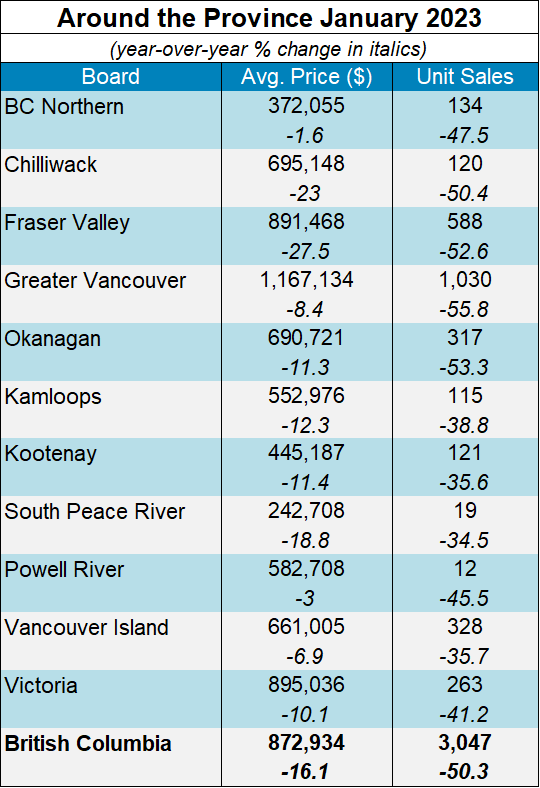
Vancouver, BC – February 14, 2023. The British Columbia Real Estate Association (BCREA) reports that a total of 3,047 residential unit sales were recorded in Multiple Listing Service® (MLS®) systems in January 2023, a decrease of 50.3 per cent from January 2022. The average MLS® residential price in BC in 2023 has seen a dip to $872,934, down 16.1% compared to the average price of over $1 million in January 2022, which was recorded near the peak of the market. The total sales dollar volume was $2.7 billion, representing a 58.3% decrease from the same time in the previous year.
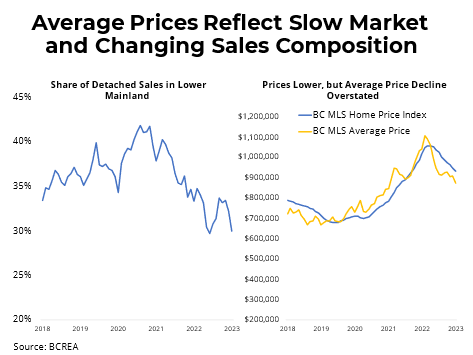
“Provincial sales are off to a slow start in 2023 as activity continues to be weighed down by high borrowing costs,” said BCREA Chief Economist Brendon Ogmundson. “While average prices have flattened out in many markets over the past few months, year-over-year measures reflect the decline that occurred from the peak in 2022, as well as a marked shift in the composition of sales away from more expensive homes.”
The total number of active listings has significantly increased compared to the record low level recorded at the start of 2022. However, at just under 22,000 total listings, the inventory of homes for sales remains well below normal for January as a scarcity of new listings in many markets has muted the impact of slow sales activity.
-30-
Provincial Housing Market Showing Signs of Recovery Heading into Spring
For the complete news release, including detailed statistics, click here.
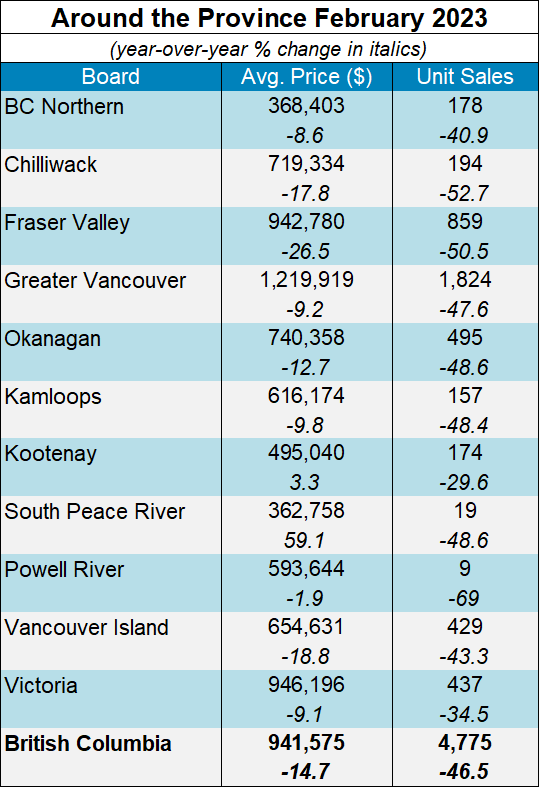
Vancouver, BC – March 13, 2023. The British Columbia Real Estate Association (BCREA) reports that a total of 4,775 residential unit sales were recorded in Multiple Listing Service® (MLS®) systems in February 2023, a decrease of 46.5 per cent from February 2022. The average MLS® residential price in BC in 2023 was 941,575, down 14.7 per cent compared to the average price of over $1.1 million in February 2022, recorded at the market's peak. The total sales dollar volume was $4.5 billion, representing a 54.4 per cent decrease from the same time in the previous year.
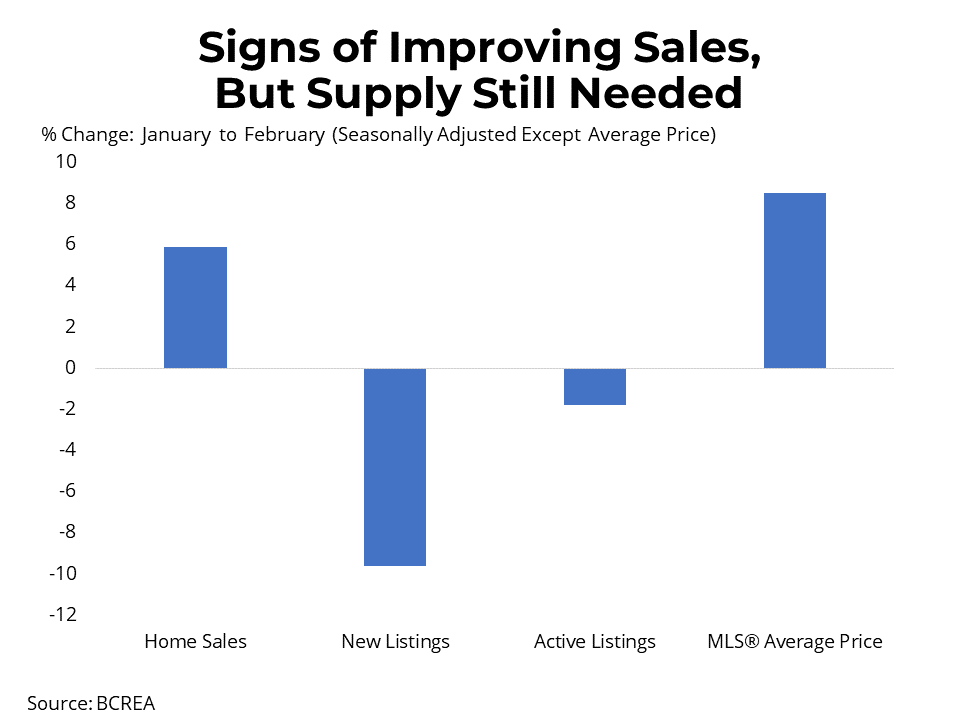
“While activity across provincial housing markets remains well below normal,” said BCREA Chief Economist Brendon Ogmundson. “There are encouraging signs that the market is balancing out. Home sales rose month-over-month in most markets, and prices appear to be firming up in the face of low supply.”
Worth mentioning, the provincial MLS® average price was up 8.5 per cent month-over-month to its highest level since July 2022, partially due to a more stable market but also because of the composition of sales reverting to a more normal mix following low sales of single detached homes through the Lower Mainland in January.
-30-
2019 BCREA Annual Report Now Available
The 2019 British Columbia Real Estate Association (BCREA) Annual Report is now available for viewing.
This year, the report was created in the form of a microsite and can be accessed at bcreaannualreport.ca.
With 2020 in full swing, the 2019 Annual Report explores the key focus areas and outcomes achieved at BCREA last year in collaboration with our partners. Most importantly, it highlights BCREA's commitment to resiliency, collaboration, and innovation so we can provide the best service to the province's 11 real estate boards and 23,000 REALTORS®.
The report includes:
- a video message from BCREA CEO Darlene Hyde and President Michael Trites,
- a year-in-review video highlighting the key organizational and departmental successes from 2019,
- a feature article with commentary from BCREA staff, and
- a link to the 2019 Audited Financial Statements.
To subscribe to receive BCREA publications, or to update your email address or current subscriptions, click here.
2021 Advocacy Year-In-Review
This year was full of significant changes for the real estate sector in BC. REALTORS® continued to navigate the challenges of the COVID-19 pandemic and many assisted communities hit by historic rainfalls in a number of ways, including fundraising to support the Red Cross.
2021 was also filled with significant government interventions impacting the sector. Here’s a recap of significant actions by the BC Government from this past year.
Cullen Continues Inquiry into Money Laundering
The Commission of Inquiry into Money Laundering in BC (Cullen Commission) continued to examine a series of sectors, including real estate, throughout 2021. BCREA Chief Executive Officer Darlene Hyde and Chief Economist Brendon Ogmundson were participants in the Cullen Commission, during which they answered questions about the real estate sector and demonstrated how BCREA has supported Realtors by equipping them with tools to help identify and combat money laundering. These tools included developing a course for managing brokers and compliance officers, and providing resources on filing Suspicious Transaction Reports and other FINTRAC requirements.
Oral submissions to the Cullen Commission ended in October 2021. The Cullen Commission was recently granted an extension for submitting their final report, which will now be published on May 20, 2022. We look forward to the release of the final report and will continue advocating for smart policy to ensure integrity and transparency in supporting Realtors to help identify and combat money laundering in real estate.
BC Real Estate Sector Moves to Single Regulator
For the second time in five years, the real estate regulatory system was restructured. In March 2021, the government passed amendments to the Real Estate Services Act, resulting in a new regulatory body for real estate, the BC Financial Services Authority (BCFSA). In addition to real estate, BCFSA also regulates credit unions, trust companies, insurance companies, mortgage brokers and pension plans.
At BCREA, we are hopeful about the potential of the shift away from a dual-regulator model, which had its challenges. We do, however, have several ongoing areas of concern that we are continuing to advocate for as we continue regular meetings with senior staff at BCFSA. We will continue to call for the creation of a Professional Standing Committee to establish licensing qualifications and provide on-the-ground insights into all proposed changes to real estate practice.
Actions Taken to Improve Housing Supply
While there is no single solution to housing affordability in BC, governments can have the greatest impact by encouraging increased housing supply. A recent BCREA Market Intelligence report estimates in March 2021, 67,000 buyers were searching for homes across BC while only 24,000 listings were available. In November 2021, total active residential listings were down 40 per cent year-over-year an all-time record low for the province. These numbers highlight the undersupplied housing market in the face of surging demand.
There has, however, been some progress made by the provincial government on increasing housing supply in the past year, including:
- speeding up local government’s development approvals processes by removing the default requirement for local governments to hold public hearings for zoning bylaw amendments that are consistent with Official Community Plans,
- enabling local governments to delegate decisions on minor development variance permits to staff so they can also work towards decreasing approval times and
- providing grants to local governments to create more efficient development approvals processes.
Undoubtedly, there is still much more to be done to reduce the imbalance between housing supply and demand in BC. We are calling for the government to implement other supply-side measures and calls to action made by the Development Approvals Process Review and the Expert Panel on Housing Supply and Affordability alongside fulsome consultation with the real estate sector.
These are just a few significant developments from the BC Government and on which BCREA will continue to focus on closely into the new year. Other policies that will reverberate into 2022 is the recently announced cooling off period and the fallout from the federal election, which included a promise by the Liberal Party to introduce a Home Buyers’ Bill of Rights.
2022 Advocacy Year-in-Review
With 2022 now in the rear-view mirror, BCREA’s Government Relations department reflects on a busy and eventful year.
2022 was filled with regulatory change and shifts in the provincial political landscape impacting the real estate sector. Public and media interest around housing affordability intensified greatly across the year, often portrayed as escalating crises. As a result, governments have felt pressured to act quickly – at times rashly, announcing policies with varying degrees of advanced research and sector collaboration.
Amidst this backdrop, the BCREA Government Relations department has adopted an increasingly research-oriented approach, adding original data and policy research to media and governmental discourse. Our goal has been and continues into 2023 to go beyond asserting opinion, but rather providing evidence-based sectoral thought leadership. Here’s a recap of our activities from the past year.
A Better Way Home
In response to the provincial government’s announcement of a Home Buyer Rescission Period, BCREA released a research-focused white paper titled “A Better Way Home.”
After months of rigorous research and analysis, the report provided 33 recommendations to improve consumer protection and transparency in the real estate transaction process. The report was released in 2022, along with a press conference and a comprehensive communications, public and media engagement plan. The campaign was well-received and extensively covered by national and regional media outlets. Many of the proposals were echoed in the BC Financial Services Authority’s (BCFSA) report “Enhancing Consumer Protection in BC’s Real Estate Market.”
Despite the aligned recommendations of BCREA and the BCFSA, the provincial government moved forward with legislative change announcing that the Home Buyer Rescission Period would take effect in January 2023. Throughout this process, BCREA worked closely with the regulator and other stakeholders to ensure that REALTORS® have the resources to understand and comply with the changes. We continue to monitor this process closely and maintain an ongoing dialogue with the regulator around real and potential issues tied to this legislation.
Provincial Government Leadership
In June 2022, Premier John Horgan announced that he would be stepping down as soon as the BC NDP elected a new leader. After the disqualification of an “outsider” leadership candidate, David Eby was sworn in as premier on November 18. During his campaign, Eby focused much attention on BC’s housing crisis, and echoed many of BCREA’s concerns about a chronic housing undersupply and protracted approval process for new housing projects.
Upon taking office, Premier Eby announced the creation of a stand-alone Ministry of Housing and appointed Ravi Kahlon as its first Minister. Other new and major cabinet portfolios went to Minister of Finance Katrine Conroy, Attorney General Niki Sharma and Minister of Municipal Affairs Anne Kang. Ministers remaining in their portfolios include Minister of Health and Minister Responsible for Francophone Affairs Adrian Dix, Minister of Public Safety and Solicitor General Mike Farnworth, and Minister of Transportation and Public Infrastructure Rob Fleming.
Having worked with Eby closely in recent years, we are optimistic about his approach in the coming year. As a policy forward, hands-on leader, we expect a closer relationship with the Premier’s office and better collaboration around potential policies in the months ahead. This is a much-needed change from the prior administration.
On the issue of housing affordability, we have spent the last few years countering the narrative that BC affordability issues are closely related to foreign ownership. The metrics simply do not support this assertion, given that foreign ownership has fallen to less than 0.5 per cent in the last two years. Our focus has been on demonstrating that a supply drought is the main causal indicator – and we have had strong success in convincing the Minister of Housing (now Premier) David Eby to adopt this position.
Under this lens, our focus increasingly turned to influencing change at the municipal level. A primary challenge point of increasing supply is inefficiencies at the municipal level. To this end, we have been and will continue into 2023 focusing efforts on change at this level of government. Streamlining approval processes, better structures to deal with the “NIMBY” attitude at the community level, and more aligned provincial leadership leveraging provincial and federal funding as being tied to regional development have been particular areas of focus.
Local Government Shake-up
In October 2022, British Columbians went to the polls to elect their local government representatives. A new wave of mayors and councillors brought significant change to many municipalities in the province.
In Victoria, the retirement of Lisa Helps brought wholesale change to council, as Marianne Alto captured the mayoralty, and a virtually entirely new council will helm the city for the next four years.
In Vancouver, Ken Sim rolled over incumbent mayor Kennedy Stewart with a resounding landslide victory, and four new councillors will join the six who were re-elected.
Wholesale change was also the theme in Surrey, with incumbent Doug McCallum and his running mates all but erased from council.
New mayors also won elections in Kelowna, Kamloops, Port Moody, Langley Township, Prince George, and Abbotsford (among others).
Union of BC Municipalities
In September 2022, BCREA attended the annual convention of the Union of BC Municipalities in Whistler. This year, for the first time, BCREA invited its member boards to participate. Real Estate Board of Greater Vancouver has been a long-time attendee on its own, and delegates from Fraser Valley, Interior, Northern and Vancouver Island all participated, making for a strong presence at the convention. BCREA created materials to hand out to delegates and hosted several important meetings on-site with various mayors and provincial officials.
Federal Foreign Buyers Ban
In much the same manner as the provincial Home Buyer Rescission Period, the federal government quickly announced and passed the Foreign Buyers Ban legislation with insufficient research or consultation.
Ottawa’s decision to release the accompanying regulations a mere ten days prior to implementation left REALTORS® across Canada scrambling to understand and comply with the new regulations. Many sectoral thought leaders (including BCREA) have drawn attention to the “political, rather than practical” nature of this policy, which is not expected to have any meaningful impact on its intended purpose to make housing more affordable for average Canadians.
What’s Coming in 2023
BCREA’s Government Relations department anticipates another intensive year amidst governmental pressure tied to issues of national housing affordability. Both the federal and provincial governments are paying particular attention to housing policy issues and are often skirting the necessary research and analysis to draft comprehensive legislation that will achieve stated goals. We will be continuing and expanding detailed, research-based advocacy on behalf of all BC REALTORS®.
We are committed to representing the voice of BC REALTORS® in advocating for the common goals of improving housing, implementing a regulatory system that works for REALTORS® and their clients, and ensuring that policies are based on evidence and adequate consultation.
To get in touch with us, please contact us at [email protected].
2023 Standard Forms Launch
The Standard Forms Launch aims to address the needs of REALTORS® in this dynamic environment by revising and creating new forms and clauses to help support the profession while minimizing the number of changes throughout the year.
Today’s release encompasses updates that ensure BCREA Standard Forms are consistent and reflect current practice requirements and the various requests received from real estate practitioners.
Some highlights of the release include:
- The addition of a new counterparts term,
- New heritage and archaeological questions in the Property Disclosure Statements,
- A new Releasing Trust Account Deposit Funds Clause,
- The use of additional language to provide greater clarity, and
- Housekeeping and formatting updates.
The revised Standard Forms and new clause are now available on CREA WEBForms®.
Prior to the release, BCREA incorporated launch process safeguards, developed a communication plan for post-launch communications, reviewed current practices for updates, and tested for quality assurance with CREA’s WEBForms® team.
BCREA extends a big thank you to all the volunteers.
Launch Package
To help prepare REALTORS® and managing brokers integrate the new and revised Standard Forms into their practice, BCREA’s Launch Package includes watermarked versions of the revised forms highlighting the changes, guides, and a summary of the revisions.
Standard Forms Toolkits and Professional Development Courses
In addition to the launch, we’ve updated the Standard Forms Toolkits page and are working with our Instructors to update our Professional Development courses on CREA’s Learning Hub (login required).
If you have form or clause-related questions, email us at [email protected].
If you have questions about CREA’s WEBForms® or require support, please email CREA at [email protected].
2023 Throne Speech Outlines BC Government’s Housing Priorities
On February 6, 2023, Lieutenant Governor Janet Austin opened the fourth session of the 42nd parliament with a Throne Speech outlining Premier Eby’s governmental priorities.
While vague in specific policy deliverables, the Throne Speech outlined several broad initiatives directly impacting BC’s real estate sector.
Increasing Housing Supply
Budget 2023, which is set to be tabled on February 28, 2023, is promised to make record-level investments in housing for middle-class families. Pointing to investment and speculation as primary causes of rising housing costs, the government plans to invest in increased housing supply and services near transit hubs province-wide.
The provincial government also intends to launch a refreshed housing strategy and work with local governments and stakeholders to ensure this strategy results in more affordable homes for middle-class families, seniors, and those with the greatest need. The fall session will introduce laws to turn this strategy into new affordable housing.
Throughout the above-noted consultation process, BCREA is committed to advocating on behalf of BC REALTORS® and ensuring the voice of REALTORS® is heard loud and clear.
Anti-money Laundering
The Throne Speech reiterated the BC government’s commitment to supporting “people who work hard and play by the rules.” It announced that legislation will be introduced to crack down on money laundering. This legislation will likely be inspired by the Commission of Inquiry into Money Laundering in BC’s Final Report.
The government promises that this year’s multi‑billion-dollar surplus will be used to support British Columbians “now and for the long term,” so we can expect many new initiatives from the BC government in the coming year.
We understand the importance of staying informed and educated on policy matters that directly impact BC REALTORS®, and we are committed to keeping you informed on the latest policy developments.
As the new provincial government rolls out these new initiatives, we are dedicated to staying at the forefront of these changes and providing REALTORS® with policy updates.
Please refer to the full Throne Speech here for more information on Premier Eby’s key governmental priorities.
2024 BC Property Assessments
The 2024 BC Property Assessments are now available online through BC Assessment, and homeowners can now check theirs on the website and expect to receive their notices in the mail by the end of January 2024.
REALTORS® are often a valuable source of information for both buyers and sellers in helping them understand tax assessments and how they are used to calculate property taxes.
"Most homeowners around the province can generally expect about a -5 or +5 per cent rise in assessment values when they receive their notices in early January,” says BC Assessment assessor Bryan Murao. “Most homeowners can expect only modest changes in the range of -5% to +5%. These assessment changes are notably less than previous years.”
It is important to note that an increase in a property's assessment value does not necessarily mean an increase in property taxes for homeowners. In most cases, property taxes are only affected if a property's value is above the average value change for the community.
If a property owner is still concerned about their assessment after speaking to a BC Assesment appraiser, they may submit a Notice of Complaint (Appeal) by January 31st, for an independent review by a Property Assessment Review Panel.
For more information about assessments and trends in your area visit BC Assessment.
Managed Forest Land
BC Assessment has also issued an Important Notice to Purchasers of Private Managed Forest Land to make them aware of two aspects of tax law that have caused significant concerns for some purchasers:
- Purchasers of managed forest land may be responsible for paying taxes on timber previously harvested by the Vendor; and,
- Purchasers of managed forest land may be responsible for paying exit fees to the Managed Forest Council if the property is removed from managed forest class.
Prospective purchasers of privately managed forest land are advised to inquire about previous timber harvesting and its potential property tax implications. Exit fees may be incurred if the property is removed from managed forest land class before 15 years of enrollment.
For more information, visit the Managed Forest Council website or contact BC Assessment at [email protected] or call 1-866-valueBC (825-8322).
2025 BC Property Assessments
The 2025 BC Property Assessments are now available online through BC Assessment, and homeowners can now check theirs on the website and expect to receive their notices in the mail by the end of January 2025.
REALTORS® are often a valuable source of information for both buyers and sellers in helping them understand tax assessments and how they are used to calculate property taxes.
"Across the Lower Mainland and throughout BC, the overall housing market has generally stabilized in value for a second consecutive year," says BC Assessment Assessor Bryan Murao. "Most homeowners can expect only modest assessment changes in the range of -5 to +5 per cent."
For the Lower Mainland region, overall assessments have generally remained flat from about $2 trillion in 2024 to $2.01 trillion this year. Almost $27 billion of the region's updated assessments are from new construction, subdivisions, and property rezoning. The Lower Mainland region includes all of Greater Vancouver, the Fraser Valley, the Sea to Sky area, and the Sunshine Coast.
It is important to note that an increase in a property's assessment value does not necessarily mean an increase in property taxes for homeowners. In most cases, property taxes are only affected if a property's value is above the average value change for the community.
If a property owner is still concerned about their assessment after speaking to a BC Assessment appraiser, they may submit a Notice of Complaint (Appeal)Notice of Complaint (Appeal) by January 31, for an independent review by a Property Assessment Review Panel.
For more information about assessments and trends in your area visit BC Assessment.
2025 Begins With Strong Sales and Listings Activity
For the complete news release, including detailed statistics, click here.
Vancouver, BC – February 13, 2025. The British Columbia Real Estate Association (BCREA) reports that 4,221 residential unit sales were recorded in Multiple Listing Service® (MLS®) Systems in January 2025, up 6.4 per cent from January 2024. The average MLS® residential price in BC in January 2025 was down 1.0 per cent at $949,560 compared to $959,191 in January 2024.

The total sales dollar volume was $4 billion, a 5.3 per cent increase from the same time the previous year. BC MLS® unit sales were 12 per cent lower than the ten-year January average.
“As expected, 2025 is off to a better start in most regions across BC,” said BCREA Chief Economist Brendon Ogmundson. “January’s pickup in sales and listings may foreshadow a stronger 2025, caveated by global uncertainties which may trigger higher or lower rates from the Bank of Canada.”
Active listings in January 2025 climbed to 30,896 units, a 27 per cent increase from the same month last year. Normalizing trends in new listings, coupled with stronger sales activity in the past few months, have led to an accumulation of inventory. Moving forward, it remains crucial for supply to keep pace with growing demand to keep markets balanced and prevent rampant price appreciation.

2025 PacificWest Experiences Designed for Managing Brokers
Managing brokers have so many things on the go and so many things to do that finding the time to sift through all the possible resources that suit their interests and growth can easily slide to the bottom of the to-do list.
On Monday, October 20, 2025, the PacificWest Managing Brokers Summit* sponsored by BCREA, is a pre-conference event offering a hand-selected treasure trove of top-of-mind subjects presented by leaders in the sector.
Featuring 16 speakers and leaders in the profession, our curated presentations are on topics like:
- Navigating Change: Leadership and the Road Ahead;
- Managing Broker Support LIVE In Person – Gloves Off, Wisdom On;
- Unlock Venture Capital and Tech Strategies; and
- Broker Power Hour: Risk Management Tools & Tips From E&O.
View the entire Managing Brokers Summit details here.
This is a great opportunity to cut through the noise, spend time expanding your expertise, network with peers, and gain practical and timely insights. Remember, the Managing Brokers Summit is an add-on ticket to the 2025 PacificWest Conference, so double-check that you select it at registration.
* eligible for three self-directed Professional Development Program hours.
Keep an eye out on BCREA’s LinkedIn page for more details over the coming weeks!
At the PacificWest trade show, our Professional Services Advisors, Marty Douglas, Ken Magel, and Jim McCaughan, along with Professionalism & Practice Initiatives Director Ryan DeLuca and Professional Development Strategy & Practice Advocacy Manager Carmen deFoy, will be onsite to host “Managing Broker Support LIVE.” This is a unique opportunity to engage with them directly, ask practice-related questions, and receive tailored advice.
Find us at trade show booth #307 and spin our prize wheel to win!
2025 PacificWest Managing Brokers Summit: Designed for Leaders Who Help Shape the Profession
Managing brokers don’t just manage offices; they help shape the future of real estate. That’s why at the 2025 PacificWest Conference, BCREA is giving you a space designed exclusively for your leadership growth and impact.
Beginning on Monday, October 20, 2025, the Managing Brokers Summit, sponsored by BCREA, is a pre-conference event. This exclusive full-day will give you practical insights on risk management, leadership, and regulatory issues – everything you need before the main event even starts. The Managing Brokers Summit is an add-on ticket to the 2025 PacificWest Conference, so double-check that you select it at registration.
Then, from Tuesday, October 21 to Wednesday, October 22, find us on the 2025 PacificWest Conference trade show floor, where BCREA’s Managing Broker Support LIVE and Communications team will be ready to connect. Whether you have practice-related questions, challenges you’re working through, or ideas on how we can better support you, we want to hear them. And if you’re a REALTOR® looking for resources to strengthen your business, we’ve also got you covered.
Don’t miss this opportunity to learn, connect, and grow!
2026 BC Property Assessments
The 2026 BC Property Assessments are now available online through BC Assessment, and homeowners can now check theirs on the website and expect to receive their notices in the mail by the end of January 2026.
"The softening housing market is being reflected in 2026 property assessments," says BC Assessment Assessor Bryan Murao. "Many homeowners throughout the Lower Mainland can expect some decreases in assessed value with most changes ranging between -10% to 0%."
“Vancouver Island and the Southern Interior are generally flatter in value with changes ranging between -5% to +5% while the North and the Kootenays are varying more broadly in the -5% to +15% range," adds Murao.
For the Lower Mainland, total assessments have decreased from about $2.01 trillion in 2025 to about $1.92 trillion this year. Almost $24 billion of the region's updated assessments is from new construction, subdivisions and the rezoning of properties.
The REALTOR® Role
REALTORS® are often a valuable source of information for both buyers and sellers in helping them understand tax assessments and how they are used to calculate property taxes.
It is important to note that an increase in a property's assessment value does not necessarily mean an increase in property taxes for homeowners. In most cases, property taxes are only affected if a property's value is above the average value change for the community.
If a property owner is still concerned about their assessment after speaking to a BC Assessment appraiser, they may submit a Notice of Complaint (Appeal) by Monday, February 2, 2026, for an independent review by a Property Assessment Review Panel.
For more information about assessments and trends in your area, visit BC Assessment.
Managed Forest Land
BC Assessment has also issued an Important Notice to Purchasers of Private Managed Forest Land to make them aware of two aspects of tax law that have caused significant concerns for some purchasers:
- Purchasers of managed forest land may be responsible for paying taxes on timber previously harvested by the Vendor; and,
- Purchasers of managed forest land may be responsible for paying exit fees to the Managed Forest Council if the property is removed from managed forest class.
Prospective purchasers of privately managed forest land are advised to inquire about previous timber harvesting and its potential property tax implications. Exit fees may be incurred if the property is removed from managed forest land class before 15 years of enrollment.
For more information, visit the Managed Forest Council website, or contact BC Assessment at [email protected] or 1-866-valueBC (825-8322).
2026 Flood and Wildfire Season: What You Need to Know
Every year, the Earth does its best to remind us that “Yes, climate change is a real thing,” by increasing the frequency and intensity of atmospheric rivers, heat waves, and wind events, which – in turn – increase the frequency and intensity of floods and wildfires.
Here’s what you need to know about these extreme weather events as we get into spring and summer.
When Are Floods and Wildfires Most Likely to Occur in BC?
As we’ve seen with the recent atmospheric river event, floods can happen at any time of year in BC. However, according to ClimateReadyBC, the most severe floods usually occur in spring and early summer due to heavy rain and melting snow.
Meanwhile, the BC wildfire season typically runs from the spring to the fall, with peak danger coming in the summer.
What Will 2026 Hold for Floods and Wildfires in BC?
While it’s impossible to accurately predict the severity of an upcoming flood or wildfire season, one big variable that we can observe is the amount of the snowpack. The Province has a network of Automated Snow Weather Stations (ASWS) and regularly updates a webpage that provides a bi-weekly summary of snow conditions, graphs, links to other sites, and more.
So, if you’re a true geo-climatological geek, check out the site and amaze your friends, family, and co-workers with obscure trivia about the current level of the snowpack in your local mountains.
All kidding aside, the snowpack has a dramatic influence on both flooding and wildfires. Obviously, a very high snowpack, coupled with a rapid melt (due to a sudden spring heatwave) can result in high freshet volumes and potential for downstream flooding. For example, regions in northern BC currently have snowpack levels exceeding 100 per cent of normal levels.
On the other hand, areas with below-average snowpack levels are at higher risk of a severe wildfire season. Less snow means that soil will dry out faster, resulting in higher potential for early-season fires, or even reactivation of “zombie fires,” which can remain active underground through the winter. Also, a low snowpack makes a region more vulnerable to mid-late summer drought conditions by eliminating the moisture buffer that makes the soil more resistant to drying.
Much of BC is currently experiencing lower-than-average snowpack levels, the worst being Vancouver Island (48 per cent of normal snowpack levels), West Chilcotin (49 per cent), South Coast (61 per cent), and the Okanagan (62 per cent).
What Other Predictive Tools Exist?
The Province has also developed the BC Disaster and Climate Risk and Resilience Assessment to help residents understand the potential risks they face from various climate hazards in their region. This webpage helps inform the public, as well as equips REALTORS® with tools to assess the impacts of these hazards and guide clients with their buying and selling decisions.
With extreme weather events on the rise, our sector has a clear obligation to ensure buyers and sellers make informed, “eyes-open” decisions about exposure to climate-related risks across regions, neighbourhoods, and individual properties.
2026 Kicks Off With Weak Sales Activity
For the complete statistics release, including detailed tables, click here.
Vancouver, BC – February 11, 2026. The British Columbia Real Estate Association (BCREA) reports that 3,314 residential unit sales were recorded in Multiple Listing Service® (MLS®) Systems in January 2026, down 22.9 per cent from January 2025. The average MLS® residential price in BC in January 2026 was down 1.9 per cent at $924,239 compared to $942,384 in January 2025.

Total MLS® residential sales dollar volume was $3.06 billion, down 24.4 per cent from the same time the previous year. BC MLS® unit sales were 30.97 per cent lower than the ten-year average for the month of January.
“British Columbia’s housing market kicked off 2026 with its second weakest January since 2016, with sales in almost every region falling short of historical averages,” said BCREA Chief Economist Brendon Ogmundson. “Despite a slow start, we expect stable rates and improved affordability conditions to release pent-up demand with sales picking up over the course of 2026.”
Active listings in January 2026 climbed to 32,626 units, a 5.6 per cent increase from the same month last year. Weak sales activity over the past several quarters have led to an accumulation of inventory, which should accommodate demand pressures in the short term. However, dampening sentiments concerning new home construction in BC leave the housing market vulnerable to long-term demand growth, a pattern which will be monitored over the next few years.

5 Things REALTORS® Can Learn from Uber
By Victor Khong, REALTOR®
Uber has finally arrived in BC! While it may appear to be an industry disruptor, what it really offers is as old as time: exceptional customer service. Here are five things REALTORS® can learn from this so-called industry disruptor:
1. Provide timely communication – Part of the appeal of Uber is how much communication you receive about your ride. Uber lets you know what you’ll be charged upfront, when the car will be there and when it arrives, and even prompts you to rate your driver at the end of your journey. This shows the importance of timely and consistent communication with your clients throughout a transaction. From initial contact to completion, consumers want to know where they are en route to their destination.
2. Smooth the process (without reducing your fiduciary duties) – Uber makes the process smooth and straightforward for their customers, without cutting any corners. When looking for ways to ensure a smooth and seamless experience, make sure you take the time to get to know your clients and understand what’s important to them. For example, some clients prefer the convenience of electronic signatures, while others want the security of signing in person.
3. Be accountable – Just as Uber sends its customers an electronic receipt with the fare breakdown and route taken, your workflow should document and communicate your efforts to your clients. For example, the Disclosure of Remuneration form for buyers and the Disclosure to Sellers of Expected Payment form for sellers are accountability tools.
Uber also gives every customer a chance to review their driver and takes this feedback seriously (Uber will de-activate drivers who have cumulative ratings of 4.6 or below). Similarly, it’s a great idea to conduct a completion interview at the end of every transaction and use the feedback you receive to hone your skills and process.
4. Offer added value – Uber understands that value isn’t all about saving money. REALTORS® who offer negotiation strategies and advice on market price, and perform the due diligence of investigating title, land use, compliance, and material latent defects, provide their clients with added value. Make sure to invest in your education and continue to grow your skillset so you can ensure this added value for your clients.
5. Embrace change – Ultimately, the only constant in life is change and the real estate industry will continue to change and grow, just as the ride-hailing industry will evolve over time. In the same way Uber will adapt to meet the needs of its customers, be flexible in your approach, stay current on real estate and consumer trends and embrace industry best practices in the face of change.
To subscribe to receive BCREA publications, or to update your email address or current subscriptions, click here.
A Bad Inspection Report #460
When a buyer refuses, for a legitimate reason, to remove a subject clause because of a bad inspection report, what is the listing licensee to do with that knowledge?
This was the issue in a recent case where the court found the listing licensee liable for $47,000 in damages for failing to fully tell subsequent buyers about problems revealed in an earlier inspection report.
In Gundersen v. Savoy, the property was a modified single-wide manufactured home on land near Cranbrook1. The sellers had built an addition to the home.
In June 2004, the sellers listed the property. In their Property Disclosure Statement (PDS), the sellers said they were not aware of any moisture problems.
In February 2005, the sellers accepted an offer subject to inspection. When the buyer received a negative inspection report, she collapsed the deal. In his report, the inspector cited some mildew in the basement under the addition. The inspector said that a vapor barrier should be installed over the exposed earth under the home, and the area treated with a solution to kill mildew. He also found that the furnace was too small. Later, the buyer's agent told the listing licensee that the buyer collapsed the deal because the inspector reported mould in the home. With the inspector's report in mind, the sellers took steps to repair the problem by covering the exposed earth with poly and applying a mildew-killing solution.
In January 2006, new buyers viewed the home twice. On January 29, the sellers entered a Contract of Purchase and Sale to sell the property for $178,000 to the buyers. There was no subject-to-inspection clause in the contract. The sellers also updated their PDS to certify they were not aware of any moisture or water problems in the walls, basement or crawl space.
When the buyers moved in, they discovered widespread mould and mildew. For health reasons, they apparently abandoned the home after roughly six months. The buyers sued the sellers, the listing licensee and his brokerage. The court dismissed the claim against the sellers, but found the licensee liable for deceit. The brokerage was vicariously liable for its licensee.
At trial, the listing licensee claimed that he told the buyers that the black poly was there because the earlier inspector had noticed mildew on the underside of the addition. He testified that he told the buyers that the sellers had received advice to spray underneath the floor with a solution, and to insulate and cover the area with a vapour barrier. According to the licensee, he told the buyers that the sellers had apparently remediated the mildew problem on the inspector's instructions. He also told them the furnace was too small. The licensee testified that this was when the buyers decided to proceed without a subject-to-inspection clause.
The court, however, preferred the buyers' evidence, rejecting the licensee's version. The wife of the buying couple testified that when they suggested making their offer subject to inspection, the listing licensee said that an inspection had already been done, and that all was fine except the furnace was too small. She was adamant – the furnace was the only deficiency that the listing licensee told them about.
The court found that the licensee persuaded the buyers by half-truths not to seek an inspection, when he knew that an inspection would be prudent, especially given the property's mildew history. The court said that if the licensee really believed that the seller had remediated the property, he should have told the buyers about all of the inspector's findings. Instead, the licensee edited his information, keeping silent about that which might worry the buyers most.
Generally, whether a seller responds to a legitimate negative inspection by repairing the problem or not, the listing licensee should disclose the situation to a later buyer. The licensee should also consider whether the problem is a material latent defect within Section 5-13 of the Real Estate Council of British Columbia Rules2, in which case the licensee must disclose the situation in writing before the buyer enters an agreement to buy the property.
| 1. |
|
|
| 1. | Licensee Rules. |
To subscribe to receive BCREA publications such as this one, or to update your email address or current subscriptions, click here.
A Better Way Home: BCREA, Boards Publish Sweeping Recommendations for Government to Address Challenges in BC’s Housing Market
The British Columbia Real Estate Association (BCREA), with support from the province’s real estate boards, has published a white paper and series of sweeping recommendations for the BC Government aimed at addressing current concerns with the province’s housing market, the real estate transaction process and consumer protection.
The white paper, called A Better Way Home: Strengthening Consumer Protection in Real Estate, offers more than 30 recommendations spanning four areas: addressing housing supply issues, enhancing consumer protection in real estate transactions, evolving the real estate sector and contributing to the creation of a world-leading regulatory structure. It incorporates findings from seven focus groups with consumers and REALTORS®, years of survey data, and a detailed analysis of economic and secondary literature, including the impacts of attempted housing market interventions worldwide.
“BCREA shares consumer and government concerns that current housing market conditions are untenable. Our recommendations include long-term measures to create more housing options for British Columbians, as well as immediate steps to give consumers in the market today more peace of mind,” says BCREA Chief Executive Officer Darlene K. Hyde. “As the voice of BC’s 24,000 Realtors, we want consumers to have full confidence in real estate transactions.”
BCREA’s recommendations to support consumer confidence in real estate transactions include:
- Giving buyers time to research a property before making an offer by introducing a mandatory “pre-offer period” of a minimum of five business days from when a property is first listed. During this period, offers cannot be made.
- Helping consumers make more informed decisions in multiple offer scenarios by collaborating with real estate sector stakeholders to establish a process that balances offer transparency for buyers with privacy concerns.
- Ensuring prospective buyers have immediate access to relevant information by making property disclosure statements mandatory and available upon listing.
- Mandating that all documents related to strata transactions are made available with the listing, including strata bylaws, depreciation reports, status of contingency funds, strata council correspondence and the Form B.
- Raising entry qualification standards for new licensees to ensure consumers are supported by a profession that is evolving along with the changing market.
While A Better Way Home is based on years of feedback, data and market analysis collected by BCREA and regional real estate boards, we have published it in response to the government’s announced plans to introduce a mandatory “cooling off period” in real estate transactions as soon as this spring. We are deeply concerned that this decision was made without first conducting thorough public consultations with the real estate sector and consumers, a problem statement or supporting rationale.
BCREA supports measures to increase consumer protection in real estate transactions, but it must be done in a way that is evidence-based, regionally nuanced and considers buyers, sellers and changing market trends. Without these best practices, policies are likely to result in unintended negative consequences for consumers and the real estate market as a whole.
“A ‘cooling off period’ is not the answer to alleviating the stresses consumers are currently facing in real estate transactions,” adds Hyde. “It won’t stand the test of changing market conditions, regional market differences and doesn’t equally serve buyers and sellers. It also does nothing to address the root of BC’s housing affordability problem; namely, lack of supply.”
An analysis of “cooling off periods” in other global jurisdictions has shown the policy to be ineffectual at best. The provincial government announced plans for a “cooling off period” in real estate transactions on November 4, 2021, without broad consultation with the housing sector. BCREA strongly believes that consumer interests are best served when the government invites in-depth input from housing sector stakeholders before announcing potential policies.
“With access to extensive data and expert analysis on housing market conditions, on-the-ground insights into consumer experience, close working relationships with other housing sector stakeholders, and a commitment to enhancing consumer confidence in the Realtor profession, BCREA is uniquely positioned to support the government in identifying a ‘better way home’ for all British Columbians,” says Hyde.
To read BCREA’s whitepaper and view the full list of recommendations, visit bcrea.bc.ca/betterwayhome.
To download a media kit, visit bcrea.bc.ca/betterwayhomemedia.
Additional Quotes:
“We support measures that strengthen consumer protection and improve housing affordability and supply in our region. To find policy approaches that benefit current and hopeful home buyers as well as home sellers and owners requires a thorough understanding of how real estate transactions occur at every stage. Policymakers can only strike this delicate balance by consulting industry experts. This is why we urge our regulator and provincial government to deeply consider BCREA’s recommendations before implementing new requirements for home buyers and sellers in BC to follow.”
Taylor Biggar
Chair, Real Estate Board of Greater Vancouver
“The BC Government’s recently announced “cooling off period,” while well-intentioned, may result in unintended consequences. We’ve seen in the past that well-meaning proposals such as the vacancy tax, speculation tax, and foreign buyers’ tax have done little, if anything, to stem a burgeoning market. The issue is supply, plain and simple. The government has ambitious plans to increase housing inventory by 114,000 units over the next decade. To put this in perspective, to achieve a balanced market would require an inventory injection of 25,000 additional units today. This is a fundamental challenge and by an order of magnitude far greater than any stop-gap measure like a “cooling off period" could address.
“Today’s record housing market is driven not by any single element. It’s the result of a combination of factors: rock-bottom interest rates, major shifts in lifestyle and work habits due to a global pandemic and record low inventories. This is an issue of complex interdependencies in need of an equally well-formed strategy to resolve. If we are to achieve a long-term solution, we require a coordinated, collaborative approach, one that includes all stakeholders – regulators, Realtors, builders, and local governments – as equal partners.
“Fraser Valley Realtors have been an integral part of building communities for the past 100 years. We’ve been through numerous market peaks and troughs over the decades. We bring proficiency and insight into the mechanics and workings of real estate market transactions and a particular expertise in understanding what drives market trends, including the all-important intangible elements. This knowledge is critical if we are to establish a solution with staying power.”
Larry Anderson
President, Fraser Valley Real Estate Board
“The BC Northern Real Estate Board supports BCREA’s recommendations to enhance consumer protection and improve housing affordability. The "cooling off period" recently announced by the BC Government was made without consultation from the real estate sector and appears to be a “one-size-fits-all” solution based on current market conditions in specific parts of the province.
“However, markets conditions vary across time and geography, especially in the north where there are currently buyer, seller and balanced markets. A poorly planned policy could undermine consumer protection in the face of a swiftly changing environment. We ask the government and regulator to review BCREA’s recommendations and to consider the protection of all consumers, both buyers and sellers, regardless of where they reside.”
Alex Goseltine
Executive Officer, BC Northern Real Estate Board
Media contact:
Shaheed Devji
Sr. Communications Specialist
778.847.7424
[email protected]
A breach of Section 73 of the Land Title Act #255
By Gerry Neely
B.A., LL.B.
A recent Court of Appeal decision concerning the validity of a lease, while affecting only a few landlord/tenant relationships, may have serious consequences for those few. The property in the lease in question was part of an unsubdivided larger parcel of the landlord's land. A building was erected on the part.
After a series of disputes which led to the landlord's refusal to renew the lease, the tenant brought an action to force the landlord to do so. The landlord's defense was that the lease was illegal because it was in breach of section 73 of the Land Title Act.
Section 73 states that except in compliance with the Land Title Act, no person shall subdivide property into smaller parcels for the purpose of ... leasing it for a term exceeding three years. The term of the lease was 51 months. The Land Title Act deines subdivision to mean a division of land into two or more parcels by plan, apt descriptive words, or otherwise. By this definition the landlord's property was subdivided when the parties signed the lease. Since none of the governmental consents that may be required for a subdivision were obtained, the subdivision did not comply with the Land Title Act.
The reason why section 73 may only affect a few leases is because it does not apply to a lease of a building, or part of a building.
The Court of Appeal agreed that the lease was illegal because it was made in breach of the public policy underlying the prohibition contained in section 73. That public policy is the regulation of land development and its use in the public interest, which can only be protected if municipalities and other governmental authorities responsible for zoning and related public interests retain control of the process of subdivision.
Italso decided not only that an illegal lease cannot create a leasehold interest in the land, but that the parties could not enforce the contractual rights and obligations contained in the lease. (For example, the landlord's right to receive rent, and the tenant's right to possession or renewal.)
A significant fact upon which the Court of Appeal based its decision, was that neither party was aware of the requirements of section 73. If the landlord had such knowledge and deliberately broke the law, the court would have found it very difficult to allow the landlord to repudiate its obligation to renew the lease, and might have tried to find some way to support the tenant's rights.
The Law Society thought the case to be sufficiently important that it brought it to the attention of lawyers with the suggestion that they advise their clients, both landlords and tenants, of the need to review existing leases that may now prove to be unenforceable.
One example of illegal leases may be found in the purchase of recreational property by a group of individuals in the name of a company of which they are the shareholders. Subdivision in the customary manner is unobtainable. The company then leases to each individual an area of land which each is entitled to occupy exclusively.
Or, a one-story, non-strata titled warehouse building is divided into separate units, each of which is then leased together with the land in front of each tenant's unit. Each tenant has the exclusive right to the use of this land. This appears to fall within the section 73 prohibition. If the tenant does not have exclusive use, but only a right to access and parking, the lease would be outside the section 73 prohibition.
What is the validity of a lease in which, as is often the case, the tenant is given the exclusive right to a number of parking spaces? Does this mean that if the spaces are within the building, the, lease is valid, but if they are outside, the lease is illegal?
Since this would be an absurd result the courts may accept one or two arguments in support of the validity of the lease. The first is that the general public interest underlying section 73 is not harmed by inclusion in a lease of exclusive parking rights in favour of a tenant. The second argument would be that since section 73 does not apply to a lease of a building, or part of a building, the granting of exclusive parking rights is too minor and ancillary to the main purpose of the lease to be a breach of section 73.
Factors a court may have to consider will be the size and use of the land in relation to the building. If Supreme Court judges concluded that they have to follow strictly the decision of the Court of Appeal, then an amendment to section 73 which has been part of the Land Title Act since 1915, will be needed to provide a balance in favour of individual rights.1
| 1. |
|
To subscribe to receive BCREA publications such as this one, or to update your email address or current subscriptions, click here.
A Brief Note on New Listings Activity in 2023
Summary of Findings:
- New listings in BC have fallen to 25 per cent below pre-pandemic norms.
- Most of the explanation for low listings is due to overall slow market activity, but a multi-decade high interest rate differential between old and new mortgages is playing a role.
- The situation should resolve with time, but the current period further highlights the structural problem of chronically undersupplied housing markets, which results in volatility and susceptibility to demand shocks.
The post-pandemic housing market has been notable for its stubborn refusal to track expectations. One of the most interesting and unexpected recent housing market trends has been the lack of new listings, which have been trending well below average in all areas of the province since the start of the year. At first blush, the lack of new listings is indeed counterintuitive. With borrowing costs at decade highs and high inflation squeezing household budgets, it seems reasonable to assume that new listings would hold steady, or even rise, as some overburdened households were forced to sell their homes. Instead, new listings have declined substantially in housing markets across Canada.
In this Market Intelligence, we show that the pattern of new listings we see is, in fact, a usual outcome of current market dynamics and underlying economic fundamentals. Contrary to expectations, we show that a sharp rise in interest rates has historically been a deterrent to homeowners’ listing their homes.
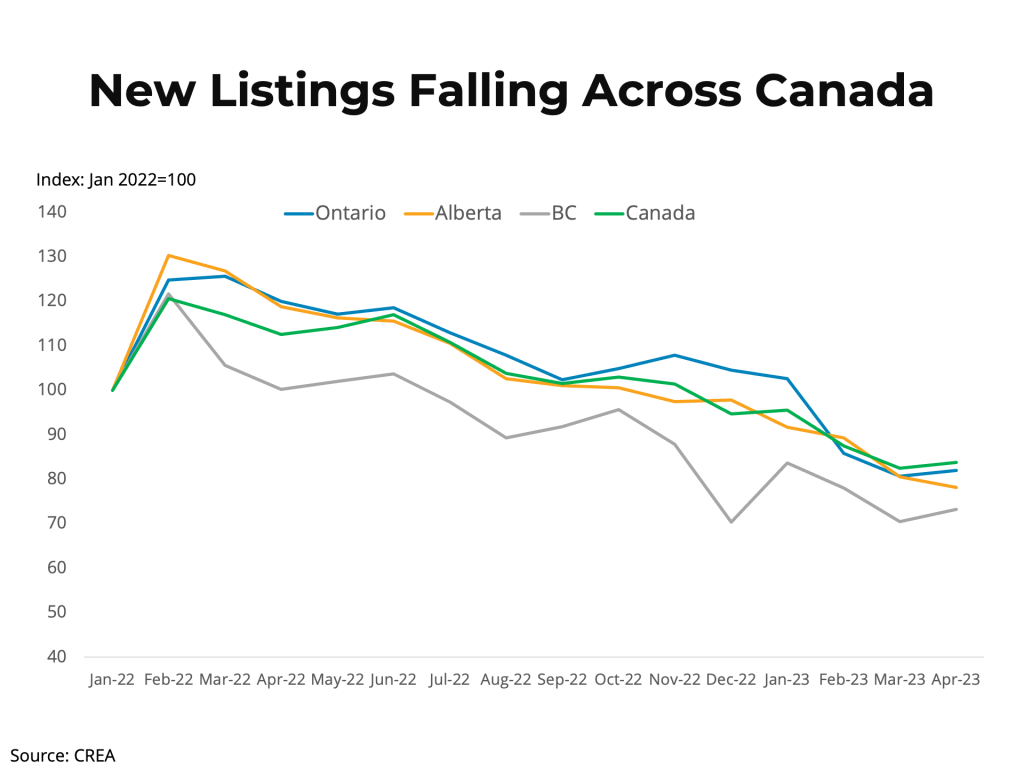
For more information, please contact:
Brendon Ogmundson
Chief Economist
604.505.6793
[email protected]
A Commercial Expert and An Elaborate Marketing Scheme #254
By Gerry Neely
B.A., LL.B.
An Ontario real estate salesperson made a number of material errors in an eighteen page brochure, prepared by him as part of an elaborate marketing scheme. Three of these, which led to particularly important misrepresentations, were sufficient to allow a buyer to rescind an accepted offer. The salesperson represented that he was an expert in commercial real estate listings, who had gained a reputation in his "one-year" as a salesperson, for the preparation of detailed marketing plans.
In a trial in which damages of $635,000 were awarded against the agency and the salesperson, the judge held that the salesperson had breached his duty to the sellers by failing to:
1. confirm in writing from the municipalities the three important representations in the brochure;
2. advise the sellers that the representations made by him as their agent in the brochure would be binding upon the sellers, and that misrepresentations made by him would give a buyer the right to rescind the contract;
3. insert a waiver or disclaimer in the brochure.
Number 1 elevates a prudent practice to a positive duty.
Had the salesperson obtained these confirmations the errors should have been discovered and the problems resolved.
The duties referred to in number 2 are surprising, since they appear to be matters of law, which should be the responsibility of the lawyer acting for the sellers. Perhaps all the judge meant in this case was, that if this advice had been given to the sellers, they might have paid more attention to the details of the brochure.
It is unlikely that this duty would apply to an ordinary residential listing, but where does one draw the line? Licensees do have some responsibilities as professionals, familiar with contracts dealing with real estate, to be aware of some of the consequences of their actions and to explain them to their principals. An example is, in my opinion, the duty of a licensee to advise a party intending to make a counter offer that if that is done, the other party has the right to revoke the offer.
The agency was liable for failing to adequately superviseits salespersons and for lacking a policy requiring a waiver or disclaimer in the brochure. The reference to the disclaimer came asa result of a second brochure prepared by the salesperson when the first sale collapsed. It contained a very prominent disclaimer of liability.
This is not a common practice, but there is no doubt that adding a waiver or disclaimer can be of value to a seller. An instance of an effective disclaimer is discussed in Column #102 (April, 1987), which is repeated below.
"Above information is from sources believed to be reliable, but should not be relied upon without verification. N.R.S. assumes no responsibility for its accuracy."
The courts interpret disclaimers strictly against the person relying upon them as a defense. Therefore, the wording of the disclaimer must be carefully drawn, preferably by a lawyer acting for the client.
The judge's findings may be limited by the facts because the more expert the licensee, and the more elaborate the marketing strategy, the higher the duty.1
***
Column #249 referred to an assessment of tax by Revenue Canada of a licensee who waived his commission for an equivalent reduction in the sale price of property sold to a friend. That created correspondence and telephone calls with the single message, "Revenue Canada can't do that to us, we still have the right to work for nothing whether we want to or not." Discussions with a tax lawyer indicated that it must have been a peculiar transaction which led to this assessment, and speculation that perhaps there was some benefit to the salesperson.
***
A lawyer wrote to ask if there is any better way by which a deposit, in excess of a commission can be paid over in a timely manner to avoid a delay in registration which, in his case, almost gave the sellers the right to repudiate their sale. The sale involved a quick closing and barely sufficient time to have the consents of both the sellers and buyers delivered to the agency holding the deposit. His suggestion was that the agent or agents involved in the transaction have the parties sign the consents once an unconditional offer is accepted, or when the conditions have been removed from a conditional offer. These should be appropriate times since the names of the conveyancers acting for the parties must also be obtained for the sales record sheet.
| 1. |
|
To subscribe to receive BCREA publications such as this one, or to update your email address or current subscriptions, click here.
A Consumer’s Guide to Home Energy Retrofits
Energy retrofits are more than just a buzzword; retrofits are a smart investment for homeowners, offering a range of benefits beyond just lowering energy costs. Retrofitting involves upgrading existing homes to improve their energy efficiency, making them more sustainable and comfortable in the long run.
What is Retrofitting?
Retrofitting your home involves making modifications to improve its energy efficiency and sustainability. This can include upgrading insulation, replacing old appliances and heating equipment with energy-efficient models, sealing air leaks, and installing smart thermostats. The goal is to create a more comfortable, healthier living space while reducing energy bills.
Why Retrofit Your Home?
Improve Comfort: Retrofitting can enhance your home comfort by reducing drafts, maintaining consistent temperatures, and improving humidity control.
Increase Energy Efficiency: By upgrading to energy-efficient appliances and equipment, you can significantly reduce your energy consumption and lower your utility bills.
Improve Air Quality: Upgrading ventilation systems and using eco-friendly materials can improve indoor air quality, reducing allergens and pollutants.
Eliminate Fossil Fuels: Transitioning to renewable energy sources like solar panels or heat pumps can help reduce reliance on fossil fuels, contributing to a cleaner environment.
Increase Home Value: Energy-efficient homes are in high demand, and retrofitting can increase the resale value of your property while attracting eco-conscious buyers.
Retrofit 101
Navigating the retrofitting process can seem complex, but the Community Energy Association, in partnership with the City of Port Moody, the Capital Regional District, the Regional District of the East Kootenays, and BCREA, as well as funding from BC Hydro, has created a series of resources and materials consumers, REALTORS® and contractors can use to support their clients in their retrofitting journey.
Visit the Community Energy Association Retrofit 101 page for more guides, videos, and expert advice.
A Developer Must Disclose All Amendments to a Disclosure Statement #431
An anticipated result of the current economic situation has been in increase in litigation concerning condominium unit pre-sales. One such recent B.C. Supreme Court case relieved an unhappy purchaser from his obligations under the purchase agreement because the purchaser did not receive all of the amendments to the disclosure statement at the time of purchase.1
In October 2007, the developer provided the purchaser, who was interested in buying a condominium unit, with a disclosure statement dated September 2005. However, the developer did not provide three amendments that had been made to the disclosure statement between September 2005 and October 2007. The purchaser subsequently entered into a purchase agreement for the unit accompanied by a $350,000 deposit. However, after gaining access to the partially completed unit, the purchaser realized that the view was not as represented. He also became aware of the three undisclosed amendments. He wrote to the developer, enclosing a notice of rescission and demanding the return of the deposit on the grounds that the developer had breached its obligation under the Real Estate Development Marketing Act (“REDMA”) to ‘provide a disclosure statement to a purchaser before entering into a purchase agreement’.
The purchaser argued that, under REDMA, an amendment to a disclosure statement becomes part of the disclosure statement and must be delivered at the time of purchase. The developer, while not disputing that the amendments had not been provided, claimed that a purchaser should not be able to rescind unless there has been a significant change in the developer’s promise or information regarding the development. It pointed to the distinction in REDMA between filing a new disclosure statement (required where there has been a material change to the value, price or use of a development unit or where the superintendent so requires) and an amendment to an existing disclosure statement (required in other cases, where the change is not material). It urged the court to find that this distinction limits a purchaser’s right of rescission to cases where the developer fails to deliver a new disclosure statement that discloses a material change.
The court did not accept the developer’s argument. It concluded that REDMA is consumer protection legislation and one of its primary objectives is ensuring that developers provide purchasers with all material facts when developments are being marketed. It found that the disclosure requirements of REDMA are not limited to material facts and all amendments to a disclosure statement must be disclosed as the purchaser is entitled to know what he or she is purchasing. The court found that REDMA’s definition of ‘disclosure statement’ included amendments and thus both the original disclosure statement and any amendments must be delivered to a purchaser. It held that REDMA provides a right of rescission to any purchaser who is entitled to a disclosure statement, including amendments, and does not receive it before entering into a purchase agreement.
Ultimately, the court found that the distinction between filing a new disclosure statement and amending an existing one does not affect a purchaser’s right of rescission. The court was of the view that requiring developers to provide copies of existing amendments along with the disclosure statement does not impose an onerous burden on them and is consistent with the legislative objective of consumer protection.
Yet to be decided is the developer’s claim against the listing brokerage for failing to provide the amendments to the purchaser although the listing brokerage alleges that it was specifically instructed not to do so.
| 1. | Dwane v. Bastion Coast Homes Ltd, 2009 BCSC 726. |
To subscribe to receive BCREA publications such as this one, or to update your email address or current subscriptions, click here.
A Guide to Recessions and the BC Housing Market
To view the latest Market Intelligence report PDF, click here.
As the Bank of Canada aggressively raised rates over the past year to fight multi-decade-high inflation, fears are mounting that tighter monetary policy will push the Canadian economy into recession. Indeed, central banks have a poor historical track record in achieving “soft landings” following tightening cycles. That is, amid high inflation, central banks often struggle to “thread the needle” of raising rates enough to bring inflation back down to 2 per cent without tipping the economy into a recession.
In this Market Intelligence, we summarize how past Canadian recessions have impacted the BC economy and housing market and look forward to how the BC housing market may perform during a potential 2023 recession.
Summary of Findings
High interest rates mean that recession anxiety is mounting:
- Historically, home sales tend to lead the business cycle, starting to decline many months before the start of a recession. By the time the recession begins, sales are typically near their nadir.
- Prices follow a less predictable pattern surrounding recessions. The early 1980s involved a large run up and crash in prices, but subsequent recessions involved a modest softening or plateauing of prices before the ascent resumed.
- Historically, home sales tend to post substantial recoveries following a recession as interest rates are cut to support the economy.
- Strong economic fundamentals and demographics support the housing sector in British Columbia.
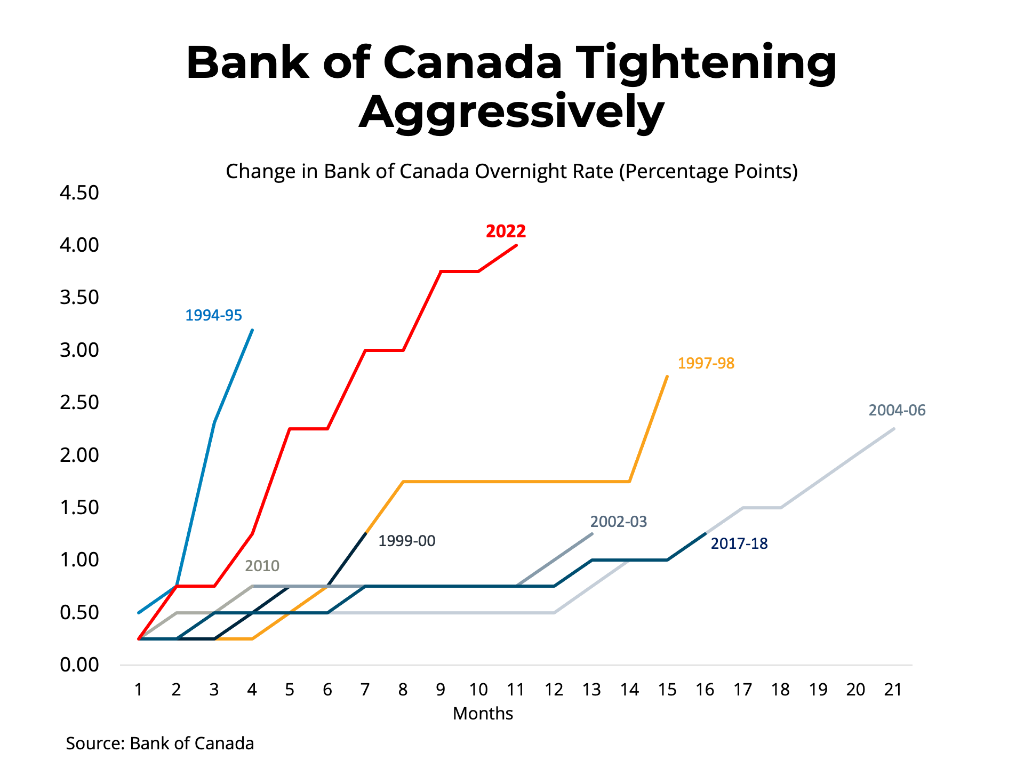
For more information, please contact:
Brendon Ogmundson
Chief Economist
Direct: 604.742.2796
Mobile: 604.505.6793
[email protected]
A Guide to Understand Home Energy Retrofits
Energy retrofits are more than just a buzzword; they represent a great way to lower energy costs for homeowners. Retrofitting involves upgrading existing homes to improve their energy efficiency, making them more sustainable and cost-effective in the long run.
REALTORS® familiar with retrofit benefits can help homebuyers and sellers make informed decisions about energy-efficient properties.
What is Retrofitting?
Retrofitting involves modifying a home's energy efficiency. This can include upgrading insulation, replacing old appliances and space and water heating equipment with energy-efficient models, sealing air leaks, and installing smart thermostats. The goal is to create a more comfortable, sustainable living space while lowering energy bills.
Retrofit 101
Navigating the retrofitting process can seem complex, but the Community Energy Association, in partnership with the City of Port Moody, the Capital Regional District, the Regional District of the East Kootenays, and BCREA, as well as funding from BC Hydro, has created a series of resources and materials REALTORS® and contractors can use to support their clients in their retrofitting journey.
Visit the Community Energy Association Retrofit 101 page for more guides, videos, and expert advice.
A Judge’s Guide to Whim and Fancy, or Best Efforts Clauses; Seller Had to Have Actual Knowledge of Default, Not Deemed Knowledge of Agent, to Be Liable Under Contract; Note Re: Legally Speaking 332 #333
By Gerry Neely
B.A. LL.B.
In one case, the conditional clause in a Contract of Purchase and Sale required the buyer to satisfy himself as to the tax implications of Canadian/USA/international law upon his purchase of Canadian property. The buyer lived and worked in California, and the purchase monies from an inheritance were to be transferred to Canada from Iran.
This was such a broad area of law, and the buyer's decision to remove or not remove the condition was so subjective, that it was impossible for a judge to determine whether the buyer acted reasonably in not removing the condition. This fell within the whim and fancy type of conditional clause and the judge held that the contract was not enforceable.
The unusual aspect of this case was that the owner sold the property to another person, who took the title unaware of the first contract. The lawsuit was between the disappointed buyer and the titleholder, who kept the property because of the judge's decision.1
In another case, the conditional clause required the buyer to obtain approval for building plans and permit to build. The plans were submitted, then withdrawn, and the condition was not removed. When the seller sued for the deposit, the evidence disclosed that the real reason for the buyer's withdrawal was his acceptance of a job in another city. This condition is a typical best efforts clause, which doesn't depend solely upon a buyer's subjective decision. It is narrow enough in its scope that the factors involved in the buyer's decision not to remove the condition can be examined.2
***
The importance the court attaches to the exact wording of a contract is illustrated in a case involving the sale of a large office building for $12,550,000, and how the addition of one word saved a seller approximately $90,000. The seller covenanted that, to his "present actual knowledge," the office leases were in good standing at the date of the contract and at the date of closing, unless the seller disclosed in writing that a tenant had defaulted before the latter date.
Two weeks prior to closing, the seller's property manager discovered a tenant had vacated without notice, which was a breach of the lease. The seller was not aware of this. The buyer took 14 months to find a new tenant and sued for loss of rent, tenant inducements, and commission totaling approximately $90,000.
Licensees are aware that at common law, knowledge of the agent is deemed to be the knowledge of the principal. Based upon that principle, the judge would have given the buyer what he was seeking, but for the word "actual." It was chosen carefully to distinguish between the knowledge of the property manager/agent, and the knowledge of the seller/principal.
While the buyer lost because he couldn't prove actual knowledge, there was no suggestion that the seller had deliberately absented himself to avoid being told of default. The result would likely have been different if there had been evidence of bad faith.3
***
In Legally Speaking column 332, reference was made to a special resolution that failed, even though the townhouse owners had sufficient votes to obtain the required majority. For the readers who wrote to ask why, a call to one of the lawyers for the parties disclosed a rare instance in this sorry story of leaky condos, where the majority subordinated their self-interest to the wider interest of reducing divisiveness amongst strata owners. Both factions agreed to let a judge decide this issue, and agreed that, instead of the winner obtaining an order for costs against the loser, each would pay its own costs.
To subscribe to receive BCREA publications such as this one, or to update your email address or current subscriptions, click here.
A New Year and New Resources for REALTORS®: What to Expect From BCREA in 2020
2020 has already gotten off to an eventful start for REALTORS® – the new Professional Development Program framework came into effect on January 1 and the Real Estate Council of BC announced it has developed a new mandatory anti-money laundering course for all real estate licensees.

Here at BCREA, we’re rolling up our sleeves and looking forward to a new year of serving the province’s 11 real estate boards and 23,000 REALTORS®. Here are just a few initiatives to watch out for in 2020.
New Professional Development Courses
Our Education team will be releasing ten new learning opportunities in 2020, starting with a Rural Real Estate Essentials course and a course on cannabis, Cannabis and Real Estate – The New Paradigm. The Rural Real Estate Essentials course will help REALTORS® better serve their clients by providing an understanding of the unique nature of rural real estate, including sample clauses for rural transactions and specific risks to watch out for.
Cannabis and Real Estate – The New Paradigm, will provide REALTORS® an overview of current legislation as it pertains to real estate, both commercial and residential. REALTORS® will learn about disclosure duties, marketing implications and risk mitigation for buyers and sellers.
Both courses will be offered online and will become available later in the spring.
Ensuring REALTORS®’ Voices Are Heard
One of BCREA’s key mandates is to make sure REALTORS®’ voices are heard when it comes to provincial advocacy, including regulatory change. With that in mind, BCREA will continue to engage with the provincial government as they move toward a single regulator. We delivered our recommendations to the Ministry of Finance in December 2019 and will spend a lot of time this year reinforcing them.
As a participant in the Cullen Commission of Inquiry into Money Laundering, we’ll continue to support the government’s efforts to better understand money laundering risks in real estate. At the same time, we’re developing new FINTRAC workshops and a community of practice for managing brokers and compliance officers that will launch in early spring.
Expanding Economics Resources
Our Economics team will be releasing a new suite of sub-regional market charts to help REALTORS® better understand housing trends in their local markets. The charts will be provided monthly to each Member Board and will be made available on the BCREA website. February is the targeted launch date.
That’s not all. In the second half of 2020, we’ll launch Economics 101, a new course to help REALTORS® make the most of BCREA’s housing market analytics.
Enhancing Standard Forms Resources
BCREA Standard Forms are the foundation of real estate transactions and are used by REALTORS® in BC daily. To help you and your clients understand the purpose and content of various commonly used real estate forms, BCREA is focussing on developing tools and resources to help you succeed. With a focus on forms in 2020, you can expect to see toolkits complete with explainer videos, multilingual form guides, practical guidance on the use of forms, and more.
BCREA is committed to providing you with enhanced forms and resources to better serve you in practice.
New Resources for REALTORS®
Real estate practice is always changing and BCREA is here to provide real estate boards and REALTORS® with the resources to keep pace with these changes. Starting this month, we’re launching a new monthly podcast called Open House by BCREA that will bring you the latest industry headlines plus a feature conversation on issues related to real estate practice. Keep an eye out for the launch of our first episode at the end of January with Leslie Howatt from the Real Estate Errors and Omissions Insurance Corporation.
To subscribe to receive BCREA publications such as this one, or to update your email address or current subscriptions, click here.
A Path to Energy Efficiency
The provincial government’s CleanBC plan has substantial impacts on homeowners through rebates and incentives, free energy coaching, new standards for building upgrades and exploring an energy rating requirement.

Introduced in late 2018, the plan aims to help the province achieve its goal of cutting greenhouse gas emissions by 40 per cent by 2030. BC Budget 2019 laid out funding for CleanBC initiatives, totalling $902 million over three years.
Several rebates are in effect now, such as one for replacing electric, oil, propane or natural gas heating systems with a heat pump, upgrading wood-burning stoves through the Provincial Wood Stove Exchange Program, as well as financial incentives for commercial and multi-unit residential buildings for energy saving studies and upgrades.
Other grants will be available in the coming months, including a Clean Communities fund available to remote communities so residents can apply for grants to upgrade existing housing. Find the full list of funding opportunities, including pre-existing incentives here.
In addition to rebates and incentives, the province is also offering free energy coaching services for homes and businesses, including a phone and email hotline staffed by specialists.
Several significant long-term changes have been announced. There will be new standards for existing building upgrades to be developed by 2024, guided by the National Energy Code. The province is also exploring an energy rating requirement for homes and buildings across the province at the point of sale or lease, similar to what has been done on vehicles and appliances.
Another energy efficiency development that took effect in late 2018 was the BC Energy Step Code, which allows local governments to incentivize or require higher levels of energy efficiency in new construction.
BCREA appreciates the government providing incentives and rebates so homes can be more energy efficient. The free coaching will also assist homeowners in understanding how best to access the opportunities available and choose the most effective renovations. We strongly believe in the importance of energy efficiency through a voluntary approach.
Be sure to check out the full CleanBC plan and the Budget 2019 CleanBC Backgrounder.
To subscribe to receive BCREA publications such as this one, or to update your email address or current subscriptions, click here.
A Phased Developer Must Contribute to Common Facilities #454
Though many licensees are not aware of it, in a phased strata project the developer must contribute to the cost of common facilities until the final phase is deposited. The British Columbia Court of Appeal's recent decision in Strata Plan NES 97 v. Timberline Developments Ltd. is a good illustration.1 In that case, a strata corporation in Fernie successfully sued the developer for roughly four years worth of unpaid contributions to certain expenses.
By developing in phases, a developer can add strata lots and common property over time. The Strata Property Act (Act) defines a common facility as a "major facility in a phased strata plan, including a laundry room, playground, swimming pool, recreation centre, clubhouse or tennis court, if the facility is available for the use of the owners."2 Pending the filing of the last phase, Section 227 of the Act requires the developer to share the expense of common facilities with the strata corporation. Subject to the regulations, this is the formula for sharing expenses:
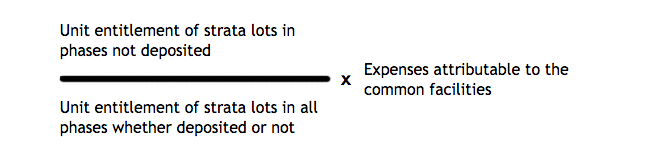
In a phased project this divides the expense of common facilities between owners who purchase early in the development and the developer, where the developer serves as a proxy for those who will become owners in the future, after later phases are built.
In the Timberline case, the developer built the project in 11 phases. There were 175 strata lots in six buildings. There were also six hot tubs, each associated with a particular lodge. In addition, three of the lodges contained a common laundry room and four lodges had elevators. For several years, the owners paid all the expenses for the hot tubs, laundry rooms and elevators. The developer never contributed to these expenses.
Eventually, the strata corporation sued the developer, claiming that the hot tubs, laundry facilities and elevators were all common facilities and that the developer must reimburse the strata corporation for the developer's share of their expense. The strata corporation claimed reimbursement for a roughly four year period ending February 1, 2008, when the developer filed the final phase.
The critical question was whether the various features were common facilities within the meaning of the Strata Property Act.
The court confirmed that the hot tubs were common facilities and that the developer must reimburse the strata corporation for its share of their expense. The tubs were a major feature because they were important or significant to the facility and were available to all the owners. In particular, the hot tubs qualified as common facilities because they were optional features that enhanced the development's overall quality for the owners. The relevant expenses were attributable to the hot tubs for wear and tear over time, including the necessary replacement of one of the tubs, which was especially expensive.
For the same reasons, the laundry facilities qualified as common facilities within the meaning of the Strata Property Act. The court rejected the strata corporation's claim, however, because it could not prove that the particular expenses were clearly attributable to the laundry facilities.
Finally, the court found that the elevators were not common facilities because they were not optional. Instead, the elevators were a standard means of access, similar to a hallway or stairs.
In a development where the last phase is not yet filed, it is a good idea to ask if there are any common facilities, and if so, whether the developer contributes to their upkeep.
| 1. | Strata Plan NES 97 v. Timberline Developments Ltd., 2011 BCCA 421 aff'g 2010 BCSC 1811. | |
| 2. | Strata Property Act, s. 217 (definition of "common facility"). |
To subscribe to receive BCREA publications such as this one, or to update your email address or current subscriptions, click here.
A Potpourri of Trivial Tidbits #183
By Gerry Neely
B.A., LL.B.
In the tradition of the wisdom of Solomon is a case involving an owner who in the course of excavating for a house foundation, damaged the roots of a tree standing on the boundary line between his and the adjoining owner's property to such a degree that the tree died. The judge decided that each owner had an interest as tenant-in-common in the tree and that damage to 50% of the root system which led to the fatality was a trespass for which the owner was liable in damages of $2,000 payable to the adjoining owner for his half interest in the tree.
Section 59 of the Real Estate Act states that an original purchaser of a lot from a developer is deemed to have relied upon the Disclosure Statement so that if it contains a misrepresentation, the original purchaser can sue the developer. That same right of action against the developer is not available to a subsequent purchaser of the lot.
A condominium owner who ruined the rug in the lobby of the strata building in which he lived when bleach leaked from a box the owner had left on the rug, was sued by the strata condominium's insurance company to recover the cost of replacing the rug. His defense was Section 54 of the Condominium Act which directs the strata corporation to insure against fire or such other perils as are usually the subject of insurance. This section also provides that not only the strata corporation but also the owners are deemed to be included as the named insured on the policy of insurance which is in force under this section. The advantage of being deemed to be an owner under the policy is that no claim could be made against this owner. The question was whether leakage of this kind fell within the perils which the strata corporation should have insured.
The judge decided it was an obvious peril and the breach of the strata corporation's duty to insure for this peril relieved the owner from liability to repay the insurance company.
***
A woman who stored goods in a mini warehouse and who was in arrears of rent was awarded damages of $18,000 to compensate her for the sale by the owner of the warehouse of her goods at auction to net $500. The owner was entitled to sell to recover rent arrears, but his liability arose because he failed to give her notice or to advertise the auctioning of the goods, and the sale at such a low amount breached his duty to exercise the same care that a careful owner who had custody of similar goods in similar circumstances would have exercised.
And to the committees of the boards arranging the annual summer golf tournaments, read on. The organizers of the Alpine Potato Festival 18 hole tournament which was held on July 1, 1986 in Edmunston, New Brunswick didn't expect to end up in a New Brunswick Court of Appeal three years later because of their refusal to deliver an $18,000 Toyota to a golfer who scored a hole-in-one on the second hole. Or was it the 1lth hole or the 18th hole?
The problem for the lucky winner was that the course had nine holes and a shotgun start found him teeing off on the third hole. (For non-golfers, a shotgun start has nothing to do with encouraging slow players to play faster), (a non-golfer is the person who, when asked what his best shot is says, "a scotch and soda".) The hole-in-one occurred on the 18th hole he played which meant that the ball disappeared into the second hole of the first nine or the 1lth hole of the second nine.
The committee invoked local rules to deny the winner his prize. The local rules lacked clarity so that the court reviewed the Royal Canadian Golf Association Rules which required the holes to be played in their correct sequence. Somehow this was, interpreted to mean that it was the second hole of the course rather than the golfer's second hole which mattered.
The lesson is that any deviation from the R.C.G.A. rules which are permitted by those rules should be published and brought to the attention of the contestants to avoid litigation.
To subscribe to receive BCREA publications such as this one, or to update your email address or current subscriptions, click here.
A Practical Approach to Reducing (Unhelpful) Stress
By Josh Froc from Work to Wellness, Guest Contributor
If trying to work harder or working less hasn't landed you the stress-reducing effects you hoped for, this article is for you. For almost everyone, being stressed doesn't feel good, and we want less stress – but as wonderful as it is, the world of real estate is stressful.
Being results-oriented and genuinely caring about clients means that sometimes REALTORS® stress about the never-ending to-do list and juggling our well-being in a challenging market.
How much time do you spend feeling like that? What could you be doing instead if you could get back most of the time you spend worrying?
A big portion of mental energy gets wasted worrying about things that aren’t helpful and don’t create change. In this article, you will find a simple tool to help you get that time and energy back.
Helpful vs. Unhelpful Stress
Many of us stress about the same things over and over. Some things are worth worrying about because that stress leads us to do something about them, to solve the underlying problem. We'll call this “helpful stress.”
Many other things are not worth stressing about because we can't (or shouldn't) do anything about them; they are not in our control, and worrying about them doesn't help us. We'll call this “unhelpful stress.”
As you'll soon see, this stress can sabotage our efforts to deal with and learn from the helpful stress. It's been well established that those who focus on helpful stress (things you can control) typically do better from a mental health perspective than those who focus on unhelpful stress (things outside of their control).
You can try it for yourself.
Here is a simple exercise to help you spend more time on what you can control and regain the time and energy wasted on things you can't control.
The Two Buckets Tool
This tool involves putting everything that stresses us out into two buckets.
Bucket one is for things that are helpful to stress about (usually about 20 per cent of stressors) because that stress alerts us to something important we can do now to reduce future stress or improve our stress management.
Bucket two is for things that are not helpful to stress about (usually about 80 per cent of stressors) – either because there is nothing we can do about it right now (out of our control) or because it's not something we want to take immediate action on.
This tool is based on the assumptions that:
- Approximately 80 per cent of the things you stress about probably cause more harm than good,
- The remaining 20 per cent of the things you stress about are probably worth stressing about, and
- Within the 20 per cent, extra time and energy are spent worrying about the same things over and over.
When we get stressed, our nervous system mobilizes resources to help us survive. Part of this shift involves inhibition of our prefrontal cortex, a part of the brain that helps us plan, make decisions, and think rationally. Using this tool we can decide ahead of time (before we get stressed) what is worth worrying about, and what to do about those stressors. By deciding from a calm, clear-headed place how to deal with stressors before they arise, we can give ourselves the tools to handle situations better and with much less stress when they do occur.
If you've decided ahead of time how to respond to stress, then when a stressor shows up, and your (stressed) mind tries to convince you that you need to be very worried – you can likely recognize this thought and say "hey, I knew you were going to show up, what took you so long! I already have a plan for you!" With this awareness comes the power to stress yourself out significantly less and weaken the habit of stressing over time.
The Process
Step 1
Pick a time in your day when you are most calm and productive. (For many people, this is first thing in the morning, before checking emails and social media).
Step 2
List all the things you are likely to stress about that day. (Hint: If you're looking for inspiration, think about the things that have stressed you in the past!).
Step 2 (Alternative)
At the end of the day, list the things that caused you stress that day.
Step 3
Go through the list and label each item as "helpful stress" (Bucket one) or "unhelpful stress" (Bucket two). Here's an example:
You make a list, and one of the stressors on your list is: “The photographer called, and they need me to call them back ASAP.”
The next step is categorizing this as ‘Bucket one’ (helpful stress) or ‘Bucket two’ (unhelpful stress).
For this example let’s say you choose: Bucket one – “This is important I've got a house to list soon!”
Now it’s time to “decide ahead of time” – this is where you choose what you'd like to do when this situation arises. When making that decision, ask yourself: what can I do about it, and what do I want to do about it? It might also be helpful to ask yourself, “Is this something that happens often?”
With this reasoning, you can decide to stop whatever else you’re doing and call ASAP. Or you could choose to put two 15-minute slots in your calendar each day to "call people back and address any emergencies."
Then, when it happens, rather than having to make a decision when you’re stressed and then worrying if you made the right decision… you can know you made a high-quality decision from a calm place when your brain was functional; it makes it much easier to deal with the consequences, no matter how you respond.
The main lesson here is to decide from a calm and collected place. Using this method, you can make higher-quality decisions. You’ll find that a lot of the things you stress about now are not actually helpful, freeing you up to stop stressing about them (gradually, over time, as the habit fades).
How Can I Apply This Tool?
You can use the two-buckets tool to perform a stress audit. There are three options for you below based on how much time you want to apply to this and how you want to divide that time. Whether you choose one or none of them (and decide to run with your own ideas), you'll likely end up making a list.
Tools like the wellness wheel (below) can help you with the stress audit by organizing your thinking into different "life areas.” This can help you more quickly think of the things that stress you out and categorize them to remember them more easily.

Here are three practical examples of how this tool could be applied:
Monthly Stress Audit (15-20 minutes per month)
Rate your stress on a scale of 1-5, one being the lowest and 5 the highest level. Ask yourself these questions when rating your stress level:
- What are all the stressful thoughts you can think of that have been around these past couple of days or weeks?
- What topics or areas of your life stress you out, and what are the thoughts associated with them?
Just by writing down this list, you might see some patterns you weren't aware of, and it will help make it easier to recognize when those stressors come up, to automatically respond better. It also may provide some peace of mind to see it on paper.
Then, circle the ones that you can actually control or that stressing about could actually help make the stressor go away. You will likely find that most things being stressed about are costing you much more mental energy and stress than they're saving. Do this once at the end of each month. Over each quarter, you can hopefully see that your stressors have been changing.
The Daily Stress Audit (One minute per day)
Each day, spend one minute and write down whatever is stressing you out right now. This is best done throughout your day when you are likely stressed out. It serves as a pattern disruption and will also help catch a snapshot of the stressful thoughts when they are fresh! It doesn't utilize the whole two-bucket tool – but this is a practical, easy piece to fit into a busy schedule and can eventually be turned into a routine. One way to make this easier is to set an alarm to go off mid-day each day as a reminder to write down what is stressing you out.
Daily Pre-stress Plan (Five minutes per day)
Spend five minutes each morning thinking about “What things am I likely to stress about today?” then ask yourself the following questions: “Which of those stressful thoughts are helpful? Which are things that you can control or that, with effortful action, you can stop from coming up in the future? Which of those things are necessary to stress about?”
What Next?
Start by applying the easiest strategy (for you) that you can, while still feeling like you're making progress. You should feel progress and a de-stressing effect even the first time you do this activity.
Building awareness for the things in your life that you can and can't control (or don't want to) will automatically make it easier for you to stay calm in situations that used to stress you out. If you can make this habit stick, even if you're spending 10-15 minutes a month – it can save you a considerable amount of stress and time and ensure you're progressing each month and not getting stuck stressing about the same problems over and over.
Stress is unavoidable in the 21st century. Reducing stress, removing stressors, and managing the stress we experience is becoming a critical differentiator between those who are successful and happy, and the rest. How does your strategy measure up?
About Work to Wellness
The two-bucket tool is part of one of the mental health workshops offered by Work to Wellness: Building Resilience in Times of Stress. If you want more tools like this, you can look for further workshops they provide. If you're interested in booking a workshop for a group of REALTORS® or have any questions, you can email [email protected].
If you want individual help reducing your stress or using the tool outlined in this article, you can also book your individual stress audit! Click here to book your audit.
A Recent Privacy Complaint #409
A recent privacy case highlights the need to obtain consent before using an individual’s personal information. The Privacy Commissioner of Canada recently found that a licensee, in an advertisement, breached the federal Personal Information Protection and Electronic Documents Act (PIPEDA) by using personal information about two other REALTORS® without their consent.1
What is PIPEDA?
PIPEDA is substantially similar to BC’s Personal Information Protection Act, which requires provincially regulated organizations, such as brokerages, to protect personal information. PIPEDA protects personal information collected, used or disclosed by federally regulated entities in the private sector. Before using someone else’s personal information, both statutes require an organization’s representatives to first obtain that person’s consent.
PIPEDA defines personal information, in part, as information about an identifiable individual, which includes any factual or subjective information about that individual (e.g., name, address, birth date, income, gender, religion, education, employment, etc.).2 Apart from a few exceptions, PIPEDA prohibits using or disclosing this information without informed consent.3
The case
A representative wanted to advertise himself as a top-ranked REALTOR®. As a member of a real estate board, the licensee used the Multiple Listing Service® (MLS®) to get information about the listings and sales of other salespersons. Although the MLS® provided some data on the sales activities of other REALTORS®, it couldn’t rank representatives against one another. To rank the other REALTORS®, the licensee bought a report from an organization that sold real estate statistics. The report apparently ranked representatives by the number of units sold and dollar value. It contained each representative’s name, franchise name, number of units sold, each unit’s value, average time on the market and average sales price per representative.
Using the MLS® information and the ranking report as sources, the representative created an advertisement for his services, in which he ranked the top five REALTORS® in the area and listed the number of houses each had sold. Among the five, the licensee ranked himself first.
Two licensees named in the ad, ranked third and fifth, complained to the Commissioner that they hadn’t consented to their personal information being used.
According to the evidence, members of the real estate board signed an agreement to use the MLS® system. To the extent that MLS® information is associated with an individual, the board’s privacy policy considered it personal information, which, as much as possible, should be collected directly from the relevant listing broker or salesperson. Under the agreement with the board, personal information included the user’s name, phone number, business address and employer.
The organization that prepared the statistical report obtained its information partly from the MLS® database, but didn’t have a contractual relationship with the real estate board.
The licensee argued, in part, that since the MLS® information was available to users of the MLS® and the other organization from which he bought the statistics, the data shouldn’t be considered personal. In the representative’s view, real estate licensees provide business services and their business performance becomes public information.
The licensee’s argument was rejected by the Commissioner, who held that the licensee disclosed the other representatives’ personal information without their consent. Merely by using the MLS®, the other licensees didn’t consent to the use of their personal information (that is, information about their respective sales records) in their competitor’s ad. The case summary doesn’t say what remedy, if any, the Commissioner ordered, though PIPEDA contains various penalty provisions and a complainant may claim damages against a wrongdoer in the Federal Court of Canada.
| 1. | PIPEDA Case Summary #303, Real estate broker publishes names of top five sales representatives in a city, May 31, 2005. | |
| 2. | PIPEDA, s. 2 (definition of “personal information”) and Questions and Answers regarding the application of PIPEDA, Alberta and British Columbia's Personal Information Protection Acts (PIPAs). Office of the Privacy Commissioner, Ottawa. Last modified: November 5, 2004. | |
| 3. | PIPEDA, Sch. 1, Principle 4.3. |
To subscribe to receive BCREA publications such as this one, or to update your email address or current subscriptions, click here.
A Record Year for the BC Housing Market
For the complete news release, including detailed statistics, click here.
Vancouver, BC – January 12, 2022. The British Columbia Real Estate Association (BCREA) reports that a record 124,854 residential unit sales were recorded by the Multiple Listing Service® (MLS®) in 2021, a 32.8 per cent increase from the 94,001 units sold in 2020. The annual average MLS® residential price in BC was $927,877, an 18.7 per cent increase from $781,572 recorded the previous year. Total sales dollar volume was $115.8 billion, a 57.7 per cent increase from 2020.
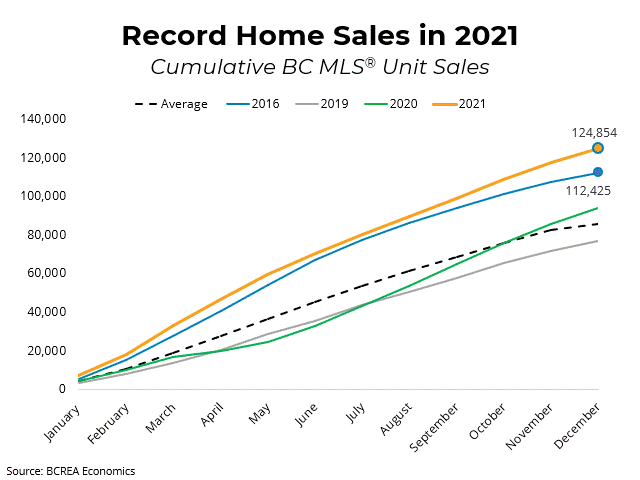
“Last year was a record year for BC homes sales with seven market areas setting new highs,” said BCREA Chief Economist Brendon Ogmundson. “Listings activity could not keep up with demand throughout the year. As a result, we start 2022 with the lowest level of active listings on record.”
A total of 6,871 MLS® residential unit sales were recorded across the province in December down 17.6 per cent from a record-setting December 2020. The average MLS® residential price in BC passed the $1 million mark for the first time as the average price in three of the largest markets in the province were over $1 million in December. Total sales dollar volume was $7.1 billion, a 1.2 per cent increase year-over-year.
Total active residential listings were down 41.2 per cent to a record low of 12,179 units. The supply situation is particularly concerning in the Fraser Valley, Chilliwack and Vancouver Island where there is one month or less of supply at the current pace of sales.
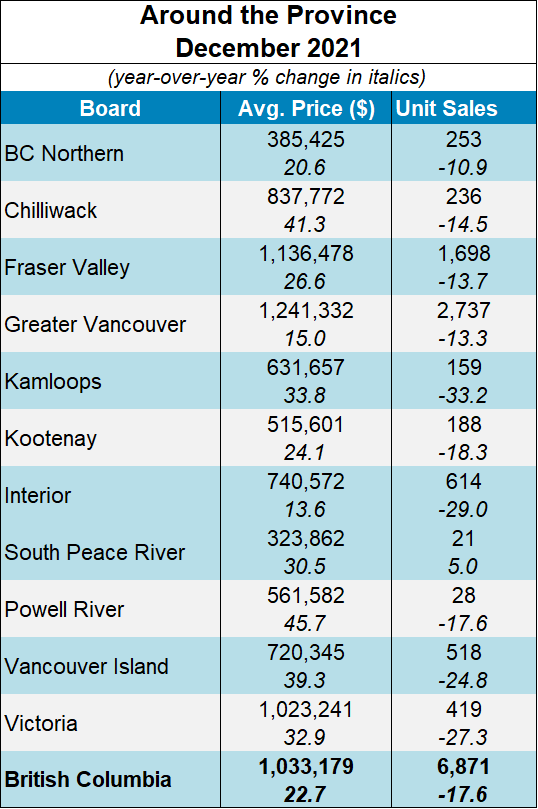
-30-
For more information, please contact:
Brendon Ogmundson
Chief Economist
Direct: 604.742.2796
Mobile: 604.505.6793
Email: [email protected]
A Record-Setting Start to 2021
For the complete news release, including detailed statistics, click here.
Vancouver, BC – February 11, 2021. The British Columbia Real Estate Association (BCREA) reports that a total of 7,169 residential unit sales were recorded by the Multiple Listing Service® (MLS®) in January 2021, an increase of 63.3 per cent over January 2020 and over a thousand sales higher than the previous record for the month of January. The average MLS® residential price in BC was $845,169, a 16.1 per cent increase from $728,269 recorded in January 2020. Total sales dollar volume was $6.1 billion, an 89.6 per cent increase from last year.
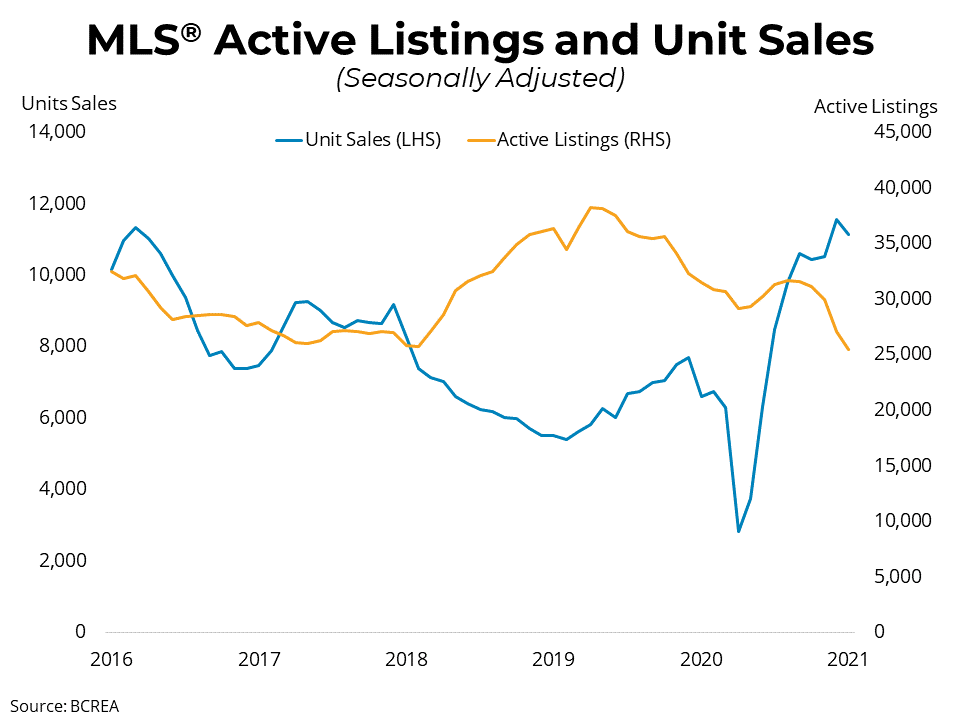
“It was once again a record-setting month for the provincial housing market,” said BCREA Chief Economist Brendon Ogmundson. “While sales were strong across all regions of the province, the Fraser Valley, Interior and Vancouver Island regions shattered previous sales records and pushed January sales to new heights.”
Total active residential listings were down 21.5 per cent to 20,254 units in January, the lowest level of provincial active listings on record, going back to 2000. With strong sales and so few listings, market conditions are exceptionally tight with less than three months of total supply.
“The supply of listings continues to be held back by the pandemic,” added Ogmundson. “With so few listings, markets are starved for supply and prices are under extraordinary pressure.”
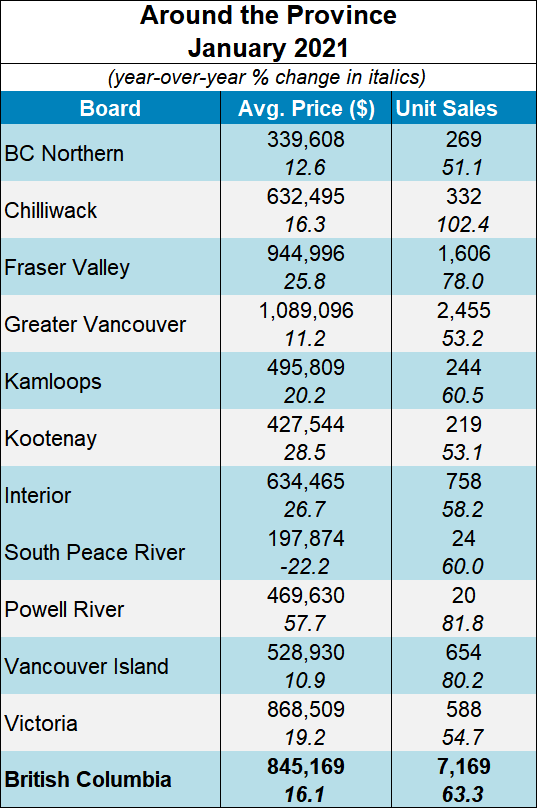
-30-
For more information, please contact:
Brendon Ogmundson
Chief Economist
Direct: 604.742.2796
Mobile: 604.505.6793
Email: [email protected]
To subscribe to receive BCREA publications such as this one, or to update your email address or current subscriptions, click here.
A Return to Balance for BC Housing Market
For the complete news release, including detailed statistics, click here.
Vancouver, BC – July 13, 2018. The British Columbia Real Estate Association (BCREA) reports that a total of 7,884 residential unit sales were recorded by the Multiple Listing Service® (MLS®) across the province in June, a 32.5 per cent decrease from the same month last year. The average MLS® residential price in BC was $716,326, down 1.3 per cent from June 2017. Total sales dollar volume was $5.6 billion, a 33 per cent decline from June 2017.
 “The impact of the B20 stress test is still being felt across the province,” said Brendon Ogmundson, BCREA Deputy Chief Economist. “Lower demand as the result of higher mortgage rates and stringent mortgage qualification rules are bringing most markets around the province back into balanced conditions.”
Although the supply of active listings in the province is on the rise, inventory remains low by historical standards and markets like Vancouver Island and the Okanagan remain undersupplied.
Year-to-date, BC residential sales dollar volume was down 18 per cent to $32 billion, compared with the same period in 2017. Residential unit sales decreased 20 per cent to 43,863 units, while the average MLS® residential price was up 2.4 per cent to $730,492.
-30-
For more information, please contact:
Brendon Ogmundson
Deputy Chief Economist
Direct: 604.742.2796
Mobile: 604.505.6793
Email: [email protected]
To subscribe to receive BCREA publications such as this one, or to update your email address or current subscriptions, click here.
A Strata Council Member’s Liability #417
Many licensees own condominiums; some also serve on strata councils. Strata property managers regularly encounter strata council members. Recently, the Supreme Court of Canada had the last word on the liability of some strata council members (the Members) for conflicts of interest.
The Strata Property Act requires a council member to fully disclose whether the member has any interest, direct or indirect, in any transaction involving the strata corporation. The Act prohibits the member from voting on the matter and requires the member to leave the meeting.(1)
Dockside Brewing Co. v. Strata Plan LMS 3837 involved a strata hotel in Vancouver.(2) The Members were part of an owners’ group that wanted to lease the strata corporation’s common property. When a competitor obtained the lease rights, the owners’ group sought the rights. The group took control of the strata council by electing their members to eight of nine council seats. Using their control of the strata council, the owners planned to cause the strata corporation to sue to attack the competitor’s lease rights so the owners’ group could acquire them.
Meanwhile, the owners’ group also made certain commitments to others concerning the leases. If the owners’ group failed to get the lease rights, they potentially faced a $600,000 claim.
The Members executed their plan to obtain control of the strata corporation’s affairs, for their own benefit, and to use the corporation’s funds for that purpose. While they didn’t personally take the strata corporation’s money, they spent those funds for legal services intended to benefit their owners’ group. They benefited by sharing the legal expenses with the other members of the strata corporation who were not part of their owners’ group. At general meetings, and at council meetings, the Members did not disclose the true use of the legal expenses incurred by the strata corporation. They didn’t disclose their conflicts of interest, including their potential $600,000 liability if the owner’s group failed to get the lease rights. They didn’t leave the meetings when the relevant resolutions were discussed and they didn’t abstain from voting.
Ultimately, other owners asked the court to order the Members to reimburse the strata corporation for the legal fees improperly spent pursuing the objectives of their owners’ group.
The Supreme Court of British Columbia found that the Members breached the statute’s conflict of interest provisions. They also failed to meet the standard of care expected of council members.(3) The court ordered the Members, jointly and severally, to compensate the strata corporation for approximately $190,399 in legal expenses and to pay, in addition, special court costs of roughly $150,000.(4)
The British Columbia Court of Appeal upheld the decision against the Members. When the Members asked the Supreme Court of Canada to hear their appeal, the court dismissed their application, bringing this legal story to an end.
Whether a licensee serves as a strata council member, or advises the council as its strata manager, the licensee cannot ignore the Strata Property Act’s conflict of interest requirements. Simply put, each council member must:
1. Disclose a conflict, immediately,
2.Leave the meeting (unless asked to stay to provide information), and
3.Not vote.
Lastly, the strata council member and the strata manager should ensure the minutes of the meeting record that the council member did these things.
To subscribe to receive BCREA publications such as this one, or to update your email address or current subscriptions, click here.
A True Condition Precedent #463
In Swan Group Inc. v. Bishop, a $130,485 deposit was at stake.1 The issue was whether a subject clause was a true condition precedent (TCP).
At common law, a TCP is an external condition whose fulfillment depends on the will or actions of someone who is not a party to the contract;2 for example:
[s]ubject to the … necessary approvals of the Ontario Municipal Board … to the site plan … 3
Until a TCP is fulfilled, the obligation of all parties to carry out the transaction is suspended. If the particular event does not occur, the contract becomes void and they are all excused. Consequently, to waive a TCP, every party must consent. One party may not unilaterally waive a TCP.
There are two exceptions. First, in the contract, the parties may expressly give to one side the right to waive the particular TCP. Second, legislation permits one party to waive a TCP if these criteria apply:4
| (a) | the subject clause benefits only that party, |
| (b) | the contract is capable of being performed without fulfilling the subject clause in question, and |
| (c) | the waiver occurs before the subject removal deadline. |
By comparison, an ordinary condition precedent requires a party to do something; for example:
Subject to the buyer confirming that zoning for the property is RM-1 (Multiple Dwelling) …
An ordinary condition precedent does not affect the existence of the contract. Until that subject clause is fulfilled, it suspends only that party's obligation to perform his or her contractual obligations. Anytime before the subject removal date, that party may waive the condition and demand full performance from the other side.
In April 2007, the seller entered a pre-sale contract to construct and sell a condo to the buyer for $922,094. The buyer paid a deposit of $130,485. The contract contained this subject clause (Developer's Condition):
This offer is subject to the following Developer's Condition:
(a) the Developer shall register the Phased Condominium Plan creating the units shown on Schedule 1 on or before Sept. 30, 2008.
On May 6, 2009, the seller registered the condominium plan (equivalent to a strata plan in BC), roughly seven months after the September 30 deadline. The buyer did not object. Then, shortly before closing in November 2009, the buyer announced that he would not complete for lack of funds.
Both sides claimed the deposit. The Alberta Court of Appeal found that the Developer's Condition was not a TCP. Since this was an ordinary condition, the seller's failure to register the condominium plan by September 30 did not void the contract. Instead, the seller could waive it without the buyer's consent.
The Developer's Condition required the seller to register the condominium plan. The remote possibility that the registrar, a third party, might reject the seller's filings did not convert this into a clause whose fulfillment depended on the will or action of someone who was not a party to the contract. The wording did not make the contract subject to the registrar approving something. The contract was alive when the buyer announced that he would not complete. The seller was entitled to the deposit.
Swan Group offers a reminder to pay special attention to any subject clause whose fulfillment depends on the will or action of someone who is not a party to the contract (e.g., subject to the registrar approving the attached plan of subdivision). It is critical to expressly make the subject clause for the sole benefit of one party and to reserve that party's right to waive the subject clause. If not, one's client may be shocked to discover that he or she needs the consent of every other party to waive the subject clause, failing which the contract is dead.
To subscribe to receive BCREA publications such as this one, or to update your email address or current subscriptions, click here.
A Vendor May Stipulate a Higher Rate of Interest Apply if Default Occurs on the Part of the Purchaser #7
By Gerry Neely
B.A. LL.B.
Occasionally, a vendor who has agreed to carry part of the sale price on a mortgage, agrees to take a lower rate of interest than the current rate, because the remaining terms of the sale justify that decision. On the other hand, the vendor does not want the lower rate to be a temptation to the purchaser to delay payments. In that case, the vendor may stipulate that a higher rate of interest is to apply if default occurs on the part of the purchaser.
There is a right and a wrong way to ensure that this provision would be enforceable by the vendor/mortgagee. The wrong way is as follows:"The sum of $100,000.00, together with interest thereon at the rate of twelve (12%) per cent per annum, calculated half-yearly not in advance as well after as before default and maturity, computed from the 1st day of March, 1981; provided, however, that upon default in payment by the mortgagor, the rate of interest payable by the mortgagor shall be increased from twelve (12%) per cent per annum to sixteen (16%) per cent per annum."
The reason this would be unenforceable is found in Section 8 of the Interest Act, R.S.C. 1970, c. 1-18, which reads as follows:"8.(1) No fine or penalty or rate of interest shall be stipulated for, taken, reserved or exacted on any arrears of principal or interest secured by mortgage of real estate, that has the effect of increasing the charge on any such arrears beyond the rate of interest payable on principal money not in arrears."
The purpose of Section 8 is to prevent a lender from obtaining from a borrower an excess amount by way of an increased interest penalty because of the default of the borrower. The effective way of enforcing this provision is shown in the following paragraph:"The sum of 5100,000.00, together with interest thereon at the rate of sixteen (16%) per cent per annum etc....; provided, however, that the rate of interest shall be reduced from sixteen (16%) per cent to twelve (12%) per cent during the month immediately preceding a payment made by the mortgagor punctually on the date when such payment was due and payable to the mortgagee (this wording assumes monthly payments made on the 1st day of each month)."
Since this provides for a reduction in the event of prompt payment, it does not offend the Interest Act. It is not unfair to the purchaser as it would be if an inadvertent delay of one day in making a payment prevented the purchaser from obtaining the benefit of the lower rate of interest for the balance of the term of the mortgage.
This question arose in a recent case where the vendors took back a second mortgage which provided that no interest would be payable during the first three months, at which time if the mortgage remained unpaid, interest would accrue at eighteen (18%) per cent due and payable on a per diem basis. Payment was not made at the end of the three month period, as had been expected, and eventually foreclosure proceedings were commenced. The purchaser argued that the imposition of interest after three months was a penalty. The Court looked upon the transaction as one in which the vendors granted the purchaser a three month period of grace within which to pay, and at the expiration of that period of grace, interest began to accrue. In reaching this decision, the Court made a distinction between a vendor who secures part of the unpaid purchase price, and a lender loaning money on mortgage security. The Court felt that Section 8 was aimed at what perhaps can best be described as the usual commercial lender transaction. While agreeing that the result is right, one should not rely upon this distinction to justify the use of the "wrong way" clause.
| 1. | MacDonald v. Muncey, 13 R.P.R. 199. |
To subscribe to receive BCREA publications such as this one, or to update your email address or current subscriptions, click here.
A Whole Lot to Know About the Land Owner Transparency Act #533
On November 30, 2020, the Land Owner Transparency Act1 (LOTA) came into effect, and with it, the Land Owner Transparency Registry (LOTR). Now, with every change in title to a property in British Columbia, a transparency declaration must be filed with the Land Title and Survey Authority of British Columbia (LTSA). Individuals acquiring an interest in land are responsible for completing the declaration. REALTORS® should be aware of these new requirements so they can advise clients to speak to a legal professional as needed. Legal professionals will assist clients with the required filings on all future property purchases.
On the transparency declaration, the transferee (i.e., the person or entity about to become the new registered owner) must declare if they are a reporting body. A reporting body is any one of the following:
- a relevant corporation;
- a trustee of a relevant trust; or
- a partner of a relevant partnership.
If the transferee is a reporting body, then a transparency report must also be filed. The type of information that must be included in the transparency report can include the following (depending on the type of reporting body): full names, citizenship of individuals, country of residence and address of principal residence, date of birth, social insurance number, tax number, last known address, the type of partnership, the address for the partnership, jurisdiction (laws) that governs the partnership, head office, and information about the settlor of a trust.2
Practically speaking, this means all properties owned by a company, or properties that are held in trust for another party under a trust (including a bare trust) or a partnership, are reporting bodies and therefore must file a transparency report to confirm who the interest holders of the corporation, the trust, or the partnership (as applicable) are. The Province introduced LOTR as part of its plan to address housing affordability in BC and “end hidden ownership.”
Here is an example of how LOTR works:
Pretend Holdings Ltd. purchases a property closing on December 18, 2020. The only shareholders of Pretend Holdings Ltd. are John Smith and Jane Smith. John and Jane each own 50% of the shares in Pretend Holdings Ltd.
On the closing date, before the transfer documents can be filed with the LTSA, a transparency declaration must be filed. Since a company is going on title to the property, the transparency declaration will confirm that the transferee, Pretend Holdings Ltd., is a reporting body since it is a relevant corporation. This means that a transparency report also needs to be filed. The transparency report will confirm who the interest holders of Pretend Holdings Ltd. are. A corporate interest holder is someone who owns 10% or more of the shares or voting shares in a relevant corporation. Therefore, in this example, the transparency report will disclose that John Smith and Jane Smith are the corporate interest holders.
All existing reporting bodies (where the transfer was filed prior to November 30, 2020) must file a transparency report by November 30, 2021, disclosing who the interest holders of the property are. Clients may wish to reach out to legal professionals for assistance with filing these reports.
Moving forward, if there is a change of interest holder, the reporting body must file a new transparency report, regardless of whether registered ownership changes or not. For example, using the fact pattern set out above, if Jane Smith were to sell her shares in Pretend Holdings Ltd. to John Doe, then Pretend Holdings Ltd. would need to file a new transparency report disclosing that Jane Smith ceased being an interest holder and that John Doe is now an interest holder in the property.
Public Registry
The registry will become publicly accessible beginning April 30, 2021. Similar to land title searches, a fee will be charged for all LOTR searches. According to the LOTR website, the search fees will be $5.00 per search.3 However, not all information filed with the registry will be available to the public, only primary information about interest holders. Secondary information including birth dates and social insurance numbers will only be accessible by those defined as a regulator, a taxing authority, or law enforcement.4
Summary
British Columbia has a new registry that records and discloses who the beneficial owners, or interest holders, of properties are. The registry will soon become publicly accessible. It is unclear at this time how the information noted in the registry will be used by the public, financial institutions, and the government.
Realtors need to be able to understand the basic principles of the LOTR and inform their clients as to what kinds of information will become publicly available through the registry. Realtors may also wish to help educate past clients who are reporting bodies, that they need to file a transparency report prior to November 30, 2021, for all existing properties that were acquired prior to November 30, 2020. If you believe your client is a reporting body, have them reach out to the legal representative to discuss LOTR filing and disclosure requirements. Note there are fines of up to $100,000 or 15% of the assessed value of the property, for offences, failure to file, or providing false or misleading information under LOTA.
For more information, visit the LOTR website, or click here to learn more about the implications for Realtors and real estate practice.
| 1 | <a" target="_blank" rel="noopener noreferrer">Land Ownership Transparency Act, SBC 2019, Chapter 23. | |
| 2 | See https://landtransparency.ca/wp-content/uploads/2020/11/LOTR_Policy_Presentation-Nov-19.pdf and https://landtransparency.ca/wp-content/uploads/2020/11/LTSA-LOTR-FactSheet_Nov12.pdf | |
| 3 | See https://landtransparency.ca/search/ | |
| 4 | See https://landtransparency.ca/wp-content/uploads/2020/11/LOTR_Policy_Presentation-Nov-19.pdf |
To subscribe to receive BCREA publications such as this one, or to update your email address or current subscriptions, click here.
A Year-in-Review: BCREA’s 2019 Highlights
2019 was an eventful year at the BC Real Estate Association (BCREA), and in the real estate sector as a whole. Building on new and existing relationships and driven by a commitment to innovation and collaboration, we continued to work hard to serve BC’s 11 real estate boards.
Here are a few of the highlights!
Fostering a United Sector Voice
The Advocacy team strengthened BCREA’s position as an important partner to government and other policy influencers by fostering a new level of collaboration across the real estate sector. In April 2019, the release of a series of anti-money laundering recommendations with four partner organizations gained both government support and significant media coverage.
“As we continue to face challenges and navigate change in organized real estate, the need to be collectively organized in our dialogue with government has only increased,” said Trevor Hargreaves, who joined the organization in February of 2019 as VP of Government Relations and Stakeholder Engagement. “The success of the joint anti-money laundering recommendations highlights the impact of a united sector voice.”
Areas of change from 2019, including the Commission of Inquiry into Money Laundering in BC, the review of the role of managing brokers, and impending regulatory changes, have carried into 2020. To navigate these changes, Trevor and the Advocacy team will continue to work with BC’s 11 real estate boards and other provincial and national bodies so that REALTORS®’ voices are heard.
Strengthening the Foundation for Communications
BCREA’s Communications team played a key role in the success of all BCREA’s core services, from media relations for the joint anti-money laundering statement and editorial management of all Economics publications, to creative input into Standard Forms resources and the development and execution of the PDP transition communications strategy with member board partners.
The team was proud to launch the new BCREA website in July 2019. The new mobile-friendly, content-focused website is the foundation for engaging with members and real estate sector stakeholders. “The relaunch of our website has been a key piece of BCREA’s long-term communications strategy,” said April van Ert, Communications Manager. “It allows us to provide boards and REALTORS® with timely and user-friendly access to BCREA information and resources.”
Looking ahead, the team looks forward to continuing to bring innovation to BCREA’s communications. 2020 has gotten off to a great start with the launch of Open House by BCREA, a monthly podcast for REALTORS® featuring real estate news and practical insights.
Collaborating on the New Professional Development Program
REALTOR® interests, ways of doing business and learning styles have and continue to change. To ensure the Professional Development Program (PDP) continues to meet REALTOR® needs, BCREA collaborated with real estate boards to create a new PDP framework that’s more flexible and innovative.
“Putting together the new framework was the biggest highlight of 2019, not only because of what it represents – a new and better way forward for REALTORS® – but also how it came about,” said Joanna Pedersen, Education Manager. “There were numerous stakeholders involved in the process and the commitment to collaboration was inspiring!”
The new PDP framework launched on January 1, 2020. With the framework in place, the Education team is working to develop new in-person and online learning opportunities to enhance REALTOR® professionalism and increase professional development offerings available across the province.
Enhancing Standard Forms Processes and Resources
Standard Forms are the backbone of every transaction and they play a huge role in the daily practice of real estate professionals. That’s why in 2019, BCREA began refining our processes for creating and amending forms as part of our commitment to ensuring these forms provide continued value for REALTORS® and their clients.
We also created new resources for managing brokers and REALTORS®, including a privacy policy template for brokers and two explainer videos on the Privacy Notice and Consent form – one for REALTORS® on working with the form and another to help REALTORS® explain the form to their clients.
“In 2020, we will continue the work we started in 2019 to make the Standard Forms processes more streamlined and work to make the forms more accessible in their usage and language,” said Corinne Caldwell, Chief Operations Officer. “We will also build out additional resources to support REALTORS® in working with the forms and keeping up to date on form changes.”
Thought Leadership in Economics
The 2019 housing market saw substantial shifts over the course of the year. The Economics team continued to serve as thought leaders in the real estate sector, producing regular reports on provincial home sales and economic activity as well as critically examining government policies and initiatives targeted at the real estate sector.
This included an in-depth analysis of the impact of the B20 mortgage stress test on BC homes sales and the potential uptake of the First-Time Home Buyer Incentive.
“Government policy plays a large role in the housing market and it’s important REALTORS® and consumers are informed of the impacts," said Brendon Ogmundson, who took over as Chief Economist in October of 2019. "We began 2020 by analyzing the impacts of the Speculation and Vacancy Tax on BC home sales and released our findings in the latest BCREA Market Intelligence Report."
With another busy year in the BC real estate sector already underway, the BCREA team is already hard at work! To learn more about our 2020 initiatives, click here.
Aboriginal Land Development and Sale (Continued) #329
By Gerry Neely
B.A. LL.B.
Column 328 referred to the landlord/tenant relationship resulting from the development of reserve lands. Once all levels of approval have been given, for example, to a residential project, a headlease is created between the federal Minister of Indian and Northern Affairs and a developer, as the tenant. This document provides the foundation for the subsequent sale of a right to possession of a residential unit, by way of a sublease, from the developer to the buyer.
The headlease is similar to an ordinary lease of commercial property. It sets out all terms and conditions intended to govern relationships which might exist for as long as 99 years. It also contains the formula for calculating the rent to be paid by the developer and, ultimately, by the buyer as a subtenant.
The formula may require prepayment of the rent for the whole term of the lease. This satisfies the Aboriginal group's need for revenue and, if the appropriate wording is contained in the headlease, meets the buyer's needs for security of possession and legal title, free from the developer's default under the headlease. However, that may be too much of a financial outlay for the developer to make.
Another headlease formula provides for rent reviews to be made every five or ten years, with the calculation of rent tied to the fair market value of the property at the date of the review. The publicity surrounding the Musqueam band and its tenants has made it clear that in a long-term lease, this formula creates uncertainty. It can lead to rent increases in excess of a subtenant's ability to pay, and default which ends in the loss of the right to possession. A variation of this formula is to tie rent reviews to the current Consumer Price Index (CPI).
Another formula for a phased development, which appears to meet the Aboriginals' need for revenue and buyers' security of tenure, and reduces the developer's initial cash outlay, has also found favour with the Canada Mortgage and Housing Corporation (CMHC). It requires an initial prepayment of rent by the developer toward the total rent payable under the headlease. As each unit is sold, the balance of rent is paid to the band.
There is always a possibility in a phased development that a developer who successfully completed one phase may default under the headlease during a future phase. This formula insulates the buyers in an earlier phase from the subsequent default, by providing that the prepaid lands are to be assigned to the homeowner's association of the completed phase. Each buyer automatically becomes a member of the association.
Since Aboriginal groups have the power to tax developed property, an important term of the headlease is the formula for calculating annual property taxes. To be competitive with adjoining non-reserve lands, the methods of determining mill rates, assessments and allowing for homeowners grants should result in a tax comparable to similar property in the adjoining regional district or municipality.
As a point of clarification, column 328 stated that provincial laws "such as the Strata Property Act and the Real Estate Act may not apply to reserve lands." Part 2 of the Real Estate Act does not apply to lands reserved for an Aboriginal group, an area of exclusive federal jurisdiction.
The position of the Superintendent of Real Estate is that Part 1 of the Act applies, presumably because it is a law of general application, similar to traffic laws, which are not directed at Aboriginals, but apply to everyone.
To subscribe to receive BCREA publications such as this one, or to update your email address or current subscriptions, click here.
Aboriginal Land Development and Sale (Continued) #330
By Gerry Neely
B.A. LL.B.
The importance of a homeowner's association was alluded to in Legally Speaking column 329. The association's role in a development is equivalent to that of a strata corporation. It provides the mechanism through which the owners of leasehold interests in a development, or a phase of a development, govern the administration of their properties. An example of this is the control of parking spaces and storage lockers, which are tied to the subleases.
The sale of Aboriginal lands creates new problems for both licensees and conveyancers - one of which arises from the fact, as noted in column 329, that registration in the Indian Land Registry takes several days. Normally, no funds will be advanced to either the buyer or lender until registration is complete. Licensees are the first to face this problem when they are fixing the dates for completion, adjustment and possession. This problem is intensified when the licensee is dealing with back-to-back transactions.
Conveyancers have developed several procedures to deal with this delay in registration. Where a lender is involved, the mortgage monies are advanced to the lender's lawyer when the borrower has satisfied all of the lender's requirements, except for registration. The sale closes upon the undertaking of the lender's lawyer to pay the mortgage monies to the buyer's conveyancer upon proof of satisfactory registration.
Another procedure involves the execution and delivery of the sublease and supporting documents to the Indian Land Registry a few days in advance of closing in the hope that they will be registered by the completion date.
The buyer signs an additional document - a reassignment back to the seller. This is held in escrow to be registered if the sale does not complete. If a mortgage were involved, the buyer's conveyancer would have to undertake not to draw down the mortgage monies and apply to obtain a discharge of the mortgage if it had been registered.
In concluding this overview of the sale of Aboriginal lands, there are two points I wish to emphasize. The first is that all of this discussion relates to reserve lands and not to off-reserve lands to which Aboriginals claim title.
The second is the importance of reading all the documents affecting a prospective buyer's interest in a subleased property. They may include the headlease, sublease, service agreements with municipalities, the application of municipal bylaws and a band's property tax bylaw. The Musqueam Indian Band's rent review clause of the rent payable over the term of a 99-year lease is the most recent example of the need to make your clients aware of the responsibilities they assume.
To subscribe to receive BCREA publications such as this one, or to update your email address or current subscriptions, click here.
Aboriginal Title and Its Implications #471
On June 26, 2014 the Supreme Court of Canada released a landmark decision concerning Aboriginal rights and title in the Tsilhqot’in Nation v. British Columbia1 case.
In a unanimous decision, the Supreme Court of Canada confirmed that the Tsilhqot’in Nation holds Aboriginal title to over 4000 square kilometers of land west of Williams Lake. This decision is significant because it is the first judicial finding of Aboriginal title in Canada.
In the Tsilhqot’in Nation case, the Supreme Court of Canada confirmed that in order to establish a claim to Aboriginal title, a First Nation must be able to prove “sufficient occupation” of the land in question at the time of European settlement. Of importance is the Court’s determination that “significant occupation” is not confined to specific settlement sites, as had been determined by the BC Court of Appeal, but extends to lands regularly used for hunting, fishing or otherwise exploiting resources and over which the First Nation exercised effective control at the time of the assertion of European sovereignty. The adoption of the broader “territorial” approach, as opposed to the narrower “site specific” approach, will probably result in larger title claims succeeding in the future.
Once Aboriginal title is established, the successful First Nation will have the right to decide how their land will be used, the right of enjoyment and occupation of their land, the right to the economic benefits arising from their land and the right to proactively use and manage their land. Such use will not be confined to pre-sovereignty uses and customs such as hunting and fishing only. Modern Aboriginal land holders will be able to use their land in modern ways. As Aboriginal title includes the right to reap the economic benefits of resources situated on Aboriginal title lands, successful claims will result in a diminution of resource revenues to the Province from those lands.
Of interest to many British Columbians is what effect, if any, this decision will have on private property situated on land that is subject to a First Nation claim. The simple answer is none. The Tsilhqot’in Nation did not include any privately owned land in their territorial claim, so how Aboriginal title can be reconciled with private property rights is a question for another day.
The Tsilhqot’in Nation decision does not change the basic principles of the Crown’s duty to consult with First Nations but it will compel the Crown to engage that duty more often as the geographical scope of Aboriginal title has been more broadly defined by the Court’s adoption of the “territorial” approach.
It is difficult to speculate about the implications of the Tsilhqot’in Nation decision. Initial reaction seems to range from “nothing has changed” to “the sky is falling.” While it clearly provides certainty to the Tsilhqot’in Nation, what will its effect be on the many other First Nation land claims in British Columbia? Will some First Nations abandon the treaty process and seek certainty through the Courts? How long will that process take?2 Will the Crown’s broader duty to consult resulting from the adoption of the “territorial” approach enhance or impair resource development on Crown land in British Columbia? The answers to those questions will be revealed over time.
Hopefully First Nations, government and industry will seek ways to collaborate to shape the future of British Columbia. The Tsilhqot’in Nation decision repeated the oft-quoted words of Chief Justice Lamer in the Delgamuukw decision that Aboriginals and non-Aboriginals “are all here to stay.”
Brian Taylor
Bull Housser LLP
Action Plan for Economic Recovery to Achieve CleanBC Goals
In August, BCREA interviewed the Pembina Institute’s director for buildings and urban solutions, Tom-Pierre Frappé-Sénéclauze, to understand their perspective on making homes and buildings in BC low carbon, healthy and resilient.
Tom-Pierre was a coauthor of a July submission sent to the BC Government, “Accelerating BC’s economic recovery through building retrofits.” Closely aligned with BCREA’s recommendations, the Pembina Institute called for:
- boosting CleanBC incentives for deep retrofits in homes and buildings,
- accelerating retrofits and construction of social housing, and
- deepening renovations of public sector buildings.
The Pembina Institute’s recommendations aim to assist the BC Government achieve the province’s climate targets of reducing greenhouse gas emissions by at least 40 per cent below 2007 levels by 2030. The BC Government has an opportunity to work toward these climate goals while also stimulating the economy. According to Pembina, incentives for retrofits are effective tools for economic recovery because they create a high number of jobs per dollar, employ a range of skilled labour and use many local made-in-BC materials.
To achieve its climate targets, Pembina says BC will need more workers in the construction sector. “There are opportunities for laid-off workers to take upgrade courses and move into the sector,” notes Tom-Pierre. For example, more resources are needed for contractors to install heat pumps and insulation.
In July, BCREA and other real estate stakeholders provided the government with similar COVID-19 economic recovery recommendations to help the government achieve their climate goals, including:
- provide incentives for building retrofits,
- encourage energy-efficient materials by expanding the list of eligible energy conservation materials and equipment exempt from PST, and
- support skilled trades training.
To subscribe to receive BCREA publications such as this one, or to update your email address or current subscriptions, click here.
Action Required to Keep your BCREA Mobile Account Active
We are creating enhancements to our online account management system for all existing BCREA Mobile subscribers. Please check your inbox for an email from [email protected] which provides a username and temporary password in order for you to create an account and register your device on the upgraded system.
Please ensure you take action immediately once you receive the email so there is no disruption to your service. The new online account management system can be accessed here: https://bcrea.mywirelessconcierge.ca
If you have any questions or need assistance please contact the BCREA Mobility Team at 1.877.909.3612 from 8am to 8pm Monday - Friday or email [email protected].
FAQ
1. Why are you asking me to create a new account and register my device?
The BCREA Mobile online account management system that our wireless subscribers utilize for billing, device upgrades, etc is being improved. You will continue to have an online portal to manage your account and have a dedicated customer service team to assist you with any questions.
We ask you to follow the few steps outlined in our email to enable your account and register your device on the new online portal.
Exceptional service to subscribers remains a number one focus.
2. Will all my lines be under this new account?
Yes, everything will now be in this new portal for your convenience.
3. Why do you need my credit card details again?
In adherence to credit card compliance policy, we cannot port your credit card from the old system to the new one.
4. Will the monthly price change?
No, the price and your features will not change, everything remains the same in terms of the key features BCREA Mobile offers you.
Actions Against Licensees – Negligence and Interfering With Contractual Relations #152
By Gerry Neely
B.A. LL.B.
Chutzpah is a Yiddish word meaning "brazen nerve". An example of chutzpa is the story of a young man who was found guilty of the murder of his parents and then at the time of sentencing, asked the Judge to show mercy because he was an orphan. Licensees who suspect from the spate of litigation that arose in the '80s, that dissatisfied vendors or purchasers of real estate will sue the licensees upon any pretext, will find support for their suspicions and another example of chutzpa in the report of the following decision.
Purchasers who wanted property with some outbuildings, were shown property which appeared to have a 35 foot backyard with one outbuilding. The vendor accompanied the purchasers on their examination of the property, and pointed out to them the spot where he assumed the cornerpost was located. The purchasers completed their purchase and subsequently discovered that the actual location of the cornerpost left them with little backyard and the outbuilding on the adjoining property. The purchasers were awarded damages for the fraudulent misrepresentation of the vendor.
The vendor then sued the agent for the agent's breach of duty to the vendors. While the reasons for judgement are silent, obviously the vendor's argument was that the agent had a duty to know the location of the boundaries because of the purchaser's wish to buy property with an outbuilding.
This case went to the Court of Appeal where the Court of Appeal said "it defies common sense that a principal that has been found liable in damages for a fraudulent misrepresentation may sue his agent, alleging that the agent failed to correct the misrepresentation. The vendor in this case was responsible for, and caused the loss to himself and to his wife". The action against the agent was dismissed.1
* * *
The submission of offers to purchase property which is in foreclosure can often be baffling or frustrating to licensees. In one case John offered to purchase such property through an agent. A second purchaser, Mary, made a slightly higher offer through another agent. This was accepted by the bank, subject to Court approval. Both offers were submitted, but not accepted because the owner obtained an adjournment. The bank's solicitor suggested to John and Mary that they deliver sealed envelopes to him with their final offers, upon their understanding that this would be binding upon them. They did this, but over the objections of the second agent, both envelopes were opened by the bank's solicitor. He advised John and Mary that since John's offer was higher, it would be submitted to the Court.
Mary decided to submit a higher offer through the second agent. While the salesperson was uncertain initially whether the agency could lawfully or ethically do this, her manager concluded that the salesperson should submit the higher offer on behalf of Mary. At the hearing of the bank's application to confirm the sale, John objected to the Judge receiving the second offer because of the agreement made with the bank's solicitor. The judge directed both parties to submit further sealed bids by 2:00 p.m. that afternoon. When they were opened, Mary's offer was higher and accepted, thus the judge approved the sale to her.
John then sued Mary, the second agent, its manager and the salesperson. He alleged a breach of contract against Mary and as against the agent, damages for interference with contractual relations. At issue was the effect of the agreement made with the bank's solicitor. There was no doubt that there had been an agreement, but did it create a legal relationship between John and Mary which the Court could enforce?
The judge was critical of the arrangement proposed by the bank's solicitor because it might prevent the best price from being obtained for the property. He concluded that there was no consideration between the parties which would form the basis for the contract to exist, and dismissed the claim against Mary and the licensees.
This does not mean that parties such as John and Mary cannot contract to bind themselves to a similar arrangement. But if they do, and one of them breaches the contract and re-submits a higher offer, the Court may accept that offer to obtain the best price possible for the owner or creditors. However, while breach of the agreement may not give the injured party the property, it would give that party a remedy in damages against the defaulting party.2
To subscribe to receive BCREA publications such as this one, or to update your email address or current subscriptions, click here.
Administrative Penalties Expanded
Today, the Office of the Superintendent of Real Estate (OSRE) and the Real Estate Council of British Columbia (RECBC) announced changes to the Real Estate Rules to expand the use of administrative penalties (APs). OSRE first proposed these rule changes in September 2020, in a consultation that attracted nearly 600 responses – including a detailed submission from BCREA and all BC real estate boards.
What’s changing
These changes take effect on February 1, 2021. From that date, the number of contraventions subject to APs will double. These Rule changes don’t introduce any new requirements; they just change what’s eligible for APs and the amount of penalties that can be charged. APs will be sorted into four categories:
Category A – mostly business management infractions with low risk of harm to consumers and generally easily substantiated. First contravention, $1,000; subsequent, $2,000.
Category B – generally minor matters with no or immaterial harm to consumers, and where imposing an administrative penalty is in the public interest. First contravention, $2,500; subsequent, $5,000.
Category C – substantial duties licensees owe to clients and non-clients (e.g., section 3-3 of the Rules). First contravention, $5,000; subsequent, $10,000.
Category D (daily) – mostly minor matters that present a low risk of harm to consumers, and which have a time element. First contravention, $1,000; subsequent, $2,000. Plus, potentially $250 each day or part of a day to a maximum of $50,000.
In addition, section 3-4 of the Rules has been changed to separate acting honestly from reasonable care and skill. This will allow contraventions relating to reasonable care and skill to be eligible for administrative penalties and contraventions relating to honesty to be treated more severely.
What it means for REALTORS®
At a high level, the regulators expect expanded APs to speed up RECBC’s discipline process and lead to more predictable outcomes for licensees. It should also mean that RECBC can devote more resources to serious infractions.
For an individual licensee, these are five key takeaways:
- Before RECBC levies an AP, it will use the Administrative Penalty Guidelines to make sure APs are appropriate.
- The expanded APs only apply to contraventions starting on February 1, 2021; that is, these changes don’t apply to existing breaches of the Rules without the consent of the real estate professional.
- If you’re found to contravene a Rule subject to APs, and you don’t breach that Rule again over the course of five years, it will be removed from your record. If you are found to have breached the same Rule within five years, this will be a subsequent contravention and the higher penalty will apply.
- Within 14 days of when an AP decision is issued, a licensee can ask RECBC to reconsider the penalty.
- After reconsiderations are resolved, AP contraventions greater than $1,000 will be published on the Decision page of RECBC’s website for five years.
For more information, check out these resources from the regulators:
- AP fact sheet,
- Regulators’ news release,
- RECBC Administrative Penalty Guidelines (explain the process and the criteria),
- RECBC publication policy, and
- Results of the public consultation.
To subscribe to receive BCREA publications such as this one, or to update your email address or current subscriptions, click here.
Adult Only Buildings and the Human Rights Act #210
By Gerry Neely
B.A, LL.B.
How do amendments to the Human Rights Act (HRA) affect a developer pre-selling strata residential units in an intended adult only development? Amendments to the HRA enlarged the definition of age to include anyone between 19 and 64 years inclusive, and added family status as one of the prohibited discriminatory practices in the rental of real estate.
The result of these recent amendments is that HRA still does not prevent restriction based upon age or family status in the sale of residential property. However, a landlord renting a rental unit in residential premises cannot discriminate on the basis of age or family status, unless every rental unit is reserved for rental to:
a person over 55 years of age or; two or more persons, one of whom must be at least 55; or a rental unit in a prescribed class of residential premises (none prescribed as yet).
The HRA does not define family status, but it probably will be broadly defined because human rights law, "is given as broad and liberal an interpretation as is necessary to achieve its remedial purposes." It will not be as narrow as the Residential Tenancy Act definition which has been repealed, that a family was "two or more persons who will live together and includes a parent and a child of that parent."
The developer of an adult only strata development can refuse to sell a unit to anyone under any age the developer chooses, or refuse to sell to a family because that family includes a child. The purchaser of a unit, who wants to rent it, cannot refuse to rent to any family containing a child. The purchaser can refuse to rent to anyone under age 19 because of that person's age, but not if that person is part of the family. (This will pose a dilemma for a purchaser, as landlord, when the prospective tenant is an underage mother and her child.)
The ideal bylaw amendment for an adult only strata corporation would be a bylaw which limited not only the number of units available for rent, but reserved each rental unit for one tenant over 55, and none of the other co-tenants could be younger than whatever age the developer considered appropriate to maintain the adult orientation of the development.
This amendment may not be possible. The Condominium Act allows a strata corporation to limit only the number of residential strata lots within the strata plan that may be leased by the owners. Apart from this right to limit numbers, the Condominium Act states that the bylaws may not operate to prohibit or restrict the lease of a strata lot. An amendment to restrict the age of tenants appears to be beyond the authority of a strata corporation.
The best the owner/developer may be able to do to retain the adult only residential strata development, would be to limit the number of strata lots available for rent. Developers will have to decide whether they want to tie their hands in this manner, or leave the question of limiting the number of units available for rent to the members of the strata corporation.
A developer or strata corporation that wanted to maintain an adult only building would have to decide whether the strata corporation, in exercising its power to limit the number of units to be leased, may prohibit leasing entirely. That question was raised in a B.C. case where the bylaws prohibited the rental of any residential strata lot except where the owner could prove hardship under Section 32 of the Condominium Act. In that case the strata council had the power to approve the lease.
An owner who objected to this bylaw argued that limiting was not equivalent to the prohibition which this bylaw imposed. The owner's argument was, in order to limit a number, some number more than zero is required. The judge, however held that the owner's right to a hearing and the strata council's obligation to hold such a hearing, under Section 32, gave the owner something more than zero. He held the bylaw to be valid.1
(The question of existing strata bylaws limiting occupancy to people over a certain age will be discussed in the next column.)
| 1. |
|
To subscribe to receive BCREA publications such as this one, or to update your email address or current subscriptions, click here.
Affordability Continues to Weigh on Housing Demand
For the complete news release, including detailed statistics, click here.
Vancouver, BC – May 14, 2019.The British Columbia Real Estate Association (BCREA) reports that a total of 6,652 residential unit sales were recorded by the Multiple Listing Service® (MLS®) in April, a decline of 18.9 per cent from the same month last year. The average MLS® residential price in the province was $685,304, a decline of 6.2 per cent from April 2018. Total sales dollar volume was $4.6 billion, a 23.9 per cent decline from the same month last year.
 “BC home sales were essentially unchanged from March on a seasonally adjusted basis,” said BCREA Chief Economist Cameron Muir. “Prospective home buyers continue to grapple with the decline in their purchasing power caused by federal government changes to mortgage policy.”
Total MLS® residential active listings increased 33.6 per cent to 38,672 units compared to the same month last year. The ratio of sales to active residential listings declined from 28.4 per cent to 17.2 per cent over the same period.
Year-to-date, BC residential sales dollar volume was down 29.8 per cent to $13.9 billion, compared with the same period in 2018. Residential unit sales decreased 24.5 per cent to 20,479 units, while the average MLS® residential price was down 7 per cent to $680,671.
-30-
For more information, please contact:
Cameron Muir
Chief Economist
Direct: 604.742.2780
Mobile: 778.229.1884
Email: [email protected]
To subscribe to receive BCREA publications such as this one, or to update your email address or current subscriptions, click here.
Age Restriction Unenforceable? #234
By Gerry Neely
B.A., LL.B.
The frequency with which these columns are dealing with Section 30 of the Condominium Act, and the decisions the courts apparently feel obliged to make as a result of the wording of Sections 29 and 30, make one hope that a new Condominium Act will soon be before the legislature.
Bylaws which limit the right to occupancy of a strata unit to people over a designated age may no longer be enforceable, as the result of a decision involving a Vernon strata corporation whose bylaws prohibited any person under the age of 50 years from occupying a strata lot for more than 21 days in total in any year.
Section 29 of the Condominium Act states that, "subject to Section 30, the bylaws shall not operate to prohibit or restrict the transfer, lease, mortgage or other dealings with a strata lot." As discussed in column #230, Section 30 only allows the strata corporation to limit the number of units which can be leased. The judge decided that the bylaw was unenforceable because the age restriction was an attempt to restrict the lease of a strata lot, an attempt which did not fall within the limited exception contained in Section 30.
In reaching his decision the judge referred to another case where a strata corporation bylaw required owners to occupy their units for at least 12 months before they could apply to lease them. This bylaw was held to be unenforceable as a breach of Sections 29 and 30.
Since the decision was not appealed it will be left to either the Court of Appeal or a new Condominium Act, to decide whether bylaws creating adult-only strata corporations can be enforced. It would appear that this decision will prevent a strata corporation from adopting the Human Rights Act age restrictions for rental occupants of a strata unit referred to in column #210. It is unlikely that the legislature intended to grant an exemption from prohibition against discriminating on the basis of age in connection with a rental unit, unless every rental unit was reserved for rental to at least one person over the age of 55, and yet have a Condominium Act which is interpreted to mean that age restrictions such as these cannot be enforced.1
***
In 1991 when the GST was relatively new and licensees had little knowledge of it, a licensee wrongly advised the buyer of rural property that no GST was payable. Since the buyer had relied upon this representation, the licensees were liable in damages equal to the amount of the GST of approximately $20,000. In reaching this decision the judge said that, as specialists in their field the licensees should be expected to be generally knowledgeable with respect to a number of basic matters concerning the property, including the taxes applicable to it and to its purchase.
In 1994, licensees honestly but mistakenly represented that no GST was payable upon the sale of a vacant lot owned by a company. Neither the seller nor the buyer were prepared to pay the GST, and the dispute came down to the completion date before it was resolved by an agreement which was made possible by the agent's decision to reduce its commission.
There is no doubt that there may be difficulty in determining whether GST is payable upon the sale of bare land, recreational or other personal use real property. Whether an exemption exists or not will depend upon a number of factors including how the property is owned, how it has been used, and how it will be used.
The judge may have been wrong in stating that, in his opinion, the buyers were entitled to assume that the licensee would know whether or not the GST applied to the sale of the property. There is no question, however, that he was right when he went on to say that if the licensee did not know, or was uncertain about the application of GST he should have made that clear to the buyer.
Since the answer to whether GST is to be paid depends so much upon the facts, a licensee should not hesitate to recommend that the owner seek the advice of a lawyer or accountant experienced in this area, and the owner should be prepared to take that advice to avoid potential litigation.2
To subscribe to receive BCREA publications such as this one, or to update your email address or current subscriptions, click here.
Agent’s Authority to Receive Mortgage Payments #50
By Gerry Neely
B.A. LL.B.
Usually you would assume that if you are making monthly payments on a mortgage to a mortgage broker, that you could safely pay the principal amount required to pay the mortgage in full to the broker, and obtain a release from the mortgagee. A recent case once again raises the question of the authority that the principal has given to an agent, and indicates the necessity for caution when dealing with the agent rather than the principal.
The plaintiffs in the action bought property subject to a mortgage in favour of Devon Mortgage Ltd., which had been transferred to a Bertha Glass. Both the mortgage and its assignment were registered before the sale was completed. Shortly after the purchase, the plaintiffs were advised by Devon to make all monthly payments to it and to provide fire insurance showing loss payable to Glass. Although the mortgage did not fall due until December 1, 1982, in February, 1982, Devon advised the plaintiffs that the mortgage would be payable on March 1, 1982, and as a result of that advice, the plaintiffs paid the mortgage balance to Devon. Payment was made through the plaintiffs' solicitors who forwarded the cheque to Devon upon trust to discharge the mortgage. Devon received the monies but failed to pay them to the mortgagee, Glass, who in turn refused to provide a discharge of mortgage. The plaintiffs sued for a declaration that Devon was the agent for Glass who was bound therefore to provide a discharge of her mortgage to the plaintiffs.
The evidence established that Devon was the agent for Glass to administer her mortgage for a negotiated fee. It did not have actual authority to receive the pay out of the mortgage (actual authority arises out of a contractual relationship between a principal and agent). The question to be decided was whether the agent had apparent authority to act on behalf of Glass. Apparent authority commonly arises as a result of representation by conduct, as where the agent is permitted to act in some way in the conduct of the principal's business with another person.
The plaintiffs argued that by allowing Devon to collect nine monthly payments without her having made any direct contract with the plaintiffs, Glass represented to the plaintiffs that Devon had authority to request and to receive a pay out. The Court looked at a number of cases where the Court had to decide where the loss is to fall when a debtor pays money to a person other than his creditor, and the money is misappropriated by the person to whom it is paid. These cases establish the following rules:
- If payment is made to the person other than a creditor, the onus is on the party making the payment to show by clear evidence that the payment was authorized by the creditor.
- The mere authority to receive payment of interest does not prove authority to receive monies on account of principal.
- Express authority to receive payment of principal before it falls due must be clearly proved. Such authority cannot be inferred from any ordinary course of dealings between the parties.
As a result of these precedents, the Court held that Glass was not obliged to deliver a discharge of mortgage until the amount owed to her had been paid by the plaintiffs. The result is not unreasonable in that the plaintiffs should have been aware from reading their own mortgage that it did not mature for another eight months. This should have alerted them, as well as their solicitors, to question the authority of the agent.
There are several other points to be gained from this case, if your mortgage is not held by an institutional lender. The first is to do a search of title before paying out a mortgage, to satisfy yourself not only as to who is entitled to receive the mortgage monies, but also as to whether the mortgagee may have judgements registered against his or her interest in the mortgage. The second is that wherever possible, try to exchange a cheque for a registrable discharge of mortgage.
| 1. | Kohn v. Devon Mortgage Ltd. and Glass,(1984) 1 W.W.R. 544. (Alberta) |
To subscribe to receive BCREA publications such as this one, or to update your email address or current subscriptions, click here.
Agentic AI in Real Estate: Convenience, Control, and Professional Responsibility
Artificial intelligence (AI) has already made parts of real estate practice easier. Some REALTORS® use AI tools to help draft listing descriptions, organize information, summarize lengthy documents, prepare client education materials, build checklists, and reduce some of the pressure that comes with a busy practice.
Brokerages are also exploring how AI can support training, internal resources, knowledge management, and consistent access to information. Used thoughtfully, these tools can help REALTORS® spend more time on the parts of their role that require professional judgement.
Agentic AI takes this one step further. Instead of simply generating content in response to a prompt, agentic AI can be designed to complete tasks, send communications, update systems, prepare documents, make recommendations, and take action on a user’s behalf.
There may be appropriate ways for REALTORS® and brokerages to use agentic AI for lower-risk workflows, such as organizing internal information, prompting follow-ups, managing task lists, or supporting administrative processes where safeguards are in place. However, using agentic AI does not transfer responsibility for the work. If an AI system drafts, sends, posts, recommends, or updates something on a REALTOR®’s behalf, the REALTOR® remains responsible for reviewing that work and for the consequences of relying on it.
This distinction matters because real estate practice is not just a series of administrative tasks. Some uses of AI are lower risk, while others involve advice, judgement, contractual terms, legal risk, negotiation strategy, confidential information, or representations to the public. The more a task involves those elements, the more important close human review becomes.
This is especially true where an AI system has access to client or transaction information, BCREA forms, or other copyright-protected or confidential materials. Depending on the platform and its terms of use, uploaded information may be retained, processed, used to improve the system, shared with third parties, or reproduced in ways the REALTOR® or brokerage did not intend or authorize. In some cases, this may create privacy, confidentiality, intellectual property, or record-management concerns, particularly where sensitive client information or proprietary materials are involved.
Preparing an offer is a good example. If agentic AI drafts an offer for a buyer and sends it directly to the buyer for signature, a small error may have significant consequences. An AI-generated offer may omit a financing subject, use the wrong completion or possession dates, miscalculate Home Buyer Rescission Period timelines, or include terms that do not reflect the buyer’s actual needs. Even if the error was created by AI, the document was still prepared and sent as part of the REALTOR®’s practice.
Client communications raise similar considerations. AI can be helpful in preparing draft responses, or helping a REALTOR® respond more efficiently to common questions. However, any information created or provided by AI should be reviewed before it is relied on or sent to a client. A response may sound polished and confident while still needing correction or additional context. It may also touch on issues that require closer review or input from an appropriate professional, particularly where the issue involves a client’s legal position, contractual obligations, confidentiality concerns, or transaction-specific risks.
These risks connect directly to a REALTOR®’s regulatory obligations. Section 30 of the Real Estate Services Rules (the Rules) requires a brokerage and its related licensees to act in the best interests of the client. That obligation is difficult to meet if a REALTOR® relies on an AI-generated document, recommendation, or communication without first reviewing it for accuracy, context, and alignment with the client’s instructions and interests. Sections 33 and 34 are also relevant. A licensee must act honestly and provide real estate services with reasonable care and skill. In practice, AI may assist with the work, but the REALTOR® still needs to understand and assess what has been produced before it is sent, signed, or relied on.
Agentic AI can also create risks if it is used to publish, schedule, update, or distribute public-facing content on behalf of a REALTOR® or brokerage. For example, an AI tool may update a listing description, post to social media, send a marketing email, or revise website content before the information has been reviewed. Section 41 of the Rules prohibits false or misleading advertising that the licensee knows, or reasonably ought to know, contains a false or misleading statement or misrepresentation. REALTORS® should ensure AI-assisted public-facing content is reviewed before it is published or distributed.
For managing brokers, the issue is also one of supervision and protection of brokerage systems. Section 28 requires managing brokers to be actively engaged in the management of the brokerage, ensure the business is carried out competently and in accordance with the legislation and Rules, and maintain an adequate level of supervision. As agentic AI becomes more common, brokerages should consider how its use will be managed in practice. This may include developing policies on approved tools, prohibited uses, review requirements, documentation expectations, and when client or transaction information must not be entered into an AI system.
Agentic AI may become a valuable part of real estate practice, but it should not be treated as an independent professional. Used appropriately, it can support efficiency and consistency. Used without adequate review, it can create real risks for clients, REALTORS®, and brokerages. AI can assist with the work, but professional judgement must remain with the licensee.
For more information, REALTORS® and managing brokers may wish to review the BC Financial Services Authority’s resources on artificial intelligence:
Agreements for Sale #68
By Gerry Neely
B.A. LL.B.
A recent amendment to the Law and Equity Act may mean that the time-honoured method of selling property by way of an agreement for sale (right to purchase) may cease. Although its use has declined over the past few decades, largely because most sales require mortgage financing, its use has been continued because it fits certain circumstances. Those circumstances generally are where the vendor is receiving a low down payment and wants the benefit of the shorter "redemption" period allowed in actions for specific performance or rescission of an agreement for sale.
That "redemption" period was three months rather than the customary six months under a mortgage. Based upon the ultimate results of cancellation of an agreement for sale, there has been no logical reason why there should be a difference in the redemption periods - precedent, however, has preserved the difference until now.
The amendment proposes that default under an agreement for sale will have the same results as default under a mortgage. Specifically, the redemption period will be lengthened to six months.
The decision to provide the same remedies for default under an agreement for sale or a mortgage was hastened by a case which disclosed that an agreement for sale contained a booby trap for both the purchaser and the mortgagee of the purchaser's equity in the property.
The case involved an agreement for sale of land containing a clause that, if default occurred, the vendor had the right to give thirty days' notice to the purchaser to remedy the default. If the purchaser failed to do that within the thirty day period, the agreement was then stated to be void. The purchaser was in default of some monthly payments which, if paid, would have brought the agreement for sale into good standing. When that was not done, the vendor filed a petition seeking an order for the cancellation of the agreement for sale. The purchaser did not defend even though it appeared that a sale of the property might produce a surplus after payment of the amount owing under the agreement for sale, taxes and expenses. The reason for this failure lay in the mortgaging of the purchaser's equity to United Dominions Investments Limited, which did appear for the purpose of arguing that the agreement should not be cancelled.
It was argued on United Dominions' behalf that the Court had the power to grant time for redemption or to grant relief under the Law and Equity Act from the default that had occurred. The Court concluded that it had no power but to cancel the agreement because it specifically provided for cancellation when default continued after the thirty day notice period had expired.
The mortgagee then tried to have the Court order that the monies received by the vendor should be refunded to the purchaser. The Court has this equitable power under the Law and Equity Act. However, the judge held that United Dominions had no status to make that request, only the purchaser. In addition, the default had continued for sixteen months in respect of revenue producing commercial property. The judge decided that there was no equitable reason why it should require the vendor to repay the monies it had received from the purchaser.
The amendment does not cover all agreements for sale. If the purchase price is to be paid within less than six months from the time the contract was entered into, and if the purchaser is not entitled to possession of the land that is the subject matter of the contract, then the vendor can still seek a three month redemption period.
| 1. | Oxford Development Group Ltd. v. Tahsis Estates Ltd. et al, 58 B.C.L.R. p. 47. | |
| 2. | Bill 42,Second Session 33rd Parliament, Section 5. |
To subscribe to receive BCREA publications such as this one, or to update your email address or current subscriptions, click here.
AI Said So and Why Expertise Still Matters
Artificial intelligence (AI) has quickly become part of everyday business. REALTORS® are leveraging it to draft marketing content, summarize information, and streamline administrative tasks. Consumers are also using it increasingly. What makes AI feel especially persuasive is not simply that it produces information, but that it can make incomplete, outdated, or inaccurate answers sound authoritative and credible.
One of AI’s more entertaining qualities is that it rarely pauses to say, “It depends.” It can occasionally answer with the ease of someone explaining real estate at a dinner party after only reading half an article online. Sometimes the challenge is not in finding information; it’s remembering that a well-written answer still needs to be tested against experience, context, and professional judgement.
For REALTORS®, this highlights an important reality: in a world where information is increasingly abundant, expertise becomes even more valuable.
When Everyone Has “The” Answers
The biggest shift created by AI isn’t simply access to more information. It is that consumers are now arriving with conclusions, and often a lot of them. They come armed with AI-generated views on pricing, market conditions, neighbourhoods, financing, investment potential, and, because AI is nothing if not generous, pages of follow-up questions to ask their REALTOR®. Some of these insights are useful; others deserve a healthy dose of skepticism.
As a result, a REALTOR®’s role is less about being the gatekeeper of information – that ship sailed long ago – and more about helping clients separate fact from fiction and focus on what is relevant to their circumstances.
Where AI Stops and Judgement Starts
Real estate transactions have never been about information alone. They involve context, nuance, interpretation, and judgement.
AI can summarize a disclosure statement. It cannot determine which detail deserves a deeper conversation.
AI can explain zoning regulations. It cannot fully understand a client's goals, risk tolerance, or long-term plans.
AI can draft a listing description. It cannot assume responsibility for ensuring every statement is accurate.
For all of AI’s capabilities, it still lacks one critical element, accountability. That’s not a criticism of the technology; it’s simply a reminder that professional judgement remains central to professional practice.
If information is incomplete, outdated, or wrong, “AI said so” is not a defence.
A Responsible Approach to AI
BCREA has been exploring how AI can support REALTORS® while keeping professional expertise firmly at the centre of the process. As part of that work, BCREA created REESE, an AI-driven search engine that launched in fall 2025.
Since then, we’ve gathered feedback and insights that have helped shape a more robust version, designed to provide REALTORS® with more efficient access to trusted resources and support them in navigating practice questions.
Built specifically for BC REALTORS® and managing brokers, BCREA’s new iteration of REESE is expected to launch in fall 2026.
One important feature of the evolution of REESE is source transparency. Rather than simply providing an answer, REESE is being created to identify the materials used to inform a response, making it easier to review and verify information.
REESE isn’t intended to replace expertise or professional judgement, nor is it meant to be a substitute for legal or managing broker advice. Like any tool, its value comes from the knowledge, experience, and critical thinking of the person using it.
What Comes After the Prompt
The real estate profession has successfully adapted to decades of technological change. Online listings, digital signatures, virtual tours, and mobile technology have changed how REALTORS® work, but they have not changed the value REALTORS® provide. AI is likely to follow a similar path. The tools will evolve, the answers will get faster, and AI will probably continue producing impressive volumes of information with the confidence of a tool that has never had to sit across from a client and explain the fine print.
The real opportunity is not about replacing what makes great REALTORS® valuable but about freeing them to spend less time searching for information and more time applying the insight, experience, accountability, and judgement that clients rely on when making some of the most important decisions of their lives.
After all, the future probably does not belong to the person who can generate the most content. It belongs to the person who can make sense of it.
All for One, One for All — New Team Rules in Effect #559
The BC Financial Services Authority (BCFSA) has introduced new Real Estate Services Rules (“Rules”) with respect to teams effective April 1, 2023. But, what’s new in them?
- Teams names must be registered with BCFSA;
- Family names, when used in joint advertising, where the family members are an unregistered team are no longer permitted as an exception;
- Teams must be composed of at least two licensed members;
- Team members must be associated with the team and must be licensed to the same brokerage;
- Team members cannot provide trading services outside of their team;
- All team members are collectively the designated agent of all the team’s clients;
- Real estate professionals can only be members of one team at a time.
The regulator’s historical decisions on teams suggest that timely registration and notice to the regulator is important as, where real estate professionals have failed to register a new team or have failed to register a team following a brokerage change in a timely manner, penalties have been assessed by the regulator.
The regulator has published a lengthy FAQ to assist real estate professionals in various situations to assist in compliance with the new rules by the deadline (see Real Estate Teams FAQs)
Why do the Team Rules matter?
Forming a team expands your agency obligations, in that you will now owe agency obligations to all the current clients of all the existing team members.
When considering how agency works within the rules for teams, remember the motto by Alexandre Dumas in The Three Musketeers, “All for One, One for All”.
New Rule 42.4(5) clearly states that team members share their agency obligations.
The related brokerage of the members of a real estate team must, under section 32 [designated agency], designate all members of the real estate team to provide, as designated agents, trading services to or on behalf of any client of any member of the team.
Before the team rules come into effect, teams are well advised to carefully examine how they are conducting day-to-day business to ensure they don’t create unnecessary conflict of interest.
Some examples:
- Team Member A and Team Member B both show different buyers the same property on the same day;
- Team Member A and Team Member B receive conflicting listing instructions from separating spouses;
- Team Member B’s seller cancels a team listing and lists their property with another brokerage, Team Member A is contacted days later by a potential buyer to show the same cancelled listing.
As illustrated by each of these situations and absent frequent and daily communication, a conflict of interest may arise. Teams should have a process whereby client information is shared confidentially and regularly to ensure that each team member is aware of the business activities of the other team member.
Given the requirements of the Rules, timely communication of business activities between the team members will be required for regulatory compliance.
Real estate professionals may need to modify or stop some of their daily business activities to align with the new requirements.
Implied Teams – Be Careful with Business Practices
Rule 42.2 has been expanded with broad language to capture into the concept of “teams” those activities where real estate professionals are likely going to be perceived by the public as doing business together. This rule may capture many real estate professionals who have historically not considered themselves to be part of a “team.”
Examples of business practice real estate professionals should consider that may create a “team” may include:
- Licensed family members who advertise jointly or who otherwise have access to each other's files;
- Employing a licensed assistant (they would be a defacto team member under the rules);
- Referring the majority of your in-market referrals to a single REALTOR®;
- Shared marketing;
- Regularly co-listing properties or co-hosting open houses;
- Regular meetings of two or more REALTORS® to discuss each other’s current business activities;
- Sharing an office space outside a brokerage;
- Ability to regularly access client data (paper or electronic) of another real estate professional;
- Sharing an unlicensed assistant who has access to both of your client databases;
There are many more examples that can conceivably be caught by this expansive rule, so REALTORS® should review their own individual situations with their managing broker and ask the following question: If the activity in question were to be viewed by the public could they possibly assume that the two individuals in question were regularly working together?
Real estate professionals who are currently not on teams should examine their existing working relationships to ensure that they will not be a team under the new rules and if necessary, take those steps to ensure the separation of their business activities from other Real estate professionals or forming a team.
The new Real Estate Services Rules on teams go into effect as of April 1, 2023.
Alleged Misrepresentations by Licensee Salesperson/Builder, Agency Not Liable #296
By Gerry Neely
B.A., LL.B.
It is not every circumstance when an agency will be liable for misrepresentations made by its employee/salesperson. An agency was drawn into legal proceedings when the buyer of a new home sued the agency and the salesperson, who was the builder of the home, on the contractual warranty or for an implied warranty of habitation, and for negligent misstatements by the licensee.
On the facts, the judge found that while the contractual warranty did not apply because it was only for one year, the house was incomplete at the time of sale and, for that reason, there was an implied warranty by the builder in favour of the buyer.
The buyer, however, was unable to establish misrepresentation by the licensee. The judge said that, even if the seller had been able to do that, the agency would not have been liable because the representations of the licensee were made in his capacity as a seller or builder, and not as a salesperson.1
* * *
A member asked a question as to the legal responsibility of both members and sellers where an illegal activity is taking place on a listed property. Leaving aside for the moment the specific illegal activity, namely marijuana growing, the general rule is that no citizen has an obligation to report to the authorities an activity which may appear to them to be illegal. An exception to this general rule is an obligation to report to the authorities a child in need of protection.
With respect to the marijuana growing operation, a licensee would be covered by the general rule but would have to be careful not to appear to be aiding or abetting the carrying on of the illegal activity. Aiding and abetting is an offence if a person does or omits to do something for the purpose of aiding another person to commit an offence. it becomes an offence, however, only if there is a guilty intent behind the action or omission. There would be no guilty intent if a licensee, having observed the illegal activity, walked away from it because he or she did not want to become involved.
It would be different if the licensee continued to try and find a buyer for a property, knowing that a buyer would only be interested in the land and not concerned with an inspection of the house which the buyer intended to demolish. If, during this period, the plants grew to the point where they were harvested, this would be seen as abetting cultivation. The licensee, because of his or her duty to the principle of full disclosure and loyalty, must disclose the existence of the illegal activity to the seller.
In one instance, the Real Estate Council held a property manager to be negligent for having failed to periodically enter a house leased on behalf of the owner by the property manager where it was discovered that a growing operation had been conducted in the home, leaving it a wreck. The seller's responsibility to report to the authorities is a matter of self-preservation to avoid having the property seized by the Crown.
A licensee or seller, if asked by a police officer whether he or she is aware of a marijuana growing operation taking place on the property, can answer yes or refuse to answer the question. If, however, the question is answered falsely "No," when the licensee or the seller knows a marijuana growing operation is taking place, the offence of obstructing justice would have been committed.
This article first appeared in Board Briefs, the newsletter of the Victoria Real Estate Board.
| 1. |
|
To subscribe to receive BCREA publications such as this one, or to update your email address or current subscriptions, click here.
ALR/ALC Revitalization Consultation
The Agricultural Land Reserve (ALR) contains land where agriculture is recognized as the primary use and non-agricultural uses are restricted. The Agricultural Land Commission (ALC) is the independent administrative tribunal responsible for preserving land in the ALR.

In January, the BC Minister of Agriculture created an Advisory Committee tasked to make recommendations on revitalizing the ALR and ALC. The Advisory Committee is evaluating policy issues that impact the ALR and ALC, and consulting with stakeholders and the general public.
A discussion paper published by the Advisory Committee raises concerns about increased residential development on ALR land not related to agricultural use. The paper also notes the absence of provincial legislation restricting the sizing and siting of residential uses in the ALR.
REALTORS® across BC are involved in real estate transactions concerning land in the ALR every day, and changes to land use strategy that restricts residential uses may impact your ability to provide clients with properties that meet their needs.
Preserving agricultural land in BC is a worthwhile pursuit, and one that should consider the short- and long-term impacts on the real estate profession and the rights of private property owners.
The discussion paper, as well as opportunities to participate in the consultation, can be found online. The consultation period closes on April 30, 2018. Please take the time to share your insights and expertise.
To subscribe to receive BCREA publications such as this one, or to update your email address or current subscriptions, click here.
Amended Disclosure Statement – Rescission Rights #171
By Gerry Neely
B.A., LL.B.
A judge of the Supreme Court of British Columbia has interpreted the rescission rights contained in Part II of the Real Estate Act which are available to the purchaser of a strata title property, in a way which may bring some limited joy to developers.
The case involved an accepted offer made March 1989 to purchase a condominium unit under construction by a developer who had filed a disclosure statement in January 1989. Two amended disclosure statements were filed February 6 and March 13, 1990, neither of which were delivered to the purchaser until June 19, 1990. The amendments changed the development to a phased strata plan, and the completion date from February 1990 to July 31, 1990, respectively.
When the purchaser received the two amendments he elected to rescind, an election rejected by the vendor. The purchaser sued for the return of a $56,000 deposit, arguing that he had a ' statutory right to rescind when a disclosure statement was amended, even if the amendment did not disclose a material change. He argued further that the developer had an obligation to deliver the amended disclosure statements immediately following filing with the Superintendent. The judge interpreted Part II to hold that a statutory right of rescission arises only upon the filing of the disclosure statement, not upon the filing of an amended disclosure statement.
In addition, the judge held that there is nothing in Part II which requires the developer to deliver the amended disclosure statement to the purchaser within any particular period of time. According to the judge that meant that the amended disclosure statement had only to be delivered prior to the actual date of sale.
This part of the judgement dealt only with the statutory right of rescission, and the argument then shifted to whether the rights of rescission contained in the Contract of Purchase and Sale helped the purchaser. That right was to terminate the contract within seven days after receipt of an amendment, "that materially affects the offering of units in...... On the evidence, the judge held that the delay of five months in the completion of construction was not sufficiently material to support the purchasers contractual right of rescission.'
This decision was applied in another Supreme Court of British Columbia decision where a disclosure statement had been filed containing the usual statutory three day rescission rights clause. It was followed by two amended disclosure statements which the purchaser admitted did not contain material amendments to the disclosure statement. At stake in this case was a $156,000 deposit. The purchaser's argument that any amendment triggered the right of rescission was rejected by the judge, for the reasons referred to in the first case.'
Since the first case was appealed but settled, it remains the law in British Columbia. It is probable that the appropriate amendments will be incorporated in a new Real Estate Act to clarify the rights of a prospective purchaser when a disclosure statement is amended.
Two other points to note came from the second decision. The first is that the statutory three day right of rescission should not be repeated in the amended disclosure statements. That was done in this case to meet the Superintendent's requirements. However, it gave the purchaser an argument that a new opportunity to rescind had arisen, an argument rejected by the judge.
The second point is that the deposit was so large, being 30% of the purchase price, that the judge was not prepared to order that it be forfeited to the vendor. Instead, he directed the parties to provide evidence to enable him to determine whether the deposit was a genuine pre-estimate of damages or whether it was a penalty for which relief from forfeiture could be granted.
To subscribe to receive BCREA publications such as this one, or to update your email address or current subscriptions, click here.
AMENDED: New Rules to Profoundly Change How REALTORS® Work With Consumers
This news release was amended to correct inaccuracies regarding potential conflicts of interest, disclosures regarding remuneration and to add comment on the impact of the Rule changes. The corrections are italicized for clarity.
Vancouver, BC – June 15, 2018. On June 15, 2018, changes to Rules under the Real Estate Services Act that dictate how REALTORS® work with consumers will come into effect. The Rules, mandated by the Office of the Superintendent of Real Estate (OSRE) and finalized on April 27, 2018, have been amended to ensure that REALTORS® make adequate disclosures, so that consumers can make informed decisions.
“BCREA, together with the Real Estate Council of British Columbia (RECBC), has been hard at work to update the Applied Practice Courses for new licensees. BCREA has also been updating its continuing education courses and nearly two dozen standard legal forms that have been impacted by the changes,” said British Columbia Real Estate Association (BCREA) CEO Darlene Hyde. “The new rules governing real estate practices mark a significant shift in how REALTORS® in BC work with their clients. It’s important that consumers know what to expect when the changes come into effect.”
REALTORS®, consumers and conflicts of interest
One of the changes is a ban on dual agency. Dual agency occurs when a REALTOR® represents more than one party in a real estate transaction. That can be a buyer and a seller, two or more buyers, or a landlord and a tenant. The ban was recommended by RECBC’s Independent Advisory Group in 2016. Exemptions will be possible in limited circumstances. Under the prohibition on dual agency a real estate agent cannot represent two clients with competing interests at the same time.
REALTORS®, consumers and compensation
From June 15, REALTORS® are required to make more disclosures on the commissions they receive on transactions. Once the amendment comes into effect, a REALTOR® must give the seller a copy of the disclosure form before presenting each offer or counter-offer from potential buyers. This form explains how the commission will be shared with other brokerages involved in the transaction (the buyer’s brokerage) and any other payments the REALTOR® expects to receive as a result of the transaction.
BCREA and the 11 member boards have been working with RECBC and OSRE to make these changes as seamless and as transparent as possible. We are actively working to educate REALTORS® on the implications of these changes so they can continue to serve consumers with integrity and professionalism when the Rule changes come into effect.
“These changes will profoundly alter for the foreseeable future the way consumers initially interact with their REALTOR® and the ban on limited dual agency will have a negative impact on consumer choice with respect to their selection of REALTOR® in some circumstances,” said Hyde. “BCREA has done its utmost to facilitate the transition to the new Rules and we stand behind a strong regulatory regime, informed and knowledgeable customers and professional REALTORS®.”
For more information on the Rule changes, visit Council’s Knowledge Base.
Click here for the PDF.
-30-
For more information, please contact:
April van Ert
Communications Manager
Email: [email protected]
604.742.2797
To subscribe to receive BCREA publications such as this one, or to update your email address or current subscriptions, click here.
Amendment to the Residential Tenancies Act and Notice of Termination #4
By Gerry Neely
B.A. LL.B.
The amendment to the Residential Tenancies Act (R.T.A.), which allows a vendor, on behalf of a purchaser, to give a Notice of Termination to a tenant before title has been transferred to the purchaser, has cured a problem for the purchaser who requires residential premises for occupancy for himself at the earliest possible date. However, this cure does have one side effect which could be harmful for the vendor's bank balance. By Section 18(1) of the R.T.A., a tenant who has received that notice may, at any time during the period of the notice:
- Give to the landlord at least ten days' written notice of a termination date earlier than that specified by the landlord; and
- Pay the landlord on the date he gives the notice of termination under Paragraph (a), the proportionate amount of rent due up to the date the earlier termination is specified to be effective.
If the tenant takes advantage of this section, the vendor will be deprived of rental which he would have expected to receive, unless he had been advised that this was a possible result of his complying with the purchaser's request to give the tenant notice to terminate. If the Offer to Purchase imposes upon the vendor this duty, the following clause will help to protect the vendor against a loss of rental income:
"At the written request of the Purchaser (and following removal of the condition precedent referred to hereinbefore) the Vendor agrees forthwith to give notice to terminate to the tenant. If the tenant then terminates the tenancy upon ten days' notice to the vendor, the purchaser shall pay to the vendor on the completion date an amount equal to the difference between the rental received by the vendor for the period referred to in the Notice to Terminate given to the tenant, and the rental to which the vendor would have been entitled had no notice to terminate been given to the tenant."
And to protect the vendor further, we could also add:
"The Vendor shall not be liable to the purchaser for the refusal of the tenant to deliver up possession, whether or not that refusal arises from a Notice to Terminate which is found to be defective, and the vendor shall not be required to take any action to evict the tenant."
From the questions and comments which have been received, there is still some confusion as to when the vendor can give Notice to Terminate on behalf of a purchaser. Section 16(1) lists the following conditions which must be met:
- There must be a bona fide agreement for sale and the condition precedent within it satisfied;
- The purchaser must certify in writing to the landlord that he or his spouse or a child or a parent of his or hers will occupy the residential premises;
- The purchaser must ask the landlord in writing to give the tenant notice to terminate.
The period of notice is to be no less than fifty-eight (58) days.
To subscribe to receive BCREA publications such as this one, or to update your email address or current subscriptions, click here.
Amendments in counter-offer—should seller’s agent advise buyer’s agent of changes to offer? #363
By Gerry Neely
B.A., LL.B.
The first case in Legally Speaking 362 discussed the liability of a buyer's agent who had submitted an offer containing a conditional inspection clause. He failed to notice the seller's counter-offer amended the inspection clause, which led to the buyer's loss of a $50,000 deposit. Although the agent was clearly negligent, he must have thought he had been misled by the seller’s agent because, according to the buyer's testimony, his reaction when he first became aware of the amendment was, "The bitch slipped it past me."
There is nothing in the reasons for judgment to indicate that the seller's agent, either innocently or otherwise, tried to mislead the buyer's agent. However, he may have misled himself since no changes had been made to the inspection clause in a similar offer/counter-offer between the seller and buyer two weeks earlier. The parties could not agree on price, and the buyer's agent might have thought that was the only outstanding issue that needed his direct attention.
Without excusing his failure, the problem would not have arisen if the seller's agent had advised him of all amendments made by the counter-offer. This raises the question of the obligation, if any, of a seller's agent in such a position to give this advice. If everyone agreed that the golden rule, "do unto others as you would have them do unto you," governs, then notice should be given. Since not everyone is likely to agree, what creates an obligation?
A brief survey of a few nominees in Victoria—an obviously representative group—suggests there is no standard practice or industry rule to impose an obligation to give notice of amendments. However, Article 29 of The Canadian Real Estate Association's Standards of Business Practices is broad enough to support giving notice as an accepted procedure. It states that the business of a REALTOR shall be conducted so as to avoid controversies with other REALTORS. Article 2, which requires REALTORS to deal fairly with all parties to a transaction, may also apply if the REALTOR's responsibility includes the parties and their agents.
The problem of the buyer's agent can apply to anyone. This is particularly so in the current busy market, as the potential for mistakes is increased by the number of offers and counter-offers amended on the original offer, which are faxed back and forth so frequently they become difficult to decipher. One board in another province had an addendum in which the amendments of either party were written chronologically, in a conversational way, such as:
1. I accept your offer if you increase the deposit to $10,000 and the price by $20,000 and change the possession date to XXX. (seller's signature)
2. I agree to increase the deposit to $10,000 and the price only by $10,000, to $210,000, but I cannot agree to change the possession date. (buyer's signature)3. I accept your offer to purchase the property at $210,000, and withdraw my request to change the possession date. (seller's signature)
This might not be practical where there are other addendums in which amendments or additions are to be made. However, it has the clarity required by Article 6, namely that the parties' agreement is to be written in clear and understandable language that expresses the agreement between them.
The contract may be unenforceable if the written words are obscured because of repeated changes or the quality of the faxed contract and, if so, the licensee may be held to be negligent (see Legally Speaking 110 and 111).
To subscribe to receive BCREA publications such as this one, or to update your email address or current subscriptions, click here.
Amidst a Sea of Change: New Challenges and Opportunities for a New Year #557
2023 marks another year of regulatory changes in the real estate profession. Some of the most notable adjustments include:
- Changes to the BC Strata Property Act effective November 2022 removing rental restrictions and age restrictions- with the exception of 55+ rules for strata properties (see the Legally Speaking issue on this topic from December 2022 #556);
- The expansion of BC’s speculation and vacancy tax to several new areas in January 2023- Lions Bay, Squamish, North Cowichan, Duncan, Ladysmith, and Lake Cowichan;
- The implementation of the Federal property anti-flipping rule where those who purchase a residential property and sell it within 12 months of that purchase may be deemed to have flipped and profit may be taxed as business income;
- The Federal Prohibition on the Purchase of Residential Property by Non-Canadians Act (“Foreign Buyers Ban”) which came into effect on January 1, 2023; and,
- BC’s Home Buyer Rescission Period (“HBRP”) rules that came into effect on January 3, 2023.
This piece focuses on the HBRP with an overview, my two cents on where claims may arise, and my thoughts on how to avoid those claims.
Make a New Year’s Resolution: Know the HBRP
Much has already been written by the BCFSA and the BCREA to assist licensees in navigating the HBRP launched and established under the Real Estate Services Act and the Real Estate Services Rules (and related Regulations and amendments to the Property Law Act).
For example, there are new and revised standard forms referencing the HBRP for use by REALTORS®, guidelines, FAQs, blogs and a new course to assist:
- BCFSA Guideline, FAQs, Information sheet
- BC’s Home Buyer Rescission Period: Your Questions Answered
- To Rescind or Not to Rescind...
- The Home Buyer Rescission Period: What REALTORS® Need to Know Course Now Live!
Similarly, there is an excellent introductory piece to the HBRP in Legally Speaking from November 2022 #555.
The Cole’s Notes Version of the HBRP
The HBRP came into effect on January 3, 2023, and it provides buyers with an opportunity to rescind a contract to purchase of residential real property for up to three clear business days after an offer is accepted.
If the buyer exercises their right of rescission during the rescission period, they must pay the seller 0.25% of the purchase price.
The rescission period applies to many forms of residential property. However, there are exemptions for property located on leased land, a leasehold interest, property sold at auction, property sold under court order or supervision of the court – as well as where other legislation applies such as for presale condominiums and strata titled properties under the Real Estate Development Marketing Act.
To inform clients and unrepresented parties alike, two disclosures are required. The first is made to all consumers in the Disclosure of Representation in Trading Services form, which touches on general information on the HBRP and where to go for more information. The second is made only to clients at the time of preparing or presenting an offer, this detailed information on the HBRP includes that the rescission period cannot be waived, provides information about the period during which a buyer can rescind, details the calculation of the rescission fee and when it must be paid, explains how deposits are dealt with, and highlights the exceptions to the right of rescission.
Where Do I See Claims Against Licensees Coming From…?
I do not have a crystal ball, but if I did, I think it would tell me that the following areas may generate claims:
- not knowing the HBRP exists (impossible, right, given all the coverage?), its application, exemptions, that waiver is not allowed;
- providing incorrect information or simply getting it wrong when it comes to describing the HBRP, when it applies or the exemptions;
- not disclosing general information to consumers or explaining the detailed disclosure to clients in a transaction where the HBRP applies or failing to use the required forms;
- making mistakes with respect to the mandatory mechanics of giving a rescission notice for a buyer or when receiving notice as a seller;
- disputes between multiple buyers where only one wants to rescind and a conflict arises;
- calculating the amount of the rescission fee incorrectly;
- making mistakes in the calculation of the three clear business days for the rescission period; and
- disputes on the rescission fee and its payment, on deposit releases generally and where there is no deposit in hand.
How to Avoid Claims
Get the Knowledge - To avoid these possible claims, it is of utmost importance to know all the details of the HBRP, its exemptions, and its application. Use the resources provided and take the courses available.
Use the Tools - Practically, it will be key to ensure that the disclosure forms are used, explained, and received by your clients as well as unrepresented parties while not crossing the line into implied agency by providing advice to unrepresented parties (See Legally Speaking #503 on Implied Agency).
Document the Discussion - Documented discussions must take place between the licensee and their client. Where there is any uncertainty, legal advice should be recommended in writing.
As part of those discussions, licensees acting for buyers must be clear that the rescission period does not necessarily assist with due diligence a buyer may want completed on the property. The rescission period and the time for removal of subject conditions run concurrently but the period itself does not mandate access to the property while certain conditions or terms added to the contract may provide for that. For example, the rescission period allows a buyer to rescind the deal during the rescission period for any reason, or for no reason, and does not require any explanation. However, after the period expires, if a buyer requires financing, wants a professional inspection, oil tank scan or water/septic testing, for example, the buyer must have conditions in the contract allowing them to do so.
Calculate Carefully - Care must be taken in both calculating the rescission fee and ensuring buyers are aware of the cost of rescinding the contract.
Further, careful attention must be taken in calculating the time that the rescission period runs and expires. Consider what is defined as business days and holidays and that the day the offer is accepted contract does not count. Be sure to use the BCREA day calculator provided for the HBRP (BCREA Access login required). Written diaries and computer diaries should be kept for those important dates.
Use Care & Follow-Up – Send the rescission notice by the method chosen by the seller which may be by email (with read receipt), fax, or by registered mail. Consider that buyers, or their real estate professionals on behalf of the buyers, may prove service of notice by sending an email with a requested read receipt (can their/your email service send read receipt requests, can you evidence the read-receipt request was sent?). Consider further, whether the seller received actual notice of that email or of a registered mail (which is deemed received when sent even if not received yet). Consider still further, the practicalities where a buyer makes a last-minute decision late on day 3 of the rescission period- can you serve the notice on time? Lastly, what if you are representing a seller who has a back-up offer or wants to accept another offer and wants to know if the rescission period has expired with no notice delivered- can you be sure a rescission notice by registered mail is not on the way. Better attempt to check with the buyer’s agent (in writing) and you may wish to tell the seller to get legal advice.
The HBRP and its notice requirements mean you must confirm, confirm, and confirm…
Document the file –Great care must be taken in providing the rescission notice with the appropriate information, to the appropriate person and by the method set out in the contract.
Careful instructions must be taken and well documented for any rescission. This is particularly so when only one buyer is delivering the notice of rescission but not all. You may act for multiple buyers and have conflicting instructions. That conflict may need to be resolved with the buyers obtaining legal advice.
When no deposit has been paid, sellers may need legal advice to assist them in taking steps to claim the rescission fee through the courts.
Concluding Thoughts
As always, knowing the HBRP rules beforehand, having detailed and documented discussions with your client, and finally, recognizing your own limitations and recommending the appropriate expert advice is essential.
Hopefully, these New Years’ challenges drifting in the sea of change throughout 2023 do not cause you or your clients to drift into rough waters.
AML Series: Common Red Flags in Real Estate Transactions
By The AML Shop, Guest Contributor
Reporting entities, including REALTORS®, have an obligation to report transactions to the Financial Transactions and Reports Analysis Centre of Canada (FINTRAC) when there are reasonable grounds to suspect (RGS) a connection to a money laundering, terrorist financing, or sanctions evasion offence. And yet, outside the receipt of large amounts of cash or attempted payment in virtual currency, many REALTORS® struggle to identify the types of activities or characteristics of a deal that could lead to RGS.
Given the importance of identifying and reporting suspicious transactions, this month’s article examines the themes of suspicious indicators that commonly appear in real estate deals
While the concept of RGS has been previously explored in more detail in our “AML Series: Suspicious Transaction Reporting Thresholds” article, it is worth restating that the presence of a single suspicious indicator does not necessarily require submitting a suspicious transaction report. However, the presence of each indicator should trigger the REALTOR® to review the deal in light of that indicator, and any other indicators that are present, to determine if the RGS reporting threshold has been reached.
Unclear Sources of Funds
The importance of anonymity as a feature of a money laundering scheme cannot be overstated, and very often, in order to avoid detection, the parties that conduct the predicate offence are not the same as the parties that conduct transactions using the proceeds of that crime.
In a real estate context, this could take the form of a straw buyer arrangement, where a buyer purchases a property on paper, but there is a side arrangement with the true beneficial owner of the property, who is ultimately funding the purchase. One good indicator that a purchaser is not the true beneficiary of a real estate deal is if the buyer is purchasing a property beyond their apparent financial standing. This is especially true for clients who have non-income-generating occupations, such as students, unpaid interns, and unemployed persons.
When a purchase does not make sense within the context of a client’s occupation or nature of business, REALTORS® must take measures to understand the source of the funding that will be used to purchase the property.
Unusual Involvement of Third Parties
Keeping with the theme of anonymity, the involvement of third-party relationships is a common suspicious indicator relating to real estate transactions. Clients may be accompanied by another person who appears to be primarily directing the deal. While there might not be anything particularly unusual in the case of a third party who is a parent, other types of relationships (e.g., lawyer and client) or business partners may not be so harmless.
Cases where the relationship between the parties is undetermined are particularly concerning, and REALTORS® should always inform their brokerage’s compliance officer if they are not able to discern the relationship between their client and a third party.
Difficulties in Verifying Client Identity
Verifying the identity of their clients is one of the most important tools that REALTORS® have in making the financial system inhospitable to would-be criminals.
When clients are reluctant to provide identifying information or if they provide contradictory information, this may indicate something unusual and possibly suspicious about the deal.
For example, imagine a scenario where a client provides a copy of their driver’s licence. When the REALTOR® examines the licence, they notice that it has expired. When the REALTOR® asks for another identification document, the client provides a copy of a passport. Upon examination, the REALTOR® sees that the date of birth on the passport is different from the date of birth documented on the driver’s licence that was provided.
This inconsistency would go a long way towards reaching RGS. These indicators are more important than ever, as FINTRAC’s recently published 2025 Assessment of Money Laundering and Terrorist Financing Risks in Canada paper listed mortgage fraud as representing a high-risk threat to the Canadian financial system. As mortgage fraud (especially title fraud) often involves the theft of a homeowner’s identity, it is essential that REALTORS® clearly understand the reasons why any anomalies or discrepancies in identifying information obtained from their clients can be a red flag.
In Conclusion
Understanding the characteristics of a deal that could indicate potentially suspicious activity is key to ensuring the effectiveness of a compliance program, maintaining the integrity of the financial system, and avoiding FINTRAC enforcement actions.
While the presence of a single red flag does not automatically require a suspicious transaction report, each indicator should prompt REALTORS® to carefully review the deal with consideration of client risk and other relevant context to assess whether the reporting threshold has been met.
Unclear sources of funds, unusual third-party involvement, and difficulties in verifying client identity are common warning signs that may point to money laundering, terrorist financing, or sanctions evasion. By remaining vigilant and seeking clarification when anomalies arise, real estate professionals can play a critical role in detecting and preventing financial crime.
This article is provided by The AML Shop for BCREA, member boards and associations, compliance officers, managing brokers, and BC REALTORS® for informational purposes only, and is based on The AML Shop's understanding of the regulatory and legislative standards in place at the time it was written. Those standards and FINTRAC's enforcement of them vary and change over time.
The AML Shop is not a law firm, and this article does not constitute legal advice. This summary may also not be applicable to your specific situation.
We encourage readers to verify the information’s accuracy and relevance before relying on it for professional or legal decisions.
This resource is made available with the generous support of the Real Estate Foundation of BC (REFBC).
REFBC is a philanthropic organization working to advance sustainable, equitable, and socially just land use across BC. REFBC funds projects, connects people, and shares knowledge. Learn more: refbc.ca.
AML Series: FINTRAC Monetary Penalties
By The AML Shop, Guest Contributor
As part of its mandate to facilitate the detection and prevention of money laundering, the Financial Transactions and Reports Analysis Centre of Canada (FINTRAC) conducts periodic examinations of reporting entities, including real estate brokerages. These examinations aim to assess reporting entities’ compliance with federal anti-money laundering (AML) regulations.
Like many other regulatory systems, Canada’s federal AML regime has established an administrative monetary penalty system. This system allows FINTRAC to directly impose monetary penalties in response to regulatory deficiencies identified during an examination, rather than relying on the courts. The monetary amounts of these penalties can be significant, and as FINTRAC is required to notify the public when a penalty is levied, reporting entities may also suffer reputational damage.
This month’s article delves into the penalty regime and explores when and why FINTRAC levies these penalties, the magnitude of the penalties, and the measures available for contesting them.
When Does FINTRAC Issue an Administrative Monetary Penalty?
FINTRAC’s public policy on administrative monetary penalties (AMP) states that the purpose of an AMP is to encourage future compliance and promote a change in behaviour. In other words, the purpose of an AMP is not to punish a reporting entity’s historical non-compliance. In practice, we have seen certain patterns of non-compliance that are more likely to result in a FINTRAC examiner recommending the application of an AMP.
Significant Gaps in the Compliance Program
Remember that reporting entities need to maintain a compliance program that contains the following elements:
- the appointment of a compliance officer;
- a documented assessment of money laundering, terrorist financing, and sanctions evasion risks;
- the maintenance of written policies and procedures;
- a program for providing training to staff and REALTORS®; and
- a review of the program that must be conducted at least once every two years.
If FINTRAC determines during an examination that more than one of these program elements has not been substantially documented and / or implemented, it is more likely to take the position that a change in behaviour needs to be encouraged through the issuance of an AMP.
Unreported Suspicious Transactions
The collection of financial intelligence is one of the most important aspects of FINTRAC’s mandate. During examinations, a great deal of focus is placed on transactions that were not reported and for which FINTRAC has identified one or more indicators of suspicious activity. If, after the examination, an examiner concludes that a transaction should have been reported, an AMP is more likely to be recommended.
Repeat Deficiencies
Given that the purpose of the AMP regime is not intended to be punitive, identifying deficiencies during an examination does not automatically result in an AMP. However, FINTRAC expects that any cited violations will be corrected to prevent recurrence. If a reporting entity fails to address these findings, and the same or similar issues are identified during a subsequent examination, FINTRAC may determine that it needs to take enforcement measures to encourage the entity towards compliance in the future.
FINTRAC’s AMP Calculations
Once FINTRAC has determined that issuing an AMP for a reporting entity is warranted, it calculates the penalty amount based on the nature of the violation, FINTRAC’s assessment of harm, the reporting entity’s history of compliance, and the non-punitive nature of the AMP regime.
Nature of Violation
Violations of the regulations and legislation are classified as minor, serious, or very serious. Minor violations (e.g., failing to verify a client’s identity) carry a maximum penalty of $1,000 per violation. Serious violations (e.g., failing to document a risk assessment) carry a maximum penalty of $100,000. A very serious violation (e.g., not filing a suspicious transaction) carries a maximum penalty of $500,000 per violation for entities and $100,000 per violation for individuals.
Remember that REALTORS® have an obligation to report suspicious transactions that is independent of their brokerage. So, while a brokerage that fails to report a suspicious transaction faces a maximum penalty of $500,000, the individual REALTOR® who failed to report the transaction (or at least escalate the transaction to their compliance officer) could also face a maximum penalty of $100,000.
Assessment of Harm
In addition to considering the maximum penalty amount based on the type of violation, FINTRAC also considers the impact of non-compliance on the Canadian financial system and FINTRAC’s ability to carry out its mandate. Generally, FINTRAC’s assessment of harm is based on the degree to which a reporting entity has failed to meet its compliance requirements.
For example, a complete failure to document an assessment of money laundering and terrorist financing risk is considered more harmful than the documentation of a risk assessment that was missing certain key elements. FINTRAC has published a series of guides for how it assesses harm for different types of violations.
Compliance History and Non-Punitive Purpose
Given the non-punitive purpose of the AMP regime, once FINTRAC has assessed the harm done by a reporting entity’s non-compliance, it reviews previous examinations to determine if the entity has previously received an AMP for the same type of violation. If it is a reporting entity’s first AMP for the violation, it will reduce the amount by two-thirds, while second offences are reduced by one-third.
While the regulations and legislation require FINTRAC to consider the regime’s non-punitive nature and a reporting entity’s compliance history when determining the magnitude of an AMP, a recent court decision for an appeal of an AMP amount determined that FINTRAC cannot conflate these two factors.
In other words, simply reducing a penalty based on compliance history does not in itself make the penalty non-punitive. FINTRAC needs to demonstrate that the levied penalty amount is necessary to encourage the reporting entity towards future compliance.
Contesting an AMP
At the conclusion of an examination, a reporting entity may receive a letter from FINTRAC informing them that, based on the examiner’s recommendation, a monetary penalty is being considered. The entity has 30 days from the receipt of the letter to provide additional information and / or make arguments to influence FINTRAC’s decision.
If the initial representation to FINTRAC is unsuccessful, the reporting entity will receive a notice of violation (NOV), stating that a penalty has been levied. The entity then has 30 days to appeal the NOV to the Director of FINTRAC. This appeal may be made on the substance of the NOV (e.g., the facts on which it is based) and / or the amount. Should the Director reject that appeal, the reporting entity may appeal further in federal court.
Properly preparing representations to FINTRAC and, if necessary, appeals for federal court is time-consuming, and it is extremely important that reporting entities wishing to contest an AMP retain legal counsel as soon as possible from the date of receiving a findings letter.
In Conclusion
By imposing AMPs, FINTRAC underscores the importance of reporting entities to comply with their regulatory obligations, and these penalties are an important enforcement tool that helps FINTRAC carry out its mandate. However, levying a monetary penalty can have a significant financial and reputational impact on a reporting entity.
To protect their operational interests, it is essential for brokerages and REALTORS® to understand the purpose and nature of this regime, as well as their avenues to appeal what they deem to be an unfair application of the penalty regime.
This article is provided by The AML Shop for BCREA, member boards and associations, compliance officers, managing brokers, and BC REALTORS® for informational purposes only and is based on The AML Shop's understanding of the regulatory and legislative standards in place at the time it was recorded. Those standards and FINTRAC's enforcement of them vary and change over time. The AML Shop is not a law firm, and this article does not constitute legal advice. This summary may also not be applicable to your specific situation. We encourage readers to verify the information’s accuracy and relevance before relying on it for professional or legal decisions.
This resource is made available with the generous support of the Real Estate Foundation of BC (REFBC). REFBC is a philanthropic organization working to advance sustainable, equitable, and socially just land use across BC. REFBC funds projects, connects people, and shares knowledge. Learn more: refbc.ca.
AML Series: Intelligence Sharing Between Reporting Entities
By The AML Shop, Guest Contributor
Historically, one of the most significant weaknesses in Canada’s fight against money laundering and terrorist financing is the siloing of financial intelligence. For example, if there are reasonable grounds to do so, a brokerage might identify a client as suspicious. However, even if the brokerage submits a Suspicious Transaction Report to the Financial Transactions and Reports Analysis Centre of Canada (FINTRAC), there is no mechanism for the brokerage to share the nature of that suspicion with other REALTORS®, mortgage brokers, or lenders. If these other reporting entities had the benefit of that intelligence, they would likely view their transactions and interactions with their client through a different lens and would be better positioned to gather even more intelligence, which could be shared with FINTRAC. Sharing is caring after all!
As of this year, updates to federal anti-money laundering (AML) regulations have introduced an information-sharing framework. In this article, we’ll explore how this framework operates.
An Introduction to Federal Privacy Legislation
As the very purpose of an information sharing framework is to facilitate the sharing of personal information between reporting entities, it is essential that these frameworks comply with legislation governing the protection of personal information.
Canada’s federal privacy legislation governing the private sector is the Personal Information Protection and Electronic Documents Act, or PIPEDA. PIPEDA holds businesses accountable for the personal information they hold in their records. Businesses must define the purpose(s) for which they collect personal information and limit that information to the elements required to achieve that purpose. For example, the information that a REALTOR® might need for sales and marketing differs from the information required to comply with the Proceeds of Crime (Money Laundering) and Terrorist Financing Act. In instances where there is a breach of personal information held by a company and there is a risk that the breach could result in harm to a person, PIPEDA also requires businesses to disclose that breach both to the person, as well as the Office of the Privacy Commissioner (OPC), the government agency that is responsible for both administering and enforcing PIPEDA.
What is a Code of Practice?
Under the amended AML regulations, in order to share personal information between themselves, reporting entities must operate within a Code of Practice. A Code of Practice is a documented framework that ensures information sharing is conducted in alignment with the principles outlined in PIPEDA.
These codes must describe the following elements:
- The reporting entities that will be subject to the code: While the regulations permit a single reporting entity to develop a Code of Practice, practically speaking, a Code of Practice is more effective if it permits the sharing of information between reporting entities. Codes of Practice that cover franchise networks and regional, provincial, and national associations could be an effective way for REALTORS® to share financial intelligence.
- The purpose for which personal information will be shared between the entities operating under the Code of Practice, as well as which types of personal information can be used and disclosed by those entities: In order to comply with PIPEDA, a Code of Practice must describe its use (e.g., to support the assessment of clients’ money laundering risk, as well as the sharing of financial intelligence with FINTRAC), and describe the personal information (e.g., name, date of birth, account numbers, etc.) that reporting entities operating within the Code of Practice may share with one another.
- The method by which the personal information will be shared: The Code of Practice needs to describe the situations in which information may be shared between the entities operating within the practice and how the information will be transmitted. For example, one reporting entity might request information from another entity about a potential client. Upon receiving approval, the requesting entity could be granted access to information about the client that is stored on a central database.
- The measures that will be taken to protect personal information: As Codes of Practice outline the framework for sharing personal information between reporting entities, they also need to describe the controls that will be in place to prevent unauthorized access to that information. Depending on how that information will be stored and transmitted, those controls could involve cyber and / or physical security measures.
Approving the Code of Practice
Once the Code of Practice has been developed, it must be submitted to the OPC for approval, and that approval must be provided within 120 days of the application. However, if, based on the information that is provided, the OPC is not able to determine whether the Code of Practice meets the requirements, it may suspend the application until additional information is provided.
Applicants must also notify FINTRAC upon making an application to the OPC and provide FINTRAC with a copy of the Code of Practice. While the OPC ultimately decides whether the code is approved, FINTRAC may provide feedback to the applicant and / or the OPC up to 60 days from the date the application is made.
Once a Code of Practice is approved, it must be recertified by the OPC at least once every five years. Additionally, organizations must inform FINTRAC and the OPC, and receive the OPC’s approval prior to making any changes to the Code of Practice.
In Conclusion
The new provisions for information sharing between reporting entities address one of the most significant gaps in Canada’s AML regime, and the implementation of Codes of Practice will aid in our national fight against financial crime. However, while these new powers enhance the security of the Canadian financial system, they must be balanced with individuals’ right to privacy. Due to the sensitivity of the information that reporting entities will share amongst themselves, Codes of Practice need to be designed to prevent the overcollection, misuse, or unauthorized access of that information.
This article is provided by The AML Shop for BCREA, member boards and associations, compliance officers, managing brokers, and BC REALTORS® for informational purposes only, and is based on The AML Shop's understanding of the regulatory and legislative standards in place at the time it was written. Those standards and FINTRAC's enforcement of them vary and change over time.
The AML Shop is not a law firm, and this article does not constitute legal advice. This summary may also not be applicable to your specific situation.
We encourage readers to verify the information’s accuracy and relevance before relying on it for professional or legal decisions.
This resource is made available with the generous support of the Real Estate Foundation of BC (REFBC).
REFBC is a philanthropic organization working to advance sustainable, equitable, and socially just land use across BC. REFBC funds projects, connects people, and shares knowledge. Learn more: refbc.ca.
AML Series: Partnering Against Financial Crime
By The AML Shop, Guest Contributor
A lot is expected of REALTORS® under the federal anti-money laundering (AML) regime: conducting significant client due diligence, maintaining records, and remaining on the constant lookout for indicators of suspicious activity; all while trying to do their job and establish a rapport with their clients.
When it comes to identifying and preventing financial crime in the real estate sector, all parties involved, including REALTORS®, mortgage brokers and lenders, and lawyers, have a role to play.
While each party has a different, yet complementary function with respect to a real estate deal, they work together to make the real estate sector an inhospitable environment for bad actors. This month’s article looks at how each participant’s role in the sector contributes to the protection of our financial system.
REALTORS®
REALTORS® spend more time with their clients than any other reporting entity. Between attending showings, supporting clients through disappointments, and celebrating a successful close, REALTORS® get to know their clients on a level deeper than those in other sector roles.
Knowing your client is a crucial part of the fight against financial crime. The better that reporting entities understand their clients, the more difficult it is for would-be criminals to operate anonymously.
Greater knowledge within these relationships also helps to better understand and identify the type of behaviour and transactions that can be expected within those relationships, and therefore, those that are unusual and require greater scrutiny. For example, only a REALTOR® would be aware if an unnamed third party accompanied their client on showings and provided input with respect to a deal.
Mortgage Brokers
Unlike REALTORS®, mortgage brokers might meet with their clients once, if at all. However, during the mortgage origination process, brokers obtain and review documents and information that provide a thorough understanding of a borrower’s financial profile.
This allows them to obtain a greater view of their clients’ sources of wealth, as well as identify patterns of activity that appear inconsistent with a borrower’s financial pattern. For example, reviewing bank statements can reveal balances or deposits incompatible with a client's occupation.
Mortgage Lenders
Like mortgage brokers, lenders also conduct a detailed underwriting process, which helps them gain a detailed picture of a borrower’s financial situation.
However, while a mortgage broker ceases to gather new information about the business relationship once a mortgage application has been approved, lenders service the mortgage throughout the term of the loan, which allows them to identify unusual patterns of repayment. For example, if a mortgage lender receives a large prepayment, they can assess that payment to determine whether it makes sense in the context of the borrower’s financial picture, which was developed during the underwriting process.
Lawyers
While lawyers are not required to report to the Financial Transactions and Reports Analysis Centre of Canada (FINTRAC) and are therefore outside the scope of the federal AML regulatory regime, FINTRAC has regular consultations with provincial law societies. Each of the societies has implemented ‘know your client’ requirements for its members that are similar to the obligations outlined in the federal regulations.
Lawyers are unique in their role, as they are responsible for disbursing funds between the parties upon closing. This allows lawyers to detect financing structures that may be indicative of criminal activity. For example, lawyers are well-positioned to identify cash purchases (e.g., purchases without financing) or deals where a buyer has obtained financing from related private lenders.
In Conclusion
The fight against financial crime in the real estate sector is a shared responsibility, requiring vigilance and cooperation from REALTORS®, mortgage brokers and lenders, and lawyers. Each participant brings unique strengths and perspectives to the table – from the deep client relationships fostered by REALTORS®, to the financial scrutiny applied by brokers and lenders, to the transactional oversight provided by lawyers.
By working together and leveraging their complementary roles, these professionals create a robust defence against illicit activity, helping safeguard the integrity of the financial system. Ongoing collaboration, awareness, and adherence to regulatory standards are essential in making the real estate sector a hostile environment for financial criminals and ensuring trust in every transaction.
This article is provided by The AML Shop for BCREA, member boards and associations, compliance officers, managing brokers, and BC REALTORS® for informational purposes only, and is based on The AML Shop's understanding of the regulatory and legislative standards in place at the time it was written. Those standards and FINTRAC's enforcement of them vary and change over time.
The AML Shop is not a law firm, and this article does not constitute legal advice. This summary may also not be applicable to your specific situation.
We encourage readers to verify the information’s accuracy and relevance before relying on it for professional or legal decisions.
This resource is made available with the generous support of the Real Estate Foundation of BC (REFBC).
REFBC is a philanthropic organization working to advance sustainable, equitable, and socially just land use across BC. REFBC funds projects, connects people, and shares knowledge. Learn more: refbc.ca.
AML Series: Summing Up AML Requirements for REALTORS®
By The AML Shop, Guest Contributor
As the real estate sector continues to evolve, so too do the responsibilities of REALTORS® in safeguarding Canada’s financial system. Over the past year and a half, this Anti-Money Laundering (AML) series has explored the critical role that REALTORS® play in the fight against financial crime by breaking down complex regulatory requirements into practical guidance. As we reach the final article, we’ll bring these insights together and review the key lessons learned.
Client Due Diligence
Conducting effective client due diligence is one of the most important steps that REALTORS® can take in their role as gatekeepers to the financial system. Given that the ability to transact anonymously is the primary feature of any money laundering scheme, it is essential that REALTORS® know who the parties involved in a real estate deal are and the relationships between them.
Verifying the identity of clients, as well as any unrepresented parties, is the first thing that comes to mind when we think about client due diligence, but it is much more than that. REALTORS® also need to determine if there are other people or entities giving instructions about a deal (e.g., third parties), as well as the relationship of those parties to their clients. Individuals engaged in illegal activity often work with straw buyers or other intermediaries to conduct transactions on their behalf, and REALTORS® who fail to take measures to identify third-party relationships are vulnerable to exploitation by money launderers and other financial criminals.
A similar money laundering typology is the abuse of corporations or other types of legal entity structures by bad actors. In using these structures to facilitate money laundering, individuals committing unlawful acts often set up a corporation, trust, or partnership, or purchase an existing company and utilise that entity to purchase and sell real estate. This provides an opportunity for the criminal to hide the true beneficiary of a deal behind the entity. To remove this opportunity for individuals to obscure their identities, the regulations require REALTORS® to attempt to understand who the individuals are who own and control the entities they deal with.
Along with verifying identity and identifying third-party relationships, recognizing individuals who are politically exposed is another important piece of the client due diligence framework. Corruption is a pervasive issue that affects every society, and it weakens citizens’ trust in institutions and the social fabric.
As custodians of our financial system, REALTORS® must take steps to determine if their clients are politically vulnerable. This means they hold senior positions in the government, military, or an international organization, or they hold a judicial capacity. As such, clients who have the authority to set policy and determine the allocation of resources are a prime target for bribery. This is not to say that all politically exposed clients are suspicious, but REALTORS® must keep these clients’ politically vulnerable status in mind and maintain a constant watch for indicators that the funding for a deposit is connected to the proceeds of bribery.
AML Series Resources: Due Diligence Requirements
- “The Importance of Knowing Your Client” video
- “How to Verify a Person’s Identity” article
- “How to Verify a Business’ Identity” article
- “Determining Beneficial Ownership” article
Sharing Intelligence with FINTRAC
In addition to preventing bad actors from transacting anonymously, in their role as gatekeepers, REALTORS® are also required to report suspicious transactions to the Financial Transactions and Reports Analysis Centre of Canada (FINTRAC), even if that transaction is never completed.
A transaction or attempted transaction must be reported to FINTRAC when there are reasonable grounds to suspect (RGS) a connection to a money laundering, terrorist financing, or sanctions evasion offence. RGS is a low threshold, and it does not require REALTORS® to prove that money laundering, or any other financial crime, has occurred – only that it is reasonable to suspect that it may have.
In assessing whether there are RGS, REALTORS® need to consider the facts of the transaction (e.g., amounts and methods of payment), relevant context (e.g., the client’s occupation and referral source, and / or whether they have a previous history with the client), as well as indicators of suspicious activity. The presence of a single indicator does not, in itself, constitute RGS; however, each indicator must be reviewed in consideration of the relevant facts and context. Each additional indicator that is present for a transaction increases the likelihood that there are RGS.
In addition, REALTORS® are required to comply with Canadian sanctions legislation, which prohibits Canadian individuals and businesses from conducting or facilitating transactions with individuals and entities listed under a sanctions program. If a REALTOR® determines that they are dealing with someone who is included on a sanctions list, in addition to submitting a Suspicious Transaction Report, they must also submit a Listed Person or Entity Property Report to FINTRAC, the Canadian Security Intelligence Service, and the Royal Canadian Mounted Police.
AML Series Resources: Sharing Financial Intelligence with FINTRAC
- “Sanctions and Sanctions Evasion” article
- “Terrorist Property Reporting article” (note: the Terrorist Property Report was renamed the Listed Person or Entity Property Report after this article was published)
- “Suspicious Transaction Reporting” article
- “Suspicious Transaction Reporting Thresholds” article
- “Why Money Launderers Love Real Estate” article
- “Common Red Flags in Real Estate Transactions” article
Documented Compliance Program
To ensure that REALTORS® conduct proper client due diligence and assess transactions for RGS, each brokerage needs to have a compliance program that contains the following five elements:
- Compliance officer: The brokerage needs to appoint a single person responsible for the oversight of the brokerage’s compliance program. This person needs to have sufficient knowledge, authority, and access to resources to fulfil this role.
- Risk assessment: This assessment needs to be documented and needs to assess money laundering and terrorist financing risks associated with the brokerage’s operations, as well as how the brokerage identifies which clients represent a higher level of threat. For those areas of the business that are high-risk, the brokerage also needs to document the steps it takes to control that possibility. For example, a brokerage may conduct more thorough due diligence on a high-risk client than it would on a lower-risk client.
- Policies and procedures: The brokerage must prepare a document that describes how it meets its client identification, reporting, and recordkeeping obligations, as well as how it maintains its compliance program and complies with directives issued by the Department of Finance.
- Training: Agents and administrative staff are key pieces of a brokerage’s compliance program, and they must receive proper training that helps them understand their role in the compliance program, as well as the brokerage’s policies and procedures. Brokerages must document a plan that describes how and when this training is delivered, the contents of the training, and how the brokerage keeps records of training completion.
- Two-year review:To ensure its effectiveness, the program must be tested at least once every two years. While testing can be conducted by an external party or a member of the brokerage, FINTRAC recommends that the review should not be led by the compliance officer or other brokerage members who are responsible for the oversight of the program. Regardless of whether an internal or external party leads the review, each aspect of the compliance program must be thoroughly tested, and the testing process and results must be meticulously documented.
AML Series Resources: Elements of a Compliance Program
- “Anti-Money Laundering With the AML Shop” webinar
- “The Life of a Compliance Officer” article
Conclusion
Over the course of this series on AML for the real estate sector, we have explored the practical steps and regulatory requirements that help REALTORS® verify clients, identify risks, report suspicious activity, and maintain robust compliance programs.
We hope this series has provided you with valuable insights and guidance to support your compliance efforts. For more detailed information on any of the topics covered, we encourage you to revisit previous articles for further support. Thank you for joining us on this journey to strengthen AML practices in real estate.
This article is provided by The AML Shop for BCREA, member boards and associations, compliance officers, managing brokers, and BC REALTORS® for informational purposes only, and is based on The AML Shop's understanding of the regulatory and legislative standards in place at the time it was written. Those standards and FINTRAC's enforcement of them vary and change over time.
The AML Shop is not a law firm, and this article does not constitute legal advice. This summary may also not be applicable to your specific situation.
We encourage readers to verify the information’s accuracy and relevance before relying on it for professional or legal decisions.
This resource is made available with the generous support of the Real Estate Foundation of BC (REFBC).
REFBC is a philanthropic organization working to advance sustainable, equitable, and socially just land use across BC. REFBC funds projects, connects people, and shares knowledge. Learn more: refbc.ca.
AML Series: Suspicious Transaction Reporting
By The AML Shop, Guest Contributor
Reporting entities must submit suspicious transaction reports to the Financial Transactions and Reports Analysis Centre of Canada (FINTRAC) when there are reasonable grounds to suspect a connection to a money laundering, terrorist financing, or sanctions evasion offence. Sharing this financial intelligence with FINTRAC is one of the most important roles reporting entities have in Canada’s AML regime. While there are multiple ways to submit reports to FINTRAC, real estate brokerages and REALTORS® typically submit these reports via an online portal called the FINTRAC Web Reporting System, or FWR. FWR uses a standardized reporting form that guides reporting entities through the specific information required when submitting a report. However, this form is common across all reporting sectors, which means that banks, jewellery stores, REALTORS®, and every other reporting sector needs to figure out how the specific report fields apply to their business model and transaction flows. In this article, we will look at some of the key areas of the Suspicious Transaction Report form and how they could apply to a real estate transaction.
Transaction Information
The Transaction Information section requires reporting entities to provide basic information about the transaction, such as:
- the date and time of the transaction;
- where the transaction occurred;
- how the transaction occurred (e.g., in person, online);
- the purpose of the transaction (e.g., deposit for the purchase of a residential property);
- whether the transaction was completed. This is important, as reporting entities are required to report both completed and attempted suspicious transactions. For example, if a buyer attempted to provide a $20,000 cash deposit, the listing brokerage refused to accept the deposit, and the buyer walked away from the deal, the brokerage would still have an obligation to report the attempted transaction to FINTRAC; and
- the transaction reference number. For a real estate transaction, this is typically the deal number.
It’s worth noting that some reports might have multiple transactions, and reporting entities must include the details for each transaction. For example, if a buyer provides a substantial deposit to a brokerage’s trust account which is subsequently refunded to the buyer, the receipt and refund of the deposit are each treated as separate transactions. Similarly, if a person purchases a home and after a short time, sells that property to a related party at a price significantly above market value, both the purchase and sale of the property are considered separate transactions.
Starting Action
Each transaction has a Starting Action. The Starting Action refers to the activity that initiated the transaction, and that activity has either an incoming or outgoing direction determined based on the direction of the funds. For example, the receipt of a deposit cheque would be an incoming transaction, while the refund of that deposit would be an outgoing transaction.
In the Starting Action section of the Suspicious Transaction Report, reporting entities are required to provide additional information about the funds or other assets used to initiate the transaction, such as the type of funds (e.g., cheque, cash, domestic fund transfer), the amount and currency, and the details of any accounts involved in the Starting Action.
Conductor Information
Each Starting Action has a Conductor. This is the individual or entity who Conducts the transaction. For example, if a buyer’s brother drops off a deposit cheque at the brokerage, the buyer’s brother is the Conductor. If a deal fails to complete and the purchaser requests the return of their deposit, the purchaser is the Conductor. Reporting entities must document identifying information about the Conductor on the report form. It is also important to note that when a REALTOR® submits a Suspicious Transaction Report for a person or entity, they are required to take reasonable measures to verify that person or entity’s identity. If they are successful, they must record the details associated with that verification (e.g., driver’s licence number, expiry date, jurisdiction of issue).
If a third party is involved in the transaction, reporting entities must include the information in their third-party record, such as the third party’s name, address, occupation, date of birth, and relationship to the Conductor. In the previous example of the buyer’s brother dropping off a deposit cheque at the brokerage, the brother would be listed as the Conductor, and the buyer would be recorded as the third party.
Completing Action
Just as each transaction has a Starting Action, each transaction also has at least one Completing Action. This is the activity or activities that are conducted to settle the transaction. For example, when a deposit cheque is received, the Completing Action is the deposit to the trust account. When a deposit refund is issued by cheque, the Completing Action is the cheque issuance. If a deposit is issued electronically, there may be multiple Completing Actions. For example, there might be a domestic transfer of funds, which is subsequently deposited to a bank account. Each of these Completing Actions must be recorded in the Completing Action section of the report.
Similarly to the Starting Actions, reporting entities must record information such as the amount, currency, and details of accounts involved in each Completing Action.
Beneficiaries
As brokerages and REALTORS® are required to document information about the individuals and entities that Conduct the Starting Action, they are also required to record information about the individuals who Benefit from the Completing Action being Conducted. In many cases, this will be the same person or entity as the Conductor. However, this will not always be the case. In the example above of a purchaser’s brother dropping off a deposit cheque on behalf of their sibling, the purchaser’s brother is the Conductor, while the purchaser is the Beneficiary. A brokerage itself can never be listed as the Beneficiary of a transaction. For example, when a brokerage receives a deposit even though the funds are deposited to the brokerage’s trust account, they are ultimately held for the Benefit of the purchaser.
Nature of Suspicion
While many reporting sections require data to be entered in a highly structured format, the Nature of Suspicion section allows REALTORS® and brokerages to use free-form text entry to describe their rationale for submitting the report. The unstructured format of this section makes it one of the most crucial sections of the Suspicious Transaction Reporting form as it allows REALTORS® and brokerages to use the facts and context that have been provided elsewhere in the report to weave a detailed and coherent narrative of why this transaction (or series of transactions) reaches the threshold for reasonable grounds to suspect.
REALTORS® and brokerages must be as detailed as possible when describing the nature of their suspicion. Remember that the FINTRAC intelligence analyst who reviews the report will not have access to facts or context that have not been otherwise disclosed in the report; if there are additional details that contributed to the determination of reasonable grounds to suspect, be sure to include that information in the narrative. REALTORS® should also list the FINTRAC indicators that contributed to their determination in this section. Lastly, remember that FINTRAC intelligence analysts are not real estate professionals, and it is important to avoid referencing acronyms and terminology specific to the profession or the brokerage.
Action Taken
In addition to filing a Suspicious Transaction Report, REALTORS® and brokerages may elect to take additional measures to address and mitigate the risk of the suspicious activity. These Actions could include:
- adjusting the risk of the client and conducting enhanced monitoring,
- reporting the transaction directly to law enforcement, or
- cancelling the deal or transaction.
In this final field of the Suspicious Transaction Report, REALTORS® and brokerages must describe any other mitigating actions that were taken. Similarly to describing the Nature of Suspicion, it is important to be as detailed and descriptive as possible.
In Conclusion
Accurately and comprehensively reporting suspicious transactions cannot be overstated. By providing detailed narratives and listing relevant indicators, REALTORS® play a critical role in aiding FINTRAC's efforts to combat financial crimes and protecting themselves against FINTRAC monetary penalties.
The article is provided by The AML Shop for BCREA, member boards and associations, compliance officers, managing brokers, and BC REALTORS® for informational purposes only and is based on The AML Shop's understanding of the regulatory and legislative standards in place at the time it was recorded. Those standards and FINTRAC's enforcement of them vary and change over time.
The AML Shop is not a law firm, and this article does not constitute legal advice. This summary may also not be applicable to your specific situation.
We encourage readers to verify the information’s accuracy and relevance before relying on it for professional or legal decisions.
This resource is made available with the generous support of the Real Estate Foundation of BC (REFBC).
REFBC is a philanthropic organization working to advance sustainable, equitable, and socially just land use across BC. REFBC funds projects, connects people, and shares knowledge. Learn more: refbc.ca.
AML Series: Suspicious Transaction Reporting Thresholds
By The AML Shop, Guest Contributor
The sharing of financial crime intelligence with law enforcement is at the core of the Financial Transactions and Reports Analysis Centre of Canada’s (FINTRAC) mandate, and Suspicious Transactions Reports are the primary vehicle by which FINTRAC collects this intelligence. It is no surprise, then, that the largest monetary penalties are reserved for reporting entities that fail to submit a Suspicious Transaction Report. These penalties can reach a maximum of $500,000 per unreported transaction! However, many reporting entities fail in this area – not from a lack of care or malignant intent, but from a lack of understanding of when their obligation to submit a Suspicious Transaction Report is triggered. This month’s article will explore the threshold at which a Suspicious Transaction Report must be submitted.
What Are Reasonable Grounds to Suspect?
According to federal anti-money laundering (AML) regulations, reporting entities must submit a Suspicious Transaction Report when “there are reasonable grounds to suspect that the transaction or attempted transaction is related to the commission of a money laundering offence, terrorist activity financing offence or a sanctions evasion offence…”.
Many reporting entities misunderstand this threshold, believing that it requires them to have proof that criminal activity is taking place. Reasonable grounds to suspect is, in fact, a low threshold. It is more than a hunch but does not require knowledge or evidence of criminal activity, or even belief that such activity has occurred. It merely means that, based on the facts and context of the transaction (more on these ideas below), it is reasonable to suspect that the funds are connected to the proceeds of crime, or the parties involved in the transaction are connected to criminal activity.
This graphic illustrates where reasonable grounds to suspect fit with respect to thresholds of suspicion:

Remember that as a REALTOR®, you have an independent obligation to report suspicious transactions to FINTRAC, even if you merely have a simple suspicion. You should also inform your compliance officer in writing.
How Do You Know When Reasonable Grounds to Suspect Have Been Reached?
Reporting entities must assess each transaction based on the relevant facts, context, and indicators to determine whether the reasonable grounds to suspect threshold has been met. While there is a certain amount of subjectivity in assessing reasonable grounds to suspect, generally, upon reaching this reasonable threshold, the reporting entity should be able to articulate the nature of its suspicion in such a way that, based on the same information, a person of similar experience would reach the same conclusion.
For example, imagine that a REALTOR® represents a client who wishes to purchase a property listed at $1.5 million. After communicating with the client, the REALTOR® learns that:
- the client is a student,
- she does not wish to view the property prior to making an offer, and
- she needs to close the deal within 30 days.
Facts
The relevant facts for this transaction include the price of the property, the client’s occupation, and her desire to close the deal quickly without first seeing the property.
Context
The context within which these facts need to be evaluated includes the financial standing that can reasonably be expected for a student and the typical period between signing an offer and the closing date.
Indicators
FINTRAC has published a list of indicators of money laundering and terrorist financing relevant to the real estate sector, as well as a bulletin including indicators of sanctions evasion. Based on these sources, the relevant facts and context can be used to identify the following indicators:
- the client appears to be living beyond their means;
- transactions in which the parties show a strong interest in completing the transaction quickly, without there being good cause; and
- the client purchases a property without viewing it.
The brokerage must now take steps to obtain additional information that will assist in evaluating whether there are reasonable grounds to suspect. In this case, the REALTOR® might inquire about the source of funding for the purchase and why the buyer requires the deal to close so quickly.
Imagine that the client responds defensively and refuses to explain the source of the funds. Her explanation for the compressed timeline for the deal is complicated and contradicts information previously provided to the REALTOR®. The brokerage has now identified the following additional indicators:
- the client has a defensive stance to questioning,
- the client presents confusing details about the transaction or knows few details about its purpose, and
- there is an insufficient explanation for the source of funds.
The additional information obtained during the brokerage’s review has failed to disconfirm its initial suspicion; in this case, it has even increased suspicion. Although the brokerage has not proven a connection to criminal activity, it can safely assert that it is reasonable to suspect that the transaction is connected to a money laundering, terrorist financing, or sanctions evasion offence.
Imagine an alternate scenario in which the client responds to the REALTOR®’s inquiries by explaining that her parents are successful professionals, and they are buying the property for the client so she can live close to university while she pursues her studies. She requires the deal to close quickly as she would like to ensure that she has time to move into her new home prior to the start of the new semester, which begins in five weeks. Given the tight timeline, she will not have an opportunity to view the property in person as she lives in another province.
In this alternate scenario, the brokerage might elect to conduct some due diligence on the client’s parents to better understand the source of the funds. However, in the absence of any additional indicators, the extra information obtained during the deal review would likely satisfy the brokerage’s initial concerns, thus moving it away from the reasonable grounds to suspect reporting threshold.
The Importance of Keeping Records of Transaction Reviews
During a regulatory examination, FINTRAC may request that a brokerage explain why certain deals or transactions for which they have identified indicators were not reported. Therefore, brokerages must always keep thorough notes detailing the rationale for their conclusions, regardless of whether a review concluded with a determination of reasonable grounds to suspect.
In Conclusion
Reporting entities need to submit a Suspicious Transaction Report when they have reasonable grounds to suspect a connection to a money laundering, terrorist financing, or sanctions evasion offence. Failing to do so can result in expensive monetary penalties.
Whether there are reasonable grounds to suspect are determined based on the facts and context of a transaction and relevant indicators of money laundering, terrorist financing, and sanctions evasion. While there is a certain amount of subjectivity with respect to this reporting threshold, with practice and experience, reporting entities can learn to effectively and consistently identify reportable transactions and protect themselves both from monetary penalties and exploitation from financial criminals.
This article is provided by The AML Shop for BCREA, member boards and associations, compliance officers, managing brokers, and BC REALTORS® for informational purposes only and is based on The AML Shop's understanding of the regulatory and legislative standards in place at the time it was written. Those standards and FINTRAC's enforcement of them vary and change over time.
The AML Shop is not a law firm, and this article does not constitute legal advice. This summary may also not be applicable to your specific situation. We encourage readers to verify the information’s accuracy and relevance before relying on it for professional or legal decisions.
This resource is made available with the generous support of the Real Estate Foundation of BC (REFBC). REFBC is a philanthropic organization working to advance sustainable, equitable, and socially just land use across BC. REFBC funds projects, connects people, and shares knowledge. Learn more: refbc.ca.
AML Series: The Life of a Compliance Officer
By The AML Shop, Guest Contributor
The appointment of a compliance officer is one of the key elements of an anti-money laundering (AML) program, as this person takes responsibility for the effective design, implementation, and ongoing performance of the program. Without a strong compliance officer to manage it, even the most well-designed compliance program is doomed to failure. Although a compliance officer may delegate certain responsibilities to other team members, they remain ultimately responsible for overseeing the brokerage’s compliance program.
The Financial Transactions and Reports Analysis Centre of Canada’s (FINTRAC) compliance program requirements somewhat describe the expectations for a compliance officer; however, the guidance lacks the detail needed to understand what is required to fulfill the responsibilities of this office in practice. This article will fill that gap as we explore the key responsibilities of a brokerage’s AML Compliance Officer.
Creation and Maintenance of Risk Assessments and Policies and Procedures
The compliance officer is responsible for all areas of the compliance program. This includes executing and logging the brokerage’s money laundering risk assessment and preparing and documenting the policies and procedures designed to ensure compliance with the Proceeds of Crime (Money Laundering) and Terrorist Financing Act and its regulations. Together, these documents detail the design of the compliance program, and the compliance officer must draft the program in such a way as to maximize compliance effectiveness while minimizing the impact on clients and REALTORS®.
Neither the risk assessment nor the policies and procedures are static documents. Risk is fluid, and the compliance officer must monitor for changes to their brokerage’s risk profile over time. For example, the opening of a new branch, the introduction of a new deposit payment method, or the implementation of a new sanctions screening system, could all impact a brokerage’s risk. The documented risk assessment needs to be updated to reflect any such change.
Just as risk is fluid, so is the regulatory environment, and the compliance officer needs to make sure that they are aware of any relevant regulatory changes and update the brokerage’s policies and procedures as needed. Subscribing to FINTRAC’s mailing list is a great way of keeping current with regulatory updates.
Training
Brokerages must deliver training to their staff and REALTORS®, and the compliance officer must ensure that the training materials effectively communicate to trainees the information needed to fulfil their role in the brokerage’s compliance program.
Training is delivered when a new person joins the brokerage, as well as on an ongoing basis, and the compliance officer is responsible for ensuring that all staff and REALTORS® complete their training in accordance with the brokerage’s policies and procedures. Integrating AML training into the onboarding process will help to support training completion for new staff and REALTORS®. The compliance officer can maximize ongoing training completion by defining the training date at the beginning of the year, keeping detailed records of who has completed the training, and ensuring that there is a process for continually following up with those team members who have not completed training by the defined date.
Completion of Two-Year Effectiveness Reviews
Brokerages are required to ensure that the effectiveness of their program is evaluated once every two years. While the compliance officer is not necessarily responsible for conducting the review (in fact, FINTRAC has stated that as a best practice, the review should not be led by the compliance officer), they are responsible for ensuring that the review is conducted within the two-year timeframe and that it is led by a person with sufficient knowledge of the regulatory requirements, as well as FINTRAC’s expectations for conducting a two-year review. Review FINTRAC’s compliance program requirements for more information about conducting a two-year review.
Review of High-Risk and Unusual Files
Staff and REALTORS® occasionally identify clients, deals, or transactions that represent a higher risk for money laundering or terrorist financing or exhibit behaviour or characteristics that could be indicative of financial crime. These files should be brought to the attention of the compliance officer for further review to determine if enhanced due diligence or an investigation of the file is warranted. Investigation could include instructing staff or REALTORS® to obtain additional information or documentation from the client, conducting open-source research on the client, or reviewing existing information in the client file, such as their occupation. Ultimately, the compliance officer needs to obtain and review the information they need to determine if there are grounds to submit a suspicious transaction report.
Submitting FINTRAC Reports
If the compliance officer determines the threshold for submitting a suspicious transaction report has been reached, they are responsible for ensuring that the report is submitted promptly. While a compliance officer may choose to appoint an administrative staff member to complete the FINTRAC reporting form, the compliance officer should review the report to ensure its accuracy and completeness before the report is submitted.
Communicating with FINTRAC
FINTRAC occasionally contacts reporting entities to obtain information about their business and compliance program. This could be in the context of a compliance examination or an assessment of the reporting entity’s compliance risk. Communications with FINTRAC could be through in-person or online interviews, completing compliance questionnaires, or providing compliance program documentation or client or transaction records. As the person who is ultimately responsible for the compliance program, the compliance officer must ensure that FINTRAC is provided with the requested information. FINTRAC typically provides reporting entities with 30 days to fulfill an information request.
Quality Control
Many brokerages rely on their administrative staff to review the FINTRAC compliance forms and documentation prepared by REALTORS®. This is an important function as it serves as a last line of defence in identifying gaps in the compliance records, as well as identifying potentially suspicious behaviour. A well-functioning quality control process can help compliance officers get a good night’s sleep. To ensure that the administrative team is effectively reviewing client files, the compliance officer should conduct periodic testing of files to ensure that the administrative team has not failed to flag any recordkeeping gaps or indicators in the file.
Primary Source of Compliance Guidance
Compliance can be confusing, and staff and REALTORS® frequently have questions about how the regulations apply to a particular deal or situation. The compliance officer acts as the first port of call regarding FINTRAC enquiries, guiding staff and REALTORS® to ensure that their actions align with the regulatory requirements and the brokerage’s compliance program. This requires the compliance officer to ensure that their regulatory knowledge remains up-to-date. Once again, subscribing to FINTRAC’s mailing list will be helpful, as the compliance officer will be notified when new guidance is published and about upcoming regulation changes.
In Conclusion
The role of a compliance officer is multifaceted and critical to the success of an AML program. From designing and implementing risk assessments and policies to ensuring ongoing training and conducting effectiveness reviews, the compliance officer must navigate an ever-changing regulatory environment. This key pillar of the compliance program protects the brokerage from potential risks and upholds the integrity of the financial system. As the regulatory landscape continues to evolve, the compliance officer's role will remain indispensable in safeguarding against financial crimes and fostering a culture of compliance.
The article is provided by The AML Shop for BCREA, member boards and associations, compliance officers, managing brokers, and BC REALTORS® for informational purposes only and is based on The AML Shop's understanding of the regulatory and legislative standards in place at the time it was recorded. Those standards and FINTRAC's enforcement of them vary and change over time.
The AML Shop is not a law firm, and this article does not constitute legal advice. This summary may also not be applicable to your specific situation.
We encourage readers to verify the information’s accuracy and relevance before relying on it for professional or legal decisions.
This resource is made available with the generous support of the Real Estate Foundation of BC (REFBC).
REFBC is a philanthropic organization working to advance sustainable, equitable, and socially just land use across BC. REFBC funds projects, connects people, and shares knowledge. Learn more: refbc.ca.
AML Series: Upcoming Regulatory Changes
By The AML Shop, Guest Contributor
The anti-money laundering (AML) regulatory landscape is constantly shifting, as legislators and regulators work to adapt our regime to address newly identified threats and technologies. It is essential that reporting entities remain abreast of the latest regulatory standards. Failure to do so can result in crippling monetary penalties, as discussed in our “FINTRAC Monetary Penalties” article. We can expect to see a higher-than-usual number of regulatory changes over the next one to two years as Canada prepares for its mutual evaluation by the Financial Action Task Force, scheduled for later this year, and works to address any findings from the evaluation. In some cases, several changes to the regime have already been proposed and approved. This month’s article explores the accepted and proposed amendments that will have a direct impact on the real estate sector.
Beneficial Ownership Registry
In order to prevent bad actors from using corporate structures to obscure their identities, REALTORS® already have an obligation to try to understand and confirm who the individuals are that own and control their legal entity clients.
As of Wednesday, October 1, 2025, they will have an additional requirement when it comes to beneficial ownership: If a REALTOR® has a client that is a federally registered corporation, and they determine that the client is high-risk, they must compare the beneficial ownership information obtained from the client against the information contained in the Corporations Canada database. If any material discrepancies are identified, including ownership information that is missing from the database, the client must resolve them either by providing the REALTOR® or Corporations Canada with updated information. If the discrepancies are not resolved within 30 days, REALTORS® must report the discrepancy to the Director of Corporations Canada. Identifying a material discrepancy in beneficial ownership information should also trigger a review to determine if there are grounds to submit a suspicious transaction report, especially if the discrepancy is not resolved within the 30-day period.
Unrepresented Parties
October 1, 2025, will also bring new obligations concerning unrepresented parties. Currently, REALTORS® are required to take reasonable measures to verify the identity of parties that are not represented by a REALTOR® during the course of a real estate transaction, such as a Sale By Owner. In other words, REALTORS® meet their obligations by simply attempting to verify the unrepresented party’s identity, regardless of whether the attempt is successful. However, as of October 1, the requirement to verify the identity of unrepresented parties will be mandatory, and REALTORS® who fail to verify the identity of a represented party successfully will be out of compliance.
Additionally, REALTORS® will be required to maintain information records of all unrepresented parties. An information record is a record that includes the following details:
- name,
- address,
- date of birth (in the case of an individual), and
- occupation or nature of business.
While REALTORS® have long been required to maintain these records about their clients, the amendments coming into force in October will require information records to be kept for unrepresented parties as well. Like the identity verification requirement, this new record-keeping obligation is mandatory, and the inability to obtain the required information will not be sufficient to meet the Financial Transactions and Reports Analysis Centre of Canada (FINTRAC)’s expectations.
Bill C-2
In June 2025, Bill C-2 was first read in Parliament. Should this bill pass into legislation, it will have a wide-ranging impact on Canada’s AML regime. Some of the more impactful changes include:
- Increased penalty amounts: FINTRAC penalties for minor, serious, and very serious violations are currently set at $1,000, $100,000, and $500,000, respectively. Bill C-2 proposes a drastic increase in these amounts, whereby minor violations would carry a maximum penalty of $40,000, serious violations could carry a penalty up to $4,000,000, and very serious violations could carry a penalty of $20,000,000. If the violator is an individual, the maximum cumulative penalty would be capped at the greater of $4,000,000 and 3% of the person’s gross global income, and in the case of an entity, the greater of $20,000,000 and 3% of the entity’s gross global income.
- Compliance agreements and orders: Bill C-2 will require reporting entities to enter into a compliance agreement with FINTRAC at the conclusion of an examination. These agreements will require the reporting entity to define the measures and timelines to address any findings identified during the examination. The measures and timelines will be subject to FINTRAC’s approval. If a reporting entity refuses to enter into or fails to meet the terms of a compliance agreement, FINTRAC may issue a compliance order. These orders will impose a deadline and require the reporting entity to publicly declare the measures that will be taken to address the identified violations. Failure to comply with a compliance order will result in increased penalty amounts.
- Registration with FINTRAC: While money services businesses are already required to register with FINTRAC, Bill C-2 would require all reporting entities to enrol in the FINTRAC registry. In applying for registration, REALTORS® and other reporting entities would need to provide identifying information about their business and its owners. This registration would also need to be periodically renewed. FINTRAC will have the power to refuse to enrol a reporting entity or renew its registration if the reporting entity has yet to settle a FINTRAC penalty amount.
- Limits on cash transactions: Currently, if a REALTOR® receives $10,000 or more in cash, they are required to report the transaction and keep certain records. Bill C-2 would prohibit these types of transactions entirely.
In Conclusion
The Canadian AML regulatory regime is evolving, and the shifting of the landscape can be expected to continue for the foreseeable future. Many regulatory changes have a direct impact on requirements for the real estate sector, and REALTORS® must ensure that they keep up-to-date with the latest standards. Given the higher price for non-compliance due to the potential increase in monetary penalties, the role of the compliance officer is more important than ever. Brokerage compliance officers must protect their brokerage by ensuring that their compliance manuals remain up-to-date, and that staff and agents receive ongoing training in their role in the compliance program.
This article is provided by The AML Shop for BCREA, member boards and associations, compliance officers, managing brokers, and BC REALTORS® for informational purposes only, and is based on The AML Shop's understanding of the regulatory and legislative standards in place at the time it was written. Those standards and FINTRAC's enforcement of them vary and change over time.
The AML Shop is not a law firm, and this article does not constitute legal advice. This summary may also not be applicable to your specific situation.
We encourage readers to verify the information’s accuracy and relevance before relying on it for professional or legal decisions.
This resource is made available with the generous support of the Real Estate Foundation of BC (REFBC).
REFBC is a philanthropic organization working to advance sustainable, equitable, and socially just land use across BC. REFBC funds projects, connects people, and shares knowledge. Learn more: refbc.ca.
AML Series: Why Money Launderers Love Real Estate
By The AML Shop, Guest Contributor
While money laundering is a growing challenge across many professions, BCREA recognizes the unique risks it poses to real estate and takes those impacts seriously. Real estate continues to be an attractive target for money launderers; however, through education, compliance tools, and resources such as those developed by BCREA and others within organized real estate, meaningful progress is being made. This article is intended to help deepen awareness of how money laundering operates in the sector, while underscoring the critical role REALTORS® play in safeguarding the integrity of our profession.
Did you know that buying and selling real estate is one of the principal methods that drug traffickers, human traffickers, and corrupt politicians use to give their ill-gotten gains a sheen of respectability? An Expert Panel on Money Laundering, commissioned by British Columbia’s Minister of Finance in 2019, estimated that 5.3 billion dollars of real estate transactions in that province in that year alone were the result of money laundering. While the amount of criminal proceeds laundered through Canadian real estate is difficult to quantify, experts agree that somewhere between 43 and 113 billion dollars of criminal proceeds pass through the Canadian real estate market annually.
Money launderers are not constrained by the same cost considerations as most other real estate parties. While money laundering certainly doesn’t account for the entirety of the current housing affordability crisis, the 2019 British Columbia Expert Panel on Money Laundering estimated that the introduction of the proceeds of crime contributed to a five per cent increase in pricing.
This begs the question: Why do money launderers love real estate? This month’s article examines this question to gain an understanding of the features of the sector that make it such an attractive vehicle for laundering the proceeds of crime.
High Value Assets
Real estate is generally the most expensive item a person will purchase over their lifetime. This makes it an especially attractive asset to organized crime groups that need to launder hundreds of thousands, if not millions, of dollars each month. A great deal more effort goes into schemes requiring dozens of lower-value transactions as compared to a real estate deal that allows millions of dollars of criminal proceeds to be laundered in a single transaction. Further, each interaction that a money launderer has with the financial system represents an opportunity to be detected, so a real estate deal, which typically consists of a single transaction, presents a lower risk.
Market Driven Pricing
One of the methodologies that criminals use to launder money through the real estate sector is mispricing by overvaluing or undervaluing (usually overvaluing) a property. In this strategy, value is transferred between co-conspirators outside of the traditional channels, such as wires, bank drafts, etc.
For example, imagine that Ms. Y is the head of a crime syndicate. One of her lieutenants, Mr. X, has accrued a million dollars from the drug trade that he needs to transfer to his boss. The criminal syndicate maintains a stable of properties that it uses to launder its criminal proceeds, and Ms. Y has recently purchased such a property for two million dollars. She now sells the property to Mr. X for three million dollars, thereby completing the transfer of value from Mr. X to Ms. Y.
If real estate properties had a defined value, this typology would be easy to detect. However, the market determines the worth of a property. In other words, a property is worth what a buyer is willing to pay. This makes it more difficult to discern if a property is being intentionally mispriced.
Sales Driven Environment
Unlike professionals in many other reporting sectors, real estate professionals rely on sales commissions as their primary source of income. The real estate profession is also one that is particularly relationship-driven, as REALTORS® need to build a sense of trust with their client. Bad actors are aware of this dynamic and take advantage of the fact that their REALTOR® is disincentivized to ask questions that are likely to make their clients uncomfortable, such as the source of the funds for a purchase.
This incentive environment is therefore attractive to a money launderer, as it is more likely that the true nature and motivations of the transaction will not be identified. Criminals also know that a brokerage does not have the same resources to dedicate toward the prevention of money laundering as a financial institution does, which additionally reduces the risk of their detection.
Long-Term Growth of Real Estate Assets
The process of money laundering can be a costly one, and an organized crime group can expect to pay up to 30 per cent of its take to clean its funds. However, rather than representing a cost, laundering money through real estate represents an opportunity for criminal groups to turn a profit, as real estate tends to appreciate over time.
Furthermore, even after the initial purchase, real estate offers criminals continuing opportunities to launder additional funds. For example, a criminal enterprise can use properties to provide housing to its members, while portions of the proceeds of its criminal activities are deposited into its bank each month as “rental income.”
In Conclusion
Real estate presents a highly attractive vehicle for money laundering due to its high value, market-driven pricing, sales-driven environment, and long-term growth potential. The ability to launder large sums of money through single transactions, coupled with the inherent complexities and opportunities within the real estate market, makes it a preferred choice for criminals.
As such, it is crucial for REALTORS® to remain vigilant and proactive in identifying and mitigating money laundering activities within this sector. By understanding the methods and motivations behind these illicit activities, REALTORS® are better placed to detect incidences of money laundering and to protect the integrity of the profession and the Canadian financial system as a whole.
This article is provided by The AML Shop for BCREA, member boards and associations, compliance officers, managing brokers, and BC REALTORS® for informational purposes only, and is based on The AML Shop's understanding of the regulatory and legislative standards in place at the time it was written. Those standards and FINTRAC's enforcement of them vary and change over time.
The AML Shop is not a law firm, and this article does not constitute legal advice. This summary may also not be applicable to your specific situation.
We encourage readers to verify the information’s accuracy and relevance before relying on it for professional or legal decisions.
This resource is made available with the generous support of the Real Estate Foundation of BC (REFBC).
REFBC is a philanthropic organization working to advance sustainable, equitable, and socially just land use across BC. REFBC funds projects, connects people, and shares knowledge. Learn more: refbc.ca.
An Agent’s Duty of Care – Commission Cases Continued #360
By Gerry Neely
B.A., LL.B.
Legally Speaking 359 considered a licensee's successful claim for commission when his principals argued that he breached the standard of care and fiduciary duty owed to them by failing to act upon and disclose information that might have benefited them. The judge decided that the licensee owed no duty to call other agents who had expressed an interest in the property to advise them of a substantial price reduction.
In reaching this decision, the judge relied upon the evidence of an expert in real estate practice and conduct who testified that there is no industry standard or accepted practice to contact other agents following a price reduction. This decision depends upon the particular facts of the case and should be used cautiously as a guide to a licensee's conduct following a price reduction.
The expert witness also said that each situation is governed by market conditions relating to the property and the specific needs and interests of the sellers. This is consistent with the general rule of law with respect to disclosure: namely, that an agent must disclose "everything concerning the contract that a reasonable man with the information known to the agent would consider likely to influence the conduct of the principal." The judge agreed there may be circumstances relating to a price reduction which would create a duty, but they were not present in this case.1
***
In another commission case, the sellers acknowledged that the agent was the effective cause of sale, but argued he was disentitled to a commission because the relationship he created had "not merely been dislocated or postponed, but broken."
The sellers signed a standard Multiple Listing Contract and a Property Disclosure Statement Residential (PDS Residential) prepared by the buyers' agent on October 5, 2000. The PDS Residential contained a comment about a septic field problem and a contractor's solution for it. The sellers accepted a conditional offer, dated November 23, 2000, for the full price of $249,900. The important conditions were the resolution of the septic field problem by December 4, 2000 and to the sale of the buyers' home by January 1, 2001.
The sale collapsed when the sellers refused the buyers' request to hold back $10,000, pending repair to the septic field. The listing salesperson continued to show the residence, but no offers were received before the listing expired on February 20, 2001. The sellers later remedied the septic field problem.
The buyers looked at other properties but made no offers. They were still interested in the residence; however, they did not contact the sellers again until June 1, 2001, following an agreement for the sale of their home. They made an offer to purchase the residence at the same price, on the same forms, with essentially identical terms as those prepared by their agent for the original offer. This offer was accepted by the sellers and the parties gave no thought to the possibility of a commission claim.
The critical factors favouring the agent in this case were:
- the buyers' knowledge of the property, which enabled them to make an offer directly to the sellers;
- the similarity of terms of the two offers, which were due to the efforts of the agents;
- the buyers' continued interest in the residence; and
- the lack of any serious attempt by the sellers to sell it.
The judge decided that the chain of relationship had been dislocated, as that term is commonly known as being put out of order, disturbed or upset. However, the arrangements between the buyers and sellers were not completely broken, so commission was ordered to be paid to the claimants.2
For other effective cause cases, see columns 233, 271, 275 and 314. Since not all commission cases are reported, I would welcome hearing about your experiences. Please e-mail your comments to [email protected].
To subscribe to receive BCREA publications such as this one, or to update your email address or current subscriptions, click here.
Announcing the 2025 PacificWest Managing Brokers Summit Sponsored by BCREA!
After last year’s successful Managing Brokers Stream at PacificWest, we're proud to introduce the 2025 PacificWest Managing Brokers Summit sponsored by BCREA.
Held on Monday, October 20, 2025, this dedicated day of leadership-specific learning takes place before the full conference, giving managing brokers space to focus on the unique challenges they face without missing a beat of the PacificWest 2025 Conference.
The Managing Brokers Summit is an exclusive full-day event featuring updates and guidance from key regulatory and sector organizations, including the BC Financial Services Authority and Real Estate Errors and Omissions Insurance Corporation.
BCREA’s senior leadership team will also share key insights on Advocacy priorities, market intelligence, and the supports and resources available to help managing brokers succeed.
The event also highlights our popular Managing Broker Support LIVE, a special Community of Practice in-person session where attendees can ask their most challenging practice-related questions directly to BCREA’s Managing Broker Support Line team.
With curated content designed with managing brokers in mind, plenty of opportunities to network with fellow brokers from across BC, and lunch included, the 2025 PacificWest Managing Brokers Summit sponsored by BCREA promises to be a pre-conference hit.
Another Year, No Action: Foreign Buyer Ban Continues to Leave BC Ski Areas Out in the Cold
Vancouver, BC – January 19, 2026. The Association of Interior REALTORS® (AOIR), in partnership with the British Columbia Real Estate Association (BCREA), is renewing calls for the federal government to exempt several major ski resort communities in the province from 2022’s Prohibition on the Purchase of Residential Property by Non-Canadians Act (also known as the Foreign Buyer Ban).
Under current federal regulations, the Foreign Buyer Ban applies to areas designated by Statistics Canada as Census Metropolitan Areas (CMAs) or Census Agglomerations (CAs). In BC’s Interior, this classification captures nine communities and their surrounding regions. While the legislation aims to curb foreign speculation in major population centres, using CMA and CA boundaries as the determining factor has inadvertently swept up a number of geographically distinct areas.
Specifically, the Foreign Buyer Ban has caused unintentional economic difficulties for some ski communities. In already challenging market conditions, preventing foreign investment in tourism-focused areas is a needless hindrance. Yet despite federal awareness of this issue, the government has been slow to act.
“Another year has gone by and we’ve yet to see any action on this,” said AOIR Director of Government Relations and Communications Seth Scott. “The Interior has some of the province’s most important tourism regions and most popular ski hills. Homes on these mountains serve a different purpose than those in the centre of communities. With another ski season underway, now is the time for government to step up with an exemption and keep these areas economically viable in an already challenged economy.”
Currently, the Foreign Buyer Ban doesn’t encompass other large BC ski resort areas and municipalities, including Whistler and Big White, or other ski communities outside the province, such as Mont Tremblant.
“This is a matter of fairness and consistency,” said BCREA Senior VP of Government Relations, Marketing & Communications Trevor Hargreaves. “Including some ski resort areas and excluding others simply by chance really isn’t good policy making. Providing an exemption for all ski communities in BC is a simple fix and the right thing to do. This is an urgent issue, and it’s one that Canada’s Minister of Housing and Infrastructure, Gregor Robertson, should get to work on fixing immediately.”
AOIR and BCREA are urging Housing, Infrastructure and Communities Canada as well as the Canada Mortgage and Housing Corporation to issue a regulatory exemption for Sun Peaks, Apex Mountain, Silverstar, and similar Interior ski resort areas as soon as possible.
-30-
For more information:
Seth Scott
Director of Government Relations and Communications
Association of Interior REALTORS®
[email protected]
Trevor Hargreaves
Senior VP, Government Relations, Marketing & Communications
BC Real Estate Association
[email protected]
Anti-Money Laundering in Real Estate Sector
REALTORS® are committed to doing their part to ensure that money laundering has no role in the real estate sector.

BCREA has worked with other real estate sector organizations to create a joint statement on money laundering, with shared recommendations to government. Recommendations included that government and regulatory agencies better utilize on-the-ground experience of real estate professionals to develop compliance resources and test policy ideas. The Attorney General and Ministry of Finance responded by applauding BCREA's anti-money laundering work, issuing a joint statement congratulating our "practical and valuable actions".
On May 9, the BC Government published two long-anticipated reports on anti-money laundering and real estate, one by Peter German, a former commissioner of the RCMP, and one by the Expert Panel on Money Laundering in BC Real Estate. The panel consisted of chair Maureen Maloney, Tsur Somerville and Brigitte Unger, who are all leading experts in their respective fields of policy, real estate economics and money laundering. BCREA actively participated in both reviews, providing recommendations and best practices for REALTORS®. The reviews reflected some of BCREA's recommendations, including bringing more transparency and accountability to all professionals involved in real estate transactions and improving regulatory structures.
Days after the reviews were published, the BC Government announced the initiation of a public inquiry, which will help to explain how we got to where we are today. BCREA is continuing to request that some recommendations be implemented before the public inquiry concludes. This includes a request that provincial and federal governments, along with relevant government agencies, coordinate their actions and share information to create a more effective enforcement regime. We are also asking for mandatory anti-money laundering education for REALTORS® to help improve their abilities to identify and report suspicious transactions.
We will continue to work in collaboration with government to help create an environment support regulators and law enforcement in decisive and immediate action to stop anyone abusing our economy.
Be sure to check out:
- BCREA's joint statement on money laundering
- Government's response to BCREA's joint statement
- Government news release on expert panels
To subscribe to receive BCREA publications such as this one, or to update your email address or current subscriptions, click here.
To subscribe to receive BCREA publications such as this one, or to update your email address or current subscriptions, click here.
Anti-Money Laundering Resources

Last updated: February 10, 2021
Ensuring REALTORS® have the resources to meet anti-money laundering requirements is an important step towards keeping money from criminal activity out of BC’s housing market. BCREA has created this dedicated page to help Realtors access BCREA’s anti-money laundering resources. Throughout the fall, we’ll add to these resources with new blog, podcast and video content on anti-money laundering topics.
Background
Money laundering is an issue of significant concern for all British Columbians. At BCREA, we take the issue very seriously. We continue to be active participants in the Cullen Commission of Inquiry into Money Laundering in British Columbia, where we have been providing information, documentation, and expertise. We are scheduled to give public testimony in early spring 2021. BCREA is committed to ongoing sectoral efforts that foster increased awareness, understanding and best-practice compliance around money laundering as a strategic priority. By strengthening our practices, we can assist government in assessing and minimizing this issue while also better protecting our communities.
We recently introduced a new educational initiative called Mastering Compliance: Anti-Money Laundering Training for Brokers, a blended learning program focused on best-practices and anti-money laundering compliance. The program launched on Monday, October 5. Click here to learn more.
Below, Realtors can access BCREA's resources, communications and advocacy materials related to this issue.
Resources
News Releases
- BCREA Calls for Increased Federal/Provincial Cooperation to Tackle Money Laundering in BC (February 26, 2020)
- BC’s REALTORS® Welcome Government Recommendations (May 13, 2019)
- BC Real Estate Sector Submits Anti-Money Laundering Recommendations to Government (April 15, 2019)
- BCREA Supports BC Government’s Money Laundering Investigations (November 27, 2018)
- BCREA Supports Government's Reviews of BC Real Estate (September 28, 2018)
Blog Posts
- BCREA Set to Represent REALTORS® at Cullen Commission of Inquiry into Money Laundering (February 10, 2021)
- How REALTORS® Help Prevent Money Laundering in Real Estate: Identifying and Reporting Suspicious Transactions (January 13, 2021)
- How REALTORS® Help Prevent Money Laundering in Real Estate: Reducing the Risks (December 17, 2020)
- How REALTORS® Help Prevent Money Laundering in Real Estate: Setting the Landscape (November 25, 2020)
- New Form Helps Brokerages Meet Anti-Money Laundering Requirements (October 20, 2020)
- Transparency Registers Effective October 1 (September 8, 2020)
- Signs You Should File a Suspicious Transaction Report (September 3, 2020)
- Register Now for Mastering Compliance: Anti-Money Laundering Training for Brokers (August 26, 2020)
- BCREA Combats Money Laundering Through Participation in Cullen Commission (May 28, 2020)
- New Anti-Money Laundering Initiatives in Development (December 5, 2019)
- BCREA Brings REALTOR® Perspective to Inquiry into Money Laundering (November 18, 2019)
- Real Estate Professions Taking the Lead to Curb Money Laundering (May 17, 2019)
- Anti-Money Laundering: Opportunities for Action (May 17, 2019)
- Anti-Money Laundering in Real Estate Sector (May 1, 2019)
- FINTRAC Compliance? There's an App for That! (March 7, 2019)
- Focus on Anti-Money Laundering (March 1, 2019)
- Understanding Money Laundering Vulnerabilities (February 13, 2019)
- The Role of REALTORS® in Helping the Government Stop Money Laundering (January 4, 2019)
- Real Estate Transparency to Build Public Confidence (November 1, 2018)
Media Coverage
- British Columbia Real Estate Association calls for co-ordinated effort to tackle money laundering (Real Estate Magazine, March 11, 2020)
- What BCREA wants the government to do about money laundering (Canadian Real Estate Magazine, February 28, 2020)
- Canada must expose hidden company owners to end 'snow washing,' inquiry hears (CBC, February 27, 2020)
- Acceptance of cash deposits rare in real estate, money laundering inquiry hears (BNN Bloomberg, February 26, 2020)
- B.C. money laundering inquiry to begin amid hopes for answers, accountability (CBC, February 23, 2020)
- Mandatory anti-money laundering course rolls out for B.C. realtors (CBC, January 1, 2020)
- Darlene Hyde: Realtors are part of the solution to fighting money laundering (Vancouver Sun, May 24, 2019)
- ‘Swiss cheese’ regulatory system allows dirty money into real estate: BCREA CEO (Vancouver Courier, May 15, 2019)
- Joint statement on anti-money laundering commitments by real estate industry (BC Gov News, April 15, 2019)
- Real estate groups issue recommendations on money laundering (The Globe and Mail, April 15, 2019)
- Real estate sector proposes changes to fight money laundering (Vancouver Sun, April 15, 2019)
- B.C.'s real estate professionals on what they need to stop money laundering in housing (CBC, April 15, 2019)
Advocacy
Submissions
In 2019, BCREA actively participated in Peter German’s review of money laundering in gambling, luxury cars and real estate and Maureen Maloney’s Expert Panel on Money Laundering. View our submissions below:
- BCREA submission to Expert Panel on Money Laundering (March 4, 2019)
- BCREA submission to Peter German (March 4, 2019)
BCREA also monitors the BC Government’s various anti-money laundering initiatives and provides feedback on behalf of Realtors, as necessary. See the following recent documents for more information:
- Letter to Minister of Finance Carole James regarding the Land Owner Transparency Registry (August 13, 2020)
- Response to consultation on proposed corporate beneficial ownership registry (April 29, 2020)
Recommendations
In 2019, BCREA brought together four other real estate sector partners to combat the issue of money laundering. This collaboration resulted in a commitment from all organizations involved to pursue shared best practices and recommendations for government, which you can find here.
To follow BCREA’s advocacy work on anti-money laundering and other issues, contact [email protected] to subscribe to the Advocacy Update, published every two weeks.
To subscribe to receive BCREA publications, or to update your email address or current subscriptions, click here.
Anti-Money Laundering: Opportunities for Action
A public inquiry into money laundering has now been ordered. This has been a media favourite for a long time, and certainly since the reports of Peter German and the Expert Panel on Money Laundering in BC Real Estate were published on May 9.
 Here's a quick summary of BCREA's actions, analysis and how we're supporting REALTORS®.
In recent months, BCREA participated in both of the provincial government reviews, commissioned a vulnerability assessment of residential and commercial transactions and worked with four other real estate sector organizations on joint AML best practices and recommendations.
Both Peter German and the Expert Panel criticize REALTORS® for not filing many suspicious transaction reports and for poor compliance statistics with FINTRAC. To be clear, they also criticize FINTRAC for not providing the best feedback, data and resources. And both reports call out many other professions and the provincial and federal governments. The Expert Panel also explains that real estate is complex and it can be difficult to identify criminal activity in a context where most people are legitimate. While some media reports have focused on REALTORS® and “real estate firms,” the reports don't.
The Expert Panel makes 29 recommendations (Peter German only reports his findings and observations), and BCREA's perspective is reflected in 16 of them. We agree with the Expert Panel that lawyers and other professionals involved in potentially vulnerable aspects of real estate transactions should become part of the anti-money laundering monitoring and compliance system. We also strongly support coordination among governments and government agencies, the need for regulators to educate professionals about their reporting obligations and improved public reporting by FINTRAC.
Here are a few more Expert Panel recommendations that haven't been reported (the following language has been simplified):
6. The BC government should implement the recommendations of the Perrin report to improve BC's real estate regulatory framework. The Perrin report recommends a single regulator under the Financial Institutions Commission (instead of the dual system we have now), and the government is already moving in that direction
7. Individual real estate licensees—rather than managing brokers—should be responsible for their own compliance with the Real Estate Services Act and the [federal] Proceeds of Crime (Money Laundering) and Terrorist Financing Act. This is a new direction.
8. Developers should be licensed under the Real Estate Services Act and the exemption from the Act for developers' employees should be eliminated. BCREA's always been on record that people who work for developers should be licensed; the biggest question we have about licensing developers is how that would impact our own regulatory system.
We're optimistic that, if implemented, the Expert Panel's recommendations will help create an efficient, comprehensive system to keep the proceeds of crime out of real estate. But that could take a long time, since many of the recommendations are complicated and require legislative changes at the federal and provincial levels.
In the meantime, BCREA is representing the REALTOR® voice as the government considers these recommendations. We're also working with member boards on resources to help REALTORS® meet their FINTRAC compliance requirements. More information will be available soon, and we welcome feedback and suggestions at any time.
Find the Expert Panel and Peter German reports below, as well as BCREA’s submission to the Expert Panel and our response following the release of the two reports:
Expert Panel report – Combatting Money Laundering in BC Real Estate
BCREA submission to the Expert Panel (March 4, 2019)
BCREA news release (May 13, 2019)
To subscribe to receive BCREA publications such as this one, or to update your email address or current subscriptions, click here.
Applications for BC Emergency Benefit for Workers Now Open
As of May 1, 2020, British Columbians can apply here for the BC Emergency Benefit for Workers (BCEBW). The BCEBW is a one-time, tax-free $1,000 payment for British Columbians whose ability to work has been affected by the COVID-19 pandemic. If you are eligible for the Canada Emergency Response Benefit (CERB) you are likely eligible for the BCEBW.
Eligibility requirements
To be eligible for the BCEBW, you must:
- have been a resident of British Columbia on March 15, 2020;
- meet the eligibility requirements for the CERB (click here to learn more);
- have been approved for the CERB, even if you have not received a benefit yet;
- be at least 15 years old on the date of application;
- have filed, or agree to file, a 2019 B.C. income tax return; and
- not be receiving provincial income assistance or disability assistance.
How to apply
As of May 1, you can apply here for the BCEBW at any time, and payments are expected to be received within 10 business days of your application. To learn more, visit www.gov.bc.ca/workerbenefit.
Other financial aid
There are several financial aid programs available to Realtors and brokerages who have been affected by the COVID-19 pandemic. In addition to the CERB, the Canadian government is also offering the Canada Emergency Wage Subsidy (CEWS) and the Temporary Wage Subsidy (TWS) programs, as well as other financial supports available to small businesses. You can find more information about these programs on our COVID-19 resources page, under financial aid.
To subscribe to receive BCREA publications, or to update your email address or current subscriptions, click here.
Apply Now: Join BCREA’s 2024-2025 Board of Directors
BCREA is seeking REALTOR® and Public Directors to join our Board of Directors for the 2024-2025 term.
As a BCREA Director, you will have the opportunity to make a meaningful impact on the future of the REALTOR® profession and guide the real estate sector on provincial issues.
With your sectoral expertise and governance experience, you will help set BCREA’s strategic focus and provide counsel on a broad range of governance issues, including financial oversight, risk mitigation, and succession planning.
“As a director on the board at BCREA, there is an unmeasurable sense of pride,” says BCREA Chair Darren Close, “Working collectively with a group whose talents and skills are blended in such a way to create opportunities to learn, grow, and give back to the profession which truly does treat us so well.”
“It has been and will continue to be a privilege for me,” Close adds.
Whether you have a background in accounting and finance, law, insurance, human resources, commercial real estate, managing a brokerage, or serving on boards of directors, your experience and leadership will shape the profession’s vision for the future.
Please contact us at [email protected] If you have any questions.
**Please note the application was closed on Monday, December 4, 2023.
About BCREA
BCREA is the provincial association for BC REALTORS®. As a champion for the real estate sector, BCREA advances REALTOR® professionalism and ensures the REALTOR® voice is heard, for the benefit of consumers and communities, across BC. By working in collaboration with the province's real estate boards, our mission is to provide professional development opportunities, advocacy, economic and policy research, and standard forms so REALTORS® are trusted, respected, and proud of their profession.
Apply Now: Join BCREA’s Board of Directors
BCREA is seeking REALTOR® and public Directors to join our Board of Directors for the 2023-24 term.
As a BCREA Director, you will have the opportunity to make meaningful impact on the future of the REALTOR® profession and guide the real estate sector on provincial issues.
With your sectoral expertise and governance experience, you will help set BCREA’s strategic focus and provide counsel on a broad range of governance issues including strategic goals and objectives, financial oversight, BCREA’s business and activities, material risks and overseeing succession planning to ensure continued leadership.
“Serving on BCREA’s Board of Directors has helped me broaden my experience, expand my knowledge and learn from my peers,” says BCREA Chair Janice Stromar.
“The most rewarding part about being a Director is getting to meet different people from across British Columbia and getting to know their different experiences about the issues that face organized real estate today.”
Whether you have a background in law, land information, IT, communications, insurance, managing a real estate brokerage, or serving on boards of directors, your experience and leadership will shape the profession’s vision for the future.
If you are interested in learning more about being a BCREA Director, click here to register for our information Zoom webinar on Monday, October 31.
Please contact us at [email protected] If you have any questions.
Apply Now
To apply to be a REALTOR® Director, click here.
To apply to be a public Director, click here.
*Please note the application was closed on Thursday, December 1.
About BCREA
BCREA is the professional association for over 25,000 commercial and residential REALTORS® in BC. Our mission is to empower the province’s eight real estate boards by sharing our expertise and providing professional development opportunities, advocacy, economic research and standard forms so REALTORS® are trusted, respected and proud of their profession.
Learn more at www.bcrea.bc.ca/about-bcrea/about-us.
Apply to Become a BCREA Director for the 2021-22 Term
Applications are now being accepted for individuals interested in becoming a REALTOR® or public director on the BCREA Board of Directors for the 2021-22 term.
To request an application package, contact your local real estate board or email [email protected]. Deadline to submit your application package is January 15, 2021.
“We’re really here to help guide the industry and work for REALTORS® around the province. So, no matter where you’re from, what board you’re from, at the end of the day we’re here for the betterment of the profession,” says BCREA Chair Anthony Bastiaanssen.
“What is really important in coming to the Board of Directors is the diversity of the perspectives and background that people come from and recognizing that your unique perspective and way of thinking is likely going to be something that the Board of Directors can use.”
If you are interested in learning more about being a BCREA director, including time commitments, roles and responsibilities, and more, watch the recording of an information session hosted by BCREA on November 30.
The session, held via Zoom, was hosted by Chair of the Nominating Committee Tanis Read, a featured comments BCREA Board of Directors Chair Anthony Bastiaanssen, BCREA CEO Darlene Hyde, and BCREA Director Cory Raven.
Questions about the application package and process can be sent by email to [email protected].
To subscribe to receive BCREA publications, or to update your email address or current subscriptions, click here.
Applying for CERB – Start with a CRA My Account
In order to apply for the new Canada Emergency Response Benefit (CERB), expected to launch April 6, you must first have an online account with Canada Revenue Agency (CRA), called CRA My Account. The British Columbia Real Estate Association (BCREA) recommends that all REALTORS® who intend to apply for CERB and who do not yet have a CRA My Account create one immediately, even if you’re not yet sure if you will qualify.
Signing up for CRA My Account
You must have a CRA My Account to apply for CERB. It can take up to ten days to receive a security code from CRA once you have applied for an account. Delays in setting up this account mean you will have to wait to apply for CERB. If you have a My Service Canada Account, you do not need to register for a CRA My Account.
How do I create a CRA My Account?
Click here to learn how to apply for a CRA My Account. You will need to have the following information available to complete the online application.
- your social insurance number,
- your date of birth,
- your current postal code or ZIP code, and
- an amount you entered on your income tax and benefit return, so have your return on hand (the line requested will vary and it could be from the current tax year or the previous one).
Remember, once you complete the application, you will have to wait to receive your security code in the mail, which could take up to ten days. You won’t have access to your account or be able to apply for CERB until you have received the security code.
I don’t even know if I will qualify for CERB. Should I still get a CRA My Account?
Yes. BCREA will provide details more details on qualifying for CERB and other financial supports in the coming days. By signing up for CRA My Account immediately, you are ensuring quicker access to emergency relief funding.
How will I know if I will qualify for CERB?
Self-employed individuals will qualify for CERB but BCREA is still working to provide clarity on two issues:
1. Whether REALTORS® who are self-employed but also have other jobs qualify for CERB. If not, then Employment Insurance may be an option.
2. Whether REALTORS® who have incorporated as Personal Real Estate Corporations (PREC) and receive a wage from their PREC can apply. In this case, the Canada Emergency Wage Subsidy may apply instead of CERB.
For more information on CERB, go to https://www.canada.ca/en/services/benefits/ei/cerb-application.htm.
To subscribe to receive BCREA publications, or to update your email address or current subscriptions, click here.
Appraiser and Real Estate Licensees – Question of Liability #105
By Gerry Neely
B.A. LL.B
John and Joan were looking for revenue property which they found in 1980 thirteen miles east of Smithers Iying between the Yellowhead Highway and the Bulkley River. In addition to the house they intended to occupy, the parcel of land contained eighteen mobile home pads and a recreational camping ground for overnight use by persons towing housetrailers upon the land. The parcel of land had been represented to contain 29.54 acres.
Two years later, a surveyor employed to assist in determining the subdivision possibilities of the land, advised John and Joan that the area of the parcel was only 21.6 acres. A lawsuit for negligence was brought against the vendor, its real estate agency, the two salespersons employed by the real estate agency and an appraiser.
All of the defendants honestly believed that the true acreage was 29.54 acres. The shape of the land was irregular, consisting of a fairly flat area bordering the river with the back part of the parcel rising to high cliffs toward the highway. This made it difficult to estimate the size visually. It was also difficult to estimate the size by an examination of the plans, because the parcel John and Joan purchased was the residue remaining after a number of earlier subdivisions.
The Assessor's Rolls kept on microfiche in the real estate agency stated the acreage to be 29.54 and that is where the search for the misrepresentation began. The search ended with the discovery that the Department of Highways had taken eight acres for road purposes some years earlier, but that information was not forwarded to the Land Title Office. Therefore, the title upon which the assessment authority relied for its information was wrong.
The appraiser's report accurately estimated that the flat area of the property contained something less than 20 acres in the mobile home park and in the campground area. The appraiser was asked to explain why it didn't occur to him that the hillside could not have contained 9.54 acres and that the 29.54 acre figure contained in his report must have been wrong. The appraiser responded by saying that because he thought the hillside portion to be valueless, its existence would not have affected his opinion as to value even if he had directed his mind to this discrepancy.
The judge decided that the appraiser's physical examination of the property could not have been as thorough as his report made it appear. This decision was reached at least in part by the fact that an earlier appraisal by another appraiser contained a number of minor errors which were repeated in the appraiser's report. The judge felt that the question he had to answer was whether the appraiser had a professional duty to pay sufficient attention to the upper parts of the property which he considered unusable, so as to realize that the acreage given to him was grossly in error or, at least somewhat in error. The appraiser's lawyer argued that if the judge were to hold that the appraiser had this duty, it would mean that every appraiser providing an opinion as to the value of unsurveyed land would have to have a survey done. He argued that the appraiser's duty was only to inform competently as to value.
The judge disagreed, saying that in these circumstances the appraiser, by his conduct and words, had assumed a duty to exercise his skill and judgment, upon which he knew the client was relying, to alert the client to the fact that something was radically wrong with the lot size. The judge held that the appraiser was negligent and in breach of his contractual obligations and therefore liable in damages to the purchasers.
The real estate agency and its employees were held not to be negligent for relying upon the accuracy of the assessment authority roll for their information. They gave evidence that they had never found any errors in the records and that the use of the assessment authority rolls for an accurate legal description and notation of acreage was accepted practice in Smithers. No expert evidence was given to show that such reliance was inappropriate or unreliable. However, it was evident that the judge reached his decision with respect to the licensees with some hesitation because he directed that they bear their own costs, even though they were successful.1
| 1. | Cleemput v. Northcountry Realty Ltd., et al., B.C.S.C., Smithers Registry, No. 103/82. |
To subscribe to receive BCREA publications such as this one, or to update your email address or current subscriptions, click here.
Appraisers – Renewal, Lease, Date for Valuation of Rent; Property Managers – Doing Business in Washington State #146
By Gerry Neely
B.A. LL.B.
Any well drawn commercial lease containing an option to renew at a rent to be agreed upon during the renewal term either provides a formula by which the rent can be calculated, or provides that the rent will be fixed by an arbitration done pursuant to the provisions of the Commercial Arbitration Act. If the lease does not provide a mechanism for calculating the rent in the renewal period, then the renewal will be void for uncertainty.
Many renewal clauses require the tenant to exercise its option to renew no less than six months before the term ends, and if the parties cannot agree upon the rent to be paid within the three months following this exercise, then the arbitration process starts.
This happened in a case where notice was given prior to July 1, 1988 to renew a lease for a five year term beginning January 1, 1989. The parties failed to agree upon the rental by October 1, 1988 and an arbitrator was appointed in February, 1989. The arbitrator chose October 1, 1988 as the proper date to value the property in order to calculate the rent to be paid during the renewal. His reasoning was that this was the date when the parties became entitled to submit the rental dispute to arbitration. The problem with the selection of the October 1st date is that rents generally increased by ten percent between October 1 and January 1, 1989. That meant a difference in the tenant's favour of $54,000 over the renewal term. The arbitrator referred in his decision to the general increase but elected to ignore it since it took place after October 1st.
Under the Commercial Arbitration Act, the landlord had to obtain leave from a judge to appeal the arbitrator's decision. It had to satisfy the judge that the results of the arbitration justified intervention upon a point of law which, if not heard, might have resulted in a miscarriage of justice, and that the point of law was important to the class or body of persons of which the landlord is a member, or of general or public importance.
Because arbitration procedures to determine rentals upon renewal of leases are widespread, the judge concluded that the appeal should be heard, because persons engaged in commercial real estate would be affected by the point of law in question. He decided that the arbitrator had made an error of law in choosing a date which preceded the renewal period as a date for valuing the property. The beginning of the renewal period was the date when the property should have been valued to fix the rent for the next five years.1
* * *
A Vancouver property manager signed an agreement in British Columbia to manage an apartment building in the State of Washington. The building was owned by a Washington limited partnership whose general partner was a British Columbia resident. Work under the contract was done in both jurisdictions, although mainly in British Columbia.
The property manager was licensed in British Columbia under the Real Estate Act, but not in the State of Washington under comparable legislation. In that state, anyone who negotiated directly or indirectly for the lease or rental of real estate was compelled to first obtain a licence. The contract could be terminated on three month's notice but was terminated by the owner without notice.
The property manager sued successfully for damages for failure to give notice. The trial judge decided that it was not necessary for the property manager to be licensed as a real estate broker in the State of Washington. This decision was appealed. The Court of Appeal had to decide whether the property manager could enforce a contract valid in British Columbia for the payment of its fees if the performance of that contract in the State of Washington was illegal there. The Court analyzed the property manager's position as follows:
The work done in the State of Washington was essential to the performance of the contract, not incidental to it. It would have been unlawful for the property manager to have done this work in British Columbia without a licence and recover its fees. The State of Washington made it unlawful for a property manager to collect a fee unless licenced. The property manager could not legally do in Washington what it agreed to do under the terms of the contract.
As a matter of policy, the Court of Appeal decided that it would not enforce in British Columbia a contract illegal in the State of Washington, with the result that the property manager lost its claim for damages.2
To subscribe to receive BCREA publications such as this one, or to update your email address or current subscriptions, click here.
Are you a REALTOR®? Join the BCREA board!
Are you interested in what’s going on with your profession? Do you follow the latest developments in real estate and talk to your fellow REALTORS® about leading our profession forward? If so, the British Columbia Real Estate Association is looking for you!
BCREA is the professional association for more than 23,000 REALTORS® in BC, focusing on provincial issues that impact real estate. Working with the province’s 11 real estate boards, BCREA provides continuing professional education, advocacy, economic research and standard forms to help REALTORS® provide value for their clients.
We are looking for several REALTORS® to sit on our Board of Directors to help set the organization’s strategic focus, engage in meaningful discussion about the future of the real estate profession and provide direction to BCREA’s professional staff on priority projects.
To learn more about this opportunity, click here. To request an application package, please email [email protected].
Area – BC Assessment Authority Information Inaccurate #289
By Gerry Neely
B.A., LL.B.
We can draw two conclusions from the facts described in a recent decision in which a buyer sued for damages because the area of the land purchased by the buyer was only 258.5 acres instead of 309 acres. The first conclusion is that one cannot rely upon the British Columbia Assessment Authority for accurate information about the size of a property. The second is that, where the area of the property is important to the buyer, or where the price per square foot or acre is an important fact in determining the total price, the Contract of Purchase and Sale should contain a warranty as to area.
The agent who prepared the offer in the first decision added, after the legal description, "309.17 acres." It was only after the sale closed and a survey was done that the buyers found the property contained the lesser acreage. The buyer sued for misrepresentation and breach of warranty.
It was clear from the evidence that the owners of the property did not know the actual area, but thought it to be about 300 acres. In an attempt to confirm this information, the listing agent telephoned the BC Assessment Authority which confirmed that the acreage, according to their records, was 309, but they had no way to verify this. The listing agent was referred to the Surveyor General’s office in Victoria which gave him an official survey plan that did not state the size of the property.
The buyer’s agent was told that no survey had been done and that neither the seller nor the listing agent could provide any more information concerning the actual area of the land. The buyer’s agent attempted to confirm the information concerning acreage but his only source was the same BC Assessment Authority.
It was also clear from the evidence at the trial that the buyer, who had been involved in a number of property transactions, was prepared to accept the information provided by the BC Assessment Authority as accurate. The seller successfully resisted the claim for damages for misrepresentation for two reasons. Firstly, the buyer admitted that he had been involved in the purchase of a number of properties and he had never run into a situation where the tax assessment data was wrong. He acknowledged that he assumed that data from this source was accurate. Therefore, he had not placed any reliance upon the information obtained from the sellers. In addition, the judge held that neither the sellers nor the listing agent had made a false statement, either negligently or at all.
The buyer’s next position was that the inclusion of the acreage in the legal description amounted to a warranty that the property would be that size. In examination for discovery, the buyer’s agent said that his practice when a warranty was intended was to use language such as "the vendor confirms" or "the vendor warrants" to indicate that the seller was making a promise about the property.
The judge concluded that the addition of the number of acres to the legal description was not a warranty as to the quantity of land being sold.1
In reaching this decision, the judge had referred to, inter alia, a case where it was stated in the contract that 9 acres were being sold. Although it was subsequently discovered that the property was only 7.14 acres, the judge concluded that the buyer was interested in the particular piece of property, whether it contained 9 acres or not, and the reference to 9 acres did not amount to a warranty.
A judge came to an opposite conclusion in another case where the contract contained the following wording: "Legal description, see addendum attached 1110 acres Gabriola Island." The actual area was 57.6 acres less and the buyer sued to recover the difference, arguing that the price was negotiated on a per acre basis.
There was evidence of other transactions in which blocks of land had been sold by MacMillan Bloedel at prices that worked out to exactly $10,000, $5,000 or $4,000 per acre. The evidence also included a sale in which a rebate was voluntarily given to a buyer when it was discovered that the area of land was less by 19 acres and the price had been fixed at $5,000 per acre.
The judge accepted this evidence to hold that the reference to 1110 acres was not in the contract by way of a minor description of the property, but was the fundamental basis for determining the purchase price. As such, it was a warranty which entitled the buyer to damages equal to $4,000 per acre for the shortfall.2
| 1. |
|
|
| 2. |
|
To subscribe to receive BCREA publications such as this one, or to update your email address or current subscriptions, click here.
Area, Mistake Discovered After Closing #157
By Gerry Neely
B.A. LL.B
A vendor innocently misrepresents the area of his lot as 10 acres when it is only six acres. If the purchaser relied upon this misrepresentation and discovered the mistake BEFORE completing his purchase, the probability of the purchaser being able to repudiate the contract is high. That probability may be reduced to zero if the discovery is made AFTER the sale is completed.
The following cases have these facts in common - each vendor had received the proceeds of sale, and title had been transferred to the purchaser before the discovery that the area misrepresented was less than the actual area.
- A vendor innocently misrepresented the area of a parcel of farmland in Saskatchewan as 9.5 acres when it was only 5.2 acres. The purchaser walked over the property several times, knew where the boundaries were, and that a plan of survey existed which he did not examine.1
- Property in Nova Scotia was innocently misrepresented in an advertisement and in its legal description as 200 acres approximately, when its actual area was 110 acres. The boundaries of the property the purchaser examined consisted of a road on the west, line fences on the north and east, and a grove of trees on the south.2
- A vendor innocently misrepresented a parcel of land as having 14 acres when it only had 9 acres. The purchaser told the vendor that he was buying the land because he needed 14 acres to carry on his business.3
- A real estate broker in Toronto who had sold a three-storey home, examined the floor plans of a condominium under construction. The area misrepresented was 2,669 square feet which was the minimum area the broker felt would accommodate his family and furniture. The floor plan was irregular and difficult to measure. When they moved in and the furniture wouldn't fit in rooms where the plan showed sufficient space, a measurement revealed the actual area to be only 2251 square feet.4
While each purchaser sued for damages or rescission and proved the misrepresentations, only the last two purchasers were successful. The mixed results reveal the difficulty of seeking damages or rescissions for a deficiency in the area purchased after title has been transferred. The reason for this is that once monies and property have changed hands, the law prefers certainty and finality so that the parties are free to use or dispose of the money or property received.
This principle was applied in the first two cases where the judges decided that the purchasers bought on the basis of what they saw, rather than upon what they were told. The second two cases illustrate some of the limited exceptions to this general rule, including fraud, negligent misrepresentation, a warranty or an error in substance.
The purchaser in case 3 relied upon the last exception to seek rescission of his contract. An error in substance does not mean merely that if there is a substantial difference between the actual area and the area misrepresented, the Court will grant a purchaser damages or rescission. If it meant that, then the purchaser in case 2 should have been awarded damages. What it does mean is that if the difference leaves the actual area purchased valueless for the purpose for which it was to be used, then the Court will provide a remedy. Since the actual area was too small for his business, the purchaser obtained rescission.
The real estate broker relied upon another exception to the general rule, namely a negligent misrepresentation by the vendor. The broker was able to prove that the vendor had been told that the area of the condominium under construction was inaccurate, but did nothing to correct this. The broker obtained damages measured by the market value per square foot as determined by expert evidence, times the number of the missing square feet. He proved that as a knowledgeable and experienced broker and investor, he had purchased the condominium only after analyzing its fair market value per square foot, when compared to comparable units.
A legal description may not easily describe the property to be transferred - a metes and bounds description is an example. In that case, where the area is important to the purchaser, but the purchaser does not want to pay for the costs of a survey, then a warranty given by the vendor will give the purchaser a remedy in damages after completion. The vendor must be very certain of his facts before he agrees to give such a warranty. Having agreed to do so however, the clause to be added to the contract of purchase could be as simple as, "the vendor represents and warrants that the area of the property is no less than . . . "
| 1. | Sisson v. Pak, 45 RPR 319. | |
| 2. | Amos v. Helmke, 1981 45 N.S.R. (2) 69. | |
| 3. | Freear v. Gilders, 1921, 64 D.L.R. 274. | |
| 4. | Chapman v H.L.S. York Development Ltd. 64 OR (2d) 498. |
To subscribe to receive BCREA publications such as this one, or to update your email address or current subscriptions, click here.
Assessment of Strata Title Units, All Rented, in One Building #103
By Gerry Neely
B.A. LL.B.
How should the assessed value of residential strata title apartment units, all in one building and all rented, be determined? Is it to be done by valuing the strata lots on the basis of their market value as individual units, if sold? Or is it to be based upon valuing all of the strata lots as components of an entire rental building? This question came before a Judge of the Supreme Court as a result of an appeal by way of a stated case, from a decision of the Assessment Appeal Board.
The facts were that the taxpayers were two companies registered as the owners of two strata title complexes in the West End in Vancouver, contained in two buildings made up of 75 and 66 rental strata lots, respectively. The assessor used the comparable sales approach to compare the units with similar strata title units, some owner-occupied and some rented, that were sold near the valuation date.
The appraiser acting for the owners used an income approach by capitalizing the net rental income of all of the strata lots in a building. The capitalization rate was a rate derived from the sale of entire strata complexes sold en bloc where all of the strata lots were owned by one owner. The appraiser then allocated the total value among the strata lots within the building.
The Assessment Appeal Board acknowledged that there was no difference in physical characteristics between the strata units in the complex and the properties used as comparables by the assessor. The principal difference was between the strata title units in buildings predominantly occupied by owners of the units,and strata title units in buildings occupied solely by tenants. The Board concluded, on the evidence before it, that a lower price per strata lot resulted from the sale en bloc of rental strata title units within one building, owned by one owner,than if the strata title units were sold individually and were in a block owned by a number of owners who were the predominant occupiers.
The judge agreed that there was evidence before the Board to support a difference in price between two strata title units of comparable size and other physical characteristics, if one were in a rental building and the other in a building mainly occupied by homeowners. He therefore approved the assessment based upon a capitalization rate, which determined the total value of each building, and then the subsequent allocation of that value among each of the strata lots in the complex.
Counsel acting for the assessor has advised that this decision is to be appealed. The assessor's argument is that the Assessment Act requires that each separate legal parcel must be valued for taxation purposes separately by comparisons with selling prices of similar individual units traded in the market. The assessor's opinion is that if this decision is correct, it will have unintended results. Those results might include a circumstance where there is single ownership of several adjoining properties that but for this decision would be assessed separately at a residential rate. The properties, however, if consolidated and if apartment zoning were permitted, would be assessed more as an apartment site. The assessor says that, in that circumstance, with this decision, would he have an obligation to assess the separate individual properties at a higher value based upon their potential apartment use.
This decision, if upheld on appeal, will still depend upon there being evidence that strata title units in buildings occupied solely by tenants are worth less than those in buildings occupied predominantly by owners of the units. That evidence may not be available in smaller communities where there may not be the same mix of strata title apartment unit buildings.
| 1. | Queens Plate Development Ltd. and Hearthside Manor Ltd. v. Assessor of Area #09-Vancouver S.C.B.C., Vancouver Registry, No. A863176. |
To subscribe to receive BCREA publications such as this one, or to update your email address or current subscriptions, click here.
Assignee Beware #538
In a caveat emptor, or buyer beware, jurisdiction such as BC, buyers are required to conduct their own due diligence to satisfy themselves as to the condition of the property they are acquiring. They often employ experts such as home inspectors and environmental, structural and geotechnical engineers to assist them in this regard. These experts conduct their investigations and provide the buyer with a written report setting out their findings. Included in these reports one can usually find a variety of limitations and disclaimers. One limitation that is often included is the disclaimer that the report is being prepared for the sole use and benefit of the client and no one else. This is a rather uncontroversial limitation for a buyer but can be a dangerous pitfall for an assignee, as was demonstrated in a recent BC Supreme Court case.1
In this case, the buyer was purchasing a commercial property and engaged an environmental consultant to assess whether there were any environmental concerns with the property. The consultant undertook a Phase I and II assessment. The Phase II report concluded that “environmental contamination was not discovered on the subject site.” It also contained the following disclaimer:
“[consultant] has prepared this report for the use of the Client to assist the Client in understanding the physical and environmental factors related to the subject property… [consultant] will not accept liability for any loss, injury, claim or damage arising directly or indirectly from any use or reliance on this report by any person or entity other than the Client”
The buyer/Client assigned the Contract of Purchase and Sale to another company (“Assignee”). Despite the assignment agreement recommending that the Assignee conduct its own due diligence the Assignee did not, relying solely upon that done by the buyer. The sale completed with the Assignee becoming the registered owner of the property. Five years later, the Assignee discovered environmental contamination and spent over $800,000 remediating the property. The Assignee sued the consultant for negligent misrepresentation to recover those costs.
To succeed in its claim of negligent misrepresentation, the Assignee would have to prove:
1. the consultant had made a representation that was inaccurate,
2. the consultant was negligent in making the representation,
3. the Assignee relied on the representation, and
4. the Assignee suffered loss as a result of the reliance.
At issue, of course, was the disclaimer. While the Assignee might have been able to establish points 1 and 2 above, the consultant argued that the Assignee could not have relied upon the report, and the representations therein, in light of the disclaimer. The Court agreed, finding that the disclaimer was clear and unambiguous, that it was the normal practice of the consultant to include such a disclaimer in all its reports, that the consultant did not know the report was to be relied upon by the Assignee and that the consultant had not consented to the Assignee relying upon the report. As such, the case was dismissed, and the Assignee did not recover the cost of the remediation.
What could the Assignee have done in this case to protect itself and what can assignees do to protect themselves, in general?
Firstly, the Assignee, or any assignee for that matter, could have conducted its own due diligence. However, that is not always as straightforward as it seems. Is there enough time to conduct further due diligence before the completion date in the Contract of Purchase and Sale? Does the Contract of Purchase and Sale allow for access to the property by the Assignee? If not, will the seller allow the Assignee to conduct its own due diligence?
Secondly, the Assignee, or any assignee for that matter, could have sought the consent of the consultant to waive the disclaimer and enabled the Assignee to rely upon the report. If such consent is granted, it should be documented in writing.
Thirdly, the Assignee, or any assignee for that matter, could have required the buyer/assignor to warrant and represent in the assignment agreement that it adopted the findings of the consultant as its own. The buyer/assignor might understandably be reluctant to assume such liability and if they did, it would probably come at considerable cost to the assignee.
Fourthly, an assignee could roll the dice and proceed with the assignment transaction being unable to rely upon the expert reports provided to the buyer. That is unfortunately what the Assignee did in this case, with disastrous results.
Regardless of what option an assignee decides to take, they should be aware of the risks inherent in trying to rely on a report with a clear and specific client disclaimer. Licensees that are advising assignees should bring such limitations and constraints to their client’s attention and refer them for independent legal advice as to the consequences of specific limitation or disclaimer clauses found in a consultant’s report. Licensees who are acting for a buyer/assignor and dealing with an unrepresented assignee should be sure that the assignee has been served with the Disclosure of Risks to Unrepresented Parties form as required by the Real Estate Council of BC.
1. 0694841 BC Ltd. v Alara Environmental Health and Safety Limited, 2021 BCSC 128.
Bonus comment
While this case2 is not precedent-setting, I report on it as it warmed my heart in these otherwise dark times. A pizzeria started in business in 1976 pursuant to a lease (1976 Lease). In 1998 it entered into a new lease which would expire in 2010 (1998 Lease). Business was good and the 1998 Lease was extended twice more with the final extension set to expire in 2026, a total term of fewer than 30 years. While many of us would laud the initiative and perseverance of operating a pizzeria from 1976 to 2026, not so the Ministry of Finance. It took the position that the 1998 Lease was an extension of the 1976 Lease and that the combined leases were for a term exceeding 30 years and, as such, a Property Transfer Tax of close to $150,000 was payable. If that pizzeria was anything like my local pizzeria, I am guessing the amount of the tax exceeded its annual profit. Fortunately, the court concluded that the two leases were separate, and the 1998 Lease had a term of less than, not more than, 30 years, and as such tax was not payable. Score 1 for the little guy.
2. M&N Hewitt Enterprises Ltd. v British Columbia, 2021 BCSC 93.
Assignment of Commission to Listing Agent #311
By Gerry Neely
B.A., LL.B.
A licensee with a deposit that is less than the commissions has always run the risk of either losing the remainder of the commission, or being forced to sue for it, because an unhappy seller instructs his lawyer or notary public (the conveyancer) to pay all of the proceeds of sale to the seller. The avoidance of that risk is one of the reasons the ML Contract includes paragraph 6, in which the seller has agreed to assign irrevocably to the listing agent from the proceeds of sale, the remuneration due to it.
However, for that assignment to be effective, notice of it must be given to the conveyancer from whom payment of the commission is expected. The question of what constitutes effective notice to a conveyancer was examined in a 1986 Ontario case where the contract for the sale of the property, contained an irrevocable instruction to the seller’s solicitor to pay commission directly to the agent from the proceeds of sale any commission remaining payable after the deduction of the deposit.
Notice of the amount of the commission, together with a copy of the contract, was forwarded to the seller’s solicitor whose attention was directed to the authorization for direct payment of commission to the agent. The seller revoked his instructions and received all of the sale proceeds from his solicitor, who was held to be personally liable for payment of the commission to the agent.1
This decision supports the practice of giving notice of the amount of the commission and sending a copy of the standard form contract of sale to the conveyancer responsible for distribution of commission, provided that paragraph 22 is unchanged. This paragraph gives the conveyancer notice of the seller’s agreement to pay a commission as per the Listing Contract and contains the authorization for the buyer and anyone acting on behalf of the buyer or seller to pay the commission from the cash proceeds of sale. The notice would be ineffective if the authorization had been deleted, which is unlikely. What is more likely, is that the substance of paragraph 22 is absent from a non-standard contract used by the parties, for example, a commercial contract prepared by lawyers for the parties.
Paragraph 22 does not state that it is irrevocable. In my experience a conveyancer never receives a copy of the ML Contract and few are aware of paragraph 6. This means that the conveyancer, whose only knowledge of the documents signed by the seller is the contract of purchase and sale, would act upon a seller’s revocation of paragraph 22 and pay the balance of funds to the seller.
The twin possibilities of a revocable paragraph 22, and the use of a non-standard contract contributed to VREB’s decision to change the basis upon which commissions are distributed. The first change is the recognition that since the seller is responsible for the payment of commission, it is the seller’s conveyancer who should be responsible for payment of commission at the seller’s cost.
No information concerning the commission is given to the buyer’s conveyancer, which leaves the calculation of the commission to be deducted from the proceeds of sale to be done by the seller’s conveyancer. Removing the buyer’s lawyer from the commission payment loop avoids the question of what authority the co-operating agent had to instruct a buyer’s conveyancer to distribute a commission which had been assigned to the listing agent.
Where a listing and co-operating agent are involved in a transaction, both sign a confirmation of commission agreement be delivered to the seller’s conveyancer, which refers to the assignment of commission to the listing agent. In the letter sent by the listing agent to the seller’s conveyancer, in which is enclosed the contract of purchase and sale and the confirmation of commission agreement, the listing agent draws the attention of the conveyancer to the assignment in its favour. The same information is provided by a listing agent who double-ends a transaction.
The co-operating agent sends the deposit in excess of the co-operating agent’s share of the commission, to the seller’s conveyancer upon stakeholder undertakings, and forwards to the buyer’s conveyancer the copy of the contract of purchase and sale.
This system has been in effect for about two years and appears to be working to the satisfaction of both licensees and conveyancers and without complaint from the public.
| 1. |
|
To subscribe to receive BCREA publications such as this one, or to update your email address or current subscriptions, click here.
Assignment Terms – It’s All in the Contract #546
Licensees must ensure they read the terms of real estate contracts carefully and explain them to their clients. This is especially true when it comes to assignment clauses contained within contracts.
Within the past number of years, the government has imposed laws and regulations around assignments in order to protect sellers, prevent ‘shadow flipping,’ and ensure transparency. In May of 2016, the Real Estate Services Act was amended to impose a restriction on the Assignment of Contracts of Purchase and Sale unless the seller was provided with a specified form of notice. The new restriction was imposed to try and prevent ‘shadow flipping’ and ensure sellers were protected from potentially having the contracts to sell their homes assigned by buyer(s) in a heated market. As a response to this restriction, section 20.A was inserted into the Contract of Purchase and Sale form created by the British Columbia Real Estate Association. A few years later, in January of 2019, the Real Estate Development Marketing Act was amended to include policy statement 16, which requires contractual terms related to pre-sale assignments to be included in all pre-sale contracts, including that a developer must not consent to an assignment unless the developer collects and reports prescribed information about the assignor, assignee and the assignment.
While these new measures can assist in protecting consumers, assignment clauses still need to be considered carefully in contracts. A recent case, Lau (Re) 2020 CanLII 12248 (BC REC), highlights this. The licensee in Lau was disciplined for failing to advise a client about the assignment terms contained within a pre-sale contract. In Lau, the licensee told the buyer prior to entering into the contract that they could assign the contract prior to the completion date with the developer’s consent and that “pre-sale contracts have been known to be assigned prior to completion for a profit.”1 However, the actual pre-sale contract entered into in Lau specified the buyer could only assign to a spouse, parent, child, grandparent or grandchild, provided two conditions were met. Firstly, the three deposits must have been paid in full, and secondly, the developer must have consented. The contract did not allow the buyer to assign to a non-arm’s length party. Additionally, the contract specified that the contract could not be assigned for a period of 12 months after the date of the contract. The licensee did not go through the terms of the contract with the buyer and admitted that he did not adequately explain the restrictions on assignment.
The buyer filed a complaint with the Real Estate Council of BC and told them that because she could not assign the contract prior to the completion date, she was forced to obtain an additional mortgage to help pay for the closing costs for the property.
Whenever reviewing or drafting contracts, licensees need to consider the application of existing laws and regulations, along with principles of contract drafting. When looking at assignment terms, licensees must consider both the restrictions/prohibitions and permissions contained in a contract. For example, what kind of assignments are permitted? Are there specific assignments that are restricted or prohibited? Are there conditions placed on the assignment? Recently a contract came across my desk that permitted a specific type of assignment (an assignment to an affiliated company) however, the language used in the assignment provisions did not contain a corresponding prohibition on other types of assignments, meaning the buyer could have assigned the contract to anyone which was not the drafters intent. Consideration also needs to be given for any conflicting assignment terms - this is especially true with the addition of clause 20.A. in the standard Contract of Purchase and Sale form.
Assignments have been a hot topic in British Columbia for a long time, and Lau highlights the importance of ensuring that agents review, understand and explain assignment terms to both buyers and sellers. Additionally, licensees must ensure that they do not become complacent in assuming standard (or required) assignment terms are contained in contracts.
| 1. | Lau (Re), 2020 CanLII 12248 (BC REC), at para 9 and 10 |
Attention to Detail Successful #253
By Gerry Neely
B.A., LL.B.
A nominee who called to report the successful defense of an action for damages brought by a purchaser, thought that publication of the brief details might provide a welcome balance to the cases, in which occasionally the licensee has been found wanting. He was full of praise for the professionalism of his salesman, who was able to produce as evidence a diary in which he recorded the times, dates and contents of discussions and meetings.
In addition, he went beyond merely having the sellers tick the boxes in the Property Condition Disclosure Statements. He also had them place their initials beside each tick as confirmation that the sellers were aware of each representation they made. It was this carefulness and thoroughness that impressed the judge and won the case.
***
A strata corporation and a company related to the developer who constructed the strata building, signed a lease in favour of the company giving it the use of all of the parking stalls for 99 years. The lease was signed on behalf of the strata corporation by an individual employed by the developer, who did some work for both the strata corporation and the company holding the 99 year lease.
Some four years after this lease was granted the strata corporation, on behalf of the dissatisfied owners who said that they were unaware of the lease and that they would have to pay for parking, applied for an order to declare the lease void. They were successful for a number of reasons, including the failure to have the lease approved by special resolution, since it was a disposition of the common property in which both present and future owners have an interest.
The principal reasons, however, had to do with the uncertain authority the individual had to act on behalf of the strata corporation. His relationship with the developer and the holder of the 99 year lease created the potential for a conflict of interest. If he acted as agent for the strata corporation to manage it, the lease was not in the best interests of owners. His execution of it was a breach of Section 116 of the Condominium Act and of his fiduciary duties to the strata corporation.
While this case is under appeal, it is a further example of the difficulties described in Columns #180 and #185 of finding a method acceptable to a judge, by which a condominium developer can reserve control over the common property parking.1
***
There are a number of "illegal" suites in many homes in most communities in B.C. Generally, municipalities turn a blind eye to their existence and would only act on a complaint received by cityhall. When that happens, municipalities have a powerful remedy toprevent the continued renting of a building to more than one family.
In a Kamloops case, where a two-story house in a single-family residential zone was rented as an up and down duplex, following a complaint the owner was given two options. He could either convert the property to single-family occupancy, or seek approval for an amendment to the zoning bylaw to allow for a two-family dwelling in that location only. The owner was unsuccessful in his application to have the property rezoned and, following another complaint, the city applied for an interim injunction under Section 751 of the Municipal Act. It states that if a building is used in contravention of a bylaw, the municipality may commence court proceedings to prevent the continued breach of the bylaw.
In many instances where an injunction is sought by one person against another, the court will examine the balance of convenience in favour of either party, before deciding whether to grant the injunction. It may also look to see whether so many years have elapsed without any action having been taken to prevent the continuing breach that the application for the injunction should be denied.
Those arguments don't apply where the breach is one of a statute and the municipality was granted the injunction.2
***
With the exception of a contract for personal services, such as for example a contract with a singer or a hockey player, generally speaking, death does not frustrate a contract. That was the issue in a case in which a woman had made an offer to purchase property in her name alone. This was based upon an agreement with her partner, that both would contribute the down payment equally, obtain a mortgage which they would pay equally and register the property in their names jointly. If one died, the other would become the owner of the whole property.
Unfortunately, the partner died before the sale was completed. The estate of the deceased partner denied liability and since she was unable to complete the purchase, she negotiated a release from the seller. She then sued the estate for damages. No evidence was presented that the estate was unable to perform the partner's obligations. The trial judge had held that the death of the partner did not release the deceased's estate from liability. The Court of Appeal confirmed the trial judge's order that the estate pay her the amount of damages.3
| 1. |
|
|
| 2. |
|
|
| 3. |
|
To subscribe to receive BCREA publications such as this one, or to update your email address or current subscriptions, click here.
Auckland’s Housing Supply Experiment: What Does it Mean for British Columbia’s Homes for People Plan?
Vancouver, BC – September 26, 2023. As British Columbia continues to grapple with an ongoing housing crisis, a new economic report reveals how the province’s Homes for People housing plan can expand housing supply and improve housing affordability by following the blueprint of New Zealand’s Auckland Unitary Plan (AUP).
According to the latest Market Intelligence report from the BC Real Estate Association (BCREA), following the aggressive housing liberalization and upzoning policy in Auckland would eventually improve affordability in BC by slowing home price growth and allowing incomes to catch up. Additionally, expanding the housing stock would lead to healthier resale inventories and balance markets while shifting the distribution of sales toward principal owners by reducing speculative activity.
Summary of Findings:
- New evidence from Auckland shows that policy change can achieve a 50 per cent increase in housing permits in less than a decade and successfully soften housing costs.
- Per capita housing starts in BC are historically low, and a 50 per cent boost in starts by the end of this decade would bring activity back to the level of the early 90s, but still well below the level of the 70s.
- BCREA’s Real Estate Policy Analysis Model model (REPAM) predicts that such a boom in housing starts would increase home completions by 37 per cent per quarter relative to a status quo baseline by Q4 of 2030, while the total housing stock would be 2 per cent higher.
- The model predicts that the increase in housing supply would pull average prices down by 4 per cent relative to a status quo baseline by Q4 of 2030, and slow long-run price growth, modestly improving affordability.
“While it is promising to see that steps can be taken, affordability in BC deteriorated due to chronic underbuilding for decades, and will not quickly be remedied,” says BCREA Chief Economist Brendon Ogmundson. “Still, if policymakers can increase housing supply quickly and extensively through a combination of measures, there is hope that affordability can improve in the province again.”
“These results are encouraging, but the scale and immediacy of the problem are considerable,” Ogmundson adds.
Since the start of the COVID-19 pandemic, average home prices in BC have risen nearly 40 per cent, with new rental costs up by a similar amount. Listings on the MLS® system have plummeted by nearly a quarter. However, the report shows that BC’s forthcoming housing plan has the potential to enable a building boom similar in magnitude to the AUP through a policy of re-zoning and incentives for new home construction. By bringing per capita starts back to a more historically normal level, the affordability ratio can gradually be bent in the right direction.
-30-
Click here for the news release PDF.
For more information, please contact:
Brendon Ogmundson
Chief Economist
604.505.6793
[email protected]
Morgan Guo
Media Liaison
778.373.6483
[email protected]
Audits and Advance Rulings #184
By Gerry Neely
B.A., LL.B.
It seems like a lifetime, but it is only 15 months since the Goods and Services Tax was implemented. Now that this intensive period of instruction in the intricacies of the legislation has ended, we can expect that the Excise/GST branch of Revenue Canada will be shifting more attention to its audit and collection functions. That means we have to re-examine some of the assumptions we made concerning the method of calculating the tax, because that is what the GST branch itself has been doing. Column 167, which was published in March, 1991, listed a number of calculations of the different fair market values which might result upon the sale of a house at $200,000, depending upon how GST was calculated. One assumption concerning the application of the new home rebate must be altered because of the method of calculation which the branch now applies.
Paragraphs one and two of that column are summarized below for easier comparison to the method of calculation now required by the branch:
Sale price including GST is $200,000, builder to pay GST:
1) Sale price net of GST is $200,000/1.07 = $186,915.89
2) GST is $186,915.89 x 7% = 13,084.11
3) Newhomerebateis$13,084.llx36% = 4,710.28
4) GSTcosttobuilders$13,084.llorwithrebate = 8,373.83
The GST branch says that it now accepts the calculation in (I.) above, using 1.07% as the denominator only if: (a) no one is entitled to the rebate, or (b) the purchaser claims it separately, or (c) if the contract price is reduced by the amount of the rebate.
If the builder has the benefit of the rebate, then 1.0448% is to be substituted as the denominator. Where did this come from you may well ask? .0448 is the percentage of GST payable after the rebate is made, that is to say 64% x 7% = 448 to the right decimal. Inserting that denominator in the above calculations obtains the following results:
1) Sale price net of GST is $200,000/1.0448 = $191,424.20
2) GST is $191,424.20 x 7 % = 13,399.69
3) New home rebate is 13,399.69 x36% = 4,823.89
4) GST cost to builder is $13,399.69 or with rebate = 8,579.69
(36% applies on sales up to $350,000)
A comparison of both examples reveals an increase in the amount of GST and a decrease in the builders net of $205, an insignificant difference except for a builder selling a large number of units. However, the main problem for a builder who is audited is that if the calculations have not been done in accordance with this method, then there is a potential liability for interest and penalty.
Since the majority of rebate transactions involve a builder who pays the GST and credits the rebate to the purchaser, there will be spot audits only of this category of rebate. However, there will be an audit of each rebate claimed in category (21 and (3) above. The audits involve a "paper audit" in which production of the contract of purchase and statements of adjustments may be required.
Obviously, there will still be many questions for which answers are required from the branch. An example of that is the uncertainty surrounding the question of whether the sale of a vacant lot attracts GST. The branch has created a GST ruling service intended "to promote voluntary compliance, uniformity and self-assessment by providing certainty with respect to the interpretation and application of Part LX of the Excise Tax Act (Goods and Ser-vices Tax)." There are two types of rulings, an application ruling which is dealt with locally and an advance ruling for which a draft opinion is prepared locally and which is then sent to Ottawa for approval. These two rulings are binding within the limitations referred to in GST information memorandum 100-3.
In addition to these rulings, the branch will offer interpretation of specific provisions of the law to explain how, in general, the law would apply. Since there appears to be a very fine line between the facts which distinguish an application ruling from an advance ruling anyone interested in obtaining a ruling would be advised to obtain assistance from the branch as to the category in which the facts would fit before submitting a request in writing. There is no charge for a GST ruling, at least at the present time and the rulings are reviewed in the order in which they are received.
To subscribe to receive BCREA publications such as this one, or to update your email address or current subscriptions, click here.
August Home Sales Suggest Impact of Stress Test Fading
For the complete news release, including detailed statistics, click here.
Vancouver, BC – September 13, 2018. The British Columbia Real Estate Association (BCREA) reports that a total of 6,743 residential unit sales were recorded by the Multiple Listing Service® (MLS®) across the province in August, a 26.4 per cent decrease from the same month last year. The average MLS® residential price in BC was $669,776, down 1.2 per cent from August 2017. Total sales dollar volume was $4.5 billion, a 27.3 per cent decline from August 2017. p>
 “The downturn in housing demand induced by the mortgage stress-test is now largely behind us,” said Cameron Muir, BCREA Chief Economist. “The BC housing market is evolving along the same path blazed by Ontario and Alberta, where the initial shock of the mortgage stress-test is already dissipating, leading to increasing home sales.”p>
Year-to-date, BC residential sales dollar volume was down 19.9 per cent to $41 billion, compared with the same period in 2017. Residential unit sales decreased 21.3 per cent to 57,674 units, while the average MLS® residential price was up 1.7 per cent to $719,064.
-30-
For more information, please contact:
Cameron Muir
Chief Economist
Direct: 604.742.2780
Mobile: 778.229.1884
Email: [email protected]
To subscribe to receive BCREA publications such as this one, or to update your email address or current subscriptions, click here.
Avoid Costly Mistakes Concerning the Foreign Buyers’ Tax #549
A recent BC Supreme Court decision (Shave v. Sommerey, 2022 BCSC 183) highlights the potential risks for REALTORS® working with buyers whose residency or citizenship status is unknown or has recently changed.
The Property Transfer Act, RSBC 1996, c. 387 was amended in August 2016 to impose a surtax on the fair market value of the property at the time of purchase. Initially, a 15 per cent surtax applied only to the Metro Vancouver Regional District; but on February 20, 2018, the provincial government increased the surtax to 20 per cent and its geographical application extended to other regional districts, including the Capital Regional District, Fraser Valley, Nanaimo and Central Okanagan.
The plaintiffs in Shave v. Sommerey moved from the UK to Kelowna in January 2018. In May 2018, they made an offer to purchase a home in Kelowna, indicating in the Contract of Purchase and Sale that they were not citizens or permanent residents of Canada. However, this offer collapsed for financing reasons and the plaintiffs indicated to their Realtor that they could not afford the purchase as they were still not Canadian permanent residents.
Later in May 2018, the plaintiffs drove across the border into the US to finalize paperwork for their move to Canada. On learning of this trip, the plaintiffs' Realtor understood its purpose was for the plaintiffs to become permanent residents or citizens of Canada.
In late June 2018, the plaintiffs made an offer to purchase a different home in Kelowna for $862,000. The Realtor filled in the Contract of Purchase and Sale, indicating “yes” to the question regarding the buyers' Canadian residency, based on the Realtor’s earlier understanding regarding the plaintiffs' US border trip. Unfortunately, this error was never corrected, although it turned out the US border trip had to do with the plaintiffs finalizing their Canadian work permits—and not with becoming residents or citizens.
The plaintiffs completed the purchase but were later assessed an additional $172,400 in tax. As a result, they sued their Realtor and their conveyancing solicitor. The solicitor had made no express inquiries to verify the plaintiffs' residency status. Nonetheless, the Court found the Realtor 70 per cent liable for the plaintiffs' damages, the conveyancing solicitor 20 per cent and the plaintiffs themselves 5 per cent.
When working with buyers who have recently moved to BC and wish to purchase in one of the geographical areas subject to the 20 per cent foreign buyers’ surtax, it is important for Realtors to inquire into their residency status.
Where there is uncertainty, it would be advisable to refer the buyers to a lawyer or accountant to obtain advice on the applicability of the foreign buyers' tax as a condition or prior to entering into a Contract of Purchase and Sale. Documenting advice in writing is always a good idea.
In addition, more complicated situations, such as separation agreements, foreclosures, transfers to beneficiaries of estates or potential surtax rebate, etc., could also attract the foreign buyers' surtax.
There is a recent Court of Appeal decision concerning the liability of a conveyancing lawyer (Tellini v. Bell Alliance, 2022 BCCA 106) about the lawyer’s advice to a non-resident spouse respecting the timing of a separation agreement and subsequent transfer of the other spouse’s 50% share of the family home into her name. In this case, the spouse had lost the opportunity to get a refund of the foreign buyers’ tax she paid ($74,700) because she did not become a resident until more than a year after the transfer. The Court found that the refund possibility was not reasonably foreseeable.
In sum, it is essential to perform proper care and due diligence in knowing your client and their residence or citizenship status. Minor oversights can lead to costly mistakes when dealing with the foreign buyers' tax. Realtors should take caution to minimize any potential risks involved in real estate transactions.
Avoiding GST Surprises at Completion
The Goods and Services Tax (GST) remains an area of misunderstanding that can create real risk at the end of a transaction. For managing brokers, an important best practice to reinforce with REALTORS® is the need to raise GST considerations with sellers at the very beginning of the listing process.
Too often, GST is treated as an afterthought. However, whether GST applies to a transaction depends on factors such as the seller’s status, the nature and use of the property, and whether the property is considered taxable. These are not issues that can be resolved quickly under the pressure of closing. Early discussions allow sellers to obtain appropriate accounting or legal advice and make informed decisions about pricing and structure.
Having these conversations upfront significantly reduces the risk of unexpected GST liabilities surfacing at completion. When GST is not addressed beforehand, disputes can arise between buyers and sellers as to who is responsible for the tax.
It is also important to remind REALTORS® of the default position under the Contract of Purchase and Sale (CPS), which states that GST is included in the purchase price unless otherwise indicated. Reinforcing this point highlights the significance of understanding GST obligations in the initial stages of the transaction, as this information will be crucial when reviewing offers. Where GST is payable but has not been clearly addressed in the contract, the seller may be required to remit GST out of the agreed purchase price, potentially resulting in a high unexpected cost.
The CPS, however, allows GST to be negotiated. The parties can expressly state that GST is in addition to the purchase price or allocate responsibility in another agreed manner. Clear drafting is key. Where GST may apply, the contract should explicitly address whether the price is inclusive or exclusive of GST and who is responsible for payment and remittance.
Managing brokers play a critical role in reinforcing these practices. Encouraging REALTORS® to identify potential GST issues early, recommend appropriate professional advice, and ensure the CPS accurately reflects the parties’ intentions will help mitigate risk and support smoother transactions.
Initial awareness, clear communication, and proper documentation are the best tools to avoid GST surprises at closing.
B-20 is Stressing Potential Home Buyers
The federal B-20 stress test is preventing many British Columbians from achieving their dream of home ownership.

The Office of the Superintendent of Financial Institutions enacted new mortgage rules in 2018, requiring borrowers to qualify for a mortgage at the higher of either the rate they’ve negotiated with their bank plus two per cent or the Bank of Canada’s five-year rate.
BCREA's Economics Department published a Market Intelligence Report concluding that, without the stress test, home sales in BC would have been about ten per cent higher in 2018. The stress test resulted in an estimated $500 million of lost revenue in BC.
We're calling on the next federal government to alleviate the negative effects of the stress test with two recommendations:
- reinstate 30-year amortizations for both insured and uninsured mortgages, and
- reduce the current risk buffer from two per cent to one per cent.
BCREA is meeting with Members of Parliament to ensure that the stress test and housing affordability in BC remain at the forefront during the federal election campaign. So far, we've met federal Liberal MP Randeep Sarai and senior advisor to the PMO Ben Chin to share our proposed amendments to the stress test. In early August we discussed housing issues with federal NDP leader Jagmeet Singh. We also explained our concerns with his proposed national foreign buyers tax here.
We're working with other real estate sector organizations to create a joint statement on the B-20 stress test and other housing affordability recommendations. The goal is to help candidates understand how to help make BC housing more accessible and affordable.
To subscribe to receive BCREA publications such as this one, or to update your email address or current subscriptions, click here.
B-20 Stress Test Needs Revision to Improve Housing Affordability
Vancouver, BC – March 12, 2019. The British Columbia Real Estate Association (BCREA) is calling on the federal government to revisit the B-20 stress test so that more BC families can achieve their dream of homeownership. Mortgage lending rules, known as the B-20 stress test, have eroded housing affordability by reducing the purchasing power of families by as much as 20 per cent. Introduced last year, the stress test forces even the most credit-worthy borrowers with large down payments to qualify at an interest rate that is two percentage points above the rate they negotiate with their bank.
 “We would like to see a review and reconsideration of the current mortgage underwriting ‘stress test,’ as well as a return to 30-year amortizations for federally insured mortgages,” says BCREA chief executive officer Darlene Hyde. “These rules must be changed now before BC families are left further behind.”
The stress test has caused a sharp decline in the attainability of homeownership in Canada. Since its implementation, home sales have declined 18 per cent across the country. Canada’s largest urban centres, where lack of affordability was especially acute before the new rules came into effect, have been hardest hit.
Home sales have declined nearly 25 per cent in Toronto and more than 45 per cent in Vancouver over the same period.
“The B-20 stress test is also having a negative impact on homeowner equity, family spending and the housing stock itself,” adds Hyde. “There’s a knock-on effect to the overall economy as families who are worried about declining home equity cut back on retail spending, home renovations and other products and services.”
A sharp decline in housing demand also causes home builders to pull back on production, arguably when it’s needed most, leading to slower growth of the housing stock and yet another supply crunch coupled with upward pressure on home prices down the road. Accordingly, the Canadian Home Builders’ Association has expressed similar concerns regarding the B-20 stress test, and the Canadian Real Estate Association and Toronto Real Estate Board have recently made similar appeals.
When families are locked out of the housing market by the strictest of mortgage rules, even the BC government treasury is affected. The sharp decline in home sales caused by the B-20 stress test has cost the government $400 million in lost Property Transfer Tax revenues alone, money that could have been used for health care, education and affordable housing.
-30-
Click here for the PDF.
For more information, please contact:
April van Ert
Communications Manager
Email: [email protected]
604.742.2797
To subscribe to receive BCREA publications such as this one, or to update your email address or current subscriptions, click here.
Back-Up Offers #89
By Gerry Neely
B.A. LL.B.
A vendor's decision to take a back-up offer can be risky to the vendor's financial health, as will be apparent from your review of the following facts.
An agent brought to an owner on November 8, 1983, an offer to purchase the owner's property for 54,550,000.00, calling for a deposit of $50,000.00 and completion December 30th, 1983. The offer, which was subject to conditions to be met to the purchaser's satisfaction only and to be removed on or before November 25th, 1983, was accepted by the owner.
Another agent brought to the owner on November 8, 1983, an offer to purchase the property for $4,700,000.00. This offer was subject to a number of conditions, the most important of which turned out to be the following one:
"This offer is subject to the non-completion or collapse of the offer to purchase from X, on or before November 25, 1983, that has been accepted by the vendor."
The owner accepted the second offer, an offer that gave the owner only slightly more money than the first offer because the owner was liable for commission on the second offer, while on the first offer, the purchaser was to pay commission.
On November 25, the owner told the agent who had submitted the back-up offer that the conditions had been removed and that no changes had been made in the now unconditional contract. Three days later, however, the back-up purchaser found that the deposit had been increased by $25,000.00 and the date for completion had been extended to January 16, 1984.
These changes arose as a result of the following sequence of events that took place on November 25. The agent acting for the first purchaser took to the owner a signed removal of conditions. He then presented a second document that also stated that the conditions had been removed, but that the purchaser had agreed to increase the deposit monies upon the agreement of the owner to extend the completion date. Thirdly, he took with him another offer which, had the owner agreed to it, would have resulted in a reduction of the purchase price.
The owner told the agent that he had a back-up offer and refused to reduce the price, but did agree to the altered terms contained in the second document.
Upon the discovery of the amended terms, the back-up purchaser took the position that the first sale had collapsed and the back-up offer was now a binding contract. The owner proceeded with the sale to the first purchaser and the back-up purchaser then sued the owner for damages.
The owner's main defence was that the sequence of events meant that the conditions were removed to convert the conditional offer into a binding contract. This seemed to be a reasonable argument, given that once the contract became unconditional, the parties could re-negotiate the contract if they were able to agree upon the altered terms.
The judge rejected this, finding as a fact that the events of November 25th resulted in the re-negotiation of material terms of the contract that amounted to the cancellation or non-completion of the November 8th contract. The Judge further held that the existence of the back-up offer created a commitment preventing the owner from making a different deal with the first purchaser to the one contracted for in the November 8th conditional offer.
The judge accepted appraisal evidence that the building was valued at $4,850,000.00 on December 23, 1983, the date when the solicitor for the owner advised the back-up purchaser that the owner intended to proceed with the sale to the first purchaser. Damages of $150,000.00 were awarded to the back-up purchaser.
This case will probably be appealed and, if not, its effect will be limited by its narrow facts. It does suggest, however, that an owner, by accepting a back-up offer, prevents himself from altering any of the material terms of the first offer. This lack of flexibility may work to the owner's disadvantage. On the other hand, if the owner tries to provide for this flexibility by giving himself the right in the back-up offer to alter terms in the first offer, the back-up purchaser must be very keen to purchase if he is prepared to add to the uncertainty that is already the principal characteristic of a back-up offer.
| 1. | B.D. Management Ltd. v. Tajico Holdings Ltd.,S.C.B.C., 1986 B.C.D. Civil 2268-01. |
To subscribe to receive BCREA publications such as this one, or to update your email address or current subscriptions, click here.
Back-Up Offers: There’s a Clause for That #519
Roughly twice a year my heart stops when a claim comes to my attention. Why? Because a licensee reports that the seller has sold the property twice!
Naturally, the seller is upset. They only have one property to sell and two buyers demanding it.
In these instances, the seller typically accepts an offer for the property with subject conditions and then accepts a second offer for the property, also with conditions. The two buyers remove conditions and then the trouble begins, when both buyers claim to have a binding contract.
The seller alleges that the licensee did not ensure the second offer was accepted with appropriate terms, indicating it was a back-up offer and subject to the collapse of the first offer.
Back-up offers
The Real Estate Council of BC’s Professional Standards Manual specifically addresses offers made after a previous offer has been accepted—known as “back-up offers”. When dealing with a back-up offer, a licensee should always include a back-up offer clause. The suggested clause is:
“Back-up Contract Clause
Subject to the seller ceasing to be obligated in any way under the previously accepted Contract of Purchase and Sale on the subject property on or before (date).
This condition is for the sole benefit of the seller.”
Council recommends the licensee acting for the seller advise the seller to get legal advice if there are any attempts to renegotiate the first offer, as that may activate the back-up offer and create a risk that the property is sold to two buyers simultaneously. The licensee should also suggest the second buyer obtain legal advice under the same circumstances.1
Singh v. Sidhu
Back-up offers were the subject of a recent case of Singh v. Sidhu.2
In this case, the licensee acted on behalf of the sellers. He entered into a listing agreement, provided advice to the sellers on a list price, marketed the property, and finally, obtained an offer (the “Singh offer”). The Singh offer was countered by the sellers and ultimately accepted with several subject conditions. Conditions were removed and the date for completion approached. Prior to completion, the sellers contacted the licensee and told him that their family circumstances had changed, and they did not want to complete the transaction. The licensee was asked to convey that information to the buyers who had no agency.
Then the unthinkable happened—the licensee was told for the first time that the sellers had already accepted an offer for the property from a Mr. Sran (the “Sran offer”)! When both buyers asserted they had a binding contract, the parties headed off to court.
The sellers argued that the licensee was repeatedly told that any offers he obtained were to be back-up offers. The court found that the listing contract made no reference to back-up offers, the Singh offer made no mention of back-up offers, and the licensee was first told of the Sran offer two months after the sellers had removed conditions on the Singh offer. In doing so, the court added that it would have expected an amendment to the standard listing agreement if the licensee was told to only obtain back-up offers, as well as perhaps an amendment as to his right to commission on any offers that the sellers achieved through other means.
In the Singh decision, the court dismissed all claims against the licensee. The court awarded the property to the Singhs and ordered the sellers to pay damages to Sran for failing to deliver the property.
The court preferred the evidence of the licensee over that of the sellers, whose evidence was contrived, inconsistent and not supported by the documents. The licensee was found to have performed his duties properly, in conformity with the expectations of the parties and in line with his contractual obligations and ethics. Although this case was a clear win for the licensee, it’s a reminder that when you know you are dealing with a back-up offer, you should always include a back-up offer clause.
| 1. | Professional Standards Manual at Part III, Trading Services, Acting for Sellers (h)(xi). | |
| 2. | Singh v. Sidhu, 2019 BCSC 1551. |
To subscribe to receive BCREA publications such as this one, or to update your email address or current subscriptions, click here.
Balanced Conditions Prevail in BC Housing Market
For the complete news release, including detailed statistics, click here.
Vancouver, BC – November 14, 2018. The British Columbia Real Estate Association (BCREA) reports that a total of 6,405 residential unit sales were recorded by the Multiple Listing Service® (MLS®) across the province in October, down 26.2 per cent from the same month last year. The average MLS® residential price in BC was $690,161, a decline of 4.1 per cent from October 2017. Total sales dollar volume was $4.2 billion, a 29.3 per cent decline from October 2017.
 “The BC housing market continued to grapple with tougher mortgage qualifications in October,” said Cameron Muir, BCREA Chief Economist. “However, more moderate consumer demand has led to a much-needed increase in the supply of homes for sale.”
Total active residential listings were up nearly 30 per cent to 36,195 units in October, compared to the same month last year. While the BC housing market exhibited balanced conditions overall in October, market conditions do vary between regions and by product type.
Year-to-date, BC residential sales dollar volume was down 22.1 per cent to $49.7 billion, compared with the same period in 2017. Residential unit sales decreased 22.8 per cent to 69,664 units, while the average MLS® residential price was up 1 per cent to $713,662.
-30-
For more information, please contact:
Cameron Muir
Chief Economist
Direct: 604.742.2780
Mobile: 778.229.1884
Email: [email protected]
To subscribe to receive BCREA publications such as this one, or to update your email address or current subscriptions, click here.
Banff Western Connection 2019 is Almost Here…
…but there’s still time to register!
This year's Banff Western Connection (BWC) conference is taking place next week, from January 24 to 26, in beautiful Banff, Alberta.
 BWC is a great opportunity for REALTORS® from all over Canada and beyond to connect, network and grow their professional knowledge and skills. It is also eligible for 3 Category C PDP credits!
The event will feature educational sessions focused on the latest issues and trends for REALTORS®, including:
- The Future of Real Estate
- Technology Advancements in Real Estate
- Team Building and Mental Health
- REALTOR® Safety
- Women in Real Estate
There will also be several pre- and post-conference sessions, a tradeshow with over 30 exhibitors and several networking events. Click here for information about the pre-conference sessions on January 23 and 24, and follow this link to register today!
To subscribe to receive BCREA publications such as this one, or to update your email address or current subscriptions, click here.
Banff Western Connection Cancelled
Due to COVID-19 the 2021 Banff Western Connection Conference, which was to be held in January 2021 at the Fairmont Banff Springs Hotel in Banff, Alberta, has been cancelled. Banff Western Connection means so much to all of us at BCREA and we’re disappointed to share this news. However, it’s important that we all remain committed to slowing the spread of COVID-19.
Please note that there is no intention to host the 2021 event virtually. The Conference Planning Committee is exploring options for future Banff Western Connection events and will provide updates as more information becomes available.
Bank Foreclosure – Customer Rights; CMHC Guarantee – Negligence #114
By Gerry Neely
B.A. LL.B
Financial institutions often demonstrate a casual if not contemptuous disregard for requests for pay-out statements or delivery of an executed discharge of a mortgage. While they are quick to demand payment where default occurs, or interest if payment is delayed, they are not as quick to provide statements or discharges. Whether this results from insufficient staff or bureaucratic centralization remote from the customer's community, one judge's decision is a victory for the customer.
A couple with a mortgage against their home in favour of a bank decided to assign it to a trust company, not only to reduce their interest and payments, but because of the treatment they had received from the bank. They advised the bank of this and asked for a pay-out statement. In spite of that, the bank sent what was referred to as a "preliminary extension notice', In addition, it gave erroneous and conflicting pay-out figures, making the actual payment by the trust company to the bank impossible. The bank then commenced a foreclosure action, even though the trust company remained willing to pay the bank the amount owed to it. The judge who looked at these facts dismissed the foreclosure position, gave the mortgagors their costs and directed the bank to assign to the trust company the bank's mortgage, upon payment of the amount owed to the bank.
As the judge said "the Bank has created its own problems. As I say, these could easily have been avoided had the Bank been less arrogant and uncompromising."1
* * *
A CMHC guarantee of a 95% mortgage helped the borrowers in an unexpected way. A Newfoundland couple offered to purchase a home on Long Pond in Conception Bay South, subject to obtaining a mortgage. The bank manager advised them that the loan could only be made if CMHC agreed that the appraised value was at least equal to the purchase price. They were told as well that CMHC would make a thorough inspection, and if any deficiencies were noted, there would be a holdback of sufficient funds to make any necessary repairs.
CMHC inspected the property and, in a report which CMHC knew would be given to the prospective purchasers, left blank the space in which any items of repair noted by CMHC on its inspection, would have been detailed. On the strength of this, the loan was approved, the purchasers removed the condition and went ahead with the purchase. They entered into contented occupation only to discover a few deficiencies which made continued living in the premises difficult. These deficiencies, which included a malfunctioning sewage system, unfit drinking water, spliced and taped wiring in the attic and a roof which leaked, resulted in an appraiser testifying that at the time of their purchase, the deficiencies reduced the value of the property by $8,000.00.
They sued a number of people, including CMHC, and at the trial level, CMHC was held to be liable in damages. CMHC appealed and argued that it should not be liable because CMHC was only acting for the bank. CMHC was prepared to pay the bank whatever was outstanding under the mortgage, whether or not CMHC was negligent. The borrowers said that they were relying upon the skill of CMHC in not only determining market value, but the amount that might have been required to do necessary repairs. They expected to receive the CMHC report and, had it listed the repairs that were required to be done, they would either have renegotiated the purchase price or not removed the condition as to financing.
In the result, CMHC was held to be liable to the borrowers for the cost of the repairs as a result of its negligent inspection.2
| 1. | Bank of Montreal v. Duncan, Supreme Court of British Columbia, Vancouver Registry, No. H870296. | |
| 2. | Snow v. Cumby, 42 R.P.R., page 320. |
To subscribe to receive BCREA publications such as this one, or to update your email address or current subscriptions, click here.
Bank of Canada Upends Summer Sales Recovery
For the complete news release, including detailed statistics, click here.
Vancouver, BC – August 10, 2023. The British Columbia Real Estate Association (BCREA) reports that a total of 7,103 residential unit sales were recorded in Multiple Listing Service® (MLS®) systems in July 2023, an increase of 25.9 per cent from July 2022. The average MLS® residential price in BC was $967,948, up 5.6 per cent compared to July 2022. The total sales dollar volume was $6.9 billion, representing a 33 per cent increase from the same time last year.
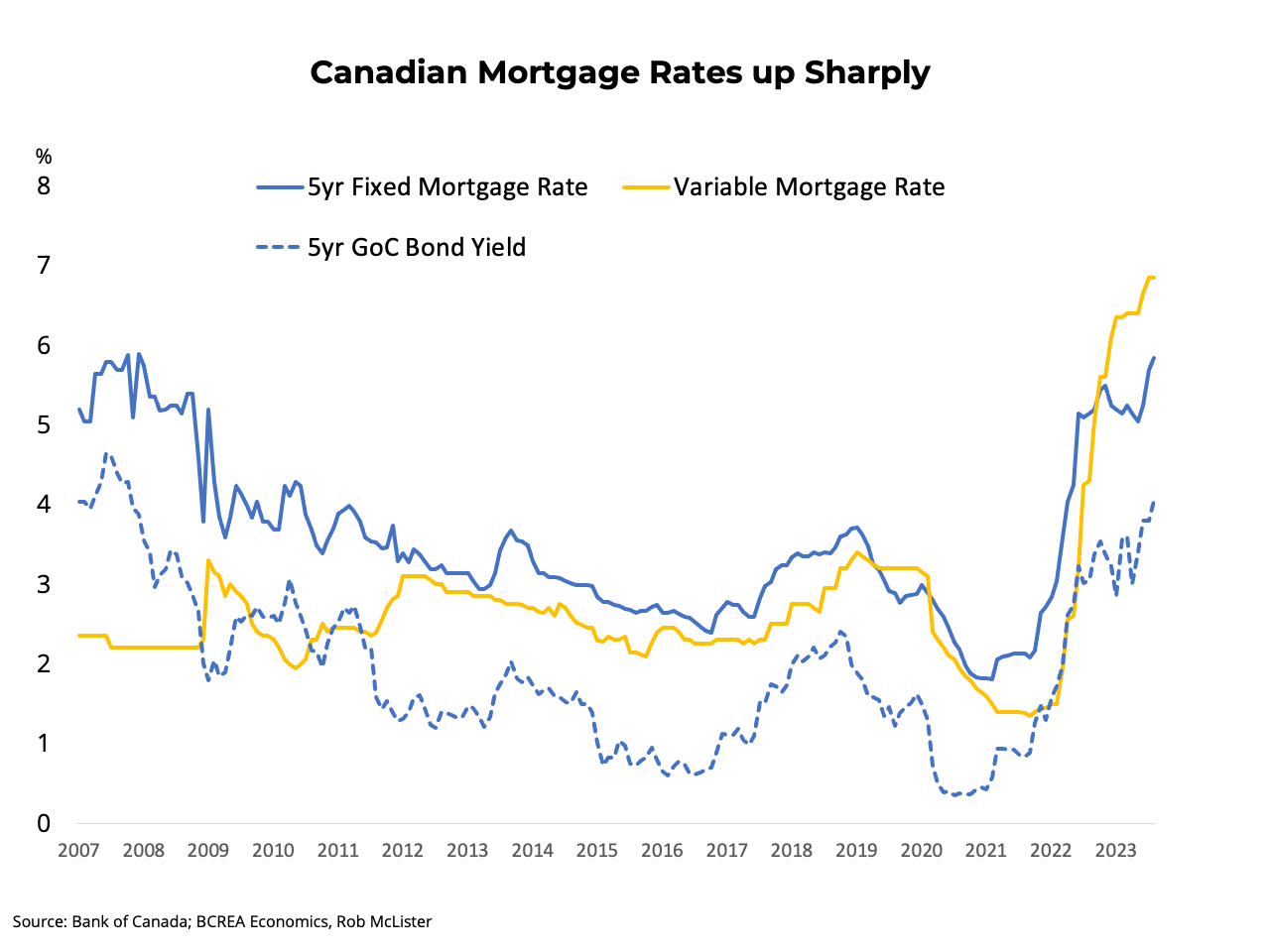
“Home sales are up significantly since this time last year,” said BCREA Chief Economist Brendon Ogmundson. “That said, there are signs that the most recent Bank of Canada rate increases are slowing activity as mortgage rates climb to their highest levels in over a decade.”
Active listings in the province were flat compared with July 2022, at just over 31,000 total listings and were up for the second consecutive month on a monthly, seasonally adjusted basis, as new listings return to more normal levels and sales moderate.
Year-to-date BC residential sales dollar volume was down 20.9 per cent to $46.3 billion, compared with the same period in 2022. Residential unit sales were down 16.3 per cent to 47,508 units, while the average MLS® residential price was down 5.4 per cent to $975,232.
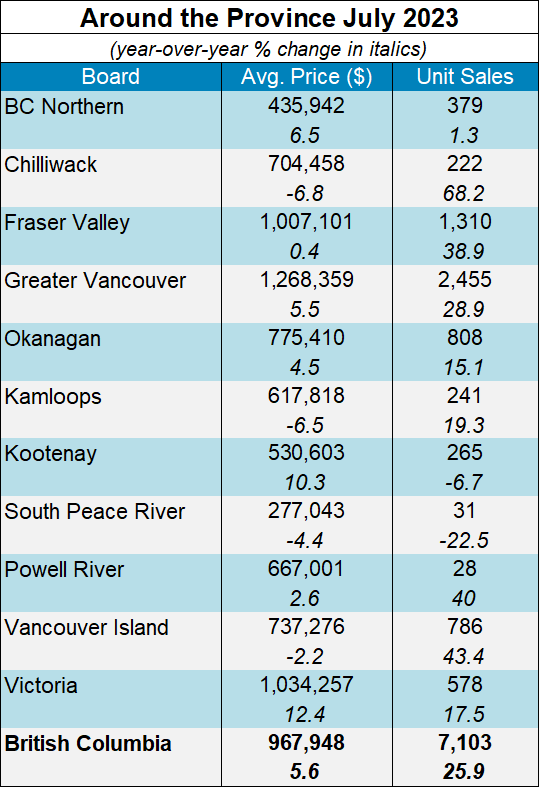
Bankruptcy of an Agent #177
By Gerry Neely
B.A., LL.B.
There have been fortunately, very few bankruptcies among real estate agencies in British Columbia, but when they do occur, they have unpleasant consequences for salespersons sharing in commissions paid to the bankrupt firm. Usually the bankrupt agency had assigned its receivables to its bank to secure a line of operating credit, and it took the commission because of its security. The salesman's position was that of an employee who was owed an unsecured amount by the bankrupt agent.
Attempts to persuade the provincial government to amend the B.C. Real Estate Act to create a trust of the deposit or other commission monies in favour of the salespersons have failed because of the argument that this would give a preference to real estate salespersons that other employees do not have.
Even without legislative changes however, all may not be lost because of the able arguments made by an Ontario lawyer who appealed the decision of a trustee in the bankruptcy of a real estate agency. The trustee disallowed the claims of two salespersons for commissions in excess of $20,000. This was based on a line of cases which held that the employer/employee relationship between agent and salesperson resulted in only a simple debt owed from one to the other. The difference between these cases and the Ontario case is that the salespersons and the agent had signed agreements which satisfied the judge that the salespersons were independent contractors and not employees.
Although the agent received the real estate commission, by the terms of the agreements the agent had no right to the commission as such. The monies from which commission would be payable to the salespersons were received by the agent in trust for the vendor and purchaser until closing. Following closing, the agent then became a stakeholder or collection agent, holding the trust funds for other brokers and the independent contractor salespersons, subject to the agent's right to payment of an administrative fee and a percentage of the salesperson's commission. judgement was given for the salespersons.
There are differences between the Ontario and British Columbia Real Estate Acts which may make this part of the decision not as favourable for B.C. licensees. The Ontario act defines a salesman as a person employed, appointed or authorized by a broker -. The British Columbia act is more restricted, referring only to the word "employed". However the judge in the Ontario case noted that the act did not prohibit an independent contractor relationship and cited a number of cases where an independent contractor was described as having been employed by his employer.
The second alternative argument which was accepted by the judge was based upon the principle of unjust enrichment. The Bankruptcy Act excludes from property to be divided among creditors, any property held by the bankrupt in trust for any other person. The agency was only entitled to 36% of the commission. The trustee in bankruptcy claimed to be entitled to recover 1 00 % of the commission, more than the agency could have retained if it had remained solvent. This would unjustly enrich the trustee and other creditors at the expense of the independent contractor salespersons. The judge held that the trustee retained the excess commission in trust for the salespersons.
The unjust enrichment argument does not depend upon the interpretation of the British Columbia Real Estate Act, but only upon the interpretation of the agreement between the agent and the salesperson.1
***
The Legally Speaking column #172 incorrectly stated that the reasonable period for a holdover clause should be 80 days; this should have been 60 days.
We are sorry if this error has caused any confusion.
| 1. |
|
To subscribe to receive BCREA publications such as this one, or to update your email address or current subscriptions, click here.
BC Financial Services Agency Becomes Sole Regulator for Real Estate
On August 1, the BC Financial Services Authority (BCFSA) assumed the Real Estate Council of BC (RECBC) and the Office of the Superintendent of Real Estate (OSRE) to become the only real estate regulator. BCFSA is a ‘super-regulator,’ regulating not only real estate but also credit unions, trust companies, insurance companies, pension plans and mortgage brokers. A dual-regulator model has created challenges for the real estate sector, so we are encouraged at the potential of this amalgamation. The amalgamation implements the Perrin Report’s recommendation to streamline the regulatory system and create more transparency for real estate professionals and better protection for consumers. The BC Real Estate Association and member boards’ role and services are not affected by the change.
So far, there have been few changes to the rollout. The most significant change affecting the day-to-day practice of REALTORS® is that RECBC’s website no longer exists. Instead, resources have been moved to BCFSA’s website. Another change affecting daily practice is that the Real Estate Services Rules have been renumbered. If you come across any challenges with these changes, we encourage you to email us at [email protected] with your concern so that we can anonymize and forward the issue to BCFSA staff.
BCREA staff have been meeting bi-weekly with senior management of BCFSA for months leading up to this changes. While we’re hopeful that this regulatory change will ultimately result in more efficiencies for consumers and real estate professionals, we are continuing to advocate for areas of improvement. One key recommendation we continue to ask for is the creation of a Professional Standing Committee to establish licensing qualifications and provide on-the-ground insights into all proposed changes to real estate practice.
As additional changes continue to occur throughout the coming months, we will continue acting as the voice of Realtors to advocate for a regulatory system that is easy to understand and inspires confidence in the professionals it governs.
Additional resources:
BC Financial Services Authority Publishes Update About Move to Single Regulator
On May 19, the British Columbia Financial Services Authority (BCFSA) published a status update regarding the integration of the Office of the Superintendent of Real Estate (OSRE) and Real Estate Council of BC (RECBC) into the BCFSA to create a single regulator for BC’s financial services sector.
In the news release published on its website, the BCFSA says the creation of a single regulator – which, in addition to real estate services, already includes credit unions, trust companies, insurance companies, mortgage brokers and pension plans – will “simplify accountabilities and enhance regulator oversight through more effective business processes, investigations, and enforcements.”
The BCFSA expects that the new regulatory model, which will be organized functionally with departments overseeing the entire financial sector, will come into effect this summer.
“We welcome the creation of a single integrated regulator for BC’s financial services sector and are optimistic about the efficiencies this amalgamation is expected to bring for real estate professionals,” says BCREA Chief Executive Officer Darlene Hyde. “We look forward to a collaborative and productive relationship with the BC Financial Services Authority as we continue to advocate for a regulatory environment that is informed by the REALTOR® perspective and results in increased consumer confidence.”
Over the coming weeks, BCREA will continue work with the BCFSA, OSRE and RECBC to understand the impact of the changes and to provide input at every opportunity, ensuring the collective voice of BC Realtors is heard throughout the next stages of the regulatory shift.
As a part of the future integration, current RECBC CEO Erin Seeley will take on a new role as Senior Vice President of Policy and Stakeholder Engagement, while current Superintendent of Real Estate Micheal Noseworthy will serve as Senior Vice President of Compliance and Market Conduct.
A full list of BCFSA’s future executive team can be found here. And an FAQ document, which includes more information about the integration of RECBC and OSRE, can be found here.
To learn more about what you can expect with the move to a single regulator, click here.
BC Government Announces New Housing Measures in 2024 Budget
On February 22, 2024, Finance Minister Katrine Conroy introduced the provincial government’s Budget 2024. The budget unveiled several new housing related measures, including the BC Home Flipping Tax and various property transfer tax exemptions.
While BCREA commends the provincial government’s renewed commitment and efforts to improve housing attainability for British Columbians, the budget’s introduction of a “flipping tax” is unlikely to have a meaningful impact on housing attainability.
Flipping Tax
The BC Home Flipping Tax is a 20 per cent tax on the gain from sale of a home within a one-year time horizon and a pro-rated tax on sales up to within a two-year period. The tax will apply to both properties and assignments of contracts and is in addition to any existing federal or provincial income taxes incurred from the sale of the property, including the federal anti-flipping tax. Exemptions will be available for certain life circumstances that might motivate the sale of a property within two years, including for added supply through the creation of rental accessory dwelling units.
The BCREA Economics Department’s preliminary analysis estimates the flipping tax will decrease home sales by between 1-2 per cent over a three-year period. Given the relatively small impact, prices and housing attainability are essentially unchanged by the tax. This is unsurprising, given that short-term flipping represents a low share of sales activity (less than 2 per cent in both Vancouver and Victoria).
However, because the government has now implemented a disincentive to sell within a two-year period after purchasing, there will be some potential sellers that are prompted to delay listing, resulting in a lower level of listings inventory than without the tax. As a result, home prices may increase with the flipping tax compared to a no-tax baseline. Ultimately, the only way to prevent harmful short-term speculation in the housing market is to ensure housing is abundant. Our team plans to continue to analyze the flipping tax and provide updates when available.
Property Transfer Tax Exemptions
In principle, BCREA supports reduced property transfer taxes for first-time home buyers and people purchasing newly constructed homes. However, while we're in favour of measures that increase first-time home buyers’ abilities to purchase properties, it's critically important that housing supply is increased so they aren’t caught in bidding wars to acquire those homes. More detail is needed on property transfer tax exemption for purpose-built rentals to understand its impact on housing attainability for British Columbians.
BCREA will continue to advocate for more thoughtful and evidence-based policies that can genuinely move the needle on housing attainability and alleviate the housing crisis facing British Columbians.
Between March 10 and 12, BCREA and delegates from real estate boards across the province will be taking part in our annual Government Liaison (GL) Days in Victoria. During this time, we will be meeting with MLA’s representing all parties and advocating for the establishment of a permanent housing roundtable where stakeholders such as BCREA can advise on housing policy prior to its introduction and implementation.
BC Government Presents Stay-The-Course Budget
BC’s Budget 2020 offers some new investments to assist homeowners and their communities, but falls short of substantial changes to improve housing affordability.
We’re pleased by the promise of an additional $419 million investment over three years to support CleanBC for home and workplace electric vehicle charging stations and new pilot programs to further reduce carbon emissions. An additional $195 million will also be invested over three years to help communities better respond to and recover from wildfires, floods and other emergencies.
These are the highlights of the few budget items related to housing:
- an additional $118 million in operating funding and $56 million in capital funding to support BC’s housing strategy. This will result in a planned $1.1 billion in total capital funding to support housing and homelessness initiatives over the next three years,
- a new exemption to the Property Transfer Tax that will be introduced for qualifying Canadian-controlled limited partnerships. Effective on royal assent, the Property Transfer Tax Act is amended to clarify the calculation of partial principal residence exemptions where the land is greater than 0.5 hectares or the property includes non-residential improvements, and
- amendments to the Land Tax Deferment Act to centralize program administration within the Ministry of Finance, effective May 1, 2020.
In BCREA’s response to the Budget 2020 consultation, we recommend fairness and effectiveness in provincial property taxes, such as increasing the First-Time Home Buyers’ Program Property Transfer Tax exemption threshold to $750,000 from $500,000. We also recommend more policies to help increase housing supply, such as exempting properties in the development process from the additional school tax using the same policy framework created to exempt development projects from the Speculation and Vacancy Tax.
We will continue to advocate for housing affordability solutions through our submission to the Expert Panel on the Future of Housing Supply and Affordability in April.
More government information on BC Budget 2020: https://bit.ly/2vGSXGa.
Photo: Minister Carole James delivers the 2020 Budget to stakeholders and journalists (Courtesy of Province of British Columbia/Flickr)
To subscribe to receive BCREA publications, or to update your email address or current subscriptions, click here.
BC Government Proposes Changes to Real Estate Services Act Paving Path for Single Regulator
On March 2, Bill 8: Finance Statutes Amendment Act, 2021 was introduced in the BC Legislature. With its introduction, the BC Government’s intention to create a single financial services regulator, including real estate, announced in September 2019, was finally made clear.
The bill creates the path for the Office of the Superintendent of Real Estate (OSRE) and the Real Estate Council of British Columbia (RECBC) to become part of the BC Financial Services Authority (BCFSA). According to the government’s news release, this is expected to happen “later in 2021.”
BCREA reaction
We welcome a more cohesive regulatory structure, which is something we asked for early in 2019. Unfortunately, the legislative changes introduced yesterday don’t include the creation of the Professional Standing Committee BCREA proposed more than a year ago.
When the BCFSA becomes the real estate regulator, administration of the Real Estate Services Act (RESA), Real Estate Development Marketing Act and parts of the Strata Property Act will be added to the BCFSA’s current regulatory responsibilities, which include credit unions, mortgage brokers and insurance. BCFSA’s Chief Executive Officer will become the new Superintendent of Real Estate.
As a result of the omission of the Professional Standing Committee, BCREA is concerned that real estate licensees will have fewer opportunities to provide input into rules and policies that impact the practice of real estate. Although the Professional Standing Committee isn’t included in the proposed amendments to RESA, we hope it will be implemented in the practical application of the new regulatory structure. We will continue to work with the BCFSA, OSRE and RECBC to this end. Our goal is to ensure a consistent, meaningful process for practitioner input.
Other changes
At a high level, the government also proposes the following changes, among others:
- expanding the administrative penalty system, including the option of requiring further education and doubling the maximum penalty (currently $50,000),
- eliminating discipline committees, and
- strengthening the new superintendent’s options for handling urgent circumstances.
Next steps
BCREA is carefully reviewing the proposed changes to RESA, including seeking legal analysis and meeting with government staff.
This bill – like all bills – will be debated in the legislature and subject to further changes as part of that process. Once it’s passed, it won’t take effect right away. Instead, the government will implement it at a later date by regulation.
As BCREA learns more about the proposed changes to RESA, we’ll provide updates in future blog posts. If you have any concerns, please contact Senior Policy Analyst Norma Miller.
To subscribe to receive BCREA publications, or to update your email address or current subscriptions, click here.
BC Government Releases Cullen Commission Final Report and Recommendations
On Wednesday, June 15, the BC Government publicly released the final report and recommendations from the Cullen Commission of Inquiry into Money Laundering in BC.
The Commission was established in May 2019 to examine the extent of money laundering in BC. Areas of focus included real estate, as well as the gaming sector, financial institutions, the corporate sector, lawyers and notaries, accountants, luxury goods and virtual assets. Last year, former BCREA Chief Executive Officer Darlene Hyde and Chief Economist Brendon Ogmundson represented BC’s real estate boards and Realtors by participating in the inquiry to provide context and insight into the functions of the real estate sector.
In the final report, Commissioner Austin Cullen recommends the creation of a provincial anti-money laundering unit and changes to FINTRAC. Additionally, the Commissioner was unable to find a link between money laundering in real estate and housing unaffordability.
“The commissioner’s findings, after more than a year of study, show that the volume of money laundering in our province is ‘enormous’ is profoundly concerning,” said BC Attorney General and Minister Responsible for Housing David Eby.
Read more about the findings and recommendations:
Focus on real estate
One of the many areas of focus of the inquiry and final report was money laundering in real estate.
In addition to finding no link between housing prices and money laundering, Commissioner Cullen highlighted that “the real estate sector is highly vulnerable to money laundering.” He also wrote that REALTORS®:
- have a poor record of anti-money laundering reporting and compliance;
- display an inadequate understanding of, and hold misplaced beliefs about, how money laundering occurs in the real estate industry;
- are confused about how to comply with their federal anti-money laundering obligations; and that
- most real estate agents and brokers have no background in compliance or anti-money laundering measures, and there is significant frustration in the industry about the lack of guidance.
The report was also critical of FINTRAC, Canada’s financial intelligence unit, saying that “law enforcement bodies in BC cannot rely on FINTRAC to produce timely, useful intelligence about money laundering.” As a solution, Commissioner Cullen called for the “need for clear, simple guidance from FINTRAC about when transactions must be reported.”
BCREA continued advocacy
We know Realtors, as members of the public and trusted advisors for consumers are concerned about money laundering in real estate and your frustrations around the difficulties of the current compliance requirements. As BCREA continues to review and analyze the report and its findings, we will inform you of developments that impact your day-to-day work and the future of the profession.
We will also continue to advocate for more transparency and collaboration with the real estate sector from regulatory bodies to ensure that any changes to anti-money laundering requirements for Realtors are effective and created with careful consideration for the nuances of the real estate transaction and the protection of Realtors and their clients.
If you have questions about the Cullen Commission, email [email protected].
BC Government Responds to Industry Feedback on <em>Residential Tenancy Act</em> Changes
In the immediate wake of publicly voiced concern from BCREA, the BC Government has reversed course on two recent changes to the Residential Tenancy Act (RTA) as they relate to buyers of tenanted properties.
The initial changes laid out in Bill 14, which came into effect on July 18, 2024, required four months' notice – instead of the previous two months' notice – for evictions due to personal or caretaker use. The legislation also raised the dispute period from 15 days to 30 days.
Now the government is amending the regulation to lower the personal-use notice period to three months and the dispute period to 21 days for situations when a landlord gives notice to a tenant on behalf of a purchaser. These changes come into effect on August 21, 2024.
"Since the amendments came into force, government has listened to feedback from industry stakeholders that a four-month notice period could prevent first-time buyers from purchasing a tenanted property," the government said in a statement on August 1, 2024.
The BCREA Government Relations department is proud to have been a key part of the industry response, along with partners from the Canadian Mortgage Brokers Association – BC (CMBA-BC). In open letters and a joint press release, the two organizations pointed out the flaws with lengthening both the personal-use notice period and the dispute period, including their effect on first-time homebuyers.
"We appreciate the government responding quickly to our concerns," said Trevor Hargreaves, BCREA Senior VP, Government Relations, Marketing & Communications. "This legislation caused confusion and concern amongst both REALTORS® and the public, including buyers and sellers, and we're happy to see changes made to alleviate that."
In BCREA's open letter, the organization reiterated its call for government to launch a permanent housing roundtable made up of housing policy experts and other stakeholders from across the BC housing sector, as it would have allowed for this round of feedback to be delivered before the legislation took effect.
Related links:
To read the full statement from the BC Government, click here.
To read CBC coverage of these latest developments, click here.
To read BCREA's letter to the BC Government, click here.
To read BCREA and CMBA-BC's joint press release, click here.
For more information:
If you have questions or concerns about changes to the RTA or any other policy issue, please email Trevor Hargreaves at [email protected].
BC Government Takes Positive Step to Increase Housing Supply, But Incentives Needed to Encourage Action
With demand significantly outweighing supply in many regions across BC, the cost of housing has risen dramatically during the COVID-19 pandemic. The British Columbia Real Estate Association (BCREA) has maintained that increasing market housing supply is a key to making homeownership more affordable for British Columbians, which is why the provincial government’s recent announcement introducing proposed legislative amendments aimed at speeding up municipal development approvals is a welcomed, positive step.
“We have seen throughout the pandemic that housing for British Columbians is at a premium, both in terms of options and cost,” says BCREA Chief Executive Officer Darlene Hyde. “The most obvious and impactful measure that can be taken to address this is increasing supply. So, we are encouraged to see that the government is making this a priority.”
The changes announced by the government include the removal of requirements for local governments to hold public hearings for development proposals that already align with Official Community Plans (OCPs) and equip municipal staff to make decisions for minor development variance permits.
BCREA has long been advocating for measures to speed up development approvals and we are pleased to see them being put into practice. Our recent pre-budget submission to the government’s standing committee on finance specifically called for changes to the public hearing process. What remains, however, is the adoption of additional measures outlined in the Development Approvals Process Review (DAPR) final report, which the provincial government published in September 2019, but have yet to implement.
“Increasing housing supply is not a simple solution. It requires a coordinated and aligned effort from all orders of government and adequate incentives for municipalities to take action,” adds Hyde. “What is not addressed here are the undercurrents of hesitancy around development that exist within certain municipalities.”
BCREA recommends governments at both the provincial and federal levels work collaboratively to make infrastructure investments to local governments conditional on targets in OCPs. This is a recommendation that is echoed both in the DAPR final report and by the Canada-British Columbia Expert Panel on the Future of Housing Supply and Affordability in its final report. The province should also provide local governments with best practices for writing, adopting and amending OCPs, and municipalities should prioritize the creation of missing middle housing through the gentle densification of single-family residential neighbourhoods.
For more information, contact:
Trevor Hargreaves
BCREA Vice President, Government Relations
[email protected]
604.375.8076
BC Government to Implement Homebuyer Protection Period in January 2023
The BC Government has created regulations that will enable a mandatory three-day Homebuyer Protection Period (HPP), previously called a “cooling off period,” on January 1, 2023. While BCREA supports enhanced consumer protection measures for real estate consumers, we are extremely disappointed by this announcement. We anticipate that the HPP will not be an effective measure, especially as market conditions are changing and becoming more balanced.
BCREA offered more than thirty alternative recommendations in our paper published in our white paper, “A Better Way Home.” Many of these recommendations aligned with the BC Financial Services Authority’s report, “Enhancing Consumer Protection in BC’s Real Estate Market,” which was published in May.
So far, the Ministry of Finance has ignored these recommendations, only choosing to move forwards with their Homebuyer Protection Period, which was announced before any consultation took place.
The decision to implement an HPP undermines the independence and expertise of BCFSA and is concerning to Realtors and British Columbians. For consumers to truly be protected in a real estate transaction in BC, the government needs to empower BCFSA to conduct its own research on policies’ effectiveness, otherwise, there will continue to be a lack of positive changes to BC’s housing market.
While there remain many unanswered questions, here are the details of the HPP upon the announcement:
Deposit
- if a deposit is held in trust, brokerages may release it upon rescission
- rescission fee amount is provided to the seller
- the balance (if any) is returned to the buyer, despite what may be provided in the contract.
Exemptions and waivers
The HPP cannot be waived. Narrow exemptions include:
- sales subject to a 21 of the Real Estate Development Marketing Act
- sales of residential real property located on leased land
- sales of leasehold interest in residential real estate
- sales at auction
- sales under a court order or supervision of a court
Defining residential real estate
The policy will apply to the following types of structures:
- detached homes,
- semi-detached homes,
- townhouses,
- apartments in a duplex or other multi-unit dwelling,
- residential strata lots,
- manufactured homes that are affixed to land, and
- cooperative interests that include a right of use or occupation of a dwelling.
The HPP does not apply to presale properties already subject to a rescission period under the Real Estate Development Marketing Act.
Requirements to Inform Consumers
Licensees must provide general information on the HPP to all consumers through the Disclosure of Representation in Trading Services (prescribed content).
Service of Notice
Homebuyers must serv rescission notice on the seller in one of the following forms:
- registered mail
- fax
- e-mail with read receipt
- Personal service
Rescission Notice Content
Rescission notice must contain:
- address, PID or description of the property
- names and signature of the purchaser
- name of the seller(s)
- date of notice
Additional Disclosure
Licensees must also provide an additional mandatory disclosure at the time of preparing an offer on behalf of presenting an offer to a client, containing the following information:
- the HPP cannot be waived,
- the rescission period,
- dollar amount of the rescission fee,
- deposit handling, and
- HPP exemptions.
Records Retention
Brokerages must retain a copy of a rescission notice that it prepares or receives (enables audit and reporting).
BCREA staff have met with BC Financial Services Authority staff to receive a debrief from them and begin coordinating education resources for licensees. We will continue to collate questions and concerns, bringing them to the Minister of Finance.
BCREA understands the importance of consumer protection measures and continues to support enhancements to real estate transactions. REALTORS® consider consumer protection a top priority in their work with consumers every day, and improving consumer confidence, and trust in their home buying journey is something the profession is constantly working towards.
To learn more, read:
Home Buyer Rescission Period Regulation Order in Council
Disclosure of certain clients of the right of rescission Order in Council
BC Home Flipping Tax Now in Effect: Here’s What REALTORS® Need to Know
As of January 1, 2025, the BC Home Flipping Tax is now in effect. REALTORS® need to know this new tax is distinct from the existing federal property flipping tax and specifically targets short-term property sales within British Columbia.
Here’s how it works:
- The tax applies to income from sales of residential properties, presale contracts, or assignments owned for less than 730 days (two years). This includes properties bought before January 1, 2025, if they are sold on or after that date and owned for less than two years.
- The rate is 20 per cent for sales within the first 365 days of ownership, gradually decreasing until it is eliminated at 730 days.
- This tax applies to any person or entity (individual, corporation, partnership, or trust) selling property within BC, regardless of residency.
- Exemptions include certain primary residences, though exemptions are subject to specific conditions and filing requirements.
The BC Government has released a new video about the tax. Check it out here.
To check out all the details on the BC Government website, click here.
For the BC Real Estate Association’s breakdown of the new tax, including a comparison with the federal flipping tax, click here.
BC Home Sales Above 100,000 for Third Consecutive Year
For the complete news release, including detailed statistics, click here.
Vancouver, BC – January 12, 2018. The British Columbia Real Estate Association (BCREA) reports that a total of 103,763 residential unit sales were recorded by the Multiple Listing Service® (MLS®) across the province in 2017, a decline of 7.5 per cent from a record 112,211 unit sales in 2016. The average MLS® residential price in BC was $709,579 in 2017, up 2.7 per cent from the previous year. Total sales dollar volume was $73.63 billion, down 5.1 per cent from 2016.
 "Robust housing demand in 2017 was underpinned by a strong economy, employment growth and rising wages," said Cameron Muir, BCREA Chief Economist. "Above trend migration, both international and interprovincial, also bolstered housing demand, while broader demographic fundamentals added fuel to condominium sales in urban centres and to all home types in retirement-oriented communities."
The BC housing market ended the year with a strong December. Home sales increased 4 per cent from November, on a seasonally adjusted basis. However, the year-end results were likely pushed higher by some homebuyers advancing their purchases to avoid tougher mortgage qualification rules in the new year.
In December, a total of 5,738 residential unit sales were recorded by the MLS® across the province, an increase of 21.5 per cent from the same period last year. Total sales dollar volume was $4.2 billion, up 36.3 per cent from December 2016. The average MLS® residential price in the province was $734,108, up 12.1 per cent from the same month last year.
-30-
For more information, please contact:
Cameron Muir
Chief Economist
Direct: 604.742.2780
Mobile: 778.229.1884
Email: [email protected]
To subscribe to receive BCREA publications such as this one, or to update your email address or current subscriptions, click here.
BC Home Sales Continue at Slower Pace
For the complete news release, including detailed statistics, click here.
Vancouver, BC – December 14, 2018. The British Columbia Real Estate Association (BCREA) reports that a total of 5,179 residential unit sales were recorded by the Multiple Listing Service® (MLS®) across the province in November, down 33.1 per cent from the same month last year. The average MLS® residential price in BC was $718,903, a decline of 1.9 per cent from November 2017. Total sales dollar volume was $3.7 billion, a 34.3 per cent decline from November 2017.
 “BC households continue to struggle with the sharp decline in purchasing power caused by the B20 mortgage stress test,” said Cameron Muir, BCREA Chief Economist. “Most BC regions are now exhibiting relative balance between supply and demand.”
Total active residential listings were up nearly 31 per cent to 33,500 units in November, compared to the same month last year. However, it should be noted that this compares to 2017, when active listings for the month of November were at their lowest level in more than 15 years.
Year-to-date, BC residential sales dollar volume was down 23.1 per cent to $53.4 billion, compared with the same period in 2017. Residential unit sales declined 23.6 per cent to 74,847 units, while the average MLS® residential price was up 0.7 per cent to $713,302.
-30-
For more information, please contact:
Cameron Muir
Chief Economist
Direct: 604.742.2780
Mobile: 778.229.1884
Email: [email protected]
To subscribe to receive BCREA publications such as this one, or to update your email address or current subscriptions, click here.
BC Home Sales Continue at Slower Pace in September
For the complete news release, including detailed statistics, click here.
Vancouver, BC – October 11, 2018. The British Columbia Real Estate Association (BCREA) reports that a total of 5,573 residential unit sales were recorded by the Multiple Listing Service® (MLS®) across the province in September, a 33.2 per cent decrease from the same month last year. The average MLS® residential price in BC was $685,749, down 1.1 per cent from September 2017. Total sales dollar volume was $3.8 billion, a 34 per cent decline from September 2017.
 “BC home sales continue at a slower pace compared to last year,” said Cameron Muir, BCREA Chief Economist. “The impact on affordability and purchasing power caused by the mortgage stress test and moderately higher interest rates are negating the effect of the extraordinarily strong performance of BC’s economy over the last five years.”
Year-to-date, BC residential sales dollar volume was down 21.3 per cent to $45 billion, compared with the same period in 2017. Residential unit sales decreased 22.5 per cent to 63,251 units, while the average MLS® residential price was up 1.5 per cent to $716,096.
-30-
For more information, please contact:
Cameron Muir
Chief Economist
Direct: 604.742.2780
Mobile: 778.229.1884
Email: [email protected]
To subscribe to receive BCREA publications such as this one, or to update your email address or current subscriptions, click here.
BC Home Sales Continue to Slow in July
For the complete news release, including detailed statistics, click here.
Vancouver, BC – August 11, 2022. The British Columbia Real Estate Association (BCREA) reports that a total of 5,572 residential unit sales were recorded by the Multiple Listing Service® (MLS®) in July 2022, a decrease of 42.4 per cent from July 2021. The average MLS® residential price in BC was $923,449, a 3.6 per cent increase from $891,376 recorded in July 2021. Total sales dollar volume was $5.1 billion, a 40.3 per cent decline from the same time last year.
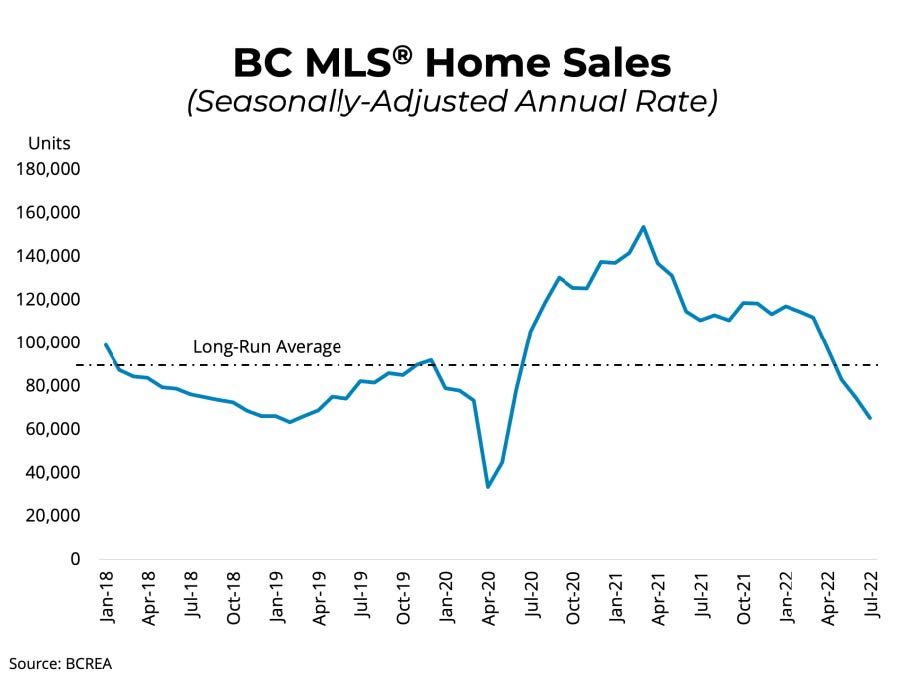
“High mortgage rates continued to lower sales activity in July,” said BCREA Chief Economist Brendon Ogmundson. “Many regions around the province have seen sales slip to levels well below normal for this time of year.”
As the pace of sales activity declines below normal levels, inventory is accumulating. Provincial active listings rose 28 per cent year-over-year, though from a very low level in July 2021. Inventories remain quite low, but the slow pace of sales has tipped some markets into balanced or even buyers’ market territory.
Year-to-date, BC residential sales dollar volume was down 20 per cent from the same period in 2021 to $58.7 billion. Residential unit sales were down 29.3 per cent to 56,801 units, while the average MLS® residential price was up 13.2 per cent to $1.03 million.
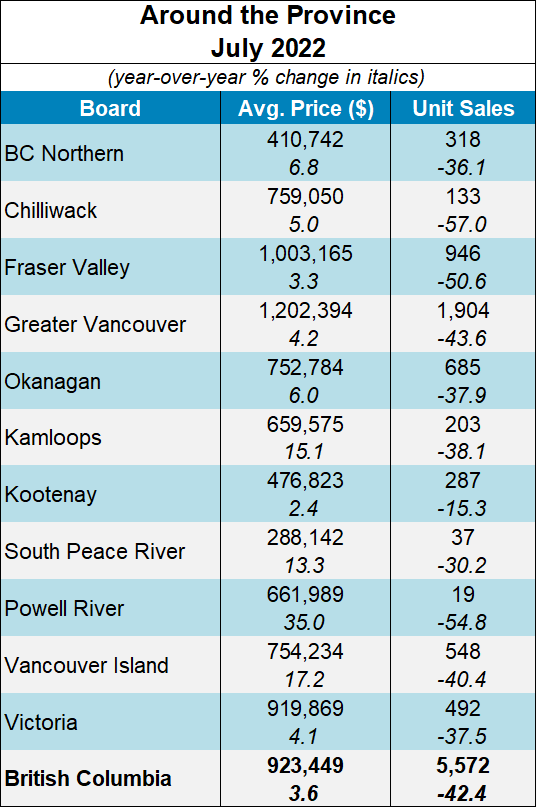
-30-
BC Home Sales Decline 25% in 2018
For the complete news release, including detailed statistics, click here.
Vancouver, BC – January 15, 2019. The British Columbia Real Estate Association (BCREA) reports that a total of 78,345 residential unit sales were recorded by the Multiple Listing Service® (MLS®) in 2018, a decline of 24.5 per cent from the 103,758 units sold in 2017. The annual average MLS® residential price in BC was $712,508, an increase of 0.4 per cent from $709,601 recorded the previous year. Total sales dollar volume was $55.8 billion, a 24.2 per cent decline from 2017.
 “BC home sales fell below the 10-year average of 84,800 units in 2018,” said Cameron Muir, BCREA Chief Economist. “The sharp decline in affordability caused by the B20 mortgage stress test is largely to blame for decline in consumer demand last year.”
A total of 3,497 MLS® residential unit sales were recorded across the province in December, down 39.1 per cent from December 2017. The average MLS® residential price in BC was $695,647, a decline of 5.2 per cent from December 2017. Total sales dollar volume was $2.4 billion, a 42.3 per cent decline during the same period.
Total active residential listings were up 33.3 per cent to 27,615 units in December, the highest December inventory since 2014 when 33,995 active residential listings were recorded.
-30-
For more information, please contact:
Cameron Muir
Chief Economist
Direct: 604.742.2780
Mobile: 778.229.1884
Email: [email protected]
To subscribe to receive BCREA publications such as this one, or to update your email address or current subscriptions, click here.
BC Home Sales Dip After Strong December
For the complete news release, including detailed statistics, click here.
Vancouver, BC – February 15, 2018. The British Columbia Real Estate Association (BCREA) reports that a total of 5,306 residential unit sales were recorded by the Multiple Listing Service® (MLS®) across the province in January, an increase of 18.3 per cent from the same period last year. The average MLS® residential price in BC was $721,477, up 16.2 per cent from the previous year. Total sales dollar volume was $3.83 billion, a 37.4 per cent increase from January 2017.
 "BC home sales dipped 10 per cent from December to January, on a seasonally adjusted basis," said Cameron Muir, BCREA Chief Economist. "New mortgage rules requiring conventional borrowers to qualify at a higher interest rate likely contributed to the decline in home sales last month. The impact was magnified by a strong December as many households advanced their purchase decisions ahead of the policy's implementation."
Despite the decline in January transactions, the seasonally adjusted annual rate of home sales was 101,800 units.
Compared to January 2017, market conditions tightened in all BC board areas except Victoria, where the sales-to-active listings ratio declined from 46.3 per cent to 40.5 per cent. Despite this decline, Victoria remains in strong sellers' market territory. Total active listings in the province were down 8.6 per cent to 20,901 units, compared to the same period last year.
-30-
For more information, please contact:
Cameron Muir
Chief Economist
Direct: 604.742.2780
Mobile: 778.229.1884
Email: [email protected]
To subscribe to receive BCREA publications such as this one, or to update your email address or current subscriptions, click here.
BC Home Sales Gain Momentum in September
For the complete news release, including detailed statistics, click here.
Vancouver, BC – October 15, 2025. The British Columbia Real Estate Association (BCREA) reports that 5,782 residential unit sales were recorded in Multiple Listing Service® (MLS®) Systems in September 2025, up 4.4 per cent from September 2024. The average MLS® residential price in BC in September 2025 was up 0.4 per cent at $948,296 compared to $944,298 in September 2024.

Total MLS® residential sales dollar volume was $5.5 billion, up 4.8 per cent from the same time the previous year. BC MLS® unit sales were 21.4 per cent lower than the ten-year average for the month of September.
“Home sales in the province are gaining momentum following a slow first half of 2025,” said BCREA Chief Economist Brendon Ogmundson. “We anticipate sales will finish the year strong, aided by lower interest rates helping to unleash pent-up demand.”
Year-to-date, BC residential sales dollar volume is down 7.3 per cent to $51.8 billion, compared with the same period in 2024. Residential unit sales are down 4.2 per cent year-over-year at 54,594 units, while the average MLS® residential price is also down 3.3 per cent to $949,203.

BC Home Sales on the Rise in May
For the complete news release, including detailed statistics, click here.
Vancouver, BC – June 14, 2019. The British Columbia Real Estate Association (BCREA) reports that a total of 8,221 residential unit sales were recorded by the Multiple Listing Service® (MLS®) in May, a decline of 7 per cent from the same month last year. The average MLS® residential price in the province was $707,829, a decline of 4.3 per cent from May 2018. Total sales dollar volume was $5.8 billion, an 11 per cent decline from the same month last year.
 “BC home sales increased 9 per cent in May compared to April, on a seasonally adjusted basis,” said BCREA Chief Economist Cameron Muir. “However, consumers continue to struggle with the negative shock to affordability that stringent mortgage lending policies have created.”
Total MLS® residential active listings were up 23.2 per cent to 41,519 units compared to the same month last year. However, total active listings were down 2 per cent from April, on a seasonally adjusted basis, the first monthly decline since the B20 Stress test was introduced in January 2018.
Year-to-date, BC residential sales dollar volume was down 25.1 per cent to $19.8 billion, compared with the same period in 2018. Residential unit sales decreased 20.2 per cent to 28,711 units, while the average MLS® residential price was down 6.2 per cent to $688,339.
-30-
For more information, please contact:
Cameron Muir
Chief Economist
Direct: 604.742.2780
Mobile: 778.229.1884
Email: [email protected]
To subscribe to receive BCREA publications such as this one, or to update your email address or current subscriptions, click here.
BC Home Sales Remain Slow While Active Listings Plateau
For the complete news release, including detailed statistics, click here.
Vancouver, BC – November 14, 2022. The British Columbia Real Estate Association (BCREA) reports that a total of 5,242 residential unit sales were recorded by the Multiple Listing Service® (MLS®) in October 2022, a decrease of 45.5 per cent from October 2021. The average MLS® residential price in BC was $932,979, a 3.1 per cent decrease from $963,011 recorded in October 2021. Total sales dollar volume was $4.9 billion, a 47.2 per cent decline from the same time last year.
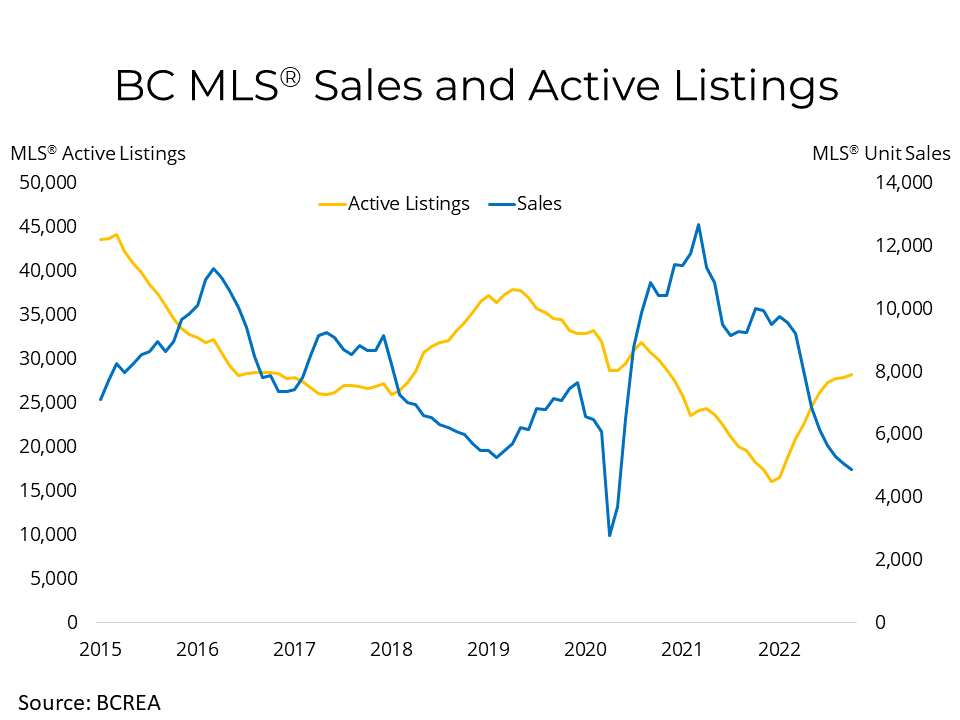
“Sales activity remains slow across the province and inventories appear to be plateauing,” said BCREA Chief Economist Brendon Ogmundson. “While prices have fallen from peak levels reached in early 2022, average prices have recently leveled off.”
Year-to-date, BC residential sales dollar volume was down 26.3 per cent from the same period in 2021 to $73.3 billion. Residential unit sales were down 33 per cent to 72,824 units, while the average MLS® residential price was up 10 per cent to $1.01 million.
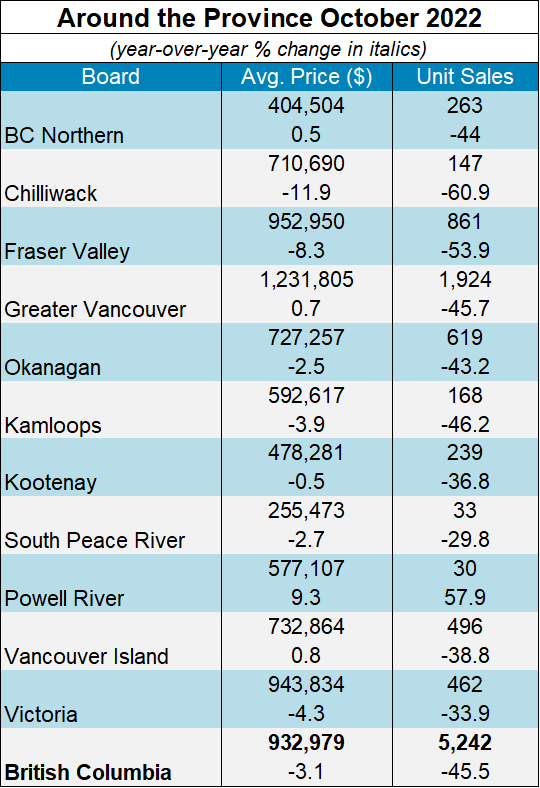
-30-
BC Home Sales Returning to Normal While Supply Hits Record Low
For the complete news release, including detailed statistics, click here.
Vancouver, BC – September 14, 2021. The British Columbia Real Estate Association (BCREA) reports that a total 9,507 residential unit sales were recorded by the Multiple Listing Service® (MLS®) in August 2021, a decrease of 7.1 per cent over August 2020. The average MLS® residential price in BC was $901,712, a 17.2 per cent increase from $769,691 recorded in August 2020. Total sales dollar volume was $8.6 billion, an 8.9 per cent increase from last year.
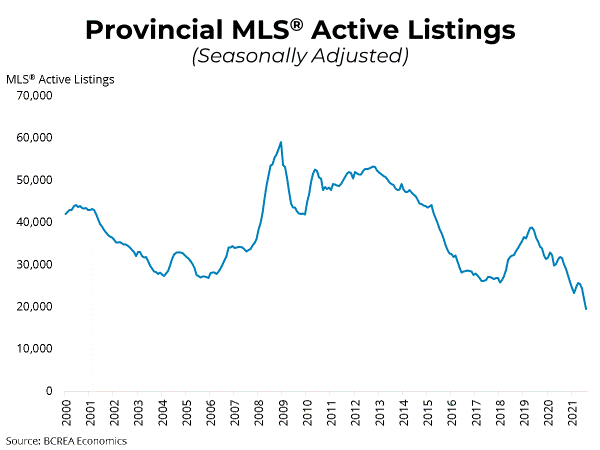
“Home sales around the province have essentially returned to normal after a record setting spring,” said BCREA Chief Economist Brendon Ogmundson. “However, we continue to see a drought in the total supply of listings as well as downward trend in new listings activity.”
Total active residential listings were down 37.9 per cent year-over-year in August and were 42 per cent below normal levels for the month of August.
Year-to-date, BC residential sales dollar volume was up 102.2 per cent to $82 billion, compared with the same period in 2020. Residential unit sales were up 67.8 per cent to 89,980 units, while the average MLS® residential price was up 20.5 per cent to $911,245.
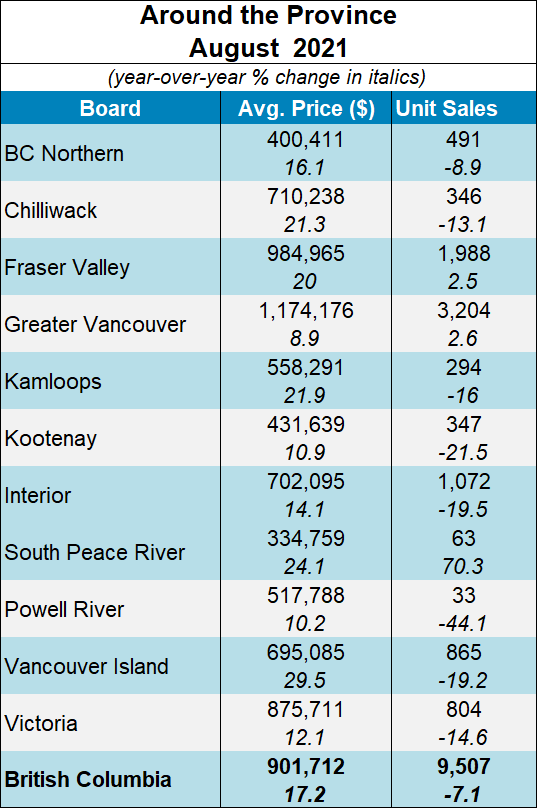
-30-
For more information, please contact:
Brendon Ogmundson
Chief Economist
Direct: 604.742.2796
Mobile: 604.505.6793
Email: [email protected]
BC Home Sales Show Little Change in April
For the complete news release, including detailed statistics, click here.
Vancouver, BC – May 14, 2018. The British Columbia Real Estate Association (BCREA) reports that a total of 8,203 residential unit sales were recorded by the Multiple Listing Service® (MLS®) across the province in April, a 16.8 per cent decrease from the same month last year. The average MLS® residential pricein BC was $730,507, up 0.2 per cent from the previous year. Total sales dollar volume was $5.99 billion, a 16.7 per cent decline from April 2017.
 "BC home sales were essentially unchanged in April compared to March, albeit up nearly 1 per cent on a seasonally adjusted basis," said Cameron Muir, BCREA's Chief Economist. "The impact of more burdensome mortgage qualifications for conventional borrowers is expected to soften over the next several months as potential buyers adjust both their finances and expectations."
The supply of homes for sale in April increased 4 per cent from the previous month. However, total active listings on the market continue to remain low from a historical perspective. Most regions of the province have begun trending toward more balance between supply and demand, causing less upward pressure on home prices.
Year-to-date, BC residential sales dollar volume was down 6.7per cent to $19.9 billion, compared with the same period in 2017. Residential unit sales decreased 11.8 per cent to 27,135 units, while the average MLS® residential price was up 5.7 per cent to $731,661.
-30-
For more information, please contact:
Cameron Muir
Chief Economist
Direct: 604.742.2780
Mobile: 778.229.1884
Email: [email protected]
To subscribe to receive BCREA publications such as this one, or to update your email address or current subscriptions, click here.
BC Home Sales Trend Higher in February
For the complete news release, including detailed statistics, click here.
Vancouver, BC – March 12, 2020. The British Columbia Real Estate Association (BCREA) reports that a total of 5,741 residential unit sales were recorded by the Multiple Listing Service® (MLS®) in February 2020, an increase of 26.3 per cent from February 2019. The average MLS® residential price in BC was $758,863, a 12 per cent increase from $677,681 recorded the previous year. Total sales dollar volume in February was $4.4 billion, a 41.4 per cent increase over 2019.
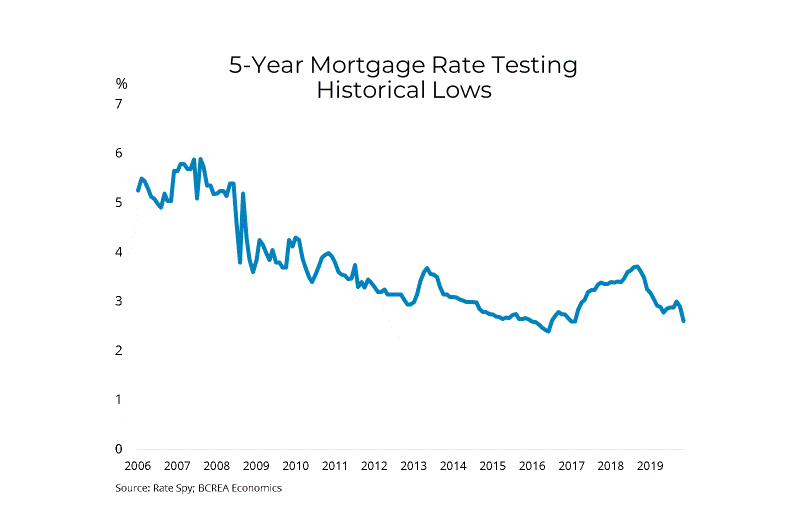
“Housing markets in BC continued to trend near long-term average levels in February,” said BCREA Chief Economist Brendon Ogmundson. “Recent declines in mortgage rates and favourable changes to mortgage qualifying rules may provide a boost to home sales heading into the spring, although there is significant economic uncertainty lingering over the outlook.”
Total MLS® residential active listings fell 8.4 per cent to 28,303 units compared to the same month last year. The ratio of sales to active residential listings increased 20.3 per cent from 14.7 per cent last February.
Year-to-date, BC residential sales dollar volume was up 38.4 per cent to $7.6 billion, compared with the same period in 2019. Residential unit sales increased 24.8 per cent to 10,135 units, while the average MLS® residential price was up 10.9 per cent to $745,501.
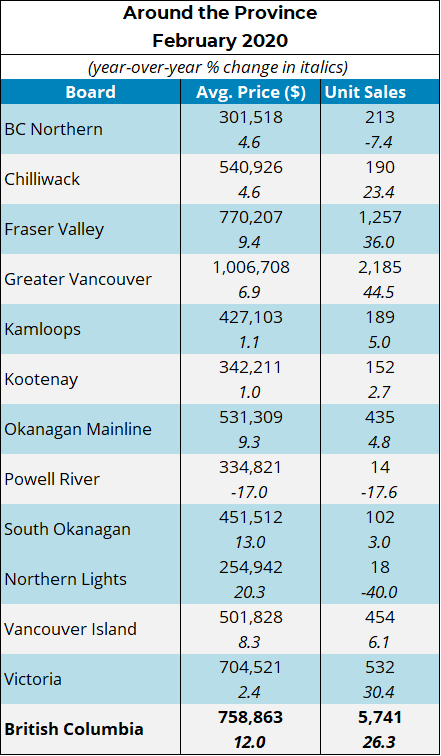
-30-
For more information, please contact:
Brendon Ogmundson
Chief Economist
Direct: 604.742.2796
Mobile: 604.505.6793
Email: [email protected]
To subscribe to receive BCREA publications such as this one, or to update your email address or current subscriptions, click here.
BC Home Sales Trend Lower in June
For the complete news release, including detailed statistics, click here.
Vancouver, BC – July 15, 2019. The British Columbia Real Estate Association (BCREA) reports that a total of 6,960 residential unit sales were recorded by the Multiple Listing Service® (MLS®) in June, a decline of 11.8 per cent from the same month last year. The average MLS® residential price in the province was $687,584, a decline of 4 per cent from June 2018. Total sales dollar volume was $4.8 billion, a 15.3 per cent decline from the same month last year.
 “BC home sales moderated lower in June after a stronger showing in May,” said BCREA Deputy Chief Economist Brendon Ogmundson. “While mortgage rates offered by lenders have moved below 3 per cent, a static qualifying rate has limited the impact of the lower cost of borrowing.”
Total MLS® residential active listings were up 18.6 per cent to 42,625 units compared to the same month last year and were essentially flat on a seasonally adjusted basis compared to May.
Year-to-date, BC residential sales dollar volume was down 23.4 per cent to $24.5 billion, compared with the same period in 2018. Residential unit sales decreased 18.7 per cent to 35,679 units, while the average MLS® residential price was down 5.8 per cent to $688,080.
-30-
For more information, please contact:
Brendon Ogmundson
Deputy Chief Economist
Direct: 604.742.2796
Mobile: 604.505.6793
Email: [email protected]
To subscribe to receive BCREA publications such as this one, or to update your email address or current subscriptions, click here.
BC Home Sales Trending Toward Normal Activity
For the complete news release, including detailed statistics, click here.
Vancouver, BC – May 12, 2022. The British Columbia Real Estate Association (BCREA) reports that a total of 8,939 residential unit sales were recorded by the Multiple Listing Service® (MLS®) in April 2022, a decrease of 34.9 per cent from a record April 2021. The average MLS® residential price in BC was $1.065 million, a 12.9 per cent increase from $943,765 recorded in April 2021. Total sales dollar volume was $9.5 billion, a 26.5 per cent decline from the same time last year.
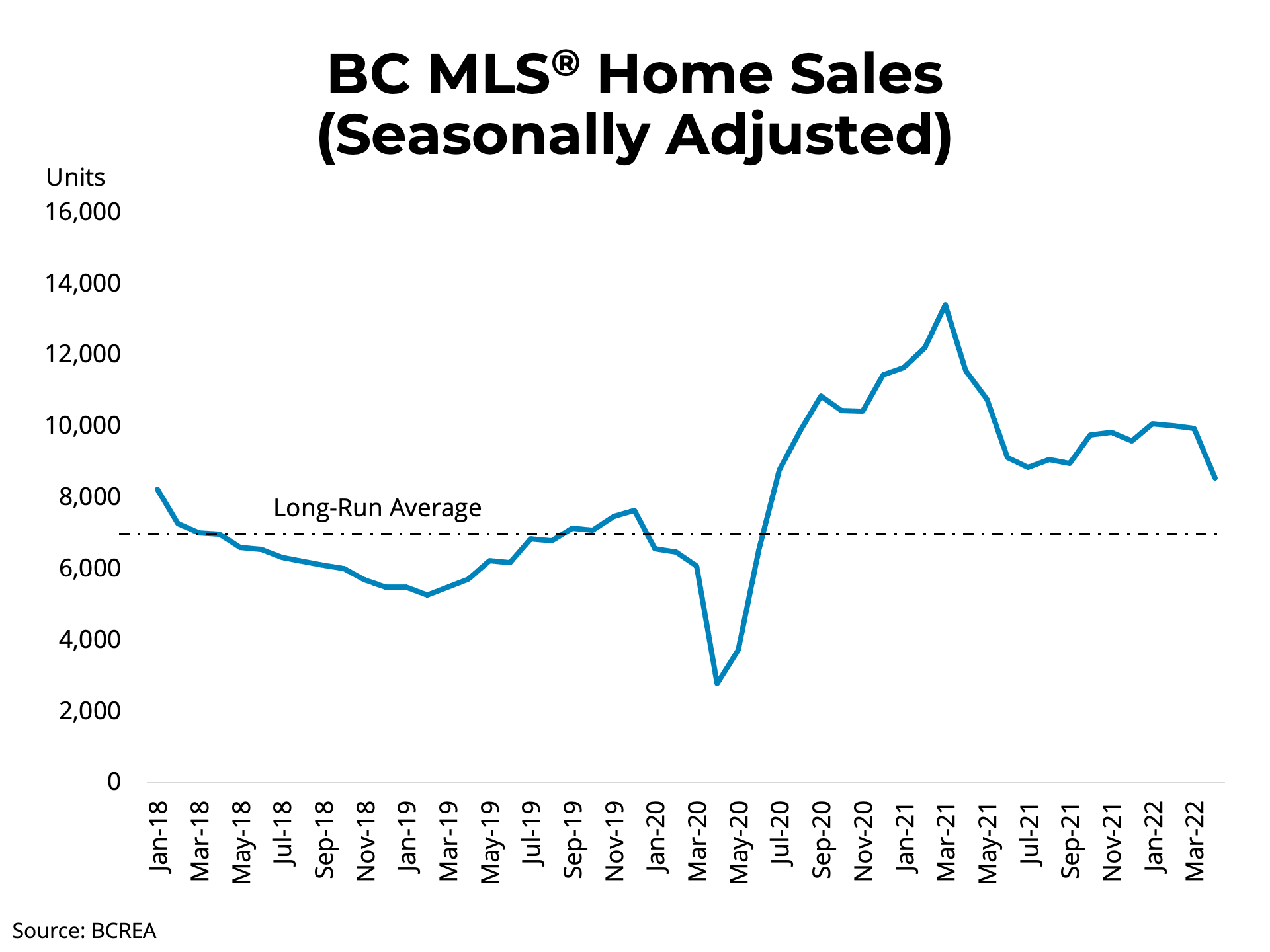
“Canadian mortgages have sharply increased, surpassing 4 per cent for the first time in a decade,” said BCREA Chief Economist Brendon Ogmundson. “With interest rates rising, demand across BC is now on a path to normalizing. However, given existing levels of supply, markets conditions remain tight.”
Provincial active listings were 7.5 per cent lower than this time last year, though listings are starting to accumulate in some markets as demand fades. However, it will likely take a year or more for the supply of listings to return to balanced market levels.
Year-to-date, BC residential sales dollar volume was down 10.7 per cent to $38.4 billion, compared with the same period in 2021. Residential unit sales were down 24.2 per cent to 35,618 units, while the average MLS® residential price was up 17.8 per cent to $1.078 million.
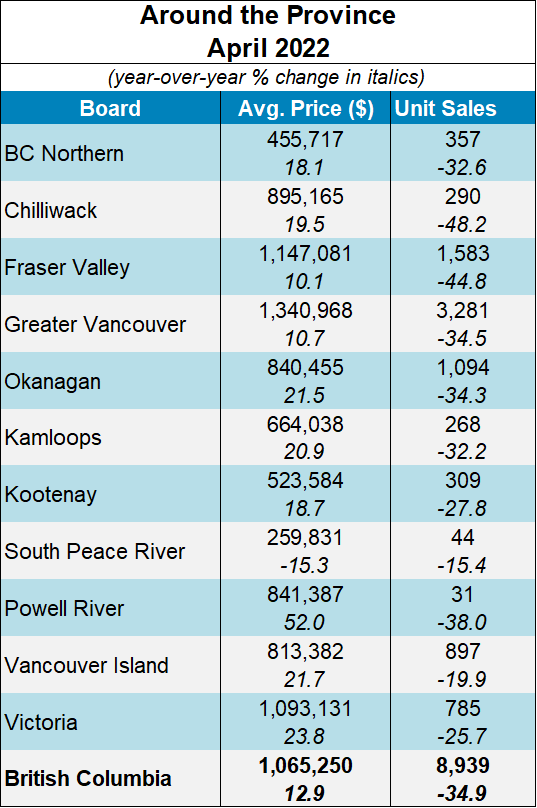
-30-
For more information, please contact:
Brendon Ogmundson
Chief Economist
Direct: 604.742.2796
Mobile: 604.505.6793
Email: [email protected]
BC Housing Market Activity Continues Moderating Trend in July
For the complete news release, including detailed statistics, click here.
Vancouver, BC – August 11, 2021. The British Columbia Real Estate Association (BCREA) reports that a total of 9,663 residential unit sales were recorded by the Multiple Listing Service® (MLS®) in July 2021, a decrease of 7.2 per cent over July 2020. The average MLS® residential price in BC was $891,687, a 17.1 per cent increase from $761,772 recorded in July 2020. Total sales dollar volume was $8.6 billion, an 8.6 per cent increase from last year.
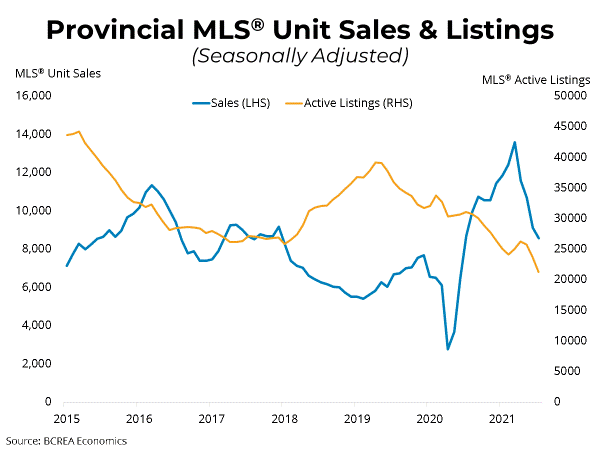
“Provincial market activity slowed in July with both sales and listings declining on a seasonally adjusted basis,” said BCREA Chief Economist Brendon Ogmundson. “While sales remain robust, listings activity continues to be a concern as inventories trend near record lows.”
Total active residential listings were down 32.2 per cent year-over-year in July and continued to fall on a monthly seasonally adjusted basis.
Year-to-date, BC residential sales dollar volume was up 124.7 per cent to $73.4 billion, compared with the same period in 2020. Residential unit sales were up 85.4 per cent to 80,461 units, while the average MLS® residential price was up 21.2 per cent to $912,379.
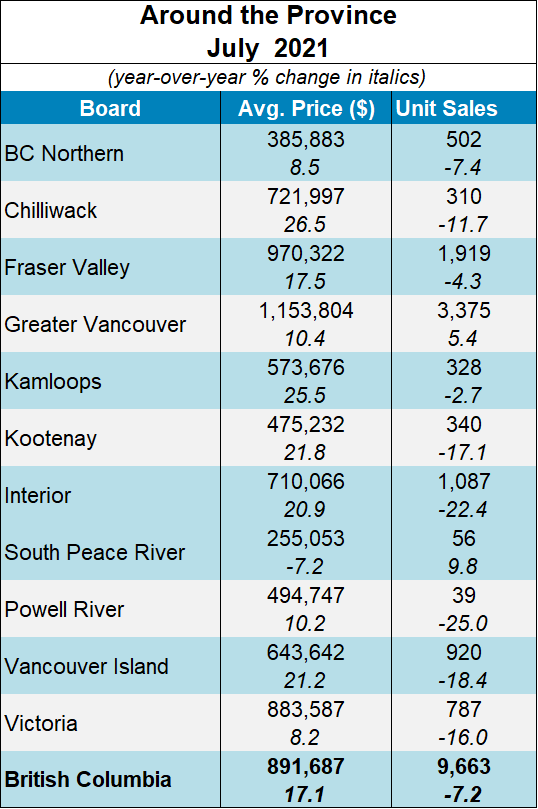
-30-
For more information, please contact:
Brendon Ogmundson
Chief Economist
Direct: 604.742.2796
Mobile: 604.505.6793
Email: [email protected]
BC Housing Market Activity Strengthening Into the Closing Months of 2025
For the complete news release, including detailed statistics, click here.
Vancouver, BC – November 12, 2025. The British Columbia Real Estate Association (BCREA) reports that 6,374 residential unit sales were recorded in Multiple Listing Service® (MLS®) Systems in October 2025, down 10.2 per cent from October 2024. The average MLS® residential price in BC in October 2025 was up 0.8 per cent at $978,658 compared to $970,483 in October 2024.

Total MLS® residential sales dollar volume was $6.2 billion, down 9.4 per cent from the same time the previous year. BC MLS® unit sales were 17.1 per cent lower than the ten-year average for the month of October.
“Sales activity in many regions of the province has recovered to pre-tariff levels, with more expensive regions continuing to lag behind,” said BCREA Chief Economist Brendon Ogmundson. “We expect demand to steadily enter the market as interest rates fall, driving a stronger final quarter of the year.”
Year-to-date, BC residential sales dollar volume is down 7.5 per cent to $58 billion, compared with the same period in 2024. Residential unit sales are down 4.8 per cent year-over-year at 60,954 units, while the average MLS® residential price is also down 2.8 per cent to $952,273.

BC Housing Market Activity Weakens Heading Into the Holidays
For the complete news release, including detailed statistics, click here.
Vancouver, BC – December 15, 2025. The British Columbia Real Estate Association (BCREA) reports that 5,052 residential unit sales were recorded in Multiple Listing Service® (MLS®) Systems in November 2025, down 13.3 per cent from November 2024. The average MLS® residential price in BC in November 2025 was down 1.4 per cent at $965,914 compared to $979,774 in November 2024.

Total MLS® residential sales dollar volume was $4.9 billion, down 14.5 per cent from the same time the previous year. BC MLS® unit sales were 24.9 per cent lower than the ten-year average for the month of November.
“Market activity cooled throughout the province in November, with sales in every region falling short of historical averages,” said BCREA Chief Economist Brendon Ogmundson. “While broader headwinds continue to linger, we hope stable rates and fading trade uncertainty with the US will stimulate sales moving into 2026.”
Year-to-date, BC residential sales dollar volume is down 8.1 per cent to $62.9 billion, compared with the same period in 2024. Residential unit sales are down 5.6 per cent year-over-year at 65,997 units, while the average MLS® residential price is also down 2.7 per cent to $953,306.

BC Housing Market at Historically Low Level of Supply
For the complete news release, including detailed statistics, click here.
Vancouver, BC – November 10, 2021. The British Columbia Real Estate Association (BCREA) reports that a total 9,593 residential unit sales were recorded by the Multiple Listing Service® (MLS®) in October 2021, a decrease of 13.7 per cent from October 2020. The average MLS® residential price in BC was $964,777, an 18.9 per cent increase from $811,307 recorded in October 2020. Total sales dollar volume was $9.3 billion, a 2.6 per cent decline from the same time last year.
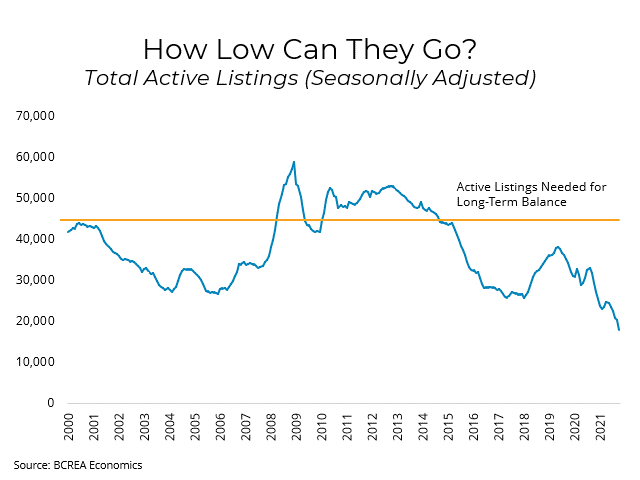
“The story across the province continues to be the record low number of listings,” said BCREA Chief Economist Brendon Ogmundson. “Rising mortgage rates should start to temper sales activity next year, but even with a moderation in demand it will take quite some time for the inventory of homes to return to a healthy level.”
Total active residential listings were down nearly 40 per cent year-over-year in October, falling to an all-time record low for the province. Active listings have now fallen for five consecutive months on a seasonally adjusted basis.
Year-to-date, BC residential sales dollar volume is up 69.7 per cent to $99.6 billion compared to the same period in 2020. Residential unit sales were up 42.8 per cent to 108,798 units, while the average MLS® residential price was up 18.8 per cent to $915,833.
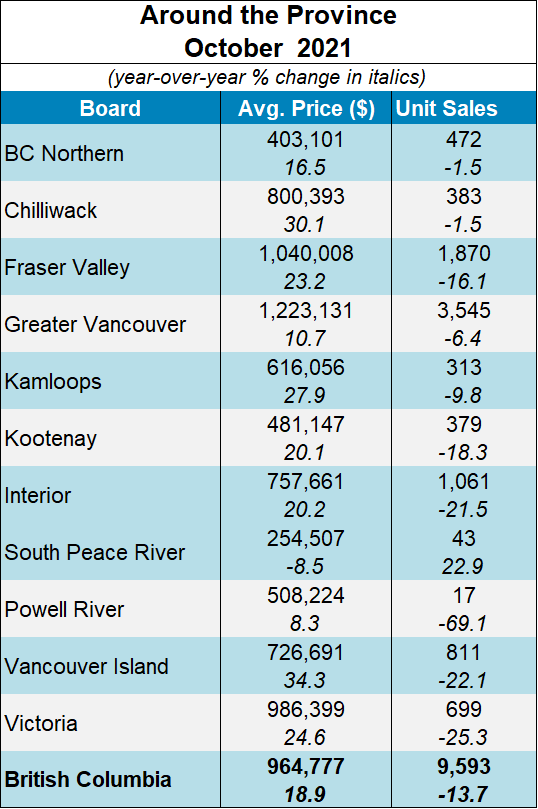
-30-
For more information, please contact:
Brendon Ogmundson
Chief Economist
Direct: 604.742.2796
Mobile: 604.505.6793
Email: [email protected]
BC Housing Market Continues at a Record Pace
For the complete news release, including detailed statistics, click here.
Vancouver, BC – March 11, 2021. The British Columbia Real Estate Association (BCREA) reports that a total of 10,918 residential unit sales were recorded by the Multiple Listing Service® (MLS®) in February 2021, an increase of 89.1 per cent over February 2020 and over a thousand sales higher than the previous February record, set in 2016. The average MLS® residential price in BC was $889,584, a 17.3 per cent increase from $758,382 recorded in February 2020. Total sales dollar volume was $9.7 billion, a 121.8 per cent increase from last year.
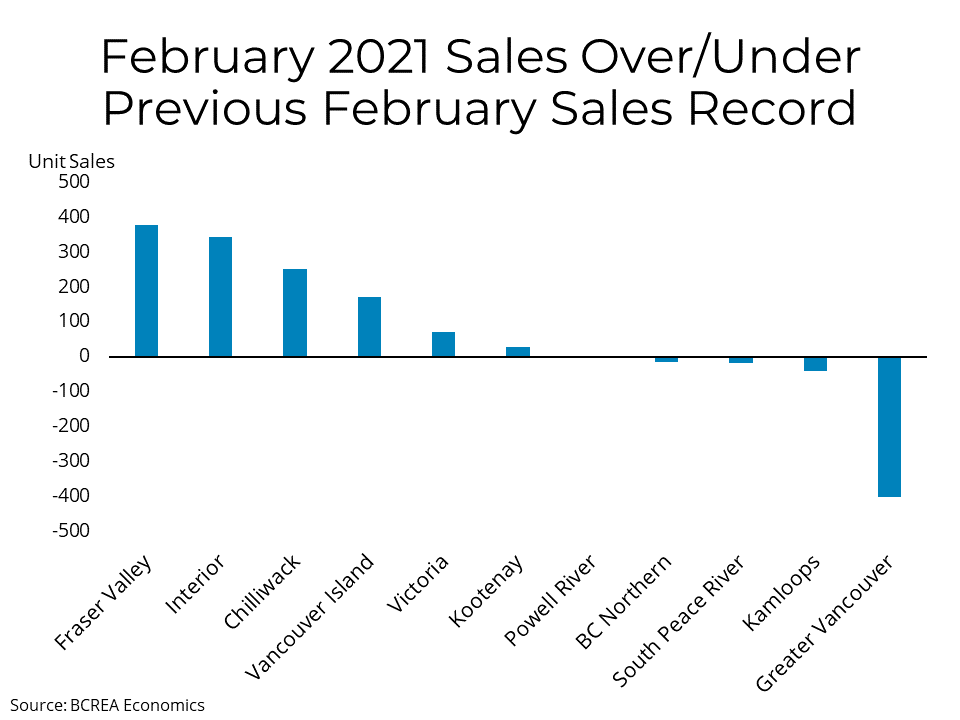
“Near-record sales in Metro Vancouver, combined with unprecedented housing demand outside of Metro Vancouver, continues to drive a blistering pace of home sales in BC,” said BCREA Chief Economist Brendon Ogmundson.
Total active residential listings were down 28.7 per cent to 20,185 units in February, the lowest level of provincial active listings on record, going back to 2000. Fortunately, new listings have increased considerably, but given the pace of sales, total inventory of homes for sale remains severely depleted.
“There is a drought of resale inventory across the province,” added Ogmundson. “With so few listings, and with so much demand for single-detached homes, average prices have increased dramatically.”
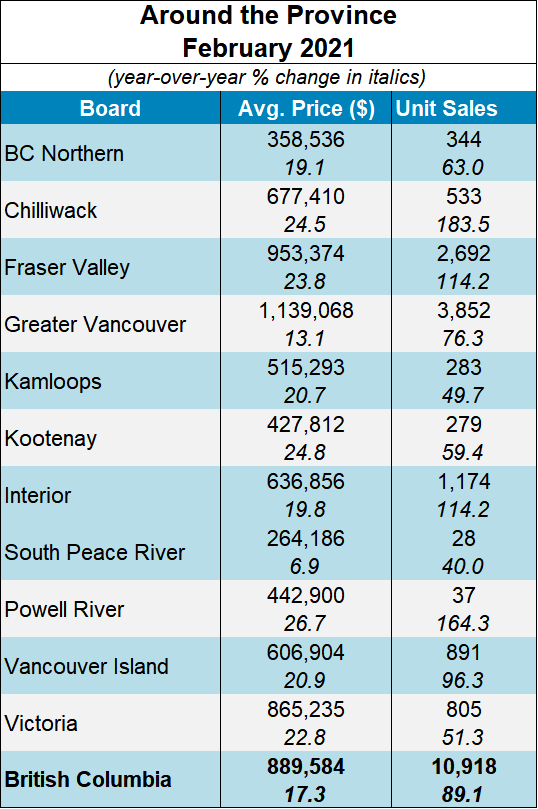
-30-
For more information, please contact:
Brendon Ogmundson
Chief Economist
Direct: 604.742.2796
Mobile: 604.505.6793
Email: [email protected]
BC Housing Market Continues Record Pace in October
For the complete news release, including detailed statistics, click here.
Vancouver, BC – November 12, 2020. The British Columbia Real Estate Association (BCREA) reports that a total of 11,051 residential unit sales were recorded by the Multiple Listing Service® (MLS®) in October 2020, an increase of 43.8 per cent from October 2019. The average MLS® residential price in BC set a record of $812,960, a 12.5 per cent increase from $722,333 recorded the previous year. Total sales dollar volume in August was $8.98 billion, a 61.8 per cent increase over 2019.
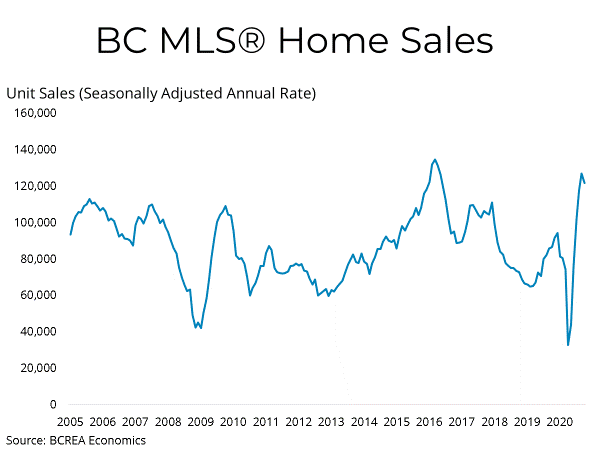
“The provincial housing market sustained its blistering pace of activity in October,” said BCREA Chief Economist Brendon Ogmundson. “While pent-up demand may be starting to fade, record low interest rates and a recovering job market are supporting strong sales.”
“A pandemic-driven shift in buyers’ preference for extra space is pushing average prices to record highs as larger value transactions account for a higher share of sales,” added Ogmundson. Prices are also being pushed higher by a lack of inventory. Total provincial active listings continue to trend lower and were close to 14 per cent lower in October 2020 compared to 2019.
Year-to-date, BC residential sales dollar volume was up 29.7 per cent to $58.7 billion, compared with the same period in 2019. Residential unit sales were up 16.3 per cent to 76,140 units, while the average MLS® residential price was up 11.5 per cent to $771,085.
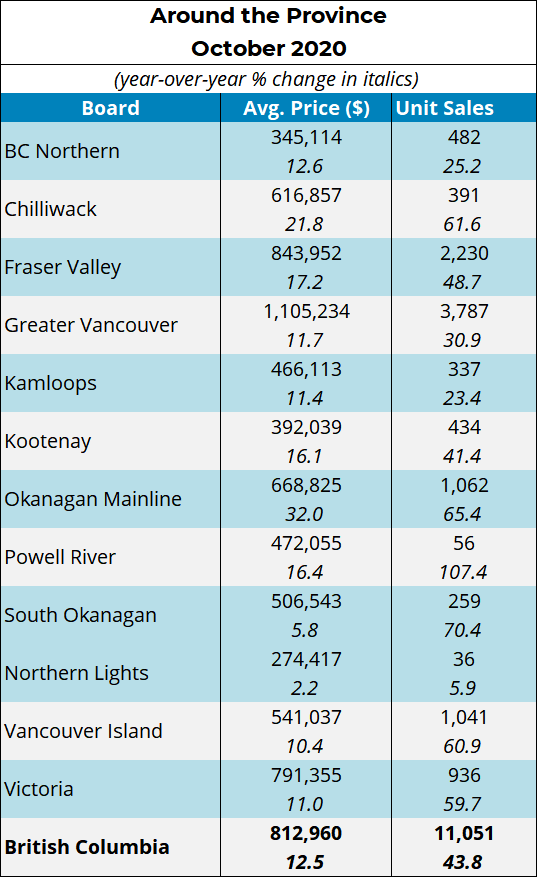
-30-
For more information, please contact:
Brendon Ogmundson
Chief Economist
Direct: 604.742.2796
Mobile: 604.505.6793
Email: [email protected]
To subscribe to receive BCREA publications such as this one, or to update your email address or current subscriptions, click here.
BC Housing Market Posts Strongest November on Record
For the complete news release, including detailed statistics, click here.
Vancouver, BC – December 14, 2020. The British Columbia Real Estate Association (BCREA) reports that a total of 9,416 residential unit sales were recorded by the Multiple Listing Service® (MLS®) in November 2020, an increase of 42.1 per cent from November 2019. The average MLS® residential price in BC set a record of $816,074, a 9.3 per cent increase from $746,310 recorded the previous year. Total sales dollar volume in November was $7.68 billion, a 55.4 per cent increase over 2019.
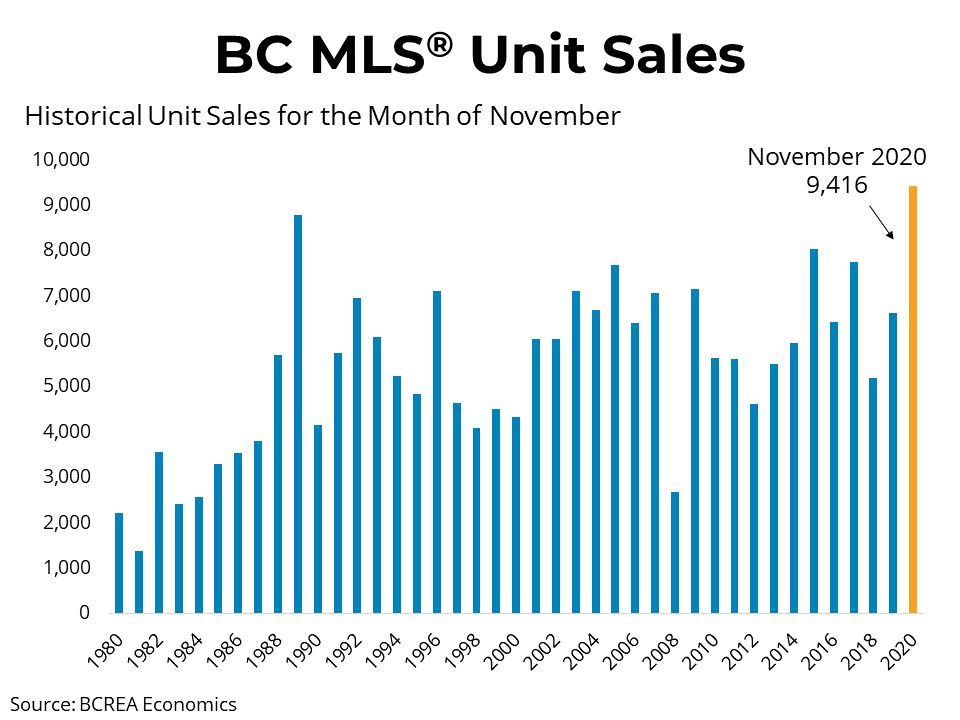
“Home sales were once again unseasonably strong in November with several markets setting records for the month,” said BCREA Chief Economist Brendon Ogmundson. “While demand continues to be strong, the supply of listings has reached near-record lows in several parts of the province, with prices rising sharply as a result."
Active listings were down close to 14 per cent year-over-year in November, which contributed to a 34.8 per cent sales-to-active listings ratio. Consequently, the provincial average price rose 9.3 per compared to this time last year with many markets seeing even stronger price growth.
Year-to-date, BC residential sales dollar volume was up 32.3 per cent to $66.43 billion, compared with the same period in 2019. Residential unit sales were up 18.7 per cent to 85,625 units, while the average MLS® residential price was up 11.4 per cent to $775,845.
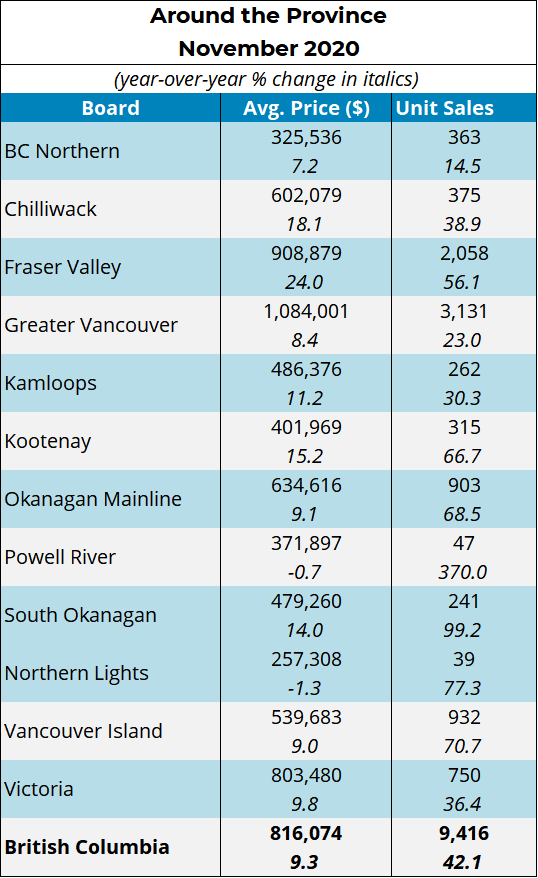
-30-
For more information, please contact:
Brendon Ogmundson
Chief Economist
Direct: 604.742.2796
Mobile: 604.505.6793
Email: [email protected]
To subscribe to receive BCREA publications such as this one, or to update your email address or current subscriptions, click here.
BC Housing Market Showing Signs of Stabilizing Despite Decreased Activity
For the complete news release, including detailed statistics, click here.
Vancouver, BC – September 13, 2022. The British Columbia Real Estate Association (BCREA) reports that a total of 5,645 residential unit sales were recorded by the Multiple Listing Service® (MLS®) in August 2022, a decrease of 40.8 per cent from August 2021. The average MLS® residential price in BC was $918,378, a 2.1 per cent increase from $899,428 recorded in August 2021. Total sales dollar volume was $5.2 billion, a 39.6 per cent decline from the same time last year.
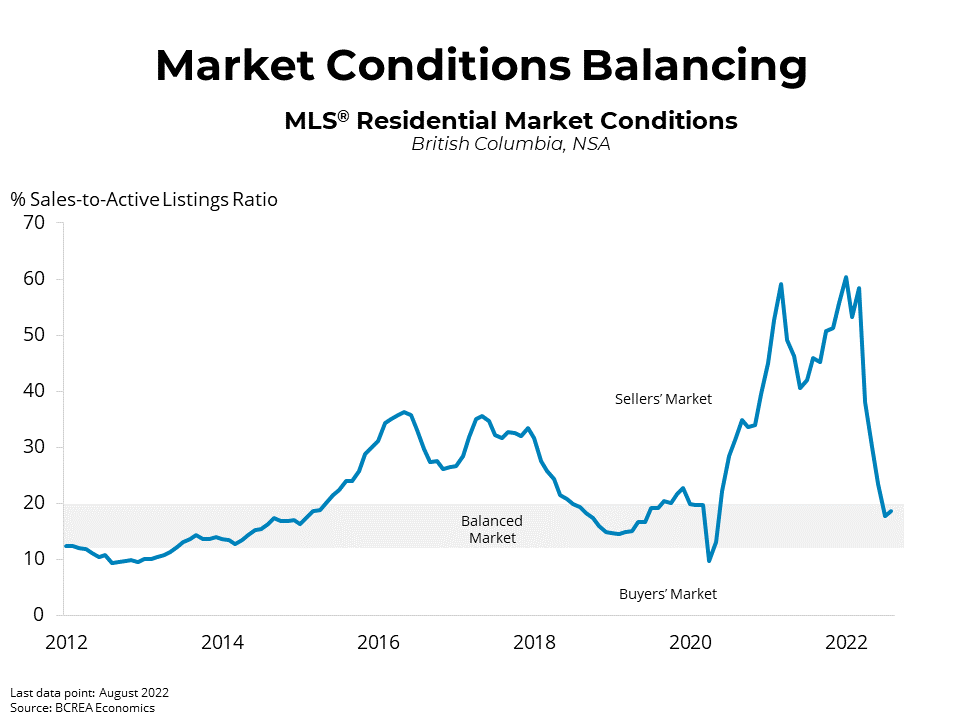
“Housing activity across the province remains well below normal but is showing signs of stabilizing,” said BCREA Chief Economist Brendon Ogmundson. “While inventory is up over last year, active listings have somewhat stalled at relatively low levels in most major markets and as a result we are seeing a healthier balance compared to last year.”
Year-to-date, BC residential sales dollar volume was down 22.1 per cent from the same period in 2021 to $63.8 billion. Residential unit sales were down 30.5 per cent to 62,502 units, while the average MLS® residential price was up 12 per cent to $1.02 million.
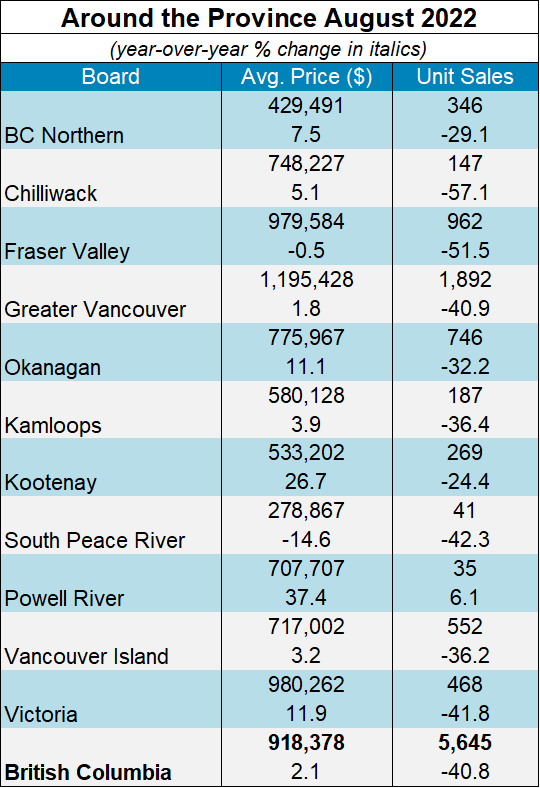
-30-
BC Housing Markets Bounce Back in June
For the complete news release, including detailed statistics, click here.
Vancouver, BC – July 14, 2020. The British Columbia Real Estate Association (BCREA) reports that a total of 8,166 residential unit sales were recorded by the Multiple Listing Service® (MLS®) in June 2020, an increase of 16.9 per cent from June 2019. The average MLS® residential price in BC was $748,155, a 9.1 per cent increase from $685,968 recorded the previous year. Total sales dollar volume in June was $6.1 billion, a 27.5 per cent increase over 2019.
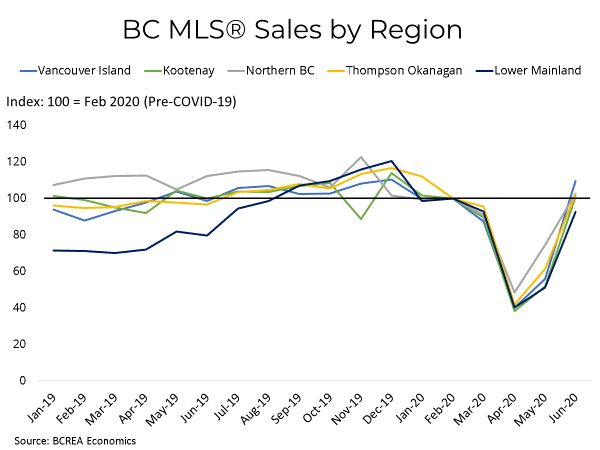
“Sales around the province surged back to pre-COVID-19 levels in June,” said BCREA Chief Economist Brendon Ogmundson. “While there are some temporary factors that may have pushed demand forward, we are cautiously optimistic that market activity will remain firm.”
Although listings activity has normalized along with sales, active listings are still down close to 20 per cent year-over-year and, as a result, many markets are seeing upward pressure on prices.
Year-to-date, BC residential sales dollar volume was up 0.6 per cent to $24.7 billion, compared with the same period in 2019. Residential unit sales were down 8 per cent to 32,875 units, while the average MLS® residential price was up 9.4 per cent to $751,722.
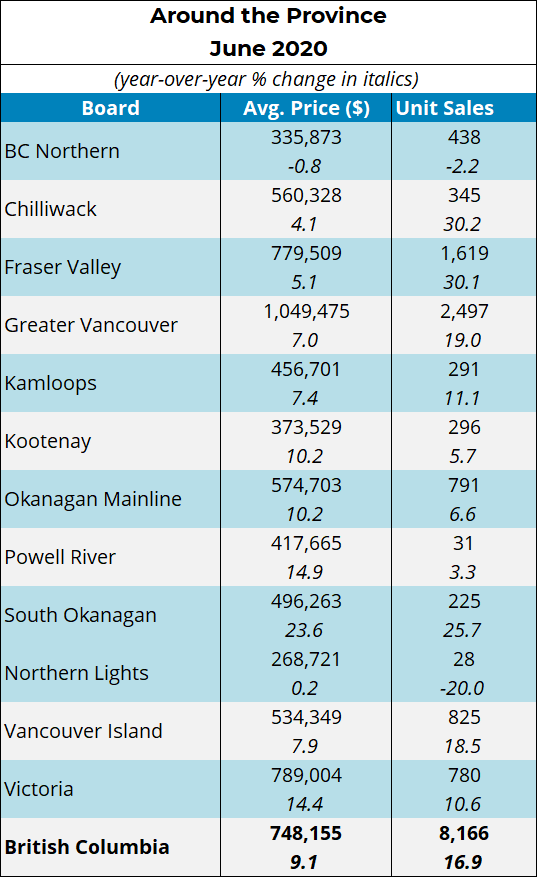
-30-
For more information, please contact:
Brendon Ogmundson
Chief Economist
Direct: 604.742.2796
Mobile: 604.505.6793
Email: [email protected]
To subscribe to receive BCREA publications such as this one, or to update your email address or current subscriptions, click here.
BC Housing Markets Heat Up as Summer Ends
For the complete news release, including detailed statistics, click here.
Vancouver, BC – September 14, 2020. The British Columbia Real Estate Association (BCREA) reports that a total of 10,172 residential unit sales were recorded by the Multiple Listing Service® (MLS®) in August 2020, an increase of 42.8 per cent from August 2019. The average MLS® residential price in BC was $771,309, a 12.7 per cent increase from $684,093 recorded the previous year. Total sales dollar volume in August was $7.8 billion, a 61.1 per cent increase over 2019.
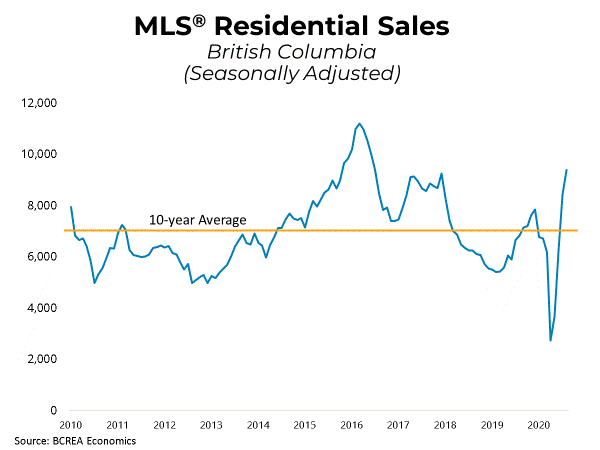
“Very strong provincial home sales continued in August,” said BCREA Chief Economist Brendon Ogmundson. “While pent-up demand from the spring is driving much of the increase, we anticipate a sustained strong level of sales through the fall.”
Total provincial active listings are still down more than 10 per cent year-over-year, with some markets even more under-supplied as the pandemic continues to keep listings low. As a result, prices are sharply rising around the province.
Year-to-date, BC residential sales dollar volume was up 15.8 per cent to $40.4 billion, compared with the same period in 2019. Residential unit sales were up 4.9 per cent to 53,336 units, while the average MLS® residential price was up 10.4 per cent to $757,504.
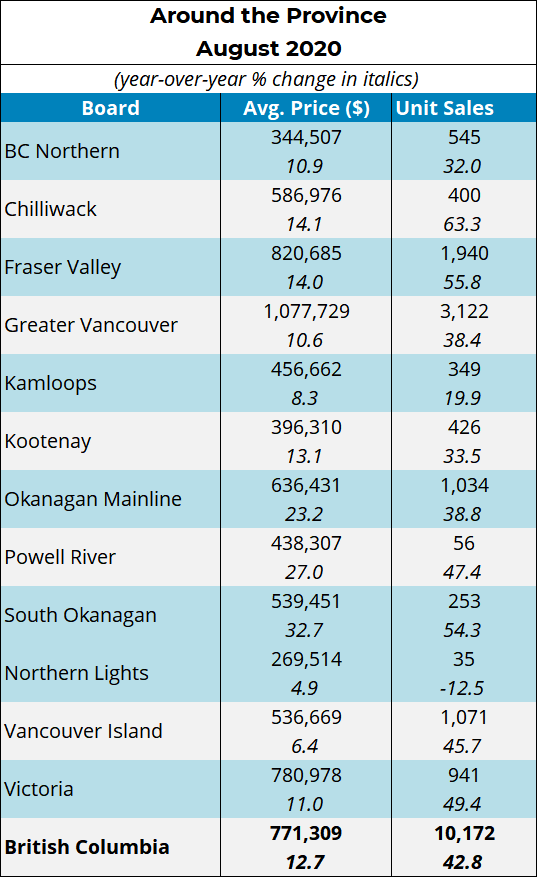
-30-
For more information, please contact:
Brendon Ogmundson
Chief Economist
Direct: 604.742.2796
Mobile: 604.505.6793
Email: [email protected]
To subscribe to receive BCREA publications such as this one, or to update your email address or current subscriptions, click here.
BC Housing Markets Off to a Strong Start in 2020
For the complete news release, including detailed statistics, click here.
Vancouver, BC – February 13, 2020. The British Columbia Real Estate Association (BCREA) reports that a total of 4,426 residential unit sales were recorded by the Multiple Listing Service® (MLS®) in January 2020, an increase of 23.7 per cent from the 3,579 units sold in January 2019. The average MLS® residential price in BC was $725,370, a 9.1 per cent increase from $664,633 recorded the previous year. Total sales dollar volume in January was $3.2 billion, a 35 per cent increase over 2019.
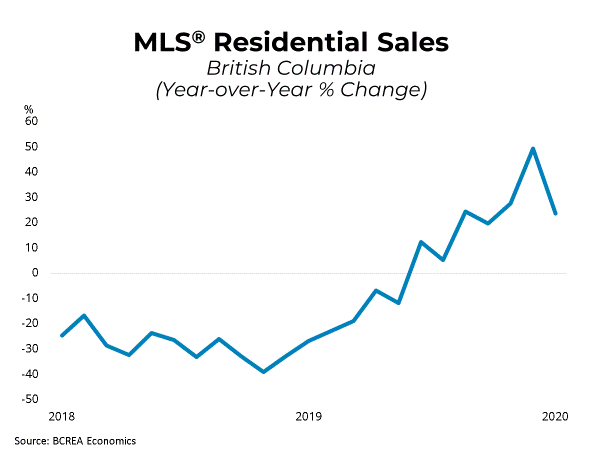
“Housing markets in BC are off to a strong start in 2020,” said BCREA Chief Economist Brendon Ogmundson. “We expect a much more typical year of home sales in 2020 as markets recover from the policy-induced slowdown of the past two years.”
Total MLS® residential active listings fell 12.6 per cent to 25,790 units compared to the same month last year. The ratio of sales to active residential listings increased to 17.2 per cent from just 12.1 per cent last January.
“While many markets are showing strong signs of recovery, the struggling forestry sector is having a clear impact on housing demand, particularly in the North and parts of Vancouver Island,” added Ogmundson.
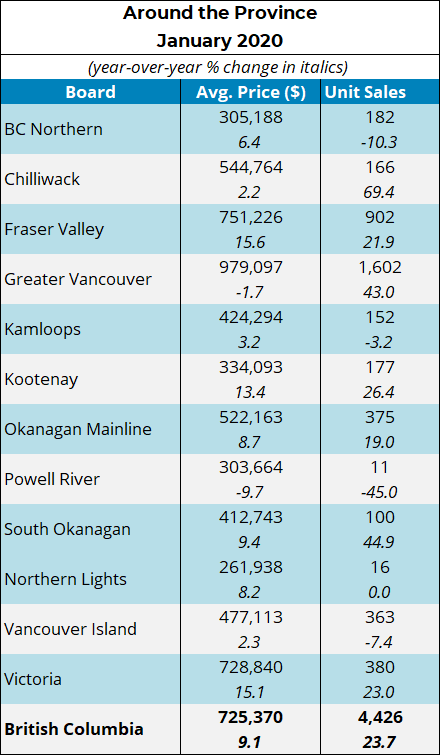
-30-
For more information, please contact:
Brendon Ogmundson
Chief Economist
Direct: 604.742.2796
Mobile: 604.505.6793
Email: [email protected]
To subscribe to receive BCREA publications such as this one, or to update your email address or current subscriptions, click here.
BC Human Rights Code, Section 8: Strata Corporation and Unintentional Discrimination of Physically Handicapped Resident #393
By Gerry Neely
B.A. LL.B.
Tribunal decisions made under the British Columbia Human Rights Code reveal a dramatic increase in complaints based on prohibited grounds of discrimination, from 61 in 2000 to 457 in 2004 and 591 in 2005.
Some of these complaints were made against strata corporations by physically handicapped persons under s. 8 of the Code. This section prohibits discriminatory conduct that would deny to a physically or mentally handicapped person an “accommodation, service or facility that is available to the public.”
Some complaints could’ve been avoided if the councils were aware that a bylaw, rule or regulation, intended to apply to all strata residents, may discriminate because it has an adverse effect on a physically handicapped person. In that event, a strata council’s duty is to accommodate the needs of the handicapped person to the point where doing more would result in undue hardship, “whether that hardship takes the form of impossibility, serious risk or excessive cost.”
The cases that follow in this and the next Legally Speaking column provide some guidance, if not certainty, for complaints involving s. 8 of the Human Rights Code.
A strata corporation had a typical intercom and entry system that enabled a resident to “buzz in” a visitor. Amid home invasion concerns in Greater Vancouver and Fraser Valley, the strata corporation had experienced one forced entry leading to theft from and damage to storage lockers. Although the forced entry might’ve occurred during the day, for security reasons, the strata council approved the installation of a lock timer that deactivated the system between 8 pm and 8 am. A visitor could still ring the unit, but the resident would have to go to the lobby to let in the visitor.
A doctor for a resident whose heart problems had required ambulance and hospitalization gave evidence that she’d be unable to walk to the lobby to let in emergency help, and any delay could be critical. She had home care ending at 10 pm. The strata council agreed to delay the timer for her to 10:30 pm and suggested she find someone in the building to phone to let in emergency assistance. She wasn’t prepared to rely on other residents, most of whom were elderly and had their own health problems.
That was the extent of the accommodation the strata council would make. Because the time of the forced entry was unknown, the Human Rights Tribunal questioned whether the timer installation would’ve prevented this incident and concluded removal of the timer wouldn’t expose residents to an unacceptable risk. The timer could be removed easily and inexpensively. The strata council didn’t provide sufficient evidence as to the cost of accommodating the resident’s needs and whether it would be prohibitively expensive.
The tribunal held that the provision of the intercom and entry system by the strata corporation to the resident was a service that created a public relationship between them. The strata corporation was ordered to remove the timer and pay $1,500 to the resident to compensate her for “injury to dignity, feelings and self respect.”1
(to be continued in Legally Speaking 394)
| 1. | Williams v. Strata Council, # 768, 2003 BCHRT 17. |
To subscribe to receive BCREA publications such as this one, or to update your email address or current subscriptions, click here.
BC Market Activity Remains Subdued in September
For the complete news release, including detailed statistics, click here.
Vancouver, BC – October 12, 2022. The British Columbia Real Estate Association (BCREA) reports that a total of 4,977 residential unit sales were recorded by the Multiple Listing Service® (MLS®) in September 2022, a decrease of 45.8 per cent from September 2021. The average MLS® residential price in BC was $927,119, a 1.7 per cent increase from $912,008 recorded in September 2021. Total sales dollar volume was $4.6 billion, a 44.9 per cent decline from the same time last year.
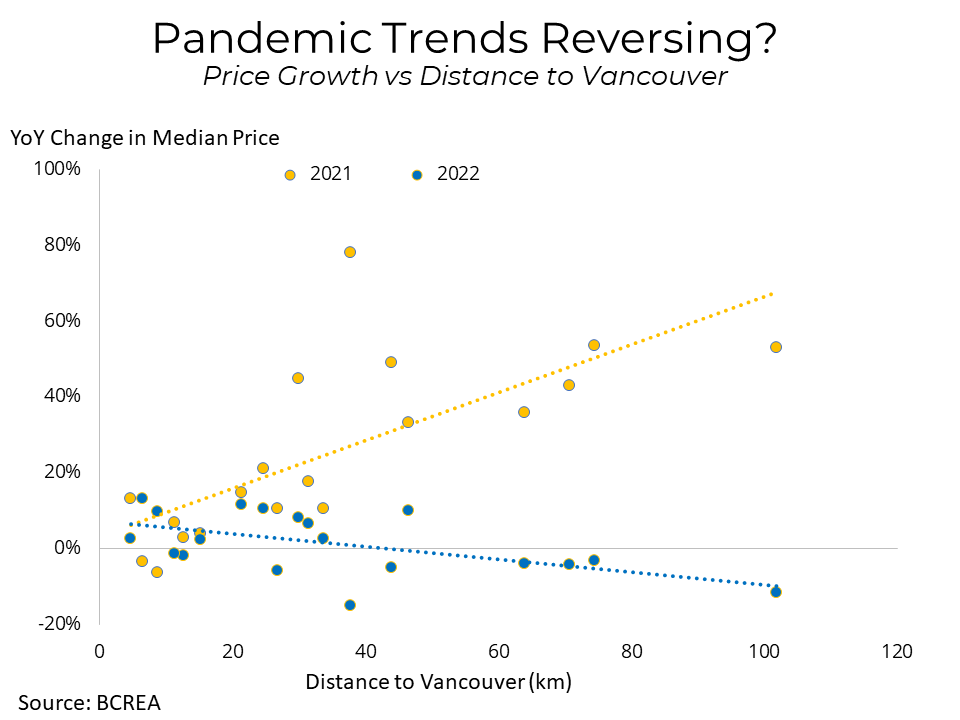
“Mortgage qualifying continues to be a significant hurdle for many potential buyers as interest rates rise,” said BCREA Chief Economist Brendon Ogmundson. “In addition, many trends that drove demand in smaller markets, such as remote work and the quest for affordable space, have faded in prominence. As a result, we see a stronger pullback in markets outside of major metropolitan areas.”
Year-to-date, BC residential sales dollar volume was down 24.2 per cent from the same period in 2021 to $68.5 billion. Residential unit sales were down 31.8 per cent to 67,547 units, while the average MLS® residential price was up 11.3 per cent to $1.01 million.
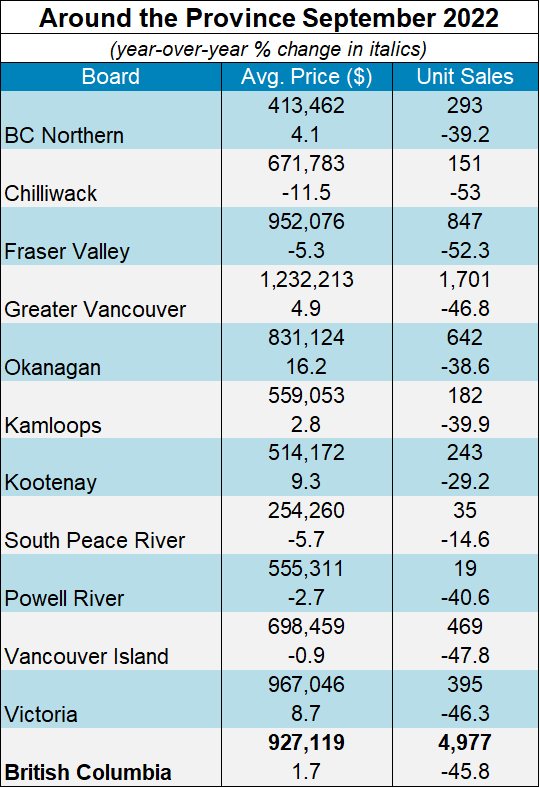
-30-
BC Markets Calming but Sales Still on Record Pace
For the complete news release, including detailed statistics, click here.
Vancouver, BC – May 12, 2021. The British Columbia Real Estate Association (BCREA) reports that a total of 13,683 residential unit sales were recorded by the Multiple Listing Service® (MLS®) in April 2021, an increase of 312.3 per cent over April 2020 when the onset of the COVID-19 pandemic prompted a lockdown of the provincial economy. The average MLS® residential price in BC was $946,606, a 29.1 per cent increase from $733,330 recorded in April 2020. Total sales dollar volume was $12.9 billion, a 432.2 per cent increase from last year.
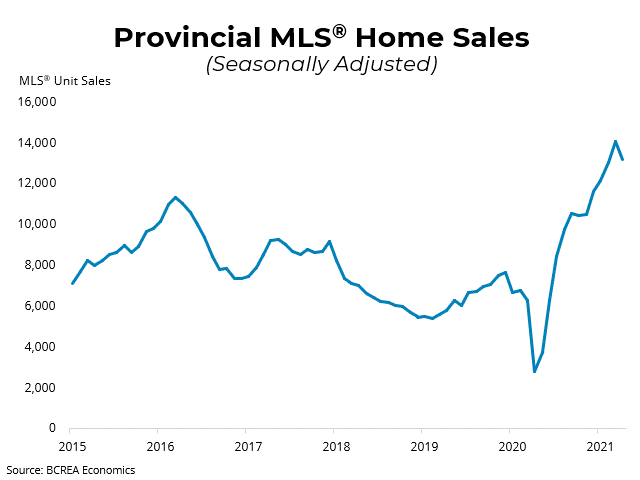
“Although provincial home sales were down slightly from an all-time high in March, sales activity was the highest on record for April,” said BCREA Chief Economist Brendon Ogmundson. “Home sales continue on a record pace, though we do see a calming environment compared to the frenzied activity of recent months.”
Total active residential listings were down 14.5 per cent year-over-year in April but did tick higher on a seasonally adjusted basis for the second consecutive month as new listings activity ramped up.
“We are starting to see very strong new listings activity in several markets,” said Ogmundson, “however, it will take quite some time for total listings to return to the level needed to balance out markets and temper growth in home prices.”
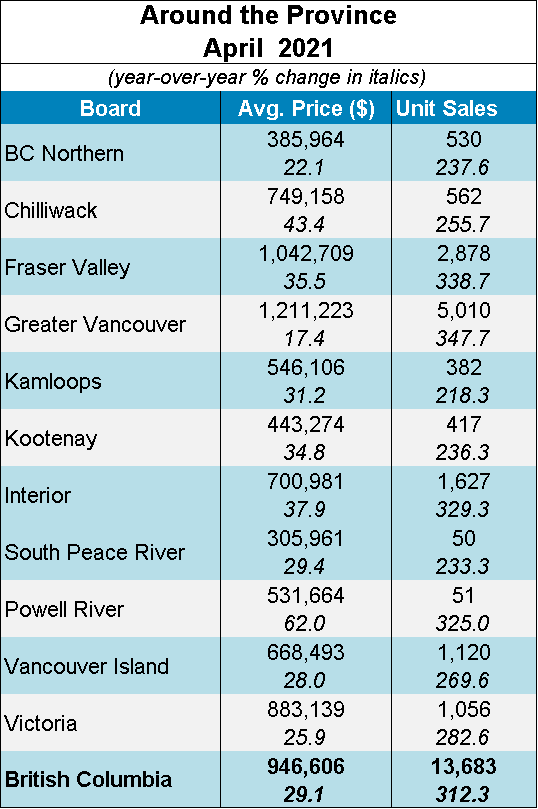
-30-
For more information, please contact:
Brendon Ogmundson
Chief Economist
Direct: 604.742.2796
Mobile: 604.505.6793
Email: [email protected]
BC Markets Finding Balance at Low Levels of Activity
For the complete news release, including detailed statistics, click here.
Vancouver, BC – November 14, 2023. The British Columbia Real Estate Association (BCREA) reports that a total of 5,373 residential unit sales were recorded in Multiple Listing Service® (MLS®) systems in October 2023, an increase of 1.8 per cent from October 2022. The average MLS® residential price in BC was $968,786 up 4.1 per cent compared to October 2022.
The total sales dollar volume was $5.2 billion, representing a 6 per cent increase from the same time last year.
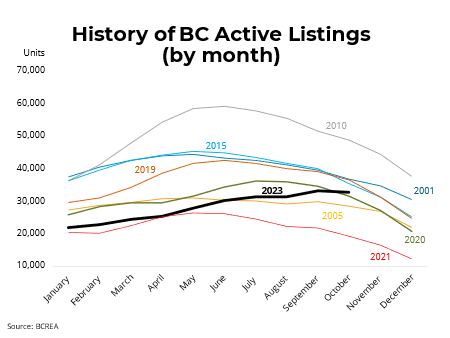
“Home sales have slowed as expected given high borrowing costs and a punishing stress test,” said BCREA Chief Economist Brendon Ogmundson. “However, the inventory of homes for sale remains quite low, despite a modest uptick in new listings. Consequently, markets have found balance, though at a very low level of activity.”
On a seasonally adjusted basis, active listings in the province have increased for the fifth consecutive month, but still remain low by historical standards and fall short of what is typically required for a sustainable market balance in the long term.
Year-to-date BC residential sales dollar volume was down 13.6 per cent to $63.1 billion, compared with the same period in 2022. Residential unit sales were down 10.5 per cent to 64,936 units, while the average MLS® residential price was down 3.4 per cent to $971,802.
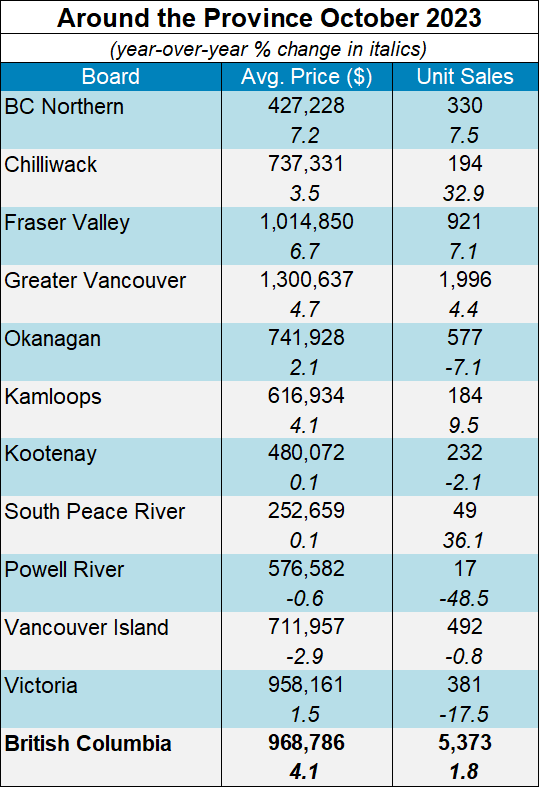
BC Markets Showing Signs of Recovery As Supply Remains Scarce
For the complete news release, including detailed statistics, click here.
Vancouver, BC – April 13, 2023. The British Columbia Real Estate Association (BCREA) reports that a total of 7,118 residential unit sales were recorded in Multiple Listing Service® (MLS®) systems in March 2023, a decrease of 38.3 per cent from March 2022. The average MLS® residential price in BC was 961,451 down 11.6 per cent compared to the average price of close to $1.1 million in March 2022, recorded near the market's peak. The total sales dollar volume was $6.8 billion, representing a 45.5 per cent decrease from the same time last year.
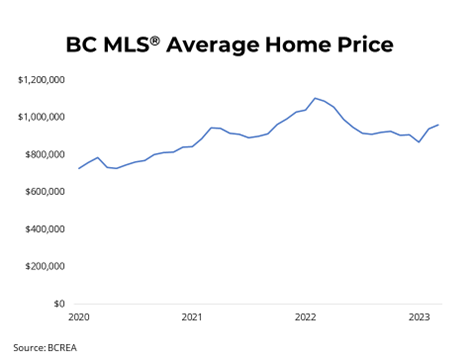
“The BC housing market is currently characterized by slow sales but also still very low levels of listings,” said BCREA Chief Economist Brendon Ogmundson. “Consequently, even though home sales remain about 20 per cent below normal levels for this time of year, the average home price in BC has now risen two months in a row, reaching its highest level since May 2022 as markets tighten due to a lack of supply.”
Active listings in the province are up 25 per cent compared to this time last year but have fallen for the second straight month in the wake of a modest recovery in home sales and continued weak new listings activity.
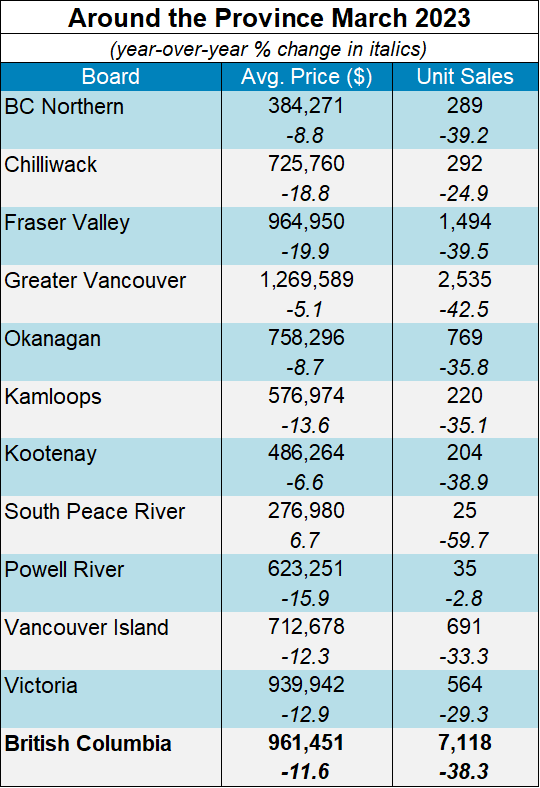
-30-
BC Municipal Elections: Local Governments Need to Address Housing Affordability
As British Columbians head to the polls on October 15, BCREA is pleased to share the top housing affordability solutions that should be the policy focus of candidates running for office across the province.
Local Government’s Role in Addressing Housing Affordability
Local governments have many policy and planning tools they can use to address housing affordability in their communities, such as the Housing Needs Report.
As of April 2019, local governments are required to produce housing needs reports every five years. These reports provide an evidential basis for addressing housing needs tailored to individual communities. To find your community’s housing needs report here or visit your local government website.
Discerning how candidates plan to leverage these policy and planning tools for housing can help you compare different housing platforms. Understanding the housing needs in your community and learning more about your local candidates’ housing policy platforms can help you make an informed decision in this election.
Solutions to Improving Housing Affordability
BC needs more housing supply. While barriers to increased supply vary across the province, the evidence shows that local and provincial governments need to do more to increase housing supply more quickly.
British Columbians require more types of housing in more places (duplexes, triplexes, fourplexes and other Missing Middle housing types). This demand is demonstrated in many of the province’s housing needs reports.
The housing approval process also needs to be improved. Strengthening the Official Community Plan’s zoning powers and utilizing public consultation appropriately can streamline the approvals process.
Make Your Voice Heard – Get Out and Vote!
Elections BC maintains a list of candidates running for office across the province. Your local government website contains information about how, when, and where to vote, as well as more details about the candidates running for office in your community.
The struggle for affordable housing is province-wide and local elected officials play a crucial role in addressing this issue. Voting is our most important civic duty. We hope you consider these issues as you cast your vote on October 15.
BC Organizations Call for a Full Legislative Review of the <em>Strata Property Act</em>
Vancouver, BC – February 9, 2026. The Association of Interior REALTORS® (AOIR) and the BC Real Estate Association (BCREA) are asking the BC Government for a full legislative review of the Strata Property Act and increased education for strata councils.
As demand for smaller, more affordable housing grows, the prevalence of strata-titled properties has increased significantly. Current estimates put the number of people living in strata housing across British Columbia at over 1.5 million. This means that, with ever greater frequency, real estate deals require parties to a transaction to obtain and understand a number of important strata-related documents.
Despite the increased prevalence of these documents in transactions, the legislation that governs stratas and the rules around strata document delivery remain unchanged and are unable to keep up with the evolving needs of consumers. Issues with obtaining these documents – including disputes on cost, long wait times, and incomplete packages – have become increasingly normal.
“Meaningful reform must begin with a full review of the Strata Property Act,” said Seth Scott, AOIR Director of Government Relations and Communications. “REALTORS® work with strata corporations and documents every day, and modernizing the legislation is essential to ensuring buyers are able to continue having accurate, reliable, and accessible information.”
In a joint letter to the BC Ministry of Housing and Municipal Affairs, AOIR and BCREA delivered six policy recommendations regarding the Strata Property Act, ranging from Form B costs, delivery timelines, and mandatory strata council education. The organizations also highlighted the operational challenges associated with obtaining strata documents prior to listing, emphasizing the need for change.
The Strata Property Act has not undergone a comprehensive legislative review since its inception over a quarter century ago. As a result, REALTORS®, strata management, and consumers are working with outdated requirements created before the widespread use of digital technology, which do not reflect the modern realities of strata governance, record keeping, and buyer expectations.
“The legislation requires significant updates to ensure that document delivery timelines are manageable, and that rush fees are fair and transparent across the province,” added Scott.
As part of the larger call to government, BCREA has created a proposal entitled, Mandatory Strata Training Program: Driving Excellence in Strata Property Management. Modeled on Ontario’s Director Training but tailored to BC, the proposal aims to create a training system to empower strata council members to make informed financial decisions, maintain buildings proactively, and resolve disputes with fairness and consistency. By introducing mandatory training and raising the standard of council education, this initiative could lead to safer, better-maintained properties, fewer surprise special levies, and a more harmonious living environment.
“Civil Rights Tribunal decisions in BC repeatedly surface preventable governance failures with uneven bylaw enforcement, deferred maintenance, and misuse of insurance,” said Jasroop Gosal, BCREA Government Relations Manager. “It’s time to fix this with mandatory, no‑cost, multilingual strata council training that sets clear competencies and publicly registers certified council members. Backed by continuing education and government oversight, this evidence‑based approach will stabilize reserve planning and rebuild trust in strata governance.”
AOIR and BCREA are urging the Ministry of Housing and Municipal Affairs to conduct a full legislative review of the Strata Property Act before considering or proceeding with additional strata regulations.
-30-
Learn More:
To read AOIR and BCREA’s full letter to the BC Government, click here.
To read BCREA’s mandatory strata training proposal, click here.
Contact:
Seth Scott
Director of Government Relations and Communications
Association of Interior REALTORS®
[email protected]
Jasroop Gosal
Manager, Government Relations
BC Real Estate Association
[email protected]
About the Association of Interior REALTORS®
The Association of Interior REALTORS® is a member-based professional organization serving approximately 2,600 REALTORS® who live and work in communities across the interior of British Columbia, including the Okanagan Valley, Kamloops, and Kootenay regions, as well as the South Peace River region.
About BCREA
BCREA is the provincial association for BC REALTORS®. As a champion for the real estate sector, BCREA advances REALTOR® professionalism and ensures the REALTOR® voice is heard, for the benefit of consumers and communities, across BC. By working in collaboration with the province's real estate boards and associations, our mission is to provide professional development opportunities, advocacy, economic and policy research, and standard forms so REALTORS® are trusted, respected, and proud of their profession.
BC Organizations Call for a Full Legislative Review of the <em>Strata Property Act</em>
Vancouver, BC – February 9, 2026. The Association of Interior REALTORS® (AOIR) and the BC Real Estate Association (BCREA) are asking the BC Government for a full legislative review of the Strata Property Act and increased education for strata councils.
As demand for smaller, more affordable housing grows, the prevalence of strata-titled properties has increased significantly. Current estimates put the number of people living in strata housing across British Columbia at over 1.5 million. This means that, with ever greater frequency, real estate deals require parties to a transaction to obtain and understand a number of important strata-related documents.
Despite the increased prevalence of these documents in transactions, the legislation that governs stratas and the rules around strata document delivery remain unchanged and are unable to keep up with the evolving needs of consumers. Issues with obtaining these documents – including disputes on cost, long wait times, and incomplete packages – have become increasingly normal.
“Meaningful reform must begin with a full review of the Strata Property Act,” said Seth Scott, AOIR Director of Government Relations and Communications. “REALTORS® work with strata corporations and documents every day, and modernizing the legislation is essential to ensuring buyers are able to continue having accurate, reliable, and accessible information.”
In a joint letter to the BC Ministry of Housing and Municipal Affairs, AOIR and BCREA delivered six policy recommendations regarding the Strata Property Act, ranging from Form B costs, delivery timelines, and mandatory strata council education. The organizations also highlighted the operational challenges associated with obtaining strata documents prior to listing, emphasizing the need for change.
The Strata Property Act has not undergone a comprehensive legislative review since its inception over a quarter century ago. As a result, REALTORS®, strata management, and consumers are working with outdated requirements created before the widespread use of digital technology, which do not reflect the modern realities of strata governance, record keeping, and buyer expectations.
“The legislation requires significant updates to ensure that document delivery timelines are manageable, and that rush fees are fair and transparent across the province,” added Scott.
As part of the larger call to government, BCREA has created a proposal entitled, Mandatory Strata Training Program: Driving Excellence in Strata Property Management. Modeled on Ontario’s Director Training but tailored to BC, the proposal aims to create a training system to empower strata council members to make informed financial decisions, maintain buildings proactively, and resolve disputes with fairness and consistency. By introducing mandatory training and raising the standard of council education, this initiative could lead to safer, better-maintained properties, fewer surprise special levies, and a more harmonious living environment.
“Civil Rights Tribunal decisions in BC repeatedly surface preventable governance failures with uneven bylaw enforcement, deferred maintenance, and misuse of insurance,” said Jasroop Gosal, BCREA Government Relations Manager. “It’s time to fix this with mandatory, no‑cost, multilingual strata council training that sets clear competencies and publicly registers certified council members. Backed by continuing education and government oversight, this evidence‑based approach will stabilize reserve planning and rebuild trust in strata governance.”
AOIR and BCREA are urging the Ministry of Housing and Municipal Affairs to conduct a full legislative review of the Strata Property Act before considering or proceeding with additional strata regulations.
-30-
Learn More:
To read AOIR and BCREA’s full letter to the BC Government, click here.
To read BCREA’s mandatory strata training proposal, click here.
Contact:
Seth Scott
Director of Government Relations and Communications
Association of Interior REALTORS®
[email protected]
Jasroop Gosal
Manager, Government Relations
BC Real Estate Association
[email protected]
About the Association of Interior REALTORS®
The Association of Interior REALTORS® is a member-based professional organization serving approximately 2,600 REALTORS® who live and work in communities across the interior of British Columbia, including the Okanagan Valley, Kamloops, and Kootenay regions, as well as the South Peace River region.
About BCREA
BCREA is the provincial association for BC REALTORS®. As a champion for the real estate sector, BCREA advances REALTOR® professionalism and ensures the REALTOR® voice is heard, for the benefit of consumers and communities, across BC. By working in collaboration with the province's real estate boards and associations, our mission is to provide professional development opportunities, advocacy, economic and policy research, and standard forms so REALTORS® are trusted, respected, and proud of their profession.
BC Organizations Launch In-Home Danger Radon Gas Public Awareness Campaign
Vancouver, BC – November 4, 2024. November is Radon Action Month, and the BC Real Estate Association (BCREA), BC Lung Foundation, and Real Estate Foundation of BC are announcing the launch of a new collaborative Radon Gas Public Awareness Campaign.
Radon gas is a threat to homeowners and their families across British Columbia, with a traditionally low level of public awareness. Exposure to radon gas is estimated to cause over 3,000 lung cancer deaths in Canada each year. Homes with elevated levels of radon can be found in every region of the country, and some parts of BC – including the Kootenays, Okanagan, and Prince George areas – are known to have a high proportion of these homes.
This new public awareness campaign directs British Columbians to a new landing page, RadonKills.ca/BC, where they can find crucial information about this hidden threat, including how to test for and remediate high levels of radon in their homes.
“For a lot of people, radon flies under the radar until it impacts them directly. We want to make people throughout the province aware of the dangers of radon so they can head it off before it becomes an issue,” said Trevor Koot, BCREA CEO.
Radon Action Month has been observed every November in Canada since 2013. The timing is particularly important because radon levels are highest in homes during the heating season between October and April, when windows are most often closed tight.
“Radon is a leading cause of lung cancer in Canada, but there is still so much work to be done to educate British Columbians on its dangerous impacts. Knowing about radon and testing radon levels in your home can save lives,” says Christopher Lam, President & CEO of BC Lung Foundation.
To spread the word about how British Columbians can protect themselves and their families, the public awareness campaign includes both digital and traditional advertising, with ads on social media and radio throughout the province, and roadside billboards in Chilliwack and Kelowna. The campaign also seeks to further educate BC REALTORS®, an ongoing joint effort between BCREA and the BC Lung Foundation.
“Not only can REALTORS® help buyers and sellers be more aware of radon concerns and obligations in housing transactions, but they’re key conduits of information in their communities,” added Koot. “The more REALTORS® and the public know about radon, the better for the province.”
BCREA, the BC Lung Foundation, and the Real Estate Foundation of BC encourage all British Columbians to educate themselves and test for radon. Check out RadonKills.ca/BC for more information.
-30-
For more information:
Craig Battle, Senior Marketing & Communications Specialist
BC Real Estate Association
[email protected]
604.742.2790
About BCREA
BCREA is the provincial association for BC REALTORS®. As a champion for the real estate sector, BCREA advances REALTOR® professionalism and ensures the REALTOR® voice is heard, for the benefit of consumers and communities, across BC. By working in collaboration with the province's real estate boards and associations, our mission is to provide professional development opportunities, advocacy, economic and policy research, and standard forms so REALTORS® are trusted, respected, and proud of their profession.
About BC Lung Foundation
Established more than a century ago to fight tuberculosis, the BC Lung Foundation is dedicated to helping prevent lung disease and improving lung health. Through research, education, advocacy, and patient support initiatives, BC Lung offers hope, help, and a voice to the one in five British Columbians affected by a lung condition. For more information visit bclung.ca.
About Real Estate Foundation of BC
The Real Estate Foundation of BC is a philanthropic organization working to advance sustainable, equitable, and socially just land use across BC. We fund projects, connect people, and share knowledge.
BC Organizations Urge Homeowners to Test for “Silent Killer” Radon Gas
Vancouver, BC – November 3, 2025. November is Radon Action Month, and the BC Real Estate Association (BCREA), BC Lung Foundation, and Real Estate Foundation of BC are teaming up to urge the public to test their homes for radon gas.
Despite a traditionally low level of public awareness, radon is a threat to homeowners and their families across British Columbia. Exposure to the colourless, odourless radioactive gas is the second-highest cause of lung cancer in Canadians after smoking, estimated to cause over 3,000 lung cancer deaths in the country each year.
Running for the second straight year, this joint public awareness campaign aims to direct British Columbians to a landing page, RadonKills.ca/BC, where they can find crucial information about this “silent killer,” including how to test for and remediate high levels of radon in their homes.
“Radon is a risk that’s not going away,” said BCREA CEO Trevor Koot. “The threat is real, and the only way to know if your home has high radon levels is to test.”
While homes with elevated radon levels can be found across Canada, the BC Interior has some of the highest residential radon levels in the country, making the location of this awareness campaign particularly important. The timing is also important because radon levels are highest in homes during the heating season between October and April.
“Testing your home for radon can make all the difference in keeping you and your family safe. As the second leading cause of lung cancer, awareness of radon is so important, especially for areas in our province at greater risk,” said BC Lung Foundation President & CEO Christopher Lam.
To spread the word about how British Columbians can protect themselves and their families, the public awareness campaign will place ads on radio, TV, and social media throughout the province, and roadside billboards in Chilliwack, Kamloops, and Kelowna.
BCREA, the BC Lung Foundation, and the Real Estate Foundation of BC encourage all British Columbians to educate themselves and test for radon. Check out RadonKills.ca/BC for more information.
-30-
For more information:
Craig Battle, Senior Marketing & Communications Specialist
BC Real Estate Association
[email protected]
604.742.2790
About BCREA
BCREA is the provincial association for BC REALTORS®. As a champion for the real estate sector, BCREA advances REALTOR® professionalism and ensures the REALTOR® voice is heard, for the benefit of consumers and communities, across BC. By working in collaboration with the province's real estate boards and associations, our mission is to provide professional development opportunities, advocacy, economic and policy research, and standard forms so REALTORS® are trusted, respected, and proud of their profession.
About BC Lung Foundation
Established more than a century ago to fight tuberculosis, the BC Lung Foundation is dedicated to helping prevent lung disease and improving lung health. Through research, education, advocacy, and patient support initiatives, BC Lung offers hope, help, and a voice to the one in five British Columbians affected by a lung condition. For more information, visit bclung.ca.
About Real Estate Foundation of BC
The Real Estate Foundation of BC is a philanthropic organization working to advance sustainable, equitable, and socially just land use across BC. We fund projects, connect people, and share knowledge.
BC Real Estate Association and Canadian Mortgage Brokers Association – BC Identify Significant Issues with Changes to <em>Residential Tenancy Act</em>
Vancouver, BC – July 25, 2024. The BC Real Estate Association (BCREA) and the Canadian Mortgage Brokers Association – British Columbia (CMBA-BC) are calling upon the BC Government to amend and refine recent changes to the Residential Tenancy Act (RTA). Both organizations published open letters outlining concern around unintended consequences and the high potential the changes will negatively impact homebuyers, rental-property owners, and tenants in the province.
Changes laid out in Bill 14, which amends the RTA and is intended to protect residential tenants from tenancies terminated in bad faith, came into effect on July 18, 2024. However, in their letters to government, BCREA and CMBA-BC noted a number of concerns and points of confusion that will create difficulties when using the rules in real-life transactions.
BCREA noted the following concerns, among others, in its letter to government:
- The new requirement of providing four months' notice – instead of the previous two months' notice – for evictions due to personal or caretaker use is posing a major hurdle. While this is a problem for all buyers, it's particularly problematic for high-ratio buyers, including first-time buyers, who generally need mortgage default insurance to secure their financing.
- The new legislation makes no distinction between a buyer of a tenanted unit who just wants to move into their new home and a landlord who might be using a bad-faith eviction as a tool to raise rents beyond the allowable limit.
- Combining a four-month eviction notice with a 30-day dispute notice produces an effective five-month period in which a buyer can't take possession of their new home. This is impractical for buyers moving from one home to another and is too long a period to wait between completions.
- Without default mortgage insurance, lenders require a minimum down payment of 20 per cent for rental properties. First-time buyers typically do not have the financial capacity for such a significant down payment. Furthermore, a default-insured mortgage holder must receive vacant possession to qualify for a default-insured mortgage and cannot close on a purchase where the former tenant has not vacated the home.
- A home must be owner-occupied to be eligible for homeowner insurance and also for mortgage insurance from Canada’s largest providers of mortgage insurance, including CMHC.
- Using a new web portal, landlords will be required to provide personal and confidential details about the persons moving into the home, which will then be shared with the tenant. This new requirement is raising serious implications for the privacy and security of owners.
For its part, CMBA-BC pinpointed several other concerns, including:
- Mortgage Approvals Timeline: The four-month notice period creates a misalignment with the typical 90 to 120-day rate hold period for mortgage approvals. Buyers, especially those with less than 20 per cent down payment, may face significant challenges in coordinating the vacancy of the property with their mortgage approval timeline, potentially leading to funding denials or increased costs for buyers. These changes will impact first-time homebuyers the most as these are the most typical buyers of previous rental properties.
- Increased Financing Risks: Buyers may be forced to remove financing conditions from their offers without a guaranteed mortgage approval due to the extended notice period. This leaves them vulnerable to interest rate fluctuations and other factors that could impact their ability to qualify for the mortgage, heightening their financial risk.
- Legal and Liability Concerns: The new timeline could increase the risk of purchase contract cancellations, as buyers may struggle to secure financing within the extended period. This could lead to legal disputes or lawsuits, adding stress and financial risk for all parties involved.
In light of these and other concerns, the two organizations have offered the following recommendations to government:
- Adjust the notice rules for conventional mortgage buyers to allow for vacant possession within no longer than a three-month time period.
- Allow high ratio insured buyers (including first-time buyers) who will be occupying the property to continue to have a two-month notice period because of the financial hardship caused by a longer delay in them taking possession of their property, and the likelihood of them running afoul of financing restrictions.
- Require that the privacy of new buyers be protected. Use existing, publicly accessible systems as the source of information on new buyers to be reported by landlords to former tenants. Contracts of Purchase and Sale are confidential documents and should not be shared with tenants. A standard Statutory Declaration form should be developed to carry out any necessary disclosures.
- Eliminate the reporting requirement for buyers who intend to occupy their own unit. The buyer’s intent could be documented by use of a Statutory Declaration or as part of the Property Transfer Tax return process. An early sale of the unit could be tracked through the Land Titles or BC Assessment systems.
BCREA also reiterated its past call for the BC Government to create a permanent housing roundtable comprised of housing policy experts and other representatives from organizations across the housing sector in BC. Such a group, the association said, would be able to provide early advice to government in the creation of new or updated housing policy, such as changes to the RTA.
-30-
Quotes:
Trevor Hargreaves, Senior Vice President of Government Relations, Marketing & Communications, BCREA –
“We appreciate the efforts to protect tenants from bad-faith evictions and the need to provide more rental supply, but are concerned the policy changes appear to have been crafted without adequate consultation with related sectors in terms of the multitude of related issues they will cause. These changes are inadvertently making it more difficult for all buyers, but especially first-time buyers, many of whom are currently tenants, to enter the housing market.”
Rebecca Casey, President, CMBA-BC –
“The Canadian Mortgage Brokers Association of British Columbia firmly believes that the amendments to the Residential Tenancy Act will exacerbate housing unaffordability and availability of rental units in our province by hindering purchase transactions for buyers with less than 20 per cent down payments, narrowing the eligibility of purchasers for properties that are currently tenanted. We appreciate the BC Ministry of Housing's commitment to addressing housing challenges and protecting tenants' rights. However, while we await accommodations or changes to the Act, we are concerned that these amendments will worsen these issues rather than alleviate them, potentially compromising the stability and affordability for current and prospective tenants and home purchasers.”
Learn More:
To read BCREA's full open letter to the BC Government, click here.
To read CMBA-BC's full open letter to the BC Government, click here.
Contact:
Craig Battle, Senior Marketing & Communications Specialist
BC Real Estate Association
[email protected]
604.742.2790
Sajjid Lakhani, CMBA-BC Public Relations
Canadian Mortgage Brokers Association – BC
[email protected]
778.387.4647
About BCREA
BCREA is the provincial association for BC REALTORS®. As a champion for the real estate sector, BCREA advances REALTOR® professionalism and ensures the REALTOR® voice is heard, for the benefit of consumers and communities, across BC. By working in collaboration with the province's real estate boards and associations, our mission is to provide professional development opportunities, advocacy, economic and policy research, and standard forms so REALTORS® are trusted, respected, and proud of their profession.
About CMBA-BC
As the voice for BC's mortgage brokers, the Canadian Mortgage Brokers Association – British Columbia (CMBA-BC) represents the province’s mortgage industry. Incorporated in 1990, the Association exists to support and enhance professionalism and ethical standards within the mortgage industry. Our members support housing affordability measures and CMBA-BC is committed to working with government and financial regulators to create mortgage and housing policies with solutions to help more British Columbians own homes.
BC Real Estate Association Calls for New Short-Term Rental Exemptions Amidst Tariff Challenges and Expected High Tourism Demand
Vancouver, BC – May 27, 2025. In BC’s current tariff- and trade-challenged environment, provincial priorities need to adapt. While affordable housing is a critical provincial issue, so are provincial economic wellbeing and the health of our tourism sector. When the Short-Term Rental Accommodations Act and its accompanying regulations were put into force, the province was extremely focused on creating additional housing by any lever possible. Since its implementation, however, short-term rental (STR) legislation has caused a series of economic challenges across the province that need to be addressed.
With the current geopolitical environment expected to drive up domestic tourism this summer, now is the time to consider implementation of much-needed changes to STR legislation.
Our sector understands the pressing and immediate need to address the housing crisis throughout the province and routinely advocates for increased housing supply across the entirety of the housing spectrum. Long-term rentals are a vital piece of the housing continuum, and thus we understand the impetus for changing STR governance in the province. That said, the following recommendations would craft a better balance between housing and economic needs in regional communities.
Recommendation: Return Zoning Autonomy to Local Governments
As it stands, local governments can opt out of the principal residence rule in the legislation if they provide adequate written notice and can prove their vacancy rate has been 3 per cent or over for two consecutive years. While this formula may work for some local governments, the provision has proven to be too restrictive for many communities.
For example, Parksville has not experienced a 3 per cent vacancy rate in more than 20 years so would not have initially qualified for this exemption. Parksville Mayor Doug O’Brien pushed back in a letter to Minister of Housing and Municipal Affairs Ravi Kahlon, arguing that a partial exemption was justified for several reasons, including that specific suites in the area had been purpose-built as STRs, with infrastructure designed for temporary and seasonal tourism usage.
After a lengthy justification process, Minister Kahlon finally granted a partial exemption, demonstrating that communities have unique STR needs not previously contemplated by the provincial STR policies, and these needs must be taken seriously by the province.
Similarly, while Prince George had a vacancy rate of 3.7 per cent in 2022, the number dropped to 2.8 per cent in 2023 – disqualifying it from an exemption. Councillor Brian Skakun noted how the regulations would hurt the city, which hosts many people who look for STRs, including healthcare and construction workers. Councillor Kyle Sampson argues the criteria to qualify for an exemption are arbitrary, suggesting instead an average over a number of years.
Prior to the implementation of these rules, many local governments had areas and buildings zoned specifically for STR use. This allowed communities to balance their need for tourist accommodation with the need for long-term rental units.
It stands to reason that the legislation should be amended to give local governments this power back. There would be significant benefit for local governments to be able to request exemptions for locations and buildings in their community that are zoned for STRs. Doing this would allow municipalities and regional districts the flexibility to shape short-term regulations to fit the nuances of their unique communities and end the false binary of being in or out as exists under the current legislation.
Recommendation: Expand the Strata Hotel and Fractional Ownership Exemption
The Short-Term Rental Accommodations Act provides an exemption from the principal residence requirement for strata hotels and fractional interest property. An exemption exists for these property types provided the property owner is unable to use their property as a principal residence due to a mandatory provision in a rental pool, rental management agreement, or fractional ownership agreement. These regulations were recently amended to include a number of other criteria based on building unit zoning, management agreements, covenants, and the presence of a staffed front desk. The regulation as implemented is confusing and currently excludes a number of strata hotels from acquiring much-needed exemptions.
In order to accommodate tourists as well as owners who may wish to live in high-tourism communities on a part-time basis, a high number of unique ownership types such as strata hotels and fractional ownership properties exist across the Interior. These properties were designed to facilitate such short-term occupancy needs and are often ill-suited for long-term tenancy. While long-term occupancy is possible in some cases, the primary purpose of these buildings remains focused on tourism and short-term tenancy.
The failure of current regulations to capture all strata hotel and fractional ownership has had severely negative economic consequences by removing tourist accommodations in tourist-reliant economies. It also creates confusion for REALTORS® and consumers.
It is our view that strata hotels and fractional interest property should be fully exempt from STR regulations. These properties were never intended to be part of the long-term rental market and current exemptions are much too difficult for many to understand.
Recommendation: Geographic Exemptions for Areas in Close Proximity to Healthcare Centres
Our members care about ensuring that the communities they live and work in remain vibrant and healthy. Many larger rural communities act as healthcare hubs for the regional districts and rural areas that surround them. For those travelling into these communities for necessary medical treatments, extended hotel stays may not be viable or appropriate.
Additionally, unlike in larger urban centres, many communities across the North and Interior receive a high number of travelling nurses, locum doctors, and other healthcare professionals that service the community on a temporary basis. Due to the transient nature of their stay, longer-term tenancy agreements are not the best option for these individuals.
In order to ensure the healthcare needs of Northern and Interior communities are met, it is our view that an exemption to the principal residence rule should be added for STR units in close proximity to major healthcare centres and hospitals. The recently passed Housing Statutes (Transit-Oriented Areas) Amendment Act could act as a good template in defining what geographic radius should be exempt around designated health centres and hospitals.
Recommendation: Establish Broad Television and Film Sector STR Exemptions
Amidst the uncertainty of Canada-US relations, it is imperative that government take steps to incentivize film and television projects to continue operations across BC. Current STR legislation has hindered the TV and film sector’s ability to house the sizeable transient cast and crew on these projects. It has created an over-reliance on already challenged hotel room inventories across the province, further lowering year-round vacancy rates, increasing consumer competition, and driving up average hotel costs.
We recommend immediate implementation of broad STR exemptions for the TV and film sector across the province.
-30-
Quote:
Trevor Hargreaves, Senior Vice President of Government Relations, Marketing & Communications, BCREA –
"The BC provincial government has the challenging job of balancing housing policy with overall provincial economic wellbeing. Some key changes to current short-term rental legislation would help many people and communities across the province while maintaining the spirit of the original policy."
For more information:
Craig Battle
Senior Marketing & Communications Specialist
[email protected]
604.742.2790
About BCREA
BCREA is the provincial association for BC REALTORS®. As a champion for the real estate sector, BCREA advances REALTOR® professionalism and ensures the REALTOR® voice is heard, for the benefit of consumers and communities, across BC. By working in collaboration with the province's real estate boards and associations, our mission is to provide professional development opportunities, advocacy, economic and policy research, and standard forms so REALTORS® are trusted, respected, and proud of their profession.
BC Real Estate Association Calls for Review of BC’s Short-Term Rental Ban
Vancouver, BC – September 23, 2024. The British Columbia Real Estate Association (BCREA) is calling for significant amendments to BC's short-term rental laws to mitigate the major disruption they've caused for specific business and tourism sectors across the province, the Association announced today.
On May 1, 2024, the BC Government enacted a widespread ban on short-term rentals, with the intent of returning homes to the long-term rental market. However, as part of a new housing policy resource hub launched in the lead-up to the 2024 Provincial General Election, BCREA identified multiple groups of British Columbians negatively affected by the ban, including:
- medical employees transferred to remote areas;
- those receiving multi-week medical care as well as caregivers in urban areas;
- film sector workers in town for weeks at a time;
- those attending or employed by short-term but large events for which hotel space is inadequate (such as a Taylor Swift concert or the FIFA World Cup 2026); and
- those needing short-term housing due to delays in being able to take occupancy of homes or apartments.
As part of the analysis, the Association stressed that provincial and regional economies need to be factored into policy decisions of this magnitude.
“While housing affordability is extremely important, there are additional considerations in communities across BC that have been paved over with the implementation of this policy,” said Trevor Hargreaves, BCREA Senior VP, Policy and Research. “There are numerous exemptions desperately needed to make this a workable and successful policy moving forward.”
Hargreaves added, “There is no question that some of these short-term rental units should be functioning as long-term rentals, but there are some legitimate uses for short-term rentals that are no longer permitted under the legislation.”
The Association proposed several exemptions from the ban across a wide variety of categories, including high-tourism areas and the groups listed above.
-30-
Learn More:
For more information on short-term rentals and several other housing issues of concern, check out the BCREA Election resource hub.
Contact:
Trevor Hargreaves, Senior VP, Policy and Research
BC Real Estate Association
[email protected]
604.742.2798
Craig Battle, Senior Marketing & Communications Specialist
BC Real Estate Association
[email protected]
604.742.2790
BC Real Estate Association Disappointed by Housing Tax Increases in 2026 Provincial Budget
Vancouver, BC – February 18, 2026. In the immediate wake of the release of BC Budget 2026, the BC Real Estate Association (BCREA) is raising concerns about budget housing measures that could exacerbate existing market issues.
In a provincial economy facing external headwinds and uncertainty, it is unsurprising that the BC Government is running a sizable deficit. However, the lack of a clear plan to return the provincial debt-to-GDP ratio to a sustainable path raises concerns about the province’s fiscal health. Mounting debt and rising debt-service costs will constrain the ability to provide tax relief for BC households or fund worthwhile programs.
These realities made Budget 2026 an important inflection point, particularly for housing affordability across the province. Unfortunately, the budget failed to address either the growing tax burden or the province’s housing issues. When faced with a potentially significant slowdown in new home construction, the government has opted to further burden the development sector with tax increases, imperiling the ability of the province to meet its own long-term housing supply targets.
Instead of policies to lower the cost of development, Budget 2026 doubled down on policies that have already proven ineffective at improving affordability:
- Higher school taxation rates on development lands, which will increase costs that will be downloaded to buyers and further hinder project viability.
- Applying PST to professional housing-related services, increasing soft costs and further challenging the economic viability of projects.
- Increasing the Speculation and Vacancy Tax to four per cent for foreign residents and others at a time when BC badly needs to attract capital to increase housing supply.
These tax increases will only make an already challenging development climate more difficult.
“There is unfortunately not a lot to like from either a macroeconomic or housing perspective in this budget,” says Brendon Ogmundson, BCREA Chief Economist. “We understand that the province is in a difficult position and needs to raise revenues, but doing so on the back of an already struggling housing sector will ultimately prove to be self-defeating.”
-30-
Contact:
Craig Battle
Senior Marketing & Communications Specialist
BC Real Estate Association
[email protected]
604.742.2790
BC Real Estate Association Disappointed by Housing Tax Increases in 2026 Provincial Budget
Vancouver, BC – February 18, 2026. In the immediate wake of the release of BC Budget 2026, the BC Real Estate Association (BCREA) is raising concerns about budget housing measures that could exacerbate existing market issues.
In a provincial economy facing external headwinds and uncertainty, it is unsurprising that the BC Government is running a sizable deficit. However, the lack of a clear plan to return the provincial debt-to-GDP ratio to a sustainable path raises concerns about the province’s fiscal health. Mounting debt and rising debt-service costs will constrain the ability to provide tax relief for BC households or fund worthwhile programs.
These realities made Budget 2026 an important inflection point, particularly for housing affordability across the province. Unfortunately, the budget failed to address either the growing tax burden or the province’s housing issues. When faced with a potentially significant slowdown in new home construction, the government has opted to further burden the development sector with tax increases, imperiling the ability of the province to meet its own long-term housing supply targets.
Instead of policies to lower the cost of development, Budget 2026 doubled down on policies that have already proven ineffective at improving affordability:
- Higher school taxation rates on development lands, which will increase costs that will be downloaded to buyers and further hinder project viability.
- Applying PST to professional housing-related services, increasing soft costs and further challenging the economic viability of projects.
- Increasing the Speculation and Vacancy Tax to four per cent for foreign residents and others at a time when BC badly needs to attract capital to increase housing supply.
These tax increases will only make an already challenging development climate more difficult.
“There is unfortunately not a lot to like from either a macroeconomic or housing perspective in this budget,” says Brendon Ogmundson, BCREA Chief Economist. “We understand that the province is in a difficult position and needs to raise revenues, but doing so on the back of an already struggling housing sector will ultimately prove to be self-defeating.”
-30-
Contact:
Craig Battle
Senior Marketing & Communications Specialist
BC Real Estate Association
[email protected]
604.742.2790
BC Real Estate Association named Best Workplaces™ in British Columbia for 2023
We are proud to announce that BCREA has again been named one of the Best Workplaces in British Columbia™ for 2023.
This year's designation marks the fourth consecutive year BCREA has received this accreditation, after a thorough, independent analysis conducted by Great Place to Work®.
The list is based on direct feedback from employees of the hundreds of organizations that were surveyed by Great Place to Work®. To be eligible for this list, organizations must be Great Place to Work- Certified™ and have exceptionally high scores from employees on the Trust Index® Survey.
Thank you to our entire team for making BCREA a certifiably great place to work. As we continue our mission to empower BC’s eight real estate boards and 26,000 REALTORS®, BCREA remains committed to delivering an excellent workplace culture with engaged staff. BCREA displays excellence in the workplace through professional development initiatives, team building, competitive compensation and benefits, and flexibility in adapting to a hybrid working model.
About BCREA
BCREA is the provincial association for BC REALTORS®. As a champion for the real estate sector, BCREA advances REALTOR® professionalism and ensures the REALTOR® voice is heard, for the benefit of consumers and communities, across BC. By working in collaboration with the province’s real estate boards, our mission is to provide professional development opportunities, advocacy, economic and policy research, and standard forms so REALTORS® are trusted, respected, and proud of their profession.
About Great Place to Work®
Great Place to Work is the global authority on high-trust, high-performance workplace cultures. A global research and consulting firm, Great Place to Work® provides the benchmarks and expertise needed to create, sustain, and recognize outstanding workplace cultures. In Canada, Great Place to Work® produces both industry and demographic specific Best Workplace™ lists and represents the voices of 500,000 employees across the industry. This is part of the world’s largest annual workplace study, recognizing the world's Best Workplaces in a series of national lists including those published by The Globe & Mail (Canada) and Fortune magazine (USA).
BC Real Estate Association Named Best Workplaces™ in Real Estate & Construction for 2024
We are proud to announce that BCREA has been named one of the Best Workplaces™ in Real Estate & Construction for 2024.
This year's designation marks the fifth consecutive year BCREA has received this accreditation after a thorough, independent analysis conducted by Great Place to Work®.
The list is based on direct feedback from employees of the hundreds of organizations that were surveyed by Great Place to Work®. To be eligible for this list, organizations must be Great Place to Work-Certified™ and have exceptionally high scores from employees on the Trust Index Survey.
We appreciate our entire team for contributing to BCREA's outstanding workplace environment. As we continue our mission to empower BC’s eight real estate boards and associations, and REALTORS®, BCREA remains committed to delivering an excellent workplace culture with engaged staff. Our commitment to excellence is evident through initiatives in professional development, team building, competitive compensation and benefits, and our flexibility in embracing a hybrid work model.
About BCREA
BCREA is the provincial association for BC REALTORS®. As a champion for the real estate sector, BCREA advances REALTOR® professionalism and ensures the REALTOR® voice is heard, for the benefit of consumers and communities, across BC. By working in collaboration with the province's real estate boards and associations, our mission is to provide professional development opportunities, advocacy, economic and policy research, and standard forms so REALTORS® are trusted, respected, and proud of their profession.
About Great Place to Work®
Great Place to Work® is the global authority on high-trust, high-performance workplace cultures. It is a global research and consulting firm with a mission to build a better society by helping companies transform their workplaces. Great Place to Work® provides the benchmarks, framework, and expertise needed to create, sustain, and recognize outstanding workplace cultures.
In Canada, Great Place to Work® produces both industry and demographic specific Best Workplace™ lists. This is part of the world’s largest annual workplace study, which culminates in a series of national lists in over 50 countries, including the study’s flagship list of 100 Best Companies published annually in Fortune magazine.
Globally, this survey represents the voices of 11 million employees, which are the primary determinant in selecting winners. There’s only one way to get on this list – your employees have to put you on it.
BC Real Estate Association named Great Place to Work® in Canada for 2022
The BC Real Estate Association has again been certified as a Great Place to Work® in Canada. The designation in 2022 marks the third consecutive year BCREA has received this accreditation. The Great Place to Work Certification® recognizes organizations as “employers of choice” for their outstanding workplace culture.
In addition to supporting BC’s eight real estate boards and 24,000 REALTORS®, BCREA is committed to delivering an excellent workplace culture with engaged staff. BCREA displays excellence in the workplace through professional development initiatives, team building, competitive compensation and benefits and flexibility in adapting to a hybrid working model.
In 2021, BCREA was also named one of the Top 50 Best Places to Work™ in Canada.
About BCREA
BCREA is the professional association for over 24,000 commercial and residential REALTORS® in BC. Our mission is to empower the province’s eight real estate boards by sharing our expertise and providing professional development opportunities, advocacy, economic research and standard forms so REALTORS® are trusted, respected and proud of their profession.
About Great Place to Work®
Great Place to Work® is the global authority on high-trust, high-performance workplace cultures. It is a global research and consulting firm with a mission to build a better society by helping companies transform their workplaces. Great Place to Work® provides the benchmarks, framework, and expertise needed to create, sustain, and recognize outstanding workplace cultures.
In Canada, Great Place to Work® produces both industry and demographic specific Best Workplace™ lists. This is part of the world’s largest annual workplace study, which culminates in a series of national lists in over 50 countries, including the study’s flagship list of 100 Best Companies published annually in Fortune magazine.
Globally, this survey represents the voices of 11 million employees, which are the primary determinant used in selecting winners. There’s only one way to get on this list – your employees have to put you on it.
BC Real Estate Association Named One of the Best Workplaces™ in BC for 2024
We are proud to announce that BCREA has again been named one of the Best Workplaces™ in British Columbia for 2024.
This year's designation marks the fifth consecutive year BCREA has received this honour after a thorough and independent analysis conducted by Great Place to Work®.
The list is based on direct feedback from employees of the hundreds of organizations surveyed by Great Place to Work®. To be eligible for this list, organizations must be Great Place to Work—Certified™ and have exceptionally high employee scores on the Trust Index survey.
Thank you to our entire team for making BCREA a certifiably great place to work. As we continue our mission to empower REALTORS® and BC’s eight real estate boards and associations, BCREA remains committed to delivering an excellent workplace culture with engaged staff. BCREA displays excellence in the workplace through professional development initiatives, team building, competitive compensation and benefits, and flexibility in adapting to a hybrid working model.
About BCREA
BCREA is the provincial association for BC REALTORS®. As a champion for the real estate sector, BCREA advances REALTOR® professionalism and ensures the REALTOR® voice is heard for the benefit of consumers and communities across BC. By working in collaboration with the province’s real estate boards and associations, our mission is to provide professional development opportunities, advocacy, economic and policy research, and standard forms so REALTORS® are trusted, respected, and proud of their profession.
About Great Place to Work®
Great Place to Work® is the global authority on high-trust, high-performance workplace cultures. A global research and consulting firm, Great Place to Work® provides the benchmarks and expertise needed to create, sustain, and recognize outstanding workplace cultures. In Canada, Great Place to Work® produces both industry and demographic-specific Best Workplace™ lists and represents the voices of 500,000 employees across the industry. This is part of the world’s largest annual workplace study, recognizing the world's Best Workplaces™ in a series of national lists including those published by the Globe & Mail (Canada) and Fortune magazine (USA).
BC Real Estate Association Named One of the Best Workplaces™ in BC for 2025
We are proud to announce that BCREA has been named one of the Best Workplaces™ in British Columbia for 2025.
Following a thorough and independent analysis conducted by Great Place to Work®, BCREA has once again earned a spot on this list, marking our sixth consecutive year of receiving this honour.
The list is based on direct feedback from employees of the hundreds of organizations that were surveyed by Great Place to Work®. To be eligible for this list, organizations must be Great Place to Work-Certified™ and have exceptionally high scores from employees on the Trust Index™ survey, which measures trust, fairness, and camaraderie in the workplace.
This recognition belongs to every member of our team whose dedication and spirit make BCREA a truly great place to work. As we continue our mission to empower REALTORS® and serve BC’s eight real estate boards and associations, we remain dedicated to fostering an environment where employees feel engaged, supported, and proud of their contributions.
BCREA displays excellence in the workplace through Professional Development initiatives, team building, competitive compensation and benefits, and flexibility in adapting to a hybrid working model.
About BCREA
BCREA is the provincial association for BC REALTORS®. As a champion for the real estate sector, BCREA advances REALTOR® professionalism and ensures the REALTOR® voice is heard, for the benefit of consumers and communities, across BC. By working in collaboration with the province's real estate boards and associations, our mission is to provide professional development opportunities, advocacy, economic and policy research, and standard forms so REALTORS® are trusted, respected, and proud of their profession.
About Great Place to Work®
Great Place to Work® is the global authority on high-trust, high-performance workplace cultures. A global research and consulting firm, Great Place to Work® provides the benchmarks and expertise needed to create, sustain, and recognize outstanding workplace cultures. In Canada, Great Place to Work® produces both industry and demographic specific Best Workplace™ lists, and represents the voices of 500,000 employees across industry. This is part of the world’s largest annual workplace study, recognizing the world's Best Workplaces™ in a series of national lists including those published by the Globe & Mail (Canada) and Fortune magazine (USA).
BC Real Estate Association Renews Call for Provincial Drug Home Remediation Policy
Vancouver, BC – June 1, 2026. As British Columbia continues to confront clandestine drug production, the use of residential and often rural properties for these operations places future occupants increasingly at risk. Just this past week, the RCMP issued a news release about a Chilliwack fentanyl operation and an Abbotsford MDMA laboratory that were raided and shut down, both operating out of outbuildings on rural properties.
In light of this news, the BC Real Estate Association (BCREA) is renewing its call for the creation of a provincial drug home remediation policy.
“Once a home has been used for illicit drug production, owners often face significant challenges completing remediation and restoring the property for safe occupancy,” says Trevor Hargreaves, BCREA VP of Policy, Research, and Government Relations. “What’s more, the homes themselves become stigmatized. In these cases, banks are hesitant to lend and insurers are reluctant to provide coverage, which makes the prospect of purchasing these homes a challenge for many buyers.”
Compounding these issues is the disjointed manner in which homes are remediated. Currently, BC municipalities set their own processes for the remediation of homes used in drug production.
“There needs to be a standardized process that outlines steps from identification through to full repair and remediation,” says Hargreaves.
In both 2018 and 2024, BCREA partnered with the University of the Fraser Valley Centre for Public Safety and Criminal Justice Research to review current practices throughout the province. The reports found significant inconsistencies in municipal remediation requirements across BC.
The recent Abbotsford and Chilliwack cases highlight differences in remediation standards: Each city has distinct cleaning and disinfection requirements, as well as differences in the scope of substances covered under their remediation policies. The full 2024 report and its findings can be viewed here.
BCREA continues to advocate for the establishment of a single province-wide multi-step process that will ensure public safety by standardizing identification and repair protocols. Notably, a more standardized approach is in use in Alberta when identifying and repairing homes used for drug production.
This proposed standardization would make lenders and insurers more willing to work with these properties, helping homeowners to list them for sale and buyers to secure necessary financing and insurance. All steps could be completed under a lens that best protects the public by ensuring thorough and consistent environmental remediation.
-30-
For more information:
Craig Battle
Senior Marketing & Communications Specialist
[email protected]
604.742.2790
BC Real Estate Association Urges Comprehensive Review of BC Housing Taxes
Vancouver, BC – October 7, 2024. With the British Columbia election less than two weeks away, the BC Real Estate Association (BCREA) is calling for major housing tax reform aimed at increasing affordability and fairness in the province, the Association announced today.
As outlined on their housing policy resource hub launched in the lead-up to the election, BCREA noted that BC housing taxation levels are some of the highest in the world and have risen sharply since 2016. This has had a significant negative effect on the cost of housing in the province.
BCREA recommendations include:
- a systematic review of the Property Transfer Tax (PTT), which was launched in 1987 as a “luxury tax” and intended to only apply to five per cent of real estate transactions, but now applies to nearly 100 per cent in the Lower Mainland and roughly 70 per cent even in the relatively more affordable areas of the province;
- a review of policies related to foreign investment, including the Foreign Buyer Tax, to ensure that the province continues to attract investment from outside of Canada as a means of reaching aggressive housing targets; and
- the immediate repeal of both the Speculation and Vacancy Tax (SVT) and the yet-to-be-implemented Residential Property Short-Term Holding Profit Tax (Flipping Tax), which are both duplicated at the federal level.
Trevor Koot, BCREA CEO, noted that a vital first step would be the review of the PTT, which now accounts for $1.95 billion in annual tax revenue for the province.
“The Property Transfer Tax was originally supposed to be a ‘luxury tax,’ but it’s evolved into a heavy burden for all British Columbians,” Koot said. “The PTT has far outlived its original purpose without ever facing a systematic review, and the time has come for that to change.”
While taxes are a necessary tool for funding public services, Koot added, they shouldn’t be a barrier to homeownership or add unnecessary complexity to real estate transactions. The way forward is a long, hard look at the current policies, which must be undertaken by BC’s next government to ensure fairness for British Columbians.
-30-
Learn More:
For more information on housing tax reform and several other housing issues of concern, check out the BCREA Election resource hub.
Contact:
Craig Battle, Senior Marketing & Communications Specialist
BC Real Estate Association
[email protected]
604.742.2790
BC Real Estate Boards Named Finalists for 2022 Real Estate Land Awards
The Real Estate Foundation of BC (REFBC) recently announced the finalists for its 2022 Land Awards recognizing outstanding projects and standout leaders who work to build healthy, resilient communities and natural environments.
The awards are presented in five different categories across BC. BCREA is proud to recognize the Association for Interior Realtors and Vancouver Island Real Estate Board for being named finalists in the Real Estate category for championing sustainable and health initiative programs for REALTORS® and homeowners across the province. The BC Lung Foundation, which with BCREA worked to develop resources on radon gas, was also nominated.
Learn more about the finalists and the respective projects below.
Association of Interior Realtors – Building Climate Resilience in the Okanagan: A Homeowner’s Resource Guide
“Building Climate Resilience in the Okanagan: A Homeowner’s Resource Guide” offers comprehensive and valuable information addressing pressing needs in the region regarding the effects of extreme weather events. In collaboration with municipalities, First Nations , NGOs and conservation groups, this unique guide offer homeowners insight into flooding, wildfire, drought, biodiversity and energy efficiency.
Read the guide here.
Vancouver Island Real Estate Board – Real Estate Energy Efficiency Program
The Vancouver Island Real Estate Board’s Real Estate Energy Efficiency Program is a rebate program for homeowners. The rebate program encourages homeowners in this region to ensure their homes are energy efficient through insulation, draft proofing and space heating.
Click here for more details about the Real Estate Energy Efficiency Program.
BC Lung Foundation – Radon in Real Estate: Transforming BC’s Indoor Environments
In partnership with BCREA, the BC Lung Foundation created Radon for REALTORS® to support Realtors in better understanding radon gas and how it relates to the real estate transaction. This course helps Realtors demonstrate competency and apply reasonable care when working with clients, such as being knowledgeable about the environmental condition and taking appropriate steps to alert clients of known health and safety concerns.
(BCREA Access Login Required)
The course is part of a series of resources for real estate sector created by the BC Lung Foundation.
Award winners will be announced at the 2022 Land Awards Gala hosted in New Westminster on June 9, 2022. Learn more about the event here.
BC Real Estate Regulatory Design
The BC Government has announced a review of BC’s real estate regulators to ensure that consumers in the real estate market are effectively protected.

While more details are still to come, this review will examine the roles and responsibilities of the two co-regulators, the Real Estate Council of British Columbia and the Office of the Superintendent of Real Estate.
This co-regulatory model was established in 2016, following the recommendations of the Independent Advisory Group. BCREA recognizes the importance of consumer protection and welcomes robust regulatory powers, but we believe that the regulatory design could be streamlined.
In the current system, the role of each regulator is unclear, which creates uncertainty for consumers and licensees. These dysfunctions do not help or protect BC consumers.
BCREA raised these concerns in a productive meeting with the Minister of Finance in April, and we are pleased to see the BC Government is addressing this issue. The review ends on June 15, 2018, and we look forward to participating constructively.
More information:
- Review of real estate regulators to strengthen protections, BC Government News Release
- BCREA position on real estate regulatory design (April 2018)
To subscribe to receive BCREA publications such as this one, or to update your email address or current subscriptions, click here.
BC Real Estate Regulatory Review
On April 18, 2018, the BC Government announced a review of the province's real estate regulators. This review will examine the roles of the real estate regulators to ensure that consumers in the real estate market are effectively protected.
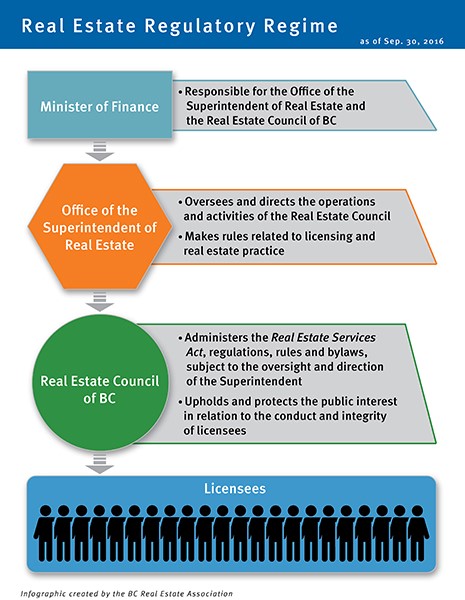
Currently there are two co-regulators: the Real Estate Council of British Columbia and the Office of the Superintendent of Real Estate (OSRE). This unique model was quickly implemented following the recommendations of the Independent Advisory Group in 2016.
BCREA and REALTORS® welcome robust regulatory oversight, but we believe there are dysfunctions in the current regulatory system. The roles of Council and OSRE are unclear, and the division of rule-making and rule-interpreting powers has resulted in confusion for REALTORS® and consumers.
As well, a lack of industry representation on Council means that there isn't enough real estate expertise around the table when decisions are being made.
A streamlined regulatory system with clearly defined roles and greater industry involvement would create more certainty for REALTORS® and better protection for consumers.
BCREA is working with the real estate boards to gather feedback from REALTORS® across the province, which we will use to prepare an official response to the review. We welcome your input directly at [email protected].
The Minister of Finance will receive the recommendations of this review on June 15, 2018.
More information:
To subscribe to receive BCREA publications such as this one, or to update your email address or current subscriptions, click here.
BC Real Estate Sector Submits Anti-Money Laundering Recommendations To Government
Vancouver, BC - April 15, 2019. Organizations representing key professions in the BC real estate sector submitted joint recommendations to the provincial and federal governments today to help protect BC’s housing market from money laundering.
The participating organizations include the British Columbia Real Estate Association, the Appraisal Institute of Canada – BC Association, BC Notaries Association, Canadian Mortgage Brokers Association – British Columbia, and the Real Estate Board of Greater Vancouver.
In their submission, these organizations also commit to shared best practices to help keep the proceeds of organized crime out of the economy. Their efforts focus on helping protect the real estate market from unscrupulous operators and ensuring the public can have full confidence in BC’s real estate market. All of the organizations have fully supported and participated in the government’s investigations into money laundering and real estate.
A real estate transaction involves multiple professionals. It will take a coordinated effort by all involved, working in collaboration with government, to stop money laundering. The joint recommendations and best practices submitted by these organizations reflect their commitment to the professionals and consumers they serve.
-30-
Read their submission to government:
Real Estate Sector Anti-Money Laundering Statement
As a group of real estate organizations representing industry professionals, we are committed to a transparent real estate market and to ensuring that the public can continue to have full confidence in the real estate industry. Illegal funds have no place in BC’s real estate market. We are supportive of the government’s investigations into money laundering and real estate, having actively participated in Peter German’s review and the Expert Panel on Money Laundering.
As an industry, we have come together to commit to shared best practices and make recommendations to government. By aligning as an industry and working in collaboration with government, we can help facilitate an environment in which consumers are well-served and industry professionals can thrive.
Anti-money laundering recommendations Our collaboration has resulted in a commitment from the undersigned organizations to pursue the following shared best practices and recommendations for government:
- Accept only verified funds – For sectors of real estate that are not already required to do so, we recommend that they accept funds only in forms that are verifiable through Canadian financial institutions.
- Mandatory anti-money laundering education – We recommend the introduction of mandatory anti-money laundering education for all real estate professionals subject to the reporting requirements administered by the Financial Transactions and Reports Analysis Centre of Canada (FINTRAC) to ensure that those professionals are trained in recognizing and reporting suspicious transactions. FINTRAC should work with sector organizations, regulators and the provincial government to improve existing resources so that they better reflect real-world situations and improve compliance.
- Smart regulation – We recommend that the federal government amend the Proceeds of Crime (Money Laundering) and Terrorist Financing Act to allow FINTRAC intelligence to be made available to additional regulatory authorities, including the BC Securities Commission and the Financial Institutions Commission (FICOM). Optimally, the federal and provincial governments, as well as their respective agencies, should coordinate their actions, share information, such as the provincial assignment registry, and create a comprehensive, efficient enforcement regime.
- Ongoing engagement – We recommend governments and regulatory agencies, including FINTRAC, better utilize on-the-ground experience of real estate professionals to develop compliance resources and test policy ideas. This will result in well-crafted, practical regulation and foster a culture of compliance to protect consumers and the economy.
- Timely and transparent reporting – We recommend that FINTRAC implement a framework to identify and report trends on a regular basis and in language that is consistent and understandable to professionals, the public and media. This reporting system should also include consistency in examinations with immediate feedback designed to help industry professionals improve their compliance systems.
For a backgrounder to the statement, click here.
Click here for the PDF.
To subscribe to receive BCREA publications such as this one, or to update your email address or current subscriptions, click here.
BC REALTOR® Jayden Lee to Run 162 km for BC Children’s Hospital Fundraiser
On October 6, 2023, BC REALTOR® Jayden Lee is set to run 162 km to raise $150,000 for BC Children’s Hospital Foundation.
Jayden was not always a serious runner, but the determination to give back to his community motivated him to get out of his comfort zone and go the distance for children receiving treatment at BC Children’s Hospital.
When he was 16 years old, Jayden was diagnosed with acute lymphoblastic leukemia and started his years-long journey with cancer. This year marks five years since Jayden’s last chemotherapy treatment and on October 6 at 3 pm, he will have his last check-up at BC Children’s Hospital, closing out a transformative chapter in his life. To celebrate that, Jayden will run 162 km back to his home in Chilliwack after his appointment and has set a goal to raise $150,000 for BC Children’s Hospital Foundation.
Earlier this week, BCREA CEO Trevor Koot sat down with Jayden to learn more about Jayden’s remarkable journey and how other REALTORS® can help support the cause. Take a look:
[iframe width="560" height="315" src="https://www.youtube.com/embed/Jk8XLVDq78Y" frameborder="0" allowfullscreen style="position:absolute;top:0;left:0;width:100%;height:100%;"][/iframe]
This is not the first time that Jayden has found ways to give back to the hospital that saved his life and inspire kids who are still fighting for theirs. On October 2, 2021, Jayden held a fundraiser and ran 103 km from Chilliwack to the BC Children’s Hospital in Vancouver and raised over $125,000.
We encourage REALTORS® from across the province to answer Jayden’s call to action and help him reach his fundraising goal of $150,000. Your support will make a meaningful impact to help BC Children’s Hospital provide transforming care to kids with cancer.
To donate, please visit BC Children’s Hospital Foundation’s fundraising page, here (Donation link is open until Wednesday, November 1, 2023).
BC REALTORS® Advocate for a Pre-Offer Period
The BC Real Estate Association’s annual Government Liaison Days (GL Days) event was held from Sunday, March 10 to Tuesday, March 12, 2024, at the Hotel Grand Pacific in Victoria.
Bringing together 65 attendees consisting of government relations (GR) staff and REALTOR® committee members from all of the regional boards/associations, BCREA GR staff, and Board Members, the event provided delegates an opportunity to hear from a wide range of speakers, learn about advocacy meeting best practices, and meet with their regional Members of the Legislative Assembly (MLAs).
This year, we were pleased to hear from all four provincial party leaders: Premier David Eby, Kevin Falcon from the BC United Party, John Rustad of the BC Conservatives, and Sonia Furstenau from the BC Greens, as well as BC Minister of Housing Ravi Kahlon, and federal Conservative Housing Critic Scott Aitchison. Non-political speakers included our media panel guests, Richard Zussman and Katie DeRosa, pollster Mario Canseco from Research Co., and Dil Puar from the Canadian Real Estate Association.
At Monday night’s reception at the Steamship Grill & Bar, the second annual Provincial Advocacy Awards were handed out to Tore Jacobsen (GR REALTOR® Volunteer Award), Greater Vancouver REALTORS® (though, given that the award is for 2023’s work, the award was presented to the Real Estate Board of Greater Vancouver) for the Real Estate Board GR Committee Award, and Seth Scott of the Association of Interior REALTORS® (Real Estate Board GR Staff Award). BCREA greatly appreciates the work of our dedicated members and partners in delivering advocacy messages to various levels of government.
But it wasn’t all fun and games. The serious work was meeting with MLAs and delivering our key messages in the form of two “asks.” First, we re-vamped our previous recommendation for a Permanent Provincial Housing Roundtable. With the numerous and complex housing policies announced by the government, it is necessary to ensure that they will accomplish their goals “on the ground” and not generate negative unintended consequences.
Our second ask was for the government to replace its current Home Buyer Rescission Period with a Pre-Offer Period to provide improved consumer protection for buyers and sellers during over-heated market conditions. A Pre-Offer Period would allow buyers to complete their due diligence prior to making an offer rather than after an offer has been accepted.
BCREA will continue to advocate for more thoughtful and evidence-based policies and will follow up with MLAs on these two recommendations to support REALTORS® GL Days lobbying efforts as we move towards the provincial election, scheduled for October 2024.
BC REALTORS® Advocate for a Pre-Offer Period
The BC Real Estate Association’s annual Government Liaison Days (GL Days) event was held from Sunday, March 10 to Tuesday, March 12, 2024, at the Hotel Grand Pacific in Victoria.
Bringing together 65 attendees consisting of government relations (GR) staff and REALTOR® committee members from all of the regional boards/associations, BCREA GR staff, and Board Members, the event provided delegates an opportunity to hear from a wide range of speakers, learn about advocacy meeting best practices, and meet with their regional Members of the Legislative Assembly (MLAs).
This year, we were pleased to hear from all four provincial party leaders: Premier David Eby, Kevin Falcon from the BC United Party, John Rustad of the BC Conservatives, and Sonia Furstenau from the BC Greens, as well as BC Minister of Housing Ravi Kahlon, and federal Conservative Housing Critic Scott Aitchison. Non-political speakers included our media panel guests, Richard Zussman and Katie DeRosa, pollster Mario Canseco from Research Co., and Dil Puar from the Canadian Real Estate Association.
At Monday night’s reception at the Steamship Grill & Bar, the second annual Provincial Advocacy Awards were handed out to Tore Jacobsen (GR REALTOR® Volunteer Award), Greater Vancouver REALTORS® (though, given that the award is for 2023’s work, the award was presented to the Real Estate Board of Greater Vancouver) for the Real Estate Board GR Committee Award, and Seth Scott of the Association of Interior REALTORS® (Real Estate Board GR Staff Award). BCREA greatly appreciates the work of our dedicated members and partners in delivering advocacy messages to various levels of government.
But it wasn’t all fun and games. The serious work was meeting with MLAs and delivering our key messages in the form of two “asks.” First, we re-vamped our previous recommendation for a Permanent Provincial Housing Roundtable. With the numerous and complex housing policies announced by the government, it is necessary to ensure that they will accomplish their goals “on the ground” and not generate negative unintended consequences.
Our second ask was for the government to replace its current Home Buyer Rescission Period with a Pre-Offer Period to provide improved consumer protection for buyers and sellers during over-heated market conditions. A Pre-Offer Period would allow buyers to complete their due diligence prior to making an offer rather than after an offer has been accepted.
BCREA will continue to advocate for more thoughtful and evidence-based policies and will follow up with MLAs on these two recommendations to support REALTORS® GL Days lobbying efforts as we move towards the provincial election, scheduled for October 2024.
BC REALTORS® Advocate for Better Consumer Protections During 2022 Government Liaison Days
On May 10 and 11, many BC REALTORS® took part in the BC Real Estate Association’s 2022 Government Liaison Days (GL Days), an event where Realtors from across BC convene to discuss government liaison issues and meet with their local MLAs.
First held in 1988, GL Days connects Realtors from across the province, giving them a forum to showcase discuss issues pertinent to BC’s real estate sector with their colleagues and members of the government. Typically, GL Days takes place in Victoria, but due to ongoing travel concerns as a result of the COVID-19 pandemic, the event took place virtually, hopefully for the last time.
This year, attendees discussed potential solutions to improve housing affordability and strengthen consumer protections. These issues were a continuation of advocacy undertaken by BCREA through our paper, “A Better Way Home: Strengthening Consumer Protections in BC Real Estate.”
In attendance to speak with Realtors were MLAs David Eby, BC’s Housing Minister and Attorney General, and Liberal Housing Critic, Mike Bernier.
Strengthening Consumer Protections
The first series of recommendations discussed at GL Days was related to Bill 12, the Property Law Amendment Act, which enables the government to implement a “cooling off period” for buyers of residential real estate.
Realtors are concerned that a “cooling off period” will worsen affordability by increasing the number of frivolous offers. To mitigate these risks, we propose an exemption for situations where both the buyer and seller agree to waive their right to rescission. There are many instances where a mandatory “cooling off period” would not make sense and a property needs to be sold quickly, such as the result of a divorce, health problems or other unexpected circumstances.
Increasing Housing Supply
To address long-term consumer protection concerns, Realtors are advocating for improvements to housing supply as a key function to improve affordability. We recommend a provincial policy review to consider tying development approvals to housing targets, such as a local government’s Official Community Plan or Housing Needs Report. This ask mirrors recommendations from both the Development Approvals Process Review and Expert Panel on the Future Housing Supply and Affordability in BC. Our second recommendation for solutions to housing affordability is a provincial, permanent housing roundtable that brings together all levels of government and housing stakeholders to address challenges and construct innovative solutions.
We would like to thank all of the Realtors who volunteered their time to attend our sessions and represent their profession through meetings with MLAs.
Additional GL Days resources:
- Housing affordability brief (BCREA Access login required)
- Consumer protection brief (BCREA Access login required)
- BCREA’s White Paper, “A Better Way Home: Strengthening Consumer Protection in BC Real Estate”
BC REALTORS® Advocate for Housing Taxation Review
Every year, the BC Real Estate Association (BCREA) hosts its annual Government Liaison (GL) Days event in Victoria to bring together REALTORS® from across BC, delve into crucial GR issues, and engage with Members of the Legislative Assembly (MLAs). This year’s GL Days on March 9–11 was an exciting event with engaging speakers and productive MLA meetings from all three political parties.
The event began with a fruitful collaboration among representatives of the eight real estate boards and associations that resulted in renewed direction for future collective advocacy. Working together to achieve change makes the sector more resilient, and GL Days provides a golden opportunity to put the sector’s best minds together towards achieving common goals. GL Days 2025 demonstrated strong momentum in this direction.
Our delegate awards reception was held in the Royal BC Museum, where we were pleased to recognize the outstanding achievements of BC Northern Real Estate Board REALTOR® Victor Khong, the Association of Interior REALTORS® GR Committee, and Greater Vancouver REALTORS®’ Director of Government Relations Harriet Permut, who have shown exceptional dedication to our sector.
We co-hosted our MLA reception with the Canadian Mortgage Brokers Association – British Columbia, highlighting our collaborative relationship to elected officials to bolster the impact of our lobbying efforts. The reception attracted many MLAs and was an engaging event filled with relationship-building conversations between real estate professionals and elected officials.
At this year's GL Days, REALTORS® again advocated for a permanent provincial housing policy roundtable of experts. We have long recommended a mechanism of thorough governmental consultation of housing experts to vet provincial housing policy. Premier David Eby has a new mandate but a slimmer majority, and we hope both his party and the opposition will be more receptive to conducting the consultation desperately needed to create effective housing policy.
We also advocated for a thorough review of the Property Transfer Tax, the Speculation and Vacancy Tax, the Foreign Buyer Tax, and the BC Home Flipping Tax. None of these taxes has achieved its stated goals and collectively they hinder housing attainability for many British Columbians. Each of them must be seriously re-examined for needed changes or repealed altogether. Read more about REALTORS®’ GL Days recommendations here.
Premier Eby’s engagement with us during his live session was a highlight. In a surprising pivot, he recognized the importance of real estate investors in improving housing attainability. Minister of Housing and Municipal Affairs Ravi Kahlon, Conservative Party of BC leader John Rustad, and interim BC Green Party leader Jeremy Valeriote also engaged with our delegates and discussed their visions for housing attainability in BC.
While this event is over, our advocacy efforts are ongoing, and we are dedicated to ensuring needed housing policy changes are brought to the attention of elected officials to improve the future of attainability.
BC REALTORS® Advocate for Housing Taxation Review at 2025 Government Liaison Days
Every year, the BC Real Estate Association (BCREA) hosts its annual Government Liaison (GL) Days event in Victoria to bring together REALTORS® from across BC, delve into crucial GR issues, and engage with Members of the Legislative Assembly (MLAs). This year’s GL Days on March 9–11 was an exciting event with engaging speakers and productive MLA meetings from all three political parties.
The event began with a fruitful collaboration among representatives of the eight real estate boards and associations that resulted in renewed direction for future collective advocacy. Working together to achieve change makes the sector more resilient, and GL Days provides a golden opportunity to put the sector’s best minds together towards achieving common goals. GL Days 2025 demonstrated strong momentum in this direction.
Our delegate awards reception was held in the Royal BC Museum, where we were pleased to recognize the outstanding achievements of BC Northern Real Estate Board REALTOR® Victor Khong, the Association of Interior REALTORS® GR Committee, and Greater Vancouver REALTORS®’ Director of Government Relations Harriet Permut, who have shown exceptional dedication to our sector.
We co-hosted our MLA reception with the Canadian Mortgage Brokers Association – British Columbia, highlighting our collaborative relationship to elected officials to bolster the impact of our lobbying efforts. The reception attracted many MLAs and was an engaging event filled with relationship-building conversations between real estate professionals and elected officials.
At this year's GL Days, REALTORS® again advocated for a permanent provincial housing policy roundtable of experts. We have long recommended a mechanism of thorough governmental consultation of housing experts to vet provincial housing policy. Premier David Eby has a new mandate but a slimmer majority, and we hope both his party and the opposition will be more receptive to conducting the consultation desperately needed to create effective housing policy.
We also advocated for a thorough review of the Property Transfer Tax, the Speculation and Vacancy Tax, the Foreign Buyers Tax, and the BC Home Flipping Tax. None of these taxes has achieved its stated goals and collectively they hinder housing attainability for many British Columbians. Each of them must be seriously re-examined for needed changes or repealed altogether. Read more about REALTORS®’ GL Days recommendations here.
Premier Eby’s engagement with us during his live session was a highlight. In a surprising pivot, he recognized the importance of real estate investors in improving housing attainability. Minister of Housing and Municipal Affairs Ravi Kahlon, Conservative Party of BC leader John Rustad, and interim BC Green Party leader Jeremy Valeriote also engaged with our delegates and discussed their visions for housing attainability in BC.
While this event is over, our advocacy efforts are ongoing, and we are dedicated to ensuring needed housing policy changes are brought to the attention of elected officials to improve the future of attainability. If you are interested in joining our efforts, contact your real estate board or association to become involved in advocating for sound housing policy that British Columbians can get behind.
To see photos from GL Days 2025, including both presentations and gatherings, click here.
BC REALTORS® Advocate for More Thoughtful Housing Policymaking Process
On May 7-9, 2023, delegates from all eight real estate boards gathered in Victoria to meet with their constituent Members of the Legislative Assembly (MLAs) during BCREA’s annual Government Liaison (GL) Days. During this event, BC’s organized real estate sector collectively advocated for a more thoughtful housing policymaking process and increased missing middle housing options for British Columbians.
To kick off this year’s GL Days, BCREA hosted a Delegate Reception at the Royal BC Museum, where we presented three inaugural BCREA Advocacy Awards. We were pleased to award Government Relations (GR) Committee Chair Ray Harris of the Real Estate Board of Greater Vancouver with the “GR REALTOR® Volunteer” award for his tireless provincial advocacy efforts. Executive Officer Alex Goseltine of the BC Northern Real Estate Board was presented with the well-deserved “Real Estate Board GR Staff” award, and the illustrious Vancouver Island Real Estate Board received the “Real Estate Board GR Committee” award.
In addition to meetings with their MLAs, GL Days delegates had the opportunity to listen to several notable political speakers hosted by BCREA. Featured speakers were the federal Minister of Housing and Diversity and Inclusion Ahmed Hussen, the federal Shadow Minister of Housing and Diversity and Inclusion Scott Aitchison, the provincial Minister of Housing Ravi Kahlon, and MLA Peter Milobar representing the provincial opposition party.
The esteemed speaker lineup also included prominent political correspondent Rob Shaw of CHEK News, BCREA Chief Economist Brendon Ogmundson, and the Canadian Real Estate Association’s Government Relations Manager Elvanee Veeramalay.
During the evening MLA Reception, GL Days delegates mingled with MLAs from across the province. Here, delegates strengthened previous relationships with their elected officials and were introduced to new provincial politicians as well, bringing an invaluable networking experience to GL Days.
The two recommendations REALTORS® brought to their MLAs were the creation of a permanent provincial housing roundtable to inform housing policy and the creation of more missing middle housing options for British Columbians. While these recommendations were well received, we will continue our advocacy for these policy initiatives to help improve housing attainability and create a more effective housing policymaking process in BC.
Going into GL Days, nine additional stakeholders had officially endorsed the housing roundtable recommendation. BCREA actively continues to increase the number of stakeholder endorsements of this recommendation, and we are committed to building upon the productive advocacy conducted during this year’s GL Days.
BC REALTORS® Advocate for Real Estate Taxation Review
BCREA’s annual Government Liaison (GL) Days brings REALTORS® from across BC to Victoria to engage with Members of the Legislative Assembly (MLAs) on key provincial housing issues. Held from Sunday to Tuesday, March 8-10, 2026, this year’s event featured strong speakers, productive MLA meetings, and renewed collaboration among BC’s eight real estate boards and associations, highlighting growing momentum toward more unified advocacy.
To check out photos from GL Days 2026, click here.
This year, our annual Delegate Awards Reception was held at the Steamship Grill & Bar. We were pleased to recognize the Fraser Valley Real Estate Board’s Government Relations Committee, REALTOR® Volunteer Janice Stromar, and Victoria Real Estate Board Government Relations staff member Denise Hogue, who have shown exceptional dedication to our sector.
On the final day of the conference, we co-hosted our MLA reception with the Canadian Home Builders’ Association of BC (CHBA BC), highlighting our collaborative relationship to bolster the impact of our lobbying efforts. The reception attracted many MLAs and was an engaging event filled with relationship-building conversations between real estate professionals and elected officials.
Building on collaborative efforts with member organizations, BCREA and REALTORS® brought three asks to MLAs during the conference. First, we recommended the repeal of costly Budget 2026 real estate tax increases, including pausing the proposed Speculation and Vacancy Tax increase and not implementing an expansion of the Provincial Sales Tax.
We also asked for a fulsome review of the Strata Property Act, along with pushes for mandatory training for strata council members, improved access to strata documents, and regulated rush fees.
Finally, we recommended several policies to unlock BC’s prefabricated housing potential, including harmonizing municipal zoning, creating a multi-year provincial procurement roadmap, and expanding TradeUpBC to train and prepare workers for prefabricated construction. Read more about REALTORS® GL Days recommendations here.
Premier David Eby was among the many speakers who addressed delegates during the event. During his engagement with us, he expressed his deep concern about the risk that falling housing starts and stalled condo projects could trigger a future housing supply crunch in BC, despite Minister of Housing and Municipal Affairs Christine Boyle’s downplay of the slowdown and insistence that construction activity remains strong. The Premier also told us he’s open to a real estate sector roundtable to help provide much-needed expertise to government on housing policies in the current market, something BCREA has long recommended.
Minister Boyle, Conservative Party of BC interim leader Trevor Halford, Conservative Party of BC housing critic Linda Hepner, and BC Green Party leader Emily Lowan also engaged with our delegates and discussed their visions for housing attainability in BC.
Other notable sessions included a housing policy panel composed of fellow housing sector stakeholders, concurrent sessions on prefabricated housing and small-scale multi-unit housing, a conversation with BC Financial Services Authority CEO Tolga Yalkin, and discussions with legislative reporter Rob Shaw and federal Conservative housing critic Scott Aitchison.
Although GL Days has concluded, our advocacy work continues. We remain committed to ensuring elected officials understand the housing policy changes needed to improve attainability, and we encourage anyone interested in supporting this work to connect with BCREA or their local real estate board or association and get involved in advocating for housing policies British Columbians can support.
BC REALTORS® and Housing Stakeholders Call for Housing Roundtable
On April 20, 2023, the Surrey Board of Trade hosted the Housing Crisis Solutions with Minister Ravi Kahlon event to discuss innovative solutions to British Columbia’s housing crisis with the Minister as he shared his vision to alleviate housing challenges.
Co-sponsored by the BC Real Estate Association (BCREA), Fraser Valley Real Estate Board (FVREB), and Uniti, this event highlighted speeches from housing stakeholders concerned about BC’s ongoing housing attainability crisis, where BCREA and FVREB formally pitched the need for a permanent provincial housing roundtable to the Minister of Housing.
BCREA announced support for this initiative from a diverse collection of organizations across the housing sector, illustrating the need to establish a permanent housing roundtable to review and provide advance feedback on potential new housing policy. See associated news release.
Supporting stakeholders include the Aboriginal Housing Management Association, Active Manufactured Home Owners Society, Appraisal Institute of Canada – BC Association, BC Non-Profit Housing Association, BC Real Estate Association, Canadian Mortgage Brokers Association – BC, LandlordBC, Mortgage and Title Insurance Industry Association of Canada, Small Housing BC, and the Surrey Board of Trade.
At last Thursday’s event, BCREA’s Senior VP of Policy Research & Advocacy, Trevor Hargreaves, stressed the “great deal of housing policy expertise that exists right across this province. [However], these are voices that very rarely gather at a single table.”
FVREB’s Chair of the Stakeholder and Government Relations Committee, Tore Jacobsen, asserted that FVREB is “encouraged that the provincial government recognizes the reality of the crisis and appreciates the funding and strategies aimed at making a lasting impact.”
Nevertheless, some recent policy passed by Premier Eby’s administration demonstrates the lack of collaboration between the provincial, local, Indigenous governments, and housing stakeholders across the housing continuum. A proactive, consultative process is needed to prevent unintended negative consequences of various housing policies, such as the fallout from the Building and Strata Statutes Amendment Act, which banned age restrictions for any age below 55 in strata buildings. This resulted in even fewer opportunities for growing families and first-time homebuyers, as some strata corporations have shifted their age limits to 55-plus. This consequence could have been anticipated and perhaps mitigated had the housing sector been properly consulted.
Jacobsen added that as policy-minded stakeholders in the housing sector who desire greater governmental consultation on housing policy, we want to be there to provide guidance and expertise to housing policymakers.
“What we are calling for today is the establishment of a formalized housing roundtable so that when the provincial government is looking at implementing new ideas, they run it past a series of representatives drawn from within the housing continuum,” Hargreaves said.
As the voice of BC REALTORS®, BCREA is dedicated to advocating this recommendation for a permanent provincial housing roundtable and will drive this message forward to elected BC Members of the Legislative Assembly during our annual Government Liaison Days in Victoria, at the beginning of May.
BC REALTORS® Go to Ottawa to Advocate for More Housing Supply
In late October, the Canadian Real Estate Association (CREA) hosted its 40th annual Political Action Committee (PAC) Days in Ottawa. PAC Days is an event where REALTOR® volunteers and Government Relations staff from every province meet with their local Members of Parliament (MPs) to discuss advocacy issues developed by CREA.
Given the federal election earlier this year, this was an opportunity to share recommendations that can shape existing and emerging federal programs aimed at improving housing affordability. Additionally, PAC Days includes several days of programming on effective advocacy, polling trends, the federal political media landscape, and other information sessions.
REALTORS® brought two recommendations to their MPs, both related to missing-middle housing and overall housing supply. Missing-middle housing is a range of multi-unit housing types that are gentle- to medium-density, including duplexes, townhouses, and low-rise apartments.
Federal Levers
The first recommendation was to leverage all federal levers to unlock housing supply. REALTORS® asked the federal government and opposition parties to speed up building more missing-middle homes by setting clear, measurable housing-delivery targets in all their funding programs and rules.
Infrastructure funding agreements, the Housing Accelerator Fund, and federal transfers should be used to encourage zoning modernization, expedite permitting, and align with national housing goals.
The intention is not to add bureaucracy or incur additional spending. Instead, the recommendation is to make existing investments work smarter by aligning departments, reducing duplication, and encouraging goal alignment among all levels of government.
Build Canada Homes Funding
The second recommendation REALTORS® brought to their MPs is that the government dedicate a modest share of the Build Canada Homes (BCH) projects to market-based missing-middle housing.
Non-market housing is a crucial component of the housing continuum that the BCH program intends to address; however, to truly fix Canada’s housing system, federal programs must address the needs of middle-class families who are increasingly locked out of homeownership.
Notably, in some markets, prefabrication can ensure that homes are built faster, at lower cost, and with consistent quality, while maintaining the BCH program’s core focus on deeply affordable housing.
By embracing a balanced approach, the government can restore hope for the middle class, relieve pressure on rentals, and prove that national leadership can deliver homes for every Canadian.
BC REALTORS® Meet In-Person Again at the Association of Interior REALTORS® Tradeshow
From June 22-23, BCREA staff participated in the inaugural Association of Interior REALTORS® tradeshow in sunny Penticton, BC. This trade show marks BCREA’s return to large in-person events after the easing of the COVID-19 restrictions. We hosted a booth for the two-day event and had the opportunity to connect with Realtors from the Interior, Kootenays and across the province.
“It was great to connect with the Association of Interior REALTORS® members and see familiar faces again,” says BCREA Chair Janice Stromar. “It was exciting to gather together from across the province and learn from some really informative speakers.”
BCREA economist Ryan McLaughlin was a featured speaker at the Stats and Economic Forum. During his presentation, he spoke about the state of the BC economy, the housing market, monetary policies and the BCREA forecast. Also in attendance were BCREA CEO Trevor Koot, Vice President of Government Relations and Stakeholder Engagement Trevor Hargreaves and Professional Services Manager Jim McCaughan who met and spoke with attendees about key issues for Realtors in BC and current work being done by BCREA.
Check out some of the photos from the event below!

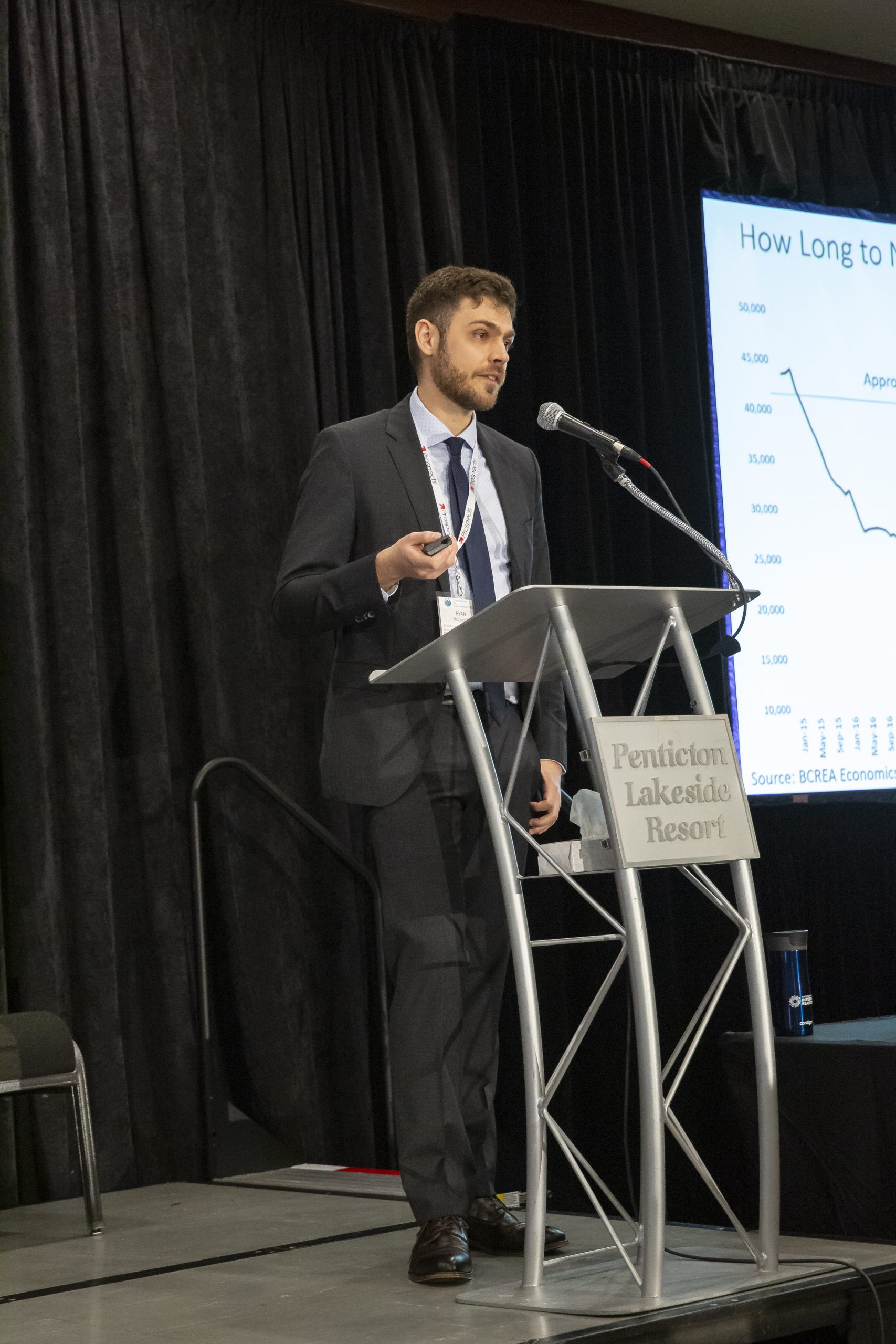



BC REALTORS® Support BCFSA Interim Findings On Rising Strata Insurance
For Immediate Release
Vancouver, BC – June 17, 2020. The British Columbia Real Estate Association (BCREA) welcomes the BC Financial Services Authority’s (BCFSA) interim findings on the unprecedented rise in strata insurance premiums and deductions. On behalf of BC’s 23,000 REALTORS® and 11 real estate boards, BCREA has also developed a series of recommendations for the provincial government to ensure strata owners can access affordable and comprehensive strata insurance.
“Realtors are concerned about the impact of rising strata insurance costs on their clients and communities, particularly as we face the new economic challenges of COVID-19”, says Darlene Hyde, BCREA’s Chief Executive Officer. “We look forward to a final report from BCFSA and we’re here to help them in any way we can in working to resolve this critical issue.”
With some 1.5 million B.C. residents living in strata units, soaring strata insurance costs have a widespread impact. As the provincial association for BC’s Realtors, BCREA’s recommendations aim to protect homeowners by ensuring no strata goes uninsured and that there is transparency for buyers and sellers when it comes to understanding a strata’s coverage.
BCREA’s recommendations to the BC Government include immediate and long term measures.
Immediate:
- Amend the Form B Information Certificate to require proof of insurance, including premiums, deductibles, coverage and expiry date.
- Work with the insurance sector to put measures into place that assure all strata corporations are able to obtain insurance coverage, for as long as the difficult market conditions last.
- Engage with insurers so they continue to provide coverage to strata corporations.
- Amend the Strata Property Act to require a strata corporation to inform owners and tenants of any material change in insurance coverage, including an increase in any deductible, as soon as feasible.
- Require insurers to provide strata corporations with notices 60 days before their policies expire or will be cancelled.
Long term:
- Encourage the provincial insurance regulator, the BC Financial Services Authority, to make public the data and information it is gathering from insurance companies to better understand the current climate of expensive strata insurance.
- Encourage the BC Financial Services Authority to foster a robust, economically viable market that attracts insurance providers.
- Develop mandatory education for strata council members.
- Either create a new organization – modelled on the Condominium Authority of Ontario – to enforce the Strata Property Act, including providing mandatory training and creating best practices for strata councils, or assign this role to the Ministry of Municipal Affairs and Housing.
Impact of Rising Strata Insurance in BC
For several months, many BC strata corporations have faced significant cost increases when renewing their insurance. Some buildings have struggled to find insurers willing to renew their coverage at all. This alarming situation creates uncertainty and risk that could have serious impacts on the housing market and the economy.
Strata units are widely considered to be affordable. For buildings impacted by high insurance costs, the best case sees affordability undermined as costs are passed along to owners through higher monthly fees. Individual owners responsible for damage beyond their units may also face insurance deductibles so large it could bankrupt them.
In the worst case, a building that is unable to obtain insurance no longer complies with the Strata Property Act and individual units in the building cannot be bought or sold.
For media enquiries, contact:
April van Ert
Communications Manager
[email protected]
604.742.2797
Click here for the PDF.
To subscribe to receive BCREA publications such as this one, or to update your email address or current subscriptions, click here.
BC’s Homebuyer Protection Period: What’s Next for REALTORS®?
After the BC Government’s announcement introducing initial details of the upcoming Homebuyer Protection Period to take effect in real estate transactions in January 2023, you might be wondering, what’s next?
REALTORS® are at the front lines of real estate transactions in BC, so a change in the way transactions are conducted will have an impact on how your serve your clients.
As the voice of the province’s 25,000+ REALTORS®, BCREA will continue to review the details of the Homebuyer Protection Period and advocate for effective implementation that minimizes unintended consequences. We will also to continue to urge government to improve consultation and collaboration with the sector, make evidence-based policy decisions and empower province's real estate regulator to act independently.
While we don’t have all the details yet, the Homebuyer Protection Period is coming in 2023 so, alongside our advocacy efforts, BCREA has begun work to prepare for the changes to ensure that REALTORS® are as prepared as possible.
Here is what we’re working on:
Updating and Creating New Standard Forms
To ensure REALTORS® are equipped with the tools needed to serve clients seamlessly through these changes, we are reviewing our current standard forms to identify amendments and/or new forms needed.
Updating Professional Development Courses
Many of our professional development offerings refer to the current process of conducting a real estate transaction. We will be reviewing our courses to ensure they reference updated processes affected by the Homebuyer Protection Period.
REALTOR® Training, Education and Resources
As with all changes to the real estate transaction process, BCREA is committed to providing training and education to ensure your ability to serve clients is impacted as minimally as possible.
In the coming weeks and months, we will be sharing directly with you more information about the Homebuyer Protection Period – as it becomes available – along with resources, such as new and updated standard forms toolkits, to ensure you’re ready for the changes that take effect next year.
While we work on these resources, we would love to hear your thoughts. If you have questions, comments or suggestions that you have not yet shared with BCREA regarding the Homebuyer Protection Period (or previously, the “cooling-off period”) you can email [email protected].
If you’re a Managing or Associate Broker, you can also attend the next Community of Practice session on August 17, 2022, during which we will be discussing the Homebuyer Protection Period. If you aren’t already registered for BCREA’s Managing Broker Community of Practice, click here to register.
BC’s REALTORS® Welcome Government Recommendations
Vancouver, BC – May 13, 2019. The British Columbia Real Estate Association (BCREA) is encouraged by the recommendations set out by the Ministry of Finance’s Expert Panel on Money Laundering led by Maureen Maloney. As the voice of BC’s 23,000 REALTORS®, we appreciate recommendations that will bring more transparency and accountability to all professionals involved in real estate transactions and improve regulatory structures for the benefit of all British Columbians.
“The government’s investigations into money laundering have made clear what REALTORS® have known for a long time: real estate transactions are complicated and don’t just involve REALTORS®,” said Darlene Hyde, Chief Executive Officer for the British Columbia Real Estate Association. “We support swift action from the government to ensure an efficient, comprehensive system to keep the proceeds of crime out of real estate.”
REALTORS® are committed to doing their part to ensure a transparent real estate market. That’s why in April, BCREA worked with four other real estate sector associations to submit a joint statement outlining five recommendations and best practices to the government to help stop money laundering.
In this joint statement, our associations called for mandatory anti-money laundering training for all real estate professionals who come under the federal regulatory requirements. We’re hopeful that the government will now work with regulators to introduce mandatory anti-money laundering education as we move towards more personal accountability for all actors in a real estate transaction.
Finally, we’re optimistic that, if implemented, the Expert Panel’s recommendations for enhanced reporting and transparency from the Financial Transactions and Reports Analysis Centre (FINTRAC) will go a long way in ensuring BC’s housing market benefits British Columbians. In our April statement to government, we highlighted the urgent need for better and more timely feedback and public reporting from FINTRAC.
“Right now, when a real estate office is examined by FINTRAC, the feedback is slow or even non-existent,” said Hyde. “REALTORS® have long been asking FINTRAC to provide immediate, specific suggestions for how they can improve their compliance systems. BCREA hopes the BC Government can work with FINTRAC to bring about the changes REALTORS® have been advocating for.”
BC’s REALTORS® are united with government and all British Columbians in believing that illegal funds have no place in our province’s housing market. We support regulators and law enforcement in decisive and immediate action to stop anyone abusing our economy.
-30-
Click here for the PDF.
For more information, please contact:
April van Ert
Communications Manager
Email: [email protected]
604.742.2797
To subscribe to receive BCREA publications such as this one, or to update your email address or current subscriptions, click here.
BC’s Short-Term Rental Registration Deadline Is Approaching
Managing brokers, an important deadline is fast approaching that may impact your REALTORS® and their clients. As of Thursday, May 1, 2025, all short-term rental hosts in British Columbia must register their rental units with the provincial short-term rental registry to operate legally.
This requirement applies to property hosts, co-hosts, and property managers handling short-term rental operations.
What REALTORS® Need to Know
If your REALTORS® are working with clients who operate short-term rentals, they should be aware of the following key points:
- Mandatory Registration: Every short-term rental unit must be registered separately, with exceptions for multiple bedrooms within the same home.
- Compliance Deadline: Listings that are not registered by Thursday, May 1, 2025, will be removed, and future bookings will be cancelled starting Sunday, June 1, 2025.
- Annual Registration Fees: Fees vary based on the type of short-term rental, with discounts available for early registration before Monday, March 31, 2025.
- Business Licensing Requirements: Some municipalities may require additional business licences to operate a short-term rental.
- Rental Property Management Services: A rental property management licence is required to provide ongoing management of a rental property. For more information on licensing, read more in BC Financial Service Authority’s bulletin on “Trading Services or Rental Property Management?”
Action for Managing Brokers
We encourage you to remind your REALTORS® to inform their clients – especially those involved in short-term rental properties – about this new requirement. Ensuring compliance will help clients avoid disruptions and penalties.
For more information, REALTORS® and their clients can visit the BC Short-Term Rental Registration page.
BCFSA Proposes Changes to Real Estate Teams
On February 23, the province’s real estate regulator, the BC Financial Services Authority (BCFSA) released proposed amendments to the Real Estate Service Rules intended to clarify the role and duties of real estate teams and team members. Teams play an important role for licensees; they can allow families or partners to work together, facilitate larger sales volume and lead generation, provide mentorship opportunities, improve work-life balance, allow for specialization of skills, and normalize income. However, the regulatory framework would benefit from defining teams and providing more clarity about how team members should conduct their professional activities.
BCFSA is conducting a 60-day consultation on the following proposed requirements:
- all teams must register with BCFSA,
- teams include two or more licensed members,
- team members provide services through their team only, and
- team members clearly identify their team name in all advertising.
BCFSA is also proposing Rule changes to align trust account reporting requirements for real estate brokerages with upcoming changes to Canada Deposit Insurance Corporation deposit insurance protection rules to eliminate duplication and streamline information reporting requirements for brokerages.
Last year, BCREA submitted recommendations to BCFSA based on a consultation with REALTORS® to understand how team structure can be improved. We appreciate BCFSA’s continued consultation on these issues to understand what is best for consumers and licensees.
We support BCFSA’s desire to define ‘teams,’ as we previously recommended in 2021, and we will continue to consult Realtors to ensure the definition is as clear and balanced as possible. We will be conducting a series of focus groups with managing brokers and franchisees in the coming month to understand how the proposed changes will impact Realtors.
We have ongoing questions for BCFSA, such as ensuring an adequate time for teams to adapt to the changes and how to support managing brokers through the transition.
We encourage Realtors to provide their feedback to BCFSA’s consultation, which is open until April 24. To learn more, check-out BCFSA’s Annotated Rules and Frequently Asked Questions.
BCFSA’s Relicensing Process Adjustment: A Positive Step
In a move that demonstrates its commitment to supporting real estate professionals, the British Columbia Financial Services Authority (BCFSA) has implemented a significant change in the relicensing process that allows REALTORS® to register for continuing education courses well in advance.
According to the organization, “BCFSA is implementing a new strategy by providing a list of all available course offerings up to three months in advance of their start dates. This proactive approach is designed to give licensees ample opportunity to plan and register for the mandatory continuing education courses well before their renewal date.”
BCFSA went on to say, “By extending the scheduling window, BCFSA aims to alleviate the frustration and inconvenience licensees may have experienced in the past. With this change, BCFSA hopes to ensure that licensees have the necessary time and resources to meet the mandatory continuing education requirements, enabling them to renew their licence on time.”
The impact of this change cannot be overstated. The previous challenges associated with registering for continuing education courses added unnecessary stress to an already demanding profession. BCFSA's proactive approach addresses these challenges head-on, providing REALTORS® with the flexibility and foresight needed to plan their professional development effectively.
BCREA applauds BCFSA for tackling this challenge. As an organization dedicated to enhancing the professional excellence of REALTORS®, BCREA understands the importance of accessible and timely education. Continuing education is not just a regulatory requirement; it is a vital component of maintaining the highest standards of practice in the real estate profession.
By ensuring that REALTORS® have ample time to register for courses, BCFSA is helping to uphold these standards and foster a culture of continuous learning and improvement.
We encourage all REALTORS® to take full advantage of this new scheduling window and plan their continuing education well in advance. Together, we can continue to elevate the real estate profession in British Columbia.
While you wait to take your relicensing courses, BCREA offers several continuing education programs you can enroll in to further your education and enhance professionalism in the sector. Find more courses on our Professional Development page.
BCREA 2026 Second Quarter <em>Housing Forecast</em>: BC Housing Market Faces Multiple Headwinds in 2026
To download the PDF, click here.
Vancouver, BC – April 27, 2026. The British Columbia Real Estate Association (BCREA) released its 2026 Second Quarter Housing Forecast today.
Multiple Listing Service® (MLS®) residential sales in BC are forecast to fall 2.1 per cent to 68,700 units this year. In 2027, MLS® residential sales are forecast to move higher, rising 7.7 per cent to 74,000 units.

“The housing market continues to be challenged by persistent global headwinds and a struggling economy,” said BCREA Chief Economist Brendon Ogmundson. “However, improved affordability in many markets combined with several years of pent-up demand creates conditions for a rebound, though households will likely need a prolonged period of stability to re-enter the market.”
With active listings at their highest level since 2015, and additional pressure from elevated new-home inventory, we anticipate the average price in BC will fall by 1.4 per cent in 2026 to $939,800, down from $952,930 in 2025. This decrease largely reflects disproportionate weakness in more expensive markets in the Lower Mainland, casting downward pressure on the broader provincial average price.
-30-
For the complete news release, including detailed statistics, click here.
For more information, please contact:
Brendon Ogmundson
Chief Economist
Direct: 604.742.2796
Mobile: 604.505.6793
[email protected]
To subscribe to receive BCREA publications such as this one, or to update your email address or current subscriptions, click here.
BCREA 2026 Third Quarter <em>Housing Forecast Update</em>: Home Sales Expected to Rise in 2027
To download the PDF, click here.
Vancouver, BC – August 20, 2026. The British Columbia Real Estate Association (BCREA) released its 2026 Third Quarter Housing Forecast Update today.
Multiple Listing Service® (MLS®) residential sales in BC are forecast to fall 1.2 per cent to 69,325 units this year. In 2027, MLS® residential sales are forecast to move higher, rising 7.5 per cent to 74,500 units.

“A long-awaited recovery in the British Columbia housing market appears to be underway as we enter the second half of 2026, but will be slow and gradual and continues to be challenged by persistent geopolitical volatility,” said BCREA Chief Economist Brendon Ogmundson. “Ultimately, an expected pick-up in the provincial economy over the next year provides cause for optimism that sales activity will improve in 2027.”
With active listings near their highest level since 2015, and additional pressure from elevated new-home inventory, we anticipate the average price in BC will fall by 1.2 per cent in 2026 to $941,800, down from $952,767 in 2025. This decrease largely reflects disproportionate weakness in more expensive markets in the Lower Mainland, casting downward pressure on the broader provincial average price.
-30-
For the complete news release, including detailed statistics, click here.
For more information, please contact:
Brendon Ogmundson
Chief Economist
Direct: 604.742.2796
Mobile: 604.505.6793
[email protected]
To subscribe to receive BCREA publications such as this one, or to update your email address or current subscriptions, click here.
BCREA 50th Anniversary: 1986 – Here at Last!
Throughout 2026, BCREA will be looking back to years past in celebration of our 50th anniversary. Join us as we break down some of the biggest moments for the Association and the real estate sector at large.
Today, we look to 1986, a year remembered as a time of historic change and economic development for the province of British Columbia. BCREA’s president at the time was Marty Douglas, who remains among our ranks today as a Professional Services Support Advisor.
In a January BCREA Bulletin newsletter article, Marty wrote that there was cause “for some real satisfaction as we enter 1986.” He added, “We can say with assurance that consumer confidence, bolstered by stable interest rates and a recovering economy, has returned in force.”
At the time, the Canadian economy had shifted into an upswing, and Canadians were buying houses at a record pace. “In British Columbia alone,” Marty wrote, “over $1.4 billion in residential sales to the end of October serves to vividly illustrate this newfound confidence.”
In describing the purchase trends at the time, Marty outlined that “many buyers were young, first-time purchasers, and a surprising number, close to 25 per cent nationally, were single.”
Providing a snapshot of the market at the time, he described prices as having been “relatively stable,” and “forecast to show moderate, inflation-linked increases throughout 1986.”
Housing starts were projected at 25,000 for the year, and there was a fair amount of enthusiasm around the forthcoming Expo 86, which was slated to bring increased attention to the province with hopes of a boost in sales.
Of historical note, Marty went on to announce the formation of the BC Real Estate Foundation (now the Real Estate Foundation of BC), which continues to fund sustainable land usage initiatives to this day.
In his article, Marty wrote about how, through the new foundation, the interest accrued from agents’ general trust accounts would benefit “not only the real estate industry, but the general public of British Columbia, through education, law reform, research, and other worthwhile programs.”
Of final note, Marty also pointed to the development of a new “Contract of Purchase and Sale Form,” which was “the culmination of some two years of deliberation by a joint committee of the BC Real Estate Association and the Canadian Bar Association (BC Branch).”
All of the above are interesting aspects that relate to our current market and serve as a reminder in these volatile times of the lasting nature of BC real estate’s boom / bust cycle. It also shows how many of the areas of focus back then remain issues of concern today.
Stay tuned for further historical snapshots from years past in coming weeks!
Photo credit: Colin Rose, Wikimedia Commons
BCREA 50th Anniversary: BC Real Estate and Cross-Border Relations
As we get further into 2026, Canada-United States relations feel particularly frayed. The Canadian economy strains under tariffs and increasingly hostile posturing by the Trump Administration, with no end in sight. But amid these difficult international relations, it’s important to remember that we have long shared a much closer relationship with the US.
An interesting look back at years past and our collective response to US tragedy is the BC REALTOR® community’s actions following the September 11, 2001, terrorist attacks. An October 5, 2001, print edition of the Real Estate Board of Greater Vancouver’s (now Greater Vancouver REALTORS®) REALTOR Link® newsletter recapped highlights of the sector's efforts.
The newsletter notes that on the day of the attack, BCREA was holding provincial meetings in a hotel in Richmond. Notably, board and association presidents, as well as executive officers, gave up their hotel rooms to accommodate stranded travellers.
In the days that followed, the REALTOR Link® article outlines that:
- As the Vancouver International Airport became crowded with rerouted flights, some REALTORS® took travellers into their homes.
- REALTORS® lined up to donate blood, and many took part in memorial services and vigils.
- Board and association staff members joined the world in a day of mourning. Both the Real Estate Board of Greater Vancouver and the Fraser Valley Real Estate Board observed moments of silence.
- In Vancouver, board staff participated in a candle-lighting ceremony outside the building to express condolences.
In real estate, we’ve come to expect periodic market volatility. Seemingly, international relations work in a similar fashion.
Here’s hoping we return to a stronger relationship with our neighbouring country soon and maintain that relationship for a long time to come.
BCREA 50th Anniversary: Economist Brendon Ogmundson on Canada’s Obsession With Real Estate
BCREA is turning 50 years old this year. As part of our anniversary celebration, we interviewed the Association's Chief Economist, Brendon Ogmundson. A sought-after specialist in housing market analysis and economic forecasting, Brendon was recently named one of Canada’s most influential people in real estate by Buzz Digital Magazine.
In the interview video below, Brendon discusses multiple topics, including his time at BCREA, Canada's obsession with real estate, and the future of the sector.
[iframe width="560" height="315" src="https://www.youtube.com/embed/TNBikW9TTIM" frameborder="0" allowfullscreen style="position:absolute;top:0;left:0;width:100%;height:100%;"][/iframe]BCREA 50th Anniversary: How a 1980 BCREA Logo Contest Became a Win-Win
In June 1980, North Vancouver REALTOR® Jerrie Netolicky won a contest to replace BCREA’s logo. His design included regional mountain and sea highlights:

For his trouble, Jerrie won a bronze plaque with his logo on it and a trip for two to San Francisco (or the cash equivalent).
Jerrie's design went on to be quite influential, not too far away from the logo currently in use.

For more on the Association's current logo and branding, click here.
BCREA 50th Anniversary: How the <em>Heritage Conservation Act</em> Is Evolving Under Private Sector Criticism
Throughout 2026, BCREA will be looking back to years past in celebration of our 50th anniversary. Join us as we break down some of the biggest moments for the Association and the real estate sector at large.
The British Columbia Heritage Conservation Act (HCA) was originally enacted in 1977. It replaced the previous Archaeological and Historic Sites Protection Act and was intended to further strengthen the protection of archaeological sites on both public and private land.
An excerpt from the 2012 Real Estate Council of BC’s Professional Standards Manual outlines the function and implications of the HCA as:
“The intent of the Heritage Conservation Act with respect to archaeological sites is to balance a respect for heritage and a property owner’s right to develop, (though) some private landowners may face costly archaeological studies and / or limited use of their land.
“The Heritage Conservation Act is concerned with activities that may alter heritage sites automatically protected under the legislation. While it is not likely to affect properties where there is no intended change of use, it could have an impact where a change in that use is contemplated (e.g., subdivision, new construction, construction of an addition or pool).”
The HCA has been a hot political topic in recent months. In 2025, the provincial government announced a set of proposed amendments that immediately drew significant criticism due to the lack of adequate consultation to help inform the real-world and unintended consequences. In response to this feedback, particularly from key private-sector stakeholders, the BC Government extended the consultation period and endeavoured to draft a revised set of changes.
The latest proposal has addressed many concerns, but continues to draw criticism from the private sector because of the perceived continued lack of consultation on the design of proposed changes.
In light of policy concerns around land usage and property ownership related to the recent Cowichan Tribes v. Canada decision and the Declaration on the Rights of Indigenous Peoples Act, some organizations are calling for a moratorium on changes to the HCA until these issues can be clarified in the courts.
The HCA has long served to help protect critical archaeological areas within the province. And, once it completes its current process of modernization, it’s sure to be an important resource for the real estate sector in the years to come.
BCREA 50th Anniversary: What Does BCREA’s Anniversary Mean to You?
BCREA is turning 50 years old this year. As part of our anniversary celebration, we interviewed current and past BCREA Chief Executive Officers about the Association and the real estate sector at large.
In the first of several videos to come, Trevor Koot, Darlene Hyde, and Robert Laing answer the question: “What does BCREA's 50th anniversary mean to you?” Check out their thoughts below.
[iframe width="560" height="315" src="https://www.youtube.com/embed/ronS0dVjFbk" frameborder="0" allowfullscreen style="position:absolute;top:0;left:0;width:100%;height:100%;"][/iframe]BCREA 50th Anniversary: What Is the Future of Organized Real Estate?
BCREA is turning 50 years old this year. As part of our anniversary celebration, we interviewed current and past BCREA Chief Executive Officers about the Association and the real estate sector at large.
In the video below, Trevor Koot, Darlene Hyde, and Robert Laing answer the question: “What is the future of organized real estate?” Check out their thoughts here.
[iframe width="560" height="315" src="https://www.youtube.com/embed/-OjX4cnyH6Y" frameborder="0" allowfullscreen style="position:absolute;top:0;left:0;width:100%;height:100%;"][/iframe]BCREA 50th Anniversary: What Makes Real Estate Special?
BCREA is turning 50 years old this year. As part of our anniversary celebration, we interviewed current and past BCREA Chief Executive Officers about the Association and the real estate sector at large.
In the first of several videos to come, Trevor Koot, Darlene Hyde, and Robert Laing answer the question: “What makes real estate special or unique?” Check out their insights below.
[iframe width="560" height="315" src="https://www.youtube.com/embed/8OAVW2ffI_g" frameborder="0" allowfullscreen style="position:absolute;top:0;left:0;width:100%;height:100%;"][/iframe]BCREA Access Replacing REALTOR Link® On August 23
On August 23, BCREA is launching BCREA Access, a new platform for REALTORS® to securely access resources from BCREA. Designed exclusively for BC REALTORS®, managing brokers and real estate board staff, BCREA Access contains resources to help support real estate professionals, where and when you need it the most.
With BCREA Access, REALTORS® will be able to:
- access key REALTOR® and managing broker resources,
- explore current advocacy issues and ways to participate in lobbying efforts,
- find professional development opportunities,
- discover more about BCREA and how to get involved, and
- sign-up for great REALTOR® benefits.
Logging into the new platform will be easy! BCREA Access uses the same secure, login information used for REALTOR Link® and is accessible on mobile and tablet devices.
Why did we create BCREA Access?
The introduction of BCREA Access is to replace BCREA’s presence on REALTOR Link®, which is being discontinued by the Canadian Real Estate Association (CREA) on September 15, 2022. This means that after September 15, you will no longer be able to access resources on REALTOR Link®.
If you frequently use REALTOR Link®, it's also worthwhile to note that CREA plans to make its own content previously available on REALTOR Link® accessible through a new resource page and on its public website. However, other pages – like BCREA and real estate board pages – will no longer be accessible.
If you have questions about BCREA Access, contact [email protected].
If you have questions about the discontinuation of REALTOR Link®, contact [email protected].
BCREA Access: Explore Five Useful Resources Available Now
BCREA Access is the new, exclusive platform for BC REALTORS® to find professional resources from BCREA. Created to ensure REALTORS® have timely and secure access to BCREA Resources with CREA discontinuing REALTOR Link® on September 15, 2022, BCREA Access has many useful resources available now.
Haven’t signed in to BCREA Access yet? Using BCREA Access is easy! Your login information is the same as what you use for CREA’s REALTOR Link® and BCREA Access is available on mobile and tablet devices when you are on the go.
Here are five resources you might find helpful on BCREA Access which are available today:
- Access key REALTOR® and managing broker resources exclusively on BCREA Access.
Managing Brokers can have their voice heard and help shape BCREA’s future resources for brokers by taking the Managing Brokers needs analysis survey. Deadline is 11:59pm on September 8. - REALTORS® can stay up to date about political real estate news that affects the sector by reading Advocacy Update, BCREA’s biweekly subscription-based newsletter.
- Get involved with BCREA through volunteer opportunities and organized real estate committees. Learn about what the Board of Directors, Board Committees, External Appointments and Operational Committees do and how to volunteer on BCREA Access.
- Explore and review BCREA Professional Development courses in one place. BCREA Access makes it easy for REALTORS® to discover course topics and quickly find self-paced online courses you have already registered for.
- REALTORS® can sign-up for great benefits through your exclusive member portal. Discover preferred mobile plans, insurance programs, and health benefits on BCREA Access today.
BCREA Addresses Minister Robinson’s Announcement
Yesterday, Minister of Finance Selina Robinson announced plans to amend the Property Law Act to pave the way for the introduction of a “Homebuyer Protection Period” in real estate transactions. While the Government’s announcement lacked detail, the Homebuyer Protection Period will give buyers the right to rescind offers in real estate transactions. While governmental language has changed, this is essentially the cooling-off period that has been much discussed in recent weeks.
As your provincial professional association, we know that REALTORS® share government and public concern about the risks consumers face in heated markets and the challenges of BC’s housing affordability issues. We also know that a cooling-off period could have unintended consequences, such as protecting buyers at the expense of sellers or encouraging buyers to make offers on properties they’re not serious about, consequently increasing competition and driving home prices higher.
Later this morning, we will release a statement to media in response to yesterday’s announcement which expresses our ongoing concern with their approach. We’re not alone in questioning the introduction of a cooling-off period. According to a recent survey of more than 1150 British Columbians, only 35% of consumers support a cooling-off period.
In our statement to media, we also assert that it’s time to stop spreading the myth that Realtors are driven by self-interest. Government needs to recognize the important contributions Realtors make towards better protecting consumers and improving housing affordability as consumers certainly do. The same survey that showed British Columbians do not widely support a cooling-off period also revealed that more than 70 per cent of consumers believe Realtors should be consulted on real estate policy changes.
We will continue to advocate on your behalf and keep you informed of our approach, as well as any opportunities for Realtors to support BCREA’s advocacy efforts.
BCREA Advances Anti-Money Laundering Recommendations
Illegal funds have no place in BC’s real estate market. Real estate playing an important role in the lives of British Columbians, serving as one of the key economic drivers in the province. BCREA shows leadership on behalf of REALOTRS® by advocating for smart policy to ensure integrity and transparency and supporting Realtors to help identify and combat money laundering in real estate transactions.
“The real estate sector in BC takes the issue of money laundering seriously,” said BCREA CEO Darlene Hyde. “We have taken a wide variety of internal steps to strengthen our education for membership and practices in the field, and we are pushing to work more closely with regulators to more collective tackle an issue that exists in the shadows.”
BCREA has already made substantial progress on previous recommendations. We lobbied the Real Estate Council of BC to implement mandatory anti-money laundering education, which was launched in January 2020. BCREA’s anti-money laundering work was applauded by the Attorney General and the Minister of Finance in a government news release in April 2019.
BCREA is also updating our anti-money laundering course for managing brokers. The self-paced online course is set to launch in September 2021, reinforcing practice guidelines based on survey data and follow-up with participants who took the course in October 2020. The next version will reflect input from managing brokers, and is expected to launch in June 2021.
Apart from supporting the Cullen Commission of Inquiry into Money Laundering in British Columbia, BCREA recommends that the BC Government:
- let the Cullen Commission complete its work before implementing additional significant anti-money laundering measures, and
- coordinate actions with the federal government to create a comprehensive, efficient enforcement and regulatory regime.
To subscribe to receive BCREA publications such as this one, or to update your email address or current subscriptions, click here.
BCREA Advocacy 2020 Year in Review
2020 was an eventful year that required BCREA to adapt to many unexpected challenges. As with most British Columbians, the COVID-19 pandemic required changes how we conduct our practices. We have learned just how resilient and adaptable BC’s Realtors can be, showing leadership and coming together to help flatten the COVID-19 infection rate. Below are a few 2020 highlights from BCREA’s Government Relations team.
One issue that was delayed due to the pandemic was regulatory reform. The new timeline for integration of the Office of the Superintendent of Real Estate and the Real Estate Council of British Columbia into the BC Financial Services Authority (BCFSA) is early 2021. Throughout the year, BCREA has been meeting with government staff and ministers to ensure that this change is more effective and efficient than the current model. Three of our recommendations are:
- create a Professional Standing Committee to establish licensing qualifications,
- separate public policy from operational policy, with input from licensees, and
- give the real estate licensing function the authority to make its own rules and operational policies.
We are hopeful that when amendments are introduced in coming months, changes will support licensee accountability and improve consumer protection.
Since the end of 2019, BC strata corporations have faced rising strata insurance costs, causing increased affordability challenges for strata unit owners. In June 2020, the BC Government introduced amendments to begin addressing this issue, naming BCREA as a contributor. Three of BCREA’s recommendations were adopted, including:
- amend the Form B Information Certificate to require proof of insurance,
- require a strata corporation to inform owners and tenants of any material change in insurance coverage as soon as feasible, and
- require insurers to provide strata corporations with notices before their policies expire or will be cancelled.
BCREA will continue working with government and other organizations to advocate for additional solutions to make insurance more affordable.
BCREA also continued work to keep money from criminal activity out of BC’s housing market. We created a page dedicated to help Realtors access anti-money laundering resources. We have also been active participants in the Cullen Commission of Inquiry into Money Laundering in British Columbia. We gave opening statements to the commission and will provide testimony in February 2021 as the voice of BC’s Realtors.
In November, in the midst of the pandemic, British Columbians went to the polls, resulting in an NDP majority government. BCREA worked with member boards on ensuring new and re-elected MLAs were educated on challenges facing the real estate sector, notably housing supply, rising strata insurance costs and incentives for energy retrofits.
With another busy year already underway, our team is hard at work continuing to support BC’s Realtors.
To subscribe to receive BCREA publications such as this one, or to update your email address or current subscriptions, click here.
BCREA Advocacy Exchange: Conference for Managing Brokers
On September 19, BCREA hosted our first Advocacy Exchange: Conference for Managing Brokers. The conference provided a unique opportunity for managing brokers from across the province to network, learn about advocacy, ask questions and be informed on matters affecting organized real estate.
The event was well attended by over 250 managing brokers, licensees and key stakeholders. Representatives from BCREA, the Canadian Real Estate Association (CREA), the Office of the Superintendent of Real Estate (OSRE), the Real Estate Council of BC (RECBC) and the Financial Transactions and Reports Analysis Centre of Canada (FINTRAC) presented on regulatory issues, advocacy and compliance, and attendees were able to raise their questions and concerns throughout the day.
Highlights from the conference include:
- The particularly avid engagement for the FINTRAC presentation. Managing brokers made the most of Thomas Tomasovszky's Q&A session to ask detailed questions about meeting compliance obligations.
- RECBC Executive Officer Erin Seeley's Q&A session, which provided a positive opportunity for dialogue between managing brokers and RECBC. The presentation slides can be found here: Regulation and Compliance in a Time of Change, or watch the full presentation: https://youtu.be/y0BjWCbuWW0.
- Key consultation findings presented by BCREA. These include results from the managing broker researchBCREA conducted earlier this year, as well as an overview of the results from the consumer surveyBCREA conducted in August. See the BCREA presentation slides here: BCREA Advocacy Part 1 and BCREA Advocacy Part 2, or watch the presentation by Norma Miller, BCREA Government Relations Manager: https://youtu.be/A_SmoaEmtvo.
- Randall McCauley's insights from CREA on how understanding the government's views of the real estate industry is the key to successful government relations. His presentation can be found here: Turning the Tables—How the Government Sees the Real Estate Industry, or watch the full presentation: https://youtu.be/dNVBjtXhbic.
- Superintendent Micheal Noseworthy and Deputy Superintendent Jonathan Vandall highlighting future opportunities for engagement between managing brokers and OSRE. These opportunities are laid out in their presentation slides: Reviewing the Roles and Responsibilities of Managing Brokers, or watch the full presentation: https://youtu.be/1kbfNMVoN50.
We appreciate the level of engagement throughout the day and the number of questions that were raised. While we were unable to address all of them during the conference, it's important to us that we address as many of these questions as possible. Some will be used as topics for future articles, and many have been submitted to the presenters to provide answers, which will be posted on our Advocacy Page on REALTOR Link® under BCREA Advocacy Exchange: Conference for Managing Brokers over the coming weeks.
BCREA is also building a stronger presence on social media regarding advocacy and regulatory issues. Follow us on Facebook, Twitter and LinkedIn for updates.
To subscribe to receive BCREA publications such as this one, or to update your email address or current subscriptions, click here.
BCREA Agrees with Expert Panel’s Calls to Increase Housing Supply for Improved Affordability
Increasing and diversifying housing supply is part of a necessary, meaningful, and long-lasting solution to make housing more affordable in British Columbia. The British Columbia Real Estate Association is encouraged by the final report from the Expert Panel on Housing Supply and Affordability and its specific recommendations around housing supply.
“There is no question that, for British Columbians to access housing options within their means, the supply of housing has to increase. To do so, local governments must decrease barriers and speed up their approval processes,” says BCREA CEO Darlene Hyde. “We welcome these findings from the Expert Panel, which echo our own recommendations about housing supply. We are – as always – ready to work with governments to help them develop and implement thoughtful, evidence-based policies that will deliver results.”
Among the 23 recommendations from the panel, the report calls for the BC government to conduct a review of public hearings and consider alternative options for more meaningful, earlier public input in different formats. This eliminates the potential for a loud minority to skew and delay outcomes and timelines. BCREA is also encouraged to see the panel highlight challenges and opportunities outlined in the provincial government's 2019 Development Approvals Process Review (DAPR) report, which outlines solutions to the issue of needlessly long development approval timelines.
The provincial government has made some progress to facilitate more supply, but much more needs to be done as it is increasingly difficult to become a homeowner in BC.
Established by the governments of Canada and BC in 2019, the Expert Panel was tasked with examining housing trends for rental and homeownership and making recommendations to both levels of government.
BCREA and Member Board Delegates Advocate for Improved Housing Attainability at 2023 Union of BC Municipalities Convention
Last week, BCREA and five BC real estate boards sent delegates to the Union of BC Municipalities (UBCM) Convention in Vancouver to meet with local and provincial political leaders and staff. Throughout the event, BCREA’s delegates strongly advocated for greater housing attainability, and distributed a brief to elected officials containing two recommendations described below.
Our primary recommendation was that as the provincial government advances the missing middle initiative announced in the Homes for People plan, they should consult not only with local governments, but also with industry, particularly builders and designers, so that regulations do not discourage, but rather encourage the construction of Missing Middle Housing.
Our secondary recommendation was focused on non-metropolitan municipalities, which often have similar housing supply issues but with different causes than their urban counterparts. We recommended that they conduct their own housing roundtables with local contractors, builders, and trades, to determine the unique obstacles and solutions to creating more housing supply in their communities.
BCREA also had a tradeshow booth, where convention goers received our housing policy briefs, had the opportunity to complete a housing policy survey, and engaged with the face of BCREA to better understand our advocacy and BC REALTORS®’ perspectives on housing attainability.
UBCM Resolutions
At the convention, UBCM voting delegates (councillors and mayors) voted on a series of resolutions. While non-binding, endorsed resolutions will be presented to the BC Government for consideration. Endorsed resolutions relating to real estate include:
- BC Housing Delays: UBCM lobbies the provincial government to address delays at BC Housing.
- Expanding Property Transfer Tax Exemptions: UBCM urges greater exemption from Property Transfer Tax payments to support the creation of non-market housing.
- Municipal Authority for Empty Homes Tax: UBCM lobbies for municipalities’ ability to tax unoccupied Class 1, Residential properties.
- Short-Term Vacation Rental Listing Platforms: UBCM asks for legislation requiring short-term rental platforms to demonstrate local government approvals, list rental property addresses, and provide government enforcement mechanisms.
- Incentives for Heat Pumps and Other Climate Resilience Retrofits in Multi-Residential Buildings: UBCM requests that all dwelling types are eligible for incentives and rebates for retrofits.
- Enhanced Retrofit Programs for Part 3 Buildings: UBCM requests the improvement of programs available to all Part 3 buildings.
- Property Transfer Tax Sharing for Local Governments: UBCM advocates for sharing property transfer tax revenue with local governments.
Resolutions Endorsed with Amendments Include:
- Homes for People Action Plan: UBCM asks that legislation implementing the Homes for People Action Plan not apply without input from local governments.
- Affordable Housing Infrastructure Upgrades: UBCM urges the province to fund infrastructure and land acquisition for the creation of affordable housing.
- Development Approvals: UBCM urges expedited review of development applications requiring approval from the Ministry of Environment, the Ministry of Transportation and Infrastructure, and BC Hydro.
While the 2023 UBCM convention is over, we remain committed to advocating on behalf of BC REALTORS® and consumers to address challenges in the real estate sector. BCREA and our Government Relations team continue to support thorough, evidence-based housing policies that increase housing attainability for British Columbians.
BCREA and Real Estate Board Delegates Join Discussion on Housing Affordability at 2022 Union of British Columbia Municipalities Convention
Last week, BCREA and five of BC’s real estate boards sent delegates to the Union of BC Municipalities (UBCM) Convention in Whistler to meet with local and provincial political leaders. Throughout the event, BCREA’s delegates delivered a clear message on housing affordability.
Firstly, we set out to challenge housing myths, including the idea that foreign investment is the main cause of housing price escalation and that BC municipalities are building enough housing.
We also advocated for solutions to improve housing affordability, including improving the housing approval process and allowing more types of housing in more places. To communicate these solutions, we held meetings with MLAs and other elected officials from across the province, echoing sentiments written by BCREA Senior Vice President Trevor Hargreaves in this Vancouver Sun opinion piece.
UBCM Resolutions
At the convention, UBCM voting delegates (which include councillors and mayors) voted on a series of resolutions. While non-binding, resolutions that were endorsed will be forwarded to the BC Government for consideration. Resolutions relating to real estate that were endorsed include:
- Provincial Responsibility for Flood Protection – Calling on the BC Government to significantly increase its level of funding for flood preparedness and mitigation,
- Enforcement Tools for Short-Term Rentals –UBCM urges the BC Government to develop and implement short-term rental enforcement solutions for all local governments, such as broadening authority to enforce compliance through simplified ticketing procedures; collection of evidence and the establishment of proof based on online investigation of accommodation listings; and expanding options to compel payment on unpaid fines through mechanisms such as applying uncollected ticket fines to property taxes.
- Non-Profit Housing Acquisition Strategy – UBCM advocates that the provincial government support the recommendation in the Canada-BC Expert Panel on Housing Supply to develop a provincial acquisition strategy and grant program.
- Community Housing Development Supports – UBCM asks the BC Government to broaden the mandate of Infrastructure BC to facilitate the delivery of strategic housing projects on behalf of petitioning local governments.
- Mandatory Inclusionary Housing Bylaw – UBCM requests that the BC Government makes the legislative changes required to permit a municipality to adopt a mandatory inclusionary housing bylaw.
- Bare Land Strata Development Minimum Standards – UBCM asks the BC Government to amend the Bare Land Strata Regulation to not require that bare land strata developments meet the same minimum standards set by local governments to ensure consistency across all developments throughout the community.
- Increasing Provincial Incentives for Installing Solar Panels and Solar Hot Water Systems – UBCM requests the BC Government modifies the BC Building Code to include design and placement standards and load-bearing requirements for solar panels and solar hot water systems.
- Homeowner Insurance Availability and Provisions – UBCM petitions the BC Government to introduce and adopt legislation that requires all insurance providers in BC to provide insurance to all homeowners in the province with provisions that are consistent, fair and equitable.
- Home Owner Grant Increase – UBCM requests that the BC Government increases the Home Owner Grant to reflect the actual school tax charged on the property where the school tax is higher than the grant.
- Tiny Homes – UBCM asks the BC Government to review the BC Building Code to address barriers to allow and provide building requirements for tiny homes.
- Accelerating Zero Emissions Buildings – UBCM requests the BC Government to accelerates its timelines for requiring the zero emissions new constructions.
Resolutions that were endorsed with amendments include:
- Encouraging Safe and Affordable Housing – UBCM requests the provincial and federal governments provide tax exemptions for all income derived from the long-term rental of secondary suites as measure to encourage the provision of safe and affordable housing.
- Speculation and Vacancy Tax Review – UBCM asks the BC Government to consult with local governments on an evaluation of the Speculation and Vacancy Tax Act including a review of the specified areas and the impact on electoral areas adjacent to the designated taxable regions.
While the 2022 UBCM convention is over and delegates from across the province have left Whistler, we remain committed to advocating on behalf of BC REALTORS® and consumers to address challenges in the real estate sector. BCREA and our Government Relations team will continue to support thorough, thoughtful and evidence-based policies that aim to provide more housing opportunities for British Columbians.
BCREA Appointee Sought for Real Estate Compensation Fund Corporation
The BC Real Estate Association (BCREA) Board of Directors (BOD) is seeking an appointee for the Real Estate Compensation Fund (RECFC) Corporation BOD. This appointment is a three-year term and would commence on January 1, 2025.
RECFC was established in 2005 to protect the public in the event of lost funds due to the actions of a real estate professional.
It is a non-profit organization that pools the assessments paid by licensees and uses those funds to deliver claims to members of the public who have suffered a compensable loss. The Board oversees the conduct of RECFC’s business and investments.
Responsibilities
The RECFC requires a BOD with the appropriate mix of competencies that support and advance the organization’s mission. The Director is expected to:
- Attend all BOD meetings annually (four BOD meetings, including video/audio meetings).
- Read and reflect on materials in preparation for meetings.
- Attend orientation and training. Meetings are typically held in Vancouver.
All interested candidates are expected to have the time and commitment to fulfill their responsibilities as a Director. All directors should be committed to the importance of sound governance and be ready, willing, and able to put in the required time to learn the job, get to know the organization, prepare for meetings, and participate fully as part of the BOD.
Directors are appointed for three-year terms and may serve two consecutive terms.
Skills and Experience
Each year, the RECFC BOD assesses itself against its skill matrix to determine the additional skills and experiences that would help strengthen the BOD. In addition, all Directors should be committed to RECFC’s vision, mission, and values and possess certain personal attributes. Specifically for this year, the BOD is seeking nominees with the following skills and experiences:
- Governance and leadership
- Profession knowledge
- Financial, accounting, and/or investment acumen
Each director is also expected to demonstrate the following personal attributes on a consistent basis:
- Business Acumen: Able to cut through complex business matters to get to the heart of the issue; uses logical analysis.
- Financial Acumen: Ability to read and understand a set of financial statements that present a breadth and level of complexity of accounting issues that are generally comparable to the breadth and complexity of the issues that can reasonably be expected to be raised by RECFC’s financial statements.
- Public Interest Mindset: Understands the importance of the public interest, including overseeing the fund in accordance with the Trustee Act and reimbursing wronged parties.
- Independence of Mind: Unfettered from forming or maintaining their own views and speaking their mind honestly and objectively on all issues. Willing and able to respectfully challenge prevailing opinion. Strongly understands the duty to act honestly and in good faith with a view to the best interests of RECFC and the responsibility to the long-term sustainability of the organization.
- Team Player: Demonstrates perception, acuity, tact, and rapport to build constructive working relationships that engender mutual trust, respect, and contribution. Values others’ opinions and demonstrates an orientation towards consensus and reaching solutions.
- Engaged: Willing and prepared to come to meetings and actively participate (including having read and considered all pre-read material). Flexible and accommodating to participate in unscheduled meetings and conversations as circumstances warrant.
Time and Term Commitment
Directors are appointed for three-year terms and may serve two consecutive terms.
Directors are expected to attend all BOD meetings annually (four Board meetings, including video/audio meetings), to read and reflect on materials in preparation for meetings, and to attend orientation and training. Meetings are typically held in Vancouver.
How to Apply
If you are interested in this position and believe you are qualified, please apply by emailing [email protected].
The deadline to have your application submitted is Friday, September 6, 2024.
This posting is closed and no longer accepting applications.
BCREA Appointee Sought for Real Estate Errors and Omissions Insurance Corporation

The BC Real Estate Association (BCREA) Board of Directors is seeking an appointee for the Real Estate Errors and Omissions Insurance Corporation (REEOIC) Board of Directors. The appointment term would commence on March 1, 2024.
About the Real Estate Errors and Omissions Insurance Corporation
The REEOIC was proclaimed into existence on February 1, 1988. Its purpose, as stated in the Real Estate Services Act ("RESA"), is to enable licensees to obtain indemnity against liability arising out of the negligent provision of real estate services. The mission of REEOIC is to provide cost-effective professional liability insurance, loss prevention tools and legal support services for the protection of real estate licensees and thereby the public. We are a not-for-profit organization that pools the assessments paid by real estate licensees in a fund, which is used to pay the costs of defending and indemnifying licensees against claims.
The assessments, which are collected by the BC Financial Services Authority on behalf of REEOIC, constitute a fund known as the Real Estate Errors and Omissions Insurance Fund.
Skills and Experience
Collectively, the Board should possess the following skills and experience, gained outside of REEOIC and through experience with an organization of at least similar size and complexity to REEOIC.
- Executive Leadership
- Finance
- Governance
- Human Resources
- Insurance
- Investment
- Real Estate
- Risk Assessment
- Stakeholder Relations
- Strategic Planning
- An active or retired real estate licensee is preferred
- A diverse background that contributes to a broad range of perspectives and experiences to REEOIC discussions and decisions. This may include many aspects such as gender, ethnicity, accessibility, geography, and age.
Term and Time Commitment
Directors are appointed for three-year terms and may serve two consecutive terms.
The REEOIC Board meets a minimum of three times per year (May, September, and December), including an annual retreat that takes place over a weekend in September. The dates for the Board meetings in 2024 have not yet been set, but the Board will be meeting on December 4 and 5, 2023 in their Boardroom and a new appointee would be encouraged to attend this meeting as an observer.
Additionally, each Director sits on either the Claims and Underwriting Committee or the Finance, Audit and Governance Committee and participates in the occasional meeting or conference call. Directors receive a per diem for attending meetings, plus travel per diems and expenses.
How to Apply
Please send your resume and expression of interest to [email protected] by July 24, 2023.
The BCREA Nominating Committee thanks all applicants; however, only those selected as potential candidates will be contacted.
To subscribe to receive BCREA publications such as this one, or to update your email address or current subscriptions, click here.
BCREA Appointees Sought for Real Estate Errors and Omissions Insurance Corporation
The BCREA Board of Directors (BOD) is seeking two appointees for the Real Estate Errors and Omissions Insurance Corporation (REEOIC) BOD. The appointment term would commence on Sunday, February 1, 2026.
REEOIC was proclaimed into existence on Monday, February 1, 1988. Its purpose, as stated in the Real Estate Services Act, is to enable licensees to obtain indemnity against liability arising out of the negligent provision of real estate services.
The mission of REEOIC is to provide cost-effective professional liability insurance, loss prevention tools, and legal support services for the protection of real estate licensees and the public. It is a not-for-profit organization that pools the assessments paid by real estate licensees into a fund which is used to pay the costs of defending and indemnifying licensees against claims.
The assessments collected by the BC Financial Services Authority on behalf of REEOIC constitute the Real Estate Errors and Omissions Insurance Fund.
Skills and Experience
Collectively, the BOD should possess the following skills and experience, gained outside of REEOIC and through experience with an organization of at least similar size and complexity to REEOIC:
- Executive Leadership
- Finance
- Governance
- Human Resources
- Insurance
- Investment
- Real Estate
- Risk Assessment
- Stakeholder Relations
- Strategic Planning
An active or retired real estate licensee is preferred.
A diverse background that contributes to a broad range of perspectives and experiences to REEOIC discussions and decisions will be considered an asset. This may include many aspects such as gender, ethnicity, accessibility, geography, and age.
Time and Term Commitment
Directors are appointed for three-year terms and may serve two consecutive terms.
The REEOIC BOD meets a minimum of three times per year (May, September, and December), including an annual retreat that takes place over a weekend in September or October. The dates for the BOD meetings in 2026 have not yet been set, but the BOD will be meeting on Tuesday, December 9, 2025, in their boardroom, and new appointees would be encouraged to attend this meeting as observers.
Additionally, each Director sits on either the Claims and Underwriting Committee or the Finance, Audit, and Governance Committee and participates in the occasional meeting or conference call. Directors receive a per diem for attending meetings, plus travel per diems and expenses.
How to Apply
This posting is closed and no longer accepting applications.
Please send your resume and expression of interest to [email protected] by Tuesday, September 9, 2025.
The BCREA Nominating Committee thanks all applicants; however, only those selected as potential candidates will be contacted for a virtual interview on Tuesday, November 25, 2025 (please hold this date in your calendar).
BCREA Board of Directors 2018-2019 — James Palanio Leads Provincial Real Estate Organization
Vancouver, BC – May 2, 2018. The British Columbia Real Estate Association (BCREA) is pleased to announce that Penticton REALTOR® James Palanio has been elected as its 2018-2019 President.
"I'm very pleased to be BCREA’s President," says James Palanio. "This has been a period of significant change in our profession. We will be employing a collaborative and cohesive approach to enhance REALTORS®’ ability to continue to serve the best interests of their clients."
Licensed since 2002, James Palanio is an Associate Broker with Royal Lepage Locations West realty in Penticton. He is very involved in organized real estate provincially, which allows him to be at the cutting edge of change within the real estate profession in the province. He has served as a Director at BCREA for six years and at the South Okanagan Real Estate Board for six years, as well as serving on numerous committees.
Joining Mr. Palanio as Officers of the Association are President-Elect Michael Trites of Royal LePage Northstar Realty in South Surrey and White Rock, Past President Jim Stewart of 460 Realty in Nanaimo and Chief Executive Officer Darlene Hyde.
BCREA also welcomes new REALTOR® Directors Anthony Bastiaanssen (Kelowna), Dan Morrison (North Vancouver), Katherine Rutherford (Kamloops), as well as new Public Director, Kam Raman. Returning REALTOR® Directors include Ray Harris (Port Coquitlam), Kyle Hislop (Chilliwack), and Cory Raven (Vancouver). Public Director, Mark Sakai, is also returning.
-30-
For more information, click here.
Click here for the PDF.
To subscribe to receive BCREA publications such as this one, or to update your email address or current subscriptions, click here.
BCREA Board of Directors 2019-2020 — Michael Trites Leads Provincial Real Estate Organization
Vancouver, BC – March 26, 2019. The British Columbia Real Estate Association (BCREA) is pleased to announce that Fraser Valley REALTOR® Michael Trites was elected as its 2019-2020 President at its annual general meeting on March 26, 2019.
“Working in organized real estate has always been a rewarding experience,” says Michael Trites. “In 2018, there was a lot of focus on helping REALTORS® adapt to change. In 2019, I look forward to helping shift that perspective and working with BCREA and the province’s 11 member boards to lead change.”
Licensed for more than 40 years, Trites brings a wealth of knowledge and expertise to BCREA. He is currently the managing broker of Royal LePage Northstar Realty in South Surrey and White Rock and previously served as a director for the Fraser Valley Real Estate Board for four years.
Joining Mr. Trites on the Board of Directors are President-Elect Anthony Bastiaanssen of the Okanagan Mainland Real Estate Board, where he was president in 2016; Past President James Palanio of Royal LePage Penticton; and BCREA CEO Darlene Hyde.
BCREA also welcomes new REALTOR® Directors Gian-Piero Furfaro (Victoria) and Janice Stromar (Vancouver Island). Returning REALTOR® Directors include Ray Harris (Port Coquitlam), Dan Morrison (Vancouver), Cory Raven (Vancouver) and Katherine Rutherford (Kamloops). Public Directors Kam Raman and Mark Sakai are also returning.
-30-
For more information, and a high-resolution photo of Michael Trites, click here.
To read BCREA’s full annual report, click here.
Click here for the PDF.
For more information, please contact:
April van Ert
Communications Manager
Email: [email protected]
604.742.2797
To subscribe to receive BCREA publications such as this one, or to update your email address or current subscriptions, click here.
BCREA Board of Directors 2020-2021: Anthony Bastiaanssen Leads Provincial Real Estate Organization
Vancouver, BC – March 24, 2020. The British Columbia Real Estate Association (BCREA) is pleased to announce that Okanagan REALTOR® Anthony Bastiaanssen has been elected as its 2020-2021 President at the BCREA Annual Meeting on March 24, 2020.
“Now more than ever, Realtors need the support of a strong provincial association working cohesively with local real estate boards,” says Bastiaanssen. “I look forward to serving the profession as BCREA’s new President and helping to provide stability and support so Realtors can continue to meet the challenges of a changing sector.”
Bastiaanssen has been a Realtor with RE/MAX Kelowna – Westside since 2006 and received his managing brokers’ license in 2013. Having also previously served as a Director and President of the Okanagan Mainline Real Estate Board, Bastiaanssen brings a wealth of knowledge and expertise to BCREA.
Joining Bastiaanssen as Officers of the Association are President-Elect Dan Morrison of Sotheby’s International Realty Canada, who served as President of the Real Estate Board of Greater Vancouver in 2016; Past President Michael Trites of Royal Lepage Northstar Realty; and BCREA Chief Executive Officer Darlene Hyde.
BCREA also welcomes new Realtor directors Tim Ayres (Sooke) and Darren Close (Kimberley). Returning Realtor directors include Gianpiero Furfaro (Sun Peaks), Ray Harris (Port Coquitlam), Cory Raven (Vancouver) and Janice Stromar (Nanaimo). Public directors Kam Raman and Mark Sakai are also returning.
For a high-resolution photo of Anthony Bastiaanssen, click here.
To view BCREA’s 2019 Annual Report, click here.
Click here for the PDF.
To subscribe to receive BCREA publications, or to update your email address or current subscriptions, click here.
BCREA Board of Directors 2021-2022: Dan Morrison Becomes Chair of Provincial Real Estate Organization
For Immediate Release
Vancouver, BC – March 23, 2021. The British Columbia Real Estate Association (BCREA) is pleased to announce that North Vancouver REALTOR® Dan Morrison was elected as its 2021-2022 Chair at the BCREA Annual Meeting on March 23, 2021.
“Realtors showed tremendous leadership over the past year, as they adapted to the COVID-19 pandemic, prioritized the health and safety of their clients and the public, and navigated historic levels of activity in the market,” says Morrison. “I look forward to serving the profession as BCREA Chair and guiding BCREA’s strategic direction as we continue supporting boards and Realtors in meeting the challenges of an ever-changing sector.”
Morrison has been a full-time Realtor since 1991 and has held several leadership roles at RE/MAX, Royal LePage and Sotheby’s International Realty Canada. He has also served as President, Past President and Director of the Real Estate Board of Greater Vancouver and was the first-ever recipient of the REALTORS Care® award for North and West Vancouver for his contributions to the community.
Joining Morrison as Officers of the Association are Chair-Elect Janice Stromar of Royal LePage Nanaimo Realty; Past Chair Anthony Bastiaanssen of RE/MAX Kelowna; and BCREA Chief Executive Officer Darlene Hyde.
BCREA also welcomes new Realtor director Ashley Smith (Vancouver) and new public director Liza Aboud. Returning Realtor directors include Tim Ayres (Sooke), Darren Close (Kimberley) and Gianpiero Furfaro (Sun Peaks). Public directors Catherine Aczel Boivie and Kam Raman are also returning.
-30-
For a high-resolution photo of Dan Morrison, click here.
To view BCREA’s 2020 Annual Report, click here.
Click here for the PDF.
For more information:
April van Ert
Communications Manager
[email protected]
604.742.2797
BCREA Board of Directors 2022-2023: Janice Stromar Leads Provincial Real Estate Organization
For Immediate Release
Vancouver, BC - March 23, 2022. The British Columbia Real Estate Association (BCREA) is pleased to announce that Vancouver Island REALTOR® Janice Stromar has been elected as its 2022-2023 Chair at the BCREA Annual Meeting on March 22, 2022.
“It’s an exciting time to be stepping into the role of Chair of BCREA’s Board of Directors,” says Stromar. “With BCREA launching into its 2022-2024 strategic plan, there are new opportunities to strengthen the Realtor profession and show thought-leadership within the sector. BCREA staff and board of directors have done incredible work over the past few years, and I look forward to contributing to their ongoing success.”
Stromar has been a licensed Realtor for 18 years and joined the BCREA Board of Directors in 2019. She served as a Vancouver Island Real Estate Board (VIREB) Director from 2014 to 2018, where she was President in 2017. Her commitment to the real estate sector extends to her community, where she sat on the City of Nanaimo Affordable Housing Steering Committee in 2017/2018, as well as on the Board of Directors for the Nanaimo Women’s Business Network and the Nanaimo Executives Association. Stromar was also awarded the 2021 Realtor of the Year award at the VIREB Annual General Meeting.
Joining Stromar as Officers of the Association are Chair-Elect Darren Close of Royal LePage East Kootenay Realty; Past Chair Dan Morrison of Sotheby's International Realty Canada; and BCREA Chief Executive Officer Darlene Hyde.
BCREA also welcomes new Realtor directors Ruth Hanson (North Vancouver), Chris Shields (Surrey), Robert Wood (Kelowna) and new public director Kenneth Tan. Returning Realtor directors include Ashley Smith (Vancouver) and Tim Ayres (Sooke). Public directors Liza Aboud and Catherine Aczel Boivie are also returning.
-30-
For a high-resolution photo of Janice Stromar, click here.
To view BCREA's 2021 Annual Report, click here.
To view BCREA's 2022-2024 Strategic Plan, click here.
For more information:
Harveen Dhaliwal
Communications Specialist
[email protected]
604.742.2793
BCREA Board of Directors 2023-2024: Darren Close Leads Provincial Real Estate Organization
For Immediate Release
Vancouver, BC – March 22, 2023. The British Columbia Real Estate Association (BCREA) is pleased to announce that Victoria REALTOR® Darren Close has been elected as its 2023-2024 Chair at the BCREA Annual General Meeting on March 21, 2023.
“I am humbled and excited to have been selected by our peers to transition into the role of Chair for our provincial association,” says Close. “I look forward to continuing to foster our relationships, finding more opportunities for success, and assuring presence and accountability for all of our members.”
“As a champion for the real estate sector in British Columbia, BCREA has made great strides in many areas. And each day we grow stronger working together to meet the demands of our profession.” Close adds.
Close has been a REALTOR® since 2004 and has been actively involved in organized real estate since 2014. Prior to joining the BCREA Board of Directors in 2020, he served as a Director of the former Kootenay Association of REALTORS®, now part of the Association of Interior REALTORS®, for seven years, where he was President and Finance Chair.
Joining Close as Officers of the Association are Chair-Elect Tim Ayres of Royal LePage Coast Capital; Past Chair Janice Stromar of Royal LePage Nanaimo Realty; and BCREA Chief Executive Officer Trevor Koot.
BCREA also welcomes new REALTOR® Directors Kim Heizmann (Kelowna) and Darcy McLeod (Vancouver), and new public Director Amanda Magee (Vancouver). Returning REALTOR® Directors include Ruth Hanson (Vancouver), Chris Shields (Surrey), Ashley Smith (Vancouver), and Robert Wood (Kelowna). Public Directors Catherine Aczel Boivie and Kenneth Tan are also returning.
-30-
For a high-resolution photo of Darren Close, click here.
To view BCREA's 2022 Annual Report, click here.
Click here for the PDF.
For more information:
Morgan Guo
Marketing-Communications Specialist
[email protected]
Direct: 778.373.6483
BCREA Board of Directors 2024-2025: Tim Ayres Leads Provincial Real Estate Organization
For Immediate Release
Vancouver, BC – March 27, 2024. The British Columbia Real Estate Association (BCREA) is pleased to announce that Sooke REALTOR® Tim Ayres has been elected as its 2024-2025 Chair at the BCREA Annual Meeting on March 26, 2024.
“I am very excited to be selected to lead our provincial professional organization as its 2024-2025 Chair,” says Ayres. “Supported by a strong Board of Directors, CEO, and staff, I anticipate that BCREA will continue to advocate for REALTORS® and consumers on housing issues that affect us all in British Columbia, promote professionalism and professional development among the REALTOR® community, and continue to be a trusted source of real estate economic data in BC.”
“Our profession is always changing, and BCREA is here to be a proactive participant, leading the conversation surrounding real estate and housing issues in the province,” Ayres adds.
Tim Ayres has been licensed since 2004 and is focused on residential sales on Vancouver Island, BC. Tim realized the value of giving back to the profession early in his career. He has volunteered with the Victoria Real Estate Board (VREB) since 2006 on numerous committees and on the Board of Directors from 2009-2015, being elected the youngest ever VREB president at 33, in 2014. Tim has also served the Canadian Real Estate Association as a committee member, and on its Board of Directors from 2016-2018. Tim has been on the BCREA board since March of 2020.
Joining Ayres as Officers of the Association are Chair-Elect Chris Shields of Macdonald Realty; Past Chair Darren Close of RE/MAX Generation; and BCREA Chief Executive Officer Trevor Koot.
BCREA also welcomes new REALTOR® Directors Daniel John (Richmond) and new Public Director Andy Pham. Returning REALTOR® Directors include Ruth Hanson (Vancouver), Kim Heizmann (Kelowna), Darcy McLeod (Vancouver), Ashley Smith (Vancouver), and Robert Wood (Kelowna). Public Directors Catherine Aczel Boivie and Amanda Magee are also returning.
-30-
For a high-resolution photo of Tim Ayres, click here.
To view BCREA's 2023 Annual Report, click here.
Click here for the news release PDF.
For more information:
Bill Yu
Marketing-Communications Coordinator
[email protected]
Direct: 778.401.4051
BCREA Board of Directors 2025-2026: Chris Shields Leads Provincial Real Estate Organization
The British Columbia Real Estate Association (BCREA) is pleased to announce that Surrey REALTOR® Chris Shields was installed as its 2025-2026 Chair at the BCREA Annual Meeting on March 25, 2025.
"The real estate sector is evolving rapidly, and our profession is facing more change than ever before," says Chris. "My goal is to ensure that BCREA is a strong advocate for REALTORS®, providing them with the resources, education, and support they need to thrive. We must also work closely with our regulator to streamline processes and remove unnecessary administrative burdens so that REALTORS® can focus on what they do best: guiding, advising, and protecting their clients to achieve their real estate goals."
Chris brings nearly two decades of experience as a REALTOR® and a deep commitment to advancing the profession in British Columbia.
A member of the Fraser Valley Real Estate Board (FVREB) since 2005, Chris has a distinguished history of service in the profession, including his tenure as FVREB President and multiple leadership roles within BCREA. Over the past several years, he has served on various BCREA committees, including Finance, Governance, Human Resources, and Accreditation and Quality Assurance. With his extensive background in governance – holding the Institute of Corporate Directors, Rotman School of Management Governance, and Accredited Director designations – Chris is well-positioned to guide BCREA through a year of critical sector developments.
Joining Shields as Officers of the Association are Chair-Elect Kim Heizmann, Past Chair Tim Ayres, and BCREA Chief Executive Officer Trevor Koot.
BCREA also welcomes new REALTOR® Directors Chelsea Mann and Marlon Murr, and new Public Director Ehsan Etezad. Returning REALTOR® Directors include Ruth Hanson, Daniel John, Darcy McLeod, and Robert Wood. Public Directors Amanda Magee and Andy Pham are also returning.
For a high-resolution photo of Chris Shields, click here.
To view BCREA's 2024 Annual Report, click here.
BCREA Board of Directors 2026-2027: Kim Heizmann Leads Provincial Real Estate Organization
The British Columbia Real Estate Association (BCREA) is pleased to announce that Okanagan REALTOR® Kim Heizmann has been installed as its 2026-2027 Chair at the BCREA Annual Meeting on Tuesday, March 24, 2026.
“The real estate sector thrives when teamwork and strong leadership guide the way,” says Kim. “Leading an organization like BCREA is truly a team effort, and I’m honoured to serve as Chair alongside such a dedicated Board of Directors. Our work doesn’t happen in isolation; it relies on strong collaboration with our member boards and associations and their leadership teams across British Columbia. Each region brings valuable experience and perspective, and when we listen to one another and work together, we strengthen the entire profession. I’m grateful for the trust placed in BCREA and look forward to a year of thoughtful partnership as we continue supporting REALTORS® and the communities they serve.”
Kim has dedicated 19 years to real estate in British Columbia’s Okanagan region, and for the past decade has served in a variety of leadership roles, championing collaboration and professionalism within organized real estate. Throughout her career, she has remained committed to fostering growth, integrity, and innovation across the sector.

Joining Heizmann as Officers of the Association are Chair-Elect Robert Wood; Past Chair Chris Shields; and BCREA Chief Executive Officer Trevor Koot.
BCREA also welcomes new REALTOR® Director Phil Moore (Burnaby), who will be joining BCREA’s Board of Directors when he has completed his term at the Canadian Real Estate Association on Wednesday, April 15, 2026. Returning REALTOR® Directors include Ruth Hanson (Vancouver), Daniel John (Vancouver), Chelsea Mann (Kamloops), Darcy McLeod (Vancouver), and Marlon Murr (Victoria). Public Directors Ehsan Etezad, Amanda Magee, and Andy Pham are also returning.
For a high-resolution photo of Kim Heizmann, click here.
To view BCREA's 2025 Annual Report, click here.
BCREA Brings REALTOR® Perspective to Inquiry into Money Laundering
In late October, BCREA began its involvement in the Cullen Commission of Inquiry into Money Laundering in British Columbia by attending a series of public meetings which were held throughout the province.

Trevor Hargreaves, BCREA Vice President of Government Relations and Stakeholder Engagement, attended the meetings in Vancouver, Victoria, and Richmond on behalf of BCREA, which has been granted formal standing throughout the process, giving the province's REALTORS® a seat and unified voice at the table.
"Money laundering is an issue of high public and governmental concern and it's important that we are a part of this process," says Hargreaves. "Our role is to help ensure the Commission understands the daily realities of real estate practice. Over the course of the Commission process, we will likely have multiple opportunities to provide industry specific insight, context and expertise."
BCREA may be asked to be provide context, insight, or documentation, and may be given the opportunity to call witnesses and carry out cross-examination.
The Cullen Commission was announced by Premier John Horgan on May 15, 2019, after a series of reports commissioned by the provincial government highlighted the need for further investigation and action surrounding money laundering in BC.
BCREA participated in the two main money laundering reports commissioned by the provincial government: Dirty Money: An Independent Review of Money Laundering in Lower Mainland Casinos Conducted for the Attorney General of British Columbia by Peter German, a former commissioner of the RCMP; and Combatting Money Laundering in BC Real Estate, prepared by an expert panel consisting of Maureen Maloney, Tsur Somerville, and Brigitte Unger.
BCREA also commissioned a vulnerability assessment of residential and commercial transactions, and worked with four other real estate organizations to prepare a set of anti-money laundering best practices and recommendations.
In the new year, the Commission will move to a more formal evidence-gathering process. After it's completion, the Commission is expected to publish its findings and make recommendations aimed at addressing the factors that have led to the prevalence of money laundering in BC.
To subscribe to receive BCREA publications such as this one, or to update your email address or current subscriptions, click here.
BCREA Calls for Increased Federal/Provincial Cooperation to Tackle Money Laundering in BC
Vancouver, BC – February 26, 2020. Today, the BC Real Estate Association makes our opening statement to the Cullen Commission of Inquiry into Money Laundering in British Columbia.
“We are committed to working with government to better understand this issue and address any pre-existing vulnerabilities within our sector,” says BCREA CEO Darlene Hyde. “It is our hope that by working collaboratively we can steer a path forward that strengthens consumer protection measures and limits illicit impact on the housing market”.
To date, there have been few dependable statistics that indicate the true size and scale of money laundering in the BC real estate sector. Estimates often quoted from the Maloney Expert Panel Report on Money Laundering are based on the Utrecht Gravity model, which is not evidence-based. Figures as high as $5.3 billion are frequently quoted from the report, but by Maloney’s own admission those figures are at best a calculated guess, based on theoretical models.
Money laundering exists in the shadows. To truly address this issue and stem the tide of illicit funds will require coordinated effort at the international, federal and provincial levels with harmonized data sharing and joint investigative efforts.
“It is our hope that the outcome of this commission is a clearer, evidence-based indication of the scale of money laundering in BC,” says Hyde.
Last April, in collaboration with several sector stakeholder groups, we issued recommendations to assist with identifying and recommending necessary change. We continue to urge the provincial and federal governments to consider these recommendations:
- Accept only verified funds - For sectors of real estate that are not already required to do so, we recommend that they accept funds only in forms that are verifiable through Canadian financial institutions.
- Mandatory anti-money laundering education - We recommend the introduction of mandatory anti-money laundering education for all real estate professionals subject to the reporting requirements administered by the Financial Transactions and Reports Analysis Centre of Canada (FINTRAC) to ensure that those professionals are trained in recognizing and reporting suspicious transactions. As a first step, we were pleased to see the Real Estate Council of British Columbia introduce mandatory training for real estate professionals in January. FINTRAC should work with sector organizations, regulators and the provincial government to improve existing resources so that they better reflect real-world situations and improve compliance.
- Smart regulation - We recommend that the federal government amend the Proceeds of Crime (Money Laundering) and Terrorist Financing Act to allow FINTRAC intelligence to be made available to additional regulatory authorities, including the BC Securities Commission and the BC Financial Services Authority. Optimally, the federal and provincial governments, as well as their respective agencies, should coordinate their actions, share information, such as the provincial assignment registry, and create a comprehensive, efficient enforcement regime.
- Ongoing engagement - We recommend governments and regulatory agencies, including FINTRAC, better utilize on-the-ground experience of real estate professionals to develop compliance resources and test policy ideas. This will result in well-crafted, practical regulation and foster a culture of compliance to protect consumers and the economy.
- Timely and transparent reporting - We recommend that FINTRAC implement a framework to identify and report trends on a regular basis and in language that is consistent and understandable to professionals, the public and media. This reporting system should also include consistency in examinations with immediate feedback designed to help industry professionals improve their compliance systems.
To subscribe to receive BCREA publications, or to update your email address or current subscriptions, click here.
BCREA Calls for Ongoing Collaboration with Launch of Sole Regulator
The British Columbia Real Estate Association (BCREA) welcomes the announcement that as of August 1, consumers can look forward to a more efficient and better coordinated regulatory authority for real estate when the BC Financial Services Authority (BCFSA) becomes the sole regulator for BC’s financial services sector, including real estate.
As the voice of BC’s ten real estate boards and more than 23,000 REALTORS®, we also continue to recommend to the new regulator that a professional standing committee of real estate practitioners be established to provide ongoing and proactive advice to this new regulatory authority.
“Realtors have unique insight into the needs and concerns of consumers as they make what’s likely the biggest financial decision of their lives,” says Chief Executive Officer Darlene K. Hyde. “In the interest of best serving consumers, we hope BCFSA will take advantage of the support BCREA, BC’s ten real estate boards and Realtors have offered since conversations on amalgamation first began.”
Currently real estate is regulated by the Real Estate Council of BC and the Office of the Superintendent of Real Estate. BCREA has been consulting with these bodies in the lead up to amalgamation on behalf of the Realtor profession. In addition to advocating for the creation of a professional standing committee, we have asked the new regulator to:
- Increase transparency and consistency of disciplinary decisions leading to licensing suspensions and provide insight into the future of disciplinary hearings.
- Pursue opportunities to collaborate with BCREA and BC’s ten real estate boards to strengthen anti-money laundering and other supports for managing brokers.
- Communicate the schedule for any possible policy changes related to the amalgamation.
- Provide ongoing transparency on the effectiveness of the amalgamation and regulation, including stakeholder consultation and quarterly reports.
- Communicate whether Real Estate Rules will be renumbered, providing a clear table of concordance if so.
- Continue to meet regularly with BCREA.
Real Estate is an important driver of the BC economy and is at the heart of one of the most important issues of British Columbians’ everyday lives: homeownership.
“Nobody understands the impact of policy on homeownership better than Realtors, who help consumers achieve their dreams of homeownership every day,” says Hyde. “Realtors look forward to contributing to an effective regulatory environment, offering on-the-ground insight that will serve consumers and help BCFSA to successfully fulfill its mandate.”
BCREA Calls for Safer Homes at the 2019 UBCM Convention
British Columbia Real Estate Association's (BCREA) Government Relations team attended the annual 2019 Union of BC Municipalities (UBCM) Convention in Vancouver from September 23 to 27. On the first day of the convention, VP of Government Relations and Stakeholder Engagement Trevor Hargreaves participated in a panel presentation on anti-money laundering, along with Attorney General David Eby and Minister of Finance Carole James.

We also staffed a trade show booth and attended many sessions where we spoke with cabinet ministers, MLAs, mayors and local government councillors. We received interest across the province from delegates who shared BCREA’s commitment to building better neighbourhoods.
One of the issues we promoted is the need for the BC Government to develop a consistent process to remediate homes used to produce drugs. Whether legal or illegal, using homes to produce drugs can have serious negative impacts on the health and safety of future occupants. To promote the issue, we offered delegates hand sanitizer with the tagline, "If only there was a sanitizer for homes used to produce drugs."
The second issue we showcased is the need for provincial leadership for floodplain mapping. Many homes are in high-risk flood areas, often unknown to the families living in them. Working with local governments, the BC Government should create a province-wide plan to map flood hazards for all BC communities and ensure the maps remain up to date.
The concerns of REALTORS® and BCREA on these issues and others were echoed in several convention sessions and resolutions. Some of the provincial government initiatives we learned about include:
- a complete overhaul of the legislation used by government for emergency planning; the new approach will include more focus on minimizing the damage of disasters like flooding, so this works well with our recommendation for floodplain maps,
- plans to develop a home plate policy for homes in the Agricultural Land Reserve; this would create requirements for where a home could be placed on a lot, in addition to how big it can be, and
- the formation of a provincial-UBCM working group to consider ways to strengthen the regulation of short-term rental properties.
To subscribe to receive BCREA publications such as this one, or to update your email address or current subscriptions, click here.
BCREA Calls on Next Government of Canada to Lower Development Charges and Fund Municipal Infrastructure
Vancouver, BC – April 14, 2025. To help address the need for a significant increase in housing, the BC Real Estate Association (BCREA) is calling on the next Government of Canada to repurpose the Housing Accelerator Fund (HAF) to offset municipal development and amenity cost charges, the Association announced today.
The federal government created the HAF to assist municipalities with boosting housing supply while supporting affordable, diverse, and climate-resilient communities. But the program was implemented without adequate structure or guidance as to how to best use the funds to achieve these goals. In the meantime, new development has been slowed by substantial increases in development cost charges (DCCs) and amenity cost charges (ACCs) as individual municipalities strain to pay for infrastructure growth.
“The prevailing philosophy of ‘growth pays for growth’ is not working,” said Trevor Hargreaves, BCREA Senior VP of Policy Research and Government Relations. “We have a dire need for new housing across the country, but development sector profitability has been hindered by increasing building costs, exacerbated by municipalities raising DCC and ACC fees. In the end, the homebuyer pays the price.”
In many Canadian cities, rising development costs have proven detrimental to the economics of many projects and resulted in cancelled or delayed development. Notably, for projects that do move ahead, these costs are most often passed along to the purchaser, significantly increasing the cost of housing.
While the creation of the HAF has been a step forward for municipalities, this program and its associated funds would be more efficiently utilized with a focus on DCCs and ACCs. As such, BCREA urges the federal government to expand and reorient the HAF to primarily provide financing for municipal infrastructure in communities that have shown a willingness to expand housing supply.
Additionally, policymakers should be encouraged to provide flexibility on the timing of DCC payments, allowing them to be collected at the end of a project rather than up front to ease the financial constraints on housing projects. Accelerator funding could also be used in these instances to carry related cost charges.
-30-
For more information:
Craig Battle, Senior Marketing & Communications Specialist
BC Real Estate Association
[email protected]
604.742.2790
About BCREA
BCREA is the provincial association for BC REALTORS®. As a champion for the real estate sector, BCREA advances REALTOR® professionalism and ensures the REALTOR® voice is heard, for the benefit of consumers and communities, across BC. By working in collaboration with the province's real estate boards and associations, our mission is to provide professional development opportunities, advocacy, economic and policy research, and standard forms so REALTORS® are trusted, respected, and proud of their profession.
BCREA Celebrates 50 Years in 2026
The BC Real Estate Association (BCREA) is celebrating our landmark 50th anniversary in 2026. Over the course of the year, you’ll see a variety of content related to the anniversary in our various communications to you.
You can quickly identify anniversary content as it will include this logo:

A lot has changed over the years. Governments have come and gone. There have been market highs and lows, as well as ongoing practice issues. And, of course, there has been the involvement of generations of BCREA staff and REALTOR® volunteers.
There’s a lot to reflect on. Throughout the year, we’ll be creating content related to the anniversary and making it available on a new, dedicated page of our website here.
Join us as we look back at many of the most notable events in our history.
BCREA CEO and Chief Economist Participate in Cullen Commission of Inquiry into Money Laundering
On February 17, BCREA CEO Darlene Hyde and Chief Economist Brendon Ogmundson appeared before the Cullen Commission of Inquiry into Money Laundering in BC to represent REALTORS®’ boots-on-the-ground perspective into the real estate sector.
The Cullen Commission was created to look into the prevalence of money laundering in BC in a number of sectors, including real estate, and issue recommendations as a result of its findings. In addition to BCREA, other organizations from the real estate sector have participated in the hearings, including the BC Financial Services Authority, the Office of the Superintendent of Real Estate, the Real Estate Council of BC and the Canadian Mortgage Brokers Association, BC.
Darlene told the commission about how BCREA has supported BC Realtors by equipping them with tools to act with the highest professional standards and help identify and combat money laundering in BC’s real estate market. BCREA has increased anti-money laundering training and resources available to resources, including:
- a new online training program for managing brokers and compliance officers at real estate brokerages to master compliance requirements from FINTRAC,
- expanding online resources on key anti-money laundering themes like recognizing and reporting suspicious transactions, accurately recording client identification and understanding how Realtors can help identify and stop money laundering, and
- conducting ongoing social media campaigns to raise awareness of the resources available to Realtors.
In addition, Brendon answered questions from the commission on the B-20 stress test, the Speculation and Vacancy Tax, foreign buyers and the quantification of money laundering in real estate.
“We recognize that the Cullen Commission is an important part of getting to the bottom of money laundering in British Columbia,” said Darlene. “On behalf of the province’s 23,000 Realtors, we welcomed the opportunity to be a part of these proceedings, representing a boots-on-the-ground perspective into the real estate sector and what Realtors are doing to educate themselves and help identify money laundering.”
Where to find more information
For more information about the Cullen Commission and BCREA’s involvement, watch the BCREA Community of Practice from February 3, during which BCREA’s Vice President of Government Relations and Stakeholder Engagement Trevor Hargreaves and legal counsel Chris Weafer share a background of the commission with managing brokers.
The commission is expected to deliver its final report in the summer of 2021. To watch the session, click here and navigate to the one hour and 33-minute mark of the February 17 video. You can also read a transcript of the session here or access our opening statement from February 2020 here.
To subscribe to receive BCREA publications such as this one, or to update your email address or current subscriptions, click here.
BCREA Chief Economist Re-appointed to Economic Forecast Council
British Columbia Real Estate Association (BCREA) Chief Economist Brendon Ogmundson has been re-appointed as a member of the Province of British Columbia’s Economic Forecast Council until July 2023. Ogmundson was invited to extend his current term by Minister of Finance Carole James.
“COVID-19 has had unprecedented impacts on BC’s economy,” says Ogmundson. “Now more than ever, I welcome the opportunity to continue serving on the Economic Forecast Council as we look towards economic recovery.”
On June 16, BCREA will submit its own recommendations on economic recovery and BC’s housing markets as part of BC’s 2021 budget consultation process. BCREA is also a member of the COVID-19 Cabinet, a group created by BC’s business community to address the significant impact of COVID-19 on BC’s economy.
About Chief Economist Brendon Ogmundson
Brendon Ogmundson holds an MA in Economics from Simon Fraser University and is a CFA Charterholder. In 2019, he was awarded the Crystal Ball Award by the Association of Professional Economists of British Columbia. He specializes in macroeconomic forecasting, housing market analysis, and econometric modelling and is also a contributor to the Philadelphia Federal Reserve's Survey of Professional Forecasters.
About the Economic Forecast Council
The Economic Forecast Council includes some of Canada’s most respected independent forecasters who meet annually with the Minister of Finance to offer economic advice in advance of each year’s budget and fiscal plan. Other members include:
- TD Bank Financial Group
- Business Council of BC
- HIS Markit
- Laurentian Bank Securities
- Bank of Montreal
- Conference Board of Canada
- CIBC World Markets
- National Bank Financial
- Central 1 Credit Union
- Scotiabank
- RBC Capital Markets
- Stokes Economics
To subscribe to receive BCREA publications such as this one, or to update your email address or current subscriptions, click here.
BCREA Chief Executive and Operating Officers Recognized with Business Leadership Awards
By Ellen Baragon, Guest Contributor
British Columbia Real Estate Association (BCREA) Chief Executive Officer Darlene Hyde and Chief Operating Officer Corinne Caldwell have earned recognition from Business in Vancouver (BIV) for their achievements in business and leadership.
Hyde is one of the recipients of the BIV 2020 BC Chief Executive Officer of the Year awards, sponsored by Fasken and Deloitte. Recognized in the Not-for-Profit category, she is one of six leaders selected for their vision and strategy, financial performance, development of employees, innovation, social responsibility and sustainability in their respective fields and organizations. Hyde joined BCREA as its Chief Executive Officer in 2018 after holding senior executive positions at the Commercial Real Estate Development Association of Metro Vancouver, the New Car Dealers Association of BC, and the Insurance Corporation of British Columbia. She is also currently Chair of the Insurance Council of British Columbia.
Caldwell has been named one of BIV’s 2020 Forty Under 40 of BC young entrepreneurs, executives and professionals, all of whom have been recognized for demonstrating excellence in business, judgment, leadership and community contribution. Caldwell joined BCREA in 2013 as Director of Finance and Administration and also served as Chief Financial Officer prior to her current role as Chief Operating Officer. She is also a Director with the Jane Goodall Institute of Canada.
“On behalf of the BCREA Board of Directors and staff, I would like to congratulate both Darlene and Corinne,” says BCREA Chair Anthony Bastiaanssen. “These wonderful achievements highlight their tireless commitment to the betterment of BCREA, its members and REALTORSÒ in BC. I thank them both and the entire BCREA staff for their continued dedication to service and excellence.”
Both Hyde and Caldwell have led BCREA and its staff as they work with the province’s 11 real estate boards, 25,000 REALTORS® and real estate partners to ensure continuity, stability and public safety in the real estate sector during the COVID-19 pandemic.
Hyde will be featured in a video podcast on biv.com during the week of November 16 and Caldwell will be featured in the annual Forty Under 40 magazine.
To subscribe to receive BCREA publications, or to update your email address or current subscriptions, click here.
BCREA Combats Money Laundering Through Participation in Cullen Commission
As a participant in the Cullen Commission, BCREA is providing information about the daily practice realities in real estate. Our participation will help strengthen consumer protection measures and limit money laundering in the real estate sector.
The Cullen Commission, established in May 2019, is conducting videoconferencing hearings from May 25 to June 30, 2020. BCREA provided an opening statement in February and will continue sharing our expertise by providing testimony in the fall session when the Cullen Commission focuses on real estate.
In our opening statement, we provided background information on our actions taken to combat money laundering, including our best practices and recommendations made in collaboration with other real estate stakeholders and participation in the Expert Panel and Peter German provincial money laundering reports.
We also reiterated our ongoing anti-money laundering recommendations, including calling for increased coordination and information sharing among federal and provincial governments, as well as their respective agencies. In addition, we are calling for better use of on-the-ground expertise of real estate professionals to develop compliance resources and policy ideas. In early 2020, the Real Estate Council of BC implemented BCREA’s recommendation to introduce mandatory anti-money laundering education for real estate professionals.
With the help from information gathered from managing brokers and compliance officers, BCREA continues to provide new and upcoming resources to support REALTORS®, including infographics, podcasts, FAQs and digital workshops.
The Cullen Commission will deliver an interim report by November 2020 and a final report by May 2021.
To subscribe to receive BCREA publications, or to update your email address or current subscriptions, click here.
BCREA Condemns Sexualized Violence
We at the BC Real Estate Association are deeply disturbed by recent allegations of sexual assault by REALTORS® against members of the Victoria community. Above all, our thoughts are with individuals who have shared their experiences.
We acknowledge the courage it takes to come forward as a survivor of sexual assault and support investigations into these allegations. Sexual assault has no place in society.
BCREA Conference to Discuss Best Practices in FINTRAC Regulation Compliance
BCREA's first ever conference on regulatory and advocacy issues for managing brokers will also include a panel discussion on best practices in complying with FINTRAC's anti-money laundering regulations.

"Complying with FINTRAC reporting regulations is an important part of managing brokers' duties," said Darlene Hyde, BCREA Chief Executive Officer. "We want to help managing brokers learn more about best practices in compliance and get their thoughts on how BCREA can help close any gaps in meeting reporting responsibilities."
The BCREA Advocacy Exchange: Conference for Managing Brokers will take place at the Sheraton Vancouver Airport Hotel in Richmond on Wednesday, September 19. It will bring brokers together from across the province to learn more about key issues driving sector change, from assessing money laundering risks to future changes to rules under the Real Estate Services Act. There will be presentations by BCREA, the Canadian Real Estate Association, the Office of the Superintendent of Real Estate and the Real Estate Council of British Columbia.
Just as importantly, the conference is a platform for managing brokers to share their perspectives on the future of real estate in BC and have a voice in shaping BCREA's advocacy approaches.
To subscribe to receive BCREA publications such as this one, or to update your email address or current subscriptions, click here.
BCREA Creates Notice & Acknowledgement Form for Use During COVID-19 Pandemic
The British Columbia Real Estate Association (BCREA) has created a new Standard Form, the Notice & Acknowledgement form, for use by REALTORS® during the COVID-19 pandemic. It is now available on WEBForms®.
With the practice of real estate having changed since the outbreak of COVID-19, your clients may have many questions and concerns over how operating in the COVID-19 environment affects a transaction. The Notice & Acknowledgement form is intended to help protect their interests by helping them make informed decisions.
Used at the beginning of a transaction, the form:
- Provides a notice of certain changes to real estate practice due to COVID-19,
- supports client safety, and
- provides a recommendation to seek legal advice.
We have created a guide for Realtors to further understand the purpose of the form. The guide elaborates on the three key purposes of the form and highlights who should use the form and when.
The Notice & Acknowledgement form is now available through WEBForms®, under BCREA Standard Forms (REALTOR Link® username and password required for access).
For more information and resources related to real estate practice during the COVID-19 pandemic, visit the BCREA COVID-19 resources page.
To subscribe to receive BCREA publications, or to update your email address or current subscriptions, click here.
BCREA Creates Virtual Community for Managing Brokers
In April, BCREA launched our Managing Broker Community of Practice, a virtual community where managing brokers can connect, find important information, hear from guest speakers, and share best practices. The current focus of the Community of Practice is supporting managing brokers with information around the COVID-19 pandemic. Based on the needs of the community, the focus will expand to address other emerging issues and topics.
The Community of Practice sessions are currently held every Wednesday at 10:00 am via Zoom webinar. To register for the Community of Practice sessions in May, please click here. By registering, you can attend any of the May sessions.
The weekly May sessions will cover the following topics:
- an economic update and market outlook with Brendon Ogmundson, BCREA Chief Economist, on Wednesday, May 6;
- an update from the Real Estate Errors and Omissions Insurance Corporation with Leslie Howatt, Executive Officer, and Chris Johnston, Staff Lawyer, on Wednesday, May 13; and
- a discussion around anti-money laundering, FINTRAC requirements and COVID-19 with consulting firm MNP LLP on Wednesday, May 20.
To date, the Community of Practice has gathered to hear presentations on the COVID-19 Economic Response Plan and financial support for managing brokers and REALTORS®, BCREA and CREA's provincial and federal advocacy efforts on behalf of Realtors and brokerages, regulatory changes and principle-based practice with the Real Estate Council of BC, and live virtual tours during the COVID-19 pandemic and beyond.
We encourage all managing and associate brokers to share your feedback and ideas for future sessions by emailing [email protected].
To subscribe to receive BCREA publications, or to update your email address or current subscriptions, click here.
BCREA Donation to BC Fires Appeal
Last year, BCREA donated $40,000 on behalf of REALTORS® in BC to the British Columbia Fires Appeal after devastating wildfires threatened numerous communities across the province and forced thousands of individuals and families to leave their homes.

REALTORS® in BC care deeply about the communities they serve and live in. On behalf of our members, BCREA donated $40,000 to support the Canadian Red Cross in providing much needed assistance to those affected by the wildfires. These funds went towards running shelters, distributing essential supplies and providing financial assistance to individuals, families and small businesses.
Now, almost a year later, the Red Cross continues to support these communities as they repair, rebuild and look to the future. The assistance that the Red Cross has provided is immeasurable and BCREA, on behalf of REALTORS® in BC, is proud to support their efforts.
To subscribe to receive BCREA publications such as this one, or to update your email address or current subscriptions, click here.
BCREA Education Programs Win 2021 ARELLO Awards
Update - September 24: This blog post previously referenced a third award win for BCREA's Open House by BCREA podcast. This has been removed as ARELLO mistakenly issued this award.
BCREA has won two ARELLO awards recognizing outstanding communication systems and educational programs related to real estate regulation and practice in North America. BCREA was recognized for the Managing Broker Community of Practice, and Mastering Compliance Anti-Money Laundering Program. Beginning in 2020, these programs and products were an essential part of BCREA’s commitment to provide timely, relevant, and impactful resources to BC’s ten real estate boards and 23,000+ REALTORS.
ARELLO is the Association of Real Estate License Law Officials and is an international organization with a mission to support the administration and enforcement of real estate license laws. Every year, ARELLO presents awards to members for exemplary leadership in areas of real estate regulation or related services.
A program or service must contribute to the real estate industry, promote public protection, and be adapted to benefit licensees and consumers to be eligible for an ARELLO award, as well excel in four areas: concept, methodology, quality, and benefits.
Winning Programs and Where to Find Them
Mastering Compliance: Anti-money Laundering Training for Brokers
Category: Education & Post-license/Continuing Education
Mastering Compliance helps managing brokers and compliance offers understand and meet their federal anti-money laundering requirements. The program features webinars, videos, infographics, presentations, training modules, articles, podcasts and a managing broker’s Community of Practice.
The program’s initiatives fill knowledge gaps, offer a space for real estate professionals to find effective solutions, share best practices and highlight the importance of creating a culture of compliance in brokerages and the real estate profession. The virtual program was an innovative, multimedia online learning experience with virtual classroom sessions and was highly regarded by learners who completed the program.
Are you interested in taking the program? Register for this year’s Mastering Compliance program which begins October 20, 2021. For non-members, you can request access to register here.
(BCREA Access login required)
Managing Broker Community of Practice
Category: Education & Miscellaneous
In April 2020, BCREA created the Managing Broker Community of Practice, a weekly webinar series to bring together managing brokers and industry experts to address the timely and emerging needs of COVID-19. Since its conception, Community of Practice has evolved to address other emerging issues and topics in real estate. Guest speakers range from regulators, lawyers, communications specialists to a panel of managing brokers.
Managing brokers can expect to connect and foster a network of professionals, find practical solutions and tips for real estate professionals, and promote professionalism in the industry.
Currently, the Community of Practice webinar series is held twice per month.
BCREA Engages on Privacy and Access to Information
In May 2025, BC’s Information and Privacy Commissioner and Registrar of Lobbyists Michael Harvey conducted a tour of the province to gather public feedback as part of his offices’ strategic planning process for the next three years.
As part of the engagement process, the BC Real Estate Association (BCREA) submitted written consultation responses divided into the topics of 1) privacy and access to information, and 2) lobbying. We engaged with membership to inform our responses and thank everyone who contributed to making our submissions comprehensive.
BCREA continues to focus Advocacy and resources on ensuring REALTORS® maintain best practices in the realm of privacy, such as through a new video (BCREA Access login required) on understanding privacy rights and how personal information is stored.
Below you will find a broad overview of recommendations included in BCREA’s recent submission on privacy and access to information, which focused on concerns about the structure and process of data collection used to regulate BC’s real estate sector.
Privacy
- Clarify regulatory data collection purpose, authority, and appropriateness through sector collaboration.
Regulatory data collection must be clearly justified, purpose-driven, and aligned with legal authority to uphold privacy principles and avoid unnecessary exposure of sensitive information. Collaboration between regulators and sectors, guided by principles like data minimization and accountability, ensures data is relevant, accurately interpreted, and responsibly used.
- Improve regulatory accountability in data collection processes.
To ensure high standards in regulatory environments, robust accountability mechanisms – such as audits, annual reporting, and designated data protection roles – must be implemented to govern data collection and use. These measures should align with legislative obligations while safeguarding against conflicts with the intended purpose of data collection practices, reinforcing transparency, security, and responsible stewardship.
- Provide small and medium-sized businesses support to fulfill privacy obligations.
Small and medium-sized businesses need tailored support to protect the data they collect, including standardized digital consent tools and simplified privacy compliance guidance for service-based sectors like real estate. Scalable privacy obligations, education campaigns, and proportionate requirements are essential to reflect the diverse technological capacities of these organizations.
- Recognize sector-specific roles in handling sensitive information and ensure regulatory alignment.
Organizations in service-based industries already manage sensitive data under existing regulations, so new privacy requirements must be practical, proportional, and aligned with current frameworks. Coordinated efforts between privacy authorities and sector regulators are essential to reduce duplication, ease compliance burdens, and maintain public trust through consistent data protection practices.
Access to Information
- Improve response timelines for Freedom of Information (FOI) requests.
To improve transparency and efficiency, clearer service-level agreements should be established for FOI requests to ensure timely responses. Additionally, basic strata documents and development permits should be made more accessible without requiring formal FOI processes.
- Encourage proactive disclosure of frequently requested datasets.
A centralized digital portal should be developed to streamline access to public real estate and business-related information across all BC municipalities. This would enhance transparency, reduce administrative burden, and improve service delivery for residents and businesses alike.
BCREA supports the Office of the Information and Privacy Commissioner and the Office of the Registrar of Lobbyists in their efforts to modernize their mandates and improve service delivery. We welcome continued dialogue with both the offices and REALTORS® on this issue to ensure the real estate sector’s privacy and access to information concerns are effectively considered.
BCREA Engages on Privacy and Access to Information
In May 2025, BC’s Registrar of Lobbyists and Information and Privacy Commissioner Michael Harvey conducted a tour of the province to gather public feedback as part of his offices’ strategic planning process for the next three years.
As part of the engagement process, the BC Real Estate Association (BCREA) submitted written consultation responses divided into the topics of 1) privacy and access to information, and 2) lobbying. We engaged with membership to inform our responses and thank everyone who contributed to making our submissions comprehensive.
BCREA continues to focus Advocacy and resources on ensuring REALTORS® maintain best practices in the realm of privacy, such as through a new video (BCREA Access login required) on understanding privacy rights and how personal information is stored.
Below you will find a broad overview of recommendations included in BCREA’s recent submission on privacy and access to information, which focused on concerns about the structure and process of data collection used to regulate BC’s real estate sector.
Privacy
- Clarify regulatory data collection purpose, authority, and appropriateness through sector collaboration.
Regulatory data collection must be clearly justified, purpose-driven, and aligned with legal authority to uphold privacy principles and avoid unnecessary exposure of sensitive information. Collaboration between regulators and sectors, guided by principles like data minimization and accountability, ensures data is relevant, accurately interpreted, and responsibly used.
- Improve regulatory accountability in data collection processes.
To ensure high standards in regulatory environments, robust accountability mechanisms – such as audits, annual reporting, and designated data protection roles – must be implemented to govern data collection and use. These measures should align with legislative obligations while safeguarding against conflicts with the intended purpose of data collection practices, reinforcing transparency, security, and responsible stewardship.
- Provide small and medium-sized businesses support to fulfill privacy obligations.
Small and medium-sized businesses need tailored support to protect the data they collect, including standardized digital consent tools and simplified privacy compliance guidance for service-based sectors like real estate. Scalable privacy obligations, education campaigns, and proportionate requirements are essential to reflect the diverse technological capacities of these organizations.
- Recognize sector-specific roles in handling sensitive information and ensure regulatory alignment.
Organizations in service-based industries already manage sensitive data under existing regulations, so new privacy requirements must be practical, proportional, and aligned with current frameworks. Coordinated efforts between privacy authorities and sector regulators are essential to reduce duplication, ease compliance burdens, and maintain public trust through consistent data protection practices.
Access to Information
- Improve response timelines for Freedom of Information (FOI) requests.
To improve transparency and efficiency, clearer service-level agreements should be established for FOI requests to ensure timely responses. Additionally, basic strata documents and development permits should be made more accessible without requiring formal FOI processes.
- Encourage proactive disclosure of frequently requested datasets.
A centralized digital portal should be developed to streamline access to public real estate and business-related information across all BC municipalities. This would enhance transparency, reduce administrative burden, and improve service delivery for residents and businesses alike.
BCREA supports the Office of the Information and Privacy Commissioner and the Office of the Registrar of Lobbyists in their efforts to modernize their mandates and improve service delivery. We welcome continued dialogue with both the offices and REALTORS® on this issue to ensure the real estate sector’s privacy and access to information concerns are effectively considered.
BCREA Explores Four Standard Forms in New Tutorial Videos for REALTORS®
In BCREA’s latest release of tutorial videos for BC REALTORS®, we explore four key standard forms:
- the Co-Listing Form – Separate Representation,
- the General Release and Authorization to Pay Deposit Funds form,
- the Notice of Condition Waiver / Declaration of Fulfillment form, and
- the Lockbox Acknowledgement, Consent, Release and Indemnity form.
These tutorial videos are intended to help Realtors better understand and use these common forms and feel confident in explaining these forms to their clients.
Co-Listing Form – Separate Representation
This video tutorial explores the Co-Listing Form – Separate Representation, which allows multiple sellers who may have opposing interests to each have their own designated agent to represent their interest in the sale of a property.
[iframe width="560" height="315" src="https://www.youtube.com/embed/a-36uv1DNO8" frameborder="0" allowfullscreen style="position:absolute;top:0;left:0;width:100%;height:100%;" ][/iframe]To learn more about this form, click here to access the form toolkit on the Standard Forms Resource Centre.
General Release and Authorization to Pay Deposit Funds
This video tutorial explores the General Release and Authorization to Pay Deposit Funds form, which should be used when all parties agree that the Contract of Purchase and Sale should be terminated.
[iframe width="560" height="315" src="https://www.youtube.com/embed/SAr7gfqCpFk" frameborder="0" allowfullscreen style="position:absolute;top:0;left:0;width:100%;height:100%;" ][/iframe]To learn more about this form, click here to access the form toolkit on the Standard Forms Resource Centre.
Notice of Condition Waiver / Declaration of Fulfillment
This video tutorial explores the Notice of Condition Waiver / Declaration of Fulfillment. This form is intended to document when a benefiting party (or parties) waives or declares fulfilled the condition(s) that were included in the original Contract of Purchase and Sale.
[iframe width="560" height="315" src="https://www.youtube.com/embed/CyOeVCOD6M0" frameborder="0" allowfullscreen style="position:absolute;top:0;left:0;width:100%;height:100%;" ][/iframe]To learn more about this form, click here to access the form toolkit on the Standard Forms Resource Centre.
Lockbox Acknowledgement, Consent, Release and Indemnity
This video tutorial explores the Lockbox Acknowledgement, Consent, Release and Indemnityform, which was created to support Realtors in facilitating discussions with clients around the uses, benefits and potential risks of using a lockbox.
[iframe width="560" height="315" src="https://www.youtube.com/embed/kCt3PhEvuso" frameborder="0" allowfullscreen style="position:absolute;top:0;left:0;width:100%;height:100%;" ][/iframe]To learn more about this form, click here to access the form toolkit on the Standard Forms Resource Centre.
To access other videos created for Realtors and consumers, as well as form guides, revision guides, form toolkits and more, please consult the Standard Forms Resources Index or visit the Standard Forms Resource Centre.
If you have questions on Standard Forms, please email [email protected].
BCREA Highlights Five Critical Housing Issues as BC Election Approaches
The writ dropped on Saturday, September 21, 2024, and the lead-up to the BC election is officially underway. BCREA would like to outline the details of the pre-election campaign we are launching.
As a nonpartisan association, we do not endorse one party over another. However, we take it upon ourselves to bring attention to important issues within the housing space and work to influence the public and media to ensure relevant housing questions are being asked.
You can read about our five-point election platform on the BCREA website here: 2024 Five-Pillar Election Issues.
We’re focusing on five issues of critical concern:
Issue 1: Expansion of Provincial Trades Education
Issue 2: Housing Tax Reform
Issue 3: Short-Term Rentals
Issue 4: Establishing a Permanent Housing Roundtable
Issue 5: Remaining Problems with New Notice to End Tenancy Rules
We’ll be tackling these issues in the public sphere leading up to the election with a series of targeted opinion articles in the press over the coming weeks and issuing press releases to attract media on an issue-by-issue basis.
In addition, we’re running current advertising on Global Television and CKNW Radio, which brand BCREA as a resource for public real estate information. In October, we’ll move into election messaging on multiple radio stations (CKNW 980, Rock 101.1, 99.3 CFOX & AM730) and launch a digital media campaign.
In short, you’ll be seeing a lot of BCREA and our key election issues in the media over the coming weeks. We urge you to get involved and amplify some of this messaging on your social channels and in discussions within your community.
If you have any questions or concerns, you can reach out to me at [email protected].
BCREA Hosts Government Liaison Days 2023 in Victoria
On May 7-9, 2023, BCREA and representatives from each of BC’s eight real estate member boards will gather in Victoria for our annual Government Liaison (GL) Days conference. We are looking forward to hosting this event in person again for the first time since 2019.
GL Days is a key advocacy event during which organized real estate in BC speaks with one voice. During GL Days, REALTORS® and member board representatives meet with their constituent Members of the Legislative Assembly (MLAs) to discuss BC housing policy and provide provincial-level policy recommendations to influence future government housing policy.
This year, we will be presenting two recommendations to MLAs.
Create a Permanent Housing Roundtable
The lack of a permanent, holistic, coordinated approach to housing attainability has reduced the intended benefits of housing policy and produced unintended negative consequences that could have been anticipated and avoided with fulsome sector engagement.
Much of the sectoral policy expertise exists outside of government, and many of these stakeholders are rarely adequately consulted, nor is there a permanently established process for the ongoing sharing of ideas, perspectives, and approaches between these groups.
As such, we are recommending the creation of a permanent provincial housing roundtable within the newly created Ministry of Housing.
BCREA has received endorsements of this policy recommendation from nine additional market and non-market stakeholders, including the
- Aboriginal Housing Management Association,
- Active Manufactured Home Owners Society,
- Appraisal Institute of Canada – BC Association,
- BC Non-Profit Housing Association,
- Canadian Mortgage Brokers Association – BC,
- LandlordBC,
- Mortgage and Title Insurance Industry Association of Canada,
- Small Housing BC, and
- the Surrey Board of Trade.
For more information, click here.
Create More Missing Middle Housing Options
Single-detached homes are generally the most expensive type of housing in any municipality. While single-detached homes are an important part of the housing continuum, they are out of reach for the vast majority of first-time homebuyers.
Despite this reality, single-detached zoning currently makes up 60-75 per cent of residential zoning designations in BC, thereby assigning the entire cost of a lot to one dwelling unit. Being able to build between four and six units on a lot divides the land cost by the number of units, thus dramatically reducing the cost of each unit.
Missing Middle Housing can be built quickly compared to large apartment buildings and will allow young families to move into neighbourhoods experiencing population stagnation.
This is why we are recommending the BC government build on its "Homes for People" action to apply the province’s missing middle zoning legislation across the province rather than to a few select municipalities.
Housing attainability is a province-wide issue, including in northern and rural communities, and it is important that policies to provide more attainable homes are considered across the province.
For more information, click here.
BCREA looks forward to presenting these recommendations to MLAs at GL Days in May.
BCREA Individual Identification Information Record to be Retired Ahead of June 1 FINTRAC Changes
BCREA’s Individual Identification Information Record will become obsolete as of June 1, 2021, when the Financial Transactions and Reports Analysis Centre of Canada’s (FINTRAC) latest regulatory amendments come into effect. These amendments will change reporting obligations for brokerages under the Proceeds of Crime (Money Laundering) and Terrorist Financing Act (the Act). With that in mind, BCREA will retire this form on May 31.
Why will this form be obsolete?
As of June 1, FINTRAC will consider a brokerage to have entered into a business relationship with a client the first time they conduct a transaction or activity that requires them to verify the client's identity under the Act. In contrast, a brokerage is currently considered to have entered into a business relationship with a client if the brokerage conducts two transactions or activities over a period of five years that require them to verify the identity of the client under the Act.
This change to FINTRAC requirements creates new additional record-keeping obligations for brokerages and Realtors. It also means that BCREA’s Individual Identification Information Record will no longer meet brokerages’ FINTRAC requirements, which is why the form is being retired.
What form should I use instead?
Brokerages and Realtors in BC should use the updated Canadian Real Estate Association (CREA) Individual Identification Information Record to meet their identification verification requirements under the Act. The most current version of the CREA form can be downloaded from WEBForms®.
When should I stop using the BCREA form?
The form will be removed from WEBForms® on May 31, and Realtors and brokerages should not use the BCREA individual Identification Information Record on or after June 1.
As new guidance and resources are released around the June 1 FINTRAC amendments, BCREA will look for ways to continue supporting compliance officers, managing brokers and Realtors in meeting their FINTRAC and regulatory obligations.
For more information on how the June 1 FINTRAC amendments affect business relationships, click here. For additional information, resources and updates on the June 1 FINTRAC amendments, visit the gateway page on the BCREA website.
If you have questions on Standard Forms, please email [email protected].
BCREA is Moving!
On November 15, BCREA moves to a new, open concept office. Since REALTORS® understand better than anyone what a big undertaking a move is, we hope you'll have patience as we get everything up and running.

BCREA move office closures
Our offices will be closed from 1 pm on Thursday, November 15 until Tuesday, November 20. Please note that BCREA’s Learner Support Team will still be available via phone and email during regular office hours on Thursday, November 15 and Monday, November 19. On Friday, November 16, callers are encouraged to email their inquiries for Legal Update to [email protected] and for Applied Practice Course to [email protected].
As of November 19, our new mailing address will be:
Suite 1425, 1075 West Georgia Street
Vancouver BC, V6E 3C9
Staff phone numbers will not be changing.
To subscribe to receive BCREA publications such as this one, or to update your email address or current subscriptions, click here.
BCREA is Seeking a Public Director to Join Board of Directors
BCREA is now inviting applications for a position on its Board of Directors for the 2026-2027 term. If you are a member of the public who is eager to influence the future of real estate in British Columbia, we encourage you to apply to serve as a Public BCREA Director.
As a Public BCREA Director, you will have the chance to drive meaningful change within the REALTOR® profession and help shape the direction of the real estate sector on key provincial matters.
By bringing your professional expertise and governance leadership, you will play a pivotal role in setting BCREA’s strategic priorities and advising on a broad range of governance responsibilities, including financial stewardship, risk management, and long-term succession planning.
Whether your background is in finance and accounting, law, insurance, human resources, commercial real estate, brokerage management, or board governance, your insights and leadership will help define the vision and future of the profession.
Applications are open until Monday, December 1, 2025.
If you have any questions, please email [email protected].
If you want to learn more about being a BCREA Director, watch the recap of our information Zoom webinar:
About BCREA
BCREA is the provincial association for BC REALTORS®. As a champion for the real estate sector, BCREA advances REALTOR® professionalism and ensures the REALTOR® voice is heard, for the benefit of consumers and communities, across BC. By working in collaboration with the province's real estate boards and associations, our mission is to provide professional development opportunities, advocacy, economic and policy research, and standard forms so REALTORS® are trusted, respected, and proud of their profession.
BCREA is Seeking Public Directors to Join Our Board of Directors for the 2025-2026 Term
BCREA is now accepting applications for positions on the BCREA Board of Directors for the 2025-26 term. If you are a member of the public who wants to have a meaningful impact on the future of the real estate profession, consider applying to become a BCREA Director.
As a BCREA Director, you will have the opportunity to make a meaningful impact on the future of the REALTOR® profession and guide the real estate sector on provincial issues.
With your sectoral expertise and governance experience, you will help set BCREA’s strategic focus and provide counsel on a broad range of governance issues, including financial oversight, risk mitigation, and succession planning.
Whether you have a background in accounting and finance, law, insurance, human resources, commercial real estate, managing a brokerage, or serving on boards of directors, your experience and leadership will shape the profession’s vision for the future.
If you want to learn more about being a BCREA Director, watch the recap of our information Zoom webinar:
Please contact us at [email protected] If you have any questions.
About BCREA
BCREA is the provincial association for BC REALTORS®. As a champion for the real estate sector, BCREA advances REALTOR® professionalism and ensures the REALTOR® voice is heard, for the benefit of consumers and communities, across BC. By working in collaboration with the province's real estate boards and associations, our mission is to provide professional development opportunities, advocacy, economic and policy research, and standard forms so REALTORS® are trusted, respected, and proud of their profession.
BCREA is Seeking REALTOR® Directors to Join Our Board of Directors for the 2025-2026 Term
BCREA is now accepting applications for positions on the BCREA Board of Directors for the 2025-26 term. If you are a REALTOR® who wants to have a meaningful impact on the future of the real estate profession, consider applying to become a BCREA Director.
As a BCREA Director, you will have the opportunity to make a meaningful impact on the future of the REALTOR® profession and guide the real estate sector on provincial issues.
With your sectoral expertise and governance experience, you will help set BCREA’s strategic focus and provide counsel on a broad range of governance issues, including financial oversight, risk mitigation, and succession planning.
Whether you have a background in accounting and finance, law, insurance, human resources, commercial real estate, managing a brokerage, or serving on boards of directors, your experience and leadership will shape the profession’s vision for the future.
If you want to learn more about being a BCREA Director, watch the recap of our information Zoom webinar:
Please contact us at [email protected] If you have any questions.
About BCREA
BCREA is the provincial association for BC REALTORS®. As a champion for the real estate sector, BCREA advances REALTOR® professionalism and ensures the REALTOR® voice is heard, for the benefit of consumers and communities, across BC. By working in collaboration with the province's real estate boards and associations, our mission is to provide professional development opportunities, advocacy, economic and policy research, and standard forms so REALTORS® are trusted, respected, and proud of their profession.
BCREA Issues Key Recommendations to Help BC Unlock Housing Supply
British Columbia continues to face a persistent shortage in housing supply, particularly in urban and high-growth regions. While recent policy interventions have been designed to address affordability concerns, elements of the current taxation framework are contributing to constraints on housing development and investment.
The Additional Property Transfer Tax applied to foreign buyers and the proposed expansion of the Provincial Sales Tax (PST) to real estate-related services materially affect the cost and feasibility of new housing delivery. These measures influence the availability of capital, the financial viability of development projects, and the overall pace at which new housing is brought to market.
Addressing housing affordability requires a structured approach that prioritizes increasing supply while ensuring that taxation policy does not inadvertently undermine this objective.
In light of that, BCREA has crafted a new discussion paper, Unlocking Housing Supply: Targeted Reform of the Additional Property Transfer Tax for Foreign Buyers and Proposed Provincial Sales Tax Expansion, which formed the basis of the Association's June 9, 2026, presentation to the BC Select Standing Committee on Finance and Government Services about priorities for Budget 2027.
The discussion paper further unpacks the issues mentioned above and outlines two main recommendations for the BC Government:
- Reform the Additional Property Transfer Tax for Foreign Buyers
- Do Not Proceed With the Expansion of the Provincial Sales Tax
The paper also includes an additional recommendation focused on strengthening strata governance.
Taken together, these recommendations represent a balanced approach that supports both the delivery of new housing and the integrity of the housing system over time.
To read the full discussion paper, click here.
BCREA Issues Key Recommendations to Help BC Unlock Housing Supply
British Columbia continues to face a persistent shortage in housing supply, particularly in urban and high-growth regions. While recent policy interventions have been designed to address affordability concerns, elements of the current taxation framework are contributing to constraints on housing development and investment.
The Additional Property Transfer Tax applied to foreign buyers and the proposed expansion of the Provincial Sales Tax (PST) to real estate-related services materially affect the cost and feasibility of new housing delivery. These measures influence the availability of capital, the financial viability of development projects, and the overall pace at which new housing is brought to market.
Addressing housing affordability requires a structured approach that prioritizes increasing supply while ensuring that taxation policy does not inadvertently undermine this objective.
In light of that, BCREA has crafted a new discussion paper, Unlocking Housing Supply: Targeted Reform of the Additional Property Transfer Tax for Foreign Buyers and Proposed Provincial Sales Tax Expansion, which formed the basis of the Association's June 9, 2026, presentation to the BC Select Standing Committee on Finance and Government Services about priorities for Budget 2027.
The discussion paper further unpacks the issues mentioned above and outlines two main recommendations for the BC Government:
- Reform the Additional Property Transfer Tax for Foreign Buyers
- Do Not Proceed With the Expansion of the Provincial Sales Tax
The paper also includes an additional recommendation focused on strengthening strata governance.
Taken together, these recommendations represent a balanced approach that supports both the delivery of new housing and the integrity of the housing system over time.
To read the full discussion paper, click here.
BCREA Launches Disclosures in Real Estate Course
By Ellen Baragon, Guest Contributor
BCREA has launched Disclosures in Real Estate (DIRE), a new course to help you better understand the scope of your disclosure obligations. The course focuses on how and when to properly make disclosures in order to better support clients, reduce risk, and remain compliant with legislation and professional standards.
Don't let the ‘dire’ acronym put you off though. Disclosure obligations don’t have to be daunting, as long as you have a clear understanding of the requirements as spelled out in law and in our industry’s professional standards.
DIRE IS FOR ALL REALTORS
This course is ideal for early career Realtors as it offers a foundational understanding of all disclosures. But long-time Realtors and Managing Brokers will also benefit from revisiting the reasoning behind disclosure practices.
DIRE is comprehensive and covers the broad range of disclosure situations that Realtors normally encounter and some of the less common ones, related to:
- Establishing agency
- Working with unrepresented parties
- Conflicts of interest
- Dual agency
- Revealing an interest in trade
- Personal information
- Property disclosures
- Advertising
- Remuneration
To give learners a practical understanding of Realtor disclosure, DIRE uses the 4D formula (decide, disclose, document, demonstrate) to help you navigate some of the more multidimensional disclosures you may deal with.
FAILURE TO DISCLOSE COMES WITH RISKS
The course emphasizes the high standards Realtors are expected to meet when providing services, as well as the risks associated with failing to make adequate disclosure.
With a thorough understanding of the legislation and professional standards governing disclosure, you willbe confident that no matter the situation, you will be well equipped to meet the standards of professionalism that is the mark of a successful, highly professional Realtor.
The Disclosures in Real Estate course is currently available alongside Managing Disclosures, as both may be counted towards accredited hours within the same PDP cycle.
Registration for this 6 hour course is now open The cost is $150.
(BCREA Access username and password required)
BCREA Launches Energy-Efficient and Sustainable Homes Course
BCREA has launched Energy-Efficient and Sustainable Homes, a new online, accredited, self-paced course, designed for REALTORS® to learn about the characteristics of a sustainable, energy-efficient home. And explore various sustainability programs (e.g., LEED, R-2000, BC Step Code, Passive House) that go beyond the minimum building code requirements in BC.
This course also introduces the “House as a System” approach, which encourages Realtors to view sustainability and energy efficiency holistically. Viewing the house as an interdependent, multi-component system can help you advise your clients on the most effective and efficient home choices.
(REALTOR® Link login required)
After completing this course, you will earn 3 accredit PDP hours and will be able to identify ways to increase a home’s sustainability through improving energy, heat, and water efficiency. You will also be able to recognize various sustainable products and systems, based on third party certifications, that will increase a home’s sustainability while reducing its impact on the environment.
This project is made possible with funding from the Real Estate Foundation of British Columbia.
To subscribe to receive BCREA publications such as this one, or to update your email address or current subscriptions, click here.
BCREA Launches FINTRAC Action Plan
BCREA has launched a new action plan in collaboration with member boards to support REALTORS® and managing brokers in better understanding and meeting their FINTRAC reporting duties to help keep the proceeds of organized crime out of the housing market. We have also increased our collaboration with CREA and government partners to prepare for more scrutiny of real estate's vulnerability to criminal activities.

In August, BCREA began working with CREA and FINTRAC to gather more information on where managing brokers and REALTORS® may be falling short of their compliance duties. Using this information, BCREA will develop online and in-person training resources in collaboration with member boards. FINTRAC will also make a presentation at BCREA Advocacy Exchange: Conference for Managing Brokers on September 19.
Clarifying myths around FINTRAC compliance is an important element of the action plan. This fall, BCREA will work with member boards to plan and co-host an editorial board meeting with Lower Mainland media to educate them on the steps REALTORS® and managing brokers already take to comply with federal requirements. This is part of a broader campaign to build public confidence in BC's 23,000 REALTORS®.
At the government relations level, BC Attorney General David Eby has indicated he will order a review of money laundering in real estate. BCREA is actively working to ensure that review—when it's ordered—is fair and balanced.
BCREA's action plan is still in the early stages and there is a lot of work ahead to prepare for these coming challenges. BCREA looks forward to working with CREA, member boards, managing brokers and REALTORS® to increase support and be a strong advocate for the profession.
To subscribe to receive BCREA publications such as this one, or to update your email address or current subscriptions, click here.
BCREA Launches Housing Policy Resource Hub for 2024 BC Election
It’s official: BC voters will head to the polls for the 2024 Provincial General Election on Saturday, October 19. But what are the key housing priorities for the next government, particularly with BC mired in an ongoing affordability crisis?
Ahead of this pivotal election, BCREA has launched a housing policy resource hub, intended to help British Columbians get the info they need to make informed decisions at the polls.
These resources include:
- a political background of BC;
- housing questions to ask political candidates; and
- detailed breakdowns of five key issues of concern, including tax reform and short-term rentals.
BCREA and its Government Relations department are committed to delivering research-backed analysis on housing policy and legislation from all levels of government, both during the election season and throughout the year.
Click here to head to the resource hub now.
BCREA Launches National Housing Policy Information Page Ahead of Federal Election
Canada will head to the polls for the 2025 Federal Election on Monday, April 28. There’s a lot at stake for voters, with increased trade and economic pressures threatening to further complicate ongoing affordability and housing crises.
Ahead of this pivotal election, BCREA has launched a national housing policy information page, intended to help British Columbians make informed voting decisions.
This page includes:
- Housing policy questions to ask political candidates in your area
- The Canadian Real Estate Association’s ten-part housing policy plan
- Two additional key policy positions from BCREA
BCREA and its Government Relations department are committed to delivering research-backed analysis on housing policy and legislation from all levels of government, both during the election season and throughout the year.
Click here to head to the national housing policy information page now.
BCREA Launches Privacy Notice and Consent Form Video for Consumers
The British Columbia Real Estate Association (BCREA) has created a new video to help consumers better understand the Privacy Notice and Consent form, and how REALTORS® protect consumer privacy and personal information during and after real estate transactions. You can show this video to consumers when discussing the Privacy Notice and Consent form, or at any point if they have questions about how their personal information will be used.
[iframe width="560" height="315" src="https://www.youtube.com/embed/yNNWtxrEnWQ" frameborder="0" allowfullscreen style="position:absolute;top:0;left:0;width:100%;height:100%;" ][/iframe]The video explains the Privacy Notice and Consent form, and also reviews privacy laws, explains primary and secondary uses of personal information, and lets consumers know they can feel safe when disclosing their personal information. As a REALTOR®, you’re always looking out for your clients’ best interests, and this video reflects that commitment to protecting consumers.
If you’re looking for more information on working with the Privacy Notice and Consent form, BCREA has also created a video for REALTORS®. To download the Privacy Notice and Consent form, please visit WEBForms®.
If you have any questions, please contact your board or BCREA directly.
BCREA Mobile Holiday Giveaway Winner!

Thank you to all BC REALTORS® who participated
in the BCREA Mobile Holiday Giveaway Contest.
A big congratulations to Karrie Grewal for winning the iPhone 11!
An exclusive plan for REALTORS®
REALTORS® need a mobile plan that works as hard as they do. That’s why we’ve partnered with the Alberta Real Estate Association to offer BC REALTORS® a mobile plan on the Rogers network with all the features you want and flexibility you need. Learn more and sign up on REALTOR Link®.
For more information, please contact:
[email protected]
1.844.707.7676
BCREA Named One of Canada’s 50 Best Workplaces™
Vancouver, BC – April 16, 2021. The BC Real Estate Association (BCREA) is among one of Canada's 50 Best Workplaces™ of 2021. The list of Best Workplaces™, and related stories, will appear in a Special National Report on Friday April 16, 2021 in The Globe and Mail.
“It’s an honour to be named one of Canada’s Best Places to Work” says BCREA CEO Darlene Hyde. “All of us at BCREA are passionate about co-creating a great culture that promotes excellence, growth, and staff engagement. Making our people a priority allows us to be more collaborative and innovative, in service of BC’s ten real estate boards and 23,000 REALTORS®.”
As the provincial association for BC Realtors, BCREA is committed to continuous improvement. “Being in the top 50 of Canada’s Best Places to Work is also a growth opportunity” says Hyde. “We look forward to learning from the insights gained through the process and continuing to support our staff as they’re the ones who really make BCREA a great place to work.”
The 2021 Best Workplaces™ in Canada list is compiled by the Great Place to Work® Institute. The competition process to be ranked on this list is employee driven, based on two criteria: two-thirds of the total score comes from confidential employee survey results and the remaining one-third from an in-depth review of the organization’s culture. This offers a rigorous representation of the organization from an employee perspective, and an overall portrait of the workplace culture. Together, they provide crucial data relative to five trust-building dimensions: credibility, respect, fairness, pride, and camaraderie.
This year’s list captured the experience and sentiment of over 82,000 employees, rolling out to impact over 300,000 Canadian employees.
For more information, please contact the Institute at [email protected] or visit www.greatplacetowork.ca.
-30-
About Great Place to Work®
Great Place to Work® is the global authority on high-trust, high-performance workplace cultures. It is a global research and consulting firm with a mission to build a better society by helping companies transform their workplaces. Great Place to Work® provides the benchmarks, framework, and expertise needed to create, sustain, and recognize outstanding workplace cultures. In Canada, Great Place to Work® produces both industry and demographic specific Best Workplace™ lists. This is part of the world’s largest annual workplace study, which culminates in a series of national lists in over 50 countries, including the study’s flagship list of 100 Best Companies published annually in Fortune magazine.
Globally, this survey represents the voices of 11 million employees, which are the primary determinant used in selecting winners. There’s only one way to get on this list – your employees have to put you on it.
About BCREA
BCREA is the professional association for about 23,000 REALTORS® in BC, focusing on provincial issues that impact real estate. Working with the province’s 11 real estate boards, BCREA provides continuing professional education, advocacy, economic research and standard forms to help REALTORS® provide value for their clients.
To demonstrate the profession’s commitment to improving Quality of Life in BC communities, BCREA supports policies that help ensure economic vitality, providing housing opportunities, preserve the environment, protect property owners and build better communities with good schools and safe neighbourhoods.
BCREA Named One of Canada’s Top 50 Best Workplaces™ for 2023
We are proud to share that BCREA has been recognized as one of Canada’s Top 50 Best Workplaces™ for 2023. The list of Best Workplaces™, and related stories, appeared in a Special National Report on April 14, 2023, in The Globe and Mail.
“It’s an honour to be recognized as one of Canada’s Best Places to Work,” says BCREA CEO Trevor Koot. “This recognition is a reflection of our team’s commitment to building a workplace culture that promotes excellence, growth, and staff engagement.”
Thank you to our entire team for making BCREA a great place to work and thrive. As we continue our mission to empower BC’s eight real estate boards and 26,000 REALTORS®, BCREA is committed to delivering an outstanding workplace culture that prioritizes the wellness and success of our staff.
The 2023 Best Workplaces™ in Canada list is compiled by the Great Place to Work® Institute. The competition process to be ranked on this list is employee-driven and represents multiple industries and sizes of organizations. Seventy-five percent of each organization’s score is based on confidential employee feedback, from the globally recognized Trust Index® Survey. The remaining 25 percent is based on the quality, quantity and effectiveness of the programs and policies which support their employees and corporate culture. This study offers a rigorous representation of the organization from an employee perspective and an overall portrait of the workplace culture. Together, they provide crucial data relative to five trust-building dimensions: credibility, respect, fairness, pride, and camaraderie.
This year’s list captures the experience and sentiment of 150,000 employees, rolling out to impact over 500,000 Canadian employees.
About Great Place to Work®:
Great Place to Work® is the global authority on high-trust, high-performance workplace cultures. It is a global research and consulting firm with a mission to build a better society by helping companies transform their workplaces. Great Place to Work® provides the benchmarks, framework, and expertise needed to create, sustain, and recognize outstanding workplace cultures. In Canada, Great Place to Work® produces both industry and demographic specific Best Workplace™ lists. This is part of the world’s largest annual workplace study, which culminates in a series of national lists in over 50 countries, including the study’s flagship list of 100 Best Companies published annually in Fortune magazine.
Globally, this survey represents the voices of 11 million employees, which are the primary determinant used in selecting winners. There’s only one way to get on this list – your employees have to put you on it.
BCREA Now Accepting Applications for REALTOR® Positions on its Board of Directors
BCREA is now inviting applications from REALTORS® who are eager to help shape the future of real estate in British Columbia. If you are ready to elevate your leadership impact and represent your colleagues, we encourage you to apply to serve on BCREA’s Board of Directors 2026-2027 term.
As a REALTOR® Director, you will have the opportunity to influence meaningful change within the profession and provide strategic guidance on issues that impact REALTORS®, brokerages, and the broader real estate sector.
By bringing your experience as a practicing real estate professional and your knowledge of the challenges and opportunities facing REALTORS®, you will play a key role in setting BCREA’s strategic priorities and advising on a wide range of governance responsibilities, including financial stewardship, risk management, and long-term succession planning.
Whether your expertise lies in residential or commercial real estate, managing a brokerage, association governance, or professional development, your perspective and commitment will help strengthen the REALTOR® profession.
Applications are open until Monday, December 1, 2025.
For questions, please contact [email protected].
If you want to learn more about being a BCREA Director, watch the recap of our information Zoom webinar:
About BCREA
BCREA is the provincial association for BC REALTORS®. As a champion for the real estate sector, BCREA advances REALTOR® professionalism and ensures the REALTOR® voice is heard, for the benefit of consumers and communities, across BC. By working in collaboration with the province's real estate boards and associations, our mission is to provide professional development opportunities, advocacy, economic and policy research, and standard forms so REALTORS® are trusted, respected, and proud of their profession.
BCREA Nowcast
BC Monthly Real GDP Estimate for May 2026 & Preliminary Estimate for June 2026
The BCREA Nowcast estimate for provincial economic growth, measured as year-over-year growth in real GDP, indicated a 1.9 per cent increase in May 2026. By comparison, the Canadian economy saw a year-over-year growth of 1.7 per cent in May. Our preliminary estimate for June suggests that year-over-year growth was 1.7 per cent for BC, compared to 1.9 per cent for Canada. Our year-over-year estimate was the strongest since January 2025, and the Nowcast monthly series shows a provincial economy that is recovering following a rocky start to the year.
On a regional level, growth remains steady but still below trend across most areas of the province. Northern BC remains a bright spot, showing a significant recovery, driven by higher global commodity prices and a rebound in regional employment.

To view the full interactive BCREA Nowcast, click here.
To download the PDF, click here.
For more information, please contact:
Brendon Ogmundson
Chief Economist
Direct: 604.742.2796
Mobile: 604.505.6793
Email: [email protected]
BCREA Online Courses Have Moved to the Hub
BCREA’s online courses have officially moved to the Hub, the Canadian Real Estate Association’s online learning platform! All BCREA courses previously available on UBC Sauder’s online learning platform have been integrated into the Hub and, after January 31, 2020, will no longer be available for registration through UBC Sauder.*
The Hub offers streamlined access to our online courses, making it easier for REALTORS® to get quality online education that serves their professional needs and personal interests.
To access BCREA's online courses, you will need your REALTOR Link® login credentials:
After signing in, you can register for BCREA courses on any BCREA branded page. Here’s a quick sneak peek of accessing a course in the Hub!

Our online courses have all been updated with a refreshed look and simplified user experience. All courses are also accredited under the Professional Development Program. BCREA courses that are currently available online include:
- Canada’s Anti-Spam Legislation: Guidance for REALTORS®
- Competition Law for REALTORS®
- Land Types: Knowing More about the Products for Sale
- Manufactured Homes: What REALTORS® Should Know
- Strata Fundamentals 1 (Online)
- Strata Talks 1: Depreciation Reports for REALTORS®
Learners can also look forward to BCREA’s soon-to-be released courses on Cannabis and Real Estate and Rural Real Estate Essentials.
To celebrate our move to the Hub, we’re offering a 10% discount when you register for our online courses before March 31, 2020. To receive your discount, enter the code X6QAQ4AX at registration. This discount code can only be applied once per individual, to one course.
Have questions? Contact BCREA’s education team at [email protected].
*If you register for BCREA online courses via UBC Sauder on or before January 31, 2020, you will have access to complete these courses on UBC’s platform until January 31, 2021.
To subscribe to receive BCREA publications such as this one, or to update your email address or current subscriptions, click here.
BCREA Online Courses Updated to Reflect Regulatory Changes
With the Home Buyer Rescission Period (HBRP) expected to be implemented province-wide on January 3, 2023, BCREA has revisited previously available courses to learn where and how the rescission period may have changed what REALTORS® need to know for their practice.
We have identified significant revisions to reflect the new legislation in the Disclosures in Real Estate course and some minor revisions or additions in four additional online courses.
Disclosures in Real Estate
Disclosures are important and often misunderstood by REALTORS®. The updated course has an additional module added on the new legislation and related forms of BC Financial Services Authority and BCREA. This is a great opportunity for REALTORS® to refresh their knowledge of disclosures while also understanding the new legislation.
Online Courses with minor revisions to reflect the new legislation:
- Standard Form Essentials: The Property Disclosure Statement
- Strata Fundamentals 1
- Manufactured Homes: What REALTORS® Need to Know 2.0
- Contract Law for REALTORS®s
These courses have been updated (e.g., changes to a paragraph or two) to reflect the new HBRP rules.
On December 1, 2022, the following will be released:
- All revised self-paced online courses will be available on the BCREA Hub
- Registration for The Homebuyer Rescission Period: What REALTORS® Need to Know course
- The new Notice of Rescission toolkit alongside all other revised toolkits on the Standard Forms Resource Centre
Please note that none of these resources will be available prior to December 1.
Do you have questions about the 2023 Regulatory Changes and Standard Forms Launch? Visit bcrea.bc.ca/forms2023 (BCREA Access login required) for the most current information or for Professional Development specific e-mails contact us at [email protected].
BCREA Petitions BC Government to Adopt Province-Wide Drug Home Remediation Standards
BCREA recently announced the publication of a new joint research study, Ensuring Healthy Homes for British Columbians: Provincial Standards for Remediation and Certification. The study, conducted by the University of the Fraser Valley Centre for Public Safety and Criminal Justice Research, lays out a blueprint to standardize processes of drug home remediation across British Columbia to assure standards of repair and help return these properties to the housing market.
In the wake of the study's release, BCREA sent a letter to the BC Government recommending the implementation of a standardized, provincial multi-step remediation policy, which would be of significant benefit for government, buyers, sellers, and ancillary-related businesses.
As stated in the letter: "Remediation standards are necessary to ensure homes used in drug operations are safe to reintroduce into the housing market. The current patchwork of policies at the municipal level are insufficient to ensure the health and safety of residences and their occupants."
To read BCREA's letter to government, click here.
To read the full study, click here.
BCREA Pleased With Housing Focus in Federal Budget 2019
Vancouver, BC – March 20, 2019. The British Columbia Real Estate Association (BCREA) is pleased with the measures announced in Budget 2019 that will help address housing affordability in British Columbia. REALTORS® in BC recognize that home ownership is a difficult goal to achieve for many British Columbians, and the policies announced in this budget provide meaningful assistance with this complex challenge.
BCREA supports the newly announced First-Time Home Buyer Incentive program, which introduces shared equity mortgages that will help to directly foster affordability. The budget also proposes increasing the Home Buyers’ Plan (HBP) withdrawal limit from $25,000 to $35,000, further supporting first-time buyers.
“British Columbians who aspire to home ownership need to be able to achieve this goal to assure a sustainable future for our province,” says Darlene Hyde, BCREA CEO. “REALTORS® have advocated for modernization of the HBP for a long time and we’re pleased to see it addressed in Budget 2019.”
The BC real estate sector makes important direct contributions to economic growth in the province, ultimately accounting for close to ten per cent of real GDP in the province through new home construction and residential and commercial real estate transactions. Home sales also generate significant spin-off expenditures. According to a 2017 study from the Canadian Real Estate Association (CREA), each home sale on the Multiple Listing Service® (MLS®) in BC between 2014 and 2016 generated $67,800 in related expenditures, such as moving costs, renovations and legal fees following the sale. Each transaction also generated an average of $7,000 in Property Transfer Tax.
BCREA also welcomes the following measures announced in Budget 2019:
- making the National Housing Strategy a permanent program,
- the announcement of an additional $10 billion and an extension of the Rental Construction Financing Initiative until 2027-28—a strong policy direction that will assist with assuring market sustainability,
- increased sharing of financial data among federal and provincial governments and their agencies as part of anti-money laundering/anti-terrorist financing efforts; this issue can be best addressed with close collaboration among the federal and provincial governments, along with industry,
- the announcement of an Expert Panel on Housing Supply and Affordability. These are significant issues in British Columbia, and a well-chosen panel can bring collective expertise and forward-thinking strategy to the issue. In the near future, BCREA will provide the federal and provincial governments with recommendations for strong potential appointees.
While we welcome the incentives for first-time home buyers, the announced measures fail to address the damage done by the mortgage stress test. BCREA is particularly encouraged that the federal government is carefully monitoring the effects of the B-20 mortgage regulations, as we recently voiced concern regarding the overreaching impact this policy is having in the Lower Mainland. We assert the federal government needs to review the policy against interest rate changes since its introduction and re-institute 30-year mortgages to further help Canadians achieve their goals of homeownership.
-30-
Click here for the PDF.
For more information, please contact:
Trevor Hargreaves
Vice President of Government Relations and Stakeholder Engagement
[email protected]
604.742.2798
To subscribe to receive BCREA publications such as this one, or to update your email address or current subscriptions, click here.
BCREA Prepares Recommendations for Province’s Review of Managing Brokers
BCREA is preparing a response to the Office of the Superintendent of Real Estate (OSRE), in light of its recent discussion paper, Reframing the Role of Managing Brokers in BC.

BCREA's response will provide evidence-based insights and industry-focused recommendations and context to the review process and will be based partly on feedback from and consultation with the province's 23,000+ REALTORS®.
If you are a REALTOR® in BC, fill out this survey by November 29 to have your input anonymously considered for BCREA's submission.
About OSRE's discussion paper
The paper, which outlines potential short and medium-term actions and longer-term concepts concerning the roles and responsibilities of managing brokers in BC, is part of a review being conducted by OSRE, in conjunction with the Real Estate Council of British Columbia (Council) and the Ministry of Finance.
Prompted by changing industry conditions and business models, the review aims to identify areas and sources of challenges for managing brokers and related risks to the industry and consumers, as well as explore options for the future of the role.
Currently in BC, according to the Real Estate Services Act, every brokerage is required to have a managing broker at all times. Responsibilities of the managing broker are varied and include supervision, knowledge of improper conduct and appropriate subsequent action, management of accounts and records, and notice to parties regarding deposits.
OSRE's consultation process is open to the public and BCREA also encourages all REALTORS® to read the discussion paper and submit their own individual feedback by emailing [email protected] by the December 15 deadline.
In early 2020, a summary of the consultation and feedback provided is expected to be published.
For more information on the project, click here.
To subscribe to receive BCREA publications such as this one, or to update your email address or current subscriptions, click here.
BCREA Press Conference Drives Increased Attention on Permanent Provincial Housing Policy Roundtable Initiative
On Monday, September 29, 2025, BCREA and several coalition partners hosted a press conference to make an urgent call for a Permanent Provincial Housing Policy Roundtable.
The press conference was hosted by Trevor Hargreaves, BCREA’s Senior VP of Government Relations, Marketing & Communications. Speakers from coalition partners included:
- Brad West, Mayor, City of Port Coquitlam;
- Margaret Pfoh, CEO, Aboriginal Housing Management Association;
- Rebecca Casey, President, Canadian Mortgage Brokers Association – BC; and
- Shawn Bouchard, Vice President, Quadra Homes.
You can view a replay of the full press conference live stream here:

Multiple media outlets, including CTV, Global News, Canadian Press, and the Western Standard, attended the press conference, and other journalists joined via a teleconference.
To date, the event has succeeded in driving major media attention. Here is a sampling of news links:
- On the Coast (CBC Radio): UBCM wants province to establish a Housing Policy Roundtable
- Business in Vancouver: Provincial housing roundtable needed, says BCREA coalition
- Western Standard: 'NO BRAINER': Coalition calls on BC gov't to establish permanent housing policy roundtable
The press conference followed closely on another major development for the Permanent Provincial Housing Policy Roundtable initiative. On Friday, September 26, 2025, the Union of BC Municipalities voted to support the establishment of the roundtable at their annual conference, bringing increased urgency to the call.
To view our press release on that development, click here.
To learn more about the roundtable, click here.
BCREA Press Conference Drives Increased Attention on Permanent Provincial Housing Policy Roundtable Initiative
On Monday, September 29, 2025, BCREA and several coalition partners hosted a press conference to make an urgent call for a Permanent Provincial Housing Policy Roundtable.
The press conference was hosted by Trevor Hargreaves, BCREA’s Senior VP of Government Relations, Marketing & Communications. Speakers from coalition partners included:
- Brad West, Mayor, City of Port Coquitlam;
- Margaret Pfoh, CEO, Aboriginal Housing Management Association;
- Rebecca Casey, President, Canadian Mortgage Brokers Association – BC; and
- Shawn Bouchard, Vice President, Quadra Homes.
You can view a replay of the full press conference live stream here:
Multiple media outlets, including CTV, Global News, Canadian Press, and the Western Standard, attended the press conference, and other journalists joined via a teleconference.
To date, the event has succeeded in driving major media attention. Here is a sampling of news links:
- On the Coast (CBC Radio): UBCM wants province to establish a Housing Policy Roundtable
- Business in Vancouver: Provincial housing roundtable needed, says BCREA coalition
- Western Standard: 'NO BRAINER': Coalition calls on BC gov't to establish permanent housing policy roundtable
The press conference followed closely on another major development for the Permanent Provincial Housing Policy Roundtable initiative. On Friday, September 26, 2025, the Union of BC Municipalities voted to support the establishment of the roundtable at their annual conference, bringing increased urgency to the call.
To view our press release on that development, click here.
To learn more about the roundtable, click here.
BCREA Public Website and BCREA Access Get a New Look
At BCREA, by working in collaboration with the province’s real estate boards, our mission is to empower BC REALTORS® by providing the resources and support they need to excel in their profession. With this commitment in mind, we are thrilled to announce the upcoming redesign of BCREA’s public website and BCREA Access on Tuesday, April 30, 2024.
This redesign aims to enhance the user experience and provide more targeted content to our diverse audiences. Through improved segmentation, we can cater specifically to the needs of both the public and our valued REALTOR® community.
In this blog post, we will address frequently asked questions about the redesign and explain some of the enhanced functionality you can expect from these updated platforms.
1. What’s the benefit of having segmented audiences?
So you can access what you need when you need it. Just in time, just for you. Having a clear path around what content to deliver to whom and on which platform allows for tailored user experiences, which leads to better wayfinding of information, making navigating available resources smooth, easy, and efficient.
2. When and how can I access the new sites?
The redesigned BCREA public website and BCREA Access will be available on Tuesday, April 30, 2024.
Go to bcrea.bc.ca/access and use the same CREA REALTOR.ca Single Sign-On login information as usual. We recommend bookmarking this page to find it easily anytime you are on your computer, tablet, or mobile device.
For the public website, just visit bcrea.bc.ca.
3. What highlights should I know about regarding the new BCREA Access site?
We’re excited that ALL the Professional Development and Standard Forms content that currently exists on our public site will be packing up, moving over, and making a home on BCREA Access. This will give you a complete hub, providing easier access to all their services and materials.
4. Where should I go for Professional Development information?
The brand-new Professional Development page details BCREA’s Professional Development Program, differences between Accredited and Self-Directed development, FAQ PDFs, and video resources. You'll also find an Explore Course page (formerly known as the Calendar of Accredited Courses page) with descriptions, dates, and registration for online and instructor-led courses, our BCREA Course Catalogue, and a Library of Accredited Courses from various sources in BC.
5. What about Standard Forms? Where do I look for that?
The Standard Forms section will include: Standard Forms Toolkits with interactive training guides, the Revision Request Form, a resources page with PDFs like the Standard Forms Resources Index and Clause Catalogue, and InFormBot, our chat-bot like tool to guide you through commonly used standard forms during transactions.
6. What changes can I expect on the BCREA public website?
BCREA’s public resources, valuable to audiences beyond the REALTOR® community, will be published on our public site. Tailoring this information to this audience will help us meet their needs and interests. The following resources will be housed on the public site:
- Information about our advocacy efforts, policy positions, and consultations from a consumer perspective. The REALTOR® perspective about these topics will all be on BCREA Access;
- Economic insights and publications and thought leadership pieces;
- A brand-new section that offers an overview of Real Estate in BC, insights on the value of REALTORS® for consumers, and resources and tips for prospective buyers or sellers;
- Information on becoming a REALTOR® and the first steps for new REALTORS®;
- A resource hub with our leading publications like Legally Speaking, Open House newsletter, Open House podcast, and media releases;
- BCREA’s mission, vision, and core services, along with information about our Board of Directors and volunteer opportunities; and
- Tax and Home Buyer Rescission Period calculators.
You can get more answers to your questions about the upcoming changes in our FAQ document:
Stay tuned for our brand new BCREA website and BCREA Access launch on Tuesday, April 30, 2024!
BCREA Receives Two ARELLO® Awards for Excellence in Communications and Education
BCREA is proud to announce that on Wednesday, September 10, 2025, we were recognized with two Association of Real Estate License Law Officials (ARELLO®) Awards. These honours highlight our commitment to excellence in communications systems and leadership in educational programs related to North America’s real estate sector.
BCREA was presented with the Education Award for Post Licensing / Continuing Education for the Standard Form Essentials: Indigenous Lands, Contracts, and Disclosures course; and the Communication Award in the Website category for BCREA’s REALTOR®-only website: BCREA Access. Both winners represent projects that were essential to BCREA’s commitment to providing timely, relevant, and impactful resources to BC’s eight real estate boards and associations and 26,000+ REALTORS®.
The ARELLO® Awards are presented annually to acknowledge outstanding systems, programs, and services that advance the real estate profession and promote public protection.
About the Winning Projects
Standard Form Essentials: Indigenous Lands, Contracts, and Disclosures course
Category: Education & Post Licensing / Continuing Education Course
With the Squamish First Nation’s Sen̓áḵw project, the largest Indigenous-led economic development in Canada’s history, the development of Indigenous lands for residential use is expected to rise, and REALTORS® need the knowledge and tools to navigate transactions involving Indigenous lands.
The Standard Form Essentials: Indigenous Lands, Contracts, and Disclosures course was developed to meet that need. This self-paced course provides REALTORS® with foundational knowledge on Indigenous land governance and practical guidance on using standard contracts and disclosure forms applicable to these lands.
BCREA Access
Category: Communication - Website
In 2022, the Canadian Real Estate Association announced the retirement of REALTOR Link®, a resource platform designed to share firewalled content to the REALTOR® community. To address this change, BCREA evaluated the content deemed valuable by its membership and created BCREA Access, a website built to house firewalled content and provide REALTORS® with the information they need, when they need it.
BCREA’s daily work centres on providing resources and support to REALTORS® across British Columbia. With this primary goal in mind, BCREA Access has evolved into an intentionally targeted platform.
Today, BCREA Access offers REALTORS® and managing brokers streamlined access to Professional Development, Standard Forms, compliance resources, and current sector updates. By improving design, navigation, and category management, BCREA Access is a one-stop hub for REALTORS® and managing brokers to obtain the resources most valuable to them.
BCREA Receives Two ARELLO® Awards for Excellence in Communications and Education
BCREA is proud to announce that on Wednesday, September 10, 2025, we were recognized with two Association of Real Estate License Law Officials (ARELLO®) Awards. These honours highlight our commitment to excellence in communications systems and leadership in educational programs related to North America’s real estate sector.
BCREA was presented with the Education Award for Post Licensing / Continuing Education for the Standard Form Essentials: Indigenous Lands, Contracts, and Disclosures course; and the Communication Award in the Website category for BCREA’s REALTOR®-only website: BCREA Access. Both winners represent projects that were essential to BCREA’s commitment to providing timely, relevant, and impactful resources to BC’s eight real estate boards and associations and 26,000+ REALTORS®.
The ARELLO® Awards are presented annually to acknowledge outstanding systems, programs, and services that advance the real estate profession and promote public protection.
About the Winning Projects
Standard Form Essentials: Indigenous Lands, Contracts, and Disclosures course
Category: Education & Post Licensing / Continuing Education Course
With the Squamish First Nation’s Sen̓áḵw project, the largest Indigenous-led economic development in Canada’s history, the development of Indigenous lands for residential use is expected to rise, and REALTORS® need the knowledge and tools to navigate transactions involving Indigenous lands.
The Standard Form Essentials: Indigenous Lands, Contracts, and Disclosures course was developed to meet that need. This self-paced course provides REALTORS® with foundational knowledge on Indigenous land governance and practical guidance on using standard contracts and disclosure forms applicable to these lands. Click here to view the course details.
BCREA Access
Category: Communication - Website
In 2022, the Canadian Real Estate Association announced the retirement of REALTOR Link®, a resource platform designed to share firewalled content to the REALTOR® community. To address this change, BCREA evaluated the content deemed valuable by its membership and created BCREA Access, a website built to house firewalled content and provide REALTORS® with the information they need, when they need it.
BCREA’s daily work centres on providing resources and support to REALTORS® across British Columbia. With this primary goal in mind, BCREA Access has evolved into an intentionally targeted platform. Today, BCREA Access offers REALTORS® and managing brokers streamlined access to Professional Development, Standard Forms, compliance resources, and current sector updates. By improving design, navigation, and category management, BCREA Access is a one-stop hub for REALTORS® and managing brokers to obtain the resources most valuable to them. Click here to visit the BCREA Access homepage.
BCREA Recognized as One of the 2025 Best Workplaces™ in Canada!
We are thrilled to announce that BCREA has earned a spot as one of Canada's Best Workplaces™ for 2025, securing a rank of 91.
A strong workplace culture starts with a great team. We appreciate our staff for contributing to BCREA's outstanding workplace environment. As we continue our mission to empower BC’s eight real estate boards and associations, and REALTORS®, BCREA remains committed to delivering an excellent workplace culture. Our commitment to excellence is evident through initiatives in Professional Development, team building, competitive compensation and benefits, and our flexibility in embracing a hybrid work model.
This prestigious recognition is based on real feedback from our employees, who are at the heart of what makes us great. The rankings reflect the quality and consistency of the workplace experience across all teams and roles, evaluated by the Great Place to Work® Trust Index™ employee survey.
The Trust Index™ delves into the core aspects of a great workplace – such as trust in leadership, camaraderie among colleagues, and loyalty to the company. It also takes into account the diversity of responses across different demographics, ensuring that our workplace stands out for its inclusivity and equitable culture.
This study provides a comprehensive snapshot of our organizational culture, drawing on the feedback and sentiment of over 640,000 Canadian workers. It’s a true reflection of the employee experience, highlighting our commitment to building a workplace that values trust, respect, and opportunity.
About BCREA
BCREA is the provincial association for BC REALTORS®. As a champion for the real estate sector, BCREA advances REALTOR® professionalism and ensures the REALTOR® voice is heard for the benefit of consumers and communities across BC. By working in collaboration with the province's real estate boards and associations, our mission is to provide professional development opportunities, advocacy, economic and policy research, and standard forms so REALTORS® are trusted, respected, and proud of their profession.
About Great Place to Work®
Great Place to Work® is the global leader in defining and recognizing high-trust, high-performance workplace cultures. With a mission to improve society by helping companies transform their workplace environments, they provide benchmarks, frameworks, and expertise for creating and maintaining exceptional cultures. The Best Workplaces™ in Canada list is part of the world’s largest annual workplace study, representing the voices of 11 million employees across more than 50 countries. The winners are chosen exclusively based on employee input – there’s only one way to make this list: your employees must put you there.
This remarkable achievement speaks volumes about the commitment of every member of the BCREA team. We’re proud to be part of such an inspiring workplace, and we remain dedicated to fostering an environment where everyone thrives.
BCREA Recognized as One of the 2026 Best Workplaces™ in Canada!
We are thrilled to announce that BCREA has earned a spot as one of Canada's Best Workplaces™ for 2026, securing a rank of 85 among companies with fewer than 100 employees.
A strong workplace culture starts with a great team. We appreciate our staff for contributing to BCREA's outstanding workplace environment. As we continue our mission to empower REALTORS® and BC’s eight real estate boards and associations, BCREA remains committed to delivering an excellent workplace culture. Our commitment to excellence is evident through initiatives in Professional Development, team building, competitive compensation and benefits, and our flexibility in embracing a hybrid work model.
This prestigious recognition is based on real feedback from our employees, who are at the heart of what makes us great. The rankings reflect the quality and consistency of the workplace experience across all teams and roles, evaluated by the Great Place to Work® Trust Index™ employee survey.
The Trust Index™ delves into the core aspects of a great workplace – such as trust in leadership, camaraderie among colleagues, and loyalty to the company. It also takes into account the diversity of responses across different demographics, ensuring that our workplace stands out for its inclusivity and equitable culture.
This study provides a comprehensive snapshot of our organizational culture, drawing on the feedback and sentiment of over 600,000 Canadian workers. It’s a true reflection of the employee experience, highlighting our commitment to building a workplace that values trust, respect, and opportunity.
About BCREA
BCREA is the provincial association for BC REALTORS®. As a champion for the real estate sector, BCREA advances REALTOR® professionalism and ensures the REALTOR® voice is heard for the benefit of consumers and communities across BC. By working in collaboration with the province's real estate boards and associations, our mission is to provide professional development opportunities, advocacy, economic and policy research, and standard forms so REALTORS® are trusted, respected, and proud of their profession.
About Great Place to Work®
Great Place to Work® is the global leader in defining and recognizing high-trust, high-performance workplace cultures. With a mission to improve society by helping companies transform their workplace environments, they provide benchmarks, frameworks, and expertise for creating and maintaining exceptional cultures. The Best Workplaces™ in Canada list is part of the world’s largest annual workplace study, representing the voices of 11 million employees across more than 50 countries. The winners are chosen exclusively based on employee input – there’s only one way to make this list: your employees must put you there.
This remarkable achievement speaks volumes about the commitment of every member of the BCREA team. We’re proud to be part of such an inspiring workplace, and we remain dedicated to fostering an environment where everyone thrives.
BCREA Refresh
Despite the challenges of the last couple of years, the member boards and BCREA have agreed on the first step of a plan to move forward together.

Beginning April 1, 2018, the annual provincial dues REALTORS® pay to BCREA will be reduced to $144 from $232. This is a direct result of concerns expressed by the member boards, and their request that we do more with less. BCREA will focus on the core provincial services: government relations, economics, education, standard forms, communications and the arbitration of interboard commission disputes.
Most implementation details will be determined after Darlene Hyde takes on the position of Chief Executive Officer, effective January 22. Darlene has extensive experience leading non-profit organizations, in the fields of commercial real estate, energy, insurance, automotive retail and telecommunications. Her work in stakeholder and government relations, advocacy, communications and governance will serve BCREA well.
Any implementation plan will include specific ways for BCREA to evaluate the changes and report regularly to member boards. Ensuring the continued value of BC REALTORS® continues to be BCREA's purpose, and is a great starting point for accountability.
To subscribe to receive BCREA publications such as this one, or to update your email address or current subscriptions, click here.
BCREA Releases New Form to Address Risk of Subject-Free Offers
BCREA has created the Buyer’s Acknowledgement of Information – Recommended Conditions form to help REALTORS® document that they have advised buyers of the increased risks and possible consequences of not including some or all of the recommended conditions in an offer. The form also allows Realtors to document that clients have been advised to obtain independent legal advice. Using this form will help mitigate risks for Realtors, brokerages and clients by helping to ensure clients make informed decisions. The new form is now available for download on WEBForms®.
Conditions reviewed in the form
The Buyer’s Acknowledgement of Information – Recommended Conditions form captures a number of recommended conditions found in a typical offer for residential properties in BC, including home inspection, financing, insurance and strata documents, and leaves room for any other conditions discussed to be documented. By filling out this form, a buyer acknowledges that despite the increased risks, they have instructed their Realtor to make an offer on the property without some or all of the documented conditions.
Accompanying form toolkit
BCREA Standard Forms has created a comprehensive form toolkit, available on the Standard Forms Resource Centre, to support Realtors in working with this new form. This toolkit reviews the purpose of the form, how and when it should be used, and frequently asked questions, including whether this is a mandatory form, whether it can be used when working with unrepresented parties, and if a Realtor should complete the form if the buyer would like to include most but not all of the recommended conditions.
To access the numerous Standard Forms resources available, including form guides, revision guides, videos for Realtors and consumers, form toolkits and more, please visit the Standard Forms Resource Centre.
If you have questions on Standard Forms, please email [email protected].
BCREA Responds to <em>Heritage Conservation Act</em> Transformation Project Technical Policy Paper
BCREA recently provided feedback to the Ministry of Forests on the updated proposed changes in the Heritage Conservation Act Transformation Project Phase 3 Technical Policy Paper.
The revised proposals in the paper reflect substantive changes informed by stakeholder feedback, and several of BCREA’s prior concerns have been addressed. Most significantly, the removal of “intangible heritage” references in the Heritage Conservation Act addresses one of the primary issues we identified. However, we continue to have concerns and recommendations about several items.
Click here to read BCREA's full response.
BCREA Responds to Government Announcement on Cooling Off Period
For Immediate Release
Vancouver, BC – November 5, 2021. As a result of market conditions over the past year, the British Columbia Real Estate Association (BCREA) is aware that many British Columbians have been unsuccessful and left frustrated when trying to purchase a home. We support making homeownership more achievable for people in BC, however, the provincial government’s recent announcement outlining plans to implement a cooling off period for residential real estate transactions as a consumer protection measure is premature as consultation on the predetermined measure has yet to take place.
“BCREA supports thoughtfully designed, properly vetted and evidence-based policy that protects consumers and enhances professionalism and transparency within the real estate sector,” says BCREA Chief Executive Officer Darlene Hyde. “Unfortunately, in the case of this announcement, without more details resulting from thorough consultation, it’s not clear whether what has already been announced will improve homebuyer protection. Committing to this type of policy without the appropriate level of research and consultation first is presumptive at best.”
Policies addressing market conditions should consider the interests of all parties in a transaction, changing market trends, regional nuances, potential unintended consequences and should also include a defined process to monitor efficacy of the measures introduced.
“It is our hope that the ensuing consultation process the regulator undertakes will explore the full complexity of the issues involved and consider the diversity of perspectives available,” Hyde adds. “Along with the province’s ten real estate boards and 23,000+ REALTORS®, we are keen to participate in this process.”
BCREA will be conducting a consultation process with the province’s real estate boards and Realtors to help the government understand the full scope and impact on real estate transactions resulting from the suggested consumer protection measures.
- 30 -
For interview requests, contact:
Shaheed Devji
BCREA Senior Communications Specialist
[email protected]
778.847.7424
BCREA Seeking Participants for Consumer Research
Real estate and housing has always been a hot topic in British Columbia, especially over the last few months with record-breaking sales and rising housing prices.
Given that REALTORS® are involved in the majority of real estate transactions in BC, the British Columbia Real Estate Association (BCREA) is conducting consumer research to better understand how consumers view REALTORS® and why.
We invite British Columbians to complete the survey by Friday, July 16 for a chance to win one of five $100 Amazon gift cards. To gather input, we're using a tool called Thoughtexchange, which allows respondents to share thoughts and to rate those shared by others, depending on how much (or how little) they resonate.
We also encourage respondents to return to the survey link once or twice over the coming weeks to rate thoughts shared by others. The information collected in the survey is anonymous and confidential.
BCREA Seeks Focus Group Participants for Practice-Ready REALTOR® Project
By Katja Gallagher, Education Coordinator, BCREA
Are you a new REALTOR®, managing broker or have many years of experience in the profession? Would you like to share your insights concerning the unique needs and challenges of new Realtors? If so, we want to hear from you!
BCREA has launched the Practice-Ready REALTOR® Project that seeks to identify opportunities to better support new entrants into the real estate profession to ensure they have the knowledge, skills and supports needed to succeed.
As part of the research, three focus groups are being held in May and BCREA is in search of a diverse range of participants. To express our gratitude, focus group participants will receive a free 3-hour BCREA self-paced online course of their choice (to be given upon focus group completion).
Focus group sessions will be approximately two to three hours in length with up to 18 participants per group. The focus groups will be held virtually on:
- May 6, 2021, 9:00 am – New Realtors
- May 7, 2021, 9:00 am – Managing Brokers and Experienced Realtors
- May 25, 2021, 9:00 am – New Realtors or Mixed Cohort
If this is of interest to you, please complete the application at the link below. BCREA will contact selected participants by April 30, 2021.
We thank everyone for taking the time to complete the application.
BCREA Seeks Nominees for the Land Title and Survey Authority of British Columbia
The Opportunity
The Land Title and Survey Authority of British Columbia (LTSA) is seeking expressions of interest from individuals who wish to be considered for appointment to its Board of Directors. The LTSA Board Governance Committee is seeking a qualified individual for a three-year term beginning Tuesday, March 31, 2026.
The Land Title and Survey Authority Act established the LTSA in 2005 as a publicly accountable, statutory corporation which operates and administers British Columbia‘s land title and survey systems. LTSA’s self-generated 11-member Board of Directors is selected from nominees of the stakeholder entities identified in the Land Title and Survey Authority Act. Board Directors are compensated in accordance with the LTSA Bylaws, Part 5.
More information is available at the LTSA Board Backgrounder here.
The Organization
The LTSA maintains secure land title and survey systems through the timely, efficient registration of land title interests and survey records along with other land-related registries such as the Land Owner Transparency Registry established under the Land Owner Transparency Act and the Condo and Strata Assignments Integrity Register. These services are an essential underpinning to British Columbia’s private property market and the civil justice system, and British Columbia’s civic governance, taxation and Crown land management frameworks.
LTSA’s vision is a real property market that is trusted and transparent, and its strategic business priorities are focused on the development of a real property platform. Planned investments in strengthening core systems support continued operational excellence and position the LTSA for growth through the development of expanded land and property data service offerings. Technology investments include building a new underlying application platform to modernize the technology foundation and improve functioning across the real estate property market value chain.
The LTSA Board has approved an Indigenous Reconciliation Plan, which includes collaboration with the First Nations Lands Advisory Board and Resource Centre on the development of a new independent First Nation Land Governance Registry.
How to Apply
This application is now closed.
If this position is of interest and you believe yourself to be qualified, please complete the LTSA Nomination form found here, and send it with your current resume to [email protected].
The application deadline is Friday, September 19, 2025. The BCREA Nominating Committee thanks all applicants; however, only those selected as potential nominees will be contacted.
BCREA Set to Represent REALTORS® at Cullen Commission of Inquiry into Money Laundering
On February 17, BCREA is expected to participate in the Cullen Commission of Inquiry into Money Laundering in BC. Representing the province’s ten real estate boards and 23,000+ REALTORS®, BCREA Chief Executive Officer Darlene Hyde and Chief Economist Brendon Ogmundson will answer questions as the Cullen Commission shifts its focus to real estate.
We understand you may have questions about the Cullen Commission, BCREA’s involvement, and how Realtors fit in. For a general overview, watch this video message from BCREA CEO Darlene Hyde:
[iframe width="560" height="315" src="https://www.youtube.com/embed/ETEAOJ6yDdw" frameborder="0" allow="accelerometer; autoplay; clipboard-write; encrypted-media; gyroscope; picture-in-picture" allowfullscreen][/iframe]What is the Cullen Commission?
At the request of the BC Government, the Cullen Commission was created to look into the prevalence of money laundering in BC in several sectors, including real estate, and to issue recommendations as a result of its findings.
Other areas being examined include gaming and horse racing, financial institutions and money services, luxury goods and professional services including legal and accounting.
Hearings began in February 2020 and the commission is expected to deliver its final report in May 2021.
How is BCREA involved?
As a voluntary participant in the Cullen Commission, on behalf of BC’s real estate boards and Realtors, BCREA represents a “boots-on-the-ground" perspective into the real estate sector. Read BCREA’s Opening Statement to the Cullen Commission – from February 26, 2020 – here.
In addition to our opening statement and upcoming testimony, we have supported the Cullen Commission by providing information when requested. We also submitted our feedback and recommendations during the creation and publication of three of the four Cullen Commission’s terms of reference reports.
The hearings are also expected to include the Real Estate Council of British Columbia and the Office of the Superintendent of Real Estate, among others.
What do Realtors need to know?
Realtors should know that BCREA is committed to ensuring the public can continue to have full confidence in this profession through our participation in the Cullen Commission of Inquiry into Money Laundering.
While there may be increased media and public attention on real estate and Realtors in the coming weeks, your commitment to serving your clients with the highest professional standards has been and continues to make a positive impact.
Where to find more information
For more information about the Cullen Commission and BCREA’s involvement, watch the BCREA Community of Practice from February 3 during which BCREA VP Government Relations and Stakeholder Engagement Trevor Hargreaves and legal counsel Chris Weafer share Cullen Commission background with managing brokers.
You can also visit cullencommission.ca for more information, including hearing schedules and to watch previous and upcoming hearings.
Stay tuned to the BCREA website and social media channels for updates related to BCREA’s involvement in the Cullen Commission.
To subscribe to receive BCREA publications such as this one, or to update your email address or current subscriptions, click here.
BCREA Staff Authors Appear Monthly in Real Estate Magazine
BCREA is excited to announce the launch of an ongoing editorial partnership with Real Estate Magazine (REM), Canada’s premier magazine for real estate professionals.
Starting in April 2024, BCREA has provided one article for publication in REM each month. The articles are written by a rotating group of BCREA authors, including:
- Trevor Koot, Chief Executive Officer;
- Trevor Hargreaves, Senior VP of Government Relations, Marketing & Communications; and
- Brendon Ogmundson, Chief Economist.
The partnership is a chance to elevate BCREA voices and branding onto a national stage for REM’s audience of REALTORS®, real estate agents, sales representatives, brokers, owners, administrators, and other real estate sector stakeholders.
To date, the topics have ranged from what the Bank of Canada looks for when lowering policy rates – and how this affects mortgage rates – to the need for fundamental shifts in Canadian real estate. The latest BCREA article, written by Trevor Hargreaves, looks at what the BC real estate sector needs from the coming provincial election.
Click here to read Trevor Hargreaves’s latest REM article.
And click here to see the full archive of REM articles from BCREA authors on our website.
BCREA Standard Forms Housekeeping Amendments Spring 2022
Update: This post was updated on May 18, 2022. Find out more about the changes and the rationale in the Housekeeping Amendments Launch Package – May 2022 found here. (REALTOR Link® login required).
While BCREA attempts to do an annual Standard Forms Launch, from time-to-time housekeeping amendments come up where it makes sense to make the changes to the forms as soon as possible.
On May 16, 2022, BCREA released the following through CREA’s WEBForms®:
- revisions to four standard forms,
- a modification to a question impacting several Property Disclosure Statements,
- the retirement of the Presale Transaction Cross Reference List form, and
- enhancements to the searchability of forms on WEBForms®.
The following is a summary of the Standard Forms and the revisions that will be included.
Assignment of Contract of Purchase and Sale
The Assignment of Contract of Purchase and Sale New Development is being updated to remove a dollar sign in the box that is intended to insert the percentage amount of the developer’s fee if the parties agree that the fee is a percentage of the purchase price in the contract.
Parties are still able to enter an agreed upon amount as a dollar figure in the appropriate box should they prefer.
Buyer’s Agency Acknowledgement
The Buyer’s Agency Acknowledgment form is being updated to provide space to identify the name of the brokerage that will provide services to the buyers through the efforts of the designated agent.
As with other Standard Forms, BCREA is working to provide additional space to accommodate three buyers working with the designated agent, including spaces for up to three buyers' initials and signatures on the acknowledgement form.
Contract of Purchase and Sale of Manufactured Homes on a Rental Site
The Contract of Purchase and Sale of Manufactured Homes on a Rental Site form is being updated to be consistent with other versions of the Contract of Purchase and Sale with regards to when the deposit would be paid.
This change provides that the deposit will be paid within 24 hours of acceptance unless otherwise agreed to by the parties to the contract, to provide greater certainty.
It also specifies that all monies paid pursuant to this section (DEPOSIT) will be paid in accordance with Section 12 TENDER or by uncertified cheque except as otherwise set out in Section 2 DEPOSIT and will be delivered and held in trust under the Real Estate Services Act to the named entity.
Tenancy Agency Exclusive Contract & Schedule
A third initial box has been added to provide a space for each page to be initialled by the tenant as well as the managing broker or another authorized signatory from the brokerage.
Schedule “A” is also being incorporated into the contract to enable the designated agent to set out the services to be provided to the tenant.
Property Disclosure Statement – Multiple Forms
The question on the following Property Disclosure Statements that references “WETT certificate” is being updated to reflect the fact that there are WETT certified inspectors but no WETT certificates:
- Property Disclosure Statement Residential
- Property Disclosure Statement Rural Properties – Land and Buildings
- Property Disclosure Statement Strata Title Properties (Non-Bare Land Strata)
- Property Disclosure Statement Strata Title Properties (Bare Land Strata)
- Property Disclosure Statement First Nations Leasehold Properties
Form Retirement – Presale Transaction Cross Reference List
The Presale Transaction Cross Reference List form was originally designed to provide buyers with important information on multi-family units that were under development and to provide a starting point for buyers to determine whether advice or clarification is needed. Over the years the use has dropped to a point where maintaining or making necessary updates to the form with such low usage is no longer an effective use of resources. As such, the Presale Transaction Cross Reference List form is being retired.
Forms Searchability
In addition to the form changes, additional keywords have been added to BCREA Standard Forms on CREA’s WEBForms® to enhance the searchability of the forms. This has not changed the form names only the ease of the search.
In addition to searching forms by keywords, the drop-down menu containing all forms remains.
Click here to view the Spring 2022 Housekeeping Standard Form Revisions Pre-Launch Package, which includes a summary of the changes along with advanced copies of the revised forms (watermarked and not for use). REALTOR Link® login required.
If you have any questions about the Spring 2022 Housekeeping Standard Form Revisions email [email protected].
BCREA Statement on Musqueam Agreements
The BC Real Estate Association (BCREA) is aware of the recent announcement that the Musqueam Indian Band and the Government of Canada have signed three landmark agreements recognizing Musqueam’s Aboriginal rights, and strengthening Musqueam’s roles in fisheries, stewardship, and marine emergency management. We remain attentive to the evolving landscape of Aboriginal title in British Columbia through policy, legal, and practice lenses.
We recognize the significant efforts made to advance negotiated agreements outside of the courts. Negotiated solutions contribute to clarity and shared understanding of governance structures, particularly in a province where the history of land, title, and jurisdiction is complex and evolving.
It is important to underscore that agreements of this nature do not invalidate fee-simple title. Aboriginal title and fee-simple title are distinct legal concepts, each with its own characteristics and scope. Continued education and thoughtful dialogue are essential to ensuring confidence in BC’s property ownership system.
BCREA will continue to monitor developments as additional details become available, provide analysis, and communicate updates as appropriate. You can find these updates and other related resources on our “Trust as the Foundation of Property Ownership” web page here.
I also remain available to present at brokerage meetings to provide context and support informed discussion. If you would like to book a speaker on this or any other topic, please click here.
BCREA Submits Recommendations for New Regulator
On December 16, 2019, BCREA submitted 18 recommendations to Minister of Finance Carole James to help guide the government as they work towards a new regulatory structure for real estate professionals.
This follows Minister James's announcement in November that the Office of the Superintendent of Real Estate (OSRE), which currently oversees the Real Estate Council of BC (RECBC), will be integrated into the BC Financial Services Authority (BCFSA) by 2021. A key goal, according to OSRE, is to provide effective consumer protection and increase public confidence in the broader financial services sector.
If the government is to reach this goal, input from REALTORS® - who have a firsthand understanding of how regulations impact consumers - will be paramount.
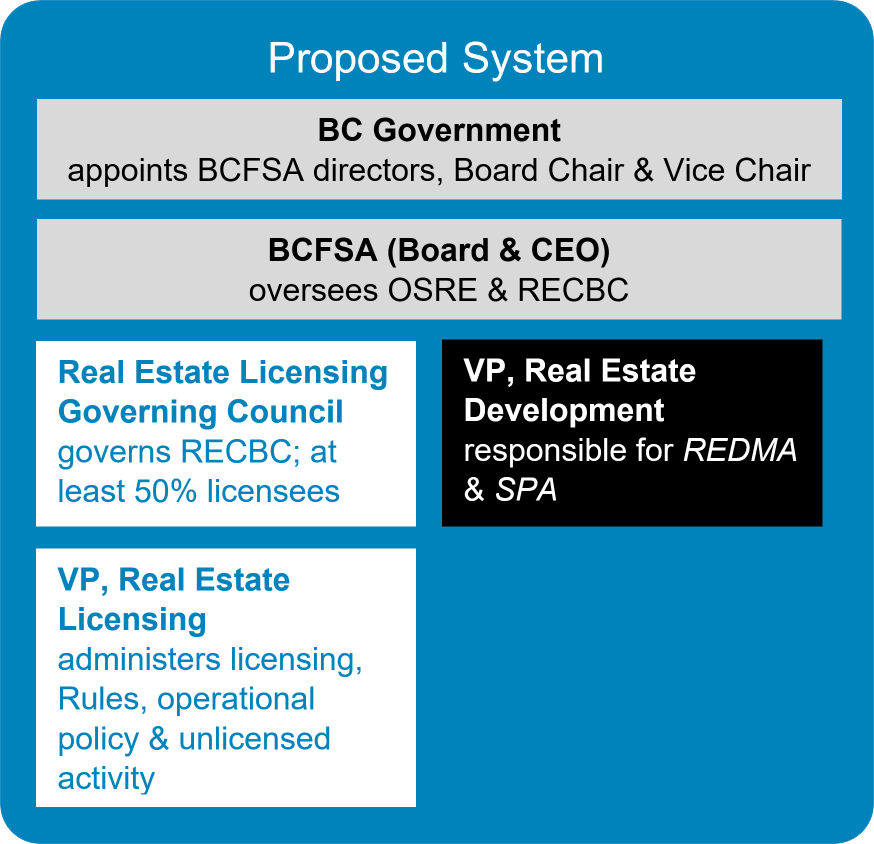
In the new system, BCREA wants to see completely separate functions for licensing of real estate professionals (under the Real Estate Services Act) and real estate development (that is, responsibility for the Real Estate Development Marketing Act and the Strata Property Act). We also want to make sure that at least half of the governing council of the licensing function are real estate licensees (right now only three out of 14 RECBC members are current or former licensees).
Regulatory reform is a top priority for BCREA. We’ll continue to work closely with member real estate boards and consult with all REALTORS®, as needed, to make sure we fully understand and represent your views. Watch for updates and opportunities to participate throughout 2020.
BCREA’s full submission to Minister James is available here.
To subscribe to receive BCREA publications such as this one, or to update your email address or current subscriptions, click here.
BCREA Supports BC Government’s Money Laundering Investigations
Vancouver, BC – November 27, 2018. As the provincial association for BC’s 11 regional real estate boards and 23,000 REALTORS®, the British Columbia Real Estate Association (BCREA) is deeply concerned by a recent news report that suggests up to $1 billion may have been laundered through Vancouver luxury real estate in 2016. BCREA continues to support the provincial government’s ongoing efforts to understand money laundering vulnerabilities in real estate transactions.
“Since we learned earlier this summer that BC’s real estate sector may be used in money laundering activities, we’ve been working aggressively with government and other partners to help support investigations into organized crime,” said BCREA’s Chief Executive Officer Darlene Hyde.
BCREA supports the government’s fight against organized crime
In July, BCREA learned that BC brokerages and REALTORS® were having trouble understanding and meeting their reporting duties to Canada’s Financial Transactions and Reports Analysis Centre (FINTRAC). BCREA responded quickly to help REALTORS® better meet their compliance responsibilities.
“As the report says, money laundering is a complex problem and recognizing when sophisticated international crime syndicates – who are experts at fraud and deception – are at work behind the scenes takes significant resources,” noted Hyde. “At BCREA, we are ready to make our contribution to keeping BC’s economy safe from organized crime and we have committed to assisting the government.”
Here are the steps BCREA has already taken:
- Invited FINTRAC to speak to more than 250 brokers and REALTORS® about understanding and meeting their compliance obligations at our first ever managing brokers conference.
- Updated the BCREA course on real estate transactions and FINTRAC reporting.
- Created targeted communications to REALTORS® addressing issues around FINTRAC reporting and compliance.
- Proactively approached the provincial government to assist in their inquiry into real estate’s vulnerabilities to organized crime.
- Requested the opportunity to participate in the Ministry of Finance’s Expert Panel on Money Laundering in Real Estate.
- Encouraged BC’s 23,000 REALTORS® to participate in the government’s money laundering investigations through their online and telephone hotlines.
- Promoted the government’s request for public participation into its inquiries through our own social media platforms.
BCREA will continue to ensure public trust
While BCREA has not received any reports of REALTORS® being complicit in money laundering, we continue to support the government’s investigations into this serious issue. Any REALTOR® found to be knowingly complicit with money laundering should be held accountable to provincial professional standards, criminal codes and to the REALTOR® Code of Ethics. As the voice of BC’s REALTORS®, we look forward to continuing to assist the government and ensuring the public can have full confidence in the REALTOR® profession.
-30-
Click here for the PDF.
For more information, please contact:
April van Ert
Communications Manager
Email: [email protected]
604.742.2797
To subscribe to receive BCREA publications such as this one, or to update your email address or current subscriptions, click here.
BCREA Supports End to Open Houses During COVID-19 Crisis
Vancouver, BC – March 20, 2020. The British Columbia Real Estate Association (BCREA) supports recommendations made by local real estate boards to stop open houses during the COVID-19 pandemic. “As British Columbians face this unprecedented health risk, it is vital that everyone does their part to help slow the spread of the COVID-19 virus,” says Darlene Hyde, Chief Executive Officer of BCREA. “While only the provincial government or the real estate regulator has the ability to mandate an end to open houses, we urge REALTORS® to encourage clients to take advantage of digital tools like virtual tours when buying or selling a home.”
With the impacts of the COVID-19 pandemic continuing to expand, BCREA is working hard to support the province’s 11 real estate boards and 23,000 Realtors in adapting to changes to real estate practice. As part of this, we are:
- leading a steering group with leadership from real estate boards across BC to support Realtors and their clients in this time of uncertainty;
- offering our support to the Real Estate Council of BC in sharing information and best practices with Realtors and consumers; and
- liaising with other real estate sector and government partners to help real estate practice evolve to better protect Realtors and consumers.
As the professional association for BC’s Realtors, BCREA is also working with government partners to ensure Realtors will have access to emergency relief funding as the real estate market slows as a result of the pandemic.
“We are seeing the curtailment of face-to-face commerce across all sectors and real estate is no exception. The sooner we act to slow the spread of this virus, the sooner we can help our communities and economy recover,” adds Hyde. “In the meantime, we continue to rely on our government for guidance and support in meeting the COVID-19 challenge, including ensuring Realtors can also access emergency relief funding in the weeks and months to come.”
To subscribe to receive BCREA publications, or to update your email address or current subscriptions, click here.
BCREA Supports Government’s Reviews of BC Real Estate
Vancouver, BC – September 28, 2018. The British Columbia Real Estate Association (BCREA) welcomes the provincial government’s launch of an inquiry into money laundering in sectors including real estate. As the professional organization representing BC’s 11 regional real estate boards and the province’s 23,000 REALTORS®, BCREA also welcomes the results of Dan Perrin’s review of BC’s real estate regulatory bodies.
“BCREA supports the provincial government’s review to identify the scale and scope of verifiable illicit activity in the real estate market,” said BCREA CEO Darlene Hyde. “We are committed to ensuring that the public can have full confidence in the real estate market and REALTORS®.”
In June, Peter German released an independent review of money laundering in Lower Mainland casinos, flagging that around $100 million may have been laundered. Although even if all the money identified in the report was used to purchase real estate, this would represent just 0.03% of Metro Vancouver residential sales volume, it is unacceptable that any proceeds from organized crime are entering BC’s real estate market
The findings of Dan Perrin’s regulatory review have been long awaited by BC’s real estate sector. BCREA participated in Perrin’s review in May 2018, calling for a streamlined regulatory system that would create more transparency for REALTORS® and better protection for consumers.
“Dan Perrin’s findings echo many of the concerns we identified and shared with the government and other stakeholders earlier this year,” said Hyde. “We look forward to getting a better understanding of Perrin’s recommendations and working with the government, OSRE and the Council to bring about a regulatory framework that is efficient, effective and aligns with the needs of consumers and REALTORS®,” she added.
You can view the full Perrin report here and the news release on the money laundering inquiry here.
-30-
Click here for the PDF.
For more information, please contact:
April van Ert
Communications Manager
Email: [email protected]
604.742.2797
To subscribe to receive BCREA publications such as this one, or to update your email address or current subscriptions, click here.
BCREA Supports Housing Funding for Middle-Income Families, Encourages Additional Supply-Side Action
For Immediate Release
Vancouver, BC - April 19, 2021. The British Columbia Real Estate Association (BCREA) welcomes the province’s recent announcement that $2 billion in development financing will be committed to the HousingHub program to help create affordable housing choices for middle-income families.
“With home prices having risen over the last decade and that trend continuing, we know securing housing – whether through ownership or rental – is not easy,” says BCREA CEO Darlene Hyde. “This type of action, which focuses on adding supply to meet overwhelming housing demand, is a meaningful step in the right direction. But of course, there’s more work to be done.”
Housing prices in BC have risen 52 percent since 2012, and these costs are often passed on to home buyers and tenants. While there are many factors – like interest rates – which affect housing prices, one of the biggest factors is the limited housing supply relative to the demand.
BCREA encourages the province to continue to focus on supply-side measures in order to create more housing options for the people of BC. These measures might include, but are not limited to, reducing public hearing times in the development approvals process, as well as leveraging transportation funding to encourage gentle densification.
“There isn’t a silver bullet when it comes to housing affordability,” adds Hyde. “But there is a clear way forward and that is evidence-based policy focused on creating more housing options for British Columbians. We are pleased to see the government’s action with the HousingHub commitment and we look forward to working with the government on future action.”
- 30 -
For media inquiries contact:
April van Ert
BCREA Communications Manager
[email protected]
778.773.9174
BCREA to Host Government Liaison Days 2026 in Victoria
From Sunday to Tuesday, March 8-10, 2026, BCREA and representatives from each of BC’s eight real estate boards and associations will gather once again in Victoria for our annual Government Liaison (GL) Days conference.
During GL Days, REALTORS® and member board and association representatives meet with their constituent Members of the Legislative Assembly (MLAs) to provide recommendations to influence future government housing policy.
This year, we will be presenting three recommendations to MLAs.
Repeal Costly Budget 2026 Real Estate Tax Increases
BC Budget 2026 contains housing measures that could worsen existing market issues, which raised concerns from BCREA and many others.
The proposed Speculation and Vacancy Tax (SVT) increase to four per cent for foreign ownership discourages much-needed investment that supports new housing construction.
Expanding the Provincial Sales Tax (PST) to include non-residential real estate services (including trading, rental property management, and strata management services), as well as architectural, accounting, bookkeeping, engineering, geoscience, and security services, will decrease affordability in BC by increasing development soft costs, construction costs, and dampening new real estate supply.
As such, BC REALTORS® will be advocating for the province to repeal costly real estate tax increases from the budget, including pausing the proposed SVT increase and eliminating the PST expansion.
Review the Strata Property Act
Even though approximately 1.5 million British Columbians live in strata properties, most strata council members, while well-intentioned, lack formal training in financial oversight, legal compliance, and property management.
Obtaining complete strata documentation for necessary transaction due diligence has become an increasingly difficult, costly, and lengthy process.
The 2019 Law Institute of British Columbia’s report recommending changes to strata legislation excluded key stakeholders, including organized real estate, leaving several key issues inadequately considered.
This is why BC REALTORS® recommend that the provincial government conduct a fulsome, consultative review of the Strata Property Act, require mandatory training for strata council members, and improve access to strata documents.
Unlock BC’s Prefabricated Housing Potential
A status quo level of homebuilding will not be enough to meaningfully improve housing attainability in BC over the next ten years. Traditional construction methods remain slow, costly, and vulnerable to supply chain disruptions and labour shortages.
Both the provincial and federal governments have acknowledged that prefabricated housing methods offer a proven solution to these challenges. However, the adoption of prefabricated housing in BC is constrained by multiple systemic barriers.
Building on the Fraser Valley Real Estate Board’s Build Faster, Smarter report, BC REALTORS® recommend that the provincial government work to unlock the province’s prefabricated housing potential by harmonizing municipal zoning, creating a multi-year provincial procurement roadmap, and expanding TradeUpBC to train workers.
On Wednesday, February 18, 2026, BCREA Government Relations staff hosted an advance briefing for REALTOR® delegates who are attending GL Days and meeting with MLAs in Victoria. You can view the recording here:
[iframe width="560" height="315" src="https://www.youtube.com/embed/hlZJbbDB-qQ" frameborder="0" allowfullscreen style="position:absolute;top:0;left:0;width:100%;height:100%;"][/iframe]If you’d like to become involved in future advocacy on behalf of organized real estate in BC, please contact your regional real estate board or association to learn about related opportunities.
BCREA to Make Sweeping Recommendations Addressing Challenges in BC’s Housing Market
Vancouver, BC – British Columbia Real Estate Association (BCREA) Chief Executive Officer, Darlene K. Hyde, will be announcing a series of sweeping recommendations addressing current concerns with the province’s housing market, the real estate transaction process and consumer protection.
The recommendations are part of a comprehensive whitepaper, A Better Way Home: Strengthening Consumer Protection in Real Estate, BCREA will be releasing which explores the validity, scope and potential impact of the Ministry of Finance’s plan to introduce a “cooling off period” for residential real estate transactions, other potential consumer protections and the current state of BC’s real estate sector.
Members of the public can view the announcement via live stream and media will have the opportunity to ask questions via teleconference and in person following prepared statements.
Date: February 28, 2022
Time: 10:00 – 11:00 am (PST)
Participants:
- Darlene K. Hyde, Chief Executive Officer, British Columbia Real Estate Association
- Representatives from the Real Estate Board of Greater Vancouver, Fraser Valley Real Estate Board and BC Northern Real Estate Board
Location:
- Live Stream & Teleconference
- Live stream link: https://bcrea.bc.ca/live.
- Media can participate in the Q&A portion of the announcement by teleconference. To receive conference details, register at https://bcrea.bc.ca/mediaregistration.
- In-Person Media Attendance
- Fairmont Hotel Vancouver – Boardroom (900 W Georgia St, Vancouver, BC).
- Limited spots are available for media to attend the news conference in person. To reserve a spot, email [email protected].
Media contact:
Shaheed Devji
Sr. Communications Specialist
778.847.7424
[email protected]
BCREA Video Series: Are You Ready for the June 1 FINTRAC Changes?
In case you haven’t heard, the Financial Transactions & Reports Analysis Centre of Canada (FINTRAC) has introduced new and revised regulatory requirements that come into effect on June 1, 2021, that will impact your real estate practice and anti-money laundering obligations. To ensure you’re ready for these changes, BCREA has created a series of short videos explaining the changes and what they mean in practice.
The first video in the series provides a high-level introduction to the amendments, reviews changes to certain Know Your Client obligations and changes to when business relationships are created.
[iframe width="560" height="315" src="https://www.youtube.com/embed/D29WDsO-3Uc" frameborder="0" allowfullscreen style="position:absolute;top:0;left:0;width:100%;height:100%;" ][/iframe]The second video reviews the new beneficial ownership requirements for entity clients, including how to obtain beneficial ownership information, record keeping, and ongoing monitoring.
[iframe width="560" height="315" src="https://www.youtube.com/embed/e2xXpS7negY" frameborder="0" allowfullscreen style="position:absolute;top:0;left:0;width:100%;height:100%;" ][/iframe]The third video covers the new politically exposed person (PEP) determination requirements and reviews when you are required to make a PEP determination and what to do if you determine that someone is a PEP.
[iframe width="560" height="315" src="https://www.youtube.com/embed/OLL_UaRV1bk" frameborder="0" allowfullscreen style="position:absolute;top:0;left:0;width:100%;height:100%;" ][/iframe]The fourth video in the series discusses ongoing and enhanced monitoring for business relationships, which is not new but may be more common with the changes to when business relationships are created.
[iframe width="560" height="315" src="https://www.youtube.com/embed/OSDfyBFFn68" frameborder="0" allowfullscreen style="position:absolute;top:0;left:0;width:100%;height:100%;" ][/iframe]The final video in the series touches on the new virtual currency requirements. While the use of virtual currency to purchase real estate in BC is not common practice, it may be in the future, so it’s important to be aware of these new requirements.
[iframe width="560" height="315" src="https://www.youtube.com/embed/20_KXlzOKpY" frameborder="0" allowfullscreen style="position:absolute;top:0;left:0;width:100%;height:100%;" ][/iframe]For more information and additional resources on the June 1 FINTRAC changes, click here.
BCREA Welcomes Budget 2023’s Housing Measures with Cautious Optimism
On February 28, 2023, Minister of Finance Katrine Conroy delivered the BC 2023 Budget Speech, adding financial promises to bolster Premier Eby’s stated governmental priorities.
With a new premier and cabinet, which includes a separate Ministry of Housing, BCREA was hopeful that the new government’s first budget would make strong commitments to increasing housing supply.
While there are some promising new announcements and BCREA is encouraged by the government’s commitment to addressing housing affordability in the province with $4.2 billion in operating and capital funding, many details remain unclear and will be outlined in a forthcoming “refreshed housing strategy” in the spring.
Here are some Budget 2023 highlights impacting BC’s real estate sector:
Zoning Changes and Faster Permitting Process
- Budget 2023 promises to introduce zoning changes and speed up the permitting process to generate more housing supply. This reaffirms the new housing permitting strategy the provincial government announced on January 16, 2023.
BCREA has been a longstanding advocate for these housing initiatives. While the government’s plan is a positive move in the right direction, its details are elusive, and the results remain to be demonstrated.
Market Housing Supply
- $394 million in new capital funding to acquire lands for future affordable and market housing development projects along main transit corridors.
- $91 million over three years for a new pilot project that will provide financing incentives to encourage homeowners to develop new secondary suites on the property of their principal residences for long-term renters.
Rental Housing
- A new income-tested Renter’s Tax Credit. It will provide up to $400 per year in income tax credit for households with adjusted income up to $60,000. Households with adjusted income above the $60,000 threshold will receive a gradually reduced credit, reaching zero at $80,000. The thresholds will be indexed to inflation each year.
- $575 million over three years to enable post-secondary institutions to create more student housing in high-demand areas throughout BC.
- A Rental Protection Fund (announced in January 2023) that will provide one-time capital grants to non-profit housing organizations to purchase affordable residential rental buildings and ownership co-operatives listed for sale to safeguard those rental units.
- $7 million to support the BC Rent Bank which will help provide renters with financial support to prevent eviction and homelessness.
- $15.6 million over three years for the Residential Tenancy Branch to strengthen service delivery and support the timely resolution of landlord/tenant disputes.
While BCREA is pleased with the commitments to help current low- and moderate-income renters, there was hope for more commitments to increase rental housing supply.
Non-market supply
- Increasing BC Housing’s debt facility by $839 million to support housing programming.
- New investments for the Community Housing Fund.
- $44 million to help people who are living in encampments to access temporary modular housing.
Indigenous housing
- Funding to help double the number of units created through the Indigenous Housing Fund.
Taxes
- Effective for transactions that occur on or after January 1, 2024, purchases of new purpose-built rental buildings will be exempt from the further two per cent property transfer tax that is applied to the fair market value of the residential component of a taxable transaction that exceeds $3 million.
BCREA remains cautiously optimistic that more impactful policies and details regarding the investments outlined above will be introduced in the upcoming “refreshed housing strategy” to be released in spring 2023.
For more information, please refer to the full Budget Speech here.
BCREA Welcomes Change to Stress Test
Vancouver, BC – February 19, 2020. As the voice of BC’s 23,000 REALTORS®, the British Columbia Real Estate Association (BCREA) welcomes Minister of Finance Bill Morneau’s announcement of changes to the benchmark rate used to determine the minimum qualifying rate for insured mortgages, also known as the “stress test”.
Minister Morneau announced that as of April 6, 2020, the new benchmark rate will be the weekly median 5-year fixed insured mortgage rate from mortgage insurance applications, plus 2 per cent.
“Today’s announced change to the stress test for insured mortgages is a move in the right direction to more accurately align qualifying rates with mortgage rates being offered in the market,” says BCREA Chief Economist Brendon Ogmundson. “For the last year, the Bank of Canada’s benchmark posted rate has been much higher than 2 per cent over contract rates, leading to overly onerous mortgage qualifications.”
“We hope this signals a similar change is coming for uninsured mortgages,” Ogmundson adds.
The stress test has been keeping qualified buyers out of homes they can afford. That’s why BCREA and CREA have recommended that the federal government:
- review the mortgage stress test to ensure the realities of local real estate markets are taken into consideration, and
- allow existing mortgage holders to be exempted from the stress test at the time of renewal.
You can read our housing affordability recommendations here.
To subscribe to receive BCREA publications, or to update your email address or current subscriptions, click here.
BCREA Welcomes Exemptions to Bill 45
Vancouver, BC – October 16, 2018. The British Columbia Real Estate Association (BCREA) welcomes the Government of British Columbia’s inclusion of exemptions from the speculation and vacancy tax proposed as Bill 45 today, Tuesday, October 16, 2018. Some of the exemptions directly address concerns BCREA brought to the Province’s attention through its advocacy work.
The Bill allows for exemptions for British Columbians going through traumatic life events such as illness and divorces or separations. It also allows for exemptions for owners of properties that are being developed or undergoing renovations.
It also exempts strata units from a vacancy tax for 2018 and 2019, where strata restrictions prohibit rentals. Further clarity is needed on this exemption and other implications.v
BCREA, its 11 regional real estate boards and the 23,000 REALTORS® they represent look forward to providing the Province with REALTOR® insight on the implementation of Bill 45 to ensure that the best interests of BC homeowners are served.
Read the Province’s news release here . Learn more about the speculation and vacancy tax here.
-30-
Click here for the PDF.
For more information, please contact:
April van Ert
Communications Manager
Email: [email protected]
604.742.2797
To subscribe to receive BCREA publications such as this one, or to update your email address or current subscriptions, click here.
BCREA Welcomes Four New Directors
The BCREA Board of Directors has appointed three new REALTOR® Directors and one new Public Director to replace the outgoing members and form the 2018-2019 Board of Directors.
These individuals will be joining President James Palanio, President-Elect Michael Trites, Past President Jim Stewart, REALTOR® Directors Ray Harris, Kyle Hislop, Cory Raven and Public Director Mark Sakai effective May 1, 2018.
The new appointed REALTOR Directors are:
Anthony Bastiaanssen
Anthony Bastiaanssen has worked as a full-time selling REALTOR® for the past 12 years, and a managing broker for six. He served on the Okanagan Mainline Real Estate Board as a director, where we was president in 2016. Prior to becoming a REALTOR®, Anthony work in the areas of technology, accounting, finance, and B2B sales.
Dan Morrison
Dan Morrison, ICD.D, is the Senior Managing Broker of Royal LePage Sussex in 2017 and has been a full-time REALTOR® since 1991. He served as a Real Estate Board of Greater Vancouver Director from 2012 to 2018, where he was President in 2016. In 1999, Dan was acknowledged as the REALTORS® Care REALTOR® of the year for North and West Vancouver.
Katherine Rutherford
Katherine Rutherford moved from Edmonton to BC in her late 20s to work as an executive assistant, and first became a REALTOR® in 2002. In 2013, she moved to Kamloops, where she reestablished her career and currently resides. When she's not working, she enjoys golf, travelling, skiing and cooking.
And the newly appointed Public Director:
Kam Raman
Kam Raman has more than 20 years of financial services industry experience and currently serves as Regional Vice President at First Canadian Title Insurance Company. She has chaired and co-chaired several boards, and holds an MBA from Queen's University and a BBA specializing in entrepreneurial leadership.
BCREA-CREA Federal Election Webinar Recap: Recording and Resources
Thank you to those who attended the BCREA-CREA Federal Election Webinar on Monday, April 14, 2025. As promised, we recorded the webinar, which you can watch here:
[iframe width="560" height="315" src="https://www.youtube.com/embed/CDVi3u7_0OA" frameborder="0" allowfullscreen style="position:absolute;top:0;left:0;width:100%;height:100%;"][/iframe]During the webinar, we provided a preview of social media graphics and hashtags you can use to amplify our communications. Please find the graphics linked below and remember to include a link to BCREA's Federal Election webpage and add #BCREAadvocacy and #housingattainability when you use them on your networks:
- BCREA Roundtable Graphic - Social
- BCREA Roundtable Graphic - Instagram
- BCREA Tax Reform Graphic - Social
- BCREA Tax Reform Graphic - Instagram
*To download the social graphics above: Click on each link to open the file in your web browser, then right-click on the graphic, click “Save image as...” and save the graphic to your computer.
Also, here are some additional federal election resources:
- CREA Federal Election Webinar Presentation
- BCREA Federal Election Webinar Presentation
- BCREA Federal Election Webpage
- CREA Federal Election 2025 Resources (REALTOR® Action Network login required)
Save the Date: BCREA Election Housing Policy Forum on April 24
Don’t forget to save the date for the BCREA Election Housing Policy Forum on Thursday, April 24, 2025, from 10-11:30 am PT, where you will have the opportunity to hear from and ask questions of federal candidates representing each of the major federal political parties regarding important housing issues in this election.
Register for the webinar here: https://us06web.zoom.us/webinar/register/WN_uqVY49ifSkyZG6oRolLgUw
If you have questions related to BCREA’s federal election advocacy, please reach out to [email protected].
BCREA’s 2021 Standard Forms Release Coming This Fall
This fall, BCREA will release 11 new standard forms, multiple clauses and revisions to a significant number of forms.
The new forms will include First Nations Reserve Lands Leasehold Properties, Cancellation of Buyer Agency Exclusive Contracts, Property Disclosure Statement – Strata Properties – Bare Land Strata and more. New clauses will cover issues like transacting leasehold interest properties, dealing with negative assignments amounts and strata properties dealing with proposed levies.
The form revisions are intended to:
- Maintain alignment with regulatory and practice requirements, including the real estate regulator's recent name change and references to the Real Estate Services Rules and renumbering.
- Incorporate requests from members of the profession and associated professions, such as changes to the Contract of Purchase and Sale Manufactured homes, Property Disclosure Statement with regards to the Water Sustainability Act.
- Bring greater clarity and uniformity with some of the standard contract terms across various forms.
- Redesign the layout of the Notice of Condition Waiver/Declaration of Fulfillment, Contract of Purchase and Sale and Property Disclosure Statement forms.
How is BCREA helping REALTORS® prepare?
To prepare Realtors and managing brokers for the new forms and form revisions, BCREA will release various resources leading up to the launch and additional supports after the launch, including:
- A dedicated web page to help Realtors and managing brokers stay up to date with the latest on the Fall 2021 Standard Forms Release: bcrea.bc.ca/forms2021.
- Webinars:
- A Managing Broker Community of Practice session on November 3 to explore the 2021 form changes. Click here to register for this session.
- A Post-launch Realtor webinar on December 2 featuring a live Q&A and discussion on the form changes. Stay tuned for a link to register.
- Open House by BCREA podcast episode on the 2021 form changes released on November 26.
Keep an eye on your email inbox for Resources for REALTORS® more information on the 2021 forms release, including links to the resources mentioned above!
How can I stay up to date?
In addition to keeping an eye on your inbox, make sure you also visit and bookmark the launch page at bcrea.bc.ca/forms2021.
This page will have links to relevant blog posts as well as quick links to the Standard Forms Resource Centre, where you can access the Standard Forms Toolkits as well as other Standard Forms resources and WEBForms®, where you can access the new and revised forms and clauses on November 24.
Do you have questions about BCREA Standard Forms? Visit bcrea.bc.ca/standardforms or e-mail us at [email protected].
BCREA’s BC Budget Highlights
Budget 2019 introduced few changes for real estate, but four new developments caught BCREA's attention:

Taxation clarity
When the budget bill receives Royal Assent clarifying changes will be made to the following statutes:
- Property Transfer Tax Act, Taxation (Rural Area) Act and Income Tax Act around information sharing among these statutes, and
- Speculation and Vacancy Tax Act to exempt properties uninhabitable as a result of natural disasters and to ensure that the due date for additional tax isn't earlier than the annual due date of the Speculation and Vacancy Tax for the calendar year.
Market housing affordability
Budget 2019 builds on currently-operating local government rent banks by establishing a provincial program to provide low-income renters facing evictions with short-term, low-interest loans.
Wildfire management
An additional $111 million over three years is allocated to fire management. This funding will be used to strengthen BC's efforts to combat and prevent wildfires, providing more capacity for direct wildfire control and increasing resources for communication and community engagement during wildfire season.
Energy efficiency
Under the banner of CleanBC, the budget offers $41 million over three years to make energy-saving home retrofits affordable for British Columbians (see "A Path to Energy Efficiency" for more information).
In our submission to the budget consultation last fall, BCREA once again asked for tax fairness for homebuyers and owners. Specifically, we strongly believe the Property Transfer Tax exemption for first-time homebuyers should be increased. Also, all thresholds related to the Property Transfer Tax should be indexed, so they keep pace with the market. Real estate is dynamic, and the structure of the tax should reflect that.
We had also hoped the government would announce that development properties would be exempt from the additional school tax, which takes effect this year. Such a move would help encourage builders and developers to increase housing supply and would be consistent with exemptions from the Speculation and Vacancy Tax.
Read BCREA's 2019 budget submission here.
To subscribe to receive BCREA publications such as this one, or to update your email address or current subscriptions, click here.
BCREA’s Commitment to Excellence Rewarded with 2023 ARELLO Awards
BCREA has won two Association of Real Estate License Law Officials (ARELLO) awards recognizing outstanding communication systems and educational programs related to real estate regulation and practice in North America. BCREA was recognized with the Education Award in the Miscellaneous category for its Standard Forms Resource Centre; and the Education Award in the Post-License/Continuing Education Course category with The Home Buyer Rescission Period: What REALTORS® Need to Know course. Both winners were essential to BCREA’s commitment to providing timely, relevant, and impactful resources to BC’s eight real estate boards and 26,000+ REALTORS®.
ARELLO is an international organization with a mission to support the administration and enforcement of real estate license laws. Every year, ARELLO presents awards to members for exemplary leadership in areas of real estate regulation or related services.
Awarded courses, programs, services and resources must contribute to the real estate industry, promote public protection, and be adapted to benefit licensees and consumers, as well as excel in four areas: concept, methodology, quality, and benefits.
Learn More About the Winners
The Home Buyer Rescission Period: What REALTORS® Need to Know Course
The Home Buyer Rescission Period: What REALTORS® Need to Know course covers the specifics of the Home Buyer Rescission Period Regulation, equipping REALTORS® with a strong foundation required to address the needs of their clients. REALTORS® taking this course will mainly find useful the various scenarios that walk through exercising the right of rescission.
After completing this course, learners will be able to:
- identify the key elements of the new legislation, including the length of the rescission period;
- provide required disclosures of the rescission rights to their clients;
- calculate the rescission amount properly;
- explain how the deposits are handled, in accordance with the Regulation;
- fill out appropriate forms to be compliant with the new requirements and
- identify strategies for managing brokers to mitigate risks.
(BCREA Access login required)
Standard Forms Resource Centre
BCREA's Standard Forms Resource Centre is an innovative solution for REALTORS® and managing brokers in BC, and a valuable risk management tool for REALTORS®.
The Standard Forms Toolkits incorporate many comprehensive resources in the Standard Forms Resource Centre. Available tools include:
- Introduction to the Form: provides an overview of the forms and how and when they are typically used.
- Instructional Videos: for REALTORS® and consumer-focused videos they can share with their consumers.
- Annotated Forms: breaks down each of the terms of the forms and what they mean.
- How to Complete: provides REALTORS® with an understanding of what information is required in each section.
- Frequently Asked Questions: a list of the most common questions and answers about BCREA Standard Forms and how to use them.
- Professional Development Opportunities: links to courses that offer more content on related forms.
Since October 15, 2023, BCREA’s Standard Forms Toolkits migrated from the Standard Forms Resource Centre to BCREA Access. This transition is set to deliver a more streamlined and user-friendly experience for REALTORS®. You can access BCREA’s Standard Forms Toolkits at: https://www.bcrea.bc.ca/access/toolkits/.
(BCREA Access login required)
BCREA’s Government Liaison Days
Moving the dial on real estate advocacy issues
Market housing affordability, anti-money laundering and remediating properties used to produce drugs were the priorities at this year's Government Liaison (GL) Days, which took place in Victoria at the Hotel Grand Pacific from April 28 to 30.

GL Days is BCREA's key advocacy event that brings together delegates from all of BC's 11 real estate boards to learn about advocacy issues and best practices and meet with their local MLAs. Through GL Days, delegates become important grassroots links between the real estate profession and MLAs, establishing a foundation for successful ongoing advocacy work.
Advocacy priorities
Each year, BCREA works with local boards to identify key advocacy priorities to ensure balance among regional concerns. This year's priorities impact REALTORS® and consumers across the province. Two of the priorities – market housing affordability and anti-money laundering – are top of mind for the public, government and media. The third – remediating properties used to produce drugs – is an issue that REALTORS® and real estate boards are calling on the government to devote more resources to. Here are the recommendations BCREA and delegates made to government on these issues:
Market housing affordability
- The BC Government should set an end date on the Speculation and Vacancy Tax, based on predefined outcomes. What market threshold is the government seeking to reach? Actual market specifics around the term "affordability" have never been stated publicly and clarity is needed.
- The province should urge the federal government to review and reconsider the current mortgage underwriting "stress test," as well as reinstate 30-year amortizations for federally insured mortgages. This federal initiative has significantly stalled BC home sales by locking a sizeable number of potential buyers out of the market based on outdated guidelines that ignore mortgage rate changes since implementation.
- The provincial and federal governments, and their respective agencies, should coordinate their actions, share information (such as the provincial pre-sale assignment registry) and create a comprehensive, efficient enforcement regime.
- The Real Estate Council of British Columbia should develop required anti-money laundering licensing and relicensing education for REALTORS®.
- Government should develop a consistent process to remediate buildings used in drug production to ensure they are safe.
- All local governments should implement the new uniform remediation policies and practices.
Anti-money laundering
Remediating properties used to produce drugs
To read more about each of the three priorities, please follow the links below:
MLAs praise REALTOR® engagement
In total, delegates connected with 68 of the province's 87 MLAs. Feedback has been positive, with MLAs praising real estate boards and delegates for their thoughtful, productive approach and for providing REALTOR® insight on issues important to all British Columbians.
Congratulations to all the real estate boards and delegates for helping move the dial on these key real estate advocacy issues. We look forward to continuing to work to ensure REALTORS®' perspectives are recognized as invaluable to smart public policy.
To view the Government Liaison Days 2019 video, click here.
BCREA is also building a stronger presence on social media regarding advocacy and regulatory issues and you can help by following BCREA on Facebook, Twitter and LinkedIn for updates.
Pictured: Minister of Finance Carole James, BCREA President Michael Trites and BCREA CEO Darlene Hyde at BCREA's Government Liaison Days.
To subscribe to receive BCREA publications such as this one, or to update your email address or current subscriptions, click here.
BCREA’s Legal Defense Reserve
Keeping up with the times to support BC REALTORS®
Did you know the British Columbia Real Estate Association (BCREA) recently increased its legal defense reserve from $35,000 to $50,000?
 The increase reflects recognition of the greater risks to business practices as a result of Rule changes, new legislation on taxation, the legalization of marijuana and amplified concerns about money laundering in real estate.
Things happen – why the legal defense reserve exists for REALTORS®
The real estate marketplace is a dynamic, demanding environment, and sometimes an individual REALTOR® may experience legal challenges that could negatively impact the sector as a whole. That's why, fifteen years ago, BCREA created a legal defense reserve to support REALTORS® by contributing to legal costs related to issues of provincial significance.
BCREA's legal defense reserve is available to all BC REALTORS®, but to be eligible for consideration, the issue must be of provincial significance. In other words, a positive outcome from the proceedings should benefit REALTORS® across the province.
How can a REALTOR® request access to the legal defense reserve?
REALTORS® wishing to access funds should make a submission to BCREA's Board of Directors ([email protected]). Once a submission is received, the Board of Directors will review the application for merit, consult with legal counsel and provide their assessment to the REALTOR®.
For further questions or concerns, please email [email protected].
To subscribe to receive BCREA publications such as this one, or to update your email address or current subscriptions, click here.
BCREA’s Limited Dual Agency Waiver Proposal
Making the LDA ban more workable for consumers and REALTORS®
On January 16, leadership from the British Columbia Real Estate Association (BCREA) met with Minister of Finance Carole James to present a proposal for a waiver that would make the ban on limited dual agency (LDA), the practice of a REALTOR® representing both parties in a transaction, more workable for small communities and commercial real estate transactions in the short term.
 The proposal was supported by real-life stories gathered from REALTORS® through a provincewide survey on unintended negative impacts of the ban.
Minister James said she would discuss our proposal with the Real Estate Council of BC and the Office of the Superintendent of Real Estate and provide us with feedback. In the meantime, we continue to investiage long-term solutions. Meetings like these help us build stronger relationships with the government by providing workable solutions to issues impacting consumers, while ensuring REALTORS® voices are heard.
Making the LDA ban more workable
The waiver, or certificate of independent legal advice, we proposed would continue to emphasise consumer protection while solving some of the side effects of the LDA ban. Here's an example of how the waiver would work:
- A REALTOR® represents a seller, and then the same REALTORS®'s buyer client expresses interest in the seller's property.
- The potential buyer decides they want to continue working with the REALTOR® who's already representing the seller.
- The REALTOR® provides three documents to the seller and the potential buyer:
- the Council's Disclosure of Risks Associated with Dual Agency form,
- Certificate of Independent Legal Advice (waiver), and
- the appropriate BCREA limited dual agency agreement.
- The potential buyer and seller then each meet with a lawyer to discuss the LDA agreement and complete the Certificate of Independent Legal Advice.
Your engagement helps ensure REALTOR® voices are heard
Back in October, Minister James asked BCREA to provide evidence of why the LDA ban doesn't work for consumers. In response, we launched a provincewide survey to gather data and personal stories of how the ban impacts consumers and REALTORS®. We thank the more than 1,200 individuals who completed the survey.
We learned that 96 per cent of commercial REALTORS® say the ban has negatively impacted their business. 94 per cent of respondents working in communities of 10,000 or less say the ban has negatively impacted their business.
60 per cent of REALTORS® have observed an increase in unrepresented consumers, who are now limited when choosing the REALTOR® they believe can best represent them, and 60 per cent of REALTORS® working in communities of 25,000 or less have referred more than 25 per cent of their clients to other REALTORS®.
Photo: On January 16, BCREA President James Palanio, President-Elect Michael Trites, Past President Jim Stewart and CEO Darlene Hyde met with Minister of Finance Carole James to present the LDA waiver proposal.
To subscribe to receive BCREA publications such as this one, or to update your email address or current subscriptions, click here.
BCREA’s Provincial Lobbying Conference: Government Liaison Days
On October 15 and 16, 90 delegates met at the Hotel Grand Pacific in Victoria for BCREA's Government Liaison (GL) Days. Please click here to view the GL Days 2018 summary video.

The conference gave attendees the opportunity to first familiarize themselves with this year's three advocacy priorities—transparency in real estate transactions, limited dual agency and tax fairness for owners and new buyers—and get a deeper understanding of BC's political landscape and the lobbying skills they would need for successful MLA meetings.
MLAs praise REALTOR® engagement
In total, meetings were set up with 74 of the province's 87 MLAs. Our government relations advisors at Counsel Public Affairs have told us that MLAs have praised member boards and delegates for their thoughtful, productive approach to these meetings, which provided REALTOR® insight on issues important to MLA's constituencies.

Congratulations to all the member boards and delegates for their successful work in paving the way for closer relationships with all MLAs. The success of Government Liaison Days is just one indication that REALTORS® voices are being heard.
BCREA is also building a stronger presence on social media regarding advocacy and regulatory issues and you can help. If you are not already following us on Facebook or Twitter, please take the time to do soIt's a simple action that can help boost the public's perception of REALTORS® and awareness of REALTOR® professionalism. Follow BCREA on Facebook, Twitter and LinkedIn for updates.
To subscribe to receive BCREA publications such as this one, or to update your email address or current subscriptions, click here.
BCREA’s <em>Ready, Set, Know</em> Course Returns With 2026–27 Edition!
It’s time to refresh your knowledge and stay ahead of emerging issues in the real estate sector.
Ready, Set, Know: REALTOR® 2026–27 Edition is the second edition in BCREA's Ready, Set, Know course series, equipping REALTORS® with up-to-date knowledge on recent legislative changes and timely market topics.
Worth six Professional Development Program (PDP) hours, this course is available in either a self-paced online format or an instructor-led live format for those who prefer face-to-face learning.
About the Course
Regardless of the format you choose, by the end of this course, you will be able to:
- discuss recent legislative and regulatory changes impacting the real estate sector and prepare for upcoming developments;
- identify key considerations and risks related to subject to sale transactions;
- explain the purpose of Electrical Planning Reports and understand how they may affect clients’ ability to install electric vehicle charging infrastructure and heat pumps in strata properties;
- recognize common cyber security threats facing REALTORS® and apply practical strategies to help protect client information and transactions;
- dispel myths and understand the benefits of prefabricated homes; and
- adhere to compliance requirements and apply best practices for advertising on social media.
Ready, Set, Know: REALTOR® 2026–27 Edition will be available until Friday, December 31, 2027.
If you already completed Ready, Set, Know: REALTOR® 2025–26 Edition, you can still earn PDP hours for completing the 2026–27 Edition within the same licensing cycle, as the course content is all new.
Register for the self-paced format here.
To check for upcoming dates for the instructor-led version, see the current course calendar here.
Want a quick overview of BCREA’s PDP offerings? Explore our Professional Development Course Promo Videos page here.
BCREA’s Consumer Protection Recommendations Attract National Media Attention
BCREA’s white paper A Better Way Home: Strengthening Consumer Protection in Real Estate Transactions has attracted significant media attention nationwide. BCREA launched the white paper at a press conference in downtown Vancouver on Monday, February 28 with all of BC’s major news outlets in attendance, including Global, CBC, and CTV. More than 500 viewers, including many REALTORS®, tuned in for the live stream.
BCREA drafted the white paper in response to the BC government’s plans to introduce a mandatory “cooling off” period, announced in November 2021, without consultation with the public or real estate sector, a problem statement or supporting rationale. BCREA strongly believes that consumer interests are best served when the government invites in-depth input from housing sector stakeholders before announcing potential policies.
Speaking at the press conference, CEO Darlene K. Hyde said, “A consultation in which the outcome is pre-determined is not a consultation at all.”
“As the provincial professional association for BC Realtors, we know that Realtors are uniquely positioned to support the government in identifying a ‘better way home’ for all British Columbians,” said Hyde. “It’s our hope that the release of our white paper gives both the government and the BC Financial Services Authority (BCFSA) a greater appreciation of the impact Realtors can have on shaping public policy.”
Media coverage included stories by the Globe & Mail, The Vancouver Sun, CTV News, CBC, Global News, National Post, BNN Bloomberg, Castanet, Times Colonist, Vancouver Is Awesome and many community news outlets.
About A Better Way Home
BCREA’s white paper, developed with support from regional real estate boards, offers more than 30 recommendations spanning four areas: addressing housing supply issues, enhancing consumer protection in real estate transactions, evolving the real estate sector and contributing to the creation of a world-leading regulatory structure. It incorporates findings from seven focus groups with consumers and Realtors, years of survey data, and a detailed analysis of economic and secondary literature, including the impacts of attempted housing market interventions worldwide.
In the paper, BCREA takes a detailed look at the potential impacts of a “cooling off period” in terms of consumer protection and improving housing affordability. An analysis of economic and secondary literature and studies of such market interventions worldwide show “cooling off periods” to be ineffectual at best.
Instead, BCREA proposes implementing a mandatory “pre-offer period” of a minimum of five business days from the date of listing during which time offers cannot be made on a property. This pre-offer period would give consumers time to do their research on a property before presenting an offer, meeting the government’s stated goal of helping consumers make more informed decisions without introducing more uncertainty into real estate transactions.
You can learn more about the white paper by visiting bcrea.bc.ca/supporting-consumers/.
Next Steps To Help Find A Better Way Home
BCREA and BC’s real estate boards will continue to call on government to pursue evidence-based policy recommendations that truly protect all parties involved in a real estate transaction while urging them to address the fundamental challenge of BC’s housing market: the mismatch between supply and demand.
Realtor support is critical to the success of our work. Watch your inboxes this week for further information on how you can help bring this message to government.
BCREA’s New <em>Ready, Set, Know</em> Course Now Live!
A new edition of this course was launched on Monday, July 6, 2026 that you can learn more about here.
Curious to know what’s shaping the future of real estate?
Ready, Set, Know: REALTOR® 2025-26 Edition is a new course from BCREA that equips REALTORS® with up-to-date knowledge on recent legislative changes and timely market topics.
This course is available for six Professional Development Program hours as either a self-paced online offering that allows you to complete the course at your own pace or an instructor-led live offering if you prefer more structured, face-to-face learning.
About the Course
Regardless of the offering you choose, by the end of this course, you will be able to:
- analyze the assignment of pre-sales and calculate potential gains or losses;
- understand how climate hazards such as fires, floods, and droughts impact properties and their insurability;
- identify requirements for depreciation reports and understand recent changes that prevent indefinite postponement;
- explain the differences between joint ownership models (joint tenants, tenants in common, a shared interest in land, cooperatives) and when the right of survivorship applies;
- discuss current zoning changes and their implications for properties that now qualify for small-scale, multi-unit housing;
- use artificial intelligence (AI) tools to streamline your workflow, improve your marketing, and better serve clients; and
- confidently respond to client questions about emerging trends and regulatory shifts in the real estate landscape.
Register for Ready, Set, Know: REALTOR® 2025-26 Edition in the self-paced format here.
To check for upcoming dates for the instructor-led version, see the current course calendar here.

BCREA’s New Professional Services Manager Reflects on State of BC’s Real Estate Sector
After a long and successful career working as a real estate professional, Jim McCaughan, joined the BCREA team earlier this year. As BCREA’s new Professional Services Manager, Jim brings with him more than four decades of experience in the real estate sector as a REALTOR®, managing broker, instructor and in governance roles. Jim was first licensed in 1977 as a Sales Associate and became a Broker in 1979 and went on to manage more than 120 associates.
In governance, Jim is a Past-President of the Fraser Valley Real Estate Board and the Chilliwack Real Estate Board, served six years on the Real Estate Council of BC and eleven years on the Errors & Omissions Insurance Corporation of BC. And not to mention, Jim was the 2012-13 BCREA President.
Jim’s experience, expertise and service-oriented attitude make his opinions highly sought after and respected. With the unprecedented market conditions of the COVID-19 pandemic changing, we sat down with him to learn more about his role at BCREA and what he believes BC Realtors should know moving forward.
What does your role as the Professional Services Manager entail?
My role is to provide practical expertise to all BCREA member services to ensure the delivery of valuable and timely services for member boards and Realtors. In addition, I work to identify and assess industry issues and strategize and develop responses to critical matters affecting the real estate industry and Realtors.
The real estate industry is constantly changing; what do you think is the most important change that’s happening right now?
The real estate industry continually faces challenges from inside and outside the sector. I have a sign above my desk which reads, “every problem is an opportunity for a solution;” to that point, our industry is resilient and with all that has gone on with the housing market through the pandemic until now, we need to be able to adapt.
One of the key issues in the real estate market right now is consumer protection. Home buyers are frustrated with how difficult it is to buy a home and the conditions they have faced over the last two years. As BCREA continues to advocate for consumer protection and that it’s at the forefront of governmental policies, Realtors should continue to act in the best interest of buyers and sellers, helping them navigate ever-changing conditions.
With municipal elections taking place in the fall, can you explain how local officials and regulations may affect the real estate industry?
Cities and municipalities have an opportunity to take positive steps to enhance our housing supply and, in turn, affect the real estate sector as a whole, particularly the balance of the market. Local officials have the ability to modify their regulations to streamline the process for approvals of subdivisions and building permits. It is clear that the predominant reason for current housing challenges in BC and Canada result from a lack of housing supply.
What’s a professional tip that you would share with Realtors?
Realtors, regardless of experience, need to stay connected with the profession to enhance consumer confidence in the real estate transaction. It could be through a positive social media presence, joining organized real estate, or enrolling in extra professional development courses.
Furthermore, we need to continually look for opportunities to demonstrate the great value that Realtors bring to their clients and take steps to continue to act as trusted advisors for consumers.
Throughout my career, I have observed that success in the profession comes down to 60 per cent work ethic and 40 per cent personality and skillset. Anyone who has a strong desire, a settled purpose and an invincible determination will be able to accomplish any desired goals.
Despite the challenges the sector faces, I believe the future can and will be very bright for Realtors and consumers and BC Realtors will continue to be a valuable resource to people embarking on the home buying experience.
BCREA’s Virtual Government Liaison Days
On May 4 and 5, over 80 attendees from all around BC participated in BCREA’s Government Liaison Days. At this virtual conference, attendees learned about how the government can improve housing supply as well as energy efficiency in homes. REALTORS® then met with their MLAs to discuss the impact in their communities.
Energy efficiency
Realtors presented MLAs with an opportunity to expand BC’s role as a leader in the fight against climate change. To reduce homes’ carbon footprints and increase the impact of energy assessment tools, BCREA recommends that the provincial government:
- consult with real estate sector stakeholders and homeowners before requiring energy assessments on existing homes,
- ensure that an energy assessment tool is available to owners of all existing homes rather than only at the point of listing, and
- coordinate an energy assessment tool with other programs, such as CleanBC retrofit incentives and EnerGuide for Homes.
In advance of Government Liaison Days, Advocacy Projects Manager Mark Sakai wrote an op-ed in the Georgia Straight, a guide to making homes in BC more sustainable and energy efficient.
Housing supply
An important resource in forming housing supply recommendations is the government’s own Development Approval Process Review (DAPR) report. DAPR provides a roadmap to address challenges and identify opportunities to improve local government approvals processes. Approvals affect how quickly housing projects are built, allowing supply to better react to changes in demand. BCREA recommends that the provincial government:
- empower Official Community Plans (OCPs) to reduce unnecessary public hearings, and
- leverage transportation funding and OCPs to encourage local governments to increase gentle densification of affordable, family friendly housing options such as duplexes, triplexes, secondary suites and laneway homes.
So far, there has been mostly positive feedback from MLAs, with many agreeing that the development process is too long and requires simplification. During the conference, Attorney General and Minister Responsible for Housing David Eby gave a keynote address, and we were encouraged to hear that his vision on housing supply aligns with BCREA. He expressed support for increasing density along transit corridors and said that his ministry is “currently working on implementing DAPR.”
Behind BC’s Unemployment Rate During COVID-19
Highlights:
- BC's unemployment rate 11.5 per cent in April, would have been 16.8 percent if underutilized workers included
- Services sector bears the brunt of physical distancing measures
- Younger workers have been more impacted, particularly younger women
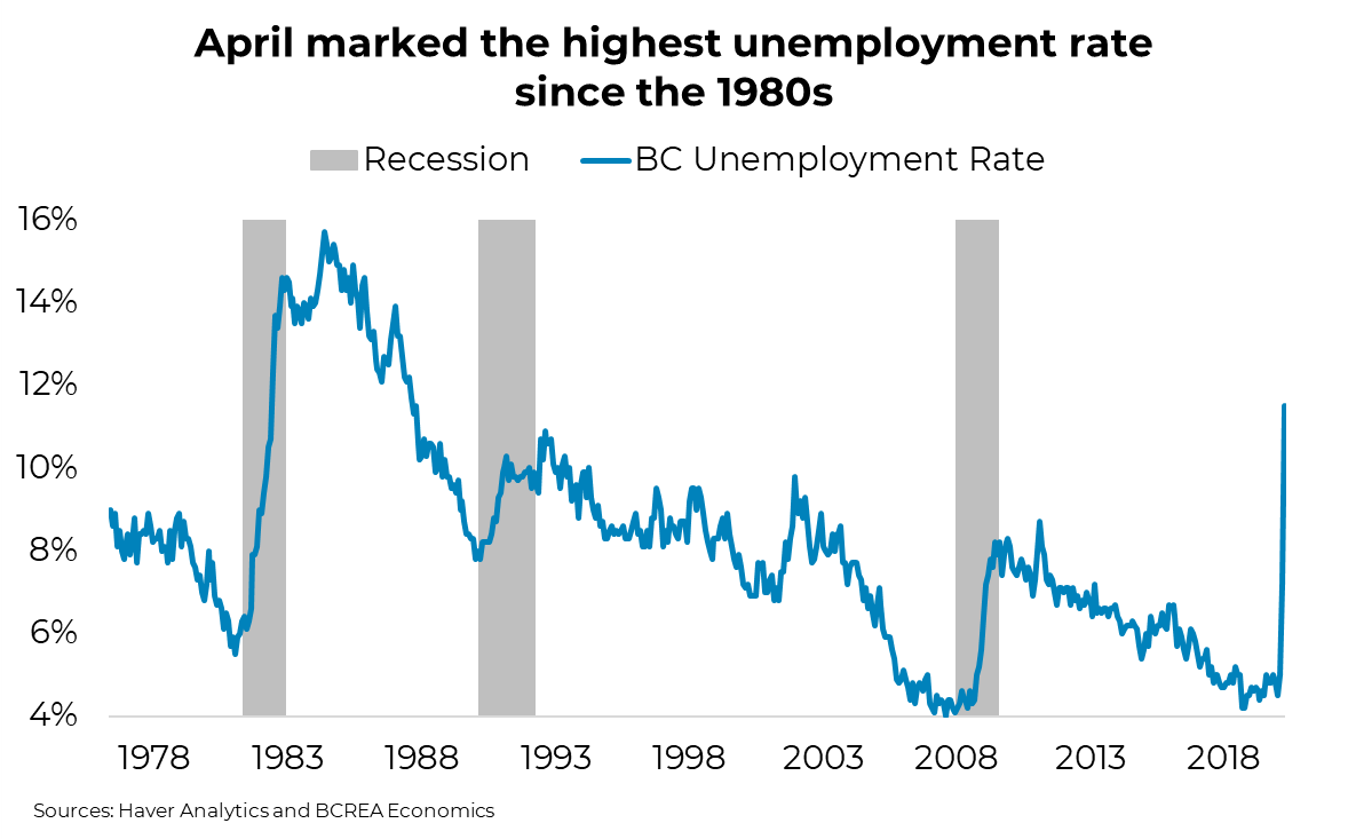
Since the pandemic was declared in March 2020, an unprecedented number of jobs have been lost in a very short period. Within two months, employment in BC fell by almost 383,000 jobs, essentially wiping out all job gains since the 2008/09 Financial Crisis. This brought the April unemployment rate up to 11.5 per cent, BC's highest unemployment rate since the recession in the early 1980s. In this report, we take a deeper look behind the unemployment rate to understand who has been most impacted, as well as potential implications for the real estate sector.
April unemployment rate higher if underutilized workers included
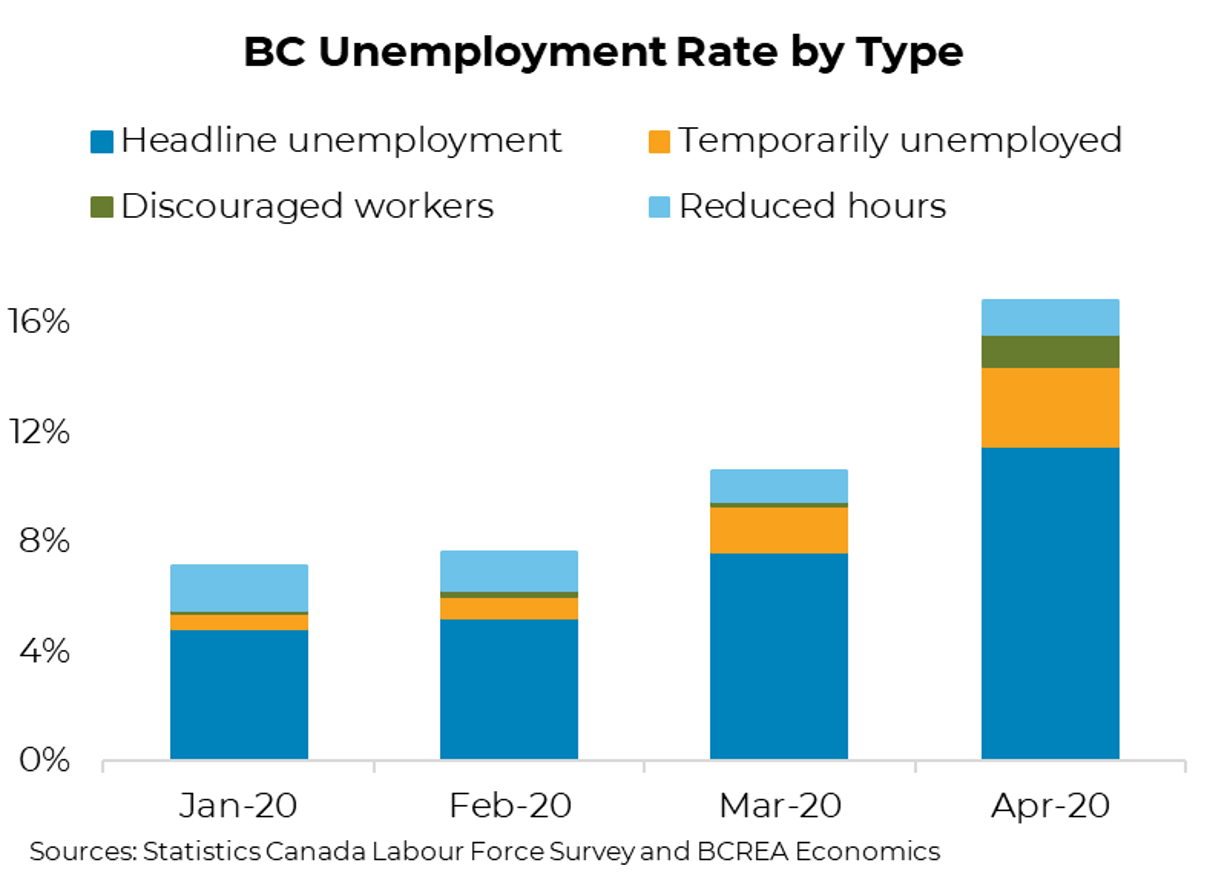
The April unemployment rate does not capture underutilized workers who are temporarily unemployed and will likely return to work once restrictions have eased; those who are able to work but have been discouraged from looking for a job; and those who have had their hours reduced due to the pandemic. If we include these individuals, the April unemployment rate would have been 5.3 percentage points higher at 16.8 per cent.
Services sector bears the brunt of physical distancing measures
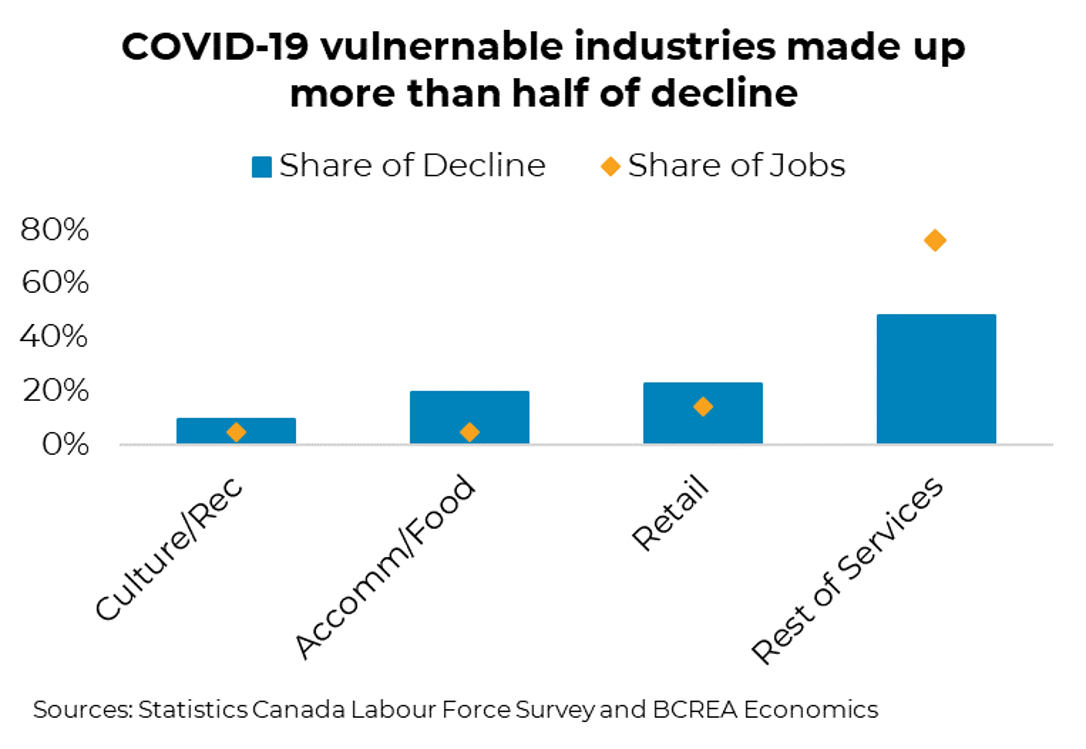
Unlike in past recessions, where goods-producing sectors such as manufacturing and construction would have been the most impacted, the services-producing sector has been hit hardest, representing 90 per cent of job losses in the province since February.
Within the services sector, more than 50 per cent of losses were in the sub-sectors of culture/recreation, accommodations/food services and retail. The decline in these sub-sectors was disproportionately higher than their 24 per cent share of total service sector employment. These sub-sectors tend to have lower wages, less job security (temporary and non-unionized) and fewer health benefits.
Younger workers more impacted, particularly women

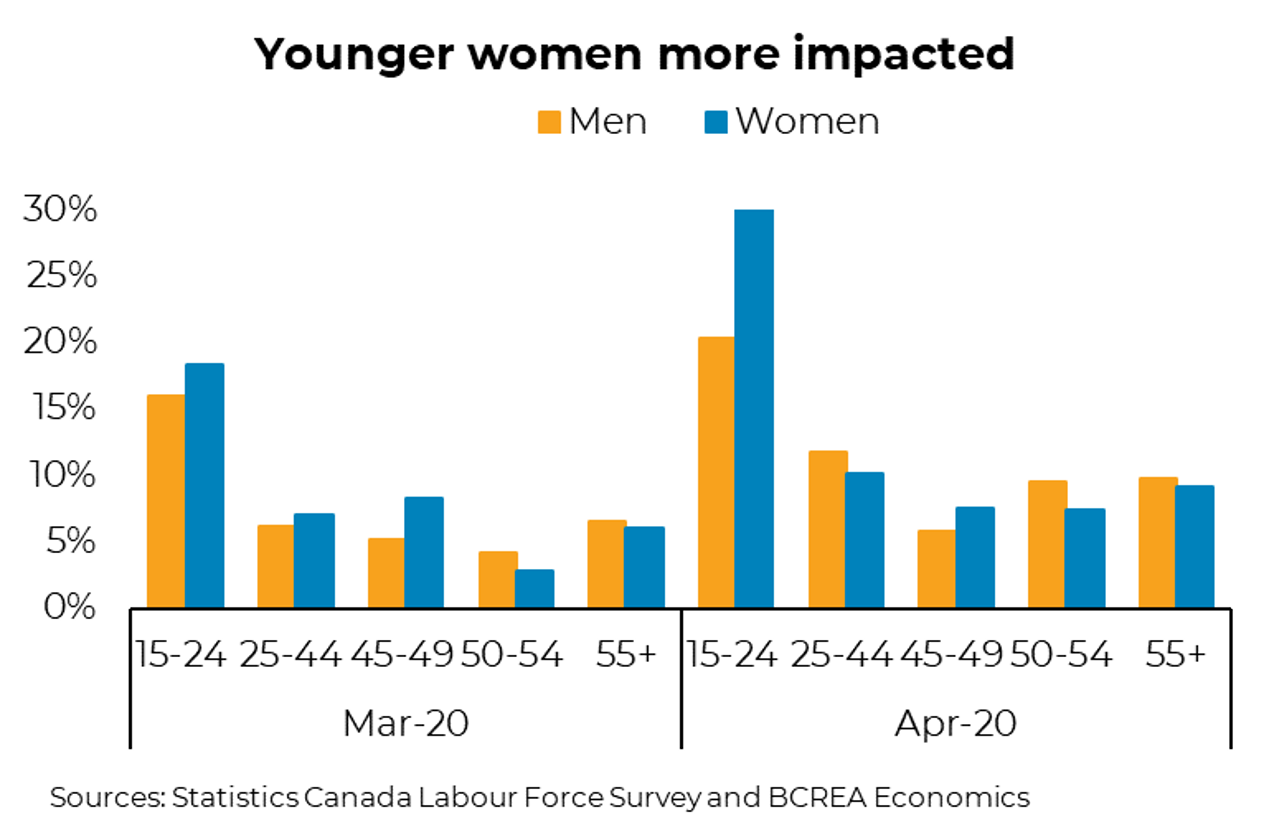
Focusing on the services sector, younger workers (15 to 24) had the highest unemployment rates in April, which is not surprising as a higher share of them are employed in COVID-19 vulnerable industries. Among younger workers, women were more negatively impacted, with an unemployment rate of 30 per cent in April compared to men at 18 per cent. Meanwhile, older age groups such as those in the first-time homebuyers range (25 to 44) and homeowners range (44 and over) experienced less of an increase in unemployment rates.
Looking ahead
The Canada Emergency Response Benefit will continue to help individuals to cover a share of household “core” spending (food and shelter) until they return to work, the effectiveness of which will undoubtedly vary between regions based on local costs. The Canada Emergency Wage Subsidy (the uptake of which has been slow) will help some businesses retain a portion of their employees, but only if they are able to re-open. Additionally, some banks and other financial institutions are offering relief by way of deferred mortgages (740,000 Canadian households have delayed such payments, representing 15 per cent of mortgages) and credit card payments. The hope is that these support programs will tide households over until they can begin returning to work.
The Province has begun to gradually ease restrictions for some businesses and services to re-open, including provincial parks, elective surgeries, retail, and food service establishments. These sectors made up the bulk of the decline in employment since February. At the same time, employment recovery will depend on consumer demand. That demand has thus far proven to be cautious in countries like China and others who have started to re-open. The easing of restrictions related to culture/recreation and tourism is not expected anytime soon, suggesting that unemployment in these sub-sectors will persist.
Implications for the real estate sector
So far, the majority of job losses have been in lower wage sectors and among younger workers who tend to be renters, which suggests we can expect further uncertainties and negative pressure on rental markets. Additionally, there is a risk that underutilized workers who are temporarily unemployed due to the pandemic could become permanently unemployed if businesses are not able to recover from the economic downturn of the last few months. A recent Canadian Federation of Independent Business survey reported that 32 per cent of firms were unsure if they could re-open. This could delay potential home purchases or lead to forfeitures in the longer term.
Meanwhile, those in age groups who tend to be first-time homebuyers or existing homeowners experienced less of an increase in unemployment rates. These groups tend to hold jobs in higher wage sectors with more job security (e.g., those temporarily unemployed but expected to return to work, such as workers in the construction industry). As mortgage rates are likely to stay at their current low levels for the next while, first-time homebuyers could be incented to purchase sooner than planned, and existing homeowners could have more cash in their pockets when they go to renew their mortgages.
Lastly, for households who are still employed and self-isolating, they are not spending as much on gas, public transportation, eating at restaurants, gym memberships, etc. Such unexpected savings could translate into healthy down payments and, combined with lower mortgage rates, could expedite some home purchase timelines.
To subscribe to receive BCREA publications, or to update your email address or current subscriptions, click here.
Being Sued is No Fun! #438
By Jennifer Clee
We all know that being sued for allegedly failing to fulfill legal and/or professional responsibilities can be traumatic, but it can also be time consuming and consequently, expensive. A recent decision of our Provincial Court illustrates how legal proceedings involving relatively straightforward legal issues can morph into protracted and strenuous battles.1
The case against a REALTOR® involved an allegation of misrepresentation regarding the square footage of a home. The Claimant, a former REALTOR® and present employee of the BC Assessment Authority, sued the defendant listing REALTOR® for misrepresenting the square footage of a home as being 2669 square feet when in fact, by his calculations, it was 2274 square feet.
The discrepancy in the measurements arose as a result of the listing REALTOR® including an area of 477 square feet for the unfinished loft over the garage in the “Other” section of the MLS® Residential Data Input Form, which was then included in the computation of the square footage of the property by the MLS® interface program. Including the “Other” area resulted in the MLS® printout representing total square footage as 1799 square feet, or less than the Claimant’s own measurement of 2274 square feet which included the finished basement and the main and upper area of the home, for liveable square footage. However, the Court found negligence on the part of the listing REALTOR® for including the area of the unfinished loft on the Residential Data Input Form.
Despite that finding, to establish liability against the listing REALTOR® the Claimant had to overcome three other legal hurdles. To succeed with his claim, it was incumbent upon the Claimant to establish a duty of care owed by the listing REALTOR®, reasonable reliance by him on the alleged misrepresentation and damage suffered as a result of his reliance on the misrepresentation or as a result of the listing REALTOR®'S negligence. The Claimant failed to overcome these three hurdles and the claim against the REALTOR® was dismissed. Interestingly, the Court applied the doctrine of caveat emptor, finding that the “measuring of a home to ascertain its square footage would be patent and, as such, fall on the purchaser’s obligation during inspection even if the defect (misrepresentation as to size) might not be observable by casual inspection and may require more diligent investigation.”2
The matter may have been settled at an early stage if the REALTOR® had been prepared to make a substantial settlement offer to the Claimant, who sought $21,675 from the REALTOR®, close to the maximum claimable under the monetary jurisdiction of the court. As it was apparent from the Claimant’s own evidence and that of his witnesses’, and the applicable case law, that his case was unlikely to succeed, no monetary offer was made. When no settlement offer was forthcoming, the Claimant advanced a complaint against the listing REALTOR® and brokerage to the Real Estate Council, which dismissed the complaint.
However, despite the outcome of the trial and the relief it visited upon the listing REALTOR®, it was not without a hefty price. The trial took six days to be heard, spread over a period of 14 months. In addition to the six days of valuable time spent sitting in Court, the listing REALTOR® spent hours in preparation and that, in addition to testifying in court, resulted in an emotional toll.
The lesson to be learned? While there may be more than one standard for measuring properties in British Columbia,3 be consistent with the practice in your market, measure all properties you list and double check the measurements to ensure their accuracy and lastly, ensure the information published on MLS® is accurate. Taking these steps will assist you in avoiding the misery and cost, both in time and money, associated with lawsuits and Council complaints.
To subscribe to receive BCREA publications such as this one, or to update your email address or current subscriptions, click here.
Benefits – Taxable or Not? #168
By Gerry Neely
B.A., LL.B.
National Revenue's unsuccessful attempt to add to a taxpayer's income may be of interest to your clients whose employers require them to move and to all licensees wearing uniforms. In two separate cases, payments were made to taxpayers by their employers which the Minister of National Revenue wanted to classify as income from employment.
In the first case the taxpayer whose job was with the Federal Government, moved from Ottawa to Edmonton and in the process sold a house in Ottawa with a 12.5 % mortgage and purchased a house in Edmonton with 14.25 % interest on the mortgage financing.
Federal Government employees who relocate at the employer's request and incur additional expenses upon the purchase of a new residence are compensated and compensation includes a mortgage interest differential payment. In this case, the remaining term of the Ottawa mortgage was three years, so over the next three years the taxpayer received approximately $2,600 to compensate him for the higher interest charges on the Edmonton property.
The Minister of National Revenue argued that this was an additional economic benefit to the taxpayer. The taxpayer said that this payment did nothing more than reimburse him for the cost incurred because of his employer's request that he move to Edmonton. The judge decided the issue against the Minister of National Revenue.1
Another case involved a plainclothes police officer who was paid $500 pursuant to the terms of a collective agreement, to defray the cost of providing outsize clothing he needed to conceal police equipment such as a revolver, handcuffs and walkie-talkie. M.N.R. concluded that this was a benefit and added the sum of $500 to the policeman's income. The issue was the same and again, the judge held that the payment was not a benefit but instead compensation for an expense the employer ordered the policeman to incur.2
***
A licensee told a vendor that he represented a person who had previously inspected the vendor's house and was prepared to make an offer, which however was to be subject to an unlimited inspection. The vendor's evidence was that he discussed limiting the inspection to structural soundness, foundations and a search for infestation in detail with the licensee.
Neither party was aware of the instructions given by the other to the licensee. The conditional clause in the offer to purchase which had been accepted by the vendor provided that the sale was subject to "satisfactory inspection of the building structure." The vendor (a barrister) gave evidence that he was told by the licensee that this clause provided for the limited inspection the vendor wanted.
The inspection report confirmed that there were no structural deficiencies and no insect infestation, but that there were other deficiencies which the inspector listed. The purchaser declined to proceed and the vendor sued for damages when the property resold for a lower price.
The trial judge held that the licensee was agent for the purchaser when he approached the vendor, and became agent of the vendor when the vendor signed an exclusive listing. He interpreted the conditional clause to mean an unlimited inspection. The licensee was liable for negligently misrepresenting that the clause had the restricted meaning the vendor relied upon when accepting the offer to purchase.
in addition, the trial judge stated that the licensee had a duty to advise the vendor of the purchaser's instructions concerning the inspection. This non-disclosure was a breach of duty to his principal, the vendor.
The Court of Appeal confirmed the trial judge's findings.3
| 1. |
|
|
| 2. |
|
|
| 3. |
|
To subscribe to receive BCREA publications such as this one, or to update your email address or current subscriptions, click here.
Best Efforts Condition Precedent #209
By Gerry Neely
B.A., LL.B.
Whether a condition precedent falls within the "whim or fancy" or "option or offer" category of conditions, or within the category that requires purchasers to use their best efforts to satisfy the conditions, is a question judges continue to be asked. Since the cases depend upon different facts, they may appear to be contradictory or inconsistent. For example, "subject to the sale of the purchaser's residence" is a best efforts category while "subject to the purchaser's review of leases" falls within the "whim and fancy" cases. (See Column #163 for a fuller discussion of consequences.)
The reports of cases in which condition precedents are interpreted may provide a useful list of clauses and the categories into which they fall. The condition precedent in one case was that completion was "subject to the purchaser's review and approval of easements #___ and #___." The easements were for driveways which were in place and which crossed the vendor's land. The purchaser was concerned that the driveways might not have been constructed within the area described in the registered right of way agreement.
The purchase satisfied himself that their location on the ground was consistent with the description in the right of way agreement, and orally told the vendors that the easements were acceptable to him. Before completion the vendor attempted to revoke the contract by saying that the condition precedent fell within the "whim or fancy" category of conditions. The vendor's argument was that the removal of the condition depended solely upon the subjective state of mind of the purchaser, who could refuse to approve the easements without attempting to justify that decision.
The judge, however, held that the purchaser couldn't avoid his obligation to complete the purchase by refusing to approve the easements without justifiable reason. A binding contract was created when the parties signed it, although its completion was subject to the removal of the condition. The purchaser had to use his best efforts and the vendor could not terminate the contract on the basis that the condition precedent rendered the contract unenforceable.1
***
Column #186 discussed a case where a licensee, who knew nothing of a zoning bylaw which prevented construction upon the front seven feet of a building lot, was held to be responsible for an innocent misrepresentation by omission. This allowed a purchaser to repudiate the Contract of Purchase and Sale, and exposed the licensees to an action for damages by the vendor.
The trial judge had concluded that the zoning bylaw was equivalent to an unrevealed easement which constituted a serious cloud on title. The Court of Appeal disagreed, holding that the zoning restriction was the equivalent of a set back. Although the zoning bylaw created a restriction on the enjoyment of the property in order to preserve the amenities of the neighbourhood, it was not a cloud on title.2 (This case and this decision should be contrasted with the facts and the decision referred to in Column #187.)
***
Several columns have discussed cases involving loans where the interest rate exceeded the limit of 60% fixed by the Criminal Code of Canada. Those cases involved defaulting borrowers who used the criminal rate of interest as a defense against an action by the lenders for payment of interest. A recent case involved a borrower who had paid the interest and was trying to recover it. Normally monies paid under an illegal contract such as this are not recoverable. One reason for allowing recovery is that the Criminal Code section is there for the protection of borrowers. However, the Criminal Code section became law to protect "the weak and needy from unscrupulous, oppressive and sometimes violent makers of small loans."
The borrower in this case was experienced and not a weak borrower. The lender was not an oppressive lender. The judge held that interest was not recoverable because the Criminal Code section was not intended to protect the sophisticated borrower from this kind of lender.3
To subscribe to receive BCREA publications such as this one, or to update your email address or current subscriptions, click here.
Best Efforts or Whim and Fancy Conditions #163
By Gerry Neely
B.A., LL.B.
The subject of conditional offers and their enforceability continues to confound licensees and lawyers alike. The difficulty lies in failing to recognize the distinction between conditional clauses which require the approval of someone other than the purchaser or the vendor, and those conditional clauses, which, as one judge said, are subject only to the "whim or fancy of the purchaser."
Examples of the first category of conditional clauses are those which depend upon approval of say, rezoning or subdivision by the city of ___________or of financing by the Bank of ___________. In each of these examples, it is the decision of a third party which determines whether the condition will be removed. These examples are referred to as the "best efforts" cases because they require each party to do whatever is reasonably necessary on his part to meet the condition. (The best effort rule includes a "subject to sale of purchaser's residence" condition.)
For instance, a purchaser whose offer was subject to financing and who didn't want to complete, was liable for damages to the vendor when he failed to take any steps to see if the financing could have been obtained. Offers which contain these "third party approval conditions" create a contract which neither party can revoke during the period the condition remains open to be removed or waived.
Examples of the second category of conditional clauses are found in a case involving an offer to purchase submitted on behalf of a purchaser by an agent engaged primarily in commercial real estate. The offer was subject to the purchaser's review of all leases, contracts, plans, surveys and the state of title of the lands; a detailed inspection of the building; and the arrangement of financing. Removal of the conditions depended upon the review, inspection and financing being done to the sole satisfaction of the purchaser.
The purchaser removed the condition a few minutes past the deadline, by which time the vendor had given notice of termination.
The purchaser sued for specific performance of the contract and among other arguments advanced, tried to bring the conditions within the "best efforts" cases. The judge rejected this argument because the offer created no agreement which a court could enforce. The reason: there was no way the judge could test whether the purchaser used his best efforts to decide whether he was satisfied with the matters referred to in the conditions.
The vendor was free to revoke his acceptance at any time after the offer was made and before the vendor received notice of the purchaser's removal or waiver of the conditions. The effect of the "whim and fancy" offers is to create an option in favour of the purchaser which is unenforceable unless the agreement is under seal or for consideration. The deposit could not have been consideration for the option because the purchaser was entitled to its return (refer to Column 57 for a discussion of the use of seals or appropriate clauses.)
There are two reasons why it is necessary to know when you are faced with a "whim and fancy" clause. The first reason is the one already mentioned, namely to prevent the vendor from revoking the purchaser's offer before the purchaser has had time to satisfy himself as to whether the condition should be removed or waived. The second is to avoid being sued for having failed to draft a legally enforceable document. (see Column 111.) In case of doubt, seal the contract or provide consideration to the vendor.1
| 1. |
|
To subscribe to receive BCREA publications such as this one, or to update your email address or current subscriptions, click here.
Best Practices for Do-Not-Call Lists
Lead generation is an important part of a REALTOR®'s work but there are some risks too, especially when it comes to telemarketing. REALTORS® and brokerages need to understand their role in protecting consumer privacy before picking up the phone – and it starts with the national Do-Not-Call List.
What’s the national Do-Not-Call List?
The Canadian Radio-Television and Telecommunications Commission (CRTC) maintains a national Do-Not-Call List (DNCL), which contains the names and telephone numbers of people who do not want to receive unsolicited telephone calls or messages.
Anyone, whether a corporation or private individual, who wants to generate leads by phone must buy a subscription to the Do-Not-Call List, as well as maintain an internal office DNCL. Offices are required to keep telephone numbers on internal lists for three years and 14 days. There is an Excel form available on REALTOR Link® for brokerages to use as a template to build and maintain their office’s do-not-call list.
Failure to comply with the national DNCL can result in significant penalties of up to $1,500 per violation in the case of an individual and up to $15,000 per violation in the case of a corporation.
Is there a problem?
The CRTC receives 300 complaints per day relating to the DNCL. Two common complaints related to the real estate sector include:
- brokerages using external telemarketers to make calls without the brokerage having registered or subscribed to the DNCL, and
- attempts to avoid compliance by disguising a sales call as a survey (opinion polling and market research firms conducting surveys aren’t required to follow DNCL rules).
What can REALTORS® do?
Since brokerages are liable for calls made on their behalf by telemarketing service providers, it’s vital to ensure that you’re working with one that is 100 per cent compliant with the DNCL rules. Do some research, request documentation verifying the company’s compliance and consider making inquiries to ensure that they really have their house in order.
Brokerages that directly make cold calls or engage in telemarketing practices should also have their own office do-not-call policies that they can give to consumers on request and to ensure compliance with office policies. You can find a template for developing an office policy for your brokerage here.
If you directly engage in telemarketing, it’s helpful to have a prepared script to ensure compliance. For example, the federal Telecommunications Act requires brokerages to immediately disclose the purpose of your call and the company or individual you represent; having a script can make it easier to comply.
What about referrals?
If one of your clients gives you a referral and the referral telephone number is not registered on the national DNCL, you are free to call that number. When it comes to clients you have had a previous relationship with, you are allowed to call them for up to 18 months after your business relationship has ended.
If you have further questions to ensure calling practices are consistent with the law, email [email protected]. To learn more about the CRTC DNCL, visit the Canadian Real Estate Association’s FAQ and resources on REALTOR Link®.
To subscribe to receive BCREA publications, or to update your email address or current subscriptions, click here.
Best Practices for Showings and Open Houses #596
Showings are an important part of a REALTOR®’s role. It is essential to understand best practices, including what is and is not acceptable during showings, as well as the types of situations that can lead to disciplinary consequences.
Hosting Open Houses
The best practice is for the seller’s agent (the listing agent) to host the open house themselves.1 Section 30(a) of the Real Estate Services Rules (the Rules) requires the listing agent to act in the seller’s best interests.2 The listing agent is generally best positioned to answer questions factually and to protect the seller’s interests throughout the open house.
If the listing agent is unable to host the open house, they should first obtain instructions from the seller confirming whether the seller wishes to proceed without them and, if so, whether the seller consents to another REALTOR® from the same brokerage hosting the open house. When the listing agent cannot host, the best practice is generally to have another REALTOR® from the same brokerage host the open house. If you work as part of a team, the team members may already be acting collectively as designated agents for the seller, which can make it easier for another team member to step in.
If you do not work as part of a team, your brokerage may appoint another designated agent for the seller to conduct the open house, provided the listing agreement or services agreement allows for it. The new designated agent should provide the appropriate disclosure to the seller, and the service agreement should clearly state when that designated agent’s duties begin and end. This helps ensure that the REALTOR® from your brokerage who is hosting the open house is clearly responsible for protecting the seller’s interests.
Another option is to have a REALTOR® from your brokerage host the open house, but not as a designated agent. This is sometimes done so that the hosting REALTOR® can pursue leads for prospective buyer clients. However, this approach does not protect the seller’s interest. If you nevertheless proceed with this approach, you should do the following:
- inform the seller that the hosting REALTOR® will not be acting in their best interest;
- tell the seller not to share confidential information with the hosting REALTOR®;
- tell the seller not to seek advice from the hosting REALTOR®;
- ensure your listing agreement or services agreement allows for another REALTOR® to host the open house; and
- have the hosting REALTOR® present the seller with a disclosure confirming they do not represent the seller.
Should the Listing Agent Be Present for Showings?
In British Columbia, the listing agent may either attend showings or use a lockbox to provide the buyer’s REALTOR® with access to the property. The listing agent should discuss both options with the seller and obtain instructions on whether the seller wants the listing agent present for showings. Some sellers may prefer the listing agent to attend in order to help safeguard the property and belongings, answer questions, and highlight features of the home.
If the property is tenanted, the landlord or the landlord’s agent must safeguard the tenant’s possessions. For that reason, it is prudent for the listing agent – or another licensed REALTOR® acting on behalf of the seller – to be present when a tenanted property is being shown.3
As a general practice, there should always be one REALTOR® present at any showing, whether it’s the buyer’s or the seller’s REALTOR®. Before proceeding with any showings, the seller’s REALTOR® should discuss and seek instructions from the seller regarding who they want present. If the arrangement for any particular showing differs from what is set out in your listing agreement or services agreement, the seller’s informed consent should be obtained in writing and retained on file.
What Is Acceptable During a Showing?
Before any showings take place, the listing agent should speak with the seller to determine the rules and expectations for access to the property. Sample rules could include:
- please take shoes off prior to entering;
- respect the property as if the owners are present;
- stay with your agent;
- do not take photos;
- do not open drawers, desks, medicine cabinets, or personal storage;
- do not use washrooms unless permission has been given;
- do not consume food or drinks while on the property; and
- do not bring extra attendees without approval.
These rules and expectations aren’t just about etiquette. They are also important aspects of risk management and professionalism.
While some of these expectations may seem like common sense, regulatory disciplinary decisions show why it is still important to state ground rules clearly before a showing. In one recent case, a REALTOR® was fined $20,000 after being caught on camera drinking milk directly from the seller’s milk container while showing the property to buyer clients. The fact that this occurred during the COVID-19 period made the conduct even more troubling. The BC Financial Services Authority (BCFSA) concluded that the REALTOR®’s actions undermined public confidence and amounted to conduct unbecoming of a licensee.4
Any rules and expectations for showings should be clearly communicated to buyers’ REALTORS® and, through them, to all attendees.
When attending a property, the REALTOR® should confirm the number of attendees. Access during a showing is for a specific purpose, and not a blanket invitation. The buyer’s REALTOR® should not assume they can bring extra family members, friends, contractors, or other attendees unless they have been cleared in advance with the seller or listing agent.
If something is broken, damaged, or stolen during a showing, it should be reported immediately to the appropriate REALTOR®, the seller, the brokerage, and the managing broker. The facts, including what happened, when it happened, and who was present, should be documented right away. Whether any resulting loss is covered by insurance, or recoverable from another party, will depend on the facts and the available coverage. Close supervision of showings can help reduce this risk.
Security and Surveillance Cameras
In BC, the private-sector privacy statute is the Personal Information Protection Act (PIPA). PIPA governs the collection, use, and disclosure of personal information by organizations in a manner that recognizes both privacy rights and the organizations’ legitimate need to collect and use information for purposes that a reasonable person would consider appropriate.
PIPA generally applies to organizations, including businesses and brokerages, rather than to purely personal or domestic conduct. It also contains an exception where personal information is collected, used, or disclosed by an individual for personal or domestic purposes only. As a result, a seller’s personal home security camera may fall outside PIPA if it is being used strictly for personal or domestic purposes. By contrast, if a brokerage or another organization is itself collecting or using surveillance footage in the course of business, PIPA is much more likely to apply. Even where PIPA does not apply, surveillance and recording practices may still raise civil privacy issues under BC’s Privacy Act.
Sellers can use security cameras, such as Ring doorbells, to protect their property. However, it’s a best practice for the listing agent to communicate that such cameras are present at the property if the listing agent is aware of the cameras and the seller has consented to such disclosure. Regardless of whether disclosure of such security cameras is legally required in every situation, prudent REALTORS® should assume there may be surveillance devices in the home and conduct themselves accordingly.
Video surveillance and audio recording are not always treated the same under the law. REALTORS® should be especially cautious about on-site conversations near devices capable of capturing audio. Under the Criminal Code, intercepting a private communication can raise separate legal issues unless an exception applies, including consent from a party to the communication. Buyers and their REALTORS® should be careful not to discuss confidential matters in front of recording devices, as the seller may listen to these recordings. REALTORS® should also be mindful that less visible devices, such as crib cameras or nanny cams, may be present in the home. As a best practice, avoid having substantive or confidential conversations while inside the property, and instead wait until you have exited the home.
It is also important to note that camera footage may be used in investigations involving REALTORS®. In 2024, a REALTOR® was ordered to pay a $10,000 discipline penalty and $4,000 in enforcement expenses after allowing clients to access a property without a licensed agent present, using an unlicensed person to show the property, and then providing false or misleading information to BCFSA. The seller, who was monitoring the property by surveillance camera, noticed that the buyer’s REALTOR® was not present during the showing. The REALTOR®’s misleading account was disproved by the surveillance footage.5
Conclusion
While showings and open houses are routine parts of a REALTOR®’s practice, careful thought must still be given to how they are conducted and what occurs during them. Clear expectations, proper supervision, and a high level of professionalism help protect clients and maintain public confidence in the profession.
Beware of Heritage or Archaeological Issues #564
When looking for a property to develop or redevelop, prudent buyers are well advised to investigate the suitability of the property for their plans prior to committing to purchase it. Depending on the property and the type of development, this may include researching or retaining the appropriate professionals to research and advise on any zoning concerns or particular municipal issues such as:
- official community plans,
- availability or sufficiency of necessary utilities such as water,
- environmental issues such as riparian area protections,
- invasive species, or contaminated sites,
- encroachments such as rights of way or easements,
- geotechnical concerns, etc.
An important issue that may impact development, but is sometimes only discovered once shovels are in the ground, is whether the property has any archaeological features of concern. British Columbia, particularly its coastal regions, bears archaeological evidence of some 13,000 years of human occupation,1 confirming First Nations oral history originating from time immemorial.
The potential conflict between private property rights and the public interest in discovering, researching, and preserving archaeological remains is poorly addressed by the current legislative and administrative framework in BC. Consultation efforts are currently underway2 on revisions to this framework, including its administration, to align with the objectives of the UN Declaration on the Rights of Indigenous People. Whether any of the revisions will address the sometimes exorbitantly expensive impact of archaeological finds on private property owners remains to be seen.
Protected archaeological sites are identified according to standards established by regulation. There are currently over 60,000 known sites in BC, and there likely are many more undiscovered sites. Both known and undiscovered sites are protected by the Heritage Conservation Act,3 which prohibits the:
- damage or removal of any heritage objects or human remains from a burial place with historical or archaeological value;
- damage, alteration, covering or moving of an aboriginal rock painting or carving that has historical or archaeological value; and
- damage, excavation, digging in, alteration, or removal of any heritage objects from an archaeological site identified by regulation.
What is a buyer to do when a seller does not disclose any knowledge of any heritage or archaeological issues on a property, and there is nothing noted on the title to the property? Such a buyer might request a search4 of the property through the Archaeology Branch, which strictly manages and protects access to information about known archaeological sites to prevent damage to the sites by vandalism.5 If time is of the essence, such information might be obtained more quickly by hiring a professional archaeologist (https://www.bcapa.ca/) with access to a GIS application called Remote Access to Archaeological Data (RAAD).6 Even if a search yields no results, this is not a guarantee that there are no archaeological concerns on the property. It is possible that an unknown and unrecorded site may be discovered during development, and such a site is nevertheless protected under the Heritage Conservation Act.
A buyer might also search the local or municipal heritage inventory list to determine whether the property has been noted as being of interest. Note that presence on a heritage inventory list is not the same as heritage designation. The latter is typically noted on the title to the property and can result in the Province having to compensate the property’s owners if there is a reduction in the property's market value as a result of the designation. This is one of the reasons why designation is rare. A property may still have significant archaeological protections even if not officially designated.
There have been some notable cases regarding archaeological concerns in the news and/or in the Courts. For example, Mackay v. British Columbia7 was a 2013 case concerning an Oak Bay homeowner who had to undertake significant archaeological work before replacing an existing single-family home, which was not a designated heritage site. Nothing on the property’s title would have indicated any archaeological significance. The homeowner sued the Province for approximately $600,000, being the costs associated with obtaining a site alteration permit, delays in construction, and loss in property value. She also challenged the legal authority of the Archaeology Branch to require a site alteration permit in the first place, in the absence of official heritage designation of the property, and to order her to pay for the archaeological work without a Ministerial order. After an arbitration, appeal, and judicial review, the homeowner successfully established that the Archaeology Branch could not require her to pay for a heritage inspection and investigation as a pre-condition of obtaining a site alteration permit. The court held that it was unfair for the homeowner to bear more than her fair share of the costs associated with providing a public benefit, such as collecting and preserving artifacts on the site, without a Ministerial order to that effect.
It remains open for the Minister of Forests to order a property owner to conduct and pay for heritage inspections and investigations. Such orders are more commonly made in large resource management projects such as forestry cases,8 oil and gas,9 or other infrastructure projects.10 They are rarely made against individual homeowners, and the writer has located only one such Ministerial order in what appears to have been a case where the owner conducted unauthorized work that damaged archaeological findings.11
The Province continues to require heritage investigation permits and site alteration permits to be obtained under the provisions of the Heritage Conservation Act, and reports be provided regarding any findings.
Not every homeowner can afford to take on the Province in arbitration or the Courts. A recent CBC News article12 highlights the situation in which a family has found themselves after purchasing a 79-acre property in Soda Creek, north of Williams Lake, intending to build a farm and event venue. The family says it had no disclosure of any archaeological issues at the time of the purchase or when applying for permits for a water well and septic tank. Interestingly, the responsible regional district also had no record of any archaeological sites on the property and issued a building permit. Only the family’s application for a BC Hydro connection raised a concern about the archaeologically sensitive nature of the land, as BC Hydro maintains its own mapping systems, which include locations of potential archaeological significance.13 The family is now stuck, unable to afford the costs of archaeological investigations necessary to obtain a site alteration permit, without which they cannot do any of their planned work to build a farm and event venue, and left without any compensation for the impact on their property and future plans.
In January 2023, the BC provincial government announced14 the creation of a one-stop-shop approach to provincial permitting to help speed up approvals and construction of new homes. This approach unifies processes under several different ministries, including riparian area approvals, water licenses, transportation approvals, road rezonings, contaminated sites, and requirements for heritage or archaeology inspections. Priority is to be given to Indigenous-led projects, BC Housing applications, and multiple-unit applications. It remains to be seen whether this will impact the availability of archaeological site information or the cost of performing the necessary archaeological investigations and obtaining the required Heritage Conservation Act permits.
When working with buyers intending to develop or redevelop a property, licensees should act within their area of expertise and recommend other professionals to assist buyers with conducting necessary investigations. If an archaeological site is known or suspected to be located on the property, sufficient time should be built into the purchase and sale process to allow for a search of the Archaeology Branch database, and/or the retainer of an archaeologist.
Beyond Your Expertise: When to Recommend Clients Get Legal Advice #531
The Question
I am asked for advice from licensees on potential claims daily. They often describe a scenario involving complex matters beyond the expertise of a licensee, such as taxes, structural issues/defects or complicated legal questions, like whether a contract is alive or dead? They want to know what they should do and what they should tell their clients.
My Answer
In these situations, I tell the licensees to recommend their clients get legal advice. I know right away from the silence on the phone that they are not satisfied with that answer. They want to be able to solve the problem for their client themselves, or they tell me they strongly suspect their client does not want to pay a lawyer. The decision to seek legal advice or not is, of course, up to the client and not the licensee.
The Curiosity
What happens to licensees who don’t recommend legal advice on matters beyond their expertise? In Legally Speaking #59 (September 1984), author Gerry Neely reminded licensees to avoid giving legal advice to their clients. This was good advice then and remains so today.
The Real Estate Rules, s. 3-3(d) say licensees should “advise the client to seek independent professional advice on matters outside of the expertise of the licensee”.
The Real Estate Council of BC’s (RECBC) Knowledge Base has at least 13 references to the term “legal advice.” They warn licensees to recommend their clients get legal advice and/or include a clause subject to the client obtaining legal advice in many different scenarios, such as:
- when dealing with a purchase in a strata that is non-compliant with the Strata Property Act;
- when dealing with contract clauses including assignments that are beyond their expertise or limitations and where doubt exists as to the use, impact or interpretation of a suggested clause;
- when dealing with conflicts in acting for multiple clients;
- when dealing with the sale of a business going beyond the standard form of Contract of Purchase and Sale; and
- when dealing with complicated timing of builder’s liens.
The common theme in the recommendations from RECBC is that ifthere are any issues outside of a licensee’s expertise, they should advise their client to seek independent legal advice. In doing so, licensees recognize the limits of their own expertise and protect the client and themselves.
Those licensees who fail to follow this recommendation do not fare very well. Here are some examples from recent RECBC consent orders and decisions:
- In RECBC File #15-574 July 16, 2020, a licensee agreed to a finding of misconduct under s. 35 of the Real Estate Services Act (RESA) and 3-3(d) of the RECBC Rules [advise the client to seek independent professional advice on matters outside of the expertise of the licensee]. The licensee acted for the sellers where there was a fire at the property before completion. She agreed that the buyer’s agent created an addendum to the Contract that arguably left no firm date for the repairs and completion to occur. She agreed that she assumed that the sellers, who said they spoke to a lawyer generally about the fire, had also run the addendum by that lawyer but did not confirm this nor recommend that they do so. The licensee in this unique situation ended up agreeing to misconduct, disciplinary penalties and enforcement expenses.
- In RECBC File #15-486 April 22, 2020, a broker was found liable for misconduct and sanctioned with disciplinary penalties, a remedial broker’s course and significant enforcement expenses for misconduct. The broker was found to have recommended that one of his listing agents agree to loan money to his client to be secured by a mortgage on the property. That created a conflict. The broker and the listing agent did not recommend that the client get legal advice on the loan or the conflict.
- In RECBC File #15-758 April 15, 2020, a licensee agreed to findings of misconduct arising from his listing of a property where he did not have the consent of both the half owner and the trustee for the other half owner. He admitted that he listed the property and had the half owner accept an offer from a buyer, all without notice to the trustee on title for the other owner (the title search indicated the trustee’s interest on subsequent pages but the licensee only reviewed page one). Before, and even when the licensee was made aware of the trustee’s interest, he did not recommend legal advice on the ownership and authority to sell. Though the deal closed and only the trustee complained to RECBC, misconduct was agreed and sanctions of disciplinary penalties and enforcement expenses were levied.
- In RECBC File #15-680 January 21, 2020, misconduct was agreed and a suspension, penalties and expenses were levied against a licensee for failing to recommend legal advice where a City notice was received by the seller and flagged in a PDS but not sought out or shared with the buyer making an unconditional offer. The risk of making an unconditional offer in those circumstances was explained by the licensee but legal advice was not recommended then or even when the PDS was disclosed and permit issues beyond the licensee’s expertise abounded at the property.
In closing, if an issue is beyond your expertise, recommend your clients get legal advice.
To subscribe to receive BCREA publications, or to update your email address or current subscriptions, click here.
Blanket Ban on Residential Evictions Ends
On June 24, the BC Government made it possible to evict residential tenants for reasons other than non-payment of rent. That means real estate transactions that require vacant possession can now proceed.
Landlords with existing orders for eviction can take them to the courts beginning July 2, 2020, for enforcement and can enforce a writ order effective immediately. Landlords can enter a rental suite with 24-hour notice and don’t need the tenant’s consent. And documents can now be served in person.
REALTORS® and landlords are expected to follow health guidelines like physical distancing, cleaning and wearing masks when appropriate. Please continue with your diligence in showing property and meeting with clients. Check out the protocols from WorkSafeBC for more information.
The government commits to giving advance notice before lifting the moratorium on evictions for non-payment of rent at a future date. A framework will be put in place that will require landlords to work with tenants to repay rent that’s owing over a reasonable period of time.
For now, the freeze on rent increases remains in place, as does a landlord’s ability to restrict access to common spaces.
Read the government news release here and information about COVID-19 and tenancies here. And these are the timelines required for serving notices during tenancies.
To subscribe to receive BCREA publications, or to update your email address or current subscriptions, click here.
Boo You Really Want to Know? #487
By Jennifer Clee
B.A., LL.B.
Licensees often ask whether a death at a property must be disclosed by the seller, be it death by murder, natural causes, accident or suicide. The simple answer is no. However, there are practical considerations that may make disclosure of such events beneficial to the seller.
Seller's Disclosure Duty
Sellers and their agents have a common law duty to disclose material latent defects of which they have knowledge, rendering the property dangerous or unfit for habitation. Latent defects — those not discoverable upon a reasonable investigation by a buyer or the buyer's home inspector — concern defects directly related to the intrinsic quality of the building or property itself which, applying an objective standard, materially affect the property's use or value. A licensee acting on behalf of a seller has the professional duty to disclose any material latent defects as defined by Section 5-13 of the Real Estate Council of British Columbia's Rules.
Events at a property, such as a suicide, or a murder in the home, or a claim that the home is haunted, are often referred to as stigmas or stigmatizations. These do not affect the objective value of a property, though they may make a property less (or more) attractive to certain individuals due to subjective considerations. A seller is not required to disclose stigmas or stigmatizations.
It is the buyers' responsibility to ask questions about any personal considerations that could affect their enjoyment of a property. As stated in Summach v. Allen:1"…to allow defects to be determined by individual preferences would open the floodgates of litigation by remorseful purchasers and create an impossible standard of disclosure for vendors."
A Quebec Court,2 considering the seller's duty to disclose his son's suicide ten years earlier at the property, put it this way: "The court has a great deal of difficulty in agreeing that elements whose importance depends on the sensitivity, phobias, sentiments, or purely personal and subjective apprehensions that are not related to the quality of the building should be subject to compulsory disclosure. Imposing such rules would place an impossible burden on the shoulders of a seller in assessing which of the events that had occurred in the house might be important in the mind of the buyer and therefore of consequence in terms of his decision."
Seller's Duty When Asked
If a buyer asks the seller about an event or occurrence, such as a death at the property, the seller may either answer the question or decline to answer the question. However, the seller must not misrepresent or mislead the buyer. Thus, a seller of a haunted mansion declining to answer a buyer's question as to whether the property is haunted should state that he is declining to answer the question rather than answering, "Not a ghost of a chance."
Failing to disclose a stigma may expose the seller to an expensive and time consuming lawsuit if the buyer subsequently learns of the stigma; disclosing a stigma will avoid that risk.
Seller's Agent's Disclosure Duty
| A seller's agent is not required to disclose a stigma to a buyer unless: |
| i) The seller's agent also represents the buyer who has indicated a concern about the stigma; or |
| ii) The seller's agent has been authorized by the seller to answer a buyer's question about the existence of the stigma. |
As the law is continually changing, to avoid complaints or claims by sellers or buyers relating to the non-disclosure of stigmas, sellers' licensee should advise sellers in writing to obtain independent legal advice regarding their obligation to disclose known stigmas associated with their property.
| 1. |
|
|
| 2. |
|
Breach of Duty and Fraudulent Misrepresentation #129
By Gerry Neely
B.A. LL.B
Termites, latent defect, non-disclosure, breach of duty, fraudulent misrepresentation, and all occurring in Toronto. A young couple purchased a home in an area of termite infestation which had started about five years prior to their purchase. They were aware of this problem because an earlier conditional offer made by them for another home in this same area, had collapsed when it was found to be riddled with termites.
The house they purchased was one whose owners had omitted to tell the listing salesman that the drywall in the basement concealed termite damage drawn to the owners' attention two years earlier by a termite inspector. Hardwood on the second floor had been replaced by plywood, and a small wooden beam installed, to repair other termite damage. The listing salesman failed to see any evidence of the infestation, within the period of fifteen minutes he took to examine the garden, measure eight rooms on the ground floor, check out a second floor kitchen, and left. The listing he filed with MLS stated that the house was in a move in condition.
On their first visit with the selling agent, the young couple asked the selling agent whether the house was termite free, to which the salesperson responded by saying she would inquire. On the second visit when the selling salesperson was again asked whether there were any termites she said there were none. In fact, the selling salesperson had neither asked the vendors this question nor had she examined the house for termite damage. Both visits by the young couple and the selling agent to the premises were short and made at night. The young couple asked the selling salesperson to insert a termite clause, a request the selling salesperson deflected by saying that she had never heard of one.
An offer was made and accepted and when the young couple took occupancy of Termite Towers the damage they found was so extensive that it took them eight months to put the house in livable condition. They sued the vendors, the listing and selling agents and salespersons with the following results.
The vendors were liable for their failure to disclose latent defects of which they were aware. Silence about a known major latent defect is the equivalent of an intention to deceive. They were held to be responsible for 50% of the damages.
The listing salesperson's liability was fixed at 20%. There was evidence from two experienced real estate agents who qualified as expert witnesses that a reasonably competent real estate salesperson should have spent 30 minutes to an hour upon an inspection, rather than 15 minutes. That inspection would have made the salesperson suspect that a problem existed. The judge stated the duty of the listing agent as follows: "The listing agent must take the time and trouble to inspect the property so that major damage or major defects can be known to him, and knowing that other members of the buying public will either see or be told about his description, he must exercise a very high duty of care, which does not go so far as to say he must be a qualified building inspector." The judge held that the listing salesperson's performance and inspection fell short of the normal practice one could expect of a real estate sales person.
The listing agent was held to be liable for his salesperson's breach of duty. In addition, liability would have been imposed upon the listing agent in any event, because the judge said that the listing agent had a duty to know of the termite infestation in the area. Further, he had a duty to instruct his sales staff concerning important trends in the area. The failure to do this was a breach of the standard required of the listing agent.
The liability of the selling agent and selling salesperson for the remaining 30% of the damage, arose out of the selling salesperson's failure to make the inquiries requested by the young couple. As the judge said, "The selling agent has a strict obligation to pursue questions asked by the purchasers diligently until she is satisfied she has correct and honest answers. She is not entitled to ignore or make light of their questions." In addition, she untruthfully said that there were no problems, a statement "made recklessly by her not caring whether they were true or not." This was a fraudulent misrepresentation for which both she and her employer were liable.1
| 1. | Jung et al v. IP et al, 47 R.P.R. p 113. |
To subscribe to receive BCREA publications such as this one, or to update your email address or current subscriptions, click here.
Breaking Up is Hard to Do: What Happens When a Licensee Leaves a Brokerage? #573
What happens when a REALTOR® leaves a brokerage while working on client transactions? This is an ongoing issue for REALTORS® and managing brokers to navigate. This article will review considerations surrounding listing agreements, independent contractor agreements or employment agreements, commission, transferability of trades in real estate, and confidentiality when a licensee departs a brokerage.
Independent Contractor Agreements and Employment Agreements
Both brokerages and licensees should carefully review and consider the independent contractor agreements and employment agreements that govern their relationship. Both parties should ensure that the agreements clearly set out what happens if the licensee wishes to leave the brokerage or is terminated. These sections of the agreements should consider the following:
- Is the licensee required to give the brokerage a specific notice period before their exit? Is the brokerage required to give the licensee notice of termination?
- What happens to commissions for transactions that are still conditional, (pending)or haven’t closed yet? Are there different terms for different transaction stages, for example, prior to or after subject removal?
- Does the licensee have to pay the brokerage an administration fee upon their exit?
- Are pending transactions and listings transferrable to the licensee’s new brokerage?
Since there is no standard precedent in British Columbia for these agreements between brokerages and licensees, both parties must consider these questions and ensure the agreement clearly outlines each party’s rights and responsibilities upon the departure of a licensee.
Listing Agreements
Listing agreements in BC are with the brokerage, not the licensee, and under the standard multiple listing agreement, brokerages are given the right to designate another licensee if the designated agent ceases to be engaged by the listing brokerage.1 As such, if a licensee leaves a brokerage while a property is listed or during a pending transaction, then the brokerage is entitled to designate a different licensee to act on behalf of the seller. Barring an arrangement to the alternative as set out in the independent contractor agreement, the listing, and the client stay with the brokerage.
Despite the terms outlined in the listing agreement, some brokerages may allow the transfer of listings and transactions to a new brokerage through their internal policies and procedures or independent contractor agreements. If such provisions exist, then the brokerages, licensee, and client would all need to be in agreement regarding the transfer.
Commissions
When a licensee leaves a brokerage while transactions are still pending, one of the key considerations will surround the remuneration of the licensee through either commissions or bonuses.
As it relates to remuneration and the payment of commissions or bonuses, licensees should become familiar with their rights and responsibilities under their independent contractor agreement or employment agreement (as the case may be). Key considerations to look for in these agreements regarding remuneration following a departure include:
- Is the licensee still entitled to commissions in pending transactions or transactions that haven’t closed. Does it depend on what stage of the transaction they are at?
- Are there any reductions, such as administrative fees, applied to the commission or bonus?
- What happens to advances made on pre-sale contracts?
Confidentiality
Section 30(e) of the Real Estate Services Rules2 sets out the confidentiality obligations of a brokerage and its licensees to clients:
“…if a client engages a brokerage to provide real estate services to or on behalf of the client, the brokerage and its related licensees must do all of the following: …
(e) maintain the confidentiality of information respecting the client.”3
This duty of confidentiality to the client continues even when the client ceases being a client of the licensee. Licensees need to recognize and understand this ongoing duty even following their departure from a brokerage or when they cease representing a client. For more information, look at the BC Financial Services Authority’s confidentiality guidelines.4
Brokerages
Brokerages should ensure that clear provisions are included in their independent contractor agreements or employment agreements regarding the departure of licensees. It is recommended that such agreements specify a minimum length of notice that the licensee must provide before they depart. The notice period will give the brokerage time to review active listings where the licensee is acting as a designated agent, determine if the licensee has any pending transactions, and to formally remove (offboard) the licensee from their systems. Having clear policies and procedures in place and communicating these to licensees can make the transition smoother for both the brokerage and the clients.
Summary
The decision to leave a brokerage can be a big one. Before leaving, licensees should become familiar with the terms of their independent contractor agreement or employment agreement to ensure a smooth transition. Knowing their rights and responsibilities will allow the licensee to strategically plan the move and make proper arrangements. Licensees should consider active listings and pending transactions, and how their departure from their current brokerage will impact these. Ideally, the timing of any transitions should be done to mitigate any negative outcomes or harm to clients.
| 1. | See Section 7 of the BCREA Multiple Listing Agreement. | |
| 2. | Real Estate Services Act, Real Estate Services Rules [Last amended February 1, 2024 by BC.Reg. 260/2023]. | |
| 3. | See Section 30(e) of the Real Estate Services Act, Real Estate Services Rules [Last amended February 1, 2024 by BC Reg. 260/2023]. | |
| 4. | For more information, read the BCFSA Confidentiality Guidelines. |
Brendon Ogmundson Steps Into Role of BCREA Chief Economist

Darlene Hyde, Chief Executive Officer of the BC Real Estate Association (BCREA), is pleased to announce the appointment of Brendon Ogmundson as Chief Economist for BCREA.
Brendon has been with BCREA for nine years, most recently serving as Deputy Chief Economist. Earlier this year, he was awarded the Crystal Ball Award by the Association of Professional Economists of British Columbia for the quality of his economic forecasting. Brendon specializes in macroeconomic forecasting, housing market analysis, and econometric modelling. He is responsible for producing forecasts for the BC, Canadian and US economies, as well as authoring a quarterly analysis of mortgage rates and the BC commercial real estate market. He is also a contributor to the Philadelphia Federal Reserve’s Survey of Professional Forecasters.
Brendon is an experienced communicator, frequently contributing to major news outlets. He holds an MA in Economics from Simon Fraser University and is a CFA Charterholder.
Brendon replaces Cameron Muir who served as BCREA’s Chief Economist for the past 13 years. “We owe a huge debt of gratitude to Cameron, who took the economics department to a new level,” says Hyde. “ And we extend sincere congratulations to Brendon upon his promotion.”
For more information, please contact:
April van Ert
Communications Manager
Direct: 604.742.2797
Email: [email protected]
To subscribe to receive BCREA publications such as this one, or to update your email address or current subscriptions, click here.
British Columbians Face Diverse Housing Challenges in Northern and Island Communities
In advance of the 2022 General Local Elections, BCREA discussed housing challenges faced by mayors and community stakeholders in several of BC’s unique municipalities. While at first glance, problems may seem lesser in areas like Vancouver Island or northern B.C., where the average home price is ‘only’ $430,000, there is an array of unique challenges preventing would-be renters and buyers in these regions from attaining housing.
The problem is quickly worsening, as nearly half of all municipalities saw their average home prices increase by over 50% between 2016 and 2021.
Unique Housing Challenges Outside Metro Vancouver
Vanderhoof Mayor Gerry Thiessen outlined challenges potential buyers can face in obtaining mortgage financing in many of BC’s small communities. Banks and credit unions make mortgage approval decisions based on statistics, but when a town’s population is too small to provide meaningful statistics, the institutions become more risk-averse.
Another challenge in small communities like Vanderhoof is getting the insurance that is often required for mortgages. Insurance can be increasingly expensive or challenging to obtain due to wildfires and other natural disasters.
The housing crisis has knock-on effects for other issues and in other areas. Northern Health has identified housing issues as a problem in recruiting doctors, nurses and other professionals to smaller communities. When these issues persist, they can result in relocation and even homelessness in larger cities like Prince George.
“When you don’t address problems in rural areas, the problems get pushed to urban areas,” Thiessen says.
Issues like labour supply shortages, which are a challenge in communities big and small, can also have unique nuances in different areas. In Nanaimo, for example, labour shortages impact not only the building sector but also city staff.
City of Nanaimo Mayor Leonard Krog explains, “a good year for housing development used to be about $200 million in building permits. By 2019, that doubled. Finding staff to manage two times the applications is a challenge.”
BCREA and real estate boards share many of the same concerns as these mayors.
“Northern communities face many of the same housing supply challenges seen across the province,” says BC Northern Real Estate Board CEO Alex Goseltine. “In seeking solutions, they can face unique obstacles.”
What can REALTORS® do?
The province is diverse, and the issues are diverse, which means the solutions are diverse. There are many actions REALTORS® in northern and island communities can take to do their part in addressing housing affordability. For example, when consumers are in areas at risk of wildfires like Vanderhoof, REALTORS® can get informed on obtaining insurance.
Another great resource is the Rural Real Estate Essentials online course by BCREA, aimed to help BC REALTORS® expand their reach to rural areas so they can identify and manage risks associated with rural real estate.
Supply is nuanced, and REALTORS® can share their on-the-ground expertise of challenges they are experiencing with candidates running for office. In addition, attend all-candidate meetings, learn about the different candidates’ platforms, and vote on October 15 (or sooner through advanced voting).
Broadened CERB Criteria Makes More REALTORS® Eligible
On April 15th, the Government of Canada broadened the Canada Emergency Response Benefit (CERB) criteria by allowing applicants to earn up to $1,000 in each four-week eligibility period. People who are eligible for Employment Insurance or sickness benefits or who have exhausted their Employment Insurance benefits between December 29, 2019 and October 3, 2020 are also now eligible. This change clarifies that REALTORS® are eligible if they have continued to work but have not received income or if their income is at or below the $1,000 threshold.
More on who’s eligible
CERB was launched to support residents of Canada over the age of 15 who have stopped working due to COVID-19 reasons, including:
- Unable to work because of being quarantined or sick due to COVID-19
- Caring for someone with COVID-19
- Caring for children due to school or daycare closures
- Lay-offs or leaves without pay
To be eligible, you also must have had employment and/or self-employment income of at least $5,000 in 2019 or the 12 months prior to your date of application. You cannot have quit voluntarily. For complete eligibility information and more on CERB, go here.
More on applying
The first step in applying for CERB is setting up an online account with Canada Revenue Agency (CRA), called CRA My Account (if you don’t already have one). Go here to learn more about that process.
There are seven CERB eligibility periods and you can apply for up to four periods, which don't have to be consecutive. When submitting your first claim, you cannot have earned more than $1,000 in employment and/or self-employment income for 14 or more consecutive days within the four-week benefit period of your claim.
If you receive income above the $1,000 threshold after you have received a CERB payment, and then stop receiving income or fall below that threshold, you will need to re-apply. When you re-apply, you cannot have earned more than $1,000 in employment and/or self-employment income for the entire four-week benefit period of your new claim. You can view the eligibility periods on the CRA's webpage.
Because you can only apply for four periods in total, if you’re not facing immediate financial hardship it may be in your best interests to wait to apply. Applications will be accepted up to December 2, 2020, meaning payouts will be available retroactively for the eligibility periods. You will be expected to report CERB as income when you file your income tax for the 2020 tax year.
Proving eligibility
CERB is designed to be easy and quick to administer so when you apply, you will be asked questions to confirm your eligibility but no proof or supporting documentation will be required. However, the government has said that in the fall they will begin reviewing applicants retroactively and anyone found to have applied when they weren’t eligible will be required to return the funds. This may trigger a CRA audit.
Do not apply if you have already applied for Employment Insurance.
Surrendering your licence and eligibility
One of the key eligibility criteria for CERB is that you have not quit your job voluntarily. Currently, it isn't clear if surrendering your real estate trading services licence would be considered quitting voluntarily. With that in mind, BCREA advises all Realtors hoping to apply for CERB to maintain their licence.
If you’re denied CERB
If you apply for CERB, and discover you're not eligible, please email Trevor Hargreaves, VP of Government Relations and Stakeholder Engagement at the British Columbia Real Estate Association (BCREA). BCREA is collaborating with the Canadian Real Estate Association (CREA) to make government aware of barriers Realtors are facing.
To subscribe to receive BCREA publications, or to update your email address or current subscriptions, click here.
Broker’s Responsibility to Have Office Policies to Help Representatives Deal With Water Problems; Contract to Enter Into a Contract Is Unenforceable #382
By Gerry Neely
B.A. LL.B.
An Alberta decision about a broker's failure to establish policies for representatives to deal with known water problems in homes constructed by a developer in a given area reflects the high value of local knowledge.
The broker's problem started when a new licensee, who had never shown a house by herself, was on call. First-time homebuyers were referred to her even though they had asked for an experienced REALTOR®. Regrettably for all, she misrepresented her experience and qualifications.
She showed them a house that had signs of water damage. It was built by the developer, although the significance of that wasn't known to her. She removed the buyers' concerns with explanations the judge held were negligent and fraudulent. They bought the house and successfully sued for damages when they found they had to deal with continuing leaks in the basement.
It was common knowledge in the broker's office that the developer's houses meant "buyer beware." The street the house was on was known to have the worst water problems in the area. One representative searched the title of any house she dealt with in the area to confirm this particular developer wasn't the builder. However, the listing representative, who worked in the broker's office, wasn't aware of the problem.
The judge decided this wide variation of knowledge exposed new representatives and the public to the risk of litigation that might have been avoided if the broker had two office policies in place:
- identify potential problems affecting houses in the area, and
- train new representatives on how to deal with repeated buyers' questions concerning water problems.
The lack of these policies led the judge to order the broker to pay two-thirds of the damages and the representative the remaining one-third.1
Legally Speaking 129 discusses an Ontario decision of a broker's liability for not knowing of a serious termite infestation and for failing to instruct his representatives concerning important trends in the area.
* * *
A lawyer acting for the seller drafted a sale agreement containing all essential information needed for a binding Contract of Purchase and Sale, except the completion date, which hadn't been discussed by the parties.
This clause was added to deal with the omission: "That the Contract of Purchase and Sale of the Property will be prepared by the Purchaser's lawyer with terms and conditions, and the date of the completion of the Property to be agreed by the Vendor and the Purchaser."
The buyers' lawyer deleted "and the date of completion of the Property" and added an additional paragraph containing a fixed completion date. The seller's lawyer asked for another date, which the buyers accepted by initialling the change; however, no Contract of Purchase and Sale was ever signed.
The buyers' lawyer should have deleted the entire clause, because no binding contract could exist until the parties agreed on the terms of a further contract. The seller refused to sign the transfer document and the buyers lost their action to force the seller to complete.2
To subscribe to receive BCREA publications such as this one, or to update your email address or current subscriptions, click here.
Brokerage Meeting in a Box: “Reviving” Offers
This edition of Brokerage Meeting in a Box features “reviving” offers. Below are speaking points and links to resources.
Did you know that you can also book one of our Professional Services Support Advisors, Jim McCaughan or Marty Douglas, to present at your brokerage meeting, whether online or in person? Find out more about how to request a speaker here.
Topic: “Reviving” Offers
Speaking Points
Clarifying the Process for Expired Offers and Contracts
One of the most common questions we receive at BCREA’s Managing Broker Support Line is about “reviving” expired offers and contracts. However, the term “revive” should be avoided, as an expired offer cannot be brought back to life. Instead, there are two proper approaches:
- Drafting a new offer: This is BC Financial Services Authority’s (BCFSA) preferred approach, ensuring clarity and minimizing risks.
- Overwriting the expired offer: This involves striking out the relevant clauses and having all parties initial the changes. However, this approach can lead to complications, such as missing key clauses or creating confusion due to excessive strikethroughs.
The same principles apply to contracts: An expired offer cannot be extended to remove subjects via an addendum. While overwriting an agreement is an option, it introduces risks that could lead to disputes or errors. Drafting a new agreement ensures accuracy, completeness, and consistency (and is once again BCFSA’s preferred approach).
Resources
BCREA
BCFSA
Brokerage Meeting in a Box: Artificial Intelligence in Real Estate Practice
This edition of Brokerage Meeting in a Box features guidance on the responsible use of artificial intelligence (AI) in real estate practice. Below are speaking points and links to resources.
Did you know that you can also book one of our Professional Services Support Advisors, Jim McCaughan or Marty Douglas, to present at your brokerage meeting, whether online or in person? Find out more about how to request a speaker here.
Topic: AI in Real Estate Practice
Speaking Points
1. AI is a Tool – Not a Decision Maker
AI can support drafting, summarizing, and analysis, but it does not replace professional judgement. REALTORS® remain responsible for all advice, communications, and decisions made with clients.
2. Protect Client Confidentiality
AI tools may store or process information externally. Avoid entering personally identifiable information like:
- client names,
- financial or transaction details, and
- confidential brokerage information.
Treat AI tools as potentially public environments unless confirmed otherwise.
3. Verify All AI-Generated Content
AI outputs can be inaccurate, outdated, and misleading. REALTORS® should:
- review all outputs carefully,
- validate facts before use, and
- apply human judgement before sharing with clients.
4. Understand Regulatory Expectations
AI use must align with the BC Financial Services Authority’s (BCFSA) rules and obligations, and brokerage policies and procedures.
Using AI does not reduce professional responsibilities. REALTORS® remain fully accountable for the accuracy of the information and the services they provide.
5. Avoid Over-Reliance on Automation
AI can improve efficiency, but over-reliance introduces risks, such as:
- missed context in complex or emotional situations, or
- poor client experiences when human judgement is removed.
AI should augment, not replace, client-facing interactions.
6. Be Transparent When Using AI
Clients should clearly understand when AI is being used to influence information, communications, or decisions. Examples include:
- AI-generated listing descriptions,
- market summaries or insights, and
- client communications.
REALTORS® should ensure that content remains accurate and clear, and that the use of AI use does not mislead or create false impressions.
Transparency supports informed decision-making and helps maintain client trust.
Key Takeaway for REALTORS®
AI can improve efficiency and support your work, but you remain responsible for accuracy, confidentiality, transparency, and professional judgement in every client interaction.
Resources
BCFSA
Canadian Real Estate Association (CREA)
Brokerage Meeting in a Box: Conflict of Interest Disclosures
This edition of Brokerage Meeting in a Box features information about conflict of interest disclosures. Below are speaking points and links to resources.
Did you know that you can also book one of our Professional Services Support Advisors, Jim McCaughan or Marty Douglas, to present at your brokerage meeting, whether online or in person? Find out more about how to request a speaker here.
Topic: Conflict of Interest Disclosures
Speaking Points
- Disclose early, clearly, and in writing
- Required under Real Estate Services Rules as soon as a conflict arises.
- Applies even if you don’t believe a conflict exists, but a reasonable person might.
- Written disclosure must include full details and be retained in brokerage records.
- Prioritize avoiding conflicts, not just managing them
- Your first duty is to avoid conflicts whenever possible.
- Only disclose and proceed if the conflict is unavoidable.
- Seek guidance from your managing broker when in doubt.
- Know the common sources of conflict
- Secondary employment in related fields (e.g., mortgage broker, contractor).
- Personal or business relationships (e.g., spouse, friend, brokerage owner).
- Acting on your own behalf or dealing with properties tied to your personal interests.
- Promote transparency and client autonomy through disclosure
- Written disclosure allows clients to ask questions and seek independent advice.
- Full transparency helps build and maintain trust.
- Keep communication ongoing throughout the relationship.
- Protect yourself – insurance doesn’t cover personal transactions
- If you act for yourself in a transaction, Errors & Omissions insurance won’t apply.
- Conflicts involving your own interests are especially high-risk.
- Avoid dual roles to protect both yourself and your client.
Resources
BCREA
BC Financial Services Authority
Brokerage Meeting in a Box: Human Resources
This edition of Brokerage Meeting in a Box features information about human resources. Below are speaking points and links to resources.
Did you know that you can also book one of our Professional Services Support Advisors, Jim McCaughan or Marty Douglas, to present at your brokerage meeting, whether online or in person? Find out more about how to request a speaker here.
Topic: Human Resources
Speaking Points
- The Purpose of Human Resources
- Human resources (HR) refers to all the processes involved in managing human capital (e.g., recruiting, hiring, onboarding, performance management, termination).
- These processes should not only reflect your business's mission statement and values but also be designed to protect your business from litigation and regulatory risks.
- When agents are hiring unlicensed assistants, they must consider how their recruiting and onboarding processes reflect their business principles and those of the brokerage.
- Independent Contractor vs. Employee
- A major litigation risk is treating independent contractors like employees.
- In BC, independent contractors are considered self-employed and are not protected under the Employment Standards Act (ESA).
- Independent contractors must operate their own business and have control as well as direction over their work as long as it complies with the Real Estate Services Act and brokerage policies.
- Independent contractors also provide all necessary equipment to carry out their work and shoulder the risks of their business not generating profit.
- Unlike employees who are usually dependent on one employer for their income, independent contractors may have several clients who pay for their services through their brokerage.
- In contrast, employees are protected under ESA.
- ESA protects employees by providing minimum standards for compensation, work hours, sick leave, and other work-related conditions.
- This means that REALTORS® working as independent contractors are generally not protected by ESA.
- Hiring Unlicensed Assistants
- REALTORS® hiring unlicensed assistants should be mindful of the distinction between an independent contractor and employee.
- If they treat an independent contractor as an employee, they may be vulnerable to wrongful termination lawsuits or other work-related litigation.
- Blurring the line between these two categories also opens the brokerage to the same risks.
- Maintaining Professionalism in HR
- In accordance with the Human Rights Code, HR policies and procedures should be free of discrimination.
- REALTORS® at your brokerage should remove discriminatory language from job postings and avoid such language during interviews.
- Additionally, if REALTORS® delegate HR responsibilities, they must respect confidentiality and privacy obligations while avoiding conflicts of interest.
- Conflicts of interest may arise when working in teams involving family members and non-family members, which are also governed by the Real Estate Services Rules.
- Creating Safe Workplaces
- Business owners, employers, and workers are all responsible for maintaining physically and psychologically safe workplaces.
- REALTORS® registered as Personal Real Estate Corporations (PRECs) are considered incorporated companies and required to carry insurance through WorkSafeBC.
- If PRECs employ other workers, they have additional workplace safety responsibilities, including maintaining a health and safety program.
- Consult WorkSafeBC for context-specific guidance.
Resources
BCREA
WorkSafeBC
- WorkSafeBC website
Brokerage Meeting in a Box: Property Disclosure Statement Changes
This edition of Brokerage Meeting in a Box features secondary employment. Below are speaking points and links to resources.
Did you know that you can also book one of our Professional Services Support Advisors, Jim McCaughan or Marty Douglas, to present at your brokerage meeting, whether online or in person? Find out more about how to request a speaker here.
Topic: Property Disclosure Statement Changes
Speaking Points
The BC Court of Appeal in Sewell v. Abadian emphasized that even when sellers strike out the contents of a disclosure form or mark it “not applicable,” this does not eliminate risk. In fact, doing so can lead to confusion or misrepresentation.
- BCREA, the BC Financial Services Authority, and the Real Estate Errors & Omissions Insurance Corporation are aligned in their message: disclosure is the best way to mitigate risk. While the new Property No-Disclosure Statement (PNDS) exists for unique situations, completing a disclosure form remains the recommended approach when the seller has knowledge about the property.
- Sellers who cannot or choose not to make representations – such as in estate sales, foreclosures, or when they lack firsthand knowledge – can now use the PNDS. It documents the decision not to complete a PDS while still reinforcing the obligation to disclose any known material latent defects.
- The revised “Seller’s Disclosure of Known Material Latent Defects Form” clearly outlines that if a seller refuses to authorize the disclosure of a known material latent defect, the REALTOR® is required to cease providing trading services.
- The PNDS is not intended to be incorporated into the Contract of Purchase and Sale (CPS). Its purpose is to clearly document that the seller has elected not to make any representations regarding the property’s condition. Incorporating the PNDS into the CPS risks creating confusion about its legal effect and may inadvertently give rise to contractual obligations that the form is specifically designed to avoid.
Resources
BCREA
- July 2025 Standard Forms Launch Resources
- "Updates to Property Disclosure Statement Forms" article
- Property Disclosure Statement Updates and Changes Community of Practice webinar
- “Reducing Risk in the Interim: Disclosure Practices That Protect” article
BC Court of Appeal
- CANLII Court of Appeal Decision: 2025 BCCA 158 (CanLII) | Sewell v. Abadian | CanLII
Brokerage Meeting in a Box: Radon Awareness
This edition of Brokerage Meeting in a Box features radon awareness. Below are speaking points and links to resources.
Did you know that you can also book one of our Professional Services Support Advisors, Jim McCaughan or Marty Douglas, to present at your brokerage meeting, whether online or in person? Find out more about how to request a speaker here.
Topic: Radon Awareness
Speaking Points
- Radon is a Naturally Occurring Gas: Radon is a colourless, odourless radioactive gas that occurs naturally from the breakdown of uranium in soil, rock, and water. It can accumulate in homes, particularly in basements and ground-level rooms.
- Health Risk and Safety: Prolonged exposure to high levels of radon is a known health risk, being the second leading cause of lung cancer after smoking. Informing buyers about the potential health impact of radon exposure is crucial, especially if levels exceed the acceptable threshold (200 Bq/m³ in Canada).
- Material Latent Defect: If a property has been tested and shows elevated radon levels above 200 Bq/m³, it is considered a material latent defect according to the BC Financial Services Authority (BCFSA). If REALTORS® are aware of this, they are required to disclose this defect to potential buyers, as it impacts the safety and usability of the property.
- Mitigation is Possible: High radon levels can be mitigated through systems that vent the gas outside the home. REALTORS® should inform clients that radon issues can often be resolved with affordable and effective mitigation solutions.
- Encourage Testing: In areas known for elevated radon levels, it’s advisable to recommend radon testing during the home inspection process. Even if the seller is unaware of radon levels, encouraging buyers to test can help avoid future issues or surprises.
Resources
BCREA
- Community of Practice: Understanding Radon with Dr. Aaron Goodarzi
- Radon Resources
- Legally Speaking: Radon: What You Should Know about This Invisible Health Hazard #577
British Columbia Financial Services Authority (BCFSA)
Canadian Cancer Society
Evict Radon
Health Canada
Brokerage Meeting in a Box: Secondary Employment
This edition of Brokerage Meeting in a Box features secondary employment. Below are speaking points and links to resources.
Did you know that you can also book one of our Professional Services Support Advisors, Jim McCaughan or Marty Douglas, to present at your brokerage meeting, whether online or in person? Find out more about how to request a speaker here.
Topic: Secondary Employment
Speaking Points
- The exemptions listed in the Real Estate Services Regulation exist for those who are not currently licensed and are providing trading services in one of the sectors identified (e.g., working as an employee of a developer).
- The exemptions cannot be applied to those already licensed as the BC Financial Services Authority (BCFSA) indicates that once you are licensed, you cannot provide any services that require that licence outside of the brokerage you are licensed to.
- The only exemptions that a licensee can claim are identified in Part 9 of the Real Estate Services Rules.
- These exemptions relate to:
- Management of rental real estate owned by the licensee,
- Management of rental real estate owned by the licensee’s family,
- Management of a strata corporation by a licensee who is an owner (e.g., a licensee sitting on a strata council in a building in which they own a unit), or
- Acquisition or disposition of real estate by a licensee or spouse of a licensee.
Resources
BCFSA
- Conflict of Interest (Trading Services) Guidelines
- Conflict of Interest (Rental Property & Strata Management) Information
- Licensing Exemptions Guidelines
Real Estate Services Regulation
Real Estate Services Rules
Brokerage Meeting in a Box: Subject Removal Versus Waiving and Fulfilling
This edition of Brokerage Meeting in a Box features information about subject removal versus waiving and fulfilling. Below are speaking points and links to resources.
Did you know that you can also book one of our Professional Services Support Advisors, Jim McCaughan or Marty Douglas, to present at your brokerage meeting, whether online or in person? Find out more about how to request a speaker here.
Topic: Subject Removal Versus Waiving and Fulfilling
Speaking Points
- Stating that subjects are “removed” lacks precision.
- Saying a subject has simply been “removed” does not confirm whether the buyer met the condition or chose to proceed without meeting it.
- This lack of detail creates unnecessary uncertainty about what the buyer actually intended.
- Waived and fulfilled mean different things in law.
- Waived means the buyer is choosing to proceed even though the condition was not met.
- Fulfilled means the buyer has satisfied the condition through evidence or completion of the required step.
- These outcomes are not interchangeable, and each carry different legal consequences.
- Legal advice supports documenting the decision, not just stating removal.
- The recommendation to mark each subject as waived or fulfilled is based on legal advice.
- Clear wording protects consumers and professionals by reducing the risk of a dispute about the buyer’s intention.
- Courts interpret intention primarily from the contract but may consider other evidence if the wording is unclear.
- If a dispute arises, courts begin by interpreting the parties’ intentions based strictly on the written contract.
- Clear, precise wording in the subject removal is therefore essential.
- If the contract wording is ambiguous, courts may look to additional contemporaneous evidence, such as emails, texts, or other correspondence.
- Even if it is unlikely for a buyer to successfully argue they did not intend to proceed, litigating ambiguity is expensive and time-consuming.
- Clear wording helps avoid the cost of proving what should have been obvious.
- The name of the form matters less than the wording.
- It does not matter whether a brokerage form, board or association form, or other tool is used.
- What matters is copying the complete subject clause exactly as written.
- The clause should be followed by a hyphen and the notation “waived” or “fulfilled” to provide the clearest evidence of the buyer’s decision.
- Clear documentation aligns with the duty to provide competent service.
- The Real Estate Services Rules require licensees to provide competent service.
- Competence includes accurately expressing a buyer’s intentions in writing.
- If a subject removal form does not clearly specify waived or fulfilled, the licensee risks falling short of this duty, especially if the lack of clarity causes harm or dispute.
- Both buyer agents and listing agents should stress its importance.
- Buyer agents should explain to their clients why each subject should be marked as waived or fulfilled.
- Listing agents should advise their sellers of the importance of receiving a clear record.
- When both parties understand why the wording matters, there is less risk of confusion or disagreement later.
Resources
Check back soon for an FAQ that is currently being drafted and will be included in the updated Contract of Purchase and Sale toolkits.
Brokerage Meeting in a Box: Team Names and Where They Go
This edition of Brokerage Meeting in a Box features information about team names and where they go. Below are speaking points and links to resources.
Did you know that you can also book one of our Professional Services Support Advisors, Jim McCaughan or Marty Douglas, to present at your brokerage meeting, whether online or in person? Find out more about how to request a speaker here.
Topic: Team Names and Where They Go
Speaking Points
- Teams can only exist at brokerages that operate under the designated agency brokerage model. They cannot exist under a brokerage agency as the entire brokerage is considered to be a team.
- All clients must know which licensee(s) represent them as the designated agent(s) for the brokerage:
- This includes all team members, even if some are not actively working with that client.
- Sharing all team member names ensures that their clients are aware of who is responsible for representing them and who has access to their personal information.
- Team members must be listed in full on every service agreement between the brokerage / agent and the client:
- This includes service agreements such as listing contracts and buyer agency contracts.
- Team members must be listed on all written disclosure documents:
- This includes the Disclosure of Representation in Trading Services, Disclosure of Risks to Unrepresented Parties, etc.
- Team names can be used in a Contract of Purchase and Sale, as the team members are not parties to that contract.
- Team names must appear in all advertising, even if the advertisement has just one team member on it:
- Consumers must understand when an agent is part of a team because they are unable to provide trading services outside that team.
- Team members cannot hop in and out of a team on a transaction-by-transaction basis.
Resources
BC Financial Services Authority
Real Estate Services Act
Brokerage Meeting in a Box: Using Artificial Intelligence Responsibly When Taking a Listing
This edition of Brokerage Meeting in a Box features information about using artificial intelligence responsibly when taking a listing. Below are speaking points and links to resources.
Did you know that you can also book one of our Professional Services Support Advisors, Jim McCaughan or Marty Douglas, to present at your brokerage meeting, whether online or in person? Find out more about how to request a speaker here.
Topic: Using Artificial Intelligence (AI) Responsibly When Taking a Listing
Speaking Points
- AI-Generated Property Descriptions: Accuracy Over Appeal
- AI tools can quickly draft compelling listing descriptions, but they may introduce details that are exaggerated, implied, or entirely inaccurate.
- Even subtle wording can create misrepresentation risk if it overstates features, conditions, or uses.
- Discussion prompt: Who is responsible for verifying every statement in a listing description, and what steps should be taken before publishing?
2. Photo Editing: Where Enhancement Becomes Misrepresentation
- Basic edits, like brightness or contrast adjustments, are generally acceptable.
- However, using AI to remove defects, alter views, or enhance features beyond reality can mislead buyers.
- Discussion prompt: Where should the line be drawn between standard marketing and creating a false impression of the property?
3. Confidentiality Risks When Using AI Tools
- Entering client information, transaction details, or sensitive property issues into AI platforms can expose that information beyond the brokerage’s control.
- Many tools retain or use data for training purposes.
- Discussion prompt: What types of information should never be entered into AI tools, and how can brokerages set clear boundaries?
4. Over-Reliance on AI: Loss of Professional Judgement
- AI can assist, but it cannot replace professional expertise or local market knowledge.
- Blindly relying on AI outputs can lead to errors in pricing strategies, property positioning, or disclosures.
- Discussion prompt: How do we ensure AI supports, rather than replaces, professional judgement?
5. Disclosure and Transparency in Marketing
- If AI is used to generate content or imagery, consider whether disclosure is appropriate, especially if the output could influence a consumer’s understanding of the property.
- Transparency reinforces trust and professionalism.
- Discussion prompt: When, if ever, should the use of AI in listings be disclosed to consumers?
6. Consistency With Brokerage Policies and Standards
- AI use should align with existing brokerage policies on advertising, disclosure, and client service.
- If policies do not yet address AI, this is a gap worth closing.
- Discussion prompt: Do our current policies adequately address AI use, or do we need to update them?
7. Record Keeping and Accountability
- AI-generated content is still the responsibility of the licensee.
- Maintaining records of what was generated, edited, and ultimately published can support accountability if questions arise later.
- Discussion prompt: What documentation practices should be in place when AI is used in listing preparation?
Resources
BC Financial Services Authority
Brokerage Uses Oppression Remedy to Collect Commission #422
An Ontario brokerage recently used a modern corporate remedy to collect its commissions, when the principal of a corporate seller stripped virtually all the assets out of the company, leaving the seller an empty shell with no money.1
Some legal background is useful. Statutes require directors to make reasonable business decisions in light of all the circumstances known by the directors, or about which they ought to have known.2Sometimes, directors must consider the impact of their actions on a company’s creditors.3
Depending on circumstances, the legislation also permits certain persons to ask a court for a remedy when the affairs of a company, or the powers of the directors, are used in a way that is oppressive. To remedy oppression, the court may order a director to pay compensation.4
In Remo Valente Real Estate (1990) Ltd. v. Portofino Riverside Tower Inc., four businessmen incorporated a company (the “Development Company”) to build a large condominium project. All four were principals of the Development Company. One of the four owned a real estate brokerage. He arranged for the sale of the property to the Development Company. As part of the deal, everyone agreed the brokerage would be the exclusive agent for the sale of all the condos in the project. The Development Company also signed an exclusive listing agreement with the brokerage.
When relations within the group broke down, one of the principals bought out the others and took over sole control of the Development Company. As the Development Company’s sole director and shareholder, he then reorganized the company, effectively transferring the property to other entities. This left the Development Company an empty shell, without money to pay the brokerage’s commissions. The principal also caused the Development Company to terminate the brokerage’s listing and change the sales office locks.
The brokerage successfully sued the Development Company, its sole principal and several related entities. In part, the brokerage sued, as a creditor of the Development Company, for an oppression remedy.5
In the court’s view, the principal reorganized the Development Company to prevent the brokerage from collecting its past and future commissions. The reorganization disregarded the interests of the brokerage, as a creditor of the Development Company.6 The court ordered the principal, the Development Company and several related entities, jointly and severally, to pay the brokerage’s commissions, past and future, with interest and apparently court costs. This made the principal personally liable to pay the commissions owed by his Development Company.
In Ontario, the oppression remedy is available to a shareholder, and to “any other person who, in the discretion of the court, is a proper person to make an application.”7 BC’s Business Corporations Act uses similar wording, though the BC courts haven’t yet decided whether a creditor of a company may sue its directors for an oppression remedy. Nevertheless, an oppression remedy in a similar situation should be considered. Even better, when listing with a corporate seller, a brokerage can strengthen its ability to later collect commission by also getting a written promise from the company’s principal(s) to personally guarantee the performance of their company’s obligations to the brokerage.
To subscribe to receive BCREA publications such as this one, or to update your email address or current subscriptions, click here.
Brokering a new deal for Managing Brokers
At BCREA's second annual Managing Brokers' Conference in October, Superintendent of Real Estate Micheal Noseworthy introduced a new discussion paper: "Reframing the Role of Managing Brokers in BC." The discussion paper is part of a managing broker consultation process by the Office of the Superintendent of Real Estate (OSRE) that began in fall 2018 with a survey of licensees and a series of roundtable discussions.

The objective of the discussion paper, written in collaboration with the Real Estate Council of BC and the Ministry of Finance, is to review the role of managing brokers within BC's real estate regulatory framework. The paper proposes potential short- and medium-term actions as well as longer-term concepts that are being considered. OSRE will publish their final consultation summary report in early 2020 based on feedback received.
BCREA is working on a submission to OSRE informed by on-the-ground expertise from REALTORS®. BCREA is conducting focus groups with managing brokers from seven boards across BC to understand support and critiques for OSRE's proposed actions, as well as present other solutions proposed to improve the role of managing brokers. In addition, we’re also conducting a survey to give all REALTORS® the opportunity to provide their input on the role of managing brokers.
The deadline for submission has been extended to January 15, 2020.
Photo caption: Superintendent Micheal Noseworthy speaking about OSRE's discussion paper at BCREA's Managing Brokers' Conference
Budget 2024 Consultation
On May 30, 2023, BCREA made an in-person submission to the provincial Select Standing Committee on Finance and Government Services, as part of the consultations for the 2024 Provincial Budget.
During the session, the Committee received a multitude of important housing policy recommendations from stakeholders, including Landlord BC, BCREA, and the Real Estate Board of Greater Vancouver.
Each presenter is permitted to make a maximum of three recommendations, and BCREA’s first recommendation was to adequately fund the BC Builds program to effectively bring together public lands, low-cost financing, and faster provincial and local government approvals, and to create innovative tools to help more middle-income households find a home that fits their needs. However, these policies must work “on the ground” in an efficient manner, and without unintended negative consequences, in order to produce the new units so desperately needed in BC. Therefore, part of the increased funding for BC Builds should include the establishment of a permanent provincial housing roundtable.
BCREA, along with ten other diverse housing stakeholders, have been calling for the establishment of a housing roundtable, to allow government access to housing policy expertise from across the province, and from the full spectrum of the housing sector, with the objective of producing strong, evidence-based policy. Unfortunately, we have long observed many negative, unintended consequences from policies the government hastily implemented without adequate consultation, such as those seen in the Building and Strata Statutes Amendment Act. The establishment of this pool of housing policy expertise that the government can harness when creating policy is necessary for identifying and reducing these negative, unintended consequences of policies before they are implemented.
Our second recommendation was to increase infrastructure investments for local governments to support the missing middle zoning initiative. Increasing the population of low-density neighbourhoods, even gradually, can put a strain on infrastructure, be it “pipes in the ground,” or community amenities such as parks, recreational centres or bike lanes. By making it easier for local governments to accommodate new multiplex housing, more housing options can be created for more people, in more places. The crafting of strong, effective legislation and regulations to encourage Missing Middle Housing should be the first task of a new housing roundtable.
Finally, we recommended that any “flipping tax” does not result in unintended negative consequences that actually inhibit the development of new housing supply. For example, if an older house in poor condition is purchased, and renovated into a fourplex, then those three additional units should not be subject to a flipping tax. Similarly, renovations that result in a significant improvement in energy efficiency and/or reduction in carbon emissions should also be exempt from the tax.
BCREA appreciated the opportunity to present our recommendations to the Select Standing Committee on Finance and Government Services, and we will continue to advocate for these policy initiatives that will help make housing more attainable for more British Columbians.
To view the full BCREA’s 2024 Budget Consultation written submission, click here.
Builders Lien Act #282
By Gerry Neely
B.A., LL.B.
February 1st, 1998 is the date when the new Builders Lien Act became law, with the exception of a few sections which will only come into force if and when they are proclaimed by regulation at a later date. The sections are those against which the British Columbia Real Estate Association protested, because they allowed a buyer to withhold 10% of the purchase price. This discretion is so broad it created concern that it might be used by a buyer for a purpose other than protection against liens filed after the closing took place.
While the amount of the lien holdback continues to be 10%, the times for filing a lien and retaining the holdback are extended from 31 and 40 days respectively to 45 and 55 days. Several new concepts have been introduced to fix the date when the periods will commence. One is the date a certificate of completion has been issued by a payment certifier, who certifies to the parties when the contract/sub-contract has been substantially completed or performed.
Another is to tie the substantial performance of a contract to whether the remaining work to complete or correct the improvement, costs no more than 3% of the first $500,000 of the contract price, 2% of the next $500,000 and 1% of the balance. The improvement itself is deemed to be completed if a substantial part of it is ready for use or is being used for the purpose intended.
The Act deems that construction of a strata lot is completed, or the contract for its construction is substantially performed at a date no later than the date the strata lot is first occupied. The Condominium Act will be amended to change the times for lien filing and holdback retention to the 40 and 55 days referred to above.
Some additional protection is now provided for persons entitled to claim against the lien holdback, through the requirement that the owner must deposit the lien holdback in a savings institution in a joint trust account in the names of the owner and head contractor, if there is one. If the owner acts as the project manager, then the owner will have to establish separate joint holdback accounts for each contract.
The owner and the head contractor/contractors must administer the trust holdback account jointly, including presumably joint signing authority. The failure of the owner to establish the account is a default, which entitles the contractor dealing with the owner to suspend operations until the default is rectified.
It does not appear at first reading that the Act provides any other penalty for an owner who decides not to create a joint trust holdback account, if the head contractor/contractors with whom the owner is dealing, either do not care, or do not have the leverage to insist upon it. Nor does it appear that there is any obligation upon a contractor to establish with a sub-contractor a jointly administered trust holdback account.
All monies received by a contractor/sub-contractor in connection with a job are trust funds received for the benefit of the persons entitled to be paid under the contract. A contractor/sub-contractor must first pay for the work done or materials used before taking the money received under the new contract for its own use.
The trust continues to attach to monies owed to a contractor, which are garnisheed before the lien holdback account is established. Once established, the monies cannot be garnisheed.
The penalty for a breach of this trust is a fine of not more than $10,000, or imprisonment for not more than two years, for any individual who commits the breach, or a director or officer of a corporation who knowingly assents to asquiescences in the offense.
While the present Act requires only the owner to retain the lien holdback, under the new Act each contractor/sub-contractor must retain a 10% lien holdback. The advantage of this multiple system of holdbacks to the contractor/sub-contractor is that the 10% establishes the maximum liability each has if it becomes necessary to discharge liens arising from the particular contract. In addition, this system will permit the early release of the holdback for work completed during the initial stages of a project, rather than having to wait until the project is completed.
Assignments by contractors/sub-contractors of monies due to them from the performances of contracts, are invalid as against a lien or trust created under the new Act. An agreement that the Act or its remedies are not to apply is void.
Wrongful filing of a lien against property entitles the owner to damages. Anyone who knowingly files a claim containing a false statement commits an offense for which a fine, not exceeding the greater of $2,000, or the amount by which the stated claim exceeds the actual claim, can be imposed.
To subscribe to receive BCREA publications such as this one, or to update your email address or current subscriptions, click here.
Builders Lien Clause #69
By Gerry Neely
B.A. LL.B.
I recently reviewed a proposed contract for the purchase of a lot and a home to be constructed by the owner/builder. The licensee who prepared the contract prudently included a clause to provide for a lien holdback. The percentage to be held back was fifteen per cent. However, since September 1, 1984, ten per cent is the percentage which an owner should retain to protect himself against liens filed by contractors, subcontractors, workers or materialmen who do any work or supply any material on the job.
The importance to a purchaser of having a lien holdback is illustrated by the facts of a case in which purchasers bought a builder's package from an owner/builder. By the terms of the contract of purchase, the owner/builder was to complete the construction of a home for the purchasers in accordance with specifications attached to the contract. No reference was made to a lien holdback, and when the home was complete, the owner/builder swore a Statutory Declaration that all claims for wages and materials had been fully paid.
After the owners took title and paid over their monies, liens in excess of $30,000.00 were filed. The purchasers were held to be liable for the payment of the liens which they would have been able to discharge in full had they held back ten percent of the contract price. Failing a holdback, the lien claimants could force a sale of the purchasers' home if the purchasers failed to pay the liens.
The first point to note is that one should never substitute a builder's declaration for a lien holdback if one can provide for the lien holdback. While a false Statutory Declaration may result in a criminal prosecution, that doesn't help a purchaser out of his financial problems. The second point to note is the importance of including within the contract of purchase, a clause allowing the purchaser to retain a lien holdback. Some lawyers, when acting for a vendor who is selling a recently constructed home, will refuse to agree to a lien holdback unless the contract provides for it.
We understand that the following clause has been adopted by the Real Estate Board of Greater Vancouver as part of the clauses and phrases to be used by its members, and one similar or identical to it could be used where appropriate:
In compliance with the Builders Lien Act, the vendor is aware that ten per cent of the value of the improvements shall be held back from the vendor's proceeds by the conveyancer for a period of forty one days from date of issuance of the Certificate of Occupancy.
In most circumstances, the date upon which the Certificate of Occupancy is issued probably indicates the date when the contract was substantially completed. However, the circumstances of the specific case must apply since neither the date of issuance of the Certificate of Occupancy, nor even occupancy itself may establish when the holdback period commences.
These comments do not apply to a strata lot. In that case, a purchaser is entitled to hold back seven per cent of the gross purchase price for a period of forty days after the transfer of title and no lien may be filed later than thirty days after the transfer.
| 1. | Northcoast Forest Products Ltd. v. Taylor,,County Court of Westminster, No. A840367. |
To subscribe to receive BCREA publications such as this one, or to update your email address or current subscriptions, click here.
Builders Liens #70
By Gerry Neely
B.A. LL.B.
Column #69 which discussed a Builders Lien clause resulted in questions which indicate that there is some confusion as to when liens may be filed and lien holdbacks may be paid out. Those licensees who were surprised to discover that a lien could be filed against property even after title of the property had been transferred from the owner-builder to a purchaser, questioned the period of time during which the purchaser was exposed to this liability.
The claim of lien of a contractor or subcontractor may not be filed later than thirty one days after the contract of the contractor has been substantially completed, abandoned or otherwise ended.
In the case of someone who has supplied material to a project, the lien may not be filed later than thirty one days after the improvement to which the material has been supplied has been substantially completed or abandoned, or the contract for the construction or making of the improvement has been otherwise ended.
A claim of lien of a worker may not be filed later than thirty one days after the last work has been done by the worker, for which the lien is claimed.
A question was raised as well as to the responsibility of an owner of land who allows someone to build or to alter or repair an existing structure on his land. This could apply where the owner has agreed to sell to a purchaser who then employs a contractor to build a home for him before the title is transferred. Alterations or repairs to an existing structure might occur within a shopping mall. In circumstances where the owner is aware that work is being done on his property even though the owner did not contract for that work to be done, the owner has the same liability under the Act as the person who actually requested the work to be done.
This exposes the owner to claims for liens unless the owner has taken advantage of Section 13 of the Act. This Section states that if the owner posts in at least two conspicuous places on the land, or on the work which is being done upon the land, a notice in writing that he will not be responsible for the improvement, then he is not liable for any improvements constructed after the notice was posted. The owner can obtain the same protection by giving actual notice in writing to a person claiming a lien under the Act, that he will not be responsible for the improvements made after notice has been given.
The Builders Lien Act and the cases interpreting it, do not clearly suggest that in every instance, a purchaser from an owner-builder who retains a ten per cent lien holdback will be able to obtain the discharge of all lien claims in excess of the lien holdback. This unsatisfactory state of the law means that you should consider your position if you are involved in a building contract or negotiating the sale of property under construction or recently completed. If you have any doubts as to the vendor's financial strength, then you might wish to consider either asking the purchaser's lawyer to assume the responsibility of approving the offer, or be prepared to have the vendor confirm in writing to the prospective purchaser whether or not payment has been made for the work done to date (with the exception of a lien holdback) and whether a separate lien holdback has been retained by the owner-builder.
To subscribe to receive BCREA publications such as this one, or to update your email address or current subscriptions, click here.
Building Client Confidence Through Collaboration #593
REALTORS® play a central role in guiding their clients through the twists and turns of real estate transactions, but they are rarely a solo act. Rather they are a part of a larger cast of professionals who work together to ensure their clients’ success in those transactions.
When acting for buyers, REALTORS® are expected to help clients find the property to be purchased, advise them on the appropriate price for the property, help negotiate the price and terms of the purchase transaction, present their offers to the sellers, and at times handle deposit funds paid by their clients.1
When acting for sellers, REALTORS® are expected to help clients advertise and show their property. They could also find buyers, advise on the appropriate sale price, present any offers received, and negotiate the price and terms of the sale transaction.2
Some transactions may appear to be run-of-the-mill, while others may raise unusual questions, whether as a result of client particularities, questions from other parties to the transaction, unusual contractual clauses, or unusual features of a property.
Regardless of the kind of transaction, REALTORS® are expected to spot issues that may require the input of other professionals. They are also required to recommend that their clients engage those professionals, and to work cooperatively with them in a team-based approach to client service. These duties are all contained within the general duty of a REALTOR® to “act with reasonable care and skill.”3
Spotting issues that may fall outside a REALTOR®’s area of expertise demonstrates professionalism and provides value to their clients.
In a recent BC case, the real estate agent’s failure to recommend legal advice to his seller client was found to constitute a breach of the standard of care expected of him.4 The property in the case was an unusual type of strata property, which would have required a complex process to amend the strata plan in order to permit the development of a new home up to the maximum floor area permitted by the city’s zoning bylaws. The Court found there were sufficient red flags for the agent to doubt the information provided by the seller about the property, and that the agent should have recognized the limits of their own expertise and proactively recommended that their clients obtain legal advice (early on in the agency relationship).5
There are many types of professionals a REALTOR® may need to suggest their client consults in the course of a real estate transaction. Some of these are home inspectors, contractors, appraisers, lawyers, accountants, tax advisors, environmental consultants, archaeological consultants, or even other REALTORS® who may be more familiar with a particular geographical area or type of property.
For example, a REALTOR® asked to list a property for a married couple, where one spouse has moved into long-term care, may refer the clients to a lawyer before even taking the listing. This is to ensure that the clients are both competent enough to give instructions, and / or that appropriate documents are prepared to enable the other spouse to sell the property.
A REALTOR® assisting a buyer in purchasing a development property that has an easement, right-of-way, or covenant registered on title may refer the buyer to a lawyer to ensure that the buyer understands the impact of those title charges on their plans for the property.
The REALTOR® may also consider whether the buyer would benefit from obtaining a property survey, if one is not already available from the seller, and from retaining an architect or development consultant familiar with any local planning regulations that might apply. It’s best if this is done early on in the transaction.
When dealing with a property that may have structural or safety concerns, whether disclosed by the seller in a Material Latent Defect form, Property Disclosure Statement, or discovered by a home inspector during the home inspection, a REALTOR® may consider referring their buyer to a contractor, engineer, or other professional to ensure the scope of the concerns is understood before proceeding with the purchase. The same applies to more unusual property types, such as leasehold properties, time-shares, or commercial properties, as well as unusual purchase structures like share purchases, joint ventures, or partnerships, which may lead to potential issues. In these cases, clients will benefit from timely advice from professionals such as lawyers, accountants, or tax advisors.
REALTORS® should recommend legal advice immediately in transactions that appear to be collapsing, or where there is uncertainty about whether the Contract of Purchase and Sale is still “alive.” In another recent BC case, a real estate agent was found negligent for not recommending that her buyer clients seek legal advice immediately when they instructed her to collapse the contract unilaterally. The Court commented that a reasonable REALTOR®, upon receipt of such instructions, should have provided basic advice about the impact of that decision on the buyers’ legal rights (such as the forfeiture of the deposit, and perhaps additional damages), and should have told them to immediately seek independent legal advice.6
It is important that REALTORS® encourage their clients to consult the appropriate professionals and that clients have sufficient time and opportunity to find the right professionals for their particular issues during the transaction, or even proactively, before entering into the transaction.
When referring other professionals, REALTORS® should endeavour to provide their clients with options of multiple qualified professionals with whom they have had successful past working experiences.7 REALTORS® can also provide their clients with a neutral referral service, such as a directory of professionals practicing in the area. Examples include the Lawyer Referral Service,8 or professional association directories for particular professions, such as the British Columbia Association of Professional Archaeologists,9 and more. REALTORS® may wish to make it clear that they are not personally endorsing the other professionals, and that clients should do their own due diligence.10
To minimize their own risk of liability, REALTORS® should document their referrals in writing and should refrain from directly retaining any professionals on behalf of their clients.11 It is best for the client to directly engage the professional, provide them instructions, communicate directly for advice, and negotiate payment for their services. This avoids the risk of miscommunications and any dispute over the scope of the services or over who should pay for the professional’s services.
A REALTOR®’s role in providing real estate services in a transaction is to act as a trusted advisor for their client, coordinating many aspects of the transaction. Working collegially with a client’s other professional advisors will reduce risk, enhance client trust, and produce better outcomes for the client.
Building Hope: Canada’s Housing Plan in Budget 2024
The April 16, 2024, unveiling of Canada's federal Budget 2024 has brought forth a myriad of promises and plans, chief among them being the ambitious Housing Plan. In a country where attainable housing has become an increasingly pressing issue, the federal government's recent commitment to address this challenge has garnered both praise and scrutiny.
Canada’s Housing Plan
At the heart of the budget lies a comprehensive Housing Plan aimed at tackling the housing crisis gripping many parts of Canada. With a target to unlock 3.87 million new homes by 2031, the plan operates on three pivotal pillars.
First, it emphasizes building more homes, injecting momentum into construction projects nationwide. Notable measures include a temporary accelerated capital cost allowance for apartments to incentivize builders to get more projects moving by increasing their after-tax return on investment. The federal government is leveraging its $55 billion Apartment Construction Loan Program by making it available to provinces and territories that launch their own ambitious housing plans, similar to the BC Builds initiative.
Second, measures are enacted to improve the process of renting or owning a home. Significantly, Budget 2024 proposes an increase in the Home Buyers’ Plan limit from $35,000 to $60,000, allowing Canadians to withdraw more from their Registered Retirement Savings Plan to buy or build a qualifying home. This increased limit has been a subject of sectoral advocacy for many years. Another longstanding advocacy piece is addressed through Budget 2024’s 30-year mortgage amortizations for first-time home buyers purchasing newly built homes. Some industry pundits have expressed concern over measures that increase demand, while the lack of appropriate supply continues to be a problem in many markets across the country.
Lastly, the plan aims to help Canadians unable to afford a home. The federal government plans to launch a $1.5 billion Canada Rental Protection Fund to preserve the affordability of existing homes and support the acquisition of new affordable homes. Budget 2024 also proposes an additional $1 billion for the Affordable Housing Fund, a $13.2 billion program providing low-interest or forgivable loans and contributions for new and repaired affordable and community housing.
Canada's Housing Plan represents a significant step towards addressing the pressing issue of housing attainability. Alongside the Canadian Real Estate Association, BCREA applauds the federal government’s commitment to tackling the housing crisis. However, the plan’s success will depend on the government's ability to implement effective supporting policies and collaborate with stakeholders, demonstrating our imperative to remain vigilant and hold policymakers accountable.
Given capacity concerns, there also continue to be questions regarding Canada's construction industry's ability to produce so many housing units. A move to more manufactured/prefabricated housing could be key to meeting Canada’s ambitious housing targets. BCREA will continue to advocate for thoughtful and evidence-based policies that can genuinely improve housing attainability for British Columbians.
Building Scheme Restrictions #240
By Gerry Neely
B.A., LL.B.
There are hundreds, if not thousands, of homes in the province whose titles are subject to the restrictive covenants contained in the building schemes registered at the time the subdivisions were created.
An increasing number of cases deal with the enforcement of restrictive covenants, as some owners find them to be too restrictive and other owners with the benefit of the restrictive covenants find that they are being ignored.
How far will a court go to enforce a clear breach of an unambiguous restriction? That question arose in a case where one of the restrictive covenants contained in a building scheme created in the mid-1950s, was a prohibition against allowing trees or shrubs to exceed 20 feet in height.
An owner who had purchased his property in 1966 mainly for its panoramic view, was attempting to obtain an order that his neighbour trim four 60 to 70 foot high trees which interfered with his view. His intention, if the application succeeded, was to sue all of the other owners whose property contained trees impeding his view.
The neighbour, who had purchased in 1991 at a time when the excessive growth must have occurred over the preceding 20 years, refused to do so because of the expense.
The first issue raised by the neighbour was that it would be inequitable to enforce the restrictive covenant because of the owner's failure to take timely steps to enforce it over the many years the trees were growing. The judge accepted this argument, agreeing that the owner's inaction might have led subsequent purchasers of other lots to believe that the performance of the covenants had been waived, or that they were no longer enforceable.
The major defense, and the one most troubling to owners who would like to see restrictive covenants enforced, arises from the neighbour's assertion that if the owner was successful, the neighbour would be forced to spend money to cut the four trees.
The significance of this argument is that one of the characteristics of the restrictive covenants within a building scheme, is that if the covenants are to be enforced against subsequent purchasers from the first owners, they must be negative rather than positive.
Thus, a covenant in a building scheme that required an owner to build a fence would be unenforceable, either because it required the expenditure of money or the doing of some act. Instead, a covenant preventing an owner from building a fence, or a fence above a certain height, is a negative covenant which could be enforced.
In this case the restriction was clearly a negative covenant, namely, not to allow trees to grow beyond 20 feet. Enforcing it, however, would require the expenditure of money, a positive act.
The judge resolved this dilemma by saying that what was initially a negative covenant became a positive covenant, when the earlier owners entitled to enforce the covenant, did not do so when the trees on the neighbour's property began to exceed 20 feet in height.
The comments made by the judge suggested that the only way in which the original purchasers could have complied with the restrictive covenant without expending money, was to plant trees that would not grow beyond 20 feet.1
***
That comment is inconsistent with an earlier British Columbia decision where an owner tried to enforce a similar restrictive covenant intended to protect views. The owner sought an order that a very large tree that was on the neighbour's property, at the time of the creation of the building scheme, be removed.
The judge hearing this case decided that the restrictive covenant would not apply to an existing tree. He went on to say, however, that either neighbour would be in breach of the restrictive covenant, if trees or shrubs planted by them grew to obstruct the views of other owners in the subdivision. No mention was made in this decision of the cost to the property owner of trimming or cutting such trees.2
The lesson of the first decision is that owners in a building scheme must be vigilant in enforcing restrictive covenants, and that purchasers of property subject to building scheme restrictions, cannot assume that they will have the benefit of them.
| 1. |
|
|
| 2. |
|
To subscribe to receive BCREA publications such as this one, or to update your email address or current subscriptions, click here.
Building Scheme, Developer to Approve Plan, is this a Conflict of Interest? #308
By Gerry Neely
B.A., LL.B.
A building scheme generally gives a developer the right to approve the plans for homes to be constructed upon the newly created lots. A perceived conflict may be seen where the developer may own lots in a subdivision and refuses to approve the plans for a home to be built upon a sold lot.
The perception of a conflict is increased when the developer refuses to approve the plans for the construction of a home in one phase because of the impact that might have on the next phase of a multi-phased subdivision. That argument was made for the builder of a home on a corner lot at the entrance to a new phase described by the developer as having a higher standard than the preceding phase.
The judge acknowledged that developers of subdivisions have an interest not just in selling lots but also in protecting the interest of all lot owners to ensure that the desirable characteristics of the neighbourhood are preserved to meet existing standards. The building scheme gave the developer the sole discretion to interpret, apply and approve or reject any plans submitted on behalf of a purchaser of a lot. Even though this appeared to give the developer an unfettered discretion to make these decisions, the courts have established limits on that discretion. A builder cannot make a decision based upon bad faith, or made with the intention of discriminating, or made on a totally inadequate factual basis.
The evidence established that the developer’s rejection of the plan was consistent with its approval of plans for corner lots, to avoid a blockage of the sight lines on a corner lot. The judge was satisfied that the developer acted properly and refused the builder’s request that it be removed as the approving authority under the building scheme.1
* * *
A seller trying to defeat a buyer’s action for specific performance of a conditional contract for the purchase of the seller’s apartment block argued that there was no enforceable contract, but only an offer to buy which contained vague and unenforceable subject conditions. The offer contained eight conditions, including a satisfactory review and approval of financial statements, a satisfactory physical inspection, completion of a phase I environmental audit, all to be approved by the buyer.
The seller’s argument was that all of these conditions and their removal depended entirely upon the subjective state of mind of the buyer, who could refuse to approve them without attempting to justify that decision. This would have brought them within the whim or fancy type of condition.
The judge did not agree, following another decision in which a court decided that conditions concerning engineering, soils and traffic reports that were to be approved by the buyer could not be rejected arbitrarily but only on reasonable specified grounds. The conditions were not so complex that a court would be unable to assess the reasonableness of a buyer’s decision not to remove or waive a condition, which, if unchallenged, allowed the buyer to repudiate the contract.2
To subscribe to receive BCREA publications such as this one, or to update your email address or current subscriptions, click here.
Building Schemes – Consequences of Failing to Obtain Building Plan Approval #375
By Gerry Neely
B.A. LL.B.
In carrying out their duties, licensees, lawyers and notaries give their clients copies of titles, registered building schemes and other restrictive covenants and, in doing so, often duplicate them. It's surprising then to find cases involving restrictive covenants, where buyers must have forgotten their existence or significance, with resulting costly consequences.
This comment arises from a decision involving a building scheme registered in 1954, which prohibited construction of buildings more than one storey high on certain lots to preserve the ocean views of neighbouring residents. An owner of an existing one-storey home demolished it and began construction of a one-storey home with a basement. When construction reached the lockup stage, it became clear that the home would be higher than the one it replaced. The residents whose views would be obstructed if construction continued petitioned for an order directing the owner to modify the design to comply with the building scheme.
The owner's defense that the basement couldn't be counted as a storey because of the definition of "basement" in a zoning bylaw was rejected. The owner was given 120 days to either remove the structure or modify the design to comply with the building scheme, or obtain the approval of the residents.1
In another case, a building scheme for waterfront property on Salt Spring Island required the prior approval of building plans by the developer. An owner started construction of a $30,000 garage without obtaining approval. Although the developer told the builder about this requirement after construction had commenced, the owner instructed the builder to finish the job.
When the judge decided there was a breach of the building scheme, the owner asked the court to consider awarding damages for the breach of covenant instead of ordering its removal. A judge may do this by taking into account the cost of the building, the cost of its removal and the circumstances under which the owner proceeded to build without plan approval.
The judge decided the other residents' continuing obstructed views , the relatively low value of the garage and the decision of the owner to proceed despite having knowledge of the covenant couldn't be compensated by damages and wouldn't create a hardship for the owner. The owner was ordered to remove the structure or rebuild, in accordance with plans approved by the builder, within 120 days of the date of the reasons for judgment.2
What happens if the developer, whose approval is required, ceases to exist? Contractors, who began construction on lots subject to a building scheme that required plan approval, found the developers' corporate registrations had been cancelled.
Several owners commenced an action to enforce the building scheme by requiring the contractors to get plan approval from all owners in the subdivision. This was such an impossibility that the contractors applied under s. 35 of the Property Law Act to have the building scheme modified by deleting three plan approval paragraphs. This section of the Act gives the Supreme Court the power to modify or cancel an unenforceable building scheme.
The building scheme gave the developers the right to appoint another person to approve plans in their place. That hadn't been done, so the three paragraphs were cancelled. The remainder of the building scheme remained intact.3
To subscribe to receive BCREA publications such as this one, or to update your email address or current subscriptions, click here.
Building the Future: Unlocking the Production Potential of BC’s Housing Sector
To view the latest Market Intelligence report PDF, click here.
Vancouver, BC – September 5, 2024. Despite recent government attempts to address BC's ongoing housing crisis, a new economic report from the BC Real Estate Association (BCREA) indicates that even the current, elevated pace of construction will be insufficient to improve affordability in the province.
According to the latest BCREA Market Intelligence report, moving the needle of affordability and meeting the province's housing targets will require aggressive reforms. These include significant expansion of the construction workforce, improved efficiency throughout the home-creation process, and collaboration between the construction sector and multiple levels of government.
[iframe width="560" height="315" src=" https://www.youtube.com/embed/Njz3jdF_HP8?si=AjdbJbiJ-v6Zb4dP" frameborder="0" allowfullscreen style="position:absolute;top:0;left:0;width:100%;height:100%;"][/iframe]
Summary of Findings:
- A status quo level of homebuilding will not be enough to meaningfully improve affordability over the next ten years.
- Improving affordability will likely require a large expansion of construction production capacity to hit provincial targets.
- Construction labour force expansion will be necessary but not sufficient. We also need a significant boost to productivity in the construction sector.
- Building a record amount of new housing is going to require an unprecedented level of financial investment on the part of government and developers.
“What this report hopefully shows is that, while ambitious, achieving bold housing supply targets is possible and, indeed, crucial to meaningfully improving housing affordability for British Columbians,” says BCREA Chief Economist Brendon Ogmundson. “However, it will require a coordinated effort from the government and the development sector, and probably a bit of luck.”
The report concludes that several other factors, including increased capital stock, regulatory streamlining, and financing incentives, will likely be needed to enable the construction expansion necessary to improve BC housing affordability.
-30-
Click here for the news release PDF.
For more information, please contact:
Brendon Ogmundson
Chief Economist
604.505.6793
[email protected]
Amit Sidhu
Economist
604.677.9345
[email protected]
Ryan McLauglin
Senior Economist
Busting Fire Sprinkler Myths
Fire safety is important for all homeowners, and it can be a great selling point for REALTORS®. Having a home sprinkler system can greatly minimize damages from home fires, and can even save money on insurance.

On February 22, the Fire Chiefs' Association of British Columbia will host a Home and Family Sprinkler Summit for housing professionals. Network, listen to a variety of speakers and even watch a live sprinkler demonstration.
It's not just older homes with faulty wiring that pose a higher risk. New lightweight construction leads to more rapid structural failure. No matter the age of the home, highly-flammable synthetic furnishings also increase the fire load.
A sprinkler system greatly mitigates this risk, although there are a lot of misconceptions about them. Homeowners often mistakenly worry they will be expensive to install and maintain, will leak or go off accidentally, or will cause more damage than the fire itself.
Fire chiefs are spreading the word that installing sprinklers can be cheaper than replacing carpets, at about $1.35 per square foot. Maintenance simply requires making sure the sprinklers are unobstructed, and the water supply isn't turned off. It's even more rare and less damaging for a sprinkler to leak or cause water damage than any other plumbing fixture in the house. And, while smoke alarms may go off frequently, sprinklers only react to significant changes in heat caused by actual fires. In the event of a fire, 85 per cent of the time only one sprinkler activates and is sufficient to contain the blaze.
Sign up for the Sprinkler Summit before January 15 to qualify for the early bird discount, or as late as January 30 with the discount code "BCRealtor." More information on sprinklers, and event registration.
To subscribe to receive BCREA publications such as this one, or to update your email address or current subscriptions, click here.
Buyer Agency #224
By Gerry Neely
B.A., LL.B.
The launch of the good ship, SS Agency Disclosure, is underway and there is no turning back. She left port comfortably ahead of any potential government interest in legislating adequate agency disclosure and is now moving on the flood tide of the legal and ethical requirements of CREA and the courts. The success of her voyage depends upon how well the licensees in the province, as her crew, absorb the information they will receive over the next few months concerning agency disclosure and the introduction of buyer agency.
On the latter subject, some licensees have grasped eagerly the advantages of buyer agency and are putting it into practice, without first learning the responsibilities that accompany the relationship between buyers and their agents. The purpose of this column is not to discourage anyone from embracing buyer agency, because among its advantages are those referred to in column #221, but to remind licensees who may be advertising their services as buyers' agents for a flat fee, that the responsibilities they assume may mean that they have sold themselves short.
To use the metaphor of the sea again, no captain confidently sails for a distant port without charts or other navigational aids. Similarly buyers' agents should know that the duties they will owe to buyers are essentially the same duties they now owe to sellers: fiduciary duties of trust, loyalty and confidentiality, full disclosure of facts that are or should be within their knowledge which might affect the value of the property being purchased, to provide reasonable advice and to be prepared to prove that these duties have been complied with. From these general duties to the more specific, it is obvious that the obligation to the buyer is to obtain the lowest price and the best terms possible, having regard to the buyer's circumstances and the market. That means an analysis of comparable properties done as professionally and prudently as any analysis done for a seller intending to list property for sale.
The August newsletter of the Real Estate Errors and Omissions Insurance Corporation contained the advice that selling salespeople must remember that they cannot always rely on the listing salesperson to provide them with accurate information. This advice is doubly true for buyers' agents who will have to satisfy themselves as to the accuracy of the information provided to the seller or the seller's agent.
Searches of title may be required. Information, whether in the listing provided by the seller or seller's agent, or in the Property Condition Disclosure Statement or elsewhere may need to be verified. This listing of specific duties cannot be exhaustive and if you have a checklist for what you now do for sellers, examine it to see how it will apply when you act for buyers.
The importance of buyers' agents contracts cannot be underestimated. Licensees will have to be very familiar with the advantages of buyers agency, if they are to persuade a public accustomed to the present system, that there are advantages to a prospective buyer signing a buyer agency agreement to purchase property. These contracts will establish the basis for payment of commission
Some of these obligations may be modified by the terms of a buyer's agent contract. For example, a buyer may agree by the contract to rely upon the buyer's physical inspection of the property together with any home inspection services report, to verify the accuracy of the information concerning its physical condition which is provided by the seller or the seller's agent.
One lesson we may learn from what happened following the introduction of buyer agency in the United States, is the need to maintain the cooperation and civility among members of a board which has made the Multiple Listing System® so beneficial to the public and to licensees.In some states, individual salespeople or brokers adopted an adversarial approach to licensees acting for buyers. Either no commission split was offered or a different and smaller commission in the split offered to sub-agents was offered to buyers agents. Competitiveness is healthy, but competition rather than combativeness is the aim if the MLS® system and its benefits are to be maintained.
And remember the motto of the SS Agency Disclosure is, "make port not court."
To subscribe to receive BCREA publications such as this one, or to update your email address or current subscriptions, click here.
Buyer Agency Contract Enforced #423
Although only five to seven per cent of British Columbia REALTORS® consistently use written Exclusive Buyer’s Agency Contracts, their use and enforceability is growing elsewhere in Canada.
In a recent Ontario case,1 a buyer engaged a brokerage and REALTOR® to assist her in finding a residential property to purchase. A suitable property was located and, prior to submitting an offer to purchase, the buyer signed a standard buyer agency agreement appointing the brokerage as the buyer’s exclusive agent for a four-month period and agreeing to pay a commission of three per cent of the purchase price if a property was purchased by the buyer during the term of the agreement.
The offer was not accepted and the buyer advised the REALTOR® that she and her husband “needed the summer off and would resume their search in the fall.” When the REALTOR® contacted the buyer in the fall, he was advised that the buyer had purchased a new home from a builder without the assistance of the buyer’s brokerage but within the term of the buyer agency agreement. The brokerage demanded payment of its commission and the buyer refused to pay on the grounds that:
1. The Buyer agency agreement was obtained without consideration;
2. The buyers brokerage and its REALTOR® failed to comply with their fiduciary duty to ensure the buyer had a clear understanding of the nature and scope of the buyer agency agreement;
3. The buyer agency agreement applied only to the first property; and
4. The buyer did not understand the nature and scope of the buyer agency agreement.
The court rejected all arguments.
The court found that the efforts of the REALTOR® to find a suitable property were ample consideration to form a binding contract.
Secondly, although the buyer agency agreement contained a provision that the buyer’s brokerage had provided the buyer with written information on buyer agency, the REALTOR® had not provided such written information. However, even though the REALTOR® had not provided the buyer with written materials on agency, the court found that the REALTOR® had verbally explained the nature and scope of the buyer agency agreement to the buyer and that was sufficient to satisfy the fiduciary duty owed to the buyer.
Thirdly, the court found that the buyer agency agreement had appointed the buyer’s brokerage as the buyer’s exclusive agent for the term of the agreement, and the obligation to pay commission applied to any property purchased by the buyer within the term of the agreement whether or not it was introduced to the buyer by the buyer’s brokerage. The court stated that the agreement “is written in plain English. Its language is not confusing and its purpose clear.”
Finally the court rejected the buyer’s fourth argument finding that, given the buyer’s education and business experience, the buyer was sophisticated and suitably knowledgeable to have a full appreciation of contractual terms and obligations.
The court dismissed the brokerage's claim for commission on the narrow ground that as the buyer agency agreement was signed only by the husband and the property was purchased in the name of the wife only the husband was technically not liable to pay commission as the husband had not entered into a binding contract of purchase and sale for property within the term of the contract.
However decisions such as these serve to remind REALTORS that written agency agreements entered into with buyers are enforceable in the same manner as written listing agreements entered into with sellers.
| 1. |
|
To subscribe to receive BCREA publications such as this one, or to update your email address or current subscriptions, click here.
Buyer Beware of Patent Defects #415
A seller has a duty to disclose material latent defects, but not patent defects, and the doctrine of caveat emptor (buyer beware) continues to apply to real estate transactions in BC.
A seller spent four years renovating their residence, including constructing several retaining walls, relocating the kitchen, adding a bathroom and bar, moving an interior wall, adding a beam to the dining room and enclosing an outdoor patio. Upon completion of the renovations, the buyers agreed to purchase the property, which they viewed twice. The Contract of Purchase and Sale was an all-cash offer, not made subject to the buyers completing an inspection.
Before moving in, the buyers discovered numerous problems including leaking, the presence of mould and deficiencies in the retaining walls. They hired an engineering firm to inspect the property. The resulting report strongly condemned the construction quality of practically the entire residence, every outbuilding and the retaining walls. It painted a picture of a flawed residence with massive leaking or potential for significant water ingress, mould, structural defects and settlement concerns. The buyers never moved in and sold the property on an “as is, where is” basis at a loss of more than $700,000.
In considering the buyers’ claim against the seller, the trial judge distinguished between patent defects—for which the buyers were not compensated—and latent defects—for which they were. The judge articulated the following test for distinguishing between the two:
Patent defects are those that can be discovered by conducting a reasonable inspection and making reasonable inquiries about the property . . . In general, there is a fairly high onus on the purchaser to inspect and discover patent defects. This means that a defect which might not be observable on a casual inspection may nonetheless be patent if it would have been discoverable upon a reasonable inspection by a qualified person. In some cases, it necessitates a purchaser retaining the appropriate experts to inspect the property.(1)
The trial judge concluded some problems arising from the construction of the subfloors and a small leak in the living room were latent defects, which couldn’t have been discovered by a reasonable inspection. The seller was found to have known about them and, as such, was bound to disclose. The remaining problems were found to be patent defects, which would have been discoverable upon inspection by a qualified person. The court awarded the buyers less than $40,000 for the seller’s failure to disclose the material latent defects.
The buyers appealed and argued that the trial judge shouldn’t have imposed the standard of “an inspection by a qualified professional.” The BC Court of Appeal dismissed the appeal and stated:
. . . a purchaser who has no knowledge of house construction may not recognize that he or she has observed evidence of defects or deficiencies. In that case, the purchaser’s obligation is to make reasonable inquiries of someone who is capable of providing the necessary information and answers. A purchaser who does not see defects that are obvious, visible, and readily observable, or does not understand the implications of what he or she sees, cannot impose the responsibility—and liability—on the vendor to bring those things to his or her attention.(2)
The principle of caveat emptor requires buyers to satisfy themselves as to the condition of the property they acquire. The only exception is the requirement that sellers disclose material latent defects of which they are aware. Buyers can best protect themselves by engaging qualified professionals to inspect and advise them on the condition of the property.
| 1. |
|
|
| 2. |
|
To subscribe to receive BCREA publications such as this one, or to update your email address or current subscriptions, click here.
Buyer Contracts – Is Now the Time?
When a REALTOR® works with a client, they invest their time, expertise, resources, and professional guidance to provide skilled services on behalf of the client. Logic would suggest that the REALTOR® should have a reasonable expectation to be compensated for the value they provide. This can and should be accomplished by way of a mutually beneficial services agreement which is a listing contract or buyer agency contract. Both parties to the agreement are best served when they know what they can expect from the other party and what is expected from them.
Virtually all REALTORS® are adept at obtaining listing contracts because these are required to deliver the optimal exposure provided by the multiple listing services. Conversely, even though assumed buyer agency in BC began in 1995, buyer contracts are still somewhat limited. The time for change may be near, and REALTORS® should endeavour to create written service agreements with their buyer clients just as they do with sellers. Working without a contract puts a REALTOR® in the role of a volunteer, which is great for charitable activities but not so great for generating income.
As a long-time trainer on the topic of buyer agency, my experience is that when a REALTOR® learns to make an effective presentation to a potential buyer client, informing them of the tremendous value and all of the benefits provided by way of an exclusive service agreement, the buyer is most often willing to sign a contract. This is exactly the same process as obtaining listing contracts. In both situations, the client can recognize value when it is professionally presented and will be attracted to quality service providers.
The first essential skill required to achieve optimal outcomes when working with buyer clients is to negotiate a 20-minute meeting with them to discuss the implications of agency. This should be done prior to viewing properties so that it will align with the regulatory requirement to provide written agency disclosure by way of the Disclosure of Representation in Trading Services (DORT), prior to providing real estate services. This meeting should be arranged during the first conversation, whether a phone call, an email, or an in-person meeting at an open house.
While the Buyer Agency Exclusive Contract is a lengthier document when compared to the Buyer Agency Acknowledgement form, the contract is better suited to address potential conflicts of interest which may arise, such as when showing multiple buyers the same property.
The major key to success when interviewing potential buyer clients is a high-quality value proposition in the form of a buyer presentation. This will be similar to the listing presentation and will demonstrate what buyers need from an agent and how the REALTOR® will provide invaluable services. Items highlighted in the presentation should include important aspects of local market knowledge, expert guidance when evaluating properties, negotiation skills, assistance with due diligence periods, and other services in your unique value proposition. REALTORS® can deliver the best property, at the lowest overall cost with a minimum of inconvenience.
Many buyers are never given any of this information, so they don’t know what they don’t know. Unsurprisingly, many buyers do not recognize the wisdom of having a mutually beneficial service agreement with a qualified buyer agent. The bottom line is that when a legitimate buyer understands the great value and important benefits provided by a REALTOR®, in most cases, they are more than willing to sign a contract.
At the onset of the relationship, the REALTOR® should ask some important questions:
- Why are you moving?
- When do you need to move?
- Do you need to sell your present home first?
- If we find the ideal home today, is there anything that would stop you from making an offer with me today?
The answers to these questions will establish the buyer’s motivation, urgency, ability, and commitment. This information will help the REALTOR® decide whether to take on this buyer as a client. REALTORS® should carefully choose clients.
After the presentation, both parties will decide whether or not they want to move forward. The terms of the buyer agent contract are negotiable and determined by mutual agreement of both properties. The length of the contract can be one week, one month, one year, or any other period of time agreed to by the parties.
Buyer’s Agent Failure to Advise of Amendment in Counter-Offer #362
By Gerry Neely
B.A., LL.B
An Ontario buyer's agent, who submitted an offer to the seller's agent, discovered the importance of carefully examining the seller's counter-offer for amendments the hard way, at a personal cost of $50,000. The offer was subject to an inspection and to the "obtaining of a report satisfactory to the purchaser." This clause was included in the offer because the buyer noticed a large area of wet and soggy soil where the septic tank was located, even though there had been no rain for days.
The first offer was rejected because the offered price was too low. A second offer at a higher price was made two weeks later. The seller's counter-offer increased the price by $5,000 and added to the inspection clause, in his handwriting, the underlined words "obtaining of a report satisfactory to the purchaser that there are no structural defects."
The buyer accepted the increase and initialed the price change at the request of his agent, who did not mention the second amendment. It came to the agent's attention only after the buyer, upon receipt of an unsatisfactory report concerning the septic system, attempted to recover his $50,000 deposit. That failed and the buyer sued the agent for negligence.
A finding of negligence was inevitable. The agent's duty was to specifically draw the buyer's attention to any provisions in the agreement that were contrary to his interests or instructions. In addition to showing the amendment to the buyer, the agent should have explained its significance: that even if there had been a problem with the septic system, the amendment might prevent him from getting out of the purchase.
The agent tried to reduce his damages by claiming the buyer was equally liable because he failed to read the amended offer. The judge agreed that it would have been more prudent for the buyer to have reread it rather than rely on his agent; however, he had merely done what his agent asked him to do and was depending on him for advice.
The agent could not reduce his damages by saying the buyer should have caught his mistake. The agent was ordered to pay damages of $50,000.1
* * *
Another Ontario agent found himself in trouble when he and the owners of a motel and restaurant jointly prepared a brochure to list and market the business. It contained selective financial information, showing significant net operating income. In fact, known expenses were excluded, which turned a paper profit into an actual loss. The business, for which the buyer paid $399,000, was valued by an appraiser at $225,000 in a subsequent lawsuit against the owners and the agent.
The appraiser found that the statements were incomplete, inaccurate and unhelpful to the buyer. The agent's first defence was that he owed no duty to the buyer because he was the agent for the sellers. However, he had failed to provide the financial statements and documents required under Ontario law, the equivalent of s.39 of BC's Real Estate Act, which created a statutory duty owed by the agent to the buyer.
The agent's second defence was that the owners lied to him when they gave him the financial information. This defence failed because of case law in Ontario stating that agents must do more than just pass on information received from sellers. Instead they must take reasonable steps to satisfy themselves that the information is accurate.
This is a very broad statement of an agent's duty, but it applied in this case. Had the agent asked to see the audited annual financial statements, which were available, he would have known the sellers' information was false. The sellers and agent were ordered to pay the buyer $196,000.2
| 1. |
|
|
| 2. |
|
To subscribe to receive BCREA publications such as this one, or to update your email address or current subscriptions, click here.
Buyers Must Beware #465
A recent Provincial Court decision1 was an excellent example of how BC higher court judgments are applied to the factual problems that arise between buyers and sellers.
In February 2005, the defendant, Montpetit, purchased a fire-damaged house. He undertook extensive renovations and in February 2006, listed the renovated property for sale with Coast Realty. Montpetit signed a Property Disclosure Statement (PDS) which, by way of a line drawn through all of the various sections, made no disclosure about the property. Coast Realty and the listing REALTOR® acted as limited dual agents for the seller, as well as the claimants who bought the property.
The buyers’ offer to purchase was made subject to inspection. The inspection report listed deficiencies, most of which were dealt with by the seller prior to closing, but also recommended that a crawlspace be further inspected; this was not done prior to closing. After the purchase, the buyers experienced flooding in the basement from the uninspected crawlspace and a second inspection uncovered additional problems.
The buyers sued the seller for failing to disclose the deficiencies, as well as the brokerage and REALTOR®, alleging that they knew or ought to have known about the deficiencies and the seller’s misrepresentations.
The court analyzed the property deficiencies within the context of the caveat emptor (“buyer beware”) doctrine, which necessitates that the buyer must “fend for himself, seeking protection by express warranty or by independent examination” and if the buyer fails to do so, then “he is without remedy either at law or in equity.”2
An exception to this doctrine is a seller's requirement to disclose a property's latent defects which could not be discovered upon reasonable inspection by a qualified person. The court followed the BC Court of Appeal decision in Cardwell v. Perthen3 and concluded that as the deficiencies could have been discovered upon inspection, they were NOT latent defects and the buyers’ failure to discover them left no recourse against the seller.
As against the brokerage and REALTOR®, the court found that they had a principal/agent relationship with, and a duty of care to, the buyers which was modified by the Limited Dual Agency Agreement which required them to disclose to the buyer “defects about the physical condition of the property” known to them.
The court found that they did not have any direct knowledge of the deficiencies and misrepresentations and nothing in a REALTOR®’s standard of care to a client set out in the BC Supreme Court decision of Brown v. Douglas4 suggested they should have known. They did not have a duty to warn a client of obvious risks (patent defects) and were not held to possess the skills of building inspectors.
The court also rejected the argument that the REALTOR® failed to verify the completeness of the PDS, concluding that it is only a “starting point” and that once a buyer obtained a home inspection then, “absent fraud or concealment, reliance shifts [from the PDS] to the home inspector.”
The court dismissed all claims against the brokerage and REALTOR® and concluded that the buyers had “misconceived the nature of the duty of the brokerage and the REALTOR® as agents in the matter ... by viewing the brokerage and the REALTOR®’s duty as providing them a source of compensation for any breaches committed by the seller.”
This case highlights a common dispute: the post-closing discovery by buyers of property defects. It once again emphasizes the strength of the caveat emptor doctrine and the limitations of the PDS. A buyer is responsible to discover all property defects which could be discovered upon a reasonable inspection by a qualified person. A buyer who chooses to purchase a used property without first having it inspected by a qualified person takes a significant risk and may have no recourse against the seller or REALTORS® involved.
To subscribe to receive BCREA publications such as this one, or to update your email address or current subscriptions, click here.
Buyers’ Due Diligence Obligations #452
By Jennifer Clee
B.A., LL.B.
There have been a number of recent articles on a seller's obligation to make full and complete disclosure of all issues respecting property offered for sale. What about a buyer's obligation when purchasing property?
Most licensees are familiar with the doctrine of caveat emptor or 'buyer beware.' That maxim holds that a seller has no obligation to disclose patent defects: those discoverable upon a reasonable inspection. However, a seller does have an obligation to disclose latent defects – those not discoverable upon a reasonable inspection – which make the premises dangerous or unfit for habitation. Courts have balanced a seller's duty to disclose certain facts and to avoid misrepresentation with the buyer's duty to protect their own interests.
Characterizing a defect as patent or latent is a question of fact requiring consideration of the defect's nature, its importance to the buyer, and the extent of the inspection and inquiry that would be reasonable in the circumstances to reveal the defect. In determining the applicable standard of care, the court will consider the investigative actions that a reasonably prudent buyer would take in the circumstances. The buyer's level of sophistication is relevant in determining the standard. Our courts consider that buyers have the primary responsibility for investigating a property they propose to purchase, and a duty to carefully review all information provided to them regarding the property.
Consider the facts in Creswell Investments Inc. v. Pavone1: a sophisticated commercial buyer purchased a commercial strata unit that had a removable mezzanine installed without the necessary building permit. The buyer's offer was non-subject and specified that the mezzanine was included. While the seller had completed a Property Disclosure Statement (PDS), which indicated the seller was aware of alterations or additions done without a required permit and referred to the mezzanine, the buyer did not ask for the PDS and thus it was not provided.
Prior to completion, and at his request, the buyer received authorization from the seller to review the property's city file and received the contact information for the mezzanine manufacturer. The buyer did not follow up in reviewing the file or contacting the manufacturer.
After the sale completed, the buyer discovered the mezzanine did not comply with the building code. The buyer sued the seller for failing to disclose the mezzanine's status. After dismissing the claims for misrepresentation against the seller, the ultimate issue for the court was whether the mezzanine's status constituted a latent defect, which the seller was obliged to disclose, or a patent defect.
The court found that the mezzanine did not comply with the fire safety provisions of the building code and this was a latent defect as the premises were potentially dangerous. However, the court concluded that, as the mezzanine's status could have been discovered by a reasonable investigation by the buyer, the defect was patent.
The court held that a reasonably prudent buyer in the buyer's position would have made enquiries about the property at the time of his offer and made the agreement subject to being satisfied with the results of those enquiries. The court held that at the very least, the buyer should have requested a copy of the PDS. Had those steps been taken, the buyer would have discovered the mezzanine's status.
The decision serves as a reminder that while sellers are obliged to make full and complete disclosure of defects not readily discoverable, making the property dangerous or unfit for habitation, buyers are equally obliged to exercise due diligence in investigating properties they propose to purchase. The standard of inquiry will be that of a reasonably prudent buyer in the circumstances.
| 1. | Creswell Investments Inc. v. Pavone, 2011 B.C.S.C. 1069 (S.C.). |
To subscribe to receive BCREA publications such as this one, or to update your email address or current subscriptions, click here.
Call for Letters of Interest – Appointee to the BCREA Finance and Audit Committee
The BC Real Estate Association (BCREA) Board of Directors (Board) is seeking to appoint a Finance Specialist to the BCREA Finance and Audit Committee. The successful applicant requires an accounting designation (CPA) and relevant financial management experience. This appointment term would commence May 1, 2020.
About British Columbia Real Estate Association
BCREA is the professional association for over 23,000 commercial and residential REALTORS® in BC. Working with the province’s 11 real estate boards, we provide professional development opportunities, advocacy, economic research and standard forms so REALTORS® are trusted, respected and proud of their profession.
About the Finance and Audit Committee
The BCREA Finance & Audit Committee assists the Board in fulfilling its obligations and oversight responsibilities relating to financial planning and reporting, budget preparation, audit process, accounting systems and internal controls and risk management, and when required, to make recommendations to the Board for approval.
In the process of overseeing BCREA’s financial procedures, the Finance and Audit Committee will have unrestricted access to BCREA’s personnel and documents and will be provided with the resources necessary to carry out its responsibilities, including the authorization to engage independent counsel and other advisors.
Expertise in the following is required:
- Financial planning and reporting, reviews and approves BCREA’s operating and capital budgets as well as major projects
- Oversight of the external audit, reviews and approves for recommendation to the Board, BCREA’s annual audited financial statements
- Monitors accounting systems and internal controls
- Monitors and make recommendations regarding investment performance and policies
- Risk management, leading the Board’s oversight of BCREA’s risk management processes, controls and policies for identification and mitigation of risks
Time Commitment & Compensation
The BCREA Finance and Audit Committee meets four times throughout the year. Additional meetings may be held if deemed necessary by the Committee Chair. Meetings can be attended in person or via video conference.
This is currently a volunteer position; however, a per diem of $300 per meeting has been proposed which will be subject to approval at BCREA’s Annual General Meeting in March. Travel and meal costs are reimbursed.
How to Apply
If you have questions about the vacancy or wish to apply, please submit a letter of interest and current resume to the attention of the BCREA Nominating Committee via email to [email protected] by March 6, 2020.
The BCREA Nominating Committee thanks all applicants; however, only those selected as potential candidates will be contacted.
To subscribe to receive BCREA publications, or to update your email address or current subscriptions, click here.
Callout to REALTORS®: What’s Your Experience with the Home Buyer Rescission Period?
Have you had an experience with a buyer who has used the Home Buyer Rescission Period? If ‘yes,’ then BCREA wants to hear about your experience at [email protected].
We would like to hear from you. Your responses will be kept anonymous. We may reach out to you for further comments, if you’re willing to share more.
Please send us your stories, including:
- what board are you located in?
- was a deposit held?
- how was the seller impacted?
- why did the buyer choose to use the rescission period?
- was the rescission fee paid?
- were there any unintended questions?
Thank you for your assistance, your stories will assist with our ongoing discussions with the BC Financial Services Authority and the BC Government.
Please send your stories to us at [email protected].
Can the Regional Relief and Recovery Fund Help You?
By Ellen Baragon, Guest Contributor
The federal government’s Regional Relief and Recovery Fund (RRRF) could assist brokers who, for various reasons, have not been able to take advantage of other programs such as the Canada Emergency Business Account (CEBA). The $1 billion fund was launched in May to support small to medium businesses struggling to recover from COVID-19 in rural and remote communities.
It offers interest-free loans for up to $40,000 for operational costs. The federal agency delivering the aid for BC is Western Economic Diversification Canada (WD). The terms of the loans are flexible to permit businesses adequate time to recover, but require some accountability reports. The loan funds are taxable.
However, the RRRF will not be available to REALTORS® who are sole proprietors as that is a basic eligibility barrier.
RRRF Basic Eligibility
To be eligible your business must:
- Not be a sole proprietorship
- Have fewer than 500 full time employees
- Have suffered financially because of the COVID-19 pandemic.
- Intend to continue operations in Western Canada
- Were operational as of March 1, 2020
Even businesses that have not had any sales, do not have a payroll, or salaried staff, are eligible.
Businesses that are not eligible for RRRF:
- If your business is eligible for the CEBA program you are not eligible for the RRRF.
- If your business is in a community already served by a Community Futures (CF) office and your business is eligible, then you are not eligible for the RRRF. Find out if your community is already served by a Community Futures office in BC by clicking on this link and typing in your community's name. (For example, Chilliwack, Gibsons, Nelson, etc.)
The Benefits you may receive
If eligible, your business can receive a repayable contribution up to $40,000.The amount will be the lesser of the your estimated total operating balance between April 1, 2020, and September 30, 2020 or $40,000.
Conditions of the RRRF loan
If you receive this funding you will be required to show that the full amount of the contribution was used for operating costs, such as rent, wages and salaries, utilities, insurance, debt expenses, professional fees and property and business taxes.
You will also be required to submit a final report that includes:
- Number of jobs maintained, as a result of RRRF funding
- Confirmation that the business is continuing its operations
- Other data as may be requested by WD
WD may also request a copy of your business' financial statements. The loan repayment terms are flexible.
- No scheduled monthly repayments are required until after December 31, 2022
- Repayment of 75%, or up to $30,000, of the contribution amount, on or before December 31, 2022, will result in the forgiveness of 25%, or up to $10,000 of the total contribution
- If 75% of the contribution amount is not repaid by December 31, 2022, the balance owing will be converted to an additional three (3) year term repayable contribution (with a fixed monthly repayment schedule), beginning January 2023, with no forgivable portion
- The full balance, of the contribution amount must be repaid no later than December 31, 2025
How to apply for the RRRF
* Important: Applications cannot be started and saved, so it must be completed in one session. Incomplete applications will not be assessed and will be considered ineligible for funding.
- You can apply for the RRRF now through the WD. After your application is assessed you will be notified by email with a decision, ideally within 10 business days, however due to current demand there may be a delayed response.
- Due to the volume of inquiries the WD is currently not able to respond to telephone calls. Applicants are advised to refer to the RRRF Frequently Asked Questions or by email to the nearest WD Contact Centre.
- Refer to the application guide for instructions
- Prepare all the requested documentation you'll need before you begin the application process.
- Businesses are limited to the submission of one application for RRRF
To subscribe to receive BCREA publications, or to update your email address or current subscriptions, click here.
Can You Sell Your Home By Email? #458
By Jennifer Clee
B.A., LL.B.
The New Brunswick Court of Appeal recently considered whether an exchange of emails between a prospective buyer and seller of residential property constituted a binding contract.1
The property was listed for sale on Kijiji. After an initial phone call, the buyer and seller negotiated a sale by email. The seller emailed the buyer offering to sell the property for $160,000, providing the buyer assumed the mortgage and paid her legal fees. The buyer emailed agreeing to assume the mortgage, pay the seller's legal fees and offer $155,000. The buyer also emailed asking if his wife could view the property. The seller emailed back advising the buyer that she would accept his offer. The buyer's next email suggested he have a purchase and sales agreement drafted and proposed a closing date. Three hours later the seller emailed the buyer advising that after speaking with her partner, she was not prepared to sell the property. The seller was the sole owner of the property.
The buyer sought a judicial determination that the email exchange resulted in a binding agreement. The buyer argued that the email exchange constituted a written agreement, contained all the essential contract terms, satisfied the definition of electronic signature under New Brunswick's Electronic Transactions Act2 (NB ETA), and therefore satisfied that provisions under that province's Statute of Frauds3 which, like BC's Law & Equity Act4, provide that no contract for the sale of land is enforceable unless the agreement is in writing and signed by the party charged.
While the case concerned New Brunswick legislation, BC's legislation is substantially the same.5 The BC Electronic Transactions Act6, like the NB ETA, provides that contracts for the sale of land may be entered into electronically providing the parties agree, and providing the other common law requirements for contract formation are satisfied. Both Acts provide that the legal requirement for a signature is satisfied with an electronic signature and define electronic signature similarly, as information in electronic form that a person has created or adopted in order to sign a document and that is in, attached to or associated with the document.
While the lower court found a binding agreement, the Court of Appeal held otherwise. The higher Court acknowledged that the emails satisfied the written requirement of the Statute of Frauds and commented, without making any conclusion in this case, that it was possible that the method of the seller identifying herself in the emails could satisfy the definition of electronic signature under the NB ETA, and thus the requirements of the Statute of Frauds.
The Court also acknowledged that the email exchange contained the essential elements for a contract: parties, price, property. However, applying the objective standard of the "reasonable bystander", the Court concluded that the parties lacked the requisite intention to contract, a criterion for contract formation. In reaching its conclusion, the Court considered the fact that neither the buyer nor his wife had viewed the property, the buyer's reference to a future draft agreement, and the fact that the buyer was unaware of the terms of assuming the mortgage.
The following passage illustrates the Court's concern with finding enforceable contracts by informal electronic communications, particularly in transactions involving the sale of residential property:
"The notion that a person can sift through a series of emails, identify the 3 P's, find a signature that satisfies the Electronic Transactions Act and, correlatively, the Statute of Frauds, and then have the court fill in any necessary contractual terms is simply out of step with reasonable expectations of today's typical consumer. There are still instances where formalities count. The purchase of a home is one of them."7
The decision is encouraging as the Court recognized that the sale of real property is a sophisticated process, where formality is required and consequently, the expertise of licensees.
| 1. | Druet v. Girouard 2012 NBCA 40. | |
| 2. | R.S.N.B. 2011, c. 145. | |
| 3. | R.S.N.B. 1973, c. S-14. | |
| 4. | R.S.B.C. 1996, c. 253, s. 59. | |
| 5. | See also Legally Speaking 450: Electronic Signatures | |
| 6. | S.B.C. 2001, c. 10. | |
| 7. | Supra, footnote 1, page 3. |
To subscribe to receive BCREA publications such as this one, or to update your email address or current subscriptions, click here.
Canada Emergency Commercial Rent Assistance for Commercial Owners Extended
By Ellen Baragon, Guest Contributor
The federal government has extended the Canada Emergency Commercial Rent Assistance (CECRA) for another month to help small businesses cover rental costs through August 2020. This follows a previous CECRA extension for the month of July.
CECRA provides forgivable loans to qualifying commercial property owners to cover 50% of three monthly rent payments as a way to support businesses that have been hit hard by the pandemic.
New and existing CECRA applicants may opt for the August rent reduction, but taking advantage of the one-month extension is voluntary.
Application deadlines
Eligible businesses that have not yet submitted an application for CECRA must apply by August 31, 2020. Those that were previously approved must apply for the July and August extension by September 14, 2020.
Click here for more information on how CECRA can help commercial landlords and tenants.
BC Emergency Protection Act
BC's Minister of Finance Carole James has also confirmed that the BC government’s Emergency Protection Act, which prohibits CECRA-eligible commercial landlords from evicting tenants due to unpaid rent payments, remains in place at least for the duration of the federal rent assistance program.
Said James: “The ban [on evictions] will continue to protect small businesses in British Columbia that would be eligible for rent relief but whose landlords have not applied, and it will encourage landlords to apply for the joint federal-provincial relief program.”
To subscribe to receive BCREA publications, or to update your email address or current subscriptions, click here.
Canada Emergency Response Benefit – What it means for REALTORS®
With the announcement of the newly created Canada Emergency Response Benefit (CERB) and associated eligibility criteria, the Canadian Real Estate Association (CREA) continues to work with the federal government to make additional details available to REALTORS® as soon as possible.
“Since the emergence of COVID-19, CREA has been in ongoing discussions with government departments and agencies. We have had meaningful conversations about the unique challenges facing Realtors and the potentially devastating outcomes of any interruptions to their day-to-day business,” said Michael Bourque, CEO of CREA. “We are monitoring the implementation of these programs and will continue working to ensure these small-business people are eligible for financial aid.”
As the professional association representing BC’s 11 real estate boards and more than 23,000 Realtors, the British Columbia Real Estate Association (BCREA) is working closely with CREA to ensure Realtors can access this benefit.
About CERB
CERB is a taxable benefit that will provide $2,000 a month for up to four months for workers who lose their income as a result of the COVID-19 pandemic and covers Canadians who have lost their job, are sick, quarantined, or taking care of someone who is sick with COVID-19, as well as working parents who must stay home without pay to care for children who are sick or at home because of school and daycare closures.
The government has said CERB will apply to contract workers and self-employed individuals who would not otherwise be eligible for Employment Insurance (EI). CREB will also be available to workers who are still employed but are not receiving income because of disruptions to their work situation due to COVID-19.
The new benefit will be available through an online portal that is set to launch on April 6, with funds expected to flow within ten days of applying.
To subscribe to receive BCREA publications, or to update your email address or current subscriptions, click here.
Canada’s Financial Gatekeepers
By The AML Shop, Guest Contributor
The opioid addiction epidemic and increased rates of human trafficking and weapon trafficking are just three examples of the toxic impact that organized crime groups have on our society. And yet, all these problems would disappear if they ceased to be profitable. That is, we could largely eliminate many of our most urgent criminal threats by depriving criminals of the ability to launder the proceeds of their crimes. Between provincial inquiries, an abundance of monetary penalties handed out by the Financial Transactions and Reports Analysis Centre of Canada (FINTRAC), and subsequent media scrutiny, a great deal of focus has been placed on the role that the real estate sector can play in the money laundering process.
As part of BCREA’s continued efforts to educate BC REALTORS® about their obligations under federal anti-money laundering (AML) legislation, it will release a series of materials designed to assist real estate professionals to better understand what steps they need to take to help prevent the proceeds of crime from entering their transaction stream. Before we take a deeper dive, it will be helpful for brokers and REALTORS® to understand their role in Canada’s anti-money laundering and anti-terrorist financing framework.
In 2001, Canada introduced its federal AML legislation, called the Proceeds of Crime (Money Laundering) and Terrorist Financing Act (PCMLTFA, or the Act). This legislation, designates certain sectors and occupations, including real estate brokers and sales representatives, as gatekeepers of the Canadian financial system.
This is the approach that is recommended by the Financial Action Task Force, the leading international AML standard-setting organization, of which Canada is a founding member. As gatekeepers operate in sectors that allow individuals or entities to introduce funds into the Canadian financial system and/or transfer funds within the system or outside of the system, they are in the best position to deter and detect money laundering and terrorist financing.
FINTRAC is the government organization responsible for supervising the gatekeepers. It can conduct examinations of regulated businesses to assess compliance with the PCMLTFA. Failure to comply can result in FINTRAC levying monetary penalties, or even making recommendations to law enforcement for criminal proceedings.
What does it mean to be a gatekeeper of our financial system? Ultimately, it means doing your part to make the Canadian financial system a hostile environment for would-be money launderers and terrorist financiers. Specifically, your obligations fall into three categories:
- Removing opportunities for anonymity: Criminals hope to remain as anonymous as possible when laundering their money, as anonymity reduces the chances that the criminal can be connected with the proceeds of crime, and the predicating criminal activity. This means conducting due diligence on your clients, including, but not limited to, verifying their identity, identifying and understanding the involvement of any third parties, and understanding the beneficial ownership and control structure of entity clients.
- Maintaining records: Investigations into money laundering and other financial crimes are entirely reliant on investigators being able to follow the money. Without an understanding of the movement of value between assets, parties, accounts, and jurisdictions, investigators and prosecutors are not able to reach the preponderance of evidence that they need to bring a case and ultimately convict criminal actors. Real estate brokerages are, therefore, required to keep these records that could help support a financial investigation. It’s important to note that although FINTRAC may view these records during the course of a regulatory examination, it is not required to provide these records to law enforcement in the absence of a judicially authorized order.
- Reporting to FINTRAC: Part of FINTRAC’s mandate includes providing financial intelligence to law enforcement, intelligence bodies, and tax authorities, in support of active investigations. This means that with the exception of intelligence related to an imminent threat to Canada’s security, the request for the information must come from law enforcement agencies themselves. FINTRAC cannot proactively provide intelligence to law enforcement.
Real estate brokers and sales representatives are required to report certain types of transactions to FINTRAC; most notably, but not exclusively, those transactions for which there is a suspected connection to money laundering or terrorist financing. These various transaction reports are the primary source of intelligence that is shared with law enforcement.
Together, these three categories summarize real estate brokers’ and sales representatives' obligations under the PCMLTFA.
Although compliance with the Act may sometimes seem onerous, it is important to remember, that money laundering is not a victimless crime. It is one of the main processes that allows criminal organizations to operate and thrive. We all have a part to play in the fight against financial crime, and by fulfilling our obligations under the PCMLTFA, we help to protect the Canadian financial system, while also ensuring that we avoid FINTRAC enforcement actions.
The article is provided by The AML Shop for BCREA, member boards and associations, compliance officers, managing brokers, and BC REALTORS® for informational purposes only and is based on The AML Shop's understanding of the regulatory and legislative standards in place at the time it was recorded. Those standards and FINTRAC's enforcement of them vary and change over time.
The AML Shop is not a law firm, and this article does not constitute legal advice. This summary may also not be applicable to your specific situation.
We encourage readers to verify the information’s accuracy and relevance before relying on it for professional or legal decisions.
This resource is made available with the generous support of the Real Estate Foundation of BC (REFBC).
REFBC is a philanthropic organization working to advance sustainable, equitable, and socially just land use across BC. REFBC funds projects, connects people, and shares knowledge. Learn more: refbc.ca.
Canada’s Foreign Buyer Ban Begins in January
Starting in January 2023, non-Canadians will be banned from buying homes across Canada, through the Prohibition on the Purchase of Residential Property by Non-Canadians Act. This Act prohibits non-citizens and non-permanent residents from purchasing residential property in Canada for two years.
The federal government has still not released the supporting regulations for the foreign buyer ban. The regulations are expected to include definitions, exceptions, and enforcement elements to help REALTORS® and their clients understand and comply with the law. Below is a description of what we do know:
The Act restricts non-Canadians from avoiding the ban by using corporations or other entities to purchase residential property. Both the non-Canadian purchaser of prohibited property and any person or entity that knowingly assists in the purchase can be fined up to $10,000 and the property may be forced to be sold.
“Residential property” includes detached houses or similar buildings of one to three dwelling units, as well as parts of buildings such as semi-detached houses, strata units or other similar premises.
How does the Foreign Buyer Ban Impact REALTORS®?
REALTORS®, along with lawyers and notaries, owe their clients an obligation to inform. The legislation does not rely on REALTORS® to enforce the prohibition, however it does allow for penalties to be imposed on any party found guilty of knowingly assisting a non-Canadian in violating the prohibition.
Exemptions
At this point, there is still lots that we do not know about the Act, because details have not been announced through regulation. There may be exemptions for certain groups of people, types of residential property and special circumstances, but these have not yet been established. Also, it is still unclear what is meant by “control” and what is considered “purchase” within the Act. The final regulations are intended to be published later this fall.
Although it is uncertain, we anticipate exemptions will be put in place for:
- recreational properties,
- residential property located outside of a large urban centre,
- vacant land where the land has been zoned for residential use or mixed use by municipal authorities within large urban centres,
- Indigenous peoples,
- international students on the path to permanent residency,
- individuals with work permits residing in Canada,
- individuals fleeing international crises and other vulnerable populations, and
- accredited members of foreign missions in Canada.
Advocacy
BCREA is concerned that this policy will create obstacles for homeownership for newcomers and can interfere with Canada’s ability to attract immigrants. The policy is at odds with the federal government’s own immigration targets, as the aim to welcome 465,000 next year. Even if a person is not a Canadian resident, they are still able to contribute to Canada’s economy and communities.
BCREA supports the Canadian Real Estate Association’s (CREA) advocacy for additional exemptions, including:
- Americans and Mexicans through the Canada-United States-Mexico Agreement. This exemption would avoid a reciprocal response from Canada’s trading partners that could harm Canadians. A US Congressman has already warned that if Canada were to target foreign owners of real property in the United States, there may be reciprocal policies implemented.
- areas where existing measures are in place. This would include the many areas in BC that are subject to the Speculation and Vacancy Tax, whereby non-Canadians are subject to an additional 20 per cent property transfer tax in specified areas, and
- established dwellings for redevelopment, provided they increase housing stock.
CREA also asked that the federal government take into consideration the compliance burden of implementation and the recognition that housing needs vary across the country.
CREA’s full consultation submission can be found here.
Cannabis Cultivation: Conversations for REALTORS® and Homeowners
On October 17, it became legal for Canadians to grow cannabis in their own homes. Still, just because it is legal, it doesn't mean it is a good idea. A lack of guidance when it comes to issues around remediation, not to mention lenders' and insurers' reluctance to take on the risk of a home where cannabis has been grown, mean that homeowners who have grown cannabis might be in for an unpleasant surprise when it comes time to sell. These new risks give REALTORS® an excellent opportunity to add value to their clients by simply having conversations about these risks. Here are some questions (and answers) REALTORS® may get from clients who want to grow cannabis.

Now that cannabis is legal, why is growing it at home different from growing any other sort of plant?
According to Fraser Valley Real Estate Board's website safegrowhomes.ca, cannabis is not like typical houseplants. If it is being grown for harvesting, its light, water and nutrient requirements are much higher than those of houseplants. It also produces a lot more of its own moisture—potentially equivalent to that of five to seven house plants. That means growing cannabis could significantly increase the potential for mold in your home.
Will growing cannabis make it harder for me to sell my home in the future?
It is quite probable that choosing to grow cannabis at home will make it harder to sell, even if only a few plants were grown.
First, there is a stigma around growing cannabis at home. Because cannabis is a demanding plant to grow and its cultivation is more likely to create mold, there's a good reason for the stigma around legal growing. To make it worse, there are no official standards when it comes to remediating a home that has been damaged by cannabis cultivation. The British Columbia Real Estate Association (BCREA) and the provinces 11 regional real estate boards have all called on the BC government to implement province-wide remediation standards. You can learn more about BCREA's recommendations here.
But it’s not just about stigma. Many lenders and insurers have said they may avoid homes where cannabis has been grown. That means potential buyers might have trouble getting financing or pay higher premiums for home insurance—all factors that will impact the purchase price they are willing to pay.
Some buyers may just walk away and opt for a house without these risks. According to a Zoocasa 2018 housing report, 48 per cent of British Columbians say they would think twice about purchasing a property where cannabis was grown, even if there were only four plants.
Do I have to disclose if I’m growing cannabis at home if I want to sell?
Homeowners are only asked to declare whether cannabis has been grown on the property illegally on the Property Disclosure Statement (PDS). Still, if cannabis has been grown legally and this has resulted in a material latent defect, like mold, this must be declared. The PDS has recently been updated to reflect legalization of cannabis. Find out more here.
Will growing at home impact my mortgage?
It may. Ahead of legalization, some lenders have reported that they will not offer mortgages on homes where cannabis has been grown. A Dominion Lending website reviewed by BCREA notes that as of October 11, they only had one lender willing to finance such a home and with a one per cent additional premium. This won't just impact resale prospects; homeowners may face problems when their mortgage comes up for renewal.
Even if growing at home causes some damage, that’s what I have insurance for, right?
No. The Fraser Valley Real Estate Board’s safegrowhomes.ca website says this:
"The BC Automobile Association (BCAA), which offers home insurance as well as automobile insurance, says home insurance in Canada does not cover any loss if the premises are used for cannabis activities."
That’s not all. BCAA flat-out will not cover any loss to an insured home if the home or another detached structure or property is used to grow cannabis, even if the loss is completely unrelated to cultivation. Homeowners and buyers need to have frank conversations with insurers if they intend to grow at home or buy a property where cannabis has been grown in the past.
Is there a safe way to grow?
Right now, there are no guidelines on how to safely grow at home, just as there are no guidelines on how to remediate a home where cannabis has been grown. BCREA and the province's 11 regional real estate boards have asked the provincial government to provide peace-of-mind for homeowners and buyers by clarifying what makes a grow home a safe home.
For more information on issues related to cannabis cultivation for homeowners and renters, visit Fraser Valley Real Estate Board’s website: safegrowhomes.ca.
To subscribe to receive BCREA publications such as this one, or to update your email address or current subscriptions, click here.
Capital Gains Tax – Principal Residence #96
By Gerry Neely
B.A. LL.B.
Following the death of a woman in 1982 who lived on a parcel of land of 6.09 acres, the Department of National Revenue assessed a taxable capital gain of $202,800.00 on the deemed disposition of the property. This assessment was based upon the Department's contention that only one acre was necessary for the taxpayer's use and enjoyment, and that therefore the balance was not covered by the principal residence exemption.
The 6.09 acres was part of a fifty acre farm, the bulk of which was sold in 1961. The deceased had continued after the sale to maintain the rural way of life to which she had been accustomed, which included keeping several cows on the property. She enjoyed her life style, but that was only one of the reasons why she kept the 6.09 acres. The other reason was that until 1980, the zoning restrictions applicable to the property required a minimum lot size of 5.2 acres. After the change in zoning, she could have subdivided, but chose not to do so.
One argument made on behalf of the taxpayer was that she needed the whole of the property for her use and enjoyment. A further argument was that for the period from V-Day until 1980, she could not have subdivided the property to sell off the area in excess of one acre. The Tax Court of Canada agreed with the Department of National Revenue that her life style did not require more than one acre and that therefore the area in excess of that was taxable.
It agreed, however, with the estate that between 1971 and 1980, ownership of all of the property, because of the zoning limitations, was necessary in order to use and enjoy the residence. Therefore, the entire property was to be treated as the principal residence for nine of the ten years of ownership.1
In 1978 an assistant professor was employed at the University of Waterloo under a contract that would give him tenure in 1983 if his performance was satisfactory. Until that time, his employment could be terminated yearly. In 1979, he and his wife bought a home in Toronto intending to move into it if his contract at the University of Waterloo was not renewed. This decision was based upon the lack of employment opportunities in the Kitchener-Waterloo area for someone with his qualifications if his employment were terminated, as well as the belief that homes in the Toronto area were increasing in value. The assistant professor didn't wish to find himself three or four years later having to pay 1982 or 1983 prices in order to live in Toronto.
The house he bought had been a single family residence that was divided into three apartments. Two of those apartments were rented at the time of the purchase and they continued to be rented. The assistant professor's wife moved into the third apartment and lived there while he rented an apartment in Kitchener-Waterloo, returning on week-ends and holidays to his home in Toronto.
During the period the two apartments were rented, they did not take depreciation on the property and lost money on the rents. Their intention when they bought it was to eventually take over the whole of it and renovate it for their sole use.
In 1983 when he was granted tenure, they sold the house and bought one in the Kitchener-Waterloo area. The Department of National Revenue assessed the taxpayer for taxable capital gains upon the rental portion of the house. The taxpayer's appeal against this assessment was allowed. The Tax Court of Canada held that the entire house was a housing unit as defined, rather than three separate units. The Court accepted the taxpayer's explanation that he didn't purchase an income producing property, but instead a principal residence for his use.2
| 1. | The Estate of Sarah Raper v. M & R 86 D.T.C. 1513. | |
| 2. | Saccomanno v. M & R, 86 D.T.C. 1699. |
To subscribe to receive BCREA publications such as this one, or to update your email address or current subscriptions, click here.
Caveat Emptor – Buyers’ Due Diligence; s.39 of the Real Estate Act and the Power to Impose a Penalty for Frivolous Lawsuits #369
By Gerry Neely
B.A. LL.B.
A buyer who bought a waterfront home subsequently sued the listing agency and salesperson in the Victoria small claims court for negligently misrepresenting the garage size and stating that the kitchen cabinetry was made of cherry wood. She complained the garage was not long enough to hold a standard sized car and the interior of the cabinets were made of melamine, claiming she would not have paid full price had she known.
The evidence established she had looked at the house over a period of six months and had the floor plans, which included the dimensions of the garage. She had the opportunity and an obligation to both examine the plans and simply open a cabinet door to discover what she was getting. Caveat emptor applied and, in dismissing her claim, the judge said she could not "close her eyes to something easily discoverable" and then blame the agent. 1
* * *
A case in the Port Coquitlam small claims court involved the purchase of a small coffee shop business, which was represented on the MLS® to have average monthly sales of $5,500 and daily sales of $200 to $250. Negotiations started in June 2000 and ended in the transfer of the business on August 31. The buyer found that daily sales only averaged $160 to begin with, and fell so much that he was forced to close in June 2001. Part of the loss occurred due to a leaky canopy that was intended to provide shelter for customers and, unlike Starbucks customers, none of the buyer's customers were prepared to sit in the rain.
The buyer sued the seller and the listing agent for misrepresentation of the monthly and daily income. The case against the agent was a breach of s.39 of the Real Estate Act, which requires an agent to provide 12-months of statements ending not more than 120 days before the signing of the contract. The agent was aware of this because the clause he added to the contract referred to financial years ending May 31, 1998 to May 31, 2000, which brought him within the 120-day period. However, these statements were unavailable and the parties agreed to substitute statements ending January 15, 1998 to December 31, 1999.
It was clear the agent had breached the Act and had not protected himself by obtaining a specific waiver by the buyer of the s.39 requirements; however, the judge accepted the agreement to substitute statements as the buyer's waiver of these requirements.
An examination of the financial statements confirmed the accuracy of the monthly and daily earnings set forth in the MLS® information. There had been no false statement and the claims against the agent and seller were dismissed. The judge noted there was no guarantee in the listing or any other document that the business would continue to earn the stated monthly and daily revenue. He commented that buyers have duties of due diligence and they cannot "sit in the weeds" and wait for the other side to make mistakes.
In addition to awarding costs for filing fees, travel, witness fees and other court costs, the claimant was ordered to pay to the defendants a penalty of $1,000. The court has the discretion under Rule 20(5) of the Small Claims Act to order a party, who makes a claim and proceeds through trial with no reasonable basis for success, to pay to the other party up to ten per cent of the amount claimed. 2
| 1. | King v. Bruce et al., SPCBC, Victoria, Reasons for Judgment, February 17, 2003. | |
| 2. | Lintotts Holdings v. Kim et al., PCBC, Coquitlam, Reasons for Judgment, February 19, 2003. |
To subscribe to receive BCREA publications such as this one, or to update your email address or current subscriptions, click here.
Caveat Emptor #218
By Gerry Neely
B.A., LL.B.
For those of us who felt that court decisions had relegated the doctrine of caveat emptor to an earlier era, a recent case confirms that the doctrine is still alive to protect vendors, if the facts are right. In one case, prospective purchasers noticed cracks and a sagging floor during their inspection of a house. They were accompanied by the wife's father, a former real estate salesman who was there to offer his advice.
The vendors explanation of these defects was that they were there when they purchased the house three years earlier. They assumed that they were due to a settlement problem which existed when they moved in. The purchasers made an unconditional offer to purchase with a written contract prepared by the father, which was accepted.
When the purchasers moved in they found more cracks in the walls and in the concrete floor of the basement, that had been covered by wallpaper, wood panelling, drapes, carpets or furniture. They spent $12,000 to raise one end of the house and repair the damage caused by the settling and sued to recover this sum.
The printed form contract contained the usual clause that there were no representations or warranties, a clause that would not protect the vendors against fraudulent misrepresentations made by them. The judge's assessment of the vendors was that they were honest and that they had made no false or fraudulent statements. His decision that the purchasers bought the home "as is" was influenced by the reliance placed by them upon the advice of the father, who was described by the judge as an expert, because of his real estate experience. The judge stated that the purchasers could have protected themselves by making their offer conditional upon an inspection.
The purchasers also argued that the vendors had an obligation to advise the purchasers that a door that had been permanently left open, because a freezer had been placed in front of it, could not be closed upon the vendors vacating the premises. The purchasers claimed this was evidence of a serious settling problem. The Court of Appeal said they had no duty to disclose this to the purchasers, in part because the Contract of Purchase and Sale had already been entered into when they made this discovery, and partly because the statement concerning settling was one of opinion rather than a representation of fact.1
***
The courts are widening the liabilities of directors of a company for offences committed by the company with their knowledge. Personal liability was imposed in the following circumstances:
- a director of a company who advised another company that if it bought his company's products, the products could be resold for a profit to a buyer named by the director. When that buyer refused to purchase the goods, they were resold at a loss of $150,000, which the judge ordered the director to pay personally.2
- upon directors of a travel agency who put the proceeds of sale of Air Canada tickets into their general account, with the result that the agency's bank took the money to cover an outstanding line of credit. This breach of an agreement with Air Canada, that all ticket sale monies were to be held in trust to be paid only to Air Canada, was held by the Supreme Court of Canada to be a dishonest and fraudulent breach of trust.3
- judgment for $53,765.22 against the sole director of a small B.C. company, the amount of provincial sales tax collected by the company, but not paid. The director had taken from the company approximately $40,000 before it stopped carrying on business. The Social Services Tax Act provides that any person who collects tax under the Act holds it in trust for the province. The reasons in the Air Canada case were applied to hold the director personally liable.4 (This case and the $150,000 judgment case are being appealed.)
Failure to pay sales tax or GST may also result in criminal charges for an officer, director, employee or agent of a company involved in the commission of the offence by the company, and penalties of fines or imprisonment or both.
These consequences suggest that it would be imprudent to use collected tax monies as a substitute for a bank line of credit.
To subscribe to receive BCREA publications such as this one, or to update your email address or current subscriptions, click here.
Caveat Emptor and Seller’s Lack of Knowledge of a Latent Defect #383
By Gerry Neely
B.A. LL.B.
A Supreme Court judge concluded the following advertisement by a representative for the sale of a lot implied a warranty that the buyer could commence construction of a house without unusual expense or building methods:"0.59 (acre) building site in an area of executive homes. South West view property. Fully serviced lot. Building scheme in effect, area suits two storey plus basement or rancher and basement. Room for RV & workshop."
There was a large cavity in the middle of the lot when it was purchased by the owner. Her representative recommended she accept the developer's offer of free fill to eliminate the cavity and improve the marketability of the lot, if she decided to sell rather than build. She agreed, and approximately 100 tandem truckloads of fill were dumped to a depth of eight to ten feet until the compacted surface was level with the adjoining lots. It wasn't obvious that fill had been added. She decided to sell.
The buyer's inspection led him to assume the lot was ready to build on without problem but, when foundation excavations commenced, he discovered the fill had to be removed at a cost of $33,000. He sued the seller. The judge decided the fill was a hidden defect, and the seller's failure to disclose this lulled the buyer into foregoing due diligence steps that might have revealed its presence. The judge ordered the seller pay damages to the buyer.1
The seller appealed successfully to the BC Court of Appeal. It decided the ad only represented a building lot for sale, and nothing more could have led the buyer to believe there would be no unusual expense. The buyer had also argued the increased cost of construction was a latent defect that should have been disclosed.
The test for a latent defect is a defect that wouldn't be apparent by any inquiry a buyer is able to make before entering into a contract. However, the liability of a seller for non-disclosure depends upon the seller knowing it's a defect. The seller genuinely believed the fill was a benefit and that its presence wouldn't increase construction costs. Because of this, the judge rejected the claim that it was a latent defect.2
A seller who fails to disclose a known latent defect or who conceals a defect or conducts himself so as to mislead a buyer with respect to a defect that would otherwise be patent, may be liable for fraudulent misrepresentation. However, the seller doesn't need to disclose a patent defect, because the rule of caveat emptor applies. The onus is on a buyer to satisfy himself by reasonable inspection and inquiry as to the condition and quality of the property in question.
Failing that, and in the absence of warranty or fraud, the buyer has no remedy against the seller. The buyer of the lot didn't ask the one question that might have warned him off, caused him to negotiate a warranty or given him a remedy if the seller had said "No"; that is, "Has any fill been added to the land?"
Knowing the distinctions between latent and patent defects may be more important now that licensees have a duty to advise owners to disclose latent defects known to the licensee, and to walk away if the owner refuses to do so (Part 5, Division 2, s. 5-13 of the Real Estate Council Rules under the Real Estate Services Act).
Legally Speaking 384 will contain the facts and decisions in several cases to illustrate how these tests or rules are applied.
| 1. | Wiens v. Smeets SCBC, New Westminster Registry, Reasons for Judgment, September 24, 2004. | |
| 2. | Wiens v. Smeets, BCCA, Vancouver Registry, Reasons for Judgment, March 24, 2005. |
To subscribe to receive BCREA publications such as this one, or to update your email address or current subscriptions, click here.
Caveat Emptor Does Not Always Protect The Seller #477
In a recent case, the plaintiff offered to purchase a property "subject to inspection."1 A Property Disclosure Statement (PDS) accompanied the Contract of Purchase and Sale wherein the sellers had answered negatively to whether they were aware of any structural problems, moisture and/or water problems in the walls, basement or crawl space or damage from wind, fire or water.
The subsequent inspection did not reveal any significant problems and the subjects were removed. Prior to completion, however, the buyer was advised by a third party that the house had been previously inspected pursuant to an insurance claim and that some of the wall framing was found to contain mould and rot. The contractors had draped the affected area in clear plastic with a sign indicating that mould was present. The contractors were never called back to complete the repairs. The sellers indicated at trial that they had repaired the problem themselves.
Prior to closing, the buyer, through his agent, sought to undertake a more extensive examination of the affected area which was denied. The sellers also refused to consider holding back some of the purchase price pending a resolution of the matter. Instead, the sellers' lawyer advised the buyer that he would, at a minimum, forfeit his deposit unless he completed. Faced with this prospect, the buyer completed the purchase and gave notice that the sellers would be held responsible for any undisclosed damages.
Upon purchasing the property, the buyer discovered significant rot and mould in two places, including the area discovered by the previous inspection. Repairs totalled $140,000 for which the sellers were found to be liable.
The court acknowledged the doctrine of caveat emptor (or buyer beware) as it applies to the purchase of real property.2 In general, the onus is on the buyer to inspect and discover patent defects; defects which could be discovered upon a reasonable inspection by a qualified person.3 A seller is not liable for damages arising from patent defects.
However, caveat emptor is not a defence in all cases. A seller is required to disclose latent defects; defects which could not be discovered upon a reasonable inspection by a qualified person, of which they were or should have been aware or where they were reckless as to whether such a problem existed.
In this case, the court concluded that the problems were not patent defects, as they were not discovered upon a reasonable inspection by a qualified person. As latent defects, the sellers were required to disclose them if the sellers knew, ought to have known or were reckless as to their existence. The court concluded that the repairs done by the sellers were insufficient and that they knew or were reckless as to the existence of the ongoing problem.
With respect to the representations made in the PDS, the court recognized the danger in a buyer placing too much reliance on the PDS. The broad nature of the questions may not reveal a seller's past history with the property in a case where the seller believes a problem has been rectified or was a one of a kind incident. Disclosure statements are designed to be the start – not the end – of the buyer's investigation. The court found that the representations in the PDS can provide some recourse to the buyer where it can be shown that the statement was made falsely or recklessly.
Given the sellers' knowledge of the problem, the court found that their negative answers on the PDS amounted to fraudulent misrepresentations which assisted the buyer in recovering from the sellers.
While the doctrine of caveat emptor still imposes a high onus on the buyer to discover problems in a property they are acquiring, there may still be recourse against a seller who fraudulently conceals or recklessly disregards latent defects.
| 1. |
|
|
| 2. |
|
|
| 3. |
|
CEBA Changes Make More Real Estate Business Models Eligible
By Ellen Baragon, Guest Contributor
More changes have been made to the federal government's Canada Emergency Business Account (CEBA) that makes the program more available to REALTORS®. The new provisions address some gaps that were evident when CEBA was first unveiled, which excluded some real estate business models.
The latest amendments to CEBA make the program available to businesses that:
- receive income directly from their businesses
- rely on contractors
- pay employees through dividends rather than payroll, such as family-owned corporations and personal real estate corporations (PREC). (Note that financial aid received under this program is to be used for operating expenses and can not be used for the payout of dividends. Consult legal advice if you have questions about your own business.)
To qualify under the expanded eligibility criteria, applicants with payroll lower than $20,000 would need:
- a business operating account at a participating financial institution;
- a Canada Revenue Agency business number, with filings of 2018 or 2019 tax returns
- eligible non-deferrable expenses between $40,000 and $1.5 million, for costs such as rent, property taxes, utilities and insurance.
More information can be found here: CEBA government site.
To subscribe to receive BCREA publications, or to update your email address or current subscriptions, click here.
CERB or CEWS: Which Federal Aid is Right for You?
If you are a REALTOR® trying to understand whether you should apply for the Canada Emergency Response Benefit (CERB) (due to launch April 6) or the Canada Emergency Wage Subsidy (CEWS) (launch details unavailable) there are two questions to ask yourself:
- Are you self-employed?
- Have you incorporated as Personal Real Estate Corporations (PREC) and receive a wage from your PREC?
Are you self-employed?
If you are a self-employed Realtor, without additional sources of salaried income and you have stopped working because of COVID-19 impacts, you are eligible for CERB. COVID-19 impacts include loss of job or income, illness or quarantine, providing care to an individual who is sick or in quarantine or providing care to a child due to school or daycare closures.
You must also:
- reside in Canada and be over the age of 15,
- have stopped working because of COVID-19 and have not voluntarily quit your job,
- have received income of at least $5,000 in 2019 or in the 12 months prior to the date of application, and
- be or expect to be without employment or self-employment income for at least 14 consecutive days in the initial four-week period. For subsequent benefit periods, you must expect to have no employment income.
Read the government’s guide to CERB here.
Have you incorporated as a Personal Real Estate Corporation (PREC) and receive a wage from your PREC?
If you have incorporated as a Personal Real Estate Corporation (PREC) and receive a wage from your PREC, the Canada Emergency Wage Subsidy Program may be worth pursuing, particularly if you have seen a drop in your income but not a complete halt.
This program provides up to a 75 per cent wage subsidy to eligible employers for up to 12 weeks, retroactive to March 15, 2020 if they have seen a drop of at least 30 per cent in their revenue. Eligible employers include individuals, taxable corporations and partnerships consisting of eligible employers. For more information on this program, visit the government’s website.
However, this is not to say that if you have a PREC you will be ineligible for CERB. Unfortunately, at the time of writing there are no hard and fast guidelines on this. Your best bet is to talk to an accountant if you are uncertain which programs you’ll qualify for.
Even if you’re not yet sure whether you’ll apply for CERB, sign up for an online account with Canada Revenue Agency (CRA My Account) today, as you’ll need that to apply and it can take up to 10 days to receive a security code. Find out more here.
CERB vs CEWS?
The Canadian Real Estate Association (CREA) has created a great infographic that outlines the differences between the two aid programs – you can check it out here. You’ll also find important details on how to apply for CERB to ensure your application can be reviewed as quickly as possible.
Changes Coming to REALTOR® Professional Development
One step closer to a new professional development framework
BC's REALTORS® are one step closer to a new framework for professional development that is more flexible and REALTOR®-focused.
 On March 26, the leadership of the province's 11 real estate boards and the British Columbia Real Estate Association (BCREA) approved a new framework that will recognize self-directed learning, as well as accredited courses.
With a tentative implementation date of January 1, 2020, the revamped Professional Development Program (PDP) will recognize your hours of professional development rather than provide you credits for completing courses, which has been the approach since the PDP was launched in 2006.
"The new professional development framework will give REALTORS® more choice in pursuing education while underscoring the value of the REALTOR® brand," says BCREA Chief Executive Officer Darlene Hyde. "We look forward to engaging with REALTORS® more in the coming weeks to hear their questions and thoughts as we plan for a smooth transition."
How would it work?
BC REALTORS® would need to complete 18 hours of professional development within their two-year licensing cycle. Twelve of these hours would be completed through PDP-accredited courses that would better meet REALTOR® needs. You'd have the flexibility to complete the remaining six hours through self-directed learning. Some possibilities could include in-brokerage learning, conferences or professional learning outside organized real estate. This means you will be able to get credit for some of the learning you already do.
To help ensure a smooth transition, the boards and BCREA agreed that any PDP credits REALTORS® have earned as of December 31, 2019 will be directly converted to accredited hours under the new framework.
Under the new model, education required to re-license with the Real Estate Council of BC, such as Legal Update, would not be PDP accredited. This is driven from the Council's desire to separate their Relicensing Education Program from our Professional Development Program.v
"This new PDP framework separates mandatory licensing education for all real estate licensees from the commitment to lifelong learning and higher professional standards that distinguishes REALTORS®," says Hyde. "Shaped by your input through a provincewide survey and focus groups, the contemplated framework recognizes learning doesn't just happen in a classroom."
What happens next?
Our focus now is to more deeply engage with you about this new framework and ensure you're informed well in advance of the planned transition, starting with two virtual townhalls planned for May 2 and May 9.
We'll be sharing more details, including the exact time and how to join these online townhall sessions, in the coming days. The aim is to give you a forum to ask questions, share concerns and get responses in real-time. We'll use what we learn through your participation to finetune the framework and plan for a smooth transition with minimal disruption for REALTORS®.
In the meantime, if you have questions about the new PDP framework, please contact your local real estate board or BCREA.
To subscribe to receive BCREA publications such as this one, or to update your email address or current subscriptions, click here.
Changes to BCREA Standard Forms

Not surprisingly, the upcoming Rule changes will also mean updates to many of the BCREA standard forms used everyday. Once the Rule changes come into effect, outdated versions of the standard forms and the Working with a REALTOR®brochure will no longer be available on WEBForms®. As a REALTOR®, it's important that you are ready to work with the revised forms from day one. That means making sure you discard any print or electronic copies of previous versions and familiarizing yourself with the updated forms before they are in use.
BCREA's Standard Forms Committee has also taken this opportunity to make other changes to address issues that have been raised by REALTORS® or that were required because of changes impacting the industry, such as new applicable taxes.
The changes resulting from the Rule changes fall within two main categories:
- changes related to agreements between consumers (buyer/seller or landlord/tenant), and
- changes related to agreements/documents between REALTORS® and consumers (listing agreement or agency agreement).
Agreements between buyer/seller or landlord/tenant or assignee/assignor
Changes have been made to update the "Agency Disclosure" sections in these forms to refer to the Council's new disclosure form. In the same vein, all references to privacy disclosure in the Working with a REALTOR® brochure, which will no longer be in use, have been replaced to refer to the new 'Privacy Notice and Consent' form.
The required disclosure regarding agency relationships previously contained in the Working with a REALTOR®brochure is now covered in the Council's new mandatory disclosure form, the 'Disclosure of Representation in Trading Services'. REALTORS® must provide this new form to all consumers. Likewise, the new 'Privacy Notice and Consent' form must be signed by consumers and kept on file by the REALTOR®.
Agreements between REALTORS® and consumers
References to limited dual agency were removed throughout. References to disclosure regarding payments to cooperating brokerages were revised. The designated agent's duties were updated to reflect the new Rules, and the consumer's acknowledgments regarding conflicts of interest were also revised.
References to the Working with a REALTOR® brochure have also been replaced to reflect the fact that REALTORS® must now use the Council's 'Disclosure of Representation in Trading Services'. Where these forms previously referred to the Working with a REALTOR® brochure, they now refer to the new 'Privacy Notice and Consent' form.
In addition, updates were made to explain that these agreements will now terminate in the event that the brokerage/agent are unable to continue to act for a consumer if a conflict arises that is not permitted by the new Rules.
More about disclosure and the 'Privacy and Notice and Consent' form
When the Rule changes come into effect, the Working with a REALTOR® brochure will no longer be in circulation. Instead, REALTORS® will be required to use the Council's new mandatory disclosure form, the 'Disclosure of Representation in Trading Services'. REALTORS® must make this disclosure to consumers before providing any trading services. For full information on how and when to use the Council's mandatory disclosure form, please visit the Council's Licensee Knowledge Base.
REALTORS® will still receive and work with consumers' personal information. To ensure consumers understand that their personal information will be collected and safeguarded, BCREA has created a new standard form called the 'Privacy Notice and Consent' form. The 'Privacy Notice and Consent' form must be signed by consumers and kept on file by the REALTOR®.
Additional updates to Contracts of Purchase and Sale
Finally, the Standard Forms Committee has also made changes to the Contracts of Purchase and Sale in addition to changes related to the Rules. These forms have been revised to include clauses relating to new applicable taxes (such as the City of Vancouver Empty Homes Tax and the BC speculation tax), residency disclosure requirements, and requirements related to GST certificates as applicable.
To help REALTORS® get ready for the transition, we've put together a summary of all the changes to BCREA standard forms and made it available on REALTOR Link®. You can view or download that document here.
To subscribe to receive BCREA publications such as this one, or to update your email address or current subscriptions, click here.
Changes to Improve Transparency Within Real Estate Transactions
In an effort to make BC's real estate industry more transparent, the Office of the Superintendent of Real Estate (OSRE) has introduced additional disclosure statement requirements regarding assignments of strata purchase agreements. While these changes are targeted at developers who market strata lots in developments properties, it's important for REALTORS® who are involved in the buying and selling of stratified properties to be aware of the disclosure changes.

Policy Statement 16: Additional disclosure statement requirements
Starting January 1, 2019, there will be additional disclosure requirements for developers who market, for sale or for long-term lease, any of five or more strata lots in a proposed or existing stratified building in BC. The amendments that have been made to Real Estate Development Marketing Act (REDMA) and the Real Estate Development Marketing Regulation to reflect these changes are outlined in Policy Statement 16, which can be found here.
The additional disclosure requirements were introduced to support the creation of the Condo and Strata Assignment Integrity Register, which also comes into effect January 1, 2019. This register was created for developers to collect and report additional information about assignments of purchase agreements – you can find detailed information here.
When OSRE announced the register earlier this fall, they called for public and industry feedback on Policy Statement 16. BCREA participated in this consultation and provided OSRE with suggestions to improve the Policy, some of which were incorporated into the revised Policy Statement 16. Unfortunately, our suggestion that all developers be required to employ REALTORS® was not addressed, and we will continue to advocate for this.
What do the changes mean for REALTORS®?
REALTORS® who buy and sell strata properties must be aware of these disclosure changes. New disclosure statements filed on or after January 1, 2019 must include the additional disclosure requirements, and disclosure statements filed before January 1, 2019 must be promptly amended. In accordance with the Act, a developer must file a disclosure statement with OSRE before marketing a development.
After the Rule changes involving agency and disclosure that came into effect earlier this year, it is understandably daunting to think about incorporating more changes to disclosure requirements into your business practices. As the regulators continue to introduce changes with the intention of improving transparency within real estate transactions, we will continue to support REALTORS® with the transition and implementation of these changes.
We are currently developing a resource to assist with the new disclosure requirements and this will be made available before the changes come into effect on January 1. In the meantime, please visit the links below for more information:
- Disclosure requirements under the Act, the Regulation and Policy Statements: www.gov.bc.ca/osre.
- REDMA Information Bulletin: https://www2.gov.bc.ca/assets/gov/housing-and-tenancy/buying-and-selling/consumer-protection/redma-policy-statements/information-bulletin-redma-18-01.pdf.
- REDMA Strata Assignments FAQs: https://www2.gov.bc.ca/assets/gov/housing-and-tenancy/buying-and-selling/consumer-protection/redma-policy-statements/redma-assignments-qa.pdf.
To subscribe to receive BCREA publications such as this one, or to update your email address or current subscriptions, click here.
Changes to REALTOR® Education in Response to COVID-19
Since the World Health Organization’s (WHO) announcement of the COVID-19 pandemic on March 11, the BCREA Education team has been working closely with the province’s 11 real estate boards to ensure REALTORS® will be able to continue their professional development.
We support real estate boards that have chosen to reschedule or cancel in-person course offerings, or switch to a virtual classroom environment wherever possible, as a result of WHO and Canadian government recommendations to practice social distancing.
This means that BCREA Professional Development Program (PDP) courses regularly held in-person within real estate board classrooms are also shifting to a virtual classroom environment wherever possible.
At this time, virtual classroom environments are being hosted using Zoom, an online video conferencing platform. For more information on courses being held in virtual classrooms, and what you need to participate, please contact your local real estate board.
Online alternatives
BCREA online courses are also readily available for you to complete at any time, at your own pace. Current online course offerings can be accessed via the links below and offer a great option to continuing your professional development during the period of social distancing:
- Cannabis and Real Estate: The New Paradigm
- Rural Real Estate Essentials
- Competition Law for REALTORS®
- Manufactured Homes: What REALTORS® Should Know
- Strata Talks 1: Depreciation Reports for REALTORS®
- Strata Fundamentals (Online)
- Land Types: Knowing More about the Products for Sale
- Canada’s Anti-Spam Legislation: Guidance for REALTORS®
Each of these courses is an accredited PDP course, and all 18 of your required PDP hours can be accumulated through our accredited online courses.
BCREA encourages everyone to practice safety in these challenging times. And remember, while maintaining appropriate social distances, virtual classrooms and online learning environments are available to meet your learning needs.
To subscribe to receive BCREA publications, or to update your email address or current subscriptions, click here.
Changes to Stress Test Mean Good News for British Columbians
The advocacy of BCREA and other stakeholders has resulted in the Federal Minister of Finance Bill Morneau announcing changes to the mortgage stress test.
The stress test is used to determine the minimum qualifying rate for mortgages. The new benchmark rate will be the weekly median five-year fixed insured mortgage rate from mortgage insured applications, plus two per cent. Changes will take effect on April 6, 2020.
Last year, we published a Market Intelligence Report, which concluded that the stress test resulted in an estimated $500 million of lost economic activity in BC in 2018. We met with several Members of Parliament, including NDP leader Jagmeet Singh and Liberal MP Randeep Sarai, in addition to senior advisor to the Prime Minister’s Office Ben Chin. We also worked with other real estate sector organizations to create a joint statement on the stress test and other housing affordability recommendations.
We hope this is the first of several changes to the stress test. BCREA, the Canadian Real Estate Association and regional BC real estate boards will provide further input as the Office of the Superintendent of Financial Institutions has announced that they are considering the same benchmark rate for uninsured mortgages. We will continue recommending:
- reviewing the mortgage stress test to ensure the realities of local real estate markets are taken into consideration, and
- allowing existing mortgage holders to be exempted from the stress test at the time of renewal.
While there’s still more work to be done, this small step will allow more British Columbians to achieve their dream of homeownership.
To subscribe to receive BCREA publications, or to update your email address or current subscriptions, click here.
Changes to the Postal Service Means Businesses Will Continue to Use Couriers for Date Sensitive Mail #12
By Gerry Neely
B.A. LL.B.
The transfer of the postal service to a Crown Corporation may improve relations at the post office, and it may even improve service in the long run. However, the present uncertain service means that businesses will continue to use couriers for mail that must reach its destination by a certain date, until either the postal service improves or the Crown Corporation attempts to enforce the monopoly it has for the delivery of first class mail.
Having entrusted important mail to a courier and paid a substantially higher amount for its delivery than one would have paid to the Post Office, what remedy do you have against the courier service if it negligently fails to deliver by the specific date, the mail given to it. This question arose in a recent case where the unfortunate Plaintiff had agreed to sell Crown land to a third party upon a condition that title to the lands was to be conveyed to the purchaser by December 31st, 1976. The Plaintiff had to take certain steps before it was entitled to the Crown Grants, and those steps were completed in November of 1976. At that time the Crown Grant Unit of the Lands Branch in Victoria was made aware of the urgency of registration in the Prince George Land Registry Office on or before December 31st, 1976. The President of the Plaintiff company attended in Victoria on December 29th, 1976, the date when the Crown Grants were issued and ready for registration. The President asked if he could take the Crown Grants to Prince George by airplane, but he was advised that Government policy would not permit that. Instead the Grants would have to be either sent by registered mail or delivered by courier. The courier service advised the Lands Branch that one-day service could be given to Prince George. This would have meant that delivery could be made in Prince George on December 31st, 1976, and with that assurance, the Lands Branch contracted with the courier service for delivery of the Crown Grants. In fact, the courier failed to deliver the Crown Grants in Prince George until January 4th, 1977. The purchaser refused to complete the transaction and the resulting settlement created a financial loss to the Plaintiff of approximately $77,000.00.
The Plaintiff sued both the Crown and the courier for negligence. The Court held that the Crown was not liable because it fulfilled its statutory duty in accordance with the provisions of the Land Act. There was no doubt that the courier failed to do what it agreed to do. In fact the evidence indicated that the waybill directed that shipment was to be made by "air shipment only" and "special delivery." Instead it was delivered by truck by an agent employed by the courier service.
Notwithstanding this evidence, the courier was found not liable for the damages suffered by the Plaintiff, because it did not owe a duty to the Plaintiff. For that duty to exist, it must have been reasonably foreseeable that a failure to follow instructions properly would cause injury to a third party such as the Plaintiff. The courier service argued that it had no knowledge of what documents it had been delivering and it was not aware that it was delivering those documents on behalf of the Plaintiff. It was not aware of the importance of the documents, because of an "unwritten" governmental policy not to disclose to a courier the contents of an envelope.
The results of the case would probably have been different had the Plaintiff been able to contract directly with the courier service. The importance of this decision however, is to indicate the necessity of obtaining a firm commitment from a courier of its ability to deliver by the required date and time. The second point is to make certain that the courier is aware that damage may arise in the event that delivery is made after that time. Taking these steps should result in the recovery of those damages which would be "reasonably foreseeable" as arising from the breach of duty by the courier.
| 1. | Hofstrand Farms Ltd. v. R. In Right of Province of British Columbia and B.C.D. Ltd. 22 B.C.L.R. 348. |
To subscribe to receive BCREA publications such as this one, or to update your email address or current subscriptions, click here.
Chattels or Fixtures – New Test? #247
By Gerry Neely
B.A., LL.B.
A number of tests have been developed by the courts to decide whether an article is a chattel or a fixture, but the difficulties in applying the tests to specific articles continues. For example, signs rented by a former tenant and embedded in concrete, which however could be removed and sold by the landlord as chattels, were held to be fixtures. On the other hand, a heavy concrete block manufacturing machine bolted to a floor and which could only be removed by taking out a wall was held to be a chattel.
In its simplest terms, the first step in deciding whether an article is a fixture is to find out whether it is attached to the real property. If it is attached, even slightly, it is presumed to be a fixture. If it is only slightly attached does its intended use defeat this presumption? Its intended use is to be discovered by examining the extent and the purpose of the attachment.
A judge of the Supreme Court of British Columbia, who was trying to determine whether a trustee in bankruptcy or a mortgagee was entitled to restaurant equipment of a bankrupt, decided to restate the rules classifying an article as a fixture or chattel, with examples. His rules are summarized as follows:
1. An item unattached to property except by its own weight, which can be removed without damage or alterations, which will require repair to the fixture or land to which the item is attached, is a chattel. A walk-in freezer, or a large item built inside a structure that cannot simply be taken out of a door or window is a fixture, unless it canbe removed without damage or alteration to the premises. Removal or replacement of a doorjamb or window would not constitute damage or alteration.
2. An item such as a telephone, toaster, or computer that can be removed by merely taking the plug out of the outlet is a chattel, whilethe electrical outlet, telephone or computer jackattached to a wallis a fixture.
3. An item that cannot be unplugged and which is attached even slightly so that it requires the, "removal of screws, nails, bolts, detachment of plumbing or the cutting or capping of hardware," is a fixture.
4. If a piece of equipment which is attached to a structure can be removed, but would be useless in its separate state, then it is a fixture. Conversely, if it could be removed without damage or alteration and could be used even though not part of the structure to which it was attached, then it will be a chattel. An example is that of a crane which moves along tracks permanently attached to the structure. The crane can be removed, but without the tracks the crane would be useless and it is therefore a fixture.
Pictures hanging onto the walls suspended by their own weight by a hook, a television set or stereo speakers mounted upon brackets attached to the wall are chattels. The nail or bracket is the fixture.
5. An item that is a fixture, but which is shown to be a tenant's fixture, can be removed duringthe tenancy, "provided that the tenant leaves the premises in exactly the same condition as he or she received them."
6. It is only in exceptional circumstances not covered by these rules that the purpose for which the object is affixed to property be examined. The example given by the judge was a mobile home that may be resting on land by its own weight, but it may also be clearly established that it was intended to be a fixture. The judge seemed to conclude that the purpose test would be used rarely and only in relation to very large or expensive items.
The judge's reasons for formulating these rules was that they provide commercial certainty and therefore reduce expensive litigation involving financially troubled or bankrupt companies or individuals. He also recognized that not all of those rules are consistent with previous BCCA decisions. He expressed the hope that the Court of Appeal would accept his reasoning and agree that the consequent reduction of litigation, often at a cost exceeding the value of the goods in dispute, justifies the support of these rules.
Time will tell - rigid rules and hard facts create inequities. Until we know whether this decision will be followed, reversed or ignored, licensees who are obtaining new listings should keep these tests in mind when they are discussing with their sellers the list of items which may be considered to be fixtures, but which the seller wants to exclude from the property offered for sale. Since we tend to take the printed part of forms for granted, this may be a good opportunity to review paragraph seven of the Contract of Purchase and Sale.1
| 1. |
|
To subscribe to receive BCREA publications such as this one, or to update your email address or current subscriptions, click here.
Chattels or Fixtures New Test Applied #260
By Gerry Neely
B.A., LL.B.
Column #247 referred to a case in which the judge laid down six rules for deciding whether or not an article is a chattel or a fixture. Since that case, another judge who said that the rules were of material assistance, has applied them to decide which of the following items are fixtures and which are chattels.
Fixtures
The electrical unit of the garage door opener, although it could be unplugged, it could not easily be removed from the brackets holding it and, in addition, was attached to another portion of the garage door opener. By itself it would be useless. (Rules 3 & 4) A display shelf attached to the wall by screws, because the removal of the screws would damage the wall. (Rule 3) A Jennaire cooktop on a range which was built into a countertop, was an essential part of the range. (Rule 4)
Chattels
A built-in Frigidaire convection oven, because it could be removed by unplugging it from the electrical outlet. (Rule 2) The cannister portion of a built-in vacuum system, because it could be unplugged and removed from the bracket holding it, without damage to the wall. (Rule 4)
Differing conclusions between the Jennaire cooktop and the cannister indicate that fine distinctions will still be made. This decision was made in the context of a foreclosure action. if the court had been interpreting paragraph seven of the Contract of Purchase and Sale which states that the purchase price includes, "fixtures, appurtenances and attachments thereto", a strong argument would be made that a cannister is an attachment. However, in view of this decision, where a house has a built-in vacuum system, it would be prudent to add the cannister to the items to be included in the purchase.1
***
In the good old days, in the late 1980s, in Ontario, when the condominium market was overheated, a saleswoman sold 320 condominium units in three projects. By the time the projects were registered in 1991 134 buyers had defaulted, some of them forfeiting deposits of $20,000 each and others, $60,000 each.
The saleswoman was employed by a licensed real estate agency, which in turn was employed by a developer, with whom the agency had had a working relationship over a number of years. She was to receive draws against commissions on the sales contract negotiated by her. There was no discussion as to her entitlement, in the event of the defaults which occurred several years later.
The agency chose not to sue the developer for payment of commissions from the deposits, as they wished to retain its good will, a decision which resulted in their negotiating reduced commissions on the resale of a number of the units. Eventually all units were sold, the agency received the reduced commissions, but no payment was made to the saleswoman for the 134 collapsed sales.
In the litigation that followed, the agency's defense was that commissions were eamed only when the sales were completed. This argument was rejected by the judge, who said that if that condition was intended to be part of the terms of the contract, the onus was on the agency to make that clear to the saleswoman.
The judge also stated that the agency could not waive its right to commission to obtain an advantage for itself through the resale of the units, when waiving this right to commission deprived the saleswoman of her rights.
The agency's obligation was to make every effort to collect the commission, or to negotiate a reasonable settlement. This conclusion was based upon an earlier Ontario case, where a broker was held not to be in breach of a duty to the salesperson when it acted reasonably in negotiating a reduced commission.
In this case, the judge concluded that the agency did not act reasonably, but for its own benefit, and gave judgment in favour of the saleswoman.2
| 1. |
|
|
| 2. |
|
To subscribe to receive BCREA publications such as this one, or to update your email address or current subscriptions, click here.
Choose Your Own (Mis)Adventure: How US Tariffs Could Impact BC Housing
To view the latest Market Intelligence report PDF, click here.
Summary of Findings:
- A tariff on all Canadian imports to the United States would have serious consequences for the Canadian and BC economies.
- A 25 per cent tariff would push both the Canadian and BC economies into recession, and the impact could be compounded by a broader trade war and retaliatory tariffs by Canada.
- Under the most likely scenario, the BC housing market would see a temporary decline in activity before posting a robust recovery as mortgage rates decline substantially, thereby unleashing pent-up demand.
Until quite recently, the Canadian economic outlook appeared clear. After a relatively “soft landing,” Canada was braced for a stronger 2025, driven by higher consumption and business investment on the back of lower interest rates.
However, that outlook has become much cloudier following the results of the American election. More specifically, threats of tariffs from the newly installed American administration have sent bond markets, economists, and the Bank of Canada into a frenzy of uncertainty. Given the strong bilateral trade activity and integrated supply chains that underpin both economies, broad-based American tariffs, coupled with potential Canadian retaliation, could have serious implications for the Canadian economy and the housing market.
This Market Intelligence report seeks to unpack the uncertainty surrounding potential tariffs by exploring several potential tariff scenarios and their implications for the BC housing market.
For more information, please contact:
Brendon Ogmundson
Chief Economist
Direct: 604.742.2796
Mobile: 604.505.6793
Email: [email protected]
Amit Sidhu
Economist
Direct: 604.677.9345
Email: [email protected]
Clause 9, Contract of Purchase and Sale – Seller Unable to Deliver Clear Title, Contract Unenforceable #340
By Gerry Neely
B.A. LL.B.
Clause 9 of the Contract of Purchase and Sale continues to be a trap for the unwary licensee (or lawyer), because it is the type of "boilerplate" clause that the eye and mind skip over. It requires the seller to deliver a clear title - except for enumerated, permitted encumbrances, one of which is a "restrictive covenant in favour of utilities and public authorities."
A seller lost a sale and a licensee a commission, when a buyer refused to complete a purchase because the seller was unable, upon the closing date of May 2, 2001, to remove two restrictive covenants. One covenant had expired in 1961, while the other was so ancient that it was unclear from the faded, barely decipherable document filed in the Land Title Office whether it expired in 1936.
On April 30, 2001, the buyer's lawyer gave notice to the seller's lawyer that the buyer would only complete if the restrictive covenants were removed on the completion date. The seller responded that the covenants were not material and did not affect the title. The BC Supreme Court Reasons for Judgement do not discuss whether the seller's lawyer decided it was too late to apply to have them removed because they had expired.
The seller sued for specific performance of the contract. He argued the covenants were of no practical effect, and that the seller was ready, willing and able to give clear title to a buyer who used Clause 9 as a pretext to conceal a change of mind. As true as this may have been, it was irrelevant in the face of the Norfolk v. Atkins (1989) decision that a buyer only has a " truly clear title " when encumbrances such as these are discharged.
The seller's action was dismissed and the buyer recovered his deposit of $25,000. Aggrieved sellers in similar circumstances may decide to sue licensees for damages for negligence, with a good chance of success. This is the sixth Legally Speaking column on this issue and, in each of the cases discussed, a seller who failed to remove an unenumerated encumbrance lost his action for specific performance.1
The onus is on the seller's agent to examine the title of the seller's property, and advise the seller of the encumbrances that may need to be removed to provide clear title and make the contract enforceable. If an encumbrance such as a right-of-way or restrictive covenant cannot be discharged, that information should be given to other agents or prospective buyers so they can be written into the contract as additional permitted encumbrances, if the buyer accepts them.
I understand these acts, supported by the Licensee Practice Manual, are the practice of most licensees now. They put the resolution of the clear title issue at the beginning of the negotiations, and remove an opportunity for a buyer to safely repudiate a purchase prior to the closing date. This establishes a standard of practice against which a judge will measure a licensee's conduct to decide whether a licensee is negligent. 2
| 1. | Legally Speaking 160, 188, 198, 245 and 317 | |
| 2. | Gardner v. Parker, S.C.B.C., Victoria Registry, Reasons for Judgement, June 8, 2001. |
To subscribe to receive BCREA publications such as this one, or to update your email address or current subscriptions, click here.
Clause for Concern?
Understanding who pays the Speculation and Vacancy Tax in a transaction
REALTORS® don't have to worry about including a clause in a contract of purchase and sale that specifies that a buyer won't be held liable for the Speculation and Vacancy Tax (SVT). Here's why:

- When a buyer purchases a residential property, they will either pay the Property Transfer Tax (PTT) or be exempted from the PTT because they took advantage of an exemption like the First Time Home Buyers' Exemption or Newly Built Homes Exemption. Payment of the PTT (or exemption) means you're eligible for an exemption of the SVT for the year of purchase.
- The SVT is levied on the person who owns the property on December 31 of the calendar year. That means if the seller transfers a property before December 31, they will not receive a declaration for said property for that calendar year. The new owner will receive a declaration but won’t be subjected to the SVT for that calendar year because they will have either paid the PTT or been exempted from it.
When the seller has outstanding taxes
If a seller owes the SVT from previous years and sells the property without paying back taxes, the seller remains responsible for paying overdue SVT. In other words, the speculation and vacancy tax follows the person (seller), not the property. If there is a lien on a property due to unpaid SVT, it will appear on the land title just like any other charge would.
Understand how the SVT impacts clients in your region
While the tax doesn't impact all of BC, it's important to familiarize yourself with the area you practice business the most. Also, don't forget that your managing broker is a great resource if you have questions about what taxes apply to a specific transaction.
For more information on the SVT, a complete list of exemptions, and to learn what is new or has changed about the speculation and vacancy tax, please visit the provincial government's website.
To subscribe to receive BCREA publications such as this one, or to update your email address or current subscriptions, click here.
Clause One – Contract of Purchase and Sale; Condominium Bylaw #188
By Gerry Neely
B.A. LL.B
Column #160 discussed a Vancouver case where a purchaser was successful in avoiding the completion of a purchase because the vendor was unable to remove a private easement charging his property for the benefit of adjoining property easement. He was successful because clause one of the standard form Contract of Purchase and Sale required the vendor to deliver title free and clear of all rights of way, except those in favour of a utility or public authority. No exception to the vendor's obligation to clear title is made for any other type of right of way.
Another case on Vancouver Island has been reported where a purchaser refused to close because of the vendor's inability or unwillingness to remove a private right of way granted in 1936 to the owner of the adjoining property for the purpose of laying down water pipes. The purchaser was entitled to the return of the deposit because of the vendors default in failing to meet the terms of clause one. These two cases impose upon a licensee a greater responsibility to search title and to decide whether the contract should be altered to provide that encumbrances against title which cannot be removed by the vendor, should be stated as exceptions to the vendors obligation to clear title of all encumbrances.1
***
A Strata Corporation which wishes to limit an owner's right to the use of a condominium must carefully word the bylaw which imposes a restriction on such rights. A Strata Corporation approved a bylaw which prohibited visible changes to the building exteriors. The bylaw listed a number of examples of prohibited changes, including any additions or deletions of a permanent or semi-permanent nature, or the enclosure of common and/or limited common property.
An owner erected an aluminium garden shed on her patio to the dismay of the other owners who had approved the bylaw because it was intended to preserve "the exterior appearance and landscaping of the lagoon complex." When the Strata Council insisted upon its removal, the owner commenced court proceedings seeking a declaration that the bylaw did not affect her.
Since the bylaw did not specifically prohibit the shed addition, the Strata Corporation was forced to argue general principles of law to interpret the bylaw rather than looking at the plain meaning of the words in the bylaw.
One principle advanced by the Strata Corporation came from an Ontario case which the British Columbia judge discussed, but which he was not prepared to accept applied in B.C. The principle is attractive however because it enunciates what most people would agree is the foundation of compatible condominium living. That is to say, people who buy a condominium agree to be bound by the bylaws which reflect "community concerns and not the wishes of a particular owner." A bylaw which is within the power of the Strata Corporation to enact, and which is challenged as being unreasonable, can be supported by the application of this principle, if there is a clear breach of the bylaw.
In this instance the judge decided that the addition of the garden shed did not contravene the bylaw because the patio upon which it was constructed was not part of the definition of "building exterior." That definition could only refer to the walls of the building and did not extend to cover the patio adjacent to the building. Since the shed was not affixed to the building or land, it was not an addition within the meaning of the bylaw.2
To subscribe to receive BCREA publications such as this one, or to update your email address or current subscriptions, click here.
Clauses in the Offer to Purchase #8
By Gerry Neely
B.A. LL.B.
The Offer to Purchase used by the Multiple Listing Service of the Victoria Real Estate Board contains the following clauses:" . . . Balance of cash payment to be deposited in trust by the purchaser by 5 p.m. on ____________,19__. Balance of cash payment to be made to the Vendor and sale completed by 5 p.m. on ____________,19__."
Two additional clauses state when possession is to be given to the purchaser and when adjustments are to be made. In addition, the following clause is contained in the Offer to Purchase:" . . . It is understood that time shall be of the essence hereof, and unless the balance of the cash payment is paid and a formal agreement entered into within the time mentioned to pay the balance, the vendor may (at his option) cancel this agreement, and in such event the amount paid by the purchaser shall be absolutely forfeited to the vendor as liquidated damages. . . "
There has been a difference of opinion as to the legal significance of the clause which calls for the cash payment to be deposited in trust by a certain date. Generally, the date is fixed a few days prior to the date when the cash payment is to be made to the vendor. This allowed a few days for registration, and gave the Vendor assurances that the Purchaser was able to complete, to enable the Vendor to conclude the arrangements necessary to give vacant possession to the Purchaser. The question which had been unanswered until recently, was whether the failure of the purchaser to deposit funds in trust by a certain date entitled the vendor to repudiate the contract. The argument in support of repudiation was that the "time is of the essence" clause, applied to all dates in the offer to purchase which required either the Vendor or the Purchaser to take action within the time stated in the Offer to Purchase.
That point has been settled, insofar as it is founded upon clauses identical to those noted above. In the case in question, monies to be deposited in trust by 5 p.m. on January 26th, 1981, were not received until January 28th, 1981. By the time fixed for completion, which was 5 p.m. on January 29th,1981, the monies were available to be paid to the vendor. In a rising market, the vendor repudiated the contract. The purchaser sued for specific performance and the solicitor for the purchaser argued that the clause requiring the balance of the cash to be deposited in trust by 5 p. m. on January 26th, 1981, was a warranty, rather than a condition. If it was a warranty, its breach would entitle the vendor to damages; but if it was a condition, its breach would entitle the vendor either to repudiate the agreement or to claim damages.
In reviewing the offer to purchase, Mr. Justice Hinds found that the essential ingredients of the sale of the townhouse, were all clearly specified. He contrasted these essential ingredients with the "payment into trust" clause and concluded it was more in the nature of a representation of the intention of the purchaser, than a condition that went to the root of the contract. He held that it was not intended to be a fundamental term of the contract, and therefore was a warranty and not a condition. Its breach by the purchaser did not entitle the vendor to repudiate the contract.
In addition he found that the "time is of the essence" clause did not apply to the payment into trust clauses. He held that it referred to two matters only, the payment of the balance of cash and entering into a formal agreement.
The result of this case is that the failure by the purchaser to deposit funds in trust when required to do so, gives the vendor only a right to claim damages. If monies are paid to the vendor upon the completion date it is unlikely that the Vendor will have a claim for damages, although one can visualize expenses incurred by a Vendor who hesitated to make final arrangements because the purchaser's funds had not been paid into trust on time.
| 1. | Day v. Roach,29 B.C.L.R. 107. |
To subscribe to receive BCREA publications such as this one, or to update your email address or current subscriptions, click here.
CleanBC Rebates Doubled
To help BC’s economy recover from the COVID-19 pandemic, many CleanBC rebates are doubled until December 31, 2020. These initiatives will help homeowners save energy and will also help the province meet its new emissions target rate to be 16 per cent below 2007 levels by 2025.
The increased rebates are available for:
- switching from natural gas, propane or oil heating to electricity,
- switching from wood heat to electricity,
- upgrading electric heating,
- upgrading natural gas heating,
- water heating,
- windows and doors, and
- insulation.
To access the CleanBC rebates, homeowners must register for a promo code by December 31, 2020. Then they must purchase eligible equipment and have it installed and invoiced by a licensed contractor by March 31, 2021 and complete the online application. The rebate application will be applied after the application has been reviewed and approved.
For more information, visit betterhomesbc.ca.
To subscribe to receive BCREA publications such as this one, or to update your email address or current subscriptions, click here.
CleanBC Review Presents Opportunity for a New Approach
The BC Government is currently undertaking an independent review of CleanBC, the suite of policies intended to reduce carbon emissions by 40 per cent below 2007 levels by 2030 (only five years away). However, the Province’s own Climate Change Accountability Report acknowledges that “BC’s current policy landscape does not put us on track to meet our 2030 targets.”
Indeed, the current economic situation places the government between a rock and a hard place, as it attempts to balance the need for economic growth with its lofty carbon reduction targets. And while per capita emissions have declined substantially, actual emissions have remained largely level for the past two decades.
The Province has implemented a number of different policies over the years in an attempt to meet its carbon reduction targets. Many have involved rebates or other financial incentives, which have not been consistently applied over time. Changes in rebates to programs such as electric vehicle purchase or conversion of home heating systems from fossil fuels to electric heat pumps create uncertainty when households are planning their annual budgets.
The Need for a Holistic Approach
What seems to be missing is a more holistic approach to carbon reduction, looking at the way we design our cities and industries to encourage societal change. Only with this kind of approach, coupled with a focus on new technology, can we meet CleanBC’s goals.
For example, adopting a “complete communities” mindset in urban planning – whereby residents can access most of their daily needs by walking or cycling – would dramatically reduce the need to use internal combustion autos for such tasks. Supported by frequent, reliable transit and networks of efficient, safe bike lanes, residents could be convinced that they can reduce the number of vehicles in their household. Increased walking and cycling will also result in a healthier population, reducing health care costs and the emotional toll of diseases associated with a sedentary lifestyle.
As part of a CleanBC reboot, an extensive engagement / communication strategy will need to be developed, extolling the virtues of a holistic approach. This strategy could be effective in resisting targeted negative movements aimed at specific policies, such as the carbon tax.
In order to be effective, a holistic approach would require support from major corporations in the province, NGOs, and prominent influencers. However, if these influencers and corporations are reluctant to sign on, the provincial government must be willing to look inward and determine if a change of trajectory is necessary.
Good urban planning, combined with a robust program to electrify heating, ventilation, and air conditioning (HVAC) and domestic hot water systems in existing homes, would go a long way to reduce carbon emissions in our cities and towns. But that doesn’t mean that we should abandon innovative new ways to become fully self-sufficient in electrical generation.
Disruptive Technologies and Electrical Generation
There are disruptive technologies currently available, or on the horizon, that can change the narrative of electrical generation in the province. For instance, much of the Southern Interior would be ideal for solar generation. I recently read that China has installed 464 gigawatts of solar capacity in the past 12 months alone. For scale, BC Hydro’s entire installed generation capacity is just over 12 gigawatts.
Similarly, the need to ship diesel by barge to BC’s isolated coastal communities could be eliminated by installing tidal turbine generators and battery storage systems at the many narrow surge channels present along our rugged coastline.
The ultimate disruptive technology could come from a Richmond-based company called General Fusion, which is developing a viable technology known as magnetized target fusion. While the company is currently seeking more capital to further its current reactor prototype, this technology potentially represents the “holy grail” of energy development, promising limitless electricity with little or no environmental impact.
The combination of a holistic approach to planning our urban communities, plus the use of new technologies to generate electricity for remote communities and industrial development, could allow BC to balance economic growth and carbon emission reduction. The rebooted CleanBC program should reflect this approach to encourage an all-hands-on-deck mindset to reach the goal of healthier communities and reduced carbon emissions.
CleanBC Review Presents Opportunity for a New Approach
The BC Government is currently undertaking an independent review of CleanBC, the suite of policies intended to reduce carbon emissions by 40 per cent below 2007 levels by 2030 (only five years away). However, the Province’s own Climate Change Accountability Report acknowledges that “BC’s current policy landscape does not put us on track to meet our 2030 targets.”
Indeed, the current economic situation places the government between a rock and a hard place, as it attempts to balance the need for economic growth with its lofty carbon reduction targets. And while per capita emissions have declined substantially, actual emissions have remained largely level for the past two decades.
The Province has implemented a number of different policies over the years in an attempt to meet its carbon reduction targets. Many have involved rebates or other financial incentives, which have not been consistently applied over time. Changes in rebates to programs such as electric vehicle purchase or conversion of home heating systems from fossil fuels to electric heat pumps create uncertainty when households are planning their annual budgets.
The Need for a Holistic Approach
What seems to be missing is a more holistic approach to carbon reduction, looking at the way we design our cities and industries to encourage societal change. Only with this kind of approach, coupled with a focus on new technology, can we meet CleanBC’s goals.
For example, adopting a “complete communities” mindset in urban planning – whereby residents can access most of their daily needs by walking or cycling – would dramatically reduce the need to use internal combustion autos for such tasks. Supported by frequent, reliable transit and networks of efficient, safe bike lanes, residents could be convinced that they can reduce the number of vehicles in their household. Increased walking and cycling will also result in a healthier population, reducing health care costs and the emotional toll of diseases associated with a sedentary lifestyle.
As part of a CleanBC reboot, an extensive engagement / communication strategy will need to be developed, extolling the virtues of a holistic approach. This strategy could be effective in resisting targeted negative movements aimed at specific policies, such as the carbon tax.
In order to be effective, a holistic approach would require support from major corporations in the province, NGOs, and prominent influencers. However, if these influencers and corporations are reluctant to sign on, the provincial government must be willing to look inward and determine if a change of trajectory is necessary.
Good urban planning, combined with a robust program to electrify heating, ventilation, and air conditioning (HVAC) and domestic hot water systems in existing homes, would go a long way to reduce carbon emissions in our cities and towns. But that doesn’t mean that we should abandon innovative new ways to become fully self-sufficient in electrical generation.
Disruptive Technologies and Electrical Generation
There are disruptive technologies currently available, or on the horizon, that can change the narrative of electrical generation in the province. For instance, much of the Southern Interior would be ideal for solar generation. I recently read that China has installed 464 gigawatts of solar capacity in the past 12 months alone. For scale, BC Hydro’s entire installed generation capacity is just over 12 gigawatts.
Similarly, the need to ship diesel by barge to BC’s isolated coastal communities could be eliminated by installing tidal turbine generators and battery storage systems at the many narrow surge channels present along our rugged coastline.
The ultimate disruptive technology could come from a Richmond-based company called General Fusion, which is developing a viable technology known as magnetized target fusion. While the company is currently seeking more capital to further its current reactor prototype, this technology potentially represents the “holy grail” of energy development, promising limitless electricity with little or no environmental impact.
The combination of a holistic approach to planning our urban communities, plus the use of new technologies to generate electricity for remote communities and industrial development, could allow BC to balance economic growth and carbon emission reduction. The rebooted CleanBC program should reflect this approach to encourage an all-hands-on-deck mindset to reach the goal of healthier communities and reduced carbon emissions.
Climate Priority for BC Government
Throughout the election campaign, all three main BC parties made promises to be leaders in reducing greenhouse gas emissions. While all parties agreed incentives for retrofitting homes were important to meet climate change goals, BCREA knows the government needs to make significant improvements if it’s going to meet current carbon reduction targets.
Government incentives for home renovations appear to have had some positive impacts given that greenhouse gas emissions from buildings decreased by eight per cent from 2007 to 2017. This is encouraging, and we believe that extending existing programs and providing new incentives will spur additional actions by property owners.
BCREA wrote an op-ed on the importance of widespread energy retrofits that are available to commercial, purpose-built rental, multi-family strata and single-family properties. Delivery models should also be diverse to increase uptake potential, including upfront cash incentives and tax credits.
It’s also important to educate British Columbians on how they can benefit from recurring and new programs. Public outreach for consumers can help to encourage demand for voluntary retrofits to reduce carbon footprints and energy costs.
Incentives for energy retrofits can contribute to progress on climate change goals and also create new job opportunities and serve as an economic stimulus. The benefit of incentive-based programs delivered in combination with adequate education is that property owners can evaluate what changes will provide them the most benefit in their unique context.
With more British Columbians staying at home as a result of rising COVID-19 cases, there is no better time for the government to help all property owners take steps to improve their home’s energy efficiency. When more property owners are able to make informed decisions to reduce their carbon footprints, all British Columbians benefit.
See our full list of election recommendations here.
To subscribe to receive BCREA publications such as this one, or to update your email address or current subscriptions, click here.
Co-Lenders’ Personal Liability for Agent’s Misrepresentation #326
By Gerry Neely
B.A. LL.B.
Raising financing for a specific project occasionally involves pooling the funds of a number of investors in a mortgage in favour of a limited company which is incorporated and managed by the persons who brought the project to the attention of the investors. An arrangement of this kind is often structured through order forms and powers of attorneys, agreements between co-lenders and between the co-lenders and the company as trustee (in this column to be referred to as the manager).
Investors might be surprised to discover that they may have incurred a greater risk than not recovering their investments: personal liability for damages resulting from the conduct of the manager. This was the issue in an action brought by a glazing contractor for approximately $500,000 owed to it. The glazier contracted for and did the work only after an officer of the manager had advised the contractor’s banker that the money to pay the contractor was in place. In fact, virtually all money had been paid out and there was no arrangement in place for conventional financing. On these facts, liability for the negligent misrepresentation of the officer was imposed upon the officer, the manager and the co-lenders.
The potential for liability of the co-lenders depended upon the extent of their control over the manager. A person can be both an agent and a trustee at the same time. The distinction between them is that an agent acts for and under the control of his principal, while a trustee ordinarily is not subject to the control of a beneficiary. Beneficiaries are not personally liable if the person is merely the trustee. The greater the power of control over the agent/trustee, the greater the principles of agency rather than trust are applicable.
In this case the trustee acknowledged that it acted as the agents of the co-lenders, who had a number of rights to exercise control, including whether the trustee should take action because of default. The extent of control was sufficient for the judge to hold that the co-lenders, as principals, were liable for the negligent misrepresentations of the officer.
There must have been sufficient equity in the property to cover the damages because the contractor’s lawyer recommended that payment of the damages in priority to repayment to the investors, should be limited to their interest in the mortgage.1
In an Ontario case, a shell company without assets repudiated a binding contract to purchase property for $2,000,000 when the real estate marker collapsed. The principal of the shell company was held to be liable for damages of $870,000 upon the same agency principles because the shell company was clearly the agent of the principal.2
| 1. | Advanced Glazing Systems Ltd. v. Frydenlund, Multimetro Mortgage Corp. et al Reasons for Judgment, May 25, 2000, SCBC, Nanaimo. | |
| 2. | 642947 Ontario Ltd. v. Fleischer, 1997(9) RPR (3d) 262. |
To subscribe to receive BCREA publications such as this one, or to update your email address or current subscriptions, click here.
Co-Listings: What REALTORS® Should Consider When Co-listing a Property #530
Before entering into a co-listing agreement, there are some important items REALTORS® need to consider:
- Will a co-listing be beneficial or detrimental to the seller(s)?
- Which co-listing form is appropriate to use?
- Who do I owe my fiduciary duty to?
Will a co-listing be beneficial to the seller(s)?
Realtors have a duty to act in the best interest of their clients. Before entering into a co-listing agreement, Realtors should consider whether or not it is in the best interest of the seller(s) to have more than one agent list the property.
The answer to the question may depend on the size of the market and area of expertise of the Realtors. The prohibition on acting as a limited dual agent increases the potential for conflicts, and potentially the need to cease acting for the seller(s). By having more than one listing agent involved, the potential for conflicts with past or existing clients increases two-fold. This issue can be further exacerbated when working in a small market or a specialized segment of the market.
Alternatively, having more than one Realtor list a property may increase the marketing efforts and network of potential selling agents. Additionally, it may provide the seller(s) with differing perspectives and approaches to selling the property.
Which co-listing form is appropriate to use?
If multiple Realtors are going to be engaged to list a property, which co-listing form should be used? The British Columbia Real Estate Association (BCREA) recently released two forms for co-listings. The first form updates the existing Co-Listing form – Joint Representation, and the second form is a new form to deal with situations where sellers have opposing interests.
Co-Listing Form - Joint Representation
The first form, the updated Co-Listing Form - Joint Representation, should be used in situations where cooperating sellers are jointly engaging multiple brokerages and designated agents to list their property and represent them. This form should only be used where the sellers have aligned interests. The form can also be used if a sole seller (e.g., only one legal owner of a property) wishes to engage more than one listing agent.
Co-Listing Form - Separate Representation
The new Co-Listing Form – Separate Representation was developed to address situations where multiple sellers, with opposing interests, engage different brokerages and designated agents to represent their specific interest in a property sale. With this form of agreement, each designated agent is only engaged by their specific seller, and not all sellers of the property. It’s especially important to advise sellers to seek independent legal advice before entering into this form of agreement.
Who do I owe a fiduciary duty to?
With any co-listing situation, Realtors must be aware of who their duties, and specifically fiduciary duties, applies to.
Under a Co-Listing Form - Joint Representation, both agents owe their fiduciary duties to all the sellers involved for the property, and this fiduciary duties are jointly owed to the seller(s) by both designated agents.
Under a Co-Listing Form – Separate Representation, each designated agent owes their fiduciary duties to their specific client, however, both designated agents must act reasonably and cooperate with each other in connection to the co-listing. This is addressed in the form under section 1.A.:
…The parties agree to act reasonably and cooperate with each other in connection with the Co-Listing and the sale and marketing of the Property. Without limiting the foregoing, the Brokerages and the Sellers’ respective Designated Agents will promptly share all material information regarding the Property, the Co-Listing, the sale and marketing of the Property; however, the Brokerages and the Designated Agents will not disclose confidential information about their respective clients without prior consent from their clients.
This cooperation means both designated agents will promptly share all material information regarding the property, listing, marketing, and ultimately the sale of the property with each other. Despite the requirement to act reasonably and cooperate, it is important that the designated agents do not share confidential information regarding their respective clients with the other co-listing agent without the prior consent of their client(s).
Conclusion
Co-listings can create opportunities as well as questions for Realtors. Before entering into a co-listing agreement, agents should consider whether they are acting in the best interest of their client, what form of co-listing is appropriate and who they owe their fiduciary duty to.
Realtors should become familiar with the two new BCREA Co-Listing Forms and when to use them. Helpful information regarding the forms can be found in the Standard Forms toolkits linked below:
To access the Standard Forms toolkits, you must first login with your BCREA Access credentials and then click “Enrol” on each toolkit page.
To subscribe to receive BCREA publications such as this one, or to update your email address or current subscriptions, click here.
Co-Ownership Agreements: “Till Dispute Do Us Part” #539
With the cost of properties continuing to rise in most parts of British Columbia, many people are looking to invest or acquire properties with others. While the co-ownership of property can have financial benefits at the outset, it can also come with a host of problems and disputes. Therefore, parties should consider entering into a co-ownership agreement setting out the rights and obligations of the parties, and mechanisms for resolving disputes.
Co-Ownership Agreements – The Basics
Co-ownership agreements should be negotiated and entered into prior to purchasing the property, or shortly thereafter to ensure everyone is in agreement before any potential disputes arise. Co-ownership agreements should contain provisions addressing the following basic items:
- how ownership of the property will be registered on title to the property;
- what percentage interest in the property each party holds;
- the initial capital contributions of each party;
- how mortgages will be handled and paid;
- how the property will be used, for example as a rental, for owners use, etc.;
- how will expenses be allocated between the parties;
- what happens if someone doesn’t pay their portion of the expenses;
- what happens if a co-owner passes away, loses capacity, divorces, or becomes bankrupt;
- do co-owners have the right to purchase each other’s interest, and if so, what are the mechanisms for this;
- what happens if a co-owner is in default of their obligations under the agreements;
- how are disputes going to be resolved; and
- when and how can the property be listed and sold.
In addition to the items noted above, co-ownership agreements may also address the renovation or redevelopment of the property, equalization payments if one co-owner has exclusive use of the property, responsibility for maintenance and landscaping, etc.
Partition of Property Act
In the absence of a co-ownership agreement, parties need to rely on the courts to resolve disputes, and often these disputes are addressed by one co-owner requesting the court-ordered sale of the property under the Partition of Property Act1 (the “Act”).
Section 6 of the Act allows any co-owners holding at least half of the interests in the property to request the court to order the sale of the property. Whereas section 8 of the Act allows for the other parties not requesting the court-ordered sale to undertake to purchase the interest in the property of the person requesting the sale from the court. If the undertaking is given by the other owners, then the court can order the valuation of the property and give direction on how the requesting owner’s interest is to be sold to the other owner(s).
In Machin v Rathbone2, the court confirmed that where one party (or parties) who hold more than 50% of the interests in the property request the sale of the property under section 6 of the Act, and the other party requests the sale of the original applicant’s interest in the property, section 6 will prevail, and the property will be listed for sale by court order,
“I find that s. 8(2) of the Partition of Property Act does not act so as to deprive an owner of at least one-half interest in land of the right to sell on the market that is conferred by s. 6. I find rather that the intent of s. 8(2) is to enable a majority owner to purchase the interest of a minority owner who has sought a forced sale under s. 6.”
The court in Machin also confirmed that any of the co-owners could submit an offer to purchase the property once it was listed for sale. It is quite possible the litigation in Machin could have been avoided had the parties entered into a co-ownership agreement that provided clear mechanisms for how to deal with the property in the event of a dispute between the parties.
In Vetter v BolivarConclusion
Co-ownership of properties is likely to increase in the future as the value of property continues to rise. It is very important for licensees to advise their clients to obtain legal advice regarding the co-ownership of property when multiple parties are involved in a purchase. Well drafted and thought-out co-ownership agreements can lower the potential for disputes, and provide co-owners with clear rights, obligations, and mechanisms for resolving disputes.
1
Partition Of Property Act, RSBC 1996 CHAPTER 347
2
Machin v Rathbone, 2006 BCSC 252
3
Vetter v Bolivar, 2010 BCSC 652
Collaboration Between Parties and Levels of Government Key to Housing Affordability in Canada
With another minority government headed to Ottawa after this month’s federal election, collaboration between parties will be key to a functional Canadian government. This is especially true when it comes to making homeownership more achievable in Canada according to the British Columbia Real Estate Association (BCREA).
The Liberals, Conservatives and NDP all made increasing supply a part of their housing platforms during the election campaign and BCREA encourages the new government to find common ground as Members of Parliament begin their work on making housing more affordable in Canada.
“During an election campaign it’s easy to get caught up in party politics,” says BCREA Vice President of Government Relations and Stakeholder Engagement Trevor Hargreaves. “But we can’t lose sight of the fact that what makes a minority government function is collaboration. Our new government now needs to put politics aside and focus on creating long-lasting, evidence-based housing policies that help Canadians.”
BCREA, like the Canada-British Columbia Expert Panel on the Future of Housing Supply and Affordability, believes it is vital that the federal government develop a more comprehensive National Housing Strategy that – as the Panel’s final report puts it – creates “a planning framework that proactively encourages housing.” This means developing a strategy that is focused on creating all types of housing, working with provincial and municipal governments, addressing the barriers municipalities face with development approvals, and rewarding meeting federal housing targets. Particularly on the municipal side, this is a major cause of development delays.
"Supply-side measures take longer to implement and achieve, so they aren’t often a go-to policy option by politicians concerned with quick wins,” says Hargreaves. "But if you want to actually achieve forward movement in this housing market and truly help Canadians, it’s time to put optics aside, align the levels of government and vastly increase supply."
In addition to working with governments, collaboration with housing sector organizations to develop and implement evidence-based policy initiatives are essential steps moving forward. Along with the Canadian Real Estate Association, BCREA, as the professional association of BC’s 23,000 Realtors located in one of Canada’s most active housing markets, is committed to being a partner of government with the goal of making homeownership more achievable for all Canadians.
Collapsed Sale — Remarketing and Reasonable Mitigation #440
By Edward L. Wilson
The falling market of 2008 saw a number of buyers refusing or unable to complete their purchases and sellers were often electing to terminate their contracts, relist and sell their property. Sellers then often sued the defaulting buyer for damages, being the difference between the original sales price and the ultimate sale price and related costs.
In relisting their property, sellers are complying with their obligation to mitigate their damages. Care must be taken when relisting or reselling properties in such circumstances however, as demonstrated in a recent BC case.1
As the closing date of November 13, 2008 approached, the buyer who had agreed to purchase the home for $845,000 was not in a position to close; she had not sold her home and asked for an extension. The seller, who needed the sale proceeds to close on her new purchase, refused to grant an extension. The seller relisted the property on November 14, 2008 for $849,000.
The original buyer submitted a new offer at the original price but with a later closing date which was not accepted. The seller accepted a new offer from a different buyer on December 1, 2008 with a completion date of December 3, 2008 and a purchase price of $670,000, resulting in a net loss of $169,356.25 to the seller. The seller then sued the original buyer to recover her damages, only a portion of which would be satisfied by the original deposit of $30,000.
The defaulting buyer said that the seller did not act reasonably in mitigating her damages and acted prematurely and unreasonably when she sold the property to the second buyer at a bargain.
In accordance with the established case law, the courts held that the burden lay with the seller to prove her damages and that her mitigation was reasonable. The Court agreed with the original buyer and found that the seller did not act reasonably in accepting the new offer. The Court believed the seller acted precipitously in selling the property at a price significantly below the fair market value of $845,000 as established in an appraisal dated November 21, 2008. The Court acknowledged that the seller needed the funds to close on her purchase, but found she did not pursue the other options available to her such as interim bridge financing or negotiating further with the original buyer.
While the seller's real estate agent said the sale price under the second contract was reasonable for the market at that time, the seller provided no appraisal evidence supporting that position. Indeed, the only appraisal evidence submitted to the Court was the November 21 appraisal, indicating a fair market value of $845,000.
The Court felt the seller could have renegotiated her deal with the first buyer which would have been a more reasonable solution. The Court held that her failure to act reasonably meant the buyer was not required to pay for her avoidable losses and her claim was dismissed by the Court.
All REALTORS® and their clients should take note of this case when marketing properties in such circumstances. The seller must act reasonably when mitigating losses and should seek legal advice as they develop a marketing strategy and consider any new offers for their property.
A rushed sale, which may seem reasonable in light of circumstances, may prevent a successful damages claim later. If an offer dramatically lower than the original price is accepted, a formal independent appraisal supporting that lower price as being reasonable may be necessary to support the damage claim in any subsequent court action.
| 1. |
|
To subscribe to receive BCREA publications such as this one, or to update your email address or current subscriptions, click here.
Collapsing Deals: A Refresher on the Common Law Principles #524
The current situation with COVID-19 has led to daily changes in the way we live our lives and conduct our business. The rapid changes and daily announcements have led to a lot of uncertainty and questions. In periods of flux, whether economic, political or social, we often see a greater number of collapsing real estate deals, or questions related to potential collapsing deals. As such, it’s a good time to review the law and principles for collapsing deals. In British Columbia, we have many well-established common law principles regarding collapsing deals that can give us a bit of guidance in these uncertain times.
This article will review the law regarding collapsing deals. It is important to note that this article is not intended to be a substitute for independent legal advice. It is strongly recommended that REALTORS® advise their clients to seek independent legal advice in situations involving a collapsing deal as each situation will be fact-specific.
There are three broad categories of reasons why a real estate transaction may collapse:
1. default or breach of contract;
2. misrepresentation or mistake; and
3. frustration.
This article will review each category and the remedies that may be available to innocent parties in such circumstances.
Default or Breach of Contract
A default or breach of contract typically arises in the following situations:
1. the Seller no longer wishes to sell or cannot sell their property in accordance with the terms of the contract (e.g., they do not have enough proceeds to clear title);
2. the Buyer is unable to complete the purchase of the property (often because of financing or the inability to come up with the down payment);
3. the Buyer does not want to complete the purchase (often because of new information or new economic, political, or social context); or
4. one party to the contract is in breach of one of its obligations under the contract (e.g., the Buyer failing to pay a deposit on time or the seller not being able to deliver vacant possession when the contract requires it).
The breach can be an actual breach (i.e., one which has occurred), or an anticipatory breach where the breaching party demonstrates (by words or conduct) that they do not intend to complete the transaction contemplated under the contract.
If a default or breach of contract does not relate to a fundamental term of the contract, then the innocent party is generally required to still complete the transaction and can sue for damages resulting from the breach or default (for example, if a warranty is untrue). A default or breach of a fundamental term of the contract may relieve the innocent party from needing to complete the transaction, while still entitling them to additional remedies such as entitlement to the deposit and damages as discussed below. The most common fundamental terms in real estate contracts relate to time, payment of funds and clearing title.
Remedies for default or breach of contract may include entitlement to the deposit, damages, and occasionally specific performance. Real estate contracts often specify the consequences of certain kinds of default and may provide for specific remedies that are available upon default.
Misrepresentation or Mistake
A real estate transaction may also collapse because of either a misrepresentation (usually by the seller or their Realtor) or because of mistake.
There are three different types of misrepresentation: innocent, fraudulent and negligent. The party who relies on the misrepresentation may be entitled to remedies under all three types of misrepresentation (though the specific remedy may differ between the three).
The legal doctrine of mistake refers to a situation where either one party or both parties are mistaken about a fundamental term of a contract. Generally speaking, for there to be relief under the doctrine of mistake, the mistake must have been a common or mutual mistake where both parties were mistaken on a fundamental term of the contract. For example, where both parties make the same mistake in relation to a fundamental term of the contract in the case of common mistake, or the parties are mistaken as to each other’s intentions or obligations in the case of mutual mistake. In rare instances there may be relief for a unilateral mistake by one party, however, the other party must have known or ought to have known about the mistake.
The remedy for misrepresentation can be damages and/or rescission, whereas the remedy for mistake is rescission (or, in certain cases, rectification, which is not covered by this article).
Frustrated Contracts
A contract may be “frustrated” when parties to a contract did not (and could not) foresee an intervening event which makes the performance of the contract impossible. For the doctrine of frustration to be applicable, three things must be present in the given situation:
1. the parties (or either of them) are unable to carry out the contract or parts of the contract;
2. the intervening event causing such inability to perform was beyond the control of, and not the fault of, either party; and
3. the parties did not make any provision in the contract to possibly deal with such an event or the consequences flowing from it.
Generally speaking, it is very challenging to successfully argue that a contract has been frustrated.
The remedy for frustrated contracts can include termination of the contract and restitution (which will not be covered by this article).
Remedies
So what remedies are available to an innocent buyer or seller in the face of a collapsing deal?
There are four common remedies available to the innocent party in the face of a collapsing deal:
1. deposit,
2.damages,
3. rescission, and
4. specific performance.
Before an innocent party elects how to proceed (once there is a breach or a deal begins collapsing), they should obtain independent legal advice to ensure they understand the remedies available to them and they do not inadvertently do something that changes their legal position or limits the remedies available to them.
A brief summary of each remedy is provided below.
Deposit
The innocent party is usually entitled to the deposit. However, it should be noted that even though the innocent party may be entitled to the deposit, if the deposit is being held under the Real Estate Services Act it cannot be released without the consent of both parties, meaning the innocent party may need to obtain a court order for the release of the deposit if the defaulting party does not agree that the deposit can be released to the innocent party.
Generally speaking, depending on the terms of the contract, an innocent seller is entitled to retain the deposit whether or not they suffered any damages. The exception to this is in instances where the deposit is so large, that it cannot be considered a deposit anymore.
Damages
The innocent party can claim for any damages they have suffered as a result of the other party’s breach of contract or misrepresentation (as the case may be). If the innocent party is also retaining the deposit, then they can claim damages in excess of the deposit amount. The claim for damages can be for common law damages or in lieu of specific performance. If a buyer has failed to pay a deposit when due and payable, a seller can seek an award in the amount equivalent to the deposit as either an action for damages or debt.
Rescission
The remedy of rescission is uncommon when dealing with collapsing deals in real estate. Rescission is the “unwinding” of the contract. Rescission is generally used as a remedy if there was a misrepresentation or mistake regarding a fundamental term of the contract and other forms of damages would not be available. By rescinding a contract, the innocent party ‘undoes’ the contract and both parties go back to the position they were in before the contract was entered into. The innocent party may also be entitled to damages to compensate them for any losses suffered by entering into the contract.
Specific Performance
Specific performance is a remedy whereby the court orders the defaulting party to complete the transaction as contemplated in the contract. The remedy of specific performance can be available in limited situations where a property or facts of the transaction are so unique that damages will not be sufficient. This remedy is not very common as the threshold of proof is very high.
COVID-19 and Completing Real Estate Transactions
Although there may be a higher number of collapsing deals or inquiries regarding collapsing deals during the COVID-19 pandemic, Realtors should be aware that real estate transactions continue to complete and close.
Lawyers and notaries have been working alongside the Land Title and Survey Authority (LTSA) and Law Society to ensure systems are in place for transactions to continue closing, even when clients are in self-quarantine. While some law firms and notaries offices have closed, the majority remain open and will continue to remain open as an essential service. Most offices have taken steps to protect their employees and clients, such as having limited numbers of employees in the office, having large numbers of employees work remotely from home, and changing procedures around clients in office interactions to abide by social distancing requirements.
The LTSA has also temporarily approved the swearing of affidavits remotely by video conference for the purposes of land title applications (although clients may still need to meet with their legal representative in-person to satisfy the lender’s funding requirements).
There has recently been a number of clauses being circulated in the real estate industry related to COVID-19 and the automatic extension of completion dates. Realtors should advise their clients to discuss these clauses with their lawyer or notary prior to signing addendums or placing them in new contracts. Some of these clauses, although well-intentioned, do not consider the potential impacts on related deals or do not properly define terms being used within the clause which can lead to the collapse of related deals or disputes.
In closing, it’s important to remember that the usual principles of contract continue to apply in the current environment and real estate professionals need to recognize when to advise their clients to seek independent legal advice regarding their real estate transaction contracts.
To subscribe to receive BCREA publications, or to update your email address or current subscriptions, click here.
Collecting An Unpaid Deposit #437
If a buyer defaults before a deposit is fully paid, can the seller terminate the Contract of Purchase and Sale and successfully sue for the unpaid deposit money? It depends on the contract.
In Agosti v. Winter1, a standard form Contract of Purchase and Sale2 required a $10,000 deposit, “upon subject removal.” No other deposit requirements were added to the standard wording. The purchase price was $280,000. In Clause 2, the standard wording required all deposits to be paid to the brokerage in trust in accordance with the Real Estate Services Act.
The standard contract made time of the essence. It also provided that if the buyer failed to pay the balance due, the seller could terminate the contract, in which case:
| 12. … [t]he amount paid by the Buyer will be absolutely forfeited to the Seller … on account of damages, without prejudice to the Seller's other remedies. |
Upon subject removal, the buyer failed to pay the $10,000 deposit and then told the sellers that she would not proceed with the purchase. The sellers terminated the contract and sold the property to another purchaser for $275,000, being $5,000 less than the first deal. The sellers then sued the buyer for the unpaid deposit and general damages. In a summary trial, the sellers sought judgment for the unpaid deposit.
The buyer claimed that since the sellers terminated the contract, they could not now rely on it to collect the unpaid deposit. According to the buyer, the sellers could only claim general damages, which in this case were $5,000, being the seller’s loss on the re-sale of the property.
When one party breaches a fundamental term of the contract, the innocent party may treat the breach as repudiation, terminate the contract and sue for damages. Both parties are then discharged from further performance of the contract. The innocent party, however, retains any rights acquired up to that time. If, at the time of repudiation, the seller has acquired the unconditional right to a deposit that remains unpaid, the seller may collect it.
In Agosti, the British Columbia Court of Appeal dismissed the seller’s claim for the unpaid $10,000 deposit. Unless otherwise altered, the standard contract does not give a seller an unconditional right to the deposit when repudiation occurs. The standard contract does not say a seller is absolutely entitled to the deposit if the sale does not complete.
In the court’s view, if the sale does not complete, the standard contract does not make the deposit non-refundable or forfeit it automatically to the seller. Instead, the standard wording permits a seller to claim the deposit on account of its damages. The court said that, “If the damages are less than the deposit, the Seller is not entitled to the excess, but it is returned to the Buyer.”3
In Agosti, the sellers were entitled to payment of the deposit when the subjects were removed. The standard contract said the deposit would be held by the brokerage or paid into court, pending resolution of the sellers' claim. The amount forfeited to the sellers would be "the amount paid by the Buyer ... on account of damages." Assuming the sellers proved their $5,000 in damages, that is the amount of the deposit that would be forfeited to them.
Given the standard contract, if upon a buyer’s default, a seller wants the ability to terminate the deal and recover any unpaid deposit, the better practice is to give the seller an absolute right to the unpaid deposit by adding words making the deposit non-refundable.4
To subscribe to receive BCREA publications such as this one, or to update your email address or current subscriptions, click here.
Commercial Bare Land Lease Use Restriction and Rent Adjustments #361
By Gerry Neely
B.A., LL.B.
The language used in a lease to decide how the adjustment of rent will be determined for a bare land commercial property can be very important. A recent decision involving the rental to be paid during each successive five-year period of a 20-year commercial bare land lease, where the use of the land was restricted to "construction and operation of a building supply business," serves as a reminder. The adjusted rents were to reflect a "fair market rental," with any dispute settled by arbitration.
The appraisers for both parties agreed the fair market value of the land was $425,000, but differed on whether the restricted use should influence their calculations of fair market rental. The tenant's appraiser argued it should and, because the demand for building supply sites was low, arrived at an annual rental of $27,000. The landlord's appraiser thought it should not be a factor as almost all commercial leases contained a use restriction, and settled on $45,000.
The arbitrator accepted the landlord's appraisal evidence by deciding that a use restriction should only be taken into account if it was expressly stated in the rent adjustment clause. The tenant appealed, leading to an examination of three cases:
- 1. An Ontario Court of Appeal decision that rejected a landlord basing rent on highest and best use, in favour of taking into account the restriction limiting land use for manufacturing purposes. The lease did not set a method for the valuation of the renewal rent.
- 2. A British Columbia Court of Appeal decision regarding a lease that limited use to "a hotel and related hospitality business," stating that the renewal rent was to be "a value equal to 10% of the fair market value of the Leased Premises as bare land." The Court overturned the trial judge's decision that the restricted use was a factor in determining the rent, because of the express reference to bare land.
- 3. A Supreme Court of Canada decision that the phrase "current land value" in a rental adjustment clause excluded a consideration of any uses made of the leased lands.
The tenant's appeal was successful and the rent was fixed at $27, 000.1
* * *
Legally Speaking 297 discussed a 1997 case where a seller was ordered to pay the agent's commission despite a buyer's default, and the two approaches courts have taken in this circumstance. In one approach, sellers expect to pay commissions only from the proceeds of sales and, therefore, should only be liable for commissions if they are advised of their obligations beforehand. The other says the right to commission depends upon the interpretation of the listing contract.
The British Columbia Supreme Court (BCSC) judge in the 1997 case adopted the second approach, with a warning that his decision would not necessarily apply in all instances. Therefore, he said, prudent licensees should advise their principals that they expect to be paid even if the buyer defaults. The seller appealed and the British Columbia Court of Appeal (BCCA) upheld the trial judge's decision, but commented it would not "necessarily concur" with his warning - a comment which leans toward the interpretation made in the BCSC, but leaves the issue open for BCCA interpretation in future cases.2
The BCSC also examined a licensee's entitlement to commission in a recent case where a sale failed because of the death of the buyer before closing. The seller sued the buyer's estate for damages, which included the amount paid to the licensee to settle his commission claim. The judge examined the commission clause in the standard Multiple Listing Contract and the contract between the parties that was signed during the period of the listing. Following the precedent set in the 1997 case, he decided either party could have enforced the contract, and the commission claim was valid.3
The results of the BCSC cases are favourable for licensees since few, if any, discuss whether they expect to be paid commissions upon sales that collapse through no fault of the clients at the time the listing is to be signed.
To subscribe to receive BCREA publications such as this one, or to update your email address or current subscriptions, click here.
Commercial Leading Indicator
Please be advised that as of November 25, 2025, BCREA has discontinued the Commercial Leading Indicator (CLI). Due to a shifting post-COVID commercial landscape and recent changes to data availability for some CLI components, we can no longer be confident in the CLI's predictive capacity. Thank you for reading.
Commission – Licensees Sign the Effective Cause of Sale #314
By Gerry Neely
B.A., LL.B
A Port Alberni agent successfully collected a commission because of his prominently displayed sign on his principal’s property. It, and the dog run that could be seen from the road, resulted in drive-by buyers turning in and speaking to the owner’s son. When the owner advised the agent of this interest, the agent gave the prospective buyers an appraisal of their house but failed to obtain a listing. They listed the property with another agent and told the Port Alberni agent that the house that they had viewed was out of their price range.
The agent’s listing expired on August 31st, and the owner advertised it for three days, commencing September 2nd in a publication that appeared late in the day. On September 3rd an unconditional offer was made and signed between the agent’s principals and the buyers who had said that the property was out of their price range. The purchase price had been reduced by the amount of the commission and $10,000.00, which was the cost of repairs the buyers had indicated they thought needed to be done.
In finding that the agent was entitled to a commission because he was the effective cause of the sale, the judge said that to decide otherwise would mean that everyone would make a sham of the real estate industry. They would list their homes, have signs put up on their properties, and then advise the prospective buyers to wait until the listing expired, when the price would be reduced the commission.1
* * *
A Manitoba agency successfully found a buyer for a hotel owned by a company. The buyer had to sell a house to complete the purchase so it was agreed that the buyer would take a lease on the hotel for a year and then start payments against the purchase price. The house did not sell, the asset sale was changed to a share sale and the buyer continued to carry on the business until it failed. All of the negotiations had been conducted for the shareholders by a family member, who was not a shareholder.
The agency contract with the company entitled the agent to a commission if the hotel was sold. The agency sued both the company and the shareholders. The action against the shareholders was based upon the argument that they were undisclosed principals of the family member who had negotiated the contract. The defenses were that the company could not be liable since shares and not the asset were sold; and the shareholder could not be liable, because they had no contract with the agent.
The action against the shareholders failed because there was no privity of contract between the agent and the shareholders. The action against the company succeeded because of the judge’s finding that the agent had fulfilled its obligations when it introduced a purchaser, and it was immaterial whether the assets or the shares were sold. Unfortunately, the company’s bankruptcy made the win a loss.2
To subscribe to receive BCREA publications such as this one, or to update your email address or current subscriptions, click here.
Commission – Not Payable, Lack of Effort #120
By Gerry Neely
B.A. LL.B
A real estate salesman in Alberta who advertised himself as a farm and ranch specialist was given a general listing in 1982 for the sale of a ranch. The only offers received were unacceptable and in April 1983, the owner agreed to renew the listing, but only until July 1, 1983. The salesman stated that he was certain the ranch would sell by that date, but wanted the listing to run through until December 31st, 1983. This was to allow for the arrangement of any possible financing that might have to be done.
The salesman also asked for an exclusive listing, which the owner gave to him upon the salesman's promise to "work harder". The listing contract contained the following words to express the consideration given by the salesman: "In consideration of your advertising and/or using your efforts to dispose. . . "
The exclusive listing entitled the salesman to a commission if the ranch were sold by the owner or anyone else during the period of the listing.
There was more activity on the ranch than in the salesman's office, and as April showers gave way to May flowers and when the first crop of hay was cut in June without an acceptable offer having been presented, the owner in July asked the salesman to cancel the listing agreement. Silence. The owner's lawyer's request met with the same lack of response, whereupon the owner was advised by his lawyer to rescind the contract and re-list the ranch.
The owner did this, the ranch was sold in September, and the salesman ultimately sued successfully for payment of a $41,000.00 commission. The owner argued that he was entitled to rescind the contract because the salesman had breached his undertaking to advertise and use his efforts to dispose of the ranch. The evidence on behalf of the salesman of his efforts was that during April, May and June, he had made five telephone calls, advertised eleven times in the "Oyen Echo", a weekly publication of limited local circulation, and dealt with offers on June 20th and 21st. Those offers related to purchases of only parts of the ranch. The salesman had not shown the ranch or advertised it in the Medicine Hat area where his agent carried on business.
The trial judge said that while the commission was considerable, and the efforts of the salesman were not "all that great, nor were they all that expensive" they were sufficient to show consideration to support an order for payment of the commission.
The decision was appealed and the Court of Appeal reviewed the duty an agent for reward owes his principal - "the duty to exercise such skill, care and diligence as is usual or necessary in the ordinary conduct of the profession or business in which he is employed, or is reasonably necessary for the proper performance of his duties". The Court of Appeal looked at this definition, the salesman's promise to work harder, and his actual activities and concluded by a two to one majority, that his efforts fell "markedly short of establishing the degree of diligence which would support the earning of a commission". It reversed the trial judge's decision and agreed with the owner that he was justified in rescinding the listing contract because of the material default of the salesman in his primary obligation to his principal.
The dissenting judge did not discuss the agent's activities in saying that he would have dismissed the owner's appeal. Instead, his decision that the owner's appeal should be dismissed was based upon his opinion that the contract was still in effect because the owner had not advised the salesman that the owner was terminating the contract. Unfortunately for the salesman, he was the only one of the three judges who felt that the contract remained in existence for that reason.
| Styles v. Rogers Realty Ltd. 55 Alta. L.R. (2d) 229. |
To subscribe to receive BCREA publications such as this one, or to update your email address or current subscriptions, click here.
Commission – Open Listing #73
By Gerry Neely
B.A. LL.B.
An open listing given by the owner of property in the fall of 1982 to half a dozen agents - the introduction of the eventual purchaser by a licensee who is not one of the half dozen - a signed agreement by the owner to pay the licensee the commission - the deal closed but another licensee was awarded the commission. What went wrong (or right, depending upon whether you lost or gained the $23,750.00)?
The owner was an experienced developer who never gave exclusive listings or listings in writing. Instead, he dealt with a few agents, knowing according to the owner's evidence given at trial, that the agent would be entitled to a commission if the agent were "instrumental in bringing about the sale."
One of the agents with whom he had done business over the years introduced the owner to a new salesman who energetically approached the task of finding a purchaser. He prepared a brochure containing a photograph of the building, drawings, square footage, tenants lists and other pertinent information. In addition to widely distributing this brochure, he placed ads in the newspaper and printed and distributed two to three thousand flyers.
Now enter the other licensee, who kept in touch with a selective list of German clients to stimulate their interest in purchasing property in British Columbia. Knowing that some of his clients were to visit British Columbia in the spring of 1983, the licensee advertised that he had clients who were prepared to purchase property. The salesman who had prepared the brochure saw the ad and telephoned the licensee and, as a result, forwarded to him a brochure.
The licensee then prepared his own brochure which was mainly a recapitulation of information in the brochure he had received, but with a new photograph. When he presented an offer on behalf of his German client, the licensee also gave the owner a commission agreement. This raised in the owner's mind for the first time, the question as to how the licensee had heard of the property. When asked this question, the licensee said that he had driven by it and had seen the leasing signs on it. When asked if there were any other real estate agents involved, the licensee said no.
The owner signed the commission agreement and, shortly afterwards, the salesman who prepared the first brochure heard of the sale and told the owner that the licensee with the German client had first heard of the property through the salesman. Both agencies claimed a commission, the owner set aside the equivalent of one commission and everyone sued.
Why did the licensee with the German client lose? The Judge decided that,
- The licensee was never a true agent for the owner, but was simply a spokesman for his German client. The Judge then said that if he were wrong in reaching this conclusion, then in the alternative,
- If the licensee were an agent, then he was an agent for both the owner and the purchaser. As such, he had a duty to disclose to the owner all "material circumstances which would be likely to influence the conduct of his principal." Since the owner was induced to sign the commission agreement by the licensee's misrepresentation that no other real estate agents were involved, the licensee was in breach of his duty of disclosure and could not successfully claim the commission.
Why did the other agent succeed, even though it had only an open listing and hadn't directly introduced the purchaser to the owner? The Judge decided that,
- The actions of the energetic salesman of the other agent were instrumental, by whatever route, in introducing to the owner a purchaser who ultimately completed the purchase. He brought a willing seller and a willing buyer into relations with each other in regard to a business transaction, and a business transaction resulted.
- In the alternative, the Judge said that if he were wrong in his conclusion with respect to payment of the commission, he awarded the other agent an amount equal to the commission on a quantum meruit basis. In other words, even in the absence of a specific contractual right to a commission, the law implied a promise on the part of the owner to pay a reasonable amount for the work done by the salesman from which the owner benefited.
| 1. | Interra International Inc. v. Moray Development Ltd.; Chartwell and Associates Realty v. Moray Developments Ltd.,1985 B.C.D. Civil 3783.1-01. |
To subscribe to receive BCREA publications such as this one, or to update your email address or current subscriptions, click here.
Commission – Purchaser’s Default #90
By Gerry Neely
B.A. LL.B.
You have a listing agreement with a vendor, a binding contract of sale is signed but the sale collapses because of the vendor's refusal to complete. The Courts will enforce your claim for commission even though the listing contract does not specifically state what your rights are where the vendor is in default. The reason for this is that the vendor by his own default cannot deprive the agent of the commission.
What position will the Courts take, however, where it is the purchaser who defaults and the listing contract fails to state what your rights to a commission would be in this instance? This question was decided by the Supreme Court of Canada earlier this year in a case that is of interest, because the listing contract referred to in the case is one that surfaces from time to time, generally in connection with exclusive or non-Board listings.
The listing contract entitled the agent to a commission of five per cent upon "any sale or exchange however effected during the currency of this agreement". It was to be paid on the date set for completion of the sale, if the agent "procured a valid offer on the terms and conditions. . .".
The offer to purchase subsequently signed by the vendor and purchaser contained the agreement by the vendor to pay the commission to the agent for the agent's "having procured this offer". The purchaser defaulted, the vendor sued the agent for the deposit of $15,000.00 and the agent counter-claimed for a commission of $22,650.00.
Was the agent entitled to a commission because he had found a purchaser ready, willing and able to complete at the time the binding offer was accepted by the vendor? Or did the agent's rights depend upon the purchaser completing on the closing date? Was the agent's right to a commission contained in the listing contract or in the offer to purchase or were they both consistent?
The Supreme Court of Canada interpreted "sale" to mean a completed sale. Thus, while the agent had earned a commission when he procured a valid offer to purchase, payment depended upon the purchaser being ready, willing and able to complete the sale. Since the purchaser had defaulted, the Supreme Court of Canada, by a four to three majority decision, held that the vendor was entitled to the deposit and dismissed the agent's counter-claim for commission.
The case was decided upon an interpretation of the words of the listing contract, and upon the ordinary understanding of a vendor that when he hires an agent, he expects to pay a commission only if his property is sold. If, therefore, an agent expects to receive a commission or part of it upon a sale that collapses through default of the purchaser, the listing contract must contain clear and unequivocal wording giving this right to the agent. Not only that, the part of the listing contract dealing with the consequences of a purchaser's default should be drawn specifically to the notice of the vendor in such a way that it is clear the vendor understands what he has agreed to pay the agent if the purchaser defaults. A number of Board MLS® contracts already contain a provision that if the purchaser defaults, the agent is entitled to the lesser of the deposit or commission. Perhaps this part should be capitalized or otherwise high-lighted so that it cannot be overlooked by the vendor.
One final point concerns the effectiveness of the commission agreement contained in the offer to purchase. The Court stated that the agent's right to a commission was decided when the listing agreement was signed. Those rights were not altered by the offer to purchase. Had there been no listing agreement, the agreement to pay commission contained in the offer to purchase would not have been enforceable, because the agent was not a party to that contract and there was no consideration flowing from the agent to the vendor.
| 1. | H. W. Liebig & Company Ltd. v. Leading Investments Ltd.,1986 1 S.C.R. p. 70. |
To subscribe to receive BCREA publications such as this one, or to update your email address or current subscriptions, click here.
Commission – Solicitor’s Liability for Payment; Garnishee Orders #92
By Gerry Neely
B.A. LL.B.
The decision of an Ontario District Court Judge is good news for licensees but bad news for solicitors who are too dutiful in carrying out their clients' instructions.
A vendor had accepted an offer containing in the standard form of offer to purchase the following words:
"the undersigned accepts the above offer and agrees with the agent above named in consideration for his services in procuring the said offer, to pay him upon the date above fixed for completion, a commission of 6% of an amount equal to the above mentioned sale price, which commission may be deducted from the deposit. I hereby irrevocably instruct my solicitor to pay to the agent any unpaid balance of commission from the proceeds of the sale."
The agent wrote to the vendor's solicitor to draw to his attention the direction in the offer, and told the solicitor to send the cheque to a specific address. The vendor revoked its original instructions to its solicitor with the result that the solicitor paid all of the proceeds of sale to the vendor. The agent then brought an action against the solicitor for the vendor claiming payment of the balance of commission of $3,130.00. The agent argued that the direction in the offer to purchase, was an equitable assignment of the commission funds which was enforceable personally against the solicitor once the proceeds of sale came into his hands. To this, the solicitor argued that there was no consideration for the assignment.
The Court decided that obtaining the offer constituted sufficient consideration to support the binding assignment. The solicitor then argued that he should not be liable personally for the breach but the Court in citing a British Columbia case, stated that once it was found that there was an equitable assignment supported by consideration, the solicitor was personally negligent for not paying the assigned funds to the agent.1
* * *
While on the subject matter of commissions, the difficulty in garnisheeing any commissioned salesman's wages is evident from the facts of one case. Over a five or six month period, a creditor served some 20 garnishee orders upon the salesperson's employer, without receiving any funds. It then sued the employer unsuccessfully for the amount owed to it, arguing that it was entitled to a summary judgment against the employer.
The reason the creditor was unsuccessful was because a commission payable to a real estate salesperson is a wage within the meaning of the Court Order Enforcement Act.
No "wage" can be successfully garnisheed unless the wage is payable or due within 7 days after the date of the Affidavit sworn in support of the garnishee order.2
| 1. | Family Trust Corporation v. Morra, 39 R.P.R. 187. | |
| 2. | Crown Trust Company v. Licensee, SCBC Nanaimo Registry SC4147. |
To subscribe to receive BCREA publications such as this one, or to update your email address or current subscriptions, click here.
Commission #24
By Gerry Neely
B.A. LL.B.
"A 1980 decision in which licensees who did not have a listing were successful in obtaining payment for services rendered by them,". . . illustrates that even in a slumping market for real estate, there are opportunities for a licensee to be of service and to be paid for doing so. An owner gave a first mortgage to a company and then granted six mortgages to another company. Default having occurred in payment of the amount owed under the first mortgage, the first mortgagee commenced a foreclosure action. The second mortgagee was in financial trouble as well, and, as a result, a Receiver-Manager of the second mortgagee was appointed. The Receiver-Manager applied in February, 1980 in the foreclosure action for exclusive conduct of sale and for the right to list the property for sale with a real estate firm at a commission of not more than seven per cent (7% ) to be paid from the gross selling price. This application was approved.
In August, 1980, a real estate firm brought to the Receiver-Manager an offer of $900,000.00, and the Receiver-Manager instructed his solicitors to apply to the Court for an Order that the offer be accepted, and that real estate commission be paid in respect of that offer. However, during the period between February and August, two other licensees had been dealing with the registered owner, who had encouraged them to try and find a purchaser. Just prior to the date when the application to approve the $900,000.00 offer was to be heard, the two licensees brought the registered owner an offer at $1,100,000.00 which was accepted by the registered owner, subject to Court approval.
At the hearing, the Court rejected the offer brought by the Receiver-Manager and approved the sale of the property at $1,100,000.00 but because of objections raised by counsel acting for the Receiver-Manager, declined to deal with the question of payment of the real estate commission. Counsel argued that even though the Receiver-Manager had benefitted by the actions of the two licensees in that the second mortgagee received an additional $200,000.00, no commission was payable as the property had not been listed with the two licensees, nor had there been any discussions between them and the Receiver-Manager or with any officer or servant of the second mortgagee. The argument of the two other licensees was that through their efforts and services, a substantial benefit was obtained by the Receiver-Manager of the second mortgagee and it would be inequitable and against conscience to allow the second mortgagee to benefit as a result of services performed by others, without payment for those services. The concept to which the Court then referred was that of unjust enrichment, which arises when:
- A defendant has been enriched by receipt of a benefit,
- He has been enriched at the plaintiff's expense, and
- It would be unjust to allow the defendant to retain the benefit.
The Court went on to discuss the circumstances under which an individual is liable for payment for services rendered. Liability would occur normally where the individual requested the services. Liability may also occur, however, where, although no request was made, the individual had an opportunity to reject the services, but, instead, accepted them, "with actual or presumed knowledge that they would be paid for". The evidence before the Court made it clear that at the hearing to approve the ultimate sale, the Receiver-Manager was aware of the part played by the two licensees and was made aware, further, that they were looking for payment of a commission from the sale proceeds. The Court held that since the second mortgagee received a benefit and since the Receiver-Manager had not objected to the sale, the second mortgagee was unjustly enriched at the expense of the two licensees.
Using the rate of commission that would have been paid to the agent who brought in the offer at $900,000.00, $30,000.00 was fixed as fair and reasonable compensation for the services performed by the licensees in arranging the sale for $1,100,000.00.
An important ingredient in the success of the licensees was that their intention to claim a commission was made known to the Receiver-Manager in the Court hearing. It is important, therefore, that a licensee makes certain that this fact is brought before the Court, even if the licensee is separately represented by counsel at the Court proceedings.
| 1. | Park Lane Ranch Ltd. v. Fleetwood Village Holdings (Phase 11) et al,1980, 17 R.P.R. 35 (B.C.S.C.). |
To subscribe to receive BCREA publications such as this one, or to update your email address or current subscriptions, click here.
Commission and One Year Holdover Period #172
By Gerry Neely
B.A., LL.B.
One word in a listing contract meant the difference between failure and success for a licensee claiming commission based upon an offer made during a one year holdover period, which contained a condition removed after the expiration of the holdover period. The case is useful because it illustrates the often quoted remarks in cases interpreting the licensee's right to recover commission that recover depends entirely upon the wording of the provisions relating to commission.
The Ontario exclusive listing contract contained the following clause:
"This agreement to list shall expire at 11:50 pm on the 15th day of October, 1984. If the above property and/or business or corporate shares is sold, exchanged, leased or optioned by anyone within one year thereafter who has been made aware that the property is for sale through the marketing activities of you or your sub-agents, then I also agree to pay you a commission as aforesaid."
Prior to October 15, 1984, the owner entered into a conditional agreement with a prospective purchaser introduced by the licensee. The time for removal of the condition was extended several times into 1985 before the sale collapsed. The property was relisted with another agent, and on September 23, 1985, the owner and the purchaser signed another offer to purchase which was subject to financing being arranged by the same purchaser within 90 days. The condition was removed in November of 1985 and the sale closed in February, 1986.
The owner denied liability for commission on the basis that since the offer was conditional, no sale took place within the one year holdover period. The trial judge agreed with the owner, but the Ontario Court of Appeal mtook a different approach, an approach which centered around the significance of the word "option" in the listing contract. An option and a conditional agreement depend for their effectiveness upon the decision by the prospective purchaser whether to exercise the option of to remove the condition. It would have been inconsistent to have liability imposed upon the vendor to pay a commission upon an option granted during the period which was not exercised by the optionee until after the holdover period ended, and not be liable for a commission where a conditional offer entered into during the holdover period became binding after the period expired. The commission clause entitled the licensee to a commission.
In addition to the above quoted clause, the listing agreement provided that the commission would be paid only out of the sale proceeds. It is unlikely that the licensee's claim for commission would have been successful without this limiting provision, because the Court would have been reluctant to order payment of a commission if the sale failed to close.
The other interesting aspect of this case is the lengthy holdover period. The compliance guidelines produced by CREA in connection with the Prohibition Order suggested that a reasonable period for a holdover clause should be 80 days. An argument can be made that rather than fixing an arbitrary period, the circumstances should justify the reasonableness of the holdover period, even one for 12 months. The circumstances could include the value of the property and the duration and extend of the marketing activities of the licensee. The larger the value and the gretaer the extent of the marketing activities, the more reasonable it is that the holdover period should be longer to enable the licensee to benefit from a sale made to someone introduced to the property by the licensee before the expiration of the listing contract.1
***
Column 170 discussed a decision which held that the vendor's lawyer, rather than the purchaser's lawyer, was responsible for the preparation of the conveyancing documents. The case haas been appealed, but another case for which reasons for judgement in the Court of Appeal were handed down on March 26, 1991, shows the position the Court of Appeal will likely take on this question. An opinion by one judge is that where the costs of the transfer are borne by the purchaser then the purchaser's conveyancer is to prepare the transfer documents.2
To subscribe to receive BCREA publications such as this one, or to update your email address or current subscriptions, click here.
Commission Cases #128
By Gerry Neely
B.A. LL.B
Two recent commission cases in which the judges could have as readily ruled against the licensees were instead resolved in their favour. In the first case, the owner of a small commercial property was attempting to sell it himself. When a licensee responded to an ad and asked for a listing the owner said "bring me a buyer and I'll pay a commission." It was agreed that the commission would be the standard one for the sale of such properties.
The licensee brought a number of purchasers, one of whom liked everything about the property except the price. While the licensee continued to show other properties to this prospective purchaser over the next six or seven months he continued to discuss with her the good features of the property he had first shown to her. Then the licensee went back to the owner and said that his price was too high, to which the owner responded "make me an offer, and I'll look at it."
With this encouragement the licensee returned to his prospective purchaser to tell her that the owner would look at the price. She said that she would give it some further thought. Two months later when the licensee telephoned her she said that she had purchased the property from the owner. The licensee's request for payment of commission was rebuffed by the owner who said he was unaware that the purchaser to whom he had sold was the licensee's "client."
The argument against payment of the commission was that when the purchaser first saw the property, she was only a casual observer. When she entered into negotiations eight or nine months later, she was acting on her own and the effective cause of the sale were the negotiating skills of the owner and the purchaser. Even though the licensee had only met the owner twice over an interval of eight or nine months, the judge held that the licensee was the effective cause of the sale. Not only had he introduced the purchaser to the owner and the property, but he had continued to maintain the prospective purchaser's interest in the property to such an extent that she entered into the negotiations which resulted in the sale.
The licensee's case was helped by the purchaser, who confirmed the evidence of the licensee. In addition, the judge accepted her evidence that she had discussed with the owner the commission owed to the licensee, and that the owner had told her he would take care of it.1
* * *
The second case concerns a knowledgeable vendor and purchaser dealing with property suitable for development listed with an agent who introduced the purchaser to the owner. An offer was made which was neither accepted nor rejected. When the listing expired, the owner advised the prospective purchaser that the property was withdrawn from the market. The owner tried to determine the feasibility of developing the property, and following that study, re-listed the property with another agent.
This agent obtained from the bank which had been working with the owner, a list of companies whose business activities might make them prospective purchasers. Included in this list was the company which had made the offer through the first agent. The second agent was able to solicit an offer from this company as well as one from another company. The latter offer was accepted subject to conditions and when the conditions could not be fulfilled, the offer expired. A new offer at a higher price was made by the patient prospective purchaser introduced by the first agent and this was accepted. A full commission was paid which was split between the second agent and the purchaser's real estate arm.
The owner refused to pay the commission requested by the first agent. He argued that the first agent could not have been the effective cause of sale because there were so many intervening events between the time of the introduction and the date of sale that the first agent could not claim that his introduction had been the effective cause.
The agent's lawyer argued that the interest of the purchaser had never ended, but was merely suspended during the period when the owner decided whether to develop or sell the property. The judge agreed and said further that even the intervening offer conditionally accepted by the owner, was insufficient to break the chain. The introduction by the agent was the effective cause of sale for a purchaser who knew what it wanted and who was prepared to wait. The first agent received the listing agent's portion of the commission upon evidence that it would have split the commission with the purchaser's real estate arm.2
| 1. | United Realty Ltd. v. Latek, CC Vancouver E865389. | |
| 2. | David Keegan v. I.L.C. Enterprises Ltd. , CC Vancouver F873661. |
To subscribe to receive BCREA publications such as this one, or to update your email address or current subscriptions, click here.
Commission Cases #189
By Gerry Neely
B.A. LL.B
The right of an agent to a commission arose in a case where the vendor refused to complete a sale because just two days prior to closing, the purchaser substituted a nominee company for himself as the purchaser of the vendor's property. The vendor on the afternoon of the day set for closing refused to accept the change. Although the purchaser agreed to alter the documents and complete the next day, the vendor refused to extend the time for completion.
The purchaser sued unsuccessfully for specific performance and the vendor sued successfully for the deposit. The agent then sued for commission based upon a listing contract in which the vendor agreed to pay a commission if a binding contract of sale was entered into during the terms of the listing. The vendor's argument was that the strict terms of the listing contract should be enforced only if the agent had advised the vendor of his liability for commission even if a sale failed because of the purchaser's default, and the vendor, armed with that knowledge, had signed the listing.
The sympathies of the judge were clearly with the agent who had found a purchaser for the vendor within the time and according to the terms of the listing contract. The vendor could have completed the sale if it had not been to the vendor's economic advantage to refuse to close. Judgement for the agent.1
***
A listing contract in the Prince George area provided for the more or less usual three circumstances under which an agent would be entitled to commission. A proviso in the listing contract negated any obligation to pay commission if the listing contract had expired and the property had then been re-listed with another licensed real estate agent. This occurred and following the re-listing the second agent earned a commission upon obtaining an offer from a purchaser who had been introduced to the property by the first agent before that agent's listing had expired.
The first agent sued, arguing that it was entitled to a commission because the sale took place during the holdover period or was made to a person introduced to the property during the term of the MLS contract. The agent's lawyer tried to find an ambiguity in the listing contract which the judge declined to agree was there. The proviso was clearly intended to avoid an owner becoming obligated to pay commission to two separate listing agents and defeated the first agent's claim for commission.2
***
A purchaser who had signed a binding contract of sale through the Multiple Listing Service of the Real Estate Board of Greater Vancouver paid a $50,000 deposit, but was unable to close. A binding contract of sale had been entered into which entitled the listing agent to a commission. The listing agent agreed to waive its entitlement to commission if the vendor would re-list the property with the listing agent who would receive a commission upon the resale of the property. The vendor did, the property was sold and the vendor paid to the listing agent a commission upon the sale. In the meantime the vendor and the first purchaser negotiated a division of the deposit and when requested to do so the selling agent who held the deposit returned it less a sum which it claimed as commission on the collapsed sale. The vendor sued the selling agent to recover this sum.
The listing agreement created a contract between the listing agent and the vendor. The question for the selling agent was whether the vendor's authority to the listing agent to delegate his duties to a sub-agent created a contract between the sub-agent and the vendor.
The judge concluded that there was no general rule that privity of contract exists between a selling agent and a vendor in all MLS contracts. His conclusion was based upon the wording of the MLS contract in which all obligations to pay commission were obligations owed by the vendor to the listing agent. Any agreement to pay a portion of the commission to the selling agent is only an obligation between the two agents and not between the vendor and the selling agent. The vendor was entitled to damages in the amount of the commission withheld by the selling agent.3
To subscribe to receive BCREA publications such as this one, or to update your email address or current subscriptions, click here.
Commission Cases #191
By Gerry Neely
B.A. LL.B
The importance of the exact wording of the terms of a listing contract from which an agent expects to obtain a commission are illustrated in recent decisions of the B.C. Court of Appeal and the Manitoba case which follows. An agreement between a broker retained to obtain financing for land developers contained four clauses, any one of which depending upon the facts, would entitle the broker to a commission. The first clause stated that commission would be payable:
(a) upon a commitment to loan being given either to you or us on the above terms or on other terms acceptable to us during the term of this exclusive agency. The "above terms" referred to the security for the loan, the loan amount, term, interest rate, funding and processing fee. Letters of commitment were received within the term of the listing contract as extended, although the borrowers acceptance took place after the term ended. The accepted terms differed from the "above terms".
The borrower forwarded the lender the cheque requested and instructed its lawyer to authorize the lender to pay the broker's commission from the proceeds of the first mortgage advance. The borrower signed the formal loan agreement, but it was never signed by the lender. According to the borrower, the lender unilaterally imposed new conditions which the borrower could not meet.
The borrower sued for its commission, but lost at trial because the trial judge held that a commitment meant a binding contract. In his opinion, the letters of commitment gave the lender too many unilateral escape hatches for the letters to constitute a contract.
The B.C. Court of Appeal stated that Clause (a) of the listing contract meant that the agent need only bring about a commitment, not a binding contract. The words and actions of both the borrower and the lender confirmed that the parties understood that a commitment to the borrower had been made.
The borrower argued that the listing expired on September 19, 1988 and the commitment was not accepted by the borrower until September 20, 1988. The court dealt with this argument by saying that although the agreement specified the time in which the commitment to loan had to be given, if the broker's claim to commission was to succeed, it did not set any time limit for acceptance. The court said that it would be patently unfair, unless specifically provided for, that payment of commission would be dependent upon the date of acceptance of the offer. The broker was successful because of the court's conclusion that it earned its commission upon the presentation of the commitment within time and upon terms acceptable to the borrower.1
***
A Manitoba agent was also successful in obtaining commission based upon a listing contract which provided that commission was to be payable on any sale contracted during the currency of the agreement from any and all sources whatsoever. The contract also required the vendor to refer all inquiries or offers to the agent. During the listing period the vendor centered into an agreement directly with a purchaser who had agreed to buy the property a year earlier, but who was not able to complete because his financing arrangements failed.
The vendor's defense was that the agreement was "not contracted" during the listing period, but instead was either a revival of the earlier agreement or the culmination of the negotiations which produced the earlier agreement.
The judge was satisfied that the word "contracted" referred to the time during the listing period when the vendor entered into the agreement directly with the purchaser. He interpreted the clause requiring the vendor to forward to the agent all inquiries and offers as meaning that only the agent had the right to effect a sale during the listing period, even to the exclusion of the owners.2
| 1. | Citifund Financial Services Ltd. vs. Sayani et al, B.C. Court of Appeal, Vancouver Registry, May 5, 1992. | |
| 2. | Smalley Agencies Ltd. vs. Hill-Everst Holdings Ltd., 1992, [4 W.W. R233]. |
To subscribe to receive BCREA publications such as this one, or to update your email address or current subscriptions, click here.
Commission Claim Lost, Restrictive Contract Wording #339
By Gerry Neely
B.A. LL.B.
Earning a commission is very much an all or nothing venture. It is made riskier by the court's strict interpretation of a listing contract to determine whether the acts of an agent who claims a commission, fall within the precise wording of the contract. It is important that an agent not only know the limits of the commission terms when the listing contract is signed, but as events unfold, review them to see whether they should be modified.
This would have helped an agent who was given a listing by a bank that had conduct of sale of property upon which it was foreclosing. The contract, which was prepared by the bank solicitors, was not a standard listing contract. The agent was entitled to a commission if a binding contract of sale and purchase was executed and approved by the court, the sale was completed and the sale proceeds received by the bank, all within the five-month term of the contract.
After the expiration of the term, the agent was entitled to one-half the commission if a court-approved sale was made to a buyer (named on a prospective buyers list, given to the bank) with whom the licensee was actively negotiating for the purchase of the property, and the bank received the sale proceeds within ninety days of the term expiry.
Twenty-seven days before the end of the term, a motion for court approval of a sale to a buyer brought by the agent to the bank, and which was to complete within 14 days of the court order, was adjourned for one week. At the request of the agent, the bank agreed to pay a full commission even if the sale proceeds were received after the term ended.
A better offer, which provided for a 45-day completion date, was presented to the court a week later. An order for sale was made in favour of a buyer who was not on the agent's list of prospective purchasers. The owner of the property, who was entitled to receive the balance of the sale proceeds left after creditors and commission were paid, objected to payment of a full commission.
He objected because the sale proceeds were not paid to the bank during the term. One-half of the $106,000 commission was paid to the agent who then applied to the court for an order for payment of the remaining half. At this hearing the owner said his consent to payment of one-half was given in error.
He asked the court to find that the agent was not entitled to any commission and should be ordered to repay the $53,000. He argued that no sale had been completed during the term. In addition, the buyer who completed the sale after the term ended was not one with whom the agent had actively negotiated during the term.
The agent's argument that the contract had been modified by an oral agreement was defeated by a clause in the contract that no modification of it was effective, unless it was made in writing and signed by the parties.
The judge agreed that no commission was payable and ordered repayment of the $53,000. He further said that the agent could have protected his commission by negotiating a modification to cover any completed sale. In making this comment he quoted another judge's remarks that "in the absence of an express term the courts will not come to the assistance of brokers and imply into contracts a term for their protection."
This was an unfortunate result for an agent who had done a great deal of work on behalf of a client.
| 1. | HSBC Bank Canada v. 356533 B.C. Ltd.,S.C.B.C., Vancouver, Reasons for Judgement, July 11, 2001. |
To subscribe to receive BCREA publications such as this one, or to update your email address or current subscriptions, click here.
Commission Claims – Agent and Not Licensee Must Sue Under s.43 of the Real Estate Act; Importance of a Written Record #372
By Gerry Neely
B.A. LL.B.
A false start raised several expensive obstacles for a licensee who sued for payment of a commission. The commission agreement was made by letter from the licensee's client, a limited company, addressed to the licensee and his agent. It agreed to pay a commission to the licensee personally, if a binding lease was signed between the company and a named prospective tenant.
When that occurred the company acknowledged the commission had been earned but, upon a change in share ownership, it refused to pay. An action was commenced in the name of the licensee.
The company's first defence was that the licensee had no status to bring the action because of s.43(2) of the Real Estate Act. It does not allow a salesperson to accept remuneration with respect to a real estate transaction, other than through the agent employer. Therefore, the licensee's agent should have started the action.
This forced the licensee to apply to the BC Supreme Court to have the agent added as a party. A judge has the discretion to do this to ensure that all issues in a proceeding can be effectively decided. Since the agent was named in the commission letter, the judge included the agent.
The second defence was that the licensee was not an employee of the agent, because the licensee was named as an independent contractor in their written contract. This is significant because s.43 of the Act only allows a salesperson to enter into a contract of commission if the salesperson is doing so as an employee of the agent.
The judge examined the terms of the contract containing the licensee's obligations and duties. These exceeded the obligations and duties the licensee would have had as a self-employed person. This, and a termination clause for breach of contract, led the judge to decide that the licensee was an employee of the agent, despite the classification of independent contractor for income tax or other purposes.
The final defence claimed the contract was void for uncertainty because, while it was made with both the licensee and the agent, the commission was payable only to the licensee. The judge rejected this argument, saying the commission could be accepted by the licensee for delivery to the agent to be distributed according to their contract.
The licensee's success would normally have entitled him to an order for costs against the company. However, since he commenced the action instead of the agent, he had to pay his own costs.1
* * *
A Victoria salesman wrote to describe his success in suing for commission without a lawyer in small claims court, as the representative of the agency.
His client accepted a conditional offer after he and the buyer's agent reduced their commission slightly. The client was grateful for this concession and appeared to be pleased when the conditions were removed; however, she repudiated the sale a few days later. The deposit was returned to the buyer. Through her lawyer, she claimed she had been reluctant to sell and was rushed into a decision in the dead of night.
The salesperson prepared an inch-thick volume of all documents from the listing contract to the amendment removing conditions, all signed by his client. It included the date, time and name of each REALTOR for 14 showings over the 56 days of the listing. The judge concluded the licensee's evidence was entirely credible, while the defendant's was not.
His suggestion to REALTORS: "From the very first contact with a potential client . . . document, document, document."
| 1. | Cameron v. Salmon Arm Business Park Ltd.,, SCBC, Salmon Arm, Reasons for Judgment, April 27, 2004. |
To subscribe to receive BCREA publications such as this one, or to update your email address or current subscriptions, click here.
Commission Claims Made in Small Claims Court #275
By Gerry Neely
B.A. LL.B
The increase several years ago of Small Claims Court monetary jurisdiction to $10,000, opened the door for a number of licensees to sue for payment of a commission which they might otherwise have chosen to forget about. The advantage is that there are no costs, other than minor court costs, that can be assessed against the licensee if the claim is dismissed. The disadvantage is that the dollar limit is not greater.
With these pros and cons before him a White Rock licensee, whose commission was $52,000, sued in Small Claims Court for $10,000. He took this action upon advice that the success of his claim was difficult to predict.
The claim was based upon a contract between the developer and the licensee's agency with respect to a specific property the developer needed as part of a land assembly. The contract, which was the standard form Fraser Valley contract, had been amended to provide that commission would be payable, even if a binding contract of sale was entered into more than 90 days after the date of expiration of the listing contract. An offer made to the owner of the property in August of 1992 was rejected because the owner wanted to wait until a neighbourhood community plan for the area had been completed.
That took almost a year and a half, during which period the licensee kept in touch with the developer and made one or two approaches to the owner. When the owner learned from his neighbour that he had sold his property to the developer, and the price and terms upon which the sale was made, he dealt directly with the developer.
Upon these facts the developer refused to pay commission, arguing that while the licensee had maintained a relationship with the developer, the licensee had not cultivated as much of a relationship with the owner as the developer expected.
That argument failed. The long delay was attributable to the time spent in approving the neighbourhood control plan. The parties were bound by the contract, which did not limit the time within which the sale of the property might be made. The licensee was the effective cause of sale, the failure to follow up with the sellers was a non-issue. Judgment was given for $10,000.1
* * *
A Ucluelet agency has taken the same route successfully in two cases brought into Small Claims Court. In one case a licensee brought a prospective buyer to a FSBO property. The owner signed a fee agreement to pay a commission, if a sale was made to the buyer. Neither the offer made by the buyer, nor the counter offer made by the seller were accepted.
Four months later when the owner offered the property for sale again, the licensee contacted the earlier prospective buyer who was not interested. However, in another month, a contract between the two parties was entered into which the licensee became aware of when the sale completed.
The sale price had been reduced by the approximate amount of the real estate commission. The judge held that this action, together with the manner in which the documents were drawn and the attempt to conceal the sale, was improper conduct on the part of the owner. The judge decided that the agent's introduction of the buyer was the effective cause of the sale and that the sale would have been effected by the licensee had it not been for these actions. judgment was given in favour of the licensee for $5,600.2
* * *
The same licensee sued successfully for a commission in Small Claims Court, in connection with a somewhat similar set of circumstances, where the buyer introduced by the licensee bought the property directly from the owner, in a manner intended to avoid payment of a commission.
In this case, the licensee had a listing on and off for a period of approximately 18 months. The licensee showed the property to the buyer at least two or three times before the buyer decided to wait until his house sold.
The final listing, which entitled the licensee to a commission on the sale of the property to any buyer introduced to it by the licensee, was to expire on February 28th, 1995. Two offers were made directly to the owner by the same buyer, the first dated February 18th and the second March 20th and each for the same amount.
The judge found that the licensee's introduction of the buyer, her continued work with them, the fact that the buyer's reason for deferring an offer was for the sale of their own home first, meant that she was the effective cause of sale and entitled to payment of the commission.3
To subscribe to receive BCREA publications such as this one, or to update your email address or current subscriptions, click here.
Commission Clause #231
By Gerry Neely
B.A., LL.B.
Another commission case in which the licensee's success illustrates again the importance of the wording of the commission clause.
A foreclosing mortgagee obtained an Order allowing it to appoint a receiver. The latter then gave a nonexclusive agency to a licensee to whom commission would be payable, "should you procure for us a prospective purchaser who offers a price and other terms that are acceptable."
The letter agreement further went on to state that, "this letter is intended to ensure that your commission is paid should the property be sold through yourself." The licensee agreed to waive payment of a commission, if a sale did not complete, and a deposit was forfeited to the mortgagee.
An offer was obtained by the licensee which was acceptable to the mortgagee and which was subsequently approved by the court. One of the terms of the offer was that completion was subject to tenancies existing as at the date of the offer. Between the date of the offer and the date the court order was made the receiver leased two stores.
When the purchaser learned of this it refused to close because it asserted that they were leased below market rent. The mortgagee elected not to force completion or to retain the deposit, and authorized the licensee to repay to the purchaser the $ 1 00,000 deposit received from it.
The licensee sued for commission of $59,000, and the mortgagee's defense was that no commission was payable because the sale didn't complete.
The only circumstance in which the licensee agreed to waive commission was if a deposit was forfeited to the mortgagee. The licensee's agreement did not extend to waiving the commission if a deposit was repaid to the purchaser. The licensee was the effective cause of sale and entitled to the commission.
The judge's decision in favour of the licensee was helped by the fact that neither the purchaser nor the licensee was at fault. It was the receiver's decision to lease the two units, which caused the mortgagee to breach its covenant to deliver possession subject only to the leases that existed at the date of the offer.1
***
A case - which serves as a reminder to a licensee of the importance of advising the licensee's principal immediately - when a deposit cheque given by a prospective purchaser is returned NSF. An Ontario licensee took an offer from a purchaser with a deposit which consisted of two $5,000 post-dated cheques. They were returned NSF, but the owners were not told of this until 38 days had elapsed.
Between this delay and the subsequent time spent to try and have the cheques made good, the owners were held up for 51 days. That delay was held to be negligence on the part of the licensee, which made it liable for carrying costs, including taxes and mortgage interest, plus legal fees, totaling $6,126.2
***
Even if your neighbour has a registered ten foot easement for a water line over your property, which allows him to inspect the line and its equipment, you don't have to put up with unreasonable conduct, which interferes with your right to a reasonable degree of privacy. When an inspection of a water box was the only reason for the almost weekly, if not daily entry upon your land, and when that inspection was accompanied by verbal abuse, a judge modified the easement to limit the neighbour's right of entry for inspection to one day a month without undue disturbance to you.3
To subscribe to receive BCREA publications such as this one, or to update your email address or current subscriptions, click here.
Commission Collection – No Breach of Duty or Fiduciary Relationship #359
By Gerry Neely
B.A., LL.B.
When the price of a property listed on the Multiple Listing Service® (MLS®) is reduced, what is the extent of a licensee's obligation, if any, to give follow-up notice to buyers' agents who have shown interest in the property?
This novel question arose when a West Vancouver property was listed on May 15, 2001 for $748,000, $50,000 more than recommended by the sellers' licensee. This price was reduced in stages to $629,000 on August 18, and finally to $519,000, effective September 6. The large reduction was due to the sellers entering into an agreement in May to purchase a home under construction, closing August 31, 2001.
A conditional offer for $480,000 and open for less than 48 hours, was received from a developer on September 7, before the reduction was disseminated through MLS®. In an effort to attract a better offer, the licensee informed several buyers' agents of the reduction. He believed these buyers' agents had shown serious interest in the property, had the price had been lower.
However, he did not call a salesperson whose client, a doctor, had seen the house twice in July when it was listed at $719,000. At that time, that agent stated his client would be interested in a price range between $560,000 and $580,000.
The sellers accepted the developer's offer after the licensee explained the options available to them and reminded them that the MLS® information had only been processed the previous day. He also continued to show the house and, within four days of the date of acceptance, had two back-up offers of $519,000 and $589,900, the latter from the doctor.
The conditions were removed and the sale closed with no payment of commission. When the listing agent sued for commission, the sellers claimed he had breached the required standard of care. They also claimed he breached the fiduciary duty owed to them by failing to advise them of the doctor's interest in July at the lower price range, and by failing to inform the doctor's agent of the greatly reduced price when the licensee received the developer's limited duration offer.
They argued that the lack of dissemination of the price reduction through MLS® made it important to contact all buyers' agents who had indicated a significant interest in the property by viewing it more than once. This would have required less than ten phone calls.
The licensee responded that many people had shown an interest, but considered the price too high. He had not heard from the doctor or his agent, even though the price was reduced over a period of time. He considered the range of price mentioned by the doctor's agent to be merely an opinion of market value and not an expression of a serious interest in the property.
The judge concluded that the sellers kept control of the pricing, leading to an overpriced property and no offers. Their difficult financial circumstances made it risky to reject the only offer they received. The licensee kept them fully informed and did not withhold information that a reasonable licensee would have disclosed.
He added that, in the absence of written offers, deciding when there is a sufficient level of interest to impose a duty upon a licensee to make a follow-up call would be a "near impossible task." As there was no duty of care to call other agents, the licensee did not breach a duty of care or his fiduciary relationship to his principals. Commission was ordered to be paid to the listing agency.1
Legally Speaking 360 will continue to consider commission cases with an in-depth look at the duty of care issue.
| 1. |
|
To subscribe to receive BCREA publications such as this one, or to update your email address or current subscriptions, click here.
Commission Dispute Between Agent and Salesperson #34
By Gerry Neely
B.A. LL.B.
A salesperson's right to payment of a commission or of a bonus earned during his employment, but not paid before the salesperson left the agent with whom he was employed, has been examined in several cases. In the first case, after an amicable parting, the agent considered that some of the subsequent actions of the former employees were not entirely "cricket" and he denied payment of bonuses and commissions owed to the former employees. They sued and the agent based his defense on the interpretation of the written commission plan in effect in the office. The plan contained the following sentence:
"All commissions earned are the property of the agency, and in the event of any dispute, it shall be at the discretion of the agency, how the commission shall be apportioned."
The defendant's argument that the discretion given to it allowed it to refuse to pay a salesperson any or all of his commission was rejected by the Court, which held that that sentence only entitled the agent to settle disputes between two salespersons in the same office claiming entitlement to the commission, or where the dispute arose between the agency and the vendor. The agent's right to withhold the commission could only arise it proof of damages, set off or counterclaim had been presented by the agent. Judgment was given for the plaintiffs.1
In two separate cases brought against the same employer by two former employees, the principal issue was the question of the rate of commission to be paid following termination of employment with respect to deals written prior to the salesperson leaving, but completing after the salesperson had left. The employer's policy manual provided for payment of a basic commission of 50%, with 60% to be paid to salespersons who met the qualifications described in the policy manual. The manual further provided that salespersons who had left the company would not be eligible for retroactive bonuses on deals completing subsequent to the date of termination.
In the first case, the salesperson was entitled to receive a 60% commission split prior to his decision to terminate his employment. The Court interpreted the policy manual to mean that the additional 10% he received was a bonus which he was not eligible to receive once he had left his employment.2
In the second case, the former employee was entitled to a 60% commission split, but his employment was terminated by his employer. If the Court had followed the decision in the preceding case, it would have meant that the employer's actions prevented the employee from receiving the additional 10% to which he would otherwise been entitled. The Court held that this would have resulted in the employer being unjustly enriched at the expense of the employee, and it gave the former employee the extra 10%.
The second case also dealt with several other issues, one of which was an award of damages to the former employee for expenses of $404.35 plus general damages of $400.00. These arose because the former employee participated in an incentive program which rewarded the successful participants with a trip to Hawaii which included a "first class hotel" on Oahu and accommodation in one of "Kanai's top hotels". The employee refused to accept the substandard accommodation actually available to him and presented a bill for the hotel cost incurred in finding accommodation of the quality promised. The Court held that the failure to provide the promised accommodation was a breach of contract and the former employee was entitled to be reimbursed for the extra expenses incurred. The additional $400.00 was to compensate for personal inconvenience resulting from the breach of contract.3
A further issue in the second case was whether or not the employer's policy manual created a contract between the agent and the salesperson. The Court of Appeal in February, 1983, held that it did.
To subscribe to receive BCREA publications such as this one, or to update your email address or current subscriptions, click here.
Commission Due Despite Extension of Completion Date #405
In general, a brokerage must have a contract with a person to claim commission from that person. In each particular set of circumstances, the wording of the contract determines the brokerage’s entitlement to the commission.
In Clause 5 of the Multiple Listing Contract, a commission is payable where a legally enforceable Contract of Purchase and Sale is entered into during the listing period, or in certain cases afterwards, where the buyer was introduced to the property during the listing period. Finally, commission is payable if, during the listing period, a buyer makes an offer where the buyer is ready, willing and able to pay the listing price and agrees to all other relevant terms requested in the listing contract, but the seller refuses to sign the buyer’s offer.
A seller signed a listing agreement described by the court as the “standard type of listing agreement.” The listing period ran for 180 days. In the listing contract, the sellers agreed to pay the brokerage a commission of $9,750 plus GST upon a binding Contract of Purchase and Sale being entered into, and the sale being completed by the purchaser.
On the same date, the listing REALTOR® presented the buyers’ offer for $325,000, which the sellers accepted.
The buyers were selling their current home and purchasing the sellers’ property on the same day. On the completion date, the buyers received the proceeds from the sale of their current home too late in the day to complete the purchase of the sellers’ property. When the buyers’ REALTOR® asked the sellers for a one-day extension to permit the buyers to complete the next day, the sellers refused unless the purchase price was increased by $15,000. They ultimately settled for $12,000. To facilitate the sale, the buyers’ REALTOR® agreed with the buyers that the monies being held to pay the real estate commission could be used to facilitate the sale, without prejudice to the brokerage’s right to later collect the real estate commission directly from the sellers.
The next day, the deal completed and the buyers moved in. The sellers, however, refused to pay the brokerage’s commission. The sellers argued that, when the buyers failed to complete the day before, the deal was dead and they no longer owed commission. The sellers also claimed someone told them that the real estate agent was “out of the picture,” which to them meant commission was no longer payable. For that reason, they agreed to the one-day extension on the basis the REALTOR® was no longer entitled to commission. The brokerage sued the sellers for the commission.
The court ordered the sellers to pay commission in the gross amount of $10,432.50, including pre-judgment interest and reasonable expenses. These sellers wrongly refused to pay commission. While the Contract of Purchase and Sale between the sellers and buyers might have come to an end when the buyers couldn’t complete on the planned completion date, the listing contract was a separate agreement between the sellers and the brokerage. The licensee introduced the buyers to the property and the buyers completed their purchase within the listing period. There was no evidence that the listing brokerage ever waived its commission or authorized anyone else to so inform the sellers.1
This case reminds us of the importance of the listing contract, whose wording governs entitlement to commission. In a commission dispute, the listing contract is the first thing to check.
| 1. | Cikes v. Silcox, 2006 BCPC 369. |
To subscribe to receive BCREA publications such as this one, or to update your email address or current subscriptions, click here.
Commission Earned During a One-Year Overholding Period #165
By Gerry Neely
B.A., LL.B.
An Ontario listing agreement which expired on October 15th, 1984, had a one-year overholding clause. This entitled the agent to a commission if within that year, the property was sold, exchanged, leased or optioned to anyone who, during the listing period, was made aware through the marketing activities of the agent that the property was for sale. Commission was to be paid upon completion.
A conditional offer was made through the agent in August 1984 by a purchaser who was unable to remove the conditions. The property was relisted in August 1985, with another agent under a listing contract which excluded a number of potential purchasers, including the purchaser who made the August 1984 offer. On September 23rd, 1985, that purchaser made an offer acceptable to the vendor which was conditional upon the purchaser arranging financing within 90 days of acceptance. The condition was removed by the purchaser on December 11th, 1985, after the expiration of the one-year overholding period, and the transaction subsequently completed.
The vendor refused to pay the commission because it argued that since the offer was conditional, no sale took place during the overholding period. The judge agreed and the agent appealed. The Appeal Court overruled the trial judge to hold that the September offer created a binding contract of purchase and sale in the overholding period, when the condition was removed.
The reasons for judgment emphasize that all decisions concerning an entitlement to commission depend upon the terms of the contract covering the payment of commission. In this case, there were two significant terms upon which the court relied in reaching its decision. The first was the entitlement to commission if the property was optioned during the overholding period.
The court concluded that the positions of an optionee and a conditional purchaser are somewhat similar. Completion by an optionee is dependent upon the optionee's decision to proceed, and completion by the conditional purchaser was dependent upon fulfilling or waiving the financing clause. It would be inconsistent therefore, that a vendor should be required to pay a commission in the case of an option given within the overholding period, but not be liable for commission for an accepted conditional offer made during this same period which became unconditional when the period ended.
The second term of significance to the judge was that no commission was payable in either instance unless the sale closed. No vendor would pay a commission for the granting of an option which might not be exercised. Similarly, no commission would be payable by holding that the sale took place during the overholding period unless the sale was completed.1
| 1. |
|
To subscribe to receive BCREA publications such as this one, or to update your email address or current subscriptions, click here.
Commission Lost by Licensee Who Introduced Purchaser #221
By Gerry Neely
B.A., LL.B.
As the real estate industry in British Columbia moves toward the adoption of buyers' agency as an alternative to sub-agency, it is interesting to read decisions in which the licensee's claim for commission would have had a different result if the licensee had been acting for the buyer.
In an Alberta case, a licensee was asked to assemble a parcel of land between 5,000 and 10,000 acres for an undisclosed purchaser, a Hutterite colony. The licensee found an owner with sufficient suitable land and obtained a listing, but negotiations between the owner and the undisclosed purchaser failed because they could not agree upon the price.
The licensee decided to put pressure upon the owner to reduce its price, by assembling a competing, but less suitable block of land near the acreage the colony preferred. This stratagem resulted in the owner selling the acreage to the colony at a reduced price.
The owner refused to pay the agent's claim for commission, arguing that the agent's reasons for assembling the second parcel disentitled it to commission, because those actions were inconsistent with the duty the agent owed to its principal, the owner.
The Alberta Court of Appeal agreed with the trial judge's conclusion that while the agent was the effective cause of sale, its actions were more consistent with it being the agent of the purchaser rather than the seller, disentitling it to commission.
The agent could have employed as tactic safely, if it had been agent for the buyer. To protect itself for commission the agent would have had to either negotiate a commission to be paid by the buyer, or if paid by the seller, under a contract with the seller containing an acknowledgment that the buyer's agent owed no fiduciary duty to the seller.1
***
Deceit - a fraudulent misrepresentation or scheme intended to deceive and trick another, who is ignorant of the facts and who is prejudiced or damaged by the deceit. A finding of deceit allows the court to award damages to compensate people for uncertainty and stress, as well as punitive damages where the conduct of the other party is deserving of punishment.
The court found a purchaser to be deceitful in circumstances where a mother and daughter and their respective spouses owned two adjoining parcels of land which they wanted to sell. For reasons which are too complicated to recite they didn't wish to sell the mother's property, unless the daughter's property was also sold.
A purchaser, "A", viewed the mother's property, but expressed an interest in purchasing the daughter's property. Within a day or so of "A"s visit, an offer by "M" for the mother's property with a closing date of July 15th was accepted, subject to the sale of the daughter's property by a certain date.
Then an offer was received from "A" to purchase the daughter's property, closing date July 30th. Attempts to have the closing date set prior to the closing of the sale of the mother's property failed, because the purchaser said that his money would be invested until July 30th.
The sale of the mother's property completed, but "A" defaulted, forfeiting a $5,000 deposit. The daughter resold her property at a loss, and borrowed money to complete the purchase of other property she had agreed to purchase on the strength of "A"s offer.
The evidence at the trial established that "A" and "M" were working together and that the $5,000 deposit had been drawn on "M"s account. They wanted only the mother's property and had no intention of purchasing the daughter's property.
As a result of "M"s deceit, the daughter received damages of $50,000 for the reduced price on the resale, plus one year's interest on the amount she eventually received; $15,000 for aggravated damages for the uncertainty and stress caused by "MI's action; and $10,000 for conduct described by the judge as "reprehensible, callous and harsh and deserving of punishment."2
| 1. |
|
|
| 2. |
|
To subscribe to receive BCREA publications such as this one, or to update your email address or current subscriptions, click here.
Commission on a Sublease #148
By Gerry Neely
B.A., LL.B.
A company held a very profitable sublease on commercial premises for a remaining term of approximately two years, with four successive rights of renewal of five years each. It wanted to sub-sublease the premises and told an agent that it would pay a commission to the agent if he found a potential tenant who was prepared to enter into a lease for "up to twenty-two years." By letter to the company, the agent said with respect to its commission, that,
We understand that in the event of successfully concluding a lease, we are eligible for fees in the amount of 5% of the first year's rent and 3% of any subsequent year's rent.
The potential tenant agreed to take the property for the whole of the twenty-two years following the exercise of all of the options, entitling the agent to a commission.
So what can there be to argue about? Well, the company agreed that while it owed a commission, payment of the commission was to be made as and when the rent was received by it. It based this conclusion upon its interpretation of the contents of the letter from the agent, including the commission clause prepared by the agent. The company said that the reference in the letter from the agent to it of a lease of "up to 22 years," plus the plural use of the word "fee" meant that commission was payable out of or from rent as it is paid.
The agent argued that "in the event of" meant "upon the happening of a certain event," namely the conclusion of a lease, and "eligible" meant "entitled to payment." Once the sub-sublease was obtained, there was nothing more for the agent to do.
The Judge's decision that the company's interpretation of the contract was wrong, was fortified by the evidence of expert witnesses that none had heard of commissions being paid from a rental income stream. It was acknowledged that in some instances where options to renew might or might not be exercised, commissions were only payable upon the exercise of the options. In holding for the agent, the Judge said that payment of the commission when the work was done was not only consistent with the parties' reasonable expectations, but also consistent with thc universal usage or custom of the real estate industry in British Columbia.
The argument would have been avoided if the agent had provided for payment to be made in full upon the execution of the sub-sublease.l
* * *
''Deemed'' in the legal sense, means an assumption that something is a fact, when it may or may not be one. It is a word which should be used only with the greatest of care, as the following case illustrates.
A Nova Scotia licensee who was advised by a prospective purchaser that financing was not a problem, inserted the following clause in the printed standard form.
The purchasers further agree to arrange at their own expense a first mortgage at their own expense. This mortgage to be deemed arranged in fifteen banking days, failing this the offer becomes null and void and deposit to be returned in full.
During the fifteen day period, the purchaser discovcred from an engineer's report prepared at the request of the purchaser's bank, that the cost of renovations would be excessive. The purchaser did not notify the vendor within this period that he could not arrange financing.
The vendor sued for damages. The purchaser argued that the clause in question was void for uncertainty because of the conflict between the legal meaning of the word "deemed," and the words which followed in the latter part of the second sentence. While that might have been what the parties had expected, the Judge had to interpret the words provided by the agent.
Although the purchaser's obligation to notify the vendor was not expressed in this clause, the Judge held that the purchaser had to give notice within the period, of his inability to obtain financing, to avoid the consequences of the meaning of the word "deemed." His failure to do that meant the contract was interpreted as if the mortgage had been arranged.
If the word "deemed" is used in conjunction with the standard form Contract of Purchase and Sale, the "waived or declared fulfilled clause" should be examined to decide whether it should be eliminated or how it should be modified.2
To subscribe to receive BCREA publications such as this one, or to update your email address or current subscriptions, click here.
Commission Trust and the Personal Property Security Act ; Condominium Act – Assessments, Defaulting Owner, Strata Corporation Priority Over a Mortgagee #272
By Gerry Neely
B.A. LL.B
Column No. 266 described a B.C. Court of Appeal decision that a valid trust can be created by a properly worded independent contractor contract, despite the illegality of that form of contract under the current Real Estate Act. The significance of this decision is that the trust protects the licensee's commission upon the bankruptcy of the agent employing the licensee. Column No. 267 referred to a further issue that had to be dealt with, namely whether the trust was one that should have been registered under the Personal Property Security Act.
That question was referred back to the Supreme Court, the issue was argued on July 4th, and in Reasons for Judgment, handed down on July 22nd, it was held that the trust created by an independent contractor contract was not one that was required to be registered under the Personal Property Security Act. The judge's decision was based upon the exemption referred to in Column No. 266, that commissions are not fees for professional services.
While this decision is good news, it is too early to break out the champagne. It may be appealed because of the large sum of money that will now go to salespersons, as opposed to other creditors of the bankrupt agency. An appeal must be filed within 30 days of the Order made in the Supreme Court, so we should know around August 22nd whether there is still one more hurdle to overcome.1
* * *
The question of what expenditures by a strata corporation can be said to be included in common expenses, was examined in a case in which a foreclosing first mortgagee disputed the strata corporation's claim to have priority for amounts paid by the strata corporation on behalf of defaulting owners. The condominium in question was an old building converted to strata lots. According to the owners, who are suing the developer, the conversion was badly done.
A strata corporation can register a Certificate of Default against a defaulting owner, which gives the strata corporation priority over any other lien or charge, except a lien filed under the Builders Lien Act in favour of the Crown, or a mortgage in favour of the Crown. In the case in question, the defaulting owner owned four strata lots, and the amounts levied were in the range of $11,000 for each unit.
The amounts claimed by the strata corporation were divided into four categories:
| Maintenance Levies: | the monthly assessments based upon the annual budget and filing lien fees. |
| Fine Levies: | late payment penalties. |
| Legal Levies: | legal fees. |
| Repair Levies: | plumbing, structural, repairs, roof, sump pump, deficit. |
The foreclosing mortgagee acknowledged that the maintenance levies had priority over its mortgage. On the basis of an earlier B.C. decision, the judge held that fines and legal fees did not have priority over the mortgage. The main argument concerned the repair levies, which were about $7,000 for each strata lot.
The mortgagee's argument was that the combinations of Section 128 and 37 of the Condominium Act, meant that only those repairs provided for in the annual budget, could have priority over the mortgage. None of the amounts paid for repairs were included in the annual budget. The court rejected that argument, on the basis that the cost of the repairs had been authorized by a special resolution of the members; the repairs protected and increased the security held by the mortgagee, and therefore the strata corporation should have priority over the mortgage.
The judge mentioned in passing that the mortgagee could have chosen to exercise its voting rights in an attempt to defeat the special resolution had it wanted to. The court ordered the sale of the properties and directed the proceeds of the sale to be paid firstly to the strata corporation to cover the repair and maintenance levies; the balance to the mortgagee and if any surplus remained, fines and legal fees were to be paid from that surplus.2
Where as in this case, a strata corporation wants to collect monies owed by a defaulting owner, its remedy is to apply to the court for an order setting a redemption amount and period of time within which the owner may redeem its property. The redemption period may be as short as thirty days. Failing payment, the owner's property is to be sold and the strata corporation is to have conduct of sale.
| 1. | Drennan v. Turnbull, S.C.B.C., Reasons for Judgment, July 22, 1997. | |
| 2. | Royal Bank of Canada v. Holden, B.C.S.C., Reasons for Judgment, November 27, 1996. |
To subscribe to receive BCREA publications such as this one, or to update your email address or current subscriptions, click here.
Commission Trust Between Independent Contractor and Agent, Validity & Personal Property Security Act Involvement #266
By Gerry Neely
B.A. LL.B
An investment made by BCREA and the Victoria Real Estate Board, of legal fees towards the cost of a claim made by a Victoria licensee, that payment of her commission had priority over the receiver/manager of a bankrupt agent, paid a quick dividend when the British Columbia Court of Appeal (BCCA) handed down its reasons for judgment on February 19th, 1997.
The decision, although leaving the licensee with one more hurdle to overcome, strengthens the priority for commissions earned under an independent contractor relationship, over the claims of unsecured creditors of the agent. The Victoria licensee’s case was chosen for support, because it provided the first opportunity to have the BCCA hear arguments that the judge who decided the Homelife/Realty (Victoria) Ltd. case in 1992 erred in holding that an Independent Contractor Contract (ICC), and the commission trust created by it were illegal and unenforceable.
The latter case also involved a commission claim arising from an ICC for priority over the claims of the receiver and other creditors of Homelife. The first reason priority was denied was that an independent contractor relationship was a contravention of the Real Estate Act, which by definition allows only a true employment (employer/employee) relationship.
The second reason was that the commission trust in the ICC could not be enforced because it was in breach of sections 16 and 48 of the Real Estate Act. The reasoning in the Homelife case was accepted and followed in three subsequent cases in the Supreme Court of British Columbia, in which the same issues of priority were argued.
The BCCA was inclined to agree with the Homelife trial judge that an independent contract relationship was illegal under the Real Estate Act. It decided however, that even assuming that there was an illegal relationship, this would not prevent the creation of a valid commission trust in favour of the salesperson. The trust would take effect after the agent paid from the trust account the amounts due to persons entitled under section 16 of the Real Estate Act. The agent was then a trustee for the salesperson for the remaining funds in the trust account, namely the commission monies.
The BCCA did say that, at least in theory, a commission trust arising from an employer/employee relationship would be valid and enforceable. Despite this, only those licensees who have independent contractor status can be certain of benefiting from this decision.
It is important for income tax purposes that both the terms of the ICC and the conduct of the parties support the claim that the relationship is one of independent contractor. Revenue Canada has made the point on a number of occasions, that deviations from the terms of the ICC may result in the rejection of the income tax return filed by a licensee claiming to be an independent contractor. One cannot be certain that the courts will not look at the conduct of the parties to determine whether independent contractor status existed.
A discussion of the tests for determining independent contractor/employee status can be found in column No. 228. In addition, the BCCA reasons for judgment contain both the commission clause found in the ICC, and some of the factors which supported independent contractor status.
The hurdle which the licensee still must overcome, is that the case has been referred back to the Supreme Court of British Columbia, to hear the argument of counsel for the receiver/manager that section 2 of the Personal Property Security Act applies to this trust, because it created a security instrument which must be registered to establish a priority over other claims.
The opposing argument may rest upon section 4(d) of the PPSA which states that it does not apply to, "the creation or transfer of an interest in present or future wages, salary, pay, commission or any other compensation for labour or personal services other than fees for professional services."
If a licensee’s commission is a fee for professional services then the Act applies to it. However, a decision based upon an identical sub-section in the equivalent Alberta statute, held that a commission paid to a real estate agent is not a fee paid for professional services. How helpful this case will be remains to be seen, since the facts differ from those of the B.C. case.1
Pending a decision by the SCBC, a licensee who wants to hedge his or her bets as to the outcome, could file a financing statement in the PPSA registry. The date and time establishes the priority for the commission claim amongst other secured creditors and before unsecured creditors.
The procedure and cost is minimal and does not require the consent of the agent. The second step to perfect this trust would be to obtain the agreement of the agent to establish a separate commission trust for the salesperson, or a pooled commission trust for all salespersons, with ICC’s. The pros and cons and complexities of these suggestions will be discussed in a following column.2
| 1. | Re: Lloyd, 30 CBR, (3d) 113. | |
| 2. | Receiver/Manager of FWC The Land Company v. Bohun and Turnbull, Victoria Registry, B.C.C.A., Reasons for Judgment dated February 19, 1997. |
To subscribe to receive BCREA publications such as this one, or to update your email address or current subscriptions, click here.
Commission Upon the Sale of "An Insolvent Property" #232
By Gerry Neely
B.A., LL.B.
The case referred to in Column #231, which discussed the loss of a commission payable by an insolvent owner of property valued at less than the total amount of mortgages and liens registered against it, raised comments as to how licensees can protect themselves. The judge stated that licensees either needed the consent of the encumbrance holders, or an order of the court to collect commission from the sale proceeds. The facts in that case were unusual in that no foreclosure action had been commenced. Instead the court was asked to make a vesting order in favour of a purchaser, which would have the effect of giving the purchaser title clear of the mortgages and liens.
In the more usual circumstances of a foreclosure action, where one of the parties is given an order for conduct of sale, that party is generally given the power to appoint an agent. The court order will contain the terms upon which commission is payable. If those terms are met, the agent is entitled to a commission in priority to the claims of the chargeholders.
In the absence of a court order, licensees should not knowingly take a listing on insolvent property, unless they are satisfied the owner can pay the commission from a source other than the property. Usually this is not a solution because it is the owner's insolvency that creates the problem in the first place.
Where a licensee is acting for a buyer interested in property, the agent should look to the buyer for commission, and try to structure the offer so that court approval of the sale includes a direction to pay the commission. If the offer is net of the commission to be paid to the buyer's agent, the offer should contain a statement that the buyer is responsible for commission. If the offer includes commission, it should contain a term that the commission in the stated amount will be deducted from the purchase price, in satisfaction of the buyer's obligation for commission.
Whether these deductions will be accepted will depend in part upon how close the price is to the appraised value of the property, and in part upon whether objections are made by encumbrance holders. For example, the court might reject the offer because one of the encumbrance holders is a licensee, who is prepared to sell the property for no commission or payment of part of the commission to the cooperating agent. Obviously attempts should be made to obtain the consents of the encumbrance holders. The bottom line is that the court's duty is to obtain the best price possible for the benefit of the encumbrance holders and owners.
***
If the proposed amendment to Section 28 of the Real Estate Act becomes law in 1995 without any change to it, property managers will find themselves with the same obligations for the disclosure of agency relationships, as other licensees have in connection with the sale of property.
That will be relatively simple to do for an agent entering into an agency relationship with a landlord, particularly one owning a multi-unit rental building. However, since tenants outnumber landlords, the explanations of agency disclosure, whether contained in the BCREA brochure or not, mean that these requirements for both landlords and tenants will add additional costs in staff time and paper.
Agency disclosure was introduced to dispel the confusion in the public mind concerning agency relationships. That confusion was found mainly in the sale of real estate. It is unlikely that the same confusion exists in the minds of residential tenants, few of whom can believe that property managers act for them.
A number of states in the United States of America have dealt with this reality by not requiring disclosure, if a lease is of residential premises for a term of less than 12 months. An argument can be made that it is beneficial to the public to provide this or a similar exemption. Otherwise, it is likely that the additional cost of meeting agency disclosure requirements, which are incurred by property managers and landlords, will eventually be passed on to short term residential rental tenants.
To subscribe to receive BCREA publications such as this one, or to update your email address or current subscriptions, click here.
Commission, Claim by Former Employee for Listing Portion of The #86
By Gerry Neely
B.A. LL.B.
As every licensee knows, the listing obtained by that licensee is the property of the agent for whom the licensee is employed at the time the listing is taken. The licensee may lose his right to a commission if he moves his licence to another agency and the listed property is sold after the change of employment has occurred.
Those agencies which have policy manuals or contracts of employment, however, may provide that, depending on the circumstances, the departed listing licensee shares in the distribution of the commission.
The Ontario Court of Appeal heard a case involving a claim by a salesman for the listing portion of the commission of property listed by the salesman that was sold after he had moved to another agency. His contract of employment stated that the listing was the property of the company and the salesman was entitled only to commission if he were an employee of the company on the date the property "is sold or listed." It further provided that if a listing were sold after his employment ended, then any commission he received would be at the sole discretion of the company.
The salesman obtained a listing for the sale of a very large residential complex in Ottawa, inspected the property, photographed it, assembled the necessary financial data and other relevant information, and prepared a brochure for presentation to prospective purchasers. Together with another salesman in the same office who had found a purchaser who was interested in purchasing the property, they worked over a number of months and finally an agreement was reached for the sale of the property at a price of $9,100,000.00.
However, before this contract came into being, the salesman had moved to another office and, concerned about his commission, kept in touch with both the other salesman working on the transaction and the office manager. He was reassured by their statements that he would be taken care of. He took this to mean that he would receive a share of the commission.
Instead, the company, through the office manager, exercised its sole discretion in favour of the other salesman, who received both the listing and selling portions of the commission. The evidence at the trial disclosed that the office manager received more than half of the listing salesman's portion of the commission. Since the office manager held a salaried position and was not entitled to any commission, his only explanation at the trial for the receipt of this money was the repayment of a small loan and a consulting fee paid to him by the other salesman for advice given by the office manager with respect to transactions unrelated to the property in question.
Having decided that he had really been taken care of, the departed listing salesman sued for the listing portion of the commission and was met by the argument that his entitlement was at the sole discretion of the company. It had exercised its discretion against him and that was the end of it.
The trial judge decided that the payment to the office manager was a bribe to him to exercise his discretion in favour of the selling salesman. The trial judge, however, felt that he couldn't interfere with the company's exercise of its discretion.
The Court of Appeal decided otherwise; it held that in exercising its sole discretion, the company could not deprive a former salesman of commission earned through services performed during his employment, without reasonable grounds for so doing. If the clause were to have any meaning at all, it could not be interpreted as if it were to say no more than "we will pay you your commission only if we feel like it." Instead, the sole discretion of the company had to be exercised reasonably, honestly and in good faith.
The Court held that the company had to show that in the circumstances, its decision was not unreasonable. The evidence of the collusive agreement between the selling salesman and the office manager made it impossible for the company to show that it had acted reasonably in exercising its discretion. In the result, the former salesman was successful in his claim for payment of the sum of $57,625.00.
| 1. | Greenburg v. Meffert, 37 R.P.R., pg. 74. |
To subscribe to receive BCREA publications such as this one, or to update your email address or current subscriptions, click here.
Commission, Defaulting Buyer, Commission Payable to Listing Agent (continued) #298
By Gerry Neely
B.A., LL.B.
We have leasehold strata plans and phased strata plans and now something entirely new: "sections." A strata corporation may create sections to represent the different interests of owners of residential lots and of non-residential strata lots; owners of different types of residential strata lots; or owners of non-residential strata lots whose uses are significantly different. When created, a section has the same powers and duties as the strata corporation concerning matters relating solely to the section.
Property managers are affected by at least three sections, one of which states that they may not be proxy holders. A contract for strata management services may be cancelled by Special Resolution at any time, despite the terms of the contract. A property manager can be penalized for failing to return to the strata corporation any records in the property manager's possession or control, within four weeks after the contract ends.
The rights and responsibilities of owners/developers will be changed significantly. The owner/developer, as the first council of the strata corporation, will now have a statutory duty to act honestly and in good faith with a view to the best interests of the strata corporation, and exercise the care, diligence and skill of a reasonably prudent person in comparable circumstances. This duty to act honestly and in good faith in the best interests of the strata corporation is identical to the duties of directors of a company.
Owners/developers who now pay the operating expenses but not the amount required to be paid based upon unit entitlement, and who fail to pay monies into the contingency reserve fund, will have to change their ways. Upon the first transfer of title to a buyer, the owner/developer must pay into the contingency reserve fund at least five per cent of the estimated operating expenses, and commence payments for unsold strata lots based upon their unit entitlements.
If the budget prepared by the owner/developer underestimates the operating expenses by ten per cent or more, the owner/developer may be penalized by an amount to be set by regulation. Financial penalties may also be levied by the strata corporation against an owner/developer who fails to call the first annual general meeting, which is instead called by another owner.
There are two circumstances in which a tenant is eligible for election to a strata council. The first is where the landlord has assigned to the tenant some or all of the powers and duties of the landlord. The second is where the term of the lease is for a set term of three years or more.
A council member's standard of care is the same as that of the owner/developer. A conflict of interest must be disclosed by a council member. Failure to do so means that any contract or transaction involving the council member cannot be enforced unless the contract or transaction is approved by Special Resolution or upon an application to the court. A judge may order the council member to compensate the strata corporation for any loss, or to pay to it any profit that may have arisen from the contract or transaction, if the judge finds it to have been unreasonable or unfair.
When an elected strata council takes control it can decide the percentage contribution to be made to the contingency reserve fund, unless the fund is less than 25 per cent of the average yearly expenditure measured over the immediately preceding three fiscal years. If it is, then no less than ten per cent of the operating fund for the current year must be paid into the contingency reserve fund. Once the contingency reserve fund is equal to or greater than the average yearly expenditure, any additional contributions to the contingency reserve fund must be approved by Special Resolution.
If a special levy has been approved and an agreement for the sale of a strata lot has been entered into, the seller is responsible for the part of the levy payable before the date the strata lot is conveyed and the buyer for the part payable after it is conveyed.
Between the conveyance of the first strata lot and the first annual general meeting, the strata corporation cannot enter into a contract or transaction with either the owner/developer or a person who is not at arm's length from the owner/developer unless the contract or transaction is approved unanimously by the owners.
To subscribe to receive BCREA publications such as this one, or to update your email address or current subscriptions, click here.
Commission, Defaulting Buyer, Commission Payable to Listing Agent #297
By Gerry Neely
B.A., LL.B.
When a buyer defaults and the listing agent sues the seller for commission, there have been two lines of legal thought as to whether the listing agent should succeed. The first is "the ordinary understanding of mankind" that when a homeowner employs an agent to find a buyer, the commission is payable out of the sale price, only if the sale completes.
If the agent expects to receive a commission even if the buyer defaults, that is out of the "ordinary understanding." Therefore, before the listing contract is signed, the agent's expectations should be made clear to the homeowner - so clear that it is apparent that the homeowner understands commission will be payable upon a buyer's default.
The second approach is that commission contracts are to be interpreted according to the law, which governs all contracts and all questions of agency. Therefore, the agent's entitlement to a commission depends upon the true construction of the terms of the Listing Contract.
In one case in which a licensee was suing for commission, three Listing Contracts had been signed by a seller, each containing the usual clause that a commission is earned if a binding Contract of Purchase and Sale is entered into during the term of the agreement. The seller accepted two successive offers from the same buyer, during the terms of the second and third Listing Contracts. Each time the buyer was granted extensions upon payment of additional deposits and each time the buyer defaulted.
The seller received a total of $170,000 in forfeited deposits and paid a part commission on the first contract. Upon the seller's refusal to pay a commission on the second contract, on the basis that no sale had been concluded, the agent sued for commission.
After considering both approaches the judge concluded that the second approach was the law in Canada and that, on the interpretation of the wording of the Listing Contract, the agent Was entitled to the commission. In doing so, the judge made a point that the seller was experienced enough to have his solicitor witness his signature on two of the three Listing Contracts. The seller had the opportunity to, and probably did, obtain legal advice.
In coming to this decision, the judge made the following remarks: "I do not wish to conclude these reasons without remarking that in my view it would be a wise agent or REALTOR who informs a prospective client as to their potential obligation to pay a commission given the form of the wording contained in this standard form listing contract in the event of default, whether by purchaser or by vendor."
This is significant because it suggests that if the licensee had not made it clear that he expected to be paid a commission even if the buyer defaulted, and the seller was a neophyte who acted without legal advice, the judge would have leaned toward accepting the first approach and denied the agent's claim for commission.1
The present Condominium Act, which has 133 sections in 51 pages, is being replaced by the Strata Property Act, which has 322 sections in 129 pages. This means that a major relearning experience lies ahead. Comments about changes follow, not necessarily in order of importance.
Apart from some exceptions, a strata corporation will only be able to restrict rentals by either prohibiting all rentals or by limiting the number, percentage or period of times residential strata lots may be rented. One exception is a rental to a member of the owner's family, because that term will be defined by the regulations. A new rental restriction bylaw does not take effect until the earlier of the year after the bylaw is passed, or one year after the tenant occupying a strata lot when the bylaw was passed vacates it.
A bylaw prohibiting a pet or restricting age does not apply to a pet or to the persons in residence at the time the bylaw is passed.
(To be continued in Column # 298)
| 1. |
|
To subscribe to receive BCREA publications such as this one, or to update your email address or current subscriptions, click here.
Commission, Receiver/Manager Can’t Be Sued Personally for Sale of Unionized Business, Seller Discharged Employees, Not Liable for Payment Made by Buyer to Settle Grievance #327
By Gerry Neely
B.A. LL.B.
An agent who is given a listing of real property by a receiver/manager licensed under the Bankruptcy and Insolvency Act can confidently expect to be paid if a buyer contracts during the term of the listing to purchase the property in question and completes the purchase. Unfortunately, the agent with a listing from the owner of the property can rarely expect to be paid from the proceeds of sale, which usually are insufficient to pay both the secured creditors and the commission.
An owner's agent with a listing of development property, who was in this position, sued the receiver/manager personally for refusing to pay the commission. The agent obtained a conditional offer from two companies which had been involved with the development of adjoining property, also owned by the agent's principal. Although the offer was accepted, the sale did not complete because of the intervening action of a receiver/manager appointed to manage the affairs of the principal.
The facts are complex but include the granting by the receiver/manager of a listing to an agent who was entitled to a commission if a binding contract was entered into during the term of the listing and the sale completed. Payment was not dependent upon the agent introducing a buyer to the property.
Eventually a settlement was made with the two companies and court ordered approval was given to their purchase of the property and to the payment of commission to the agent appointed by the receiver/manager. The owner's agent's claim for commission was lost because of a section of the Bankruptcy and Insolvency Act that bared a claim against a receiver/manager personally under a contract made between the debtor and a creditor prior to the date of the appointment of a receiver/manager.
The result might have been different if the receiver/manager had agreed in the beginning to be bound by the owner's agent's listing contract. A licensee in the same position as the owner's agent, who wants to have the receiver/manager accept the agent's listing, will have to first determine whether the licensee's principal will consent to what may be a conflict of interest between the principal and the receiver/manager.1
* * *
It is common in a commercial contract for the sale of a business as a going concern, to find a clause requiring a seller to terminate the employment of all employees, and to indemnify against claims for employees for "wages, salaries, bonuses, pensions or other benefits, severance pay, notice or pay in lieu of notice and holiday pay, for any period prior to closing."
The words in quotations are taken from an asset purchase agreement of a unionized business. The buyer rehired all but five employees, who grieved and received a settlement of their claims from the buyer who sued the seller for the amount paid. The buyer lost upon a finding by the judge that it was a successor employer; the amounts paid were not severance payments but, instead, were settlements of the employees' claims to be reinstated. In addition, the payments were not made for periods prior to closing.2
| 1. | Howlett et al. v. 512046 B.C. Ltd., BCSC, Vancouver, Reasons for Judgment, June 2, 2000. | |
| 2. | Woodgrove Manor Ltd. v. Kem Enterprise Inc. et al., BCSC, Victoria, Reasons for Judgment, May 2, 2000. |
To subscribe to receive BCREA publications such as this one, or to update your email address or current subscriptions, click here.
Commissions – Listing Agreements for Court Ordered Sales #82
By Gerry Neely
B.A. LL.B.
A recent decision in an action which is likely to go on for some time involves an owner of a foreclosed property that was sold by Court Order, who has sued the lawyer who was advising him throughout the foreclosure proceedings. The basis of the action is that the lawyer consented to an Order for the sale of the property that, according to the owner, wrongfully resulted in a licensee receiving payment of a commission of $91,000.00.
The owner's argument is that the licensee was not entitled to the commission in the circumstances that resulted in the sale. The licensee has been drawn into the action by the lawyer to recover from the licensee the amount of the commission if the lawyer is held to be liable in damages to the owner. In order to reduce the number of issues to be heard at the trial, the Court was asked in this preliminary proceeding to determine whether commission was payable to the licensee.
The order giving conduct of sale to a creditor of the owner allowed the creditor to list the property with "one or more real estate firms. . . for a period to expire upon the redemption date or such other date" as the court might order. Commission would be payable only to the REALTOR "who may arrange the sale."
The commission agreement entered into as a result of this court order provided that a commission would be payable to the licensee on either of the following events:
"If title to the property is transferred pursuant to, or as a consequence of, an application for a Court approved sale brought by (the creditor) of an offer obtained by the licensee which was entered into during the term of this agreement."
The listing that was signed provided that it would expire on the date the redemption period ended. This redemption period was extended twice by court order; however, the listing agreement was never formally extended. After the first redemption period ended, the owner agreed to an extension of the listing contract. In addition, the solicitor acting for the creditor assured the licensee that its listing agreement would be extended. No new or extended written listing agreement was signed.
The offer ultimately approved by the court was made and approved after the extended redemption period had expired.
The purchaser whose offer was approved apparently learned of the foreclosure through the owner's solicitor and made his offer directly to the court. The licensee did not bring to the court the offer that was ultimately approved.
The importance of knowing the limitations of the listing contract is highlighted by the following reasons why the judge in this case decided that the licensee would not have been entitled to the commission paid to it:
- The listing agreement was not in force at the time the offer was submitted to the court, because
(a) When the applications were made to the court to extend the redemption period, the court was not asked to extend the period when the creditor having conduct of the sale could list the property for sale with the licensee.
(b) Even though the owner agreed to an extension of the listing contract and the solicitor acting for the creditor assured the licensee that its listing agreement would be extended, no valid listing agreement could have existed after the expiration of the first listing agreement unless it was in writing, signed and for a specific term as required by Section 47 of the Real Estate Act.
- By the terms of the agreement to pay a commission, the licensee was not entitled to a commission because the licensee had not obtained the offer approved by the Court.
| 1. | Mayo Holdings Ltd. et al v. Donald Moore Cunliffe, et al, Supreme Court of British Columbia Nos. SC4793 and SC5428, Nanaimo Registry. |
To subscribe to receive BCREA publications such as this one, or to update your email address or current subscriptions, click here.
Commissions #113
By Gerry Neely
B.A. LL.B
There are occasions when a licencee agrees reluctantly to pay part of a purchaser's costs out of the licencee's commission, to make a deal between a cash-short purchaser and the vendor. Since this helps the vendor, the licencee might well think that the licencee's decision to help the purchaser is not a material fact which the vendor needs to know.
This was the opinion of a licencee who found herself dealing with two hard-bargaining parties. During the negotiations the purchaser told the licencee that he would discontinue negotiations for the purchase of a commercial building unless the licencee agreed to pay approximately one-half of the commission to him. Since the payment to the purchaser amounted to $46,000.00, the licencee was reluctant to agree, but did so. Following the sale, the vendor discovered this agreement and refused to pay commission. The agent sued and the trial judge allowed the claim for commission because the licencee gained no advantage at the expense of the vendor. In addition, the interests of the licencee and the vendor were the same, namely to complete the sale at the vendor's asking price.
This decision was appealed and the vendor argued in the Court of Appeal that the agent had a duty to disclose "everything known to him respecting the subject matter to the contract which would be likely to influence the conduct of his principal." The Court said that an agent cannot arbitrarily decide what information is likely to influence the conduct of his principal. If the agent is undecided as to whether a fact should be disclosed, the agent can resolve that doubt by disclosing the fact to his principal. In this case, the Court of Appeal held that the licencee's non-disclosure arose from a desire to earn at least a part of the commission, and constituted a breach of fiduciary duty. As a result, the claim for commission failed.
This decision of the Court of Appeal may be limited by its facts. The Court of Appeal looked upon the agreement insisted upon by the purchaser as raising a question as to his integrity. Since the vendor was taking back a mortgage and continuing to be involved in the management of the commercial property, the Court's opinion was that had the vendor known of the purchaser's demand, he might have decided that the purchaser was not a person with whom the vendor wished to be involved in business.1
* * *
Two owners of property had a disagreement which led to the Court approving the sale of the property by auction. One owner had given an agent a listing on the standard MLS® contract, although the Court Order directing the sale by auction made no provision for payment of commission out of the proceeds of sale. Although the facts were somewhat more complicated than described above, the owner gave the listing to make sure that the agent was paid. He then refused to pay the commission unless it came out of the proceeds of sale. The judge held that the other owner was not liable for commission because he had not contracted to pay a commission. Since the owner who had given the listing had done so without Court approval, he was liable for 100% of the commission even though he bought his own half interest, because the standard listing contract entitled the agent to a commission on any binding contract of sale entered into during the period of the listing.2
* * *
Where two parties are given joint conduct of sale, the agent who is offered the listing by one party, should try to have both parties agree to sign it. Otherwise the agent may have difficulty collecting the commission out of the sale proceeds. In one case where the agent took a listing from only one party, the property was sold on a sealed bid basis to the other party. His offer was accepted over another bid because it provided more net money, since no commission was payable upon the approval of that offer. The agent had a standard listing contract and may be able to use the case referred to in the preceding paragraph, as a precedent for claiming commission from the party who gave the agent the listing.3
To subscribe to receive BCREA publications such as this one, or to update your email address or current subscriptions, click here.
Commissions #181
By Gerry Neely
B.A., LL.B.
The following cases illustrate the often expressed statement that in considering an agent's claim for commission, no general rule can be laid down and each case must be decided on the terms of the contract in question and the facts.
In a Saskatchewan case an agent without a listing introduced to an owner a prospective purchaser who made two offers in August which were rejected. On September I st the agent obtained a 90 day exclusive listing in which the owner agreed to pay a 6% commission if an accepted offer was entered into during the term of the exclusive listing. Discussions of which the agent was unaware took place between the prospective purchaser and the owner about the purchase of the property and a price was agreed upon.
The owner moved out on October lst, giving possession to the prospective purchaser as a tenant on a month to month basis. The owner was unaware that the purchaser/tenant required bank financing which was not applied for until late November. The application was approved on December 2nd and the sale closed December 7th, after the expiration of the listing. The judge suspected that the late application for financing was an attempt to avoid commission. The judge concluded that the agreement entered into within the 90 day period was sufficient to entitle the agent to the commission.1
***
An owner signed a Calgary MLS listing contract which provided for payment of a commission to an agent if "the property is sold by me or anyone on my behalf to anyone who has been aware of this property through the marketing activities of you or your co-agents or sub-agents during the term of authority." The listing was dated August 18, 1987 and expired November 3, 1987.
A couple who had noticed the agent's sign on the property in late August entered negotiations conducted through the agent over the next three or four weeks. Two offers made by them were rejected by the owner and the couple abandoned their attempts to purchase the property.
At no time had the owner met the prospective purchasers. They did nothing further until February of 1988 when driving past the house they noticed a private For Sale sign. They disclosed to the owner that they were the persons who had been negotiating for the purchase of the property in September, 1987. An agreement was entered into which resulted in the transfer of title to the purchasers in November, 1988. The owner argued that he was not liable for commission because no sale had taken place during the period of the listing, negotiations had ceased, the agent was not the effective cause of the sale and the terms of the contract were unduly harsh and unfair.
The judge said that it was not the responsibility of the court to extricate people from what may be an improvident contract entered into by them or to impose the court's idea of fairness. Upon the plain wording of the contract, the agent was entitled to a commission because its marketing activities in erecting the sign which attracted the couple and his showing of the property to them fell within the terms of the listing.2
***
Cases concerning an agent's claim for commission for obtaining a financing commitment for a real estate developer by the agent's principal rarely reach the Court of Appeal. The facts in a case heard by the British Columbia Court of Appeal concerned a contract by which the developer agreed to pay a service commission to the agent if a lender was introduced to the property who was ready, willing and able to lend on terms and conditions acceptable to the developer.
In this case, the agent obtained commitments acceptable to the developer for both first and second mortgage financing. When the developer found that cost estimates had increased, his inconclusive negotiations with the lenders resulted in his going elsewhere to successfully obtain financing.
The developer declined to pay the commission of $130,000, arguing that for the agent to succeed the agent had to prove that the lender would have been ready, willing and able to lend on the date referred to in the commitment letter. This argument was rejected because the developer repudiated the commitment and the wording of the listing contract provided that the commission was earned when the commitment was made and accepted by the developer.3
To subscribe to receive BCREA publications such as this one, or to update your email address or current subscriptions, click here.
Commissions and the Power of the Seal #424
By Edward L. Wilson
Occasionally one hears of a lawyer handling a closing, refusing to pay the REALTOR® their commission out of the purchase proceeds based on instructions from their client. What’s the impact of this action?
In Clause 24 of the BCREA-Canadian Bar Association Contract of Purchase and Sale, the seller authorizes and instructs the buyer and anyone acting on the buyer’s or seller’s behalf (i.e., the conveyancing lawyer) to pay the commission out of the cash proceeds of the sale to the cooperating and listing agents. It should also be noted that, in several places, the contract is expressly stated to be executed under seal.1
Now and then, the question has arisen whether this direction is binding on the conveyancing solicitor who isn’t a party to the contract, such that they cannot ignore the direction, even if their client specifically instructs them not to pay the commission. Will the solicitor be liable to the REALTOR® for failure to pay the commission in such a case?
This issue has been addressed in two Ontario cases. In the first case,2 a clause in the Agreement of Purchase and Sale provided that: “I [the seller] hereby irrevocably instruct my solicitor to pay direct to the Agent any unpaid balance of commission from the proceeds of the sale.” The seller instructed the conveyancing solicitor not to honour this direction, and the solicitor did not pay the funds to the agent.
The agreement provided for a seal to be affixed, but in fact no seal was affixed in this case. At the trial level, the court found that the direction in the agreement, coupled with the receipt of the closing funds, constituted a “complete equitable assignment of the balance of the commission,” thereby engaging the solicitor’s liability for failure to honour the assignment.
The Divisional Court overturned the trial decision finding that the addition of the irrevocable direction in the agreement was made without any new or additional consideration flowing from the agent to the seller and, as the seal wasn’t attached, the seller was free to withdraw his direction. The solicitor was bound to comply with his client’s instructions without incurring liability to the agent.
In the second case,3 the court considered the same issue with a different result. The agreement contained a similar irrevocable direction to pay the agent the unpaid balance of the commission, but it included a printed black circle that resembles a seal and, under that circle, the word “(Seal).” Above the signature of the seller’s principal, were the printed words “In Witness Whereof I have hereunder set my hand and seal,” and to the left were the words “Signed, Sealed and Delivered in the Presence of.”
The transaction closed, but the seller instructed its solicitor not to pay the commission. The court considered the earlier case but referred to the fact that there was no seal contained in the agreement signed by the seller. In the case before the court, the seal was included in the form.
Given the direction in Clause 24, and the fact the BC contract is expressly stated in three places to be executed under seal, it’s likely that if a BC court were to consider a case based on a transaction using the BC contract, the court may very well follow the decision in the more recent Ontario case. Lawyers who follow their clients’ instructions and pay the proceeds out to the parties without payment of the commission put themselves at risk.
| 1. |
|
|
| 2. |
|
|
| 3. |
|
To subscribe to receive BCREA publications such as this one, or to update your email address or current subscriptions, click here.
Commissions Small Claims Court #208
By Gerry Neely
B.A., LL.B.
The increase in the Small Claims Court jurisdiction to $10,000 has resulted in more cases of some complexity being tried in that court because the process is more information and potentially therefore, less expensive than Supreme Court.
An agent claimed a commission in Small Claims Court, on the basis that the listing contract with the vendor entitled her to a commission by bringing to the vendor a purchaser who was ready, willing and able to purchase the vendor's property. The agent had three successive listings over a period of about nine months and as the judge said, expended a substantial amount of professional effort and extensively advertised the property which was difficult to sell. The two vendors accepted an offer which was subject to their finding suitable accommodation by a certain date.
The vendors were going their separate ways and one found a suitable house and asked the other vendor not to hold the sale up because, otherwise, she would lose the property she had found. With this plea before him, the other vendor decided to continue to live in the home, and made arrangements to purchase the other vendor's interest before the date for removal of the accommodation condition. This resulted in the frustration of the offer to purchase.
The decision of the vendors not to complete their sale prevented the agent from receiving the commission she had earned. Judgment was given to the agent in the amount of the commission.1
***
A party dissatisfied with the decision of a Small Claims Court judge can appeal to the Supreme Court. A developer did that in a case where a licensee had sued for $5,000, the amount the developer agreed to pay to the licensee, for the negotiation of a home building contract between the developer and the lot purchaser. At the time of the agreement to pay commission, the developer had listed two other lots with the licensee. The business relationship between the two parties had been ongoing for about three years. The developer claimed that when this relationship commenced, the licensee had agreed to unconditionally cancel a listing without an obligation to pay commission for sales made within sixty days after the listing was cancelled, when requested to do so by the developer.
Rightly or wrongly the developer was unhappy with the licensee's performance and wanted to cancel the listings. The licensee signed a MLS® cancellation notice used by the Vancouver Real Estate Board, having crossed out the reference to the sixty-day period, within which liability for commission was created upon sales or accepted offers made in that period.
The board refused to accept new listings for the property submitted to it by another agent because of the deletion of the sixty-day period. The licensee didn't take effective action to clarify the situation with the board, with the result that the properties remained off MLS® until the expiration of the sixty-day period.
These facts led the developer to counter claim for damages because of this inability to effectively market the two properties. The licensee's claim for $5,000 was won in Small Claims Court, but the developer's counter claim was lost. In the Supreme Court the judge concluded that the licensee had failed to meet his obligations to unconditionally cancel the listings and was liable in damages to the developer.
The next question was what if any damages had been incurred. The evidence established that one of the houses, which was substantially completed, might have sold earlier if it had been on MLS®. Damages of $1,500 were awarded to the developer.
The point of the case, however is not the amount of the damages, but the readiness of the judge to accept that there was an obligation on the part of the licensee to ensure that the impediment to the relisting of the property on MLS® was removed immediately.2
To subscribe to receive BCREA publications such as this one, or to update your email address or current subscriptions, click here.
Commissions, Garnishees and Interest #97
By Gerry Neely
B.A. LL.B.
Before weave the memory of 1986 too far behind, some questions have been asked concerning several of the 1986 Legally Speaking columns.
Column 90 discussed a case where an agent was unable to collect a commission where a purchaser had defaulted, and the listing contract omitted to state what the vendor's obligation would be if that occurred. A number of Boards have covered this omission by providing that the agent is entitled to receive the commission or the deposit, whichever is the lesser. The recommendation in the column was that this part of the listing contract should be drawn to the attention of the vendor. This recommendation has been questioned on the basis that if the listing contract signed by the owner gives the agent a claim for commission even if the purchaser defaults, what more is necessary?
The recommendation is based upon remarks found in the Supreme Court of Canada decision referred to in Column 90. The first remark was that it is the normal understanding of an owner that he hires an agent to find a purchaser who completes his purchase. Therefore, if the owner is to pay a commission or relinquish the deposit to the agent, the agent's rights must be stated in clear and unequivocal language. Since the agent's right to the commission or deposit, whichever is the lesser, appears to be a clear and unequivocal statement, that would appear to be the end of it.
That brings us, however, to the second remarks found in the decision. The Judges referred to the fact that the listing contracts are usually drafted by real estate associations and therefore originate with the listing agent, rather than with the owner. Even if the wording is clear and unequivocal, as one of the Chief Justices said, "more often than not they are signed by the vendor without the benefit of legal counsel and often without even reading them." The Judge went on to say that the signature of the owner on a document will bind the owner if the party relying upon the document (the agent) can reasonably believe that the owner accepted or assented to the contents of the document.
The best proof of that acceptance is evidence that the contents of the listing contract were drawn to the attention of the owner and the listing agent had every reason to believe that the owner understood what was being discussed. The suggestion to high-light, perhaps by capitalizing that part of the contract dealing with payment of the lesser of the commission or deposit, was to make it more difficult for the owner to deny knowledge of it.
Column numbered 92 referred to the difficulty faced by a creditor in attempting to garnishee any commission salesman's wages. The difficulty arises because the amount to be garnisheed must be a wage payable or due within 7 days after the date of the affidavit sworn in support of the garnishee order. This raised the question as to whether or not the Department of National Revenue was bound by the same laws that apply to other creditors. The fact is that the Department of National Revenue does have an advantage. When it demands payment of an amount due from an employee, the demand remains open until the liability to Revenue Canada is satisfied. In addition, unlike an ordinary creditor, Revenue Canada does not need to obtain a judgment and it is not limited in the amount that it can demand is to be paid to it from a salary cheque.
Column numbered 95 dealt with interest calculations and it resulted in two separate questions. The first was as to the interest calculation by which the first eleven monthly payments were applied entirely to principal. It was suggested that this is either wrong, or at the least, confusing and unnecessary given that the calculations were based upon the 10.48% monthly equivalent of 11% compounded annually. These facts were taken from the reasons for judgment and must have been drawn from the expert evidence given to the Judge. If any other expert wants a forum to challenge the mathematical calculations, I will provide it in a Legally Speaking column.
The second question concerned the correctness of the conclusion that interest was to be compounded once a year, notwithstanding that payments were to be made monthly. Whether the decision is correct in law, this case illustrates the wisdom for anyone charging interest of stating whether the compounding is to be done annually, semi-annually, monthly, weekly, daily or whatever.
To subscribe to receive BCREA publications such as this one, or to update your email address or current subscriptions, click here.
Common Exit Strategies
Whether a managing broker’s departure is planned, such as through retirement or the sale of the brokerage, or unexpected due to death or incapacitation, having a clear and legally sound exit strategy is an essential part of any effective succession plan.
The formation of an exit strategy will depend on the brokerage’s organizational structure, whether it operates as a corporation, partnership, or sole proprietorship. Despite these differences, several common models and considerations apply across all brokerages. Regardless of the approach taken, each strategy must align with the Real Estate Services Act (RESA) and any other applicable regulatory requirements to ensure a legally compliant and orderly transition of leadership.
Sale of the Brokerage
One of the most common exit strategies for managing brokers is the sale of the business or the broker’s ownership interest in it. This may involve selling to a third-party buyer, an existing partner, or a key employee. Since many brokerages in British Columbia are structured as corporations or partnerships, the sale generally takes the form of either an asset sale, a share sale (for corporations), or a unit sale (for partnerships).
In an asset sale, the buyer acquires selected assets and may assume certain liabilities. In a share or unit sale, the buyer acquires ownership in the legal entity itself, effectively stepping into the seller’s position. The structure used will depend on factors such as taxation, liability exposure, and the operational goals of both the seller and buyer.
Asset Sale
In an asset sale, the buyer and seller negotiate which specific assets and liabilities will be transferred as part of the transaction. The purchaser can selectively acquire only those assets that align with their strategic goals, such as client lists, office equipment, intellectual property, or goodwill, while excluding unwanted obligations, including outstanding debts, pending litigation, or legacy contracts.
The buyer may also choose to assume certain liabilities, such as lease agreements or employee contracts, if they are beneficial or necessary for operational continuity. This structure offers flexibility, allowing buyers to tailor the acquisition to their specific needs.
An asset sale can also create a clear separation from the seller’s historical obligations, making it easier to integrate the acquired assets into an existing business or rebrand the brokerage under new leadership. However, this type of transaction requires detailed due diligence and legal documentation to ensure that all intended assets and liabilities are properly identified, valued, and transferred in accordance with applicable laws and regulations.
Share or Unit Sale
A share or unit sale involves transferring ownership of the legal entity itself, whether a corporation or a partnership, by selling shares or partnership units. In this type of transaction, the buyer acquires the entire business as a going concern, including all assets, liabilities, contracts, and obligations, unless specific steps are taken before closing to restructure or exclude certain components.
Because the legal entity remains intact, there is generally no need to reassign or transfer existing contracts such as client agreements, leases, or licences, which can make the transition smoother from an operational perspective. However, this structure may also result in the buyer assuming contingent liabilities, tax exposures, or unresolved legal matters associated with the entity.
Share or unit sales, therefore, require detailed due diligence and legal review. Buyers typically examine corporate records, financial statements, tax filings, employment agreements, and any pending or potential litigation to understand the full scope of what is being acquired. Sellers must ensure that the representations and warranties in the purchase agreement accurately reflect the state of the business and that appropriate indemnities are included to protect both parties.
Tax Considerations
Tax treatment plays an important role in determining whether an asset sale or a share sale is the more suitable structure for a succession transaction.
Both buyers and sellers should consult with qualified tax professionals and accountants early in the process to ensure compliance with federal and provincial tax requirements and to avoid unexpected liabilities after closing.
Buyer’s Preference
From the buyer’s perspective, asset sales are often preferred because they allow the buyer to allocate the purchase price among the acquired assets. This allocation increases the tax cost base of those assets, enabling greater depreciation over time. The resulting deductions can reduce taxable income and improve cash flow. Asset sales also allow buyers to avoid inheriting historical liabilities or tax exposures associated with the seller’s entity.
Seller’s Preference
Sellers often prefer share or unit sales because the proceeds from the sale may qualify for capital gains treatment, which is generally taxed at a lower rate than ordinary income. In Canada, individuals may also be eligible for the Lifetime Capital Gains Exemption (LCGE) on the sale of qualifying shares of a small business corporation, potentially sheltering up to $1.25 million in capital gains from taxation. This can result in substantial tax savings for the seller, particularly in the context of retirement or estate planning.
The tax implications of each structure are complex and depend on several factors, including the nature of the assets, the legal structure of the business, the residency and tax status of the parties, and how the sale proceeds will be used.
Financing Arrangements in a Sale
When selling a brokerage or a managing broker’s ownership interest, several financial arrangements may be used to complete the transaction. These arrangements determine how the purchase price will be funded and paid over time.
Buyer Financing
Buyer financing (also known as acquisition financing) allows a purchaser to buy a business using borrowed funds from a financial institution or private lender. This financing may take the form of a loan, line of credit, or another financial instrument. It enables the buyer to complete the purchase while maintaining liquidity and potentially using the brokerage’s future earnings to repay the debt. Buyer financing often requires security over brokerage assets and, in some cases, over the buyer’s personal or business assets.
Seller Financing
Seller financing allows the managing broker, as the seller, to finance a portion of the purchase price, with the buyer making payments over time rather than paying the full amount at closing. The seller receives regular payments, which may include interest or a share of future profits, providing an ongoing income stream after the sale.
For example, in a $1,000,000 brokerage sale, the buyer might pay $800,000 at closing and the remaining $200,000 over five years, with monthly payments at a six per cent interest rate.
Alternatively, the agreement could include a profit-sharing arrangement where, if the brokerage’s annual revenue exceeds a set threshold, the seller receives an additional bonus linked to the business’ performance.
Earnouts or Contingency Payments
Earnout or contingency payment arrangements tie a portion of the purchase price to the brokerage’s future performance. This structure can be useful when the business’ value is uncertain or difficult to determine. For example, a buyer may agree to pay an additional amount after closing if the brokerage achieves certain revenue or profitability targets. These arrangements require clearly defined performance metrics, timelines, and verification methods to avoid misunderstandings or disputes.
Share or Unit Purchases
In corporations or partnerships, a share or unit purchase allows the buyer to acquire ownership through equity rather than cash. This structure is particularly relevant when multiple owners are involved, and one wishes to exit.
For instance, instead of receiving the full $1,000,000 purchase price in cash, a seller may accept $400,000 in shares of the buyer’s company, giving them a continuing ownership interest in the business’ future success. These transactions are typically formalized through detailed agreements to ensure clarity and enforceability.
Familial Transfer
Another common exit strategy involves a familial transfer, in which the brokerage's or the managing broker’s ownership interest is transferred to family members. Familial transfers are often facilitated through family trusts, Section 85 rollovers, or Section 86 freezes under the Income Tax Act.
Family Trusts
A family trust is a legal arrangement in which a person (the settlor) transfers assets – such as a brokerage, real estate, or investments – to a trustee who manages those assets for the benefit of designated beneficiaries, typically family members.
In a succession planning context, a family trust allows the settlor to maintain control over how and when the assets are distributed, protect them from creditors, and potentially reduce taxes. This structure enables a gradual transfer of ownership and wealth as beneficiaries mature and become involved in the business. Family trusts also provide flexibility in distributing income and capital, allowing distributions to be tailored to the needs and capabilities of each beneficiary.
Section 85 Rollover
A Section 85 rollover is a tax-deferred transaction available to corporations under the Income Tax Act. It allows a business owner to transfer assets to a corporation in exchange for shares, without triggering immediate capital gains tax.
Instead of selling assets such as the brokerage at fair market value and paying tax on the gain, the owner and the corporation jointly elect an “agreed amount,” deferring tax until the shares are eventually sold or redeemed.
For example, a managing broker who owns a brokerage valued at $1,000,000 may wish to transfer ownership to a newly incorporated company controlled by their children. Under a Section 85 rollover, the managing broker transfers the brokerage assets to the new corporation in exchange for preferred shares valued at $1,000,000. The children then subscribe for new common shares at a nominal amount. This defers capital gains tax until the preferred shares are redeemed or sold, while future growth in the company’s value accrues to the children’s common shares.
Section 86 Freeze
A Section 86 freeze is another tax-deferral mechanism under the Income Tax Act. It allows a business owner to exchange their common shares for fixed-value preferred shares in the brokerage company without triggering immediate capital gains tax.
This exchange “freezes” the current value of the owner’s interest while new common shares – typically issued to family members or a family trust – capture all future growth in the company’s value.
For example, if a managing broker owns one hundred per cent of the common shares of a brokerage valued at $1,000,000, they may exchange those shares for fixed-value preferred shares worth $1,000,000 under a Section 86 freeze. The corporation then issues new common shares to the broker’s children or a family trust for a nominal amount. From that point forward, any increase in the brokerage’s value accrues to the new common shares, while the managing broker can gradually redeem the $1,000,000 in preferred shares over time, reducing tax exposure on death or disposition.
These corporate planning tools are complex and should be structured with assistance from qualified legal and financial professionals to ensure compliance with the Income Tax Act and alignment with the brokerage’s long-term succession goals.
Estate Transfers
In the event of a managing broker’s death, the brokerage or the managing broker’s ownership interest may be transferred to their estate. This process requires advance planning through a governing will or trust deed that clearly specifies how the business is to be handled – whether it will be sold, transferred to a family member, or otherwise managed.
Estate transfers are subject to probate fees and must comply with applicable legal and tax requirements. Clear documentation and coordination with legal and financial professionals are essential to ensure a smooth transition and to protect the interests of heirs, beneficiaries, and other stakeholders.
Under RESA, the estate may apply to the Superintendent for a temporary licence to wind up or transfer the brokerage. This temporary licence is valid for up to 12 months and may only be used for those limited purposes.
Without a well-defined estate plan, a brokerage may face significant operational disruptions, regulatory non-compliance, or loss of business value during the transition period.
Dissolution or Wind Up
Some managing brokers may choose to wind up or dissolve the brokerage entirely. Winding up refers to the active process of closing a business by selling assets, paying outstanding debts, and distributing any remaining funds to shareholders or partners. Dissolution, by contrast, is the formal legal termination of the business’ existence, which typically occurs after the winding-up process is complete.
For corporations and partnerships, the procedures governing wind up and dissolution are generally set out in their articles of incorporation, partnership agreements, or other governing documents. This process may be appropriate when there is no suitable successor, when the business has fulfilled its purpose, when it no longer has value as a going concern, or when market conditions make continued operation unviable.
Under RESA, a brokerage that ceases operations must:
- immediately surrender its brokerage licence and the licences of all related licensees;
- submit a report describing the wind up process and, if requested by the Superintendent, provide financial statements or other relevant records; and
- ensure that all brokerage records are properly retained in accordance with RESA. Records may be held by another brokerage, an accountant, a lawyer, a notary public, or another person acceptable to the Superintendent. These records must be maintained for the prescribed retention period under RESA to ensure regulatory compliance and protect client interests.
These steps are critical for maintaining compliance with regulatory requirements and protecting the interests of clients, licensees, and other stakeholders during the closure of the brokerage. Failure to comply with these obligations may result in penalties, reputational harm, and legal liability.
Final Considerations
No single exit strategy suits every brokerage. The best approach depends on factors such as ownership structure, market conditions, succession readiness, and personal objectives. Whether the chosen path involves a sale, family transfer, estate transition, or dissolution, each option must comply with RESA and other applicable laws to ensure a smooth and lawful transfer of responsibilities.
By planning and documenting the intended approach, managing brokers can protect their brokerage’s value, maintain regulatory compliance, and provide stability for clients and licensees through any transition.
This resource was developed with subject matter experts for BCREA, member boards and associations, compliance officers, managing brokers, and BC REALTORS® for informational purposes only and should not be relied upon as legal or tax advice.
Readers are encouraged to verify the information’s accuracy and relevance, and should consult qualified professionals before acting.
Communicating During Stressful Times
By Gerald G. Clerx (Success Partner, Engage BRILLIANTLY Training Group)
The current pandemic has created a lot of anxiety within the real estate community – it’s a stressful time for everyone. Buyers are uneasy about the future of their investment as well as their ability to qualify and make mortgage payments and sellers are concerned about how the market uncertainty will impact the sale of their property. REALTORS® are justifiably concerned about how this pandemic and associated economic fallout will impact their livelihood.
In times of stress, how we communicate with one another becomes extremely important. Our words and actions will serve to either de-escalate stress by alleviating fears and calming emotions or escalate it, causing irreparable harm to client relationships.
During the next few months, you will engage in difficult conversations with your clients and colleagues. Here are some communication tips to support you in handling these situations with poise and grace.
When addressing a difficult topic
Keep in mind that when you communicate you do so through three channels of expression: verbal, vocal and visual. Each channel will impact how your message is received at a conscious and unconscious level.
Verbal tips
Be aware of the words you use when addressing a difficult topic with your colleagues or clients. Eliminate phrases such as ‘you always’ or ‘you should have’ or ‘if I were you’. The first is blaming, the second is judging and the third is preaching, and none are effective at neutralizing an emotionally charged environment.
Vocal tips
Vocal refers to the pace, tone and volume of your voice. You can lower the defensiveness of the person you are engaging with by using a steady pace, a softer tone and a lower volume.
Visual tips
Visual communication includes hand gestures, facial expressions and body posture. Since body language accounts for the majority of how your message is perceived, be particularly aware of what yours is expressing. Open palms, calm facial features and relaxed body posture will help prevent your client from reacting to your message defensively.
When responding to an emotionally charged client
When you are on the receiving end of an emotionally charged client, it’s helpful to practice the art of ‘non-defensive listening’.
When you find yourself in this situation, your instincts may compel you to defend yourself. A traditional way of handling emotionally charged language is to respond with the JAWS of defense by Justifying, Accusing, Withdrawing or becoming Sarcastic.
Rest assured that while these response options might feel gratifying as they leave your lips, they can cause irreparable harm to your professional relationships. As a wise sage once said, ‘A moment of patience in a moment of anger will prevent a thousand moments of regret.’
A far more productive response option, when confronted by a stressed client, is to remain calm and respond with an appropriate alignment phrase. An alignment phrase can be either an agreement, acknowledgment or empathy response:
- Agreement: I agree you should have been told sooner.
- Acknowledge: Clearly, you feel very strongly about this.
- Empathize: I understand how frustrating this must be for you.
An alignment response that’s sincere places you next to the emotionally charged individual instead of pitting you against them.
When dealing with situations in a calm manner you are better positioned to ask the clarifying questions necessary to isolate the source of concern or frustration and respond with the appropriate information or steps to resolve it. While we ultimately can’t control stressful situations, we can control how we respond to them, and this will be particularly important to remember while you deal with potentially stressful situations over the coming months.
For more information and resources related to real estate practice during the COVID-19 pandemic, visit the BCREA COVID-19 resources page.
To subscribe to receive BCREA publications, or to update your email address or current subscriptions, click here.
Community of Practice Session Added on March 31 to Address Housing Market Conditions
BCREA has added a session of our Managing Broker Community of Practice on March 31, 2021 at 10:00am to address the current conditions of BC’s housing market.
The session will explore some of the emerging trends resulting from the state of the housing market, including multiple and subject-free offers, as well as offer guidance for brokers for managing risks during the current climate.
Featured speakers include Canadian Mortgage Brokers Association British Columbia CEO Samantha Gale, and Real Estate Council of BC Professional Standards Advisor Bruce McCoubrey.
On April 7, the Community of Practice session will build on the theme of risk management with guest Leslie Howatt and Christopher Johnston from the Errors and Omissions Insurance Corporation of British Columbia.
About BCREA’s Managing Broker Community of Practice
BCREA launched the Managing Broker Community of Practice in 2020 to connect managing brokers virtually. During the sessions, participants will explore important information related to real estate practice in BC, hear from guest speakers, and share best practices. The Community of Practice sessions are currently held twice per month via Zoom webinar.
To register for all upcoming sessions, click here.
To access past sessions and resources, click here (REALTOR Link® login required).
To suggest future topic ideas, please email [email protected].
Comparing Election Promises to Increase Housing Supply
All parties are pledging to drastically increase housing supply, with the Liberal Party leading the race by pledging 1.4 million new homes; the Conservative Party pledging 1 million new homes; and the New Democrat Party (NDP) promising 500,000 new homes. While these lofty ambitions show that housing is top-of-mind for all three parties, it’s important to have a closer look at the proposed policies that will enable (or not) an increase in housing supply. This article highlights a few marquee policies proposed by the three largest parties. (Note: The Green Party has not released its platform at the time of writing).
Liberal Party
“Introduce a new Multigenerational Home Renovation tax credit for families wishing to add a secondary unit to their home for…extended family members to live with them.”
BCREA endorses gentle densification in pre-existing communities, especially those around transit corridors. This measure will assist with incentivizing gentle densification, but there continues to be more that can be done, especially as many local governments have zoning restrictions on this type of housing.
“Establish an anti-flipping tax on residential properties, requiring properties to be held for at least 12 months.”
Canada already has a capital gains tax for non-principal residences in Canada, which seems to make this proposed tax unnecessary.
“Introduce a Home Buyers Bill of Rights.”
We are supportive of the idea of a Home Buyers Bill of Rights and the objective of increasing consumer protection. If well-implemented, ensuring total transparency on the history of recent house sale prices, moving forward with a publicly accessible beneficial ownership registry and establishing a legal right to a home inspection can further protect consumers. We are, however, concerned with the proposed ban to blind bidding. There is no evidence that this would curb a hot market or address issues of housing affordability. The true remedy to rising housing prices during a hot market would be to increase supply across the housing spectrum.
Conservative Party
“Leverage federal infrastructure investments to increase housing supply.”
This policy would implement BCREA’s recommendation, although there are questions that remain. It’s unclear how this would be implemented and how the federal government would hold local governments to account. However, we are hopeful that whomever forms the next government would adopt this policy.
“Remove the requirement to conduct a stress test when a homeowner renews a mortgage with another lender instead of only when staying with their current lender, as is the case today.”
We support this policy as it would allow for more homeowner flexibility. We would additionally ask for reinstating 30-year amortizations and that the stress test be modified to reflect the reduced risk for longer term mortgages.
“Encourage Canadians to invest in rental housing by extending the ability to defer capital gains tax when selling a rental property and reinvesting in rental housing.”
We are supportive of this recommendation as a means to encourage more development of rental housing.
NDP
“Set-up dedicated fast-start funds to streamline the application process for co-ops, social and non-profit housing.”
Red tape and wait times are a huge roadblock in preventing more housing supply from taking place in a reasonable amount of time and these delays increase development costs, which are passed on to buyers. We are encouraged by this proposal and recommend that it be extended to all types of housing.
“Provide resources to facilitate co-housing and ease of access to financing by offering CMHC-backed co-ownership mortgages.”
This policy is positive, and while there’s anecdotal evidence that more people are considering co-ownership, co-ownership makes up only a small portion of mortgages and is unlikely to have a widespread impact.
“Double the Home Buyer’s Tax Credit to $1,500.”
We support this measure as it would increase consumer flexibility and buying power.
We encourage you to learn about each of your parties and your local candidates. Read each parties’ full housing platform here.
Comparing Provincial Party Housing Platforms
Below is a comparison of the three main party’s platforms’ impact on real estate and housing.
COVID-19 Economic Recovery
Green
- Allocate $300 million to create a six-month rent subsidy program for small businesses.
Liberal
- Eliminate the Provincial Sales Tax (PST) for one year and then set it at three per cent for subsequent years.
- Permanently eliminate the Small Business Income Tax.
- Implement a short-term commercial rent relief that flows directly to tenants.
NDP
- A one-time $1,000 direct deposit to families ($500 for individuals) whose household income is under $125,000 annually ($62,000 for individuals).
- A 15 per cent refundable tax credit for small and medium-sized businesses based on eligible new payroll.
Rental Housing
Green
- Close the gap between affordable rent and what renters are actually paying.
- Provide a means-tested grant that applies to low- and moderate-income earners who are paying more than 30 per cent of their income in rent.
Liberal
- Create a new residential property sub-class for rental housing of three or more units.
- Change BC Assessment practices to ensure rental properties are no longer valued based on the highest and best use, but rather on actual rental use.
NDP
- Freeze rental rates to the end of 2021. After 2021, permanently limit rent increases to the rate of inflation.
- Provide an ongoing income-tested renter’s rebate of $400 per year for households earning up to $80,000 annually that are not already receiving other rental support.
- Provide new rent supplements for residents of supportive housing ready to move on to independent living.
- Ensure no net loss of rental units in real estate redevelopment projects.
- Ensure prompt and effective resolutions of tenancy disputes.
Market Housing Affordability
Green
- Close loopholes in the Speculation and Vacancy Tax that allow many foreign owners and satellite families to be exempt.
Liberal
- Work with municipalities to review the current property tax structure to incent affordable housing development, prevent speculation and drive affordable rental housing.
- Develop tax-relief measures to help people hurt by COVID-19 economic impacts to keep their homes.
- Replace the Speculation and Vacancy Tax with a condo-flipping capital gains tax.
- Implement higher property taxes for non-residents of Canada.
NDP
- Eliminate outdated parking minimums in projects close to public transit.
- Develop a single-window provincial permitting process.
- Work with local governments to streamline the approval process.
Strata Insurance
Green
- Convene a taskforce to deal with the rising cost of strata insurance to develop solutions as soon as the BC Financial Services Authority finished their investigation. The taskforce should include insurance brokers, insurers and strata owners
Liberal
- Encourage and facilitate self-insurance models for stratas.
- Eliminate the practice of “best-terms” pricing.
- Reduce statutorily-required insurance for strata properties from full replacement value to a level in line with actual claims cost history.
- Modernize the BC Building Code to address strata insurance premiums.
NDP
- Continue with the BC Financial Services Authorities’ investigation to bring down strata insurance costs. If rates have not been corrected by the end of 2021, develop a public strata insurance option, similar to Saskatchewan.
Housing Supply
Green
- Expand supports for co-op housing through extending leases for existing co-ops about to expire, create a land bank for new co-ops and provide security of tenure for co-ops on leased land.
- Work with local governments to expand the “missing middle,” such as townhouses and triplexes.
Liberal
- Establish an incentive fund for municipalities with housing policies that enable demonstrable increases in the construction and supply of new housing.
- Implement tax and permitting changes to boost housing supply, including rental and market housing, to increase choice and improve affordability for British Columbians.
- Require reviews of Official Community Plans every five years and require zoning bylaws be updated to reflect changes to the plan within one year after adoption.
- Allow the waiving of hearings for Official Community Plan compliant projects.
- Support zoning reform to provide inclusionary zoning and to ensure the Residential Rental Tenure Zoning tool cannot be used to devalue and downsize property.
- Use provincial and municipal land for affordable housing.
- Reduce delays in building-permit approvals and new homeowner costs.
- Improve the municipal development approval process, based on best practices.
- Strengthen and enforce Regional Growth Strategy targets so they are robust and effective.
- Provide provincial funding to create a digital tracking tool to allow municipalities and applicants to track the progress of individual applicants and identify roadblocks.
NDP
- Continue with the 10-year housing plan to provide 114,000 new, affordable homes.
- Continue rolling out the Homes for BC plan.
- Deliver the remaining units in the previous $550 million commitment for on- and off-reserve housing for Indigenous people, while pressuring the federal government to do its share.
Energy Efficiency
Green
- Enact Property Assessed Clean Energy (PACE)-enabling legislation.
- Work with industry partners to enhance the Clean BC Better Homes, Better Buildings program by:
- increasing the short-term incentives offered to stimulate retrofits,
- accelerating the requirements of the building code and efficiency requirements of equipment, and
- partnering with colleges, technical institutes and private organizations to develop training programs to expand employment in green retrofit space.
Liberal
- Encourage the retrofitting of homes and businesses.
- Modernize the BC Building Code to address energy efficiency.
NDP
- Increase programs and incentives for both residential and commercial buildings, including PACE (Property Assessed Clean Energy) financing that allows homeowners to take out loans for efficiency upgrades and pay them back over time through annual property taxes.
- Require REALTORS® to provide energy efficiency information on listed homes.
- Empower local governments to set their own carbon pollution performance standards for new buildings.
Wildfire and Flood Protection
Green
- Provide $100 million over four years to fund climate adaptation initiatives.
- Protect communities from wildfires and flooding through landscape level, ecologically-centred, forest management and fuel treatment projects.
Liberal
- Reduce the impact of climate-related disasters like wildfires and floods.
Agricultural Properties
Green
- Make food production and food security part of the Agricultural Land Commission’s mandate.
- Restrict and regulate foreign ownership of Agricultural Land Reserve land.
Liberal
- Implement reforms to the Agricultural Land Commission to allow more opportunities for secondary residences.
To learn more, read the NDP, Green and Liberal platforms.
You can find help on questions to ask candidates over the phone, through door-to-door campaigning, or in virtual all-candidates meetings here.
Find out voting information, including how to vote by mail, here.
To see BCREA’s election asks, visit bchousingaffordability.ca.
To subscribe to receive BCREA publications, or to update your email address or current subscriptions, click here.
Comparing the BC Home Flipping Tax and Federal Property Flipping Tax: What REALTORS® and Their Clients Need to Know
As of January 1, 2025, the new BC Home Flipping Tax has added another layer of tax consideration for British Columbians who sell residential property within a short timeframe. This tax is in addition to the existing federal property flipping tax introduced by the Canada Revenue Agency (CRA) in 2023.
Here’s a breakdown of both taxes to help REALTORS® be aware of tax considerations and know when to guide their clients to seek professional advice.
The BC Home Flipping Tax (Effective January 1, 2025)
The new BC Home Flipping Tax has been imposed in addition to the federal tax, specifically targeting short-term property sales within British Columbia. Here’s how it works:
- The tax applies to income from sales of residential properties, presale contracts, or assignments owned for less than 730 days (two years). This includes properties bought before January 1, 2025, if they are sold on or after that date and owned for less than two years.
- The rate is 20 per cent for sales within the first 365 days of ownership, gradually decreasing until it is eliminated at 730 days.
- This tax applies to any person or entity (individual, corporation, partnership, or trust) selling property within BC, regardless of residency.
- Exemptions include certain primary residences, though exemptions are subject to specific conditions and filing requirements.
The Federal Property Flipping Tax (Effective January 1, 2023)
The federal property flipping tax rule, in effect since January 2023, applies to gains from the sale of a property owned for less than 365 consecutive days. Under this rule:
- Gains are treated as business income rather than capital gains, resulting in full taxation at the individual’s tax rate.
- Principal residence exemption generally does not apply if the property is flipped, meaning it is no longer automatically tax-exempt if sold within the short period.
- Certain life events exempt property sales from this rule.
Understanding the Two Taxes
Both the BC Home Flipping Tax and the federal property flipping tax are designed to target income earned from short-term property sales, but they differ significantly in terms of applicability, administration, and exemptions.
| Aspect | Federal Property Flipping Tax | BC Home Flipping Tax |
| Effective Date | January 1, 2023 | January 1, 2025 |
| Scope | Applies to properties held for less than 365 days | Applies to properties held for less than 730 days |
| Tax Treatment | Gains taxed as business income (no capital gains treatment) | Additional 20 per cent tax on gains within first 365 days, decreasing to 0 per cent at 730 days |
| Exemptions | Some exemptions for life events (death, marriage breakdown, serious illness, eligible relocation) | Certain exemptions may apply under the BC Home Flipping Tax. Some exemptions apply automatically, while others require filing a tax return within 90 days of the sale. |
| Administration | CRA | Province of British Columbia |
Calculating the BC Home Flipping Tax
The BC Government has created a four-step guide to help homeowners calculate their BC Home Flipping Tax. Click here to check it out.
Additional Resources:
Comparing the BC Home Flipping Tax and Federal Property Flipping Tax: What REALTORS® and Their Clients Need to Know
Starting January 1, 2025, the new BC Home Flipping Tax will add another layer of tax consideration for British Columbians who sell residential property within a short timeframe. This tax will be in addition to the existing federal property flipping tax introduced by the Canada Revenue Agency (CRA) in 2023.
Here’s a breakdown of both taxes to help REALTORS® be aware of tax considerations and know when to guide their clients to seek professional advice.
The BC Home Flipping Tax (Effective January 1, 2025)
The new BC Home Flipping Tax will be imposed in addition to the federal tax, specifically targeting short-term property sales within British Columbia. Here’s how it works:
- The tax applies to income from sales of residential properties, presale contracts, or assignments owned for less than 730 days (two years). This includes properties bought before January 1, 2025, if they are sold on or after that date and owned for less than two years.
- The rate is 20 per cent for sales within the first 365 days of ownership, gradually decreasing until it is eliminated at 730 days.
- This tax applies to any person or entity (individual, corporation, partnership, or trust) selling property within BC, regardless of residency.
- Exemptions include certain primary residences, though exemptions are subject to specific conditions and filing requirements.
The Federal Property Flipping Tax (Effective January 1, 2023)
The federal property flipping tax rule, in effect since January 2023, applies to gains from the sale of a property owned for less than 365 consecutive days. Under this rule:
- Gains are treated as business income rather than capital gains, resulting in full taxation at the individual’s tax rate.
- Principal residence exemption generally does not apply if the property is flipped, meaning it is no longer automatically tax-exempt if sold within the short period.
- Certain life events exempt property sales from this rule.
Understanding the Two Taxes
Both the BC Home Flipping Tax and the federal property flipping tax are designed to target income earned from short-term property sales, but they differ significantly in terms of applicability, administration, and exemptions.
| Aspect | Federal Property Flipping Tax | BC Home Flipping Tax |
| Effective Date | January 1, 2023 | January 1, 2025 |
| Scope | Applies to properties held for less than 365 days | Applies to properties held for less than 730 days |
| Tax Treatment | Gains taxed as business income (no capital gains treatment) | Additional 20 per cent tax on gains within first 365 days, decreasing to 0 per cent at 730 days |
| Exemptions | Some exemptions for life events (death, marriage breakdown, serious illness, eligible relocation) | Certain exemptions may apply under the BC Home Flipping Tax. Some exemptions apply automatically, while others require filing a tax return within 90 days of the sale. |
| Administration | CRA | Province of British Columbia |
Resources:
Compensation for Loss of Commission Under a List Back Agreement #391
By Gerry Neely
B.A. LL.B.
Legally Speaking 62 and 162 discuss cases involving paragraph 8 of the Multiple Listing Contract, which requires an owner to refer all enquiries and offers for the purchase of the listed property to the listing agent. An owner’s breach of this obligation gives the listing agent the right to damages for loss of commission, and the measure of damages is the commission that could have been earned. Neither these cases nor any others were mentioned in a Small Claims Court decision handed down in November 2005 concerning a brokerage’s claim for compensation for loss of commission.
The brokerage had listed two lots for sale and, when a developer’s offer to purchase was accepted, the developer signed a list back agreement for their sale when homes had been constructed on them. The agreement was not in favour of the brokerage, but was in favour of a non-legal entity with a name close to that of the brokerage. The listing representative reduced his commission by $4,050 to facilitate acceptance of the developer’s offer.
The developer ignored the list back agreement, sold the completed lots directly and refused to pay commission of $30,495. The brokerage sued for $10,000, the maximum amount in Small Claims Court. Since there was no doubt the developer breached his obligation to list the properties with the brokerage, the judge said the only question was how much compensation should be awarded as damage, and how it should be calculated.
He took into account the following concerns in reaching his decision: the list back agreement was apparently made with a non-legal entity; the agreement was more like a promise, because it wasn’t signed by the party accepting the list back; an incomplete reference to commission; the lack of evidence supporting the amount of commission that could have been earned; no adjustment for listing expenses; and no allowance for commissions to buyers’ agents.
The judge could have denied the brokerage’s claim on the grounds of uncertainty of terms and the lack of a legal entity as a party to the list back agreement, but that would have allowed the developer to benefit from his breach of the agreement. While that would have been inequitable, the judge must have concluded that, because of these concerns, it would also be inequitable to award the full $10,000 to the brokerage. Instead, the judge ordered the developer to pay to the brokerage $4,050 to restore the amount of commission reduced by the listing representative.1
The reasons for judgment did not state whether the parties agreed with appropriate wording that the Multiple Listing Contract and its terms would govern the list back. If it did, then the developer would have been in breach of paragraph 8. Even if it didn’t, one could argue that the Legally Speaking columns 62 and 162 cases should apply. The calculation of compensation should start with the amount of commission the brokerage would have earned if the developer had honoured his commitment, because that’s the amount the developer would have paid. The judge could then consider whether there were circumstances that warranted reduction of compensation, which was done in Legally Speaking 62.
| 1. | Royal Pacific Realty Kingsway Ltd. v Gill, , 2005 BCPC O523. |
To subscribe to receive BCREA publications such as this one, or to update your email address or current subscriptions, click here.
Concessionary Financing, Take-Back Mortgages and Buy-Downs Interest Rates #21
By Gerry Neely
B.A. LL.B.
Column 20 discussed concessionary financing by vendors in the form of take-back mortgages and buy-downs of interest rates on high interest mortgages to be assumed or arranged by a prospective purchaser. The clauses referred to in that column were intended to give the vendor the opportunity of finding a buyer for a take-back mortgage, by making the vendor's acceptance of the Offer subject to the vendor obtaining a satisfactory commitment for the sale of his mortgage at a stated maximum discount.
The second aspect of concessionary financing involves the buy-down of current high mortgage interest rates. The April 12, 1982 article in the Financial Times of Canada referred to in Column 20 quoted real estate agents and builders as saying that mortgage rate cuts attracted more buyers than did reductions in the sale price of homes. Interest buy-downs, by reducing the buyer's monthly payments, might qualify a potential buyer for an institutional loan, where a reduction in the price and therefore the mortgage amount, would not do so.
Let us assume that an offer providing the vendor with all cash has been made, which is subject to the purchaser raising a first mortgage at a stated rate of interest which is current, and the vendor agreeing to reduce the effective rate by 3 points, a fact to be made known to the first mortgagee. The vendor is prepared to accept the Offer if the cost to the vendor of the buy-down is limited. Ideally, as a result of his knowledge of the mortgage market and the practise of local mortgage lenders, the licensee should have made himself aware of the actual costs of the buy-down, assuming that the purchaser is approved and that interest rates remain unchanged between the time of the initial investigation made by the licensee and the time the commitment is made by the mortgage company.
However, interest rates may change, and to avoid exposing the vendor to the risk of an open-ended costly buy-down by having the vendor just agree to pay the amount required to buy-down the rate by 3 points, the following clause might be used with the "subject to financing" clause:
"If the first mortgage is approved, the vendor agrees that there shall be deducted from the proceeds of sale an amount not in excess of $_________, which shall be paid to the first mortgagee in order to reduce the effective rate of interest on the said mortgage to ___%. If the amount is insufficient to reduce the effective rate to ___%, the vendor, at his option, may cancel this agreement or authorize the purchaser to deduct the additional amount required to reduce the effective rate to ___%."
If at the time the Offer is made the licensee is uncertain as to the ultimate source of mortgage money, and therefore the probable cost of the buy-down, the following clause may be substituted for the above clause:
"If the first mortgage is approved, the vendor's obligation to complete this agreement is subject to his approval of the amount required to be deducted from the proceeds of sale to be paid to the first mortgagee, in order to reduce the effective rate of interest to ___%."
These clauses are suggested only as guides to be altered to meet the specific circumstances of each Offer. They are suitable for the present market conditions of decreasing property values and high interest rates, but not for a market where a rise in interest rates coincided with a sudden increase in property values. In that case, the vendor might use his option to cancel the agreement in order to take advantage of the increase in property values.
Concessionary financing arrangements can be complicated, and every licensee should take every step possible to minimize his potential liability, not only to the vendor, but also to the purchaser. Spread the risk around by involving a mortgage broker or other financial advisor, as well as the conveyancers acting for the parties.
To subscribe to receive BCREA publications such as this one, or to update your email address or current subscriptions, click here.
Concessionary Financing, the Salvation of the Housing Markets #20
By Gerry Neely
B.A. LL.B.
An article in the Financial Times of Canada of April 12, 1982 reviews the extent to which "concessionary financing" by vendors has been the salvation of the housing markets in the past few months. The article in question suggests that in Canada and the United States, 70% and 500710 respectively of house sales result from the agreement of vendors to take back a mortgage, either to hold or to sell, or to buy-down the interest rate on a mortgage, or to otherwise provide cut rate loans to buyers who cannot afford conventional mortgages. With today's high interest rates and the resulting inability of a purchaser to establish sufficient income to satisfy either the gross debt service ratio or the total debt service ratio, creative financing rather than a reduction in sale price, may be the difference between a sale and a continuing listing. An amount applied by the vendor to buy-down the interest rate on a first or second mortgage, may widen the list of eligible purchasers far more than would the same amount applied toward a reduction in the purchase price of the home. As for the vendor who agrees to take back a second mortgage but needs more cash than the (net to the vendor) down payment made by the purchaser, the amount such vendor will receive on the sale of the second mortgage in the secondary mortgage market, may decide whether there is a deal or not.
A vendor receives an Offer to Purchase which requires the vendor to take out a mortgage. Let us assume that such an Offer would only be acceptable to the vendor if he is assured of the sale of the mortgage at a certain maximum discount. The following clause would give back the licensee or vendor time to search for a buyer of the take-back mortgage:
"Subject to the vendor obtaining on or before the ___ day of _______________, 1982, a commitment satisfactory to the vendor for the sale of the said mortgage at a discount of no more than $_____________."
And since the success of the vendor's search for a buyer will depend on the financial standing of the purchaser, as well as the security of the property, the following sentence should be added to the above clause:
"The purchaser hereby authorizes the vendor or his agent to obtain a credit report or such other financial information concerning the purchaser as the vendor may reasonably require, and consents to the release of such information to prospective purchasers of the said mortgage. The purchaser further agrees to sign a separate authority if that should be necessary."
Additional clauses dealing with interest buy-downs will appear in the next column.
To subscribe to receive BCREA publications such as this one, or to update your email address or current subscriptions, click here.
Conditional Clauses #250
By Gerry Neely
B.A., LL.B.
Offers to purchase property often contain a condition that the offer is subject to a party obtaining legal advice, usually concerning the title or the terms of the offer. What are the obligations of sellers or buyers for whose benefit this condition is added, and of the lawyers whose opinions are sought?
A lawyer's obligation was examined in a B.C. case involving a condition for the seller's benefit, that legal advice be obtained concerning the enforceability of the offer. The seller's lawyer came to the conclusion that the offer created an unenforceable option. The sellers declined to proceed and the buyer sued for specific performance.
The test was not whether the lawyer's opinion was right or wrong, but whether the lawyer had come to an opinion which he honestly and genuinely believed. The evidence presented by the seller's lawyer included notations of the changes that he would recommend to make the contract enforceable. The judge's decision was that the actions taken by the seller's lawyer met the test of honesty and genuiness and dismissed the buyer's action.
Essentially what this comes down to is whether the lawyer acted in good faith. If it is proven that the lawyer refused to approve a contract, to get a client out of a contract, or for some other reason, then the lawyer is not acting in good faith.
An example of this is where a landlord's lawyer outlined, by letter, the terms the landlord was prepared to accept for a renewal of the tenant's lease. The tenant was asked to have its lawyer prepare and forward the renewal documents if the terms were acceptable. The landlord's lawyer also stated that if the documents were satisfactory they would forward them to the landlord for execution.
The tenant's lawyers complied with this request, but no response was received from the landlord's lawyer, no doubt because the landlord had agreed to sell the property to a purchaser, who intended to occupy the area leased to the tenant. The tenant applied for an order to confirm the validity of the renewal. The judge decided that the lawyer's inaction was evidence of bad faith from which the landlord could not benefit and gave the tenant the order it wanted.
other evidence of a lawyer not acting in good faith can be found in objections made by a lawyer that are "so patently absurd that the court could say that they are ridiculous." A finding of that kind would lead the court to disregard the lack of approval in determining the rights of the parties to the contract.1
***
What is a buyer's obligation? A Contract of Purchase and Salestated that completion was subject to the buyer's lawyer approvingthe interim agreement and title search to be removed by April 10th. When the lawyer discovered that the home was newly-constructed,he advised them that the terms of the offer were insufficient toprotect them and prepared the additional tenns he felt were needed.
The buyers refused to proceed and the seller sued for the deposit.The seller was unsuccessful, as the judge held that the buyers wereentitled to rely upon the disapproval by their lawyer of theinterimagreement.
The failure of a buyer, when the offer contains a conditionalclause of this nature, to seek legal advice, would result in a judgedeciding that the buyer had waived his right not to complete.
In addition, the judge held that the buyers were under no obligation to renegotiate the contract, to see whether or not the seller would agree with the revisions suggested by the buyer's lawyer. His decision was based upon how the conditional clause was worded. This suggests that if appropriate wording had been added, which required the buyers to put their lawyer's changes to the sellers for consideration, that the judge might have found that there was an obligation to renegotiate.2
***
In cases where the conditions are not of the "whim and fancy" type of clause, and therefore an offer is created, there is an obligation on the buyer to act reasonably. This applied in a case where engineering, soils and traffic reports, were to be delivered to the buyer for his approval. The court said that the buyer's obligation was to consider the various reports and not to reject them arbitrarily, but only on reasonable specified grounds. One can assume that this conclusion would apply equally to a seller for whose benefit conditional clauses were inserted in a contract.3
To subscribe to receive BCREA publications such as this one, or to update your email address or current subscriptions, click here.
Conditional Sale and Purchase by Vendor – Licensee's Duty to Vendor #118
By Gerry Neely
B.A. LL.B
An unconditional offer from a purchaser flush with funds is as welcome as the first spring day in Dawson Creek and as rare as a double-ended commission. In most instances, a person cannot afford to purchase another home unless that person's house has been sold. When a conditional offer has been accepted by a homeowner, the duty of the licensee preparing an offer by the homeowner to buy another house is to provide advice as to how to minimize the risk to which the homeowner in these circumstances is exposed.
This is the conclusion reached by a judge in a case where a vendor accepted a no-deposit offer which was subject to financing. This condition was to be removed by December 6, and a $3,000.00 deposit was to be paid by the purchaser into the trust account of the selling agent, within forty eight-hours after the removal of the condition. The vendor then made a conditional offer to purchase another home, the conditions to be removed on the same date, namely December 6. This offer was prepared by the listing agent who knew that the vendor couldn't buy unless her house was sold.
On December 5th or the morning of December 6th, the selling agent advised the listing agent that the purchaser intended to remove the condition on December 6, and was prepared to give the selling agent on that date, a certified cheque for the $3,000.00 deposit. The selling agent was aware that the vendor had to remove her conditions on December 6, and at the request of the listing agent, agreed to telephone the listing agent when the certified cheque was received. The purchaser removed the conditions, but the cheque received by the selling agent at 9:30 p.m. on December 6th was uncertified. Attempts to advise the listing agent of this failed because the messages left with the listing agent's answering service were not returned. The vendor and the listing agent removed the conditions in the vendor's offer to purchase, despite not knowing whether the vendor's sale was to proceed. Eventually, when it became apparent the purchaser couldn't afford to purchase the vendor's home, the vendor sued both the listing and the selling agents.
The judge held that the listing agent had a duty to advise the vendor of the financial risk she was running in removing the conditions in her offer to purchase, when she had no security in the form of a deposit upon the sale of her home. This information would have enabled the vendor to decide whether to renegotiate with her purchaser for an extension of time, or terminate her offer by not removing the conditions. The judge had no doubt that had the vendor been aware of the circumstances, she would have chosen one of these alternatives rather than remove the condition. He also held that the listing agent was negligent in not returning the selling agent's telephone calls when that arrangement had been made between them. Had the listing agent done so, the fact that the purchaser had not provided a certified cheque would have been a warning sign to the listing agent of the unreliability or lack of integrity of the purchaser.
Was the listing agent negligent in arranging for the removal of the conditions on both offers on the same day? The judge decided that by itself, this was not evidence of negligence. However, it is more prudent to have the deposit paid into trust by the purchaser, and the conditions on the sale contract removed before the date upon which the conditions in the purchase contract are to be removed.
The judge refused to accept the argument that the selling agent was negligent in not checking the financial capacity of the purchaser. The selling agent had confirmed that the purchaser's applications for mortgages had been made and everything seemed to be in order. There was no evidence that the selling agent knew that there was a financial risk involved in dealing with the purchaser. Had the selling agent been aware of some material information concerning the purchaser's inability to finance his purchase, which the selling agent failed to disclose, then the judge might well have found a breach of fiduciary duty owed to the vendor.
The listing agent was held liable in damages of $11,391.10.
| Leiser v. Neusome et al. SCBC Van. Registry C-860640. |
To subscribe to receive BCREA publications such as this one, or to update your email address or current subscriptions, click here.
Conditions Precedent Revisited #410
By Jennifer Clee
A representative’s primary duty of care to his/her client is to draft an enforceable Contract of Purchase and Sale. This can be challenging when the representative is also trying to protect his/her client’s interests by including certain conditions in the contract for that client’s benefit.
A recent decision of the Supreme Court in Jung v. GNR Property Management Inc. reiterates the importance of taking care in the drafting of conditions precedent, or subject conditions, in Contracts of Purchase and Sale.1
In Jung, a representative acting for a buyer of a golf course property included several conditions in the Contract of Purchase and Sale for his client’s benefit. The contract also contained a condition that the seller was to provide the buyer with certain documentation within five days to allow the buyer to obtain financing. The seller failed to provide the documentation within the time specified and the buyer applied for an order requiring the seller’s compliance with the condition. The seller later revoked what he claimed to be a standing offer, rather than a binding Contract of Purchase and Sale.
After considering the terms and conditions of the agreement, the court found there was no binding agreement between the parties and that the agreement was, instead, a revocable offer. The decision rested partly on the specific wording in the agreement and partly on the broadness of two of the conditions included for the buyer’s benefit.
The specific wording in the agreement considered by the court was contained in a clause stating that the buyer and the seller agreed that, prior to committing to its purchase of the land and business, “the purchaser must satisfy itself with respect to those conditions outlined above at his discretion.” The court found this clause implied that the buyer’s decision to remove the conditions was subjective and arbitrary, as both parties appeared to have agreed that the buyer could decide, at his whim, not to remove the subjects. The court also considered that, by including wording in the agreement providing that “upon acceptance and removal of the conditions precedent . . . it shall form a binding agreement of Sale and Purchase,” the parties unambiguously expressed their intention that the agreement wouldn’t become binding until subject conditions had been removed.
The two subject conditions that factored into the court’s decision to find the agreement unenforceable made the agreement “subject to lawyer’s approval” and “subject to accountant approval.” While the conditions were clearly included to protect the buyer (and the representative), they were considered too broad to be enforceable.
While the wording in the agreement with which the court was concerned in this case isn’t contained in the standard Contract of Purchase and Sale, the decision emphasizes the importance of drafting clear, precise and objective conditions to avoid the contract being considered unenforceable and the drafter being exposed to a claim for negligent drafting. See pages 131 -133 of the Licensee Practice Manual for advice as to how to draft a condition precedent so as to reduce the risk of the contract being rendered unenforceable due to the vagueness or broadness of the condition.
The Contract of Purchase and Sale, most recently revised by BCREA and the Canadian Bar Association-British Columbia in April 2007, contains a clause confirming that the Contract of Purchase and Sale is executed under seal and that the seller’s acceptance is irrevocable. Using this Contract will make it difficult for the seller to successfully argue that the conditions of the buyer were too subjective or uncertain to be enforceable.
| 1. | Jung v. GNR Property Management Inc., 2006 BCSC 1692. |
To subscribe to receive BCREA publications such as this one, or to update your email address or current subscriptions, click here.
Condo Document Alert #451
The majority of all new housing starts involve strata properties. In a dozen municipalities, strata properties now make up more than half of all taxable properties.1
In December 2011, the provincial government changed several important strata requirements.2 Whether a licensee markets strata properties or manages them, the licensee needs to know about these developments. The changes mainly concern depreciation reports and contributions to a strata corporation's contingency reserve fund (CRF). Some changes are immediate, while others come into effect at different times over the next two years. This is a summary of the changes that most concern licensees.
Depreciation Reports
A strata corporation's depreciation report estimates the life expectancy of major items and the ultimate cost of their repair or replacement. Effective December 13, 2011, every strata corporation must periodically obtain a depreciation report, unless otherwise exempted. A strata corporation whose strata plan contains less than five strata lots is excused from this requirement. So too, where a strata corporation by 3/4 vote waives the requirement for a depreciation report, the corporation may defer compliance with this requirement for up to 18 months.
With some exceptions, a strata corporation has two years (in most cases, until December 13, 2013) to obtain the mandatory depreciation report. After that, a strata corporation must update its depreciation report every three years, unless exempted. Only a qualified person may prepare the depreciation report, which must involve an onsite inspection. The depreciation report must project the anticipated costs of maintenance, repair and replacement of major building components over the next 30 years. The depreciation report must also contain certain information, including a financial forecast that offers at least three cash-flow funding models for the CRF.
Strata Records
Effective December 13, 2011, a strata corporation must keep among its records any depreciation report obtained by the strata corporation. The strata corporation must also keep any reports respecting the repair or maintenance of major items in the strata corporation, including engineers' reports, risk management reports, sanitation reports and reports respecting any items for which information is mandatory in a depreciation report.
Effective March 1, 2012, whenever a strata corporation issues an Information Certificate (Form B), the corporation must attach to it, among other things, the corporation's most recent depreciation report.
In addition, effective, January 1, 2014 the Information Certificate (Form B) will change. At that point, the Form B will require a strata corporation to disclose if there is any parking stall or storage locker allocated to the strata lot and if so, whether the parking stall or storage locker is a separate strata lot, part of a strata lot, or part of the common property.
Funding the CRF
In the past, the Strata Property Act imposed a CRF ceiling. In simple terms, once a strata corporation's CRF exceeded the amount of the previous year's operating budget, the law prohibited further CRF contributions, unless the eligible voters by 3/4 vote decided otherwise. Effective December 13, 2011, the CRF cap disappeared. Now, so long as the strata corporation has the statutory minimum amount in its CRF, the corporation may approve further contributions as part of the ordinary budget approval process after considering the depreciation report, if any.
This is only a summary of these important changes; the new requirements for depreciation reports, for example, are reasonably complex. A licensee can view the legislation at: www.housing.gov.bc.ca/strata/regs/OIC-SPA.pdf. Every listing licensee and buyer's agent should immediately add to their list of requisite documents any depreciation report, as well as the related documents listed above. Every strata property manager may learn the specifics of these changes by attending those industry events where these developments will undoubtedly be discussed in detail.
To subscribe to receive BCREA publications such as this one, or to update your email address or current subscriptions, click here.
Condominium Act – Loss of Owner’s Right to Vote; Contract of Purchase and Sale – Paragraph 9 Exclusions of Representations, Etc. #268
By Gerry Neely
B.A. LL.B
Section 125(6) of the Condominium Act states that except where a unanimous resolution is required, an owner is not entitled to vote at a general meeting, unless all contributions payable for the owner’s strata lot have been paid. An owner/developer of a newly-created strata corporation, who follows the not uncommon practice of paying all of the actual common expenses, except for the amount to be paid into the contingency reserve fund, may have acted to its detriment.
Section 128 of the Condominium Act lists the owner/developer’s obligations with respect to payment of the estimated common expenses. The first is to prepare a budget of the estimated common expenses for the first nine months following the registration of the strata plan. The owner/developer then must pay the actual common expenses, until the earlier of the date the first strata lot is occupied or conveyed to a buyer.
Thereafter and until the first annual budget is approved at the first annual general meeting, all owners must pay their proportionate share of the estimated common expenses contained in the interim budget, according to their respective unit entitlements. (The first annual general meeting, which is to be called by the owner/developer, must be held upon the earlier of the date when 60% of the strata lots have been conveyed, or nine months following registration of the plan.)
If during this period the actual expenses exceed the estimated expenses, the owner/developer must pay the excess. If the reverse is true, each owner, including the owner/developer, is entitled to a rebate of payments made in excess of the actual expenses.
Once the first strata lot is occupied or conveyed the owner/developer, to comply strictly with section 128, should pay its proportionate share of the estimated common expenses in accordance with the unit entitlement of the unsold strata lots. The owner/developer should then pay the costs in excess of the estimated common expenses. In doing so, the owner/developer’s conduct would fall within a strict interpretation of the meaning of "contributions payable for his strata lot."
A more liberal interpretation of the word "contributions" would protect the owner/developer who paid the actual expenses and a proportionate share of the estimated contingency reserve fund.
Regardless of how a judge interprets this section, an owner/developer who paid the actual expenses remaining after the contributions of the other owners, but did not pay the amount budgeted for the contingency reserve fund would, if challenged, have forfeited its right to vote.
* * *
A licensee had obtained a Property Condition Disclosure Statement, which was not given to a prospective buyer until after the buyer’s offer had been made and accepted. The statement disclosed that additions or alterations had been made to the property without permits. The buyer claimed that he was advised by the licensee that extensive renovations had been done to the property, by professionals, and in conformity with applicable codes and standards. This was denied by the licensee.
Paragraph nine of the Contract of Purchase and Sale excludes representations, warranties, guarantees, promises or agreements other than those set out in the contract. When the buyer repudiated the contract, the seller sued for the deposit, arguing that paragraph nine prevented the buyer from relying upon the representations made by the seller’s licensee.
For this argument to succeed, the seller had to first establish that the licensee’s representations were minor and immaterial. The judge rejected this, holding that the representations were material and that they were made to induce the buyer to enter into the agreement. He decided that the licensee had made an innocent, but negligent misrepresentation.
If the seller had succeeded on that point, he would then have had to establish that paragraph nine had been drawn to the attention of the buyer and that its meaning had been explained to him. If the seller were able to do this, the judge would have concluded that in making the offer the buyer had accepted the exclusions described in paragraph nine. Since no one had explained to the buyer the significance of paragraph nine, the result was that the seller lost on this point as well and the buyer regained his deposit.1
| 1. | Pearce v. Chacon, B.C.S.C., Reasons for Judgment, January 1, 1997. |
To subscribe to receive BCREA publications such as this one, or to update your email address or current subscriptions, click here.
Condominium Act, Municipal Act, Social Service Tax Act #98
By Gerry Neely
B.A. LL.B.
These three Acts proclaimed by the Legislature in Victoria may contain a number of booby traps waiting to explode in the face of the unwary, but each contains at least one. Anyone purchasing a condominium knows that the legal description includes an interest in the common property. And certainly a mortgagee advancing funds to the owner of a strata lot would find that his mortgage states that it charges the owner's interest in the common property. The mortgagee could reasonably assume that the mortgage gives him the some protection as does a mortgage charging non-strata title property.
That is not the case, at least if the manner in which the Victoria Land Title Office deals with the subdivision of common property is consistent throughout the Province. A strata corporation has the power, if approved by a special resolution of the owners, to sell all or part of the common property. If approved, the subdivision plan carving off a portion of the common property does not need the consent or the signature of any mortgagee whose mortgage was registered after the strata plan was created. Why, since a subdivision of property normally requires the mortgagee's consent? The reason - no endorsement of the mortgagee's name is made on the page that refers to dealing with the common property, and only those persons whose names appear on this page are required to consent.
A mortgagee might find to his dismay that, without his knowledge, his security has been reduced because the swimming pool and tennis courts that once formed part of the common property are now owned by a health spa. This is unlikely to happen where there are a large number of owners, but it could happen if there is only one owner of either a strata corporation as small as a strata lot duplex, or as large as a sixty unit condominium that didn't sell in 1981. This is not a problem that will disturb the sleep of very many borrowers, but it might make C.M.H.C. and other lenders want to have a talk with the Director of Land Titles.
* * *
Generally, governments give themselves an edge in trying to collect taxes, and the Municipal Act is no exception in aiding a municipality to recover unpaid taxes. Suppose you are renting commercial premises and, to carry on your business, you have goods and chattels in your possession in your leased premises. Your lease requires you to pay your share of taxes to the landlord, who receives them but fails to remit them to the municipality.
Section 449 of the Municipal Act gives the municipality the right to seize your goods and chattels to pay the taxes owed by the landlord, if, under the terms of your lease with the landlord, the landlord had the right to seize your goods and chattels to cover any arrears of rent owed to the landlord. Since most commercial leases give the landlord the power to levy distress for arrears, your goods and chattels are subject to seizure by the municipality.
This was the unfortunate experience of a sublessee in North Vancouver whose landlord owed the municipality unpaid taxes in excess of $117,500.00. The municipality was successful in obtaining an order preventing the sublessee from moving or dealing with any of its goods or chattels other than to deliver them to the municipality.
* * *
We used to have a Sales of Goods in Bulk Act which was nothing but a nuisance to solicitors acting for a purchaser of a business. It was repealed, but a part of it moved into the Social Service Tax Act. As you are aware, a vendor selling tangible personal property is required to collect and to remit retail sales tax to the Province. If, however, that vendor decides to sell his stock through a sale in bulk, he is required to obtain a certificate, in duplicate, from the Commissioner that all taxes collected by the vendor have been paid. A sale in bulk is defined as a sale by a vendor of tangible personal property out of the usual course of the vendor's business; or a sale of substantially the entire stock of the tangible personal property of the vendor; or a sale of an interest in the business of the vendor.
The problem for the purchaser who buys the stock through a sale in bulk is that if he fails to ask the vendor to deliver up the duplicate copy of the certificate, then that purchaser is responsible for payment of all sales tax collected by the vendor but unpaid. While the purchaser has a right to sue the vendor, that may be an empty right if the vendor has disappeared.
Perhaps you have other examples of booby traps that you'd like to share with your fellow licensees.
To subscribe to receive BCREA publications such as this one, or to update your email address or current subscriptions, click here.
Condominium Act: Unresolved Issues #276
By Gerry Neely
B.A. LL.B
Completion of the revisions to the Condominium Act will be delayed, according to the Ministry of Finance and Corporate Relations, to allow for a further discussion of the major five following issues.
The major issue is one raised by the owners of larger strata lots who argue that expenses should be shared equally by all owners, because the present method of sharing common expenses, based upon lot size, is inequitable. Examples such as landscaping, strata management services and recreational facilities are expenses which the proponents of this argument state have little or no relationship to lot size.
The opposing view is that since lot size also determines an owner's share of the common property, a larger lot owner may obtain a greater benefit from the common property expenditures. In addition, opponents say that the owner of a small lot may have bought it precisely because of the lower monthly assessment, which would be increased if expenses were shared equally.
The options suggested to the Ministry, which it is reviewing, are these:
- Require equal sharing of all expenses for both existing and future strata corporations. This is one option that cannot be seriously considered, since it would create its own inequities because of the expenditures that do depend upon lot size.
- The second alternative would allow the owners to approve, by a 75% majority or higher, a change to equal sharing.
- A third option is to define by legislation those expenses that bear little or no relation to lot size, which would be shared equally.
- A further suggestion would combine several alternatives based upon the equal sharing of services, which are provided at equal cost to all lots, but payment for the actual cost of services which vary with lot size.
- Another option is to change the voting structure to give larger lots more votes.
- The final option is to narrow the spread between the largest and smallest lots by fixing a dollar or percentage cap. If monthly expenses are $200 for the larger lot, and $100 for the smallest lot, the largest lot would continue to pay $100 more than the smallest lot. Once the base of $100 has been established, any future expense increase would be shared equally. (How would the monthly fees of the in-between lots be calculated?)
The next issue concems age bylaws, which are opposed by those who say that they restrict affordable housing options available to families who want to own their own homes. This corncern, together with the different court decisions as to the right of a strata corporation to enact age bylaws, leads to the suggestion that the right to pass age bylaws be prohibited. The exception to this would be the seniors condominiums which adopt a 55 years of age or over rule.
Rental restriction is a further issue, based upon the argument that this restricts the supply of rental accommodation and limits the flexibility and mobility of condominium owners. Those who favour rental restrictions say that absentee owners do not actively participate in management, or have the same interests in the condominium as do resident owners.
The suggestions to effect a compromise include requiring that a minimum number or percentage of lots may be rented at any one time, or; to grandfather all current rentals which could be rented indefinitely, whether the current tenants leave or stay; or allowing investment owners a period, such as one year, to adjust their affairs.
The final issue concerns complaints about the practice of non-resident owners giving their proxies to one person, often the strata manager, who may hold sufficient proxies to prevent resident owners from exercising control over their own homes. The alternatives which are suggested to deal with this problem are to restrict voting rights of non-resident owners, either entirely or only on matters involving the budget. The other option is to restrict the number of proxies one person can vote. Either of these proposals appear to address effectively the concern of the resident owners. If implemented, they would have a negative effect upon the marketing and ownership of condominiums, particularly recreational condominiums.
Comments on the above issues and proposals should be sent, before November 15th, 1997, to:
To subscribe to receive BCREA publications such as this one, or to update your email address or current subscriptions, click here.
Condominium Age Restriction Upheld #259
By Gerry Neely
B.A., LL.B.
Another decision concerning the right of a strata corporation to pass by-laws limiting occupancy to those of advancing years and to prohibit the rental of any strata units. This case arose out of the occupancy of a unit by parents in their seventies, and a son who was forty-eight, in 1990, when the condominium was purchased in the names of the parents.
In 1995, a by-law was approved reserving the occupancy of each unit for individuals fifty-five years of age and older, with the exception of spouses, or of visitors who could stay for up to one month in any twelve month period. Owners were liable for a fine of $250 for each week the by-law was breached. In addition, the by-law prohibited the rental of any unit.
When it became apparent to the parents that the strata council might evict their son, they commenced an action for an order prohibiting the strata council from doing this, and for a declaration that the age restrictions and rental prohibition were invalid. While the council agreed to the order prohibiting eviction of the son, the action with respect to the other two matters continued.
The parents argued that the age restriction was unfairly prejudicial to them because it limited the number of potential buyers, for although buyers under age fifty-five could purchase units, they could not occupy them. They were unable to support this argument with the expert evidence the judge said they needed, since the age restriction might actually increase the demand within the age group who would be entitled to occupy an unit.
They used the same age restriction argument with respect to the limitation of their right to lease strata lots. This argument brought in the Human Rights Act, which prohibits discrimination on the basis of age with respect to a rental unit unless, as occurred here, the by-law reserved occupancy of each strata unit to at least one person fifty-five years of age or older. They also said the Condominium Act did not give a power to a strata corporation to limit rentals based upon age, or to prohibit all rentals.
We have two Acts in conflict, the Condominium Act which only allows a strata corporation to limit the number of units that may be leased, and the Human Rights Act which allows discrimination based upon age. The judge held that the human rights legislation must prevail over the Condominium Act, since it defined public policies concerning matters of a general and fundamental concern.
The result was that the by-law imposing the age restriction was upheld. The by-law prohibiting leasing was set aside.
This last decision was well reasoned and took fully into account the Human Rights Act. It is now the third decision in which judges have held that the Condominium Act only allows strata councils to limit the number of units that may be rented. it does not allow them to prohibit rentals entirely. Only one case supported prohibition. Until someone takes this issue to the B.C. Court of Appeal, it is very likely that other judges reviewing condominium by-laws that prohibit, rather than limit rentals, will find them to be unenforceable.
With this decision, the combined effects of the Human Rights Act and the Condominium Act are that a strata corporation may pass a by-law restricting age, if the restriction is of the kind found in the by-law referred to in this case. While the age restriction does not prevent someone under that age from purchasing a unit, it does prevent that person from occupying the unit.
Apart from the agreement made between the strata corporation and the son, the judge's decision that the bylaw was valid would have given the strata council the right to evict the son, although a judge would be sympathetic to any reasonable argument that was made. However, in the case discussed in Column #144, a child was born to a couple living in an apartment under a tenancy agreement prohibiting children. The parents were unsuccessful in having the court set aside the notice to vacate given to them because of the birth of the child.1
| 1. |
|
To subscribe to receive BCREA publications such as this one, or to update your email address or current subscriptions, click here.
Condominium Jacuzzi’s Excessive Noise and Chlorine Odour #264
By Gerry Neely
B.A., LL.B.
The Condominium Act, as out-of-date as it is in many respects, may provide a remedy to a strata lot owner, who finds that a decision of the strata council to manage part of the common facilities for the benefit of all owners, interferes with the owner's enjoyment of her suite. Section 40 gives an owner the power, where a strata corporation fails to fulfill an obligation under the Act or bylaws, to apply to the court for a mandatory injunction requiring the strata corporation to perform the obligation.
This is what an owner did whose unit was directly above a jacuzzi, which was not in operation at the time she took possession. When the strata council approved its use, it found that the noise from the equipment and the voice levels associated with its use, together with the smell of chlorine were excessive.
The judge found that the noise exceeded the maximum acceptablenoise level and that the order of chlorine was offensive.
Instead however, of giving her an order which would prohibit the continued operation of the jacuzzi, he gave the strata corporation time to try and relieve the causes of her complaint.
The strata corporation was unsuccessful, in part because removing the odour successfully by the use of fans, resulted in an increase in the noise level. Engineers could give no assurance that the installation of sound isolation membranes would solve the problem. The strata council's solution was to limit the number of hours of operation, which helped with the noise level, but failed to eliminate the chlorine smell.
Section 116 gives the strata corporation the power to control, manage and administer the common property and common facilities for the benefit of all owners. This power could not be used to unreasonably interfere with the enjoyment of a member's separate property. The judge found that the conduct complained of was unreasonable and ordered the operation of the jacuzzi to cease. 1
***
In an earlier column, a case was discussed in which the seller's innocent failure to disclose a proposed heritage designation of a house, which the buyer/developer intended to demolish, was held to be a latent defect in the condition of the property, which entitled the buyer to damages. That decision was relied upon by a developer as a defense against payment to a seller of a take-back mortgage of $7,500,000, which was in default.
The defense was destined to be lost, but it was advanced by the developer's lawyer, in the hope that the judge would agree that this was an issue that required a full trial, rather than one that might result in immediate summary judgment against the developer. The argument was that the municipality's demand for a road through the middle of the property was a latent defect of which the seller was aware.
The contract between the seller and the developer gave the developer a period of time to satisfy itself as to the development potential of the property. In the developer's meeting with the city no mention had been made of the requirement for the road. The contract was subsequently amended to provide that the developer bought the property as-is and where-is.
However, as the judge said, developers are always aware that they are likely to be faced with demands by a municipality which will affect the proposed costs of the development. These requirements are not a latent defect in the property. Judgment was given for the amount of the take-back mortgage.2
***
Legally Speaking column #260 incorrectly stated in the ninth paragraph that, "The judge also stated that the agency could not waive its right to commission to obtain an advance for itself through the resale of the units, when waiving this right to commission deprived the salewoman of her rights."
This should have read "to obtain an advantage for itself through the resale of the unit . . ." We are sorry for any confusion this error may have caused.
| 1. |
|
|
| 2. |
|
To subscribe to receive BCREA publications such as this one, or to update your email address or current subscriptions, click here.
Condominium Parking by Owner/Developer #185
By Gerry Neely
B.A., LL.B.
Another failed attempt by an owner/developer of a strata development to grant exclusive use to a purchaser of a strata unit of a parking stall within the common property. The contract of purchase stated that the purchase price of a unit included two parking stalls to be held on 99 year leases. The cost of one stall was included in the purchase price, but the extra one cost $8,000.
The disclosure statement explained that the owner/developer intended to have the strata corporation enter into an agreement giving him the exclusive use and enjoyment of a number of stalls for a term of 99 years or until the strata corporation dissolved. The owner/developer would then assign its interest in specific stalls to a purchaser.
A dissatisfied purchaser sued, arguing that the representation of a 99 year lease was a condition which couldn't be met by the owner/developer and that the breach of that representation entitled the purchaser to rescission or damages.
The reasons for judgment analyzed the various methods in which parking spaces can be dealt with when units are sold. The first is to include the parking space as part of the title of the strata lot, which can be done even if the residence and the parking garage or stall are not contiguous. While this method provides the greatest security of tenure for a purchaser, the disadvantage for an owner/developer is its inflexibility. A slightly less secure method is to have the owner/developer designate parking stalls as limited common property for the exclusive use of the strata lot owner. This designation can only be removed by a unanimous resolution of the strata lot owners including the owner affected by the resolution. Again, the problem for both the developer and a subsequent strata council, is the inflexibility of a designation which may prevent a real location of parking stalls among owners.
Another method which is rarely used, is to lease areas of the common property for parking. The problem is that if the lease is for more than three years, it is deemed to be a subdivision of land which is subject to the approval process contained in the Land Title Act.
An innovative approach in attempting to meet the objectives of both the owner/developer and a purchaser was taken by a Victoria lawyer a few years ago, the success of which depended upon location of the parking stalls being within the condominium building. Before the area of the building was subdivided, the developer leased to a third party associated with the developer, a long term lease of part of what would become common property in the underground parking garage floor when the strata plan was filed. Following the filing of the strata plan, the lease of 29 parking stalls was recorded on that part of the strata plan described as dealings with the common property. The developer was able to do this because the subdivision requirements of the Land Title Act do not apply to a lease of a building or part of a building.
Following registration of the strata plan, the third party granted a sub-lease of a parking stall to the purchaser of a condominium who wanted an extra stall. The Land Title Office refused to note the purchaser's interest in the sublease because there was no separate title for the parking space. The risk for the purchaser of the stall is that a third party dealing with the head lease who has no knowledge of the sub-lease may be able to deny exclusive use to the sublessee.1
***
A licensee sued for a commission of $46,537 and was awarded $1,500 based upon a claim of quantum meruit. The licensee was unable to establish that there was an agreement to pay commission or that he was the effective cause of the sale or that he had introduced the purchaser to the property.
The purchaser had used the licensee as the judge said, both as a searcher of property and a gofer. The judge fixed the damages of the licensee at $1,500. This decision gave the licensee more than that amount since fortunately it allowed the licensee to claim costs against the purchaser of the four day trial.2
To subscribe to receive BCREA publications such as this one, or to update your email address or current subscriptions, click here.
Condominium Retroactive By-Law Unenforceable #263
By Gerry Neely
B.A., LL.B.
A ground level strata unit had a patio on common property, which was reserved for the exclusive use of the owners of the unit. Buyers who purchased it installed a hot tub about June of 1995. The patio was entirely surrounded by the wall of the building, a fence and gateway. The hot tub could only be seen by someone who went out of their way to look between the slats of the gate, or stood on a ladder and looked over the fence.
The strata council objected to the tub for a variety of reasons, including increased insurance liability, failure to obtain the approval for additions to the exterior of the strata lot, and the potential disturbance to neighbours. In November, 1995, the by-laws were amended to prohibit the installation of a hot tub.
Some of these objections had their origin in the 1985 by-laws, which required approval for alterations to the exterior and prohibited acts which might increase or invalidate the insurance coverage. The strata corporation however, was unable to present any evidence in support of these arguments, and the owners were able to establish that there had been no noise complaints.
The judge followed the case referred to in Column #188, in which a judge said that a garden shed constructed upon a patio was not part of the definition of "the exterior of the building". He concluded that the strata corporation did not have the power to pass a by-law which would have this retroactive effect. In reaching the decision that the hot tub need not be removed, it is obvious from the Reasons for judgment, that he thought the concerns of the property manager and strata council were exaggerated.'
***
Damages for mental distress, arising from the breach of a contract for the buyer or seller of real estate, is rarely claimed and where claimed more often than not denied. The test is whether the person claiming mental distress should be compensated for damages the other party should reasonably have anticipated would be suffered, because of the breach of the contract.
An example of the application of this test is found in an Alberta Court of Appeal decision involving a developer's condominium project, one unit of which he agreed to sell to a husband and wife. The condominium unit was to be occupied by the wife's elderly father, whose special needs required changes to the plan prepared by the developer. As a result of these changes, the developer was well aware of her concern for her father.
Completion was to be in six months, but a number of problems led to continued extensions of the date for closing. When the developer was faced with reducing the number of units, which increased the size of the husband and wife's suite, the developer demanded a substantial increase in price. When that demand was refused the developer declared the contract at an end.
By this time, a further six months had elapsed and the increase in property values in Calgary made purchasing a home there unaffordable. They moved to British Columbia where her father lived, so that they might look after him and in doing so the wife received half the salary she had been paid in Calgary.
They sued the developer for damages, obtaining an award of $70,000 for the difference in value of the condominium contract price, and its market value at the date the developer terminated the contract.
The judge was satisfied that the loss of her dream house, her inability to care for her father in it, having to move elsewhere and taking such a substantial reduction in her salary, were the causes of her mental distress. All of these were directly linked to the breach of contract and since the developer was aware of the special circumstances, further damages of $7,500 were awarded for her mental distress.2
| 1. |
|
|
| 2. |
|
To subscribe to receive BCREA publications such as this one, or to update your email address or current subscriptions, click here.
Condominium, Breach of Fiduciary Duty, Developer Required to Repay Parking Rent #284
By Gerry Neely
B.A., LL.B.
A licensee called the B.C. Real Estate Association to ask for the result of the appeal referred to in Column #253, of a decision which declared void a 99-year lease granted by a condominium developer to a subsidiary company. The lease, which was for all the parking stalls in a newly-constructed condominium building, had been signed on behalf of the strata corporation, by an employee of the property management company, which was another subsidiary of the developer. The employee's action, and the developer's instructions to him to grant the lease, were held to be breaches of their fiduciary duties to act in the best interests of present and future owners of the strata lots.
While a search disclosed that the appeal had been abandoned, it also revealed a follow-up action by the strata corporation to recover all parking rental revenue received by the developer, between the date the lease was granted in July, 1989 to the date it was declared void in 1996. The strata corporation's claim was that the developer's breach of fiduciary duty entitled the strata corporation to be put in the same position it would have been in, had it had the continuous use of the parking stalls from 1989.
The developer's initial defense was that full disclosure of the developer's intentions to use the parking stalls for its own purposes, had been made to the first owners. This claim was based upon a rule that a person, who is of age and mentally competent, who knows his legal rights and that he is surrendering them, has consented to the breach of fiduciary duty.
The judge decided that, by purchasing their units with the information known to them, the first owners had consented to the developer's breach of duty. Because of an uncertainty in the terms of the lease, the judge held that the first owners' consent was limited to the first three years. Rentals earned beyond that period, that came from parking stalls used by residents of the strata units owned by the first owners, were ordered to be repaid to the strata corporation.
The developer also claimed that it should not have to repay rentals made by residents of strata units owned by subsequent owners. Repayment would be a windfall because they purchased their units at lower prices, which reflected the fact that they would not have the use of the parking stalls, a right they now had.
The judge accepted this argument, in principle, but there was insufficient evidence to establish the low price. He held that the consents of the original owners to the breaches of fiduciary duty were not a defense to the claim by the subsequent owners, and the developer was ordered to repay these rentals as well.1
The same breach of fiduciary duty was found in an Alberta case, in which there were 125 parking stalls for 77 condominiums, and the excess parking stalls were leased to the developer for 99 years.2
In an Ontario case, a developer was required to pay to the strata corporation the amount the developer had received from the sale of additional parking spaces.3
***
Another case in which a corporate developer was unsuccessful in an action to recover from a lot buyer the GST of $25,000, which the developer was forced to pay to Revenue Canada upon the refusal of the buyer to do so. The sale had proceeded upon the basis of wrong advice, that it was exempt from GST. The developer's action failed because it could not prove that it had given written notice to the buyer, either that the sale price included GST or, if it did not, the purchase price and the amount of GST to be paid by the buyer.
The facts were almost identical to those in the GST case discussed in Column #261, where the obligations and rights of a seller in these circumstances are set out in detail. The significant difference is that the seller in the Column #261 case succeeded, because the parties were using the commercial Contract of Purchase and Sale of the Victoria Real Estate Board. The clause it contained, with respect to GST, formed part of the contract and was held to be the equivalent of an acceptable notice from the seller to the buyer.
In this more recent case, the parties used the standard form Contract of Purchase and Sale. While it refers on the reverse side to GST, this reference is specifically excluded from forming part of the contract.4
To subscribe to receive BCREA publications such as this one, or to update your email address or current subscriptions, click here.
Condominiums – Leaky – Court Disallowed Fines for Breach of Rental Bylaw; Owners Entitled to a Hearing #316
By Gerry Neely
B.A. LL.B.
Two strata owners, who were faced with a rental bylaw limitation, rented their condominium to their adult children without seeking permission from the strata corporation. At various times over several years, permission to rent was denied, then given, and then denied. The owners tried unsuccessfully, in a poor market, to sell their unit, which was located in a building showing signs of water damage. Eventually, fines were imposed. They exceeded $10,000 at the time the owners applied to the court for cancellation of the fines. The owners also applied for an order that the strata council’s failure to give them a hearing was oppressive. In turn, the strata corporation applied for an injunction to restrain the owners from leasing the unit to their children.
The judge cancelled the fines on the basis that, to enforce the bylaw, the strata council should have applied earlier for the injunction. Considering the history of the problem, failing to do so led unreasonably to the accumulation of fines.
The judge also said the owners were entitled to a full and fair hearing of their appeal based on hardship. To do this, the judge had to overcome a 1985 decision of the BC Supreme Court. The decision held that economic hardship alone wasn’t sufficient to establish the type of hardship that justified an appeal of a rental limitation bylaw to the strata council.1 The judge did this by accepting that economic hardship, combined with a leaky condo problem, required the strata council to not unreasonably refuse the owners' request for an exemption from the rental bylaw limitation.
It is interesting to speculate whether this reasoning would also apply to an owner attempting to sell in a poor market.2
| 1. | Von Scottenstein v. Strata Plan 730 (1985), 64 B.C.L.R. 376. | |
| 2. | Willson v. The Owners, The Highlands Strata Corporation (Strata Plan LMS 222), SCBC, Reasons for Judgment, November 26, 1999. |
To subscribe to receive BCREA publications such as this one, or to update your email address or current subscriptions, click here.
Condominiums – Special Assessment, Owners Refusal to Pay #304
A strata owner who refused to pay the second half of a special assessment for the cost of substantial repairs to a condominium complex applied to the court for an order for the cancellation of a certificate of default filed against the strata owner’s property by the strata corporation. The owner claimed that a cost overrun was not provided for in the strata corporation’s annual budget and that the circumstances did not constitute an emergency which would have allowed the strata corporation under Section 49 to make this payment without the authority of a special resolution.
The repairs included the replacement of roofs, siding, eavestroughs and the painting of the common property. This was authorized by special resolution in 1997, which stated that "in general" the work and costs were to be done in accordance with the consultant’s report attached to the special resolution. Part of the work was to be done in that year at a cost of $743,000 and part in 1998 for $326,000.
The 1997 resolution provided that any potential increase in cost should be brought to the members for review and approval at a special meeting. Six months after the special resolution a meeting was held to explain the cost overrun.
No formal vote was taken but the chairman of the strata council stated that the tenor of the meeting indicated that the owners, by majority, wanted to go ahead. The work was done over the objections of the strata owner who, however, took no steps to have a special meeting called by the strata council. At the next annual general meeting the owners approved the changes which resulted in the cost overrun, by a majority vote.
The building was 25 years old and the consultant’s report identified 18 serious leaks, 15 very serious leaks and recommended 69 immediate roof replacements and 36 additional roof replacements. The judge held that the defects were serious and had to be dealt with quickly and were therefore authorized by Section 49.
The argument that the cost overruns were not properly approved by the members was met by the judge’s decision that the wording of the resolution gave the strata corporation the discretion to vary the work to be done. In addition the strata owner failed to act promptly to protect his own interests, and allowed the additional work to be done when he could have requisitioned a special meeting at which the issue could have been put to a vote.1
***
The purchaser of property owned by Canada Safeway Limited intended to develop it for a mixed commercial and residential condominium project, which both parties agreed was the best use of the property. It was anticipated that the floor space ratio (FSR) would be 2.3 to 2.5 and the purchaser agreed to pay a greater price if the ratio exceeded 2.3. To the surprise of both parties and over their objections the director of planning for Vancouver down zoned the property and reduced the FSR. The developer refused to proceed and sued for the return of the first installment of $150,000.
The circumstances leading to the changes were unusual. The property was located in the area of a pilot project to seek input from the community as to its vision of the future for that community. The purchaser’s vision apparently was not shared by the community. The judge was satisfied that not only did the parties not actually contemplate these events, no reasonable persons in their position would likely have foreseen them. The judge was satisfied further that if they had considered this possibility, they would have agreed that the contract would be frustrated and therefore void. The purchaser was entitled to the return of the $150,000 installment.2
| 1. |
|
|
| 2. |
|
To subscribe to receive BCREA publications such as this one, or to update your email address or current subscriptions, click here.
Condominiums Presold – Minor or Substantial Changes to Preconstruction Plans #290
By Gerry Neely
B.A., LL.B.
One of the decisions referred to in Column #269 discussed whether changes made during the course of construction to the plans of condominiums, which had been presold before construction started, were substantial enough to enable buyers to rescind the contracts. The changes, including the elimination of five windows in each suite, were held to be sufficiently substantial to entitle the buyers to the return of their deposits.
This issue was also discussed in a recent case where changes were made to the washer/dryer facilities and to a bathtub/shower combination during construction. The buyer refused to complete and sued for the return of deposit monies of approximately $84,000 which the developer, who lost approximately $76,000 on the resale of the unit, had declared forfeited.
The floor plans for the proposed units included a designated storage area for each suite of no less than 200 cubic feet, in which the washer/dryer would be located. Since the developer, by designating this area as storage, had received a credit toward an increased floor space ratio, the municipality rejected the plans.
As an interim measure, the plans were modified to provide for a partition wall at one end of the storage area. This formed a closet with a separate door where the washer and dryer were located, which was acceptable to the municipality.
The licensees, who were preselling the units, were only given the original floor plans to be delivered as part of their sales presentations to prospective buyers. During construction, the washer/dryer was moved from the storage area into a hallway location where it reduced the amount of the ensuite bathroom space.
The buyer objected and threatened to rescind, but withdrew that threat upon the developer’s offer to install the washer/dryer without charge. Another charge, which the buyer only discovered upon a final suite inspection, was that the contour tub/shower combination shown on the plan had been replaced by a shower stall.
The buyer inspected the suite in the process of "signing off" and made no complaint to the washer/dryer or the tub changes. However, he was not satisfied and, following an inspection of the records at the municipal hall where he discovered the municipality’s rejection of the initial plan, he concluded that he had been mislead for over a year and refused to complete.
The contract between the parties allowed the contractor to make minor modifications considered desirable and reasonable by the project architect. At the trial it was acknowledged that there was neither an industry nor architectural standard defining the term "minor" and that whether a change is minor or not will depend upon the circumstances and point of view of the buyer.
The test the judge applied was the standard of a reasonable person, taking into account the importance of the facts a buyer would have considered when deciding whether to purchase the unit. The judge went on to say that the details of what is represented to a buyer are extremely important because the buyer’s commitment is made before there is anything that the buyer can see.
He considered the change to the ensuite bathroom from the contour tub/shower combination to only a shower to be a minor change, a conclusion based in part upon the buyer’s failure to protest the change when he first discovered it.
He also concluded that the change from the first to the second plan, which resulted in the washer/dryer being partitioned off from the storage area, was a minor change. However, the relocation to the hall was a substantial change because it reduced the size of the bathroom, created an inconvenient location and might lead to more noise and confusion than would otherwise be the case.
Despite this favourable ruling, the buyer failed to recover the deposit. The reason was the buyer’s failure, upon learning of the change, to decide without delay to give notice of his intention to repudiate the contract and never vary from that decision.
Here the buyer, after learning of the relocation of the washer/dryer, accepted the developer’s offer of a free washer and dryer, made a further deposit, arranged mortgage financing and signed off the suite after inspecting it, without making any further complaint.1
| 1. |
|
To subscribe to receive BCREA publications such as this one, or to update your email address or current subscriptions, click here.
Conduct of Sales Proceedings #182
By Gerry Neely
B.A., LL.B.
An exclusive conduct of sale given in court ordered proceedings for the sale of property is normally limited to a stated period of time and usually gives the person with conduct of sale the right to list the property with an agent. If a court ordered sale order authorizes payment of a commission to the agent who arranges the sale, what are the agent's commission rights under an M.L.S. listing contract which extends beyond the date the exclusive conduct of sale ends, and which contains the usual commission clauses found in such contracts?
In a 1985 foreclosure action an order was made giving a judgement creditor conduct of sale with the right to list the property with an agent for a period to expire upon the redemption date, and to pay a commission to the agent, "who may arrange the sale." A written listing expiring on the redemption date was given to an agent who was entitled to a commission only if the agent obtained an offer which was approved by the court and the sale completed.
The redemption date was extended several times and the licensee was assured that the listing agreement also would be extended, but no written extensions were signed. The court approved the sale a few days after the redemption period ended, to a purchaser who discovered the property through his own initiatives.
The judge held that no commission was payable because the agent neither arranged the sale, nor did approval for the sale take place during the redemption period. The agent's claim that the listing had been extended by the oral assurances given to it was denied because of the unmet exclusive listing requirements of Section 46 of the Real Estate Act. The judge went on to say that even if there had been a written listing in place in favour of the agent, its term would have ended on the redemption date.1
***
Contrast this with the following cases. An order gave a wife who was separated from her husband the exclusive conduct of sale of the jointly owned matrimonial home. Her authority to list the property and to pay a commission to an agent who "may arrange the sale of the said lands", expired July 10th. On June 29th, she signed an M.L.S. contract expiring September 1 st which contained the usual three events upon which commission would be payable, including an introduction to the property during the term of the listing regardless of who made the introduction.
A FSBO sign placed on the property by the husband attracted the attention of a licensee who, with his client, introduced themselves to the property and to the husband on July 9th, which resulted in an offer which the wife and husband accepted on July 11th. The husband argued that the listing contract was invalid because it went beyond the period for which the wife had exclusive conduct of sale. In the alternative, if the contract was valid when signed on June 29th, it ceased to have any validity on July 10th.
The judge rejected both arguments and instead held that the wife and husband were bound by the terms of the listing contract until July 10th. The discussion between the husband and the purchaser on July 9th constituted an introduction to the property which entitled the agent to commission. The judge held however that from July 10th until September 1st, the listing was only valid with respect to the wife's one-half interest.2
The argument was also made that the wife had exceeded her authority in granting a listing which provided for payment of a commission to an agent who hadn't arranged a sale. This was rejected on the basis of another decision in foreclosure proceedings where the order for conduct of sale in favour of the second mortgagee authorized payment of a commission to the agent "who may arrange the sale." The agent was given an exclusive listing containing commission terms similar to the M.L.S. listing in the preceding case. Even though it was the registered owner and not the agent who found a purchaser, the sale was made during the term of the listing which the judge held to be valid, thus entitling the agent to a commission. The difference in these cases is that the agents with written listing contracts were successful.
Licensees may avoid wasting time and the costs of advertising and other expenses by obtaining a copy of the court order to assess the impact the restrictions imposed by it will have upon the actions normally taken by a licensee to sell property. After all, purchasers of an undivided one-half interest in matrimonial property are rare.3
To subscribe to receive BCREA publications such as this one, or to update your email address or current subscriptions, click here.
Conducting Live Virtual Tours During COVID-19 and Beyond
During the COVID-19 pandemic, conducting live virtual tours can help real estate business to continue while keeping REALTORS® and clients safe. A live virtual tour, not to be confused with an open house, is a tour of a seller’s property, during which the seller, seller’s Realtor, buyer and buyer’s Realtor are all present using virtual meeting technology. Conducting live virtual tours allows sellers and buyers to show and view homes while minimizing physical interaction with the listed properties.
If you have a grasp of using virtual meeting technology, including an understanding of the security features, and feel comfortable coaching your clients on using the technology, you’re well on your way to hosting live tours. The Kamloops & District Real Estate Association (KADREA) and Kootenay Association of REALTORS® (KAR) have also created helpful resources on live virtual tours to support Realtors in offering this valuable service.
How do live virtual tours work?
Live virtual tours are organized by the seller’s Realtor at the request of an interested party. During the tour, the seller’s Realtor hosts a virtual meeting using their preferred meeting platform (e.g., Zoom, Skype, Facetime, etc.). The seller’s Realtor invites the buyer, the buyer’s Realtor and the seller to this virtual meeting, and all four parties join remotely.
Of the parties involved, the seller is the only party physically present in the home. The seller remains on mute with their camera turned on and provides a tour of the property. During the tour, the buyer and the buyer’s Realtor may ask questions and request to see additional aspects of the home. All questions should be directed to the seller’s Realtor.
Tips for conducting live virtual tours
KADREA/KAR created a tip sheet for all parties involved in a live virtual tour, which includes tips on conducting live virtual tours, using virtual meeting technology, guiding client discussions, and more. You can download the printable tip sheet here. They also created helpful video examples of what a live virtual tour could and shouldn’t look like.
Watch the video examples:
The future of real estate
As real estate consumers get used to the ease and convenience of virtual real estate practices during the COVID-19 pandemic, there will likely be demand for these practices after the pandemic has passed. Now is a great time to adopt new technologies and business practices, such as live virtual tours, that consumers may expect in a post-COVID world.
To learn more about live tours, visit the KADREA website.
For more information and resources related to real estate practice during the COVID-19 pandemic, visit the BCREA COVID-19 resources page.
To subscribe to receive BCREA publications, or to update your email address or current subscriptions, click here.
Conference for Managing Brokers: BCREA Question Responses
On September 19, BCREA hosted our first BCREA Advocacy Exchange: Conference for Managing Brokers. The conference provided a unique opportunity for managing brokers, licensees and stakeholders from across the province to network, learn about advocacy and hear from key organizations in the industry.

Conference attendees posed many insightful questions throughout the day, using an online platform that allowed them to ask questions, answer polls and vote for the questions they most wanted answered. While we were unable to address all the questions during the conference, it's important to us that we address as many of them as possible. Those that were posed to the presenters have been submitted to the appropriate contacts, and we have provided answers to the burning questions posed to BCREA. The three questions that attendees of the conference most wanted answered from BCREA are given below. The remainder of the questions and answers can be found on REALTOR Link® here.
- Will BCREA provide more managing brokers courses and support groups?
The BCREA Advocacy Exchange: Conference for Managing Brokers is an example of the education and support that we are offering for managing brokers, and we are planning to offer it again in 2019. Our education department is also looking at new courses to introduce as part of the PDP and there is a focus on managing brokers. - Should there be a BC brokers advocacy group with brokers from each board to help boards and BCREA relate to the industry and members?
Currently, when BCREA consults with REALTORS®, we work with the real estate boards to make sure we get all the necessary perspectives, including those of managing brokers. Several real estate boards have brokers’ councils already, and the Real Estate Brokers Association of BC exists, as well. - Would it be wise for all boards to work together to hire provincial legal representation to deal with issues with Council and the competition bureau, as examples
BCREA seeks legal advice on a regular basis, and we consult specialists to ensure we receive the most appropriate advice.
The Association also has a Legal Defence Program that provides financial assistance to support litigation of provincial significance, including any civil suit, criminal prosecution or other legal proceeding where the legal issues involved are of significance to a substantial portion of the membership or to the real estate profession as a whole. The financial support is provided to offset legal expenses, not for payment of judgments, damages, fines or opposing counsel fees or costs.
Please visit REALTOR Link® for the rest of the questions and answers from BCREA. We will also post responses from the other presenters as they become available.
To subscribe to receive BCREA publications such as this one, or to update your email address or current subscriptions, click here.
Conflicts of Interest: Sound Judgment Required #543
As Brian Taylor summarized in his February 26, 2021 Legally Speaking article, Learning from an RECBC Discipline Decision #535, the disciplinary landscape for real estate professionals changed dramatically in September 2016.
Most starkly, fines and penalties were greatly increased by the then regulator, the Real Estate Council of BC (RECBC).
But there is no need for panic.
As Brian rightly cautions, very few real estate transactions end up in any type of discipline action. When they do, they are no doubt of great importance to the licensees involved and can provide learning points for licensees across the province.
Often, a disciplinary decision, or a consent order (now handed out by the new regulator the BC Financial Services Authority) offers a look into what the regulator expects of licensees. I theorize, perhaps not that scientifically mind you, that conflicts of interest matter to the regulator, due in no small part because of it being of importance to the public. Furthermore, it appears if a licensee is found to be in a conflict, that may impact the level of sanction imposed.
Three disciplinary decisions of note were released in September 2021. They each had large sanctions and a common thread. Let’s explore these decisions.
1. Acting in conflict
First, a licensee had their licence canceled, with no ability to reapply for five years, incurred a disciplinary penalty of $23,250, was ordered to pay enforcement expenses in the sum of $51,563.45, and had various other orders imposed including a requirement to be the subject of enhanced supervision for a period of two years if they became re-licensed1.
Let’s examine the findings of the discipline committee.
The licensee was involved in the sale of a multi-use property in 2016. He listed the property at that time through his brokerage. During the course of the listing, he moved brokerages. He did not report the sale to the relevant brokerage at the time. Effectively, he completed the transaction outside of the brokerage.
He did not inform the sellers of his role as a limited dual agent, nor did he have them sign the related Limited Dual Agency Agreement.
He did not clearly explain his role, the remuneration, or other matters to the sellers particularly where there was a conflict of interest.
He did not recommend the clients get legal advice (see my Legally Speaking article Beyond Your Expertise: When to Recommend Clients Get Legal Advice #531).
The discipline decision held, amongst other things, that the licensee had committed professional misconduct, committed conduct unbecoming of a licensee and brought the real estate industry into disrepute. In doing so the licensee was found to be acting in his own interests and not in the best interests of each of his clients.
The decision and stiff sanction were likely aggravated by the fact that in originally acting for the sellers and then becoming an undisclosed dual agent:
- he prepared a contract of purchase and sale for the property with his wife as the buyer,
- the deal called for a vendor take back mortgage in this unique situation, and
- the licensee and his wife moved into the property prior to completion, without paying rent and while the seller still lived at the property.
The decision provides a clear example of a classic (and avoidable) conflict of interest and conduct unbecoming a licensee.
2. Putting consumers at risk
Second, a recent decision of the discipline committee ordered a disciplinary penalty in the amount of $45,000, enforcement expenses of $50,000, a one-year suspension and further administrative orders and sanctions.2>/sup>
The findings?
In short, the sanctions were ordered as the licensee was found in multiple transactions to be acting in a conflict of interest and committed misconduct and conduct unbecoming of a licensee where they:
- approached and convinced owners facing foreclosure to engage in a rent to own program on terms that were disadvantageous for the owners;
- purchased the properties at a price less than the assessed value;
- purchased the properties in the licensee’s or his wife’s, or her company's name;
- rented the properties back at higher than market rental; and
- had the owners execute an option agreement where default meant the option to repurchase was lost.
All without recommending legal advice in writing.
The decision was clear that the program was not illegal but simply disadvantageous to the owners, many did not receive legal advice, and many believed the licensee was acting on their behalf or were at least confused on representation.
The decision recounted that the regulator's primary mandate is to protect the public and that the type of conduct the licensee engaged in put consumers at risk in a situation where the licensee stood to profit from the program while the owners took on the majority of the risk.
Can you spot the common thread of conflict of interest and conduct unbecoming of a licensee being a magnet for sanctions?
3. Acting for yourself
Third, a decision with sanctions of a one-year suspension, enforcement expenses in the sum of $150,000 and related administrative sanctions.3
The findings?
In this case the disciplinary findings were that the licensee labelled herself as seller‘s agent despite there being a dual agency agreement, failed to disclose to buyers the full amount of commission, failed to disclose everyone on the team, and, most importantly, amended listing documents for the brokerage without its consent and without providing copies to the brokerage.
The decision held that the licensee had provided services for two different brokerages during the relevant time and had entered into listing agreements for several properties. The decision found that the licensee failed to follow the instructions of sellers to cancel several listings, signed cancellations of listings on behalf of sellers without their consent, and did not explain the impact of such cancellations – including that the property cannot be relisted within 60 days of cancellation.
The licensee was found to have altered listing agreements without the consent or knowledge of the managing broker. Specifically, she was suspected of either using a photocopy of the managing broker signature or the managing broker‘s signature on a blank amendment form to amend listings.
In finding, again, professional misconduct and conduct unbecoming a licensee, the decision touches on the fact that the licensee was switching brokerages during the course of the listings, was in a dispute with the old brokerage and wanted to take the listings with her so she amended listing forms largely to accomplish that purpose.
Again, a situation of conflict of interest that could easily have been avoided.
Conclusions
You can and should review these decisions and come to your own conclusions.
My conclusion is the penalty for simple errors, as evidenced by reviewing discipline decisions and consent orders for the past year, is far exceeded by the penalty and sanctions for matters where a licensee puts themselves in a conflict placing their own interests ahead of their client, the industry, or the public (a looking glass into what the regulator likely values).
Conflicts of interest hurt clients and appear to be a source of higher sanctions from the regulator.
Put simply, clients come first. As a professional your interests are always secondary.
| 1. | RECBC Decision re Chonn September 22, 2021 | |
| 2 | RECBC Decision re Bratch September 13, 2021 | |
| 3 | RECBC Decision re Yang September 8, 2021 |
Consequences of Breach of Fiduciary Duty #411
An agent’s duty of full disclosure to their client and the consequences of a breach of that duty were the subject of a recent lawsuit concerning deficiencies in a new townhouse in a development near Squamish.1
The owner/developer and the buyer of the unit were represented by separate REALTORS® from the same brokerage. The seller, buyer and brokerage all entered into a limited dual agency agreement.
The buyer believed the unit would have granite countertops and a crawlspace with a forced air heating system. A few days before closing, she learned the unit contained laminate countertops and baseboard heating. The buyer completed the transaction, replaced the laminate countertops with granite and sued the owner/developer and brokerage.
The REALTOR® working with the seller had prepared a draft feature sheet, which indicated granite countertops. Preliminary plans posted on the brokerage’s website indicated the heating system would be forced air. The feature sheet and plans were provided to the buyer through the REALTOR® working with the buyer.
The court found the information about the countertops and heating system in the feature sheet and plans were negligent misstatements. Since the value of the unit had risen substantially since closing, no damages could be awarded for negligent misrepresentation because the buyer hadn’t suffered any loss.
All parties agreed the brokerage and REALTORS® were acting as limited dual agents and owed limited fiduciary duties to both the buyer and seller. The court found the limited dual agency agreement didn’t limit an agent’s duty of full disclosure to their client (except with respect to price, motivation and personal information).
The REALTOR® working with the seller acknowledged he knew of the replacement of the forced air system with baseboard heating, but didn’t see the need to alter the plans distributed or posted on the brokerage’s website because, in his view, the change was a benefit to buyers. The court found that was a fundamental misconception of his duty as an agent, citing a case which concluded that it was for the principal, not the agent, to decide whether a material difference in the property was important.2 The court found the changes to the countertops and the heating system were material changes that should have been disclosed to the buyer.
The brokerage, through its REALTORS®, had breached its fiduciary duty to the buyer as a limited dual agent by providing her with inaccurate and misleading information. If a breach of fiduciary duty is established, damages are, at a minimum, the surrendering of profits resulting from that breach. In this case, the profit amounted to the commission received by the brokerage of $14,680.10 and the court ordered damages against the brokerage in that amount.
The court found the cost of replacing the granite countertops amounted to only $4,200 and the damages for receiving baseboard heaters, instead of forced air heating, was assessed at $1,000. However, because the court found that the brokerage had breached its fiduciary duty to its client, the brokerage was required to pay damages in the amount of the commission received rather than the actual loss suffered by the buyer. Had the losses incurred by the buyer been greater than $14,680.10, the brokerage would have been required to pay the higher amount.
This case is an important illustration of the principle that a breach of an agent’s fiduciary duty to their client can result in the loss of commission, even if the client suffers little or no actual damage.
| 1. | Matthias and Garibaldi Springs Development Ltd. et al., 2007 BCPC 138. | |
| 2. | Ocean City Realty Limited and A and M Holdings Limited et al., [1987] 36 Dominion Law Reports (4th) 94, B.C.C.A. |
To subscribe to receive BCREA publications such as this one, or to update your email address or current subscriptions, click here.
Consequences For Breach Of Fiduciary Duties #491
S was the owner-operator of both a real estate brokerage and a mortgage company which intermingled their business enterprises. From 2002 to 2005, M worked as a REALTOR® for the real estate brokerage.
In 2004, M purchased a property and by 2007, had consolidated all the mortgages on the property into a single mortgage to S's mortgage company. In 2008, M was behind in his payments and sought to renew the mortgage at a lower rate. S did not agree and so, M decided to sell.
M listed the property with another real estate brokerage at a price that would satisfy the outstanding mortgage with money remaining. After two price reductions, the property didn't sell and the listing expired. M then met with S and tried again to renegotiate the mortgage terms.
S refused and proposed that M list the property with his real estate brokerage at a lower price to encourage a quick sale. In February 2009, M entered into a listing contract with the real estate brokerage. At the time, S knew that the mortgage company would probably commence a foreclosure action against M. S did not discuss the conflict of interest inherent in acting as M's REALTOR® when the mortgage company would be commencing a foreclosure.
During the listing, S encouraged M to reduce the listing price on more than one occasion to the point where the listing price was less than the amount owing on the mortgage. In April, the mortgage company commenced foreclosure proceedings and obtained an order for conduct of sale of the property with the real estate brokerage appointed as the listing agent. S submitted two letters on his real estate brokerage letterhead in support of the foreclosure action. The property was eventually sold with a mortgage shortfall of close to $30,000. The real estate brokerage received a commission of nearly $14,000.
After the property was sold, M complained to the Real Estate Council of BC about S's conduct. As a result, S entered into a consent order where he admitted he had committed professional misconduct by failing to disclose that he acted as M's REALTOR® while he owned the mortgage company, and that the real estate brokerage would be providing trading services to the mortgage company. Consequently, S paid a fine of $1,000. Not satisfied with the results of his complaint, M commenced a lawsuit against S seeking general and punitive damages for the breach of fiduciary duty.
The Court was not kind to S. It confirmed that the fundamental undertaking of a REALTOR® is to "act loyally and transparently, in the best interests of the client."1 The court concluded that S's ownership of the mortgage company put him in a serious conflict of interest when he agreed to act as M's REALTOR®. His loyalty was divided given the mortgage debt amount and the mortgage company's intention to foreclose. Even though M was a REALTOR®, the court found that he did not consent to or waive the conflict. Of particular concern to the Court, was S's conduct in filing affidavits in support of the foreclosure proceedings. These contained confidential facts obtained in his role as M's REALTOR®, which were detrimental to M and benefitted the mortgage company.
What is unusual about this case is that M agreed he had not suffered any actual monetary loss from S's actions as the foreclosure court had held that the mortgage was valid and the property was sold for a fair and reasonable price. However, proof of loss is not necessary to establish a claim for breach of fiduciary duty and the Court found that S's "multiple acts of disloyalty" justified an award of $15,000 to M.
The Court awarded a further $25,000 in punitive damages noting that the "modest punishment imposed by the Real Estate Council (had) little, if any, discernible punitive or salutary effect." All in all, this acts as a reminder to REALTORS® (from both the Real Estate Council and the Court) of their duty to never put their own interest in conflict with the interests of their client.
Brian Taylor
Norton Rose Fulbright LLP
| 1. |
|
Consumer Rights and Real Estate Practice
BCREA continues to advocate for a review on the impending ban on limited dual agency, which is scheduled to come into force on June 15, 2018.

Limited dual agency occurs when a REALTOR® represents more than one party in a real estate transaction, such as a buyer and a seller or two or more buyers. We believe the ban on limited dual agency will limit consumer choice, disrupt commercial real estate practices and negatively impact small communities across BC.
BCREA raised these concerns with the Minister of Finance and opposition critics in April, and we will continue to advocate for a review of the ban on limited dual agency to ensure the consequences are understood.
BCREA is also advocating on behalf of consumers and REALTORS® in the consultation on new Rules proposed by the Office of the Superintendent of Real Estate. The proposed new Rules cover conflicts of interest, continuing professional education, English language proficiency requirements and disclosure of remuneration to sellers.
While BCREA agrees with some of the proposed Rule changes, there are several which we believe could be improved to improve outcomes for both consumers and REALTORS®. Transparency in the property buying process is important. We urge the Superintendent to be mindful of the total impact of all the changes being made. BCREA also asks for recognition of differences between residential and commercial real estate.
More information:
To subscribe to receive BCREA publications such as this one, or to update your email address or current subscriptions, click here.
To subscribe to receive BCREA publications such as this one, or to update your email address or current subscriptions, click here.
Continue to Use Virtual Tools When Possible to Market, Show and View Properties
BCREA would like to remind REALTORS® to continue to use virtual tools when possible to market, show and view properties, to limit face-to-face interactions, and to follow the safer showings guidelines released last week. While the order issued by the Provincial Health Officer (PHO) on November 7 limiting social interactions and travel in the Lower Mainland and the Fraser Valley does not restrict rental and home sale viewings, it’s important to continue prioritizing virtual interactions to keep your communities safe.
Safer showings during BC’s second wave
The acceleration in the number of COVID-19 cases in BC means we must all continue our efforts to reduce the spread of the virus. On November 5, BCREA and the Real Estate Council of BC (RECBC) released guidance on safer showings, to reflect current public health directives and orders issued by the PHO. This guidance is intended to help Realtors assess, prepare for and mitigate potential health risks to themselves, their clients and other community members when conducting in-person showings.
In addition to following these guidelines, we advise Realtors to continue discussing the risks of in-person showings with their clients and to recommend their clients use virtual tools when possible to market, show and view properties.
Realtors urged to stop open houses
BCREA, RECBC and the Office of the Superintendent of Real Estate are also strongly advising real estate professionals to suspend open houses at this time. This recommendation follows the order issued by the PHO mandating that no more than six people may attend an event in or at a private residence. Realtors can find more information and resources on the use of virtual tools, how to safely conduct in-person showings and navigating the COVID-19 pandemic here.
To subscribe to receive BCREA publications such as this one, or to update your email address or current subscriptions, click here.
Continuing Strata Insurance Issues
Widespread, significant increases in the cost of insurance have plagued many BC strata corporations for more than a year. BCREA and other stakeholders have raised concerns and offered potential solutions to this complex problem.
During the provincial election campaign, we educated candidates about strata insurance. These high costs are ultimately paid for by strata unit owners, which makes these homes less affordable.
While we wait for the final report from the BC Financial Services Authority (BCFSA) and for the BC Government to consult on and implement the measures passed in the summer legislative session, BCREA recommends that the government:
- Encourage the BCFSA to foster a robust, economically viable market that attracts and retains insurance providers.
BCREA understands more insurance providers are already offering coverage in BC now compared to a year ago, which is a positive step because competition is extremely important. We trust that the BCFSA, in its role as the provincial insurance regulator, is examining the elements of a sustainably attractive market for insurance providers.
- Develop mandatory education for strata council members.
Council members are volunteers, but the role requires financial acumen, experience and skill. Without equipping strata council members with these skills, it’s going to be hard to ensure that buildings are better managed in the future. We envision a streamlined process with education available online, to establish a baseline knowledge level.
- Create a mechanism to enforce the Strata Property Act, including providing mandatory training and creating best practices for strata councils.
The Civil Resolution Tribunal handles disputes related to the Act, but there’s no dedicated oversight body within BC to monitor strata practices and ensure buildings are being run well. BC should look at the Condominium Authority of Ontario, which offers training, dispute resolution and other services to help improve strata living.
BCREA looks forward to working with the new government and other organizations to further explore these ideas and others. Stratas are an extremely important element of BC’s housing mix and we need to work together to make insurance affordable now and in the future.
See our full list of election recommendations here.
To subscribe to receive BCREA publications such as this one, or to update your email address or current subscriptions, click here.
Continuing the Joint Meeting Conversation
Navigating changes to REDMA
January 23 marked the first joint meeting of real estate board and British Columbia Real Estate Association (BCREA) leadership of 2019. We hold regular joint meetings to gather input from real estate board leadership on important initiatives underway at BCREA and build stronger relationships.

Our President James Palanio welcomed more than 30 real estate board leaders who all share a commitment to leading a collective voice on issues important to REALTORS® around the province. CEO Darlene Hyde shared updates on two key initiatives going on at BCREA: the revitalization of the Professional Development Program; and our ongoing efforts to help REALTORS® better understand and meet their Financial Transactions and Reports Analysis Centre of Canada (FINTRAC) reporting responsibilities.
The feedback received from all real estate boards on the work that's been done was overwhelmingly positive. Although 2018 was an eventful year for REALTORS® and managing brokers, we are incredibly grateful for the engagement each real estate board has contributed during a period of unprecedented change. We look forward to continuing the conversation and working collaboratively on issues important to REALTORS® in 2019.
Your feedback is always valued—please don't hesitate to reach out to your local board or BCREA!
To subscribe to receive BCREA publications such as this one, or to update your email address or current subscriptions, click here.
Contract Etiquette for REALTORS®: Navigating Changes, Strikeouts, and Initials #592
A properly drafted Contract of Purchase and Sale (CPS) is critical to the successful completion of a real estate transaction. Drafting legally enforceable contracts that accurately reflect the agreement between a buyer and seller is a fundamental part of every REALTOR®’s practice, and failing to do so can introduce unnecessary risk and potential liability for both you and your clients.
While contractual documents are often marked up or revised during the back-and-forth of negotiations, it is important that edits be made with care and precision. Contracts that are ambiguous or unclear can lead to uncertainty regarding the parties’ intentions. If there is doubt about the essential terms of a contract, it may ultimately be deemed to be unenforceable. Here are essential things to know about navigating changes, strikeouts, and initials in a CPS:
1. Sloppy Edits Lead to Risky Lawsuits
When there are multiple rounds of offers and counter-offers, there is a heightened risk of uncertainty or ambiguity regarding the parties’ expressed intentions, particularly when edits are made carelessly. Disputes over a contract’s terms or enforceability can lead to lengthy and costly litigation, and the REALTORS® that were tasked with drafting or reviewing such contracts may be drawn into these proceedings. In some cases, REALTORS® can become targets of legal claims themselves.
2. A Good Case in Point
In Intergulf,1 the seller argued that three purchase contracts entered into with the buyer were unenforceable. Each agreement contained multiple drafting errors, and the seller claimed that uncertainty regarding the purchase price and identity of the purchaser rendered the contracts unenforceable.
In drafting the initial offers, the buyer’s agent misstated the name of the buyer as “Intergulf Development Corporation” (a non-existent entity) instead of the correct legal name, “Intergulf Investment Corporation.” This error was only partially corrected by the buyer. In some instances, the word “Development” was struck out and replaced with “Investment,” while in other parts of the contract, references to “Intergulf Development Corporation” remained. In the seller’s counter-offer, the seller initialled the buyer’s corrections but did not amend the remaining references to “Intergulf Development Corporation.”
In addition to the lingering incorrect references to “Intergulf Development Corporation,” the seller’s counter-offers (which were accepted) contained inconsistencies in the stated purchase price. In particular, the seller’s agent had struck out the original purchase price and inserted a revised amount in both numeric and written form. However, the numeric and written amounts did not match, introducing further ambiguity into the agreement.
Despite these drafting errors and finding that the contracts were “sloppily drafted,” the BC Supreme Court held that the contracts were enforceable, having found sufficient evidence that the parties had reached agreements on the essential terms. In particular, the court found that there was no ambiguity as to the purchaser’s identity, as some of the naming errors were corrected and those changes were initialled by both parties. With respect to the purchase price, the court was able to determine, based on the sequence of the exchanged documents, that the numerical expression of the purchase price was the correct one. As a result, the trial judge was satisfied that the substance of the agreements could be sufficiently discerned and ordered the rectification of the contracts (i.e., a court-ordered remedy that corrects a written contract to reflect the parties’ true agreement).
The seller appealed the trial court’s decision, but the BC Court of Appeal upheld the ruling, finding no error in the trial judge’s reasoning. While Intergulf2 involved clear mistakes in the contracts, the legal outcome may have been different had the parties’ intentions been less evident, giving rise to legitimate ambiguity. Notably, however, the final legal resolution came only after a lengthy and expensive legal process, one that included a nine-day trial (where both the buyer’s and seller’s agents testified) and an appeal to this province’s highest court.
3. Practice Tips for REALTORS®
To avoid similar legal pitfalls that were seen in Intergulf,3 and to protect both themselves and their clients, REALTORS® should keep the following practical tips in mind when drafting or revising contracts during the negotiation of offers and counter-offers:
- Keeping it clear: A fundamental requirement of any written contract is that it must be clear and readable. Illegible handwriting or unclear text can introduce ambiguity and spark disputes. Whenever possible, use typed or printed text when making edits to ensure clarity and to avoid misinterpretation.
- Striking with care: When striking out terms / clauses, use a single line striking through each clause instead of a large “X” over multiple clauses. Vague or partial strikeouts can cause confusion about which terms are included or excluded. Clear, precise edits maintain readability and minimize ambiguity.
- Initial every change / edit: All parties should initial every change in an offer or counter-offer to ensure mutual agreement on each edit. Failing to initial changes may create confusion or lead to legal disputes as to the terms of the agreement or even whether there is an enforceable contract at all.
- Review and confirm with your client: Carefully review the CPS with your client to ensure they understand and agree to all terms and changes. Have them initial each approved change and take the opportunity to clearly document any related discussions and client instructions.
- Managing multiple edits: Offers and counter-offers can go back and forth indefinitely, but too many changes and initials on one page (or pertaining to a single clause) can cause confusion as to what has actually been agreed upon. Where appropriate, consider using a CPS Addendum or drafting a counter-offer on a fresh form instead of repeatedly striking through and editing an existing form. This approach helps avoid overcrowding and enhances clarity. If you’re preparing a counter-offer using a fresh form, remember to take care to ensure that all intended contractual terms and conditions are transposed completely and accurately.
- Take care when striking through initials: If possible, avoid striking through initials when negotiating a term multiple times. Instead, consider using a fresh form to avoid potential confusion. While keeping previous initials visible can help show the sequence of changes and provide a clear negotiation trail, striking through old initials for proposed terms that were not accepted may enhance clarity in some cases. However, drafting a counter-offer on a fresh form also introduces the risk that agreed-upon terms or conditions may be inadvertently omitted or misstated, and may create uncertainty if multiple versions of a contract appear to be complete or binding. As always, careful review is essential to ensure that only the intended agreement is operative and that clarity, accuracy, and readability are maintained.
- Review every detail every time: Negotiations can move quickly, but it’s essential to take the time to thoroughly review each offer and counter-offer. The back-and-forth nature of these exchanges can lead to mismatches between the written and numeric expressions of the purchase price, inconsistent terms, or uninitialled changes. When reviewing a counter-offer (even after multiple rounds of negotiations), never assume that the only change relates to the purchase price or a single clause. Always review the entire contract to ensure all revisions are clearly identified, properly initialled, and fully understood by your clients.
4. The Importance of an Audit Trail
Whether a contract is executed electronically or using wet signatures and initials, maintaining a clear audit trail is essential. As demonstrated in Intergulf,4 the court examined the sequence of negotiations to determine the parties’ mutual intent, which was instrumental in the court finding that the impugned contracts were enforceable. Accordingly, it is highly advisable to keep accurate records of when offers, counter-offers, and acceptances are communicated. Furthermore, where possible, such as when using electronic signing software, REALTORS® should retain an electronic audit trail showing when and by whom edits, initials, and signatures were made. This level of documentation can be critical in resolving disputes about the formation or terms of the CPS.
Final Remarks
As demonstrated in Intergulf,5 even when courts can ultimately decipher the contracting parties’ intentions, poorly drafted or unclear contracts often result in costly, time-consuming, and risky legal disputes. By carefully managing how changes are made, initialled, and documented, and by maintaining a clear audit trail, REALTORS® can help protect both their clients and themselves from unnecessary risk and potential liability.
| 1. | Intergulf Investment Corporation v. 0954704 BC Ltd., 2018 BCCA 337. | |
| 2. | Ibid. | |
| 3. | Ibid. | |
| 4. | Ibid. | |
| 5. | Ibid. |
Contract Fundamentals 101 #425
The recent BC Supreme Court decision in Bryjen Holdings Co. v. Pug Investments Ltd. is a refresher on contract fundamentals.1
The property was commercial.
The Seller and Buyer were both small business corporations operated by married couples, who, in each case, were the principals of their respective companies. Even though the Seller and Buyer were individual corporate entities, for simplicity, I refer to the respective principals as the sellers or buyers. When referring only to the corporate seller or buyer, I capitalize it as “Seller” or “Buyer,” as the case may be.
The Seller’s title carried a relatively new RBC mortgage with an outstanding balance of $2.45 million and a significant prepayment penalty. The sellers had personally guaranteed the corporate Seller's obligations under the mortgage. The mortgage prohibited the sellers from transferring any rights under the mortgage without RBC’s consent.
In August 2005, on behalf of the corporate Buyer, the buyer husband (who was a licensee) and his wife met with the sellers to talk about buying the property. During the meeting, the licensee produced an offer to purchase, which he had already prepared in the name of the Buyer. After the seller husband made some changes to the offer, both he and the licensee signed it.
The offer price was $4.45 million, with a $60,000 deposit to be paid upon removal of all subjects. The balance of $4.39 million was payable by cash or solicitor’s certified trust cheque at closing. The offer required the Seller to deliver clear title, with certain exceptions, in registerable form.
The offer contained various conditions for the buyers’ benefit, including subject clauses for satisfactory financing and for the Buyer’s review of leases and other documents to be supplied by the Seller. It also contained a Norfolk Aikens clause, which is required where a buyer relies on new mortgage financing to purchase the property.
When the sellers didn’t deliver certain documents, the buyers claimed breach of contract and sued for specific performance.
At trial, the licensee, on behalf of the buyers, described a deal quite different from the offer signed by the parties in August. For instance, he said the buyers didn’t have to pay any more than $600,000 in cash. He testified the contract permitted the buyers to assume the corporate Seller’s RBC mortgage of $2.45 million, and that the Seller would loan the buyers the remaining $1.4 million under a vendor take-back mortgage, possibly at 6.5 per cent.
Alternatively, the licensee claimed the buyers would purchase under an agreement for sale. If so, the corporate Seller would continue both as registered owner and as borrower under the RBC mortgage, until the buyers paid the entire $4.45 million purchase price. In another purchase alternative described by the licensee, the buyers would pay off the RBC mortgage and the remaining $1.4 million over some unspecified term.
The court held that, while the principals discussed various ways to help the buyers purchase the property, the evidence failed to prove a contract. Virtually every important feature of the contract described by the licensee, for the buyers, was either absent from the written offer, or inconsistent with it. Plus, the offer lacked clear financing arrangements because the parties never reached agreement on how the buyers would finance the purchase.
This case reminds us all that, in a real estate deal, the written document must accurately record the entire agreement. The failure to accurately and completely record the deal may leave a party unable to prove that there is a contract. Every important feature must also be certain, including financing arrangements.
| 1. |
|
To subscribe to receive BCREA publications such as this one, or to update your email address or current subscriptions, click here.
Contract Law Foundations for REALTORS®: Online Course Explores Legal Principles Behind Real Estate Contracts
BCREA has created a new self-paced online course, Contract Law Foundations for REALTORS®, which equips learners with a foundational understanding of the legal principles relevant to contracts respecting to real estate in British Columbia.
Contract Law Foundations for REALTORS® focuses on the foundational principles, common pitfalls, and best practices with real estate contracts. Possessing an understanding of these elements better equip Realtors with the tools needed to produce successful transactions.
(BCREA Access login required)
This course, worth three accredited PDP hours, is an introductory course for new REALTORS® who want to expand their knowledge of this important area of the law, as well as experienced REALTORS® who wish to have a primer on the foundational laws applicable to real estate related contracts in British Columbia.
By the end of this course, learners will understand and be able to identify:
- The laws governing the formation and termination of contracts respecting real estate in British Columbia.
- The most common standard form contracts that REALTORS® use in their daily practice as well as the important clauses in each of the contracts discussed.
- Demonstrate their knowledge of contract law through the application of best practices and avoidance of common pitfalls.
Are you a new Realtor? Visit our New REALTOR® landing page to explore more resources and frequently asked questions.
Contract of Purchase and Sale – Clause 18 #344
By Gerry Neely
B.A. LL.B
I understand it is the standard practice of a licensee to explain the significance of the Contract of Purchase and Sale terms to the parties to it, before it is signed. This is particularly desirable for Clause 18, in which the parties agree there are no representations, warranties, etc. other than those set out in the contract. In the case of representations, the parties agree to those representations contained in the Property Disclosure Statement, if it is incorporated in the contract.
Since Clause 18, with some exceptions, relieves the party making an unwritten representation from liability, the parties to a contract must focus on having representations important to them written into the contract. Ngai Man Lam, a buyer of two adjacent, retail, strata lot units in a building under construction, discovered this when she repudiated her purchase and sued to recover her $60,000 deposit.
Her offer was made after her examination of a draft strata plan containing few construction details. The developer agreed, at her request, to remove the wall separating the two units. Lam signed a contract which gave the developer the right to run utility lines, pipes and duct work, where necessary, in the consolidated units. The contract gave her an allowance if the work done reduced the finished floor area.
A duct which measured 8 feet by 3 feet was left where the wall would have been, in the middle of the area where she had planned to install a large service counter, preventing her from doing so. Lam claimed the developer knew the duct would be required for a bakery and ought to have known it would materially reduce her use of the two units as one.
The judge was satisfied that, in reaching his decision, the only factor considered by the developer was whether the wall was load-bearing; he had not intended to mislead the buyer. The developer was entitled to rely upon the protection of Clause 18 because the buyer had the opportunity to insist that a representation of such importance to her be added to the contract. 1
Lam had referred to a BC case, Bektor v. Williams, where the use of an earlier equivalent Clause 18 was not accepted. It involved an owner who innocently advertised a lot for sale as being suitable for a residential building site, completely unaware that a city bylaw prohibited any construction on a lot as small as hers. Although the representation was not in the contract, the owner was liable for damages because the representation "was of such substance as to go to the purchaser's basic purpose in entering into the contract", and the clause in question had not been drawn to the purchaser's attention.2
The distinction between the two cases is that Bektor was unable to build the house he bought the lot for, while Lam was able to operate a retail business in the two strata lots. That leaves the question, raised by Bektor, of whether Clause 18 should be specifically drawn to the attention of both parties. The Lam case judge ignored this issue in deciding that Clause 18 relief was available to the developer.
In an Alberta case, the Reasons for Judgement referred approvingly to evidence that a similar clause in a standard real estate contract had been drawn to the attention of the parties.3 In a BC case discussed in Legally Speaking 268, a judge held a listing agent had represented that major repairs to a house had been made professionally and in conformity with applicable codes and standards. Before completion, the buyer discovered the work had been done without a permit, and repudiated the contract and sued for the return of the commission. The seller attempted to rely upon Clause 9 (now Clause 18) of the Contract of Purchase and Sale. The judge decided the misrepresentations were intended to induce the buyer to enter into the contract. There was no evidence that Clause 9 had been drawn to the attention of the buyer, with the result that the buyer succeeded in his action.4
As you can see from the different conclusions on the effect of a representation made outside the terms of the contract, the protection available from Clause 18 may be lost if its purpose is not drawn to the attention of the parties.
To subscribe to receive BCREA publications such as this one, or to update your email address or current subscriptions, click here.
Contract of Purchase and Sale – more ways to avoid being sued #355
By Gerry Neely
B.A. LL.B.
If a seller and licensee fail to consider paragraph 9 of the Contract of Purchase and Sale - that is, they do not list the encumbrances to remain on title - they risk a lost sale and a lost commission, respectively.
The theme of this column stems from a licensee's questions about whether the delivery of the title search to a buyer, and the buyer's actual knowledge of the encumbrances on title, are sufficient to prevent the buyer from repudiating a Contract of Purchase and Sale.
The obligation imposed upon a seller by paragraph 9 has been discussed in several columns, the most recent being Legally Speaking 340. The very strong conclusions in both the British Columbia Supreme Court and the British Columbia Court of Appeal mean that the seller has a positive duty to clear the title of all non-permitted encumbrances. A seller's inability to do so would be a breach of contract, regardless of the buyer's knowledge. This applies particularly to financial charges such as mortgages. This type of encumbrance was the factual basis for the Norfolk v. Aikens 1 decision which has been applied in most of the decisions reviewed in previous columns.
However, the licensee's question of the effect of the buyer's actual knowledge does raise a point that has not been made in any of the cases discussed in the columns dealing with paragraph 9. Should a buyer, who has actual knowledge of, and agrees to the encumbrances that will remain, be able to use the seller's breach to repudiate the contract?
None of the reasons for judgment refer to the buyer's actual knowledge, either because there was no evidence of it or, if there was, it was not considered to be relevant. It might be relevant where the encumbrances in question are non-financial, such as private easements, rights-of-way or restrictive covenants.
One argument against the buyer is the evolving duty of good faith to complete a contract referred to in Legally Speaking 349. The decisions in columns 245 and 267 concerning private rights-of-way provide another argument because they were not based upon the Norfolk case. Instead, the analysis was based upon whether they would seriously interfere with the buyers' enjoyment of the properties, or would be too minor to do so. This is a complicated matter which includes how the rights of the parties would be dealt with if both parties were essentially in default at the time of closing.
Although it would be an interesting issue for lawyers, it is not one that licensees want to experience. It is easily avoided if each licensee does a title search, or makes the contract subject to a conveyancer's approval, and ensures that the parties agree upon the encumbrances that are to stay on title after closing.
On another matter, and as a result of several calls, it is important to remember to bind a conveyancer to pay commission to an agent. Notice of the assignment of commission from the seller to the listing agent, which is contained in the listing contract, must be received by the conveyancer.
For greater detail on the Contract of Purchase and Sale see columns 155, 160, 188, 198, 245, 267, 317, 340.
| 1. |
|
To subscribe to receive BCREA publications such as this one, or to update your email address or current subscriptions, click here.
Contract with Unincorporated Company a Nullity; Unlicensed Person Posing as Licensed; Residential Assessment – Market Value Included Not GST; Cheque Yore Spilling #265
By Gerry Neely
B.A. LL.B
Two decisions illustrate the risk of not using the full name of a company purchasing property, or the failure of a company to be incorporated at the date it received the benefit of an assignment of a contract. In the first case, which involved an agent’s claim for commission, the principal defense was that the agent had failed to disclose the identity of the buyer. The seller was able to make this argument because the agent had not used the full name of the company. The correct corporate buyer’s name was Banwait Investment Holdings Limited, but the name on the contract was B.I. Holdings Limited or nominee.
The agent’s claim for commission was saved for two reasons, the first of which was that the seller was aware of the identity of the buyer. The second reason was that the words "or nominee" indicated that someone other than the corporate buyer might be the eventual owner.1
No argument was made that in fact there was no such entity as B.I. Holdings Limited. That point was made in the second case, where the assignment of a buyer’s interest in a contract was made to an affiliated company, which was incorporated four days after the date of the assignment.
When the project covered by the contract failed, the now incorporated affiliate company sued for the return of a $500,000 deposit. It lost for a variety of reasons, one of which was that it had no status to sue. Since the company was not in existence at the date the assignment was made, the assignment was a nullity.2
* * *
We tend, as Canadians, to take people at face value, which as an Ontario lawyer discovered was an expensive mistake. The lawyer acted for a mortgagee who advanced $70,000 over property registered in the names of a married couple. The mortgage was signed by the husband, but the wife’s signature was signed by an impostor posing as her. The lawyer’s failure to ask for identification was below the standard of care of solicitors in this situation and judgment was given against him for the full $70,000 plus interest at 18%.3
Impostors are not limited to those who impose upon lawyers. An individual posed as a real estate agent to obtain information from the listing agent of property the individual was interested in purchasing. During discussions he held with the owners of the property, and at his request, the owners pointed out the boundaries of the property. Mistakenly, they included a part not owned by them.
When the individual discovered this after the purchase was completed he sued the owners for misrepresentation. In an interesting decision which shed some light upon the high duty the court believes a real estate agent would have for himself, and by extension for his clients, the individual lost. The reason - the judge concluded that a real licensed real estate agent would not have relied upon the owner’s representation, but instead would have made his own investigation. No harm came to the listing agent, but perhaps licensees will decide to double-check the credentials of people unknown to them who claim to be licensees, if only to avoid being used.
* * *
A buyer of a new condominium, whose unit was assessed on the basis of a purchase price which included GST, appealed the assessment, arguing that the fair market value for assessment purposes should exclude GST, because otherwise the homeowner was being doubly taxed.
The assessment board agreed that including GST would result in double taxation. However, it presented appraisal evidence which showed that when a new residence is resold the amount paid in GST is built into the sale price and recaptured. The Assessment Appeal Board’s decision, which was upheld by a Supreme Court judge, was that including net GST in the estimation of market value for new construction, is the only equitable way of assessing homeowners in a consistent manner.4
* * *
Column No. 261 discussed the sale of a mixed commercial/residential use building and the seller’s successful attempt to recover GST paid by the seller on the value of the commercial portion, which the buyer refused to pay.
This case contained an amusing example of how relying upon spell-cheque, oh, excuse me spell-check, may lead to a different meaning to that intended by the author. The lawyer acting for the losing buyer, according to the reasons for judgment, stated that he expected to succeed on the "colon law". Did he mean the "common law" or is this a description of the effect the GST has had? Another example of spell-check editing appeared in the Canadian Bar Association’s newsletter concerning the closures of court houses. The author, while acknowledging the difficult economic times, agreed that some "physical" restraint is necessary. So was the argument about preserving courts or cells? The Vancouver Sun reported that a senior civil servant had retired suddenly and there was speculation that it might be for a "breach" of security. There was nothing in the article, however to suggest that he was caught with his pants down.5
To subscribe to receive BCREA publications such as this one, or to update your email address or current subscriptions, click here.
Conveyancing Considerations During the COVID-19 Pandemic
The second half of 2020 has been a busy time for real estate transactions, which has resulted in an increase in conveyancing. To help control the spread of COVID-19, it remains paramount to continue using technology to reduce in-person contact during all aspects of a transaction, including conveyancing.
In dealing with the consequences of the pandemic, Realtors have adapted their business practices to help ensure safety by using virtual technologies to show, market and view homes, meet with clients and execute documents remotely. Similarly, legal professionals have adapted their practices by offering services such as remote signing and video conferencing.
With respect to conveyancing, lawyers and notaries have implemented protocols in their offices to help reduce risk and maintain the safety of their staff and clients. To ensure social distancing can be observed and the appropriate cleaning and disinfecting protocols followed, this likely means limiting the number of people that can visit an office at one time – which may impact completion dates.
To help ensure a smooth closing, advise your clients to talk to their legal professionals as soon as possible to determine:
- What options are available from their legal professional i.e., can the transaction be executed virtually, or will they need to visit the office?
- What dates the legal professional can accommodate the completion. Where dates are flexible, consider having real estate transactions complete at dates other than the middle or end of the month, which typically tend to be busier times for legal professionals. This will reduce the number of in-person interactions taking place on the same day and help to ensure physical distancing can be maintained. It can be helpful to know if completion dates are flexible before a client enters into the contract.
- What safety protocols are in place if a client must attend the office in person.
With this knowledge, clients will be better informed before entering into a contract as to the timeline and measures that can be taken to help ensure their safety and the safety of those around them.
To subscribe to receive BCREA publications such as this one, or to update your email address or current subscriptions, click here.
Cooperating Agent’s Claim for Commission from Listing Agent #307
By Gerry Neely
B.A., LL.B.
The agent for a prospective buyer, whose offer for a seller’s property was rejected, sued the listing agent for the share of commission offered by the listing agent to cooperating agents. The offer, which was for the exact price and the same terms as those contained in the MLS® contract, was rejected because the seller had already accepted an offer, subject to a condition concerning finance, which was to be removed several weeks later. That event occurred, the sale to the buyer who made the first offer completed and the listing agent received the commission.
The argument for the agent was that it came within the definition of an agent acting for a prospective buyer (paragraph 4A of the MLS® contract); the listing agent had offered a commission of 2 ½ per cent of the sale price to the cooperating agent who assists in obtaining a buyer for the property, and the agent had found a buyer ready, willing and able to purchase on the terms of the listing. Further, since paragraph 8 of the MLS® contract requires the seller to accept an offer by a buyer who is ready, willing and able to purchase on the terms set out in the MLS® contract, the agent for the prospective buyer had fulfilled the terms of the MLS® contract.
The agent acknowledged that it could make no claim to the commission paid to the listing agent by the seller in respect of the sale, because the agent did not find the buyer. The agent could not sue the seller for a second commission for the seller’s breach of paragraph 8 of the MLS® contract, because the agent was not a party to that contract.
In the end the success of the agent’s claim depended upon whether he assisted in obtaining a buyer. That in turn was decided by the ordinary meanings of the phrase "prospective buyer" and the word "buy." The dictionary meaning of the word buyer is someone who has bought something. A prospective buyer on the other hand is someone who expects to buy something in the future. The offer by the listing agent made in 5(c) is to pay part of the listing agent’s commission to a cooperating agent who brings a buyer. The offer is not made to a cooperating agent who presents an offer from a person who may be ready, willing and able to purchase, but whose offer is not accepted.
In addition, the commission to be paid is based upon a percentage of the sale price, a price agreed upon between the seller and buyer, which usually differs from an offered price. The agent’s claim was dismissed.
This decision may answer a question that has been addressed by some boards in their regulations, as to whether a listing agent is liable to a cooperating agent when, despite a binding contract, the buyer fails to complete. By finding the buyer who contracted with the seller, the cooperating agent had accepted the listing agent’s offer and earned the right to share in a "portion of the listing agent’s commission". While the seller would be liable by paragraph 5(a) of the MLS® contract for payment of the commission, it might never be collected by the listing agent. The reasoning in this case suggests that the cooperating agent is only entitled to a commission if the agent brings a buyer who completes.1
| 1. |
|
To subscribe to receive BCREA publications such as this one, or to update your email address or current subscriptions, click here.
Cost of Living Concerns in Commercial Contracts for the Supply of Goods or Services or in Leases #6
By Gerry Neely
B.A. LL.B.
The recently reported record increase in the cost of living reinforces everyone's concern as to the method by which they can protect themselves against the decreasing value of the dollar. This concern arises particularly in commercial contracts for the supply of goods or services, or in leases, where the term of the contract or lease is for a number of years. The method most often used to ensure that payments made say in 1985, will provide a dollar return roughly equivalent to the value of the 1981 dollar, is to tie the basic cost to the supply of the goods or services, or the basic rent, to what is commonlv referred to as the cost of living index. The importance of describing correctly the index to be used is illustrated by a decision in an Ontario case, where the Court was asked to interpret the phrases "cost of living" and "cost of living index". The case involved the interpretation of a clause in a lease for a term of 10 years commencing August 1, 1973, at a monthly rental of $1,100.00. The rent for the second five year period beginning July 31, 1978 was to be adjusted in accordance with changes in the cost of living as measured by the cost of living index.
The court examined a number of definitions of the phrase "cost of living", but was unable on the evidence to determine what was intended as the source for the number or numbers of figures that constituted the "cost of living index". It was argued that the Consumer Price Index was intended by the parties as the source of these figures. The Court was unable to conclude, without doubt, that this was what the parties intended. It held that the references to "cost of living" and "cost of living index" were too vague and imprecise to be enforceable. Since there was no provision within the lease for arbitration, the landlord found himself in each year through to 1983, receiving rental set ten years earlier.
The following formula would have been successful.Increase Rent (1978-1983) = $1,100.00 x C.P.I. (1978)
C.P.I. (1973)
(C.P.I. means the Consumer Price Index for Vancouver, B.C. as determined by Statistics Canada, or such other Index as may be substituted for it by Statistics Canada or the then recognized Statistical Branch of the Canadian Government).
The definition of C.P.I. forms part of the formula. Instead of the index for Vancouver, the index for Canada could have been used. In addition, Statistics Canada maintains indexes for the price of products and those indexes could be used. If for e.xample you are dealing with the sale of a printing business where the cost of paper forms a substantial part of the cost of doing business, the index for pulp and paper could be substituted in the above formula.
The table below indicates the variations in the Consumer Price Index for Canada and Vancouver:
| Year | Canada/Vancouver | January | Annual Average |
| 1976 | Canada | 145.1 | 148.9 |
| Vancouver | 146.3 | 153.7 | |
| 1977 | Canada | 154.0 | 160.8 |
| Vancouver | 159.1 | 164.7 | |
| 1978 | Canada | 167.8 | 175.2 |
| Vancouver | 171.0 | 177.4 | |
| 1979 | Canada | 182.7 | 191.2 |
| Vancouver | 184.1 | 191.1 | |
| 1980 | Canada | 200.1 | 210.6 |
| Vancouver | 198.0 | 209.0 | |
| 1981 | Canada | 224.1 | |
| Vancouver | 224.3 |
| 1. | Re Collins Cartage v Storage Co. Ltd et al and McDonald, 13 R.P.R. p. 93. |
To subscribe to receive BCREA publications such as this one, or to update your email address or current subscriptions, click here.
Counteroffer – No Date for Acceptance by Purchaser; No Listing Contract for the Sale of Shares #154
By Gerry Neely
B.A. LL.B.
Murphy's law - if something can go wrong it will, and then get worse - doesn't always lead to litigation, but when it does, it often highlights a useful practice point. A company whose principal was a licensed REALTOR, listed three strata lots for sale, through the agent with which the REALTOR was licensed. A selling salesman in the same office brought an offer to purchase one lot to the listing salesman which he accepted on behalf of his company.
An addendum to change the possession date to May 30, 1989 was prepared and signed by the listing salesman. The selling salesman had the purchaser sign the addendum and then the selling salesman put it in the incoming mail slot of the listing salesman. All of these actions took place on the same day, March 28, 1989.
The listing salesman did not receive the addendum, and on May 2nd, resold the property to a third party. When the purchaser became aware of this, he advised the listing salesman on May 15th of his acceptance of the counteroffer by addendum. He also filed a Lis Pendens to prevent the sale to the third party, and litigation ensued.
The listing salesman had failed to insert in the addendum, the date to which it was open for acceptance by the purchaser. The vendor argued that without a date, acceptance had to be made within a reasonable period of time, and the period between March 28 and May 15 was unreasonable. The Judge rejected this argument and held that the counteroffer remained open for acceptance or rejection by the purchaser or withdrawal by the vendor, until May 30th, the date for the change in possession.
Even if the listing salesman had been alerted to the problem in time to withdraw the counteroffer before the purchaser's acceptance had been communicated on May 15th, he still would have lost. The evidence that the signed addendum had been delivered to the listing salesman's mail slot was accepted by the Judge. Delivery by the selling salesman of the addendum to the listing salesman's mailslot, was sufficient communication of the purchaser's acceptance.1
* * *
An agent who takes a listing from a Company for the sale of property, and then is invited to sell the shares of the Company as an alternative, should refuse the invitation unless the terms of sale of the shares are agreed upon and the listing is revised.
An agent with an exclusive listing for the sale of property owned by a company was told to liaise with the company's property manager. He advised the agent that the agent could offer the property or the shares of the Company for sale. The agent brought an offer to purchase either the property or the shares.
The offer for the property would have been accepted except that several shareholders were considering the purchase of the shares held by other shareholders, and the agent was asked to defer the presentation of the offer. The purchase of the remaining shareholders' interests took place but no sale of the property. The agent sued but its claim for commission against the Company was lost because no binding contract of sale of the property came into being for which the agent was the effective cause.
The claim against the shareholders was denied because the agent was unable to prove that the property manager had authority to create a contract between the shareholders and the agent. Even if there had there been an agreement to pay commission, it would have been unenforceable because it was uncertain. The agent did not know the identity of the shareholders and whether all or just some of them wished to sell. There was no agreement as to the basis upon which the price of the shares was to be established. There was not agreement as to the commission rate.
The final question left unanswered by the judge was whether the agreement to sell the shares was an exclusive listing which violated Section 46 of the Real Estate Act because it was not in writing. The wide definitions of "real estate" and "business" found in the Act, as well as the facts of this case, are a reminder of the need for an agreement in writing with the shareholders who wish to sell.2
To subscribe to receive BCREA publications such as this one, or to update your email address or current subscriptions, click here.
Court – Can It Review a Board’s Decision to Penalize a Member #88
By Gerry Neely
B.A. LL.B.
Have you ever wondered what your remedy would be if your Board imposed a penalty upon you that you thought was unfair because, in your opinion, it was based upon a wrong interpretation of the facts of the complaint made against you. Could you apply to a Judge to have him decide whether the finding against you was justified? Might the Canadian Charter of Rights help you?
These questions arose in connection with fines levied against a real estate broker who was a member of the Winnipeg Real Estate Board. The Professional Standards Committee of the Board had decided that a "commission reduction plan" advertised by the member was a breach of the Rules and Regulations, Code of Ethics and Standards of Business Practice of the Board. The member advertised an arrangement under which purchasers of properties listed with the member under the Board's MLS® would, with the agreement of the vendor, be given a reduction in the purchase price paid by the purchaser. The reduced purchase price was based upon a formula that led to a reduction in the usual commission payable to the vendor, with the reduction being passed on to the purchaser.
The broker applied to the court for an order that the fines be set aside. The principal argument was that the Professional Standards Committee had proceeded on a wrong principle in holding that the scheme was illegal.
The Board responded to this argument by saying that the court had no jurisdiction to examine the proceedings and the decision taken by the Professional Standards Committee. As we know, decisions taken by a statutory commission or tribunal, such as the Motor Carrier Commission, are subject to review by the court. The reason for this is that the Motor Carrier Commission is established by a Provincial public statute for the purpose of protecting the public. Since the Motor Carrier Act gives the Commission a duty to regulate and discipline, then the court has the power to review its decisions.
Unlike the Motor Carrier Commission, the Boards within British Columbia are not created by a public statute, even though they are incorporated under the Society Act. They function only as a regulatory body for private citizens who are its members. Therefore, as a voluntary and private organization, the decisions of the Ethics Committee or of the Professional Standards Committee are not subject to review by the courts.
Losing on this point, the broker then argued that his inability to continue to advertise his scheme meant that his rights of freedom of expression guaranteed under the Canadian Charter of Rights had been violated.
The question to be settled here was whether the Charter only governed rights and liberties as between subjects and their governments, or did it also determine rights between private citizens and private corporations. The judge accepted the general view that the Charter of Rights was intended only to regulate the relationship of an individual with the government by invalidating laws and governmental activity which infringed upon the rights guaranteed by the Charter.
The judge then held that since the member's complaint involved a "private" as opposed to a "government" action, the Charter did not apply to give the court the power to set aside the actions of the Winnipeg Real Estate Board.
Unless the member can establish to the court's satisfaction that the Board failed to follow its own rules and regulations, or that there was a denial of natural justice, the Board's decision is final and it is binding upon the member.
| 1. | Peg-Win Real Estate Ltd. v. The Winnipeg Real Estate Board, In The Queen's Bench (Manitoba) Suit No. 84-01-04767. |
To subscribe to receive BCREA publications such as this one, or to update your email address or current subscriptions, click here.
COVID-19 and a Different Type of “Exposure” Risk
By Ellen Baragon, Guest Contributor
Even when REALTORS® adapt strict COVID-19 safety protocols (you can review BCREA’s guidelines here), hosting open houses increases the risk of exposure to COVID-19. Hosting open houses also results in another type of exposure for Realtors: exposure to public scrutiny. With British Columbians anxiously watching the latest transmission numbers, neighbours in strata housing and single-family home communities will be quick to voice any concerns they have about open houses or lax safety protocols.
Realtors who proactively communicate the steps they’re taking to keep their communities safe and respond to concerns with professionalism and empathy will elevate their own reputation and the reputation of the Realtor profession.
Here are ten ideas on how to engage with the communities where you host open houses to help them understand the safety measures you are taking to adapt to our “new normal.”
Engaging your community
- Be proactive on your website and social media channels and post a summary of the protocols you are following at showings and open houses.
- Anticipate comments you might receive online or in-person and have some responses prepared in advance that highlight the steps you’re taking to keep your community safe. Be prepared to respond with empathy whenever you are contacted, whether online or in person.
- Prepare information sheets explaining the precautions you are taking during showings and open houses to protect the community. Two or three days prior, leave the information in the mailboxes of houses next to and across from the property where the showing will be held.
- Consider safety protocol toppers on signage outside the open house and including information in the take-one boxes.
- Make information on your safety protocols easily accessible to other Realtors by posting it on MLS® back-end systems.
- If the listing is in a strata property, notify the strata manager/or council president that you are holding an open house and provide information about your safety precautions. Offer to distribute this information to residents of the strata or post it in common areas.
- If you make marketing videos, consider creating an explainer video on the COVID-19 safety protocols for viewings. Use your smart phone to record yourself briefly outlining what you are doing to protect the community and the buyers and sellers who come to the showing. Post it online and provide a link in all your other marketing materials.
- Consider which advertising mediums, such as local newspapers and/or social media, you can use to identify the measures you are taking to keep consumers safe during the COVID-19 crisis, along with tips on what consumers should expect if they are planning to attend an open house or showing.
- If the showing or open house is in a neighbourhood with its own Facebook page, see if the administrator of that account is willing to post information about the safety protocols you are using along with contact info for those who want to know more.
- Learn more about how to manage community concerns and reputation risks during COVID-19 by checking out the Open House by BCREA podcast episode with VP Crisis and Risk Ari Indyk at the global communications firm Edelman or check out this blog post for more ideas.
To subscribe to receive BCREA publications, or to update your email address or current subscriptions, click here.
COVID-19 Community Care: Brokerage Gives Portion of Fees to Rapid Relief Fund
Over the coming weeks, BCREA will share stories about the many REALTORS® across BC who are supporting their communities during the COVID-19 pandemic.

During the COVID-19 pandemic, Macdonald Realty Victoria has been donating a portion of its agents' monthly fees to the Rapid Relief Fund. The fund was created by the Victoria Foundation, the Jawl Foundation, and the Times Colonist to help those in need as a result of the COVID-19 pandemic.
Macdonald Realty Victoria's first monthly contribution of $1200 was given in April, with donations to follow each month as the firm's agents continue to work from home.
Thank you Macdonald Realty Victoria for supporting your community during this time!
If you have a story to share, please email [email protected].
COVID-19 Community Care: Brokerage Raises $17,000 for Local Food Bank
Over the past several months, we've been sharing stories about the many REALTORS® across BC who are supporting their communities through the COVID-19 pandemic. For now, this will be the last post in the COVID-19 Community Care series.

During the COVID-19 pandemic, RE/MAX Kelowna held a bottle drive to support the Central Okanagan Food Bank and raised over $17,000!
There were a lot of moving parts to make this event a success, from coordinating with the bottle depots to collaborating with Trinity Church for their parking lot and volunteers, from drafting Realtors for sorting and driving to finding trucks and trailers for pick up, on top of managing the issue of safety around COVID-19.
The drop-off pile grew much faster than anticipated. In the end, Realtors and volunteers worked all day on Saturday and most of the day on Sunday to make sure everything was sorted and delivered. Two bottle depots were filled to capacity in the process!

"With smiles and exhaustion on our faces, we delivered the last load to the bottle depot on Sunday. We had hoped to raise at least $5,000. On the day it was clear we would do more than that but we were astonished when the final number came through." - Jerry Redman & Peter Kirk, Owners/Brokers, RE/MAX Kelowna
Thank you RE/MAX Kelowna for your hard work and dedication to serving your community!
COVID-19 Community Care: Brokerage Supports Food Bank and ‘Soup for Seniors’ Program
Over the past several months, we've been sharing stories about the many Realtors across BC who are supporting their communities through the COVID-19 pandemic.

During the COVID-19 pandemic, REALTORS® at RE/MAX All Points Realty Group, which has offices in New Westminister, Coquitlam, and Port Moody, donated to two local causes and organized a Virtual Food Drive to help feed members of their community.
RE/MAX All Points Realty Group donated $1,000 to Share Family & Community Services, who run the local food bank, and $1,000 to Greens and Beans restaurant to support their "Soup for Seniors" program. The 'Soup for Seniors' program was implemented to help seniors in New Westminister who were unable to leave their homes due to the pandemic.
RE/MAX All Points Realty Group has also organized a Virtual Food Drive to raise funds for the Greater Vancouver Food Bank. To learn more and donate to the cause, please click here. They will also be accepting food donations at their office in Coquitlam on Saturday, June 20.
Thank you RE/MAX All Points Realty Group for supporting your community during this time!
COVID-19 Community Care: Chilliwack REALTOR® Supports Seniors During COVID-19
Over the coming weeks, BCREA will share stories about the many REALTORS® across BC who are supporting their communities during the COVID-19 pandemic.

During the COVID-19 pandemic, Luisa Nestman, REALTOR® with RE/MAX Nyda Realty and member of the Chilliwack and District Real Estate Board, has been volunteering with Chilliwack Community Services (CCS), a non-profit, multi-service agency that runs 43+ programs serving children, youth, families, and seniors. Luisa is supporting CCS by delivering meals on wheels to seniors and other vulnerable people in the community.
Thank you, Luisa, for taking care of your community during this challenging time!
If you have a story to share, please email [email protected].
COVID-19 Community Care: Kelowna REALTOR® Delivers Chef-Prepared Meals
Over the coming weeks, BCREA will share stories about the many REALTORS® across BC who are supporting their communities during the COVID-19 pandemic.
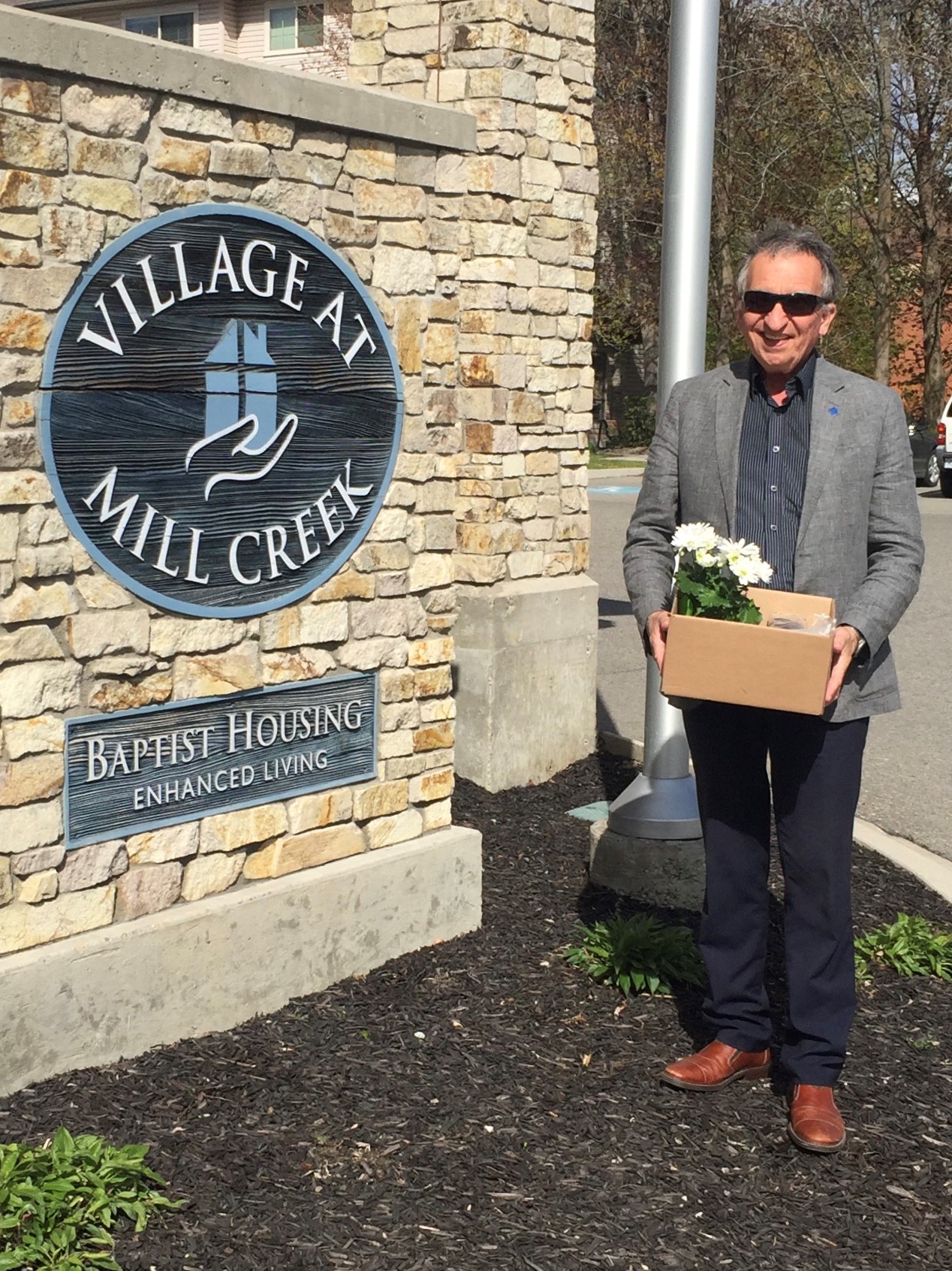
During the COVID-19 pandemic, Michael Loewen, REALTOR® with Royal LePage Kelowna and member of the Okanagan Mainline Real Estate Board, has teamed up with Kelowna-based chef Masayuki Negoro to provide high-quality meals to vulnerable people in the Kelowna area. Masayuki prepares the meals and Michael delivers them throughout the community.
Chef Masayuki shared the following on his social media:
"Thank you to Michael Loewen for delivering my meal packages throughout Kelowna. I really appreciate you volunteering to help feed our community! I hope all of you that received a package enjoy your meals. Much love to you all!"
Thank you, Michael, for taking care of your community during this challenging time.
If you have a story to share, please email [email protected].
COVID-19 Community Care: REALTORS® Support Mental Health Fund for Frontline Workers
Over the past several months, we've been sharing stories about the many Realtors across BC who are supporting their communities through the COVID-19 pandemic.

During the COVID-19 pandemic, Dexter Realty held their annual REALTOR® awards to recognize those agents who, in the preceding calendar year, exemplified the highest standards of work ethic, skill, and focused effort – in both the company and the broader real estate profession.
Given the current circumstances, the winners of the 2019 Dexter Realty Awards chose to forego their personal awards and gifts so that the funds could instead be donated to the Resilience Without Barriers Fund.
The Resilience Without Barriers Fund was created by the BC Professional Fire Fighters’ Association to support the mental health of frontline workers during the pandemic. This fund provides emergency workers with access to counselling sessions with a trauma clinician at First Responder Health Services.
Thank you Dexter Realty for supporting our frontline workers.
COVID-19 Community Care: Surrey REALTOR® Takes Part in Diaper Drive for Mothers in Need
Over the coming weeks, BCREA will share stories about the many REALTORS® across BC who are supporting their communities during the COVID-19 pandemic.

During the COVID-19 pandemic, Manny Chatha, REALTOR® with Team Randy Mann Homes of Stonehaus Realty and member of the Fraser Valley Real Estate Board, has taken on a number of initiatives to help support his community.
Manny, alongside all of Team Randy Mann Homes, partnered with Mamas for Mamas Vancouver to organize a diaper drive for mothers in need. Together, they were able to donate more than 10,000 diapers.
Manny has also been working with Khalsa Aid Canada and Neighbors Helping Neighbors to help deliver meals to vulnerable people and struggling families.
Thank you, Manny, for taking care of your community during this challenging time.
If you would like to join Manny in any of his initiatives please contact him at [email protected].
If you have a story to share, please email [email protected].
COVID-19 Community Care: Vancouver REALTOR® Supports Frontline Workers
Over the coming weeks, BCREA will share stories about the many REALTORS® across BC who are supporting their communities during the COVID-19 pandemic.

During the COVID-19 pandemic, Kam Garcha, REALTOR® with Sutton West Coast Realty and member of the Real Estate Board of Greater Vancouver, and his wife Jessica Garcha started Subs-4-Scrubs, a local initiative to support frontline workers in BC.
As Subway Restaurant franchise owners in Richmond, Kam and Jessica wanted to use their Subway restaurant to give back to the community. The mission behind Subs-4-Scrubs is to provide Subway sandwiches to frontline workers in hospitals and units across the Greater Vancouver and Fraser Valley areas.
If you would like to donate to Subs-4-Scrubs, you can access the GoFundMe page here. 100% of funds raised go toward providing Subway sandwiches to frontline workers across Greater Vancouver and the Fraser Valley.
Thank you, Kam and Jessica, for taking care of frontline workers and your community during this challenging time.
If you have a story to share, please email [email protected].
COVID-19 Community Care: Victoria Brokerage Shares Positive Messages with Community
Over the coming weeks, BCREA will share stories about the many REALTORS® across BC who are supporting their communities during the COVID-19 pandemic.

During the COVID-19 pandemic, Sotheby's International Realty Canada, Victoria office started a campaign to help create a positive impact in their community. Given that their office is in a high traffic location in downtown Victoria, this brokerage posted the following messages in their windows to remind others how they can have a positive impact during this trying time:
- Support Small Business
- Give Blood
- Check on Friends, Neighbors, and Family
- Donate to a Food Bank
- Feeling Lost? Reach Out
While it may feel like there's nothing we can do to change the current circumstances, these messages remind us that we each have the power to create positive change in our communities. To read each message in more detail click here.
Thank you Sotheby's International Realty Canada, Victoria office for sharing these messages and reminding us of the ways we can support each other through the pandemic.
COVID-19: Population Growth and Housing Demand
To view the Market Intelligence Report PDF, click here.
Summary Findings:
- Immigration is the most important driver of population growth in BC, with a growing share within the prime working-age and household-forming demographic.
- The global pandemic has resulted in a sharp drop in immigration and consequently BC reporting one of the lowest quarterly increases in population growth since 2011.
- In the short term, the impact of lower population growth will weigh most significantly on the rental market due to a significant reduction in international students and new permanent residents.
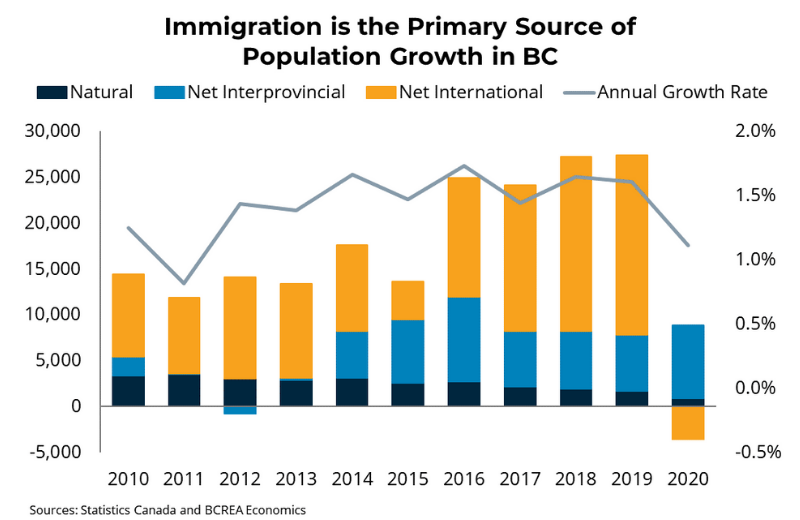
For more information, please contact:
Brendon Ogmundson
Chief Economist
Direct: 604.742.2796
Mobile: 604.505.6793
[email protected]
Kellie Fong
Economist
Direct: 778.357.0831
Mobile: 604-366-6511
[email protected]
To subscribe to receive BCREA publications, or to update your email address or current subscriptions, click here.
COVID-19: Resources for REALTORS®

Last updated: July 1, 2021
The provincial state of emergency that was in place for more than a year has now been lifted. For British Columbians, this means unlimited indoor and outdoor personal gatherings, an end to mask mandates and the freedom to travel within Canada. For REALTORS®, this means the option to return to open houses and in-person showings.
As we progress through BC's Restart Plan, we must still keep the safety of our communities top of mind and continue to follow the advice and recommendations of regulators, public health officials, and government.
Specifically, brokerages should review WorkSafeBC's Communicable Disease Prevention Guide for Employers and ensure brokerage staff and Realtors follow safe practices to help reduce the risk of workplace transmission of COVID-19 and other communicable diseases.
While most of the COVID-19 guidance on this page no longer aligns with public health orders, we will continue to maintain this page, providing new information and resources as they become available.
The content is divided into six sections:
- Financial Aid: understanding and accessing financial supports.
- Conducting Transactions: conducting real estate transactions while practicing social distancing.
- Standard Forms & Liability: understanding contracts, standard forms, FINTRAC compliance and liability.
- Economic Impacts: guidance from BCREA Economics on market impacts.
- Supporting Clients: information to support your clients.
- Professional Development: continuing your professional development online.
Financial Aid
- One Year Later: Government Financial Support for REALTORS® During COVID-19 (Canadian Real Estate Association)
- Economic supports for businesses (Government of BC)
Conducting Transactions
- Safe Practices Checklist for Managing Brokers (Updated December 7/20)
- UPDATED: As Case Counts Rise, REALTORS® Should Continue to Prioritize Health and Safety (Updated May 5/21)
- UPDATED: Selling Tenant-Occupied Properties During the COVID-19 Pandemic (Updated May 5/21)
- UPDATED: COVID-19: REALTORS® and Consumers Can Travel for Real Estate Transactions (Updated May 4/21)
- REALTORS® and COVID-19: Three Tips for Working During the Hot Market (Posted March 10/21)
- Updated Guidance for Real Estate Practice During COVID-19 (Updated January 14, 2021)
- Conveyancing Considerations During the COVID-19 Pandemic (Posted December 8/20)
- REALTORS® Encouraged to Continue Safe Business Practices in Light of New Public Health Orders (Posted November 20/20)
- Continue to Use Virtual Tools When Possible to Market, Show and View Properties (Posted November 12/20)
- Real Estate Professionals Urged to Stop Open Houses: Regulators and Provincial Association Recommend Virtual Tools (Posted November 5/20)
- Safer Showings During BC’s Second Wave (Posted November 5/20)
- Blanket Ban on Residential Evictions Ends (Posted June 25/20)
- Podcast: Episode 7 - Returning to Work & Risks to Realtor Reputation (Posted May 28/20)
- UPDATE: Extension of BC's State of Emergency: What it Means for REALTORS® (Updated May 28/20)
- Conducting Live Virtual Tours During COVID-19 and Beyond (Posted April 24/20)
- Home Inspection Protocols During COVID-19 (Posted April 22/20)
- PODCAST: Episode 5 - Conducting Business During COVID-19 (Posted April 20/20)
- CREA Introduces Feature to Highlight Live-Streamed Open Houses on REALTOR.ca (Posted April 9/20)
- UPDATE: Conveyancing in the Time of COVID-19 - So Far (Updated April 3/20)
- Three Ways to Virtually Show a Property During COVID-19 (Posted March 26/20)
Standard Forms & Liability
- UPDATE: Dealing with Contracts and Disclosure Requirements (COVID-19 FAQ) (Updated November 12/20)
- New COVID-19 Presumption in the Workers Compensation Act (Posted September 10, 2020)
- Using CREA’s Health Waiver (Posted June 3, 2020)
- BCREA Creates Notice & Acknowledgement Form for Use During COVID-19 Pandemic (Posted April 22/20)
- PODCAST: Episode 4 - COVID-19 Standardized Clauses, and Financial Support (Posted April 9/20)
- How Can REALTORS® Protect Themselves Against Liability During the COVID-19 Pandemic? (Posted April 8/20)
Economic Impacts
- UPDATE: COVID-19 Reopening Dashboard (Updated April 28/21)
- COVID-19: Population Growth and Housing Demand (Posted October 28/20)
- “The Unusual World of Pandemic Economics” – Why BC’s Housing Market Remains Strong Despite COVID-19 (Posted September 9/20)
- Monitoring COVID: BCREA Develops New Economic Resources (Posted September 2/20)
- UPDATE: COVID-19 Economic Impacts Dashboard (Updated August 28/20)
- Webinar Recording: “The End of The Beginning” and BC’s Real Estate Sector & Economy (Posted May 28/20)
- Is It Different This Time? Recessions and the BC Housing Market (Posted April 20/20)
Supporting Clients
- COVID-19 and a Different Type of “Exposure” Risk (Posted July 16/20)
- Managing Online Communities While Returning to Operation (Posted June 12/20)
- Communicating During Stressful Times (Posted April 19/20)
Professional Development
- PODCAST: Episode 6 - How to Stay Productive During COVID-19 (Posted April 30)
- Helping REALTORS® Invest in The Future: PDP Discounts During COVID-19 (Posted April 30)
- Five Ways for REALTORS® to Keep Busy During COVID-19 (Posted April 30)
- Online Education During the COVID-19 Pandemic (Posted April 30)
To subscribe to receive BCREA publications, or to update your email address or current subscriptions, click here.
CPI Rental Increase Formula; Woodstoves; Vendor’s Continuing Liability to Mortgagees Following Sale #44
By Gerry Neely
B.A. LL.B.
Column 41 discussed a matter raised by the Vancouver Island Real Estate Board concerning the potential uninsurability of a home whose owner failed to disclose to his insurer that a woodstove was a source of heat within the home. That drew a comment from an agent in the lower mainland, that in the agent's opinion, disclosure was only necessary in areas where there is no fire protection. The agent felt that this problem would not apply to a home in the Greater Vancouver area or in any area around a major urban centre. In case of doubt, check.
The same column referred to Column 6 written in June, 1981, which contained a formula for adjusting rentals based upon increases in the Vancouver Consumer Price Index. The formula became less meaningful as a result of the change this year by Statistics Canada in the base year from which increases in the Consumer Price Index are measured. That change converted the official base year from 1971=100 to 1981=100. We repeat below (courtesy of Statistics Canada) both the factors and the methods by which the CPI can be converted from a 1971 or 1981 base year to a 1978 base year.
To convert the CPI to a 1978 base using 1971=100, the factor for conversion is 100/177.4 or .56369; and using 1981=100, the factor is 100/74.3 or 1.34589. For example: year 1971=100 X factor = 1978=100; 1981=100 X factor = 1978=100.
| 1978 | 177.4 | x .564 | = 100 | 74.3 | x 1.346 | = 100 |
| 1979 | 191.1 | = 107.7 | 80.0 | = 107.7 | ||
| 1980 | 209.0 | = 117.8 | 87.5 | = 117.8 | ||
| 1981 | 238.9 | = 134.7 | 100.0 | = 134.6 | ||
| 1982 | 264.0 | = 148.8 | 110.5 | = 148.7 | ||
| 1983 | 280.9 (July) | = 158.3 | 117.6 | = 158.3 |
The minor differences result from the rounding to one decimal place of the published indexes. For anyone wanting clarification or the factor for converting to a rental base year other than 1978, I would recommend calling Statistics Canada, the Enquiries Officers, 666-3691, Vancouver, B.C. (or toll free 112-800-663-1551).
The Real Estate Council is concerned that an owner of property which has decreased substantially in value and who has sold his property for little or nothing down to a purchaser who assumes a mortgage for which the owner is personally liable, may not be aware of his continuing liability. If the purchaser defaults in payments to the mortgagee, the vendor who signed the mortgage may be joined in the foreclosure action, and held to be liable for any amount the mortgagee is unable to recover from the sale of the mortgages premises. If that occurs, Section 20 of the Property Law Act implies a covenant on the part of a purchaser to pay the mortgage registered against title, and to indemnify the vendor against any payment or liability which the vendor incurred at the time the vendor signed the mortgage. However, that right of indemnification may be of little value if the purchaser lacks assets or income, and it is for that reason it is suggested that vendors should be made aware of their continuing liability.
To subscribe to receive BCREA publications such as this one, or to update your email address or current subscriptions, click here.
CRA Launches Calculator for Wage Subsidy Program
Canada Revenue Agency (CRA) has launched an online calculator to help employers estimate the amount of wage subsidy they can expect if they apply for the Canada Emergency Wage Subsidy (CEWS). This calculator will help you to determine some specific line amounts that you will need to enter into the CEWS application form once it becomes available on April 27.
The CEWS amount will be based on the number and type of eligible employees you have and the amount and type of pay they received before and during the crisis.
To use the calculator and learn more, click here.
For more information and resources related to real estate practice during the COVID-19 pandemic, visit the BCREA COVID-19 resources page.
To subscribe to receive BCREA publications, or to update your email address or current subscriptions, click here.
CREA announces new WEBForms® service provider
In November, the Canadian Real Estate Association (CREA) announced it will be transitioning to a new service provider for CREA WebForms® in 2019. The new CREA WEBForms® will be powered by the leading transaction management platform TransactionDesk® by Lone Wolf Technologies.

The Fraser Valley Real Estate Board (FVREB) first developed WEBForms and sold it to CREA in 2001. For nearly 18 years, FVREB regularly provided CREA with the infrastructure, support and product oversight to ensure REALTORS® across Canada could efficiently work with their clients. We thank FVREB for their innovation and commitment to enhancing the Canadian real estate profession.
What does this new partnership with TransactionDesk® mean for BC REALTORS®?
TransactionDesk® offers cloud-based real estate business tools for seamless transactions with clients. BC REALTORS® can look forward to a number of new features, including:
- unlimited TransactionDesk® storage for signed and third-party documents, task management, checklists and more;
- freedom of choice with regards to leading digital signature, document management and transaction management add-on applications; and
- integration with REALTOR® Load (ADT).
We understand this will be a significant transition for members and are committed to working with CREA and real estate boards to ensure training resources will be available. CREA has yet to provide its 2019 rollout schedule, but we'll share more news as it becomes available.
For more information and to read CREA's new release about the new partnership, click here.
To subscribe to receive BCREA publications such as this one, or to update your email address or current subscriptions, click here.
CREA Changing National Login System
Mark your calendars for Tuesday, September 26, 2023, as the Canadian Real Estate Association (CREA) launches an advanced and more secure login experience across its offerings. This will also affect how you log in to BCREA Access, BCREA’s self-paced online courses, and CREA’s Learning Hub.
CREA's existing login system has been reliable and valuable to REALTORS®, boards, and association staff; however, as with all technology, it needs to be upgraded. The new REALTOR.ca Single Sign-On offers an enhanced user experience and an improved security solution by implementing multi-factor authentication (MFA), ensuring a more robust and user-friendly platform. Furthermore, the new account will be a gateway to links embedded within your board/association's dashboards or MLS® System.
As BCREA Access, BCREA’s self-paced online courses, and CREA’s Learning Hub are accessible using CREA’s login system, we encourage you to set up your new account early to ensure a seamless transition and continued access to BCREA’s and CREA’s services.
The sooner you create your account, the better. Starting Tuesday, September 5, when trying to log in to CREA's existing login system, you’ll be redirected to another login page with a pop-up to create your new account. By Tuesday, September 12, users who haven’t created their accounts will have to register to further access any BCREA or CREA services.
Remember that you must keep using your current credentials until the new login experience is launched on Tuesday, September 26, 2023.
CREA recommends not to use group emails or shared accounts when setting up your account, so please consider this when creating it.
Find more information and answers to your questions at the CREA Updated National Login Experience FAQ:
Why is CREA implementing these changes?
CREA has decided to revamp its national login system to a single sign-on authentication for several compelling reasons, which include:
- enhancing password management;
- elevating user security and privacy, introducing MFA;
- improving user experience with a single set of secure credentials; and
- integrating third-party applications.
How to create your new account:
You can make a new account using two methods:
- Click the unique link in the email sent to the same address where you currently receive your REALTOR.ca email leads.

2. In case you don’t receive the email or prefer to do it right away, starting Tuesday, September 5, you can follow the instructions in the popup window that will appear when you sign into BCREA services, such as as BCREA Access, BCREA’s self-paced online courses, CREA’s Learning Hub, CREA WEBForms®, member.REALTOR.ca, member.CREA.ca, and other CREA products using your current login.
Remember, if you haven’t set up your new account by Tuesday, September 12, the next time you try to login you will be prompted to create a new account to access all BCREA and CREA services.
To create an account, you’ll need:
- A unique email address you can easily access (don’t use a shared email address such as a team email address).
- A secure password that follows standard password complexity rules (a mix of special characters, both upper and lower-case letters, and an appropriate length).
- A mobile phone number for MFA (Canada/U.S. numbers only).
You can find more information and answers to your questions about this process at the CREA Updated National Login Experience FAQ.
CREA Introduces Feature to Highlight Live-Streamed Open Houses on REALTOR.ca
As COVID-19 continues to impact the way REALTORS® conduct business, virtual showings and living-streaming of open houses have become useful tools for Realtors looking to replace traditional in-person viewings.
In support of virtual practices, the Canadian Real Estate Association (CREA) has introduced a new feature on REALTOR.ca that allows Realtors to highlight live stream open houses directly on their REALTOR.ca listing.
REALTOR.ca supports all major live-streaming platforms, including popular choices such as Facebook and Instagram Live. The process is simple – just visit REALTOR.ca/golive and enter the details of your live stream under each of your listings. Clients will then be able to scroll through scheduled live showings and add the event to their calendars.
For a quick start guide on how to use this feature click here.
In addition to live streaming, REALTOR.ca continues to support 10 virtual tour and video services, including:
- Matterport
- YouTube
- iStaging
- immoviewer
- iGUIDE
- Property Panorama
- Realvision
- Vimeo
- Imagemaker360
- ListSimple
As Realtors continue to adjust how they help clients buy and sell properties during the COVID-19 pandemic, technologies such as virtual tours and live streaming can help Realtors serve their clients while following government protocols and ensuring everyone’s safety.
To subscribe to receive BCREA publications, or to update your email address or current subscriptions, click here.
CREA’s Standards of Business Practice Establishing REALTOR’s Duties #153
By Gerry Neely
B.A. LL.B.
The extent to which the CREA Code of Ethics and Standards of Business Practice are factors in a judge's decision involving the liability of licensees is illustrated by the following case.
A husband and wife listed their home for sale with an agent because the wife had a serious medical problem made worse by the polluted air in the city of Hamilton where they lived. The listing agent was aware from her discussions with the couple, that they wanted to relocate in an area where there was clean fresh air. While one might assume that need could only be met in British Columbia, their search for clean air took the listing agent and the couple into the countryside around Hamilton, an area unfamiliar to the listing agent.
She enlisted the help of an agent who knew the real estate in the area where clean air was thought to exist. The second agent was told that this was the reason they were looking at real estate in his district. This agent took the couple to a property listed by him which in every respect seemed to them to be satisfactory. Their home having sold, when the second agent said to them, "If you are looking for healthy property, that's it", they made an offer which was accepted.
Before the completion date, they learned that the property directly across the road from the property they had agreed to purchase, was a potential land fill site. They refused to complete their purchase and they were successfully sued by the vendor for damages of approximately $18,000. In turn they sued both agencies to recover the amount they had paid in damages.
The Judge reviewed the evidence and then asked, what is the standard of care owed by the agents to the couple. The Standard of Business Practice was introduced into evidence for the purpose of establishing thc duties of REALTORS with respect to all parties, including the purchaser. He reviewed Articles 2 and 3. Article 2 imposes a duty upon a member to promote the interest of his client without relieving the REALTOR from the obligation of dealing fairly with all other parties to the transaction.
Article 3 requires a member to disclose all pertinent facts concerning every property so that he may fulfill his obligation to avoid error, exaggeration, misrepresentation or concealment of pertinent facts.
The listing agent who had sold the couple's home no doubt said that since she did not know the area, she fulfilled her responsibility to the special need of the couple by bringing in the knowledgeable second agent. The Judge decided that in these special circumstances, the listing agent's responsibility was to satisfy herself that the property recommended by the second agent was in fact the property the couple required. She could not rely upon the second agent - she had to make her own inquiries.
The second agent's liability arose from his failure to disclose the existence of the potential dump site. The Judge questioned the second agent about this lack of disclosure of what the Judge considered to be a pertinent fact. The agent said that he would have disclosed its existence if he had known that it was intended to be used as a landfill site.
But since it was only a potential site, he believed that if he had given the couple this information, that would have been working against the interests of his vendor. The Judge decided that the second agent had a duty to disclose this information. In the Judge's opinion, the statement by the second agent that the property was healthy property was a negligent misrepresentation upon which the couple relied. Had they been aware of this pertinent fact, they would not have offered to purchase the property.
The two agencies were branches of the same company. The Judge's decision was that the Company was liable because knowing of the special needs of the couple, it should either have protected those needs, or not placed itself in a position of "real conflict by representing both vendor and prospective purchasers".
One might question the finding of liability against the first agent who had relied upon the experience of the second agent in an area with which she was unfamiliar. The Judge must have been influenced by the very serious nature of the wife's problem, which had progressed to the point where a double lung transplant was necessary.1
| 1. | Patay v. Hutchings et al. 6 R.P.R. (2d) p. 121. |
To subscribe to receive BCREA publications such as this one, or to update your email address or current subscriptions, click here.
Criminal Rate of Interest #243
By Gerry Neely
B.A., LL.B.
An interest rate in excess of 60% is illegal under Section 347 of the Criminal Code. In one case, a $10,000 bonus on an advance of $180,000, secured by a mortgage for $190,000, to be repaid in 30 days without interest, resulted in an effective annual interest rate of 89%.
The lawyer who drew this mortgage was held to be negligent because he failed to consider the effect of Section 347. The case does not establish new law, but serves as a reminder to all professionals who may be involved in the preparation of contracts for short-term loans, that a relatively small bonus can lead to a criminal rate of interest.1
***
The question of whether a contract is enforceable often turns upon whether its essential terms are certain. This question arose in a case involving a defaulting purchaser who was trying to recover a $100,000 deposit made in a contract containing the terms of a vendor takeback mortgage.
The first argument that the contract was uncertain because it failed to state whether the mortgage was "open" or "closed," was lost when the judge said that this was not an essential term of the mortgage. The second argument did involve an essential term, namely, that interest was payable at "12% from closing date" upon a principal sum, which was to be repaid in two equal annual installments.
Nothing was stated as to when interest would be paid or how it would be computed. In earlier cases, the absence of these terms led to findings of uncertainty which made the contracts unenforceable. In this case, both parties had stated on cross examination their understanding that the interest would be annual interest and each payment would include principal and interest. The judge admitted this evidence to give the vendor the deposit.2
***
While the principles establishing fiduciary duties may have arisen in cases involving agency, trustees, partners, directors, accountants, lawyers and other persons giving advice, a BC court has extended the relationship to a contract between two homeowners and a project manager.
The homeowners, who were new immigrants to British Columbia, were prepared to purchase an existing house if it could be renovated for between $50,000 and $60,000. The project manager, who claimed to be familiar with construction practises, said that the work could be done for close to that amount.
A contract for $63,000 was entered. The work was done slowly and badly and ultimately was completed by another contractor at a cost that was $29,000 in excess of the contract price.
In the court action that followed the homeowners found that the project manager had obtained three bids for the renovations ranging from $80,000 to $132,000. The lowest bidder was persuaded to reduce his bid to get the job and the project manager was aware that the work would not be high quality. The homeowners also found that the project manager was paid $2,500 by the builder to get the job.
The homeowners were entirely dependent upon the project manager's advice in all matters, and they expected the project manager to exercise his discretion in their best interests. Their lack of knowledge of the country to which they had immigrated made them particularly vulnerable in attempting to exercise any control over the project manager's discretion.
The judge found that the project manager's failure to act in the best interests of the homeowners, to the exclusion of his own interest, was a breach of fiduciary duty. The damages which were awarded included the $29,000 cost to the renovations, the $2,500 secret commission and punitive damages of $2,500.
One conclusion to draw from this decision is that a REALTOR's fiduciary duty may increase in proportion to, or to the extent of, the inexperience of the other party in the subject matter of the contract being negotiated.3
To subscribe to receive BCREA publications such as this one, or to update your email address or current subscriptions, click here.
Cybersecurity Tips for REALTORS®: Multifactor Authentication
With most of our business being conducted online, REALTORS® and managing brokers must be aware of good cybersecurity practices. Ensuring your digital accounts are secure online prevents hackers from obtaining not just your sensitive information, but also private client information.
In a recent Community of Practice for Managing Brokers session, BCREA Technology Manager, Mairon Batista, presented about multifactor authentication (MFA). If you missed the session, you can find the recording on our Community of Practice page (BCREA Access login required).
What is Multifactor Authentication?
“Multifactor authentication” or “two-step verification” is a process to confirm your identity when you try to sign in to an application. There are three ways a computer or a system can identify you. It can ask for:
- a pin or password;
- a card, badge, USB key, cellphone; or
- biometrics (fingerprint or facial recognition).
Many online services like social media, email and government services like the Canadian Revenue Agency use MFA. Often, MFA occurs when you log in to an account on a new device or web browser. This additional step prevents hackers from breaking into your account with a compromised username and password.
It is less likely that a hacker can log into your accounts and systems if you use MFA in your daily operations.
Another critical point to note is that using SMS or text message codes as a factor of authentication is not the best practice anymore. Hackers can copy phone numbers and intercept text messages. Instead, using authenticator apps on your smartphone is more secure. Here are some of the best multifactor authenticator applications:
Most major services and applications give you the option to set up MFA. Examples are Facebook, Instagram, Twitter, LinkedIn, Dropbox, Amazon Web Services, WordPress, Office365, and G Suite.
And always be mindful that you provide the code to the authentic website, not a fake one.
Reasons to Use Different Passwords
Given the increase in security threats in today’s world, a complex password is not enough to prevent cyber-attacks and breaches. Therefore, incorporating MFA is the best practice.
Additionally, using different passwords can prevent potential cybersecurity breaches when emails and usernames are easily searchable.
A hacker simply needs a victim’s username or email and password. So how do hackers get your credentials you may ask? A huge part of this is due to weak or stolen passwords hackers may obtain from a previous data breach and reuse the stolen credentials across the internet.
Another way hackers can gain access to an organization’s network is through password spraying. This hacking tactic is when hackers try a specific password across many accounts before moving on to the next one.
Here are some password management tips:
- Replace the password with a pattern. For instance, use a unique code or pattern formed out of letters or numbers.
- Use various numbers, symbols, and upper and lower-case letters.
- Avoid reusing passwords.
What else can you do to protect yourself?
Despite our best efforts to be safe online, hackers are savvy. So be aware of social engineering tactics regarding your interactions online. Social engineering is the art of exploiting human psychology rather than technical hacking techniques to gain access to networks, accounts, or data. Read more about social engineering and how to spot it in this blog post by CSO.
Furthermore, you should educate yourself and your peers on the latest cybersecurity best practices and incorporate extra security measures into your business. Here are some other practice tips to enhance your cybersecurity awareness:
- Do a review in your organization of what services you use. Then, log in and check if you can activate MFA or two-factor authentication.
- Ask yourself: what would impact our organization if someone had access to this account or service? Usually, besides a financial impact, there is also the risk of repetitional damage.
- Enrol in cybersecurity awareness training.
- Follow Cybercrime Magazine to stay up to date with best practices.
- Apply for cyber insurance via BCREA’s affinity insurance program for managing brokers.
Damages Awarded When Prospective Buyers Failed to Complete the Sale of Their Home #18
By Gerry Neely
B.A. LL.B.
Two commissions paid but only one completed sale, and damages awarded of $43,588.98, all arising from the failure of prospective purchasers to complete the sale of their own home. The unfortunate prospective purchasers made an unconditional offer to purchase Horton's house, expecting to receive funds from the sale of their home. That did not occur, leaving the purchasers no alternative but to advise Horton that they could not complete their purchase of his house on July 15th, 1981, for $152,000.00 cash. Horton re-listed his property for sale in late July at $142,000.00, but because of the weak market conditions prevailing in Victoria in the second half of 1982, it was not until February 9th, 1982, that Horton received $125,000.000 upon the re-sale of his home. Horton sued and the Court held that there was a binding contract of purchase and sale between the parties which the purchasers had repudiated. Horton was entitled to the following damages:
Loss on Resale was fixed at $24,000.00, the difference between the price which should have been paid on July 15th, 1981, namely $152,000.00, less the sum of $125,000.00, less the deposit of $3,000.00 paid to the real estate agent.
Interest of $16,457.64 for the interest lost by Horton on the purchase price that he should have received on July 15th, 1981. This calculation was based on rates set for Court Order interest.
Loss of Second Commission was fixed at $5,545.00. The Hortons had entered into the usual Victoria Real Estate Board Multiple Listing contract, which provides that the commission is payable upon "a binding contract of sale/exchange of the said property being entered into during the said period". The Court having held that a binding contract of sale had existed, the real estate agent who had the first listing, was entitled to his commission. The repudiation having forced Horton to re-list his property, the measure of his damages included the commission he had to pay upon the re-sale of his property.
Municipal Taxes - $863.98.
Insurance - $173.00.
Total - $47,038.98.
Deducted from this amount was the sum of $3,500.00, an amount equal to five months' rental which might have been earned at the rate of $700.00 per month had Horton attempted to mitigate his damages by renting his home for at least five of the seven months it was vacant. The Hortons had moved into their new home one week before they expected to give possession to the prospective purchasers on July 15th, 1981. The Court agreed that they could not realistically be expected to move back in to mitigate their damages, but seven months vacancy seemed unreasonable. This, in spite of evidence by Horton of advice from his counsel to leave it empty because it would probably take three months to get an interim tenant out if an offer were accepted from a purchaser who wanted possession. Undoubtedly, the advice was good when given because no one expected it to take seven months to find a purchaser.
The plaintiff had tried to claim a larger amount of interest paid by the plaintiff for interim financing arranged before the first listing of the property was given. The purpose of the interim financing was to cover the financing needed on the property they intended to sell and on their newly purchased home. The Court held that since the defendants in the action were not aware of Horton's financial arrangements, they should not be required to reimburse Horton for the unforeseeable (by the defendants) extra interest charges which Horton had to pay.
| 1. | Horton u. Zirul,34 B.C.L.R. 234. |
To subscribe to receive BCREA publications such as this one, or to update your email address or current subscriptions, click here.
Damages for Breach of Contract – Avoided or Reduced #64
By Gerry Neely
B.A. LL.B.
Usually a judge will not assist a person who is in breach of contract, to avoid the consequences of that person's default. One would expect this to be particularly true where the contracting parties agreed that the default of one party would result in "pre-estimated" damages becoming payable to the other party. However, the interpretation of a statute or the application of a rule of law may help the defaulting party to avoid or to reduce the damages he agreed to pay.
In one case, a mortgagor signed a mortgage that provided that if default occurred, the mortgagee was not required to accept the principal sum unless "bonus of three months' interest was paid on the principal money in default". The mortgage was not paid at its date of maturity and the mortgagee refused to accept from the mortgagor the principal sum plus a per diem rate of interest at the mortgage rate, to the date of payment. Instead the mortgagee demanded an additional $30,000.00, an amount equivalent to three months' interest under the mortgage. Section 8 of the Interest Act of Canada prohibits a penalty on arrears of principal secured by a mortgage of real estate, that has the effect of increasing the charge on such arrears beyond the rate of interest payable on principal monies not in arrears. The mortgagee argued that the Section could not be applied in this circumstance because all of the principal monies were in default and therefore there was no principal money not in arrears. The British Columbia Court of Appeal rejected this argument and found that notwithstanding the agreement by the mortgagor to pay the bonus, the mortgagee could not collect it because that would be a breach of the Interest Act.1
In a second case, a developer paid a mortgage broker $30,750.00 and a life insurance company $61,500.00 as a fee for obtaining the mortgage loan and as a stand-by fee respectively. When the developer decided to sell rather than to build, it sued for the return of the stand-by fee. The agreement with the insurance company provided that the sum of $61,500.00 was to be retained by it as liquidated damages and not as a penalty, "it being agreed by all parties the $61,500.00 represents a fair estimate of such estimated damages". However, on the evidence presented by the insurance company, the Judge held that a generous allowance for costs of the insurance personnel involved in the approval of the loan, which were thrown away as a result of the developer's default, would be $15,000.00. The insurance company did try to prove that it had incurred a substantial loss of investment income as a result of setting aside the mortgage monies in short term investments which earned less interest than the long-term investments that would otherwise have been made. This evidence was too inconclusive to be accepted, but had it been, the additional investment loss would have established the pre-estimate of damages as being reasonable. However, the pre-estimate was "so extravagant, exorbitant or unconscionable" in relation to the actual loss suffered by the insurance company that it could only recover its actual loss.
During the course of cross-examinations, the developer discovered for the first time that the mortgage broker had also received a fee from the insurance company. The developer argued that the mortgage broker was its agent and that since the interests of the insurance company were adverse to those of the developer, the mortgage broker could not act for both without first obtaining the consent or waiver of the developer. The Judge agreed with the developer that the mortgage broker was in breach of its fiduciary duty to its principal, and ordered repayment to the developer of the sum of $30,750.00.
Therefore, in spite of the written contracts with both the mortgage broker and the life insurance company, the developer was reimbursed for substantially all of the money it had agreed to pay.2
| 1. | Adams Properties Ltd v. Sherwood Estates Ltd., 144, D.L.R. (3d), p. 562. | |
| 2. | Cumberland Realty Group v. B.L.T. Holdings Ltd., 32 R.P.R. 9.. |
To subscribe to receive BCREA publications such as this one, or to update your email address or current subscriptions, click here.
Damages in Lieu of Commission #62
By Gerry Neely
B.A. LL.B.
The advantages of a listing agreement which fully describes the basis upon which a commission is earned and the obligations of the owner toward the listing agent, in order to support a claim for commission or for damages in lieu of commission, are illustrated by the facts of the following case.
In a foreclosure action brought by a first mortgagee, a second mortgagee was given exclusive conduct of sale with liberty to list the property with an agent. An exclusive listing agreement was entered into with an agent which provided that a commission would be paid if a binding contract was entered into during the term of the exclusive listing or if the agent's efforts were the effective cause of a binding contract of sale being entered into at any time. In addition, if someone was introduced to the property during the term of the exclusive listing agreement, who was ready, willing and able to purchase on the terms contained in the listing agreement or who purchased on other terms, the agent was entitled to a commission even if he had not produced the introduction.
The listing agent actively marketed the property but had not found a purchaser by the date the second mortgagee's right of conduct was to expire. Three days after the date the conduct of sale expired, the second mortgagee accepted an offer from a company whose principal directors had seen the property during the period of the exclusive listing given to the agent. The serious negotiations which led to the acceptance of the offer had taken place over a period which began about eight days prior to the expiration of the listing. A week later, the Supreme Court granted an Order that the offer be accepted, and a few weeks later the agent discovered that the property had sold for $1,750,500.00. The agent sued for commission of $89,285.00. The Court held that the agent's claim for commission could not succeed for these reasons: (a) the purchaser had neither entered into a binding contract of sale during the term of the listing agreement nor was the agent the effective cause of the sale; (b) although the purchaser was introduced by the second mortgagee to the property during the term of the exclusive listing agreement, an earlier Court of Appeal decision held that the agent's right to claim a commission upon this basis depended upon both the introduction and the purchase taking place during the term of the listing agreement.
All, however, was not lost. The listing agreement contained the following sentence which no doubt is in all Board listing contracts:
"I further agree to refer to you all enquiries for purchase of the property and communicate to you all offers of purchase which may be received during the term of this exclusive listing agreement."
It was clear that the second mortgagee was in breach of his agreement to refer all enquiries for the purchase of the property to the agent. In spite of this breach, the agent's right to recover damages depended upon whether the judge could conclude that on a balance of probabilities a binding purchase agreement could have been reached during the term of the listing agreement rather than three days after it had expired. The judge decided that the licensee, who was an experienced real estate sales agent, would have been able in a shorter period of time than it took the second mortgagee and the purchaser, to prepare an agreement acceptable to the first mortgagee and in a form that could be presented to the Court for approval.
His decision, then, was that the agent was entitled to damages but not for the full commission of $89,285.00. The damages were reduced to four per cent of the gross selling price, or $51,000.00. The rationale behind this reduction was the evidence of the agent that it would have been prepared to negotiate a lower commission, having regard to the fact that the second mortgagee did locate the purchaser.
| 1. | Wolstencroft Realty Corporation v. Ashcroft Holdings Ltd,S.C.B.C., 33 R.P.R. 206. |
To subscribe to receive BCREA publications such as this one, or to update your email address or current subscriptions, click here.
Damages, Deposits; Separate Legal Representation for Vendors #26
By Gerry Neely
B.A. LL.B.
In an Ontario case which arose because of a purchaser's refusal to close a real estate transaction, the vendors were awarded S5,000.00 general damages for the "vexation, frustration, distress and anxiety, caused solely by the failure of the Defendants (Purchasers) to complete this transaction upon the date agreed upon." This was in addition to special damages totalling $28,247.00. The Court held that the purchasers knew that the vendors were purchasing another home and that they required the proceeds of the sale in order to complete that purchase, and that it must have been within the contemplation of the purchasers that their refusal to close the transaction would result in the mental anguish experienced by the vendors.
(Widdington v. Dickinson, 133 D.L.R. (3rd) part 2 page 472)
On another matter, an agent holding in trust a deposit which is larger than the commission, is often asked to pay the excess to the purchaser's solicitor prior to closing, so that the solicitor has in trust the full amount owed to the vendor by the purchaser, less the amount of commission payable to the agent. This amount should not be paid even with the consent in writing of the parties, unless the solicitor is asked to undertake to return it in the event that the transaction does not complete. A failure to do so may deprive the vendor of the benefit of having the large deposit if the purchaser defaults. Perhaps a better practice to follow would be to leave the whole of the deposit with the agent in trust until the agent is advised by the purchaser's solicitor that the transaction has been completed. At that time, the agent can then pay the balance of the deposit in excess of the commission, to the vendor.
Professional Standards Handbook D 10.
In the past, the purchaser's solicitor generally arranged to have the vendor attend at his office to sign the Transfer documents. The reason solicitors were prepared to follow this practice was that it was considered that the purchaser's solicitor owed no duty to the vendor, except in unusual circumstances. However, the trend of recent Court cases, is to impose a duty upon a purchaser's solicitor where that solicitor performs duties which would ordinarily be performed by a solicitor acting for a vendor. An example of the circumstances in which a purchaser's solicitor was found liable to a vendor was where the solicitor drew a mortgage in favour of the vendor to secure part of the unpaid purchase price. The vendor's mortgage proved to be valueless as security because a building mortgage had been placed on the property in priority to the vendor's mortgage. Default having occurred upon a subsequent sale arising out of the foreclosure proceedings, insufficient monies were realized to satisfy the amount owed to the vendor under its second mortgage. The Court found that even though there was no contractual relationship between the solicitor and the vendor, a fiduciary relationship was created by the circumstances. The failure of the solicitor to ensure that the vendor understood that his agreement to permit the actual registration of a first mortgage in priority to his second mortgage, was in accordance with the terms of the interim agreement, was a breach of the solicitor's duty to the vendor which gave rise to damages against the solicitor. This followed a Court of Appeal decision in which the Court held that a solicitor incurred a duty of care towards a Vendor when either he undertook to carry out the conveyancing work that ordinarily would be done by a vendor's solicitor, or he applied his special skills as a solicitor to assist another person
The result of these decisions and others has led an increasing number of lawyers to insist that the vendor be separately represented, even on a cash transaction. In these circumstances, and to avoid delays in completion, it would be prudent for licensees to advise vendors that they may be asked to retain their own conveyancer to represent them on their sale.
| 1. | Clarence Construction Ltd v. Lavalee, 132 D.L.R. (3d) 153. | |
| 2. | Travy v. Austin,83 D.L.R. (3rd) 46. |
To subscribe to receive BCREA publications such as this one, or to update your email address or current subscriptions, click here.
Damages, Licensees’ Purchase of Property Customer Wanted, No Explicit Agency Relationship, Fiduciary Duty; Leaky Condo, Buyer Acted Unreasonably in Relying Upon Property Disclosure Statement #336
By Gerry Neely
B.A. LL.B.
It should be obvious that licensees cannot purchase property they know their clients want. If licensees are uncertain whether an agency relationship has been created by conduct, they must take all necessary steps to satisfy themselves that the buyers have abandoned their interests in the property, before offering to purchase it. Failure to do so may lead to an award of damages against licensees and their agents.
A Manitoba licensee was asked by a buyer to help purchase a specific home for use as a combined residence and business office. They examined the home which was satisfactory to the buyer. The buyer disclosed his financial circumstances to the licensee and asked him to prepare an offer. Instead, the licensee recommended the buyer satisfy himself that mortgage financing was available, and offered to help him do so.
Between June 2, 1998, the date of the licensee's first visit, and June 12, 1998, when the licensee offered to purchase the property, the licensee revisited the property on four or five consecutive days. During this period, the licensee left several voice mail messages with the buyer inquiring about his interest in the property. In addition, he left an envelope in his office to be picked up by the buyer. When the buyer failed to respond to the calls and pick up the envelope, the licensee concluded that the buyer had lost interest. The licensee then made his own successful offer.
The buyer sued for damages, denying that he had received the messages. He confirmed he had never lost interest and had the money and financing needed to buy the property. The licensee's argument that there was no agency relationship was rejected, as was evidence of his attempts to determine whether the buyer's interest had ended.
Although no explicit agency relationship existed, the judge concluded that a fiduciary relationship arose when the licensee received confidential financial information from the buyer. The breach of that relationship resulted in damages against both the licensee and his agent for special and general damages of $8,000 and $4,000 for mental distress.1
* * *
A condo buyer who paid $133,000 for her unit found herself with an assessment of $60,000 to meet the cost of leaky condo repairs, and a unit with an assessed value of $22,200. She sued the sellers for negligent misrepresentations made in the Property Disclosure Statement (PDS). The sellers had answered "no" to questions concerning roof leakage and unrepaired damages, structural problems and damage due to wind, fire or water.
The PDS stated that disclosure was made with respect to suite 206 owned by the sellers. It advised prudent buyers to make their own inquires and investigations and encouraged them to hire an inspector. The buyers had been given copies of meeting minutes of the strata council, which the seller chaired, and of the building committee, upon which the seller sat as a member. These minutes referred to leaks through the exterior stucco in units other than 206. Repairs had not been entirely successful. The contract was subject to the buyer's approval of the minutes.
The buyer's success depended upon her ability to prove that the seller negligently misled her and that she had reasonably relied on the negligent misrepresentation. The seller's first defence was that the delivery of the minutes and PDS was full disclosure of the leakage problem and proof of the seller's intention not to mislead.
The minutes gave the buyer knowledge of the history of the water leakage problem in the complex. She had the opportunity to review the documents and avoid the problem by declining to remove the condition, but chose not to do so. The judge decided that in making this choice, she failed to act in a reasonable manner by relying only upon the PDS, and denied her claim for damages. 2
The second defence was that the questions in the PDS only applied to suite 206, and not to the entire complex, which is what the buyer argued. The judge agreed with the buyer that if the PDS answers applied to both, then the representations it contained were misleading and negligent. However, having decided the case on the basis of a lack of reason, the judge concluded that it was unnecessary to consider whether the seller was negligent in limiting his answers to only the suite.
This leaves unresolved the interesting question as to whether the answers in the PDS are intended to apply to both the suite and the complex.
Look for Legally Speaking 337, July 2001, for a detailed discussion of the Streamside Protection Regulation.
| 1. | Anderson v. Peters, 37 RPR (3rd) 212. | |
| 2. | Sask v. Brooke, SCBC, New Westminster Registry, Reasons for Judgment, December 27, 2000. |
To subscribe to receive BCREA publications such as this one, or to update your email address or current subscriptions, click here.
Deal With Strata Properties? Learn More About the Expiring Speculation and Vacancy Tax Exemption for Strata Owners
If you’re a REALTOR® who has clients involved in strata property transactions, you may get asked questions about owners renting out their units and the implications on the Speculation and Vacancy Tax (SVT). Until now, strata owners who were not permitted to rent out units may have qualified for an SVT exemption. That changes in 2022.
Strata owners should be aware that they may be required to pay the SVT in 2022 if their property is unoccupied.
Prior to the 2022 tax year, if a strata owner had a covenant or a bylaw preventing property from being rented out, then they would qualify for an SVT exemption. This only applied if the rental restriction was in place on or before October 16, 2018 and the owner also purchased the property before that date. For example, if a BC resident purchased a strata property prior to 2018 but under their strata bylaw they are not allowed to rent it out, they will have qualified for the SVT exemption between 2018 and 2021, but they will have to pay the tax for 2022 if the unit remains unoccupied.
The SVT is an annual tax based on how owners use residential properties in major urban areas of BC. The annual tax rate is two per cent of the assessed property value for properties owned by foreign owners and satellite families, and 0.5 per cent for Canadian citizens or permanent residents. The minimum residency requirements to avoid the SVT are that the unit be occupied for six months (180 days) out of every year.
Last month, the BC Government released data on the SVT. BC residents who are captured by the tax rose by 51 per cent in the last year, while the number of non-BC residents captured by the tax fell by 24 per cent.
The objective for the SVT was to discourage housing speculation and encourage people with vacant homes in BC to convert them to long term rentals. To learn more about the economic impacts of the Speculation and Vacancy Tax, read BCREA’s Market Intelligence report.
Learn more about other SVT exemptions here.
Dealing With Heritage Sites #476
By Jennifer Clee
B.A., LL.B.
How many licensees are aware that the Heritage Conservation Act (HCA),1 which replaced the Archeological and Historic Sites Protection Act (the Act) in 1977, extends the legislated protection of archeological sites on Crown lands, to archeological sites on private property, without requiring formal designation or notice being registered on title? An archeological site by definition is a location where there is evidence of past human activity, and may include shell middens, remains of ancient houses, campsites, ancient stone carvings or other heritage objects.
Land that has been designated as heritage property is clearly protected under the HCA, but so is land falling within the definition of heritage site. A heritage site is any land, whether designated or not, that has "heritage value" to British Columbia, a community or an aboriginal people. This even includes land covered by water. Heritage value means the historical, cultural, aesthetic, scientific or educational worth or usefulness of a site or object. The consequences of licensees not being aware of the protection afforded to archeologically sensitive land can by significant. Consider the following example:
A buyer locates a beautiful piece of land listed for sale in Northern BC adjacent to a pristine lake. The land appears perfectly suitable for the buyer's dream of constructing a multi-unit residential property. Unbeknownst to the buyer, his licensee, the seller and his licensee, archeological research conducted in the 1970's under the Act generated a report identifying the property as an archeological site. The seller, who had inherited the property, never received the report, although he had found artifacts on the property. The title search does not reveal a notice that the property is designated heritage property.
The buyer decides to make an offer to buy the property, subject to the possibility of rezoning the property to accommodate his development plans. The buyer contacts the local authority, which provides verbal assurance that the buyer's rezoning application will be favourably received. The buyer removes his subject condition based upon that assurance and completes the purchase.
Subsequently, in the course of seeking approval to rezone the property, the buyer learns that the property is protected by the HCA. The buyer then spends thousands of dollars obtaining an archeological impact assessment required for his application for a site alteration permit and based upon the report, no permit is issued and the rezoning is not approved.
The result? The buyer is out of pocket not only for the costs associated with the archeological impact assessment and rezoning application, but also the cost of the land, legal fees and other development costs. The value of the land may also have diminished as a result of the development restrictions.
The outcome? Likely a lawsuit against:
| a) | The buyer's licensee and his/her brokerage for failing to contact, or recommend that the buyer contact, the Archeological Branch;2 |
| b) | The seller's licensee and his/her brokerage for not investigating and ascertaining whether the property was protected under the HCA; |
| c) | The seller for not disclosing that the property had archeological significance; and/or |
| d) | The local authority for not contacting the Archeological Branch before giving informal approval to the developer's zoning application. |
Licensees should be familiar with archeologically sensitive areas in the communities in which they work and be aware of the silent arm of the HCA and its effect on the use, development and/or value of any property it protects. To avoid claims or professional conduct complaints relating to archeological sites, licensees should:
- Check to see if property is listed on municipal or provincial heritage registers;
- Contact the Archeological Branch or submit a BC Archeological Site Data Request Form3 to the Branch to determine if the property is protected; or
- Shift that responsibility to their client (in writing).
Licensees should also review the Real Estate Council of British Columbia's Professional Standards Manual section on heritage properties4 and become familiar with the subject clauses set out therein.
| 1. |
|
|
| 2. | Ministry of Forest, Lands and Natural Resource Operations. | |
| 3. | BC Archaeological Information Request Form. | |
| 4. | The Heritage Conservation Act. |
To subscribe to receive BCREA publications such as this one, or to update your email address or current subscriptions, click here.
Dealing With Tenanted Properties: What Trading-Only Licensees Should Watch Out For #598
Licensees providing trading services should be careful about the kinds of assistance they provide to clients when selling or purchasing tenanted properties. The desire to smooth a transaction for your clients can be dangerous when you step across the line into the arena of providing rental property management services for which you are not licensed.
The BC Financial Services Authority has provided guidance on the types of services that both trading services licensees and rental property managers can provide. As a trading services-only licensee, you are allowed to:
- assist a landlord with finding tenants;
- assist a tenant in finding a property to rent; and
- collect security or pet damage deposits from tenants on behalf of a property owner (but you must promptly deliver such deposits to the brokerage for deposit into the brokerage’s trust account).
However, as a trading services-only licensee, you are not allowed to provide services that can only be provided by rental property managers. These include:
- collecting rents from tenants on behalf of a property owner,
- making payments to third parties on behalf of a property owner,
- negotiating or entering into contracts on behalf of a property owner,
- supervising employees or contractors hired by a property owner, and
- managing landlord and tenant matters.
Only a licensed rental property manager can provide ongoing management services.
Can a REALTOR® Issue a Notice to End Tenancy for Purchaser’s Use?
Only if they are licensed to provide property management services, and only with the owner’s authorization to do so for the property.
A seller who accepts an offer that contains a vacancy clause, and a written request from the buyer to serve a three-month Notice to End Tenancy for Purchaser’s Use, must issue that notice using the Residential Tenancy Branch’s web portal.
Licensees should not use the portal on their client owners’ behalf unless the licensees are also licensed for providing rental property management services and have the clients’ authorization to do so for the property. If you are a trading services-only licensee, you should advise your client that they must issue this notice themselves through the portal, and you can direct them to the information sheet provided by the Residential Tenancy Branch.
Can a REALTOR® Fill Out an End of Tenancy Inspection Report?
Only if they are licensed to provide property management services, and with the owner’s authorization to do so for the property.
You might be asked by your sellers to assist with their tenants’ move-out inspection. Note that move-out inspections fall under “management of landlord and tenant matters” on the list of services that can only be provided by rental property managers.
See, for example, the Real Estate Council’s Consent Order: Cheryl Chih Yu Kang, November 6, 2019,1 where the trading services-only licensee had provided assistance to an overseas friend who purchased a property in West Vancouver. The licensee provided a copy of the lease and completed a move-in inspection report naming herself as the tenant’s agent and the brokerage’s address as the landlord’s address for service. She also renewed the lease and dealt with various tenant complaints over the course of the lease. These services were found to be rental property management services for which Ms. Kang was not licensed. She was ordered to pay a $7,500 discipline penalty and $1,500 in enforcement expenses, and to complete remedial courses.
Can a REALTOR® Communicate With a Strata on Their Client’s Behalf About Tenant Matters?
Only if they are licensed to provide property management services, and with the owner’s authorization to do so for the property.
See, for example, the Real Estate Council’s Consent Order:Steve Wai Bun Hui and Steve Hui Personal Real Estate Corporation, November 19, 2020,2 where a trading services-only licensee had communicated with a strata manager on behalf of his seller client. The seller was not fluent in English and asked the licensee to assist with resolving the tenant’s complaint about exterior windows not being cleaned by the strata corporation. When asked by the strata manager for proof of his authority, the licensee incorrectly responded that he was a rental property manager for the property, and fabricated a back-dated property management agreement, which he signed on behalf of the client. The licensee was suspended for 30 days, ordered to pay an $18,000 discipline penalty and $1,500 in enforcement costs, and directed to complete remedial courses.
Can a REALTOR® Help a Buyer Find Tenants for a New Property?
Yes, even if they only have a trading services-only license. REALTORS® can also collect the security and pet deposits, if any, as long as they deposit them immediately into their brokerage’s trust account.
However, if a licensee does not hold a rental property management license, they must be careful not to take any further steps, such as:
- negotiating the terms of the tenancy agreement;
- entering into the tenancy agreement on behalf of the owner;
- collecting rent;
- arranging for repairs of the property; or
- acting in Residential Tenancy Branch disputes.
REALTORS® should never deposit rent or security or pet deposits into their own bank accounts.
See, for example, the Real Estate Council’s Consent Order: Ke (Jerry) Liu and Jerry Liu Personal Real Estate Corporation, December 6, 2018,3 where a trading services-only licensee who provided property management services was suspended for 14 days, ordered to pay a $5,000 discipline penalty and $1,500 in enforcement costs, and directed to take certain remedial courses.
Can REALTORS® Manage Their Own Properties?
Yes, Part 9 of the Real Estate Services Rulesprovides that if you are a trading-only licensee, you may manage real estate owned by you or by certain members of your family in certain circumstances. You should review the Part 9 exemptions in detail to determine whether they apply to your particular situation, and if they do, ensure you comply with the requirements to provide certain written disclosures to various parties.
However, note that there is no coverage by your Errors and Omissions Indemnity Plan when providing any real estate services in respect of property owned or being acquired by you or your spouse or by any entity you own or control (see exclusions 9 and 13). If you are a trading services-only licensee, be careful not to stray into providing rental property management services. Providing your clients with excellent service may include referring them to a licensed rental property management service provider if they require one.
| 1. | Real Estate Council of British Columbia, Consent Order: Cheryl Chih Yu Kang (BC Financial Services Authority, Vancouver, 2019). |
|
| 2. | Real Estate Council of British Columbia, Consent Order: Steve Wai Bun Hui and Steve Hui Personal Real Estate Corporation (BC Financial Services Authority, Vancouver, 2020). |
|
| 3. | Real Estate Council of British Columbia, Consent Order: Ke (Jerry) Liu and Jerry Liu Personal Real Estate Corporation (BC Financial Services Authority, Vancouver, 2018). |
Death at a Property #502
If someone dies at a property, is the death a material latent defect that must be disclosed in writing to all other parties before entering an agreement under Rule 5-13?1 Or, is the death a stigma and, if so, must the listing agent disclose it?
In Wang v. Shao, the owner was a grandmother whose daughter, son-in-law and two grandchildren lived at her property on Vancouver's westside.2 The 10-year-old granddaughter attended a private school nearby. In November 2007, someone shot and killed the son-in-law immediately outside the property's front gate. When media reports linked the son-in-law to organized crime, school authorities asked the granddaughter to leave the school. The girl finished the school year at a local public school. Then, she enrolled in a private school in West Vancouver where she would have more opportunities to speak English. In approximately June 2008, the family moved to West Vancouver. But for the son-in-law's murder, the granddaughter would have stayed at her westside private school and the family presumably would not have moved.
Roughly a year after the family moved to West Vancouver, the owner's daughter (the seller) listed the now vacant property under a power of attorney. She told the listing agents that she was selling because of the granddaughter's move to private school in West Vancouver, where she would have more opportunities to speak English. The seller intended that the REALTORS® would convey that explanation to any buyer who asked the reason for selling.
The seller also asked if she had to disclose the murder to buyers. After consulting her managing broker, the senior listing agent advised the seller to seek her lawyer's advice. The senior listing agent understood that she need not disclose the murder, but if a buyer asked whether anyone had died there, she would reveal it. In her Property Disclosure Statement, the seller denied knowledge of any material latent defect in the property.
At the buyer's request, the buyer's agent asked the listing agent the reason for selling. The listing agent answered by repeating the explanation that the granddaughter had moved to a school in West Vancouver with more opportunities to speak English. The listing agent did not know that the murder had prompted the school change.
In September 2009 the buyer entered a contract to purchase the property for $6,138,000. Shortly after subject removal, the buyer learned about the murder. She refused to complete. The buyer feared that the assailant could return and mistake her children for members of the son-in-law's family. Later, the seller sold the property to someone else for less money.
The seller sued the buyer for the loss on the re-sale. The buyer counter-claimed for rescission for failure to disclose the murder as a material latent defect, or alternatively, misrepresentation.
The court distinguished between a property defect and a stigmatizing event. A defect involves some intrinsic quality of the property. The son-in-law's death was not a defect in the property, but it was potentially a stigma, being an event or circumstance that a buyer personally dislikes. Since a seller cannot predict what the buyer might subjectively dislike, the seller does not normally have to voluntarily disclose a stigma. The buyer must ask.
But, when the listing agent conveyed the seller's explanation that she was selling because the granddaughter had changed schools, it was a fraudulent misrepresentation by omission. The answer, while true on its face, was an incomplete half-truth. It concealed the fact that the granddaughter changed schools as a result of the son-in-law's death, and that the murder was a factor in the decision to sell the property. In Wang, the buyer was entitled to rescind the contract.
Once aware of a stigma, a listing agent should seek instructions to voluntarily disclose it, or alternatively, to disclose it if asked. A buyer's agent should ask about any stigma of concern to the buyer.
When a buyer asks whether anyone has died at the property, if a listing agent chooses to answer, they must tell the truth. But, what if the death is linked to the seller's reason for selling, as in Wang, and the listing agent knows it? If a buyer asks the reason for selling, and the listing agent elects to answer, then the agent must tell the truth and disclose the death.
Mike ManganB.A., LL.B.
| 1. | Real Estate Council of British Columbia Rules, Section 5-13, https://www.recbc.ca/licensee/rules.html#section5-13. | |
| 2. | Wang v. Shao, 2018 BCSC 377. |
Legally Speaking is published monthly. Real estate boards, real estate associations and REALTORS® may reprint this content, provided that credit is given to BCREA by including the following statement: "Copyright British Columbia Real Estate Association. Reprinted with permission." BCREA makes no guarantees as to the accuracy or completeness of this information or the currency of legal information.
To subscribe to receive BCREA publications such as this one, or to update your email address or current subscriptions, click here.
Death at a Property Revisited #514
In 2007, a man was murdered outside the gates of his Shaughnessy home. The murder, described by the police as a targeted killing, remains unsolved. The victim lived in the home with his wife and two children. The property was owned by his mother-in-law, who resided in China. One of his daughters attended a private school nearby. When the school learned that the killing might be linked to organized crime, the daughter was asked to leave the school as they feared for the safety of the other students. The daughter relocated to a public school. The next year, the daughter enrolled in a private school in West Vancouver and the family moved to West Vancouver. Roughly a year later, the wife ("Seller") listed the Shaughnessy property for sale on behalf of her mother.
The Seller told the listing agents that she was selling the property because of her daughter's enrollment in the West Vancouver school. She asked the listing agents if she was required to disclose the murder of her husband to prospective buyers. She was advised to seek legal advice on that matter. In the Property Disclosure Statement, the Seller denied knowledge of any material latent defect in the property.
A prospective buyer had their agent ask the listing agent the seller's reason for selling the property. The listing agent advised that the family had moved to West Vancouver to be closer to the daughter's school. No mention was made of the murder. The buyer entered into a Contract of Purchase and Sale but before completion, discovered the details of the murder and refused to close on the grounds that the Seller had failed to disclose the murder as a material latent defect in the property.
The trial judge found that the murder is not a material latent defect in the property, which would need to be disclosed, but a stigma in the property, which does not.1 A stigma is most readily described as a subjective factor that might be important to some buyers but not others. The trial judge did, however, find that the seller's answer to the question of why she was selling was incomplete and amounted to a fraudulent misrepresentation by omission. The trial judge determined that the husband's murder was a factor in her selling the property and even though the question asked was a general one, the buyer "was entitled to an accurate answer, rather than one calculated to conceal Mr. Huang's death as a reason for the plaintiff's decision to sell the property."2
On appeal, the trial judge's decision was overturned.3 The BC Court of Appeal stated: "if the law were now to be modified to require that upon being asked a general question like the one asked in this case, vendors must disclose all of their personal reasons and explain the causes for those reasons, even when they bear no relationship to the objective values or usefulness of the property, the door would be open to a huge number of claims…The doctrine of caveat emptor…places on the buyer the onus of asking specific questions designed to unearth the facts relating to the buyer's particular subjective likes and dislikes. The answer given by the plaintiff's agent to Mr. Deng's question (that the daughter needed a better chance to practice her English) was an honest answer as far as it went, and in my opinion she was not required to supplement it with a description of the entire chain of events that led to the enrollment of the plaintiff's daughter at the new private school—unless the buyer asked specifically why the girl had been at a public school or whether any violent deaths had occurred during Ms. Wang's tenure of the property."4
Once again, BC's highest court has reminded us that the doctrine of caveat emptor or buyer beware is alive and well in this province. A seller is not required to disclose the existence of a stigma in the property, which may be an issue for one buyer but not another. If buyers have personal concerns such as death, ghosts, allergies, etc. that would affect their decision to buy a property, the onus is on them to inquire, by way of a specific rather than general question, as to whether those conditions exist.
Brian Taylor
Norton Rose Fulbright LLP
| 1. | Wang v Shao, 2018 BCSC 377 [for a detailed analysis of the trial judge’s decision see Legally Speaking: Death at a Property]. | |
| 2. | Wang v Shao, 2018 BCSC 377 at para 217. | |
| 3. | Wang v Shao, 2019 BCCA 130. | |
| 4. | Wang v Shao, 2019 BCCA 130 at paras 46 and 47. |
Legally Speaking is published monthly. Real estate boards, real estate associations and REALTORS® may reprint this content, provided that credit is given to BCREA by including the following statement: "Copyright British Columbia Real Estate Association. Reprinted with permission." BCREA makes no guarantees as to the accuracy or completeness of this information or the currency of legal information.
To subscribe to receive BCREA publications such as this one, or to update your email address or current subscriptions, click here.
December Sales Mark a Strong Final Quarter of 2024
For the complete news release, including detailed statistics, click here.
Vancouver, BC – January 13, 2025. The British Columbia Real Estate Association (BCREA) reports that 4,484 residential unit sales were recorded in Multiple Listing Service® (MLS®) Systems in December 2024, up 24.7 per cent from December 2023. The average MLS® residential price in BC in December 2024 was up 5.6 per cent at $1,013,556 compared to $960,057 in December 2023.

The total sales dollar volume was $4.5 billion, a 31.7 per cent increase from the same time the previous year. BC MLS® unit sales were 15 per cent lower than the ten-year December average.
“Home sales closed the year on a much stronger note than in 2023,” said BCREA Chief Economist Brendon Ogmundson. “A stronger finish to 2024 pushed home sales just above last year’s total, setting up a strong hand-off to 2025.”
For all of 2024, BC residential sales dollar volume was up 3.2 per cent to $73.1 billion, compared with year-end 2023. Residential unit sales were up 2.1 per cent year-over-year at 74,434 units, while the average MLS® residential price was also up 1.1 per cent to an average of $982,326 for 2024.

Defaulting Purchaser Regains Deposit #164
By Gerry Neely
B.A., LL.B.
The advantages to a vendor of the use of the Norfolk v. Aikens addendum to the standard form contract {Column 155) is apparent from a decision delivered October 24th, 1990, which allowed a defaulting purchaser to recover a $40,000 deposit. The purchaser's offer was made prior to the Norfolk v. Aikens decision on the standard form contract of purchase and sale which requires the vendor to deliver title free from financial encumbrances.
There were two mortgages on title in favor of one mortgagee which the vendor's solicitor undertook to discharge upon receipt of the sale proceeds. When the purchaser's solicitor refused to agree to this method of closing, the vendor's solicitor did what virtually any other lawyer would have done pre Norfolk v. Aikens.
He arranged to obtain discharges of the mortgages to be available for registration on the closing date, to demonstrate that his client was ready, willing and able to clear title. The undertaking given to the mortgagee prevented him from applying to register the discharge unless payment of the sale proceeds would be made to him. The vendor's solicitor arranged to have an articled student attend at the Land Title Office with the original closing documents. No one appeared on behalf of the purchaser and the purchaser's solicitor then confirmed that he didn't have sufficient funds to close.
When the vendor sued for the deposit, he was met by judicial comments of Southin, J.A. in Norfolk v. Aikens that a title may be clear if the mortgage has been paid or it may be clear if an application has been made to register the discharge. However, if neither has occurred, then the title cannot be said to be clear of financial encumbrances. The judge accepted this reasoning to hold that the vendor was not ready, willing and able to deliver clear title. Since this meant that the vendor could not enforce the terms of the standard form contract, the purchaser was entitled to the return of the deposit plus costs.
The case has been appealed and the question the Court of Appeal is being asked is whether in these circumstances, a vendor should only have to be able to demonstrate an ability to clear title by doing what this vendor did. If the answer is no, a vendor will have to obtain bridge financing and register a discharge or with the mortgagee's concurrence, take the risk of applying for registration in the expectation that the application can be withdrawn before registration takes place. This would be an acceptable risk only in the rarest of circumstances.1
* * *
The decision in the next case also returned to a defaulting purchaser its deposit. The purchaser refused to complete, alleging that the property was non-conforming. Although this turned out to be untrue, the purchaser sued for rescission of the contract and the return of the deposit.
The basis for the claim for rescission was a clause in the contract which stated that the purchaser was to assume a first mortgage of "approximately $635,000 at 10 1/2% due 1993." The rate of interest in fact was 10 3/4%.
The vendor argued that the word "approximately" modified the rate of interest as well as the principal sum. This argument falls under the category that any defense is better than none because the judge had no difficulty in deciding that the word approximately modified only the principal sum. He found further that the rate of interest was a fundamental term of the contract upon which the purchaser had relied, and the purchaser was entitled to the return of the deposit.2
| 1. |
|
|
| 2. |
|
To subscribe to receive BCREA publications such as this one, or to update your email address or current subscriptions, click here.
Defects, Disclosure and Caveat Emptor #430
By Jennifer Clee
B.A., LL.B.
It’s trite law that a seller and a listing REALTOR® have a duty to disclose known material latent defects, but not patent defects. Sometimes the distinction as to what constitutes a patent defect or a latent defect isn’t clear.
Take a sump pump in the crawl space, for instance. Is it a latent defect warranting disclosure by a listing REALTOR®? The BC Supreme Court has held that it isn’t, overturning, on appeal, the Provincial Court’s decision finding a seller and her agent liable for failing to disclose to the buyers the existence of a sump pump in the crawl space of the property they purchased.
After briefly viewing the property, and without going into the crawl space, the buyers chose to make a subject-free offer. The buyers had reviewed the Property Disclosure Statement (PDS), which indicated the seller wasn’t aware of any water problems in the crawl space.
Shortly before completion, the buyers learned the property may have had water ingress issues in the past. The buyers sought to inspect the property before completion, but the seller refused access. After seeking legal advice, the buyers completed the purchase and, upon gaining access several days later, found water standing in the crawl space. The buyers sued their agent, the seller and the seller’s agent.
The Provincial Court found the seller and her agent liable for negligent misrepresentation and negligence, after concluding that the presence of the sump pump signified a structural defect that should have been disclosed on the PDS. The seller’s agent denied any knowledge of a sump pump. However, the Provincial Court accepted the seller’s evidence that she had disclosed the existence of the sump pump to her agent, and that he had advised it need not be disclosed if the seller hadn’t had any water problems. The seller admitted at trial that the previous owners had disclosed the sump pump and past water issues to her when she purchased the property, but she didn’t convey her knowledge of the previous owners’ water issues to her agent.
The Provincial Court held that the manner in which the seller completed the PDS constituted a negligent misrepresentation, which misled the buyers and justified their decision not to carry out a further inspection of the property. The Provincial Court found the seller’s agent a party to the misrepresentation, and negligent for failing to make reasonable enquiries.
The Provincial Court’s finding against the seller’s agent was successfully appealed to the BC Supreme Court, which held that the existence of a sump pump wasn’t a material defect. Even if it was, it was a patent defect, discoverable upon reasonable inspection, and therefore didn’t require disclosure.
The Supreme Court reiterated the principles set out in Cardwell v. Perthen: that the onus rests upon a buyer to carry out a reasonable inspection of the property and that, for those defects or conditions discoverable upon a reasonable inspection, the doctrine of caveat emptor strictly applies. The court held that the manner in which the PDS was completed didn’t eliminate the buyers’ obligation to carry out a reasonable inspection of the property, and the lack of an inspection didn’t obviate the doctrine of caveat emptor or make the distinction between patent or latent defects irrelevant.
Where there’s confusion about whether a particular condition may be categorized as patent or latent, full disclosure is recommended to avoid a lawsuit. Also, as discussed in Legally Speaking 415, buyers should be warned to carefully inspect the property they propose to purchase and, if they aren’t qualified to do so, to engage qualified professionals to do so on their behalf.
| Papoutsis v. Lacroix et al, Unreported, April 21, 2008, Provincial Court of British Columbia, Action No. 05-2239, Sechelt Registry. | ||
| McIntosh et al v. Papoutsis, 2009 BCSC 174. | ||
| Cardwell et al. v. Perthen et al., SBC 1998, c. 43, s. 149(1). |
To subscribe to receive BCREA publications such as this one, or to update your email address or current subscriptions, click here
Defects, Duty to Disclose Those That Are Reasonably Discoverable #66
By Gerry Neely
B.A. LL.B.
We import more than fruit, vegetables, movies and the Beach Boys from California; now we may be importing their law. A licensee has forwarded a reference to a decision of the California Supreme Court which contains reasons similar to those of a recent British Columbia decision concerning the duty of an agent. The California case involved a purchaser of a house on a hill who was returning home one evening looking forward to a dry martini with a twist of lemon from his own lemon tree. Unfortunately he arrived home to find that the lemon tree and his house had travelled during the day in a southerly direction down the hill into the next block.
A trifle vexed at the discovery that he had been sold a mobile home, he initiated an investigation which revealed that during the three years immediately preceding his purchase, there had been two landslides on the property. His vendor had taken action to prevent further subsidence of the soil, but surprise, surprise, had not told the agent of the soil problems. The purchaser sued the listing agent (among others) and the evidence at trial was that the agent was aware of certain "red flags" which should have alerted him to the potential problems.
The agent said that his duty was only to disclose to a prospective buyer the facts about the property known to the agent. The trial judge and the California Court of Appeal agreed that the listing broker had a duty to disclose not only known defects, but those that are reasonably discoverable.
The British Columbia case dealt with the purchase by a young couple in September, 1981, of a lot which they intended to build upon in a few years when they could afford to do so. Had they wanted to view the lot a few months later, they would have needed hipwaders since the area flooded annually in the winter, a fact known to the licensee but not disclosed to the purchaser.
It was evident, however, that the lot was unserviced, since it was in the midst of an open field with no roads in place. The licensee did a number of the right things, by searching title, obtaining a copy of the Plan of Subdivision and asking the municipality questions concerning zoning and plans for servicing. The municipality confirmed that the lot was unserviced and the municipality had no plans to provide servicing, information relayed to the purchasers by the licensee. However, the licensee did not ask what restrictions there might be on the use of the land, a questions which would have revealed the existence of a bylaw which prevented the deposit of earth fill on the property.
When the purchasers became aware of the problem, they stopped payments to the vendor under a mortgage taken back by her. The vendor foreclosed, and the purchasers sued for rescission of the contract.
As far as the purchasers knew, the only obstacle to construction was the lack of servicing. Had they been made aware of the flooding, of course they would not have offered to purchase the property. Had they been made aware of the bylaw which prevented the deposit of earth fill, they might have asked questions which would have led to the disclosure of the permanent impediment against building. As it was, they had not received what they had bargained for, which was a piece of land upon which they could build a home when their financing and the municipality's servicing were in place.
The judge stated that the licensee had a duty "to obtain all the information that is relevant and necessary so that the prospective purchasers are able to make a value judgment as to whether to acquire the property. That information can come from a variety of sources, including the municipality in which the land exists, the appropriate land registry office, from presumably other real estate agents, and certainly from experience. The information I think is to be freely given and is to be complete, both with the realization that the prospective purchasers are relying upon the information to make the decision as to whether to purchase the property".
The judge rescinded the agreement between the vendor and purchasers and ordered the repayment to the purchasers of the money they had paid to the vendor. The licensee and agent were required to compensate the owner for all costs incurred by the owner, including interest, the real estate commission paid by the owner and the legal costs of both the purchaser and the vendor.
The judge had little sympathy for the owner because she no doubt was aware of the flooding and ought to have made sure that the agent fully disclosed that fact to all prospective purchasers. However, both this case and the California case appear to impose a higher duty upon the agent than they do upon the owner of the property.
| 1. | Gray v. Baidwan,S.C.B.C. 83/0465, Victoria Registry. |
To subscribe to receive BCREA publications such as this one, or to update your email address or current subscriptions, click here.
Define Your Professional Development with Self-Directed Learning
One of the recent changes to the Professional Development Program (PDP) is the introduction of self-directed learning. Watch this video from BCREA and boards to find out what self-directed learning means for you!
You can find answers to the most frequently asked questions about self-directed learning here and learn more about the new PDP framework here.
To subscribe to receive BCREA publications such as this one, or to update your email address or current subscriptions, click here.
Déjà Vu: BC Housing Market Risks Repeating the 2010s
To view the latest Market Intelligence report PDF, click here.
Vancouver, BC – January 26, 2026. The latest economic report from the BC Real Estate Association (BCREA) indicates that immediate government action is required to encourage housing starts and avoid rapid home price increases toward the end of this decade.
According to a new BCREA Market Intelligence report, today’s housing market shows signs similar to the 2010s housing cycle, which ultimately led to severe undersupply and a dramatic deterioration in affordability.
Summary of Findings:
- BC risks repeating the post‑Global Financial Crisis housing cycle, where weak demand boosted inventories and slowed construction – only to leave the province severely undersupplied when demand rebounded, triggering rapid price escalation and worsening affordability.
- Unsold new inventory has surged to a 30‑year high, especially concentrated in the apartment segment, and developers are delaying or cancelling projects because weak pre‑sales make financing nearly impossible. This dynamic threatens a future supply crunch.
- BCREA model simulations show a significant upside risk to prices, with home prices potentially rising up to 27 per cent (inflation-adjusted) by 2032 as current construction shortfalls collide with recovering demand later in the decade.
- Policy action on both demand and supply sides is needed now, including measures to strengthen pre‑sales, reconsider foreign‑buyer participation in new construction, and reduce development costs. Without this, BC is likely to enter another prolonged affordability crisis.
“Unsold inventory of new homes is rising to levels not seen since the late 1990s, which, along with crippling taxes, is discouraging future development,” says BCREA Chief Economist Brendon Ogmundson. “This puts BC at risk of chronic undersupply when demand inevitably returns and a repeat of the 2010s cycle of accelerating home prices.”
The report concludes that expanding supply remains the most important ingredient to both sustainable development and moderated price growth over the foreseeable future, while also noting that there is substantial benefit to reducing the existing excess of unsold new inventory as quickly as possible.
For more information, please contact:
Brendon Ogmundson
Chief Economist
Direct: 604.742.2796
Mobile: 604.505.6793
Email: [email protected]
Amit Sidhu
Economist
Direct: 604.677.9345
Email: [email protected]
Delay in Applying for Building Site Approval; a Loss of View; Commission Advance Loans #378
By Gerry Neely
B.A. LL.B.
The phrase "the race goes to the swiftest" describes the result of a dispute between the purchasers of two adjoining lots in a subdivision fronting on Columbia Lake. The lots were subject to a building scheme that required the developer's approval of the building site location and limited construction to a line that marked where the land dropped sharply to the lake.
One lot offered more of a panoramic view of the lake and surrounding mountains than the other, because the line jutted out toward a finger of land. The person who bought this lot from the developer resold it to buyers attracted by this feature. These buyers neither made their offer to purchase conditional upon getting approval to build on the jut-out, nor did they ask the developer if permission would be given.
In the meantime, the purchasers of the adjoining lot promptly proceeded to obtain plan approval and started construction. More than a year elapsed before the other owners applied for permission to build toward the jut-out area. The developer declined to approve this preferred location and offered a compromise that was influenced by the location of the house on the adjoining lot.
The jut-out lot owners then commenced an action for approval of their preferred location. Several issues were argued, including bad faith on the part of the developer. However, the owners' failure to protect themselves when they bought, and their delay in applying for approval, led to the dismissal of their action.1
* * *
It's regrettable, but true, that the "lovely view" that led to the purchase of the dream home may shrink or disappear behind fast growing trees, a neighbour's nine-foot fence or an addition to the land. The homeowner who experiences this loses an important amenity and probably property market value.
While all landowners are entitled to the use and enjoyment of their property, what are the consequences of a neighbour interfering with the use and enjoyment of another's land? Apart from legislation, the common law provides a remedy for some intrusions by a neighbour. The question of balancing rights was at the root of an action brought by a homeowner whose previously unobstructed view was limited by her neighbour’s construction of a trellis.
The courts allow claims for damages and requests for injunctions for nuisances such as excessive noise, vibrations, smoke and odours and gases, which are the principal irritations between neighbours. However, the law does not give a remedy where the complaint is a loss of privacy or the loss of a view. The courts have held that giving a remedy for these issues would unduly restrict the neighbour's use and enjoyment of his or her land.2
If one is fortunate enough to be able to dictate terms, then a covenant by the neighbour not to infringe on view corridors is registerable against the neighbour's title.
* * *
While it's commonly thought that a discharged bankruptcy is released from all previous debts, an exception occurs when the debt arose from false pretences or fraudulent misrepresentation. An Ontario company lent money as an advance against commission to a REALTOR who filed for bankruptcy and was ultimately discharged. The lending company sued for $23,697 on the basis of this exception.
In a lengthy, complicated judgment, the company lost because it was unable to prove the REALTOR was deceitful. Those who are interested in knowing more about the facts and law can find them in the federal Bankruptcy and Insolvency Act, Part 7, s.178(1)(d), (e) and the case cited below.3
To subscribe to receive BCREA publications such as this one, or to update your email address or current subscriptions, click here.
Delays in Completion – Wills Variation Act; Seat Belt Legislation #67
By Gerry Neely
B.A. LL.B.
Delay in the completion of a sale may arise through the operation of the Wills Variation Act. The purpose of this Act is to give the surviving spouse or children of a deceased person, the right to apply to the Court to have the Will of the deceased person varied in their favour. This application by the surviving spouse or children must be brought within six months from the date of issuance of Probate of the Will in British Columbia. As a result of this time limitation, no part of the estate is to be distributed until six months after the Grant of Probate, unless the Court or the persons who would be entitled to bring the application (namely the spouse or children) consent to the transfer.
This applies equally to real estate. If the consent of the Court or the persons entitled to apply is not obtained, then while the purchaser can take title, his title will be subject to a notation filed against it by the Registrar of Land Titles. That notation states that the purchaser's interest is subject to the liability of being charged by an Order made under the Wills Variation Act. Since the Order could direct, for example, that the real estate was to be transferred to a beneficiary, a purchaser cannot safely take title until a period of six months and ten days has expired or the consents of the Court or persons referred to have been obtained.
The ten days is added because the applicant has ten days after the issuance of the Writ within which to file a Lis Pendens against the title. If no Lis Pendens is filed and six months and ten days has elapsed, then the title can be transferred free of any liability under the Wills Variation Act.
Therefore, if you are dealing with an Executor on the sale of real property held by an estate, you should enquire as to the ability of the Executor to convey title free of any liability under this Act.
* * *
A licensee, who in the course of driving a prospective purchaser to an open house, was told to "button up" when he asked his passenger to "belt up," wonders whether the passenger knew something that he didn't. The licensee assumed that the legislation applied to him and to his passengers while he was driving them to and fro - the passenger thought otherwise.
The licensee's assumption is generally correct. If there is a seatbelt assembly for the seating position occupied by a person in a motor vehicle being driven or operated on a highway, then that person is required to wear the complete seatbelt. In addition, no driver may drive a motor vehicle containing a passenger less than sixteen years of age, unless that passenger wears a seatbelt.
The exceptions to this rule are firstly for those people who are able to obtain a Certificate stating that the person is unable either for medical reasons or because of the person's size, build or other physical characteristics, to wear a seatbelt. The second principal exemption is available to a person who is "actually engaged in work which requires him to alight from and re-enter the motor vehicle at frequent intervals and who, while engaged in that work, does not drive or travel in that vehicle at a speed exceeding 40 km/h." Would any licensee be able or wish to drive within this limitation?
Any person who contravenes the seatbelt provisions of the Motor Vehicle Act commits an offence and is liable for a fine of not more than $100.00. A licensee would be subject to a fine if his seatbelt were unfastened or he failed to have the seatbelt of someone under the age of sixteen, fastened. However, if a passenger sixteen years of age or over refused to belt up, then the passenger and not the licensee would be liable for the fine.
To subscribe to receive BCREA publications such as this one, or to update your email address or current subscriptions, click here.
Deposits #43
By Gerry Neely
B.A. LL.B.
While it is not necessary to have a deposit in order to create a binding contract, having a deposit or even the promise of a deposit has proven to be beneficial to vendors where the purchasers have declined to proceed with their purchases. This can be equally as important to the licensee who has earned a commission, even though the sale does not complete.
In the first case, the vendor obtained judgment for $45,000.00 plus pre-judgment interest of 17% against a purchaser who changed his mind after his offer had been accepted. The $45,000.00 was a deposit which the vendor insisted had to be put up by the purchaser before the vendor released financial information concerning his property. The deposit was made in the form of a cheque issued by the purchaser and delivered to the vendor's solicitor. Having decided not to proceed, the purchaser stopped payment on his cheque. The property was sold subsequently by the vendor without financial loss but he sued for the amount of the deposit. The purchaser argued that the vendor could only recover if he sued for specific performance or rescission and showed a loss on the resale which was greater than the amount of the deposit. The court held that a cheque could, in the circumstances that existed here, be evidence of an existing debt and on this basis gave judgment for the vendor.1
In the second case, a purchaser made an offer which was accepted subject to the collapse of an existing contract entered into between the vendor and another purchaser. The amount of the deposit was stated to be $10,000.00, of which $200.00 was paid when the offer was made, and the balance of $9,800.00 was to be paid forthwith upon the collapse of the existing contract. That event occurred, but the purchaser refused to complete because he was unable to obtain financing, even though his offer was not subject to his being able to do so. Having accepted the purchaser's repudiation, the vendor then sued for the total deposit of $10,000.00. Naturally the purchaser argued that the only amount the vendor could retain was the sum of $200.00. The Court, however, agreed with the vendor that the purchaser could not put himself in a better position by refusing to pay the balance of the deposit, than the position in which he would have been had the whole of the deposit been paid. Judgment for the vendor of $9,800.00 plus prejudgment interest of 17%.2
In the third case, the intending purchaser gave a cheque for $10,000.00 to the vendor as a deposit for the purchase of property under an agreement which was subject to the issuance of a building permit in the purchaser's name. The vendor agreed with the purchaser's request to not deposit the cheque. The building permit would have been made available had the purchaser applied for it, but he failed to do so. When the vendor attempted to cash the cheque after advising the purchaser of his intention, he found that there were insufficient funds in the account. The vendor sued successfully for $10,000.00, the Court rejecting the purchaser's argument that the condition was unfulfilled.3
In the fourth case, the vendor's action to recover a subsequent deposit of $10,000.00 was unsuccessful. An initial deposit of $1,000.00 had been paid at the time the offer was accepted but, when it became apparent that the purchaser required an extension of time for completion, the vendor insisted that an additional deposit of $10,000.00 be made. The purchaser was still unable to complete as a result of a mortgagee's delay. Because time was of the essence, the vendor refused to complete and sold for $132,000.00 the house which the unfortunate purchaser had been entitled to purchase for $105,000.00. The vendor's action for the amount of the subsequent deposit of $10,000.00 was lost because the Court held that at the time the deposit was demanded, the vendor was aware that the property could be resold for a substantial profit. The second deposit was held to be a penalty for which relief from forfeiture was granted to the purchaser.4
| 1. | Vanvic Enterprises Ltd. v. Mack, 38 B.C.L.R. 203. | |||||
| 2. | Angus v. Sian, S.C.B.C. (1982) 25 R.P.R. 162 | |||||
| 3. | Lemac Holdings Ltd. v. Paul's Holdings Ltd.County Court (1982) 40 B.C.L.R. 241. | |||||
| 3. | Howren v. J. Heathcote & Co.,S.C.B.C. (1982) 37 B.C.L.R. 279. | |||||
| 1. | Unisource Canada Inc. v. Bray, B.C.C.A., Vancouver Registry, Reasons for Judgment, January 28, 1988. | |
| 2. | Ambassador Industries Ltd. v. Kastens, S.C.B.C., New Westminster Registry, March 30, 2001. |
To subscribe to receive BCREA publications such as this one, or to update your email address or current subscriptions, click here.
Disclaimer Clause; Joint Tenancy Risk #102
By Gerry Neely
B.A. LL.B.
"Above information is from sources believed to be reliable, but should not be relied upon without verification. N.R.S. assumes no responsibility for its accuracy."
This clause, at the foot of a page in an N.R.S. catalog containing listing information of a property available for sale, proved to be quite valuable in a law suit. A recently licensed salesman took his first listing from friends who asked him if he were interested in selling their home. The information he was given was taken from an earlier listing agreement prepared by another salesman. The listing salesman did not check the information he took from the earlier listing, either by asking questions of the owner or by checking other sources. The listing stated that the house had a concrete foundation and that the walls and ceilings were insulated. As events established, it lacked a concrete foundation and only a portion of the walls and ceilings were insulated.
A selling licensee gave prospective purchasers a number of listings from the N.R.S catalog and from the MLS book. As a result of their examinations of these listings, they selected this house and went with both the listing and selling salespersons to examine it. While the salespersons sat in the living room, the prospective purchasers went through the house but did not go into the crawl space, partly because it was dark and without electric light, and partly because the dirt on the floor helped to deter any examination. They asked no questions of either licensee, and no representations were volunteered or made by the licensees to the purchasers. Neither licensee was aware of the deficiency.
Having discovered the problems and incurred the expenses in rectifying them, action was brought against the vendors, the two licensees and their employer. The Judge held that the listing agent was negligent in failing to verify the information given to him by the vendor. This decision would have been sufficient to establish liability on the part of the listing salesman and his employer, but for the existence of the disclaimer at the bottom of the page in the N.R.S catalog. The evidence established that the selling agent had not drawn the disclaimer to the purchasers' attention, or advised the purchasers that the information might not be accurate and should not be relied upon. The purchasers testified that they did not notice the disclaimer.
The Judge held the disclaimer contained such a clear and express warning that the information within it should not be relied upon without verification, that the purchasers should have been aware that N.R.S was not assuming a duty of care toward the purchasers. If it did not assume a duty of care, it would not be liable in negligence to the purchasers, to whom it had no contractual duty. The combination of the disclaimer and the fact that neither of the licensees had made any representations to the purchasers, resulted in the purchasers' claim failing.1
* * *
Parents may register their interest in property with an adult child as Joint Tenants, as an estate planning device. The purpose is to make it easier and less expensive to transfer property on the death of the parents. This may create other problems, as it did for one family when the son holding a jointly registered interest became bankrupt. Even though the son contributed nothing, did not expect to have any use or enjoyment of the property during his parents' life, other than through their invitation, his undivided one-third interest was held to be available to satisfy his creditors.
The reason, registration of his name on the title was conclusive evidence at law and in equity that he was entitled to an estate in fee simple in the lands and, because of that, the trustee in bankruptcy was entitled to sell his interest for the benefit of his creditors.@
| 1. | Tabakis v. Villarosa et al, In the County Court of Westminster, New Westminster Registry, No. F850211. | |
| 2. | In The Supreme Court of British Columbia in Bankruptcy, Vernon Registry No. 4745 |
To subscribe to receive BCREA publications such as this one, or to update your email address or current subscriptions, click here.
Disclaimers Against Reliance: Not Always a Magical Cure #510
Number 510
In a recent case from the BC Provincial Court1, the following disclaimer was found ineffective in defending the buyer's claim that the sellers' agent was negligent in including incorrect square footage calculations in the MLS® listing:
"The enclosed information while deemed to be correct is not guaranteed."
The judge found the sellers' agent was negligent in including the incorrect square footage. The judge distinguished this type of general disclaimer from other more specific disclaimers which, in other cases2, were found to be effective in rebutting an allegation of a duty of care owed by a seller's agent to a buyer. More specific disclaimers may include:
- "All measurements to be verified by purchaser if important."
- "Information should not be relied upon without independent verification."
Note that no form of disclaimer will protect sellers' agents who know the information presented is inaccurate3.
However, where a sellers' agent has no reason to believe the information conveyed to potential buyers is inaccurate but has not independently verified its accuracy, it is advisable to include a disclaimer and to make that disclaimer as specific as possible. In some circumstances, it may also be advisable to include the name of the source of the information being presented, such as municipal or other tax authority records, surveys, other professionals, etc.
For buyers' agents, it is important to determine the motivation of the buyers and to investigate any information that may be important to the buyers given their particular motivation or interests. Where buyers' agents cannot independently confirm the accuracy of the information presented by the sellers or the sellers' agent, they should advise buyers to retain other professionals who can verify the information and/or should consider including a subject in the contract of purchase and sale shifting the risk onto the seller for the accuracy of the information presented.
An interesting situation can arise in cases where buyers are purchasing a bare lot for development from a seller who has prepared potential building plans for the lot. Buyers might well assume, having viewed such potential building plans, that they should be able to build a home according to those building plans. However, in many cases, such potential building plans have not yet been approved by the municipality or the municipal approval may have expired, or the plans may not have been vetted by professionals such as structural engineers, and may well be unachievable in the end. A sellers' agent in such a situation should be careful to include a specific disclaimer regarding the need for prudent buyers to retain their own professionals to verify the possibility of the building plans being used in the construction of a new home.
Oana Hyatt
B.Sc. (Pharm), LL.B
Legally Speaking is published monthly. Real estate boards, real estate associations and REALTORS® may reprint this content, provided that credit is given to BCREA by including the following statement: "Copyright British Columbia Real Estate Association. Reprinted with permission." BCREA makes no guarantees as to the accuracy or completeness of this information or the currency of legal information.
To subscribe to receive BCREA publications such as this one, or to update your email address or current subscriptions, click here.
Disclosure and Assignments for Strata Lots
Navigating changes to REDMA

The BC Government recently made amendments to the Real Estate Development Marketing Regulation, which involve disclosure requirements for developers who market strata lots in development properties. Fortunately, the Office of the Superintendent of Real Estate (OSRE) issued Policy Statement 16 to provide guidance around these changes. And better yet, we're here to help decipher what these changes mean for REALTORS®!
What are the new requirements?
As of January 1, 2019, developers who market any of five or more strata lots in a development have additional disclosure requirements regarding assignments of strata purchase agreements. These include the following:
- Disclosure statements are now required to include additional content. What content is included depends on whether the developer allows assignments.
- Before consenting to an assignment, developers must collect additional information about each proposed party to the assignment agreement and report this information to the designated administrator. This information may then be used by the administrator for tax purposes.
Ultimately, the purpose of the new requirements is to decrease tax evasion, but they will also serve to increase transparency within real estate transactions.
What do the changes mean for REALTORS®?
Although the new requirements are aimed at developers, if you're a REALTOR® acting for a developer, you also need to be aware of the changes. It is particularly important to note the following ways that the changes will or may affect you as a REALTOR®:
- You should always review the disclosure statement to ensure that the appropriate information is included.
- If a developer asks you to draft or revise a disclosure statement in accordance with the new requirements, you should recommend that the developer obtain legal advice to ensure the disclosure statement meets their needs and complies with the law.
- Before seeking a developer's consent to an assignment, you should ensure that you've first provided them with the information that is required about each party to the assignment.
The changes are set out in full in Policy Statement 16, which can be found here. Please refer to the Policy Statement for specific disclosure statement requirements.
For additional information, please see the following resources from the BC government:
To subscribe to receive BCREA publications such as this one, or to update your email address or current subscriptions, click here.
Disclosure of Archaeological Findings: More Digging May Be Required #522
What concerns could a waterfront lot, a rural farm, and an older urban home all have in common? One possible answer is that each of these types of property could be subject to the provisions of the Heritage Conservation Act or a municipal bylaw respecting heritage value. Heritage concerns may affect the value of the property, its redevelopment potential, or even the ability of a new owner to make any renovations, repairs, or additions to the existing structures.
In the clearest circumstances where a property has been designated as a heritage site, an interested buyer can find an easily identifiable physical marker, such as a bronze heritage plaque (for example, there are more than 2,200 registered heritage buildings in the City of Vancouver alone). Additionally, a heritage designation is usually registered on title.
However, properties that have only been proposed for designation as heritage sites will bear no such plaque or marker. Further investigations should be made to determine the stage of the designation process and its effect on the property.
Many (but not all) municipalities maintain a separate heritage register, listing properties which have been identified as having “heritage value”.
Is a property that is not a designated heritage site, nor listed on a heritage register as having “heritage value,” but which has archaeological findings considered to have “heritage value” under the Heritage Conservation Act?
This was one of the issues raised in a recent Provincial Court case,1 where a buyer alleged that the sellers of a bare lot where Aboriginal shell middens had been found should have answered yes to question 4.C in the Property Disclosure Statement:
Are you aware if the property, or any part of the property, is designated or proposed for designation as a “heritage site” or of “heritage value” under the Heritage Conservation Act or under municipal legislation?
The sellers had undertaken an archaeological study to determine the extent of shell middens found on the bare lot waterfront property, in order to establish a possible building envelope for obtaining a development permit for the eventual construction of a residence. Shell middens are concentrations of ancient edible mollusc shells and constitute evidence of ancient settlements such as Aboriginal villages or camp sites. The archaeological study concluded limited portions of the property had some archaeological value, and an archaeological expert would have to be retained to supervise the planning and construction of the residence.
The court held that while the wording of question 4.C could be clearer, the “archaeological value” of a property with shell middens can be a factor considered in determining the “heritage value” of that property. The court came to this conclusion by reviewing the definition of the term “heritage value” in the Heritage Conservation Act, which is:
"heritage value" means the historical, cultural, aesthetic, scientific or educational worth or usefulness of a site or object;
The court read the concept of “heritage value” into the specific protections offered by section 12 to 14 of the Heritage Conservation Act to sites with archaeological value, such as sites where shell middens are discovered.
However, the court found the sellers had focused only on the heritage site designation portion of question 4.C and had not turned their mind to whether “archaeological value” could imply “heritage value”. While the court held those terms must be related, and the answer to question 4.C was likely yes, the court found the sellers had answered the question honestly and to the best of their ability, which is all the Property Disclosure Statement required them to do. The court emphasized that a Property Disclosure Statement is not a warranty, and it was the buyer’s obligation to make further inquiries into the development potential of the property. The buyer’s claim failed.
The Real Estate Council of BC provides a suggested standard clause to be inserted into an offer to purchase a property that a buyer intends to redevelop, allowing the buyer sufficient time to investigate the potential effect of the Heritage Conservation Act on the use or development of the property. Such investigations may include searching title to the property, inquiring with the appropriate municipal department, reviewing Archaeology Branch records (which can take time to obtain), and reviewing any documents provided by the current owner of the property.
| 1. | Slade v. Demarchi, BC Provincial Court, Duncan Registry Small Claims Action No. C5228, November 7, 2019. |
To subscribe to receive BCREA publications such as this one, or to update your email address or current subscriptions, click here.
Disclosure of Natural Catastrophes and Climate-Related Risks to Buyers #575
In BC, the risks of severe weather events, including flooding, landslides, and wildfires, have been increasing in recent years due to the effects of climate change. These events can be localized and catastrophic, like the Grouse Complex Wildfire which destroyed hundreds of homes in West Kelowna last August, or more generalized and profession-specific like the snap freeze event which has decimated the BC wine sector across the province in January 2024.
In response to this increasing risk, the BC Financial Services Authority commissioned a whitepaper titled Natural Catastrophes and Climate-Related Risks (NCCR). This document outlines several profession approaches to climate change, aimed at enhancing resilience to these events for both brokerages and consumers. There are two key pillars to the NCCR: identifying the risks to business (including brokerages) due to climate change and protecting consumers through disclosure. This article focuses on the disclosure steps individual REALTORS® should take in response to this policy. While this whitepaper has not directly changed any of the Real Estate Service Rules, REALTORS® need to be mindful of how this broad policy will apply to their clients and customers.
Role of the REALTOR®
In any real estate transaction, the REALTOR® is generally the person to whom the client or the customer is looking for answers and often assurance. REALTORS® would be well advised to avoid quantifying or minimizing a risk for the client, such as when responding to a question like, “How likely do you think it will be that this property could be affected by a flood?” A prudent REALTOR® would respond by providing resources to their client and not advice, by saying “I can’t assess that risk for you, but here is a copy of the 200-year flood map produced by the municipality, and I can set up an appointment with an insurance advisor to discuss how you can mitigate that risk.”
Communication with Clients
These questions can be difficult for REALTORS® when trying to manage these responses between clients and unrepresented parties. For clients, the REALTOR® as a fiduciary is required to be candid and fully disclose all information known to them (see Rule 30, Duties to Clients). However, REALTORS® also have obligations to unrepresented parties (eg, Rule 33, Duty to Act Honestly). Importantly, when faced with these difficult questions (that go beyond merely factual information) from unrepresented parties, it would be prudent to reply, “Let me take that question back to my client and get back to you” and reply within a reasonable time once you have had a chance to discuss the reply with both your client and potentially your managing broker and your client’s lawyer.
Form of Disclosure
The NCCR did not introduce additional disclosure, however, it did signal that it is prudent for REALTORS® to have a broad, holistic, and regional view of disclosure as opposed to only focusing on the property that is the subject of the transaction. This disclosure will vary depending on property type or location and REALTORS® should be familiar with where to obtain that information from provincial and local government respecting those risks, for example, wildfire risk and flooding risk maps. Additional NCCR disclosure will not be required on every property in BC, as this will depend on the location, history, and available data mapping.
How to Disclose
Where you have a property where disclosure would be prudent or required, disclosure should be made appropriately:
- If a property has a “material latent defect” as defined by Rule 59 (note: most NCCR disclosures will not fall within this capacity), then the Seller’s REALTOR® must make the disclosure, in writing outside the contract or service agreement and prior to any agreement being entered into and the contract must contain an acknowledgment of such disclosure;
- For most NCCR disclosure, where it is not a “material latent defect” (discussed above) or “latent defect” (where disclosure is required by the seller at common law) then:
- Where the seller has chosen to make a preemptive disclosure (usually after consultation with their lawyer), then the disclosure should be part of the contract between the buyers and sellers (note: Seller’s licensees should not be making this disclosure prior to obtaining client permission). Although this disclosure may be made as part of the PDS, disclosure within the contract terms is the preferred approach;
- Where the Buyer’s REALTOR® wants to make the disclosure to their client (Rule 30(h) - duty to discover relevant facts), then the REALTOR® should do so with the Acknowledgment of Risk Form (or their brokerage form), and this disclosure should not form part of the Contract of Purchase and Sale. Some examples of these non-contractual disclosures may include: flooding covenants or wildfire covenants on title, advising clients to seek insurance prior to subject removal, and enclosures of flood or wildfire risk mapping.
Only those items which are negotiated between the buyer and seller should form part of the Contract of Purchase and Sale. Clauses should not be inserted for the sole benefit of disclosure by the drafting Buyer’s REALTOR® (although this may be done by the Seller’s REALTOR®), such disclosure by the Buyer’s REALTOR® to their buyer clients should take place in writing outside the contract.
REALTORS® need to ensure that their clients are educated to make informed decisions about the risks inherent in their real estate purchase. This is accomplished by taking a holistic view and prompt and proactive disclosure of risks inherent to both the property and the geographic area. For more on these issues, see Legally Speaking #561 on Wildfires and Climate Change.
Resources:
| 1. | NCCR white paper. | |
| 2. | Grouse Complex Wildfire. | |
| 3. | Wine Freeze. | |
| 4. | Real Estate Services Rules. | |
| 5. | Province Wildfire Risk Maps. | |
| 6. | Province Floodplain Maps. | |
| 7. | Legally Speaking Wildfires. |
Diverse Collection of Organizations Call Upon BC Government to Establish a Permanent Housing Roundtable to Collaborate and Test New Housing Policy
Surrey, BC – April 20, 2023. A collection of organizations across the housing continuum is calling upon the BC Government to establish a permanent housing roundtable to address the ongoing housing crisis, announced at a Surrey Board of Trade event today.
British Columbia is amidst a housing attainability and affordability crisis. Intense public concern around escalation in housing costs, rising interest rates, and low inventory has created a challenging set of conditions within the province.
“Premier Eby and Housing Minister Kahlon are showing a great willingness to implement change and tackle BC’s housing issues head-on, and that’s to be commended,” says Trevor Hargreaves, Senior Vice President of Policy Research & Advocacy at the BC Real Estate Association. “What’s lacking here isn’t new ideas, but process. We’re calling upon government today to create a permanent housing roundtable that will add more rigour to the policy-making process in BC, and create a structure that better utilizes the broad collection of expertise within the market and non-market housing organizations that can be brought to the table. The only outcome here would be stronger and more effective housing policy.”
By gathering housing experts from across the housing spectrum, along with federal, provincial, local, and Indigenous governments, to collaborate, share ideas, and craft advance feedback and analysis of unintended consequences for any new policy announcements, this will create a more thorough review and advisory panel for new ideas, policy or legislation.
Notably, this is an issue that has the support of a broad collection of market and non-market housing organizations. The ask is supported by the Aboriginal Housing Management Association, Active Manufactured Home Owners Society, Appraisal Institute of Canada - BC Association, BC Non-Profit Housing Association, BC Real Estate Association, Canadian Mortgage Brokers Association - BC, LandlordBC, Mortgage and Title Insurance Industry Association of Canada, Small Housing BC and the Surrey Board of Trade.
-30-
Click here for the PDF version.
Click here to view the technical brief on the Permanent British Columbia Housing Roundtable proposal.
Quotes:
Anita Huberman, President & CEO, Surrey Board of Trade –
“The Surrey Board of Trade supports the establishment of a permanent housing roundtable which will in fact reduce red tape, increase efficiencies and increase housing supply – needed workforce housing to support our businesses.”
David Hutniak, CEO, Landlord BC –
“Achieving more attainable housing for British Columbians requires a robust and coordinated effort between different levels of government, in close collaboration with market and non-market housing stakeholders. On-the-ground real estate expertise is underutilized in the policy process.”
Trevor Hargreaves, Senior VP, Policy Research & Advocacy, BC Real Estate Association –
“REALTORS® are on the frontlines of the challenges in market housing. They are the primary source of data on housing markets, enabling them to provide on-the-ground knowledge to identify where and to what degree market challenges exist in their community.”
Media Contacts:
Trevor Hargreaves
Senior VP, Policy Research & Advocacy
BC Real Estate Association
[email protected]
236.333.4572
Morgan Guo
Media Relations
BC Real Estate Association
[email protected]
778.373.6483
Anita Huberman
President & CEO
Surrey Board of Trade
[email protected]
604.340.3899
David Hutniak
CEO
LandlordBC
[email protected]
604.644.6838
About BC Real Estate Association
BCREA is the professional association for over 26,000 commercial and residential REALTORS® in BC. Our mission is to empower the province’s eight real estate boards by sharing our expertise and providing professional development opportunities, advocacy, economic research and standard forms so REALTORS® are trusted, respected and proud of their profession.
About LandlordBC
LandlordBC is the industry leader for the residential rental housing industry in British Columbia. It is our mission to support you and your rental housing business. Whether you have one unit or hundreds of rentals, LandlordBC prides itself on professionalizing the rental housing industry through education, support, and most importantly, government advocacy.
About Surrey Board of Trade
The Surrey Board of Trade attracts business to Surrey and supports business in Surrey. We provide businesses and organizations with economic opportunity, workplace development and education, international trade, government advocacy and business connections. We believe that transportation and education are the two economic foundations of building our city.
Don’t Forget About Council #511
In the many years that I have taught the Legal Update course, most REALTORS® have shown understandable interest in court decisions and how those decisions might affect their practice and personal liability. Surprisingly, I have not noticed the same level of interest or concern regarding disciplinary decisions by the Real Estate Council of BC (Council).
The underlying assumption for the diminished level of interest in Council's disciplinary actions might be the belief that if one is not going to be found liable by a court for their actions, it's unlikely that they would be found liable by Council for those same actions. Such a belief is not only mistaken but dangerous. Courts deal with compensating clients for damages suffered as a result of their agent's negligence. Council deals with the professional misconduct of licensees, which may or may not have resulted in their client suffering financial harm.
While it's possible that a finding of negligence by a court could also result in a finding of professional misconduct, it's important to note that the former is not a prerequisite of the latter. Following are two recent disciplinary decisions of Council that illustrate how REALTORS® can suffer significant consequences from their misconduct even if their client would be unlikely to have been successful in court.
Negligent misrepresentation in sales material In the first case,1 the listing agent represented in his sales material that the newly renovated house was built in 2013 and that the property was fully fenced and contained both security and sprinkler systems.
Before making an offer to purchase, the buyer viewed the property and discovered the property was not fenced. They also noted the absence of a security system; this was confirmed by the listing agent when asked directly. Armed with this knowledge, the buyer made an offer to purchase subject to inspection and the production of permits regarding the renovations. The permits revealed that, while the renovations were done in 2013, the house was built in 1993. Although the buyers had indicated that a sprinkler system was of prime importance to them, the sprinkler system was not addressed by their inspector. Despite this, the buyer still removed the subjects and completed the purchase.
After acquiring the property, the buyer became dissatisfied with the transaction. One might imagine their first thought was to sue the seller and listing agent for the obvious misrepresentations made about the property by the listing agent. However, it's unlikely that such a lawsuit would have been successful in court. To be successful, the buyer would have to establish that a misrepresentation was negligently made, that the misrepresentation was relied upon by the buyer and that the buyer suffered damages as a result of the misrepresentation. While the misrepresentations in the sales material were obviously negligently made, the buyer could not be said to have relied upon them as the buyer knew (or in the case of the sprinkler system, ought to have known) that the representations were false at the time they removed their subjects.
Even though it's unlikely the listing agent would have been found liable if the complaint had been pursued through the courts, he was not so fortunate before Council. Council found the listing agent to have committed professional misconduct and he was given a seven-day suspension together with a $5000 discipline penalty and $1500 in costs.
Revealing confidential information to a third party without consent
In the second case,2 the listing agent had a longstanding relationship with the seller. As part of that longstanding relationship, the listing agent understood that the seller was estranged from her daughter and did not want personal contact with her daughter. After the sale of the property, the seller moved into a care home. The daughter approached the listing agent and asked that she be provided with the seller's address so that the daughter could personally deliver a letter to the seller. The listing agent provided the daughter with the seller's new address. The daughter contacted the seller directly, causing the seller great distress.
Even though the actions of the listing agent did not cause the seller financial damage, the listing agent was found by Council to have committed professional misconduct by divulging confidential information of the seller to a third party without the consent of the seller. The listing agent was reprimanded and ordered to pay a disciplinary penalty of $2000 and $1500 in costs.
Both of these decisions reinforce the fact that professional misconduct can exist irrespective of whether the actions of the licensee would create liability in the courts. REALTORS® must at all times understand the regulatory environment under which they operate so as to avoid actions that amount to professional misconduct.
Brian Taylor
Norton Rose Fulbright LLP
Legally Speaking is published monthly. Real estate boards, real estate associations and REALTORS® may reprint this content, provided that credit is given to BCREA by including the following statement: "Copyright British Columbia Real Estate Association. Reprinted with permission." BCREA makes no guarantees as to the accuracy or completeness of this information or the currency of legal information.
To subscribe to receive BCREA publications such as this one, or to update your email address or current subscriptions, click here.
Double Interims – A “No, No” #77
By Gerry Neely
B.A. LL.B.
Despite the creative lending practices of a few financial institutions, such as the Crown Trust and the Canadian Commercial Bank, licensees rightly perceive that the majority of mortgage lending institutions insist that the borrower must meet fairly tough financial and market value requirements before a mortgage loan will be approved. Some licensees must even believe that these requirements are unrealistically difficult to meet, because from time to time schemes resurface that are intended to mislead a mortgage company into granting a loan that exceeds the ratio of market price to mortgage amount.
These schemes have included double interim agreements, one as between the parties and one for the mortgage company. The latter agreement provides for a higher price and a larger down payment than the parties actually agreed upon. That is not only unethical and illegal, but if it succeeds in inducing the mortgage company to lend more than would otherwise have been obtained, it is also a criminal offence.
In a prosecution brought in Newfoundland, two accused were charged with obtaining credit by falsely stating that the purchase price of the house which was to be the security of the loan was $13,500.00 when in fact it was only $9,500.00. The accused pleaded not guilty, but admitted that they had falsely stated in the application for their mortgage that the purchase price was $13,500.00 plus $3,000.00 for renovations. Their defence was that the mortgage company was not mislead by this misrepresentation, because in an appraisal obtained by the mortgage company, it showed the fair market value of the property as being $18,500.00.
That appeared to be a good defence, upon the argument that the mortgage company relied upon the appraisal and not the misrepresentation.
However the evidence of the mortgage manager was that in making a loan, the mortgage company took the lower of purchaser price or appraised fair market value. The appraisal that was carried out then was a precautionary measure to satisfy itself that it was getting adequate security. The amount advanced was a percentage of the misrepresented price of $13,500.00 plus $3,000.00 for the intended renovations.
The court held that the false representation of the purchase price was the inducement which led the mortgage company to lend approximately $4,000.00 more than it would otherwise have done had it known the true sale price.
The accused were found guilty of this offence and pleaded guilty to two others. One accused was fined $3,000.00 or in default two years, the other $2,200.00 or in default seventeen months, both in 1977 dollars. These accused appeared to be principals rather than agents, but the offence would be committed by a licensee who knowingly assisted a principal to obtain credit by a false representation made with intent to defraud.1
| 1. | Regina v. Dyke and Dyke, 33 C.C.C. (2d) 1977, p.557. |
To subscribe to receive BCREA publications such as this one, or to update your email address or current subscriptions, click here.
Drafting a Listing Exclusion #429
A listing contract may say that no commission is payable in certain circumstances; for instance, if the buyer is a certain person. Since the particular circumstances are excluded from those that attract commission, this arrangement is often called a listing exclusion.
There is no standard wording for a listing exclusion. If the listing brokerage and seller agree to a listing exclusion, the listing licensee usually drafts the wording and adds it to the listing contract. Where the brokerage uses a preprinted form of listing contract, the licensee often adds the extra wording by hand.
In Berrettoni v. Hugh & McKinnon Realty Ltd., the Supreme Court of British Columbia strictly interpreted a listing exclusion against the brokerage that was claiming commission.1
The sellers had a long-standing dispute with the couple that owned the lot next door. The dispute arose from a restrictive covenant in the sellers’ title in favour of the lot next door. The covenant protected the neighbouring lot’s privacy and view by significantly limiting the size and location of any residence on the sellers’ property. This also lowered the market value of the sellers’ property. In an earlier attempt to remove the restrictive covenant, the sellers unsuccessfully sued their next door neighbours,2 one of whom then offered to buy the sellers’ property for a low price, which the sellers rejected.
When the sellers listed the property, they told the listing representative they didn’t want the property sold to one of the next door owners. Consequently, the licensee added a listing exclusion to the listing contract. The case doesn’t quote the actual wording used, but the exclusion apparently said that no commission was payable if the licensee sold the property to an owner next door.
The buyer was a business corporation, which turned out to be a company connected with one of the owners next door. This came to light when, in the course of completing the sale, it became evident that her name would ultimately appear as the new registered owner. Relying on the listing exclusion, the sellers refused to pay commission.
When the brokerage sued the sellers to recover commission, the Provincial Court of BC (Small Claims Division) ordered the sellers to pay it. The court read the exclusion clause in favour of the brokerage by implying two additional terms into the listing exclusion. The court implied that the brokerage would only lose commission if the listing representative knowingly sold the property to one of the neighbours next door, and that the listing licensee must show that he diligently tried to discover the identity of the purchaser.
When the sellers appealed, the Supreme Court of British Columbia overturned the lower court’s decision. A court will imply a term into a contract where it’s clear the parties themselves must have intended it, either because the implied term is necessary for the efficient business of the parties, or where the term to be implied represents the obvious, but unexpressed, intention of the parties. Here, the common intention was to prevent a sale to particular neighbours. The listing exclusion spoke for itself; it wasn’t necessary to imply any additional terms into it. The Supreme Court strictly interpreted the wording of the listing exclusion against the licensee.
When drafting a listing exclusion, choose your wording carefully. For instance, when excluding commission if a particular buyer purchases the property, use wording to the effect that no commission is payable if the licensee knowingly facilitates a sale to that buyer, or fails to reasonably inquire into the identity of the purchaser.
| 1. Berrettoni v. Hugh & McKinnon Realty Ltd., 2008 BCSC 307. | ||
| 2. Berrettoni Estate v. Belzberg, 2006 BCSC 225. |
To subscribe to receive BCREA publications such as this one, or to update your email address or current subscriptions, click here
Due Diligence Irrelevant; Time Is of the Essence #36
By Gerry Neely
B.A. LL.B.
A number of decisions in the past few years have emphasized the necessity of recognizing the commercial reality which leads to the formation of the agreements entered into in the real estate industry. As one Court stated, if all interim agreements to purchase were to include all of the details that the defendant argued should have been included, it was highly unlikely that people in the real estate field would ever be able to put a sale together and the entire industry would be in a chaotic mess. The first case which follows may be an indication that this realistic view of the interpretation of a real estate contract may be extended to the realities which occasionally confront the conveyancer completing or attempting to complete the transaction.
The facts as disclosed in the Judgment are clear and simple. The defendant purchaser defaulted on an agreement to purchase a duplex for cash. The vendor sued for specific performance and the purchaser's defense was that the vendor was unable at the time of completion to clear title, which by the terms of the Offer to Purchase she was required to do. The Court found that the Vendor had intended to use part of the defendant's purchase monies to discharge existing encumbrances, and the only reason she was unable to complete and to clear title was because the money to discharge encumbrances was not forthcoming from the purchaser. In those circumstances, the vendor was held not to be in breach of a covenant to deliver clear title, and the defendant was in breach of his agreement when he failed to pay the purchase monies on the date fixed for completion. The plaintiff vendor was awarded specific performance against the defaulting purchaser.
While one would like to see this case established as a precedent, until that is certain it would be preferable when the licensee knows that the vendor is relying upon the purchase monies to clear title, to insert in the interim agreement a clause similar to the following clause:
"The purchaser acknowledges that the vendor's obligation to clear title of all financial charges is subject to the vendor's receipt from the purchaser of the purchase price."
It is important to note that this clause will not be suitable for all circumstances.1
* * *
The second case is an illustration of the strict application of well-understood principles of law concerning the "time is of the essence" clause, with unfortunate consequences for the purchaser.
In this instance, the vendor refused to complete the sale because of the failure of the purchaser to deliver the purchase monies or the transfer on or before the closing date. In the trial which followed, the purchaser lost his action for specific performance when the B.C. Court of Appeal confirmed the trial Judge's findings of fact. Those findings were that (1) time is of the essence; (2) the vendor did not waive that provision; (3) the purchaser was unable to complete because a mortgagee failed to provide a statement of the amount owing under the mortgage, which was to be assumed by the purchaser. The Court found that the purchaser had acted with due diligence but both the trial Judge and the Court of Appeal agreed that was not enough.
This case highlights the understandable practice of waiting until all conditions have been removed and the contract is binding before issuing instructions to the conveyancer to prepare documents. If the time between the removal of conditions and the completion date is short, it would be prudent to suggest to the purchaser that his conveyancer be retained to search title and start to obtain whatever other information may be required, if it appears that the probabilities of the condition being removed are reasonable with the result that the time spent and the cost incurred may not be lost.2
| 1. | Stapleton v. Molnar et al, S.C.B.C. 1982 B.C.D. Civil 2272-05. | |
| 2. | Tarangal v. Symynuk, B.C.C.A. 39 B.C.L.R. 313. |
To subscribe to receive BCREA publications such as this one, or to update your email address or current subscriptions, click here.
Duelling Regulators #508
Recent amendments to the Real Estate Services Act (RESA) granting the Superintendent of Real Estate (Superintendent) greater oversight over the Real Estate Council of BC (Council) resulted in a recent jurisdictional clash between the two regulators.1
In February 2016, in response to concerns about real estate licensee conduct, the Superintendent established an Independent Advisory Group (IAG) to "examine whether the current regulatory regime adequately protected consumers and the wider public interest from real estate licensee conduct that is inconsistent with the duties and standards of conduct required of licensees."2 The IAG examined the existing regulatory scheme and made a number of recommendations, one of which was to increase the Superintendent's oversight of the Council. In implementing that recommendation, amendments to RESA were enacted. The amendments included rescinding the Council's rule-making authority and giving it to the Superintendent and making Council's administration of RESA—its regulations, rules and bylaws—expressly subject to the Superintendent's oversight and direction. A new Part 6.1 was added setting out the new role of the Superintendent in relation to the Council. Part 6.1 included a new section 89.1, which allows the Superintendent to direct the Council to issue a notice of discipline hearing.
Two consumers submitted a complaint to the Council alleging that licensee P, while acting as a dual agent, misrepresented a property they wished to buy. A compliance officer of the Council began an investigation, received submissions from the interested parties, including licensee P, and submitted his report to the Council. The Council's discipline committee reviewed the report and decided to close the file, notifying the complainants and licensee P of its decision. The consumers then complained to the Superintendent. The Superintendent reviewed the complaint and the process followed by the Council and determined that the public interest would be best served by considering the matter further. The Superintendent, pursuant to his powers under Section 89.1, directed the Council to issue a notice of discipline hearing against licensee P regarding the subject matter of the complaint. Council declined on the grounds that they had already considered the matter and had come to a decision, thus exhausting their statutory jurisdiction. The Council respectfully argued that Section 89.1 could not be interpreted as reviving that spent jurisdiction. Not surprisingly, the Superintendent disagreed and sought an order from the BC Supreme Court that the Council be compelled to issue a notice of discipline hearing.
The courtroom was crowded. In addition to the lawyers for the Superintendent and the Council, licensee P was represented as was the British Columbia Real Estate Association (BCREA), which was granted status as an intervenor. While the Superintendent and the Council focussed on the limits of the Superintendent's newly minted powers, licensee P and BCREA focussed on the lack of procedural fairness afforded to licensee P in the Superintendent making his decision to invoke Section 89.1. Their argument was that an order under Section 89.1 was tantamount to an appeal of the Council's decision and as such licensee P should have been afforded an opportunity to make submissions.
On the issue of jurisdiction, the court sided with the Superintendent. It concluded that "the plain wording of the statute indicates that the Superintendent may direct a notice of discipline hearing even if the Council has previously determined otherwise."3 This is significant as it might provide consumers who are dissatisfied with Council's disposition of their complaint a second kick at the can.
On the issue of procedural fairness to licensee P, the Superintendent was not as fortunate in this case. The Court determined that, at a minimum, licensee P should have at least been notified that the Superintendent was considering the matter and that the matter was not fully concluded. As a result, the Court declined to issue an order requiring the Council to issue a notice of discipline hearing. The Court stressed that issues of procedural fairness are determined by the individual facts and circumstances in each case and its decision regarding licensee P might not apply in all circumstances.
As evidenced by this case, the increase in the powers of the Superintendent have increased the chances of jurisdictional clashes between the Superintendent and the Council, both of which have an active role in the regulation of licensees. We can only hope that such clashes are kept to a minimum and that licensees have a clear understanding of the regulatory scheme they are operating under.
Brian TaylorNorton Rose Fulbright LLP
Legally Speaking is published monthly. Real estate boards, real estate associations and REALTORS® may reprint this content, provided that credit is given to BCREA by including the following statement: "Copyright British Columbia Real Estate Association. Reprinted with permission." BCREA makes no guarantees as to the accuracy or completeness of this information or the currency of legal information.
To subscribe to receive BCREA publications such as this one, or to update your email address or current subscriptions, click here.
Duty of a Vendor to Make Himself Available on Closing Date #10
By Gerry Neely
B.A. LL.B.
Can vendors who neither want to complete their sale nor pay a commission, succeed by the simple act of making themselves unavailable at the time fixed for completion, and by instructing their conveyancer to do the same. Not according to a decision of a Vancouver County Court Judge in an action brought by an agent for payment of its commission.
The vendors were aware through the notary public who was representing them and who had discussions with the purchasers' solicitor, that the purchasers intended to complete their purchase. However, the Purchasers' solicitor was unable to make the usual arrangements for the execution and exchange of documents and monies in trust, because the vendors' conveyancer failed to answer telephone calls and could not be located on the closing date. The documents and purchase monies were mailed to the notary public but they were not received until the day following the closing date.
Naturally, the vendors' defense was that tender was not made in time. The issue was whether the vendors had a duty to make themselves available on the closing date. The Court held that if the purchasers had met their obligation under the contract, then the vendors' duty was to seek out the purchasers on the date of closing. In reaching this decision, reference was made to an earlier Supreme Court of British Columbia decision (Burtini vs. Sovilj 61 D.L.R. (3rd) 505), where the Court stated that it was the obligation of the vendor to arrange to meet the purchasers at the Land Title Office on the closing date for the purpose of exchanging documents and money. A similar obligation is imposed upon a purchaser.
Fortunately, the vast majority of transactions are completed by the usual trust agreement made between conveyancers acting for both parties, an agreement that avoids a meeting of parties at the Land Title Office. However, these cases indicate a method whereby a vendor or purchaser may clearly establish that either was ready, willing and able to complete his sale or purchase.
| 1. | Coast Estate Ltd. v. Lopinowski, C.C. 1981 B.C.D. Civil 3787-01. |
To subscribe to receive BCREA publications such as this one, or to update your email address or current subscriptions, click here.
Duty of Good Faith to Complete Contracts #349
By Gerry Neely
B.A. LL.B
Lawyers used to feel they could confidently advise clients that, if the buyers failed to pay on the closing dates or sellers failed to deliver executed conveyancing documents by those dates, the contract could be terminated by the innocent party because of the "time is of the essence" clause. However, over the past two decades the judges in several cases have accepted the argument that there is an implied duty on the part of sellers and buyers to act in good faith to complete contracts.
Examples include an Ontario case where a document prepared by the buyer's lawyer was not in registrable form. This wasn't discovered until late in the day and, by the time it had been corrected and delivered to the seller, the registry was closed. When the seller refused to close, the judge held that the seller was not entitled to use the "time is of the essence" clause to terminate the contract because he had breached his duty to act in good faith. 1
In another Ontario case, a buyer refused to complete because of a shortfall of 0.16 per cent of the total property the seller had agreed to sell and convey. The court refused to allow this repudiation on the basis that the parties to the contract owed each other a duty to "act reasonably and in good faith and not in a capricious or arbitrary manner." 2
Several Alberta and BC cases have reached the same results on conduct described as "unjust and inequitable." 3, 4.
These decisions mean that a lawyer advising a client cannot assume that a court will automatically allow the client to exercise the contractual right the client has to terminate the contract.
To subscribe to receive BCREA publications such as this one, or to update your email address or current subscriptions, click here.
Dynamic, Knowledgeable, Relatable: Meet the New BCREA!
Vancouver, BC - November 19, 2018. The British Columbia Real Estate Association (BCREA) is excited to launch a new brand identity reflecting the Association’s commitment to leadership and excellence in serving BC’s 11 regional real estate boards and 23,000 REALTORS®.
“The new BCREA is dynamic, knowledgeable and relatable – just like the REALTORS® we serve,” said Darlene Hyde, Chief Executive Officer. “Our rebranding reflects our commitment to leading the way as the REALTOR® profession goes through a time of significant change.”
Simple and friendly, BCREA’s new logo best captures BCREA’s transformed identity. The four peaks, created by the blue and orange arrows and corresponding white spaces, symbolize the four main property sectors: residential, commercial, agricultural and industrial. They also symbolize rooftops and BC’s mountains. Together, their upward energy expresses a drive for improvement and excellence.
The lower half of the logo represents both a speech bubble and an open single quotation mark, symbolizing BCREA’s role in starting, facilitating and contributing to important conversations between real estate boards, REALTORS®, consumers, government and other partners.
“BCREA’s revitalized brand really captures REALTOR® core values: relationships and professionalism,” said James Palanio, President of BCREA. “But it’s more than just a symbol. It’s also a tool that will help us stand out and increase awareness of how BCREA empowers BC’s real estate boards and enhances REALTOR® professionalism through advocacy, ongoing professional education, economic insights and standardized legal forms.”
Today’s launch of the new logo and other design elements, including colour palette and fonts, is just the beginning. BCREA will also launch a new website in early 2019. As part of BCREA’s brand revitalization, the organization has also moved to a new open concept office at Suite 1425, 1075 West Georgia Street, Vancouver BC, V6E 3C9.
-30-
Click here for the PDF.
For more information, please contact:
April van Ert
Communications Manager
Email: [email protected]
604.742.2797
To subscribe to receive BCREA publications such as this one, or to update your email address or current subscriptions, click here.
Early Possession With First Nations Leasehold Transactions
A recent request to the Standard Forms Committee raised an important issue: How does early possession operate in First Nations leasehold transactions, particularly where final completion is delayed by approval and registration processes?
Unlike fee-simple transactions, the purchase and sale of a leasehold interest in First Nations reserve lands is subject to approval processes and registration requirements under the governing First Nation and the applicable land registry. These processes can be lengthy and unpredictable, making early possession an attractive option for parties seeking greater certainty around occupancy.
For managing brokers, it is important to understand how early possession operates and ensure licensees can explain its benefits and risks.
Trust Completion
Trust completion requires that any necessary third-party approvals, if applicable, be obtained, subjects be removed, and that the parties fulfil their contractual obligations. These obligations include the seller initiating the assignment of the lease, and the buyer submitting the down payment and authorizing the release of the purchase price upon final completion.
If third-party approval is not required, trust completion occurs when subjects are removed and obligations are fulfilled. Where approval is required, it occurs seven business days after approval is granted, excluding BC statutory holidays.
Final Completion vs. Possession
Final completion occurs when the lease assignment is registered with the land registry having jurisdiction. While possession typically follows, delays in registration mean contract terms may allow early possession under defined conditions.
Until final completion occurs, the buyer does not have a registered leasehold interest in the property, even if the buyer is already in possession.
Key Conditions for Early Possession
Early possession cannot occur before trust completion. Additional provisions allocate risk and clarify the parties’ rights until final completion, including:
- a buyer must obtain title insurance acceptable to both the buyer and lender,
- the policy must be issued by a company licensed in BC,
- the parties must agree on who pays for the policy, and
- the buyer is deemed a tenant until final completion and acquires a registered interest only upon registration.
Structuring Early Possession
The parties must agree on:
- the number of days after trust completion when possession is granted, and
- the timeframe for the buyer to request possession after contract acceptance.
Because approvals may be required, possession is tied to trust completion rather than a fixed date.
Early possession can provide practical certainty on occupancy, but it does not eliminate the risks associated with delayed registration, failed approvals, or transactions that do not complete.
Managing brokers play a key role in ensuring their licensees understand and communicate these risks and avoid characterizing early possession as equivalent to ownership.
Check out BCREA's Early Possession With First Nations Leasehold Transactions video here.
Easements – Obsolete or Not – Property Law Act #358
By Gerry Neely
B.A., LL.B.
Section 35 of the Property Law Act provides for the cancellation of an easement if it is obsolete due to changes in the character of the land, the neighbourhood or other material circumstances. Without this section, the following easement interests, which were the focus of two recent cases before the British Columbia Court of Appeal, could go on forever.
The first case involved an easement given in 1994 as part of a phased strata development. It gave the developer and other workers access to the phase one common property to move construction material and equipment necessary for the completion of the phase two building. It also gave the eventual owners of the phase two units a right of access through the common property of phase one to the street.
The developer went bankrupt, preventing construction of phase two as planned. It was sold to another developer in 1999, who intended to build a structure similar to the original plan; however, it would be a different strata corporation separate from phase one. The new developer needed the access and construction easements as well, but the phase one owners opposed it and applied for an order declaring the easements obsolete.
They argued the easement's purpose was to assist in the completion of phase two, as part of a strata development governed by one strata council. The developer responded that the agreement creating the easements did not contain express wording limiting development of the phase two lands to the original developer's plan. He argued the first developer would have intended to have as much flexibility as possible, ensuring he or his successors continued to have access to facilitate the development of the phase two lands.
The Supreme Court of British Columbia judge interpreted the easement document as a whole, concluding the easement was obsolete because the parties intended the easement to apply only to the original plans.1
The second case involved a 12-foot easement created in 1955 along the common boundary of one lot, providing access from a street to a private garage on the adjoining lot. While the recitals in the easement document stated that was the purpose for creating it, the express grant of easement in the remainder of the document used broader language. It stated that the easement could be used for all purposes connected with the use and enjoyment of the land.
The garage was demolished in 1969 to make way for a 51-unit apartment building. The apartment owners made minimal use of the easement until the owner of the lot over which the easement ran tried unsuccessfully to make a deal for its removal. In this case, the apartment owners were successful in the Supreme Court of British Columbia because the judge concluded that the reference to "all purposes" prevented the easement from becoming obsolete.2
Each loser successfully appealed the decisions of the Supreme Court judges. The developer won when the British Columbia Court of Appeals held that if the parties had intended to expressly limit development to the original plans, it would have been easy for them to have stated that when the agreement was prepared. The second developer's intentions to use the easements for the purposes set forth in the original agreement also helped.3
In the second case, the lot owner won, because the court considered the changes that had taken place in the neighbourhood and the apartment owners' failure to use the easement. This outweighed the broad language upon which the Supreme Court judge relied.4
To subscribe to receive BCREA publications such as this one, or to update your email address or current subscriptions, click here.
Effective Cause #492
What if a buyer is introduced to a property, or to a seller, during a multiple listing, but later enters a legally enforceable contract to buy the property after the listing expires?
The standard Multiple Listing Contract (MLC) preserves entitlement to commission in two stages, subject to one overriding consideration. First, if the seller and buyer enter their contract within the first 60 days after the MLC expires, the brokerage is entitled to commission.1 Second, if the seller and buyer enter their contract after that 60-day point, the brokerage must prove that it is an effective cause of the sale.2 The brokerage need only be an effective cause; not the effective cause. Yet, no commission is payable in either case if, in the meantime, the seller lists with another licensed brokerage and the property sells during the term of the other brokerage's listing contract.3
We call these provisions holdover clauses, because they hold over the right to commission after the listing period expires. Clause 1A in the MLC specifies the expiry date. Note, expiry of the contract is not the same as cancellation.
An MLC expires when the listing period runs to its conclusion at the expiry date.4 This can occur where the listing runs for the whole of the listing period as originally contemplated, or where, by agreement, the seller and brokerage shorten the listing term by amending the contract to expire sooner.
When is a REALTOR® an effective cause of a sale? Merely introducing a buyer is not enough. The REALTOR®'s services must be instrumental in bringing about the sale. The REALTOR® must show an unbroken link between the licensee's efforts and the transaction in question. Determining whether there's a break in the chain requires objectively looking at the evidence as a whole, rather than relying on a party's own views.5
In Oceanview Realty Ltd. v. Hiltz, the sellers entered an MLC with the listing brokerage. One of the sellers was a licensee.6 During the listing, a cooperating brokerage's buyer agent presented the buyer's offer, which the sellers accepted. Even though the deal collapsed for lack of financing, the buyer agent continued to work with the buyer to obtain funding. Meanwhile, the listing expired. Ten days after the listing expired, the licensee seller persuaded the buyer to discharge his buyer agent by groundlessly disparaging that buyer agent's competence. Now dealing directly with the buyer, the sellers contracted to sell their property to the buyer in terms nearly identical to those previously negotiated by the buyer agent. Roughly 76 days after the listing expired, the sale completed. The listing brokerage waived its commission, but assigned its right to claim commission to the cooperating brokerage, which sued the sellers. The buyer agent had continued to work with the buyer until the seller intervened. The court found that the buyer agent was an effective cause of the sale, ordering the sellers to pay the cooperating brokerage's commission.
A buyer's liability for commission may also turn on proof of effective cause. In Royal Pacific Realty Corp. v. Cressey Projects Corp., a brokerage sued to collect nearly $443,000 in commission for its licensee's role in assembling three adjacent properties for a developer.7 The issue was whether the licensee was the effective cause of the developer's purchases. Previously, the developer agreed to pay a commission if the licensee presented, on the developer's behalf, a written offer that was accepted and completed. Over a five-month period, the licensee presented various offers for each of the properties, but none were accepted. During the next six months, there was no evidence of any active involvement by the licensee. Then, through a series of events and other brokers who had nothing to do with the licensee, the developer quickly bought all three properties. The licensee played no part in these later transactions. The court dismissed the brokerage's claim, because there was a clear end to the licensee's role in negotiations.
Effective Cause of Sale, the Test – Break in Continuity of Negotiations #271
By Gerry Neely
B.A. LL.B
The conclusion of a judge, concerning the test for determining the effective cause of sale in a case where an agent sued for a commission, may have some application to the arbitration of a commission dispute between two agents of a board/association.
The agent took a listing at a price of $3.85 million, a listing which, with several renewals, continued from March, 1991, to October, 1992. In the latter month, a couple who had viewed the property approximately seven times over the preceding two or three months, and had obtained an appraisal which valued the property at $2.8 million, made an offer of $2.75 million. The sellers' counter offer of $3.65 million was rejected and the prospective buyers then turned their attention to other properties which might be suitable for their new home.
The sellers listed the property with another agent, a listing which excluded a commission if a sale subsequently took place to the prospective buyers. They were now anxious to sell because of their purchase in 1992 of another house. A mutual friend first advised the sellers that he thought their asking price was too high and then told the prospective buyers that the sellers might be prepared to consider a more realistic offer. In June of 1993 the property sold for $2.9 million.
The argument for payment of commission made on behalf of the agent was that it did not matter that there had been a break in the continuity of negotiations. Instead, if the ultimate sale was on, essentially the same terms as the offer that was made before negotiations ended, then the test for continuity had been met and the agent was entitled to a commission.
The sellers' argument was that the similarity between the original unsuccessful offer and the ultimate sale was irrelevant. The commission could only have been earned if the agent could establish that there had been a continuity in negotiations, or a continuing interest in the negotiations.
The judge's decision was that the proper test to be applied was whether the continuity of negotiations had been broken. Even though the agent had introduced the eventual buyers, and had used his best efforts to market the property, the agent's claim for commission was lost because negotiations between the parties were at an end in October, 1992 when it was apparent that they were so far apart in price.
In reaching this decision the judge referred to a decision of the Supreme Court of British Columbia, where an agent had a contract which entitled him to commission if a sale of the shares of a company took place to a named party introduced by the agent, or if a binding contract was entered into at any time and the agent's efforts were the effective cause of sale.
An agreement was reached, which was subject to financing, which could not be arranged. The parties agreed that the contract was at an end and the agent returned the buyer's deposit.
Within a matter of a month the Company's Act was changed to allow the assets of a company to be mortgaged to assist a buyer in the purchase of shares of a company. The seller, but not the agent, became aware of this and as a result of direct negotiations by the seller with the buyer and the financial institution, the seller was able to arrange for the sale of his shares.
The agent's claim for commission was rejected because the relations between the parties were not merely postponed but broken. The contract was reopened because of the change in the law, but not through any actions of the agent.1
In arbitrations involving a commission dispute between members of a board/association, one of the factors referred to in determining effective cause is whether the agent who introduced the buyer to the property, followed that introduction up by maintaining the buyer's interest in the property. Failing to do that, in general, means that the agent has abandoned the buyer and broken the causal connection.
The relationship can be re-established through some fresh initiative. If, for example, the agent in the preceding case had become aware of the change in the law and had advised the seller of it, it is probable that the original introduction, together with this fresh initiative, would have led the court to declare that the agent was the effective cause of the sale.
In cases involving commission disputes between agencies, the question of whether this relationship was re-established before the other agency became involved with the same buyers will be important.2
| 1. | Robertson-Neff & Associates Ltd. v. House, (1978), 7 B.C.L.R., 142. | |
| 2. | McDonald Realty (1974) Ltd. v. Saunders, S.C.B.C., Reasons for Judgment, May 20th, 1997. |
To subscribe to receive BCREA publications such as this one, or to update your email address or current subscriptions, click here.
Eight New Education Courses Released in 2021
'Tis the season to wind down and wrap up another busy year! With the holidays around the corner, and Santa checking his list twice, now is a wise time to check your Professional Development Program (PDP) hours twice, too.
Ensure you're up to date with your professional requirements by catching up with BCREA's accredited education offerings.
In 2021, BCREA released eight online, self-paced courses for REALTORS® to obtain accredited PDP hours. These new courses range from 2-9 PDP hours, all of which can be done in your own time.
Whether you're a new Realtor looking for introductory courses or a managing broker wanting to enhance your professionalism, there's a course suitable for your needs.
Browse the BCREA course catalogue and sign up for a course today.
(BCREA Access login required)
So, without further ado, here's a summary of what launched this year at BCREA.
Happy holidays and happy learning!
Energy-Efficient and Sustainable Homes
Learn about the characteristics of a sustainable, energy-efficient home and various sustainability programs beyond the minimum building code requirements in BC.
By the end of this course, learners will be able to identify ways to increase a home's sustainability while reducing its impact on the environment.
Upon successful completion, learners will receive 3 PDP hours.
Healthy Indoor Environments: Meeting Your Clients' Needs
Improve your knowledge of living in a healthy home and the various health factors that may impact your clients' decisions.
This course is authored by Noah Quastel of the BC Lung Foundation, in conjunction with leading experts to address the "tightness" of a home and ways to prevent different types of outdoor pollutants from entering a home.
Upon successful completion, learners will receive 4 PDP hours.
Radon for REALTORS®
This course helps Realtors become knowledgeable about radon, an invisible, odourless gas, can ensure you demonstrate competency and reasonable care for your clients regarding environmental conditions.
The information presented in this course can also add value for the health and safety of clients and Realtors alike.
Upon successful completion, learners will receive 2 PDP hours.
The BC Energy Step Code: A Primer for Selling Energy-Efficient New Homes
Learn about the BC Energy Step Code, building strategies and products that can help increase energy efficiency.
This course is authored by Peter Sundberg of the City Green Solutions and other leading experts. Enhance the standard of professional competency in how you can assist clients and protect their best around energy efficiency.
Upon successful completion, learners will receive 3 PDP hours.
Contract Law Foundations for REALTORS®
Gain a foundational understanding of the legal principles relevant to real estate contracts in British Columbia.
Learners will be introduced to the elements of an enforceable contract, how a contract can be terminated and the possible remedies available on a breach of contract. Plus, get practice-ready tips for working with contracts in this introductory course.
Upon successful completion, learners will receive 3 PDP hours.
Know Your Product: House Structures
This introductory course covers the fundamentals of residential construction, including footings, foundations, floors, decks, walls, openings, stairs, roofs, and chimneys. Additionally, this course brings awareness to the common wood-boring insects found in British Columbia.
Knowing your product inside-out will help you better advise your clients—whether to make the appropriate property disclosure as a seller or understand the necessity of a home inspection as a buyer.
Upon successful completion, learners will receive 6 PDP hours.
Mastering Compliance 2.0: Anti-Money Laundering Training for Brokers
This program helps managing brokers and owners, senior officers and compliance officers meet the requirements for an anti-money laundering compliance program under the Proceeds of Crime Money Laundering and Terrorist Financing Act (PCMLTFA) and associated Regulations.
MC 2.0 prepares brokerages to meet FINTRAC's two-year effectiveness review requirements and compliance.
Upon successful completion, learners will receive 9 PDP hours.
Economics for REALTORS®: How to Apply Economic Data and Trends to Help Your Clients
Learn how the real estate market interacts with the broader economy in Economics for REALTORS®. Find out how economic factors affect housing supply and demand and the impact of government policies on real estate markets. Learners will also better understand how to analyze detailed economic graphs and statistics.
Brendon Ogmundson of the British Columbia Real Estate Association authored this course.
Upon successful completion, learners will receive 2 PDP hours.
(BCREA Access login required)
Election Housing Promises Destined to Fail Without Detailed Plans to Increase Supply
For Immediate Release
Vancouver, BC – September 1, 2021. The British Columbia Real Estate Association (BCREA) is encouraged by the focus on housing affordability as a key priority in each of the major party’s platforms in the lead-up to September’s federal election. However, while parties pledge to build more homes and make purchasing easier, without detailed plans to quickly turn those promises into action that will increase supply, campaign promises will lead to municipal bottlenecks, failed policy and disappointed homebuyers.
“We are pleased to see the discussions around housing affordability take center stage during the election campaign,” says BCREA Chief Executive Officer Darlene Hyde. “However, what we’ve seen promised so far falls short of what is needed to make a significant, long-lasting impact. It is important for our new government to make creating a comprehensive housing strategy focused on increasing supply an immediate top priority.”
Many of the measures proposed so far focus on increasing consumer flexibility and purchasing power and while the Liberals and Conservatives have lofty goals to build more market homes, neither of the parties addresses how they will do so in the face of significant barriers. To adequately increase supply, establishing a federal housing strategy – one that incentivizes municipalities to speed up development approvals that are getting bogged down by public hearings which cater to airing the grievances of a vocal minority – is key to scaling up the number of units being built in the relative short term.
While BCREA supports assistance for home buyers and the creation of non-market housing, without detailed plans on increasing supply across the housing spectrum these measures will likely be met with disappointment as prospective buyers will experience a market that can’t meet their demand, causing continued upward pressure on prices.
“We know through our assessment of the current and historical market conditions that there just aren’t enough listings to satisfy demand,” says BCREA Chief Economist Brendon Ogmundson. “To truly improve housing affordability and help British Columbians and Canadians get in homes, increasing supply is where the focus needs to be. Working with municipalities is essential in achieving this.”
It’s clear that tackling housing affordability is a primary campaign focus for each of the major parties this election, but without a comprehensive and collaborative strategy to increase supply, can their commitments extend beyond the campaign and into government? Developing the details of these plans needs to be an immediate focus for our new government otherwise their promises to help more Canadians achieve their homeownership dreams will fall flat.
For the PDF news release, click here.
For more information, please contact:
Shaheed Devji
Senior Communications Specialist
Email: [email protected]
778.847.7424
Electronic Signatures #450
As computer technology plays an increasing role in the real estate industry we are forced, from time to time, to evaluate these technologies in order to ensure they are consistent with the law and responsible practices.
Contracts of purchase and sale and other documents used by REALTORS® are already commonly delivered or transmitted by fax or email. Computer applications that allow electronic forms of these documents to be generated are also available. Some new technologies gaining increasing exposure in the marketplace are applications that enable individuals to affix electronic signatures to contracts.
Some of the commercially available electronic signature applications involve:
- uploading documents to secure websites;
- delivery of the contract to the one or more recipients via email;
- recipients 'logging in' to secured websites and adopting electronic signatures;
- affixing an adopted signature to contracts where required on the document; and
- notifications being sent to various parties that the contract has been electronically signed and then distributed to each party in electronic form.
Generally speaking, contracts between individuals can be made orally or in writing. The practice of reducing a contract to writing is simply a way of creating evidence of that contract and its terms and conditions. However, contracts that deal with land or interests in land receive special treatment. For various reasons, including the historical significance of land and its commercial value, contracts that deal with land or interests in land, such as contracts of purchase and sale, leases, mortgages and easements, must be (1) made in writing and (2) signed by the individuals that are parties to them in order to be enforceable. These requirements arise out of the Law and Equity Act and are well entrenched in our legal heritage.
The Electronic Transactions Act (Act) provides for the validity of electronic signatures in British Columbia. Section 11(1) of the Act states that:
If there is a requirement under law for the signature of a person, that requirement is satisfied by an electronic signature. |
As a result of this section, any contract which would be legally enforceable had it been signed by an individual, in person with a hand-written ink signature, will be equally enforceable if it is signed using an electronic signature. An electronic signature that complies with the Act will satisfy the second requirement of the Law and Equity Act that a Contract of Purchase and Sale, lease etc. be "signed."
Section 1 of the Act defines an "electronic signature" as:
…information in electronic form that a person has created or adopted in order to sign a record and that is in, attached to or associated with the record. |
Electronic signatures created using many of the commercially available electronic signature applications will fall within the definition of "electronic signature" under the Act. Accordingly, contracts of purchase and sale and other documents used by REALTORS®, including service agreements, can be electronically signed and this method of signature will not affect their enforceability.
Despite the foregoing, the Act does not provide for electronic signatures to be used on certain types of documents such as:
| a. |
|
|
| b. |
|
|
| c. |
|
|
| d. |
|
and certain other specified types of documents. As you may expect, the documents referred to in subsection (d) above would include the prescribed forms of Land Title Office documents such as the Form A – Freehold Transfer, the Form B – Mortgage, and so on, which are usually signed in the presence of a lawyer or notary public.
Although electronic signature applications are commercially available, it remains to be seen whether they will be preferred over the prevailing method of "putting pen to paper" and physically signing contracts and delivering or transmitting them by fax or email.
|
|
To subscribe to receive BCREA publications such as this one, or to update your email address or current subscriptions, click here.
Electronic Signatures: Are You Getting Informed Consent?
As we all learned in our pre-licensing courses, genuine informed consent is a requirement for a legally binding and enforceable contract. Simply having a consumer sign a document may not meet the legal requirement for an enforceable agreement if the consumer later contends they did not understand its contents.
Electronic signatures have become an essential tool in the real estate sector, allowing REALTORS® to expedite transactions and make the home-buying process more efficient. That said, it is critical that REALTORS® remember the importance of obtaining informed consent from clients when using them. While the convenience of electronic signatures can streamline processes, ensuring that clients fully comprehend what they are signing remains a fundamental aspect of professionalism and legal responsibility.
Informed consent means a client understands not only that they are signing a legal document but also the implications of the agreement they are entering into. This principle applies whether a client is signing a physical document or an electronic one. The use of electronic signatures does not reduce the need for transparency or alter the REALTOR®’s duty to explain the terms of the contract in a clear and comprehensive manner.
In BC, the Real Estate Services Act (RESA) outlines the obligation of real estate professionals to act in their clients’ best interests. This means that, when it comes to electronic signatures, ensuring informed consent is not just a courtesy but a legal obligation under RESA. Acting in the client’s best interest means REALTORS® must explain documents thoroughly and verify that clients are comfortable with the electronic signature process.
Obtaining informed consent also requires ensuring that clients are aware of how the electronic signature process works and that they are consenting to the terms of the agreement digitally. This involves more than just sending a document through an electronic signature platform. REALTORS® should take the time to walk their clients through the key elements of the contract, especially if the client is unfamiliar with electronic transactions or might feel unsure about the process. Providing clients with an opportunity to ask questions and ensuring they understand the contract’s contents is critical to securing informed consent and fulfilling their obligations under RESA.
One common misconception about electronic signatures is that they are less legally binding than handwritten signatures. However, in Canada, electronic signatures are recognized under the Personal Information Protection and Electronic Documents Act, which ensures that digital agreements are just as enforceable as their paper-based counterparts.
This recognition underscores the importance of ensuring clients fully understand the legal weight of the documents they sign electronically. In the context of RESA, REALTORS® must remember that their fiduciary duty to act in a client’s best interest extends to all transactions, whether completed on paper or digitally.
In addition to the legal considerations, REALTORS® should be mindful of the technical aspects involved in using electronic signatures. It's essential to use reputable electronic signature platforms, such as Docusign, that comply with security standards to protect clients’ information. REALTORS® should explain to clients how the electronic signature process works, including any verification methods used, such as multi-factor authentication, to enhance security.
This not only builds trust but also reassures clients that their personal information is being handled securely. In fulfilling their obligations under RESA, REALTORS® must ensure that clients are comfortable with the tools and platforms being used.
Another critical aspect to consider is ensuring that the client has the capability and the means to provide an electronic signature. Some clients may lack the technological skills or access to the necessary devices to sign electronically. In such cases, REALTORS® should offer alternative methods for obtaining signatures, such as providing physical copies or arranging in-person signings. The goal is to ensure that all clients have the same access to signing documents in a way that is comfortable and accessible to them, without any undue pressure. This is especially important in fulfilling the duty under RESA to protect and serve the client’s best interests.
It’s also worth noting that the obligation to obtain informed consent is an ongoing process. REALTORS® should not assume that clients who have previously used electronic signatures fully understand every aspect of the current agreement. The complexity of real estate transactions means that each document requires careful review and explanation, regardless of whether the client has signed similar documents before. A good practice is to always verify that the client understands the document they are signing and to encourage questions at every step.
As more REALTORS® adopt electronic signatures, it is essential to prioritize informed consent as part of the client experience. Doing so not only fulfils legal and ethical obligations but also builds trust and transparency in the REALTOR®-client relationship. Informed clients are more likely to feel confident in their decisions, which in turn leads to smoother transactions and a better overall experience for all parties involved. In this way, REALTORS® can maintain the highest standards of professionalism and continue to act in their clients’ best interests, as mandated by RESA.
So, while electronic signatures offer tremendous convenience and efficiency, the importance of ensuring that clients provide informed consent cannot be overstated. By making sure that clients fully understand the documents they are signing and the implications of their digital signature, REALTORS® can maintain the highest standards of professionalism, protect their clients’ interests, and comply with their obligations under RESA.
Encroaching Buildings or Fences – Property Law Act, Section 32 #143
By Gerry Neely
B.A. LL.B.
If someone offers to bet on favourable odds to you that he can subdivide a parcel of land and register title to part of it in his name without ploughing through the usual subdivision process with all of its approval requirements, don't take the bet. The reason-Section 32 of the Properly Law Act. This section allows a Court to deal with the problem of a building or a fence which encroaches on adjoining land.
While the Court may order the removal of the encroachment, it can also validate the encroachment by giving the encroaching owner title to the land encroached upon, or an easement over it, upon payment of compensation. In one case involving two adjoining twenty acre commercially zoned parcels, one owner mistakenly and innocently constructed a $60,000 building which encroached partly upon the adjoining parcel. When a subsequent survey disclosed the encroachment, the Court was asked to settle the problem.
It agreed that the building should not be removed, not only because it was new and relatively expensive, but because its location on the adjoining property would not economically inconvenience the owner. The encroaching owner was ordered to pay annually an amount based on the area of the encroached land, its value, and the estimated life of the building.1
This section has been used to give title to an encroaching owner of a strip of land 8' wide by 128' long. A swimming pool encroached one and one-half feet onto the strip, which also contained a small moveable shed. A fence had been constructed on the adjoining owner's property to enclose the pool and shed. The position of the fence and the location of the shed and pool led the encroaching owner to believe that the strip was his.2
In another case the encroachment was a pie shaped wedge of lawn formed by rock retaining walls topped by a chain link fence enclosing lawn and shrubs and containing an area of about 315 square feet. The encroaching owner wanted to obtain title to this area to retain the value of his property and to improve that value if the property could be subdivided at a later date. The cost of removal and replacement of the encroaching walls and fence was only $747. The Judge ruled against the encroaching owner and ordered him to remove the encroaching material.3
The decisions in the foregoing cases were based upon the following statement of principle:
The discretion of the Court to allow the honestly mistaken person to retain...land on paying compensation is not one that is to be lightly exercised. . . [and] . . . the claimant must show that the balance of convenience is decidedly in his favour before he is permitted to retain another's land, or, that the equities preponderate in his favour within the framework of the statute.
This leads to the unusual case of the privately owned village of Paldi near Duncan on Vancouver Island, which covered an area of approximately forty acres in unorganized territory. In 1987 the owners discovered that a number of buildings as well as portions of the water and sewer systems serving the village encroached upon approximately 13 acres of an adjoining parcel.
An unopposed application was made to the Court, by which title to this 13 acre parcel was to be vested in the names of the registered owners of the remaining village lands. A separate title to this 13 acre parcel was registered in the name of the village owners solely upon the Order of a Judge made under the authority of Section 32.4
To subscribe to receive BCREA publications such as this one, or to update your email address or current subscriptions, click here.
Encroachments on Adjoining Property – Property Law Act #291
By Gerry Neely
B.A., LL.B.
Occasionally a property owner builds a wall, fence, walkway or structure partly on adjoining property. This is usually the result of a misunderstanding of the location of the common boundary line between the two properties.
Decades ago an encroached-upon owner would have had the right to have the encroachment removed. The law was changed by what is now Section 36 of the Property Law Act. Where a building encroaches on adjoining land or a fence has been improperly located so it encloses adjoining land, the court can vest the title of the encroached-upon or enclosed land in the encroaching owner, or give an easement over it to the encroaching owner upon payment of compensation to the encroached-upon owner.
The test a judge must apply to treat both owners fairly is the balance of convenience between them. In analyzing this issue, the courts have considered three principal factors.
1. What was each party’s knowledge of the correct boundary line before the encroachment took place? Did each have an honest belief or were they negligent or fraudulent in determining the location of the boundary line? Only an honest belief should entitle the encroaching owner to the relief sought.
2. Is the encroachment a lasting improvement and if so, what effort and cost is involved in removing it? What is its effect upon the properties in question? The permanence of the improvement and the cost and difficulty to move it are factors that influence a court to give the relief sought by the encroaching owner.
3. How does the size of the encroachment affect the present and future value and use of the properties?
The following cases were decided upon consideration of these factors. In each case Smith is the encroacher and Brown is the encroachee.
Smith and Brown owned adjoining large lots. Smith moved a mobile home onto his lot, where it encroached upon Brown’s lot. Brown intended to build a house on his lot near where the encroachment occurred. Smith applied to the court for an order vesting title or giving an easement over the area encroached upon.
The judge decided that Smith had been negligent in failing to know the property lines. The mobile home could easily be moved and the area Smith wanted title to would interfere with Brown’s plans to build his home. The balance of convenience favoured Brown and an order was given that the mobile home be removed.1
When Brown added a room to his house it was discovered that Smith’s retaining wall encroached onto Brown’s property. The cost of replacing the wall was approximately $30,000. Smith applied for a vesting order or an easement on the encroached-upon land.
The judge was satisfied that an honest mistake had been made in locating the boundary line, and that the cost of removing the wall and replacing it was unjustified because its existence did not unduly affect the use or value of Brown’s land. The judge made an order for an easement in favour of Smith over the encroached-upon area, with compensation to be settled and paid to Brown.2
In the next case, both Smith and Brown were mistaken about the location of the property line and Smith’s sidewalk was built over Brown’s property. Smith needed the sidewalk to access his home and it would be impractical and difficult to move. The balance of convenience favoured Smith to whom an easement was given, upon payment of $500 to Brown as compensation. The easement would remain until it was no longer needed for such access.3
In the final case, where an easement to Smith was 4.2 per cent of the total area of Brown’s property, the compensation awarded to Brown was 4.2 per cent of the estimated value of Brown’s property.4
To subscribe to receive BCREA publications such as this one, or to update your email address or current subscriptions, click here.
ENERGY STAR Certification for Commercial Buildings
Obtaining an ENERGY STAR certification can be a great way to add value to a listing. They use less energy, cost less to operate, and produce fewer greenhouse gas emissions. On average, homes with the certification are 20 per cent more energy efficient than new homes, and approximately 83 per cent of Canadians recognize the ENERGY STAR brand. And as of March 2018, commercial and institutional buildings are now eligible for ENERGY STAR certification.

To qualify, the building must be verified by a licensed professional and have a 1-100 ENERGY STAR score of a least 75. Currently there are seven building types that are eligible: K-12 schools, commercial offices, hospitals, supermarkets and food stores, medical offices, senior care communities and residential care facilities, and ice rinks, but Natural Resources Canada is continually working to add new types.
To apply for certification, you have to register for ENERGY STAR's portfolio manager and benchmark your building with at least 12 months of metered energy data. Once you've checked the data for accuracy, buildings with a score of 75 or higher can apply for verification by a licensed professional.
For more information, visit the Natural Resources Canada website.
To subscribe to receive BCREA publications such as this one, or to update your email address or current subscriptions, click here.
Enforce Your Rights, or Lose Them #542
Anyone who has been involved in a transaction for a property under construction is likely familiar with the potential for delays of completion. While developers don’t often fail to deliver, it can happen. What happens when significant delays do occur? Can a developer be in default under the contract? What about the innocent party in a transaction: can they fail to deliver on their obligations after the other party has already defaulted? While the answer isn’t always simple, it comes down to enforcing your rights, or losing them.
A recent decision out of the Ontario Court of Appeal has confirmed that an innocent party to a real estate transaction must enforce their rights when the defaulting party repudiates a real estate contract, otherwise they can lose their right to terminate the contract or seek other remedies.
Repudiation of a contract occurs when a party defaults on their obligation(s) under a contract and demonstrates “an intimation of an intention to abandon and altogether refuse performance of a contract”1. Some examples of repudiation in real estate contracts are as follows:
- failure of the buyer to pay the deposit when due and payable;
- failure of a buyer to complete a purchase on the completion date;
- failure of a seller to transfer a property to a buyer on the completion date; or
- the buyer (or its representative) communicating to the seller that they cannot, or will not, complete the purchase of the property.
Once a contract has been repudiated, the innocent party has two options:
- accept the repudiation, and seek remedies against the defaulting party; or
- elect not to terminate, and the contract remains in force.
Under the second option both parties are obligated to continue performing their obligations under the contract.
In Ching v. Pier 27 Toronto Inc.2 the Ontario Court of Appeal denied the buyer’s request for the return of their deposit, even though the seller was in default under the contract. The reason the court denied their request was because the buyers had failed to accept the repudiation by the seller and then the buyer ultimately failed to perform their obligations under the contract. The facts of the case are as follows:
- The buyers, Mr. and Ms. Ching, entered into a presale contract in 2008 to purchase a condo that was under construction
- The Ching’s paid deposits totalling $214,238.85
- The original completion date was set to occur in 2010
- The developer extended the completion date eight times between 2010 and 2014
- The presale contract only allowed the developer to extend the completion date by 24 months from the original completion date, meaning the developer was in default.
- The buyers never actively enforced their rights with respect to the contract every time the developer extended the completion date, meaning they acted is if the contract was still in effect
- In August of 2014 the buyers finally requested the termination of the contract due to the developer’s numerous unpermitted extensions
- The developer stated they did not have the right to terminate the contract
- The buyers did not close the transaction nor take possession of the property at closing because their mortgage approval had expired and they believed they should be entitled to the return of their deposit due to the developer’s ongoing default in extending the completion date.
The trial judge in this case decided that while in fact the developer was in default under the contract, the Ching’s had failed to “’clearly and unequivocally’ accept the repudiation to terminate the Agreement”3 when the developer was in default, and they were therefore bound to also perform their obligation under the contract to complete the purchase.
The trial judge treated the presale contract as subsisting because after each event of default by the developer (ie. each unpermitted extension), the buyers acted in a way that affirmed the contract was subsisting, these actions included requesting the ability to assign the contract and doing “nothing for too long”4. Based on this, the trial judge denied the return of the buyer’s deposit. The Court of Appeal upheld the trial judge’s decision and refused the Ching’s request for the appeal of the original judgement and to have their deposit returned.
Conclusion
It is important for Realtors to advise clients to seek independent legal advice if one party to a contract is in default. This advice should be sought as soon as they become aware of the default as simple actions may be inferred that the innocent party elected not to terminate the contract or seek other remedies.
Enforcement of Holdover Clauses #443
Commission under listing contracts has always been payable where a legally enforceable Contract of Purchase and Sale is entered into by the seller during the term of the contract.
In 1997, the Multiple Listing Contract was amended to expand the circumstances under which a commission is payable.
Section 5A(ii) of the Multiple Listing Contract now provides that commission is payable if:
| "a legally enforceable contract of sale between the Seller and a Buyer who is introduced to the Property or to the Seller by the Listing Brokerage, a Cooperating Brokerage or any other person including the Seller during the term of this Contract is entered into: | |
| a. within sixty (60) days after the expiration of the term of this Contract, or | |
| b. any time after the period described in (a) where the efforts of the Listing Brokerage or the Cooperating Brokerage where an effective cause;" |
These "holdover" provisions continue to be considered and enforced by the courts.
In a recent case1, a seller entered into a Contract of Purchase and Sale more than sixty days after the expiration of the term of the Multiple Listing Contract.
The buyer had been introduced to the property and the seller during the term of the listing contract by a brokerage representing a prospective buyer.
For reasons unrelated to the ultimate decision, the buyer's agent was not aware that the property was already listed on the Multiple Listing Service® (MLS®). The listing brokerage was not involved in the offer from that particular buyer. The sale completed and the buyer's agent was paid directly by the buyer.
Upon learning of the transaction, the listing brokerage sued the seller for commission owing under Section 5A(ii)(b) of the Multiple Listing Contract.
In considering whether commission was payable, the court confirmed that, "it is the interpretation of the [Multiple Listing Contract] that determines whether a commission is owing and not some concept of general expectation."
The court concluded that it was the buyer's agent and not the listing brokerage that was the effective cause of the sale. However, it concluded that the buyer's agent was a cooperating agent under the Multiple Listing Contract and, on the strict wording of the contract, the obligation of the seller to pay commission to the listing brokerage was triggered "as a result of the introduction of a purchaser during the listing agreement by a Cooperating Brokerage that is the effective cause of the sale."
REALTORS® and sellers should be mindful of the fact that courts will strive to enforce the specific terms of a clearly written contract.
| 1. |
|
To subscribe to receive BCREA publications such as this one, or to update your email address or current subscriptions, click here.
Enter the Hollywood Tower Hotel: Explore Defect Disclosure Obligations
The Hollywood Tower Hotel is not a real place. Still, there's a lot it can teach us about material latent defects, patent defects, and stigmas. All you need to do to prove it is simply check out BCREA's brand-new webpage: Identifying Defects and Stigmas.
Dreamed up by Professionalism & Practice Initiatives Director Ryan DeLuca with an appearance by Professional Development Strategy & Practice Advocacy Manager Carmen deFoy, this new page features a fictional journey.
Each part of the story uses the haunted halls of the Hollywood Tower Hotel to show how REALTORS® can approach problems that are obvious, those that remain hidden until uncovered, and those that stem from a property’s history rather than its structure. Overall, the narrative provides REALTORS® guidance on how to distinguish between these challenges and meet disclosure obligations with clarity and confidence; it also offers the public more information about the differences between material latent defects, patent defects, and stigmas.
The characters depict Ryan and Carmen as they navigate the decrepit property. Facing creaking floorboards, cracked foundations, and eerie elements, they travel from room to room to display insights and help readers better understand what disclosure obligations REALTORS® have.
Within the walls of the Hollywood Tower Hotel, even the most unnerving details help illuminate the importance of disclosure. Every corner of the property serves as a reminder of why disclosure matters: to protect consumers, promote fair transactions, and uphold the standards of the profession.
BCREA’s goal in creating this new public web page is to provide a tool that is both engaging and useful. Disclosure is one of the most important aspects of real estate. By using the Hollywood Tower Hotel as the backdrop, a complex subject is presented in a way that is approachable, memorable, and directly applicable to real estate transactions.
The doors of the Hollywood Tower Hotel are now open on BCREA’s public website. Step inside, come along on this voyage of disclosure, and see what Ryan and Carmen uncovered at great risk. You do not need to brave the cobwebs or risk an encounter with the hotel’s ghostly residents – all you need to do is visit the page.
Environmental Liability #478
In Dolinsky v. Wingfield, oil from a leaky underground tank contaminated the property next door.1 When the affected property's owner sued to recover clean-up costs, the court held several current and former owners of the source property liable.
In this case, the properties were adjacent, with Ms. Dolinsky's property downhill. Further downhill, beneath both properties, lay the Gorge Waterway.
On March 4, 2012, District of Saanich engineers discovered oil in the Waterway. Initially, they traced the oil to Ms. Dolinsky's property. In early December, oil once again appeared in the Waterway and the Ministry of Environment took charge. Their investigators found a leaking underground tank on the property above the Dolinsky property. The Ministry removed the tank and its contents.
It would cost Ms. Dolinsky roughly $123,000 to remediate her property. To recover her loss, she sued the current and several previous owners of the source property. Dolinsky's claim against two previous co-owners is especially instructive.
In late March 2012, a couple bought the source property to fix and flip. In August 2012, they sold the property. When sued, the couple claimed they were exempt from liability as innocent buyers.
Under the Environmental Management Act (Act), a purchaser may claim an innocent buyer exemption if they can show that when they acquired the property, it was already a contaminated site, and there was no reason to know or suspect contamination.2 They must also show that before acquiring the property, they made all appropriate inquiries into the site's previous ownership and uses.3
If an underground oil tank contaminates a site, the owner must remediate the property. Where the owner reasonably incurs clean-up costs, that owner may recover those costs from any other responsible person, including a property's current or previous owner.4 A responsible person is liable for clean-up costs, unless he or she falls within one of the Act's exemptions.
By the time of the couple's purchase, the District had installed on Dolinsky's property a special dam to collect the oil, plus warning signs. Before buying the source property, the couple waived a Property Disclosure Statement and did not check for a tank or contamination, as recommended by their property inspector. Later, when Ms. Dolinsky asked permission to look for the oil's source on the source property, they refused.
Though Dolinsky and others warned the couple there was contamination, the court found that the couple turned a blind eye. Had they cooperated earlier, the leaky tank could have been removed much sooner to minimize contamination. The court found the couple jointly and severally liable for 35 per cent of Ms. Dolinsky's clean-up costs.
To successfully rely on the Act's innocent buyer exemption, a purchaser must make all appropriate inquiries into the site's previous ownership and uses before acquiring the property. A buyer agent should warn the buyer to inquire into a site's previous ownership and uses, and document all inquiries, before purchasing the property.
If a buyer's agent reasonably suspects there may be a tank, the licensee must use reasonable efforts to determine if one is present. If there is no clear answer, the licensee must warn the buyer to obtain appropriate professional advice (e.g. from an environmental engineer or lawyer).5 If a buyer's agent knows that a property contains an unused underground oil tank, it is essential to warn the buyer that the tank's presence may expose the buyer to significant financial liability.
If a listing licensee has reason to believe that an out-of-use underground oil tank may be present, the licensee should warn the seller to determine if one is there. Otherwise, the discovery of a tank later may expose the seller to significant liabilities.6
| 1. | Dolinsky v. Wingfield, 2015 BCSC 238. | |||||
| 2. | Environmental Management Act (EMA),S.B.C. 2003, s. 46(1)(d). | |||||
| 3. | To decide if a person made all appropriate inquiries, s. 28 of the Contaminated Sites Regulation, BC Reg. 375/96 lists additional, related factors that the court must consider. | |||||
| 4. | EMA,Ss. 47(5). | |||||
| 5. | Real Estate Council of British Columbia, Professional Standards Manual, online: (2015), Trading Services 4(a)(xxiv)(6), What To Do If You Are Representing A Buyer, www.recbc.ca/psm_section/general-information-trading-services. | |||||
| 6. | Real Estate Council of British Columbia, Professional Standards Manual, online: (2015), Trading Services 4(a)(xxiv)(6), What To Do If You Are Representing A Seller, www.recbc.ca/psm_section/general-information-trading-services. | |||||




| 1. |
|
To subscribe to receive BCREA publications such as this one, or to update your email address or current subscriptions, click here.
Exclusive Buyer’s Agent Contract, Commission and Limited Dual Agency Clauses (continued) #294
By Gerry Neely
B.A., LL.B
The preceding column (#293) set out the facts concerning a licensee’s claim for commission under an Exclusive Buyer’s Agent Contract (EBAC) and gave the first reason why the claim was unsuccessful. The second reason was linked to the licensee’s representation that signing a 12-month EBAC, before the offer to purchase the Yellowknife hotel was signed by Jung, was in Jung’s best interests.
The judge’s opinion was that before the EBACs were signed, the licensee had a duty to explain the alternative commission arrangements surrounding the potential purchase of the Yellowknife hotel. If the hotel owner had accepted the offer for $2,000,000 the licensee would have received a commission of $200,000, payable by Jung and Im. If the licensee had acted as listing agent or cooperating agent, his commission would have ranged between $30,000 and $65,000, all payable by the seller.
Jung, with this explanation, would then have had the opportunity to decide whether the benefit of the licensee’s services for a full year warranted payment of the higher commission. The judge said it was clear that the only reason Jung had first signed the EBAC was the specific transaction, and not the future benefit of the licensee’s services. The licensee’s representation that it was in Jung’s best interests was untrue and, therefore, the EBAC was void.
The judge also said that if the EBAC had been signed in June 1995 for a 12-month term, before the licensee introduced Jung to a piece of property Jung was interested in purchasing, the licensee would not have had the duty to disclose that he could have acted as the listing agent for the hotel owner.
The third reason is based upon the concept of limited dual agency as a means to avoid the conflict of interest arising from undisclosed dual agency relationships. Paragraph 6 requires a buyer’s agent, who also is the agent of a seller, to disclose the dual agency relationship and obtain the consent of the parties to act as their limited dual agent. If either refuses to consent, the buyer’s agent ceases to act as agent for the buyer but may continue to act for the seller.
The judge held that the licensee was acting as an undisclosed dual agent. The evidence which supported this decision was the licensee’s statement to the owner of the Yellowknife hotel that the licensee knew the offer of $2,000,000 was too low and that there would be no further negotiations.
The judge could have decided that the licensee, in deciding not to press for counter offers, was just being realistic. Instead, he concluded that the earlier relationship between the seller and the licensee, combined with the licensee’s decision not to press for a counter offer, was the result of the licensee’s reluctance to lose the goodwill of the owner as a potential contact and seller.1
The judge’s comments concerning Paragraph 6 are helpful. Firstly, he did not reject the concept of limited dual agency. He thought that it was at least an attempt to "address the fundamental issue of conflict of interest by ensuring that written notice of the existence of such conflict is provided to the buyer." This comment, although not binding on any other judge, is an encouraging endorsement of the policy behind the implementation of the limited dual agency concept. The problem for the licensee lay not in concept or the wording of Paragraph 6, but in the conduct of the licensee, as found by the judge.
The second comment was that Paragraph 6 was "perhaps unfair to the buyer," because of the buyer’s loss of agency representation when the parties failed to consent to limited dual agency.
The decision as to who would suffer the loss of agency representation, the seller or the buyer, was made in 1993 during the discussions of the contents of the proposed EBAC by a British Columbia Real Estate Association committee. No one could predict how long it would take before the public accepted the notion of contracting with a buyer’s agent under a written contract. However, the MLS® systems have made prospective sellers aware that they will be expected to enter into a written listing contract. The existence of this practice, and of the number of existing contractual arrangements that there would be between sellers and listing agents, led the committee to decide that the seller would be preferred when the parties did not consent to limited dual agency.
The option of adopting the legal profession’s conflict rules, which would require the agent to not act for either party, was discussed and rejected, enabling licensees to continue to double-end transactions.
| 1. |
|
To subscribe to receive BCREA publications such as this one, or to update your email address or current subscriptions, click here.
Exclusive Buyer’s Agent Contract, Commission and Limited Dual Agency Clauses #293
By Gerry Neely
B.A., LL.B.
At last, a decision which I believe reviews, for the first time, the terms of the Exclusive Buyer’s Agent Contract, particularly paragraphs 4 and 6 which deal with an agent’s remuneration and conflicts of interest, respectively. The decision provides some guidelines for licensees who often walk a fine line between balancing their duties to their clients and obtaining payment for the services they provide.
The case involved a licensee who was experienced in motels and hotels in the hospitality industry. His clients, Im and Jung, were business associates who were interested in either jointly or separately purchasing this type of property. In their first meeting in June 1995, the licensee advised Im and Jung of his preference to act exclusively as a buyer’s agent, explaining the difference between that and the more traditional real estate agent’s role that existed before the introduction of buyer agency.
Within two weeks of that meeting Im signed an Exclusive Buyer’s Agent Contract (EBAC), with a six-week term, as a prelude to a successful offer to purchase property shown to him by the licensee. The EBAC entitled the licensee to a fee of five per cent of the purchase price. Paragraph 4(b) required him to advise Im, before an offer was made, of the amount offered by the listing agent to a cooperating agent.
The fee the licensee would receive upon the completion of the purchase, after crediting the amount offered by the listing agent to the licensee, would significantly exceed the amount offered by the listing agent to cooperating agents.
In November the licensee escorted Im and Jung on a tour which took them to Yellowknife where the licensee introduced them to a hotel owner with whom the licensee had discussions in 1991 concerning the sale of the hotel. At that time, the owner had been willing to pay the licensee a commission of approximately two to three per cent if the licensee found a buyer for the hotel.
In December 1995 Im and Jung each signed 12-month term EBACs containing the identical commission structure referred to earlier. Each, therefore, contracted to pay five per cent of the purchase price of any property they bought during the term of each EBAC. The 12-month term was important to the licensee because he was aware that Jung had been dealing with another licensee in Alberta.
Im and Jung were prepared to sign the EBACs because they wanted to purchase the Yellowknife hotel. In addition, they relied upon the licensee’s assurances that they would benefit from the EBACs because he would be acting in their best interests only.
The licensee knew that the hotel owner wanted in excess of $3,000,000 but that an offer of around $2,700,000 might succeed. The buyers offered only $2,000,000, an offer which was rejected, as the licensee expected. The licensee told the owner that he knew the offer was too low and that ended any further negotiations.
Jung made one further offer on another property. This offer failed because the licensee’s commission, on top of the difference between the seller’s price and the amount Jung was prepared to pay, was too great. Jung had now concluded that the licensee’s commission structure was a barrier to a potential purchase.
In May 1996 he bought shares in a lodge which was listed with another agent who received a commission of $57,000, half of which was paid to the cooperating agent who introduced Jung to the property. The licensee sued Jung for a five per cent fee of approximately $99,000, on the basis that a legally enforceable Contract of Purchase and Sale had been entered into during the term of Jung’s EBAC. The licensee’s claim was dismissed for three reasons, all relating to the circumstances surrounding the Yellowknife offer.
The first reason was the failure of the licensee to advise Jung of the amount of commission which might be available from the hotel owner to Jung by way of setoff against the five per cent fee to be paid to the licensee. Paragraph 4(b) of the EBAC serves two purposes, the first of which is to enable the buyer to assess the total cost of a proposed purchase after taking into account net commission costs. The second is to prevent a licensee from obtaining two commissions by crediting to the buyer the amount otherwise payable to a cooperating agent.
(To be continued in Column #294)
To subscribe to receive BCREA publications such as this one, or to update your email address or current subscriptions, click here.
Expert Panel Recommends Meaningful Action to Increase Housing Supply
The Expert Panel on Housing Supply and Affordability established by the governments of Canada and BC to examine housing trends for rental and homeownership has published its final report, with 23 recommendations for the provincial and federal governments.
The panel was created in September 2019 to explore the issues of housing supply and affordability and then develop actionable recommendations to help British Columbians access housing that is affordable and meets their needs.
The 23 recommendations are categorized into five calls to action, including:
- create a planning framework that proactively encourages housing,
- reform government fees on property development,
- expand community and affordable housing,
- improve coordination among and within local, provincial and federal governments, and
- treat renters and homeowners equitably.
BCREA is encouraged to see another independent report echo our own calls for the government to increase appropriate housing supply.
For example, the Expert Panel recommends that the BC Government conduct a review of public hearings and consideration of alternative options for more meaningful, earlier public input in different formats. Unnecessary public hearings can delay homebuilding and amplify the voices of groups opposing new housing at the expense of citywide objectives and affordability. This can result in a false perception that the majority of residents oppose a new development, because those most motivated and available to participate in the process generally oppose the development plans.
We were also encouraged to see the Expert Panel highlight challenges and opportunities outlined in the provincial government’s 2019 Development Approvals Process Review (DAPR) report. DAPR outlines solutions to the issue of needlessly long development approval timelines.
Moving forward, BCREA will advocate that the BC Government implement the relevant recommendations from the Expert Panel’s report. The government has made some progress to facilitating more supply, such as introducing the new Local Government Development Approvals Program to support local governments to improve their development approvals process. But more still needs to be done, given that housing prices have risen by 52 per cent since 2012 and markets across BC remain woefully undersupplied. We are hopeful that this report will shed more light on these problems and result in more government actions targeted at increasing affordable, appropriate supply.
Expired Listing Purchased by Person Previously Shown Property by Licensee #54
By Gerry Neely
B.A. LL.B.
There is probably no more frustrating experience for a licensee than to discover that after the listing had expired, a person who had been shown the property by the licensee, had purchased it. So when a Block Bros. salesman found that an agreement had been signed on February 3rd 1981 between his principal and the purchaser with whom the licensee had discussed the details of the property, the licensee sued upon two listing contracts that had expired on November 30th 1980. One was a Block Bros. exclusive, while the other was the MLS® listing contract of the Vancouver Island Real Estate Board, a contract which was signed about a month after the Block Bros. exclusive had been in force.
During the period of the listing, the licensee had three or four meetings with the ultimate purchaser, gave to him a brochure of pertinent information and discussed the subdivision of the property to create a lot, the sale of which would offset the purchaser's initial cost. The purchaser was familiar with the property so no examination of the property on it took place. No meetings between the vendor and the prospective purchaser occurred and discussions broke off when the prospective purchaser said he could not afford to buy the property.
A good deal of argument at the trial must have dealt with the question of whether Block Bros. was entitled to choose to sue on the listing contract that suited it best, or whether the two listing contracts formed one agreement, or whether the MLS® contract superseded the Block Bros. exclusive agreement. There were differences between the two listing contracts, as to the circumstances under which liability for a commission arose. In the Block Bros. exclusive contract, a vendor was liable for commission in the event of a sale of the property at any time during the term of the listing contract or any time thereafter to a purchaser "found or introduced to the property during the term of this exclusive agency." The MLS® contract provided for payment of a commission in the event of a sale during the listing or within 170 days of the expiration of the listing contract, to a purchaser "introduced to me/us or shown the said property during the aforesaid period on the other hand."
The Judge held that the MLS® contract replaced the exclusive Block Bros. agreement. The significance of this for the licensee was that the vendors denied having received a copy of the MLS contract. The vendors had in their possession, copies of five other listing contracts involving not only the property which was the subject matter of the claim for commission, but two other pieces of property. The vendors appeared to the Judge to be very careful about keeping and storing documents and the licensee was unable to state positively that he had given a copy of the MLS® contract to the vendors although he testified that was his practice. The Judge did not accept the argument that the acknowledgment which was part of the printed form of the agreement, of the vendors receipt of a copy, was conclusive. He did suggest that had a separate receipt been signed, that would have been "very strong evidence of delivery of a copy." Delivery of a copy was particularly important to the vendors who were entitled to know the date when the listing expired and the period of 170 days commenced. Section 46 not having been complied with the agreement to pay a commission was invalid and no commission was payable under the MLS® contract.
As a secondary point, the Judge also said that the licensee would not have been entitled to a commission because he had neither introduced the purchaser to the vendor, or shown the property as required by the terms of the MLS® contract. It is true that on the former ground the licensee could not have succeeded, but denying a commission on the second ground involves a very narrow interpretation of the conduct required to show a property. The reasoning in the case is not helpful to decide what conduct would have been sufficient to satisfy the second ground.
The case is being appealed to that the decision of the Trial judge may be reversed. However, it is a useful reminder of the necessity of being able to prove that the principal (and if more than one, each principal) received a copy of the exclusive listing immediately after its execution. A separate receipt or a letter to the principal confirming delivery of the copy may be necessary.
| 1. | Block Bros. Realty Ltd. v. Monsieurs,CC Van. Is. 1984 B.C.D. Civil 3784-01-06. |
To subscribe to receive BCREA publications such as this one, or to update your email address or current subscriptions, click here.
EXTENDED: BCREA Public Director Position Available
The British Columbia Real Estate Association (BCREA) is the professional association for more than 23,000 REALTORS® in BC, focusing on provincial issues that impact real estate. Working with the province’s 11 real estate boards, BCREA provides continuing professional education, advocacy, economic research and standard forms to help REALTORS® provide value for their clients.
The BCREA Board of Directors is comprised of nine REALTOR® Directors and two public Directors. The BCREA Board of Directors is presently seeking candidates for one of the two public positions and welcomes interest from qualified candidates. For this two-year position, the Board is looking for candidates with experience in governance and a background in accounting & finance, insurance, law, and/or commercial real estate. An appreciation of the issues faced by organized real estate and a Director’s designation (C. Dir., ICD.D) would be assets.
To learn more about this opportunity, click here. To request an application package, please email [email protected].
Extremely Tight Conditions Persist in the BC Housing Market
For the complete news release, including detailed statistics, click here.
Vancouver, BC – February 14, 2022. The British Columbia Real Estate Association (BCREA) reports that a total of 6,138 residential unit sales were recorded by the Multiple Listing Service® (MLS®) in January 2022, a decrease of 14.7 per cent from January 2021. The average MLS® residential price in BC was $1,042,169, a 23.5 per cent increase from $843,918 recorded in January 2021. Total sales dollar volume was $6.4 billion, a 5.3 per cent increase from the same time last year.

“Sales activity is down compared to record levels at the start of last year,” said BCREA Chief Economist Brendon Ogmundson. “However, the level of sales activity remains strong compared to the long-term average and inventory is still incredibly low. As a result, it will take quite some time to get back to healthy balance in the BC market.”
Total active listings remain near record lows with just 13,000 total listings in the province. For context, a healthy level of re-sale listings for the province is closer to 40,000 listings. As a result of this listings drought, markets all over the province are seeing significant upward pressure on prices.
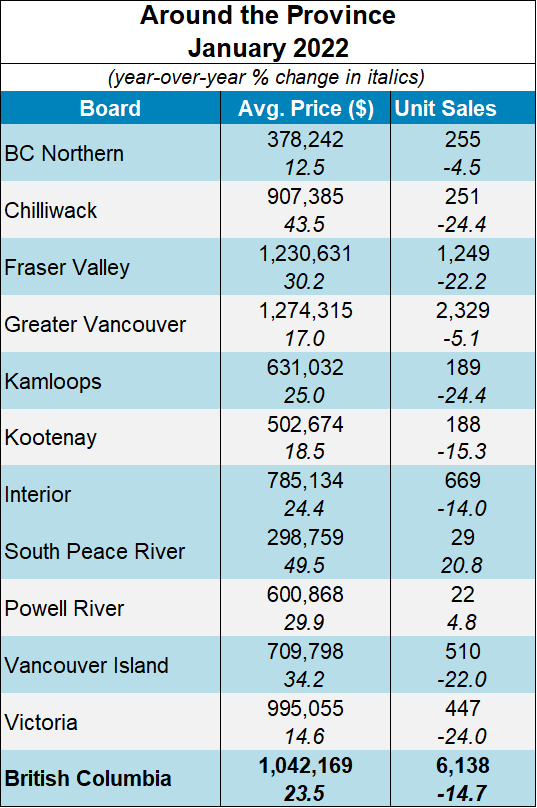
-30-
For more information, please contact:
Brendon Ogmundson
Chief Economist
Direct: 604.742.2796
Mobile: 604.505.6793
Email: [email protected]
Failure To Disclose Proves Costly #498
In the summer of 2012, a seller was advised by his neighbour that environmental consultants were inspecting the neighbour's property for possible contamination, and would contact the seller to do similar tests on his property. In August and September, the seller received two separate "Notification of Likely or Actual Migration" forms from the environmental consultants. In October, representatives of the environmental consulting firm drilled, sampled and installed five monitoring wells on the seller's property, which were covered over with sod.
In February 2013, six months after receiving the notifications and four months after the monitoring wells were installed, the seller listed his property for sale. He completed a Property Disclosure Statement (PDS), which was incorporated into and formed part of the eventual Contract of Purchase and Sale. In the PDS, the seller answered "No" to the question "Have you received any other notice or claim affecting the Premises from any person or public body?" He also left blank the section which invites the seller to provide additional information or explanations about the condition of the property.
The buyer didn't discover the possible contamination of the property or the existence of the monitoring wells until after the purchase had completed. The buyer sued the seller for fraudulent, or in the alternative negligent, misrepresentation.1 The buyer argued that the seller's actions amounted to fraud. The judge noted that our courts have observed that "the classic and most obvious form of fraud is where the vendor positively misstates to the purchaser facts which he knows to be false, for the purpose of deceiving the purchaser."2
The seller testified that, at the time he completed the PDS, he didn't really recall getting the notifications, and that if he did recall he didn't connect the notifications with the question that he answered in the negative. His position was that he answered every PDS question honestly and to the best of his knowledge, and that he didn't intend to deceive the buyers. He further testified that, after completing the PDS, he informed his REALTOR® of the possible contamination and the monitoring wells, and his REALTOR® advised that he didn't need to disclose those facts. His REALTOR® denied providing such advice and further denied the matter ever being raised with him.
Fortunately for the seller, the court concluded that the seller's actions weren't fraudulent. However, the seller was found liable for a negligent misrepresentation. He had to reimburse the buyers for the loss resulting from the seller's failure to disclose the receipt of the two notifications, and his failure to disclose the existence of the monitoring wells, which were not visible to the naked eye.
From the evidence, the court concluded that the general contamination issue was clearly on the seller's mind, yet by completing the PDS the way he did, the seller didn't bring it to the attention of the buyers. The court concluded that, had the buyers been aware of the environmental issues, they would not have made the offer they did.
The seller's alleged raising of the contamination issue with his REALTOR® after completion of the PDS raises an interesting issue. It's conceivable that after completing a PDS, a seller might conclude that one or more of their answers was incorrect or require explanation, or that events subsequent to the completion of the PDS have rendered all or part of the PDS inaccurate. In those cases, the seller has an obligation to correct the error. Failure to do so may result in liability.
Brian Taylor
Norton Rose Fulbright LLP
| 1. | Ban v Keleher, 2017 BCSC 1132. | |
| 2. | Hanslo v Barry, 2011 BCSC 1624 at paragraph 72. |
Fair Market Value of Leased Bare Land #216
By Gerry Neely
B.A., LL.B.
It's remarkable how often those who draft contracts, including leases and contracts of purchase, and those parties who sign them, find that a term of the contract that seemed perfectly clear to everyone is ambiguous and requires the aid of the court to decide what it means.
An example of this is found in a commercial lease of bare land for a term of 50 years that restricts the use of the land for hotel and related hospitality businesses. The base rent is to be renegotiated periodically to arrive at a rent equal to 10% of the fair market value of the land as bare land.
The obvious meaning is to value the property as if it did not have a building or other improvements constructed upon it. It meant this and more to the tenant who argued that the restricted hotel use is to be considered in determining the fair market value of the land.
There must have been a higher and better use for the land because the landlord presented an argument for a third meaning, namely that the evaluation should be made as if there was no lease and no restricted use affecting the land. The Chambers judge agreed with the tenant, but a majority of the Court of Appeal disagreed, accepting the landlord's position that fair market value could only be obtained if the lease and restricted use were ignored.
The dissenting judge said that the restriction prevented the tenant from utilizing the highest and best use of the land. Therefore the landlord should not be entitled to a fair market value based upon that highest and best use, when it was the landlord who was responsible for the term in the lease which restricted the use for hotel purposes.
While a ground lease is a rarity, the significance of this case for a licensee preparing a commercial offer to lease bare land, is to obtain instructions from the licensee's principal, (landlord or tenant) as to whether a restrictive use is to be a factorin determining fair market value.1
***
A clause in leases dealing with an assignment often allows the landlord to cancel the lease if substantial control of a corporate tenant changes without the consent of the landlord. Rarely does the clause distinguish between a transfer of shares to outsiders and a rearrangement of shares among existing shareholders of the company. That is understandable because a factor in the landlord's decision to grant the lease, may have been the landlord's confidence in the shareholders who had control of the company when the lease was negotiated.
However a judge has decided that this type of clause does not apply to a change of control resulting from transfers among existing shareholders. The result of this decision is that the more or less typical clause that is used will have to be changed to make it clear that the landlord's consent is required where there is a change in the effective control of the corporate tenant from the persons holding a majority of the shares at the date of the lease.2
***
A commercial lease required the tenant to give 180 days written notice by registered mail, postage prepaid, of the tenant's wish to renew the lease. On the 180th day the tenant faxed the notice to a receiver of the landlord, who received the notice during business hours. The renewal rent, which was fixed by the terms of the lease, was $110,000 per annum less than market rent.
The landlord refused to renew the lease, arguing that the notice was invalid. in the judge's mind, the only issue was whether actual notice had been given within the 180 day period. He held that since the renewal clause did not prohibit other methods of service, the faxed notice was valid.3
To subscribe to receive BCREA publications such as this one, or to update your email address or current subscriptions, click here.
Fall 2020 Standard Forms Release

Last updated: October 2, 2020
This page contains background information on the Fall 2020 Standard Forms Release, information and resources to help Realtors prepare for use of the forms, and quick links to other relevant resources.
BCREA will update this page as new information and resources are available.
Background
On September 16, 2020, BCREA will release seven new standard forms, three new clauses, a significant number of revisions to existing standard forms, and updates to the signature blocks on 20 forms.
BCREA has developed these forms and revisions with input from Realtors, managing brokers and other industry stakeholders, as well as direction from the provincial Standard Forms Committee.
Resources
Training Materials
- Forms 2020: Post-Launch Webinar Recording and Resources (October 2, 2020)
- Fall 2020 Standard Forms Release Launch Package (BCREA Access user name and password required)
- Managing Broker Community of Practice (August 19, 2020) Fall 2020 Standard Forms Informational Webinar
Blog Posts
- REALTORS® Invited to Webinar to Discuss New and Revised Standard Forms (September 22, 2020)
- New and Revised Standard Forms Now Available on WEBForms® (September 17, 2020)
- Get to Know the New and Revised Standard Forms Coming in September (August 27, 2020)
- Get Ready for BCREA's Fall 2020 Standard Forms Release (August 13, 2020)
- Standard Forms Resource Centre Now Available: Here's What You Need to Know (August 5, 2020)
- Standard Forms Resource Centre Launching in August, Major Form Release This Fall (July 30, 2020)
Quick Links
- BCREA Standard Forms Resource Centre - Your go-to for BCREA Standard Forms training materials.
- WEBForms® - Access all new and revised BCREA standard forms and clauses on launch day.
To subscribe to receive BCREA publications, or to update your email address or current subscriptions, click here.
Fall 2021 Standard Forms Release

Last updated: November 24, 2021
This page contains background information on the Fall 2021 Standard Forms Release, information and resources to help REALTORS® prepare for use of the forms and quick links to other relevant resources.
BCREA will update this page as new information and resources are available.
Background
On November 24, 2021, BCREA will release 11 new standard forms, multiple clauses and revisions to a significant number of forms.
BCREA has developed these forms and revisions with input from Realtors, managing brokers and other industry stakeholders, as well as direction from the provincial Standard Forms Committee.
The form revisions are intended to:
- Maintain alignment with regulatory and practice requirements, including the real estate regulator's recent name change and references to the Real Estate Services Rules and renumbering.
- Incorporate requests from members of the profession and associated professions, such as changes to the Contract of Purchase and Sale Manufactured homes, Property Disclosure Statement with regards to the Water Sustainability Act.
- Bring greater clarity and uniformity with some of the standard contract terms across various forms.
- Redesign the layout of the Notice of Condition Waiver/Declaration of Fulfillment, Contract of Purchase and Sale and Property Disclosure Statement forms.
Resources
Training Materials
- Fall 2021 Standard Forms Post-Launch Q&A Webinar for REALTORS® (December 2, 2021) Click here to register.
- Fall 2021 Standard Forms Release Launch Package (REALTOR Link® login required)
- Fall 2021 Standard Forms Release Pre-Launch Package (REALTOR Link® login required)
- Managing Broker Community of Practice (November 3, 2021) Standard Forms Pre-Launch Webinar.
Blog Posts
- Fall 2021 Standard Forms Release Now Available on WEBForms® (November 24, 2021)
- REALTORS® Invited to 2021 Standard Forms Post-Launch Q&A Webinar (November 10, 2021)
- Get to Know the 11 New Standard Forms and Schedules Coming This November (October 28, 2021)
- BCREA's 2021 Standard Forms Release Coming This Fall (October 14, 2021)
Quick Links
Fall 2021 Standard Forms Release Now Available on WEBForms®
The new and revised standard forms, schedules and clauses included in BCREA’s Fall 2021 Standard Forms Release are now available on WEBForms®!
BCREA has now released 11 new standard forms and schedules, as well as multiple clauses and form revisions, to help REALTORS® enhance their professionalism and adapt to changing best practices.
Prior to the release the Standard Forms went through quality assurance testing by CREA’s WEBForms® team, and additional testing was completed by Realtors and real estate board staff throughout the province. BCREA extends a big thank you to all the volunteers.
Standard Form resources
In addition to the release, we’ve updated the Standard Forms Resource Centre (SFRC) with resources to help Realtors navigate the new forms and form revisions. This includes the Launch Package. which contains details of the new and revised forms, along with training guides and interactive toolkits for a number of forms.
Post-launch Q&A webinar
Got questions about the new and revised forms? Join us on December 2, 2021 for a FREE one-hour virtual Q&A session for Realtors to get real-time answers to any questions you may have. We encourage you to submit a question by emailing [email protected]. Space is limited, so register early!
Standard forms support
If you have questions that are form or clause related email us at: [email protected].
If you have questions about CREA’s WEBForms® or require support, please email CREA at: [email protected].
Coming soon
Keep an eye on your inbox for the launch of InformBot for Standard Forms on December 1. An interactive chatbot-style tool, InformBot is designed to help Realtors better understand which standard forms to use during every stage of a transaction. Stay tuned!
Fall 2025 Standard Forms Launch Now Live
In the evolving real estate profession, the creation and integrity of Standard Forms are essential for conducting real estate transactions in British Columbia. BCREA aims to minimize the number of changes BC REALTORS® experience throughout the year by consolidating the release of new forms, clauses, and revisions into one major launch per year unless otherwise required.
Today’s launch encompasses updates that ensure BCREA Standard Forms are consistent and reflect current practice requirements and the various requests received from real estate practitioners.
Highlights of the Fall 2025 Standard Forms Launch include updates to the following forms:
- Buyer’s Notice to Seller of Intention to Occupy (previously known as Tenant Occupied Property – Buyer's Notice to Seller for Vacant Possession)
- Contract of Purchase and Sale – Residential
- Contract of Purchase and Sale for Business Assets Including Real Property
- Contract of Purchase and Sale for Commercial Real Estate
- Contract of Purchase and Sale of a Leasehold Interest in First Nations Leasehold Reserve Lands (Third Party Approval Not Required)
- Contract of Purchase and Sale of a Leasehold Interest in First Nations Leasehold Reserve Lands (Third Party Approval Required)
- Contract of Purchase and Sale of a Manufactured Home on a Rental Site
- Exclusive Listing Contract
- Lockbox Acknowledgement, Consent, Release, and Indemnity
- Multiple Listing Contract
- Offer to Lease (Commercial)
These updated Standard Forms are now available on CREA WEBForms®.
Launch Package
To help REALTORS® and managing brokers integrate the updated Standard Forms into their practice, BCREA’s Fall 2025 Standard Forms Launch Launch Package includes watermarked versions of the updated forms highlighting the changes, guides, and a summary of the revisions.
Resources
Stay up-to-date with the latest on our Fall 2025 Standard Forms Launch Resources page.
If you have any questions regarding the Fall 2025 Standard Forms Launch, please email us at [email protected]. If you have questions about CREA WEBForms® or require support, please email CREA at [email protected].
Fall 2025 Standard Forms Launch Resources
This page contains information about the Fall 2025 Standard Forms Launch, including resources to help REALTORS® prepare for use of the forms and links to other relevant resources.
Last Updated: April 27, 2026. BCREA will update this page as new information and resources become available.
Background
With the help of the Standard Forms Committee, BCREA develops and maintains Standard Forms and clauses to support REALTORS® in meeting regulatory requirements; mitigate risk to REALTORS®, reduce liability, and enhance their professional practice; ensure high provincial standards and consistency in practice; enhance professionalism; and protect consumers.
BCREA aims to minimize the number of changes BC REALTORS® experience throughout the year by consolidating the release of new forms, clauses, and revisions into one major release per year unless otherwise required.
This year, on Monday, December 1, 2025, BCREA updated several Standard Forms.
Standard Forms Launch Package
The Fall 2025 Standard Forms Launch Launch Package for the Monday, December 1, 2025, forms launch includes watermarked versions of the updated forms highlighting the changes, guides, and summaries of the revisions.
The updated forms are now available on CREA WEBForms®.
Toolkits
- Under Construction: Buyer’s Notice to Seller of Intention to Occupy (previously known as Tenant Occupied Property – Buyer's Notice to Seller for Vacant Possession)
- Updated: Contract of Purchase and Sale – Residential
- Updated: Contract of Purchase and Sale for Business Assets Including Real Property
- Under Construction: Contract of Purchase and Sale for Commercial Real Estate
- Under Construction: Contract of Purchase and Sale of a Leasehold Interest in First Nations Leasehold Reserve Lands (Third Party Approval Not Required)
- Under Construction: Contract of Purchase and Sale of a Leasehold Interest in First Nations Leasehold Reserve Lands (Third Party Approval Required)
- Updated: Contract of Purchase and Sale of a Manufactured Home on a Rental Site
- Updated: Exclusive Listing Contract
- Under Construction: Lockbox Acknowledgement, Consent, Release, and Indemnity
- Under Construction: Multiple Listing Contract
- Updated: Offer to Lease (Commercial)
Resources
To support REALTORS® with understanding the changes in this form launch, BCREA has created resources that summarize the form revisions to help them integrate the revised Standard Forms into their practice. These resources are currently being updated and will be made available as soon as possible.
BCREA strongly recommends that BC REALTORS® always use the most current BCREA Standard Forms and clauses available on CREA WEBForms®. For any questions regarding Standard Forms, please email [email protected]. To stay updated with the latest Standard Forms information and resources, visit our Standard Forms Resources page.
- Fall 2025 Standard Forms Launch Frequently Asked Questions PDF
- Summary of Form Revisions PDF
- Standard Forms Resources Index PDF
- Fall 2025 Standard Forms Launch Community of Practice webinar
- Understanding the Contract of Purchase and Sale – Residential consumer video
- CREA WEBForms®
Check back soon, as this page will be updated when new information and resources become available.
Family Relations Act and the Collapsed Sale #251
By Gerry Neely
B.A., LL.B.
The sale of a home registered in the name of one spouse only collapsed when a matrimonial dispute led the other spouse to take proceedings under the Family Relations Act to protect her interest in the family home. The licensee who experienced this unforeseen end to what appeared to be a "done deal", wanted to know the wider circumstances which might lead to the same result and how that result might be avoided or at least minimized.
The non-title spouse was able to bring these proceedings because the home was ordinarily used for a family purpose. As such, it was a family asset which the Supreme Court has the power to divide equally between the two spouses, or in different proportions if that would be unfair. The court has the power to make an order preventing the disposal of a home to protect the interest of the non-title spouse. The court also may make an order allowing one spouse to have the exclusive use of the matrimonial home and its contents.
The couples who may exercise these rights under the Family Relations Act must be lawfully married. Fewer rights are available for a common-law spouse, defined in the Family Relations Act as a man or woman not married to each other, who lived together as husband and wife for a period of not less than two years. Each has the right to apply for exclusive use of the matrimonial home and its contents, but not to obtain an order which would give the non-title spouse an interest in the home.
While evidence of these rights will not be found on the title of the home when searched, an eligible, concerned nontitle spouse may unilaterally make an application under the Land (Spouse Protection) Act which will have the effect of preventing the disposition of the home without the consent of the non-title spouse. The application is to file an entry in the Land Title Office against the title of the home. To be eligible to make this entry, there must be land registered in the name of either the husband or wife, upon which a dwelling is occupied by them as their residence. The benefits available under this Act apply only to lawfully married couples.
That is not to say that a common-law spouse does not have the right to claim and to protect an interest in land. Usually the claim of a common-law spouse is based upon the grounds that an interest has arisen because of a contract or a trust. A person claiming this interest can file a caveat before an action is commenced or a lis pendens after an action has been brought, to prevent a transfer of title of the home.
The reason there aren't more problems in this area is because usually when there is a matrimonial dispute, by the time the property is listed for sale, the parties have agreed upon the terms of sale and the division of the sale proceeds. For the other instances where the matrimonial dispute has been smoldering and bursts into flames after the house is listed for sale, there are precautions a licensee may take as a matter of routine when property is registered in the name of one spouse only.
The licensee should treat the title as if both spouses were registered as the owners of the home. The desired result is the consent to the listing from the non-title spouse, either given on the listing contract or by separate agreement. This consent doesn't prevent a non-title spouse from attempting to prevent the sale. However, it may make it easier to reach an agreement that the sale should proceed because no better price can be obtained, the proceeds of the sale can be paid so as to protect the parties, and their receipt of the proceeds will help them to resolve their other differences.
If the parties are candid about their deteriorating marital status and they decline to accept your advice that they eac be represented by lawyers who can provide the framework of an agreement through which the house can be sold and the proceeds paid over, the licensee should try and have a separate agreement signed by them.
The minimum requirements would be an irrevocable agreement binding- upon both of them to list the property.for sale; that the non-title spouse will not dispute the validity of any off er made and accepted by the registered owner on title, which is not less than the agreed upon price and payable strictly in accordance with the terms of the spousal agreement; and that if any dispute arises other than with respect to the agreed upon price and the terms of the sale, the sale proceeds shall be paid to third parties representing each of them.
This advice may seem somewhat Pollyanna, as we all know disputes where the parties are so dug in that not even tact, sensitivity or common sense will help. However, your discussions may reveal at the beginning a future problem you can resolve now, or One so intractable that you may save yourself time, trouble and money by declining a listing.
To subscribe to receive BCREA publications such as this one, or to update your email address or current subscriptions, click here.
Faxed Transmission – Signed and in Writing; Trespass to Land – Trees #124
By Gerry Neely
B.A. LL.B
Is a contract created by Fax Transmissions a contract in writing signed by the persons transmitting the offer or acceptance? Having been long accustomed to telegram and telex acceptances, the answer must be yes, if the Courts are prepared to accept this further technological advance in communication.
One B.C.S.C. judge has accepted the technology in a case concerning the validity of faxed proxies. They were rejected by the chairman of a meeting of limited partners on the grounds that the faxed proxies were neither signed nor in writing as required by the limited partnership agreement.
The judge supported the argument that they were valid. While the proxies were not themselves signed, it was sufficient that they bore the photographic reproduction of the original signature. The faxed proxies were "in writing', in the extended meaning which can be given to that phrase. This decision should logically be expected to apply to faxed Offers to Purchase.1
* * *
In the following case which involved an action for damages for trespass to land, one owner gained a new respect for the value of trees. He mistakenly instructed a tree serviceman to cut down an apple tree, an arbutus tree and a Douglas fir without first checking to make sure that they were on his property. There was no doubt as to the trespass but the question was, how were damages to be fixed? The evidence given on behalf of the trespasser by a real estate appraiser was that the market value of the property remained the same whether the trees were standing or not.
The owner had no intention of selling and the loss of the trees deprived her both of privacy and the opportunity to give the apples away annually to her friends. Expert evidence, which was accepted by the judge, put the value of the apple tree at $198.00, the 22 inch diameter arbutus at $2,874.00, and the 42 inch Douglas fir at $13,965.00. Had these trees been isolated and outstanding, the judge would have given damages for those amounts. Instead, they were part of a wooded lot with remaining trees and shrubs in abundance. The damages assessed against both the trespasser and the tree serviceman were reduced to $150.00, $2,000.00 and $6,000.00 respectively.2
Column 121 referred to a decision of the Court of Appeal confirming that an Offer to Purchase which was subject to the purchaser being able to arrange "satisfactory financing" did not make the offer void for uncertainty. The suggestion contained in the last paragraph was that where the purchaser was uncertain as to the mortgage terms he might want or be able to obtain, then only the wording "satisfactory financing" should be used, rather than the other phrases referred to in the last paragraph. The better practice is still to try and obtain all the information necessary in order to use the standard financing clause found in the Clauses and Phrases Manual. If this information is available and the clause is used, the purchaser will have less opportunity to argue uncertainty and the Courts will not be faced with trying to apply the test referred to in Column 121.
| 1. | Beatty v. First Explorations Fund 1987 & Co., 25 B.C.L.R. (2nd) 37. | |
| 2. | Law v. Gunter & Parsons, S.C.B.C. - Victoria Registry - 86/2692. |
To subscribe to receive BCREA publications such as this one, or to update your email address or current subscriptions, click here.
Federal Budget 2022: Taxation of Property Flipping, GST and Assignment Sales #548
The proposed federal budget for 2022 has introduced a number of new rules relating to real estate, including new rules to dampen speculation in the Canadian real estate market (for a full list of the housing affordability measures announced, click here).
REALTORS® should be generally aware of these changes and where they may affect a client’s transaction, and accounting advice should generally be recommended prior to a binding contract being entered into. For Sellers, this advice often should occur at the time of listing unless a Seller’s subject conditions are going to be included in the contract of purchase and sale.
Residential Property Flipping Rule
A commonly held belief was that one had to hold a property for more than a year to obtain many of the tax benefits of the principal residence exemption. This requirement will now be codified into the Income Tax Act, and “property (a taxpayer has) held for fewer than 12 months (will) be subject to full taxation on profits as business income, applying to residential properties sold on or after January 1, 2023.”
There are certain “life event” exemptions proposed once effective (2023); however, Sellers who have held title to the property for a period of less than 12 months should be generally advised to obtain tax advice prior to listing. Remember that the date the title was initially transferred into the name of the Seller can be found on a Title Search next to the heading “Application Received” and this date may be very different than the date the contract was entered into--especially where the property was purchased as a pre-sale development.
GST on Residential Assignment Sales
GST will be now applicable on all assignment sales of new (or substantially renovated) housing (where GST is applicable to the Purchase Price). In the past, an Assignor may have argued that they did not have to pay GST on the Assignment Amount since they may have intended to reside in the property as their principal residence. This deeming provision now prevents the taxpayer from taking that position and makes GST payable by the Assignor on any Assignment Amount.
Section 5.18 of the BCREA Assignment of Contract of Purchase and Sale New Development standard form states that “The Assignment Amount is inclusive of any GST payable with respect to the Assignment Agreement and the Assignor shall remit any GST payable.” Importantly this means that the Assignor will be required to pay GST on the Assignment Amount (commonly called the lift).
Note that GST will not be payable by the Assignor on the Total Purchase Price (as the developer receives the GST on the Original Purchase Price portion and will be required to remit that), nor will GST be payable on the return of the Deposit amount (as this amount is not income). A similar requirement is contained in Section 4.14 of the BCREA Assignment Contract of Purchase and Sale Non-Developer standard form.
To illustrate this, let us consider how this would work for a residential pre-sale, with an original purchase price of $800,000 and an assignment purchase price of $900,000, between a Developer (who is likely a GST registrant) and an Assignor and Buyer (who are not GST registrants).
For the Buyer/Assignee, they would pay:
- Original Purchase Price: $800,000, plus
- GST on Purchase Price: $40,000, plus
- Assignment Amount: $100,000
For the Assignor, they would receive:
- Assignment Amount: $100,000, less:
- Brokerage Commission, as applicable; and
- GST on Assignment Amount and
- Income Tax on Assignment Amount
The result is that the Assignor is netting less than the amount of the profit in the assignment.
Assignors’ Payment to the Canada Revenue Agency
As most residential Assignors are not GST registrants or filers, this makes remittance of the GST amount on the Assignment Amount rather cumbersome. Additionally, most law firms who do residential conveyance do not file compliance filings with the Canada Revenue Agency, and this means that the Assignor, following receipt of the Assignment Amount (which will include both the GST and Income Tax portions payable), will need to engage an accounting firm to make such payment to Canada Revenue Agency within 30 days of the Completion Date of the transaction.
The GST Position in the BCREA Residential Contract of Purchase and Sale
Realtors should also remember that a GST position is not taken in the standard Contract of Purchase and Sale for residential sales. The contract simply provides in Section 11B that a GST certificate will be provided at closing, however no representation or warranty as to GST applicability is made.
Realtors should consider placing additional language in the contract which specifies whether or not GST is payable, or the property is GST exempt (note that the two most common exemptions are “used residential premises” and “sale of vacant land by an individual not in the course of business”).
While a full discussion of GST is beyond the scope of this article, resources and clauses for Realtors exist in the BCFSA Knowledge Base.
Advising Clients to Seek Professional Advice
Realtors should inform their clients early to investigate the possible tax implications upon their sale of property with accounting and tax professionals. Specialized tax advice is beyond the scope of a Realtor. However, it is incumbent on the Realtor to “red flag” the issues at an appropriate time when the client has an ample opportunity to seek out a professional tax advisor. For Sellers and Assignors of residential real estate, this recommendation to seek independent professional tax advice should occur at the time of listing the property and prior to any contract being entered into.
Federal Budget Lacks Meaningful Housing Supply Initiatives
On March 28, 2023, federal Minister of Finance Chrystia Freeland announced the 2023 Federal Budget which focused on inflation relief for low-income families and incentives for the green economy. The Budget outlined several housing-related measures but fell short of what is needed to improve housing attainability for Canadians.
Below are the highlights from the federal 2023 Budget affecting the housing sector.
Consumer Protection and Home Buyer Assistance Measures
As of April 1, 2023, financial institutions will be able to start offering the Tax-Free First Home Savings Account to Canadians.
The federal government has committed to consulting on changes required to remove regulatory barriers for homebuyers from diverse communities seeking access to alternative financing products.
Through the Financial Consumer Agency of Canada, the Feds have also published a guideline to protect Canadians with mortgages who are facing exceptional circumstances.
They propose provision of $31.7 million over three years, starting in 2023-24, to Public Safety Canada and the Canada Mortgage and Housing Corporation to work with the Department of Finance Canada to create a low-cost flood insurance program, aimed at protecting households at high risk of flooding and without access to adequate insurance.
Budget 2023 proposes to provide $15.3 million over three years, starting in 2023-24, to Public Safety Canada to create a publicly accessible online portal where Canadians can access information on their exposure to flooding.
The federal government also reiterated their commitment to tackling the financialization of housing through existing measures and remains committed to developing a Home Buyers’ Bill of Rights, stating they will work with provinces and territories to create this plan.
Housing Supply Measures
The recent announcement also included the stated intent to support the reallocation of funding from the National Housing Co-Investment Fund's repair stream to its new construction stream, as needed, to boost the construction of new affordable homes for the Canadians who need them most.
Budget 2023 proposes to commit an additional $4 billion, over seven years, starting in 2024-25, to implement a co-developed Urban, Rural, and Northern Indigenous Housing Strategy.
While BCREA welcomes the federal Budget 2023 housing initiatives, the details of their implementation are yet to be determined, and there remains a notable lack of meaningful supply-side solutions to significantly improve housing attainability for Canadians.
BCREA will continue to advocate for more impactful supply-related solutions and proactive, fulsome reliance on sectoral expertise to inform government housing policy.
Federal Budget Recap: Foreign Buyers Tax Concerning, Other Measures Welcomed
On April 19, Canada’s Minister of Finance Chrystia Freeland introduced the Liberal government’s first budget since the beginning of the COVID-19 pandemic. The budget provides significant funds to many programs, including several to assist homeowners and renters, increasing the federal deficit by an estimated $382 billion, but also includes measures which are concerning to BCREA.
The budget calls for a tax on all foreign owners of vacant residential property in Canada, to be levied annually beginning in 2022. Once the legislation is introduced and passed, it is expected that all non-citizen and non-permanent resident owners of residential property in Canada will be required to file an annual declaration. The tax is estimated to bring in $700 million of tax revenue over the next four years, with revenues supporting investments into housing affordability.
BCREA response to foreign buyers tax
BCREA is concerned about the effectiveness of this foreign buyers tax. Creating obstacles to homeownership for non-Canadian citizens or permanent residents can interfere with Canada’s ability to attract foreign investment. This is in contradiction to the federal budget’s call for strengthening Canada’s immigration system. As the budget says, “diversity is our strength, including as a source of our economic strength,” yet this tax will reduce the benefits of foreign investment. Foreign investment improves job growth, introduces new technologies and provides economic stimulation.
In addition, much of BC already has a 20 per cent foreign buyer tax, meaning the federal tax would be redundant and overly punitive. In the government’s promised upcoming consultation on the proposed tax, we will remind them that BC has a similar preexisting tax.
The need for supply-side policy
Demand-side measures to influence long-term housing affordability are often ineffective and short-lived, which is why BCREA is calling on governments to focus on policies to increase housing supply. We were encouraged that Freeland agreed with this approach.
In the federal budget recap attended by BCREA Vice President of Government Relations and Stakeholder Engagement Trevor Hargreaves, Freeland said “housing affordability is something that all Canadians are concerned about. Broadly speaking, housing affordability is a question of supply. We want to work with provinces and municipalities to find creative ways to increase housing supply.”
Specifically, the budget reallocates $1.3 billion through the National Housing Co-Investment Fund and the Rental Construction Financing Initiative. We are also pleased to see the government extending several lockdown supports, including extending the rent subsidy and Lockdown Support. These supports will begin to decline July 4, 2021 and will be eliminated by September 25, 2021.
Additional budget notes
We were also encouraged to see the government commit $4.6 million over four years to further anti-money laundering financing, with $0.6 million per year ongoing to enable FINTRAC to, in part, develop and administer a cost recovery scheme for its compliance activities. To increase transparency of ownership, the budget also commits to $2.1 million over two years to Innovation, Science and Economic Development Canada to support the implementation of a publicly accessible corporate beneficial ownership registry by 2025.
The budget also provided funding that will assist homeowners in improving their energy efficiency, as well as preparing for natural disasters caused by climate change. The budget committed $4.4 billion over five years to Canada Mortgage and Housing Corporation to help homeowners complete deep home retrofits through interest-free loans worth up to $40,000. Loans will be available to homeowners and landlords who undertake retrofits identified through an authorized EnerGuide energy assessment. The program will also include a dedicated stream of funding to support low-income homeowners and rental properties serving low-income renters including cooperatives and non-profit housing.
The budget commits funding to several floodplain mapping and wildfire protection programs to protect homeowners from disaster caused by climate change, , including:
- $1.4 billion over 12 years to top up the Disaster Mitigation and Adaptation Fund, to support a variety of projects, including floodplain mapping,
- $12 million over five years to renew the Standards to Support Resilience in Infrastructure Program so that it can continue updating standards and guidance in priority areas such as floodplain mapping,
- $64 million over three years to work with provinces and territories to complete floodplain maps for higher-risk areas,
- $101 million to enhance wildfire preparedness in Canada’s National Parks, and
- $29 million over five years to support increased mapping of areas in Northern provinces and territories at risk of wildfires.
All of the above measures will take effect after receiving royal assent of the bill. Many political analysts are predicting that the budget is presaging an upcoming federal election that may be called later this year.
Photo courtesy of the Government of Canada/Prime Minister's Office.
Federal Election: Housing Affordability and Climate Change Top of Mind in BC
In the most unsurprising of events, the writ has been dropped and Canadians will head to the polls on September 20 to vote for their next Member of Parliament. BC is certain to be a significant battleground for political parties. It’s no coincidence that party leaders Justin Trudeau, Erin O’Toole and Jagmeet Singh have already spent significant resources travelling to BC in the past few months. According to 338canada.com, as of August 17 only 21 of BC’s 42 electoral ridings are considered “safe” for the incumbent party, with the other half being an uncertain two- or even three-way race.
This means that as campaigning (officially) begins, candidates will be listening to the issues that British Columbians are keen to talk about. A recent Angus Reid survey found that housing affordability, along with climate change, are the two issues British Columbians care about the most.
The Canadian Real Estate Association (CREA) and the BC Real Estate Association (BCREA) are taking advantage of election season to highlight the policy solutions that Canadians and British Columbians are looking for. CREA has developed an election website, www.REALideas.ca, which focuses on these election issues:
- Home supply and infrastructure. Two thirds of Canadians who don’t own a home want to some day. Unfortunately, two thirds of Canadians also believe it has become harder to buy a home in the past year. Creating bilateral agreements between Infrastructure Canada and the BC Government, along with other provinces, would work towards addressing the shortage of housing supply while improving quality of life. Within a BC context, BCREA is also calling on the next federal government to tie transit infrastructure investments to increased density around transit nodes.
- National housing roundtable. Establishing a national housing roundtable with all levels of government, along with builders, REALTORS® and civil society organizations would help ensure every Canadian has a place to call home.
- Affordability and debt reduction. Increasing the Registered Retirement Savings Plan (RRSP) withdrawal limit from $35,000 to $50,000 and reintroducing the 30-year amortization for insured mortgages for first-time homebuyers would provide more young Canadians the opportunity to enter the housing market while saving and investing for their futures.
- Climate change resiliency. Providing more incentives for voluntary energy retrofits to the existing building stock can help reduce greenhouse gas emissions. In addition, providing more leadership in mitigating climate change risks and preparing for disaster recovery from wildfires and floods could assist with BC’s current and future natural disasters.
Once all the party platforms are released, we will write a post comparing the different promises affecting the real estate sector in BC. To keep updated with BCREA’s publications, visit the Elections Page on BCREA Access.
Federal Foreign Buyers Ban is in Effect
NOTE: This content was updated on August 8, 2024.
Starting January 1, 2023, non-Canadians are banned from purchasing homes in Canada under the definition of 'residential property' indicated in the legislation, regulations, and regulatory amendments. This ban was initially implemented for a period of two years. However, on February 4, 2024, the Government of Canada announced its intention to extend the existing ban on foreign ownership of Canadian housing for an additional two years, to January 1, 2027.
Although further technical interpretations of the regulations are still pending, here is the current understanding of the regulations.
How does the Foreign Buyers Ban Impact REALTORS®?
REALTORS®, along with lawyers and notaries, have an obligation to inform their clients. The legislation does not rely on REALTORS® to enforce the prohibition. However, REALTORS® who knowingly assist a non-Canadian in contravening the prohibition can be found guilty of an offence and liable on summary conviction to a fine of up to $10,000.
Importantly, REALTORS® do not have any information collection, processing or reporting requirements. REALTORS® should still engage in due diligence as a measure of risk mitigation. To support REALTORS® with their due diligence, the Canadian Real Estate Association (CREA) has developed a certificate: Certification and Consent of Purchaser.
The certificate should be completed before assisting or advising a potential purchaser and it should be used in combination with other due diligence practices. Such practices may include reviewing and keeping a record of the purchaser’s valid and current identification (such as a passport) to determine the purchaser’s citizenship, residency or exempt status.
The key difference between the completion of this certificate and the Know Your Client FINTRAC Regime’s requirement to ID your client at the time of transaction is that with the Foreign Buyers Ban, REALTORS® should ID clients before assisting or advising them on the purchase of a property.
Exemptions
Exceptions exist for international students, temporary residents, specifically exempted foreign nationals and refugee claimants, subject to varying conditions, such as tax filing and residency obligations.
Properties located outside of a Census Metropolitan Area (CMA) or a Census Agglomeration (CA) are excluded from this prohibition. The Canada Mortgage and Housing Corporation has created this tool (with an interactive map) that can help REALTORS® determine if a property could be subject to the ban.
An order requiring the residential property be sold may be sought if certain conditions are met, namely the non-Canadian is the owner at the time the order is made, and notice requirements have been met.
Certain aspects of the Foreign Buyers Ban still lack clarity, including the exemptions. Under CREA's jurisdictional leadership, we are actively engaged in ongoing dialogue with federal policymakers, legal experts, Statistics Canada, the Canadian Mortgage and Housing Corporation and other stakeholders for clarification on the ambiguities.
For further details, please consult the regulations and regulatory amendments.
Definitions
The ban applies to 'residential property,' which includes detached houses or similar buildings of one to three dwelling units, as well as parts of buildings such as semi-detached houses, strata units or other similar premises.
“Non-Canadian” as it relates to corporations and other entities, refers to:
- "an entity formed otherwise than under the laws of Canada or a province;" and
- "an entity formed under the laws of Canada or a province – whose shares or ownership interests are not listed on a stock exchange in Canada for which a designation under Section 262 of the Income Tax Act is in effect – and controlled by an entity referred to in paragraph (a) or controlled by a person referred to in paragraph (a), (b) or (c) of the definition non-Canadian in section 2 of the Act."
“Purchase” is defined as “the acquisition, with or without conditions, of a legal or equitable interest or a real right in a residential property,” with the exception of, among other things, acquisitions of interests resulting from transitional or life events such as death, divorce, separation, or a gift.
The Act restricts non-Canadians from avoiding the ban by using corporations or other entities to purchase residential property.
“Control” with respect to a corporation or entity, means:
- "direct or indirect ownership of shares or ownership interests of the corporation or entity representing 10 per cent or more of the value of the equity in it, or carrying 10 per cent or more of its voting rights;" or
- “control in fact of the corporation or entity, whether directly or indirectly, through ownership, agreement or otherwise.”
Federal Government Addresses Housing Affordability – With BC on the Sidelines
On September 14, 2025, the federal government launched the Build Canada Homes agency, first announced in May’s Speech from the Throne.
The agency’s goals largely centre on non-market affordable housing, with a mandate to grow the proportion of housing that is for low- and middle-income households; create the conditions for high-capacity non-market housing; and generate long-term, predictable demand for factory-built housing.
The agency also intends to focus on cost-efficient construction methods, including factory-built, modular, and mass timber housing, and will prioritize using Canadian building materials such as lumber and aluminum.
[iframe width="560" height="315" src="https://www.youtube.com/embed/hPiA5paYHkU" frameborder="0" allowfullscreen style="position:absolute;top:0;left:0;width:100%;height:100%;"][/iframe]What this means in terms of dollars and cents is an initial $13-billion investment. Of the $13 billion, the previously announced $1.5-billion Canada Rental Protection Fund will be launched within the newly created agency.
Build Canada Homes has ambitious targets, prioritizing 4,000 factory-built homes on six federally owned sites located in Dartmouth, Longueuil, Ottawa, Toronto, Winnipeg, and Edmonton. It’s worth noting that none of the first six target municipalities are in BC, which is generally considered the epicentre of Canada’s nationwide housing affordability issues.
BCREA is encouraged to see that the federal government, through the Build Canada Homes announcement as well as the GST exemption for first-time home buyers, is taking a supply-based approach to addressing housing affordability issues in Canada. Affordable, non-market housing is important, with current demand outpacing supply.
That said, non-market housing is only one facet of the housing continuum, with about three per cent of Canadians living in subsidized housing. A broader approach will be required to address the totality of Canada’s housing needs.
As the Build Canada Homes program continues its rollout, BCREA will continue to call on the federal government to repurpose the Housing Accelerator Fund to offset municipal development and amenity cost charges.
Federal Government Addresses Housing Affordability – With BC on the Sidelines
On September 14, 2025, the federal government launched the Build Canada Homes agency, first announced in May’s Speech from the Throne.
The agency’s goals largely centre on non-market affordable housing, with a mandate to grow the proportion of housing that is for low- and middle-income households; create the conditions for high-capacity non-market housing; and generate long-term, predictable demand for factory-built housing.
The agency also intends to focus on cost-efficient construction methods, including factory-built, modular, and mass timber housing, and will prioritize using Canadian building materials such as lumber and aluminum.
[iframe width="560" height="315" src="https://www.youtube.com/embed/hPiA5paYHkU" frameborder="0" allowfullscreen style="position:absolute;top:0;left:0;width:100%;height:100%;"][/iframe]What this means in terms of dollars and cents is an initial $13-billion investment. Of the $13 billion, the previously announced $1.5-billion Canada Rental Protection Fund will be launched within the newly created agency.
Build Canada Homes has ambitious targets, prioritizing 4,000 factory-built homes on six federally owned sites located in Dartmouth, Longueuil, Ottawa, Toronto, Winnipeg, and Edmonton. It’s worth noting that none of the first six target municipalities are in BC, which is generally considered the epicentre of Canada’s nationwide housing affordability issues.
BCREA is encouraged to see that the federal government, through the Build Canada Homes announcement as well as the GST exemption for first-time home buyers, is taking a supply-based approach to addressing housing affordability issues in Canada. Affordable, non-market housing is important, with current demand outpacing supply.
That said, non-market housing is only one facet of the housing continuum, with about three per cent of Canadians living in subsidized housing. A broader approach will be required to address the totality of Canada’s housing needs.
As the Build Canada Homes program continues its rollout, BCREA will continue to call on the federal government to repurpose the Housing Accelerator Fund to offset municipal development and amenity cost charges.
Federal Government Amends the Foreign Buyers Ban Regulations
On March 27, 2023, the federal government announced amendments to the Prohibition on the Purchase of Residential Property by Non-Canadians Act’s (the Act) accompanying Regulations, effective March 27, 2023. The Act was passed in June 2022 and the regulations came into force January 1, 2023.
Here’s what you need to know about the amendments to the Foreign Buyers Ban.
Enable more work permit holders to purchase a home to live in while working in Canada.
The amendments allow those who hold a work permit or are authorized to work in Canada under the Immigration and Refugee Protection Regulations to purchase residential property. Work permit holders are eligible if they have 183 days or more of validity remaining on their work permit or work authorization at time of purchase and they have not purchased more than one residential property. The current provisions on tax filings and previous work experience in Canada are being repealed.
Repealing existing provision so the prohibition doesn’t apply to vacant land.
Repealing section 3(2) of the regulations, so the prohibition does not apply to all lands zoned for residential and mixed use. Vacant land zoned for residential and mixed use can now be purchased by non-Canadians and used for any purpose by the purchaser, including residential development.
Exception for development purposes.
This exception allows non-Canadians to purchase residential property for the purpose of development. The amendments also extend the exception currently applicable to publicly traded corporations under the Act, to publicly traded entities formed under the laws of Canada or a province, and controlled by a non-Canadian.
Increasing the corporation foreign control threshold from 3 per cent to 10 per cent.
For the purposes of the Prohibition, with regards to privately held corporations or privately held entities formed under the laws of Canada or a province and controlled by a non-Canadian, the control threshold has increased from 3 per cent to 10 per cent. This aligns with the Underused Housing Tax Act's definition of ‘specified Canadian Corporation’.
While the BC Real Estate Association (BCREA) welcomes these amendments because they provide greater flexibility to newcomers and businesses seeking to contribute to Canada, we remain opposed to the legislation’s highly political and largely non-evidential assertion that foreign ownership plays a significant role in Canadian housing attainability.
The federal government’s need to amend this policy demonstrates its overly hasty policy-making process. The negative unintended consequences that necessitated the amendments could have been mitigated with proactive, fulsome sectoral consultation. The negative fallout from this legislation once again highlights a concerning trend at all levels of government to implement policy affecting major economic sectors without adequate advance sectoral consultation.
BCREA is committed to continuing our advocacy efforts calling for the establishment of a Permanent Housing Roundtable to bring together all stakeholders in the housing sphere and help address its challenges with an inclusive, holistic and innovative approach.
Federal Throne Speech Includes Housing in Economic Recovery Plan
On September 23, Governor General Julie Payette presented the Speech From the Throne, providing an overview of many programs the government has enacted in the last six months as well as providing an outline of the government’s upcoming agenda. Several of the announcements will impact real estate in BC.
On market housing, the government promised to move forward with previously promised enhancements to the First-Time Home Buyer Incentive. To understand the impacts these changes could have in BC, read BCREA’s Market Intelligence Report, “Potential Uptake of the First-Time Home Buyer Incentive.”
We were pleased to hear the throne speech commit to taking more action on climate change by creating thousands of jobs to retrofit homes and buildings. The speech also called to reduce the impact of climate-related disasters, like floods and wildfires.
Several previously-announced COVID-19 programs will be extended or expanded. The Canada Emergency Wage Subsidy will be extended through to next summer. In addition,
- the Canada Emergency Business Account will be expanded,
- the Business Credit Availability Program will be improved,
- the Employment Insurance (EI) system will become the sole delivery mechanism for employment benefits, including for Canadians who did not qualify for EI before the pandemic. This includes the self-employed and those in the gig economy, and
- targeted financial support will be provided to businesses that must close because of local public health directives.
Other significant economic announcements include:
- introducing further support for industries that have been hardest hit, including travel and tourism, hospitality, regional airline routes and cultural industries like the performing arts,
- making a significant, long-term investment to create a Canada-wide early learning and childcare system, and
- in the short term, the government will do “whatever it takes, using whatever fiscal firepower is needed” to address economic recovery. In the longer term, the government will identify additional ways to tax extreme inequality, including limiting the stock option deductions for wealthy individuals at large and established corporations, as well as addressing corporate tax avoidance by digital giants.
Beginning September 24, the parliament will sit to debate the throne speech. If the Throne Speech does not have support from at least one of the official parties, the government will fall and a federal election will be held. The Conservative Party has already said they would not support the Throne Speech, while the NDP and Bloc Québécois have laid out further policies they would like to see in order to provide support.
To subscribe to receive BCREA publications such as this one, or to update your email address or current subscriptions, click here.
Few New Promises to Increase Housing Supply in BC’s 2022 Budget
BC’s 2022 budget is very much a recovery budget. There are significant investments in continued recovery from this past year’s extreme wildfire and flooding events, as well as the COVID-19 pandemic.
The budget acknowledged that BC’s “record-low supply and strong demand for homes” led to large price gains in 2021, across all major regions and for all dwelling types. However, there was little promised in the way of new investments to address this lack of housing supply.
Significant new investments impacting BC’s real estate sector include:
Affordable housing
- Providing $8 million of funding to support non-profit housing providers accelerate the construction of mixed-income housing through the Community Housing Fund.
- An additional $111 million to continue and accelerate progress towards building 114,000 affordable housing units in BC over 10 years. This includes a new $600 per month rent supplement for More than 3000 low-income families and seniors mixed-income rental housing.
Aboriginal Housing
- $12 million over the next three years to create and support the work of the Declaration Act Secretariat’s work on the Declaration on the Rights of Indigenous Peoples Act (Declaration Act). The Secretariat will provide guidance on consultation and consistency of laws with the Declaration Act, help to inform the government’s legislative agenda and engage with Indigenous peoples to ensure the Act is consistently applied.
CleanBC
- Over $39 million in new operating funding to support energy efficient buildings and market supports under the CleanBC Better Homes, Better Buildings program. This includes $16 million over three years to provide new top-up incentives such as heat pump incentives for rural and northern homeowners. Additionally, $3 million is provided over three years to develop the highest efficiency standards for space and water heating, and a new home energy rating system home buyers identify the energy efficiency of homes.
Climate preparedness
- $400 million for Emergency Management BC to support people and communities in their recovery from flooding.
- $45 million for the BC Wildfire Service and Emergency Management BC, as well as $52 million in Wildfire Prevention Projects and Services
Other significant investments include:
- $2 billion allocated to pandemic recovery contingencies over the next year,
- $100 million per year investment into a childcare plan in partnership with the federal government, and
- $289 million over five years to connect more rural, remote and Indigenous communities to high speed internet.
- The current year’s deficit is now forecast to be $483 million.
Fictitious Mortgages – A Mortgage Broker’s Nightmare #306
By Gerry Neely
B.A., LL.B.
The diligence of an employee of a mortgage broker, and the suspicions of a bank customer service representative, helped to stop the activities of a criminal who created fraudulent mortgages which were then assigned to innocent customers looking for a reasonable return.
The method of operation of the fraudsman, as the judge called him, was to select a clear title property and create a false mortgage in which it appeared that the owner had mortgaged her property. The owner’s signature was then forged, as was the name of the lawyer who purportedly witnessed the owner’s signature.
The fraudsman used names that were either identical or similar to those of lawyers in the Lower Mainland. To make it easier to respond with a forged letter to a mortgage broker’s request for confirmation of the mortgage balance, the fraudsman changed the owners’ addresses in both the Land Title Office and the BCA records, to fictitious addresses.
When the fraudsman attempted to sell the fictitious mortgagee’s interest in the false mortgage to a mortgage broker, the employee asked to speak to the mortgagors, only to be told that they were out of town. She then called the real lawyer named in the mortgage who said that he had not witnessed the signatures.
When she tried unsuccessfully to reach another lawyer whose name was on a statutory declaration, the Law Society advised her that they had no record of him. Understandably, she declined to proceed further.
Defeated but determined, the fraudsman contacted another mortgage broker and this time, on the instructions of the mortgage broker, an assignment of the mortgage between the fictitious mortgagee and a real investor was executed, registered and a cheque for $69,000 was delivered to the fictitious mortgagee/fraudsman.
He then attempted to deposit the cheque in a bank account he had opened a week earlier through a customer service representative who thought it odd that her customer wore a false beard. Had the fraudsman stated his occupation to be an actor, the representative might not have been sufficiently suspicious to check the address he gave her, which turned out to be that of a strip mall, and his telephone number, which was a telephone answering service. The driver’s license number given by the fictitious mortgagee did not match the name.
The result was that, when the fraudsman entered the bank carrying a briefcase and wearing the false beard, he was arrested by the RCMP. He was convicted of crimes relating to four forged mortgages from which he obtained approximately $140,000, not including the $69,000.
Following the arrest, the RCMP found documents which indicated that in one fictitious mortgage transaction the fraudsman gave 12 postdated cheques to the mortgage broker for the mortgagees. It was only when the mortgage became due a year later that the mortgage broker discovered the mortgage was fraudulent. This case was discussed at a recent meeting of the Vancouver Real Property Sub-Section of the Canadian Bar Association because it raised a number of questions. Whose responsibility is it to verify the borrower’s identity, the mortgage broker or lender, or the lender’s lawyer?
Should a lawyer or notary public, as an officer witnessing the signature of the assignor of the mortgage, do more than take the picture ID of the driver’s license? How far should an officer go? Should the officer call the lawyer or notary public, who witnessed the mortgagor’s signature, to confirm that the lawyer had actually witnessed this signature?
Understandably, these questions were not resolved at the meeting.1
| 1. |
|
To subscribe to receive BCREA publications such as this one, or to update your email address or current subscriptions, click here.
Fiduciary Duty Owed by Agent to Principal – When Does it End? #117
By Gerry Neely
B.A. LL.B
On January 15, 1988, you put on MLS a listing expiring April 14, 1988, for the sale of a commercially zoned corner lot at a price of $360,000.00. A salesperson working for another agent brought an unconditional offer accompanied by a $25,000.00 deposit, for the sale of the lot at $325,000.00 The offer was accepted on February 1, 1988 and the sale was to close June 1, 1988.
On February 2nd, an individual who had seen your sign on the lot, a sign which had on it the asking price, called you directly to say that he wanted to buy the property. When you advised him that the lot had been sold, he stated that he had a particular use for the lot which would justify him paying $50,000 00 more than the asking price. At this point, what do you do? Do you decide to pay a visit to the purchaser to ask whether the purchaser is interested in a quick profit on a resale from which you can earn a second commission?
You justify doing this because having found a purchaser for your principal which is what you contracted to do, you owe him no further duty. In addition, by entering into the binding contract of sale, your principal has lost his right to deal with the property and can do nothing to take advantage of the second offer. You are worried if you advise your principal of the much higher price, that may induce him to break his contract with the purchaser and you will then be in breach of Section 27 of the Real Estate Act.
In the alternative, do you ask yourself whether your duty to your principal continues until the sale closes? If you answer yes to that question, you decide to advise your principal of the second offer, realizing that your principal has a number of alternatives. He may do nothing or he may attempt to renegotiate the sale with the purchaser. He might also try to avoid completing the sale by some lawful means, and this of course could be difficult for you in your claim for commission if your principal is successful.
The first alternative is attractive because it appears to protect the earned commission and may obtain a second commission. The second alternative exposes you to the risk of having to sue for a commission if your principal either tries to evade his lawful duty under the contract with the purchaser, or concludes that you badly underestimated market value.
If you chose the first alternative and decided that your duty ended when the binding contract was signed, then you made the wrong choice as far as an Appellate Court in Ontario is concerned.
The Court held that the agent's duty continued up to the completion of the sale or the expiration of the listing contract. The addition of the latter words in the Reasons for Judgment appears to create some uncertainty-is it the first or the last event to occur which ends the duty? However, since the listing in the Ontario case was to expire on April 30th, 1983, and the sale to close on May 27th, 1983, the Appellate Court must have meant that the duty would continue after the expiration of the listing contract, and until the sale closed. Presumably, if the sale did not close, and the listing expired after the date of closing, the duty would then continue until the listing expired.
The agents lost their claim for commission. They also were ordered to pay to the principal the amount of the second commission, as damages to the principal for their breach of fiduciary duty. Although the principal had asked for damages equal to the difference between the two purchase prices, the Court dismissed this claim upon evidence that the agents had no knowledge of the second offer until after the acceptance of the first offer.
| Yorkland Real Estate Ltd. v. Dale , 60 O.R. (2nd) at p. 460. |
To subscribe to receive BCREA publications such as this one, or to update your email address or current subscriptions, click here.
Fiduciary Relationship Responsibilities Between the Licensee and Client #29
By Gerry Neely
B.A. LL.B.
Legally Speaking Column No. 1 discussed the fiduciary relationship between the licencee and the person who has retained the licencee to sell his property. Those principles were examined in a recent case where the licencee exchanged his property for that of the principal's property. The principal had listed a 2 1/2-acre semi-rural parcel of land upon which was situate a well-aged two bedroom bungalow. A licencee in the office which had the listing offered in July to purchase the property for completion in October. The offer by the licencee to purchase the 2 1/2-acre property was subject to several conditions, including tentative approval from all appropriate authorities for the subdivision of the property, to be obtained by September 15th, 1980. Another condition was approval of financing. The principal's offer to purchase the licencee's three bedroom home was also subject to several conditions, one of which was approval of financing by August 4th.
These negotiations took place in 1980 when residential real estate values in the Victoria area were increasing substantially. During September the licencee asked the principal for an extension of the date for completion until December 15th, and on October 7th, new interim agreements were signed containing the same prices as the July agreements, and containing similar condition precedents except that the subject clauses relating to financing had been dropped. The licencee had written assurance of financing while the principal had only oral assurances which subsequently were not honoured. During the discussions leading up to the October 7th agreements, the principal had asked the licencee whether property values for the two properties had changed in the two months since the July agreements were signed. The licencee said that while they had, that would have made no difference because both of the properties would have risen equally in value. In the licencee's opinion, the difference of $15,100.00 between the prices for the two properties which had been settled in July, still represented the difference in value between them in October. The licencee had until December 1st to remove the condition relating to approval for subdivision, which he did.
Ultimately, the principal declined to complete and the licencee sued for specific performance. The critical question at trial was the accuracy of the advice given by the licencee in October that there had been no change in the spread in price of the two properties. The principal had no other professional guidance apart from the licencee and the suggestion by one of the licencee's colleagues to the owner that she obtain independent legal advice did not assist the licencee, because he was aware that she had not done so. Appraisal evidence given on behalf of the principal indicated that her property had increased in value somewhat under 20%, or an increase of $21,400.00. The evidence also suggested that the increase in value would be attributable principally to land rather than to improvements. Since the value of the principal's property was greater than that of the licencee's, it meant that the licencee's property would have had to increase by 35% to maintain the same spread in price. The evidence on behalf of the licencee as to the increase in value of his property was based upon the weekly statistical summaries of the Victoria Real Estate Board which appeared to prove that the average price paid for a three bedroom home increased by 38.7 per cent from the third week of July to the first week of October. The same weekly summaries showed that the average price of houses with one or two bedrooms increased by only 4% and that houses with four bedrooms decreased by 5%. The Court found it difficult to accept these one week summaries as being representative of the changes which had taken place, because to do so would have meant accepting the lower percentage changes up and down as being representative of the change in values of the other categories of homes. The Court held that the sampling represented by one week's sale was too small to determine the average price and instead accepted the appraisal evidence of value offered on behalf of the principal.
In considering the respective positions of the licencee and the principal, the Court also decided that the licencee had given himself somewhat in excess of four months to decide whether to take up or abandon the sale as might prove to be in the licencee's interests. The Court looked upon this as an option for which the licencee paid nothing.
The Court held that the licencee had not discharged the onus of proving that he had complied with his obligation to the owner and held against his action for specific performance.
The principles applied by the Court are summarized in the following statement: ". . . an agent purchasing from his client who enjoys an advantage - such as the present plaintiff (licencee) enjoyed - by virtue of greater knowledge and acumen, must show that, innocently or otherwise, he did not take advantage of this disparity."'
| 1. | Roga Holdings Ltd. v. Hystad,S.C.B.C. 1982 B.C.D. Civil 3795-01. |
To subscribe to receive BCREA publications such as this one, or to update your email address or current subscriptions, click here.
Final Acceptance Date: Who Completes It and Why It Matters
Since the introduction of the Final Acceptance Date section in the Contract of Purchase and Sale (CPS), questions have arisen about how to handle situations where the date is left blank or is completed incorrectly.
While the Final Acceptance Date is not a substantive term of the contract, it functions as a reference date used in determining certain contractual and statutory timelines, including:
- the start of the rescission period (if applicable); and
- time‑based contractual obligations, such as deposit deadlines.
Its primary purpose is to provide a clear and consistent reference point from which these timelines are calculated; the insertion or omission of a date does not, by itself, determine whether a legally binding contract has been formed.
What Is the Final Acceptance Date?
The Final Acceptance Date section is intended to reflect current practice, where either party, the seller or buyer, may accept the terms of the other party, whether through the initial offer or counter-offers, depending on how negotiations unfold.
It is the date on which the last party executed and communicated acceptance of the contract to the other party or parties.
Who Can Insert the Final Acceptance Date and When?
Once the last party has signed, before delivering the contract, they may insert the Final Acceptance Date to reflect the factual date on which final acceptance occurred, provided the date is objectively supportable and accurately reflects the execution and delivery history of the transaction. As a best practice, the date should be inserted promptly after final execution, after which the executed contract should be delivered to all parties.
The date should not be pre-filled or inserted before final execution has occurred, as doing so can lead to errors, miscalculated deadlines, and confusion about contractual timelines. When the date is inserted after execution, it is best practice to notify the parties and retain documentation supporting how the date was determined.
What If the Final Acceptance Date Is Left Blank?
If the Final Acceptance Date is left blank, that alone does not render the contract invalid, as the date serves as a reference point rather than a contractual term. An otherwise properly formed contract may still be enforceable, provided the essential terms of the contract are present.
However, the omission may create ambiguity and practical uncertainty regarding contractual and statutory timelines, including the calculation of the buyer’s rescission period.
Because the Final Acceptance Date is used to calculate statutory rescission timelines referenced in the Notice for Buyer’s Rescission Right section, an omitted or incorrect date may create uncertainty regarding the commencement and expiry of the buyer’s rescission rights.
When the Final Acceptance Date has been omitted, REALTORS® should consult with their managing broker and consider preparing an addendum for the parties’ consideration confirming the agreed Final Acceptance Date.
In such cases, steps may be taken to determine the appropriate date, for example:
- Confirming with the parties when the last party signed and delivered the contract.
- Reviewing electronic signature records.
- Referring to supporting electronic documentation, such as emails or transaction records.
Clear documentation regarding how the Final Acceptance Date was determined can help demonstrate reasonable professional conduct and support brokerage record-keeping and compliance obligations.
REALTORS® should also ensure that clients receive a complete copy of the fully executed agreement once the Final Acceptance Date has been confirmed.
What If the Parties Do Not Agree on the Final Acceptance Date?
If the parties are not in agreement about the date of final acceptance, that is, the date on which the last party executed and delivered the contract, a date should not be inserted until the parties have reached agreement.
In these situations, the Final Acceptance Date should not be used to resolve or escalate a dispute, as it is intended to record an objective event rather than determine contractual rights. If the parties later reach an agreement, the agreed-upon Final Acceptance Date should be documented in writing through written confirmation or a mutually signed addendum.
Financing Clauses – "Satisfactory Personal Financing" – Uncertain #110
By Gerry Neely
B.A. LL.B
Adam B. Able, the affable agent/owner of the Point Grey Wreck Beach Real Estate Agency, was in his office balancing his accounts payable against the sales awaiting completion, when a dark cloud entered his office. Under it stood his newest salesman, Mr. Nester Neofite, carrying an important letter, wearing a worried look and little else. To be precise, nothing else but his Adidas. When Adam assigned the Wreck Beach territory to Nester, he had been reluctant to agree to Nester's request to solicit listings in the nude. Nester insisted, arguing that no clothes gave him an edge on the competition. Adam had to admit that once Nester started worrying less about where to put his hands and more about where to carry his pen, business had been remarkable. The only problem he had created arose from his enthusiastic inexperience which led him to list a great little business that promised 100% return in just 3 summer months with splendid franchise opportunities. Adam had to cancel it when he discovered from reading a police report in the Province that the owner of The Little Grass Shack at Wreck Beach was selling more than sun tan lotion, beach balls and thongs.
The letter Nester carried was from a lawyer written on behalf of a purchaser found by Nester, to advise him that the purchaser wanted his $20,000.00 deposit refunded. "Nester," said Adam, "this is a serious matter. Let's arrange to meet with my solicitor, Noel."
The next day when Noel finished reading the offer to purchase and letter, he turned to Nester. "This is a straightforward offer containing only one problem for you, and this is the condition, which reads, 'This offer is subject to the purchaser's obtaining satisfactory personal financing, by May 31st, 1984'.1 Tell me, Nester, a little bit of the background." "Well," said Nester, "the purchaser wanted an inspection and needed some financing so I told him that we would add this condition to give him an out, as it were. A friend of his who is taking a night school course on house construction convinced him that there were some problems with the house and he then told the mortgage company not to proceed further because he had changed his mind."
Noel turned to Adam and said, "The main problem is whether or not this clause is sufficiently certain to enable a Court to interpret what it means. In an English case where the condition was subject to the purchaser obtaining a satisfactory mortgage, the Court said that the concept was too indefinite to give the phrase any practical meaning. The Judge said that it might have been possible to bring forward evidence to establish what would be a usual or reasonable rate of interest or the terms of the mortgage but the lack of the loan amount and the terms of repayment meant that the Court could not interpret the clause with any certainty at all.
"Two judges of the Supreme Court of British Columbia in separate cases followed this English case to hold that financing clauses allowing the purchaser to obtain "a satisfactory mortgage'' or "suitable mortgage'' were too uncertain to form a binding contract of sale. While a third decision, which was of a County Court judge interpreting a clause containing the words "suitable financing", was in favour of certainty, the lawyer who is asking for the return of the $20,000.00 deposit has two Supreme Court of British Columbia decisions supporting his demand. I'm afraid you will either have to return the deposit with the vendor's consent, or pay it into court without that consent."
"But," said Adam, "that's not fair. The purchaser did not use his best efforts to find the financing, but backed out because he didn't like the results of the inspection. Surely, he can't rely on his own default to keep the deposit." "That," said Noel, "is an argument that was rejected in the most recent case, on the basis that because of the uncertainty, there was no contract at all."
"And Nester," said Noel, "I'd suggest you refresh your memory concerning financing clauses by looking at the Clauses and Phrases book published by the Vancouver Board, or if you haven't that, those found in the Professional Standards Handbook. In addition, it would have been safer to have inserted a condition requiring an inspection, rather than hiding it within the financing clause."
"There is one other point of concern about the offer, and that is that the wording of the clause makes it more of an option than an offer, but you already have information about that, Adam, which you can discuss with Nester."2 (to be continued)
| 1. | Pietrobon v. McIntyre, S.C.B.C., 15 B.C.L.R. (2d) 350. | |
| 2. | Legally Speaking Columns No. 57 and 63. |
To subscribe to receive BCREA publications such as this one, or to update your email address or current subscriptions, click here.
Find out What These Changes Mean for REALTORS®!
Who is or isn't taxed?
You've likely heard about the provincial government's new Speculation and Vacancy Tax that came into effect on January 1 by now.
 In case you missed it, the tax targets homes left vacant for six months or more within a calendar year and is designed to help turn empty properties into homes for people who live and work in BC. But what does it mean for REALTORS® and consumers?
The Speculation and Vacancy Tax: an overview
Not everyone will have to pay the new Speculation and Vacancy Tax (SVT)–in fact, it's estimated that more than 99% of British Columbians will be exempt for a couple of reasons.
First, the SVT only applies to residential properties within certain areas of British Columbia–areas where housing affordability is a significant issue or that typically attract non-BC resident buyers or second/vacation home owners. See a list of heretaxable areas.
Second, when Minister of Finance Carole James first announced the SVT in fall 2018, she also announced specific exemptions that directly addressed concerns BCREA brought to the province's attention through our advocacy work.
While not every owner in a taxable area will have to pay the SVT, every owner in these regions will be required to make an annual declaration and apply for exemptions. The declarations can be made online or over the phone and the registration system is expected to open January 18. The first declaration is due March 31. Find out how to claim an exemption.
Exemptions: the nitty-gritty
REALTORS® and consumers don't have to worry about the SVT impacting the purchase or sale of a property. When a consumer buys a residential property and either pays Property Transfer Tax (PTT) or isn't subject to the PTT because they took advantage of an exemption (like the First Time Home Buyers' Exemption or Newly Built Homes Exemption), they won't be required to pay the SVT for the purchase year. As the tax applies to the owner of a property on December 31 of the calendar year, the seller won't be subject to the tax either if the property has been sold before this date. Basically, payment of (or exemption from) PTT trumps the SVT.
The new tax also allows exemptions for owners whose properties are vacant due to unpredictable and traumatic life events, like illness and divorces or separations. The government has also given some breathing room to owners who bought a residential unit as an investment in a building that restricts or doesn't allow rentals. They are exempt for the 2018 and 2019 tax years and have until 2020 to have the building bylaws changed or sell the unit. From 2020, they will have to begin paying the tax each year.
In a similar vein, owners of properties that are being developed, undergoing significant renovations or newly built residential properties are also exempt. For a complete list of exemptions, go here.
Tax rates and credits
The tax rate has been set at 0.5% of a property’s assessed value for 2018. In 2019, this rate will rise to 2% for owners for foreign owners and satellite families. The tax rate will remain 0.5% for Canadian citizens or permanent residents of Canada who are not members of a satellite family.
Tax credits are also offered depending on the owner's residency and nationality. BC owners can claim an annual $2,000 tax credit or $2,000 per property in the case of multiple owners. Foreign owners and satellite families can claim a tax credit equal to 20% of their BC income. However, the credit cannot reduce the tax below the 0.5% base rate.
Canadians who aren't BC residents can access a tax credit equal to 10% of their BC income but as with foreign owners, this credit cannot reduce the tax below the 0.5% base rate.
Read more about the SVT here or view the FAQ.
To subscribe to receive BCREA publications such as this one, or to update your email address or current subscriptions, click here.
Finder’s Fee; Unlicensed Person Entitled to Enforce Payment #334
By Gerry Neely
B.A. LL.B.
A Supreme Court of British Columbia judge decided an individual who was not licensed as an agent or salesperson under the Real Estate Act was entitled to payment of $50,000 for introducing a buyer to property sellers. Since Section 47 of the Act bars a claim for commission or other remuneration for an act done as an agent or salesperson by an unlicensed claimant, why did the judge come to this conclusion?
The sellers were the majority shareholders of a limited company that was the registered owner of a commercial/apartment complex. The company was a bare trustee for the shareholders, whose proportionate interests in the complex were represented by shares of the company and a trust agreement of all shareholders.
When the minority shareholder declined to buy their interest, the majority shareholders agreed to pay a finder's fee to an individual, if he brought to them a buyer prepared to pay their price. When the finder did, the minority shareholder exercised a right to purchase by offering the majority an amount that gave them the same net they would have received from the first offer.
However, the minority shareholder refused to pay the finder's fee. An application was made to court and a judge ordered the majority shareholders to decline the first offer and sell to the minority shareholder. He also directed that a further hearing be held to determine whether the finder could enforce payment of the fee.
The finder's argument was that he was not the agent of the sellers and therefore Section 47 did not apply to him. The sellers had not authorized him to act on their behalf to deal with third parties. He merely provided information. He placed himself in the same category as unlicensed fee claimants in other cases against whom the Section 47 defence (or its equivalent in other provinces) had been raised.
In one case, information on homes available for rent had been provided; in another, the fee was to negotiate an extension of a property purchase closing date; and in a third case, the fee was for advice upon how to deal with the prospective buyer. In each case, the court concluded that the claimant was not acting as an agent as defined in the relevant real estate act.
The minority shareholder argued that the finder did more than provide information. His acts in searching out buyers to introduce to the sellers were identical to the principal act of an agent, which is to bring buyers and sellers together, and which very often is the effective cause of sale.
The judge's conclusion was that the "the mere act of introduction" did not fall within the definition of agent found in Section 1 of the Act. Having reached this decision, the judge did not have to address another argument of the finder, namely, that a sale of shares does not fall within the definition of real estate, also in Section 1. No doubt that issue will be debated in the appeal proceedings that have commenced.
| 1. | Lindholm Land & Investment Corporation v. Danzo,Reasons for Judgment, Victoria Registry, March 7, 2001. |
To subscribe to receive BCREA publications such as this one, or to update your email address or current subscriptions, click here.
Finding Floodplain Maps

While COVID-19 may pose the greatest risk right now, floods also do significant damage regularly in BC and across the country. Economic, social and environmental impacts can take many years to reverse and BCREA believes smart planning to avoid, or at least minimize, flooding is a better approach.
Floodplain maps can support local government decision making by demonstrating the risks to both existing and proposed developments and infrastructure and, in the process, help foster resilient community growth and emergency planning. To be effective, however, floodplain maps must be updated regularly to account for many factors, including changes in development, the environment and climate.
BCREA is working with the University of British Columbia (UBC), Okanagan Campus, to update a provincial inventory of floodplain maps. We carried out a similar project in 2015 and found that only 15 floodplain maps had been updated within the previous ten years.
Since 2015, federal and provincial funding programs have been available to local governments. While we know there have been many mapping projects, no government or other organization has published a list. BCREA is updating its inventory of floodplain maps to help keep property owners, potential real estate buyers and others informed.
The first phase of the project – currently underway – involves a survey of all BC local governments and First Nations to learn more about their mapping projects and data they have available. In the second phase, UBC will develop a localized flood vulnerability index to help communities assess flood-induced risks.
If your local government or First Nation would like to participate in the survey, please contact Norma Miller no later than December 15, 2020.
This project is made possible with funding from the Real Estate Foundation of British Columbia.
To subscribe to receive BCREA publications such as this one, or to update your email address or current subscriptions, click here.
FINTRAC Compliance? There’s an App for That!
If you're looking to reduce errors and omissions when it comes to completing FINTRAC individual identification and receipt of funds forms, you might want to check out the FINTRACKER™ app created by Forward Form Solutions Inc.

The app is meant as a digital FINTRAC reporting solution for real estate professional to help reduce human error, save time and improve compliance. Using scanning software, FINTRACKER™ extracts information from government issued identification needed to verify client identity and uses this information to auto-populate digital forms.
The information is stored on a secure server as SSL encrypted data that is only accessible by the compliance officers, brokers and agents who subscribe. The app is available for smart phones, tablets and desktop computers.
Find out more at www.fintracker.ca.
Do you know of any other tools to support REALTORS® and brokerages meet their compliance responsibilities? Email [email protected].
Fire Alarm Systems; Income Tax – Agent’s Waiver of Its Commission Share #81
By Gerry Neely
B.A. LL.B.
The high energy costs of the 70's led to an increase in the number of free-standing wood stoves providing heat to economy minded home owners. This in turn led to a problem when the owner of the home containing the wood stove took it with him when the house was sold.
The stove was probably a fixture, both because of the degree to which it was attached to the building, but also because of the purpose for which it was attached, namely to improve the usefulness or enjoyment of the home by the owner. If it were the sole source of heat, it is quite clear that it was a fixture that should have been left, but because no reference was made to it in the Offer to Purchase, the vendor concluded that it was his to take. This problem was referred to in Column #41 in which licensees were advised to refer to the wood stove in the Offer to Purchase if it were intended to be included in the purchase price.
The perceived high crime rate of the 80's has resulted in the increasing installation of burglar and fire alarm systems in private homes. If the system consists of a control box connected by wires in the walls to motion or infra red detector boxes mounted on the walls of the rooms where illegal entry is most likely to occur, it is a fixture which should be left.
However, as with wood stoves, so now with alarm systems. In listing a property containing an alarm system, the licensee should determine whether or not the purchase price is to include the alarm system and that fact should be recorded in the listing contract and in the Offer to Purchase.
* * *
A licensee has asked if an agent waives its portion of the commission on property sold or purchased by a licensee employed by the agent, is the amount of commission waived by the agent taxable income in the hands of the licensee?
From a sampling of opinions from various sources, the answer is yes, no, maybe or that depends.
There appears to be little problem where the licensee is selling his own property and his agent has agreed to waive its portion of the commission. If there is a problem, it will be because the licensee received a benefit arising from his employment and the tax department decides to plow new ground in the commission field.
A problem can arise, however, when the licensee purchases property through his agent and the agent rebates to the licensee the agent's portion of a commission received from the vendor. This happened to a salesman who, in 1964, bought a home through the real estate firm which employed him. The firm received the total commission and paid its share to the salesman, giving him a T-4 slip for commission earned by the salesman. When this amount was taxed as income, the salesman appealed on the basis that he was an independent businessman rather than an employee, and that the commission cheque was a refund of part of the purchase price of a capital asset.
These arguments were unsuccessful. He was held to be an employee who received this money only by virtue of his employment.
The difficulty for the salesman in this case arose because his agent had to account in some fashion for the income received by the agency but not retained by it. It did that by the off-setting expensed commission paid to the salesman. This created a paper trail which led to the Tax Appeal Board.
Taxpayers are entitled to structure their financial affairs to minimize the amount of tax paid by them. Perhaps there would be no problem for the purchasing licensee if by agreement with his agent and the vendor, the commission and the purchase price were reduced by the agent's share of the commission.
Considering the wide powers of the Department of National Revenue, no licensee should regard these comments as anything more than food for thought. Any action resulting from such thought should be made only on the basis of good tax advice based upon a full explanation of the facts.
| 1. | Grant v. Minister of National Revenue, 67 D.T.C. 249. |
To subscribe to receive BCREA publications such as this one, or to update your email address or current subscriptions, click here.
Fire Damage Before Closing – Rights and Responsibilities of Buyer and Seller; Easement With or Without Motor Vehicles – No Parking on Easement Area #350
By Gerry Neely
B.A. LL.B
When a fire destroyed or damaged a house before the completion date for its sale, at common law the buyer had to complete the purchase and pay the contract price, unless the contract otherwise provided. For this reason, the Contract of Purchase and Sale includes Clause 16 which allocates risk to the building between the parties. A case involving a fire that damaged a rental property in Whistler prior to the closing date discussed what the seller and buyer should do to preserve their respective rights against each other.
The judge summarized their remedies to say the buyer's rights were to have a conveyance of the property with a reasonable decrease in the price. The seller had the right to an extension of closing to permit negotiations to proceed. These mutual obligations meant each had to act in good faith to set a new closing date that would allow them to arrive at a reduced price. Either party's failure to meet these new obligations might result in a finding that the party had repudiated the contract, leading to a loss of rights.
The buyer suggested a two week extension for closing, but the seller would only agree to one week. The buyer proposed a substantial reduction in the price and wanted a registrable agreement for sale during the construction period to prevent the seller from encumbering the property. The seller unsuccessfully countered with an offer to complete at the contract price and rebuild, but refused to provide compensation if the building was not restored by the date the buyer had set. The seller then offered to complete and assign the cash proceeds of insurance to the buyer. This offer was unacceptable to the buyer because the cash proceeds were substantially less than the cost of repairs.
In the litigation that followed, the buyer sued for specific performance of the Contract of Purchase and Sale. The seller resisted this and sued for forfeiture of the deposit. Neither party succeeded, the judge holding that each party had failed to act reasonably and in good faith. The buyer's failure was to insist upon having the agreement for sale, a term not included in the contract. The seller's failure to agree upon a reasonable extension of time for negotiations and to give any reduction in price was a breach of her obligation to negotiate in good faith.1
Clause 16 has remained substantially unchanged for decades in both the Contract of Purchase and Sale and its predecessor, the Interim Agreement. While it could be altered to avoid litigation such as the foregoing, what would be the appropriate wording of the change? Commercial leases and commercial property sales provide some guidance.
For example, if the damage exceeds a set percentage of the sale price, either party may terminate the contract. Anything less requires an abatement of the price. In commercial leases, the question of whether the landlord or the tenant can terminate the lease is tied to how long it will take to restore the damaged premises. Having said this, the rarity of incidents of this kind, and the concern that an alteration of a standard form contract may create more problems than it solved, are good arguments against change. However, some thought may be given to altering this clause in addendums for the sale of unique or more valuable properties.
* * *
Another example of how the wording of a standard clause could be altered easily to prevent litigation is found in an easement for a common driveway shared by owners of adjoining properties subdivided from a single lot. The access clause contained the usual wording giving the owners and their servants and agents the right "to pass and repass over the said property with or without motor vehicles."
One owner allowed guests to park on the easement and put in portable curbs to assist his guests in parking. Neither was placed so as to obstruct the passage of other vehicles. The other owner objected to these acts.
The British Columbia Court of Appeal held that the wording of the easement did not allow parking or curbing, but that temporary stopping by fuel trucks or service vehicles did not amount to parking (one assumes that the latter part of this decision would apply to allow the dropping off and picking up of guests.)2
| 1. | Buckwheat Enterprises Inc. v. Shiu, 48 R.P.R. (3rd), p. 73. | |
| 2. | Banville v. White, 100 B.C.L.R. (3rd), p. 88. |
To subscribe to receive BCREA publications such as this one, or to update your email address or current subscriptions, click here.
Fire Damage Before Completion Date – Doctrine of Frustration #233
By Gerry Neely
B.A., LL.B.
What is the position of the parties to a Contract of Purchase and Sale when fire damages or destroys the building, which is the subject matter of the contract, between the date the contract was signed and the completiond ate? If the Doctrine of Frustration applies, the parties are not required to honour their obligations under the contract.
Frustration of contract occurs when the damage from an intervening event, such as a fire, has the effect of making the contract substantially different from the contract the parties had agreed to. However, the doctrine doesn't apply if the contract states how the parties would deal with the results of such an intervening event.
Paragraph six of the standard form Contract of Purchase and Sale states that the seller bears the risk of damage such as fire until 12:01 a.m. on the completion date. Since the parties have agreed by this clause as to how the problem of the fire would be resolved, the doctrine does not apply and the contract continues in force.
If damages have occurred which the seller is unable to repair before the completion date, the buyer has several remedies. The buyer may rescind the contract, sue the seller for damages, or insist upon a transfer from the seller with appropriate compensation, which may be a reduction in the purchase price.
While the seller may have the same right to force the buyer to purchase, again with appropriate compensation in the buyer's favour, it will be far more difficult for a seller to force a purchaser to ttake the damaged remains. The test is an objective test. Would a reasonable purchasser take what is left at a reduced price?1
***
During the period of a listing an agent submitted an offer to purchase which was rejected. The listing expired November 30th, 1993, and in January, 1994, the sellers ad the prospective buyers introduced by the agent negotiated a sale, a condition of which was that completion was subject to the sale of the purchaser's property. The condition was one which was originally suggested by the agent, but rejected by the purchaser.
The condition was fulfilled and the sale completed in May, 1994. Upon discovering the sale, the agent sued for commission. The agent's claim was that it was the effective cause of sale and that by virtue of paragraph 5(a)(ii) of the standard MLS® Contract, its efforts entitled it to a commission.
The sellers' defense was that the agent's activities fell short of the effort required to make the agent the effective cause of the sale. The judge, however, considered that the agent's introduction of the buyers, together with the agent's participation in the initial negotiations were the foundation for the ultimate sale, which entitled the agent to commission.2
***
The value of agency disclosure, as a way of reducing a licensee's liability, is apparent from the results of an Ontario case. An agent had a listing of property which the city, over the objections of the owner, intended to designate as heritage. A buyer noticed the agent's, "For Sale" sign and when asked for information about the property the licensee did not disclose the possible heritage designation. The licensee prepared and submitted the offer which was accepted by the seller.
All parties were aware of the buyer's intention to demolish the buildings. When he was prevented from doing so, he sued. The judge held that the preparation of the offer was done on behalf of the buyer, an action which created an undisclosed dual agency relationship. The seller, of course was liable for damages, but both the agency and the salesperson were also held liable for breaches of their fiduciary duties to disclose the potential heritage designation.3
To subscribe to receive BCREA publications such as this one, or to update your email address or current subscriptions, click here.
First-Time Home Buyer Incentive Launches in September
Help your clients understand the incentive and whether they can benefit
In September, the federal government will launch the First-Time Home Buyer Incentive, an interest-free loan that doesn't require monthly payments. The incentive is intended to help reduce monthly mortgage payments without increasing the amount needed to save for a down payment.
How does it work?
Eligible homebuyers with the minimum down payment for an insured mortgage can apply to finance a portion of their home through a shared equity mortgage with the federal government. This means that the government shares in the upside and downside of the property value.
For an existing or manufactured home, the incentive will be five per cent of the total borrowed amount. For a newly constructed home, the homebuyer can choose either a five or ten per cent incentive.
The homebuyer will need to repay the incentive based on the fair market value of their property. Repayment occurs when the homeowner sells the property or after 25 years, whichever comes first
Eligible homebuyers can apply for the incentive as of September 2, 2019.
Who's eligible?
To qualify, a homebuyer needs:
- to be a first-time homebuyer or have gone through a breakdown of a marriage or common-law partnership or, in the last four years, not occupied a home owned by the homebuyer, current spouse or common law partner,
- to be a Canadian citizen, permanent resident or non-permanent resident who's legally authorized to work in Canada,
- at least the minimum down payment of five per cent,
- a maximum down payment of 9.99 per cent for the ten per cent incentive or a maximum down payment or 14.99 per cent for the five per cent incentive,
- a maximum annual pre-tax household income of $120,000, and
- total borrowing (mortgage plus the amount of the incentive) that's limited to four times the maximum household income.
Your clients can use this Eligibility Calculator to determine if they meet the requirements as a first-time homebuyer.
How can I apply?
To apply for the incentive, a homebuyer needs to fill out the application documents once they're available and take them to their lender.
Will your client benefit?
The most expensive home that can be bought using the incentive is $565,000, meaning that with an average BC MLS® price of $684,497 in July, many homes in BC won't allow first-time homebuyers to meet the eligibility requirements. In the next Market Intelligence Report, BCREA's Economics Department will analyse the expected uptake of the incentive across BC.
- Government of Canada First-Time Home Buyer Incentive website
- June CREA townhall with federal Minister of Families, Children and Social Development Jean-Yves Duclos discussing the incentive and other measures to support first-time homebuyers
To subscribe to receive BCREA publications such as this one, or to update your email address or current subscriptions, click here.
Five Insurance Tips for Wildfire Season
Sadly, it seems that in addition to spring, summer, fall and winter, BC now has a fifth season: wildfire season. What’s worse is that this year the wildfire season has gotten off to an early start, making it more important than ever for REALTORS® to help clients manage wildfire risks. While there are some things homeowners can do to make their properties more wildfire-resilient (check out the province’s FireSmartTM website), it largely comes down to homeowner insurance. Here are five insurance tips for buying and selling during wildfire season.
1. Know the 50 km radius rule.
During wildfire season, most insurance providers won’t bind insurance policies on properties within a certain radius – typically 50 km – of an active and uncontained wildfire. However, there are a few that will consider insuring a home with a wildfire more than 25 km away but less than 50 km on a case-by-case basis. For example, if there is a fire that is considered to be under control within a 50km radius (shown as green on the BC Wildfire Dashboard), an insurer may be willing to bind a policy.
2. Consider wildfire risks when drafting a contract.
Buyers can help mitigate some of the risks of buying a home in wildfire season by including a “subject to insurance” clause in their offer. If the buyer can’t secure insurance by the completion date, the mortgage company may not fund the mortgage, which could lead to the buyer not being able to complete, based on the terms of the contract. As always, advise clients to seek legal advice regarding the addition of clauses to the Contract of Purchase and Sale.
Another way to help mitigate wildfire risks from the get-go is by asking for a long completion. For example, a buyer could ask for a fall completion or at another time when wildfire activity has decreased.
3. Get a “binder” from an insurance provider, not just a quote.
There’s a big difference between getting a quote from an insurance provider and an insurer “binding” a policy. A quote just summarizes the coverages being offered and the annual premium (price). When an insurance provider binds an insurance policy, it means they’ve issued the policy and coverage will come into effect on the agreed-upon date. Buyers should request that the insurer binds the policy to align with the closing date so that coverage is active when the sale has been completed. However, if the closing date changes, a bound offer won’t become valid until the buyer becomes the owner and the buyer should notify the insurer to change the effective date.
Once a policy has been bound, the insurer is generally bound to honour the policy (assuming there is no misrepresentation on the buyer’s part), even if a fire were to ignite that is a potential threat to the home or a pre-existing wildfire were to spread.
4. Buyers: secure insurance as early as possible!
Since buyers are likely to find it more difficult to secure insurance during wildfire season, it’s important that they begin shopping around as early as possible. Delays in securing insurance can hold up the sale process and even cause a deal to collapse if a buyer’s financing depends on securing insurance. And, as per tip 3, don’t forget the importance of getting a binding offer and not just a quote for a policy!
5. Get legal advice.
In situations where buyers and sellers are in a legally binding contract and are facing the potential of a sale not completing or requiring extensions, they should be advised to seek legal advice as soon as possible. Remember, changing dates on a contract effectively reopens the contract. Obtaining legal advice will help ensure buyers and sellers are aware of their rights and obligations.
For more information on helping clients manage wildfire risks, go to:
Five Questions for the Post-Pandemic Housing Market
The COVID-19 pandemic has had substantial and often counter-intuitive impacts on the BC economy and housing market. As we hopefully put the worst of the pandemic behind us and look ahead to a post-pandemic world, there remains significant uncertainty about what exactly that world is going to look like. In this Market Intelligence, we look at five questions for the post-pandemic BC housing market:
- How long until markets return to balance?
- Will demand for extra space persist post-pandemic?
- Is remote working here to stay?
- When might immigration normalize and what does that mean for housing?
- Will high inflation lead to a sharp rise in mortgage rates?
To view the Market Intelligence Report PDF, click here.
For more information, please contact:
Brendon Ogmundson
Chief Economist
Direct: 604.742.2796
Mobile: 604.505.6793
[email protected]
Ryan McLaughlin
Economist
Direct: 778.657.5960
Mobile: 604-366-6511
[email protected]
Five Things REALTORS® Should Know About Real Estate and the Economy
Clients rely on REALTORS® to have ample knowledge of the housing market while guiding them through the buying and selling process. To be as effective as possible in advising your clients, a general understanding of what influences the market is essential.
With this in mind, BCREA recently created the self-paced online course Economics for REALTORS®: How to Apply Economic Data and Trends to Help Your Clients. Here are five learning outcomes from the course that Realtors should know about real estate and the economy:
1. How do real estate and the economy interact?
- direct and indirect contributions of the real estate sector to Canadian GDP,
- the ways in which home prices are measured,
- the supply and demand framework.
2. What are the economic fundamentals that impact housing demand?
- the short-run and long-run economic fundamentals that affect housing demand,
- short- and long-run economic indicators that impact housing demand
- how government policies impact real estate markets,
- the role of the Bank of Canada in the economy and its impact on the housing market.
3. What impacts housing supply?
- what causes the supply curve to shift and how does this affect prices,
- measures of new and existing housing supply including the stock,
- the new housing supply process from construction permit to MLS listing
4. What determines home prices?
- the short-run and long-run economic supply curves that affect prices,
- the most important drivers of home prices in BC according to BCREA research,
- how is a seller vs a buyer’s market determined and how does it affect prices,
- how to apply market metrics like the sales to active listings ratio to gauge the direction of home prices.
5. How does one measure housing affordability?
- understand what determines housing affordability,
- define important housing affordability measures and explain their usefulness,
- analyze the impact of government policy on housing affordability.
Realtors who understand economic trends can incorporate this knowledge into their practice and help their clients make more informed decisions. To learn more, register for Economics for REALTORS®: How to Apply Economic Data and Trends to Help Your Clients.
(BCREA Access login required)
Five Ways for REALTORS® to Keep Busy During COVID-19
As REALTORS®, the hustle and bustle of your lives may have quieted due to the COVID-19 pandemic. However, it doesn't mean you can't keep busy during this time as you continue to practice social distancing and following government recommended guidelines.
Whether you’re continuing to try and conduct business, or are simply looking for ways to remain productive, here are five ways for Realtors to keep busy during COVID-19:
1. Make networking a priority
Even if you’re working from home there are many ways to continue networking and interacting with coworkers, clients, and the community to maintain and expand your business.
1. Check in with your current and past clients. This can help expand your reach for future clients.
2. Have a virtual coffee, lunch, or happy hour with colleagues to share business ideas.
3. Use the “High Five” practice for networking. Read more about it here.
4. Look for online volunteer opportunities that you or your brokerage can get involved with and help your community.
2. Focus on professional development
While traditional classroom learning is currently unavailable, there are plenty of opportunities for Realtors to continue their professional development online. BCREA has a selection of online courses making it easy for you to access quality education that serves your professional needs, personal interests, and earns you Professional Development Program (PDP) hours.
With more flexibility in your schedule you can use this opportunity to take a course that interests you while also enhancing your professional development.
3. Boost your online presence
With more time spent at home and in front of a computer, now is a great opportunity to boost your online presence. A 2019 study from the National Association of Realtors highlights the importance of a strong social media presence. The study notes that 47 per cent of real estate businesses listed social media as the best source for generating high-quality leads.
Some ways to enhance your online presence:
- Revamp your website,
- Enhance your content by taking high-quality photos and videos for posts and listings
- Schedule content in advance to keep your audience engaged
- Start a blog to share more about your business
For more tips on how to boost your social media presence check out this article.
4. Plan ahead
There’s no better way to stay productive than planning ahead. Here are some best practices for business planning:
- Create a 30-60-90-day business plan focusing on building your business framework and structure, connecting with clients and preparing for the return of face-to-face business.
- Spend some time researching the tools, resources, forms and services provided by your brokerage that are there to help support you in your business.
- Consider listing properties, remotely, with an effective date in the future, and prepare the listings by conducting your due diligence research – you’ll be ahead of the competition when the crisis is over!
5. Focus on personal wellness
As we all try to adjust to this new ‘normal’, it is important that we prioritize taking care of ourselves.
The Government of Canada has a page dedicated to mental health and wellness during COVID-19 that provides good tips and tools.
Some of those include:
- Doing five minutes of mindful activities every morning
- Personalizing your workspace
- Finding stress coping mechanisms that work for you
- Incorporate self-care into your routines
Additionally, the Mental Health Commission of Canada has created a guide you can download to help you create a self-care routine you can incorporate into your daily schedule. You can find the guide here.
As COVID-19 continues to disrupt our personal and professional lives it’s important we prioritize our mental health and personal wellbeing so we can continue to cope as best as possible during these unprecedented times.
To subscribe to receive BCREA publications, or to update your email address or current subscriptions, click here.
Fixtures or Chattels and the Case of the Missing Vacuum Canister #377
By Gerry Neely
B.A. LL.B.
An experienced nominee recently related an instance of a buyer's agent trying to settle a problem for his client by paying for a built-in vacuum canister that the seller intended to take. Since stories like this are common, he suggested revisiting Legally Speaking 247 and 260, and the question of chattels and fixtures.
Legally Speaking 247 contains a set of rules created by a BC Supreme Court judge to determine whether an object is a chattel or fixture, and 260 reviews a case where the rules were used to decide which among the disputed items were chattels or fixtures. However, the application of the rules can be uncertain due to many conflicting court decisions.
This issue starts with paragraph 7 of the Contract of Purchase and Sale, where a buyer's agent lists the items to be included or excluded from the purchase price of the assets sold to the buyer. The form includes all assets that are "fixtures, appurtenances and attachments." It leaves the question of what is a fixture or chattel open to interpretation, but removes some uncertainty by identifying other assets that are included in the purchase price. Fewer assets are identified on the form than in the Licensee Practice Manual's Listing Checklist, which contains both chattels and fixtures, including a built-in vacuum canister and attachments.
It's important to use a list when completing paragraph 7, as illustrated by a 1996 decision in a foreclosure case, where the Contract of Purchase and Sale was used in a court ordered sale. No additional items were added to paragraph 7, but the phrase "all chattels and non fixtures" was added to the exclusion clause. The buyer expected to receive, among other items, a canister that the foreclosed owner had removed because she thought it was a chattel. The master agreed, concluding the canister was a chattel because it hung only by screws on a wall, and the plumbing and piping in the wall were fixtures.1
Arguably, this conclusion is wrong because it doesn't address the question of whether the canister was a paragraph 7 appurtenance or attachment to the plumbing and piping. The use and design of the canister indicate that it is both an appurtenance (belonging to) and an attachment (thing attached or to be attached to a device for a special purpose).
The master's conclusion is consistent with rule 4 in the Legally Speaking 247 case, which was applied in the Legally Speaking 260 case to decide that a canister was a chattel. However, the contract was not a factor in either case, since one was a dispute between a trustee in bankruptcy and a mortgagee, and the other was based on a court order. Consequently, while the rules are a useful guide, their application clearly depends on the facts of each case.
If you think this is confusing, it is. Do your part by listing the buyer's expectations, thereby removing the argument of chattel or fixture, appurtenances and attachments.
| 1. | Royal Bank of Canada v. Connor,, SCBC, Vernon Registry, Reasons for Judgment, December 23, 1996. |
To subscribe to receive BCREA publications such as this one, or to update your email address or current subscriptions, click here.
Flood Protection
Flooding poses catastrophic risks to BC’s economic vitality, safety, environment, property owners and communities. BCREA’s flood protection work focuses on floodplain maps, a strong role for the provincial government and education for REALTORS® and their clients.
BCREA Recommends the Provincial Government:
- Take the lead, working with local and federal governments, to ensure floodplain maps are updated and remain current.
- Ensure sufficient provincial government expertise and capacity to implement flood mitigation initiatives, including the National Disaster Mitigation Program.
Resources:
BCREA Floodplain Action Plan
Floodplain Mapping Backgrounder
Floodplain Maps Funding Guidebook
To subscribe to receive BCREA publications such as this one, or to update your email address or current subscriptions, click here.
Floodplain Maps Action Plan
When floods strike, individuals and communities are subject to significant economic and social costs. Many British Columbians are unaware of the flood risk they face, due to out-of-date floodplain maps.

BC has the opportunity to take steps to minimize damage from future floods—this is the purpose of the British Columbia Real Estate Association’s (BCREA) initiative to ensure existing floodplain maps are updated and remain current. Effective flood management is complex, and floodplain maps are a logical starting point.
A floodplain map shows areas subject to high flood hazard, and helps guide land use decisions. Ongoing changes in hydrology, land use and climate require maps to be updated regularly, but that hasn’t happened in most parts of BC. Outdated floodplain maps compromise the ability of decision makers to effectively assess and manage flood risks, putting BC communities in jeopardy.
Read the full BCREA Floodplain Action Plan
Focus on Anti-Money Laundering
The extent of money laundering in BC is unclear, but two provincial government reviews should help provide more information and the basis for effective action.

REALTORS® definitely support efforts to keep the proceeds of crime out of the real estate market. For many years, REALTORS® have been among many professionals subject to federal anti-money laundering and anti-terrorist financing regulations.
In fact, BCREA is one of several professional organizations putting forward recommendations to the provincial government's Expert Panel, led by Maureen Maloney, and Peter German. We've established a set of best practices for REALTORS® that includes only accepting deposits in forms that are verifiable by financial institutions. At the same time, BCREA is developing a comprehensive education approach to help REALTORS® comply with federal requirements and manage their own risk effectively.
We also see opportunities for governments and government agencies to better coordinate their efforts, and to clarify the role of provincial regulators in anti-money laundering strategies. In addition, we encourage the Financial Transactions and Reports Analysis Centre of Canada (known as FINTRAC) to ensure consistency in its examinations, report its findings in meaningful ways and engage with sector organizations to create resources that reflect real-world situations.
Fact or fiction?
BCREA's infographic, REALTORS® and Money Laundering: Fact or Fiction?, dispels some public misconceptions around the role of REALTORS® in identifying sophisticated organized crime and money laundering. Check out the infographic here.
To subscribe to receive BCREA publications such as this one, or to update your email address or current subscriptions, click here.
Foreclosure – Defence of Vendor/Mortgagor Against Deficiency Claim #72
By Gerry Neely
B.A. LL.B.
The Real Estate Council has recently advised licensees of the desirability of advising a vendor of the vendor's continuing liability to a mortgage lender under a mortgage granted by the vendor on property that is then sold to another person who agrees to assume the mortgage payments. The decrease in property values has given a number of vendors the unpleasant experience of being joined in a foreclosure action of property they may have sold two, three or four years earlier by a mortgage lender seeking to recover from the original vendor/mortgagor any deficiency that may result upon the sale of the mortgaged premises.
This experience has been made even more unpleasant by the discovery that the deficiency is substantially greater than it would otherwise have been because the rate of interest under the mortgage was increased at the time of the renewal of the mortgage by the purchaser. The main defence to this deficiency claim is that by renewing the mortgage, the mortgagee accepted the purchaser as the person primarily liable on the original debt and by doing so, released the vendor/mortgagor.
Although this argument has been unsuccessful in several cases reported over the past two years it was accepted by a Chambers judge in Vancouver recently. The decision offers a defence for at least a limited number of vendors/mortgagors whose circumstances are similar to those referred to in the case in question.
In 1981 the owner mortgaged his property to Royal Trust Corporation of Canada for $114,520.06 at 13 3/4%, to mature January 15th, 1982. Later in 1981 the property was sold to a purchaser who assumed the mortgage and then in January of 1982 renewed it for a further period of 4 years at 17% at increased monthly payments and a changed prepayment privilege. The renewal agreement stated that the original mortgage was deemed to be redated to January 15, 1982 and it contained the usual clause that all terms and conditions in the original mortgage remained in full force and effect except as amended by the renewal agreement.
Default having occurred, a foreclosure action was eventually started which for reasons not made clear from the Reasons for Judgment, took three years to reach the stage where the vendor/mortgagor was being asked to pay the deficiency of $44,819.00.
His defence depended upon the court deciding that the facts fell within the following criteria.
First, did the new debtor assume the complete liability? The court held that the combined effect of the original mortgage and the renewal agreement made the purchaser liable on the covenant.
Second, did the Royal Trust Corporation of Canada accept the purchaser as the principal debtor and not merely as an agent or guarantor? Although there was no specific release by the mortgagee of the vendor/mortgagor, the judge held that the renewal agreement created a new covenant to pay, that of the purchaser.
Third, did the mortgagee accept the new contract in full satisfaction and substitution for the old contract? Since all of the terms of payment were changed, the judge held that there was an implied acceptance of the purchaser's covenant to pay, in substitution for the covenant of the original vendor/mortgagor.
The consequence of these findings by the judge resulted in the discharge of the original vendor/mortgagor of any obligation to pay the deficiency.
| 1. | Royal Trust Corporation of Canada v. Chui et al,S.C.B.C. 1985 B.C.D. Civil 2768-13. |
To subscribe to receive BCREA publications such as this one, or to update your email address or current subscriptions, click here.
Foreclosure and Residential Tenants #448
Licensees often wonder whether during foreclosure proceedings the borrower can rent the property to a residential tenant so the tenancy survives the foreclosure. Generally speaking, the answer in British Columbia is "no". The recent decision in First National Financial GP Corp. v. Sirotka, illustrates why.1
In 2009, the lender began foreclosure proceedings which the borrowers did not contest. On December 1, one of the borrowers rented the property to a tenant in a month-to-month tenancy agreement. Eight days later, the court granted the Order Nisi. In an Order Nisi, the court gives judgment to the lender for the mortgage debt and sets the redemption period. At the time, the lender did not know about the tenancy.
In 2010, the lender obtained an order to list the property. When the court approved the sale on November 17, the lender knew about the tenancy, but no one told the court.
After the court-ordered sale, the tenant refused to vacate the property. So, the new owner asked the court for an order for possession, requiring the tenant to vacate.
Recall that a fee simple owner has possession of the land. When the owner, as borrower, gives the lender a mortgage, the borrower, in law, transfers his or her interest in the land to the lender. The borrower transfers the interest on the condition that the lender will return it when the debt is paid. Finally, when a land owner gives a lease to a tenant, the tenant acquires exclusive possession of the premises for the term of the lease.
In the First National case, the court noted that an owner may only grant an interest in land that the owner has to give. Under their mortgage, the owners, as borrowers, promised their lender possession of the property in the event of default. In this case, the tenant's right to possession was subject to the terms of the earlier mortgage, which gave the bank possession of the land. In the Order Nisi, the borrowers lost possession of the property. When the borrower purported to enter a tenancy agreement after the Order Nisi, the borrower had no possession rights to give because he had already transferred them to the lender.
In First National, the court also considered section 94 of the Residential Tenancy Act.2 That section requires the lender to add the tenant as a party to make any court order enforceable against the tenant in the foreclosure. In this case, it was too late to add the tenant as a party because the court had already given judgment in the Order Nisi. Historically, where a borrower rents the property to a residential tenant during foreclosure proceedings, but fails to add the tenant as a party, the court will not use section 94 as a shield to protect that tenant against the foreclosure. In the court's view, if the legislature wished to interpret section 94 that way, the government would need much clearer language. The court treats section 94 as more of a procedural requirement, rather than one giving substantial rights to the tenant. The inability to add the tenant as a party in First National did not immunize that tenant from the foreclosure.
In any event, the Land Title Act gave the lender's claim for possession priority over the tenant's claim.3 When the lender began foreclosure proceedings, the lender filed a Certificate of Pending Litigation (CPL) against the borrower's title. This is standard practice. The Act provides that where a person files a CPL, anyone who subsequently acquires an interest in the land (such as a tenant), takes subject to the rights of the claimant who filed the CPL.
In First National, the court gave the new owner an order for possession, but allowed the tenant roughly three weeks to vacate the property. The bottom line: during foreclosure proceedings, the borrower should not rent the property to a residential tenant without the lender's agreement. Otherwise, the foreclosure will bring the tenant's rental to an end. Also, in a court-ordered foreclosure listing, if the listing licensee learns there is a new residential tenant in the property, the licensee should promptly notify the lender.
| 1. |
|
|
| 2. |
|
|
| 3. |
|
To subscribe to receive BCREA publications such as this one, or to update your email address or current subscriptions, click here.
Forfeiture of Deposit #453
Section 12 of the standard Contract of Purchase and Sale provides that unless the balance of the purchase price is paid on the completion date "the Seller may, at the Seller's option, terminate this Contract, and, in such event, the amount paid by the Buyer will be absolutely forfeited to the Seller…on account of damages without prejudice to the Seller's other remedies."
Following a line of authority first established by the BC Court of Appeal in 19971, Section 12 was generally interpreted as requiring the deposit to be forfeited to the seller where the buyer failed to complete, irrespective of whether or not the seller had suffered any actual damages.
However, in 2009 another BC Court of Appeal decision2, which did not consider the earlier decision, cast doubt on that interpretation. In the more recent case, the court held that the proper construction of Section 12 was that if the sale doesn't complete, the deposit is not automatically forfeited to the seller; rather the seller is entitled to claim the monies paid as a deposit on account of damages. If the damages are less than the amount of the deposit, the seller is not entitled to the excess but it is returned to the buyer.
The apparently conflicting views in these two BC Court of Appeal cases were considered in a recent BC Supreme Court decision3 where a seller, who had not suffered any actual damages, sought to retain the deposit as a result of the buyer's failure to complete. The court considered the two BC Court of Appeal cases and was able to reconcile the apparently conflicting decisions.
In the 1997 decision, the Contract of Purchase and Sale contained language providing that, in the case of the buyer's failure to complete the deposit would be non-refundable and absolutely forfeited to the seller. The more recent 2009 decision considered the current language of Section 12 which merely states that the deposit is absolutely forfeited.
The court concluded that the two decisions were not irreconcilable. It found that in the earlier case, the contract contained the language "non-refundable" and that language, together with the phrase "absolutely forfeited", was enough to show that the deposit was payable to the seller in full without proof of damages. Whereas in the latter case, the mere presence of only the phrase "absolutely forfeited" was not sufficient.
Following the reasoning in this most recent BC Supreme Court decision, the operative portion of Section 12 of the standard Contract of Purchase and Sale will be amended in June 2012 to read:
"…the amount paid by the Buyer will be non-refundable and absolutely forfeited to the Seller."
The addition of this language should resolve any possible ambiguity and once again provides that where a buyer fails to complete, the deposit will be forfeited to the seller without proof of damages.
To subscribe to receive BCREA publications such as this one, or to update your email address or current subscriptions, click here.
Forms 2020: New Standard Forms and Clauses
By Ellen Baragon, Guest Contributor
As part of BCREA’s Fall 2020 Standard Forms Release, seven new standard forms and three new clauses will be released on September 16, 2020.
The following is a summary of the upcoming new standard forms and clauses with brief descriptions outlining why they were created and their intended use.
1. New Forms
Authority to Lease – Residential
This new form provides REALTORS® with a service agreement that can be used if they are listing a residential property for lease on behalf of an owner/landlord and they want to list the property on the MLS®.
Individual Identification Information Record
This one-page form has been developed for low-risk transactions when Brokerages and Realtors are identifying their clients (or taking reasonable steps to identify unrepresented parties) that they meet face-to-face.
Co-Listing Form – Separate Representation
This form has been developed to allow multiple sellers with opposing interests to engage different designated agents to represent them separately in the sale of their property under one MLS® listing.
General Release and Authorization to Pay Deposit Funds
This form was requested and created to help Realtors deal with collapsed deals.. This form should be used when a sale collapses and all parties agree that has in fact occurred.
It includes a recommendation for clients to obtain independent legal counsel before signing. Once signed, this form will have the effect of severing the contractual relationship between the parties, releasing claims they may have thereunder, and directing where any deposit funds that have been given to the brokerage should be paid.
Lockbox Acknowledgement, Consent, Release and Indemnity Form
This form has been designed as a tool to help Realtors facilitate a thorough discussion with their clients about lockboxes, including providing an overview of their uses and benefits and highlighting the potential risks associated with using a lockbox.
It allows the seller to acknowledge that they have been informed of these risks and provides documentation of the seller’s consent in writing. By signing, the seller releases and indemnifies the designated agent and brokerage from liability in connection with the use of the lockbox.
Notice of Condition Waiver / Fulfillment
The purpose of this form is to create a consistent and predictable form of notice for a party to use to waive or declare fulfilled a subject condition for their benefit in the Contract of Purchase and Sale.
Seller’s Disclosure of Material Latent Defects
The purpose of this form is to support Realtors acting for sellers when complying with their obligations under the Real Estate Rules to disclose material latent defects about the property to the buyer prior to the seller accepting an offer, while also ensuring the seller is aware of the information being disclosed.
The form has been designed as a tool to facilitate a thorough discussion with sellers about their disclosure requirements at common law versus the broader disclosure requirements imposed on Realtors under section 5-13 of the Real Estate Rules.
2. New Clauses
BCREA has developed three new title clauses which can be included in the Contract of Purchase and Sale (CPS) to clarify the notations, charges and encumbrances that will remain on title after closing, to the extent not captured by Section 9 of the CPS.
There are often registrations against title that a seller cannot or does not want to discharge, such as easements, building schemes, ordinary restrictive covenants – there will be others too.
Section 9 of the CPS requires the seller to remove all charges not specifically listed in this clause or otherwise set out in the agreement. Many of these charges affect how an owner can use the property. If the seller's title contains an easement, a building scheme or other charge not listed in Section 9, the seller must remove that charge unless otherwise agreed to in the CPS.
If the seller is not able to (or does not wish to) cause these charges to be removed at closing, these new clauses provide a framework that can be added to the CPS (in addition to Section 9) to set out those notations, charges and encumbrances that will remain on title after completion.
Fall 2020 Standard Forms Release Pre-Launch Package
Click here to view the Fall 2020 Standard Forms Release Pre-Launch Package, which includes advanced copies of the revised forms (watermarked and not for use) along with resource guides. BCREA Access username and password are required.
In addition to the new standard forms and clauses, BCREA will also be releasing:
- A significant number of revised forms. Learn more here.
- Updated signature blocks on more than 20 forms. Learn more here.
If you have any questions about the Fall 2020 Standard Forms Release ask your managing broker or email [email protected].
To subscribe to receive BCREA publications such as this one, or to update your email address or current subscriptions, click here.
Forms 2020: Post-Launch Webinar Recording and Resources
On September 29, BCREA hosted a webinar to answer questions REALTORS® had after two weeks of using the new and revised standard forms and clauses that were included in our Fall 2020 Standard Forms Release.
The webinar – which featured a panel including BCREA Chief Operating Officer Corinne Caldwell, Professional Services Manager Jennifer Lynch, and Legal Counsel for Standard Forms – comprised of a brief introduction, followed by a Q&A session answering questions submitted in advance and those submitted live on the webinar.
We received so many great questions and we hope that the responses provided will help you feel more confident in using the new and revised forms. If you would like to watch the webinar again, or if you registered but could not attend the session, we have made a recording available for on-demand viewing.
Feel free to share this video with your colleagues.
Other Resources
Fall 2020 Standard Forms Release Launch Package
In addition to the webinar, be sure to check out the Fall 2020 Standard Forms Release Launch Package which includes copies of new and revised forms and clauses as well as training guides with information about the forms purposes, changes, and how to use the form.
Standard Forms Resource Centre (BCREA Access login required)
You can also visit the Standard Forms Resource Centre to access form toolkits for a variety of forms. Toolkits are interactive training guides, many of which including video tutorials.
Standard Forms FAQ (BCREA Access login required)
Also available on the Standard Forms Resource Centre is the Standard Forms Frequently Asked Questions document, which is a compilation of common questions regarding BCREA standard forms.
If you continue to have questions regarding BCREA standard forms, feel free to reach out to your managing broker or email [email protected].
For more information about the BCREA Fall 2020 Standard Forms Release, click here.
Forms 2020: Revised Standard Forms
By Ellen Baragon, Guest Contributor
As part of BCREA’s Fall 2020 Standard Forms Release, ten revised standard forms will be released on September 16, 2020
- Find out more about BCREA’s Fall 2020 Standard Forms Release at bcrea.bc.ca/forms2020.
The following is a summary of the revised standard forms with brief descriptions outlining why they were created and their intended use.
Authority to Lease – Commercial
The Authority to Lease – Commercial form has been revised to include the term “Commercial” in its title and has also be updated to:
- indicate its purpose to be used in commercial transactions; and
- to provide consistency with other contracts regarding Section 5 which deals with the listing brokerage's remuneration.
When completing these forms, Realtors should remember to use the latest version, the form appropriate to the transaction, and to complete all relevant details in Section 5 – Remuneration to ensure their brokerage’s commission is properly recorded.
Contract of Purchase and Sale
All Contract of Purchase and Sale standard forms have been updated to reflect that the tender provisions have been updated in each version of the CPS to allow tender/payment by wire transfer to reflect that more deposits are happening by way of wire transfer.
In the CPS – Residential, Section 11A(2) has been revised to reflect that the Speculation and Vacancy Tax (SVT) does not apply in all jurisdictions and therefor the seller is only required to provide an SVT declaration upon request by the buyer’s conveyancer. The change to Section 11A(2) will help eliminate uncertainty at closing if the property is not a jurisdiction that the SVT applies.
Contract of Purchase and Sale – Leasehold Interest in First Nations Land
In addition to the CPS form changes above, the legal description in the Contract of Purchase and Sale – Leasehold Interest in First Nations Reserve Lands had the following revision has been updated to reference “PID”, “PIN” and “CLSR” to reflect the various types of legal descriptions that may apply to First Nations Reserve Lands.
The titles to the attached Schedules and Exhibit have also been updated for clarity.
Co-Listing Form (Joint Representation)
The Co-Listing Form - Joint Representation has been updated to reflect how the agreement for cooperating sellers who jointly engage multiple brokerages in a co-listing operates.
The changes will allow joint representation co-listings to be documented more accurately and will more clearly set out the parties’ agreements.
In addition to setting out the main rights and obligations of the brokerages in more detail, the name of this form was changed to add “Joint Representation” to distinguish between the new Co-Listing Form (Separate Representation) created by BCREA. Learn more here.
Exclusive Authority to Lease
The Exclusive Authority to Lease – Commercial form has been revised to include the term “Commercial” in its title, and has also be updated to:
- indicate its purpose to be used in commercial transactions; and
- to provide consistency with other exclusive contracts regarding Section 5 dealing with the listing brokerage's remuneration.
Offer to Lease
The following revisions have been made to the Offer to Lease form:
• Under Section 17 “Schedules,” checkboxes were added to reflect whether or not additional terms are included.
• A new Section 39 “Additional Terms” has been added to the contract to allow for additional terms to be included. In the additional terms section, checkboxes and schedule were added in response to requests for a simple way to include terms and conditions that did not appear in the form and did not otherwise fit within one of the existing schedules.
Property Disclosure Statement
There have been new questions added to various Property Disclosure Statements (PDS), in order to expand sellers’ disclosure in respect to certain matters.
The additional questions included are:
Question on Bats
All versions of the PDS were updated to include bats on the infestation question. It is a common misconception that bats are rodents, however they are not categorized as rodents and may cause significant damage and issues that cannot be easily remedied – especially in light of their protected status.
Property Disclosure Statement - Water Sustainability Act
All versions of the PDS were revised based on a request from the Ministry of Forests, Lands and Natural Resource Operations and Rural Development to increase awareness among real estate brokers, agents, buyers and sellers of water licensing requirements based on the 2016 Water Licensing Act for water sustainability, particularly the changes for groundwater licensing and the March 1, 2022 deadline. The added questions intend to address the governmental changes around groundwater licensing. BCREA has created a specific FAQ resource (REALTOR Link® log-in required) to address the questions on the PDS on the Water Sustainability Act.
Property Disclosure Statement Strata - Insurance
Given the ongoing concerns regarding strata insurance, the Summary of Insurance Coverages was added to the list of strata documents that may be requested in the PDS.
Realtors should review the new questions and become familiar with them so that they can help guide their clients through the process of completing the forms.
Privacy Notice and Consent
The following text has been added to the Privacy Notice and Consent Form to help Realtors better comply with BC’s Personal Information Protection Act (PIPA):
"Your personal information may be transferred to or stored in a foreign country, in which case the governments, courts, law enforcement, or regulatory agencies of that country may be able to obtain access to your personal information through the laws of that foreign country."
This text was added to help comply with PIPA and PIPEDA and so that the wording contained in the Privacy Notice and Consent form is consistent with the wording contained in all other agreements that contain privacy disclosures. The form is now more inclusive by providing notice that a client’s personal information may be transferred to or stored in a foreign country.
Fall 2020 Standard Forms Release Pre-Launch Package
Click here to view the Fall 2020 Standard Forms Release Pre-Launch Package, which includes advanced copies of the revised forms (watermarked and not for use) along with resource guides. REALTOR Link® username and password are required.
In addition to the revised standard forms, BCREA will also be releasing:
- Seven new standard forms and three new clauses. Learn more here.
- Updated signature blocks on more than 20 forms. Learn more here.
If you have any questions about the Fall 2020 Standard Forms Release ask your managing broker or email [email protected]
To subscribe to receive BCREA publications such as this one, or to update your email address or current subscriptions, click here.
Forms 2020: Updated Signature Blocks
By Ellen Baragon, Guest Contributor
As part of BCREA’s Fall 2020 Standard Forms Release, the signature blocks on more than 20 standard forms have been updated and will be released on September 16, 2020.
- Find out more about BCREA’s Fall 2020 Standard Forms Release at bcrea.bc.ca/forms2020.
After a recent review of the brokerage signature blocks on a number of forms, BCREA’s Standard Forms Committee noted opportunities to ensure consistency by revising and standardizing signature blocks on more than 20 standard forms.
While these changes affect the layout and wording of some of these signature blocks, they do not change the meaning of the agreements between the brokerage and the client.
Managing brokers or authorized signatories should sign the agreements on behalf of the brokerage (which also indicates brokerage approval for the purpose of the boards). If indicated, the designated agent should sign on their own behalf to acknowledge their own responsibilities.
No changes have been made to the consumer signature blocks and clients should continue to sign to indicate their acceptance of the agreement.
After the last party signs the form, the client and the brokerage should receive a fully executed copy. If there are any questions regarding the proper protocols for execution of agreements on behalf of brokerages (including these forms), Realtors should consult their managing broker.
The following is a sample of some of the updated forms:
- Buyer Agency and Remuneration Agreement
- Buyer’s Agency Exclusive Contract
- Amendment of Buyer’s Agency Exclusive Contract
- Exclusive Authority to Lease
- Authority to Lease
- Amendment of Exclusive Authority to Lease
- Amendment of Authority to Lease
- Fee Agreements
- Limited Dual Agency Agreements
- Multiple Listing Contract
- Exclusive Listing Contract
- Amendment of Exclusive Listing Contract
- Tenant’s Agency Exclusive Contract
Fall 2020 Standard Forms Release Pre-Launch Package
Click here to view the Fall 2020 Standard Forms Release Pre-Launch Package, which includes advanced copies of the revised forms (watermarked and not for use) along with resource guides. BCREA Access username and password are required.
In addition to the new standard forms and clauses, BCREA will also be releasing:
- Seven new standard forms and three new clauses. Learn more here.
- A significant number of revised forms. Learn more here.
If you have any questions about the Fall 2020 Standard Forms Release ask your managing broker or email [email protected].
To subscribe to receive BCREA publications such as this one, or to update your email address or current subscriptions, click here.
Four or More? Practice Tips for Transactions Involving Cannabis Properties #534
It has now been over two years since Canada moved to legally regulate the production and sale of cannabis for recreational use. While households can legally have up to four cannabis plants each, with exceptions made for those who have a license to grow medical cannabis, questions remain about the duties of real estate agents in transactions involving properties where cannabis is or was grown. As the cliché goes, the answer to most of these questions is: “It depends.” However, there are steps buyers’ and sellers’ agents can take to minimize risks for their clients in such transactions.
Two cases decided by the BC Supreme Court in 2019 illustrate potential pitfalls when dealing with properties where cannabis was grown.
In Owen-Jones v. Vasir, 2019 BCSC 2002, the buyer attempted, unsuccessfully, to avoid the consequences of his own failure to complete the purchase of a home in Delta.1 When the seller sued, the unrepresented buyer argued that there had been an undisclosed cannabis grow operation at the home, and he was therefore entitled to the return of his deposit. The buyer also counterclaimed against the seller’s real estate agent, alleging non-disclosure of the grow op.
The Court found that the seller’s agent had disclosed verbally to the buyer that there had been an incident involving damage caused to the home by a tenant, allegedly connected with a cannabis grow op, some eight years earlier. The Court found this was not a representation made by the seller’s agent and was instead simply a statement of the seller, conveyed through the agent. There was nothing false or misleading about the statement. In the result, the seller was entitled to keep the deposit and consequential damages, and the buyer’s claim against the seller’s agent was dismissed.
In Beacock v. Moreno, 2019 BCSC 955, the buyer sued the sellers and the limited dual agent for failure to disclose the prior use of the property as a cannabis grow operation.2 After purchasing the property in 2005, the buyer had undertaken extensive mold remediation.
The Court found that the agent could only have known about the prior grow op 1) from any prior dealings with the property, 2) from the sellers, or 3) from any obvious signs at the property which would indicate there had been a grow op. The agent was found not to have had any knowledge or reason to suspect a prior grow op in the circumstances.
The buyer was unsuccessful against the limited dual agent in this case but was successful against the sellers in fraudulent misrepresentation. The sellers, who did not appear at trial, were held to have had knowledge of the grow op from the Property Disclosure Statement they had received in their purchase of the property only a year earlier, in 2004.
Note that although both these cases pertained to transactions that took place prior to the enactment of the Cannabis Act on October 17, 2018, there is no reason to believe they would be decided differently today.
The writer is not aware of any BC court decisions concerning disputes over properties where cannabis was grown, where the subject transaction took place after October 17, 2018. Therefore, we must look to the Real Estate Rules, in particular Rule 5-13, and to the general framework in long-established case law on material latent defects.
When acting for sellers, it is a good idea to review the Real Estate Rules regarding disclosure, as well as the Real Estate Council of BC’s answers to frequently asked questions about the duty to disclose the presence or past presence of cannabis plants. Sellers’ agents should review with their clients the common law duties of disclosure in respect of any material latent defects that render a property unsafe or unfit for habitation. In situations that do not fit neatly in the scenarios in the Council’s FAQs, sellers’ agents may refer their clients for legal advice about the scope of disclosure they need to make.
Buyers’ agents will usually have detailed discussions with their clients about their needs, and what types of inquiries should be made into the property. When reviewing with the buyers any information provided by the sellers, buyers’ agents’ advice to their clients should take into account:
- whether the buyers have concerns about their ability to obtain mortgage financing or property insurance;
- any disclosure or indication of material latent defects that may be present and which may be costly or even impossible to remediate;
- any concerns about stigma and valuation of the property; or
- the potential for further criminal activity at a property where cannabis has been grown.
A diligent buyers’ agent will make inquiries of the sellers and any other available sources, in respect of the buyers’ plan for the property. A buyers’ agent may want to discuss with their clients whether a contractual warranty clause respecting the manufacture or growing of illegal substances should be included in the Contract of Purchase and Sale. A buyers’ agent should also recommend that their clients retain appropriate experts such as inspectors to investigate any defects. Any such discussions or advice should be documented in writing if possible.
| 1. | Owen-Jones v. Vasir, 2019 BCSC 2002. | |
| 2. | Beacock v. Moreno, 2019 BCSC 955. |
To subscribe to receive BCREA publications such as this one, or to update your email address or current subscriptions, click here.
Fraudulent Misrepresentation Made Against Sellers #238
By Gerry Neely
B.A., LL.B.
The Property Condition Disclosure Statement, (PCDS), was the basis for proof of a claim of fraudulent misrepresentation made against sellers, by buyers, when the buyers had to pay approximately $4,000 to correct the septic system problems they found when they took possession of the property. The sellers stated in the PCDS that they were unaware of any problems in the septic system.
The buyers discovered that the septic tank had a broken concrete lid, a temporary plywood cover, and the sewage flowed back from the field into the tank to the point of overflowing. None of this would have been visible or known to the buyers whose inspection was made in the winter when the ground was covered with snow.
The contract was subject to the condition that the buyers must approve the disclosure statement, a condition which the buyers removed. It does not appear from the Reasons for Judgment, that the clause containing the condition, was the type referred to in the Malenfant case discussed in Column #230, which made the PCDS and its contents part of the Contract of Purchase and Sale.
The provincial court judge followed the Malenfant decision to decide that the only purpose of the PCDS, as used in this transaction, was to disclose what the sellers knew about the property, but not to constitute warranties, the breach of which might give rise to damages.
The judge concluded that the sellers had known of the problem, were untruthful in denying that there was a problem, and that the buyers relied upon the representations contained in the PCDS in deciding to complete their purchase. He held that the purchasers were victims of a fraudulent misrepresentation and awarded damages equal to the cost of replacement of the septic system.1
***
A purchaser who did not have the money to complete his purchase on the date fixed for completion was successfully able to recover his deposit because of the seller's default. The property the purchaser had agreed to buy was registered in the name of a husband and wife. The contract, however, was made between the husband and the purchaser.
Section 6 of the Property Law Act requires any person who has entered into an agreement for the sale of land, to register that land in that person's name before the transfer is made. Section 6 further provides that anyone failing to comply with Section 6 cannot sue to enforce the agreement.
In this case, the court held that the effect of Section 6 was to require the husband to have his wife transfer her one-half interest to him, on or before the date of completion, to preserve any right he might have had to sue the purchaser for the deposit.2
***
A licensee who made an offer on his behalf to purchase property listed with another agent, gave to the listing agent an offer to purchase, which contained an acknowledgment that the buyer was licensed under the Real Estate Act. The Section 28 disclosure form, which stated that the licensee was to receive one-half of the commission, was incorrectly completed. In addition, it was delivered after the offer was made, but before it was accepted.
The licensee resold the property before the completion date and the transfer was made directly from the owners to the second purchaser. When the owners discovered that the licensee had made a gross profit of $16,000 on the resale, they complained to the Real Estate Council and then sued for the return of the profit, on the basis that the licensee was a sub-agent who owed a fiduciary duty to them.
At no time had the licensee any direct dealing with the owners, or made any representations, or offered any inducements to them.
The licensee was held to be in breach of Section 28 of the Real Estate Act; however, the judge found in the licensee's favour in the action brought by the owners. The judge determined that it was clear the licensee was never the agent of the owners and that no fiduciary duty could arise from these facts.3
***
Legally Speaking column #237 incorrectly stated in the fourth paragraph that "The judge decided that her disclosure was substantially, if not fully in compliance with the Act, and that the purchaser, who was a very sophisticated owner and trader of commercial property, was not misled." This should have read "the seller, who was a very sophisticated owner and trader of commercial property, was not misled."
We are sony for any confusion this effor may have caused.
To subscribe to receive BCREA publications such as this one, or to update your email address or current subscriptions, click here.
Free Mini-Course: Learn About GST Changes in Updated Contract of Purchase and Sale Forms
Have you heard that the Contract of Purchase and Sale (CPS) standard form has changed? Are you aware that the purchase price on the CPS now includes Goods and Services Tax (GST) by default, unless the parties agree otherwise? Do you know how this impacts your clients? Are you aware of your obligations and limitations as a REALTOR® when dealing with GST-related concerns?
If you answered “no” (or even “maybe”) to any of the above questions, this mini-learning opportunity is for you! BCREA has created a free course to help REALTORS® go from novice to ace on GST and the CPS in under 30 minutes. A Primer on GST and the Contract of Purchase and Sale helps REALTORS®:
- identify when GST may apply to a residential real estate transaction,
- understand the changes to the CPS regarding the inclusion of GST,
- consider appropriate clauses to include when addressing GST in the CPS,
- explain the benefits of GST being included in the purchase price, and
- discuss the inclusion of GST in the purchase price with buyer or seller clients.
BCREA recently revised several of its standard forms. This course considers the above GST-related topics in relation to the following revised forms:
- CPS of a Leasehold Interest in First Nations Reserve Lands (Third Party Approval Not Required)
- CPS of a Leasehold Interest in First Nations Reserve Lands (Third Party Approval Required)
- CPS of a Manufactured Home on a Rental Site
- CPS – Residential
For more information on GST changes in these updated CPS forms, click here.
While BCREA’s new course provides practical information on GST, it does not make REALTORS® tax experts. As with all things tax-related, it is still best practice for REALTORS® to refer their clients to tax lawyers or accountants for advice on handling GST-related issues. To that end, the course also provides advice on referring out.
This online, self-paced course takes about 30 minutes to complete. Even though it is not eligible for accredited or self-directed hours, the course provides valuable knowledge on navigating GST discussions with both buyer and seller clients. Offered for free, A Primer on GST and the Contract of Purchase and Sale costs only a bit of time and is sure to level up your knowledge regarding GST and the CPS.
From Foundation to Finish – Understanding the Nuances of Owner-Built Homes for REALTORS® #570
Buyers may be unaware of the differences between purchasing a newly built home from:
- a developer, subject to the provisions of the Real Estate Development Marketing Act;
- a residential builder licensed with the Homeowner Protection Office; or
- an owner-builder under an Owner Builder Disclosure Notice.
There are different benefits and pitfalls for buyers and for REALTORS® in dealing with each of these three categories of sellers. Additionally, there are different considerations for REALTORS® when dealing with each of these categories of builder or homeowner.
This article will focus on considerations for REALTORS® acting for buyers or sellers of homes built and sold by owner-builders. A good starting point for all REALTORS® is reading the provisions of the Homeowner Protection Act and Regulation, and the Regulatory Bulletin on Buying or Selling an Owner-Built Home.1
To sell an owner-built home, the owner-builder must obtain an occupancy permit and then occupy the house for at least one year. The owner-builder cannot list, sell, or rent the new home during that one-year period unless they have obtained BC Housing’s permission to do so on account of hardship.
If less than ten years have elapsed since the date of the occupancy permit, the owner-builder must give any prospective buyer an Owner Builder Disclosure Notice before entering into an agreement for the sale of the home. BC Housing will not release the Owner Builder Disclosure Notice if less than a year has passed since the occupancy permit.
Note that anyone who buys an owner-built home, but then re-sells it within the ten-year period, is still required to provide the Owner Builder Disclosure Notice.
The Land Title Office notifies BC Housing any time the title to an owner-built home is transferred. BC Housing can take enforcement action against the seller if the sale happens without following the letter of the law. Such enforcement action can include compliance orders, monetary penalties, convictions under the Homeowner Protection Act, etc.
When listing a home within ten years of the date of the occupancy permit, a REALTOR® will want to inquire whether an owner-builder originally built the house and if at least one year has passed since the date of the occupancy permit. If so, the Owner Builder Disclosure Notice must be given to any prospective buyers before entering into any agreement to sell the home. Listing the home for sale prior to the expiry of the one-year period or failing to provide the Owner Builder Disclosure Notice, can have significant BC Financial Services Authority disciplinary consequences for the seller’s agent2 and can give rise to potential civil liability to the buyer and/or seller.
If the home was built by a licensed residential builder, a REALTOR® may wish to confirm with BC Housing that the builder’s licence is still active and that there is valid warranty coverage for the home.
Similarly, when representing buyers interested in purchasing a relatively newly built home, REALTORS® should request documents related to the identity of the builder of the home and any warranty policy that might apply.
Interested buyers can check the status of a new home in the New Homes Registry at bchousing.org. The registry provides information for homes built on or after November 19, 2007, such as whether a licensed residential builder built the home and has a policy of home warranty insurance; or whether it was built without warranty insurance under an exemption such as an Owner Builder Authorization.
An owner-builder’s obligations to a subsequent buyer are similar to those of a licensed residential builder under a 2-5-10 home warranty insurance policy.3 However, a licensed residential builder’s warranty insurance policy is underwritten by an insurance company. Unless the owner-builder has specifically purchased such coverage with an insurance company, an owner-builder is liable personally and directly to subsequent buyers of the owner-built home for defects that a 2-5-10 home warranty insurance policy would have covered. Such personal liability might be difficult to enforce if the owner-builder no longer resides in BC, has no assets to cover any judgment made against them, or has died.
When purchasing a home built by a licensed residential builder, a buyer will likely want to know whether the builder’s licence is still active, and the expiry dates and terms of the warranty coverage. A buyer may also wish to know if any outstanding warranty claims made by the seller have not yet been resolved. REALTORS® will want to discuss these issues with buyers early on in the process to allow adequate opportunity to investigate and/or negotiate suitable terms.
Don’t forget homes built in the last ten years or so can raise additional issues for consideration before listing and/or entering into a Contract for Purchase and Sale. The ten-year deadline usually starts from the date of the occupancy permit, which can sometimes be years after the home was substantially built. BC Housing is a good start for any inquiries. Licensees may also wish to take the Real Estate Board of Greater Vancouver’s course on the Homeowner Protection Act and to review BC Financial Services Authority’s Knowledge Base article on this topic.
Full and Honest Answers to PDS Questions #416
By Edward L. Wilson
Property Disclosure Statements (PDS) have been adopted by real estate boards and associations across Canada, with most being similar to the various PDS provided by BCREA. The care that must be taken in completing the PDS has been considered in several court decisions.
In a recent Ontario decision, the court considered the Ontario Seller Property Information Statement (SPIS).(1) As a result of ice build up in the winter of 2003-2004, a house had water damage that had been largely, but not completely, repaired. When selling the house later in 2004, the sellers completed the SPIS with the following three questions that addressed the issue of water problems or damage:
7. Are you aware of any moisture and/or water problems?
8. Are you aware of any damage due to wind, fire, water, insects, termites, rodents, pets or wood rot?
9. Are you aware of any roof leakage or unrepaired damage?
The sellers raised the issue of the water damage and the repairs with their real estate agent and whether it should be disclosed in the SPIS. The real estate agent dissuaded them from doing so by making two points: the language of the question was in the present tense and there was no water damage at the time of signing the statement. Therefore, the sellers answered each of these questions with a “no.”
The buyers found out about the damage prior to closing and refused to complete the transaction. The sellers subsequently sold the house to another buyer at a substantially lower price and sued the first buyers for damages for failure to complete the original transaction.
The seller’s lawyer argued that the questions spoke in the present tense and called for answers about the condition of the home only as of the date the SPIS was signed. The court found no rational argument for a “present-tense” or “current” interpretation of the questions 7 to 9.(2) The court pointed to language in the SPIS that said the answers had to be complete and accurate, and concluded the questions should be given a plain and common sense reading.
The court concluded the answer “no” to the three questions was untrue, but implied that if “no” was checked off and further information about the damage and the repairs had been added in the additional comments section, a different conclusion may have been reached. The court found that, in light of the sellers’ failure to disclose the damage, the buyers had a right not to complete the transaction.
The court canvassed several cases across Canada considering other PDSs(3) and concluded that the purpose of the PDS is to put the purchaser on notice of a problem. If there is a problem, the PDS raises questions and concerns, rather than providing detailed answers.
When completing a PDS with clients, REALTORS ® should always encourage a full and honest answer to the question raised and consider whether further information should be added through the additional comments section. A technically correct but misleading answer may result in serious consequences for a seller.
If in doubt whether something should be disclosed, it probably should be disclosed and, if appropriate, further details added to the additional comments section.
To subscribe to receive BCREA publications such as this one, or to update your email address or current subscriptions, click here.
Future Commission Not Deductible From Purchase Price; Deposit Lost — Failure to Act Expeditiously #398
By Gerry Neely
B.A. LL.B.
A half-interest in a home is owned by a live-in resident, while the other half-interest is owned by non-residents. All owners had been ordered to sell and divide the net proceeds, unless the resident owner bought the other owners’ interest. Should payment of a possible future commission reduce the price to be paid by the resident owner?
The resident owner argued that half of the commission should be deducted from the price to be paid by her. She claimed not doing so would be unfair, as she would pay 100 per cent of the future commission. The judge rejected this argument as too speculative—no agent may be involved in a future sale, commission rates may vary or she may pass away while still owning the house.1
A conditional buyer’s attempt to recover a $40,000 deposit held by an owner failed and resulted in an order to pay $95,000. The order arose from the owner’s sale of the property in question at a lower price than the buyer had agreed to pay.
The buyer, a BMW car dealership, agreed to start the process within three weeks of acceptance of the offer, and to “expeditiously” obtain all necessary municipal approvals and permits. The conditional clauses in the offer were approvals for rezoning, a development permit and a land use designation for the purposes of the dealership. The buyer moved quickly and, just slightly under four months before closing, the city’s planning commission approved the rezoning application and recommended it to city council for approval. At this stage, a development permit application accompanied by the building plans would have been accepted for consideration by the city administration.
The buyer didn’t apply for a development permit at this point, because of professional advice to wait until city council signed the rezoning bylaw. In addition, the building plans had to meet BMW design standards, and plan preparation didn’t commence until a month after planning commission approval. The buyer stopped the preparation of plans when it became apparent there was insufficient time left to obtain the permit, and then sued for the deposit.
The judge decided there were three reasons why the buyer was in breach of his covenant to act expeditiously. Considering the relatively tight deadline, the buyer should have begun preparing the building plans earlier (author’s note: if the delay was to avoid throwing away the preparation cost if the application was rejected, the buyer at least should have been ready to proceed once approval was given). The professional advice would likely have differed if the buyer had told the advisor of the deadline. City council approval of the rezoning bylaw was given six weeks before closing—enough time to file the permit application and decide, based on feedback from city staff, whether to waive the permit condition and complete the purchase.
The buyer was ordered to pay the owner $95,000, less the deposit and other small adjustments. The result might have been the same if the agreement to act expeditiously had been omitted, because courts would imply a buyer’s duty to use best efforts to satisfy a condition. However, the expressly worded, written covenant should focus a buyer’s attention on this obligation.2
| 1. | Koscak and Koscak v. Koscak, SCBC, New Westminster Registry, Reasons for Judgment, May 20, 2005. | |
| 2. | 504148 Alberta Ltd. v. Seventies Homes Canada Inc., 2005 ABQB 382. |
To subscribe to receive BCREA publications such as this one, or to update your email address or current subscriptions, click here.
FVREB REALTORS® Invited To Participate in BCREA Partnership with Big Sisters of the Lower Mainland
The British Columbia Real Estate Association (BCREA) has partnered with the Big Sisters of the Lower Mainland on a pilot basis to help connect young girls aged seven to 17 with female mentors in the Fraser Valley Real Estate Board (FVREB) area.
About Big Sisters of the Lower Mainland
Right now, Big Sisters of the Lower Mainland have a waiting list of over 150 vulnerable youth waiting for a caring female mentor. Surrey is one area of greatest need. The languages spoken by the young women include Punjabi, Hindu, Farsi, Spanish, Vietnamese and Arabic. These young women are looking for mentors and role models from their own communities.
Big Sisters believe that every person has limitless potential and individual strengths. They seek to maximize these traits in each person who is a part of Big Sisters: Little Sisters who haven’t yet seen what they are capable of; the mentors who are realizing their capability as role models.
Become a Big Sister
BCREA and FVREB invite adult female Realtors, their female colleagues and families to consider becoming Big Sisters. This would involve a commitment of 2-4 hours per week, for a minimum of one year. The rewards of mentoring are immense both for the youth, the Big Sister and for society at large. If you are interested, contact Big Sisters at [email protected] by November 13 to register for an information session (see graphic below).

For more information on Big Sisters and their impact, visit their website or watch this video.
Garden Removal – Damages; Oral Revocation of a Counteroffer #137
By Gerry Neely
B.A. LL.B.
A Victoria couple's love of their garden led them to take it with them when they moved. Its absence was not noticed at first by the purchasers, who had taken possession on a dreary rainy January day. However when the weather cleared, as it occasionally does in Victoria, the pockmarked shrubless back garden looked more like the roadsides leading to the garbage dump than the award winning English garden featured in the ad which captured their attention.
Since the charm of the cozy cottage they had purchased depended upon the beauty of the garden for its value, the purchasers sued for breach of contract and conversion. Damages were given to the deflowered purchasers for $5,000 for breach of contract and $5,000 for punitive damages.1
* * *
The standard form Contract of Purchase and Sale states that notice of the acceptance of the offer or counter offer is to be given in writing to the other party. Must communication of the revocation of the counter offer also be in writing?
This question arose upon the interpretation of the standard form contract in connection with the purchase of a lot for $550,000. A counter offer to the written offer to purchase was made at the price of $590,000, open for acceptance for three days. Within a few hours of having made the counter offer, the owner accepted a better offer, which was subject to revocation of the counter offer.
The owner was unable to reach her agent until early the next morning. At that point, notice of acceptance of the counter offer had not been received by the owner's agent. The owner asked her agent to advise the purchasers that the counter offer was revoked. The agent telephoned this information to the purchasers who said that they had accepted the counter offer the previous evening by initialling the changes to the offer.
The vendor denied that there was a contract for the sale of the lot, and the purchaser sued for specific performance. The lawyer for the purchaser had to overcome the fact that the owner's agent had given notice of revocation orally to the purchasers before they had communicated their acceptance of the counter offer in writing.
He argued that the course of conduct between the parties could only lead to the conclusion that they had agreed that all communications relating to the offer and counter offer were to be in writing. In support of this argument, he argued that the original offer was in writing as was the counter offer, and that both provided that acceptance had to be in writing. Therefore, oral revocation wasn't sufficient.
The Court disagreed, stating that revocation can be given orally or in writing. If the intention to revoke is clear, and notice of revocation is given before acceptance of the counter offer is communicated to the owner, then the revocation is valid.
The purchasers, lawyer also argued that the counter offer was open for acceptance for another two days. However, the agreement by the vendor to keep the counter offer open for the three day period was not supported by consideration from the purchaser. The vendor had not bound herself by a separate specific contract to keep her offer open, and was therefore free to revoke her counter offer at any time before notice of acceptance of it by the purchaser was received by her.
The separate contract to keep the offer open for three days, could have been created by the addition of the following words to the contract "Purchasers hereby pay $10 to the vendor as consideration for the vendor keeping this counter offer open for acceptance until 5:00 p.m. June 3, 1988".2
| 1. | Freeman v. Champagne, SCBC 871193 (Judgment given May 11 1989). | |
| 2. | Hughes v. Gryratron Developments Ltd., SCBC Vancouver Registry C883072. |
To subscribe to receive BCREA publications such as this one, or to update your email address or current subscriptions, click here.
Get Flood Ready
So far this year, BC’s River Forecast Centre has issued ten flood or streamflow advisories and watches. As spring draws closer, snowmelt and heavy rain may result in seasonal flooding in areas of the province.
Anyone concerned about flood risks to their property should consider how to minimize potential damage. A few years ago, BCREA assisted the BC Government in preparing the Flood Information for Homeowners and Home Buyers resource. This resource offers ideas to consider when purchasing and renovating a property, as well as these simple, inexpensive tips for protecting against flood damage:
- store valuable and important items or documents on upper floors,
- anchor fuel sources,
- seal cracks in the foundation and around doors and windows,
- install backflow valves on basement floor drains, washing machine drains, toilets and sink drains,
- install a sump pump,
- make sure water drains away from the foundation, and
- regularly clean gutters, perimeter drains and nearby storm drains.
To monitor flood risks in your area, check out the River Forecast Centre website. Much more information about preparing for floods and other hazards is also available online from the PreparedBC website.
To subscribe to receive BCREA publications, or to update your email address or current subscriptions, click here.
Get Ready for BCREA’s Fall 2020 Standard Forms Release
On September 16, BCREA will release seven new standard forms, three new clauses and a number of revised forms on WEBForms®. The new forms will be accompanied by guides that will also be posted on WEBForms®, while additional resources on the revised forms will be made available on the Standard Forms Resource Centre.
What forms are changing?
We'll be providing a complete list of the new and revised forms in the August 28th issue of Resources of REALTORS®. This edition will include an information package with an advance copy of the forms (watermarked, not for use) and their associated guides so Realtors can familiarize themselves with the changes before they come into effect.
How is BCREA helping Realtors prepare?
The August 28th issue of Resources of REALTORS® will also include blog posts that review the three category of revisions in detail (new forms, new clauses and form revisions) with a focus on practice implications. But that's not all BCREA is doing to support Realtors through these changes.
On August 19, we're offering a webinar for managing brokers so they are better prepared to respond to questions once the information package and watermarked forms are released later this month. Our aim is to help Realtors and managing brokers hit the ground running when the new and revised forms become available on September 16.
Additional webinars and resources will be provided once the forms are launched to provide Realtors ongoing support as they integrate the changes into their daily practice.
Why are so many changes being made?
The new and updated forms were drafted in response to requests from the profession and reflect regulatory and practice requirements. BCREA decided to release all the form changes at once based on feedback from Realtors. The intention is to reduce the amount of changes Realtors experience over the course of the year while improving consistency – to signature blocks, for example – across standard forms. BCREA standard forms are not mandatory and are intended to Realtors meet professional obligations and reduce risk.
We anticipate another form release later in 2020 when the Land Owner Transparency Act comes into effect. We will be supporting Realtors through this change and providing additional information as it becomes available.
How can I stay up to date?
In addition to keeping an eye on your inbox, you can also visit and bookmark bcrea.bc.ca/forms2020, a dedicated web page to help Realtors and managing brokers stay up to date with the latest on the Fall 2020 Standard Forms Release. Here you’ll find links to relevant blog posts as well as quick links to the new Standard Forms Resource Centre, for training materials and resources, and WEBForms®, where you can access the new and revised forms and clauses on September 16.
To subscribe to receive BCREA publications, or to update your email address or current subscriptions, click here.
Get Ready for Mastering Compliance: Anti-Money Laundering Training for Brokers
BCREA’s popular self-paced education program, Mastering Compliance: Anti-Money Laundering Training for Brokers, is back! This year’s program is touted as “Mastering Compliance 2.0,” with enhancements incorporating feedback from last year.
Mastering Compliance: Anti-Money Laundering Training for Brokers helps managing brokers, compliance officers and administrative staff who contribute to FINTRAC compliance at their brokerage meet FINTRAC’s two-year effectiveness review requirements.
Learners can expect a mixture of text, audio, video and infographics integrated into the program. The digestible and easily understandable design of the program breaks down the requirements and outlines the practice applications.
By the end of this course, learners will be able to:
- develop and maintain an effective compliance training program,
- meet FINTRAC reporting and record-keeping requirements,
- mitigate business risks related to money laundering,
- guide real estate professionals on when and how to file a Suspicious Transaction Report,
- enhance brokerage policies and procedures and
- navigate a FINTRAC examination with confidence.
This course will provide brokers and compliance officers with practical tools and strategies for enhancing a brokerage’s compliance program, a strong foundation in FINTRAC compliance requirements and preparing for a FINTRAC audit or examination.
Upon successful completion of this self-paced online program, learners will receive nine accredited professional development hours.
Learners highly regarded the inaugural 2020 version of Mastering Compliance, and the program recently received an education award from ARELLO. Learn more about the esteemed recognition and ARELLO here.
Register for Mastering Compliance starting October 20, 2021 (BCREA Access login required) and for non-members, request access to register here.
Coming Soon: Mastering Compliance: Anti-Money Laundering in Real Estate Symposium
This virtual symposium is scheduled for early 2022. It will bring real estate industry leaders, anti-money laundering experts and managing brokers together to explore and develop a deeper understanding of anti-money laundering and FINTRAC compliance within a real estate context.
More details and information about the symposium will be revealed later.
Get to Know BCREA Access – The New Platform Created Exclusively for BC REALTORS®
BCREA has now launched BCREA Access, a new, secure platform designed to house resources for REALTORS® and managing brokers where and when they need it the most.
BCREA Access is replacing BCREA’s presence on REALTOR Link®, which is being discontinued by the Canadian Real Estate Association (CREA) on September 15, 2022.
BCREA will continue to publish public facing resources on our website, such as news releases, blog posts, economics research and data, and more, while BCREA Access will contain information and resources created specifically to support REALTORS® and managing brokers.
What is BCREA Access?
BCREA Access is a new platform for REALTORS® to securely access BCREA resources previously found on REALTOR Link® as well as new content such as:
- key REALTOR® and managing broker resources,
- current advocacy issues and ways to participate in lobbying efforts,
- professional development opportunities,
- REALTOR® benefit offers, and
- information about BCREA and how to get involved.
The launch of BCREA Access is just the beginning. We will be making enhancements based on user experience and your feedback and will update the platform with timely, relevant content to help serve your needs.
If you have questions about BCREA Access, contact [email protected].
If you have questions about the discontinuation of REALTOR Link®, contact [email protected].
Get to Know BCREA Economics: The Go-To Resource for Housing Trends in BC
As a new REALTOR®, getting familiar with housing trends and learning about the market sets you up for a successful career in real estate. When it comes to economics, the British Columbia Real Estate Association (BCREA) Economics team is one of the most respected economics departments across Canada. The team analyzes housing markets and the economic trends that shape them for the province’s ten real estate boards and 23,000+ Realtors, and consumers across BC. BCREA releases regular reports on provincial home sales and economic activity, from quarterly mortgage rate and housing forecasts, market intelligence reports and more.
A list of all the economic products at BCREA:
- Statistical Releases: Monthly releases on provincial residential sales on the Multiple Listing Service®.
- Housing Market Update: Monthly videos of BCREA Chief Economist Brendon Ogmundson discussing the latest housing statistics.
- Housing Forecast: Quarterly economic outlook of the provincial housing market and markets across the province.
- Mortgage Rate Forecast: Quarterly mortgage rate outlook.
- Nowcast: Monthly estimate of provincial economic growth (expressed as year-over-year growth in real GDP).
- Market Intelligence Reports: Timely analyses of emerging housing issues on an as-needed basis.
- Economics Now email subscription: Monthly subscription updates on the most recent economic data relevant to the BC Housing market and economy.
- Economic Recovery Dashboard: A suite of charts tracking the BC economy’s recovery from the COVID-19 pandemic and related recession.
- Commercial Leading Indicator: Quarterly forecast of changes in broad commercial real estate activity.
Let’s get more familiar with our Economics department with a few questions with BCREA Chief Economist Brendon Ogmundson.
- Tell us a little about yourself, your background, and your career at BCREA.
- I hold a Masters in Economics from Simon Fraser University and I am also a CFA Charterholder. I started working at BCREA in 2010, my current position being Chief Economist. I specialize in macroeconomic forecasting, housing market analysis, and econometric modelling. I am a Member of the Province of British Columbia’s Economic Forecast Council as well as a contributor to the Philadelphia Federal Reserve's Survey of Professional Forecasters. I also have the honour of being a three-time winner of the Crystal Ball Award by the Association of Professional Economists of British Columbia. Our current economics team is Ryan McLaughlin, who recently joined BCREA as an Economist, and myself.
- I hold a Masters in Economics from Simon Fraser University and I am also a CFA Charterholder. I started working at BCREA in 2010, my current position being Chief Economist. I specialize in macroeconomic forecasting, housing market analysis, and econometric modelling. I am a Member of the Province of British Columbia’s Economic Forecast Council as well as a contributor to the Philadelphia Federal Reserve's Survey of Professional Forecasters. I also have the honour of being a three-time winner of the Crystal Ball Award by the Association of Professional Economists of British Columbia. Our current economics team is Ryan McLaughlin, who recently joined BCREA as an Economist, and myself.
- Why do you think it’s especially important for new professionals entering the real estate industry to understand economics?
- It is easy to get overloaded with information and conflicting narratives when it comes to the economy and especially the Canadian housing market. Realtors certainly do not have to be experts in economics but having a solid understanding of what factors matter to their clients and their business is important. The BCREA Economics department strives to provide this understanding through a clear and concise analysis of housing markets and the economic trends that shape them.
- It is easy to get overloaded with information and conflicting narratives when it comes to the economy and especially the Canadian housing market. Realtors certainly do not have to be experts in economics but having a solid understanding of what factors matter to their clients and their business is important. The BCREA Economics department strives to provide this understanding through a clear and concise analysis of housing markets and the economic trends that shape them.
- BCREA distributes many great economic products, which products do you specifically recommend new Realtors should stay up to date with?
- For new Realtors just trying to get a sense of the market, our monthly statistics release, which details sales and price trends for all of our member board areas, and the accompanying housing market update video are a good starting point. From there, our quarterly housing forecasts are a great way to get a feel for what factors are shaping future market activity. For those that are really into data, we also offer a monthly estimate of provincial economic growth in our BCREA Nowcast and monthly updates on the most recent important data releases related to employment, interest rates, and new home construction through our Economics Now email subscription.
- For new Realtors just trying to get a sense of the market, our monthly statistics release, which details sales and price trends for all of our member board areas, and the accompanying housing market update video are a good starting point. From there, our quarterly housing forecasts are a great way to get a feel for what factors are shaping future market activity. For those that are really into data, we also offer a monthly estimate of provincial economic growth in our BCREA Nowcast and monthly updates on the most recent important data releases related to employment, interest rates, and new home construction through our Economics Now email subscription.
- You’re launching a new course later this year, Economics 101. Could you tell us a little about the course and how it will be especially helpful for new Realtors?
- The Economics 101 course focuses on developing an understanding of the economic fundamentals that influence real estate markets. It will also provide an overview of the economic materials published by BCREA, and how Realtors can use those materials to interpret and apply economic analysis to better inform their clients on past and current housing market trends.
- The Economics 101 course focuses on developing an understanding of the economic fundamentals that influence real estate markets. It will also provide an overview of the economic materials published by BCREA, and how Realtors can use those materials to interpret and apply economic analysis to better inform their clients on past and current housing market trends.
- Since your time at BCREA, what’s one project you worked on that you’re most proud of?
- In this past year, we have been able to produce some great topics for the Market Intelligence Reports. These reports allow us to delve deep into specific research topics or questions and produce analyses that can influence policymakers, the media, and the public.
Recent Market Intelligence Reports:
- In this past year, we have been able to produce some great topics for the Market Intelligence Reports. These reports allow us to delve deep into specific research topics or questions and produce analyses that can influence policymakers, the media, and the public.
Get to Know BCREA Government Relations: The Voice of BC’s REALTORS®
When there are more than 23,000 REALTORS® in British Columbia, having a collective, industry voice can be difficult. This is why BCREA has a dedicated Government Relations department to support BC Realtors.
Sometimes, new Realtors overlook the importance of public policy related to the real estate industry, affecting the profession—especially now, when change has dawned upon the sector.
To ensure BC Realtors are heard, BCREA’s Government Relations team works with all levels of government to advocate for public policy relating to the real estate industry and real estate practice. They make policy recommendations to the provincial government, have an ongoing dialogue with provincial officials, and collaborate with industry stakeholders to guarantee the sector is included in policymaking.
Some of BCREA’s top advocacy priorities include:
The Government Relations team publishes Connections, a quarterly newsletter highlighting advocacy news, focusing on BCREA’s government relations activities to keep in touch with Realtors.
Their recent works include participation in the Cullen Commission, consultation to reforming the provincial regulator, and advocacy during the 2021 Federal Election. Read more about the Government Relations’ advocacy work on the BCREA Blog.
But for now, let’s get to know our Government Relations department with a few questions with BCREA Vice President Trevor Hargreaves.
- Tell us a little about yourself, your background, and your career at BCREA.
- My career background of more than 25 years has been a slow transition from journalism to corporate communications to government relations. Before joining BCREA, I was heavily involved in international trade policy related to CETA, TPP and NAFTA on the government relations side and with various commodities sectors, emergency management and First Nations issues.
I’m thankful that my career has repetitively positioned me in the middle of evolving national issues, as we are currently amidst escalating pressure on our sector tied to housing affordability and consumer protection.
When we talk about the Government Relations team at BCREA, by no means am I a solo show. My department is staffed by Advocacy Projects Manager Mark Sakai and Senior Policy Analyst Matt Mayers.
Aside from work, I’m an avid skier and hiker, and I have two children bordering their teenage years, which is its own complex policy dynamic.
- My career background of more than 25 years has been a slow transition from journalism to corporate communications to government relations. Before joining BCREA, I was heavily involved in international trade policy related to CETA, TPP and NAFTA on the government relations side and with various commodities sectors, emergency management and First Nations issues.
- Why is it essential for new real estate professionals to stay informed with public policy?
- Change is upon the real estate sector, and it’s happening now. Public concern about housing affordability is high, and federal and provincial governments feel pressure to enact change.
We know the real fix is market supply, and so do they, but interim measures to curry favour are becoming ever more common. These temporary measures put our sector at risk.
To navigate these challenges, we need to act strategically, professionally and united at the national, provincial and board levels over the next few years. In many ways, we’re better equipped to find solutions for broad housing issues than the government, and we need to work together to get to these solutions before the government mandates less thought-out options upon us.
- Change is upon the real estate sector, and it’s happening now. Public concern about housing affordability is high, and federal and provincial governments feel pressure to enact change.
- BCREA has several advocacy resources. Which resources do you recommend new Realtors have a look at first?
- Advocacy Update is our core Government Relations communications initiative for the time being. As we gateway into 2022, we’re reviewing our communications structure and better informing the membership on the various quickly developing issues. It’s important that we increasingly utilize methods to equip concerned membership to amplify our voice with government, media and the public amidst our advocacy efforts.
I also suggest following the BCREA blog posts on our website to keep up with various issues as they evolve.
- Advocacy Update is our core Government Relations communications initiative for the time being. As we gateway into 2022, we’re reviewing our communications structure and better informing the membership on the various quickly developing issues. It’s important that we increasingly utilize methods to equip concerned membership to amplify our voice with government, media and the public amidst our advocacy efforts.
- Could you tell us a little about the Advocacy Update newsletter and how it benefits new Realtors?
- Advocacy Update serves as a monthly update on all things internal Government Relations. Aside from the written content on issues, meetings and advocacy direction, it often includes a quick video debrief update on what’s happening and any notable announcements.
I can certainly say that within my time at BCREA, policy work and relations are pressured and moving quickly. So, there has never been a better time to educate yourself on all that is happening.
- Advocacy Update serves as a monthly update on all things internal Government Relations. Aside from the written content on issues, meetings and advocacy direction, it often includes a quick video debrief update on what’s happening and any notable announcements.
- Since your time at BCREA, what’s one project you worked on that you’re most proud of?
- Our anti-money laundering issue positioned the sector ahead of the government and highly collaborated with other industry stakeholders. In addition, our work on advocacy around supply has significantly grown to influence the national dialogue.
I’m also incredibly proud of our swift action after the intention of a cooling-off period was announced by the province. The announcement was highly concerning to us at BCREA and right across the sector—especially regarding the consideration of market intervention.
I have never seen the sector align to take a more coordinated, strong set of steps in response. Such actions speak to how we need to address our collective futures by working together. I’m optimistic about our next steps as a sector and how we shall take a stronger and united set of steps in 2022.
Change is happening now, and it’s exciting! I encourage you, as new Realtors, to get increasingly knowledgeable about our core issues, take a more active role and be part of that change.
- Our anti-money laundering issue positioned the sector ahead of the government and highly collaborated with other industry stakeholders. In addition, our work on advocacy around supply has significantly grown to influence the national dialogue.
Get to Know BCREA Standard Forms: The Backbone of Real Estate Transactions
As a new REALTOR®, knowing which forms to use for a transaction may seem daunting at first. To ensure Realtor success and confidence, BCREA collaborated with the province’s ten real estate boards, lawyers, and other industry experts to draft and update standard forms for Realtors in BC. These forms are the backbone of real estate transactions.
The BCREA Standard Forms department is one of the leading resources for Realtors in British Columbia when it comes to the use and understanding of standard forms. Our forms are accurate, feature the latest information, and are copyrighted and not available for public or third-party access or use.
Check out this video to get an overview of BCREA Standard Forms:
[iframe width="560" height="315" src="https://www.youtube.com/embed/aOOt3d5b_5Q" frameborder="0" allowfullscreen style="position:absolute;top:0;left:0;width:100%;height:100%;" ][/iframe]BCREA also releases videos that help Realtors explain different forms to clients. These videos series help ensure that clients are comfortable with the document before signing.
Here’s a list of standard forms resources, from videos guides, toolkits and more:
- BCREA Standard Forms: Stay in the know with the latest blog posts, news, updates and more.
- BCREA Standard Forms Videos: Tutorial and explainer videos for Realtors and consumer-focused videos that help explain forms to clients.
- BCREA Standard Form Resource Centre (SFRC): Find training materials and resources. (BCREA Access login required)
- Tell us a little about yourself, your background, and your career at BCREA.
- Before joining BCREA, I was a managing broker and Realtor for 25 years, and I was heavily involved in leadership in organized real estate. I had the opportunity to be heavily involved as a subject matter expert on several professional development courses a wrote courses on the Property Disclosure Statement and Multiple Offers. My interest in education led me to become an instructor and mentor for the Real Estate Trading Services Applied Practice Course. In my various roles, I found my passion in working to support Realtors and managing brokers, and I joined BCREA in early 2020 to provide practice experience across BCREA’s different departments, including Standard Forms.
- Why do you think it’s essential for new real estate professionals to understand standard forms?
- Standard forms are used in business every day and are the core of real estate transactions. As real estate transactions are complex and the forms are legal in nature, it can take time to develop a good understanding of the standard terms of the forms and be able to explain them to clients. There are great resources that have been developed, such as Realtor and consumer videos, to help build an understanding. There are also a wide variety of professional development opportunities to build foundational knowledge, such as Contract Bootcamp, Contract Foundations, Property Disclosure Statement, just to name a few.
- BCREA releases many great standard forms. Are there particular standard forms you recommend new Realtors should stay up to date with?
- It’s important for Realtors to familiarize themselves with any form they use or anticipate using in a transaction. We try to provide the right tools and best resources to help support new Realtors and seasoned professionals.
The resources created by Standard Forms are meant to be accessible when Realtors need them most.
In recognizing that Realtors are caught in a constant state of change, in order to better support Realtors, we try to do an annual launch for new forms, clauses, and form revisions. Along with the annual launch of the forms, we create resource materials such as:- guides on the new forms and form revisions, to help Realtors understand what and why changes are made,
- webinars for Managing Brokers in advance of the form launch to help ensure they are informed in advance so that they can support their Realtors,
- forms pre-launch package for Realtors and managing brokers to see the forms and form guidance in advance of the release,
- and Q&A webinars for Realtors post-launch.
- It’s important for Realtors to familiarize themselves with any form they use or anticipate using in a transaction. We try to provide the right tools and best resources to help support new Realtors and seasoned professionals.
- Could you tell us a little about toolkits and how they are beneficial for new Realtors?
- Standard Forms toolkits are a great place to find information about certain forms, and they can be found on the Standard Forms Resource Centre. Toolkits are accessible through REALTORLink® and contain many components to support Realtors such as:
- videos for Realtors, in addition to consumer videos, Realtors can share with their clients to help explain forms,
- annotated forms to break down what the standard terms in the contract mean,
- form explainers or how to complete the forms,
- FAQs to help break down and explain forms, and
- professional development opportunities related to the forms.
- Standard Forms toolkits are a great place to find information about certain forms, and they can be found on the Standard Forms Resource Centre. Toolkits are accessible through REALTORLink® and contain many components to support Realtors such as:
- Since your time at BCREA, what’s one project-specific to Standard Forms, you worked on that you’re most proud of?
- During my time at BCREA, the Standard Forms Resource Centre has been a huge accomplishment! It was a team effort across the association to create a go-to resource for all standard forms, including toolkits on the various forms, blogs, change requests and indexes for resources. There’s also a video that explains more about it here.
Get to Know the 11 New Standard Forms and Schedules Coming This November
BCREA continues to help REALTORS® enhance their professionalism and adapt to changing best practices with a new Standard Forms release. This release will include 11 new standard forms and schedules as well as multiple clauses and form revisions.
To help managing brokers and associate brokers prepare their Realtors for the change, BCREA will be holding a Community of Practice session on November 3. This session will provide an overview of the creation and form change process and will highlight the new forms, clauses and form revisions as well as the resources that were created to support Realtors in preparing for the release. If you haven’t already registered for his session you can do so below.
Managing brokers & Realtors can also stay up to date with the latest on the Fall 2021 Standard Forms Release by visiting bcrea.bc.ca/forms2021. BCREA will also shortly be announcing a Realtor Q&A webinar on the new form and form changes on Dec. 2 – stay tuned for details!
In the meantime, here’s an overview of the new forms that will be released on Nov. 24.
Cancellation of Buyer’s Agency Exclusive Contract
This form supports Realtors, their brokerages and their buyer clients by providing a written agreement for the termination of a Buyers Agency Exclusive Contract, with flexible terms for the cancellation.
Contract of Purchase and Sale Business Assets Schedule
BCREA has made amendments to the Contract of Purchase and Sale (CPS) Business Assets form to assist Realtors in better capturing the details of the various business assets that may be included as part of the transaction. Based on these revisions, a specific CPS Business Assets Schedule was created.
Contract of Purchase and Sale First Nations Leasehold Land - Third Party Consent Required
This form is to be used specifically in transactions involving First Nations Leasehold Land where third-party approval is required. Like other versions of the CPS, it’s a template agreement to facilitate the purchase and sale of a leasehold interest in a particular property by creating a written contract between the seller and the buyer. It is also used to guide the negotiations between the parties.
Contract of Purchase and Sale First Nations Leasehold Land - Third Party Consent Not Required
This form is to be used specifically in transactions involving First Nations Leasehold Land where third-party approval is not required. Like other versions of the CPS, it’s a template agreement to facilitate the purchase and sale of a leasehold interest in a particular property by creating a written contract between the seller and the buyer. It is also used to guide the negotiations between the parties.
Notice of Condition Waiver Declaration/Fulfillment (Offer to Lease)
This form supports Realtors dealing with an Offer to Lease by documenting if a party is waiving or declaring fulfilled the condition(s) that were included for their benefit in the original Offer to Lease.
Notice of Condition Waiver Declaration/Fulfillment (Offer to Lease) Schedule
This schedule was created to enhance form usability allowing additional space for declaring condition(s) waived or fulfilled in the Notice of Condition Waiver Declaration/Fulfillment – Offer to Lease form.
Notice of Condition Waiver Declaration/Fulfillment (Contract of Purchase and Sale) Schedule
This schedule was created to enhance form usability allowing additional space for declaring condition(s) waived or fulfilled in the Notice of Condition Waiver Declaration/Fulfillment (Contract of Purchase and Sale) form.
Property Disclosure Statement Addendum
This addendum was created to provide additional space for comments and/or explanations in the Property Disclosure Statement forms.
Property Disclosure Statement - Bare Land Strata
This form was created to allow sellers to disclose the status or condition of a property to a buyer for residential properties constructed on a bare land strata lot.
Property Disclosure Statement First Nations Leasehold Properties
This form was created to allow sellers to make specific disclosures about the status or condition of leasehold properties located on First Nations Reserve Lands, providing potential buyers with information about the condition of the property.
Homeowner’s Association (HOA) Schedule to Property Disclosure Statement First Nations –Leasehold Properties
This schedule was created to be used with the Property Disclosure Statement First Nations Leasehold Properties and serves to provide information to potential buyers for properties that are part of an HOA.
If you have any further questions about the Fall 2021 Standard Forms Release, please visit bcrea.bc.ca/forms2021 or email [email protected].
Get to Know the New and Revised Standard Forms Coming in September
With less than a month to go before BCREA’s Fall 2020 Standard Forms Release on September 16, REALTORS® now have the opportunity to view advance copies of the new and revised forms, clauses and accompanying resource guides.
BCREA has developed a pre-launch package that includes previews of the new and revised forms and clauses (watermarked and not for use) and training resources that explain the forms and revisions and will help you prepare for their use.
(REALTOR Link® user name and password required)
The following blogs posts give a brief overview of the upcoming new forms and clauses and revisions and their practice implications:
- Forms 2020: New Standard Forms and Clauses
- Forms 2020: Revised Standard Forms
- Forms 2020: Updated Signature Blocks
Realtors can also view a recording of the BCREA Managing Brokers Community of Practice webinar from August 19, which highlighted key aspects of the upcoming new forms and revisions and included presentations from BCREA Chief Operating Officer Corinne Caldwell, BCREA Legal Counsel for Standard Forms James Matthews, and BCREA Professional Services Manager Jennifer Lynch.
The new and revised BCREA Standard Forms and clauses will be available for use on WebForms® on September 16. A webinar will be held for Realtors on October 6 to give Realtors and Managing Brokers the opportunity to ask questions they may still have after gaining some experience using the new and updated forms. Registration details will be available in September.
The new and updated forms were drafted in response to requests from the profession and other key stakeholders and reflect regulatory and practice requirements. BCREA is releasing all the form changes at once based on feedback from Realtors and to reduce the amount of changes Realtors experience over the course of the year.
We anticipate another form release later in 2020 when the Land Owner Transparency Act comes into effect. We will support Realtors through this change and provide more information as it becomes available.
To learn more about the Fall 2020 Standard Forms Release:
- Read “Get Ready for BCREA’s Fall 2020 Standard Forms Release”
- Listen to the August 2020 episode of Open House by BCREA, which features a conversation with BCREA Professional Services Manager Jennifer Lynch
- Visit the BCREA Forms 2020 landing page to read other previously published materials and stay up to date with the latest materials.
If you have any questions about the Fall 2020 Standard Forms Release ask your managing broker or email [email protected]
To subscribe to receive BCREA publications such as this one, or to update your email address or current subscriptions, click here.
Get to Know the New BCREA Public Website
BCREA is excited to announce the launch of its redesigned public website and BCREA Access platforms! This redesign aims to enhance your experience and provide more targeted content for you as a consumer!
Through improved segmentation, we can cater specifically to the needs of the public on our public website and our valued REALTOR® community on BCREA Access. Let's take a look at the main changes.
BCREA for Consumers and the General Public
Our public website, where you are right now, is the main hub for BCREA's public resources, valuable to audiences beyond the REALTOR® community. Here, you will find the tools and guidance you need, whether you're starting your real estate journey as a buyer or a seller, are curious about the real estate sector, or are even considering becoming a REALTOR®.
Here you can find:
- Information about our Advocacy efforts, policy positions, and consultations;
- Economic insights and publications, and thought leadership pieces;
- a brand-new section that offers an overview of Real Estate in BC, insights on the value of REALTORS® for consumers, and resources and tips for prospective buyers or sellers;
- information on becoming a REALTOR®, and the first steps for new REALTORS®;
- a resource hub with our leading publications like Legally Speaking, Open House newsletter archive, Open House podcast archive, and media releases;
- BCREA's mission, vision, and core services, along with information about our Board of Directors and volunteer opportunities; and
- tax and Home Buyer Rescission Period calculators.
All content formerly targeted to REALTORS®, like Standard Forms and Professional Development, now resides in BCREA Access.
BCREA Access: Exclusive Content for REALTORS®
BCREA Access is our secure platform designed to house resources for REALTORS® and managing brokers where and when they need it the most: updates on advocacy issues and ways to engage in lobbying, Professional Development options, Standard Forms, exclusive REALTOR® benefits, and information on BCREA and how to get involved. Are you a REALTOR® or managing broker? Log in to BCREA Access here.
With this transition, we're excited that ALL the Professional Development and Standard Forms content that once existed on our public site now resides on BCREA Access. This will give REALTORS® a complete hub, providing easier access to all their services and materials.
If you have questions or want to know where to find the content you're looking for, check our FAQ document:
If you have questions about BCREA Access, contact [email protected].
Getting it Right: Real Estate Regulation and Commercial Licensing
In 2021, the BC Government intends to integrate the Office of the Superintendent of Real Estate (OSRE) and the Real Estate Council of British Columbia (RECBC) into the BC Financial Institutions Commission (BCFSA). According to the November 12 news release, this move will satisfy a recommendation made by Dan Perrin in 2018 to create a single real estate regulator.
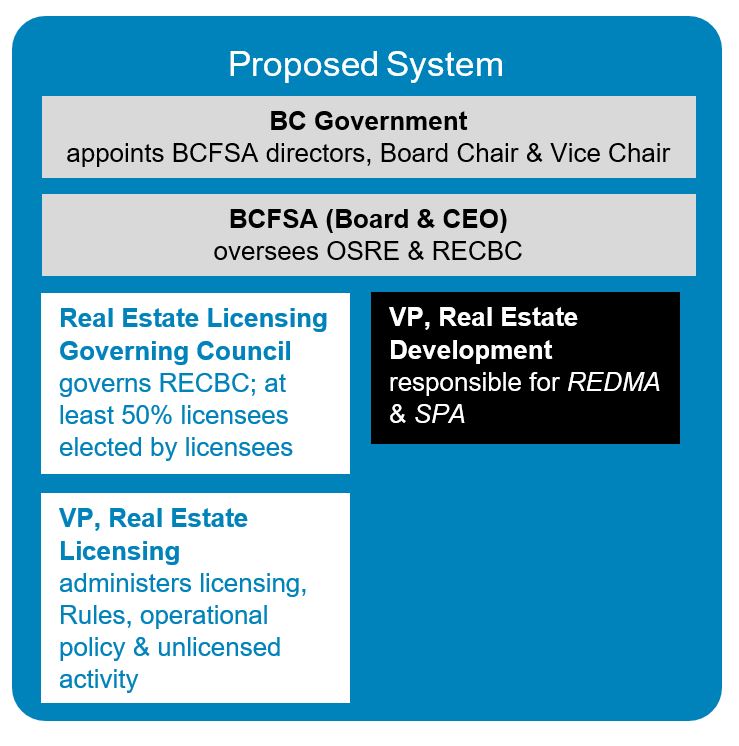
For several months, BCREA has worked with lawyers and member boards on a clear vision for a new, effective regulatory structure. We support the move to a single regulator, and strongly believe the regulator needs to inspire consumer confidence, make decisions based on practical knowledge and be easily understood by licensees and consumers.
With the restructuring, both OSRE and RECBC will turn into departments or functional units of the BCFSA, though the details haven't yet been determined. BCREA has 18 recommendations to help shape the new structure, including asking for clear separation between regulation of real estate development and real estate licensing.
Our most critical recommendation is that the BCFSA retain the equivalent of the RECBC's governing council, and at least half of the members of that council should be licensees. This will help ensure future changes to real estate practice are based on experience, can be implemented with minimal disruption and will have obvious benefits for consumers and licensees.
Commercial licensing?
Because we know changes to the Real Estate Services Act will be introduced in 2020, this is also the right time to explore a separate licence for commercial real estate.
Over the summer, BCREA worked with member boards on REALTOR® focus groups, and we also conducted a survey. According to the survey, 95 per cent of REALTORS® who already focus on commercial real estate support a separate licence. Fifty-six per cent who focus on residential are supportive, and only 25 per cent of REALTORS® think a separate licence is needed.
Introducing commercial and residential licensing could have a big impact, so it's important to look at it carefully. Without a clear direction, and because some significant questions were raised, BCREA's recommendation is that we work with OSRE and RECBC to examine commercial licensing.
We'll submit our recommendations on the regulatory structure and commercial licensing this month. BCREA looks forward to working with the regulators and the Ministry of Finance to create a stable, accountable, effective regulatory environment that meets the needs of licensees and consumers.
Getting Ready for BC’s Restart Plan
May 25th was an exciting day for all of us as Premier John Horgan, Provincial Health Officer Dr. Bonnie Henry and Minister of Health Adrian Dix announced details of BC’s four-phase restart plan. After more than a year of uncertainty and concern about the health and well-being of ourselves and our loved ones, brighter days are ahead.
Still, as we look forward to the easing of restrictions, we must remember that our behavior over the coming weeks will determine whether the milestones laid out in BC’s Restart Plan will be met. As Dr. Henry said, it will be data and not dates that determine what restrictions are eased and when.
According to the Restart Plan, consultation with sector associations on easing restrictions will not begin until June 15. New sector-specific guidelines are currently not anticipated before July 1. BCREA will be working with member boards, government partners, the Real Estate Council of BC, the Office of the Superintendent of Real Estate and WorkSafeBC to inform the new guidelines and ensure you are supported in adapting your practice to these coming changes.
In the meantime, public health orders regarding the number of people who can attend showings remain in place and REALTORS® should continue to follow the guidelines for Safer Showings During the COVID-19 Pandemic, as well as the guidance set out in the COVID-19 Safe Practices Checklist for Managing Brokers.
On behalf of BCREA’s staff and board of directors, I want to acknowledge all BC Realtors for their outstanding efforts and resilience in adapting their practice to help slow the spread of COVID-19. We are proud to serve the profession and look forward to the days when we can help bring Realtors together again in person, whether through BCREA courses offered by member boards or events like Banff Western Connection and Government Liaison Days.
Until then, keep being kind, being calm and being safe – and, if you’re able, get vaccinated.
Darlene K. Hyde
Chief Executive Officer
Getting Ready for the June 1 FINTRAC Changes: Beneficial Ownership
By Adam Feldman, CAMS, CAMS-RM, CSC, Guest Contributor
What is a beneficial owner, and why do I need to know?
A beneficial owner is defined in Canadian federal anti-money laundering regulations as an individual who owns or controls 25% or more of an entity. This could be through direct ownership or ownership of another entity. For example, Offshore Holdings Inc. owns 50% of Legitimate Business Corp., and Offshore Holdings is wholly owned by Boris Badinov. Boris, therefore, owns 50% of Legitimate Business Corp.
Bad guys love to use corporate and other types of entity structures to conduct transactions or make purchases using their proceeds of crime because these structures provide a perfect opportunity to remain anonymous and place extra layers between them and their dirty money. That’s why it’s so important to know who is directing and benefitting from real estate transactions that are conducted by an entity.
I’m sensing that this means new regulatory obligations...
Great instincts! Beneficial ownership requirements are nothing new to the Canadian anti-money laundering space, and money services businesses, banks and credit unions, securities dealers, and life insurance companies have long been required to determine who the individuals are that ultimately own their entity clients. As of June 1, 2021, real estate brokerages will be required to obtain and verify beneficial ownership information of their entity clients, as well.
Brokerages can obtain an entity’s beneficial ownership information by referencing official documentation, such as an annual corporate return, asking the entity’s representative for the information and keeping a record of their response, or having the entity’s representative provide the information in writing.
As of June 1, whenever a brokerage needs to verify the identity of an entity, they’ll be required to obtain information about the ownership and control structure and keep a record of the name and address of any individual who owns or controls 25% or more of the entity. If the entity is a corporation, the brokerage will also need to record the names of the directors. If the entity is a trust, the record needs to include the name and address of the trustee, and all known settlors and beneficiaries. For not-for-profit organizations, brokerages will also need to determine if the entity is registered as a charity with the Canada Revenue Agency and, if it’s not registered, determine if the organization accepts donations from the public.
Speaking of not for profits, those types of organizations might not have individuals who own the entity. In this case, brokerages need to determine who controls the organization, for example, the board of directors or board of governors.
I need to verify the information, too?
Wait, there’s more! In addition to obtaining information about the beneficial ownership and control structure of an entity client, brokerages will also need to make reasonable efforts to verify or confirm the accuracy of that information. The reasonable efforts made to verify the accuracy of the information cannot be the same as the efforts used to obtain the information. For example, it would not be acceptable to obtain a corporation’s beneficial ownership information by referring to a shareholder registry and rely on that same document to verify the information.
If an entity is the owner of a property located in BC, you might be able to search for publicly available information in the Land Owner Transparency Registry, or LOTR. It’s important to note, however, that the information publicly available through the LOTR is not always current and does not confirm title or ownership of estates and interests – it’s merely a repository of records. If you’re trying to verify the beneficial ownership information about the buyer, or you’re unable to find your client in the LOTR, you can verify the beneficial ownership information by taking other measures such as asking the entity’s representative to sign a document stating that the beneficial ownership information that they provided is accurate to the best of their knowledge.
Seems straightforward, right? Well, not quite. If the entity has a complex ownership structure, with multiple layers of parent-subsidiary relationships, relying on the entity’s representative to promise they’re telling the truth isn’t going to cut it. In these cases, you’ll need to refer to external, official documentation such as a shareholder register, partnership agreement or trust agreement. You’ll also need to keep a copy of those documents in your records. You may also want to seek advice from your managing broker or legal professional.
Is that everything?
Almost! If you remember from the first blog post of this series, brokerages are required to conduct ongoing monitoring of their business relationships. As of June 1, 2021, these ongoing monitoring obligations include confirming beneficial ownership information. This means that brokerages will need to determine if there’s been a change to the ownership and control information of their entity clients according to a risk-determined frequency. If they determine that there has been a change, they need to go through those same steps to record and verify the new information.
What if I can’t verify the beneficial ownership information?
If, after your best efforts, and documenting the reasonable measures you’ve taken, you’re unable to verify the beneficial ownership information, all is not lost. You can still represent the client; however, if you’re in a business relationship with an entity, that relationship will automatically be classified as high risk and subject to all of the enhanced due diligence measures that go along with that classification. You’ll also need to take reasonable measures to verify the identity of the entity’s CEO or equivalent, using either the government-issued photo ID method, the credit file method or the dual-process method.
Did I say brokerage? I meant real estate professional!
While brokerages and real estate professionals are jointly responsible for suspicious transaction and terrorist financing reporting obligations, the responsibility for compliance with other federal anti-money laundering regulations belongs to the reporting entity, which is typically the brokerage. This is true of the new beneficial ownership obligations, as well. In practice, however, brokerages often delegate certain information collection and verification processes to real estate professionals and expect them to complete these processes in the manner specified by the legislation and regulations to ensure the brokerage remains in compliance.
Beneficial ownership determination imposes additional regulatory obligations for brokerages and requires the development and implementation of additional compliance procedures. However, understanding who ultimately directs and benefits from real estate transactions is an important step in keeping money from criminal activity out of BC's real estate market.
Be sure to check out the other blogs in this series at the links below:
- Getting Ready for the June 1 FINTRAC Changes: Business Relationships
- Getting Ready for the June 1 FINTRAC Changes: Politically Exposed Persons - Part 1
- Getting Ready for the June 1 FINTRAC Changes: Politically Exposed Persons - Part 2
- Getting Ready for the June 1 FINTRAC Changes: Virtual Currency Obligations
For additional information and resources on the June 1 FINTRAC changes, click here.
Getting Ready for the June 1 FINTRAC Changes: Business Relationships
By Adam Feldman, CAMS, CAMS-RM, CSC, Guest Contributor
Brokerages have been required to conduct ongoing monitoring of their business relationships ever since the concept was introduced into regulation in 2014. At that time, the Financial Transactions and Reports Analysis Centre of Canada (FINTRAC) clarified that a business relationship is established if a brokerage conducts two activities in a period of five years, which requires them to verify the identity of the client (both individuals and entities).
However, there have been a series of amendments made to the regulations, and effective June 1, 2021, brokerages are considered to have entered into a business relationship with a client the first time they are required to verify the client's identity. While the FINTRAC regulations designate brokerages as responsible, in practice these obligations are typically delegated to REALTORS®. With that in mind, this blog post will refer to “Realtors”.
FINTRAC states that you need to identify a client at the "time of the transaction", which FINTRAC defines as the time when the deed is signed. Given that you might not be present when the transaction completes and that you have a duty to identify a client regardless of whether a transaction completes, best practice would be to identify your client either at the time you first meet them or when you sign an agreement to represent them. If your client is a corporation or other entity, their identity must be verified within 30 days of the transaction, i.e. within 30 days of signing the deed.
The good news here is that the new business relationship requirements will only be applied to relationships that are established after June 1, 2021. So if you represented a client last year, and did not form a business relationship (ie. they did not conduct two or more activities within the last five years), you’re not required to do ongoing monitoring, unless you enter into a business relationship with them after June 1, 2021.
Also, when conducting a deal where the other party is unrepresented, although you're required to take reasonable measures to verify that party's identity as they are not your client, the identity verification doesn't trigger the establishment of a business relationship.
Help! I’m in a business relationship!
What happens once you enter into a business relationship?
- For starters, you'll need to keep a record of the "purpose and intended nature of the relationship." This is a record that describes why the client is using your services. For the real estate sector, this usually involves keeping a record that describes the type of property the client is or will be buying or selling. For example, purchase or sale of a residential property, purchase or sale of a commercial property, etc. The idea behind the purpose and intended nature record is that it should provide some context in terms of the types of transaction flows you'd expect to see throughout the relationship. Transactions that don't appear to be consistent with the purpose and intended nature should prompt additional questions and perhaps even the filing of a suspicious transaction report if those questions are not answered to your satisfaction.
- When you enter into a business relationship, you also need to make a determination as to whether a client is a politically exposed person, or PEP. We'll talk more about PEPs in a future post.
- In addition to making periodic ongoing PEP determinations, there are three additional ongoing monitoring requirements that Realtors need to conduct:
- Assessment of risk – When Realtors enter into a business relationship, they need to assess the relationship's risk. Due to the fluid and ever-changing nature of risk, Realtors also need to periodically reassess the risk of the relationship. The assessment of risk helps determine the frequency of ongoing monitoring.
- Transaction review – High-risk relationships need to be monitored to a greater depth and at a higher frequency than low-risk relationships. Realtors need to periodically review the transactions that their clients conduct to make sure the transactions are consistent with their understanding of the relationship and to identify any indicators of suspicious activity.
- Information review and update – Lastly, Realtors need to keep client information up to date. Specifically, Realtors need to periodically review and update the information such as their name, address and phone number), as well as information that might be used to assess the risk of a relationship. This could involve periodically contacting a client and asking them to confirm the information that is contained in your files. Information reviews must be conducted more frequently for higher-risk clients.
Ongoing monitoring measures need to be taken for all business relationships, even if the client doesn't conduct any additional deals after the business relationship has been established.
I want out of this relationship!
So, how does a business relationship end? A business relationship naturally expires five years after the client conducts the last transaction that requires the brokerage to verify their identity. It cannot be terminated earlier at the request of the client or the brokerage.
Business relationship requirements can be both time- and resource-intensive. These obligations and FINTRAC's focus on the sector demand solid compliance programs to comply with these new rules. Given their complexity and ongoing nature, technology-based approaches to support your compliance efforts may be the best option.
Be sure to check out the other blogs in this series at the links below:
- Getting Ready for the June 1 FINTRAC Changes: Beneficial Ownership
- Getting Ready for the June 1 FINTRAC Changes: Politically Exposed Persons - Part 1
- Getting Ready for the June 1 FINTRAC Changes: Politically Exposed Persons - Part 2
- Getting Ready for the June 1 FINTRAC Changes: Virtual Currency Obligations
Getting Ready for the June 1 FINTRAC Changes: Politically Exposed Persons – Part 1
By: Adam Feldman, CAMS, CAMS-RM, CSC, Guest Contributor
What is a PEP?
If you’ve been following the regulatory changes that are coming into effect on June 1, 2021, you might be aware that, under circumstances described in the next section, brokerages will be required to determine if an individual is a PEP. But what is a PEP? Well, “PEP” refers to a politically exposed person. These are individuals that hold a senior position in a government, military, judiciary, or international organization. The senior nature of a PEP’s position provides them with the potential to influence policy direction and/or the allocation of resources.
The specific roles and positions that qualify an individual as a PEP are defined in federal anti-money laundering legislation, but PEPs can essentially be categorized as:
- a foreign PEP,
- a domestic PEP,
- a head of an international organization (HIO), or
- a family member or a close associate of a foreign or domestic PEP or HIO.
It’s worth mentioning that the mayor of a Canadian city, town, village, or rural or metropolitan municipality is also considered to be a domestic PEP, regardless of the size of the population.
Family members and close associates of a PEP or HIO hold the same status as the individuals to whom they’re related or associated. For example, a parent of a foreign PEP would also be considered a foreign PEP. You can refer to FINTRAC’s guidance for a complete list of who qualifies as a PEP/HIO, but for now, let’s just keep it simple. For the rest of this post, unless otherwise specified, references to PEPs will include these subcategories.
So now that I know what a PEP is, what do I need to do?
Starting on June 1, certain activities, events or transactions will require brokerages to take reasonable measures to determine if the individuals they’re dealing with are PEPs. These determinations will need to be made as a result of the following:
- Entering into a business relationship – Remember, as of June 1, brokerages will enter into a business relationship the first time they create an information record for a client. This will also trigger a requirement to determine if the client is a PEP.
- Ongoing monitoring – Once you’ve entered into a business relationship, FINTRAC expects you to periodically reassess your client’s PEP status.
- Detecting a fact about a client that indicates they may be a PEP – You need to make a PEP determination if you identify a fact that indicates that a client might be a PEP; for example, if they mention that they formerly held a senior position in the government of a foreign country.
- Receiving $100,000 or more in cash or virtual currency – You’re probably thinking this is pretty rare, but if you ever do receive $100,000 or more in cash or the equivalent value in virtual currency in a single transaction, you’ll be required to make a PEP determination for the individual that you receive the cash or virtual currency from.
But how do I determine if a person is a PEP?
There are a few different methods that brokerages can use to determine if they’re dealing with a PEP:
- Asking the individual – This is one of the most common PEP determination methods, and it requires a brokerage to provide the individual with the definition of who qualifies as a PEP and then asking them if the definition describes them or someone that they know. This method is easy to implement and it’s also consistent with FINTRAC’s description of reasonable measures. It’s not very reliable, though, as you need to trust the individual to tell you the truth.
- Commercial databases – Many software vendors maintain extensive lists of known PEPs. A brokerage that holds a subscription with one of these vendors merely has to enter the individual’s name and the system will identify whether the name matches that of any known PEPs. This is also a very common method of making a PEP determination and, in one sense, it’s more reliable than asking the person, as the commercial databases are independently maintained. On the other hand, no database of known PEPs can be entirely complete. After all, how realistic is it to expect that a database will include every family member or close associate of every known PEP?
- Open-source research – As PEPs are public figures, there tends to be a fair amount of information about them in the public domain. Brokerages can determine if an individual is a PEP by doing some background research using social media and their favourite search engine. This method requires strong online research skills and often requires allocating dedicated resources to conduct these searches. However, open-source research can be quite reliable when conducted by a skilled researcher.
Whichever method or combination of methods that you use, your PEP determination process should be described in your brokerage policies and procedures.
What do I do if I determine that the individual is a PEP?
If you determine that an individual is a PEP, some specific measures need to be taken to evaluate and mitigate the risk associated with the individual. Stay tuned for next week’s post to learn more!
Remember, brokerage really means real estate professional!
Although both brokerages and real estate professionals have obligations to comply with federal anti-money laundering regulations related to reporting suspicious transactions or the possession or control of terrorist property, the bulk of the compliance obligations, including the requirement to make a PEP determination, fall to the reporting entity. This is typically the brokerage. However, a brokerage often delegates certain compliance processes to their real estate professionals who help the brokerage remain compliant by conducting those processes in the manner specified by the legislation, regulations, and brokerage policies and procedures.
Be sure to check out the other blogs in this series at the links below:
Getting Ready for the June 1 FINTRAC Changes: Politically Exposed Persons – Part 2
By: Adam Feldman, CAMS, CAMS-RM, CSC, Guest Contributor
If you remember last week’s post, starting on June 1, 2021, brokerages will need to determine if an individual with whom they are dealing is a politically exposed person (PEP). A PEP is an individual who holds a senior position in a government, military, judiciary or international organization. PEPs fall into one of the following categories:
- foreign PEPs,
- domestic PEPs,
- heads of international organizations (HIOs), or
- relatives and close associates of a domestic or foreign PEP or HIO.
For simplicity's sake, we'll refer to them collectively as "PEP's", unless there's a reason to differentiate.
The last post also talked about the different ways that you can determine if you’re dealing with a PEP.
Now that we’re all caught up, let’s continue the discussion!
What do I do if I determine that the individual is a PEP?
Once you’ve determined that you’re working with an individual who is a PEP, your next step is to determine if you’re dealing with a high-risk PEP. If you determine that the individual is a foreign PEP, this is a very simple determination, as all foreign PEPs are considered to be high-risk PEPs forever by federal anti-money laundering legislation.
If you determine that the individual is a domestic PEP or HIO, you’ll need to conduct an assessment to evaluate if they’re a high-risk PEP. When assessing the risk of a domestic PEP or HIO, you can consider the same factors that you use to evaluate the risk of all your business relationships. You might want to consider other factors as well, such as:
- whether the individual currently holds the office or position and, if they don’t, how much time has elapsed since they left office;
- if the individual attempts to shield their identity;
- if the person uses intermediaries, such as an accountant or lawyer, which is unusual based on the nature of the deal;
- if the person uses family members or close associates as legal owners for property or entities in a way that doesn’t fit the person’s profile;
- if the person is associated with an industry that has been identified as being vulnerable to corruption by Transparency International;
- whether there is any adverse media that indicates that the institution in which the individual serves or served, has a reputation for corruption; and
- if the individual provides you with inaccurate information or is reluctant to provide you with the additional information you need to evaluate their risk.
Whatever methodology you use to assess the risk of domestic PEPs and HIOs, make sure you document it as part of your risk-based approach and follow your FINTRAC obligations, and brokerage’s policies and procedures.
I’ve completed my risk assessment. Now what?
Other than conducting ongoing monitoring and record keeping, as you’re required to for all business relationships, if you determine that the individual is not a high-risk PEP, you don’t need to take any further actions, aside from keeping a record of your assessment of the PEP’s risk. If, however, you assess the PEP as representing a high risk, there are a few enhanced measures that you need to take depending on what triggered the high-risk PEP determination in the first place.
If you determine that an individual is a high-risk PEP, after entering into a business relationship or as a result of ongoing monitoring of a business relationship, you need to take reasonable measures to establish their source(s) of wealth. This means that you need to try to understand the individual’s financial profile. Where does their money come from? Some common sources of wealth include salary, business income, investments and inheritance. Reasonable measures to determine source(s) of wealth could include asking the individual, using an enhanced due diligence research service, or conducting online, open source research on the individual. You also need to conduct the same enhanced due diligence measures that are documented in your brokerage’s policies and procedures that you would conduct for all your high-risk business relationships.
Although unlikely, if you determine that an individual is a high-risk PEP as a result of receiving $100,000 or more in cash or the equivalent value in virtual currency, in addition to taking the enhanced measures described above, you also need to take reasonable measures to determine the source of funds (or virtual currency) that was used for the transaction. Examples of sources of funds could include savings, sale of real estate and sale of a car or boat. But that’s not all. Once you’ve taken reasonable measures to determine the source of funds and source of wealth, you’ll also need to get a managing broker to review the transaction.
How much time do I have to complete PEP obligations?
Brokerages have 30 days from the date of the event that triggered the PEP determination requirement to:
- make the PEP determination,
- conduct the risk assessment (for domestic PEPs and HIOs), and
- complete the enhanced measures (for high-risk PEPs).
What records do I need to keep?
Regardless of the outcome, brokerages need to keep a record of the outcome of that determination. If it’s determined that the client is a domestic PEP or HIO, you need to keep a record of your assessment of whether the individual is a high-risk PEP. For high-risk PEPs, you need to keep that information plus the following records:
- the office or position that the individual holds or held,
- the name of the organization or institution in which the individual serves or served,
- the date that the PEP determination was made, and
- the individual’s source of wealth (if known).
In the unlikely event that the PEP determination was made as a result of receiving $100,000 or more in cash or virtual currency, your records will also need to include:
- the source of the funds or virtual currency that were used for the transaction (if known),
- the name of the managing broker that reviewed the transaction, and
- the date of the managing broker’s review.
Remember, brokerage really means real estate professional!
Although both brokerages and real estate professionals have obligations to comply with federal anti-money laundering regulations related to reporting suspicious transactions or the possession or control of terrorist property, the bulk of the compliance obligations, including the requirement to make a PEP determination, fall to the reporting entity. This is typically the brokerage. However, a brokerage often delegates certain compliance processes to their real estate professionals who help the brokerage remain compliant by conducting those processes in the manner specified by the legislation, regulations, and brokerage policies and procedures.
Be sure to check out the other blogs in this series at the links below:
Getting Ready for the June 1 FINTRAC Changes: Virtual Currency Obligations
By: Adam Feldman, CAMS, CAMS-RM, CSC, Guest Contributor
The rise of virtual currency
If you’ve followed the news lately, you’ve probably noticed the increased prominence that virtual currencies are gaining on the global financial landscape. A 2019 study estimated that 9% of the global population owns Bitcoin, while British Columbia alone is home to 229 Bitcoin ATMs. In anticipation of the increased mainstreaming of virtual currencies, the Ministry of Finance has introduced new federal anti-money laundering regulations that require brokerages to verify an individual’s identity, make a third-party determination, keep a record, and submit a report to FINTRAC when conducting a large virtual currency transaction. These obligations come into force on June 1, 2021.
What is a large virtual currency transaction?
A large virtual currency transaction occurs when a brokerage receives virtual currency valued at $10,000 or more. This could be received in a single transaction or multiple transactions from or on behalf of the same person or entity in a 24-hour period.
What do I need to do if I conduct a large virtual currency transaction?
Starting June 1, when a brokerage conducts a large virtual currency transaction, it needs to take the following actions:
- verify the identity of the individual or entity that conducted the transaction,
- make a third-party determination,
- keep a record of the transaction, and
- submit a report to FINTRAC.
It’s worth mentioning that brokerages don’t need to verify the identity of an individual or entity if they’ve already done so and are confident in the accuracy of the information that was used to verify the identity. However, brokerages need to take reasonable measures to determine if the transaction is being conducted on behalf of a third party for each large virtual currency transaction, even if a third-party determination has been previously made.
How much time do I have to complete these measures?
At the time that a brokerage receives virtual currency above the reporting threshold, it also needs to keep a record of the transaction, verify the identity of an individual, and take reasonable measures to make a third-party determination. Large virtual currency reports need to be submitted within five business days after the brokerage receives the virtual currency.
Wait, I’m not ready!
There are a lot of regulatory changes coming into force on June 1, and FINTRAC has stated that it will exhibit flexibility when assessing a reporting entity’s compliance with the new regulations. Specifically, with respect to large virtual currency transactions, FINTRAC has stated that if, despite its best efforts, a brokerage does not have a process in place for reporting these transactions by June 1, it should keep a record of all virtual currency transactions that meet or exceed the reporting threshold and submit reports for those transactions once a reporting process has been implemented. Brokerages need to have the reporting process in place by December 1, 2021, and unreported large virtual currency transactions that are conducted between June 1 and November 30, 2021, will need to be reported to FINTRAC by March 31, 2022, at the latest.
Can I accept payment in virtual currency right now?
Although virtual currency may become more common in real estate deals in the future, it is not likely to play a prominent role in British Columbia real estate deals for the time being. The Real Estate Council of British Columbia (RECBC) has issued guidance stating that virtual currencies such as Bitcoin cannot be held in trust, so a third party would have to hold it, and recommending that consumers seek legal advice if they want to explore this method of payment. Further, the Contract of Purchase and Sale created by the British Columbia Real Estate Association and the Canadian Bar Association – BC Branch does not currently include virtual currency as an accepted means of payment. In addition, some BC real estate boards don’t allow the purchase of real estate using virtual currency and brokerages may have their own policies and procedures in place related to the use of virtual currency.
In short, if you’re thinking of representing a client that wants to purchase or sell property in exchange for virtual currency, be sure to reach out to RECBC, your local real estate board and your brokerage for guidance first, and advise your client to seek independent legal advice.
Remember, brokerage really means real estate professional!
Although both brokerages and real estate professionals have obligations to comply with federal anti-money laundering regulations related to reporting suspicious transactions or the possession or control of terrorist property, the bulk of the compliance obligations, including large virtual currency transaction requirements, fall to the reporting entity. This is typically the brokerage. However, a brokerage often delegates certain compliance processes to their real estate professionals who help the brokerage remain compliant by conducting those processes in the manner specified by the legislation, regulations, and brokerage policies and procedures.
Be sure to check out the other blogs in this series at the links below:
Getting to Informed Consent: Explaining Listing Agreements to Clients #551
When REALTORS® connect with clients in a listing contract, the clients often tend to only focus on one or two key details, such as commission rates or purchase price. As good practice, REALTORS® must remember to slow down and adequately explain the finer details to ensure that clients fully understand the nature of the document(s) they are asked to sign.
It is a part of a REALTORS®’s duty to be “acting in the best interest of the clients includes obtaining informed consent … outlining the exact nature of the real estate services being provided”1, 2.
In order to do so, here are some key details about listing contracts to fully understand and thoroughly explain to clients before they put pen to paper.
Explaining Key Areas of the Listing Contract
- Term of Agreement (Section 1)
- Point out the length of the agreement, as well as connect this with the cancellation/release options that you discuss in Section 14. It is a good practice to have the client’s initial beside the Expiry Date.
- Point out the length of the agreement, as well as connect this with the cancellation/release options that you discuss in Section 14. It is a good practice to have the client’s initial beside the Expiry Date.
- Listing Price (Section 3)
- Review the Comparative Market Analysis, the client’s motivations for selling and preferred timelines with the client. (Remember, the Comparative Market Analysis should form part of your file).
If the pricing is aggressive or the market is shifting, consider a preliminary discussion of listing price amendments and when those will be considered. Additionally, ensure that you discuss both positive and negative outcomes, as these conversations allow the client to get a sense of what the range of outcomes is likely to be in the local market.
- Review the Comparative Market Analysis, the client’s motivations for selling and preferred timelines with the client. (Remember, the Comparative Market Analysis should form part of your file).
- Cooperating Brokerage (Section 4)
- Explain that the seller’s commission payable to the listing brokerage is shared between the listing brokerage and brokerages. Importantly, clarify that although the commission is split, the buyer’s Realtor is NOT working for the seller in any way and no confidential information will be shared with Buyer’s REALTORS®.
- Explain that the seller’s commission payable to the listing brokerage is shared between the listing brokerage and brokerages. Importantly, clarify that although the commission is split, the buyer’s Realtor is NOT working for the seller in any way and no confidential information will be shared with Buyer’s REALTORS®.
- When Commission Gets Paid (Section 5A)
- Explain that commission is payable once the client enters into a legally enforceable or subject-free contract with a buyer. Also, explain that commission can be payable even after termination of the listing contract in the event that a buyer who was introduced to the property during the term of the listing agreement purchases the property within 60 days after termination of the listing contract.
- Explain that commission is payable once the client enters into a legally enforceable or subject-free contract with a buyer. Also, explain that commission can be payable even after termination of the listing contract in the event that a buyer who was introduced to the property during the term of the listing agreement purchases the property within 60 days after termination of the listing contract.
- How Much Commission is Paid (Section 5D)
- Using the list price, explain the calculation of commission and that GST is payable in addition to this amount.
This is a perfect opportunity to explain and review the Disclosure to Sellers of Expected Remuneration form with the seller.
- Using the list price, explain the calculation of commission and that GST is payable in addition to this amount.
- Designated Agency (Section 7) and Your Services (Section 9)
- In addition to your marketing plan, remember to cross-reference the duties in this section which are owed to clients under the Disclosure of Representation in Trading Services form. Explain to your client that your duty is to represent their interests throughout the process. However, a client should understand that you cannot follow any unlawful instructions.
- In addition to your marketing plan, remember to cross-reference the duties in this section which are owed to clients under the Disclosure of Representation in Trading Services form. Explain to your client that your duty is to represent their interests throughout the process. However, a client should understand that you cannot follow any unlawful instructions.
- Seller Agreements (Section 10)
- Explain that while you, the REALTOR®, are working for the seller, you expect the seller will work with you to assist in the sale and keep you informed of any material changes with the property or their capacity to sell. If the seller is not the title holder, ensure you have a certified, true copy of any power of attorney or the probated will.
- Explain that while you, the REALTOR®, are working for the seller, you expect the seller will work with you to assist in the sale and keep you informed of any material changes with the property or their capacity to sell. If the seller is not the title holder, ensure you have a certified, true copy of any power of attorney or the probated will.
- Conflict of Interest (Section 12)
- Review what an example of a conflict of interest is. For instance, if your buyer client is interested in this listing and how you would practically deal with that conflict, emphasizing communication, transparency and your duties to each party.
This is a great time to review the protocol for conflicts and the Agreement Regarding Conflicts of Interest between Clients.
- Review what an example of a conflict of interest is. For instance, if your buyer client is interested in this listing and how you would practically deal with that conflict, emphasizing communication, transparency and your duties to each party.
- Termination (Section 14)
- The client needs to understand what happens if they request to terminate the listing contract prior to the expiry date. Be specific with your own business practices here and write it down clearly. Is the client free to hire another agent immediately? If not, what are the conditions of early termination? Cross-reference this back to the term discussion in Section 1.
Using Electronic Signing Programs Effectively – Review Then Sign
Electronic signatures are fast and legally binding but can often lead to arguments over “informed consent” between REALTORS® and clients. More so, as electronic signing programs are becoming more frequently used, it is often the case that clients electronically sign on mobile devices and often cannot effectively read the document.
Here is a suggested three-step process when using electronic signatures:
- Send the client a copy of the document not set up to sign, such as a locked PDF or Word file.
- Call the client over the phone to review the document or detail your comments or concerns in an email.
- Once it is clear that the client understands the document, then send the client the secure document for electronic signature.
Have a Checklist
Ultimately, clients may forget the details of listing agreements and other important details in the excitement of the deal. To prevent potential conflicts, you should have a checklist for both listing presentations and offer presentations, which will ensure you have covered all the relevant points with your clients. Keeping a marked-up version of this checklist in your file is a great way to keep notes.
Remember that although you work with real estate transactions on a regular basis, this will often be an occasional or a new experience for your clients. Therefore, providing clients redundant or repetitive information they may already be aware of is much better than failing to disclose a key term that will later become detrimental to your client’s position.
| 1. | Emam (Re), 2012 CanLII 26111 (BC REC) | |
| 2. | Chonn (Re), 2021 CanLII 89767 (BC REC) |
Getting to Informed Consent: Explaining Listing Agreements to Clients #551
When REALTORS® connect with clients in a listing contract, the clients often tend to only focus on one or two key details, such as commission rates or purchase price. As good practice, REALTORS® must remember to slow down and adequately explain the finer details to ensure that clients fully understand the nature of the document(s) they are asked to sign.
It is a part of a REALTORS®’s duty to be “acting in the best interest of the clients includes obtaining informed consent … outlining the exact nature of the real estate services being provided” (Emam (Re), 2012 CanLll 26111 (BC REC) and Chonn (Re), 2021 CanLII 89767 (BC REC)).
In order to do so, here are some key details about listing contracts to fully understand and thoroughly explain to clients before they put pen to paper.
Explaining Key Areas of the Listing Contract
- Term of Agreement (Section 1)
- Point out the length of the agreement, as well as connect this with the cancellation/release options that you discuss in Section 14. It is a good practice to have the client’s initial beside the Expiry Date.
- Listing Price (Section 3)
- Review the Comparative Market Analysis, the client’s motivations for selling and preferred timelines with the client. (Remember, the Comparative Market Analysis should form part of your file).
If the pricing is aggressive or the market is shifting, consider a preliminary discussion of listing price amendments and when those will be considered. Additionally, ensure that you discuss both positive and negative outcomes, as these conversations allow the client to get a sense of what the range of outcomes is likely to be in the local market.
- Review the Comparative Market Analysis, the client’s motivations for selling and preferred timelines with the client. (Remember, the Comparative Market Analysis should form part of your file).
- Cooperating Brokerage (Section 4)
- Explain that the seller’s commission payable to the listing brokerage is shared between the listing brokerage and cooperating brokerages representing buyers. Importantly, clarify that although the commission is split, the buyer’s Realtor is NOT working for the seller in any way and no confidential information will be shared with Buyer’s REALTORS®.
- When Commission Gets Paid (Section 5A)
- Explain that commission is payable once the client enters into a legally enforceable or subject-free contract with a buyer. Also, explain that commission can be payable even after termination of the listing contract in the event that a buyer who was introduced to the property during the term of the listing agreement purchases the property within 60 days after termination of the listing contract.
- How Much Commission is Paid (Section 5D)
- Using the list price, explain the calculation of commission and that GST is payable in addition to this amount.
This is a perfect opportunity to explain and review the Disclosure to Sellers of Expected Remuneration form with the seller.
- Using the list price, explain the calculation of commission and that GST is payable in addition to this amount.
- Designated Agency (Section 7) and Your Services (Section 9)
- In addition to your marketing plan, remember to cross-reference the duties in this section which are owed to clients under the Disclosure of Representation in Trading Services form. Explain to your client that your duty is to represent their interests throughout the process. However, a client should understand that you cannot follow any unlawful instructions.
- Seller Agreements (Section 10)
- Explain that while you, the REALTOR®, are working for the seller, you expect the seller will work with you to assist in the sale and keep you informed of any material changes with the property or their capacity to sell. If the seller is not the title holder, ensure you have a certified, true copy of any power of attorney or the probated will.
- Conflict of Interest (Section 12)
- Review what an example of a conflict of interest is. For instance, if your buyer client is interested in this listing and how you would practically deal with that conflict, emphasizing communication, transparency and your duties to each party.
This is a great time to review the protocol for conflicts and the Agreement Regarding Conflicts of Interest between Clients.
- Review what an example of a conflict of interest is. For instance, if your buyer client is interested in this listing and how you would practically deal with that conflict, emphasizing communication, transparency and your duties to each party.
- Termination (Section 14)
- The client needs to understand what happens if they request to terminate the listing contract prior to the expiry date. Be specific with your own business practices here and write it down clearly. Is the client free to hire another agent immediately? If not, what are the conditions of early termination? Cross-reference this back to the term discussion in Section 1.
Using Electronic Signing Programs Effectively – Review Then Sign
Electronic signatures are fast and legally binding but can often lead to arguments over “informed consent” between REALTORS® and clients. More so, as electronic signing programs are becoming more frequently used, it is often the case that clients electronically sign on mobile devices and often cannot effectively read the document.
Here is a suggested three-step process when using electronic signatures:
- Send the client a copy of the document not set up to sign, such as a locked PDF or Word file.
- Call the client over the phone to review the document or detail your comments or concerns in an email.
- Once it is clear that the client understands the document, then send the client the secure document for electronic signature.
Have a Checklist
Ultimately, clients may forget the details of listing agreements and other important details in the excitement of the deal. To prevent potential conflicts, you should have a checklist for both listing presentations and offer presentations, which will ensure you have covered all the relevant points with your clients. Keeping a marked-up version of this checklist in your file is a great way to keep notes.
Remember that although you work with real estate transactions on a regular basis, this will often be an occasional or a new experience for your clients. Therefore, providing clients redundant or repetitive information they may already be aware of is much better than failing to disclose a key term that will later become detrimental to your client’s position.
Getting to the Bottom of FINTRAC Compliance
Answers to your burning questions
The wait for responses from the Financial Transactions and Reports Analysis Centre of Canada (FINTRAC) to managing brokers' top questions submitted at the Conference for Managing Brokers is over!
 During the conference, attendees submitted questions to the presenters and voted for the questions they most wanted answered. Responses to three burning questions submitted to FINTRAC are given below. The rest of the responses from FINTRAC can be found here.
- Why all the FINTRAC pressure on our industry when banks control the flow, not REALTORS®?
FINTRAC administers the Proceeds of Crime (Money Laundering) and Terrorist Financing Act (PCMLTFA) and its associated Regulations, to which a number of sectors are subject. We provide outreach and assistance to all of these sectors and have developed guidance on each sectors' obligations with respect to the implementation of a compliance program, ascertaining identification, record-keeping, and, as applicable, reporting to FINTRAC.
That said, the exploitation of real estate by criminals for money laundering purposes is well recognized internationally and underscores the importance of quality reporting on relevant suspicious transactions. Many countries are increasing their efforts to implement counter measures following the Financial Action Task Force (FATF)'s work on this topic indicating that the real estate sector is highly susceptible for many reasons: for example, easy price manipulation and a variety of complex options for selling/purchasing/financing with anonymity.
It is important to recognize that the real estate brokers and sales representatives are uniquely positioned to be able to assess aspects of the transaction that other entities involved may not be aware of. While the actual flow of funds for the purchase of real estate may involve financial entities, it is the real estate brokers and sales representatives that have a relationship with the participants to the transactions. Furthermore, financial institutions may under-report because of an erroneous belief that brokers/agents/developers have already submitted suspicious transaction reports. For example, the suspicions surrounding deposits for a purchase may be primarily visible to and reported by real estate agents, brokers and developers, whereas those related to loans may be more visible to and reported by financial institutions. - How can we build a proper FINTRAC compliance program if each auditor has a different perspective on many of the grey areas?
To ensure that we exercise professional judgement in a consistent manner, we rely on our collective knowledge, experience, training, and standardized assessment approach, while taking into account the nature, size, and complexity of different businesses. Compliance officers strive to provide clear and consistent explanations of the examination findings, and guidance to facilitate your understanding of your legislative obligations, as well as of FINTRAC guidelines, policies, and procedures. Finally, all examination findings go through a peer review and managerial approval process to further ensure consistency.
As such, what might appear to be different perspectives on grey areas may actually be a result of the different considerations used – e.g., compliance history, the size of the reporting entity, the way a particular reporting entity sets out responsibilities in its policies and procedures. - How can FINTRAC tell us to not rely on the CREA FINTRAC compliance guidelines and related FINTRAC content? Are they incorrect?
FINTRAC encourages industries and industry associations to develop products on which the reporting entities within a sector may base their compliance program. However, these products may be intentionally general so as to be applicable, at a high-level, across the industry. As such, a real estate broker or sales representative may be able to use CREA's guidelines and content, but must consider whether it is specific enough for its purposes, and applicable given how its entity functions on a day-to-day basis.
Please click here for the rest of the responses from FINTRAC. Thank you to FINTRAC for presenting at the Conference for Managing Brokers and for providing these great responses!
To subscribe to receive BCREA publications such as this one, or to update your email address or current subscriptions, click here.
Goodbye Salespersons, Nominees and Agents; Paragraph 2(f) of the PDS—Building Permits, Licensee’s Standard of Care and Material Latent Defects #379
By Gerry Neely
B.A. LL.B.
To familiarize ourselves with the name changes for the classification of licensees in the new Real Estate Services Act, Legally Speaking columns from now on will describe salespersons as representatives, nominees as managing brokers and agents as brokerages.
* * *
A managing broker's lament about the consequences of a seller who falsely answered "yes" to paragraph 2(f) of the residential Property Disclosure Statement (PDS) illustrates the dilemma representatives face when taking a listing and completing a PDS.
Paragraph 2(f) asks the seller whether he or she is aware if any additions or alterations were made without a required permit. A permit is generally required when health or safety related work should be inspected. You should be able to rely on the seller's choice of an answer. However, if there are circumstances that make you doubt its accuracy, you should also question it. In addition, buyer's representatives should disclose relevant information they know about and obtain answers to questions buyers ask them.
A representative flagrantly failed to do so in a 1995 case, where a 40-year-old army hut was converted into an attractive rancher represented to be three years old. The seller had answered "no" to paragraph 2(f).
The representative was not initially aware of the home's true age, nor that it had been a shell before its conversion. He discovered this from someone other than the seller after a conditional offer collapsed, but didn't search for permits or change the PDS. It was the representative for a second potential buyer who found that no permits had been issued to the seller. The sale proceeded when the seller signed an addendum prepared by the seller's representative to give the buyer a warranty that the house met the current building code standards.
But, of course, it didn't—there were many structural deficiencies and building code violations. Damages of $70,000 on an $80,000 purchase price were ordered to be paid by the seller, the brokerage and the representative. The representative was negligent for knowingly passing on the seller's misrepresentation to the buyer's representative. In addition, he was equally as liable as the seller for the representation that the house complied with the building code, because he failed to check for permits.
The judge's opinion was that, while the representative couldn't be expected to know the building codes in every respect, the standard of care expected of him was to know the relationship between the building code and the municipal bylaws, which results in inspections and the issuance of building permits.1
The deficiencies were material latent defects, which may have made the home potentially dangerous or unfit for occupation. The repair costs were extraordinary. Any one of these factors is a reason to determine whether work was done with the appropriate permits and inspections. The lack of a permit and the presence of these factors require disclosure by both sellers and licensees.
| 1. | Johnstone v. Dame, , SCBC, Nanaimo Registry, Reasons for Judgment, December 12, 1995, and Legally Speaking 252. |
To subscribe to receive BCREA publications such as this one, or to update your email address or current subscriptions, click here.
Government Needs Transitional Rules for All Transactions Impacted By Taxes Introduced in Budget 2018 — New Taxes Unlikely to Stabilize Housing Market
Victoria, BC – February 20, 2018. The British Columbia Real Estate Association (BCREA) calls on the government to introduce transitional rules for all transactions impacted by the new tax measures introduced in Budget 2018. The new tax measures come into effect on February 21, 2018. The Property Transfer Tax (PTT) increase to 5 per cent for properties over $3 million, as well as the increase to 20 per cent and expansion of the Foreign Buyer’s Tax to other parts of the province will have an immediate impact on transactions underway.
When the Foreign Buyer’s Tax was introduced in 2016, consumers and REALTORS® were frustrated by the number of collapsed deals due to how the tax was introduced. At the time, the Association called for grandfathering of transactions underway to ensure a smooth transition. While the province has indicated transitional rules for the expansion of the Foreign Buyer’s Tax to other parts of BC, the Association believes this should apply to all transactions.
Of additional concern, the “speculation” tax introduced in the budget will affect British Columbians who own or want to invest in those markets by buying a second home or recreational property.
The Association welcomes measures in Budget 2018 to increase the supply of affordable housing in British Columbia. These initiatives are important steps in supporting those who need the most assistance to find and afford housing. However, the government missed the opportunity to help home buyers across the province by increasing the thresholds to the PTT or index those thresholds to reflect the changing real estate market.
The new tax measures introduced by the government to “stabilize the housing market” are unlikely to achieve the intended objective. The taxes ignore the major culprit – matching housing supply and demand within a reasonable timeframe. Additional taxes, whether targeted at foreign buyers or speculators, do not reduce the gap between when a housing project starts, and when it is available to purchase.
-30-
Click here for the PDF.
To subscribe to receive BCREA publications such as this one, or to update your email address or current subscriptions, click here.
Government Relations at BCREA: Why We Do What We Do
“Government Relations” – two simple words. But, in terms of our work at the BC Real Estate Association (BCREA), what does it mean?
The first part is self-explanatory, indicating all three levels of government, and the Province specifically, as we’re a provincial organization.
The second part isn’t so simple. What does “relations” mean? Well, as with individuals, organizations can have relationships. And the actions of the two sides in any relationship will determine whether it’s positive and mutually beneficial or negative and toxic.
For an organization like BCREA, the relationship with the provincial government is critical. Many of the factors that impact our sector are determined through provincial legislation and regulations. It is said that the objective of a Government Relations (GR) team is two-fold: to get government to do good things, and to prevent government from doing bad things.
But how does BCREA influence government to “do good things”? Simply calling up a provincial cabinet minister and making a request usually doesn’t work. It would be foolhardy for a minister to listen to the advice of any advocacy group and immediately implement new policy or regulations (which is why that never happens).
Similarly, seeking out a meeting with the minister only to thump your fist on their desk and berate them about the release of their new policies is also unlikely to result in future meetings, answered emails, or returned phone calls.
Getting to the point that important decision-makers in government will listen to your advice and take it seriously is a long, challenging task. Talk to a member of our team for any length of time and you may hear us say that “GR is a long game.” Truer words have never been spoken.
To win the ear of government officials, you must first show them that you understand them. And that takes serious research into a large number of questions. What are they concerned about? What are they hearing from their constituents? What are the available policy solutions? What have they tried, and how successful was it? Are there things that the private sector can do that would create a greater probability of a successful policy?
Answering these questions is the hard work of policy analysts. Weeks and months will be devoted to the grind of “background work” in order to arrive at the few paragraphs that comprise an eventual set of recommendations to the minister. Careful consideration of the current political atmosphere, fiscal realities, and timing in the election cycle is necessary to ensure that these proposals will be seen as pragmatic and actionable.
This also means that we take a non-partisan approach. We need to assure government that we would be telling them the same thing regardless of the political party they represent. We must be sincere in our assertion that we are not interested in supporting one party. Instead, we are interested in supporting good policy.
It also means seeking out collaborative alliances to demonstrate to government that several stakeholders agree on a particular course of action.
What does success look like? I would say there are two key indicators that we are heading in the right direction. First (and most obvious), government adopts your recommendations for the implementation of new policies. Second, government will seek you out for specific advice on new or amended policies because they view you as a trusted advisor.
This is perhaps the ultimate objective of Government Relations, and one that must be carefully nurtured and retained. When you finally have the government’s ear, you must work equally hard to ensure that such privilege is not misused, because that is the surest way to lose it.
Government’s First Actions on Strata Insurance
After hearing from strata corporations, owners and other stakeholders – including REALTORS® – for several months, on June 23 the BC Government introduced legislative changes to help address the high costs of strata insurance.
Strong advocacy work by BCREA and the real estate boards has resulted in BCREA being named as a contributor in the government’s news release and three of our recommendations being included:
- Add insurance information to the Form B Information Certificate, with liability for accuracy resting with the insurer or insurance agent instead of the strata corporation. We hope this can happen quickly after the legislation is passed.
- Require strata corporations to inform owners about insurance coverage, provide notice of any policy changes, including increasing deductibles. This will be in effect as soon as the legislation is passed and will give all owners a better understanding of their situation.
- Strengthen notification requirements by insurers to strata corporations of changes to insurance coverage and costs, or an intent not to renew. The government hasn’t specified how much notice will be given, but BCREA asked that strata corporations receive 60 days’ notice.
Other measures include ending referral fees between insurers and property managers, identifying when stratas are not required to get full insurance coverage and strengthening depreciation reporting requirements. All proposed changes have to be debated in the legislature, and most of them will require more work and consultation by the government and others (ideally) to work out the details.
The government knows these changes won’t fix the problem, but this is a start. This fall, the BC Financial Services Authority, which regulates provincial financial services including insurance, will publish research findings that will help the government create effective policies to help BC strata owners and corporations now and into the future.
We’ll continue to keep Realtors informed as this issue develops.
See our full list of recommendations here.
To subscribe to receive BCREA publications, or to update your email address or current subscriptions, click here.
Ground water regulations and licensees standard of care #388
By Gerry Neely
B.A. LL.B.
A recent Ontario decision involving a salty well demonstrates the importance of BC real estate licensees advising their clients of the legal requirements associated with the purchase of property containing wells, once BC’s new Ground Water Protection Regulation comes into force on November 1, 2005. See the August 2005 issue of The Bulletin for more information.
The licensee acting for the buyer received from the listing salesperson an Ontario “Vendor Property Information Statement” stating the well was salty. This wasn’t given to the buyers. The sellers also provided a water well record required by regulation, which also stated the well was salty and “high in chlorides.” This was attached to the contract, but wasn’t fully read or understood by the buyers, or explained by their licensee.
The licensee did add a condition that the contract was subject to approval by the buyers of the quantity and quality of the water. He had a sample from the well tested. When the results were negative, he advised the buyers to remove the condition, knowing the test was for bacteria and not salt.
The conduct of the licensee acting for the buyer was shockingly bad, and he was found negligent. He and his brokerage firm were liable for damages of $27,152.
The licensee acting for the buyer was held to the following standard of care:
In Ontario, the real estate agent is often the only professional advisor on the terms of an agreement of purchase and sale. Typically, lawyers are not retained until, as in this case, the agreement has been signed by both sides. Because agents take on this advisory role, they must be held accountable for failing to protect their clients against the special risks of a transaction.
After November 1, the same standard of care of knowledge and advice will apply in BC.1
Misrepresentation—claimant unable to prove loss
A buyer who claims damages against a licensee for misrepresentation must prove a loss due to reliance on the misrepresentation. If the loss can’t be proven, the licensee isn’t liable in damages, even if the misrepresentation were proven. In one small claims action, the buyers of a residential strata lot sued the dual agent who acted for them, alleging a misrepresentation of the area purchased.
The purchase price of the strata lot included 1,279 square feet of finished space on two floors, plus two parking spaces and a storage locker in the parking garage below. The agent had only measured the finished area. Her problem began when she mistakenly showed on the data input sheet the measurement of the top floor (550 square feet) as the area of the unmeasured parking and storage. The buyers’ measurement of the two parking spaces and storage locker was 336 square feet, and they sued for the difference in value of 214 square feet they claimed they had paid for. The agent’s evidence was that she had pointed out the error to the buyers.
The judge rejected the city property assessment the buyers presented in support of their loss, because it wasn’t sufficiently accurate. Instead, the judge accepted a real estate appraiser’s evidence that the buyers paid no more than market value at the date of purchase. While the judge wasn’t convinced the buyers had relied on the misrepresentation, he didn’t have to rule on this issue because the buyers failed to prove damages. Their claim was dismissed.2
| 1. |
|
|
| 2. |
|
To subscribe to receive BCREA publications such as this one, or to update your email address or current subscriptions, click here.
Grow-op possibility and actions against property manager and dual agents #386
By Gerry Neely
B.A. LL.B.
A rumour and other indirect evidence that a home had been used to grow marijuana resulted in separate actions being combined in a single provincial court trial because of their common facts.
One action was brought by the buyer of the house against the former owners and the dual agents who acted for the buyer and sellers for damages suffered due to their failure to disclose the possibility of a grow-op.
The other action was brought by the former owners of the home against the property management company that rented it to the alleged grow operator, for failing to exercise care in the selection of the tenant and a lack of proper inspections. They wanted reimbursement for the cost of repairs and the return of fees paid to the company. Their written contract didn’t refer directly to inspections. Instead, in very general terms, the company was required to act reasonably in performing every act usually performed by a manager of similar premises.
The company only performed interior inspections if it had a specific concern, upon request, if there was a need for repairs or maintenance and for incoming and outgoing inspection. The property manager likely would have avoided litigation if this wording had been in the contract, because the owners assumed the management company would inspect the exterior monthly and the interior periodically.
Damages to the house were discovered after an exterior inspection revealed the furniture had been removed. The tenant left the house when notice was given of the intention to do an interior inspection. No direct evidence of a grow-op was left, but the type of damages pointed to a grow-op as their source. The lack of direct evidence led the former owners to decide it was unnecessary to disclose to their representative or in the Property Disclosure Statement the possibility that there had been a grow-op in the home.
The dual agents first learned of the possible grow-op from another representative in their brokerage firm who had been told this by a client. The dual agents decided they had an obligation to make their principals aware of this possibility, and proceeded to do so. The buyer denied having been given this information.
The judge accepted the evidence of the dual agents, concluding the information had been given to the buyer. Therefore, and in the absence of any actual knowledge by the dual agents of the potential defect, there was no breach of their respective duties to the former owners or the buyer.
The former owners fared no better with their claim against the property manager. The management company’s check of the tenant’s employment record and history with prior landlords didn’t reveal anything that would concern a reasonable landlord. Their credibility suffered because they differed as to the inspections that had been agreed upon in the discussions leading to the contract with the property management company. The judge dismissed their claim, concluding the contract didn’t impose an obligation for regular interior inspections and the company had acted reasonably in carrying out exterior inspections. 1
| 1. |
|
To subscribe to receive BCREA publications such as this one, or to update your email address or current subscriptions, click here.
GST and Fair Market Value #167
By Gerry Neely
B.A., LL.B.
Appraisers tell me that the property purchase tax was small enough not to affect appraisals of fair market value, but that the GST is too large to be ignored as one of the factors in calculating fair market value. While the implementation of GST has given builders a variable bottom line, what, if anything, has it done to the calculation of fair market value (FMV) and the price upon which a licensee's commission may be calculated?
Assume the sale of a new unoccupied single family dwelling house completed in 1990 and sold in 1991 by the builder for $200,000 (GST included):
1) Under the GST legislation, FMV - GST = FMV or: $200,000 x 100/107 = $186,915.89
(This is the builder's worst position, if the purchaser doesn't qualify for the new housing rebate and possession is given after June, 1991.)
2) If the purchaser qualifies for the new housing rebate of ($13,084.11 x 36% = $4,710.28) and assigns it to the builder, the builder's net is increased to $191,626.17.
3) If possession is given before April, 199 1, and the purchaser assigns to the builder the FST rebate
($186,915.89 x 4.25 % x 2/3 = $5,295.96) the builder's net is further increased to $196,922.12.
4) If possession is given after March 31, 1991 but before July, 1991 the two-thirds in the above equation becomes one-third, the FST is reduced to $2,648, and the builder's net falls to $194,274.17.
There are, of course, different variables if the sale is a condominium or if GST is added to the price of $200,000. So, how many fair market values can there be when there should only be one?
1) $186,915.89, under the GST legislation definition. 2) $200,000 for the calculation of property purchase tax, based upon the Ministry of Finance's opinion that this price meets their definition of FMV; which is the price to be paid by a willing purchaser to a willing vendor. (This, despite the fact that the willing purchaser paid $200,000 to a willing builder who accepted something less.)
3) $200,000 according to a purchaser thinking of an immediate resale at his cost, or $186,915.89 if the purchaser is alking to the B.C, Assessment Authority.
4) $186,915.89, up to wherever the builder's bottom line reaches.
According to CMHC, GST is to be included in determining the lending value of property. Lending value is the lesser of the purchase price or market value as determined by appraisal. If the purchase price includes GST or no reference is made to GST, that will be the purchase price which is compared to market value. if the purchase price specifically excludes GST, then for the purpose of obtaining lending value, the net GST must be added to the purchase price.
As for commissions, is the purchase price the $200,000 paid by the purchaser or $200,000 less GST; is it the builder's bottom line; or if GST is added, is it $214,000 or $200,000? What should the listing contract provide?
Since a builder is unlikely to agree to pay commission on GST added to the purchase price, the builder may logically argue that he should not pay commission on GST included in the purchase price. On the other hand, in pre-GST times no one deducted FST from the sale price to calculate the value for commission purposes. So, can a builder logically object to paying commission on the purchase price less the net GST payable after crediting all rebates?
Presumably, appraisers looking at comparable sales reported on MLS will need to know whether GST was included or excluded from the purchase price. But will they need to know the extent to which rebates influenced a builder's decision to sell at the price reported? Different appraisers have suggested different approaches to the calculation of fair market value. This column raises questions without attempting to provide answers and a future column will be tumed over to an appraiser who has the answers.
To subscribe to receive BCREA publications such as this one, or to update your email address or current subscriptions, click here.
GST- Buyer Able to Offset GST Included in the Purchase Price; Home Inspection Condition – Test of Buyers Refusal to Remove It #343
By Gerry Neely
B.A. LL.B
The Ontario standard form of purchase and sale dealt with the Good and Services Tax (GST) by providing, in a clause, a blank space in which the parties would state whether GST was to be included in the purchase price or added to it. The seller of property valued at $920,000, who acted without accounting or legal advice, agreed that if the transaction was subject to GST it would be included in the price.
At closing, the purchaser promised to indemnify the seller against any GST liability and disclosed his GST registration number. He also provided a certificate which confirmed the sale was subject to GST of $60,186. That was deducted from the sale price but the purchaser, instead of paying that sum to the Canada Customs and Revenue Agency, utilized input tax credits in excess of the GST to avoid payment.
The seller sued unsuccessfully when he discovered this arguing that, among other claims, the real estate agent had misrepresented the meaning of the clause. The judge said it was clear that, while the GST was due on the purchase of this taxable real property, the Excise Tax Act allowed the purchaser to apply his unused input tax credits in this manner. 1
***
How far must a conditional buyer, whose offer is subject to a home inspection, go to justify his decision not to remove the condition, when the typical conditional clause gives the buyer the "sole and absolute" discretion to satisfy himself with the results of the inspector's report?
That was the question in a case where conditional buyers of a new $1,510,000 home refused to waive the condition when they reviewed the home inspector's report, and sued the agent and developer to recover their $150,000 deposit. The report described the home as well-built and, on a scale of nine, gave it an above-average seven. Only five deficiencies were noted and they could be repaired for less than $2,200. The most serious was the slope of the roof which was inadequate to drain water from it, and which might create a problem in 10 to 15 years.
Not surprisingly, the real estate agent concluded that early buyer's remorse had set in. She demanded to see the report and receive the buyers' reasons for the decision, neither of which was provided. From the seller's perspective, the buyers had the onus of proving that they acted reasonably and in good faith.
Their conduct should be measured by applying an objective standard that considered only the extent to which the deficiencies affected the building's fitness, structural completion and mechanical usefulness. Since the deficiencies were minor and could be repaired at a cost of less than one-sixth of one per cent of the sale price, the buyers' conduct was unreasonable and evidence of bad faith.
The buyers countered this by saying the home had been advertised as having been built with "the most extraordinary details" and "meticulous attention to detail." The report cast doubt on the quality of this work and the building had fallen below the expectations they had when they made their offer. They argued the test to measure their good faith was subjective in nature and should therefore take into account the factors which were important to them personally.
One of those factors was the problem they might have in the repair of the roof, both with respect to a tenant who was prepared to pay a high rent for immediate occupancy and the logistics of supervising work when they lived 1,500 kilometers away. There was no evidence of the usual hidden motives of a buyer who refuses to waive a condition - that is, lack of funds, price too high, another property he would prefer to have.
The judge concluded the buyers genuinely believed they were getting less than they had bargained for and ordered the return of the deposit. In doing so, he considered both the objective and subjective tests to which both parties referred.2
| 1. | Bumac Properties Inc. v. 1221 Limeridge Inc., 37 R.P.R. (3rd), p. 315. | |
| 2. | Marshall v. Bernard Place Corp., 36 R.P.R., p. 153. |
To subscribe to receive BCREA publications such as this one, or to update your email address or current subscriptions, click here.
Guarantees #51
By Gerry Neely
B.A. LL.B.
The fall in real estate values has made the security held by financial institutions of somewhat dubious value with the result that the number of Court actions against guarantors to recover deficits owed by principal borrowers has increased sharply. This is bad news for guarantors since the form of guarantee used by financial institutions contains so many escape clauses in favour of the financial institution that even a Houdini would have difficulty in safely emerging from its maze of small print. However, as the following cases illustrate, a little planning on the part of the guarantor, and a lot of luck because of changed circumstances, may enable the guarantor to avoid liability.
In the first case, the guarantor insisted upon negotiating changes to the bank's form of guarantee to provide for the addition to it of several conditions. One condition was that the bank would notify the guarantor of any default by the principal debtor, within fifteen days of that default occurring. Another condition was that the guarantor would be a party to any negotiations between the bank and the principal debtor involving the loan to the principal debtor. These conditions arose out of the agreement between the principal debtor and the guarantor which contained a number of safeguards to minimize the possibility that the principal debtor would be unable to pay the debt owed to the bank. The bank failed to meet these conditions and, when the principal debtor was unable to pay the amount of $168,821.19, the bank sued the guarantor. The guarantor argued that the two conditions were vital to the guarantor and the failure of the bank to perform those conditions had the effect of discharging the guarantor from liability. The Alberta Court of Appeal accepted this argument and dismissed the bank's claim.1
There are circumstances where the actions of the financial institution prejudice the guarantor so much that the guarantor is discharged from liability. In one instance, a husband and wife who were the principal shareholders of a company indebted to a bank, gave a number of guarantees to the bank over a period of years. When the amount of the loans exceeded the company's authorized limit, a meeting between the guarantors and the bank resulted in an extension of credit to the company. In return for the shareholders agreeing to give additional security and new guarantees to the bank, the bank agreed not to call the loan to the company until two road building projects underway had been completed. After the principal shareholder gave the further guarantee, the bank ceased to honor any cheques issued by the company. This of course put the company in the position where it was unable to continue with its business and therefore unable to repay the loans. The bank sued the guarantors, who argued that the actions of the bank were in breach of the contractual agreement entered into among the bank, the company and its principal shareholders. The bank had impaired the financial position of the company and prejudiced the guarantors. The British Columbia Court of Appeal agreed with this argument and discharged the guarantors from any further liability.2
Another circumstance in which a guarantee was relieved from liability is found in the facts of a foreclosure action. A mortgagor gave a mortgage in which a company and an individual were named as guarantors. The mortgagor sold the property and subsequently the new purchaser obtained from the mortgagee a modification of the mortgage. The modification extended the term for one year and increased the rate of interest from 13 3/4% to 18 1/2%. The purchaser defaulted and the mortgagee sued for personal judgment against the guarantors. They successfully argued that the result of the modification agreement was a new contract with the purchaser which was substituted for the original contract. The effect at law of this substitution was to extinguish the liability of the guarantors. This case is useful for pointing out the significant distinction between a principal debtor and a guarantor. As a guarantor you are entitled to rely upon some of the defences put forward in the cases mentioned above. As a principal debtor, however, those defences would not be available to you. In this case, had the guarantor been referred to consistently throughout the mortgage as the "principal debtor" rather than variously being referred to as principal debtor or guarantor, then the guarantor would have been found to be liable.3
So the message is to know what the printed form means, to negotiate changes or additions when you have some room to bargain, and to document the agreement made with the financial institution.
To subscribe to receive BCREA publications such as this one, or to update your email address or current subscriptions, click here.
Has Your Brokerage Re-Activated Their COVID-19 Safety Plan?
On January 7, BC’s Provincial Health Officer announced that employers are required to re-activate their COVID-19 Safety Plans. To ensure the safety of REALTORS®, managing brokers and their clients, we recommend brokerages update and re-activate their COVID-19 Safety Plan after reviewing the updated Work Safe BC COVID-19 Safety Plan template.
BCREA will continue to update our COVID-19 resources as needed to ensure you have up-to-date guidelines and information. In the meantime, visit the BC Centre for Disease and Control for further information on how you can continue to practice safely and slow down the spread of COVID-19.
Have You Checked Out BCREA’s New Courses?
As summer slips away, and we head into a crisp BC fall with a fresh new school year, you might be thinking of heading back to the books as well. This year BCREA introduced six new online courses for REALTORS®, expanding BCREA's comprehensive online course catalogue.
In case you missed them, or you’re thinking of productive ways to occupy your time this fall as we transition back to spending more time indoors, here are six self-paced, accredited, online courses released this year you might be interested in taking:
- Energy-Efficient and Sustainable Homes
This course is designed for Realtors to learn about the characteristics of a sustainable, energy-efficient home and explore various sustainability programs (e.g., LEED, R-2000, BC Step Code, Passive House) that go beyond the minimum building code requirements in BC. Register here. - Healthy Indoor Environments
This course improves Realtor knowledge of what it means to live in a healthy home and the various health factors that may impact the decisions of their clients. Register here. - Radon for REALTORS®
Within this course, Realtors will explore radon - the leading cause of lung cancer in non-smokers - and how it relates to the real estate transaction. Register here. - Contract Law Foundations for REALTORS®
This course equips Realtors with a foundational understanding of the legal principles relevant to contracts in relation to real estate in British Columbia. Register here. - BC Energy Step Code: A Primer for Selling Energy-Efficient New Homes
Here, Realtors will improve their knowledge of the BC Energy Step Code, a code that sets levels, or "steps", of performance requirements for new construction, and is a growing deciding factor for clients when buying new homes. Register here. - Know Your Product: House Structures
A self-paced, accredited, online course revamped from the previously popular Know Your Product, in-person course, where Realtors are provided a comprehensive introduction to the fundamentals of residential construction including footings, foundations, floors, decks, walls, openings, stairs, roofs, and chimneys. Register here.
(BCREA Access login required)
Have Your Say: All-REALTOR® Survey on Confidence in Real Estate
The BC Real Estate Association (BCREA) is seeking your input on the BC Financial Services Authority (BCFSA) discussion paper, “Strengthening Confidence in Real Estate Services.”
This paper outlines policy proposals aimed at enhancing transparency, fairness, and professionalism in the real estate sector. While the discussion paper is not a formal consultation on amendments to the Real Estate Services Rules (the Rules), BCFSA is inviting feedback on the ideas explored within it. Should they choose to move ahead with any of their policy proposals, they will undertake further formal consultation before any changes to the Rules are introduced.
To ensure the profession’s voice is heard during this period, BCREA is gathering its own feedback from REALTORS® across the province through a short survey. Your insights will help guide our Advocacy as the regulator considers these issues, ensuring any policies are grounded in real estate practice conditions.
The survey should take approximately ten minutes to complete. The deadline for completing the survey is noon on Friday, January 16, 2026. Your responses to the survey will remain anonymous as BCREA’s submission to BCFSA will only include aggregated data.
In addition to completing this survey, we encourage you to share your feedback directly with BCFSA if you have not done so already. Direct submissions help ensure the full range of individual experiences and viewpoints are considered as part of the regulatory review.
If you have any questions or comments, please contact [email protected].
Thank you for your time and valuable input.
Have Your Say: BC Home Energy Survey
The BC Home Energy Planner is a free website that helps owners of ground-oriented dwellings understand how energy efficient their home is. The BCREA Government Relations team wants to learn whether this tool is useful to REALTORS® and their clients when they talk about buying or selling a home.
We’re asking REALTORS® to share their thoughts and experiences about home energy efficiency in a new online survey. We also want to know how REALTORS® feel about the idea of including optional home energy scores when homes are listed for sale.
This project is led by the Ministry of Energy and Climate Solutions in collaboration with the BC Real Estate Association (BCREA) and funded by Natural Resources Canada.
As home energy efficiency becomes a larger priority for homebuyers, it is important for REALTORS® to be informed about tools like the BC Home Energy Planner and the value they can bring to clients.
This is your opportunity to help the government with a tool that can provide value to your clients. We encourage you to make your voice heard.
This survey will be open until Friday, March 6, 2026, at 11:59 pm PT.
Headway on Housing Affordability
Market housing affordability matters to everyone. British Columbians in communities of all sizes need more options for housing that is affordable, safe and appropriate to their family needs.

While there's no magic solution, BCREA believes government and the private sector can work together to build a comprehensive plan that’s effective and fair. In our submission to MLAs (Tax Fairness to Balance the Needs of Owners and New Buyers), we made several recommendations, including that the provincial government:
- Increase the First-Time Buyers' Program Property Transfer Tax (PTT) exemption threshold, so first-time buyers have more options.
- Index the PTT thresholds and make adjustments annually to keep pace with the market.
- Expand the exemption for the additional foreign buyer PTT to include everyone with a work permit in BC.
- Maintain the current geographical scope and rate of the addition foreign buyer PTT.
On October 16, the Speculation and Vacancy Tax bill was introduced. BCREA was pleased to see extensive exemptions for development land, and we urge the government to apply the same thinking to the additional school tax in 2019.
We also welcome the expected amendments agreed to between the BC NDP and BC Green Party. BCREA believes all homeowners who pay income tax in Canada should be exempt from the Speculation and Vacancy Tax. Although that recommendation hasn’t been accepted, we’re pleased that all Canadians will be treated equally and will only be subject to the lowest rate of 0.5 per cent.
Rental housing is another important component of affordability, and BCREA recognizes that many renters struggle to find homes that fit their budgets. However, the BC Government’s decision to decrease the maximum annual allowable rent increase to inflation instead of 2 per cent plus inflation seems short sighted. If landlords can’t afford to maintain their properties, or decide to remove their units from the rental market, renters are left with fewer choices.
To subscribe to receive BCREA publications such as this one, or to update your email address or current subscriptions, click here.
Hearing Impaired Person’s Signal Dog v. “No Pet” Condominium Regulation #292
By Gerry Neely
B.A., LL.B.
Dogs can be trained to assist the visually or hearing impaired and to warn epileptics of an impending seizure. A recent Ontario case asked the question of whether a dog capable of providing assistance to the hearing impaired was exempted from a "no pet" condominium regulation.
An owner, who agreed at the time of purchase in 1989 to obey the bylaws, rented the condominium until 1996, when she decided to occupy it. She advised the strata council that her mother, who was deaf and had a dog that she required for assistance, would be moving in with her. Although her request for an amendment to the "no pet" clause was denied, she, her mother and the dog moved in.
The evidence was that the mother was 85 years old, had been deaf for many years and was entirely dependent upon her dog to function on her own. The dog acted as her ears, alerting her to the telephone, the intercom, heat and smoke alarms. With the dog’s help she did not need the assistance of another human being. The dog was taken in and out of the building in a tote bag to avoid infringing upon the prohibition in public areas.
The argument on behalf of the strata council was that the "no pet" restriction was reasonable. The judge did not disagree with this argument. However, he said that enforcing the bylaw would result in discrimination against the mother because of her handicap. Accordingly, the application of the strata corporation was rejected.
The Ontario Human Rights Code defines "handicapped" to include "deafness or hearing impediment." The British Columbia Human Rights Code prohibits discrimination based upon "physical or mental disability." While the BC Code does not define either disability, there is no doubt that deafness would be included. This decision is an interesting precedent for the exemption of dogs trained to assist people with other disabilities.1
* * *
An owner, registered with others as a joint tenant or tenants in common of property, who wishes to sell over the objections of the others, will find a remedy in the Partition of Property Act. This Act gives the owner who wants to sell the power to compel the partition or sale of the property or part of it. Some highlights of the Act follow.
If the land can be partitioned amongst the owners the court will do so, unless owners having at least a 50 per cent interest in the property want the land to be sold and the proceeds to be divided amongst them. Unless the court sees a good reason to the contrary, the sale and division of the proceeds must be ordered.
The court may decline to make an order for the following reasons: a want of good faith; malice in commencing the proceedings; wrongful intent or conduct on the part of the owner bringing the proceedings; or the facts and circumstances of a particular case make it unjust to grant the order for partition and sale.
The last reason is illustrated by a case where a 17-year marriage was terminated by the wife, who sought partition and sale. The home, which was specifically adapted to the husband’s interests, was built largely from money he had set aside for his retirement. The proceeds from a forced sale would be insufficient to provide him with similar accommodation. He had a bad heart and, at age 70, was not in a position to start over. The wife’s order was refused.
Similarly, where a spouse remains in the family home, particularly with young children, the court is reluctant to force a sale on the other spouse’s request.
While the cases indicate that the court has jurisdiction to order a sale with only the joint owners having the right to participate, a public sale open to all bidders is preferable to ensure that justice is done to all owners by obtaining the highest price.
The court cannot order a sale of the property and distribution of the proceeds, instead of a division of the property, where any one of the joint owners undertakes to purchase the interest of the owner requesting a sale. In that event the court will order that the interest of the owner requesting partition or sale be valued in such a manner as the court deems proper.
The courts also look at the commercial implications of the alternatives of partition or sale taking into account, for example, the potential negative tax consequences for a joint owner who is unwilling to sell.
| 1. |
|
To subscribe to receive BCREA publications such as this one, or to update your email address or current subscriptions, click here.
Help Protect Your Clients from Title and Mortgage Fraud Attempts
Recent reports of home title and mortgage fraud cases in Ontario have raised questions about what real estate professionals across Canada can do to help protect their clients from similar fraud attempts.
On January 5, 2023, law enforcement officers in Toronto warned the public of two fraudsters who impersonated the owners of an Etobicoke-area home and hired a real estate agent to list the house for sale. The property was then sold to unsuspecting buyers, and the new homeowners took possession. Several months after the sale of the property, the real homeowners discovered that their property was sold without their consent.
So, how does the scheme work? And what can REALTORS® do to help protect their clients from similar fraud attempts?
What is Title and Mortgage Fraud?
The word "title" is used to describe someone's right of ownership to land. Title fraud is when the title of someone's home is stolen.
Title and mortgage fraud can take on many different forms. The perpetrators are sophisticated and leverage modern technology to their advantage. In the Ontario cases, organized crime groups allegedly used stolen identification, hired “stand-ins” to pose as tenants to gain access to the homes and impersonated homeowners to mortgage or sell them, according to a CBC Toronto investigation.
Here in BC, existing safeguards, such as the land-title registry system, make title fraud more difficult to commit.
According to the province’s Land Title and Survey Authority, there have been three reported attempts at title fraud in the past three years, out of approximately three million submissions.
Although we have not seen a proliferation in title fraud claims in BC, there’s an array of best practices REALTORS® can leverage to help protect their clients from similar fraud attempts.
What Can REALTORS® Do to Help Prevent Fraud Attempts?
Home title and mortgage fraud may impact both homebuyers and homeowners. In these situations, innocent parties on either side of the transaction can fall victim to the crime.
When engaging with new clients, REALTORS® are expected to exercise due diligence to ensure the people they are working with are whom they claim to be and have the authority to sell.
Being able to demonstrate that you have exercised due diligence to verify the information provided by your clients can go a long way to protecting your reputation in the sector, the interests of your clients, and the reputation of the REALTOR® profession.
For more information on fraud prevention best practices, please refer to BC Financial Services Authority’s January 26, 2023 communication, Licensees Can Help Prevent Fraudulent Real Estate Transactions.
Identity Verification
Under the Proceeds of Crime (Money Laundering) and Terrorist Financing Act and its Regulations, REALTORS® have an important role to play in screening their clients, which includes identifying persons and entities.
Verifying identity is a foundational element of Canada's anti-money laundering and anti-terrorist financing regime and a key component of client relationships. It helps you to understand and assess any risk that may be associated with their transactions or activities. The importance of identity verification at the onset of the relationship cannot be understated.
There are several methods to verify the identity of a person, according to Financial Transactions and Reports Analysis Centre of Canada (FINTRAC) guidelines.
Additionally, third-party identification and verification tools are available to assist REALTORS® and compliance officers in confirming the identity and the authority of their clients. Typically, these tools feature software technology, such as facial recognition and computer-assisted risk assessment, that can help REALTORS® validate document authenticity.
Title Insurance
To mitigate risk, REALTORS® are encouraged to advise their clients to explore title insurance for added protection. Title insurance is an insurance policy that offers protection against losses associated with coverage, such as survey issues, title defects, as well as title fraud. The extent of coverage may vary based on region, policy type and the insurance provider.
Although title insurance can’t prevent your clients from becoming a victim of fraud, it can protect them from many of its associated consequences and the resulting stress.
Protecting the Integrity of Real Estate Transactions
REALTORS® play a crucial role in safeguarding British Columbians in the entire homebuying and selling journey. If you have reasonable grounds to suspect someone may be engaged in identity fraud, you can file a Suspicious Transaction Report (STR) with FINTRAC.
For more information on the suspicious transaction reporting process, please refer to FINTRAC’s guidelines on STR.
Helping Homeowners and Buyers Navigate New Federal Tax Changes
The federal government is introducing new tax changes that may impact homeowners and potential homebuyers beginning January 1, 2023. Here's what you need to know.
Multigenerational Home Renovation Tax Credit
This tax credit for families applies to eligible construction costs for those who wish to add a secondary unit to their home to allow an immediate or extended family member to live with them. To be eligible, the renovation must be completed in the owner’s primary residence where they live with a senior or disabled person. The tax credit covers 15 per cent of costs to a maximum of $7,500. Eligible expenses would include the cost of labour, building materials, equipment rentals and permits. Non-eligible expense examples include furniture, construction and equipment tools, routine repair or maintenance costs, household appliances and devices and landscaping or security services. Expenses must be supported by receipts.
Residential Property Flipping Rule
Individuals who purchase a residential property and sell it within 12 months of their purchase may be subject to the Residential Anti-Flipping Rule. Under the new rules, any profit from the sale of residential real estate (including rental property) within a year would be taxed as business income and ineligible for either the 50 per cent capital gains rate or the principal residence exemption.
Exemptions include:
- household addition, such as birth, adoption, or care of an elderly parent,
- breakdown of a marriage or common-law partnership,
- threat to personal safety, such as domestic violence,
- change in employment,
- insolvency, or
- involuntary disposition, such as from a natural or human-caused disaster.
REALTORS® can stay informed and help their clients understand what changes will impact them.
Helping REALTORS® Invest in The Future: PDP Discounts During COVID-19
The British Columbia Real Estate Association (BCREA) is helping Realtors invest in the future by providing discounts to our Professional Development Program (PDP) courses. Watch a short message from Anthony Bastiaanssen, Chair of the Board of Directors, to learn more:
[iframe width="560" height="315" src="https://www.youtube.com/embed/zxCvbFqekmQ" frameborder="0" allowfullscreen style="position:absolute;top:0;left:0;width:100%;height:100%;" ][/iframe]25% Discount On All BCREA Online PDP Courses
To help Realtors use this time to enhance their skills and look to the future, BCREA is discounting all online PDP courses by 25% from May 1 to July 31. The discount will be built into the posted price of the course, tax inclusive. This means that a three-hour course that formerly cost $80 will now be offered at $60. Learn more about our online PDP offerings here.
Waiving Learner Fees for Real Estate Boards
Since the global pandemic was declared, BCREA has helped both large and smaller boards transition their in-person courses to an online learning environment. Now BCREA will further support PDP at your local board by waiving the learner fee they normally pay to BCREA when they host a BCREA PDP course. This means more revenue will stay at your real estate board so they can better support members.
Enhanced Support for Boards and Realtors
BCREA has diverted financial and staff resources to enhance the services it provides real estate boards during this crisis. We have launched a Community of Practice for managing brokers, a special section on our website devoted to COVID-19 information relevant to the profession (click here), and new standard forms resources and webinars. We have more projects under fast-tracked development, including new PDP courses.
Our government relations team has been in near-daily contact with the Canadian Real Estate Association to ensure Realtors don’t fall through the cracks of federal financial relief programs. They have also been in regular conversation with the BC Ministries of Finance, Health and Housing to advocate on key real estate-specific needs impacting Realtors and consumers.
Our Economics team has launched a weekly dashboard to help REALTORS® understand and monitor the progression of the COVID-19 virus in Canada in comparison with other countries, as well as the economic impacts – you can view the dashboard here.
There are still many challenges ahead as we prepare to transition to a “new normal” living with the COVID-19 threat. As your provincial professional association, BCREA will continue to do our utmost to serve the profession.
To subscribe to receive BCREA publications, or to update your email address or current subscriptions, click here.
Heritage and Archaeological Conservation Basics for REALTORS® #595
British Columbia's Heritage Conservation Act1 (the “Act”) enables the protection and conservation of over 60,000 documented and likely many more undocumented heritage and archaeological sites in the province. These sites hold physical evidence of how and where people lived, including burial sites, shell middens,2 and other archaeological artifacts. Similarly, local governments also have the power under the Local Government Act3 or Vancouver Charter4 to protect properties or areas identified as having heritage value.
Despite having significant practical implications, heritage and archaeological protections frequently operate without any readily visible indicators, such as legal notations on title. It is therefore essential for REALTORS® to understand the scope and applicability of heritage and archaeological protections in the areas in which they practice and their potentially expensive implications, particularly when demolition, excavation, or property development are being contemplated.
What is the Heritage Conservation Act?
Here are five key takeaways for REALTORS®:
- The Act protects sites that have archaeological or cultural heritage value (“Protected Sites”) and prevents these sites from being damaged or altered without a permit issued under the Act.
- Protections under the Act apply regardless of whether the land is public or private and whether it is a known or unrecorded Protected Site.
- Provincially designated heritage or archaeological sites under the Act may have a legal notation on title, but the majority of Protected Sites are undesignated and will not have any legal notation on title.
- Making alterations to a Protected Site often includes more onerous development or building permit requirements and may involve heritage inspections and investigations, archaeological impact assessments, and consultations with affected First Nations. This can result in construction delays, increased building costs, and prohibitive development restrictions.
- Protections under the Act apply to previously disturbed or developed sites, and prior development may not determine the applicability of the Act.
Heritage Conservation: A Local Perspective
Local governments also have the power under the Local Government Act or Vancouver Charter (as the case may be) to protect properties of heritage value. Unlike the Act, however, the focus of municipal protections is typically on built heritage, such as historic houses, churches, and neighbourhoods, as opposed to archaeological or Indigenous heritage. Some major tools that local governments have for heritage conservation include:
- Community Heritage Register (CHR): an official list of buildings, structures, or sites that a local government has identified as having heritage value or character. While inclusion in the CHR does not, in itself, automatically prevent an owner from developing, redeveloping, or demolishing a property, it gives the local government access to further conservation management tools, such as the ability to delay the issuance of demolition, building, or development approvals for up to 60 days while it evaluates and considers its heritage protection options, which can include negotiations for long-term protection or formal heritage designation.
- Municipal Heritage Conservation Area (MHCA): a specifically designated zone used by local governments that focuses on preserving the overall character of a neighbourhood rather than individual buildings. The protections, restrictions, and geographical boundaries associated with an MHCA are typically described in the local government’s Official Community Plan (OCP). An MHCA is typically associated with strict, localized regulations on property alterations, renovations, new construction, and / or demolition. Alterations to properties that are part of an MHCA may require a heritage alteration permit and may also be subject to special design and maintenance standards.
- Municipal Heritage Designation (MHD): an official recognition of heritage value that is generally registered on title. MHD provides formal legal protection of the character-defining elements of a property and against future demolition by way of municipal bylaw. Alterations to a property that has been designated may require a heritage alteration permit and may also be subject to specific standards of maintenance and design.
Heritage Conservation and Important Implications for REALTORS® and Their Clients
Heritage and archaeological protections can have important implications for both REALTORS® and their clients. Consider the following recent examples:
- In the matter of Bood (Re), 2026 BCSRE 30,5 a former real estate agent was found by the BC Financial Services Authority (BCFSA) to have engaged in professional misconduct when she failed to disclose to a buyer that the property she listed for sale was part of a protected archaeological site.
While the agent had knowledge that the property was situated on an archaeological site, she followed her seller’s instructions to not disclose the archaeological status of the property to the buyer. The seller also indicated “no” to the question, “Are you aware if the property, or any portion of the property, is designated or proposed for designation as a ‘heritage site’ or of ‘heritage value’ under the Heritage Conservation Act or under municipal legislation?”
Shortly after taking possession, the buyer, who intended to develop the property, was ordered by the BC Archaeology Branch to stop clearing the land because of its protected status. The buyer later sold the property at a $110,000 loss after being unable to proceed with their planned development. In that case, the archaeological status of the property was found to be a Material Latent Defect (“MLD”) under the Real Estate Services Rules. As a result, the agent’s non-disclosure amounted to professional misconduct. She was fined $60,000 and ordered to pay $6,500 in enforcement expenses.
- In the matter of Svrta (Re), 2025 BCSRE 129,6 a buyer’s agent agreed to pay a $20,000 disciplinary penalty and $1,500 in enforcement expenses to the BCFSA for failing to take adequate steps to disclose to her buyer client that the property they were purchasing in Qualicum Beach was situated on a protected archaeological site.
It was reported that the Contract of Purchase and Sale did not include any clauses or conditions related to the property being in an archaeologically sensitive area. The buyer purchased the property with the intention of potentially renovating or building. It was reported that the buyer faced increased costs to alter the property, including $3,500 for a permit each time to excavate and standby costs of $125 per hour each for an archaeologist and a First Nations representative for the duration of the excavation.
Heritage Conservation Act Transformation Project
The Act hasn’t seen any major changes since 1996, and the Heritage Conservation Act Transformation Project announced by the BC Government has been underway since 2021. This “transformative” effort aims to improve heritage protection and conservation, enhance First Nations participation, and increase transparency and access to archaeological information.7
Following public and stakeholder consultations in 2025 on proposed amendments to the Act, which raised concerns about increased costs and delays for infrastructure projects, the BC Government announced in January 2026 that it is postponing the introduction of proposed amendments to the Act, which were initially slated for the spring of 2026. The BC Government has said that continued engagement and additional feedback from industry, local governments, and First Nations are required.8
On March 26, 2026, the BC Government published a new technical policy paper9 outlining updated proposals for changes to the Act so that interested stakeholders can provide further input.10 Drafting of legislative amendments for consideration is anticipated in the fall of 2026. To learn more about the Heritage Conservation Act Transformation Project and its engagement timeline, visit the Heritage Conservation Act Transformation Project website.
Tips for REALTORS®
Heritage and archaeological protections can carry significant implications, especially where development, renovation, alteration, or excavation is being proposed. REALTORS® can consider the following tips and guidance to help them effectively navigate these complexities:
- When dealing with potential heritage or archaeological sites, REALTORS® should consider advising their clients on the impact of the Act and / or any local heritage protections as applicable, including their potential impact on value as well as the ability to build, demolish, develop, or renovate. For matters outside their expertise, REALTORS® should encourage their clients, in writing, to obtain independent legal, archaeological, or valuation advice.
- REALTORS® may be able to determine whether there are any heritage or archaeologically sensitive areas where they practise through a community’s OCP where available:
- An OCP will sometimes indicate areas with heightened archaeological potential. Since the precise locations of archaeological sites are not allowed to be in the public domain, there is typically no distinction made in an OCP between an archaeological site and an area of archaeological potential or sensitivity. Please note, however, that protected archaeological sites may still exist outside of the modelled potential areas in the OCP.
- Similarly, an OCP may indicate areas that a local government has designated as a Heritage Conservation Area pursuant to the Local Government Act or Vancouver Charter. For example, the Queen’s Park area in New Westminster and First Shaughnessy area in Vancouver are Heritage Conservation Areas in the Lower Mainland.
- An OCP will sometimes indicate areas with heightened archaeological potential. Since the precise locations of archaeological sites are not allowed to be in the public domain, there is typically no distinction made in an OCP between an archaeological site and an area of archaeological potential or sensitivity. Please note, however, that protected archaeological sites may still exist outside of the modelled potential areas in the OCP.
- While most properties with potential archaeological or heritage concerns will not have any legal notations on title, it is nevertheless important for REALTORS® to carefully review title to determine whether the property may have been designated as a provincial heritage site under the Act and / or an MHD pursuant to the Local Government Act or Vancouver Charter. Remember that a property may still have archaeological or heritage protections in the absence of any official designation, as discussed above.
- REALTORS® should be mindful that protections under the Act apply to sites that have been previously disturbed or developed and should not assume that previously developed sites are free from restrictions or protections. For example, residents of Lytton, BC, have reported costly and lengthy archaeological assessments / monitoring during debris removal and construction. This has reportedly slowed the rebuilding process for the town, which is located within the traditional territory of the Nlaka'pamux Nation.11
- Many municipalities have their own CHR, and REALTORS® can consult the relevant CHR to determine whether the property with which they are dealing has been listed as a property of potential heritage significance. In addition to making inquiries with the local municipality or regional district, REALTORS® can also access the BC Register of Historic Places12 (BCRHP), which is an official list of historic places recognized by the Province or a local government. Please note, however, that archaeological sites are not included in the BCRHP list.13
- The Province maintains an inventory of known archaeological sites. REALTORS® can find out if there is a known archaeology site on the property with which they are dealing by submitting a data request to the BC Archaeology Branch.14 This service is free of charge, and the estimated response time is stated in the confirmation email that you receive upon submission.
For potentially faster service, a professional consulting archaeologist may be able to provide your clients with the same or similar information.15 REALTORS® should be aware that, as there are unknown / undiscovered archaeological sites, a property’s absence in the provincial archaeological site inventory is not necessarily determinative.16
- Information obtained from the various searches may contain information beyond the expertise of a REALTOR®, such as site plans, sketches, and surveys. REALTORS® should be mindful of their duty to recommend independent professional advice to their clients for matters outside of their expertise. Where appropriate, REALTORS® can put the onus on their clients, in writing, that they need to investigate the subject property in respect of its archaeological / heritage significance.
- Sellers’ agents should assist their clients with the completion of the Property Disclosure Statement (PDS) to ensure that sellers understand their obligation to answer the PDS truthfully and accurately. With respect to the PDS question, “Are you aware if the property, or any part of the property, is designated or proposed for designation as a ‘heritage site’ or of ‘heritage value’ under the Heritage Conservation Act or under municipal legislation?”, previous case law has held that a property that is not a designated heritage site nor listed on a heritage register can nevertheless have “heritage value” if the property has archaeological value.17
- REALTORS® should carefully consider their own disclosure obligations pursuant to Rule 59 of the Real Estate Services Rules.18 Known heritage / archaeological protections may amount to an MLD within the meaning of Rule 59, which requires that REALTORS® disclose all known MLDs to all other parties to the trade promptly and before a Contract of Purchase and Sale is entered.
- REALTORS® should recommend appropriate subject conditions to their clients, including those that will allow sufficient time to conduct necessary searches and investigations in respect of any potential heritage or archaeological concerns.
Additionally, a buyer’s agent may consider recommending a seller’s warranty that the property is not restricted under the Act or any similar legislation or similar local government bylaws. If such a warranty is proposed, a seller’s agent should be mindful that heritage and archaeological protections can operate without any readily visible indicators. Hence, a seller’s agent should exercise caution and explain the impact of said warranty, preferably in writing, to their client or advise their client to seek independent legal advice before proceeding. See my article “Seriously, what’s your deal?”, regarding adverse clauses and BCFSA’s Knowledge Base for suggested clauses and related guidance.19
For more information regarding heritage and archaeological issues and practical tips for REALTORS®, please also see Legally Speaking articles #287, #288, #476, #522, and #564.
Heritage Conservation Act (continued) #288
By Gerry Neely
B.A., LL.B.
As discussed in the previous column, early planning may reduce the overall costs. For example, with early advice, an owner may be able to change his or her plans before an excavation disturbs the artifacts within the site, to avoid the higher remedial cost of screening and salvaging the artifacts from disturbed soil.
The source information for the location of known sites is found in the provincial heritage register which is maintained in Victoria. It lists approximately 22,000 archaeological sites to which 800 to 1,000 new sites are added annually.
That may sound forbidding but, in 1997/1998, the Archaeology Branch of the Ministry of Small Business, Tourism and Culture reviewed 2,988 small-scale developments, some involving property subdivision or residential development which were referred to the Branch by local governments or highways. Of this number, only about 10 per cent required impact assessments by archaeological consultants.
A search can be requested at the Branch office in Victoria,1 either by fax, in person or through an agent. The Branch receives upwards of 800 information requests per year and, with only two persons available to respond to these requests, one should expect 5 to 15 days of processing time and not count on a response at the low of this scale.
The files are not available to everyone. Firstly, one must have sufficient archaeological knowledge to be given access to the register and to be able to interpret the information found in the books. That information may include the site plan, sketch, scale of the survey of the land which disclosed the site, who might have conducted the survey, the time-frame within which it was done and other information, most of which would probably be indecipherable to the average person.
Secondly, the Branch has a responsibility to protect sites from looting and vandalism. Therefore, the application for a search requires the individual to state the reason why the site information is required and the third parties who will have access to the information. This information cannot be shared with anyone whose name does not appear on the Date of Request Form without the permission of the Archaeological Branch.
Charges of a consultant are generally based on an hourly rate and the cost of a search for the site on a small lot may be as low as $20 to $30.
The Heritage Conservation Act provides for fines of up to $50,000 for an individual and $1,000,000 for a corporation, upon conviction for violation of the Act.
The significance for licensees is that they may have a duty to first determine whether there are archaeologically sensitive areas within the community in which they work, and whether a search for archaeological sites may be necessary information for a seller or a buyer. A very, very general statement is that areas that our forefathers found attractive for settlement were also likely to have been attractive to the Aboriginal people who were here before them.
In these circumstances, the licensee’s duty may be comparable to the duty of the listing agent referred to in Column #129. The Column discussed a decision involving a termite-ridden house in an area of Toronto in which a termite infestation had started a few years earlier. The judge concluded that the listing agent’s duty was to know of the termite infestation in the area and to instruct his sales staff concerning important trends in the area. The failure to do this was a breach of the standard required of the listing agent. It is unlikely that the salesperson’s duty would be found to be any less.
* * *
Columns #266 and #267 in 1997 referred to a Victoria case and a Court of Appeal decision which confirmed that a commission trust between an independent contractor/salesperson and agent was valid, giving the salesperson priority over the claims of unsecured creditors of the agent. It left unanswered the question of whether the commission trust had to be registered under the Personal Property Security Act. The subsequent decision of the Supreme Court that the trust need not be registered, which was appealed, will not proceed because of a settlement reached between the receiver and the salesperson, Ms. Turnbull. This leaves the Supreme Court decision as the law with respect to this issue.
| 1. |
|
To subscribe to receive BCREA publications such as this one, or to update your email address or current subscriptions, click here.
Heritage Conservation Act #287
By Gerry Neely
B.A., LL.B.
Although legislation to protect and conserve heritage property in British Columbia has been in existence since 1925, its impact upon residential homeowners and small property owners has seemed remote. That changed in the Victoria area with newspaper reports of the problems experienced by a beachfront owner of property whose excavations for a planned addition to his home revealed broken clam shells, stone fragments and pieces of bone.
The significance for the owner was that the bits of stone, bone and shells were potential evidence of an archaeological site which would be protected under the provisions of the Heritage Conservation Act. Work stopped until an assessment was done by an archaeological consultant to determine whether there was physical evidence of earlier human settlement and whether it warranted protection under the Act.
The Heritage Conservation Act attempts to control alterations to sites, which might occur as a result of altering the land, by constructing an addition or installing a pool or pond, for example, to limit or minimize the damage or destruction of history in this province.
If there is no change in land use or no intention to enlarge existing structures which might require sub-surface excavations, then the Archaeology Branch of the Ministry of Small Business, Tourism and Culture, need not become involved.
If you intend to subdivide property, then, as part of the process of subdivision, the proposal for development may be referred to the Archaeology Branch to determine whether an archaeological assessment is recommended. There is no uniform practice amongst Ministries, Regional Districts and Municipalities as to whether a proposal for subdivision will be referred to the Archaeology Branch. The Ministry of Transportation and Highways and the Ministry of Employment and Investment regularly do so.
In addition, the Municipal Act gives Municipalities and Regional Districts the power to pass bylaws to withhold the issuance of building permits if they would result in an alteration to protected heritage property. Even in the absence of such a bylaw, an application for a building permit which affects the sub-surface may lead to your being referred, for archaeological advice, to Municipalities or Regional Districts which may have information indicating that your property is in an archaeologically sensitive area or is a site.
Maps containing site information have been made available by the Branch to the Municipalities and Regional Districts in British Columbia. How useful this information will be within the local area may depend upon the compatibility of the computer systems used by the Municipalities and Regional Districts, with the systems used by the Branch.
While there is no legislation governing the profession of archaeological consultants, the Archaeology Branch has a list of the qualifications one should look for1 and an association has been created which lists a number of consultants throughout the province.2 Local colleges and universities may give you the names of consultants who work in the area. In outlying areas, the Ministry of Forests may provide the same information since the Ministry includes archaeological overviews and impact assessments in its planning.
Depending upon the circumstances, the cost may include a search, assessment and the cataloguing and analysis of material taken from the site, as well as recommendations of archaeological impact studies to the Archaeology Branch, which has the final say in what is to be done. If there is an unavoidable loss of heritage resources as a result of a development, then the owner may be asked to pay compensation in-kind or in cash.
The Archaeology Branch recommends obtaining advice and directions as to how to proceed to minimize the impact on the resource, the owner and the developer of the archaeological values of the site.
(Next Column – How and where to search and licensees’ duties)
To subscribe to receive BCREA publications such as this one, or to update your email address or current subscriptions, click here.
High Mortgage Rates Keeping Potential Buyers Sidelined
For the complete news release, including detailed statistics, click here.
Vancouver, BC – July 12, 2022. The British Columbia Real Estate Association (BCREA) reports that a total of 7,136 residential unit sales were recorded by the Multiple Listing Service® (MLS®) in June 2022, a decrease of 35.7 per cent from June 2021. The average MLS® residential price in BC was $951,105, a 4.6 per cent increase from $909,657 recorded in June 2021. Total sales dollar volume was $6.8 billion, a 32.8 per cent decline from the same time last year.
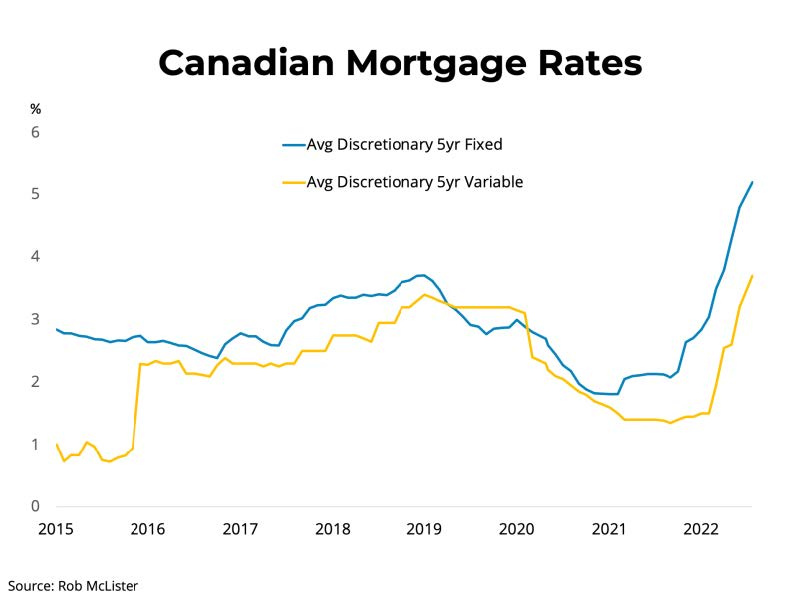
“While a still growing economy and robust population growth point to strong demand, it is increasingly difficult to satisfy that demand at current interest rates,” said BCREA Chief Economist. “As a result, sales activity across the province, but especially in more expensive markets, continues to slow.”
For the second straight month, year-over-year provincial active listings rose, with listing in June 16.4 per cent higher than this time last year. While active listings remain below what is typical for a balanced market, some markets and housing types have tipped into balanced or even buyers’ market territory as sharply higher mortgage rates push potential buyers to the sidelines.
Year-to-date, BC residential sales dollar volume was down 17 per cent to $53.5 billion compared with the same period in 2021. Residential unit sales were down 27.6 per cent to 51,202 units, while the average MLS® residential price was up 14 per cent to $1.05 million.
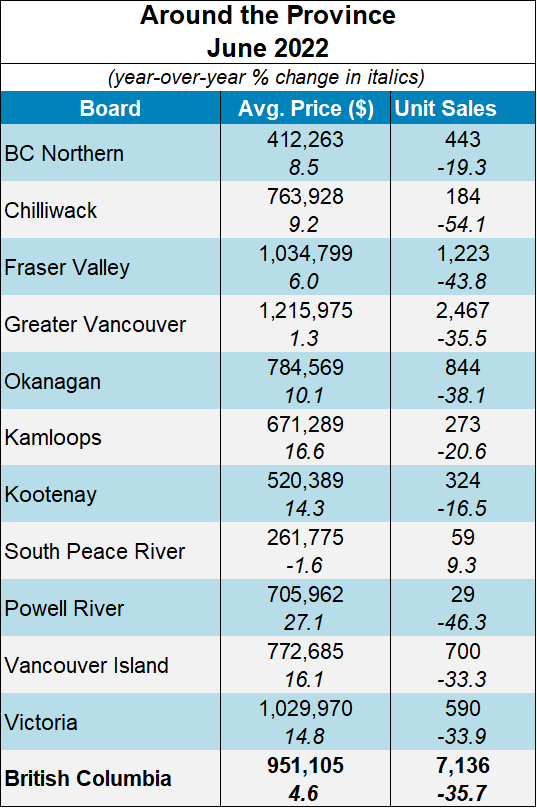
-30-
High Time for Change
In October 2018, cannabis became legalized across Canada, and in BC individuals are now allowed to legally grow up to four plants per residence. This new legislation change has made it increasingly important for the government to ensure that homes used in drug operations are made safe.

There are many potential harms associated with growing cannabis in homes, such as mould, as plants need high humidity, and electrical and fire hazards. British Columbians understand these risks. A February 2019 survey indicated 73 per cent of respondents would not choose to live in a home where cannabis was grown, and two thirds said they would not live in a home if they knew their neighbours grew recreational cannabis.
Whether legal or illegal, using homes to produce drugs can cause serious harms to the health and safety of future occupants for years to come. Surprisingly, there are no provincial regulations for how a property should be remediated after it has been used to produce drugs. There is currently a patchwork approach of municipal bylaws and health authority jurisdictions. There is not even a provincial policy that specifies what a "property used to produce drugs" is.
BCREA is advocating for the provincial government to develop a consistent process to remediate buildings used in drug productions to ensure they are safe. In 2018 BCREA commissioned research by the University of the Fraser Valley, who recommended a five-step process to remediate homes.
In April, REALTORS® met with MLAs at our Government Liaison Days to recommend that the government institute a process to ensure healthy homes for British Columbians. Some MLAs expressed interest, and MLA Laurie Throness has recently introduced legislation that, if passed, will develop provincial remediation standards, protecting homeowners and getting more units onto the market. We look forward to continuing to work with Mr. Throness and the BC Government to drive this issue forward.
Read a summary of research by the University of the Fraser Valley or the full research.
To subscribe to receive BCREA publications such as this one, or to update your email address or current subscriptions, click here.
Holdover Commission Clause #356
By Gerry Neely
B.A., LL.B.
A fairly typical holdover clause in a commercial listing contract entitles the agent to a commission if a sale takes place within six months of the expiration of the listing, if a buyer is introduced to the property by the agent during the listing period. In one case, an additional proviso made the agent's claim dependent upon whether the buyer was named on a list of the parties introduced to the property, which was given to the seller before the expiration of the listing period.
The agent failed to provide this list, but sued for commission, claiming he was the effective cause of sale. The claim was based upon an offer the agent said was made in his presence by a cooperating agent shortly before the end of the listing period. The agent tried to circumvent his failure to provide the list by arguing that the offer was sufficient notice.
The seller denied receiving the offer. Neither agent was able to produce a copy of it, and their evidence as to the presentation of the offer was contradictory. Apart from the lack of evidence, the agent lost because the purpose of the clause is to make the seller aware of the potential continuing liability for commission if the property is sold to someone named on the list.
A widely-used standard commission clause such as this is interpreted to achieve commercial certainty and minimize litigation. This means that even if the agent had been the effective cause, the express terms of the clause would have defeated his claim.1 A similar decision on a different commission clause is discussed in Legally Speaking 339.
***
A member asked me to elaborate on a Supreme Court of Canada decision that challenged the Canada Customs and Revenue Agency's test for deciding whether to disallow business losses claimed by a taxpayer.
The case involved an investor who paid $1,000 cash each for four highly-leveraged condominium rental units in a managed rental pool real estate development. While the ten-year projections were for negative cash flow and income tax deductions, the expected rental income and occupation rates were not realized due to higher interest charges and other losses. The tax department disallowed the losses on the basis that, when the taxpayer made the investment, he had no reasonable expectation of profit.
The taxpayer appealed unsuccessfully to the Tax Court of Canada and the Federal Court of Canada. He succeeded in the Supreme Court of Canada when it decided the tax department's test second guessed bona fide commercial decisions of a taxpayer and resulted in "the unfair and arbitrary treatment of taxpayers."
As a result, the Court substituted a two-step test to first decide whether the activity was commercial or personal. If it was commercial, the next step was to determine if the expenses for which a loss is claimed fall within the Income Tax Act. There was no evidence of personal use by the taxpayer. The Court allowed the taxpayer's claim for losses by applying this new test to the investment.2
| 1. |
|
|
| 2. |
|
To subscribe to receive BCREA publications such as this one, or to update your email address or current subscriptions, click here.
Home Inspection Protocols During COVID-19
BCREA is diligently working to keep BC’s REALTORS® informed of the evolving real estate landscape during the COVID-19 pandemic. Preparing your clients for a real estate transaction during a pandemic means being able to explain to them not only how you’ve adapted your business and protocols to reflect the current conditions, but also how related service providers have adapted theirs.
Recently, the Home Inspectors Association of BC (HIABC) updated its protocols for its members, designed to reduce the risk of HIABC home inspectors bringing COVID-19 into homes or carrying it from one inspection to another. We encourage all Realtors to familiarize themselves with these updated home inspection protocols and to review them with buyers and sellers in advance of entering into a real estate transaction.
There continue to be many uncertainties as the COVID-19 situation develops, and we are here to help you navigate them. If you have questions, please reach out to BCREA or your local real estate board.
To subscribe to receive BCREA publications, or to update your email address or current subscriptions, click here.
Home Insurance During Wildfire Season
 Wildfires have had a devastating impact on communities across BC in recent years. This year's wildfire season has already begun and, as a REALTOR®, you can help protect your clients by reminding them of the importance of home insurance, both year-round and when buying or selling a home.
If your client is buying a home, remind them to secure home insurance early in the sales process. They should also include an insurance clause in their offer of purchase. Homebuyers may find it more difficult to secure home insurance during wildfire season and delays in securing insurance can hold up the sales process.
If your client is selling their home, advise them to wait to cancel their home insurance until after the closing so that they are still protected if the deal goes south. Amidst other factors that could interfere with a sale, if the buyers find it difficult to obtain home insurance, the sale could be unexpectantly derailed.
In general, if you work with clients in a fire-prone community, remind them to seek insurance protection before a wildfire threatens their home. Although insurers will renew home insurance policies when an active wildfire is threatening a home or community, it may be more difficult to obtain this coverage until the wildfire is contained or the threat passes.
To learn more about wildfires and wildfire safety, visit the Insurance Bureau of Canada's website.
To subscribe to receive BCREA publications such as this one, or to update your email address or current subscriptions, click here.
Home Less than Advertised #303
By Gerry Neely
B.A., LL.B.
Another favourable decision has been given in support of commission trusts for salespersons and cooperating agents, and their priority over the claims of a secured creditor. The secured creditor had registered a general security agreement under the Personal Property Security Act against all assets of the insolvent agency. The creditor was the former principal shareholder of the insolvent agency and the debt for which the security was registered was the balance of the unpaid sale price of the shares. The creditor’s claim was that the assets included the commission monies.
Buyers from the former shareholder of the insolvent agency gave evidence that in calculating the value of the shares, commission monies were excluded from the valuation of the assets of the agency. There was ample evidence that the agency was a 100% house whose only income was from the fees, including administration and transaction fees, paid by the salespersons to the agency in exchange for services provided to them.
The insolvent agency had established a commission trust account into which it paid from its statutory trust account the commission due to the salespersons and from which the salespersons received the amount owed to them.
The judge was satisfied that the salespersons were independent contractors and that their commissions were held in a valid trust in their favour. Their claims had priority over the claims of the holder of the general security agreement.
The cooperating agents’ claim was based upon an express trust in their favour, a trust found in the bylaws of the Fraser Valley Real Estate Board. The bylaws state that commissions are trust monies and that once the statutory provisions of the Real Estate Act had been satisfied, the monies in the agent’s trust account were subject to a trust in favour of the other agents to whom a share of commission became payable.
The principal argument of the holder of the general security agreement was that a commission trust was a security interest that must be registered under the Personal Property Security Act to have priority over the general security agreement. The judge rejected that argument, following the Victoria cases referred to in Columns #288, #267 and #266.
While this decision is good news for licensees, the decision has been appealed.1
***
An agency and one of its salespersons found themselves in court because of a claim made by a buyer of a home in 1991 that he had suffered damages because, while the listing information described the area of the home as 1120 square feet, it was only 1032 square feet. The buyer’s claim was that he paid $6,000 more for the house than he should have, he borrowed $4,000 more than he needed and as at 1998, the difference between houses with areas of 1120 and 1032 square feet was about $15,000.
The salesperson’s evidence that the buyer never asked him to measure the house and there were no discussions about its size, was uncontradicted. The buyer’s response to that was that he relied upon the "expertise and professionalism" of the agent rather than any direct statement about the size of the house.
The buyer lost. He was unable to establish that there had been a negligent misrepresentation. He had an opportunity to inspect the house and in fact the disclaimer attached to the listing information stated that the information should not be relied upon without independent verification. Finally he did not buy the house on a per square foot basis but because it met his requirements. The price paid was realistic, given the market.2
| 1. |
|
|
| 2. |
|
To subscribe to receive BCREA publications such as this one, or to update your email address or current subscriptions, click here.
Home Office or Work Space Expense Deductions #414
By Jennifer Clee
Section 18(12) of the Income Tax Act permits a self-employed individual to deduct expenses associated in using part of the home as a place of business. However, no claim may be made in respect of any “work space” in a “self-contained domestic establishment” (dwelling house, apartment or similar place in a residence in which you eat and sleep), unless one of the following tests is met:
- the work space is the principal place of business; or
- the work space is used exclusively for the purpose of earning income from business and is used on a regular and continuous basis for meeting clients, customers or patients of the business.
Where either test is satisfied, the permitted deduction consists of the total permitted expenses (expenses related to the work space; e.g., rent, insurance, property taxes, mortgage interest, heat and light), prorated for the square footage of the work space vis a vis the total square footage of the house, and for the time allocated for business (as opposed to personal) use of the work space.
Thus, if a REALTOR® utilized a 400 square foot den in his home as a work space in a home of 5,000 square feet, and the den was used 40 per cent of the time for business use, the permitted deduction would be 40 per cent of 12.5 per cent of the permitted expenses. Also, the amount of the deduction cannot exceed the amount of income from the business, before claiming deductions for work space in the home.
Some REALTORS® have expressed concern about Deep v. The Queen, a 2006 decision of the Tax Court of Canada in which the taxpayer, Dr. Deep, appealed a reassessment by the Canada Revenue Agency (CRA). The majority of the issues before this particular court are of no concern here (except as a source of humour) and the appeal was, for the most part, unsuccessful. Surprisingly, despite facts suggesting that neither of the two tests set out above were met, the court upheld and slightly increased the amount of permitted deductions for home office expenses claimed. However, the allowed expenses were substantially less than those claimed by Dr. Deep and the deductions, after adjusting for the size and use of the work space, were nominal.
The decision of the court—and, for that matter the auditor—allowing any deduction for work expenses is clearly inconsistent with CRA’s stated policy and is an anomaly in the law. One possible explanation for the decision could be insignificance of the work space or home office expense issue in relation to the other issues with which the court was concerned.
REALTORS® should not be misled by Deep. To take advantage of the home office deductions, self-employed licensees should ensure that either test (a) or (b) is satisfied and that expenses claimed have been prorated for use and size of the work space. Licensees would be also be well served by consulting professional accountants.
| Income Tax Act, R.S.C. 1985, c.1, s.18(12). |
| Deep v. The Queen, 2006 DTC 3033. |
To subscribe to receive BCREA publications such as this one, or to update your email address or current subscriptions, click here.
Home Sales Continue at Below Average Pace in June
For the complete news release, including detailed statistics, click here.
Vancouver, BC – July 15, 2024. The British Columbia Real Estate Association (BCREA) reports that 7,082 residential unit sales were recorded in Multiple Listing Service® (MLS®) systems in June 2024, a 19 per cent decrease from June 2023. The average MLS® residential price in BC in June 2024 was up 1 per cent at $998,159 compared to an average price of $988,632 in June 2023. The total sales dollar volume was $7.1 billion, an 18 per cent decline from the same time the previous year. BC MLS® unit sales were 24 per cent lower than the ten-year average for June.

“Sales activity in June was much softer than the same time last year, with June of 2023 representing the market peak following last summer’s pause in rate hikes,” said BCREA Chief Economist Brendon Ogmundson. “However, both sales and active listings continue to gradually inch upwards, keeping the market in balanced territory.”
Year-to-date, BC residential sales dollar volume was down 2 per cent to $38.6 billion, compared with the same period in 2023. Residential unit sales were down by 4.1 per cent year-over-year at 38,639 units, while the average MLS® residential price was up 2.3 per cent to $997,883.

Home Sales Continue Normalization Trend in October
For the complete news release, including detailed statistics, click here.
Vancouver, BC – November 13, 2019. The British Columbia Real Estate Association (BCREA) reports that a total of 7,666 residential unit sales were recorded by the Multiple Listing Service® (MLS®) in October, an increase of 19.3 per cent from the same month last year. The average MLS® residential price in the province was $724,045, an increase of 5.1 per cent from October 2018. Total sales dollar volume was $5.55 billion, a 25.4 per cent increase from the same month last year.
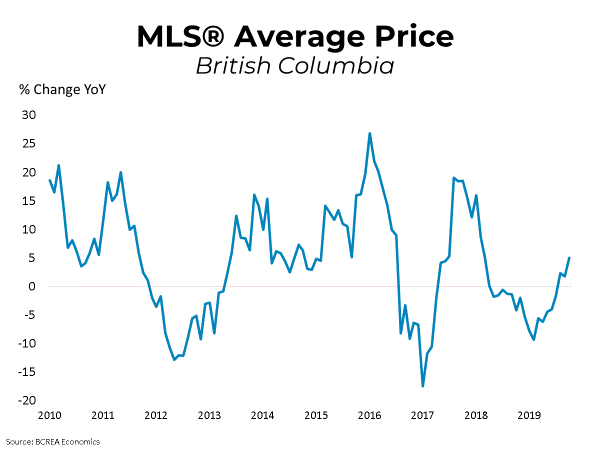
“Most markets around the province are returning to a more typical level of sales activity,” said BCREA Chief Economist Brendon Ogmundson. “That recovery in sales and slower listings activity is putting upward pressure on prices in many markets.”
MLS® residential active listings in the province were up 1 per cent from September 2018 to 36,567 units, although down slightly when compared on a seasonally adjusted basis. With sales and listings down, overall market conditions in the province have tightened, with a sales-to-active listings ratio of 21 per cent.
Year-to-date, BC residential sales dollar volume was down 9 per cent to $45.3 billion, compared with the same period in 2018. Residential unit sales were 6.2 per cent lower at 65,468 units, while the average MLS® residential price was down 3 per cent year-to-date at $691,618.
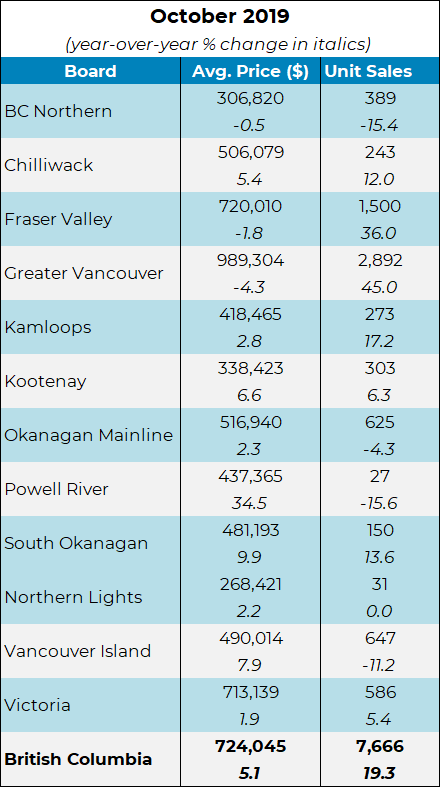
-30-
For more information, please contact:
Brendon Ogmundson
Chief Economist
Direct: 604.742.2796
Mobile: 604.505.6793
Email: [email protected]
To subscribe to receive BCREA publications such as this one, or to update your email address or current subscriptions, click here.
Home Sales Decline in 2022 After a Record 2021
For the complete news release, including detailed statistics, click here.
Vancouver, BC – January 12, 2023. The British Columbia Real Estate Association (BCREA) reports that 80,874 residential unit sales were recorded by the Multiple Listing Service® (MLS®) in 2022, a 35.2 per cent decline from a record 124,788 units sold in 2021. The annual average MLS® residential price in BC was $996,878, a 7.5 per cent increase from $927,513 recorded the previous year. Total sales dollar volume was $80.6 billion, a 30.3 per cent decline from 2021.
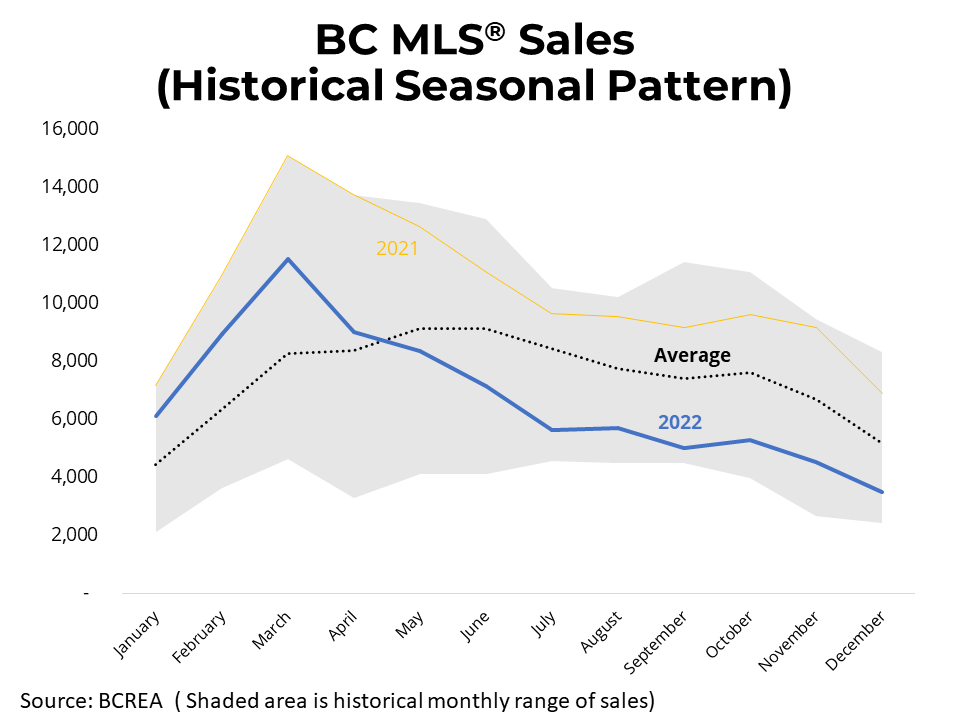
"Last year could not match last year's record pace," said Brendon Ogmundson, Chief Economist. "While strong momentum from the end of 2021 carried through to the first quarter of the year, the pace and degree of Bank of Canada interest rate tightening ultimately precipitated a dramatic shift in the provincial housing market."
A total of 3,490 residential unit sales were recorded by the Multiple Listing Service® (MLS®) in December 2022, a decrease of 49.4 per cent from December 2021. The average MLS® residential price in BC was $911,753 an 11.5 per cent decrease from $1.03 million recorded in December 2021. Total sales dollar volume was $3.2 billion, a 55.2 per cent decline from the same time last year.
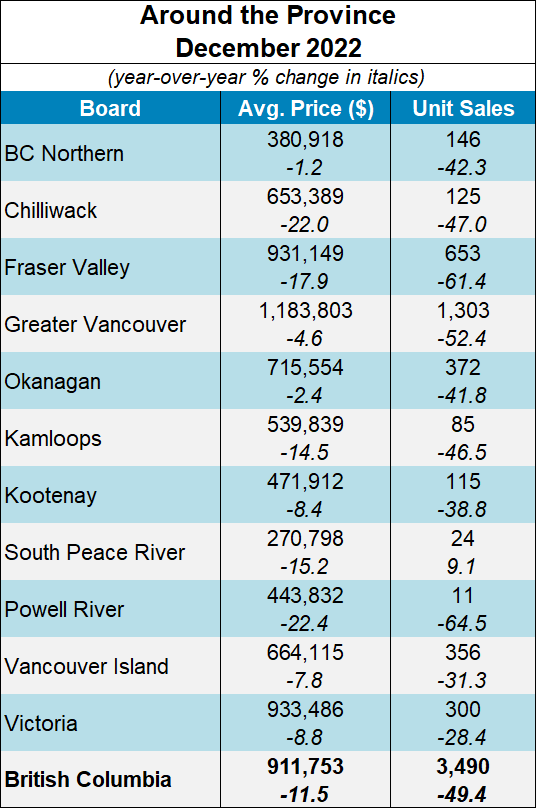
-30-
Home Sales Firming Across the Province
For the complete news release, including detailed statistics, click here.
Vancouver, BC – December 12, 2019. The British Columbia Real Estate Association (BCREA) reports that a total of 6,616 residential unit sales were recorded by the Multiple Listing Service® (MLS®) in November, an increase of 27.5 per cent from the same month last year. The average MLS® residential price in the province was $746,939, an increase of 5.5 per cent from November 2018. Total sales dollar volume was $4.94 billion, a 34.4 per
cent increase from the same month last year.
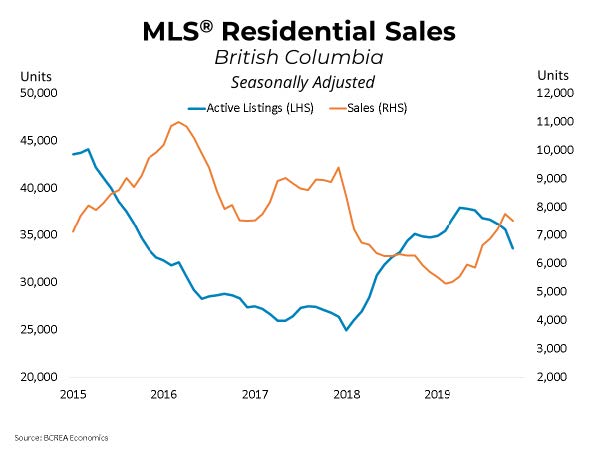
“After several months of strong gains, home sales are now firming around
long-run averages,” said BCREA Chief Economist Brendon Ogmundson. “We
expect 2020 will be a much more typical year for markets compared to the
volatility of recent years.”
MLS® residential active listings in the province were down 6.6 per cent from November 2018 to 31,310 units, and down for a seventh straight month on a seasonally adjusted basis. Overall market conditions remain balanced with a sales-to-active listings ratio of 21 per cent.
Year-to-date, BC residential sales dollar volume was down 6 per cent to $50.23 billion, compared with the same period in 2018. Residential unit sales were 3.9 per cent lower at 72,106 units, while the average MLS® residential price was down 2.2 per cent year-to date at $696,574.
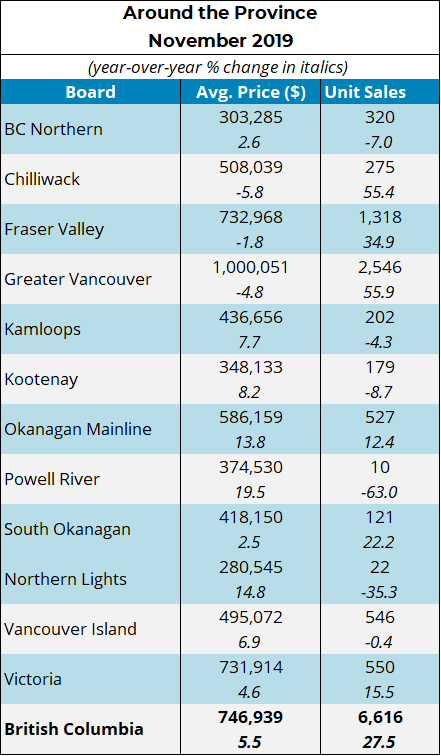
-30-
For more information, please contact:
Brendon Ogmundson
Chief Economist
Direct: 604.742.2796
Mobile: 604.505.6793
Email: [email protected]
To subscribe to receive BCREA publications such as this one, or to update your email address or current subscriptions, click here.
Home Sales Remain Slow Amidst Very Challenging Economic Environment
For the complete statistics release, including detailed tables, click here.
Vancouver, BC – April 15, 2026. The British Columbia Real Estate Association (BCREA) reports that 5,766 residential unit sales were recorded in Multiple Listing Service® (MLS®) Systems in March 2026, down 3.6 per cent from March 2025. The average MLS® residential price in BC in March 2026 was down 2 per cent at $939,846 compared to $959,236 in March 2025.

Total MLS® residential sales dollar volume was $4.21 billion, down 5.6 per cent from the same time the previous year. BC MLS® unit sales were 34.53 per cent lower than the ten-year average for the month of March.
“Global conflict leading to rising mortgage rates paired with a sluggish economy are presenting a challenge for a housing market recovery,” said BCREA Chief Economist Brendon Ogmundson. “Improved affordability and pent-up demand should translate to an acceleration of activity, though the market will need a period of relative calm for households to build confidence.”
Year-to-date, BC residential sales dollar volume is down 13 per cent to $12.7 billion, compared with the same period in 2025. Residential unit sales are down 11 per cent year-over-year at 13,595 units, while the average MLS® residential price is also down 2.2 per cent to $933,859.

Home Sales Up Slightly on Bank of Canada Rate Cuts
For the complete news release, including detailed statistics, click here.
Vancouver, BC – August 13, 2024. The British Columbia Real Estate Association (BCREA) reports that 6,943 residential unit sales were recorded in Multiple Listing Service®(MLS®) Systems in July 2024, a 2 per cent decrease from July 2023. The average MLS® residential price in BC in July 2024 was down 0.8 per cent at $959,480 compared to an average price of $967,298 in July 2023. The total sales dollar volume was $6.7 billion, a 2.9 per cent decline from the same time the previous year. BC MLS® unit sales were 17 per cent lower than the ten-year average for July.

"Home sales activity across BC remains below average, though with some emerging signs of volume starting to normalize,” said BCREA Chief Economist Brendon Ogmundson. “With the Bank of Canada now undoing the rate hikes that disrupted a recovery in 2023, activity should continue to pick up through the end of the year.”
Year-to-date, BC residential sales dollar volume is down 2.1 per cent to $45.2 billion, compared with the same period in 2023. Residential unit sales are down by 3.8 per cent year-over-year at 45,579 units, while the average MLS® residential price is up 1.8 per cent to $991,606.

Homebuyers Remain Hesitant in April
For the complete news release, including detailed statistics, click here.
Vancouver, BC – May 14, 2025. The British Columbia Real Estate Association (BCREA) reports that 6,453 residential unit sales were recorded in Multiple Listing Service® (MLS®) Systems in April 2025, down 14.6 per cent from April 2024. The average MLS® residential price in BC in April 2025 was down 6.1 per cent at $942,884 compared to $1,003,638 in April 2024.

The total sales dollar volume was $6.1 billion, a 19.7 per cent decrease from the same time the previous year. BC MLS® unit sales were 27 per cent lower than the ten-year April average.
“Regional activity continued to diverge in April with more expensive regions experiencing a larger drop in sales activity,” said BCREA Chief Economist Brendon Ogmundson. “Uncertainty regarding trade and monetary policy has caused trepidation for prospective buyers, largely in the Lower Mainland, prompting overall provincial activity to fall far below historical averages.”
Year-to-date, BC residential sales dollar volume is down 11.7 per cent to $20.7 billion, compared with the same period in 2024. Residential unit sales are down 7.9 per cent year-over-year at 21,676 units, while the average MLS® residential price is also down 4.1 per cent to $953,674.

Hot Markets: Risks and Tips to Avoid Getting Burned #537
How hot is the current hot market? Hot enough that earlier this month, the Real Estate Council of BC (RECBC) issued a caution to consumers and real estate professionals, reminding consumers of the importance of due diligence and reminding real estate professionals to have full and frank discussions with consumers, fully explaining the increased risks and consequences of making offers without the usual subject conditions and arming them with all the information needed to make fully informed decisions.
Great advice.
In this hot market, however, real estate professionals may struggle to protect clients when offers are mainly unconditional, or at least without the full subject conditions we typically see in a deal. It’s hard to protect your client’s interests when you often cannot use one of the best weapons – subject conditions.
Follow the usual advice in markets of any temperature
In this hot market, REALTORS® must keep their cool and remember that some of the oft-repeated, time-tested and best advice to protect themselves and consumers still applies:
- Remember who you act for and the rules of agency.
- Know your client and ask questions. Have full discussions on their needs, wants, issues, firm budget and risk tolerance, and remember that every client is different.
- Know the property you are dealing with and complete due diligence in advance where possible, such as title, property disclosure statement, strata documents, etc.
- Document the advice you give and the decisions the clients make.
- Do not practice outside your area of expertise. If your client wants advice on something outside of your area of expertise, advise them to seek independent professional and/or legal advice and document this recommendation.
How do risks and claims differ in a hot market?
When the market gets hot, things speed up. At the Real Estate Errors & Omissions Insurance Corporation, we are seeing an increase in claims of various types including valuation claims, negligent drafting claims, and claims arising from the imbalance in the market and the multitude of offers for some properties.
1. Valuation claims
In valuation claims, sellers say they undersold or buyers say they overpaid. In these scenarios, we are reminded that real estate professionals are not held to the standard of an appraiser and that appraisals are “an art, not a science.” However, when advising on price, thoughtfulness, full discussions, and due diligence are needed.
How to avoid valuation claims
Realtors acting for sellers or buyers should have up-front discussions with their clients at the beginning of any relationship around market conditions, client expectations, the value of properties in the area and other comparable properties, and how offers may be presented, accepted and countered (and the pros and cons of any approach to presenting offers). It’s important to set clear expectations during these conversations.
Particularly when acting for sellers and recommending a listing price, you should ideally discuss comparable properties, do a comparative market analysis (CMA) where applicable, and always discuss and document your advice and the client’s decisions. Ensure you keep copies of all CMAs and comparable properties that were discussed and that helped to inform the client’s decision on the list price.
2. Negligent drafting claims
We are also seeing more claims related to seller’s or buyer’s remorse when parties want out of a deal as values rise. To escape the deal, the parties and their legal counsel look to the contract for an escape valve. Remember, it is part of your job to draft an enforceable contract. Careful drafting, discussions, setting expectations and documenting advice are paramount and can help to prevent negligent drafting claims.
Some examples of recent negligent drafting claims include:
- questioning authority to enter into a contract and challenging whether the seller is the proper party on title or has a valid power of attorney (POA) to sell;
- raising problems with e-signatures – mainly an alleged lack of review of the contract terms and a failure to explain the terms of the contract properly or at all; and
- alleging improper or incorrect terms/wording of a contract such as parties, price or dates (what I call speed errors).
How to avoid negligent drafting claims
Slow down and proofread all offers and counter-offers, and recommend your clients do the same. Do not assume because the other party said they are only countering on dates, that they have not altered other terms as well. Be careful in the use of e-signature software – encourage and support clients in reviewing the full document each time and not just the purported change, and recommend they read it on a larger screen than their phone.
Additionally, ensure title and company searches are done and you have full written authority to sell from the person on title or a valid POA. Always deal with the party on title and avoid dealing with the kind and/or domineering relative who is not.
Review prices, dates, parties to the contract and all terms carefully with each and every offer and counter-offer (no matter how many there may be).
3. Hot market/offer claims
As you can guess, hot markets are the home to all the usual stress-inducing suspects including bully offers, referential offers, multiple offers, and back-up offers. Offers are also being made in this market for properties sight unseen. Some examples of hot market issues include:
- buyers entering into a contract sight unseen and subject-free, then refusing to close after realizing the view is obstructed;
- buyers making a subject-free offer and claiming they were unaware of the risks and that they had no financing clause. The buyers with pre-approval are then unable to get financing when the property is appraised too low; and
- buyers trying to get out of a subject-free contract when they discover defects at the property in an unconditional deal.
Unfortunately, there is no silver bullet clause (sorry…) as each offer or multiple offer situation is unique. Back-up offers have their own challenges and must be made carefully. Changes to the original contract and extensions should also be made carefully (ideally with legal advice) to not open the contract, trigger the back-up offer and/or be accused of selling the property twice (see my Legally Speaking #519 from October 2019).
How to avoid tripping over offers
As a seller’s agent with multiple offers, develop rules for review and offer presentation with your client, follow them, update them, and document and communicate any changes. Consider using an offer comparison chart to track all offers and key terms, and easily compare them.
As a buyer’s agent with multiple offers, ask questions to ensure you know when you are in a multiple-offer situation and recommend your clients complete their due diligence in advance where possible. Ensure consumers are aware of the risks and consequences of not doing so, which are very serious and include having no financing to complete a deal or taking on a property that is riddled with expensive defects.
Consider using condition acknowledgment forms with buyers who are going subject-free or without the usual conditions. On that note, BCREA has created the Buyer’s Acknowledgement of Information – Recommended Conditions form, which will help you discuss and document a buyer’s acknowledgment that they have been advised of the increased risks of not including some or all of the recommended conditions in an offer.
Ideally, recommend clients have a legal professional on board at the beginning of your agency relationship. This enables your client to have a lawyer available, engaged and able to answer thorny questions and provide advice on contractual obligations and risks. Waiting too long to recommend legal advice, particularly in this hot market, may mean your client has no practical opportunity to do so, and neither you nor your client will be protected (see my Legally Speaking #531 from October 2020, my Risk Report article from December 2019, and the RECBC discipline decision of October 30, 2017, 14-431).
Good luck, and remember to stay cool in this hot market!
Housing Affordability
The residential real estate market is a continuum, with social housing on one end and luxury housing on the other. Rental housing and market housing affordability are important components that help keep the continuum operating smoothly, ensuring appropriate housing options for all and matching supply with demand.

BCREA recommends that governments:
Ensure the Property Transfer Tax accurately reflects the dynamic nature of the real estate market
- For any future changes to the PTT, ensure that real estate transactions already underway are exempt.
- Expand the exemption for the additional 20 per cent foreign buyers’ PTT to include everyone with a work permit in BC, and do not increase this tax or expand it beyond its current geographical scope.
- Increase the First-Time Home Buyers’ Program Property Transfer Tax (PTT) exemption threshold to $750,000 from $500,000.
- Use the Housing Priority Initiatives Fund to increase the 2% PTT threshold to $525,000 from $200,000.
- Index the following PTT thresholds using the Consumer Price Index, and make adjustments annually:
- 2% and 3% thresholds,
- First-Time Home Buyers' Program exemption threshold, and
- Newly Built Home Exemption threshold.
Provide direct assistance to homebuyers, homeowners and renters (recommendations for the federal government)
- Create more green incentives for homeowners to help contribute to Canada's climate change goals.
Make evidence-based policy decisions
- Respecting privacy legislation and practice, publish buyers' residency data and government's analysis of that data.
Encourage greater density in urban areas
- Increase the supply of affordable, market, ground-oriented, family (three-bedroom) homes along transit corridors in lower density neighbourhoods using PTT revenue. For example, the province could provide financial incentives to municipalities fast tracking medium-density projects—townhomes, co-housing and cooperatives—to help defray the costs of accelerated planning and rezoning.
- Increase the supply of smaller, market homes in neighbourhoods using PTT revenue to create gentle density in low density neighbourhoods. For example, the province could provide financial incentives to municipalities to permit the sale of laneway homes and the stratification of secondary suites, where the home permits it. Funds could be used to update zoning and to create a system for stratifying suites.
- Counter “Not-in-My-Backyard” opposition to development through public education via a “new neighbours” campaign to increase acceptance of new developments geared to first-time homebuyers and purpose-built rental developments.
Promote best practices among local governments
- Ensure local governments levy development cost charges and community amenity contributions appropriate to the impact of development.
- Encourage improvements in the municipal development application process, such as reduced turnaround times for obtaining construction permits.
Ensure the Residential Tenancy Act is effective and balances the rights of landlords and tenants.
To subscribe to receive BCREA publications such as this one, or to update your email address or current subscriptions, click here.
Housing Demand Continues to Recover in August
For the complete news release, including detailed statistics, click here.
Vancouver, BC – September 12, 2019. The British Columbia Real Estate Association (BCREA) reports that a total of 7,093 residential unit sales were recorded by the Multiple Listing Service® (MLS®) in August, an increase of 4.9 per cent from the same month last year. The average MLS® residential price in the province was $685,575, an increase of 2.6 per cent from August 2018. Total sales dollar volume was $4.86 billion, a 7.6 per cent increase from the same month last year.
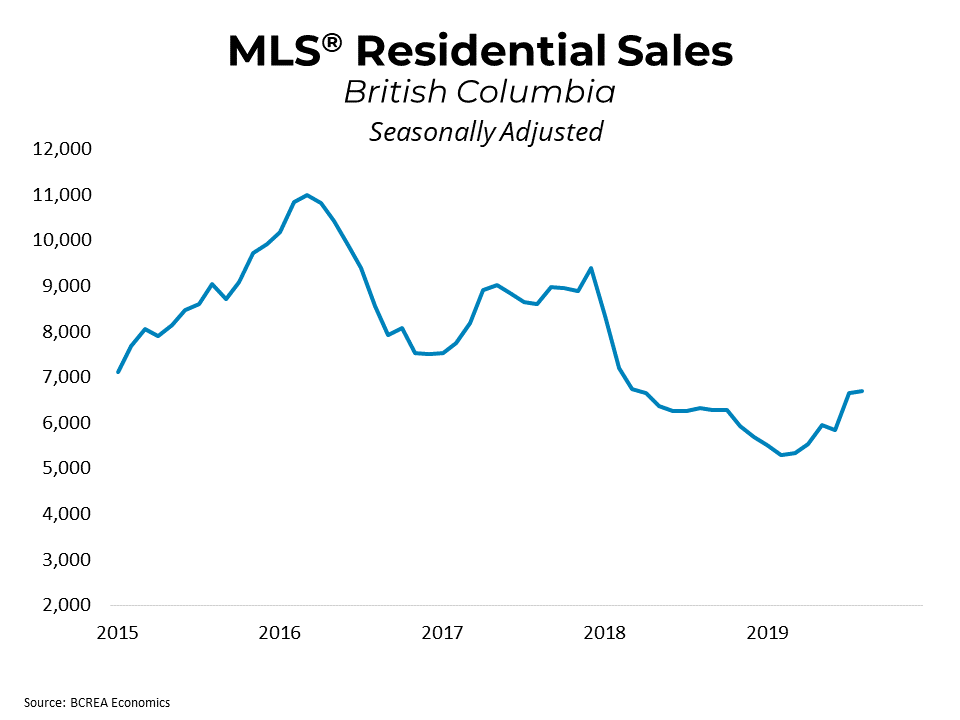
“BC home sales continue to recover from a policy-driven downturn,” said BCREA Deputy Chief Economist Brendon Ogmundson. “Home sales have been rising through the spring and summer, but still remain well below pre-B20 stress test levels.”
MLS® residential active listings in the province were up 10 per cent from August 2018 to 40,098 units and were essentially flat compared to July on a seasonally adjusted basis. Overall market conditions remained in a balanced range with a sales-to-active listings ratio of about 18 per cent.
Year-to-date, BC residential sales dollar volume was down 16 per cent to $34.9 billion, compared with the same period in 2018. Residential unit sales were 12.2 per cent lower at 50,806 units, while the average MLS® residential price was down 4.4 per cent year-to-date at $686,303.
-30-
For more information, please contact:
Brendon Ogmundson
Deputy Chief Economist
Direct: 604.742.2796
Mobile: 604.505.6793
Email: [email protected]
To subscribe to receive BCREA publications such as this one, or to update your email address or current subscriptions, click here.
Housing Demand Improves in July
For the complete news release, including detailed statistics, click here.
Vancouver, BC – August 13, 2019. The British Columbia Real Estate Association (BCREA) reports that a total of 7,930 residential unit sales were recorded by the Multiple Listing Service® (MLS®) in July, an increase of 12.4 per cent from the same month last year. The average MLS® residential price in the province was $684,497, a decline of 1.6 per cent from July 2018. Total sales dollar volume was $5.43 billion, a 10.5 per cent increase from the same month last year.

“BC home sales climbed higher for the first time in 18 months on a year-over-year basis in July,” said BCREA Chief Economist Cameron Muir. Housing demand has also trended higher since March, rising 21 per cent on a seasonally adjusted basis. “Households appear to be adjusting to the tighter credit environment as the shock of the B20 stress test dissipates.”
MLS® residential active listings in the province trended lower in July, down 3 per cent from June and 6 per cent from April on a seasonally adjusted basis. Active listings were up 12.4 per cent to 41,621 units on a year-over year basis, while overall market conditions remained unchanged from 12 months ago with the sales-to-active listings ratio at 19.1 per cent.
Year-to-date, BC residential sales dollar volume was down 18.9 per cent to $30 billion, compared with the same period in 2018. Residential unit sales decreased 14.4 per cent to 43,612 units, while the average MLS® residential price was down 5.3 per cent to $687,413.
-30-
For more information, please contact:
Cameron Muir
Chief Economist
Direct: 604.742.2780
Mobile: 778.229.1884
Email: [email protected]
To subscribe to receive BCREA publications such as this one, or to update your email address or current subscriptions, click here.
Housing Market Activity Normalizing After a Frenetic Year
For the complete news release, including detailed statistics, click here.
Vancouver, BC – July 12, 2021. The British Columbia Real Estate Association (BCREA) reports that a total of 11,070 residential unit sales were recorded by the Multiple Listing Service® (MLS®) in June 2021, an increase of 34.7 per cent over June 2020. The average MLS® residential price in BC was $910,445, a 22.2 per cent increase from $745,194 recorded in June 2020. Total sales dollar volume was $10.1 billion, a 64.6 per cent increase from last year.
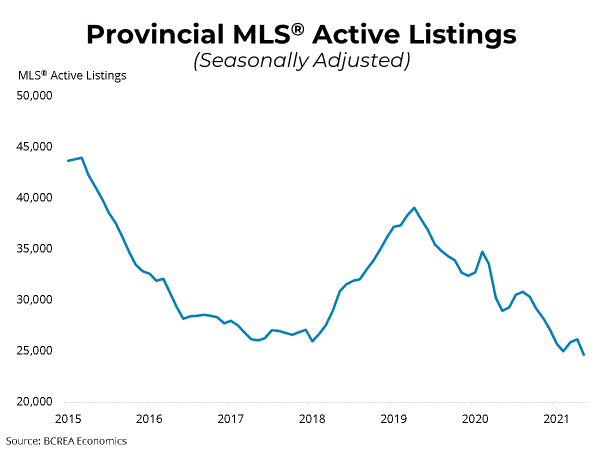
"As expected, housing market activity is calming to start the second half of 2021,” said BCREA Chief Economist Brendon Ogmundson. “That said, while down from record highs earlier this year, home sales across the province remain well above long-run average levels.”
Total active residential listings were down 23.4 per cent year-over-year in June and continued to fall on a monthly seasonally adjusted basis.
Year-to-date, BC residential sales dollar volume was up 161.6 per cent to $64.7 billion, compared with the same period in 2020. Residential unit sales were up 114.3 per cent to 70,690 units, while the average MLS® residential price was up 22.1 per cent to $915,563.
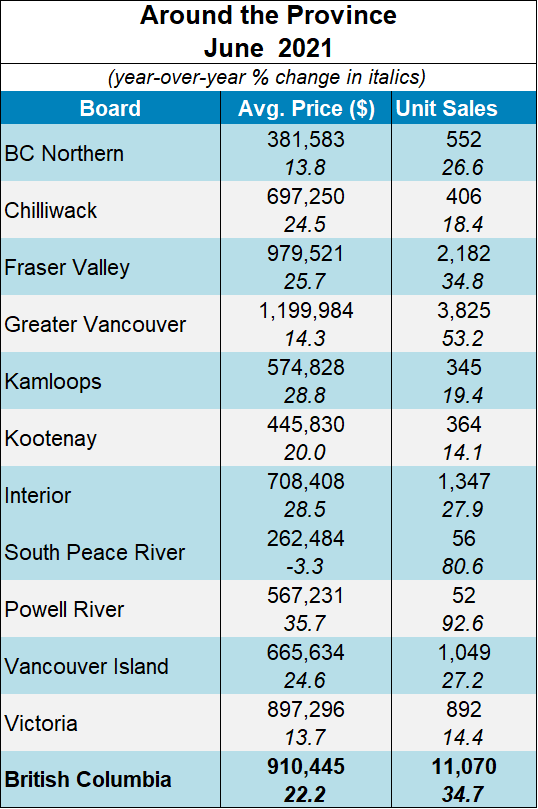
-30-
For more information, please contact:
Brendon Ogmundson
Chief Economist
Direct: 604.742.2796
Mobile: 604.505.6793
Email: [email protected]
Housing Market Activity Picks Up to Start 2024
For the complete news release, including detailed statistics, click here.
Vancouver, BC – February 13, 2024. The British Columbia Real Estate Association (BCREA) reports that a total of 3,979 residential unit sales were recorded in Multiple Listing Service® (MLS®) systems in January 2024, an increase of 29.4 per cent from January 2023. The average MLS® residential price in BC in January 2024 was up 10.5 per cent at $957,909 compared to an average price of $866,922, the low-point for average prices over the past two years. The total sales dollar volume was $3.8 billion, an increase of 42.9 per cent from the same time in the previous year.
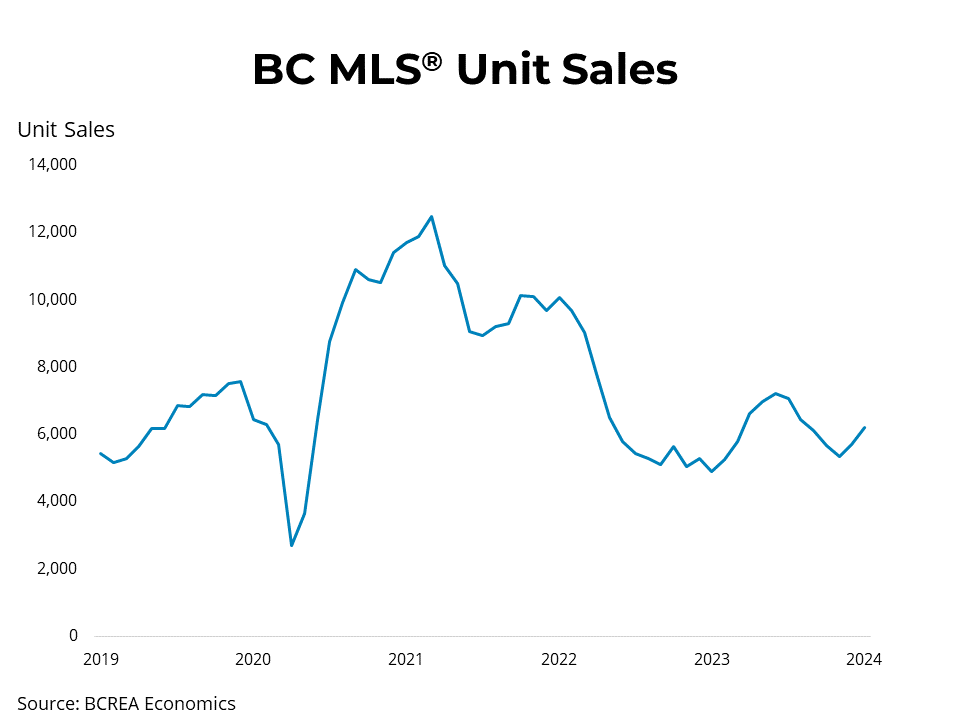
"Home sales are on a clear uptrend to start 2024," said BCREA Chief Economist Brendon Ogmundson. "A sharp decline in fixed mortgage rates and expectations for future Bank of Canada rate cuts is driving sentiment in the market and bringing pent-up demand off the sidelines."
The total number of active listings, though up year-over-year, remains relatively low by historical standards. New listings activity has shown signs of normalizing following a down year in 2023. A steady pace of new inventory will be crucial in keeping markets balanced as sales accelerate.
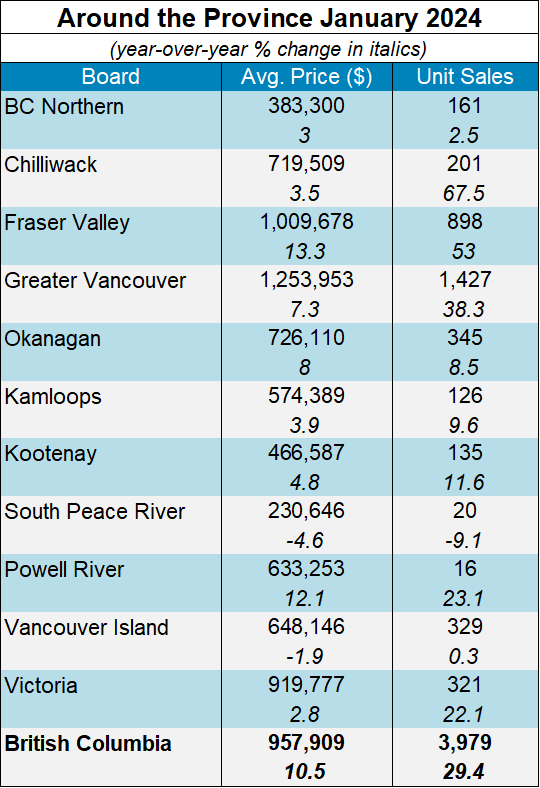
Housing Market Activity Remains Slow in November
For the complete news release, including detailed statistics, click here.
Vancouver, BC – December 13, 2022. The British Columbia Real Estate Association (BCREA) reports that a total of 4,512 residential unit sales were recorded by the Multiple Listing Service® (MLS®) in November 2022, a decrease of 50.8 per cent from November 2021 and about 30 per cent below a historical average November. The average MLS® residential price in BC was $906,785 an 8.6 per cent decrease from $992,245 recorded in November 2021. Total sales dollar volume was $4.1 billion, a 55 per cent decline from the same time last year.
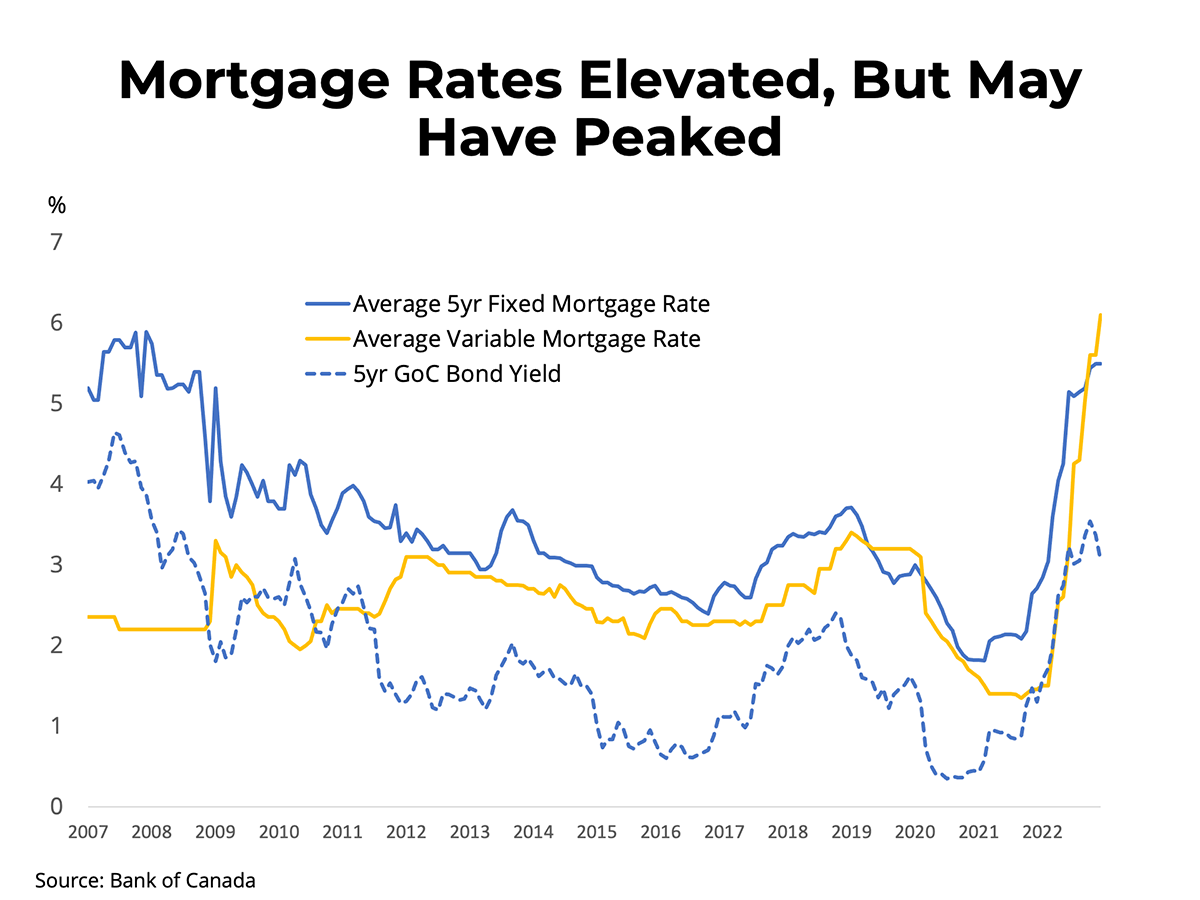
“A lot has changed in 2022,” said Brendon Ogmundson, Chief Economist. “This time last year, home sales were near a record for November, home prices were accelerating, and mortgage rates were less than half of current levels. Elevated mortgage rates will continue to constrain sales activity, though with the Bank of Canada nearing the end of its tightening cycle and benchmark bond yields falling, mortgage rate relief may be on the horizon.”
Year-to-date, BC residential sales dollar volume was down 28.7 per cent from the same period in 2021 to $77.4 billion. Residential unit sales were down 34.4 per cent to 77,376 units, while the average MLS® residential price was up 8.6 per cent to $1 million.
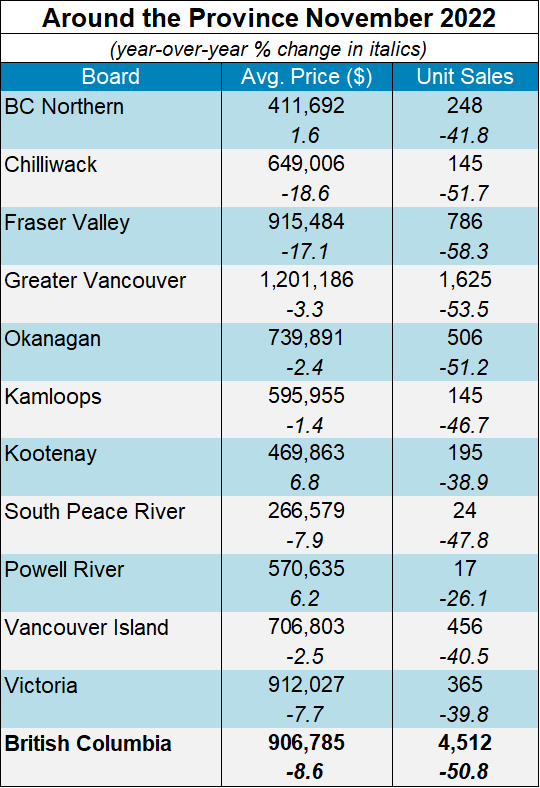
-30-
Housing Market Activity Shows Signs of Recovery in May
For the complete news release, including detailed statistics, click here.
Vancouver, BC – June 15, 2020. The British Columbia Real Estate Association (BCREA) reports that a total of 4,518 residential unit sales were recorded by the Multiple Listing Service® (MLS®) in May 2020, a decline of 45.2 per cent from May 2019. The average MLS® residential price in BC was $728,898, a 3.2 per cent increase from $706,394 recorded the previous year. Total sales dollar volume in May was $3.3 billion, a 43.5 per cent decrease over 2019.
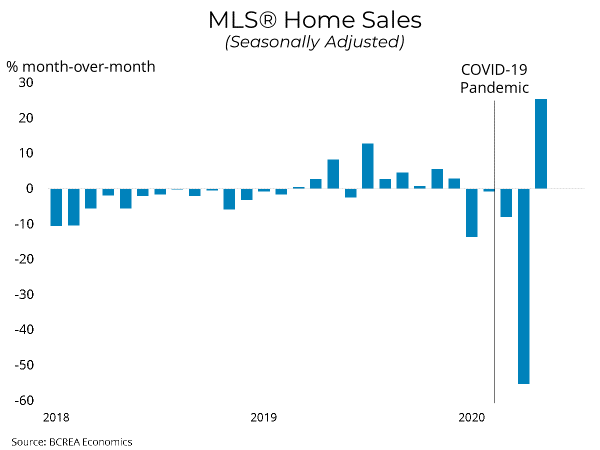
“There were encouraging signs of recovery in May,” said BCREA Chief Economist Brendon Ogmundson. “While activity is still far below normal, both sales and listings are up significantly from April’s lows.”
New listings activity started to normalize around the first week of May, reversing a slide in total active listings. However, active listings are still down close to 24 per cent year-over-year and are more than 10,000 listings below where they would normally be in the spring months.
Year-to-date, BC residential sales dollar volume was down 6 per cent to $18.6 billion, compared with the same period in 2019. Residential unit sales were down 14.2 per cent to 24,695 units, while the average MLS® residential price was up 9.6 per cent to $753,155.
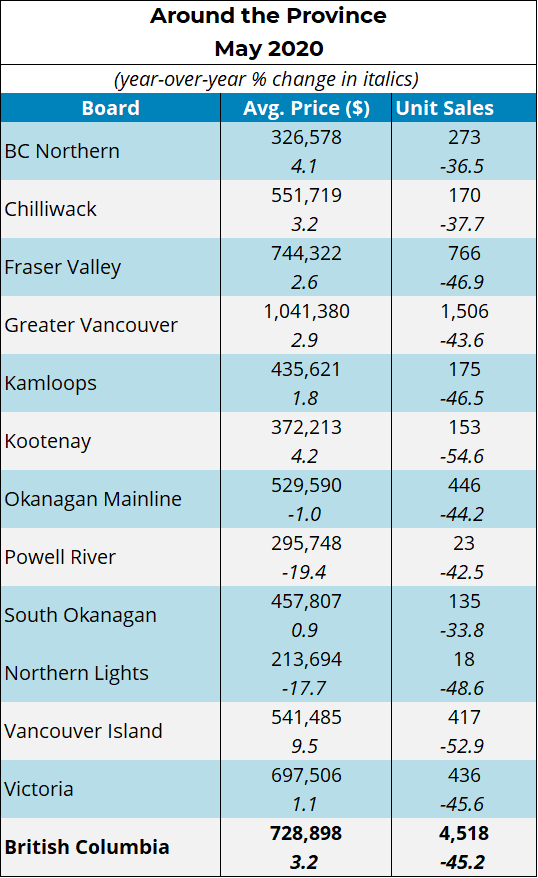
-30-
For more information, please contact:
Brendon Ogmundson
Chief Economist
Direct: 604.742.2796
Mobile: 604.505.6793
Email: [email protected]
To subscribe to receive BCREA publications such as this one, or to update your email address or current subscriptions, click here.
Housing Market Activity Uneven Across BC Regions
For the complete statistics release, including detailed tables, click here.
Vancouver, BC – August 13, 2026. The British Columbia Real Estate Association (BCREA) reports that 6,561 residential unit sales were recorded in Multiple Listing Service® (MLS®) Systems in July 2026, down 6.7 per cent from July 2025. The average MLS® residential price in BC in July 2026 was down 1.3 per cent at $929,619 compared to $942,247 in July 2025.

Total MLS® residential sales dollar volume was $6.1 billion, down 7.9 per cent from the same time the previous year. BC MLS® unit sales were 18.8 per cent lower than the ten-year average for the month of July.
“Seasonally adjusted sales activity rose from the previous month across most of BC, while weaknesses remained concentrated in the Lower Mainland,” said BCREA Chief Economist Brendon Ogmundson. “Looking ahead, resilience in the economy and a recovering labour market should translate to regional markets converging to long-term averages over the next year.”
Year-to-date, BC residential sales dollar volume is down 6.7 per cent to $38.04 billion, compared with the same period in 2025. Residential unit sales are down 5.6 per cent year-over-year at 40,432 units, while the average MLS® residential price is also down 1.2 per cent to $940,948.

Housing Market Slows, but Resilient in Response to Pandemic
For the complete news release, including detailed statistics, click here.
Vancouver, BC – May 13, 2020. The British Columbia Real Estate Association (BCREA) reports that a total of 3,284 residential unit sales were recorded by the Multiple Listing Service® (MLS®) in April 2020, a decline of 50.8 per cent from April 2019. The average MLS® residential price in BC was $737,834, a 7.8 per cent increase from $684,430 recorded the previous year. Total sales dollar volume in March was $2.4 billion, a 46.9 per cent decrease over 2019.
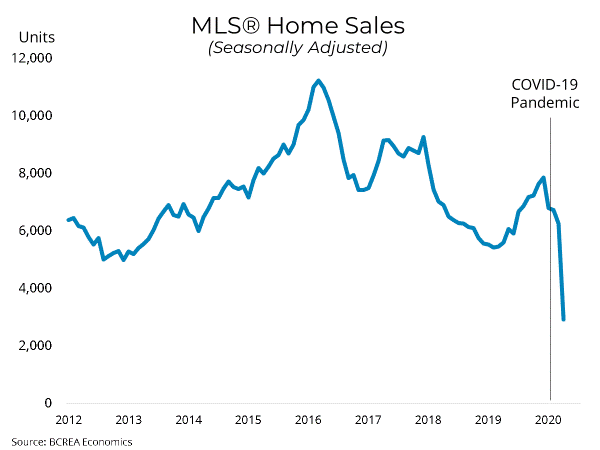
"We expected to see a sharp drop in sales for April as we confronted the COVID-19 pandemic,” said BCREA Chief Economist Brendon Ogmundson. “However, buyers and sellers are adapting to a new normal, and activity should pick up as the economy gradually re-opens.”
While home sales were down by more than half compared to this time last year, the supply of homes for sale, which normally rises through the spring, was down close to 10 per cent on a seasonally adjusted basis and down 23.7 per cent year-over-year. That slide in total active listings means that prices remained firm despite the sharp fall in sales.
Year-to-date, BC residential sales dollar volume was up 9.6 per cent to $15.3 billion, compared with the same period in 2019. Residential unit sales were down 1.7 per cent to 20,164 units, while the average MLS® residential price was up 11.6 per cent to $758,614.
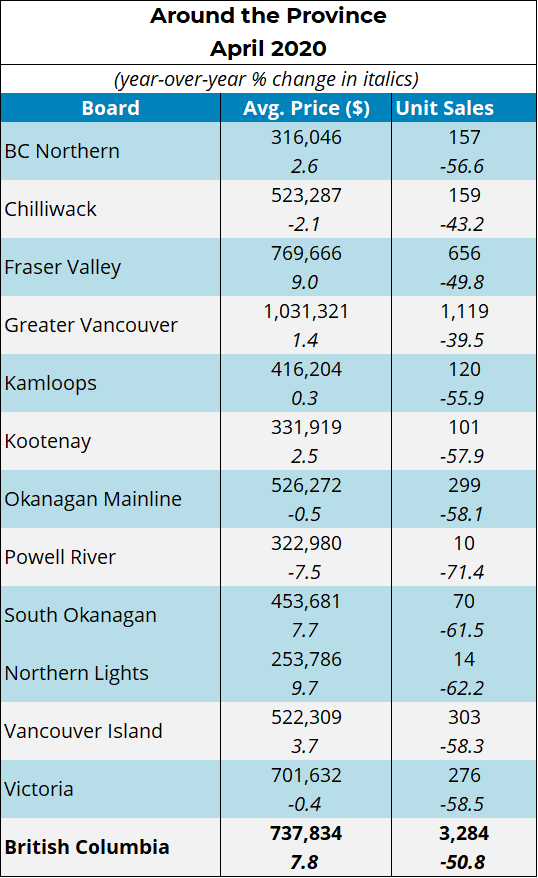
-30-
For more information, please contact:
Brendon Ogmundson
Chief Economist
Direct: 604.742.2796
Mobile: 604.505.6793
Email: [email protected]
To subscribe to receive BCREA publications such as this one, or to update your email address or current subscriptions, click here.
Housing Market Update – August 2026
Watch BCREA Economist Amit Sidhu discuss the July 2026 statistics.
[iframe width="560" height="315" src="https://www.youtube.com/embed/vLrjNpWG3tM" frameborder="0" allowfullscreen style="position:absolute;top:0;left:0;width:100%;height:100%;"][/iframe]
For more information, please contact:
Amit Sidhu
Economist
Mobile: 604.677.9345
Email: [email protected]
To subscribe to receive BCREA publications such as this one, or to update your email address or current subscriptions, click here.
Housing Markets Flat in 2019 After Strong Second Half
For the complete news release, including detailed statistics, click here.
Vancouver, BC – January 13, 2020. The British Columbia Real Estate Association (BCREA) reports that a total of 77,331 residential unit sales were recorded by the Multiple Listing Service® (MLS®) in 2019, a decline of 1.5 per cent from the 78,516 units sold in 2018. The annual average MLS® residential price in BC was $700,460, a decline of 1.6 per cent from $711,564 recorded the previous year. Total sales dollar volume was $54.2 billion, a 3 per cent decline from 2018.
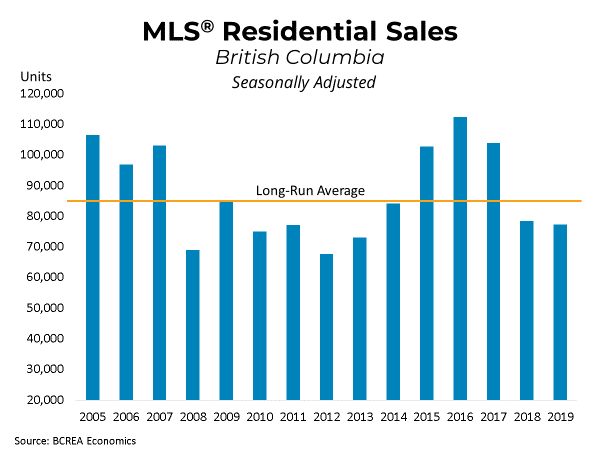
“Housing markets across the province staged a strong recovery in the second half of 2019,” said BCREA Chief Economist Brendon Ogmundson. “This sets up 2020 to be a much more typical year than what markets have experienced recently.”
A total of 5,218 MLS® residential unit sales were recorded across the province in December, up 48.9 per cent from December 2018. The average MLS® residential price in BC was $755,165, an increase of 8.7 per cent from December 2018. Total sales dollar volume was $3.9 billion, a 61.8 per cent increase year-over-year.
Total active residential listings were down 10.6 per cent to 24,691 units in December. Total inventory of homes for sale have declined more than 10 per cent on a year-over-year basis for two straight months.
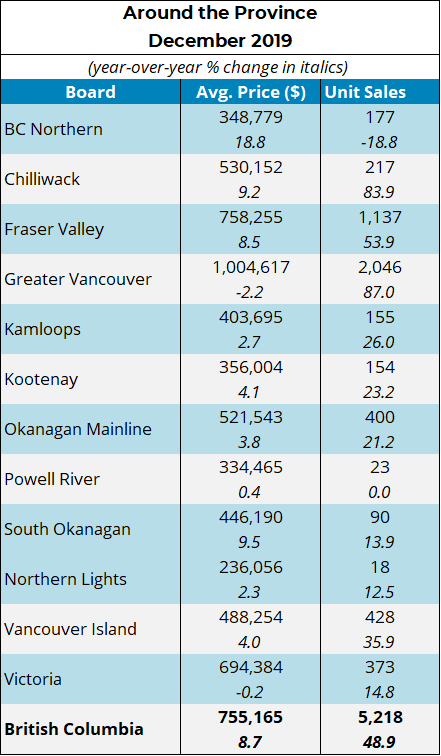
-30-
For more information, please contact:
Brendon Ogmundson
Chief Economist
Direct: 604.742.2796
Mobile: 604.505.6793
Email: [email protected]
To subscribe to receive BCREA publications such as this one, or to update your email address or current subscriptions, click here.
Housing Markets Post Strong Rebound in October
For the complete news release, including detailed statistics, click here.
Vancouver, BC – November 25, 2024. The British Columbia Real Estate Association (BCREA) reports that 7,119 residential unit sales were recorded in Multiple Listing Service® (MLS®) Systems in October 2024, up 33.5 per cent from October 2023. The average MLS® residential price in BC in October 2024 was up 0.3 per cent at $970,845 compared to an average price of $968,256 in October 2023.

The total sales dollar volume was $6.9 billion, a 33.8 per cent increase from the same time the previous year. BC MLS® unit sales were eight per cent lower than the ten-year average for October.
“While it took longer than expected, a recovery in home sales to more normal levels has seemingly arrived,” said BCREA Chief Economist Brendon Ogmundson. “Across BC, we saw significant month-over-month increases in activity as buyers returned to the market after a long high-interest rate driven hiatus.”
Year-to-date, BC residential sales dollar volume is down 0.2 per cent to $62.9 billion, compared with the same period in 2023. Residential unit sales are down by 1.1 per cent year-over-year at 64,176 units, while the average MLS® residential price is up 0.9 per cent to $980,280.

Housing Monitor Dashboard
The dashboard was last updated on July 27, 2026.
The BCREA Economics team has created the Housing Monitor Dashboard to help REALTORS® monitor BC’s housing market. This dashboard provides up-to-date data on key variables for public education and use. The image and data are available for download under each chart, where possible.
Resale Home Market
The resale home market uses data from the MLS® System used by BC REALTORS®.
Active Listings are the number of listings available for sale on the MLS® System as of the end of each month.
New Listings are the number of newly listed properties on the MLS® System during a particular month.
Home Sales are the number of units sold on the MLS® System during a particular month.
The Average Sale Price is the average price for all homes sold on the MLS® System during a particular month. In other words, this number is equivalent to the total dollar value of all sales (the sales volume) divided by the number of transactions. This number will change if the price of homes changes, but also if the composition of home sales changes – for instance, if buyers shift towards apartments rather than single-family homes, the Average Sale Price will fall (if all else remains the same).
The Home Price Index (HPI) is an indicator published by the Canadian Real Estate Association (CREA) to estimate an adjusted price for a typical home in a region. Given that the Average Sale Price is vulnerable to shifts in the composition of sales, the HPI adjusts for this by estimating the price of a fixed ‘composite’ unit across time. This removes composition biases and provides a smoother estimate of the price in a region across time.
The Sales to Active Listings Ratio (SALR) measures the tightness of a market. It is estimated by dividing the number of sales by the number of active listings. While the typical SALR varies by market, for BC at large, the housing market is considered balanced if the SALR is between roughly 0.15 and 0.25. If the ratio is above this range, the market is in seller’s territory, and if it is below this range, it is in buyer’s territory.
Construction
Home construction, as measured by starts, units under construction, and completions, are crucial variables for the overall housing market. As new homes are added to the provincial housing stock and eventually become part of the resale market, construction data is essential for REALTORS®. Construction is also the primary way that new supply is introduced into the housing market, which in the long run is the only way to keep prices stable and maintain affordability.
A Housing Start is the stage when the concrete has been poured for the whole of the footing around the structure or an equivalent stage where a basement will not be part of the structure. A unit is under construction after the start but prior to completion. The number of units under construction exceeds the number of starts and completions since units remain under construction for a duration before completion.
Months to complete property in BC have been trending up in recent years. BC also has longer average months to complete than most other provinces in Canada.
Rental Market
The figure below measures the average asking rents of vacant properties on Rentals.ca. These rents will be higher than the average rents paid by renters since landlords raise rents for new renters, and long-time tenants tend to pay less. The figure below shows rents for 1- and 2-bedroom units in Vancouver and Victoria.
Borrowing Costs
Mortgage rates are one of the most important drivers of housing activity in BC. Changes in mortgage rates and mortgage qualifying costs can cause significant changes in housing market trends. The chart below provides up-to-date data on average fixed and variable mortgage rates available in the Canadian mortgage market.
Other BCREA Data
The Nowcast is BCREA’s estimate of GDP in BC. The growth of provincial GDP is a key indicator of economic activity, but provincial GDP data is only available annually and with a considerable delay. That's why we developed the BCREA Nowcast – a tool to track monthly growth in the BC Economy. The Nowcast compiles monthly economic data into one easy-to-understand number, expressed as the year-over-year growth in the BC economy.
As the underlying economic data is released with a one- or two-month lag, our estimates for monthly growth will also lag in real-time by two months (e.g., estimated growth in January will be published at the end of March). There are no adjustments to the model estimate except those due to revisions to the underlying data.
*Graphs with an asterisk have had their data normalized to a starting point. This is to provide for easier comparison across the series in the figure. For example, if the graph is normalized to January 2019, a value of 110 at a given point in time indicates that the variable is 10 per cent higher than it was in January 2019.
Housing Supply Takes Centre Stage During GL Days Live Sessions
BCREA would like to thank all the REALTORS® who participated in this year’s annual Government Liaison (GL) Days live sessions on May 4 and 5. Realtors from across the province convened virtually to learn about policies to address the two issues of improving housing supply and energy efficiency in homes.
In addition to discussion around the topics with BCREA staff and Counsel Public Affairs, this year’s sessions also included presentations from Attorney General and Minister Responsible for Housing David Eby and Global BC’s Legislative Bureau Chief Keith Baldrey.
Minister Eby echoed the importance of solutions to housing affordability through increasing supply. We were encouraged to hear that the Minister is “currently working on the implementation of the Development Approvals Process Review (DAPR) report in partnership with municipalities.”
One policy from the DAPR report that the province should immediately implement is reducing unnecessary public hearings. While we support fulsome public engagement, ineffective and redundant hearings can favour those opposed to development. To accomplish this, BCREA recommends the BC Government conduct a provincial policy review to consider tying development approvals to housing targets and provide local governments with training and best practices.
Minister Eby also said that there were opportunities to increase density along transit corridors. This aligns with BCREA’s recommendation to encourage local governments to replace single-family homes with “Missing Middle” housing options in neighbourhoods accessible to transit. “Missing Middle” housing is a range of multi-unit or clustered housing types compatible with single-family homes, such duplexes, triplexes and townhouses.
Baldrey shared behind-the-scenes stories of how MLAs responded to the COVID-19 pandemic. For example, he contrasted Premier John Horgan’s response to COVID-19 with other premiers in Ontario and Manitoba. Premier Horgan made the decision to take a backseat and let Minister of Health Adrian Dix and Provincial Health Officer Dr. Bonnie Henry lead the way on many issues, while in Ontario and Manitoba the Premier continued to stay in the spotlight. In hindsight, Premier Horgan made a politically savvy decision, as it allowed the BC NDP to call an election and form a majority government, while Premier Ford and Premier Pallister have taken recent nosedives in popularity.
The next step for Realtors is to take the lessons learned from the virtual sessions and accompanying resources into their meetings with MLAs to advocate for solutions to increase housing supply and improve energy efficiency of homes.
Housing Supply: Myth Busting and Providing Real Solutions
For too long, governments have accepted beliefs about the housing market which have led to policies that have not appropriately addressed the issue of housing unaffordability. These myths have been reinforced through mainstream and social media and are widely accepted as true. But are they?
Here we address two of these housing myths and examine two practical solutions that will help provide more housing and chart a return toward a more affordable housing market.
Jump to:
Myth #1: Foreign investment is the main cause of housing price escalation
There is no doubt that foreign investment exists in the housing market (remember British Properties?), and for the foreseeable future, it will be there.
Over the past six years we have seen a steady reduction in foreign investment in the real estate and throughout that time prices have escalated at an unprecedented rate. Over the past year, the market value of foreign investment is only about 0.3 per cent.
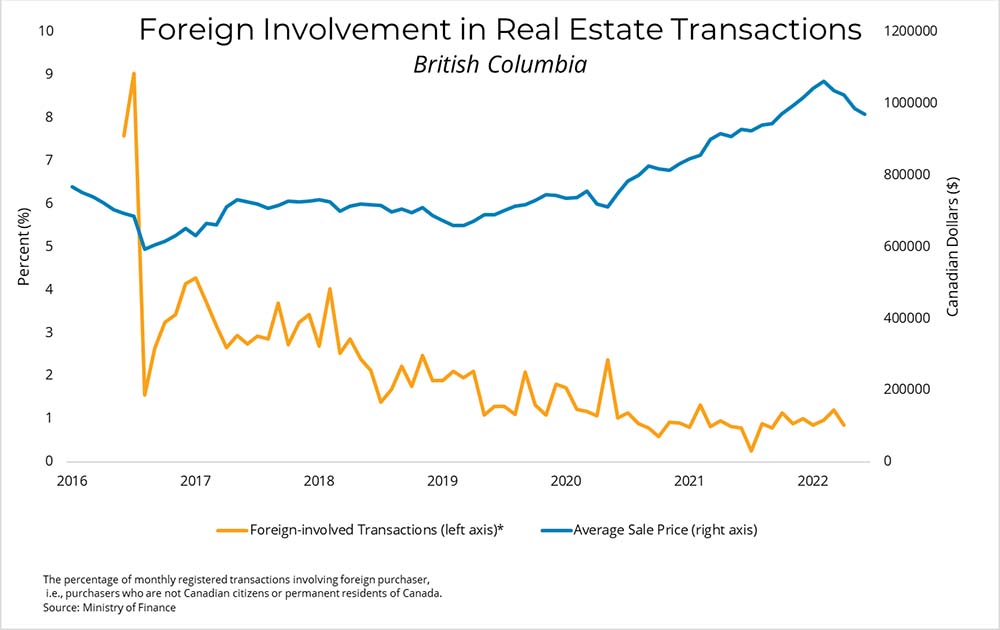
Myth #2: We’re building enough housing
It’s bad methodology to compare population growth and housing stock to conclude that we have been building enough housing. Demand for could far outpace housing stock, but if there isn’t enough housing then population could still stagnate, or even decrease.
Housing stock/new supply is a constraint on population growth – people can’t move/stay here if there’s nowhere to live. More than 100,000 people moved to BC in 2021, approximately 34 per cent from other provinces/territories and the rest from other countries (Source: Province of BC).
Here are some additional facts to consider:
- A report from CMHC said B.C. as a whole would require 570,000 new homes beyond what is usually built to achieve anything resembling affordability by 2030. That figure represents over 71,000 new units per year, every year between now and 2030, over and above currently projected housing growth.
- A recent Scotiabank housing report stated that Canada has the lowest number of housing units per 1,000 residents of any G7 country. The number of housing units per 1,000 Canadians has been falling since 2016 owing to the sharp rise in population growth. An extra 100,000 dwellings would have been required to keep the ratio of housing units to population stable since 2016—leaving us still well below the G7 average.
Average household size has been declining, so we need more housing stock. Most municipalities have not met their housing growth projections. In Metro Vancouver, only North Vancouver City has seen new housing completions above their projections from the Regional Growth Strategy. Metro Van as a whole is 6% below its own projection (Source: Homebuilders Association Vancouver).
Real Solutions to Improve Housing Supply
Improving the new housing approval process
It takes too long to bring new housing from concept to market. For an apartment building, a five-year period from initial project proposal to occupation is not unusual. The public consultation model is broken – we need a better process for public hearings.
A solution is to strengthen the Official Community Plan (OCP) with zoning powers – new proposals compliant with the OCP should jump straight to the development permit stage. There is no need for a time-consuming rezoning and public hearing process for a development that adheres to pre-established community housing priorities.
A major benefit of this structure is that it would front-load the process for special interest groups to voice their opinion on community housing priorities during the development process of the municipal community plan. This is a better time for these voices to be heard and for communities to then make decisions and chart a path using their OCP. This change would maintain a democratic community development process while also eliminating the major development delays caused by additional community meetings. It would streamline processes significantly for the better.
The public consultation at OCP approval stage encourages public feedback on a community-wide, longer-term perspective, instead of a “single-property, short-term, how-does-this-impact-me” approach, which favours special interest groups intent upon slowing down or stopping new housing supply in their neighbourhood.
It is essential that any supply solution follow the advice of the provincial Development Approvals Process Review (DAPR) and the BC-Canada Expert Panel on the Future of Housing Supply and Affordability. Both studies identified the municipal approval process as a significant barrier to the ability for housing supply to respond to spikes in demand.
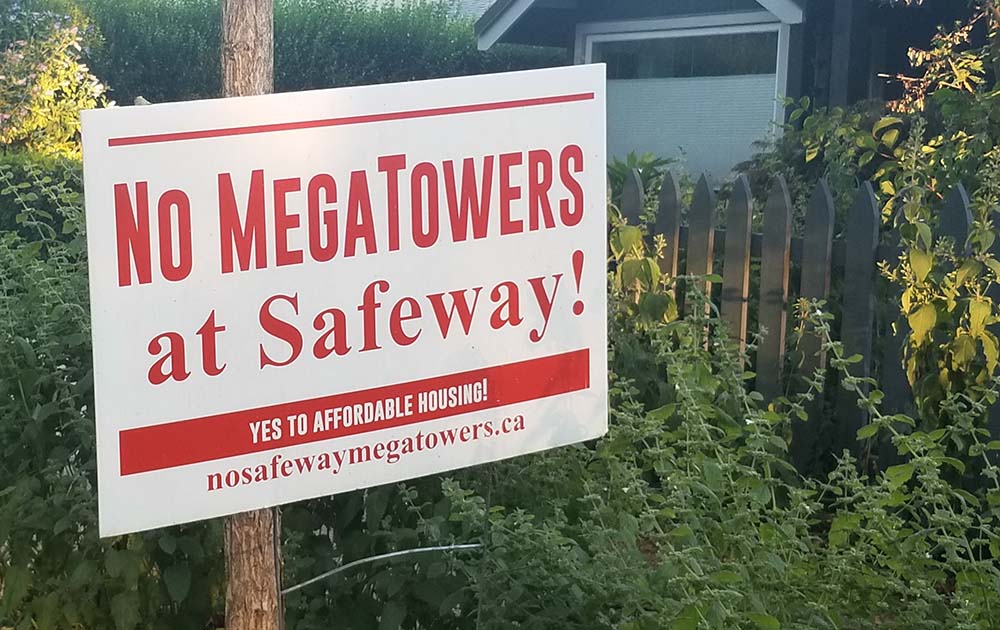
Allow more types of housing in more places
In most cities, the vast majority of residentially-zoned land only allows single detached homes – the most expensive form of housing.
Zoning reform can allow “multi-plex” missing middle housing (duplexes, triplexes, fourplexes with secondary suites and coach/laneway homes) on most single detached-zoned lots. This will allow for more ground-oriented, family-friendly homes. The ability to distribute the high cost of land amongst several housing units creates improved affordability.
Existing single-detached zoned neighbourhoods are near important infrastructure: schools, parks, recreation centres, libraries, retail/commercial districts and transit.
Many older single-detached zoned neighbourhoods are experiencing population stagnation. Allowing new, young families to move into these areas will generate more school enrollment and provide more support for the small, local retail/commercial businesses that populate local high streets.
With a streamlined approval system, the small-scale nature of these developments means that they can be built quickly, in more areas of our cities. Unlike large apartment projects, missing middle housing can be built by smaller contractors, much like single-family homes.
Smart design can create missing middle housing that is sympathetic to the scale and character of existing neighbourhoods, addressing the concerns of many who oppose this type of housing. Check out the Missing Middle Competition for some great examples of missing middle housing.
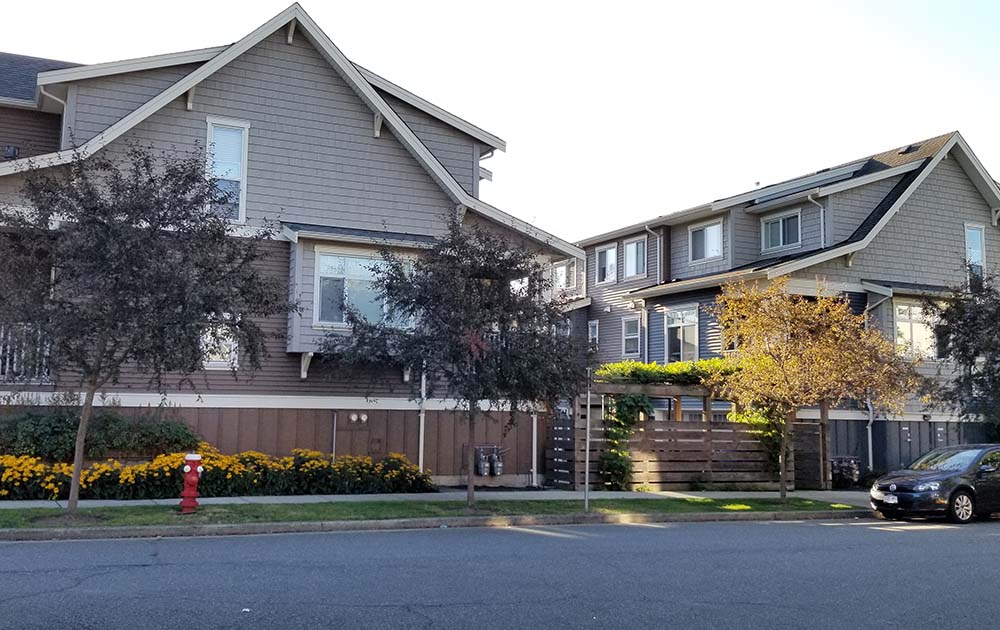
How Can REALTORS® Protect Themselves Against Liability During the COVID-19 Pandemic?
A REALTOR® cannot be held liable for damages resulting from someone being or likely being infected with or exposed to COVID-19, whether directly or indirectly, as a result of the Realtor providing real estate agent services, according to an order issued by the Minister of Public Safety and Solicitor General on April 2.
This order, issued under the Emergency Program Act, aims to protect those who provide “essential services” including Realtors, from certain types of liability. The order is only in effect during the state of emergency.
To be covered by this protection, Realtors must not be grossly negligent and must provide real estate agent services in accordance with all applicable emergency and public health guidance or believe that they are doing so.
The order does not protect Realtors from all liability during the COVID-19 pandemic. It only protects you if someone is or likely is infected or exposed to COVID-19 as a result of a Realtor’s provision of real estate services. For example, this order would not cover liability, if any, resulting from a buyer’s decision to proceed with an offer without viewing a property in-person due to the COVID-19 pandemic.
As a result of this order, you may decide it’s not necessary to obtain waivers from your clients in relation to the potential of being infected with or exposed to COVID-19. However, you may wish to continue using waivers, provided by your brokerage, as a way to confirm with each client that you’re complying with the applicable emergency and public health guidance. To help support Realtors, BCREA is creating a Notice and Acknowledgement form in regards to documenting legal advice, which will be made available through WEBForms® by 17 April 2020.
To subscribe to receive BCREA publications, or to update your email address or current subscriptions, click here.
How Do Amendments to the Strata Property Act Impact You?
On November 24, 2022, the BC Government passed amendments to the Strata Property Act, which take immediate effect. There are two significant changes impacting REALTORS® dealing with strata properties, as well as their clients:
- all rental restriction bylaws are removed, except for bylaws restricting short-term rentals such as Airbnb or Vrbo, and
- all age restriction bylaws are removed, with the exception of “seniors only” (55-plus) rules. This means that a strata will no longer be allowed to have 19-plus age restrictions.
This affects REALTORS® differently, depending on their area of practice.
For strata management services:
- advise your strata corporation clients that the Strata Property Act has been amended and the changes are currently in force,
- review the updated requirements in section 45(3) of the Strata Property Act if preparing a notice of an annual or special general meeting of a strata corporation,
- seek instructions from your clients in relation to amendments to the strata, and
- corporation’s bylaws are required to remove any unenforceable bylaws or any bylaws that contravene the Strata Property Act.
For trading services:
- advise your buyer or seller, where relevant, that the Strata Property Act has been amended,
- review strata bylaws for re-sale strata lots and/or Property Disclosure Statements for presale strata lots and strata lots purchased from a developer. Advise your clients to seek legal advice if they contain restrictions that are no longer compliant with the Strata Property Act, and
- if you are working with a potential buyer or seller that is under contract to purchase a rental or age-restricted property, advise them that the Strata Property Act has been amended and they may wish to seek legal advice.
For rental property management services licensees:
- advise your clients that the Strata Property Act has been amended, and ensure rental agreements that you manage on behalf of your clients comply with the amended legislation.
Additional changes to the Strata Property Act that were passed along with removing strata restrictions include:
- the requirement for an owner developer to file a rental disclosure statement (Form J) to explain strata rental rights is repealed,
- requirements for a notice of an annual or special general meeting of a strata corporation are expanded,
- requirements for an information certificate to include the number of rented strata lots in a strata plan is repealed,
- electronic meetings are now permanently permitted without the need for a bylaw, and
- secret ballots are not permitted at electronic meetings to ensure eligible voters and proxies are identified and calculated accurately.
Strata properties are a popular housing choice in BC. With over 1.5 million British Columbian living in strata housing, these changes may impact many consumers across the province. REALTORS® are responsible for staying on top of legislative changes impacting real estate to keep their clients informed.
Additional Resources
- BC Financial Services Authority Advisory: Amendments to the Strata Property Act (November 28, 2022)
- BC Financial Services Announcement (November 21, 2022)
- Government news release (November 21, 2022)
- Building and Strata Statutes Amendment Act, 2022 (Third Reading)
How Do Consumers Really See REALTORS®?
REALTORS® in BC have been under intense scrutiny since 2016. They have been singled out as key contributors to big picture problems like skyrocketing housing prices and money laundering. But how do consumers really see REALTORS®? Do they consider REALTORS® responsible for BC's housing affordability challenges? And how much do they understand about the real estate profession and recent changes to real estate practices?

These are some of the questions the British Columbia Real Estate Association (BCREA) wanted to answer when we commissioned an online survey of more than 800 adults in August 2018. Here's what we found out.
Consumers are happy with their REALTORS®
Among survey participants who had bought or sold a home in the last five years, 88 per cent relied on the services of a REALTOR®. The majority reported that they were happy with the services they received:
- 88 per cent said they were "very" or "somewhat" satisfied with their REALTOR®.
- 78 per cent added they would be likely to work with the same REALTOR® in the future.
Consumers don't hold REALTORS® accountable for affordability issues
Consumers are far more likely to blame current and past provincial governments for BC's housing affordability issues than REALTORS®:
- 18 per cent of those polled blame the previous government.
- 12 per cent blame the current government.
- 35 per cent blame foreign buyers.
Consumers don't agree with the ban on limited dual agency
The survey explained that the recent ban on limited dual agency means that some buyers and sellers are no longer able to work with the REALTOR® of their choice. When asked how important it was to them to be able to work with the REALTOR® of their choice, 73 per cent said it was "very important" or "somewhat important".
But there is support for regulation in specific areas
While 63 per cent of respondents answered they were "not too aware" or "not aware at all" of recent regulatory changes, 46 per cent of those polled answered that they were in favour of more regulation.
Survey respondents said their opinion of REALTORS® would improve if there were:
- higher education standards (39 per cent), and
- tougher penalties for REALTORS® who profit from misconduct (68 per cent).
However, it is worth noting that only 35 percent said they had a clear understanding of the education and licensing requirements for REALTORS®.
How will BCREA use this survey data?
Survey data like this helps us be more targeted in our advocacy work. It tells us where we need to do more to educate the public, media and politicians about REALTORS®, professional standards and issues related to real estate practice. Just as importantly, it tells us where there is already support for REALTORS® and issues facing the profession. This sort of information is particularly helpful as member boards gear up to meet with their local MLAs at the upcoming GL Days. It helps us dispel myths around consumer perceptions and highlight the shared interests of the profession and the market.
How InFormBot Can Be Used in Your Practice
InFormBot, launched on Wednesday, December 1, 2021, was built to help new REALTORS® navigate commonly used Standard Forms more efficiently and confidently. To learn more about what InFormBot is, please read the “What is InFormBot?” article.
How to Use InFormBot in Ten Easy Steps:
Step One
Locate InFormBot directly via this link or on BCREA Access on the Standard Forms InFormBot page or the Standard Forms section submenu:

You can also access InFormBot via the fixed button located at the bottom of the Standard Forms, Standard Forms Toolkits, or Standard Forms Resources pages on BCREA Access:

Step Two
Simply click the button to launch the digital tool in a new window. You are not required to log in with your REALTOR Link® credentials if you use the direct link in step one.
Step Three
Once InFormBot is launched, you will see the “Home” dashboard and navigation icons:

Step Four
Use the "left" and "right" navigation arrows to return to the transaction stage menu or the next transaction stage. You can also revisit previous information using the orange "up" navigation arrow. If you want to return to the “Home” dashboard screen, click the "home" navigation icon.
Step Five
To get started, InFormBot will ask some general questions about your real estate transaction, such as whether you're working with a buyer, seller, or seeking additional information:

Step Six
Next, click the option that relates most to your transaction stage and needs. Seller stages include Onset of Relationship, Pre-listing, Listing, Offer and Counter-offer, Offer Acceptance, Right of Rescission Period, and Due Diligence Complete:

Buyer stages include Onset of Relationship, Buyer's Consultation, Writing an Offer, Offer Acceptance, Right of Rescission Period, and Due Diligence Complete:

Step Seven
Once you’ve made your selection, InFormBot will offer suggestions of commonly used Standard Forms.
Step Eight
When you've found the Standard Form you’re looking for, click on its name highlighted in blue. A new browser tab with the form will open, providing access to the form and / or resources like those contained in the Standard Forms Toolkits located on BCREA Access. The toolkits are interactive training guides that provide REALTORS® with information about a form, outline what the sections of the form mean, offer guidance on completing it, FAQs, and more.
Step Nine
If you need direction at any time regarding other transactions or resources, simply click the "home" navigation icon to return to the “Home” dashboard. You can also scroll up to see the history of your InFormBot chat.
Step Ten
When you're satisfied with InFormBot's suggestions and have the Standard Forms information you need, you can use the navigation icons to explore InFormBot and discover more Standard Forms. You can also visit the Standard Forms page on BCREA Access for more resources.
Note: There are times when InFormBot may suggest you seek advice from your managing broker. This is meant to ensure that you consider other forms that may apply to your transaction, as this tool is meant to provide a high-level overview and is not intended to be all-encompassing.
If you need help navigating InFormBot or have questions about BCREA Standard Forms, email [email protected].
From now until Friday, May 30, 2025, at 5:45 pm PT, test your knowledge about InFormBot and enter to win free enrolment for one of five three-hour self-paced online Professional Development courses!
Stay tuned throughout May 2025 as BCREA continues reintroducing InFormBot with blog and social media posts. Keep an eye on our LinkedIn page for more!
How REALTORS® Can Prepare for the 2025 BC Wildfire Season
As we enter British Columbia’s 2025 wildfire season, it’s a good time to refresh our knowledge about this powerful natural phenomenon, including its role in the ecosystem and the horrific damage it can inflict.
As we all know, our province is virtually blanketed by forests of various types, which makes it particularly susceptible to wildfires. What's more, prolonged drought conditions, low snowpacks, and below-average precipitation have all contributed to recent high burn totals.
In 2024, about 1 million hectares were burned. The year before, the total was over 2.8 million hectares, the highest amount ever recorded for a single year. However, that followed a season when only 135,200 hectares burned, far below the ten-year average. And the 2018 total of 1.35 million hectares followed a near-record low season of only 14,500 hectares.
That all goes to say: The volume of forest burned from year to year is highly variable, as is the estimated total cost, so we can’t fully predict what the 2025 season will look like. A large number of wildfires are caused by lightning, but far too many are preventable. On average, 42 per cent are human-caused.
While small wildfires can actually prevent larger ones from occurring and play an essential role in the life cycle of a forest, large-scale ones are detrimental to air quality, slope stability, and water quality in adjacent streams and lakes. And we are all aware of the damage to housing, businesses, and critical infrastructure when wildfires expand into settled areas. Nobody needs to be reminded of the devastating impacts of recent wildfires in Fort McMurray, Lytton, West Kelowna, Jasper, or Pacific Palisades.
Disasters like the ones mentioned above have multi-layered impacts, destroying homes and forcing mass evacuations. There are also community-wide effects, as damaged infrastructure must be repaired (and hardened against future wildfires), and the local housing market is put under strain as displaced households need to find suitable accommodations during repair / rebuild. Meanwhile, local capacity to provide much-needed new housing gets stressed to the limit.
So, what can be done to mitigate the damage from wildfires? One major weapon is awareness. This means understanding the potential risks faced by your community and preparing for a worst-case scenario. It means taking steps to make your home is FireSmart. It means having a “go bag” packed and ready if wildfires are burning in your general vicinity and having an evacuation plan for your family and pets.
To help with these efforts, the BC Government is working on provincial and regional disaster and climate risk and resilience assessments. These will provide information on wildfire risk, but also threats from extreme heat, drought, coastal and riverine flooding, and earthquakes.
As we become more aware of the risks to life and property from wildfires and flooding, issues of insurance and financing will become a more significant consideration for homeowners and prospective homebuyers. Insurance companies are already excluding coverage for some properties in Florida (storms and flooding damage) and California (wildfires), and the inability to obtain insurance coverage will impact the availability of financing.
As specialists in local knowledge, REALTORS® should be aware of the threats faced by property owners and be able to direct them, and prospective purchasers, to information on mitigating risk and improving resiliency. Acting as a source of knowledge and a valuable conduit of information is a way to provide a higher level of service to your clients.
Bonus: As a big fan of the Knowledge Network, I want to plug their outstanding current original programming on BC’s front-line firefighters. It’s called Wildfire, and I encourage everyone to check it out.
FireSmart BC Webinar! On Wednesday, May 7, 2025, FireSmart BC shared valuable insights with us in the Managing Broker Community of Practice on how homeowners can take proactive steps year-round to reduce the risk from wildfires, focusing on home insurance and mitigation strategies. Watch the replay and view the resources here.
How REALTORS® Help Prevent Money Laundering in Real Estate: Identifying and Reporting Suspicious Transactions
By: Ellen Baragon, guest contributor
Brokerages, managing brokers, compliance officers, brokerage staff and REALTORS® are uniquely positioned to assess certain aspects of a real estate transaction that others may not have access to. By complying with your professional obligations to file a Suspicious Transaction Report (STR) and share suspicious transaction information with the Financial Transactions and Reports Analysis Centre of Canada (FINTRAC), you play an important role in helping to combat money laundering in real estate.
Reporting thresholds
When does a transaction reach the threshold of requiring an STR? FINTRAC has outlined the following measures below as a guide:
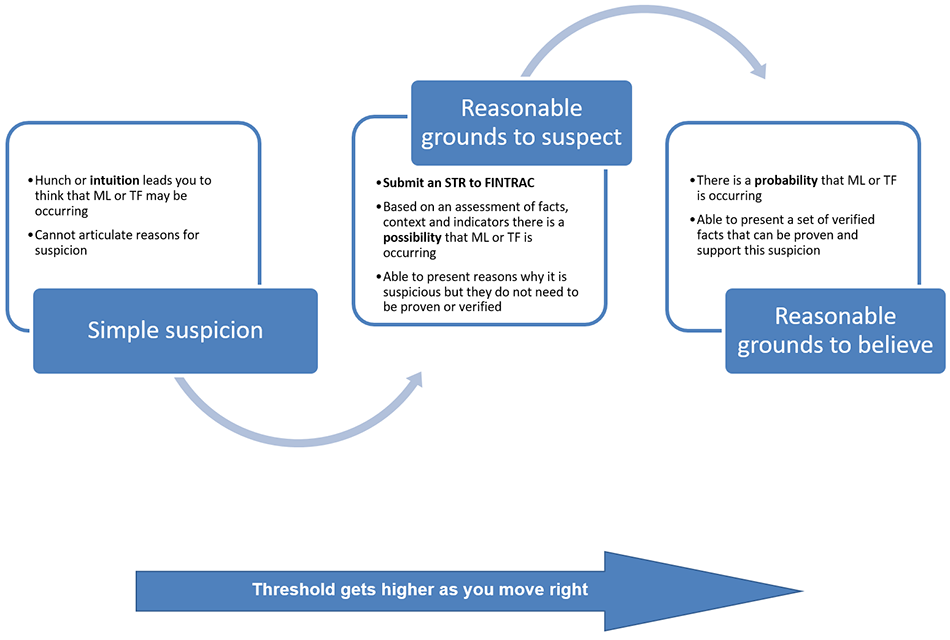
- A simple suspicion is characterized by a person’s “gut feeling” that causes them to suspect a transaction is amiss, but there are no underlying facts, context or red flags to support this suspicion. An underlying fact about a transaction is one that is known to exist. This can include details such as the date, time, location, amount or type of transaction, account details, financial history, or criminal background. A simple suspicion is not grounds to submit an STR to FINTRAC.
- The reasonable grounds to suspect threshold is met when the underlying facts, context and red flags point to the possibility that a money laundering or terrorist offence has occurred, even if it has not been proven. Therefore, it’s important to note that if the assessment of facts, context and indicators provides reasonable grounds to suspect, an STR must be submitted to FINTRAC.
- The reasonable grounds to believe threshold is met when the underlying facts, context and red flags suggest a probability that a money laundering or terrorist offence has occurred, and the underlying facts have been verified to support this probability. This is a higher threshold than the grounds to suspect, although both meet the standard for submitting an STR to FINTRAC.
FINTRAC guidelines can help you determine if there are reasonable grounds to suspect or believe that a transaction is related to money laundering or terrorist offences or attempts to commit such crimes. If you are unsure, you should speak to your brokerage compliance officer for clarity and to assess conclusively if an STR is required.
Money laundering red flags for Realtors and brokerages
To help Realtors and brokerages determine when an STR needs to be filed, the following indicators of money laundering and terrorist financing can serve as ‘red flags’. Please note, this is not an exhaustive list.
- A client provides minimal, vague or fictitious information that cannot be readily verified.
- The buyer’s agent is especially guarded about their client.
- The client is in an undue hurry to complete the purchase.
- The purchase is made without anyone viewing the property; the buyer shows no interest in the features of the property.
- The sale price is abnormally high or low.
- The client has an unusual lack of concern regarding commissions or other transaction costs.
- The property is purchased without a mortgage, which is not consistent with the characteristics of the buyer.
- The client is not able to account for the source of payment from their income or assets.
- The client tells you that funds are coming from one source, and at the last minute the source changes.
- Payments arrive from several individuals or sources.
- The client requests an unusual or uncustomary way to handle the transaction.
- A residential property is titled in the name of a third party.
- The purchased property is immediately resold, and the resale entails a significant increase or decrease in the purchase price.
Filing a Suspicious Transaction Report
Once you have completed the appropriate measures and determined that the reasonable grounds to suspect threshold has been reached, you must complete an STR as soon as practicable. The STR must be complete and accurate, clearly articulating your brokerage’s suspicions, and that of your brokerage, and referencing all underlying facts, context and indicators that led to the suspicion. This is important because any missing information could cause potential harm to FINTRAC’s analysis and the picture it provides to law enforcement.
Who should file the Suspicious Transaction Report?
Realtors and brokerage staff are encouraged to talk to their compliance officer to determine who will file the report.
What does a complete Suspicious Transaction Report consider?
A complete STR includes, but is not limited to, the following information:
- when the transaction was completed or attempted,
- if the transaction was attempted, the reason it was not completed,
- the financial instruments or mechanisms used to conduct the transaction,
- where the transaction took place,
- the grounds to suspect that the transaction or attempted transaction is related to the commission or attempted commission of money laundering or terrorist offence,
- how the transaction took place, and
- the parties to the transaction, in particular: the conductor, beneficiary and holders of all accounts involved; identifying information on the parties involved in the transaction; the owners, directors, officers, and authorized signers or entities involved, information on the ownership, control and structure of the business; each individual or entity’s role; information about the relationships between the parties.
Keep suspicious transaction reporting confidential
It is an offence to disclose that an STR has been made, is being made, will be filed or to disclose the contents of the report with the intent to prejudice a criminal investigation.
Remember, STRs supply FINTRAC with important data about trends, patterns, relationships and entities of money laundering activity in Canada, which in turn assists law enforcement in investigating and prosecuting offenses. By submitting STRs to FINTRAC when appropriate, Realtors and brokerages can play a key role in helping authorities reduce the risk of money laundering to BC’s financial system and the larger economy.
FINTRAC’s STR forms can be found here and a guide to reporting suspicious transactions in real estate can be accessed here.
For more information and resources on anti-money laundering, visit BCREA’s AML resources page.
To subscribe to receive BCREA publications such as this one, or to update your email address or current subscriptions, click here.
How REALTORS® Help Prevent Money Laundering in Real Estate: Reducing the Risks
By Ellen Baragon, Guest Contributor
Due to the real estate sector’s size, its services, and the high monetary values involved, real estate is at risk of being targeted for money laundering – as are banks and financial sectors where large transactions are common. One important way a real estate brokerage can reduce this risk is by regularly conducting an assessment to identify the factors that could expose them to this kind of crime.
Under the Proceeds of Crime (Money Laundering) and Terrorist Financing Act (PCMLTFA), the Financial Transactions and Reports Analysis Centre of Canada Risk (FINTRAC) requires each real estate brokerage to conduct an assessment and documentation of risks related to money laundering and terrorist financing, as well as mitigation measures to deal with those risks, and review it at least every two years or sooner, if risk factors change.
While there are specific legal requirements of brokerages around managing the risk of money laundering, REALTORS® also have an important role to play in combatting money laundering.
Considerations for a risk-based approach to money laundering
Assessing risk tolerance
When conducting a risk assessment, it’s important to consider what is an acceptable level of risk for your brokerage. This should be assessed with consideration of the risk that exists, and the controls and measures you have already implemented to reduce the level of risk.
Determining risk factors
To help you assess risk, consider the following factors:
- the brokerage’s clients and business relationships, including their activity patterns and geographic locations,
- the services and delivery channels that the brokerage offers,
- the geographic location(s) where the brokerage conducts their activities (e.g., the geographical area of Metro Vancouver has a large international port and airport and close proximity to the US border. These may be factors that increase vulnerability to money laundering and terrorist financing.),
- new technologies and their impacts on the brokerage’s clients, business relationships and services or delivery channels of their activities, and
- other relevant factors affecting the brokerage’s business (e.g., turnover, rules and regulations for the real estate industry, etc.).
Implementing controls
Implementing controls to mitigate the brokerage’s identified risks will enable the brokerage to stay within its risk tolerance. If a brokerage sets a higher risk tolerance, this will require stronger risk mitigation measures and controls. The brokerage will want to ensure that the risk mitigation and controls correspond with the risks that have been identified.
Addressing residual risks
When conducting a risk assessment, you must also consider the level of risk that remains after the implementation of mitigation measures and controls. Money laundering is a crime with many complex elements and money launderers constantly adapt their methods and channels to avoid detection, therefore the risk is residual and requires ongoing monitoring.
Helping mitigate risk through a culture of compliance
An effective risk assessment goes far beyond simply meeting regulatory requirements and ticking the boxes. Compliance officers, managing brokers and real estate professionals should build a “culture of compliance” in their businesses, marked by awareness and knowledge of money laundering, and a willingness to follow the guidance set out by FINTRAC. In a future blog post in this series, BCREA will explore ways to establish a culture of compliance.
FINTRAC risk assessment requirements
FINTRAC expects a brokerage to demonstrate in writing that they have tailored their risk-based approach considering all facets of their exposure to money laundering and terrorist activities, documented the risks and implemented mitigation measures. The FINTRAC site provides guidance on the risk-based approach to combatting money laundering and terrorist financing as well as workbooks that include a "how to" methodology.
Compliance officers are also expected to be able to demonstrate to FINTRAC that they have reviewed and, if necessary, updated their risk assessment and mitigation measures if the brokerage or practice has changed or expanded in a way that would require a revision of their risk management plan.
For more information and resources on anti-money laundering, visit BCREA’s AML resources page.
To subscribe to receive BCREA publications such as this one, or to update your email address or current subscriptions, click here.
How REALTORS® Help Prevent Money Laundering in Real Estate: Setting the Landscape
REALTORS® are committed to doing their part to help prevent money laundering in the BC real estate sector. As the professional association for BC Realtors, BCREA is committed to providing knowledge and resources to help address this complex issue. As part of this commitment, we have created a new blog series to increase awareness around money laundering in the BC real estate sector and how Realtors are helping to lead efforts to prevent it.
In this first blog post of the series, we review the concept of money laundering, and how and why criminals may attempt to target the BC real estate sector.
What is money laundering?
Money laundering is the act of disguising the proceeds of crime to make them appear legitimate. This allows criminals, including organized crime and drug traffickers, to benefit from their crime by enabling them to use the profits of their illegal activities without arousing suspicion.
While money laundering occurs in many sectors of the economy, criminals looking to “clean” the proceeds of their crimes may find real estate attractive because of the high value of real estate.
How does money laundering happen?
Money laundering typicallyinvolves at least three steps, which often occur simultaneously:
- Placement: placing the proceeds of crime within the financial system, for example, using small bills to buy in at a casino and receiving higher denomination bills or a cheque in return.
- Layering: converting the proceeds of crime into another form, such as purchasing real estate; criminals will often create complex layers of financial transactions to distance themselves from the underlying criminal activity.
- Integration: returning the laundered proceeds to the economy to create a perception of legitimacy.
If money laundering occurs in real estate, it’s most likely to occur at the layering stage. At this stage, criminals would look to purchase a property by engaging in a transaction that looks legitimate but disguises the true beneficial ownership of the property.
Why real estate?
In 2018, Peter German began an investigation into money laundering in BC and examined several industries, including real estate, casinos, luxury cars and horse racing. In his 2019 report, German recognized that criminals may find real estate attractive because:
- it is high value,
- it is often seen as a “safe” investment,
- it has the potential for profit over time or income from rent, and
- the owner of a property may be a corporation, trust or nominee, which may help to conceal the true identity of the buyer.
While the BC Land Owner Transparency Act, which takes effect this month, intends to make real estate purchases in BC more transparent, it will take a coordinated effort to solve this complex problem and deter criminals from laundering money in the real estate sector in BC and across Canada.
The next blog post in this series will discuss how Realtors and brokerages can assess their practice for potential vulnerabilities and reduce the risk of being targeted by criminals.
For more information and resources on anti-money laundering, visit BCREA’s AML resources page.
To subscribe to receive BCREA publications such as this one, or to update your email address or current subscriptions, click here.
How the 2022 Federal Budget Impacts BC Real Estate
UPDATE - April 12, 2022: This post was updated to correct a figure related to the Multigenerational Home Renovation Tax Credit. The tax credit is up to $7,500, not $50,000 as previously stated.
Budget 2022 was introduced on April 7 with a significant focus on the supply and affordability of housing in Canada. BCREA was encouraged to hear Canada’s Minister of Finance Chrystia Freeland accurately diagnose the root cause of the country’s housing affordability problem. “Canada does not have enough homes,” Freeland said. “We need more of them, fast.”
New spending towards housing totalled $10.1 billion, which – apart from climate change and Indigenous reconciliation – was the largest area of new spending in the budget and demonstrates that the government is beginning to seriously prioritize tackling Canada’s housing crisis.
Below is an overview of new commitments in the budget that may impact BC’s real estate sector.
Housing supply
Many commitments made to increase housing supply align with BCREA’s ongoing advocacy. The largest of these commitments was a new Housing Accelerator Fund, which will invest in municipal housing planning and delivery processes to speed up developments. Existing infrastructure programs will now tie infrastructure funding to actions by provincial and local governments to increase housing supply, which BCREA called for in our pre-budget submission. Additionally, more funds are being allocated to the National Co-Investment Fund, which will expand co-op housing.
There was also a commitment to launching a Multigenerational Home Renovation Tax Credit, which will allow families to claim 15 per cent (up to a $7,500 credit) in eligible renovation and construction costs incurred to construct a secondary suite for seniors or adults with disabilities.
Several proposals within the budget specifically target housing supply for Indigenous Canadians, including the initiation of an Urban, Rural and Northern Indigenous Housing Strategy.
Assistance for First-Time Homebuyers
The budget also increases much-needed incentives for first-time homebuyers, through a new Tax-Free First Home Savings Account. Beginning in 2023, it will give prospective first-time homebuyers the ability to contribute up to $40,000. Like a Registered Retirement Savings Plan (RRSP), contributions would be tax-deductible, while withdrawals to purchase a first home would be non-taxable, like a Tax-Free Savings Account (TFSA). In addition, the First Time Home Buyers’ Tax Credit will be doubled to $10,000, retroactive to homes purchased on or after January 1, 2022.
Home Buyers’ Bill of Rights
The budget also re-affirmed the government’s commitment to introduce a Home Buyer’s Bill of Rights. This would include a national plan to end “blind bidding” as well as possibly include a legal right to a home inspection and ensuring transparency on the history of sales prices on title searches. While we support the intent to protect homebuyers, independent research shows that banning “blind bidding” would likely lead to higher prices in a hot real estate market.
Reducing Foreign Demand
The budget committed to introducing legislation designed to reduce foreign demand in real estate. The legislation would prohibit non-Canadian citizens or permanent residents as well as non-Canadian commercial enterprises from acquiring non-recreational, residential property in Canada for two years. We are concerned this measure needlessly targets non-Canadians, creating barriers for attracting foreign investment, and will potentially result in reciprocal policies from other countries targeting Canadian “foreign” owners.
Other demand-side measures
In addition to targeting demand from non-Canadians, the government will also conduct a review of housing as an asset class to better understand the role of large corporate players in the market and the impact on renters and homeowners. They will also introduce legislation to introduce an “anti-flipping tax” beginning January 1, 2023.
Energy Retrofits
Another core aspect of the budget was new commitments to improve the energy efficiency of homes. These include strengthening affordability and energy efficiency requirements within the Rental Construction Financing Initiative, developing a Canada Green Buildings Strategy, creating the Deep Retrofit Accelerator Initiative and expanding tax deductions for business investments in clean energy equipment to include air-source heat pumps. These initiatives are designed to reduce Canada’s greenhouse gas emissions reductions targets of 40 per cent below 2005 levels by 2030.
While there are several proposals that raise concern in Budget 2022 and require further consultation, detail and scrutiny before implementation, overall, BCREA is encouraged that the federal government is taking initial steps to tackle the country’s affordability crisis.
How the REFBC Helps Advance the Real Estate Profession in BC
REALTORS® are on the front lines of real estate in British Columbia advising clients, navigating change, and helping build stronger communities every day. While this work is often fast-paced and client-focused, it’s also part of a much larger picture. That’s where the Real Estate Foundation of BC (REFBC) plays a vital role.
REFBC is a grant-making organization that supports education, research, and public awareness initiatives across the province. What makes the connection so meaningful is that a significant portion of their funding comes from interest earned on trust accounts held by real estate brokerages.
In March 2025, we were pleased to learn that several of BCREA’s Professional Development and public awareness projects will receive grant funding from REFBC. With their support, we’re excited to progress on a number of meaningful initiatives set to launch over the next year. Each one is being developed to strengthen REALTOR® knowledge, leadership, and connection to the communities we serve.
One of the most forward-looking initiatives is Ready, Set, Know: REALTOR® Edition 2025 / 2026, a pilot course designed to evolve into an annual offering. The course was created around “just-in-time” topics identified by REALTORS® themselves, offering relevant, timely content that helps professionals stay ahead of emerging trends. This year’s edition includes modules on artificial intelligence (AI) in real estate, the assignment of pre-sales, climate-related risks, ownership models, and small-scale, multi-unit housing. It’s built to help REALTORS® feel confident in their knowledge and equipped to lead in conversations that matter.
REFBC has also supported the launch of a new Mentorship Program for Managing Brokers. This initiative reflects the increasing complexity and responsibility of brokerage leadership today. This year-long pilot offers new managing brokers a clear, structured pathway to grow their skills, navigate challenges, and lead with confidence. But it’s more than a training program, it’s a space to build lasting professional relationships. By connecting emerging leaders with experienced mentors and a community of peers, the program fosters a strong support network that encourages shared learning, trust, and collaboration. This investment in leadership development not only strengthens brokerage management across BC but also creates a positive ripple effect. As managing brokers enhance their capabilities, they are better equipped to mentor and support new agents entering the profession, thereby elevating the overall standard of real estate practice in the province.
Another key offering that will be made possible through REFBC’s funding is the Fundamentals of Agency course. This course reinforces the essential principles of fiduciary duty, client loyalty, confidentiality, and professional responsibility. Through interactive elements and real-world scenarios, it helps REALTORS® deepen their understanding of agency and the ethical responsibilities that come with it.
Beyond Professional Development and leadership, REFBC’s support also extends to public awareness. This year’s funding helps build on the ongoing Radon Awareness Campaign, expanding efforts to inform British Columbians about the health risks of radon gas and encouraging them to take action, which often begins with a conversation with a REALTOR®. The campaign reflects a continued commitment to ensuring REALTORS® are equipped with the knowledge and resources to support clients in making safer, more informed housing decisions.
We’re incredibly grateful for REFBC’s support of these initiatives. Their commitment to responsible land use and Professional Development enhances the work REALTORS® do every day and contributes to the long-term strength of the real estate profession in BC.
How to Apply for BCREA’s Legal Defence Reserve for REALTORS®
BCREA’s Legal Defence Reserve (LDR) is a valuable support system that assists REALTORS® by supporting litigation or providing other assistance for issues concerning the Realtor profession.
When serious issues arise with potential implications on Realtor practice, reputation, and the real estate profession as a whole, BCREA may assist you with your claims with financial support related to litigation or discipline, or support in other forms such as advocacy with the regulator.
Previously, the LDR supported the Real Estate Brokers Association of BC with its participation the Cullen Commission.
If you find yourself in need of support, here are five steps for how to apply for the Legal Defence Reserve.
Step One:
Log into BCREA Access and visit the LDR page, which is located in the main menu under Resources for Boards & REALTORS®.
Step Two:
Complete the LDR application here (BCREA Access login required).
Step Three:
Complete the application with pertinent details. You will need to answer the following:
- A summary of the issue for which you face disciplinary or legal recourse.
- Why is this issue important to Realtors in BC?
- Have you tried to resolve the issue and assess the allegations through consultation with a lawyer or BCFSA?
- What do you hope to achieve?
- What assistance do you want BCREA to provide?
Additionally, you will need to obtain written support from your managing broker and member board.
Step Four:
Submit the completed application along with supporting documents by email to [email protected].
Step Five:
Wait for a decision from the Legal Defence Committee (LDC). The Committee will review the application and contact you via email with its decision.
To learn more about the Legal Defence Reserve and how BCREA supports Realtors, visit www.bcrea.bc.ca/legaldefence.
How to Detect Tax Evasion for the Purpose of Money Laundering in Real Estate
The Financial Transactions and Reports Analysis Centre of Canada (FINTRAC), in collaboration with the Canada Revenue Agency (CRA), has released an Operational Alert titled Laundering the Proceeds of Tax Evasion in Real Estate. This alert aims to help real estate professionals recognize the signs when a real estate transaction could be connected to the laundering of tax evasion proceeds which form part of their Proceeds of Crime (Money Laundering) and Terrorist Financing Act obligations.
Tax evasion is a serious offence under the Income Tax Act and Excise Tax Act which involves actions like falsifying records, hiding income, or inflating expenses. The proceeds from tax evasion are considered criminal and often mix with money laundering activities. Criminals use similar methods to conceal funds, whether from tax evasion or other crimes like drug trafficking.
As with many professions, the real estate sector can be vulnerable to these activities due to the ease of manipulating property prices and using complex ownership structures to hide the identity of beneficial owners. This makes it essential for real estate professionals to be vigilant.
FINTRAC’s alert outlines several common methods used to launder the proceeds of tax evasion in real estate, including:
- Private Financing Outside Financial Institutions: This involves private lenders or unlicensed money services businesses with no logical explanation provided as to why they chose not to use a traditional lender.
- Exploiting Assignment Contracts: Developers and builders may sell a property multiple times before it's built, generating unreported income from forfeited deposits and reselling the property at a higher price.
- Shadow Flipping: Buyers purchase properties and use assignment clauses to sell their interest in a property before the closing date, earning multiple unreported commissions or capital gains.
- Using Straw Buyers: These are transactions involving a person purchasing a property on behalf of another (called a “straw buyer”) who cannot complete the transaction, often due to a lack of reported income or proper documentation required to obtain a mortgage.
To assist REALTORS® in identifying suspicious transactions related to laundering the proceeds of tax evasion, FINTRAC provides several indicators including but not limited to:
- Financing for the purchase of property is provided by a private lender, or an unlicensed money services business other than a financial institution, with no logical explanation provided.
- There is an excessively high or low price attached to the properties transferred from the buyer to the seller without adequate supporting documents.
- Transactions involve assignments of contract where the same property is sold multiple times to different buyers and / or investors before being built.
- The value of the property purchased is inconsistent with the reported / stated wealth and income of the client.
- Statements from buyers as to the intended use of the property purchased (i.e., residence or investment) are inconsistent.
- Investment vehicles or offshore accounts are used for the purchase of property.
- Large amounts of money from foreign individuals or entities, located in a country that imposes limits on international transfers are wired through multiple smaller electronic transfers to be ultimately invested in real estate.
- Statements or questions are received from buyers as to how to avoid paying taxes on real estate property.
- Cryptocurrencies are used as payment to property developers, investors, and / or speculators.
Determining whether to submit a suspicious transaction report (STR) to FINTRAC involves considering the facts, context, and indicators of money laundering or terrorist financing. It requires more than a gut feeling; there must be reasonable grounds to suspect that a transaction is related to money laundering.
Indicators serve as red flags, stemming from characteristics, behaviours, and patterns that appear inconsistent with what is expected. On their own, indicators may not seem suspicious, but combined with other factors, they can create a picture of potential illicit activities. REALTORS® must assess these elements to determine if an STR is necessary.
A comprehensive and high-quality STR is essential for FINTRAC’s analysis process. The report should include parties involved, transaction details, reason for suspicion, and how transactions occurred. Including the term: #CRARealEstate in Part G – Description of suspicious activity on the STR helps facilitate FINTRAC’s disclosure process.
As managing brokers and REALTORS®, it is crucial to understand and implement FINTRAC’s new guidelines on identifying tax evasion and money laundering activities. These measures not only help maintain the integrity of the real estate sector but also ensure that Canadians benefit from a strong and stable market.
By staying informed and vigilant, REALTORS® can significantly contribute to combating financial crimes and a healthier real estate sector in Canada. BCREA has several courses which expand on REALTORS®’ anti-money laundering (AML) obligations which can help in the fight against money laundering and terrorist financing in all its forms. Find more about these courses on our Professional Development page.
To help REALTORS® continue diligently updating and educating themselves about AML, BCREA is releasing a series of AML resources. To find out more, check out our Anti-Money Laundering page.
How to Find BCREA Open Letters to Government and Consultations
“How does BCREA interact with the BC Government and BC Financial Services Authority on issues of importance to the housing and real estate sectors?”
Great question!
The BCREA Government Relations team maintains relationships with elected officials at all levels of government, looking to make sure the BC REALTOR® voice and perspective are heard. BCREA also hosts the annual Government Liaison Days conference (happening this year from March 9-11, 2025), which facilitates conversation about crucial issues between REALTORS® and their local Members of Legislative Assembly.
But that’s only part of the story.
Letters to Government
BCREA often puts pen to paper, writing open letters to key members of government on housing policy issues that affect REALTORS® and the public.
Moving forward, we will post these letters in the Letters to Government section on the Advocacy page of our website, available here.
The first letter posted in this new archive addresses an urgent need for BC: remediating homes used in drug production. Released in the wake of a BCREA-commissioned study on the topic, the letter recommends a slate of province-wide remediation standards to ensure health and safety while restoring drug-impacted homes to the housing market. You can find that letter here.
Consultations
BCREA is also often invited to participate in government and regulator consultations, offering the BC REALTOR® perspective on matters of provincial and federal importance.
In these cases, BCREA conducts research and delivers a letter back to the organization or government ministry hosting the consultation, providing careful analysis and evidence-based opinion to the larger discussion.
You can find past BCREA consultation responses here.
How to Fund Flood Mapping
Flooding poses significant risks to communities, and the effects can be widespread and last for years. Floodplain maps illustrate where floodwaters are expected to go, which makes them the most logical first step in flood management. To be effective, these maps also need to be updated regularly.

Unfortunately, there hasn’t been a coordinated program in BC to create and/or update floodplain maps for many years. Local governments are mainly responsible for flood management, and many of them simply don’t have the expertise or the resources.
Since 2015, federal and provincial government funding programs have helped many BC communities carry out flood mapping and related projects. However, those programs are short term, which means local governments have to be creative about their funding options, often using multiple strategies.
BCREA has put together a list of funding strategies local governments can use for their mapping projects in our Floodplain Mapping Funding Guidebookfor BC Local Governments. This resource is a great starting point for governments that are taking a proactive approach to land use decisions and emergency management.
To subscribe to receive BCREA publications such as this one, or to update your email address or current subscriptions, click here.
How to Prepare for the 2025 BC Wildfire Season
As we enter British Columbia’s 2025 wildfire season, it’s a good time to refresh our knowledge about this powerful natural phenomenon, including its role in the ecosystem and the horrific damage it can inflict.
As we all know, our province is virtually blanketed by forests of various types, which makes it particularly susceptible to wildfires. What's more, prolonged drought conditions, low snowpacks, and below-average precipitation have all contributed to recent high burn totals.
In 2024, about 1 million hectares were burned. The year before, the total was over 2.8 million hectares, the highest amount ever recorded for a single year. However, that followed a season when only 135,200 hectares burned, far below the ten-year average. And the 2018 total of 1.35 million hectares followed a near-record low season of only 14,500 hectares.
That all goes to say: The volume of forest burned from year to year is highly variable, as is the estimated total cost, so we can’t fully predict what the 2025 season will look like. A large number of wildfires are caused by lightning, but far too many are preventable. On average, 42 per cent are human-caused.
While small wildfires can actually prevent larger ones from occurring and play an essential role in the life cycle of a forest, large-scale ones are detrimental to air quality, slope stability, and water quality in adjacent streams and lakes. And we are all aware of the damage to housing, businesses, and critical infrastructure when wildfires expand into settled areas. Nobody needs to be reminded of the devastating impacts of recent wildfires in Fort McMurray, Lytton, West Kelowna, Jasper, or Pacific Palisades.
Disasters like the ones mentioned above have multi-layered impacts, destroying homes and forcing mass evacuations. There are also community-wide effects, as damaged infrastructure must be repaired (and hardened against future wildfires), and the local housing market is put under strain as displaced households need to find suitable accommodations during repair / rebuild. Meanwhile, local capacity to provide much-needed new housing gets stressed to the limit.
So, what can be done to mitigate the damage from wildfires? One major weapon is awareness. This means understanding the potential risks faced by your community and preparing for a worst-case scenario. It means making sure you're covered for damage caused by wildfires. It means taking steps to make your home is FireSmart. It means having a “go bag” packed and ready if wildfires are burning in your general vicinity and having an evacuation plan for your family and pets.
To help with these efforts, the BC Government is working on provincial and regional disaster and climate risk and resilience assessments. These will provide information on wildfire risk, but also threats from extreme heat, drought, coastal and riverine flooding, and earthquakes.
While we can't predict what the 2025 wildfire season will bring, awareness and preparation remain our best tools. Wildfires are a fact of life in BC, but by planning ahead and working with others, we can reduce their worst impacts and better protect our communities.
Bonus: As a big fan of the Knowledge Network, I want to plug their outstanding current original programming on BC’s front-line firefighters. It’s called Wildfire, and I encourage everyone to check it out.
How to Verify a Business’ Identity
By The AML Shop, Guest Contributor
Our last article, How to Verify a Person’s Identity, looked at the different ways that REALTORS® can verify the identity of their individual clients. In this article, we take a closer look at your options for verifying the identity of your corporate and other legal entity clients.
But first, let’s quickly review the situations in which you are required to verify the identity of an entity.
REALTORS® must verify the identity of a legal entity in the following scenarios:
- When representing the entity for the purchase or sale of real estate.
- Upon receiving funds from an entity (i.e., a wire transfer) for which the brokerage is required to keep a receipt of funds record.
In addition to these more common events, the following scenarios require REALTORS® to take reasonable measures to verify the identity of a legal entity:
- Upon submitting a suspicious transaction report with respect to the entity.
- When there is an entity that is party to a deal that is unrepresented by a REALTOR®.
Verifying the identity of an entity generally involves confirming that the entity exists, and the type of information that REALTORS® can reference to make this confirmation will be dependent on the structure of that entity. For corporate entities, REALTORS® have a few options:
- Certificate of incorporation: Certificates of incorporation are issued by corporate registration authorities (for example, BC Registries). You can verify the identity of a corporate client by obtaining the corporation’s certificate of incorporation.
- Annual filing: Corporations are required to file annually with their registration authority. Annual filings confirm information such as directorship, and registration address. You can verify the identity of a corporation by obtaining a copy of the corporation’s most recent annual filing.
- Other documents: REALTORS® can verify the identity of a corporate client by referencing any other document that confirms the corporation’s existence, its name and address, as well as the names of its directors. A corporate profile report would be a good example of another document that could be used to verify a corporation’s identity.
When verifying the identity of a non-corporate entity, you can reference any document that confirms that the entity exists and confirms its name and address. The type of document that you reference will depend on the organization’s structure. For example, a trust agreement can be used to verify the identity of a legal trust, while a partnership agreement might be used to verify the identity of a partnership.
Regardless of whether you are verifying the identity of a corporation or other entity, the information that you reference must be valid, current, and authentic.
REALTORS® may rely on physical copies of documents to verify an entity’s identity, in which case you need to keep a copy of that document in your records. Conversely, you can rely on information that is obtained electronically (if it is obtained from a public source). When relying on electronic information, you must keep a record of the type of information that was referenced (for example, a corporate profile report), the source of that information (for example, BC Registries), as well as the entity’s registration number and jurisdiction of registration.
As with verifying the identity of an individual, REALTORS® can rely on another party to verify the identity of an entity on their behalf, but they must have a written agreement in place with that party requiring them to provide the identity information to you as soon as possible upon your request. The other party also must verify the entity’s identity by confirming its existence, as previously outlined above. However, while you can rely on any individual or entity to act as your agent for the purpose of verifying the identity of an individual, a party that you rely on to verify the identity of an entity must be regulated by the Financial Transactions and Reports Analysis Centre of Canada (FINTRAC). Refer to the FINTRAC website for a list of sectors that FINTRAC supervises.
Finally, whenever you verify an entity’s identity, you must also verify the identity of the signing officer who is acting for the entity using one of the identity verification methods that were discussed in the last article. You also need to take reasonable measures to obtain and confirm information about the beneficial ownership of the entity. Stay tuned for future articles to learn more about beneficial ownership and your other anti-money laundering-related obligations.
The article is provided by The AML Shop for BCREA, member boards and associations, compliance officers, managing brokers, and BC REALTORS® for informational purposes only and is based on The AML Shop's understanding of the regulatory and legislative standards in place at the time it was recorded. Those standards and FINTRAC's enforcement of them vary and change over time.
The AML Shop is not a law firm, and this article does not constitute legal advice. This summary may also not be applicable to your specific situation.
We encourage readers to verify the information’s accuracy and relevance before relying on it for professional or legal decisions.
This resource is made available with the generous support of the Real Estate Foundation of BC (REFBC).
REFBC is a philanthropic organization working to advance sustainable, equitable, and socially just land use across BC. REFBC funds projects, connects people, and shares knowledge. Learn more: refbc.ca.
How to Verify a Person’s Identity
By The AML Shop, Guest Contributor
In last month’s video, we explored the value of knowing your client, or KYC, as well as the various KYC measures that real estate brokers and sales representatives are required to take under federal anti-money laundering legislation. In this article, we’re going to take a deeper dive into one of the most crucial KYC processes, which is verifying identity. Although REALTORS® are required to verify the identity of both individuals and entities, this article will focus specifically on verifying the identity of an individual.
REALTORS® must verify a person’s identity in the following scenarios:
- When representing a person for the purchase or sale of real estate.
- When creating a receipt of funds record REALTORS® are required to verify the identity of the person who provided the funds.
The following scenarios require REALTORS® to take reasonable measures to verify a person’s identity:
- Upon submitting a suspicious transaction report with respect to the person.
- When there is a person who is party to a deal that is unrepresented by a REALTOR®.
In order to provide brokerages with the freedom to customize their compliance programs, the regulations define several acceptable methods for verifying the identity of an individual.
Government Photo Identification
The most common method that REALTORS® rely on to verify a person’s identity is by referring to a photo identification document issued by the federal government or a provincial or territorial government. Foreign-issued documents can also be relied on if they are equivalent to an acceptable Canadian-issued document.
In order to successfully rely on a piece of photo-identification, the document must meet the following criteria:
- It must be valid and authentic (i.e. not a fraudulent document),
- It must be current (i.e. unexpired),
- It must include the person’s name,
- The photo on the document must match the person’s likeness, and
- It must have a unique identifier (i.e. a driver's licence number).
REALTORS® can confirm the authenticity of an identification document by examining it for evidence of tampering or other anomalies. When verifying a person’s identity remotely, as you’re not able to physically examine the person’s document, it is essential that a technology product is used to ensure the document’s authenticity.
Credit File Method
REALTORS® can also verify the identity of a person by referencing a Canadian credit file. In order to verify a person’s identity with this method:
- REALTORS® must obtain the credit file from the credit bureau. It is not acceptable to obtain the credit file from the person.
- The name, address, and date of birth on the credit file’s header must match the information provided by the person.
- The file must have at least three years of credit history.
- The file must contain information from at least two sources (i.e. a credit card and utility provider).
Canadian credit bureaus offer identity verification products that reference a person’s credit file to verify their identity without impacting their credit score.
Dual Process Method
In addition to the government photo identification and credit file methods, REALTORS® can verify a person’s identity by referring to information from two reliable sources. For the purpose of the dual process method, a reliable source could include the government, a financial institution, or a utilities or telecommunications provider. Together, the information provided must confirm information from two of the following categories:
- Name and address,
- Name and date of birth, or
- Name and possession of a deposit, credit, or other loan account with a financial institution.
For example, a REALTOR® might obtain a tax bill to confirm the person’s name and address and a credit card statement to confirm their name and possession of an account. The information provided must be valid and current. This means that if the information has an expiry date, it must be unexpired, and if the information is periodically re-issued (for example, a tax statement or a credit card statement), REALTORS® must refer to the most recent version of the information.
Agent or Mandatary
If a REALTOR® is unable to verify a person’s identity themself, they may rely on another party (their agent) to conduct the verification on their behalf. In order to authorize an agent to verify a person’s identity, REALTORS® must have a written agreement in place with the agent, prior to their verifying the person’s identity. A templated agent agreement can be downloaded from WEBForms®. When verifying the person’s identity, your agent must use one of the previously described identity verification methods. The agent must also provide you with the person’s identity information for retention in your records. While there are no limits as to who you can select as an identity verification agent, you retain ultimate responsibility for properly verifying the person’s identity, so it is essential that you have confidence that the agent’s verification measures will be in line with regulatory standards.
Effective identity verification is crucial to the success of your KYC process and these regulations provide REALTORS® with multiple verification options to suit their operational and compliance processes. Always ensure that your policies and procedures clearly identify which methods have been adopted by your organization.
The article is provided by The AML Shop for BCREA, member boards and associations, compliance officers, managing brokers, and BC REALTORS® for informational purposes only and is based on The AML Shop's understanding of the regulatory and legislative standards in place at the time it was recorded. Those standards and FINTRAC's enforcement of them vary and change over time.
The AML Shop is not a law firm, and this article does not constitute legal advice. This summary may also not be applicable to your specific situation.
We encourage readers to verify the information’s accuracy and relevance before relying on it for professional or legal decisions.
This resource is made available with the generous support of the Real Estate Foundation of BC (REFBC).
REFBC is a philanthropic organization working to advance sustainable, equitable, and socially just land use across BC. REFBC funds projects, connects people, and shares knowledge. Learn more: refbc.ca.
Human Rights Act – Building Scheme Restriction Discriminatory #229
By Gerry Neely
B.A., LL.B.
A trio of companies subdivided acreage into 14 lots which included an older home. A building scheme registered by the developers provided that the use of a building for commercial purposes was limited to persons who used the building as a residence and office to carry on the professions or businesses described in the covenant.
Negotiations by a company (Co. "B") which administered group homes for physically or mentally handicapped persons to purchase the home as a group home for four disabled persons were unsuccessful. Co. "B"'s conditional offer was rejected by the developers in part because the periods of time for removal of several conditions were too long, and, in part, because they thought that the business of the group home was inconsistent with the building scheme restriction. A complaint that the developers refused to sell the property because of the physical and/or mental disabilities of the four persons, the complainants, was filed under the Human Rights Act.
The developers had no dealings with the complainants represented by Co. "B" and sound business reasons for discontinuing negotiations. The Board of Inquiry acknowledged that there was no evidence that the developers intended to discriminate and yet an Order was made requiring the developers to refrain from discriminating on the basis of physical and/or mental disability and to pay $1,500 to each of the four complainants.
Had the developers' objections been limited to their business reasons that might have been the end of this matter. However, by linking the business reasons to the building scheme restriction, the developers rejection in the words of the Board was "tainted by a discriminatory purpose". Why was the commercial business restriction held to be discriminatory?
Section 4 (a) of the Act states that no person shall deny to a person or class of persons on the basis of a prohibited ground of discrimination the opportunity to purchase a commercial unit or dwelling unit that is represented as being available for sale.
A building scheme such as this, honestly made and which applies to everyone may constitute discrimination if it has an adverse effect on a person or group of persons on the basis of a prohibited ground. The nature of the disabilities of the complainants is such that the only way they can live is in a group home. The prohibition against their purchase of a building suitable for their use has an adverse effect upon them.
Where an adverse affect occurs, the duty of was to "accommodate the individuals adversely affected to the point of undue hardship". This test is taken from several Supreme Court of Canada decisions where the hours of work requirements of a major employee conflicted with an employees religious faith. For example, a department store's policy that employees must work Friday evenings and Saturdays on a rotation basis. A Seventh Day Adventist claimed this had a discriminatory effect because of her religion. This was held to be a discriminatory practice and the employer could only support it by showing that accommodating her would have created an undue hardship.
An employer with a large employee base would find it relatively easy to find other hours of employment to accommodate the religious practices of the individual. It is not clear what the developers might have done to accommodate the group home purchase. The Board suggested they should have asked questions to determine the extent to which say increased traffic from occupants, employees and suppliers might have affected the development.
What would be a developer's position, however, if it hadn't reserved a power to modify the building scheme in respect of an unsold lot and require the consent of new owners. The answer may be found in an Ontario Human Rights decision where by-laws of a condominium corporation stated that each unit was to be occupied only as a family residence. A Board of Inquiry held the by-law to be discriminatory and ordered it to be altered to permit group homes for ex-psychiatric patients to occupy condominium units.
The decision in the BC and Ontario cases might have been different if evidence had been provided that the developers' attempt to accommodate the disabled persons would have amounted to undue hardship to the developers but, in the absence of any evidence, discrimination was found to have taken place. Property rights in the traditional sense may be changed by Section 4 and persons who believe they are affected to their detriment will need to marshall evidence to establish undue hardship.1
| 1. |
|
To subscribe to receive BCREA publications such as this one, or to update your email address or current subscriptions, click here.
Human Rights Code Complaint Against Licensee by Another Licensee; Minor Defect in Comparison With Larger Contract Benefit Didn’t Justify Repudiation #401
By Gerry Neely
B.A. LL.B.
“Don’t shoot the messenger”—this must have been the reaction of a licensee against whom two complaints of discrimination under the Human Rights Code were made by another licensee. The first was discrimination on the basis of family status with respect to a service customarily available to the public under s. 8. The second was made under s. 43, which prohibits discrimination against a person who made a complaint under the Code.
The first licensee had a listing from a strata unit owner who was 84 years old and in failing health. The complainant lived with her handicapped son in the same building as the owner. They sat in the lobby of the building, taunting the people who entered. This frightened the elderly owner so much that she listed her unit for sale. Consequently, when the complainant asked the licensee for access for the complainant and a client to view the unit, the owner instructed the licensee to deny access.
This brought the nominees of both licensees together. Both licensees were prepared, if necessary, to show the property themselves; however, the complainant did not ask her nominee for assistance and filed the complaints. The s. 43 complaint arose because the complainant had previously made two complaints of discrimination against the strata corporation and strata council.
The licensee also lived in the building and was aware of the earlier complaints. The complainant alleged that denial of service by the licensee was in retaliation for these complaints. The evidence was overwhelmingly against the complainant; her own nominee even questioned why she filed the complaints when the access issue could have been resolved through the Real Estate Board of Greater Vancouver. Both complaints were dismissed.
Her nominee also gave evidence that an owner has a right to exclude certain buyers or refuse to sell to a specific individual. The Human Rights Tribunal member accepted this evidence, but remarked that the owner’s choice is not a defence when the buyer falls within one of the prohibited grounds of discrimination set out in the Code. This decision is also a reminder that it’s no defence to a complaint of discrimination to say you were only following orders.1
Buyers paid a deposit of $391,000 on the purchase price of $1,955,000 for two strata units to be built over a two-year period. A dispute arose about the allocation of four parking stalls, and it was unresolved at the completion date in May 2003. After the buyers refused to complete the transaction, the seller resold the units in February 2004 for $2,750,000. The seller also sued successfully for the deposit when the judge held there was no substantial breach of contract by the seller that justified the buyers’ repudiation of the contract.
The buyers appealed, arguing that the deposit was a penalty and equity entitled them to relief from forfeiture of the deposit, particularly in light of the windfall profit. This argument would likely have succeeded had the parties not agreed that the deposit was a pre-estimate of the damages the seller would sustain if the buyer defaulted, and would be forfeited as liquidated damages. This pre-estimate of damages is encouraged because it reduces, if not eliminates, litigation to determine damages. The trial judge said the real estate market might have fallen over the building period and the seller could’ve lost more than the deposit. The appeal court agreed and dismissed the buyers’ appeal.(2)
| 1. | Erdodi v. Dobson (No.4), 2006 BCHRT 185. | |
| 2. | Liu v. Coal Harbour Properties Partnership, 2006 BCCA 385. |
To subscribe to receive BCREA publications such as this one, or to update your email address or current subscriptions, click here.
Human Rights—Section 8 and Discrimination Regarding Accommodation #394
By Gerry Neely
B.A. LL.B.
(continued from Legally Speaking 393)
The obligation to accommodate the needs of a disabled person was applied in a Nova Scotia case where the complainant sought accommodation in a mobile home park. He could not walk further than 25 feet and used a scooter and wheelchair to move about. He needed a 10 x 14 foot shed for his scooter, trailer attachment, charger and space to transfer to his wheelchair. He found a mobile home that suited his needs, provided he could enlarge the existing shed, and applied to the park manager for approval as a tenant.
When he indicated he wanted to increase the length of the shed to 14 feet, the manager stated that park rules only allowed 10 x 10 foot sheds. Two months later, the manager offered to allow this extension, but the disabled man declined because of the expensive commitments he had made to renovate his existing property—commitments made with the belief that the shed extension was prohibited.
The evidence at his complaint hearing indicated the park rules were not consistently enforced and, as such, there were many infractions. One MLS® listing of park-owned property included a 12 x 12 foot shed. The park manager conceded that granting the extension request would not create hardship for the park owners. The tenant received damages of $10,000.1
BC Human Rights Code, section 9 and discrimination re purchase of real property
This section prohibits discrimination against a person who wants to buy a commercial unit, dwelling unit, land or an interest in land, or because of a term or condition of the purchase.
In one case, the member of a co-op residential building denied a potential tenant the opportunity to purchase shares, which would’ve entitled him to a dwelling unit, because of his sexual orientation. While no outright objection was made, several factors led the tribunal to conclude sexual orientation was the reason, including the lengthy delay in considering the application, the financial records of the complainant, failing to give any reason for the denial, failing to disclose documents and destroying or losing documents that might have contained the reasons.2
The circumstances in which developers innocently discriminated against mentally handicapped persons are worth reading in Legally Speaking 229. The developers had created a residential subdivision with a typical building scheme restricting commercial uses. The developers discriminated against four physically and mentally handicapped persons when they rejected an offer made on behalf of the handicapped persons to purchase a lot for a group home because they thought the use was prohibited by the restrictive covenant. This reason prevailed over the business objections they had to the lengthy periods of time for removal of conditions.
The prohibited grounds of discrimination are “race, colour, ancestry, place of origin, religion, marital status, physical or mental disability, sexual orientation or sex of that person or persons.” Family status, age or lawful sources of income are added to these in s. 10, which concerns discrimination in tenancy premises.
| 1. | Matthews v. Westphal Mobile Home Court (Ltd), {2005} N.S.H.R.B.I.D No. 6. | |
| 2. | Outingdyke v. Irving Apartment and others, 2005 BCHRT 443. |
To subscribe to receive BCREA publications such as this one, or to update your email address or current subscriptions, click here.
Human Rights: What to Remember When Purchasing, Selling, or Renting Properties #587
It is always prudent to familiarize yourself with or learn more about our provincial human rights legislation, the Human Rights Code (the Code). The Code applies to the areas of, among others:
- services available to the public,
- purchasing or selling property, and
- tenancy.
Understanding its application is essential to ensuring compliance with your professional obligations as a REALTOR®.
The Code prohibits discrimination on the basis of personal characteristics such as age (19 or older, does not apply to buying property), ancestry, colour, criminal conviction (only applies to employment), family status (does not apply to buying property), gender expression, gender identity, marital status, mental or physical disability, place of origin, political belief (only applies to employment), race, religion, sex, sexual orientation, or source of income (only applies to tenancy). The Code also prohibits retaliatory actions against a complainant.
Complaints about alleged violations of the Code are adjudicated by the BC Human Rights Tribunal (the Tribunal) and must be filed within a year of the date of the alleged discrimination. It is not necessary to prove intent to discriminate. However, the complainant must prove the respondent was aware of the complainant’s protected personal characteristic(s).1 If the Tribunal finds there was discrimination, it can issue a variety of orders, including:
- ordering the respondent to stop the discrimination;
- requiring the respondent to provide monetary compensation to the complainant for injury to dignity, feelings, and self-respect; and
- awarding compensation for any expenses incurred.
As a REALTOR®, you cannot deny someone services based on any of the prohibited reasons, even if acting on your clients' instructions or without intending to discriminate.
In the November 2006 Legally Speaking article, “Human Rights Code Complaint Against Licensee by Another Licensee; Minor Defect in Comparison With Larger Contract Benefit Didn’t Justify Repudiation #401,” past contributor Gerry Neely discussed a Tribunal decision in a complaint from a REALTOR® on behalf of her buyer, who was refused a showing of a property listed for sale. The buyer’s REALTOR® alleged that in refusing to arrange a showing, the seller’s REALTOR® had discriminated on the prohibited reason of family status. The Tribunal found that the seller’s REALTOR® had not discriminated on the basis of family status, and commented that the seller had an unrelated, subjective preference respecting this prospective buyer.2
The issue was resolved by removing the listing from the Multiple Listing Service® System. The Tribunal commented that if the seller’s REALTOR® had refused access for a discriminatory reason, this might have constituted a breach of the Code by the seller’s REALTOR®, even though the seller’s REALTOR® was merely acting on the seller’s instructions.
In 2017, a similar complaint was made by a buyer who used a wheelchair against a seller’s REALTOR®, who refused him access to the property.3 The denial was based on the seller’s instruction that all persons viewing the property were to remove their shoes at the door. The Tribunal found that the only reason for denying the buyer access was his use of a wheelchair, which was connected to the protected ground of disability. Again, following the sellers’ instructions was not considered a sufficient defence for the REALTOR®.
Landlords are free to choose suitable tenants for their property, but must not discriminate based on any protected grounds. Similarly, when acting as a property manager, you cannot discriminate or refuse to rent a property to a potential tenant based on any of the prohibited grounds, even if acting under the instructions of your client, the landlord.
In a 2011 case, the Tribunal found that the owner of a mobile home park had discriminated against a prospective tenant on two prohibited grounds: source of income (the tenant was collecting a disability pension) and disability (the tenant had a cognitive disability as a result of a brain injury).4 The Tribunal also said that while a landlord may choose not to provide a reason when rejecting a rental application, this does not protect the landlord from applying the Code. Failure to provide a reason for the rejection when a tenant requests one can lead the Tribunal to infer discrimination against a tenant who is a member of a protected group.
You must also be careful not to discriminate against an existing tenant for any of the prohibited reasons. For example, should an existing tenant experience a change in circumstances, such as developing a disability or experiencing a change in family status, the landlord has a duty to accommodate these changes and must not engage in discriminatory behaviour. Accommodations may include taking steps to modify the property (e.g., installing a wheelchair ramp or allowing a service dog in a no-pets building) up to the point of undue hardship for the landlord.
The Tribunal recently dismissed a complaint by a tenant on the basis of disability.5 The tenant wished to smoke marijuana for chronic pain management on the property, in breach of the no-smoking provisions of the tenancy agreement. The landlord proved he had asthma triggered by the smell of marijuana smoke. The Tribunal found the landlord had adequately attempted to accommodate the tenant’s disability by offering that the tenant could end the lease early without penalty or that the tenant could smoke marijuana on the edge of the property.
A recent complaint by a couple who had a second child while living in the respondent strata corporation, who were then fined by the strata corporation for breaching the maximum occupancy bylaw, is proceeding through the Tribunal. The strata corporation failed in its attempt to have the complaint struck as being without merit, with the Tribunal commenting that the strata corporation had not shown evidence of undue hardship resulting from having to modify the maximum occupancy bylaw. The final decision in this case has not yet been rendered. It can take four or even five years from the date a complaint is filed to receive a final decision from the Tribunal.
The Real Estate Errors and Omissions Insurance Corporation (REEOIC) provides liability insurance for real estate licensees in British Columbia, covering losses from errors, omissions, or negligent acts during professional duties. However, REEOIC does not cover licensees in discrimination claims. Should you be named as a respondent in a complaint to the Tribunal, you should get legal advice right away. You may also want to check the terms of any other insurance you have to see if such claims are covered.
Ideas into Action: BCREA Managing Brokers’ Conference
Register today for BCREA’s second Managing Brokers’ Conference and join managing and associate brokers from across BC on October 16 and 17 at the Coast Capri Hotel in beautiful Kelowna for a day of networking and learning!

This year's conference theme is Ideas into Action, and the all-day conference on October 17 will take an interactive approach to tackling some of the most important issues facing managing brokers today.
Topics will include:
- Preparing for the new Professional Development Program
- Reputation management & money laundering
- Updates from the Office of the Superintendent of Real Estate and the Real Estate Council of BC
- BCREA advocacy update
- Real Estate Errors and Omissions Insurance Corporation session on risk management
Sessions will encourage feedback and participation, so that attendees come away with new skills, practical resources and stronger relationships with other real estate professionals. To round it off, there will be a mini expo on October 17 expanding on themes discussed during the sessions. Attendees will receive three category C PDP credits for attending the conference.
The event will kick off on the evening of Wednesday, October 16 with a Welcome Reception sponsored by the Real Estate Foundation of BC at Summerhill Pyramid Winery. RSVP details for the reception will be included in your conference registration confirmation email. Guests are welcome to attend the reception at an additional cost (see details below).
Conference details
Date: Thursday, October 17, 2019
Time: 8:30 am-4 pm
Location: Coast Capri Hotel, Kelowna
Cost: $180 until August 9, $200 after August 9 (excluding taxes & fees)
Registration: bcrea_ideasintoaction.eventbrite.ca
Reception details
Date: Wednesday, October 16, 2019
Time: 5 – 6:30 pm
Location: Summerhill Pyramid Winery, Kelowna
Cost: Included in conference registration (Guest tickets available for an additional $40,
excluding taxes and fees)
Registration: Details to RSVP and buy guest tickets included in conference registration
confirmation email
To subscribe to receive BCREA publications such as this one, or to update your email address or current subscriptions, click here.
Identifying Different Property Interests in British Columbia #584
Property ownership in British Columbia can take many different forms, each with distinct rights, responsibilities, and legal implications. REALTORS® have the professional obligation to understand and correctly represent these property types as codified by the Real Estate Services Rules. According to Rule 30(f), the listing REALTOR® has a duty to “disclose to the client all known material information respecting the real estate services, and the real estate and the trade in real estate to which those services relate.”1 While the REALTOR® acting for the buyer has a duty to “use reasonable efforts to discover relevant facts respecting any real estate that the client is considering acquiring.”2
The cases of Hughes (Re)3 and Chapman (Re),4 which deal with the same transaction, illustrate how these obligations apply equally to REALTORS® on both sides of a transaction. The listing REALTOR® must ensure that the information in the listing is accurate, and the buyer’s REALTOR® must verify that information, if they can do so, through available public and secondary sources.
Freehold Fee Simple Ownership
Freehold fee simple is a type of freehold ownership that is common in BC. Freehold title can also include both fee tail (where an owner and their heirs hold the estate as inherited property) and life estates (where an owner hold the estate for their lifetime), however of these other forms only life estates remain in BC and take the form of a charge on title. Freehold fee simple grants the owner property rights over the land and any affixed structures upon it, subject only to the limitation of the Crown Grant. Fee simple property rights (and use of the lands) are also subject to any registered charges, liens, or interest on title under the Torrens land title system of BC (i.e., a registered lease or a restrictive covenant).
REALTORS® can inquire into the fee simple title by doing a land title search on the parcel, wherein the owners’ names are disclosed. The land title search can be further verified by a BC Assessment search, which allows the civic address and legal address to be compared against the title results.
Strata Properties
Strata titles are a sub-type of fee simple property grant where there is both the strata property belonging to the owner and the common property that is shared with the other owners of the strata corporation. While some basic aspects of the strata lots can be verified with a title and BC Assessment search (as set out above), the strata plan should also be obtained from the Land Title Office to verify the strata lot is in three-dimensional space, and a Form B Information Certificate package should be obtained from the strata property manager (bylaws, budget, rules, and depreciation report).
Whether a property is a bare land strata, non-bare land strata, or fee simple (non-stratified) property cannot be assessed by simply touring the property. Only through careful review of the land title and subdivision or strata plan will the nature of this interest be clear. Bare land strata designations are generally indicated in the title of the registered strata plan.
Care is required in these listing representations, as buyers often do not fully appreciate the differences in the legal nature of their grant until the use of their property is limited (i.e., by strata bylaws), or their property is damaged, and insurance coverage becomes necessary. For example, when representing smaller strata properties (i.e., duplex and fourplex units), it is incorrect to represent that there are “no bylaws,” as the Standard Bylaws under the Strata Property Act apply even if the strata has not developed its own set of bylaws. Likewise, a bare land strata would not have a shared insurance policy, whereas a non-bare land strata would. This distinction can be material during the fire and flood seasons.
Leasehold Properties
Unlike a fee simple interest, a leasehold interest is defined by the lease document, and the right to possess the property under the lease is a defined term, which ultimately will revert to the landlord / owner of the property. The first step in listing a leasehold interest is to review and be familiar with the terms of the lease, including:
- Term Duration: The remaining length of the lease term.
- Payment Terms: Whether payments are prepaid or periodic.
- Default Provisions: Conditions under which the lease may be terminated by the landlord due to defaults.
- Sublease or Assignment Rights: The lessee's ability to transfer their interest and any required landlord consent. The right to mortgage the leasehold interest is related to the lessee’s ability to assign and is often limited by the terms of this section.
- Registration Status: Whether the lease is registered or unregistered (a registered lease is enforceable against third parties).
The terms of the lease can be verified through an estoppel certificate, which is a document signed by the tenant and landlord, verifying the business terms of the lease and confirming that the lease is currently in good standing.
The BC Real Estate Association’s Standard Contract of Purchase and Sale should not be used to assign / transfer a leasehold interest. Depending on the nature of the property with the leasehold interest (residential, commercial, Indigenous lands) a contract specific for such assignment of leasehold interest should be used.
Other Interests
Across British Columbia, in addition to those property interests discussed above, you will encounter other property interests, including leases on Indigenous lands, cooperative interests, timeshares, and tenancies. Use care when these are encountered, confer with your managing broker, and if necessary, seek additional advice prior to listing. Remember that there must be a lawful property right being transferred to be a valid listing.
REALTOR® Responsibilities
Real estate professionals in BC have a duty to ensure the nature of the property interest being sold is accurately identified and conveyed to clients.5 Understanding the various forms of property ownership in British Columbia is crucial for educating clients and allowing them to make informed real estate decisions.
Impact of the Proposed Speculation Tax
Housing measures featured prominently in BC Budget 2018.

Of particular concern to BCREA is the proposed speculation tax. It will target homeowners in urban areas who pay little or no income tax in BC and owners of second properties that are not long-term rentals.
We believe there are opportunities to minimize the impact of this tax for all homeowners who pay income tax in Canada. We also urge the BC Government to consult the public to ensure the best input and insights are available as the details are determined.
We raised our concerns in a productive meeting with Minister James and opposition critics in early April. BCREA looks forward to continuing those conversations, and we also recognize the government’s initiatives to increase supply, including the recent announcement to build 14,000 new rental homes throughout the province.
More information:
- BCREA position on the proposed speculation tax, plus questions about other BC Budget measures (March 2018)
To subscribe to receive BCREA publications such as this one, or to update your email address or current subscriptions, click here.
To subscribe to receive BCREA publications such as this one, or to update your email address or current subscriptions, click here.
Implied Agency: If It Quacks Like a Duck, It May Be a Duck! #503
Implied agency is very much on the brain these days with the Superintendent of Real Estate's new rules on agency now in effect. Rule 5-10.1 requires that licensees use a new form from the Real Estate Council of British Columbia to disclose the risks faced by unrepresented parties, the limited assistance that licensees can provide them and to recommend that they seek independent professional advice. Licensees need to be aware that they can provide only very limited services to unrepresented consumers in a property transaction. Failure to take extreme care may result in claims of implied agency.
Implied agency is defined in the 20th Edition of Bowstead & Reynolds on Agency at p. 61:
Agreement between principal and agent may be implied in a case where one party has conducted himself towards the other in such a way that it is reasonable for that other to infer from that conduct assent to an agency relationship.
The danger in going beyond the very limited services that a licensee can offer to unrepresented parties in a transaction is that the consumer will argue that an implied agency relationship has been created. If an agency relationship is implied, the Court may impose on the licensee the same kind of duties and obligations that a licensee owes a client, including fiduciary duties of loyalty, disclosure and confidentiality.
In a recent decision in Siemens v. Howard,1 the Court of Appeal dealt with implied agency. A real estate licensee, H, lived across the street from the plaintiff, S. In December of 2013, S approached H and mentioned he was looking to purchase property to expand his chicken farm. H mentioned he was planning to purchase the abutting property to his lot for himself and adjust his lot lines to increase his 9.5 acre property to 10 acres. H suggested the remaining acquired lands might be suitable for S, who expressed interest and told H to keep him informed. S claimed that H was acting as his agent and purchased the property on his behalf.
The trial judge looked at the conduct of H and S to determine whether an implied agency relationship was created. Despite disputes in the evidence, she made a number of findings which supported her conclusion that H was not acting as agent for S. First, she found that although H introduced S to the property, both parties evidence stated that it was in the context of H acquiring the abutting property for himself. Second, there was no evidence that S instructed H on any terms of the four offers made for the property, including the price. Third, the trial judge noted that while H and S communicated with one another frequently by text and telephone, they did not speak at all during the time that H was submitting the final offers for the abutting property.
The Court of Appeal upheld the findings of the trial judge on the facts and on the conclusion that there was no implied agency. Despite the fact that there was no implied agency in this case, it serves as a reminder of the risks licensees face whenever they are dealing with someone who does not have their own representation.
Licensees must be cautious when dealing with parties with no agency who elect to proceed in a transaction as an unrepresented party. The starting point for licensees is to comply with Rule 5-10.1. Licensees dealing with unrepresented parties should understand their limitations, remind unrepresented parties of these limitations and avoid any conduct that might lead to implied agency such as providing advice or allowing an unrepresented person to share confidential information with them without warning that this information will be passed on to their client. Keeping a good record of all communications is good practice. Licensees offering the very limited services allowed to an unrepresented party must stick to only those services permitted.
Chris JohnstonB.A., LL.B.
| 1. | Siemens v. Howard, 2018 BCCA 197. |
Legally Speaking is published monthly. Real estate boards, real estate associations and REALTORS® may reprint this content, provided that credit is given to BCREA by including the following statement: "Copyright British Columbia Real Estate Association. Reprinted with permission." BCREA makes no guarantees as to the accuracy or completeness of this information or the currency of legal information.
To subscribe to receive BCREA publications such as this one, or to update your email address or current subscriptions, click here.
Implied Representation that Rents Lawful #149
By Gerry Neely
B.A., LL.B.
A purchase was made of an Ontario apartment block under an agreement which set out the rent payable for each suite. There was no express representation that the rents were established lawfully. The new owner found himself facing demands by tenants for a rental review and a rollback of rents claimed to be in excess of those permitted under the Ontario tenancy legislation.
The new owner settled these demands by repaying the excessive rent increases and by lowering rents to the amounts lawfully permitted.
Upon the purchaser's action against the vendor for damages, the vendor denied liability because it had made no representation that the rents were lawful. The court however, held that the vendor's statement of the rents payable by the tenant created an implied representation that the rents were lawfully charged, and awarded damages to the purchaser.
In British Columbia this case could apply to a rental increase made within twelve months of the last increase or where there has been no increase, within twelve months of the date the existing rent was established.1
* * *
Another Ontario case contains two examples of bad clause drafting practices by an agent who prepared a number of conditions to be added to the Standard Form Contract used by the local Real Estate Board. Completion of the purchase was conditional upon the purchaser obtaining satisfactory soil tests, site plan approval and a building permit, all within nine months of the date of acceptance of the offer.
Then the agent added a clause that said that if the purchaser was not satisfied with any of "the above conditions within the allowed time frame, then the vendor agrees to give the purchaser month to month extensions". Finally the agent added a clause similar to the one found in the Standard Form Contract in British Columbia, which gave the purchaser the right to waive the conditions "prior to the expiration of the period of time as aforesaid". If the purchaser failed to do so, the contract was void.
The purchaser didn't proceed diligently and when the nine month period ended, the vendor applied for a declaration that the contract was no longer binding because it was ambiguous. The judge interpreted the two clauses concerning time to mean that if the purchaser was unable to remove the conditions within the nine month period, the purchaser had a reasonable period thereafter to remove them. That was a very charitable interpretation of a clause which another court could easily have said was void under the rule against perpetuities because the extension from month to month could mean that the contract would run forever.
However he could not reconcile these two clauses with the final clause added by the agent. Since the date for removal of the conditions could automatically be extended from month to month, there was no date which would fix the "date of the expiration of the period of time as aforesaid". Since it was the purchaser's agent who prepared the agreement, the ambiguity was interpreted against the purchaser.
Apart from the ambiguity created by the clauses, it is bad practice not to set a time limit or establish the mechanism for the time within which the conditions must be fulfilled.2
| 1. |
|
|
| 2. |
|
To subscribe to receive BCREA publications such as this one, or to update your email address or current subscriptions, click here.
Implied Warranty – Purchase of an Incomplete New Residence #226
By Gerry Neely
B.A., LL.B.
When a buyer contracts to purchase a residence before construction of it is complete, the law implies a warranty in favour of the buyer that the work will be done in a good and workmanlike manner, the materials will be suitable and the building will be fit for habitation.
The warranty will apply if the buyer is able to establish that the residence was incomplete at the time of purchase, the warranty wasn't excluded by the terms of the contract and that further work was to be done by the seller to complete it. The implied warranty does not apply to work done before the contract was signed, if that work was visible upon inspection.1
***
Builders who now limit or do not provide for deficiency repair warranties will be taking a closer look at the warranty statements required in the disclosure statement, or any they may insert in the Contract of Purchase and Sale, as a result of a B.C. Court of Appeal decision which contains a lengthy examination of when a new residence is complete. An action for the cost of repair of water damage was brought against the builder four years after the sale of a five unit strata development. The contract for the sale of the first unit was dated September 16th, the building inspector issued an occupancy permit on November 7th, and between then and December 20th the four remaining units were sold. All units were occupied by the end of the following January, and in February the builder received complaints of rain water seeping through the stucco walls into units. Over the next three years the builder made unsuccessful attempts to solve the problem, and gave up.
In the fourth year the strata corporation hired engineers who correctly concluded that caulking and the application of sealant was the solution to the problem. When the strata corporation sued to recover the cost of the work, the builder's first defense was that the building was complete when these sales took place.
The court rejected the notion that a building inspector, or a builder, could determine when completion occurred and said further that completion and not substantial completion was the standard. The court concluded that a new residence will not be considered to be complete until the deficiencies, which one can expect to find following occupation and exposure to the elements, have been corrected.
The builder's second defense was that the implied warranty was excluded by the terms of the contract and the warranty in the disclosure statement. Paragraph six of the Contract of Purchase and Sale states that the agreement contains no warranties other than those contained in the contract. The disclosure statement, under the heading "construction warranty", stated that there was no warranty in respect of the development.
This argument was rejected because the attempt to either exclude the implied warranty, or substitute for it a warranty in different terms, was neither clear nor clearly brought to the attention of the buyer.
The builder could have excluded the implied warranty if it had stated in the disclosure statement that the buyer would be responsible for any work required to complete the building, or to correct defects, and that the builder did not warrant the premises to be fit for habitation.
Since this might repel prospective purchasers, the judge acknowledged that a builder who was prepared to complete construction and correct deficiencies could limit the life of the warranty to cover only those breaches disclosed within a year, a period covering reasonable use and exposure to the elements.2
| 1. |
|
|
| 2. |
|
To subscribe to receive BCREA publications such as this one, or to update your email address or current subscriptions, click here.
Important GST Changes in the Contract of Purchase and Sales Forms
As a part of BCREA’s Fall 2024 Standard Forms Launch, which comes into effect on Tuesday, November 12, 2024, there will be significant changes to the handling of the Goods and Services Tax (GST) in the Contract of Purchase and Sale (CPS) Standard Forms. These changes are critical for all REALTORS® to understand, as they directly impact how GST is addressed in real estate transactions across the province.
[iframe width="560" height="315" src="https://www.youtube.com/embed/2N4N7VO9J6g?si=LEiuGUOdlxtwI-tk" frameborder="0" allowfullscreen style="position:absolute;top:0;left:0;width:100%;height:100%;"][/iframe]BCREA has created the above video to support REALTORS® with a better understanding of this change.
What’s Changing?
The most notable update is that GST will now be automatically included in the purchase price unless otherwise negotiated. This shift is designed to mitigate the risks associated with scenarios where there is an improper (or the lack of assignment) of GST liability in contracts, which is a common issue that has led to claims with the Real Estate Errors and Omissions Insurance Corporation and disciplinary actions by the BC Financial Services Authority.
While buyers and sellers can still negotiate GST liability, this new default structure offers greater clarity and protection. Sellers are generally in a better position to obtain professional advice to understand their GST obligations based on their use of the property. This change helps sellers accept offers with full awareness of their net proceeds while also providing buyers with transparency regarding their total out-of-pocket expenses.
Why This Matters?
Failure to correctly assign GST liability in contracts has been a source of legal and financial risk for all parties involved. The new approach reduces this risk by making it clear that GST is included in the purchase price unless stated otherwise, simplifying the process and reducing the chance of misunderstandings or disputes after the fact.
Enhanced Disclosure for Better Client Protection
In addition to the changes in how GST is handled in contracts, a new disclosure has been added to the CPS information page outlining that:
- GST liability is negotiable.
- Buyers and sellers should seek professional advice regarding GST obligations.
- If applicable, funds from the sale must be remitted to the Canada Revenue Agency by the seller.
This robust disclosure is designed to ensure that clients are fully informed about their responsibilities and the potential implications of GST in their transactions. As a REALTOR®, it’s your role to guide clients through these changes and help them understand their rights and obligations in the updated contracts.
Next Steps: Stay Informed and Educate Your Clients
With these changes just around the corner, it’s vital that all REALTORS® familiarize themselves with the updated forms and the nuances of GST in real estate transactions. Clients depend on their REALTORS® to provide guidance and ensure clarity in real estate transactions while encouraging them to seek professional advice on complex matters such as tax liability. For additional resources, including FAQs and further guidance on the Fall 2024 Standard Forms Launch, visit the Fall 2024 Standard Forms Launch Resources page (BCREA Access login required).
Improving the Role of Managing Brokers
In October at BCREA's Managing Brokers' Conference, the Office of the Superintendent of Real Estate (OSRE) reported on work to review the roles and responsibilities of managing brokers in BC. They released a discussion paper and asked for feedback on five short- and medium-term actions as well as three long-term concepts.
BCREA worked with member boards to facilitate seven focus groups with managing brokers from across BC. BCREA also conducted a survey that was completed by nearly 1,100 REALTORS®.
Recommendations
REALTORS® clearly support two of the short- and medium-term actions proposed in the discussion paper:
- more targeted relicensing education for managing brokers that's more hands-on, as opposed to simply more education, and
- developing best practices and related resources for managing brokers to provide clearer processes and more standardization.
There were mixed responses on the proposed long-term concepts. Many REALTORS® prefer keeping the status quo within an enhanced regulatory framework. Others prefer moving to a single licensing, where each licensee would basically be a managing broker, citing Colorado, California and Washington as successful case studies. Few REALTORS® we heard from support replacing the managing broker with a compliance officer, although many welcome more support from professional advisors employed by either OSRE or organized real estate.
Managing brokers and survey respondents provided their own creative suggestions to improve the role of the managing broker, including:
- mentorship for managing brokers and all REALTORS®,
- increased managing broker networking opportunities,
- raising the education bar for all REALTORS®, not just managing brokers, and
- shifting liability away from managing brokers.
BCREA's working with member boards to finalize recommendations so the real estate sector can provide feedback to OSRE with a unified voice. BCREA will recommend that any changes OSRE pursues are done in an exploratory manner in collaboration with REALTORS® to ensure on-the-ground experience and expertise rather than rushed policy that adds more burden without clear benefit.
BCREA will submit feedback to OSRE by the January 15, 2020 deadline and we encourage all REALTORS® to provide their own feedback to [email protected].
To subscribe to receive BCREA publications such as this one, or to update your email address or current subscriptions, click here.
In a Bind Over Home Insurance?
How to secure coverage during wildfire season
Most buyers won't realize there's a difference between an insurance company giving them a quote for an insurance policy and an insurance company binding an insurance policy. But as a REALTOR®, you certainly should.

When an insurance provider “binds” an insurance policy it means they've issued the policy and coverage will come into effect on the agreed-upon date. A quote is just an insurance provider's estimate of how much a certain policy will cost. It doesn't mean the insurer will ultimately bind the policy.
During wildfire season, many insurance providers place restrictions on binding insurance policies on properties within a certain radius—commonly 50 km—of an active and uncontained wildfire. If insurers won't bind policies in the area where your client is purchasing, you and your client could find yourselves in a real "bind"!
If your client doesn't have insurance in place by the completion date, the mortgage company won't fund their mortgage. This could result in a collapsed transaction, putting your client in breach of contract and their deposit at risk. Follow these important steps to protect your client if they're buying a home during wildfire season:
- Get a quote early.
Your client should get quotes early in the sales process, whether the home they're looking to buy is near an active wildfire or not. This gives them the opportunity to shop around if some insurance providers won't offer quotes due to nearby wildfires. If they can't find a provider who will, they may need to push their closing date. - Understand if the policy is binding.
Remember—a quote is just a quote! Even if your client gets a quote early, it's not a guarantee the provider will bind the policy, as a wildfire could crop up between the time of the quote and the time of binding. When your client receives their quote, they should ask how the provider handles this type of situation. Some providers may still bind the policy if there was offer and acceptance of a quote before the wildfire became active. - Include fire/property insurance clause in your client's offer.
Many REALTORS® include a clause in an offer noting that the offer is subject to the property and buyer qualifying for insurance coverage. You might also suggest your client include a clause extending the completion date if insurance is unavailable due to a nearby wildfire.
As always, advise your clients to seek legal advice regarding the addition of clauses to the Contract of Purchase and Sale. - Be aware of active wildfires in the area.
You can do so by regularly checking the BC Government's Current Wildfire Activity page here.
Finally, if you're working with a client who's selling their home, encourage them to wait to cancel their home insurance until after closing. This will ensure they're still protected if the buyer is unsuccessful in obtaining insurance and the sale is delayed or collapses.
In a Limited Dual Agency, When is Notice Received? #413
In general, when a licensee serves as agent for her principal—the client—the licensee has authority to send and receive communications for that client, unless the client directs otherwise.
What about a limited dual agent? If a licensee is a limited dual agent, can the licensee receive notices from other persons for the seller and buyer, respectively, or must each client receive those notices personally?
In a recent case involving the sale of the sellers’ ranch, the licensee was a limited dual agent and the parties apparently used BCREA’s standard form Contract of Purchase and Sale.1 In the standard contract, a party must remove a subject clause by giving written notice to the other side on or before the subject removal date, or the contract terminates. In the ranch sale, the subject removal date was December 15.
On December 15 at 9:31 pm, the buyers delivered an email to the licensee advising that the buyers’ condition precedents were removed. At that point, the licensee faxed the usual subject removal form to the buyers, asking them to complete it and return it to the licensee by fax.
The licensee testified to the effect that he promptly left a telephone message for the sellers that evening confirming that the buyers were removing their subject clauses. The seller husband denied the licensee’s version of events, claiming instead that he didn’t personally learn the buyers were removing their subjects until four days after the deadline for subject removal. The sellers refused to complete.
When the buyers sued the sellers for specific performance, the sellers defended on several grounds, including a claim to the effect that there was no contract because the buyers didn’t remove their subjects on time.
Even if it were true that the sellers didn’t personally learn the subjects were removed until four days after the deadline, the subjects were removed on time. By notifying the licensee by email of the removal of their subjects in the evening of December 15, the buyers delivered written notice on time. Delivery to the sellers’ agent, the licensee, constituted delivery, in law, to the sellers.2
The court said, in part,
The (sellers) entered into a Limited Dual Agency Agreement with (the brokerage) in addition to the initial multiple listing agreement. It specified that the brokerage and its licensees were the agents for both the buyer and seller. All communications regarding the purchase of the ranch between the parties were conducted through (the licensee). (The licensee) did not have the authority to sign any documents on behalf of the (sellers), or enter into any contracts on their behalf . . . However, (the licensee) was in fact their agent for dealing with the (buyers), and for receiving communications on their behalf.3
The court found that the sellers were notified in writing about the subject removals in time, held that there was an enforceable contract and ordered the sellers to specifically perform it.
The standard form Limited Dual Agency Agreement doesn’t expressly say anything about the agent’s authority to give and receive communications for all parties; therefore, a licensee may better avoid any misunderstanding about his or her authority to deal with communications by specifically telling each party that the agreement implicitly allows the licensee to give and receive communications for all parties.
To subscribe to receive BCREA publications such as this one, or to update your email address or current subscriptions, click here.
In Memoriam: Andrew Peck
At British Columbia Real Estate Association (BCREA), we were saddened to hear of the passing of past president Andrew Peck. Andrew served as BCREA president in 2007.
 He was passionate about the real estate profession and also served as president of the Real Estate Board of Greater Vancouver (REBGV) in 2004 and president of the Canadian Real Estate Association (CREA) in 2017.
His career and service to the profession was remarkable. He began has career in 1983 and was broker owner, vice-president and general manager of Royal Pacific Realty Group—one of Canada's largest and most successful real estate brokerages. He also founded REBGV's government relations department and served on every CREA committee. He was equally willing to mentor young professionals.
Andrew will be missed for his warmth, generosity and unique sense of humour. Our thoughts are with his husband, family and friends.
A celebration of his life will be held Saturday, March 2 from noon to 4 pm at the Royal Vancouver Yacht Club, 3811 Point Grey Road. Andrew expressed his desire to have contributions made to the BC Cancer Foundation in lieu of flowers.
To subscribe to receive BCREA publications such as this one, or to update your email address or current subscriptions, click here.
In Memorium: Dick Pemberton
BCREA is saddened to hear of the passing of former BCREA Director Dick Pemberton. Dick was a BCREA Director from 2011-2017, and most recently a member of the Government Relations Committee.

In his wife's words, "Dick Pemberton passed away on Monday, October 28, 2019 after a courageous battle with cancer."
Dick was REALTOR® with RE/MAX Real Estate Kamloops since 2006 and President of the Kamloops and District Real Estate Association in 2010. Prior to his career in real estate, Dick was a member of the RCMP for 35 years and served on two UN peacekeeping missions.
"Anyone who knew Dick adored him", said BCREA Chief Operating Officer Corinne Caldwell. "He was a kind, humble, and thoughtful person who always felt the importance of giving back to the industry."
Dick was a generous man who loved the outdoors and brought joy to those around him. Our thoughts are with his wife, family and friends.
A celebration of his life was held at St. Paul's Cathedral on Saturday, November 9.
In Memorium: Eric Charman
BCREA is saddened to hear of the passing of BCREA Past President and honourary member Eric Charman. Eric, who is described as a “local legend” and pioneer of real estate in Victoria, BC, also served as President of both the Victoria Real Estate Board and the Canadian Real Estate Association.
Eric worked in real estate for 38 years and was deeply passionate about serving the profession. He was also a well-known philanthropist and patron of the arts in Victoria, organizing hundreds of charity events and raising millions of dollars for local organizations.
“Eric was fiercely proud to be a REALTOR® and had a passion for serving the interests of organized real estate,” said Jim McCaughan, who served with Eric on the Real Estate Council of British Columbia. “His gregarious personality enabled him to captivate attention in all situations and wherever he travelled.
“He earned respect and created a network of influential people which he deftly used to advance initiatives that resulted in many positive results for our profession,” continued Jim. “While he was skilled in working in a room filled with politicians and world leaders, he was equally able to use his personality to relate to children. I observed this when my family attended one of his charity events in Victoria.
“Eric was a great ambassador for organized real estate.”
You can read more about Eric and his remarkable life of giving in this tribute in the Times Colonist, Victoria's local newspaper.
In Tribute: Remembering Jill Hall, a Champion for Radon Awareness
It is with great sadness that we share the passing of Chilliwack REALTOR® Jill Hall, a passionate and deeply committed advocate whose work significantly advanced radon awareness in BC. Jill’s clear, informed voice, grounded in lived experience, brought attention to a serious and preventable health risk, and her impact will be felt for years to come.
Jill’s advocacy was both personal and purposeful. Following her diagnosis of radon-induced lung cancer, she chose to speak openly about her experience to help protect others. She believed strongly that awareness saves lives and dedicated herself to ensuring that radon was better understood by professionals, decision-makers, and the public alike.
Over several years, Jill worked closely with real estate boards, associations, regulators, local governments, and organizations such as the BC Lung Foundation. She raised concerns, shared research, encouraged education, and helped elevate radon as an issue requiring attention across sectors. Her correspondence reflects a collaborative spirit and a deep commitment to consumer and public health.
Beyond advocacy, Jill was generous with her time and energy. She regularly responded to members of the public seeking guidance, encouraged testing and mitigation, and shared resources with anyone who reached out. Many individuals have credited Jill’s work with prompting them to test their homes and take action – steps that may ultimately save lives.
Jill also understood the power of public conversation. Through media engagement and community dialogue, she helped ensure radon was no longer an invisible issue. Her message was consistent and clear: radon is a real health risk, and awareness matters.

As Jill’s former managing broker, BCREA Professional Services Support Advisor Jim McCaughan knew her well.
“I had the privilege of working with Jill for two years,” he said. “Our relationship really expanded as she became a powerful and effective advocate and champion for radon gas awareness in BC. I was proud to know her and call her a friend.”
Jill leaves behind a legacy defined by courage, compassion, and an unwavering commitment to protecting others. Her efforts supported broader public awareness campaigns, advanced professional resources and educational materials, and contributed to the inclusion of radon in the Property Disclosure Statement. In doing so, she strengthened clarity around disclosure, consumer protection, and the growing recognition of radon as a latent defect.
Jill also believed deeply in the power of shared learning. The Community of Practice webinar sessions* that emerged around radon created space for ongoing dialogue, professional learning, and collaboration, ensuring the conversation continued beyond any single campaign.
Her legacy will live on in the awareness she raised, the conversations she started, and the countless people who now know to ask an essential question: “Have you tested your home for radon?” She will be remembered with respect, gratitude, and admiration.
In Jill’s honour, and in support of the education she so strongly believed in, BCREA will be providing complimentary access to our Radon for REALTORS® course from now until Friday, May 1, 2026. Interested participants can use code BCREAradon2026 to receive 30 days of free access to the course.
Due to anticipated demand, registration may be subject to a wait list if enrolment capacity is reached. Registration details are available here.
To read Jill's obituary in the Chilliwack Progress, click here.
Finally, for more on Jill’s life and radon awareness advocacy, click here to check out our profile of her in the November 2024 issue of Open House: The Newsletter.
Income Sprinkling Restrictions Simplified
On December 13, the federal Minister of Finance announced a plan to simplify changes to the Income Tax Act. For the 2018 tax year, several categories of business owners will be exempt from the new rules on income sprinkling.

Under the new rules, the following exemptions will apply:
- For business owners aged 65 or older, sprinkling with a spouse will be permitted in the same way that pension income can be split between spouses.
- Adults aged 18 or older will be exempt, provided they work on average at least 20 hours per week in the year or during the previous five years.
- Adults aged 25 or older will be exempt if they own at least 10 per cent of the shares of a small business.
For those who don't qualify in the above categories, a reasonableness test will be applied based on labor contributions, capital contributions and risk assumed.
Owners of private corporations—such as personal real estate corporations—will have until the end of 2018 to adjust to the proposed exclusion for significant shareholdings. The CRA has prepared guidance on these measures.
Read more from the federal Department of Finance here.
To subscribe to receive BCREA publications such as this one, or to update your email address or current subscriptions, click here.
Income Tax – The Cost of Buy-Downs as a Moving Expense; Faxed Communications – The Validity Of #156
By Gerry Neely
B.A. LL.B
The reasons for judgment of a recently reported case, which have not yet made their way to the Victoria courthouse library is of particular interest in these days of high interest rates and buy-downs. This case must have been going through the court system since the early '80s because the buy-down was $6,000 to reduce the interest rate for a $50,000 two-year mortgage on a house sold at $131,800 from 25% to 17%.
The vendor made that payment to enable the purchaser to qualify for the mortgage. No one suggested that the vendor consider a price reduction of the same amount, probably because the price reduction would not have achieved the same result. In any event, the vendor's decision worked to his advantage, although it took an appeal to the federal court to establish that.
A taxpayer in Canada is entitled under Section 62 (1) of the Income Tax Act, to claim deductions for moving expenses against ordinary income if: (a) the taxpayer moves from one residence in Canada to another residence in Canada to commence a business or to be employed in the other location, or to attend a university or post-secondary educational institution, and (b) if after the move, the distance between his old residence and his new work location is not less than 40 kilometres greater than the distance between his new residence and his new work location.
Moving expenses are defined by Section 62 (3) (e) to include the selling costs incurred in respect of the sale of the old residence. The taxpayer claimed the buy-down of $6,000 as a selling cost. Revenue Canada disallowed this deduction because a price reduction in an amount sufficient to enable the purchaser to qualify for the mortgage would not have been a deductible selling cost. Revenue Canada's position was that the buy-down was equivalent to a price reduction.
The tax court and federal court both upheld the taxpayer's argument that the taxpayer's right to the deduction was based upon the method it chose to bring about the sale (the buy-down) and not another method which it might have chosen (the price reduction).1
* * *
An Ontario court was asked in 1989 to interpret a 1974 agreement which gave a purchaser a right of first refusal to purchase other property owned by the vendor. The optionee had to meet the terms of the offer within 72 hours from the date the optionor delivered to the purchaser a true copy of an offer acceptable to the optionor. The optionee's acceptance had to be exercised and delivered to the optionor within the 72 hour period.
The optionor faxed to the purchaser an offer acceptable to the optionor. The optionee did not exercise the option until 101 hours after receipt of the faxed offer. The optionor, as a result thereof, took the position that he had a binding agreement with the prospective purchaser.
The optionee sued for a declaration that its exercise of the right of first refusal was proper because the optionor had failed to deliver a true copy of the offer. The argument was that in 1974, when fax machines were unknown, the parties could not have anticipated a fax communication as a method for delivery of an offer acceptable to the optionor.
The court rejected this argument, saying that what was important was delivery and not the method of delivery. Another decision confirming the willingness of the court to encourage the acceptance of advanced technology.2
| 1. | Canada v. Collins, citation to be provided. | |
| 2. | Rollings v. Williams Investments Ltd., 7 RPR 2.(d) 1. |
To subscribe to receive BCREA publications such as this one, or to update your email address or current subscriptions, click here.
Income Tax – Waiving Commission #249
By Gerry Neely
B.A., LL.B.
The tax laws can have the unfortunate consequence of turning an act of kindness, into a taxable benefit resulting in tax to be paid upon an amount not received. A licensee wrote to suggest that a warning be given to licensees of an assessment of tax by Revenue Canada arising from a decision by a licensee to waive his commission for an equivalent reduction in the sale price. The reason for this benevolence was that the buyer was a friend of the selling salesperson.
Then, how would this decision come to the attention of Revenue Canada? The seller claimed the full commission as a moving expense when she filed her annual income tax return. Revenue Canada allowed a deduction of only one-half the commission, stating that this was all that the seller had paid. As proof of payment of the full commission, the unsuspecting salesperson gave the seller a letter outlining the circumstances, to be delivered to Revenue Canada.
Revenue Canada allowed the full exemption, and then notified the selling salesperson that the forgiven commission would be attributed back to him, to be included in his income for that year. The licensee who reported this made the very prudent suggestion that if a salesperson negotiated away all or part of the commission, the salesperson should retain at least enough to pay the taxes on the forgiven commission if the need arises.
***
A Contract of Purchase and Sale contained a condition that the purchase agreement was subject to the buyer satisfying himself, "that a parking area will likely be allowed by the city in the basement area of the building." The contract was also subject to engineering studies being done to the buyer's satisfaction. By a separate clause the buyer agreed to use his best efforts and good faith to effect the fulfillment of these two conditions.
The advice received from engineers and others was that although the construction of parking was technically feasible, it was not economically feasible. The buyer did not remove the condition concerning parking, and as a result of the terms of the contract, it was atan end.
The buyer sued when the seller refused to release the deposit of $250,000, losing the first round in the Supreme Court when the trial judge ruled that the wording of the condition covered only technical feasibility, not economic feasibility.
The Court of Appeal took a different approach. It was based upon the view that offers such as these should not be set aside for uncertainty, because a clause is not phrased completely or precisely. Thus, what would have been the parties' response if at the beginning of the negotiations, they had been asked specifically if they understood the parking condition to mean that the project must be both technically and economically feasible to the buyer?
If they agreed that they understood the condition to mean this, then the Court of Appeal would interpret the conditional clause in a commercially rational way by implying a term that the parking must be reasonably economically feasible, having regard to the buyer's plans. The Court of Appeal concluded that the parties would have come to this agreement, and an Order was made directing payment of the deposit to the buyer.
No mention is made in the Court of Appeal, Reasons for judgment, that the contract may have been void, as the conditions resulted in an option rather than an offer, along the lines of the whim and fancy cases. That would appear to be an argument that would have helped the buyer in obtaining the return of his deposit.
Since it was not made, the parties' lawyers may have decided the argument did not apply because the parties had evidenced their intention that this be an offer, by requiring the buyer to use his best efforts in good faith.
It is too bad that this point had not been argued since, if the court came to the conclusion that the addition of this kind of clause was sufficient to create an offer and not an option, it would avoid the necessity of providing consideration for the whim and fancy clauses.1
| 1. |
|
To subscribe to receive BCREA publications such as this one, or to update your email address or current subscriptions, click here.
Income Tax #25
By Gerry Neely
B.A. LL.B.
One of the results of the reduction in residential sales has been an increase in the number of trades of residential properties between people who can't find a satisfactory cash buyer. For any one entitled to deduct moving expenses under Section 62 of the Income Tax Act, the question of how the obligation for commission is dealt with, can become important. This was evident in a case which came before the Tax Review Board on January 15, 1982, where a deduction from the taxpayer's income of a real estate commission was disallowed.1
The essence of Section 62 is that if a taxpayer ceases to carry on business or to be employed at a particular location and moves more than twenty-five miles to carry on a business or to be employed at another location in Canada, then the taxpayer may be entitled to deduct the moving expenses defined by Section 62(3). (These provisions apply equally to a student who commences or ceases to be a student in full-time attendance at an educational institution providing courses at a post-secondary school level.) The definition of moving expenses includes any expense incurred as or on account of:
"(e) The selling costs in respect of the sale of his old residence."
The taxpayer listed his home for sale with an agent, and subsequently transferred the home to another company owned by the agent. The agreement of purchase and sale indicated a sale price of $43,000.00, a down payment of $5,000.00 and a balance on closing of $38,000.00. In fact, the only cash that changed hands was the sum of $38,000.00. Although not stated, it would appear that the sale took place as part of a guaranteed purchase arrangement made between the agent and the taxpayer. The taxpayer had been obligated to pay a 5 1/2% commission had the house been sold through the listing agreement, and it was argued on his behalf that the effective sale price was $40,280.00, a figure arrived at by calculating the sale price which would produce a 5 1/2% commission and leave $38,000.00. This argument assumed that there was an obligation for commission which had been discharged by the taxpayer receiving a net figure. As against this argument, the Department of National Revenue referred to a portion of Section 62(1) where it is stated that the taxpayer's entitlements to deduction is governed by the following words:
"There may be deducted amounts paid by him as or on account of moving expenses . . . "
The Tax Review Board accepted the argument of the Minister of National Revenue that since the taxpayer had not paid an amount as real estate commission, he had not incurred an expense on account of the selling costs in respect of the sale of his old residence. The result - deduction disallowed. A different result for the taxpayer would have been achieved if the commission had been settled as a separate part of the guaranteed price arrangement, and cheques had been exchanged.
In another decision of the Tax Review Board,2 a real estate salesman appealed a decision by the Minister of National Revenue which disallowed legal costs claimed by the salesman in the defense of an action brought against him. The salesman, together with his employer, were both sued by a purchaser who claimed damages for misrepresentation against both the employer and the salesman. The Minister of National Revenue disallowed the deduction for legal fees paid by the salesman on the grounds that those monies were not expended for the purpose of earning income from employment, within the meaning of Paragraph 8(1) (f) of the Income Tax Act.
The Tax Review Board agreed with the taxpayer that he was an employee, and that there was a master-servant relationship. The obvious purpose of the taxpayer entering into that relationship was to sell real estate thereunder in order to earn commission income. It was within that relationship that the salesman's action resulted in the law suit against him, which necessitated his undertaking the defense which resulted in his incurring legal costs. Result - deduction allowed.
To subscribe to receive BCREA publications such as this one, or to update your email address or current subscriptions, click here.
Income Tax, Income or Capital Gain #31
By Gerry Neely
B.A. LL.B.
The intention of the taxpayer as the determinative factor in whether one hundred per cent of the profit realized on the sale of property is taxed as income, or only fifty per cent as capital gain, is described in the following two cases. In the first one, the taxpayer stated that over the years he had purchased numerous parcels of land (some improved) to hold as investments. It was his hope that an investment in land would appreciate in value at a rate greater than any investment in the stock market, and that it would be sold when the appreciation in value achieved the taxpayer's investment objective. The Tax Review Board stated that this was the "purest definition of trading that anyone can want. You buy and you sell and you make money." The period of time over which the land was held, and the fact that some of the land had improvements upon it, did not establish the purchases as investments. "The intrinsic characteristics of income or capital does not depend solely on the nature of the asset involved for income tax purposes; the purpose of acquisition, the use during ownership and the reasons for disposition are equally, if not more relevant to any such determination."
The profit on the sale by the taxpayer was held to be fully taxable as income.1
In the second case, the profit realized by a taxpayer who had entered into an agreement to sell land five days after he had obtained a binding contract of purchase on the land, at twice the price he had agreed to pay, was held to be a capital gain. The intention of the taxpayer when he agreed to purchase the land was to build a warehouse-workshop for his own use, to replace similar space in a building owned by the taxpayer. The taxpayer was vacating this space in order to lease it to the tenant who occupied the remaining space in the taxpayer's building.
On the day the taxpayer's offer to purchase was accepted, he approached a member of council to start the process of changing the zoning, a process which he expected to achieve successfully within his time limitations. He then became aware for the first time that a group of businessmen had been assembling land in the area for a shopping centre, a fact known only to the businessmen and the land owners in the area, one of whom was the member of council approached by the taxpayer.
The Tax Review Board's decision that his profit of $74,000.00 was taxable as a capital gain, was based on its acceptance of the taxpayer's evidence that his only intention when he purchased the land was to build his warehouse. In rejecting the argument of the Minister of National Revenue, that evidence of his intention to sell was apparent from the quick turnover of the property, the Board accepted the uncontradicted evidence of the taxpayer, the councilmen and the businessmen purchaser, as well as the course of conduct of the taxpayer both before and after the sale was made. In addition, the chairman stated that he was at a loss to understand how and why the taxpayer could logically have refused such an offer.2
| 1. | Lovering v. MNR, 82 D.T.C. 1731. | |
| 2. | Toutouse v. MNR, 82 D.T.C. 1710. |
To subscribe to receive BCREA publications such as this one, or to update your email address or current subscriptions, click here.
Increases in Annual Rentals and Interest Rates Under the Interest Act #15
By Gerry Neely
B.A. LL.B.
Before we leave 1981, we should refer you to two columns in which the Court cases upon which the discussions in both columns were based, were either appealed or affected by a decision in a separate case. Column #6 published in June, 1981, described the use of a formula to establish increases in annual rentals by linking the first year rent and the Consumer Price Index in that year, to increases in the Consumer Price Index in succeeding years. The decision in the case upon which the column was based was reversed on appeal, the appeal court holding that it was prepared to accept the phrases "cost of living index" and "Consumer Price Index" as being synonymous. The appeal court decision does not alter the value of using the formula for Increased Rent, such as the one described in Column # 6.
Column #7 published in July, 1981, should be re-examined by anyone who decided to use the clause which allowed the borrower under a mortgage to pay a lower rate of interest in the event that a payment due under the mortgage was paid when it was due. The purpose of the clause was to encourage prompt payments on behalf of the mortgagor. The recommended conveyancing method to achieve this result has been to provide, for example, that the rate of interest shall be sixteen per cent, but if prompt payment is made, interest is reduced to twelve per cent. Reversing this clause so that a higher rate of interest is payable on arrears would contravene Section 8 of the Interest Act. This stipulation for interest at a given rate with the provision that a lower rate will be accepted if paid punctually is an equitable rule accepted by the Courts before the enactment of the Interest Act in 1880, and until 1981, it has been considered by conveyancing solicitors as not being in breach of the Interest Act.
This practice has been challenged for the first time in an Ontario case where the mortgage provided for interest at ten per cent per annum both before and after maturity and before and after default. . . with interest and principal to become due and payable on March 30th, 1980. The mortgage further provided that notwithstanding this clause, if the full amount of principal was paid on or before March 30th, 1980, interest was waived. Counsel for the borrower submitted that the effect of these two clauses was as follows: "the rate of interest before March 30th, 1980, is nil; on default it becomes ten per cent which applies retrospectively to the inception of the term of the mortgage. This. . . is a penalty." Counsel for the lender argued that on a plain reading of the mortgage it did not offend Section 8. The interest remained the same, both on principal monies not in arrears and on arrears of principal and interest. The advantage to the borrower if the principal money were paid on or before March 30th, 1980, was not a penalty, "but a benefit conferred by contract to induce prompt payment of the principal."
The Court referred to a number of decisions and textbooks which stated that there was general agreement that the rule was well settled and accepted by both Courts and conveyancers. This was so even though there was equally general agreement that the difference between what was acceptable and what was not, involved fine distinctions, which were "super subtle" or may have been founded on "a somewhat less than intelligible rule". The Court decided that the difference was a matter of semantics, that it should not take into account these fine distinctions and instead that it should look at the effect of the provision with which the Section 8 is concerned. It decided that the effect of the clause was to make the loan interest-free until the due date, and thereafter interest was imposed at ten per cent on arrears. It therefore held that interest could not be claimed by the lender.
The decision is unfortunate because it overturns what has been a well-accepted conveyancing practice which introduced some flexibility into the negotiations between vendor and purchaser. Until and unless this decision is successfully appealed, it would be imprudent now for a mortgagee to agree to a reduction in interest for prompt payment. The clause referred to in Number 7 is now a SNAFU (Simply Not Acceptable For Use).
| 1. | Re Weirdale Investments Ltd. and Canadian Imperial Bank of Commerce, et al121 D.L.R. (3d) 1981, p. 150. |
To subscribe to receive BCREA publications such as this one, or to update your email address or current subscriptions, click here.
Increasing Deposit #2
By Gerry Neely
B.A. LL.B.
Every vendor wants as large a deposit as possible, while no potential purchaser wants to tie up a relatively large sum if he is unable to get the financing which is the condition precedent to his purchase of the vendor's property. As a result, the offer to purchase may contain the following provisions:
- The sum of $1,000.00 by way of deposit and part payment against the purchase price.
- A further cash payment of $9,000.00 when the financing has been approved.
Does No. 2 above mean the same as the following No. 2?
- The deposit shall be increased by a further cash payment of $9,000.00 when the financing has been approved.
Both paragraphs No. 2 may be interpreted to mean the same; namely, that the further cash payment of $9,000.00 is paid as part of the deposit. However, the use of the first No. 2 gives a vendor who does not want to complete the sale an argument that the sum of $9,000.00 was a deferred payment (i.e. part of the balance of the purchase price) rather than part of the deposit. As such, it should have been paid directly to the vendor, rather than to the agent. Payment to the agent, therefore, was not sufficient tender by the purchaser to give the purchaser the right to sue for specific performance. The principle of law behind this argument is that generally a vendor's agent who is appointed for the purpose of seeking and receiving offers to purchase has the authority to receive the initial or down payment, but has no implied authority to receive further installments of the purchase price. This statement of principle depends upon the facts, and the Court may, as it did in the case in question, find that the additional cash payment of $9,000.00 formed part of the deposit. However, the argument would have been avoided had the second provision No. 2 been used.
To subscribe to receive BCREA publications such as this one, or to update your email address or current subscriptions, click here.
Independent Contractor or Employee – The Tests For #228
By Gerry Neely
B.A., LL.B.
When the Homelife/Victoria case was decided in 1992, the conduct required to establish independent contractor status was not common knowledge among the licensees who claimed this status at the hearing. However, Revenue Canada reports that the returns of licensees claiming to be independent contractors continue to be rejected, either because of the terms of the contract, or because the parties to the contract failed to adhere to its terms.
Arrangements made outside the contract may differ sufficiently from the terms of the contract to change the independent contractor relationship. While it is not a requirement that the contract be in writing, a written as opposed to an oral contract is more prudent, in part, because Revenue Canada will rule whether a specimen contract meets the independent contractor status tests.
One of the reasons why it is important to get a Revenue Canada ruling is that the Income Tax Act does not set out the tests which determine whether one is self-employed or an employee. Instead they are found in numerous decisions, all of which depend upon their facts.
In one case these tests were listed: the control test, the integration test, the economic realty test, and the specific result test.1 The same case contained the following list of guides to which the courts have referred to in deciding whether a person is an employee or not:
Right to control; right to dismiss; the nature of the task; the freedom of action given; the magnitude of the contract amount; the manner in which it is to be paid; ownership of tools; changes of profit; risks of loss; and integration to payer's business.
The courts acknowledge that it is difficult in some cases to draw the line between independent contractor and employee status. An example of this difficulty is found in a case dealing with real estate licensees and a Quebec statute which required pension deductions to be made from payments to employees. No contributions would be required from self-employed salespersons. The agency had two types of contracts, a common element between them being that in both contracts the salespeople were able to choose their working hours, their days off, their holidays and had no quotas to meet.
Salespersons with the first type of contract were responsible for their offices, telephone, furniture, stationery, advertising and automobile costs. While the listings were the property of the agent, the only financial arrangement between the two parties was that from the commissions paid to the agent, 10% was retained and the balance was paid to the salesperson. The salespersons with this category of contract were held to be self-employed.
In the second type of contract advertising costs were shared between the two parties and the agent had the right to examine every advertisement; the agent kept control over files and secretarial services, the right to decide whether to sue or not, to withhold commissions if certain requirements were not met, the right to approve correspondence and the obligation to provide the salesperson with signs, stationery and office space.
The salesperson's responsibility was to follow the policies established by the agent, to attend meetings, and to have an office in the salesperson's home. Commission was shared between the agent, the cooperating agents and the salespersons, according to an agreed percentage. This type of contract was held to be one of employment.
This case was decided in 1987, and in turn its decision was based partly upon an 1968 case. While Revenue Canada would not necessarily follow either case as a precedent, some of the facts concerning the duties and responsibilities of the parties would be applied today to the assessment by Revenue Canada of a salesperson's status.2
To subscribe to receive BCREA publications such as this one, or to update your email address or current subscriptions, click here.
Independent Contractor Status v. Employee Status #227
By Gerry Neely
B.A., LL.B.
As most licensees must be aware, while the Supreme Court of British Columbia has held in three cases that under the Real Estate Act a salesperson can only be an employee of an agent, the policy of Revenue Canada under the Income Tax Act, is to recognize the independent contract status of a salesperson. That this seeming conflict is a matter of concern to licensees and their tax advisers is evident from a recent notice sent to CGA's by their organization.
They were advised that if Revenue Canada changed its policy because of these cases the deductibility of certain expenses by licensees might be disallowed. In addition, agents as employers may be required to pay the CPP and UIC premiums that should have been deducted had the licensees been employees.
Revenue Canada was asked in 1992 after the decision in the Homelife/Victoria case, and again recently how these decisions may affect Revenue Canada's assessment of a licensee's independent contractor status claimed for purposes of income tax, CPP and UIC. Probably not at all has been the response. The reason, as given by the Assistant Director - Revenue Collections for Vancouver island, one o three Revenue Canada districts within the province, is that the decisions in these three cases were not based upon an interpretation of the Acts governing Canada Pension, Unemployment Insurance and Income Tax. (This column, as well as column #228 which follows, has been examined by the other two districts, Penticton and Vancouver, and no objections have been taken to the contents by them.)
However, policy can change and the question is what can be done to resolve this conflict. The Homelife/Victoria case, and the two which followed it, involved insolvent agencies which held commission monies in trust, and the courts had to decide how these monies should be distributed among competing parties, including the licensees whose efforts had earned the commissions.
The Homelife/Victoria salesperson's arguments for priority over other creditors were that they were independent contractors and their contract created a commission trust in their favour. "Salesperson" under the Real Estate Act, "means a person, other than a nominee, employed by an agent...".
The court refused to interpret this as if the word "includes" had replaced the word "means", an interpretation necessary to give it a wider meaning than employee. it was a breach of the Act to contract as an independent contractor, and this breach led the judge to decide that the trust they claimed could not be enforced and they were unsecured creditors.
A solution to the potential conflict concerning independent contractor status is to persuade the provincial cabinet to set aside legislative time to amend the definition of salesperson, which has remained essentially the same since the first Real Estate Act became law in 1920. It is not apparent that the amendments which will be required will impair the responsibility, accountability and supervision among agents, nominees and salespersons which now exist.
One reason for recommending amendments is to ensure that Revenue Canada's policy, which now allows licensees claiming independent contractor status to obtain the tax advantage enjoyed by self-employed persons, is not lost because of the current definition of a salesperson. A second reason is that a court may declare a contract to be void entirely, or in part, which may result in it being unenforceable by an agent or salesperson.
The amendment could be specific, i.e. - a salesperson includes a person employed by an agent or a person who has contracted with an agent as an independent contractor....or we could broaden the definition and follow the examples of Alberta and Ontario for example, a salesperson includes a individual employed, appointed or authorized by an agent.
The judge in the Homelife/Victoria case thought that a contract, which stated that the agent received monies on account of commissions in trust for salespersons, was a breach of sections 15 and 16 of the Act. If the contract language makes it clear that monies are received in trust for the parties until closing, and that thereafter the agent is a stakeholder holding commission monies in trust for licensees, then the amendments may enable independent contractors to create a commission trust.
To subscribe to receive BCREA publications such as this one, or to update your email address or current subscriptions, click here.
Indian Land Development and Sale, Introduction To #328
By Gerry Neely
B.A. LL.B.
Anyone involved for the first time in the sale of an interest in reserve land will find little that resembles the more usual sale of fee simple land with which we are familiar. The outright sale of reserve land is a rarity, occurring usually as part of a trade of land, because the land is lost to the First Nation.
Instead, the principal legal structure for the development and transfer of an interest in reserve land is a landlord/tenant relationship described in a headlease, a sublease and assignment. A buyer is a tenant who acquires a right to possession of reserve land.
Provincial laws such as the Strata Property Act and the Real Estate Act may not apply to lands reserved for Indians, because that is an area of exclusive federal jurisdiction; although they may apply if they are incorporated into federal laws. Whether a provincial law of general application, such as traffic laws will apply, depends upon the extent to which they are directed to Indians specifically. Builder's liens are not registered and registration may not establish the priorities of charges.
Municipal zoning and building bylaws may only apply to reserve lands if they are incorporated by contract or by a bylaw of a First Nation. A band may displace a municipality's power to tax non-natives on a reserve by exercising the jurisdiction the band has under the Indian Act and the Indian Self Government Enabling Act.
Only a few older legal interests in reserve are registered in the Land Title Office. Such interests are now to be registered in the Indians Lands Registry established in 1967 in Ottawa. Unlike our Torrens system of registration, which does not require an historical search beyond the current title, a search in the Indian Lands Registry must be made back to the document that created the interest, which is described as the root of the title.
The origin of that root depends upon whether the reserve land is BAND LAND OR LOCATEE LAND. Band land is held for the benefit of all members of the band. They must vote in favour of whatever commercial, industrial or residential development they want on a designated and described area of the reserve. Upon approval by the band members, the area is surrendered to the Federal Crown to be accepted by Order in Council.
The Crown becomes the headlessor under a lease which may be in favour of a developer that may be a corporation controlled by the band. The latter in turn, enters into sublease with a sublessee who is entitled to, for example sole possession of the residence beside the 18th hole of the golf course built by the band corporation.
Locatee lands are those which have been allotted by the band council by resolution to an individual band member for his or her own benefit. A locatee can lease such land without a vote unless the lease is for more than 49 years, in which case, a referendum of band members is required to approve it. Even if the lease is for less than 49 years, the band council is asked for its input as to whether the intended purpose may be detrimental to the band.
As to financing, the Indian Act states that the real and personal property of a First Nation or member of it cannot be mortgaged or subject to attachment by a non-native. Clearly this hindered a band's plans for development and the Act was amended to allow mortgages of designated land. That did not include locatee land, which remains difficult to finance.
The security to be given to a mortgagee will likely be a mortgage of the lessee's interest in the sublease and, if there is a homeowners association, the shares of it. The conveyancer acting for the mortgaged will need to be satisfied that the headlease is in good standing and that its terms do not negatively impact the mortgagee's right to lend and to foreclose.
Most mortgages will not fund until the assignment of sublease to the buyer and the mortgage have been registered. Since this process takes several days, it creates a timing problem for sellers, particularly those who are depending upon the funds for the for the purchase of other property.
There is nothing simple about the purchase by sublease of reserve land. The headlease, and perhaps the sublease, will be lengthy and complicated. There may be a service agreement with the local municipality or regional district, whose bylaws may also affect the sublessee.
Words such as lengthy, complex and frustrating seem to be part of any discussion of this subject. Leasing requires approval from one of more of the following: a band member, band council, band membership, the Minister of Indian Affairs and Northern Development and the Governor in Council.
This column highlights just a few of the many aspects of the economic development of reserve lands that are apparent when one travels through the province. Self-education is a must for any licensee who decides to specialize in this area of property sales and who wants to be not only proficient but damage proof.
To subscribe to receive BCREA publications such as this one, or to update your email address or current subscriptions, click here.
Inflation and the Rising Trend of Underinsured Claims: Tips for REALTORS®
According to Aviva Insurance, there has been a growing trend of underinsured claims across personal and commercial property lines over the past two years. This trend is fuelled by customers not being adequately insured to value. As a result, Aviva says that claims are coming in much higher than what customers are insured for.
With inflation hitting new record levels and driving up claims costs, REALTORS® must help their clients understand the importance of ensuring their commercial and personal properties are insured to value.
Impact of inflation
Increases in material and labour costs and global supply chain issues have significantly driven up reconstruction costs on homes and commercial buildings. With the Consumer Price Index recently hitting a 30-year high of 6.7 per cent, the value of contents is something commercial property customers should not overlook.
For homeowners, the COVID-19 pandemic resulted in a wave of home renovations, additions and appliance upgrades as people suddenly found themselves spending more time at home. These property updates and the increased materials costs can easily lead to underinsured claims. Thus, it leads clients to new assets that don’t correctly reflect their existing policy.
Encourage your clients to confirm they are fully insured
Realtors should suggest clients review their personal policies to ensure their insurance adequately covers their property to value. Clients can speak to their insurance providers for advice and additional access resources.
On the other hand, generally, commercial properties can get a detailed appraisal of a building from an appraiser accredited by the Appraisal Institute of Canada. As well, homeowners can get a valuation from an inspection report.
BCREA’s Home and Lifestyle Insurance Program
Did you know BCREA is partnered with Aviva Insurance to provide Realtors with options regarding their own insurance policies?
Our Home and Lifestyle Insurance Program offers market-leading policies for homeowners, condominium owners and tenants at a preferred rate. Discover more professional benefits today.
(BCREA Access login required)
Aviva Insurance has provided services to BC Realtors for more than 25 years. Thousands of professionals throughout BC and Canada rely on the Aviva team for their specialized advice and educational resources and to help ensure they are properly protected.
Information Session Recording: Becoming a Member of the BCREA Board of Directors
On October 7, 2021, BCREA hosted a virtual information session for REALTORS® and members of the public interested in becoming a member of the BCREA Board of Directors and the application process for the 2022-23 term.
Hosted by the Chair of the BCREA Nominating Committee Anthony Bastiaanssen, who was joined by BCREA Chief Executive Officer Darlene Hyde, current Chair of the BCREA Board of Directors Dan Morrison, and Public Director, Liza Aboud, the webinar addressed several pre-selected questions and included a live Q&A session.
[iframe width="560" height="315" src="https://www.youtube.com/embed/Jqpz79TEEpc" frameborder="0" allowfullscreen style="position:absolute;top:0;left:0;width:100%;height:100%;" ][/iframe]Applications to become a BCREA Director are now being accepted and must be submitted by December 1, 2021 at 4:00pm. The BCREA Nominating Committee will then review all applications and short-listed candidates will be contacted to schedule a virtual interview for February 10 or 11, 2022. Applications for the Public and REALTOR® Director positions can be found here:
For more information about becoming a BCREA Director check out this blog post or contact the Chair of the BCREA Nominating Committee at [email protected].
Interest – The Criminal Illegal Rate #151
By Gerry Neely
B.A. LL.B.
In times like these we might feel that high interest rates are a crime, but they don't become a crime under the Criminal Code of Canada until the effective annual rate exceeds 60%. Since a rate of 59% per annum baldly stated in a loan agreement would make even the most needy borrower blanch, a lower rate is quoted and the difference between it and the true rate is accounted for by bonuses, penalties, commission, brokerage, fees, etc., etc., etc. As a result, and to close this loophole, the definition of interest in the Criminal Code includes all charges and expenses payable as a result of a loan to the borrower.
An Ontario Company trying to develop coal property in Kentucky raised $750,000 through a lender of last resort. $250,000 was the first advance and it was to be repaid in three months with interest at 2% over prime. The borrower agreed to pay a facility fee of $37,500 to cover the services and expenses incurred by the lender. This was deducted from the first advance and no part of it was to be refunded even if no further advances were made.
The company defaulted and the lender sued the directors of the company as guarantors. The guarantors argued that the guarantees were unenforceable because the effective rate of interest for the three month loan exceeded the criminal rate. This argument depended upon whether the facility fee was repayment for services and expenses incurred in connection with the loan agreement and related transactions, or interest as defined in the Criminal Code.
The Ontario Court of Appeal decided that the facility fee was interest, no matter how it may have been described or disguised. Its deduction, together with the expressed rate over prime for a three month term, resulted in an effective annual rate of 88%. Since the rate was illegal, repayment of interest could not be enforced against the guarantors.
The guarantors then said that they couldn't be forced to repay the principal because the illegality of the interest rate tainted the agreement to repay the principal loan. This led the Ontario Court of Appeal to refer to two British Columbia cases in which illegal rates of interest were found, but only one borrower was fortunate enough to be relieved of the liability for repayment of the principal.
In the first case, a purchaser who owed an unpaid vendor $84,000 gave him a mortgage for $100,000 plus interest at 2% over prime. Payment of $84,000 plus accrued interest within 30 days discharged the mortgage, otherwise the sum of $100,000 became payable on demand. Demand for payment was made on the 40th day. The judge held that the $16,000 difference was interest, which meant that the effective rate over the periods of either 30 or 40 days was substantially in excess of the criminal rate.
However, since the primary purpose of the mortgage was to secure the unpaid balance of the purchase price, the agreement was not fundamentally illegal. The way in which the mortgage was drawn allowed the Judge to sever the separate paragraph dealing with interest from the paragraph concerning repayment of principal.
The borrower was ordered to repay the principal but not the interest.
The second case makes interesting reading for loan sharks. There, $25,000 was advanced under an agreement by the borrower to repay $31,250 in 90 days. This worked out to 100% per annum, a criminal rate of interest. The illegal interest rate could not be severed from the obligation to pay principal. The judge held that the only purpose of the loan agreement was to make the loan at a criminal rate of interest, and denied the lender the right to recover either principal or interest.
In the Ontario case, the loan agreement terms for payment of interest and principal could be severed. The Court of Appeal ordered the repayment of principal by the guarantors because: the parties were businessmen who negotiated from a basis of equality, the deterrent effect of prohibiting repayment of an illegal rate of interest would not be reduced by ordering repayment of principal, and the guarantors would otherwise be enriched at the expense of the lender.1
| 1. | William E. Thomson Associates Inc. v Carpenter 61 E.L.R. (4th) p.1. |
To subscribe to receive BCREA publications such as this one, or to update your email address or current subscriptions, click here.
Interest Calculation #95
By Gerry Neely
B.A. LL.B.
Have you ever had a vague suspicion that the interest quoted to you on the pay-out of a loan was higher than it should be? However, your suspicions were lulled by the delivery by the mortgagee of an amortization schedule showing in detail the amount of interest charged to you over the term of the loan. The results of a case dealing with the following facts may lead to more questioning of pay-out statements provided by mortgagees or unpaid vendors.
Two purchasers owed $275,000.00 payable with interest at 11% over five years and decided to have their accountants check the pay-out statement provided by the vendor when they came to the conclusion that the interest demanded by the vendor was more than the vendor was entitled to receive.
The dispute came before a judge who was asked to decide what the following words in an Agreement for Sale meant:
". . . for the price of $365,000.00. . . payable. . . $90,000.00 on the execution of this Agreement. . . and the balance. . .
together with interest at the rate of 11% per annum calculated annually, not in advance. . . in consecutive monthly
installments. . . Each of the said monthly installments shall be applied firstly to interest and secondly to principal."
A further clause provided that:
". . . all arrears of interest shall bear interest at the rate aforesaid from due date to payment thereof."
The accounting experts who testified on behalf of both parties all agreed that the frequency of compounding was an essential part of any interest calculation.
The purchasers' accountants decided that the words "calculated annually, not in advance," meant that interest was to be compounded once each year, at the end of each year. They prepared a computer printout using a monthly rate of 10.48% as the equivalent of 11% compounded annually, not in advance.
According to this calculation, the first eleven monthly payments were applied entirely to principal. Interest at 11% was calculated on the declining balance each month and totalled. The subsequent monthly payments were then applied against that interest until it was fully paid. In month 22, the reduction of principal resumed and the process was repeated annually.
"No way, Jose," said the vendor. He said that the significant portion of the clause that decided the frequency at which interest was to be calculated was the portion that said the "monthly installments shall be applied firstly to interest and secondly to principal." That made interest payable monthly under the agreement for sale and the words "calculated annually" were meaningless. Under his method, the vendor would calculate accrued interest at the end of each month by taking 1/12th of the annual rate, applying that to the principal balance outstanding at the end of the month, and then using the monthly installment to pay the amount of interest so calculated. Any balance of the monthly payment would be applied to reduce the principal before the next monthly calculation.
The Judge didn't buy the argument that the phrase "calculated annually" was meaningless, because the Interest Act (Canada) contains similar language. He concluded that the word "calculate" was synonymous with the word "compounded" and held that "compounding" in this agreement occurred only once a year.
The happy result for the purchasers was a reduction of approximately $8,500.00 in the amount of interest they had to pay.
| 1. | Lynch and Utter v. Elford Estates Ltd.,6 B.C.L.R. (2d) at p. 69. |
To subscribe to receive BCREA publications such as this one, or to update your email address or current subscriptions, click here.
Interest Clauses – Uncertain and Unenforceable #100
By Gerry Neely
B.A. LL.B.
What do the following three clauses have in common?
"Vendors to carry $90,000.00 by way of a first mortgage payable at $950.00 per month, principal and 12% interest included with a three-year interest adjustment clause. This mortgage to be open and purchaser to have privilege to pay out in full or part at any time without notice, bonus or penalty.''1
"A mortgage of $32,000.00 to be paid at ten and one half percent interest for a two year mortgage amortised over twenty years Plus a two year additional mortgage option (same) Payment to start on January 4th, 1984."2
"Subject to purchaser arranging a first mortgage of $20,000.00 at current interest rates by June 29, '83."3
Each clause was contained in an offer to purchase. Clauses 1 and 3 were prepared by licensees, while Clause 2 was prepared by the owner of the property. In each instance, the purchaser refused to complete and the vendor sued for specific performance or damages.
In the first case, it was clear that the parties intended that the rate of interest was to be examined every three years to determine whether it should be adjusted. However, no mechanism was provided by which the interest rate would be altered. Since the clause dealing with interest, an essential term, was too vague to be enforceable, the interim agreement was held to be void for uncertainty. Since there was no agreement, there was no commission payable to the agent.
In the second case, the clause did not set out how interest was to be calculated or whether the mortgage payments were to be made monthly or less frequently. Once again, the absence of these essential terms made the agreement uncertain and unenforceable.
The third case, for some, will seem to have the wrong result. The purchaser was able to obtain approval for the mortgage, but only with her husband's guarantee, which he initially agreed to give. He withdrew as a guarantor, with the result that funds were not available on June 29th. The vendor's action for specific performance or damages was dismissed for two reasons. The first was that the clause referred to current interest rates, and the judge was unable to understand how there could be two current interest rates in existence at the same time. He was not satisfied with the entry into evidence of a loan application by the wife that did set out two different rates of interest, one a floating rate and the other a fixed rate.
The second reason was that the subject clause had not been satisfied. Apparently there wasn't evidence available as to why the husband changed his mind about acting as a guarantor. The judgment doesn't indicate whether the "best effort" argument was advanced.
The judge also raised a point which would not have occurred to most of us, and that is whether the obligation on the part of the purchaser to arrange a first mortgage by June 29, '83, meant only that the mortgage had to be approved by that date, or that it meant that the money had to be available on that date. There probably is no difference, given that once approval is given, most mortgagees would prefer to advance funds early rather than later.
The Reasons for Judgment do not state whether the closing date was June 29th, '83, or later. We have assumed, and I suggest that it is a reasonable assumption, that a purchaser's obligation to arrange or to obtain or to have made available to him a first mortgage by a certain date is satisfied if approval is obtained by that date. The purchaser's obligation to pay funds to the vendor does not arise, except in rare circumstances, until the closing date.
| 1. | Damer et al v. Krack,S.C.B.C. No. C843673, Vancouver Registry. | |
| 2. | Cooper v. Hawes, No. SC 59-1984, Rossland Registry. | |
| 3. | Knapp et al v. Tavernier et alS.C.B.C. No. C836899, Vancouver Registry. |
To subscribe to receive BCREA publications such as this one, or to update your email address or current subscriptions, click here.
Interest Rates Main Cause for Hot Market According to Recent Survey of BC Public
Canada's hot housing market has led to headlines from coast to coast over the last several months. Here in BC, the market has been historically busy, with a record-setting number of sales month after month, and home prices following suit.
We wanted to know what the general public thinks about the current state of the market. So, with the support of public opinion firm Research Co., we asked a sample of the BC public a number of questions. From the causes of the historically busy market to Realtor practice, and potential measures to cool the market, the public weighed in on a range of topics.
Here are some of the results...
Causes of the hot market
When the public was asked about the causes of the hot market, more than two in five British Columbians (43 per cent) chose historically low interest rates as the main factor.
Nearly thirty percent believe the COVID-19 pandemic is the main factoring, including 45 per cent of respondents in the 18-34 age bracket.
Only 10 per cent of respondents believe the behaviour or Realtors is the main cause of the market conditions.
Government intervention
On the topic of government intervention, three in five respondents (62 per cent) think the provincial government should "definitely" or "probably" intervene to slow down the real estate market.
That number increases to 71 per cent in the 18-34 age bracket, and 72 per cent for renters.
The response to federal government intervention is similar, with a majority of respondents saying the government should "definitely" or "probably" intervene.
Specific measures to cool the market
In terms of the mechanisms that could be considered to slow down the real estate market in BC, respondents were asked if it would be a good or bad idea to respond with a number of measures.
Increasing housing supply was endorsed by 75 per cent of respondents, while the lowest level of support was for raising interest reates, with 35 percent in favour, and 47 per cent considering this a bad idea.
For more on the result of the survey, including analysis from Research Co. president Mario Canseco, listen to the April 2021 episode of the Open House by BCREA podcast.
Interest Reduced #178
By Gerry Neely
B.A., LL.B.
Anyone paying or expecting to receive interest at a rate of say 1 ½ % per month, should check the contract under which interest is payable to see if it contains a statement of the yearly rate of interest which is equivalent to the 1 ½ % per month. The reason for this is Section 4 of the Interest Act (Canada) which limits interest the lender can collect to 5% per annum if the interest under a written or printed contract (other than a mortgage) is payable at a rate or percentage for any period of less than a year, and the contract does not expressly state the equivalent yearly rate.
There has been a rash of cases over the past few years involving an interpretation of this section. As one judge said while there seems to be no dearth of judicial precedent on the effect of Section 4, "There is an evident lack of consistency." Examples of inconsistencies which may create a problem for a lender or an opportunity for a borrower are found in the reports of the following cases:
1. 24% PER ANNUM PAYABLE MONTHLY
A court in Alberta held in March of 1990 that the Bank of Nova Scotia was only entitled to interest at 5% per annum because its contract, while stating the yearly rate of 24%, (the nominal rate) should have stated the effective rate of 26.8% because the interest payments were made monthly rather than yearly. This case is under appeal. The reasoning in this case was rejected in September, 1990 by an Ontario court which held that Section 4 was satisfied if the nominal yearly interest in a C.I.B.C. contract was stated even though interest payments were made monthly. Another Ontario court, as well as another judge in Alberta, have since rejected the reasoning in the Bank of Nova Scotia case.
2.18% PER ANNUM PRIOR TO DEMAND FOR PAYMENT AND 2% PER MONTH AFTER DEFAULT 2% PER MONTH BOTH BEFORE AND AFTER DEFAULT
A lawyer who prepared separate promissory notes containing these interest terms was found to be negligent because they did not comply with Section 4. It is clear that the omission of the yearly equivalent in the second note was a breach of Section 4. The judge, however, held that a similar breach occurred in the first note when the equivalent yearly rate was not stated for the monthly rate of 2% after default. Contrast this conclusion with an Alberta case where a supplier's invoice contained the following interest clause:
"The buyer shall pay all invoices 30 days from bill of lading date and shall pay to the seller interest of 1.5% per month on all overdue accounts."
The supplier was awarded interest of just under two million dollars and the buyer appealed, arguing a failure to comply with Section 4. The court analyzed this argument by saying that interest can have several different meanings. The most common meaning is money paid for the use of money lent. It can also mean money payable as damages for the non-payment of a debt. The judge held that the first meaning applied to Section 4 because that section contains consumer protection law entitling consumers to know the annual rate of interest they are paying. It is not intended to cover interest paid to a supplier as compensation for the failure of the buyer to pay upon the due date.
However, it appears this question can only be settled at the Supreme Court of Canada level. A Saskatchewan court of appeal case involved a construction contract where money not paid to the contractor within 30 days of the due date, was to bear interest at 1 ½ % per month. The contractor relied upon the preceding Alberta case to argue that a building contract was not a loan agreement and therefore did not need to comply with Section 4. The owner argued that there was nothing in the wording of Section 4 to restrict it to loan agreements only. The court agreed that Section 4 applied to the building contract and the result was that the contractor's recovery was limited to 5% per annum.
To subscribe to receive BCREA publications such as this one, or to update your email address or current subscriptions, click here.
Interest, Prime + 2%; Vendor Take-Back Mortgage; Residential Mortgage or Residential Agreement for Sale #130
By Gerry Neely
B.A. LL.B
An offer to purchase a commercial building was subject to raising a first mortgage at a rate of interest no more than "C.I.B.C. prime plus 2%." The Commitment letter from the mortgage company carried the same reference to "C.I.B.C. prime plus 2%." This became "C.I.B.C. prime plus 2% per annum" in the mortgage. Everyone assumed that 2% and 2% per annum are the same, but if prime is 11%, shouldn't prime plus 2% be 11.22% rather than 13%? Since the borrower needs the money to complete the purchase, he is not interested in an argument with the mortgage company that he should only be paying 11.22%.
What however is the position of the vendor if the purchaser can obtain a mortgage at prime plus 2% per annum, but decides for other reasons, not to proceed with the purchase? The vendor commences an action for damages for the breach by the purchaser of the agreement. He is met by the defence that either the agreement is void for uncertainty, or that no mortgagee was willing to lend the purchaser money at 11.22%.
The probabilities are that the judge hearing this case would accept evidence of common usage that anyone using the phrase "prime plus 2%" understood it to mean "prime plus 2% per annum." On the other hand, the judge might interpret the phrase literally, and agree with the purchaser that his obligation to complete was dependent upon his being able to obtain a mortgage with a rate of interest no more than 11.22% per annum.
Since the word "prime" in the offer to purchase became a seven line clause in the mortgage def1ning prime rate there is sufficient vagueness in the meaning of the word "prime" without compounding the interpretation of it by omitting the words "per annum" from the phrase.
* * *
As interest rates rise, and the prices of homes in many areas of B.C. continue to increase, their affordability is reduced for prospective purchasers with low down payments, and a limited capacity to meet higher mortgage payments. We may be entering into a period where the vendor take-back mortgage will become a useful instrument for making a sale. The Clauses and Phrases Manual contains appropriate clauses to use for first and second mortgages, clauses which give the vendor the right to check the credit of the purchaser.
* * *
Columns 125 and 126 referred to the legislation which became effective on December 1, 1988, possibly limiting the personal liability of a mortgagor or purchaser under an agreement for sale of residential property, who resells to a purchaser who assumes the payments to be made under the mortgage or agreement for sale.
This legislation does apply to mortgages or agreements for sale in existence at December 1, 1988,
- if the mortgage or agreement for sale has a term, and the term expires after December 1, 1988, or
- if the mortgage or agreement for sale is payable on demand, and the transfer of the estate in fee simple or the assignment of the purchaser's interest in the agreement for sale is made after December 1, 1988.
To subscribe to receive BCREA publications such as this one, or to update your email address or current subscriptions, click here.
Interested in Joining BCREA’s Standard Forms Committee?
Are you passionate about standard forms and real estate documentation? Do you have an eye for detail and a genuine interest in how forms shape professional practice? If so, we have an opportunity that might be right for you. We’re seeking a REALTOR® or managing broker to join our Standard Forms Committee, where you'll have a direct impact on the tools that thousands of REALTORS® across British Columbia use every day.
Why Join the Standard Forms Committee?
The Standard Forms Committee plays a vital role in ensuring the forms used by REALTORS® and consumers across BC are concise, current, and reflect best professional practices. As a member of the committee, you'll contribute to creating, maintaining, and refining forms that support REALTORS® in meeting regulatory requirements, mitigating risks, and enhancing their professional practice. You will have the opportunity to collaborate with other professionals in the sector, including managing brokers, legal experts, board staff, representatives from Errors and Omissions Insurance Corporation, the regulator, and others, bringing together a wealth of experience and perspectives to refine forms that meet the needs of REALTORS® and consumers alike.
What Does It Take to Be on the Committee?
We’re looking for a REALTOR®/managing broker who has a deep interest in standard forms and a passion for enhancing professionalism within the real estate sector. The committee member must possess a provincial perspective, demonstrate strong teamwork skills, and have experience addressing complex issues with a balanced and thoughtful approach. While prior committee experience is valuable, what we truly seek is someone who understands the practical implications of forms and can help shape tools that will be used across the province.
The Role You’ll Play
As a committee member, you’ll help assess the legal, regulatory, and practice implications of new and revised forms. Your expertise will inform decisions around structure, wording, identifying resources, and risk management, ensuring forms are created only when there’s a clear, extensive need. You will also participate in discussions with various stakeholders, including other REALTORS®, managing brokers, legal professionals, and consumers, to gather a comprehensive understanding of how changes to forms will impact the real estate landscape.
Not only will you provide recommendations for the creation of resources to support REALTORS® in using these forms, but you’ll also actively help identify potential risks and propose solutions for all parties involved in the transaction process.
What’s in it for You?
Being a part of this committee is a unique opportunity to contribute to the profession, gain a broader understanding of industry standards, and collaborate with a network of knowledgeable stakeholders and peers. You'll be directly involved in influencing the creation of tools that support the real estate community and enhance consumer protection. Plus, you'll help ensure that forms keep pace with regulatory changes and evolving market conditions.
Interested? Learn more about the Standard Forms Committee by viewing the Terms of Reference here.
Applications are now CLOSED.
Introducing BCREA’s New Course: <em>The Human Resources Playbook for Brokerages</em>
What is the difference between an employee and an independent contractor? How does this distinction impact key human resource processes, such as performance management and termination? BCREA’s new course, The Human Resources Playbook for Brokerages, introduces learners to the key principles, processes, and legislation applicable to people management in real estate brokerages.
Offered in both instructor-led and self-paced formats, this course takes learners through the human resources lifecycle: recruitment, onboarding, learning and development, performance management, and termination. The course also considers the differences between independent contractors and employees, emphasizing how their management differs from a legal and practical perspective.
The course is worth six Professional Development Program credits.
Human resource processes are essential to running a business; they are, after all, dealing with the business’s most valuable asset – its talent. Yet, tasks like writing an attractive job description or developing an effective onboarding program are often pushed to the side. This course foregrounds the importance of human resource functions in a real estate brokerage, highlighting how these functions reinforce a brokerage’s mission and values.
The topics covered include:
- Employment Standards Act and Pay Transparency Act,
- protecting privacy when delegating human resource responsibilities,
- avoiding discrimination during the hiring process,
- conducting background checks and providing references,
- providing accommodations to both employees and independent contractors,
- ensuring a physically and psychologically safe workplace,
- terminating an employee with and without cause, and
- resolving workplace conflicts.
Created for managing brokers, associate brokers, and other people managers in real estate brokerages, the course approaches these human resource processes from a risk management perspective. It points out the dangers of treating independent contractors as employees and the dangers of constructively dismissing an employee. To this end, REALTORS® hiring unlicensed assistants may also find the course valuable.
Ever wonder how long you should store interview notes for? What conflicts of interest may arise when managing team members? Or how to create an onboarding toolkit? The Human Resources Playbook for Brokerages course addresses these questions and more.
Register for The Human Resources Playbook for Brokerages in the self-paced format here.
To view upcoming dates for the instructor-led version, see the current course calendar here.
Introducing BCREA’s Definitions Guide
The arrival of fall traditionally signals the back-to-school period, a time for gearing up for learning and stocking up on supplies. In keeping with this seasonal turn, BCREA’s Professional Development team is launching its Definitions guide, an essential tool to take with you to your next Professional Development Program course, whether it be online or in person.
Why Worry About Definitions?
BCREA’s Definitions guide focuses specifically on defining terms from legislation, regulation, rules, and BCREA itself, which are commonly referenced in BCREA’s self-paced online and instructor-led courses.
Does the term register under the Land Owner Transparency Act have the same meaning as the term registrar under the Indian Act? Does the word court in the Manufactured Homes Act refer to the Supreme Court of Canada, the Supreme Court of British Columbia, or another court?
What about the word owner? Does the Homeowner Protection Act, the Manufactured Homes Act, the Real Estate Services Act, and the Strata Property Act, all use the word owner the same? The same can be asked of other terms, such as client, tenant, and even, money. How do their definitions differ or resemble each other when referenced in various pieces of legislation?
The meaning of words matters, especially when it comes to a REALTOR®’s practice, particularly when navigating transactions. For example, to fulfill the REALTOR®’s responsibility to protect consumers’ personal information, you need to know not only which legislation informs this responsibility, but also what the definition of “personal information” is. Similarly, REALTORS® dealing with strata-titled properties need to know how the Strata Property Act defines a bylaw, common asset, and common property to properly advise their clients.
How to Use the Definitions Guide
Covering a range of legislation applicable to the practice of real estate, this guide can help answer the questions above and make the most out of BCREA courses. Aside from the acts previously mentioned, it also includes the Proceeds of Crime (Money Laundering) Act, the Real Estate Development Marketing Act, and the Electrical Safety Regulation from the Safety Standards Act.
Beginning with BCREA’s own key terms, the guide is organized alphabetically in sections, with each section focused on a piece of legislation. Within each section, the definitions, taken verbatim from the acts, regulations, or rules are also organized alphabetically, making it easy to find the definitions you need quickly.
Under its definitions, where applicable, the guide also includes a reference section. The reference section provides links to specific acts and regulations that further contextualize to help you understand the term. Instead of having to click from one piece of legislation to another, you can access the relevant passages from one convenient reference section.
Understanding relevant legislation, regulations, and rules is an important part of a REALTOR®’s many responsibilities. BCREA’s Definitions guide can be a great aid in achieving that understanding. The next time you are sitting in a class or going through a self-paced online course, have this guide accessible. It can also be found in the header on the Professional Development Explore Courses page, as well as under Professionalism & Practice, in the REALTORS® submenu on this website.
Introducing BCREA’s Government Relations Quarterly Newsletter
The British Columbia housing policy landscape is constantly changing, and the BC Real Estate Association's (BCREA) Government Relations department is adapting right along with it.
On Thursday, March 27, 2025, BCREA launched Government Relations Quarterly (GRQ), a quarterly newsletter to be sent directly to REALTORS®.
This new newsletter is a one-stop shop for all things BCREA Advocacy and Government Relations, bringing light to BCREA’s stance on the biggest housing policy issues and the conversations the Association is having with government, in addition to providing space for practice-related advocacy efforts.
The inaugural issue of GRQ featured stories on the federal housing policy landscape, the Foreign Buyer Ban and its effect on BC tourist destinations, and BCREA’s recent successful Government Liaison Days conference. You can check out the full issue in the newsletter archive here.
How to Receive BCREA’s Advocacy and Government Relations Newsletters
REALTORS® do not need to subscribe to GRQ, as they will be automatically included.
The new GRQ newsletter is complementary to but different from BCREA’s Advocacy Update, which is sent to subscribers every two weeks. If you don’t already receive it, you can subscribe to Advocacy Update here.
Introducing BCREA’s Government Relations Quarterly Newsletter
The British Columbia housing policy landscape is constantly changing, and the BC Real Estate Association's (BCREA) Government Relations department is adapting right along with it.
On Thursday, March 27, 2025, BCREA launched Government Relations Quarterly (GRQ), a quarterly newsletter to be sent directly to REALTORS®.
This new newsletter is a one-stop shop for all things BCREA Advocacy and Government Relations, bringing light to BCREA’s stance on the biggest housing policy issues and the conversations the Association is having with government, in addition to providing space for practice-related advocacy efforts.
The inaugural issue of GRQ featured stories on the federal housing policy landscape, the Foreign Buyer Ban and its effect on BC tourist destinations, and BCREA’s recent successful Government Liaison Days conference. You can check out the full issue in the newsletter archive here.
How to Receive BCREA’s Advocacy and Government Relations Newsletters
The new GRQ newsletter is complementary to but different from BCREA’s Advocacy Update, which is sent to subscribers every two weeks. If you don’t already receive it, you can subscribe to Advocacy Update here.
REALTORS® do not need to subscribe to GRQ, as they will be automatically included.
Not a REALTOR®? You can subscribe here.
Introducing InFormBot, BCREA’s Latest Standard Forms Digital Tool
BCREA is excited to announce the launch of InformBot for Standard Forms, a new digital tool that helps REALTORS® navigate the most commonly used forms with confidence.
InFormBot is a chatbot-like program that provides Realtors with an overview of standard forms to use during every transaction stage. Whether working with a seller or a buyer, InFormBot can guide you to the appropriate forms.
Standard forms highlighted in InFormBot include forms from the BC Financial Services Authority, Canadian Real Estate Association and our own British Columbia Real Estate forms. InFormBot also provides relevant, high-level practice tips and resources.
Where to Find InFormBot
You can access InFormBot on desktop, tablet and mobile. Here’s where you can easily find BCREA InFormBot:
- the BCREA homepage,
- New REALTORS® page,
- Standard Forms page and,
- Standard Forms Resource Centre.
Please note that you are not required to login with your BCREA Access credentials to access InFormBot, but you need your credentials to view the standard forms shared by InFormBot.
If you have questions about the BCREA InFormBot or Standard Forms, visit bcrea.bc.ca/standardforms or e-mail us at [email protected].
Introducing REALTOR® Wellness
Real estate is a rewarding profession, but it can also be demanding, fast-paced, and unpredictable. Long hours, changing markets, client expectations, and the pressure to perform can take a real toll over time. That’s why BCREA is proud to introduce the REALTOR® Wellness page on BCREA Access: a dedicated space focused on supporting your overall well-being, both professionally and personally.
The REALTOR® Wellness page is designed to bring together practical, credible, and relevant resources that reflect the realities of working in real estate. Our goal is simple: to help REALTORS® build sustainable, healthy careers by supporting their mental, physical, and emotional well-being.
Here’s what you can expect to find on this page:
Practical tools and resources
From stress management and burnout prevention to building healthy routines and resilience, you’ll find practical learning resources and tools that can be applied in day-to-day work and life.
Awareness and key dates
The page will spotlight national and provincial wellness initiatives, awareness days, and campaigns that matter to REALTORS®, helping you stay informed and engaged throughout the year.
Supports and pathways
Where appropriate, we’ll share information about external supports and resources available in BC and across Canada, so you know where to turn when you or someone you know needs help.
Wellness looks different for everyone, and there’s no single “right” approach. The REALTOR® Wellness page is not about perfection. It’s about awareness, choice, and support. Whether you’re looking for a quick resource, planning ahead for a busy season, or simply curious about ways to protect your well-being, this space is here for you.
We invite you to explore, check back as new content is added, and use what’s helpful for you. A healthy REALTOR® community benefits everyone, and this page is one more step toward that goal.
The information provided on this blog is intended for general informational and educational purposes only. It is not intended to provide medical, psychological, or other professional advice and should not be relied upon as a substitute for advice from a qualified health professional.
If you have concerns about your health or well-being, please consult a qualified medical or mental health professional.
Introducing the Brand New BCREA Access
BCREA is excited to announce the launch of its redesigned public website and BCREA Access platforms. This redesign aims to enhance your experience and provide more targeted content for consumers and REALTORS® like you!
Through improved segmentation, we can cater specifically to the needs of the public on our public website and our valued REALTOR® community on BCREA Access. Let's take a look at the main changes!
BCREA Access: Exclusive Content for You
BCREA Access is our secure platform designed to house resources for REALTORS® like you, where and when you need them the most:
- Professional Development opportunities, the library of accredited courses, and the BCREA Course Catalogue;
- Standard Forms toolkits, the Revision Request Forms, and the InFormBot;
- REALTOR® professionalism & practice resources, legal guidance, interboard arbitration;
- Managing broker resources, including the Managing Brokers Support Line, Community of Practice, and compliance resources;
- current Advocacy issues and ways to participate in lobbying efforts;
- REALTOR® benefit offers, and
- information about BCREA and how to get involved.
We’re excited that ALL the Professional Development and Standard Forms content that once existed in our public site now resides on BCREA Access, making it a one-stop-shop for all REALTORS®.
BCREA Public Website: Content Focused on Consumers
Our public website is now the main hub for BCREA's public resources, valuable to audiences beyond the REALTOR® community. Here, the general public will find the tools and guidance they need to get started on their real estate journey.
Our public site is a great resource for your clients, whether they are buyers or sellers, curious about the real estate sector, or are even considering becoming a REALTOR®.
Our public website has:
- Information about our Advocacy efforts, policy positions, and consultations;
- Economic insights and publications, and thought leadership pieces;
- a brand-new section that offers an overview of Real Estate in BC, insights on the value of REALTORS® for consumers, and resources and tips for prospective buyers or sellers;
- information on becoming a REALTOR®, and the first steps for new REALTORS®;
- a resource hub with our leading publications like Legally Speaking, Open House newsletter archive, Open House podcast archive, and media releases;
- BCREA's mission, vision, and core services, along with information about our Board of Directors and volunteer opportunities; and
- tax and Home Buyer Rescission Period calculators.
If you have questions or want to know where to find the content you're looking for, check our FAQ document
If you have questions about BCREA Access, contact [email protected].
Introducing the New BCREA Podcast: Open House by BCREA
Today, BCREA is proud to launch Open House by BCREA, a monthly podcast where REALTORS® in BC will find the latest real estate news and feature conversations with experts on issues related to real estate practice.
To help REALTORS® stay up to date, BCREA publishes regular blog posts and economic forecasts and data and offers a variety of professional development courses. Open House by BCREA is the latest BCREA offering aimed to equip REALTORS® with the tools they need to best serve their clients.
The first episode, “Managing REALTOR® Risk in 2020,” features a conversation with Leslie Howatt, Executive Officer of the Real Estate Errors and Omissions Insurance Corporation.
About the Podcast
Published at the end of each month in conjunction with the new Resources for REALTORS® distribution, each episode of the podcast will feature two segments:
- What’s New – A look at the top real estate related headlines of the month.
- Feature Conversation – A conversation with an expert in real estate, with a specific focus on providing insight into issues related to real estate practice.
The Resources for REALTORS® newsletter also includes Legally Speaking, which is no longer a standalone publication, and recent posts from the BCREA blog.
How to Listen
Every month, the latest episode of Open House by BCREA will be available on the BCREA podcast page. Here you can also find an archive of previous episodes and links to the articles and websites referenced on the show, otherwise known as the “show notes.”
Listeners can also get notified on their smartphone when the latest episode is published by subscribing on their favourite podcast app, including Apple Podcasts, Google Play, Spotify, Stitcher, and TuneIn.
You can even ask Alexa to “play the podcast Open House by BCREA.”
Listen to Episode 1 of Open House by BCREA here.
Questions and Comments
Do you have a question, comment or suggestion for a topic to cover on one of the upcoming episodes of Open House by BCREA? Email [email protected].
Introducing the New Managing Brokers Support Group
Are You a New Managing Broker? Find the Support You Need.
The real estate landscape in British Columbia is constantly evolving, presenting opportunities for growth, leadership, and impact. For those stepping into the role of a managing broker, this transition brings new opportunities and challenges. It requires more than just professional knowledge – it calls for strong leadership skills, the ability to navigate complex regulations, and a commitment to maintaining the highest standards of professionalism. Whether you’re a new managing broker eager to make your mark or a brokerage looking to support your newest team member, this is the perfect resource for you.
Why This Role Matters
As a new managing broker, you are stepping into a role that goes beyond managing transactions – you’re becoming a leader within your brokerage. You’re not just the point person for compliance and supervision, you’re a mentor and a coach for your team, a trusted advisor who can offer strategic insights, and a pillar of support for REALTORS® as they navigate their careers. Your ability to guide them through the complexities of evolving regulations is crucial– particularly as legislation changes across various areas, including consumer protection, privacy, and other key compliance issues. This role is critical in maintaining the integrity and success of a brokerage, and it comes with the opportunity to shape the future of real estate in BC.
What to Expect as a New Managing Broker
The transition from agent to managing broker involves adapting to a host of new responsibilities. From upholding regulatory requirements to developing leadership skills, every day brings a new set of challenges and opportunities to learn. It’s a dynamic environment where no two days are alike – one moment, you’re resolving disputes, the next, you’re mentoring a new agent, and later, you could be fine-tuning your brokerage’s strategic direction.
Building a Strong Network
One of the most valuable assets for new managing brokers is a network of peers and sector experts. Being able to connect with others who are facing similar challenges can provide a sense of community and support that is often needed in the early stages of this role. For brokerages, encouraging new managing brokers to engage in peer networks or programs can be an excellent way to ensure they feel supported and empowered.
That’s why our New Managing Brokers Support Group is such a valuable resource. It’s not just about learning the responsibilities of the role – it’s about building meaningful relationships, asking the right questions, and tailoring the experience to address your unique challenges. Participants will engage in discussions on everything from regulatory compliance to conflict resolution, guided by sector experts who can provide real-world insights.
Why Invest in This Learning Experience?
For new managing brokers, investing time in structured learning programs can provide the skills and confidence needed to excel in this new role. Programs like the New Managing Brokers Support Group are designed to cover key topics, offer access to experienced professionals, and build a supportive network – all at no cost. This is a valuable opportunity to learn from experienced professionals and ask questions as you step into your role as managing broker.
A Year-Long Journey of Growth
Our New Broker Managing Brokers Support Group kicks off on Tuesday, January 28, 2025, and offers virtual sessions each month throughout the year. It’s a space where new managing brokers can deepen their understanding of the role, build their leadership skills, and connect with others. Topics range from compliance and legal considerations to effective communication and crisis management, ensuring a well-rounded learning experience.
If you’re a new managing broker looking to establish yourself as a leader, or a brokerage eager to support your newest team members, this program is tailored to meet your needs.
Join Us in Shaping the Future of Real Estate
Ready to empower yourself or your team with the skills and knowledge needed for success as a managing broker? Click here to learn more. Click here to register for the program.
Invasive Species
When that little squirrel becomes a big problem
Invasive species come with a series of problems, especially if you're not aware of the risks.
 Whether you're a REALTOR® conducting business on Vancouver Island, or northern BC, understanding what invasive species are found in your area is the first step in helping your client avoid those risks. Your knowledge can guide them to make a proper assessment when buying or selling.
Getting into the weeds
The Invasive Species Council of BC classifies invasive species as various plants, animals, fish, insects or fungi that can cause economic or environmental harm. While some flora and fauna are obviously invasive species, others can seem harmless at first glance, like that cute squirrel you feed on your porch or the wild blackberries in your neighbour's backyard.
When approaching the topic of possible invasive species with your clients, you can encourage them to:
- inquire with the sellers whether they're aware of any invasive species on their property,
- ask experts and local authorities about any known invasive species in the area of the property, or
- refer to the Invasive Species Council of BC library.
Further information about invasive species in specific areas around BC is available on the Invasive Species Council of BC website. You can find more information on their economic, environmental and societal impacts here.
To subscribe to receive BCREA publications such as this one, or to update your email address or current subscriptions, click here.
Is It Different This Time? Recessions and the BC Housing Market
To view the Market Intelligence Report PDF, click here.
Summary Findings:
- The 2020 COVID-19 driven recession will be deep, though the duration may be shorter than past recessions.
- We expect that home sales will post an initial sharp decline as households and the real estate sector adhere to social distancing.
- As measures implemented to mitigate the spread of COVID-19 are gradually lifted, we expect that low interest rates and pent-up demand will translate to a significant recovery in home sales and prices.
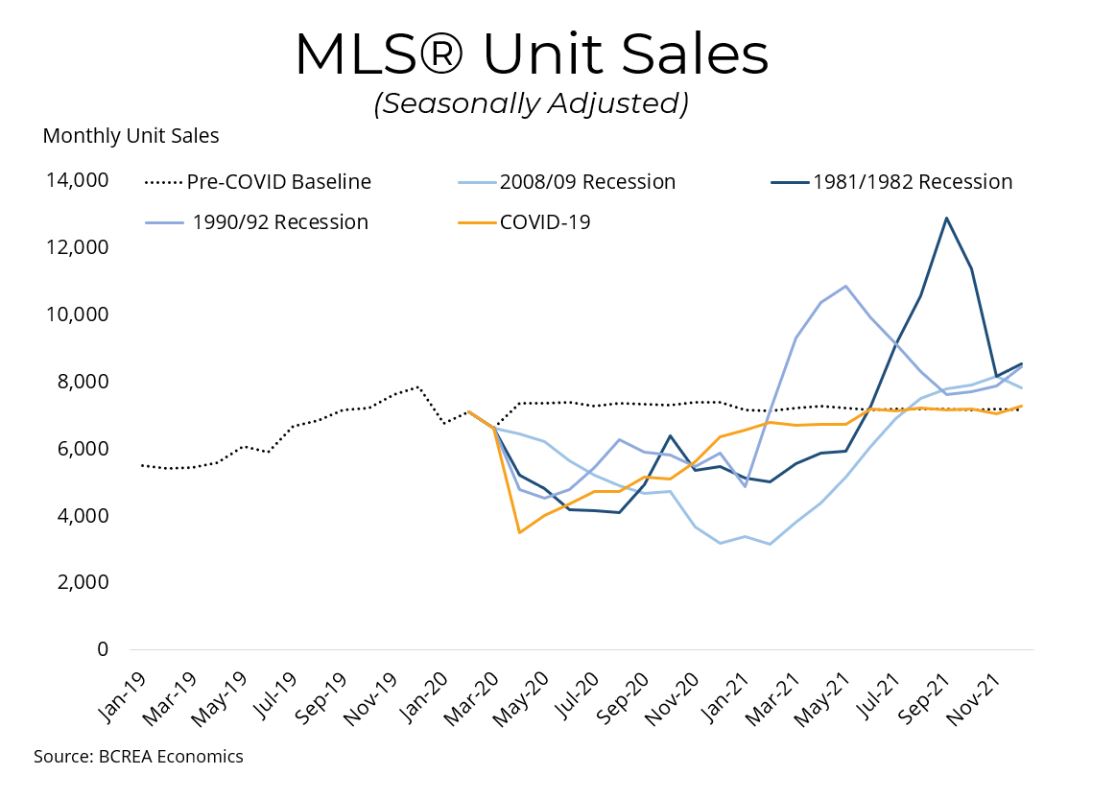
For more information, please contact:
Brendon Ogmundson
Chief Economist
Direct: 604.742.2796
Mobile: 604.505.6793
[email protected]
Kellie Fong
Economist
Direct: 778.357.0831
Mobile: 604-366-6511
[email protected]
To subscribe to receive BCREA publications, or to update your email address or current subscriptions, click here.
Issues for Developers, Easements and Subdivision Plans #11
By Gerry Neely
B.A. LL.B.
You own seventeen acres of vacant land in West Vancouver for which you have obtained approval of a plan of subdivision which requires the dedication of a road along the northern boundary of your property. Your problem is an easement crossing the area of the proposed road, in favour of the owner of adjoining property who had constructed a swimming pool upon it at a time when there was no sanitary sewer into which surplus pool water could be drained. The easement was given to allow drainage into a small creek. Since that time, the municipality has constructed a sanitary sewer into which the swimming pool owner had connected all of his domestic sanitary services, with the exception of the drainage for the pool.
If you as the developer are forced to relocate the road because of the easement, the cost of relocation and delay will be substantial. You therefore propose an extension of the easement under the proposed road to connect it to a new sanitary sewer. The difficulty with this proposal is that since the proposed road will become vested in the Crown, no registered charge such as an easement is permitted to encumber it. You also offer at your expense, to connect the swimming pool to the sanitary sewer.
The swimming pool owner objects to all of this, arguing that at the time the easement was granted, he felt that it would increase his privacy by preventing construction of a road close to his property, and that it might influence the density of the property behind his. He argued that the use and enjoyment of his property would be seriously affected and the market value of his property would be diminished, if a road were constructed.
With interest costs mounting daily, you instruct your solicitor to apply under Section 31 of the Property Law Act, R.S.B.C. 1979, Chapter 340, for the cancellation of the easement. This section became law in 1978 and it allows a person interested in land to apply to the Supreme Court for an Order to modify or cancel an "easement, land use contract, statutory right-of-way, a restrictive or other covenant burdening the land or the owner, a right to take the produce of or part of the soil, or an instrument by which minerals or timber or minerals and timber, being part of the land, are granted, transferred, reserved or excepted."
The Court must first satisfy itself that the application is not premature in the circumstances, and then it must look at the criteria contained in five separate subsections to determine whether the easement should be modified or cancelled. In this case, the Court looked at two subsections to decide whether the "reasonable use of the land will be impeded, without practical benefit to others, if the registered charge or interest is not modified or cancelled". The second subsection requires the Court to satisfy itself that the "modification or cancellation will not injure the person entitled to the benefit of the registered charge or interest."
The Court balanced the rights of the two parties, the undoubted large disruption and expense to the developer were it required to relocate the road, versus the right of the swimming pool owner to have it drained. The Court held that the use of the land as a road was a reasonable use and having regard to the purposes of the easement, ordered that it should be cancelled. It further ordered the developer to provide proper drainage of the swimming pool into the sanitary sewer, by the use of first-class construction and at a minimum of inconvenience to the swimming pool owner.1
In another case, an application was made to modify a land use contract to allow a shopping centre in Penticton to commence operations four months earlier than the date provided in the land use contract. This application had the support of the City of Penticton, but it was opposed by groups affected by the earlier opening, including the Downtown Business Association. While it was admitted that there were benefits to both the community and the City, was the modification such that it "will not injure the person entitled to the benefit." Clearly, there would be an injury to downtown merchants and the Court dismissed the application.2
| 1. | Quadrant Development Limited v. Madink, (1981) 23 B.C.L.R. 214. | |
| 2. | Peachtree Mall Ltd. v. Penticton,(1979) 18 B.C.L.R. 18. |
To subscribe to receive BCREA publications such as this one, or to update your email address or current subscriptions, click here.
It’s Time to Say Goodbye: Ending an Agency Agreement Before It Expires
Relationships change – whether it's between friends, family or a REALTOR® and a client. Sometimes, relationships come to a natural conclusion, like when a REALTOR® helps a client buy a home, meaning that terms of the Exclusive Buyer's Agency Agreement have been met.

The British Columbia Real Estate Association (BCREA) provides REALTORS® and their clients with a number of agency agreements to set out the terms of their relationship:
- Exclusive Buyer's Agency Agreement
- Multiple Listing Agreement
- Exclusive Multiple Listing Agreement
- Exclusive Authority to Lease
- Tenant Agency Exclusive Contract
While these agency agreements define everyone's responsibilities, sometimes things happen that mean one or both parties is unable – or unwilling – to continue the relationship.
Things change
An agency agreement may come to an early end if the brokerage that the REALTOR® works for runs into problems, like its license being suspended or cancelled, or if it's facing bankruptcy, insolvency or receivership. A REALTOR® may also have to end a relationship with a client before their agency agreement expires if continuing to act for that client would amount to dual agency that is not permitted under the Real Estate Services Act Rules.
In these cases, the agency agreement automatically ends and the obligations of the brokerage and the REALTOR® and the buyer, seller, landlord or tenant also end in accordance with the terms and conditions of the agency agreement.
Relationship status: it's complicated
In some cases, a REALTOR® or client might want to end the agency agreement before it expires for other reasons. If this happens, then a new agreement needs to be entered into between them to end their original agency agreement. That can be more complicated than it sounds in the case of a disagreement. If both parties can't agree to end the relationship, then the rights and obligations laid out in their original agency agreement continue until that agreement expires.
To avoid these types of situations, before entering into an agency agreement, a REALTOR® and client should discuss how they want to handle specific circumstances that may come up and may lead to the end of their agency relationship. These terms can be negotiated and included in the agency agreement before it's signed. But be careful – making changes to such an agreement comes with risks. Be sure to get legal advice before agreeing to or adding new terms to any agency agreement.
To subscribe to receive BCREA publications such as this one, or to update your email address or current subscriptions, click here.
It’s Finally Here: The Short-Term Rental Accommodations Act #572
The name of the game
It’s often said that the only constant in life is change, and change certainly appears to be the name of the game. Described as a real “game-changer”, the Short-Term Rental Accommodations Act (“STRAA”) aims to return short-term rental units to the long-term rental market. It comes as part of the Homes for People Action Plan to address low vacancies for long-term rentals, as well as other housing challenges. Beginning May 1, 2024, the STRAA brought the following important changes into effect:
- short-term rentals of less than 90 days will be limited to a host’s principal residence1 plus one secondary suite2 or accessory dwelling3 in designated municipalities with a population of over 10,000 as well as some smaller adjacent communities (with some exemptions) (the “Principal Residence Requirement”); and
- protections for legal non-conforming use will no longer apply to short-term rentals where updated local bylaws prohibit this type of use.
For a comprehensive overview of how the STRAA changes the way short-term rentals operate in British Columbia, REALTORS® should review the British Columbia Financial Services Authority’s Advisory regarding the STRAA and Legally Speaking #571.
STRAA and implications for REALTORS®
REALTORS® should be aware that the STRAA (and the Principal Residence Requirement in particular) may restrict the permitted uses for a property in which they are involved with. This can have important implications for disclosure obligations and the manner in which a property may be marketed. As such, REALTORS® should ascertain whether the Principal Residence Requirement applies to the municipalities/communities where they practice and be aware of areas exempt from this requirement.4 Similarly, REALTORS® should also understand that the Principal Residence Requirement does not apply to hotels, motels, certain strata-titled hotels, timeshare properties, certain fractional ownership properties, and strata guest suites.5
Duties on REALTORS® to know basic land use bylaws (Davis v. Lasuta, 2023 BCSC 1060)
As articulated by Mr. Gerry Neely in Legally Speaking #187, a REALTOR® is expected to be familiar with the basic requirements of municipal land use bylaws.6 Concurrently, REALTORS® should be aware of the importance of Rule 30(d) of the Real Estate Services Rules,7 which requires them to advise their clients to obtain independent professional advice on matters that are outside of their expertise. These two obligations need to be balanced against each other.
The importance of recommending independent advice was aptly demonstrated in the case of Davis v. Lasuta. In Davis, the buyers purchased property located on the Agricultural Land Reserve (“ALR”) for the purpose of operating a campground with permanent tenants. Following completion, the buyers alleged that the licensees, who acted as limited dual agents, failed to disclose that the regulations under the Agricultural Land Commission Act (“ALCA”) only permitted a seasonal/temporary campground.
The Court found that the buyers were given a copy of the ALCA Regulations and the applicable zoning bylaw and were also told by the licensees to seek professional advice, which they chose not to do. The Court held that it was the buyers’ responsibility to conduct their own investigations, and they failed to seek the necessary advice. Moreover, the Court found that the licensees’ obligations in this case only extended to disclosing the information that they were given, advising of the zoning bylaws that were in place, and recommending that the buyers seek appropriate professional advice.8 In the end, the Court stated that the buyers asserted an “unreasonable reliance” on the licensees for legal advice on the interpretation and implications of the zoning bylaws.
Potential pitfalls with the STRAA
The Davis case serves as an important reminder for REALTORS® to exercise caution when they are making representations or giving advice about a property’s permitted uses. In light of the STRAA, REALTORS® should bear the following tips in mind when dealing with short-term rentals:
- Take time to learn about the STRAA and its effect. Educate yourself on the applicability of the Principal Residence Requirement within the municipalities/communities where you practice, including the potential situations where it may not apply.
- Stay current and stay tuned. Municipalities with a rental vacancy rate of 3% or more for each of the two previous years have an annual opportunity to opt out of the Principal Residence Requirement. Some communities, including Dawson Creek, West Kelowna, and Fort St. John, have opted out of the Principal Residence Requirement for 2024. Similarly, some initially exempt communities including Tofino, Osoyoos, and Pemberton have opted in to the Principal Residence Requirement, but the Principal Residence Requirement will not take effect until November 1, 2024 for these communities, subject to government approvals9. Accordingly, REALTORS® should remain apprised of any developments regarding the applicability of the Principal Residence Requirement in the areas that they practice.
- Be mindful that the STRAA imposes a “minimum standard” for short-term rentals. That is, local bylaws may impose additional restrictions/criteria over and above the STRAA. Hence, it is still important for REALTORS® to remain apprised of local land use bylaws. According to the BC Ministry of Housing, provisions in local bylaws that are inconsistent with the STRAA would no longer be in effect.10 If you are unsure about the effect of the interaction between the STRAA and local bylaws, advise your clients to seek independent professional advice.
- Do not make assumptions. Operators of short-term rentals will lose the ability to rely upon legal non-conforming use protections and will need to comply with both local and provincial regulations, including the Principal Residence Requirement, where applicable. Hence, REALTORS® should not expect that previous lawful non-conforming usage will continue after May 1st, 2024. 11
- Know your limits and advise your clients to seek independent legal advice regarding municipal land use bylaws and other relevant provincial legislation. In line with Rule 30(d) of the Real Estate Services Rules, REALTORS® should advise their clients to seek professional advice on matters outside of their expertise. REALTORS® should also consider whether the contract of purchase and sale contains appropriate subject conditions that allow their clients to conduct necessary investigations.
- Be mindful of disclosure obligations. Rule 59 of the Real Estate Services Rules states that a Material Latent Defect includes a latent defect that renders the real estate“…unfit for the purpose for which a party is acquiring it…”. Should such a defect become known to a REALTOR®, it must be disclosed to a potential purchaser. While the Court in Davis rejected the argument that zoning bylaws and associated limitations were Material Latent Defects, REALTORS® should nevertheless be mindful of their duty to disclose known Material Latent Defects. They also need to use their judgment in determining whether additional disclosure is necessary under specific circumstances.
- Be aware of potential misrepresentation. With a more complex regulatory environment for short-term rentals, REALTORS® should recognize that they may be at greater risk of inadvertent misrepresentations. Exercise extra caution when discussing a property’s permitted uses, including its suitability for short-term rentals. Do not make representations that you do not know to be true.
A strata’s perspective: short-term rentals and municipal zoning bylaws
In 2022, amendments were made to the Strata Property Act, removing a strata corporation’s ability to restrict rentals (“Bill 44”). Section 141 of the Strata Property Act12 now provides for a blanket prohibition on rental restrictions:
“No restriction of rentals by strata corporation
141 The strata corporation must not screen tenants, establish screening criteria, require the approval of tenants, require the insertion of terms in tenancy agreements or otherwise restrict the rental of a strata lot.”
Strata bylaws prohibiting or limiting what is known as short-term accommodations are not impacted by Bill 44, as short-term accommodations are not technically considered “rentals” but are instead licenses to occupy, which do not confer an exclusive right of possession (e.g. similar to how hotels operate). Notably, the terms “rent” or “rental” are not defined within the Strata Property Act, and the length of stay is not necessarily determinative of whether a strata lot is being used as “short-term accommodation” or as a “rental”. In Semmler v. The Owners, the Court held that the words “rent,” “rental,” “tenants,” and “tenancies” in the Strata Property Act do not apply to licenses to occupy. Rather, the Court stated that the word “rental” in the Strata Property Act must be read as describing an intention to create a tenancy, and a licensee is an occupant but not a tenant.
The British Columbia Civil Resolution Tribunal (the “BCCRT”) has held that a strata corporation has a duty to enforce its bylaws, including a bylaw prohibiting illegal uses.13 In this regard, a breach of municipal bylaws regarding zoning or licensing have amounted to an illegal use of a strata lot. As such, and in the wake of the STRAA, it seems likely that a strata corporation would be able to enforce contraventions of municipal bylaws and/or provincial legislation (such as the STRAA) by way of its illegal use bylaw and/or other applicable strata bylaws.14 Due to the nuanced and often complex nature of enforcing strata bylaws, strata managers are encouraged to advise their clients to seek independent legal advice from a strata lawyer before proceeding.
Conclusion
While the STRAA creates a more complex environment in which REALTORS® conduct business, THEY will inevitably need to adapt to the changes imposed by the STRAA. Being mindful of the potential implications that the STRAA can have will help you avoid costly legal or disciplinary battles. After all, the name of the game is and seemingly will be—change.
| 1. | Principal residence means the residence in which an individual resides for a longer period of time in a calendar year than any other place. | |
| 2. | Secondary suite means an accessory dwelling unit that is located in and forms part of a primary dwelling unit, such as a basement suite. | |
| 3. | Accessory dwelling unit means a building, or part of a building, that (a) is a self-contained residential accommodation unit, (b) has cooking, sleeping and bathroom facilities, and (c) is secondary to a primary dwelling unit located on the same property. | |
| 4. | See: https://www2.gov.bc.ca/gov/content/housing-tenancy/short-term-rentals/principal-residence-requirement#PRapplies | |
| 5. | For additional information, see sections 3 and 4 of the Short-Term Rental Accommodations Regulation: https://www.bclaws.gov.bc.ca/civix/document/id/complete/statreg/268_2023/ | |
| 6. | Betker v. Williams, 1991 CanLII 1160 (BCCA) | |
| 7. | Real Estate Services Rules, B.C. Reg. 209/2021 | |
| 8. | Para. 122 | |
| 9. | See: https://news.gov.bc.ca/releases/2024HOUS0020-000590 | |
| 10. | Section 10(1) of the Community Charter, [SBC 2003] c.26 states that “[a] provision of a municipal bylaw has no effect if it is inconsistent with a Provincial enactment”. Similarly, section 16(1) of the STRAA provides that “[a] provision of a short-term rental bylaw made under the Vancouver Charter has no effect if it is inconsistent with the principal residence requirement under this Act”. | |
| 11. | Section 36 of the STRAA states that non-conforming use exceptions in the Local Government Act and the Vancouver Charter will no longer apply to short-term rentals. See section 36 of the STRAA for more detailed information. | |
| 12. | Strata Property Act, [SBC 1998] c. 43 | |
| 13. | See section 26 of the Strata Property Act and Ikbal v. Section 1 of the Owners, Strata Plan LMS 1866, 2021 BCCRT 5. | |
| 14. | See, for example, Ikbal v. Section 1 of the Owners, Strata Plan LMS 1866, 2021 BCCRT 5, Hall v. The Owners, Strata Plan EPS2983, 2019 BCCRT 806, Bradley v. The Owners, Strata Plan KAS 2503, 2021 BCCRT 91, The Owners, Strata Plan LMS 4498 v. Mac Phee-Manning et al., 2019 BCCRT 463, and The Owners, Strata Plan KAS3112 v. Lentz, 2019 BCCRT 1152. |
It’s Time for Canada’s Leaders to Look at Housing Policy with a Climate Change Lens
For Immediate Release
Vancouver, BC – September 15, 2021. As Canadians get ready to elect a new federal government next week, two issues are top of mind according to several public opinion polls: housing affordability and climate change. And it’s no surprise these two areas are prominent; housing and the changing climate are inextricably linked to the quality of life of Canadians. As a result, the BC Real Estate Association (BCREA) calls on our future elected officials to begin to seriously look at housing policy with a climate change lens.
“This summer British Columbia experienced the worst heat wave in our recorded history and what could end up being the most devastating wildfire season ever,” says BCREA Chief Executive Officer Darlene Hyde. “If there were any doubts about the very real impacts of climate change, they should be erased. Canadians want to see real action on climate change, and they want to see it now.”
Historically, housing affordability and climate change may have been seen by the public and government as separate issues, with different policy levers needed to address them. It would be easy for Canada’s leaders – our new elected officials of all political stripes – to continue this way of thinking, but it’s time the two issues are looked at together.
The latter half of the COVID-19 pandemic has seen housing prices spike to unprecedented levels, fuelled by low interest rates, pent up demand, the desire by people to re-make their living spaces and by extremely low levels of available supply. Many Canadians are very concerned that their dream of home ownership may never be fulfilled if current market conditions continue.
Alongside market conditions, the current landscape of housing is not helping the climate crisis. Single-family dwellings generally consume more energy and emit more greenhouse gases per square foot of livable area than townhouses or apartment units built under the same building code. It’s also generally true that most single-family homes are built in areas that are further from employment centres and are not within easy walking distance from commonly used retail and service outlets, recreation or entertainment amenities. The result is an increased reliance on cars for transportation, again resulting in more greenhouse gases.
“It would be irresponsible to look at solutions to Canada’s housing supply crisis without looking at how these fixes affect the climate,” Hyde adds. “In fact, by looking at the two together, we are more likely to explore creative solutions that will make the long-lasting change that is needed in both areas.”
BCREA recommends the creation of more “missing middle housing” through gentle densification. By transforming our close-in single family zoned neighbourhoods, we can provide new, energy-efficient housing, right-sized for young families (many of whom will be first-time homebuyers) and empty nesters who would like housing options within their historic home neighbourhoods. By making better use of an extremely highly priced asset (residentially zoned land within proximity to existing retail/service outlets, community amenities and transit) and replacing the single-family home model with three, four or five units on the same plot of land, we can address many of our most pressing issues in one fell swoop.
To accomplish this, however, we need leadership from our elected officials from all levels, starting with our new federal government. If housing policy is developed with the changing climate in mind, we will not only be creating better and more housing options for those who need it, but we will be doing so sustainably.
For the PDF news release, click here.
January 2026 Updated PDP Framework Resources
This page contains information about the January 2026 updated Professional Development Program (PDP) framework, including resources to help managing brokers and REALTORS® prepare for the coming changes.
Last Updated: October 6, 2025. BCREA will update this page as new information and resources become available.
Background
The evolved PDP Framework will take effect on Thursday, January 1, 2026.
The updated framework was developed through extensive consultation with boards and associations, REALTORS®, managing brokers, and education experts. It represents a more meaningful, updated approach to REALTOR® learning and professional growth.
Key highlights include:
- an increase in three required Professional Development hours from 18 to 21;
- greater focus on relevant, practical learning;
- alignment with today’s real estate practices and public expectations;
- stronger support for REALTOR® professionalism, credibility, and long-term success.
Resources
- Frequently Asked Questions PDF
- Updated Professional Development Program Framework Coming in January 2026 Blog Post
- Updated Professional Development Program Framework: What Changes Are Coming? Blog Post
If you have questions regarding the updated PDP Framework, please contact [email protected].
Check back soon as this page will be updated when new information and resources become available.
Join BCREA’s Managing Broker Advisory Committee
BCREA is seeking managing brokers to serve on the Managing Broker Advisory Committee. As a committee member, you will be involved in meaningful discussions, help identify opportunities, and provide recommendations about how BCREA can best support managing brokers and the profession.
The committee is seeking diverse representation and perspectives, including managing brokers from different-sized brokerages, broker owners, experienced and early career brokers, brokers with experience in commercial, Government Relations, and / or Professional Development, and more.
Serving on the Managing Broker Advisory Committee is a fantastic opportunity to meet like-minded people, share and gain knowledge, and ensure your valuable insights and expertise remain at the heart of BCREA’s commitment to providing more support and guidance to BC managing brokers as part of our strategic plan.
Applications are now closed.
Committee Member Role
The committee members provide a wealth of relevant knowledge, expertise, and perspectives through their practice and consultation with stakeholders. As a committee member, your role will include:
- identifying issues and opportunities that:
- may have an impact on the profession, specifically those that fall under BCREA’s services;
- enhance REALTOR® professionalism; and
- support managing brokers.
- discussing, exchanging information, and sharing perspectives about the real estate sector, including any key developments;
- providing insights and practical expertise on topics as requested by BCREA; and
- making recommendations to help BCREA move the profession forward.
Commitment
Please refer to the Managing Broker Advisory Committee – Terms of Reference for the complete description of responsibilities and expectations.
BCREA is looking for candidates based on a skills matrix, ensuring a well-rounded committee with a variety of perspectives. The committee is dedicated to promoting Diversity, Equity, and Inclusion, and actively seeks to reflect the diversity of the communities it serves.
Members of the BCREA Managing Broker Advisory Committee are expected to attend a minimum of three meetings per year, which will be conducted via video conferencing. Committee members are generally appointed for a one-year term.
Application Details and How to Apply
- there are three openings for committee members for the 2026 term from January to December;
- applications are open from Friday, September 26 to Friday, October 31, 2025;
- to learn more about BCREA’s Managing Broker Advisory Committee, please view the Terms of Reference here;
- new member selection is made in November 2025, with the new term starting in January 2026; and
- to apply for a committee member opening, please fill out this application form by Friday, October 31, 2025 - Applications are now closed.
BCREA’s Managing Broker Advisory Committee thanks all applicants; however, only those selected as potential members will be contacted.
Applications are now closed.
If you have any questions regarding the opportunity to serve on the Managing Broker Advisory Committee, please contact the BCREA Committee Coordinator at [email protected].
Join BCREA’s Managing Broker Advisory Committee: Applications Now Open
BCREA is seeking managing or associate brokers to serve on the Managing Broker Advisory Committee. As a Committee member, you will be involved in meaningful discussions, identifying opportunities and providing recommendations about how BCREA, through its core services can best support managing brokers and the profession to ensure BCREA is driving value.
The Committee is seeking diverse representation and perspectives including managing brokers or associate brokers from different sized brokerages, broker owners, experienced and early career brokers, brokers with experience in commercial, government relations and/or professional development, and more.
Serving on the Managing Broker Advisory Committee is a fantastic opportunity to meet like-minded people, share and gain knowledge, and a chance to continue to give back to the profession in a meaningful way.
(Applications are currently closed.)
Committee Member Role:
The Committee member will provide a wealth of relevant knowledge, expertise, and perspectives through their practice and consultation with stakeholders. An overview of what the Committee member will do in the role includes:
- identify issues and opportunities that:
- may have an impact on the profession,
- falls into BCREA’s core services,
- enhance REALTOR® professionalism,
- and support managing brokers,
- discuss, exchange information and share perspectives about the real estate markets and any key developments;
- provide insights and practical expertise on topics as requested by BCREA;
- and make recommendations to BCREA to move the profession forward.
Commitment
Please refer to the Managing Brokers Advisory Committee Terms of Reference for the complete description of responsibilities and expectations. (BCREA Access login required)
BCREA will be looking for candidates that reflect the diversity of our members and welcome applicants of all backgrounds, including visible and non-visible minorities and persons with disabilities.
Members of the BCREA Managing Broker Advisory Committee are expected to attend a minimum three meetings per year, that will be conducted either in person or via video conferencing. Committee members are appointed for a one-year term.
(Applications are currently closed.)
If you have any questions regarding the opportunity to serve on the Managing Broker Advisory Committee, please contact the Chairs of the BCREA Managing Broker Committee at [email protected].
July 2025 Standard Forms Launch Resources
This page contains information about the July 2025 Standard Forms Launch, including resources to help REALTORS® prepare for use of the forms and links to other relevant resources.
Last Updated: November 17, 2025. BCREA will update this page as new information and resources become available.
Background
With the help of the Standard Forms Committee, BCREA develops and maintains Standard Forms and clauses to:
- support REALTORS® in meeting regulatory requirements;
- mitigate risk to REALTORS®, reduce liability, and enhance their professional practice;
- ensure high provincial standards and consistency in practice;
- enhance professionalism; and
- protect consumers.
To reduce the number of changes for BC REALTORS®, the release of new and revised forms and clauses are consolidated into one major release per year unless otherwise required. This form launch is in response to such an exception.
Following the BC Court of Appeal’s decision in Sewell v. Abadian, BCREA is issuing a targeted mid-year form launch to ensure REALTORS® have access to forms that reflect current legal interpretations, support their professional obligations, and help protect the integrity of the transaction.
In Sewell v. Abadian, the Court found that the sellers were not, in fact, withholding disclosure by striking out sections of the Property Disclosure Statement (PDS), adding comments about the property's tenancy, and signing the pre-drafted statement acknowledging their obligation to update the buyer if any information changed. Rather, the Court concluded that these actions effectively conveyed that the sellers did not know the answers to the struck-out questions, even though the sellers’ actual intent was to avoid making any representations on those points. The Court also noted that incorporating a struck-out PDS into the Contract of Purchase and Sale can create potential legal liability for the seller.
In response, BCREA worked closely with legal counsel, the Real Estate Errors and Omissions Insurance Corporation, and the Standard Forms Committee to evaluate the decision’s implications.
Although the PDS remains an optional form, disclosure is generally the preferred approach to support transparency, reduce risk, and facilitate informed decision-making in a real estate transaction. Buyers may request that sellers complete the PDS, and in many cases, doing so can assist with financing requirements and help reduce the likelihood of post-closing disputes. BCREA recognizes the importance of the Property Disclosure Statement in helping buyers understand key aspects of the property. However, BCREA also acknowledges that while it is generally in the buyer’s interest to receive this information, there may be circumstances in which it is not in the seller’s best interest to complete the form. In these cases, a discussion with the seller’s REALTOR® will be essential to explore available options.
BCREA released the following updates on Wednesday, July 9, 2025:
- Form Change - Property Disclosure Statements
- New Form - Property No-Disclosure Statement
- Renamed Form & Form Changes - Disclosure of Material Latent Defects
These updates reflect current legal expectations and are intended to reduce risk and support REALTORS® in delivering professional, informed service.
Standard Forms Launch Package
The July 2025 Standard Forms Launch Package for the Wednesday, July 9, 2025, forms launch includes watermarked versions of the revised forms highlighting the changes, guides, and summaries of the revisions.
Toolkits
- Updated: Addendum to the Property Disclosure Statement
- Updated: Property Disclosure Statement First Nations Leasehold Properties
- Updated: Property Disclosure Statement Land Only
- Updated: Property Disclosure Statement Residential
- Updated: Property Disclosure Statement Rural Premises - Addendum, Land, and Building
- Updated: Property Disclosure Statement Rural Premises - Land and Building
- Updated: Property Disclosure Statement Strata Title Properties (Non-Bare Land Stratas)
- Updated: Property Disclosure Statement Strata Title Properties - Bare Land Strata
- New: Property No-Disclosure Statement
- Revised: REALTORS®’ Disclosure of Material Latent Defects (formally, Seller's Disclosure of Material Latent Defects)
Resources
To support REALTORS® with understanding the changes in this form launch, BCREA has created resources that summarize the form revisions to help them integrate the revised Standard Forms into their practice. These resources are currently being updated and will be made available as soon as possible.
BCREA strongly recommends that BC REALTORS® always use the most current BCREA Standard Forms and clauses available on CREA WEBForms®. For any questions regarding Standard Forms, please email [email protected]. To stay updated with the latest Standard Forms information and resources, visit our Standard Forms Resources page.
- Property Disclosure Statement Updates and Changes video
- Standard Form Essentials: Property Disclosure Statement Residential course
- July 2025 Standard Forms Launch FAQ
- "Updates to Property Disclosure Statement Forms" article
- Brokerage Meeting in a Box: Property Disclosure Statement Changes
- Property Disclosure Statement Updates and Changes Community of Practice webinar
- "Reducing Risk in the Interim: Disclosure Practices That Protect" article
- Standard Forms Index
- CREA WEBForms®
Check back soon, as this page will be updated when new information and resources become available.
Keeping Clients Out of Hot Water Over Groundwater Licencing
Droughts, water restrictions and wildfires have all become part of a typical BC summer, just like Okanagan cherries or a BC Day barbecue. Despite all of BC's lakes and rivers, the truth is that water scarcity is a serious concern. That's why the provincial government introduced the Water Sustainability Act in 2016, which requires anyone diverting and using groundwater for non-domestic purposes to apply for a groundwater license by March 1, 2022.

Groundwater licensing & REALTORS®
If you have a client who uses groundwater for non-domestic purposes but doesn't apply for a water license by March 1, 2022, they risk losing their right to access groundwater on their property. As a REALTOR®, you can add value to your clients by making sure they understand this requirement and how to apply for their license.
How groundwater licensing works
The groundwater licensing requirement came into effect on February 29, 2016. But that doesn't mean it only applies to anyone who began using groundwater after this date–it applies to everyone. If you were a non-domestic groundwater user on or before February 29, 2016, you will submit an existing use licence application. If you were a non-domestic groundwater user on or after March 1, 2016, you will submit a new use application.
The deadline to apply is March 1, 2022 and the government is waiving the one-time application fee to people who submit their application on or before this date.
What about domestic users?
If you use groundwater for domestic use in a private home, you do not require a licence. However, as a REALTOR®, you should encourage your clients to register their well, if they have one. By registering their well, they create a record of their water use, which helps ensure it's considered by the decision-makers dealing with other licence applications.
How to apply for a licence
For information on how to apply or to submit an application for groundwater licensing or register a well, please visit the Province's Secure Your Water Rights Today portal. FrontCounter BC has also recently published a useful webinar on how to submit an application for an existing use groundwater licence.
To subscribe to receive BCREA publications such as this one, or to update your email address or current subscriptions, click here.
Key Components of a Succession Plan
A well-crafted succession plan establishes how the brokerage will remain operational, compliant, and client-focused in the event of the managing broker’s departure – whether planned or unexpected. It identifies the individuals responsible for assuming leadership, the processes for transferring authority, and the measures required to maintain business continuity.
Every managing broker should consider developing two complementary succession plans:
- A long-term exit strategy that supports retirement or a planned transition of leadership.
- A contingency plan that addresses sudden or unforeseen circumstances, such as illness, incapacity, or death.
Both types of plans should be documented, reviewed regularly, and integrated into the brokerage’s operational framework so they can be activated quickly when needed.
Long-Term Exit Strategies
A long-term exit strategy is a succession plan developed to prepare for a managing broker’s eventual retirement or voluntary departure from the brokerage. It is created well in advance of any anticipated transition to ensure the brokerage continues to operate smoothly, compliantly, and with minimal disruption once leadership changes.
This type of plan begins by identifying who will assume responsibility for the brokerage, whether through internal promotion, external recruitment, or the sale of the brokerage. The designated successor must be properly licensed and prepared to assume the complete regulatory, operational, and fiduciary duties of a managing broker under the Real Estate Services Act (RESA). In some cases, this may include a period of overlap or mentorship to ensure a gradual and effective handover.
A comprehensive long-term exit strategy should also outline the specific steps required to facilitate a seamless transition, including:
- timelines for notifying the BC Financial Services Authority (BCFSA) and other relevant parties of the intended transition;
- procedures for transferring control of trust accounts, client files, and financial records;
- internal communication protocols for informing licensees and staff of the change; and
- external communication plans for notifying clients and maintaining their confidence during the transition.
A well-articulated exit strategy not only ensures operational stability but also protects the brokerage’s reputation and client relationships. By planning ahead, managing brokers can leave behind a legacy of professionalism and preparedness, demonstrating foresight and commitment to the continued success of their brokerage.
Contingency Plans for Immediate Departure
In contrast to long-term exit strategies, a contingency plan prepares the brokerage for immediate and unforeseen departures of the managing broker, such as sudden incapacitation, serious illness, or death. These events can occur without warning and, without preparation, can severely disrupt brokerage operations and client service.
A contingency plan functions as a safeguard to maintain operational stability during these emergencies. It achieves this by pre-designating temporary successors – individuals who are licensed and capable of assuming the managing broker role on short notice – and by establishing clear, documented emergency procedures that can be activated immediately in the event of such occurrence.
Just as with long-term exit strategies, contingency plans must include step-by-step procedures for:
- notifying BCFSA and meeting any immediate regulatory obligations;
- communicating the change in leadership to licensees, staff, and clients;
- securing temporary control of trust accounts, client records, and communication systems; and
- activating any interim operational measures, such as appointing an alternate managing broker or engaging a locum through BCREA’s Locum Tenens Brokerage Resources.
Under RESA, the Superintendent may issue a temporary 12-month licence to a qualified individual from the managing broker’s estate or committee; however, this licence is strictly limited to winding up or transferring the business, and not continuing day-to-day operations. While this provision offers limited short-term relief, it underscores the need for a comprehensive contingency plan that extends well beyond the minimum regulatory requirements.
A well-developed contingency plan ensures that even under the most unexpected circumstances, your brokerage can continue to meet its obligations to clients, protect trust funds, and maintain compliance until permanent leadership is re-established.
Key Components
Whether developed as a long-term exit strategy or a short-term contingency plan, every succession plan should include the following key components to ensure a smooth, organized, and legally compliant transition of brokerage leadership:
Successors
Every succession plan should identify the key licensed successor or successors who will assume responsibility for the brokerage. This may involve naming a specific individual or establishing a hierarchy of licensed managing brokers who can assume temporary or permanent control. It is essential that all named successors are properly licensed as managing brokers under RESA, fully understand the obligations of the role, and are both willing and prepared to assume those responsibilities when required.
Filings
Each succession plan should include clear, detailed instructions regarding mandatory filings, particularly those required by BCFSA and the Superintendent under RESA. These filings typically include annual financial statements, accountants’ reports, and brokerage activity reports, all of which are essential for maintaining regulatory compliance.
The plan should also indicate the status of each filing, such as whether it is up to date, pending submission, or under review, and identify who is responsible for preparing and submitting them during a transition. This level of detail ensures that successors can meet statutory deadlines, avoid penalties, and maintain transparency with regulators, clients, and investors following the managing broker’s departure.
Records
Management of records is a vital component of all succession plans. The plan should include detailed instructions on where current client files, including contracts, notices, disclosures, and correspondence, are stored. It should also specify where escrow or trust account information is kept, including banking details, reconciliation reports, and trust ledger records, all of which are subject to strict oversight under RESA.
Bank account signing authorities and account access procedures should be clearly outlined to avoid delays in financial operations. In addition to transaction files, the plan should also account for operational records such as insurance policies, corporate filings, and association memberships, which may affect the brokerage’s ability to maintain coverage and professional standing.
Finally, every succession plan should include a current roster of licensees affiliated with the brokerage, along with their roles, contact information, and licensing status. This enables successors to quickly assess staffing needs, delegate responsibilities, and maintain compliance with supervisory obligations.
Practical Information
Effective succession plans should also include practical operational information necessary to maintain business continuity. This includes clear instructions on how to access digital systems such as computer networks, email, voicemail, and administrative software. Passwords, login credentials, and security protocols should be documented and stored securely so that authorized successors can retrieve them quickly when needed.
Without access to these digital assets, even the most qualified successor may face significant delays in assuming control of brokerage operations, which can result in service disruptions, missed deadlines, and potential regulatory non-compliance.
To support the day-to-day continuity of the business, brokerages should also ensure that key service contracts and related agreements, such as those with landlords, utilities, IT providers, and other essential vendors, are organized and easily accessible. Up-to-date contact information and readily available copies of these agreements, whether digital or physical, help successors act swiftly and maintain uninterrupted operations.
Together, these components form the foundation of an effective succession plan. By documenting critical information, designating qualified successors, and clearly outlining operational procedures, a brokerage can ensure that leadership transitions happen smoothly and without regulatory interruption. With these elements in place, managing brokers can consider the various exit strategies available to them and determine which approach best fits their personal and business goals.
Final Considerations
Succession planning is not a one-time exercise. It is an ongoing process that should evolve alongside your brokerage’s structure, personnel, and regulatory environment. A well-prepared succession plan ensures that if a transition occurs – whether planned or unexpected – your brokerage remains compliant with RESA and continues to operate smoothly.
Managing brokers should regularly review and update their succession plans to ensure accuracy, designate responsible individuals, and confirm that all required documentation, filings, and access information remain current. Sharing the plan with key personnel ensures that everyone understands their role in maintaining stability during a transition.
By holding a current, detailed succession plan, managing brokers protect their licensees, clients, and reputation while fulfilling their legal obligations under RESA.
This resource was developed with subject matter experts for BCREA, member boards and associations, compliance officers, managing brokers, and BC REALTORS® for informational purposes only and should not be relied upon as legal or tax advice.
Readers are encouraged to verify the information’s accuracy and relevance, and should consult qualified professionals before acting.
Killing the Deal: The Dangers of Anticipatory Repudiation #582
Once a Contract of Purchase and Sale (CPS) has been accepted, a party can’t unilaterally alter its terms. If a party insists on changing the deal or otherwise indicates that they are unable or unwilling to fulfill their contractual obligations when due, they risk repudiating (i.e., rejecting) the contract.
REALTORS® should be aware that their actions and / or communications which signal their clients’ refusal to honour the terms of the CPS can form the basis of anticipatory repudiation. This can give the other party an option to immediately terminate the CPS and pursue legal remedies, effectively killing the deal.
Anticipatory Repudiation in Real Estate Transactions
In the context of a residential real estate transaction, anticipatory repudiation can occur when a party clearly indicates, in advance, that they won’t fulfill a term in the CPS which deprives the other party of the contract’s primary benefits. While this concept seems simple, its application can be complex and highly fact dependent. A party can signal their intention not to perform or be bound by the provisions of the CPS in various ways, sometimes even inadvertently, such as demanding changes to key terms.
Examples of Anticipatory Repudiation
Determining whether anticipatory repudiation has occurred will depend on the terms of the CPS and the specific circumstances. A key question is whether a reasonable person would conclude that the defaulting party no longer intends to be bound by the agreement. Some scenarios that may give rise to anticipatory repudiation include:
- a buyer or seller indicating that they won’t close the transaction on the completion date;
- a buyer or seller indicating that they are unable or unwilling to comply with a material term in the CPS, such as vacant possession, title, purchase price, or completion date;
- a buyer refusing to pay the required deposit;
- a buyer or seller refusing to complete the transaction unless there are material changes to the terms of the CPS; and
- a buyer or seller repeatedly requesting to extend the completion date.
While these examples are intended to provide some guidance, they are not exhaustive. Clear-cut answers are also rare, if not impossible. Luckily, as a REALTOR®, you don't need to have all the answers to protect yourself and your clients from the dangers of anticipatory repudiation.
Navigating Dangerous Waters: Tips for REALTORS®
As a REALTOR®, you should be mindful of situations where actions or words can be seen as repudiating the CPS. Here are some tips that REALTORS® should keep in mind to avoid putting themselves (and their clients) at risk.
- REALTORS® should promptly advise their clients to seek independent legal advice if they express any concerns about fulfilling their contractual obligations or wish to terminate the CPS. Similarly, a REALTOR® should recommend that their clients consult a lawyer if they suspect that anticipatory repudiation has occurred or may occur and to refrain from dispensing legal advice (i.e., declaring a contract dead or alive).
- REALTORS® owe their clients a duty of confidentiality. Do not disclose confidential information, such as your clients' unwillingness or inability to meet their contractual obligations, without their explicit instructions and without recommending that they seek independent legal advice first. Sharing such details could be seen as an anticipatory repudiation and may inadvertently “kill the deal.”
- Think carefully before attempting to re-negotiate the CPS on behalf of a client. If your clients require significant / substantial amendments, you should recommend independent legal advice before proceeding. By promptly recommending legal advice, you ensure your clients receive the professional support they need while shifting potential liability to an appropriate legal expert. Also, see Amy Peck’s Legally Speaking #565 about amending real estate contracts.
- If you are re-negotiating terms on behalf of your clients, beware that overly bullish or demanding language can amount to contract repudiation. In Zoleta v. Singh and RE/MAX Twin City Realty1, the Superior Court of Ontario held that the purchaser’s lawyer’s demand, rather than a request for a price reduction, amounted to a repudiation of the contract. Specifically, by requiring a reduction in the purchase price, the Court found that the purchaser had signalled to the vendor that he would not complete the purchase unless the vendors agreed to a price change.
A Quick Word of Caution: Back-Up Offers
A back-up offer is typically contingent on a seller no longer being obligated under a previously accepted CPS. In this regard, anticipatory repudiation by the first buyer may potentially release the seller from their obligations and activate the back-up offer. Therefore, any proposed amendments to an original offer, when a back-up offer is in place, should be approached with caution. If a significant change to the original contract is being proposed or demanded, a seller’s agent should advise their clients to seek independent legal advice regarding their obligations before proceeding. This helps ensure that the proposed amendment does not unintentionally bind a seller to two contracts.
Final Reflections
Navigating a deal that takes an unexpected turn can be challenging, and REALTORS® may feel the urge to help renegotiate terms to keep things on track. However, if your clients are unable or unwilling to proceed under the original terms of the CPS, it’s important to encourage them to seek independent legal advice promptly. Be aware that your actions and choice of words can have significant legal consequences, potentially triggering an anticipatory repudiation. This could lead to the termination of the contract and legal claims against both you and your clients. By following the tips outlined above, you can help protect yourself and your clients from potential risks.
| 1. | Zoleta v. Singh and RE/MAX Twin City Realty, 2023 ONSC 5898 (CanLII). |
Know Your Product: House Structures is Now Available Online
Know Your Product: House Structures is a revamped version of the previously popular Know Your Product, in-person course, where REALTORS® will be provided a comprehensive introduction to the fundamentals of residential construction including footings, foundations, floors, decks, walls, openings, stairs, roofs, and chimneys. This course is available as a self-paced online offering, that allows you to complete the course at your own pace, or an instructor-led live offering if you prefer more structured, face-to-face-learning.
However, due to COVID-19, the instructor-led offering will be held virtually over Zoom. To see dates for instructor-led offerings, please see the current course calendar here. BCREA's full list of self-paced online offerings, including this course, are available on the Professional Development Hub here.
(BCREA Access Login Required)
Regardless of the offering you choose, by the end of this course you will have earned 6 PDP hours and will be able to:
- use essential vocabulary for discussing a house’s structure and features;
- recognize potential issues within a house that may have created or may possibly lead, over time, to a defect;
- use the issues discovered to help establish a more accurate comparative market analysis (CMA);
- better assist your seller clients make the appropriate property disclosures; and
- help your buyer clients understand the pros and cons of any house they may wish to buy.
The primary goal of this course is to improve Realtors’ ability to knowledgeably answer their clients’ questions about a single-family home and to know when to refer their clients to the appropriate professional.
Please note that PDP hours may only be administered for one of these two offerings within a licensing cycle.
Know Your Seller #513
Seller's agents must be certain that they are dealing with the person with authority to list and sell the property. Confirming the identity and the authority of your clients may seem simple. However, in the global society today with complex deals, complicated ownerships of property and challenging deals, the pitfalls may be expanding.
Examples of situations that may result in claims or complaints against licensees include:
- a person acting on behalf of the seller does not have a proper power of attorney to execute documents for the absent seller;
- a licensee who has been authorized in writing to sign on behalf of the seller does not execute the contract properly (i.e. signs in the name of the seller rather than in the licensee’s own name, as agent for the seller);
- a licensee fails to do a title search and is not dealing with the seller on title;
- a licensee acts for a company without ensuring that she has proper authority from the corporate directors; or
- a licensee takes instructions from an unauthorized representative of the seller such as a friend, family member or business partner without the knowledge or requisite written authority of the seller.
Predictably, these scenarios can lead to situations where the seller refuses to close and is sued by the buyer for failing to complete. In a rising market, the buyer seeks damages for any difference in value of the property, costs and expenses thrown away, specific performance and/or related damages, interests and legal costs. The licensee may be named as a party to the lawsuit with allegations of negligence for failing to ensure the contract was being signed by the proper party or for misrepresenting that they had the authority of the seller to list the property and to accept an offer of purchase and sale for a property.
In a recent decision1 of the British Columbia Supreme Court, a licensee faced this type of allegation when he was not aware that he was receiving instructions from someone other than the person on title. Although the Court found a binding contract at the end of the day and the claims against the licensee were dismissed, the stresses and expenses of a trial that lasted more than 50 days would have been extensive. The best ways to avoid such a kerfuffle include the following:
- When listing a property, always conduct a full title search. Know who your client is!
- On any listing involving a corporation, be certain to have a company search done and ask for the articles of incorporation and proof of who the officers and directors are with authority to authorize a transaction, perhaps with a Director’s Resolution.
- Where the seller may be absent physically or have health issues and wishes to give a power of attorney to another person, recommend your client get legal advice to ensure the form of power of attorney being used is valid and acceptable for filing with the Land Titles office and that it has not expired and/or been revoked.
- Consider using DocuSign or other software for secure electronic signatures with proper written consents in place for absent parties to a deal, rather than signing for them.
- If asked to sign for a party, be sure that the request is in writing, is genuine, and that the licensee signs for the seller in the licensee's own name, as agent for the seller.
- Never witness a signature that you did not actually witness.
- Don’t be lulled into believing that a family member has authority to make decisions for the person on title. Make sure you are getting instructions from the owner of the property and if it is someone else, that they have been granted the proper authority from the seller to sign on their behalf.
Licensees are expected to draft legally enforceable contracts and the starting point should always be to ensure that you know who owns the property and that you are dealing with the person with proper authority. An ounce of prevention is worth a pound of cure.
Chris Johnston
B.A., LL.B.
Legally Speaking is published monthly. Real estate boards, real estate associations and REALTORS® may reprint this content, provided that credit is given to BCREA by including the following statement: "Copyright British Columbia Real Estate Association. Reprinted with permission." BCREA makes no guarantees as to the accuracy or completeness of this information or the currency of legal information.
To subscribe to receive BCREA publications such as this one, or to update your email address or current subscriptions, click here.
Knowing the Rules May Not Be Enough #529
A recent discipline decision from the Real Estate Council of BC (Council) illustrates how important it is for licensees to be aware of and follow Council guidelines and their interpretations, which can be found in newsletters, notices, articles, and answers to Frequently Asked Questions, all readily available on Council’s website.
In this decision,1 a couple was engaged in divorce proceedings. As part of those proceedings the matrimonial property was to be sold. The Property was registered solely in the name of Spouse A. Spouse B had filed a certificate of pending litigation against the Property. A court issued the following order in the divorce proceedings:
"The Property shall be listed for sale forthwith with the parties to have joint conduct of sale in so far as picking a realtor, determining a listing price and determining a sale price for the Property.” (Order)
Spouse A, the registered owner of the Property, listed the Property but did not advise the listing brokerage or the listing licensee at the time he entered into the listing contract that he was engaged in divorce proceedings or that Spouse B had been granted joint conduct of sale under the Order. A week after the listing commenced, Spouse B sent the licensee a copy of the Order.
Spouse A received an offer to purchase the Property (Offer). The licensee, representing Spouse A, forwarded the Offer to the lawyer for Spouse B who reviewed it with his client. The lawyer advised the licensee that the Offer was acceptable to Spouse B with minor changes to the completion and possession dates.
The revised Offer was sent to the buyer. The buyer then accepted the new completion and possession dates, but reduced the offered purchase price by $2000 (Counter Offer).
The licensee then forwarded the Counter Offer to the lawyer for Spouse B who advised the licensee that Spouse B was at work and would not be able to review the Counter Offer until the end of the day. However, Spouse A did not want to wait, and accepted the Counter Offer, and instructed the licensee to send the accepted Counter Offer to the buyer. The licensee did so, believing he was following the instructions of his client.
Council received a complaint regarding the conduct of the licensee. The licensee, by way of a Consent Order, eventually admitted to professional misconduct by failing to ensure that Spouse B was involved in determining the ultimate price of the Property, when the licensee knew about the Order.
Of interest to all licensees, is the following paragraph in the Agreed Statement of Facts in the Consent Order:
"Although the RESA, the regulations made under RESA and rules made under RESA (Rules) do not address a licensee’s obligations in the circumstances of this case, the licensee accepts that the Council has issued guidance in a newsletter advising licensees that both spouses must be involved in decisions relating to the sale of family property, even if one spouse is not on title."
Council has provided licensees with considerable guidance and interpretation of the Rules which can be found in the numerous articles, newsletters, notices and answers to Frequently Asked Questions found on its website. Council expects licensees to have read, be aware of and follow these guidelines and interpretations. The outcome of this discipline decision suggests that a licensee who acted in ignorance of such guidance and interpretations could be acting without reasonable skill and care in contravention of the Rules.
| 1 |
|
To subscribe to receive BCREA publications such as this one, or to update your email address or current subscriptions, click here.
Lack of Inventory Creating Tighter Market Conditions Across BC
For the complete news release, including detailed statistics, click here.
Vancouver, BC – May 11, 2023. The British Columbia Real Estate Association (BCREA) reports that a total of 7,427 residential unit sales were recorded in Multiple Listing Service® (MLS®) systems in April 2023, a decrease of 17.7 per cent from April 2022. The average MLS® residential price in BC was 995,506 down 5.6 per cent compared to the average price of close to $1.1 million in April 2022. The total sales dollar volume was $7.4 billion, representing a 22.5 per cent decrease from the same time last year.
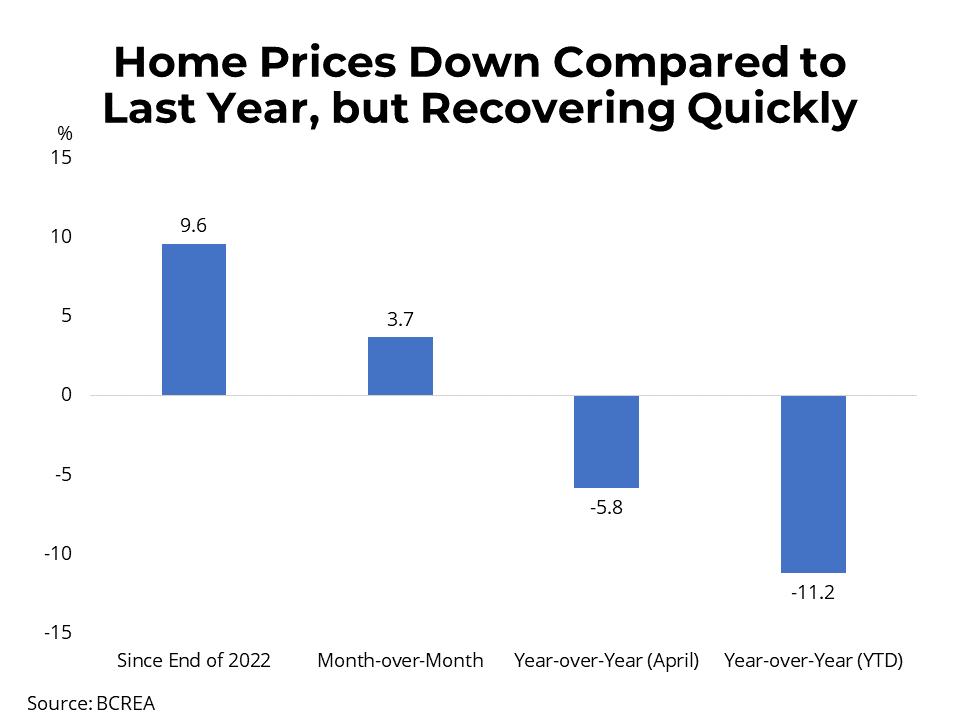
“BC home sales have now risen for three consecutive months, but that recovery in sales has not been matched by listings which continue to fall well below normal levels,” said BCREA Chief Economist Brendon Ogmundson. “As a result, average prices across the province are once again rising, recovering much of the decline since prices peaked early last year.”
Average home prices, while still down year-over-year, are rising on a monthly basis in most markets. The average price in BC has now risen for three consecutive months and is up over 9 per cent since the start of 2023.
Year-to-date, BC residential sales dollar volume was down 44.1 per cent to $21.4 billion, compared with the same period in 2022. Residential unit sales were down 37.1 per cent to 22,417 units, while the average MLS® residential price was down 11.2 per cent to $954,984.
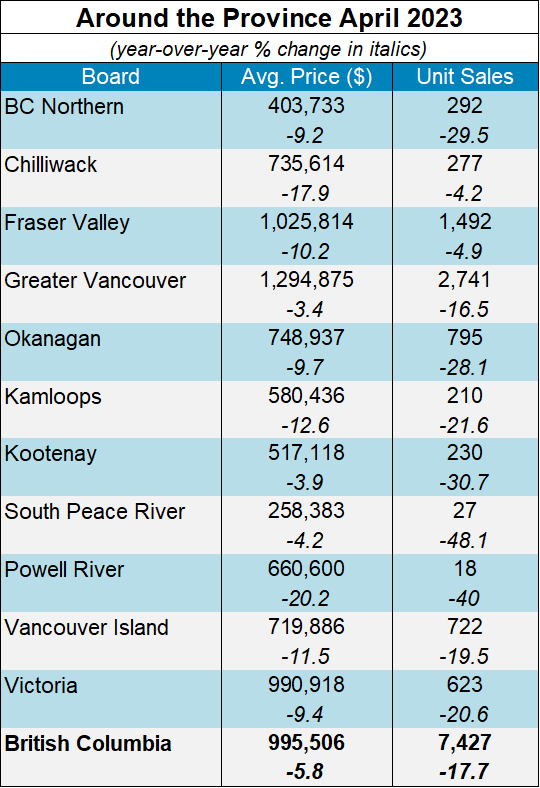
-30-
Land Owner Transparency Registry Filing Extended to 2022
The Land Owner Transparency Registry (LOTR) filing deadline has been extended to November 30, 2022, without incurring penalties. This extension gives reporting bodies with interests in land more time to file a transparency report.
According to the BC government, they “heard from legal professionals in BC that pre-existing owners need more time to gather information about ownership and prepare to file with the registry.”
In addition to the new deadline, Realtors should be aware of these requirements and advise their clients to speak to legal professionals for more details.
Since April 30, 2021, the LOTR has been a publicly searchable registry of records about individuals who have an indirect interest in land held through corporations, trusts and partnerships. LOTR aims to address housing affordability, end hidden ownership and crack down on fraud and money laundering in the province. The Land Title and Survey Authority administers the LOTR under the Land Owner Transparency Act (LOTA).
For more information about the LOTR and LOTA, here are some resources:
Land Owner Transparency Registry Filings Required Beginning November 30
The Land Owner Transparency Act (LOTA) and the Land Owner Transparency Registry (LOTR) come into effect on November 30, 2020, and that means REALTORS® should prepare for changes to practice when completing a transaction to allow for the new reporting requirements outlined by LOTA.
How does this affect your practice?
Beginning on November 30, 2020, a transparency declaration must be filed to the LOTR on behalf of the transferee(s) of land. So, for transactions that are set to close on November 30 or later, your buyer clients will need to be made aware of the additional reporting requirements.
The actual filing is something legal professionals will be responsible for, however, for transactions closing after November 30, it is important that Realtors:
- Advise your clients to speak to a legal professional about these requirements early on to ensure there is ample time for appropriate information to be gathered and filed. Be aware that when a buyer is a corporation, partnership or trust, not a resident of Canada, has beneficial owners or has shareholders outside of the country, this period could take up to one month;
- Plan for closing periods to allow for legal professionals to complete the transparency declaration and determine if a transparency report must be filed;
- In situations where transparency reports are required, advise clients to speak to their legal professional to understand the timelines and what they should expect, so they can ensure adequate timing.
To prepare for filing to the LOTR, sample forms are available on landtransparency.ca to help Realtors, legal professionals and clients know in advance what information will be needed.
Why is this needed?
According to the Land Title and Survey Authority of British Columbia (LTSA), in its plan to address housing affordability, the BC government created the LOTA with the aim of ending hidden ownership, and to crack down on fraud and close loopholes.
As a result, the LOTR will require information about “interest holders,” or parties who do not have a direct ownership but have a meaningful relationship or indirect ownership in the land, to be stored and eventually be publicly accessible.
What else is coming?
Guidelines from RECBC
The Real Estate Council of BC (RECBC) is expected to release additional guidelines around LOTA and LOTR for real estate professionals. Realtors should keep a look out for those guidelines in future communications from both RECBC and BCREA.
LOTR to become searchable
Beginning April 30, 2021, the public will be able to search the LOTR and obtain some personal information about ownership interests in land. Personal information like date of birth and social insurance numbers will not be shown.
Where to find more information
Webinar for managing brokers
In October, BCREA dedicated its Community of Practice for managing brokers to exploring LOTA and LOTR and a presentation from Reuben Danakody (Director and Administrator, Land Owner Transparency Registry Services) and Shannon Brown-John (Deputy Administrator, Land Owner Transparency Registry Services).
Other resources
More information about the Land Owner Transparency Act can be found at landtransparency.ca, which includes information such as:
- Details of Filing Requirements
- Common Questions and Answers
- Sample Transparency Records
- Videos and Recorded Webinars
- LOTA/LOTR Fact Sheet
Get a reminder
Do you want to receive an email from BCREA on November 30, 2020, reminding you that LOTR filing requirements are in effect? Click here to sign up.
Land Owner Transparency Registry Publicly Searchable as of April 30, 2021
The Land Owner Transparency Registry (LOTR) becomes publicly searchable on April 30 and guidance from the Real Estate Council of BC (RECBC) on how to use LOTR in real estate practice is coming soon. BCREA will support brokerages and REALTORS® in adapting their practice in accordance to the RECBC guidance once it’s available. In the meantime, Realtors can prepare by familiarizing themselves with LOTR and the new public search tool.
What is LOTR?
The first of its kind in Canada, LOTR is a registry of information on individuals and entities who have an indirect interest in land as defined in the Land Owner Transparency Act (e.g., through corporations, trusts and partnerships) which is housed in a soon-to-be searchable public database.
How to use the LOTR public search tool?
The LOTR public search will be accessible through myLTSA Explorer. Realtors (and the public) will be able to search by the name of a buyer or seller, or the parcel identifier (PID). A PID is a number that uniquely identifies a parcel of land in the land title register of BC. Searching by name will show the interests in land to which the person is identified as a reporting body, interest holder or settlor, while searching by PID will show the persons who are identified as reporting bodies, interest holders or settlors for that land.
What information is available to the public?
Not all information contained in LOTR will be available to the public. Information that’s publicly accessible is referred to as “primary identification information,” and will only include certain information about corporations and limited liability companies, individuals, and relevant partnerships. For an outline of what primary identification information will be available, click here.
Cost for using the public search tool
Similar to land title search fees, there is a $5 fee for every LOTR public search.
You can find more information on the LOTR public search tool at www.landtransparency.ca. If you’re a managing or associate broker interested in learning more about LOTR, we invite you to join us for the Managing Broker Community of Practice session on Wednesday, April 21, at 10:00 am PST – click here to register.
For updates on the RECBC guidance on using LOTR in real estate practice, keep an eye on this page and upcoming BCREA communications.
Land Title and Survey Authority of British Columbia to Increase Fees in April
The Land Title and Survey Authority of British Columbia (LTSA) has announced that it will increase most customer fees by approximately three per cent as of Wednesday, April 1, 2026.
For Land Title Act services, the fee increase will apply only to LTSA's portion of fees, resulting in a net increase of 1.58 per cent to the overall customer fee. LTSA’s electronic transaction service charge, Land Owner Transparency Registry filing fees, and other LTSA administrative fees will increase by approximately three per cent. For example, the total fee for an electronic title search will increase from $10.89 to $11.06.
To view the current and projected fees, click here.
LTSA says it uses revenue from fees to cover operational costs and address the impact of inflation. Under the LTSA’s Operating Agreement with the Province, LTSA may increase its service fees under the Land Title Act, Land Act, Mineral Tenure Act, and Energy Resource Activities Act annually by the adjusted Consumer Price Index (CPI) amount.
Land Title Office Records and the Highways Act #27
By Gerry Neely
B.A. LL.B.
A purchaser entered into an agreement for the purchase of land adjoining the highway which, according to his search of title in the Land Title Office, was of a certain area. Subsequent to the completion of the purchase, a survey revealed that the actual area was twenty five per cent less than the area indicated on the plan filed in the Land Title Office. The discrepancy was accounted for by the widening of the highway in the 50's. There was nothing filed in the Land Title Office which, in a normal search, would have indicated that this portion of the land purchased had been gazetted for road purposes. Until 1968 or 1969, the Ministry of Highways did not, as a matter of routine, file notices with the various Land Registry Offices of expropriations and purchases of land for highway purposes. In turn, the Land Registry Offices followed inconsistent practices which for some period of time resulted in a notation on the Certificate of Title or the Plan of the highway right-of-way plan number. This practice may not have been consistent throughout the Province, but it was stopped at least in Victoria because of concerns as to the legal liability which might result if a right-of-way plan was missed. From 1968 or 1969, as a matter of policy, the Ministry has filed notices with the various Land Title Offices of all expropriations and purchases of land for highway purposes occurring subsequent to those years. Although there have been discussions about bringing the Land Title Office records up to date by endorsing Titles with notice of previous highway rights-of-way, the sheer bulk of the work required has meant that no action has been taken.
The authority to file a notice is found in Regulation 334/79, which gives the Minister of Transportation and Highways a discretion as to whether or not to file a certificate with the Land Title Office in which the land is located. Section 23 of the Land Title Act, which provides that a Certificate of Title is conclusive evidence that the owner is indefeasibly entitled to an estate in fee simple, is subject to a number of qualifications, one of which is that it is subject to any highway or public right-of-way, water course, right of water or other public easement. The combination of the discretion given to the Minister to file a notice in the Land Title Office, together with the effect of Section 23, means that a person who buys property without notice of a highway right-of-way probably has no recourse against either the Minister or the assurance fund.
The prudent purchaser of land contiguous to a highway should make his offer subject to verification of the lot size with the Regional or District Office of the Ministry of Transportation and Highways.
The Highways Act contains another trap for an unsuspecting owner. By Section 4 of the Act, when public monies have been expended for the development of a road, the Court may declare the road to be a public highway, even though there has been no formal dedication or publication in the Gazette. In a recent case, the Court of Appeal held on the evidence of a man who had been familiar with the properties since 1910, that a road access across an owner's property to the lands of an adjoining owner, was a public highway. The evidence disclosed that the road had been built by a crew of road builders who were engaged in building public roads in the area. In addition, submission of the public financial accounts for 1910 and 1911 revealed an expenditure of about $2,000.00 on the "Long Lake" road. That evidence was sufficient to allow the Court to declare that the road access was a public highway. Once that declaration has been made, Section 5 of the Highways Act then gives the Ministry the power to enlarge the access to at least ten metres on each side of a mean centre line of the travelled road.
While this latter problem is one more likely to arise in rural areas, one should be alert to the wide definition of a highway found in the Highways Act, namely that a highway "includes all public street, roads, ways, trails, lanes, bridges, trestles, ferry landings and approaches and any other public way."
| 1. | Bunz v. Vayro,1982 [B.C.D.] Civ. 2207-1-01. |
To subscribe to receive BCREA publications such as this one, or to update your email address or current subscriptions, click here.
Landlord's Liability – Leased Premises #109
By Gerry Neely
B.A. LL.B
What do the Province of British Columbia, the Municipalities of Enderby and Chilliwack, Hudson's Bay Company, Safeway, Grouse Nest, Royal Canadian Legion and landlord have in common? They have been sued under the Occupiers Liability Act by someone injured on premises over which they had a responsibility to ensure that the premises were reasonably safe for anyone using them.
Injuries occurred on parking lots stepped down one foot from the sidewalk giving access to the parking lot, from the failure to use non-skid paint on steps and around swimming pools, the failure to put up signs warning against diving off a wharf into water that was too shallow, from the installation of a concrete pad under an old locomotive engine over which children crawled. Not all actions were successful-liability was denied for injuries suffered by a woman at a wedding reception doing Grecian dances in high heels on a powdered wax wooden floor.
Until the enactment of the Occupiers Liability Act, a landlord might have been shielded from these liabilities. At common law, apart from contract or fraud, a landlord who leased unfurnished premises owed no duty to his tenant or any other person entering on those premises. This meant that while someone injured on the landlord's premises might be able to sue the tenant, he couldn't sue the landlord.
That limitation of liability was changed significantly by the Occupiers Liability Act. A landlord who leases unsafe premises is liable for damage to person or property if the landlord has agreed to be responsible for maintenance and repair. This applies regardless of what kind of premises are leased.
If the premises are residential and there is no agreement between the landlord and tenant as to who will repair, the landlord is still caught. The reason for this is the combination of the Occupiers Liability Act with the Residential Tenancy Act. Under the latter Act, a landlord has a statutory duty to maintain residential premises in a state of repair that complies with health and safety standards, including housing standards, required by law. Breach of this duty gives a tenant the right to sue for damages and the Occupiers Liability Act extends this right to any one entering upon the premises.
In one case, a landlord had constructed a sunken concrete walkway beside an unguarded and unlit stairwell which led to a basement entry. A visitor to the tenant occupying the house left it in the evening when it was almost dark, with the intention of crossing the yard to where his car was parked. He fell into the sunken walkway and suffered substantial injuries, including the loss of an eye. The evidence was that the sunken walkway violated the building codes and, in addition, good building practise would require a railing to have been placed on top of the retaining wall which separated the back yard from the sunken walkway. Damages in the amount of $33,000.00 were awarded to the injured visitor.
In another case, a railing surrounding a second floor landing had become so rotten that when a visitor to the tenant renting the house leaned against it, he fell and sustained severe injuries. In a third case, a railing around a porch fifteen feet above ground level broke under the weight of a visitor to the tenant's suite. The boards of the railing were rotten and, once again, liability was found.
In not every instance will a breach of the building code result in liability for injury. In one case, a tenant who rented a self-contained residence was injured when he fell down stairs within the house. No railing was on the stairs, which was a breach of the building code. However, the tenant couldn't establish that the absence of the handrail led to his fall.
In each instance, the tenant could have been sued, but instead the landlord was sued. Even if a tenant has agreed to provide liability insurance, these cases are strong arguments in favour of having either personal or commercial liability insurance in place, depending upon the extent of the business involved in the rentals.
To subscribe to receive BCREA publications such as this one, or to update your email address or current subscriptions, click here.
Landlords Take Notice – Recent Amendments to BC Tenancy Legislation #574
The BC residential rental market has been a very hot topic lately in many different business and social circles. Restrictions imposed on the short-term rental market have taken several homeowners by surprise, and the BC Government has again changed the rental landscape with the passing of Bill 14 – Tenancy Statutes Amendment Act, 2024, which amends the BC Residential Tenancy Act (RTA) and the BC Manufactured Home Park Tenancy Act. Bill 14 was granted royal assent and became law on May 16, 2024, and the changes will take effect in phases. This article focuses on the changes to the RTA.
Key Changes to the RTA
It is worth reading the entire law because not all changes are discussed here, but some key changes to the RTA are these (where there is a reference to a matter being "prescribed" that means prescribed by regulation; changes already in force are indicated in bold):
| Section No. | Change Imposed |
| 9 | Establishes an "authorized internet site" maintained by the residential tenancy director and used for the purposes of providing notice and other purposes under the RTA. |
| 12 | Adds Section 22.1 to the RTA, which now prohibits a landlord from increasing the rent when the number of occupants increases because a minor, or a person who was a minor when the tenancy agreement was entered into, moves in. Section 14 limits the amount of any such increase to the prescribed amount. |
| 15 | A landlord may not give notice to end the tenancy unless the relevant requirements or circumstances justifying the end of the tenancy exist or the landlord has a reasonable belief that those requirements/circumstances existed at the time the notice is given. |
| 17 | The notice period to end a tenancy for landlord use, for any reason, is increased to four months, unless another notice period is prescribed, which may not be less than two months. |
| 18 | A landlord can only end a tenancy to convert a residential unit to non-residential use if that non-residential use is prescribed. |
| 19 | Unless otherwise prescribed, a landlord may not end a tenancy for their own or close family use, or a purchaser or their close family's use where the building contains five or more rental units, and is either not stratified or is stratified but all rental units are owned by the same owner. |
| 20 | The tenant dispute period for a notice to end a tenancy under Section 49 of the RTA is extended from 15 days to 30 days for all reasons unless a different period is prescribed, which will not be less than 15 days. |
| 22 | The compensation payable to a tenant if a landlord ends the tenancy under Section 49 is changed from the equivalent of one month's rent to the greater of the prescribed amount or one month's rent. The tenant may also withhold that prescribed amount from the rent otherwise payable for the remaining months at the end of the tenancy. If the withheld amount is less than the prescribed compensation, the landlord must cover the difference. Additionally, if the conditions prompting the termination notice do not occur as specified, the compensation due to the tenant has been revised from 12 times the monthly rent to the greater of the prescribed amount or 12 times the monthly rent. |
| 23 | To avoid the increased compensation payable under Section 51(2), the stated use that justified the end of the tenancy for any reason other than demolishment is increased to 12 months unless another period is prescribed, which will be no shorter than six months. A similar amendment is made to the amount payable if the circumstances justifying a tenant having to vacate the unit at the end of a fixed-term tenancy do not come to pass. |
| 25 | Section 25 imposes a similar tenant right to withhold rent where compensation under Section 51.4 is payable and directs the landlord to pay any additional amounts not withheld. The amount payable to the tenant if the conditions prompting the termination notice do not occur as expected has been updated from 12 times the monthly rent to whichever is higher: a prescribed amount or 12 times the monthly rent. |
| 28 | Section 28 creates a mandatory system for providing notices to end tenancy pursuant to the Internet portal established under Section 9. Landlords must pay a fee to use this required system and may not change the content of the notice forms unless authorized by the RTA director or by regulation. |
| 29 | Section 29 requires RTA director authorization before notices are given to end tenancies under certain prescribed sections of the RTA, which are yet to be determined. If authorization is required, landlords must use a standard form and pay a fee. It also outlines some criteria the director must consider on such an authorization application. |
| 31 | Section 31 restricts the application of dispute resolution proceedings under the RTA to claims under a certain value ($35,000 or $65,000, depending on the claim) unless the applicant waives the right to recover any amount over those limits. |
| 34 | The administrative monetary penalty that may be imposed under Section 87.3(1) has changed from a maximum of $5,000 to a prescribed amount. |
| 35 | Failure to follow the rules set out in Section 22.1 (restriction on varying rent based on the number of occupants) or 44.1 (landlord prohibition respecting ending tenancies) are now included as offences under the RTA and are currently subject to a $5,000 fine. |
| 36 | Section 36 adds a few other RTA contraventions (of Sections 22.2, 53.1, or 53.2) as offences and changes the former $5,000 fine to a prescribed amount. |
| 39, 41-44 | Transitional provisions relating to changes to occupant-based rent changes, the effect of certain landlord notices based on the date they were issued or received, and the impact on ongoing dispute resolution procedures. In particular, if a tenant notice was given under s. 49(2) [landlord's use of property] on or before April 2, 2024, then the old tenant compensation regime under s. 51 of the RTA applies. If the notice was given after April 2, 2024, then the amended compensation regime (outlined in section 23 above) applies. |
The non-bolded sections will come into force by regulation. No regulation release date has been communicated, but the prevailing view is that at least some regulations are expected in the summer of 2024. All bolded sections came into force by latest May 16, 2024.
Policy and Impact
This provincial government has been fairly aggressive in addressing the lack of affordable housing in many key residential centres, sky-rocketing home prices over the last many years, and insufficient long-term rental inventory. Its stated goals with the introduction of Bill 14 have been to deter bad-faith evictions, prevent unfair rent hikes, and limit other ways in which landlords may gain advantage over current or future tenants. It also seeks to provide stability in the rental market and certainty in resolving disputes. See the province's news release on the introduction of Bill 14 here.
The impact of these changes remains largely unknown given Bill 14's recent, and only partial, coming into force. There are also many gaps remaining due to the lack of enacted regulations. However, these changes do and will affect landlords/owners and purchasers of tenanted properties. In particular, notice periods and compensation amounts have changed, as will the procedure for providing notices to tenants if they are to be effective. This may impact clients' ability to comply with their obligations under contracts of purchase and sale related to tenant notice dates and any obligations to provide vacant possession. In other words, the RTA changes will trump any contractual obligations, which will put clients who have agreed to terms inconsistent with the changes in a very difficult spot. This may, in turn, directly affect the obligations of REALTORS® where an owner/landlord's compliance with the RTA is delegated to them, for example in providing required notices to tenants. There is also no detail as of yet about the internet portal being created, though since its use is mandatory, REALTORS® should watch closely for related government updates.
For all these reasons, REALTORS® should ensure they are familiar with the Bill 14 changes as they develop so they can properly advise their clients or refer them to legal advice where necessary and understand their own obligations. Landlords and potential purchasers of tenanted properties should also familiarize themselves with these changes and contact their REALTOR® for advice.
Latent defects – endangered bird species and heritage designation #387
By Gerry Neely
B.A. LL.B.
An Ontario real estate salesperson learned more than he ever expected or wanted to about the Loggerhead Shrike (eastern population), “a songbird that hunted like a small hawk,” on the federal and provincial endangered species lists. He acted as dual agent on a 129-acre parcel of land, under an agreement not to disclose confidential information that compromised either party’s bargaining position. The one exception was a latent defect known to either the seller or the agent.
The purchase price of $34,000 reflected a 400-foot hydro easement and Canadian Pacific Railway line crossing the property, the southerly part of which was wetland unsuitable for building. The buyers were interested in the property because the northerly portion contained a building site and adjoining land apparently suitable for their plans. When they submitted their plans to the township, they were told they would be liable for prosecution if they proceeded to build their home and workshop there. The reason: they would be within the 400-metre radius circle of suitable habitat preserved for known Shrike nests.
The buyers sued the agent for damages. The agent had received from the sellers a video and brochure concerning the Shrike, but decided not to disclose the significance of this to the buyers because he didn’t consider it important enough. That was a mistake—the judge decided this limitation on building sites was a latent defect that should have been disclosed to enable the buyers to make their own investigation. (1)
A precedent referred to in this case concerned the non-disclosure by an agent of a city’s intention to designate property as heritage. The seller and agent knew the buyers wanted to demolish buildings on the property, an action the designation would have prevented. The intended designation was held to be a latent defect the agent had a duty to disclose. (2)
A decision in a provincial court case handed down on August 9, 2005 will be interesting to licensees with pets. The plaintiff sued the breeder from whom she had purchased an eight-week Samoyed puppy at the low price of $350, because it was born tailless. The breeder had given the buyer an oral guarantee that the puppy was healthy. However, as the puppy matured, she discovered she had to cope with many special needs, the most significant of which was a congenital dermoid cyst not discovered until age two. The cost of the surgery was the major part of the more than $10,000 the buyer had spent on the Samoyed’s medical problems.
The judge decided the action was governed by the BC Sale of Goods Act and the purchase of the dog should be treated as any other purchase of a consumer product. The warranty was limited to the problem the Samoyed had at the date of purchase, the dermoid cyst, and damages were limited to those reasonably resulting from the breach.
Was it reasonable for the buyer to have spent $10,000 on her dog’s care? The breeder’s lawyer argued the amount spent exceeded the commercial value of the dog and the buyer had a duty in the legal sense to limit damages by declining to have the surgery done. She, and not the breeder, should bear the costs. The judge agreed, awarded damages of $350 to the buyer and gave her an alternative the judge was sure she wouldn’t want to exercise: to have the breeder replace the dog. (3)
To subscribe to receive BCREA publications such as this one, or to update your email address or current subscriptions, click here.
Latest Tutorial Videos for REALTORS® Explore Five Standard Forms
In BCREA's latest release of tutorial videos for BC REALTORS®, we explore five key standard forms:
- the Co-Listing – Joint Representation form,
- the Contract of Purchase and Sale Addendum / Amendment form,
- the Disclosure of Referral Payment form,
- the Fee for Service Retainer Agreement form, and
- the Tenant Occupied Property – Buyers Notice to Seller for Vacant Possession form.
These tutorial videos are intended to help Realtors better understand and use these common forms and feel confident in explaining these forms to their clients.
Co-Listing – Joint Representation
This video tutorial explores the Co-Listing – Joint Representation form, which allows cooperating sellers to engage two brokerages and their designated agents to represent the sellers jointly under a listing agreement.
[iframe width="560" height="315" src="https://www.youtube.com/embed/VbkTxZG0iWQ" frameborder="0" allowfullscreen style="position:absolute;top:0;left:0;width:100%;height:100%;"][/iframe]To learn more about this form, click here to access the form toolkit on the Standard Forms Resource Centre.
Contract of Purchase and Sale Addendum / Amendment
This video tutorial explores the Contract of Purchase and Sale Addendum / Amendment form, which can be used as either an addendum or as an amendment form for the Contract of Purchase and Sale. As an addendum it can be used to add additional terms or conditions to a contract at the time the contract is executed by parties, being attached to, and forming the Contract of Purchase and Sale. As an amendment it can be used to makes changes to the terms of the contract after it has already been executed.
[iframe width="560" height="315" src="https://www.youtube.com/embed/krRSjbWmHtY" frameborder="0" allowfullscreen style="position:absolute;top:0;left:0;width:100%;height:100%;" ][/iframe]To learn more about this form, click here to access the form toolkit on the Standard Forms Resource Centre.
Disclosure of Referral Payment
This video tutorial explores the Disclosure of Referral Payment form, which should be used by Realtors to document disclosure to their client when there is an intent to pay a referral payment.
[iframe width="560" height="315" src="https://www.youtube.com/embed/HBza_FDcaDM" frameborder="0" allowfullscreen style="position:absolute;top:0;left:0;width:100%;height:100%;" ][/iframe]To learn more about this form, click here to access the form toolkit on the Standard Forms Resource Centre.
Fee for Service Retainer Agreement
This video tutorial explores the Fee for Service Retainer Agreement form, which can be used by a brokerage to document the specific services it agrees to provide to the consumer and the remuneration the consumer agrees to pay for them. The form also documents the consumer’s agreement with the brokerage with respect to other particulars of the arrangement, including the term, the nature of representation, and the consent for the collection, use and disclosure of their personal information.
[iframe width="560" height="315" src="https://www.youtube.com/embed/N5XBofca7mw" frameborder="0" allowfullscreen style="position:absolute;top:0;left:0;width:100%;height:100%;" ][/iframe]To learn more about this form, click here to access the form toolkit on the Standard Forms Resource Centre.
Tenant Occupied Property – Buyers Notice to Seller for Vacant Possession
This video tutorial explores the Tenant Occupied Property – Buyers Notice to Seller for Vacant Possession form, which is used when a buyer is purchasing a property that is occupied by a tenant, and the buyer or the buyer’s close family member intends to occupy the property and the contract provides for vacant possession.
[iframe width="560" height="315" src="https://www.youtube.com/embed/BZaIxdleEmY" frameborder="0" allowfullscreen style="position:absolute;top:0;left:0;width:100%;height:100%;" ][/iframe]To learn more about this form, click here to access the form toolkit on the Standard Forms Resource Centre.
To access other videos created for Realtors and consumers, as well as form guides, revision guides, form toolkits and more, please consult the Standard Forms Resources Index or visit the Standard Forms Resource Centre.
If you have questions on Standard Forms, please email [email protected].
Launching Legal Update 2018
In mid-October, the Real Estate Council of British Columbia decided to make major changes to the mandatory Relicensing Education Program course, Real Estate E&O Insurance Legal Update in 2018 (Legal Update), which BCREA administers on behalf of the Council.

The new course focuses on consumer protection, important regulatory updates, ethics and best practices in a new format that blends online and classroom learning. Learners have up to two weeks to complete the component of the course at their own pace; the second component of the course is a full-day classroom session.
The new, blended course is available to all licensees. Those whose licence expires within the first six months of 2018 may choose to complete the online version of Legal Update 2017 as an alternative.
Be sure to give yourself a minimum of three weeks to complete the new course. To help you out, Council will send licence renewal notices to your inbox earlier and more frequently.
In mid-October, the Real Estate Council of British Columbia decided to make major changes to the mandatory Relicensing Education Program course, Real Estate E&O Insurance Legal Update in 2018 (Legal Update), which BCREA administers on behalf of the Council.
The new course focuses on consumer protection, important regulatory updates, ethics and best practices in a new format that blends online and classroom learning. Learners have up to two weeks to complete the component of the course at their own pace; the second component of the course is a full-day classroom session.
The new, blended course is available to all licensees. Those whose licence expires within the first six months of 2018 may choose to complete the online version of Legal Update 2017 as an alternative.
Be sure to give yourself a minimum of three weeks to complete the new course. To help you out, Council will send licence renewal notices to your inbox earlier and more frequently.
Enrollment in the new Legal Update 2018 course is now available online. If you are eligible for the 2017 online course, registration is available here. More information from the Council can be found here.
To subscribe to receive BCREA publications such as this one, or to update your email address or current subscriptions, click here.
Leaky Condo Repairs – Townhouse Owners Refused to Pay for Repairs to Apartment-Style Units #332
By Gerry Neely
B.A. LL.B.
Reasons for Judgment were published on February 7, 2001, in the first case I have seen that examines the Strata Property Act (SPA) to settle a dispute as to whether the townhouse owners had to contribute to the cost of repairing the leaky condos in a three-storey block. The strata corporation consisted of 224 residential units made up of 182 low-rise townhouses, which were clear of the problem, and 42 apartment-style units within the block, which were affected by the leaky condo syndrome.
The problem first became apparent in 1997. Subsequent remedial work on the balconies and stucco of the block revealed structural rot, which led to an engineer's recommendation to replace the exterior walls. On December 9, 1999, the cost of repair work was estimated to be approximately $700,000.
The townhouse owners' position was that the units were divided into two distinct types of stratas, and the apartment owners, who benefited from the repairs, should bear the full cost. The strata corporation sued for a declaration that all owners were responsible for the cost.
The first question was which Act applied to the case: the new SPA, which became law on July 1, 2000, or the Condominium Act, which was repealed on that date. The problem and the legal process had taken place before the SPA became law. The answer depended upon whether the SPA grandfathered the relevant sections of the Condominium Act.
The judge decided the SPA applied because it and its regulations provided for the allocation of the common expenses of strata corporations, provisions originally created under the Condominium Act.
The question then was whether the more usual circumstances, which result in all owners contributing to the common expenses, applied to the townhouse owners. An exception to this circumstance is made in the SPA and its regulations for different sections of residential strata lots within a strata corporation. The regulations define the types of sections as townhouse, apartment and detached house.
Two conditions must be satisfied before a section is created. A bylaw change must be approved by no less than 3/4 of the eligible voters in both the section and the strata corporation. In addition, the contributions to the operating fund must relate to and benefit only the strata units in the section.
In this case, a special resolution to create separate townhouse and apartment-type sections was put forward in September 1999. It failed, despite the fact that the townhouse owners had the majority votes needed to gain approval. Since the conditions were not met, the townhouse owners had to contribute to the repair costs.
That failure is significant for another reason. For several years, the strata corporation had allocated different expenses to the two types, upon the authority of section 128 of the Condominium Act. The regulations grandfathered the continuance of these different allocations, at the discretion of the strata corporation. The failure of the vote and the decision of the strata council to assess all owners was held by the judge to be a rejection of the continuance of prior allocations.
In a "cover all bases" remark, the judge commented that if he were wrong in concluding that there was only one section in the strata corporation, he held that the townhouses would benefit from the repairs done to the apartment-style units. The judge based his comment upon appraisal evidence that the values of the townhouses were reduced by the disrepair, to a greater extent than comparable units in the area. The benefit was their increased marketability.
The decision provided another reason to prevent the townhouse owners from meeting the conditions required to limit their contribution to the repair cost. It will be interesting to see if other judges interpret a "benefit" as broadly as had the judge in this case.
| 1. | Strata Corporation LMS 509 v. Andersen et al., SCBC, Reasons for Judgment, Vancouver Registry, February 7, 2001. |
To subscribe to receive BCREA publications such as this one, or to update your email address or current subscriptions, click here.
Leaky Condo Syndrome – Statute of Limitations #313
By Gerry Neely
B.A., LL.B.
That leaky condos are disasters is a given but what is even more depressing are the results of the decision of the cases now being heard concerning the attempts by condominium owners to obtain damages from developers, architects, engineers and others involved in the planning and construction of the condominium.
Strata owners, and in particular, strata councils, need to be aware that once there is evidence of a leaky condo syndrome, the writ must be issued within the time limitations contained in the Statute of Limitations. Failing that, the right to recover damages is lost.
That was the position of the owners of a strata complex completed in 1986. Within a year there was evidence of leakage through the roof. Some remedial work was done by the contractor, but the leakage continued. Consultants’ reports indicated damage to the balcony decks and stucco. Correspondence took place in 1988 and 1989 with the developer, the roofer, and the new home warranty program. Legal actions were threatened in 1990, but it was not until November 7, 1995, that the writ was issued against the architects and others involved in the construction of the complex.
The normal limitation period for an action for recovery of damage to property under the Statute of Limitations, is six years. That meant that the writ should have been issued sometime in 1992, six years after completion of the complex. Understandably, since defects may not become known for some years, the Statute of Limitations provides an exception to the normal six-year limitation.
There are two parts to this exception. The first is that time doesn’t begin to run until the identity of the wrongdoer is known to the person issuing the writ. The second part is that if the strata council had taken legal advice at the appropriate time, would it have been advised that there was a reasonable prospect of success in an action brought to recover the cost of repairs to the defective building?
The second part did not require that the strata council actually take advice but whether, at the appropriate time, they either knew or had the capacity to discover the facts upon which a cause of action would be based. In effect this part involves "notional advice given by notional advisors". he appropriate time in this case was no later than six years prior to the date of issue of the writ in 1995.
This would have been prior to November 7th, 1989. There was ample evidence at that date of the seriousness of the problem and the identity of the parties to be sued. The strata council failure to act promptly was a complete bar to the claim for damages against the contractors and consultants.
| 1. |
|
To subscribe to receive BCREA publications such as this one, or to update your email address or current subscriptions, click here.
Leaky Condo, Special Assessment, Approval by Ordinary Resolution Sufficient – but No Authority to Collect Lump-Sum Payment #310
By Gerry Neely
B.A., LL.B.
Following upon the leaky condo case discussed in Column 304 of an owner’s refusal to pay a special assessment, is another case in which the developer, as the holder of 24 units in a 194 unit condominium development, challenged the validity of an ordinary resolution approving an assessment of $2,467,000 to be paid in one lump-sum.
There was no doubt about the need for repairs because two engineering reports confirmed not only the deterioration of sheathing and framing, but also the deterioration of structural members such as balcony joists which threatened the safety of the occupants.
Two successive extra-ordinary general meetings were called but in each the special resolution to approve the assessment failed to obtain the required 75 per cent majority. The strata council then called an annual general meeting at which a third special resolution was also defeated. Following that, the strata council put forward an ordinary resolution to approve the assessment as part of the 1999/2000 budget, which was approved.
The developer challenged the validity of the budget resolution on two grounds. The first was that these repairs were "unusual and extraordinary expenses" which could only be approved by special resolution under Section 49 of the Condominium Act, or by payments out of the contingency reserve fund.
The position of the strata corporation was that these were the type of repairs that would normally be included in the annual budgets of a strata corporation as general cost items. The nature of the repairs rather than their extraordinary cost determined whether they were normal or unusual or extraordinary.
The Condominium Act imposes an obligation upon the strata corporation to maintain and repair assets of a strata corporation. Section 35 gives the strata corporation the power to establish a fund for administrative expenses and for the discharge of other obligations of the strata corporation. The judge said that repairs to the waterproof envelope of the building fell within the category of other obligations of the strata corporation which it had a responsibility to discharge. In addition, the purpose of the contingency reserve fund is to pay unusual or extra-ordinary future expenses while the repairs which created the expenses for which the assessment was approved, were urgently needed now.
The approval by ordinary resolution of this budget item at the annual general meeting was valid.
The developer’s second ground was Section 35 (4), which states that budget items approved by the members at the annual general meeting become due and payable only on the first day of each month. The judge accepted the argument that the strata council could not force a lump-sum payment. However, instead of invalidating the resolution the judge rectified it by directing that the assessment be paid monthly by the owners.
Strata corporations must amend their bylaws to obtain the authority to have special assessments paid in lump sums or for periods other than monthly.1
* * *
Column 307 discussed an unsuccessful claim for commission by an agent whose client’s offer was rejected by the seller who had already accepted an offer. The first offer was subject to financing, the second offer was unconditional, but otherwise both offers met the seller’s terms set out in the MLS® Contract. What wasn’t clear from the reasons for judgment was that the first offer was not accepted in writing, but only orally. It was the absence of a written, binding contract, albeit conditional, that led the agent to sue for the share of commission offered to co-operating agents.
| 1. |
|
To subscribe to receive BCREA publications such as this one, or to update your email address or current subscriptions, click here.
Learning from an RECBC Discipline Decision #535
Starting in 2016, the real estate profession has seen numerous regulatory changes, including increased fines, new regulations, greater involvement from the Real Estate Council of BC (RECBC) and the elimination of limited dual agency. As a result, I have tried to focus many of my more recent articles on discipline decisions of RECBC. While discipline decisions sometimes generate unwanted attention, it is important to put them in perspective. In 2020, there were close to 100,000 MLS® transactions in BC. A tiny fraction (probably less than 1%) lead to any type of disciplinary action. While discipline decisions are a rare occurrence, they are important to review so that all licensees are better aware of the conduct that RECBC considers unacceptable and why.
A recent RECBC decision1 deals with the lockbox system that is prevalent throughout the province. A buyer’s agent had arranged with the seller’s agent for her clients to view his listed property. As is often the case, neither the seller nor the seller’s agent would be present at the viewing. The buyer’s agent was to gain access to the property by using a key contained in a lockbox at the property. Shortly before the viewing, the buyer’s agent realized she would be unable to attend the viewing in person. Without contacting the seller’s agent or her managing broker, the buyer’s agent obtained the code to the lockbox and provided it to her clients. Her clients then entered and viewed the property, unaccompanied by the buyer’s agent. It is unlikely this transgression would have been discovered but for another licensee who had arranged a viewing a half-hour after the unaccompanied viewing. When he realized that no licensee had accompanied the prospective buyers, he contacted the seller’s agent who ultimately complained to the buyer’s agent’s managing broker and RECBC. During RECBC’s investigation, it was discovered that the buyer’s agent had provided the lockbox code to her clients in respect of a second property, which they had also viewed without her accompaniment.
By way of a Consent Order, RECBC and the buyer’s agent agreed that the buyer’s agent’s conduct contravened both the Real Estate Services Act (RESA) and the Real Estate Rules and agreed upon the following penalties:
- Three-month suspension,
- $15,000 fine,
- $1500 in enforcement costs, and
- completion of remedial professional development courses.
To put a three-month suspension in monetary perspective, licensees reading this article should simply take 25% of their last year’s income and add that to the additional $16,500 in fines and enforcement costs. It is not clear from the record whether the licensee was represented by a lawyer in this matter but if she was, those legal costs would have come out of her own pocket. All-in-all, this was a substantial price to pay for not accompanying her clients on a viewing.
What struck me as interesting in this decision was RECBC’s approach to this matter. How did it view the licensee’s conduct?
Section 35 of RESA sets out the various ways a licensee may commit professional misconduct. The most common way is by contravening RESA, the regulations or the Rules. But there are other criteria in section 35 that RECBC used in this case. In addition to breaching the Rules, the buyer’s agent was found to have committed professional misconduct by demonstrating incompetence in performing an activity. She was also determined to have had committed conduct unbecoming a licensee in that her conduct undermined public confidence in the real estate profession and brought the real estate sector into disrepute. These charges are not commonly laid, are broad and subjective in their scope and, together with the significant penalty, may well reflect RECBC’s condemnation of the conduct.
With respect to the Rules, Council determined that the buyer’s agent had breached her duty to act in the best interest of her client (emphasis added) by not accompanying them to the viewing. I suggest that this finding might reflect RECBC’s acknowledgment of the vulnerability of buyers in the caveat emptor reality of the process of purchasing property in BC and RECBC’s desire to see those buyers fully accompanied and represented throughout each and every step of that process.
One has to assume that this conduct was an isolated incident. If, however, it was not, this decision will certainly ensure that it does not happen again.
For further information on using lockboxes and using the Lockbox Acknowledgement, Consent, Release and Indemnity form with buyers and sellers, you can access the form toolkit on the BCREA Standard Forms Resource Centre here (BCREA Access login required). P.S. On an unrelated note, a recent BC Court of Appeal decision has reaffirmed that payment of commission is not always dependent on the completion of the transaction. In Panegos v O’Byrne2,the court said “A standard form listing agreement was used which provided that the Realtor’s commission would become payable if, inter alia, an enforceable contract of purchase and sale was entered into during the term of the listing contract.” The vendors were liable for the Realtor’s commission, whether the transaction closed or not; it was not payable “out of” the sale proceeds. I believe I may take judicial notice that this is not an unusual provision in listing agreements.
| 1. | RECBC Decision re Li December 9, 2020. | |
| 2. | Panegos v O’Byrne, 2020 BCCA 352 (para 3). |
To subscribe to receive BCREA publications such as this one, or to update your email address or current subscriptions, click here.
Lease – Renewal, No Renewal Agreement, Initial Lease Terms Binding Upon Tenant; Operating Expenses Not Defined and Therefore Uncertain; UFFI – Damages for Breach of Warranty #278
By Gerry Neely
B.A. LL.B
The omission of wording in a lease renewal clause that the renewal would be void if the parties were unable to agree upon the renewal terms, led to some surprising results, at least for the tenant.
The right to renew the initial term for a further period of three years, provided that the renewal rent was to be no less than the rent paid during the initial term, and that any renewal agreement entered into was to include provisions for the payment of additional rent to cover the proportionate area costs of property tax and operating expenses.
While notice to renew was properly given by the corporate tenant, the parties were unable to agree upon the terms of the renewal lease and after nine months the tenant vacated the premises.
The landlord then sued the tenant and the two personal guarantors for monthly rent plus GST for the balance of the term, based upon the rent payable during the initial term. The landlord also claimed for damages for the proportionate share of taxes and operating expenses, legal costs and 24% per annum upon the amount due to it.
The B.C. Court of Appeal held that the tenant became bound by the terms of the lease upon its renewal. It was therefore liable for the rent and GST for the three year term. Interest at 24% was payable on that amount, because it was a term of the lease that rent in default would bear interest at 24%. The tenant was also liable for payment of its proportionate share of the taxes, but not for interest.
The landlord's claim for "operating costs" was dismissed because the term was not defined. The judge said it was therefore too uncertain to be sued upon.
In view of the lack of appropriate wording to deal with the failure to agree upon the terms of the renewal lease, or the mechanism for fixing the renewal rent when the parties could not agree upon it, and based upon the B.C. Court of Appeal decision, the tenant presumably could have continued to occupy the premises over the three year term, paying the rent called for in the initial lease.1
* * *
A decision in a Newfoundland case reveals that UFFI is still a headache for both sellers and buyers. A house was sold and resold three times, and on each sale, the seller gave to the buyer a warranty that there was no UFFI within the house. The fourth buyer found in the course of renovations that the house contained UFFI. This could only be removed at a cost of $23,000, money which the buyer did not have. His purchase was made in 1990 and in 1992 he vacated the house because of mild headaches and a general concern that his health was endangered.
He sued his seller, who in turn joined in with the person from whom he had bought, and so on down the line.
No medical evidence was provided to establish that UFFI was a health risk. The appraiser, who had appraised the property at the time of purchase at $90,000, gave evidence that he would have reduced the value to $67,000, had he been aware of the UFFI. Damages of approximately $24,000 were awarded to the buyer, who sued his seller, who in turn sued the person from whom he bought, who then sued the first seller who had given the UFFI warranty.
I assume the reason why each party was aware of the existence of the earlier warranties was because Newfoundland does not have a Torrens system. Therefore, proof of the title of an owner to sell would be based upon an examination of the transfer documents of his predecessors in title. This chain of liability might be found in British Columbia, because of the printed form UFFI warranty that used to be included in offers to purchase. Since other warranties are given, is this case therefore an argument for warranties limited say to any breach discovered and sued upon by the buyer during his period of ownership of the house?2
| 1. | P. T. Haro Enterprises Inc. v. Paris Restaurant Ltd., 9 R.P.R. (3d), p. 98. | |
| 2. | Clancy v. Shanahan, 9 R.P.R (3d), p. 55. |
To subscribe to receive BCREA publications such as this one, or to update your email address or current subscriptions, click here.
Lease for More Than Three Years – Illegal? #32
By Gerry Neely
B.A. LL.B.
The Land Title Act requires a tenant with a long-term lease who wishes to register it, to follow the same procedure as does an owner who wants to divide his land into a number of parcels. Specifically, Section 73 provides that unless there is compliance with the subdivision requirements of the Act, "no person shall subdivide land into smaller parcels than those of which he is the owner for the purpose of leasing. . . for a term exceeding three years."
Compliance with the subdivision requirements means that the approving officer who is responsible for the approval or the rejection of subdivision plans, must approve the subdivision which will be created by the long-term lease. Until recently, the principal problem created for the tenant who had an unregistered lease of this kind, was that the tenancy might be abruptly ended by the landlord's sale of the property. A recent decision appears to raise for the first time the question of whether a lease of land for a term in excess of three years is illegal and, as such, incapable of creating contractual rights between the landlord and the tenant.
The leases in question were of waterfront lots on Okanagan Lake, which were too small to meet the requirements of the zoning regulations. The leases contained a clause which made it apparent to the parties that the parcel could not be subdivided and that the leases could not be registered. The purchaser from the landlord took title with notice of the unregistered leases, but decided to develop the property and gave the tenants notice to vacate. The question asked of the Court was whether the leasehold interests created legally enforceable interests, or were they void from the beginning because they were unregistrable documents which were incapable of creating a charge or interest in land and, in particular, a charge against the property described in the leases.
The tenants argued that all this did was prohibit the registration of their interests and the enforcements of those interests through registration. The Court raised the question as to whether the prohibition against subdivision meant that a lease of "what is known to be an unsubdividable portion of a parcel of land is an illegal act." If that were so, it could not create any contractual rights which the parties could sue upon. The Judge decided, however, that he need not answer this question but only the question as to whether the documents created an interest in land. He concluded that they did not and that they were incapable of creating a charge against the property described in the leases. Although it must be emphasized that the decision is limited to its facts, the discussion of whether or not an unregistrable long-term lease is illegal must cause concern to any one entering into an unregistrable lease of land for more than three years.
It should be noted that the prohibition referred to above does not apply where only a building or part of a building is being leased on a long-term lease. It should also be noted that the definition of a lease for a term not exceeding three years means that if there is an option or covenant for renewal in the lease, the option or covenant must not extend the total lease periods beyond three years.
| 1. | Nesrallah, Harrower and Nicholson v. Pagonis,38 B.C.L.R. p. 112. |
To subscribe to receive BCREA publications such as this one, or to update your email address or current subscriptions, click here.
Lease, Agreement To – Void for Uncertainty #85
By Gerry Neely
B.A. LL.B.
Lance lay on the chesterfield, his headache just beginning to respond to his wife's soothing cool hand on his forehead. The cause of his headache - a three-day trial and a judgment that was a blow to Lance's pride. You see, Lance thought of himself as an expert in leasing property, a skill he had first learned from his father who was an old-timer in the real estate business.
Some of you may even remember his father, Charles, because in real estate mythology, he is believed to be the first real estate salesman to have had printed on his business card the slogan "Get a Lot While You're Young." That slogan proved that humour sells and Charles did so well with young newlyweds that he came to be known in the business as "old Chuckalot."
Inevitably, Lance, to his annoyance was nicknamed "Lancelot" by his father's friends. This changed only slightly for the better when Lance, whose successes in leasing he enjoyed retelling, came to be known to those of his friends who met daily at the round table for coffee, as "Sir Leasetenalot."
So much for the family history. Back to the trial at which Lance had been a witness in a case involving a landlord's action against a tenant who had reneged on an agreement to lease the landlord's property. As Lance advised his wife, he had hurriedly prepared the Offer to Lease on his usual Interim Lease Agreement form. When signed by the parties, this Agreement provided for a basic rent at so much per square foot "all triplenet dollars." It also gave the tenant an option to renew for five years "at negotiated rates" and "a right of first refusal to purchase." Finally, it required the tenant to prepare, at the tenant's expense, a lease "in the form attached and initialled by both parties." No form of lease was attached.
The defence of the tenant was that the agreement to lease was unenforceable because of the uncertainty of the terms of the proposed lease. As the judge said "the agreement sought to be specifically performed contained some unhappily worded expressions." The first expression to be examined was the reference to "all triplenet dollars." The landlord knew that meant the tenant was to pay all expenses. The tenant, however, thought that while the landlord was to receive the basic monthly rent net, the share of the taxes, insurance, maintenance and operating expenses to be paid by the tenant was still to be negotiated.
The second uncertainty was the lack of a lease containing the terms which the parties intended would govern their relationship. The judge could not say with certainty what the two parties had in mind.
It was this lack of an attached form of lease that defeated the landlord's claim for specific performance. This major uncertainty enabled the judge to avoid deciding whether the phrase "triplenet" or the other code phrases, also made the agreement uncertain.
As his wife, Myr-lynn, continued to work her magic on the vanishing headache, Lance finished his story.
The landlord was not entirely unsuccessful. The judge said that the tenant had a duty to prepare, execute and deliver a lease to the landlord. The tenant's failure to obtain a copy of the landlord's standard form of lease or to prepare its own lease entitled the landlord to retain the deposit of $10,425.00 as liquidated damages. Had the obligation to provide the lease been placed upon the landlord rather than the tenant, the tenant would have been entitled to the return of the deposit.
| 1. | The Royal Trust Corporation of Canada v. Island Savings Credit Union, S.C.B.C. No. C834584, Vancouver Registry. |
To subscribe to receive BCREA publications such as this one, or to update your email address or current subscriptions, click here.
Lease, Shopping Centre, Reservation of Parking Spaces for One Tenant; Special Resolution of a Society, Spoiled Ballots #145
By Gerry Neely
B.A. LL.B.
A real estate agency with more than 40 licensees leased ground level offices in a small shopping centre containing retail and office space as well as two restaurants, one of which is a McDonalds. One day the manager of the agency looked out of his office to see a tow truck driver preparing to tow his car away. A quick dash and a brief confrontation with the driver disclosed that his car was parked in a space the landlord had set aside for McDonalds. Further investigation revealed that 45 of the 72 car parking spaces had been reserved for McDonalds.
The agency brought an action for an injunction to prevent the landlord from reserving these spaces. It claimed that the landlord had represented that it would not designate parking spaces for the use of one tenant only. The 38 page lease defined parking areas as part of the common property, for the benefit of the tenants, their officers, employees, agents, customers and other invitees. The landlord had the right to establish and enforce reasonable rules regarding the use and operation of the common areas. The lease also gave the landlord the right to designate certain areas for employee parking. It also had the right to change the use of the common areas, provided the change did not result in a material and permanent interference with access to the tenant's office by the tenant's customers.
There was no covenant in the lease by the landlord with respect to the setting aside of parking spaces for one tenant, and in the proceedings the landlord denied that it had agreed not to do so. The landlord acknowledged that it had given McDonalds the right to prohibit tenant and employee parking within the McDonald parking area, in order to provide spaces for customers of McDonalds and other tenants, including the customers of the real estate agent. McDonalds further agreed that as long as customer use was not prejudiced, short term parking by tenants and employees within the parking area would be permitted.
The Judge refused the real estate agency's request for an injunction and for a declaration that the landlord was in breach of the landlord's covenant for quiet enjoyment. The decision is being appealed.
Many real estate agencies have their offices in shopping centres. All agencies need parking, not just for customers but for their licensees. Many shopping centre leases allow the landlord to prohibit employee parking. The case is important primarily as a reminder to find out the powers of the landlord with respect to the use of parking areas and to do what McDonalds apparently did; establish your parking rights in the lease if they are important to you.1
* * *
Assume that you are the Chairperson of a general meeting of your Board, called for the purpose of amending the bylaws by special resolution. The proposed amendment is contentious and a vocal minority have been lobbying against its acceptance. You expect the vote to be close, and check the Society Act to confirm that a special resolution is one which is passed by "a majority of not less than 75% of those members, who, being entitled to do so, vote in person or where proxies are allowed, by proxy."
100 members are present and vote. 74 votes support the resolution, 24 oppose it, and 2 votes are spoiled. Your dilemma is that the resolution appears to have been defeated because only 74% of the members who voted supported it, and yet only 24% of the members opposed it. Are the spoiled ballots to be counted as no votes to defeat the resolution, or to be disregarded in calculating the percentage required to determine the number of affirmative votes? If the spoiled votes are ignored, the resolution passes by a 75.5% majority.
This question was examined in a case concerning a society which operated a lakeshore mobile home park for its members. It had been involved in a simmering dispute over a long period of time with members who failed to maintain their properties in accordance with the rules and regulations of the society. All members were asked to resolve the dispute at a general meeting by a special resolution.
Passage of the special resolution would mean that the members who had ignored the rules would lose their right to live in the park. The vote was close and would have been defeated if spoiled ballots were counted. The Judge decided that the special resolution passed by ruling that only valid ballots were to be counted in calculating the percentage of yes votes.2
| 1. | Firth et al. v. B.D. Management Ltd. et al., SCBC Registry 956/88 April 4 1989. | |
| 2. | Shawnigan Lake Recreation Association v. Hansen et al.,1989 B.C.D.C. 3989-01. |
To subscribe to receive BCREA publications such as this one, or to update your email address or current subscriptions, click here.
Leasehold Strata Parking and Storage #475
Strata developers often use long-term leases to generate revenue from the sale of leasehold interests in parking stalls and storage lockers. A recent case1 reminds licensees about the importance of the lease documentation, the requirements for which were updated in 2014.2
In a lease over land, recall that the tenant acquires exclusive possession for the term of the lease. Sometimes, in the early stages of a development, the developer will lease the intended parking or storage areas to an associated corporation for a lengthy term (e.g., 99 years). Later, the developer will designate those areas as common property in the strata plan.
When the developer eventually files the strata plan, the common property parking stalls and lockers are subject to the prior long-term lease. If a first purchaser wants to use a stall or locker, the purchaser pays extra. In exchange, the developer causes the associated corporation to partially assign or sub-lease that stall or locker to the first purchaser.
In Christian v. Calvano, the complex contained parking stalls as well as two-car garages and storage lockers. Before filing its strata plan, the developer – as the landlord – entered a long-term lease with an associated corporation – as the tenant – for all of the parking stalls, garages and lockers. After registering the lease at the Land Title Office, the developer later deposited its strata plan.
When the seller, Mr. Calvano, bought his strata lot from the developer, he also acquired a partial assignment of the long-term lease from the long-term tenant for the use of parking stall 30 and a locker. Later that year, needing more space, Mr. Calvano paid a further $60,000 for a partial assignment of the long-term lease for the use of Garage 3.
In early 2011, the seller listed his strata lot for sale, including his leasehold interest in parking stall 30, the locker and the garage respectively. When the property did not sell, he reduced the price and excluded from the listing his leasehold interest in the garage. Apparently, he asked the listing licensee to say that the garage lease was available for an additional $65,000.
In October 2011, the seller entered a Contract of Purchase and Sale to sell his strata lot to the buyer with an assignment of the seller’s respective leasehold interests in parking stall 30 and the locker. The contract did not expressly deal with the garage. Despite some negotiation, there was no agreement to assign the seller’s leasehold interest in Garage 3 to the buyer.
Shortly after completion, the strata corporation notified the buyer that her purchase included the leasehold interest in the garage. When the seller disagreed, the buyer sued to confirm her leasehold interest in the garage.
In Christian, the lease documentation was critical. It provided, in effect, that an owner is only entitled to further assign their leasehold parking or locker rights so long as the owner owns a strata lot. Should the owner sell the strata lot without assigning their leasehold parking or storage interest to another owner or purchaser, the lease would deem that leasehold interest would be automatically assigned to the purchaser. Since the parties’ contract did not include the seller’s leasehold interest in Garage 3, the court confirmed that it was automatically assigned to the buyer.
These long-term parking and storage leases are seldom registered. If the seller does not have the relevant documentation on hand, the Real Estate Council of British Columbia suggests asking the seller to check for information about the lease in the contract by which the seller bought the strata lot. Alternatively, a licensee may inquire with the Superintendent of Real Estate. If the developer filed a disclosure statement, it should disclose the lease. If there is still confusion, the seller should seek legal advice.3 Often, a long-term parking or locker lease will require the long-term tenant to own a strata lot in the complex. Upon selling the strata lot, if the owner fails to transfer their leasehold parking or storage rights to the buyer, the lease usually deems that leasehold interest to be assigned to the buyer anyway
Mike Mangan
B.A., LL.B.
Legally Speaking is published monthly. Real estate boards, real estate associations and REALTORS® may reprint this content, provided that credit is given to BCREA by including the following statement: "Copyright British Columbia Real Estate Association. Reprinted with permission." BCREA makes no guarantees as to the accuracy or completeness of this information or the currency of legal information.
To subscribe to receive BCREA publications such as this one, or to update your email address or current subscriptions, click here.
Leases #93
By Gerry Neely
B.A. LL.B.
Unless you are a property manager and actively involved in residential leases, the oddities of the Residential Tenancies Act, once known to you, may now be forgotten. This could apply particularly to a fixed term house lease, say of 12 months which as everyone knows, automatically expires at the end of the term. Or at least it used to do that before the change in the Residential Tenancies Act. Under that Act, the lease automatically expires at the end of the term only if the Landlord and tenant have agreed in writing at the time they commence the fixed term tenancy, that it will terminate on the date of its expiration. If they do not do that, and the tenant remains in possession, he does so on a month to month tenancy. (Different requirements exist for mobile home pad tenancies.)
* * *
An Ontario property manager knowingly collected rents higher than those permitted in an Order of the Rent Review Commissioner appointed under the Ontario Residential Tenancies Act. The owner of the apartment block was aware of these breaches of the Act. When both the property manager and owner were charged with an offence, they entered into a plea bargain that resulted in the owner being fined $2,000.00 and the charges against the property manager being withdrawn.
The owner sued the property manager unsuccessfully to recover the amount of the fine and legal expenses. The Court refused to order repayment of these amounts because of the owner's knowing participation in the illegal rent increases.
The owner also sued, but this time successfully, to recover in excess of $2,000.00 the property manager had deducted from the rental money it collected for the owner, to cover the property manager's legal fees. The property manager also had to pay the penalty for the illegal rent increases.1
* * *
Dominion Stores leased premises from Bramalea under a long term lease containing a clause that no assignment to a subsidiary Company was permitted without the consent of Bramalea. This consent could not unreasonably be withheld if the subsidiary Company agreed to carry on in the leased premises, the same business as Dominion. (If the assignment was to anyone other than a subsidiary company, Bramalea could arbitrarily withhold its consent.) Bramalea refused to consent to an assignment of a Lease to a subsidiary company whose shares were then to be sold to an operator other than Dominion Stores.
Some of the objections of Bramalea were valid but they were met by Dominion Stores. The Court decided that the reason for requiring permission to assign, was to make certain that the same business was carried on in the premises. The Court also decided that the real reason for the objection by Bramalea was that it wanted to increase the rent. The Court held that this was an unreasonable objection, Bramalea's consent was unreasonably withheld and it ordered approval of the assignment to be made.2
* * *
A British Columbia Court has decided that a Landlord is liable in damages to a tenant where the landlord's consent to an assignment is unreasonably withheld.3
To subscribe to receive BCREA publications such as this one, or to update your email address or current subscriptions, click here.
Legal Advice – The Pitfalls of Giving #59
By Gerry Neely
B.A. LL.B.
Adam entered his solicitor's office with a writ in his hand and an expression on his face which his solicitor, as Adam's old golfing partner, recognized. It was the "how did this happen to me" look that appeared on Adam's face when, after playing faultless golf for seventeen holes, he sliced off the tee and three putted home. Adam was the president, director and nominee of A. Lurt Listing Services Ltd., whose motto was "Stay Alert and Stay Ahead." He sat down, handed to his solicitor the writ and said, "You won't believe this, Noel, but I'm being sued by two purchasers who bought a house through me and who now claim that the bad legal advice I gave them cost them $6,000.00. You know I couldn't have done that - after all, I've taken the pre-licencing course, the post-licencing course, the agent's course, have a library full of self-help legal publications and I've managed to stay awake through almost all of the educational seminars put on by the Board."
Refraining from reminding Adam of Adam's comments when Noel had given some advice to a client about the value of a piece of property, Noel examined the writ and then invited Adam to tell him what had happened.
"I prepared an offer for my purchasers which was subject to the sale of their property. I had to present the offer on Sunday, August 31, because the listing salesman was going on holidays the next day and after one quick counter-offer by the vendor which the purchasers accepted that day, I had a deal. On Tuesday, September 2nd, I agreed to guarantee the sale of the purchasers' home, and I had the purchasers sign a new offer. I tried to reach the vendors to advise them that the subject clause had been removed and when I was unsuccessful, on Wednesday, I gave the offer with the subject removed to the listing agent's sales manager for signature by the vendor. On Thursday I was able to sell the purchasers' home. They were reluctant to accept the offer for their home until I assured them that they had an enforceable agreement to purchase the vendor's home. Then to my horror I was advised that the vendors had repudiated the deal on the ground that the contract was void since it was signed on a Sunday. I couldn't reach you, because you were playing golf, but another lawyer to whom I spoke, together with a few friends in the business with whom I discussed this matter, all agreed that the vendor was right. I even spent the week-end reading my law books and came to the conclusion that I had given the purchasers the wrong advice."
"You can imagine that they were a little unhappy when I told them that they didn't have a deal and the reason why. However, they accepted my advice again. Since they couldn't find a place to move that they could afford, two weeks later they paid $6,000.00 more to the same vendor to get the house they wanted. They say that they wouldn't have paid the extra $6,000.00 if I hadn't reversed my opinion as to the enforceability of the contract. Where do you think I stand?"
"In the water hazard on the eighth fairway, old buddy," said Noel. "While the contract was made and accepted on a Sunday, it did not become a binding contract until the condition was removed on Tuesday. Although I can't recall at this moment the name of the case that states that the Lord's Day Act does not apply to these facts, I think if you dig back through your seminar material, Adam, you'll find a reference to it. So you see that the advice you gave the purchasers that the contract was binding was good advice even if you didn't realize why. Because you had your mind changed for you, I'm afraid that you are liable for payment of the additional $6,000.00 it cost the purchasers, oddly enough because of the high standard expected of persons licenced under the Real Estate Act. The point is, if you are not expected to know much of anything, then your liability is correspondingly limited. However, you are a person possessed of the special skills which you, as a licencee, are deemed to have because of the educational requirements you have had to meet. Since the purchasers relied upon your advice, your negligent though honest misrepresentation forms the basis for an action for damages for their financial loss."
"Well," questioned Adam, "what can I do to protect myself in the future?" To that Noel said, "the best thing you can do when you are asked for legal advice, and I know this may be difficult, is to persuade the purchasers or the vendors at their expense to see their own lawyer. In that way, he is responsible and not you for bad legal advice. And if that fails, maybe you would like to rent a pager for me so that you can reach me on the golf course."
| 1. | Fahlman v. Block Bros. Realty Ltd. et al,S.C.B.C. 1984 B.C.D. Civil 3799-01. |
To subscribe to receive BCREA publications such as this one, or to update your email address or current subscriptions, click here.
Legal Use of Photographs in Real Estate Transactions #597
It’s often a photograph that will entice us to get up, go out, and view a property for sale. Strong images can mean the difference between a REALTOR® finding the perfect buyer or seeing a listing languish. But the question of who owns those images and what rights attach to such ownership may be overlooked.
As the law currently stands, the default owner of the copyright over listing photographs is the creator of the image. However, that has not always been the case. Confusion often arises among REALTORS® who may wish to re-use old listing images or share them via various media platforms. Diligent efforts need to be made to ensure REALTORS® protect themselves from being on the receiving end of a copyright battle with photographers and other owners of these images.
Pre- & Post-2012
In Canada, the governing legislation on ownership of a “work,” which is defined to include photographs, is the Copyright Act (the Act).1 Copyright in a work comes into existence when that work is created.2
Section 13(1) of the Act confirms the creator of the photograph (or photographer) is the default first owner, and not the REALTOR® or brokerage who paid for the images. Section 13(1) states:
13(1) Subject to this Act, the author of a work shall be the first owner of the copyright therein.
This section is not limited to photographs, but also includes other original literary, dramatic, musical, and artistic works in a fixed material form. However, for the purposes of this article, we are focusing solely on ownership rights of photographs.
Prior to 2012, if a REALTOR® requested and paid for photographs to be taken for a listing, the REALTOR® was the default owner of those images pursuant to Section 13(2) of the Act, which stated:
13(2) Where, in the case of an engraving, photograph or portrait, the plate or other original was ordered by some other person and was made for valuable consideration, and the consideration was paid, in pursuance of that order, in the absence of any agreement to the contrary, the person by whom the plate or other original was ordered shall be the first owner of the copyright.3
Section 13(2) was repealed in 2012, removing ownership rights of those who requested, and purchased, photographs. This means that since 2012, and current through today, the original creator of the photograph is the default owner of all listing images a REALTOR® requests and obtains, in the absence of any agreement to the contrary.
To avoid ownership and copyright issues, a REALTOR® (through their brokerage) will often enter into an agreement with the photographer to either assign or license the photographer’s copyrights to the images. An assignment involves the transfer of some or all of the photographer’s rights to a REALTOR®’s brokerage. On the other hand, a licence gives a REALTOR® permission to use the photographs under certain conditions, while the photographer maintains ownership rights.4
Pursuant to Section 13(4) of the Act, the photographer can only assign or license their copyright through a written and signed agreement. REALTORS® should never rely on verbal or “handshake” deals to protect their rights to use listing photographs.
Standard agreements will likely include language whereby the photographer agrees that the photographs under discussion constitute a “work” as defined in the Act and that they are the first owner of those works. The agreement will typically set out the scope of use of the images – either through assignment or licence – and irrevocably assign or license rights and title, including copyrights in the images, to the REALTOR®’s brokerage. It is important that the photographer warrants that each image created pursuant to the agreement is an original work created, or owned exclusively, by the photographer, and that they do in fact have the legal rights to assign or license the copyright.
A REALTOR® should always consult a lawyer prior to entering into any licensing or assignment agreements for the use of listing photographs.
Caution for REALTORS®
While it is tempting to re-use or share photographs from previous listings, REALTORS® must be aware of the potential legal and professional issues that may arise from doing so.
Copyright Infringement
By using or sharing photographs without proper ownership or licensing rights, a REALTOR® faces the risk of a complaint or lawsuit for copyright infringement. Although not a common occurrence, the photographer, as owner, is well within their rights to commence legal action for the unauthorized use of their images.
The 2011 BC Supreme Court case Century 21 Canada Limited Partnership v. Rogers Communications Inc.5 dealt with this very issue. This decision addressed various allegations of breach of contract and copyright infringement, and specifically considered the defendant’s access to and use of the plaintiffs’ website and contents, which included listing photographs. Although decided prior to 2012 (when ownership rights changed), it is nonetheless helpful in understanding what constitutes copyright infringement and any exceptions to such infringement set out in the Act.
In this case, the defendant had created a website that featured photographs and written descriptions of property listings hyperlinked to the plaintiffs’ website. The plaintiffs, Century 21 Canada Limited Partnership and two licensed real estate agents, who were found to hold the images’ copyrights, claimed copyright infringement for the defendant’s use of these listing descriptions and photographs.
Ultimately, the court held that the defendant was in clear violation of copyright by posting even one photograph and a substantial portion of each real estate listing taken from the plaintiffs’ website.6
The court also addressed the fair-dealing exception for copyright infringement set out in Section 29 of the Act. Fair dealing for the purpose of research, private study, education, parody, or satire does not infringe copyright. However, any such assessment is done on a case-by-case basis and takes into consideration the purpose, character, and amount of the dealing, the nature of the work, available alternatives, and the effect of the dealing, in determining whether or not a dealing is fair.
Despite advancing an exception defence, the court in Century 21, supra rejected the defendant’s argument and found that reproduction of property listing descriptions and photographs did not constitute fair dealing, and thus, was not exempt from copyright infringement.
Misrepresentation
It goes without saying that all advertising material must accurately represent the property that is being listed for sale at the time of the sale. Descriptions and photographs must not misrepresent the current state of a property and its surrounding areas. The BC Financial Services Authority (BCFSA) has issued Practice Guidelines on Advertising (the Guidelines),7 which aim to assist REALTORS® and provide BCFSA’s interpretation of the Real Estate Services Rules (the Rules)8 and all other applicable legislation.
The Guidelines specifically caution REALTORS® from publishing any advertising, in any format, that is false or could potentially mislead a consumer. Such misrepresentation may include dated photographs that do not reflect the state of a property at the time of listing. This obligation upon a REALTOR® is also codified in Section 41 of the Rules, which state:
41 A licensee must not publish real estate advertising that the licensee knows, or reasonably ought to know, contains a false or misleading statement of misrepresentation concerning real estate, a trade in real estate or the provision of real estate services.
Tips & Considerations
What may be an innocent oversight in using photographs without proper authorization, can result in unnecessary and complicated legal claims of copyright infringement. Below are a few practice points to keep in mind when dealing with photographs in the context of real estate transactions:
- The photographer retained by a REALTOR® to create listing photos owns the copyright of those photos unless there is a written agreement to the contrary.
- Do not use, share, or re-post any photographs (in any capacity, limited or otherwise) you do not have copyright to without written agreement from the owner of the images.
- Prior to using or reproducing photographs from a listing that is not yours, ensure you are aware of the agreements the listing REALTOR® entered into and their ability (or inability) to share such photographs.
- Prior to relying on photographs provided to you by a client, confirm whether your client has the proper authorization to share and reproduce these photographs.
- Ensure you are complying with any specific advertising requirements set out by BCFSA and any real estate board or association you are a member of.
- Review all standard pro-forma assignment and / or licensing agreements attached to photographs that were created prior to 2012 to ensure they accurately reflect amendments made to the Act respecting default ownership.
Legally Speaking 371 – Hardwood Flooring Bylaws Revisited; Paragraphs 8 and 14 of the Contract of Purchase and Sale #374
By Gerry Neely
B.A. LL.B.
The message some licensees took from the two cases discussed in Legally Speaking 371 was that a strata corporation can't enforce a bylaw restricting the installation of hardwood floors. In fact they can, due to s.219 of the Strata Property Act, which allows strata corporations to enact bylaws controlling the use and enjoyment of strata units.
The facts in the cases discussed in column 371 were somewhat unusual. It's clear that a strata corporation can enforce a properly worded, non-discriminatory bylaw to restrict the installation of hardwood flooring.
* * *
What obligation does a seller have to repair damage to a roof that occurred between the date a Contract of Purchase and Sale became binding and the completion date? The seller sold a 70-year-old heritage home in Vancouver to a buyer whose first offer of $650,000 lapsed after a home inspector reported the roof needed to be replaced immediately. A second offer of $625,000 was accepted by the seller, in part because of the inspector's report.
The buyer drove by the property immediately after a severe storm and saw shingles on the ground. He called the seller's agent to have him ask the seller to get the roof patched, but the agent declined, saying the seller wouldn't pay for it. The roof sustained water damage and rain water leaked into one suite. The buyer completed the contract under protest on the advice of his lawyer, who said damages were insufficient to repudiate the contract.
The buyer patched the roof, repaired the damage to the suite and sued. He claimed that, since the home wasn't substantially in the same condition as when it was viewed, the seller was in breach of paragraph 8 of the contract. However, his claim was for the cost of replacement of the entire roof. This claim was rejected because the cost of patching and repairing the roof was too insignificant—compared to the purchase price—to be substantially different from the condition of the property when viewed. The buyer got what he had viewed—a house with a deplorable roof in need of immediate replacement.
The buyer also claimed the seller was responsible for any damage to the property until the completion date, and his failure to patch the roof was a breach of paragraph 14. The judge agreed the seller's responsibility was to have a temporary patch job done immediately and awarded damages to the buyer. The need to patch the roof was so evident that the judge did not refer to precedents to support his decision.1
Very few cases involving these "risk clauses" have been reported, and two are from Ontario. In one, a seller failed to disclose a sewer backup. His attempt to remedy the damage was inadequate and the buyer successfully sued to recover the cost of replacing all of the carpeting.2In the other case, the seller vacated the property three weeks prior to closing. After taking possession, the buyer discovered floor tiles had lifted in a recreation room. The seller was liable for the cost of replacing the tiles, even though he didn't know how the damage occurred.3
Does paragraph 14 impose an absolute liability on an owner to repair all damage, no matter how slight it may be? Not if the decisions in several cases, including one in BC, 4 are followed. They set up a test of reasonableness: "to keep the property in a reasonable state of repair" with "the same degree of care that a prudent owner would take."
To subscribe to receive BCREA publications such as this one, or to update your email address or current subscriptions, click here.
Legislature Trumps the Courts #408
By Edward L. Wilson
Lawson Lundell LLP
A property owner with surplus lands may be tempted to lease a portion of a parcel of land to gain additional revenue. Farmers lease portions of their lands, as do owners of industrial and commercial properties, often with the assistance of a REALTOR®. However, in many cases, such leases are illegal and contrary to s. 73 of the Land Title Act pursuant to a 1996 BC Court of Appeal decision. 1 Section 73 provides that no one shall subdivide land into smaller parcels by way of leasing it for a term exceeding three years without complying with the local government’s subdivision requirements.2
The Court of Appeal held that a lease in contravention of s. 73 was void and unenforceable. Before that decision, most lawyers believed leases in contravention of s. 73 were still enforceable as between the parties, but would not bind subsequent purchasers and mortgagees. It was widely believed that, while such a lease didn’t create an interest in land, it did create personal rights and obligations between a landlord and tenant.3
The decision
International Paper Industries Ltd. (IPI) leased a portion of a parcel of land from Top Line Industries Inc. (TLI) for a 51-month term with a further right of renewal. A dispute arose when IPI exercised its renewal option and TLI refused to renew the lease, arguing the lease was illegal because it contravened s. 73. The trial judge held that the rights and obligations created by the lease were binding as between the parties, even though the lease was contrary to s. 73.
The Court of Appeal held that s. 73 was intended to ensure that municipal authorities retain control over subdivision as a means of controlling land use and development. The court held that the lease in question contravened s. 73, that such contravention precluded the tenant from enforcing any personal or proprietary rights pursuant to the lease, and that the lease was illegal and void from the start. Either the tenant or the landlord was free to walk away from the arrangement.
Bill 35
The Top Line decision was considered controversial and many sources called on the government to amend the Land Title Act to make long-term leases of part of a parcel of land enforceable as between the parties.4 The government answered that call by introducing Bill 35 - Miscellaneous Statutes Amendment Act (No. 2), 2007, which received Second Reading in the legislature on May 14, 2007. With Royal Assent and proclamation expected*, leases that violate s. 73 based on the Top Line decision will be valid as between the parties, returning the status of the law as it existed before that 1996 decision. A court may find that all REALTORS® (and particularly commercial REALTORS®) should have knowledge of s. 73 and the Top Line case. REALTORS® listing properties where the owner has leased a portion of the property to a third party, or brokering such a lease negotiation, should advise the parties of the issue and suggest they seek legal advice.
| 1. | International Paper Industries Ltd. v. Top Line Industries Inc., BCCA, Vancouver Registry, May 21, 1996 (1996). | |
| 2. | Section 73 does include exceptions for leases of all or part of a building or leases having a term (including all renewals) of less than three years. | |
| 3. | Nesrallah v. Pagonis. (1987), 47 RPR 216; and Anglican Synod of the Dioceses of British Columbia v. Tapanainen (1990), 21 ACWS (3d) 277. | |
| 4. | Report on Leases and Unsubdivided Land and the Top Line Case. BC Law Institute, Report No. 38, July 2005 (available at www.bcli.org). |
To subscribe to receive BCREA publications such as this one, or to update your email address or current subscriptions, click here.
Level Up with BCREA’s <em>Tax Tips</em> Course Series
Tax implications are an unavoidable part of real estate, and understanding them can set you apart as a trusted advisor.
BCREA’s Tax Tips course series gives REALTORS® the essential tools and insights needed to better guide clients. Tax Tips: Introduction to Federal Income Tax and Real Estate Transactions and Tax Tips: A Deeper Dive into Federal Income Tax and Real Estate Transactions are instructor-led, six-hour accredited courses designed to help REALTORS® confidently recognize tax-planning opportunities and potential pitfalls. Whether you're building foundational tax knowledge or expanding your existing expertise, these courses will help you better support clients navigating real estate tax implications.
While REALTORS® aren’t expected to be tax experts, understanding the basics (and beyond) empowers you to spot issues early, guide clients responsibly, and enhance the value you bring to every transaction.
About the Courses
In the Introduction course, you will learn about:
- how the Canada Revenue Agency income tax system works,
- the differences between business, capital, and principal residence sales,
- capital cost allowance and its implications,
- capital gains rules and principal residence exemptions,
- the underused housing tax, and
- tax considerations related to share sales.
In the Deeper Dive course, you will learn about:
- the distinction between current costs and capital costs,
- key tax considerations for rental income properties,
- advanced capital cost allowance concepts,
- how to calculate capital gains and losses,
- principal residence exemptions on farmland, and
- non-resident ownership of Canadian real estate.
Overall, these courses help REALTORS® deliver more informed, professional guidance while knowing exactly when to recommend that clients seek specialized tax advice.
To check for upcoming dates for Tax Tips: Introduction to Federal Income Tax and Real Estate Transactions or Tax Tips: A Deeper Dive into Federal Income Tax and Real Estate Transactions, see the current course calendar here.
Liability for Both a Limited Company and the Employee, Resulting From the Actions of the Employees #14
By Gerry Neely
B.A. LL.B.
A recent case illustrates the liability which may attach to both a limited company and the employee of the limited company, resulting from the actions of the employees. The case involves a mortgage brokerage firm that took applications from prospective borrowers who wished to raise money secured by mortgages or real property. The firm then found an investor who, if the loan was approved, took an assignment from the mortgage brokerage firm of the mortgage given to it by the borrower. In this case, an investor agreed to provide $55,000.00 on the security of a second mortgage to be registered behind a first mortgage of $127,000.00. $10,000.00 of the $55,000.00 was to be held back until an appraisal established that the improvements to be constructed by the borrower would result in the total of the first and second mortgages not exceeding 75% of the value of the property. The investor approved the loan on the strength of a statement by the employee of the mortgage brokerage firm that the value of the property was $229,000.00. The total of $127,000.00 and $45,000.00 was just slightly in excess of 75% of such value, which was acceptable.
The investor received 8 monthly payments before the borrower defaulted on both the first and second mortgages. For reasons which are not clear from the reported decision, the $10,000.00 holdback was advanced without appraisal. In the subsequent foreclosure action, the value of the land and improvements was insufficient to cover the amount due on the first mortgage, with the result that the investor received nothing on the security of his second mortgage. The investor sued both the employee and the firm and at the trial the evidence indicated that the land and improvements had been appraised at $200,000.00, and that the appraiser had then given a supplementary appraisal stating that on the basis of slightly larger lot boundaries and site work, the value of land and improvements was $229,000.00. The appraiser qualified this larger valuation by stating that $229,000.00 "was not to be considered as being an estimate of market value of the land and improvements if sold as they were." The investor reviewed the $200,000.00 appraisal but the evidence was not clear whether he received the supplemental appraisal. It had been discussed, however, and other documents prepared by the employee had consistently referred to the $229,000.00 value. The Court held that all parties had that value in mind when approval of the loan was given by the investor.
Because of these facts, the Court did not find that there was a deliberate misrepresentation constituting fraud, on the part of the employee. It did find the employee to be negligent in his representations regarding the value of the property. Negligence arose firstly because the employee was a person who should have known and understood the contents of the appraisal and the qualification contained in the supplementary appraisal. Then having undertaken to make representations to the investor as to the value of the property, the employee had a duty to give the investor accurate information. Finally, the investor relied and acted upon the representations made by the employee.
On behalf of the employee, it was argued that he should not be liable personally since his misrepresentation was made in the execution of the duties which were imposed upon him by the contract between his employer and the investor. The Court held, however, that his negligence was independent from that of his employer because the misrepresentation led up to, or was preliminary to, the contract which resulted from the assignment of the mortgage from the mortgage brokerage firm to the investor.
The company was liable in contract for breach of warranty. In addition, it was liable in tort for negligence of its employee, which occurred in the course of his employment.
Damages of $48,363.15 were awarded against both the employee and the mortgage brokerage firm.
| 1. | Herrington et al v. Kenco Mortgage and Investments Ltd. et al,29 B.C.L.R. 54. |
To subscribe to receive BCREA publications such as this one, or to update your email address or current subscriptions, click here.
Liability for Commission #481
A recent BC Supreme Court decision confirms that the Multiple Listing Contract (MLC) creates an equitable assignment by irrevocably assigning to the listing brokerage its commission out of the sales proceeds, imposing a trust obligation on the seller.1 For the conveyancing lawyer or notary, this case and recent changes to the standard Contract of Purchase and Sale (CPS) raise the prospect that he or she may be personally liable for the commission, if they follow a client's instructions not to pay it.
In the CPS, a seller has the contractual right to the purchase price from the buyer. In the law of assignment, with some exceptions, the seller may, in advance, transfer to another person some or all of that contractual right, if certain requirements are met.
When a seller enters a MLC, the seller irrevocably assigns to the listing brokerage the right to collect its commission out of the sale proceeds.2 A third party who knowingly diverts those proceeds elsewhere may be personally liable for breach of trust.
In Coast Realty Group (Campbell River) Ltd. v. Neilson Island Holdings Inc., the property was an island near Tofino. The seller was a business corporation with two directors.
In 2012, the corporation entered into a MLC, co-listing the property with Coast Realty Group (Coast) and a RE/MAX office that had earlier listed the property without success. After Coast's listing REALTOR® introduced the buyer to the property, one of the corporation's directors intervened to directly negotiate the contract with the buyer.
Apparently, Coast did not hold any deposit in trust. At completion, the conveyancing lawyer or notary did not pay any commissions out of the sale proceeds.
Shortly after completion, Coast's listing Realtor learned about the sale. Coast wrote to the seller requesting its commission, including RE/MAX's portion of the commission.
The corporation refused to pay Coast's commission, groundlessly claiming that Coast breached its obligations. Using funds from another source, the same director paid an apparently arbitrary, partial sum to RE/MAX.
In the meantime, the same director caused the corporation to pay the entire sale proceeds to other creditors, leaving the corporation without any assets. Coast sued for its full commission, while RE/MAX apparently did not.
The court found that the seller owed the $74,900 gross commission to Coast. By irrevocably transferring to Coast the right to collect its commission out of the sale proceeds, the MLC created an equitable assignment. The corporation held the relevant portion of the sale proceeds in trust for Coast. When the seller paid those funds to other parties, the seller, as trustee, also breached its trust obligation.
By causing the corporation to pay the entire sale proceeds to others, the corporation's director knowingly assisted in that breach of trust. The director knew about the assignment and there was no principled basis to pay all the proceeds to others. The court also held the director personally liable to Coast for its commission.
To be personally liable for breach of trust by diverting sales proceeds elsewhere, one must know about the assignment. Until recently, the seller's irrevocable assignment of sale proceeds was found in the MLC, but not the CPS. This meant that, most of the time, the conveyancer did not receive notice of the assignment.
As a remedy, BCREA recently added a new clause — Clause 20 — to the residential CPS. In that clause, buyer and seller both acknowledge that the seller has previously, in the listing contract, equitably assigned to the listing brokerage sufficient sale proceeds to pay its commission. They also confirm that the CPS is notice of that assignment to anyone acting on behalf of the buyer or seller, such as a lawyer or notary. If a seller groundlessly directs a lawyer or notary to refrain from paying the brokerage's commission, the conveyancer who follows those instructions risks personal liability for knowingly participating in a breach of trust.
Realtors should always use the most current forms. When using the updated CPS, the listing brokerage may enhance the notice in Clause 20 by reminding the conveyancer, in writing, about the clause (e.g. in a cover letter). Finally, when listing with a corporation, a brokerage further improves its prospects for payment by obtaining a written guarantee from one or more of the corporation's principals. In a guarantee, the principal personally guarantees the corporation's performance of its obligation to pay commission.
Mike Mangan
B.A., LL.B.
| 1. |
|
|
| 2. |
|
Liability For Strata Insurance Deductibles #515
Many strata owners do not know they may be personally liable to reimburse their strata corporation for its insurance deductible, the portion of the loss the insured must pay in an insurance claim, which can be many thousands of dollars. The British Columbia Law Institute's formidable committee of strata experts (the "Committee") recently recommended changes to the Strata Property Act, which would require most owners to insure themselves against this liability.1 The Committee observed,2
Many strata corporations have seen their deductibles, particularly for damage caused by water ingress, rise significantly. An owner who isn't adequately insured against this risk could face a crippling liability.
Background
The Strata Property Act requires a strata corporation to carry property insurance over, "(a) common property, (b) common assets, (c) buildings shown on the strata plan, and (d) fixtures built or installed on a strata lot, if the fixtures are built or installed by the owner developer as part of the original construction on the strata lot."3 A strata corporation must also carry liability insurance against claims for injury or damage to the person or property of a third party caused by an accident or negligence.4 Each year, a strata corporation must review its insurance needs and report on its insurance coverage at the annual general meeting.5
Deductibles vary and can be large, depending on the risk insured or the strata corporation's own claims history. If a strata corporation claims against its insurance policy for an amount exceeding the deductible, the corporation usually absorbs the deductible as a common expense to which every owner contributes through their respective strata fees or a special levy.
What if the cause of the strata corporation's insurance claim is an owner's mishap?6 Even though the deductible is a common expense, the Strata Property Act permits the strata corporation to sue that owner to recover its deductible if the, "owner is responsible for the loss or damage" in question.7 The Act sets a low threshold, making the owner responsible for the deductible if they are the primary cause, or answerable for, the mishap.8 There is no need to prove negligence, being the failure to meet a particular standard of care. In one case, an owner's plugged toilet caused water to back-up and escape into suites below, producing approximately $50,000 in damage. The strata corporation claimed against its insurance policy for the repairs, charging back the $10,000 deductible to the owner. The court confirmed the owner's liability for the deductible. Since the water came from a toilet in the owner's strata lot, he was responsible; there was no need to prove him negligent.9
A strata corporation can amend its bylaws to require a higher standard of liability, such as negligence. In one case, the strata corporation's bylaws stated that any insurance deductible paid by the strata corporation arising from an owner's, "act, omission, negligence or carelessness" will be charged to the owner.10 An owner's clogged toilet over-flowed, causing $42,538 in damages to other units. To pay for the repairs, the strata corporation claimed against its insurance policy, charging back its $25,000 deductible to the owner. Even though the bylaw set a higher standard than the Strata Property Act, the court enforced the bylaw. After flushing the toilet, the owner breached the standard of care by failing to ensure the waste cleared the bowl and the water shut off. This was negligence, as required by the bylaw, and the court ordered the owner to pay the $25,000 deductible.
Recommendations11
The Strata Property Act's Schedule of Standard Bylaws constitutes the default bylaws for every strata corporation, except to the extent a corporation modifies them by filing an amended bylaw at the Land Title Office. The Committee recommends adding a new standard bylaw to require every owner to have insurance to cover payment of a deductible under the strata corporation's property insurance policy. Where an owner is responsible for the loss giving rise to the strata corporation's insurance claim, the Committee recommends amending the Act to allow the corporation to charge back to the owner the lesser of the cost of repairing the damage or the deductible. The Committee also recommends amending the Act to require a strata corporation each year to inform owners and tenants of any material change in the corporation's insurance coverage, including any increase in a deductible.
Pending these changes, a REALTOR® acting for a strata buyer is wise to warn the client about this liability. It's also prudent to ask about the strata corporation's deductibles and check the bylaws for any provision affecting this risk. A careful buyer agent will warn their client to purchase property insurance to protect the buyer against liability for the strata corporation's deductible.
Mike Mangan
B.A., LL.B.
| 1. | British Columbia Law Institute, Report on Insurance Issues for Stratas by the Strata Property Law (Phase Two) Project Committee, BCLI Report No. 86 (Vancouver, British Columbia Law Institute, March 2019) at p. 67 and 69, online: British Columbia Law Institute. | |
| 2. | Ibid. at p. 87. | |
| 3. | Strata Property Act, SBC 1998, c. 43, s. 149(1). | |
| 4. | Ibid. s. 150(1). | |
| 5. | Ibid. s. 154. | |
| 6. | Ibid. s. 158(2). | |
| 7. | Ibid. s. 158(2). | |
| 8. | Mari v. Strata Plan, LMS2835, 2007 BCSC 740. | |
| 9. | Strata Plan VR360 v. Jauhar, 2016 BCPC 238. | |
| 10. | Strata Plan LMS 2446 v. Morrison, 2011 BCPC 519. | |
| 11. | British Columbia Law Institute, supra note 1, p. 91-92. |
Legally Speaking is published monthly. Real estate boards, real estate associations and REALTORS® may reprint this content, provided that credit is given to BCREA by including the following statement: "Copyright British Columbia Real Estate Association. Reprinted with permission." BCREA makes no guarantees as to the accuracy or completeness of this information or the currency of legal information.
To subscribe to receive BCREA publications such as this one, or to update your email address or current subscriptions, click here.
Licence and Registration Please #545
A strong licensing regime is one of the cornerstones of the BC Real Estate Services Act (“RESA”), and something all licensees will be familiar with. However, some intricacies of licensing requirements may catch you off-guard, which is what happened in two recent BC Financial Services Authority (“BCFSA”) investigations resulting in discipline.
Licensing – An Overview
RESA (s. 3) requires persons providing “real estate services” to be licensed unless they fit one of the limited exemptions. “Real estate services” are defined to include three categories:
- trading services,
- rental property management services, and
- strata management services.
Some exemptions to the requirement to be licensed to perform any of those services are set out in RESA itself; others are set out in separate regulations made to supplement RESA. These exemptions are limited and include circumstances where real estate services are being provided to a company by in-house employees, or when people are dealing with their own property.
Importantly, determining whether or not someone is performing real estate services does not depend on whether or not that person is paid for those services. If you provide services defined as “real estate services,” then you must be licensed to do so regardless of any compensation.
Also, you must be adequately trained for each of the three real estate services categories listed above. In other words, having a trading services license does not automatically authorize a licensee to perform rental management or strata management services, or vice versa. Those designations must be separately applied for.
Providing real estate services while not licensed to do so is classified as an offence under s. 118 of RESA. Categorizing this activity as an offence brings the activity into the criminal sphere.
While the provincial government can prosecute unlicensed activity criminally, the more common way in which people are held accountable for unlicensed activity is via a BCFSA investigation and disciplinary proceeding.
Recent Disciplinary Decisions on Unlicensed Activity
Two recent BCFSA proceedings provide some guidance on the application of RESA’s licensing requirements and highlight the seriousness with which the BCFSA takes unlicensed activity.
In the Matter of Yiu Keung (Anthony) Ng and Kitsilano Management Ltd.
The principal of Kitsilano Management, Mr. Ng was an accountant and notary public but at no time did he or Kitsilano Management hold license to provide any real estate services. Between 2000 and 2017, he and his company provided rental property management services to overseas property owners for a fee. Details of the services they provided included advertising properties for rent, entering into contracts with owners and tenants to provide rental management services, collecting and making payments to and from third parties, negotiating and entering into tenancy agreements, and managing landlord-tenant matters including repairs.
Kitsilano Management wound up it business on December 31, 2017, but before doing so, it sold its portfolio of rental properties to another licensed rental management company for $50,000.
Mr. Ng and Kitsilano Management’s actions were agreed to be the provision of trading (with respect to advertising) and rental management services in the absence of a license to do either. They agreed to pay a $50,000 penalty and $50,000 in disgorgement of profits obtained on the sale of the rental property portfolio in December 2017. They also were ordered to pay $3,500 in enforcement costs.
In the Matter of Dymont and Pan Pacific Platinum Real Estate Services Inc. dba LeHomes Realty
These proceedings were brought under s. 35 of RESA, which is the section prohibiting professional misconduct, rather than under s. 3. However, the allegedly unprofessional conduct involved unlicensed real estate services.
Between March and August 2020, BCFSA (then RECBC) conducted an audit of LeHomes Realty’s office and records. During that audit, BCFSA discovered record keeping discrepancies and rental trust account shortages. This, in turn, revealed that LeHomes Realty had permitted an unlicensed company to provide financial rental property management services on behalf of the brokerage’s clients, including making payments on behalf of owners to third parties for property expenses and holding security deposits. LeHomes Realty made payments to the unlicensed company out of its rental commission trust account.
Two consent orders were issued, one against Mr. Dymont, as managing broker, and one against LeHomes Realty for professional misconduct. Mr. Dymont had surrendered his managing broker license in the course of the investigation. He was subject to a $10,000 penalty, a broker remedial education course, and $1,500 in enforcement costs, and certain conditions should he apply to become a managing broker again within two years of the date of the order. LeHomes Realty was subject to a $17,500 penalty, an audit at its own expense to ensure compliance with RESA, and $1,500 in enforcement costs.
Conclusions
These recent proceedings suggest the following considerations and best practices:
- Be clear on what services require what form of license, particularly in the rental management space.
- If you do not hold a specific license to provide real estate services, you may contravene RESA licensing obligations whether or not you are paid for the services being provided, unless you can show an exemption.
- Subcontracting a part of real estate services to an unlicensed person or company can result in liability for the brokerage and/or the managing broker for professional misconduct.
Licensee Purchasing Property Found to Have Fiduciary Duties to Sellers #407
In a case where a licensee purchased property in her own name, a Supreme Court judge surprisingly found the licensee owed a fiduciary duty of disclosure to the sellers.
The sellers had listed their condominium at $529,000. The licensee submitted an offer to purchase the condominium for $517,500, accompanied by the required written disclosure that she was a licensee. It wasn’t clear from the disclosure document whether the licensee had disclosed an intention to keep the condominium for personal, rental or other use or resell it. Although the evidence of the parties at trial conflicted, the judge found as a fact that the licensee had, from the outset, intended to resell the property but had verbally advised the sellers that she intended to keep the property for rental purposes.
The deal closed at $517,500 and, six days later, after painting the condominium and installing new hardwood floors, the licensee listed the property for sale at $639,000. The property eventually sold for $613,000.
The sellers became angry upon learning of the resale and sued the licensee. That the court found in favour of the sellers and ordered the licensee to pay them the profit she made on the resale is not surprising. What is surprising is that the judge concluded liability arose because the licensee owed a fiduciary duty to the sellers; they placed a degree of trust in the licensee and relied upon her assertions as to her intention to resell. The sellers claimed that, if they knew the licensee intended to resell, they would have concluded the market value was greater than the asking price and wouldn’t have accepted the licensee’s offer. Interestingly, no mention was made of the reliance, or lack of reliance, the sellers placed upon their own agent—the listing brokerage—to advise them on market value.
In addition to her findings with respect to the licensee, the judge suggested a fiduciary duty between a buyer’s agent and a seller might arise when the seller places a degree of trust in the information provided by the buyer’s agent. In support of this proposition, the judge cited several cases that were presented at the trial. All of the cases cited, however, arose under subagency, where all licensees acting for buyers were subagents for the seller. The court did not consider whether those cases would apply in the same manner in the current assumed buyer agency system, where buyers’ agents clearly don’t have an agency relationship with sellers. While it can’t be said that a fiduciary obligation can never arise between a seller and a licensee acting for a buyer, it’s much less likely to arise under the assumed buyer agency system than under the subagency system, which existed prior to 1994.
In the end, the judge found that, even if she was wrong with respect to her conclusions about fiduciary duty, the sellers were still entitled to the result on the basis that the licensee had made a fraudulent misrepresentation (as to her intention to resell), which the sellers had acted upon to their detriment.
A fiduciary relationship won’t usually arise between a buyer and a seller or between a buyer’s agent and a seller represented by their own agent. Even so, licensees must always be careful to provide accurate information regardless of whether or not a fiduciary relationship exists.
| 1. | Westrheim et al. v. Gao et al., 2007 BCSC 274. |
To subscribe to receive BCREA publications such as this one, or to update your email address or current subscriptions, click here.
Licensee Suing to Protect His Reputation #213
By Gerry Neely
B.A., LL.B.
A licensee who found himself the victim of substantial and sustained abusive remarks from a local resident was forced to sue the resident for damages for defamation, in order to protect the licensee's reputation. Apart from the usual obscenities, the defendant referred to the licensee as, "a scum bag who would screw old people", and advised prospective purchasers and neighbors not to buy a house through the licensee because, "he will screw you the way he did my mother."
The defendant accused the licensee of forcing his mother to sell her property for less than it was worth by his intimidation of her. The initial remarks were made when the property the licensee was showing to prospective purchasers or tenants, was the property the defendant's mother had owned. The licensee's role in that sale had been as the selling agent.
The obsessive repetition of derogatory comments such as these in a small community affected the licensee's business. He found that five different properties in the vicinity of the property he had been showing had been listed with, and sold by, other real estate agencies but none had been listed with his firm. His business relationships with other professional and business people had been affected, and he was reluctant to show properties to them because of the possibility that the defendant would direct obscenities at him in the presence of his clients. The licensee believed that the defendant's conduct adversely impacted his life both financially and psychologically.
The licensee decided he had no alternative other than to sue when the defendant advised the licensee's lawyer that the defendant intended to publish, in the local newspaper, an ad seeking the names of other people who had had business dealings with the licensee. In response to the action brought against him, the defendant pleaded the truth as a defense and stated that his remarks were fair comment made in good faith on a matter of public interest.
The evidence concerning his mother failed to support his defense. The defendant's allegation of intimidation of his mother was negated by evidence that the family had agreed with the mother to list the property for sale, and that the mother accepted the offer in the presence of both the listing agent and the licensee.
A finding of defamation is intended to protect a person's reputation. Untrue remarks which, "adversely reflect upon the business, trade, profession or calling of a person are defamatory." Remarks which discredit a person's performance or capacity to perform his profession or work, enable the person to sue for damages. Remarks which suggest dishonesty or incompetence are presumed to inevitably give rise to injury to a person's reputation.
The judge held that the defendant's remarks imputed a lack of honesty and integrity in the licensee's conduct of his profession. Damages could be awarded to compensate the licensee for the loss of his reputation and for any direct financial loss he could prove. The damages could be increased or reduced, depending upon the conduct of the defendant. The licensee was unable to prove a specific financial loss, but was awarded damages of $ 1 0,000 as compensation for his loss of reputation, and for the injury to his self esteem. A further $2,000 was added to this amount because of the, "continuing, persistent and malicious conduct and words" of the defendant.
The defendant's threat to continue this harassment, resulted in the judge issuing an order restraining the defendant from continuing to make any further slanderous or obscene comments or amputations towards the licensee personally, or in the conduct of his business, directly or indirectly.1
| 1. |
|
To subscribe to receive BCREA publications such as this one, or to update your email address or current subscriptions, click here.
Licensee’s Duty to Know Effect of Municipal or Other Governmental Land Use Laws #380
By Gerry Neely
B.A. LL.B.
The decision in Legally Speaking 379, that the representative had a duty to know the relationship between the building code and municipal bylaws concerning inspections and permits, is one of several decisions examining circumstances where the representative had a duty to know municipal bylaws. Here are three more examples.
A representative advertised that buyers could build their dream home on a lot with the best view in town. Neither the seller nor the representative were aware that the municipal bylaws only allowed construction on lots connected to a sewer, or with an area of at least two acres. Neither condition applied, and the representative was sued successfully for negligent misrepresentation. The BC Court of Appeal held the representative had a duty to know the basic requirements of municipal land use bylaws; in this case, whether the advertised lot was in fact a building lot.1
A couple bought a corner grocery store business with residential premises upstairs. They understood from their representative that they could carry on this business or raze the building and build a larger structure. The representative was aware that this property was the basis for their future financial security. She also knew that, while the property was zoned commercial, its future use on the official community plan was for a park. The couple wouldn't have bought the property had they known this, and ended up selling it to the municipality at a loss. The representative was held liable for this loss, because of her failure to tell the couple of a material fact that would have altered their decision to buy the property.2
In an Ontario case, a woman with a serious medical problem, made worse by smog, wanted badly to move to a place where there was fresh air. She and her husband retained an agent and agreed to buy property when he said, "if you are looking for healthy property, that's it." They then discovered the property directly across the road was a potential land fill site and refused to close. The sellers sued successfully for damages, which they in turn collected from the agent, who had said in his defence that he hadn't thought it necessary to advise them about a potential site. The judge said the agent's statement of the healthiness of the property was a negligent representation.3
These decisions may seem extreme, but they are reminders of the importance of carefully assessing the extent of the information a client needs to make an informed decision before buying or selling.
To subscribe to receive BCREA publications such as this one, or to update your email address or current subscriptions, click here.
Licensee’s Authority to Bind His Principal #30
By Gerry Neely
B.A. LL.B.
Two recent decisions illustrate the extent to which a licensee can create a binding contract of sale by a vendor, in circumstances where the vendor argued that the licensee had acted without authority.
In the first case, a purchaser made an offer through the selling agent to purchase the vendor's house for $95,000.00. The vendors refused this offer but authorized the listing agent to make a counter-offer for $100,000.00. The listing agent made the appropriate changes in the interim agreement and the offer was delivered to the selling agent. The purchaser accepted the counter-offer but ultimately the vendors refused to proceed with the transaction. The purchaser sued the vendors for specific performance and the vendors in turn brought an action against the listing agent. The interim agreement was straight forward and the Court was prepared to order specific performance if it were satisfied that in fact an agreement had been reached between the two parties. The husband vendor denied that his discussion with the listing agent had authorized the listing agent to make the counter-offer on behalf of the husband and wife vendors. The Court accepted the listing agent's evidence over that of the vendors and concluded that the listing agent was an able and experienced salesman who would not have made the counter-offer unless he had express authority to do so. The purchaser was given his order for specific performance.1
Where, as in this case, a licensee is given oral instructions by his principal, the licensee should keep a written record of his instructions and confirm them forthwith by a letter to his principal.
In the second case, there was no doubt that the licensee acted without authority but in spite of that, the plaintiff purchaser was granted specific performance of contract for the purchase of a lot. The purchaser had made an offer to purchase a lot in a proposed subdivision. An extension of the date for completion was granted by the vendor because of delays in obtaining approval for the subdivision. When it became apparent that this date could not be met, the vendor advised his licensee that another extension would not be granted. In spite of that advice, the licensee prepared an extension agreement and delivered it to the prospective purchasers for their signature. They, throughout the course of these negotiations, had dealt only with the licensee and not with the licensee's principal, the vendor. Having regard to this circumstance, the Court held that the licensee had apparent authority to act on behalf of the vendor, and that the vendor was bound by the licensee's dealings with the purchasers. This was so, notwithstanding the misrepresentation by the licensee of the instructions given to him.
This decision gave the vendor a right of action against the licensee for damages for acting in breach of his duty to his principal. The measure of damages would include any increase in the value of the lot following its subdivision, over the price which the purchaser had agreed to pay.2
| 1. | Gordy v. Legal et al, S.C.B.C. 1983 B.C.D. Civil 2230-04. | |
| 2. | Quon v. North American Contractors Ltd.,QS.C.B.C. C803182 Vancouver Registry.[1993] S.C.R. 87. |
To subscribe to receive BCREA publications such as this one, or to update your email address or current subscriptions, click here.
Licensees Liable for Not Determining Seller’s Non-resident Status? #493
On March 25, 2017, several local newspapers ran a story with the alarming headline, "House buyer beware: Landmark court ruling will shake real-estate industry."1 The story referred to a February 10, 2017 BC Supreme Court judgment2 and left licensees wondering about this decision's impact on their duties to ascertain the Canada residency status of sellers for the purposes of the Income Tax Act. Despite the heightened tone of the story, the court's decision does not establish any new duties for licensees in this respect.
There is significant risk to buyers dealing with non-resident sellers due to the Income Tax Act.3 In some circumstances, the Act allows the Canada Revenue Agency (CRA) to recover from the buyers the non-resident withholding tax, which the non-resident sellers in this case should have paid, in the amount of $695,000. Where a buyer makes "reasonable inquiry" and has no reason to believe the seller is non-resident in Canada, the buyer might escape liability under the Act.
The issues in this case were: 1) whether the notary acting for the buyers had made "reasonable inquiry" as to the residence status of the seller, and 2) whether the notary had advised the buyers of their potential tax liability if the seller was not resident in Canada. Note that the case did not address the role or duties of the buyers' agent in this situation. The evidence was that the buyers' notary had inquired with the sellers' law firm as to whether the sellers were Canadian residents at the time of purchase. The law firm had responded that they had no information on this topic, as they were only acting for a creditor of the sellers, who had obtained conduct of the sale of the property pursuant to a court order. The notary then took no further steps to ascertain the residence status of the sellers.
The court found that the notary had failed to make "reasonable inquiry" as to the residence status of the sellers, and had failed to advise the buyers about the potential tax liability. While the buyers are liable to the CRA for some $695,000, plus any applicable penalties and interest, there has been no determination at this stage of the case as to whether the buyers are entitled to recover the entire amount from the notary. It is possible that, at the next stage of the case, the notary might be able to reduce their liability by raising some defences, or pointing fingers at other persons involved in the transaction. The notary did attempt to add the buyers' agent as a third party to the action for this purpose, but that application was refused by the court as it was brought forward too late in the litigation. The notary can still commence a separate action against the buyers' agent, although it's difficult to see how the buyers' agent could be at fault in that case. The decision has been appealed by the notary.
As of March 30, 2017, the standard form Contract of Purchase and Sale (CPS) was amended to include the buyers' declaration as to citizenship (as required, in respect of the BC 15 per cent foreign buyer tax). Licensees should not give advice to their clients on how to complete this declaration, nor on how to interpret any declaration made by the other party to the transaction. However, as a best practice, licensees should recommend that their clients seek legal or accounting advice with respect to tax issues. A reminder to this effect now also appears on the "Information About This Contract" sheet appended to the CPS.
The Real Estate Council of British Columbia advises that brokerages should also be aware of this matter—particularly where a CPS is assigned to a non-resident buyer and the profit is to be paid to the assignor before completion of the original deal.
Oana Hyatt
B.Sc.(Pharm), LL.B.
| 1. | Todd, Douglas, "House buyer beware: Landmark B.C. court ruling will shake real-estate industry," Vancouver Sun (March 25, 2017). | |
| 2. |
|
|
| 3. |
|
Licensees’ Duty to Disclosure of All Facts to His Principal #1
By Gerry Neely
B.A. LL.B.
The selling agent brought an offer to the listing agent for $85,000.00 on September 26, 1977, which was accepted by the vendors, subject to their obtaining a release of a prior offer by September 29th. The release was obtained, the contract became binding and on September 30, 1977, the selling agent took an exclusive listing from the purchaser for the re sale of the property at $120,000.00. On October 1st, 1977, the property was re-sold for $100,000.00. Both sales were closed concurrently on October 28th, with the pertinent documents in each sale being registered within two minutes of each other at the Registry Office. The only persons unhappy with these results were the vendors, who decided that the additional $15,000.00 over the price they received should have been theirs. They therefore sued the first purchasers, the selling agent and the real estate firm employing the selling agent.
At the trial, these additional facts (as found by the Court) were revealed:
- The vendors had asked the selling agent if he thought that the purchaser would pay more, and he advised them that their house was only attractive to a certain element of the public and that in addition the offer made to them was unconditional and it should be accepted.
- The first purchaser had bought and sold a number of properties through the selling agent, and both had been partners in a real estate syndicate.
- The first purchaser stated that he intended to use the property for a residence and construction office, carry out some improvements and possibly offer it for sale the following spring. This evidence was rejected since his execution of an exclusive listing agreement the day after the conditions were waived seemed somewhat inconsistent with his stated intentions.
- Between September 27th and September 30th, the selling agent had shown the second purchaser other properties which they found unsatisfactory. The selling agent advised them that he knew of another property that he thought would suit their purposes. He only disclosed its identity to the second purchasers after the exclusive listing agreement was signed (September 30th, 1977), and at noon on the following day, he took them to see the property, which they agreed to purchase.
On these facts, the Court held that the selling agent had allowed and even persuaded his principals, the vendor, to enter into the agreement with the first purchaser with undue haste and without making full and fair disclosure of the prospect of the potential sale to the second purchaser. In doing so, the selling agent violated the principle that he is required to disclose to the vendor all information that the selling agent acquires which would be of advantage to the vendor. Since this was done in the course of his employment, both he and his employer were liable in damages. The damages were fixed at $14,000.00, which was the difference between the two prices, less the commission that would have been paid on that amount. They were also called upon to pay the plaintiffs' costs, both for the action against the selling agent and his employer, but also the costs of the action against the purchaser.
The principles which the Court derived from the facts and the review of other cases are the following:
- That the relationship between a real estate agent and the person who has retained him to sell his property is a fiduciary and confidential one;
- That there is a duty upon such an agent to make full disclosures of all facts within the knowledge of the agent which might affect the value of the property;
- That not only must the price paid be adequate but. . . must be as advantageous to the principal as any other price that the agent could, by the exercise of diligence on his principal's behalf, have obtained from a third person; and
- That the onus is upon the agent to prove that those duties have been fully complied with.
| 1. | Jackson v. Packham Real Estate Ltd., 109 D.L.R., 3rd Series Page, 377. |
To subscribe to receive BCREA publications such as this one, or to update your email address or current subscriptions, click here.
Licensees' Duty to Know Basic Municipal Bylaws #187
By Gerry Neely
B.A. LL.B
The decision of the city of Cranbrook to extend its boundaries led to a lawsuit against the owner of a small vacant lot and the listing and selling agents involved in its sale to a purchaser who found that the bylaws of the city prevented him from building a home upon the lot. The problem arose because neither the owner nor the licensees were aware that Cranbrook bylaws allowed construction of a home only if it was on the sewer system or on a parcel of at least two acres.
The purchaser bought without having made any separate investigation of his own. Instead, he relied upon the listing licensee's statements that the purchaser could build his dream house on a lot with the best view in town. When the purchaser approached the city for its suggestions as to what could be done to remedy the problem, he was advised either to purchase sufficient adjoining land to bring the parcel up to two acres, or apply for an amendment to the building bylaw to permit the installation of a septic system. The purchaser did neither and after trying to sell the lot over a period of several years sued the vendor and the two licensees for damages.
The issues of importance to licensees which came out of the decision of the B.C. Court of Appeal included a finding that a real estate agent should be expected to know the basic requirements of municipal land use bylaws. A prospective purchaser is entitled to conclude that a licensee speaks with professional knowledge when he/she says that a house can be built on a lot and the purchaser is entitled to rely on that information without doing more. Both licensees were held to be liable in damages for negligent misrepresentation and the vendor was held to be liable for the misrepresentation of the licensees as her agents.
This case also demonstrates how the court might interpret paragraph 9 of the Standard form contract which states in heavy black print that there are no representations or other promises other than those set out in the Contract of Purchase and Sale. The offer in this case predated the standard form contract and contained an "exclusion clause" by which the purchasers agreed that they were not induced to enter into the agreement by any representations other than those contained in the written document. Since the representations complained of were outside the written offer, the owner relied upon this clause to deny liability for the representations made by her agents.
It is a common experience among lawyers that in the heat of negotiations, neither vendors nor purchasers read the small print in the offer. judges have this experience in mind when they are asked to interpret a printed form document to which clauses have been added by the parties.
The judge rejected the exclusion clause defense for two reasons. The first reason why the clause was ineffective was that the representation went to the very root of the contract. That is to say, the only reason for the purchaser's interest in the property was to build a home in which to live, and only the representations induced him to buy the lot. The exclusion clause might have been effective if, for example, the purchaser's objective in buying the property was to hold it for long term investment. The second reason was that the purchaser's attention wasn't drawn specifically to the printed exclusion clause. The clause might have protected the owner even if the misrepresentation went to the root of the contract, if the purchaser had the effect of the exclusion clause explained to him, and he had then made the offer without adding to the contract a representation which would have been read by the owner, that a home could be constructed upon the lot.
Another instance of a court's reluctance to let a technical defense outweigh the merits of a case is found in the Reasons for judgement of the parking case referred to in Column #185. There, the purchaser of the condominium signed an acknowledgment that he had received, read and accepted the disclosure statement. In fact, he had not. Had he done so he would have noticed that what he was promised on the offer to purchase was not what the owner had agreed to give in the disclosure statement. The purchaser was awarded damages for the developer's failure to be able to deliver two parking stalls to be held on 99 year leases because the judge decided that the acknowledgement was meaningless and the purchaser's carelessness in failing to protect himself irrelevant when weighed against the developer's misrepresentation.1
| 1. | Betker v. Williams, 63 B.C.L.R. (2d), 14. |
To subscribe to receive BCREA publications such as this one, or to update your email address or current subscriptions, click here.
Life Lease Housing and Seniors (continued) #352
By Gerry Neely
B.A. LL.B
There are several models for life lease housing other than the one referred to in Legally Speaking 351. That model requires the landlord to refund the purchase price to a life tenant whose lease is terminated.
Other models include the following:
- The tenant receives the refund of the purchase price and all or part of a capital gain.
- The refund is indexed to increases in the cost of living.
- The redemption value is based on future values, which avoids a guarantee but allows the tenant to retain the proceeds of sale, less an amount to cover the landlord's costs.
- The development is not strata titled and both monthly and life tenures are available to residents.
- Under occupancy agreements, life tenured residents are entitled to receive 85 per cent of the appraised fair market value of their units, valued at the end of their residencies.
- A more complicated scheme gives the tenant a life-long occupancy at a much lower purchase price by reducing the redemption value to zero over a period of time determined as if it were an annuity.
Principal Advantages of Life Leases
- participation in a community with shared values where recreational, care and support services are likely to be available;
- the tenant's right to receive a refund of the purchase price, although this right ultimately depends upon there being a market for the unit (In the column 351 model, the tenant's recourse is against the security refund pool, then the sale proceeds of the tenant's unit. If there is still a shortfall the tenant can sue the landlord, but that is likely to be fruitless.);
- the current low interest and dividend rate period means that the payment of capital toward the purchase price is a better use of capital than if it was invested to provide after-tax income to pay for equivalent rental accommodation;
- housing for seniors may be made more affordable by the free contribution of land, labour and materials to a development by non-profit societies and municipalities; and
- where the project has been strata titled, the Strata Property Act provides the mechanism through which management of the strata corporation can be undertaken by the tenants (I have been told that the life tenants in some projects have assigned their votes to the landlord or have been deemed to have done so. If this is found to be legally enforceable, the tenants' right to challenge acts of the landlord that fall within the Strata Property Act will be limited, which makes the appropriate lease terms more important.).
Principal Disadvantages of Life Leases general limitation
- upon the ability to sell, lease or mortgage (The tenants may not be able to assign, sublet or part with possession without the landlord's consent.);
- in the column 351 model, the inability to register the leases on title will likely prevent tenants from obtaining conventional mortgage financing (The model tries to overcome this by having the landlord arrange a blanket mortgage for all tenants who pay less than the full purchase price. That may not help tenants who want to borrow against their equities.);
- in the column 351 model, there is no provision dealing with the sponsor's decision to end its relationship with the development, thus there is no legal impediment appearing in the documentation to compel the company that holds title to the strata lots to transfer its shares to the tenants or to a company controlled by them (Since the tenants in this model are not entitled to capital gains, any realized gains would stay with the company that is the landlord. Although unlikely, a for-profit group to whom the shares are transferred and whose interests differ from those of the tenant might become the landlord. The lease does not deal with the problem created by financial difficulties of the sponsor which might lead to its bankruptcy.); and
- if some units are unsold, the landlord may lease them under conventional short-term leases (While this may be necessary, it can lead to a dilution of the benefits the life tenants expected and to disputes about the allocation of common expenses.).
While many of these disadvantages can be remedied by the addition of appropriate clauses, they do indicate the complexity of some of the issues surrounding life leases. Real estate and legal advisors need to be aware of these complex issues and must discuss them with prospective buyers.
Seniors who rely heavily upon the goodwill of the sponsor may not be as concerned as they should be about their legal position. The importance of a carefully thought-out agreement to govern these life-long relationships cannot be understated.
There is no legislation in BC that specifically addresses all aspects of life leases. For a licensee who needs to know more about this topic, the closest at-home guidance can be found by examining Disclosure Statements. There are currently over 30 filed with the Superintendent of Real Estate.
Further help in identifying problems may be available from Manitoba, where the Life Leases Act governs life leases. Ontario is also a good resource, because there are several life lease residences there, and groups like the Ontario Association of Non-Profit Homes and Services for Seniors advocate non-profit life lease projects. An article by Robert Vernon is also useful. It can be found on page 40 in the 37th volume of the 3rd series of the Real Property Reports, available in law libraries.
I made a general statement at the end of column 351 concerning the lack of consumer legislation and commented that disclosure to consumers is only required if a project is strata titled. In a discussion of life lease governance, subsequent to the publication of that column, I learned the position of the Superintendent of Real Estate: a disclosure statement is required where apartments in a building are leased under a life lease scheme, even though they are not strata titled.
To subscribe to receive BCREA publications such as this one, or to update your email address or current subscriptions, click here.
Life Lease Housing and Seniors #351
By Gerry Neely
B.A. LL.B
Life lease is a term for an alternative residence and ownership arrangement for seniors. The term has been growing in BC over the past ten years because of its appeal to seniors with shared interests and values. The typical arrangement involves a non-profit service club or church sponsoring the construction of an apartment-style residential building to be leased to persons 55 years or older.
From the sponsor, who acts as landlord, tenants meeting the age requirement purchase the right to live in a unit until they terminate the lease or die. At that time, they or their estates are entitled to refunds of some or all of the original purchase price, or the opportunity to share in any increase in price depending upon the terms of their leases. The rationale for not sharing in an increase in price is that the tenants paid below-market prices for their units due to the sponsor's donation of land or other resources.
The following details of one form of life lease, which is taken from a Disclosure Statement filed with the Superintendent of Real Estate, will help explain the pros and cons of life lease housing. In this case, the sponsoring service club had formed a housing society to develop the property and it incorporated a limited company to own the land.
Fees and Financing
The units range in price from $139,000 to $190,000, approximately 20 per cent less than the values attributed to each strata lot in a schedule attached to the Disclosure Statement.
Each tenant pays an Entrance Fee, which consists of the total purchase price of one unit plus a security refund payment of $2,500 and, if required by the purchaser, a $5,000 payment for a parking space. All amounts are refundable except the security refund, which remains as part of a pool of similar amounts from which the Entrance Fee is to be refunded upon a lease termination.
The landlord agrees, if sufficient funds are available, to refund all of the Entrance Fee, except the security refund, within 90 days of termination of the lease. If there are insufficient funds available to pay a refund to one or more tenants, each is paid in accordance with the order of their lease terminations and upon the sale of their unit.
In addition to the Entrance Fee, the tenant pays a proportionate part of the operating expenses comprised of strata fees, taxes and landlord's costs (that is, financing costs and reserves set aside under the lease).
Development and long-term financing are secured by a first mortgage against the title of all strata lots. As security for the refund of the Entrance Fee, the landlord agrees to grant each tenant a mortgage in the principal amount likely to be refunded. The reason this may seem indefinite is that any monies owed by the tenant are deducted from the amount to be refunded. The mortgage to a tenant who has paid all of the Entrance Fee is granted priority over the first mortgage. The mortgage to a tenant who has paid less than full price remains a second mortgage. The tenant can obtain financing from the landlord for the unpaid portion of the purchase price, and can repay this amount at any time to give the tenant's mortgage priority over the first mortgage.
Rights and Responsibilities
An Offer to Lease, a Lease and a Security Agreement define the rights of the tenant and landlord.
The tenant is prohibited from registering the lease in the Land Title Office and from assigning the lease. The landlord's consent is required for a change of possession or a subletting by the tenant. The landlord can withhold consent arbitrarily if the tenant expects to receive money or other consideration in excess of the tenant's payment of operating expenses. No one under the age of 55 years, other than the spouse or common law spouse of the tenant, can permanently occupy the unit without the landlord's consent.
Although the landlord is the owner in fee simple of all the strata lots, section 148 of the Strata Property Act assigns to the tenants the landlord's rights and responsibilities with several minor exceptions. The tenants therefore have the right to vote and to sit on the strata council.
With respect to repairs and maintenance, the tenant is only responsible for ordinary cleanliness and reasonable care of the unit. The landlord's obligations are to maintain and repair the unit so it is fit for habitation and to ensure it complies with health and safety standards. There does not appear to be an express obligation on the part of the landlord to repair and maintain common areas and assets, presumably because that is the responsibility of the strata corporation. Since the life lease definition of common expenses includes the repair and replacement of the building, the cost of repairing a leaky condo would fall upon the tenants in the same manner as if they were fee simple owners of their units.
Termination
The lease can be terminated voluntarily by the tenant with written notice and delivery of vacant possession, or automatically upon the death of the tenant. Where there are two tenants, the lease is terminated upon the last to die. The landlord can terminate the lease with 30 days' notice for a default in payment, and without notice if the landlord deems the tenant's actions to be a nuisance, detrimental to the project or a danger to other tenants.
There have been some problems with life leasing, which is largely unprotected by consumer legislation. The Residential Tenancy Act does not apply to a life lease. Adequate disclosure is only required if the project is strata titled and therefore falls under the Real Estate Act. The problems and other issues will be discussed in the next column.
To subscribe to receive BCREA publications such as this one, or to update your email address or current subscriptions, click here.
Limited Dual Agency – Duties Now Owed to Both Seller and Buyer #244
By Gerry Neely
B.A., LL.B.
When limited dual agency is consented to by the seller and buyer, the fact that the agent now has two principals to whom duties are owed, leads to unexpected consequences and a dilemma for which there may be no certain answer, as the following facts demonstrate.
A seller and buyer who entered into a contract to purchase a home were represented separately by two REALTORS, employed by the same agency. Both the seller and the buyer consented to the dual agency this relationship created and signed the Limited Dual Agency agreement.
Prior to the completion date the seller's REALTOR was asked by a third party to prepare a backup offer on the condition that if the offer was accepted by the seller, both the seller and the REALTOR would agree not to disclose to the buyer the existence and terms of the backup offer. The third party said that he believed the buyer might want an extension of the closing date because his sale proceeds might be delayed. If the buyer became aware of the backup offer he would have not only reason, but also the time within which to arrange the necessary financing.
The REALTOR knew that the agency employing him owed a duty to both the seller and buyer to make to each of them a full and fair disclosure of all material circumstances. He also knew that this obligation continued until the sale completed or collapsed.1
When the REALTOR looked to the Limited Dual Agency agreement for guidance he realized that section 31b)(iii), which prohibited the disclosure of personal information about either party, might limit the apparent obligation to advise the buyer of the backup offer. At this point the REALTOR put the problem on the nominee's desk.
What does personal information mean in the context of this transaction? They concluded that "personal" would be more likely to be defined as private information obtained from the seller, or about the seller, and that however broadly the phrase might be interpreted, it was unlikely to include a backup offer for the very property, which was the subject matter of the contract between the seller and buyer.
They debated whether they could avoid the issue of confidentiality by declining to present the offer. However, this might not only prejudice the seller, but might also result in a breach of the Standards of Business Practice 2 and the board bylaws, which required an agent to present offers for consideration by a seller.
They next discussed whether they should ask the seller if he would agree to maintain confidentiality. If he agreed, they would present the offer and, if it was accepted, say nothing to the original buyer. If any complaint was made they would argue that in the midst of these uncertain, conflicting ethical duties, they had done their best to discharge their duties to both parties. After all, the buyer knew that time was of the essence.
However, their decision was made for them when they reread paragraph 3(a) of the Limited Dual Agency agreement which states that, "the agent will deal with the buyer and the seller impartially", that is to say, fair to both sides, neither prejudicing one nor favouring the other. Could they be seen to be impartial if they had presented an acceptable offer to the seller and then said nothing to the buyer?
They decided to advise both the third party and the seller of the conflict that would occur if they prepared and presented the backup offer. With their agreement, they referred the third party to another agent and the seller agreed to obtain advice from his lawyer, if he needed any. In this way, the dual agent would not know whether a backup offer, if presented, had been accepted.
They felt that if the buyer learned of the circumstances, and claimed they had a duty to disclose even the discussions of a backup offer, they would be able to say that it was unsolicited, had been thrust upon them, and they had used their best judgment to avoid a conflict. Lawyers, and therefore judges, they hoped would appreciate the point. In order to protect the agency and the REALTOR representing the buyer, the discussions of this issue took place in confidence between the nominee and the seller's REALTOR.
Entering into a limited dual agency relationship may be the only alternative to no agency, where two REALTORS are employed by the same agency, or in branch offices of an agent. Where the REALTOR has the option of suggesting either a limited dual agency or a customer relationship, these facts suggest that the REALTOR should seriously consider the latter option.
| 1. |
|
|
| 2. |
|
To subscribe to receive BCREA publications such as this one, or to update your email address or current subscriptions, click here.
Limited Dual Agency and Independent Advice #459
Judicial consideration of the practice of limited dual agency continues to evolve. A recent court decision1 considered whether a REALTOR® had a duty to refer their client for independent legal advice before the client entered into a Limited Dual Agency Agreement (LDAA).
The plaintiff was a retired labourer with an elementary school education who, together with his wife, sought to relocate to the Okanagan. He became interested in a property and viewed it with the listing REALTOR®. He decided upon the amount he was prepared to offer for the property and the REALTOR® assisted him in the preparation of a formal offer.
The REALTOR® also had the plaintiff enter into a LDAA. The offer and the LDAA were then delivered to the seller. The offer was accepted and the transaction was completed. Sometime after completion the plaintiff became dissatisfied with a number of things about the property and sued the seller for misrepresentation and the REALTOR® for both misrepresentation and breach of fiduciary duty. The plaintiff was partially successful against the seller with respect to the claims of misrepresentation but unsuccessful against the REALTOR®.
The plaintiff first claimed that the REALTOR® was negligent in not confirming certain representations made by the seller. The court concluded that the duty of the REALTOR® was to check the completeness and accuracy of information which is usual and customary for REALTORS® to verify and all other information of which the REALTOR® is in doubt. The plaintiff did not adduce any expert evidence as to what information was usual or customary for a REALTOR® to verify. Absent any expert evidence the court was not prepared to conclude that it was customary or usual for a REALTOR® to inquire into or check the electrical system in a house or outbuilding nor was it customary or usual to examine the surrounding property.
With respect to the claim that the REALTOR® breached the fiduciary duties owed to the buyer the plaintiff claimed that, because the buyer may not have understood the nature of the LDAA, the REALTOR® was obliged to afford the plaintiff the opportunity of getting independent legal advice before entering into it, that the REALTOR® failed to meet the obligations under the CREA REALTOR® Code and finally that the REALTOR® preferred the interests of the seller over the buyer. The court dismissed each claim.
The plaintiff argued that the requirement in the REALTOR® Code for a REALTOR® to "encourage parties to seek the advice of outside professionals where such advice is beyond the expertise of the [REALTOR®]" obligated the REALTOR® to refer the plaintiff for independent legal advice before the plaintiff entered into the LDAA. The court did not agree. While concluding that there may be circumstances where such a referral was warranted, this was not one of them.
Having found that the REALTOR® had explained the document to the plaintiff, that the plaintiff had bought other houses before and had sold their previous property through limited dual agency and that there was no evidence to suggest that the plaintiff was incapable of understanding the document, the court concluded that the REALTOR® did not have an obligation to refer his client for independent legal advice. The plaintiff also tried to argue, with no success, that the fiduciary duties of the REALTOR® were not affected by the terms of the LDAA.
Once again a BC court has recognized that "limited dual agency agreements are not uncommon in this province." In this case the court confirmed that, except in extraordinary circumstances, a REALTOR® is not obligated to refer his client (even a client with limited education) for independent legal advice before entering into a LDAA where the document has been explained to the client and there is no evidence to suggest that the client was incapable of understanding it.
| 1. |
|
To subscribe to receive BCREA publications such as this one, or to update your email address or current subscriptions, click here.
Limited Dual Agency and the BC Court of Appeal #439
In 2008, a BC Supreme Court decision awarded damages against a REALTOR® for breach of fiduciary duty when acting as a limited dual agent.1 The REALTOR®, while selling his own property to a client, entered into a Limited Dual Agency Agreement as well having the buyer execute an Addendum to the Contract of Purchase and Sale agreeing to seek independent legal and appraisal advice. At trial, the court found that the REALTOR® owed the buyer a duty of loyalty and disclosure which had not been sufficiently modified by either the Limited Dual Agency Agreement or the Addendum to absolve the REALTOR® from liability. The REALTOR® appealed. That the BC Court of Appeal upheld the decision is not surprising.2 What is of interest, however, are the comments of the Court of Appeal on the concept of limited dual agency.
This is the first decision of the BC Court of Appeal to consider the practice of limited dual agency in British Columbia. The court acknowledged the existence of the practice stating that "a dual agency agreement is an agreement entered into when a real estate agent acts for both the vendor and the purchaser. In such circumstances, there are inherent conflicts of interest for the agent, who is fixed with obligations to two principals. The dual agency agreement limits such fiduciary obligations so that such arrangements are possible."
The court also quoted with approval from two other trial court decisions which had supported the concept of limited dual agency noting that:
| "In British Columbia there has arisen in the real estate industry a practice and a procedure whereby REALTORS® can act for both parties, that is the seller and the purchaser. Where there is to be such an arrangement, a form of agreement has been developed which is signed by both the vendor and the purchaser. By that agreement it is acknowledged that both of the parties have agreed that one agent will act for both of them. The agreement purports to limit the scope of the duties which are owed by the agent to each of the parties. It contains an acknowledgement that all parties are aware of the specifics of the arrangement and the obligations that will be imposed."3 |
That the BC Court of Appeal has accepted the concept of limited dual agency is of significance as decisions of the BC Court of Appeal are binding on lower courts.
While the court was generally supportive of the concept of limited dual agency it found that it would not apply to a situation where a REALTOR® was not only the agent involved but one of the principals in the transaction. The court noted in this case that the usual dual agency arrangement involves three parties; the seller, the buyer and the REALTOR® and that the Limited Dual Agency Agreement imposed a duty of impartiality on the REALTOR® with respect to the REALTOR®'s dealings with the buyer and the seller. The court found that "impartiality is possible in the usual situation involving three individuals" but could not see "how an agent who is himself the seller could truly set impartiality as between himself and the buyer," concluding that "where the agent is also a principal, the limitations in the dual agency agreement are inapplicable and cannot be given effect."
In this case, having found that the Limited Dual Agency Agreement was ineffective in limiting the REALTOR®’s fiduciary obligations to the buyer, the court also found that the Addendum, which had been signed two days after the Contract of Purchase and Sale had been executed, did not assist the REALTOR® as the fiduciary breaches had already occurred by the time it was signed. It left open the possibility that the REALTOR® could have protected himself by getting the Addendum, or a similar waiver, signed at the outset of the negotiations.
Where a REALTOR® is selling or buying their own property to or from a client, limited dual agency is inappropriate. Their client should either be represented by another REALTOR® or should obtain independent legal and appraisal advice.
| 1. |
|
|
| 2. |
|
|
| 2. |
|
To subscribe to receive BCREA publications such as this one, or to update your email address or current subscriptions, click here.
Limited Dual Agency Can Still be a Risky Business #427
A recent BC Supreme Court decision awarded damages against a REALTOR® for breach of fiduciary duty while acting as a limited dual agent.1 The relationship between the plaintiff and the REALTOR® first began in 2005 when the plaintiff answered a newspaper ad concerning the sale of a property listed by the REALTOR®. The plaintiff, who was unsophisticated in the world of real estate, was unrepresented and consented to the licensee acting as a limited dual agent in the transaction. The plaintiff was so impressed with the REALTOR® that she remained in contact with him and referred several friends and acquaintances to him, and received several referral fees.
Shortly after purchasing the first property, the plaintiff and REALTOR® entered into negotiations to purchase a larger property owned by the REALTOR® himself. A price was agreed upon and a Contract of Purchase and Sale was executed, with the licensee acting as a limited dual agent. Two days later, the parties executed an addendum to the contract, which urged the plaintiff to obtain her own licensee and to seek independent legal advice with respect to the transaction.
The transaction closed without the plaintiff seeking additional representation. The plaintiff subsequently sued the brokerage and the REALTOR®, claiming they owed a fiduciary duty to her to disclose that the purchase price was in excess of the market value, as well as the fact that significant renovations to the property had recently been completed.
The court found that the brokerage and the REALTOR® owed a fiduciary duty to the plaintiff to disclose the factors concerning the market value of the property and the recently completed renovations. The court focused on the plaintiff’s lack of sophistication and vulnerability, and the fact that she relied heavily on and placed her trust in the REALTOR®’s knowledge of real estate values, income potential and financing.
The court did not accept that the licensees’ duties had been limited by the execution of the limited dual agency agreement or the addendum urging the plaintiff to seek independent advice, because the setting of the terms, including price, had occurred before the limited dual agency agreement and addendum were signed. The court found that, prior to the execution of the limited dual agency agreement, the licensee owed a duty of complete and not limited disclosure to their client.
The fact that the court chose to find a breach of fiduciary duty, in light of the signed limited dual agency agreement and addendum, seems to be contrary to recent decisions that have supported limited dual agency.2 Factors that might have contributed to the finding of liability may have been the lack of sophistication of the client, her reliance on the REALTOR® and the fact that the REALTOR® was selling his own property rather than acting as the agent for a third-party seller.
Although recent judicial decisions have been supportive of limited dual agency, this case is a reminder that a licensee’s duty of disclosure may depend, in part, on the sophistication of their client and their reliance on the licensee. Particular caution must always be taken where the REALTOR® acts in their own interest as either buyer or seller.3
| 1. | De Jesus v. Shariff [2008] B.C.J. No. 1547 (S.C.). | |
| 2. | See Legally Speaking columns 419 and 426. | |
| 3. | See Report from Council, February 2008 Vol. 43, No. 5 and June 2008 Vol. 43, No. 8. |
To subscribe to receive BCREA publications such as this one, or to update your email address or current subscriptions, click here
Limited Dual Agency or No Agency? #419
REALTORS® should remember that limited dual agency isn’t the only option available to them when dealing with both parties to a transaction.
A REALTOR® approached a property owner to see whether he was interested in selling his property. The REALTOR® faxed an offer to him together with an exclusive listing contract, a Limited Dual Agency Agreement and the Working With a REALTOR® brochure. The owner rejected the initial offer, but accepted a revised offer and signed all the documents. The transaction completed but some time later the seller, convinced the property had sold for less than its value, sued the REALTOR® and his brokerage for breach of fiduciary duty, breach of contract and negligence.(1) The findings with respect to those claims are discussed in Legally Speaking 418.
I believe the case is instructive for REALTORS® on a different level.
The REALTOR® opted to act as a limited dual agent, which imposed agency duties, albeit limited ones, on the REALTOR® and his brokerage. Incurring those limited dual agency duties resulted in the lawsuit for, among other things, breach of the fiduciary duty an agent owes to their principal. But was limited dual agency the only option available to the REALTOR®? Did he and his brokerage have to assume the obligations of a limited dual agent?
The court held that no agency relationship was formed with the seller until the seller signed the exclusive listing contract. It’s assumed from the facts that an agency relationship with the buyer existed prior to sending the offer to the seller. Accordingly, at the time the REALTOR® was preparing the offer, he was the buyer’s agent but hadn’t yet become the agent of the seller. At that point, the REALTOR® had two options:
1. provide the seller no agency representation and treat him as a customer, OR
2.offer limited dual agency representation with the consent of both parties.
The parties chose limited dual agency at the suggestion of the REALTOR® and the REALTOR® and brokerage assumed limited agency duties to the buyer and the seller. It was on the basis of those agency duties that the brokerage and REALTOR® were sued.
But was consideration given to providing the seller no agency representation and completing the transaction without becoming the agent of the seller? The REALTOR® could have treated the seller as a customer and entered into a fee agreement, whereby the seller specifically acknowledged and agreed that the brokerage and REALTOR® acted for the buyer and “did not owe any agency duties to the seller.” By not becoming the agent of the seller, they could have continued to act as the sole agent of the buyer, wouldn’t have become the limited dual agent of both parties and wouldn’t have owed any fiduciary duties to the seller.
While it might not have prevented the lawsuit, it would have eliminated any claims based on agency duties. The fee agreement would also have secured the payment by the seller of the REALTOR®’s commission, despite the fact that the REALTOR® wasn’t the seller’s agent.
Understanding the difference between the options of no agency representation and limited dual agency, and the legal obligations assumed by REALTORS® and brokerages under each situation, is crucial. A more detailed explanation of the options of no agency representation and limited dual agency can be found in the BCREA Continuing Professional Education course, What Brokerages and REALTORS® Need to Know About Agency.
| 1. |
|
To subscribe to receive BCREA publications such as this one, or to update your email address or current subscriptions, click here.
Limited Dual agency—Defining “Personal Information” and Limitations on Dual Agency Relationships #366
By Gerry Neely
B.A., LL.B.
A recent BC Supreme Court decision raises the question: are there circumstances when a licensee should avoid entering into a dual agency relationship? I also believe this case is the first to examine the meaning of "personal information" in the Limited Dual Agency Agreement.
A licensee undertook the sale of a commercial business with an advertisement that drew the attention of a buyer interested in looking at it and other businesses. The buyer signed an Exclusive Buyer's Agent Contract, which contained the licensee's acknowledgement that only the seller would pay commission, and the buyer's agreement to sign a Limited Dual Agency Agreement if he made an offer to purchase the property.
While the seller's licensee was actively giving the buyer information about the commercial business, the buyer retained another licensee to represent and advise him. The seller's licensee was to submit the buyer's offer and the expected counter-offer, and both licensees agreed upon a division of the commission. Thereafter, they thought the seller's licensee acted only for the seller, and the other for the buyer. Despite this, the seller's licensee had the buyer sign a Limited Dual Agency Agreement in accordance with their original agreement, and the buyer bought the commercial business for $12,600,000.
A few years later, having decided he had paid too much, the buyer sued both licensees for $2,468,473. He argued the licensees had breached s.36 of the Real Estate Act, the Exclusive Buyer's Agent Contract and the Limited Dual Agency Agreement.
The judge rejected the buyer's evidence of the breach of s.36 disclosure requirements, and ruled the Exclusive Buyer's Agent Contract was repudiated when the buyer decided to seek another advisor—the seller's licensee accepted this when he agreed to share commission with the other licensee.
The buyer argued the licensee had breached the Limited Dual Agency Agreement by revealing to the seller that he was able to complete a business transaction for $10-15 million without the buyer's consent. He claimed this encouraged the seller to set a higher price than originally intended.
The judge agreed it was the licensee's obligation to "keep the confidence of the buyer with respect to information not in the public domain, of commercial or industrial value, given on a business-like basis, and with some avowed common object in mind." However, he also held that, while this information was personal, the buyer consented to its release because he had provided it for use in a resume, which would be given to the seller. The buyer's action was dismissed.1
The seller's licensee was not trying to double-end the commission. In hindsight, there was no need for the Limited Dual Agency Agreement, which exposed him to the duties and limitations of a dual agent.
The limitations mean there are circumstances when dual agents cannot give the advice for which they were retained. Complex commercial transactions are one instance. Multiple offers in a hot market may be another. One cannot avoid the circumstance where licensees representing a seller and buyer, respectively, work in the same office or for a company with multiple offices.
An agent hoping to double-end should first assess the risks and rewards of being a dual agent.
The October 2003 Report from Council, published by the Real Estate Council of British Columbia, contains an excellent article detailing an Alaska Supreme Court decision. The case deals with the conduct of a listing agent who did not discuss agency relationships with a prospective buyer until after the buyer had viewed the property and made an offer to purchase it. Her actions resulted in an undisclosed dual agency relationship and led to an award, which included punitive damages of $200,000. As the article points out, the decision could be followed in this province because the Alaska agency disclosure appears to be similar to that in s.36 of the Real Estate Act.
| 1. |
|
To subscribe to receive BCREA publications such as this one, or to update your email address or current subscriptions, click here.
Limited Duty of Care in Limited Dual Agency #426
By Jennifer Clee
There have been numerous articles on the legal concept of limited dual agency. Recent decisions of BC courts provide interesting judicial comment on the subject.
What is evident from the cases is that buyers and sellers entering into Limited Dual Agency Agreements (LDAA) still rely on REALTORS® to fully protect their interests. While courts in other jurisdictions have considered the existence of the limited dual agency relationship to impose an even higher duty on the REALTOR® acting for both parties in the transaction, BC courts recognize the duty of care owed by a REALTOR® in that relationship is limited.
In a 2006 Provincial Court decision, a buyer sued the REALTOR® acting as a limited dual agent for failing to properly protect his interests. The transaction involved the sale of a unit in a condominium complex. The strata council minutes indicated the building had problems with windows. After the buyer purchased his unit, a large special assessment was passed. The buyer complained that he relied on the REALTOR® to read the minutes and strata documentation, and to inform the buyer of any “important information.” The court found the buyer’s reliance on the REALTOR® was unreasonable as the REALTOR®, in acting for both the seller and the buyer, was simply a conduit of information between the parties without truly representing either party.1
In a later Provincial Court decision the buyer sued the REALTOR®, acting as a limited dual agent, for breach of contract, breach of fiduciary duty and/or negligence in failing to discover and disclose the difference between the water system approved by the original Conditional Water Licence in 1980, and the water system that existed at the time of the sale. In determining the liability of the REALTOR®, the court followed its earlier decision and commented as follows:
[The purchasers] laboured under the belief that the agent had a duty to investigate on their behalf the land being sold. No authority was provided for this proposition. The authorities go the other way. In British Columbia, a limited dual agent is little more than a conduit of information.2
In a decision rendered earlier this year, the Provincial Court again reiterated this position. The case involved a claim by a seller, against a defaulting buyer, who in turn asserted a claim against the REALTOR® due to the dual agency relationship. Again, as in the decisions referred to above, the buyer purported to “totally” rely on the REALTOR® to assist him in his purchase.
The judge quoted directly from the wording in the Working With a REALTOR® brochure, which describes the limitations on the duty owed by a REALTOR® in a limited dual agency position, in explaining why the REALTOR® acting in that capacity was simply a “go-between” or a “conduit.”3
The BC Supreme Court has similarly upheld the wording of the LDAA as limiting the duty imposed upon a dual agent.4
It should be comforting to REALTORS® to hear that the LDAA is accomplishing its objective of protecting REALTORS® acting for both parties. However, it goes without saying that liability will depend upon whether the parties have given informed consent to the REALTOR® acting as dual agent, and whether the court considers, on the facts, that the REALTOR® fulfilled his or her duties under the LDAA.
To subscribe to receive BCREA publications such as this one, or to update your email address or current subscriptions, click here.
Limits Changes of First Offer #200
By Gerry Neely
B.A., LL.B.
A vendor, who accepted a conditional offer to purchase and then accepts a backup offer, limits his right to renegotiate the terms of the first contract. The first contract was with an individual purchaser from whom the vendor agreed to take back a mortgage for part of the sale price. The backup offer was subject to, "the collapse of that prior contract on or before midnight of May 14th, 1992."
The first purchaser assigned his interest in the contract to a numbered company whose principals asked the vendor to accept their personal covenants on the takeback mortgage, in substitution for the first purchaser's covenant. The vendor agreed, provided the purchase price was increased by $10,000, but withdrew this offer when a concern arose that any variations to the first contract would result in the backup offer becoming binding.
The backup purchaser thought that changes had occurred, filed a caveat and as a result, the vendor and the numbered company were unable to complete the sale to it. Three separate actions were commenced and four applications were made before the judge decided which purchaser was entitled to specific performance.
The backup purchaser claimed that the first contract was void for uncertainty because of the lack of some of the terms of the takeback mortgage. The judge's answer was that the backup purchaser, who was not a party to the first contract, had no right to challenge its validity. Further, if there was any uncertainty, then changes to the agreement to remove the uncertainty were evidence of the parties intention to uphold the first contract, and not of its collapse.
The backup purchaser also claimed that the first contract had either been extinguished and a new contract took its place, or in the context of the backup offer, the amendments resulted in its collapse. While this argument was lost because the judge held that the first contract was unchanged, the argument does highlight potential risk for both vendors and licensees.
A novation occurs when two parties to a contract agree with a third party that the third party shall replace one of them with the result that the party who is replaced has no further liability under the contract. This differs from an assignment because, while the first purchaser had the right to assign the benefits to a third party, he could not rid himself of his liability to the vendor to guarantee payment of the backup mortgage.
In this case if the vendor, for the consideration of $10,000, had transferred title to the numbered company and had accepted the covenants of the shareholders in substitution for the covenants of the first purchaser, a new contract would have been created to replace the first contract. The collapse of the first contract would then have made the backup offer enforceable and left the vendor liable for specific performance to one purchaser and in damages to the other purchaser.
Novation may not be limited just to a substitution of parties, but also to a substitution of the terms of the first contract. Does a new contract result if the parties increase or reduce the price, change the amount of the mortgage or the interest rate? It is not clear when a substitution of terms results in a new agreement.
Some help is provided in this case by the judge's comments that changes to remove uncertainty were not evidence of the collapse of the first offer. Additional assistance is found in the B.D. Management case referred to in columns 89 and 127. In that case the Court of Appeal held that an increase of $25,000 in the deposit for an extension of the completion date by approximately two months, were "non-fundamental details" of the first contract which did not lead to its collapse.
The question of whether a vendor who accepts a backup offer impliedly undertakes not to change to the prejudice of the backup purchaser, the terms of the first contract, was raised, but not answered because no alterations were made to it. The question does point to clauses the parties to the original transaction and to the backup offer may want to expressly add to the offers. A first purchaser who knew that there were others who were keenly interested in purchasing the property might want a clause which would prevent the vendor from signing a backup offer, which might be effective to avoid entangling the purchaser in the kind of litigation that occurred in this case. The backup purchaser might want the vendor to covenant not to alter any of the terms of the first contract, and conversely the vendor might want to reserve the right to alter any of its terms.1
| 1. |
|
To subscribe to receive BCREA publications such as this one, or to update your email address or current subscriptions, click here.
Listing and Selling Tenanted Properties #553
Listing and selling tenanted properties can be complicated and add complexity to a transaction. From coordinating showings, to providing vacant possession, to provisions in contracts for standard adjustments at closing, there is a lot for REALTORS® to know and understand.
Coordinating Showings
At common law and under section 28 of the Residential Tenancy Act (the “Act”), a tenant has the right to quiet enjoyment of the rental unit. This means they are granted the right to reasonable privacy, freedom from unreasonable disturbance, and exclusive possession of the rental unit.1 This right of quiet enjoyment can sometimes make showing a tenanted property a bit more complicated. REALTORS® should attempt to have the landlord and tenant agree in writing on a showing schedule.
If the landlord and tenant cannot come to an agreement on the showing schedule, then the landlord must give the tenant at least 24 hours written notice before each showing. The notice must provide the reason for entering the rental unit and the date and time of entry.
It is important to note that the landlord or a representative of the landlord (in this case the REALTOR®) must accompany all prospective purchasers to ensure the safety of the tenant’s possessions during showings.2 The time for showings must be reasonable and a tenant can refuse entry for unreasonable showings.
Vacant Possession
In B.C., a tenancy cannot be terminated simply because the property is being sold. In order to lawfully terminate a tenancy during a sale, the provisions of section 49(5) of the Act must be followed.
Section 49(5) of the Act allows for a two-month notice to end tenancy to be provided to the tenant if a landlord has entered into an agreement to sell the rental unit, all the conditions of the sale have been satisfied, and the purchaser has asked the landlord to give written notice to the tenant because either the purchaser or a close family member3 of the purchaser intends to occupy the rental unit.
If a purchaser is requiring vacant possession of the rental unit, REALTOR’S® must ensure there is a term in the contract whereby the seller agrees to provide the two-month notice under section 49(5) of the Act. If this term is included in the contract, the buyer must ask (in writing) pursuant to subsection 49(5)(c) of the Act for the seller to provide the notice to the tenant.
Additionally, the BC Financial Services Authority (BCFSA) clause can be used in the contract to address the Notice to End Tenancy, and the BCREA Standard Forms, “Tenant Occupied Property (Buyers Notice to Seller for Vacant Possession)” form, can be used to help facilitate notice being provided.4 In these instances, REALTORS® must also consider the timing of the completion date and possession date. REALTORS® must ensure the requested possession date is after the requested two-month notice, or else vacant possession will not be possible. If any issues arise regarding a vacant possession date on the original offer, the possession date may be amended by way of a counter-offer to the buyers prior to acceptance.
If a tenant must vacate their unit under the two-month notice to end tenancy, the tenant is entitled to one month’s free rent. REALTORS® should include terms in the Contract of Purchase and Sale confirming whether the buyer or seller will be responsible for this one month’s compensation.
Additionally, both the buyer and seller should be aware that under section 51(2) of the Act, a tenant is entitled to compensation equal to 12 months’ rent if the stated purpose for ending the tenancy under section 49(5) is not completed in a reasonable time and has not been used for the stated purpose for at least six months duration.5
Adjustments
Adjustments for monthly rent payment and security deposits are generally handled at closing as prepared by the legal representatives of the buyer and seller on the statements of adjustment. REALTORS® should advise sellers to continue collecting rent until the adjustment date or end of tenancy (whichever is sooner), and to only return the security deposit to the tenant if the tenant vacates prior to the possession date.
If the tenant is still in possession of the rental unit on the possession date, then the security deposit will be transferred to the buyer (as the new landlord) as a credit on the statement of adjustments at closing. If agreed in the Contract of Purchase and Sale, the statement of adjustments is where you may see the buyer compensating the seller for the one month’s free rent that a tenant was given under section 51(1) of the Act.
Summary
Selling a rental unit can add an extra layer of complexity to a transaction. REALTORS® need to be able to advise both buyers and sellers on the process and applicable legislation for showings and ending tenancies.
| 1 | See section 28 of the Residential Tenancy Act, [SBC 2002] CHAPTER 78 (the “Act”). | |
| 2 | For more helpful information, see Selling a Tenanted Property - Province of British Columbia (gov.bc.ca) | |
| 3 | For the purposes of the Act, a “close family member” is defined as am individuals’ parent, spouse or child, of the parent of child of that individual’s spouse. See section 49(1) of the Act. | |
| 4 | See section 49(5) of the Act. | |
| 5 | See section 51(2) of the Act. |
Listing Contract – Cancellation and Relisting; Discharge – Ministry Of Highways – Attempt to Reserve Property for Future Highway Use #280
By Gerry Neely
B.A. LL.B
Column #279 discussed the cancellation of a listing, which cancelled the holdover clause and the practice of cancelling an MLSO listing of property, which has been on the market for a number of days to give the listing a fresh appearance.
However, there is more to this issue, as the following scenario indicates. A seller and salesperson agree to cancel a 60 day listing and then relist the property for a further 60 days. During the first listing period, the salesperson had shown the property to a potential buyer who seemed to be interested, but did nothing. The property is not relisted a third time.
In the month following the end of the second listing, the buyer approaches the seller directly and a sale is made within the second holdover period. The seller says sorry, no commission, because during the second listing the buyer was neither introduced to the seller nor shown the property. That occurred during the period of the first listing, a listing cancelled by the second listing. The seller's argument would succeed, if the decision of the judge referred to in the 1984 case discussed in Column #54 is followed.
Where the parties agree to a cancellation, but not to a relisting, then a licensee should consider not an outright cancellation, but instead the modification of the listing contract. The listing agent would release its exclusive right to list the property, giving the seller the right to deal with the property, before the end of the listing.
The seller would release the listing agent from the duties owed to the seller and acknowledge that paragraph 5(b)(ii), the holdover clause, and paragraph 6 dealing with the assignment of remuneration would continue to be binding upon the seller.
To further protect themselves, a licensee who cancels and relists should alter the second listing contract to provide that commission is payable upon any introduction or showing of the property that occurred during the period the first listing contract was in force.
***
For those who suspected that the Ministry of Highways takes more land than it can use, to be set aside for future road purposes that may or may not take place, the following case provides proof of that suspicion, as well as a remedy for the affected property owner. A Maple Ridge developer owned land within 800 metres of the intersection of the Lougheed Highway and 232nd Street in Maple Ridge.
Section 57(2) of the Highway Act requires the approval of the Minister before the adoption of a zoning bylaw, which applies to land or improvements within a radius of 800 metres of the intersection of a controlled access highway with any other highway.
In order to obtain approval by the municipality for zoning of a part of this land to permit residential townhouse construction, the developer registered a restrictive covenant against his title in favour of the province of British Columbia.
The developer subsequently applied under Section 31 of the Property Law Act for an order that the restrictive covenant was unenforceable, because Section 57 could not be used by the Minister to reserve land for future highway development, which was unrelated to the intersection itself.
There was ample evidence of the Ministry's intention to retain the power to restrict further development of the developer's land, because it might be required as part of a corridor for a proposed highway to a proposed bridge crossing the Fraser River.
The judge agreed that the restrictive covenant had little to do with protecting the intersection and concluded that the restrictive covenant was invalid, because the Ministry used Section 57 for a wrongful purpose. In addition, since the future use was not approved and was unfunded, the judge considered the Ministry's plans to be so speculative that he ordered the restrictive covenant to be discharged under Section 3 1.
If its plans were more certain than they appeared to be, the Ministry had the option of purchasing the developer's lands, as it had purchased other lands in the proposed corridor. 1
| 1. | Maple Ridge Projects Ltd. v. British Columbia, Reasons for judgment, September 5th, 1997. |
To subscribe to receive BCREA publications such as this one, or to update your email address or current subscriptions, click here.
Listing Licensees Duties to Provide True Market Value; The Cancellation of a Listing Cancels the Holdover Clause #279
By Gerry Neely
B.A. LL.B
The extent of a licensee's duty to provide market value for property a licensee knows he will list for sale, was discussed in a case where a lakefront lot, which was listed for sale at $35,000, was purchased and resold immediately for $65,000.
The offer to purchase was received within two weeks of the listing of the property. During that period the licensee had been told by another licensee that the property was listed below market value, information with which the listing licensee disagreed. This information was not communicated to the lot owners. The lot owners sued for the maximum amount of damages of $10,000 that could be claimed in Small Claims Court.
In describing the licensee's duty, the Small Claims Court judge referred to the potential for a conflict of interest of a licensee, who knows that the property for which he is providing a market value will be listed with the licensee. The perceived conflict is that the licensee will list the property at a low price in order to sell it quickly to earn a commission.
The trial judge held that the licensee was in breach of his fiduciary duty, when he failed to advise his principals of the advice he had been given, that the property was listed at below market value, particularly when a quick offer at the asking price was received.
When the lot owners succeeded in Small Claims Court, the licensee appealed. Upon the same facts, the Supreme Court judge agreed that the comments about the low market value should have been given by the listing licensee to the lot owners. Since the ultimate buyer owned almost all of the remaining land surrounding the lake, the Supreme Court judge held that the licensee was negligent in failing to discover, as had the buyer who flipped the property, that the owner of the large parcel surrounding the lake was a likely buyer. 1
* * *
I understand that, with the cooperation of their sellers, licensees will cancel listings of property, which they intend to relist and continue selling, to avoid having the number of days the property has been unsold appear on the MLS(D information distributed to other members of the board. That may be a dangerous practice, if the property is not relisted with the same licensee, and is subsequently sold to a buyer who was introduced to the property before the listing was cancelled.
For reasons other than the one described in the above paragraph, a Victoria licensee cancelled a listing a few days before it was to expire. The seller continued to market the property and sold it himself within approximately one month of the cancellation, to a buyer who had been shown through the property by the licensee during the period of the listing.
When the seller refused to pay the commission, the licensee sued, arguing that paragraph 5(a)(ii) of the listing contract, the holdover clause, applied. The seller's denial of liability was based upon the ordinary meaning of cancel as meaning revoking, annulling, or making a contract void or invalid. While the Small Claims Court judge accepted these definitions, she said that the holdover clause continued in effect. In her opinion, it did not matter whether a contract expired or was cancelled, in either case it came to an end and the 90 day period commenced when that occurred and, therefore, the seller was liable for a commission.
The seller appealed the decision to the Supreme Court of British Columbia. There the judge, on the same evidence, held that when the listing contract was cancelled, none of it, including the holdover clause, had any further liability.2
* * *
Since a listing contract is made between two parties, a licensee cannot unilaterally terminate a contract, other than for breach by a seller of its terms. A licensee who terminates a contract, without the consent of the other party, could be liable in damages if, for example, the property remains off MLSO, market values fall and the owner claims damages for a lost opportunity. The result of this decision is that an unhappy licensee should try and negotiate the end to the contract to retain the benefit of the overholding period. (To be discussed further in the next column.)
To subscribe to receive BCREA publications such as this one, or to update your email address or current subscriptions, click here.
Listing, Cancelled, the Effect of; Buyers Limited Remedy After Closing, to Rescind Transaction #283
The decision concerning the effect of the cancellation of a listing contract upon the holdover clause, which was discussed in Column #279, was based upon oral reasons for judgment provided by one of the lawyers involved in the proceedings. Since then a transcript of the Supreme Court of British Columbia decision, which overturned the provincial court decision, has been obtained. In view of the interest expressed as a result of Column #279, the reasons for judgment in both courts are repeated below:
The provincial court judge stated in reference to the holdover clause that, "It is merely semantics as to whether the contract was expired or cancelled. It came to an end." She went on to find that commission was payable, to which the supreme court judge said:
"With respect, I conclude that the learned provincial court judge erred. The obligation of the seller to pay a commission, after the term of the contract, ended when the contract was cancelled and the agreement was brought to an end. I do not think it is a semantical distinction to talk of termination and cancellation in these circumstances. If a listing contract is alive and terminates, then the obligation continues. But if there is a cancellation, as there was in these circumstances, and that cancellation is accepted, bringing the agreement to an end, the obligations of the parties come to an end. That might not deal with the situation where there was a vested entitlement to a commission as at the date of cancellation, but that is not the case here."
In response to those who wondered where the 90 day holdover period referred to in the column came from, it is from the Victoria Real Estate Board's listing contract.
***
Once the sale of a property has closed through the transfer of title to the buyer, a buyer who claims misrepresentation by the seller has very few remedies to have the transaction reversed and the purchase price repaid. One of the few remedies arises when, as a result of a mutual mistake, the buyer receives something totally different from what he expected to buy and the seller expected to sell. If the facts fit within this statement of the remedy, the judge must then decide whether it be unfair to the seller to "unscramble the egg".
This remedy was the basis for a buyer's attempt to reverse the purchase for $170,000 of a cottage on Georgian Bay in Ontario. The buyer did not obtain a survey prior to purchase and four years elapsed before he had the property surveyed. It was discovered then that 95% to 99% of the cottage was built on the 66' road allowance between the property and the shoreline. The evidence was clear that the seller was not aware of the encroachment.
The judge was satisfied that this was a case of mutual mistake, both parties believing that what was being sold was the land and a cottage, but what the buyer received was vacant land. The buyer was entitled to rescission, provided the equities favoured the buyer. The argument in favour of the buyer was that if the transaction was not reversed, the seller would have been paid for a cottage he did not own and the seller was left with a cottage that could not be sold and might have to be destroyed.
The arguments in favour of the seller were that by the time this matter came to trial, eight years had elapsed, during which the seller had conducted his financial affairs on the basis that the sale was final. In addition, the buyer now wanted to shift to the seller the risk arising from the buyer's failure to obtain a survey.
The court decided that the equities favoured the seller and refused to reverse the transaction, based mainly upon the delay, partly upon the failure of the buyer to obtain a survey, but also because of "the strong public interest in the finality of property transactions."1
The majority of cases in which the doctrine has been applied, are ones where the area of property purchased was substantially less than the parties understood was being conveyed. (Nine acres instead of 14; 84' frontage instead of 160'.) However, in one British Columbia case, a seller was ordered to repay the purchase price to the buyer, when the property purchased was found to be unsuitable for the buyer's use, because the seller had knowingly exaggerated the actual water recovery rate of a well.2
| 1. |
|
|
| 2. |
|
To subscribe to receive BCREA publications such as this one, or to update your email address or current subscriptions, click here.
Live Online Course and FAQ Created for REALTOR® Education About Radon Gas
With questions about radon gas recently added to the Property Disclosure Statement in April 2020, REALTORS® may be looking to brush up on their knowledge about the odourless and colourless radioactive gas that occurs naturally throughout BC and which, if accumulated in homes and other buildings, can become a health risk.
As a result, BCREA, in partnership the BC Lung Foundation, has created two resources for Realtors to improve their knowledge about radon gas as it relates to real estate practice: 1) an accredited online offering being delivered as a live webinar and eligible for two PDP hours 2) an FAQ document with common questions and links to other useful resources.
Accredited Webinars
Radon and Real Estate: Understanding New Developments for Practice in BC is an accredited online offering delivered via live webinar which covers the health and science of radon, how to test and mitigate, the work of radon professionals, current law and policy, and the duties of real estate licensees. Participants will learn how to advise clients on radon and how to find relevant resources and will receive two accredited PDP hours upon completion.
(REALTOR Link® username and password required)
Presenters include:
- Dr. Anne-Marie Nicol, Associate Professor in the Faculty of Health Sciences at Simon Fraser University;
- Dr. Noah Quastel, Director of Law and Policy, Healthy Indoor Environments, British Columbia Lung Association; and
- Chantal Wilson, professional mechanical engineer and owner of Little Bear Engineering in Revelstoke, BC.
The webinar will be offered on the following dates from 1:00pm-3:00pm:
- June 17, 2020 – Registration now open
- July 15, 2020 – Registration now open
- August 12, 2020 – Registration opens after July 15
- September 23, 2020 – Registration opens after July 15
Cost: The June and July courses are being offered at a discounted cost of $45 as a part of BCREA’s efforts to help support Realtors during the COVID-19 pandemic. Courses in August and September will be offered at the regular cost of $60.
Space is limited and Realtors are encouraged to register early to reserve a spot in these webinars. BCREA will also be offering additional opportunities for education related to radon gas later this year.
Radon: Frequently Asked Questions
BCREA has also created an FAQ document as a supplemental resource for Realtors to use to enhance your knowledge about radon gas.
The FAQ document addresses 13 common questions about radon gas, including:
• what is radon;
• where radon found in BC;
• does each home need to be tested;
• and more.
In addition to the comprehensive list of questions and answers, the document, which was created with the support of Dr. Noah Quastel from the BC Lung Foundation, includes links to external resources on radon gas.
As of May 2020, radon gas is referenced in the Property Disclosure Statement. BCREA’s accredited online course, Standard Form Essentials: The Property Disclosure Statement, provides an in-depth overview of the entire PDS, resulting in a thorough knowledge of the form's contents and purpose. Upon completion, Realtors earn three accredited PDP hours. For more about the course, click here.
To subscribe to receive BCREA publications, or to update your email address or current subscriptions, click here.
LMLGA 2026: Governance, Affordability, and the Search for Stability
The Lower Mainland Local Government Association (LMLGA) conference is often an early signal of where municipal issues are heading before they reach the Legislature or the Union of BC Municipalities (UBCM) floor. Discussions at this year’s gathering, held in Whistler, BC, from April 29 to May 1, 2026, made one thing clear: Local governments are under pressure from every direction, and that pressure is no longer just financial or operational. Increasingly, it is cultural and institutional, rooted in public confidence and governance capacity.
Across resolutions, plenary sessions, and informal conversations, three themes dominated LMLGA 2026: governance and council conduct; affordability and service delivery; and a widening gap between public expectations and the tools municipalities have to meet them.
Governance Takes Centre Stage
One of the most consequential discussions focused on reforms to local government codes of conduct. The Province is advancing a framework that shifts authority away from individuals and toward collective accountability. Under the proposed changes, expanded powers such as suspensions would rest with full councils or boards (only after an investigator’s recommendation), and councils that decline to act would be required to publicly justify their decisions.
This was broadly welcomed as a necessary correction. It reinforces that governance failures are rarely the responsibility of one person and should not be addressed through unilateral action.
Yet speakers were equally clear that rules alone will not fix dysfunctional councils. Codes of conduct can be misused if culture is ignored. Mayors and chairs were repeatedly described not just as decision makers, but as mediators responsible for maintaining respectful debate and setting expectations for behaviour.
Former Abbotsford mayor Henry Braun, now serving as a provincial special advisor, summed it up bluntly: If civility is absent, no complaints process or bylaw will save a council. Culture change has to come first.
Prevention Over Punishment
There was near consensus that formal investigations usually come too late. By the time outside consultants are brought in, relationships are often already broken.
This led to strong calls for better prevention through education and orientation. Many argued that council orientation should be treated like a shareholder agreement, clearly defining roles, boundaries, and responsibilities at the outset. Proposals discussed included mandatory governance training, standardized orientation requirements, public annual reporting on conduct complaints, and whistleblower protections for staff.
Despite widespread recognition of the problem, a resolution calling for mandatory governance education ultimately failed. The debate highlighted a recurring tension. Local governments acknowledge governance challenges but remain hesitant to accept binding requirements.
Elections, Accountability, and Trust
Another notable update related to how conduct complaints will be handled during elections. A new legislative blackout window will pause investigations during campaigns, with complaints against unsuccessful candidates disappearing altogether unless they were initiated before the blackout period.
The intent is to prevent strategic complaints during elections while preserving accountability. Whether this strikes the right balance remains to be seen, but it reflects growing concern about fairness and trust in the system.
What Voters Are Telling Municipal Leaders
Overlaying governance discussions was a sobering snapshot of voter sentiment. Research presented at LMLGA showed healthcare, housing, and affordability dominating public concern. Economic confidence has not fully recovered since the COVID-19 pandemic. While households may feel stable today, anxiety about the future is rising.
This has clear implications for municipal politics. It is not an environment that rewards unpredictable taxes or abstract policy debates. Voters are focused on tax stability, access to affordable housing, mental health and addiction supports, and restoring public safety in urban cores.
Trust in institutions continues to decline. At the same time, voters remain open to change but not instability. Competence, predictability, and personal credibility matter more than ever.
Resolutions and Signals
The resolutions adopted at LMLGA reflected these pressures. Executive resolutions calling for restored funding to the Agricultural Land Commission and reinstatement of delayed healthcare and housing capital projects passed easily. Many others addressed policing, housing, land use, mobility, consultation, and enforcement tools.
An interesting development was noted during the resolution debates. The resolutions had a central theme: If the provincial government is making decisions that impact local governments, then local governments need a seat at the table during the process. This ask is strikingly similar to BCREA’s Permanent Provincial Housing Policy Roundtable proposal, which was approved at UBCM last year.
Equally telling were the fractures. Mandatory governance training failed. A proposal for a creative sector immigration stream failed. A call for an independent provincial auditor for Metro Vancouver failed. Even a resolution that technically passed – tax fairness for port communities resolution technically passed – revealed sharp division on the floor.
Not every carried vote reflected true consensus.
Looking Ahead
LMLGA 2026 offered an honest snapshot of local government at a crossroads. Councils are being asked to deliver more with fewer resources, amid declining trust and rising expectations. Governance reform is no longer abstract. It is operational, political, and urgent.
As provincial responses roll out in the coming weeks, the real test will be whether alignment on problems translates into structural reform. The conversation has begun. The harder work is turning it into action.
Lockboxes: A Useful Tool Requiring Careful Placement
Lockboxes are a convenient tool for providing access to a property while reducing the need for a physical exchange of keys or a listing agent's physical presence. While they can improve efficiency and flexibility for showings, their use is ultimately a risk-management decision that requires thoughtful consideration. REALTORS® should assess whether a lockbox is appropriate for the particular listing and ensure it is securely and properly placed.
Strata Rules and Approvals
When considering the use of a lockbox for a property governed by a strata, the first consideration is whether the bylaws permit its use. Some strata corporations prohibit lockboxes entirely, while others impose specific conditions or placement restrictions. If permitted, any required strata approval must be obtained before its use, and the placement of the lockbox must align with any applicable rules. REALTORS® should avoid relying solely on informal assurances and, where necessary, seek clarification from the strata council or property manager to ensure compliance.
Secure and Appropriate Placement Locations
Lockboxes should always be placed in a secure and appropriate location to reduce the risk of theft or tampering. Avoid attaching lockboxes to locations that can be easily cut, broken, or removed, such as tree branches, temporary or weak fencing, or loose railings. Lockboxes should also be placed in a discreet location, where possible, to avoid drawing unnecessary attention. If no secure or appropriate location is available, the use of a lockbox may need to be reconsidered.
If a secure location is identified, additional considerations should be made to determine whether it is appropriate. Lockboxes should never be placed on a hydro or gas meter, as this may pose safety concerns and interfere with utility access, and placement on public benches, lamp posts, parking signs, or poles is often restricted by city bylaws.
Avoid Identifying Information
For security reasons, lockboxes should never contain identifying information. This includes unit numbers, addresses, owner names, or any labels that indicate which property the lockbox belongs to. If an unauthorized individual accesses a lockbox, identifying markers can make it easier for them to locate and enter the unit.
Compromised Lockboxes
Even with best practices, lockboxes can be compromised. Brokerages should have a clear policy outlining what to do if a lockbox is lost or damaged. This may include immediately changing access codes, notifying the property owner, documenting the incident, and reporting to the strata.
Lockboxes should never be placed on public property. Where a suitable location cannot be identified, alternative access arrangements should be considered to better protect the seller's interests. Equally important is having a full and candid conversation with the seller about the benefits and potential risks of using a lockbox. Sellers should understand both the convenience advantages and the potential security, privacy, and compliance risks, so they can make an informed decision based on all relevant facts.
Locked-in Mortgage – No right to prepay #84
By Gerry Neely
B.A. LL.B.
There must still be some high interest mortgages in force because I have received several calls from licensees asking for an update of columns 38 and 39 in which the question of whether or not a locked-in mortgage could be prepaid before maturity was discussed. As you will recall, the opportunity for a mortgagor to prepay before maturity depended upon whether the term of the mortgage brought the facts within Section 10 of the Interest Act.
That section states that if a mortgage is payable more than five years after the date of the mortgage, then the mortgagor may, after the expiration of the five year period, tender the amount of principal and interest, together with three months interest in lieu of notice, to the mortgagee. If the mortgagee refuses to accept such tender, no further interest is payable under the mortgage.
The mortgagors who applied to the Court for a declaration that they were entitled to prepay their mortgages, had mortgages that fell into two different fact patterns. The first fact pattern was that of a mortgage whose original term was more than five years from the date of execution of the mortgage. The second fact pattern was of a mortgage whose original term was less than five years, but the mortgage had been renewed by one or more extensions so that the renewals extended the original term beyond five years.
Those mortgagors fortunate enough to fall into the first fact pattern found that the Courts ruled in their favour. Those mortgagors whose mortgages fell into the second fact pattern were not as fortunate - some were successful, and some were not.
A recent BC Court of Appeal decision considered a mortgage granted in 1978 for a two year term. It was renewed for a further one year period and then for a further four year period expiring November 1985. In February 1984, the Mortgagors asked for a discharge on the grounds that considering the number of extensions, more than five years had passed since the date of their mortgage.
This argument was successful in the Supreme Court. However the Court of Appeal took a different view of the facts. Its discussion of the cases where the original term of the mortgage exceeded five years indicated that had those facts been before it, the Court of Appeal would have granted the right of prepayment. However it declined to grant this right in a case where the original term of the mortgage was less than five years, even though the renewals resulted in a total term longer than five years. The Mortgagor was locked in for the balance of the renewal term.
As was pointed out in the Reasons for Judgment, and using another example, if the original term was three years, and that term was renewed and extended for a 20 year term without a prepayment privilege, then the Mortgagor was locked in for the whole of the 20 year renewal.
The Court's opinion was that the only way this could be altered would be by a change in legislation. The change would be one that gives the mortgagor the same right after the end of five years of the renewal term, as a mortgagor now has with respect to the original term of the mortgage.
| 1. | Turner v. Royal Trust Corporation of Canada, 69 BCLR p. 1. |
To subscribe to receive BCREA publications such as this one, or to update your email address or current subscriptions, click here.
Locked-In Mortgages – a Further Report; Non-Refundable Deposits – a Further Comment #56
By Gerry Neely
B.A. LL.B.
The battle to force a mortgagee to accept prepayment of a locked-in, high-interest rate mortgage which had been renewed after the initial term of five years had expired, continues on several fronts within the legal system. Column #47 referred to the case of Kaltenbach v. The Royal Trust Company, which left The Royal Trust Company the winner. However, a Manitoba Court of Appeal decision, which again involved The Royal Trust Company, has given fresh hope to those mortgagors who are able to bring themselves within the special set of facts necessary to take advantage of the cases discussed in Columns #38 and #39. The Royal Trust Company's extension agreement contained a waiver on the part of the mortgagor of the right of prepayment found in Section 10 of the Interest Act (Canada). The Manitoba Court of Appeal held in April of this year that this attempt by The Royal Trust Company to waive the benefits given by the Section was contrary to the policy contained in the Statute and as such, was void. The Royal Trust Company is seeking leave to appeal to the Supreme Court which leaves the end of this story still to be told. One point to note is that any mortgagor who assumed a mortgage originally taken out by a limited company, cannot take advantage of this decision. The Interest Act only gave this right of prepayment to individuals and not corporations.
* * *
Column #52 discussed phrases used in an apparent attempt to reduce uncertainty by stating what the legal result would be if a vendor or purchaser removed a condition such as "subject to financing." One example referred to was the phrase "non-refundable deposit" used in circumstances where the contract between the parties was subject to a purchaser being able to obtain financing. This phrase was inserted for the purpose of drawing to the attention of the purchaser that once the condition had been removed, the deposit would not be refunded. The column stated that the expectation of the parties would be that if the purchaser was unable to obtain his financing, the deposit would be refunded. The Fraser Valley Real Estate Board has commented that this statement may be too broad because there are circumstances in which the vendor should be entitled to retain the deposit as consideration, for example, for having his property off the market for a period of time. That comment is fair. While the example used covers the majority of circumstances in which an offer is made subject to the fulfillment of certain conditions with the deposit to be returned if the conditions cannot be fulfilled, there are instances in which the vendor should be entitled to negotiate a non-refundable payment.
However, if it is the intention of the parties that the vendor is to retain the deposit whether or not the condition is removed, then that should be clearly stated. The wording to achieve this need not be complicated, perhaps being nothing more than the following: "The vendor shall be entitled to retain the deposit of $_______ whether or not the purchaser removes the condition referred to above, but if it is removed by the purchaser, the deposit shall be applied toward the purchase price."
A case to which Peter Watts has referred in some of his seminars may require a change in practice. It is a case in which no specific consideration was paid to the vendor in return for the vendor accepting an offer which was subject to a condition. If the purchaser were unable to fulfill the condition, the purchaser had the right to cancel the agreement. The Court held that the failure to pay specific consideration to the vendor meant that the offer was only an option and, since it was unsupported by consideration, the vendor was entitled to terminate the agreement before the purchaser removed the condition. If this case is correct and it is followed, it will change the real estate practice since it will mean that any time a subject to clause is included in an interim agreement, some consideration will have to be paid to the vendor.
| 1. | Potash v. Royal Trust Company,Manitoba Court of Appeal (1984) 4 W.W.R. 210. |
To subscribe to receive BCREA publications such as this one, or to update your email address or current subscriptions, click here.
Long-Term Advocacy and Ensuring REALTORS®’ Voices Are Heard
Government relations and advocacy are core services that BCREA provides the province's 11 regional real estate boards and the REALTORS® the boards represent. But what's the difference between advocacy and government relations? And how do both fit into BCREA's overarching strategic goals?

Advocacy is about building positive relationships with stakeholders like consumers, media and professional organizations as well as with government, including regulatory bodies like RECBC.
The focus of government relations is narrower: build strong relationships with government so REALTORS®' voices are heard when it comes to the development, interpretation and implementation of policies related to real estate practice.
Given that elected officials, like MLAs, are committed to representing the interests of the public who voted for them, success in government relations largely depends on success in advocacy as a whole. With that in mind, long-term advocacy is a crucial part of BCREA's 2018–2020 Strategic Plan and one of the plan's most important goals: ensure REALTORS® are heard.
That's why BCREA senior staff and colleagues from BC's 11 regional real estate boards met in mid-September for an advocacy planning session.
At this planning session, we identified and agreed on three key issues for Government Liaison Days (BCREA's provincial lobbying conference) in Victoria from October 14 to 15: transparency in real estate transactions and FINTRAC compliance, limited dual agency and tax fairness for owners and new buyers.
We also discussed new tactics to make BCREA's advocacy work stronger over the long term. Based on these conversations, here are some of the things you can expect from BCREA in the coming months:
- Increased presence on social media to build REALTOR® reputation and awareness of where REALTOR® and consumer interests align.
- A proactive approach to media to dispel myths about real estate and real estate practice.
- Robust issue management processes to quickly address media attention and keep regional real estate boards and REALTORS® informed of BCREA's response.
- Greater understanding of consumers' views on REALTORS®, real estate issues and Rule changes in our advocacy approach through surveys and focus groups.
Thank you to all the regional real estate boards who attended the advocacy planning session, which is just the beginning of our collaborative approach. We look forward to continuing to work together to ensure REALTORS®' voices are heard.
To subscribe to receive BCREA publications such as this one, or to update your email address or current subscriptions, click here.
Lost in Translation: Avoiding Misunderstandings When Dealing with Clients in Languages Other Than English #528
In BC, real estate contracts are only available in English. However, clients may prefer to communicate in a language other than English and may choose to work with a REALTOR® who can communicate in this language. When this happens, and especially when such clients have not purchased property in BC before, there is an opportunity for misunderstandings.
A recent Ontario case1 illustrates the potential for misunderstandings when dealing with clients whose preferred language is not English and who may not understand real estate contracts as written. In this case, the parties and licensees communicated in Russian throughout the transaction. When the transaction collapsed, the buyer claimed he had not read or understood the terms of the contract of purchase and sale or subject removals he had signed, all in English, and therefore he should not be held to the contract terms. This type of legal defence has a Latin name, non est factum, which means “it is not my deed.” It is well-settled law that a party is bound by a contract they have signed, absent fraud or misrepresentation.2
For the court to accept a non est factum defence, it becomes necessary to scrutinize the circumstances of the execution of the contract of purchase and sale and any other documents related to the transaction. The licensee’s memory of the circumstances of the execution of the contract of purchase and sale, including any specific terms discussed, will often be called upon.
In this case, the judge accepted the licensee’s evidence that she had reviewed and explained the subject conditions with the buyer, and the implications of removing those subject conditions. The licensee also gave evidence that she believed the buyer understood and was familiar with the process from prior transactions he had been involved in. The judge did not believe the buyer’s claim that the licensee had told him that, even after subject removal, he could still get a home inspection and get out of the contract up until the closing date. As a result, the buyer was held to have breached the terms of the contract.
The opposite conclusion was reached in an older Ontario case,3 where the judge found that two licensees had failed to properly explain the terms of an exclusive buyer’s agency agreement and a contract of purchase and sale to their clients, who were recent immigrants from Russia with little or no English proficiency, making their first real estate purchase.
In this case, the judge accepted the buyers’ evidence that they had met with the licensees late at night when they were very tired. The licensees had a stack of papers that they asked the buyers to sign as they flipped through the pages. The licensees did not explain any of the documents, nor did they leave copies with the buyers. One of the documents the buyers signed was an acknowledgment that the property they were making an offer to buy had been a marijuana grow op. The judge accepted the buyers’ evidence that they would have never signed such a document had they understood what it was, as one of the buyers had severe asthma. The judge also accepted the buyers’ evidence that they would have never signed the buyer’s agency agreement had they known it had a term of six months. The judge found the licensees had breached their fiduciary duty to the buyers and ordered damages against the licensees.
When working with clients whose preferred language is not English, Realtors should spend ample time to adequately explain the terms of any and all documents the clients are asked to sign; refer to another professional such as a lawyer or a certified translator if there are any areas of concern; and take good notes of any discussions had with clients. When dealing with clients who are new to Canada or to real estate purchases in Canada, Realtors should also remember that in other jurisdictions, contract law or commercial practice with respect to subject conditions or deposits, for example, may differ and clients may need these concepts explained.
| 1. | Kazakevich v. Sychev, 2020 ONSC 3516 | |
| 2 | Gordon v. Krieg, 2013 BCSC 842, paras. 149-155 | |
| 3 | Sutton Group-Admiral Realty v. Statsenko, 2011 CarswellOnt 1094 |
To subscribe to receive BCREA publications, or to update your email address or current subscriptions, click here.
LTSA Continues to Meet Demand
More than 8500 applications processed this week
While Land Title and Survey Authority of British Columbia (LTSA) has introduced social distancing measures in their offices, such as restricting access to staff, direct access pass-holders and Registry Agents, it's keeping up with customer demand and expects to remain open for business.
In a statement posted on their website on Thursday, March 19, the LTSA said “So far this week, we have processed more than 8,500 applications and are meeting our service targets for turnaround times across all service areas.”
The LTSA noted that with Front Counter services closed, customers should use their website resources and electronic filing services to access front counter services such as:
- File Claim of Builders Lien
- Transmit Title to Surviving Joint Tenant
- Transmit Interest to an Executor
LTSA’s call centres are open from 8am – 4:30pm each business day to answer questions about land title applications, survey dataset submissions, and system setup and use. Click here for contact information.
To subscribe to receive BCREA publications, or to update your email address or current subscriptions, click here.
LTSA Fee Increases in Effect
As announced on March 1, 2023, a small increase to most Land Title and Survey Authority of BC (LTSA) services fees, including Land Owner Transparency Registry fees, is now in effect as of April 1, 2023. LTSA will use revenue from the fee increase to address the impact of inflation on operations.
Land Title Act service fees are payable to LTSA and remitted to both LTSA and the BC Government. For Land Title Act services, the fee increase is only applied to LTSA’s portion of fees, resulting in a net increase of 2.5 per cent to the overall customer fee. The myLTSA service charges, Land Owner Transparency fees, and other LTSA administrative fees have increased by approximately five per cent.
Under its Operating Agreement with the Province, LTSA may increase its portion of the Land Title Act services fees annually by the adjusted CPI amount. Under the Land Owner Transparency Act, the LTSA may set fees for filing to the Land Owner Transparency Registry. The fees collected ensure continued operation of LTSA’s services, which are an essential underpinning to BC’s private property market.
Follow this link to see the breakdown of service fee changes effective April 1, 2023.
Please email LTSA at [email protected] with any questions you may have.
LTSA Historic Records: Discriminating Covenants in the Land Title Register
By Carlos MacDonald, Director of Land Titles, Land Title and Survey Authority of British Columbia
If a property owner or buyer encounters a discriminating covenant in land title records, it can be a shocking surprise. Discriminating covenants are clauses that restrict the sale, ownership, occupation or use of land on the basis of sex, race, creed, colour, nationality, ancestry or place of origin of a person, and reflect a different cultural reality from our province’s history. In spite of several efforts to amend these records over the past 40 years, they are still periodically found on title for certain residential properties in British Columbia. But are these clauses legitimate? Why do these covenants still appear? And what can be done to change them?
First, it’s important to know that these covenants are not enforceable. Enacted in 1978, Section 222 of the Land Title Act operates against any registered covenant that directly or indirectly has a discriminating effect, whenever registered and in whatever form created. In short, discriminating covenants are void and have no effect.
Discriminating clauses appear most often in land title records from the first half of the 20th century. In some cases they appeared to be a standard covenant for all properties in a particular development, as was the case for the British Properties in West Vancouver. They can also occur more randomly, added to the records for one land parcel but not an adjacent one. These clauses are an artifact from our racist heritage and, with your help, the Land Title and Survey Authority of British Columbia (LTSA) can act to make it clear that these restrictions are invalid.
If your client would like to amend the covenant document to cancel the offensive covenant, please notify the Registrar of Land Titles. In most cases, restrictive covenants contain other provisions that are still valid, so the Registrar will make an endorsement by the offensive covenant indicating it has been cancelled pursuant to s.222 of the Land Title Act. Because the Registrar is prohibited under the Land Title Act from erasing or rendering illegible the original words on a record, the words are struck through so that it is more apparent on the face of a record that the discriminating language is void. The LTSA published Practice Note 01-15, which outlines in more detail how discriminating covenants are treated. There is no cost for this amendment.
Over the decades, a number of initiatives have been undertaken to identify and amend documents that contain discriminating covenants. The Land Title Office did a significant amount of work after section 222 was enacted in 1978 to identify restrictive covenants and add an endorsement on title to draw attention to the clauses that were void. Due to the technological limitations of the time, microfilm records were not altered but now, modern digitization provides an opportunity for these records to be amended to reflect today’s laws and values.
The effort to identify documents with discriminating clauses is ongoing. There are millions of documents in the LTSA vaults in the form of microfilm, bound book volumes, survey plans and other paper and digitized documents. The LTSA relies on the assistance of property owners, local governments, and other property professionals to help identify the land title records that need to comprehensively reflect that any discriminating covenant is void. Some municipalities, including the City of Vancouver and the District of West Vancouver, have begun initiatives to explore the feasibility of striking any remaining covenants from properties within their jurisdictions. More broadly, some community members are proposing that legislative changes be introduced to enable these covenants to be erased entirely; many voices have an opportunity to be heard in this ongoing dialogue.
If you have any questions about discriminating covenants or would like to request an endorsement be made on an existing land title record, please contact us. For more information about historic land title records in the LTSA’s care, visit ltsa.ca/about-ltsa/historic-records.
To subscribe to receive BCREA publications such as this one, or to update your email address or current subscriptions, click here.
LTSA to Increase Fees in April
The Land Title and Survey Authority of British Columbia (LTSA) has announced that it will be increasing service fees as of April 1, 2022. According to LTSA, the net increase will be 1.4% to the overall customer fee.
To view the current and projected fees, click here.
LTSA says that it uses revenue from fee increases to address the impact of inflation on operations.
REALTORS® typically rely on LTSA's title, charge and plan information to support their work in real estate transactions in BC. Created in 2005, the LTSA is a statutory corporation responsible for operating the land title and survey systems in the province.
Maintaining Continuity: Transaction, Regulatory, and Succession Considerations
The departure of a managing broker is not just a staffing change. It triggers immediate legal, operational, and transactional consequences that can affect every part of the brokerage. Active transactions may stall, licensees lose their authority to act, and client relationships can be placed at risk.
Understanding these impacts is essential to building an effective succession plan. By anticipating how transactions and regulatory requirements will be handled, managing brokers can protect their business, their licensees, and their clients from unnecessary disruption.
Transaction Impacts of a Managing Broker’s Departure
In British Columbia, you are the operational and regulatory anchor of your brokerage. Your licence and active oversight are required for the brokerage to legally provide real estate services. If you suddenly became incapacitated or passed away and there was no backup or proxy managing broker in place, the consequences for your brokerage’s active transactions would be immediate and serious. Every deal currently in progress would be affected.
Without a managing broker in place, licensees cannot proceed with transactions. Closings may be delayed, clients may lose representation, and your brokerage’s reputation could be harmed at the worst possible time.
Larger brokerages can sometimes reduce this risk by having multiple managing brokers who can step in quickly. However, for many small and mid-sized brokerages in BC, that is simply not practical.
This is why succession planning matters so much, particularly if you are the sole managing broker. By identifying a qualified successor in advance and establishing clear procedures, you can help ensure that transactions continue with minimal interruption.
This protects your clients, your licensees, and the business you have worked hard to build.
Regulatory Requirements
Under the Real Estate Services Act (RESA), a brokerage cannot legally provide real estate services without a managing broker. If a managing broker leaves, all real estate services must be paused immediately. During this period, the licences of all real estate professionals working at the brokerage are temporarily inoperative.
This pause affects more than just service delivery, as remuneration for real estate services must be paid to the brokerage, rather than directly to the individual licensee. As a result, transactions and payments cannot proceed until the brokerage has a new managing broker in place.
Section 7(3)(b) of RESA states:
A licensee “must not accept remuneration in relation to real estate services from any person other than the brokerage in relation to which they are licensed.”
Because all remuneration must legally flow through the brokerage, licensees also lose the ability to collect fees or receive payments during this period.
The brokerage is also required to notify the BC Financial Services Authority (BCFSA) when a managing broker leaves. Under section 24(1)(b) of the Real Estate Services Rules:
“A brokerage must promptly notify the superintendent in writing of … any related managing broker, associate broker or representative who ceases to be engaged by the brokerage and the reasons for that cessation.”
This notice initiates the regulatory process that allows for the appointment of a new managing broker or the issuance of a temporary licence, if needed.
If this situation occurs, your licensees have two options:
- Wait for a new managing broker to be appointed so their licences can be reactivated.
- Transfer their licences to another brokerage with an active managing broker.
Even a short gap between your departure and the appointment of a new managing broker can disrupt business and shake client confidence. A clear, proactive succession plan is the most effective way to avoid a regulatory shutdown and ensure business continuity.
The Importance of Succession Planning
The legal and operational consequences of a managing broker’s incapacity or death without a succession plan are significant. As noted earlier, RESA requires that a brokerage and its licensees immediately cease operations until a new managing broker is appointed. This requirement exists to protect consumers by ensuring that all real estate services are supervised by a qualified and licensed professional. If the brokerage fails to comply, it can face serious regulatory action, including fines, licence suspension, or other disciplinary measures.
For managing brokers, this means that not having a plan in place creates unnecessary risk for the brokerage, its licensees, and its clients. An effective succession plan should clearly document:
- who will step in,
- what will happen to active files,
- how trust accounts will be handled, and
- how communication will be managed.
Consider a brokerage with 25 licensees and $10,000,000 in trust deposits. If the managing broker suddenly suffers a stroke, all transactions, including pending closings, must stop. Without a succession plan, licensees may scatter to other brokerages, clients may lose confidence, and the business could suffer long-term reputational harm.
In contrast, a brokerage with a designated successor and a written agreement with a holding brokerage can quickly transfer trust funds and continue operations under temporary supervision. This approach not only reduces the disruption of transactions but also preserves client confidence, protects trust monies, and gives licensees a clear path forward during a period of uncertainty.
Succession planning is not just about preparing for retirement. It is about protecting your brokerage, your licensees, your clients, and your reputation in the event of the unexpected.
Who Will Step In
The appointment of a new managing broker is critical to help ensure brokerage operations can resume. The appropriate approach will depend on the circumstances surrounding the departure, the brokerage’s structure, and the amount of planning that has taken place.
Before determining the approach, it’s important to ensure any potential successor or alternate managing broker:
- holds the appropriate licensing categories that align with the services your brokerage provides,
- meets all regulatory requirements set by BCFSA for managing brokers, and
- has the capacity to take on your brokerage, since a managing broker can only be licensed in relation to a maximum of four affiliated brokerages at one time.
With these factors in mind, there are three main pathways to consider when managing this transition:
- Appointing a pre-identified successor who can step into the managing broker role. In some cases, this may also involve appointing someone within the brokerage who was not identified initially as a successor but is qualified and prepared to assume the role.
- Securing an alternate managing broker from another brokerage.
- Obtaining a temporary licence in cases where the managing broker has become incapacitated or died, and the brokerage is going to wind down its services.
The appropriate pathway will depend on the circumstances surrounding the departure, the brokerage’s structure, and the extent of planning.
Successor
If you have identified a successor as part of your succession plan, the appointment process can be completed more quickly, minimizing operational disruptions. When selecting any new managing broker, whether a successor or alternate, it is essential that their licensing categories align with the services your brokerage provides. This ensures compliance and allows the brokerage to continue offering the same range of services without interruption.
Alternate Managing Broker
One of the most common approaches brokerages use to maintain operations during a transition is to secure an alternate managing broker from another brokerage. This option can help bridge the gap between a departure and the appointment of a permanent successor, allowing the brokerage to continue providing services in compliance with RESA.
Note: This is different from a temporary licence issued by the Superintendent under RESA in the event of incapacity or death. Bringing in an alternate managing broker is an operational solution, not a regulatory appointment.
When a managing broker leaves, the alternate managing broker’s licence must be transferred to your brokerage so real estate services can continue uninterrupted during the transition.
Under RESA, a licensee, including a managing broker, may transfer their licence to another brokerage at any time during their two-year licensing period. The transfer fee is determined by BCFSA.
Licensees who remain with the brokerage during this period should be prepared for a temporary slowdown until the new managing broker is fully licensed and able to resume oversight. By having a clear succession plan and identifying a successor, you can help minimize this uncertainty and protect the business’ stability.
Locum Tenens Brokerage Resource
Another operational solution available to brokerages during a managing broker’s absence is the Locum Tenens Brokerage Resource offered by the BC Real Estate Association (BCREA). This program provides support during a short or defined absence of the managing broker, helping maintain operational and regulatory stability.
Through the program, BCREA maintains a roster of experienced, licensed managing brokers who are available to step into the role temporarily. A locum can perform the duties and responsibilities of the managing broker, ensuring the brokerage continues to meet all legal and operational requirements under RESA. This can help prevent business disruptions and maintain client service levels while the managing broker is away.
Using a locum can be especially valuable for brokerages with only one managing broker, where even short absences can cause operational and compliance challenges. By having someone you have vetted and who is ready to step in, brokerages can avoid unnecessary interruptions to transactions and service delivery.
For more information about the Locum Tenens Brokerage Resource, contact BCREA’s Managing Broker Support Line at [email protected] or 604.520.9440 (toll-free 1.844.414.8655).
Temporary Licence
If a managing broker becomes incapacitated or dies, the Superintendent, under RESA, may issue a temporary licence to the executor or administrator of the estate, or to an appointed individual (known in law as the committee) of the estate. Rule 16 sets out this authority and limits its purpose and duration:
“The superintendent may issue a temporary licence to (a) the executor or administrator of the estate of a deceased individual who was licensed as a brokerage or managing broker, or (b) the committee of the estate of an incapacitated individual who was licensed as a brokerage or managing broker… for the purpose of winding up the business or for the purpose of transferring or selling the business as a going concern.”
In such circumstances, the maximum term for a temporary licence under this section is 12 months, and it may include conditions and restrictions the Superintendent considers appropriate.
This temporary licence is strictly limited to winding up or transferring the business. It does not allow the brokerage to return to regular operations.
What Will Happen to Active Files
When a managing broker departs, every transaction file in progress is immediately impacted. Without an active managing broker, licensees cannot take any further steps to advance transactions. This includes presenting or accepting offers, removing subjects, or closing deals. All client representation effectively pauses until a new managing broker is appointed or an alternate managing broker steps in.
Transaction records, trust funds, and client communications remain the responsibility of the brokerage. If a temporary licence is issued to an executor, administrator, or committee of the estate, their authority is limited to winding up or transferring the business, not completing active transactions. This means they may manage the administrative side of files, but cannot oversee new or continuing real estate activity.
If the brokerage ceases operations and no successor or alternate managing broker is appointed, service agreements with clients may automatically terminate, leaving clients without representation and halting all active transactions.
If, however, a successor or alternate managing broker is in place, the transaction files remain active and can continue under the new managing broker’s supervision. This highlights the importance of a clear and well-documented succession plan.
In some cases, licensees may choose to transfer their licences to another brokerage during this transition period. It is important to remember that clients are the brokerage’s clients, not the individual licensee’s. Any change in brokerage representation must be agreed to by all parties involved, including the client.
To manage this effectively, brokerages should include clear guidance in their policies and procedures manual that sets out expectations for:
- communication between licensees and the brokerage when considering a move,
- how active transaction files in progress will be handled,
- how clients will be informed and their consent obtained for any changes in brokerage representation, and
- the handling of brokerage records and documentation.
To minimize disruption, a strong succession plan should also address how:
- transaction files will be secured and maintained during a transition,
- trust funds and deposits will be managed,
- licensees should communicate with clients about what happens next, and
- timelines such as subject removals or completions will be handled under a successor or alternate managing broker.
Proactively outlining these procedures helps protect client interests, maintain business continuity, and uphold the brokerage’s regulatory obligations.
How Trust Accounts Will Be Handled
If your brokerage previously had only one managing broker and there are trust funds or deposits that need to be managed during the transition, Rule 69 allows you to arrange for a “holding brokerage” to hold those funds temporarily. A holding brokerage is another licensed brokerage that receives or holds trust monies on your behalf under a written agreement. This option is used when your brokerage is unable to manage trust accounts directly, such as during a gap between managing brokers. The funds remain in a separate trust account in your brokerage’s name but are securely held and administered by the holding brokerage until normal operations resume.
How Communication Will Be Managed
When a managing broker departs, the brokerage should be prepared for licensees to make individual decisions about whether to wait for a new managing broker to be appointed or transfer their licence to another brokerage. How this transition is communicated and managed can directly affect client relationships, deal continuity, and the brokerage’s reputation.
As a managing broker, it is important to anticipate these decisions and proactively communicate with licensees and clients during the transition. Although licensees may source their own clients and cover their own expenses, the contractual relationship is between the client and the brokerage, not between the client and the individual licensee. This means that if a transition is poorly managed, clients may decide not to wait for a new managing broker to be appointed or may choose not to work with whoever is selected as an alternative managing broker.
To minimize disruption, you should:
- communicate clearly and early with licensees about the brokerage’s transition plan;
- encourage transparent communication between licensees and their clients to maintain trust;
- assess the likelihood of licence transfers and plan operationally for possible changes in agent count and deal flow; and
- ensure that any alternate managing broker brought in meets all RESA licensing and regulatory requirements, including capacity limits.
Conclusion
The sudden departure, incapacity, or death of a managing broker can create immediate and far-reaching consequences for a brokerage. Transactions can grind to a halt, trust funds may need to be transferred or held temporarily, and licensees may face uncertainty about where and how to continue their work. Clients may also lose confidence in the brokerage if communication and operational continuity are not managed effectively.
A well-prepared succession plan ensures that your brokerage is not left scrambling in these situations. By identifying a designated successor, considering the use of tools such as holding brokerages or locum arrangements, and documenting clear operational procedures, you can minimize disruptions, maintain regulatory compliance, and protect the reputation of your business.
Proactive planning also supports your licensees, giving them a clear understanding of the next steps and helping preserve client relationships. Ultimately, succession planning is not only a regulatory safeguard under RESA but also a strategic business tool that helps protect the brokerage you’ve built and the people who rely on it.
If you don’t already have a succession plan in place, now is the time to build one. If you do, review it regularly to make sure it reflects your current team, business structure, and regulatory obligations. A clear and current plan will give you, your licensees, and your clients confidence that the brokerage can continue operating smoothly, no matter what happens.
This resource was developed with subject matter experts for BCREA, member boards and associations, compliance officers, managing brokers, and BC REALTORS® for informational purposes only and should not be relied upon as legal or tax advice.
Readers are encouraged to verify the information’s accuracy and relevance, and should consult qualified professionals before acting.
Managing Broker Insights
Managing broker oversight is an important theme that runs through several of the recommendations from the Independent Advisory Group (IAG). The Superintendent of Real Estate has said that implementing these recommendations is a priority for his office.
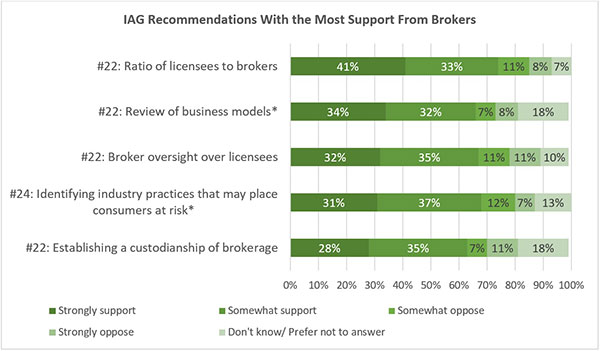
In late 2017 and early 2018, BCREA worked with NRG Research Group Inc. to understand the realities of operating a real estate brokerage in BC, and learn more about broker reactions to specific IAG recommendations. The project included focus groups and an online survey.
These are the top five issues and concerns for brokers:
- increased compliance,
- increased liability and risk as new Rules take effect,
- overall profitability of the brokerage,
- prohibition of limited dual agency, and
- training and focus on professional standards of licensees.
While seven IAG recommendations relate directly to managing brokers, several of them have multiple aspects. These recommendations have the strongest support:
- #22: identify and implement ways to improve managing broker supervisory effectiveness, including a maximum ratio of licensees per supervising managing broker
- #24: identify industry practices that may be placing consumers at risk
- #22: strengthen the requirements for managing brokers to have active and direct oversight over licensees
- #22: undertake a thorough review of new business models to ensure appropriate governance and oversight of licensees and public protection
- #22: provide the Real Estate Council with authority to establish a custodianship of the brokerage for a limited time, to facilitate the orderly winding down or transfer of a business where the managing broker is not able to discharge their responsibilities
A summary of the research, including the recommendations managing brokers like least and the ones that are too vague to be supported or opposed, is available on REALTOR Link®.
To subscribe to receive BCREA publications such as this one, or to update your email address or current subscriptions, click here.
Managing Brokers Invited to Webinar on Fall 2020 Standard Forms Release
On September 16, BCREA will release seven new standard forms, three new clauses and a significant number of revisions to existing forms. Managing brokers are invited to join the virtual Managing Broker Community of Practice on Wednesday, August 19 at 10:00 am to learn more about the upcoming standard forms release. To register for the Community of Practice webinar, please click here.
During this webinar hosted by BCREA, we will give managing brokers an idea of what to expect from the new forms, clauses and form revisions. Managing brokers who attend the webinar will also receive a PowerPoint presentation outlining the form revisions to present to their brokerage, along with advance copies of the new forms and other training and reference material.
This information will also be shared with REALTORS® throughout August and September on the BCREA website and social media channels.
On August 5, BCREA will launch the Standard Forms Resource Centre, a new platform for Realtors and managing brokers to access training resources for BCREA standard forms. Learn more here.
If you have questions about standard forms, please visit bcrea.bc.ca/standardforms or e-mail us at [email protected].
To subscribe to receive BCREA publications, or to update your email address or current subscriptions, click here.
Managing Brokers’ Conference Now Open To All REALTORS®
Registration for BCREA's upcoming Ideas Into Action Managing Brokers' Conference is now open to all REALTORS®. The conference, taking place at Kelowna's Coast Capri Hotel on October 16-17, will focus on issues facing managing brokers but the topics are sure to be of interest to all REALTORS®. Plus, attendees receive 3 category C PDP credits.
Registration and Hotel Booking
Registration is $200 plus fees and taxes and includes an invitation to a welcome reception at Summerhill Pyramid Winery on October 16. Click here to register and don't forget to RSVP for the reception! (Guest tickets are available for purchase, so you can share the opportunity with colleagues, friends or partners).
The deadline to book hotel rooms at BCREA's special rate is October 2! Rooms are available for $159, plus taxes, at the Accent Inn. The group code for booking on www.accentinns.com is 5747488. The rate is also set up for one day pre and post should you require additional nights.
Conference Program
Here’s a taste of just some of the conference content you can expect:
- Best practices related to money laundering risk – Henry Tso from MNP, a Canadian accounting, tax and business consulting firm with deep experience in best practices related to money laundering risk, will lead this session. Henry previously led one of the RCMP’s largest financial crime teams in Canada and has worked for over 20 years fighting financial crime.
- Professional Development Program transition – This session will ensure you're ready for the transition to the new Professional Development Program (PDP) framework on January 1, 2020.
- Mobile app sneak preview – in keeping with the theme of the conference, you’ll be introduced to a new mobile app that will support BC REALTORS® with timely resources and professional development.
Plus, you’ll learn about risk management from the Real Estate Errors and Omissions Insurance Corporation, get updates from the Real Estate Council of BC and the Office of the Superintendent of Real Estate, and learn about BCREA’s provincial advocacy work.
You’ll find more program information on Eventbrite and Facebook.
Managing Online Communities While Returning to Operation
With Phase 2 of BC’s Restart Plan underway, REALTORS® may encounter concerns or criticism from consumers, especially online. In the latest episode of Open House by BCREA: Returning to Work and Risks to REALTOR® Reputation, Ari Indyk, VP Crisis and Risk at Edelman, provides advice on mitigating and responding to consumer concerns as we navigate this “new normal.” Below, you will find some of Ari’s tips for managing your online communities while returning to operation.
1. Communicate proactively
“Clearly communicate about the operational and policy changes you’ve implemented and how they’re intended to protect employees, clients and the broader public.”
Ensure you’ve communicated with your online community about the ways you’ve adapted your operations to prioritize the health and safety of your clients and employees. Share this proactively across your communication channels – social media, website, newsletter, etc. – to reduce the potential for confusion, concern or misinformation, and prepare your clients for what to expect during your next business interaction.
2. Develop a list of FAQs
“Start to think through some of those high-risk, high-possibility questions you might be receiving from your clients about how you’re reacting to COVID-19 or how it impacts the transaction process.”
Whether formally or informally, prepare a list of frequently asked questions you anticipate receiving from your clients about how you’ve adapted your business practices to prioritize health and safety. This will allow you to respond quickly when you receive a question or concern from a client or online community member.
3. Continue marketing but “solve, don’t sell”
“Canadians don’t expect that local businesses are going to stop marketing their services, but there does need to be a change in approach within the current environment. This can be summed up with, ‘solve, don’t sell’.”
While your clients don’t expect you to stop marketing altogether, it’s important to remember the golden rule of marketing: “solve, don’t sell.” When promoting yourself online or through social media, emphasize how your services can help solve a need, while being sensitive to the ways the pandemic may have affected your clients.
4. Avoid tone-deaf marketing content
“When thinking about the [marketing] content you’re developing, make sure it’s social distancing appropriate and aligns with the current health guidelines in your region.”
Always consider the pandemic when developing marketing content and ensure it's aligned with current health and safety guidelines. For example, avoid using imagery that suggests you are not following social distancing protocols or other recommendations from the Provincial Health Officer.
5. Think before you type
“Remember, whatever you write on the internet is going to be there forever, so think twice before you start commenting online.”
When responding to negative feedback online, make sure you have a coherent response thought out, as well as escalation pathways if the conversation continues. This could mean taking the conversation offline rather than leaving it in full public view and preparing for follow-up questions your response might receive.
For more tips on mitigating and responding to consumer concerns as you resume operations, listen to the full episode of Open House by BCREA: Returning to Work and Risks to REALTOR® Reputation with Ari Indyk, VP Crisis and Risk at Edelman.
To subscribe to receive BCREA publications, or to update your email address or current subscriptions, click here.
Market Activity Endures Through Foreign and Domestic Headwinds
For the complete statistics release, including detailed tables, click here.
Vancouver, BC – May 11, 2026. The British Columbia Real Estate Association (BCREA) reports that 6,311 residential unit sales were recorded in Multiple Listing Service® (MLS®) Systems in April 2026, down 1.9 per cent from April 2025. The average MLS® residential price in BC in April 2026 was up 0.8 per cent at $952,768 compared to $944,796 in April 2025.

Total MLS® residential sales dollar volume was $6.01 billion, down 1.1 per cent from the same time the previous year. BC MLS® unit sales were 25.38 per cent lower than the ten-year average for the month of April.
“Challenges in the local economy and labour market, combined with upward pressure on rates due to the ongoing oil supply shock, are continuing to suppress pent-up demand and weaken overall market activity,” said BCREA Chief Economist Brendon Ogmundson. “However, modest monthly gains (seasonally adjusted) in some regions hopefully depict the beginning of a broader stabilization in housing activity, underpinned by improved affordability conditions that should encourage prospective buyers to enter the market.”
Year-to-date, BC residential sales dollar volume is down 9.5 per cent to $18.7 billion, compared with the same period in 2025. Residential unit sales are down 7.6 per cent year-over-year at 20,059 units, while the average MLS® residential price is also down 2 per cent to $932,492.

Market Activity Flounders Throughout the Province
For the complete statistics release, including detailed tables, click here.
Vancouver, BC – March 12, 2026. The British Columbia Real Estate Association (BCREA) reports that 4,516 residential unit sales were recorded in Multiple Listing Service® (MLS®) Systems in February 2026, down 9.7 per cent from February 2025. The average MLS® residential price in BC in February 2026 was down 2.9 per cent at $932,243 compared to $960,572 in February 2025.

Total MLS® residential sales dollar volume was $4.21 billion, down 12.3 per cent from the same time the previous year. BC MLS® unit sales were 32.87 per cent lower than the ten-year average for the month of February.
“Housing market activity continues to struggle, with sales declining from every region in the province compared to the same time last year,” said BCREA Chief Economist Brendon Ogmundson. “We hope that improved affordability conditions in most regions and stable rates will motivate prospective demand to enter the market and drive stronger sales activity over the rest of the year.”
Year-to-date, BC residential sales dollar volume is down 17.8 per cent to $7.3 billion, compared with the same period in 2025. Residential unit sales are down 15.8 per cent year-over-year at 7,832 units, while the average MLS® residential price is also down 2.4 per cent to $929,323.

Market Activity Shows Encouraging Signs of Improvement
For the complete statistics release, including detailed tables, click here.
Vancouver, BC – July 13, 2026. The British Columbia Real Estate Association (BCREA) reports that 7,225 residential unit sales were recorded in Multiple Listing Service® (MLS®) Systems in June 2026, up 0.9 per cent from June 2025. The average MLS® residential price in BC in June 2026 was down 0.8 per cent at $946,878 compared to $954,712 in June 2025.

Total MLS® residential sales dollar volume was $6.84 billion, up 0.1 per cent from the same time the previous year. BC MLS® unit sales were 18.4 per cent lower than the ten-year average for the month of June.
“Sales rose year-over-year in June for the first time since September 2025, driven by stronger activity in the Greater Vancouver area,” said BCREA Chief Economist Brendon Ogmundson. “We hope this marks the beginning of a stronger second half of the year across BC housing markets as sales converge to more normal levels following several years of unexpected global shocks.”
Year-to-date, BC residential sales dollar volume is down 6.4 per cent to $31.96 billion, compared with the same period in 2025. Residential unit sales are down 5.4 per cent year-over-year at 33,886 units, while the average MLS® residential price is also down 1.1 per cent to $943,249.

Market Activity Strengthens as Uncertainty Wanes
For the complete news release, including detailed statistics, click here.
Vancouver, BC – August 13, 2025. The British Columbia Real Estate Association (BCREA) reports that 7,056 residential unit sales were recorded in Multiple Listing Service® (MLS®) Systems in July 2025, up 2.2 per cent from July 2024. The average MLS® residential price in BC in July 2025 was down 2.1 per cent at $942,686 compared to $963,047 in July 2024.

The total sales dollar volume was $6.7 billion, virtually unchanged from the same time the previous year. BC MLS® unit sales were 16 per cent lower than the ten-year July average.
“Housing markets across BC continue to build momentum through the summer, with all regions apart from the Lower Mainland boasting higher sales activity from the previous year,” said BCREA Chief Economist Brendon Ogmundson. “With a stable trajectory for monetary policy, we expect sales in the province will continue to improve as tariff uncertainties fade.”
Year-to-date, BC residential sales dollar volume is down 9.4 per cent to $40.8 billion, compared with the same period in 2024. Residential unit sales are down 5.7 per cent year-over-year at 42,895 units, while the average MLS® residential price is also down 3.9 per cent to $952,323.

Market Momentum Continues into the Fall
For the complete news release, including detailed statistics, click here.
Vancouver, BC – October 15, 2019. The British Columbia Real Estate Association (BCREA) reports that a total of 6,938 residential unit sales were recorded by the Multiple Listing Service® (MLS®) in September, an increase of 24 per cent from the same month last year. The average MLS® residential price in the province was $697,943, an increase of 2.1 per cent from September 2018. Total sales dollar volume was $4.84 billion, a 26.5 per cent increase from the same month last year.
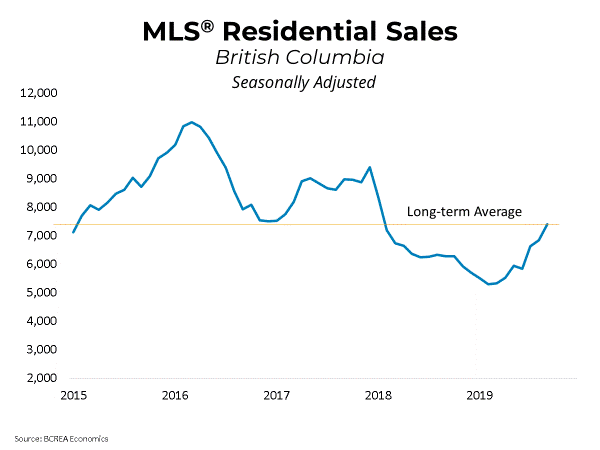
“Markets across BC built on momentum from the summer,” said BCREA Chief Economist Brendon Ogmundson. “While the year-over-year increase in provincial sales was quite strong, home sales in most areas are simply returning to historically average levels.”
MLS® residential active listings in the province were up 4 per cent from September 2018 to 39,117 units and were essentially flat compared to August on a seasonally adjusted basis. Overall market conditions remained in a balanced range with a sales-to-active listings ratio of about 18 per cent.
Year-to-date, BC residential sales dollar volume was down 12.4 per cent to $39.7 billion, compared with the same period in 2018. Residential unit sales were 8.9 per cent lower at 57,773 units, while the average MLS® residential price was down 3.9 per cent year-to-date at $687,530.
-30-
For more information, please contact:
Brendon Ogmundson
Chief Economist
Direct: 604.742.2796
Mobile: 604.505.6793
Email: [email protected]
To subscribe to receive BCREA publications such as this one, or to update your email address or current subscriptions, click here.
Market Recovery Continues at an Uneven Pace Across BC
For the complete news release, including detailed statistics, click here.
Vancouver, BC – January 13, 2026. The British Columbia Real Estate Association (BCREA) reports that 4,271 residential unit sales were recorded in Multiple Listing Service® (MLS®) Systems in December 2025, down 5.9 per cent from December 2024. The average MLS® residential price in BC in December 2025 was down 5.6 per cent at $952,061 compared to $1,008,513 in December 2024.

Total MLS® residential sales dollar volume was $4.1 billion, down 14.5 per cent from the same time the previous year. BC MLS® unit sales were 18.5 per cent lower than the ten-year average for the month of December.
“Weakness in provincial market activity was concentrated in the Lower Mainland in 2025, with sales across the province recovering at different rates from tariff uncertainty,” said BCREA Chief Economist Brendon Ogmundson. “Looking ahead, we hope that steady mortgage rates and fading trade uncertainty with the US will strengthen demand, leading to a broader recovery in the housing market.”
Year-to-date, BC residential sales dollar volume is down 8.3 per cent to $67 billion, compared with the same period in 2024. Residential unit sales are down 5.6 per cent year-over-year at 70,255 units, while the average MLS® residential price is also down 2.9 per cent to $953,345.

Marketing – Another Product? #91
By Gerry Neely
B.A. LL.B.
For some years Victoria has had double the average population of Canadians over the age of 65 years, the result, of course, of its incomparable beauty and moderate climate.
Over the next 30 to 40 years, Canada overall is expected to see a doubling of its population over this age. New alternatives to traditional housing are being developed to meet the needs of this enlarging group. The ingenuity of an experienced real estate licensee or an academic with time to spend, might provide the solution for the following problem.
For the third time in the last two years, I have had a client discuss the opposite consequences of inflation upon the value of his home, and the purchasing power of his pension. His pension, through inflation, currency devaluation and other factors, no longer allows him and his wife to travel or to enjoy the other percs that it provided at the time of his retirement.
In the meantime, inflation has substantially increased the value of his home to the point where, if he sold, the income earned from the proceeds of sale would provide him with extra income even after payment of rent and payment of income tax on the investment income. Mortgaging the house to provide the capital appears to be impractical. On the other hand, he and his wife like their home and want to live there during their lifetimes.
The question then is, what price might someone pay to purchase their home at a value discounted to reflect the life expectancies of both the husband and wife? In return for a discounted price, the husband and his wife would remain in possession by receiving a life interest in their property.
How many factors, apart from present market value and life expectancy, would decide the discounted price? The principal risk for the investor is that our clients might live longer than their expected lifetimes. The benefit, as macabre as it sounds, is that they might die in a plane crash a year from now, since the purpose of getting capital now is to enable them to travel later. Secondary risks include the failure to keep the premises in repair, or a failure to pay taxes and insurance. Those risks, of course, can be dealt with by providing for the termination of the life estate for default by the life tenant with appropriate provision for notice and rectification of default.
On the question of repair, the best risk would be a piece of land that might be a key to a future development in which the value of the building would be zero. A medium risk for repair would be the condominium in a steel and concrete building.
Perhaps there is a market here to be explored. More older people are now willing to defer municipal taxes from year to year than they were when this opportunity was first provided by legislation. This indicates that more people are taking the view that the assets are for themselves to enjoy rather than to accumulate for their heirs.
The following alternatives may help to define the circumstances that clients in this position would consider:
- They are able to live in the premises until both are deceased, or until they are no longer able physically to live in their home, whichever first occurs.
- They are able to live or to enjoy the use of the premises until the death of both of them, which would mean that they could, if they wished, sublet the premises in the event that they had to enter a personal care home.
Any answers?
To subscribe to receive BCREA publications such as this one, or to update your email address or current subscriptions, click here.
Marketing Decisions Can Be Significant #485
A decision as to whether a seller should market multiple lots separately or as a package is usually considered a marketing decision, but it can have legal implications as well.
In this case,1 the seller offered two separate commercial properties for sale as a package. Each property was subject to a right of first refusal (RFR) in favour of the respective tenants. Each RFR provided that the tenant would have a right to purchase the property at the price and on the terms offered by any third party.
The seller accepted a single offer to purchase both properties as a package subject to the seller receiving notice that the respective tenants had not exercised their RFR. The condition precedent provided that if the subjects were not waived or satisfied by a certain date the accepted offer would be null and void. The two properties were of significance to the buyer as their purchase would give the buyer control of the whole block for redevelopment. One wonders if that fact lead to the decision to market the two properties as a package.
As required by each RFR the seller sent the accepted offer to both tenants. The tenant of the first property on McPherson Avenue did not exercise its RFR, but the tenant of the other parcel (Kingsway Property) sent the following letter to the seller:
"Since your letter and accepted Offer to Purchase included two properties for sale for one aggregate price, and since we understand that the holder of the right to purchase the property on McPherson Avenue has waived its rights under such right of first refusal we take the position that your letter amounts to an offer to sell both of the two properties to us at the aggregate price for both properties, all on the terms of the Offer to Purchase that you forwarded to us."
Upon receipt of the letter, the seller advised the buyer that the tenant of the Kingsway Property had exercised its RFR and as a result the accepted offer was null and void. The seller returned to the buyer the deposit held pursuant to the accepted offer and entered into an agreement to sell the two parcels to the tenant.
The buyer refused to accept that result and sued for specific performance of the accepted offer arguing that the RFR on the Kingsway Property could not be exercised with respect to the property on McPherson Avenue and in attempting to do so the tenant of the Kingsway Property had failed to properly exercise its RFR. One assumes the buyer sued for specific performance rather than damages because of the unique nature of the two properties and their importance in the land assembly.
The BC Court of Appeal concluded that despite the unsegregated nature of the two properties, the Kingsway RFR was still triggered by the buyer's accepted offer. It also concluded that the letter sent by the Kingsway tenant constituted an effective exercise of its RFR.
The Court agreed with the buyer that the Kingsway RFR did not entitle the tenant of the Kingsway Property to purchase the McPherson Avenue property. However, by exercising its RFR, the Kingsway tenant rendered the buyer's accepted offer null and void. Once the buyer's accepted offer ceased to exist, the seller could sell both parcels as a package to the tenant outside of the parameters of the RFR.
In this case the decision to market the two properties as a package rather than separately was significant. Had the properties been marketed separately and had the buyer made separate offers for each property, the tenant's exercise of the Kingsway RFR would only have rendered the offer on the Kingsway Property null and void and would not have affected the offer on the McPherson Avenue property.
Brian Taylor
Bull Housser LLP
| 1. |
|
Markets at a Glance
Markets Remain in Balance Heading into Summer
For the complete news release, including detailed statistics, click here.
Vancouver, BC – June 13, 2024. The British Columbia Real Estate Association (BCREA) reports that 8,075 residential unit sales were recorded in Multiple Listing Service® (MLS®) systems in May 2024, a 11.6 per cent decrease from May 2023. The average MLS® residential price in BC in May 2024 was down 1.5 per cent at $1 million, compared to an average price of $1.02 million in May 2023. The total sales dollar volume was $8.1 billion, a 13 per cent decline from the same time the previous year.

"Markets could not match the surge in home sales that occurred this time last year," said BCREA Chief Economist Brendon Ogmundson. "However, we are starting to see a pick-up in sales activity to more normal levels, which, combined with rising inventory, is helping to keep markets in balanced territory."
Year-to-date, BC residential sales dollar volume was up 2.7 per cent to $31.5 billion, compared with the same period in 2023. Residential unit sales were flat year-over-year at 31,573 units, while the average MLS® residential price was up 2.6 per cent to $997,899.

Masks Recommended for REALTORS® and Clients as BC Introduces New COVID-19 Measures
The British Columbia Real Estate Association (BCREA) recommends REALTORS® and your clients once again wear masks while conducting open houses and private showings as a result of rising COVID-19 case numbers and the BC government’s recent announcement that beginning August 25, people 12 and older – both vaccinated and unvaccinated – will be required to wear a mask in indoor public spaces.
The government also announced that proof of vaccination through a provincial vaccine card will be required for participation in discretionary activities beginning on September 13.
BCREA is currently seeking more information about the mask mandate and vaccine card as they relate to real estate transactions, but in the interest of keeping the public safe and stopping the spread of COVID-19, BCREA recommends Realtors and clients be vigilant and wear masks in indoor spaces when conducting real estate transactions. We also recommend brokerages review their health and safety plans and act accordingly.
The government has indicated that the mask mandate is temporary and will be reassessed as the BC vaccine card is fully implemented. Until then, masks will be required in areas such as malls and shopping centres, retail and grocery stores, restaurants and bars, public transportation, schools, and more. Proof of vaccination will be required for indoor concerts, sporting events, movie theatres, gyms, and more.
For more details about BC’s latest COVID-19 orders, restrictions, and guidance, click here. As more information becomes available or if these recommendations change, BCREA will update Realtors accordingly.
Throughout the pandemic, Realtors have prioritized public health and safety. As the pandemic continues, we encourage brokerages and Realtors to review public health orders and COVID-19 best practices to ensure minimizing the impact of COVID-19 remains a priority.
Material Latent Defect Versus Latent Defect. Is There a Difference? #486
Two major disclosure duties govern every listing REALTOR®. Common law requires the Realtor to disclose any known latent defect. At the same time, the Real Estate Council of British Columbia (Council) demands compliance with the Material Latent Defect Rule.1 Are these two requirements the same?
Common Law Latent Defect
Under common law, the onus is on a buyer to satisfy him or herself about the quality of the real property being sold.2 It is the buyer's job to find any patent defect, being one discoverable by a reasonable inspection or reasonable inquiry. A latent defect is the opposite. The courts effectively define a latent defect as one that is not discoverable by a reasonable inspection or inquiry, and which makes the property dangerous or uninhabitable.3 A seller or listing Realtor must disclose any known latent defect. They may disclose verbally, but written disclosure is the best practice.
A recent Alberta case, McKenzie v. Smith, is a good illustration.4 The sellers' underground sewer line suffered infiltration by tree roots. The sellers knew there was a history of sewer problems, including a backup, but did not disclose it. These problems could not be discovered by a reasonable inspection. They were underground without telltale signs of previous sewer difficulties. Shortly after completion the sewer backed up again, making the basement uninhabitable for the buyers, who sued the sellers. The court found the sellers liable under common law for failure to disclose this latent defect.
Material Latent Defect Rule
Council's Material Latent Defect Rule is broad, covering circumstances corresponding to a common law latent defect, plus more. The Rule defines a material latent defect as:
 |
" …[a] material defect that cannot be discerned through a reasonable inspection of the property, including any of the following: |  |
5 | |||
| (a) | a defect that renders the real estate | |||||
| (i) | dangerous or potentially dangerous to the occupants, | |||||
| (ii) | unfit for habitation, or | |||||
| (iii) | unfit for the purpose for which a party is acquiring it, if | |||||
| (A) | the party has made this purpose known to the licensee, or | |||||
| (B) | the licensee has otherwise become aware of this purpose; | |||||
| (b) | a defect that would involve great expense to remedy; | |||||
| (c) | a circumstance that affects the real estate in respect of which a local government or other local authority has given a notice to the client or the licensee, indicating that the circumstance must or should be remedied; | |||||
| (d) | a lack of appropriate municipal building and other permits respecting the real estate." | |||||
Unlike the common law, the Rule also demands written disclosure before entering an agreement.
The Council Rule Demands More
Generally, a common law latent defect is a very significant problem, usually involving risk to health or habitability as in the McKenzie case.
Yet, the broad wording of the Material Latent Defect Rule covers a wide range of problems, from the very serious to those without any physical danger at all. For example, in a recent discipline decision a residential property contained two rental suites.6 Neither suite had the necessary municipal permit. The Data Input Form ambiguously said, "Suite: None, Unauthorized Suite". There was no completed Property Disclosure Statement (PDS). The Council found that both listing Realtors breached the Material Latent Defect Rule by failing to tell the buyer in writing, before entering an agreement, that the suites were unauthorized.
It is easy to confuse the two standards. The terms latent defect and material latent defect are similar. The standard PDS may also confuse some. The PDS defines material latent defect for the seller, but only cites that part of the Council's definition equivalent to a common law latent defect. The PDS asks if the seller is aware of any material latent defect (the Council's term), being one that renders the real estate dangerous or potentially dangerous to the occupants, or unfit for habitation (effectively the common law definition).
The two requirements are not the same, but if you always abide by the Material Latent Defect Rule, you will likely meet the demands of both the Council and common law.
Mike Mangan
B.A., LL.B.
Measuring Commercial Premises #441
A recent case confirms that when listing a commercial property, a licensee should break down the rentable area of each floor.1
The property was a building in Kamloops consisting of a main floor and mezzanine.2 On April 16, 2004 the licensee's brokerage listed the property for sale. The buyer was a corporation in the business of purchasing and leasing commercial properties. The licensee acted as dual agent, representing both seller and buyer.
When the President of the corporation asked about the square footage of the main floor, the licensee said it was 20,000 square feet. The President understood that figure to refer only to the main floor, and not to include the mezzanine and storage areas.
During negotiations, the licensee gave the President an excerpt from a recent appraisal which indicated the building area was approximately 19,543 square feet.
On approximately April 21, the parties entered a Contract of Purchase and Sale for the property for $1.1 million in which the premises were described as having approximately 19,544 square feet of rental space. The deal was subject to the buyer completing a feasibility study.
Before removing subjects, the buyer received the complete construction plans for the building and a building inspection report stating the building was approximately 20,000 square feet, with 16,000 square feet of production floor and 3,000 square feet of office space.
Meanwhile, the buyer found a tenant for the space and, apparently relying on the licensee's earlier remarks, told the tenant there were 20,000 square feet on the main floor. On June 8, subject to completing the purchase, the buyer entered an agreement to lease to a tenant who understood that the building contained 19,543 square feet on one level.
The sale completed on July 16 and the licensee ultimately received $38,500 in commission. The evidence revealed that as of September 2004, the fair market value of the building was $1.4 million.
When the tenant moved into the building, the tenant discovered that the main floor was only about 17,400 square feet. The buyer, as landlord, agreed to renegotiate the lease and, in the end, spent roughly $216,924 to build the tenant an addition.
The buyer sued the seller, the listing brokerage and its licensee, claiming approximately $307,914 in damages, being the present value of lost revenue over the 20-year term of the lease to the tenant. The lost revenue flowed from the difference between the property's actual rentable area versus the rentable area promised during negotiations, plus the cost of the addition to the building.
The seller claimed the REALTOR® negligently misrepresented the rentable area and failed to determine the building's rentable area. The court dismissed the negligent misrepresentation claim. Despite the licensee's negligent remarks, the buyer's President could not reasonably rely on them in the face of the building plans, the appraisal and the inspection report, all of which indicated the main floor did not contain all the rentable area. On the other hand, the court allowed the negligence claim, saying:3
| I find that (the listing licensee) was negligent in this matter. I accept the evidence that a realtor has an obligation to determine the rentable area of the building and to so inform the purchaser. (The listing licensee) should have broken down the rental space of every floor and recognized that it is not acceptable practice to inform the purchaser of the total rentable area if the total rentable area is made up of a floor and mezzanine. |
That negligence claim failed, however, for lack of damages. The buyer's reliance on the licensee's remarks did not cause a loss because it bought a building worth far more than the purchase price.
The court did award $1,000 in nominal damages against the licensee and his brokerage for breach of his agency contract. As the buyer's agent, he failed to ensure the completeness and accuracy of his information.
The Real Estate Council stresses caution and consistency when measuring any property. In a commercial property, the Council recommends that a licensee use the Standard Method of Floor Measurement for Office Buildings used by members of the Building Owners and Managers Association of British Columbia (BOMA BC).4
| 1. |
|
|
| 2. |
|
|
| 3. |
|
|
| 4. | Professional Standards Manual, 7th ed. (Vancouver, Real Estate Council of British Columbia, 2010) |
To subscribe to receive BCREA publications such as this one, or to update your email address or current subscriptions, click here.
Meet BCREA’s Vice President of Government Relations and Stakeholder Engagement

BCREA would like to give a warm welcome to our new Vice President of Government Relations and Stakeholder Engagement, Trevor Hargreaves! Trevor brings a wealth of knowledge to our Government Relations department, with wide-ranging experience in government and public relations and strategic communications, all necessary components to successful advocacy.
A seasoned pro in the Government Relations arena
Trevor is no stranger to advocacy in a complex industry, with his most recent role being Director of Communications, Government and Public Relations at the British Columbia Dairy Association. In this role, Trevor represented dairy farmers across BC and advocated for the dairy industry with all levels of government, media, special interest groups and other industry associations. Trevor will work in a similar capacity to ensure the voices of BC REALTORS® are heard loud and clear.
Looking ahead: proactive measures and a united voice
As Vice President of Government Relations and Stakeholder Engagement, Trevor will take a proactive approach to asserting our policy positions and getting ahead of issues affecting REALTORS® and real estate in BC.
He will also work towards uniting the voice of organized real estate in BC. "I very much respect that the real estate boards are concerned about the regionality of their issues, but many issues currently facing the industry are really provincial in scope whether that's immediately apparent or not," says Trevor. "My goal is to get us to a point where we're increasingly working to find solutions with a united voice."
To accomplish this, there will be ample consultation and dialogue with the real estate boards. "Guidance and input from the boards is essential to aligning our efforts and steering our industry perspectives in a collective and informed manner," Trevor adds. "I look forward to working collaboratively with the boards to achieve our shared advocacy goals."
We are so excited to welcome Trevor to the team, and to continue advocating on behalf of all BC REALTORS® with Trevor leading the charge.
To subscribe to receive BCREA publications such as this one, or to update your email address or current subscriptions, click here.
Meet the new BCREA: the voice of BC’s REALTORS®
On November 19, BCREA introduced its new brand identity, complete with a new logo, colour palette and approach to communicating with real estate boards and REALTORS®.

"It was the right time to rebrand," said Darlene Hyde, Chief Executive Officer of British Columbia Real Estate Association. "First, REALTORS® and real estate boards have been telling us that our brand was outdated and out of touch with the 'REALTOR® on the street'. Second, the launch of the new brand coincided with our move to a new, more cost-effective office. By combining the two, we were able to get the most value out of printing and other costs associated with our move."
The strategy behind the brand
While BCREA's new logo is the first thing REALTORS® will notice about the new brand, it’s the strategy behind the brand that is the most important.
"Our new brand reflects a real commitment to changing how we communicate and support REALTORS® and BC's 11 regional real estate boards," added Hyde. "We're devoting more energy to providing real-time information and resources to REALTORS® so they can add more value to their clients. We’re also putting more resources towards advocacy, so we can be more effective in making REALTORS®'s voices heard.”
The story behind the logo
That's exactly the sentiment captured in BCREA's new logo. The top half of the logo is composed of four peaks, created by the blue and orange arrows and the white spaces between them. They symbolize the four main property sectors: residential, commercial, agricultural and industrial. They also symbolize rooftops and BC's mountains.
The lower half of the logo represents both a speech bubble and an open single quotation mark, symbolizing BCREA's role in starting, facilitating and contributing to important conversations between real estate boards, REALTORS®, consumers, government and other partners. From advocacy and economics to education and standard forms, it expresses that BCREA is the voice of BC's REALTORS®.
To subscribe to receive BCREA publications such as this one, or to update your email address or current subscriptions, click here.
Mental Health and Mental Capacity in Real Estate Contracts #560
Mental health is always a topic worth discussing because, as conversations about mental health are becoming more and more open, we realize that it touches all of our personal and professional lives in some way. However, mental health issues are still very personal and private and generally up to individuals to discuss (or not) on their terms. This may create issues where there are questions about a person’s capacity to enter a contract, such as a listing contract or a contract of purchase and sale of real estate, making it a particularly relevant issue for real estate professionals to consider.
The general principle is that in order to enter into an enforceable contract, a person must have the mental capacity to do so. The goal of this rule is to ensure that a person is capable of understanding the contract terms and appreciating that they are committing to certain legally binding obligations. This is one of the reasons that people under the age of 19 are not able to enter into enforceable contracts, except in rare, specific circumstances; this protects minors from committing to contract terms they may not be able to grasp fully. However, the courts will presume that an adult has capacity unless specific evidence proves the contrary.
There is also an important distinction in law between someone with mental health issues and someone who truly lacks the required mental capacity to enter into a contract. The Supreme Court for British Columbia has recently cautioned against blurring “the concepts of mental health disability, mental illness, and lack of capacity” (Binng v Gill, 2022 BCSC 1479 at paras. 144 ff.). Proving a lack of mental capacity is an extremely high bar, since the courts are very hesitant to interfere in parties’ existing contracts, given the economic and other turmoil that the resulting uncertainty would create. It also furthers the important public policy interest in protecting disability rights, which are guaranteed under the Canadian Charter of Rights and Freedoms, the BC Human Rights Code, and the Canadian Human Rights Act, by recognizing the critical difference between someone who has a disability and someone who is truly incapable, a difference that for many years was not recognized, resulting in great harm and discrimination to many disabled persons.
These distinctions are not always easy to determine, and questions about mental capacity can create a minefield of legal, privacy, and human rights issues. However, though difficult, they may need to be answered to properly protect a person’s interest in purchasing or selling property. Some indicators of mental capacity issues are:
- confusion about existing circumstances (date, reason for the meeting or discussion, identity of the parties),
- significant confusion about fundamental elements of the transaction, and
- repeated questions in a short period of time about key terms.
Capacity can also come and go. In other words, someone not legally capable of entering into a contract one day may be capable of doing so the next. It is a very fact-specific and sensitive analysis that may need to be repeated if contracts are being entered into at different times, for example, when making several offers or counteroffers.
In the context of a loan dispute, there is a helpful discussion about the factors in a lack of capacity analysis in the BC Civil Resolution Tribunal decision of iFinance Canada Inc. v B.M., 2021 BCCRT 164 at paras. 20-36.
REALTORS® owe a duty of care, and this includes ensuring that their clients have the mental capacity to enter into a contract. If a REALTOR® has concerns about a client's capacity to enter into a contract, particularly if there are indications of memory impairment, dementia, or other mental disabilities, they should take steps to address those concerns. In such cases, a REALTOR® should be especially vigilant and take extra precautions to ensure their client is fully aware of the contract terms and the legal obligations they are committing to.
If you have any concern about a client’s capacity to enter into a contract, or some concern about the capacity of the parties on the other side of a transaction, you should be taking steps to alert your clients to that concern. If the issue is your client’s capacity and you are not sure your client can instruct you any longer, you should talk to your managing broker and seek legal advice. Whether or not someone is capable of entering into a contract is a legal determination and is best made by a lawyer, often with the assistance of health care professionals.
Mental Health Awareness Month: Navigating the Stressful World of Real Estate
Real estate professionals face unique problems and challenges in their everyday practice, from the uncertain housing market landscape, long work hours, and other stressors, each taking a toll on their mental and physical health.
According to the findings of the survey on COVID-19 and mental health from the Centre for Addiction and Mental Health, one in every four Canadians aged 18 and older tested positive for signs of depression, anxiety, or posttraumatic stress disorder in spring 2021, up from one in every five (21 per cent) in fall 2020. The study also demonstrated that there is still a high level of stigma around discussing mental illnesses, let alone getting treatment for them, making this a priority and a public health issue.
Many real estate professionals, such as managing broker Josh Rosenberg, did not always have the tools to deal with the constant pressure that comes with working in the real estate profession, and hitting rock bottom with his mental health was a wake-up call. "I've seen colleagues suffer due to alcoholism, drugs, and marital problems, all of which were driven by stress or a lack of guidance on navigating those challenging times," he stated.
Andrew Carros, COO of Engel & Völkers Vancouver, and seasoned real estate professional shares his experience: "As someone who has experienced the mental health toll of the real estate industry firsthand, I can attest to the importance of prioritizing human connection over profitability." The general expectation of 24/7 work from REALTORS® and the pressure to show results not only at work but on social media often pile up and leads to burnout, alcohol and drug abuse, and even divorce. "It's time for us to learn how to let go, set boundaries, and slow down and deliver quality work. We need to offer mental health support and education to ensure that REALTORS® are equipped to handle the demands of this broken system. Regulators and other actors must take responsibility for fostering a healthy office culture and investing in personal and mental health mentorship and training for its professionals," Carros concluded.
Support from peers and building a safe workplace culture have helped other professionals navigate the industry's hurdles, like Tore Jacobsen, managing broker at Macdonald Realty. "I used to think that anxiety and stress were just a normal part of the job, but it wasn't until I hit my breaking point that I realized the importance of prioritizing my mental wellness," he explains. What started as mild anxiety turned into physical discomfort, chest pain, and other symptoms that led Jacobsen to visit the hospital several times before taking a break. "It wasn't until I sought help that I realized the importance of caring for myself. I openly shared my struggles with my colleagues, which sparked a conversation that helped others with similar issues. I urge everyone to seek help and talk about it – it's a critical step in the healing process. We should all prioritize mental health, and I'm grateful for the resources and support that have helped me along the way," Jacobsen added.
Discussions around mental health, stress, and depression in real estate have become more common after the COVID-19 pandemic. Given the scarcity of resources in the industry, Rosenberg took the lead in creating the Real Estate Assistance Program Society of BC (REAPS of BC), an independent organization of real estate professionals that offers peer support and services for other professionals looking for someone to talk to.
The society focuses on bridging the gap to get guidance for REALTORS®, managing brokers, and other real estate professionals dealing with stress, depression, anxiety, drug and alcohol dependence, and other treatable illnesses. "Receiving support from people who understand our struggles and the nature of our difficulties can be valuable. We want to connect other professionals with the proper resources to help overcome their situations, have a shoulder to cry on, and understand that it is okay not to be okay," Rosenberg added.
Should you or someone you know need help, or if you'd like to volunteer to support others, BCRW is recruiting volunteers in the real estate community who want to share their strengths, expertise, and hope with those who need it by creating a support system to provide encouragement and advice. You can volunteer or access REAPS of BC here.
Mental Health Week: Come Together, Canada
Monday to Sunday, May 4-10, 2026, is Mental Health Week
The Canadian Mental Health Association's theme for Mental Health Week 2026 is Come Together, Canada. 13 per cent of Canadians (15+) say they feel lonely “always or often.” In 2023, the World Health Organization declared loneliness and social isolation as a global health concern, including in the workplace.
For some people, having a quieter life with limited social interactions is exactly what they need. For others, they may be surrounded by people and yet feel lonely. Combating loneliness means finding the type of interactions and relationships that make you feel connected to others.
REALTORS® are often perceived as outgoing, social people, and the nature of their job requires them to interact with people each day. In reality, even a social person can experience loneliness, and daily interaction doesn’t always prevent feeling disconnected from people.
The Benefits of Social Connection
Research shows that strong social support is linked to:
- higher rates of well-being,
- greater safety and resilience,
- increased prosperity, and
- longer life expectancy.
Feeling connected can create a sense of belonging and positively impact self-worth. Positive social interactions activate our brain's reward system, releasing dopamine and oxytocin.
Health Risks
Loneliness can trigger and dysregulate our brain’s stress response, the hypothalamic-pituitary-adrenocorticotropic axis (the HPA axis), affecting our mood and emotional regulation, thinking, focus, memory, energy, immune function, and metabolism.
The health risks associated with prolonged feelings of loneliness include:
- depressive symptoms,
- self-harm and suicide,
- high blood pressure,
- stroke, and
- heart disease.
Support in the Workplace
Loneliness can impact not only someone’s mental health but also their job performance. People can experience a lack of motivation or creativity, as well as increased rates of burnout. Creating relationships at work can be difficult in a predominantly remote and digital work environment, but it is possible. Look for opportunities to bring people together that include time for non-work items or games. When meeting one-to-one, include both relational and transactional interactions.
Combating Loneliness in Your Personal Life
Finding opportunities for genuine interactions in our personal lives is also important. We often postpone social engagements due to work and home responsibilities, but as shown above, carving out time to catch up with friends and family can have a positive impact on our well-being. If you are looking to expand your social circle, you might consider exploring community events, volunteer opportunities, or recreational sports you could get involved in.
Mental Health Week
Mental Health Week is an opportunity to come together and build stronger bonds for better mental health. Ask yourself, how can you create a connection for yourself or positively influence the lives of others this Mental Health Week.
Find more resources at mentalhealthweek.ca and follow these Canadian Mental Health hashtags on Instagram: #MentalHealthWeek #cometogethercanada
Visit BCREA's new REALTOR® Wellness page for more information and support.
The information provided in this blog is intended for general informational and educational purposes only. It is not intended to provide medical, psychological, or other professional advice and should not be relied upon as a substitute for advice from a qualified health professional.
If you have concerns about your health or well-being, please consult a qualified medical or mental health professional.
Mentorship & Succession: Building a Strong Foundation
An effective mentorship program serves as a base for robust succession planning.
Mentorship focuses on developing people and leadership capacity over time, while succession planning ensures the brokerage is ready to manage change in a compliant and orderly way.
When seasoned professionals mentor and support up-and-comers, brokerages can nurture talent, instill core values, and ensure a steady flow of skilled individuals. Succession planning builds on that foundation by protecting organizational continuity, promoting stability, and strengthening sustained long-term success, allowing better management of changes as the need emerges.
To help with these important cornerstones, BCREA has designed the new Mentorship & Succession webpage, featuring a series of resources to help leaders build an efficient mentorship program and a valuable succession plan.
Mentorship
Mentorship benefits everyone: the mentor, mentee, and brokerage. It offers numerous advantages for the brokerage, fostering a pipeline of talent ready to step into leadership positions should the need arise.
It’s no secret that a well-run mentorship program requires an investment of time and energy. To make mentorship more accessible, BCREA has developed ready-to-use resources designed to support the three primary roles in any Mentorship Program – mentees, mentors, and managing brokers.
These materials address crucial stages of the process, such as applying to become a mentor or mentee, signing a mentorship agreement, and structuring effective meeting agendas. They also include how to secure feedback on the mentorship program to gather beneficial data and insights, so brokerages can evolve their programs and increase value.
Designed as fillable PDFs that brokerages can customize and brand with their logo, these resources facilitate mentor-mentee connections while assisting associate and managing brokers in overseeing the program.
These resources serve as a companion to BCREA’s new Building Future Leaders: A Blueprint for Brokerage Mentorship Programs course.
Find out more on the new Mentorship Program Resources page.
Succession
Succession planning is often something managing brokers intend to address later, after growth stabilizes or when retirement feels closer. In practice, it is one of the most immediate risk-management tools a brokerage can implement.
A strong succession plan protects more than the business itself. It protects licensees who rely on consistent supervision, clients who expect continuity of service, and the brokerage’s reputation in the marketplace. It also helps managing brokers continue to meet their legal obligations under the Real Estate Services Act, even when circumstances shift quickly.
To support managing brokers, BCREA has developed six succession planning resources that outline the core elements of an effective plan. These resources explain what a succession plan entails, highlight regulatory requirements to consider, and walk through practical issues such as selecting a successor or navigating the sale of a brokerage.
Rather than offering a one-size-fits-all solution, the resources are meant to help managing brokers build a plan that reflects their brokerage’s size, structure, and risk profile.
Succession planning is not about stepping away. It is about foresight, responsibility, and leadership. Strong brokerages do not leave continuity to chance. They plan for it, document it, and revisit it regularly.
Find out more on the new Succession Planning Resources page.
Metro Vancouver Cities Need Collaboration to Address Housing Affordability
At the 2022 Union of BC Municipalities (UBCM) Convention, delegates from BCREA and five of BC’s real estate boards met with municipal leaders to discuss how housing supply and affordability issues have impacted their communities. In advance of the upcoming civic elections, we are pleased to share what we’ve learned to help inform housing affordability discussions.
Embrace the diversity of Housing Supply Options
While rental housing is part of the solution to our housing crisis, Coquitlam Mayor Richard Stewart supports BCREA’s call for more housing supply to address housing affordability. Mayor Stewart reiterated that his municipality has not abandoned the idea that homeownership should be the ultimate goal for families.
One crucial component of addressing the need for supply is illustrated in BCREA’s report, A Better Way Home, where we advocate for the replacement of single-detached housing with more “Missing Middle” housing types (duplexes, triplexes, and fourplexes) to allow for more gentle densification. The demand for more Missing Middle housing has been echoed in many Housing Needs Reports from the Metro Vancouver region, including the cities of Langley, Maple Ridge, North Vancouver, Vancouver, as well as the District of West Vancouver.
“Having adequate, affordable housing options is a fundamental human need,” says Jeff King, CEO of the Real Estate Board of Greater Vancouver. “For too long, our region has struggled to ensure availability of the volume and variety of housing to meet this need.”
As the demand for more attainable, family-friendly housing options continues to rise, advancing Missing Middle housing options will become increasingly more crucial to British Columbians’ housing goals.
Increase Collaboration between Stakeholders and Government
Another major theme at UBCM’s housing affordability discussions is the importance of collaboration between stakeholder groups and levels of government.
As Mayor Stewart noted, if some cities are unwilling to prioritize housing needs, this exacerbates housing issues in neighboring cities and communities. We need to work together as we all share the responsibility to address housing affordability challenges.
BCREA continues to advocate for more collaboration among community stakeholders and all levels of government. A coordinated, collaborative approach is necessary to comprehensively identify obstacles to meeting housing supply demands, across the continuum of housing needs.
Other cities in the Metro Vancouver region, such as Burnaby and Langley, have identified the importance of collaboration between stakeholder groups and levels of government in their Housing Needs Reports.
Specifically, The City of Langley’s report recognizes the benefit of collaboration — improved resource sharing and the ability to effectively address British Columbians’ housing needs.
“Meaningful progress requires long-term planning and collaboration among all levels of government and community stakeholders.” Says Jeff King, “No one group or jurisdiction can do this alone and the real estate sector is willing to work with others to help tackle this regional challenge.”
Understanding the diversity of housing supply options and the necessity of collaboration will help voters make informed decisions. And as we approach the upcoming civic elections, which will be held on October 15, we encourage you to learn about the candidates running for councillors and mayors in your municipality.
Michael Trites Leads Provincial Real Estate Organization
British Columbia Real Estate Association Board of Directors 2019-2020
BCREA Board of Directors, staff and key stakeholders were pleased to welcome Michael Trites as the 2019-2020 President at the annual general meeting on March 26, 2019.
With more than 40 years as a licensed REALTOR®, Michael brings a wealth of knowledge and expertise to BCREA. He is currently the managing broker of Royal LePage Northstar Realty in South Surrey and White Rock and previously served as a director for the Fraser Valley Real Estate Board for four years.
"Working in organized real estate has always been a rewarding experience," says Michael. "In 2018, there was a lot of focus on helping REALTORS® adapt to change. In 2019, I look forward to helping shift that perspective and working with BCREA and the province's 11 member boards to lead change."
Joining Mr. Trites on the Board of Directors are President-Elect Anthony Bastiaanssen of the Okanagan Mainland Real Estate Board, where he was president in 2016; Past President James Palanio of Royal LePage Penticton; and BCREA CEO Darlene Hyde.
BCREA also welcomes new REALTOR® Directors Gian-Piero Furfaro (Victoria) and Janice Stromar (Vancouver Island). Returning REALTOR® Directors include Ray Harris (Port Coquitlam), Dan Morrison (Vancouver), Cory Raven (Vancouver) and Katherine Rutherford (Kamloops). Public Directors Kam Raman and Mark Sakai are also returning.
We look forward to the experience Michael and the new directors bring as dedicated professionals in organized real estate and we're excited to work more closely with them this year.
For more information and a high-resolution photo of Michael Trites, click here.
To read BCREA's full annual report, click here.
To subscribe to receive BCREA publications such as this one, or to update your email address or current subscriptions, click here.
Ministry of Finance Announces Shift to Single Regulator
Earlier this week the Ministry of Finance announced their intent to shift to a single regulator, wrapping real estate oversight into the BC Financial Services Authority (BCFSA). They are aiming for this new legislation to be tabled by Fall 2020, with implementation in 2021.

Under this new structure the Office of the Superintendent of Real Estate (OSRE) and the Real Estate Council of British Columbia (RECBC) will both be integrated into the BCFSA.
"While this is a significant announcement, there is still a great deal of work to be done in developing the structural specifics of this new regulatory model," said Trevor Hargreaves, BCREA VP of Government Relations. "BCREA will continue to consult with government in the coming days, weeks and months with a focus on urging government to craft smart policy that’s both efficient from a regulatory perspective and workable for the day-to-day realities of the real estate sector".
See full release here.
To subscribe to receive BCREA publications such as this one, or to update your email address or current subscriptions, click here.
Misrepresentation, Innocent; Mobile Home, Refusal of Landlord to Consent to Assignment #186
By Gerry Neely
B.A. LL.B
Normally, the listing agent for the owner of an existing home is unconcerned with set backs or other limitations which would affect the size and location of a home to be constructed upon the lot upon which the home sits. A recent decision may change that when the listing salesperson discovers that the prospective purchaser intends to demolish the home.
In the case in question, the City of Vancouver had passed a bylaw that prevented construction on the front 7' of a 50' x 1 10' lot, reserving this portion of the lot for possible future expropriation for road widening. This limitation was not (unsurprisingly) registered against title and no one involved in the transaction was aware of the bylaw until after the offer was accepted. When the purchaser discovered this limitation and refused to complete, the vendor sued for damages resulting from the sale of his property in a falling market.
The only representation made by the listing salesperson was the lot size. She made no mention of the 7' building restriction because she was unaware of it. The judge held that this was an innocent misrepresentation by omission. The effect of the bylaw was that there was a potential for expropriation of about 6% of the property and that if expropriation occurred, the travelled portion of the road would be that much closer to the house. In addition, siting of the proposed house and pool wanted by the purchaser would be more difficult. Again, none of this information was known to the listing salesperson.
The cumulative impact upon the purchaser's plans of the restrictions in the judge's opinion, meant that the lot she bought was fundamentally different from the lot which was offered for sale to her. The innocent misrepresentation was a material misdescription which entitled the purchaser to the return of her deposit and denied the vendor damages.
The decision is under appeal and it will be interesting to see the results of the appeal because the judge's findings impose a very rigorous duty of care upon a licensee.1
***
A recent case examined the question of whether the owner of a mobile home park acted reasonably in refusing a tenant's request for an assignment of the tenant's pad to a proposed purchaser of the tenant's mobile home. In 1988 the owner of the park, as landlord, gave notice to the tenants that to preserve the quality of the park and the value of the homes within it, no future sales of 10' wide mobile homes would be permitted.
Since pads were in short supply, the owner of a 10' wide could obtain a higher price for the unit if it was sold as part of a contract which included the assignment of a pad to the purchaser. The landlord had no objection to the purchaser or to the purchaser's proposed use of the home. The landlord's only objection was based upon its policy restricting the continued use of 10' wides. The question then was whether the landlord had acted arbitrarily and unreasonably in withholding its consent, contrary to Section 12 of the Residential Tenancy Act. The judge was satisfied that the landlord was entitled to consider the economic impact of an assignment on the value of the landlord's property. The judge also accepted evidence that as a general proposition, mobile homes do deteriorate over time, both in condition and value. The landlord's objective in preserving the value of its property and that of the mobile home owners in the park was reasonable.
However, there was no evidence that the tenant's mobile home was below the standards of maintenance of other homes in the park or that its condition reduced the value of the landlord's property or the value of the other mobile homes. The landlord's policy, as reasonable as it was in general terms, created an injustice to the tenant. As a result, the judge held that on these facts the landlord had acted unreasonably in withholding its consent to the assignment.2
| 1. | Tunner v. Novak et al S.C.B.A.., Vancouver Registry #C893872, October 10, 1991. | |
| 2. | Karpis v. Lark Enterprises Ltd. S.C.B.C., Vancouver Registry #CX914992, December 5, 1991. |
To subscribe to receive BCREA publications such as this one, or to update your email address or current subscriptions, click here.
Mobile Home – Freedom of Choice to List With Any Agent #60
By Gerry Neely
B.A. LL.B.
An arbitrator acting under the provisions of the Residential Tenancy Act has provided reasons for a decision involving the owner of a mobile home in a park, who had listed her home for sale with a real estate company not approved by the landlord. When the tenant had moved her home onto a pad in the park, the tenant had entered into a tenancy agreement which made the rules of the park part of the tenancy agreement. The Application for Tenancy which was signed by the applicant contained an acknowledgment on her part that she had read the park rules and that she agreed that they were entirely reasonable. The rules allowed her to sell her home privately if she wished to do so. If, however, she wished to employ an agent, then she was obliged to list the home for sale with two companies named in the rules.
When she listed her home with the agent of her choice and that agent placed his sign in the window of the tenant's home, the tenant's refusal to remove the sign resulted in a termination notice. The tenant asked for an order setting aside the Notice of Termination on the basis that her only objection to the park rules was the rule which restricted her freedom to sell through a real estate agent of her choice.
The arbitrator reviewed Section 4 of the Residential Tenancy Act, which describes the terms that are permitted in a tenancy agreement. Those terms must be reasonable and they must deal with the tenant's use, occupation or maintenance of the residential premises and/or a service or facility used in connection with those premises. The arbitrator's initial comment was that limiting a tenant's right to choose an agent had nothing to do with the terms permitted by Section 4. The arbitrator then said that if I am wrong in coming to this conclusion, can it be said that the refusal to allow the tenant to choose her own agent is reasonable. If it is not reasonable, then the rule limiting her to an agent chosen by the landlord would be unenforceable. The landlord's position was that the rule was necessary to protect the landlord's property from abuse, from real estate agents who would improperly conduct themselves on the park property. The landlord further argued that by granting a monopoly to certain companies to sell within the park, the convenience, safety and welfare of everyone residing in the area would be increased.
The difficulty for the landlord with that argument was that the officer of the landlord company who gave evidence acknowledged that he was the president of both the landlord company and one of the companies through which the tenant was expected to list her home for sale. The president also acknowledged that an indirect benefit of twenty five per cent commission was received on the mobile homes which the second company sold. The arbitrator also found as a fact that the landlord withheld its consent where the tenant wished to sell his or her home through an unauthorized company. The arbitrator examined Section 12 of the Residential Tenancy Act which allows a tenant to assign or sublet his interest in a tenancy agreement with the consent of the landlord, and provides that the landlord shall not arbitrarily or unreasonably withhold his consent to such assignment or subletting. As a result of his interpretation of these Sections and of his findings of fact, the arbitrator held that the rule restricting the sale of mobile homes to those companies listed in the rules, was unreasonable and therefore unenforceable.
The arbitrator delivered a final blow at the enforceability of the rule by stating that it was a breach of the fundamental freedom of association guaranteed by the Charter of Rights. The notice of termination was set aside and presumably the tenant was then free to sell through the agent of her choice.
This decision cannot be considered a precedent that will be binding upon other tribunals or Courts. It does, however, provide a reasonable interpretation of Sections 4 and 12 that can readily be followed in somewhat similar circumstances.
To subscribe to receive BCREA publications such as this one, or to update your email address or current subscriptions, click here.
Modification of an Easement Agreement #385
By Gerry Neely
B.A. LL.B.
When is an easement not an easement? "When the rights granted by it detract so substantially from the rights of the servient owner that it must be something other than an easement." This quote is from the reasons for judgment interpreting an easement agreement granting access over Lot 3 (the servient tenement) for the benefit of Lot 2 (the dominant tenement). The benefits included the right to "landscape, garden and enjoy the Easement Area as an integral part of Lot 2," in common with the owner of Lot 3.
The Lot 2 owners constructed a road through the Easement Area, which restricted the Lot 3 owner's access to her property for heavy equipment or a pickup truck, planted hedge trees that would potentially eliminate her water view, installed deer fences approximately eight feet high on either side of the Easement Area to protect the fruit trees and grapes they had planted in the Easement Area, constructed concrete pilasters to support trellises for grapes and took the fruit from pre-easement trees because they looked after them.
Eventually, the Lot 3 owner rebelled and sued to modify the easement by deleting the landscaping clause. The Lot 2 owners' position was that the rights of the Lot 3 owner to landscape and garden her property in the Easement Area were subject to their rights. If this argument prevailed, the Lot 3 owner might never be able to use her property. The judge agreed that there was no way both parties could landscape and garden within the Easement Area and ordered the deletion of the clause.1
* * *
Enforcement of hard flooring bylaw
In another hard flooring material case, a strata corporation had mixed success when it petitioned for an order directing an owner to remove the laminate flooring he installed. It contravened a flooring bylaw approved two years before the owner purchased his unit, requiring wall-to-wall carpet throughout second- and third-floor units except kitchens, bathrooms and five feet of the entry halls.
The owner neither asked whether laminate flooring was permitted nor searched in the Land Title Office for a copy of the bylaws before he made his offer. Instead, he relied on a "buyer's package" provided by the listing representative, whose evidence was that it contained a complete set of the bylaws. The judge didn't accept the owner's claim that the page containing the flooring bylaw was missing.
The owner was ordered to remove the flooring and replace it with carpet at his expense, but wasn't ordered to pay the legal costs normally paid to a successful party. While a strata corporation has the power to require an owner to pay the cost of remedying a contravention, it must first give the owner particulars of the complaint and a reasonable opportunity to answer it, including a hearing if the owner requests one. The strata corporation failed to do this and, therefore, had to bear its own costs.2
* * *
Indian Land Registry and First Nations Registry System
The Law Society of BC recently issued a practice watch concerning a completed sale of a sublease on First Nations land following registrations in the Indian Land Registry.
Some First Nations Bands, including the one in question, now have the right to create and run their own land registry systems. In this case, after all monies had been paid out, the lawyer acting for the buyer was notified by Indian and Northern Affairs Canada that the registrations had been cancelled and would have to be submitted for re-registration under the Band’s First Nations Registry System. The system for the Band in question wasn't in place at the time of the notification. Unfortunately, both the cancellation of the registrations and the failure to set up the Band's registration system potentially risked the title and priority interests of a buyer and mortgagee.
Lawyers who deal with First Nations land were advised to determine whether the land falls under the First Nations Land Management Act, and were referred to www.fafnlm.com for information.
To subscribe to receive BCREA publications such as this one, or to update your email address or current subscriptions, click here.
Money Laundering in Canada 2019
Join ABC solutions in Victoria, BC on September 23-25 for Money Laundering in Canada 2019, Canada’s premiere event in the field of money laundering compliance.

This year’s theme is Compliance: Making Sense of the Details. The conference promises to be informative and pragmatic, looking at trending crimes, risks, compliance practices and regulatory change. Speakers include the Honourable David Eby, Dr. Peter German and numerous experts in money laundering compliance. This annual conference is a great opportunity for professionals from all industries that could intersect with money laundering to gain deeper insight into their role in anti-money laundering compliance.
For the full program and registration form, click here.
To subscribe to receive BCREA publications such as this one, or to update your email address or current subscriptions, click here.
Monitoring COVID: BCREA Develops New Economic Resources
The COVID-19 Reopening Dashboard allows readers to monitor the evolution of the BC economy as the province gradually reopens. The dashboard focuses on the sectors and activities that have been most significantly impacted by the pandemic and the province’s subsequent state of emergency. The most recent update shows that home sales have more than fully recovered in BC and are now above pre-pandemic levels.
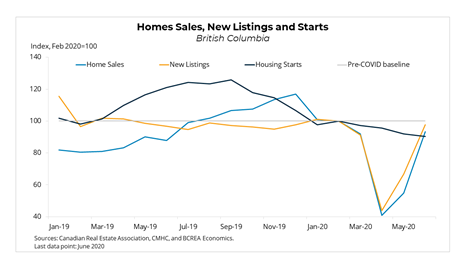
The Economics Impacts Dashboard helps to monitor the progression of COVID-19 and the impacts of the pandemic on the housing, employment and financial sectors in BC. There is also a “Chart of the Week” showcasing a new indicator and/or trend related to the pandemic. The current dashboard shows that the housing sector recovery is well underway, aided by record low mortgage rates, while the labour market is still finding its way back to pre-COVID-19 levels of employment.
The Commercial Leading Indicator (CLI), which BCREA has produced for several years, forecasts changes in broad commercial real estate activity. BCREA’s research shows that the variables composing the CLI reliably forecast BC commercial real estate activity at a lag of two to four quarters. The CLI was down again in the second quarter of 2020 as a result of the pandemic-induced shutdown of the economy. Going forward, it is expected that the environment for commercial real estate activity will continue to be weak. The next release will be at the end of November.
The BCREA Nowcast, another pre-existing publication, estimates monthly real GDP growth for BC, an important measure of the province’s overall economic performance. The most recent update shows the BC economy is recovering, albeit slowly. The economy is estimated to have contracted about 6 per cent in June, which is an improvement from the worst of the pandemic when the economy contracted an estimated -10.6 per cent in April. Including advance estimates for July, BC continues to see significant year-over-year negative growth, but month-over-month improvements, reflecting the ongoing reopening of the BC economy.
In addition to these resources, BCREA’s Economics department also continues with regular publications, including monthly statistics releases, occasional Market Intelligence Reports, quarterly Mortgage Rate Forecasts and more.
To subscribe to receive BCREA publications such as this one, or to update your email address or current subscriptions, click here.
More Caveat Emptor, Latent and Patent Examples #384
By Gerry Neely
B.A. LL.B.
The owners of a house, which was old when they bought it in 1979, sold it in 1994 to buyers who discovered after completion that the kitchen floor sloped 2.5 to five centimetres from one side to the other. The buyers elected not to retain a home inspector, although there were some cracks in the kitchen walls, which they thought were superficial. They claimed a slow foundation settlement was an undisclosed latent defect and sued for damages.
The sellers were used to living in older homes and saw nothing unusual about slightly sloping floors. All doors opened and closed properly, and the slope didn't interfere with their use and enjoyment of the kitchen. They had answered "No" to the Property Disclosure Statement (PDS) question asking whether they were aware of any structural problems.
The judge accepted that the sellers knew nothing of a structural problem, which would likely have been discovered by a qualified home inspector. This was a patent defect and caveat emptor applied, denying the buyers' claim.1
A buyer sued for damages when he discovered, after closing, that the house he bought sloped 12 inches from the west wall to the east wall, a distance of 48 feet. The buyer's examination of the property was limited, and the contract contained a condition that the offer was subject to an inspection. The slope was neither disclosed by the buyer nor detected by the inspector.
The judge decided the inspector was negligent and liable for damages, but the seller wasn't liable because the slope was a patent defect that didn't have to be disclosed.2
Buyers discovered a strong smell of rotten eggs and seepage came from the septic field of their newly purchased home when they used the toilets, washer and bathtubs. Further investigation revealed the water table was so high that the septic tank couldn't drain properly and sewage backed into it. The sellers had answered "No" to the PDS question asking whether there was a problem with the septic system.
The judge found the sellers must have known the condition of the septic field. It was a latent defect that they should have disclosed. Their misrepresentation entitled the buyers to damages of $15,000 to remedy the problem.3
The owner of a large 50-year-old home, which had been extensively remodelled by previous owners, added a bedroom, bathroom and hallway to a wing. This work was done without a permit and didn't comply with the current building code's minimum height requirements. The buyer only discovered this when the municipality prohibited use of the space and ordered the plumbing removed.
The two representatives who listed and sold the house recognized these rooms didn't comply with the current code. However, from their discussions with the owner they understood the improvements were old and, in their experience, municipalities didn't enforce building codes retroactively.
The judge found the remodelling was a latent defect that the owner should have disclosed, because the work could have been lawful depending on the date of construction.4
To subscribe to receive BCREA publications such as this one, or to update your email address or current subscriptions, click here.
More Practitioners Needed on Real Estate Council
On June 15, new real estate Rules under the Real Estate Services Act came into effect, making significant changes to real estate practice in the province. This includes several new disclosure requirements and a ban on limited dual agency (where a licensee acts for more than one party in a transaction).

BCREA sees the importance of a robust regulatory environment that supports consumers and ensures high standards of professionalism for licensees. The Rule changes that took effect in June are significant and, like many major initiatives, have resulted in challenges.
Since June 15, BCREA has worked with the Real Estate Council of British Columbia to smooth the transition. Working with the 11 regional real estate boards, we're providing feedback on issues that consumers and REALTORS® face, advocating for workable solutions and calling for more licensee input into future changes.
BCREA wants to see more opportunities for collaboration between BCREA and the Council, as well as the appointment of more licensees to serve on the Council. Currently, only two out of 14 Council members are licensed under the Real Estate Services Act. BCREA firmly believes the Council will make better decisions if it is informed by practical knowledge and experience of the real estate profession.
We also recommend the Council prioritize consumer education when significant Rule changes are made and, in its role as regulator, inspire confidence in licensees as trusted professionals.
Throughout July, BCREA Chief Executive Officer Darlene Hyde and other representatives have met with regulators and provincial MLAs to raise these concerns. Feedback from these meetings has been positive. We value our relationships with decisions makers and will continue to seek solutions to the challenges consumers and REALTORS® face as a result of the recent Rule changes.
To subscribe to receive BCREA publications such as this one, or to update your email address or current subscriptions, click here.
More Than Wage Subsidies: Additional Aid for Brokerages
By Anna Jones, CPA, CA (Partner, Church Pickard)
The Canada Emergency Wage Subsidy (CEWS) and Temporary Wage Subsidy (read about them here) are just two financial aid programs available to managing brokers as small business owners. The Work-Sharing Program, Canada Emergency Business Account and recently announced Canada Emergency Commercial Rent Assistance programs can all help managing brokers overcome the COVID-19 crisis. Here’s what managing brokers should know.
Work-Sharing Program
The Work-Sharing program helps employers and employees avoid layoffs when there is a temporary decrease in business activity beyond the control of the employer. During a Work-Sharing agreement, available work is redistributed through a voluntary reduction in hours by all employees within one or more work units. This allows the employer to retain a full work force on a reduced work week rather than laying off part of the work force.
You can apply for the program through Employment and Social Development Canada (ESDC). On average, employees must experience between 10% and 60% reduction in employment hours of a normal work week over the life of the agreement. If you are approved, Employment Insurance generally pays employees 55% of their average weekly earnings to a maximum of $573 per week (for 2020) for which their hours have been reduced.
To be eligible, your business must be a year-round business in Canada in operation for at least one year, be a private business or publicly held company, and have at least two employees in the WS unit (for example, 2 conveyancing, employees). If you apply for CEWS after joining the WS program, the subsidy you receive from CEWS will be reduced for EI amounts received by employees under the work-sharing benefit.
The Government of Canada recently extended the maximum duration of the program to 76 weeks from 38 weeks as a result of COVID-19. To apply, click here.
Canada Emergency Business Account
The Canada Emergency Business Account (CEBA) is a program offered by the federal government and Canadian banks and credit unions providing interest-free loans of up to $40,000 to small businesses and not-for-profits to help cover their operating costs during COVID-19. To qualify, you will need to demonstrate that you paid between $20,000 to $1.5 million in total payroll in 2019. You can find out more here.
As a business owner, you can apply for CEBA through your bank or credit union. If you repay the balance of the loan on or before December 31, 2022, 25% of the loan (up to $10,000) will be forgiven. Banks have also made a commitment to work with personal and small business banking customers on a case-by-case basis. They would provide:
- Up to a 6-month payment deferral for mortgages
- Opportunity for relief on other credit products
Canada Emergency Commercial Rent Assistance
Announced on April 16, the Canada Emergency Commercial Rent Assistance (CECRA) program for small businesses will offer loans and/or forgivable loans to commercial property owners who in turn will lower or forgo the rent of small businesses for the months of April (retroactive), May, and June. More details on this program and when it will launch will be available soon.
To subscribe to receive BCREA publications, or to update your email address or current subscriptions, click here.
More Trouble Than It Is Worth – Analyzing the Impacts and Consequences of the Provincial Flipping Tax
Key Points:
- Flipping activity, by any definition, is an insignificant share of overall transactions in BC.
- We estimate that the flipping tax will lower sales in BC by 1.7 per cent, but will have minimal impact on home prices.
- There is a significant risk that the tax will cause potential sellers to delay listing their homes, leading to lower resale housing supply and tighter market conditions.
The BC Government has announced its intention to implement a flipping tax in British Columbia. Specifically, the government is proposing to add an additional tax to the proceeds of the sale on the sale of a home sold within two years of purchasing.
We know that flipping activity can be harmful when markets become overheated, and rapid price appreciation attracts market participants who are purely short-term speculators. It is important to differentiate sellers who are merely trying to profit from short-term market conditions from those who invest their time, labour, and capital to improve the housing stock or provide additional rental units.
In this Market Intelligence, we will look at the potential impact of this policy on the BC housing market and draw out some of its potential consequences.
Mortgage Broker’s Exclusive Contract Unenforceable #396
By Gerry Neely
B.A. LL.B.
It’s a rare occasion when one’s expertise is a negative factor influencing a judge’s decision. That happened to an experienced mortgage broker and his client, an owner of two apartment properties and a REALTOR® for 25 years. The owner advised the broker that he needed to $2.3 million to refinance a maturing bank loan of $2.17 million and other debt.
The broker prepared an exclusive contract entitling him to a fee of 0.5 per cent if he arranged a loan to be secured by the properties. The owner signed this, despite the omission of the loan amount. The broker obtained a loan commitment for $2.15 million, which the owner rejected. Instead, he refinanced the bank mortgage and obtained financing elsewhere for the remainder of the debt.
The broker sued in Small Claims Court, claiming that the commitment he obtained fulfilled the terms of the contract. In addition, since it was an exclusive contract, the refinanced loan entitled him to a fee even though it wasn’t obtained through his efforts. The owner’s defence was that the broker knew he had to obtain a commitment of $2.3 million to earn his fee.
Both men were experienced in financial matters, both missed the critical term and both were victims of their own carelessness. The judge rejected the broker’s claim for $10,000, the maximum allowed in Small Claims Court, because of his preparation of the contract. However, he acknowledged the owner had received useful information and ordered him to pay $3,875 to the broker on a quantum meruit basis.1
Small Claims Court – arrest of debtor ordered
Obtaining a judgment in Small Claims Court is one thing, but collecting is another. There are several processes to assist in collection—the ultimate one being the arrest of the debtor. That was asked for in a case where judgment was obtained in 2002. All attempts at getting the debtor before the court for an examination of his ability to pay failed because the debtor avoided service of the summons.
Finally, in April 2005, a warrant for the debtor’s arrest was issued to the sheriff with instructions not to release the debtor until either payment was made or security for payment was posted.2
Municipal bylaw enforced – contempt of court order
Municipalities have the means to enforce bylaws, particularly with respect to safety issues. Extensive renovations to a commercial/residential two-storey building were being done without a building permit, and continued in spite of five stop work orders.
The city successfully applied for an injunction preventing occupancy of the residential units and demolition of the work done without a permit. The injunction was not complied with, the owner was held to be in contempt of court and was fined and ordered to pay special costs.3
To subscribe to receive BCREA publications such as this one, or to update your email address or current subscriptions, click here.
Mortgage Interest – Claim for Damages Rejected Despite Buyer’s Default #295
By Gerry Neely
B.A., LL.B.
"The evidence of Ms. Lederman is compelling as to the importance of exposure to the widest possible market through the MLS®. It presents a simple, economical, and effective method for marketing a property. It has many advantages and no obvious disadvantages. It is the more important and beneficial to a seller in a difficult market."
This testimonial to the effectiveness of Multiple Listing Service® (MLS®) was made by a judge in a case where a buyer refused to complete the purchase of a residence and the seller sued for damages. The residence had been listed and relisted on MLS® for a period of approximately ten months, initially at the price of $5,080,000. That price was reduced successively to $4,830,000, then to $4,480,000 and ultimately the residence sold for $3,900,000.
Following the buyer's default, the seller resumed the marketing of the property at the price of $4,480,000, under the MLS® contract in existence at the date of default. It expired approximately two months later and five months elapsed before the residence was relisted at $3,900,000. During that period the promotion of the sale of the residence was restricted to the licensee's lawn sign and limited advertising.
The residence sold in approximately 3 1/2 months for $3,425,000. The seller claimed for the difference in the sale prices, namely $464,000 net of commission, loss of investment income on the net proceeds of sale, and mortgage interest payments of approximately $115,000.
The buyer's only defense was that the seller was not entitled to all of the damages claimed because the seller had not taken all reasonable steps available to him to reduce his loss. The buyer's lawyer argued that if the residence had been relisted at $3,900,000 when the buyer defaulted, it might have sold at a price close to $3,900,000, and closed within a short period of time.
Ms. Lederman, a member of the Real Estate Board of Greater Vancouver, had given evidence concerning the listing process, including the availability of the Vandat computer database and the MLS® catalogue to all members of the Board. Based upon this evidence, the judge held that the seller's failures to continue to advertise on MLSO and to adjust the selling price downward in a falling market were breaches of the seller's duty to mitigate his loss.
By analysing the intervals of time between price reductions and pro rating the difference between the two sale prices, the judge concluded that the residence would have sold four months earlier than it did at a price of $3,600,000. This reduced the seller's claim to $289,000.
The next major claim for damages was the loss of interest on the investment that could have been made if the seller had received the net sale proceeds of approximately $1,750,000. Interest on that amount, at Registrar's rates, was ordered to be paid to the seller by the buyer.
The final claim was for the mortgage interest payments of approximately $115,000, a claim that could only succeed if these damages were reasonably foreseeable by the parties at the time the Contract of Purchase and Sale was signed. There are some damages, such as the lower price on resale and the loss of investment income, that are reasonably foreseeable because they are the obvious results of a buyer's failure to complete. However, since not all sellers have mortgages, damages for mortgage interest payments are not reasonably foreseeable. They are recoverable only if the buyer had actual notice of the seller's mortgage. There was no evidence of this and the claim for mortgage interest was rejected. 1
There will be transactions, such as commercial properties or sales by developers, where it would be prudent to give actual notice of the financial charge to the buyer. The notice could be given through the addition to the Contract of Purchase and Sale of wording such as the following: "The seller is relying upon the receipt of the purchase price to clear the title of an existing mortgage."
Some thought must be given as to who initiates this addition. A buyer's agent would normally not recommend the use of this clause to a buyer, because it benefits the seller only.
On the other hand, a listing agent would prefer to have this clause already part of the offer presented by the buyer because otherwise, its addition would constitute a counter-offer.
Resolution of the issue is best decided between the agents for the parties. Two possible solutions might be: a discussion between the two agents before the offer is prepared; or, inserting the clause in the MLSO information filed by the listing agent, noting that it is included at the request/insistence (your choice) of the seller. After all, a buyer does not offer to purchase property while expecting to default.
| 1. |
|
To subscribe to receive BCREA publications such as this one, or to update your email address or current subscriptions, click here.
Mortgage Loan – Life Insurance Unavailable On Renewal; Liability Of Mortgage Company #348
By Gerry Neely
B.A. LL.B
It is a common practice for a mortgage lender to offer to sell homeowners life insurance sufficient to pay the principal amount of the mortgage outstanding upon the death of one of them. The difficulty of that death for the survivor is compounded when the insurer denies liability.
This issue was discussed in Legally Speaking 193 in the case of a couple who had insured a five-year term mortgage, which they renewed for three consecutive five-year periods. The couple had to complete a new application for insurance at each renewal and, by the third renewal, the husband had been diagnosed with cancer. As a result of a misunderstanding of the time periods expressed in the application, the husband innocently represented that he had not been diagnosed with cancer. The insurer refused to pay, stating that the insurance would not have been renewed if the application had been correctly answered.
A somewhat similar case tried in 2001 reached a different result to the benefit of the surviving spouse. A couple insured their lives to cover the repayment of a mortgage with a term of 12 months. They were unable to get insurance when they applied to renew the term because the wife had been diagnosed with cancer. The mortgage fell into arrears, the lender foreclosed and then sued the husband for a deficiency of approximately $144,000.
The husband's defence was that the mortgage company representative had failed to clearly inform them of the important provisions of the insurance policy they purchased. Although the representative discussed longer terms for the repayment of the mortgage, he did not make them aware that if they chose a 12-month term they would have to reapply and requalify for insurance.
They were denied the opportunity of considering other alternatives, such as a longer term, whole life insurance or another mortgage company, because they were not made aware that the wife's cancer would disqualify them. While the judge accepted this defence, he found the husband to be contributorily negligent for failing to ask questions or read the insurance policy. That meant that the husband had to pay 50 per cent of the mortgage company's claim. 1
| 1. | Avco Financial Services Realty Ltd. v. Norman, 45 R.P.R. (3rd), 117. |
To subscribe to receive BCREA publications such as this one, or to update your email address or current subscriptions, click here.
Mortgage Policy Changes Hit Affordability Hard
For the complete news release, including detailed statistics, click here.
Vancouver, BC – June 15, 2018. The British Columbia Real Estate Association (BCREA) reports that a total of 8,837 residential unit sales were recorded by the Multiple Listing Service® (MLS®) across the province in May, a 28.7 per cent decrease from the same month last year. The average MLS® residential price in BC was $739,783, down 1.7 per cent from May 2017. Total sales dollar volume was $6.54 billion, a 30 per cent decline from May 2017.
 “BC home sales continued to slow in May because of more stringent qualifications for conventional borrowers,” said Cameron Muir, BCREA Chief Economist. “The changes in mortgage policy are taking their toll on housing demand, not only in British Columbia, but across the country by reducing household purchasing power and housing affordability.”
While the decline in consumer demand has lifted the inventory of homes for sale, total active residential listings in the province are still relatively low by historical comparison.
Year-to-date, BC residential sales dollar volume was down 13.8 per cent to $26.4 billion, compared with the same period in 2017. Residential unit sales decreased 16.6 per cent to 35,976 units, while the average MLS® residential price was up 3.4 per cent to $733,616.
-30-
For more information, please contact:
Cameron Muir
Chief Economist
Direct: 604.742.2780
Mobile: 778.229.1884
Email: [email protected]
To subscribe to receive BCREA publications such as this one, or to update your email address or current subscriptions, click here.
Mortgage Stress Test Continues to Dampen Home Sales in February
For the complete news release, including detailed statistics, click here.
Vancouver, BC – March 13, 2019. The British Columbia Real Estate Association (BCREA) reports that a total of 4,533 residential unit sales were recorded by the Multiple Listing Service® (MLS®) in February, a decline of 27 per cent from the same month last year. The average MLS® residential price in the province was $678,625, a decline of 9.3 per cent from February 2018. Total sales dollar volume was $3.08 billion, a 33.8 per cent decline from the same month last year.
 “Prospective homebuyers continue to be sidelined by the mortgage stress test,” said Brendon Ogmundson, BCREA Deputy Chief Economist. “As a consequence, and despite a strong BC labour market, sales remained slow in February.”
Total MLS® residential active listings increased 36.5 per cent to 30,891 units compared to the same month last year. The ratio of sales to active residential listings declined from 27.4 per cent to 14.7 per cent over the same period.
“Falling mortgage rates should provide some relief for homebuyers, providing a small boost to affordability heading into the spring,” added Ogmundson.
For more information, please contact:
Brendon Ogmundson
Deputy Chief Economist
Direct: 604.742.2796
Mobile: 604.505.6793
Email: [email protected]
To subscribe to receive BCREA publications such as this one, or to update your email address or current subscriptions, click here.
Mortgagee Entitled to Six Month’s Interest in Lieu of Notice #99
By Gerry Neely
B.A. LL.B.
Mary borrowed $100,000.00 from Joe in August, 1983, which she agreed to pay with interest at 11% in monthly installments over a period of one year. This amount was secured by a mortgage and, when Mary's payments fell into arrears, Joe commenced a foreclosure action. The action was settled by Joe's agreement to add the arrears to the principal and by Mary's agreement to pay slightly higher monthly payments, including interest at 11% over a period of approximately six months, with the whole amount becoming due and payable at the end of that time.
Joe agreed to a further extension of the time for payment of the principal, but Mary again fell into arrears and failed to make any payments for five months.
Joe's lawyer then demanded payment of the monthly installments in arrears, plus compounded interest. In addition, he advised Mary that if she wanted to pay off the mortgage, she should give six months' notice to do so or pay six months' interest in lieu of notice. He did not demand payment of the principal sum which, because of the default, he was entitled to do.
Mary's lawyer tendered a cheque for principal and the interest accrued to the date of payment. This tender was rejected and Mary's lawyer sued to force Joe to accept the amount tendered.
The only issue was whether or not Joe was entitled to six months' interest in lieu of notice. Joe's argument was that Mary had treated him badly in spite of his efforts to accommodate her, having made only sixteen of thirty-six required monthly payments on time. In addition, interest rates had fallen below the 11% Mary agreed to pay, and Joe would not be able to earn the same rate of interest as Mary had agreed to pay for a few months more. Joe further said that he was entitled to plan his affairs on a businesslike basis and to have proper notice as to when the principal was to be paid. Joe's lawyer referred the judge to an English rule of law which said that it was equitable that a mortgagor who was in default should give the mortgagee either six months' notice of intention to pay off the mortgage, or pay six months' interest in lieu of notice. This rule only applied where the mortgagee had neither demanded nor taken any steps to compel payment of the amount of principal in default. The judge decided that this rule of English law still applied in British Columbia. Since Joe had only demanded payment of the arrears of monthly payments rather than of the principal, the judge held that Joe was entitled to six months' interest in lieu of notice.
The judge added that a court could fix a lesser period of notice and therefore a lesser amount of interest in appropriate circumstances. Here, however, Mary's conduct did not justify a reduction in the amount of interest in lieu of notice to be paid to Joe. It must be emphasized this decision does not mean that in every instance of default a court would conclude that the mortgagee was entitled to six months' interest in lieu of notice.
Notice of appeal of this decision was filed, but the parties settled before the appeal was heard. The decision is one, therefore, that may be followed in other cases where, as a result of the mortgagor's default and conduct, it would be inequitable to force the mortgagee to accept interest only to the date payment was made.1
* * *
"Garconniere" (pronounced gars-en-'ye(a)r): a bachelor apartment.
Now that's a word that would add a touch of class and distinction to an advertisement for the sale of a bachelor apartment and would certainly draw enquiries, if only to find out what was included in the sale price.
CORRECTION: Two words were omitted from the third last sentence of Paragraph 5 in Column No. 99. That sentence will read as follows with the addition of the words "of principal".
| 1. | Mikulic v. Calvillo and CalvilloB.C.S.C. (1986) 6 W.W.R. p. 516. |
To subscribe to receive BCREA publications such as this one, or to update your email address or current subscriptions, click here.
Most BC Communities Lack Resources to Create, Maintain Floodplain Maps: Report
Vancouver, BC – November 24, 2021. BC’s REALTORS® have been mobilizing to help communities hit hardest by the recent flooding and historic rainfalls, from fundraising to support the Red Cross to partnering with helicopter companies to fill more than 16 helicopters with emergency supplies for Abbotsford and Merritt.
The British Columbia Real Estate Association (BCREA) shares Realtors’ deep concern for the many communities and families who have lost their homes, loved ones and livelihoods due to recent catastrophic rains. As the voice of BC’s 23,000 Realtors, we have been advocating for better floodplain mapping and mitigation since 2015.
In June, we published the 2021 BC Floodplain Maps Inventory Report in collaboration with the University of British Columbia Okanagan Campus (UBCO) and the Real Estate Foundation of BC. Our report found that since 2015 only 38.5% of communities surveyed have created or updated floodplain maps. These communities pointed to a lack of funding and expertise as barriers to creating or updating floodplain maps.
“Recent flooding and this summer’s unprecedented wildfires highlight that we can no longer delay in preparing our communities for the impacts of climate change,” says BCREA CEO Darlene K. Hyde. “BC Realtors have unique insights into homeowner concerns and the need for climate resilient communities.”
“We invite all levels of government to consider the findings of our 2021 BC Floodplain Maps Inventory Report and ensure our communities have the resources they need to create and maintain floodplain maps and take other steps to mitigate flood risks.”
About the Report
With financial support from the Real Estate Foundation of British Columbia, BCREA and the University of British Columbia Okanagan (UBCO) jointly conducted this study to assess the current level of awareness of flood risks in BC communities. To accomplish this, we conducted a questionnaire survey with local governments and First Nations in which 109 communities participated. The report provides insights into how local governments and First Nations use floodplain maps, whether they are publicly available and the challenges communities experience with floodplain mapping projects.
A key finding of this research is the importance of federal and provincial funding programs.
Summary of findings:
- Since 2015, 38.5% of communities surveyed created or updated floodplain maps; the remaining 61.5% of communities reported that they have not created or updated a floodplain map.
- Land use plays a vital role in flooding, though only 62% of the maps created since 2015 meet the British Columbia Flood Hazard Area Land Use Management Guidelines.
- Of the 42 communities that have created or updated floodplain maps since 2015, 24 make those maps publicly available.
- More than half of the 109 communities that participated in the survey have no or little in-house flood management expertise.
- The most common reasons for not creating or updating floodplain maps were a lack of funding, expertise, and time.
-30-
For more information:
Shaheed Devji
Senior Communications Specialist
[email protected]
604.742.2790
Most Regions in BC See Stronger Sales in June
For the complete news release, including detailed statistics, click here.
Vancouver, BC – July 14, 2025. The British Columbia Real Estate Association (BCREA) reports that 7,162 residential unit sales were recorded in Multiple Listing Service® (MLS®) Systems in June 2025, up 1.3 per cent from June 2024. The average MLS® residential price in BC in June 2025 was down 4.2 per cent at $954,065 compared to $995,614 in June 2024.

The total sales dollar volume was $6.8 billion, a 3 per cent decrease from the same time the previous year. BC MLS® unit sales were 23 per cent lower than the ten-year June average.
“Many regional housing markets across BC remained resilient through the second quarter, with only the Lower Mainland falling below sales activity from the previous year,” said BCREA Chief Economist Brendon Ogmundson. “Until broader uncertainties are resolved, we expect overall housing activity in the most expensive areas of the province to continue lagging behind other regions that have steadily recovered since the onset of tariff uncertainty.”
Year-to-date, BC residential sales dollar volume is down 11 per cent to $34.2 billion, compared with the same period in 2024. Residential unit sales are down 7.1 per cent year-over-year at 35,847 units, while the average MLS® residential price is also down 4.2 per cent to $954,241.

Moving for Mental and Physical Health
The World Health Organization recommends 150 minutes per week of moderate-to-vigorous physical activity as the minimum standard for fundamental health benefits. The ParticipACTION1 Report Card on Physical Activity for Adults shows that only 46 per cent of adults in Canada meet this target.
As children, many of us ran around with friends, rode our bikes to school, and played on sports teams. Being active was an automatic part of life, and it was fun! As adults, more often than not, we drive instead of cycling, we sit at a desk for work, we collapse on the couch and scroll on our phones while the television plays in the background, and typically, an inevitable injury leaves us feeling we can no longer play on a sports team.
Many of us want to move more. We make plans or set intentions to be active, but those plans can stop before they get started and fail to come to fruition. What keeps some of us inactive, and can that be changed?
Many factors can weigh into remaining inactive, like:
- feeling embarrassed or not knowing how to start,
- finding exercise boring,
- lack of time or unpredictable schedules,
- expense of many activities,
- physical limitations, and
- weather constraints.
The Benefits of Activity
The direct and indirect health-care costs associated with physical inactivity in Canada have been estimated at $3.9 billion annually. Getting just ten per cent of people living in Canada to move more could result in annual savings of $629 million in health-care costs from chronic conditions, such as heart disease and type 2 diabetes.
The dollar amount associated with physical activity can be staggering to think of. Let’s break that down to what it can mean for us as individuals if we invest in moving our own bodies.
Physical benefits of being active:
- exerting energy creates more energy,
- it makes us stronger and positively impacts bone health,
- cognition and concentration improve,
- prolongs independence as we age, and
- better sleep.
Being active can also help prevent chronic diseases such as cancer, heart disease, obesity, hypertension, heart disease, and type 2 diabetes.
The benefits also extend to our mental health. Physical activity can help us feel a sense of accomplishment, improve our mood by releasing endorphins, and boost our self-esteem. It can also support stress reduction by helping us cope with it and regulate the body’s stress response. Symptoms of anxiety and depression can also be decreased through being active. In the “Mental Health Week: Come Together, Canada” blog, we looked at the importance of feeling connected. 61 per cent of Canadians report that sport and physical activity help lower feelings of loneliness.
National Health and Fitness Day
Do you need a push to get up and get going? Saturday, June 6, 2026, is National Health and Fitness Day, so let’s all plan ahead for how we will get active that day.
If you want to stay indoors, there are plenty of free online workouts on platforms like ParticipACTION, FitOn, and YouTube. For tried-and-tested routes for cycling and walking, check out sites like All Trails or Let's Go Biking!
If you are not sure what activity best suits you, take a quiz for some recommendations: Activity Quizzes - ParticipACTION
Keep an eye out for BCREA’s social media for posts celebrating National Health and Fitness Day and get motivated!
Staying Active
The recommendation of 150 minutes of activity per week breaks down to roughly 21 minutes per day. By building activity into our daily routine, it becomes more manageable, and as we begin to feel the benefits, our capacity for exercise will increase. Remember, being active is protective and preventative!
Resources
- Physical Activity Tips for Adults (Government of Canada)
- Physical Activity Tips for Older Adults (Government of Canada)
- Explore the Benefits (ParticipACTION)
- Key Statistics (ParticipACTION)
The information provided in this blog is intended for general informational and educational purposes only. It is not intended to provide medical, psychological, or other professional advice and should not be relied upon as a substitute for advice from a qualified health professional.
If you have concerns about your health or well-being, please consult a qualified medical or mental health professional.
| 1. | ParticipACTION is a Canadian non-profit charitable organization. Since 1971, they have had the mandate of encouraging people to get healthy by getting active. |
Multi-Family Homes, Strata Properties, and the Importance of Checking Title
With the rise in multi-family home developments in British Columbia, it is important to understand that not all are created equal. It's a common misconception that a small multi-family development is either automatically a strata property or, because of its size, exempt from strata requirements. Whether it is subject to the Strata Property Act depends on how it has been legally created and registered, not simply the number of dwelling units or the appearance of the development.
Not All Multi-Family Homes Are Strata Properties
A multi-family home may be structured in several ways, and may consist of:
- one non-strata parcel containing multiple dwelling units;
- separate non-strata parcels, each with its own title; or
- individual strata lots created by a registered strata plan.
When a property is not part of a strata plan, it will not generally have a strata corporation or be subject to the governance, budgeting, bylaws, and contingency reserve fund requirements of the Strata Property Act. However, other registered arrangements, such as easements, covenants, or party-wall agreements, may still affect the property's use, maintenance, and ownership.
The ownership structure should be confirmed by performing a current title search and reviewing any relevant plans and registered documents.
The Importance of Checking the Title
Before listing, marketing, purchasing, or providing advice regarding a multi-family home, REALTORS® should confirm the property registration by reviewing title documentation. A property that appears to function like a detached home may still be a strata property, and assumptions can lead to misunderstandings about ownership rights and obligations.
Multi-Family Homes and the Strata Property Act
The Strata Property Act applies to all strata developments, with some variations based on the number of strata lots. If a multi-family home is registered under strata ownership, it is still expected to comply with the Strata Property Act's requirements based on the development's size, including maintaining a budget, collecting strata fees, funding a contingency reserve fund, and complying with strata bylaws.
If a multi-family home registered under strata ownership does not appear to comply with these requirements, additional due diligence should be conducted, including consideration of whether appropriate clauses should be included in the Contract of Purchase and Sale.
Bylaws
Another common misconception is that a small strata corporation that has not formally operated or enforced its bylaws has "no rules." Standard Bylaws under the Strata Property Act apply by default to all strata corporations. Therefore, if no bylaws appear to be adopted or registered, the Standard Bylaws will govern unless alternative bylaws have been filed with the Land Title Office. This can affect matters such as pets, property use, repairs, governance, and owner obligations.
As a result, buyers should be encouraged to conduct appropriate due diligence and understand any bylaws or restrictions that may apply to the property they are purchasing.
Practical Considerations for Buyers and Sellers
REALTORS®, buyers, and sellers should avoid making assumptions based solely on the property's appearance. Determining whether a multi-family home consists of one or more non-strata parcels or individual strata lots, and understanding the implications of that ownership structure, starts with reviewing the title and conducting appropriate due diligence.
Mutual Rights of Way #206
By Gerry Neely
B.A., LL.B.
How much force can an owner use to prevent the unauthorized use by a neighbor of a road through the owner's property?
Laurel owned a large piece of land which had a lower and upper road running through it which provided access to Laurel's neighbor to the east, and to his neighbors to the north respectively. Hardy bought the property to the east knowing that he only had a right of access over the lower road, with the intention of building a house on the upper part of his lot.
The upper road provided better access because of the steep terrain between the lower road and the higher building site. Through an exchange of letters between lawyers, Laurel granted Hardy the use of the road for four months for home construction purposes only. When that period ended, Hardy had his lawyer prepare an easement for permanent use of the road, which he continued to use pending a decision.
Laurel's decision became apparent to Hardy when Laurel placed a sawhorse on the road. A pushing and shoving match arose between the two when Hardy attempted to move the sawhorse to continue to his house. Laurel, at age 88, sustained some injury and sued for damages and an injunction to restrain Hardy from trespassing.
Under Section 41 of the Criminal Code of Canada anyone who is in peaceable possession of real property is justified in preventing a person from trespassing or in removing a trespasser, if no more force is used than is necessary. Conversely, a trespasser who resists an owner's attempt to prevent or to remove the trespasser of the real property is deemed to have committed an assault without justification or provocation.
The judge's findings were that Hardy was a trespasser, Laurel used no more force than was necessary to prevent the trespass, and Hardy's altercation with Laurel was an assault which entitled Laurel to damages of $10,000 and an injunction preventing Hardy from trespassing again.1
Laurel and Hardy share the use for access purposes of a mutual right of way over Laurel's land. By the terms of the easement agreement Hardy had the right to upgrade the existing road to standards acceptable by the Ministry of Highways, and to enlarge the right of way to a full 66 feet. No such upgrading had taken place. In addition, the easement agreement provided that no altercation or change in location of the right of way was to be made without the consent of both parties. Laurel decided to build a new driveway over his land from the road to his home. The discovery of a buried B.C. Telephone company cable and a breakdown of the contractor's equipment blocked the right of way for up to five weeks.
During this period Laurel told Hardy that he could have alternative access through Laurel's property until the blocked access was repaired at Laurel's expense.
Hardy subsequently claimed that the right of way wasn't restored to its original condition or location. Hardy wanted damages for the interference including the cost of restoring the roadway to its former condition, a mandatory injunction to correct the damage and to cease interfering with Hardy's right of passage. Laurel's position was that Hardy had suffered only a temporary interruption, no irreparable damage, and that Hardy's right of passage should not prevent Laurel from making a legitimate use of his own property.
In a neat balancing act the judge said that since the right of way only gave Hardy a right of passage, Hardy could not insist upon a continued free and uninterrupted right of way over the road that prevented Laurel from building a different driveway to his home. Laurel's decision to construct the driveway on his own land was a right which was not inconsistent with Hardy's reasonable enjoyment of the access road. In reaching this decision the judge was obviously helped by Laurel's offer of alternative access.
It is difficult to know how the judge would have balanced the parties' rights if no alternative access was available to Hardy. The judge had said that the owner had the right to use his own land subject to Hardy's right to "a fair enjoyment of the right of way". That statement suggests that Hardy might have been required to give up any access for a reasonable, but limited period, required by an owner to make a legitimate use of the owner's property, even if no alternative access was available.
| 1. |
|
|
| 2. |
|
To subscribe to receive BCREA publications such as this one, or to update your email address or current subscriptions, click here.
Mutual Rights of Way Continued #207
By Gerry Neely
B.A., LL.B.
What are Rowan's rights as the owner of land over which there is a common driveway, shared with the adjoining neighbor Martin, where Martin has an obligation to repair, but fails to do so?
In 1967 when the right of way was created, whoever owned the adjoining property agreed to pay the cost of installation, on Rowan's land, of a proper gravel surface and the cost of keeping the right of way in proper repair and condition at all times. Considerable ill will was created by Rowan and Martin's complaints about each others misuse of the right of way, and Rowan's complaints of Martin's failure to keep it in repair. Rowan complained as well of the increased vehicle use and unauthorized parking upon the right of way by customers of a kennel business started by Martin on his property.
Rowan petitioned the Supreme Court for the cancellation of the right of way, arguing that Martin's failure to repair was a fundamental breach which resulted in the easement becoming invalid or unenforceable. The trial judge agreed and cancelled the easement pursuant to Section 31 of The Property Law Act.
The case went to the Court of Appeal where the question was whether Martin's right to use the right of way terminated because of the default, or was merely suspended until the proper repairs were made. The court would have considered canceling the right of way agreement because of the default if Martin had completely refused to maintain and repair the driveway and had insisted upon using and abusing the road and its surface. Since the evidence failed to establish this, the court held that Martin's right to the use of the road would be suspended until he complied with the obligation to keep it in proper repair and condition.
As one Court of Appeal judge said, establishing the standard of repair "is a very nice question". The standards required by the Department of Highways or urban dwellers would not apply to a rural setting in the Osoyoos area. He decided that a proper state of repair must be based upon the increased use of the road by Martin's customers. The state of repair, subject only to difficulties caused by having snowfalls or flooding, must be such that neither the condition of the road nor its use by Martin or his customers could prevent Rowan from being able to use it at all times.
What the mutual rights of way cases in #206 and this column indicate is that separate driveways and not just good fences make for good neighbours.1
***
A licensee who was the sole officer and director of an incorporated company made an offer on its behalf to purchase two apartment blocks, an offer which was rejected. The licensee was then approached by the owner of the two apartment blocks with an offer to sell. The licensee, again on behalf of the company, made a counter offer which the owner accepted. No disclosure statement as required from a licensee who offers to purchase property on behalf of a company of which he is a shareholder, officer or director, was delivered to the vendor.
A dispute arose between the parties as to who was in default under the agreement, with the result that the vendor refused to complete, and the licensee's company sued for specific performance or damages. The claim was met by the owner's defense that the contract wasn't enforceable by the company because of a breach of combined Sections 28 (i) (b) and 38 of the Real Estate Act. Section 38 provides that no contract is rendered void or voidable other than against the licensee who negotiated the contract, but failed to comply with the Act.
In this case the contract was not between the licensee and the vendor, but between the company and the vendor. On the plain wording of Section 38 the licensee's action did not result in a void contract. If Section 38 received this interpretation, the company directly and the licensee indirectly, would benefit from a contract entered into in breach of Section 28. The judge held that the contract was not enforceable because the company was not entitled to benefit from a breach of the Act which would have disentitled the licensee had he entered into the same contract to enforce it.2
To subscribe to receive BCREA publications such as this one, or to update your email address or current subscriptions, click here.
Navigating Canada’s Underused Housing Tax
On June 9, 2022, the federal government enacted the Underused Housing Tax (UHT), effective for the 2022 tax year. The first filing for 2022 is due on April 30, 2023. While REALTORS® do not assume direct responsibility, they can help inform their clients of their tax filing obligations.
What is the Underused Housing Tax?
The UHT is a one per cent annual levy on the value of a “vacant or underused” property belonging to “non-resident, non-Canadian owners,” although it may apply to some Canadian owners as well.
Unless residential property owners are “excluded owners,” they are required to complete an annual return. Excluded owners include, but are not limited to:
- Most Canadian citizens or permanent residents (except for affected persons listed below);
- Any person that owns a residential property as a trustee of a mutual fund trust, a real estate investment trust, or specified investment flow-through trust;
- A registered charity;
- A cooperative housing corporation; or
- An Indigenous governing body or corporation owned by an Indigenous governing body.
It is important to underscore that even owners who may fall under one of the exemptions are required to complete a filing. The following affected owners are required to file a return:
- Non-Canadian citizens or permanent residents,
- Canadians who own a residential property as a trustee of a trust,
- Any person that owns a residential property as a partner of a partnership,
- A corporation incorporated outside Canada,
- A corporation whose shares are not listed on a Canadian stock exchange, and
- A Canadian corporation without share capital.
A failure to file an UHT return can result in penalties beginning at $5,000 for individuals and $10,000 for corporations.
Concerns with the Underused Housing Tax
Both BCREA and the Canadian Real Estate Association (CREA) have expressed significant concerns regarding the UHT.
British Columbians are already familiar with these sorts of taxes, with many already subject to the Speculation and Vacancy Tax, as well as the Vancouver Empty Homes Tax. BCREA Economics research has found that these taxes do not have a meaningful impact on real estate markets, housing availability and affordability.
As anticipated by both BCREA and CREA, another concern is that the United States federal government is threatening reciprocal taxes on Canadian owners of American homes. On February 15, 2023, Congressman Brian Higgins said that because there is no US exemption, the US should institute its own tax, targeting Canadians.
BCREA will continue to advocate that the UHT’s effects should be re-evaluated and compared to other federal initiatives, such as the Foreign Buyers Ban. As economic conditions change, the effectiveness of this policy should be assessed, along with potential unintended consequences.
Additional Resources
To learn more about the UHT, please consult the following resources:
Navigating Change: Essential Takeaways on the Updated Standard Form Contract of Purchase and Sale #578
Changes Are Coming!
Important modifications are coming to BCREA’s standard form Contract of Purchase and Sale – Residential. The most important change is to “Section 1: Purchase Price”, which will now include a default term specifying that the Goods and Services Tax (GST) is included in the Purchase Price if applicable, unless the parties have otherwise agreed in writing. In other words, the default position in the updated Contract of Purchase and Sale – Residential will be that (1) the seller will pay GST if it applies, and (2) GST is inclusive of (and not on top of) the Purchase Price. The updated form will be available on CREA WEBforms® on November 12, 2024.
Moving From Deadly Silence to Clarity
The current standard form Contract of Purchase of Sale – Residential does not take a position as to who pays GST and whether it is included or excluded in the Purchase Price. This has left the door open for arguments about who would be responsible for paying GST and whether it is part of the agreed purchase price. A battle often ensues at the most inopportune time, on or just before the completion date, with each side of the deal taking the position that favours them. This situation has left REALTORS® vulnerable to legal liability and regulatory action1 if they fail to adequately address GST in the contract and designate a responsible party for paying GST. In this regard, the updated Contract of Purchase and Sale – Residential will provide greater certainty for contracting parties and will also help REALTORS® mitigate the risks of legal and regulatory liability.
Setting the Stage for Early Discussions About GST
With the updated Contract of Purchase and Sale – Residential, REALTORS® should carefully advise their clients on the effect of Section 1, particularly regarding the payment of GST. Highlighting important information about GST and the contract at the outset, before entering into any Contract of Purchase and Sale will help REALTORS® and their clients avoid any unwelcome surprises. This approach ensures that buyers can submit offers knowing their final out-of-pocket costs, and sellers, who are in the best position to determine whether GST applies to the transaction, can properly evaluate offers.
Don’t Fall into the GST Trap
While REALTORS® should fully inform their clients about the type of expenses for which their clients may be liable (such as GST), they should be careful that they do not fall into the GST trap by giving advice on matters that are outside of their expertise. Pursuant to Rule 30(d) of the Real Estate Services Rules,2 REALTORS® have a duty to advise their clients to obtain professional advice for matters that are outside of their expertise. In this regard, the applicability of GST to any given transaction can be mystifying, and REALTORS® should take steps to transfer potential liability risk to other professionals by recommending that their clients consult with a lawyer or accountant in respect of GST before executing a contract.
Master the Basics
Generally, GST applies to all transfers of real property unless there is a specific exemption. The most common exemption is for “used” residential real estate. However, this exemption has many exceptions depending on the use and nature of the property, whether it has been used for commercial activity, whether it has been substantially renovated, the seller’s status, and so forth. Accordingly, REALTORS® should generally be aware of common facts / uses of the property that may give rise to GST liability, including whether it is a:
- vacant lot,
- operating farm,
- commercial property,
- newly constructed or substantially renovated property,
- property that has been used for a commercial purpose, such as nightly or vacation rental,
- re-sale of a new unit that has not been occupied,
- substantially renovated property,
- pre-sale assignment, and
- change in use.
REALTORS® should ask questions and investigate the property’s occupancy and use, and when one or more of the above arises, REALTORS® should refrain from dispensing tax advice and instead recommend to their clients that they obtain professional tax advice.
Beware of Changes to the Default Position!
Under the updated Contract of Purchase and Sale – Residential, both buyer and seller will retain the ability to negotiate a different agreement than the default position taken in Section 1. As such, REALTORS® should consider including additional language in the contract if the parties agree to terms that differ from the default position. Similarly, REALTORS® should not assume that the default position in respect of GST is always taken, and they should carefully review any contract to fully advise their clients of its terms and to ensure that it accurately reflects the agreement between the contracting parties. In this regard, REALTORS® are reminded that “Section 18: Representations and Guarantees” of the Contract of Purchase and Sale – Residential specifically excludes any agreements or representations other than those set out in the contract. Therefore, all important agreements or representations must be documented within the contract.
Helpful Resources From BCREA
To further support REALTORS® with the changes to the Contract of Purchase and Sale – Residential and other standard form contracts, BCREA has created a Fall 2024 Standard Forms Launch Resources page. This page includes more information about the upcoming Standard Forms launch on November 12, 2024, along with resources to help REALTORS® prepare for use of the forms, a pre-launch package, and links to other relevant resources.
Final Reflections
GST can be complicated, but the updated Contract of Purchase and Sale – Residential will help REALTORS® and their clients transform uncertainty into smoother transactions. The default GST position in the updated standard form contract will help REALTORS® mitigate risks by addressing thorny GST issues early and by guiding their clients toward more informed negotiations.
| 1. | See, for example, Rosemary Anne Bridge, Representative, Treeland Realty (1992) Ltd. dba RE/MAX Treeland Realty, British Columbia Financial Services Authority, Consent Order August 22, 2024, where the representative was ordered to pay a disciplinary penalty of $15,000 and $1,800 in enforcement expenses, in part, for failing to ensure that the contract of purchase and sale clearly stated that the indicated purchase price included GST. | |
| 2. | Real Estate Services Rules, BC. Reg. 260/2023. |
Navigating Complications with Proposed Capital Gains Taxation
The federal government recently announced amendments to the Income Tax Act which propose to change the taxation of capital gains that are realized after June 24, 2024. Prior to the proposed change, sellers were required to include only half of each such capital gain in income as a taxable capital gain. However, if the amendments are enacted as proposed, sellers will now be required to include two-thirds of each such capital gain in income as a taxable capital gain. Sellers who are individuals (other than a trust) will continue to benefit from the half inclusion rate on the first $250,000 of any capital gains realized after June 24, 2024.
The amendments also propose to increase the amount of the tax installment that a non-resident is required to remit in order to obtain a clearance certificate in respect of the sale of Canadian real estate held as capital property. Prior to the proposed increase, non-resident sellers were required to remit 25 per cent of the amount, if any, by which the selling price of the property exceeds its adjusted cost base to the seller at the time of sale. However, if the amendments are enacted as proposed, the rate will increase from 25 per cent to 35 per cent. On the other hand, the rate applicable to real property that is not capital property remains at the Minister of National Revenue’s discretion, which is typically confirmed at 50 per cent of the excess.
Notably, the Canada Revenue Agency (CRA) is administering these proposed changes despite the fact that they have not yet been passed into law and notwithstanding the prorogation of Parliament. According to the CRA's Tuesday, January 7, 2025, release:
"Although these proposed changes are subject to parliamentary approval, consistent with standard practice, the CRA is administering the changes to the capital gains inclusion rate effective June 25, 2024, based on the proposals included in the Notice of Ways and Means Motion tabled September 23, 2024."
There are concerns about whether the CRA's decision to enforce the proposed changes despite the prorogation of Parliament can be made without parliamentary authorization. An Ontario resident has filed a lawsuit challenging the CRA’s authority to implement the new capital gains inclusion rate, arguing that such a decision is not authorized by law.1
It remains uncertain whether the proposed amendments will be reintroduced when Parliament recommences sitting after prorogation and, if so, whether they will be enacted in their present form given the current leadership contest within the federal Liberal Party and the likelihood of an intervening federal election. The candidates for leadership have each indicated a desire to reconsider these changes, and the leader of the federal Conservative Party is on record as opposing them.
During this uncertain period, sellers and buyers may have differing preferences: buyers may prefer to apply the prospective rate of 35 per cent, while sellers may prefer to apply the prevailing rate of 25 per cent. It’s important to remember that non-resident sellers – and buyers dealing with non-resident sellers – should always seek professional advice on relevant income tax matters of concern. This is a complex area of law, and even experts may have conflicting opinions about the best course of action.
| 1. | Canadian Lawyer Magazine: Friday, January 24, 2025. |
Navigating Contract Amendments: Key Risks When a Back-Up Offer Exists #588
When used strategically, a back-up offer can be a powerful tool. But whether you're representing a buyer or a seller, it’s important to navigate back-up offers with care. Understanding the common pitfalls is key to ensuring a smooth and stress-free transaction for both you and your clients.
Starting Off With the Right Clause
First things first: A back-up offer must clearly state that it’s in a back-up position and that it is contingent on the seller no longer being bound by an earlier accepted offer. To avoid legal headaches, it’s crucial to ensure that a back-up offer includes an appropriate subject condition. The BC Financial Services Authority (BCFSA) clause catalogue suggests the following:
“Subject to the Seller ceasing to be obligated in any way under the Contract of Purchase and Sale dated (date) (the “Sale Contract”) respecting the Property, including the Seller obtaining a full release from the Buyer, on or before (date). This condition is for the sole benefit of the Seller.”
Without an appropriate subject condition, a seller may unintentionally become bound by two separate contracts – a situation that is both stressful and legally precarious.
The activation date in a back-up clause should follow the original accepted offer’s subject removal date and allow sufficient time for the seller to secure a full release from the first buyer, if required.
Contract Amendments: Proceed With Caution
The parties to the originally accepted offer may sometimes wish to renegotiate its terms or conditions, even when a back-up offer is in place.
However, when a seller accepts a back-up offer, their ability to amend the first contract is often limited, and changes to the terms and conditions of the originally accepted offer can inadvertently trigger a back-up offer, potentially binding the seller to two contracts.
Contractual Limitations to Amendments
The BCFSA clause catalogue also includes an “optional” back-up offer clause: “[t]he Seller agrees not to amend the Sale Contract.”
If this optional clause forms a part of a back-up offer, the seller likely can’t amend the originally accepted offer without risking a breach of contract. However, this clause is subject to negotiation, and REALTORS® should consider specifying what amendments, if any, are permitted without triggering a back-up offer.
If you’re unsure whether an accepted back-up offer contractually precludes the seller from renegotiating the terms of the originally accepted offer, you should advise your clients to seek legal advice before proceeding with any proposed amendments.
Fundamental Amendments May Trigger Back-Up Offer
The key trigger in the BCFSA back-up offer clause is “…the Seller ceasing to be obligated in any way” under a previously accepted offer.
REALTORS® should be aware that certain amendments may collapse the original contract and open the door to claims that a seller is now obligated under a new agreement and not the original one.
This issue was central in a 1988 BC Court of Appeal decision,1 where a back-up buyer claimed that an Interim Amending Agreement to the originally accepted offer triggered its back-up offer. The back-up buyer argued that increasing the deposit and extending the completion date effectively collapsed the original deal. The BC Court of Appeal disagreed, finding that the amendments were “…all of a character which affirm and do not reject the original contract.” Consequently, the first contract remained in place, and the back-up offer was not triggered.
Similarly, in a 2009 BC Provincial Court ruling,2 the Court considered whether an amendment to extend the time to remove a subject condition for financing caused the collapse or non-completion of the first offer. Relying on the BC Court of Appeal decision mentioned above, the Court held that the back-up offer was not activated because the amendment did not reject the original agreement but instead affirmed its continued existence. In particular, the Court stated the following:
“As in the B.D. Management case, supra, the amendment at issue in this case is not of a character which rejects the original Pollard deal, but is of a character which affirms it. It is an amendment to a still subsisting agreement. As such, the amendment which operated to extend the time for Mr. Pollard to remove his “subject to financing” clause did not constitute a collapse or non-completion of the Pollard deal…”.
Teachable Takeaways
While the cases above involved a different back-up clause where the trigger was the “non-completion” or “collapse” of the originally accepted offer, the same legal principles likely apply to the BCFSA back-up clause. That is, some amendments to the originally accepted offer could result in “…the Seller ceasing to be obligated in any way” under a previously accepted offer.
The case law suggests that fundamental changes that reject the original contract may trigger a back-up offer, whereas amendments that merely affirm the continuing existence of the original agreement likely will not.
Whether an amendment is “fundamental” or “rejects” an originally accepted offer is a legal question and generally beyond the expertise of a REALTOR®. Where the parties to the originally accepted contract seek to amend its terms and / or conditions, REALTORS® should recommend that their respective clients seek independent legal advice before proceeding, particularly when the proposed changes are significant in nature, such as changes to price and parties.
Importantly, REALTORS® should not assume that it is always safe to increase the deposit or extend subject removal and completion dates. Each situation is fact-specific, and caution should be exercised with any proposed change.
Home Buyer Rescission Period for Back-Up Offers
If the Home Buyer Rescission Period (HBRP) applies, the three-day rescission period for a back-up offer begins upon its acceptance in the back-up position. Even if the back-up offer is subject to the seller being released from a previously accepted offer, the rescission period begins upon acceptance of the back-up offer.
For more details about the HBRP, refer to BCREA’s HBRP Calculators and BCFSA’s Home Buyer Rescission Period Frequently Asked Questions.
Final Reflections
Back-up offers can be powerful tools, but they require careful navigation to avoid costly pitfalls.3 By staying informed and vigilant, you can help protect your clients and ensure smoother, less stressful transactions.
| 1. | B.D. Mgmt. Ltd. v. Tajico Hldg. Ltd., 1988 CanLII 2932 (BCCA). | |
| 2. | Wright v. Hamster, 2009 BCPC 0109. | |
| 3. | The consequences of being bound by two contracts can be costly for a seller. See, for example, Singh v. Sidhu, 2019 BCSC 1551, where the Court ordered that the sellers pay damages to one of the buyers for failing to deliver the subject property. |
Navigating the Complaint Process with Professionalism
Real estate is a consumer-centric profession, and there are times when something may go wrong, a mistake might be made, or expectations may either be misunderstood by the client or not met by the agent, resulting in a client complaint.
It is important to know how to address a client complaint and if that’s not an option, what the complaint process looks like from both the REALTOR® and managing broker perspectives so these situations can be handled with the utmost professionalism.
BCREA has compiled frequently asked questions that cover topics such as:
- how to prevent misunderstandings,
- what happens if a complaint is made, and
- guidelines set out by the BC Financial Services Authority.
In these FAQs find answers to questions like:
- What are the most common client complaints?
- What steps can I take to resolve a complaint before it escalates?
- What are the best practices for maintaining transparency in transactions?
- And for managing brokers: What are the key elements of a successful brokerage / client complaint resolution plan?
Find the REALTOR® Client Complaint FAQ resource here.
Find the Managing Broker Client Complaint FAQ resource here.
Necessity is the Mother of Invention #526
The COVID-19 pandemic has deeply affected many parts of our society and economy – including the real estate industry. Terms many of us hadn’t heard of just three months ago – social distancing, self-isolation, lockdown, and Zoom conferencing – are now as common as, “What’s for lunch?”
Buying real estate, particularly in a caveat emptor jurisdiction such as British Columbia, usually requires physical inspection. Like Brad Pitt, most real estate has to be seen to be appreciated.
For many years, traditional methods of “showing a property” have included open houses, REALTOR® tours, private showings, and, with the advent of the lockbox, buyer tours with their agent in the absence of the listing agent. But with many sellers reluctant to have strangers in their home, and many buyers reluctant to enter a stranger’s home, these traditional methods are less than optimal under the circumstances. The Canadian Real Estate Association, the British Columbia Real Estate Association and the Real Estate Council of British Columbia have all expressly recommended against the holding of open houses during the COVID-19 pandemic.
Given these circumstances, many Realtors, with the assistance of their real estate board, are turning to technology to assist their clients in showing properties. These technological approaches have not required any regulatory changes and create little additional legal risk – they are simply replicating current practices through the use of common digital technology like Zoom, Facebook Live, Skype, and others. As the real estate profession has always been an early adopter of new technologies, this has not proved difficult for most Realtors.
For example, the Victoria Real Estate Board (VREB) is promoting the “live stream open house.” To conduct a live stream open house, the listing agent schedules the open house using a live stream platform of their choice and buyers can attend digitally to tour the house. Buyers can ask – and the listing agent can answer – questions that would have been asked at an in-person open house.
As a Disclosure of Representation in Trading Services (DORT) form is not required to be provided to an unrepresented buyer at an in-person open house (unless the listing agent is soliciting or receiving information from the unrepresented buyer about their motivations, financial qualifications and needs in respect of real estate), it is also not required to be provided to an unrepresented buyer who attends a live stream open house. Listing agents do not have to change their behaviour when conducting a live stream open house – they simply act as they would if the buyer was physically present.
The Kamloops & District Real Estate Association (KADREA) and the Kootenay Association of REALTORS® (KAR) have also introduced the “Live Tour,” designed to replace a lock-box tour by a buyer and their agent. During a Live Tour, the buyer and their agent connect with the seller and the listing agent for a digital tour of the property, with the seller acting as the cameraperson (learn more here).
Again, there is no need for a change in behaviour with a Live Tour. The listing and buyer’s agents are careful to maintain the confidentiality of their clients and all questions and interactions between the buyer and seller are conducted through their agents. As the buyer is virtually accompanied by their agent, the listing agent is not required to provide the buyer with either the DORT form or the Disclosure of Risks to Unrepresented Parties (DRUP) form. You can find helpful tips on the KADREA website for both Realtors and consumers to consider when conducting Live Tours.
There is a third virtual option: a digital tour of a property by the listing agent for an unrepresented buyer. One issue that immediately jumps to mind is whether the DORT exemption would apply to such a tour. I am concerned it might not. Unless the listing agent is holding an advertised open house (which a private tour is likely not) or providing only factual responses to general questions while not soliciting or receiving information from the unrepresented buyer about their motivations, financial qualifications or needs (which is a factual test subject to interpretation), the DORT exemption does not apply and the provision of the DORT and DRUP is required. While each licensee will have to make their own decision, a prudent listing agent may wish to eliminate the risk of any future misunderstanding by providing the DORT and the DRUP to the unrepresented buyer before commencing the tour. In my view, it’s always better to be safe than sorry.
Ultimately, each seller and buyer will have their unique needs, and, as always, it will fall to Realtors to come up with the strategies and processes, including the use of technology, to satisfy those needs and get the deal done.
To subscribe to receive BCREA publications, or to update your email address or current subscriptions, click here.
Negligence – on the Base Path – Play Ball (Carefully) #315
By Gerry Neely
B.A. LL.B.
With so many licensees involved in recreational team sports, such as softball, hockey or basketball, the question of the liability of a person who injures another during the course of a game may be of some interest. This was discussed in a BC Court of Appeal decision of a softball game. A 220 lb. male batter, who had hit a fly ball into right centre field, collided with the first baseman who had her back to the runner, watching the out-of-play ball. Although athletic, she was small and sustained compound fractures of her leg which failed to heal, despite a number of surgical procedures.
It was unclear from the evidence whether she was on the base path or not. She sued for damages and lost in the Supreme Court. At both that level and the Court of Appeal, there was agreement that anyone who participates in a sport accepts a risk of injury by reasonable competitors acting as reasonable persons.
The trial judge concluded that the base runner could only be found liable if there was an intent to injure or a reckless disregard of the first baseman’s safety. While it was apparent that there was no deliberate attempt to injure, it was unclear whether there was a reckless disregard of the first baseman’s safety. As a result, the base runner succeeded.
The Court of Appeal rejected this test of liability, saying that it must be more flexible, depending on the facts of the incident. These include "the speed, the amount of body contact and the stresses in the sport, as well as the risks the players might reasonably be expected to take during the game, acting within the spirit of the game and according to standards of fair play. A breach of the rules may be one element in that issue but not necessarily definitive of the issue". The Court of Appeal would have decided whether the batter was liable but, since the evidence was unclear, referred the matter back for a new trial.1
| 1. | Wilson v. Haddock, BCCA, Vancouver, Reasons for Judgment, September 20, 1999. |
To subscribe to receive BCREA publications such as this one, or to update your email address or current subscriptions, click here.
Negligence by Licensee #256
By Gerry Neely
B.A., LL.B.
Small mistakes lead to big problems, which proves yet again that eternal vigilance is the price to be paid to avoid having to check your E. & 0. insurance to see what the deductible is.
Buyers under a conditional Contract of Purchase and Sale, asked the agent to obtain extensions for the completion date and the date for removal of conditions. The contract already contained one change of the completion date, which had been initialed by both parties. The agent prepared an amending agreement which the buyer signed. When the sellers declined to extend the completion date, that clause was crossed out, and the sellers signed one copy of the amending agreement.
The agent's office had two versions of the contract, one of which contained the completion date the parties had agreed upon, (March 18th) and the other the proposed completion date which the sellers rejected (March 25th). The documents forwarded by the real estate office to the conveyancer, included the copy of the contract showing the March 25th completion date, the copy of the amending agreement extending both dates, but signed only by the buyer, and a sales record sheet showing that completion was March 25th.
The conveyancer, mislead by the sales record sheet, failed to notice the ambiguities in the documents he received, with the result that the conveyancing documents were not ready on March 18th. An attempt to complete the day following was rejected by the sellers, who declared the contract terminated because of the failure to pay the sale price on March 18th.
What standards of care did the judge conclude arose from these facts?
With respect to the real estate agency, when it undertook to send the relevant documentation to the conveyancer, it had an obligation to send all of the documents which contained the agreement made by the parties. Sending the contract containing the March 25th date, accompanied by the sales record sheet with the same error, and failing to send the fully executed amending agreement, were all evidence of conduct below the standard of care to be expected of a real estate agent.
The conveyancer's obligation was to become familiar in a timely manner with the terms of the agreement, usually by examining the relevant documentation. If parts of the contract, or amendments to it were not signed or initialed by both parties, or if there were apparent ambiguities on the face of the document, the conveyancer had to discover through discussions with the clients or the agent what the parties understood the agreement to be.
Failing to question the absence of the seller's signature on the amending agreement, as well as the absence of a second set of initials beside the second change to the completion date, was conduct that fell below the standard of care expected of a conveyancer in British Columbia.
Another point of interest arose from this decision. The buyer's conveyancer had telephoned the seller's conveyancer on March 18th to ask for a one-day extension. The conveyancing secretary who answered said "OK". The judge concluded that all she really meant was that the sellers would probably not object to an extension. There was no evidence presented to the judge that conveyancing secretaries ordinarily have authority to extend a completion date and he was unwilling to assume that they do. Both the licensees and the conveyancer were held to be liable to the buyers for damage resulting from their respective acts of negligence.
The defendants were represented by two insurance companies, each of whose interests would have been directed at persuading the judge that it was the other party's negligence, that caused the plaintiff's loss. The buyers had intended to build a gas station and the damages claimed were the costs thrown away for architect and surveyor's fees, legal fees, appraisal and other mortgage costs for borrowed money, and interest on that money totaling about $30,000. Once the finding of joint and several liabilities were made the insurers agreed to split the damages.1
| 1. |
|
To subscribe to receive BCREA publications such as this one, or to update your email address or current subscriptions, click here.
Negligence in Measuring Area of Commercial Property, Commission Claim Successful #196
By Gerry Neely
B.A. LL.B
An Ontario real estate agent who was found by a judge to have negligently measured the area of his client's commercial property, was still held to be entitled to payment of the commission earned upon the sale of the property. The agent based his calculations of the area of the five parcel property partly upon the dimensions of three parcels listed in the, local board's computer data base. This information had been obtained-from the city's assessment rolls to which the agent went for the dimensions of the remaining two parcels. The agent advised the vendor that the area was 5.72 acres.
The vendor refused to accept anything less than $4,900,000, a price which the purchaser agreed to pay, but at the per acre equivalent of that price. It was a condition of the purchase that the property be surveyed at the vendor's expense. If the area surveyed was less than the area represented by the vendor, the purchase price was to be reduced proportionately.
When the surveyor advised the vendor that the area was actually 5.662 acres, the vendor commented that it was probably the result of the city taking part of the property for road widening. This reduced the price by approximately $50,000. The vendor paid part of the commission and the agent sued for the remainder.
What could or should the agent have done? The judge thought that the agent might have searched title, although he acknowledged that this would probably not have been helpful. The agent might have asked the vendor's lawyer who had acted on the assembly of the five properties, for any information he had. This might have been more productive than searching title. The agent had walked the boundaries of the property with the owner, which would have been an appropriate time to ask the vendor if he was aware of highway expropriation or if he had sold any part of the property. This request would either have elicited the information the agent needed, or if the vendor remained silent, provided the agent with a defense to the complaint of negligence.
Instead, the agent relied solely upon the information contained in the board's data base and the city assessment rolls, without verifying whether that information was accurate, and without any understanding that the city's assessment information might not be up-to-date. That failure is why the judge held the agent to be negligent.
Since the vendor incurred a $50,000 reduction in the purchase price because he relied upon the agent's negligent calculation of the area, he wanted damages which he could then use to offset the agent's claim for commission. Damages were to be measured however, by the difference between what he received and the fair market value of his property, rather than between what he was paid and what he hoped to receive. The evidence indicated that the price received was well in excess of the fair market value of similar property in the area prior to this sale.
The vendor was aware when he signed the agreement that he was to be paid on a per acre basis, and he received the exact price per acre for which he had contracted. On the basis of how damages were to be measured, he suffered no loss and judgment was given to the agent.
The problem faced by the agent in Ontario is one that probably could be avoided in British Columbia by a search of title. Column #27 published in October, 1982 referred to the lack of information on a title of whether a portion of the property had been taken for highway purposes. I am told that now there should be notations on title or actual removals from the title, of the area expropriated or which may be subject to expropriation for road widening. If you can't find the notations, but believe from your examination of the property that it may be smaller than represented, the miscellaneous note section of the title search may disclose rights of way and gazette references.
How could the agent have protected himself? In the judge's opinion the agent should have advised the vendor of the source of the information upon which he relied, and told the vendor that if he wanted to be certain of accuracy, he should obtain a survey.1
| 1. | Canada Trustco v. Sorkos, 90 D.L.R. (4th) 265. |
To subscribe to receive BCREA publications such as this one, or to update your email address or current subscriptions, click here.
Negligence of House Inspector: Licensee’s Liability #140
By Gerry Neely
B.A. LL.B
The answer to this question was given in a 1977 case in which a purchaser was concerned about the soundness of the structure and foundations of an old house he wanted to purchase. A salesman employed by the agency which had the listing, recommended to the purchaser a house inspector who was a contractor working for the agency to supervise condominiums. The contractor had made hundreds of inspections, some of which were of residential property.
A clean bill of health was given as a result of the inspection. Either the inspector examined the wrong house, or he had a bad day. It became apparent after the purchaser took possession that two bearing walls were rotten and that they, together with the kitchen subfloor, had to be removed because the supports under it were also rotten. This condition of rot was readily visible to everyone but the inspector.
A claim of negligence was made against the agent because its salesman had recommended the inspector. However the contractor had a good reputation, and as an efficient and experienced contractor, was thought to possess an expert knowledge in this area of construction. The salesman had relied upon this reputation. The negligence arose from the manner in which the inspection was carried out. The Court decided that the agent was not negligent for its salesman's recommendation of a man of good reputation who in this instance, erred. The contractor of course was liable for his negligence.
The Judge commented that as the employer of the contractor/house inspector, the agent might have been liable for his negligence if the purchaser's lawyer had made that claim against the agent. This potential liability is avoided if the house inspector is an independent contractor.1
* * *
Not all transfers of a principal residence or a recreational residence to a related individual are exempt from Property Purchase Tax. What may be overlooked is that to qualify for the exemption, the parcel of land upon which the principal residence sits cannot exceed 2.03 hectares in area, and the improvements upon it cannot be designed or used to accommodate more than three families. A recreational residence is exempt only if its fair market value does not exceed $200,000 and its area does not exceed 5 hectares.
| 1. | Edstrand v. Crest Realty Ltd. and Jackson,SC 2 B.C.L.R. 188. |
To subscribe to receive BCREA publications such as this one, or to update your email address or current subscriptions, click here.
Negligence, Duty Owed to Buyers by Engineer, Health and Building Inspectors and Developer #286
By Gerry Neely
B.A., LL.B.
A recent decision, whose release coincided with the increasing attention being paid to the problem of leaky condominiums, discussed the duties owed by municipal and public health inspectors and engineers to the buyers of a lot on Bowen Island who found they could not use the property because it contained sewage and water systems that were unlawful and unsanitary.
The lot was worthless because there was no way to remedy these problems. The developer was aware of this and lied to the municipal building inspector about the source of the water to obtain an occupancy permit. He also lied to the buyers to induce them to complete their purchase when he told them that there was no problem with the water quality.
The engineer, who had been hired to design and build the sewage system, was negligent for submitting plans to the health inspectors which did not conform to the statutory requirements. The disposal field failed in part because it was too small an area and the depth of fill was too shallow to meet the demands placed upon it. In addition, the engineer failed to supervise the construction of the system yet gave to the health inspectors a certificate confirming that it had been constructed in accordance with the permit and the design.
Even though the engineer had been hired by the contractor and there was no contractual relationship between the engineer and the buyers, he owed a duty to them for the reasons set forth in a 1995 Supreme Court of Canada decision, a portion of which bears repeating.
"I conclude that the law in Canada has now progressed to the point where it can be said that contractors (as well as subcontractors, architects and engineers) who take part in the design and construction of a building will owe a duty in tort to subsequent purchasers of the building if it can be shown that it was foreseeable that a failure to take reasonable care in constructing the building would create defects that pose a substantial danger to the health and safety of the occupants. Where negligence is established and such defects manifest themselves before any damage to persons or property occurs, they should, in my view, be liable for the reasonable cost of repairing the defects and putting the building back into a non-dangerous state." 1
The public health inspectors were negligent for several reasons, the first of which was the issuance of a permit for the sewage disposal system when the plans neither conformed to the Ministry’s specifications nor to the provisions of the sewage disposal regulations. Secondly, they failed to inspect the construction of the work before they gave it final approval.
Finally, while no formal application had been made for approval of a waterworks system based upon a well to be dug on the adjoining lot, the public health officials were aware that this was intended. The judge held that, since the inspector’s duties included the assessment of unapproved water systems and testing of water for potability, they had a duty to investigate the potential violation of the Health Act and enforce its provisions by insisting that the well and system complied with the Act.
This decision was based upon earlier cases which decided that when a government has made a policy decision to inspect building plans and construction, a duty of care is owed to all who might be injured if those powers are exercised negligently. This duty of care would also be owed by the building inspector.
The buyers had paid $175,000 for the lot and were given an award of damages of $165,000, based upon a nominal residual value of the lot at $10,000. Punitive damages of $10,000 each were awarded against the developer and the engineer. The health authorities were directed to pay 70% of the damages, the engineer 15% and the developer 15%. Actions against the real estate agent and the building inspector for the regional district were settled prior to the trial by a payment of $10,000 each. 2
| 1. |
|
|
| 2. |
|
To subscribe to receive BCREA publications such as this one, or to update your email address or current subscriptions, click here.
Negligent Preparation of an Offer – Liability of Licensee for Damages #111
By Gerry Neely
B.A. LL.B
A month later Adam and Nester were back in Noel's office, this time with a letter from the vendor's lawyer. The letter contained a consent to the release of the deposit, but sought damages for negligence and breach of duty. The negligence lay in drafting an unenforceable offer and the breach of duty was the failure to carry out the vendor's instructions. Nester, or as the boys at the office called him, Nudie, had been riding high as a result of some unexpected public exposure given to him by the Province in a story that featured the significance of his buff coloured business cards carrying the slogan "Deal with a salesman who has nothing to hide". The prospects of being sued for damages had, at least temporarily, grounded Nester.
Noel finished reading the letter and said to Nester, "The negligence complained about is the addition by you of the conditional clause that completion was subject to the purchaser obtaining satisfactory personal financing. As you will recall, I advised you this clause was too uncertain and the contract would in all likelihood be found to be unenforceable. If the vendor can prove damages, and that's something we'll talk about later, then the vendor should be able to recover those damages from you and the agency.
"Last year a judge had to consider a claim for damages in what we all hope is the last case involving the 1981 fall in prices. In that case, a vendor negotiated with a purchaser over a couple of weeks, during which several agreements either extending time or reducing the amount of the deposit were signed. After the extended time had expired, the licensee brought an offer amending the expired offer. It contained the terms agreed upon between the vendor and purchaser, but it also contained a clause referring to bridge financing to be provided to the purchaser. This clause was important to the purchaser but not strictly relevant to the agreement between the vendor and purchaser. The clause merely stated that 'X Financial Institution shall give $50,000.00 for bridge financing at C.I.R.'. This was confusing to the vendor and his lawyer because it left them wondering whether it was intended to be a condition, or a statement of a commitment already made. The vendor's lawyer suggested changes to clarify the meaning of the agreement, including the deletion of this clause.
"The vendor asked the agent to discuss this with the purchaser before the changes were made to see if they were satisfactory. The vendor told the agent he did not want to risk the deal and would have accepted the offer, blemishes and all, to avoid this. The licensee refused to take back the offer until the changes were initialled, and, when all of this was done, the purchaser treated the changes as a counter-offer and rejected it. Six months later, the house was sold at a substantial loss.
"The purchaser, the agency and the licensees were all sued by the vendor. The judge agreed with the purchaser that the purchaser was not liable because the changes made to the offer constituted a counter-offer, which he was entitled to reject. The agency and licensees were held to be liable in damages because, as the judge said, 'it was unskillful drafting which scuttled this deal'. In holding that the licensees were liable in damages, the judge made the following remarks, the substance of which has been found in a number of cases dealing with licensee's negligence: 'A real estate agent in this Province must be qualified and licensed. He and his brethren have a statutory monopoly with all the advantages and burdens that that status bestows. He, in my view, holds himself out as having some special skills and not the least of this is some ability to draft legally enforceable documents relating to this business.'
"The other problem for the licensee in this case was his refusal to do what the vendor had asked him to do, which was to see if the purchaser would accept the changes before the vendor actually made them. Whether that would have saved the sale is unknown, but the judge did hold that this was a breach of the licensee's duty which contributed to the collapse of the deal."
Noel turned to Adam. "That is the bad news, but the good news is that the vendor must prove that he actually suffered damage as a result of your actions. Since we are in a rising market, he may not be able to do that."1
| 1. | Russell v. Wispinski, 13 B.C.L.R. (2d) p. 196. |
To subscribe to receive BCREA publications such as this one, or to update your email address or current subscriptions, click here.
New and Revised Standard Forms Now Available on WEBForms®
The new and revised standard forms and clauses included in BCREA’s Fall 2020 Standard Forms Release are now available on WEBForms®.
Seven new standard forms, three new clauses, and a significant number of revised forms have been released, as BCREA continues to help Realtors enhance their professionalism and adapt to trends and changing best practices.
However, some issues emerged in migrating some of the forms from the test site to WEBForms®. For example, in some instances auto-population, saving certain fillable fields and auto-formatting are not functioning as intended. CREA is working hard to resolve these issues as quickly as possible.
Training Resources
In addition to the forms and clauses, the Standard Forms Resource Centre has been updated with training materials to assist you with the new forms and form revisions. A launch package with details of the new and revised forms and training guides has also been posted on the Resource Centre, as well as interactive toolkits and videos for a variety of forms.
Post-Launch Q&A Webinar
Realtors are invited to a post-launch question and answer webinar on September 29 at 10:00am. This webinar will be an opportunity for Realtors to ask any questions they may still have after two weeks of familiarizing themselves with the forms and their accompanying resources. Space is limited, so register early!
Future Releases
We anticipate another form release later in 2020 when the Land Owner Transparency Act comes into effect. We will support Realtors through this change and provide more information as it becomes available.
If you have questions about the BCREA Fall 2020 Standard Forms Release, ask your managing broker or email [email protected].
To subscribe to receive BCREA publications such as this one, or to update your email address or current subscriptions, click here.
New and Updated Property Disclosure Statement Toolkits
Following the BC Court of Appeal’s decision in Sewell v. Abadian, BCREA issued a targeted mid-year form launch to ensure REALTORS® have access to forms that reflect current legal interpretations, support their professional obligations, and help protect the integrity of the transaction.
These changes are reflected in BCREA’s July 2025 Standard Forms Launch and took effect on Wednesday, July 9, 2025, which is when these forms were updated and available on CREA WEBForms®.
The Court's decision resulted in updates to the suite of Property Disclosure Statement forms, the release of a new Property No-Disclosure Statement form; and a revised Seller’s Disclosure of Material Latent Defects form, now titled the REALTORS®’ Disclosure of Material Latent Defects.
To support REALTORS® in implementing these changes, BCREA developed a series of resources designed to facilitate integrating the new and updated forms into practice.
New and Updated Toolkits
As a part of the supporting materials for the July 2025 Standard Forms Launch, the following toolkits have been created and / or updated:
- Property Disclosure Statement Residential,
- Property No-Disclosure Statement, and
- REALTORS®’ Disclosure of Material Latent Defects.
Each toolkit contains:
- an introduction to the form and its purpose,
- an annotated guide,
- step-by-step instructions for completing the form,
- frequently asked questions, and
- Professional Development opportunities.
The new and updated toolkits are available on the Standard Forms Toolkits page and the July 2025 Standard Forms Launch Resources page.
For additional questions, please email [email protected].
New Anti-Money Laundering Initiatives in Development
The issue of money laundering continues to be one of ongoing governmental and public concern. BCREA have taken an active role in the Cullen Commission of Inquiry into Money Laundering In BC, having applied and received formal standing to partake in the process and represent provincial real estate interests.
We have also been attending the initial public hearings which presented a mixed bag of public testimony, very little of which has thus far involved real estate. The most compelling testimony presented focused around issues tied to the casino sector and practices that are alleged to have resulted in the laundering of funds.
Internally, we are developing an array of new resources to support REALTORS® and managing brokers, such as infographics, podcasts, FAQs and regional training workshops.
In addition, the Real Estate Council of BC are amidst development of a mandatory anti-money laundering online course which will debut in early 2020.
In short, there is a great deal of work taking place behind the scenes to assure more robust education, better access to information and new services. Expect to hear more on the above in coming weeks.
Photo courtesy of The Globe and Mail
New BC Real Estate Association Report Estimates Impacts of Increased Supply on BC Housing Market
Vancouver, BC – The British Columbia Real Estate Association (BCREA) has released a new Market Intelligence report estimating the potential impacts of increased housing supply on BC’s housing market. The report, Bigger, Faster…More Affordable? Evaluating the Impact of Supply-Side Policies on the BC Housing Market, finds that policies designed to streamline the development cycle are effective at mitigating demand shocks and corresponding price increases.
“Rising housing prices continue to be a concern for British Columbians despite many attempts by both the provincial and federal governments over the years to slow price growth,” says Brendon Ogmundson, BCREA’s Chief Economist and one of the report’s authors. “While demand-side mechanisms have often been the policy of choice, it is now widely accepted that increasing supply can have a longer-lasting impact. That is what we try and quantify in this report.”
Using an economic model under development at BCREA, the report explores the linkages between the new home construction market and the re-sale market. This allows the authors to quantify how policies to build more homes faster could impact housing prices and the market’s ability to absorb new demand.
Looking at three scenarios ranging from building homes faster, building more housing, and doing so in an environment with a significantly streamlined development cycle, the results show that increasing supply and getting it to market faster would have a positive impact.
“If we can better match supply and demand in a timely fashion, the housing market is able to better withstand the impact of demand shocks and mitigate price appreciation,” Ogmundson adds. “There is a lot that needs to happen to make these types of scenarios a reality, but the most important takeaway is that increasing supply can have a lasting impact on market affordability.”
- 30 -
Media contact:
Brendon Ogmundson
Chief Economist
Direct: 604.742.2796
Mobile: 604.505.6793
Email: [email protected]
New BCREA Course Dives Into Best Practices When Interacting With Powers of Attorney and Executors
In BCREA’s new self-paced online course, Navigating Transactions Involving Powers of Attorney and Executors, learners will gain the knowledge to proficiently manage transactions involving powers of attorney (POAs) and executors.
(BCREA Access Login required)
Navigating Transactions Involving Powers of Attorney and Executors dives into potential issues and recommended practices for working with POAs and executors using real-world legal case studies.
Worth two Professional Development Program hours, this course guides learners in distinguishing between the roles, rights, and responsibilities of POAs and executors in real estate transactions by analyzing and interpreting case law about each role and applying insights to real-world transactions.
Learn how to confidently recognize potential liabilities and pitfalls with real estate transactions and implement best practices when interacting with POAs and executors.
New BCREA Course Expands <em>Know Your Product</em> Series with In-Depth Look at Apartment Buildings
Helping a client buy or sell a unit in a high-rise building? Then this course is for you!
Know Your Product: Apartment Buildings provides a comprehensive introduction to high-rise construction, systems, and features.
This course is available for six Professional Development Program hours as either a self-paced online offering that allows you to complete the course at your own pace or an instructor-led live offering if you prefer more structured, face-to-face learning.
About the Course
Regardless of the offering you choose, by the end of this course you will be able to:
- explain the different construction materials and methods used in high-rise buildings;
- identify key building components and their role in the structural integrity of the building;
- discuss the sustainability features, current technologies, and security systems in the building;
- recognize old systems that may require upgrading, likely contain hazardous materials, or are prone to failure;
- spot possible issues that may indicate a defect or over time lead to a defect;
- offer informed advice to your clients based on the condition of the property and the suite;
- know when to refer your buyers or sellers to the appropriate professionals; and
- explain to your client why a professional inspection is always advisable.
This course also includes the following topics:
- concrete and mass timber construction;
- foundations and parkades;
- vertical construction;
- building envelope;
- interior walls;
- amenity spaces;
- electrical;
- heating, ventilation, and cooling (HVAC);
- plumbing;
- elevators; and
- interior finishes.
As apartment buildings continue to evolve, this course explores sustainability features, current technology, and integrated security systems to keep up to date with the latest information. Additionally, this course’s special feature discusses building codes that govern apartment construction and safety.
Learners will leave this course with an improved ability to serve their clients by answering questions regarding not just the suite, but the building the suite is in.
Know Your Product: Apartment Buildings is the third course in the very popular Know Your Product series. The first two courses focus on single-family dwellings:
Each Know Your Product is a stand-alone course, but you can further your knowledge of building design and construction by taking all three.
Register for Know Your Product: Apartment Buildings in the self-paced format here.
To view upcoming dates for the instructor-led version, see the current course calendar here.
New BCREA Course Explores Indigenous Lands, Contracts, and Disclosures
With the announcement of Squamish First Nation’s Sen̓áḵw project, the largest Indigenous-led economic development in Canada's history, it is no secret that the development of Indigenous lands for residential use is on the rise. REALTORS® who understand the unique governance, legislation, registration, leasing, contract, disclosure, and due diligence considerations pertinent to Indigenous lands are better positioned to be leaders in the real estate sector and protect their clients’ interests.
To help REALTORS® prepare for these complex and unique transactions, BCREA has launched a new course: Standard Form Essentials: Indigenous Lands, Contracts, and Disclosures. For a limited time, BCREA is offering 25 per cent off the enrolment fee of this timely course (discount no longer available as of January 2025).
About the Course
The new Indigenous lands course provides foundational knowledge on how Indigenous lands are governed and practical guidance on using the standard contracts and disclosure forms applicable to Indigenous lands.
Overall, the course covers the following topics:
- a brief history of Indigenous peoples in the land known as Canada;
- the birth of historic and modern treaties as they relate to land management;
- the four governance regimes applicable to Indigenous lands in British Columbia;
- the various land registries where a parcel abstract may be found depending on the governance regime;
- the leasing processes and documents involved;
- the property disclosure form for First Nations land and the corresponding homeowners association schedule; and
- the two BCREA Contract of Purchase and Sale forms for First Nations land, which include clauses that pertain to both prepaid and non-prepaid leases.
Curious to know the differences between Indian reserve land, treaty land, land under a self-government agreement, and First Nation land under a land code? Or the reasons why all Indigenous lands are treated as leasehold property? Or where to find the parcel abstract for a specific First Nation?
Register for this self-paced online course to dive into these topics and more. Developed for both new and experienced REALTORS®, Standard Forms Essentials: Indigenous Lands, Contracts, and Disclosures is worth four Professional Development Program hours. It offers valuable information and practical knowledge that can be applied to your professional practice when representing sellers, buyers, or developers.
Read the full course description and register here!
New BCREA Course Outlines How to Create Effective Brokerage Mentorship Programs
Ever wonder what makes a strong mentor-mentee pairing? Or about the difference between mentors and people managers? Or how mentorship can benefit both the mentor and the mentee? BCREA’s latest course, Building Future Leaders: A Blueprint for Brokerage Mentorship Programs, answers these questions and more while outlining the process of establishing a formal mentorship program.
Mentorship has long been a cornerstone of the real estate sector. Many REALTORS® attribute their success to mentors – individuals who provide guidance and support. Building Future Leaders: A Blueprint for Brokerage Mentorship Programs recognizes the collaborative nature of this sector and expands on that quality by offering a blueprint to more structured, defined mentoring relationships. Within this framework, a mentee is seeking guidance and skill development on their career growth through the mentorship. More than just a connection between two individuals, the course positions mentorship as a core part of brokerage culture.
Offered in both instructor-led and self-paced formats, this course, worth six Professional Development Program (PDP) hours, approaches mentorship as a tool for career development, encouraging managing and associate brokers as well as experienced REALTORS® to foster the next generation of sector leaders.
Using a mentee-first framework, the course guides brokerages through crucial stages of mentorship, from recruiting participants to matching mentors and mentees to evaluating program success.
In this course, you will learn about:
- different mentorship types,
- key characteristics of mentors and mentees,
- strategies to recruit mentors and mentees,
- a five-criteria framework for mentor-mentee matching,
- mentorship agreements outlining both parties’ responsibilities,
- tips for overseeing the mentorship,
- mentor-mentee agenda items and activities, and
- data collection to evaluate the program’s success.
Additionally, the course addresses how to adapt mentorship processes for a broker-owned brokerage and highlights potential agency concerns that may arise during mentorship. Finally, the course briefly explores the relationship between mentorship and succession planning.
Register for Building Future Leaders: A Blueprint for Brokerage Mentorship Programs in the self-paced format here.
To check for upcoming dates for Building Future Leaders: A Blueprint for Brokerage Mentorship Programs, see the current course calendar here. Dates will be added as real estate boards and associations schedule the course in their calendars.
BCREA has designed resources to serve as a companion to BCREA's Building Future Leaders: A Blueprint for Broker Mentorship Programs course. Please visit the Mentorship & Succession page for more information about how leaders can develop an efficient mentorship program and a valuable succession plan.
Want a quick overview of BCREA’s PDP offerings? Explore our Professional Development Course Promo Videos page here.
New BCREA Course Unveils the Essentials of Real Estate Disclosures
Explore the fundamental aspects of real estate disclosures in BCREA’s new course Introduction to Disclosures in Real Estate. Aimed at new REALTORS® embarking on their real estate journeys, this course covers the intricacies of mandatory disclosure requirements set forth by common law, statute law, and professional sector standards.
(BCREA Access Login required)
Introduction to Disclosures in Real Estate delves into disclosure obligations when establishing agency relationships, navigating conflicts of interest, dealing with unrepresented parties, and managing dual agency scenarios. At the same time, the course extends to mandatory property disclosures, advertising considerations, and the disclosure of remuneration.
This self-paced online course is worth three Professional Development Program hours. By the end of it, learners will understand their disclosure obligations when working with buyers and sellers and will be able to name the mandatory disclosure forms required by the BC Financial Services Authority and the standard forms provided by BCREA to assist REALTORS® in making disclosures.
While this new course briefly addresses disclosures under the Real Estate Development Marketing Act, it primarily caters to new REALTORS® who are less likely to represent developers. However, if you want to learn more about disclosures or work in property management, an advanced course, Disclosures in Real Estate, is recommended for a more comprehensive exploration.
New BCREA Research Finds Funding is Key to Adequate Floodplain Mapping in BC
Since 2015, only 38.5 per cent of BC communities and First Nations have created or updated floodplain maps, according to new research published by the British Columbia Real Estate Association (BCREA) in the 2021 BC Floodplain Maps Inventory Report (for complete functionality, please download the PDF after clicking on the link).
The report, which identifies maps created or updated from 2015 to 2020, updates research BCREA first undertook in 2015. It also provides insights into how local governments and First Nations use floodplain maps, whether they are publicly available and the challenges and opportunities communities experience with floodplain mapping projects.
Floods cause significant damage to human well-being, the environment, properties, and the economy. Floodplain maps, which identify areas that may experience periodic flooding, can support local government decision making by demonstrating the risks to both existing and proposed developments and infrastructure and, in the process, help foster resilient community growth and emergency planning. To be effective, however, floodplain maps must be updated regularly to account for many factors, including changes in development, the environment and climate.
With financial support from the Real Estate Foundation of British Columbia, BCREA and the University of British Columbia Okanagan (UBCO) jointly conducted this study to assess the current level of awareness of flood risks in BC communities. To accomplish this, we conducted a questionnaire survey with local governments and First Nations in which 109 communities participated.
A key finding of this research is the importance of federal and provincial funding programs. While most communities combined more than one funding source, the National Disaster Mitigation Program helped fund almost half of the floodplain mapping projects identified in the report. The provincial Community Emergency Preparedness Fund was used for a quarter of the projects.
Other important findings include:
- Of the 42 communities that have created or updated floodplain maps since 2015, 24 make those maps publicly available.
- More than half of the 109 communities that participated in the survey have no or little in-house flood management expertise.
- The most common reasons for not creating or updating floodplain maps were communities lacking access to funding, expertise, and time.
- Land use plays a vital role in flooding, though only 62 per cent of the maps created since 2015 meet the British Columbia Flood Hazard Area Land Use Management Guidelines.
The study suggests that, from a consistency, planning and cost management perspective, more work needs to be done at the regional, provincial and national levels. In addition, more efforts such as proper guidelines for the development and upgrading of floodplain maps, standardization of data and information, strong and sufficient financial and technical support will all improve the condition of floodplain mapping in British Columbia.
BCREA initiated this project because of our interest in raising awareness of floodplain maps among governments, REALTORS® and consumers. This information helps communities make good planning and preparedness decisions and helps consumers make informed choices about where they live and work.
New Cabinet Will Lead BC’s Economic Recovery
After the BC NDP won a majority of legislative seats, Premier John Horgan has announced the new provincial cabinet. The BC NDP’s cabinet positions will play a key role in economic recovery and are an important conduit for BCREA to advance our advocacy issues. Below is a summary of ministerial appointments affecting real estate.
Hon. Selina Robinson was appointed Minister of Finance, replacing Carole James who announced her retirement from office in March after three decades in politics. Hon. Robinson previously held the position of Minister of Municipal Affairs and Housing, so BCREA has a pre-existing relationship with her. She is likely to be one of two ministers BCREA is in communication with most frequently.
Attorney General and Minister Responsible for Housing David Eby is the second minister BCREA will be in regular contact with. He is reappointed to the position of Attorney General with the added role of Minister Responsible for Housing, which was previously combined with the Ministry of Municipal Affairs. BCREA met with Minister Eby on December 17 to understand his 2021 priorities.
Hon. Josie Osborne, a new face in the BC legislature, is the new Minister of Municipal Affairs. She has municipal experience in local government, having previously served as mayor of Tofino.
Hon. Lana Popham was reappointed as Minister of Agriculture. BCREA has had a number of meetings and letter exchanges with her in the past three years, advocating for a balance between private property rights and protecting agricultural land in the Agricultural Land Reserve.
Minister of Health Adrian Dix was also reappointed to his role. He has had a busy term, playing a key role in guiding BC’s pandemic response.
Minister of Public Safety and Solicitor General Mike Farnworth will also continue in his role that he’s had since 2017. BCREA will work with him to ensure floodplain maps are updated across the province.
Hon. Rob Fleming, who previously held the position of Minister of Education, has a new portfolio of Minister of Transportation and Infrastructure. BCREA is interested in learning more about his ministry’s Integrated Transportation and Development Strategy to improve land use planning.
We look forward to collaboration with the next government where our interests align and will provide fact-based criticisms and alternative proposals for policies where improvements can be made.
See the full BC NDP cabinet here. See the list of the BC Liberal shadow cabinet here.
To subscribe to receive BCREA publications such as this one, or to update your email address or current subscriptions, click here.
New Commercial Rent Assistance Program
Canadian businesses, non-profits and charities experiencing financial hardship from COVID-19 may be eligible for a subsidy to cover part of their commercial rent through the Canada Emergency Rent Subsidy (CERS). This program, in effect since November 23, replaces a previous commercial rent assistance program (CECRA) that had lower pickup than the government expected. The goal of CERS is to support viable businesses and organizations as they head into a difficult winter.
CERS is intended to be used by organizations that have experienced a loss of revenue due to COVID-19. CERS will subsidize up to 65 per cent of rent or commercial mortgage interest on a sliding scale based on decline in revenues. The program also provides an additional top-up subsidy of 25 per cent for eligible organizations temporarily shut down by a mandatory public health order. CERS is available retroactively from September 27, meaning that it doesn’t help businesses that had to shut down in the spring.
The periods for which organizations can apply mirror the periods used for the ongoing Canada Emergency Wage Subsidy program. Currently, organizations can apply for periods until December 19, 2020. After that time, the federal government will adapt and target the program as needed. The program is set to continue until June 2021.
CERS incorporates both of BCREA’s recommendations to improve CECRA:
- The subsidy will provide payments directly to the affected organizations, without requiring landlords to apply.
- CERS also has no minimum revenue drop required to qualify.
BC is facing the most challenging time of this pandemic, with increased case counts resulting in the introduction of more strict public health orders. CERS can provide relief to many commercial tenants, including REALTORS®, as we all adapt to continuously shifting market conditions.
To learn more about the eligibility requirements, visit the CERS website.
To subscribe to receive BCREA publications such as this one, or to update your email address or current subscriptions, click here.
New COVID-19 Presumption in the Workers Compensation Act
As of August 20, 2020, REALTORS® have yet another reason to maintain high standards of hygiene and safety. Schedule 1 of the BC Workers Compensation Act includes a new presumption for infections caused by communicable viral pathogens, such as COVID-19, that are the subject of a Public Health Act notice or a declared state of emergency.
The new COVID-19 presumption in Schedule 1 of the Act applies to “workers” covered by the Act who meet all of the specified requirements in Schedule 1. Basically, this means that if a worker is diagnosed with a disease listed in Schedule 1, it’s presumed that they got it in the workplace. For real estate, workers include:
- employees of the brokerage (including any Realtors who don’t meet the conditions used by WorkSafeBC to be considered an “independent operator” Realtor for the purposes of the Act – see WorkSafeBC’s Assessment Practice Directive 1-1-3(A) for more information),
- “independent operator” Realtors who have incorporated (as the Realtor would be considered an employee of the incorporated entity),
- “independent operator” Realtors who have purchased Personal Optional Protection (POP) coverage from WorkSafeBC (because the Realtor would be considered to be a “worker” for the purposes of the Act throughout the period that the Realtor’s POP coverage remains in good standing), and
- any employees the “independent operator” Realtor employs.
It’s also important to know that “employment,” “work” and “workplace” are very broadly interpreted when it comes to workers’ compensation. For example, a REALTOR® who is considered a worker for WorkSafeBC purposes is considered to be at work when in the brokerage office, showing a property and even while driving from the office to a client’s property.
Lots of resources are available to help Realtors operate safely, including:
- Real Estate Protocols for Returning to Operation (WorkSafeBC)
- Checklist for Managing Brokers (Real Estate Council of British Columbia and BCREA)
- Rethinking “Open Houses” During the Pandemic (Real Estate Council of British Columbia and BCREA)
More details
These are the new “Description of Disease” and corresponding “Description of Process or Industry” that have been added to Schedule 1 of the Act:
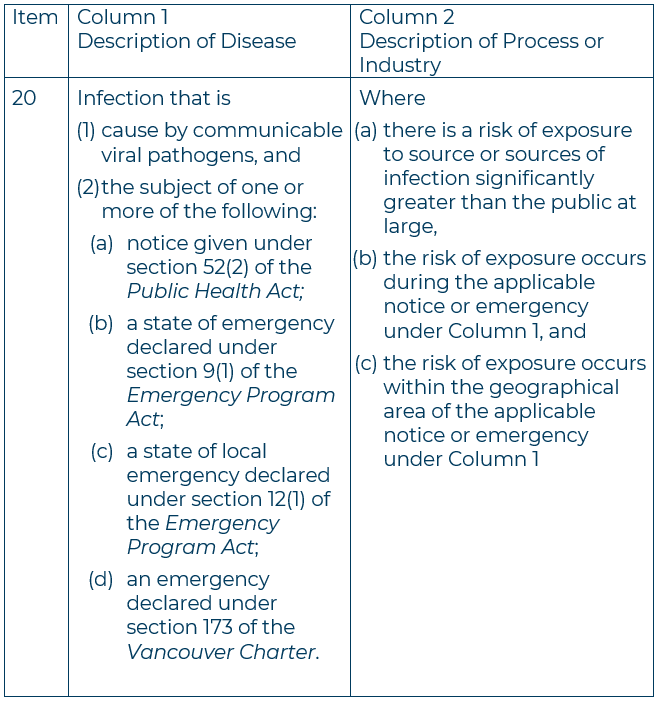
The following conditions must be met for the above Schedule 1 presumption to apply:
- The worker must be diagnosed with an infection caused by communicable viral pathogens (such as COVID-19).
- The infection must be the subject of a Public Health Act notice or a declared state of emergency.
- The risk of exposure by the worker to a source of the infection is significantly greater than the public at large and occurs during, and within the geographical area of, the applicable notice or state of emergency.
To subscribe to receive BCREA publications such as this one, or to update your email address or current subscriptions, click here.
New Disclosure of Referral Payment Form
The new Disclosure of Referral Payment form and corresponding education guide, are now available on WEBForms®.

As per Section 3-3(f) of the Real Estate Services ActRules, a licensee is required to disclose to a client "all known material information respecting real estate services" being provided. If a licensee has agreed to pay a referral payment, this is material information that must be disclosed to the client. This is true whether the referral payment is to be paid to another licensee or to an unlicensed person. If such a referral payment is to be made, REALTORS® should fill out and deliver the Disclosure of Referral Payment form to the client.
When completing the form, a REALTOR® should include the date of disclosure, the name of the client to whom they are making the disclosure and the property to which the disclosure relates at the top of the page. The REALTOR® should also include his/her name, the amount or form of the referral payment (which may not be cash) and the name of the recipient (which could be a licensed or unlicensed individual, a brokerage or another entity). The REALTOR® should then sign and deliver this form to the client.
The client should sign and date the form upon receipt. While disclosure can be made without a client signing to acknowledge receipt, it is in a REALTOR®'s best interest to have the client sign and to retain a copy of the form if in the future someone were to question whether disclosure of the referral payment was made to the client.
To subscribe to receive BCREA publications such as this one, or to update your email address or current subscriptions, click here.
New Era for Legally Speaking #404
After penning his final issue of his illustrious 26-year tenure as author of Legally Speaking last month, Gerry Neely has passed the torch to four renowned BC lawyers, who will share the authorship duties, beginning in March.
Please send questions, comments and suggestions for the new authors of Legally Speaking to [email protected].
Mike Mangan
Mike Mangan is an experienced trial lawyer, author and teacher. He’s the principal author of several cpe courses, including the popular annual Legal Update.
Mike was the first Practice Standards Advisor for the Law Society of BC. He has helped design programs on how to avoid claims and presented them to lawyers, notaries and REALTORS®. His extensive legal experience includes real estate litigation and professional liability law. In addition to his law practice, Mike is a professor at UBC’s Faculty of Law and the Real Estate Division of UBC’s Sauder School of Business.
Mike is the author of the best-selling book The Condominium Manual: A Comprehensive Guide to the Strata Property Act, now in its second edition with the third edition expected this year.
Brian Taylor
Brian Taylor is a partner with Bull, Housser & Tupper and has practiced in the areas of administrative, local government and real estate law since 1984.
Brian has acted for the real estate profession since 1986. He was instrumental in the creation of the assumed buyer agency model of representation currently practiced in BC and throughout Canada, and is a frequent advisor to the profession on the roles and responsibilities of brokerages and licensees.
He drafted the standard forms currently used by the profession and has been a member of BCREA’s Standard Forms Committee for more than 15 years. Brian created the Professional Development Program’s required course, What Brokerages and REALTORS® Need to Know About Agency, and is a frequent instructor and lecturer to the profession.
Ed Wilson
Ed Wilson, a partner with Lawson Lundell LLP, practices real estate law and acts for developers and investors in industrial, commercial and residential projects. Ed has been named as a Leading Practitioner in Real Estate Development by Lexpert Magazine.
In addition to assisting BCREA and the provincial government in drafting legislation, including the Real Estate Services Act and the Strata Property Act, Ed has been the Canadian Bar Association representative on BCREA’s Standard Forms Committee for the past ten years and was the principal drafter of the Assignment of Contract of Purchase and Sale.
Jennifer Clee
Born and raised in Vancouver, Jennifer graduated with a law degree from the University of Victoria in 1986.
Upon being called to the bar in 1987, Jennifer worked in private practice in Vancouver, specializing in professional negligence defence actions. In 1991, Jennifer joined the Real Estate Errors and Omissions Insurance Corporation as a staff lawyer, where she has defended real estate professionals in hundreds of real estate actions. Jennifer chose to follow her family roots in devoting her practice to real estate litigation, her father Hugh Clee having been active in the real estate profession for several decades.
To subscribe to receive BCREA publications such as this one, or to update your email address or current subscriptions, click here.
New Federal Programs to Assist Canadians Impacted By the Economic Fallout of COVID-19
As the federal government enters its next phase of economic recovery, new programs have been announced, while others have been modified or phased out. The following programs may benefit REALTORS® impacted by the economic effects of COVID-19.
The Canada Emergency Wage Subsidy (CEWS) has been extended until summer 2021. CEWS provides a wage subsidy for employers who have seen a reduction in revenue due to COVID-19 to allow them to re-hire workers and prevent further job loss.
Effective as of September 27, 2020, Employment Insurance (EI) benefits were temporarily expanded to include more Canadians. Eligible Canadians who were on CERB will receive the same payment, $500 per week, through EI. Most persons receiving CERB will not be required to reapply for these EI benefits, unless they are self-employed, have a SIN that starts with a 9 or have returned to work fulltime. Those who qualify for the new EI benefits will be required to continue completing reports to demonstrate eligibility. Those who do not qualify for the new EI benefits will be notified by mail.
The Canada Recovery Benefit (CRB) will replace the Canada Economic Recovery Benefit (CERB), which ended on October 3. Beginning on October 12, CRB will assist Canadians who have stopped working due to COVID-19 but do not qualify for Employment Insurance (EI) or have experienced a reduction in income of at least 50 per cent. The program will be available until September 25, 2021.
The Canada Emergency Business Account (CEBA) will be extended and expanded. CEBA provides up to $40,000 in guaranteed loans, interest-free until 2022 as well as $10,000 in forgivable loans to eligible businesses and non-profits. It’s not yet known for how long the program will be extended.
The Canada Recovery Sickness Benefit is a new program that offers $500 per week to Canadians that might take time off from work due to COVID-19. The program is available until September 25, 2021. The program is currently open for applications.
The Canada CRegional Relief and Recovery Fundaregiving Benefit is a new program providing $500 per week for Canadians who need to care for a child under 12 or a family member due to daycare or school closure. Eligible applicants can receive benefits for up to 26 weeks.
The Regional Relief and Recovery Fund will provide assistance to businesses and communities that may require additional economic recovery assistance. The program will be available through individual regional development agencies and will provide support to small- and medium-sized enterprises.
You can find up-to-date information on these and other programs by accessing Canada’s COVID-19 Economic Response Plan.
To subscribe to receive BCREA publications, or to update your email address or current subscriptions, click here.
New Home Contract – Damages for Incomplete or Deficient Work, and for Stress #132
By Gerry Neely
B.A. LL.B.
The plans were for a home with unusual design features to be constructed by a competent contractor experienced in the construction of standard design homes only. The home was to be built for a demanding client who expected very "high" quality workmanship from a contractor who intended to provide "good" quality workmanship.
Cost was a significant factor to the client but the contractor expected that there would be some flexibility with the contract price to accommodate the special features of the design. Neither the contractor nor the client fully understood the expectations or intentions of the other.
As construction proceeded, feelings ran high and eventually the contractor abandoned construction believing, wrongly as it turned out, that he wouldn't be paid. The house was nearly finished and the client moved in without the contractor's approval because the client's rental period in temporary accommodation had ended. The final draw, which was to have been paid to the contractor upon occupancy, was paid instead into trust pending resolution of the differences between the two parties.
At the same time the client gave a list of deficiencies to the contractor who was advised that he would be paid for work done. Negotiations resulted in the contractor correcting a number of deficiencies, although what could have been done in one week took four months to complete. The major issue concerned the uniquely designed skylights which during construction were changed, at the request of the contractor, to standard skylights. The contractor said this was necessary to resolve a construction problem. The change was not presented as a cost problem, but the evidence at trial was that the change saved the contractor between $8,000 and $20,000. The cost difference in favour of the contractor was not made plain to the client.
This plus other disputed issues led to the contractor suing for the balance of the contract price plus extras. The client counterclaimed for damages for incomplete and improperly completed work, as well as damages for stress. The judge agreed with a number of the claims made by the client, including an award of damages for the substitution of the less costly installation of the standard skylights.
The evidence was that the skylights as designed were so obviously unusual that the contractor should have considered the special problems they created at the time he negotiated the contract price. When he awakened to the problem, his client was entitled to know that the problem was one of cost rather than of construction. The client might not then have been as ready to accept the substitution. Or, and this may have crossed the contractor's mind, she may have been prepared to accept it but upon condition that the contract price be reduced.
Because the range of costs for the difference was so great, and since the client partially got what she wanted, damages for the substituted skylights were fixed at $8,000. After off-setting the contractor's claim, the damages received by the client were approximately $25,000.
The contractor tried to deny liability by arguing that the client was in breach of her contract by putting the amount of the last draw in trust, rather than in paying it to him. To this the judge replied that although the contract did not provide for a holdback for incomplete work, at common law the client was under no obligation to pay for work not finished or deficient. In addition the evidence made it apparent that the client wanted the contractor to complete the work and was prepared to pay for it when it was done satisfactorily.
Damages of $1,500 were awarded to the client for stress. Not only was the house not finished, but the client suffered the aggravation of the contractor working next door constructing a new home when she was trying to get hers finished. As the judge said "the house was not what was promised. Getting it finished was like pushing an elephant through a drain pipe...".
You may have noticed that throughout this column, the contractor has been referred to by the personal pronoun, although the plaintiff referred to below is a limited company. The reason for this is that the limited company owned the lot upon which the house was constructed and the lot was sold to the client as part of a building contract. The building contract, which was separate from the offer for the sale of the lot, was signed personally instead of in the name of the company. Damages were awarded against the principal of the company, rather than the company.
| 1. | Islington Trading Co. Ltd. v. Alfreds, County Court of Vancouver, Vancouver Registry No. F 861857. |
To subscribe to receive BCREA publications such as this one, or to update your email address or current subscriptions, click here.
New Index Created for Quick Access to BCREA Standard Forms Resources
With a variety of new resources having been created over the last several months – including the Standard Forms Resource Centre, the Fall 2020 Standard Forms and accompanying training materials – we have created a way for Realtors to easily find exactly what you need to help your practice.
The Standard Forms Resources Index enables quick access to the information you need to support you throughout the different phases of your transactions.
(BCREA Access login required)
In the document, you’ll be able to find the different types of resources in a variety of ways. You’ll find a section that includes general resources, as well as specific resources for the different clauses and forms.
There is a catalogue of all the Standard Forms videos as well as the form guides, FAQs and Toolkits.
The Standard Forms Resources Index will be updated regularly and is accessible via this link, from the Standard Forms page on the BCREA website, or on the Standard Forms Resource Centre. BCREA Access user name and password are required for access.
If you have any further questions about the Standard Forms Resources Index or the resources themselves, please reach out to the BCREA Standard Forms team at [email protected].
To subscribe to receive BCREA publications such as this one, or to update your email address or current subscriptions, click here.
New Listings Bounce Higher in April
For the complete news release, including detailed statistics, click here.
Vancouver, BC – May 15, 2024. The British Columbia Real Estate Association (BCREA) reports that 7,569 residential unit sales were recorded in Multiple Listing Service® (MLS®) systems in April 2024, an increase of 1.5 per cent from April 2023. The average MLS® residential price in BC in April 2024 was up 1.4 per cent at $1 million, compared to an average price of $992,440 in April 2023. The total sales dollar volume was $7.6 billion, an increase of 3 per cent from the same time the previous year.

"April was an above-average month for new listings activity, registering the highest pace since 2021," said BCREA Chief Economist Brendon Ogmundson. "Sales are still slightly below normal, which has led to a substantial increase in total inventory, though at a level still far below long-run balance. Ultimately, the market is heading into the summer in a state of relative calm with much more choice for buyers."
Year-to-date, BC residential sales dollar volume was up 9.5 per cent to $23.4 billion, compared with the same period in 2023. Residential unit sales were up 4.8 per cent to 23,507 units, while the average MLS® residential price was up 4.5 per cent to $997,132.

New Managing Broker Collective: Real Relationships, Trusted Community
Managing brokers have high expectations placed on them from day one. Their office doors are always open; they’re relied on to always provide an answer or manage a crisis.
For many new managing brokers, this can feel both daunting and isolating. Mentorship opportunities can be difficult to create, and asking a direct competitor for help sometimes doesn’t feel like an option.
In response to this need, BCREA ran a pilot project in 2025 and introduced the New Managing Broker Support Group. The feedback was positive: participants learned a lot and gained clear, valuable takeaways, but what they enjoyed most was a surprise. By far, after spending only 12 hours together, participants highlighted making strong connections and building a reliable community as what they valued most about the experience. In 2026, BCREA is leaning into that feedback.
The New Managing Broker Collective is a year-long cohort-based program designed to build real relationships, strengthen leadership skills, and support new managing brokers. It’s a space to learn, discuss, reflect, and say “I don’t know” without fear. Actually, it’s encouraged!
Sessions run monthly for 90 minutes with the first hour focusing on a Professional Development topic relevant to new managing brokers delivered by professionals and thought leaders in the sector. The final 30 minutes are intentionally reserved for debrief, reflection, and practical application.
Learning doesn’t happen in the moment. It happens when you talk things through, test ideas in real life, and compare notes with people who get it.
There’s also an asynchronous learning component: an online space where participants can continue discussions between sessions, share resources, and revisit materials. Not everyone processes best by speaking up in a live group, and not every question shows up neatly once a month. Having an online space to connect between sessions allows for deeper learning through connection and reflection.
Most importantly, this is a cohort, capped at 35 participants. By committing to attend each session, new managing brokers invest in themselves and their peers. This dedication helps everyone. Knowing who will be there each month, and online in between, allows trust to build and momentum to grow.
Participants will get out what they put in and leave each session with resources they can use immediately, along with connections to a few people they can lean on to help when the answers aren’t right there.
If you’re a new managing broker who wants to expand your network, sharpen your leadership skills, and learn alongside equally committed peers, the New Managing Broker Collective is for you.
Learn more and register here.
New Managing Brokers Support Group – Pilot Program
The New Managing Brokers Support Group is a year-long pilot program designed to support and guide new and aspiring managing brokers or associate brokers. Through monthly virtual sessions, participants will gain valuable insights and skills essential for effective brokerage management. This program, led by Kevin Brown – a sector expert, experienced broker-owner, managing broker, and instructor – will create a collaborative learning environment, featuring guest experts throughout the year to provide additional perspectives and guidance.

Why Join?
- Free Program: No registration fees.
- Year-Long Commitment: Designed to accompany your growth throughout 2025.
- Virtual Sessions: Learn and engage from anywhere.
- Experienced Mentorship: Guided by Kevin Brown, with regular guest speakers.
- Cohort Learning Experience: Build meaningful connections with peers.
- Ongoing Support: Gain access to a network of resources and support tailored to help you excel in your role.
Resources
You will be advised of the various resources offered by BCREA, and the boards and associations that can assist you in executing your duties as a managing broker.
Program Overview
The New Managing Brokers Support Group will cover key topics throughout the year, including regulatory compliance, business planning, conflict resolution, and more. Sessions are designed to enhance the professionalism and effectiveness of managing brokers, providing a strong foundation for new entrants or those considering this critical role. The program also connects participants with support to help navigate the challenges of the role, ensuring that they are not alone in their journey.
Upcoming Sessions
The program is a year-long with sessions held monthly, each focusing on a specific aspect of brokerage management. Below are the details of the first three sessions:
- Session 1: Welcome and Orientation Date: January 28, 2025 | Time: 9 am PST
Meet your mentor and fellow participants, learn about the program’s structure, and set expectations for the year. - Session 2: The Role of a Managing Broker Date: February 25, 2025 | Time: 9 am PST
Dive into the core responsibilities of a managing broker, best practices for supervision, and effective communication strategies. - Session 3: Legal and Regulatory Compliance Date: March 25, 2025 | Time: 9 am PST
Understand the regulatory landscape and learn strategies for managing legal risks within your brokerage.
Who Should Attend?
This program is ideal for:
- New managing brokers seeking support and guidance in their first year.
- Aspiring managing brokers or associate brokers looking to understand the role in greater depth.
How to Register
The New Managing Broker Support Group is full and we are not accepting new participants at this time. Depending on the outcomes of this pilot project, we'll consider adding more space next year. Thank you for your interest!
Program Commitment
Participants are encouraged to attend all sessions to fully benefit from the program. This program is designed to foster a collaborative environment where participants can build strong relationships with their peers, ask questions, and tailor the experience to their unique needs. The sessions build progressively over the year, providing a supportive space for shared learning and growth.
Questions?
For more information or assistance with registration, please contact the Managing Broker Support Line at [email protected].
New Mortgage Qualification Rules Temper Housing Demand
For the complete news release, including detailed statistics, click here.
Vancouver, BC – March 14, 2018. The British Columbia Real Estate Association (BCREA) reports that a total of 6,206 residential unit sales were recorded by the Multiple Listing Service® (MLS®) across the province in February, a 5.7 per cent decrease from the same period last year. The average MLS® residential price in BC was $748,327, up 8.8 per cent from the previous year. Total sales dollar volume was $4.64 billion, a 2.6 per cent increase from February 2017.
 “More stringent mortgage qualification rules for conventional borrowers are dampening housing demand in the province,” said Cameron Muir, BCREA Chief Economist. “Since the new rules came into effect, BC home sales have fallen more than 26 per cent, on a seasonally adjusted basis.”
Previous mortgage policy tightening has negatively impacted housing demand for a period of four to seven months, with the largest impact occurring in the third month after implementation.
Year-to-date, BC residential sales dollar volume was up 15.9 per cent to $8.47 billion, compared with the same period in 2017. Residential unit sales increased 4.1 per cent to 11,516 units, while the average MLS® residential price was up 11.3 per cent to $735,755.
-30-
For more information, please contact:
Cameron Muir
Chief Economist
Direct: 604.742.2780
Mobile: 778.229.1884
Email: [email protected]
To subscribe to receive BCREA publications such as this one, or to update your email address or current subscriptions, click here.
New Obligation to Report Sanctions Evasion
In a recent notice to boards and associations, The Canadian Real Estate Association shared the following with its members:
The Financial Transactions and Reports Analysis Centre of Canada (FINTRAC) has published a Special Bulletin on financial activity associated with suspected sanctions evasion.
The guidance states, as of August 19, 2024, all reporting entities subject to the FINTRAC Regime (including brokers and sales representatives) are obligated to submit a suspicious transaction report to FINTRAC if there are reasonable grounds to suspect that a transaction or attempted transaction is related to sanctions evasion.
What are sanctions?
All Canadians, including real estate brokers and sales representatives, have been obligated to comply with Canadian sanctions for many years. What is new, as of August 19, 2024, is the obligation to report sanctions evasion to FINTRAC.
Sanctions are a foreign policy tool used to address international peace and security concerns, gross violations of human rights, and significant foreign corruption. Canadian sanctions place restrictions on the activities permissible between Canadians and foreign states, individuals, or entities. Canadian sanctions can be issued under the Special Economic Measures Act (SEMA), United Nations Act (UNA), and the Justice for Victims of Corrupt Foreign Officials Act (JVCFOA).
Brokers and sales representatives should review the Special Bulletin on financial activity associated with suspected sanctions evasion to ensure they understand what sanctions are, and what characteristics may indicate that sanction evasion is occurring in a purchase or sale transaction.
How do I report to FINTRAC?
If a broker or sales representative has reasonable grounds to suspect a purchase or sale transaction (or attempted transaction) is related to sanctions evasion, they must report the transaction to FINTRAC in the same manner they would report a suspicious transaction.
However, as previously reported, FINTRAC’s Web Reporting System, the mechanism by which most brokers and sales representatives report suspicious transactions, is currently unavailable due to a cyber incident.
FINTRAC estimates it may be several months before the Web Reporting System is back online. As a result, REALTORS® should continue to identify and internally document all reportable sanctions evasion transactions and be prepared to report them to FINTRAC once its systems are back online.
REALTORS® should continue to monitor FINTRAC’s website for updates.
New Online Course Explores Legislation and Requirements for Manufactured Homes
BCREA has created a new self-paced online course, Manufactured Homes: What REALTORS® Need to Know 2.0, which equips REALTORS® with proper foundations on the definitions, legislation, and requirements for manufactured homes.
This new and improved 2.0 release replaces the previous version of the course with updated content and more extensive development on key issues. Manufactured Homes: What REALTORS® Need to Know 2.0 focuses on diverse topics related to exemptions and regulations for manufactured homes including:
- Manufactured Homes Act, BC Safety Standards Act and the Electrical Safety Regulation,
- electrical compliance and certification marks such as CSA stickers and Silver labels,
- basics of the Manufactured Homes Registry,
- the specifics of dealing with homes located on rented or leased pads, transporting a manufactured home to a different location, and insurance.
(BCREA Access Login Required)
By the end of this course, REALTORS® will be able to identify challenges with buying or selling manufactured homes (including mobile and modular houses), will be more familiar with the regulations and protocols when listing them, and will easily identify what to look for when alterations and additions are made to the manufactured home.
This course, worth two accredited PDP hours, is an introductory course for new REALTORS® who want to expand their knowledge of this important area of legislation and practice, as well as experienced REALTORS® who want to update their foundations related to manufactured homes in British Columbia.
New Online Course Explores Suspicious Transactions in the Real Estate Sector
BCREA has released a new self-paced online course titled The REALTOR®'s Guide to Suspicious Transactions. While BCREA has other courses on FINTRAC compliance, this is the only course that specifically focuses on ways to identify suspicious indicators of money laundering and terrorist financing in real estate.
In The REALTOR®'s Guide to Suspicious Transactions course, REALTORS® will gain practical knowledge of suspicious indicators (red flags) in real estate related to money laundering, terrorist financing, and fraud. This course introduces the four most common fraud types in real estate to enhance REALTORS®’ understanding of why fraud occurs in real estate and how it can be identified. The course also explains how money laundering occurs and what constitutes reasonable grounds to suspect, which is the minimum threshold for reporting a transaction to FINTRAC.
Given suspicious transaction reporting in the real estate sector is quite low across Canada, this course is designed to enhance compliance and help REALTORS® protect their clients and brokerages as well as safeguard their communities.
(BCREA Access Login Required)
The REALTOR®'s Guide to Suspicious Transactions is worth three accredited PDP hours. This scenario-based course contains videos, infographics, images, handouts, and worksheets to increase learning. Upon completion, learners will be able to:
- notice consumer and client behavioural indicators, consumer and client financial indicators, transaction indicators, and licensee-related indicators of money laundering and terrorist financing, and
- properly document their suspicions and collect the information required to file a Suspicious Transaction Report.
The primary goal of this course is to provide REALTORS® with accessible and practical education on how to detect the most common red flags of money laundering and terrorist financing in their day-to-day practice.
Additional Resources:
Courses
- FINTRAC for REALTORS®: Understanding Canada’s Anti-Money Laundering Laws (3 hours)
- Mastering Compliance 2.0: Anti-Money Laundering Training for Brokers (9 hours)
Articles
BCREA also has several articles on identifying and reporting suspicious transactions that can be helpful.
- Help Protect Your Clients from Title and Mortgage Fraud Attempts (February 3, 2023)
- How REALTORS® Help Prevent Money Laundering in Real Estate: Identifying and Reporting Suspicious Transactions (January 13, 2021)
Legally Speaking
- The F Word: Protecting Yourself and Your Clients from Fraud #554 (October 27, 2022)
New Online Course Explores Systems Used in Residential Construction
If you have ever been a part of a residential real estate transaction, a client has probably asked you a question about part of a house’s system. Did you have the answer? Knowledge of the ins and outs of residential construction can be an extremely valuable tool for REALTORS®.
Know Your Product: House Systems is a new self-paced online course that provides a comprehensive introduction to the systems used in residential construction equipping Realtors with tools to assist clients in making informed decisions.
This course describes the major systems within a house, including electrical, heating, cooling, insulation, ventilation and plumbing.
This course aims to provide Realtors with foundational knowledge regarding the systems of a house and introduce an essential vocabulary for discussing a house’s systems and features.
Learners will leave this course with:
- An improved ability to serve their clients and answer their questions regarding a house, its condition and its potential.
- better able to discuss current or potential problems with a property,
- provide a more accurate evaluation of a property considering the house’s condition,
- help their clients explore the pros and cons of any house that the client may be interested in;
- and identify when to consult other professionals for expert advice.
This course also has a special bonus feature exploring the BC Energy Step Code and improvements that can be made to house systems to reduce energy costs and improve energy efficiency. Upon completion, learners will have earned 6 PDP hours.
Together, both Know Your Product: House Structures and Know Your Product: House Systems provide an essential overview of what Realtors need to know about residential constructions and to be better informed about the product they sell! An instructor led version of this course will be made available later this summer for your local real estate board to deliver.
(BCREA Access Login Required)
New Online Course Helps REALTORS® Better Understand What It Means to Live in a Healthy Home
BCREA has launched Healthy Indoor Environments, a new online, accredited, self-paced course, designed for REALTORS® to improve their knowledge of what it means to live in a healthy home and the various health factors that may impact the decisions of their clients.
This course is authored by Noah Quastel of the BC Lung Foundation, in conjunction with leading experts across the range of topics explored, which include but are not limited to:
- Air Quality Controls
- Outdoor Air and traffic
- Building Structure and Exteriors
- Heating and Cooking Appliances
- Ventilation Systems
- Realtor Roles
The course also focuses on ways to prevent different types of outdoor pollutants from entering a home. Realtors taking this course will find particularly useful short videos recorded by a number of experts in the field of healthy indoor environments included in each of the modules.
(BCREA Access login required)
After completing this course, Realtors will earn 4 accredited PDP hours, and will be able to:
- identify key outdoor air pollutants
- identify ways a poor building structure and envelope can increase exposure to asbestos, formaldehyde, benzene, and radon
- describe sources and health effects of key pollutants that occur in flooring and walls, including dust, dust mites, and tobacco smoke
- recognize the kinds of stoves and fireplaces that can minimize health effects
- describe different types of ventilation systems and air quality controls that can help homeowners improve their indoor air; and
- utilize effective ways to learn about the clients’ lung health status and have a meaningful conversation about their health needs.
The primary goal of this course is to enhance the standard of professional competency in how Realtors assist their clients and protect their best interests during the home buying or home selling experience, particularly in the area of health. Click here to register (BCREA Access login required).
This Project is made possible with funding from the Real Estate Foundation of British Columbia.
Please note that during checkout that a VAT number is not required.
To subscribe to receive BCREA publications such as this one, or to update your email address or current subscriptions, click here.
New Online Course Helps REALTORS® Expand Reach to Rural Areas
Rural Real Estate Essentials is a new online course offered by BCREA, aimed to help BC REALTORS® expand their reach to rural areas. Promoting knowledge and business growth, the new course provides REALTORS® with foundational knowledge on rural real estate and helps reinforce and enhance the knowledge of REALTORS® already practicing in these areas.
- Special Offer: Use the coupon code X6QAQ4AX before March 31, 2020 to receive 10% off this new course! This discount code can only be applied once per individual, to one course.
Written by experts in the field (pun intended), Victor Khong and Michelle Wong, Rural Real Estate Essentials takes REALTORS® from BC’s concrete jungles to its more natural terrains and focuses on topics relevant to REALTORS®, buyers and sellers in rural areas.
The course covers numerous specialized topics that REALTORS® need to know when working in rural BC, including:
- working with rural titles,
- zoning and permitted land use,
- riparian areas,
- the Islands Trust,
- owner-built homes,
- insurance for rural properties,
- and more!
By the end of this course, learners will be aware of the resources and tools used by rural REALTORS®, be privy to clauses used in rural real estate transaction documents, and know how to identify and manage risks associated with rural real estate.
Hosted on CREA’s training hub, the course is an accredited Professional Development Program (PDP) offering, which means REALTORS® in BC will earn three accredited PDP hours when they finish the course.
- Click here to learn more about the revitalized PDP framework, which took effect on January 1, 2020.
Enroll for Rural Real Estate Essentials before March 31, 2020 using the coupon code X6QAQ4AX to receive 10% off your registration fee.
To subscribe to receive BCREA publications, or to update your email address or current subscriptions, click here.
New Online Course Helps REALTORS® Sharpen Client Engagement and Negotiating Skills
One of our most popular online courses has been revamped and is available again for REALTORS®. Client Engagement Excellence: Negotiating Skills is the updated version of what was previously known as Customer Service Excellence and the REALTOR® Brand and aims to strengthen Realtor competence in the core engagement skill of negotiating.
This course helps Realtors achieve successful outcomes when dealing with potential deal-breaking conditions that can stall forward momentum of a home buying or selling experience.
Written by real estate client engagement expert Gerald Clerx, this course introduces immediately transferable skills to address common challenges experienced by Realtors when working with buyers and sellers.
For the past 20 years Gerald has helped real estate professionals globally to increase the value they bring to their clients by enhancing their competency in the core skills of client assessment, presentation and negotiation.

The primary goal of this course is to enhance the standard of professional competency for how you assist your clients and protect their best interests during the home buying or home selling experience.
After completing the course you will be able to:
- Identify the three phases of client engagement and the Realtors role within each;
- recognize the signs of mental stress and identify the underlying fear;
- recognize the signs of emotional stress and identify the underlying belief;
- recognize the signs of positional stress and identify the underlying interest; and
- resolve mental, emotional and positional stress using a formulaic approach.
Hosted on CREA’s training hub, the course is an accredited PDP offering, which means Realtors in BC will earn three accredited PDP hours when they finish the course.
- RELATED: Click here to learn more about the revitalized Professional Development Program (PDP) framework, which took effect on January 1, 2020.
Enroll for Client Engagement Excellence: Negotiating Skills before July 31, 2020 to receive 25% off your registration fee (discount already applied in list price) as a part of BCREA’s commitment to support REALTORS® during the ongoing COVID-19 pandemic.
To subscribe to receive BCREA publications, or to update your email address or current subscriptions, click here.
New Online Course on Cannabis Supports REALTORS® in Navigating Legalization
Cannabis and Real Estate: The New Paradigm is a new online course offered by BCREA, designed to help REALTORS® address questions raised by the legalization of recreational cannabis in Canada, and keep them on the vanguard of current market events.
- Special Offer: Use the coupon code 1GY0GMHE before March 31, 2020, to receive 10% this new course! This discount code can only be applied once per individual, to one course. Click here to register.
Since cannabis was legalized in October 2018, there have been many questions with respect to how this new landscape would affect REALTORS® in their day-to-day practice: How does the legal framework on cannabis affect my disclosure obligations? What pitfalls should I avoid in the current cannabis landscape? How can I mitigate the risks associated with cannabis and real estate in BC?
These questions and others are addressed in this new course, which aims to help REALTORS® understand cannabis regulations on the buying, selling, renting, and management of property in British Columbia, and implications for disclosure obligations, tenancy agreements, and strata organizations.
After completing the course, learners will be able to:
- identify the cannabis plant and its usual forms of consumption;
- explain the current legal framework for cannabis in Canada;
- describe how the legalization of cannabis impacts trading services, rental property management, and strata property management services; and
- apply recent case law decisions to their daily practice
Hosted on CREA’s training hub, the course is an accredited PDP offering, which means REALTORS® in BC will earn three accredited PDP hours when they finish the course.
Enroll for Cannabis and Real Estate: The New Paradigm before March 31, 2020, using the coupon code 1GY0GMHE to receive 10% off your registration fee.
To subscribe to receive BCREA publications, or to update your email address or current subscriptions, click here.
New PDP Transition Web Page and FAQ Resource
Want to know more about the upcoming changes to the Professional Development Program (PDP)? The British Columbia Real Estate Association (BCREA) and real estate boards have released new resources to support you through the transition to the new PDP framework, effective January 1, 2020.
PDP transition web page
BCREA and the boards created the PDP transition web page, where you can find an overview of the new PDP framework, examples of self-directed learning, frequently asked questions and more. As the January 1 transition date approaches, additional resources on self-directed learning, accreditation and reporting your PDP hours will be added to the page.
PDP frequently asked questions
BCREA and the boards have also developed a list of frequently asked questions about the program and upcoming transition. If you have additional questions, please contact your board or email [email protected].
Please stay tuned for more information and resources from BCREA and your board over the coming months!
To subscribe to receive BCREA publications such as this one, or to update your email address or current subscriptions, click here.
New Professional Development Gamification Page Now Live on BCREA Access
BCREA has launched a new Professional Development Gamification page on BCREA Access to help REALTORS® stand out from the crowd as they enhance their skillset and uplevel their professionalism.
Gamification adds a dynamic layer to our Professional Development Program (PDP) by allowing REALTORS® to earn digital badges as they complete their online learning. This enables learners to track their progress, recognize and share their achievements online, and stay motivated as they continue to build their skills and knowledge across key areas of real estate practice in BC.
The Professional Development Gamification page, located under the “Professional Development” submenu on BCREA Access, offers an overview of how gamification works and the types of badges available to earn. These include:
- Course,
- Learning Plan,
- Collection, and
- Lifetime Achievement.
We invite you to explore the page here and level up your PDP learning journey today.
If you have any questions, please feel free to contact [email protected].
New PST on Non-Residential Real Estate Services
Effective Thursday, October 1, 2026, a 7 per cent provincial sales tax (PST) will apply to certain real estate services involving non-residential property in British Columbia. This includes trading, rental property management, and strata management services.
The tax applies to the fee charged for the service, not the purchase price or value of the property. For example, in a commercial real estate sales transaction, PST would apply to the taxable service fee or commission rather than the amount paid to purchase the property.
Services related to residential property, supportive housing, and farm property are not subject to the new tax. Other exemptions may also apply, including in some circumstances involving First Nations land or clients. REALTORS® should be aware that the application of an exemption may depend on the property, the client, the nature of the service, and the specific circumstances of the transaction.
Mixed-use properties may require additional consideration. With services related to a property that includes both residential and non-residential uses, PST may apply only to the portion of the service connected to the non-residential component. Brokerages may therefore need to determine how fees should be reasonably allocated and documented.
The provincial government has released initial information about the new requirements, including exemptions and transitional rules. However, important questions remain about how the tax will operate within real estate transactions and brokerage remuneration structures.
BCREA is consulting with the BC Government and seeking written direction on the practical obligations of REALTORS®, managing brokers, and brokerages. This includes determining:
- who must register for a PST number;
- who is responsible for charging, collecting, and remitting PST;
- how PST applies when remuneration is shared between listing and cooperating brokerages;
- whether payments from a brokerage to an individual licensee are subject to additional PST;
- how the tax applies to mixed-use properties and exempt clients or properties; and
- how transitional rules affect services that begin before Thursday, October 1, 2026, but are completed, invoiced, or paid for after that date.
Clear answers to these questions will be important in helping brokerages develop consistent accounting, invoicing, and record-keeping practices. They will also help reduce the risk of PST being collected twice on the same remuneration or not being collected when required.
As additional information becomes available, BCREA will develop practical resources to help REALTORS® understand how the requirements apply in common real estate scenarios.
REALTORS®, managing brokers, and brokerages are encouraged to send BCREA any questions they have about the new tax. This feedback will help us identify common areas of uncertainty and ensure that our discussions with the government focus on the issues most likely to arise in practice.
In the meantime, reviewing the available provincial government and the BC Financial Services Authority’s (BCFSA) materials is recommended. Brokerages may also wish to speak with a qualified tax or accounting professional about their particular business structure and circumstances. BCREA will share further information as it becomes available.
For more information, including transitional rules and a full list of exemptions, please consult these resources:
BC Government
- Subscribe to receive email notifications when tax and tax credit information is updated.
BCFSA
New Report Calls for British Columbia-Wide Standards for Remediating Homes Used in Drug Production
Vancouver, BC – November 26, 2024. As British Columbia continues to deal with a housing shortage, a new research study conducted by the University of the Fraser Valley Centre for Public Safety and Criminal Justice Research in partnership with the BC Real Estate Association (BCREA) finds problems with the current drug-home remediation process, and lays out a blueprint to standardize processes to assure standards of repair and help return these properties to the housing market.
As noted in the report, entitled Ensuring Healthy Homes for British Columbians: Provincial Standards for Remediation and Certification, the health hazards and safety issues associated with drug production in residential homes are complex and may vary by drug type. Contributing to the complexity of the situation are the varying municipal standards for residential remediation across British Columbia.
Updating a previous study conducted in 2018, this new report was written by Dr. Zina Lee and Dr. Irwin M. Cohen. It includes a review of RCMP police data on the number of illegal grow operations and synthetic drug labs in residential properties; a review of policies and practices across British Columbia; and interviews with 14 experts and stakeholders who have had direct experience working on the issue of residential homes used in drug production.
Key findings:
- Police data indicated that most incidents of residential drug production occurred in a single detached house, townhouse, or duplex, and the most common drugs involved were marijuana and methamphetamine.
- A review of 20 municipal bylaws across British Columbia found consistency in the minimum standards for declaring a residence as safe to occupy, but differences in how municipalities defined a controlled substance property, whether those tasked with remediation should be certified or licensed, and the level of detail with respect to remediation requirements.
- Interviews with experts and stakeholders revealed support for a provincial standard on policies and procedures related to the remediation of drug-involved homes, as well as certification and licensing of those who do remediation work and training for home inspectors.
To achieve the goal of consistent health and safety standards across the province, the report calls for regulation and oversight by the provincial government, the creation of a training and certification
process for professionals involved in home remediation, and improved and easily accessible records to mitigate the potential effects of stigma and facilitate informed decision-making by buyers and lenders.
The report goes on to conclude that whatever provincial-wide policies and procedures are implemented need to consider the evolving nature of science and research, limits on technology related to testing of samples, legal liability, efficient timelines, and costs, and balance the rights of buyers and sellers.
“The processes of drug home remediation currently differ between municipalities. A single multi-step provincial approach would not only standardize and assure a high standard of repair, but this in turn would also help the would-be buyer of these houses to attain lending services and insurance,” said Trevor Hargreaves, BCREA Senior VP, Government Relations, Marketing & Communications.
Click here to read the full report.
-30-
For more information:
Craig Battle, Senior Marketing & Communications Specialist
BC Real Estate Association
[email protected]
604.742.2790
About BCREA
BCREA is the provincial association for BC REALTORS®. As a champion for the real estate sector, BCREA advances REALTOR® professionalism and ensures the REALTOR® voice is heard, for the benefit of consumers and communities, across BC. By working in collaboration with the province's real estate boards and associations, our mission is to provide professional development opportunities, advocacy, economic and policy research, and standard forms so REALTORS® are trusted, respected, and proud of their profession.
About the University of the Fraser Valley Centre for Public Safety and Criminal Justice Research
The Centre for Public Safety and Criminal Justice Research provides research and consulting expertise to a wide range of entities, including criminal justice agencies, governments, public safety agencies, and community organizations. Our primary focus is on improving the efficiency and effectiveness of public safety operations and proposed initiatives.
New Standard Form Toolkits Available for Three Fee Agreement Forms
BCREA has created three new toolkits on the Standard Forms Resource Centre to help enhance REALTOR® knowledge of the following three fee agreement forms:
- Fee Agreement Buyer Pays (Buyer and Seller Not Represented)
- Fee Agreement Buyer Pays (Seller Represented Buyer Not Represented)
- Fee Agreement Seller Pays (Buyer and Seller Not Represented)
All three toolkits include a form guide, that reviews the purpose of the form, who should use it, and when it should be used, a preview of the form, a how-to-complete guide and frequently asked questions about the form. The FAQs cover questions around what to do if the buyer or seller does not agree to the fee agreement, and what other forms Realtors need to complete when working with unrepresented parties in a transaction.
To access all form toolkits including the fee agreement toolkits, click the button below:
Standard form toolkits
Did you know, BCREA has over 40 standard form toolkits on the Standard Forms Resource Centre? Each toolkit is an interactive training guide aimed at providing you with important information about the form and guiding you and your clients on completing the form! Learn how to navigate the form toolkits by watching this short video.
For an overview of the numerous Standard Forms resources available, including form guides, revision guides, videos for Realtors and consumers, form toolkits and more, please refer to the Standard Forms Resources Index. If you have questions on Standard Forms, please email [email protected].
New Statutory Holiday on September 30, National Day for Truth and Reconciliation
September 30 is National Day for Truth and Reconciliation, a new federal statutory holiday. The day recognizes the colonial legacy of residential schools, honour Indigenous survivors, and is vital to the ongoing reconciliation process.
This statutory holiday means federally regulated sectors such as banks will be closed in observance of the national day.
The Bank of Canada, Payments Canada, and the Investment Industry Association of Canada will be closed on September 30.
Like any other statutory holiday, a bank closure will affect the timing of mortgage registration and distribution of funds between buyer and seller. However, this does not mean private sector businesses like law firms and notaries will be closed.
Be sure to contact your legal representatives to ensure they are open and operating on September 30. If your clients have a scheduled closing this day, it's imperative you directly contact your bank, lawyer, notary, and land registry offices for more information.
If you have any further concerns or questions, contact your managing broker and real estate board.
Resources to Learn More About Truth and Reconciliation
We invite REALTORS® to commemorate the National Day for Truth and Reconciliation. Here are some resources to help gain a better understanding of this day:
- Residential School History
- Truth and Reconciliation Commission Reports
- Origins and History of Orange Shirt Day on September 30
- Indigenous Canada: A free online course from the University of Alberta
New Toolkits Available for Limited Dual Agency Agreements
BCREA has launched two new toolkits in the Standard Forms Resource Centre to help REALTORS® navigate dual agency scenarios. The toolkits cover the Limited Dual Agency Agreement (Competing Buyers/Tenants) and the Limited Dual Agency Agreement (Buyer/Tenant and Seller/Landlord). Each of the toolkits include an introduction to the form, FAQs, an annotated version of the form, an interactive How-To-Complete guide and Business Practice Considerations/Guidance.
Why these toolkits were created
Dual agency is not allowed under the Real Estate Rules, except in some very limited circumstances, which makes it all the more important that Realtors can advise consumers with confidence on the ins and outs of such relationships. The Limited Dual Agency Agreement (Competing Buyers/Tenants) and the Limited Dual Agency Agreement (Buyer/Tenant and Seller/Landlord) standard forms were created to ensure Realtors have informed consent from all parties involved prior to providing services under dual agency. The new toolkits are designed to give Realtors an in-depth understanding of how to work with these standard forms.
In particular, these toolkits answer questions like:
- How do I determine if a transaction is exempt from dual agency restrictions? and
- Why do I need a limited dual agency agreement if I’ve completed a Disclosure of Risks Associated with Dual Agency?
Click here to view the Limited Dual Agency Agreement (Competing Buyers/Tenants) Toolkit.
Click here to view the Limited Dual Agency Agreement (Buyer/Tenant and Seller/Landlord) Toolkit.
About the Standard Forms Resource Centre
These new toolkits are just two of the many toolkits available through BCREA’s Standard Forms Resource Centre. This comprehensive platform is the go-to resource for standard forms training materials and was created to help Realtors and managing brokers make the most of BCREA standard forms and raise the bar professionally.
To access the Standard Forms Resource Centre and start browsing the toolkits and other training materials, visit and bookmark bcrea.bc.ca/sfresources. You can also access the Resource Centre from the Standard Forms page on the BCREA website. You will be required to login using your BCREA Access username and password.
The Standard Forms Resource Centre is also home to a variety of other standard forms resources, including:
- the Standard Forms FAQ, a compilation of common standard forms questions and answers,
- the Standard Forms Resources Index where you'll find links to all standard forms resources, including the standard forms tutorial videos,
- the BCREA Clause Catalogue,
- the Standard Forms Revision Request Form, where Realtors and managing brokers can request new forms or form changes, and
- a summary of recent form revisions.
Keep an eye on the Resource Centre for more information about upcoming form releases and new resources! If you have questions, please email [email protected].
New Tutorial Videos Focus on Common Standard Forms
BCREA has added to its suite of video tutorials for REALTORS® on key standard forms with the launch of three new video series:
The Listing Contracts series covers the two types of listing contracts in BC: the Multiple Listing Contract and the Exclusive Listing Contract. In the videos, we explore the similarities and differences between the two. The videos also look at how to explain each of these types of contracts to a client as well as some of the standard contract terms. The Buyer’s Agency Exclusive Contract series helps Realtors better support buyers, meet regulatory requirements and reduce risk. The videos explore key aspects of the Buyer’s Agency Exclusive Contract, including the responsibilities of each party, remuneration and conflicts of interest. It also covers when it might be appropriate to use the Buyer Agency Acknowledgement form, appointment of a designated agent, and the collection, use and disclosure of personal information. Access More Standard Forms Resources As part of BCREA’s commitment to Realtor professionalism, we regularly create new resources to ensure Realtors can work with standard forms with confidence. On the bcrea.bc.ca website, go to our standard forms page or search “standard forms” to see our most recent blog posts, like this one covering the Top Three Questions About the Privacy Notice and Consent Form. For more in-depth resources, including training toolkits that offer a comprehensive look into a variety of common standard forms, visit the Standard Forms Resource Centre. If you’re new to the Standard Forms Resource Centre, you can take a quick video tour here. If you’re a new Realtor or new to BCREA’s standard forms, then check out this short video. |
To subscribe to receive BCREA publications such as this one, or to update your email address or current subscriptions, click here.
New Tutorial Videos for REALTORS® Explore Fee Agreements
In BCREA's latest release of tutorial videos for BC REALTORS®, we explore three important standard forms:
- the Fee Agreement Buyer Pays (Buyer and Seller Not Represented) form,
- the Fee Agreement Seller Pays (Buyer and Seller Not Represented) form, and
- the Fee Agreement Seller Pays (Buyer Represented Seller Not Represented)
These tutorial videos are intended to help Realtors better understand and use these common forms and feel confident in explaining these forms to their clients.
Fee Agreement Buyer Pays (Buyer and Seller Not Represented)
This video tutorial explores the Fee Agreement Buyer Pays (Buyer and Seller Not Represented) form, which enables a brokerage, who is not representing the buyer or the seller, to receive remuneration from the buyer.
[iframe width="560" height="315" src="https://www.youtube.com/embed/8BV-rCQaH2M" frameborder="0" allowfullscreen style="position:absolute;top:0;left:0;width:100%;height:100%;" ][/iframe]To learn more about this form, click here to access the form toolkit on the Standard Forms Resource Centre.
Fee Agreement Seller Pays (Buyer and Seller Not Represented)
This video tutorial explores the Fee Agreement Seller Pays (Buyer and Seller Not Represented) form, which enables a brokerage, who is not representing the buyer or the seller, to receive remuneration from a seller.
[iframe width="560" height="315" src="https://www.youtube.com/embed/PyiSPrVrWDU" frameborder="0" allowfullscreen style="position:absolute;top:0;left:0;width:100%;height:100%;" ][/iframe]To learn more about this form, click here to access the form toolkit on the Standard Forms Resource Centre.
Fee Agreement Seller Pays (Buyer Represented Seller Not Represented)
This video tutorial explores the Fee Agreement Seller Pays (Buyer Represented Seller Not Represented). This form enables a brokerage, who is representing a buyer client, to receive remuneration from an unrepresented seller of a property, or a seller who may have listed their property as a mere posting, without creating an agency or fiduciary relationship between the buyer’s agent and the seller.
[iframe width="560" height="315" src="https://www.youtube.com/embed/6ZlqrpXC9vI" frameborder="0" allowfullscreen style="position:absolute;top:0;left:0;width:100%;height:100%;" ][/iframe]To learn more about this form, click here to access the form toolkit on the Standard Forms Resource Centre.
To access other videos created for Realtors and consumers, as well as form guides, revision guides, form toolkits and more, please consult the Standard Forms Resources Index or visit the Standard Forms Resource Centre.
If you have questions on Standard Forms, please email [email protected].
New Tutorial Videos for REALTORS® Explore Listing and Buyer Agency Contracts
By Ellen Baragon, Guest Contributor
As REALTORS® work in their clients’ best interests, being well versed in all aspects of listing and buyer agency contracts can help you better support and empower your clients during a real estate transaction, as well as help you meet your regulatory requirements.
To help Realtors learn more about how these two types of forms help them to achieve these important outcomes, BCREA has created two new tutorial video series exploring the different listing contracts and the Buyer’s Agency Exclusive Contract, both of which are available online now.
Listing Contracts
In the Listing Contracts series, we go over the two types of listing contracts in BC: the Multiple Listing Contract and the Exclusive Listing Contract. We explore what ways they are similar and how they may differ. We also look at how to explain each of these types of contracts to a client as well as some of the standard contract terms.
The Listing Contracts series, which can also be accessed at bcrea.bc.ca/listingcontracts, includes the following videos:
- Different Types of Listing Contracts
- Negotiating Terms
- Termination of a Listing Contract
- Commencement, Expiry, and Signed, Sealed and Delivered Dates
- Remuneration the Holdover Clause
- Schedule “A”
You can also help your clients better understand the Multiple Listing Contract by sharing this video made specifically for consumers.
Buyer’s Agency Exclusive Contract
The Buyer’s Agency Exclusive Contract series was designed to help Realtors better support buyers, meet regulatory requirements and reduce risk. The video explores all aspects of the Buyer’s Agency Exclusive Contract including the Buyer Agency Acknowledgement form, which are essential to obtaining permission from clients before forming agency relationships with multiple buyers and sellers.
The Buyer’s Agency Exclusive Contract series, which can also be accessed at bcrea.bc.ca/buyersagency, includes the following videos:
- Exploring the Buyer’s Agency Exclusive Contract
- Appointment of a Designated Agent
- Responsibilities and Obligations of the Parties
- Remuneration
- Collection, Use and Disclosure of Personal Information;
- Conflicts of Interest
BCREA has also created a video for consumer explaining the Buyer’s Agency Exclusive Contract, click here to watch and share with your clients.
For more Standard Forms resources, including training toolkits that offer a comprehensive look into a variety of common standard forms, visit BCREA’s Standard Forms Resource Centre.
To subscribe to receive BCREA publications, or to update your email address or current subscriptions, click here.
New Updates to Property Disclosure Statement Form
As of October 29, 2018, updated versions of the Property Disclosure Statement Strata/Residential/Land and Building/Addendum Land and Building/Land forms are in effect.

These standard forms have been updated to reflect the legalization of cannabis and are now available on WEBForms®.
Update 1: Change to question in Clause 4a
When completing the form, a REALTOR® should note the question under Clause 4a has been modified to reflect the legalization of cannabis.
The question now asks: Are you aware if the Unit, or any other unit, or the Development has been used to grow marijuana (other than as permitted by law) or to manufacture illegal substances?
Please click here to view these changes.
Update 2: Boxes on forms are now shaded grey
BCREA is committed to supporting the REALTOR® profession by ensuring standard forms are up-to-date and easy to use.
BCREA has replaced the "X" with shaded boxes. The boxes shaded grey are intended to help clients initial the appropriate box.
Please click here to view these changes.
To subscribe to receive BCREA publications such as this one, or to update your email address or current subscriptions, click here.
New Video Dives Into Changes and Updates to the PDS
An important update has been made to the suite of Property Disclosure Statement (PDS) forms.
These changes are reflected in BCREA’s July 2025 Standard Forms Launch and took effect on Wednesday, July 9, 2025, which is also when these forms were updated and available on CREA WEBForms®.
BCREA has created the following video to help REALTORS® better understand these updates.
As a REALTOR® working in their client’s best interest, it’s important to fully understand all aspects of the PDS so you can confidently explain it to your clients. Clients are better protected when they understand their rights and obligations.
BCREA strongly recommends that BC REALTORS® always use the most current BCREA Standard Forms and clauses available on CREA WEBForms®.
New Video Explains Seller’s Disclosure of Material Latent Defects Form to Clients
BCREA has created a new video for REALTORS® to share with their clients to help explain the Seller’s Disclosure of Material Latent Defects form. This form allows a seller and their Realtor to disclose any known material latent defects prior to buyers making an offer.
[iframe width="560" height="315" src="https://www.youtube.com/embed/hKLR_YXmGcI" frameborder="0" allowfullscreen style="position:absolute;top:0;left:0;width:100%;height:100%;" ][/iframe]The video explains what consumers are required to disclose, what a Realtor is required to disclose and how their disclosure obligations differ. In addition to defining latent defects, material latent defects and clarifying differences in disclosure requirements, the video also covers commonly asked questions around what to do if the seller is not aware of any material latent defects and what happens if new information becomes available during the listing or sale of a property.
If you want to learn more about the Seller’s Disclosure of Material Latent Defects form, BCREA has created a form toolkit on the Standard Forms Resource Centre. The toolkit reviews the purpose of the form, who should use it, and when it should be used. It also includes a preview of the form, an interactive how-to-complete guide and frequently asked questions (FAQ). The FAQ covers whether this is a mandatory form, how it differs from disclosures made on the Property Disclosure Statement (PDS), whether this form is needed if the disclosure has already been made on the PDS, and more.
For an overview of the numerous Standard Forms resources available, including form guides, revision guides, videos for Realtors and consumers, and form toolkits, please refer to the Standard Forms Resources Index.
If you have questions on Standard Forms, please email [email protected].
New Video Explains the Co-Listing Form – Joint Representation to Clients
BCREA has created a new video to help REALTORS® explain the Co-Listing Form - Joint Representation to their clients. This form is used to amend a Listing Contract when the sellers want the property to be listed jointly by more than one brokerage.
[iframe width="560" height="315" src="https://www.youtube.com/embed/hwy9fOsu7G0" frameborder="0" allowfullscreen style="position:absolute;top:0;left:0;width:100%;height:100%;" ][/iframe]This video explains the specific terms of the Co-Listing Form– Joint Representation, factors that may determine when sellers should enter a Co-Listing with joint representation and the potential benefits of joint representation. This video also clarifies the designated agents’ fiduciary duties to all of the sellers and situations where the form may not be appropriate for use or in the best interest of the sellers.
If you want to learn more about the Co-Listing Form - Joint Representation, there is a toolkit available on the Standard Forms Resource Centre (BCREA Access login required). As with BCREA Standard Form toolkits, this toolkit includes an introduction to the form, frequently asked questions (FAQs) such as:
- How will commissions be split between the various brokerages in a co-listing?
After you've enrolled in the toolkit, click "start learning now" to access the form materials and FAQs.
To access all Standard Forms resources available, including form guides, revision guides, videos for Realtors and consumers, form toolkits and more, please visit the Standard Forms Resource Centre.
If you have questions on Standard Forms, please email [email protected].
New Video Explains the Co-Listing Form – Separate Representation to Clients
BCREA has created a new video to help REALTORS® explain the Co-Listing Form – Separate Representation to their clients. This form allows multiple sellers with opposing interests to each have their own designated agent(s) to represent them in the sale of a property.
[iframe width="560" height="315" src="https://www.youtube.com/embed/hTsWP-9JRJQ" frameborder="0" allowfullscreen style="position:absolute;top:0;left:0;width:100%;height:100%;" ][/iframe]This video reviews the difference between joint and separate representation, the circumstances under which a client may choose to enter into a co-listing agreement with separate representation, and the potential benefits of this type of arrangement. The video also explains how sellers, their designated agents and their brokerages can use the Co-Listing Form – Separate Representation to enter into a co-listing agreement where each party’s interest is represented by their own designated agent(s).
If you want to learn more about the Co-Listing Form – Separate Representation, there is a form toolkit available on the Standard Forms Resource Centre. As with all BCREA form toolkits, this toolkit includes an introduction to the form, an annotated version of the form, an interactive How-To-Complete guide and frequently asked questions (FAQs) such as:
- Should the co-listing brokerage receive a copy of the listing contract and any amendments?
- How will commissions be split between the various brokerages in a Co-listing?
After you’ve enrolled in the form toolkit, click “start learning now” to access the form materials and FAQs.
To access all Standard Forms resources available, including form guides, revision guides, videos for Realtors and consumers, form toolkits and more, please visit the Standard Forms Resource Centre.
If you have questions on Standard Forms, please email [email protected].
New Video Explains the Fee for Service Retainer Agreement Form to Consumers
BCREA has created a new video to help REALTORS® explain the Fee for Service Retainer Agreement form to consumers. This form is used by consumers to hire a brokerage to provide specific services tailored to their needs.
[iframe width="560" height="315" src="https://www.youtube.com/embed/bABvXnWPc0k" frameborder="0" allowfullscreen style="position:absolute;top:0;left:0;width:100%;height:100%;" ][/iframe]This video explains when to use the Fee for Service Retainer Agreement form, what Realtors need to explain to consumers prior to entering into a Fee for Service Retainer Agreement and what actions Realtors can take if working with unrepresented parties.
If you want to learn more about the Fee for Service Retainer form, there is a toolkit available on the Standard Forms Resource Centre (BCREA Access login required). As with BCREA Standard Form toolkits, this toolkit includes an introduction to the form and frequently asked questions (FAQs) such as:
- Why would you use the Fee for Service Retainer Agreement instead of a fee agreement?
- Does the Service Recipient need to sign this form?
- Does the Realtor need to provide any Disclosure of Representation forms to the service recipient?
After you've enrolled in the toolkit, click "start learning now" to access the form materials and FAQs.
To access all Standard Forms resources available, including form guides, revision guides, videos for Realtors and consumers, form toolkits and more, please visit the Standard Forms Resource Centre.
If you have questions on Standard Forms, please email standardforms@bcrea.bc.ca.
New Video Helps Clients Understand the Disclosure of Referral Payment Form
BCREA has created a new video to help REALTORS® explain the Disclosure of Referral Payment form to their clients. A REALTOR® often pays referral fees to people who have referred business to them which could include referring someone to work with them as one of their clients.
[iframe width="560" height="315" src="https://www.youtube.com/embed/-qPy7F-DRp0" frameborder="0" allowfullscreen style="position:absolute;top:0;left:0;width:100%;height:100%;" ][/iframe]Specifically, this form is used by a REALTOR® who intends to make a referral payment to another REALTOR®’s brokerage or to an unlicensed person when permitted to do so under the Real Estate Services Rules.
The video goes into detail about what happens before a referral fee is paid, what a REALTOR®’s obligations are regarding referral fees, and the importance of the timing of disclosure.
If you want to learn more about the Disclosure of Referral Payment form, there is also a toolkit available on the Standard Forms Resource Centre (BCREA Access login required). As included with BCREA Standard Forms toolkits, this toolkit includes an introduction to the form and frequently asked questions (FAQs) such as:
- Is the Disclosure of Referral Payment mandatory?
- When should I make this disclosure?
- What questions do REALTORS® need to consider related to paying a referral?
- Can a referral payment be paid to an unlicensed person?
If you have any questions regarding the Disclosure of Referral Payment form or other Standard Forms, please email [email protected].
New Video Helps Explain Early Possession With First Nations Leasehold Transactions
Early possession can be an attractive option in First Nations leasehold transactions when the timelines for approval and registration are uncertain. But the factors involved are nuanced and must be clearly understood.
In this video, BCREA explores what REALTORS® need to know about trust completion, final completion, title insurance, and more.
As a REALTOR® working in your client’s best interest, it’s important to fully understand all aspects of the Contract of Purchase and Sale of a Leasehold Interest in First Nations Reserve Lands so you can confidently explain them to your clients. Clients are better protected when they understand their rights and obligations.
BCREA strongly recommends that BC REALTORS® always use the most current BCREA Standard Forms and clauses available on CREA WEBForms®.
Check out BCREA's Early Possession With First Nations Leasehold Transactions article here.
New Video Helps Explain Storage of Personal Information
The Privacy Notice and Consent Form is embedded throughout various forms used in real estate transactions; knowing how personal information is stored and understanding privacy rights is essential.
In this video, BCREA answers the question: Can the clause about storing personal information outside of Canada be removed?
As a REALTOR® working in their client’s best interest, it’s important to fully understand all aspects of the Privacy Notice and Consent Form so you can confidently explain it to your clients. Clients are better protected when they understand their rights and obligations.
BCREA strongly recommends that BC REALTORS® always use the most current BCREA Standard Forms and clauses available on CREA WEBForms®.
New Videos Highlight Key Areas of Contract of Purchase and Sale
By Ellen Baragon, Guest Contributor
Given that the Contract of Purchase and Sale (CPS) is a foundational document to any real estate transaction, REALTORS® need to know the fine details that can make or break a Contract of Purchase and Sale.
To that end, BCREA has created a new tutorial video series that reviews key aspects of the Contract of Purchase and Sale for residential properties. These important topics include:
- deposits,
- completion, possession and adjustment dates,
- included and excluded items,
- risk, and
- assignments.
Standard forms such as the CPS support Realtors in their practice and help facilitate transaction between the between the seller and the buyer, while guiding negotiations between the parties.
Having a thorough knowledge of all aspects of the CPS will help you better support, empower and protect your clients during a real estate transaction.
To watch the complete CPS tutorial video series for Realtors, click here.
To see a version designed to help your clients better understand the Contract of Purchase and Sale, click here.
BCREA has also created tutorial videos on the following topics:
For more Standard Forms resources, including training toolkits that offer a comprehensive look into a variety of common standard forms, visit BCREA’s Standard Forms Resource Centre (BCREA Access login required).
To subscribe to receive BCREA publications, or to update your email address or current subscriptions, click here.
New WEBForms® Platform to Launch in July
CREA ready for early rollout in BC
Good news from the Canadian Real Estate Association (CREA)—the new WEBForms® platform will be available in BC as early as mid-July.
 CREA will reach out to BC REALTORS® who are using WEBForms® about a week before the launch date with some training materials and to announce the exact date the new platform will go live. At the end of June, you might also get an email from CREA inviting you to be one of the BC REALTORS® to beta test the new platform, so keep an eye on your inbox.
If you want to get a peek at the new WEBForms® platform or get a head-start on preparing for the transition, check out CREA's training hub.
To subscribe to receive BCREA publications such as this one, or to update your email address or current subscriptions, click here.
Newly Updated Video Explains the Contract of Purchase and Sale – Residential Form to Consumers
In collaboration with the Canadian Bar Association BC Branch, BCREA has created a newly updated video to help consumers better understand what’s involved in the preparation of the Contract of Purchase and Sale (CPS) – Residential for a particular property.
REALTORS® may want to show this video to their clients when discussing the CPS – Residential or at any point if there are questions about what’s involved in the purchase and sale of a property.
By watching the video, consumers will:
- Better understand the process of preparing a CPS – Residential.
- Learn the most common terms of a real estate transaction.
- Discover what familiar components are involved for buyers, sellers, and their REALTORS® when working on a CPS – Residential and what areas allow for flexibility to insert unique terms.
REALTORS® always look out for their client’s best interests, and clients are better protected when they understand their rights and obligations. This video reflects REALTORS®’ commitment to protecting them. Don't forget to check our Consumer Videos Playlist here for more information on how to navigate and understand standard forms, contracts, and more.
No Changes to Real Estate Practice in Step 2 of Restart Plan
With vaccine numbers rising and infection rates continuing to fall, BC is on track to move to step 2 of BC's Restart Plan as of June 15 and all of us are eager for further easing of COVID-19 restrictions. However, REALTORS® and consumers will have to be patient a little longer when it comes to changes to safety guidelines for the real estate sector.
No Changes to Real Estate Guidelines on June 15
If, as expected, BC moves into step 2 of our Restart Plan on June 15, we can look forward to the return of “indoor seated gatherings of up to 50 people” and the lifting of provincial travel restrictions. But it won’t be a return to business as usual for Realtors just yet. According to the Restart Plan, consultation for the next step on easing restrictions within different sectors will only begin on June 15. That means new guidelines for Realtors won’t be available for a few more weeks yet.
BCREA working to begin consultations
As soon as BC’s Restart Plan was announced, BCREA reached out to WorkSafeBC, the Real Estate Council of BC (RECBC) and the Office of the Superintendent of Real Estate (OSRE) to prepare for the start of consultations. We have been told that new guidelines for real estate professionals likely won’t be available before July 1, which is the earliest date for step 3 to begin. We’re ready to consult on these new guidelines and will work hard to have them available as soon as we can.
No open houses yet
While the Canadian Real Estate Association is once again allowing open house notifications on REALTOR.ca, the message from the Provincial Health Officer and WorkSafeBC is clear: continue following all current safety protocols and guidelines until new guidelines are issued. That means it’s not yet time to return to hosting open houses. We ask all BC Realtors to continue to respect this safety protocol, as well as remain mindful of physical distancing, sanitizing procedures and the continued use of masks and virtual technologies in real estate transactions. Review the safety guidelines for Realtors and brokers.
Be kind, be calm – Be patient
BC is very close to returning to a more normal way of life where COVID-19 is not the same threat that it has been. We can accelerate this return by being patient just a little while longer, and understanding that these important consultations among BCREA, WorkSafeBC, RECBC and OSRE will take place soon and new guidelines will be made available as soon as possible.
No Commission on Building Contract Where Agent Failed to Disclose #220
By Gerry Neely
B.A., LL.B.
Possession under the Contract of Purchase and Sale works well when possession is the day after completion, but not as well when both are on the same date. In the latter instance, unless the vendor's lawyer has the sale proceeds or is satisfied that they are forthcoming, a demand by a purchaser for vacant possession at 12 noon is likely to be denied.
Fortunately most people cooperate with each other because otherwise, there might be more law suits such as the one described in an Ontario decision. The standard form contract used in Ontario provided that vacant possession of a London, Ontario home was to be given on closing. Closing took place at 3:09 p.m. and the purchaser's movers arrived from Toronto at 6:00 p.m. to find the vendor still moving.
And they were still moving at 9:00 p.m. when the movers left for Toronto, returning two days later to London, at an extra cost to the purchaser of $1,400. The purchaser sued for this amount, plus the cost of staying in a motel for two days, a suit that was successful because of the vendor's breach of the contract.1
***
An agent for vendors who received a 5% commission upon the sale of their home, was asked by them, before the sale completed, to recommend a builder to construct a home for them upon a lot which they owned. A builder gave a price to the agent, who added a 4% commission to it. The builder thought that the agent was the agent for the vendors, while the vendors thought that the agent was doing this gratuitously as part of the sale of their home. The agent did not disclose to the vendors that he expected to receive a commission from the builder.
The vendors paid all of the contract price, except for the amount of the commission, and the agent sued for it. The judge decided that the agent, by his actions, had created an agency relationship with the vendor, which was separate from the agency for the sale of the house. He had a duty to disclose to the vendors that he expected to receive a commission from the builder and his failure to do so resulted in a dismissal of his action .2
***
And yet another case which illustrates the benefit of attaching the Norfolk v. Aikens two paragraph addendum to the contract. The contract in question was made in 1990 before the addendum was either prepared or in common use.
The facts are typical. A conveyancer for the vendor with a registerable discharge which could not be registered until funds were received, and a purchaser's conveyancer with instructions not to register unless the mortgage was cleared from title. The purchaser's action for the return of the deposit was successful because of the vendor's inability to deliver a title free and clear of the financial encumbrance.
The addendum appears to be universally used in residential transactions, but is surprisingly omitted from some commercial contracts where it may most be needed, because of the larger mortgages to be cleared from title.3
***
Section 996 of the Municipal Act permits a subdivision of property which might not otherwise be possible, if the subdivided lot is intended to be used a separate residence for the owner, or for a limited range of relatives of the owner.
An owner entered into an agreement for the sale of the proposed lot to an individual outside the categories of the permitted relatives. She then changed her mind, and the purchasers sued for specific performance. The purchasers lost because the court was not prepared to enforce a contract that was illegal, and therefore void, because the subdivision could only be completed if the vendor falsely represented to the municipality the nature of the application for subdivision.4
To subscribe to receive BCREA publications such as this one, or to update your email address or current subscriptions, click here.
No Duty of Loyalty Owed Agent by Independent Contractor Salespersons #217
By Gerry Neely
B.A., LL.B.
A licensed salesperson found a parcel of land for purchasers, who as joint venturers intended to build residential strata units upon it. One of the joint venturers was a company whose principal shareholder was also the agent with whom the licensee was employed. The licensee was given the right to market the units and over a few months spent considerable time furthering the development.
The licensee moved to another agency as a result of a dispute with the agent over an unrelated matter. The agent's policy manual required the manager to determine whether the vendors wished to leave the listing with the agency, or have it follow the sales associate. The vendor elected to stay with the agent.
The licensee sued for the listing salesperson's portion of the commission, when the agent took the position that the contract for payment of commission applied only while she was employed with the agent. The licensee lost the action in Small Claims Court and appealed to the Supreme Court where the judge awarded the licensee $10,000, the maximum amount for which a claim can bc made in Small Claims Court.
He concluded it would be unreasonable to imply a term in the listing contract that ended when the licensee left the agency, since that possibility had not been discussed at the time the contract was made. The time and effort the licensee put into the development was also a factor in his decision.1
***
When business relationships between a licensee d a principal sour and lead to a severance of those ations, it may pay the licensee to tidy up loose ends. the commencement of a working relationship tween a licensee and a residential builder, the ensee said that if the builder wanted to take back a ting given to the licensee, the licensee would cancel unconditionally. Specific reference was made to the 0 day" clause, commonly included in the board LS contract, that obligates the prncipal to pay a mmission if the property is sold within that period.
When the two parted company the builder agreed pay a $5,000 commission to the licensee for obtaining a building contract on a lot. The licensee agreed to cancel two listings and signed the board's cancellation forms, deleting "60 days" from the clause. The builder relisted the properties with another agent, but the board refused to accept the new listings, until it had clarification of the attempted cancellation of the obligation to pay commission in the 60 day period. The licensee did not provide such clarification, with the result that the properties remained off MLS until the expiration of the 60 day period.
The agent sued for the $5,000 and the builder counter-claimed for damages on the basis that one of the properties would have sold earlier if the problem of the cancellations had been dealt with immediately. While acknowledging the difficulty of assessing the builder's counter-claim, the judge concluded that indeed there was a slight chance of an earlier sale and gave judgment for $1,500 as an offset against the agent's successful claim.2
***
In another case, an agent sued former salespersons, charging they conspired to recruit other salespersons employed by the agent to join with them in the formation of a new agency. Under the contract between the agent and a salesperson, the salesperson received 100% of commission and paid a desk fee and shared certain office expenses. The agreement could be terminated by a salesperson on 60 days notice. The former salespersons terminated the agreement in order to start the competing agency.
The agent's claim was that the former salespersons were employees under the Real Estate Act, and as employees they had breached their fiduciary duty of loyalty to the agent. However, in an agreement between the agent and a third party, the salespersons had been referred to as independent contractors. The judge agreed that the salespersons were independent contractors and as such, did not have the duty of loyalty to the agent an employee might have had. Similarly, the salespersons recruited by those who had left also owed no duty to the agent, fiduciary or otherwise.3
To subscribe to receive BCREA publications such as this one, or to update your email address or current subscriptions, click here.
No Judicial Leeway to Compensate Unlicensed Individuals Who Provide Real Estate Services #523
Beginning in the late eighteenth century, courts refused to enforce illegal contracts as a matter of public policy. In more recent times, however, courts have tried to become more flexible in their approach, seeking to balance “the need to preserve public policy by not enforcing illegal contracts [against] the need to prevent unjust enrichment by denying recovery.”1
But how does this approach apply to people who provide real estate services?
This question surfaced in a recent case concerning real estate services provided to a seller with respect to the sale of his property.2 The seller approached the plaintiff and requested his assistance in negotiating the sale of two parcels of land to the municipality. The parties entered into an oral agreement that the plaintiff would act as the seller’s agent and would be paid compensation in the amount of ten per cent of the sale price, if the sale completed. Three rounds of negotiations over five years resulted in an eventual sale of the parcels for $6,300,000. The seller refused to compensate the plaintiff for his services and the plaintiff sued for his expected $630,000.
At trial, the seller did not contest the facts but pleaded that payment was not owing because the contract was illegal pursuant to section 4 of the Real Estate Services Act (Act), which states:
No action may be brought or continued for remuneration in relation to real estate services unless, at the time the real estate services were provided, the person claiming the remuneration was
- a. licensed under this part to provide those real estate services, or
- b. exempted by this Act or the regulations from the requirement to be licensed under this Part in relation to the provision of those real estate services.
The trial judge found that the plaintiff had in fact provided real estate services, that he was not licensed nor exempt under the Act and that an action in contract was barred under section 4 of the Act. The court did, however, find that the plaintiff was entitled to the $630,000 on the basis of quantum meruit. In striking a balance between the issues of public policy underlining the Act and unjust enrichment, the court stated as follows:
“(i) [The seller} had approached [the plaintiff], not the other way around; (ii) [the seller] had assured [the plaintiff] that his lawyer had confirmed that the agreement was not prohibited by [the Act], (iii) there was no risk to the public as [the plaintiff] was not soliciting work or holding himself out to be a real estate agent; and (iv) if no compensation was payable, [the seller] would have obtained a substantial benefit in utilizing [the plaintiff’s] services and paying nothing for them.”3
The seller appealed and the BC Court of Appeal overturned the decision, finding in favor of the seller.
The Appeal Court distinguished between two types of illegal contracts: those where the legislature has specified the consequences for the illegal contract and those where it has not. The Appeal Court concluded that in the former category, courts are obliged to carry out the statutory objective, while in the latter category it is open to courts to determine the consequences. In this case, the Appeal Court concluded that section 4 of the Act fell into the former category, leaving the trial judge no discretion. It found that the legislature had specified the consequences of an unlicensed person providing real estate services. Section 4 barred any action ‐ not just an action in contract — for remuneration. Consequently, the plaintiff’s claim for remuneration from the seller was dismissed.
The public policy objectives of the Act are clear — the legislature has determined that only persons licensed or exempted under the Act may provide real estate services. It has backed that up with a strict prohibition against unlicensed persons claiming remuneration for the provision of services that they are not permitted to provide.
Update on Wang v Shao (Legally Speaking issues 502 & 514)
The Supreme Court of Canada has denied leave to appeal the BC Court of Appeal's decision in Wang v Shao, which held that a seller was not obliged to disclose a death on the property when asked, "Why are you moving?" For a detailed discussion of the disclosure or non-disclosure of stigmas, including violent death, see Legally Speaking 502 and Legally Speaking 514, which discuss both the trial court and appeal court decisions in Wang v Shao.To subscribe to receive BCREA publications, or to update your email address or current subscriptions, click here.
Non-Refundable and Absolutely Forfeited Means Exactly That #462
Prior to April 2012, Section 12 of the standard Contract and Purchase and Sale (CPS) provided that unless the balance of the purchase price was paid by the buyer on the completion date set out in the contract, "the seller may, at the seller's option, terminate this contract, and, in such event, the amount paid by the buyer will be absolutely forfeited to the seller…on account of damages without prejudice to the Seller's other remedies."
As covered in the April 2012 issue of Legally Speaking1, two decisions of the BC Court of Appeal reached different conclusions as to whether Section 12 of the CPS required the deposit to be forfeited to the seller where the buyer failed to complete, but the seller had not suffered any actual damages.2
These two conflicting decisions were considered by the BC Supreme Court in 20123. In the Tang case, the buyer had failed to complete and the seller sought the "absolute forfeiture" of the deposit even though the seller had resold the property for a higher amount than that agreed to by the buyer. The buyer argued that, as a result of the resale at the higher amount, the seller had not suffered any damages and therefore, the buyer was entitled to the return of the deposit on the basis of the Agosti decision.
The BC Supreme Court concluded that the only difference between the two conflicting Court of Appeal decisions was that the Williamson decision, which determined that the deposit was forfeited even if the seller had suffered no damages, considered a contract where the deposit was described as both "non-refundable" and "absolutely forfeited". The Agosti decision, which concluded that the deposit was only forfeited if the seller had suffered damages, considered the then current standard CPS where the deposit was only described as "absolutely forfeited."
On the basis of that, somewhat narrow, distinction the BC Supreme Court concluded in Tang that because the then current CPS did not describe the deposit as both "non-refundable" and "absolutely forfeited", the Agosti decision applied and the deposit was to be returned to the buyer. The seller appealed that decision.
As a result, Section 12 of the standard CPS was immediately amended to provide that the deposit was both "non-refundable" and "absolutely forfeited" to negate the impact of the Agosti decision.
In 2013, the BC Court of Appeal heard the Tang appeal and, in the context of that appeal, concluded that Agosti had been wrongly decided4. The Court of Appeal reaffirmed that where a buyer fails to complete the transaction, the "absolutely forfeited" language of Section 12 results in the deposit being forfeited regardless of whether or not the seller has suffered any damages as a result of the buyer's breach. The addition of the words "non-refundable" adds emphasis to that position.
The Court of Appeal concluded that the term "on account of damages" did not, as was implied in Agosti, mean "because of damages" but meant that the deposit would be "counted toward" such damages. If the seller has suffered actual damages, the amount of the deposit is applied toward those damages. If the seller has not suffered any actual damages, the amount of the deposit, and no more, is forfeited to the seller.
Nothing in this decision alters the responsibility of brokerages which hold deposits as stakeholders under the Real Estate Services Act. When holding a deposit as a stakeholder, the deposit cannot be released to either party without the consent of both parties (regardless of the language in Section 12). If the buyer refuses to provide that consent, the seller will be forced to commence a BC Supreme Court action to have the deposit "absolutely forfeited" to the seller, at which time the brokerage may pay the deposit into court.
To subscribe to receive BCREA publications such as this one, or to update your email address or current subscriptions, click here.
Non-Refundable Deposits #52
By Gerry Neely
B.A. LL.B.
There appears to be an increasing use in interim agreements of phrases such as "non-refundable deposit", "at which time a firm contract exists" or "upon which this contract shall be binding upon the parties". The use of these phrases suggests that the licensee hopes that certain legal consequences will flow from the phrases themselves, rather than from the facts relating to the interim agreement. However, their use may create the uncertainty which they are apparently intended to avoid.
For example, what does the term "non-refundable deposit" mean in a conditional offer to purchase which is subject to, say, financing? If that phrase were not present in the conditional offer to purchase and if the financing could not be obtained in spite of the purchaser's best efforts, all parties would have understood that the purchaser would be entitled to the return of the deposit. If the deposit is stated to be non-refundable, does that mean that the vendor has more rights than would otherwise have been the case? The answer if litigated must be no, so why introduce this element of uncertainty? Undoubtedly there are appropriate instances where one can refer to a non-refundable deposit, as in an option to purchase or perhaps for emphasis in an unconditional accepted offer to purchase, to make the purchaser aware of the consequences of his default. Except in the instance of an option, the disposition of the deposit would have been the same regardless of whether or not the words "non-refundable" appeared.
In one case which had unfortunate consequences for a woman who, with her husband, had removed a condition as to financing contained in their offer to purchase, this clause followed the "subject to financing" clause:
"Deposit to be increased to $5,000,00 within 48 hours of #1 subject removal (at which time a firm contract exists)."
When the financing was arranged, the vendor agreed to waive the requirement that the deposit was to be increased to $5,000.00. Five days prior to closing, the husband and wife separated and, on the date fixed for closing, the husband cancelled the mortgage approval given to the husband and the wife. The wife's income was insufficient to enable her to obtain the mortgage and as a result default judgment was obtained against the husband. The wife defended on two grounds, the first of which was that the words in brackets in the above clause meant that there was no contract in existence between the parties because a firm contract could only arise when the deposit was increased. In the alternative, the words meant that all the purchasers had was an option.
The judge had no difficulty in rejecting these arguments, stating that all the bracketted words meant was that the contract would be absolute in accordance with its terms when the condition relating to financing was removed. The point, however, in discussing this case is that the words in brackets were clearly superfluous since the removal of the condition concerning financing and the increase in the deposit or its waiver, meant that a firm contract then existed. The addition of the words merely gave the defendant the opportunity to raise a legal argument which had the vendors been less firm in their resolve, might have led them not to sue.
The second defence was that the husband's breach relieved the wife from liability. The court looked at the law of partnership to conclude that the husband and wife's liability was a joint and several liability and each was liable for the acts or omissions of the other partner for acts done or not done within the general scope of their relationship. Once again, we have a situation where the question is who of two innocent parties, the vendors or the defendant wife, should bear the loss. It is reasonable that the Court should decide that the wife should bear the loss because if anyone could be aware of any problems that might arise with her husband, it would be she and not the vendors.
Damages were awarded in the amount of $46,109.00, an amount which included the sum of $8,109.00 required to be paid by the vendors to buy down a second mortgage.1
To subscribe to receive BCREA publications such as this one, or to update your email address or current subscriptions, click here.
Nonfeasance or Misfeasance – A Gratuitous Promise #58
By Gerry Neely
B.A. LL.B.
Occasionally a licensee may be asked during the period of a listing to do the owners a favour while they are on holidays by perhaps turning up the heat in the winter or watering the lawns in the summer. Instead of telling the owners that they are getting paid to sell the property and not to act as a caretaker for it, most licensees shrug their shoulders and ask where the thermostat or the outside water connection is located. Very little attention is paid to the liability arising from the: promise to do what the owner wants you to do. Who, if anyone, will pay if damage arises from the action or inaction of the licensee?
That question was asked by an irate owner of Dudley Durite, a licensee who had taken the owner's listing for 90 days. About 30 days into the listing, the owner had phoned to say that he was going to be away on holidays for four weeks and would dear old Dudley look after the watering for him. After all, it was rather a small job involving only half a hectare of ornamental gardens and an expanse of grass that could barely be mown in half a day on a riding mower. Dudley's heart sank as he realized that in the midst of a record heat wave he had simply forgotten his promise. He had been very busy acting as chairman of the downtown clean-up campaign in his home town of Apprazel, B.C., whose motto was "A Town without Comparables in B.C." In addition, the property had been so over-priced that he had advertised it once only without attracting any interest that might have reminded him of his promise. Upon reflection, he realized that he may have forgotten because he didn't like the owner who had been referred to him by Dudley's brother-in-law, the guy who never brought his own beer to the annual family reunion.
When action was commenced for $9,542.00 in damages for resodding the lawn and replacing the dead shrubs, D.D. went to his lawyer to tell him the facts and to obtain his opinion as to his liability.
"Well," said his lawyer, "as I understand it, you were promised nothing, received nothing and did nothing. You may have the perfect defense. I was reading a case recently in which a licensee, unlike you, Dud, did what he agreed to do. He had a listing on two condominiums at Whistler and he was asked by the owner in November to turn up the heat in them. In January a neighbour of the owner discovered extensive damages in one condo which was clearly the result of water damage arising from the melting of water in frozen pipes and fixtures. Since the thermostats were all set to zero when the damage was discovered, the owner concluded that the licensee had turned up the heat in the first condominium but had failed to do so in the second. The licensee's evidence was that he had turned up the thermostats in both condos and that since the key was available to all other licensees in the area, someone else must have turned them down in the damaged condo. If the judge was not prepared to accept his evidence, the licensee argued that he shouldn't be liable in any event. His promise to act was a voluntary act because it was made without consideration. In law, if someone undertakes to perform a voluntary act, that person is liable if he performs it improperly (misfeasance) but not liable if he neglects to perform it at all (nonfeasance)."
"To that argument," said the lawyer to D.D., "the owner responded by acknowledging that while that is a correct statement of the law, when the licensee turned up the heat in the first condo, he had commenced to perform the voluntary act and was therefore liable in damages. The Judge agreed that the licensee would have been liable if he had started to perform and then failed to follow up and finish the act he had promised to do. However, fortunately for the licensee, the Judge accepted his evidence that he had turned up the thermostats in both condos."
"So, Dudley, even if you were not to be paid, if you had gone to the house with the intention of turning on the water and changed your mind on the way, or if you watered once but not again in this heat wave, I would advise you to try to settle this claim. I would give you the same advice if payment had been offered to you. As it is, your nonfeasance combined with your gratuitous promise means no liability. This appears to be a rare instance, Dudley, when not getting paid, paid off."
(The results might have been different if in the discussions between Dudley and the owner leading up to the listing being given to Dudley, the owner had told Dudley that he would be away for four weeks and would Dudley look after the watering. In that case, the granting of the listing might constitute consideration to support the duty to water.)
| 1. | BMS Investments Ltd. v. MacGregor Pacific Realty Ltd. and Patrick Kelly,S.C.B.C., Vancouver Registry, No. C821182. |
To subscribe to receive BCREA publications such as this one, or to update your email address or current subscriptions, click here.
Norfolk v. Aikens #155
By Gerry Neely
B.A. LL.B
This decision of the British Columbia Court of Appeal led to the distribution among the boards of a two-clause addendum to the Standard Contract of Purchase and Sale. This was done because the reasons for judgment highlighted the distinction between the conveyancing practice through which almost 100% of all real estate sales are completed, and the obligations which are imposed upon vendors and purchasers who sign the standard contract.
The decision has been analyzed in several articles written for distribution to the members of the boards. The comments received from licensees by the British Columbia Real Estate Association indicate that there is still some uncertainty as to the reason why this case led to the conclusion that amendments to the standard contract were desirable. Hence, the reason for this column.
The standard contract requires the purchaser to pay all of the sale proceeds to the vendor, and the vendor to deliver to the purchaser a title free of financial encumbrances, all on or before the completion date. However, the majority of real estate transactions involve a purchaser who cannot pay the full sale proceeds until the application for the transfer of title has been filed and mortgage monies have been advanced, and a vendor with a mortgage to be discharged who cannot discharge it until the sale proceeds have been received.
In these circumstances, both the vendor and the purchaser might be forced to obtain interim financing to enable, firstly the vendor to obtain the discharge of his mortgage, and, secondly, the purchaser the cash he has to provide the vendor to become entitled to receive a registrable transfer of title to the purchaser.
The only reason these steps are not required is because of the exchange of undertakings given between lawyers or notaries acting on behalf of the parties, i.e. "If you give the executed transfer documents to me as solicitor for the purchaser, then I promise to pay the net proceeds to you on behalf of your client the vendor, upon your promise to discharge your client's mortgage.
There are no words in the standard contract which authorize this long standing conveyancing practice. Therefore, this practice is only effective where there are willing vendors and purchasers.
A vendor who doesn't want to complete can demand that the purchaser tender all cash on the closing date in exchange for the transfer of title, knowing, in all probability, that the purchaser cannot obtain the mortgage monies until title has been transferred to the purchaser. An unwilling purchaser, on the other hand, can insist that the vendor clear the title of financial charges without first having in hand the purchaser's monies. The inability of either party to meet these demands relieves the other party from completing.
The potential risk for licensees is that if the sale collapses, the disappointed party may attempt to recover his loss from the licensee who prepared the contract, on the basis that the licensee failed to create a binding contract. Since it is difficult to assess this risk, a joint committee of the Canadian Bar Association and the British Columbia Real Estate Association prepared the two-clause addendum intended to be signed at the time the standard contract is signed.
The first clause allows the vendor to defer the registration of the discharge of a mortgage until the vendor has received the sale proceeds. The second clause enables the purchaser to defer payment of the full amount due to the vendor until the mortgage proceeds are received by the purchaser's conveyancer.
These clauses are to be reviewed this fall as part of the annual examination of the standard contract. At that time a different approach to dealing with Norfolk v. Aikens may result. The clauses have not had universal approval amongst boards and lawyers. Some boards have adopted the clauses as drafted without modification; at least one board has modified the clauses to reflect local conveyancing practice but recommended their use, and one board has rejected their use. Legal opinion differs as to the significance of the Norfolk v. Aikens decision. Lawyers are concerned that the addendum may force them to accept an undertaking from a lawyer or notary public whose undertaking they would otherwise have refused to accept.
While I share the latter concern, it is my opinion that the clauses are useful because they meet the specific problem discussed in Norfolk v. Aikens of the vendor who needs to clear financial charges and the purchaser who needs mortgage monies to complete.1
| 1. | Norfolk v. Aikens, 41 B.C.L.R. (2nd) 1990, p. 145. |
To subscribe to receive BCREA publications such as this one, or to update your email address or current subscriptions, click here.
Norfolk v. Aikens Addendum; Mortgage Insurance – Unavailable When Needed #193
By Gerry Neely
B.A. LL.B
Column #164 discussed a pre-Norfolk v. Aikens offer to purchase which was interpreted using the Norfolk reasons to the advantage of the purchaser who sued for the return of his deposit, but to the disadvantage of the vendor. The purchaser was unable to pay the purchase monies on the completion date and although the vendor had in his hands two registerable discharges of title, he couldn't register them without the necessary undertakings from the purchaser's lawyer that the vendor would receive the monies owed to the mortgagees.
The Norfolk case said that for a vendor to fulfill his obligation to clear title, he had to either provide proof of payment of the mortgages or apply to register them. Since the vendor could do neither, the court held that his default entitled the purchaser to the return of the $40,000 deposit. The vendor appealed and while he was successful, the reasons of the Court of Appeal confirm the value for both parties of the continued use of the Norfolk addendum to the standard form of contract.
When a purchaser is in default, the vendor's usual remedies are to sue for specific performance if he wants the buyer to complete, which he might do in a falling market, or sue for the deposit if the vendor thought he could resell his home advantageously. The action in the Norfolk case was for specific performance, a more complex matter at law than an action for the deposit. The appeal court decided in this case that the standard imposed by Norfolk on a vendor attempting to clear title should not apply where the claim was only for the deposit.
In what is an eminently sensible judgment the court said that the obligation of a purchaser to pay the purchase price, and of the vendor to clear title, are mutually dependent covenants which are expected to be carried out contemporaneously. If one party appears to be unable to unwilling to perform its obligation, the other party is not expected to actually fulfill its obligation.
Since both parties were in default, how did the court decide who was entitled to the deposit? The purchaser's solicitor chose not to meet the vendor's solicitor at the Land Title Office on the closing date. The vendor's solicitor was there prepared to clear title. The neglect or refusal to pay the purchase price broke the chain of registration and was a default by the purchaser which entitled the vendor to the deposit.
While this decision helps vendors whose only action is for a deposit, it does not assist a vendor who wants to sue for specific performance. It is for that reason that the Norfolk v. Aikens addendum is an important addition to the standard form of contract.1
***
The larger mortgage lending institutions customarily offer to the borrower an opportunity to purchase term life insurance in an amount sufficient to cover the principal amount of the mortgage. A serious illness however, may leave the borrower unprotected just when the insurance is needed. A couple had been with the same financial institution for over 15 years during which time they had taken out a five-year mortgage which they renewed for three consecutive five year terms. Upon each renewal they were required to complete fresh applications for insurance. At the time of the third renewal the husband had been diagnosed as having cancer.
Through a misunderstanding of the time period in which they were to identify the absence of treatments or diagnosis of cancer they stated that neither had been treated or diagnosed for it. Following the husband's death, the insurance company denied liability under the policy because of his innocent misrepresentation. They also stated that even if he had correctly answered the health questions on the application he still would not have been accepted as an insurance risk.
In view of this history, it would be prudent for people applying for their first mortgage loan or any renewal of it, to check the differences in premium rates to see whether they can afford the premium for a personal term policy taken out by the borrower with a specific life insurance company where the policy provides that it can be renewed without proof of the health of the borrower.
| 1. | Gross v. Cottier, B.C.C.A. Vancouver Registry CA 013135, August 27, 1992. |
To subscribe to receive BCREA publications such as this one, or to update your email address or current subscriptions, click here.
Not Just a Name: REALTOR® Due Diligence with Third-Party Referrals #576
It’s Not Risk-Free
Making third-party referrals is a practical reality for many REALTORS®. During any given transaction, REALTORS® may refer their clients to mortgage brokers, lawyers, home inspectors, engineers, appraisers, accountants, and other professionals. While seemingly innocuous, making third-party referrals can attract both legal liability and regulatory action. Hence, when making referrals to third-party service providers, REALTORS® should ensure that they are done with requisite care and skill.
Key Considerations
Making third-party referrals is an important tool for REALTORS® to ensure that their clients obtain the advice that they need, and to ensure that they do not rely on the REALTOR® for advice that is outside of their expertise. Indeed, Rule 30(d) of the Real Estate Services Rules1 require REALTORS® to advise their clients to obtain independent professional advice on matters that are outside of their expertise. In doing so, REALTORS® should also be mindful of their duty to act in the best interest of their clients (Rule 30(a)), their duty to act honestly (Rule 33), and their duty to act with reasonable care and skill (Rule 34).
Guidance from the British Columbia Financial Services Authority (BCFSA)
REALTORS® should be familiar with BCFSA’s Referrals Guidelines and should follow this guidance when making referrals to third-party service providers. Similarly, the “DOs and DON’Ts of Referring Property Inspectors” from the April 2014 Report from Council Newsletter is also instructive. Such guidance from your regulator suggests that REALTORS® should:
- Provide their clients with a list of at least three service providers and allow their clients to select their preferred service provider independently;
- Ensure that the service providers that they refer their clients to are appropriately qualified and licensed if required; and
- Avoid conflicts of interest by disclosing any connection they have with a third-party service provider that may be perceived as a conflict, including any remuneration they receive or expect to receive.
There are currently several ongoing regulatory investigations / proceedings where licensees are alleged to have committed professional misconduct / conduct unbecoming in circumstances where referrals were made to “professionals” who were not appropriately registered or licensed2. This suggests that a modicum of care is required when REALTORS® make third-party referrals.
Legal Liability: a Cautionary Tale from the Supreme Court of Canada
While there is a dearth of Canadian jurisprudence considering when a real estate licensee can be found liable for negligence in referring a client to another professional, the relatively recent Supreme Court of Canada case of Salomon v. Matte-Thompson, 2019 SCC 14 [Salomon] is instructive.
Mr. Salomon was a Quebec lawyer who recommended two of his clients, Ms. Matte-Thompson and a company that she owned (the “Clients”), to his financial advisor (Mr. Papadopoulos). Mr. Papadopoulos was a personal friend of Mr. Salomon, and Mr. Salomon had a personal financial interest in the same investments that he recommended to the Clients. With Mr. Salomon’s encouragement, the Clients invested over $7.5 million with Mr. Papadopoulos. Ultimately, Mr. Papadopoulos turned out to be a fraudster, and the Clients lost a significant amount of money that they had invested. The Clients then sued Mr. Salomon and his law firm for professional negligence. In this regard, the Supreme Court of Canada made some important statements about a lawyer’s obligations to their clients when making referrals:
- A high threshold for establishing liability applies to cases where a lawyer has merely referred a client.
- “Although lawyers, as mandataries, do not guarantee the services rendered by professionals or advisors to whom they refer their clients, they must nevertheless act competently, prudently, and diligently in making such referrals, which must be based on reasonable knowledge of the professionals or advisors in question.”
- Lawyers who refer clients to other professionals or advisors “…must be convinced that the professionals or advisors to whom they refer clients are sufficiently competent to fulfill the contemplated mandates.”
Mr. Salomon was found to be negligent, in part, for failing to perform the required due diligence before recommending and endorsing a specific financial advisor and financial products with that advisor. Mr. Salomon also received monetary gifts / commissions from Mr. Papadopoulos which, along with his personal and financial relationship with the financial advisor, gave rise to a conflict of interest.
Ultimately, Mr. Salomon and his law firm were ordered to compensate Ms. Matte-Thompson and her company for their losses. While Salomon was a case about a lawyer’s third-party referral to a financial advisor, similar principles would likely apply to real estate licensees in BC making referrals to other professionals.
Practice Points
The above suggests that REALTORS® should exercise care when selecting the professionals to whom they refer their clients, take steps to maintain the independence of the third-party service provider and avoid conflicts of interest (whether real or perceived). Here are some practice points for REALTORS® looking to make a referral:
- Consider whether you are in a position to make a referral at all and whether your clients are better served by directing them to a referral service, such as the Lawyer Referral Service, or a professional directory, such as the “Find a Notary” function on the BC Notaries Association’s website.
- If you elect to make specific referrals, provide your clients with a list of (at least three) competent service providers for them to choose from. Advise your clients to select the professional / advisor independently and avoid endorsing or selecting any service provider for your clients.
- Always exercise care in selecting the professionals / advisors who are on your list of third-party referrals. REALTORS® should confirm that those whom they refer are licensed / registered to provide the required advice or complete the work required3. REALTORS® should also be reasonably satisfied that the professionals or advisors they refer are sufficiently competent to perform / provide the required work / advice.
- Maintain the independence of the referred professional / advisor, and do not deal with the referred professional / advisor on your client’s behalf unless specifically instructed to do so. If you have a personal relationship or any connection with a referred professional that could be perceived as a conflict, be sure to disclose it to your clients beforehand so that they can make an informed decision as to how to proceed.
- Avoid conflicts of interest, whether real or perceived. Do not retain or pay for the cost of the services of the third-party service provider on behalf of your clients and avoid accepting any remuneration or gifts from the professionals / advisors that you refer your clients to. If you do receive or anticipate receiving any remuneration, however, be sure that it is disclosed in accordance with Rule 56 of the Real Estate Services Rules.
- Do not make any promises or guarantees about what the referred professional / advisor can achieve. Similarly, do not undermine, endorse, or otherwise provide advice in the area that falls within the referred professional’s expertise.
Conclusion
Recent regulatory investigations / proceedings, as well as the findings in Salomon should serve as a reminder for REALTORS® to exercise caution and due diligence when providing third-party referrals. After all, you are providing more than just a name. For more information about making third-party referrals, please also check Oana Hyatt’s Legally Speaking article, “Third-Party Recommendations and REALTOR® Liability #504”.
| 1. | Real Estate Services Rules, B.C. Reg. 260/2023 | |
| 2. | See, for example, BCFSA’s Amended Notice of Discipline Hearing, File #19-063, where a licensee is alleged to have committed professional misconduct, in part, for referring clients to an unregistered mortgage broker: https://www.bcfsa.ca/media/3272/download | |
| 3. | REALTORS® should search available databases to ensure that your referrals are appropriately licensed/registered. For example, the Law Society of B.C. maintains a directory of practicing lawyers in B.C.: https://www.lawsociety.bc.ca/lsbc/apps/lkup/directory/mbr-search.cfm, and the Society of Notaries Public of BC maintains a similar directory: https://snpbc.ca.thentiacloud.net/webs/snpbc/register/#/. The BCFSA has an online database of registered mortgage brokers and sub-mortgage brokers: https://www.bcfsa.ca/public-resources/mortgage-brokers/find-mortgage-broker, and Consumer Protection BC maintains a database of licensed Home Inspectors: https://www.consumerprotectionbc.ca/explore-our-enforcement-actions/ |
Notice to Agent Binding Upon Seller and Buyer #222
By Gerry Neely
B.A., LL.B.
A licensee, whose name I've misplaced, asked for a reference for a B.C. case in which a licensee was held to be an agent for the purpose of receiving a notice on behalf of a seller or buyer. In one case, an offer prepared on behalf of a buyer by a licensee, who had a listing from the seller, was made conditional upon satisfactory financing being obtained. The buyer delivered the waiver to the licensee on the last day of the waiver period.
The licensee tried unsuccessfully that day to reach the seller and when the notice was delivered the next day, the seller said it was too late. Neither party had met the other, the agent having acted as an intermediary between them, preparing the offer to purchase and various counter offers. The judge held that the licensee was more than a mere messenger and that he was the agent for both parties with authority to accept the waiver on behalf of the seller.1
***
Another case of offers and counter offers by competing buyers. On January 31st, 1994, an offer was made by "A" which was open until 6:00 p.m., February 4th. This was rejected by a counter offer for a higher price which was open for acceptance until 12 noon, February 7th, 1994.
"A" accepted the counter offer although the Reasons for Judgement do not say when the acceptance occurred. On February 6th, "B" offered to purchase the property by an offer open for acceptance until 3:00 p.m., February 7th, 1994. The sellers accepted the offer on the same day and rescinded their counter offer to "A". Both documents were faxed to their agent on February 6th.
Both buyers claimed to have valid contracts. Paragraph ten of the Contract of Purchase and Sale provides that the contract becomes binding, when either the offer or counter offer is accepted in writing, and the other party is notified of such acceptance.
The sellers evidence was that they had not received notice of the acceptance of their counter offer. That evidence was sufficient to defeat "A's" claim to have a valid contract.2
***
Removing a condition, according to a Manitoba judge, is a key part of a deal, and if it is the licensee who prepares the waiver and arranges for the parties to sign it, then the licensee must exercise due care or risk being sued for negligence.
Conduct is said to be negligent if it creates an unreasonable risk of harm. In determining whether an unreasonable risk of harm occurred a court will assess how easy or difficult it would have been for the licensee to take the steps that would have removed the risk.
A Manitoba licensee prepared an offer to purchase a rooming house and added a condition that completion was subject to confirmation that the zoning permitted this use. Apparently the practise in Winnipeg is that the buyer and her lawyer verify this information, rather than the licensee, who gave a copy of the offer to the buyer and told her to take it to her lawyer. The buyer was noncommittal and evasive when the licensee asked the buyer if she had obtained this confirmation, but she finally said that she was satisfied and the condition was removed.
One would have thought that the licensee had done everything required of him, but that was not to be. The licensee did not specifically ask the buyer if she had verified the zoning. Neither had he been in touch with her lawyer to ask whether he was satisfied with the zoning. Had he made that call the licensee would have been aware that the buyer had not yet consulted her lawyer.
The risk in this case was that the zoning didn't permit a rooming house use. The measure necessary to eliminate that risk was to insist upon getting an answer to the question, "have you verified the zoning", or to call the buyer's lawyer. The judge considered this to be such a simple precaution to take that the licensee's failure to call the lawyer was negligence on his part. Because of the buyer's inaction and evasiveness, she was held to be equally liable with the licensee, reducing her damages by 50%.3
To subscribe to receive BCREA publications such as this one, or to update your email address or current subscriptions, click here.
November Home Sales Lead to New Annual Record in BC
For the complete news release, including detailed statistics, click here.
Vancouver, BC – December 15, 2021. The British Columbia Real Estate Association (BCREA) reports that a total of 9,159 residential unit sales were recorded by the Multiple Listing Service® (MLS®) in November 2021, a decrease of 3.4 per cent from November 2020. The average MLS® residential price in BC was $993,922, a 22.1 per cent increase from $814,310 recorded in November 2020. Total sales dollar volume was $9.1 billion, a 17.9 per cent increase from the same time last year.
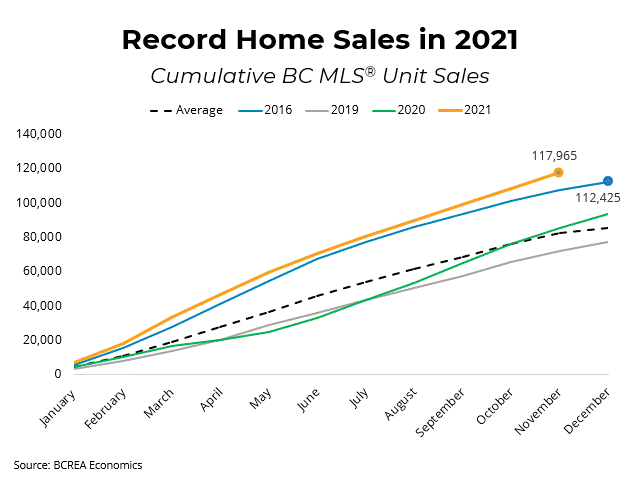
“Provincial MLS® home sales reached a new annual record in November with still one month to go in 2021,” said BCREA Chief Economist Brendon Ogmundson. “Home sales have already surpassed the previous annual record of 112,425 units set in 2016.”
Total active residential listings continued to tumbler lower, falling 39 per cent year-over-year to a record low for the province. Active listings are now about half of the level reached prior to the pandemic.
Year-to-date, BC residential sales dollar volume is up 63.6 per cent to $108.7 billion compared to the same period in 2020. Residential unit sales were up 37.7 per cent to 117,973 units, while the average MLS® residential price was up 18.8 per cent to $921,806.
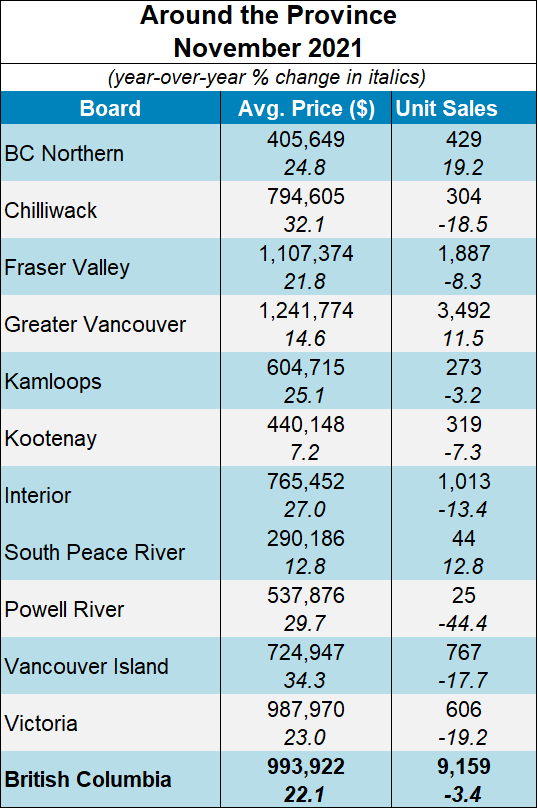
-30-
For more information, please contact:
Brendon Ogmundson
Chief Economist
Direct: 604.742.2796
Mobile: 604.505.6793
Email: [email protected]
Now Live: The Updated PDP Framework Is Here!
It’s official – as of Thursday, January 1, 2026, the updated Professional Development Program (PDP) framework is live. This is a big step forward, offering REALTOR® learning that’s more relevant, practical, and aligned with today’s real estate environment.
Developed through an inclusive consultation process with real estate boards and associations, REALTORS®, managing and associate brokers, and education experts, this evolved framework is built to support meaningful growth.
What’s New
Here are the key updates to the framework:
- 21 required PDP hours (up from 18) per two-year cycle,
- more relevant, practical learning designed for real-world application,
- stronger alignment with today’s real estate practices and public expectations, and
- support for professionalism, credibility, and long-term success as a REALTOR®.

This update is more than a requirement change. It’s a renewed commitment to helping REALTORS® thrive, build confidence in their expertise, and strengthen public trust in the profession.
Resources
To support the rollout, BCREA, together with real estate boards and associations, has created a Frequently Asked Questions (FAQ) resource that will be updated as needed, based on the questions REALTORS® and managing brokers are asking.
To stay up to date as new information is released, bookmark the Updated Professional Development Program Framework page. It will always contain the latest details.
Questions?
For any questions about the updated PDP framework, please contact us at [email protected].
Nude Beach – Disclosure or Not: Latent or Patent Defect?; Limitation Act – 30 Year Limitation Period: Right to Sue Municipality Lost #346
By Gerry Neely
B.A. LL.B
Full disclosure and view property take on entirely different meanings when a nude beach is involved. Some buyers might think a nude beach next to their lakefront property is an asset - e.g., "For sale - a lakefront rancher in dilapidated condition, but next to a nude beach." However, a buyer who put up a $100,000 deposit thought differently. He repudiated before closing when he discovered that he would be sharing his beach with people lacking discernable ID and visible means of support.
Five days after his conditional offer had been accepted, he removed the only condition, which concerned a house inspection. A few hours after the contract became unconditional, the buyer learned of the nudity problems from a neighbour and stopped payment on his cheque. The owners sued for the deposit. The buyer's only defense was that the owners, through their agents, had a duty to disclose the nude beach and the subsequent overflow onto the beach in front of the property.
If this is a defect, is it latent or patent? The parties agreed that it was not a patent defect. Even in the sunny Okanagan, few people are likely to sunbathe on a Kelowna beach in November, when the offer was made. All latent defect cases presented by the owner dealt with damage to a building or property. The buyer's counsel was unable to produce evidence of the impact that a parade of nude bodies has on the value of adjoining properties.
Welcoming or rejecting nudity is the result of the exercise of a personal preference; it cannot be measured by a standard and therefore is not a defect. The judge also noted that the buyer had five days to talk to the neighbour who readily disclosed this problem after the condition was removed. VIVA CAVEAT EMPTOR. The buyer was ordered to pay the deposit and two years' court-ordered interest on $100,000.
This must have been an entertaining case to hear and argue for everyone but the buyer. No one found it necessary to raise the question of the uncertainty of the definition of a nude beach. With the brevity of today's swimsuits (about which I make no complaint, butt would their theme song be a "Thong to Remember"?), where could one find an objective standard to apply?1
* * *
The Limitation Act provides reasonable protection against stale claims by requiring the person intending to sue to do so within the times set forth in the Act for the type of wrong upon which the claim is based. Thirty years is the maximum period set by the Act for an action for damages for a negligent act or omission committed in the processes leading to the construction of a house.
The buyer of a home, for which West Vancouver had issued an occupancy permit in May, 1963, saw cracks in the foundation at the time of purchase in 1987. In 1991 she noticed the floor was uneven. She did nothing until 1999, when a mud slide in her backyard led her to retain a geotechnical engineer who discovered that the house was built on improper fill containing logs. The soil supporting the foundation moved into the gaps created by the decomposing logs.
The owner sued the municipality for failing to properly inspect the house during construction. The first issue to be decided was whether her claim was out of time. Her success depended upon establishing that her right to sue arose later than November 21, 1963. The owner argued that her right to sue could not arise until the consequences of the improper fill became apparent when the cracks appeared in the foundation. That argument failed because the first owner would have had the right to sue the day after taking possession if the owner had discovered the defect, because he had received damaged property. He would not have had to wait until the cracks became evident.
The owner's second argument was that a new right to sue occurred when she bought the property. That would mean an extension of the 30 year period each time the property changed owners. This argument was rejected because it was contrary to the intent of the Act.
The owner lost her right to sue through her failure to act promptly when she noticed the signs of settling. 2
To subscribe to receive BCREA publications such as this one, or to update your email address or current subscriptions, click here.
Nuisance and the Limitation Act #169
By Gerry Neely
B.A., LL.B.
Noise, vibrations, odors, overhanging trees and underground roots, pollution of air or water, obstruction of highways or navigable waters or access, flooding and depriving land of support: this is not a complete list of conduct by your neighbor which may do harm to your property or to you. If your neighbor's conduct damages your property or interferes with your use and enjoyment of it and that interference is unreasonable, then that conduct may be a nuisance in law which gives you the right to damages. However, that is a right you may lose if you don't issue the Writ in time.
In June of 1985, a couple took title to a home which they had inspected from time to time over the preceding year when it was unoccupied. Some of these visits coincided with the commencement of construction of a church on the adjoining property.
That property was preloaded with approximately eight to ten feet of fill and piles were driven for foundation work which commenced in late 1984. In March of 1985, the couple discovered that the fireplace chimney was separating from the house on the side closest to the church property. In August, they noticed large cracks in the foundation slab and a living room which now sloped toward the church.
The church declined to accept responsibility and the Writ was issued June 5, 1987. At the trial, the judge accepted the plaintiff's expert evidence that the cause of the settlement on the couple's property was the weight of the preload on the church property.
The church did what it was lawfully entitled to do on its own property. The question, however, was whether its conduct was reasonable having regard to the neighbor's right to the support of the land in its natural state. The church's consultants were aware of the settlement sensitivity of the soil. Adding the additional weight of fill was an unreasonable interference with the couple's use and enjoyment of their land, entitling them to damages, unless there were other defenses.
One defense raised to their action for damages to the chimney was that they were not owners when the damage occurred. That defense was unsuccessful because an owner can recover a loss resulting from a nuisance which began before the owner purchased the property and continues after the purchase. The real obstacle to their claim was the two year limitation period in the Limitation Act for the commencement of an action for damages in respect of an injury to property.
The Limitation Act expects a reasonable man, having taken into account his own circumstances, to commence an action when, with knowledge of the extent of the injury and the cost of repairs, he has received advice which leads him to conclude that an action has a reasonable chance of success. In this case, the judge decided that the couple could have reached this decision early in March of 1985. Since the Writ was not issued until more than two years later, the claim for the chimney damage was dismissed. The claim for the foundation damage which occurred in August was allowed.
It is relatively easy for the Courts to find that a nuisance has occurred where there is actual physical damage to property. It is more difficult when the interference complained of is based on subjective responses to conduct relating to noise or odors.
So far, cases illustrate that there must be a substantial and unreasonable annoyance and discomfort before the Courts will limit your neighbor's own use and enjoyment of his property. So, apart from municipal bylaws, it looks as if we may have to put up with the backyard barbecue and the loud stereo on a warm summer's evening.1
| 1. |
|
To subscribe to receive BCREA publications such as this one, or to update your email address or current subscriptions, click here.
Object Quickly! #445
Where time is of the essence, failure to perform an obligation on time is a fundamental breach. The innocent party may treat the breach as repudiation, walk away and sue for damages.
Gulston v. Aldred involved the sale of a residential property.1 On March 3, 2008, the parties entered a standard form Contract of Purchase and Sale where time was of the essence. The purchase price was $1,570,000 with a total deposit of $105,000. Completion was April 25. The brokerage acted as limited dual agent.
In April, the seller discovered leakage from an underground oil tank on the property. For his own reasons, the buyer also wanted more time to complete. The parties amended their contract to extend completion to August 29 and added a clause requiring the seller to remediate the property and obtain a certificate of approval from the municipality on or before May 29.
On May 29, the licensee gave the buyer a letter from the seller's contractor stating that remediation was complete and that the necessary report would be sent to the municipality. The same day, the buyer asked to extend completion to October 1, but the seller refused.
On June 10, the licensee sent the municipal certificate to the buyer, who said he was satisfied with it.
In late June, the buyer's lawyer wrote to the seller claiming that the seller breached her contractual obligation to remediate the property by May 29, but saying the buyer would complete the deal by October 31. The letter also claimed an interest in the property and threatened to file a Certificate of Pending Litigation to prevent a sale to anyone else. The seller remained ready, willing and able to complete on August 29, the agreed completion date.
In July, a contractor carried out yard work on the property for the buyer.
On August 29, the buyer did not complete. The seller promptly re-listed the property and sold it to another buyer.
When the buyer sued to recover his deposit, the seller counterclaimed for the deposit and damages in an amount to be determined later. At trial, the buyer claimed that the seller failed to deliver a municipal certificate on time by May 29, as required by the remediation clause. Since time was of the essence, the buyer argued he could walk away and recover his deposit.
The court found that, by his conduct, the buyer waived the May 29 deadline. When he received the late certificate in June, the buyer said he was satisfied with it. Roughly three weeks after the May 29 due date, the buyer claimed an interest in the property, warned the seller not to sell it to anyone else, and stated that he would complete by October 31, 2008. In July, the buyer even had work done on the property.
In doing these things, the court found that the buyer affirmed the contract. Nor could the buyer show any need for the certificate by May 29, or any loss to himself for the seller's failure to do so. The court held the seller was entitled to keep the deposit. The court also ordered the buyer to pay damages for breach of contract in an amount to be determined.
Where a licensee's client wishes to walk from a standard form contract because the other side fails to do something on time, a licensee best warns the client as follows: object quickly and clearly, get legal advice immediately, and in the meantime, refrain from doing anything that might be considered consistent with the contract.
| 1. |
|
To subscribe to receive BCREA publications such as this one, or to update your email address or current subscriptions, click here.
Obtaining Credit By False Representation #257
By Gerry Neely
B.A., LL.B.
Column #77 discussed an attempt to obtain financing through the use of the Contract of Purchase and Sale, one between the parties and one for the mortgage company, the latter agreement for a higher price and larger down payment than the parties agreed upon. It is a criminal offense to attempt to obtain credit by making a false statement or representation, knowing it to be false, with the intention that it should be relied upon by a financial institution from whom a loan is sought. The parties to the contract entered a plea of guilty and were fined, or in default of payment, were subject to imprisonment for two years.
An Ontario transaction produced a somewhat similar scheme. The owners of a home, who wished to purchase a smaller home, willingly cooperated with their real estate agent when he proposed a scheme which resulted in inflating the value of the home they sold and the home they purchased. The purpose was to give them an apparent equity in their own home and an apparently greater value of the home they were purchasing to enable them to obtain a larger high ratio first mortgage.
While the financing was first approved on the basis of the price ostensibly to be paid for their new home, a few days before closing the mortgage was reduced, no doubt as a result of an appraisal at a lower price. This left them short $9,800, which they obtained by way of a second mortgage, raised by the real estate agent from funds either provided by him, or by someone connected to him.
Remarkably the sellers, as co-conspirators, in a failed attempt to make it easier to fraudulently obtain money from CMHC, sued the agent and the lawyer who had acted on their behalf. They claimed damages for the amount of the shortfall, plus an extra $3,000 paid in sale commissions because of the inflated values. They attempted to pass themselves off as, "unwitting and ignorant simple folk who were duped at every turn by the real estate agent and the lawyer." They lost because it was evident, as the judge said, that they were part of an illegal and immoral scheme to defraud CMHC.
Allegations of criminal conduct were made in both directions and the reluctance of the defendants to provide evidence indicated to the judge that criminal charges had been laid.1
***
The requirements for access to lots to be created by a subdivision plan often result in a wider roadway than future owners actually need. Where the access may be created by easements or rights-of-way, section 31 of the Property Law Act gives a judge the authority to modify or cancel the easement.
This section was considered in a case involving three side-by-side lots in a bare lot strata plan, each of which had a 10 foot panhandle to a street. The owners of each lot also had a right-of-way over the other two panhandles, creating a 30 foot right-of-way. The developer had built a 13 foot brick roadway, more or less in the centre of the right-of-way, a roadway that was adequate to meet the vehicle access needs of the owners of the three lots.
One owner, part of whose lot bordered the west side of the right-of-way, wanted to landscape the eight foot wide untravelled portion of the panhandle between her lot and the brick roadway. This was opposed by another owner who said that since the mutual rights-of-way gave that owner an easement over the whole of the right-of-way, landscaping the eight foot strip would interfere with his potential use of the right-of-way. This argument was supported by a clause in the easement agreement, which stated that no party was to do anything that would interfere with the right of access given to the other parties.
Section 31 provides three circumstances which may justify the modification of an easement or right-of-way.
1. changes in the character of the land or neigbbourhood;
2. the restriction of a reasonable use of the land, which is without practical benefit to others entitled to the benefit;
3. the absence of harm to someone who has the benefit of the easement.
| 1. |
|
|
| 2. |
|
To subscribe to receive BCREA publications such as this one, or to update your email address or current subscriptions, click here.
Occupiers Liability Act – Reduced Responsibility of Occupiers of Rural Lands for Injury or Death #367
By Gerry Neely
B.A. LL.B.
A man who took his two sons cycling over a trail on private land was thrown from his bicycle and ended up a quadriplegic, when he hit a metre-deep ditch concealed by a mound of soil. The cyclist sued for damages on the grounds that the owner breached the duty owed to the cyclist under the Occupiers Liability Act, RSBC 1966, c.377. Occupiers of premises are those in physical possession of premises, including land and buildings, over which they have responsibility and control.
Prior to an amendment in 1998, the Act imposed a duty upon every occupier of premises to take reasonable care in the circumstances to see that people who came onto the premises were reasonably safe. The 1998 amendment altered this duty for occupiers of rural land, shifting all risks of injury or death to a person who enters vacant or undeveloped rural premises for recreational purposes.
The amendment also established a reduced duty of care for occupiers of rural premises, to not act with reckless disregard for the safety of people who come onto their premises. The purpose of the amendment was to encourage landowners in rural areas to allow public recreational use of their land.
The trail in this case traversed a 145-acre parcel of land, vacant and undeveloped except for a discontinued sand and gravel operation. Although the land was within the City of Parksville, it was surrounded by rural land except on the easterly boundary, which bordered an industrial park. The owner had agreed to allow public use, without charge.
The owner filed a preliminary motion to have the action discontinued on the basis that the land was rural. The judge had no precedent, since this was the first reported case to interpret the Act's meaning of "rural premises."
In reaching his decision, the judge considered the present use of the land and surrounding lands, with no consideration of future use. The fact that the land was within a municipal boundary did not necessarily mean it should be considered urban land. Such land could have the same rural characteristics as, for example, the farmlands in Delta and the mountains of North Vancouver, which border urban areas.
He concluded the parcel was rural land. This meant the cyclist had to prove the owner acted with reckless disregard for his safety. While the cyclist had some evidence of two personal injury accidents occurring at the same place on the trail, he did not have the opportunity to obtain evidence under oath that might establish such reckless disregard.
The judge said it would be unfair to the cyclist to prevent him from continuing his action, considering his injuries and the difficulties he faced. Instead, the judge exercised his option to dismiss the owner's motion.1
If the cyclist's action does proceed, we may see a decision on what constitutes an owner's "reckless disregard" for safety.
The definition of "premises" includes land and structures; ships and vessels; trailers and portable structures designed or used for a residential, business or shelter purpose; railway locomotives and cars; and vehicles and aircraft while not in operation.
***
The effect of the Residential Tenancy Act or the terms of a lease may impose or relieve a landlord or tenant from liability as an occupier of premises. See Legally Speaking 109 and 235 for information.
| 1. | Hindley v. Waterfront Properties Corp.,, SCBC, Victoria Registry, Reasons for Judgment, June 10, 2002. |
To subscribe to receive BCREA publications such as this one, or to update your email address or current subscriptions, click here.
Offer or Option – Chapter 2 #63
By Gerry Neely
B.A. LL.B.
Column No. 57 discussed at length the problem of deciding whether a condition in an offer to purchase is not what is commonly referred to as a true condition precedent, but rather creates an option which must either be under seal or for which consideration must be given to prevent the vendor from withdrawing his acceptance of the purchaser's offer before the purchaser had the opportunity of removing the condition precedent. Clauses which have been held to create an option are those which depend upon a decision to be made by the purchaser rather than by a third party. Examples of this type of condition were referred to in Column #57 but they include conditions in which the purchaser reserves to himself the right to approve the premises, or chattels, or the financial statements. Two cases, one of which is under appeal, shed a little more judicial light on two commonly used clauses.
In one case, the offer to purchase stated that the transaction was "subject to purchaser's lawyer approving interim agreement and title search, to be removed on or before. . .". The purchaser submitted the offer to his lawyer on the first working day he could. As a result of his investigations, his solicitor did not approve the offer and concluded that some additional safeguards were needed before the purchaser could complete. The purchaser decided not to proceed and advised the vendor's agent accordingly. The vendor sued for the breach of contract. The judge's examination of the facts indicated that he considered this clause to be a true condition precedent. In part the significance of this case is that the judge stated that since the condition was inserted for the benefit of the purchaser, then the purchaser had to act upon it by submitting the offer to his solicitor. If he had done nothing at all, then the vendor might have been able to argue that the purchaser had waived his rights and the vendor might have been successful in his action for damages for breach of contract.1
The second case is the one under appeal. In that case, the purchaser's offer contained a condition that the purchaser's obligation to complete was subject to the purchaser being able to sell his own residence on or before a stated period of time. Pending the sale of the purchaser's home, the vendor retained the right to sell his home, with the result that the vendor and purchaser entered into a 72-hour clause agreement. When the purchaser still had approximately one month left to find a buyer for his home, the vendor changed his mind and notified the purchaser that the deal was cancelled. The purchaser refused to accept the cancellation and, when he found a buyer within the time, removed the subject clause. When the vendor refused to complete, the purchaser sued for specific performance.
The vendor argued that the contract was not a binding contract but it created merely a form of option. Since the contract was not signed under seal and since the deposit of $1,000.00 would be returned to the purchaser if the transaction collapsed, there was no consideration for the option. Therefore, the vendor argued that he was entitled to cancel the agreement. The judge looked at the facts, including the use of the words "condition precedent" as they would have appeared in the 72-hour clause, as well as the conduct of the parties which he found indicated that they intended to be bound by the contract, to come to the conclusion that the subject to clause did not create an option and that the contract was binding upon the vendor. The results of this case in establishing that a subject to clause of this kind creates a true condition precedent, would have been more certain if the judge had made his decision solely upon an interpretation of the offer to purchase, rather than upon that and the conduct of the parties. Perhaps the appeal will clarify that question.2
In the meantime, it would appear that these two subject to clauses can be used without either a seal or a separate consideration being required.
| 1. | Chung v. Jim, S.C.B.C. 1984 B.C.D. Civil 2228-03. | |
| 2. | Waibe v. Bobsien, C84184 New Westminster Registry. |
To subscribe to receive BCREA publications such as this one, or to update your email address or current subscriptions, click here.
Offer or Option #57
By Gerry Neely
B.A. LL.B.
The following are all abbreviated examples of the usual "subject to" clauses to be fulfilled by a purchaser, right?
- "Subject to approval of purchase price and terms by (name of the president of the purchasing company was added here). . . "1
- "Subject to my inspection and approval of premises. . . "2
- "Subject to obtaining approval of rezoning by the Municipality of. . . "
- "Subject to obtaining a first mortgage from (Bank). . ."
Wrong! Or is it just maybe?
One judge of the Supreme Court of British Columbia has held that Clauses 1 and 2 differ from Clauses 3 and 4 in their legal results. The difference allowed the vendors named in the agreements containing Clauses 1 and 2 to revoke their acceptance of the purchasers' offers before the purchaser removed the subject to or the time to do so had expired.
Clauses 3 and 4 are examples of the subject to clauses which the judge described as being normal condition precedent clauses. They require the "approval of a third party, or that financing be obtained, or that some other thing exist or be done which does not then lie in the sole discretion of either party." These clauses impose an implied obligation on each party to do whatever is reasonably necessary on his part in order that the condition can be met. The failure by a party to use one's best efforts to meet the condition gives the other party at least a remedy in damages.
Clauses 1 and 2, however, are different because the conditions to be met depend upon decisions to be made solely by the purchasers.
The judge held that these clauses created an option in favour of the purchaser to be exercised within the specified period, rather than a binding contract that was subject to a condition precedent. For these to be true options, they must have been given either under seal or for consideration. In the first case, there was no seal and, since the reasons for judgment are silent in the second case, we must assume that there was no seal on the second agreement. In the absence of a seal, it was argued that the money paid by the purchaser by way of deposit represented the consideration for the option. That argument was rejected because the vendor could only retain the deposit monies if there were a binding agreement. In neither case could there be a binding agreement until the intended purchaser approved the agreement. There would have to be separate consideration which the vendor would retain even if the purchaser did not approve the deal, in order to support the validity of the option taken by the purchaser.
The reason why the judge felt he had to draw these distinctions between the two sets of clauses was because of a Court of Appeal decision.3 That decision concerned the enforcement of an agreement which was expressed to be subject to financing. The vendor repudiated before the purchaser had been able to obtain financing and before the expiration of the time provided by the agreement for that purpose. Two of the three Court of Appeal judges held that the agreement was a binding contract for sale subject to a condition precedent. In other words, the more normal subject clause found in Clauses 3 and 4. The third judge held that the agreement created a form of option and that the consideration supporting the option was the deposit made by the purchaser. While the comments of the third Court of Appeal judge were not binding upon the Supreme Court judge, it was his attempt to reconcile the third judge's comments that led to his concluding that where either the purchaser or the vendor may in his sole discretion decide whether or not to remove the condition, an option was created which must be under seal or supported by consideration.
The decisions in the first two cases may not be followed by other Courts who may prefer the reasoning of the third Court of Appeal judge if a similar case reaches the Court of Appeal. However, they do create an element of uncertainty in the practice that has been followed in writing subject to clauses in offers to purchase. A prudent licensee may wish to take an extra step to make sure that an offer remains open and binding upon the parties until the condition is met or not, as the case may be, or until the expiration of the time provided in the offer. Those steps might include any one of the following where it is possible that a subject to clause could be considered by the Court to be an option in favour of the purchaser:
- The majority of offers which would contain an option of this kind no doubt involve residential units which are off the market for short periods of time. Since the judge referred to a seal as one way of supporting the validity of a true option, then the simplest step to take is to purchase a quantity of the small gummed circular red legal seals and apply them to the offer at the time the purchaser makes his offer.
- The following clause proposed by Peter Watts to the Fraser Valley Real Estate Board:
"As consideration for the vendor granting this option to the purchaser until the subject removal date, the purchaser has paid the sum of $_____ to the vendor as a non-refundable deposit, which amount shall be retained by the vendor for their own use whether or not the purchaser removes the condition. In the event that the purchaser has not removed the condition in writing on or before the subject removal date, this agreement shall terminate and the said non-refundable deposit shall be retained by the vendor. If the condition is removed in writing by the purchaser on or before the subject removal date, the non-refundable deposit shall be applied on account of the purchase price on completion."
(Note that the amount of the deposit should depend upon the length of time the vendor's property will be off the market and therefore may be as small as $1.00. If the period of time is lengthier or if the value of the property is substantial, then the consideration should be substantially greater.)
- If a substantial deposit is placed immediately in an interest-earning account under the authority of a clause in the offer which allows the vendor to retain the interest earned, as consideration for the option in the event that the subject clause is not removed, the above clause could be adapted as follows:
"As consideration for the vendor granting this option to the purchaser until the subject removal date, the parties acknowledge that the deposit shall be placed at interest, with the interest to be paid to the vendor for his own use whether or not the purchaser removes the condition. If the purchaser has not removed the condition in writing on or before the subject removal date, this agreement shall terminate and the interest earned on the deposit shall be retained by the vendor. If the condition is removed in writing by the purchaser on or before the subject removal date, the interest earned on the deposit shall be applied on account of the purchase price on completion."
OR a further alternative,
- "The parties acknowledge that as consideration for the vendor granting this option to the purchaser until the subject removal date, the deposit of $1,000.00 includes the sum of $10.00 which is to be paid to the vendor as a non-refundable deposit whether or not the purchaser removes the condition. If the purchaser has not removed the condition in writing on or before the subject removal date, this agreement shall terminate and the non-refundable deposit of $10.00 shall be retained by the vendor. If the condition is removed in writing by the purchaser on or before the subject removal date, the nonrefundable deposit shall be applied on account of the purchase price on completion."
To subscribe to receive BCREA publications such as this one, or to update your email address or current subscriptions, click here.
Offer to Purchase Unenforceable Because of Uncertainty As to Who Was the Intended Purchaser #3
By Gerry Neely
B.A. LL.B.
An offer to purchase made by "the undersigned Century 21 Real Estate Ltd. or nominee" was held to be unenforceable, in part because of the uncertainty as to who was the intended purchaser. The transaction was somewhat unusual because the first and second mortgage financing, which was to pay out the vendor, was to be arranged by the vendor. In addition, the purchaser agreed to "co-sign interim financing arranged by the vendor not to exceed $900,000.00". The Court had these provisions in mind when, in asking whether the purchaser was Century 21 Real Estate Ltd. or a nominee, it stated "An industrial lending institution would obviously be vitally concerned with the answers to those questions before it would be prepared to advance either permanent or interim financing, and those questions could not be answered with any certainty at all."
This case is not authority for the statement that in every instance where the purchase may be completed by someone nominated by the person making the offer, the offer to purchase is not enforceable. Here it was argued that the identification of the purchaser was important because that would affect the ability of the vendor to obtain financing. If the offer had been for cash and it was not subject to financing, it would seem reasonable to have argued that the vendor was not prejudiced by the designation of the nominee to complete the cash purchase. The case is useful because it points out the desirability of avoiding the practice of making an offer on behalf of a nominee. If subsequent to acceptance, the purchaser wishes to transfer the property to someone else, the purchaser should either try to negotiate with the vendor or complete the purchase and then re-transfer it.
This case also raises the question of the status of an offer to purchase made by a real estate agent on behalf of an undisclosed purchaser. While this is a practice of long duration and one which is supported by decisions, this case raises uncertainty as to whether this practice should be followed when an offer is subject to financing.
It may well be that subsequent decisions will limit this case to its rather peculiar facts.
| 1. | Samoth Financial Corporation Ltd. v. Todd,14 B.C.L.R. 266. |
To subscribe to receive BCREA publications such as this one, or to update your email address or current subscriptions, click here.
Offer vs. Option vs. Contract of Purchase and Sale #499
Some conditions precedent are so imprecise or subjective that they prevent the formation of a contract. Pending the weak subject's removal, we have only, in law, an offer. Removing the subject in question amounts to accepting the offer. Until the buyer delivers written notice removing the offending subject by the subject removal deadline, there is no contract. A famous example is,1
. . . [s]ubject to the approval of the president of the corporate purchaser.
Since fulfillment of this condition precedent depends on how someone feels, it is subjective. In a dispute over a subjective subject clause, one side typically obtains legal advice to leverage the arrangement's status as an offer to their advantage. A seller might cancel the deal before the buyer removes the problematic subject clause, thereby revoking the offer.2 Or, a buyer might do nothing to fulfill the feeble subject, letting the offer, in law, lapse.
Suppose that, as the result of a subjective subject clause, all we have, in law, is an offer. What if the seller, for consideration or under seal, promises not to revoke that offer? Now, we have an option:3
Where consideration is provided for leaving the offer open, the transaction is known as an option. In essence, it consists of two contracts, one the agreement regarding the offer, the second the contract arising if that offer is accepted.
With this in mind, in 2003 BCREA added to the Contract of Purchase and Sale what is now section 22.4 Section 22 essentially provides that if, pending removal of a subjective subject clause, there is only an offer, the seller promises under seal not to revoke that offer before the subject removal deadline.
In Gordon Nelson Inc. v. Cameron, a standard form contract was subject to the buyer, in its sole discretion, finding suitable financing.5 The buyer paid a $1 million deposit. In addition to the pre-printed section 22, the parties added this comparable term:
Upon acceptance of this offer, the Buyer hereby agrees that the sum of Ten Dollars ($10.00) of the initial deposit shall be non-refundable to the Buyer and the Seller acknowledges receipt of such sum as consideration for the Seller . . . allowing the Buyer the benefit of the Buyer's subjects and conditions and agreeing that the Seller's acceptance of this offer is irrevocable.
The buyer did not remove its financing subject because it couldn't find suitable financing. The sellers refused to return the deposit, claiming that the buyer breached the contract by failing to use sufficient effort to remove their financing subject.6 The buyer sued to recover its deposit.
The court found that the subjective subject clause, coupled with the term comparable to our section 22, created an option, not a contract. There was not yet any contractual obligation to use specific efforts to obtain financing. As long as the buyer acted honestly, it could choose not to exercise its option. The court ordered the $1 million deposit and accrued interest, returned to the buyer, minus the $10 payment to the sellers.
Unless the parties want an option, a REALTOR® should avoid a subjective subject clause. Instead, when apt, use one of the more objective subject clauses recommended by the Real Estate Council of British Columbia in the Professional Standards Manual.7 Council's wording is far more likely to produce an enforceable contract.
Mike Mangan
B.A., LL.B.
| 1. |
|
|
| 2. | For more information, see Real Estate Council of British Columbia, "Subject to" Clauses — General Information" Professional Standards Manual, 7th edition. | |
| 3. |
|
|
| 4. |
|
|
| 5. | Gordon Nelson Inc. v. Cameron, 2017 BCSC 1269. | |
| 6. | For information when a party is justified in refusing to remove a subject clause, see Legally Speaking No. 497 in October 2017. | |
| 7. | Professional Standards Manual. |
Legally Speaking is published monthly. Real estate boards, real estate associations and REALTORS® may reprint this content, provided that credit is given to BCREA by including the following statement: "Copyright British Columbia Real Estate Association. Reprinted with permission." BCREA makes no guarantees as to the accuracy or completeness of this information or the currency of legal information.
To subscribe to receive BCREA publications such as this one, or to update your email address or current subscriptions, click here.
Offers at prices in excess of asking price – Competition Act; Home Owner Grant Act Amendments #119
By Gerry Neely
B.A. LL.B
In some isolated places in British Columbia, more notably Vancouver, the warm market of winter has given way to the scorching sales of spring. Vendors who a year ago would have been happy to get within 5% of their asking price, are now besieged by purchasers bidding each other up to buy a property they wouldn't have looked at a year ago. This is good news for licensees but it does raise the spectre of the early 1980s where the failure of licensees to keep on top of a rapidly rising market, led to damages or the forfeiture of commissions. Legally Speaking Column #75, written in August 1985, discusses a case where a licensee was liable in damages to a vendor where there was a rapid rise in price in Vancouver in less than a month. The Court held that the licensee knew or ought to have known that the market was rapidly increasing, and he owed a duty to advise the owner of this fact.
Great care should be taken in the drafting of counter-offers and backup offers to avoid having one party in the triangle being unpleasantly surprised at the results.
This activity also brings into focus the Competition Act, which makes it an offence to supply a product at a price higher than the price at which it was offered for sale. In the early 1980s this was a concern for an owner and his agent where someone offered more than the asking price. The advice given then to the owner was to withdraw the property from the market and reprice it before re-offering it for sale. As a result of representation made by the real estate industry, the Competition Act was amended in 1986 to provide a defence where the sale of a product (in this instance, real estate) is made "by or on behalf of a person who is not engaged in the business of dealing in that product."
In the typical situation where the real estate licensee sells a home or a business or an apartment block owned by someone not engaged in the business of buying and selling property, the defence is available to both the principal and the agent. It may not be available however where the real estate agent is acting for a contractor, who is someone engaged in the business of dealing in a product, namely real estate.
What should one do? If there is time to do so, withdraw the property from the market by having the principal sign a Change of Price form. Doing this exposes one to another risk, whether this is a "bait and switch technique." That is the lesser of the two risks to meet, and the fact is of course, that the size and scope of the normal sales we are discussing would appear to be too small to warrant action by the Director of Investigations. There should be no hesitation in submitting all higher offers to the vendor.
* * *
The Home Owner Grant Act has been amended to redefine the def~nition of an owner of an "eligible residence" outside a municipality. The result of the redefinition is that the right to claim the grant is, (i) extended to an individual who leases railway land, and, (ii) denied in the 1988 tax year and subsequent years, to a tenant who does not hold a registered 99-year lease. The reason this commences in 1988 is to give a tenant who failed to claim the grant in 1987, the right to do so retroactively by making application in 1988.
To subscribe to receive BCREA publications such as this one, or to update your email address or current subscriptions, click here.
Oh, So Suite… #562
With housing prices near record levels and stubbornly high interest rates, it is hardly surprising that many buyers have and will continue to turn to “mortgage helpers” or secondary suites to supplement their income or increase their purchasing power.
According to a May 2023 article from Statistics Canada1, British Columbia has, by-far, the most “investor-occupants” in comparison with other provinces, a term which refers to a homeowner who rents out a unit on property that is also their primary residence. In fact, many buyers will include a mortgage helper on their “must haves” list alongside an open-concept kitchen. And while properties with income potential likely enjoy a distinct advantage in the marketplace, REALTORS® should be mindful that the legality of any secondary suite can present unique challenges and risks for both consumers and REALTORS® alike.
Legal or not legal, that is the question
A secondary suite is a self-contained dwelling unit with its own entrance, kitchen, bathroom, and sleeping accommodation, typically within a larger single-family home. While by-laws differ from municipality to municipality, a secondary suite is only “legal” if it was created with a building permit and meets all zoning, health and safety, electrical, and fire standards.
The serious implications of legality
Although there is a shortage of official statistics as to what percentage of all secondary suites in British Columbia are legal, the reality is that illegal suites are common and are often tenanted without serious incident. And while enforcement policies against illegal suites vary, many municipalities take a largely complaint-driven approach and do not actively seek out illegal suites. Yet, if a municipality receives a complaint and discovers the operation of an illegal suite, the potential consequences can be both expensive and time-consuming for homeowners. In addition to hefty fines, municipalities can require homeowners to bring the secondary suite into compliance with all applicable bylaws and standards or require the owner to remove the secondary suite altogether. Municipalities also have the power to file a Notice on Title for an illegal secondary suite, which would likely alert potential buyers of a breach of government by-laws or regulations2.
Claims against REALTORS®
With such significant potential consequences for homeowners, it is unsurprising that the legality of secondary suites is a consistent hotspot for claims and regulatory complaints against REALTORS®. Indeed, there are many regulatory and court decisions regarding illegal secondary suites. In one recent case, the Real Estate Council of British Columbia (RECBC) found that a REALTOR® committed professional misconduct when, acting in the capacity of a sellers’ agent, he failed to make written disclosure to the buyers that the subject property contained an illegal suite3. In another regulatory decision, a REALTOR® was found to have published misleading information by stating in an MLS® Listing that an illegal suite could help reduce mortgage payments4. Similarly, sellers’ agents have been alleged to have negligently misrepresented or misled buyers into believing that a secondary suite was legal and could be rented out legally5.
The risks are equally present for REALTORS® who act for buyers. In one decision, the RECBC found that a REALTOR®, acting within the capacity of a buyers’ agent, failed to make her clients aware of the risks of relying on unauthorized accommodation for rental income6. Similarly, another regulatory decision resulted in a finding that a REALTOR® committed professional misconduct for failing to use reasonable efforts to ascertain whether the subject property contained unauthorized accommodation7.
Tips to avoid claims
Given that the legality of any secondary suite is a hotbed for claims and complaints against REALTORS®, they should take the following precautions when dealing with secondary suites.
Sellers’ agents
- Do not make assumptions. When faced with conflicting information, take steps to confirm with the relevant municipality regarding the legality of any secondary suite before making representations regarding its legality or ability to generate income.
- If a secondary suite is unauthorized (i.e. illegal), ensure that this is accurately and consistently reflected in the MLS® Listing and all other marketing material(s).
- According to the British Columbia Financial Services Authority (BCFSA), unauthorized accommodation is a material latent defect, and adequate written disclosure, if known, must be made to a buyer before entering into a contract of purchase and sale8.
- Incorporate the use of solid disclaimers in all marketing materials. In particular, disclaimers should indicate to prospective buyers that the information contained in the marketing materials should not be relied upon without independent verification.
- Consider the use of BCFSA’s acknowledgment for unauthorized accommodations in the contract of purchase and sale: “The Buyer acknowledges that the Property contains unauthorized accommodation and understands the potential consequences including the loss of income if the Buyer is required to discontinue any rental of that unauthorized accommodation."
Buyers’ agents
- Advise your clients of the risks associated with an illegal secondary suite, including the risks of relying on income generated by an illegal suite.
- Familiarize yourself with the various zoning designations within any given municipality and be mindful that some municipalities and/or zoning designations do not permit secondary suites.
- Take steps to confirm with the appropriate municipality the legality of a secondary suite if it is of importance to your clients or recommend in writing your clients do so themselves.
- Do not make assumptions. For example, a separate gas/hydro meter or utility charge does not necessarily mean a secondary suite is legal.
- Review the Title to the subject property and suggest that your clients obtain independent legal advice regarding any notice(s) of by-law contravention on Title.
- Document your advice in writing. Consider using BCREA’s Buyer’s Acknowledgement of Information—Recommended Conditions form to document the advice given to your clients.
A special note regarding co-ownership
According to Statistics Canada, there is a high prevalence of buyers who seek to purchase real property in groups of three or more in British Columbia9. Hence, REALTORS® who are acting for buyers wishing to enter into a collective-housing arrangement would be wise to recommend independent legal and financing advice to their clients. Within the context of secondary suites, however, if a group of buyers intend to occupy an illegal suite as part of a collective-housing arrangement, they should be advised of the associated risks, including the risk that the municipality may require the illegal suite be removed. Similarly, REALTORS® should also be mindful that some municipalities may have bylaws restricting the number of maximum occupants occupying any given property. For example, the City of Vancouver’s Zoning and Development Bylaw 357510, subject to some exceptions, prohibits any dwelling unit from being occupied by more than one “family,” a definition which includes a maximum of three unrelated individuals living together as a household. Where necessary, REALTORS® should suggest to their clients that they confirm with the appropriate authorities that their intended living arrangements comply with the applicable bylaws and regulations and to seek legal advice.
Concluding thoughts
The legality of secondary suites is a hotbed for claims and complaints against REALTORS®. These issues may be particularly important given the increasing need for many buyers to rely on income generated by secondary suites and the increased prevalence of collective-housing arrangements. REALTORS® who are mindful of the potential issues that may arise regarding secondary suites will be in a better position to advise their clients and mitigate the risks of costly regulatory and court claims.
Old Is Not Necessarily Obsolete #480
On occasion, buyers become interested in properties that are subject to historical easements, some over one hundred years old. The Property Law Act provides that a court may cancel an easement where the easement is “obsolete.” Some buyers, and occasionally their advisors, assume that anything old must, for that reason alone, be obsolete and proceed to purchase those properties on the assumption that it will be easy to convince a judge that an old easement is an obsolete easement. Such is not always the case, as illustrated below.
In 1912, an owner sold part of his land on Vancouver Island. The only access to the parcel conveyed (Parcel A) was through the part retained by the seller (DL80). Unfortunately, no legal right of access was provided through the original transaction in 1912. In 1919, the lack of a legal right of access was addressed and the owner of DL80 granted an easement over DL80 for the benefit of Parcel A. The easement granted the owner of Parcel A, and her heirs and assigns, “the uninterrupted use of and passage in and along a 12 foot wide right of way with carts, vehicles or cattle at all times forever thereafter…” The recitals in the document indicated that the easement was being granted because the owner of DL80 “did not grant access to the land described in the said conveyance dated November 25, 1912...”
For over 85 years the easement was the only way to access Parcel A. In 2004, DL80 was subdivided and a road was built that provided direct road access to Parcel A. Despite the road construction, Parcel A’s owner – a developer – continued to advertise to prospective purchasers of strata lots on Parcel A that they would be able to use the easement for direct pedestrian access to the beach.
The owner of the DL80 parcel subject to the easement applied to have the easement cancelled pursuant to Section 35(2) of the Property Law Act which provides that an easement may be cancelled where the court is satisfied that “because of changes in the character of the land, the neighbourhood or other circumstances the court considers material the registered charge or interest is obsolete.”
The judge initially hearing the application to cancel the easement concluded from the recitals in the document that the right of access was limited to that which was necessary and convenient and due to the construction of the road, access over the easement area was no longer necessary. As such, she determined that the easement was obsolete and could be cancelled. The BC Court of Appeal (BCCA) disagreed and overturned her decision.1
The BCCA confirmed that recitals to an easement should only be referred to for the purpose of clarifying ambiguity. There was nothing ambiguous about the operative portion of the easement. There was no limitation on its duration. It was to be operative “forever thereafter.” There was no language suggesting that the easement would terminate upon the provision of alternate access.
The BCCA concluded that had that been the intention of the parties, the solicitor drafting the easement would have provided express language to that effect. In the absence of express limiting language, the easement remained in full force and effect. The BCCA cited a number of previous decisions which concluded that where an easement was still in use it did not become obsolete merely upon the availability of alternative access.2
A buyer purchasing property that is subject to an historical easement should never assume that, simply because the easement is old, it will be considered obsolete and thus cancellable. If the cancellation of the easement is of importance to the buyer, they should seek legal advice before purchasing the property.
To subscribe to receive BCREA publications such as this one, or to update your email address or current subscriptions, click here.
One Financial Services Regulator Coming This Summer
In March, amendments to the Real Estate Services Act (RESA) received Royal Assent, paving the way for a single financial services regulator in BC, including real estate. On May 19, the British Columbia Financial Services Authority (BCFSA) announced that the Office of the Superintendent of Real Estate (OSRE) and Real Estate Council of BC (RECBC) would be integrated into the BCFSA this summer.
The BCFSA says the creation of a single regulator – which, in addition to real estate services, already includes credit unions, trust companies, insurance companies, mortgage brokers and pension plans – will “simplify accountabilities and enhance regulator oversight through more effective business processes, investigations, and enforcements.”
The new regulatory model will be organized functionally with departments overseeing the entire financial sector.
In 2019, then Minister of Finance Carole James announced her government’s intention to carry out the amalgamation. This is the second restructuring of the real estate regulatory system in five years. BCREA welcomes opportunities for efficiencies and we look forward to a collaborative and productive relationship with the BCFSA as we continue to advocate for a regulatory environment that is informed by the REALTOR® perspective and results in increased consumer confidence.
Over the coming weeks, BCREA will continue work with the BCFSA, OSRE and RECBC to understand the impact of the changes and to provide input at every opportunity, ensuring the collective voice of BC Realtors is heard throughout the next stages of the regulatory shift.
A full list of BCFSA's future executive team can be found here. An FAQ document, which includes more information about the integration of RECBC and OSRE, can be found here.
To learn more about what you can expect with the move to a single regulator, click here.
One Man’s Opinion – A Conversation With The Readers (Part 1) #402
By Gerry Neely, B.A. LL.B
I decided earlier this year that it was time to turn over to others the pleasure of writing the Legally Speaking columns. I made this decision reluctantly, because I enjoy everything involved in the research and writing of the columns, as well as the opportunity to be involved with the people in organized real estate. However, I knew it was time to set my “best used before” date when I began to think I was indispensable. So, this column and the next will be my last. The content will focus mainly on the past to respond to the following questions.
What was the biggest legal issue facing the real estate profession in the past?
My vote, in part because it affected every licensee for much of the last half of the 20th century, was the agency relationship of seller, listing agent and selling agent that resulted in the selling agent who found the buyer becoming a subagent of the seller. Buyers and some selling agents were confused as to whether they acted for the buyers or the sellers, with resulting personal and professional liability.
Over time, what licensees considered to be usual negotiations, intended to bring sellers and buyers together, began to be seen by the courts as breaches of a subagent’s duty to disclose all material facts and to maintain the confidentiality owed to a principal.
It also became apparent that the subagent relationship with a seller created risks of breach of duty that wouldn't exist if the licensee had been the buyer’s agent. It wasn’t until 1994 that subagency was replaced by agency disclosure, limited dual agency and buyer agency. While adapting to these changes is a work in progress, the overall transition benefits every licensee.
Describe a success the profession has had during the years you wrote your column.
The protection of licensees earning commissions against sellers or bankrupt agencies has been a major success. When I started practicing law in 1958, the seller received all of the proceeds of sale, including the commission. An agency would have to sue to collect from a reneging, unhappy seller. Then, a commission clause was added to the Interim Agreement, the predecessor to the Contract of Purchase and Sale, which was signed by the seller and buyer. The clause failed because the agency was not a party to the contract. The next step was to put the clause in the listing contract, where it remains today.
The bankruptcy problem took much longer to resolve. The recession of the 1980s resulted in several agency bankruptcies. Licensees who were owed commissions were devastated to find they were only ordinary creditors of the agencies. As such, they shared the pennies on the dollar divided among all ordinary creditors, after secured or preferred creditors were paid.
Acting on BCREA’s behalf at the time, I prepared a draft amendment to the former Real Estate Act to create commission trusts in favour of licensees. Even though there was precedent for it in Manitoba’s real estate legislation, the superintendent of insurance and real estate wasn’t prepared to recommend that a preference be given to one category of commission salesperson over another.
Nothing further happened until 1992 when the BC Supreme Court ruled a commission trust in a multiple listing contract was unenforceable. The chance to challenge this decision came in 1996, when BCREA funded a successful appeal to the BC Court of Appeal that confirmed the enforceability of the commission trust in independent contractor contracts (see column 266). Now, after three decades, the commission trust provisions of the Real Estate Services Act protect licensees’ commissions.
To subscribe to receive BCREA publications such as this one, or to update your email address or current subscriptions, click here.
One Man’s Opinion – A Conversation with the Readers (Part 2) #403
By Gerry Neely
B.A. LL.B
In his final issue as author of Legally Speaking, Gerry continues with his two-part discussion on legal issues in the real estate profession.
When you reflect back on your authorship of Legally Speaking, was there one column that stood out and that you’re particularly proud of?
Yes—column 224 (September 1994). It was written to introduce buyer agency and had two main themes: one for buyers’ agents, outlining their duties to buyers and suggesting to licensees listing their services for a flat fee that the responsibilities they assumed may mean they had sold themselves short; and the other for the importance of maintaining the cooperation and civility required of members of a board to keep the MLS® effective. This was to avoid the experience in California and some other American states where, following the introduction of buyer agency, some brokers adopted an adversarial approach to licensees acting as buyer agents. This column received more favourable comments and requests to print than I’m used to (actually, if I receive two comments, that’s more than I’m used to).
The most entertaining column I wrote was 346 (April 2002), which examined the question of whether a nude beach is a defect and, if it is, whether it’s patent or latent.
Have you noticed any recurring problems over the years?
The most obvious and avoidable is a licensee’s failure to comply with paragraph 9 of the Contract of Purchase and Sale by not listing the encumbrances that are to remain on title. The result is a lost deal for the buyer, a lost commission and possibly an action for negligence against the licensee. Some licensees seem to overlook this or fail to recognize the distinction between private restrictive covenants and rights-of-way and those in favour of utilities and public authorities.
This problem was first discussed in column 28 (November 1982), which contained a recommendation for title searches. While title searches have become the norm, eight other columns between 1990 and 2003 dealt with this issue.(1)
Finally, apart from learning more real estate law than I otherwise would, the advantage of writing Legally Speaking columns over the past 26 years is that I met many fine men and women who have served your profession well.
From my observations of the changes and growth within organized real estate over the last 40 years, licensees are much more professional and knowledgeable in a more complex world. The introduction of continuing education, including the Professional Development Program, is an important step to maintaining high professional standards. The image of the profession, and its contribution to the communities it serves, continues to gain recognition from the public and government.
I’d like to thank those licensees who sent me information about cases I used in the columns, and who responded to surveys asking for their suggestions. Your input certainly made my job a lot easier.
A fitting end is to thank Norma Miller, who weaned me from the lawyer’s habit of using three words where one will do, for her always helpful comments and suggestions.
My very best wishes to each of you for a long, happy and healthy life.
To subscribe to receive BCREA publications such as this one, or to update your email address or current subscriptions, click here.
Online Course on BC Energy Step Code Helps REALTORS® With the Sale of New Energy-Efficient Homes
BC Energy Step Code: A Primer for Selling Energy-Efficient New Homes is a self-paced online course worth three accredited PDP hours in which REALTORS® will improve their knowledge of the BC Energy Step Code. The BC Energy Step Code sets levels, or “steps”, of performance requirements for new construction and is a growing deciding factor for your clients when buying new homes.
Local home construction experts and course author Peter Sundberg, in collaboration with energy experts from City Green Solutions, guide Realtors through interactive elements, video explanations, and knowledge retention exercises to help ensure that, by the end of this course, you will be able to:
- explain the role that the BC Energy Step Code plays in aligning with the national and provincial strategies and pathways to net-zero energy-ready new construction,
- identify the key features and benefits of high-performance homes and buildings,
- educate clients about the BC Energy Step Code and more effectively sell energy-efficient homes.
The primary goal of this course is to enhance your knowledge of how to assist your clients and protect their best interests during the home buying or home selling experience, particularly around energy efficiency.
2023 update: what changed in the course
To meet the recent regulatory updates to the BC Energy Step Code, BCREA has implemented some changes to the course, as well as adding a new module that covers issues related to zero-carbon homes.
As of May 1, 2023, the BC Energy Step Code was officially adopted into the BC Building Code regulation, stipulating that newly built homes must meet performance metrics from Step 3. At the same time, the Zero Carbon Step Code was added as an optional building code regulation that local governments can adopt and incorporate into bylaws.
Along with the regulation amendments, BCREA took the chance to update or add other information related to:
- 2022 CleanBC Strategy and Resources
- 5-Step ladder revisions
- Construction and design techniques
- 2022 BC Energy Step Code Market Response Study
- 2022 BC Energy Step Code Metrics Research Report Update
- 2023 Canadian Homebuilders Association National Home Buyer Preference Survey
Check out BCREA’s Energy-Efficient and Sustainable Homes PDP course here for another accredited learning opportunity related to energy-efficient homes.
This Project is made possible with funding from the Real Estate Foundation of British Columbia.

Online Education During the COVID-19 Pandemic
We are a number of weeks into social distancing and we’ve noticed that many REALTORS® are taking this time to pursue online professional development. Likewise, many individuals and organizations are creating new online learning opportunities to meet the growing demand. This blog post will help you navigate the changing landscape of online learning so you can make informed decisions around pursuing your professional development.
First and foremost, we’ve heard from many Realtors that they’ve experienced aggressive direct marketing campaigns promoting various online courses and programs, and we would like to assure you that BCREA does not share your information with third parties under any circumstances, and certainly not for the promotion of online courses.
Additionally, we have seen several promotional campaigns that have included misleading language or inappropriate use of the BCREA logo, implying the course is affiliated or endorsed by BCREA. If this is the case and the course is an accredited Professional Development Program (PDP) learning opportunity, it will be included in this list of accredited learning opportunities on the BCREA website. If the course is not included in this list, it may still be an option for your self-directed PDP hours, but there is further due diligence required to ensure you are investing your time and money into a worthwhile learning experience.
Here are four questions to ask yourself to help you choose quality online learning:
1. Is the course accredited for PDP hours?
All accredited PDP courses are listed on BCREA’s website here. In order to be accredited, the course and provider undergo a thorough review process by a committee made up of Realtors, managing brokers and education professionals to ensure it is relevant, accurate, reputable, has integrated adult learning principles and has the key competencies required of a Realtor. If a course is not accredited, it might still be an excellent learning opportunity for you and could count toward self-directed PDP hours.
2. Can the learning opportunity count toward self-directed hours?
If looking outside of accredited PDP courses, you will want to ensure the learning opportunity can count toward your self-directed PDP hours. To count, it must meet the following three criteria:
1. it must enhance your professional practice;
2. it must be verifiable and auditable, meaning you can show proof of completion; and
3. it must be a minimum of one hour in length.
Each real estate board undergoes an audit process to ensure your reported self-directed learning opportunities are auditable and verifiable. With online learning, one thing to look for is whether the course logs your progress, including knowledge checks or quizzes, to ensure it's verifiable. Watching videos, whether on YouTube or within a website that does not monitor or track your progress, would not be verifiable.
As self-directed learning is about greater flexibility and personal choice, there is no exhaustive list of learning opportunities that count toward self-directed PDP hours. Please use the criteria outlined here to determine if a learning opportunity will count toward your self-directed PDP hours. If you’re not sure, check with your local board.
3. Is it quality learning?
Quality learning is often defined by tangible results produced by solid learning objectives and includes best practices in learning and education. Some of the best sources of quality education will be from those already trusted within the industry: academic institutions, member boards, associations and other reputable providers. You may come across a quality course from another vendor, but if you're unsure, it’s always best to check with your board.
4. Is it secure?
With more and more online providers popping up, some nefarious actors may enter the market, trying to disguise themselves as quality educational offerings. It’s important to stay alert when seeking an online learning opportunity for professional development hours, especially where credit cards or other personal data are being collected. Email phishing schemes are on the rise and some may claim they offer accredited or self-directed PDP hours.
If you are purchasing an online course, practice due diligence as you would anytime you provide your credit card online.
Once again, if you are unsure, reach out to BCREA or your local board. Stay safe, and happy learning!
To subscribe to receive BCREA publications, or to update your email address or current subscriptions, click here.
Only 35 Per Cent of British Columbians Support Government’s Cooling-Off Period According to Recent Polling
On behalf of the province’s eight real estate boards and 24,000 REALTORS(R), the BC Real Estate Association (BCREA) supports the Government of British Columbia’s intent to introduce a “Homebuyer Protection Period.” However, the BC Government's cooling-off period fails to meet the needs of British Columbians. A recent independent survey of 1,157 British Columbians shows that only 35 per cent of consumers support introducing a cooling-off period.
“Policy should equally protect all parties involved in real estate transactions while also contributing to a smooth functioning market and improved housing affordability. But the Province’s plan to amend the Property Law Act to create a cooling-off period in real estate transactions leaves BC consumers with more questions than answers,” says BCREA Chief Executive Officer Darlene K. Hyde. "A cooling-off period will likely increase competition for any given property, has the potential to increase prices and does not clearly take risks to sellers into account.”
“Given that the Government has again announced plans for policy changes without publicly stated and evidence-based reasoning or proper consultation in advance of committing to the direction, it’s no wonder that consumers don’t have confidence in what they’ve proposed,” adds Hyde.
BCREA urges the government to consider the following before proceeding with regulatory change:
- Any new policies should protect both buyers and sellers equally. Sellers often become buyers in a real estate transaction and the cooling-off period exposes sellers and the market in general to greater risks and uncertainty.
- Provide evidence-based reassurance that the Government’s cooling-off period won’t unintentionally worsen affordability.
- Ensure that consumers and the real estate professionals who support them are appropriately supported during the transition.
- As the voice of BC’s 24,000 Realtors, BCREA rejects any suggestion that Realtors are not invested in consumer protection and housing affordability. On behalf of Realtors, in February 2022, BCREA presented the BC Government with a white paper with more than 30 recommendations on how to improve housing affordability and strengthen consumer protection.
A Better Way Home: Strengthening Consumer Protection in Real Estate is a white paper that incorporates findings from focus groups with consumers and Realtors, years of survey data and a detailed analysis of economic and secondary literature, including the impacts of attempted housing market interventions worldwide. Instead of a cooling-off period, a key recommendation in the white paper is the introduction of a pre-offer period of a minimum of five business days from listing during which prospective buyers could hire home inspectors of their choice, review important documents, ensure financing and complete any other due diligence prior to making an offer.
“The Realtor profession does not benefit from over-heated market conditions that leave most of their clients frustrated and discouraged, as they lose out again and again on their homeownership dreams,” says Hyde. “It’s time to let go of that harmful preconception and acknowledge the important contributions Realtors can make to better protecting consumers and improving housing affordability.”
Seventy-one per cent of British Columbians say that Realtors should be consulted when it comes to developing and implementing policy impacting real estate markets.
Open Houses: Hologram or No Hologram?
Can’t do your open house due to a scheduling conflict? Vacation? A weary state of mind where everything feels dull or not worth doing?
The BC Financial Services Authority’s (BCFSA) guidance on hosting open houses is clear: “best practice is for a seller’s agent to host.”
But occasions happen, and then the fun starts.
Are you on a team? Team members do not require the seller’s consent.
Not on a team? Then the seller’s written consent is required. And will the substitute host be a designated agent? (Good for the seller!) Or offer no representation? (Not in the seller’s best interest!)
The “no representation” scenario requires five must-dos as laid out by BCFSA.
But, you say, “I’m in a small brokerage, and no one can help. My best friend is with another brokerage. I’ll use him.” Survey says, “DON’T!!”
More importantly, BCFSA says “Don’t!” Actually, BCFSA says it “strongly discourages” doing this, which is regulator code for “See you at the hearing.” And, in their Artificial Intelligence (AI) Guideline, they add, “You should also refrain from using AI tools without your client’s express consent.”
So, in the absence of someone from your team or brokerage who could replace you, are there any other options? Well, the COVID-19 pandemic led us to adopt new technology. We accepted Zoom calls as standard operating procedure for many business practices and appeared live on distant screens. BCFSA even provided guidance on virtual open houses, and today they provide more Artificial Intelligence Information.
Will you Zoom into a future open house as the host?
Unless you have cameras and monitors throughout, you can't supervise potential buyers.
How about a robot stand-in? Sadly, this isn’t likely an option. The most current lifelike robot runs around $250,000 Canadian. But just in case you sold your Lamborghini and have spare cash lying around, there’s a chance you’d still have to licence the robot. (We’re in uncharted territory here, folks.)
You think, “Maybe a hologram is more practical?”
You could argue that it’s still you, so no licensing issues there. The only question is: Will you do it live or as a pre-recorded Q&A? If you think about it, a recorded hologram could be considered advertising, kind of a virtual feature sheet. Would a live hologram be any different from a live Zoom?
Once again, how will you supervise buyers?
This scenario may seem like a futuristic dream, but at what cost?
Years ago, one of my top sales staff said, “We’re not getting big bucks just to play an easy game!”
Just take the time and do the open house in person.
Option, Payment to Lawyer of Optionee Invalid Exercise of Option; Confirmation Added to Addendum, of Discussion With Seller, Was Not a Counteroffer #331
By Gerry Neely
B.A. LL.B.
An owner who sold a building lot took back an option to repurchase it if the buyer did not construct a dwelling house upon it by a fixed date. The option had to be exercised by a payment to the buyer of $20,000 within three months of the date. Construction of the house did not proceed and the owner exercised the option within the three-month period. He paid the $20,000 to his lawyer who advised the buyer that he had the funds in trust, to be paid to the buyer, subject to adjustments, upon the buyer's execution of the transfer form.
The buyer refused to do so, and successfully resisted the owner's action to enforce the option. The judge accepted the buyer's argument that, by failing to pay the amount to the buyer directly, as called for by the option, the owner hadn't validly exercised the option.
This is an example of how strictly the terms of an option will be interpreted against the person having the benefit of the option. When a licensee has a subject clause in an offer, which may have the effect of creating an option, any cash consideration to support the option should either be paid to the seller or the option clause should clearly set out the alternative.1
* * *
An offer to purchase property, upon which a leasehold restaurant business was carried on, contained a subject clause entitling the buyer to examine the lease and to remove the clause if he was satisfied with it. The buyer's agent received a copy of the lease with a request that he call the owner.
They discussed alterations to the restaurant and the agent asked the owner if a final inspection by the municipality had been completed. The owner said he didn't expect there would be a problem and that he would call for an inspection. The agent sent the usual addendum removing the condition and added to it the following sentence: "Seller agrees to provide final inspection certificates for alterations re above lease, by September …"
The owner, who was the former owner of a real estate agency, decided that this was a counteroffer and declined to complete, unless the buyer agreed to pay $10,000 more for the property. Rather than do this, the buyer sued to enforce the contract.
Whether a communication from a buyer is a counteroffer or merely a request for information, or confirmation of a statement or agreement made by the seller, depends upon whether the facts support an intention to reject the terms of the offer. Upon the facts of this case, the judge concluded that the addition to the addendum only expressed the agreement by the owner to apply for and provide the inspection reports.
In reaching this conclusion, the judge attached particular significance to the fact that the owner had not been asked to sign the addendum, which he would have been required to do if the addendum had been intended to be a counteroffer.2
| 1. | Rae v. Paduano, BCSC, Invermere Registry, Reasons for Judgment, June 26, 2000. | |
| 2. | Montane v. Schroeder, BCSC, Kamloops Registry, Reasons for Judgment, March 27, 2000. |
To subscribe to receive BCREA publications such as this one, or to update your email address or current subscriptions, click here.
Organized Real Estate Successfully Lobbies for Modernizing the Home Buyers’ Plan
In a win for homeowners and REALTORS®, the BC Real Estate Association (BCREA), Canadian Real Estate Association and real estate boards have successfully advocated for changes to the federal Home Buyers’ Plan (HBP).1
Canadian homeowners who have experienced a breakdown in their marriage or common-law partnership may now be able to qualify for the HBP. This will help Canadians maintain homeownership when faced with new and challenging financial circumstances. The change was announced in Budget 2019 and took effect in January 2020.
Another HBP win from Budget 2019 was an increase in the maximum RRSP withdrawal limit to $35,000 (previously $25,000). This change, which took effect in March 2019, gives first-time home buyers greater access to their RRSP savings to buy or build a home.
While BCREA welcomes the change, there are more opportunities to modernize the HBP to better reflect the BC housing market. The maximum withdrawal limit of $35,000 can only have a limited impact on access to housing in BC, which has an average price of $700,000. We will continue to look for opportunities to promote and advocate for future positive changes to the HBP.
The updated HBP is just one of many steps needed to substantially improve housing affordability in BC. You can find BCREA’s other housing affordability solutions here.
To subscribe to receive BCREA publications, or to update your email address or current subscriptions, click here.
| 1. |
|
Organized Real Estate Wants You!
Join BCREA's Board of Directors
BCREA is seeking REALTORS® for its Board of Directors, for election at its next AGM on March 24, 2020.

Ideally, the candidates should have served previously on boards of directors in organized real estate and should come equipped with governance and a range of business skills and backgrounds, including commercial. Experience on other boards of directors is also considered an asset.
The workload averages out to approximately one day a month, considering at least four board meetings a year, at least four committee meetings a year, strategic planning meetings, Government Liaison Days and other events.
In October of 2019, BCREA will host an information webinar for any interested parties, as well as a two day governance training session—Governing with Intention—which will be offered to interested candidates on October 28 & 29.
Application packages for interested candidates will be circulated in December 2019, with interviews by the Nominating committee taking place in January and February 2020.
Please address any queries to Bryndis Ogmundson at [email protected]; or 604-742-2799.
To subscribe to receive BCREA publications such as this one, or to update your email address or current subscriptions, click here.
OSRE Announces Five Recommendations to Support Managing Brokers
On Tuesday, February 9, the Office of the Superintendent of Real Estate (OSRE) announced five preliminary recommendations to support managing brokers as part of a report into the role of managing brokers in real estate transactions. The study was completed in collaboration with the Real Estate Council of BC (RECBC) and with input from BCREA, real estate boards and REALTORS®.
The recommendations are:
- Enhance education and qualification requirements for managing brokers.
- Develop enhanced resources for managing brokers to promote compliance.
- Explore more rigorous brokerage licensing and ownership requirements.
- Identify ways to enhance regulation through data and information.
- Continue to explore the long-term concepts for the role of managing brokers, as described in the 2019 discussion paper.
The report also includes more detailed sub-recommendations and OSRE noted that it has already begun working in collaboration with RECBC to implement changes, including:
- Providing enhanced resources for managing brokers by updating practice guidelines and disclosure forms,
- Improving education for real estate professionals, including for managing brokers, through the revamped Legal Update course format, introduction of new continuing education courses including a program of ethics education, and participation in the development of a National Competencies Framework for real estate practice, and
- Considering ways to adopt modern, efficient regulatory practices through improved collection of data and information, in preparation for the amalgamation of OSRE and RECBC with the BC Financial Services Authority (BCFSA).
Superintendent of Real Estate Micheal Noseworthy said in a February 9 email to real estate licensees that the challenges facing managing brokers are complex, noting that, “While there are no quick fixes, staff have provided their preliminary recommendations, informed by your feedback, which aim to take a holistic and measured approach.” Early in 2020, BCREA submitted several recommendations to OSRE regarding the future of managing brokers. The five recommendations announced by OSRE in February 2021 reflect several of BCREA’s concerns and priorities. We’ll take every opportunity to provide input as the regulator develops and implements its recommendations.
To subscribe to receive BCREA publications such as this one, or to update your email address or current subscriptions, click here.
OSRE Wants Your Input Into Real Estate Teams
The Office of the Superintendent of Real Estate (OSRE) invites REALTORS® and others to give input into the regulation of real estate teams by participating in a survey open until Friday, April 2, 2021.
OSRE has been working with the Real Estate Council of BC (RECBC) to consider how to enhance the regulation of teams and has posted a discussion paper on its website. The discussion on real estate teams is part of OSRE’s research into the role of managing brokers.
In a recent communication to real estate licensees, Superintendent of Real Estate Michael Noseworthy said, “Managing brokers operate in an increasingly complex regulatory environment where change has become a constant. Incremental measures will help both licensees and regulators to fully implement and assess the impact of changes over time.”
Details of additional engagement opportunities will be made available as their work progresses. In 2020, BCREA worked with real estate boards to hold a series of Realtor focus groups about teams. We provided our findings to OSRE and RECBC in September 2020, and BCREA will respond to the current consultation.
To subscribe to receive BCREA publications such as this one, or to update your email address or current subscriptions, click here.
Owner Consent and Notice Requirements #223
By Gerry Neely
B.A., LL.B.
Failure to comply with the Condominium Act may result in an unsuccessful action brought by a strata corporation or the failure of arbitration.
In one case, the units in a strata titled industrial park were subject to a building scheme, which allowed units to be used for "manufacturing, processing, storage...of goods and materials." An owner of one unit wanted to build a mortuary/crematorium. The owner's argument was that the human remains were brought onto the premises for storage prior to being processed through the crematorium. While the judge rejected this macabre interpretation of the building scheme, he had to dismiss the strata corporation's petition because it failed to comply with Section 15 of the Condominium Act.
Under Section 15 a strata corporation may sue on its own behalf, and on behalf of an owner, about matters affecting the common property, common facilities and other assets of the strata corporation. If the action, however, involves a matter affecting individual strata lots as was the case here, the strata corporation may only proceed with the authority of a special resolution of the members, and the written consent of the owners who wish the strata corporation to act on their behalf. In this case the written consent had not been obtained.1
***
Section 44 of the Condominium Act provides that some disputes between a strata corporation and an owner, or between two or more owners, may be arbitrated. Arbitration is limited to disputes which include contributions to common expenses, repair work done by strata corporations on an owner's strata unit, as ordered by a local authority, fines, or damages to common property. A request for arbitration may be initiated by the strata corporation or an owner. Notice of the arbitration must be given to any owner who would be affected by the arbitrator's decision.
An arbitration was held to determine how maintenance costs were to be divided between different types of units, condominium apartments and garden apartments, in one strata corporation. The arbitrator's decision might shift maintenance costs from one type to the other. All owners might be affected by the decision. Therefore, all members of the strata corporation were entitled to notice of the arbitration, and the failure to do so meant that the ruling made by the arbitrator was set aside and the parties had to start all over again.2
***
An intending purchaser of a strata lot is entitled to receive from the strata corporation a Section 36 certificate, which lists nine facts the strata corporation is required to provide to the owner. The results of one case suggest that the strata councils, or their property managers, would be well advised to give no more information than is required by Section 36. The reason is that as between the owner and the strata corporation, the certificate is conclusive evidence of the accuracy of the facts contained within it.
That proved to be advantageous to two buyers of units in a strata development constructed in 1984. A problem with water leaking into the strata units developed in 1989. This resulted in the members of the strata corporation authorizing repairs to be done. At the time of the purchase in 1991, the certificate received by the 1991 buyers contained a statement which Section 36 did not require the strata corporation to provide.
That statement was "there is no money expended on behalf of the owner of the above strata lot, not recovered by the strata corporation." Within a few months after their purchase the strata council announced that the actual cost of repairs had exceeded the anticipated costs. The previous assessments made upon all owners were insufficient to repay the additional cost incurred by the strata corporation.
The 1991 purchasers rcfused to pay their share of the new assessment levied upon all owners, stating that the cost had been incurred on behalf of the owners from whom they had purchased their strata lots. The court agreed with their argument that the effect of the statement, added to the Section 36 certificate, meant that they were not required to contribute to this CoSt.3
To subscribe to receive BCREA publications such as this one, or to update your email address or current subscriptions, click here.
Owner-Builders Liable For Poor Construction #489
Since the last Legally Speaking on this topic,1 the Supreme Court of British Columbia has awarded significant damages against two owner-builders for poor construction. The provincial government has also raised the threshold for the owner-builder exemption.
Since July 1, 1999, unless an exemption applies, every new home in British Columbia must be built by a licensed residential builder, registered with the Homeowner Protection Office (HPO) and enrolled for home warranty insurance. The owner-builder exemption permits an individual to build his or her own home, or to act as their own general contractor, if they meet certain requirements. An owner-builder may provide home warranty insurance, if they wish. Many do not.
If an owner-builder does not supply home warranty insurance, the Homeowner Protection Act imposes a statutory warranty.2 The owner-builder is deemed to promise to subsequent owners that the home is, in effect, properly built. From the date of the occupancy permit,3 this ten-year statutory warranty covers materials and labour for two years, building envelope for five years, and structure for ten years. This warranty cannot be waived by agreement.
In Chapman v. Stacey, the buyers relied on their statutory warranty to sue the owner-builders who built the buyers' home.4 This appears to be the first case of its kind. Contrary to the building code and the architect's plans, the owner-builders improperly built a deck, causing significant drainage problems. The court awarded judgment against the owner builders for $96,900 and GST, being the cost to remediate the deck, plus interest.
Recently, the government added a significant new owner-builder requirement. Effective July 4, 2016, every owner-builder applicant must pass an examination on home construction fundamentals.5 An applicant gets one chance to pass the exam per application; 70 per cent is necessary to pass.
When listing a home within approximately ten years of the date of the occupancy permit, the date of first occupancy, or readiness for occupancy, whichever came first:
- A REALTOR® must inquire whether an owner-builder built the home. If the building permit was issued before November 19, 2007, contact the HPO directly. If issued on or after that date, check the HPO's online New Homes Registry.
- If an owner-builder built the home:
- Before November 19, 2007, AND there is no home warranty insurance, the HPO will have issued an Owner Builder Declaration and Disclosure Notice to the owner builder. So long as the ten-year statutory warranty is running, that notice MUST be given to the buyer before entering any agreement to buy the home;
- On or after November 19, 2007, if it is permissible to sell the home, the HPO will have issued a Disclosure Notice to the owner builder. That notice will say whether there is home warranty insurance or not. So long as the insurance applies or the statutory warranty runs, the buyer MUST be given the Disclosure Notice before entering any agreement.
If the home fails to meet the HPO's requirements, a REALTOR® must not list it.
If a REALTOR® commits professional misconduct or conduct unbecoming a licensee, the Real Estate Council of BC may now order the licensee to pay a very large penalty,6 plus an additional penalty equal to the licensee's remuneration in the deal.7 The HPO's Registrar may impose a penalty up to $25,000, and the province may prosecute the licensee. There could also be a lawsuit.
If there is any doubt whether a home meets the HPO's requirements, do not assume anything. Check with the HPO.
Mike Mangan
B.A., LL.B.
| 1. | Clee, Jennifer, "The Homeowner Protection Act: Protect Your Clients and Yourself!", Legally Speaking, No.470 (May 2014). | |
| 2. |
|
|
| 3. |
|
|
| 4. |
|
|
| 5. |
|
|
| 6. |
|
|
| 7. |
|
Ownership Protected – Mortgage Fraud and the Land Title Act #432
By Edward L. Wilson
Lawson Lundell LLP
There are very few instances of mortgage fraud involving the registration of fraudulent mortgages in the Land Title Office. A recent Court of Appeal decision addressed the situation where a fraudster forged an owner’s signature to a transfer of the owner’s lot, transferring title to the fraudster’s accomplice — a Ms. Gill, who registered title in her true name.1 Ms. Gill granted a mortgage to a private lender who advanced Ms. Gill $40,000. Ms. Gill then granted a second mortgage to a corporate lender who advanced $55,000 under their second mortgage. Neither of the mortgagees had knowledge of the fraudulent root of Ms. Gill’s title.
The original owner brought an action to have the title to the property restored in his name. However, based on the concept of indefeasibility established in the Land Title Act (the “Act”), once a person has fee simple title to a property registered in their name, that title “is conclusive evidence at law and in equity, as against the Crown and all other persons, that the person named in the title as registered owner is indefeasibly entitled to an estate in fee simple to the land described in the indefeasible title”.2 This principle would suggest that Ms. Gill should retain title. However there are exceptions to indefeasibility as set out in section 23 of the Act including an exception providing “the right of a person deprived of land to show fraud, including forgery, in which the registered owner has participated in any degree”.3
In this case the new registered owner, Ms. Gill had participated in the fraud and the trial court made an order transferring title back into the name of the original owner relying on the fraud exemption to indefeasibility. The real question was whether or not the two mortgages would continue to charge the title once it was transferred back to the original owner. The trial court found that as Ms. Gill was the registered owner at the time of the granting of the mortgages, she could grant valid mortgages to the two mortgagees and thus those mortgages would remain registered against the title. The original owner would therefore have to make a claim against the Land Title and Survey Authority’s (LTSA) assurance fund for compensation. The owner and the LTSA appealed the decision to the Court of Appeal.
The BCCA considered the Act and based on the fraud exception to indefeasibility, confirmed that it was appropriate to transfer the title back to the original owner as Ms. Gill participated in the fraud.4 The Court found however that the indefeasibility principles set out in the Act do not extend to lesser interests such as mortgages. The Court considered other sections of the Act and found that the Act granted lesser protection to charge holders than it did to fee simple owners.5
The court found that under the Act, a mortgage granted by a person who obtained their title by fraud or forgery is invalid and the Act preserves the nemo dat quod non habit rule 66 with respect to charges. So even where a mortgagee has relied on the registered title and dealt bona fide with a non-fictitious registered owner, a mortgagee does not acquire any estate or interest in the lands on registration of their mortgages where they have been granted by a person who had no valid interest in the lands and such mortgages are void.
The decision confirmed the security of fee simple title to land, while increasing the burden on mortgagees to carry out more fulsome due diligence with respect to their borrowers.
To subscribe to receive BCREA publications such as this one, or to update your email address or current subscriptions, click here.
PAC at Home Connects REALTORS® to Federal Housing Solutions
Housing is one of the most pressing challenges facing Canadians today. It is not just a question of how many homes we build, but whether we are building the right homes to meet the needs of people at every stage of life.
Political Action Committee (PAC) at Home is how REALTORS® across the country are bringing that message directly to the federal government. Organized by the Canadian Real Estate Association, the annual campaign runs from March through May. It creates opportunities for REALTOR® Government Relations volunteers to meet with Members of Parliament (MPs) in their communities and have practical, informed conversations about what is happening in the housing market and what needs to change.
This year, those conversations have focused on a clear and consistent issue. Canada’s housing challenge is not just about supply. It is about a mismatch between supply and demand, particularly regarding the “missing middle.”
Across the country, construction has heavily focused on small units and rental products, while family-sized, ground-oriented housing options have not kept pace. The result is a system that is increasingly out of reach for first-time buyers and does not support seniors looking to downsize within their own communities.
To date, Greater Vancouver REALTORS® and BC Real Estate Association staff have completed or scheduled eight meetings with MPs, and the response has been positive. MPs are engaged, asking detailed questions about demand, inventory, and affordability, and seeking clear direction on the federal government's role.
Key Takeaways for REALTORS®
For REALTORS®, there are a few key takeaways from this year’s campaign.
First, the message is landing. MPs understand that Canadians still want to own homes and that homeownership remains an important goal. However, there is growing recognition that the current housing mix is not supporting that goal. Without a better range of housing options, particularly in the missing middle, pressure will continue to build across the entire system.
Second, the conversation is shifting toward solutions. MPs are not only acknowledging the problem but asking how to act. They want to understand what tools are available to the federal government and how policy or legislative changes can support better outcomes.
National Housing Strategy 2.0
At the core of this year’s PAC at Home message is a call for the federal government to work with provinces and territories to launch a National Housing Strategy 2.0. This renewed strategy would prioritize housing choice across the full continuum, with a clear national goal of restoring a pathway to attainable homeownership.
This means moving beyond simple unit counts and focusing on specific outcomes. It includes ensuring that federal programs and funding agreements support the development of the types of homes Canadians need, particularly missing-middle housing such as townhomes, duplexes, and other ground-oriented options.
It also means strengthening federal leadership. REALTORS® are calling for clear, outcome-driven mandates for both Build Canada Homes and the Canada Mortgage and Housing Corporation, ensuring that both organizations are aligned and working toward the same goal of improving housing access and choice.
Prioritizing a Coordinated Response
Underlying all of this is a simple principle. A national housing crisis requires a coordinated national response. Federal tools such as infrastructure funding, financing programs, and housing strategies must be aligned with regional realities and focused on delivering results.
PAC at Home is helping make that case. It brings REALTORS® into the policy conversation, connects real-world experience with federal decision-making, and ensures that the voice of the sector is heard where it matters.
PAC at Home brings REALTORS® directly into the conversation, creates space for informed discussion, and moves the file forward in a meaningful way. As these conversations continue, it will remain an important tool for shaping a more coordinated and effective approach to housing across Canada.
PacificWest 2026 Drives Momentum
PacificWest 2026 registration is open, and this year, it’s all about momentum.
After bringing together more than 1,400 professionals in 2025, PacificWest returns Monday and Tuesday, September 28-29, 2026, at the Vancouver Convention Centre East.
Hosted by the Greater Vancouver REALTORS® and Fraser Valley Real Estate Board, this year’s conference is designed to help real estate professionals refine their skills, build relationships, and prepare for what’s next.
Over two days, gain the insights, skills, and connections needed to drive business momentum and keep moving forward in a changing market.
Group Pricing Available
Receive an additional 20 per cent discount using the group pricing program when registering ten or more attendees.
Either pay for all these registrations up front, or have each individual you sign up pay for their discounted registration themselves. To learn more about group packages or to register your group, visit the group registration site here.
Sessions With Managing Brokers in Mind
Join us for strategic sector insights at this year’s PacificWest dedicated Managing Broker Stream sponsored by BCREA. This year’s programming focuses on helping managing brokers build and sustain momentum, with sessions that explore emerging trends, practical strategies, and new ways to strengthen your business.
What You’ll Gain
PacificWest is designed to give you practical tools and ideas you can put into action right away.
With a General pass, you have access to:
- keynote presentations,
- seminars and workshops,
- the trade show floor,
- the legendary Welcome Party,
- six self-directed Professional Development Program hours,
- coat check, and
- coffee on the trade show floor.
Upgrade to a VIP pass to keep your momentum going with added perks like:
- access to the VIP lounge over both days,
- lunch and happy hour on day two,
- front-row keynote seating,
- exclusive meet and greet with the closing keynote speaker,
- Wi-Fi access, and
- discounted Conference Social tickets.
Momentum Doesn’t Wait. Register today!
PacificWest Managing Brokers Stream
Managing brokers have so many things on the go and so many things to do that finding the time to sift through all the possible resources that suit their interests and growth can easily slide to the bottom of the to-do list.
On October 1 and 2, BCREA’s specialized managing brokers programming stream at the 2024 PacificWest Conference, offers a hand-selected treasure trove of top-of-mind topics presented by leaders in the sector.
Featuring 23 speakers and leaders in the profession, our curated presentations are on topics like:
- Leading a Proactive Real Estate Sector,
- Anti-Money Laundering Compliance Excellence: Enhancing Suspicious Transaction Reporting and Mitigating Risks,
- The Essentials of Licensee Suitability, and
- Terrifying Tales from the Trenches: War Stories from E&O.
View the entire stream details here.
This is a great opportunity to cut through the noise, spend some time expanding your expertise, network with peers, and gain practical and timely insights. Register here.
BCREA is also hosting a live Managing Broker Support Line at the PacificWest tradeshow. The Managing Broker Support Line offers tailored guidance and support to help brokers, and member boards and associations tackle challenges they may encounter and identify opportunities to enhance professionalism.
At the PacificWest tradeshow, our Professional Services Advisors, Jim McCaughan and Marty Douglas, along with Professionalism & Practice Initiatives Manager Ryan DeLuca and Professional Development Manager Carmen deFoy, will be onsite to host “Managing Broker Support LIVE”. This is a unique opportunity to engage with them directly, ask practice-related questions, and receive tailored advice.
Find us at tradeshow booth 211 and spin our prize wheel to win!
Pandemic Halts Sales Activity in March
For the complete news release, including detailed statistics, click here.
Vancouver, BC – April 15, 2020. The British Columbia Real Estate Association (BCREA) reports that a total of 6,717 residential unit sales were recorded by the Multiple Listing Service® (MLS®) in March 2020, an increase of 17.2 per cent from March 2019. The average MLS® residential price in BC was $789,548, a 15.1 per cent increase from $685,892 recorded the previous year. Total sales dollar volume in March was $5.3 billion, a 35 per cent increase over 2019.
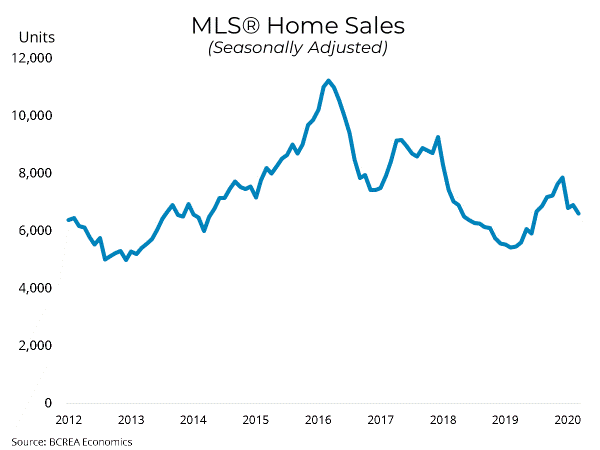
“Provincial housing markets started the month very strong before the COVID-19 pandemic put a halt to activity,” said BCREA Chief Economist Brendon Ogmundson. “Activity will slow considerably in April as households and the real estate sector implement measures necessary to mitigate the spread of this virus.”
“While we don’t know when this unprecedented period will end, markets will be boosted by pent-up demand and historically low interest rates when it does,” added Ogmundson. “The ultimate strength of the recovery will depend on how long the economy remains effectively shut down, as well as the efficacy of federal and provincial measures to bridge households through the financial difficulties brought on by the pandemic.”
Year-to-date, BC residential sales dollar volume was up 37.1 per cent to $12.9 billion, compared with the same period in 2019. Residential unit sales increased 21.7 per cent to 16,866 units, while the average MLS® residential price was up 12.6 per cent to $763,031.

-30-
For more information, please contact:
Brendon Ogmundson
Chief Economist
Direct: 604.742.2796
Mobile: 604.505.6793
Email: [email protected]
To subscribe to receive BCREA publications such as this one, or to update your email address or current subscriptions, click here.
Paragraph 8 of the Multiple Listing Contract—Seller’s Obligation to Refer Inquires and Offers; Commission Lost, Contingent Upon Giving Written Notice #376
By Gerry Neely
B.A. LL.B.
Paragraph 8 of the standard Multiple Listing Contract requires the seller to refer and deliver all enquires of offers to purchase the listed property to the listing agent. It can be a lifesaver for a listing agent whose claim for commission would fail because his or her acts didn't fall within the precise wording of the Multiple Listing Contract.
This was the situation of an Ontario agent who was entitled to a commission if the seller accepted an offer to purchase during the term of the listing, or within six months after it expired if the agent introduced the purchaser to the property. One week before the listing expired, the seller decided to independently find a buyer interested in his property. One month later, the seller accepted the buyer's offer and the sale completed two months after the expiration of the listing.
None of these facts supported the agent's claim for commission of $80,250. However, the agent had discovered the timing of the buyer's introduction to the property and was aware that the contract required the seller to give this information to the agent. The seller's breach of obligations similar to those in paragraph 8 led to an order for commission payment.1 Legally Speaking 62 and 162 also address this issue.
* * *
Another Ontario case concerns a listing agent's loss of commission because of his non-compliance with the commission terms of an MLS® listing contract for the sale of land on which the seller had a landscaping business. The contract had a 90-day holdover clause, entitling the listing agent to a five per cent commission on any sale during that period to a buyer introduced to the property during the term of the listing.
A few months later, the seller decided to sell the business as well, and signed an ICI MLS® contract containing a six-month holdover clause with terms similar to the first contract. The major exception was that payment of a five per cent commission upon a sale made during the holdover period was contingent on the seller receiving a written list of the names of parties introduced to the property during the term of the contract by the listing agent or cooperating brokers—prior to the expiration of the ICI contract.
The sale of the land and business occurred during the holdover periods in both contracts. The buyer first found out the business was for sale from a call made by the listing agent. The seller had known the buyer for years and took over the negotiations and documentation. He excluded the listing agent entirely and then declined to pay a commission. The listing agent sued and was held to be the effective cause of sale of the land and business.
However, the listing agent only received a commission on the first contract because he failed to give the written notice required by the ICI contract. The agent's suggestion that the information exchanged between the parties during the term of the contract satisfied the obligation to give written notice was rejected.
The judge interpreted the agreement strictly against the agent. The seller was entitled to actual written notice so he was fully aware of the extent of his potential liability for commission in the overholding period.2 See Legally Speaking 172, 177, 279, 280, 283, and 356 for more on holdover clauses.
To subscribe to receive BCREA publications such as this one, or to update your email address or current subscriptions, click here.
Parking Not Limited Common Property #180
By Gerry Neely
B.A., LL.B.
A sales brochure for a condominium project which consisted of 55 strata lots and 69 parking stalls, stated that each unit was entitled to one parking stall and that an additional stall, if available, would be rented by the strata council to an owner. The purchasers of one unit made it a condition of their offer that the price was to include two stalls, and despite the sales brochure, the offer was accepted by the developer.
The first indication the purchasers had that they might have a problem came at the initial meeting of owners when it was made clear that the additional stalls were common property to be dealt with by the strata council. At a subsequent extraordinary general meeting, a bylaw was passed confirming that the strata council had the power to rent and to fix fees for the rental of additional stalls by owners.
The purchasers petitioned for an order that they were entitled to the exclusive use of the extra stall. They were successful in Supreme Court because the judge held that it would be inequitable to deprive them of the use of the extra stall, and inferred that the extra stall was limited common property. The decision was appealed and the principal issue was whether or not the extra stall remained common property or limited common property.
Under the Condominium Act, an owner/developer may, when the strata plan is tendered for registration, designate areas on the plan as limited common property for the exclusive use of one or more strata lot owners. If this had been done by the developer, the purchasers' exclusive use of the extra stall could not have been changed without the purchasers' consent because a limited common property designation can only be removed by a unanimous resolution of the owners.
The owner/developer's responsibility was to act in the interest of all purchasers of the units until a strata council was elected. An agreement to grant exclusive use of an extra stall reduced the area of common property available to all owners which would affect the investment of each owner, if only marginally. As the judge commented, unless compliance with the Condominium Act is insisted upon, arrangements of this kind could be extended to give exclusive use of other common facilities such as a club house or swimming pool, only to certain owners.1
***
It's never over until it's over is the thought a licensee must have in mind in the submission of offers for the approval of a judge in a court ordered sale of property in foreclosure. This is one of those rare instances where the offers made by competing parties may become known to each other and trigger a bidding battle.
This occurred in a case where after a discussion with the bank's solicitor, the two persons interested in purchasing the property under foreclosure agreed to deliver sealed envelopes to the solicitor who agreed to place before the court the higher offer. The bids were disclosed to both parties, and as a result, the lower bidder increased her offer through her agent. The judge directed both parties to deliver to him sealed envelopes containing their final offers. When they were opened, the lower bidder had increased her offer further and the sale to her was approved.
The disappointed prospective purchaser brought an action against the successful bidder for breach of contract and against the agents for damages for interference with contractual relations. This claim was based upon the argument that the parties were bound by the agreement which they made with the bank's solicitor. The judge, however said that the primary duty of a court in these circumstances is to ensure that the best possible price is obtained. If the court were to agree that this procedure was acceptable, it would prevent any higher offers being submitted to the court and defeat the purpose of which the court's approval was required. The plaintiff's claim for damages were denied.2
| 1. |
|
|
| 2. |
|
To subscribe to receive BCREA publications such as this one, or to update your email address or current subscriptions, click here.
Parking Stalls and Strata Units #464
By Jennifer Clee
B.A., LL.B.
Licensees often mistakenly misrepresent the parking included with a strata unit sale, as a result of relying upon the seller for that information. As many sellers are mistaken as to their parking rights, licensees cannot rely upon sellers to provide accurate parking information.
Parking stalls are designated either as part of a strata lot or as common property. Parking stalls designated as common property generally fall under the control of the strata corporation.1 As a result, an owner's apparent right to use a parking stall designated as common property may not be transferable to future buyers.2 A parking stall designated as part of a strata lot, or as limited common property, will entitle a buyer of that strata lot to exclusive use of the stall. Where a parking stall is not so designated, a buyer may not have the right to use the stall, despite the seller's use.
The recent decision of Blackall v. Jarrold et al.3 concerned a dispute over parking. In Blackall, the buyers of a strata unit sued the sellers for negligently misrepresenting the number of parking stalls included in the sale. The Property Disclosure Statement stated that "parking stalls 598 and 601 are included in the purchase price along with storage locker 291, all of which will be assigned by the buyer on completion date." Both the buyers and the sellers believed that the parking stalls were designated as limited common property (LCP), and thus for the sellers' exclusive use.
In fact, only one of the stalls was designated LCP. While the original purchasers of the strata lot had paid the developer $5,350 for the use of the second parking stall at the time of their purchase, neither they nor the developer took steps to amend the strata plan. Thus the second parking stall, as common property, remained under the control of the strata corporation.
The buyers' claim against the sellers was dismissed. The court found the buyers had a clear opportunity to discover the parking stalls' status before removing subject conditions. The contract was subject to the buyers receiving and approving the usual strata documentation and verifying the status of the parking stalls associated with the property. The court held that the buyers' failure to carefully review the registered strata plan prior to removing subject conditions (a review of which would have shown only one parking stall designated as LCP) constituted a failure to exercise reasonable care and due diligence.
The buyers and sellers in Blackall were each represented by licensees in the transaction, but neither added the licensees as parties to the action. The licensees' absence from the litigation did not stop the court from expressing its opinion that the licensees' failure (and that of the licensees involved in the earlier sale of the property) to verify the status of the parking was negligent. The court stated, "Both the Grewals and the Defendants used real estate agents. Both real estate agents erred and failed to exercise a reasonable standard of care placed upon them in representing their respective clients' interests."
Effective January 1, 2014 strata corporations will be required to identify how parking (and storage lockers) are allocated to strata lots on the new Form B.4 However, to avoid claims, licensees are well advised to:
- review the strata plan and filed amendments, the common property record and any other related strata documents to verify parking stall designation,
- review the Real Estate Council of British Columbia's Professional Standards Manual (PSM) for advice as to how to accurately describe parking stalls when listing a strata property, and
- include, in any offers, those subject conditions referred to in Blackall, and found in the PSM.
| 1. | Except where the strata corporation has leased the common property parking to a developer or related entity. See the Professional Standards Manual, II. Trading Services, Strata Sales, (xiv) Parking Stalls and Storage Locker. | |
| 2. | See the Professional Standards Manual for a description of the usual arrangements that apply to parking stalls designated as common property. | |
| 3. |
|
|
| 4. |
|
To subscribe to receive BCREA publications such as this one, or to update your email address or current subscriptions, click here.
Partition of Property Act – When Friendship Turns to Enmity #395
By Gerry Neely
B.A. LL.B.
Two couples who were close friends jointly purchased a Gulf Islands cottage, each taking a one-half interest in the property. They disregarded advice to agree on a method of establishing the price of a half-interest if one couple decided to sell their interest and the other couple wanted to keep the property.
When the friendship deteriorated, one couple petitioned (under s. 6 of the Partition of Property Act, R.S.B.C. 1996, Chap. 347) the Supreme Court of BC for the sale of the property and the equal division of the proceeds between them. The other couple requested an order that the petitioners’ one-half interest be sold to them at a price to be fixed by the court, pursuant to s. 8 of the Act.
Section 6 says that, upon the request of an owner interested in one-half or more of the property, the court may order its sale rather than its division among the owners, unless there’s good reason to the contrary. Under s. 8, the court may order a sale upon the request of an owner of an interest in the property, but not if any other owner undertakes to purchase the selling owner’s share.
The question raised by these sections is whether s. 8 deprives an owner with at least a half-interest in the property of the right to sell on the open market. The judge concluded it did not; that s. 8 allowed a majority owner to purchase the interest of a minority owner who wanted to force a sale. The judge believed a sale on the open market provided the best measure of value and ordered the property be listed and sold, with either couple having the right to make an offer.1
Small Claims costs to losing claimant
While Small Claims Court is a less costly option for legal action, a claimant who loses can still face hefty expenses, as a condo purchaser who sued a brokerage and representative found. She claimed the representative’s assertion that a ceiling unit was both a heater and air conditioner was false, as she later learned it operated only as a heater. She sought $7,300 to install an air conditioning system.
The representative denied the claimant’s assertion and the judge concluded that, on a balance of probabilities, the claimant had failed to establish a false representation. However, even if she had succeeded in doing so, her claim would have failed because she had to demonstrate she suffered a loss. Damages in claims such as these are measured by the difference between the fair market value of the property at the date of sale, and the price paid (in this case, $187,000).
An appraiser, accounting for the lack of an air conditioning system, gave expert evidence that the condo’s fair market value was $190,000. The condo owner was ordered to pay out-of-pocket expenses of $3,411, including the appraiser’s bill.2
In a similar court ruling, two claimants were penalized $2,000 when they sued sellers and their brokerage firm for negligently representing that an addition was built without a building permit. The judge ruled this information had been disclosed to the claimants before they made their offer to purchase.1
To subscribe to receive BCREA publications such as this one, or to update your email address or current subscriptions, click here.
Partnership – For Better or for Worse #150
By Gerry Neely
B.A., LL.B.
When several people agree to buy property in their names with the intention of developing it for resale at a profit, but without any further agreement or discussion of what the legal relationship among them is to be, have they created a partnership? Joint ownership does not by itself create a partnership, for if each person reserves the right to sell or deal with his or her interest in the property, regardless of the wishes or intentions of the other parties, then their relationship may be merely that of co-owners.
If their intention is to jointly develop and sell the property, then they probably are partners.
While the answer as to whether they are co-owners or partners is a question of fact, the difference between co-ownership and partnership can be significant, not only in respect of tax, but also for liability.
In an Alberta case, property was listed for sale with the licensee by an owner who set the net price he would accept. Several months prior to obtaining the listing, the licensee had a reasonable belief through discussions with the owner that the listing would be his. As a result of these discussions, the licensee had agreed with a contractor and an investor, that the three of them should purchase the property when the licensee obtained the listing.
An offer was submitted in the name of the contractor's company for a price which, after commission, gave the owner his net price of $250,000 and eventually, the purchasers a profit of $141,000. Included in this profit was a benefit of $64,500 received by the licensee.
The owner then learned that the licensee was one of the purchasers and subsequently discovered the nature of the agreement to share profits made with the other purchasers. He sued the purchasers for the profit obtained by them, alleging a twofold breach of duty by the licensee.
The first breach was the failure by the licensee to disclose his interest and intention with respect to the purchase of the property, as was required of him by the Alberta Real Estate Act. Secondly, under agency law, the licensee had a duty to fully disclose to the owner all relevant facts, including not only whether the price was adequate, but whether the sale was as advantageous to the owner as any other sale the licensee could have obtained from a third party. The licensee's breach of duty and his liability to the owner was apparent, but how did that affect the contractor and the investor?
The judge held that the three of them were partners. Each was therefore jointly and severally liable for the wrongful act or omission of the licensee while acting in the ordinary course of business of the partnership. Judgment for $141,000 was awarded jointly and severally against all three parties. A separate judgment was made against the licensee for the benefit he had received. This was done to fix his liability for the secret profit of $64,500 made by him through his breach of fiduciary duty to his principal.1
* * *
Following the publication of Column 140, Mr. Jackson spoke to me concerning the Reasons for Judgment referred to in that column. Mr. Jackson informs me that he warned the purchaser of the defects but that the Court chose to believe the home owner. Column 140 repeated the Judge's remarks that Mr. Jackson has a good reputation as an efficient and experienced contractor. From the information provided to me, it is apparent that Mr. Jackson did not examine the wrong house and I regret having indulged in this hyperbole.
| 1. |
|
To subscribe to receive BCREA publications such as this one, or to update your email address or current subscriptions, click here.
Passing Information Accurately #433
In a real estate deal, a client depends on the licensee to accurately relay information between the parties. This is especially critical where the licensee is a limited dual agent.
A recent Real Estate Council of British Columbia disciplinary decision makes the point.1
Beginning in 2005, the licensee acted as the owner’s property manager for a small strip mall with six commercial tenants.
In February 2006, the owner listed the premises for lease until July 16 under an Authority to Lease. At that point, the licensee also became the leasing agent whose obligation it was to look for tenants.
Then, in April 2006, the owner listed the property for sale until May 21. A few weeks later, the owner entered a contract of purchase and sale with the buyer with an August 31 completion date.
The licensee, as limited dual agent, drafted the contract. It required the seller, pending completion, to search for tenants to fill vacancies and to inform the buyer about offers to lease.
By early July 2006, there was only one tenant in the property. The seller felt pressured by the licensee to drastically reduce rents, apparently to better attract tenants. During the licensee’s entire term as leasing agent, he only developed two potential tenants, according to the seller. Neither candidate was creditworthy. In one case, when the seller discovered that the applicant used only a mailbox address, the seller told the licensee that potential tenants must provide a credit report, financial statement, references and a concrete address. The licensee then recommended that the seller reject that proposed tenant, which the seller did.
The Council found that within four days, and without telling the seller, the licensee (who had recommended rejection of the tenant) then wrote to the buyer, claiming that the seller was attempting to frustrate the buyer's purchase by not closing acceptable lease offers. The licensee wrote that this could be viewed as a breach on the seller's part. The licensee also advised that the seller did not want to proceed with the deal, preferring now to keep the property for a new business venture.
To pressure the seller to accept tenants proposed by the licensee, and to complete the deal with the buyer (all of which would presumably generate commission), the licensee, again without telling the seller, also wrote to the buyer's lawyer. In that letter, the licensee claimed that the seller had wasted an opportunity to lease the premises, and that the licensee was prevented from showing the premises to several potential tenants.
In response, the buyer threatened the seller with legal action to enforce the deal. Yet, the Council found that the licensee never brought the owner any viable, creditworthy tenants for consideration. When the seller's lawyer replied explaining the situation, things changed. It became clear the buyer was not getting the whole story from the licensee. The buyer realized that if he bought the property filled with the tenants urged by the licensee, the buyer could end up with poor leases.
Ultimately, the seller and buyer resolved any differences and the deal collapsed.
The Council requires a licensee to act in the best interests of the client.2 After a hearing, the Council found that the licensee committed professional misconduct contrary to the Real Estate Services Act, in part, by breaching this requirement. The licensee failed to honestly, impartially (as limited dual agent) and in his clients’ best interests convey information between his clients.
For instance, when the licensee wrote to the buyer characterizing the seller's rejection of potential tenants as attempts to frustrate the deal, the licensee was inaccurate and inflammatory. Contrary to both clients’ best interests, the misinformation created an unnecessarily adversarial relationship. The Council also found that the licensee continued to perpetuate untruths to further his personal cause for commission, even when his clients were later in the process of resolving their dispute.
For these and other breaches, the Council suspended the licensee for one year with educational requirements and an order to pay $6,128 in enforcement expenses.
Mike Mangan
B.A., LL.B.
| 1. |
|
|
| 2. |
|
To subscribe to receive BCREA publications such as this one, or to update your email address or current subscriptions, click here.
Past Due: Expired Offers, Expired Contracts, and What to Do With Them #580
Real estate transactions often happen in a hurry. Many clients and REALTORS® also have busy lives and practices, and a number of things to keep track of. However, the legal principles of contract interpretation do not cut the parties or their agents any slack when complying with due dates in a contract. Depending on the type of obligation that is due, when these dates are missed, you can end up with an expired deal on your hands. While offers can be revived in some cases, contracts cannot. Even where revival is possible, there are pitfalls and consequences to be aware of and avoid.
Reviving an Expired Offer
An offer expires when an offer or counter-offer is not accepted by the specified acceptance date and time. There is no obligation on another party to accept an offer, but if they fail to do so by the required time, the offer can no longer be accepted.
Offers can technically be "revived" in that they can be made again on identical substantive terms by changing the time and date for acceptance to sometime in the future. However, this can be risky because it is not as simple as changing some dates; all terms need to be reviewed again to make sure they work on the new proposed timeline. Depending on the circumstances, the expired offer may include terms that do not make sense anymore or are not appropriate given the passage of time. The longer the gap between an offer's expiry and its revival, the higher the chances that at least some terms will need to change. This is, in part, why the BC Financial Services Authority (BCFSA) recommends against using an old form of offer and, rather, suggests starting again.
For example, reviving an offer may require adjusting other dates in the contract, such as subject removal dates or completion, possession, and adjustment dates. There may also be an opportunity for a buyer to do some of the due diligence initially included as subject conditions in the expired offer. Completing this step before re-making the offer can make it more attractive to the seller(s) and increase the likelihood of acceptance. Finally, if an offer has expired for a significant amount of time, the form of Contract of Purchase and Sale may have been updated in the interim. In such cases, the REALTOR® should use the most current version of the form when preparing an offer.
While preferable in most cases and the course of action recommended, though not required, by BCFSA, starting a fresh offer is not without risk, either. REALTORS® should ensure that all terms that their clients still want to include and that still make sense, are accurately carried over in the new offer. Extra caution is needed to ensure that nothing is inadvertently changed or left out when entering information into the fresh offer form.
It is almost certain that any required information regarding the Home Buyer Rescission Period in an offer will have to be amended when an offer is revived, unless it simply needs to be extended by a few hours.
Expired Offer vs. Expired Contract
There is a difference between an expired offer, which is where an offer or counter-offer was not accepted by the specified acceptance date and time, and an expired contract, which is where a contract with subject conditions was entered into but one or more of the subjects were not removed by the specified subject removal date. Both documents are of no further force and effect. However, reviving an offer is possible, whereas reviving a contract is not.
Once a contract expires, the parties have an opportunity, but not an obligation, to enter into a new contract on identical substantive terms. A new form of contract should be prepared in that case. However, one or more parties can decide that they no longer want to agree to the previously settled terms and can either try to negotiate some changes or walk away from the deal entirely.
What attempting to revive an expired contract often looks like is where one or more parties sign a subject removal addendum after the time for removing subjects has expired. This is not legally effective. Another common way in which REALTORS® attempt to revive a contract is by preparing an addendum stating the parties agree with all the terms in the contract other than new subject removal dates. This is also problematic. There are potential issues with the enforceability of such an addendum for failure to provide additional consideration, or value, for the change. It also creates a contradiction between the subject removal dates in the contract and in the addendum, and potentially other inconsistencies, as well. Contracts that are not internally consistent can lead to serious contract interpretation problems, resulting in legal outcomes that your clients may not want or have not anticipated.
The best practice, similar to with an expired offer, is to go through the contract term by term and carefully input them into a new contract form, making any date or sequencing amendments that need to be made as a result of the expiry. While this does not guarantee a deal will be re-made, it should avoid additional issues caused by inconsistent contract terms. If the form of Contract of Purchase and Sale has changed in the interim, REALTORS® should advise their clients of the changes.
Tracking Dates – A REALTOR®'s Responsibility
If offers or contracts expire as a result of a REALTOR®'s failure to remind their clients of important dates requiring their attention, this can create both civil liability and regulatory issues. This risk remains even if the REALTOR® attempts to revive or re-make the offer or contract but fails to do so effectively.
REALTORS® should remind clients of all important dates in a contract or offer that requires them to act. If the client fails to take the required action, resulting in the expiry of a deal the client did not want to lose, the client may argue that the REALTOR® is at fault for failing to provide adequate warning about the deadline. While parties to a contract have an obligation to look out for their own interests and monitor important dates, it is likely that in most cases, the responsibility to track dates would be found to be shared if the matter were brought before the courts in a lawsuit for REALTOR® negligence or breach of contract.
There are also potential regulatory consequences for failing to advise clients of due dates and / or ineffective efforts to keep the deal alive once those dates have passed. For example, in a case decided by way of a consent order by the then Real Estate Council of BC (RECBC), a REALTOR® attempted to revive a contract after the subject removal period had expired. This was done by way of an addendum acknowledging that the subject removal date was missed but saying that all parties agreed that the contract was to continue. The REALTOR®, acting as an authorized dual agent, was disciplined, in part, for:
a) failing to act in the best interests of their client and to disclose all material information, as currently required by Rule 30 of the Real Estate Services Rules (the "Rules"), by not having advised their seller client that the buyer had missed the subject removal date; and
b) failing to exercise reasonable care and skill, as currently required under Rule 34 of the Rules, when they attempted to revive the contract by way of an addendum, since contracts cannot be revived.
Luckily, the transaction in that case ultimately closed without any damages suffered by the clients. However, the REALTOR® was sanctioned by RECBC for their actions.
As this article has hopefully highlighted, the easiest way to avoid revival issues is to simply not miss any contract deadlines. However, if it happens, REALTORS® should make sure they are taking the right steps to try to get the deal back on track, and to take great care as they do so.
Payment of Commission #48
By Gerry Neely
B.A. LL.B.
A recent judgement is of the good news/bad news type of bad joke - the good news, Mr. Agent, is that you have earned a commission, the bad news is that you can't enforce payment of it. These circumstances arose in a case in which a vendor agreed to sell the business, fixtures, goods and chattels of a hotel. In addition, the purchaser was given an option to purchase the real property within a period of five years following the sale of the business. The vendor paid to the agent a commission of $16,250.00 upon the sale of the business, and agreed to pay a commission of $31,000.00 if the option were exercised.
The option was exercised just prior to its expiration, but the vendor refused to pay the $31,000.00 commission. The vendor's refusal was based upon the fact that by the time the option was exercised, the agent had ceased to be licensed. The underlined words of section 37(1) of the Real Estate Act, which are repeated below, provided the answer as to whether or not the vendor's defence would be successful.
"37(1) No person shall maintain an action in any Court for the recovery of compensation for any act done or expenditure incurred by him as an agent or salesman without proving that he was duly licensed under this Act as an agent or salesman, as the case may be, at the time the alleged cause of action arose."
By this Section, the licensee's claim for compensation arises as a result of "any act done by him." The act done by the agent was the procurement of the option which was contained in an Interim Agreement dated December 2nd, 1976. Unfortunately, the underlined portion of the section states that the agent must be licensed at the time the alleged cause of action arose. That cause of action arose in 1981, when the option was exercised and at that time the licensee had ceased to be licensed.
The Judge reluctantly agreed with the argument of the defendant that the plaintiff could not enforce his claim for commission.
The judgment raises the question as to what the agent could have done to protect himself. Could the licensee have assigned the commission claim to another agent likely to continue in business over the five year period? The assignment would be absolute and payment to the first agent would be made upon the basis of a percentage of the commission to be collected by the second agent. Payment to the formerly licensed agent would not appear to be a breach of Section 30 of the Real Estate Act. That Section only prohibits payment of compensation to any person who was unlicensed at the time that person acted as an agent or salesman. In 1976 when the first agent acted to obtain the option, he held a license.
Although these circumstances are unusual, perhaps they merit consideration of an amendment to Section 37 which would allow the agent to enforce payment of a commission if the agent were licensed either at the time the act was done or at the time the cause of action arose.
| 1. | Morton Ho Associates Realty Ltd. v. Wong Brothers Construction Company Ltd., S.C.B.C. 49 B.C.L.R. 68. |
To subscribe to receive BCREA publications such as this one, or to update your email address or current subscriptions, click here.
Payment Under Protest #239
By Gerry Neely
B.A., LL.B.
What do you as a buyer do when your understanding of the contract is that the seller is required to pay GST, but the seller refuses to do so. When that occurred in a recent transaction, the buyer paid the GST to avoid losing the property. The buyer's lawyer did not state that the payment was made under protest.
Instead, in wording perhaps carefully chosen to avoid alerting the seller to the possibility that an action would be commenced after the transaction closed, the buyer's lawyer said that the payment was made solely for the purpose of completing the purchase.
This statement was sufficient evidence that the payment was not made voluntarily. The law concerning the need to state that a payment is made under protest, if the payment is to be recovered, is contained in the following statement:
"If a person with knowledge of the facts pays money, which he is not in law bound to pay, and in circumstances implying that he is paying it voluntarily to close the transaction, he cannot recover it. Such payment is in law like a gift and the transaction can not be reopened."1
***
A mortgage was drawn for $190,000, which included a $10,000 bonus, the full amount to be repaid in 30 days without interest. This resulted in an effective annual interest rate of 89%. The lawyer who drew this mortgage was held to be negligent because he failed to consider the effect of Section 347 of the Criminal Code, which makes a rate in excess of 60% per annum legal.
The case does not establish new law, but serves as a reminder to all professionals considering a short term loan that a relatively small bonus can lead to a criminal rate of interest.2
***
A defaulting buyer trying to recover its deposit will look to any technicality that might result in the Court agreeing that the Contract of Purchase and Sale was void for uncertainty. In one case, the deposit was $100,000 and the technicality was that the terms of a seller take-back mortgage to secure repayment of $2,400,000 in two years' time did not state whether the mortgage was open or closed. The judge decided it was not an essential term of the mortgage and ordered the deposit to be paid to the seller.3
***
Another case in which the terms of paragraph one of the Contract of Purchase and Sale resulted in a court ordering the return of a $75,000 deposit to a buyer who refused to complete. The buyer's reason - the seller was unable to clear the title of a private restrictive covenant. Paragraph one, which has been discussed in Columns #160, #188 and #198, allows a seller to deliver a title which is subject to restrictive covenants and rights-of-way in favour of utilities and public authorities, and any other encumbrances set out in the contract.
The restrictive covenant limited the size and location of buildings on the property to protect the views of the adjoining owner. The argument of the sellers, who had sued for specific performance or damages, was that even if they were in breach of paragraph one, the buyers would have received substantially what they contracted to buy.
The judge agreed that a restrictive covenant that is of a minor nature and which would not interfere with the buyer's enjoyment of the property, is insufficient to justify the buyer's repudiation. If, however, the restrictive covenant affects the buyer's use or enjoyment of the property in a sufficient way, then that would be a serious defect of title.
Applying this test, the judge looked for guidance to cases where rights-of-way that ran along the boundary of the property within the building setbacks were minor encumbrances that did not allow a buyer to repudiate. At the other end was a case where a right-of-way prevented construction of a building within ten feed on either side of the pipeline. That represented a serious defect and entitled the buyer to repudiate.
The judge concluded that the limitation on the size and location of buildings would seriously affect the use and enjoyment and value of the property, and ordered the return of the deposit.4
To subscribe to receive BCREA publications such as this one, or to update your email address or current subscriptions, click here.
Pent-up Demand Continues to Build as Sales Remain Slow
For the complete news release, including detailed statistics, click here.
Vancouver, BC – April 15, 2024. The British Columbia Real Estate Association (BCREA) reports that a total of 6,460 residential unit sales were recorded in Multiple Listing Service® (MLS®) systems in March 2024, a decline of 9.5 per cent from March 2023. The average MLS® residential price in BC in March 2024 was up 6.5 per cent at $1.02 million, compared to an average price of $958,051 in March 2023. The total sales dollar volume was
$6.6 billion, a decrease of 3.6 per cent from the same time the previous year.
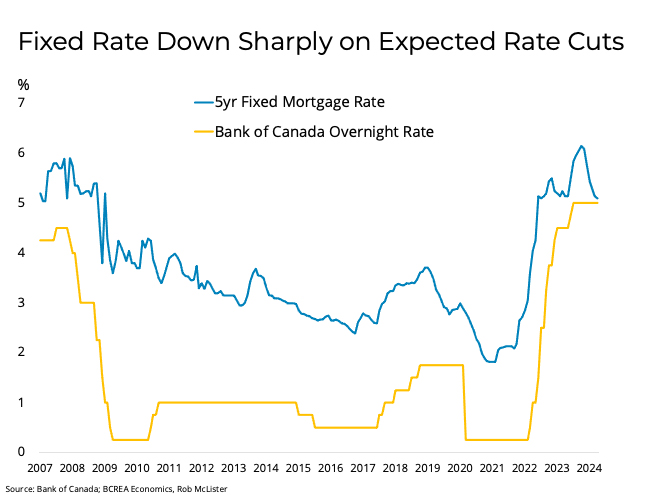
"March capped off a slow start to the first quarter of 2024," said BCREA Chief Economist, Brendon Ogmundson. "Despite a steep decline in fixed mortgage rates, buyers appear to be waiting on the Bank of Canada to lower its policy rate before jumping back into the market."
Year-to-date, BC residential sales dollar volume was up 13 per cent to $15.8 billion, compared with the same period in 2023. Residential unit sales were up 6.4 per cent to 15,938 units, while the average MLS® residential price was up 6.5 per cent to $995,149.
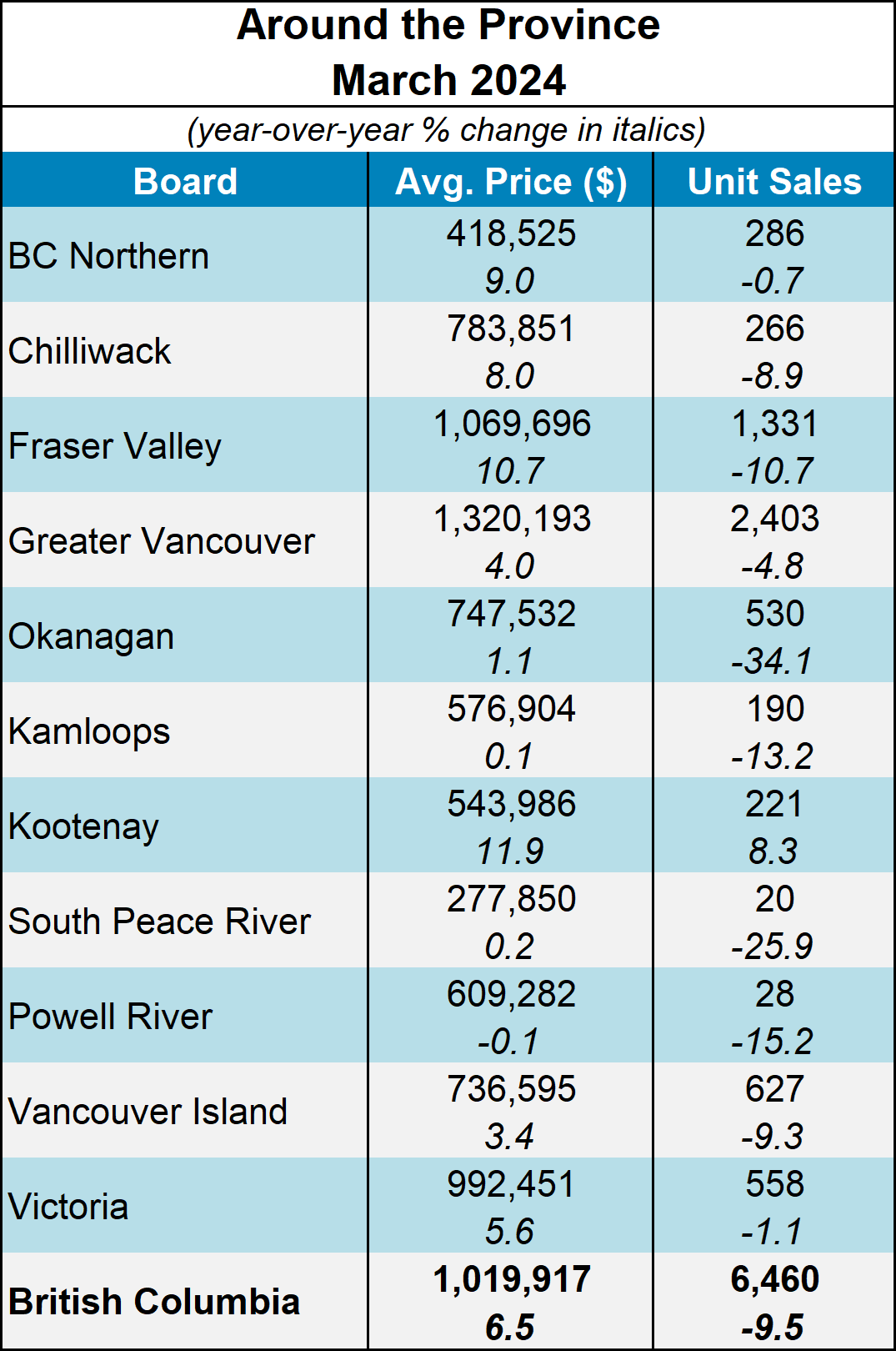
Perrin’s Recommendations a Positive First Step
On September 27, the Ministry of Finance published Dan Perrin's Real Estate Regulatory Structure Review—that is, the independent review of the regulatory framework currently governing real estate practice in BC. The report reflects many of the concerns BCREA and BC's 11 regional real estate boards have raised related to the co-regulatory structure as a whole, and to specific issues resulting from recent Rule changes.

"Dan Perrin's findings are encouraging, and we are pleased that the feedback BCREA gathered from REALTORS® earlier this year helped shape his report," said BCREA CEO Darlene Hyde.
Among his six key recommendations, Mr. Perrin suggests the Office of the Superintendent of Real Estate (OSRE) and the Real Estate Council of BC (Council) be merged with the Financial Institutions Commission. This would give the Ministry of Finance control of real estate policy development and a policy review of real estate regulatory requirements, including a review of outstanding recommendations made by the Council's Independent Advisory Group in June 2016. You can view the full Perrin report here.
Hyde added, however that the release of the report is just a small step forward. The question is if—and when—the government will move to act on Perrin’s recommendations and make the regulatory changes the real estate sector needs.
BCREA has written to Finance Minister Carole James requesting a roundtable meeting with all the organizations involved to discuss the findings: https://bit.ly/2NeNJ7E. There will also be a session at the upcoming Government Liaison Days in Victoria from October 14 to 15 to provide an overview of Perrin's report.
"BCREA will continue to advocate for changes that make BC's real estate regulatory structure function smoothly and efficiently," said Hyde. "That can only happen when REALTORS®' voices are recognized as key to bringing about change that truly leads to a better functioning and more transparent real estate sector."
BCREA thanks the 11 real estate boards and all the REALTORS® who participated in Perrin's review by providing their feedback.
To subscribe to receive BCREA publications such as this one, or to update your email address or current subscriptions, click here.
Personal Information and BCREA’s Privacy Notice and Consent Form #585
We are all living in the data age, whether we like it or not. Data is everywhere, and the collection and use of personal data is one of the most discussed legal topics of the 21st century. There are several laws that govern personal information, imposing significant obligations on persons and businesses to collect, gather, use, and disclose information only as authorized. In turn, businesses and agencies often create their own policies to explain privacy obligations in plain language and to assist their representatives or those who fall under their jurisdiction in complying with them.
This article discusses the laws in British Columbia around the collection and use of personal information and the ways in which BCREA’s Privacy Notice and Consent Form can help keep REALTORS® onside with personal information protection laws.
Privacy Laws in British Columbia
The primary law that deals with the collection, disclosure, and use of personal information in BC is the Personal Information Protection Act (PIPA). PIPA was enacted in 2003, and its stated purpose is to govern the collection, use, and disclosure of personal information in a way that balances people's right to protect their own personal information with organizations' reasonable need to collect, use, and disclose information in an appropriate way. The default is that personal information cannot be collected, used, or disclosed but the law creates carve-outs where the individual consents or the action is authorized by law.
Though both are part of BC privacy law, PIPA is distinct from the Freedom of Information and Protection of Privacy Act (FOIPPA), which generally governs the disclosure of and access to information collected and retained by public organizations.
Consent to the collection, use, and disclosure of personal information can be implied as opposed to express. However, implied consent is more difficult to prove and is open to interpretation, making it easier for an individual to later deny having given consent. The express consent reflected in a privacy notice or document containing privacy-related terms that is signed, initialled, or marked by the individual is more likely to meet the requirement for advance consent and, as such, is considered the better practice. Additionally, an organization must notify individuals about what information is being collected and the purpose for collection before the collection occurs. An organization cannot require individuals to consent to the collection of information over and above what is necessary to provide the requested product or service. Consent may be withdrawn at any time.
Even if an individual has consented, personal information may only be used or disclosed for purposes that are reasonably appropriate in the circumstances and consistent with the purpose given to the individual for collecting the information.
The BCREA Privacy Notice and Consent
Although there are a number of privacy consent forms currently circulating, BCREA has prepared a form specifically for use in the BC real estate context. Like any other disclosure form, its ability to protect a REALTOR® from later allegations of improper collection or use of information depends, in part, on it being adequately explained at the time it is executed, ensuring that the individual understands its contents. Since PIPA requires that consent be obtained before personal information is collected, it is best practice to discuss and have the BCREA Privacy Notice and Consent Form executed before any personal information from the individual is collected.
The BCREA Privacy Notice and Consent form addresses "primary" and "secondary" uses and disclosures of personal information. Primary uses and disclosures are required to perform real estate services, such as disclosures to the Multiple Listing Service® System or FINTRAC. Secondary uses are optional and relate to future marketing outreach for real estate or other services, or to conduct market surveys. Individuals may opt out of any of the secondary uses or disclosures by initialling the boxes provided.
It is beyond the scope of this article to discuss the sections of the form in detail. However, some common questions are:
- Do you need a new form when working with a repeat client?
The best practice is to have a client sign this form whenever they start working with you on a new transaction or contract. While it is arguable that previously obtained consent continues to apply so long as it has not been withdrawn, the form is updated from time to time to keep current with changing requirements. Using a new form every time better ensures that you are complying with the most up-to-date privacy laws and regulations.
- What if a client refuses to sign the Privacy Notice and Consent Form?
While you may be able to rely on implied consent to collect, use, and disclose the information strictly necessary to provide the specific real estate services a client has asked you to provide, a client’s refusal to sign the privacy notice and consent form indicates heightened privacy concerns. In such cases, the client is likely particularly sensitive to collection, use, and disclosure of their information. If a client refuses to sign the form, document their concerns and speak to your managing broker or a lawyer about whether there are workable alternatives that will allow you to take on the client without increasing the risk of a privacy complaint or dispute.
- Do you need to have this form signed when working with an unrepresented party?
It is particularly important to have an unrepresented party sign a Privacy Notice and Consent form because you have no contractual relationship with them and, therefore, no ready ability to outline in writing the personal information collection, use, and disclosure items that allow you and your brokerage to comply with PIPA and other privacy obligations.
- Can the clause regarding storing personal information outside of Canada be struck out?
No, that clause cannot be struck. Many of the platforms used to facilitate real estate transactions use servers that are located outside of Canada; therefore, it is not feasible to track and store personal information based on an individual's personal preference for where it is stored.
BCREA has a Frequently Asked Questions document with more detailed information on the Privacy Notice and Consent Form. You can find it here.
Other Privacy Notices / Consents
The BC Financial Services Authority (BCFSA) has its own Privacy Guidelines that REALTORS® should familiarize themselves with. While these are guidelines and not strictly requirements, they will inform how BCFSA views allegations of improper collection or disclosure of personal information by those under its jurisdiction.
The Real Estate Services Rules (the Rules) also provide for the disclosure of personal information by brokerages in certain circumstances.1 Since these disclosures are mandated by law, consent is not required to comply with these requirements. These changes came into effect in February 2024, so managing brokers should familiarize themselves with these relatively recent changes if they have not already done so. Other references to personal information in the Rules include a requirement that provisions respecting the use and disclosure of personal information be included in a service agreement with the client2 and that provisions regarding the personal information of strata owners be specifically addressed in a strata management services agreement.3
Finally, the province has an Office of the Information and Privacy Commissioner for BC (OIPC), which independently oversees and enforces BC's privacy laws and access to public information. The OIPC investigates and resolves privacy complaints and educates the public on their privacy rights. Its website provides additional information about the OIPC's mandate and the BC privacy regime in general.
While collecting personal information is necessary for REALTORS® to do their job, it is important to know both the limits on its collection, use, and disclosure, and how to stay onside of the privacy protections we are all entitled to in this data-crazy world.
| 1. | Rules, p. 8 (d,4). | |
| 2. | Rules, s. 43(4)(h). | |
| 3. | Rules, s. 43(6)(g). |
Personal Property Security Act – Commission Trust; Contract of Purchase and Sale (Paragraph One) Restrictive Covenant; Third Party Approval of Plans Not a Minor Defect of Title #267
By Gerry Neely
B.A. LL.B
The last column No. 266 ended with the suggestion that licensees with independent contractor contracts containing commission trusts, might wish to file a Financing Statement in the Personal Property Security Registry in Victoria, against the possibility that the Supreme Court of British Columbia may conclude that the commission trust creates a security instrument for which a Financing Statement must be registered to establish priority over the claims of other creditors.
Unlike the Land Title Office, where the originally executed mortgage must be filed, the Personal Property Registry will not accept the contract signed between the agent and the salesperson. Instead the Financing Statement serves as notice of the existence of a security instrument which might affect potential buyers or other creditors.
The information contained in the Financing Statement enables a prospective buyer or creditor to contact the debtor or creditor to obtain the details of the loan or the security. The form requires a minimum of information, one of which is that the collateral to secure the trust is the commission money owing to the secured party (salesperson) by the debtor (agent).
The cost of registration is $5 for each year the Financing Statement is to remain on the registrar. An additional $5 is charged if the information is entered by the registry, rather than by the individual who files the Financing Statement. Registration of the Financing Statement does not require the signature or consent of the agent.
Registrations can be done through the government agents’ offices throughout the province; in person at the registry on Broughton Street in Victoria, or by mail addressed to the Personal Property Registry, PO Box 9431, Station Victoria, Provincial Government, Victoria, B.C., V8W 9V3. To avoid delays or returned statements the information added to the Financing Statement should be typed, but if printed, be legible because if there is any question as to what has been printed, the statement will be returned.
It is premature to decide whether it is necessary to establish a separate commission trust, although the decision of the Supreme Court of British Columbia raised in column #266 has been given.
* * *
Another decision involving section one of the Contract of Purchase and Sale, which allowed a buyer to avoid completing the purchase of a $1,223,000 property because the seller was unable to provide title clear of a restrictive covenant in favour of the Canadian Pacific Railway. The 1945 restriction required approval of the architectural and site designs by the CPR. The CPR had agreed to provide a release, but it was unavailable for registration on the closing date.
The conclusion reached by the judge was that the CPR, at least in respect of this particular restrictive covenant, was not a utility. Therefore, it did not fall within the restrictive covenants in favour of utilities and public authorities, which are permitted by section one to remain on title.
The seller had argued that this was a minor defect of title, which would not seriously interfere with the buyer’s use and enjoyment of the property. The judge disagreed and using the analysis discussed in column No. 245, stated that any restrictive covenant requiring the approval of a third party as to how and what to build is neither minor nor insubstantial. He placed the onus squarely upon the seller to know his own title and to know what needed to be cleared from it.
The reasons for judgment do not indicate whether a real estate salesperson was involved in the sale of the property. If a licensee is acting in these circumstances and has searched the title, it would be prudent for the licensee to draw to the seller’s attention the existence of encumbrances which need to be cleared from title.1
| 1. | Chen v. Hsu, S.C.B.C., Reasons for Judgment, February 29, 1997. |
To subscribe to receive BCREA publications such as this one, or to update your email address or current subscriptions, click here.
Pitfalls in Transactions Involving Strata Condominiums #516
A recent Civil Resolution Tribunal decision1 highlights some important practice points for licensees in transactions involving strata condominiums.
The buyer of a strata condominium claimed against the seller's agent in misrepresentation and false advertising arising from the description of the building as having a "fully rainscreened exterior" in the MLS® listing. The buyer was surprised to have to pay a $4,700 special levy some seven months after purchasing the unit, for further repairs to the exterior wall cladding. The buyer's agent and the seller were not sued.
The seller's agent was successful in defending the claim, on the basis that he had relied on the seller's information that the building was fully rainscreened, and this reliance was reasonable in the circumstances. The seller's agent did not have copies of the strata minutes at the time he prepared the MLS® listing, and the Tribunal found there was no intentional attempt to misrepresent. The Tribunal found it was not reasonable for the buyer to rely on the MLS® listing description, in light of: a) the buyer's failure to request and review strata minutes before entering into an unconditional contract; b) recent strata minutes, which recorded reports of problems with some of the building's exterior wall cladding that had been re-coated instead of replaced a few years earlier; and c) the standard MLS® listing disclaimer (that the information, while deemed correct, was not guaranteed).
A similar, older Supreme Court case2 came to the same conclusion. In that case, the buyer was faced with a $60,000 special levy to repair what turned out to be a "leaky condo." The Court found the buyer had a duty to review the strata minutes and could not solely rely on representations made by the seller in the Property Disclosure Statement, which turned out to be inaccurate.
When acting as sellers' agents, licensees should be mindful of the source of any information they convey to potential buyers or their agents. Sellers' agents should indicate the source of any such information in writing. It might be prudent to obtain all the strata documents early on, to review them carefully, and to discuss any issues that arise in them with the sellers, prior to preparing the MLS® listing.
When acting as buyers' agents, licensees should ensure that buyers have as much information as possible before removing subject conditions and entering into an unconditional deal. It may take as long as 18 days to receive a full set of strata documents from the strata corporation or strata manager, so buyers' agents should be mindful of the potential necessity of a lengthy subject removal period. Buyers' agents should also make it clear to buyers that the buyers need to review the strata documents themselves, prior to removing subject conditions, and should document this advice in writing.
Oana HyattB.Sc. (Pharm), LL.B.
| 1. | Russell v. Macdonald Realty Ltd, 2019 BCCRT 738. | |
| 2. | Saks v. Brooke, 2000 BCSC 1745. |
Legally Speaking is published monthly. Real estate boards, real estate associations and REALTORS® may reprint this content, provided that credit is given to BCREA by including the following statement: "Copyright British Columbia Real Estate Association. Reprinted with permission." BCREA makes no guarantees as to the accuracy or completeness of this information or the currency of legal information.
To subscribe to receive BCREA publications such as this one, or to update your email address or current subscriptions, click here.
Planning for Post-COVID-19 Economic Recovery
BCREA's Recommendations for the Next Provincial Government
With British Columbians being asked to head to the polls on October 24, BCREA is advocating with all parties to ensure that market housing affordability is a cornerstone of the province’s COVID-19 economic recovery plan.
“The COVID-19 pandemic has made market housing affordability inequities more apparent than ever,” says Trevor Hargreaves, VP Government Relations and Stakeholder Engagement. “Whatever the election outcome, a better future for British Columbians must include meeting British Columbia’s housing needs, controlling rising strata insurance costs and supporting a greener future by encouraging energy retrofits.”
Meeting British Columbia’s housing needs
Throughout the province, there is a mismatch between available housing options and consumers’ needs. Providing enough supply – and choice in types of housing – to meet demand is a key factor in managing housing affordability. As we plan for economic recovery, ensuring all British Columbians have access to affordable, appropriate housing, whether to rent or purchase, must be a priority.
Our recommendations include:
- Fast-tracking development applications by adopting measures described in the Development Approvals Process Review.
- In urban areas, increasing the supply of affordable, market, ground-oriented, family (three-bedroom) homes along transit corridors in lower density neighbourhoods using Property Transfer Tax revenue.
- Encouraging local governments to legalize secondary suites with minimal red tape and enable alternative rental units such as coach houses.
New construction will also put people to work, further contributing to economic recovery.
Controlling soaring strata insurance costs
At least a quarter of the BC’s population lives in stratas. The massive rise in strata insurance costs has created uncertainty and risk for property owners and renters across the province. We appreciate the steps that the provincial government has already taken to protect strata owners, but more action is needed.
Our recommendations include:
- Encouraging the BC Financial Services Authority to foster a robust, economically viable market that attracts and retains insurance providers.
- Developing mandatory education for strata council members.
Encouraging energy retrofits
While all levels of government are rightly focusing on supporting British Columbians through this pandemic, climate change risks remain as urgent as ever. BC’s next government can help reduce greenhouse gases while bolstering our economy by offering energy retrofit incentives. Such incentives would make important renovations more affordable, help the government meet its climate change targets while contributing to economic recovery.
Our recommendations include:
- Committing to a long-term, widespread investment in financial incentives to help property owners voluntarily retrofit existing buildings.
- Making financial incentives available to owners of existing commercial, purpose-built rental, multi-family strata and single-family properties.
Click here to read all our policy recommendations for the next provincial government.
BC REALTORS® support strong communities
The housing market and the Realtor profession are key contributors to the provincial economy. A 2019 study from The Canadian Real Estate Association estimates that each home sale on the Multiple Listing Service® in BC between 2016 and 2018 generated approximately $72,000 in related expenditures in the three years after the sale.
BC’s 23,000 Realtors are committed to working with government and other partners to support policies that build stronger communities by encouraging economic vitality, providing housing opportunities for all British Columbians and contributing to a sustainable climate future.
PODCAST: A Guide to Getting Started as a REALTOR® (July 2021)
On this month's episode of Open House by BCREA, a panel of three BC Realtors, including host and managing broker Tony Joe, BCREA Director Ashley Smith, and Youth Professional Network chair Kate Philpott talk about getting started as a Realtor, along with tips and directions about how to fast-track a new career in real estate.
[div id="buzzsprout-player-8944597"][/div] [script src="https://www.buzzsprout.com/831562/8944597-a-guide-to-getting-started-as-a-realtor.js?container_id=buzzsprout-player-8944597&player=small" type="text/javascript" charset="utf-8"][/script]This episode was recorded on July 20, 2021.
Links:
Background
When the housing market is hot, interest in becoming a Realtor spikes. But once you have your licence, what comes next?
On this episode, Realtors Ashley Smith and Kate Philpott share their thoughts and experiences about starting out, existing and practicing among a typically older age demographic of professionals, and ideas on how to hit the ground running in a new career.
This episode will be of particular interest to anyone thinking of becoming a Realtor, licensees new or newer in the business, Realtor parents thinking of having their kids or other family enter the business, or managing brokers or sales trainers looking for action plans or perspective to assist new recruits.
Topics covered in the show include:
- The importance of seeking mentorship
- Why Realtor reputation is important
- How to navigate acts, regulations and resources
- And more!
Subscribe & Follow
Do you want to be notified on your smartphone when the latest episode of Open House by BCREA is published? Subscribe on your favourite podcast app, including Apple Podcasts, Google Play, Spotify, Stitcher, and TuneIn.
You can even ask Alexa to “play the podcast Open House by BCREA.”
While you’re waiting for the next episode, follow BCREA on social media to stay updated:
PODCAST: Challenges and Opportunities in a Hot Market During COVID-19 (February 2021)
On this month's episode of Open House by BCREA, host Tony Joe is joined by Vancouver-area REALTOR® Phil Moore, and lawyer and BCREA Legally Speaking author Brian Taylor to talk about the challenges Realtors are facing in a hot market during COVID-19, and how to turn some of those into opportunities.
[div id="buzzsprout-player-8031027"][/div] [script src="https://www.buzzsprout.com/831562/8031027-challenges-and-opportunities-in-a-hot-market-during-covid-19.js?container_id=buzzsprout-player-8031027&player=small" type="text/javascript" charset="utf-8"][/script]This episode was recorded on February 24, 2021. The conversation follows BCREA's webinar, Preserving Public Trust During COVID-19, which featured a panel of experts.
Feature Conversation – 3:45
The BC housing market is in the midst of a record surge. In January, residential unit sales recorded by MLS were up 63.3 percent over January 2020 and were more than a thousand sales over the previous record for the month of January.
Limited supply and low interest rates continue to be significant factors. Pair that with the ongoing COVID-19 pandemic and Realtors are in a situation they haven’t faced before.
And with it come some unique challenges when it comes to Realtor practice, and some unique challenges for Realtors to show leadership through their work.
On the show today, to discuss some of those challenges and opportunities, we welcome former Real Estate Board of Greater Vancouver President Phil Moore and lawyer and BCREA Legally Speaking author Brian Taylor.
Subscribe & Follow
Do you want to be notified on your smartphone when the latest episode of Open House by BCREA is published? Subscribe on your favourite podcast app, including Apple Podcasts, Google Play, Spotify, Stitcher, and TuneIn.
You can even ask Alexa to “play the podcast Open House by BCREA.”
While you’re waiting for the next episode, follow BCREA on social media to stay updated:
To subscribe to receive BCREA publications, or to update your email address or current subscriptions, click here.
PODCAST: Cooling Off Periods and Other Interventions – Will They Work? (November 2021)
Earlier this month, the BC Government announced its intention to introduce a "cooling off" period for residential real estate transactions in BC next spring as well as consultation on several other practices that potentially pose a risk to consumers, including "blind bidding." On this special episode of Open House by BCREA, we welcome three guests to the show to help REALTORS® get a better understanding of the announcement: Dr. Paul Harrison shares his research into the effectiveness cooling off periods; BCREA Chief Economist Brendon Ogmundson shares his initial analysis of the impact of a cooling off period on BC's housing market, and Mike Moffat talks about whether there is evidence that supports the idea that banning blind bidding will slow real estate price growth.
This episode was recorded on November 23, 2021.
Related Links:
Mentioned on this show:
- REALTORS® Invited to 2021 Standard Forms Post-Launch Q&A Webinar
- Cooling-off periods for consumers don’t work: study
- Banning Blind Bidding: Would it Slow the Growth in Canadian Real Estate Prices?
BCREA Resources on Cooling Off Period and Blind Bidding:
- BCREA Responds to Government Announcement on Cooling Off Period
- What is a Cooling Off Period? An Introduction for REALTORS®
- What is "Blind Bidding?" An Introduction for REALTORS®
- Community of Practice: Mandatory Cooling Off Period and Other Real Estate Transparency Measures (BCREA Access login required)
Background
Since early in the COVID-19 pandemic and peaking in early 2021, Canada and BC’s housing market specifically has experienced unprecedented conditions, with prices quickly escalating thanks to a perfect storm of record-low housing inventory and interest rates, increased household savings, an increased need, desire, and ability to work at home.
This has led to demand outpacing supply with many buyers left frustrated and, on the outside, looking in. With that frustration has come an intensified focus on the housing market from everyone from homeowners, prospective buyers, media and government officials. And along with that have come questions and calls for something to happen.
The Liberals, in the federal election campaign leading up to re-election, have promised a Homebuyers Bill of Rights, which – among other things – includes a promise to ban what is being called “blind bidding,” or changing the way the offer processes works in a transaction.
While here in BC, the provincial government has taken its lead from its federal counterpart and in November announced its intent to introduce consumer protection measures including a cooling off period next spring. It added it will also be looking at banning blind bidding, exploring mandatory home inspections and the use of subject free offers.
These announcements, without many details or full sector consultation as of yet, have left many of you asking questions. What can you expect? How will impact you and your clients? And will what’s being proposed actually change behaviour, slow price growth, or will it bring unintended consequences?
PODCAST: Energy-Efficient Homes – Starting the Conversation (January 2021)
On this month's episode of Open House by BCREA, we talk to Zachary May, Director of Strategic Policy at the Building and Safety Standards Branch of the BC Government and Chair of the Energy Step Code Council.
Over the coming years, new homes in BC will get healthier, quieter, more durable, and more energy efficient than those on the resale market, thanks to a regulation called the BC Energy Step Code. In this feature conversation, we explore the Step Code, how it will benefit consumers and how Realtors can start talking to their clients about energy-efficient homes.
[div id="buzzsprout-player-7544242"][/div] [script src="https://www.buzzsprout.com/831562/7544242-energy-efficient-homes-starting-the-conversation.js?container_id=buzzsprout-player-7544242&player=small" type="text/javascript" charset="utf-8"][/script]This episode was recorded on January 26, 2021.
Show Notes and Links
Below is where you’ll find links to articles and websites referenced during the show. You can also use the times listed to navigate your way through the episode.
What’s New – 1:25
- BCREA Launches Energy-Efficient and Sustainable Homes Course
- New Tutorial Videos Focus on Common Standard Forms
- BCREA 2021 First Quarter Housing Forecast Update: Provincial Housing Market Set Up for Very Strong 2021
- Housing Market Update - January 2021
Feature Conversation – 3:45
By 2032, all new homes in BC will be built to step 5 of the BC Energy Step Code and will be up to 80 per cent more energy efficient than those built today. As the Step Code is implemented over the coming years, Realtors can help homebuyers make informed decisions by ensuring they're aware of the benefits of energy-efficient, or "high-performance," homes.
To help prepare Realtors for the coming changes, we're joined by Zachary May, Chair of the Energy Step Code Council.
To learn more about the BC Energy Step Code and what it means for Realtors, check out this blog post and brochure for Realtors. There are also lots of great resources, including resources for your clients, at energystepcode.ca.
If you're interested in learning more about the features of an energy-efficient home and exploring various sustainability programs that go beyond the current building code requirements in BC, register for BCREA's new online, self-paced course, Energy-Efficient and Sustainable Homes (BCREA Access login required).
Subscribe & Follow
Do you want to be notified on your smartphone when the latest episode of Open House by BCREA is published? Subscribe on your favourite podcast app, including Apple Podcasts, Google Play, Spotify, Stitcher, and TuneIn.
You can even ask Alexa to “play the podcast Open House by BCREA.”
While you’re waiting for the next episode, follow BCREA on social media to stay updated:
To subscribe to receive BCREA publications, or to update your email address or current subscriptions, click here.
PODCAST: Episode 1 – Managing REALTOR® Risk in 2020
Open House by BCREA is a monthly podcast where REALTORS® will find the latest real estate news and feature conversations with experts on issues related to real estate practice in BC. Learn more about the show here.
The first episode, “Managing REALTOR® Risk in 2020,” features a conversation with Leslie Howatt, Executive Officer of the Real Estate Errors and Omissions Insurance Corporation. Howatt shares her insight, including the top three risk areas from 2019, and tips on how REALTORS® can better manage their risk in 2020.
Show Notes and Links
Below is where you’ll find links to articles and websites referenced during the show. You can also use the times listed to navigate your way through the episode.
What’s New – 1:30
- More on the new mandatory anti-money laundering course from the Real Estate Council
- More on the revitalized Professional Development Program framework
- Find accredited in-person and online courses on the BCREA Course Calendar
- Read about on the BCREA 2020 First Quarter Housing Forecast Update
Feature Conversation – 4:02
Questions, comments, suggestions? Email [email protected].
Subscribe & Follow
Do you want to be notified on your smartphone when the latest episode of Open House by BCREA is published? Subscribe on your favourite podcast app, including Apple Podcasts, Google Play, Spotify, Stitcher, and TuneIn.
You can even ask Alexa to “play the podcast Open House by BCREA.”
While you’re waiting for the next episode, follow BCREA on social media to stay updated:
PODCAST: Episode 10 – Fall 2020 Standard Forms Release Preview
On Episode 10 of Open House by BCREA, we preview the Fall 2020 Standard Forms Release with BCREA Professional Services Manager Jennifer Lynch.
In our conversation, we outline what new and revised forms and clauses are coming, and how you can begin to familiarize yourself with the forms now.
[div id="buzzsprout-player-5176396"][/div] [script src="https://www.buzzsprout.com/831562/5176396-fall-2020-standard-forms-release-preview.js?container_id=buzzsprout-player-5176396&player=small" type="text/javascript" charset="utf-8"][/script]This episode was recorded on August 25, 2020.
Show Notes and Links
Below is where you’ll find links to articles and websites referenced during the show. You can also use the times listed to navigate your way through the episode.
What’s New – 1:27
- BCREA 2020 Third Quarter Housing Forecast Update: Surprisingly Strong Recovery to Propel Housing Market in 2021
- Register Now for Mastering Compliance: Anti-Money Laundering Training for Brokers
- Province Revises Strata Property Act in Response to Insurance Crisis
Feature Conversation – 3:18
On September 16, BCREA will be releasing seven new standard forms, three new clauses, and a significant number of revisions to current forms, including updated signature blocks on more than twenty forms.
- BCREA Fall 2020 Standard Forms Release: Landing Page
- BCREA Fall 2020 Standard Forms Release: Pre-Launch Package (BCREA Access log-in required)
- BCREA Standard Forms Resource Centre
Subscribe & Follow
Do you want to be notified on your smartphone when the latest episode of Open House by BCREA is published? Subscribe on your favourite podcast app, including Apple Podcasts, Google Play, Spotify, Stitcher, and TuneIn.
You can even ask Alexa to “play the podcast Open House by BCREA.”
While you’re waiting for the next episode, follow BCREA on social media to stay updated:
To subscribe to receive BCREA publications, or to update your email address or current subscriptions, click here.
PODCAST: Episode 11 – What the Provincial Election Means for BC Real Estate
On Episode 11 of Open House by BCREA, we talk about the upcoming provincial election and what it means for the real estate sector in BC.
Joining us for a conversation is BCREA VP Government Relations and Stakeholder Engagement Trevor Hargreaves. He shares the key priorities and recommendations BCREA and the province's real estate boards will be focused on during the election.
[div id="buzzsprout-player-5591065"][/div] [script src="https://www.buzzsprout.com/831562/5591065-what-the-provincial-election-means-for-bc-real-estate.js?container_id=buzzsprout-player-5591065&player=small" type="text/javascript" charset="utf-8"][/script]This episode was recorded on September 23, 2020.
Show Notes and Links
Below is where you’ll find links to articles and websites referenced during the show. You can also use the times listed to navigate your way through the episode.
What’s New – 1:25
- New and Revised Standard Forms Now Available on WEBForms
- REALTORS® Invited to Webinar to Discuss New and Revised Standard Forms
- Mastering Compliance: Anti-Money Laundering Training for Brokers Program (BCREA Access login required)
- BCREA Launches Insurance Program for Real Estate Brokerages
- Housing Market Update - September 2020
Feature Conversation – 4:00
The race is on! With the recent call of a provincial election to be held in BC on October 24, candidates are on the campaign trail – albeit in a new way during the COVID-19 pandemic – and they’re vying votes.
Trevor Hargreaves is the Vice President of Government Relations and Stakeholder Engagement at BCREA. On a daily basis, it’s his job to make sure what’s important to Realtors and the real estate sector is known by the government in power and the opposition.
And that doesn’t change during an election.
Trevor and his team, with their continued collaboration with BC’s real estate boards, have developed a set of key priority areas and recommendations for candidates to consider during the campaign period and for when voters fill their ballots.
Subscribe & Follow
Do you want to be notified on your smartphone when the latest episode of Open House by BCREA is published? Subscribe on your favourite podcast app, including Apple Podcasts, Google Play, Spotify, Stitcher, and TuneIn.
You can even ask Alexa to “play the podcast Open House by BCREA.”
While you’re waiting for the next episode, follow BCREA on social media to stay updated:
To subscribe to receive BCREA publications, or to update your email address or current subscriptions, click here.
PODCAST: Episode 12 – Professional Standards in a Busy Market with RECBC
On Episode 12 of Open House by BCREA, we catch up with Real Estate Council of BC Professional Standards Advisor Marty Douglas and real estate lawyer Bruce Woolley. In the midst of a historically busy market, Marty and Bruce explore some of the commons questions Realtors and consumers have been asking, and offer advice on best practices for dealing with current trends including multiple offer situations, backup offers, revisiting expired offers and more.
[div id="buzzsprout-player-6127141"][/div] [script src="https://www.buzzsprout.com/831562/6127141-professional-standards-in-a-busy-market-with-recbc.js?container_id=buzzsprout-player-6127141&player=small" type="text/javascript" charset="utf-8"][/script]This episode was recorded on October 27, 2020.
Show Notes and Links
Below is where you’ll find links to articles and websites referenced during the show. You can also use the times listed to navigate your way through the episode.
What’s New – 1:55
- Raise the Bar on Your Practice with the Newly Launched, Client Engagement Excellence: Assessing and Presenting Skills Course
- Brokerage Insurance Program Now Offers Vicarious Liability and Disciplinary Fines Coverage
- Webinar Recording: BC Real Estate and the Election on Our Doorstep
- Housing Market Update - October 2020
Feature Conversation – 4:29
Marty Douglas - As a Professional Standards Advisor at Real Estate Council of BC (RECBC), Marty provides guidance and information to real estate professionals and members of the public. Prior to joining RECBC in 2018, he was licensed as a representative and managing broker on Vancouver Island. Marty began his career in 1970 and has served as a Director and President of the Vancouver Island Real Estate Board, President of BREA, Chair of RECBC and Chair of the Real Estate Errors and Omissions Insurance Corporation of BC.
Bruce Woolley - Bruce has practiced law for over 40 years with an emphasis on real estate law. He has taught and written extensively on the subject and currently provides legal and editorial advice to RECBC.
Subscribe & Follow
Do you want to be notified on your smartphone when the latest episode of Open House by BCREA is published? Subscribe on your favourite podcast app, including Apple Podcasts, Google Play, Spotify, Stitcher, and TuneIn.
You can even ask Alexa to “play the podcast Open House by BCREA.”
While you’re waiting for the next episode, follow BCREA on social media to stay updated:
To subscribe to receive BCREA publications, or to update your email address or current subscriptions, click here.
PODCAST: Episode 13 – What REALTORS® Need to Know About Land Owner Transparency
On Episode 13 of Open House by BCREA, we talk to Jamie Matthews, a partner at Farris LLP and BCREA's legal counsel for Standard Forms, about what Realtors need to know about the Land Owner Transparency Act (LOTA) and Land Owner Transparency Registry (LOTR), both of which come into effect on November 30. Specifically, Jamie explores how Realtor practice from the beginning through to the end of a transaction could change due to the new reporting requirements for the LOTR.
[div id="buzzsprout-player-6571588"][/div] [script src="https://www.buzzsprout.com/831562/6571588-land-owner-transparency-what-realtors-need-to-know.js?container_id=buzzsprout-player-6571588&player=small" type="text/javascript" charset="utf-8"][/script]This episode was recorded on November 25, 2020.
Show Notes and Links
Below is where you’ll find links to articles and websites referenced during the show. You can also use the times listed to navigate your way through the episode.
What’s New – 1:02
- REALTORS® Encouraged to Continue Safe Business Practices in Light of New Public Health Orders
- Stock Up on Online Courses with a Special Offer This Holiday Season
- Register for BCREA’s 2021-22 Directorship Application Webinar
- Housing Market Update - November 2020
Feature Conversation – 3:30
The LOTA and LOTR both come into effect on November 30. They were created in an effort to end hidden ownership, crack down on fraud and close loopholes by collecting information about “interest holders,” or parties who don’t have a direct ownership but have a meaningful relationship or indirect ownership in land.
And with them come new reporting requirements, filed by legal professionals, when an application is made to register an interest in land.
But where do Realtors fall into the equation? What do you need to know and how should you be advising your clients?
To address that and more, Jamie Matthews, a partner a Farris LLP and BCREA’s legal counsel for Standard Forms, joins the show again.
Subscribe & Follow
Do you want to be notified on your smartphone when the latest episode of Open House by BCREA is published? Subscribe on your favourite podcast app, including Apple Podcasts, Google Play, Spotify, Stitcher, and TuneIn.
You can even ask Alexa to “play the podcast Open House by BCREA.”
While you’re waiting for the next episode, follow BCREA on social media to stay updated:
To subscribe to receive BCREA publications, or to update your email address or current subscriptions, click here.
PODCAST: Episode 2 – The Changing Landscape of Strata Insurance in BC
Open House by BCREA is a monthly podcast where REALTORS® will find the latest real estate news and feature conversations with experts on issues related to real estate practice in BC. Learn more about the show here.
Episode 2, The Changing Landscape of Strata Insurance in BC, features a conversation with Shawn Fehr, Chair of the Board of the Insurance Brokers Association of BC. Fehr shares the reasons behind recent increases in strata insurance premiums and deductibles and offers tips for REALTORS® to help inform and protect their clients when dealing with transactions related to strata properties.
Show Notes and Links
Below is where you’ll find links to articles and websites referenced during the show. You can also use the times listed to navigate your way through the episode.
What’s New – 1:30
- BCREA makes its opening statement at the Cullen Commission of Inquiry Into Money Laundering
- New regional sub-market charts from BCREA Economics team launched to provide year-to-date information on the pace of MLS home sales and average prices
- Two new online courses, Cannabis and Real Estate: The New Paradigm and Rural Real Estate Essentials, launched to provide additional professional development opportunities for REALTORS®
Feature Conversation – 4:35
Questions, comments, suggestions? Email [email protected].
Subscribe & Follow
Do you want to be notified on your smartphone when the latest episode of Open House by BCREA is published? Subscribe on your favourite podcast app, including Apple Podcasts, Google Play, Spotify, Stitcher, and TuneIn.
You can even ask Alexa to “play the podcast Open House by BCREA.”
While you’re waiting for the next episode, follow BCREA on social media to stay updated:
To subscribe to receive BCREA publications, or to update your email address or current subscriptions, click here.
PODCAST: Episode 3 – The Impact of COVID-19 on REALTORS®
Open House by BCREA is a monthly podcast where REALTORS® will find the latest real estate news and feature conversations with experts on issues related to real estate practice in BC. Learn more about the show here.
Episode 3, The Impact of COVID-19 on REALTORS®, features conversations with BCREA Chief Economist Brendon Ogmundson and Manager of Professional Services Jennifer Lynch. Ogmundson discusses the new Market Intelligence Report exploring the impact of COVID-19 on the BC housing market, while Lynch talks about the changes to Realtors' day-to-day lives and business.
NOTE: This episode was recorded on Monday, March 23, 2020 and therefore may contain information that has since been updated or is no longer relevant or applicable. Please visit the BCREA COVID-19 Resources for REALTORS® page for the latest relevant information.
Show Notes and Links
Below is where you’ll find links to articles and websites referenced during the show. You can also use the times listed to navigate your way through the episode.
What’s New – 2:22
- BCREA COVID-19 Resources for REALTORS® page
- COVID-19 FAQ: Dealing with Contracts and Disclosure Requirements
- BCREA Supports End to Open Houses During COVID-19 Crisis
- Changes to REALTOR® Education in Response to COVID-19
Feature Conversations:
- Brendon Ogmundson, BCREA Chief Economist, on the potential impact of COVID-19 on the BC housing market – 6:46
- Jennifer Lynch, BCREA Manager of Professional Services, on the impacts on Realtors' day-to-day lives and business – 16:55
Subscribe & Follow
Do you want to be notified on your smartphone when the latest episode of Open House by BCREA is published? Subscribe on your favourite podcast app, including Apple Podcasts, Google Play, Spotify, Stitcher, and TuneIn.
You can even ask Alexa to “play the podcast Open House by BCREA.”
While you’re waiting for the next episode, follow BCREA on social media to stay updated:
To subscribe to receive BCREA publications, or to update your email address or current subscriptions, click here.
PODCAST: Episode 4 – COVID-19 Standardized Clauses, and Financial Support
Open House by BCREA is a monthly podcast where REALTORS® will find the latest real estate news and feature conversations with experts on issues related to real estate practice in BC. Learn more about the show here.
Episode 4, COVID-19: Standardized Clauses, and Financial Support, features conversations with BCREA's legal counsel for Standard Forms Jamie Matthews, and Anna Jones, a Partner at Church Pickard Chartered Professional Accountants.
Matthews discusses the concerns around using standardized clauses in transactions during the COVID-19 pandemic, and Jones details the different options for financial support for Realtors and managing brokers.
NOTE: This episode was recorded on Monday, April 6, 2020 and therefore may contain information that has since been updated or is no longer relevant or applicable. Please visit the BCREA COVID-19 Resources for REALTORS® page for the latest relevant information.
CORRECTION: At 17:24, Anna said that general revenue for Managing Brokers needs to drop by $30,000. This should be have been 30%.
Show Notes and Links
Below is where you’ll find links to articles and websites referenced during the show. You can also use the times listed to navigate your way through the episode.
What’s New – 1:50
- Update to the COVID-19 FAQ Dealing With Contracts and Disclosure Requirements
- Update on the blog post Conveyancing in the Time of COVID-19
- CERB or CEWS: Which Federal Aid is Right for You?
- Applying for CERB - Start with a CRA My Account
- Legally Speaking #524 - Collapsing Deals: A Refresher on the Common Law Principles
- Update to the BCREA Economics COVID-19 Dashboard
Feature Conversations:
- 4:23 - Jamie Matthews, Partner at Farris LLP and BCREA legal counsel for Standard Forms, on the use of standardized clauses to address COVID-19
- 7:16 - Anna Jones, CPA, and Partner at Church Pickard Chartered Professional Accounts, detailing the options for financial support for Realtors and managing brokers
Subscribe & Follow
Do you want to be notified on your smartphone when the latest episode of Open House by BCREA is published? Subscribe on your favourite podcast app, including Apple Podcasts, Google Play, Spotify, Stitcher, and TuneIn.
You can even ask Alexa to “play the podcast Open House by BCREA.”
While you’re waiting for the next episode, follow BCREA on social media to stay updated:
To subscribe to receive BCREA publications, or to update your email address or current subscriptions, click here.
PODCAST: Episode 5 – Conducting Business During COVID-19
Episode 5, Conducting Business During COVID-19, features a conversation with Kim Spencer, also known as the "Ethics Guy." He is a PDP instructor and Manager of Professional Standards at the Real Estate Boards of Greater Vancouver, and on this episode discusses moral, ethical, and practical questions related to REALTORS® working during the COVID-19 pandemic.
[div id="buzzsprout-player-3402052"][/div] [script src="https://www.buzzsprout.com/831562/3402052-conducting-business-during-covid-19.js?container_id=buzzsprout-player-3402052&player=small" type="text/javascript" charset="utf-8"][/script]NOTE: This episode was recorded on Tuesday, April 14, 2020 and therefore may contain information that has since been updated or is no longer relevant or applicable. Please visit the BCREA COVID-19 Resources for REALTORS® page for the latest relevant information.
Show Notes and Links
Below is where you’ll find links to articles and websites referenced during the show. You can also use the times listed to navigate your way through the episode.
What’s New – 1:27
- Broadened CERB Criteria Makes More REALTORS® Eligible
- Pandemic Halts Sales Activity in March
- CREA Introduces Feature to Highlight Live-Streamed Open Houses on REALTOR.ca
Feature Conversation – 3:40
- Kim Spencer, sometimes better known as the Ethics Guy, oversees the Real Estate Board of Greater Vancouver’s Professional Standards and Business Practices. He is also a Professional Development Instructor, who teaches accredited PDP courses including Ethics: Unlocking the REALTOR Code, and Risk Management: Protecting Yourself, Your Client, and Your Business.
On this episode, he talks about doing business during COVID-19, the transition to a virtual environment, and any ethical questions that arise during the COVID-19 pandemic.
Subscribe & Follow
Do you want to be notified on your smartphone when the latest episode of Open House by BCREA is published? Subscribe on your favourite podcast app, including Apple Podcasts, Google Play, Spotify, Stitcher, and TuneIn.
You can even ask Alexa to “play the podcast Open House by BCREA.”
While you’re waiting for the next episode, follow BCREA on social media to stay updated:
To subscribe to receive BCREA publications, or to update your email address or current subscriptions, click here.
PODCAST: Episode 6 – How to Stay Productive During COVID-19
Episode 6, How to Stay Productive During COVID-19, features a conversation with Chris Linsell, a staff writer at The Close. Chris is an experienced REALTOR® from the United States and now focuses most of his time on writing about real estate. He joins us to discuss his recent article "21 Hidden Opportunities for Realtors Under Quarantine."
[div id="buzzsprout-player-3571771"][/div] [script src="https://www.buzzsprout.com/831562/3571771-how-to-stay-productive-during-covid-19.js?container_id=buzzsprout-player-3571771&player=small" type="text/javascript" charset="utf-8"][/script]This episode was recorded on April 28, 2020.
Show Notes and Links
Below is where you’ll find links to articles and websites referenced during the show. You can also use the times listed to navigate your way through the episode.
What’s New – 1:15
- BCREA Creates Notice & Acknowledgement Form for Use During COVID-19 Pandemic
- Property Disclosure Statement Revised and Released Alongside New Online Course
- Helping REALTORS® Invest in The Future: PDP Discounts During COVID-19
Feature Conversation – 3:40
- Chris Linsell is an author for the website The Close. He’s a resident expert on real estate topics ranging from marketing, lead generation, transactional best practices, and everything in between.
As a licensed agent in the state of Michigan in the United States, Chris has been a part of hundreds of transactions from modest rural starter homes to massive waterside compounds.
Recently he wrote an article entitled “21 Hidden Opportunities for Realtors Under Quarantine” and he joins us this episode to talk about it. - Read Chris' article on CRM tools: The Best Real Estate CRM for 2020: In-Depth Reviews & Pricing
Subscribe & Follow
Do you want to be notified on your smartphone when the latest episode of Open House by BCREA is published? Subscribe on your favourite podcast app, including Apple Podcasts, Google Play, Spotify, Stitcher, and TuneIn.
You can even ask Alexa to “play the podcast Open House by BCREA.”
While you’re waiting for the next episode, follow BCREA on social media to stay updated:
To subscribe to receive BCREA publications, or to update your email address or current subscriptions, click here.
PODCAST: Episode 7 – Returning to Work and Risks to REALTOR® Reputation
Episode 7 of Open House by BCREA, Returning to Work and Risks to REALTOR® Reputation, features a conversation with Ari Indyk, VP Crisis and Risk at Edelman. With BC entering Phase 2 of its Restart Plan and Realtors and Managing Brokers beginning to resume work in larger numbers, Ari highlights some of the potential risks to Realtor reputation and provides tactical tips to help manage that risk.
[div id="buzzsprout-player-3955256"][/div] [script src="https://www.buzzsprout.com/831562/3955256-returning-to-work-and-risks-to-realtor-reputation.js?container_id=buzzsprout-player-3955256&player=small" type="text/javascript" charset="utf-8"][/script]This episode was recorded on May 26, 2020.
Show Notes and Links
Below is where you’ll find links to articles and websites referenced during the show. You can also use the times listed to navigate your way through the episode.
Final Amazon Echo Giveaway Announcement – 1:15
What’s New – 1:55
- WorkSafeBC Issues Real Estate Protocols for Returning to Operation
- Housing Market Update - May 2020
- Behind BC's Unemployment Rate During COVID-19
- COVID-19 Community Care
Feature Conversation – 3:50
Ari Indyk is Vice-President, Crisis and Risk for Edelman, which is a global communications firm that partners with businesses and organizations to evolve, promote, and protect their brands and reputations.
During the COVID-19 pandemic, Ari and his colleagues have been working on the “2020 Edelman Trust Barometer” which is a survey conducted in 11 countries, including Canada, which explores trust in a variety of institutions like businesses, other organizations, and government, during the pandemic.
The results provide insight into what the public is thinking as a result of COVID-19 and can help Realtors and Managing Brokers keep the public’s priorities and sentiments in mind, assess, and manage their own reputational risk as they begin to return to work with restrictions being lifted here in BC.
Subscribe & Follow
Do you want to be notified on your smartphone when the latest episode of Open House by BCREA is published? Subscribe on your favourite podcast app, including Apple Podcasts, Google Play, Spotify, Stitcher, and TuneIn.
You can even ask Alexa to “play the podcast Open House by BCREA.”
While you’re waiting for the next episode, follow BCREA on social media to stay updated:
To subscribe to receive BCREA publications, or to update your email address or current subscriptions, click here.
PODCAST: Episode 8 – A REALTOR®’s Guide to Radon Gas
Episode 8 of Open House by BCREA, A REALTOR®'s Guide to Radon Gas, features a conversation about radon gas and real estate with Dr. Noah Quastel, Director of Law and Policy for Healthy Indoor Environments at the BC Lung Foundation.
Radon gas isn’t new, but it’s certainly something that Realtors continue to learn about. BCREA has created some new resources for Realtors on the topic of radon gas, including an accredited live course and FAQ document, which Dr. Quastel helped produce. On this episode, we talk about how you can take that information and put it into practice.
[div id='buzzsprout-player-4365158'][/div][script src="https://www.buzzsprout.com/831562/4365158.js?container_id=buzzsprout-player-4365158&player=small" type="text/javascript" charset="utf-8"][/script]This episode was recorded on June 24, 2020.
Show Notes and Links
Below is where you’ll find links to articles and websites referenced during the show. You can also use the times listed to navigate your way through the episode.
What’s New – 1:22
- Blanket Ban on Residential Eviction Ends
- Government's First Actions on Strata Insurance
- Live Accredited Online Course and FAQ Created for REALTOR® Education About Radon Gas
- VIDEO: Help Your Clients Understand the Multiple Listing Contract
- BCREA Creates Virtual Community for Managing Brokers
Feature Conversation – 4:22
Dr. Noah Quastel is the Director of Law and Policy for Healthy Indoor Environments at the BC Lung Foundation.
Dr. Quastel is a practicing lawyer and a PHD in human geography, specializing in sustainability, the built environment and radon exposure law and policy.
He and the BC Lung Foundationhave been working to provide resources around radon gas and how it affects the real estate sector in BC. Recently he has been working with BCREA to create an accredited webinar about radon gas and real estate, and a comprehensive FAQ document which answers 13 common questions about radon and real estate.
Resources mentioned in our conversation with Dr. Quastel:
- Radon in Real Estate - BC Lung Foundation
- About Radon - Health Canada
- VIDEO: Radon in our Homes: The Science Behind the Danger (TEDx Talk by Aaron Goodarzi)
Subscribe & Follow
Do you want to be notified on your smartphone when the latest episode of Open House by BCREA is published? Subscribe on your favourite podcast app, including Apple Podcasts, Google Play, Spotify, Stitcher, and TuneIn.
You can even ask Alexa to “play the podcast Open House by BCREA.”
While you’re waiting for the next episode, follow BCREA on social media to stay updated:
To subscribe to receive BCREA publications, or to update your email address or current subscriptions, click here.
PODCAST: Episode 9 – Does Racism Exist in Real Estate?
On Episode 9 of Open House by BCREA, we ask the question: does racism exist in real estate in Canada?
Joining our discussion and to help explore solutions we welcome three guests: Bethany King, a Black Toronto-area Realtor who is advocating for change; Satnam Sidhu, a BC Realtor with 40 years of experience and time spent as president of the Canadian Real Estate Association and the Real Estate Board of Greater Vancouver; and Michael Bach, Founder and CEO of the Canadian Centre of Diversity and Inclusion.
[div id="buzzsprout-player-4784972"][/div] [script src="https://www.buzzsprout.com/831562/4784972-does-racism-exist-in-real-estate.js?container_id=buzzsprout-player-4784972&player=small" type="text/javascript" charset="utf-8"][/script]This episode was recorded on July 29, 2020.
Show Notes and Links
Below is where you’ll find links to articles and websites referenced during the show. You can also use the times listed to navigate your way through the episode.
What’s New – 1:52
- BC REALTORS® Adapt “Open House” Practices to Protect Consumers
- Standard Forms Resource Centre Launching in August, Major Form Release This Fall
- Housing Market Update - July 2020
Feature Conversation – 3:34
- 4:32 - Bethany King
- 15:15 - Satnam Sidhu
- 20:22 - Michael Bach
Subscribe & Follow
Do you want to be notified on your smartphone when the latest episode of Open House by BCREA is published? Subscribe on your favourite podcast app, including Apple Podcasts, Google Play, Spotify, Stitcher, and TuneIn.
You can even ask Alexa to “play the podcast Open House by BCREA.”
While you’re waiting for the next episode, follow BCREA on social media to stay updated:
To subscribe to receive BCREA publications, or to update your email address or current subscriptions, click here.
PODCAST: Explaining the June 1 FINTRAC Changes for REALTORS® (May 2021)
On this month's episode of Open House by BCREA, we are joined by Adam Feldman, an Anti-Money Laundering Advisor with The AML Shop, who shares an overview of the new or revised anti-money laundering regulations that come into effect on June 1, 2021, and how they will impact real estate practice. These changes were introduced by the Financial Transactions Reports Analysis Centre of Canada, more commonly known as FINTRAC.
[div id="buzzsprout-player-8599848"][/div] [script src="https://www.buzzsprout.com/831562/8599848-explaining-the-june-1-fintrac-changes-for-realtors.js?container_id=buzzsprout-player-8599848&player=small" type="text/javascript" charset="utf-8"][/script]This episode was recorded on May 20 and 25, 2021.
Rundown:
- Introduction - 0:00
- Feature Conversation - 1:45
- Adam Feldman Introduction - 2:45
- Regulatory Change Overview - 3:40
- Beneficial Ownership - 7:20
- Business Relationships - 11:30
- Politically Exposed Persons - 16:40
- Virtually Currency - 23:50
Links:
Background:
On June 1, 2021, big changes are coming to FINTRAC. The regulatory amendments will result in new or changes to existing obligations for all reporting entities, including real estate brokerages.
The amendments will cover areas such as beneficial ownership, business relationships and ongoing monitoring, politically exposed persons, certain record-keeping obligations and more.
BCREA has created a series of resources to support brokerages and REALTORS® and one of those is a conversation with Adam Feldman, who is a certified Anti-Money Laundering Advisor with The AML Shop. He assists clients in taking their AML compliance program to the next level by conducting effectiveness reviews, building compliance programs, and advising clients on navigating the regulatory landscape.
Subscribe & Follow
Do you want to be notified on your smartphone when the latest episode of Open House by BCREA is published? Subscribe on your favourite podcast app, including Apple Podcasts, Google Play, Spotify, Stitcher, and TuneIn.
You can even ask Alexa to “play the podcast Open House by BCREA.”
While you’re waiting for the next episode, follow BCREA on social media to stay updated:
PODCAST: Five Questions for the Post-Pandemic Housing Market (June 2021)
On this month's episode of Open House by BCREA, our Chief Economist Brendon Ogmundson joins the show to talk about his new Market Intelligence report exploring five questions about the post-pandemic housing market. From rising mortgage rates to remote work and market balance, we highlight what Realtors should be looking for as the economy emerges from COVID-19.
[div id="buzzsprout-player-8758026"][/div] [script src="https://www.buzzsprout.com/831562/8758026-five-questions-for-the-post-pandemic-housing-market.js?container_id=buzzsprout-player-8758026&player=small" type="text/javascript" charset="utf-8"][/script]This episode was recorded on June 21, 2021.
Other Links:
Background
The COVID-19 pandemic turned the world upside down. Within the blink of an eye, doors were shut, masks were on, and the world as we knew it had changed.
This is true for Canada and BC’s housing market – REALTORS® and consumers had to adapt how they sold and bought homes. That wasn’t a surprise.
What was a surprise though is how the market reacted. At the end of 2020 and into 2021 the BC housing market has been as busy as ever resulting from a perfect storm of factors including low mortgage rates, low housing supply, and remote work.
But what does the future hold? We’re hearing of great vaccination rates at least when it comes to first doses in BC and Canada and with that and the loosening of many restrictions across the province. So a return to life as we knew it may be around the corner.
To explore how the housing market might respond it’s our pleasure to talk to BCREA Chief Economist Brendon Ogmundson, who has put together a special Market Intelligence report asking five open-ended questions looking into what the post-pandemic housing market might look like. From rising mortgage rates, immigration and housing supply, to a look at when the market might return to balance.
Subscribe & Follow
Do you want to be notified on your smartphone when the latest episode of Open House by BCREA is published? Subscribe on your favourite podcast app, including Apple Podcasts, Google Play, Spotify, Stitcher, and TuneIn.
You can even ask Alexa to “play the podcast Open House by BCREA.”
While you’re waiting for the next episode, follow BCREA on social media to stay updated:
PODCAST: How to Manage Risk in BC’s Current Housing Market (March 2021)
On this month's episode of Open House by BCREA, we highlight best practices and ways for REALTORS® to manage risk in BC's current housing market. From client conversations, to offer presentations and documentation, Real Estate Board of Greater Vancouver Professional Standards Manager and BCREA instructor Kim Spencer takes you through it all.
We also talk to Barbara Brindle, a managing broker who has been using Zoom rooms for offer presentations, about the benefits of this tactic.
Check out BCREA's Multiple Offer Resources guide.
[div id="buzzsprout-player-8212124"][/div] [script src="https://www.buzzsprout.com/831562/8212124-how-to-manage-risk-in-bc-s-current-housing-market.js?container_id=buzzsprout-player-8212124&player=small" type="text/javascript" charset="utf-8"][/script]This episode was recorded on March 24, 2021.
Rundown:
- Introduction
- Feature Conversation: Kim Spencer - 1:53
- Feature Conversation: Barbara Brindle - 29:34
Subscribe & Follow
Do you want to be notified on your smartphone when the latest episode of Open House by BCREA is published? Subscribe on your favourite podcast app, including Apple Podcasts, Google Play, Spotify, Stitcher, and TuneIn.
You can even ask Alexa to “play the podcast Open House by BCREA.”
While you’re waiting for the next episode, follow BCREA on social media to stay updated:
PODCAST: Serving on the BCREA Board of Directors (September 2021)
On October 1, BCREA will begin accepting applications from REATLORS® and members of the public interested in becoming a part of the BCREA Board of Directors for the upcoming term. On this episode of Open House by BCREA we talk about volunteering in the real estate sector and becoming a member of the BCREA Board of Directors with Anthony Bastiaanssen, past Chair of the BCREA Board, past President of the Okanagan Mainline Real Estate Board and current Chair of the BCREA Nominating Committee.
[div id="buzzsprout-player-9249740"][/div][script src="https://www.buzzsprout.com/831562/9249740-serving-on-the-bcrea-board-of-directors.js?container_id=buzzsprout-player-9249740&player=small" type="text/javascript" charset="utf-8"][/script]This episode was recorded on September 21, 2021.
Links:
Background
REALTORS® are an integral part of the community. Not only do you facilitate what is often one of the biggest transactions of people’s lives, you support your communities through dedication to your profession. That means continuing professional development and upholding the highest standards of professionalism. And for some it also means volunteering within the profession.
If you are interested in having a meaningful impact on the future of the real estate profession, becoming a part of your local real estate board or BCREA’s Board of Directors is a great way to do that.
Every year, BCREA accepts applications for new members to its B, and joining us on this episode to talk about his experience as a Director not only on BCREA’s Board but also with the Okanagan Mainline Real Estate Board (OMREB) is Anthony Basitaanssen.
Anthony is the past-Chair of the BCREA Board of Directors and past President of OMREB. He is also chair of BCREA’s Nominating Committee and joins me to talk about his experience as a real estate board member.
Subscribe & Follow
Do you want to be notified on your smartphone when the latest episode of Open House by BCREA is published? Subscribe on your favourite podcast app, including Apple Podcasts, Spotify, Stitcher, and TuneIn.
You can even ask Alexa to “play the podcast Open House by BCREA.”
While you’re waiting for the next episode, follow BCREA on social media to stay updated:
PODCAST: Using Coaching to Build Trust (October 2021)
Across the province, REALTORS® and brokerages are engaged in innovative work to support the real estate profession and the public. And we want to share those stories. On this episode of Open House by BCREA, explore an innovative way to build trusting, successful relationships with your clients through our conversation with Mark Winter. Mark is a seasoned real estate professional with 30 years of experience and is also a certified coach. He is Director of Agent Development at a BC real estate brokerage and has written a book entitled A Different Conversation: Realizing Your Potential as a Real Estate Agent.
This episode was recorded on October 22, 2021.
Links:
- New Survey Offers Insights Into What Canadians are Saying About REALTORS®
- A Different Converesation: Realizing Your Potential as a Real Estate Agent
Background
If you had to pick the most important thing you could provide your clients with, what would it be?
In a survey recently published by the Canadian Real Estate Association and Nanos Research, the most important attributes a Realtor should display in their interactions with clients are honesty and integrity. In other words, your clients want to be able to trust you.
But building that trust can be easier said than done and the survey results also highlight that there is some room to grow in that area.
Joining us to talk about an innovative way to build trust in your relationships with your clients is Mark Winter. Mark has been a part of the same BC brokerage since 1992 and now has over 30 years of experience in the real estate business. He started off as a Realtor and now works in a senior leadership role as Director of Agent Development.
He’s also a certified coach and putting his two passions together has written a book entitled A Different Conversation: Realizing Your Potential as a Real Estate Agent. Mark joins us to talk about the coaching approach and how this approach can lead to more success and fulfillment as a Realtor, which in turn means more satisfied clients.
Subscribe & Follow
Do you want to be notified on your smartphone when the latest episode of Open House by BCREA is published? Subscribe on your favourite podcast app, including Apple Podcasts, Spotify, Google Podcasts, Stitcher, and TuneIn.
You can even ask Alexa to “play the podcast Open House by BCREA.”
While you’re waiting for the next episode, follow BCREA on social media to stay updated:
PODCAST: What Does the Public Really Think About the Hot Market? (April 2021)
On this month's episode of Open House by BCREA, Research Co. president Mario Canseco shares the results of his recent public opinion survey which asked British Columbians about their thoughts on the current hot housing market. From the causes of the historically busy market to Realtor practice, and government intervention, the public weighs in.
[div id="buzzsprout-player-8430231"][/div] [script src="https://www.buzzsprout.com/831562/8430231-what-does-the-public-really-think-about-the-hot-market.js?container_id=buzzsprout-player-8430231&player=small" type="text/javascript" charset="utf-8"][/script]This episode was recorded on April 26, 2021.
Rundown:
- Introduction
- Feature Conversation: Mario Canseco, Research Co.
It’s no surprise to our listeners that the BC housing market is busy. We’ve been experiencing record numbers of home sales for months now, with pricing rising, and the competitiveness being at levels maybe never seen before.
For sellers and agents alike, that can be welcomed. Of course, there is also concern that the market might be getting out of control and outreach for some. And there have been calls from different corners for intervention.
But what do the people putting in the offers and putting up the money actually think about what’s happening?
For some answers, today we welcome Mario Canseco to the show. He is president of Research Co. and has analyzed and conducted public opinion research since 2003, for clients across the private and public sectors.
Throughout his career, Mario has coordinated research teams for a global public opinion firm that operated in Canada, the United States and Britain, and has had a very accurate record at predicting election results, so I’m sure his research on BC’s housing market will provide some valuable insight about what homeowners, buyers, renters, and the general public think about this hot market.
Subscribe & Follow
Do you want to be notified on your smartphone when the latest episode of Open House by BCREA is published? Subscribe on your favourite podcast app, including Apple Podcasts, Google Play, Spotify, Stitcher, and TuneIn.
You can even ask Alexa to “play the podcast Open House by BCREA.”
While you’re waiting for the next episode, follow BCREA on social media to stay updated:
Policy Brief: Foreign Buyer Restrictions and Housing Supply Outcomes in BC
Enacted in January 2023, the federal Prohibition on the Purchase of Residential Property by Non-Canadians Act (also known as the Foreign Buyer Ban) prohibits non-Canadians from buying Canadian residential real estate.
While the ban was popular at the time of its enactment due to overheated home prices, BC Real Estate Association (BCREA) analysis has questioned its effectiveness. Now, there's also an argument to be made that it's stifling new construction at a pivotal moment for the housing sector.
In light of that, BCREA's Economics and Government Relations teams have developed a new policy brief looking at the current environment for development in Canada and BC, the capital necessary to reach our ambitious housing targets, and the potential role of foreign investment – particularly for pre-sales on new condominium builds.
Click here to read the full policy brief.
Policy Induced Demand Slide Does Little to Impact Supply
For the complete news release, including detailed statistics, click here.
Vancouver, BC – April 12, 2018. The British Columbia Real Estate Association (BCREA) reports that a total of 7,409 residential unit sales were recorded by the Multiple Listing Service® (MLS®) across the province in March, a 24.6 per cent decrease from the same month last year. The average MLS® residential price in BC was $726,930, up 5.3 per cent from the previous year. Total sales dollar volume was $5.39 billion, a 20.6 per cent decline from March 2017.
 “More burdensome mortgage qualifications are having the predictable effect of swiftly curbing housing demand,” said Cameron Muir, BCREA Chief Economist. “You simply cannot pull as much as 20 per cent of the purchasing power away from conventional mortgage borrowers and not create a downturn in consumer demand.”
Despite the decline in consumer demand, the supply of homes for sale remains low in most BC regions. Total active listings on the market are essentially unchanged from March 2017, and are at or near a 12-year low across the province. As a result, home prices are expected to continue an upward trajectory.
Year-to-date, BC residential sales dollar volume was down 1.7 per cent to $13.9 billion, compared with the same period in 2017. Residential unit sales decreased 9.4 per cent to 18,927 units, while the average MLS® residential price was up 8.5 per cent to $732,243.
-30-
For more information, please contact:
Cameron Muir
Chief Economist
Direct: 604.742.2780
Mobile: 778.229.1884
Email: [email protected]
To subscribe to receive BCREA publications such as this one, or to update your email address or current subscriptions, click here.
Policy-Induced Housing Slowdown Continues into 2019
For the complete news release, including detailed statistics, click here.
Vancouver, BC – February 15, 2019. The British Columbia Real Estate Association (BCREA) reports that a total of 3,546 residential unit sales were recorded by the Multiple Listing Service® (MLS®) in January, a decline of 33.2 per cent from the same month last year. The average MLS® residential price in the province was $665,590, a decline of 7.7 per cent from January 2018. Total sales dollar volume was $2.36 billion, a 38.4 per cent decline from the same month last year.
 “BC households continue to grapple with the policyinduced affordability shock created last year by the federal government,” said Cameron Muir, BCREA Chief Economist. “The resulting pullback in consumer demand is largely responsible for January’s lacklustre performance.”
Total MLS® residential active listings increased 41.2 per cent to 29,522 units compared to the same month last year. The ratio of sales to active residential listings declined from 25.4 per cent to 12 per cent over the same period.
“Many BC regions are now exhibiting buyer’s market conditions,” added Muir. “However, BC Northern, the Kootenay, Okanagan Mainline and the Vancouver Island markets continue to reflect balance between supply and demand.”
For more information, please contact:
Cameron Muir
Chief Economist
Direct: 604.742.2780
Mobile: 778.229.1884
Email: [email protected]
To subscribe to receive BCREA publications such as this one, or to update your email address or current subscriptions, click here.
Pooled Registered Pension Plans
A retirement savings option for REALTORS®
REALTORS® in BC are generally classified as self-employed. Self-employed individuals who don't have access to a workplace pension plan need to consider other retirement savings options. A Pooled Registered Pension Plan (PRPP), which pools your assets with those of others to reduce administration costs, is one option that you may want to discuss with your financial advisor.

PRPPs in a nutshell
Recently introduced by the federal government, a PRPP is a deferred income savings plan designed for smaller businesses and self-employed individuals. Similar to a Registered Retirement Savings Plan (RRSP), PPRP investment earnings accumulate on a tax-deferred basis. Income tax is not paid on funds contributed to the PRPP until the funds are withdrawn at retirement. The maximum amount you can contribute to your PRPP account within a given tax year is determined by your RRSP deduction limit.
PRPPs are also portable and not tied to a workplace, meaning they can be carried from job to job and are an option if you're self-employed.
How to open a PRPP account
Unlike many workplace pensions, a PRPP is not managed by an employer but by a PRPP administrator and you can open a PRPP account by contacting a PRPP administrator directly. Check with your local financial institution or insurance company to find a PRPP administrator.
While a PRPP is one option for retirement savings, there are many options available and your financial advisor can help determine the best option for you.
For more information on PRPPs, click here (see "Guide for British Columbia Members" and "FAQs").
To subscribe to receive BCREA publications such as this one, or to update your email address or current subscriptions, click here.
Popular BCREA Online Course Helps REALTORS® Engage Clients Effectively
Professionalism is one of the core competencies of a REALTOR®, and at the heart of having a high standard of professionalism is effective engagement with your clients. The way you interact with your clients is a key factor in developing a good reputation, your ability to conduct a successful transaction, and it’s an essential factor of a client's home buying or selling experience.
By helping Realtors strengthen your engagement skills and learn new applicable knowledge, BCREA's Client Engagement Excellence: Assessing and Presenting Skills self-paced online course helps you better serve your clients' needs. Written by real estate client engagement expert Gerald Clerx, the course helps Realtors bridge the gap between their client's actual situation and desired outcome.
If you previously completed the companion course, Client Engagement Excellence: Negotiating Skills, you'll likely recall some communication strategies. This course will provide Realtors with an all-around skill set for client engagement.
Personalize the Client Experience
The course provides learners with meaningful insights and resources to assess clients' needs effectively, and present property and service solutions. Realtors will also learn to follow a logical structure when delivering a listing, property or offer presentation, all of which apply to real-life situations.
"This course provides lots of useable, hands-on examples of how a Realtor can improve their professional practice by identifying and tailoring their approach to each client's preferred style of communication," says one BC Realtor who completed the course.
"It also provides an excellent, repeatable framework for giving more effective and efficient presentations."
Practical theories such as agency, disclosure, and ethics are also key topics of learning. In addition, participants will strengthen their core competencies to guarantee the professionalism of the Realtor brand.
Beyond interpersonal communication tips, Realtors taking this course will learn about the impact of verbal, vocal, and visual communication habits on client interactions. Learners will be able to define the strengths and limitations of each style upon completing the course.
Here's what another Realtor had to say:
"I understood the content of this course well, and it provided excellent guidance and tips for dealing with different clients' psychology and reactions that may be different than the Realtor's personality type."
Client Engagement Excellence: Assessing and Presenting Skills earns learners three accredited Professional Development Hours upon completion. To learn more and to register, click here (BCREA Access login required).
Potential Uptake of the First-Time Home Buyer Incentive
To view the Market Intelligence Report PDF, click here.
Summary Findings:
- Evaluating the First-Time Home Buyer Incentive (FTHBI) based on its principle eligibility criteria, the highest potential uptake of the FTHBI would be in more affordable regions located outside of the Lower Mainland. In contrast, the lowest uptake would be in the Lower Mainland and Victoria, accounting for 44 per cent of sales. This suggests that the FTHBI is expected to have limited impact on provincial home sales.
- Differences in the potential uptake of the FTHBI across the select regions is largely explained by the allowable maximum house price. As such, the price threshold is the most limiting in regions with higher house prices, which tend to be concentrated in the Lower Mainland and Victoria.
- The maximum income threshold is less important to potential uptake because the share of first-time homebuyers meeting this threshold is relatively comparable across the select regions.
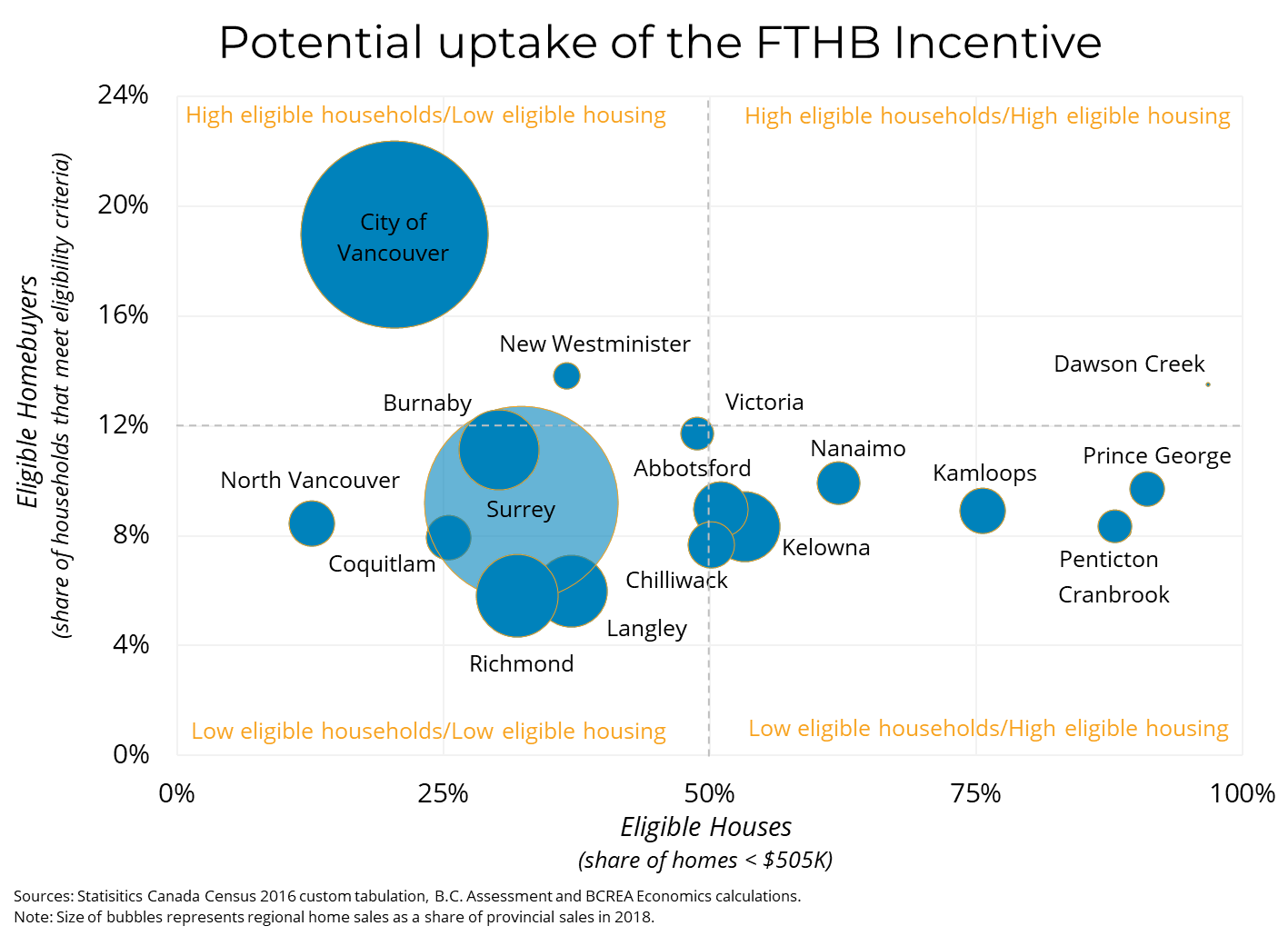
What is the First-Time Home Buyer Incentive?
On September 2, 2019 the Canada Mortgage and Housing Corporation launched the First-Time Home Buyer Incentive (“FTHBI”), with the aim of helping first-time homebuyers reduce their monthly mortgage payments without increasing their down payments. We describe the FTHBI in detail here.
To be eligible, a first-time homebuyer must have: 1) a minimum down payment of 5 per cent from traditional sources such as savings and RRSPs; 2) a maximum qualifying annual income of no more than $120,000; and 3) a loan amount of no more than 4 times a borrower’s qualifying annual income.
Using these criteria, we examine the potential uptake of the FTHBI in select regions in B.C., broadly representing the province’s 11 real estate boards.
What share of households would be eligible under the $120,000 maximum income threshold?
To be eligible for the FTHBI, first-time homebuyers may have a maximum qualifying annual income of no more than $120,0001. Using a Census 2016 custom tabulation from Statistics Canada on household annual income by age and tenure, we specify first-time homebuyers as renter households between the ages of 25 and 39; this represents the prime home buying age cohort. The data show that more than 65 per cent of first-time homebuyers in each select region would be eligible under the FTHBI’s maximum income threshold, with the lowest share in North Vancouver (66 per cent) and the highest in Penticton (86 per cent). Overall, the share of first-time homebuyers that meet the income criteria is relatively comparable across most regions.
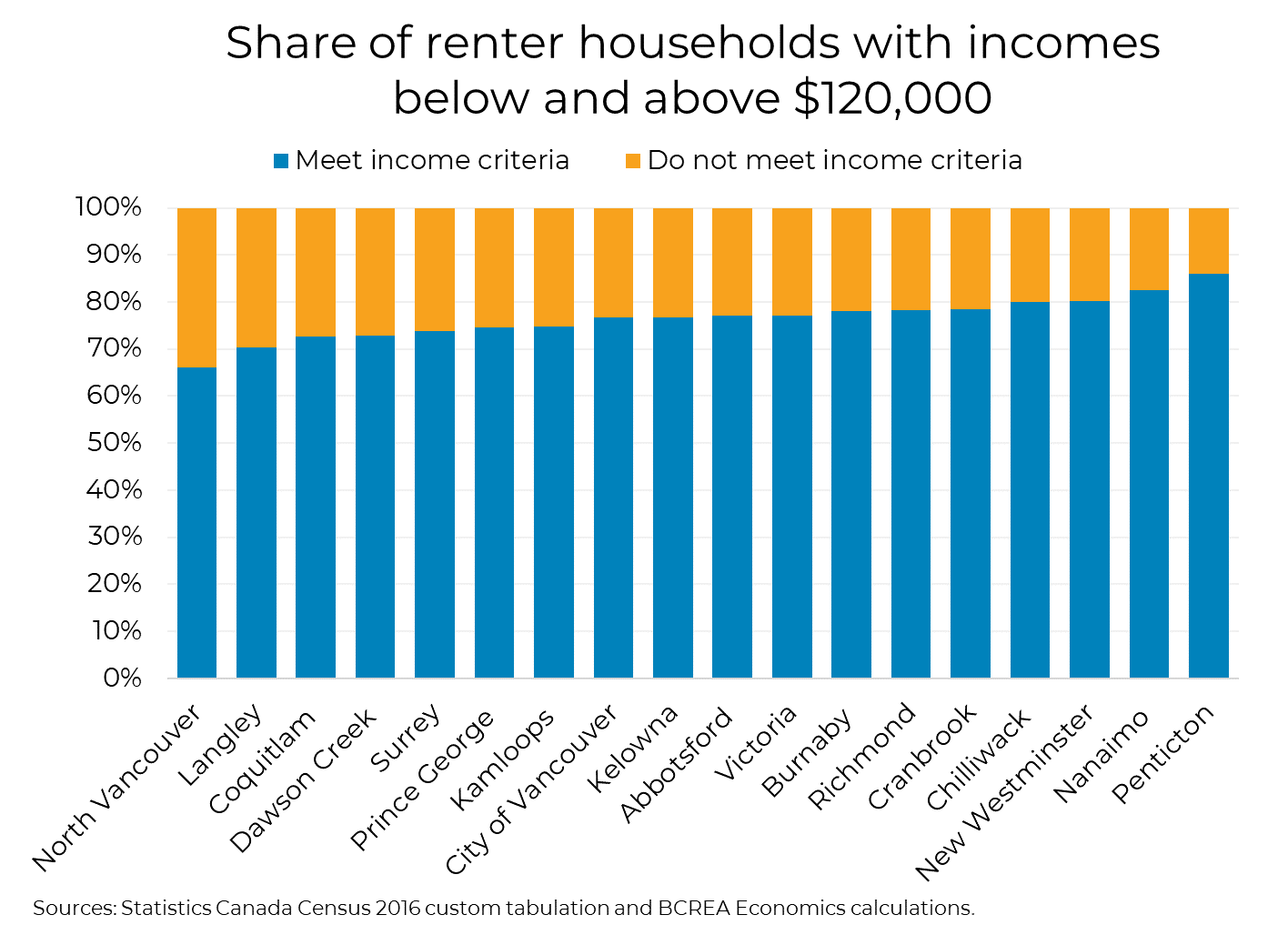 What share of available homes would fall within the FTHBI eligibility criteria?
Using the FTHBI eligibility criteria, we calculate the maximum house price to be $505,2632, assuming a minimum down payment of 5 per cent3 and a maximum qualifying annual income of $120,000.
Using provincial assessment data on 2018 home sales, we find that the lowest shares of homes that would qualify are in North Vancouver (13 per cent) and the City of Vancouver (20 per cent). These regions combined made up 13 per cent of provincial sales in 2018. In contrast, the highest shares of homes that would qualify are in Dawson Creek (97 per cent) and Prince George (91 per cent), making up a combined share of 2 per cent of provincial sales.
The share differences in these select regions are reflective of house prices. For example, the average house price in North Vancouver ($1,092,969) is more than four times higher than in Dawson Creek ($250,348).
 What does this mean in terms of the potential uptake of the FTHBI?
The highest potential uptake of the FTHBI would be in more affordable regions located outside of the Lower Mainland, which comprised 20 per cent of provincial sales in 2018. In contrast, the regions with the lowest potential uptake would be in the Lower Mainland4 and Victoria, which comprised 44 per cent of provincial sales5. This suggests that the FTHBI is expected to have limited impact on provincial home sales.
The potential uptake of the FTHBI is not particularly reliant on the income criteria because the share of first-time homebuyers exceeding the maximum income threshold are relatively comparable across the regions.
Unsurprisingly, the differences in the potential uptake of the FTHBI across the select regions is largely explained by the allowable maximum house price. As such, the price threshold is the most limiting in regions with higher house prices, which tends to be concentrated in the Lower Mainland and Victoria.
Appendix: Proposed Changes to the First Time Homebuyer Incentive
The Liberal Party announced on September 12 that if re-elected, it would expand the FTHBI in Toronto, Vancouver and Victoria. The expansion would increase the maximum qualifying annual income from $120,000 to $150,000 and increase the leverage factor from 4 times the maximum qualifying annual income to 5 times.
With a minimum down payment of 5 per cent and a maximum qualifying annual income of $150,000, these changes would increase the maximum house price from $505,263 to $789,4746. The impact would be most noticeable in the share of homes that would be eligible under the FTHBI. In the Lower Mainland, the share of eligible homes would increase from an average of 28 per cent to 62 per cent, and from 49 per cent to 78 per cent in Victoria.
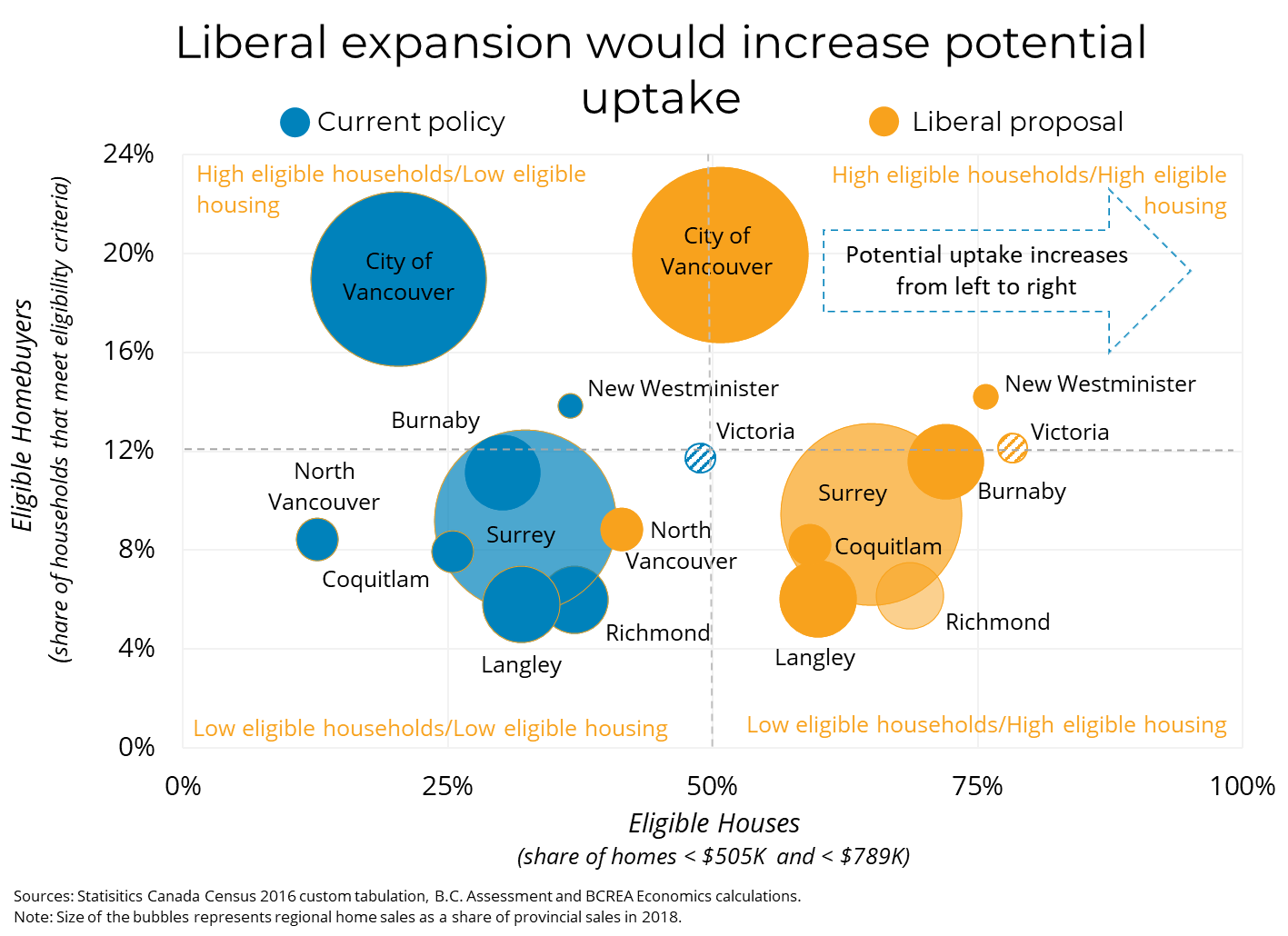
Notes and References:
1. This is subject to qualifying income requirements set out by the mortgage lender and mortgage loan insurer. Examples of qualifying annual income include a salary before taxes and investment income.
2. Calculated as 4 times the maximum qualifying annual income of $120,000 divided by the fraction of the borrower’s minimum down payment of 5 per cent (i.e., 1-0.05).
3. A potential first-time homebuyer could put down up to a maximum of 14.99 per cent, which would then put the maximum house price at $565,000. A maximum of 14.99 per cent plus 5 per cent equity from the Government of Canada would place the borrower just under the 20 per cent threshold to qualify for an insured mortgage.
4. Lower Mainland includes Burnaby, Coquitlam, Langley, New Westminster, North Vancouver, Richmond, Surrey and Vancouver City.
5. The shares quoted here do not add up to 100 per cent because we only include select regions in B.C. 6. Changing the income threshold has no impact on the share of eligible first-time homebuyers, except for a minimal impact in Vancouver (increase of 1 per cent).
For more information, please contact:
Brendon Ogmundson
Deputy Chief Economist
Direct: 604.742.2796
Mobile: 604.505.6793
[email protected]
Kellie Fong
Economist
Direct: 778.357.0831
Mobile: 604-366-6511
[email protected]
To subscribe to receive BCREA publications such as this one, or to update your email address or current subscriptions, click here.
Powers of Attorney Can Be Tricky #532
Licensees must be aware of the challenges that exist when representing someone who claims to have the legal right to act on behalf of a property owner on the basis of a power of attorney. Is the power of attorney valid? Was it properly executed? Does it empower the attorney to deal with real property? Has it expired? Has it been revoked? Has it been terminated through the death of the grantor? These are all questions that must be ascertained by the licensee before proceeding.
In 2018, two licensees were approached by Seller A wishing to list a property for sale. A title search revealed that the property was owned jointly by Seller A and their spouse, Seller B. Seller A advised the licensees that Seller B was confined to a care home and Seller A had a power of attorney (POA) to act on Seller B’s behalf. The licensees had never dealt with a POA before, and they generally took Seller A’s assertion at face value. They did review some 2009 correspondence from Seller A’s lawyer indicating there was a POA between Seller A and Seller B. However, the licensees did not obtain a copy of the POA for the deal file, a contravention of their local Board’s MLS® Regulations regarding listing properties where POA’s were involved. They also did not advise Seller A to seek independent legal advice to ensure the POA was valid. It appears that the licensees did not read, or did not understand, the POA or the lawyer’s correspondence, which clearly indicated that the POA gave authority for Seller B to act for Seller A, rather than the other way around.
The two licensees marketed the property and eventually received an offer to purchase from a buyer, which was accepted by Seller A in their own right and as the attorney for Seller B. Subjects were removed and the transaction was slated to close on April 19. On April 4 the conveyancing lawyer for the sellers advised the licensees that a copy of the POA was needed to complete the transaction. Seller A finally provided the lawyer with a copy of the POA on April 10. The lawyer immediately realized that the POA did not provide Seller A with the authority to act for Seller B. The lawyer attempted to save the transaction by getting Seller B to consent to the transaction in their own right but discovered that Seller B did not have the legal capacity to sign the required legal documents. The transaction could not be completed. As a result of the failure of the transaction, Seller A defaulted on the purchase of another property which they were intending to acquire with the proceeds of the failed transaction.
The buyers lodged a complaint with the Real Estate Council of BC (Council), concerning the actions of the two licensees. The licensees were found guilty of failing to take sufficient care to ensure that Seller A had the legal authority to sell the property and failing to advise Seller A to seek independent legal advice concerning the POA. The licensees were fined $20,000 plus costs, a substantial penalty.1
In addition to their transgressions regarding the POA, the licensees were found to be in contravention of Rule 3-2 by failing to promptly provide to their managing broker all documents relating to the transaction (they waited 8 days before filing the subject removal document) and by failing to keep their managing broker informed of the real estate services they were providing (they waited 10 days before advising their managing broker that there was a problem with the POA that might result in the transaction not completing). I mention these last two contraventions because I am seeing them creep into more and more discipline decisions. Licensees must be aware of and comply with Rule 3-2, which requires them to promptly file documents with their brokerage and keep their managing broker informed of the real estate services they are providing. Yes, I know licensees are independent contractors. Yes, I know they conduct much of their business electronically. Yes, I know they don’t visit the brokerage as often as they used to. However, none of that absolves a licensee of their obligations under Rule 3-2 (1) and (2) to promptly provide their managing broker with the original or copies of all necessary documents and keep their managing broker informed of the real estate services they are providing. As you can see from this case, 8 days is not considered prompt.
It is instructive to note that the licensees had not encountered a POA before this transaction. However, ignorance is no defence. If a licensee does not think they have the skill and expertise to conduct a transaction, they should refer it to a licensee that does. If they do not refer it, they must take steps to acquire the necessary knowledge to enable them to act with reasonable care and skill. There are tremendous resources available from Council, BCREA, local Boards and Associations, brokerages, managing brokers and more experienced licensees. Licensees are obliged to take advantage of those resources.
| 1. | RECBC decision published October 7, 2020 GWH and KM, representatives, Royal LePage Kelowna, Kelowna. |
To subscribe to receive BCREA publications such as this one, or to update your email address or current subscriptions, click here.
Powers of Attorney: A Minefield for REALTORS® #568
REALTORS® will, from time to time, encounter clients who are buying or selling real estate through a power of attorney. While seemingly straightforward, powers of attorney are nothing short of legal landmines and should be treated with extreme caution. REALTORS® should be aware that not all powers of attorney are created equal, and care must be taken to ensure that a power of attorney is valid for the real estate transaction being contemplated. Powers of attorney that do not grant the requisite authority to deal with the subject property or are otherwise invalid may result in very unhappy clients, collapsed transactions, legal battles, and costly regulatory penalties.
Not all Powers of Attorney are the Same
There are generally three main types of powers of attorney:
- specific or limited powers of attorney,
- general powers of attorney, and
- enduring powers of attorney.
A specific or limited power of attorney will restrict an attorney’s authority for a specific transaction, property, purpose, or time frame. A general power of attorney grants broad powers but ceases to be valid when the grantor becomes incapable. On the other hand, an enduring power of attorney will continue to operate beyond a grantor’s mental incapacity. Regardless of the type of power of attorney a REALTOR®may be dealing with, they should take reasonable steps to satisfy themselves that the person they are dealing with has the requisite authority to act and that the power of attorney is valid before proceeding.
A Complicated Task: Determining Authority and Validity
REALTORS®are required to take sufficient care to ensure that they are dealing with a person who has the authority to act. The scope of authority granted by a power of attorney is defined by the Power of Attorney Act1 and the terms of the power of attorney itself. When a client is acting through a power of attorney, REALTORS® should obtain a copy of the power of attorney and carefully review it to determine whether it limits or restricts the authority granted in a material way.2 Similarly, REALTORS® should be aware that relevant legislation may circumscribe the authority of a power of attorney. For example, Section 56 of the Land Title Act.3 stipulates that a power of attorney expires three years after the date of its execution with respect to transactions affecting land, unless it is an enduring power of attorney or the operation of Section 56 of the Land Title Act has been specifically excluded.4
Many other factors may affect the validity of a power of attorney. Has the power of attorney been revoked?5 Is the power of attorney properly executed and witnessed pursuant to Part 5 of the Land Title Act and Sections 16, 17, and 17.1 of the Power of Attorney Act? Has the power of attorney been terminated with the death of the grantor?6 Is the power of attorney in a form acceptable to the Land Title Office?7 These are complex questions that should be answered before a client contracts with a power of attorney, to purchase or sell real estate.
Foreign Powers of Attorney
REALTORS®should take extra care when dealing with a power of attorney from outside of British Columbia. While Section 38 of the Power of Attorney Act provides that an extra-jurisdictional power of attorney may be deemed to be an enduring power of attorney in British Columbia if it complies with very specific prescribed requirements, the risk of an extra-jurisdictional power of attorney not being recognized in British Columbia is high.8 If Section 38 of the Power of Attorney Act is to be relied upon, it should be done with legal advice.
An Important Note on Fraud
Fake powers of attorney have been linked to many fraud claims and are increasingly becoming more difficult to spot. Recently, a number of real estate professionals were ordered to pay over $275,000 in penalties and enforcement expenses for their roles in a transaction where a “seller” used a fraudulent power of attorney to sell the subject property. Hence, REALTORS®should be aware of possible red flags that a fraudulent power of attorney is being used. Possible red flags include an overseas seller, a high degree of urgency regarding the sale, a willingness to sell for less than market value, and a client with little to no knowledge of the subject property. REALTORS®should also carefully examine the power of attorney for inconsistencies and be on the lookout for other red flags of possible fraud or misuse. When acting for a seller through a power of attorney, consider whether confirmation from the grantor is possible, and be skeptical if there is no reasonable explanation as to why such confirmation isn’t possible. REALTORS® should also use their professional judgment to assess whether any potential red flags trigger their obligation to file a Suspicious Transaction Report (“STR”) with the Financial Transactions and Report Analysis Centre of Canada (“FINTRAC”).
Joint or Joint and Several?
Pursuant to section 18 of the Power of Attorney Act, if all or part of the authority is granted to more than one attorney, the attorneys must act unanimously in exercising that authority unless the power of attorney specifies circumstances in which the attorneys do not need to act unanimously or explains how conflicts are to be resolved.9 Hence, in assessing whether their clients have the requisite authority to act, REALTORS® should consider whether the language in a power of attorney permits attorneys to act separately (i.e. joint and several powers) or requires attorneys to act jointly (i.e. joint powers only). If the language of a power of attorney requires attorneys to make decisions together, REALTORS® should take care to ensure that all required attorneys sign documents on behalf of the grantor and that they confirm and document instructions received from all required attorneys.
Tips on How to Deal with Powers of Attorney
Needless to say, powers of attorney are complex legal documents with many potential pitfalls and REALTORS®would be wise to consider the following tips when dealing with a power of attorney.
- Ascertain the identities of your client(s) early and ensure that the name on the power of attorney matches exactly with that of the seller or buyer.
- Obtain a copy of the power of attorney and review it carefully to determine the extent of the authority granted and its validity. Remember to retain a copy in your file.
- Consider whether the language in the power of attorney requires multiple attorneys to act jointly or whether attorneys can act separately. If attorneys are required to act jointly, REALTORS® should be mindful that the attorneys must act unanimously.
- Consider advising your clients to obtain legal advice regarding using a power of attorney before contracting to purchase or sell property. This is particularly important when dealing with a power of attorney executed more than three years ago or from a jurisdiction outside of British Columbia.
- Be aware of any limitations on the authority granted through the power of attorney. For example, unless the power of attorney is enduring or the operation of section 56 of the Land Title Act is specifically excluded, it may be invalid for land title purposes.
- Be generally aware of the factors that could affect the validity of a power of attorney, including when a power of attorney is revoked or terminated and potential defects that could cause the Land Title Office to reject its registration. While REALTORS® should seek to identify potential issues in this regard, REALTORS® should refrain from providing their clients with legal advice. Instead, advise your clients to seek independent legal advice regarding the power of attorney where appropriate and particularly if you are in doubt.
- Be on the lookout for indicators of potential fraud. Consider verifying the power of attorney with the actual seller or buyer, if possible. Be skeptical if there is no reasonable reason why such confirmation cannot be made.
Given the potential complexities involved, REALTORS®should consider seeking the assistance of a lawyer regarding the above.
Conclusion
There is little question that powers of attorney are complex legal documents, and REALTORS®should treat them with extreme caution. Failing to take adequate steps to ensure that a power of attorney is valid and that the person you are dealing with has the necessary legal authority to deal with the subject property can lead to potential legal liability, unhappy clients, costly legal battles, and significant regulatory penalties. REALTORS® should also be aware that while this article intends to highlight some general considerations regarding the use of powers of attorney, it is not intended to be exhaustive or a definitive guide. There can be many other possible considerations, and REALTORS® should always use their professional judgment in determining whether they have the necessary skill and expertise to conduct a transaction with reasonable skill and care. For more information regarding powers of attorney, REALTORS®are encouraged to contact their managing brokers and take advantage of the resources available with the British Columbia Financial Services Authority’s Knowledge Base.
| 1. | Power of Attorney Act, [RSBC 1996] c. 370. | |
| 2. | See Brian Taylor’s Legally Speaking article “Powers of Attorney Can be Tricky #553” where two REALTORS® misunderstood the authority granted by the subject power of attorney. | |
| 3. | Land Title Act, [RSBC 1996] c. 250. | |
| 4. | Subject to the provisions in s.56(2) and (5) of the Land Title Act, [RSBC 1996] c.250. | |
| 5. | Pursuant to s.28 of the Power Attorney Act, [RSBC 1996] c.370, a grantor can revoke an enduring power of attorney by way of written notice to the attorney(s). Similarly, s.57 of the Land Title Act, [RSBC 1996], c.250 stipulates that a power of attorney that has been filed with the Land Title Office may be revoked by filing a notice of revocation or evidence “sufficient to effect revocation.” | |
| 6. | S.30(4) of the Power of Attorney Act, [RSBC 1996] c. 370. | |
| 7. | An original or certified true copy of the power of attorney must be filed with the Land Title Office in order to be effective for land purposes. According to the Land Title Office, some common defects which can cause a power of attorney to be rejected for registration include variations between the name of the grantor in a power of attorney and the name of the registered owner, a power of attorney that has not been properly signed or witnessed, a power of attorney that contains substantive differences in alternate names for the attorney, and foreign powers of attorney that is not accompanied by an extra-jurisdictional certificate as required pursuant to s.4 of the Power of Attorney Regulation B.C. Reg 20/2011. |
|
| 8. | For a foreign power of attorney to be recognized in British Columbia, it must comply with prescribed requirements, including specific residency requirements. See s. 4 of the Power of Attorney Regulation BC Reg 20/2011 regarding extra-jurisdictional power of attorneys. | |
| 9. | This generally does not apply when the additional attorney is an alternate attorney who can act only when specific conditions have been met. |
Practice Limited Dual Agency At Your Risk #473
Despite being fraught with risk, licensees continue to practice limited dual agency. While BC courts have recognized the modifications to the agency relationship agreed to by buyers and sellers who have entered a Limited Dual Agency Agreement, a licensee failing to document the parties’ informed written consent to limited dual agency prior to acting as a limited dual agent will place the licensee’s commission at risk.
In Partners Realty Ltd. v. Morrow,1 a recent Ontario decision, a licensee showed her buyer the seller’s unlisted property, then wrote an offer for the property on her buyer’s behalf. However, the licensee refused to show the buyer’s offer to the seller until the seller entered into a listing agreement. The buyer’s offer was then presented and accepted by the seller. The seller later refused to complete and the brokerage sought payment of its commission on the aborted sale pursuant to the terms of the listing agreement.
The seller maintained that she was not liable for the brokerage’s commission as the brokerage had materially breached the agreement in failing to deliver written notice of the dual agency situation prior to the buyer’s offer being presented, contrary to the following written terms of the Limited Dual Agency Agreement:
I hereby acknowledge that the Listing Broker may be entering into Buyer Agency Agreements with buyers who may be interested in purchasing or leasing my Property. In the event that the Listing Broker has entered into or enters into a Buyer Agency Agreement with a prospective buyer or tenant for my Property, I hereby consent to the Listing Broker acting as a Dual Agent for the transaction, however, the Listing Broker is required to inform me in writing of a Dual Agency situation with the Seller and Buyer at the earliest practical opportunity and in all cases prior to any offer to purchase or lease being submitted or presented.
The court found that, contrary to the terms of the agreement, the licensee did not inform the seller, in writing, of the dual agency situation prior to the offer to purchase being presented. The court found that the failure to make written disclosure of the dual agency relationship prior to the offer being presented constituted not only a breach of the agreement, but a breach of duty to make full and fair disclosure of all material facts. The court considered that the obligations of an agent include:
“…disclosure of everything known to him respecting the subject matter of the contract which would be likely to influence the conduct of his principal or everything that would be likely to operate upon the principal’s judgment.”
While the wording used in the Ontario listing agreement differs from ours, the requirement for written disclosure of any dual agency relationship and informed consent by the parties to that relationship (be it competing buyers or a buyer and seller), is effectively the same.
Clause 12 (A) of the Multiple Listing Agreement states:
| A. | If the Designated Agent (or where the Designated Agent is comprised of more than one licensee, one of those licensees) is also the agent of a prospective buyer who becomes interested in the Property, the Listing Brokerage: | |
| i) | will seek the written consent of the Seller and the prospective buyer for the Designated Agent to continue to act as their limited dual agent to facilitate a sale of the Property… | |
To preserve any claim for commission when acting as the agent for the seller and the buyer in a transaction (and to avoid lawsuits and disciplinary complaints), a licensee must remember to obtain the informed written consent of both parties before acting on their behalf.
Jennifer Clee
B.A., LL.B.
| 1. |
|
Pre-offer vs Cooling Off: Communicating with Clients
In February, BCREA has published more than 30 recommendations to the BC Government and the province’s real estate regulator, the BC Financial Services Authority, to help guide their decision making to better protect consumers in the real estate transaction process.
A key recommendation we made is for government to mandate a “pre-offer period” instead of a “cooling off period” to improve the home buying and selling process and mitigate consumer risk in a competitive market.
For REALTORS®, it’s important that you can confidently and concisely explain to your clients what BCREA’s proposed “pre-offer period” is and what it would look like in practice, to ensure they know the differences and can amplify BCREA’s advocacy.
Below are three key questions and answers Realtors need to know when talking to clients about why a “pre-offer period” is better suited for British Columbians and the implications of the government's planned “cooling off period.”
What’s the difference between a “pre-offer period” and a “cooling off period”?
A “cooling off period” gives buyers the right to withdraw from a purchase agreement within a specified period of time after their offer is accepted. The objective of this policy is to allow buyers time to reconsider their decision after having their offer accepted. Although the government has already announced its intent to implement a mandatory “cooling off period,” our research has led us to have significant concerns with the policy.
Instead, we are proposing a “pre-offer period,” which would mandate that a listing be available for a minimum of five business days before offers are allowed to be presented. This would provide prospective buyers with the opportunity to undergo due diligence, giving more time to ensure proper financing is in place, review documents and disclosure statements and conduct a home inspection before submitting an offer. A “pre-offer period” will allow potential buyers to ensure that they are making offers that are well-informed, while also reducing pressures of the highly competitive real estate market.
Why a “pre-offer period” is better than a “cooling off period?”
A key difference between the two policies is that a “cooling off period” is reactive, allowing potential buyers to reconsider a decision after it has been made, while a “pre-offer period” is proactive, allowing due diligence to take place before an offer is made.
A potential issue with a “cooling off period” is that, if a potential buyer rescinds their offer, it may create a “cascading effect,” which would jeopardize a seller’s ability to purchase their next home. A “cooling off period” tries to protect buyers, but doesn’t consider that many buyers are also sellers, and if their own home sale falls through as a result of a “cooling off period,” their own homebuying efforts could be jeopardized. A “pre-offer period” avoids this unintended consequence by taking place before an offer is made.
Another potential negative consequence of a “cooling off period” is that it may increase the total amount of offers, ultimately worsening housing affordability. Sophisticated and wealthier buyers may take advantage of a “cooling off period,” presenting offers on multiple properties to preserve their options and later backing out of all but their one preferred deal. If this occurs, it would increase the instances of multiple offers. This resulting increase in demand from insincere or frivolous offers could further increase housing prices. A “pre-offer period” would not give opportunity for these frivolous offers. It’s important that serious buyers feel confident in their offer and on the property, and that can only happen when due diligence is complete beforehand.
What can my clients and I do to amplify BCREA’s advocacy?
We are asking Realtors and their clients to play a part in amplifying our advocacy. Some Realtors and their clients have written public letters to the Minister of Finance or their local MLA, addressing concerns with the “cooling off period” and offering a better way. Realtors can also encourage their clients to show support by raising awareness about BCREA’s recommendations on social media. Use the hashtag #BetterWayHomeBC and share bcrea.bc.ca/supporting-consumers and the graphics below on your social media channels:
PRECs and Wage Subsidy Programs
If you have a Personal Real Estate Corporation (PREC), navigating Canada’s COVID-19 aid programs can seem even more complicated. If you receive a T4 from your PREC and you meet the Canada Emergency Relief Benefit (CERB) income threshold requirement (read more here), you’ll want to calculate which is more beneficial, the CERB or the wage subsidy programs since you can’t apply for both as an individual. Here’s an overview of the Canada Emergency Wage Subsidy (CEWS) and Temporary Wage Subsidy (TWS) programs to help you understand what programs are right for you and your PREC.
About CEWS
CEWS was launched to prevent further job losses, encourage employers to re-hire workers previously laid off as a result of COVID-19, and help employers to more easily resume normal operations following the crisis. It provides up to a 75% wage subsidy for the period from March 15 (retroactively) to June 6, 2020 to eligible employers. For more information, visit the government's website.
How do I know if I am an eligible employer?
PRECs meet the government’s eligible employer criteria (so do brokerages) but, to qualify, eligible employers also have to meet the revenue requirements. This means you have experienced at least a 15% drop in revenue for the first eligibility period and a 30% drop for the following eligibility periods.
To determine if you meet the revenue requirements, compare your revenue for each eligibility period to the same period in 2019. Alternatively, you can compare your revenue for each of the three eligibility periods to your average revenue for January and February 2020. Whichever benchmark you use, you will need to continue using it for the duration of the program.
What are the eligibility periods?
There are three eligibility periods:
- March 15 to April 11,
- April 12 to May 9, and
- May 10 to June 6.
How is the CEWS subsidy amount calculated?
The subsidy amount for the period between March 15 and June 6, 2020 is the greater of:
- 75% of the amount of remuneration paid, up to a maximum benefit of $847 per week; and
- the amount of remuneration paid, up to a maximum benefit of $847 per week, or 75% of the employee's pre-crisis weekly remuneration, whichever is less.
What is an employee’s “eligible remuneration”?
Eligible remuneration includes wages, salaries or other remuneration like fees, commissions or other amounts for services paid to employees. It is based on the average weekly pre-crisis remuneration paid between January 1 and March 15, excluding any seven-day periods during which the employee did not receive remuneration.
How do I apply for CEWS?
You apply through the Canada Revenue Agency’s (CRA) My Business Account portal. Go here for more information.
Can PREC shareholders receive the CEWS?
Under the current rules, you only can receive the subsidy for wages that are included in a T4, which means dividends don’t qualify.
About the TWS
The 10% TWS keeps more money in employees’ pockets by reducing the amount of payroll deductions employers are required to remit to the CRA. As an employer, you don’t apply for this subsidy. Instead, you can manually deduct 10% of your total CRA remittances for the period between March 18 and June 19, 2020, up to $1,375 for each eligible employee to a maximum of $25,000 per employer. Find out more here.
Can I reduce other deductions as well?
No. You will continue deducting income tax, Canada Pension Plan (CPP) contributions and Employment Insurance (EI) premiums from salary, wages, bonuses or other remuneration paid to your employees, as you currently do, as well as your share of CPP contributions and EI premiums, to the CRA.
Can I apply for CEWS and take advantage of TWS as well?
Yes, but amounts received under the TWS will reduce the amount received from CEWS.
To subscribe to receive BCREA publications, or to update your email address or current subscriptions, click here.
PRECs, Dividends & CERB
REALTORS® with Personal Real Estate Corporations who pay themselves dividends can apply for the Canada Emergency Relief Benefit (CERB), as long as they meet other eligibility criteria. On April 6, 2020, the federal government extended CERB eligibility criteria to include self-employed workers who pay themselves with dividends.
According to the CERB government website, non-eligible dividends (generally those paid out of corporate income taxed at the small business rate) count towards the minimum $5000 in income required for CERB eligibility. Non-eligible dividends also count toward the $1000 income threshold for a benefit period.
Read more about CERB and Realtor eligibility here.
For more information and resources related to real estate practice during the COVID-19 pandemic, visit the BCREA COVID-19 resources page.
To subscribe to receive BCREA publications, or to update your email address or current subscriptions, click here.
Premier David Eby Pivots on Real Estate Investment
After Premier David Eby’s longstanding battle against speculators and real estate investors in BC, he made a surprising pivot at the BC Real Estate Association’s Government Liaison Days (GL Days) conference in Victoria earlier in March 2025. Speaking to BC REALTORS®, the Premier admitted that investors who buy and sell real estate for profit in British Columbia are actually useful to the economy and the housing sector.
This pivot comes after the NDP government has implemented the Speculation and Vacancy Tax, the BC Home Flipping Tax, and other regulatory and legislative measures meant to curb real estate investment and speculation.
The Premier went on to explain that his government is now aiming to harness the investor spirit previously viewed as capitalist greed to move their affordable housing goals forward. His government is looking at ways to channel this enthusiasm for investment into the facilitation of more housing for people in this province. How such new initiatives will operate, given the BC Home Flipping tax that came into effect on January 1, 2025, remains unclear.
BCREA promotes the important role of investors and risk-takers in improving housing supply, with the recognition that loopholes must be addressed to ensure those people cheating the system or taking advantage of loopholes for their own personal gain at the expense of others are unable to do so.
As BCREA CEO Trevor Koot highlights, “Call them investors, call them speculators, call them entrepreneurs. The reality is someone has to assume a variety of high-stakes risks to build more housing in this province. It is unreasonable to think that the government should or could build the necessary housing in the degree of supply needed to positively influence affordability, nor is it an expectation of any housing advocate.”
As such, we need people willing to invest the funds necessary to construct these much-needed units.
We are encouraged by the Premier’s willingness to reconsider the role of investors in housing affordability and change his government’s approach in the face of looming economic threats, and more importantly, sound evidence.
Rob Shaw and Frances Bula have written extensive pieces on these new NDP government directions announced at BCREA’s GL Days event. We encourage readers to review these pieces for more details.
BCREA will continue to advocate for thoughtful and evidence-based policies that can genuinely improve housing attainability for British Columbians.
Preparing for the Rise of Prefabricated Housing: A Guide for REALTORS®
In its throne speech on Tuesday, May 27, 2025, the new federal government confirmed a policy promise from the Liberal Party election campaign: the creation of a major initiative to expand the capacity of Canada’s prefabricated housing sector. Backed by $25 billion, the “Build Canada Homes” program intends to fund innovation and capacity building in this sector.
The prefabrication of key building components for assembly at the construction site has the potential to significantly reduce the cost, time requirement, and construction waste of new housing, as well as increase sustainability.
Read on for a breakdown of this rapidly rising sector.
What is Prefabricated Housing?
Not all prefabricated housing or offsite construction options are the same. That makes it important to distinguish between the different types of products and approaches. Here are the two most common:
- “Panelization” is the most basic form, where individual wall, floor, and ceiling panels can be built in a factory and flat-shipped to a site, where they are craned in place and secured. Many builders in BC already use this process.
- “Modular” or “volumetric” construction is the production of modules, which can be anything from individual rooms to entire housing units. These are created in a factory, shipped to the site, and assembled “LEGO-block style.”
In a typical year, BC’s prefabricated housing factories produce about five per cent of the province’s homes. But these facilities are currently operating at a fraction of their capacity, meaning they can produce far more than they do now.
According to Modular BC – an organization dedicated to expanding the overall factory-built home sector in the province – the sector eventually hopes to produce 25 per cent of BC’s housing. That figure seems achievable given the current excess capacity, and the plans of the federal and provincial governments to support expansion.
Government Interest
Build Canada Homes plans to invest in prefabricated home producers to help them automate more of their production lines and hire workers for additional shifts. The program also intends to place bulk orders with manufacturers to enable more consistent production runs and keep staff employed during traditional downtimes.
The provincial government has signalled its support as well. During the fall 2024 election campaign, Premier David Eby announced his intention to “fast track” the growth of the sector to build homes quickly and affordably while creating jobs.
Other Benefits
By building in an environmentally controlled facility, manufacturers can maintain high quality while avoiding the exposure to rain and snow moisture that can plague a traditional construction site. The use of quality-control checks at every step of the production process ensures each home meets building code and energy efficiency standards. Indeed, many units being produced today already meet Energy Step Code 4 levels.
New standardized plans for four- and six-plexes, when combined with the Bill 44 Small Scale Multi-Unit Housing zoning policy, will create the opportunity to quickly and economically bring this type of ground-oriented housing to cities and towns around the province.
Offsite Construction Challenges
Not to say that the rapid uptake of prefabricated homes is without its challenges.
Local governments must embrace plan approval and inspection processes of these homes to ensure that they can be built and installed in a timely manner. To that end, Modular BC has created checklists for building officials at the planning and inspection stages.
Two other concerns are financing and capacity for housing module transportation. For the former, the sector has engaged the Canadian Mortgage and Housing Corporation to assist with updating high-ratio financing procedures. For the latter, the Ministry of Transportation and local governments will need to streamline approvals for very large loads.
Finally, and perhaps most importantly, the homebuying (and renting) public will need to shift their perception of prefabricated housing.
Structures built using offsite construction methods aren’t just for mining camps, trailers, and temporary shelters anymore (though they still hold tremendous value in these sectors). They are high-quality, energy-efficient, cost-effective, and customizable – making them a perfect fit for many buyers and renters in BC.
There will always be a market for on-site stick-frame construction for custom housing, challenging sites, and high-end clients, but for a significant portion of the market, prefabricated homes will be a big part of BC’s housing supply solution.
Prepayment of a Locked in Mortgage (#2 – A B.C. Decision) #39
By Gerry Neely
B.A. LL.B.
Column No. 38 reviewed the impact of a 1980 Ontario decision interpreting the provisions of the Ontario Mortgage Act in a way which gave a mortgagor who appeared to be locked into a high interest renewed mortgage the right to pay off the mortgage upon payment of three months' penalty. As that column was being printed, a mortgagor who had signed a mortgage on August 6, 1976, which matured on September 1, 1981 was petitioning the Supreme Court of British Columbia for an interpretation of the mortgage and a modification of it which was dated September 4, 1981. The effect of the modification agreement was to increase the interest rate payable by the mortgagor from twelve per cent to eighteen and three-quarter per cent per annum for a term ending September 1, 1986. The results were highly satisfying for the mortgagor since the reasons for judgement delivered to the Vancouver Registry on July 6, 1983, gave the mortgagor the right to pay off his mortgage by tendering the principal and accrued interest plus three month's interest in lieu of notice, pursuant to Section 10 of the Canada Interest Act.
Mr. Justice Bouck cited the facts of the Deeth v. Standard Trust Co. case, which was discussed in Column no. 38, and noted that the pattern of facts were identical to those before him. He concluded that there were no terms in the modification of mortgage agreement which prevented him from reaching the same decision as had the judge in the Deeth case. If anything, the modification agreement supported the argument of the petitioner that the mortgage dated August 6, 1976, remained in full force and effect save as modified by the terms of the modification of mortgage agreement. Among other terms of that agreement, the mortgagor covenanted with the mortgagee to perform all of the covenants, conditions and provisions contained in the mortgage dated August 6, 1976. Counsel for the Citadel Life Assurance Company argued that the effect of the modification of mortgage agreement was to merge the mortgage dated August 6, 1976, into the modification dated September 4, 1981, so the term which ended on September 1st, 1986, was for less than a period of five years after the date of September 4, 1981. That argument was rejected.
The kicker is found in the second sentence in the following paragraph taken from the reasons for judgment:
"In summary then, apart from instances when the mortgagor is a corporation, any mortgagor may pay off his mortgage in accordance with s. 10 of the Interest Act where the interval from the date of the mortgage to the date it becomes due is more that 5 years. A subsequent modification, extension or renewal agreement cannot defeat that right except perhaps where the contract specifically provides."
This sentence forecast the next argument that will be made by a mortgagee if the renewal agreement modified substantially the original mortgage. Several renewal agreements which we have examined contain provisions by which the mortgagor expressly waives any right of prepayment either under Section 10 the the Canada Interest Act or any similar Federal or Provincial legislation. Others provide that any statutory right of repayment is to take effect as if the mortgage had been dated on the date of the renewal agreement. There is a good chance that his attempt to have the mortgagor waive his rights under the Interest Act will fail as being an attempt by contract to waive the statutory rights given to the mortgagor. This argument may even prevail where the mortgagor has agreed in the renewal document that the right of repayment is to take effect as if the mortgage had been dated on the date of the renewal agreement.
As yet counsel for the mortgagee has not received instructions as to whether or not the decision in this case will be appealed. Anyone whose mortgage and renewal (or renewals) falls within these facts should jump at the opportunity to see whether or not a high interest rate mortgage can be refinanced.
No doubt the counter-attack by the lending institutions will be to refuse to renew by extending the term of an original five year mortgage. Instead, they will probably insist upon a new mortgage.
| 1. | Lynch v. The Citadel Life Assurance Company,S.C.B.C. 46 B.C.L.R. 354. |
To subscribe to receive BCREA publications such as this one, or to update your email address or current subscriptions, click here.
Prepayment of a Locked in Mortgage #38
By Gerry Neely
B.A. LL.B.
The contrast between today's relatively low rates of interest and the high rates found in mortgages which were renewed in 1982 has led the mortgagor with a closed renewal mortgage to try to find ways in which the mortgage can be paid off before maturity. These ways have included protests to both Provincial and Federal Ministers of Consumer Affairs. They also have included a re-examination of a 1980 Ontario decision interpreting a section of an Ontario statute, The Mortgages Act. The section in question is substantially identical in its substance to Section 10 of the federal Interest Act. The essence of that section is that where a mortgage is payable more than five years after the date of the mortgage, then at any time after the expiration of such five year period the mortgagor is entitled to pay to the mortgagee the amount due for principal and interest, together with three months' interest in lieu of notice. If the mortgagee refuses to accept such payment, no further interest is payable under the mortgage.
The general assumption which prevailed before the decision in the Ontario case was that the section of the Federal Interest Act quoted referred to a closed mortgage with a term of more than five years, i.e. six years, seven years, etc. However, the Ontario Court concluded that the term of the mortgage was to be measured from the date of its execution so that in the following circumstances, the plaintiff mortgagor was held to be entitled to pay off his mortgage before the renewal term expired. The mortgage had been signed on July 18, 1973. The interest adjustment date was August 1, 1973, and the mortgage matured on August 1, 1978. During July, 1978, the mortgagor accepted a renewal of the mortgage that allowed him to prepay only up to five per cent of the principal on each anniversary date. In November, 1978, the mortgagor sought to prepay the mortgage and was told that could be done only upon payment of nine months' interest penalty. The mortgagor paid this amount under protest and then sued successfully to recover the interest penalty to the extent that it exceeded three months' interest. The mortgagor's success depended upon the date of the execution of the mortgage, a date which prior to the decision in this case, was thought to be of relatively little significance.
The defendant mortgagee must have questioned the applicability of the Interest Act since the mortgage had been renewed. The Court dismissed this argument on the basis that there was only one mortgage in existence and that was the original mortgage.
This case will have limited application since very few five year mortgages have been granted in the past few years. It will apply mainly in circumstances where an original five year term mortgage has been renewed. In addition, the decision was based upon an Ontario statute for which there is no comparable statute in British Columbia. Any action in British Columbia would be brought under the provisions of the Federal Interest Act, and the Ontario decision, while persuasive, would not be binding upon a B.C. Court. The Court could decide that Section 10 of the Federal Interest Act applied only to mortgages where the initial closed term exceeded five years. However, this case is a good case for anyone whose mortgage falls within its facts since it provides a legal argument for the right to prepay a mortgage before the expiration of the renewal period.
| 1. | Deeth v. Standard Trust Co.,12 R.P.R. 157. |
To subscribe to receive BCREA publications such as this one, or to update your email address or current subscriptions, click here.
Preserving Public Trust During COVID-19: A Self-Directed PDP Opportunity for REALTORS®
On February 18th, BCREA and the province’s ten real estate boards are offering a free two-hour interactive webinar on how REALTORS® can continue to safeguard public trust during BC’s COVID-19 pandemic. By attending, participants will be able to claim two hours of self-directed learning towards their Professional Development Program (PDP) requirements.
Why attend?
With BC’s public health orders on gatherings extended and a housing market hotter than it’s been in years, Realtors are increasingly caught in a conflict between clients’ expectations and the lack of clarity around some of the COVID-19 safety guidelines. Serving clients’ best interests and helping slow the spread of COVID-19, while managing relationships with colleagues, tenants and neighbours – who all have different perspectives on COVID-19 risks – means Realtors are facing more pressure and risk than ever.
This webinar aims to give you the skills and confidence to better manage these risks so you can preserve public trust in the profession and work within COVID-19 safety guidelines. You will also learn to advise clients and colleagues more effectively on the shared risks everyone faces if they are perceived to disregard public health orders when buying or selling a property.
What to expect
The webinar will start with a panel discussion with George Greenwood, CEO of the Association of Interior REALTORS®, Phil Moore, Vancouver-Realtor and past president of the Real Estate Board of Greater Vancouver, and Bruce McCoubrey, Professional Standards Advisor at the Real Estate Council of BC. Moderated by Ari Indryk, VP of Crisis and Risk for the global public relations firm Edelman, it will explore what Realtors are seeing on the ground as well as highlight the latest COVID-19 guidance and best practices.
The webinar will then lead into a presentation on the evolution of public trust during the pandemic. After a short break, participants will have the chance to participate in tabletop exercises with realistic scenarios where Realtors face risk in today’s hot market. About half of the webinar will focus on interactive explorations of risk and how to manage it.
Webinar details
Date: Thursday, February 18, 2021
Time: 1-3 pm
Format: Zoom webinar with panel discussion and interactive exercises
Cost: None
Reporting self-directed PDP hours: BCREA will submit attendee report to member boards directly – attendees do not need to report their attendance
Questions: Contact BCREA Communications Assistant Mackenzie Smith at [email protected]
A video recording of the webinar will be sent to all Realtors but viewing the video will not qualify for self-directed professional development hours.
To subscribe to receive BCREA publications, or to update your email address or current subscriptions, click here.
Prevent Client Remorse in a Fluctuating Real Estate Market #552
In fluctuating markets, remorse claims become all too common. Consumers regret and want to escape deals. Ensuring you’re well prepared upfront with the proper documentation, the best information and best practices, REALTORS® can help prevent client remorse. Yet, client remorse and uncertainty can still occur despite your best efforts.
Why do clients get remorse?
Remorse can affect anybody and everybody regardless of how big or small a purchase can be. In the case of real estate, client remorse can happen on both the seller and buyer side.
For a seller, remorse is basic. They did not receive what they thought they should have for the property. They may allege that you advised them to list too low, pressured them to accept an early lower offer or to forgo an early higher offer hoping to get a higher offer.
Remorse is quite the opposite for a buyer. In their view, they paid more than they should have. They may allege you did not give them full information on the area, similar properties, or the property itself or that you pressured them to offer over asking with no subject conditions.
Common to most remorse claims is that the consumer believes they did not achieve a fair deal and did not receive all the information they should have. As a result, the claimant often felt unduly pressured.
The BC Financial Services Authority recently published a Broker’s Brief reminder entitled “Hot Market Buyer's Remorse,”1 which prompts licensees on the importance of communicating with clients and documenting communication and advice given to clients. In particular, when a buyer elects to make a subject-free offer, REALTORS® should document the advice, including the risks involved and use the Buyer’s Acknowledgement of Information – Recommended Conditions form.
In a recent case, the court highlighted the importance of such discussions when listing or assisting a buyer.2 In that case, the licensee rightly advised the client there were uncertainties in the housing market, a more stringent mortgage stress test was expected, and other initiatives that may impact prices in the market, including for example the empty home tax and foreign buyer’s tax. Therefore, documenting those discussions is important in preventing and defeating claims.
The basics when advising on value
As the age-old adage goes, nobody is perfect. It is well settled that a licensee will not be held to the same standard as an appraiser. However, evidence of gross over or undervaluation may lead to a finding of negligence.3
As REALTORS® aren’t appraisers, what do you have to do instead?
The court in Currie v. Sonnenberg stated:
“[t]he defendants did not have a legal duty to obtain the best possible price for the property. Rather, a realtor has an obligation to act in accordance with the applicable standard of care for giving advice on price for a property."4
And what that standard of care is may change from property to property and from one circumstance to the next.
As usual, Brian Taylor says it best:
“It is the Realtor’s function to make sure that their client has all pertinent and available information before them, so that the client may make an informed decision. It is not the Realtor’s function to make that decision for them.“5
Good advice.
Tips to avoid valuation issues and claims of remorse
When dealing with a seller, it may be best to do the following:
- To have and document discussions about the market generally and specifically in the area.
- To review the listing agreement in detail and document that review.
- To provide a CMA for the property to your seller and keep a copy of that for your file.
- To consider the need to alter that CMA if market conditions change over time as may be required.
- To document your recommendations/advice and the client’s instructions.
- To recommend legal advice and other professional advice when issues or questions that arise are beyond your expertise, like a potential appraisal if needed.
- Do not promise to sell for a certain price or date.
When acting for a buyer, the following may help:
- Have the exact same discussions and document them about the market generally and specifically in the area.
- Update those discussions as buyers' desired area, price range or wish list changes.
- Provide an updated list of comparable properties that meet the buyer’s criteria.
- Provide a CMA for a property the buyer wishes to offer and keep a copy.
- Discuss with the buyer the terms and conditions of any offer and Contract of Purchase and Sale and document those discussions.
- Have a full, frank and documented discussion about subject conditions, using the Buyer’s Acknowledgement of Information – Recommended Conditions form when going subject-free, and recommend appropriate legal and other professional advice.
Buyers and sellers should be made aware in reviewing Contracts of Purchase and Sale that these are legal and enforceable documents, and they must review each offer and counteroffer fully and carefully and understand their rights and obligations. The court will hold them to what they have reviewed and signed.6
Listening to your client and documenting any concerns they may have is a key to mitigating risk. You may be able to solve any concerns by reminding clients of the discussions you had with them and documented. For example, reminding them of what you told them and of the documents you gave them on the topics of value and being subject free.
As always, provide all your recommendations and the relevant information for a property, and remember it’s a REALTORS® job to advise and let the client decide.
In summary
Regret and remorse are natural in fluctuating markets and life. However, arming yourself and empowering your clients with the best information, documentation and research on a property and value helps avoid remorse.
| 1. | BCFSA The Broker’s Brief Hot Market Buyer’s Remorse July 28, 2022. | |
| 2. | Sandhu v. Goetz-Stankiewicz, 2022 BCSC 161 at para 7. | |
| 3. | Currie v. Sonnenberg, 2017 BCSC 526 at para 42. | |
| 4. | Currie at para 44. | |
| 5. | Legally Speaking Seller’s Remorse Not Rewarded #494 May 21, 2017. | |
| 5. | Legally Speaking Remind Consumers: They Are What They Sign! #5 September 18, 2018. |
Pride Month, Housing, and the Role of REALTORS®
Pride Month is an opportunity to celebrate 2SLGBTQI+ communities, but it is also a time to reflect on the barriers that continue to affect people’s daily lives, including access to safe, stable, and affordable housing.
For REALTORS®, housing is often discussed through market conditions, supply, affordability, listings, contracts, and client needs. Those issues are central to real estate practice, but they are not the whole picture. Housing is also connected to safety, dignity, belonging, and whether people can find a home without facing discrimination, exclusion, or added barriers.
Statistics Canada data shows that 2SLGBTQI+ households face distinct housing and affordability challenges. These households are more likely to rent than Canadian households overall (53 per cent vs. 31 per cent). They are also more likely to spend over 30 per cent of their household income on shelter costs (30 per cent vs. 22 per cent) and to be in core housing need (17 per cent vs. 12 per cent).
These numbers matter because they show that housing challenges are not experienced evenly across the population. Many communities – including Indigenous, racialized, newcomer, disabled, senior, and low-income – face housing barriers in different ways. Pride Month provides an opportunity to reflect specifically on how those barriers affect 2SLGBTQI+ people and what that means for a sector built around helping people navigate housing decisions.
Government of Canada survey findings add another important layer. Among 2SLGBTQI+ respondents who had accessed the shelter system, 51 per cent reported that it was difficult to navigate because of their sexual orientation, while 57 per cent reported that it was difficult because of their gender identity. These findings speak to more than housing availability. They speak to whether housing systems, services, and supports feel safe, accessible, and respectful for all the people who need them.
For REALTORS®, this is an important professional reminder. Clients and members of the public may come to a real estate transaction with different experiences, concerns, family structures, identities, and histories. Some may have experienced discrimination or exclusion in housing before. Others may be uncertain whether they will be treated fairly, respected, or understood.
Professionalism means being prepared to serve all clients with care and respect. It means avoiding assumptions, using inclusive language, listening carefully, and recognizing that a person’s housing needs may be shaped by more than price, location, and property features. Respectful service is not separate from good real estate practice. It is part of it.
This can show up in practical ways, such as how REALTORS® ask questions, how they refer to partners or family members, how they respond to client concerns, and how they help people feel respected throughout the process. It can also be seen at the brokerage level through training, resources, policies, and expectations that support professional and inclusive service.
No REALTOR® or brokerage can solve housing inequity on their own. But REALTORS® do play an important role in the housing system. Every interaction with a client, consumer, colleague, or community member is an opportunity to help build trust and reduce barriers.
Pride Month is a celebration, but it is also a reminder that inclusion cannot be limited to statements of support. It must be reflected in how people are treated, how services are delivered, and how professionalism is practised every day.
As REALTORS® support people through some of the most important housing decisions of their lives, Pride Month offers a meaningful opportunity to reflect on how the real estate sector can continue to contribute to fairness, dignity, and respect for all.
Principal Residence – Exemption or Taxable Gain #131
By Gerry Neely
B.A. LL.B
Where the lands surrounding a principal residence exceed one acre, the excess area only falls within the principal residence exemption if the owner can prove that the excess is necessary to the use and enjoyment of the housing unit as a residence.
The standard of proof required of an owner was discussed in a tax case where a taxpayer in Nanaimo purchased two adjoining vacant lots. She constructed upon one of them a house in which she lived, and installed on the other lot a shed and an incinerator and occasionally used the other lot for parking. Upon the sale of this lot, the taxpayer failed to declare the gain believing that the lot was part of her principal residence and therefore exempt from tax.
The Tax Department assessed the gain as taxable and the taxpayer appealed. The Minister of National Revenue argued that for the taxpayer to succeed, she had to establish that the adjoining lot was "necessary" to her use and enjoyment of her principal residence. Necessary was defined to mean something "that cannot be done without."
Since the taxpayer could have moved the shed and incinerator onto the residence lot, and since she continued to live in her home after the sale of the lot, she failed to meet the test proposed by the Minister. The judge agreed with this and confirmed the assessment.1
Many owners who could not subdivide their lands either because they were in the Land Reserve or the zoning prohibited it, found it necessary to keep more land than they needed for the use and enjoyment of their residence. Could they reduce the total capital gain by claiming an exemption for the years the property could not be subdivided?
In one case a woman owned a six acre parcel which could not be subdivided because of zoning. This zoning was changed in the ninth year following the date when capital gains became effective and she died in the tenth year. The Minister assessed the entire gain as taxable. The Tax Court, however, said that for nine of the ten years all of the property was necessary for her use as a residence because it could not be subdivided. Therefore, only 1/10th of the capital gain attributable to the land in excess of one acre was taxable.2
In another case, a taxpayer owned a 14-acre parcel which they could have subdivided into 1/2 acre lots. The land, however, was then included within the Agricultural Land Reserve from 1972 until 1975, when the landowner was able to obtain the removal of 7.9 acres from the Reserve. While they could have subdivided the 7.9 acres into residential lots, they chose not to do so but instead continued to live on it until 1980, when it was sold. The taxpayers argued that they were entitled to a partial exemption for the four years between 1972 to 1975, inclusive, when this parcel was in the Land Reserve.3
The Judge hearing this case reviewed the same sections of the Income Tax Act as the Judge in the preceding case, but came to a different conclusion. He decided as a matter of statutory interpretation, that the time when necessity was to be determined was the year in which the property was sold. Since it could have been subdivided in that year, the taxpayer was assessed the entire gain on the 6.9 acres remaining after the house and 1-acre surrounding it was exempted.
It is to be hoped that this case is appealed so that the Federal Court of Appeal can remove the uncertainty created by these two conflicting decisions.
| 1. | Fourt v. M.N.R., 88 D.T.C. p.l420. | |
| 2. | Raper v. M.N.R., 86 D.T.C. p.1513. | |
| 3. | Her Majesty the Queen v.Joyner, 88 D.T.C. p.6459. |
To subscribe to receive BCREA publications such as this one, or to update your email address or current subscriptions, click here.
Principal Residence – Calculations and Exemptions #147
By Gerry Neely
B.A. LL.B.
A taxpayer bought a home and occupied it as his principal residence for 18 months and then rented one-third of it for 46 months. He then sold the home for a gain of $52,000, which the Minister of National Revenue (MNR) taxed as a capital gain. The taxpayer appealed successfully and reduced his tax based upon the following calculations.
The total gain was divided on a straight line basis by the number of months he owned the property, to arrive at an average monthly gain of $812.84. For the first 18 months the whole of the monthly gain was: exempt. For the next 46 months, the principal residence exemption was reduced to 2/3rds of the monthly gain. The result of these calculations was to reduce the total gain to $12,460, one-half of which was taxable.1
* * *
A taxpayer had owned 8.99 acres which he purchased in 1966 for $50,000, and resold in 1980 for $899,000. During that period, he lived in a small three bedroom house on one part of the property. He constructed several outbuildings on the rest of the property where he carried on a small farm business. Five months before the sale, the municipal bylaws were changed to require a minimum area of 80 acres for each single family dwelling.
MNR limited the principal residence exemption to the home and one acre of land, because the excess property was not required by the taxpayer for his use and enjoyment of the principal residence. Upon the taxpayer's appeal, the tax court agreed with this part of MNR's assessment. The taxpayer argued, however, that the change in the bylaw before the sale took place meant that the taxpayer at the time of the sale could not have occupied a smaller parcel than the one he owned. This argument was based upon the Yates case discussed in Column 42.
The Judge concurred that it is the facts at the moment immediately before the sale takes place which are significant for the purpose of deciding whether land in excess of one acre should be deemed to be part of a taxpayer's principal residence. He accepted the taxpayer's argument and applied the principal residence exemption to the whole of the gain.3
* * *
Must a principal residence be permanent or can it be mobile? This question arose in the case of a taxpayer who owned a lakefront lot in the Shuswaps. He was unable to build a permanent structure on it because of high water and the lack of additional land for the required septic system.
From the time he bought the lot in 1973 until its sale in 1982, the taxpayer spent all his spare time and holidays on the lot, averaging at least 30 days each year. During this period, he added fill to raise the lot three feet, and bought an additional lot for the septic system. He first lived in a trailer on the lot, and later a van. In addition, he would erect a tent on the land from time to time. He never occupied the trailer or the van in Vancouver, where he parked or stored them. He lived in rented premises in Vancouver during this period and therefore had no other housing which he could have designated as his principal residence.
The partial definition of a principal residence is that it is a housing unit ordinarily inhabited in the year by the taxpayer and includes the land upon which it sits. MNR argued that a trailer, van, or tent was not a housing unit. The Judge decided that, merely because the trailer or van are mobile, or lack the services normally provided to a home, they are not prevented from being a housing unit entitled to the principal residence exemption. Depending upon the facts, a seasonal residence may be a taxpayer's principal residence. In the particular facts of this case, the Judge decided that MNR was wrong in holding that a housing unit must be a building, and granted the principal residence exemption on the lakefront lot.3
| 1. | Robitaille v. MNR, 89 DTC 593. | |
| 2. | Augart v. MNR, 89 DTC 263. | |
| 3. | Flanagan v. MNR89 DTC 619. |
To subscribe to receive BCREA publications such as this one, or to update your email address or current subscriptions, click here.
Principal Residence Exemptions #42
By Gerry Neely
B.A. LL.B.
In the first case, the question was whether or not the sale of 9.3 acres made by the taxpayers under threat of expropriation by a municipality, leaving 7/10ths of an acre upon which the taxpayers' house was situated, was exempt from taxation as falling within the principal residence exemption. Fourteen years prior to the sale, the taxpayers had bought a ten-acre parcel upon which they built their home. Ten acres was the minimum residential parcel then permitted by zoning. The evidence of the taxpayers was that when they purchased, they did not want ten acres, they wanted only enough land upon which to build their home. The balance was rented to a neighbouring farmer who grew crops upon it.
The issue was simple - did the 9.3 acres fall within the definition of principal residence contained in paragraph 54 (g) of the Income Tax Act? Could it be said that "the land subjacent to the housing unit and such portion of any immediately contiguous land could reasonably be regarded as contributing to the taxpayer's use and enjoyment of the housing unit as a residence"? Since the taxpayers could not legally have occupied the housing unit as a residence on less than ten acres, the Court held that it followed that the entire ten acres, both subjacent and contiguous, must be regarded as contributing to the use and enjoyment of the housing unit as a residence. The disposition was a disposition of a principal residence and therefore exempt from tax.1
In the second case, the taxpayer sold a nine-unit apartment building consisting of six two-bedroom apartments, each measuring 800 square feet, and three three-bedroom apartments, measuring 1,000 square feet each. The taxpayer occupied one of the three-bedroom apartments as his principal residence. The Department of National Revenue allowed an exemption of one-ninth of the total gain as representing that part of the capital gain attributable to the disposition of the taxpayer's principal residence. The taxpayer appealed on the basis that the area of his suite was approximately one-seventh of the total area of the building and that the exemption therefore should have been one-seventh. In addition he argued (courageously) that the whole of the gain on the value of the land should be exempted because the land under and around the apartment block contributed to the use and enjoyment of the unit occupied by him as his principal residence.
The Tax Review Board accepted his argument that using area rather than number of units as a criteria for determining the amount of the exemption was correct in the circumstances of this case. Since the taxpayer shared the enjoyment of the land with the tenants in the apartment block, it rejected his claim that the whole of the gain could be attributed to his principal residence exemption. He was allowed a one-seventh exemption on the gain in the value of the building and land.2
| 1. | Her Majesty the Queen v. Yates Federal Court of Canada, Trial Division T-4485-81. | |
| 2. | Berkovic v. MNR, 83 DTC335. |
To subscribe to receive BCREA publications such as this one, or to update your email address or current subscriptions, click here.
Priority Between Registered Judgment and Buyer Prior to Completion; Strata Corporation, Age Restriction in a Restrictive Covenant #270
By Gerry Neely
B.A. LL.B
What are the respective rights of a buyer, who had contracted to purchase property and a judgment creditor who had registered a judgment against the property, between the date of the Contract of Purchase and Sale and the date of completion? Three owners of a property had agreed to sell it to a buyer for $275,000. A judgment for $140,000 was registered in the Land Titles Office against the property, even though the judgment debtor had only a one-third interest in it.
As a result of the failure of the conveyancer to do the usual pre and post index searches that would have disclosed the existence of the judgment, the buyer became the registered owner of the property, subject to the judgment as a first charge. The new owner only became aware of this when the judgment creditor petitioned the court to order that the former owner's one-third interest in the property be sold.
The question, which as a judge said was one that had been discussed for more than 150 years, was whether the judgment attached to the property itself, or only to the interest that the one-third owner had in the net proceeds of the sale. The modern twist to this ancient discussion is the Torrens system of land registration in British Columbia. Under this system, which provides notice to third parties, the argument is that a creditor, who has registered his judgment, has given notice of this charge to any prospective buyer, and therefore has priority over the interest of an unregistered transfer.
The argument on behalf of the buyer is that a judgment creditor can only take whatever interest the debtor had in the property. The judge's decision was that the judgment creditor was only entitled to the interest the judgment debtor had in the net proceeds of the sale of the property, but not to the property itself. The request for an order for the sale of the property was denied.1
* * *
One of the difficulties in reading cases dealing with age discrimination is finding that the definition of an older citizen is someone who is at least 50 years of age, when everyone knows that at 50 you are just beginning to reach your prime.
That age was part of a definition in a restrictive covenant imposed by the District of North Vancouver upon the developer of a residential building intended for rental occupation by "active senior citizens." The restrictive covenant limited occupation, but not ownership, to persons over 19 years of age, who included someone at least 50 years of age. The building was subsequently strata titled. Between 15% and 20% of the units were occupied by owners and renters who were under the age of 50.
At the time the restrictive covenant was put in place, age was not a prohibited basis of discrimination in rental accommodation under the Human Rights Act. The owners who wanted the restrictive covenant nullified, argued that the age restriction in the covenant was discriminatory, and contravened section five of the Human Rights Act, which defines age for rental discrimination purposes, as 19 years or more and less than 65 years.
The judge was obviously reluctant to declare the restrictive covenant void, because the developers had received benefits and concessions on the basis of the construction of seniors' housing. His conclusion was that the age restriction was not discriminatory and did not contravene the Human Rights Act.
The result is that the restrictive covenant could be enforced with respect to owners, but not renters. An owner who intended to rent would have to comply with both the restrictive covenant and the Human Rights Act. This would prevent discrimination of renters between 19 and 65 years inclusive. The upper age limit could be reduced to 55 years of age or older, using the formula referred to in the exemption provided in the Human Rights Act, provided the strata owners were prepared to amend the bylaws.
Since the conclusion was based upon a restrictive covenant granted under the particular circumstances mentioned, and not a bylaw of a strata corporation, this decision may not affect the Marshall case discussed in Column No. 259.2
To subscribe to receive BCREA publications such as this one, or to update your email address or current subscriptions, click here.
Privacy Notice and Consent Form Resources
Learn more about working with the recently updated Privacy Notice and Consent form
The British Columbia Real Estate Association (BCREA) recently updated the Privacy Notice and Consent form, which explains to consumers how you'll use and disclose their information. To learn more about the changes and working with the updated form, check out this short video and FAQ document. The updated form is also now available on WEBForms®.
The key change to the form is the addition of four opt-out boxes, which allows consumers to opt out of secondary uses of their personal information—uses that aren't necessary to completing a transaction. The video and FAQ review the purpose of these opt-out boxes and what to do if your client chooses one or more opt outs.
It's important to start working with the updated form and to understand how to use and discuss the form with consumers. If you have any questions, please contact your board or BCREA at [email protected].
To subscribe to receive BCREA publications such as this one, or to update your email address or current subscriptions, click here.
Private Restrictive Covenants and Rights-Of-Way #245
By Gerry Neely
B.A., LL.B.
Three columns 1 have discussed cases where a seller's inability to clear the title of a private easement, allowed purchasers to repudiate contracts because of paragraph one of the Contract of Purchase and Sale. It allows restrictive covenants and rights-of-way that are in favour of only utilities and public authorities to remain on title.
The question of whether a buyer can successfully refuse to complete, even if the seller cannot remove a private right-of -way, is not the black and white question it appears to be. The answer to the assertion that the contract is void if a private right-of-way is not discharged, depends upon an examination of how it affects the property.
The test is whether the seller can transfer substantially what is required by the contract. If the encumbrance is merely minor and insubstantial, its existence would not justify a buyer's attempted repudiation of the contract. Putting it another way, would the restrictive covenant, or right-of-way, in any significant way affect the buyer's use or enjoyment of the property?
This was the question addressed in the BC Supreme Court in a case involving the sale of property using the Contract of Purchase and Sale, where a covenant restricted the size and locations of buildings on one property to protect the views of the adjoining property. In applying the test to this restrictive covenant, the judge looked at decisions in which the encumbrances in question were held to be either insufficient to interfere with a purchaser's enjoyment, or which seriously interfered with that enjoyment
Insufficient Interference
- A five foot casement along the side of property and a sewer easement over the rear five feet of the property, both easements being within the municipal building setbacks.
- A six metre wide easement covering approximately three per cent of a five acre commercial property worth $6,000,000, where the town by-laws required a six metre setback for landscaping.
- A private driveway, a part of which was found to be slightly on the neighbour's property. By obtaining a Quit Claim and moving a curb, only 12.09 square feet of the driveway remained on the neighbour's property. The area was .16% of the total property, too small an amount to interfere with the buyer's use and enjoyment of the property.
Serious Interference
- An easement in favour of an irrigation district, giving it the right to construct and maintain a pipeline on any part of the lot and which prevented building construction within ten feet on either side of the pipeline.
- A building scheme requiring approval of plans and compelling each lot owner to become a member of the community club.
- The right to lay down and maintain water pipelines over the whole of a lot.
In the BC Supreme Court case the judge decided that the restrictions concerning size and location of a building were neither minor nor insubstantial and would seriously affect the buyer's enjoyment. Since the seller could not remove the private restrictive covenant, the buyer was entitled to the return of the deposit.2
***
When an action for damages is brought against a real estate agent, the plaintiff's uncertainty about whether the evidence will support a particular claim, often results in a number of allegations being made, including fraudulent misrepresentation and breach of fiduciary duty, which are unsubstantiated. These are serious allegations suggesting as one judge said that they impute, "misconduct affecting the defendants and their trade as real estate agents and salespeople."
In a Victoria case a buyer sued a seller and the REALTORS acting for the seller for damages relating to a failed purchase. Allegations of fraudulent misrepresentation and breach of fiduciary duty were made against the REALTORS. The examinations for discovery of the real estate agent brought forth no evidence to support these allegations. Despite the lack of evidence the buyer persisted with the claims in the trial. The buyer's claim was unsuccessful and because the judge considered his conduct to be reprehensible the REALTORS were given an order to special costs. This allowed them to recover all of the legal costs incurred in the proceedings and penalized the buyer because normal costs would have been on a lesser scale.3
To subscribe to receive BCREA publications such as this one, or to update your email address or current subscriptions, click here.
Problem for a Licensee Asked to Sell a Shareholder’s Interest in a Company Incorporated Under the Provisions of the Companies Act #16
By Gerry Neely
B.A. LL.B.
A recent arbitration held in accordance with the by-laws of the B.C. Real Estate Association highlighted the problem for a licensee who is asked to sell a shareholder's interest in a company incorporated under the provisions of the Companies Act. While we do not have a copy of the decision which would disclose the facts, they apparently were similar to the following example which will suffice for the purpose of this column. One of two shareholders of a limited company asked a licensee to find a buyer for his shares. The licensee was able to do that but when an attempt was made to register the transfer of the shares, the other shareholder was successfully able to purchase them, notwithstanding the contract entered into by selling shareholder and a third party. The reason for this lay in the restrictions on the transfer of shares contained in the articles of association of the incorporated company.
The majority of companies incorporated in British Columbia are non-reporting companies which characteristically have only one or two shareholders; the directors, officers and owners are usually identical and in almost 100% of the incorporations, the stock is subject to restrictions on transfer. The restrictions may be as broad as giving the directors an absolute discretion to refuse to register the transfer of shares or to disclose the grounds for a refusal, to restrictions which establish a method by which shares must first be offered to existing shareholders who will be given a limited period of time within which to purchase the shares at the price set by the seller. Failing that, the selling shareholder is entitled to sell his shares to an outsider at a price no less than that offered to the other shareholders. If he is unsuccessful and wants to reduce the price of the shares, the other shareholders will again have the opportunity to purchase the shares at the reduced price and only after they have declined to do so, may the seller offer them for sale to outsiders.
The first enquiry to be made by a licensee who is asked to sell shares in an incorporated company, is to determine what the restrictions are and whether a selling shareholder has complied with them, or whether the other shareholders are prepared to waive their rights, or directors prepared to consent to a prospective sale, and if so, upon what limiting terms either the shareholders or directors might place upon their waiver or consent respectively. There are several other circumstances of course, where a selling shareholder may not be entirely free to dispose of his shares. Those circumstances would include an existing buy-sell agreement with the other shareholders. In addition, a licensee should be satisfied that the shares are not hypothecated as security for a loan since if the value of the shares is less than the amount of the loan, even the licensee must be satisfied that the creditor will release the shares upon payment of such lesser sum.
The sale by one partner of an interest in a partnership occurs infrequently, but when it does, it is governed either by the agreement among the partners or by the Partnership Act. In the absence of an agreement, the Partnership Act provides that no person may become a partner without the consent of all existing partners. However, a partner may assign his share in the partnership to an outsider who is entitled as a result of that assignment, to receive the share of the profits to which the assigning partner would have been entitled and in the event of dissolution of the partnership, the share of the partnership assets to which the assigning partner was entitled as between himself and the other partners. The purchaser is not however, entitled to interfere in the management or administration of the partnership business, or to require any accounts of partnership transactions, or to inspect the partnership books. Once again then, before attempting to dispose of a partnership interest, a licensee should determine from the other partners whether their consent will be forthcoming and if so, upon what terms.
| 1. | Partnership Act,R.S.B.C. 1979 c.312, s.27 7 34. |
To subscribe to receive BCREA publications such as this one, or to update your email address or current subscriptions, click here.
Proceeding With Caution: Court-Ordered Sales in the Foreclosure Context #590
At times messy and complicated, court-ordered sales happen when a property is sold pursuant to a court order. These sales typically occur in the context of foreclosure and family law proceedings, by interested parties holding a minimum 50 per cent interest in the property pursuant to the Partition of Property Act,1 or by petition of a judgment creditor under the Court Order Enforcement Act.2 This article focuses on the most common situation in which a court may order a sale – foreclosure proceedings.
Foreclosure proceedings are a judicial process whereby a mortgagee or lender seeks ownership over a property where the owner has defaulted or failed to meet their loan obligations. Foreclosure is commenced by way of petition supported by affidavits setting out the amount owing, the lender's efforts to collect the debt, and any demands issued to the debtor. The petition will also often seek a Certificate of Pending Litigation over the property.
Properties sold under court order are sold “as-is, where-is,” meaning no guarantees or warranties are made. REALTORS® should inform themselves of the nuanced processes involved in these types of sales, as there are additional steps required of a REALTOR® acting either for the seller or buyer.
Authority, Scope, and Court Process for Court-Ordered Sales
Through the foreclosure proceeding, a lender may apply under Rule 13-5 of the Supreme Court Civil Rules3 (SCCR Rules) for an order granting it “conduct of sale” to sell the property. Rule 13-5(1) grants the court discretion to order the sale of a property where it appears necessary or expedient to do so. Rule 13-5 confers on the court a “broad and sweeping discretion” to determine whether a sale of a property is necessary or expedient.4
On application, Rule 13-5(4) authorizes the court to provide direction for the purpose of effecting a sale under court order, including:
- appointing the person who is to have conduct of the sale;
- fixing the manner of sale, whether by contract conditional on the approval of the court, private negotiation, public auction, sheriff's sale, tender or some other manner;
- fixing a reserve or minimum price;
- defining the rights of a person to bid, make offers or meet bids;
- requiring payment of the purchase price into court or to trustees or to other persons;
- settling the particulars or conditions of sale;
- obtaining evidence of the value of the property;
- fixing the remuneration to be paid to the person having conduct of the sale and any commission, costs or expenses resulting from the sale;
- that any conveyance or other document necessary to complete the sale be executed on behalf of any person by a person designated by the court; and
- authorizing a person to enter on any land or building.
Assuming the court grants the petitioner's application for conduct of sale, the petitioner is legally entitled to sell the property in accordance with the terms of the order (the Approved Seller). Often, the Approved Seller will then enter into a Multiple Listing Contract with a real estate professional to sell the property. By doing so, the Approved Seller becomes the listing REALTOR®’s client and the party authorized to instruct the REALTOR® on the sale of the property. It is incumbent on the listing REALTOR® to obtain a copy of the court order to ensure compliance with all terms and specifically, to confirm that their client has been granted conduct of sale. Additionally, the court order may include terms relevant to the REALTOR®, including direction on marketing and inspections, and the amount of commission payable. The order will almost always require the sale of the property to be subject to the approval of the court.
After an offer is accepted (the Original Offer) and subjects are removed, the Approved Seller's lawyer will apply to the court for a hearing to approve the sale. This hearing is public, and any interested parties may attend. If an interested party wishes to compete with the Original Offer, they may submit a sealed bid to the Approved Seller's lawyer on the morning of the sale hearing. As of March 3, 2025, the process for submitting sealed bids is governed by Supreme Court Practice Direction 66 (PD-66).5 PD-66 no longer permits sealed bids to be collected prior to the sale hearing. Rather, the Supreme Court has gone back to an in-person approach and requires sealed bids to be collected on the day of the sale hearing.
Pursuant to PD-66, an interested buyer must now submit a competing offer in person no later than 9:45 am on the day of the sale hearing. The competing offer must be accompanied by a Schedule A, which incorporates and forms part of the offer. The Schedule A is provided by the Approved Seller in the foreclosure context and often overrides the terms of a sales contract. The Schedule A is designed to protect the lender and often includes terms confirming the property is sold "as-is, where-is" and that the lender is not responsible for any warranties or repairs. Along with the Schedule A, the competing offer must include a copy, but not the original, of the proof of deposit. Any competing offers must be condition-free, indicate the purchase is "as-is, where-is," and have the correct legal name of the purchaser(s). It is the responsibility of the listing REALTOR® to ensure they have collected all sealed bids and provided them to the Approved Seller's counsel no later than 9:45 am on the day of the sale hearing. After sealed bids are collected by the listing REALTOR®, the prospective purchaser may choose to revise the Original Offer. However, this must be done by 9:45 am on the day of the sale hearing. Per PD-66, it remains with the discretion of the presiding judge or associate judge whether to consider sealed bids provided after 9:45 am and a REALTOR® should advise their client of this fact.
Once all offers are in, counsel will provide its position on the best offer. However, it is ultimately up to the court's discretion to approve the sale. The accepted offer will often be the highest bid; however, there are other factors the court may deem more favourable to the Approved Seller. These may include a shorter closing period or higher deposit. It is important to note that the party whose offer was originally accepted may not ultimately end up being the accepted buyer. As a REALTOR® for the buyer, it is important to inform your client of this risk prior to the sale hearing.
Disclosure Obligations
Once the court approves the sale, it is final. There is no backing out of the deal, and the Home Buyer Rescission Period does not apply to court-ordered sales. The successful buyer, if they haven't already, will be required to sign the Schedule A provided by the Approved Seller. Along with terms confirming the property is purchased "as-is, where-is," the Schedule A may contain limiting language such as:
“The purchasers expressly agree that neither the seller nor its agents or representatives have any liability, responsibility, duty or obligation to disclose to the purchasers any information or knowledge that they have with respect to the condition of the lands and premises or any latent or patent defects thereto.”6
BC Financial Services Authority (BCFSA) has issued a practice resource7 reminding REALTORS® that despite clauses contained in a Schedule A that purport to limit a REALTOR®'s obligation to make certain disclosures, such as the one noted above, REALTORS® cannot contract out of their obligation to disclose known latent defects as required under Section 59 of the Real Estate Services Rules.8 A REALTOR® should advise their clients of their disclosure obligations. If a client nonetheless instructs a REALTOR® not to disclose known latent defects, BCFSA advises that the REALTOR® must withdraw and cease acting for that client.
Tips and Considerations
Navigating the purchase and sale of court-ordered sales requires careful attention to the specific processes and requirements set by the SCCR Rules. Although court-ordered sales do not happen too often, REALTORS® involved in such transactions, either on the seller’s or buyer's side, should involve their managing brokers early on to ensure they are following proper protocol and complying with their professional obligations. Below are a few takeaways a REALTOR® should keep in mind when listing a property subject to a court-ordered sale:
- obtain the court order granting conduct of sale to confirm who your client is;
- confirm all offers comply with the terms of the court order; i.e., confirm offers contain a subject requiring court approval of sale;
- recognize your listing with the Approved Seller may be voided at the discretion of the court, at any time;
- remember your obligations to collect sealed bids and provide them to the Approved Seller's lawyer no later than 9:45 am on the day of the sale hearing;
- familiarize yourself with the applicable Schedule A;
- remember your obligations to disclose known material latent defects under Section 59 of the Real Estate Services Rules prior to a sales contract being entered into;
- you must withdraw and cease acting for a seller if they instruct you not to make disclosure, as required under Section 59 of the Real Estate Services Rules;
- remember sales orders are final, and it is costly and difficult to amend a sales order once pronounced; and
- recommend that your client seek independent legal advice with respect to terms and conditions in the sales contract and Schedule A.
Professional Development Program: Frequently Asked Questions
Being a REALTOR® means committing to a standard of professionalism that goes beyond regulatory requirements. BCREA and the province's ten real estate boards facilitate Realtor professional development by providing learning opportunities to enhance skills, confidence, and knowledge within the profession. Below are frequently asked questions about the Professional Development Program.
Legal
Is Legal Update still required?
Yes. While regulatory education does not count toward your PDP hours, the British Columbia Financial Services Authority (BCFSA) still requires the Legal Update course to renew your licence every two years.
*Note that as of August 1, 2021 the Real Estate Council of British Columbia amalgamated with the BCFSA, which is now the sole regulator of real estate licensees in BC.
Does Legal Update still count toward my PDP hours?
No. When you take a course to maintain your licence, it doesn’t count toward your PDP hours.
If I choose to take Legal Update annually, will the second time I take it within the same licensing cycle count toward my PDP hours?
Yes. If you choose to take Legal Update a second time within your licensing cycle—meaning you’re not taking it as a requirement to maintain your licence—it would count toward your accredited PDP hours.
General
What’s accredited versus self-directed professional development?
Accredited professional development is learning that has been accredited by BCREA or boards and that contributes to REALTORS®’ fundamental skills, experience and knowledge. Self-directed professional development is learning that has not been accredited by BCREA or boards but enhances your professional practice.
Why are self-directed and accredited learning opportunities a minimum of one hour long?
Learning opportunities must meet a minimum standard of one hour to ensure a beneficial learning experience.
What’s the difference between BCFSA’s “regulatory education” and the Professional Development Program?
The BCFSA provides mandatory education, referred to as “regulatory education,” that you must complete every two years to renew your real estate licence. Learning and education under the Professional Development Program is required for you to maintain your status as a Realtor and your membership with your real estate board.
I’ve developed a learning opportunity for Realtors. How can I get it accredited?
Accredited learning opportunities must be hosted and carried out in collaboration with the boards or BCREA. As part of the accreditation process, external vendors will have to gain sponsorship and support for their learning opportunity from a board or BCREA. For more information email [email protected].
Reporting and auditing
How do I report and track my PDP hours?
For accredited or self-directed learning carried out at your real estate board, your PDP hours will be recorded by your board. For accredited or self-directed learning taken from another provider or outside of your real estate board, you’ll report your completed professional development hours to your real estate board.
Will my managing broker be responsible for reporting my PDP hours?
No. You will be responsible for reporting your own PDP hours to your board.
Does my managing broker need to authorize or approve my self-directed learning?
No. While your managing broker may be able to help you identify areas for learning, this is an opportunity for you to determine your own individual professional development needs.
Who’ll audit our reported PDP hours?
Your board will be responsible for verifying and auditing your PDP hours.
What happens if my PDP hours are audited?
Guidelines for auditing PDP hours are being developed. There’ll be a standard for auditing across the province, however, each board will develop their own auditing system.
PDP hours
How many PDP hours do I need to complete?
You need to complete 18 hours of professional development in each PDP cycle, of which at least 12 hours are accredited learning. You can choose whether the rest of your professional development is accredited or self-directed.
Can I fulfill all 18 required PDP hours with accredited learning opportunities?
Yes. You may fulfill all 18 PDP hours through accredited learning opportunities if you choose.
If I take extra PDP hours within a licensing cycle, can they be carried into my next licensing cycle?
No. Extra PDP hours won’t be carried over into your next licensing cycle.
If I take a PDP course twice during my licensing cycle, do I receive PDP hours each time?
No. A learning opportunity only counts towards your PDP hours the first time you take it in your licensing cycle.
Self-directed
How do I know if a learning opportunity will count toward my self-directed PDP hours?
For a learning opportunity to count toward your self-directed PDP hours, it must be verifiable and auditable, enhance your professional practice and last at least one hour. If you’re not sure if a learning opportunity would count, check with your local board.
Can I take all self-directed PDP hours in one format (e.g., conferences)?
Yes. You can take self-directed PDP hours in the format of your choosing, provided it’s auditable, verifiable and enhances your professional practice.
If self-directed learning is tracked in hours, does that mean they have to be an hour long?
Yes. All professional development opportunities, including self-directed, must be a minimum of one hour long. When you submit PDP hours to your board, they must be in complete one-hour increments, rounded down to the nearest hour.
Will in-brokerage training count toward self-directed PDP hours?
Yes. In-brokerage training can count toward self-directed PDP hours provided it’s verifiable, enhances professional practice and lasts at least one hour. For in-brokerage training to count toward self-directed PDP hours, brokers will need to provide Realtors with documentation verifying completion.
Can in-brokerage training be accredited?
Most in-brokerage training will likely fall under self-directed learning. The accreditation process is rigorous and includes making the training available to all Realtors in BC.
Is there any guidance on what learning opportunities count toward self-directed PDP hours?
Yes. BCREA and your board can provide examples of learning formats and topics to help you determine what counts towards your self-directed PDP hours.
If you have any questions about the Professional Development Program, please email [email protected].
Professional Incorporations – Continued #123
By Gerry Neely
B.A. LL.B
The response to the previous column discussing the lower rate of tax paid by a corporation carrying on an active real estate business confirmed that while everyone agrees that the federal deficit is too high, no one wants to be first in line to reduce it. The response also warrants an examination of the complexities which Column 122 invited high earning licensees to initiate.
For the purposes of this Column, the proposal is that since a real estate business is an active business which can be carried on by a company, then an agent-qualified salesperson or a salesperson who can hire an agent as a nominee for the company, can incorporate and apply for an agent's license for the company. It would then carry on an independent agency business in the name of the company, maintaining an office and signs and requiring an annual audit, in the same way as any other real estate agency, getting its commission income from a variety of sources. It might contract with a management company or an office or desk rental company to supply it with office space, secretarial and accounting services.
It is not proposed and it is not possible that the company can be an employee of an agency. The Real Estate Act makes no provision for this, with the result that a sales person who enjoys the advantages of working for a corporate agency more than operating his or her agency, will not be interested in pursuing this proposal.
The income tax complexities centre around a consideration of the risks of the company not qualifying for the small business deduction or of the corporate existence being ignored and the corporate income being taxed in the hands of its shareholder licensee.
Specifically, subsection 125(7)(d) of the Income Tax Act disallows the small business deduction to a personal services business. Essentially a personal services business can exist when an 'employee' is incorporated. What this Section tries to prevent is best illustrated by this example: Suppose a legal secretary decides to incorporate and following incorporation she continues to do the same work as before under the direction of the lawyer for whom she had worked, but now as an employee of the company she incorporated. She pays no operating expenses, bears no financial risk and has no chance of profit. If it were not for her company, the work she did for the lawyer would be reasonably regarded as establishing an employer/employee relationship. D.N.R. will say that this activity falls within the definition of a personal service business and therefore the company is not eligible for the small business tax deduction.
The independent agency referred to in the second paragraph of this column differs in that it cannot be an employee of an agent, it incurs financial risk, has a chance of profits and pays for its operations.
On September 13, 1988 a new, and very broad, general anti-avoidance rule was added to the Income Tax Act. This new provision can apply to deny a tax benefit unless an arrangement can be considered to have been undertaken primarily for bona fide purposes other than to obtain the tax benefit or unless the arrangement could be considered not to result in misuse or abuse of the Income Tax Act. There are good business reasons, other than tax reasons, for incorporation.
Refer to the assumptions set out at the beginning of this column which form the basis for the incorporation of the independent agency referred to. Add to those facts the intention of the sales person in deciding to incorporate. Initially he will be the sole employee of the corporate agent but he has hopes that he will be able to persuade other licensees to join him to expand his agency business. Is the reason for the commencement of this business any different to the reasons which lead to the beginnings of many of the large successful agencies in the province? It seeks its commission income from a variety of sources and remains free of control as to how it will operate to serve its principals. If this is subject to attack under either Section 125 or the anti-avoidance rules, then it would seem that in the opinion of the Department of National Revenue the result of tax reform is, once an employee, always an employee.
In contrast to this suppose the employees of a desk rental agency who keep 100% of their commission income and pay a fee to their agent for the offices, secretarial and accounting services they receive from the agent, all decide to incorporate. Each company contracts with the agent to provide the same services as were provided to the sales persons before they became employees of their own companies. The risk of this being attacked successfully under the general anti-avoidance rules is great because of the difficulty of establishing that the motives for incorporation were other than to obtain a tax benefit.
Since the wording of the general anti-avoidance rules is so broad as to affect any tax planning, there is an understandable reluctance on the part of tax lawyers and accountants to give unqualified opinions as to the tax consequences of what would normally be considered an ordinary commercial transaction. The onus is on the taxpayer to challenge an assessment. Any licensee considering incorporation should meet one-on-one with a lawyer and an accountant, one if not both of whom should be well qualified to give tax advice.
If you decide that there are bona fide purposes for incorporation but the tax benefits are a factor in your decision, ask yourself these two questions:
- Is my income large enough from year to year to be able to leave money in the company, money which will earn income and may be paid out later at a lower tax than would be attracted if I had taken all of it out as salary annually?
- If one of the advantages of incorporation is the deferral of taxes do I have the financial discipline to set aside the amount of tax which I hope to defer and which I will have to pay at some time, so that the capital remains untouched but earns income?
To subscribe to receive BCREA publications such as this one, or to update your email address or current subscriptions, click here.
Professional Incorporations #122
By Gerry Neely
B.A. LL.B
As a result of changes in legislation, lawyers may now join the ranks of businessmen and other professionals who are allowed to incorporate their businesses or practices. Individual lawyers are now deciding whether the advantages of tax deferral, income splitting, estate planning, capital gains exemptions and potentially greater expense deductions are worth the complexities and costs of incorporation, audit, separate banking, employee records and tax returns.
Some high earning licensees in the province have incorporated their commission income businesses and those licensees who aspire to a generous six-figure income may be interested in learning their reasons. The impetus for examining this question is the small business tax rate of 23% upon income up to $200,000, which applies to a professional corporation carrying on an active business. Personal rates of tax under tax reform are 26.3% on the first $27,500 of taxable income, 40.2% on the next $27,500 and 44.8% on taxable income in excess of $55,000. An individual having $200,000 of taxable income would pay tax of $89,260 while the professional corporation would pay $46,000. (The calculation ignores the salary deduction in the professional corporation upon which personal tax would be paid). This leads to a tax deferral of $43,620 to be invested if not needed, to be paid out at a time when the licensee's personal rates of tax are lower. It must be emphasized that tax deferral is an advantage only to the extent that income is left in the corporation.
It is also possible through incorporation to choose a separate tax year end and defer payment of tax for a further year. In addition, by employing a non-working spouse and alloting non-voting shares of the corporation to the spouse, total personal income tax paid in the family unit could be reduced.
Deferring taxable income or splitting it are not the only methods of estate planning available through the use of a corporation. A gain in the value of the shares of the corporation may fall within the extended exemption of $500,000 which is available if the shares of the corporation qualify as small business corporate shares. It has also been suggested for lawyers that their deductible expenses may be greater for expenses such as the use of private health service plans, club dues and fees, and death benefits.
No amendments to the Real Estate Act are necessary to enable a high-earning salesperson to take advantage of these benefits by incorporating a Company to earn commission income the salesperson would otherwise have earned and paid tax on. However, the salesperson who incorporates a company which then applies for an agents license must meet the same requirements for licensing as any other corporate agency. Unless the salesperson holds an agents license, the salesperson must find a nominee who is prepared to be in active charge of the business of the Company. The advantages must be weighed against the cost and complexities which members of the legal profession are now examining.
Amendments to the Real Estate Act would only be required if it were decided that, as a matter of policy, a salesperson without an agent's license could incorporate a professional corporation with limited rights (for example, no right to maintain a trust account) and no need to employ a nominee.
To subscribe to receive BCREA publications such as this one, or to update your email address or current subscriptions, click here.
Prohibition on Rental and Age Restrictions in Strata Buildings #556
On November 24, 2022, Bill 44, the Building and Strata Statutes Amendment Act, 2022 (the “Act”), was enacted and removed most rental and age restrictions in strata buildings. The amendments became effective immediately on November 24, 2022.
REALTORS® need to be aware of the impact of these changes for existing owners, buyers, and sellers.
The Act removed two rights of strata corporations to pass bylaws that could control occupancy, rental and use of strata lots:
- Prohibition of rental restrictions; and
- Removing the right to have age restrictions within a strata building, other than 55+
Rental Restrictions
The Act prohibits rental restrictions in several ways. Firstly, by repealing the requirement for developers who intend to rent strata lots to prepare a rental disclosure statement. Since January 1, 2010 developers have been required to file rental disclosure statements if they intend to rent or preserve the right to rent, all strata lots (or a portion thereof) either as the developer or by successive owners of the strata lots. Since 2010 most developers have filed rental disclosure statements, except for certain developments located in areas where “owner-occupied” buildings would be more desirable to prospective purchasers.
So how did rental disclosure statements work? If a rental disclosure statement was filed with the superintendent that reserved the right to rent the units for the next 100 years (for example), then any bylaws the strata corporation approved regarding rental restrictions were unenforceable until the end of the 100-year period. Without a rental disclosure statement being filed with the superintendent of real estate, strata corporations could only impose rental restrictions through passing resolutions by a ¾ vote at an annual general meeting or special general meeting to enact bylaws related to rentals.
The second way the Act prohibits rental restrictions is by repealing any provision of the Strata Property Act, [SBC 1998] CHAPTER 43 (the “Strata Act”) which allowed for strata corporations to create bylaws related to restricting or prohibiting rental. Before the enactment of the Act, a strata corporation could:
“…restrict the rental of a strata lot by a bylaw that:
(a) prohibits the rental of residential strata lots, or
(b) limits one or more of the following:
(i) the number or percentage of residential strata lots that may be rented;
(ii) the period for which residential strata lots may be rented.”[1]
With the Act’s enactment, strata corporations no longer have any rights to create bylaws that restrict the rental of strata lots (except for restrictions on short-term rentals (or stays) of 30 days or less).
Age Restrictions
The Act repealed existing section 123 of the Strata Act which gave strata corporations the ability to enact bylaws related to pet and age restrictions and replaced it with provisions just related to pets and animals.
The Act added sections 123.1 and 123.2 to the Strata Act. Section 123.1 states that the only age restriction allowed is now 55 and over:
“Age restriction bylaws
123.1 (1) The strata corporation must not pass a bylaw that restricts the age of persons who may reside in a strata lot except as permitted by subsection (2).
(2) The strata corporation may pass a bylaw that requires one or more persons residing in a strata lot to have reached a specified age that is not less than 55 years.”[2]
Previously, strata corporations were allowed to pass bylaws that restricted the age of persons who may reside in the strata lot. An example of these restrictions could be that strata lots could only be occupied by persons over the age of 19 or age 45 and over, which is not permissible under the amendments passed by the Act.
Section 123.2 provides exemptions for the age restrictions in 55+ buildings. These exemptions include caregivers who reside in the strata lot for caregiving, or people residing in a strata lot before the restriction occurred.[3]
Other Amendments
The Act also amended other portions of the Strata Act, such as bylaws within the Standard Schedule of Bylaws related to rental restrictions, and removed the requirement for strata corporations to confirm the number of strata lots rented on the Strata Form B.
Bill 44 also allows for electronic attendance at an annual or special general meeting without needing a specific bylaw.
What does this mean for clients?
Clients need to know the following about the new changes:
- Bylaws that prohibit the rental of strata lots are no longer enforceable. All strata lots can now be rented out.
- Bylaws that enforce only a certain number of rental units within a strata building are no longer enforceable.
- Prohibitions on short-term rentals (less than 30 days) are still allowed and enforceable.
- Any bylaws restricting the age of persons who may reside in a strata lot for persons under 55 years are no longer enforceable.
- There is no obligation for strata corporations to update their current bylaws to reflect these changes; however, they should note that some of their bylaws will no longer be enforceable.
These changes may affect not only the use and occupancy of people’s strata lots, but also the way in which their properties are listed, marketed and valued. For strata corporations in vacation ‘hotspots’ or older buildings with noise issues, these amendments may lead to more disputes and complaints for the strata corporation to address on an ongoing basis.
Promoting Quality of Life with the Real Estate Foundation of BC
As part of BCREA's commitment to promoting Quality of Life throughout the province, we follow an approach that is based around five principles: ensuring economic vitality, providing housing opportunities, preserving the environment, protecting property owners and building better communities.

This approach aligns well with the work of the Real Estate Foundation of BC (REFBC), a philanthropic organization that provides financial support for real estate-related projects, such as public and professional education, law reform and research. Since it was established in 1988, REFBC has approved more than $75 million in funding for projects all across the province.
REFBC's funding come from the interest that accrues on deposits held in brokerage trust accounts. This income amount varies depending on the amount of real estate transactions, and interest rates. To help sustain their operations, REFBC invests some of their funds using external fund managers who follow a strict environmental, social and governance investment criteria.
Among the recent grants REFBC has funded are Professional Development Program support for several member boards, a consumer education campaign for the Real Estate Council of British Columbia, and policy reviews on non-resident property ownership for the Real Estate Institute of BC.
For more information on the REFBC grants and initiatives, visit their website.
Property Condition Disclosure Statement – Licensee's Liability for Failure to Deliver and Obtain #281
By Gerry Neely
B.A. LL.B
An owner was ordered by a health officer to make repairs to, or replace, a malfunctioning sewage disposal system. Instead, he decided to sell the house and in doing so refrained from disclosing the problem to the listing agent.
He did complete a Property Condition Disclosure Statement, in which he acknowledged with respect to the septic system that a, "house drain has leakage to the surface." Under the heading of date of last service he wrote that, "tank pumped within last couple of years, arranged for by tenant."
In response to the question whether he had received any notice or claim affecting the property from any public body, the owner acknowledged that he had and stated that it was in response to the above matters disclosed by him. The owner stated the property was revenue producing. He also commented upon a number of other problems, which were the result of the age of the residence.
However, he concealed the fact that notice to the tenant to vacate had been given because of the septic problems. Instead he stated, that the notice was given because of the age-related problems of the residence. The owner was aware that his agent had advised the cooperating agent that the house could be rented.
On these facts it was not difficult for the court to conclude, that the owner was liable to the buyer for damages, for fraudulently failing to disclose that the residence could not be used as a residence until the sewage disposal system was repaired or replaced.
The listing salesperson inadvertently failed to give to the cooperating agent the Property Condition Disclosure Statement. He did give a residential data input form to the cooperating agent, a form in which it was stated that there was a Property Condition Disclosure Statement available.
The buyer sued both licensees, as well as the former owner. The claim against the cooperating agent in negligence, was his failure to notice that the data input form referred to an existing Property Condition Disclosure Statement. Had this Statement been given to the buyer, the buyer might have made inquiries of the owner, with respect to the defects in the sewage system referred to in the Property Condition Disclosure Statement.
While the judge agreed that the cooperating agent should have noticed that there was a Disclosure Statement, in the special circumstances he held that his failure was not professional. negligence. The first circumstance was that Property Condition Disclosure Statements were not universally used at the time of the sale in 1994. That circumstance would not apply today. The second was that the buyer did not care about the condition of the house, since he intended to use the property for commercial purposes, but wanted revenue in the short run.
The listing salesperson was found negligent for failing to provide the Disclosure Statement and for failing to ask the owner what the answers on the Disclosure Statement actually meant. In other words, he had a duty to ensure that he had taken reasonable steps to obtain the listing information that a buyer would want.
Although the listing salesperson and agency were found liable in negligence, the court held that they were entitled to be indemnified against any loss by the former owner, whose deception and lack of candor added to their liability.1
* * *
The two cases discussed in Column #279 were brought in Small Claims Court and then appealed to the Supreme Court of British Columbia. In the first case, reasons for judgment were given in Small Claims, December 17th, 1996 and the appeal was heard in Supreme Court and judgment filed July 15th, 1997.
In the second case, the reasons for judgment in Small Claims were given on July 29th, 1997, the appeal was heard in Supreme Court and the decision given by November 10th, 1997. Whether one likes the results or not, trials that commence in Small Claims Court, even if they are appealed, result in quick resolutions of the dispute.
| 1. | Pavenham Development Corp. v. Sladen, B.C.S.C., Reasons for judgment, September 11, 1997. |
To subscribe to receive BCREA publications such as this one, or to update your email address or current subscriptions, click here.
Property Condition Disclosure Statement #179
By Gerry Neely
B.A., LL.B.
The decision of the British Columbia Real Estate Association to provide a Property Condition Disclosure Statement to be completed voluntarily by owners should be welcomed by licensees. It is a constructive approach toward reducing law suits against licensees and minimizing liability based upon allegations of misrepresentations made by licensees in real estate transactions.
The following list illustrates just a few of the cases in which licensees were involved in court proceedings because of a vendor's misrepresentation: the septic system is fully operational; the heating costs of the greenhouse are -, there is a drilled well; the flow from the well is 3 1/2 gallons per minute; the house is fully insulated; the house is not insulated with UFFI; no, we never have any water problems in the basement (or with the roof); all rental increases were lawfully made; the financial information is substantially accurate; the lot was filled with clean fill; land is free of noxious weeds; land is fully serviced and ready for immediate building; the property is registered in my name only.
Some owners will resist the request that they complete the disclosure statement. The habitual fixer-upper of dilapidated houses or the occasional handyman who makes improvements without checking to see whether a building permit is required, may find it difficult to answer question 2(g). Some questions force an owner who would prefer to equivocate to answer an unequivocal yes and no where the question applies to the property being offered for sale. While the disclosure statement is not compulsory, requests from both selling agents and purchasers to the listing agent for the disclosure statement and the response that it is not available, will raise a suspicion where perhaps none exists. The suspicion itself will put pressures upon owners to complete the disclosure statements. In addition, purchasers will want to incorporate the disclosure statement in the standard form contract, to avoid the effect of paragraph 9.
Licensees should take the time to make themselves aware of the pros and cons of the disclosure statement from the perspective of all parties, both to overcome the owner's resistance and to be able to explain the advantages to the purchaser. For the owner, truthful answers provide a defense to an action by a purchaser who alleges that misrepresentations were made by the vendor or by the vendor's agent acting with the authority of the vendor.
The disclosure statement serves the purchaser as a source of information about the property and a check list against which the purchaser can evaluate information received from other sources, and as proof of the vendor's representations.
What the disclosure statement doesn't do is relieve either the prudent licensee or purchaser from the duties and responsibilities they now have. Those duties bear repeating. The listing agent's duty is to ascertain and verify all pertinent facts about the property before putting it on the market. The selling agent's responsibility is narrower, but is to check the "completeness and accuracy of all information which is usual or customary for brokers to verify, and of all other information as to the completeness and accuracy of which he is in doubt before conveying that information to a prospective purchaser." In addition, of course, there is a duty to verify the accuracy of an-y information the purchaser requests the licensee to obtain.
A judge has also said in one of the throwaway lines one finds in judgements, that it is not unreasonable for a selling agent to have relied upon the listing agent to disclose all material information. This throws the obligation back to the listing agent who should not rely upon the information provided by the owner where it is possible to check the accuracy of that information.
As for purchasers, even though the courts give less weight to the importance of "caveat emptor", it is still their responsibility to deal with any defects they can see, or seek explanations about inconsistencies in information provided.
To subscribe to receive BCREA publications such as this one, or to update your email address or current subscriptions, click here.
Property Condition Disclosure Statement, in writing or not? #230
By Gerry Neely
B.A., LL.B.
According to the Property Condition Disclosure Statement (PCDS), the questions and answers within it become part of the Contract of Purchase and Sale, "if so agreed in writing by the vendors and purchasers." The question is whether they become part of the contract even if there is no written agreement between the parties.
The provincial court judge, referred to in the case discussed in Column #219, stated that an owner who gives a Property Condition Disclosure Statement to a purchaser intends the purchaser to rely upon the representations contained within it. In a recent B.C. Supreme Court case, in which the former owners were sued for damages, the purchasers claimed that the answers given in the PCDS misrepresented the state of the septic tank and plumbing systems.
While the judge found the owner's answers to be truthful and dismissed the action, he raised the question of whether the answers constituted representations, which amounted to warranties as to the condition of the septic tank and plumbing system. He reviewed the PCDS and the advice that the parties should agree in writing, if it was to be part of the Contract of Purchase and Sale.
The manner in which he addressed this question indicates that he considers that this agreement must be made by the parties, if it is intended that an owner's untruthful answers wifl create a breach of contract. His comments may not be followed by another judge, but they serve as a reminder of the desirability of a written agreement as evidence of the parties' intentions. In neither of the preceding two cases did the reasons for judgement indicate that the Contract of Purchase and Sale contained the parties' agreement concerning the PCDS.1
***
Licensees who spent a great deal of time and money in the listing and sale of property were unsuccessful in obtaining a court order giving them priority for their commission over the claims of mortgagees and lien holders, in circumstances where the amount of the encumbrances exceeded the value of the property.
They had found a purchaser for the registered owner from whom they had a listing. The registered owner applied for an Order approving the sale to the purchaser and for the discharge of the mortgages and hens. The agents realized that they were unlikely to collect their commission from the owner, and applied for an Order that payment of their commission had priority over the mortgagees and hen holders.
The master who heard the argument denied their claim stating that they could only have priority if they had obtained the agreement of the encumbrance holders or a court order, before commencing work.2
***
Section 30 of the Condominium Act allows a strata corporation by special resolution to limit the number of units that may be leased. Two cases in the Supreme Court of British Columbia decided that proposed bylaws that prohibited leasing were unenforceable. in reaching this decision the judge in the most recent case expressly refused to follow the reasoning referred to in the case discussed in Column #210, where the judge decided that a bylaw prohibiting leasing was valid.
This means that strata corporation bylaws restricting leasing will have to allow at least one unit to be leased if the bylaw is to be enforceable. This then brings into play the limitations referred to in Column #210 of a strata corporation's right to restrict occupation to adults only.
This case also provides some guidance to strata councils as to the method by which notices of meetings may be given easily to strata corporation members. A notice of the special meeting at which the bylaw prohibiting leasing was to be voted upon was also challenged because it was slipped under the doors of the strata units. Section 129 of the Condominium Act states that a notice of meetings of strata owners is sufficiently given if mailed to the owner, or left with the owner or some adult person at the address of the strata lot. The judge said the notice was valid because this section did not prevent delivery of notice in this manner.3
To subscribe to receive BCREA publications such as this one, or to update your email address or current subscriptions, click here.
Property Condition Disclosure Statement, the First (?) Court Decision #219
By Gerry Neely
B.A., LL.B.
An owner of a house who was prepared to take a lower price because of its condition, rather than repair it, signed a Property Condition Disclosure Statement (PCDS) which was amended as follows:
"L. Are you aware of any roof leakage or unrepaired damage?" "Yes"
Section 4 of the PCDS set out by way of explanation, for water stained drywall, that it came from the skylight, following a record snowfall two years earlier, without any further leakage from the succeeding years heavy rainstorms.
No explanation was given for water stained drywall in a storage area under a deck which the purchaser, upon his second inspection, could only observe through a window because the key to unlock the storage room door was not made available to him.
The purchaser's concerns about the roof led to an offer conditional upon his obtaining a satisfactory roof inspection. This was provided by a roofer, who had examined the roof several months earlier, at the request of the owner and the condition was removed.
When the purchaser moved in he found that the roof leaked (from the skylight and around a chimney) and the rot and damage in the storage area was greater than he expected. The source of this damage, which was not evident until the wall was removed, was a leaky balcony drain pipe located within the walls of the home.
The purchaser sued to recover the costs of repairing the storage area. He claimed that the vendors had made a false misrepresentation with the intention that he should rely upon it and that he had relied upon it to his detriment.
Part of his argument was the PCDS failed to refer to the moisture problems in the storage room, of which the vendors were aware, which in the purchaser's mind was proven by the vendors' failure to provide the licensee with a proper key and their refusal to allow the purchaser to have access to the home prior to closing, even though it was empty.
The judge said that a vendor who gives a PCDS to a purchaser intends the purchaser to rely upon the representations contained within it. In this instance by amending "L" and disclosing a reason for the water stains, which the purchaser had no evidence to contract, there was no representation with respect to the roof upon which the purchaser could rely.
The judge made no comment as to whether the vendor had an obligation to disclosure the condition of the store room. Instead he noted that the patent defect seen by the purchaser should have alerted him to the possibility that there might be more damage than appeared.
Had the purchaser insisted upon an inspection he would have found the bulge in the drywall which was evidence of the greater damage. The purchaser's claim was dismissed.1
***
A little puffing in a promotional sales brochure is unlikely to become a representation upon which a purchaser can rely, unless the representation is included in the Contract of Purchase and Sale. A sales brochure for a condominium development not yet constructed referred to the units as "luxury city homes of 'exceptional quality'; 'architect designed interiors'; 'first class finishing'". The purchaser sued for damages claiming that he relied upon the sales brochure and it was an implied term of the contract with the vendor that construction be done in accordance with the standards described in the brochure.
The purchaser lost because the judge wasn't satisfied that the promotional information was intended by the parties to form part of the contract. In addition, it was not a term that would have been essential to make completion of the contract effective. Finally, the judge was uncertain as to how one would determine the exact standards implied by the words in the material.2
***
The second case in column #182 discussed the circumstances under which husband and wife in a matrimonial dispute were ordered to pay a commission to an agent. The owner's appeal of this order to the B.C. Court of Appeal was unsuccessful, leaving the original order in favour of the agent in place.3
To subscribe to receive BCREA publications such as this one, or to update your email address or current subscriptions, click here.
Property Disclosure and Non-Disclosure: What Every REALTOR® Should Know #589
The new Property Disclosure Statement (PDS) and Property No-Disclosure Statement (PNDS) represent a fundamental change to the day-to-day practice of residential real estate disclosure in British Columbia. The new disclosure forms, released by BCREA in response to the BC Court of Appeal decision in Sewell v. Abadian,1 recognize the change in the approach of the court. This article reviews the recent changes and the new forms. It also discusses ways to educate buyers and sellers of residential real estate on the use of disclosure forms.
In many real estate boards and associations across the province, the PDS is a mandatory inclusion in a brokerage’s file; however, before now, the seller was not legally required to complete a PDS. This led to a practice within the sector of submitting a crossed-out PDS or a PDS with some form of general disclaimer statement (e.g., “as-is” or “tenanted property, seller did not occupy”) where a seller wished to provide no disclosure.
This approach was supported by the court in Smith v. Reder and Carleton,2 where the seller had written “AS-IS” on the PDS. The Court applied the ordinary rule of caveat emptor or buyer beware, finding that the buyer was responsible for doing her own due diligence in that situation, and there was no further duty on the seller to disclose.
This approach began to change in other Canadian jurisdictions, finding that “…where there is no PDS prepared, a prudent purchaser would be expected to contract for a more thorough home inspection if the buyer wished to avoid future costly surprises. Where a PDS has been prepared, however, the buyer should be able to rely on the truthfulness and accuracy of the representations in the PDS in deciding the extent to which a contractor will be instructed to conduct a home inspection.”3
Where sellers completed the PDS (or similar disclosure documents) in other Canadian jurisdictions, those sellers were required to provide disclosure that was honest and complete. This requirement has always applied in British Columbia as well; however, recent case law, including Smith4 and Sewell,5 has emphasized a broader duty of forthrightness in disclosure.6
In Sewell v. Abadian,7 the BC Supreme Court, following historical precedent, initially found in favour of the seller who had struck a line through the PDS and wrote in the comments, “Tenanted Property, Owner has never occupied.” The Court denied the recovery of a deposit to the buyer who claimed the seller had misrepresented an unpermitted addition.
The buyer appealed, and despite the seller’s apparent intent not to make any representations, the BC Court of Appeal interpreted the strike-out form differently.8 The court held that it constituted a representation that the seller had no knowledge regarding the items in the form, and that if the seller did, in fact, possess any such knowledge, this would amount to a misrepresentation by the seller.
The key points of the BC Court of Appeal regarding the completion of the PDS in this case are as follows:
- the seller knew the importance of filling out a disclosure statement accurately;
- the seller knew that a disclosure statement he had received from a prior owner of the property disclosed the unpermitted addition;
- the seller had a choice of not providing a disclosure statement and saying nothing, but instead chose to provide one and to agree that it would be incorporated into the contract;
- the disclosure form specifically stated that the seller was responsible for the accuracy of the answers, and where uncertain, should reply "do not know";
- the disclosure statement also stated that the information provided was true, based on the seller's current actual knowledge, and that any important changes to this information made known to the seller would be disclosed prior to closing; and
- the additional comments, "tenanted property" and "owner has never occupied," were not responsive to the questions on the form asking for information about the property.
The Court of Appeal made it clear that the sector practice of crossing out a PDS with a disclaimer statement was problematic, and this practice did not eliminate the risk of confusion and misrepresentation.
Another interesting observation of the Court of Appeal’s findings in Sewell v. Abadian9 is that the contract’s instruction page appeared to influence how a court interpreted the rights and responsibilities of a party to that contract, in the absence of contractual terms to the contrary.
In response to the change in law, BCREA has released a revised PDS and PNDS to assist sellers in making timely and accurate disclosure.
Use of the Property Disclosure Statement
REALTORS® should encourage forthright and honest disclosure by sellers, as this is the best way to mitigate risks for all parties. Additionally, they should provide the PDS to their sellers to complete and then review the completed form with them. REALTORS® are strongly cautioned to refrain from completing the PDS for clients or making selections for electronic signature on a PDS form in advance of written client instructions.
When providing the PDS to sellers for completion, the following key points should be communicated clearly to the client:
- the completion of a PDS is optional, but disclosure does assist the transaction process;
- in the event you choose to complete the PDS, please fill it out completely, honestly, and be fully transparent based on your current knowledge;
- the PDS will likely be incorporated into the contract and relied upon by the buyer even if the buyer does their own inspection;
- a misrepresentation (including a partial, incomplete or non-response) may result in liability;
- where there are changes to the property that affect the information in the disclosure, please let your REALTOR® know, as they may need to update the PDS; and
- if the client is worried about the legal risks of disclosure or no-disclosure, they should seek legal advice prior to entering into any Contract of Purchase and Sale (CPS).
REALTORS® acting for sellers should review the completed PDS form with their client after they have viewed the property, obtained the city file from the relevant municipality (which may include permits, building plans and any recorded bylaw infractions held by the local government authority), and reviewed an initial title search. The REALTOR® should ask whether the representations made by the seller match their understanding of the property based on the REALTOR®’s own initial due diligence.
Where a potential misrepresentation has been identified (e.g., the seller says “no” to 3Q Unauthorized Accommodation, but the REALTOR® is aware there is an unpermitted suite from the city file), then the REALTOR® needs to make further inquiries, seek the advice of their managing broker, and ultimately bring the issue to the attention of their client. If the client’s non-disclosure relates to a material latent defect, REALTORS® must advise the seller that they are obligated under Section 59 of the Real Estate Services Rules10 to disclose the defect to the buyer or the buyer’s agent. If the seller refuses to permit this disclosure, the REALTOR® must decline to provide trading services and cease acting for the client.
Use of the Property No-Disclosure Statement
The PNDS is a very simple disclosure consisting of only two concise statements:
“In lieu of a detailed Property Disclosure Statement, the Seller is not making any representations or warranties about the Property. The Seller is aware of their obligation to disclose any known latent defects.”
The approach is clearly a response to the court expanding the parties’ obligations to the form instructions and is meant to clearly elect to make “no disclosure.”
There will be situations where sellers may choose not to complete a PDS, including estate sales, tenant properties under third-party management, or foreclosures.
When providing the PNDS to sellers for completion, the following key points should be communicated clearly to the client:
- Completion of a PNDS may make some buyers suspicious of potential issues. While this may delay or hinder a transaction, it will also alert the buyer to undertake their own due diligence process.
- Completion of a PNDS does not excuse you from disclosing any latent defects with respect to the property, meaning any defect that is not discoverable by reasonable inspection and renders the property dangerous or uninhabitable. In addition, your REALTOR® is required to further disclose all material latent defects. This is a broader definition and includes defects which render the property dangerous, uninhabitable, unfit for its purpose, or where there is a bylaw or other notice of non-compliance or a lack of permits. For more information, see the BC Financial Services Authority information page on Material Latent Defects.11
- Failure to lawfully disclose carries legal risk. If the client is worried about the legal risks of disclosure or non-disclosure, they should seek legal advice prior to entering into any CPS.
A final takeaway that cannot be overlooked from the court’s decision in Sewell v. Abadian12 is the weight placed on the instructions attached to the PDS. It can be expected that courts will continue to look to the form instructions when interpreting not only the PDS but also the other forms used by REALTORS®. A prudent REALTOR® will ensure that these instructions from the CPS, PDS, and other forms are reviewed with clients as part of their client education process, and such conversations are recorded in their file as part of their record-keeping process.
Property Disclosure Statement – Shield or Sword? #406
By Jennifer Clee
In the early 1990s, the profession introduced the Property Disclosure Statement, or PDS (formerly, the Property Condition Disclosure Statement). From its inception, the PDS was intended to shield sellers and representatives from lawsuits by minimizing their risk of liability for negligent misrepresentation. By providing a written record of the seller’s knowledge and statements about the property, the PDS was designed to eliminate uncertainty regarding the seller’s representations about the property and ensure disclosure to the buyer of any known concerns or issues. In addition to protecting buyers from unscrupulous sellers, the PDS was also designed to protect the representative by shifting reliance for information about a property to the seller, the primary source of information.
It has become apparent that, in the years following its inception, the PDS is being used by buyers as a sword against sellers. Buyers routinely advance claims against sellers based upon the statements or answers set out in the PDS, not only for negligent and/or fraudulent misrepresentation, but for breach of contract or breach of warranty. This is significant because damages recoverable for breach of contract or warranty are often greater than those recoverable for claims founded in negligence.
A recent decision by the BC Supreme Court has confirmed that, to recover damages for breach of contract based upon the representations in the PDS, the representations must either be considered terms of the Contract of Purchase and Sale, or form a collateral contract subsidiary to the main contract. The Court held that the PDS is not a collateral contract in itself and, for representations to be considered terms of the contract, the PDS must be incorporated as part of the Contract of Purchase and Sale.1
Where the PDS is incorporated into the contract, those representations requiring the seller’s knowledge of a state of affairs are consistently held not to be a contractual term or a warranty.2 While representations in the PDS consisting of a statement of fact may be considered a warranty, or a contractual term, generally the court must be satisfied that there was a contractual intention on the part of the seller to have warranted the accuracy of the statement. The simple fact that a seller has completed a PDS, which is then incorporated as part of the contract, is not, in itself, evidence of a contractual intention on the part of the seller to warrant the accuracy of the statements in the PDS.3
In a recent Provincial Court decision, the judge made the following assertion:
“The statements in the PDS . . . are not terms of the contract, they are representations. Clause 18 of the Contract of Purchase and Sale expressly provides this. These statements do not constitute a promise to do anything or refrain from doing something, they simply assert the existence of a state of facts.”(4)
In summary, while some buyers have attempted to use the PDS to create additional avenues for recovery, the courts have resisted this attempt and, for the most part, recognize the PDS for what it was meant to be—a document containing representations as to the sellers’ knowledge of the property.
To subscribe to receive BCREA publications such as this one, or to update your email address or current subscriptions, click here.
Property Disclosure Statement Revised and Released Alongside New Online Course
The British Columbia Real Estate Association (BCREA), in collaboration with the provincial Standard Forms Committee, BC’s 11 real estate boards and other stakeholders, has updated the Property Disclosure Statement (PDS). The updated PDS is now available on WEBForms®.
What are the changes to the form?
As a response to several issues impacting the BC real estate sector and concerns raised by REALTORS®, the five major revisions to the PDS are:
- the addition of questions related to Radon Gas;
- the removal of the link to the BC Housing Registry as it pertains to home warranty insurance under the Homeowner Protection Act;
- the removal of the term “material” in relation to latent defects to be consistent with the common law disclosure requirements;
- the replacement of the term “marijuana” with “cannabis” to ensure language consistency; and
- the addition of a copyright notice.
The PDS has also been amended with other minor housekeeping items.
BCREA has created a guide to help Realtors better understand and navigate these changes to the PDS. The guide includes more details on each of the five changes listed above.
REALTOR Link® username and password required.
Standard Form Essentials: The Property Disclosure Statement
Coinciding with the release of the updated PDS is the launch of BCREA’s newest online course, Standard Form Essentials: The Property Disclosure Statement, which will earn Realtors three accredited Professional Development Program (PDP) hours.
In this course, Realtors will receive an in-depth overview of the entire PDS, resulting in a thorough knowledge of the form’s contents and purpose. The course provides Realtors with a comprehensive understanding of how valuable a completed PDS can be in reducing transactional risk for buyers, sellers, and Realtors.
As the COVID-19 pandemic continues to affect the way Realtors spend their time, many of you may be spending less time on transactions and more time on professional development. However, we understand that as a result of these changes, you may be experiencing unexpected financial strain.
Considering these unprecedented times, Standard Form Essentials: The Property Disclosure Statement, is launching at a discounted rate until July 31, 2020.
To subscribe to receive BCREA publications, or to update your email address or current subscriptions, click here.
Property Disclosure Statement Tips #483
The BC Court of Appeal recently decided Nixon v. MacIver, the court's newest Property Disclosure Statement (PDS) case.1 Once again, the court held in favour of the sellers. It seems timely to offer a few PDS suggestions for licensees.
Listing REALTORS®
Why use a PDS? It makes sense that the seller, the person most familiar with the property, should inform potential buyers about his or her knowledge of it. The PDS gives every buyer the same starting point for inquiring about the property and reduces a Realtor's risk of being sued for misrepresentation.
A seller may want advice when completing a PDS. Review the PDS instructions with the seller and remind the seller to honestly and fully complete it. Warn the seller against assuming or guessing. Say, "If you don't know, you don't know." In Nixon, much of the dispute might have been avoided if the sellers, when completing their PDS, had not wrongly assumed the age of a roof. Even so, the court dismissed the claim against the sellers because they honestly believed their answer to be correct.
If the seller says, "I don't understand this question," consider simplifying the seller's inquiry. You can ask, "What part of the question don't you understand?" If the seller does not understand a particular word, consider consulting a dictionary together and always document the inquiry in your notes.
Suppose a Realtor gives a seller certain advice about filling in the PDS, but the seller rejects that advice? The Realtor should warn the seller about the risks of not following that advice and fully document the exchange.
If a Realtor believes that a seller's answer is misleading or needs clarification, they should explain to the seller why. For example, where a seller describes his knowledge of water damage in the PDS as, "some." In particular, beware the half-truth – the answer that mentions a real problem, but downplays its actual magnitude. Warn the seller that he or she may be sued for giving false or misleading information. If the seller refuses to correct a misleading answer, the Realtor should withdraw.
In a lawsuit, there may be a question whether the buyer relied on the PDS before making an offer. A listing Realtor should record when the PDS is delivered to the buyer or the buyer's agent.
Buyer Agents
It is important to put the PDS into perspective for a buyer. The Nixon case emphasizes the buyer's own obligation to investigate the property. Subject to a seller's duty to disclose a latent defect, Nixon held that a seller who completes a PDS has no obligation to add extra information beyond answering the specific questions in the form. The court reiterated that the PDS only asks a seller to say if he or she is aware of certain problems. As the Real Estate Council of British Columbia says:2
"Licensees who act for buyers should caution their clients that questions on the PDS worded, ''Are you aware…'' refer only to the present tense. A negative answer does not mean that there has not been a problem in the past or that a past problem will not recur."
Incorporate the PDS into the contract. If a particular statement in that PDS is especially important to the buyer, add that the statement in question, "is a fundamental term of this contract."
Remind the buyer of the importance of a professional inspection and have the buyer give a copy of the PDS to the inspector. The buyer can ask the inspector to note any discrepancies between what the inspector sees and what the PDS says or omits.
In contract law, a buyer may only rescind the contract for innocent misrepresentation by taking legal steps before completion. If a buyer discovers information that is inconsistent with the PDS, advise the buyer to immediately seek legal advice.
Mike Mangan
B.A., LL.B.
| 1. |
|
|
| 2. | Real Estate Council of British Columbia, Professional Standards Manual, online: Trading Services, 4. General Information, (a) (xxii)(1)Disclosing Defects: How the Law Works. |
Property Disclosure Statement Toolkits Now Updated
In consideration of the BC Court of Appeal’s decision in Sewell v. Abadian, BCREA issued a targeted mid-year form launch to help REALTORS® navigate evolving legal interpretations with greater clarity.
These changes were reflected in BCREA’s July 2025 Standard Forms Launch and took effect on Wednesday, July 9, 2025, which is when these forms were updated and available on CREA WEBForms®.
Updates were made to the suite of Property Disclosure Statement forms, there was a release of a new Property No-Disclosure Statement form, and there was a revision to the Seller’s Disclosure of Material Latent Defects form, now titled the REALTORS®’ Disclosure of Material Latent Defects.
New, Updated, and Revised Toolkits
As a part of the supporting materials for the July 2025 Standard Forms Launch, the following toolkits have been either created and / or updated:
Updated – while neither the purpose of the form has changed nor the title, some updates have been made:
- Addendum to the Property Disclosure Statement
- Property Disclosure Statement First Nations Leasehold Properties
- Property Disclosure Statement Land Only
- Property Disclosure Statement Residential
- Property Disclosure Statement Rural Premises - Addendum, Land, and Building
- Property Disclosure Statement Rural Premises - Land and Building
- Property Disclosure Statement Strata Title Properties (Non-Bare Land Stratas)
- Property Disclosure Statement Strata Title Properties - Bare Land Strata
New
Revised – the purpose of the form and the title have both changed:
- REALTORS®’ Disclosure of Material Latent Defects (formally, Seller's Disclosure of Material Latent Defects)
Each toolkit contains:
- an introduction to the form and its purpose,
- an annotated guide,
- step-by-step instructions for completing the form,
- frequently asked questions, and
- Professional Development opportunities.
The updated, new, and revised toolkits are available on the Standard Forms Toolkits page and the July 2025 Standard Forms Launch Resources page.
For additional questions, please email [email protected].
Professional Development Opportunity
Standard Form Essentials: Property Disclosure Statement Residential is an essential course on property disclosures. It discusses the differences between patent defects, latent defects disclosed by sellers under common law, and material latent defects disclosed by REALTORS® under the Real Estate Services Rules. The course touches upon stigmas, explains the difference between defects and stigmas, and reminds Realtors of when stigmas should be disclosed. Read more and register.
Property Disclosure Statements: Benefit or Burden? #447
By Jennifer Clee
The real estate industry is in a furor over the recent decision of the Ontario Court of Appeal in Krawchuk v. Scherbak1; both the sellers and the real estate agent were found liable to the buyer despite disclosing past settlement of the home and despite the buyer's obligation to make enquiries of and investigate the property. The decision has caused some to question the utility of the Property Disclosure Statement (PDS).
Krawchuk sued the sellers for negligent misrepresentation regarding the property's structural condition based upon their completion of the Seller's Property Information Sheet (SPIS), Ontario's equivalent to the PDS. The sellers answered the question "Are you aware of any structural problems?" with, "NW corner settled," adding, "to the best of our knowledge the house has settled. No further problems in 17 years." The sellers also indicated they were not aware of plumbing problems.
At trial, the Ontario Supreme Court considered the sellers' information on the SPIS regarding the structural issues incomplete, since they knew problems had extended beyond the northwest corner, and the information regarding the plumbing false, as the sellers had experienced sewer line back-ups once or twice a year. The Court of Appeal agreed with the lower court's finding of liability against the sellers, on the basis that sellers who complete the SPIS must do so honestly, accurately and completely.
At trial, Krawchuk's claim of negligence against the agent, who acted as a limited dual agent, was dismissed. However, the Court of Appeal concluded that the agent had reason to doubt the accuracy and completeness of the sellers' representations and consequently, was negligent in failing to verify the representations or to recommend that Krawchuk have the home inspected either before making an offer, or as a term of the offer.
Krawchuk would likely have been decided differently in BC. Our courts have recognized the PDS for what it was designed to be; a tool to provide information about property to prospective purchasers. Where sellers establish they have answered the PDS honestly, to the best of their knowledge, claims against them are dismissed. Our courts have consistently held that absent fraud, completion of the PDS will not usurp the doctrine of caveat emptor, or relieve buyers of their obligation to investigate property they propose to purchase. Given the sellers' disclosure of past settlement (despite not experiencing any settlement for 17 years), the plainly visible signs of settlement, and Krawchuk's failure to make any enquires or to have the home inspected, the claim against the sellers would likely have been dismissed in BC.
The outcome against the licensee would also likely have been different had the case been decided in BC, given:
- Krawchuk knew that the agent was relaying information from the sellers;
- as a limited dual agent, the agent owed a duty to both the buyer and the sellers to act impartially;
- a home inspection condition was specifically discussed, Krawchuk knew the value of an inspection but decided against it to avoid the risk of her offer being rejected;
- Krawchuk's obligation, as buyer, to make enquiries about and to investigate the property she proposed to purchase; and
- the disclaimer in the disclosure form stating that "the broker/sales representative shall not be held responsible for the accuracy of any information contained herein."
Despite Krawchuk, the PDS remains a useful document for buyers and, if completed carefully, will continue to protect sellers and agents from claims of negligent non-disclosure and negligent misrepresentation.
To avoid liability like that in Krawchuk, agents acting for sellers who choose to complete the PDS should:
- explain to their clients the importance of completing the PDS accurately, honestly and completely and the risk of not doing so;
- make further enquiries regarding any information in the PDS of which they are in doubt; and
- advise sellers not to incorporate the PDS as part of the contract.
Buyers' agents should:
- remind buyers of their obligation to make enquiries about and investigate properties they propose to purchase;
- recommend the property be professionally inspected;
- explain the risks to the buyer of not having the home professionally inspected; and
- document all advice to buyers in writing.
| 1. |
|
To subscribe to receive BCREA publications such as this one, or to update your email address or current subscriptions, click here.
Property Law Act – Encroachments and Easements, Power to Allow, Modify or Cancel #273 / #274
By Gerry Neely
B.A. LL.B
While from time to time we all rail against too many laws weighing us down, there are laws created by legislation which provide remedies for the problems created by our shortsighted predecessors - in title to the property we own and the strict application of the law to those problems. An example of a problem, is a building that encroaches upon another property, or an easement that no longer serves its purpose. The example of the legislation that allows the courts to remedy those problems is the Property Law Act.
Before it became law, virtually the only power a court had when a building encroached was to order it to be removed, and with respect to easements, little or no power to vary or cancel them. Now with the Property Law Act, the court can still order the removal of the encroachment, but it also has the power to grant an easement for the land encroached upon, or to give title to that land to the encroaching owner, on payment of compensation to the owner whose land is encroached upon.
An example of the power to permit an encroachment to continue is found in a case involving adjoining properties, whose owners incorrectly accepted the fence between their properties as the boundary. One house encroached upon the neighbour's property to such an extent, that with the true boundary, the owner would have had to trespass to obtain access to the rear of his house. An easement was given, not only to accommodate this encroachment, but to provide this access. The owner who obtained this benefit was ordered to pay $3,200 to the owner whose land assumed the burden of the easement.
In another case, neither adjoining owner was aware that a barn built by one owner encroached upon the other owner's property. When the encroachment was discovered, the encroaching owner asked the court to vest title in his name for the area encroached upon, upon payment of compensation to the other owner. In turn, the other owner asked that the barn be removed, so that the other owner could put a garden in its place.
Taking into consideration the value of the building and the difficulty and expense of removing it, and the concrete pad upon which it sat, the court gave the encroaching owner an easement over the other owner's property for the duration of the life of the barn, upon payment of compensation.
The court can cancel an easement when changes in the neighbourhood, the land, or other circumstances have made it obsolete. An owner of waterfront property had an easement for access through adjacent property. The owner had other access and did not use the easement for some years, until she finally decided to clear it for her use. The adjacent property owner then applied to have the easement cancelled, on the ground that it had become obsolete and cancellation would not injure the owner of the waterfront property. Whether modification or cancellation will injure the person entitled to the benefit of the easement is another factor the court can consider. The court agreed that the easement could be cancelled without causing injury to the other party, who had the benefit of the easement.
The owners of two adjoining lots had a common road between them to provide access. One owner built a garage, which encroached upon the easement. This owner claimed that the easement was obsolete when the other owner applied for an order to remove the encroaching garage. Since the parties were using the common right-ofway, it could not be said to be obsolete and the encroaching owner was given six months within which to remove the building.
Three adjoining, separately owned and operated, commercially busy lots had access to a highway over a nine metre strip parallel to the highway, at the front of the three properties. All three properties had given and received to and from each other, the burden and benefit of mutual easements over this strip of land. In anticipation of building a swimming pool, which would encroach upon part of the easement, an owner applied to modify the easement to have that part released. He failed to satisfy the heavy onus placed upon someone who argues that an easement should be modified or cancelled because it is obsolete, when the evidence established that the easement benefited the guests and customers of each of the businesses.
Another factor a judge may consider is whether "the unreasonable use of the land will be impeded, without practical benefits to others, if the registered charge or interest is not modified or cancelled."
This factor was applied in a case where an owner decided to build a condominium complex on his property. The construction of the building would encroach upon an access easement given for the benefit of an adjoining property. The encroachment was minimal and the removal of the encroached upon part would have little impact upon the owners of the adjoining property.
The condominium project owner at first tried to negotiate compensation for the voluntary, partial release of the easement. However, the owner having the benefit of the easement, demanded a price equivalent to the market value of the land, as if it were being sold as fee simple property.
The judge concluded that the reasonable use of the land for a condominium complex would be impeded if the easement was not partially released and that the portion of the easement involved did not have any practical use to the benefiting owners.
With respect to the question of compensation, the Act states that compensation is to be awarded only to a person who suffers damages. The benefiting owner was unable to show that they would suffer any economic loss as a result of the modification of the easement and no compensation was awarded.
The Act may even be used to curtail or remove a nuisance, resulting from the unreasonable use of the easement by the person having the benefit of it.
An easement over a ten foot strip had been granted in 1950, to provide for the maintenance of the means required to transport water for the benefit of the neighbour's adjoining property. Installation of a four inch plastic pipeline in 1984, eliminated the necd for periodical inspections of the waterline. Despite that, the neighbour daily entered the easement strip to inspect a water box and in the course of doing this, subjected the female owner to verbal abuse. A combination of a change in the character of the land from treed to residential/farm and the unreasonable use of the easement, allowed the court to modify it to limit the right of access by the neighbour.
It will come as no surprise, that an easement which gives the benefiting owner wide rights of use or access, can render the land with the burden of the easement almost valueless. In one case, as a condition of her purchase of the land, an individual was able to obtain from the seller an easement over a large adjoining parcel of land retained by the seller. The individual's intention was to create for herself a buffer zone for privacy between her property and the remaining valley. The easement gave her a right-of-way over a significant portion of the property, the right to make improvements including fencing, lawns, trees, plant life, paved or unpaved roads. A pool, outbuildings and septic tank had been erected upon the easement area.
The parcel was subsequently purchased by a farmer who grew daffodils, who poisoned grass on the easement area to clear the area for the planting of bulbs. The farmer applied for an order cancelling the easement, arguing among other things that the inability to farm the property meant the individual having the benefit was effectively the owner of the easement area.
Both the trial judge and the Court of Appeal held that even though the owner's rights had been significantly reduced, the easement was valid. The easement was of practical benefit to the individual who would suffer injury if it were cancelled, the court refused to cancel it.
In another case, a building scheme provided that only one house could be erected upon each lot. During the initial stages of the development, a house was built upon a large lot, which was then subdivided by metes-and-bounds description to create a second legally defined lot. The owner of the second lot held it for 25 or more years and then applied to sell it. An application was brought to clarify the meaning of the building scheme and specifically whether a house could be constructed on the second lot. The court unfortunately came to the conclusion that the building scheme did prevent such construction.
The Property Law Act cannot be used to increase the benefit an owner has through an easement over adjoining property. An owner, who has a right of access to the municipal road over adjoining land, applied to the court to vary the terms of the easement, to allow for the installation of a water line to the street and a sewer line under the easement. The court held that the easement was quite clear in its purpose and the owner having the right of access could not increase the burden upon the owner of the other property.
To subscribe to receive BCREA publications such as this one, or to update your email address or current subscriptions, click here.
Property Law Act, s.6—Seller Must Have Title to Sue; Commission Case—No Breach of Fiduciary Duty #373
By Gerry Neely
B.A. LL.B.
A couple who agreed to purchase a yet-to-be-constructed condominium from a developer repudiated the agreement after it was built because their complaints could not be resolved. The developer and the real estate agency entitled to a commission sued for forfeiture of the $391,000 deposit.
The developer consisted of a company and trustee doing business under a partnership name. Title to the land was registered in the name of the company as agent and nominee of the partnership. All of this information was stated in the disclosure statement given to the buyers. The agreement between the buyers and the partnership was signed by the company as managing partner.
The buyers did not rely upon a breach of contract defense. Instead, they used s.6 of the Property Law Act, RSBC 1996, c.377, which prevents a seller, whose title is not registered in his or her name by the completion date, from suing on an agreement for sale of the land. The partnership argued that, unlike a limited company, it was not a legal entity. It could not register title in its name, and transferring the partnership asset from the managing partner would be sufficient compliance with s.6.
This argument was rejected in the BC Supreme Court (BCSC), resulting in the return of the deposit to the buyers1, based in part on the case discussed in Legally Speaking 238 .
There, a husband signed an agreement for the sale of a home where title was registered in his and his wife's names. The buyer did not have the funds to complete the purchase, which normally would result in forfeiture of the deposit; however, the husband's action to obtain the deposit failed because of s.6.
The BCSC decision was reversed by the BC Court of Appeal, which decided the partnership's argument was correct. Partners carry on business both as principals and agents of each other, and the execution of the agreement by the company bound the trust to a transfer of land title to the buyers. Therefore, s.6 did not apply and the deposit was forfeited to the developer.2
A way around s.6 for a seller without title, who wants to avoid the Property Transfer Tax and other costs of transferring title to the seller, may be found in one of the cases referred to in the BCSC reasons for judgment. In that case, the buyer, who was relying on the s.6 defense, lost because he had agreed in writing to take title directly from the registered owner.3
* * *
A licensee, whose clients were interested in a FSBO house, asked the owners for their bottom-line asking price. Using that information, his clients made an offer, which the licensee only presented after the owners signed an MLS® contract and a Limited Dual Agency Agreement. After a counter-offer and acceptance, the sale completed but the owners refused to pay the MLS® commission, arguing the licensee breached the fiduciary duties owed to them.
The argument failed because the asking price had been disclosed to the licensee and the buyers before the agency relationship commenced with the execution of the Limited Dual Agency Agreement. The judge accepted the licensee's evidence that he would not have presented the offer before an agency relationship was created, because of the risk that the owners would deal directly with the prospective buyers.4
To subscribe to receive BCREA publications such as this one, or to update your email address or current subscriptions, click here.
Property Manager’s Liability for an Assault Upon a Tenant #79
By Gerry Neely
B.A. LL.B.
A case involving an assault upon a tenant will be of interest not only to property managers and owners of rental properties, but perhaps also to Strata Corporations. The facts involve the rape of a tenant by an employee of the Company managing the property for the owners. The police concluded from the lack of signs of a forced entry to the tenant's apartment, that the door was opened by a key that was either a master key or a duplicate of it.
The master keys to the 417 rental units were kept on pegs on the wall of the office of the superintendent. These keys were not locked away and were available to any one of the seven or eight employees who worked in the apartment complex. No formal checkout or other record was kept of their use by employees.
The police investigation led to the arrest and conviction of the employee and the tenant then sued the property managers and owners for damages.
Evidence at the civil trial revealed that the local police crime prevention unit had advised the superintendent a year or so earlier, that the locks were inadequate. No changes were made because of cost. There was evidence that a similar assault had taken place four months earlier, but to avoid hampering the police investigation, at the police's request, no information about this assault was circulated among the other tenants. Following this first incident however the property manager neither recommended a change in the locks nor altered the operation of the master key system.
Evidence of a lock expert was that the one-half inch bolt in the deadbolt lock, was inadequate, in part because of the deterioration of the door frame. His opinion was that to forestall a forced entry, a one inch bolt was required. It was also his opinion that the master key system was a security liability because of the easy duplication of the master keys. He had recommended to tenants who had sought his advice, that they install their own locks. While the tenancy agreement prevented the tenant from altering the lock without the written consent of the landlord, the property manager said that permission was granted to those tenants who wished to do so.
The Court held that the property manager was negligent. The negligence arose from the property manager's failure: to supervise access to the master passkeys; to equip the tenant's apartment with proper locks or a door that was in a good state of repair; to take any cautionary measures when the first assault occurred, to ensure the security of the other tenants; to implement the security recommendations of the local police crime prevention unit.
The owners were held not to be liable, but damages in the amount of $40,000.00 were given to the tenant against the property manager.1
How might this apply to Strata Corporations? The Vancouver Island Real Estate Board has forwarded a reference to a California case where the equivalent of a Strata Corporation was held to be liable for the rape of a unit owner, by a visitor to the community. The circumstances were that the owner had complained about poor lighting and when the corporation failed to do anything, the owner put up her own lights in violation of the corporation's bylaws. She was forced to take them down by the corporation and shortly after she did, the attack occurred. The corporation was held to be liable in damages to her because of its failure to investigate the problem of security or to seek solutions.
These cases suggest that if an owner, property manager or Strata Corporation believes or can reasonably be expected to believe that there is a problem with security and does nothing, liability will arise if a trespass results in damage.
| 1. | Q. v. Minto Management Ltd. et al,36 R.P.R. 1975. |
To subscribe to receive BCREA publications such as this one, or to update your email address or current subscriptions, click here.
Property Purchase Tax Act – Continued #116
By Gerry Neely
B.A. LL.B
The tax return which is filed under the Property Purchase Tax Act with transfer documents has been amended to require a purchaser to disclose the value of machinery, furniture, equipment and fixtures, which are included in the purchase price of non-residential property. "Fixture" is very broadly defined but does exclude "machinery, equipment or apparatus installed for the purpose of heating, air-conditioning, lifting of passengers or freight, lighting or sewage disposal in a building or structure."
The purpose of the amendment is to make this information available to the Social Services Tax Department to enable it to collect the six per cent sales tax on the value of this personal property.
There has always been an obligation under the Social Service Tax Act upon a purchaser to pay sales tax on the value of tangible personal property, as defined in the Act, and for the vendor to collect or to see to the collection of tax. For example, it is payable on the value of the appliances in a single family residence. The reason the Act is not enforced in these circumstances, is the same reason that no attempt is made to collect tax on the value of chattels sold through the classified ads. The tax is too small to warrant the cost of enforcement. Tax, however, is not paid on larger transactions, either because the purchaser is unaware of his obligation, or because the purchaser decides that his purchase is unlikely to be discovered.
Discovery will now be more likely since the information on the PPTA tax return will be available to the sales tax department. The fact that disclosure must be made means that the attention of vendors and purchasers and their legal advisers will be focused on their respective obligations under both Acts. The allocation of the purchase price among land, buildings and personal property will become more important. Licensees may be called upon to provide estimates of value and may do so in order to smooth the acceptance of an offer. However, unless a licensee is familiar with the pricing of the type of personal property which is being sold, the parties should be advised to obtain an independent appraisal where the value of the personal property is substantial. Licensees should be prepared to advise both vendors and purchasers of their respective obligations to see that sales tax is paid.
The phrase "non-residential property" is not defined and therefore creates uncertainty. If the intention of the amendment were to limit disclosure to sales of commercial property, including apartments, then a definition by regulation will be required to eliminate the uncertainty. The sale of an hotel or motel without any commercial space, such as a restaurant or gift shop, lies outside the definition of non-residential property. Does the addition of a gift shop, restaurant or other retail space change that? Perhaps the real question is, does it matter, since the tax is payable in any event, even if disclosure on the PPTA tax return cannot be enforced.
One reason why a purchaser may decide that it is preferable to pay the tax is that the Commissioner under the Social Services Tax Act, has the power to obtain judgment or file a certificate which has the effect of a judgment to collect the tax, interest on it, and penalty. The penalty is 25% of the sales tax where the failure to pay was willful, or 10% in any other case.
The current PPTA return may be used until March 31, 1988.
Licensees are reminded that where two or more people purchase property valued at more than $200,000.00, tax can be reduced if separate transfers of undivided interests are made to the purchasers. For example, the tax on a $500,000.00 purchase is $8,000.00 if title is transferred to A and B in one transfer. The tax is $6,000.00 if two separate transfers are made to A and to B, each of an undivided one-half interest. Trying to achieve this result by having A and B make separate identical offers is possible but should be avoided because of the complexity of the clauses required to protect the vendor against the default of one of the two purchasers. An offer to purchase containing the following clause should be sufficient: "The vendor agrees to sign separate transfers in favour of A and of B, each for an undivided one-half interest in the property."
To subscribe to receive BCREA publications such as this one, or to update your email address or current subscriptions, click here.
Property Purchase Tax Act (Continued) #107
By Gerry Neely
B.A. LL.B
On July 10, 1987, the Ministry of Finance closed the loophole referred to in the second example in Column 106 by an amendment to the PPTA, rather than by regulation. The first example given in that column of the purchase by a husband and wife was intended to illustrate the exemptions available to related individuals. However, it was unintentionally misleading because it should have referred to the classifications of property which, when transferred between related individuals, are entitled to the exemptions.
While the list of exemptions was made available to the Boards in April for distribution to licensees, it has been suggested that listing the major and more commonly used exemptions in this column will provide a useful source of information to which licensees may refer. The safest approach in deciding whether tax is payable under the PPTA, is to assume that any disposition of real property, whether by way of sale, lease, foreclosure, quit claim, gift (whether during life or by Will), the creation of a life estate, an assignment, or by operation of law (as in an expropriation) will attract tax. Then, unless you are satisfied that you know the answer, see whether the disposition is exempt, or in the very rare instances, a non-taxable transaction to begin with.
The major exemptions are for a transfer between related individuals of a principal residence, or a recreational residence or a family farm.
Who falls within the definition of related individuals? A spouse, parent, child, grandparent, grandchild, great-grandparent and great-grandchild; a spouse of any of the above; the related individual must be a citizen or a permanent resident of Canada.
Spouse is defined to include not only a person married to another person, but someone living with another person as husband and wife who has lived with that person for a continuous period of at least two years.
The definition of parent has been widened to include a person who is a step-mother or step-father of a child, where a step-parent relationship is established by marriage between the step-parent and the mother or father of the child, or the step-parent and the mother or father of the child have lived together as husband and wife for not less than two years, although not married to each other.
Principal residence means:
- a parcel of land upon which there are improvements, which do not exceed 2.03 hectares in area, and
- the improvements are designed to accommodate and are used only to accommodate three or fewer families, upon which before the transfer the individual who is transferring his interest usually resided and used as his home.
An individual can have only one principal residence at a time.
Recreational Land means land:
- not exceeding 5 hectares in area,
- that has been classified as residential land under the Assessment Act, and
- has a fair market value of less than $200,000.00, and upon which, before the transfer, the individual who is transferring his interest resided on a seasonal basis for recreational purposes.
There are no limitations on the number of recreational residences an individual may own.
Family Farm means farmland that is:
- used, owned and farmed by one individual or by related individuals, or used and owned by a family farm corporation.
Family Farm Corporation means a corporation, the principal activity of which is farming farmland and all the shares of which are owned by related individuals. There appears to be no limitations on the number of family farms that may be owned by an individual, related individuals or a family farm corporation.
Transfers of a principal residence, recreational residence or a family farm by an individual into a trust created during his lifetime, or to his estate upon death are exempt only if the individual before the transfer or death could have otherwise met the requirements for an exemption. Exemptions in a trust or an estate are limited to one principal residence and one recreational residence.
Apart from these major exemptions, the more usual real estate transactions for which exemptions are available include the following:
A change from a joint tenancy to a tenancy in common and vice versa, provided there is no change in the persons owning the interest in the land, both before and after the transfer.
A transfer of a deceased's one-half interest in a joint tenancy, to the survivor.
A transfer of a vendor's interest in an agreement for sale to anyone other than the purchaser of the lands described in the agreement for sale.
A transfer to a purchaser under an agreement for sale, by the vendor when payment in full has been made to the vendor, if tax was paid by the purchaser when the purchaser bought under the agreement for sale. This exemption also applies to the assignee of the purchaser's interest in the agreement for sale.
Where default occurs under a vendor take-back mortgage or under an agreement for sale and by Court Order the vendor regains title. Any other court order or quit claim deed cancelling the mortgagor's or purchaser's interest in land is not exempt from tax for the mortgagee or vendor who takes title.
A lease with a term, of 30 years or less (the term of the lease includes the cumulative total of all options or right to renew the lease; and with respect to time-share ownership or time-share use plans the term is the number of calendar years during which the purchaser/transferee may for any part of a year occupy the land).
To a veteran from the Director, The Veterans' Land Act (Canada).
A transfer of property made as a result of a court order under the Family Relations Act, or a written separation agreement.
Transfers to a trustee of two or more properties whose owners intend to combine the properties for the purpose of subdivision, provided that each owner's proportion of beneficial ownership in the property remains the same both before and after the transfer. This same exemption applies from the transfer back to the owners by the trustee.
There are additional exemptions which in abbreviated form are found on the PPTA Return. The Land Title Office and any conveyancer will be able to provide you with a copy of the Return. If you have any doubts as to whether a transfer is taxable and if so whether an exemption applies, refer the potential purchaser/ transferee to his solicitor for advice.
To subscribe to receive BCREA publications such as this one, or to update your email address or current subscriptions, click here.
Property Purchase Tax Act #106
By Gerry Neely
B.A. LL.B
We can expect publication in late July of regulations to carry out the intent of this Act. These regulations may:
- list transactions that are to be taxed even though the interest being sold is not capable of being registered in the Land Title Office, and
- try and tax the value of real property owned by a Company which amalgamates with another Company. At the present time, the Land Title Act treats an amalgamation as a change of name only and therefore not taxable under the PPTA.
The regulations probably will set the period within which a person entitled to register for example a Transfer in Fee Simple in his name, but who chooses not to register, is required to file a return and to pay the tax that would otherwise have been payable at the time of registration.
Since the Act now contains transitional provisions, it is probable that transactions entered into before the regulations become law will not be taxable. However anyone contemplating a sale or change of ownership that does not appear to be taxable, or if it is taxable, is taxable at the lower 1% rate, should consider now completing such transaction before the anticipated date of publication of the regulation. The interesting question is whether the regulations will try to prevent structuring a sale so as to reduce the 2% tax on the purchase price in excess of $200,000.00, to the 1% rate that applies up to $200,000.00.
The question illustrated by the following examples, is how many slices of the purchase price are required to reduce each slice below $200,000.00?
- Husband and wife decide to buy a $1,000,000.00 property. The tax, if the husband and wife take title by one transfer, is $18,000.00. If they take title through a transfer to each of them of an undivided 1/2 interest, each valued at $500,000.00, the tax is $16,000.00. If they provide that title is to be transferred to them and their three adult children, by five separate Transfers, each of an undivided 1/5th interest valued at $200,000.00, the tax is $10,000.00. The three children transfer (the parents hope) the 60% interest they have in the property, to their parents. This second transfer is exempt from PPTA tax because they are related individuals.
- An individual purchases an apartment block for $5,000,000.00 and takes title through 25 separate Transfers, each of an undivided 1/25th interest valued at $200,000.00. Tax is $50,000.00 instead of $98,000.00. The individual then applies to consolidate all of the titles.
Yes, there will be additional legal and land title office charges, but they are not significant when compared to the tax saving. The Land Title Office charge for the registration of a Transfer of an Estate in Fee Simple is now only $25.00.
At the time in June when this column is being written, there appears to be nothing specific in the Act to tax these transactions at the 2% rate. Since the PPTA is a taxing statute and therefore is to be strictly interpreted, the extent of the tax savings makes a subsequent challenge worth risking.
One point to remember is that grandfathered transactions involving written interim agreements or options to purchase made before March 20th 1987, are only entitled to the transitional tax of 1/10 of 1% if the application to register the Transfer is made before December 31, 1987.
If this Act stays with us long enough, a licensee's lack of familiarity with how the transaction might be structured to avoid or minimize PPTA tax MAY result in an action for negligence. There probably will be over time, sufficient amendments to the Act, additional regulations and advance rulings, to justify starting and maintaining a separate PPTA file.
To subscribe to receive BCREA publications such as this one, or to update your email address or current subscriptions, click here.
Property Purchase Tax Act Amendments #174
By Gerry Neely
B.A., LL.B.
A number of amendments have been made to the Property Purchase Tax Act, but those which will affect the largest number of licensees and purchasers are the amendments made to the principal residence exemption. A principal residence is defined as follows:
"Principal Residence:
A principal residence is a parcel of land that does not exceed 2.03 hectares in area and which has improvements situated on it designed and used to accommodate no more than three families, on which a person usually resides and uses as their home. A person cannot have more than one principal residence."
The first amendment reduces the area from 2.03 ha to 0.5 ha. While this will reduce the full exemption for some properties, it will mean that parcels larger than 2.03 ha which are mainly outside the urban area will be entitled to a partial exemption.
The second amendment makes it clear that to obtain the full exemption, all of the improvements constructed upon the land must be classified under Section 26 of the Assessment Act as property used for residential purposes.
A third amendment establishes a partial exemption if the area exceeds 0.5 ha, or if not all of the land is classified as residential or a combination of both. If the area exceeds 0.5 ha, the fair market value which will be exempt from tax will be equal to the ratio of 0.5 ha to the total area of the land. If not all of the improvements are classified as residential, the fair market value of the improvements which are exempted will probably be based upon a similar ratio of the improvements assessed as residential to the total assessed value of the improvements. The exact method of calculation will have to await the publication of the regulation which will prescribe how fair market value is to be determined.
A housekeeping amendment clarifies that a family farm corporation need only have one shareholder to qualify for the exemption upon the transfer of the land owned by the family farm corporation to or from related individuals.
A further amendment will benefit those purchasers with high ratio mortgages who are disqualified for Property Purchase Tax relief because the transfer of title to the purchaser and the mortgage financing are not registered concurrently. In circumstances such as these where there was no fault on the part of the purchaser, the administrator now will have the authority to grant the tax relief if the administrator is satisfied that the failure was the result of circumstances beyond the purchaser's control.
In connection with this tax relief program, it is apparent that some purchasers have taken advantage of it by claiming the exemption even though not all of the monies secured by the high ratio loan were used to purchase the property (i.e., - a line of credit). Now the only part of the mortgage which will be included in determining how much tax relief should be given will be the part applied toward the purchase of the principal residence.
A significant change to close a loophole has been made to the exemption for properties transferred to a trustee other than upon death. The present exemption is available if property is transferred to the public trustee or to a trustee authorized to carry on a trust business under the Financial Institutions Act. In addition, the administration of the trust estate must be for the sole benefit of the person transferring the property (the settler), and on the termination of the trust the property reverts to the settler, or the executors or administrators of the settler's estate. The definition of "person" includes not only a natural person, but also a limited company, a partnership and an executor, administrator or trustee. The amendment will result in only a natural person as opposed to say a limited company being entitled to the exemption.
For those who have B.C. On-line, they will be able to obtain Property Purchase Tax Bulletins together with future bulletins, regulations, and amendments to the act.
To subscribe to receive BCREA publications such as this one, or to update your email address or current subscriptions, click here.
Property Purchase Tax Act and Other Odds and Sods #104
By Gerry Neely
B.A. LL.B.
The Property Purchase Tax Act, although it has only received first reading, is here to stay. The amendments to the Bill published in the Orders of the Day of May 19, 1987, primarily remove ambiguities from the Bill as originally drafted. They do remove the original perceived inequities that would have required an owner of property who sold under an agreement for sale or took back a mortgage where title was transferred to the purchaser, to pay tax when the owner regained title and possession because of the purchaser's default. In addition, one of the amendments exempts a transfer to a veteran from the Director, The Veterans Land Act (Canada).
Although these amendments fall far short of meeting the request from BCREA and a number of other organizations, for amendments dealing with matters such as a form of exemption for the first home buyer, the Minister does have the power to make regulations to provide additional exemptions. Representations will continue to be made to the Minister for additional exemptions.
* * *
The Home Owner Grant Act is being amended to provide that the minimum tax payable by those persons entitled because of age, a handicap, or need, as defined under the Act, is now $100.00. For the remainder of those owners entitled to the Home Owner's Grant, the minimum tax has been increased from $200.00 to $350.00.
The Assessment Act is being amended to provide for the taxation of water lots regardless of actual possession.
* * *
We occasionally receive letters from real estate firms where we know that the owners are limited companies who are carrying on business under another name, which may be, for example, a franchise name. The name of the company does not appear on the letter. One of the requirements of the Company Act in respect to a company's name is that the name should appear on all "contracts, business letters, and orders for goods and on all itsinvoices, statements of account, receipts and letters of credit; all notices and other official publications; all bills of exchange, promissory notes, endorsements, cheques and orders for money signed by it or on its behalf". If a company fails to do this, an officer or director of the company who knowingly permits it not to display its name as required is personally liable to indemnify "a purchaser or supplier of goods or services or a holder of any security of the company who suffers loss or damage as a result of being misled thereby".
The standard form offer to purchase used by most if not all boards makes the offer to purchase subject to existing tenancies. We have assumed that meant a tenancy in place at the time the purchaser's offer was accepted. It has, however, been argued that the tenancy referred to was the tenancy in place at the date of completion. A recent decision has confirmed that at least with respect to a residential property, the time referred to is the date when the contract was entered into. A vendor who agreed to sell his property in November and to give possession the end of December put a tenant in possession on the 1st of December. The tenant refused to move, the purchaser refused to complete, and the vendor refused to return the purchaser's deposit. The decision was that the purchaser was entitled to the return of his deposit, notwithstanding the condition in the offer to purchase that it was subject to existing tenancies. By creating the tenancy, the vendor was unable to deliver up vacant possession and this prevented performance of the sale.
| 1. | Bhayana v. Lam, Vancouver Registry, No. C820893. |
To subscribe to receive BCREA publications such as this one, or to update your email address or current subscriptions, click here.
Property Purchase Tax Act, Bill 60 #115
By Gerry Neely
B.A. LL.B
The Property Purchase Tax Act became law in March of 1987, and amendments to it were made in December, 1987, by Bill 60, mainly to close loopholes or to remove ambiguities in the Act. One loophole was found by developers in the definition of an Agreement for Sale.
The definition excluded as a taxable transaction an agreement under which the purchase price was payable within six months after the time the agreement was signed, but the purchaser was not entitled to possession of the land during that period. A developer would sell to a builder who would register to protect his interest and then,when the house was constructed and the property sold within six months, the builder would quit claim back to the developer. The developer would then sell to the purchaser of the home, who would pay the tax. The six month period has been deleted from the definition. One result of this is that the execution by the vendor of a binding offer to purchase creates a taxable transaction. However, no tax is or can be payable because the obligation to pay tax only arises when an application is made to register a taxable transaction at a Land Title Office.
The definition of "fair market value" has been clarified to establish that fair market value is the amount that would have been paid for the fee simple interest in the land had it been sold at the date of registration of the taxable transaction. If there is an appreciable interval of time between the date a binding contract of sale was entered into, and the date of registration, market forces may have altered the fair market value of the land up or down. Improvements added to the land in that interval of time would increase fair market value. Proof of a change in fair market value that may reduce tax may create additional work for appraisers.
Exemptions were provided where lands were transferred to a trustee, to avoid taxing a transaction where the owners remained the same before and after the registration of a transfer. Filings of a number of unregistered trust agreements to support applications for exemptions by beneficial rather than registered owners, may have cast some doubt on the bona fides of some of the agreements. As a result, the Bill requires that the lands be registered in the name of the trustee where two or more registered owners of adjacent parcels of land transfer the land to the trustee to facilitate a scheme of subdivision. Similarly, transfers of land from a trustee to another person as trustee are only exempt if the transferor's interest as trustee was registered on title, and the transferee's interest as trustee is registered.
As noted above, by the use of a trustee, registered owners of adjacent parcels could participate in a scheme of subdivision without attracting tax. No similar provision applied where two or more owners of the same parcel of land intended to subdivide it. Now, if two or more registered owners of the same parcel of land decide to subdivide it, an exemption is given if the owners remain the same both before and after the subdivision, and if the fair market value of the subdivided land taken by each owner equals the fair market value of each owner's interest prior to the subdivision.
The Act gave a vendor who had sold his property and had taken back a mortgage from the purchaser, an exemption if the purchaser fell into default and the vendor obtained an Order Absolute. The words "pursuant to an Order Absolute of Foreclosure" have been deleted to give the vendor more flexibility in taking back title and avoiding payment of the tax.
One change not in the Bill but which will be found in a revised Property Purchase Tax Return will be the requirement that in a commercial transaction the value of personal property purchased be shown. Clearly the intention is to make this information available to the Social Services Tax Department to increase sales tax revenues. Licensees should make both vendors and purchasers aware of this, since the apportionment of value between real and personal property will become more important in commercial transactions.
One further point concerns the methods by which the Ministry checks the information it is given on the Property Purchase Tax Return. This information is given to the Assessment Authority, which in turn provides the Administrator with the assessed value of the property. Any discrepancies between fair market value and assessed value, after making an unspecified percentage allowance, may lead to an investigation of the return.
Information concerning additional amendments is found in Information Bulletins 4, 5 and 6 of 1987 issued by the Ministry of Finance and Corporate Relations. These have been distributed by BCREA to the local Boards for the information of members. Further information can be obtained by telephoning the Administrator in Victoria at 387-3320, or Faxing Number 387-6218.
To subscribe to receive BCREA publications such as this one, or to update your email address or current subscriptions, click here.
Property Transfer Tax – Avoidance of Tax Upon Subdivisions and Consolidations of Property #285
By Gerry Neely
B.A., LL.B.
The Ministry of Finance issued a Property Transfer Tax Act Information Bulletin 1-96, to set out in detail the steps that must be taken, if property transfer tax is to be avoided in the following circumstances.
The first is where owners of adjacent parcels of land plan to consolidate and subdivide them, with each owner receiving the same proportion of the area of the subdivided lands, as each owner held in the total lands before the subdivision took place. To avoid having to pay property transfer tax on the subdivision, the lands must be transferred to and from a trustee.
A variation of up to 1% is allowed in calculating the area transferred to each of the registered owners following subdivision. The exemption is strictly interpreted, and in one case, a difference of 5% in the apportioned values meant that the adjoining owners had to pay tax upon the value of the lands they owned and took back following the subdivision. The Ministry suggests that in view of the complexities of ownership and area calculations, the parties may wish to obtain an advance ruling.1
The second circumstance applies where one parcel of land owned by two or more owners is to be subdivided and following the subdivision, each owner receives a separate lot. If property transfer tax is to be avoided, each owner must receive a lot whose value is no greater than the fair market value of the interest held by each owner before the subdivision took place.
The Bulletin recognizes the reality that fair market value may be increased merely by the act of subdivision, or that the exemption may be lost if a significant amount of time passes between the registration of the plan of the subdivision and the transfers to the original owners, if development takes place before the lots are retransferred.
In either case, a long delay or nearby development may result in a original owner having a greater fair market value after subdivision than before. Once again, it is recommended that an advance ruling be obtained of the information concerning this, or to obtain an advance ruling by telephoning (250) 387-0604 in Victoria.
* * *
Column #204 discussed an Ontario case where the regulations of a strata corporation limited pets to animals weighing less than 25 pounds. Two owners, who were aware of the regulation before they purchased their units, brought dogs weighing more than 25 pounds with them. The trial judge held that there was no evidence that large dogs were more of a threat to the safety, security or welfare of the owners than are smaller dogs, or that large dogs would unreasonably interfere with the use and enjoyment of the common elements and of other units any more so than small dogs. He held the regulation to be unreasonable and therefore unenforceable.
The Ontario Court of Appeal disagreed, stating that a court should not substitute its opinion about the propriety of a rule enacted by a strata corporation, unless the rule is clearly unreasonable or contrary to the legislative scheme. In the absence of that, courts should defer to the rules that are deemed appropriate by a strata corporation with the responsibility for balancing the private and communal interests of the unit owners.
The court said that different approaches might have been taken to regulate the keeping of pets. The 25-pound rule may not have been the best rule or the least arbitrary, but that, however, did not make it unreasonable. The threshold for overturning a strata corporation’s regulations, which are reasonably made in the interests of unit owners, is high.
Since the Ontario and British Columbia condominium legislation have comparable sections, giving strata corporations the right to make rules and regulations, in reflection to the enjoyment and safety of the common property, this Ontario Court of Appeal decision is one that could be followed in British Columbia.
The trial took place in 1992 and the appeal was heard in 1997, showing "dogged" determination on the part of the strata council in support of a principle.2
| 1. |
|
|
| 2. |
|
To subscribe to receive BCREA publications such as this one, or to update your email address or current subscriptions, click here.
Property Transfer Tax – Multiple Buyers and Exemptions #277
By Gerry Neely
B.A. LL.B
A decision involving the Property Transfer Tax Act points to a way, when the facts are right, to reduce the amount of the total tax payable when there are multiple buyers. Three individuals bought one parcel of land in 1994 valued at $760,000, taking the fee simple title in their three names under one transfer. Instead of filing one Property Transfer Tax return, each buyer filed a separate return.
If this transfer had been a single transaction, the tax at 1% of the first $200,000, and 2% of the balance would have been $13,200. The buyers treated the transfer as three separate transactions, in which each purchased an undivided one-third interest in the property. The reduced tax the three buyers paid totalled $9,200. The Ministry of Finance issued an assessment for $13,200, an amount that must be paid within thirty days, even though the buyers filed an objection to the assessment.
Property Transfer Tax is payable upon an application to register a taxable transaction. The definition of a taxable transaction includes a transfer of an estate in fee simple. The Ministry of Finance argument was that the single transfer document constituted a single taxable transaction, regardless of how many names are registered on title. The judge accepted this argument, based upon the wording of the taxing sections in the Property Transfer Tax Act.
The reasons for judgment state that it was common ground amongst the parties that if the three buyers had filed three separate applications for transfer, three certificates of title would have been issued. Each buyer would then have been able to take advantage of the lower tax rate of 1 % on the first $200,000.
The basis for this agreement is found in Information Bulletin 2-93, Property Transfer Tax Act, where the Ministry agreed that the lower rate would prevail, where the buyers are different persons, none of them are related individuals and the interest taken by each buyer must be registered on a separate title number.
This appears to be the kind of stratagem which the Ministry used to consider a loophole, several of which have been closed, at least partially, through amendments. An example was the practice of registering an undivided one-half interest in the property, and then applying for registration of the other undivided onehalf interest in a week or a month's time. Now, if an application to register the second transfer is made within six months of the first, tax is calculated upon the combined fair market values of both transfers, as if there had been one single taxable transaction.
Again, if a person applies for registration of a partial interest in property and within six months, one or more individuals related to that person apply for registration of the remainder of the same property, the tax on the latter transfer is calculated as if there had been one transaction. (Anyone considering this should look at the definition of related individuals, a definition which includes 19 degrees of relationships ranging from great-grandparents, down through varieties of blood relatives and in-laws, to great-grandson-in-law.) It is in this area of related individuals, where the trust between transferor and transferee is unlikely to be misplaced, that transfers outside the six month period are likely to be made to save the 1% on the first $200,000.1
Similar limitations apply to multiple transfers among associated corporations.
There are rare occasions when a builder who takes a property in trade may take from the seller an executed transfer without the buyer's name added to it, in the hope that the payment of transfer tax can be avoided through a direct transfer from the seller to a buyer found by the builder. The builder runs the obvious risks of not being shown as the registered owner of the property.
The government may by regulation require a buyer, who is entitled to register a transfer in the buyer's name, but delays doing so, to pay tax as if it had been registered. It also has the power by regulation to tax a transfer which is not registrable in the Land Titles office. So far there are no regulations empowering the Ministry of Finance to do this.
* * *
Legally Speaking column #274 incorrectly stated in the second line of the first paragraph, the word //unreasonable" which should be substituted for the word "reasonable". We are sorry for any confusion this error may have caused.
| 1. | White Rock Realty v. Parklane Ventures (Meadowvale) Ltd., Provincial Court of British Columbia, Burnaby, B.C., February 5, 1996. |
To subscribe to receive BCREA publications such as this one, or to update your email address or current subscriptions, click here.
Prospectus – Receipts #49
By Gerry Neely
B.A. LL.B.
The recently distributed Bulletin referred to the intention of the Superintendent to provide additional exemptions from the provisions of the Real Estate Act relating to prospectuses. Since there is no present intention to eliminate the prospectus requirements in their entirety, a B.C. Supreme Court Decision highlights the necessity of complying with Section 50(7) of the Act.1
This Section states that no developer and no person acting on behalf of a developer shall sell or lease or enter into any contract for the sale or lease of subdivided land unless a true copy of the prospectus has been delivered to the prospective purchaser or lessee; the prospective purchaser or lessee has had the opportunity to read the Prospectus and, as importantly, a receipt has been taken from the prospective purchaser or lessee acknowledging that he has been given the opportunity to read the prospectus. Section 62 of the Act provides that no agreement to purchase subdivided land is enforceable against the purchaser by any person who has breached any of the sections of Part 2 of the Act, which includes Section 50(7).
Two purchasers who had signed a binding contract for the purchase of property brought an action for the recovery of $9,305.00 paid to the vendor by way of deposit. The evidence was that the purchasers had been given the prospectus and a receipt to be signed by them, acknowledging that they had read the document. The vendor failed to obtain the signed receipt from the purchasers. The vendor argued that since the purchasers had received the prospectus, the Act should be given a liberal interpretation and the Court should hold that the purchasers by their actions waived the rights given to them under Section 50(7). The Court rejected this argument on the basis that the central purpose of Part 2 is to protect purchasers from the actions of unscrupulous vendors. Therefore, the provisions of Part 2 are mandatory and the vendor's obligation is to assure compliance with them. The vendor's failure to do so resulted in an unenforceable contract which entitled the purchasers to the refund of the deposit.
There is no reference in the case as to whether or not a licensee was involved, but it is interesting to speculate as to what the consequences for the licensee might have been. If the licensee were responsible for obtaining the receipt and failed to do so, there is little doubt but that a Court would conclude that the licensee should have been aware of this obligation. The failure to obtain the receipt would be a negligent act entitling the vendor to damages. An example of how the Court would decide this matter is found in a decision involving a licensee who allowed his principal to accept an offer on a Sunday. This resulted in an unenforceable interim agreement and a finding against the licensee of negligence. By the time the principal was able to resell his property, it had fallen in value by $150,000.00 which was the amount of damages given against the real estate agent and the sales person.2
Another point to remember is that section 50(7) requires the person who obtains the receipt to keep it for a period of three years after the date it is taken so that it is available for inspection by the Superintendent.
| 1. | Eng-Choon v. Selby Property Investments Ltd., S.C.B.C. 46 B.C.L.R. 388. | |
| 2. | O'Toole v. Coval, S.C.B.C. 1983 B.C.D. Civil 3799-03. |
To subscribe to receive BCREA publications such as this one, or to update your email address or current subscriptions, click here.
Prospectus and Court Ordered Sales #80
By Gerry Neely
B.A. LL.B.
By the time this is published, we hope that Bill 66, The Real Estate Amendment Act (No. 2) 1985,* has been proclaimed. If it has and the Superintendent has made available the form and contents he will require for a disclosure statement, then the long wait to obtain approval of a prospectus, which has been a frustrating part of a developer's life over the past, will be ended.
Instead of having to examine and approve the contents of the prospectus, the Superintendent will be able to accept for filing a disclosure statement prepared by the developer and containing the information required by the Superintendent. It is still the developer's duty to provide a full, true and plain disclosure of the matters that are required to be included within the disclosure statement, which must be signed by the developer or a director of a corporate developer. The disclosure statement must have in conspicuous type on its outside front cover a note that neither the Superintendent nor any other authority of the Government of the Province of British Columbia has approved the merits of the matters dealt with in the statement, and that the Superintendent has not determined whether it complies with Part 2 of the Real Estate Act.
Since the onus for accuracy now falls upon the developer, as a reminder of the importance of providing full, true and plain disclosure, the penalty for conviction of an offence under Part 2 is increased to a fine of $100,000.00 for both a corporation or an individual or, in the case of an individual, to imprisonment for not more than five years less one day.
One might think that a sale resulting from a Court Ordered sale where a prospectus for the lot had been approved by the Superintendent would mean that there were no problems for the purchaser, but the following facts indicate what a mine field the real estate practice has become. In one instance, services for a subdivision had been installed and a prospectus approved. The developer went broke and in a subsequent foreclosure action, the Court ordered a sale to a purchaser who was subsequently refused a building permit by the Municipality. The reason was that the developer's engineer refused to file the as built drawings required by the Municipality until he was paid and, until they were filed, the Municipality refused to issue the building permit. Since the developer had no money, it appeared that the purchaser might have to pay for the as built drawings for a twenty-plus lot subdivision in order to build upon his own lot. Fortunately for him, the mortgagee who had foreclosed upon the twenty-plus lots still had all but one of them to sell. Although denying any liability for payment of the engineer's account, the mortgagee paid the engineer to ensure the sales of the remaining lots.
The second problem also dealt with a Court Ordered sale which provided for the sale of a lot that could, according to the Municipal Bylaws, be subdivided into a number of lots. The agent acting for the mortgagee with conduct of sale advertised the property as being capable of subdivision and the price obtained was based upon that representation.
All steps were taken to obtain Municipal approval, but when the plan of subdivision was submitted to the Land Title Office, it refused to register it. The reason for its refusal was a Statutory Building Scheme registered against the lots in the initial subdivision. That subdivision created a number of normal-sized one-family building lots, plus two or three five or ten acre parcels of land, one of which was the lot ordered by the Court to be sold. Obviously when this Statutory Building Scheme was prepared, it should have excluded these larger lots since it was obvious that ultimately they would be subdivided.
The matter was finally resolved after a certain amount of blood, sweat and money, including a further application to the Court to obtain an amendment to the Order to satisfy the requirements of the Land Title Office. A search of title by the agent would have disclosed the contents of the Statutory Building Scheme.
* Editors note: Bill 66 was proclaimed and passed by the legislature on December 11, 1985.
To subscribe to receive BCREA publications such as this one, or to update your email address or current subscriptions, click here.
Prospectus, Disclosure Statement and Other Changes #83
By Gerry Neely
B.A. LL.B.
More than you ever wanted to know about this subject, but were afraid to ask. The changes to Part 2 of the Real Estate Act that have been made over the past three years, ending with the most recent policy statements Numbered 7 and 9 issued by the Superintendent in December, 1985, justify this double column to provide a summary of the recent changes and the current requirements.
A. The major change is the substitution of a disclosure statement for a prospectus in all circumstances where a prospectus is required except the following:
- Where the subdivided land is outside the Province;
- Where the offering is of time-shared interests; and
- Where the Superintendent considers it to be in the public interest to require a prospectus to be filed. This requirement will arise if the Superintendent, either on a review of a disclosure statement filed at his office or after a client complaint, decides that the developer filing the prospectus is failing to meet the disclosure requirements of the Real Estate Act. Failure could result in a cease selling order or a prosecution under the Act.
The principal advantage of a disclosure statement is that the developer may begin selling as soon as the disclosure statement has been received at the office of the Superintendent. A secondary advantage is that less information is required for a disclosure statement than for a prospectus.
Policy Statement Number 9 makes it very clear that the substitution of filing of the disclosure statement for the prospectus is the only shortcut to the sale of lots - all of the other requirements of Part 2 must still be met.
B. The other principal change made in December, 1985, was to eliminate the requirement that a developer file with the Superintendent a satisfactory affidavit where the following exempt transactions are involved:
- A sale or lease exclusively to the shareholders of a reporting company.
- A sale or lease from one developer to another developer.
- A sale of land for industrial or commercial purposes.
- A lease of subdivided lands for a term not exceeding three years.
- Subdivided land within a municipality, either owned by the developer or held under a right to purchase registered in the developer's name, where the work and services required by the municipality have either been done or, pursuant to Section 729(9) of the Municipal Act, the developer has deposited with the municipality a bond sufficient to ensure that the work and services will be done.
Transactions falling within B (1-5) do not require a prospectus, disclosure statement or affidavit.
C. As a result of these changes, a prospectus or disclosure statement is now required for the following transactions:
- Interestingly enough (as a result of the repeal of Section 2 B.C. Reg. 41/82) by the Provincial Government, municipalities and regional districts unless they would otherwise meet the exemptions applicable to any other developer.
- A strata lot subdivision.
- Cooperative units.
- A reporting company, a developer or a lessor not falling within the exemptions referred to in Paragraphs B(1-5), inclusive.
- Subdivided land Iying outside the Province (prospectus only).
- Subdivided land in an improvement district or a regional district which is outside the boundaries of a municipality.
- Time-share interests sold or leased after September 30, 1982 (prospectus only).
- A purchaser who bought either directly or indirectly by one or more purchases, either all of, or five or more strata lots in a subdivision.
- A purchaser who bought either directly or indirectly by one or more purchases, either all of, or two or more cooperative units in a subdivision. (The regulations defining B(1-4) follow.)
Sale or lease exclusively to shareholders of a reporting company:
A reporting company, as defined in the Company Act, or a person on its behalf, that sells or leases or offers to sell or lease subdivided land only to the company's shareholders is exempt from complying with Part 2 of the Act in respect of that offer for sale or lease and the sale or lease.
Sale or lease from developer to developer:
A developer, or a person on behalf of a developer, who sells, leases or offers for sale or lease or assists in the sale or lease of five or more lots, parcels or strata lots or two or more cooperative units in a subdivision situated in the Province in a single transaction is exempt from Part 2 of the Act in respect of the lots offered for sale or lease or sold or leased in the single transaction.
Sale of land for industrial or commercial purposes:
A developer, or a person on behalf of a developer, who sells, leases, offers for sale or lease or assists in the sale or lease of subdivided land in the Province that is
(a) zoned to allow use only for industrial, commercial or both industrial and commercial purposes, and
(b) used in a way that conforms with the zoning bylaw referred to in Paragraph (a)
is exempt from complying with Part 2 of the Act in respect of that offer for sale or lease and the sale or lease.
Leases not exceeding three years:
A lessor or an offeror or a person on behalf of the lessor or offeror who leases or offers to lease subdivided land by way of a lease or agreement for lease for a term not exceeding three years is exempt from complying with Part 2 of the Act in respect of that offer for lease or lease. For the purposes of this section, the term of a lease shall include any period by which the lease may be extended under any option or covenant for renewal.
I would suggest that you check the definitions of "subdivision" and "developer" found in Sections 1 and 49 of the Real Estate Act. The Superintendent's Office has checked the above information for accuracy.
To subscribe to receive BCREA publications such as this one, or to update your email address or current subscriptions, click here.
Protect Your Clients and Reduce Claims Risks During COVID-19 #525
These are unprecedented times with the arrival of COVID-19. We have all heard that many times and it’s true for all industries, including real estate.
Although the market has slowed down, there will still be deals made and deals completed. There will also still be claims made against licensees. For the most part, these claims will look strikingly similar to claims before COVID-19.
While no one has a crystal ball, some claims may increase as a result of social distancing requirements, self-isolation requirements, and the ban on gatherings imposed to slow the spread of COVID-19. Claims may increase surrounding access to properties, problems at completion/possession and tenants.
The court claims against licensees that are most likely to increase as a result of COVID-19 may include:
- claims relating to the timing and removal of subject conditions and the ability to complete due diligence on a property;
- claims relating to completion/possession;
- claims to do with the time to effect a sale, marketing efforts made and the value achieved/paid by a seller/buyer respectively; and
- claims that licensees went beyond their expertise in providing advice, drafting clauses and negotiating resolutions to disputes on deals.
Subject condition and due diligence claims
Claims relating to the removal of conditions and parties to a deal being unable or unwilling to complete are not new. These claims may, however, increase as a result of the COVID-19 pandemic and its potential to create issues of access and the unavailability of parties and service providers (such as inspectors) owing to illness and self-isolation requirements.
For example, a seller may refuse access to a buyer to complete an inspection. This may be because the seller is ill or has recently travelled and is self-isolating. The seller may have a tenant that does not agree to provide access. One party may accuse the other of breaching the contract. When this type of dispute arises, the terms of the contract come under the microscope. Licensees can protect their clients by ensuring that contracts are clearly and properly drafted.
The seller and buyer should also be told to get legal advice on the dispute.
Completion/possession claims
Claims may arise on completion concerning an inability to provide possession, for reasons such as the sellers being unable to move, the buyers being unable to obtain financing or the tenants being unable or unwilling to move at the time of possession (armed with ministerial orders dictating that they cannot be evicted during the state of emergency). Again, the seller and buyer should be told to get legal advice in respect of the dispute. Assuming the licensee has drafted the contract and proper subject clauses in the normal course, then arguably no good claim at law should arise against the licensee; instead, it will be a contractual dispute between the seller and buyer.
It is best to have detailed and well-documented conversations in these unique times and set out the advice given to clients and the recommendations made, including when you’ve told clients to get legal advice. For instance, it may prove helpful to advise buyers – in writing – who are contemplating the purchase of a tenanted property of the potential pitfalls of reliance on a vacant possession clause. Even though a seller may have contracted to provide vacant possession, the tenant may not agree to leave. The buyer may have a contractual claim against the seller, but the buyer will have a tenant – and perhaps no property to live in at completion.
Marketing and value claims
In turbulent times such as these, it may be more challenging to advise clients on valuation. Sellers may claim they undersold their property or that it was not properly marketed leading to a lower price.
History shows that a well-documented file can help you avoid these claims. For example, seller’s agents should properly document their advice on valuation with, say, a comparative market analysis. In addition, setting out the marketing efforts that can and cannot be made in these unusual times may be a sound defense. For example, a listing agreement, amendment or correspondence that sets out what will and will not be done to market during this state of emergency (such as no in-person open houses) may go a long way to managing the seller’s expectations and defusing any claim made.
Beyond your expertise claims
The recent article in E&O’s March Risk Report, Keep up to speed, provides a reminder to licensees to stick to your area of expertise.
There may be a temptation in these challenging times for licensees to dabble in areas beyond the limits of their normal practice area. This is never a good idea and that is especially so when the landscape is changing so quickly. If you’ve never sold a tenanted property before, now is not a good time to start. If you have both a trading and property management license but have never worked as a property manager, be wary of venturing into that territory.
Licensees should be aware of special issues affecting the properties they are selling or managing. It is no defense to say you were just dipping your toes into a practice area or geographic area that you were not familiar with.
Tips to avoid claims
- Document: If you are giving advice about the impact of COVID-19 on marketing a property to a seller or buyer and providing them links to health orders or industry information, do it in writing.
- Tell clients to get legal advice: When faced with legal issues/disputes or the interpretation of rights or obligations under a contract, such as a seller refusing access for an inspection or refusing to move out at completion, recommend in writing that your client gets legal advice.
- Use virtual solutions: Use virtual solutions for showings, meetings and discussions and use e-signature software for contract and document execution.
- Education: If you’re thinking of working in a new area or with new types of properties, make sure that you learn about them. Look for a mentor or specialist who will help teach you the ropes. There may also be courses available to help you get started. If business is slower as a result of the COVID-19 situation, now may be a good time to update your education.
Lastly, follow all health orders and the recommendations of your local board, BCREA and the Real Estate Council of BC – they are all there to help and to keep you and your clients safe.
To subscribe to receive BCREA publications, or to update your email address or current subscriptions, click here.
Protected Land: Conservation Covenant Agreements #357
By Gerry Neely
B.A., LL.B.
A number of licensees are active with local conservation groups. These individuals are dedicated to preserving the natural beauty of the province and the environmental, recreational and heritage values important to their communities. For example, one such licensee was instrumental in the incorporation of The Land Conservancy of British Columbia (TLC) in 1997. Since then, TLC has raised $15 million, either alone or in partnership with other conservation groups, for the protection of more than 100 properties throughout British Columbia.
The preservation of special features of properties presents potential business opportunities for licensees who are familiar with the benefits and risks to their principals and to themselves. A licensee with a listing of a property suitable for protection could benefit from the fundraising capabilities of a conservation group like TLC interested in purchasing the property. Also, an owner who wants to protect a property, and who donates all or part of the land or accepts less than fair market value, is entitled to a tax benefit.
Conservation groups such as TLC protect land, or land and building in one of three ways: a fee simple purchase, long-term lease or conservation covenant, which is given to a recognized conservation group by a land owner. A conservation covenant may serve the same purpose as a fee simple purchase, but at less or no cost to the conservation group holding the covenant. In each case, a covenant is registered on title.
There is an increased awareness among property owners that they can protect the special features on their lands while continuing to live there, through the use of conservation covenants. Owners who retain possession agree to limit their occupation and use of the lands to avoid impairing or interfering with the special features to be protected. The conservation group is given an easement for access to the special feature and the right to remedy any damage. The covenant is registered under sections 218 and 219 of the Land Title Act.
A buyer's agent who discovers a covenant on title should make any offer subject to two factors, upon which conditions can be appropriately worded:
1. Did the owner "donate" the covenant? This is important because the owner may have received a charitable receipt for the difference between the fair market value of the land before and after the covenant was given. The restriction on use created by the covenant, for example one preventing subdivision, may have a significant impact upon the value of the property. A successive owner may not know whether a tax receipt was issued, and it is unlikely that the Canada Customs and Revenue Agency would agree to a modification of the covenant. The conservation group holding the covenant should be able to provide this information.
2. Has the owner breached any of the covenant obligations? This is important because a buyer could become responsible, as the covenant is binding upon the buyer. The covenant agreement provides for a stiff fine, called a rent charge, for the breach of an obligation. Ask the covenant holder if it is aware of any breaches, and have the covenant holder inspect the property. If there are breaches that the seller will not remedy, the buyer can refuse to remove the condition. If the covenant holder does not notice existing breaches, it cannot use them to sue the buyer.
At a minimum, a listing agent who is aware of the covenant should advise the owner to anticipate a conditional offer, which will require answers to satisfy the buyer's two main concerns.
* * *
Legally Speaking 357 discussed how an owner who wishes to retain possession of a property while protecting its special features can do so by using a conservation covenant. The following example describes a covenant intended to preserve the characteristics of an old growth forest, while allowing the landowner to remain in possession of the land.
In this case, the 3.24 hectares of land, last logged in 1925, principally contains stands of mature Douglas fir and western cedar in a scarce ecosystem, limited to the southern portion of Vancouver Island and the Gulf Islands. Trails, benches and small bridges are within the protected area. A 4,000-square foot house, septic system, well and driveway are retained for the use of the owner.
The conservation covenant agreement, signed by the owner and the covenant holder, is given in perpetuity so that, while the owner and those who succeed her will have the benefit of it, they also have the burden of the obligations. The owner retains all rights to the property except as they are limited by the agreement, along with the responsibility of paying all taxes and other costs relating to ownership, use and occupation of the land.
The owner can repair and maintain the facilities needed to reside in the house, however, replacements can only be made within the footprint of its present location, and all services must be provided within a ten-metre wide service corridor. She can build or enhance features relating to the residence within a 50-metre radius; beyond that area she cannot dump fill, garbage or other non-naturally occurring material, allow hunting, fishing or grazing of domestic animals, disturb any component of the land or remove it for commercial purposes. The owner has the right, if she chooses, to continue to build and maintain trails, benches and other improvements in the protected area, but she cannot cut, damage or remove any native plant or tree, living or dead, in this area. She cannot subdivide the land nor introduce herbicides, insecticides or pesticides.
Attached to the agreement is a Baseline Documentation Report containing an exhaustive examination of the land, fortified with location map, aerial photo with boundary overlay and photographs of the property and its flora and fauna. The report includes examinations of topography, hydrology, trees and understory vegetation, riparian areas, wildlife, soil and non-native plant intrusions.
The agreement contains a dispute resolution clause with mediation, and a provision to vary the limitations with the consent of the covenant holder, or as a result of an emergency. The covenant holder can repair damage in the protected area at the owner's expense if it is caused by the owner, or the owner's neglect to fulfill an obligation of the agreement.
The agreement grants to the covenant holder as security for a breach of an owner's obligations, a perpetual rent charge against the owner's land of $10,000 per year per violation. If a breach occurs, the rent charge is increased by 110 per cent of the market value of the removed, damaged or destroyed flora, fauna, or soil and rock at the date of the breach. The rent charge is tied to changes in the Consumer Price Index. The rent charge has priority over all financial charges and encumbrances, and payment can be enforced by the usual means available to a creditor.
To subscribe to receive BCREA publications such as this one, or to update your email address or current subscriptions, click here.
Protecting Buyers – and Yourself – in a Hot Market
With interest rates at record lows and not enough available housing stock to meet demand, buyers are willing to take risks to clinch a deal. Still, as a REALTOR®, they look to you for information on managing those risks. As you work in your client’s best interest, in advising them don’t forget to manage your own risks at the same time. That means documenting critical conversations, particularly when it comes to subject-free offers.
That’s why BCREA has put together a PDF of multiple offer resources that includes a sample Buyer’s Acknowledgment of Information. The sample Buyer’s Acknowledgment of Information asks the buyer to confirm that they have been informed that it would be in their best interest to make their offer on a property conditional on:
- receiving and approving a home inspection;
- confirming their ability to obtain financing necessary to complete the Contract of Purchase and Sale; and
- confirming their ability to arrange fire insurance on the property.
It also asks the buyer to confirm they have been given the opportunity to seek independent legal advice and “notwithstanding this information, the Buyer(s) have instructed the REALTOR® that they wish to make an offer without the conditions acknowledged above and are aware and understand the consequences of the same”. This form will be coming to WEBForms soon.
The PDF of multiple offer resources is based on BCREA's course Multiple Offers - The Strategies, The Tactics and The Game Plan, and includes checklists, guidance on working with buyers and sellers, and resources to help inform and document your conversation with clients to help mitigate risk.
With multiple offers, it’s important to comply with the Real Estate Rules, your real estate board’s rules and regulations, the REALTOR® Code and any brokerage policies.
Protecting the Profession: How the Real Estate Errors and Omissions Insurance Corporation Helped Shape BC Real Estate
As BCREA celebrates its 50th anniversary this year, it’s an opportunity to reflect on the moments that have helped shape a stronger, more resilient real estate profession in British Columbia. One such moment that emerged during a period of significant uncertainty – and ultimately led to one of the sector’s most enduring protections – is the creation of the Real Estate Errors and Omissions Insurance Corporation (REEOIC).
Responding to Risk in a Changing Market
In the early 1980s, BC’s real estate market was unusually volatile. Rapid shifts in market conditions were accompanied by a sharp increase in professional negligence claims against real estate licensees.
At the same time, the insurance industry was experiencing a difficult market. Premiums and deductibles rose steeply, and nearly half of all licensees were uninsured. Ironically, this was the moment when agents and brokerages were becoming more aware than ever of the importance of professional liability insurance, just as coverage was becoming increasingly difficult and expensive to obtain.
Recognizing the growing risk to both consumers and the profession, the Real Estate Council of British Columbia (now the BC Financial Services Authority, or BCFSA) and BCREA came together in 1986 to form a joint Real Estate Errors and Omissions Committee. Their mandate was clear but ambitious: to explore options for professional liability coverage that would be affordable, accessible, and sustainable for the profession as a whole.
After engaging consultants and actuaries and conducting province-wide surveys of licensees and brokerages, this work led to a 1987 amendment to the Real Estate Act, creating REEOIC.
REEOIC was officially established on February 1, 1988, as a special-act corporation with a clear purpose to help real estate licensees protect themselves against claims arising from errors made in the course of their professional work. Rather than relying on private insurers, REOOIC created its own Indemnity Plan, an approach that has continued to serve the sector well.
Evolving Coverage for a Changing Sector
The original coverage limits reflected a very different market. In its early years, coverage was capped at $100,000, inclusive of defence costs. As transactions became more complex and property values increased, so too did the need for stronger protection.
Over time, coverage limits were increased to $1 million and, more recently, to $2 million. Deductibles have remained relatively stable and are currently set at $2,000 per licensee, payable when a claim must be settled or paid out.
The scope of indemnity has also evolved to address emerging risks. Recent enhancements include a social engineering fraud sub-limit of $500,000, with a special deductible outlined in the Indemnity Plan, as well as increases to the property damage sub-limit, now set at $250,000.
A Shift to Proactive Loss Prevention
Just as important as coverage itself has been REEOIC’s move toward proactive loss prevention. Over the years, the corporation has increased its efforts to help licensees manage risk, address issues before they escalate, and reduce both the frequency and severity of claims.
Recent initiatives include enhanced online resources, a quarterly Risk Report, practical loss prevention articles and videos, and presentations delivered to sector stakeholders across the province. REEOIC has also introduced Cyber Guard, a dedicated loss prevention tool offering a hotline and cyber security resources to help managing brokers and real estate professionals mitigate increasingly complex digital risks.
Collaboration remains central to this work. REEOIC continues to partner with organizations such as the UBC Sauder School of Business, real estate boards and associations, BCREA, and BCFSA to deliver meaningful education and proactive risk management initiatives.
Stewardship, Stability, and Trust
Strong stewardship of the fund has allowed REEOIC to move against broader inflationary trends. Over recent years, fees have been reduced, including this year with a reduction of more than 20 per cent, bringing the annual fee to $250 (or $500 per licence renewal cycle).
As we reflect on this history during BCREA’s 50th anniversary, the creation and evolution of REEOIC stand as powerful examples of what can be achieved through collaboration, foresight, and shared responsibility. The working relationship among regulators, BCREA, and sector stakeholders has not only strengthened consumer protection but also reinforced trust in the profession.
Today, REEOIC continues to look for ways to add value for licensees, responsibly manage the program, and maintain the trust of the profession it serves. Whenever it can assist the sector within its mandate, mission, vision, and values, it remains eager to do so, just as it was when it was first conceived during one of the most challenging periods in BC real estate history.
Protection for a Licensee #199
By Gerry Neely
B.A., LL.B.
The benefit of the Property Condition Disclosure Statement in avoiding or minimizing a licensees liability is illustrated by a case in which the vendors tried to shift, to a licensee, their liability for a fraudulent misrepresentation made to a purchaser. The representation concerned a roof that was four years old, made of aluminium shingles and accompanied by a fifty year warranty.
Unhappily, the purchasers discovered only two months after they took possession that the roof leaked in a number of rooms. They then discovered that the company which had installed the roof and given the warranty was insolvent.
The judge was satisfied on the basis of the evidence called by the purchasers that the vendors had to have been aware that the roof must have been leaking after it was replaced. The purchasers obtained judgment for the cost of repairing the roof and this led to an examination of the vendors claims against the licensees that they had been responsible for the misrepresentation.
The vendors said they relied entirely on the licensees in the sale of their home and that if any false representations had been made to the purchasers, the licensees made them without the vendors knowledge or approval.
The information concerning the roof was contained in a fact sheet prepared by the licensees on the basis of statements made to them by the vendors.
The judge, in a decision which the licensees must have found very satisfactory, gave the following reason for rejecting the vendors claim against them:
"I am satisfied that the licensees did not make any representations to the purchasers, through any of the documents they prepared or otherwise, which they were not expressly or impliedly authorized to make by the vendors. I am also satisfied that the licensees believed that any representations contained in the documents which they prepared in relation to this transaction were true, on the basis of what they were told by the vendors and also on the basis of their own inspection of the property.
That being the case, the vendors cannot look to the licensees for indemnification for damages arising out of their own fraudulent misrepresentations. Further, the vendors are not able to point to anything which the licensees should have done which they did not do, or anything which the licensees did which they should not have done, in relation to this transaction."
You will note the reference to the licensees own inspection of the property, an obligation for licensees which is more fully discussed in Column #179.1
***
Question 2 (a), (b), (c)and (d) of the Property Condition Disclosure Statement ask a vendor to answer the questions referred to in the subparagraphs "to the best of your knowledge." This phrase was interpreted in an Ontario case in which the contract contained the following clause:
"The vendor herein covenants that, to the best of his knowledge, there are not now, nor shall be at time of closing, any contaminated waste material in or on the said lands."
Testing by consultants hired by the purchaser disclosed contaminates which made the land unacceptable for residential use, but satisfied the criteria for the purchasers intended commercial use. The judge accepted the evidence of the vendor that he had no knowledge of any such contamination, nor did he suspect that any existed.
The clause placed a duty upon the vendor to disclose any contaminated waste material of which he knew. Itdid not however impose a duty to make inquiries or tests to determine the actual existence of contaminates. The purchaser on the other hand, remained responsible for determining whether or not there were contaminate waste materials in the soil that would affect the purchaser's use of the property.
If the clause had not contained the phrase "to be the best of your knowledge" then it would have been an absolute warranty by the vendor that the land was free of contaminates. The presence of contaminates would then have entitled the purchaser to declare the contract void. Instead, the addition of the phrase qualified the warranty which resulted in a judgment for damages in favor of the vendor.2
| 1. |
|
|
| 2. |
|
To subscribe to receive BCREA publications such as this one, or to update your email address or current subscriptions, click here.
Province Revises Strata Property Act in Response to Insurance Crisis
The Province of BC has changed the Strata Property Act and the Financial Institutions Act in response to the recent escalation of insurance premiums and deductibles. In a communication to Strata Managers, the Real Estate Council of BC (RECBC) highlighted that now:
- Strata corporations are required to inform owners as soon as it is feasible of any material change in the strata corporation’s insurance coverage, including increasing deductibles; and
- Strata corporations can use their operating fund or contingency reserve fund to pay for property and liability insurance required under the Strata Property Act or the strata corporation’s bylaws without a vote of owners if there are reasonable grounds to believe that an immediate expenditure is necessary to obtain the required insurance.
RECBC also noted that more changes are in the works and advised real estate professionals to refer to the updated insurance web page on the government’s strata housing website for further details.
BCREA Continues to Advocate on Insurance Issues
The dramatic rise in insurance premiums and deductibles experienced by many strata properties and owners is an issue of significant concern to BCREA.
The need to find a solution is urgent, but there are no quick fixes on the horizon. The issues are complex, ranging from high claims ratios and our ever-present risk of earthquakes, to insurance companies vacating the BC market and poor maintenance practices. For the approximately 1.5 million BC residents who are strata residents, and any potential purchasers of condominium units, this crisis creates risk and uncertainty.
We have engaged with the BC Financial Services Authority with our recommendations (viewable in this previous blog post), and continue to advocate for further actions by government to ensure better availability of insurers in the market, and improved education and training for strata councils.
This page on the provincial government’s website provides more information on the recent legislative changes and additional background on insurance for strata corporations.
To subscribe to receive BCREA publications, or to update your email address or current subscriptions, click here.
Provincial Crown Land Leases 101 #457
Whether helping a client to buy or sell a leasehold interest in a provincial crown lease, the licensee must investigate the lease.
A listing licensee should always ask for the tenant's original lease document. Later, the Crown Land Administration Division ("CLAD" or "the Administration") will require the original to process a transfer of the lease. If the tenant no longer has the original lease document, the tenant must ask the Administration for another and this may take some time.
Even though many leasehold properties are remote, the licensee should visit the property if it is accessible.
Next, read the lease. How many years are left on the lease? Are there improvements on the land? Do those improvements correspond to what the lease permits? Are the improvements contained within the land? Or, for example, does a septic field encroach onto neighboring crown land? If the buyer wants mortgage financing, a lender may require a survey certificate to confirm that all improvements are within the property lines.
What uses does the lease allow? For instance, suppose the lease only allows the tenant to use the property as a personal residence on a seasonal basis. Does the tenant's use comply with that restriction? Or, for example, is the tenant using the property to operate a business, such as a fishing lodge? If the tenant's use exceeds what the lease permits, the buyer must be told.
Government laws apply on provincial crown land, including the building code and any bylaws. Generally speaking, the building code applies to any new construction. If the land contains a relatively new structure, the listing licensee must check whether the structure requires permits or approvals and if so, whether they exist. Where a lease property contains an older structure, the authorities tend to regard it as a legal non-conforming use property. If, however, the old structure burns down, the tenant may only re-build in accordance with today's requirements, including any building code and set-back requirements.
Does the property have access by road, and if so, what is the legal status of the road? Does anyone maintain the road and if so, to what degree? For example, is there road access in winter?
Only a few crown leases contain an option for the tenant to buy the property from the crown. A licensee should never suggest buying a leasehold interest so the tenant can later buy the property from the crown. Instead, a buyer should only purchase a leasehold interest for what it is, exclusive possession for the balance of the years remaining under the lease. In the rare case where a lease does contain an option to purchase, the government may or may not consider the tenant's request to buy the land. If the government does consider the request, the authorities will have to consult with local First Nations peoples. This process may take a very long time.
A licensee must also inquire whether the lease is in good standing. If, for example, there are monies owing for unpaid taxes or unpaid rent, or the CLAD has previously determined that the tenant has otherwise breached the lease, the lease will not be in good standing. The Administration will not transfer the tenant's leasehold interest to the buyer until all outstanding problems are rectified.
A licensee should allow sufficient time for CLAD to approve the proposed transfer of the leasehold interest. In some cases, the authorities may have to consult with local First Nations before approving a transfer, and this may take considerable time. Always allow for delays.
Finally, when making inquiries with the provincial government, a licensee should first contact the province's FrontCounterBC service (toll free: 1-877-855-3222). Depending on the inquiry, the FrontCounterBC staff may refer the licensee to someone at CLAD or some other office.
To subscribe to receive BCREA publications such as this one, or to update your email address or current subscriptions, click here.
Provincial Housing Market Relatively Calm Heading into Spring
For the complete news release, including detailed statistics, click here.
Vancouver, BC – March 13, 2024. The British Columbia Real Estate Association (BCREA) reports that a total of 5,497 residential unit sales were recorded in Multiple Listing Service® (MLS®) systems in February 2024, an increase of 15.3 per cent from February 2023. The average MLS® residential price in BC in February 2024 was up 4.7 per cent at $987,798 compared to an average price of $943,574 in February 2023. The total sales dollar volume was
$5.4 billion, an increase of 20.7 per cent from the same time in the previous year.

"The BC housing market is in a period of relative calm entering the spring," said BCREA Chief Economist Brendon Ogmundson. "While activity is picking up, home sales remain below normal, and home prices have been essentially flat since last summer."
Active listings are up 20.3 per cent over last year as a result of slower sales but also a recovery in new listings in January and February following a very slow year for listings activity in 2023. Last year was the slowest pace of new listing activity since 2005.

Provincial Sales Up in August, But Some Regions Still Sluggish
For the complete news release, including detailed statistics, click here.
Vancouver, BC – September 11, 2025. The British Columbia Real Estate Association (BCREA) reports that 5,961 residential unit sales were recorded in Multiple Listing Service® (MLS®) Systems in August 2025, up 0.5 per cent from August 2024. The average MLS® residential price in BC in August 2025 was down 1.4 per cent at $926,335 compared to $939,376 in August 2024.

The total sales dollar volume was $5.5 billion, down 0.9 per cent from the same time the previous year. BC MLS® unit sales were 24.2 per cent lower than the ten-year August average.
“We continue to see significant regional disparity in the market, with the Lower Mainland lagging behind the rest of the province,” said BCREA Chief Economist Brendon Ogmundson. “While sales finished the summer on a lower note than expected, we continue to see encouraging signs of a better second half of the year.”
Year-to-date, BC residential sales dollar volume is down 8.5 per cent to $46.3 billion, compared with the same period in 2024. Residential unit sales are down 5 per cent year-over-year at 48,842 units, while the average MLS® residential price is also down 3.7 per cent to $949,157.

Psychologically Impacted Property – The Haunted House; Rights Attached to an Easement #192
By Gerry Neely
B.A. LL.B
Generally, when we consider a licensee's duty to disclose material facts concerning the property in question, we think of material facts relating to the physical condition of the property. In two cases in the U.S.A., decisions by the courts that "things" other than physical defects in the property could be material defects, led to amendments to real estate agency laws in at least 25 states.
The case which started it all involved the murder of a mother and her four children in a home 10 years prior to its sale. The stigma resulting from this tragedy deterred potential purchasers.
Subsequent to the sale of the home the buyer learned of the murders and of the stigma attached to the house and sued for a declaration that the property was worth less than he had paid because of the negative public perception of the property. The California Court of Appeal agreed that the purchaser would be entitled to recover damages if he could prove that the murder had a significant affect on the market value of the property.
A New York Court heard a case where the buyer purchased a home reputed to be haunted. The vendors had promoted the reputation of the house as haunted for their own profit, but did not disclose its reputation to the purchasers. Following their purchase of the house the purchasers commenced an action to rescind the purchase on the basis that its reputation was a material fact which should have been disclosed. The New York Appeal Court agreed that if the buyer could establish that the haunted house publicity materially impaired the value of the home, the buyer would be entitled to rescission because the impairment was one that a purchaser exercising reasonable care was unlikely to discover.
These properties became known as psychologically impacted property or stigmatized properties. Almost all of the states with legislation have provided that death by murder or suicide is not a material fact which needs to be disclosed in a real estate transaction. One exception to this is if the prospective purchaser advises the agent that this information is important to him. The California legislation would require disclosure of this information if the deaths occurred within three years prior to the sale of the property.
An additional five states have enacted legislation providing that the fact that the occupant of a home has aids or died from aids is not a material fact.
The closest we have come in Canada to stigmatized properties would be the UFFI houses. Since a judge rejected the class action claims of UFFI owners because they couldn't prove damages, will there now be a study which suggests that the complaints of the occupants of UFFI homes were created by psychological stress rather than the release of harmful chemicals?
***
Reserving a right of way five feet wide adjoining the southwest boundary of said southwest one-half of Lot A for the use of the owner of Lot B, Plan 7881, his heirs and assigns.
Did this description of an easement give the person entitled to the use of it, the right to construct a walkway, staircase and railing on the easement?
The owner of the property over which the easement ran said "no". The owner of the adjoining property with the benefit of the easement said that it was essential for safety purposes, because of the steepness of the grade over a rock face on the easement area.
Even if the document granting the easement does not specify the rights of the person entitled to use the easement, the grant of easement carries with it the supplementary rights which are reasonably necessary for the exercise or enjoyment of the easement by the person entitled to use it. For example, an easement for storm drainage pipes gives the person entitled to the benefit of that easement the right to enter upon the easement area to repair the pipes.
The judge held that the grant of easement carried with it the right to construct the walkway, staircase and railing.1
| 1. | Kasch v. Goyan, 21 R.P.R. (2d), page 199. |
To subscribe to receive BCREA publications such as this one, or to update your email address or current subscriptions, click here.
Purchase of an Unsubdivided Lot Vendor's Obligation to Co-operate #195
By Gerry Neely
B.A. LL.B
The purchase of part of a lot, which must be subdivided from the parent property before title can be given to the purchaser, either requires a ten page detailed contract of the rights and responsibilities of the parties, or a one page standard form of contract with two or three small clauses and a large measure of goodwill. Both types of contracts seem to provide equal opportunities for arguments about uncertainty, which may explain why people decide to forego the legal expenses involved in drawing the ten page contract and take their chances on their goodwill surviving the vicissitudes of the process leading to the registration of the survey plan.
One such contract was subject only to the purchaser obtaining binding contracts with adjoining owners for the purchase of their properties. The only obligation the clauses added to the printed form placed upon the vendor was to allow access to enable the purchaser to have the property surveyed. There was no reference to the fact that road access would have to be provided for the remainder of the lot through one of the properties to be purchased by the purchaser. Without this access, subdivision would be impossible.
The purchaser waived the conditional clause, but within a few days of closing the vendor refused to agree to a one day extension requested by the purchaser in order to have all documents available for registration. Relying upon paragraph two of the standard form contract, the vendor terminated the contract and the purchaser then sued for specific performance.
A vendor in these circumstances assumes that his role in creating a subdivision is passive. It is the purchaser's responsibility to deal with the mechanics of meeting the subdivision requirements and of having the documents and money available on the closing date. Until this case was decided, all a vendor expected to do was to show up, sign and collect the cheque.
This case says a vendor may have much more of an obligation than that, because three of the five appeal judges held that the vendor, by accepting the offer, had agreed to participate jointly with the purchaser in the subdivision of the vendor's property.
The reasoning behind this majority decision is that the contract imposes an obligation upon the vendor to deliver title to the purchaser. The vendor cannot do this unless the subdivision takes place, and the subdivision cannot occur unless the purchaser obtains the property which would provide road access to the remaining part of the vendor's lot. One judge stated that their responsibilities were interrelated, and that the obligation to subdivide remained the obligation of each of them.
Having reached this conclusion, the majority of the Court of Appeal held that it would be inequitable to allow the vendor to insist upon completion on the due date, while the vendor's obligation to co-operate in obtaining the subdivision remained outstanding, and ordered specific performance by the vendor.
The two remaining appeal court judges disagreed, saying that the only obligation of the vendor was to sign whatever documents were delivered to him and return them to the purchaser's solicitor in good time. Their opinion was that the vendor was entitled to terminate the contract when the purchaser was unable to perform his obligations by the new closing date.
So where does this leave vendors who are faced with a proposed subdivision? One judge said that the vendor might still have a remedy by giving notice to complete within a stated reasonable period of time, failing which the transaction would be at an end. This judge was not prepared to say that that remedy was absolute because of the vendor's continuing obligation to assist the purchaser to complete the subdivision. That does not help a vendor who wants certainty, and the decision may put pressure upon a vendor to agree to an extension to avoid the cost of a lawsuit.
The majority decision was influenced by the fact that only one more day was required to complete, and their conclusion may be limited by the particular facts of the case. Other judges, on other facts, may prefer to apply the reasoning of the dissenting appeal court judges. It must be admitted that the decision has advantages for purchasers and, for that matter, for licensees whose commissions depend upon a completed sale.1
| 1. | Salama Enterprises (1988) Inc. v. Grewal, 90 D.L.R. (4th) 146. |
To subscribe to receive BCREA publications such as this one, or to update your email address or current subscriptions, click here.
Purchaser's Home Subject to Sale Before a Certain Date #198
By Gerry Neely
B.A., LL.B.
A common condition in an offer is that it is subject to the sale of the purchaser's home on or before a certain date. In these circumstances it is the duty of the purchaser to use his best efforts to sell his home. Is there an additional obligation to accept the price which an appraiser says is the fair market value of his home?
This question was debated in an Ontario case concerning a contract that contained the following clause: "This contract may be terminated by the purchaser if the purchaser is unable to obtain a contract for the sale of the purchaser's home at ... on or before July 19, 1990, and so notifies the vendor on or before that date."
Real estate prices started to fall shortly after the contract was signed and, although with extensions the purchaser had almost two months to find a buyer, no offers were received. On July 18th, notice to terminate was given. On July 19th, a friend of the vendor made an offer of $170,000 to the purchaser's asking price of $179,000. This was rejected because the net amount the purchaser would have received was insufficient to complete the purchase of the vendor's home.
When the dispute over the deposit was litigated, the vendor's appraiser gave evidence that the price offered was in excess of the fair market value of the purchaser's home. Evidence on behalf of the purchaser was that his asking price was reasonable and the judge was satisfied that he had acted reasonably in his attempt to find a buyer.
While the vendor said the purchaser's duty was to accept the offer, the judge replied that he could not ignore the purchaser's realistic assessment of his budget and the amount he needed to complete his purchase. The purchaser had met the test of reasonableness and was not duty bound to accept the last minute offer.
A vendor might avoid this result by adding a clause that required the purchaser to accept a cash offer in excess of a certain amount. This would force the purchaser at the beginning of the negotiations with the vendor, rather than at the end, to decide what is their "bottom line". It would also give the vendor the right to sue for the deposit or for specific performance if the purchaser was unable to complete.
This is a risky clause for a purchaser to use because an inadvertent omission to give notice to terminate in time means that the contract continues to be binding upon the purchaser even if his home hasn't sold.1
***
One of the 1992 reports of the chairman of the Real Estate Council of British Columbia, reported the suspension of a licensee for failing to advise a purchaser that there was an easement registered against property which a purchaser had offered to purchase, as a result of which the vendor was unable to successfully enforce the contract against a defaulting purchaser. This decision by Council is a reminder of the desirability of searching the title of any property which is the subject of an offer made through a licensee.
Clause One of the Contract of Purchase and Sale lists the charges which a vendor is not required to clear from title. These include "restrictive covenants and rights of way in favour of utilities and public authorities." (see Column #160 for a discussion of rights of way.)
Many titles are subject to restrictive covenants not in favour of utilities and public authorities, including lots charged with the restrictions contained in a statutory building scheme created when a subdivision plan was registered.
Unless a licensee adds to the contract a clause stating that the title will continue to be subject to restrictive covenants contained in the building scheme or other encumbrance (preferably with reference to the Land Title Office encumbrance numbers) a reluctant purchaser may successfully be able to avoid completion by pointing to the vendor's inability to clear title.
| 1. |
|
To subscribe to receive BCREA publications such as this one, or to update your email address or current subscriptions, click here.
Purchaser's Knowledge of When Approval of Financing Given; Criminal Rate of Interest; Is an Application to Discharge a Mortgage Sufficient Evidence of Clear Title? #194
By Gerry Neely
B.A. LL.B
What are the legal consequences for a purchaser whose Contract of Purchase and Sale was subject to raising a mortgage by October 19, 1990, when the purchasers were not made aware that the mortgage had been approved by that date. The purchasers contracted to use their best efforts and it was agreed that they had done so when they promptly applied through the local bank for a first mortgage, which had to be approved in Vancouver.
At the close of banking on October 19, 1990, the purchasers were told by the local bank that the branch had not been notified by Vancouver of any decision regarding the purchasers' application for mortgage financing. The purchasers passed this information on to the vendors and then advised them that they would not be proceeding with their purchase. On the following Monday the local branch received from Vancouver the approval given October 19.
The vendor sued for damages for the purchasers' failure to complete, and the purchasers counterclaimed for the return of their deposit. The decision of the Judge was that the contract would only be effective if the purchasers knew or had the ability to find out that mortgage approval had been given by October 19, 1990. Since the purchasers could not assure the vendor on that date that the money would be available to complete the purchase, there was no agreement after October 19 and the deposit was ordered to be returned to the purchasers.1
***
Cases involving Section 347 of the Criminal Code, which provides that an effective annual rate of interest which exceeds sixty percent (60%) is a criminal rate, continue to appear before the courts. In the most recent case, a high-rolling developer arranged a mortgage loan of $375,000 to complete the purchase of land for slightly more than $2,200,000 which he thought he would be able to flip for a price in excess of $5,400,000. He suggested to the money lender, an individual, that they jointly purchase the property and split the profit 50/50. The money lender was not interested because of the hassle involved, but agreed to advance the funds if the developer agreed to pay to the lender fifty percent (50%) of the estimated profit and the actual amount of cash advanced.
The estimated profit came to $1,300,000 and a mortgage was drawn securing repayment of $1,675,000. When problems arose, the money lender sued for that amount but was met by the defense that repayment of $1,300,000 on $375,000 three months after the loan was made, resulted in an effective annual rate of 1,406%. The money lender's argument was that this figure was a collateral advantage which was not interest, but predetermined profit. Since this argument contracted the money lender's own evidence, the Ontario Court of Appeal agreed with the defense that the $1,300,000 was uncollectible because it was interest which exceeded the lawful rate.
The moral - take a profit when it is offered.2
***
The Norfolk v. Aikens decision raised a few questions which it left unanswered for another court to decide. One of those questions was whether a vendor could satisfy his obligation to clear his title of a mortgage merely by applying in the Land Titles Office to register the discharge.
The process of registration of a discharge or mortgage involves two steps. The first step is taken when the application is made to register the discharge, and the second when the Registrar of Land Titles has endorsed the register with a notice of cancellation. A period of anywhere from a few days to a few weeks may elapse before that notation is endorsed on the title.
The opportunity to decide this question, at least at the Supreme Court of British Columbia level, came when a purchaser who was unable to pay the purchase price on the date for closing, defended an action by the vendor for damages by arguing that the vendor had failed to clear title. In this case, the vendor's lawyer had protected his client's legal position by arranging to apply to register a discharge of mortgage on the afternoon of the date of closing.
The purchaser's argument was that clear title occurred only when the notice of cancellation had been endorsed on the title. The court disagreed, deciding that if the mortgage had been paid in full, the vendor had discharged his obligation to clear title when the application was made to register the discharge. Damages of $81,500 were awarded the vendor.3
To subscribe to receive BCREA publications such as this one, or to update your email address or current subscriptions, click here.
Radon Gas Accredited Webinar a Hit With REALTORS®, August and September Registration Open
By Ellen Baragon, Guest Contributor
How many Canadians realize that unsafe radon gas exposure commonly found in some homes is the second leading cause of lung cancer in Canada, or that 3,360 Canadians died last year as a result? The spectre of radon gas exposure in homes has been a longstanding but little known health care hazard to many homeowners in several regions of BC and Canada. Radon gas contamination is serious, but the good news is that not only can its exposure be reduced and its affects mitigated to safe levels, Realtors are well positioned to provide leadership on the issue.
That has been one of the driving forces for the BC Lung Foundation (BC Lung) and BCREA to offer the webinar, Radon and Real Estate: Understanding New Developments for Practice in BC. The first two offerings of this webinar have been well received by Realtors who have benefited from a wealth of radon information, in addition to two accredited PDP hours. Only two more offerings remain, one in August, and another in September.
- Register: Radon and Real Estate – Understanding New Development for Practice in BC – Accredited Webinar (BCREA Access username and password required)
What should Realtors do about radon?
By educating homebuyers and sellers to this potentially deadly substance, Realtors can help to protect their clients from the hazards of radon as front line health home "ambassadors,” according to Dr. Noah Quastel, Director of Law and Policy for the BC Lung Foundation.
"The Realtor is in a really good position to teach people about what it is to make a home healthy and how they can save lives through educating people on the health aspects of a home," says Quastel, who is also the co-developer of the BC Lung's Healthy Indoor Environments program and collaborated with BCREA to create the new accredited webinar about radon gas for Realtors. "Radon is a good example where simply conveying information, Realtors can help save lives."
Working with BCREA, Quastel and other experts in the field of uranium and radon gas, along with health scientists, and real estate lawyers contributed to the course and related materials.
The implications of radon on real estate
Radioactive gas derives from uranium and occurs naturally in the soil in very small amounts. However, depending on several factors that have to do with location and the home structure itself, radon gas can gradually percolate up from the soil into houses, where it resides in the air that is breathed in by the occupants, without their knowledge.
The radon gas issue is so significant that in May this year radon gas was added to a section of the Property Disclosure Statement as a latent defect when its presence is above acceptable levels for human health.
“It was truly an eye opener,” says Realtor Shakun Khangiani of the radon webinar. “We have always known and talked only about asbestos. Learning now that radon is a greater health hazard than asbestos makes it critical for the general public, not just Realtors, to be made aware of its existence.”
Attendees will learn critical information about the health and science of radon, how to test and mitigate its dangers, the work of radon professionals, current law and policy, and the duties of real estate licensees.
Dr. Quastel is one of the facilitators of the Radon and Real Estate webinar, which also includes presentations from Dr. Anne-Marie Nicol, Associate Professor in the Faculty of Health Sciences at Simon Fraser University and Chantal Wilson, professional mechanical engineer and owner of Little Bear Engineering in Revelstoke, BC.
Registration is open now for the two remaining two-hour sessions from 1:00 pm-3:00 pm on August 12, 2020 and September 23, 2020. The cost of the accredited webinar is $60. Space is limited and Realtors are encouraged to register now to reserve a spot.
(BCREA Access username and password required)
For more information about radon gas and real estate, check the BCREA Radon Gas FAQ document designed for Realtors to enhance their knowledge about radon gas.
To subscribe to receive BCREA publications such as this one, or to update your email address or current subscriptions, click here.
Radon: What You Should Know about This Invisible Health Hazard #577
Do you live or work in a building with high radon gas levels? What risks might arise if you do? The following is a summary of what radon is and what you and your clients should consider in this respect. This article is only a starting point; you should also read the British Columbia Financial Services Authority’s (BCFSA) guide for buyers and sellers respecting radon1 and BCREA’s FAQ on radon (BCREA Access login required)2. You may also wish to take BCREA’s Radon for REALTORS® online course.
What Is Radon?
Radon is an odourless, invisible gas that seeps up through the ground and can enter a home through unsealed foundations, cracks in the foundation, gaps in construction materials, and plumbing system components, including sump pumps or drains. Radon gas is also a product of uranium decay. Like uranium, it is radioactive; unlike uranium, it can permeate through rocks or soil, escaping into the air or groundwater. All rocks or soil contain some uranium, but granite, shale, and sandy soils are higher in uranium or radon than clay, limestone, or very moist soil.
Why Is Radon Bad?
Concerns arise when radon gas accumulates in living spaces, as radon is highly carcinogenic. It is the second leading cause of lung cancer, behind smoking, causing over 3,000 deaths per year in Canada – almost eight times more than asbestos.
Where Is Radon Found?
The BC Centre for Disease Control provides a map of certain residential radon testing results across BC,3 but warns that radon gas levels can vary widely from house to house, even in the same neighbourhood.
Cracks in a home’s foundation or bare dirt floors in a crawlspace under the house can provide easy paths for radon to permeate from the soil into living spaces. Due to their improved insulation and airtightness, new homes can accumulate radon gas at even higher levels than older ones. While higher radon levels are found in a home's basement or lower levels, in apartment buildings or towers, radon gas levels can be higher on the top floors due to the “stack effect” or the rise of warmer air.
How Can You Test for Radon?
The radon level in a home can be measured using commercially available and relatively inexpensive radon test kits.4 A proper radon test takes at least 90 days to complete and is often recommended to carry out over the winter when homes are more likely to be sealed up. Opening windows and doors, as folks often do in the warmer months, can vent radon gas, yielding false low results. Shorter-term tests are available but are less accurate.5
How High Is Too High for Radon Gas Levels?
If radon gas is detected in a living space, remediation measures can be undertaken to lower its levels. The World Health Organization recommends a threshold level of 100 Bq/m3 (or about 3 pCi/L) for initiating remediation measures. In the US, threshold levels of 4 pCi/L (or 148 Bq/m3) require remediation. Health Canada recommends remediation within two years for any homes with radon gas levels exceeding 200 Bq/m3, and within one year for any homes with radon gas levels exceeding 600 Bq/m3.
New Construction Standards
As of March 2024, new homes built in BC are required6 to have a radon gas vent pipe installed to allow the venting of soil gases from the ground beneath the basement or crawlspace to the roof or exterior of the building. This pipe is called a passive sub-slab depressurization system. While often effective at reducing high radon concentrations, a passive sub-slab depressurization system may not bring those concentrations below the guideline levels. The British Columbia Building Code does not require builders to install a fan system in the pipe to turn this into an active sub-slab depressurization system. However, homeowners may wish to install a fan system to reach levels below the recommended threshold.
Retrofitting Older Homes
Older homes can be retrofitted with radon gas mitigation systems that can range from relatively passive methods, such as sealing porous concrete and repairing any cracks in basements or crawlspaces, to more active and costly methods, such as installing a heat recovery ventilation fan in the basement or the whole home or installing a passive or active sub-slab depressurization system like those required in new home construction.
Buying or Selling a Home and Disclosure of Radon Test Results
Property owners are not required to conduct radon testing of their properties. Still, sellers are encouraged to disclose in writing (for example, in the Property Disclosure Statement) whether they have carried out any radon testing and, if so, what the results were.
Since April 2020, Property Disclosure Statements have included the following questions for sellers:
| V. To the best of your knowledge, have the Premises been tested for radon? (i) If yes, when was the most recent test completed and what was the most recent level of radon detected: Level:_____________ □bq/m3 □pCi/L on ______________________ Date of test (DD/MM/YYYY) W. Is there a radon mitigation system on the Premises? (i) If yes, are you aware of any problems or deficiencies with the radon mitigation system? |
Under BCFSA guidance7 implemented in September 2019, sellers’ agents (or landlords’ agents) who learn that the home has been tested for radon and radon levels exceeded 200 Bq/m3 have a separate obligation from that of the sellers to disclose this to potential buyers or tenants as BCFSA considers such levels to constitute material latent defects.
If purchasing a property where a seller has disclosed prior radon testing results, buyers may consider whether those results are relatively recent or whether the seller has renovated the property since the testing was done, as such work may have impacted the radon gas levels in the home. If the seller has disclosed test results exceeding 200 Bq/m3, buyers may wish to consider options such as a price reduction, a holdback for remediation by a radon professional, and / or looking at other homes.
If purchasing a property where a seller has not disclosed prior radon testing results, most buyers will not be able to conduct adequate pre-purchase inspections for radon gas, given the typical subject removal period in a residential home purchase is much shorter than the 90+ days required for accurate radon testing. Buyers may wish to ask their home inspectors or other qualified professionals for their views on potential radon gas ingress routes into the home and the possibility and cost of installing remediation measures. Buyers may also wish to consider options such as a price reduction or a holdback for testing and possible remediation by a radon professional.
What You Should Know
Real estate professionals should be familiar with the basics of radon gas and their obligation to disclose any known test results exceeding 200 Bq/m3 and should not hesitate to refer their clients to the appropriate professionals for advice regarding radon gas remediation measures and the new construction standards in BC.
Raise the Bar on Your Practice with the Newly Launched, Client Engagement Excellence: Assessing and Presenting Skills Course
By Ellen Baragon, Guest Contributor
Improve your ability to assess client needs, hone your presenting skills, and strengthen your core competencies of agency, disclosure, and ethics in BCREA’s new Client Engagement Excellence: Assessing and Presenting Skills, a self-paced online course available now.
Written by real estate client engagement expert Gerald Clerx, the course covers the practical tools REALTORS® can use to bridge that gap between where the client is, and where the client aspires to be. For example, the type of property they own, their finances, their age, and family situation, whether they’re upsizing or downsizing, their future needs, all determine if, and how, they can reach their home buying goals.
For the past 20 years Gerald has helped real estate professionals globally to increase the value they bring to their clients by enhancing their competency in the core skills of client assessment, presentation, and negotiation.
Realtors will be shown how to recognize a client's preferred style of engagement and how their own use of language, vocal expression, and visual communications influence their client interactions.
Gerald will also illustrate how applying a logical structure and relevant content make for more successful client presentations. .
Realtors who successfully complete the course will have greater confidence in their ability to engage clients by focusing in on a client’s needs with greater insight and sophistication. Specifically, they will learn to:
- Identify and articulate four key styles of client engagement;
- Define the strengths and limitations of each model;
- Develop a comprehensive understanding of their client's real estate requirements;
- Identify verbal, vocal and visual communication habits of each engagement style;
- Use a methodical approach when presenting a listing, property or offer;
- Customize their presentation to match the four different engagement styles
Registration is available now for Client Engagement Excellence: Assessing and Presenting Skills.
To subscribe to receive BCREA publications, or to update your email address or current subscriptions, click here.
Raising the Bar Together: Perspectives on the Updated Professional Development Program Framework
Beginning Thursday, January 1, 2026, an evolved Professional Development Program (PDP) framework will take effect, marking a renewed commitment to professional growth across British Columbia’s real estate sector. With required self-directed hours increasing from 18 to 21, the updated framework encourages REALTORS® to stay current, knowledgeable, and ready to meet the demands of today’s market.
We asked REALTORS® and managing brokers for their thoughts on what this evolution means for the profession and how continued learning shapes their success.
For Victor Khong, REALTOR®, the change reflects the growing complexity of the real estate sector and the need for lifelong learning.
“Increasing PDP requirements from 18 to 21 hours is a natural progression toward improving the profession. In a complex and ever-changing real estate environment, lifelong learning enhances the value REALTORS® deliver to the public.”
Victor emphasizes that REALTORS® who actively pursue education are better equipped to serve clients and adapt to shifting regulations and practices.
For Janine Phillips, Managing Broker, education and performance go hand in hand.
“I am excited to experience the impact of the new PDP requirements on our sector. As a managing broker, I see time and time again that our top-performing agents are continuous learners. Pro tip: do your PDP early, and do it often, and success will follow.”
Her insight captures the spirit of the updated framework, viewing professional development not as a requirement but as a pathway to long-term success.
For Darcy Reddicopp, Managing Broker, the changes are a direct response to what REALTORS® have been asking for.
“During my seven years as a Director of the Fraser Valley Real Estate Board, we consistently heard from our members that the top priority was clear: increased professionalism in our sector.
There are two primary ways to achieve this – through education or disciplinary measures. I strongly believe the best path forward is through education. By committing to an additional three hours of self-directed or accredited training in each licensing cycle, we are choosing to raise the bar – starting with ourselves.
Kudos to the boards and associations and BCREA for showing leadership and responding to what we, as members, have asked for: a renewed focus on professionalism.”
Across the province, REALTORS® and managing brokers agree that meaningful, relevant education strengthens both individual careers and the profession as a whole. The updated PDP framework supports that vision, fostering growth, confidence, and trust in a changing real estate landscape.
In collaboration with boards and associations, BCREA has created a Frequently Asked Questions (FAQ) resource that will be updated regularly to address any questions REALTORS® and managing brokers may have. If you have any questions you think will be beneficial to the FAQ, please send them to [email protected].
To stay informed about the updated PDP framework, please bookmark the Updated PDP Framework Resources page, as it will contain the latest information.
If you have questions regarding the updated PDP framework, please contact [email protected].
Ready for the Next Step? Transitioning from Associate Broker to Managing Broker
Real estate in BC is continually evolving and filled with opportunities for growth, innovation, and leadership. As an associate broker, you already have the licensing education required to become a managing broker. But while the qualifications are in place, stepping into this new role involves acquiring practical knowledge and building the confidence to lead. That’s where our tailored program comes in: to support your transition and empower you with the skills needed to thrive.
For those looking to take the next step in their real estate journey, becoming a managing broker could be the game-changer you’re looking for. Let’s dive into the unique and rewarding aspects of this role in BC and see why it might be the perfect fit for you.
Lead and Inspire
As a managing broker, you’re more than a manager - you’re a mentor. You’ll play a critical role in shaping the careers of REALTORS®, providing guidance, training, and strategic advice. It’s a chance to be the trusted advisor who helps others navigate challenges and achieve success. If you thrive on leading others and enjoy being the go-to resource for all things real estate, this role is for you.
Shape the Profession
Managing brokers are at the heart of the real estate sector’s evolution in BC. With changing regulations and a shifting market, there’s a real need for leaders who can adapt and ensure their teams thrive. You’ll have the opportunity to shape how business is done, influencing best practices and driving positive change within your brokerage.
A Dynamic Work Environment
No two days are the same in the life of a managing broker. One day, you might be resolving disputes or guiding a new REALTOR® through a complex transaction, and the next, you could be developing training programs for your team. This dynamic environment is perfect for those who love variety and enjoy problem-solving.
Build Meaningful Connections
This role provides a unique opportunity to build connections with other sector leaders, from fellow brokers to influential stakeholders. These relationships open doors to new insights and opportunities that can elevate your career and your brokerage’s reputation. As a managing broker, you’ll be at the forefront of these conversations, building a network that can help drive your success.
Join Our Support Group
If you’re an associate broker with an interest in becoming a managing broker, we welcome you to join our 12-month New Managing Brokers Support Group. It’s the perfect opportunity to learn about the support available for this role, gain skills and insights, and make meaningful connections to excel in this dynamic position. Click here to learn more and register* for the program.
* The New Managing Broker Support Group is full and we are not accepting new participants at this time. Depending on the outcomes of this pilot project, we'll consider adding more space next year. Thank you for your interest!
Real Estate Act Section 28 – Disclosure by Licensee #237
By Gerry Neely
B.A., LL.B.
Not every listing contract creates a fiduciary relationship, nor does every imperfectly completed Section 28 disclosure by a licensee give a seller a legal basis for refusing to complete the sale of the seller's property to the licensee.
An offer was made in the name of a licensee "and assigns" because the licensee knew that she would need other co-owners to complete the purchase of a large commercial property. The licensee checked item #3 on the disclosure form to disclose her intention to hold the property for personal, rental or other use. Following the acceptance of her offer the licensee put together a syndicate who agreed that their interest would be held by a limited company.
The seller refused to complete and the licensee sued for specific performance. One of the seller's defenses was that the licensee should have disclosed the proposed relationship with her partners, or the limited company, by checking item #4 on the disclosure form.
The judge reviewed sections 28 and item #4 of the disclosure form and concluded that even though the licensee intended to sell part of her interest to others, none of the options on the disclosure form provided for this possibility. The judge decided that her disclosure was substantially, if not fully in compliance with the Act, and that the seller, who was a very sophisticated owner and trader of commercial property, was not misled.
Another defense was that the MLS® listing contract between the agent and the seller created a fiduciary duty. The evidence was that the MLS® contract was signed to record the seller's obligation to pay to her a finder's fee for bringing an offer.
The judge's conclusion was that neither party intended the MLS® contract to either become a binding agreement according to its terms, or to appoint the licensee's agency as the listing agent for the property. At no time did the licensee intend to list the property and the experienced seller was aware of that. The judge ordered the seller to specifically perform the contract in favour of the licensee.1
***
A decision by the British Columbia Court of Appeal that set aside a $15,000 tax assessed by the Ministry of Finance will give purchasers of property more flexibility and anonymity without double taxation, at least until the Property Transfer Tax Act is amended to cover what the Ministry of Finance may see as a loophole.
In 1983, two individuals bought a parcel of land and registered the title to it in the name of a company. At or before the time of registration, the company signed a bona fide declaration of trust acknowledging that it held the property in trust to transfer it as directed by the two individuals. The declaration of trust was not registered in the Land Title Office, either against the property or against the two lots into which it was subsequently subdivided.
Tax was assessed when one lot was transferred by the company to the two individuals at a declared fair market value of $850,000. The Crown's position was that since the trust was not registered on title, it should be disregarded in determining fair market value.
While there are exemptions from Property Transfer Tax for property held in trust, they are very limited. Exemptions are available for property transferred to and from trustees in bankruptcy, a trust company, a public trustee, a trustee registered under the Land Title Act as trustee for owners of adjacent parcels intending to subdivide them, or for transfers of a principal residence to a trustee appointed during the lifetime of the owner, or following the owner's death.
The taxpayer's argument was that the parcel had no value under the Act. At the moment immediately preceding registration of the fee simple transfer the only interest the company had in the lot was a trust obligation to transfer it as directed.
The court accepted the taxpayer's argument that no willing purchaser with full knowledge of these facts would pay anything to the company for its interest in the property. Therefore, while no exemption was available, no tax was payable because the value of the property upon which tax would be calculated was zero.2
To subscribe to receive BCREA publications such as this one, or to update your email address or current subscriptions, click here.
Real Estate Agent, Active Director of a Company, Personally Liable for Breach of Statutory Trust by the Company #309
By Gerry Neely
B.A., LL.B.
The Alberta Condominium Property Act requires that, upon the sale of residential units, substantial holdbacks from the sale proceeds to be paid to the developer, are to be retained to cover not only the cost of completion of the strata lot, but of the common property. The holdbacks are deemed to be trust funds and the persons responsible to retain them are the developer and any person acting on its behalf.
In one Alberta project, a family consisting of a father and two sons, one of whom was a licensed real estate salesperson, incorporated two companies, one to develop some property and the other, a real estate firm to market it. The project fell into financial difficulties and the development company became insolvent. The buyers of strata lots sued the developer, the real estate firm and the lawyers acting for the developer for their failure to hold back the estimated amount of $360,000 required to complete the common property.
None of the parties thought the holdback provisions applied because the subdivision created a bare land strata to be used for resort or recreational use and not as a residence or permanent residence. The judge held that this opinion was wrong. Since the law and real estate firms had paid to the developer the proceeds of the sale of strata lots and of excess deposits respectively, each was found liable in damages to the lot owners.
The three family members were directors of the development company, the real estate licensee and his brother were directors of the real estate firm, and all three were sued personally by the lot owners. While it was clear that none of them, including the real estate salesperson, had actual knowledge of the holdback provisions, the law deems that both the company and its directors must know of the existence of a statutory trust.
The licensed real estate salesperson, who was acknowledged as being the driving force behind the project, was found personally liable for the breach of trust of which he was deemed to have knowledge. Neither the father or brother were found personally liable because of their relative lack of participation in the activities of the developer.1
* * *
Ingenious schemes are often put forward in an attempt to avoid the sometimes onerous provisions of a statute. Some work, some do not, and the one described below is in the latter category.
It was an attempt to avoid the requirements for registration of a bare land strata plan. Two hundred resort strata lots and one commercial lot were to be created, and to each resort strata lot was to be assigned one of 200 recreational vehicle sites as limited common property. The Land Title Office refused to register the strata plan because the building in which the 200 strata lots were located was a mailbox, without floors, walls, a ceiling and incapable of occupation. The developers unsuccessfully appealed the registrar’s ruling, the judge holding that it was reasonable for the registrar to conclude that compartments in the community mailbox did not constitute a building.2
| 1. |
|
To subscribe to receive BCREA publications such as this one, or to update your email address or current subscriptions, click here.
Real Estate Category Added for 2022 Land Awards; Deadline for Nominations is November 5
The Real Estate Foundation of British Columbia (REFBC) is accepting nominations for its 2022 Land Awards, recognizing projects and people that demonstrate innovation and leadership in sustainable land use and real estate. The deadline for nominations is November 5, 2021.
This year, a new category, Real Estate, has been added to celebrate real estate projects or initiatives that advance sustainable and inclusive land use and real estate practices in BC. In addition to the real estate category, individuals or teams of real estate professionals are eligible for the Emerging Leader of Land Champion Awards.
If you know of a real estate initiative or REALTOR® that should be considered for these awards, submit a nomination by email to [email protected] by 6 pm on Friday, November 5. More information, including judging criteria, past finalists and applications details can be found in the 2022 Nomination Kit here.
Land Champion, Emerging Leader and Land Awards finalists will be notified in December 20021. The awards will be presented at the Land Awards Gala on June 9, 2021, at the Anvil Centre in New Westminster.
If you have questions about eligibility or the nomination process, contact REFBC Communications Manager Stephen Hui by email or phone at 778-357-1423.
Real Estate Council Lack of Jurisdiction #258
By Gerry Neely
B.A., LL.B.
Section 20 of the Real Estate Act gives the Real Estate Council the power to conduct an inquiry into a complaint, under regulation 9.12, that a licensee has been negligent or incompetent in the performance of any act, for which he is required to hold a license. While the committee reviewing the evidence may come to the conclusion that the licensee has been negligent, the facts that emerge at the hearing may also establish that the Real Estate Council hasn't the jurisdiction to impose a penalty.
The facts at one hearing were that a company licensed as an agent under the Real Estate Act, owned a bed and breakfast business which it offered for sale. It had two shareholders and directors, both licensed under the Act. They prepared an offer for the sale of the business to buyers, who were aware that the company and its directors were licensed. The property had to be subdivided and the buyers were given possession as tenants, with completion to follow the registration of the subdivision plan.
A restrictive covenant was registered with the subdivision plan, which required an owner to obtain the present owner's approval for any business to be conducted on the property. The buyers were not aware of the restrictive covenant until after the purchase was completed. They were concerned that while they were able to get consent, the restrictive covenant might affect any sale they wished to make. Since they believed they should have been told about these terms they complained to the Real Estate Council.
The hearing committee concluded that this was negligent conduct and recommended a 45-day suspension of license. The licensees appealed, arguing that the preparation of the offer was not an act done by them in their capacity as licensees under the Real Estate Act, and they were not the agents of the buyers.
It was clear that they were not agents. As the court said, it would have been an impossible conflict for the licensees as sellers, to act as agent for the buyers. The Court of Appeal agreed that the Real Estate Council, acting through a Hearing Committee, can only have jurisdiction to impose a penalty, if the relationship between the sellers and the buyers had been that of agent and principal.1
***
A licensee called concerning the refusal of a listing agent to present an offer to purchase to the seller, because the seller had already signed an unconditional offer for the sale of his home, with completion still to come. The licensee believed that the listing agent had a duty to present the offer, a belief correctly based upon a number of earlier decisions which held that the listing agent's duty to the seller continued until the completion of the sale. (See Column #117.)
These cases had their origin in the customary agent/subagent relationship. This led to speculation that with the introduction of buyer agency, what is the duty of a buyer's agent who has an accepted contract, when the buyer's agent becomes aware that a second person wants to buy the same property?
As a simple example, assume that this person hands to the buyer's agent a signed offer and a deposit cheque. If it is clear that the buyer's agent had no agency relationship with the seller, the buyer's agent's duty would be to present the second offer to the buyer, rather than to the listing agent or seller. (For a resale at a profit?)
Now assume that another buyer's agent represents the second person. In that event, the buyer's agent acting for the second person would be able to elect whether to present the offer to the first buyer's agent, or to the listing agent. (As a back-up offer, if the first buyer refused to negotiate?)
What relationship should there be between the buyer's agent and a second buyer who is not represented by another licensee. The safest relationship would be none and a referral of the second buyer to another agent. (That might not be in the interests of the first buyer, since the second offer could now be presented directly to the seller.) The next safest, with the knowledge and consent of the first buyer, would be to treat the second buyer as a customer to whom no advice would be given and for whom the only service would be limited dual agency, or as the judge said in the first case in this column, is that an impossible conflict?
| 1. |
|
To subscribe to receive BCREA publications such as this one, or to update your email address or current subscriptions, click here.
Real Estate Legislation
On January 1, 2005, the Real Estate Services Act and Real Estate Development Marketing Act were brought into force. These statutes replace Parts 1 and 2 of the former Real Estate Act.

BCREA believes that changes to the practice of real estate must be made with care to avoid unintended negative consequences, enhance consumer protection and reflect the dynamic nature of the real estate profession.
For more information about rules, bylaws and regulations, visit the Real Estate Council of BC's website.
To subscribe to receive BCREA publications such as this one, or to update your email address or current subscriptions, click here.
Real Estate Profession Revises Professional Development Program for BC’s REALTORS®
For Immediate Release
Vancouver, BC – January 2, 2020 – With a redesigned Professional Development Program now in place, REALTORS® across BC are working to meet new professional development requirements.
The British Columbia Real Estate Association (BCREA) and BC’s 11 real estate boards revised the Professional Development Program for REALTORS® in BC effective January 1, 2020. The changes help to strengthen education requirements in the profession and give REALTORS® access to more diverse learning opportunities throughout their careers.
“Ongoing education is an important part of REALTOR® professionalism and an example of REALTORS®’ commitment to serving consumers,” says Darlene Hyde, BCREA Chief Executive Officer. “We’re excited to launch a new Professional Development Program that reflects this commitment and offers REALTORS® more choice and flexibility in their education.”
The new Professional Development Program incorporates best practices in professional development and adult learning. Under the new program, REALTORS® in BC are required to complete a minimum of 18 hours of professional development over their two-year licensing cycle. These requirements go beyond what’s required by the Real Estate Council of BC to earn and maintain a real estate services license.
To give REALTORS® access to a wider variety of professional development opportunities, BCREA and boards will introduce more courses online and across the province in 2020.
To learn more about REALTOR® professional development in BC, click here.
For the PDF news release, click here.
For more information, please contact:
April van Ert
Communications Manager
Email: [email protected]
604.742.2797
To subscribe to receive BCREA publications such as this one, or to update your email address or current subscriptions, click here.
Real Estate Professionals Urged to Stop Open Houses: Regulators and Provincial Association Recommend Virtual Tools
For Immediate Release
Vancouver, BC - November 05, 2020. The regulatory agencies overseeing real estate professionals in BC and the provincial association representing REALTORS® are calling on real estate professionals across the province to protect public health and safety by temporarily discontinuing open houses. With cases of COVID-19 on the rise in BC, the Real Estate Council of BC (RECBC), the BC Real Estate Association (BCREA), and the Office of the Superintendent of Real Estate (OSRE) are together strongly advising real estate professionals not to hold open houses for properties for sale or rent, to limit face-to-face interactions and to use virtual tools whenever possible.
“RECBC, BCREA, and OSRE share the position that open houses should not be held at this time,” said Erin Seeley, CEO of RECBC. “Protecting the public during the pandemic remains our top concern. Real estate professionals in BC have been very successful in using virtual tools to limit in-person interactions with clients, and we encourage them to continue those innovative practices to keep themselves, their clients, and community members safe.”
The recommendation to temporarily end open houses follows the issuing of an order last week by the Public Health Office limiting the number of attendees at an event in a private residence to six. Real estate professionals must follow the guidance from the public health office when conducting any in-person showings. Real estate professionals are advised to continue discussing the risks of in-person showings with their clients, and to recommend that their clients use virtual tools to show and view properties.
Darlene Hyde, CEO of BCREA, said “BC Realtors rose to the challenge of the first COVID-19 wave by embracing innovative virtual technologies to serve consumers while helping keep communities safe. With transmission rates increasing, Realtors can continue to show leadership in their communities by reducing in-person interactions, wearing masks and adapting to new public health guidelines and orders.”
Micheal Noseworthy, Superintendent of Real Estate, noted “It is important for the real estate industry to maintain public trust and confidence by continuing to work in a manner that protects the public. By following the advice and recommendations of the regulators, public health officials, and government, we can help reduce the spread of COVID-19, while continuing to provide essential real estate services that British Columbians rely on in their daily lives.
Information for real estate professionals and consumers on the use of virtual tools and on how to safely conduct in-person showings is available at www.recbc.ca and www.bcrea.bc.ca.
For media enquiries, contact:
April van Ert
Communications Manager
[email protected]
604.742.2797
Click here for the PDF.
To subscribe to receive BCREA publications such as this one, or to update your email address or current subscriptions, click here.
Real Estate Professions Taking the Lead to Curb Money Laundering
Media coverage that captured REALTOR® professionalism
On Monday, April 15, 2019, the British Columbia Real Estate (BCREA) headlined the provincial and national news after it released a series of recommendations and best practices to government to help curb money laundering.
 The recommendations were developed collaboratively with four other organizations: the Real Estate Board of Greater Vancouver, the Appraisal Institute of Canada – BC Association, the Canadian Mortgage Brokers Association British Columbia and the BC Notaries Association.
More than 150 publications covered our joint anti-money statement and recommendations that were submitted to the provincial and federal governments. Shortly after the statement was made public Attorney General David Eby and Minister of Finance Carole James welcomed the recommendations and applauded our efforts to keep the proceeds of organized crime out of the economy.
The government's support of our efforts and positive media coverage gave British Columbians a better appreciation of REALTOR® professionalism and their commitment to their clients and communities. With the results of Peter German's report on money laundering in real estate and the Expert Panel on Money Laundering's investigations soon to be released, it was important to make it clear that REALTORS® cannot be treated as part of the problem. REALTORS® are essential allies in finding long-term solutions.
Media coverage
BCREA CEO Darlene Hyde did interviews with a number of media outlets following the release of the joint anti-money laundering statement, including the Globe & Mail, News1130, Fairchild Radio, CBC Vancouver and Business in Vancouver. Some more highlights include:
Pictured: Harriet Permut of The Real Estate Board of Greater Vancouver, Darlene Hyde of BCREA, Hon. David Eby, Trevor Hargreaves of BCREA and Christina Dhesi of the Appraisal Institute of Canada - BC Association.
Read the Real Estate Sector Anti-Money Laundering Statement here.
Read the provincial government joint statement here.
To subscribe to receive BCREA publications such as this one, or to update your email address or current subscriptions, click here.
Real Estate Regulatory Changes on the Way
Last year, Minister of Finance Carole James announced that the BC Government intends to integrate the Office of the Superintendent of Real Estate and the Real Estate Council of British Columbia into the BC Financial Institutions Commission (BCFSA) by 2021.

This is the second restructuring of the real estate regulatory system in four years, and BCREA has several recommendations to make sure the new framework is effective and efficient.
A sound regulatory system should be easy to understand and inspire confidence in the professionals it governs. BCREA supports accountability for real estate licensees and protection for consumers.
Here are the three recommendations REALTORS® are delivering to their MLAs (by phone and video) throughout the spring and summer, in anticipation of amendments to the Real Estate Services Act this fall:
- Create a Professional Standing Committee to establish licensing qualifications – including professional competence and conduct – and provide practical insights into all proposed changes to real estate practice.
- Review the Real Estate Services Act, the Regulation and other supporting documents to separate public policy from operational policy, with input from licensees.
- Within the BCFSA, give the real estate licensing function the authority to make its own rules and operational policies.
We look forward to working with the regulators and the Ministry of Finance to create a stable regulatory environment. For more details about BCREA’s vision, contact Vice President, Government Relations and Stakeholder Engagement Trevor Hargreaves.
To subscribe to receive BCREA publications, or to update your email address or current subscriptions, click here.
Real Estate Sector Stresses Consumer Education and Due Diligence
For Immediate Release
Vancouver, BC – April 16, 2021. The British Columbia housing market is currently experiencing a heightened level of activity, leading to increased competition and a trend of prospective purchasers submitting unconditional offers, at times without having financing secured. In a competitive market it’s important that consumers continue to focus on the due diligence associated with a real estate transaction, including home inspection, insurability, and strata documents (if applicable), etc.
The British Columbia Association of the Appraisal Institute of Canada (AIC-BC), the British Columbia Real Estate Association (BCREA), the Canadian Mortgage Brokers Association of British Columbia (CMBA-BC), and the Mortgage and Title Insurance Industry Association of Canada (MTIIAC) have been watching these recent trends with concern.
A number of factors – including record-low interest rates, demand outweighing supply, and the unique societal and financial impacts brought on by the COVID-19 pandemic – have led to these current practices, which introduce increased risk for buyers and sellers alike.
Collectively, our organizations and our members – which include appraisers, REALTORS®, mortgage brokers, mortgage insurers and title insurers – are committed to ensuring the public can continue to have full confidence in a real estate transaction.
We encourage consumers to be well-informed in their approach to any real estate transaction. We recommend seeking advice from the professionals they work with, and understanding the risks associated. Our organizations are working together to share knowledge and educate our memberships about the emergent risks of the current market conditions, and to support them and their clients in mitigating this risk.
Within the real estate sector, the Real Estate Council of BC (RECBC) recently issued a statement in cooperation with the Office of the Superintendent of Real Estate (OSRE) encouraging British Columbians to be aware of potential risk and do their research before making an offer on a home.
To help amplify these efforts, BCREA is introducing additional resources for Realtors including a new standard form to serve as a buyers acknowledgement of information, which will add additional transparency to a real estate transaction and put more focus on consumer education and professional advice. We have also introduced a form guide and toolkit to support Realtors in integrating its use in transactions.
Quotes
Christina Bhalla, Executive Director, British Columbia Association of the Appraisal Institute of Canada:
“One of the core elements of a healthy and balanced real estate market is a systematic approach and commitment to reliable property valuations. An unbiased opinion of value helps consumers make informed decisions when dealing with real property matters.
AIC-BC appraisers have no vested interest in the outcome of a transaction or in the value of a subject property and must adhere to professional standards and ethics in their practice. Appraisals contain important information about the market and help to detect market manipulation, inflated prices, mortgage fraud, and other suspicious or abnormal activity. Wherever possible, a professional appraisal report should be used as a tool to help mitigate risk and to protect consumers and the economy. Visit www.aicanada.ca for more information and to Find an Appraiser.”
Darlene Hyde, Chief Executive Officer, BC Real Estate Association:
“As a result of the current housing market conditions, Consumers are facing challenging circumstances. We understand the pressures both buyers and sellers are facing, and we encourage consumers to seek a clear understanding of the risks associated with these emerging trends by talking to your REALTOR®, and other professionals when advised. BCREA, in conjunction with the province’s ten real estate boards, are working with BC’s 23,000+ Realtors to raise awareness of these trends, their impacts and the associated risks and to support them as they continue to serve their clients.
Samantha Gale, Chief Executive Officer, Canadian Mortgage Brokers Association – British Columbia:
“Purchasers who enter into unconditional offers without sufficient committed financing to complete their purchase risk losing their deposit and being sued for damages if they are unable to complete. Purchasers may experience challenges in obtaining financing in a rapidly escalating real estate market due to the property appraising lower than the contract price, not being able to secure property insurance or not qualifying for the necessary financing, which has become more onerous during COVID. We urge prospective purchasers to speak to a mortgage broker as soon as possible to obtain appropriate financing advice.”
Randal Slavens, President and Board Chair, Mortgage and Title Insurance Industry Association of Canada (MTIIAC):
"Rapidly appreciating housing markets may make it increasingly difficult for borrowers to qualify for a mortgage. MTIIAC reminds all parties to a real estate transaction to protect themselves by being honest and accurate at all stages of a purchase or sale. Make sure you fully understand your risks and responsibilities every step of the way and always report any suspected fraud attempts to the appropriate authorities."
-30-
For more information, contact:
BC Association of the Appraisal Institute of Canada
Christina Bhalla, Executive Director
778.945.7772
[email protected]
BC Real Estate Association
April van Ert, Communications Manager
604.742.2797
[email protected]
Canadian Mortgage Brokers Association – British Columbia
Samantha Gale, Chief Executive Officer
604.408.9989
[email protected]
Mortgage and Title Insurance Industry Association of Canada
Ed Steel, Executive Director
416.994.4949
[email protected]
Real Estate Transparency to Build Public Confidence
On September 27, Attorney General David Eby and Minister of Finance Carole James announced a two-pronged approach to review money laundering in real estate. BCREA shares the government's concerns about potential vulnerabilities, and we immediately reached out to offer insights into both reviews.

For 18 years, REALTORS® have been subject to federal anti-money laundering regulations through the Financial Transactions and Reports Analysis Centre of Canada (FINTRAC). Real estate offices already take steps to see that proceeds of crime don’t enter the real estate market, including:
- appointing compliance officers,
- providing ongoing training to REALTORS®,
- conducting risk assessments every two years at a minimum, and
- verifying the identities of clients.
To help REALTORS® meet their obligations, the Canadian Real Estate Association has considerable resources, and BCREA recently revised an online course about the federal regulations. We continue to work with FINTRAC to identify opportunities to continue to improve compliance.
Similarly, we look forward to providing input to Peter German and Maureen Maloney as they conduct their investigations, with both initiatives expected to complete in March 2019. Carefully determining whether and where vulnerabilities lie in real estate transactions will help make sure the government makes effective policy decisions and that consumers can have confidence in the market.
The Expert Panel on Money Laundering, led by Maureen Maloney is accepting submissions until December 14. Check out the consultation website.
To subscribe to receive BCREA publications such as this one, or to update your email address or current subscriptions, click here.
REALTOR® Mental Health: Professional Development Built for the Real Estate Work Environment
Many people are drawn to real estate because they have an entrepreneurial spirit or love working with people and having a lot of variety in their work life. This kind of career can bring great satisfaction, but it also comes with unique stressors. Real estate professionals are often the steady presence in the middle of other people’s biggest life decisions. Generic wellness advice can be helpful, but it may not account for the daily realities of being a REALTOR®.
Professional Development courses created for REALTORS® recognize the moments when stress can surface most: negotiating under pressure, managing client emotions, navigating conflict, staying present during uncertainty, and recovering after intense stretches of work.
Accredited Learning Opportunities
The following courses have been created by regional member boards and associations and are accredited for six Professional Development Program hours.
Greater Vancouver REALTORS®
The Resilient REALTOR®: Strategies for Health and Wellness
Led by REALTOR® Joy Tark, this course takes a whole-person approach, exploring what stress, burnout, and overwhelm really look like in the real estate profession, and how they quietly shape your energy, focus, and well-being. Together, you will reconnect with what matters most, understand your boundaries, make intentional choices, and build habits that support long-term success and a healthier, more balanced life. For more information on this course, email: [email protected]
Vancouver Island Real Estate Board
The Mindful REALTOR®
Associate broker Leesa Vreugde will guide learners through this course that equips real estate professionals with a neuroscience-backed, field-tested model for diffusing tension and leading with clarity. Through practical tools, engaging exercises, and real-world scenarios, attendees will learn how to pause under pressure, reflect instead of react, and transform challenging conversations into opportunities for connection and trust. Designed specifically for agents, this course blends science, strategy, and case studies to deliver lasting skills for high-stakes interactions.
For more information on this course, email: [email protected]
Fraser Valley Real Estate Board
Resilience and Mindset
Taught by Registered Clinical Counsellor Jordan Penner, this course provides real estate professionals with practical strategies to enhance emotional resilience, build a winning mindset, and manage high-pressure situations effectively. Participants will learn evidence-based techniques from Dialectical Behaviour Therapy and Cognitive Behavioural Therapy to improve emotional regulation, decision-making, and professional adaptability. Through interactive exercises, guided self-assessments, and real-world applications, participants will develop the skills needed to stay composed under pressure, reframe challenges as opportunities, and maintain professionalism in stressful situations.
For more information on this course, email: [email protected]
Note: Education can build skills and awareness, but it isn’t a substitute for professional medical or mental health care. If you’re struggling or in crisis, consider reaching out to a qualified health professional or local crisis support services.
Find more resources on BCREA's REALTOR® Wellness page.
The information provided in this blog is intended for general informational and educational purposes only. It is not intended to provide medical, psychological, or other professional advice and should not be relied upon as a substitute for advice from a qualified health professional.
If you have concerns about your health or well-being, please consult a qualified medical or mental health professional.
REALTOR® Safety Quiz
How high do you score?
One of the best parts of being a REALTOR® are the relationships you build with clients. Still, getting to know new clients isn't without risk and veteran REALTORS® all have their stories of awkward or even dangerous situations they've experienced over the years. There are lots of resources available online and through your member boards to help you stay safe. Here are a couple to get you started:

To subscribe to receive BCREA publications such as this one, or to update your email address or current subscriptions, click here.
REALTOR® Suggestions for Future Columns and Keyword Index #389
By: Gerry Neely B.A. LL.B.
I was overwhelmed by the huge response of REALTORS® to the survey initiated by BCREA asking for the topics you'd like addressed in upcoming issues of Legally Speaking. There were more than 1,300 responses, with comments and suggestions ranging from the 77 licensees concerned about "ethics, Code of Ethics, professionalism" to one licensee who wanted more humour/fun in the column. Oh, if only the facts and law lent themselves to humour as readily as column 346 (Nude beach disclosure or not; latent or patent defect?).
Agency issues, particularly agency disclosure, buyer agency, and limited dual agency were high on the list, as were commission, condominiums and Contracts of Purchase and Sale, to name just a few.
Below are the top ten suggestions for future Legally Speaking columns. Since Legally Speaking is meant to be timely, they will be addressed as relevant legal cases arise.
| Suggested topic | Number of people who suggested topic | Number of Legally Speaking columns that already address topic |
| Code of Ethics | 77 | 2 |
| Limited dual agency | 64 | 8 |
| Real Estate Services Act* | 51 | 2 |
| Commission issues | 45 | 108 |
| Agency | 42 | 21 |
| Grow operations | 42 | 2 |
| Condominiums / stratas | 33 | 53 / 65 |
| Contract of Purchase and Sale | 26 | 95 |
| Multiple offers | 25 | 3 |
| Buyer agency | 18 | 9 |
While I'm pleased to have so many suggestions, as I read through the 25- page list I realized the answers for many of these can be found in the existing columns, using the Keyword Index available on BCREA's REALTOR Link homepage. The index can be an invaluable, user-friendly tool, due to plenty of cross referencing.
In consulting the Keyword Index on random topics you proposed, I found previous columns already available for backup offers, holdover clauses, archaeological sites, inspections, easements and rights of way, parking spaces (15 columns), counter-offers, measurements (12 columns), property disclosure statements, assignments and many more.
The only problem with the Keyword Index is that some topics have dozens of entries (in some cases, over 100), which can result in a time-consuming search. To make the Keyword Index more usable, I've started adding subject matter indexes for keywords found in a large number of columns.
The first keyword selected is "commission." The new subject matter index breaks the 105 columns that mention commission into 26 headings, from Commissions, Assignment of to Commissions, Unjust Enrichment. The index includes nearly 40 columns of commission claims won and lost, with reasons. For those REALTORS® who expressed an interest in commissions in foreclosure actions, the Court Ordered Sales and Foreclosure Actions heading refers the reader to nine columns. Disputes Between Agent/ Salesperson and Sale of Shares or Property are two other headings.
Subject matter indexes will soon follow for: fiduciary duties, listing contracts, clauses, commercial property, Contract of Purchase and Sale, Real Estate Act and misrepresentation.
Readers who use the Keyword Index will find it an easy first step to see if their questions can be quickly answered.
*Extensive information about the Real Estate Services Act and the Real Estate Development Marketing Act is available from the Real Estate Council of BC, periodically through BCREA and real estate board newsletters and in BCREA's Continuing Professional Education seminar The New Real Estate Services Act: Everything You Need to Know.
REALTOR® Voices: BCREA Listening Tour
The REALTOR® perspective is crucial to the enhancement of the support and resources BCREA offers REALTORS® across the province. Your insights are essential in helping to identify key issues and opportunities in shaping BCREA’s strategic direction for 2025 and beyond.
This fall, BCREA’s CEO Trevor Koot along with BCREA staff are hitting the road and travelling to over 17 BC communities to host over 20 listening sessions over 22 days so we can hear your thoughts, concerns, and ideas about how BCREA can better meet the needs of BC REALTORS®.
In this town hall-style open forum, we’ll explore key sector challenges, the evolution of organized real estate, and opportunities to enhance professionalism.
Together, we can collaboratively shape the future of the real estate profession in BC.
Sign up and attend one of the sessions near you and have your voice heard! To reserve a spot, register now.
If you have any questions, please email us at [email protected].
REALTOR® Voices: BCREA Listening Tour Dates*
September 3 - December 10, 2024
September
Prince George – 3 (PM)
Powell River - 9 (PM)
Vernon – 16 (PM)
Kelowna – 17 (PM)
Penticton – 18 (PM)
Cranbrook – 19 (PM)
Nelson – 20 (PM)
Kamloops – 26 (AM)
October
Chilliwack – 7 (PM)
Campbell River – 29 (AM)
Courtenay – 29 (PM)**
Nanaimo – 30 (AM / PM)
Victoria - 31 (PM)
November
Victoria – 1 (AM)
Vancouver / Lower Mainland – 25 to 27 (AM / PM)
December
Surrey – 9 (AM / PM)
Surrey –10 (AM / PM)
Time
AM Sessions: 9 - 11 AM
PM Sessions: 1 - 3 PM
**PM Session (Courtenay only): 2 - 4 PM
*Dates, times, and venues are subject to change.
REALTOR®’s Duty: Acting in the Best Interest of the Client #586
The relationship between a REALTOR® and a client is an agency relationship with the client as the principal and the REALTOR® as the agent acting on the client’s behalf. This relationship creates a fiduciary duty to the client, in which the REALTOR® must always act in the client's best interests. This fiduciary relationship has been developed through case law over many years.
In addition to the common law fiduciary duty to act in the client’s best interest, Section 30 of the Real Estate Services Rules (RESR) explicitly states the following:
“Duties to clients
30 Subject to sections 31 [modification of duties] and 32 [designated agency], if a client engages a brokerage to provide real estate services to or on behalf of the client, the brokerage and its related licensees must do all of the following:
(a) act in the best interesets of the client;
..."
However, despite this rule, there have been several disciplinary decisions related to licensees not acting in the best interests of their clients. Here is a quick summary of some recent decisions to highlight how important this topic is:
- The REALTOR® failed to act in the best interest of their client by using incorrect forms and details to obtain a release of a deposit. The REALTOR® also inappropriately signed the forms as a witness, even though the client signed electronically. Additionally, the REALTOR® was instructed to use the deposit from the first contract for the second contract, however, the REALTOR® failed to advise the clients that the deposit on the second contract was already late and not deposited in the required timeframe.1
- The REALTOR® failed to act in the best interest of their client by acting outside of the scope of their authority and client instructions. The REALTOR® and their brokerage provided strata management services to a strata corporation. The strata council notified the REALTOR® that it intended to recommend the termination of the strata management services with the REALTORS® brokerage at the upcoming annual general meeting (AGM).
The REALTOR® then took the position that the strata council’s proposed amendment to the AGM notice to include the possible termination did not comply with the Strata Property Act. The REALTOR® then submitted a letter of resignation to the strata council to be read at the AGM. The resignation letter had an offer to rescind the resignation if there was a significant change to the composition of the strata council.
At the hearing, it was found that the REALTOR® committed professional misconduct in that she acted “contrary to section 3-3(a) of the Rules to act in the best interests of her client when she responded to the Strata Council’s notification that it intended to recommend at the then upcoming annual general meeting of the Strata Corporation that the services of the brokerage be terminated by adopting a course of action designed both to circumvent and to undermine in the eyes of the Strata Corporation’s owners the authority of the Strata Council.”2
- The REALTOR® failed to act in their client's best interest by allowing them to provide a non-refundable deposit to an unlicensed business associate of the REALTOR® and failed to ensure an addendum was signed before the deposit was delivered. The REALTOR® also failed to advise their client to seek independent professional advice regarding the deposit.3
- The buyer’s REALTOR® did not act in the best interests of their client by failing to include any clauses in the contract related to the existing tenancy, advising the client of the requirements under the Residential Tenancy Act for vacant possession, and failing to provide notice to the existing tenants.4
So, What Does It Mean to Act in the Best Interests of a Client?
1) Put the client’s interests ahead of your own
First and foremost, the REALTOR® must put the client’s interest ahead of their own and anyone else’s. While this sounds simple enough, there can be an inherent conflict in how REALTORS® are remunerated. A REALTOR®’s remuneration is typically directly tied to the purchase price on an offer, having that offer accepted by the other party, and having subject conditions removed. REALTORS® need to be aware of this inherent conflict of interest to ensure they are always acting in the best interest of their client and that they are not just pushing for an offer to be made, or accepted, or subjects removed if it’s not right for the client.
Additionally, a REALTOR®’s remuneration may vary depending on the type of listing, for example, properties listed for sale by owners, where the selling agent may not be entitled to any commission from the seller. It’s essential that REALTORS® don’t steer clients away from properties in which their commissions would be reduced (or non-existent), if the property is right for the client.
Some other situations where agents need to be aware of placing their client’s interest ahead of their own relate to situations where the REALTOR® receives a referral fee from a third-party service provider or another REALTOR®. In these situations, the REALTOR® needs to ensure they do not simply recommend someone in order to obtain the referral fee, and rather they must only refer the client to another REALTOR® or third-party service provider when it is in the best interest of the client.
For more information on recent disciplinary decisions regarding conflicts of interest, read Chris Johnston’s October 27, 2021, Legally Speaking article, Conflicts of Interest: Sound Judgement Required #543.
2) Listen to your client
To act in a client's best interest, REALTORS® must listen to their clients and act on their instructions (except when such instructions are unlawful). Understanding a client’s needs, motivations, preferences, limitations, and circumstances is key to ensuring the REALTOR® can act in their client's best interests. Clients may share different opinions and priorities than their REALTOR®, so ensuring REALTORS® understand their clients and listen to them is important. It can be hard to act on a client’s instructions if the REALTOR® believes they are making a mistake or being unreasonable.
However, it’s the REALTOR®’s duty to act on their instructions, unless they are asking the REALTOR® to do something that would be unlawful. A client’s instructions may put their REALTOR® at odds with them and require the REALTOR® to withdraw from continuing to provide services and terminate the agency relationship if the client’s instructions would cause the REALTOR® to be in contravention of the Real Estate Services Act, Real Estate Services Regulations, or RESR.
3) Provide your client with information
In acting in a client's best interests, REALTORS® must provide their client with all the information they need regarding the process, the property, and the potential transaction. REALTORS® need to fully inform their clients for them to make the best decision. It’s important that REALTORS® don’t just rely on including a bunch of acknowledgements in a Contract of Purchase and Sale (CPS) in an attempt to try and absolve them from obtaining and providing fulsome information to a client. This is especially important in fast-paced transactions.
Additionally, the REALTOR® is not a party to the CPS. So, any advice, or waivers of advice, to their clients should not be contained in the CPS, but rather, a best practice is to include such advice (or waiver thereof) in a separate standalone written format, either as a written acknowledgment or in an email, with the client ideally signing such acknowledgment or confirming by written response to the email.
REALTORS® may need to refer clients to other professionals for more specific advice, such as accountants, lawyers or notaries, engineers, surveyors, and inspectors, to name a few. Knowing when to refer a client to another professional is equally as important as the advice a REALTOR® provides to a client. Section 30 of the RESR advises the client to seek independent professional advice on matters outside of the expertise of the licensee.”5
Informing clients of any conflicts of interest is just as important as providing them with information about a property. Section 30(j) of the RESR requires that REALTORS® inform their clients of any conflicts of interest in writing:
“…if a conflict of interest does exist, promptly and fully disclose the conflict to the client
(i) in writing, and
(ii) separately from a service agreement or any other agreement under which real estate services are provided and separately from any agreement giving effect to a trade in real estate.”6
When a client is fully informed of any conflicts of interest, they can make informed decisions.
4) Assist clients with making the best decision
Finally, REALTORS® need to assist clients in making the best decision for the client, even if such decisions do not benefit the REALTOR®. Putting someone else’s interest above our own can be hard, but that is at the heart of any agency and fiduciary relationship. This means that, at times, REALTORS® may lose out on compensation or feel as though their time has been wasted. However, it’s these fiduciary responsibilities and duties that allow REALTORS® to call themselves professionals and to be in positions of trust.
Conclusion
REALTORS® must act in the best interests of their clients, as required under Section 30(a) of the RESR and at common law through the principles of agency relationships and the fiduciary duty that flows from such relationship. In order to act in a client’s best interests, REALTORS® must put their client’s interests above their own, listen to their client, provide their client with fullsome information, and assist their client with making the best decisions.
REALTORS® Advocate for Housing Workforce Immigration Strategy
During the 2023 Political Action Committee (PAC) Days conference hosted by the Canadian Real Estate Association (CREA), delegates from BCREA and all eight of BC’s real estate boards met with Members of Parliament (MPs) in Ottawa to advocate for meaningful solutions to address Canada’s increasingly urgent housing crisis.
More than 400 REALTORS® from across Canada attended PAC Days. Throughout the event, BC REALTORS® met with many MPs representing federal ridings across BC and presented three recommendations for MPs to bring forward as housing attainability solutions.
Recommendation One: Establish a Permanent National Housing Roundtable
Our first recommendation is a reiteration of last year’s call for the federal government to establish a permanent national housing roundtable. While the Canadian Mortgage and Housing Corporation estimates the need for 5.8 million more homes to restore affordability by 2030, the current rate of construction demonstrates a projected shortage of 3.5 million homes. It is clear that the levels of government are not effectively coordinating their approaches to addressing this acute housing crisis. A permanent national housing roundtable that includes representation from all key housing sector stakeholders and every level of government is needed to collaborate more effectively to address the housing crisis with an inclusive, holistic, data-driven, and innovative approach.
Recommendation Two: Leverage Infrastructure Funding
Our second recommendation also parallels our previous advocacy for the federal government to ensure any new federal infrastructure funding, including but not limited to bilateral agreements, have conditions requiring the creation of new housing. We are encouraged by the federal government’s recent move to align the cabinet portfolios in charge of housing and infrastructure. However, this alignment must be used strategically to incentivize provinces, territories, and municipalities to commit to increasing housing supply. This can be done by linking federal infrastructure funding to goals such as new housing commitments, revising zoning laws, and speeding up planning and approval processes.
Recommendation Three: Develop a Housing Workforce Immigration Strategy
In recognition of the severity of the construction industry labour shortage, our third recommendation is for the federal government to develop a housing workforce immigration strategy that attracts tradespeople from abroad while streamlining the immigration process for qualified professionals willing to work in the construction industry. This recommendation is informed by a Conference Board of Canada research study commissioned by CREA, BCREA, and the Ontario Real Estate Association, which demonstrates that implementing small-scale immigration programs targeting the labour shortages in residential construction can be a step towards addressing the housing crisis in Canada.
We are pleased that MPs from across the political spectrum were receptive to these recommendations from REALTORS®. Thank you to all the REALTORS® who participated in this important opportunity to advocate for policies that promote effective solutions to the challenges facing Canada’s housing sector.
We are committed to maintaining the dialogue with MPs and elected officials from across BC. We encourage you to also continue advocating for these important policy solutions not just during PAC Days, but beyond.
REALTORS® Advocating for Affordable Strata Insurance
Strata insurance costs are rising in many parts of the province, threatening families’ housing affordability. With at least one-quarter of British Columbians living in strata units, BCREA is looking for solutions to this housing crisis.
Rising strata insurance costs are a complex issue requiring a basket of solutions to foster a robust, economically viable market. For immediate implementation, we are asking for the provincial government to:
- amend the Form B Information Certificate to require proof of insurance, including premiums, deductibles, coverage and expiry date,
- assure that all strata corporations are able to obtain insurance coverage while difficult market conditions last,
- engage with insurers so they continue to provide coverage to strata corporations, and
- increase transparency regarding changes in insurance coverage.
In the long term, we are asking the BC Government to:
- encourage the BC Financial Services Authority (BCFSA) to publish information it’s gathering about this issue,
- encourage BCFSA to foster a robust, economically viable market that attracts insurance providers,
- develop mandatory education for strata council members, and
- provide mandatory training and create best practices for strata councils, either through a new organization or through the Ministry of Municipal Affairs and Housing.
BCREA is working with real estate boards and REALTOR® volunteers who are meeting with MLAs to advocate on behalf of strata owners. To date, they have met with 16 MLAs from across the province and many more are scheduled for coming weeks. In addition, BCREA staff are in close contact with Ministry of Municipal Affairs and Housing policy staff.
See our full list of recommendations here.
To subscribe to receive BCREA publications, or to update your email address or current subscriptions, click here.
REALTORS® and COVID-19: Three Tips for Working During the Hot Market
In February’s episode of Open House by BCREA, our monthly podcast for REALTORS®, host Tony Joe and his guests – former Real Estate Board of Greater Vancouver President and current Vancouver-area Realtor Phil Moore, and lawyer Brian Taylor – explore some of the challenges and opportunities of working in a historically busy market during COVID-19.
Their insightful and in-depth conversation covers a wide range of topics from putting health and safety first, to presenting offers, and Realtor professionalism.
Here are three takeaways from the conversation:
1. Communication is key
COVID-19 has posed many challenges and evolved practice when it comes to showing, and helping to ensure the safety of clients and the public. With changes to the way showings happen, it is in everyone’s best interest to communicate clearly with your clients and other agents on safety protocols to ensure there is a clear understanding of what to expect during viewings.
2. Ensure best practices are followed
Realtors rely on a number of best practices in their day-to-day work. In a hot market, there can sometimes be pressure to move quickly and sometimes adapt tried and tested practices in an effort to serve your client. However, it is important to remember that best practices are best practices for a reason. So, when it comes to multiple offer situations, advising clients, representing clients' interests, etc. relying on your expertise and training is key.
February’s Legally Speaking article by Brian Taylor looks at one specific scenario from 2016, which resulted in discipline from Council, that is a good example of the need for continued diligence. Read it here.
3. Make your COVID-19 protocol an opportunity
As the COVID-19 pandemic continues, the public wants to know that they will be safe when dealing with the real estate profession. Realtors have made health and safety a priority, and many of you have gone above and beyond. This can be beneficial to you and your business, and the Realtor profession as a whole. Having clear and concise COVID-19 protocols will help enhance your clients' experience in working with you.
To hear more from Tony, Phil, and Brian listen to the full episode below or click here.
[iv id="buzzsprout-player-8031027"][/div] [script src="https://www.buzzsprout.com/831562/8031027-challenges-and-opportunities-in-a-hot-market-during-covid-19.js?container_id=buzzsprout-player-8031027&player=small" type="text/javascript" charset="utf-8"][/script]BCREA, the Real Estate Council of BC, and the Office of the Superintendent of BC have created Safer Showing Guidelines for Realtors. Read it here.
Subscribe and follow Open House by BCREA
Do you want to be notified on your smartphone when the latest episode of Open House by BCREA is published? Subscribe on your favourite podcast app, including Apple Podcasts, Google Play, Spotify, Stitcher, and TuneIn.
You can even ask Alexa to "play the podcast Open House by BCREA."
REALTORS® and Radon: Protecting Buyers and Sellers
Radon, a naturally occurring odourless and colourless radioactive gas, may be out of sight but it certainly shouldn’t be out of mind when it comes to real estate transactions. In fact, radon is present at different concentrations (depending on the makeup of bedrock or sediment) throughout Canada.
If radon levels in a home surpass a certain threshold, the associated health risks, particularly the heightened potential for lung cancer, increase proportionally. The risk escalates with higher concentrations, and there is no minimum level below which the risk is considered negligible.
Health Canada has established a Radon Guideline of 200 Bq/m3, which is the benchmark that would likely be recognized by a court. As a result, radon levels at or exceeding this guideline are recognized as a significant latent defect.
Understanding radon risks is more than just a professional responsibility under the British Columbia Financial Services Authority Radon Precautions Guidelines. It’s an opportunity to give clients peace of mind as they make the biggest financial decision of their lives.
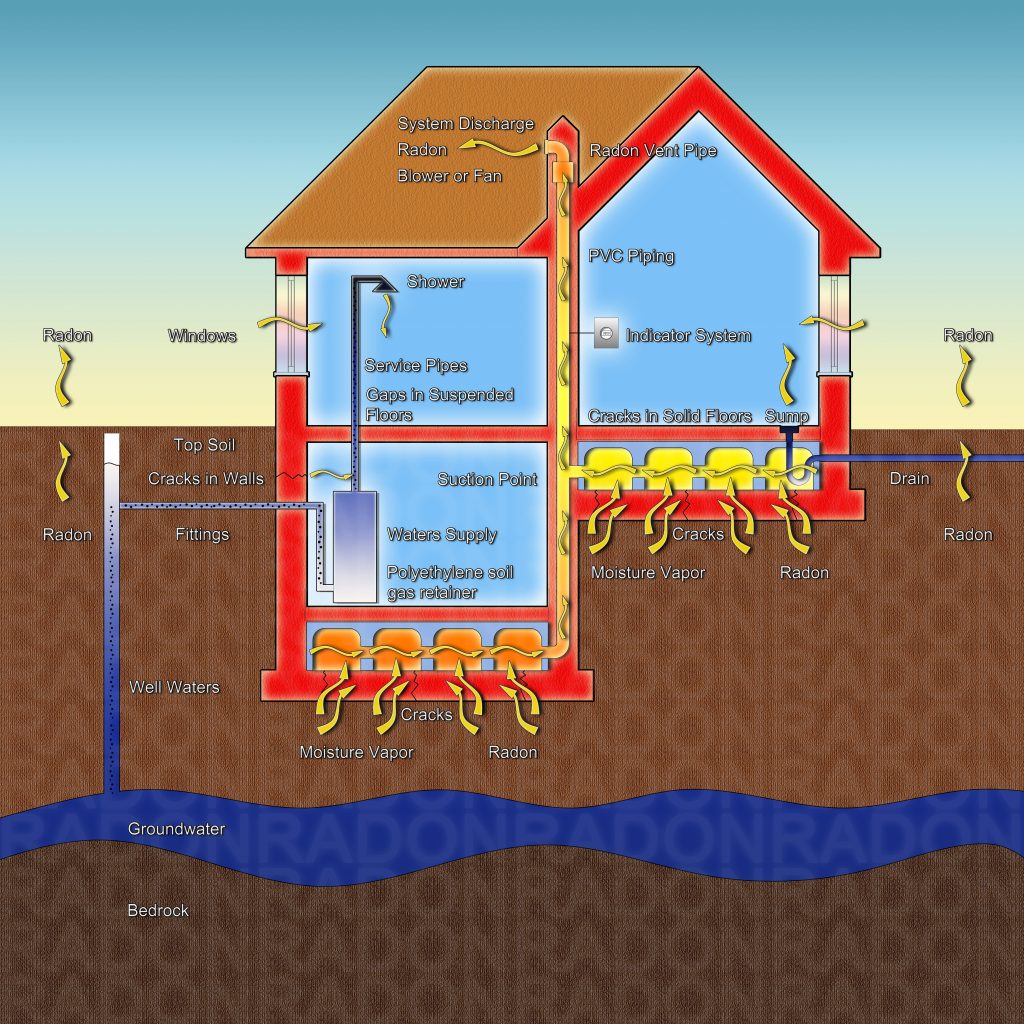
How Radon Enters a Home
Radon typically seeps through the ground and into buildings through cracks in the foundation and/or floor slabs. According to the Canadian Real Estate Association’s Homeowners Guide to Radon, radon can also enter through other openings, like unfinished dirt floors, window casements or gaps around service pipes. Factors like bedrock and soil types, soil moisture level, and seasonal temperature fluctuations also influence indoor radon levels.
Radon and Lung Cancer
Scientists estimate that radon exposure accounts for an estimated 16 percent of lung cancer deaths in Canada. A report from the Canadian Association of Radon Scientists and Technologists (CARST) explains why:
When inhaled, radon gas particles remain in lung tissue and begin to decay. As the radon particles decay, they release bursts of radiation that can damage the lung tissue cells. Over time, the cell damage can lead to the development of lung cancer.
What is considered a "high level" of radon? While Health Canada advises Canadians to pursue a radon level "as low as reasonably achievable," 200 becquerels per cubic metre is considered the maximum allowable. There is no lowest threshold, as the risk of lung cancer increases with radon concentration. For that reason, the World Health Organization suggests homeowners take action if concentrations are over 100 becquerels.
For more information on radon, visit the BC Centre for Disease Control Radon page, Interior Health's radon guide, or Health Canada's radon page.
Testing and Mitigation
The good news about radon is that testing and mitigation are relatively affordable and easy. Anyone can test their home for radon. All it takes is a radon testing device that can be found at stores like Home Hardware, Walmart, or Home Depot, or ordered online from the BC Lung Foundation’s page.
While radon mitigation is also relatively straightforward, it’s best to hire a radon mitigation specialist certified by the Canadian – National Radon Proficiency Program (C-NRPP) to take on the job, which average $3,000 depending on the size and style of the home. Fixes can involve improving ventilation, sealing cracks in foundation walls and floors, or installing a depressurization system to draw radon away from the basement. The Canadian Lung Association offers grant support for radon mitigation, you can find all the details and how to qualify for it here.
The BC Building Code has recently undergone significant revisions, which took effect in 2024. Following up on a 2023 public consultation, the revisions include a notable shift in policy regarding radon rough-in requirements.
Under the new regulations, there are mandatory requirements to incorporate a passive radon system, with additional technical specifications for homes all across the province. For more information on these changes, you can refer to the Information Bulletin document here.
Your Responsibilities as a REALTOR®
Above all, don’t forget that if a property has been tested for radon and shown to have levels at or above 200 becquerels per cubic metre, this is a material latent defect. If you’re representing a client selling such a property, this information must be disclosed in the Property Disclosure Statement. But there’s more to upholding professional standards than just disclosure when it comes to radon. Here’s how you can help:
- First, educate yourself about radon. There are many good sources, such as Health Canada and Take Action on Radon. BCFSA provides guidance to help discuss the importance of radon with clients: Radon Checklist for Sellers’ Agents, for Buyers’ Agents, and for Rental Property Managers.
- BCREA has created an FAQ document on radon with the support of Dr. Noah Quastel from the BC Lung Foundation. The document addresses common questions and provides external resources on the topic here.
- Enroll in the BCREA Radon for REALTORS® course, to deepen your understanding of radon and how it relates to real estate transactions.
- Educating yourself about radon also means understanding the radon levels in the region where you do business. The BC Radon Map is an interactive map that compiles readings from homes across BC.
- Follow BC Lung Foundation's radon-related projects.
- Ask sellers if they have had radon testing done. If they have, ask for a copy of the test results. If test results fall below 100 becquerels per cubic metre, this is an added selling feature.
- If it is 200 becquerels or higher and remediation hasn’t been done, be sure your client understands your duty to disclose this as a material latent defect.
- If your seller has already done remediation using a C-NRPP certified professional, ask for confirmation that the work has been done and that the radon levels are now in safe zones. Completed remediation is another selling point to highlight.
- In cases where remediation hasn’t been done, you can add value to your client by connecting them with a C-NRPP certified professional to get the work done.
- When representing a buyer, consider including a radon holdback (retention) clause in the contract. This involves the buyer and seller agreeing to set aside a sum of money from the purchase price that is likely to be enough to cover the cost of a typical radon remediation system. The money is held by a third party (for example, a solicitor) until the test result is known and any reduction measures have been done. If the test shows low radon levels and that no further action is necessary, the bond money is released to the seller. If the test shows that high radon levels are present and that remediation is necessary, the work is paid for from the bond money; any excess is released to the seller.
- If your buyer is planning on doing major renovations after buying, make sure they understand that this could impact radon levels in the home, even if it has been remediated in the past.
REALTORS® Are Facing Significant Hardship Due to COVID-19
The vast majority of BC REALTORS® – 91 per cent – have faced either a decrease of income or no income from transactions since the provincial state of emergency was announced on March 17, 2020. The reported loss of income was consistent among all boards, licence categories and both commercial and residential practice. The data comes from over 1,900 Realtors that responded to BCREA’s survey between May 19 and May 25.
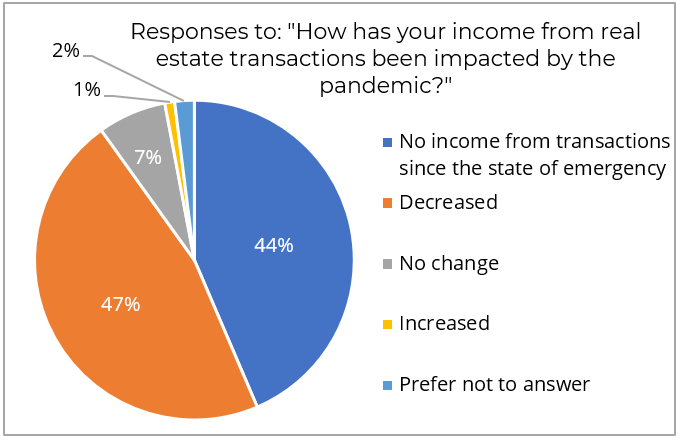 Apart from difficult market conditions, many Realtors face other disruptions to their work such as additional childcare responsibilities, challenges finding access to safety equipment and needing to take on a second job to support their families. One Realtor said “I have not been able to do any business as I am a single parent with no childcare because of the pandemic. I am home schooling two children.”
Many Realtors have relied on government financial aid programs. Nearly three in four respondents – 73 per cent – applied for the Canada Emergency Response Benefit. Many others have applied for the BC Emergency Benefit for Workers (22 per cent); the Canada Emergency Business Account (10 per cent); and the Canada Emergency Wage Subsidy (five per cent).
Respondents provided many practical recommendations for provincial and federal governments to reduce the social and economic disruption. Several suggestions include:
- “make home ownership within reach for first-time buyers,”
- “get rid of the Speculation and Vacancy Tax,”
- “[provide] support for developers that are bringing new projects to market,”
- “relax property tax deadlines,” and
- “[provide] some easing for the [mortgage] stress test.”
Despite the hardships, many Realtors are using the pandemic as an opportunity to help others in need within their communities. “[We are] communicating with Realtors in my office, conducting education sessions, providing advice on day-to-day practice, and working with other managers on resolving problems,” said one Realtor. Others are “helping tenants and landlords figure out how they will receive and pay rent.”
Thank you to all who participated in our survey.
To subscribe to receive BCREA publications such as this one, or to update your email address or current subscriptions, click here.
REALTORS® Continue to Be Hit Hard by Economic Slowdown from COVID-19
BCREA conducted a follow-up survey on the impacts of COVID-19 faced by REALTORS®. The survey was completed by 1,950 Realtors from all boards between July 13 and July 20.
A quarter of Realtors (26 per cent) continue to report no income from transactions since the end of May. Respondents’ most common reason for not receiving income was that “clients are holding out on purchasing or selling at the moment due to fear of the unknown.” Others noted that “many buyers are reluctant to look at properties due to economic consequences and fear of being laid off.”
The majority of Realtors are continuing to access government aid programs, including a majority who applied for the Canada Emergency Response Benefit (69 per cent). Many others applied for other programs since the end of May, including the BC Hydro COVID-19 Relief Fund (14 per cent), the Canada Emergency Business Account (13 per cent), and the BC Emergency Benefit for Workers (12 per cent).
A majority of Realtors (54 per cent) are no longer conducting in-person open houses during the pandemic, with many conducting video tours instead. Realtors are also following resources about COVID-19 to stay informed, with a majority of Realtors listening to briefings by Dr. Bonnie Henry and Minister of Health Adrian Dix (69 per cent) and reading BCREA and board emails and online information (62 per cent and 61 per cent, respectively). BCREA’s resources and supports that have been the most helpful for Realtors are the COVID-19: Resources for Realtors webpage and BCREA’s open house guidance published in partnership with the Real Estate Council of BC.
The survey found some signs of improvement in the real estate sector, with 30 per cent of respondents reporting an increase in income compared to May. Realtors themselves are mixed on whether they expect market conditions to improve, with 55 per cent anticipating an increase in income over the next two months. BCREA’s Economics department is also cautiously optimistic, with sales increasing across the province in June.
You can read about our May Realtor survey results here.
To subscribe to receive BCREA publications such as this one, or to update your email address or current subscriptions, click here.
REALTORS® Encouraged to Continue Safe Business Practices in Light of New Public Health Orders
With new health orders announced by the Provincial Health Officer (PHO) on November 19, BCREA encourages REALTORS® to continue COVID-19-conscious business practices, which includes using virtual tools when possible, to market, show, and view properties to help slow the spread of COVID-19.
The PHO’s recent announcement and order extends the ban on social interactions and non-essential travel to the entire province. While these restrictions do not apply directly to rental and home sale viewings, Realtors should continue to use virtual tools in order to limit face-to-face interactions.
BCREA, the Real Estate Council of BC (RECBC), the Office of the Superintendent of Real Estate (OSRE) and WorkSafe BC are working on updating our guidance on safer showings as a result of the recent announcements. This includes seeking clarity on the PHO’s mandate for masks in indoor public spaces with respect to real estate.
As always, Realtors should:
- monitor and adhere to all provincial health orders, notices, and guidance;
- refer to the BCREA and RECBC guidance for Safer Showings During BC’s Second Wave; and
- seek guidance from your managing broker if you have any questions.
You can find more information and resources on the use of virtual tools, how to safely conduct in-person showings and navigating the COVID-19 pandemic here.
To subscribe to receive BCREA publications such as this one, or to update your email address or current subscriptions, click here.
REALTORS® Encouraged to Review Health Measures Announced in Central Okanagan Due to COVID-19 Spike
On July 28, 2021, the BC Government and Interior Health announced new health measures in the central Okanagan aimed at containing a COVID-19 outbreak in the area. REALTORS® are encouraged to review the measures announced and act accordingly, putting the safety of clients and their communities first.
Included in these new measures is a mandatory mask order in public indoor spaces for all people age 12 and over in Peachland, West Kelowna, the Westbank First Nation, Kelowna and Lake Country.
Non-essential travel to the region is also discouraged and the public is asked to be cautious when gathering indoors. Read the complete set of measures in the press release from Interior Health here.
While these new measures do not directly address or impact real estate, we encourage all BC Realtors, and specifically, those operating in the interior, to be considerate and cautious in your practice by continuing to the make health and safety of your clients a priority.
Since July 1, BC has been in Step 3 of BC's Restart Plan, and brokerages and REALTORS® should continue to follow WorkSafeBC's Communicable Diseases Prevention guidelines where other specific guidelines are not in place.
For more about real estate and Step 3, including updated recommendations around open houses, click here.
REALTORS® Invited to 2021 Standard Forms Post-Launch Q&A Webinar
Already have questions about the upcoming Fall 2021 Standard Forms Release? Join us on December 2, 2021 for a FREE one-hour virtual Q&A session for REALTORS® to get real-time answers to any questions you may have.
Why attend?
This Q&A webinar will provide an opportunity for Realtors to ask questions they may have about the 11 new standard forms and schedules, revised forms and new clauses that will be released on November 24. It’s part of BCREA's effort to ensure Realtors and managing brokers have relevant and timely information to support them in their day-to-day practice.
What to expect
The webinar will include a live Q&A session with Jamie Matthews, BCREA Standard Forms legal counsel and Jennifer Lynch, BCREA’s Professional Services Manager. It will be hosted by Syntyche Smith, BCREA Standard Forms Project Coordinator.
Pre-Launch Package
BCREA has developed a Pre-Launch Package which includes advance copies of all the new and revised forms and clauses (watermarked and not for use), for your reference. It also includes guides we’ve created to support their use. The Pre-Launch Package can be referred to at any time as a resource for the new and revised forms.
We encourage Realtors to review the Pre-Launch Package before registering. If you have a question while reviewing the Pre-Launch Package or when using the new forms, you can submit it in advance on the registration page. If you would like to submit a question after registering please email it to [email protected].
About the 2021 Standard Forms Launch
Like last year’s Standard Forms update, this release is intended to ensure consistency in BCREA standard forms and reduce the number of changes Realtors experience throughout the year. Managing brokers & Realtors can also stay up to date with the latest on the Fall 2021 Standard Forms Release by visiting bcrea.bc.ca/forms2021.
Registration & webinar details:
- Click here to register
- Date: Thursday, December 2, 2021
- Time: 10am – 11am PST
- Format: Zoom (virtual)
- Cost: None
- Questions: Contact BCREA Communications Specialist Harveen Dhaliwal at [email protected] for webinar registration related questions or [email protected] for Standard Forms questions.
Space is limited, so be sure to register early. We look forward to having you!
NOTE: This webinar is not eligible for PDP hours.
REALTORS® Invited to Webinar to Discuss New and Revised Standard Forms
Last week, BCREA released seven new standard forms, three new clauses, and a significant number of revisions to existing forms as a part of our Fall 2020 Standard Forms Release.
As a part of our ongoing efforts to ensure Realtors and managing brokers are provided with relevant information to support you in understanding these changes and how they apply to your practice, Realtors and managing brokers are invited to a post-launch question and answer webinar on September 29 at 10:00am.
This webinar will be an opportunity for you to ask any questions you may still have after two weeks of familiarizing yourselves with the forms and their accompanying resources.
Webinar panelists will include BCREA Chief Operating Officer Corinne Caldwell, BCREA Professional Services Manager Jennifer Lynch, and BCREA's Legal Counsel for Standard Forms.
We want to ensure we address the questions that are most important to you! As such, questions can be submitted during registration or by emailing [email protected]. Space is limited, so register early!
For more information about BCREA’s Fall 2020 Standard Forms Release, click here.
To subscribe to receive BCREA publications such as this one, or to update your email address or current subscriptions, click here.
REALTORS®: Help shape BCREA’s strategic priorities
In September, BCREA will meet with BC’s ten member boards to develop a new three-year strategic plan and we need your input. To gather your feedback, we're using a tool called ThoughtExchange.
Click here to participate: https://tejoin.com/scroll/255686085
If you're a REALTOR®, we invite you to answer one survey question about your satisfaction with BCREA and then to share your thoughts and rate thoughts from other REALTORS®. If you're a managing broker, we ask that you also answer three additional questions about some of the resources we've developed for managing brokers before sharing your thoughts.
You can also choose to enter your name into a draw for one of five $100 gift cards for Best Buy, Save-On Foods or Petro-Canada. The survey is open until Tuesday, August 24th.
While your thoughts and stars are visible to other survey participants, they will remain anonymous. You can come back as often as you'd like to participate and, in fact, we ask that you do come back to star some of the new ideas shared since you first participated.
The ratings will help us to better understand how we can support REALTORS® and managing brokers as we develop our new three-year strategic plan.
If you need technical help, please call ThoughtExchange at 1-800-361-9027 ext. 4 or email [email protected].
Thank you in advance for your input.
REALTORS® Call for the Establishment of a Permanent National Housing Roundtable
Last week, delegates from BCREA and all eight of BC’s real estate boards met with members of Parliament (MPs) in Ottawa to discuss important issues on Canada's housing challenges at the 2022 Political Action Committee (PAC) Days conference hosted by the Canadian Real Estate Association (CREA).
Throughout the event, REALTORS® met with 15 MPs representing the Liberal, Conservative, NDP and Green parties in ridings across BC. Our conversations centered around advocating for two recommendations for lasting housing affordability solutions.
Recommendation One: Establish a Permanent National Housing Roundtable
Our first recommendation is to establish a permanent national housing roundtable to bring together all stakeholders in the housing sphere and help address its challenges with an inclusive, holistic and innovative approach.
As part of this roundtable, CREA and REALTORS® can bring their expertise and data-informed perspectives on priority issues and deliver solutions to housing challenges.
This roundtable would provide more data-driven housing policies through the opportunity to advise governments on principles and best practices that promote a fair housing market.
Recommendation Two: Leverage Infrastructure Funding
Our second recommendation is to create bilateral infrastructure agreements with provincial and territorial partners to encourage the creation of more housing supply.
This recommendation calls for a linkage between the creation of more housing supply and federal infrastructure funding. Specifically, infrastructure funding should be linked to goals such as increasing the density of housing, revising zoning laws, and speeding up planning and approval processes.
Existing investments in infrastructure are already tied to various streams, such as green infrastructure, public transit, community culture and recreation. We recommend the federal government to go a step further and add clauses to these agreements to incentivize the creation of affordable housing supply. Doing so will help address housing market needs.
We are pleased that MPs from across the political spectrum were receptive to these recommendations from REALTORS®. Thank you to all the REALTORS® who participated in this important opportunity to discuss policies that promote a vibrant and sustainable real estate sector in Canada.
We are committed to maintaining the dialogue with MPs and elected officials from across BC. We encourage you to also continue advocating for these important policy solutions not just during PAC Days, but on an ongoing basis.
Reasons for Judgement on Another Offer #173
By Gerry Neely
B.A., LL.B.
The Court of Appeal has handed down reasons for judgment on another offer or option case. This one concerned an offer to purchase containing conditions which required the vendor to deliver copies of leases and other information to a purchaser for approval. The clauses gave the purchaser the right to be arbitrary in deciding whether to accept the information.
The clauses fall into the category of conditions which depend for their acceptance or rejection entirely upon the state of mind of the purchaser. As such, the contract was merely a standing offer by the vendor to sell the property to the purchaser, which the vendor could revoke prior to the removal of the conditions by the purchaser. Since no consideration had been paid by the purchaser to the vendor to keep the contract open until acceptance, no option was created which the purchaser might have been able to enforce.1
***
Trees, and not just those in the Carmanah Valley, continue to be a subject of controversy. In one case, an owner who wanted more sunlight for his pool, cut down 13 forty foot Hemlock trees standing on his neighbour's three acres of well treed land which was occupied by the neighbour for only one month of each year. One wing of the neighbour's house lost some privacy, but the market value of the property and its overall appearance were not affected appreciably.
The neighbour was entitled to have his land restored to its previous state, but within reasonable bounds. He wanted the trespasser to bear the cost of transplanting 13 evergreens, each 40 feet tall. That would have cost in excess of $185,000, would have taken up to three years in the preparation and care of the transplanted trees, without any assurances that all of the trees would survive. The judge decided that this was unreasonable, and awarded damages of $21,000 to provide for the planting of a sufficient number of 10-12 foot trees to restore the neighbour's privacy.
In addition, the owner was ordered to pay $1,000 per tree as compensation for the loss of privacy during the period it could take for the trees to grow to 40 feet, and $2,000 per tree as punitive damages for the high handed trespass of the owner.2
***
A land owner is liable for damages caused by a tree or limb falling as a result of disease or a defect, the existence of which the landowner knew or ought to have known. The Court of Appeal has examined the facts in a case where the question was whether the owner, "ought to have know of the danger."
The facts were fairly straight forward - Christina Lake, subject to sudden gusts of extremely strong squally wind, led to a woman being pinned to the ground by a tree falling from a cluster of seven or eight trees on her neighbour's property, followed by the fall of another tree which caused further injury. She complained five or six months earlier to the neighbour that the trees bent so severely over the back of her house in earlier storms, which had uprooted trees in the area, that the trees created a hazard which should be removed. The neighbour's comment that it would cost $400 to remove the trees which he said (untruthfully), he didn't have; were contradicted by evidence from another neighbour that he topped trees and kept a watchful eye for trees at risk which might fall on his building.
"Ought to have known" was said to mean the knowledge a reasonable landowner would have who took the precautions necessary to prevent a hazard on his property from causing damage to his neighbours. Liability was imposed upon the owner even though the trees were not affected by any apparent or latent defects.3
| 1. |
|
|
| 2. |
|
|
| 3. |
|
To subscribe to receive BCREA publications such as this one, or to update your email address or current subscriptions, click here.
Rebranding Bringing a Fresh Start for BCREA
A new brand is in the works for BCREA, complete with a new logo and fresh approaches to how BCREA presents itself to the profession and the public. The launch is slated for the end of this year and, in addition to a new logo, will include a new colour palette, sense of aesthetics and tone of voice. The launch will also coincide with BCREA's planned move to new office spaces in downtown Vancouver.

"It's the perfect time for a brand refresh," said BCREA CEO Darlene Hyde. "This spring, we put a lot of energy into reshaping BCREA so that we can better support member boards and their REALTORS®. The rebranding is an important part of cementing our role within organized real estate in BC."
While BCREA's look and feel may be changing, its mandate remains the same. BCREA is committed to partnering with member boards to support REALTORS® by providing professional education and development, standard forms, advocacy, strategic communications and economic insights.
Ensuring a smooth transition to the new brand will be a big undertaking. With that in mind, BCREA will be working with member boards and other stakeholders this fall to complete an audit of branded BCREA materials, plan for the transition and offer other supports as needed.
To subscribe to receive BCREA publications such as this one, or to update your email address or current subscriptions, click here.
RECBC and BCREA Work Together to Change Regulatory Education
The Real Estate Council of BC (RECBC) and the British Columbia Real Estate Association (BCREA) have signed an agreement that will see the management of regulatory education for real estate professionals transition to RECBC in the fall of 2019. Through this agreement, RECBC will increase its oversight, control and direct involvement in the development and instruction of the Legal Update courses and Applied Practice Course, as outlined in the Raising Standards of Regulatory Education White Paper published in 2018.

What this means to you
Both RECBC and BCREA are committed to ensuring that the changeover is a smooth one for BC's real estate professionals, member real estate boards and staff. The two organizations have worked closely for months to plan the transition and minimize potential disruption. Here's what you can expect this fall:
- You will be visiting RECBC's website to register for regulatory education
- But you'll be using the same registration system as currently
- After the changeover, you'll be able to contact RECBC directly for answers to any questions about registration or courses
- You'll continue to access in-class sessions at the same locations as currently, with familiar experienced instructors
You can look forward to receiving more information throughout the summer and early fall on these changes, as work on the transition of regulatory education continues.
Background information: Raising Standards of Regulatory Education White Paper
To subscribe to receive BCREA publications such as this one, or to update your email address or current subscriptions, click here.
RECBC Approves 10 Per Cent Hike in Licensing Fees
Effective April 1, 2021, The Real Estate Council of BC (RECBC) will increase their biennial licensing fees from $1,800 to $2,000. RECBC members approved the proposed increase on January 18, following a short consultation beginning in December 2020. The new fee structure will be implemented, subject to objections from Minister of Finance Selina Robinson.
Licensing fees are distributed among RECBC, the Office of the Superintendent of Real Estate, Real Estate Errors and Omissions Insurance Corporation and Real Estate Compensation Fund Corporation. RECBC does not receive any public funding. According to RECBC, the goal of the fee increase is to sustain and improve oversight of the real estate sector.
BCREA understood that the licensing fee increases were inevitable, so took the consultation opportunity to provide input on services that REALTORS® want enhanced or introduced. Recommendations in BCREA’s feedback include:
- streamline the complaints process (current compliant investigations take an average of 245 days to complete),
- reduce the backlog of compliance files,
- reduce callback wait times for consumers and licensees,
- increase engagement with licensees to understand their on-the-ground experience,
- improve the search function of RECBC’s website,
- provide standardized reporting and auditing procedures, and
- more effective resources for managing brokers, which we heard in our managing broker consultation.
RECBC has not previously consulted on proposed fee increases. We are hopeful that through this consultation, RECBC will listen to the voices of Realtors to provide enhanced services that ensure licensee professionalism and consumer protection.
To subscribe to receive BCREA publications such as this one, or to update your email address or current subscriptions, click here.
RECBC, OSRE and BCREA Update Recommendations on Open Houses
As of July 1, brokerages and REALTORS® should follow WorkSafeBC's Communicable Diseases Prevention guidelines.
June 30, 2021 – With British Columbians set to enter Step 3 of the province’s Restart Plan on July 1, the Real Estate Council of BC (RECBC), the Office of the Superintendent of Real Estate (OSRE) and the British Columbia Real Estate Association (BCREA) are reminding consumers and real estate professionals that while open houses and in-person showings can now resume, health and safety should continue to be a priority.
RECBC, OSRE and BCREA have updated their recommendations on open houses to align with the Government of BC’s lifting of the COVID-19 health restrictions. In 2020, the regulators and the association issued joint statements strongly urging real estate professionals to refrain from holding open houses or in-person showings, and to use virtual tools wherever possible. Now, as BC enters Step 3 at a time when real estate markets across the province are extremely active, RECBC, OSRE and BCREA caution that clear and open communication between clients and real estate professionals continues to be essential.
Erin Seeley, CEO of RECBC, noted “It is important for the real estate industry to maintain public trust and confidence by protecting consumers. With market activity at sustained high levels throughout BC, real estate agents must maintain high standards of professionalism, ensuring their clients are well-informed about all aspects of the services they provide and acting in their clients’ best interests.”
Micheal Noseworthy, Superintendent of Real Estate, said “We want to thank consumers and real estate licensees for their cooperation during these challenging times. We know that the safety of all British Columbians remains a priority as we move through the Restart Plan over the coming months.”
Real estate professionals must also continue to follow the advice and recommendations of the regulators, public health officials, and government to cautiously move through the BC Restart Plan. Brokerages are advised to review the Communicable Disease Prevention Guide for Employers issued by WorkSafeBC to reduce the risk of workplace transmission of COVID-19 and other communicable diseases.
Darlene Hyde, CEO of BCREA, said “BC REALTORS® rose to the challenge presented by the COVID-19 pandemic with hard work and innovative thinking. As BC moves into Step 3, Realtors can continue to support the move forward to the next step and help keep communities safe by following best practices and maintaining clear and open communications with their clients.” Consumers with questions or concerns about real estate services can find unbiased, independent information about buying and selling property, along with potential risks and issues to watch out for, on RECBC’s website www.recbc.ca/consumers.
RECBC’s Professional Standards Advisors are available to answer questions about real estate transactions and the services to expect from a licensed real estate professional at [email protected].
As announced previously by the Minister of Finance, RECBC and OSRE will be integrating with BC Financial Services Authority (BCFSA) to create a single integrated regulator of B.C.’s financial services sector. Following the integration, expected to take place later this summer, BCFSA will be the single regulator for real estate with authority over real estate education and licensing as well as investigations and discipline for licensed and unlicensed real estate activity.
Download the PDF version here.
Recent Regulation Regarding Assignments #488
In May 2016, in response to public concern over the flipping of single family residential properties in a surprisingly robust residential market, the provincial government amended the Real Estate Services Regulation concerning the assignment of Contracts of Purchase and Sale (CPS).1
The amendment is designed to ensure that buyers and sellers are properly advised about the implications of the potential assignment of the CPS. With that disclosure, the parties will be able to negotiate terms and conditions that best suit their particular circumstances.
Section 8.2 of the Regulation requires a licensee who prepares a contract for the purchase and sale of property to include in that CPS clauses providing that the CPS may not be assigned without the written consent of the seller and that the seller is entitled to any profit resulting from an assignment of the CPS. This requirement applies to a buyer's agent who prepares the CPS on behalf of a buyer/client or a listing agent who prepares the CPS for a buyer/customer. Note that development presale contracts under the Real Estate Development Marketing Act are specifically exempted from the requirements of section 8.2.
Section 8.2 (3) provides that, "unless otherwise instructed by the party to whom or on whose behalf the licensee is providing trading services," the licensee preparing the CPS has to include the required clauses. Where a buyer specifically instructs their buyer's agent in writing not to include the clauses, the buyer's agent is required to provide a written notice to the seller's agent or, if the seller is unrepresented, to the seller directly advising the seller to seek independent legal advice. The notice must be in the form approved by the Real Estate Council of British Columbia (Notice to Seller Regarding Assignment Terms) and cannot be included as a clause in the CPS.
Where the listing agent is simply preparing the CPS for a buyer who is a customer rather than a client, and the listing agent does not represent that buyer, it cannot be said that the listing agent is providing trading services to that buyer. Section 8.2 (3) deals only with instructions from a person to whom the licensee is providing trading services. Accordingly, a listing agent acting solely for the seller could not be instructed by a buyer to add, remove or amend the required clauses in an offer prepared by the listing agent. They are only obligated by section 8.2 to include the required clauses in any offer prepared by them. If a buyer/customer asked the listing agent to add, remove or amend the required clauses the listing agent should advise the buyer that, as a result of section 8.2, they are precluded by law from making those changes. However, if the buyer themselves physically added to, removed or amended the required clauses, the listing agent would be obliged to present that offer, as written, to the seller. In this situation, the listing agent would be wise to get written confirmation from the buyer that the buyer, and not the listing agent, made the changes.
If a listing agent receives a CPS that does not contain the required clauses or those clauses have been added to or amended and the Notice to Seller Regarding Assignment Terms is provided, the listing agent has an obligation to ensure that their client, the seller, is informed about whether the CPS may be assigned. If the CPS may be assigned, the listing agent must inform their client about the conditions in the CPS regarding the right of assignment and the seller's right under the CPS to any profit resulting from the assignment, if applicable. In that case, the onus will fall to the licensee to establish that an adequate explanation was provided. A prudent licensee may wish to create written evidence of that explanation.
If the listing agent receives an offer prepared by a licensee acting for the buyer that has added to, removed or amended the required clauses, but does not contain the notice required to be prepared by the buyer's agent, the listing agent still has a duty to advise the seller of the implications of the addition, removal or amendment. The listing agent may even wish to advise their client to seek legal advice. Again, a prudent licensee may wish to create written evidence of their discussion with their client.
For more information, see the Council's frequently asked questions regarding the Regulation.2
Brian Taylor
Bull Housser LLP
| 1. | Real Estate Services Regulation, B.C. Reg. 506/2004. | |
| 2. | Real Estate Council of British Columbia's online Contract Assignment Requirements FAQ. |
Record September for BC Housing Markets
For the complete news release, including detailed statistics, click here.
Vancouver, BC – October 14, 2020. The British Columbia Real Estate Association (BCREA) reports that a total of 11,368 residential unit sales were recorded by the Multiple Listing Service® (MLS®) in September 2020, an increase of 63.3 per cent from September 2019. The average MLS® residential price in BC set a monthly record of $803,210, a 15.3 per cent increase from $696,647 recorded the previous year. Total sales dollar volume in August was $9.1 billion, an 88.3 per cent increase over 2019.
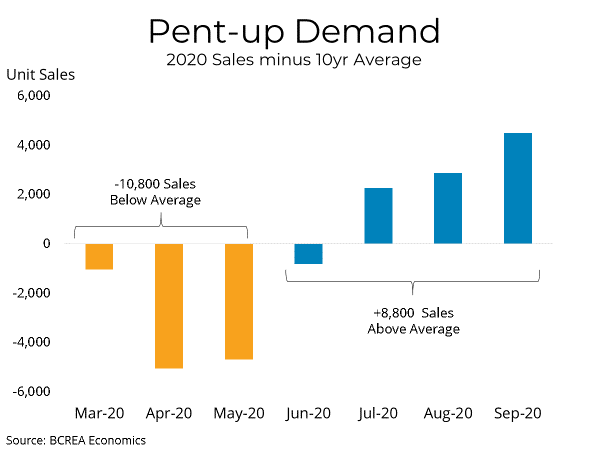
“The provincial housing market had a record-setting September,” said BCREA Chief Economist Brendon Ogmundson. “Both total sales and average prices were the highest ever for the month of September as pent-up demand from the spring pushes into the fall.”
“Average prices are skewing higher as demand for space during the pandemic drives sales of single-detached homes,” added Ogmundson. Total provincial active listings are still down about 12 per cent year-over-year, with some markets even more under-supplied as the pandemic continues to keep listings low.
Year-to-date, BC residential sales dollar volume was up 25.1 per cent to $49.7 billion, compared with the same period in 2019. Residential unit sales were up 12.5 per cent to 65,023 units, while the average MLS® residential price was up 11.2 per cent to $764,298.
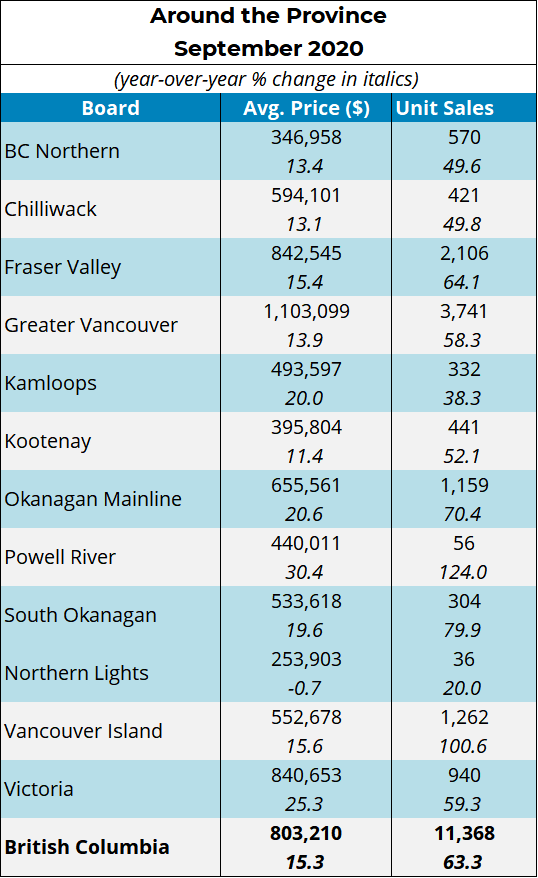
-30-
For more information, please contact:
Brendon Ogmundson
Chief Economist
Direct: 604.742.2796
Mobile: 604.505.6793
Email: [email protected]
To subscribe to receive BCREA publications such as this one, or to update your email address or current subscriptions, click here.
Record-Low Supply Keeps Market Conditions Tight in September
For the complete news release, including detailed statistics, click here.
Vancouver, BC – October 12, 2021. The British Columbia Real Estate Association (BCREA) reports that a total of 9,164 residential unit sales were recorded by the Multiple Listing Service® (MLS®) in September 2021, a decrease of 19.9 per cent from September 2020. The average MLS® residential price in BC was $913,471, a 14 per cent increase from $801,241 recorded in September 2020. Total sales dollar volume was $8.4 billion, an 8.6 per cent decline from last year.
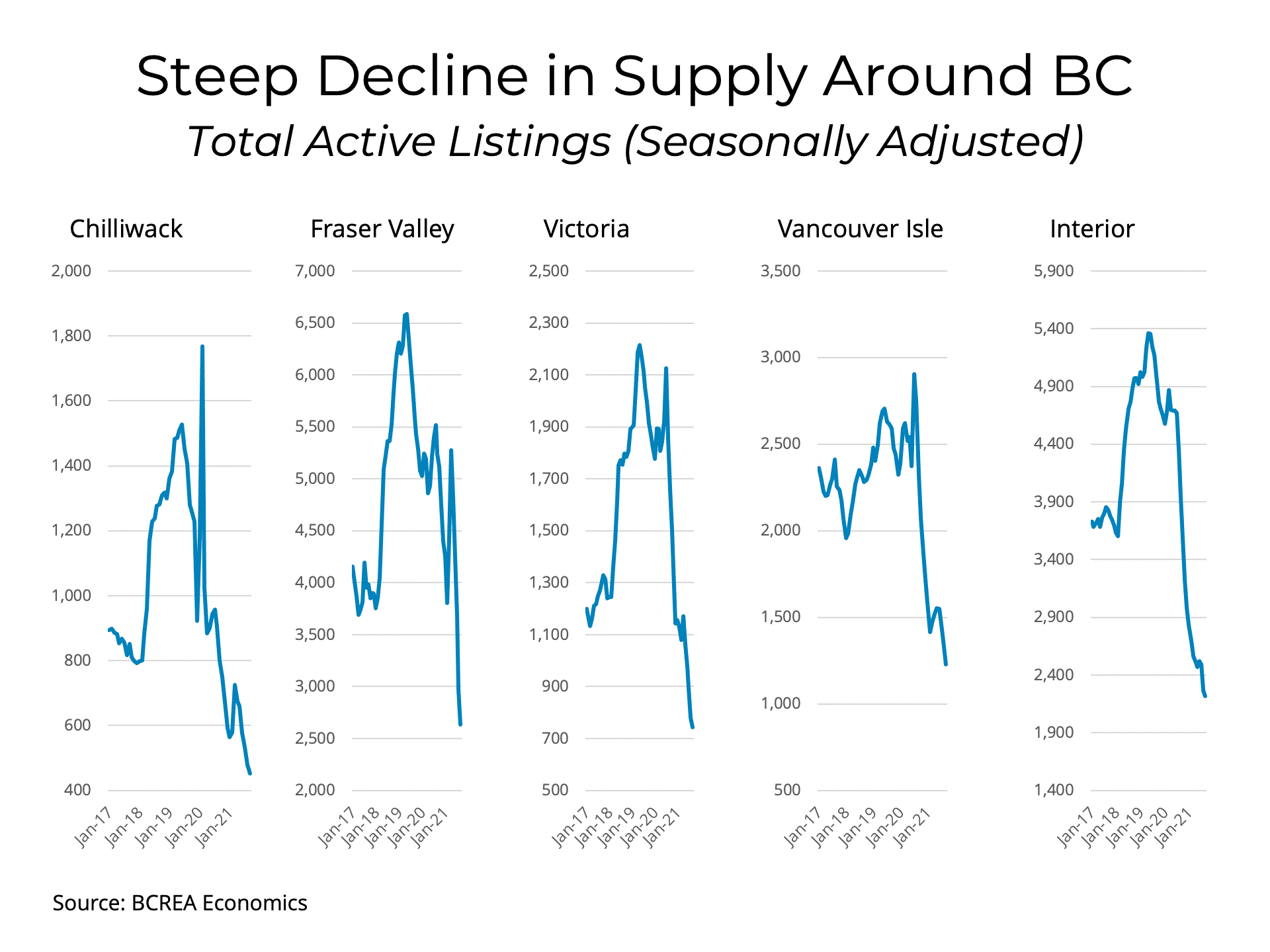
“Home sales have settled at levels that are slightly above long-term average,” said BCREA Chief Economist Brendon Ogmundson. “The main story in all markets continues to be a severe lack of listings supply, particularly in Fraser Valley, Vancouver Island and Interior markets.”
Total active residential listings were down 36.8 per cent year-over-year in September for the province as a whole and were more than more than 50 per cent below last September’s levels in the Fraser Valley and Victoria.
Year-to-date, BC residential sales dollar volume was up 81.8 per cent to $90.4 billion, compared to the same period in 2020. Residential unit sales were up 52.4 per cent to 99,182 units, while the average MLS® residential price was up 19.3 per cent to $911,195.
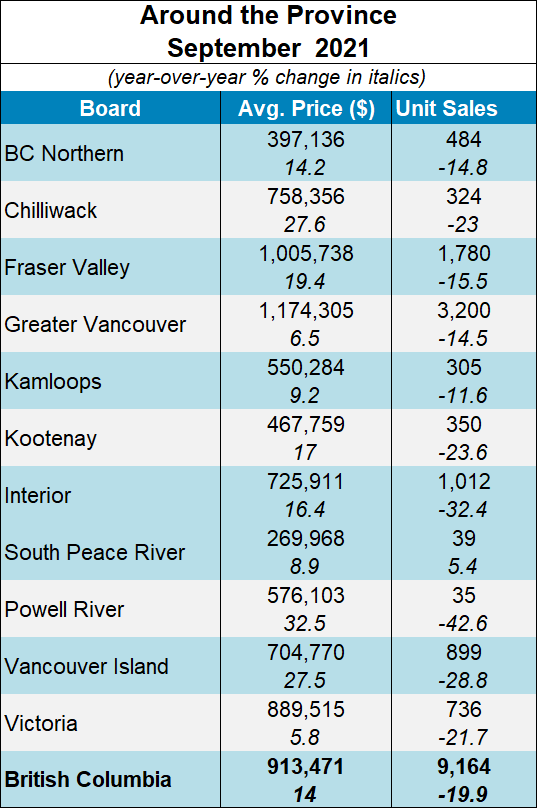
-30-
For more information, please contact:
Brendon Ogmundson
Chief Economist
Direct: 604.742.2796
Mobile: 604.505.6793
Email: [email protected]
Record-Setting Month for BC Homes Sales
For the complete news release, including detailed statistics, click here.
Vancouver, BC – April 13, 2021. The British Columbia Real Estate Association (BCREA) reports that a total of 15,073 residential unit sales were recorded by the Multiple Listing Service® (MLS®) in March 2021, an increase of 123.3 per cent over March 2020 and a new all-time record for monthly BC home sales. The average MLS® residential price in BC was $947,707, a 20.4 per cent increase from $787,032 recorded in March 2020. It should be noted that average prices across the province are being skewed higher as more expensive single-detached homes remain a higher share of dollar volume during the pandemic. Total sales dollar volume was $14.3 billion, a 168.9 per cent increase from last year.
“Home sales in the province shattered the previous record, led by markets in the Lower Mainland,” said BCREA Chief Economist Brendon Ogmundson. “While mortgage rates have risen in recent months and a modest tightening of mortgage regulations is on the horizon, market activity is expected to remain very strong through the spring.”
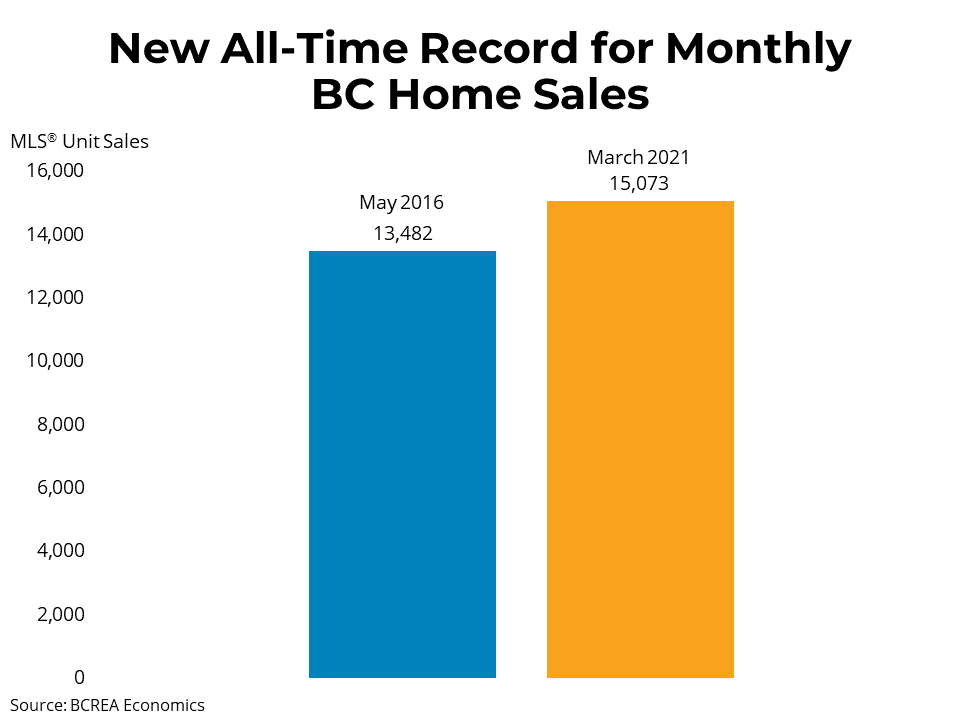
Total active residential listings were down 24.4 per cent to 22,337 units in March. The total inventory of homes for sale remains severely depleted, but new listings activity has accelerated in response to high prices.
"While the total supply of re-sale listings remains at crisis levels, many markets saw record new listings activity in March. Strong new listings activity will need to continue for some time before markets will see a healthier balance with less pressure on home prices,” said Ogmundson.
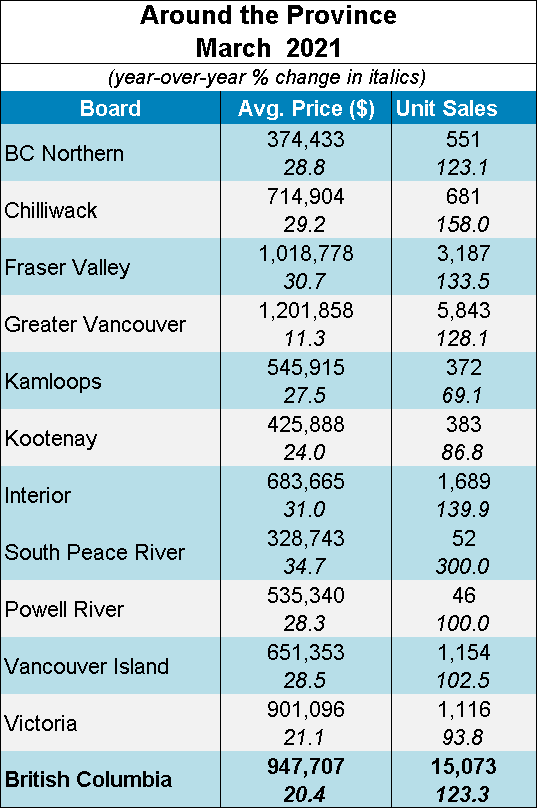
-30-
For more information, please contact:
Brendon Ogmundson
Chief Economist
Direct: 604.742.2796
Mobile: 604.505.6793
Email: [email protected]
REDMA’s Reach #456
The Real Estate Development Marketing Act (REDMA) regulates the marketing within British Columbia of development properties located inside and outside of BC. A recent BC Supreme Court decision considered the extent of the concept of "marketing" a development property in BC.1
A developer constructed a multi-unit high rise condominium project in Edmonton, Alberta. The units were advertised through print advertisements placed in Edmonton publications as well as on the developer's website and at its on-site sales office in Edmonton. An Edmonton brokerage acted as the listing brokerage and all sales were conducted from Edmonton.
One of the developer's two directors discussed the project with a REALTOR® in Vancouver known to him. That REALTOR® in turn provided information to her close friends and family, a number of whom eventually bought units in the project.
The director provided the REALTOR® with brochures, price lists and contracts and arranged for the REALTOR® to receive a referral fee for the units purchased by her family and friends.
Prior to closing, the friends and family commenced an action for the rescission of their contracts and a return of their deposits on the grounds that the disclosure requirements of REDMA had not been met.
While the developer did not dispute that the disclosure requirements of REDMA (which were more rigorous than those found in the corresponding Alberta legislation) had not been met, it argued that REDMA did not apply to these transactions as the developer had not "marketed" the properties in BC or alternatively that REDMA was beyond the jurisdiction of the BC legislature insofar as it applied to property located outside of BC.
The court found that the definition of "marketing" in REDMA is very broad and includes activities that will, or are likely to, lead to a sale. The court concluded that the director's activities in providing pricing lists, brochures and pre-signed contracts to the Vancouver REALTOR®, as well as arranging for that REALTOR® to receive remuneration for arranging the sales and the fact that such activities were the sole cause of the sales, amounted to the marketing of the project in BC as defined in REDMA.
The court concluded that the friends and family would not have known of, or purchased, the units but for the urging of the REALTOR® who had an incentive from the developer.
The court also concluded that there was a sufficient connection between British Columbia and the conduct at issue to make REDMA constitutionally applicable in the circumstances.
While the court's decision that REDMA applied to these transactions had an obvious impact on the developer, REALTORS® in BC should be mindful of the decision as well.
In a rebuke of the REALTOR® (who was not a party to the rescission actions), the court found that the REALTOR® should have known of the requirements of REDMA and therefor was "at best negligent and at worst dishonest" in not ensuring that the developer complied with REDMA when she acted at the developer's behest in selling the properties in BC.
| 1. | Mazarei v. Icon Omega Developments Ltd. 2012 BCSC 673. |
To subscribe to receive BCREA publications such as this one, or to update your email address or current subscriptions, click here.
Reducing Risk in the Interim: Disclosure Practices That Protect
Advising clients on how to handle a Property Disclosure Statement (PDS) must be tailored to the specific transaction and who you are working for. What may support a buyer’s due diligence could expose a seller to unnecessary risk, especially in light of recent legal developments.
Case in Point
In a recent British Columbia Court of Appeal decision, Sewell v. Abadian, the seller struck out all questions in the PDS and noted only that the property was tenanted and never owner-occupied. The struck-out PDS was incorporated into the Contract of Purchase and Sale (CPS).
After completion, the buyer discovered unpermitted work and alleged misrepresentation. While the trial judge found no misrepresentation and upheld the principle of caveat emptor (buyer beware), the Court of Appeal overturned that decision. In doing so, the Court of Appeal appears to have taken the position that the mere act of providing a PDS, regardless of how it is marked up, created an expectation of disclosure, due to the form’s standard language and its incorporation into the CPS.
This interpretation should impact how REALTORS® advise clients when preparing or receiving a PDS, particularly in cases where a seller does not wish to make any voluntary disclosures and strikes out or modifies the form.
At the BC Real Estate Association (BCREA), we are actively reviewing the legal and practical implications of this ruling. We're collaborating with key partners to identify appropriate long-term solutions that strengthen consumer protection and reduce REALTOR® exposure without introducing unintended consequences.
Practical Guidance for REALTORS®
While this work continues, there are steps you can take today to reduce risk and support your clients, whether you're representing sellers or buyers.
When Working With Sellers
- Have a Thoughtful Conversation With Sellers About the PDS. Discuss the benefits and risks of completing the PDS with your seller clients based on their specific property and situation. Completing the form may bring clarity, but it also carries obligations. An informed conversation up front helps manage expectations and reduce future liability.
- If Used, Stress Accuracy and Completeness. If your client chooses to complete the PDS, ensure they understand that vague or partial answers can do more harm than good. Walk through each question together and advise that they should seek legal advice if they are uncertain about how to respond. Do not advise them how to answer any question on the form.
- Clarify Disclosure Obligations, Both Theirs and Yours. Sellers are legally obligated under common law to disclose known latent defects that render a property dangerous or unfit for habitation, and that are not discoverable through a reasonable inspection. As a real estate professional, you also have a duty to disclose any material latent defects known to you under section 59 of the Real Estate Services Rules. This disclosure must be made in writing and take place before an agreement is entered into. If a seller has already disclosed a latent defect in writing, REALTORS® are not required to redisclose the same defect in order to comply with s.59. Clear documentation and transparency benefit all parties and help protect your clients from future disputes.
- Avoid Incorporating a Struck-Out PDS in the CPS. While a buyer may choose to attach a struck-out PDS to the CPS, doing so can create ambiguity and legal risk. It should be clearly communicated if the seller does not intend to complete a PDS. In these cases, the seller may wish to counter the offer to explicitly remove the PDS and ensure it is not incorporated into the contract.
When Working With Buyers
When representing buyers, the absence of a completed PDS should be seen as the beginning, not the end, of their due diligence process.
- Review What Is and Isn't Being Represented. Ensure buyers are not assuming disclosures have been made when they haven’t. Walk through the implications and help them understand the need to investigate further.
- Requesting the PDS. Even if a PDS hasn’t been completed, inform your buyers that they can still request one as part of their due diligence. It may offer valuable insight into the property’s condition and, where appropriate, can be incorporated into the CPS. While sellers aren’t obligated to provide one, requesting a PDS is a negotiable step that may support a more informed decision to purchase. In some cases, a PDS may also be required by a lender, so buyers should be aware of any related financing conditions.
- Encourage Buyers to Ask Informed Questions. If a PDS is not provided, help your clients understand that this is not unusual, but it does mean that they should take extra care in asking questions and assessing the condition of the property. REALTORS® acting for buyers have a professional obligation under section 30 of the Real Estate Services Rules to “use reasonable efforts to discover relevant facts respecting any real estate that the client is considering acquiring.” Support your clients by helping them identify key questions to ask about the property’s condition, history, and any repairs or renovations. Encourage them to follow up on any red flags or vague answers and consider engaging qualified inspectors or specialists when needed. Informed clients make more confident decisions, and your guidance is essential to that process.
- Emphasize the Value of Inspections and Independent Advice. Where a PDS is blank or struck-out, the importance of independent inspections and due diligence increases significantly. Encourage buyers to obtain a qualified home inspection and consider referring them to the appropriate specialists based on the property’s age, condition, known risks, or particular concerns of the buyers. The absence of disclosure should be a signal for further investigation.
Steps BCREA Is Taking
While BCREA is committed to acting in a timely manner, we are equally committed to doing our due diligence to respond to recent legal developments and support REALTORS® across the province. Our Standard Forms team is actively reviewing next steps in consultation with legal counsel, the BC Financial Services Authority, the Real Estate Errors and Omissions Insurance Corporation, and real estate boards / associations.
We’re also engaging with the lending community to understand how disclosure practices may impact financing, ensuring future solutions align with underwriting realities.
While there is a strong desire to move forward quickly, we’re committed to careful due diligence. Disclosure forms play a foundational role in transactions, and any changes must enhance clarity and protection without creating unintended consequences.
Keeping You Informed
We know how important clear guidance is during times of legal uncertainty. We will continue to provide timely updates as new information becomes available and as form revisions progress. Whether through Resources for REALTORS®, direct notices, or your board or association’s Professional Development channels, you can expect continued communication and tools to support your practice.
In the meantime, the actions above can help you manage risk, build client confidence, and uphold the professionalism that REALTORS® across BC are known for.
If you have questions, we encourage you to reach out to your managing broker, board or association, or BCREA’s Managing Broker Support Line at [email protected].
Additional Resources
BCREA
Reference: Children – Prohibitions Against Residing in a Building #144
By Gerry Neely
B.A. LL.B.
The tight rental market in Victoria and the lower mainland has made it difficult for families with children to find accommodation, particularly since a number of condominiums and apartment buildings prevent children from residing in them. This has led to a demand for amendments to the Human Rights Act of British Columbia, to prevent discrimination with respect to a tenancy because of age.
Section 5(1) of the Act states that no person shall discriminate with respect to a term or condition of a tenancy, because of race, colour, ancestry, place of origin, religion, marital status, physical or mental disability, or sex. No reference is made to age although age is mentioned in other sections dealing with discrimination in employment advertisements, in employment, and discrimination by unions and associations.
Those who seek the amendment contend that the Provincial Legislation is discriminatory, and that this is a breach of an individual's rights under the Canadian Charter of Rights and Freedoms to the equal protection and equal benefit of the law without discrimination because of age.
The Human Rights Act treats the rights of children and adults differently with respect to accommodation. On the face of it, this would appear to be discriminatory and therefore in breach of the child's constitutional rights. This question of whether differentiation and discrimination are synonymous was discussed in a British Columbia Court of Appeal decision where the Court said that all legislation classifies or differentiates. "Indeed, in order to ensure equal protection and equal benefits, it may be necessary for the legislature to treat groups and individuals differently."
The conclusion reached by the Court was that legislation can differentiate without being discriminatory if the legislation is fair and reasonable.
The unfairness and unreasonableness of Section 5(1) was raised several years ago in a case where a child was born to a couple who had been residing in an apartment which had a tenancy agreement prohibiting children from residing in the building. Notice to Vacate was given to the couple.
The young couple's lawyer contended that the Human Rights Act was unfair and unreasonable because it discriminated against children who were "stereotyped socially as undesirable neighbours." The argument against stated that there are a number of natural classifications of rental accommodations because people who enjoy different environments seek accommodation to meet and suit their needs. Examples of residential developments for senior citizens, or for adults only, and for families only, were given. Other reasons were cited as to why a particular apartment building may not be suitable for children: its location on a busy road, or its distance from schools would be considerations against children residing in the building.
The Judge held that it was not unreasonable or unfair that a landlord should be free to provide accommodation to meet the needs of different groups in society who enjoyed different kinds of habitations. The Petition was denied and the validity of the Human Rights Act was upheld. The case was not appealed.1
The Province of Manitoba has legislation which prevents discrimination because of age with respect to tenancies.
| 1. | Hsuan v. Mah, 7 BCLR (2d) p. 21. |
To subscribe to receive BCREA publications such as this one, or to update your email address or current subscriptions, click here.
Reference: Condominiums – Noise and Vibration. A Nuisance #142
By Gerry Neely
B.A. LL.B.
It's probably just a coincidence that the manufacturers of stereo equipment are packing more noise into a smaller box at a time when more condominiums are being built, and more and more people are living separated only by a common wall. Condominium living has been described by one judge as "a communal type of living which often requires a tremendous amount of co-operation and consideration from each other, for all residents to enjoy the lifestyle to its maximum."
The 1812 Overture which is music to one man may sound like a 21 gun salute in the bedroom of a neighbour. How will judges decide what should be the limits upon conduct which the neighbour claims denies him the full enjoyment of his condominium? One judge who was asked for an injunction to restrain a cigar smoker, initially thought the request frivolous. However, when he reviewed the circumstances, he said, "Just as no person should be subjected to the unrestricted cacophony of stereo music from his neighbour, neither should he be subjected to the continuing smell of cigar smoke if that smell is unreasonably disseminated into other peoples' worlds. I consider it to be unreasonable if a person, knowing that the smell is deleterious to others, persists, unless, of course, it can be shown that he has no control over its presence."
These comments were referred to in a case in which the owner of a condominium had installed an air-conditioning unit and replaced a bathtub with a jacuzzi whirlpool.
The owner had applied to the municipality for a permit to alter the apartment by removing non-bearing partitions only. A plumbing permit was required but was not obtained. The consent of the Strata Council for the renovations, alterations, or installations made by the owner was required by the bylaws of the Strata Corporation. That consent was not sought.
The occupants of the suite below his were elderly and they complained that the operation of both units created excessive noise and vibration.
Section 115 of the Condominium Act describes the duties of an owner. Those duties compel the owner not to use his strata lot in a manner that will cause a nuisance or hazard. The section also obliges an owner to comply with the bylaws, rules and regulations of the Strata Corporation.
The Strata Corporation commenced an action for an injunction to restrain the uses which created the nuisance of noise and vibration. The evidence was that both the vibration and noise from the use of the jacuzzi/tub and the air-conditioning unit were both beyond acceptable levels of tolerance. The owner had done everything he could do to eliminate the noise and vibration, but was unsuccessful. The Judge agreed to issue the injunction order and fortunately for the owner, the Strata Council consisted of reasonable people. They were not asking for the removal of the units, but merely their regulation. Since the major interference to the people below was in the bedroom and bathroom, the Court directed that the jacuzzi be operated only between 8:00 a.m. and 10:00 a.m. and 4:00 p.m. to 8:00 p.m. while the air-conditioning unit hours were restricted to 2:00 p.m. to 8:00 p.m.
The Judge reached this decision by placing himself in the position of a reasonable man. That is to say "a person whose notions and standards of behaviour and responsibility correspond with those generally obtained among ordinary people in our society at the present time, who seldom allows his emotions to overbear his reason and whose habits are moderate and whose disposition is equable."
In other words, the people you would like to have living on either side of your condominium.
| 1. | The Owners, Strata Plan MW87 v. Gace Maracinian,S.C.B.C., No. C882848 Vancouver Registry, March 9, 1989. |
To subscribe to receive BCREA publications such as this one, or to update your email address or current subscriptions, click here.
Reference: The “72” Hour Clause #141
By Gerry Neely
B.A. LL.B.
The time clause, which may be whatever number of hours the parties agree upon, is a useful tool for negotiating conditional offers but it can create problems when notice of an acceptable offer made by a second purchaser cannot be delivered promptly to the first purchaser. The first reported case of which I am aware which deals with the competing interests of the first and second prospective purchasers, occurred in Ontario where an agent negotiated an agreement of purchase and sale on behalf of a vendor, with purchasers named Rock (purchaser one).
This agreement was conditional upon the sale of the purchaser ones' property. The agreement contained a 72-hour clause which required purchaser one to waive the condition or meet the terms of a subsequent offer, within 72 hours of the delivery to them of the notice of the subsequent offer.
So far, so good, and nothing unusual. A subsequent agreement of purchase and sale was made with purchaser two on November 20, 1987. It was conditional upon the first agreement "failing to become a firm and binding offer by 11:59 p.m. on November 24, 1987, at which time this offer shall become a firm and binding offer." The agent was unable to reach purchaser one until 11:15 a.m. on November 22, and at that time, delivered a notice which gave them until 11:59 a.m. on November 25 to waive the condition in the agreement or meet the offer. The agent then called purchaser two to advise him of the extension of the 72-hour period until November 25, 1987, because of the delay in the delivery of the notice. Purchaser two did not dispute this extension of the date for waiver of the condition.
On the morning of November 24, the agent was advised by telephone by purchaser one that he and his wife had waived the condition. The agent prepared a waiver agreement dated November 24, which was not signed, however, until the next day because purchaser one was unavailable on the 24th.
Purchaser two met with his lawyer on November 25 before he was made aware that the first agreement was now unconditional. During that initial meeting, he did not raise the question of the extension. Later in the day, when the agent returned to purchaser two his offer and deposit cheque, his lawyer took the position that purchaser two's offer was enforceable because the condition had not been waived by midnight on the 24th. He then filed a lis pendens which prevented the transfer of title to purchaser one.
Purchaser one argued that their oral waiver of the condition created a binding contract on the 24th, which was merely confirmed by the written document executed on the 25th. The judge accepted this argument that the oral agreement was sufficient to create a binding contract because the agent, by preparing the waiver agreement, had relied and acted upon the oral waiver. The parties' conduct indicated an intention to effect their legal relationship by creating a contract enforceable by either of them.
While this decision effectively disposed of purchaser two's agreement, the judge went on to say that by his failure to object when he was advised of the extension, purchaser two had lulled the agent into believing that purchaser two had agreed to the extension. Had purchaser two objected, the agent stated that he would have attempted either to have purchaser two sign an amendment to permit the extension, or to persuade purchaser one to waive the condition on the 24th. Fortunately for the agent, purchaser one did this without prompting, but had they not done so until the 25th, the agent would have acted to his detriment by relying upon purchaser two's tacit acceptance of the extension. For this reason, purchaser two could not now say that purchaser one had only until the 24th to remove the condition.
Purchaser one obtained specific performance of their agreement, plus damages against purchaser two for expenses incurred by them because of his filing of the lis pendens.
Damages were claimed against purchaser two by the vendor for the loss of interest on the amount of the sale price from the date when the sale to purchaser one should have been completed. The vendor was a limited company in which the agent was a major shareholder. The company's claim for damages was denied because the agent "was sloppy in the wording of the agreement with purchaser two and as such created some of the confusion which existed on November 25, 1987."
The case is useful as support for the binding effect of an oral waiver. However it brings home the problem of an oral or assumed waiver and the desirability of written acceptances, amendments, or waivers, signed by the parties.
| 1. | Rock et al. v. Foster et al., 1 R.P.R. (2d) p. 55. |
To subscribe to receive BCREA publications such as this one, or to update your email address or current subscriptions, click here.
Reforming the Regulator
In 2021, the BC Government intends to integrate the Office of the Superintendent of Real Estate (OSRE) and the Real Estate Council of British Columbia (RECBC) into the BC Financial Institutions Commission (BCFSA). According to the December 12 news release, this move will satisfy a recommendation made by Dan Perrin in 2018 to create a single real estate regulator and also help address money laundering concerns in real estate.

Real estate licensees have been subject to dual regulators—OSRE and RECBC—since 2016. The system led to challenges with policy development and some uncertainty about roles. In 2018, responding to requests from OSRE, RECBC and BCREA, Minister of Finance Carole James commissioned an independent review of the regulatory structure. The review was carried out by Dan Perrin.
BCREA appreciates the governmen's interest in improving our regulatory framework, and we've identified four goals for the reform process:
- Protect the public and foster consumer confidence.
- Ensure a regulator with industry knowledge and expertise.
- Eliminate the current coregulator model.
- Create a regulatory framework that is:
- easily understood and accessed by licensees and the public, and
- involves industry consultation.
We look forward to working with the regulators and the Ministry of Finance to achieve these goals and create a stable regulatory environment.
Government news release: https://news.gov.bc.ca/releases/2019FIN0115-002149.
Photo caption: Ministers James and Eby at a spring news conference about the estimated money laundering impact on real estate
Regional Disparities Emerging in BC Housing Market Activity
For the complete news release, including detailed statistics, click here.
Vancouver, BC – October 15, 2024. The British Columbia Real Estate Association (BCREA) reports that 5,579 residential unit sales were recorded in Multiple Listing Service® (MLS®) systems in September 2024, up a little under 1 per cent from September 2023. The average MLS® residential price in BC in September 2024 was down 2.8 per cent at $942,969 compared to an average price of $969,907 in September 2023.

The total sales dollar volume was $5.3 billion, a 2.1 per cent decline from the same time the previous year. BC MLS® unit sales were 25 per cent lower than the ten-year average for September.
“Thus far, falling mortgage rates have not had the expected impact on home sales,” said BCREA Chief Economist Brendon Ogmundson. “That said, there has been interesting regional variation with markets on Vancouver Island and in the North recording more historically normal activity while the Lower Mainland and parts of the Interior lag behind.”
Year-to-date, BC residential sales dollar volume is down 3.2 per cent to $56 billion, compared with the same period in 2023. Residential unit sales are down by 4.1 per cent year-over-year at 57,069 units, while the average MLS® residential price is up 1 per cent to $981,393.

Register for BCREA’s 2021-22 Directorship Application Webinar
On November 30 at 11:00am, BCREA will be hosting a virtual information session for individuals interested in learning more about becoming BCREA REALTOR® or public Director for the 2021-22 term.
The session will be held via webinar and will be hosted by BCREA Chair Anthony Bastiaanssen, CEO Darlene Hyde, and Chair of the Nominating Committee Tanis Read.
The session will explore specifics about the role and commitment of being a Director, the application process, and more. Questions can be submitted in advance by emailing [email protected] with “Director Q&A” in the subject line, and there will also be an opportunity to ask questions during the webinar.
Applications can be submitted beginning on December 10, 2020 and will be accepted until January 15, 2021. Tune in to the webinar and stay tuned to the BCREA website for more information on the application process.
To subscribe to receive BCREA publications, or to update your email address or current subscriptions, click here.
Register Now for Mastering Compliance 2.0
Update - October 20: Mastering Compliance 2.0 is now live. The program and its modules are available for learners on the Professional Development Hub.
(BCREA Access login required)
Pre-register for Mastering Compliance: Anti-Money Laundering Training for Brokers today! The updated online program provides brokers and compliance officers with the tools to master FINTRAC compliance. This program combines self-paced and interactive learning to help you build a strong compliance program in your brokerage.
By pre-registering for Mastering Compliance 2.0, you will receive updates on the content release and immediate access to the course on October 20, 2021. So, don’t miss out on BCREA’s award-winning program! Registration is $275.
What to expect from Mastering Compliance 2.0?
Upon completion of the program, learners will have the knowledge, skills and resources to:
- navigate a FINTRAC audit or examination with confidence,
- develop and maintain an effective compliance training program,
- meet FINTRAC reporting and record-keeping requirements,
- mitigate business risks related to money laundering,
- guide agents on when and how to file a suspicious transaction report and
- improve brokerage policies and procedures.
This year’s course incorporates feedback from last year for an improved learner experience.
Who should take Mastering Compliance 2.0?
Mastering Compliance is for brokers, compliance officers and administrative staff who contribute to developing and implementing the brokerage’s FINTRAC compliance. The program provides learners with practical solutions and training to build an effective compliance program at your brokerage
Mastering Compliance 2.0 will set you up with a strong foundation and professional success if you are new to the role. If you are familiar with FINTRAC compliance, this program will help you increase your knowledge, assess your existing program and ensure your brokerage is well-positioned for a FINTRAC audit or examination.
What else you should know
Mastering Compliance 2.0 is entirely self-paced, and learners who complete the program will receive nine accredited Professional Development Program hours.
As a registrant of the 2020 Mastering Compliance Program, you have immediate access to Version 2.0. Access will be available for one year and expire October 20, 2022. Please note that this offer is only available for the identified registrant in the 2020 program and is not transferrable to another person.
Those enrolled in Mastering Compliance 2.0 will also receive updates and early registration for a virtual symposium scheduled for early 2022. The Mastering Compliance: Anti-Money Laundering in Real Estate Symposium will bring together managing brokers, industry leaders and experts. More information about the symposium will be revealed later.
(BCREA Access login required)

Registration Now Open for 2022 Banff Western Connection
Registration is now open for the upcoming Banff Western Connection Conference taking place from January 27-29, 2022 at the Fairmont Banff Springs Hotel in beautiful Banff, Alberta.
The conference will kick off on Thursday, January 27 with pre-conference sessions and an opening reception, followed by two full days of exciting, relevant, and informative sessions all designed with you, the attendee, in mind.
Pre-conference courses will be offered by CREA on Wednesday, January 26 and Thursday, January 27. Registration links for these courses can be found on the conference registration form. Please note that these sessions are eligible for self-directed PDP hours.
To cap off the conference, don’t miss the Saturday night social event, a favourite amongst previous conference attendees!
Registration details and fees
The graphic below details registration options and fees:
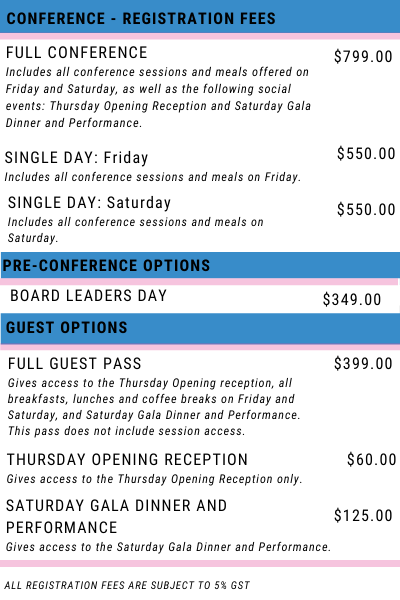
Click here to fill out the registration form to secure your spot.
COVID-19 protocols
In order to host an in-person event, the Banff Western Connection Conference and the Fairmont Banff Springs must adhere to the provincial Restrictions Exemption Program (REP). This means that all delegates, guests, speakers, contractors, partners, and exhibitors will be required to show either proof of full vaccination (both vaccination doses must be administered 14-days prior to the start of BWC 2022), or proof of a privately-paid negative rapid test result taken within 72 hours of entering the facility, each time they enter a facility and/or meeting room (or event space).
For more information on COVID-19 protocols, please visit our website here.
Accommodations
Accommodations can now be booked for the 2022 Banff Western Connection Conference. There are two options to choose from:
- The Fairmont Banff Springs
405 Spray Ave.
Banff, AB
Google Maps
A room block and special rates have been secured at the Fairmont Banff Springs for Banff Western Connection attendees. All guest room reservations must be made directly through the hotel. Reservations must be received by January 4, 2022 to qualify for the group rate and are based on availability.
Room rates start at $269.00 plus tax and applicable service fees. Each adult sharing a room over and above double occupancy will be charged an additional $30.00, plus applicable taxes and service charges per night.
To book: You can book online or call the reservations department at 1 833 762 6866 or 1 800 441 1414. If you choose to call, please identify yourself as a delegate at the 2022 Banff Western Connection.
- The Rimrock Resort Hotel
300 Mountain Ave.
Banff, AB
Google Maps
A discounted rate starting at $198.00 has been secured at the Rimrock Resort Hotel for BWC delegates. All guestroom reservations must be made directly through the hotel. Reservations are based on availability.
To book: You can book online or call the reservations department at 1 403 762 3356 and quote Banff Western Connection.
Social media
Show your excitement for Banff Western Connection 2022, and help us grow our community on social media, by following us at @BWCConference on Twitter and under “Banff Western Connection” on Facebook!
Registration Now Open for 2023 Banff Western Connection
Registration is now open for the Banff Western Connection Conference from January 26-28, 2023 at the Fairmont Banff Springs Hotel in beautiful Banff, Alberta.
The 2023 Banff Western Connection Conference will kick off on January 26th with pre-conference sessions and an opening reception. You'll then enjoy two full days of exciting, relevant and informative sessions all designed with you in mind!
To cap off the conference, you do not want to miss the Saturday night social event! Stay tuned for more exciting details on their website.
Registration details and fees
The graphic below details registration options and fees:

Accommodations
Accommodations for the 2023 Banff Western Connection conference will be hosted at the gorgeous Fairmont Banff Springs Hotel (sold out) and The RimRock Resort Hotel. Once you complete your registration you will receive details on how to book.
Social Media
Show your excitement for Banff Western Connection 2023, and help us grow our community on social media, by following us at @BWCConference on Twitter and under “Banff Western Connection” on Facebook!
Regulator Takes a Step to Curb Strata Insurance Costs
Rising insurance costs are a major concern for many of the approximately one-quarter of British Columbia’s residents who live in strata properties. This issue was a significant advocacy point for BCREA during the recent provincial election campaign, and it will continue to be a key issue as we work with the new government.
The recent announcement from the BC Financial Services Authority (BCFSA) that will put an end to “best terms pricing” is an important step in addressing this issue. In many cases, an insurance broker seeks coverage for a particular building from many different insurers, each of which agree to accept a certain percentage of the insured value, at a specific rate. Under best terms pricing, the highest bid of all participating insurers applies to the entire policy. “Best terms” applies to the insurers, not to the insured. The BCFSA and the insurance industry have agreed to end this practice effective January 1, 2021.
BCREA applauds this announcement, while recognizing that the complexity of the strata insurance market means more must be done, particularly in the areas of strata council education, accountability and transparency of insurance renewals, and greater participation of insurers in the provincial market.
This announcement from the BCFSA does not discuss the new pricing model, only that best term pricing will cease. More clarity is needed as soon as possible to provide certainty for stratas moving forward.
To subscribe to receive BCREA publications such as this one, or to update your email address or current subscriptions, click here.
Relief from Forfeiture #166
By Gerry Neely
B.A., LL.B.
Another deposit returned to a purchaser who was in default, but this time it was because the vendor benefitted from the purchaser's breach of contract. A purchaser who failed to close on the completion date because of insufficient funds, sued for the return of a $50,000 deposit paid September 1989 upon the proposed purchase price of property for $2.45 million.
At virtually the last moment, the purchaser found a third party who was prepared to complete the transaction. However, it was too late on the closing date to not only complete the registration of the transfer to the third party, but to do the post registration search required by the third party. The vendor must have had good financial and legal advice because it refused to close or to extend the closing date and in December 1989, it accepted an offer of $3.1 million.
All of the purchaser's technical arguments in support of its denial that it defaulted were rejected, but it still recovered almost all of the deposit.
The judge held that he had the power to relieve against forfeiture of money paid as a deposit despite the purchaser's default. The circumstances which apply are where the sum forfeited is out of all proportion to the loss suffered and it would be unconscionable for the vendor to retain the money.
Since the vendor profited by over $650,000 because of the purchaser's default, both circumstances were applied to deny to the vendor the right to retain the deposit. The vendor was able only to recover its taxed costs from the deposit.
The judge observed that there was no provision in the contract of purchase which required the vendor to allow for a post registration search. Instead it was the responsibility of the purchaser to ensure that sufficient funds were with his lawyer in time, not only to register the documents, but to obtain the post registration particulars so that funds could be paid before midnight on the completion date.1
***
Section 48 of the Real Estate Act supported a purchaser's successful action for specific performance brought against a vendor who refused to proceed with a sale. The vendor had asked that the purchaser's deposit which was in the hands of the agent, be paid to the vendor to enable him to pay it as a deposit upon the vendor's purchase of a house. The purchaser was prepared to see the deposit paid to the vendor's solicitor, but not to the vendor directly.
Having received this response, the vendor refused to close. When the purchaser sued for specific performance, the vendor's argument was that he was entitled to receive the deposit. The court was easily able to deny that argument by confirming that the real estate agent was holding the deposit as a stakeholder under Section 48.
The only basis upon which the vendor would have been entitled to receive the deposit before closing was if the Contract of Purchase and Sale contained a clause to that effect.
The purchaser was entitled not only to specific performance, but also to payment by the vendor of an occupation rent because the vendor continued in possession of the premises beyond the closing date.2
| 1. |
|
|
| 2. |
|
To subscribe to receive BCREA publications such as this one, or to update your email address or current subscriptions, click here.
Remediating Homes Used in Drug Operations
On October 17, non-medicinal cannabis will be legalized. In addition to establishing regulated distribution networks, the federal legislation allows individuals to legally cultivate up to four plants per residence.

BCREA remains concerned with the damage drug production can have on properties. Four plants may not sound like much, but what if it's grown in a closet? Or a 600-square foot strata unit? As with other types of drug production, growing cannabis can result in electrical issues and mould, putting property and people at risk.
To address these risks, we believe the BC Government needs to develop a consistent process to remediate buildings used in drug production to ensure they are safe. We commissioned research from the University of the Fraser Valley as a starting point.
The research recommends a public-health approach that makes clear the challenge is not with illegal or legal drug operations—it's with the damage that any drug operation can cause and the potential risks to human safety and property.
BCREA took this research to our multi-stakeholder Drug Operations Advisory Group, where we developed an action plan to promote our research report. Over the last several months, we've met with staff from the Union of British Columbia Municipalities and the Cannabis Legalization Secretariat, Minister of Public Safety Mike Farnworth and opposition critic Mike Morris.
We look forward to discussing the issue further with other government officials and stakeholders, including Health Minister Adrian Dix.
More information:
Ensuring Healthy Homes for British Columbians Summary Page (May 2018)
Ensuring Healthy Homes for British Columbians Research Paper (May 2018)
To subscribe to receive BCREA publications such as this one, or to update your email address or current subscriptions, click here.
Remediating Homes Used to Produce Drugs
On June 20, the Canadian government passed legislation confirming October 17, 2018 as the legalization date for non-medicinal cannabis. Under the legislation, individuals will be able to grow up to four cannabis plants per residence.

Four plants may not sound like much, but what if it's grown in a closet? Or a 600-square foot strata unit? Or someone decides to grow more than four plants?
BCREA remains concerned with the damage drug production can have on properties. Like other types of drug production, if someone grows cannabis in their home, electrical issues and mould can result. That puts property and people at risk.
BCREA believes the BC Government needs to develop a consistent process to remediate buildings used in drug production to ensure they are safe. We commissioned research from the University of the Fraser Valley as a starting point.
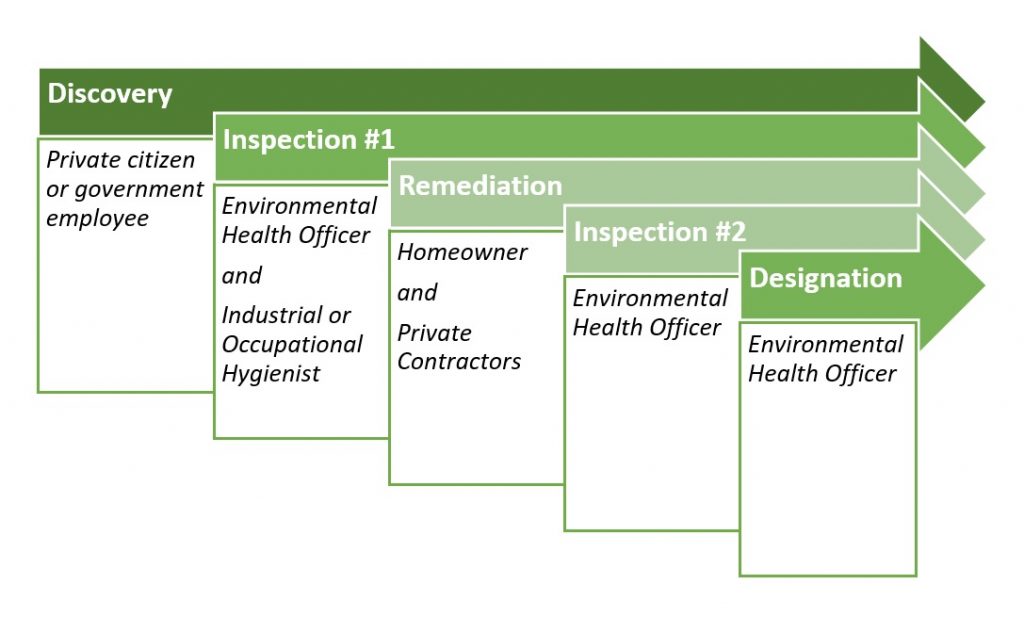
The research recommends defining what constitutes a healthy home. This would serve as the baseline against which all remediation work could be measured. The approach makes clear that the challenge is not with legal or illegal drug operations—it is with the damage that any drug operation can cause and the potential risks to human safety and property.
The research proposes a five-step remediation process in which a drug operation is discovered, inspected, remediated, inspected again and finally designated a healthy home. Because this is a public health problem, the research recommends the responsibility for the process lie with the Ministry of Health.
To subscribe to receive BCREA publications such as this one, or to update your email address or current subscriptions, click here.
Remind Consumers: They Are What They Sign! #506
When dealing with consumers, licensees will encounter those who do not read, write or speak English well, or even at all. While licensees are required to be proficient in English as a part of becoming licensed and meeting the English language proficiency requirement of Rule 2-6.1 of the Council's Real Estate Rules, consumers naturally have no such requirements.
Licensees should make efforts to encourage consumers to read and understand all transaction documents including the Contract of Purchase and Sale, disclosure forms and any forms required by the Real Estate Council of BC. The new agency forms prescribed by the Council are available in English, French, Chinese, Persian and Punjabi at https://www.recbc.ca/licensing/forms.html.
How that encouragement can be achieved depends on the situation, the licensee involved and the ability of the consumer to read, write, speak and/or understand English. There is no standard way to ensure the consumer understands and you can lead them to water but cannot make them drink, as the saying goes.
Some helpful tools to encourage a consumer to read and understand the transaction documents may include:
- Asking the consumer about their language abilities at the outset;
- Encouraging the consumer to have an unofficial translator available. This could be the licensee or someone from their office, a relative or friend of the consumer or someone else to assist in translation, if required;
- Asking the consumer if they understand the documents once they have been explained and whether they have any questions before they sign and initial the documents;
- Documenting all communications with the consumer on any language issues; and
- Recommending legal advice, where appropriate. Doing what you can to encourage the consumer to understand the transaction documents will make the deal smoother and reduce claims against the licensee as well as disputes between buyers and sellers. Ultimately, it will protect the consumer and licensee alike.
In a recent case1, a consumer who failed to read the contract they signed and claimed to have "relied on their Realtor," was not successful in their lawsuit against the licensee acting for them. The judge noted:
"I do not find the claimant's evidence compelling when they say, 'We just signed and relied 100% on our realtor.' As experienced, highly educated people, they either knew or ought to have known not to sign legal documents if they did not know what they are signing. Their failure to make any enquiry of their realtor does not enhance their credibility.
"Presumably the claimants went to (the licensee) because he could explain the various legal documents they were being asked to sign. They were spending well in excess of a million dollars. A modicum of due diligence on their part could reasonably have been expected, not the bare assertion that we relied 100% on our realtor."
Expectations of licensees will vary depending on the consumer's abilities, background and education. Licensees should take greater care explaining, reviewing and translating (or recommending someone else to translate) documents for those less experienced or less educated consumers.
Encouraging consumers to read and understand documents benefits all and ensures certainty in deals. Client service does not necessarily require your literal translation services, and you may not be qualified to do so, but encouraging a consumer verbally and in writing to read the documents that will bind them is an important step in protecting consumers.
Chris JohnstonB.A., LL.B.
Legally Speaking is published monthly. Real estate boards, real estate associations and REALTORS® may reprint this content, provided that credit is given to BCREA by including the following statement: "Copyright British Columbia Real Estate Association. Reprinted with permission." BCREA makes no guarantees as to the accuracy or completeness of this information or the currency of legal information.
To subscribe to receive BCREA publications such as this one, or to update your email address or current subscriptions, click here.
REMINDER: Land Owner Transparency Act and Registry Take Effect on November 30
The Land Owner Transparency Act (LOTA) and the Land Owner Transparency Registry (LOTR) come into effect on November 30, 2020, and that means REALTORS® should prepare for changes to practice when completing a transaction to allow for the new reporting requirements outlined by LOTA.
The following resources will help Realtors get up to speed and prepare for conversations with clients about LOTA and LOTR:
- Land Owner Transparency Registry Filings Required Beginning November 30
- Three Things to Know About the Land Owner Transparency Act and Registry
- Listen: Open House by BCREA podcast interview with lawyer Jamie Matthews
Realtors should also visit landtransparency.ca for more information Land Owner Transparency Act and the Land Owner Transparency Registry.
To subscribe to receive BCREA publications such as this one, or to update your email address or current subscriptions, click here.
Removal of Conditions and the Law and Equity Act #17
By Gerry Neely
B.A. LL.B.
An offer to purchase the assets of a hunting and fishing lodge, was subject to a number of conditions, one of which was the following: "Subject to obtaining financing, provided that this subject clause shall be removed on November 30th, 1975." It appears from the decision of the Supreme Court of British Columbia given in 1977 that November 30th passed without either the vendor or the purchaser or their solicitors discussing this clause. The vendor carried on with the arrangements for the completion of the sale after that date, but then repudiated. It was not until the Writ for specific performance was issued that the failure of the purchaser to give formal notice prior to November 30th that financing had not been obtained, was raised as a defence. The purchaser was successful in obtaining specific performance and the appeal by the vendor of that decision was dismissed by the Court of Appeal in 1981.
Both the Supreme Court British Columbia and the Court of Appeal were asked to determine the answer to the following question, as a matter of law:
Was the failure of the buyer to advise the seller prior to November 30th, 1975, that financing had been obtained, a condition precedent to the agreement, the non-fulfillment of which rendered the contract void?
The Supreme Court held that since the financing had been obtained, that part of the condition precedent had been met. The second part of the condition, which was its removal by November 30th, 1975, was held to have been waived by the vendor's conduct in proceeding toward completion even though no advice as to the removal of the condition was given on or before November 30th, 1975. It was on the basis of these arguments that specific performance was granted to the purchaser. The Court of Appeal reached the same conclusion but on different reasoning, which is repeated below:
"The interpretation which I put on the clause is that unless the purchaser gave notice before 30th November, 1975, that he was unable to arrange financing, the clause was removed from the agreement and the purchaser was bound to complete."
This decision has been followed in a case where the prospective purchaser sued for damages arising from the refusal of a vendor to comply with the terms of an offer to purchase which contained the following "subject to" clause:
"Subject to purchaser arranging a first mortgage of $90,000.00 at 13 1/2% with payments based on a twenty five year amortization by September 22/80."
The purchaser was unable to obtain financing but didn't care, having resold the property in the buoyant market of late 1980 for cash and a gross profit of $12,000.00. The question before the Court was whether the purchaser was compelled by law to give notice that financing had been arranged in order to keep the contract alive. The answer was "no". On the contrary, if the purchaser intended to rely on the condition precedent to prevent the contract from becoming binding, she had to give notice prior to the date set in the offer to purchase, that financing was unavailable.
These decisions may have unfortunate consequences for a purchaser or vendor who fails to notify the other party in time, of an inability to satisfy the condition inserted in the agreement for that party's benefit. He will be held to be bound by the contract even though, for example, his failure to obtain financing will probably render the purchase impossible and expose the purchaser to an action for specific performance or damages. One way to avoid this would be through the use of the following clause:
"Subject to purchaser obtaining financing. The vendor acknowledges that this condition is solely for the benefit of the purchaser and unless the purchaser waives fulfillment of it, this agreement shall be void if the purchaser is unable to obtain financing satisfactory to it, on or before November 30th, 1975."
This will accomplish several purposes. It avoids the argument that the condition is for the benefit of the vendor as well as the purchaser, a fact which if it existed, eliminates the purchaser's unilateral right given by Section 49 of the Law and Equity Act, to waive compliance with the condition. In addition, it avoids the problem of giving notice and the concern as to when that notice was received by the vendor. Finally, it gives the purchaser to and including the last day to obtain satisfactory financing.
Since this clause will not cover every circumstance, it still is very important for the licencee to advise the other party as to whether or not a condition has been met, waived or remains unfulfilled. In this connection, a review of Section E, pages 5 to 7 inclusive, of the Professional Standards Handbook issued by the Real Estate Council would be worth undertaking.
| 1. | Sky Ranches Limited v. Nelson et al, 30 B.C.L.R. 162 (Court of Appeal) 4 B.C.L.R. 97 (Supreme Court of British Columbia). | |
| 2. | McNabb v. Smith et al,30 B.C.L.R. 37. |
To subscribe to receive BCREA publications such as this one, or to update your email address or current subscriptions, click here.
Removing Fixtures; Whim or Fancy #205
By Gerry Neely
B.A., LL.B.
If section 441 of the Criminal Code of Canada were better known to tenants, less of them might trash rented premises. This section makes it an offense, punishable upon conviction for up to five years imprisonment, if an occupant of a dwelling house or other building deliberately and to the prejudice of a mortgagee or owner, demolishes or removes any part of the building or a fixture.
A charge under this section was brought recently against the owner of a home whose property was subject to a foreclosure action brought by a bank. The home was sold by court order and between the date of the sale and the date the purchaser took possession, the owner removed kitchen cupboards and other fixtures which the bank paid to replace. A jury convicted the owner of an offense under this section.
***
Not all decisions establish a precedent for future cases as the B.C. Court of Appeal made clear this year in reasons for judgment which confirmed the decision of a Supreme Court judge in favor of an agent. The agent was entitled to a commission upon a binding contract of sale being signed. A binding contract was signed with a purchaser who failed to close on the due date, but who was willing and able to close a day later. The vendor refused to grant an extension.
In deciding in the agent's favor, the Supreme Court judge said that the vendor could have sold its property to the purchaser if it wished by granting the extension of time. It is clear from the judgments of both courts that the refusal to extend the time influenced the decision in favor of the agent because the Court of Appeal stated that "different circumstances in the failure of a purchaser to complete may give rise to a different result". (The Supreme Court decision is discussed in Column # 1 89.)1
***
Another decision in the "whim or fancy" or "option or offer" series of cases; this one from Alberta. The conditions involved a title review, appraisal of land and equipment and environmental assessment, all to the satisfaction of the purchaser. These are conditions that depend entirely upon the subjective state of mind of the purchaser. Their subjectivity is such that there is no test a judge can apply to determine whether the purchaser had used his best efforts to satisfy the conditions.
No contract binding upon either party is created until the conditions have been removed. In the meantime, the vendor may terminate the contract at any time. This type of contract has been referred to as an option, but unless consideration is paid by the purchaser to the vendor for the option, the option is invalid. (See Column #57 for a more complete discussion, and your course material for a short consideration clause.)2
***
A resolution approved by a strata council was declared invalid because an absent member of the strata council voted by proxy. The authority in the Condominium Act which allows members of a strata corporation to vote by proxy, does not extend to voting by strata council members.3
***
A listing contract with a company for the sale of its land, does not protect the agent holding the listing for a commission where the shares of the company instead of the land are sold. The company owns the land, not the shareholders and the shareholders and company are different persons.
An Alberta agent advanced the argument unsuccessfully that it was entitled to a commission because the sale of the shares was in substance a sale of the land .4 To avoid this result and to comply with section 46 of the Real Estate Act which requires an exclusive listing to be in writing, the licensee should have obtained two listings, one signed by the company for the sale of its land and the other signed by the shareholders for the sale of their shares (or one listing with the appropriate language and signatures.) Refer to Column #16 for a discussion of the limitation upon the sale of shares to non-shareholders of a company.
To subscribe to receive BCREA publications such as this one, or to update your email address or current subscriptions, click here.
Renewed Bank of Canada Tightening Slows Sales Activity
For the complete news release, including detailed statistics, click here.
Vancouver, BC – October 12, 2023. The British Columbia Real Estate Association (BCREA) reports that a total of 5,531 residential unit sales were recorded in Multiple Listing Service® (MLS®) systems in September 2023, an increase of 10.4 per cent from September 2022. The average MLS® residential price in BC was $966,530 up 4.8 per cent compared to September 2022. The total sales dollar volume was $5.3 billion, representing a 15.7 per cent increase from the same time last year.
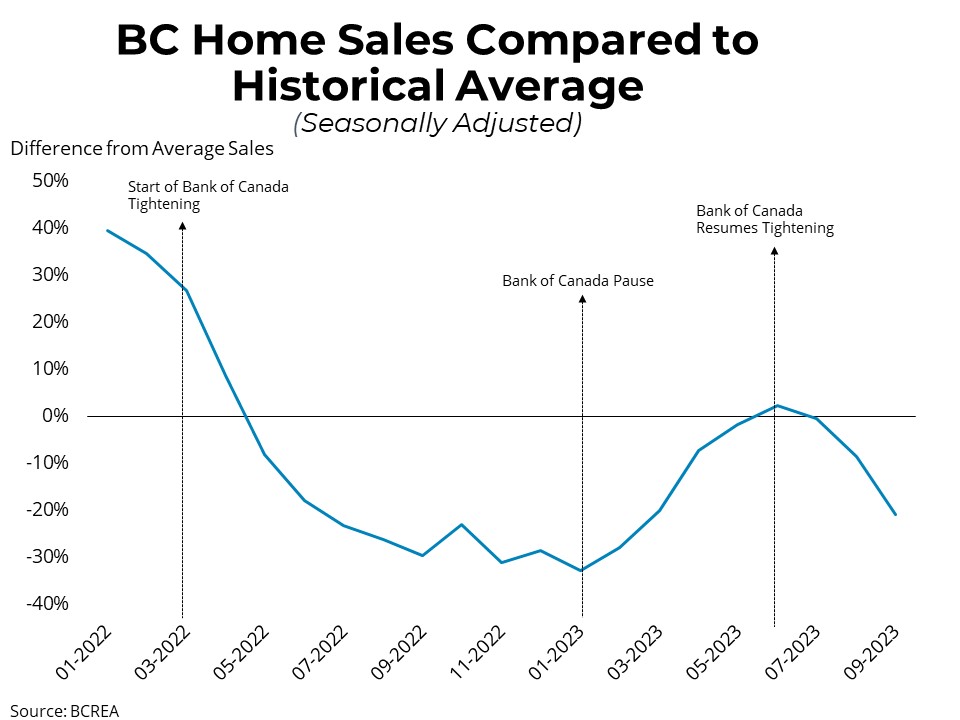
“Home sales in BC have clearly been impacted by the Bank of Canada's recent tightening of interest rates, along with the resulting surge in mortgage rates,” said BCREA Chief Economist Brendon Ogmundson. “Home sales are once again trending at below average levels as potential buyers struggle with a high cost of borrowing.”
Active listings in the province were up slightly month-over-month at just over 33,000 total listings and were 8.1 per cent higher year-over-year.
Year-to-date BC residential sales dollar volume was down 15 per cent to $57.9 billion, compared with the same period in 2022. Residential unit sales were down 11.5 per cent to 59,570 units, while the average MLS® residential price was down 4 per cent to $972,049.
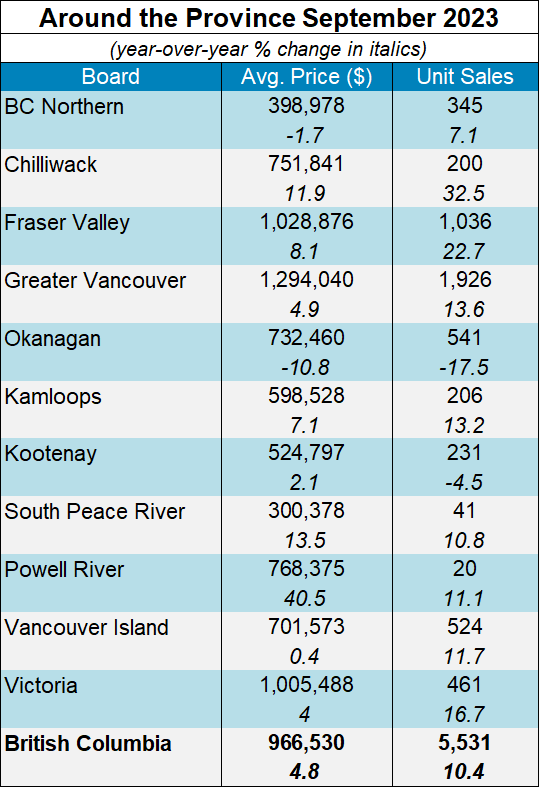
Rent Repayment Plans and Other Residential Tenancy Updates
With an announcement on July 20, the BC Government is giving landlords and tenants information to help them plan for the near future. The ban on residential evictions for non-payment of rent will be lifted before September 1, which means full rent will be due in September.
Repayment plans
The government has published a repayment framework for residential tenants who have fallen behind in their rent. Here are some highlights of that framework:
- landlords are required to enter into repayment plans with tenants for unpaid rent and/or utilities,
- the first installment will be due 30 days from when the landlord presents the repayment plan – probably October 1 for most tenants if landlords deliver repayment plans by August 31,
- tenants who have fallen behind in their rent will have until July 2021 to pay it back, as long as they make monthly installments (landlords can’t charge late fees),
- late payments during the emergency period aren’t considered cause for eviction and a tenant can’t be evicted for unpaid rent during the emergency unless they have defaulted on their repayment plan, and
- landlords and tenants can still negotiate additional terms, as needed.
Other residential tenancy news
The July 20 news release includes these additional important announcements:
• no rent increases can take effect until December 1, 2020, and
• landlords still have the ability to restrict access to common spaces for COVID-19-related health reasons.
More information about COVID-19 and tenancies is available here.
To subscribe to receive BCREA publications, or to update your email address or current subscriptions, click here.
Rental Clause #201
By Gerry Neely
B.A., LL.B.
Sometimes a simple clause such as the one which follows conceals problems which lead to litigation.
"Vendor may retain all rental monies collected from tenants prior to completion date, and purchaser may retain all rental monies collected from tenants on or after completion date."
A dispute arose between the parties as to who was entitled to prepaid rents collected by the vendor before the completion date and to the accounts receivable arising from unpaid rents which were owed to the vendor at the completion date. Since the meaning of the clause was clear, the vendor retained the prepaid rents and the purchaser received the rents owed to the vendor at the completion date, which the purchaser received from the tenants after the completion date.
The result was unfair because a tenant's payments may be a day or so late or, in commercial leases, the rent paid for the last month or so of the term may be substantial. While the clause to be drawn obviously depends upon the circumstances, generally this clause should provide that the purchaser is credited with rent paid to the vendor for any period following the completion date, and the vendor is entitled to unpaid rents for any period prior to the closing date.1
***
Property purchase tax is payable upon the fair market value of the land which is being transferred. The calculation of "fair market value" is based upon the interaction of the fictional willing vendor and purchaser, a concept which joins the "average man" and the "reasonable man" as standards by which judges try to determine right from wrong, or in this case more from less.
The definition found in the Property Purchase Tax Act is more complex than this and an amendment to this definition may be the result of a 1992 case involving a number of individuals who incorporated a company to purchase a parcel of land in trust for them. The company was then to strata title the land and convey to each of the individuals the lot to which that individual was entitled. The land value in March, 1990 when title was transferred to the company, was $825,000. Eighteen months later following the subdivision, the value of all of the parcels transferred to the individuals was $2,500,000.
No property purchase tax was paid because the owners claimed an exemption allowed upon a transfer by individuals of a single parcel of land, where the fair market value of each individual's interest in the land immediately prior to subdivision is equal to the fair market value of the registered interest the individual receives after the subdivision.
The Crown assessed tax and the owners appealed. There was no evidence of value other than a statement in the petition that the fair market value of the parcel was the same both before and after the transfer. The owners' argument was based upon a subdivision into strata lots occurring when the Registrar gives the plan a number and registers the new titles for the strata lots. Since these events occur virtually simultaneously the court agreed with the owners that the value was the same both before and after subdivision and the exemption applied.
From the comments I receive it is evident that some licensees are not aware that there are a number of exemptions to the Property Purchase Tax Act. In fact, there are 38. The ones with which we are most familiar are the exemptions for a principal residence, recreational property, transfer of property to and from joint owners and the family farm. A number of other exemptions apply to transfers to charities, governments, veterans or their spouses and transfers to and from trusts.
It is important to remember that only part of the principal residence may be exempt if the area of land exceeds .5 hectares, and that no part of a recreational residence will be exempted if the value exceeds $200,000, or the area exceeds 5 hectares. Anyone wanting to know the exemptions in greater detail should be able to obtain an instruction guide from the local Land Title Office or government agent's office.2
| 1. |
|
|
| 2. |
|
To subscribe to receive BCREA publications such as this one, or to update your email address or current subscriptions, click here.
Rental Housing: A Vital Component of the Housing Market
REALTORS® do more than buy and sell homes—they care deeply about the communities in which they live, work and play. That's why, through BCREA, REALTORS® advocate for provincial policies that support a thriving rental housing market.

BCREA supports increasing the supply of rental stock to ensure that British Columbians have access to housing options. We also believe it is important that government legislation and regulation balance landlord and tenant rights effectively.
BCREA recently put forward this perspective by participating in the BC Government's rental housing consultation. We submitted the following six recommendations:
- Retain the current maximum allowable annual increase (2 per cent + Consumer Price Index) and the ability to go to market rent with new tenants.
- Amend the definition of "landlord" in the Residential Tenancy Act to include a strata corporation dealing with a difficult tenant.
- When protecting tenants, consider how impacts on landlords could affect rental supply.
- Encourage local governments to legalize secondary suites with minimal red tape.
- Work with local governments to encourage public acceptance of purpose-built rentals.
- Work with the federal government to encourage private sector investment in rental housing.
We believe these recommendations would increase the stock of rental housing available for British Columbians, while preserving the real estate investments individuals have made by protecting their ability to freely own, use, buy and sell property.
The task force plans to present its recommendations to the government in fall 2018.
More information:
- BCREA Final Submission on Rental Housing Task Force (June 29, 2018)
To subscribe to receive BCREA publications such as this one, or to update your email address or current subscriptions, click here.
Reporting Your Professional Development Program Hours

The transition to the new Professional Development Program (PDP) framework is just around the corner! As of January 1, you'll report any PDP hours you've acquired from learning opportunities outside of your board – whether accredited or self-directed – to your primary member board. As the reporting process looks slightly different at each board, your board will provide you with more details, but keep reading for some general guidelines.
When do I have to report my hours?
1. For learning opportunities taken through your brokerage or providers other than your board, you are responsible for reporting these PDP hours to your primary member board. You can only report these hours after you’ve completed the learning opportunity.
2. For learning opportunities taken through your member board, you do not have to report your PDP hours – your board will track these hours for you!
For brokerage training that counts toward self-directed PDP hours, some boards may ask that your brokerage submit an attendance list instead of each REALTOR® reporting these hours individually. Please check with your brokerage to verify the process.
What counts toward PDP hours?
To determine if a learning opportunity is accredited and will count toward your accredited PDP hours, you can refer to this list of all currently accredited PDP learning opportunities. To determine if a learning opportunity will count toward your self-directed PDP hours, ensure it meets the following requirements:
1. it enhances your professional practice,
2. it’s verifiable and auditable, meaning you can provide proof of completion, and
3. it provides at least one hour of learning.
If you’re not sure if a learning opportunity meets one or more of these requirements, contact your board.
How many hours do I need to report?
Each licensing cycle, you are required to complete a minimum of 18 hours of professional development. We know, however, that many REALTORS® will go above and beyond this minimum and encourage you to report all of your professional development hours, including those earned in excess of the minimum requirements.
If you haven't yet received details on the reporting process at your board, please contact your board directly. For more information on the PDP framework and reporting, follow the links below:
- New Professional Development Program framework
- Finding and reporting accredited learning opportunities
- Finding and reporting self-directed learning opportunities
To subscribe to receive BCREA publications such as this one, or to update your email address or current subscriptions, click here.
Representation Agreements and Powers of Attorney – Part 1 of 3 #318
By Gerry Neely
B.A. LL.B.
If a licensee is asked by a third party to list a property, the first response would be to ask to see that person’s authority to act on behalf of the owner. Before the proclamation of the Representation Agreement Act on February 28, 2000, the licensee could have received proof of that person’s authority in one of three ways:
- by an order made under the Patient’s Property Act, appointing that person as Committee;
- by an enduring Power of Attorney which gave that person the power to act even if the owner became mentally incompetent; or
- by a non-enduring Power of Attorney used for a specific purpose.
After February 28, 2000, which of these powers remain and what has been added? The Patient’s Property Act remains in force, as does the non-enduring Power of Attorney. The weakness of the latter authority is that it becomes void if the person who gave it becomes mentally incompetent. That weakness made the enduring Power of Attorney a useful and valuable tool for people concerned that a subsequent mental incapacity would prevent them from making important financial and legal decisions, including the purchase and sale of real estate on their behalf. Despite its usefulness, the enduring Power of Attorney will only continue to be legally effective if is signed before September 6, 2000.
While a Power of Attorney is adequate to authorize someone to deal with your financial and some legal matters, it does not authorize someone to make personal, medical and other health decisions on your part when circumstances prevent you from doing so. While many people used a Living Will to accomplish this, it had no legal effect.
The Representation Agreement Act is intended to address these and other perceived inadequacies. It provides a structure, and standards and rules within that structure, enabling you to authorize someone to make decisions for you when you are unable to do so. For the incapacitated adult, these standards and rules also provide a measure of protection against abuse of the trust given by you to the representative you appoint.
To subscribe to receive BCREA publications such as this one, or to update your email address or current subscriptions, click here.
Representation Agreements and Powers of Attorney – Part 2 of 3 #319
By Gerry Neely
B.A. LL.B.
A representation agreement (RA) will be the principal document used to appoint someone you trust to make your medical, personal care, financial and legal decisions. There are two types of RAs. The first is a simple representation agreement (SRA) which gives the representative the authority to make routine legal and financial decisions, and limited daily living and health care decisions. Examples include the payment of bills, withdrawal of monies from a bank account, dental checkups and tests to determine whether health care is necessary.
Routine financial matters do not include the purchase or sale of real estate, the renewal of a mortgage for more than the amount outstanding on the loan at the time of renewal, or a new loan. The reason for this limited responsibility is that an SRA allows a person of diminished mental capacity to appoint a representative, if it is clear that the person making the appointment understood the nature and effect of the power given to the representative.
The second RA is an enhanced representation agreement (ERA) which gives the representative authority to make complex financial and legal decisions, such as when and how to sell the adult’s business and/or real estate, and complex personal and health care matters, such as refusing life supporting care or treatment. This is the agreement that would be most important to a licensee.
Another distinction between the two agreements is that the SRA can be prepared and signed without the assistance of a lawyer, while the ERA, because of its broader powers, requires the services of a lawyer.
The lawyer’s responsibility is to make certain you understand what the broader powers mean and the effect of giving those powers to your representative. The lawyer must complete a prescribed form of certification that the provisions of the ERA have been explained to you and that you understand the consequences of giving such wide authority to the representative.
Given these broad powers, which may extend to making life or death decisions for you, choosing the right representative is of paramount importance. Normally the representative will be a close family member, a spouse or child. However, you may choose a close friend, both for the friend’s objectivity and to avoid conflict among family members.
You must also consider whether appointing a close relative, who is also a beneficiary of your estate, might pose too difficult a conflict between the representative’s self-interest and duty to you. If your assets are substantial, and you would like to spend your declining years at home rather than in a nursing home, you might choose a close friend as your representative rather than the beneficiaries of your estate, who might be reluctant to see your capital assets depleted to provide costly around-the-clock assistance.
You can appoint more than one representative, but, if you do, you must set out the powers each is to have. If they share the same powers, you must state whether they may act separately or whether they must act together. You may, and probably should, name an alternate representative because the representative does not have the power to delegate his or her authority. The agreement must state the circumstances under which the alternate will take over as the representative.
To subscribe to receive BCREA publications such as this one, or to update your email address or current subscriptions, click here.
Representation Agreements and Powers of Attorney – Part 3 of 3 #320
By Gerry Neely
B.A. LL.B.
The contents of the representation agreement are yours to decide. With respect to personal, medical and health care decisions, speak to your family, friends and medical professionals. It is particularly important that you speak with your doctor if you have a chronic medical problem. State whether and under what circumstances you may or may not want such life sustaining treatments such as CPR, dialysis, life-saving surgery, life-saving antibiotics, blood transfusions or tube feeding.
The Act adds a further layer of protection against the risk of a dishonest or ineffectual representative by requiring or allowing for the appointment of a monitor to oversee the representative. In the case of the SRA, the appointments can only be waived if the representative is the adult’s spouse, or a lawyer has been consulted who provides the same certification as is required for the ERA. If an alternate representative is appointed who is not the spouse, then a monitor must be appointed unless a lawyer’s certification is obtained. In the case of the ERA, there is a specific requirement that you must either name a monitor or state that one is not required.
Finally, you and the representative must sign a representation agreement in the presence of two independent witnesses. Where the representation agreement authorizes dealing with real property, one of the witnesses must be a lawyer or notary public who provides the officer’s certification now required - for example, for Land Title Office transfers.
Each representative, monitor and witness must file a prescribed certificate in which they agree to accept the duties imposed upon them. The monitor and witnesses must also acknowledge that they have no reason to object to the making of the representation agreement. From the examination of the statutory duties of the representative and monitor, one can conclude that these are not roles to be lightly entered into.
It is possible, and probably desirable, that in some circumstances there will be more than one representation agreement. Separate agreements - concerning financial matters on the one hand and health and personal care matters on the other - mean that financial institutions and government offices, such as the Land Title Office, do not have to read through statements about your health and personal care decisions, which you probably would prefer to remain private. A Registrar of a Land Title Office has suggested that there is merit in having a separate agreement to deal with Land Title Office transactions.
No doubt much of the legislation that has been proclaimed will prove to be beneficial in the long run. In the short run however, we are advising clients to sign an enduring Power of Attorney to deal with the financial affairs and a separate representation agreement for personal and health care decisions. However, if you act by September 5, 2000, and sign an enduring Power of Attorney, you have the advantage of a useful document, which you can replace subsequently if you decide to provide more detailed instructions as to how you want your financial affairs to be handled.
To subscribe to receive BCREA publications such as this one, or to update your email address or current subscriptions, click here.
Representations Regarding Property Boundaries #428
By Edward L. Wilson
Lawson Lundell LLP
A REALTOR® should always take care when making any representation about the boundaries of a parcel of land. The location of buildings, fencing, landscaping, sidewalks and roads are often misleading indicators of a property’s true boundaries.
In a recent decision,1 the court considered a case where the buyers, in the presence of both the sellers’ agent and their own agent, had toured a home located on a large lot. Representation was made by one of the agents that the property in question stretched between the road located to the east and the road to the west and thus allowed access to the property from both roads. In fact, there was a strip of land owned by the municipality and located to the east of the property that prevented direct access to the eastern road.
The sellers’ agent had been warned about this issue by a neighbouring property owner and had made some inquiries with the municipality, but had not sufficiently clarified the issue and failed to identify the presence of the municipality-owned property. The sellers’ agent represented through words or conduct that the property extended to the fence located on the property but, in fact, the fence was located on the municipality-owned property. The ability to access the eastern road was important to the buyers as they wanted to reorient the house to the eastern road as part of an expansion of the home.
After closing, the buyers discovered the parcel did not extend to the eastern road and they could not construct direct access to the eastern road without first buying additional property from the municipality. The buyers sued the sellers and the sellers’ agent for the tort of negligent misrepresentation.
The court considered the sellers’ agent’s liability based in the tort of negligent misrepresentation by applying the five-part test in the Queen v. Cognos:2
- There must be a duty of care based on a special relationship between the representor and representee;
- the representation must be untrue, inaccurate or misleading;
- the representor must have acted negligently in making said misrepresentation;
- the representee must have relied, in a reasonable manner, on the negligent misrepresentation; and
- the reliance must have been detrimental to the representee in the sense they suffered resulting damage.
The court found the first four tests were met: there was a special relationship between a sellers’ agent and the buyers; the representation that the property went to the fence was untrue; the agent was negligent in making the representation; and the buyers relied on the representation.
After considering the different ways of measuring damages in a breach of contract case and in a negligent misrepresentation tort case the court found, after a five-day trial, the buyers had suffered no damages and dismissed the case.3 The court found the value of the property was equal to the price paid, and thus the buyers suffered no consequential damages and failed to satisfy the fifth criteria in Cognos. While ultimately not having to pay damages, the agent had to go through the costs and stresses of a five-day trial and now an appeal.
REALTORS® should exercise caution when making representations, or passing on a seller’s representations, as to the boundaries of property. Where any uncertainty exists, it’s always advisable to put a term into the contract that there are no representations as to the area of the property or its boundaries and that the buyer should obtain a survey from a land surveyor to determine the area and boundaries of the property.
To subscribe to receive BCREA publications such as this one, or to update your email address or current subscriptions, click here
Resale Before Closing #203
By Gerry Neely
B.A., LL.B.
The question of when an agent's duty to his principal ends is still uncertain. The answer to the question becomes critical when the property is resold before the sale is to close, and the same agent is involved in both sales.
In an Ontario case, an owner of unlisted property accepted an offer and signed the usual listing agreement, which provided for payment of a commission of $25,000 to the agent who had introduced the purchaser to the property. Before the sale closed the purchaser was approached by another agent with an offer to purchase the property. The purchaser advised the first agent of this, but the first agent did not so advise the vendor. Negotiations then took place, in which the first agent was involved, resulting in the sale of the property to a third party and a further $12,500 commission to the first agent.
Since the terms of the contract allowed the purchaser to assign its interest, no questions were raised when the vendor was asked to transfer title to the third party. When the vendor found that the property had been resold at a profit, and that the first agent had received a further commission on the resale, the vendor sued for damages of $37,500.
In reaching a decision the judge referred to the agent's fiduciary duty, and the obligation to act in the "best good faith." His conclusion was that the agent's duty upon being advised of the second offer was to immediately inform the vendor. That would have given the vendor the right to pursue any options the vendor might have had. That obligation continued until the date of closing of the transaction.
He ordered payment of the second commission to the vendor, but not the first, saying that nothing the agent did affected its entitlement to the $25,000. (Compare this conclusion with the case referred to in Column # 17.)1
***
The decision in another Ontario case provides another example of why an agent who is asked to find property for someone should act either as the purchaser's agent, only where the property is not listed for sale, or know what to do when a fiduciary duty is owed to both parties.
An agent was asked by his brother and his brother's wife to find them investment property for which they were willing to pay between $250,000 and $300,000. The agent found a six-plex and after a number of discussions, the vendors signed a listing contract and then accepted an offer made in the wife's maiden name in trust to avoid a connection being made between the agent and his brother. The sale price was $285,000.
The vendors subsequently discovered the relationship and refused to close, leading to an action by the purchaser for specific performance and by the agent for commission. The trial judge decided that the agent was a double agent who owed fiduciary duties to both parties. The failure of the agent to disclose that the purchasers were his sister-in-law and his brother, was a breach of fiduciary duty.
He also said that if the agent had been the vendor's agent only, he would have had a duty to disclose that the purchasers were prepared to pay up to $300,000 for a suitable property. Since he was a double agent, he was really a mediator and his duty was not to disclose confidential information learned from the purchaser. He concluded that even if the vendors had been aware of the facts, they would have accepted the offer. He awarded commission to the agent and specific performance to the purchasers.
The Court of Appeal rejected the trial judge's reasoning and reversed his decision, stating that once a breach of fiduciary duty of this kind is established, the agent is not entitled to a commission. In addition, where a breach of fiduciary duty occurs, the agent can not attempt to prove that the sale would have completed had the material facts been know to the vendor.2
***
The exemptions referred to in Column #201 for a principal residence, recreational property or the family farm, are for transfers between a very wide category of related family members. Particulars of some of the limitations upon the principal residence exemption are referred to in Column #174.
| 1. |
|
|
| 2. |
|
To subscribe to receive BCREA publications such as this one, or to update your email address or current subscriptions, click here.
Reserving the Right to Sue to Resolve Dispute Concerning Adjustments #176
By Gerry Neely
B.A., LL.B.
One problem conveyancers don't want at closing time is a dispute about the adjustments to be made between the parties. Because the amounts involved are generally small in relation to the purchase price, the main reason these disputes are not compromised is because one party doesn't want to complete.
If litigation commences, one of the defences is the failure of the other party to agree to the appropriate adjustments to be made. That happened in a case involving the purchase of a Whistler condominium pursuant to a contract of purchase containing a clause that the purchase was subject to "purchaser assuming vendor's capital account of $4, 100 on closing date." The condo was in a rental pool and each owner was required to maintain a capital account to which revenue was added and expenses deducted.
The actual amount of the capital account could not be accurately calculated until immediately after the closing date of October 3 1. Based upon available information from the Strata Council, there would be a loss of approximately $500 in the month of October which the purchaser proposed should be credited to her. This was rejected and the purchaser proposed that she accept the capital amount at $4, 1 00 and the vendor assume the October loss. Although this proposal was accepted by the vendor it was then repudiated. The purchaser then agreed to close, but reserved the right to resolve the dispute in Small Claims Court. The vendor failed to return the conveyancing documents and the purchaser sued for specific performance.
The vendor said that its sole reason for refusing to complete was the failure of the purchaser to provide a proper accounting of adjustments. This proved to be a contrived defense when the evidence established that the vendor had remortgaged the condominium just three days prior to closing. The vendor also argued that the proposal to complete which was subject to the reservation of the right to sue in Small Claims Court created a conditional acceptance. The judge rejected this argument, saying that in his view, this was a reasonable approach given the circumstances facing the purchaser.
Having rejected these arguments, the judge held that there had been an agreement on the part of the vendor to close on the basis of the vendor accepting the October loss and awarded specific performance to the purchaser. This common sense approach by the judge to the resolution of a dispute concerning adjustments is one which conveyancers may be able to use effectively to facilitate completions.1
***
Damages for mental distress in breach of contract cases have usually been rejected by the courts. That position has been changing over the past few decades and our courts are looking more readily at claims for damages for stress where a party to a contract for the sale of real estate repudiates the contract.
In one case, a purchaser repudiated a contract to purchase the home of a couple who intended to move from Calgary to Leduc. In anticipation of this move, they entered into an agreement to buy another house, committed themselves to financing, employed solicitors in connection with both properties, and arranged to terminate their employment. The result of the repudiation led to additional expenses and a loss on resale. The stress created by this was so great that problems arose between the couple with the female/spouse plaintiff experiencing facial swelling and significant stress.
In these circumstances, the judge said that for someone to succeed in claiming damages for mental distress, more than mere anxiety must have occurred. The plaintiff must establish vexation, frustration, distress and anxiety sufficient to justify the award. In this case, there were all of the above plus the physical symptoms. Damages in the amount of $7,500 were given for stress.2
| 1. |
|
|
| 2. |
|
To subscribe to receive BCREA publications such as this one, or to update your email address or current subscriptions, click here.
Residential Mortgage or Residential Agreement for Sale – Continued; Negligence, Liability of Owner/Employee of a Limited Company #126
By Gerry Neely
B.A. LL.B
Column 125 discussed how a mortgagor may be able to limit liability under the personal covenant of the mortgagee, upon the sale by the mortgagor of his residence. What is the liability of the purchaser of the residence, the person who, in the amendments, is referred to as the current owner? If the current owner assumed a liability to pay the mortgagee or to indemnify the mortgagor, then the mortgagee can sue the current owner directly, as if the current owner was an original party to the mortgage. Similarly, if the mortgagor is forced to pay the mortgagee, then the mortgagor can sue the current owner to recover the amount paid.
The onus is on the current owner to prove that he is not liable. He may discharge this onus by proving that by agreement with the person from whom he purchased the residence, he did not assume the mortgage. The current owner may also be able to avoid liability by proving that an earlier owner of the residence did not assume the mortgage at the time title to the residence was transferred to the earlier owner.
What changes in mortgage practice will result from these Amendments? Will all mortgagees put "due on sale" clauses in their mortgages? Will borrowers or lenders want the mortgage to identify the residential purpose for which the money was borrowed? What is included within family or household purposes? The purchase of the family car - yes; financing a university education - why not; the trip to Hawaii to recharge the family batteries - no, or is it just maybe? Who knows - tune in next year for some of the answers.
* * *
From the time when limited companies became part of business activities, lawyers have advised clients that one of the advantages of incorporation is to shield the owner of the company who also works in the business, from personal liability. Judges have referred to this shield as the corporate veil which lies between the company and its shareholders and have often stated their reluctance to lift the corporate veil to attach liability to the shareholder for a negligent act of the corporation. That is changing and the corporate veil is being lifted often enough now that if the Courts sat at night, the judges would be charged as peeping Toms.
A recent case dealt with a limited company carrying on an insurance agency business. An elderly woman who suffered from angina and diabetes, and who was travelling to the United States, wanted excess medical insurance coverage for her. Her son arranged this with the owner of the limited company who was also an employee of the company. A policy of insurance was provided but it excluded coverage for any illness which had required treatment or hospitalization within one hundred and eighty days of the policy's effective date. The woman died during her visit and medical bills in excess of $40,000.00 were incurred for which liability was denied by the insurance company.
The judge accepted the evidence of the son as against the evidence of the proprietor of the insurance agency, to find that the proprietor had failed to advise the son of this exclusion. He held that the employee had a duty to warn the son of the exclusion clause since the son had specified what his mother's needs were.
The company was held to be liable for the breach of contract in failing to provide an insurance policy suiting the mother~s needs. The judge referred to a number of decisions in which an employee of a company was held to be liable for the employee's negligence and said that the owner of an incorporated business who commits a negligent act in the course of that company's business, should be in no different position to an ordinary employee. The owner/employee was held to be personally liable for negligence. He would not have been liable if there had been a breach of contract only.
| Ataya v. Mutual of Omaha Insurance Co. , (1988) I.L.R. 1-2316. |
To subscribe to receive BCREA publications such as this one, or to update your email address or current subscriptions, click here.
Residential Mortgage or Residential Agreement for Sale – Limitation of Liability Under #125
By Gerry Neely
B.A. LL.B
The recession of the early eighties left many purchasers of homes unable to make the monthly payments under the mortgages they assumed when they bought their homes, or to sell their homes at a price sufficient to pay off the mortgages. In the resulting foreclosure actions, the mortgagees almost invariably sued the former owners who had taken out the mortgages, making the former owners aware of the unpleasant fact that their personal liability to the mortgagees continued after the sale of their homes.
This continuing liability may end as a result of amendments to the Property Law Act which will become effective December 1, 1988.
Some mortgage lenders and some vendors who sold properties by way of Agreements for Sale may lose their right to sue on the personal covenant of the mortgagor or purchaser respectively, after the sale of the mortgaged property by the mortgagor or purchaser.
The mortgagor or purchaser who may benefit from this legislation is one who has a residential mortgage or residential agreement for sale registered against the residence in which the mortgagor or purchaser resides. The purchaser or mortgagor can only benefit if the agreement for sale or the proceeds of the mortgage were used: (a) to acquire the residence, (b) to make improvements to the residence, (c) to make expenditures for family or household purpose, or (d) to refinance for any of the purposes in paragraphs (a), (b) and (c).
(For easier reading in the balance of this column mortgagor includes a purchaser under an agreement for sale and in addition, includes a subsequent purchaser of the residence who assumed the mortgage but who is now selling the residence; mortgagee includes the vendor under an agreement for sale; mortgage includes an agreement for sale; residence means one against which a residential mortgage or residential agreement for sale is registered.)
Following the sale of the residence, the mortgagee must demand payment of the balance secured by the mortgage within three months of the expiration of the existing term of the mortgage. If the mortgage is payable upon demand, then the demand for payment must be made within three months after the mortgagee has received written notice of the transfer of the residence. If the mortgagee fails to do so, the mortgagor is no longer personally liable to the mortgagee.
A mortgagee cannot insist that as a condition of the granting of the loan or sale, the mortgagor must waive the benefits referred to in the preceding paragraph. However, the original parties to the mortgage can waive these benefits after the transfer of the residence has occurred.
Personal liability also ceases if the mortgagee approves in writing of a purchaser of the residence. This is an important change, but to take advantage of it, the mortgagor must ask the mortgagee within three months of the date of transfer of the residence, to approve of the purchaser. The mortgagee is entitled to have reasonable financial information concerning the purchaser and a reasonable fee to cover the costs of obtaining a credit report and handling costs.
If the mortgagee ignores the request or in the opinion of the mortgagor unreasonably refuses approval, the mortgagor may apply in the Supreme Court of British Columbia for an order that approval be given. If the Court agrees, the mortgagor is released from personal liability.
For those who haven't given up, this subject is continued in the next column.
| Bill 27, Law Reform Amendment Act, Sections 5-7.1 inclusive. (Property Law Act, R.S.B.C., 1979, C340, Sections 19.1-20.3) |
To subscribe to receive BCREA publications such as this one, or to update your email address or current subscriptions, click here.
Residential Tenancy – Renovations and Long Term Leases; Commercial Lease – Letter Agreement #190
By Gerry Neely
B.A. LL.B
The Residential Tenancy Branch of the Ministry of Labour and Consumer Services distributes a useful brochure outlining the rights and responsibilities of landlords and tenants in British Columbia. It lists, for example, the circumstance under which a landlord may gain possession of the property by giving two months' notice of termination. The most obvious use of this is on a sale of rented property where a purchaser wants the vendor as landlord to give notice of termination to the tenant.
The brochure also states the other circumstance in which a landlord may give two months' notice of termination, including the landlord's requirement for vacant possession to renovate the property.
The joinder of these two circumstances under the heading TWO MONTHS' NOTICE OF INTENTION has led some licensees to conclude that when the purchaser intends to renovate, rather than to physically occupy the premises, the vendor has the right to give this notice of termination on behalf of the purchaser prior to completion. The position of the Residential Tenancy Branch is that notice to terminate for renovation purposes can only be given by the purchaser once the purchaser has become the "owner".
However, the definition of landlord in the Residential Tenancy Act includes, "a person,…entitled to possession of the residential premises." Those words provide an argument that the definition of landlord includes a purchaser who is entitled to possession under an accepted unconditional offer to purchase once the purchase closes.
My informant at the Residential Tenancy Branch was not aware of a decision interpreting this part of the definition of landlord. it would be prudent, therefore, for a licensee to advise a purchaser that the vendor does not have the authority to give a termination notice prior to closing based upon the purchaser's intention to renovate, and that if the purchaser decides to give such notice, it may be ineffective.
***
There will be old timers- in the business who remember the days before there was a Condominium Act, when the owners of apartment buildings realized ready cash from the sale of long term leasehold interests in the apartments. An amendment to the Residential Tenancy Act may have left some tenants/owners of long term leases wondering whether they are locked in to the lease for the balance of the term.
The effect of the amendment is to prohibit a landlord (which includes a tenant who has the right to sublet or assign occupancy) from entering into a tenancy agreement for a term of more than twenty years, or assigning a tenancy agreement for a term of more than twenty years unless the following circumstances apply. The first circumstance is that the tenant must be an individual who occupies the rental unit in question. The second circumstance is where the municipality in which the property is located gives approval by bylaw for the creation of the tenancy agreement or for its assignment. Apart from these circumstances it would appear that neither a corporation nor a non-resident "owner" of a long term lease may assign the lease of the unit.
***
A case of interest to licensees engaged in leasing commercial property involved the enforceability of a letter of agreement containing a clause that the agreement between the parties was subject to the execution of a mutually satisfactory lease agreement. No formal lease was signed in spite of several attempts between the parties to agree upon terms and the landlord then took the position that no lease existed.
The judge decided that the letter of agreement created a valid lease because it identified the essential requirements of a lease, namely, the parties, the property, the date of commencement of the term and the rent. The existence of a valid lease was not affected by the clause requiring the parties to execute a mutually satisfactory lease. This was not a true condition precedent which prevented the formation of the contract, but instead was a term of a contract already in existence.
If the landlord intended to end the contract on the ground that a reasonable time for reaching an agreement had expired, it must first give reasonable notice to the tenant stating that if no agreement is reached by a fixed date, the lease will be cancelled.1
| 1. | British Columbai Egg Marketing Board vs. Jansne Industries Ltd,., S.C.B.C. Vancouver Registry, May 26, 1992. |
To subscribe to receive BCREA publications such as this one, or to update your email address or current subscriptions, click here.
Residential Tenancy Act – Water Line Easement #35
By Gerry Neely
B.A. LL.B.
A local Judge of the Supreme Court has decided in a Chambers application, that a landlord who gives notice to a tenant to vacate the landlord's premises because the landlord intends to occupy them, is entitled to do so even though only part of the premises are to be occupied by the landlord or by his family. Section 16 of the Residential Tenancy Act allows a landlord to terminate a tenancy on two months' notice if the landlord or a member of his immediate family bona fide intends to occupy the premises. In the facts of this case, the landlord gave a notice in which he stated that his son intended to occupy the premises. The landlord's son occupied one bedroom only from time to time over a period of a year following termination of the tenancy. The remainder of the suite was re-rented. The tenant complained and following a hearing before the rentalsman, the landlord was ordered to pay compensation of $1,000.00 to the tenant.
The rentalsman's interpretation of Section 16(2) which allows a landlord to regain possession of his premises where he " . . . bona fide intends that he or his child or a child or parent or his spouse will occupy residential premises" meant the occupation of all of the residential premises.
On an appeal of this question, the Court disagreed with the rentalsman, in part because of the Court's interpretation of the social policy behind the implementation of the Residential Tenancy Act. That social policy was stated to provide for "security of tenure for tenants and for the setting of fitting and stable rents. A large measure of government control is being substituted for full freedom of private contract in accordance with law". In the implementation of that policy, the Legislature recognized by Section 16, that the landlord may require the use of his own premises for himself or for his immediate family. The tenant's security of tenure is therefore taken away in these very limited circumstances. In the opinion of the Court, the only test to be met was that of bona fides and having satisfied the Court of his honest intention, it did not matter whether the landlord required the whole or only part of the premises for his own or his immediate family's use.1
In another case, an owner of land subdivided it into two parcels and in anticipation of selling Lot A which had a well on it, granted an easement in favour of Lot B which the owner intended to retain. The registered easement allowed him to draw water from the well, and for that purpose, to install a water line from the well over Lot A which he was selling to provide water to Lot B. The easement contained a provision that "water shall be permitted to remain in and flow through the water line at all times, and that the water discharge valve in the pump house shall not be closed and the power for the pump shall not be turned off except for maintenance and repair purposes". After the sale of Lot A the vendor claimed to be entitled to the exclusive right of all of the water capable of being pumped from the well. The purchasers argued that they were entitled to draw water from the well and the issue then was whether the easement was effective to give the vendor the right to use all of the water to the total exclusion of any use by the purchasers of Lot A.
The decision of the Court may be summarized as follows. At common law, there is no property right in ground water and therefore it is not possible to grant an easement over the water in a well. It is possible however to grant an easement which gives someone the right to convey water from a well on another person's property, over that property, for the use of the adjoining property.
The easement which the vendor had given himself over Lot B was valid as a means of conveying water to Lot B but did not extend to giving him exclusive use of the water from the well. The Court's decision may have been based partly on the evidence of the purchasers that their use of the well did not have the effect of making water unavailable in the pipeline and therefore the vendor was unable to establish that his rights had been injured or were threatened with injury. The vendor's order for an injunction was dismissed. The vendor's only right was to share in the well water and his share would be that quantity which at any given time, would fill the water line.2
| 1. | Re Sandu and Yzereff et al, 140 D.L.R. (3rd) p. 761. | |
| 2. | Harrison v. McMahon, 139 D.L.R. (3d) p. 566. |
To subscribe to receive BCREA publications such as this one, or to update your email address or current subscriptions, click here.
Residential Tenancy Act #225
By Gerry Neely
B.A., LL.B.
Landlords will have to be as quick off the starting blocks as Linford Christie, in the 100 meters at the Commonwealth games, if they are to retain the benefit of a security deposit for unpaid rent or damages owed by a departing tenant. A section of the Residential Tenancy Act, which is in force from September 18th, 1994, requires a landlord to pay the security deposit before the 15th day following termination of the tenancy, unless the tenant agrees in writing that the landlord may keep all or part of it, or an arbitrator has ordered the tenant to pay an amount to the landlord.
If neither of these circumstances exist the landlord must apply to the residential tenancy branch, within the 15 day period, for an order for unpaid rent or damages. Failing that the landlord's remedies to retain the security deposit are lost. The tenant is then entitled for a period of up to two years following the end of the tenancy, to claim the deposit.
***
Section 50(8) of the Real Estate Act states that no person, and no person on behalf of a developer, shall sell in British Columbia subdivided land unless that person is licensed as an agent and is acting on behalf of the developer, or is a licensed salesperson employed by that agent.
This section was the basis for a successful defense to an action for damages for $53,000 brought by a developer against a purchaser who refused to close. The corporate developer employed company "A" to market condominium units. Company "A" in turn employed company "B" to do the on-site marketing, and the latter company retained sales representatives who were paid a referral fee for each successful offer to purchase they brought to the developer. All of the companies were associated in one way or another through shareholders or directors. None of the companies and individuals were licensed under the Real Estate Act.
One of the judge's finding of fact was that the sales representative who introduced the defaulting purchaser was not a part of any of the companies, but worked independently when she offered the units for sale. The judge concluded that this brought her actions within the definition of a person, who on behalf of a developer offered for sale subdivided lands. Since she was unlicensed this was a breach by the developer of Section 50(8). Section 62 of the Act prevents a person such as this developer, who has breached part two, from enforcing a contract made between a purchaser and that person.
The purchaser had alleged misrepresentations which the judge found to be unproven. In the course of reciting the facts the judge referred, without further comment, to evidence which disclosed that the purchasers were given untrue information that a number of units were sold and a number were subject to pending sales. The purpose of providing this information was, as the judge said, "to create for potential buyers the erroneous impression of activity on the market."1 (The decision is being appealed.)
***
Another case (see column #61) indicating the importance of making it clear to another party to a proposed contract, that the contract is to be with a limited company rather than the principal of that company. The case involved an action against the builder of a home by purchasers who claimed damages for the cost of repairing defects. The action was brought against the limited company that owned the land and the principal of that company. His denial of personal liability was unsuccessful because he signed the offer to purchase without indicating that he was signing in any corporate capacity, and he presented himself to the vendors in such a way that they understood that her personally was the vendor and the builder of the house.2
| 1. |
|
|
| 2. |
|
To subscribe to receive BCREA publications such as this one, or to update your email address or current subscriptions, click here.
Residential Tenancy Act Amendments #204
By Gerry Neely
B.A., LL.B.
By the time this is published amendments to the Residential Tenancy Act will have received third reading, but will only become effective by order-in-council. A review of the more interesting amendments follows.
Section 27 of the Act gives a landlord the right to terminate the tenancy where the number of persons permanently occupying the residential premises is unreasonable. instead of one month's notice, twenty-four month's notice must be given to the tenants where the increase in persons occupying the residential premises is the result of the birth of a child or the placement of a child for adoption.
A landlord who intends to demolish, convert or renovate residential premises must first obtain whatever permits or approvals are required by law before notice to end the tenancy agreement can be given.
Amendments have been made affecting the tenant' s security deposit. A landlord will now be required to return it with interest before the 15th day after the end of the tenancy agreement, except for any amount the tenant has agreed in writing to allow the landlord to retain as payment for unpaid rent or damages, or an amount the arbitrator has ordered the tenant to pay to the landlord. If there is no agreement with the tenant allowing for a deduction, the landlord must apply before the 15th day after the end of the tenancy agreement for an order by a court or arbitrator that the landlord is entitled to retain some or all of a security deposit.
If the landlord fails to do so, the tenant may apply to the Residential Tenancy Branch for an order directing the landlord to pay to the tenant the security deposit plus interest and any fee the tenant may have been required to pay to obtain the order. No landlord may make it a condition of entering into a tenancy agreement, or make it a term of a tenancy agreement, that the tenant shall agree in writing with the landlord concerning the amount the landlord may retain.
The intention of the government is to create new standard form tenancy agreements which will become a part of all tenancy agreements in the province, including those which are current. If the terms of an existing tenancy agreement or the agreement itself are inconsistent with the standard form tenancy agreement, the inconsistent terms are void or the standard form tenancy agreement is deemed to be the agreement the parties entered into. What all this means will have to await the order-in-council.
***
Considering the large number of condominiums around us and the potential for discord among owners who occupy private residences and share common property, few condominium disputes ever reach court. And when they do, the issues generally involve the regulations which are intended to make condominium living endurable for the majority.
The regulation challenged by two dog owners in an Ontario condominium case was a bylaw which allowed dogs as pets provided they did not weigh more than 25 pounds at maturity. The victims of this allegedly discriminatory regulation were Portia, a wheaten terrier and LuLu, an afghan hound. Both dogs weighed more than 25 pounds. It was conceded that since a mature wheaten weighs approximately 25 pounds, Portia was overweight.
There was no hard evidence to support the reasons for the 25 pound rule. It was suggested that bigger dogs make bigger messes, bigger dogs intimidate people more than small dogs, and big dogs cannot be carried in the front lobby as required. Because of the lack of evidence that large dogs were, anymore than small dogs, a threat to safety or that they unreasonably interfered with the use and enjoyment of property, the bylaw was declared invalid.
While the Ontario Condominium Act is more specific than the British Columbia Act in setting down guidelines for the rules and regulations strata corporations can make, the case is useful because it is a reminder that strata councils may not act arbitrarily in making rules and regulations.
The owners were aware of the regulations when they moved into the condominium. The judge was not happy with their successful defiance of the wishes of their neighbors and denied them the costs a winning plaintiff normally is entitled to receive.1
| 1. |
|
To subscribe to receive BCREA publications such as this one, or to update your email address or current subscriptions, click here.
Residential Tenancy Branch Notice Requirements – Key Information for REALTORS®
Since the launch of the Residential Tenancy Branch’s (RTB) web portal for generating landlord-use notices on July 18, 2024, it has become even more essential for REALTORS® to understand how to support their clients in providing lawful notice when ending tenancies for the purchaser’s occupancy. From notice periods to notice delivery, the Residential Tenancy Act (RTA) heavily regulates evictions for the purchaser’s occupancy as well as the purchaser’s obligations to occupy the property in good faith.
REALTORS® involved in tenant-occupied transactions must be prepared to help inform both sellers and buyers about their obligations and what to expect throughout the process, ensuring that all parties are well-informed and prepared. Here’s what your clients need to know about the process and how you can assist them.
Three-month notice for purchaser’s occupancy
When a purchaser requests vacant possession because they or a close family member (as defined by the RTA) will occupy the unit, an RTB-32P (Three Month Notice to End Tenancy for Purchaser’s Use of Property) must be generated through the RTB’s web portal. This standardized notice includes a unique identification number, the tenancy termination date, and information specifying the seller-landlord’s obligations to the tenant. It also includes the personal information of the tenant, seller-landlord, and future occupant. A sample of the notice can be found here.
Required information for the notice
To complete the notice, seller-landlords must provide their own personal information as well as that of the purchaser, tenant, and the tenancy itself. To summarize, the following information is required:
- Tenancy details
- Address of property
- Type of property (e.g., home, suite, or apartment)
- Current monthly rent
- Monthly rent payment date
- Confirmation of whether the tenancy is a fixed-term agreement or not
- Landlord details
- Number of landlords
- Declaration of using an agent or authorized representative (if applicable)
- First and last name(s)
- Date of birth
- Address
- Tenant details
- Number of tenants
- First and last name(s)
- Contact information (e.g., address, phone)
- Number of adults and/or children (under 19 years old) living at the rental unit
- Occupancy information (including purchaser’s details):
- Date purchaser is taking ownership of the rental unit
- A copy of the Contract of Purchase and Sale (for RTB use only)
- A copy of the purchaser's written request for the seller to issue the Notice to End Tenancy
- First and last name of the purchaser
- Date of birth of the purchaser (for RTB use only)
- First and last name of the intended occupant
- If the intended occupant is not the purchaser, the relationship of the occupant to the purchaser must be indicated (e.g., spouse, child, or parent)
- Current address and mailing address of the intended occupant (for RTB use only)
The Residential Tenancy Branch has provided a guide specifying all the information a landlord must upload into the portal. Learn more about the full list of requirements here.
How REALTORS® can support their clients
When dealing with tenant-occupied properties, REALTORS® play a crucial role in guiding both buyers and sellers through the complex requirements and responsibilities. Ensuring that all parties understand their obligations, timelines, and necessary steps can prevent delays and ensure compliance with the RTA. Below are several ways REALTORS® can provide valuable support to their clients during these transactions.
Working with buyers purchasing tenant-occupied properties:
- Inform Purchasers of Required Information Early On: Ensure that buyers understand, early in the process, the information they must provide to the landlord for generating the Notice to End Tenancy, should they wish to occupy the property. Clear, direct, and timely communication of the buyers’ responsibility to provide the required information helps avoid transaction delays.
- Be Prepared to Address Privacy Concerns: Given that the portal requires buyers’ personal information and other sensitive documents, including the Contract of Purchase and Sale (CPS), buyers may have valid concerns about how their information is stored and who has access to it. To address these concerns, REALTORS® can inform buyers that the CPS and their date of birth are for RTB use only. The current address, mailing address, email address, and phone number of the intended occupant, as well as the number of adults and children moving into the property, are also restricted for RTB use.
- Clarify Occupancy Requirements: Help educate buyers about their obligation, under the RTA, to occupy the property, or have a close family member do so, for at least 12 months after the tenancy ends. An immediate or close family member, as defined by the RTA, is the purchaser’s child, spouse, and parent, or the child or parent of the purchaser’s spouse.
- Verify Written Requests: Confirm that the buyers have provided a written request to end the tenancy, as required under Section 49 of the Residential Tenancy Act, to ensure compliance and avoid delays.
Working with sellers in the sale of a tenant-occupied property:
- Advise Seller-landlords to Register for a BC Online Account (BCeID) in Advance: Encouraging landlords to obtain their BCeID early in the process helps prevent potential delays as the account is required to access the RTB portal for generating notices.
- Become Familiar with the RTB Portal: Encourage landlords to visit the RTB portal and bookmark it so they know where to go should they need to generate a Notice to End Tenancy.
- Review the Required Information for the Notice: Walk landlords through the information needed to complete the notice, such as information about the landlord, the tenant/tenancy, the purchasers, and the requirements to upload the CPS, etc.
- Collect Information Early: Ensure the seller-landlord has all the necessary details to upload into the portal. This may involve collecting the required information from the buyer when they provide the written request for the seller to issue the Notice to End Tenancy.
Working with either buyer or seller in the sale of tenant-occupied properties:
- Plan Contract Dates Carefully: Ensure that the dates in the purchase contract allow sufficient time for the necessary information to be exchanged and the seller-landlord to complete the necessary steps for generating the notice after the contract becomes unconditional. This helps ensure compliance with RTB timelines.
- Stay Updated on RTA Changes: As shown in the phased implementation of Bill 14, The Tenancy Statues Amendment Act, the tenancy legal landscape, including regulations for providing notice, can change. REALTORS® are responsible for remaining updated on legislation impacting their transactions.
- Know When to Refer: Understanding the details of the tenancy is crucial for ensuring a smooth transaction. It is imperative that REALTORS® recognize the limits of their trading services license and only practice within those limits. Understanding when to refer clients to an expert, such as a lawyer specializing in tenancies or a rental property manager, not only protects REALTORS® from liability but also safeguards your clients’ interests.
To learn more about selling tenant-occupied properties, explore BCREA's newly updated course offering on the topic here.
Resort Zoning; Condominiums – Bad Design Equals Refund; Property Disclosure Statement – Section 2M Doesn’t Include Past Infestations #335
By Gerry Neely
B.A. LL.B.
Your dream is to buy a vacation home at a resort such as Whistler. You can enjoy it with your family, return the favours of friends by giving them the use of it, and reward staff with a free week in the season of their choice. You calculate that you can cover the expenses with only four weeks of rentals in the peak skiing season.
At that point you should give your head a shake and seek advice about the uses permitted in the relevant zone. You may ask yourself why, when ownership rights include renting. Well, they may not in Whistler, with its residential, tourist, residential/tourist and commercial accommodations zones.
A quick read of the residential zone bylaw in which the home is located, would not make it obvious that rentals were prohibited. The judge who considered these facts came to that conclusion only after an examination of the bylaws for both the residential and the residential/tourist zones.1
* * *
The owner of a brand new penthouse with high windows and superb views found that when the sun shone - as it occasionally does in New Westminster - the temperature rose up to 40 degrees Celsius. And that was with the vertical blinds closed.
The lack of cross ventilation prevented trapped heated air from escaping. The developer's remedy was to add more blinds to the windows, including the skylights, and to convert some windows so they could be opened. One expert said air conditioning was not a viable option.
The judge agreed with the owner's argument that bad design made the unit uninhabitable, and that the developer's proposed remedies were problematic. The owner wanted the reversal of the purchase and his money back. Since the law favours finality and certainty, this remedy is rarely given when the contract is complete.
One circumstance justifies rescission: where the buyer obtains something very different from that for which he bargained. In this case, the buyer expected to receive a new penthouse fit for habitation. The combination of the work to be done to remedy the problem (which would require the blinds in this view penthouse to be closed during daylight hours), and the uncertainty of the result, led the judge to conclude that the buyer was entitled to his money back.2
* * *
The present tense wording of section 2M in the Property Disclosure Statement, "Are you aware of any infestation by insects or rodents" made a difference to the result of a suit brought by buyers who discovered termites in the home they had just purchased. The sellers had answered "no" to this question even though, two years prior to the sale, they found termites and had them treated by a pest controller. The controller gave the sellers a 10-year warranty and made two inspections in the next year without finding any termite activity.
The issue was whether section 2M was a warranty that there had been no past infestations. The judge decided the present tense wording of the question required the sellers to say no more than they were not aware of the problem.
As a sidebar, the pest controller said termite activity is generally noticeable in the early spring and late fall. The Contract of Purchase and Sale and Property Disclosure Statement were signed in February and the buyers took possession in April. Sometimes timing is as important as location, location, location.3
To subscribe to receive BCREA publications such as this one, or to update your email address or current subscriptions, click here.
Resources to Help REALTORS® and Your Clients Navigate Extreme Climate
Annual widespread wildfires and flooding have unfortunately become a regular occurrence in BC. In 2023, more than 2.84 million hectares of forest and land burned around the province. Tens of thousands of people were forced to evacuate, and hundreds of homes and structures were lost or damaged.
There is no doubt that climate change is at the top of mind for many British Columbians. So much so, that preparing for, and mitigating climate change disasters was a top priority for the last federal election.
As a REALTOR® in BC, you should know how extreme weather events like wildfires and flooding can affect your clients so they can make fully informed decisions when buying and selling homes.
Here are some resources to help you and your clients prepare for unexpected disasters.
Wildfires
- Help clients mitigate risks through proper insurance and knowing their region.
Five Insurance Tips for Wildfire Season
- Here are some actions homeowners can do to make their properties more wildfire resilient.
Home Insurance During Wildfire Season
- Realtors can help protect clients by reminding them of the importance of year-round home insurance when buying or selling a home.
In a Bind Over Home Insurance?
- Follow these four critical steps to protect your client if they're buying a home during wildfire season.
Flooding
New BCREA Research Finds Funding is Key to Adequate Floodplain Mapping in BC
- The 2021 BC Floodplain Maps Inventory Report identifies communities that created or updated floodplain maps from 2015 to 2020 and highlights the barriers in place for those that did not.
- Considerations for how to minimize potential damage when snowmelt and heavy rain may result in seasonal flooding in areas of the province.
Responding to Rule Changes: Contact Your MLA

REALTORS® all around the province have serious concerns about the new rules affecting limited dual agency and disclosure, set to take effect on March 15, 2018. BCREA and the real estate boards are taking action, and we need REALTOR® support.
While the Real Estate Council of British Columbia is working hard to prepare for these changes, the new disclosure forms won't be available until early March, and educational courses for REALTORS® may not be developed until the spring.
These changes are significant and the timeline is short. BCREA is concerned there's not enough time for REALTORS® to prepare for these new rules.
We've launched a campaign for REALTORS® to send letters to your MLAs asking for an extended implementation period to the end of 2018. This will give Council enough time to engage with consumers, prepare materials and educate consumers and REALTORS®, so you can represent your clients' interests in line with the new rules. This extension would also allow full consideration of the impacts of the changes.
Use our REALTOR® Action Network tool now to send your email. Simply enter your information, and the site will automatically select your MLA (all emails will also be sent to the Office of the Superintendent of Real Estate, the Council and Minister of Finance Carole James).
For more information on the new rules, visit Council's FAQ page here.
To subscribe to receive BCREA publications such as this one, or to update your email address or current subscriptions, click here.
Restrictive Covenants – Cancellation or Modification #76
By Gerry Neely
B.A. LL.B.
It's been a hot summer and not just in the forests. The stack of listings you had in June have sold, disappearing as rapidly as pancakes at a loggers' breakfast. No obvious source of new listings was apparent, and it looked as if cold calls might be the only antidote to a hot autumn overdraft.
At that point, before your mind and feet started moving in the same direction, a client telephoned to say that he had some property with commercial potential that he wanted you to list. The information he provided the next day confirmed that he had a vacant lot strategically placed in a commercially zoned block that was being redeveloped through land assembly and new construction.
The listing looked like a sure thing until your search of title revealed a restrictive covenant. Your initial optimism gave way to pessimism when an examination of the document that created the restrictive covenant disclosed that the land could be used only for single family dwelling purposes. However, the resulting discussion that took place among you, your client and his solicitor indicated that all was not lost.
He referred to Section 31 of the Property Law Act which gives a Court the power to modify or to cancel a restrictive covenant if the owner can satisfy the Court that any one of five different conditions referred to in Section 31 exists in favour of the owner. This Section became law in 1978, and more cases dealing with this power of modification and cancellation are being reported as more people become aware of the existence of the legislation and attempt to take advantage of it.
One case involved a vacant lot in Tsawwassen Iying in the midst of commercial development. The restrictive covenant registered against the title in favour of the previous owner provided that the lot could only be used for a single family dwelling, a restriction which applied to the lot at the time of its purchase in 1965. The owner intended to sell the lot but first wished to obtain a release of the restrictive covenant, obviously to maximize the sale price. The former owner objected, arguing that it wished to retain some control over any development that might take place on the lot.
The owner argued that Section 31 gave the Court authority to cancel the restrictive covenant if the Court were satisfied that by reason of changes in the neighbourhood the registered charge is obsolete. Since the evidence established that commercial buildings rather than single family dwellings surrounded the owner's lot, the Court had no difficulty in deciding that the restrictive covenant was obsolete and should be cancelled.1
In another case, an eleven lot subdivision which was established in 1933 restricted construction on any one lot to no more than two single dwelling houses. Over the years ten lots became twenty by reason of subdivision. An application was brought by an owner whose lot had been subdivided so that two houses were on the original lot. The application was to modify the restrictive covenant, the effect of which if successful would be to allow a third home on the area covered by the original lot. Twenty owners consented to her application - one declined. The owner opposing the application said that the original purpose of the restrictive covenant was to preserve a rural area. The owner applying for the modification said that the purpose of the restrictive covenant was to minimize sewage disposal problems which might have arisen and which were not now a problem.
The Court decided that there was nothing in the document creating the restrictive covenant to support either assertion. The only conclusion to be drawn from the wording of the restrictive covenant was that it was intended to create a residential area with a limited number of single family homes. It therefore modified the covenant because it did not consider that in doing so it would defeat the original purpose or cause any injury to the one owner who objected to the application.2
Section 31 gives the Court authority to modify or cancel not only restrictive covenants but also easements (see Column 11), land use contracts, statutory right of way, "a right to take the produce of or part of the soil, or an instrument by which minerals or timber or minerals and timber, being part of the land, are granted, transferred, reserved or excepted."
| 1. | Laurence v. Century Holdings Ltd., S.C.B.C., 64 B.C.L.R. 33. | |
| 2. | Knight v. Stapleton, C.A. 63 B.C.L.R. 394. |
To subscribe to receive BCREA publications such as this one, or to update your email address or current subscriptions, click here.
Restrictive Covenants #197
By Gerry Neely
B.A., LL.B
The Land Title Act allows a developer who subdivides a parcel of land into lots to register a statutory building scheme which will be binding upon all purchasers and subsequent owners. The typical building scheme contains a number of restrictive covenants whose purpose is to set standards sufficient to create an orderly development and preserve the values of the developed properties.
Many of these building schemes have been in effect for decades and since they are intended to continue in perpetuity, what effective action can the owner of a lot within a building scheme take to have the restrictions removed or modified? That was a question the court had to answer in the case of a subdivision created in 1954 in a part of the Municipality of Surrey which subsequently became part of the city of White Rock.
Among other restrictions, the building scheme required approval by the developer of the plans and specifications of the house, stipulated that the setbacks must be at least 35 feet from the road and prohibited subdivision. The intentions of the owner of an 18,000 square foot lot to subdivide that lot was opposed by adjoining owners within the subdivision. They claimed that smaller lots would mean smaller homes with greater traffic density and increases in noise and other problems. One owner's specific objection was that the view from her home would be reduced if the subdivision was permitted. The opponents also were concerned that since it was the first application to subdivide a lot, granting the application would be the thin edge of the wedge which would alter and destroy the neighborhood.
The lot owner's position was that the character of the neighborhood had changed from the rural atmosphere of the 1950's to urban development. In addition, the White Rock bylaws allowed subdivision into the 5,000 square foot lots which surrounded the 1954 subdivision.
The argument on the law was based upon Section 31 of the Property Law Act which allows a judge to cancel a restriction if the judge is satisfied that the application is not premature and that one of the conditions referred to in Section 31 exists. The condition which the owner hoped the judge would apply in the owner's favor, required a finding that "the restriction is obsolete by reason of changes in the character of the neighborhood", or "its continued presence impedes the reasonable use of the land without practical benefit to others."
The judge rejected the "thin edge of the wedge argument" and granted the owner's application, largely because the area in which the subdivision existed was now substantially developed and any future changes would bc controlled by the bylaws of the city of White Rock which were more current in providing for modern development and standards.
He cancelled the requirement for approval by the developer of the plans and specification, and the 35 foot setback, as being obsolete. He cancelled the clause prohibiting subdivision because it impeded the owner's reasonable use of the land without practical benefit to others. (For other cases dealing with Section 3 1, see columns II, 44 and 76.)1
***
The new technology of the fax machine, which brings us the benefit of speedy communications and the detriment of the expectation of an equally speedy response, also brings with it the specter of additional legal liability arising from the parties reliance upon faxed communications to create contracts. This point was raised in a recent issue of the Financial Post where the author of an article discussed some of the legal problems raised by the use of fax machines. One problem for a U.S. bank which resulted in it being held to be negligent, was its failure to check its fax machine which was out of paper when an important message arrived at the fax's command centre.
The importance of the case is to remind licensees that there will be circumstances in which a court may decide that a licensee had a duty because of the expectations of the parties, to be available, in person, or at a telephone, or a functioning fax machine, at a particular place or at a particular time.
| 1. |
|
To subscribe to receive BCREA publications such as this one, or to update your email address or current subscriptions, click here.
Restructuring at BCREA
In late 2017, BCREA and our member boards collectively decided to reduce the provincial association's REALTOR® dues by 38 per cent, while maintaining the same level of quality in our core services: advocacy, economics, standard forms, interboard commission dispute arbitration, communications and education. The dues reduction takes effect on April 1, and the necessary staff restructuring occurred in late February.

It's impossible for an association of our size to make such a significant cut to our budget without having to let some staff members go. These decisions were not easy to make, and they were not made lightly.
The member boards said that BCREA was too "top-heavy" and so we've reduced the number of senior staff by combining departments. As we restructure, we'll also reduce our use of consultants and bring in new staff to fill the gaps. We're also reviewing new options for premises as our lease expires on November 30.
BCREA is in a transitional period. Under the direction of newly-appointed CEO Darlene Hyde, we've listened and done what we think is best to ensure we continue to provide value to our member boards and REALTORS®. There's sure to be an adjustment period as we settle into our new roles, but we want to assure you BCREA will continue to provide our core services.
To subscribe to receive BCREA publications such as this one, or to update your email address or current subscriptions, click here.
Retail Strata #305
By Gerry Neely
B.A., LL.B.
The businesses in a retail shopping centre in Richmond were carried on by owners or tenants of strata lots in a strata corporation. Its bylaws required an owner or occupier of a strata lot to obtain written approval from the strata council to make any change in the nature of the business carried on in the strata lot, unless all other "shop owners of the same trade, in active operation, agree to the proposed change."
An owner’s application to change the use of his shop to sell CDs was approved. The owner acknowledged the approval but said he intended to carry on the current business use for a further three months, after which it would be changed. However, during that period, the owner applied for approval for another business use, which he obtained.
Shortly after that the strata council approved a request by a competing owner to add the sale of CDs to an existing sale of audio and video equipment. The first owner had no notice of this approval and had leased the unit to a businessman for the sale of CDs. Upon a complaint by the competing owner, the strata council ordered the first owner to stop the sale of CDs. The owner’s request for re-approval of this use was rejected and the tenant refused to either quit selling music CDs or terminate the tenancy. Daily fines, which reached $75,465.11, were levied against the owner.
The landlord and tenant agreed to bring proceedings for a declaration that the bylaw was unenforceable. They lost, the judge completely rejecting the argument that the use bylaw was an improper restraint of trade or contravened Section 29 of the Condominium Act.
Although the owner lost on that issue, he was a winner of the challenge to the validity of the fine bylaw. It provided for a warning letter for a first violation, $50 for a second and a maximum of $150 per occurrence for further violations. Section 50 of the Condominium Act states that a fine of more than $25 can be imposed only through an amendment to the bylaws by resolution which must recite the bylaw, rule or regulation and the amount of the fine. The failure to comply with Section 50 meant that the fine bylaw was unenforceable.1
* * *
The Condominium Act states that owners are responsible for the repair and maintenance of their strata lots, including windows, while strata corporations bear the responsibility for the repair and maintenance of the exterior of the building, excluding windows. Does "window" mean the pane of glass only or does it include the glass and the frame? That was the question in a case where water leaked through the aluminum frames encasing the glass.
Based upon an Alberta decision, the judge concluded that it is an owner’s responsibility to keep the strata unit windows cleaned, sealed, caulked and to replace a shattered window. If it were more economical to replace the glass and frame the owner would have to pay to replace both. The strata corporation’s responsibility to maintain, repair and decorate the exterior of the buildings includes the window casing and sills. Since water was leaking through the frame, the strata corporation’s obligation was to replace it and, because it cost less to do so, to replace the glass and frame.2
To subscribe to receive BCREA publications such as this one, or to update your email address or current subscriptions, click here.
Revised Council Disclosure Forms Better Meet Consumer Needs
Recent changes to three Real Estate Council of BC mandatory disclosure forms are a significant improvement on previous versions, which were launched as part of the June 2018 Rule changes. The revised forms, which came into effect September 30, 2019, include the Disclosure of Representation in Trading Services, Disclosure of Risks to Unrepresented Parties and Disclosure to Sellers of Expected Remuneration.

"The changes go a long way to addressing concerns we brought to the Council when the forms were launched last summer," said Darlene Hyde, the British Columbia Real Estate Association's Chief Executive Officer. "It's encouraging that Council also listened to the input they gathered on their Listening Tour with member boards and managing brokers."
The new forms are more streamlined and easier for consumers and licensees to understand. They also make it clear that the forms are not contracts and, by initialing them, consumers are simply acknowledging they have received the disclosure.
Until December 31, REALTORS® may use either the original or the revised version of these forms. After that, only the new versions can be used.
For more information and to access the revised forms, visit the Council's website. You can view the Council's new toolkits for the forms here. To download the Council's Forms App, go here.
Council has also launched a new disclosure form for property managers, the Disclosure for Residential Tenancies, which explains the role of property managers to consumers. You can view that disclosure form here.
To subscribe to receive BCREA publications such as this one, or to update your email address or current subscriptions, click here.
Revised Real Estate Rules Now in Effect Under New Regulator
As a result of the integration of the Real Estate Council of BC (RECBC) and Office of the Superintendent of Real Estate (OSRE) into the BC Financial Services Authority (BCFSA) on August 1, the Real Estate Rules, now named the Real Estate Services Rules, have been revised. The changes take effect immediately.
With RECBC and OSRE ceasing to exist as of August 1, BCFSA – the new regulator of real estate service providers in BC – has renumbered the rules and made minor language changes to align with provincial drafting standards.
Read more about the changes in BCFSA's news release here.
View the new Real Estate Services Rules here.
BCFSA says there is no change to conduct requirements for licensees. To help licensees better understand the changes during the transition period, BCFSA has also created a Table of Concordance, which compares the rules as they previously existed under RECBC with the rules as they exist now. Click here to view the Table of Concordance.
To learn more about the transition from RECBC and OSRE to BCFSA as the new regulator for real estate in BC, click here.
For support during the transition, contact BCFSA directly at [email protected].
If you have feedback about how these changes affect you, please also contact the BCREA Government Relations team at [email protected]. You can also reach out to BCREA VP Government Relations Trevor Hargreaves by emailing [email protected] or calling 236.333.4572.
Revocation of Offers #563
Revocation is the withdrawal of an offer prior to the formation of a binding contract of purchase and sale. For REALTORS®, given the time pressure and risk involved, this represents a significant potential liability and it is an area that should be navigated with the assistance of your managing broker, in addition to your client receiving legal advice.1
When can a party revoke an offer?
Importantly, one can only revoke an offer; you cannot revoke an accepted contract. Therefore, knowing what step you are in the process of contractual formation is important to discerning whether revocation is an option.
Offer and acceptance
An offer is a proposed contract that has not been accepted by the other party. Each offer and counter-offer will be an offer that is capable of revocation.
This legal position becomes much more difficult to discern when an accepted offer has subject conditions. Appropriately drafted conditions will create an enforceable contract that is not revocable (this is not an offer but an accepted contract). Poorly drafted conditions that are subjective, or which relate to the mere “whim and fancy” of one party may fail to create a binding contract. There are many legal cases where REALTORS® have poorly drafted subjective conditions, and judges have found such contracts to be unenforceable. Where your client wishes to revoke or withdraw from an accepted offer (whether it is conditional or not), legal advice should be immediately recommended and sought by your client.2
The parties’ legal position may also be compromised if the contract fails to contain all the essential terms to form a firm and binding agreement, such as a missing material term3, like an outside completion date for a new home build.
Communication of revocation
Revocation must be communicated clearly.4 A real estate contract can be revoked by express communication or clear and unequivocal actions. For example, the presentation of a counter-offer will revoke the original offer and the original offer will no longer be capable of acceptance.5
Timing is crucial when revoking an offer. REALTORS® should convey the message as soon as the decision to revoke is made. It's prudent to immediately send a written follow-up to any verbal revocation of an offer, as revoking an offer verbally may lead to misunderstanding and disputes. It's also helpful to request confirmation of the receipt from the other party to ensure the message has been received and acknowledged.
Having everything documented in writing helps ensure clarity and transparency for the parties involved and will reduce the likelihood of disagreements.
Following revocation of an offer, the parties' actions must be consistent with the revocation, and they should not make any communication or take any steps that would suggest that the offer is still capable of acceptance.6
Where can revocation occur?
There are a number of situations where an offering party may wish to revoke an offer, including:
- Seller X has made a counter-offer to Buyer A (which has yet to be accepted), and Seller X just received a higher and better offer from Buyer B, which they prefer, and are willing to accept and do not want to consider multiple offers.
- Buyer A has made an offer to Seller X (which has yet to be accepted), and a new listing has come onto the market, which Buyer A prefers, and Buyer A wishes to withdraw their offer to Seller X.
- Buyer A has made an offer to Seller X (which has yet to be accepted), and Seller X has informed Buyer A that it is a multiple offer situation, which Buyer A does not want to participate in.
Revocation vs. Home Buyer Rescission (HBRP) vs. Subject Conditions
How you determine which options are available and appropriate for your client to terminate a deal depends on the stage of contractual formation:
| Contract Stage | Option | Communication |
| Unaccepted Offer/ Unaccepted Counter-offer | Revocation | No Form – ideally communicated clearly and unequivocally with a time-stamped communication. |
| Accepted Offer within three business days*** | HBRP Rescission, unless the property is exempt | Buyer has the right to rescind. Rescission must be in writing and contain certain information. Buyer must pay the Rescission Fee, 0.25% of Purchase Price. |
| Accepted Offer with Subject Conditions*** | Unable to Fulfill or Waive Subject Conditions | Mutual Release |
Legal Risk
Revocation of an offer is an area with a high degree of legal risk, and the interpretation of the case law in this field has been highly fact-driven. In the event your client is considering revoking an offer (especially where the other party may claim they have already reached acceptance), ensure that you recommend that your client seeks legal advice prior to taking additional steps.
| 1 | Reibin (Re), 2006 CanLII 63679 (BC REC) | |
| 2 | Davidson v Merrick, 2021 BCSC 1847 (CanLII) | |
| 3 | Jung v. GNR Property Management Inc., 2006 BCSC 1692 (CanLII) | |
| 4 | Freeman v. Champagne, SCBC 871193. | |
| 5 | NRS Block Bros. Realty Ltd. v. Kubek, [1995] B.C.J. No. 2599 Coultas J. follows the oft-cited authority of Fridman, The Law of Contract in Canada, 3rd ed. (Scarborough: Carswell, 1994) at ¶56. | |
| 6 | Davis v. Shaw (1910), 21 O.L.R. 474 at 475). |
Rising Mortgage Rates Continue to Slow Market Activity
For the complete news release, including detailed statistics, click here.
Vancouver, BC – June 13, 2022. The British Columbia Real Estate Association (BCREA) reports that a total of 8,214 residential unit sales were recorded by the Multiple Listing Service® (MLS®) in May 2022, a decrease of 35.1 per cent from May 2021. The average MLS® residential price in BC was $1 million, a 9.3 per cent increase from $915,392 recorded in May 2021. Total sales dollar volume was $8.2 billion, a 29.1 per cent decline from the same time last year.
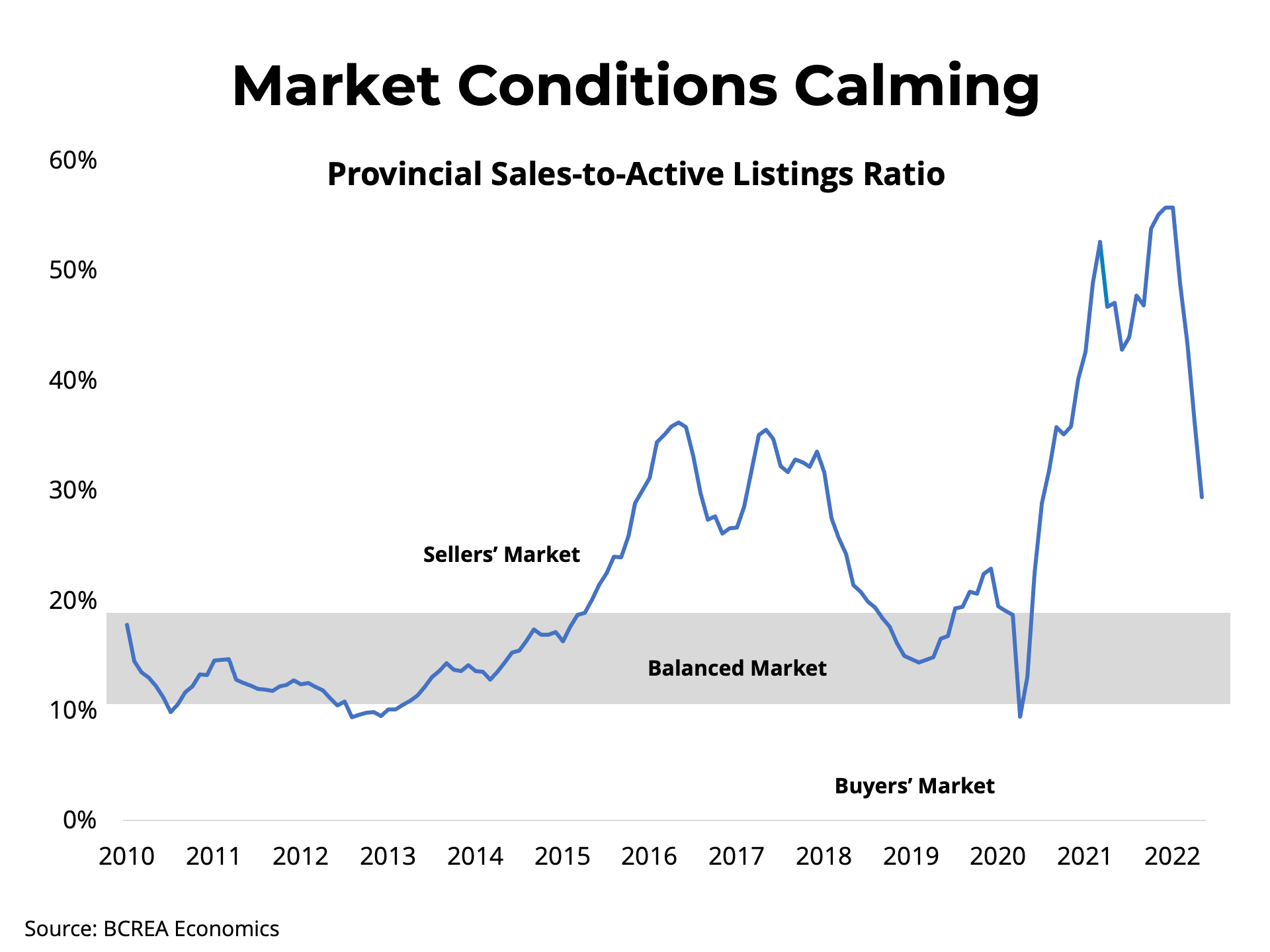
“Canadian mortgage rates continue to climb,” said BCREA Chief Economist Brendon Ogmundson. “The average 5-year fixed mortgage rate reached 4.49 per cent in June. That is the highest mortgage rates have been since 2009.”
Provincial active listings were 4.4 per cent higher than this time last year, the first year-over-year increase in active listings since 2019. However, active listings still remain below what is typical for a balanced market, though current market conditions have a high degree of variation across regions and product types.
Year-to-date, BC residential sales dollar volume was down 14.5 per cent to $46.7 billion, compared with the same period in 2021. Residential unit sales were down 26.3 per cent to 43,921 units, while the average MLS® residential price was up 16 per cent to $1.06 million.
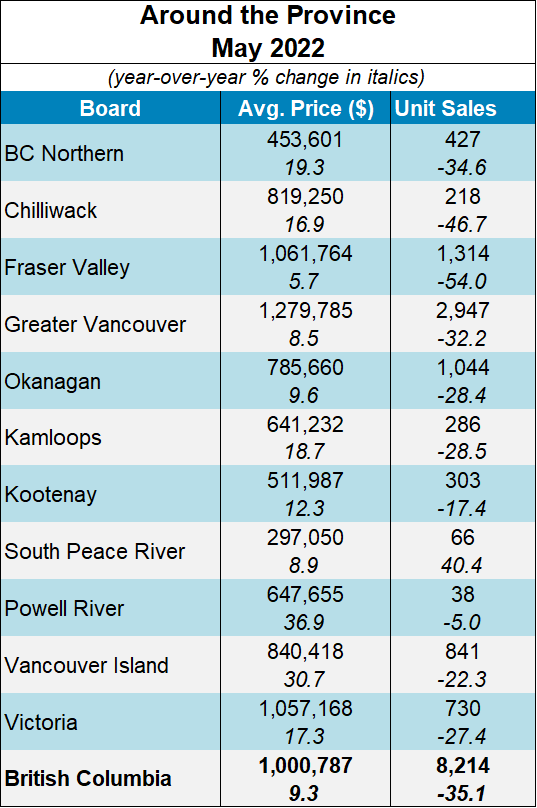
-30-
Risks and Pitfalls of Selling Park Model and Manufactured Homes with an Interest in Land
By Michael Drouillard and Brett Love, Guest Contributors
This article was based on a request made to BCREA's Legal Defence Fund for legal guidance. The Fund, through its Legal Defence Fund Committee, supports REALTORS®, managing brokers, and regional boards and associations by offering comprehensive legal and practical guidance. For further reference and to understand the evaluation criteria used, or to request additional guidance, please visit BCREA’s Legal Defence Fund page here.
Licensees sometimes come across land that is being sold with a park model home, a manufactured home, or other modular structure that is used as a permanent residence. In these cases, licensees are cautioned that additional inquiries are necessary to ensure their clients proceed with the transaction informed of the potential risks of buying such a property.
Park model homes (PMHs) are a type of home built according to recreational vehicle (RV) sector standards (CSA Z241). However, PMHs are significantly less portable than a typical RV and can only be moved with specialized towing equipment and permits for transportation.
PMHs are typically designed to be towed and occupied seasonally, but not as permanent residential dwellings. This distinguishes PMHs from manufactured homes. Manufactured homes are designed to be permanent residential accommodation and are built to a higher sector standard in terms of safety, quality, and durability (CSA Z240). Also, manufactured home ownership is recorded in the Manufactured Home Registry. There is no such registry for PMHs.
The most common risks and pitfalls with buying land that uses a manufactured home or a PMH as a permanent residence are as follows:
Zoning and Municipal Considerations
Frequently, zoning doesn’t permit a PMH or manufactured home to be used at a property as a permanent residence. For example, if a parcel of land is zoned for temporary accommodation for recreational vehicles, such as a campground or RV park, the zoning may not permit long-term accommodation. Zoning may also expressly prohibit PMHs.
Sometimes, the PMH’s use will predate the zoning bylaw, and the use of the PMH may be a legally non-conforming use. A licensee should recommend a client seek legal advice about legal non-conforming uses.
A licensee should always review the zoning for the property in question and consider whether the existing zoning permits the existing use of a PMH.
Tax Considerations
A licensee should not give a client tax advice. However, a basic understanding of potential tax considerations can help a licensee identify when a client should be advised to seek tax advice.
PST sometimes applies to the sale of PMHs and manufactured homes. The Province of British Columbia has issued a PST Bulletin with respect to how PST applies to sales and leases of manufactured buildings (PST 133).1 Whether PST applies to the sale of PMHs depends on whether the PMH is a chattel or a fixture, and whether the PMH is a new or used manufactured building. Generally, if a structure is new and is considered a chattel or tangible personal property (TPP), the buyer of the chattel will be required to pay PST.
GST sometimes applies as well. Typically, there is no GST when a PMH is sold with a land interest when it is being used as a permanent residence. However, GST can be a complicated matter requiring professional advice, and it is not always that simple.
A licensee should be particularly cautious when the sale of land includes the sale of a new and unoccupied PMH or manufactured home, and should always suggest a client obtain tax advice in that context. There could be PST and GST on the sale of the PMH or manufactured home.
Tenanted Properties
Another consideration for licensees selling a property with a PMH is whether the PMH is tenanted by a tenant who owns the structure. If that is the case, it is important to determine whether the Manufactured Home Park Tenancy Act (MHPTA) applies. Although the MHPTA typically does not apply to seasonal campground use, it could apply to an occupant of a PMH, even if the PMH wasn’t designed to be used on a permanent basis, and even though the PMH doesn’t have a manufactured home number. A very recent decision from the BC Supreme Court suggests that PMHs will be treated in the same manner as other RVs in making this determination.2
Summary
Licensees dealing with PMHs must make further inquiries when providing real estate services to clients. They cannot treat a PMH or manufactured home the same way as a conventional single-family home constructed with a building permit. There may be zoning and tax issues that prohibit the use or make it more costly, and if the structure is tenanted, this could add to the complexity. In our memorandum to BCREA, we suggest a list of due diligence steps a licensee should take when a client trades in real estate that has a PMH or manufactured home used as a permanent residence.3
| 1. | Government of British Columbia, Bulletin PST 133, Manufactured Buildings, Provincial Sales Tax Act, effective date: March 2013, accessible online at https://www2.gov.bc.ca/assets/gov/taxes/sales-taxes/publications/pst-133-manufactured-buildings.pdf. Accessed November 2, 2023. “Residential trailer park” is defined in section 123(1) of the Excise Tax Act. A full discussion of the meaning of residential trailer park is beyond the scope of this paper. | |
| 2. | Ball v Bedwell Bay Construction Ltd (cob Hazelmere RV Park and Campground), 2023 BCSC 1470. | |
| 3. | Recommended Practices for Licensees Selling a Park Model Home with an Interest in Land by Michael Drouillard and Brett Love. |
Royal Bank Appraisals; Personal Liability on Company Cheques #61
By Gerry Neely
B.A. LL.B.
From time to time suggestions are made for topics for Legally Speaking columns and, if they are of general interest and haven't been covered before, we will try to use them. One suggestion comes from the Vancouver Island Real Estate Board and it concerns a memorandum sent to all Royal Bank fee appraisers. Instead of providing an appraisal report with comparable reproduction estimates in support of market value, the appraiser for the Royal Bank need only complete on his letterhead an opinion as to market value which is based upon an external inspection of the property. On the basis of the appraiser's knowledge of sales in the neighbourhood and if the property is located in a built-up area of "similar type" residential properties where prices and market are stable, the appraiser need only state that he considers the present market value is reasonable for a mortgage of 75% or less of the present market value. For this, plus a photograph of the property, the appraiser receives $50.00. Those licencees who are members of the Appraisal Institute of Canada will be familiar with this request and the concerns expressed by that Institution as to the potential liability in negligence of an appraiser. As to this question of negligence or of a breach of the Hedley Byrne liability, one can generalize by saying that where the client limits the criteria upon which the licencee is expected to provide an opinion, then the facts which establish negligence or a breach of duty are also limited. However, the fact remains that opinions of these kinds can't be treated casually since the standard of care is established and a breach of that may create damages.
* * *
A case reported in the Business Law Reports attracted the interest of a licencee experienced in business.1 The facts were simple. The president of a company signed a cheque upon which the corporate name of the company was imprinted. The president did not indicate on the cheque that he was an officer of the company or that he was signing it on behalf of the company. When the cheque was presented for payment and it was dishonored, the payee sued both the company and the president. The president defended on the basis that he had only signed the cheque in a representative capacity as an officer of the company and not in his personal capacity. To his surprise, he lost. The reason is because of a general rule that any person who signs a cheque is personally liable unless that person states on the face of the cheque that he signs on behalf of another. There are circumstances in which this general rule may be avoided. If, for example, there is ambiguity on the face of the cheque, evidence may be introduced as to the intention of the party who signed it. However, the Court held that where the cheque was signed by one person, together with the name of the corporation, there was no ambiguity and the general rule applied.
The safest course for anyone signing on behalf of a company or a society or on behalf of any other person is to add the word "per" before the signature line, as well as the name of the office of the person signing the cheque. When you are having your corporate cheques printed, the word "per" should be added as a matter of course.
Have you ever noticed whether the printed cheques issued by your bank to your company have the word "per" on them?
| 1. | Hotz v. G. & G. Parkdale Refrigeration Ltd.,12 B.L.R. 300. |
To subscribe to receive BCREA publications such as this one, or to update your email address or current subscriptions, click here.
Royal Trust Company Mortgage Renewal Agreement #47
By Gerry Neely
B.A. LL.B.
Another case has decided whether or not a mortgagor with a low interest five year mortgage which was renewed during the period of high interest rates had the right to prepay it in spite of the terms of the renewal agreement. In this case, the mortgagors, on June 13th, 1977, had given a mortgage to the Royal Trust Company which matured on July 15th, 1982. As a result of the decisions referred to in Columns 38 and 39, the mortgagors would have had the right to pay off this mortgage at any time after June 13th, 1982. However, on June 29th, 1982, they executed an extension agreement which changed the maturity date of the mortgage from July 15th, 1982, until July 15th, 1987. Paragraph 2 of the extension agreement set the amount of the monthly payment, while Paragraph 3 gave the mortgagor the right to pay annually an additional ten per cent. Paragraph 5 contains the provisions which the mortgagee hoped would prevent the mortgagor from successfully using the provisions of Section 10 of the Canada Interest Act:
"5. Repayment of this loan and interest may only be made in the manner stipulated in Paragraphs 2 and 3 above with no further right of prepayment prior to the maturity Date of Mortgage Loan Renewal. You expressly waive any right of prepayment you now have or hereafter may have pursuant of Section 10 the the Interest Act (Canada) and/or any similar federal or provincial legislation permitting prepayment prior to the Maturity Date of Mortgage Loan Renewal. The Original Mortgage is deemed to be dated as of the Maturity Date of Existing Loan above captioned."
Paragraph 7 contained the usual provision that all terms and conditions contained in the original mortgage were to remain in full force and effect, except as amended by the extension agreement dated June 29th, 1982.
The mortgagor argued that Paragraph 5 was an attempt by the mortgagee to force the mortgagor to contract out of the benefits available to the mortgagor under Section 10 of the Interest Act. The general rule is that no one can contract out of a statute which is intended to lay down a rule of public policy. The reasoning behind this rule is that where parties to a contract possessed unequal bargaining powers, which is generally the case as between lenders and borrowers of money, then a statute passed to protect the borrower cannot be waived by him. If it were otherwise, then the statute would have no force and effect since each lender could compel a borrower to contract out of the statute and therefore defeat the intent of Parliament.
The argument of the mortgagee rested essentially upon the last sentence in Paragraph 5. By that sentence, the parties agreed that the original mortgage would be updated to July 15th, 1982. The Judge decided that the agreement of June 29th, 1982, was one in which the mortgagor and the mortgagee contracted to continue with their relationship as mortgagor and mortgagee on certain terms. One of those terms was that the mortgage relationship was to commence on July 15th, 1982, and to end on July 15th, 1987. That interval of time was not more than five years after the date of July 15th, 1982. Therefore, the agreement between the mortgagor and the mortgagee did not trigger the provisions of Section 10 and the mortgagor had no right to prepay the mortgage prior to the expiration date on July 15th, 1987.
The result: Royal Trust Company 1 - mortgagor 0. Perhaps that will not be the final score, because the decision is being appealed.
| 1. | Kaltenbach v. The Royal Trust Company, S.C.B.C. 48 B.C.L.R. 350. |
To subscribe to receive BCREA publications such as this one, or to update your email address or current subscriptions, click here.
Rule Changes – Overview
On June 15, the Office of the Superintendent of Real Estate's (OSRE) finalized Rule changes will come into effect. The Rule changes will include new requirements for licensee language proficiency, remuneration disclosure, a new relicensing education course, a ban on dual agency and new rules for conflicts of interest when acting for multiple clients. As a result, we're making some changes so we can continue to support you in your day-to-day business.

While BCREA has continued to advocate for a delay to implementing the Rule changes, we have also been hard at work to ensure REALTORS® have the knowledge and tools they need to succeed in this new landscape.
Of BCREA's core services, the most significant impact resulting from the Rule changes will be to Education and Standard Forms. To make sure the transition goes as smoothly as possible, we have been holding weekly meetings with representatives from the Real Estate Council of British Columbia (the Council), OSRE and UBC Sauder's Real Estate Division.
We have also been working closely with the Council and UBC Sauder's Real Estate Division to ensure that the changing education requirements of REALTORS® are reflected in the development of new course material. In addition, we have hosted two workshops so our instructors have the knowledge they need to teach the new material. You can read more about updates to BCREA courses in this issue.
Using the Council's interpretations of the Rule changes, we have revised our standard forms. They have been vetted by representatives from the Council and OSRE to ensure that, when used appropriately, they adhere to the new Rules. This issue contains an overview of the key changes. You can also learn more about the most important changes to Standard Forms on REALTOR Link® here.
The Council has also launched an in-depth information hub (called the Knowledge Base) on the Rule changes here.This is a great resource every REALTOR® will benefit from reviewing.
For more information on the Rules, see here.
To subscribe to receive BCREA publications such as this one, or to update your email address or current subscriptions, click here.
Rules of Cooperation: What Public Marketing Means
Remember when:
- contracts were a single page and included the commission agreement?
- telegrams and Telexes were common forms of acceptance?
- salesmen had CB radios (“Breaker, Breaker”)?
- exclusive listings were not a threatened species?
Wait – what?
Exclusive listings are a species? Now that we have your attention, it’s time to review recent history.
BCREA’s Professional Services Support Advisors were recently asked if removing or covering any reference to the Multiple Listing Service® (MLS®) on a “For Sale” sign avoided the definition of “public marketing” in the Canadian Real Estate Association (CREA)’s REALTOR® Cooperation Policy.
Let’s go through this slowly.
On Wednesday, January 3, 2024, the new Duty of Cooperation under the REALTOR® Code came into force. To quote CREA, “The core of the policy is that where public marketing of a property occurs, REALTORS® are required to place their listings on an MLS® System within the timeframe adopted by their board/association, which may be up to a maximum of three (3) days, unless an exemption applies.”
In the ‘hot’ market several years ago, it was not unusual to see a “Coming soon to an MLS®” sign on a property under contract with an Exclusive Right to Sell service agreement. The alleged purpose was to build urgency among agents and their buyers, resulting in multiple offers and hopefully leading to an enforceable contract, often at a price above listing.
CREA’s view was that such a marketing practice to a narrow group of consumers prevented “other REALTORS® from having the opportunity to cooperate on a transaction and their clients from having access to comprehensive property information on MLS® Systems during the home buying and selling process.”
In other words, some REALTORS® had joined the club in order to wave the MLS® flag with no intention of using an MLS®, “contrary to the purpose of membership in a cooperative selling system, and diminishing the efficiency, value, and benefits that MLS® Systems provide to REALTORS® and home buyers and sellers.”
So, what exactly is “public marketing?” CREA defines it as “any marketing to the public or anyone not directly affiliated with the listing brokerage / office, excluding one-to-one direct communication.”
Meaning, if you want to keep a listing exclusive and not place it on an MLS®, you can tell everyone in your own clubhouse (brokerages and their branches), but any outside communication or advertising must be one-to-one. It shouldn’t be a surprise, but social media is not one-to-one.
Okay, but can you list exclusively? Yes, but only after informing clients of the benefits of listing on an MLS® and, if the seller insists on an exclusive listing, confirming in writing that “they are declining the benefits of placing their listing on an MLS® System.”
What about exemptions?
Like Frank Sinatra’s regrets, there are a few as defined in Article 3 of CREA's REALTOR® Cooperation Policy: “exemptions include commercial listings (i.e., business properties, agricultural properties), new construction listings with multiple properties or units (i.e., residential development projects, condo development projects), and rental property listings.”
If you are interested in definitions or want to know why rental listings are exempt, consider reviewing CREA’s Frequently Asked Questions.
Safety and Manufactured Homes Pilot Project: Resources for Sellers and Buyers

Between April 11 and October 28, 2022, a pilot project is underway in the Association of Interior REALTORS® Southern Peace area regarding manufactured homes and electrical safety.
Normally, before a manufactured home can be listed for sale, a valid electrical safety certification or approval label or mark has to be in place. During the pilot project, sellers of manufactured homes in this area have the option of applying to Technical Safety BC for a variance that will allow them to list their homes before obtaining electrical safety approval. The approval will still need to be in place before a manufactured home can be sold, but the repairs and inspections can be done while the home is listed for sale.
This project is the collective effort of the British Columbia Real Estate Association, Association of Interior REALTORS® and Technical Safety BC.
We urge sellers and buyers to carefully review the following materials and to work closely with your REALTORS® if you decide to participate.
Here are some resources:
Sale of 100% the Shares of a Company Owning Real Estate Within the Definition of Real Estate “Employee” #241
By Gerry Neely
B.A., LL.B.
A 1981 decision of a judge of the Supreme Court of British Columbia goes some distance towards answering the question of whether licensees can sell the shares of a company which own real estate, and collect a commission for doing so. In addition, it may provide some support, little and perhaps too late, for those persons claiming the status of independent contractors, in insolvency proceedings involving their agent.
The facts were that shareholders of a company owning land adjacent to a golf course, which was to be developed for residential use, offered an individual a commission of $20,000, if he found a purchaser of their shares. The individual was not licensed under the Real Estate Act, and at his request, his status was stated to be that of a consultant or independent contractor, rather than an employee.
Eventually a sale was made, but payment of his commission was refused because it was argued that his actions brought him within the definition of an agent, and Section 37 of the Real Estate Act prevented him, as an unlicensed person, from enforcing payment.
Section I of the Act defines real estate to include a business, or a share in a business. That definition is not broad enough to cover the shares of the company that carries on the business of developing the real estate owned by it. The salesperson's argument was then, that the sale of shares was not a disposition of real estate, which required him to be licensed in B.C.
The judge referred to a 1951 Supreme Court of Canada decision concerning the interpretation of a similar section in the Ontario Real Estate Act. That case involved a commission payable when an option for the purchase of a majority of the shares of a company operating a business was signed by a prospective purchaser.
The question was whether the transaction fell within the definition of real estate. The S.C.C.'s decision was that the purchase of the shares of a company is not the same as the purchase of a property owned by the company. Therefore, the option contract did not fall within the definition of real estate, and the unlicensed salesperson could sue for commission.
The Ontario case dealt with a majority of shares, while the British Columbia decision involved 100% of the shares. The B.C. judge was prepared to use this distinction to say that, where all of the shares of a company owning real estate are purchased, then the transaction falls within the Section 1 definition.
His reasoning was that the purchase of 100% of the shares gave the individual purchasing them the power to deal with the assets of the company as if they were held in the purchaser/shareholder's name. If the B.C. case went no further than this, the salesperson was acting as an agent within the definition of that term in Section 1 and his claim for commission was barred because he was unlicensed.
The salesperson's response was that Section 2.1(1) exempted him because he was a "full-time salaried employee of a principal to a real estate transaction". The judge agreed that at least in the context of this subsection, "employee" included an independent contractor.
This liberal interpretation of the definition of "employee", contrasts with the restrictive interpretation contained in the HomeLife/Victoria case referred to in Column #227, that independent contractor status under the Real Estate Act is ulawful.1
| 1. |
|
To subscribe to receive BCREA publications such as this one, or to update your email address or current subscriptions, click here.
Sales Activity Remains Strong Heading into Spring
For the complete news release, including detailed statistics, click here.
Vancouver, BC – March 14, 2022. The British Columbia Real Estate Association (BCREA) reports that a total of 8,902 residential unit sales were recorded by the Multiple Listing Service® (MLS®) in February 2022, a decrease of 18.8 per cent from February 2021. The average MLS® residential price in BC was $1.109 million, a 24.9 per cent increase from $887,866 recorded in February 2021. Total sales dollar volume was $9.9 billion, a 1.5 per cent increase from the same time last year.
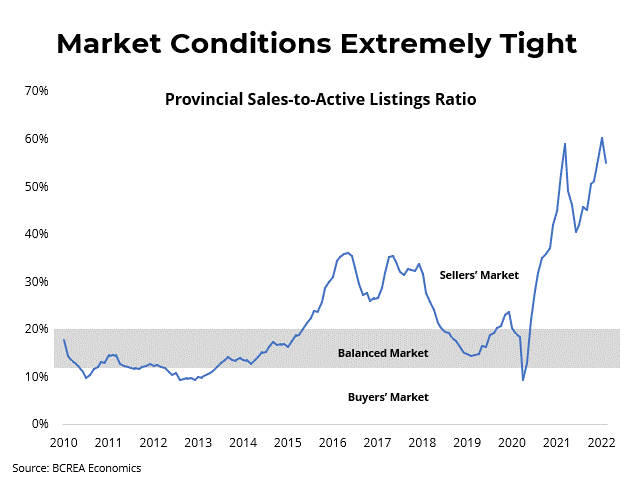
“While sales are not keeping pace with the unprecedented level of activity we saw this time last year, demand continues to be quite strong,” said BCREA Chief Economist Brendon Ogmundson. “There are some encouraging signs that listings are recovering from historical lows, but there is a very long way to go before markets achieve balance.”
Provincial active listings were 19 per cent lower than this time last year with the total inventory of homes for sale in the province at just 16,000 units. That level of inventory is well below the roughly 40,000 listings needed for a balanced market.
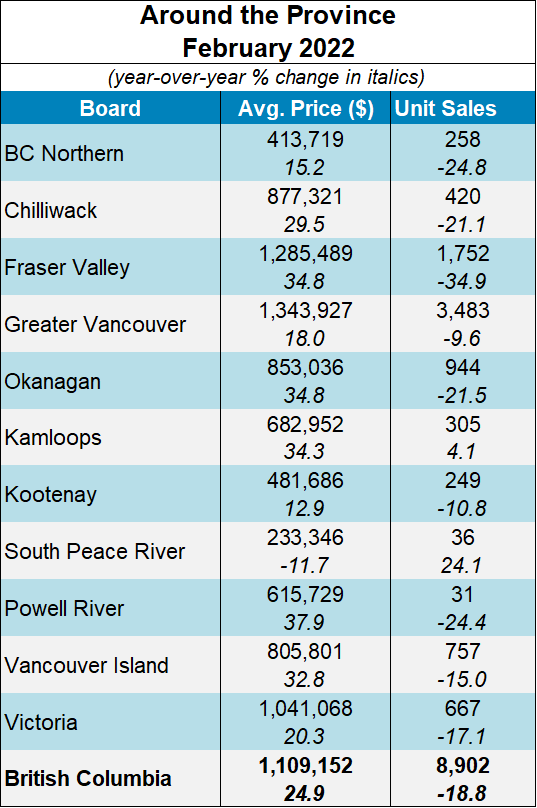
-30-
For more information, please contact:
Brendon Ogmundson
Chief Economist
Direct: 604.742.2796
Mobile: 604.505.6793
Email: [email protected]
Sales Continue Normalizing Trend in November
For the complete news release, including detailed statistics, click here.
Vancouver, BC – December 12, 2024. The British Columbia Real Estate Association (BCREA) reports that 5,841 residential unit sales were recorded in Multiple Listing Service® (MLS®) Systems in November 2024, up 25.7 per cent from November 2023. The average MLS® residential price in BC in November 2024 was up 1.7 per cent at $979,221 compared to an average price of $963,143 in November 2023.

The total sales dollar volume was $5.7 billion, a 27.8 per cent increase from the same time the previous year. BC MLS® unit sales were 12 per cent lower than the ten-year average for November.
“Home sales across the province continued the normalizing trend that began in October,” said BCREA Chief Economist Brendon Ogmundson. “The surge in activity this fall sets up 2025 for a much stronger start than we’ve seen in the last two years.”
Year-to-date, BC residential sales dollar volume is up 1.6 per cent to $68.6 billion, compared with the same period in 2023. Residential unit sales are up 0.8 per cent year-over-year at 69,983 units, while the average MLS® residential price is also up 0.8 per cent to $980,055.

Sales Slow in August, but Falling Rates Should Drive Activity Higher in the Fall
For the complete news release, including detailed statistics, click here.
Vancouver, BC – September 11, 2024. The British Columbia Real Estate Association (BCREA) reports that 5,943 residential unit sales were recorded in Multiple Listing Service® (MLS®) systems in August 2024, a 10 per cent decrease from August 2023. The average MLS® residential price in BC in August 2024 was down 1.7 per cent at $938,500 compared to an average price of $955,063 in August 2023.

The total sales dollar volume was $5.6 billion, an 11.5 per cent decline from the same time the previous year. BC MLS® unit sales were 22 per cent lower than the ten-year average for August. “After some encouraging signs of recovery in early summer, sales slowed again in August,” said BCREA Chief Economist Brendon Ogmundson. “However, with the Bank of Canada lowering rates for a third consecutive time and with fixed mortgage rates falling, we expect market activity to pick up in the fall.”
Year-to-date, BC residential sales dollar volume is down 3.3 per cent to $50.8 billion, compared with the same period in 2023. Residential unit sales are down by 4.6 per cent year-over-year at 51,505 units, while the average MLS® residential price is up 1.4 per cent to $985,609.

Sales Struggle Against a Weak Economy and Rising Mortgage Rates
For the complete statistics release, including detailed tables, click here.
Vancouver, BC – June 11, 2026. The British Columbia Real Estate Association (BCREA) reports that 6,790 residential unit sales were recorded in Multiple Listing Service® (MLS®) Systems in May 2026, down 2 per cent from May 2025. The average MLS® residential price in BC in May 2026 was down 1.4 per cent at $945,878 compared to $959,216 in May 2025.

Total MLS® residential sales dollar volume was $6.42 billion, down 3.4 per cent from the same time the previous year. BC MLS® unit sales were 26.39 per cent lower than the ten-year average for the month of May.
“Rising mortgage rates and a weak labour market continue to constrain activity around the province but especially in the Lower Mainland,” said BCREA Chief Economist Brendon Ogmundson. “The recent rise in mortgage rates presents an unexpected headwind for the market this year and may further delay a recovery in activity.”
Year-to-date, BC residential sales dollar volume is down 8 per cent to $25.1 billion, compared with the same period in 2025. Residential unit sales are down 6.9 per cent year-over-year at 26,681 units, while the average MLS® residential price is also down 1.2 per cent to $941,883.

Sales Trend Slightly Lower in August
For the complete news release, including detailed statistics, click here.
Vancouver, BC – September 13, 2023. The British Columbia Real Estate Association (BCREA) reports that a total of 6,608 residential unit sales were recorded in Multiple Listing Service® (MLS®) systems in August 2023, an increase of 15.7 per cent from August 2022. The average MLS® residential price in BC was $958,424, up 5.2 per cent compared to August 2022. The total sales dollar volume was $6.3 billion, representing a 21.7 per cent increase from the same time last year.
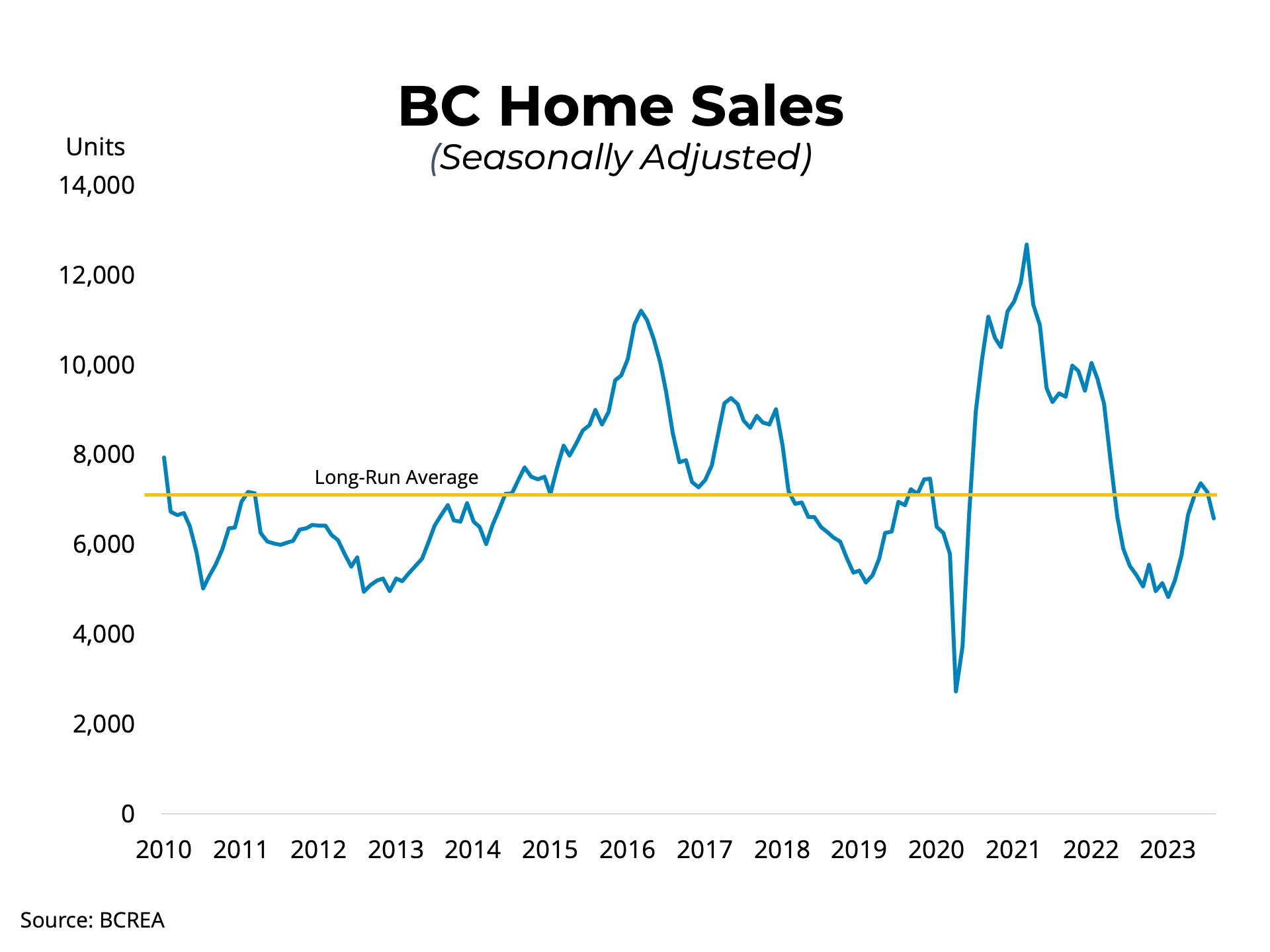
“Home sales are starting to settle back into a trend of below-normal activity following an unexpected surge in the spring,” said BCREA Chief Economist Brendon Ogmundson. “However, sales are in a much stronger place than expected given current mortgage qualifying difficulty.”
Active listings in the province were flat month-over-month at just over 31,000 total listings and up slightly year-over-year.
Year-to-date BC residential sales dollar volume was down 17.4 per cent to $52.7 billion, compared with the same period in 2022. Residential unit sales were down 13.4 per cent to 54,126 units, while the average MLS® residential price was down 4.6 per cent to $973,011.
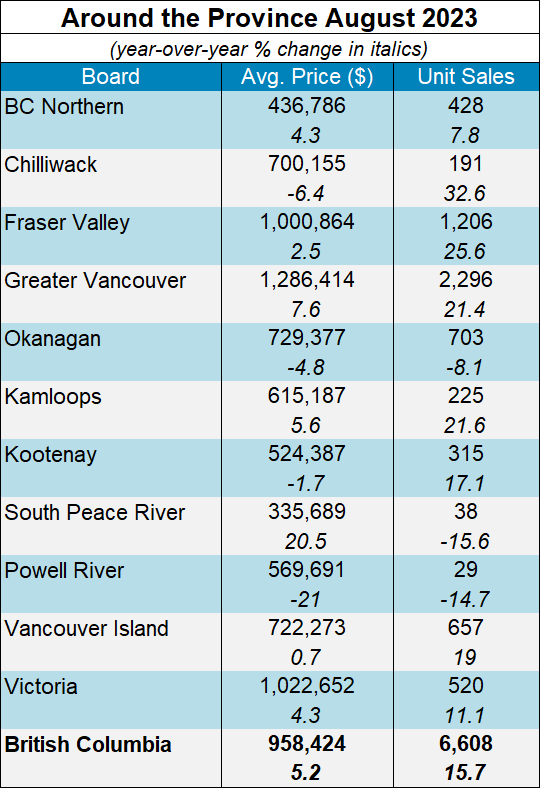
Salespersons’ Duty to Obtain Highest Price – Part 2 #75
By Gerry Neely
B.A. LL.B.
You have listed for sale a house, to be described in the ad as a handyman's special, which is located on a heavily-trafficked road in the middle of two blocks of mixed residential tenancy and low profit non-conforming commercial uses. Over the past ten years, repeated attempts to rezone the area commercial, the most recent of which was three years earlier, had all failed because of the municipality's refusal to extend services. The price reflected the pessimistic outlook for any change in the municipality's position.
Halfway through the six month exclusive listing and following the November elections and change of council, the new council voted to extend the services and to rezone the two block area. Experienced I.C. & I. Iicensees in your office were of the opinion that this would double land values, an opinion shared by other experts in a lengthy newspaper article featuring this development.
What do you do? Do you write your principal who lives out of town and is unaware of the development and suggest to him that he may wish to withdraw the property from the market or increase the price? Or do you just ignore the changed circumstances and continue to market the property at the listed price?
An indication of what you should do is found in a decision of a case that dealt with the rapid rise in value of real estate in Vancouver in the autumn of 1980 and early 1981. Prices were established between the licensee and the owner in listing agreements signed September 1st and September 16th, 1980, for the sale of a total of thirty six 99-year leasehold suites. Eighteen units were sold by October 1st and thirteen more were sold by October 24th. The first few sales were individual lots to individuals. The bulk of the remaining sales were made in groups of two or three while the last two sales were of eleven units to one individual. An offer to purchase the remaining five units in late November was made on behalf of a friend of the licensee. All sales and the last offer were made at the original listing prices. The owner was considering the last offer when he became aware that one of the units sold in September had been resold at nearly double the price the owner had received. The owner refused to accept the offer. Two of the five units listed initially at prices of $24,450.00 and $28,450.00 were sold in January, 1981, by the owner at about $50,000.00 each.
The owner sued for damages for failure to obtain the top price, arguing that either the prices set were too low at the beginning or the licensee failed to advise the owner of the explosive increase in prices.
The Judge held that there was no breach of duty by the licensee in the setting of the prices at the beginning. There was, however, a great deal of evidence from various sources, including the multiple listing service of the Vancouver Real Estate Board, that by September 30, the licensee knew or ought to have known "the market for the product he was selling was rapidly increasing and in duty to his client he was bound to go and speak to the owner and tell him."
The Judge held that by failing to give the owner the information the owner was entitled to, the owner was deprived of the opportunity of exercising his discretion in setting a proper price structure. Because the owner was deprived of this opportunity, the Judge held that he was entitled to damages on the basis of what that opportunity might have been worth.
The optimum damages the owner might have received would have been $300,000.00 had the owner been able to sell in January, 1981, the units for which sales were made October 24th. The evidence indicated, however, that rather than selling all of the units immediately, the last of the five units for which the offer had been made in November, 1980, was not sold until November, 1982, when the price had fallen to $34,000.00. One of the same suites had sold in March, 1982, at $59,500.00. The Judge mixed all of these ingredients together to come up with damages in the amount of $150,000.00, with prejudgment interest fixed initially at 17%.
As both this case and the case referred to in Legally Speaking #74 demonstrate, the licensee's duty is to keep on top of market prices and to advise the owner of current market prices.
| 1. | Virtue v. United Realty Ltd. et al,S.C.B.C. 1985 B.C.D. Civil 3799-01. |
To subscribe to receive BCREA publications such as this one, or to update your email address or current subscriptions, click here.
Salespersons’ Duty to Obtain Highest Price #74
By Gerry Neely
B.A. LL.B.
A short listing and a quick sale not only puts money in the bank and caviar on the toast, but it also avoids some of the problems for a licensee that can arise where property is on the market over a lengthy period of time and the salesperson's familiarity with it has conditioned him to believe that the owner's asking price is too high.
In an Ontario case, property was listed for sale in the fall of 1979 with one agent for the price of $29,900.00. It was listed with another agent in the fall of 1980 at the same price and relisted in the spring of 1981 for $25,900.00. The listing expired in December, 1981. In March, 1982, a salesman in the second office who had attempted to sell the property when the price was set at $29,900.00, brought an offer of $17,000.00 and strongly urged the owner to accept.
When agreement was reached at a price of $19,500.00, the purchaser flipped the property for $29,000.00. The owner subsequently learned of this and demanded the return of the commission retained by the agent, which the agent refused to do.
In the action that followed, the evidence established that the salesman genuinely thought that $17,000.00 was a good price. However, he acknowledged that he had no knowledge of current vacant land prices because he was involved in residential real estate sales. In the course of a very busy day during which three counter-offers were carried back and forth by the salesman, he either didn't have the time or didn't take the time to consider what his relationship was to the owner. In his evidence at trial, the salesman described himself as a middle man whose only responsibility was to bring a vendor and purchaser together.
The judge, however, held that his relationship was that of an agent to his principal, and his duty was to the owner who was ultimately to pay the commission. His duty included obtaining the highest price possible. His failure to perform this duty led to an order for the repayment to the owner of the commission.
This case illustrates the difficulty for a licensee whose duty is to his principal but who knows that a purchaser with whom he has been dealing is interested in buying a specific kind of property, such as vacant land, at a fire sale price. In this case the owner argued that the agent's duty was to ask the purchaser what would be the highest price the purchaser was prepared to pay. That the agent failed to do. When asked to assess the consequence of this failure, the judge said that even if the question were asked, there was no obligation on the part of the purchaser to answer the question truthfully or to answer it at all. Suppose, however, that the purchaser does say "I will pay $17,000.00 but I will go as high as $25,000.00." With that knowledge can the licensee do anything other than advise the owner not to accept the offer and to counter-offer? Apparently not, if the licensee is to discharge his duty to the owner and earn a commission.
As an alternative to being placed in this difficult position, the licensee could explain why it would be in the purchaser's interest to have the licensee act as the purchaser's agent, with the purchaser paying the commission. This will be a limited alternative, limited not only by the prevalent practice of the vendor paying the commission, but whether or not there is a written listing contract for the property to be purchased.
The owner had also sued for damages based upon the price actually paid by the purchaser and the price the purchaser might have paid. The agent was fortunate in that the judge decided that there was too little evidence as to the price the purchaser might have paid and declined to award damages. In the same circumstances, if these facts were before the Supreme Court of British Columbia, an award of damages might well have been made, as will be apparent from the facts of the case to be discussed in the next column.
| 1. | Lewis v. Simcoe Real Estate,33 R.P.R. 515. |
To subscribe to receive BCREA publications such as this one, or to update your email address or current subscriptions, click here.
Sanctions and Sanctions Evasion
By The AML Shop, Guest Contributor
This month we are exploring the concept of sanctions and sanctions evasion. Real estate brokers and sales representatives are required to report deals where there are reasonable grounds to suspect a connection to a money laundering or terrorist financing offence. As of August 2024, amendments to the Proceeds of Crime (Money Laundering) and Terrorist Financing Act (PCMLTFA) expanded these requirements to include an obligation to report deals where there are reasonable grounds to suspect a connection to a sanctions evasion offence.
The Canadian Sanctions Regime
Canada’s sanctions framework is primarily comprised of three pieces of legislation, the United Nations Act, the Special Economic Measures Act, and the Justice for Victims of Corrupt Foreign Officials Act (Sergei Magnitsky Law). Rather than placing an embargo on all economic activity with a targeted country (for example, the United States embargo on Cuba), Canadian sanctions laws adopt a focused approach, and each law is supported by regulations that specify the nature of the restrictions. Typically, those restrictions include one or more of the following:
- Prohibition on the provision of certain types of goods, services, and technological expertise.
- Prohibition on the purchase of certain types of goods from the targeted country.
- Prohibition on allowing ships or aircraft owned or used by the targeted country from passing through Canadian territorial waters or airspace.
Sanctions regulations also typically include lists of sanctioned persons or entities with whom it is prohibited to conduct or facilitate any type of financial transaction.
Sanctions Evasion
The PCMLTFA defines a sanctions evasion offence as “an offence arising from the contravention of a restriction or prohibition established by an order or a regulation made under the United Nations Act, the Special Economic Measures Act, or the Justice for Victims of Corrupt Foreign Officials Act (Sergei Magnitsky Law).”
It is worth noting that Canada maintains other lists of prohibited individuals and entities, most notably in the Criminal Code and the Freezing the Assets of Corrupt Foreign Officials Act. However, contravention of this legislation does not constitute a sanctions evasion offence, as defined in the PCMLTFA.
Indicators of Sanctions Evasion
Detecting sanctions evasion is similar to the process that reporting entities need to take when detecting money laundering, and there is an overlap between indicators of money laundering and indicators of a sanctions evasion offence. The difference is that money laundering often involves obscuring the identity of the people who conducted the predicate offence, whereas sanctions evasion involves obscuring the identity of a sanctioned person or entity.
The Financial Transactions and Reports Analysis Centre of Canada (FINTRAC) published a Special Bulletin on financial activity associated with suspected sanctions evasion which details common features that may indicate that a transaction is associated with a sanctions evasion offence. These include the following characteristics that may be relevant to a real estate transaction:
- Transactions involving intermediary jurisdictions: In order to contravene sanctions prohibitions, sanctioned persons and entities frequently need to make use of service providers and financial institutions that are based in a non-sanctioned country. Real estate brokers and sales representatives should keep an eye out for the involvement of parties that are based in, and transactions involving, countries that are known as regional financial hubs that maintain a commercial connection with the sanction jurisdiction. The United Arab Emirates, Türkiye, China, and Hong Kong are examples of countries that a sanctioned individual or entity may use to contravene sanctions restrictions.
- Transactions involving opaque corporate structures: In the November 2024 article “Determining Beneficial Ownership,” we examined the importance of understanding the beneficial ownership structure of the entities that REALTORS® deal with, as criminals often use legal entities to disguise the true beneficiary of a transaction. This is equally true for would-be sanctions evaders.
- Non-resident banking transactions: REALTORS® should pay extra scrutiny to deposits received from a financial institution that is located in a country to which the buyer has no apparent connection.
- Transactions involving proxies: Straw purchasers, nominees, and the use of complicit real estate professionals and / or law firms, are a great way to disguise the identity of the true beneficiary of a real estate transaction. As always, REALTORS® must take reasonable measures to identify any third parties involved in a real estate transaction, as well as to understand the nature of those relationships.
- Alternative financial channels: Due to their inclusion on a government-maintained list, sanctioned parties typically have difficulty accessing the traditional banking system. Deposit payments made or attempted using non-traditional means, such as virtual currency, could be indicative of an attempt to evade sanctions legislation.
The presence of any of these characteristics does not automatically require a report submission to FINTRAC. However, the presence of a single indicator should trigger REALTORS® to review the facts and context of the deal in conjunction with the indicator to determine if they lead to reasonable grounds to suspect a connection to a sanctions evasion offence.
While there is an overlap between indicators of money laundering and sanctions evasion, reporting entities need to expand their compliance program to include the detection and prevention of sanctions evasion offences.
In addition to requiring REALTORS® to submit a suspicious transaction report, in some instances, the detection of a sanctions evasion offence might also require the submission of a terrorist property report with FINTRAC and law enforcement agencies. We’ll explore terrorist property reporting requirements in more detail next month.
The article is provided by The AML Shop for BCREA, member boards and associations, compliance officers, managing brokers, and BC REALTORS® for informational purposes only and is based on The AML Shop's understanding of the regulatory and legislative standards in place at the time it was recorded. Those standards and FINTRAC's enforcement of them vary and change over time.
The AML Shop is not a law firm, and this article does not constitute legal advice. This summary may also not be applicable to your specific situation.
We encourage readers to verify the information’s accuracy and relevance before relying on it for professional or legal decisions.
This resource is made available with the generous support of the Real Estate Foundation of BC (REFBC).
REFBC is a philanthropic organization working to advance sustainable, equitable, and socially just land use across BC. REFBC funds projects, connects people, and shares knowledge. Learn more: refbc.ca.
Satisfactory Financing #121
By Gerry Neely
B.A. LL.B
Relief is in sight. This column is about a B.C. Court of Appeal decision which will make the addition of a conditional financing clause less of a hazard to the enforceability of an offer to purchase. Column 110 reported a B.C. Supreme Court decision which held that an offer to purchase was unenforceable because the conditional financing clause was too uncertain to permit the Judge to interpret what it meant. The offer in that case was subject to the purchaser obtaining "satisfactory personal financing."
The offer to purchase in the Court of Appeal decision contained a clause which made it subject to "Purchaser being able to arrange satisfactory financing on or before...." The purchaser claimed after the period for obtaining financing had expired, that he could not obtain financing satisfactory to himself. He then made a lower cash offer to purchase the home. The vendor sued the purchaser, arguing not only that the purchaser didn't try hard enough, but had never intended to try hard enough.
From the perspective of the vendor and licensees, the Court of Appeal took an encouraging approach to the interpretation of this clause. It stated "it is not the function of the courts to set interim agreements aside for uncertainty because they contain a clause which is not precisely expressed. If such a clause has an ascertainable meaning, then the courts should strive to find it. As long as an agreement is not being constructed by the Court, to the surprise of the parties, or at least one of them, the Court should try to retain and give effect to the agreement that the parties have created for themselves."
The Court of Appeal found that there was an obligation on the part of the purchaser to use his best efforts to obtain financing that was satisfactory to him, and that he was not to withhold his satisfaction unreasonably. The Court of Appeal set the test to be met by future judges in interpreting this clause, by saying that it meant "satisfactory to a reasonable person with all the subjective but reasonable standards of the particular purchaser."
No reference was made in the reasons for judgment to the many other decisions such as "satisfactory personal financing" or "suitable financing", or "satisfactory mortgage", all of which have found to be too uncertain to create a binding contract. Therefore only the clause contained in paragraph 2. should be used where the purchaser is uncertain as to which mortgage terms he may want or be able to obtain.
| Griffins v. Martens et al, Court of Appeal, Vancouver Registry C A007710. |
To subscribe to receive BCREA publications such as this one, or to update your email address or current subscriptions, click here.
Satisfactory Financing #214
By Gerry Neely
B.A., LL.B.
Subject to "satisfactory financing", while not a whim and fancy clause, has been analyzed in several earlier cases and again in a recent decision involving the cash purchase of a business. The purchaser's offer was subject to his arranging satisfactory financing.
He intended to do this through an institutional lender, whom he knew would base the decision to lend upon the appraised value of the property. The appraised value was found to be less than the price offered by the purchaser, and the lender refused to commit the amount the purchaser needed.
The vendors' offer to take back a mortgage from the purchaser was declined. A discussion took place concerning a reduction in price, but none was offered. This discussion, plus the purchaser's refusal to accept the vendors' offer of financing, led the vendors to argue that the purchaser's failure to complete was based upon his inability to negotiate a reduction in price, rather than the lack of financing to his satisfaction.
The sale did not proceed and the issue in this case was whether the purchaser was entitled to the return of the deposit. The judge decided that there was no evidence that the purchaser manipulated the appraisal, or made an offer to obtain the business at a lesser price.
He held that the purchaser acted reasonably in attempting to obtain satisfactory financing. In addition, the judge held that the offer of take-back financing amounted to a different transaction, and the purchaser was under no obligation to purchase on terms other than those contained in the offer.
In reaching his decision, that the purchaser was entitled to the return of the deposit, the judge referred to the case discussed in Column #121. In that case, the Court of Appeal said that satisfactory financing meant "satisfactory to a reasonable person with all the subjective, but reasonable standards of the particular person." 1
***
Several years ago, a lawyer questioned a purchaser's right to insist upon a holdback pending the receipt from Revenue Canada of a Clearance Certificate upon the sale of property owned by a non-resident, because the contract of purchase failed to authorize a holdback. This issue wasn't decided then, but was raised again in a case heard in Kelowna in September, 1993.
In the Kelowna case, the purchasers' solicitor asked for a holdback equal to 50% of the purchase price of a vacant lot. The vendor's solicitor, whose client resided in Hong Kong, wanted the percentage reduced to 33 1/3%. The vendor declined to sign the transfer documents, and when the purchasers sued for specific performance, one of the defenses they were met with was that an excessive holdback had been requested.2
According to the Reasons for judgment, where a Certificate of Compliance has not been obtained by a vendor, the purchaser is entitled to holdback 33 1/3 % of the purchase price where the vendor realized a capital gain, and 50% where a business profit was realized, (for example, if the vacant lot was inventory of the vendor.)
in answer to the vendor's objection that the purchasers produced no evidence to prove that the sale resulted in a business profit to the vendor, the judge said that it was not the purchasers' responsibility to examine the business affairs and history of the vendor, where such information and knowledge was peculiar to the vendor, to determine what rate of tax should apply.
Evidence was introduced that the practice in Vancouver in many transactions involving Hong Kong investors, is to holdback 50%. The judge accepted this evidence and ordered the vendor to specifically perform his contract by transferring title to the purchaser.
Revenue Canada Information Circular 72-17R4 contains an explanation of the properties subject to the different rates of tax, and a purchaser's liability for failure to ensure that the vendor complies with Section 1 16 of the Income Tax Act.
| 1. |
|
|
| 2. |
|
To subscribe to receive BCREA publications such as this one, or to update your email address or current subscriptions, click here.
Satisfactory Financing #248
By Gerry Neely
B.A., LL.B.
A seller tried to save a deal based upon a Contract of Purchase and Sale that was subject to the purchaser obtaining satisfactory financing, by offering to take back a mortgage when the purchaser was unable to obtain financing satisfactory to him. The purchaser refused this offer and successfully sued for the return of the deposit.
He was able to satisfy the judge that he had met the tests that his decision to decline conventional financing was reasonable, having regard to his circumstances,
The trial judge had said that the purchaser was not obliged to accept the seller's offer of financing, because that was a different deal from the one the purchaser had agreed upon. The Court of Appeal accepted this reasoning which is surprising.
There are a number of advantages for a purchaser who is offered a take-back mortgage, over the financing to be obtained from a conventional lender. Brokerage fees are not a factor and other costs, including legal costs, are generally less. Perhaps as important, the hoops a borrower has to jump through to obtain funds from a financial institution are avoided.
It is apparent from the reasons for judgment that there was a dispute as to when the take-back offer was made and upon what terms. The result might have been different if the offer of take-back financing was made in a timely manner and the terms of the mortgage were no more onerous than those required by a commercial lender. It would be difficult for a purchaser who rejected this offer to argue that he acted in good faith in attempting to secure satisfactory financing.1
***
One of the few cases where the question of whether a purchaser used his best efforts to obtain satisfactory financing was tested in an Alberta case, where under a conditional contract for the purchase of a home at $110,000, a $10,000 deposit was paid down and the purchaser was to obtain satisfactory financing for the remaining $100,000.
A bank refused to make the loan when the purchaser's explanation as to the source of the deposit monies was suspect. In an unsuccessful action by the purchaser for the return of the deposit, the judge said that the purchaser's failure to give concrete information in support of the
source of the funding was a failure to use his best efforts.2
***
The strata tide owners of a building used for commercial purposes decided to build an addition to it, and while this would change theconfiguration of the floors, it would continue to accommodate theexisting corporate tenants, and add some residential space. In order to achieve these results under the Condominium Act and the Land Title Act, the owners said that all they were required to do was to prove by special resolution the 'deemed' destruction of the building leading to the cancellation of the strata lots and the issue of a new title registered in the name of the strata corporation; to be followed by the transfer of the assets of the strata corporation to the owners in whose names title would be registered; and ending with the deposit of a new strata plan with strata lots conforming to the changed building configuration in the same owners.
The owners were attempting to avoid obtaining the approval of the municipality which is required upon, 'the conversion into strata lots of a previously occupied building.' While the main purpose of this section is to allow the municipality to preserve existing rental accommodation, its overall impact is to give the municipality the power to review the creation of a new strata plan of occupied buildings.
The owner's argument was that there was no conversion into strata lots because the process of converting from one strata plan to another was done in one single transaction, since all documents were filed in the Land Title Office simultaneously.
This argument was rejected because while the strata corporation remained in existence throughout this process, the strata plan and therefore the strata lots were extinguished. New strata lots were created upon registration of the second strata plan and therefore there had been a conversion for which municipal approval was required.
What this case points out is that we need an amendment to Section 57 of the Condominium Act, to allow for the amendment of a strata plan where additional residential space is being created and not potentially removed, so that the deemed destruction of the building with this complicated and expensive procedure is avoided.3
To subscribe to receive BCREA publications such as this one, or to update your email address or current subscriptions, click here.
Save the Date: Mastering Compliance 2.0 Coming October 2021
This post was updated on August 20, 2021, to incorporate that the Anti-Money Laundering Symposium has been moved to early 2022.
This October, BCREA will expand its anti-money laundering support for managing brokers and compliance officers with the launch of an updated online version of Mastering Compliance: Anti-Money Laundering Training for Brokers and followed by a virtual anti-money laundering symposium in early 2022.
About Mastering Compliance 2.0
Mastering Compliance 2.0 integrates learner feedback from the first edition of the program as well as newly released guidelines from the Financial Transactions and Reports Analysis Centre of Canada (FINTRAC) to create a new and improved Mastering Compliance 2.0.
This updated online version of Mastering Compliance includes the new June 2021 FINTRAC rules and guidelines. Each module is designed to help brokerages meet FINTRAC’s two-year effectiveness review requirements with confidence. As a self-paced, completely online program, it is specifically designed to allow you to work through it when it best suits your schedule. Completing the program will also give you nine accredited professional development hours to help you meet professional development requirements.
What Learners Say
“The Mastering Compliance Program is an excellent program for gaining a more comprehensive understanding of FINTRAC's compliance obligations. Thank you BCREA for providing ongoing training like this!”
“One of the best training programs available; every Managing Broker needs to take this course.”
“This course was extremely helpful in expanding my knowledge of FINTRAC I recommend every managing broker take it. FINTRAC is not going away and we all need to be prepared.”
With the new June 1 FINTRAC changes in effect and the success of the 2020 Mastering Compliance program, BCREA is launching Mastering Compliance 2.0. this October accompanied by an anti-money laundering focused symposium in early 2022.
Anti-Money Laundering Symposium to Give Insight into FINTRAC Examinations
Building on feedback from managing brokers and compliance officers, BCREA will host a virtual anti-money laundering symposium in early 2022. The symposium will bring together industry and anti-money laundering experts with managing brokers who have firsthand experience with FINTRAC examinations. Participants will gain new insights into the examination process, learning through the real-world experiences of others.
We look forward to the launch of Mastering Compliance 2.0 this fall and the BCREA Anti-Money Laundering Symposium in early 2022. More details and information on both the program and symposium will be available later this fall.
Section 28 Disclosure Statement #53
By Gerry Neely
B.A. LL.B.
Section 28 of the Real Estate Act was amended in 1981 to widen the requirements for disclosure to be made by a licensee prior to the purchase of real estate by the licensee or his associates. The amendment required the preparation of a disclosure statement "in the form and manner prescribed by the Superintendent," to meet what the public perceived to be the flipping of real estate by licensees (which must be the reason why some licensees refer to the disclosure statement as that "flipping form").
The importance of complying strictly with the amended Section 28 will be apparent from the decision reached in the case reported in this column. A company brought action against a vendor for specific performance of an interim agreement dated July 25, 1983, involving the sale by the vendor to the company of two lots to be subdivided from the vendor's property. The negotiations between the company and the vendor were conducted by a real estate licensee who was an officer of the company with a financial interest in it. The interim agreement contained the following disclosure statement by the agent:
"John Doe, real estate agent, has an interest in Compar Services. No commission is payable by vendor."
The vendor unilaterally cancelled the agreement and the company's action for specific performance was met by the defense that the vendor had never received a statement in writing as required by Section 28. There was evidence that the vendor was aware that the licensee with whom she was negotiating was a real estate agent. The licensee's evidence referred to discussions that had taken place over a six month period preceding the date the offer was accepted, during which he had made known to the vendor this status. In addition, he had been endeavouring to sell property owned by a neighbour of the vendor and the agent's signs appeared on that property.
The Court reviewed former Section 28 and the Section 28 provisions which replaced it, and concluded that the 1981 amendments placed a much heavier burden on licensees. It agreed that there had been a failure to comply with Section 28, the effect of which was to make the interim agreement voidable at the option of the vendor. Since she was entitled to cancel the agreement, the company's action for specific performance was dismissed.
The first mistake of the licensee arose from the failure of the licensee to disclose his interest in writing prior to making the offer. The second and major point to take from this judgment is that the form prepared by the Superintendent must be used by licensees. Not only is it to be used, but the formalities of signature and delivery of the various parts of the form must be observed by licensees. That is evident from the reference made in the reasons for judgment which are repeated below, to the manner in which the form is to be used.
"The form is to be completed in triplicate; the vendor is to acknowledge receipt of notice of the declaration which is to be witnessed by someone other than the purchaser and a copy of the notice signed by the vendor is to be filed with the Superintendent."
The Courts will interpret Section 28 strictly against licensees on the basis that it was enacted in order to protect the public. Therefore this decision will be followed in cases where the real estate agent purchaser has not complied with the Act and the vendor has elected to treat the contract as void.
| 1. | Compar Services Inc. v. Lilly Foss,S.C.B.C. 49 B.C.L.R. 364. |
To subscribe to receive BCREA publications such as this one, or to update your email address or current subscriptions, click here.
Section 30 Real Estate Act #78
By Gerry Neely
B.A. LL.B.
This is the section that prohibits payment of any commission or other compensation to any unlicensed person for "acting or attempting or assuming to act, as an agent or salesman."
BCREA has been asked whether payment of a tip for a tip that leads to a listing, is a breach of Section 30. This involves the $100.00 payment, or a bottle or case of scotch or the dinner you bought the member of your breakfast information club who provided you with the name of the couple who purchased your listing, or the 25% of a commission which a hardnosed business associate says he wants if the information he gives you results in a sale? Are these breaches of Section 30?
There do not appear to be any reported decisions dealing with this section. I have been told that there was a case a few years ago in which a licensee was charged with an offence under this section of the Act and was acquitted. Perhaps someone reading this column may be able to provide me with sufficient details about the case to reveal the facts which appeared to constitute the offence.
An Alberta prosecution dealt with a man whose business consisted of obtaining from a number of sources a referral list of residential properties for rent in the Edmonton area. This information was available to a customer who paid a fee. The accused did not show any properties, did not negotiate any terms or rental and did not act as a rental agent. He supplied information only and his fee was not dependent upon whether the customer was able to lease any premises. On the basis of these facts, the businessman was charged with an offence under the Alberta Real Estate Agents Licensing Act which is similar to the Real Estate Act. The offence was that he unlawfully traded in real estate without being licensed. He was convicted but on appeal the Alberta Court of Appeal acquitted him holding that he neither acted as an agent nor held himself out as an agent. Merely supplying information for his own profit was not an offence.1
This case provides some guidance as to how a B.C. Court might (not will) interpret Section 30 to decide that it is not an offence for a licensee to pay some compensation to an unlicensed person for the name of a prospective vendor or purchaser. It will be argued that merely providing information is not an action that brings the unlicensed person within the definition of an agent or a salesman licensed under the Real Estate Act.
In 1955 the Saskatchewan Court of Appeal held that the action of an unlicensed employee of a real estate agent who took a listing brought that transaction within the definition of an act done by a salesman. The result was that the contract for which the agent was suing for commission was illegal and no commission was recoverable. This was the first case in Saskatchewan to decide what acts a licensed salesman had to perform. It was argued that the act of taking the listing was merely a clerical function. The Court said that for this argument to succeed, a licensed salesman must have first seen, interviewed or talked to the owner before the physical act of writing up the listing by an unlicensed employee became only a clerical function.
This case indicates where the risk of a breach of Section 30 may arise. That is, where the delivery of the information is also accompanied by work done by the unlicensed person which would be held to be acts that an agent or salesman would do. The obvious example would be payment of a portion of the commission to an unlicensed person who actively assists the licensee in the sale of the listed property.
A trifling payment in cash or kind is unlikely to create a problem and an educated guess suggests that even payment of a substantial sum for information only, will be held not to be a breach of Section 30. Until that section is interpreted by a Court whose decision sets a precedent, licensees can only rely upon their common sense and good judgment to decide whether they are at risk from a proposal made by an unlicensed person for compensation in return for information.
| 1. |
Regina v. Clarke, (1973) 3 W.W.R. 666. Prince Albert Properties and Land Sales Ltd. v. Kushneryk, (1955) 5 D.L.R. 458. |
To subscribe to receive BCREA publications such as this one, or to update your email address or current subscriptions, click here.
Section 36 of the Real Estate Act; Backup Offer, appeal of (Col. 89) #127
By Gerry Neely
B.A. LL.B
This Section prevents a licensee from retaining a commission which is based upon the difference between the price at which real estate is listed for sale, and the actual price obtained. The Nova Scotia Real Estate Brokers Licensing Act contains a similar provision which a salesman there hoped did not apply to the following facts.
An apartment owner told a salesman that if he brought an offer of at least $475,000, the owner would pay the agency for which the salesman was working a commission of $10,000. In addition, the owner said that the salesman could keep anything in excess of $475,000. An offer of $485,000 was accepted, the commission of $10,000 was paid, and the salesman started to have second thoughts. This led to the salesman offering to take $5,000 instead of $10,000 and an eventual compromise at $2,000.
This amount was never paid, and the salesman sued successfully. The trial judge concluded that while the original agreement to pay the additional amount was illegal and unenforceable, the subsequent agreement to compromise the commission created a new and enforceable contract based upon the salesman's agreement not to sue for the $10,000.
This decision was appealed successfully by the owners to the Court of Appeal of Nova Scotia. It stated that since the original agreement was prohibited, the Court would not enforce a subsequent contract based upon the illegal contract made by the salesman with the owner.
Anyone contemplating an agreement of this kind in British Columbia would also be in breach of Section 33 of the Real Estate Act.1
* * *
Column 89 discussed the facts of a case in British Columbia where the owner accepted a backup offer and then agreed to amendments to the first offer accepted by him. The backup offer was "subject to the non-completion or collapse of the offer to purchase from...." Although the changes to the first offer only involved an increase in the deposit and an extension of the date for completion, the trial judge held that they amounted to a renegotiation of material terms of the first contract that resulted in its cancellation or non-completion. Damages of over $150,000 were awarded to the backup purchaser.
That decision was appealed successfully by the owner. The Court of Appeal agreed with the owner's argument that the changes did nothing more than to amend the original offer (in certain non-fundamental details) while affirming the continuing existence of that contract. This decision depended upon the interpretations of the meanings of "collapse" and "non-completion." Had there been different wording in the backup offer then the award of damages against the owner might have been upheld. That is why it is important to use wording which will protect the owner. An appropriate clause is contained in the B.C.R.E.A. Clauses and Phrases Manual.2
| 1. | Metlege v. Ryan, 113 DLR (3d) p. 248. | |
| 2. | B.D. Management Ltd. v. Tajico Holdings Ltd., B.C. Court of Appeal CA006350. |
To subscribe to receive BCREA publications such as this one, or to update your email address or current subscriptions, click here.
Seeking BCREA Appointee to the Real Estate Foundation of BC
The BC Real Estate Association (BCREA) Board of Directors is seeking an appointee for the Real Estate Foundation of BC’s Board of Governors. This appointment term would commence April 1, 2022.
About the Real Estate Foundation of BC
In August 1985 the British Columbia real estate industry, in cooperation with the BC Ministry of Consumer and Corporate Affairs, established the Real Estate Foundation as a non-profit corporation under the Real Estate Act. On January 1, 2005, the Real Estate Services Act and the Real Estate Development Marketing Act replaced the Real Estate Act. The Foundation continued under the Real Estate Services Act.
The purpose of the Foundation is to undertake and carry out real estate public and professional education, real estate law reform, real estate research and other projects intended for the public or professional good in relation to real estate activities and to undertake and carry out projects and activities that the Minister designates as being in the public interest.
Call for Letters of Interest
Responsibilities include:
- Governing in public interest;
- participating in Board affairs;
- understand the organization’s mandate;
- participate in the development, review, and approve the strategic plan;
- select, appoint, compensate, evaluate, and terminate the Chief Executive Officer;
- review financial and corporate issues; and
- review and consider staff grant recommendations.
The Board operates within the broad policy direction prescribed by section 93 (1) of the Real Estate Services Act.
If you are somebody who has the following attributes and competencies, we would love to hear from you:
- strong real estate experience;
- governance experience;
- a commitment to advancing equity, diversity, and inclusion; and
- a commitment to learning and strengthening relationships with Indigenous Peoples and governing entities.
For the full list of desired personal attributes & competencies, please click here.
While previous experience as a governor is not required, it is important that Governors understand the roles and responsibilities of a member of a not-for-profit governing board and have the necessary experience and demonstrated skills to enable them to contribute to board planning, decision-making and oversight.
Time and Term Commitment
The amount of time a Governor spends on Foundation business varies from month to month, and from person to person. A Governor can expect to spend a minimum of eight in-person days on Foundation business throughout the year. This does not include committee, meeting preparation or travel time.
In addition, Governors are requested—individually or as a Board—to attend special events from time to time.
Each member is appointed for a one to three-year term and may serve up to six years in a row.
How to Apply
For the full Governor role description, click here.
If you have questions about the vacancy or wish to apply, please submit a letter of interest and current resume to the attention of the BCREA Nominating Committee at [email protected] by February 11, 2022.
The BCREA Nominating Committee thanks all applicants; however only those selected as potential candidates will be contacted.
Self-Directed Learning: Coming to the PDP January 1!
Self-directed learning will be introduced to the Professional Development Program (PDP) on January 1, 2020. To find out more about self-directed learning and how it fits into the PDP, click here. Below, we've answered five of the most frequently asked questions about self-directed learning:
1. I am taking a learning opportunity in 2019 that meets the criteria for self-directed learning. Does this count toward my self-directed PDP hours?
No. You can start earning self-directed PDP hours for learning opportunities taken on or after the January 1, 2020 transition date. Learning opportunities that you complete before this date cannot be used toward self-directed PDP hours.
2. My licence is up for renewal in 2020 and I’ve already fulfilled my PDP requirements. Does this mean I also have to earn six hours of self-directed professional development before my licence renewal?
No. Your board will convert the PDP credits you’ve earned within your current licensing cycle to PDP hours on January 1, 2020. Therefore, if you’ve already fulfilled your PDP requirements, you are not required to take additional professional development before your next licence renewal.
3. How do I know if a learning opportunity will count toward my self-directed PDP hours before I take it?
To start, ask yourself if the learning opportunity will be verifiable and auditable by your board, meaning you can provide proof of completion; if it will enhance your professional practice; and if it’s a minimum of one hour long. If the answer is “yes” to all three, the learning opportunity will likely count toward your self-directed PDP hours! If you’re not sure, check with your local board.
4. Why do self-directed learning opportunities have to be a minimum of one hour long?
Both self-directed and accredited learning opportunities must meet a minimum standard of one hour to ensure a beneficial learning experience. The one-hour minimum also offers you more flexibility, as the minimum under the current program is three hours, and simplifies the reporting and tracking of your PDP hours.
5. My brokerage offers training that enhances my professional practice and is at least one hour long. How can I use this toward my self-directed PDP hours?
Self-directed PDP hours must also be verifiable and auditable, meaning you can provide proof of completion to your board. For brokerage training to count toward self-directed PDP hours, your managing broker will need to provide you with this proof of completion. BCREA and boards are preparing examples of what this documentation could look like and will make these available to managing brokers later this fall.
For a more detailed list of frequently asked questions about the new PDP framework, click here. If you have additional questions, please contact your board or email [email protected].
To subscribe to receive BCREA publications such as this one, or to update your email address or current subscriptions, click here.
Seller Entitled to Collect GST From Buyer, Notice Given After Transaction Closed #312
By Gerry Neely
B.A., LL.B.
There have been a number of decisions across Canada in the past year or so concerning a seller’s right to recover from the buyer of real property the GST paid by the seller that should have been paid by the buyer. The question in each case was whether notice that GST was payable on the transaction had been given by the seller to the buyer as required by the GST legislation. Some decisions were based upon the view that the legislation was designed to protect consumers who were entitled to know the cost of the purchase. Therefore, notice had to be given by the seller before the transaction completed. Other decisions were based upon the mandatory obligation of the buyer to pay GST, and that it was irrelevant whether notice was given before or after the date of closing.
A recent BC case involved a buyout of a shareholder of a company through the sale to the shareholder of a lot valued at $130,000. Fifteen months after the transaction closed, Revenue Canada demanded payment of GST from the company. A written demand by the company for payment setting forth the amount that was due, was rejected by the buyer.
The Judge’s opinion was that the demand letter was sufficient notice by the seller to comply with the GST legislation and ordered repayment of the amount of the GST to the seller. The company failed to recover penalties and interest because the seller has a mandatory obligation to pay the GST on time despite the buyer’s failure to do so.1
* * *
Column 309 referred to the personal liability of a director of a company for the breach of the statutory trust provisions contained in the Alberta Condominium Property Act. We now have similar reasons for judgment in a British Columbia case dealing with breaches of trust provisions of the Builders Lien Act. The Act creates a trust of funds received by a contractor or sub-contractor on account of the contract price for the benefit of among others, workers and material suppliers.
A limited company carried on a landscaping business. The directors were three brothers, one of whom was the "operating mind" of the company. When they found that they couldn’t pay their bills, they started a new company. A supplier of turf and soil to the first company sued both companies and the three brothers. The monies received from their various projects were put into the general account of the company, from which all debts and draws to the shareholders were paid. This was done in complete disregard of the trust priorities available to workers and material suppliers.
The brother, as the "operating mind" of the company, was held to be personally liable for 100 per cent of the amount due to the turf and soil supplier. The other two brothers, who had benefited from the breaches of trust through their draws, were liable to the turf and soil supplier in the amounts they had received.
In addition, the latter two brothers had used part of the funds they received to pay down mortgages on several properties they owned. Since it was possible to trace the monies they received to the trust fund, the turf and soil supplier was able to file liens against their properties to secure payment of the amount due to it.2
To subscribe to receive BCREA publications such as this one, or to update your email address or current subscriptions, click here.
Seller Entitled to Refuse Uncertified Third-Party Deposit; Ask Gerry #397
By Gerry Neely
B.A. LL.B.
In a case where a seller refused to accept a deposit cheque, a Supreme Court judge gave an answer to a problem we didn’t know we had in the Contract of Purchase and Sale (CPS).
The seller had agreed to sell his property for $975,000, but wanted the buyer to pay the deposit of $20,000 directly to him. The second paragraph of the CPS, the deposit section, was altered by the handwritten addition: “Upon all subject removals $20,000 will be paid to (seller) and become non-refundable.”
Immediately following this sentence, the printed portion of the second paragraph reads as follows: “All monies paid pursuant to this section (Deposit) will be delivered in trust to (brokerage) and held in trust in accordance with the provisions of the Real Estate Act.” This sentence wasn’t deleted, but should’ve been because of the obvious conflict between it and the previous sentence.
The conditions were removed on the last day available to the buyer, who delivered the deposit late to the listing agent in the evening. This is where the contract went sideways—two deposit cheques were issued by business partners of the buyer, who were neither parties to the contract nor known to the seller. The seller refused to accept a replacement cheque from the buyer the following day. He asserted that the tender of payment pursuant to paragraph 10 was defective because time was of the essence, and delivery of the buyer’s cheque was too late. As per paragraph 10 of the CPS, “Tender or payment of monies by the Buyer to the Seller will be by certified cheque, bank draft, cash or Lawyer’s/Notary’s trust cheque.”
When the buyer sued for specific performance, the seller contended the cheques weren’t certified. The buyer’s argument was that paragraph 10 only applied to the tender of monies payable on completion, an argument supported by evidence that this was the custom in real estate transactions. However, the judge didn’t agree that paragraph 10 should be interpreted as if “monies” and “the balance of the purchase price” meant the same.
The seller’s defence that he should’ve received the buyer’s certified deposit cheque succeeded. Because of this decision, the judge didn’t deal with the question of whether the use of third-party cheques breached paragraph 10.1
A licensee asked whether a CPS that’s subject to a buyer arranging financing is too uncertain to be enforceable. Decisions from the late 1980s held that contracts subject to “satisfactory personal financing,” “suitable financing” and “satisfactory mortgage” were all uncertain.2 However, column 121 discusses the interpretation of a contract conditional upon the buyer being able to “arrange satisfactory financing.” The BC Court of Appeal decided this wording had “ascertainable meaning” and was not uncertain. This decision was followed in the BC Supreme Court case referred to in column 214.
Another licensee asked whether a disappointed buyer’s agent, whose offer at the price and upon the terms of the Multiple Listing Contract was rejected by the seller, could sue the listing agent for the share of commission offered to a buyer’s agent. The answer is no. The listing agent only agrees to pay a portion of the commission to the buyer’s agent who assists in obtaining someone who buys the property, not someone whose offer is rejected. See column 307 for more information.
| 1. | Germain v. Kapchinsky, SCBC, Kelowna Registry, Reasons for Judgment, February 23, 2006. | |
| 2. | Legally Speaking 110. |
To subscribe to receive BCREA publications such as this one, or to update your email address or current subscriptions, click here.
Seller’s Remorse Not Rewarded #494
Too often this column focuses on a REALTOR®'s error or mistake resulting in the REALTOR®'s censure by either a court or the Real Estate Council of British Columbia. Such columns, while concentrating on the negative aspects of practice, are essential in providing REALTORS® with an understanding of the appropriate standard of care and duty expected of them in their day-to-day practice. With that in mind, it is refreshing to report that not all practice is viewed through such a negative lens.
In a recent decision of the BC Supreme Court,1 a former client blamed their listing agent for not obtaining them substantially more money from the sale of their house. They had listed their house with several REALTORS® with no success. The sellers chose their last REALTOR®, whom they eventually sued, in large part because she was the listing agent for a property across the street.
The sellers listed their property for $10,000 less than the property across the street. They received an offer close to $100,000 below the listing price. They alleged that the listing agent "pressured" them into accepting the low offer. The listing agent deposed that she had told the sellers it was up to them whether to accept, reject or counter the offer. Although not known to the sellers at the time, the house across the street sold for almost an identical amount. After accepting the offer, the sellers learned of another house in the neighborhood that had sold for almost $225,000 more than theirs. The sale of this neighboring property was entered into a week before the sellers accepted their offer, although that sale did not become unconditional until some two weeks after the sellers had accepted their offer. The sellers deposed that they would not have accepted the offer they received had the listing agent advised them of the other sale.
The sellers claimed that the listing agent was negligent in not providing them with a comparative market analysis that would have disclosed all the properties in the neighborhood, negligent in not discovering the pending sale of the property that sold for close to $225,000 more than theirs, and in a conflict of interest by concurrently listing two competing properties across the street from each other.
The Court dismissed all of the sellers' claims. While agreeing that the listing agent owed a duty of care to the sellers, the Court found that the sellers had not provided any evidence as to what that standard of care might be and, as such, had not established that the listing agent had breached the standard of care.
On the issue of the alleged conflict of interest, the Court concluded that there was no authority for the proposition that acting as the listing agent for two properties in the same neighborhood gave rise to a conflict of interest; if it did, the sellers had expressly waived such conflict, as they were fully aware of the other listing at the time they engaged the listing agent.
The sellers' main complaint was that they were not made aware of the pending sale, which turned out to be close to $225,000 more than the offer they accepted. However, the Court concluded that those details would not have been available to the listing agent until after that pending sale had become unconditional, which was after the time the sellers were considering their offer. In dismissing the claim, the Court concluded that "the defendants did not have a legal duty to obtain the best possible price for the property. Rather, a REALTOR® has an obligation to act in accordance with the applicable standard of care for giving advice on price for a property."
It is not unusual for sellers or buyers, with 20/20 hindsight, to conclude they should not have entered into a particular transaction and to claim that their REALTOR® "pressured them into entering into the agreement" or conversely that their REALTOR® "should never have allowed them to enter into the agreement." It is the REALTOR®'s function to make sure that their client has all pertinent and available information before them, so that the client may make an informed decision. It is not the REALTOR®'s function to make that decision for them.
Brian Taylor
Norton Rose Fulbright LLP
| 1. |
|
Sellers Right to Recover Tax Paid on Behalf of a Buyer #261
By Gerry Neely
B.A., LL.B.
Generally, the GST legislation makes a buyer of property, upon which GST is payable, responsible for its payment. The seller has the responsibility, as agent for the Crown, of collecting and remitting it. The question of the seller's rights when the buyer fails to pay the GST, was the subject matter of a B.C. case involving the sale of property used for both residential and commercial purposes.
The upper residential portion was exempt from GST which however, applied to the lower part used for commercial purposes. When Revenue Canada discovered that the sale had taken place, GST of almost $20,000 was assessed. The buyer refused to pay and Revenue Canada refused to collect it directly from the buyer, although it has the authority to do so. By the time the various avenues for self-help taken by the seller ended, interest and penalties had accrued and the seller eventually paid $26,500 to Revenue Canada.
Having paid the tax, Section 224 of the Excise Tax Act gave the seller the right to sue the buyer to recover the tax, as if the amount of the tax was a debt due to the seller rather than to Revenue Canada. However, there is a condition attached to this remedy.
Section 223 requires the seller to have notified the buyer by an invoice, receipt, or in the agreement entered into with the buyer in respect of the sale, that GST is either included in the purchase price or is added to it. No reference to GST was added to the printed form of contract between the parties. No notice of the addition of GST to the purchase price was given to the buyer until 2 1/2 years after the sale closed, when it was given, no doubt, as a preliminary step to support the litigation that followed.
The buyer's arguments that the invoice was given out of time and did not comply with Section 223, were based upon a decision in an Ontario case where a seller sued unsuccessfully to recover from a buyer the tax paid by the seller. In that case, neither the contract, nor the statement of adjustments between the parties, made any reference to GST. The invoice setting out the buyer's liability was sent to him months after the closing, when the failure to pay GST was discovered upon an audit of the seller's books by Revenue Canada.
Compliance with Section 223 is essential to the success of a seller's claim, because of a decision by an Alberta court that if there is non-compliance, there is no other remedy available for a seller to collect the tax. Accordingly, the Ontario seller's action was dismissed because of non-compliance with Section 223.
That probably would have been the end of the British Columbia seller's action except for the fortuitous circumstances, that the parties used the commercial Contract of Purchase and Sale, prepared for the IC&I division of the Victoria Real Estate Board. It contained a clause with respect to GST, a clause in which each party covenanted and agreed to comply with the provisions of the Excise Tax Act, Part IX.
Where the contract doesn't state how GST is to be treated, tax of 7% is added to the purchase price. The judge interpreted this clause to mean that since the buyer is liable for GST, the parties always intended that GST would be added to the sale price.
The seller was given judgment against the buyer for the GST she had paid. However, since Section 224 only referred to the recovery of GST paid by a seller, she did not obtain judgment for the penalty and interest of approximately $6,500. Recovery of that amount awaits the result of further litigation.
It appears from the Reasons for judgment, that the buyer disregarded his lawyer's advice to become a registrant and the seller assumed that the buyer was registered. The importance of registration is that Section 221(2) of the Act exempts a seller of taxable real property from the collection of tax, if the buyer is registered under the Excise Tax Act.
Accordingly, regarding taxable supplies of real property, no seller and no lawyer acting for a seller, should transfer title without first receiving proof in the form prescribed by the Excise Tax Act that the buyer is a GST registrant.1
| 1. |
|
To subscribe to receive BCREA publications such as this one, or to update your email address or current subscriptions, click here.
Sellers Take Back Part II of Mortgage #262
By Gerry Neely
B.A., LL.B.
As anyone who has recently signed a mortgage will know, computerization of the Land Title Office has resulted in a mortgage consisting of two parts. Part I contains the particulars of the parties, legal description, principal amount of the mortgage, the interest rate and how and when the principal and interest is to be repaid.
Part II contains contractual standard mortgage terms, which define the obligations and rights of the parties with respect to a number of matters, such as insurance, repairs, and when default occurs. Mortgage companies with a high volume of mortgage registrations will generally file their Standard Mortgage Terms in the Land Title Office. This avoids the necessity of attaching those terms to any subsequent mortgages they register. As alternatives to this, the parties may agree to use the Express Mortgage Terms they agree upon, or the plain language Prescribed Standard Mortgage Terms (the LTO Terms) that are provided under the authority of the Land Title Act.
The usual residential Contract of Purchase and Sale clause for a seller take-back mortgage is generally limited to the financing terms. It has always been a question whether the contract might be unenforceable because of the uncertainty of what mortgage terms should be included in Part H.
Generally, a law firm will use the LTO Terms unless it has filed its own standard mortgage terms. The practice of using the LTO Terms appeared to be safe when it was approved by a Supreme Court judge in 1995, in a case where a seller who tendered a take-back mortgage, which included the LTO terms, was successful in obtaining an order for specific performance against a defaulting buyer.
The unsuccessful buyer appealed and the Court of Appeal overturned the trial judge's decision that the standard terms to be used would be the LTO terms. Did the buyer win - no, because the Court of Appeal also said that a mortgage can be valid, even if few of the usual contractual terms are included within it. It said that the essence of a mortgage is the financial terms: the principal amount; rate of interest and to avoid uncertainty; the interest calculation period; the monthly payment; the term; plus implied terms for payment, quiet enjoyment, and the right to redeem.
Since none of the other contractual standard terms, including the covenant to insure, are essential to a mortgage, this means that Part II could be just one page. While normally brevity is eneficial, in this case, it may be detrimental to the seller. As a court in an earlier case said, the absence of clauses for the treatment of taxes and insurance, or the consequences of default does not make a mortgage void for uncertainty, but does mean that the mortgagee will not have their benefit.
The lack of contractual terms might work to the advantage of the buyer, although that is difficult to forecast. For the past 100 years or so, our mortgages have always contained contractual terms of one sort and another. No one in recent time has been asked to consider how the law would apply without these terms.
The following clause could be added to the usual take back mortgage clause, to ensure that the more familiar contractual mortgage terms form part of the mortgage.
"Part II of the mortgage shall contain the Land Title Act Prescribed Standard Mortgage Terms unless the parties agree otherwise."1
***
In these days of open mortgages and with financial institutions vying for business, the advantages to borrowers who have mortgaged their homes of being able to assign their mortgages to other financial institutions, rather than remortgaging, are many. Apart from avoiding the legal, appraisal, and survey costs associated with remortgaging, the financial institution may agree to pay the costs of the assignment to it of the mortgage.
What are the mortgagor's rights when the mortgagee refuses to assign the mortgage, but instead demands that it be paid off and discharged?
The mortgagor's right to insist upon the assignment is found in Section 15 of the Law and Equity Act. The substance of this section is that if the mortgagor is entitled to redeem the mortgage, he is equally entitled to direct the mortgagee to assign the mortgage to whomever the mortgagor names. Therefore, as long as the mortgage is open and not closed, the mortgagor can compel the mortgagee to assign the mortgage debt.2
To subscribe to receive BCREA publications such as this one, or to update your email address or current subscriptions, click here.
Selling Licensee’s Duty to Disclose – No “Subject to Sale” Clause #94
By Gerry Neely
B.A. LL.B.
It is the selling licensee who discovers what a prospective purchaser can or cannot afford, or what specific quality or use of the property is of particular interest to the purchaser. Since it is the duty of a licensee to disclose to the vendor all material facts known to the licensee, the selling licensee can protect not only the vendor but all licensees involved in the sale by understanding the importance of and by acting upon the information received from the prospective purchaser.
Two decisions made this year provide examples of the type of information known to the selling licensee that the Court stated should have led the licensee to insert conditions in the offer to purchase. The first case is one that has been discussed widely because of the heavy duty it places upon a licensee. In this case, a selling licensee had known the prospective purchasers for almost fifteen years. They were a couple who intended to marry and were looking for a house for themselves. Both of them would be contributing to the purchase. The woman was very strong-willed with definite ideas as to what she would or would not like. The licensee had shown the man some fifteen to twenty houses, and the woman had looked at some of these without being sufficiently interested to make an offer.
Then the selling licensee and the groom saw a house that both were convinced the groom's fiancee would like. They were so convinced of this that an unconditional all cash offer in the name of the groom was prepared by the licensee, presented and accepted.
Murphy's law fell into place when the fiancee looked at the property and described it as a pile of junk. The groom repudiated the transaction and the vendor suffered damages fixed by the Court at approximately $175,000.00.
According to the Judge, the licensee's liability for these damages arose when he failed to insert a clause in the offer that it was subject to inspection by the groom's fiancee. The need for this arose because the groom's fiancee effectively had a veto power with respect to any purchase, and in addition, was herself supplying a significant part of the purchase price.1
In the second case, in circumstances where the purchasers did not have enough money to purchase and therefore repudiated their contract to purchase, the vendor sued the defaulting purchasers as well as the listing agent and the listing salesperson. They in turn joined in the selling agency and the selling salesperson, claiming that if they were held to be liable in damages then the damages should be paid by the selling agency and the selling salesperson.
The vendors wanted an unconditional offer and the selling licensee advised the prospective purchasers of this when the purchasers said that the only way they could purchase the property was if their own home sold. The purchasers accepted the advice of the selling licensee that the market was strong and they would have no difficulty in selling their own home. When the purchasers were unable to sell their home, the vendor sold at a loss that the Court fixed at $25,000.00.
The action against the listing agent and the listing salesman was dismissed. The selling licensee was held, however, to have a duty to insert in the offer the condition that the purchase was subject to the sale of the purchasers' own home. The Court further stated that the selling licensee should not have encouraged the purchasers to make an offer without a subject to clause and that it was improper to draft and to present the unconditional offer for acceptance. The Judge then divided the liability for damages 50/50 between the purchasers who could have insisted upon the insertion of the clause but chose not to do so, and the selling licensee and selling agency.2
Column #28 provided another example of a circumstance where liability arose for a licensee who failed to insert a condition in the offer to purchase that would have prevented the purchaser from successfully refusing to complete.
| 1. | Cuttell v. Bentz, 70 B.C.L.R., p. 85. | |
| 2. | Lord v. Arts et al, S.C.B.C. 1986 B.C.D. Civil 3799-03. |
To subscribe to receive BCREA publications such as this one, or to update your email address or current subscriptions, click here.
Selling Tenant-Occupied Properties During the <em>Residential Tenancy Act</em> Transitional Period
With a phased rollout of changes to residential tenancy laws in British Columbia that started this spring with Bill 14, the Tenancy Statutes Amendment Act, REALTORS® selling tenant-occupied properties are now in a transitional period. Since Bill 14’s changes involve regulating landlord-tenant relationships, REALTORS® must remain aware of this changing tenancy landscape to advise their clients properly. As the new rules come into effect at different times, it is possible that the rules framing previous deals no longer apply to current or future ones, adding to the challenge of selling tenant-occupied properties.
Transitional period rules
Since the Bill’s changes come into effect at different times – after its introduction, upon royal assent, and throughout the summer of 2024 – Bill 14 also includes transitional period rules (Transitional Provisions), which specify whether the old or new rules apply.
- For example, Bill 14 makes significant changes to a tenant’s compensation (RTA Section 51 – Tenant’s Compensation: Section 49 notice) if a landlord does not occupy the property for personal use contemplated by RTA Section 49 – Landlord’s Notice: Landlord’s Use of Property. Prior to Bill 14, if a landlord evicted their tenants for the landlord’s (or a buyer’s) personal use of the property, the landlord (or the buyer) or their immediate family member had to demonstrate a good faith intent to occupy the unit for at least six months. Bill 14 changes this six-month period to a 12-month period (or to a shorter period of at least six months if one is otherwise prescribed).
If the landlord cannot establish that the requirements of RTA Sections 49 and 51 have been met, the tenant is entitled to compensation in the form of 12 times the monthly rent under the tenancy agreement. For REALTORS® selling or buying tenant-occupied properties, the increase in the length of the landlord’s (or buyer’s) occupancy period could have wide-ranging effects on deals, particularly if the buyer requests vacant possession. It is prudent to obtain written confirmation from buyers requesting vacant possession that they will occupy the property for the minimum period required by the RTA.
The Transitional Provisions provide that notices given pursuant to RTA Section 49 before or on the date of the First Reading (being April 2, 2024) are not impacted by these amendments to RTA Sections 49 and 51; however, notices given after the date of the First Reading are impacted. This means that the landlord’s notices to terminate the tenancy for personal use given on or prior to April 2, 2024, are governed by the pre-Bill 14 requirements of six months of occupancy, while notices given after April 2, 2024, are now governed by the Bill 14 amendments and require a 12-month occupancy.
- Another example of Bill 14’s major changes is the introduction of the new RTA Section 22.1, which provides a landlord must not increase the rent based on the number of occupants due to the addition of an occupant who is a minor or an occupant who, when the tenancy agreement was entered into, was a minor but is no longer a minor. RTA Section 22.1 came into effect upon the Bill’s royal assent on May 16, 2024, and is also subject to the Transitional Provisions.
The Transitional Provisions provide that Section 22.1 applies to tenancy agreements that were entered into prior to May 16, 2024, but it does not affect rent variances that took effect before Section 22.1 came into force on May 16, 2024.
It is advised that REALTORS® review the entirety of Bill 14, including the Transitional Provisions to fully understand the changes to the residential tenancy laws.
Advice on best practices
One of our instructors for the Selling Tenant Occupied Properties course, Richard Collins, shared his best practices for managing deals during the transitional period:
Drawing your practice lines
Collins emphasizes the importance of drawing clear lines between what is a REALTOR®’s expertise and what is not. Even though it is important for REALTORS® to stay updated on RTA changes, they are not property managers or lawyers. This is particularly important when setting out notices to end tenancies and delivery of vacant possession in the Contract of Purchase and Sale (CPS). Given that there is currently no standardized clause specifying that purchasers must complete even if the tenant fails to leave after being given proper notice, Collins advises REALTORS® to speak with their managing brokers, who can then coordinate with legal advisers about potentially inserting clauses in the CPS.
Always warn clients of potential risks
Collins also highlights the importance of REALTORS® upholding their fiduciary duties to their clients. Part of this duty is warning them of potential risks, including possible liability for tenant compensation, additional closing costs, and potential loss of rental income, involved with the deal. Tenants are entitled to one month of compensation when a tenancy is ended for the landlord’s (or buyer’s) personal use. In addition to that automatic compensation, Collins predicts we may see more “cash for key” deals; a practice where the landlord and tenant voluntarily agree to end the tenancy for a pre-specified amount of compensation. His best practice advice is for REALTORS® to use their negotiation and communication skills to establish rapport with the tenants, which can help clients navigate the tricky situations of negotiating compensation with them. He notes that REALTORS® should only do this with their client’s permission. Since it is unclear when the rest of Bill 14’s changes will take effect, clients are also at risk of having their deals affected by new laws. Given these pending changes, Collins advises that REALTORS® should warn their clients of this risk and encourage them to complete deals as soon as possible when it can be done without putting the client at undue risk.
Recognizing specialty products
Ultimately, Collins advises REALTORS® working with tenant-occupied properties to know their product, both the property and the tenant-landlord situation. He cautions REALTORS® who are not familiar with tenant-occupied properties to refer clients who are dealing with them to those who are.
“Selling a tenant-occupied property is becoming a specialty,” says Collins. “If you are going to venture into this area, do your due diligence.”
The inaugural issue of BrokerConnect, BCREA’s newsletter aimed at managing brokers, provided a detailed breakdown of these changes and their timelines. Bill 14’s effects on the RTA are also addressed in a recently published Legally Speaking #574: Landlords Take Notice – Recent Amendments to BC Tenancy Legislation” by Amy Peck.
Selling The Right To Occupy Unsubdivided Land #474
In 2001, Lakefront Ranch Inc. (Lakefront) owned 320 acres of land in central BC. The property was situated within the Agricultural Land Reserve (ALR) and therefore subject to the Agricultural Land Commission Act (ALC Act) which prohibited the subdivision of land within the ALR into smaller parcels except in extraordinary circumstances.
The shareholders of Lakefront were four separate companies, each of which held 25 per cent of the shares of Lakefront. One of those shareholder companies was Mushroom Farm Inc. (Mushroom). A single individual controlled each of the four shareholder companies, and through them Lakefront.
Lakefront and each of the four shareholder companies entered into a Shareholders Agreement and Declaration of Trust (Agreement) whereby Lakefront was said to hold the property "as trustee for the shareholders and their successors." Pursuant to the Agreement, the property was informally divided into four parcels and each of the shareholders was given exclusive possession of one of those parcels.
The Agreement characterized the rights of the shareholders to those unsubdivided parcels as an interest in land. The Agreement also made it clear that the purpose of the scheme was to avoid the unsecure and costly process of subdivision which, at trial, all parties agreed was unlikely to have been approved given the restrictions of the ALC Act.
The shares of Mushroom were transferred to new owners but the single individual continued to retain control of the other three shareholder companies and thus control of Lakefront. Over time Mushroom and Lakefront had a disagreement over their respective rights and obligations under the Agreement and Mushroom eventually sued Lakefront for failing to comply with its obligations
In what can only be described as legal chutzpah, Lakefront successfully argued that it was not bound by the Agreement (which was drafted by Lakefront itself) because the Agreement was illegal in that it offended Section 73 of the Land Title Act (LTA). Section 73 prohibits the subdivision of land into smaller parcels except in accordance with the LTA, which all parties agreed was not followed.
In agreeing with Lakefront,1 the court followed a 1996 decision of the BC Court of Appeal2 which held that an attempt to grant rights of occupation to a portion of land without first subdividing that portion offended the policy objectives of Section 73. As a result, the court determined that the Agreement was unenforceable to the extent that it purported to convey an interest in land to Mushroom.
From time to time REALTORS®, acting either for buyers or sellers, may encounter schemes which purport to grant exclusive possession to unsubdivided portions of a larger parcel of land. Some schemes may be similar to the scheme described in the Mushroom Farm Inc. case, others may not. Some schemes may offend Section 73 and others may not.
The validity of each scheme will be determined by the specific facts and circumstances involved. When confronted with a scheme that purports to create rights of occupation to an unsubdivided portion of land, REALTORS® should proceed with great caution.
A REALTOR® representing a seller wishing to sell a right to occupy an unsubdivided portion of land (either through the sale of shares or otherwise) should:
| A. | ensure that the seller obtains legal advice with respect to the legality of the interest the seller wishes to sell in light of Section 73 and the Mushroom Farm Inc. decision, as well as the provisions of the Real Estate Development Marketing Act (REDMA) as they apply to the marketing of cooperative and shared interests in land; |
| B. | ensure that any representations made by the REALTOR® are consistent with the advice provided in (a); and |
| C. | recommend that any unrepresented buyers obtain legal advice with respect to the interest they are acquiring in light of Section 73 and the Mushroom Farm Inc. decision and REDMA. |
A REALTOR® representing a prospective buyer of a right to occupy an unsubdivided portion of land should ensure that their client, before making an offer to purchase, obtains legal advice with respect to the legality and extent of the interest being offered for sale in light of Section 73 of the LTA, the Mushroom Farm Inc. decision and REDMA.
Brian Taylor
Bull Housser LLP
| 1. |
|
|
| 2. |
|
Revised July 2015
September Survey Results on Economic Impacts of COVID-19
In mid-September, over 1,200 REALTORS® took BCREA’s third survey on the economic impacts of COVID-19.
Many Realtors are still experiencing financial difficulties, with 16 per cent reporting no income from transactions in August and September. This number is down from 26 per cent of respondents who reported receiving no income from transactions from May to July. The primary reasons for not receiving any income from transactions are economic uncertainty and medical concerns about COVID-19. 35 per cent of Realtors are expecting either a decrease in income or no income in the next two months, while 64 per cent expect either an increase or no change in income.
Government assistance programs have been important for many Realtors, most notably the Canada Emergency Response Benefit (CERB) and the Canada Emergency Business Account. One respondent who’s been licensed for 30 years said, “the financial support for realtors through CERB has been my lifeline.” The CERB benefit recently ended on October 3; however, there are several new federal programs that eligible Realtors can transition to. The Canada Recovery Benefit will replace CERB and will be available until September 25, 2021. Employment Insurance (EI) benefits were temporarily expanded to include more Canadians, with eligible Canadians on CERB receiving the same payments, $500 per week, through EI.
Realtors are continuing to stay informed on health and real estate practice COVID-19 changes. Many Realtors found the briefings by Dr. Bonnie Henry and Minister of Health Adrian Dix to be important (63 per cent) as well as BCREA emails and online information (53 per cent).
Thank you to all those who participated in our three surveys COVID-19 surveys since May. Understanding the impacts allows BCREA to educate Realtors on how to access programs, return to work safely and continue advocating for effective government intervention. As we reach the end of the provincial election campaign, be sure to stay informed about the different party’s promises to ensure housing affordability and safe economic recovery remain top priorities. To learn more about BCREA’s election advocacy, visit bchousingaffordability.ca.
To subscribe to receive BCREA publications, or to update your email address or current subscriptions, click here.
Shaping the Future of Real Estate in BC Together
In just a few weeks, BCREA, alongside joint leadership from across the province, will come together for one of the most significant conversations of the year – one that will shape the future of our profession for years to come. This gathering brings together the insights and experiences from a meaningful 15 months of engagements, listening, and learning. Together, we are setting the course for BCREA’s new strategic plan, ensuring that our collective efforts are aligned with the needs and priorities of REALTORS® across British Columbia.
Listening and Learning
This process began with the all-REALTOR® Leading a Changing Real Estate Sector thought leadership webinar, which drew over 1,400 registrants and explored emerging trends, sector challenges, and the evolving national and international real estate landscape. But that was just the starting point.
Through the 2024 BC REALTOR® Survey, which received over 3,100 responses, REALTORS® shared their insights, challenges, and perspectives on where BCREA and organized real estate should focus their efforts. In some cases, the feedback raised new questions, prompting us to dig deeper.
To provide more opportunities for your voices to be heard, we worked with local boards and associations to meet REALTORS® in their communities through the REALTOR® Voices: BCREA Listening Tour. We actively listened to your insights to help ensure your perspectives helped shape the foundation of our strategic plan.
Insights That Matter
We are incredibly grateful for the time, thoughtfulness, and candour REALTORS® brought to these conversations. Your feedback wasn’t just collected – it was actively shared with joint leadership, discussed in a Community of Practice session with managing brokers, and presented in a webinar open to all REALTORS® across the province.
Some insights are already shaping BCREA’s 2025 initiatives, while broader strategic perspectives will inform joint leadership discussions in late March 2025.
What We Heard
Here’s a snapshot of the key challenges and opportunities you shared:
- Government Overreach – A strong call for a more unified voice to address regulatory complexity and policy misalignment.
- Forms & Paperwork – REALTORS® reinforced the importance of simplifying forms, standardizing processes, and improving efficiency.
- Professionalism & Ethics – A need for stronger licensing requirements, stricter enforcement of ethical standards, and standardized ethics training to elevate sector professionalism.
- Public Perception – A desire for public awareness campaigns that highlight the value, integrity, and expertise of real estate professionals.
- Professional Development – A call for more mentorship, real-world learning opportunities, and soft skills training to stay competitive.
- Technology & Tools – A need for better systems, seamless tool integration, and access to emerging technologies.
- Housing Supply & Affordability – Advocacy on affordability, taxation, and short-term rental regulations remains a priority.
- Costs & Fees – Concerns about the various fees paid to the respective boards / associations and organizations, and a lack of understanding about the services provided in return.
- Advocacy – An opportunity for BCREA to take a more active role in advocacy in support of REALTORS® and their clients.
If you haven’t already, you can view the recording of our findings and explore these insights further here.
Looking Ahead
As we move toward strategic planning discussions in March 2025, one message is clear: REALTORS® want meaningful action, stronger representation, and continued collaboration. Leadership across the province will now take these insights and determine how to move forward together in a way that best supports the profession.
To everyone who participated – thank you. Your input is invaluable, and your commitment to shaping the future of the profession is inspiring.
This is just the beginning. Your voice matters, and your feedback will continue to guide our efforts. Stay tuned for updates following our strategic planning discussions.
Your Voice. Your Profession.
Share Purchase Agreements; Not All Powers of Attorney are Acceptable for Filing in the Land Title Office #354
By Gerry Neely
B.A. LL.B
A licensee recently wrote to inquire about share purchase agreements, presumably with reference to the Contract of Purchase and Sale. The question was: what terminology is best and what additional clauses should be included where shares of a limited company are the subject of the contract?
With rare exception, and that exception is generally a small business with few assets and a low value, the purchase of shares involves potential risks for a buyer; risks that do not exist with an asset purchase. Those risks include:
- undisclosed debts
- reassessment of prior income tax returns and claims for unreported GST and PST
- unpaid, inaccurate or dishonest financial statements
- legal actions against the company
The buyer will need warranties against these and other issues.
Unless the licensee is very experienced or the share value is low, the risk to the licensee who considers the preparation of such an agreement is significant enough to justify shifting the risk to the buyer's lawyer and accountant. Licensees can assist their principals by negotiating the essential terms the parties are concerned about - that is, parties, price, description of the shares and assets, current financial statements, terms of payment and closing dates - in an agreement that is subject to approval by the professional advisors of the parties.
For those licensees who are up to the challenge, the commercial division of the Victoria Real Estate Board has a three-page commercial contract and a two-page share purchase addendum for its use. Contact your local board to determine whether something similar is available in your area.
***
Licensees occasionally receive a power of attorney (PA) to act as the attorney with authority to list property on behalf of a mentally or physically-handicapped owner. The PA is filed in the Land Title Office in support of the transfer of title if the property sells; however, not every PA will be accepted for registration.
Until a few years ago, when the Power of Attorney Act was amended to allow for the creation of an Enduring Power of Attorney, a PA was deemed at common law to be revoked when the person who gave it became mentally incompetent. The reasoning behind this is that the donor has lost the capacity to decide whether the PA should be revoked.
The advantage of an Enduring Power of Attorney is that the authority continues after a loss of mental capacity, if it contains a statement in the following words or words that have the identical effect: "the authority is to continue despite any mental infirmity of the donor."
The Land Title Office will accept and file an Enduring Power of Attorney, without questioning the mental capacity of the donor, if it has been drawn and executed properly. It will not accept any other PA unless, in accordance with s.56 of the Land Title Act, it is filed within three years of the date of its execution, or the PA expressly excludes the operation of s.56.
A discussion of these two types of power of attorney occurred in a case where the Land Title Office rejected an Enduring Power of Attorney because it stated that the power given to the attorney could only be exercised "during any subsequent mental infirmity." The Power of Attorney Act is written so that powers of attorney have legal effect from the date of execution. Therefore, the Enduring Power of Attorney in this case was unenforceable because its legal effect was postponed until the donor lost her mental capacity.1
| 1. | Goodrich v. British Columbia (Registrar of Land Titles), S.C.B.C., New Westminster Registry, March 23, 2002. |
To subscribe to receive BCREA publications such as this one, or to update your email address or current subscriptions, click here.
Shopping Centre Lease – Injunction to Prevent Landlord from Demolishing Mall; Appraiser’s Failure to Red Flag Inexact Comparables was Negligent #345
By Gerry Neely
B.A. LL.B
The arrival of the "big box power centres" should lead owners or property managers of existing, enclosed mall shopping centres to reexamine their standard leases. Landlords may find the wording of typical clauses dealing with alterations and relocations of tenants' premises limiting if they decide to change the physical structure of the malls.
The new owners of an underperforming mall decided to redevelop it by replacing the existing structure with four free-standing buildings, for tenants such as Canadian Tire and Wal-Mart, and a small strip mall for the other tenants. When notice was given to the tenants that the mall would be closed for six months to do this work, all but two tenants accepted the landlord's offer to terminate their leases.
The two tenants commenced an action, claiming that the landlord breached the "quiet enjoyment" term of the lease, and applied for an injunction to prevent demolition until the trial of their action concluded. The landlord could not afford this delay because of a tight construction deadline with the major tenants, and the potential liability for substantial damages if the legal action was decided in favour of the two smaller tenants.
The essence of the relocation clause in both leases was that if the landlord wanted to carry out alterations which required the relocation of the tenants, they would have to relocate if the new locations were equal to or better than their stores' sizes, configuration, exposure, access and comparable in all material respects to the existing stores.
This clause was of no help to the landlord because the tentative plans for the small strip mall located it some distance from the principal entry to the present store, and behind one of the big boxes. It clearly did not meet the comparability test.
The alteration clause contained very broad language to alter, expand or diminish the structure, including the right to remerchandise and change the number and location of buildings, but not the word "demolish." As broad as is this wording, if the judge's decision depended only upon the interpretation of this clause, it would have been insufficient to prevent the tenants from getting their injunction.
The judge reasoned that the landlord had expressly agreed in the leases to operate a first-class shopping centre for their terms. The landlord's own expert acknowledged big box centres differ in their retail concept from existing enclosed malls. The lease did not reserve to the landlord the right to both demolish the mall and change its retail marketing strategy. The landlord would have needed appropriate language expressed in the leases to win.
In addition, the judge said that if there was any ambiguity in the clauses he interpreted, this ambiguity would have been resolved against the landlord, because it was the document prepared by the landlord that created the uncertainty. 1
* * *
The facts of the following case describe a relatively rare property for which an appraisal is required, but the results may be of some guidance to licensees who rely solely upon the property information in their real estate board's Multiple Listing Service® system. An appraiser was held to be negligent for a gross overvaluation of a four-plex under construction ten kilometres from a ski hill, and liable in damages to the mortgagee who advanced monies on the strength of the appraisal.
The property was unique in the area and the appraiser used a combination of costs and comparisons to arrive at a value. He made several errors but his main problem was the lack of true comparable properties. As a result, he made large financial adjustments, based upon his local experience, to the three properties he selected. He had neither appraised nor seen them but, instead, relied upon real estate printouts for his information.
The judge concluded that the standard of care required of a reasonable appraiser is to obtain as much information as possible to adequately inform himself about the comparable property, and then alert the person requiring the appraisal to the possibility that his appraisal may be less reliable because of the lack of appropriate comparables.2
| 1. | Michael Santarsieri Inc. v. Unicity Mall Ltd., 26 R.P.R (3rd), 98. | |
| 2. | Kokanee Mortgage MIC Ltd. v. Concord Appraisals Ltd., S.C.B.C., Kamloops Registry, Reasons for Judgment, August 4, 2000. |
To subscribe to receive BCREA publications such as this one, or to update your email address or current subscriptions, click here.
Signs You Should File a Suspicious Transaction Report
Filing a Suspicious Transaction Report (STR) can seem like a tough call – what’s considered suspicious? And how do they help anyways? The truth is STRs are an easy and important way for REALTORS® to help protect BC’s economy from money laundering. They also play a key role in helping law enforcement identify money launderers and bring them to justice. If you experience any of these signs during a transaction, it’s time to file one.
Know thy client
Anytime a client uses a name other than their own (or a spouse’s) on documents or uses different names on offers to purchase, closing documents or deposit receipts, you need to file an STR. Likewise, if your client remains anonymous and all your dealings are with a lawyer and cheques drawn on a lawyer’s trust account, that’s a sign something might be wrong.
Caginess about using their own name isn’t the only sign something might be wrong. If your client is conducting a transaction on behalf of someone who doesn’t seem like they could afford it (like someone who is underage) or is painting their own financial situation in a way that seems unrealistic, then it’s time to submit an STR.
And while BC has lots of out-of-country buyers, if your client is a non-resident for tax purposes and is buying a property as an investment with no intention of living in it, it’s worth considering an STR, especially if there are other indicators that something’s off.
Easy come, easy go
If a client seems unconcerned about the financial risks (like losing a deposit) or costs of a transaction, warning bells should go off. Another warning sign is when a client seems unconcerned about the value of the property itself. For example, they’re planning to build a luxury house in a non-prime location; they resell the property shortly after buying it at a significantly different price although local market values haven’t changed; or they buy multiple properties in a short period of time and seem unconcerned about the location, condition or any future repair costs.
Follow the money
Any unusual ways of paying a deposit is a clear sign something’s not quite right. This could include your client asking for the deposit to be divided into smaller parts with a short interval between them or even paying the deposit with a cheque from a third-party other than a spouse or parent. Another telltale warning sign is when a client pays a substantial down payment in cash and the balance is financed by an unusual source or offshore bank.
So I filed an STR. What happens next?
From your perspective as a Realtor, not much. The transaction completes and most likely you will never know how that information was used. Identifying and prosecuting money launderers is a long process and often takes years of law enforcement officers piecing together a complex puzzle of financial and other data. But by submitting an STR, Realtors can contribute a piece of the puzzle – and it just might be the piece that helps bring a criminal to justice.
To subscribe to receive BCREA publications such as this one, or to update your email address or current subscriptions, click here.
Site Contamination, a Primer
When listing or selling a property, REALTORS® need a basic understanding of site contamination and its potential impact on property transactions. This can include identifying potential sources of contamination, understanding the implications of contamination on property value and potential liabilities, and providing essential advice to clients on how to address and mitigate contamination risks.
What is site contamination?
Site contamination refers to the presence of harmful substances, such as chemicals, pollutants, or other hazardous materials, in soil, sediment, groundwater, or air on a property. Site contamination can result from various site uses such as manufacturing, oil and gas activities, or waste disposal in the neighbouring areas of a property or the site itself. Site contamination can have profound implications for humans and the environment.
Although contamination is often not immediately apparent, it can pose a significant risk to those who live or work in the vicinity of the property and can have significant economic and legal implications for buyers and sellers. Buyers might hesitate to acquire a contaminated property or demand substantial remedial action before purchasing. On the other hand, sellers may be obligated to reveal any contamination on their property, which can restrict the pool of potential buyers and impact the property's value.
Identifying contaminated sites
It is important for REALTORS® to take steps to identify potential site contamination early in the transaction to help protect their clients from legal and financial liabilities. Some measures REALTORS® can take are:
Ask People Knowledgeable About the Site
REALTORS® should ask questions to the property owner, neighbours, and other people familiar with the site to determine if any history of activities may have caused contamination. Such activities may include underground storage tanks, dry-cleaning or industrial activities.
Search the Site Registry
Researching and digging into the records and searching the Environmental Management Act site registry can uncover information on known or suspected contaminated sites in the area to determine if the site is listed and if any environmental investigations have been conducted.
Advise Clients on Due Diligence
REALTORS® can recommend their clients undertake due diligence on properties that may be contaminated. This can be as a condition of sale, and for example, may include a Phase I Environmental Site Assessment, which comprises reviewing available records, site inspections, and interviews with site owners and operators.
When are site disclosure statements required, and what are the exceptions?
A Site Disclosure Statement is required for sellers when there are records of Schedule 2 industrial or commercial use on the property. This includes manufacturing, processing, storage, and transportation of hazardous materials, among other activities that may contaminate the site.
Site disclosure statements are triggered by various events, such as property sales, municipal applications, decommissioning or ceasing operations, and insolvency proceedings. Some exceptions may apply and are listed in Division 3, Section 4 of the Contaminated Sites Regulation, to name a few:
- If the site is the subject of an approval in principle or certificate of compliance relevant to the current or proposed use of the site and no further contamination occurred after the approval or certificate was issued.
- If a determination was made that the site is not contaminated, and no contamination occurred after the fact.
- If the person is an applicant for subdivision under Section 114 of the Land Title Act or the proposed subdivision consists only of adjusting the boundary or consolidating two or more parcels into a single parcel.
- If the land is used for a specified industrial or commercial use that would continue to be authorized on the land if the zoning were approved or the development permit or building permit is for certain purposes such as demolition, installing or replacing utilities, fencing, signage, paving, or landscaping.
- If the land is an operating area under the Oil and Gas Activities Act.
If the seller is unable to provide a site disclosure statement, the buyer should obtain appropriate professional advice and independent legal advice as they may have the right to cancel the contract.
Resources
The British Columbia Ministry of Environment and Climate Change Strategy provides many resources to identify and deal with contaminated sites:
- Site remediation hub and resources
- Contaminated site identification and exemptions for site disclosure statements
- Regulations and requirements to investigate sites
- Site remediation webinars
By asking questions, searching site registries, and recommending due diligence be undertaken with regards to potentially contaminated properties, REALTORS® can help their clients make informed decisions and avoid potential legal and financial issues in the future.
Sketching Out the Potential Impact of COVID-19 on the BC Housing Market
To view the Market Intelligence Report PDF, click here.
Summary Findings:
- While it’s unknown how the unfolding COVID-19 outbreak will impact the economy in the long-term, BC is facing a sudden stop in economic activity with little guidance to when things may return to normal.
- Based on our scenario analysis, BC home sales and prices will likely face declines in the spring and early summer but should recover along with the wider economy in the second half of the year, contingent on the outbreak resolving.
- The postponed change to the mortgage stress test rate, originally slated for April 6, 2020, will mute the impact of falling interest rates for the BC housing market.
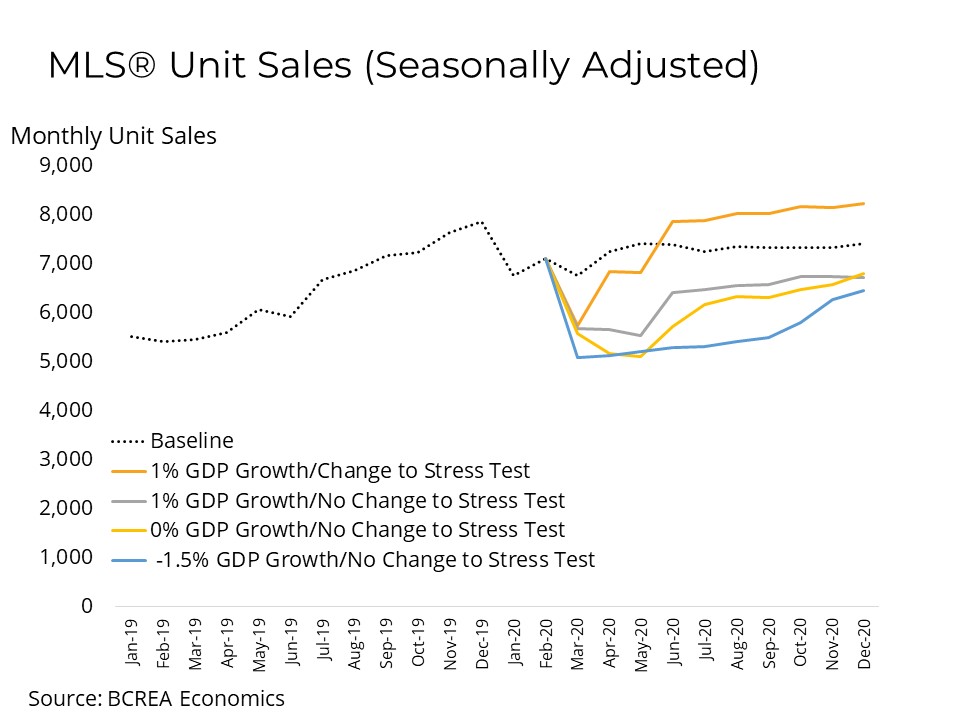
For more information, please contact:
Brendon Ogmundson
Chief Economist
Direct: 604.742.2796
Mobile: 604.505.6793
[email protected]
Kellie Fong
Economist
Direct: 778.357.0831
Mobile: 604-366-6511
[email protected]
To subscribe to receive BCREA publications, or to update your email address or current subscriptions, click here.
Small Claims Court Actions – Three Cases Against REALTORS® for Breaches of Duty #368
By Gerry Neely
B.A. LL.B.
The Small Claims Act is intended to encourage the just, speedy, inexpensive and simple resolution of claims less than $10,000. The relatively informal process enables people to appear on their own behalf, and losers are not liable for legal cost incurred by winners who choose to be represented by lawyers. The sentiment of, "I have nothing to lose but time," may be the main reason for some cases brought against REALTORS.
In one case, the buyer of two condominium units, who had to pay assessments of $7,762 and $10,285 to repair leaks, sued the listing agent in two separate actions because the agent did not tell him face-to-face that the building leaked. Neither he nor his agent asked the listing agent any questions concerning the building. The strata and general meeting minutes, which the buyer read, clearly referred to the problem.
The buyer removed the contract conditions, believing he was protected by a clause in the contract requiring the seller to pay for any assessments made before closing, but the assessments were made after he took title. A lawyer he consulted before closing advised him he could either repudiate the contract or close.
The judge ruled in favour of the agent, noting that damages were due to the buyer's failure to assess the information and his decision to close after receiving legal advice. The buyer appeared on his own behalf. 1
In another case, an agent's listing on the MLS® stated a home was connected to the municipal sewer system. The buyers lived in the home for ten years before they discovered it had a septic tank system, which was not evident by visual inspection. The previous owners thought the home was on the municipal system because the municipality billed them as if it was. The buyers also paid the sewer charges for ten years.
The buyers sued on their own behalf for the $2,100 cost to connect to the municipal system arguing the listing agent's misrepresentation was negligent and he should have checked the facts. The judge agreed the listing agent did have a duty to verify the truthfulness of information if he was doubtful; however, he had not breached this duty because he had no reason to doubt its validity. 2
In a third action, first-time homebuyers, who received a $3,000 exemption for the Property Transfer Tax on their purchase of a condominium, had to repay the tax when they sold it before the one-year residential eligibility requirement ended. They were aware of the requirement, but claimed the agent said it had been reduced to six months. They sued on their own behalf for the tax, claiming the agent made a fraudulent misrepresentation to obtain the listing and a commission. The agent vehemently denied this.
The claimants had to convince the judge that their version of the facts was more probable than the version put forth by the agent. The judge's impression after hearing the evidence was that neither party deliberately misled the court, but the problem was a result of misunderstanding and miscommunication. The claimants' action failed because they had not proved beyond a balance of probability that the agent made the statement. 3
To subscribe to receive BCREA publications such as this one, or to update your email address or current subscriptions, click here.
Softening Home Sales but Prices Remain Firm Across BC
For the complete news release, including detailed statistics, click here.
Vancouver, BC – December 12, 2023. The British Columbia Real Estate Association (BCREA) reports that a total of 4,630 residential unit sales were recorded in Multiple Listing Service® (MLS®) systems in November 2023, an increase of 2.2 per cent from November 2022. The average MLS® residential price in BC was $964,246 up 6.6 per cent compared to November 2022. The total sales dollar volume was $4.5 billion, representing an 8.9 per cent increase from last year.
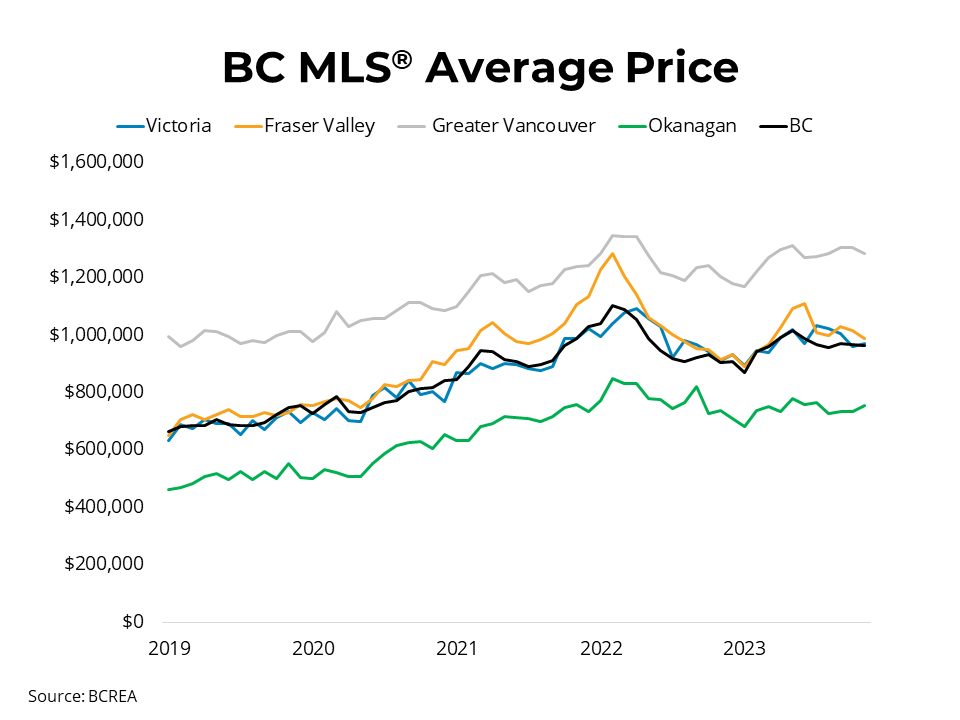
“Despite high mortgage rates and generally weak sales, home prices across the province have been remarkably resilient in 2023,” said BCREA Chief Economist Brendon Ogmundson. “Low inventory has meant that prices hold firm even at the much-reduced levels of sales activity experienced this year.”
On a seasonally adjusted basis, active listings in the province have increased for the sixth consecutive month and are now back to their highest level since August 2020.
Year-to-date BC residential sales dollar volume was down 12.4 per cent to $67.5 billion, compared with the same period in 2022. Residential unit sales were down 9.8 per cent to 69,551 units, while the average MLS® residential price was down 2.9 per cent to $971,069.
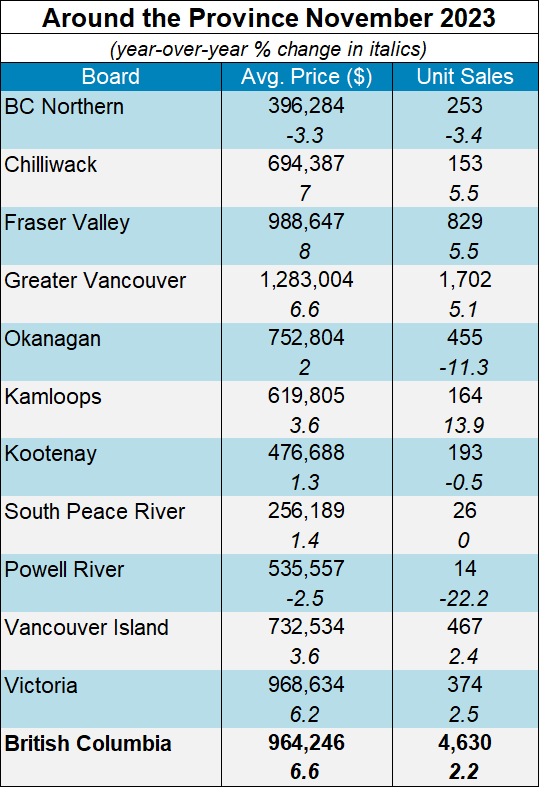
Soil Contaminated Sites [Continued] #139
By Gerry Neely
B.A. LL.B.
A whole new growth industry is developing of scientists, engineers, law professors, lawyers, columnists, experts and others, around the pollution of the environment and the liability for doing so. An increased awareness by the public of environmental hazards which pose a risk to health, brings an increased risk to licensees who fail to make themselves aware of the hazards of toxic waste to real property.
A licensee's duty is to: "obtain all of the information that is relevant and necessary so that the prospective purchasers are able to make a value judgement as to whether to acquire the property." (Column 66). A licensee must exercise a reasonable degree of skill and care in informing himself of the risks involved in dealing with potentially contaminated real property to be able to advise prospective purchasers of that risk.
This does not mean that the licensee is an insurer or guarantor against the loss which results from the discovery of contaminated soils after the purchase is complete. It does mean that licensees must know enough to recognize the "red flag" signifying a potential environmental hazard. The licensee should then advise the prospective purchaser to investigate the risk of environmental harm before an offer is made to purchase the property.
Where does one obtain information of contaminated or potentially contaminated sites? There is no central registry. While the Waste Management Branch is looking at the creation of one, a lack of funds together with the need to build up the information required for a registry means a long delay. The Waste Management Branch is able to provide some information, either as a result of permits issued by it, or from information provided by the public. It is also developing programs designed to inform the public about the environmental risks.
The Branch does have the right to file a notice under the Land Title Act, against the title of land contaminated by special waste which poses a danger to health.
The City of Vancouver has adopted a policy with respect to industrial lands which are intended to be redeveloped for another purpose. No rezoning is permitted unless the Waste Management Branch confirms that the property is either not contaminated, or that the contaminants can and will be removed. A number of other mainland municipalities are discussing similar bylaws with the Waste Management Branch.
For the moment then, perhaps the most that a licensee can do is to advise a prospective purchaser of property either to do an investigation of the use to which the property has been put, or engage a consultant to do an environmental audit. The necessary information may come as a result of City Archives, air photos, maps, fire insurance, interviews with present or former employees, or neighbours, and land title historical searches. Testing the soil may be essential.
Both licensees and lawyers should consider the clauses to be incorporated in agreements for the sale of land which is or may be contaminated. Owners may be asked to file written disclosure statements of their knowledge of the presence or absence of hazardous wastes, and their knowledge of the uses of the property. They may be required to represent and warrant the condition of the soil. They may be reluctant to do so because of the potential for substantial damages. The onus to establish the presence or absence of contaminated soils may be shifted to the purchaser by making it a condition that the purchaser satisfy himself by his investigation that the site is not contaminated.
Licensees will wish to protect themselves by raising the issue of environmental hazards with both parties, and having the parties acknowledge that they, rather than the licensee, shall be responsible for the disclosure or assessment of the potential risk. Standard clauses will be developed, but for complex transactions, licensees may also shift the risk to the legal profession of deciding what clauses are appropriate.
The risk for the person who may be found liable is in the difficulty of measuring the extent of the damages. It is relatively easy to measure the cost of the removal of UFFI from a home. The cost of the cleanup of the Expo site is an example of the high expense which may be involved in the removal of hazardous waste. While some hazardous waste can be easily neutralized, the inability of the Atomic Energy Control Board to find, after six years, a suitable site for the storing of radioactive material illustrates the difficulty of finding a place removed from population or water courses in which to store hazardous waste.
This is a topic which is most likely to affect licensees engaged in the sale of commercial or industrial properties. However, hazardous wastes can be found upon farms where pesticides or herbicides were stored, or on the site of an apartment condominium on former industrial land rezoned for residential purposes.
To subscribe to receive BCREA publications such as this one, or to update your email address or current subscriptions, click here.
Soil Contaminated Sites #138
By Gerry Neely
B.A. LL.B.
What do gas stations with underground tanks, sawmills, pulp mills, paint manufacturing shops, dry-cleaners, shipyards, truck parking yards for moving or fuel companies, junkyards, farms and 63 McClure Crescent, Scarborough, Ontario have in common? With the exception of 63 McClure Crescent, each is a potential site for soils contaminated by the deposit of hazardous waste.
Environmental issues now successfully compete for headlines, stories, and television time with free trade, the deficit, higher interest rates, loonies, and safe sex. When the Financial Post offers tips on environmental stocks, when Hollywood gives up red, white & blue for green, and President Bush advocates the reduction of acid rain, it is evident that in the 1990's the broader environmental hazards to land and buildings will engulf UFFI as the new source of liability affecting licensees, appraisers and lawyers.
Which brings us back to number 63, a property actually containing radioactive soil.
McClure Crescent had been the site of a 10 acre farm upon which rags used in the 1940's for luminous dial painting, had been burned in a pot bellied stove to reduce and concentrate the radium in the ashes. The ashes, when collected, were shipped to Eldorado Nuclear for processing. Small amounts of the radioactive material were lost in the soil and the distribution of this radioactive material took place when the 10 acre farm was subdivided and roads were excavated. The excavated material was then distributed throughout the subdivision.
When the owners listed their property, they knew that some parts of the Crescent were contaminated, including the house directly opposite number 63. They believed their property to be uncontaminated, a reasonable belief based upon the investigations of the Atomic Energy Control Board (AECB). They accepted a conditional offer which was subject to raising a mortgage upon terms which included a rate of interest no greater than 16%. The agent persuaded the purchasers to remove the condition before they applied for the mortgages, believing that there would be no trouble in obtaining it.
Shortly after the agreement became unconditional, the purchasers read a newspaper report about the radioactive material in the area, and telephoned the Atomic Energy Control Board. The purchasers were assured that there was no contaminated soil at number 63. They were also advised that the radioactive material in the area was of low level and would be removed within two months by the Government.
Then the AECB discovered that there was radioactive material in a twenty square foot area buried about two feet below the surface in the backyard of number 63. AECB advised the vendors of this, but not the purchasers, because of a policy of disclosing this information only to the owners of the affected properties.
After their purchase, the purchasers discovered that number 63 was contaminated. They also learned that AECB could not fulfill its promises to remove the radioactive material. In over 6 years of looking, neither it nor the federal or provincial governments had been able to find a disposal site. In 1984, number 63 was sold at a loss and the purchasers sued the vendors, the agent, and the AECB, and were awarded damages of $19, 846.00 plus prejudgement interest.
Fifty percent of this was paid by the vendors. Their liability arose from their breach of duty to disclose the latent defect in the area, and their further failure to disclose the latent defect they knew about after the contract was signed but before the sale completed. The latent defects were so detrimental to the purchasers that they might have rendered the premises unfit for habitation or dangerous in themselves. The Judge made a special point of stating that the vendors had a duty to advise the purchasers of the changed circumstances which occurred between the date the parties made the contract, and the date of closing.
AECB had said without qualification, that there was no contaminated soil at 63 McClure Crescent, and that a disposal site for radioactive material would be found within two months. AECB failed to advise the purchasers about its policy of limited disclosure, and failed further to warn the purchasers that they should keep in touch both with AECB and with the vendors because AECB was still checking the extent of contamination in the area. For these breaches of duty to the purchaser, AECB was held to be liable for 40% of the damages.1
Had the agent not removed the condition, the purchasers could have avoided the purchase, because they subsequently discovered they had to pay 16l/2% on their mortgage. The agent and her employer were liable for failing to meet the level of competence expected of her, and paid the remaining 10%. No claim was made against the agent for not being aware of the radioactive material in the area. [to be continued in the next column].
| 1. | Sevidal v. Chora, 64 O.R. (2nd) 169. |
To subscribe to receive BCREA publications such as this one, or to update your email address or current subscriptions, click here.
Solicitors Conflict of Interest Rules Affecting Vendors #33
By Gerry Neely
B.A. LL.B.
Column No. 26 discussed the increasing number of successful damage actions brought against lawyers by vendors in transactions where the lawyers in question considered that they were acting for the purchasers only. These actions were successful because the Courts held that in the particular circumstances, the lawyers owed a duty of care towards the vendors. In order to avoid this risk of liability, some lawyers insisted that the vendor must have separate legal advice. The Law Society has now approved new conflict of interest rules which are to be observed by all lawyers, since a breach of these rules will be considered to be unprofessional conduct. The purpose in repeating them in their entirety in this column, is to enable licensees to avoid delays in completion by advising the vendors in advance that they may be required to retain their own conveyancer.
RULING 1 ACTING FOR BOTH SIDES
- No member shall act or continue to act for more than one party in any matter where there is a conflict between any of the parties for whom the member acts.
- Acting for More than One Party to a Conveyancing Transaction
Where a solicitor is asked to act for more than one party with different interests in a conveyancing transaction, he or she shall recommend that each party have independent representation. Having given that recommendation, a solicitor shall not act for one party in a conveyancing transaction unless:
(a) because of the remoteness of the location of the solicitor's practice it is impracticable for both sides to be separately represented; or
(b) the transaction between Vendor and Purchaser is a simple conveyance involving only the assumption of one or more existing Mortgages or Agreements for Sale, and the payment of the cash balance, if any, the payment of all cash for clear title, or the discharge of one or more existing Mortgages or Agreements for Sale and the payment of the cash balance, if any; or
(c) the transaction is a simple conveyance coupled with a mortgage for an institutional lender such as a bank, trust company, life insurance company, or credit union;
- If a solicitor acts for more than one party in the circumstances of 2(a), (b), (c) above, then the solicitor shall:
(a) inform each such party in writing that he or she acts for one or more parties and that should a conflict arise which cannot be resolved, he or she cannot act for any party;
(b) obtain the consent in writing of all such parties; and
(c) raise all issues which may be of importance to any such party and explain the legal effect of these issues to all such parties.
- If a solicitor acts for more than one party in the circumstances in 2(b) or (c) above, then the solicitor shall not act in any foreclosure proceedings which arise in relation to that transaction.
- If one party does not want legal representation or wants only limited legal representation to remove any existing encumbrances, the solicitor acting for the other party shall recommend to the former that he obtain independent legal representation, and shall confirm his recommendation in writing. If the party refuses independent legal representation, or insists on only limited legal representation, the member should confirm in writing to that party that the member does not act for that party or the limited nature of the member's engagement, as the case may be.
You will note Paragraph 3(a) which prevents a lawyer who has agreed pursuant to Paragraph 2 to act for both parties, from acting for either party in the event that an unresolved conflict arises. This limitation will lead many lawyers who would prefer to continue to act for their clients, to insist that the vendor must be separately represented. Paragraph 5 provides an alternative for a vendor who doesn't want legal representation. It may also provide an alternative for a vendor who wants only limited legal representation, if the purchaser's solicitor agrees to represent the vendor. However, a vendor should be encouraged to employ separate legal representation, particularly in circumstances where there are successive transactions or mortgage financing, either of which may delay payment of funds. In these circumstances, solicitors, undertakings usually facilitate completion and delivery of possession.
To subscribe to receive BCREA publications such as this one, or to update your email address or current subscriptions, click here.
Solutions to Address BC Housing Supply
As Canadians recognize the important work done by housing partners on National Housing Day (November 22), BCREA acknowledges that there is still much work to do to ensure affordable, appropriate housing. In spite of the BC housing market’s record pace in October, supply continues to be limited. Lack of adequate supply causes affordability issues, especially for many lower-income families.
BCREA recommends that the BC Government work with local governments to speed up approval processes by adopting measures described in the Development Approvals Process Review (DAPR) report. This 2019 report was the result of the Ministry of Municipal Affairs and Housing’s consultation with local governments and housing stakeholders to identify the challenges and opportunities for improving the development approvals process. Adopting measures described in the DAPR report provides a roadmap for the province to work with local governments to better match housing supply with demand and create a balanced market.
BCREA also recommends amending zoning in single-family neighbourhoods to allow for gentle densification and more housing options. This solution could result in thousands of new ground-oriented housing units in neighbourhoods that already have all the necessary community infrastructure in place.
The role for the province in this potential solution is in providing funding from Property Transfer Tax (PTT) revenue. This revenue could be used to provide financial incentives for local governments to permit the sale of laneway homes and the voluntary stratification of secondary suites. PTT funds could also be used to update zoning and create a system for stratified suites.
As the voice of BC’s REALTORS®, BCREA looks forward to working with new and returning MLAs to advocate for a renewed focus on housing supply. We see many opportunities for MLAs to work across party lines and collaborate with real estate stakeholders to improve affordability in BC.
See our full list of election recommendations here.
To subscribe to receive BCREA publications such as this one, or to update your email address or current subscriptions, click here.
Special Circumstances for Listing Agents’ Commission #22
By Gerry Neely
B.A. LL.B.
Since the subject of this column, which was requested by the Legislative Committee of BCREA, is one which raises more questions than it answers, it would be appropriate to start it by saying,
"HELP WANTED - a reference to the report of a decision of a British Columbia Court which might settle whether a listing agent is entitled to a commission in the following circumstances:
"An agent receives a listing from an owner who unhappily anticipates that the arrears of payments due to the first mortgagee will result in a foreclosure action which will deprive the owner of his equity in the property. A foreclosure action is commenced and a second mortgagee is given conduct of the sale of the property during the redemption period set by the Court. The order for the conduct of sale gives the second mortgagee authority to list the property for sale with an agent chosen by the second mortgagee. That agent becomes the effective cause of the sale when an offer made by a purchaser obtained by the second agent is approved by the Court during the period of the listing given to the first agent. The second agent receives the agreed-upon commission out of the proceeds of sale. The first agent sues the owner for commission, and while the owner acknowledges that the first agent spent time and money in advertising, he states that he should not be required under the circumstances to pay two commissions."
The facts described are somewhat unrealistic in that a defaulting mortgagor generally has no funds to pay a commission. They are intended to raise the question of whether or not a listing agent should continue to expend time and money when conduct of the sale has been given to someone other than the owner and another agent has been given a separate listing.
If this question has been dealt with by a British Columbia Court, the results have not been reported in readily identifiable manner in any of the usual reporting services. In part, this is because motions in foreclosure actions are made in Chambers and are therefore rarely reported, and in part because the factual circumstances vary widely from case to case. In addition, discussions with a number of lawyers with substantial foreclosure practices, revealed an awareness of the problem but no answer supported by the authority of a Court decision.
The underlying reason for the Court agreeing to a payment of commission to the second agent, is that in a foreclosure action the mortgagor is liable for the expenses of a sale or of an aborted sale. If the conduct of sale is given to, say, a second mortgagee, the second mortgagee is entitled to incur reasonable and proper expenses which are chargeable against the interests of the mortgagor. Those expenses have been held to include payment of an agent's commission and, as a result, an order providing for the conduct of a sale also authorize the person having conduct to list the property with an agent and to pay that agent the customary commission.1
As always, the question of the right of the first agent to a commission depends upon the terms of the listing contract given by the owner. In the facts recited above, no commission would be payable if a right to commission depended upon the first agent being the effective cause of sale. No commission might be payable even if the agent's right to commission arose upon "a binding contract of sale/exchange of the said property being entered into during the said period." Does a "binding contract of sale" mean only a contract entered into between a vendor and purchaser in the usual way, or does it include a forced sale approved by Order of the Court? Perhaps the best position in which the first agent can put himself is to accept a listing of property either under foreclosure or where foreclosure is imminent, only if the listing clearly states that a binding contract of sale shall include a sale approved by Order of the Court, and that the first agent shall be entitled to a commission whether or not the agent was the effective cause of sale. However, even this contract may be held to be unenforceable as being impossible to perform where the Court has given exclusive conduct of sale to another party who has then listed the property for sale with a second agent. Again, the lack of reported decisions makes it difficult to predict what a Court will decide in any of the circumstances referred to in this paragraph, except to say that if the agent claiming commission was not the effective cause of sale, the Court will lean against an interpretation which would effectively compel an owner to pay two commissions.
In the midst of these ifs, ands, buts and perhaps, there is at least one positive word of advice available to the first agent when the foreclosure action is commenced. Since the owner will be joined in the action, he is entitled to appear, either in person or through his lawyer, to argue that the first listing should be continued. The agent should urge the owner to do so. In some cases heard recently in Victoria, that argument has led the Court to conclude that it will not interfere with existing contractual relations by giving conduct of sale to another party to the action. Since an owner may use this argument to try to delay the sale of his property, the success of it will depend upon other facts, one of the most important being whether the listing price is unrealistically high.
The answers to these questions may lie in your lawyer's files, to be disclosed if you decide to discuss these questions with him. Any information you obtain which is forwarded to B.C.R.E.A. or to me, will be followed up and, if useful, it will be reported in a subsequent column.
| 1. | The Royal Trust company v. Countrywide Construction Ltd et al,24559/73, Vancouver Registry. |
To subscribe to receive BCREA publications such as this one, or to update your email address or current subscriptions, click here.
Sponsor BCREA Managing Brokers’ Conference
BCREA's upcoming Managing Brokers' Conference sets the stage for enhancing professionalism as the paramount focus of this premier event.
This prestigious conference, hosted on November 8-9, 2023, at the Executive Hotel Vancouver Airport in Richmond, BC, serves as a gathering point for over 300 managing brokers from across British Columbia and beyond.
The conference encompasses a wide range of engaging opportunities, including educational sessions, workshops, and networking events. These activities provide participants with the latest insights, best practices, and cutting-edge tools to enhance their management skills.
By becoming a partner of this event, sponsors demonstrate their dedication to knowledge sharing and continuous learning, positioning themselves as leaders and trusted partners within the real estate community. BCREA’s Managing Brokers’ Conference is an ideal platform for sponsors to enhance awareness of their products and services which can lead to valuable business opportunities.
Our sponsorship package offers an array of exceptional opportunities for businesses to elevate their brand visibility and establish valuable connections with influential decision-makers within the real estate industry. Take a look at the available sponsorship opportunities, here.
For more information about BCREA’s Managing Brokers’ Conference, please visit our event website, here.
Standard Contract of Purchase and Sale Clauses: Common Misunderstandings and Confusions – Part One #566
The standard Contract of Purchase and Sale (CPS) is a familiar form of contract. Parties in a transaction and their representatives have come to expect the standardized form of CPS when contracting for residential real estate. However, some clauses in the CPS can be confusing for buyers, sellers, and REALTORS® alike.
In this two-part series of articles, we will review some of the clauses in the standard CPS, which can cause confusion or misunderstanding, so you can advise your clients and provide accurate information.
Possession (Section 5)
Section 5 of the CPS sets out the terms related to possession of the property. This section clearly states the time and date the buyer will obtain possession of the property. However, confusion arises when tenancies are involved. The standard clause starts from the requirement that the seller will provide the buyer with vacant possession of the property. However, this vacant possession is subject to any existing tenancies listed in this section of the CPS. Therefore, any existing tenancies not listed in this section of the CPS, as an exception to the vacant possession or tenancies entered into after the date of the CPS (even if it’s for the same space or unit) must be terminated, and the tenants must vacate the property by the possession date. Buyers who wish to obtain vacant possession of a tenanted property must include a clause in the CPS requesting the seller give legal notice to the tenant and provide the appropriate form along with their offer. At the same time, sellers who do not know that the starting point is vacant possession, may not be aware of what needs to be included in this section. All notices must be made in accordance with the Residential Tenancy Act (The “Act”).
Another source of confusion regarding this section is if the possession date occurs on the same day as the completion date. This is because the time for closing is not fixed in the CPS, whereas possession of the property is fixed at a specific time. This can cause issues if closing occurs late or after the possession date.
REALTORS® should consider and discuss with their client whether vacant possession is possible, and if not, they should ensure that they list all tenancies in Section 5 of the CPS, which will transfer to the buyer. When representing a buyer who requires vacant possession, ensure clauses are added to the CPS requiring the seller to give notice to the tenant under Section 49 of the Act, and consider whether the timing for possession will be sufficient for the notice period required under the Act. Additionally, if the possession date is going to be the same day as the completion date, then Section 5 must be modified (or additional terms added to Section 3 of the CPS) to note that possession will only occur after the sale's closing on the completion date.
Risk (Section 16) and Viewed Clauses (Section 8)
Section 16 (Risk) and Section 9 (Viewed) of the CPS can also cause conflict and confusion if damage occurs to a property after risk has transferred but before the possession date. Section 16 states that all buildings on the property remain at the seller's risk until 12:01 am on the completion date, after which time the risk passes to the buyer. This means that risk transfers before the transaction actually closes, since closing typically occurs between 9 am-5 pm on the completion date. So, what happens if the deal doesn’t close, but technically, risk has already transferred? Or if damage occurs on the completion date before the transaction closes?
To further complicate matters, in BC the possession date is usually one to three days after the completion date, meaning the title to the property has transferred, as has the risk (which transfer at 12:01 am on the completion date), however, the seller is still in possession of the property. This issue is made more complex by Section 8 of the CPS, which states that the property will be in substantially the same condition on the possession date as on the date the buyer viewed the property (as noted in this section of the CPS). So, if the risk transfers to the buyer as of one minute into the completion date, but the seller must deliver the property in substantially the same condition as the viewed date, then what happens if there is damage to the property that occurs at any time between the completion date and the possession date?
The answers to all the questions above are all based on a mixture of fact and law. Therefore, the best practice is to advise the buyer to obtain insurance over the property commencing at 12:01 am on the completion date but also to advise sellers to keep existing insurance policies in place until after the possession date. This results in an overlap of insurance policies for the property but ensures that both parties are protected if they are required to remedy the damage under either Section 16 or Section 8.
Title (Section 9)
Section 9 is another clause that can cause issues for sellers and REALTORS®. This section relates to title to the property. Typically, in a residential real estate transaction, the seller and their listing agent understand that the seller’s mortgage must be discharged from title to the property. However, this isn’t only what Section 9 says. Section 9 states that the buyer will obtain title to the property free and clear of all encumbrances except charges contained in the original Crown grant, and restrictive covenants and rights of way in favour of utilities and public authorities. Sellers and REALTORS® often forget how narrow these exclusions are. For example, this clause does not include easements, restrictive covenants or building schemes (which are fairly common). Therefore, if not properly addressed in the contract, the buyer can demand that any private easements be discharged at closing, and it's likely the seller will not be able to comply with the contract and discharge encumbrances that are not addressed in the contract.
REALTORS® should ensure that they review title to the property carefully and consider if additional terms need to be added to the CPS related to charges that will remain on title following the transfer of title to the buyer.
Summary
REALTORS® need to ensure they understand the standard terms of the CPS and can explain and review them with their clients. Additions or revisions to the standard CPS clauses may be needed, depending on the circumstances. Stay tuned for Part Two of this article, in which we will discuss other CPS clauses: Time, Representations and Warranties, and Acceptance Irrevocable.
For additional information on the CPS and standard clauses, the CPS Residential Toolkit offers annotated forms reviewing the terms, REALTORS® and consumer videos, guides on how to complete the form, FAQ and links to PD opportunities to further knowledge on contracts. See it here.
Standard Contract of Purchase and Sale Clauses: Common Misunderstandings and Confusions – Part Two #567
In part two of this series, we will look at clauses regarding Time, Representations and Warranties, and Acceptance Irrevocable in the standard residential Contract of Purchase and Sale (CPS). As discussed in part one of this series, parties in a transaction and their representatives have come to expect the standardized form of CPS when contracting for residential real estate. However, some clauses in the CPS can be confusing for buyers, sellers, and REALTORS® alike.
Time
There are several clauses in the CPS that relate to time:
- Section 4 Completion
- Section 5 Possession
- Section 11 Documents
- Section 12 Time
- Section 26 Offer
- Section 27 Acceptance
Arguably, terms in Sections 3 (Terms and Conditions), 13 (Buyer Financing), 14 (Clearing Title), 16 (Risk), and 23 (Disclosure of Buyer’s Recission Right) also relate to time. For this article, we will be focusing on Section 11 (Documents).
Section 11 (Documents) states, “All documents required to give effect to this contract will be delivered in registrable form where necessary and will be lodged for registration in the appropriate Land Title Office by 4 pm on the Completion Date”. On the face of it, this would seem to mean that closing must occur before 4 pm. However, the time for completion and delivery of funds has been a source of many court decisions. Most recently, in Sandhu v Uppal Farms & Greenhouses Ltd,1 the Judge concluded that the buyer’s failure not to register closing documents in the Land Title Office prior to 4 pm was only a ‘technical breach.’ The court found that as long as the buyer registered and made the sale proceeds available at some time on the completion date, the buyer was not in breach as the CPS did not require the buyer to pay the seller before the end of business hours on the completion date.2
There are often last-minute complications with documents, scheduling complications with lawyers, or other last-minute hiccups that arise. Despite the outcome in this case, REALTORS® should advise their clients to have met any pre-funding mortgage conditions and obligations for closing (such as delivering proceeds to their legal representative and signing closing documents) prior to the completion date to avoid any delays in closing and potential disputes.
Representations and Warranties
The starting point regarding the condition of the property in any real estate transaction is the principle of caveat emptor, also known as ‘buyer beware’. Essentially, this means the responsibility for determining and checking the quality and suitability of a property is that of the buyer. One way for buyers to protect themselves is to include and rely on representations and warranties from the seller.
Section 18 (Representations and Warranties) states that “there are no representations, warranties, guarantees, promises or agreements other than those set out in this Contract and representations contained in the Property Disclosure Statement if incorporated into and forming part of this contract, all of which will survive the completion of the sale.” This section is incorporated into the CPS to limit the claims for damages that the buyer can make against the seller. It also restricts the right to rescind based on misrepresentation, by limiting representations and warranties made outside of the CPS. For example, representations that may arise through verbal correspondence between the REALTOR® and buyer at an open house. However, this clause has not stopped judges in the past from considering representations and warranties provided outside of the CPS for determining if there is a valid claim for damages against a seller or a right of recission for a buyer to terminate a contract.
Since these cases are all fact-specific, REALTORS® should ensure they always include this clause in the CPS. However, even if the clause is included in the CPS, they should still be cautious regarding any verbal or written representations and warranties made to Buyers outside of the contract.
The second part of Section 18 “…all of which will survive the completion of the sale,” is included to defeat any claim from the seller that all the representation and warranties merge on closing. The common law doctrine of merger is the concept that all agreements between the buyer and seller merge at closing with the delivery of title to the buyer and the acceptance of such title by the buyer. If the doctrine of merger were to apply, a seller may have a defence against any claims from the buyer post-closing.
Acceptance Irrevocable
Section 22 (Acceptance Irrevocable) states the CPS is “executed and sealed by hand or by digital or electronic signature and seal, or otherwise, is hereby executed under seal…”, and therefore it has the same effect as if the CPS had been “physically sealed by wax, stamp, embossing, sticker or other manner.” The Section confirms that on this basis, the Seller’s acceptance is irrevocable.
So, what does all of this mean? Why are we referencing wax and seals? Why is the CPS signed under seal?
The reason the CPS is executed under seal is to avoid an argument that the contract is not legally binding due to a lack of consideration. However, despite the fact that the CPS was signed under seal, some court decisions had still found the then current version of the CPS was not legally enforceable because there was no consideration.3 However, since these decisions, Section 22 has been updated to confirm both parties’ intention to execute the CPS under seal. The intention of the parties is key in determining whether a contract has been executed under seal, and this intention must be conscious and deliberate.4 REALTORS® should be diligent when drafting the CPS to avoid subject conditions that are too vague or entirely subjective which can render a CPS unenforceable.
Summary
REALTORS® need to ensure they understand the standard terms of the CPS as it is important that they explain and review them with their clients. Additionally, REALTORS® need to stay up to date on recent case law to understand how the Courts interpret and apply the terms and clauses in the standard CPS.
For additional information on the CPS and standard clauses, the CPS Residential Toolkit offers annotated forms reviewing the terms, REALTORS® and consumer videos, guides on how to complete the form, FAQs, and links to PD opportunities to further gain knowledge on contracts. See it here.
| 1 | Sandhu v Uppal Farms & Greenhouses Ltd, 2022 BCSC 1373 | |
| 2 | Sandhu v Uppal Farms & Greenhouses Ltd, 2022 BCSC 1373 at para 41-47. | |
| 3 | 1021846 B.C. Ltd. v. Hare, and Pooni v. Storsley | |
| 4 | 1021846 B.C. Ltd. v. Hare at para 74, and Pooni v. Storsley at para 21. |
Standard Form Contract of Purchase and Sale – Interpretations #108
By Gerry Neely
B.A. LL.B
"Subject to a first mortgage being made available to the Purchaser by July 31, 1987, etc. . . ". Is the word "by" the equivalent of "prior to" or "not later than"? This is one of several questions asked by licensees attending seminars to discuss the new standard form contract of purchase and sale.
The licensee giving the seminars has had conflicting "off the cuff" legal opinions given to her and she has asked if there are any B.C. decisions interpreting the word "by" in this context. While I have been unable to find a reference to a B.C. decision interpreting an offer to purchase, a decision in a landlord tenant dispute provides some assistance. In 1940 the British Columbia Court of Appeal had to decide whether a Notice to Quit which was given in June to a tenant to vacate premises "by July 31, 1939", was valid. In a split decision, the Court held that this meant that the tenant had all day to vacate the premises and therefore the notice was valid. (It also meant that the tenant had no right to remain after the 31st of July, which meant a swift midnight move.)1
A decision more to the point but made in Ontario, was given in 1922 in connection with an offer to purchase that was to be accepted "by the 10th December, 1920". The Judge decided that "by" gave the purchaser the whole of the 10th of December within which to accept the offer.
Therefore, while "by'' has been interpreted to mean "not later than", anyone wishing to remove any ambiguity can provide that the condition is to be fulfilled "on or before July 31st, 1987".2
The next question concerns that part of the new standard form of offer which states that a contract containing a condition is terminated unless written notice has been given that a condition for the benefit of one party has either been waived or declared fulfilled. Some licensees take this to mean that the party to the contract entitled to the benefit of a condition, can simply walk away from the contract and have his deposit returned by doing nothing to fulfill the condition.
It would be a mistake to give this advice. British Columbia Courts have held that there is an implied obligation on the part of a party to use its best efforts to fulfill the conditions set out in an agreement. A party failing to do so, cannot rely on his own failure as an excuse for the non-fulfillment of this obligation. This was discussed in Column 9, and in a recent Ontario case where a builder refused to complete the sale of a lot which the builder in turn was purchasing from a developer. The builder's sale was subject to the developer obtaining approval and registration of the subdivision plan, which the developer covenanted to do. The agreement between the builder and the purchaser provided that while the contract would be void if thc plan was not registered by a certain date, the builder could extend the time for completion for three successive months. The builder refused to complete because the Municipality's requirement for a sidewalk reduced the size of the lot by 13% and the builder refused to agree to the purchaser's request for a reduction in the purchase price of the lot. The evidence made it clear that if the builder had spoken to the developer, the builder would have learned that the plan would have been approved within the period covered by the monthly extensions which the builder had the power to grant.
In an action brought by the purchaser for specific performance and for a reduction in the purchase price, the builder argued that the agreement was void because the condition as to subdivision had not been fulfilled within the time provided in the agreement. The Court said that the builder could not rely on this because the builder had contributed to the non-fulfillment of the condition.3
| 1. | J.H. Munro Ltd v Vancouver Properties Ltd., 1940 3WWR 26. | |
| 2. | Richardson v. Abel 1922, 23 Ontario Weekly Notes 136. | |
| 3. | Fenton v Barbrook, 34 DLR (4th) 683. |
To subscribe to receive BCREA publications such as this one, or to update your email address or current subscriptions, click here.
Standard Form Essentials: What REALTORS® Need to Know About the PDS
BCREA’s newly released Standard Form Essentials: Property Disclosure Statement Residential course provides REALTORS® with the tools they need to navigate property disclosures with clarity and confidence. Worth four Professional Development Program accredited hours, the dual-format course helps learners manage disclosure obligations, support client decision-making, and reduce risk in transactions.
The course begins by clarifying the differences between sellers’ disclosures of latent defects at common law and REALTOR®’s greater disclosure requirements under The Real Estate Services Rules.
The major focus of the course is then a section-by-section walkthrough of BCREA’s Property Disclosure Statement Residential (PDS) form. Each question on the form is addressed with clear explanations, follow-up questions, and practical tips, helping REALTORS® better guide clients through the disclosure process. The course also explores two newer and often misunderstood topics in the PDS: radon and archaeology.
In addition to the PDS, learners are introduced to the Property No-Disclosure Statement (PNDS) form, which may be appropriate when a seller chooses not to, or cannot, complete a PDS. The course also highlights when it may be necessary to use the REALTOR®’s Disclosure of Material Latent Defects form, even in situations where a PDS has already been provided.
Course Overview
By the end of this course, REALTORS® will be able to:
- understand the differences between patent defects, latent defects, and material latent defects;
- advise seller clients on their disclosure obligations under common law;
- meet their own disclosure obligations under the Real Estate Services Rules;
- distinguish between defects and stigmas and know when stigmas should be disclosed;
- perform due diligence based on seller responses in the PDS;
- discuss the benefits and limitations of the PNDS;
- recognize when to use the REALTOR®’s Disclosure of Material Latent Defects form; and
- suggest additional due diligence that buyer clients may wish to undertake.
Through practice-focused activities and practical examples, REALTORS® will leave this course better prepared to navigate sellers’ and REALTORS®’ disclosures and identify when it is best for their clients to seek expert advice.
Register for Standard Form Essentials: Property Disclosure Statement Residential in the self-paced format here.
To view upcoming dates for the instructor-led version, see the current course calendar here.
Standard Forms – A Valuable Copyrighted Members-Only Resource
The British Columbia Real Estate Association (BCREA) administers and manages a set of Standard Forms, standard clauses and related educational resources for use by REALTORS® in real estate transactions in British Columbia. A sub-set of the standard forms are jointly owned by BCREA and the Canadian Bar Association BC Branch (CBABC), including the Contract of Purchase and Sale.
BCREA receives many inquiries from members of the public, REALTORS®, lawyers and notaries public, regarding the availability of the forms and requirements when using the forms.
The use of BCREA’s Standard Forms is a member-only service for BC REALTORS® and should not be made available to the public, or any non-members of BCREA or CBABC. This includes the posting of any standard forms to a REALTOR'S® or managing broker’s private website for access or download by consumers.
All BCREA Standard Forms are copyrighted and carefully version controlled to include any changes to legislation from the government or changes to rules from the regulator. All titles and intellectual rights are the property of BCREA or jointly owned with CBABC. Standard Forms are protected documents that can not be accessed, modified, reproduced, copied, distributed or shared without BCREA’s prior written permission.
For more than 25 years BCREA has aimed to strengthen the foundation of real estate transactions in the province by maintaining and administering the legal contracts and related documents in the standard forms. Standard Forms are not only essential to the successful completion of real estate transactions across the province but are a valuable member resource intended to:
- protect consumers;
- help REALTORS® meet regulatory requirements;
- mitigate risk and reduce liability;
- enhance professionalism; and
- support best practices.
REALTORS® can help protect the copyright of BCREA Standard Forms that serve the profession.
For more information on BCREA Standard Forms Terms of Use click here. (BCREA Access login required)
BCREA has developed numerous resources to assist you with keeping up to date on the latest information on the Standard Forms Resource Centre.
To access the most current versions of the Standard Forms, please visit WEBForms® here.
For any additional information or questions please contact the BCREA Standard Forms department can be reached at [email protected].
Standard Forms Reminder
Changes coming June 13
On June 13, changes to the Assignment of Contract of Purchase and Sale – New Development and Non-Developer and the Privacy Notice and Consent forms will come into effect.

While none of the changes will have a significant impact on practice, it's important for REALTORS® to familiarize themselves with the changes and make sure they are working with the latest versions of the forms. Please take the time to learn about the changes and then go to WEBForms® for the updates!
Privacy Notice and Consent
This form has been updated to include opt-out boxes so that a client can choose how a REALTOR® collects and uses their secondary personal information. This better reflects applicable privacy laws and makes it clearer that parties are within their rights to withhold consent.
To allow the form to be used for represented and unrepresented parties, "your REALTOR®" has been replaced with "the REALTOR®"; "to whom you are giving this consent" has been added; and "Designated Agent" has been replaced with "REALTOR®".
The form has also been revised to include consistent language with the Canadian Real Estate Association's trademark definitions.
Assignment of Contract of Purchase and Sale – New Development & Non-Developer
Clause 5.25 of the New Development form and Clause 4.21 of the Non-Developer form has been updated to include an initial box for the Assignee to declare whether they are a Canadian citizen or a permanent resident as defined in the Immigration and Refugee Act. This change ensures there is consistency throughout all the Contract of Purchase and Sale forms.
In addition, on page 1, "prepared by" is being replaced with "brokerage" and "per" with "prepared by."
To subscribe to receive BCREA publications such as this one, or to update your email address or current subscriptions, click here.
Standard Forms Resource Centre Launching in August, Major Form Release This Fall
As REALTORS®, you know that forms and clauses are at the heart of your day-to-day real estate practice. And we know that, too. BCREA is committed to providing you with high quality, relevant, and updated standard forms and clauses, so you and your clients can complete transactions with confidence.
Over the coming weeks, we will be helping Realtors continue to raise the bar professionally with the launch of the new BCREA Standard Forms Resource Centre, and the upcoming fall 2020 Standard Forms Release.
BCREA Standard Forms Resource Centre
The BCREA Standard Forms Resource Centre on CREA’s Training Hub will be your new go-to for Standard Forms training materials.
Resources will include a variety of form toolkits (five at launch), videos, frequently asked questions and more.
The new page will launch August 5 and will be accessible via BCREA’s website and REALTOR Link® (user name and password required).
Fall 2020 Standard Forms Release
This fall, BCREA will be releasing seven new standard forms, three new clauses and a significant number of revisions to existing forms, including updates to the signature blocks on 20 forms.
Along with this major release on September 16, managing brokers will be updated on the form changes through the Community of Practice, and will be provided with resources such as a PowerPoint presentation outlining the form revisions, guides, and more.
Throughout August and September, managing brokers and REALTORS® can expect training and guidance materials and a webinar conducted by BCREA to address your questions related to the form release.
Keep an eye on your email inbox for more information, including links to the resources mentioned above!
Do you have questions about BCREA Standard Forms? Visit bcrea.bc.ca/standardforms or e-mail us at [email protected].
To subscribe to receive BCREA publications such as this one, or to update your email address or current subscriptions, click here.
Standard Forms Resource Centre Now Available: Here’s What You Need to Know
BCREA’s new Standard Forms Resource Centre is now available for REALTORS® and managing brokers!
The comprehensive platform is the new go-to for standard forms training materials and resources and was created to help REALTORS® and managing brokers make the most of BCREA standard forms and raise the bar professionally.
To access the Standard Forms Resource Centre and start browsing the form toolkits and other resources visit and bookmark bcrea.bc.ca/sfresources.
You can also access the Standard Forms Resource Centre from the Standard Forms page on the BCREA website, or on REALTOR Link®. You will be required to login using your REALTOR Link® username and password.
When you get to the new Standard Forms Resource Centre here is what you can expect to find…
Form Toolkits
The toolkit is an interactive training guide aimed at providing you with information about the form, outlining what the sections of the form mean, guiding you and your clients how to complete the form and much more.
Learn how to navigate the Standard Forms Resource Centre and how to use the toolkits by watching this short tour video:
[iframe width="560" height="315" src="https://www.youtube.com/embed/FhIqPfrLgrk" frameborder="0" allowfullscreen style="position:absolute;top:0;left:0;width:100%;height:100%;" ][/iframe]Other Resources
The Standard Forms Resource Centre is now also home to a variety of other standard forms resources, including:
- the Standard Forms FAQ, a compilation of common standard forms questions and answers;
- the Standard Forms Revision Request Form, where Realtors and managing brokers can request form changes or new form requests;
- the BCREA Clause Catalogue; and
- a summary of recent form revisions.
You can also access the latest Standard Forms blog posts published on the BCREA website, and watch the latest Standard Forms videos like the new Introduction to BCREA Standard Forms:
[iframe width="560" height="315" src="https://www.youtube.com/embed/aOOt3d5b_5Q" frameborder="0" allowfullscreen style="position:absolute;top:0;left:0;width:100%;height:100%;" ][/iframe]What else can I expect?
On September 16, BCREA will be releasing seven new standard forms, three new clauses and a significant number of revisions to existing forms, including updates to the signature blocks on 20 forms.
Keep an eye on the BCREA Standard Forms Resource Centre for more information about the form release and upcoming new resources.
Still have questions
If you have questions about the new BCREA Standard Forms Resource Centre, email [email protected].
Standard Forms Spotlight: Buyer’s Deposit Paid by a Third Party
The BCREA Standard Forms team has received several great questions about what to do, if anything, when a buyer’s deposit is paid by a third party, such as a family member or a client’s business account. To help ensure REALTORS® are aware of their obligations, we’ve compiled a list of frequently asked questions on third-party deposits, with answers provided by our Standard Forms legal advisor.
1. Can a deposit be paid by someone other than the buyer? For example, can the deposit be paid by a family member not named on the contract, or from a client’s business account where the contract is not written in the company’s name?
While the deposit may be paid by someone other than the buyer, there may be resulting legal and tax implications. Such arrangements should be planned and the buyer and party paying the deposit on behalf of the buyer should always document the arrangement so there are no misunderstandings. The parties should also consider obtaining legal advice before doing so.
2. Are there any disclosure requirements for the buyer’s Realtor to disclose to the seller’s Realtor if the deposit is paid by a third party?
In general, there are no disclosure requirements for the buyer’s Realtor to disclose to the seller’s Realtor that the deposit is paid by a third party that is acting for and on behalf of the buyer. Furthermore, under the Real Estate Rules, the buyer’s Realtor has a duty to maintain the confidentiality of information respecting the buyer, which includes information regarding the financial circumstances of the buyer.
However, the buyer’s Realtor must consider other disclosure requirements that may arise in connection with a deposit being paid by a third party. For example, the buyer’s Realtor may need to disclose the third party if that third party is involved in connection with an assignment or proposed assignment of the contract where the terms of that contract require consent from the seller to such assignment. The buyer’s Realtor may also be required to disclose the third party’s involvement in connection with their FINTRAC reporting requirements. The buyer’s Realtor should discuss any such obligations with their buyer client. If, however, a transaction were deemed to be suspicious, Realtors should ensure they do not “tip-off” the client to their suspicions.
3. In the event the deal collapses, to whom should the deposit be paid if it has been paid on behalf of the buyer by a third party?
Once the deposit is paid to the deposit holder, it is being held for the parties to the transaction by that deposit holder as a stakeholder. At this point, as between the buyer and the seller, it is as if the buyer had paid the deposit themselves (even if it was paid by a third party on the buyer’s behalf).
In the event a deal collapses, the deposit holder can only release it if the buyer and the seller sign a direction instructing that deposit holder do so. The parties can specify where the deposit be paid in that direction, which may include a third party if both the seller and the buyer agree.
Note, however, that the seller may not be aware of the fact that the buyer’s deposit was paid by a third party and therefore may be reluctant to agree that the funds be paid to that third party. If the seller does not wish to direct that the funds be released to someone other than the buyer, then the buyer may need to either receive the funds and pay them on to the third party or provide a further direction to the deposit holder.
Remember that while the third party may have paid the deposit on behalf of the buyer, that third party does not have any standing to make demands or to give directions in respect of the release of the deposit – only the parties to the contract may do this.
4. What other obligations might a brokerage/Realtor consider when a deposit is received by a third party?
When someone other than the buyer is paying the deposit, it gives rise to the Realtor’s FINTRAC obligations, such as third-party identification and receipt of funds. It may also raise flags about the source of funds and should be carefully considered along with the context. Where money laundering indicators present themselves, Realtors have obligations under the Proceeds of Crime Money Laundering and Terrorist Financing Act and should consult their brokerage’s compliance officer.
To access all Standard Forms resources available, including form guides, revision guides, videos for Realtors and consumers, form toolkits and more, please visit the Standard Forms Resource Centre.
If you have questions on Standard Forms, please email [email protected].
Standard Forms Spotlight: Client Identification and CREA Form Changes
With the Financial Transactions and Reports Analysis Centre of Canada's (FINTRAC) latest regulatory amendments coming into effect on June 1, BCREA will retire the one-page BCREA Individual Identification Information Record as of May 31. The FINTRAC amendments redefine when brokerages enter into business relationships and as such, this one-page form will no longer meet brokerage’s identification verification requirements under the Proceeds of Crime (Money Laundering) and Terrorist Financing Act (the Act). You can learn more about why this form is being retired here.
As of June 1, you should use the Canadian Real Estate Association’s (CREA) Individual Identification Information Record, or a similar form provided by your brokerage that contains all the necessary information for client identification. CREA has updated its form to reflect the June 1 amendments and it’s now available for download from WEBForms®.
CREA has a number of additional resources and forms available to help you meet your new and revised anti-money obligations, including an updated FINTRAC office policy, updated FINTRAC FAQ, a new Politically Exposed Person/Head of International Organization Checklist/Record, a new Beneficial Ownership Record and updated versions of several other forms. You can download the new and updated forms from WEBForms®.
To learn more about the June 1 FINTRAC amendments and access resources from BCREA, CREA, FINTRAC and the Real Estate Council of BC, click here.
Standard Forms Spotlight: Does a Seller Have to Document They Have Reviewed an Offer?
You’ve listed a great property on behalf of your seller client. With your marketing efforts and the attractive offering, you have received multiple offers. Sounds like an ideal scenario, right?
On the seller’s side, it certainly can be. But when it comes to potential buyers, there might be some concerns. How does a buyer know if there are multiple offers? Will the buyer have a chance to change their offer? Will all the offers be presented to the seller? How does the buyer have peace of mind that they had a fair shot at closing the deal?
With these questions in mind, REALTORS® might be wondering if a seller has to document the fact they have reviewed an offer in order to help ease the potential buyer’s concerns.
The Question
This was a concern raised at a recent Standard Forms Committee meeting. More specifically, a request was received to update the Contract of Purchase and Sale (CPS) to include an initial box for the seller to sign, indicating that the “seller has reviewed the offer.”
This would give the potential buyer proof that their offer was viewed, and help in calming any suspicion of an unfair advantage.
But is it necessary?
The Answer
While the concern is a valid one, the Committee decided against adding a signature box to indicate that the seller has reviewed the offer.
Here’s why…
The first reason is that there are already current tools and practices in place for buyer’s and seller’s agents to confirm the offer submitted was reviewed, including:
- the buyer’s agent presenting the offer, where appropriate;
- the use of the Real Estate Council of British Columbia’s Disclosure to Sellers of Expected Remuneration (DTSER) form as documentation the for the seller’s agent’s file that the disclosure was made;
- having the managing brokers contact each other directly to verify that the offer was reviewed; the manager could base the response on the DTSER being submitted to the office;
- having the seller stroke a line through the form, writing the date and acknowledging they considered the offer but did not accept it before forwarding it back to the buyer’s agent as evidence of the disclosure.
In addition to the practices already being in place to help ensure fair dealing, the second reason why the Committee decided against a change is that other challenges may arise by having the seller initial offers that they do not intend to accept.
For example, if a seller accidentally initials in the space for acceptance instead of the space for reviewing the offer, they may be in a situation where they have sold the property twice. By using one or more of the practices listed above, a buyer’s agent can be confident in telling their client that they are getting a fair shake.
Did you enjoy this post? Find more from the Standard Forms Spotlight series here.
Do you have questions about Standard Forms and real estate practice? Email your questions to [email protected] for potential inclusion in an upcoming Standard Form Spotlight blog post.
To subscribe to receive BCREA publications such as this one, or to update your email address or current subscriptions, click here.
Standard Forms Spotlight: New blog series to offer valuable insight into provincial forms and clauses
In June, we will be publishing the first post in “Standard Forms Spotlight,” a regular series of blog posts that will help REALTORS® enhance their understanding and build their knowledge of the many intricacies around provincial standard forms and clauses used in real estate transactions in BC.
Published monthly, the blog posts will address common questions, offer tips and guidelines, and will provide insight into form use, creation and changes.
Look out for the first blog next month on the BCREA website, and in the Resources for REALTORS® email distributed by BCREA. Upcoming topics include a look at what goes into standard form revisions and if and when sellers need to document when they review offers.
In BC, there are more than 50 standard forms and clauses administered by the British Columbia Real Estate Association (BCREA) and available on WEBForms®. You will likely be familiar with many of these forms, which are used more regularly, like the Contract of Purchase and Sale and the Property Disclosure Statement. Others, like the new Notice and Acknowledgement form created during the COVID-19 pandemic were recently added to forms available to Realtors.
The Standard Forms Spotlight blog series complements professional development offerings from BCREA which also explore a variety of standard form areas. For example, BCREA recently launched a new online course, Standard Form Essentials: The Property Disclosure Statement (PDS), which offers a deep dive into the Property Disclosure Statement – Residential, and earns learners three PDP hours upon completion.
The PDS course, alongside all online courses, is being offered at a discount rate until July 31, 2020 as a part of BCREA’s effort to support Realtors’ ongoing professional development during the COVID-19 pandemic. Click here to view the course.
Visit the BCREA Standard Forms page to browse all recently published blog posts and search the archives. And if you have questions about BCREA Standard Forms, feel free to email [email protected].
To subscribe to receive BCREA publications, or to update your email address or current subscriptions, click here.
Standard Forms Spotlight: REMINDER – The BCREA Individual Identification Information Record Has Been Retired
When the latest FINTRAC amendments came into effect on June 1, 2021, we retired the BCREA Individual Identification Information Record as it no longer meets brokerages’ record keeping obligations. Please use the FINTRAC forms provided by the Canadian Real Estate Association (CREA) or your brokerage to ensure you continue to meet these obligations.
Although this form has been retired, it may still appear within CREA’s WEBForms® platform if you created it as a standalone form. You may also see it included under a folder called “BCREA FINTRAC” if multiple standalone forms were created. In this case, each standalone form in the folder will need to be deleted individually.
Please see the guidance provided by CREA below to remove the retired form and the BCREA FINTRAC folder from WEBForms®:
For more information on the retirement of the form, please see this blog post: BCREA Individual Identification Information Record to be Retired Ahead of June 1 FINTRAC Changes. For the most up-to-date information on the recent FINTRAC changes, see the gateway page on the BCREA website.
To access the Standard Forms resources available, including form guides, revision guides, videos for Realtors and consumers, form toolkits and more, please visit the Standard Forms Resource Centre.
If you have questions on Standard Forms, please email [email protected].
Standard Forms Spotlight: Using BCREA Clauses to Address Vancouver’s Empty Homes Tax
The City of Vancouver’s Empty Homes Tax levies a tax against certain residential properties within the City of Vancouver based on how they are used. If an owner fails to make proper declarations or pay the proper tax, a lien can be issued against the property.
When it comes to a real estate transaction, buyers should be concerned that the seller has made all proper declarations and paid all amounts owing. In some cases, a buyer may require certain security or comfort from the seller to ensure this has happened. The buyer may also require additional information about the Empty Homes Tax status of the property, including the status of an appeal or an audit or whether the property (and its use) qualified for an exemption at a particular time.
The City of Vancouver’s Empty Homes Tax is separate from the Speculation and Vacancy Tax (SVT). For more information regarding the SVT, please refer to the related BCREA publications or to the BC Government webpage on the SVT.
For properties being sold in Vancouver, BCREA provides 22 clauses related to the Empty Homes Tax, to help support REALTORS® ensure that their client’s interests are protected. These clauses are available on WEBForms® for use by Realtors representing clients within the City of Vancouver. These clauses will not be applicable in all situations and you should carefully consider whether they apply before including them in the Contract of Purchase and Sale.
To provide the buyer with additional security, three of these clauses include holdback provisions which reflect the tax rate of the current year. The clauses which contain holdback provisions are explored below.
- Empty Homes Tax – Holdback Pending Appeal to Vacancy Tax Review Officer Regarding the City’s Decision
The City of Vancouver has determined that the Property is subject to the Empty Homes Tax ("EHT"). The Seller has submitted a complaint to the Vacancy Tax Review Officer regarding the City of Vancouver's decision to impose the EHT on the basis that an error or omission was made by the City of Vancouver, or by the owner in completing the Property Status Declaration ("PSD"). The Buyer and Seller agree that the Buyer's conveyancing lawyer or notary will hold back from the sale proceeds an amount equal to 1.25% of the 2020 assessed value (as valued by BC Assessment) until the City of Vancouver Vacancy Tax Review Officer has determined that the Property is or is not subject to the EHT for 2020. Any EHT payable will be paid from the EHT Holdback. The funds remaining in the EHT Holdback after paying the EHT will be released by the Buyer's Conveyancer to the Seller within 3 business days of the Buyer's conveyancer paying the EHT.
This clause is used if there is a pending appeal to the Review Officer regarding whether or not the empty homes tax is payable and/or the amount payable in respect of the property. Following the appeal decision, an amount on account of the empty homes tax for a period prior to the buyer’s ownership of the property may be payable. This clause provides for a holdback from the amount payable to the seller by the buyer at closing that is held in trust and from which payment of the tax owing (if any) will be made. All excess amounts above what is owing are then paid to the seller.
The percentage inserted should be the proper percentage for the applicable tax year that the appeal covers.
If there are pending appeals for more than one year, the clause should be inserted for each tax year under appeal, with the appropriate tax rate and tax year for each appeal.
- Empty Homes Tax – Holdback Pending Appeal to Vacancy Tax Review Panel Regarding the City’s Decision
The City of Vancouver and the City of Vancouver's Vacancy Tax Review Officer have determined that the Property is subject to the Empty Homes Tax ("EHT"). The Seller has submitted an appeal to the Vacancy Tax Review Panel regarding the City of Vancouver's decision. The Buyer and Seller agree that the Buyer's conveyancing lawyer or notary will hold back from the sale proceeds an amount equal to 1.25% of the assessed value (as valued by BC Assessment) until the City of Vancouver Vacancy Tax Review Panel has determined that the Property is or is not subject to the EHT for 2020. Any EHT payable will be paid from the EHT Holdback. The funds remaining in the EHT Holdback after paying the EHT will be released by the Buyer's Conveyancer to the Seller within 3 business days of the Buyer's conveyancer paying the EHT.
This clause is used if there is a pending appeal of the Review Officer’s decision to the Review Panel regarding whether or not empty homes tax is payable and/or the amount payable in respect of the property. Following the appeal decision an amount on account of the empty homes tax for a period prior to the buyer’s ownership of the property may be payable. This clause provides for a holdback from the amount payable to the seller by the buyer at closing that is held in trust and from which payment of the tax owing (if any) will be made. All excess amounts above what is owing are then paid to the seller.
The percentage inserted should be the proper percentage for the applicable tax year in which the appeal covers.
If there are pending appeals for more than one year, the clause should be inserted for each tax year under appeal, with the appropriate tax rate and tax year for each appeal.
- Empty Homes Tax – Holdback Pending Determination if Property Subject to EHT
The Buyer and Seller agree that the Buyer's conveyancing lawyer or notary will hold back from the sale proceeds an amount equal to 1.25% of the 2020 assessed value (as valued by BC Assessment) until the City of Vancouver has determined that the Property is or is not subject to the Empty Homes Tax ("EHT") for 2020. Any EHT payable will be paid from the EHT Holdback. The funds remaining in the EHT Holdback after paying the EHT will be released by the Buyer's Conveyancer to the Seller within 3 business days of the Buyer's conveyancer paying the EHT.
This clause is used when the parties are not certain if the Property is subject to the EHT for a particular tax year for which the seller (or a previous owner) ought to have paid the empty homes tax. This clause provides for a holdback from the amount payable to the seller by the buyer at closing to be held in trust and from which payment of any tax owing would be made (if the City of Vancouver determines the property is subject to the EHT for the relevant tax year). All excess amounts above what is owing are then paid to the seller.
The percentage inserted should be the proper percentage for the applicable tax year in question.
If there is uncertainty for more than one tax year, the clause should be inserted for each tax year that the parties do not know whether the property is subject to EHT.
More Information
If you require additional information on the City of Vancouver’s Empty Homes Tax and its applicability to a given property please contact your managing broker. You may also wish to advise your client to obtain professional advice from a lawyer or accountant and/or to contact the City of Vancouver.
As you can see, clauses can be very helpful in managing the risks associated with a real estate transaction by ensuring that information is conveyed and documented. As with all terms and clauses, remember that they may not be applicable in all situations and require careful consideration. To see a complete list of BCREA Clauses, access the Clause Catalogue here (BCREA Access username and password required).
Did you enjoy this post? Find more from the Standard Forms Spotlight series here.
If you have questions about Standard Forms and real estate practice? Email your questions to [email protected] for potential inclusion in an upcoming Standard Form Spotlight blog post.
To subscribe to receive BCREA publications such as this one, or to update your email address or current subscriptions, click here.
Standard Forms Spotlight: What You Need to Know About BCREA Standard Forms
This is the first post in "Standard Forms Spotlight," a regular series of blog posts that will help REALTORS® enhance their understanding and build their knowledge of the many intricacies around provincial standard forms and clauses used in real estate transactions in BC. Learn more about what you can expect in the monthly series here.
We all know that enforceable legal contracts are at the core of real estate transactions. Without them, a transaction has little footing to stand on.
For more than 25 years, the British Columbia Real Estate Association (BCREA) has aimed to strengthen the foundation of real estate transactions in the province by maintaining and administering legal contracts and related documents, also known as Standard Forms.
These forms, of which there are more than 50, are not only essential to successful completion of real estate transactions across the province, but are also valuable resources intended to:
- help Realtors meet regulatory requirements;
- mitigate risk and reduce liability;
- enhance professionalism;
- support best practices; and
- protect consumers.
Keeping Forms Current
Together with the Standard Forms Committee, BC's 11 real estate boards, lawyers and other industry experts, BCREA is committed to ensuring that Standard Forms reflect the dynamic nature of the BC real estate sector.
So, how do we achieve this? One key component that helps ensure our Standard Forms continue to meet the evolving needs and realities of the real estate sector is the BCREA Standard Forms Committee.
The Committee is made up of Managing Brokers and Realtors, real estate board representatives, representatives from the Real Estate Council of British Columbia (RECBC), the Office of the Superintendent of Real Estate (OSRE), Real Estate Errors and Omissions Insurance (REEOIC) and the BC Branch of the Canadian Bar Association. The voice of consumers is also represented.
The Standard Forms Committee provides a wealth of expertise – including practical and legal insights - and brings a variety of perspectives through their experience and consultation with stakeholders, to ensure that the Standard Forms are indeed meeting the needs expressed across the Province.
How to Request a Form Change or Suggest a New Form
The Committee often receives requests for changes to Standard Forms or suggestions for new forms from various stakeholders including Realtors and real estate boards, governmental organizations, other professional agencies, and public interest groups.
For each request that is received, the following list of questions helps determine if the request will move forward:
- Is the request for a new or revised Standard Form supported by and coming from a real estate board or from a Committee member?
- Does the proposed Standard Form or revision have a provincial scope?
- How often would the Standard Form be used, and will it appropriately address a common situation?
- Are there significant legal, regulatory or practice issues if the Standard Form were not available to Realtors?
- Will the creation or revision of this Standard Form provide value to Realtors?
Consideration is also given to how well the request would serve consumers and the profession. After the request is made (by email to [email protected]), changes to Standard Forms follow the process below:
- The request undergoes an initial internal review to examine how the request would improve a specific area of professional real estate.
- If the request is determined to meet the criteria, it is presented at the next Standard Forms Committee Meeting. Standard Form Committee meetings occur at least three times per year.
- The Committee reviews all requests received and makes recommendations based on their expertise, knowledge and experience.
- BCREA makes decisions on whether or not to amend an existing form or create a new form.
- If BCREA approves the creation of a new form or a revision to an existing form, it then undergoes a change management process, from drafting the changes (legal or typographical) to gathering feedback from the various stakeholders. This consultation may take between 1-2 months depending on the significance of the change requested.
- Once feedback is received, the new form or revisions are finalized, and guidance resources, as deemed necessary, are created to help support Realtors in using the forms.
- The final step is for the revised or new form(s) to be uploaded to WEBForms® for use in real estate practice.
As you can tell, creating or making a change to a form is not an instant process. However, the steps included in the process ensure that the creation and revision of Standard Forms are viewed from a holistic perspective. This variety of perspectives helps to protect the interests involved in the usage of the forms.
If you have any questions about BCREA Standard Forms, or if you would like to suggest a new form or a change to improve an existing form, our Standard Forms team would love to hear from you. You can reach us at [email protected].
If you have a specific forms request, please submit it here: Request a Standard Form Change (REALTOR Link® login required).
To subscribe to receive BCREA publications, or to update your email address or current subscriptions, click here.
State of Title Certificate Would Have Avoided Award of Excessive Damages #28
By Gerry Neely
B.A. LL.B.
One conclusion to be drawn from a recent decision of the Chief Justice of the Supreme Court of British Columbia is that a search of title or the purchase of a $3.00 State of Title Certificate would have avoided an award of damages in excess of $50,000.00 against the real estate agency. The licencee who had obtained the listing brought prospective purchasers who indicated their intention of building a swimming pool on the property. While walking over the property with the vendors and the licencee, the vendors were unable to locate precisely a water line easement which they believed was either on the easterly property line or very close to it. The purchasers felt that if that were the case they would not be able to build their swimming pool in the area adjacent to the water line, but that didn't trouble them because there was sufficient room on the other side of the property. However, there was an easement for a gas line on the other side of the property, although right on the property line. The licencee's evidence was that she was present when these questions about the water line took place but not about the gas line. It is evident that no one knew precisely where the easements were and that as far as the vendors were concerned, it had not been material to have that information since neither easement interfered with their enjoyment of the property.
The offer accepted by the vendors used a standard form of interim receipt which included the following language: ". . . free from all encumbrances (subject to existing tenancies) save and except (mortgage) at the purchase price of $130,000.00." Following their acceptance of this offer, the vendors then purchased another lot and made arrangements to obtain interim financing to commence construction of a home. Prior to completion, the purchasers while doing landscaping learned of the existence of two easements registered against title. One easement in favour of Inland Natural Gas ran along the property line and the judge held that it did not interfere with the purchaser's enjoyment of the property. The other easement which was in favour of Peachland Irrigation District, gave the district the right to enter any part of the lot in order to install and repair a pipeline and it prevented the owner of the property from constructing any building within ten feet on either side of the pipeline. Thus, the easement was not confined to a specific area of the lot and the Court held that this easement was a "serious defect in the vendor's title which could affect the owners' enjoyment of the property". The purchasers were entitled to repudiate the contract and to have the amount of the deposit of $5,000.00, plus costs, plus prejudgment interest paid to them by the vendors.
The next question was whether the vendors were entitled to recover their damages from the licencee and her employer. In the reasons for judgment, the Chief Justice referred to the recommendation of the Real Estate Council of British Columbia to licencees to obtain a State of Title Certificate. He went on to say that he did not intend to lay down any general proposition that a real estate agent must always search a property listed with him for sale, but stated that there are some very special circumstances in many cases where a search would be highly advisable. The search would have disclosed the existence of the easements although the licencee was made aware from the discussions between the parties that there was at least one easement on title. The Court held that since she was on notice as to its existence, she failed to exercise the degree of care and skill that is expected of an agent in such circumstances when she failed to refer to the existence of the easements in the interim agreement. This resulted in the vendors' executing an agreement in which they covenanted to deliver clear title, free of encumbrances except for the mortgage. The Court held that the licencee had "an obligation, in my view, to conduct this piece of business in a way which would protect both parties, particularly the vendors who employed her, and who were to pay her a substantial fee for her services." As to whether the vendors had any responsibility to object to an interim agreement containing a statement that they themselves must have known to be incorrect, the Court made this comment: "It is a matter of common experience that lay people, like the vendors, will usually sign documents prepared for them by experts. They assume, understandably, that everything is all right, as their advisers would tell them if it wasn't so."
For the reasons referred to, the Court held that the licencee was liable in damages for a breach of duty of care, which the relationship of agency imposed upon her, and the real estate agency employing her was vicariously liable in damages, which were fixed as follows:
| The difference between the sale price and the price the property ultimately obtained upon sale nearly a year later | $28,700.00 |
| Taxes for the year following the repudiated sale | 990.00 |
| Insurance | 170.00 |
| Advertising for resale | 136.00 |
| Costs of carrying for another year the mortgage which would have been assumed by the prospective purchasers | 7,500.00 |
| The additional interest charges on the refinancing on the above mortgage | 1,859.88 |
| Interest costs to carry the purchase of the new lot and construction of a new home plus $35.00 per day from the date of the judgment | 11,000.00 |
| Interest on an additional $7,000.00 they had to borrow at 15% | 1,000.00 |
This case raises a number of points, including the desirability of having errors and omissions insurance.
| 1. | Price vs. Malais et al and A.E. Lepage Western Ltd, 37 B.C.L.R. 121. |
To subscribe to receive BCREA publications such as this one, or to update your email address or current subscriptions, click here.
Statement – Speculation Tax: Clarity Appreciated; More Needed
Vancouver, BC – March 27, 2018. The British Columbia Real Estate Association (BCREA) was pleased to see more details of the proposed speculation tax. Refinement of the areas of the province where the tax applies and the introduction of different rates for different owners indicate a more strategic approach, and provide greater certainty.
We look forward to more answers as the speculation tax takes shape, and more opportunities to minimize its negative impact in all affected areas for all homeowners who pay income tax in Canada. For example, homeowners in the City of Vancouver could potentially be charged twice for leaving their homes vacant: once by the city and once by the province. Communities could face economic problems, due to fewer visitors, less consumer spending and lower housing prices.
Also, development properties are often bought years before they are developed, and the proposed tax would add costs that would be passed on to consumers, regardless of where they pay tax.
Finally, perhaps consideration should be given to offering incentives for homeowners to rent their properties, rather than a tax penalty.
BCREA urges the BC Government to undertake a formal, public consultation on the proposed speculation tax, to ensure the best input and insights are available, and to assure those affected that this measure is being carefully considered from all angles.
-30-
Click here for the PDF.
To subscribe to receive BCREA publications such as this one, or to update your email address or current subscriptions, click here.
Statement from BCREA
Vancouver, BC – April 30, 2018. BCREA today released the following statement:
As the organization representing REALTORS® in BC for more than 40 years, the British Columbia Real Estate Association (BCREA) strongly disapproves of any unethical activities that reduce housing affordability, take advantage of consumers or undermine transparency.
“Such practices don’t reflect the standards that the overwhelming majority of REALTORS® follow, and are offside with the values of our profession,” said James Palanio, incoming President of BCREA.
“We expect REALTORS® to achieve the highest standards of professionalism, including compliance with laws and the REALTOR® Code of Ethics,” said BCREA CEO Darlene Hyde.
BCREA supports the government and the regulator’s recent initiatives to track pre-sale information, tighten the complaint process and enforce higher penalties and delicense where allegations are proven. Today, we are reaching out to the Minister of Finance to discuss our support for ongoing work to reduce speculative activities, increase affordability and promote transparency.
-30-
Click here for the PDF.
For more information, please contact:
Darlene Hyde
Chief Executive Officer
Email: [email protected]
604.742.2787
To subscribe to receive BCREA publications such as this one, or to update your email address or current subscriptions, click here.
Stay Cool – New Home Buyer Rescission Period for Residential Real Properties Coming January 3, 2023 #555
All licensees should be aware of a new buyer protection initiative set to come into force January 3, 2023. The Property Law Amendment Act, 2022 (the “Act”) and its related regulations will give British Columbia buyers of most residential properties a rescission period, informally known as a "cooling-off" period, where buyers can change their minds within a prescribed period and cancel a contract of purchase and sale for residential property with few consequences. While this period will apply whether or not the parties to a transaction are represented by a licensee, licensees working in residential real estate should be aware of this right so they can properly advise their clients. Licensees must also disclose to consumers general information about the rescission period in the Disclosure of Representation in Trading Services Form. In addition, licensees are required to disclose more detailed information to their clients at the time the agent prepares or presents an offer.
The Act and its regulations establish a buyer’s right to rescind or cancel a contract of purchase and sale for residential real property within a three-business day period after final acceptance (sections 42 and 43 of the Act). If a buyer chooses to invoke their right of rescission within the rescission period, the buyer must pay to the seller 0.25% of the purchase price in compensation, meaning the right to rescind exists but comes with a fee. There is also a requirement that the buyer serve a written notice to the seller if they seek to rescind the contract. The notice must include the property address or legal description, the name and signature of the person exercising the rescission right, the name of all sellers in the contract of purchase and sale, and the date the right of rescission is being exercised. The right of rescission cannot be waived by the parties. In other words, if the Act applies, the parties cannot agree between themselves that the right to rescind will not apply to a given contract. It is imposed by legislation.
In establishing its approach, the provincial government consulted with the British Columbia Financial Services Authority, which it had specifically tasked with looking into recommended parameters for the rescission period and its related details. The government adopted the BCFSA’s recommendations on the length and nature of the rescission period, which BCFSA set out in its May 2022 report titled Enhancing Consumer Protection in B.C.’s Real Estate Market. The three-business day period is intended to strike a balance that minimizes potential delays in the marketing process for sellers while still being a mechanism to assist buyers, particularly in hot and high-pressure markets.
The idea appears to be that buyers may use this cooling-off period to complete due diligence activities that will assist them in making an informed decision about a purchase. The state of the real estate market at various times in certain regions is such that those activities may be difficult or at times not possible to effectively perform prior to submitting an offer or to include as subjects, which can lead to conflicts, expense, and regret. Due diligence activities can include confirming financing, reviewing relevant documents regarding the property, and undertaking inspections. It should be noted, however, that there is no requirement that a buyer show unsatisfactory results of due diligence efforts or even that they performed any such efforts before they can exercise their cancellation right under the Act. A buyer can simply change their mind, pay the fee, and cancel the contract; no explanation is required.
It should also be noted that conditions should still be included in the contract of purchase and sale to provide access to the property in question and to obtain other information required to perform the due diligence a buyer chooses to undertake. The fact that a cooling-off period now exists does not render due diligence conditions in a contract redundant.
This proposed cooling-off period is not an entirely new concept and is consistent with the current regime under the Real Estate Development Marketing Act, SBC 2004, c.41 (“REDMA”). The existing REDMA regime provides a mandatory seven-day cooling-off period for presale developments in which a buyer can cancel a presale real estate purchase without consequence.
Critical for licensees to be aware of are consequential amendments that have been made to the Real Estate Services Act, specifically to section 35(1)(a). As of January 3, 2023, it will qualify as professional misconduct for a licensee to contravene section 43 of the Property Law Act or the regulations. As noted above, licensees will be subject to new disclosure obligations about the rescission period, as well. As such, real estate licensees will need to familiarize themselves with the effects of the Act and regulations to protect themselves on the regulatory front, as well as to be prepared to properly advise their clients. The following links contain some helpful resources to help licensees get prepared:
BCFSA Home Buyer Rescission Period FAQs
BCFSA What You Need to Know About the Home Buyer Rescission Period
The Home Buyer Rescission Period: What REALTORS® Need to Know BCREA Course
It bears watching to see whether the protection period and compensation amounts get amended once their real-world impact has been tested. The regulations, which is where all these details are specified, can change quickly and easily so this is something that the industry will be monitoring closely to keep up with any changes.
Staying Secure When Using Zoom and Other Video Conferencing Tools
REALTORS®, like many other professionals who rely heavily on face-to-face interaction to conduct business, have quickly had to change the way they meet with colleagues and clients during the COVID-19 pandemic. While the change may be a lot for some, tools like Zoom have made meeting virtually easier than ever. But a significant increase in the use of these platforms, specifically Zoom, has resulted in some unintended security and privacy concerns.
Zoom has written a public letter to users highlighting some of the challenges it is facing and the steps it is taking to address these issues. But there are steps you can take right now to ensure certain levels of privacy and security when using Zoom and other video conferencing software.
Password protect meetings
Not all meetings are password protected by default. That is, anyone with the meeting link can join. This can result in unintended attendees if you or someone with the meeting link – intentionally or unintentionally – shares it with someone who was not invited, or in a public place.
To avoid being surprised by unwanted guests, always create a password for the meeting and only send this to desired meeting attendees. Sending this password in a separate email, on a separate day, adds another layer of protection against uninvited visitors. Learn how to setup a meeting password in Zoom here.
Create a waiting room
Zoom has an “Enable Waiting Room” feature when creating a meeting. This is an additional measure that helps thwart potential attendees who have not been invited by placing them in a virtual waiting room. Instead of being granted immediate access to a meeting, even if they have a meeting link and password, users are essentially put “on hold” prior to being granted approval and entry into the meeting by the host. This gives the meeting host another level of screening over who joins the meeting. Read more about it here.
Ask if the meeting is being recorded
Many video conferencing tools have the ability to record the meeting. This feature is often enabled by the host of the meeting. When a video is recorded, the information shared during this meeting can live on in perpetuity in a recorded file.
If you are the host, it is good etiquette to ask attendees if they consent to being recorded. If you are not the host of the meeting, make it a habit to ask if the meeting is being recorded to ensure you know that the information shared during the conversation – which sometimes may be sensitive – may be accessible by others after the meeting has finished.
Update your software regularly
In its letter to users, Zoom said it is shifting the focus of its software engineering team from creating new features to security. That means there might be more updates to the software more regularly than there is with other apps on your computer or smartphone. To ensure that you are taking advantage of all the security features, make sure you update the app when prompted.
These tips apply when using Zoom, but also may be put into practice if you are using other video conferencing software as well.
If you are looking for an alternative to Zoom, GoToMeeting and Skype are comparable video conference tools.
Microsoft Teams and Slack also offer video and audio chat features and a host of other features intended to make working in a digital environment easier.
Popular messaging applications including Facebook Messenger, WhatsApp, Google Duo and FaceTime also have the ability to conduct video calls.
To subscribe to receive BCREA publications such as this one, or to update your email address or current subscriptions, click here.
Stickers Aren’t Just for Kids Anymore: Why CSA Labels Matter #547
My children collect stickers and trade them at school as though they are currency. And for adults and licensees, the stickers that should concern you are the Canadian Standards Association (CSA) label and the silver label.
Licensees selling a mobile or manufactured home should locate and investigate the validity of a CSA label or silver label before listing or selling the property.
The Legalities of the Label
Section 21 of the Electrical Safety Regulation1 (the “Regulation”) reads as follows:
21 (1) Subject to subsections (3) and (4), a person must not use electrical equipment in British Columbia, or offer for sale, sell, display or otherwise dispose of electrical equipment for use in British Columbia, unless the electrical equipment displays a label or mark as follows:
(a) a certification mark;
(b) a label or mark of a certification agency that is acceptable to the appropriate provincial safety manager to certify electrical equipment for a specific installation;
(c) an approval mark issued under section 10 of the Act;
(d) in the case of used manufactured homes, used factory-built structures and used recreational vehicles, a label supplied by the appropriate provincial safety manager.
The Regulation requires that all new and used factory-built structures or manufactured homes display an approval mark from an accredited certification agency prior to sale—typically a CSA label.
Where the original label cannot be found, has been rendered invalid, or is not present, the Regulation allows for a used manufactured home and a used factory-built structure to display an approval mark or label approved by a provincial safety manager. This approval mark is a silver label which happens to be a sticker, too.
Technical Safety BC regulates this area and certifications. In addition to applying and interpreting the Regulation, they have an information bulletin and other helpful resources on their website2.
First, they have an information bulletin for the approval of manufactured homes and factory-built structures. That information bulletin contains useful definitions as well as dedicated sections for new and used manufactured homes.
Sticking with labels, the key information for avoiding claims relating to approval marks and labels comes from the section of the bulletin about:
- used manufactured homes where completely new wiring has been installed with a permit (inspection and new label required),
- alterations to wiring have been made under a permit (no new label required),
- and when alterations have been made without a permit (installation permit, inspection and a new label required).
A homeowner permit from Technical Safety BC is required for repairs or renovations. Amazingly, the type of work requiring a permit in relation to a manufactured home includes:
- replacing light fixtures or ceiling fans;
- installing or moving light switches or electrical outlets;
- installing wiring for renovations, including solar installations, and connecting; and
- permanently installed electrical equipment such as dishwashers, ovens, hoods, security cameras or heat pumps.
I am not that handy but even I have tried a couple of those chores around my home as have certainly many owners of manufactured homes.
The Practicalities and Guidance
The BC Financial Services Authority (BCFSA) has a number of tools in their Knowledge Base for use by licensees selling manufactured homes3.
The Manufactured Homes Guidelines not surprisingly provide a lot of guidance, such as:
- Determining if the property is a manufactured home and is eligible for sale in BC,
- Determining if there is a valid CSA label or approval label,
- Determining if there is a manufactured home registry (“MHR”) label and number (not the same as a CSA label number),
- Determining if alterations have been made to wiring under permit or without permit and recommending an inspection to be certain.
The Regulation and BCFSA are clear that alterations done without a permit may invalidate an existing CSA label or silver label. So, licensees need to have an important conversation with a seller before listing the property and while investigating alterations to any manufactured home property.
Getting a picture of a CSA label located on or near the electrical panel of a manufactured home for the listing is a good start, but it needs to be part of a larger conversation with the seller on any alterations. Without that information in hand, a licensee cannot know for certain whether the existing label is valid.
BCFSA also has a checklist for manufactured homes as well as information on how to locate a CSA label versus an MHR number at a property.
Consulting the local real estate boards may also provide guidance on selling mobile or manufactured homes.
Diligent buyer’s agents should recommend their clients get an appropriate inspection. The fact that a CSA label from the 1980s remains on a manufactured home and there are no alterations does not necessarily mean the electrical is perfect. It may be that in the past 30+ years, the electrical work is no longer up to code, has been chewed on by animals, or is generally not appropriate or sufficient for the property and its use.
When investigating a manufactured home and determining the appropriateness of any label, discussions about alterations and recommendations for property inspections should be in writing. Experts such as inspectors should be engaged whenever a licensee is beyond their own expertise, and should get in touch with the local contact for Technical Safety BC to help review the property and ensure that it is salable. A seller can also be asked to sign a declaration that they have not altered the property without a permit during their ownership.
What Happens If You Get It Wrong?
BCFSA has entered into several consent orders with licensees who have failed to ascertain whether the manufactured home has a valid CSA approval label or silver label4. Interestingly, the penalties agreed in these consent orders often exceed the typical cost of a silver label inspection itself—all the more reason to get it done right in the first instance.
The courts have also weighed in on CSA label issues. A Provincial Court decision from 2014 held a licensee liable for failing to ascertain whether there was a CSA label and, if so, whether it was valid5. In that case, the licensee was not aware of the Regulation or the directive by the BC Safety Authority (the regulator at the time concerning CSA labels). While an inspection condition had been recommended, and specifically declined by the buyer, liability was still found against the agent for the buyer. That case serves as a reminder that the saying “ignorance of the law is no excuse” still holds true.
Licensees must be aware of the Regulation, the related information bulletins and the recommendations of BCFSA when selling manufactured homes.
The alternative is sticker shock that impacts your pocketbook as well as your professional reputation.
Still Time to Share Your Perspective on Future Real Estate Policy
As you are most likely aware, the regulatory framework governing real estate professionals in British Columbia is under review, and REALTOR® perspectives are essential to informing the outcome of that review. The BC Financial Services Authority (BCFSA) has been consulting on its discussion paper, Strengthening Confidence in Real Estate Services, which explores how real estate services may be delivered going forward. As the consultation period draws to a close, there is still a chance for REALTORS® to have their say on policy directions that will directly affect how you serve your clients.
The discussion paper outlines a variety of potential policy directions, including written service agreements for buyers, disclosures in multiple-offer situations, consumer protections in competitive markets, clarity around agency and fiduciary duties, and considerations related to compensation structures.
These areas have practical implications for how REALTORS® conduct transactions, manage risk, and support their clients. Should BCFSA choose to move ahead with any of these policy directions, they would then undertake additional formal consultation before any changes to the Real Estate Service Rules are introduced.
Over the past few months, the BC Real Estate Association (BCREA) has engaged throughout this process on behalf of the profession. Working in collaboration with regional boards and associations, we facilitated focused discussions with REALTORS®, conducted a province-wide survey open to all REALTORS®, and maintained ongoing dialogue and outreach.
The feedback gathered through these channels continues to inform BCREA’s formal submission to BCFSA in response to the discussion paper, ensuring the day-to-day realities of real estate practice are clearly reflected in our Advocacy and that our positioning is based on your on-the-ground expertise. While BCREA’s submission represents the collective perspective of the profession, input from individual REALTORS® plays an important role in regulatory decision-making.
The BCFSA consultation closes on Saturday, January 31, 2026, at 11:59 pm. If you have not yet submitted feedback, we strongly encourage you to do so. This is one of the most direct ways to share your experience and contribute to decisions that will shape the future of real estate practice in British Columbia. Broad participation from the profession helps ensure those decisions reflect the realities of practice across the province.
BCFSA’s consultation can be accessed here.
Lastly, thank you to those who have already taken part in BCREA’s engagement activities. Your continued participation strengthens the collective REALTOR® voice and supports effective, informed advocacy.
If you have any questions, comments, or concerns, please contact [email protected].
Stock Up on Online Courses with a Special Offer This Holiday Season
By Ellen Baragon, Guest Contributor
Tired of getting the same old gifts of socks and ties at holiday time? BCREA is currently offering all online professional development courses at 20% off the regular course price, so you can give yourself the gift of knowledge this holiday season.
From November 27 to December 31, REALTORS® can stuff their stockings with as many online courses as possible using the promo code HOLIDAY20. Get your fill of accredited PDP courses to increase your knowledge and meet your professional development requirements for 2021.
NOTE: This promotion does not apply to courses delivered virtually via Zoom, WebEx etc., only to courses found here.
(BCREA Access login required)
This special holiday offer applies to all of our online courses, including some of our most popular like Disclosures in Real Estate, in which Realtors will learn the mandatory disclosure requirements established by common law, statute law, and the industry's professional standards.
Also of interest might be our two new Client Engagement Excellence courses: Negotiating Skills and Assessing and Presenting Skills. In these two courses written by real estate client engagement expert Gerald Clerx, Realtors will learn specific skills for client engagement, and strengthen core competencies such as agency, disclosure, and ethics. If you have already taken one of these courses, now is a great time to complete the set.
Register for any online BCREA course starting November 27 until the end of 2020 using the promo code HOLIDAY20, and you’ll be giving yourself the gift of a lifetime.
(BCREA Access login required)
To subscribe to receive BCREA publications such as this one, or to update your email address or current subscriptions, click here.
Strata Age Restriction Bylaws #512
Strata age restriction bylaws are alive and well.
When providing any accommodation, service or facility customarily available to the public, the provincial Human Rights Code normally prohibits one person from discriminating against another because of the other person's age or family status, unless there is a bona fide, reasonable justification.1 But, the Strata Property Act specifically permits a strata corporation to pass an age restriction bylaw.2 A strata corporation may enforce its age restriction bylaw against any resident, regardless whether he or she is an owner or a tenant. If a strata corporation passes a new bylaw restricting the age of persons who may reside in a strata lot, that bylaw, once registered at the Land Title Office, will not apply to any person residing there when the bylaw was passed and who continues to reside there.3
Whether acting as listing or buyer agent, the Real Estate Council of British Columbia expects a REALTOR® to review a strata corporation's bylaws for restrictions, including age restrictions.4 One must never assume from signage or advertising alone that a strata corporation is age restricted. Conversely, one must never assume from the presence of children that they are permitted in a complex.
The Real Estate Council also warns against the common misconception that a developer or a strata council can waive the application of an age restriction bylaw. The wording of the bylaw is critical. A strata council has no power to exempt someone from an age restriction bylaw unless the particular bylaw expressly says so. In one recent case, the strata corporation's bylaws restricted residency to persons who had reached 55 years of age.5 When an elderly owner died, her 46-year-old daughter inherited sole ownership of that owner's strata lot. Apparently assuming that strata council could exempt her from the age restriction bylaw, the daughter wrote to strata council asking for permission to reside in the strata lot.
Since there was nothing in the bylaw giving strata council authority to excuse the daughter from the bylaw, strata council refused her request. The daughter then moved in anyway. The strata corporation successfully sued the daughter for a declaration that she was residing in her strata lot in violation of the age restriction bylaw. The strata corporation also obtained judgment against the daughter for a total of $13,400 in fines at $200 per week for her continuing bylaw breach.
If the wording of an age restriction bylaw permits strata council to exempt someone from the bylaw, strata council is never compelled to do so. In Drummond v. Strata Plan NW2654, the strata corporation's bylaw restricted residency to persons over 19 years old, unless strata council gave specific written approval otherwise, with each approval to be considered on its own merits.6 After occupying a strata lot with her 13-year-old son, an owner asked strata council to exempt her son from the bylaw. When strata council refused, the owner sued the strata corporation, claiming significant unfairness. The court dismissed the owner's claim. The strata corporation was reasonably justified in enforcing its bylaw. Just because the decision seemed unfair to the owner did not mean there was significant unfairness contrary to the Strata Property Act.
What if a resident in an age restricted complex gives birth to a baby? In Hallonquist v. Strata Plan NW307, the strata corporation's bylaw prohibited children under 19 years of age from permanently residing in the complex.7 When the owner bought his strata lot, he knew about the age restriction. Roughly a year later, the owner's wife gave birth to a baby. In an effort to comply with the bylaw, the owner listed his unit for sale, but was unable to sell it. The strata corporation imposed fines for breach of the bylaw and threatened a court application to remove the child from the complex. Eventually, the owner complained to the British Columbia Human Rights Tribunal that the strata corporation discriminated against him on the basis of family status. The Tribunal dismissed his complaint, pointing out that the Strata Property Act allows the age restriction bylaw and the strata corporation must enforce it.
Mike Mangan
B.A., LL.B.
| 1. | Human Rights Code, RSBC 1996, c. 210, ss. 8 and 41(2). | |
| 2. | Strata Property Act, SBC 1998, c. 43, s. 123(1.1). | |
| 3. | Strata Property Act, s. 123(2). | |
| 4. | Real Estate Council of British Columbia, Professional Standards Manual. | |
| 5. | The Owners, Strata Plan NWS3075 v. Stevens(13 July 2017), Vancouver S172207 (BCSC); 2018 BCSC 1784. See also Strata Plan NW3075 v. Stevens, 2018 BCPC 2. | |
| 6. | Drummond v. Strata Plan NW2654, 2004 BCSC 1405. | |
| 7. | Hallonquist v. Strata Plan NW307, 2014 BCHRT 117. |
Legally Speaking is published monthly. Real estate boards, real estate associations and REALTORS® may reprint this content, provided that credit is given to BCREA by including the following statement: "Copyright British Columbia Real Estate Association. Reprinted with permission." BCREA makes no guarantees as to the accuracy or completeness of this information or the currency of legal information.
To subscribe to receive BCREA publications such as this one, or to update your email address or current subscriptions, click here.
Strata Corporation — Suit by Some Owners Against Strata Council Members Personally; Strata Corporation — Unequal Habitable Areas but Equal Payment of Common Expenses Not Significantly Unfair #400
By Gerry Neely
B.A. LL.B.
A strata corporation may sue one or more owners as representative of all owners, except those who are being sued, on a matter affecting the common property. It may also sue on behalf of one or more owners about matters affecting their strata lots. In either event, approval by a three-quarters’ majority vote of owners is required.
However, what happens when some owners, unhappy with a strata council’s decision, want to sue, but can’t get the support of the other owners? Do they have the right to sue for damages to their interest in the common property without involving the strata corporation as plaintiff, and without the approval of the other owners? These questions came before a Supreme Court of BC judge in a suit brought by a group of owners against the strata council members personally for the actions they took to remedy leaky condo problems.
The group claimed the strata council had negligently hired unlicensed and unqualified tradespeople to repair the common property. This resulted in defective work that ultimately required renovations to the entire building envelope at a cost in excess of $800,000. The judge ruled against their claim on the basis that, in the scheme of the Strata Property Act (SPA), the collective interests of all owners overrode those of the group.
When this decision was appealed, the BC Court of Appeal took a different view of the rights of strata lot owners. Since all owners, and not the strata corporation, owned the common property as tenants-in-common, each member of the group was entitled to protect that interest by suing for damages. Individuals didn’t need to involve the strata corporation or obtain the approval of the other owners.1
In columns 392 and 399, townhome-style owners successfully argued against significantly unfair reallocations of common expenses triggered by the SPA requirement that unit entitlement, and not historic allocations, must determine each owner’s share. That success was not repeated in the case of a strata corporation consisting of 42 townhome-style units, formed in 1974 by the amalgamation of two strata plans of 22 and 20 units in eight buildings. The unit entitlement of each unit was one.
The difference in habitable areas between the smallest and largest units was 20 per cent. Despite this difference, the owners shared common expenses equally for 30 years. After this period, the owners became aware of the substantial costs of restoring the building envelopes for another 30 years, and the significantly greater amounts some owners would pay unless costs were allocated according to habitable area. Those owners petitioned to have unit entitlement changed from one to habitable area.
Unit entitlement of one was clearly unfair; however, all owners knew it was the basis upon which the strata corporation conducted its affairs. Taking this into consideration, the judge held that, since all owners had a common interest in having weatherproof and serviceable buildings, it was not significantly unfair that they share this cost equally.2
To subscribe to receive BCREA publications such as this one, or to update your email address or current subscriptions, click here.
Strata Corporation Bylaws and Human Rights Code – Approval Requirement for Installation of Wood Flooring Unenforceable #371
By Gerry Neely
B.A. LL.B.
A licensee's client took title to a unit with a floating wood floor, in a strata corporation whose bylaws required strata council approval before installation. Neither the licensee nor his client knew the previous owner had not applied for permission until after closing. It had not occurred to them to ask and, fortunately, the strata council decided not to force its removal.
The licensee emailed BCREA suggesting other licensees should be advised of this potential risk.
There are two cases dealing with bylaws that either prohibit or require permission for the installation of hardwood or laminate flooring and, oddly enough, they involve the same strata corporation.
In the first case, the initial bylaws required permission for any "structural" alteration of the interior of the building. In May 1998, an owner applied for permission to install wood flooring, even though he did not believe the bylaws applied. Permission was denied and the issue was argued until July 2000, when the owner installed the wood flooring without permission. During this period, the strata corporation added legal fees, interest and fines to the owner's monthly assessment. The owner refused to pay these "violation charges."
In 2002, the strata council advised the owner's mortgagee of the lien for the charges it had filed against the title. This, and the denial of the right to vote at a meeting, led the owner to petition for a declaration that the installation of the wood flooring was not a structural alteration and for the cancellation of the "violation charges."
The judge had no difficulty in deciding a structural alteration meant a major change, such as the removal of a load-bearing wall. It had to be more than replacing wall-to-wall carpeting with wood or laminate flooring.
If the judge needed any help in deciding the initial bylaw did not apply to flooring, he found it in the revision of the strata bylaws in 2002, redefining "structural alteration" to include an alteration to the floor that changed the normal use of the floor. And, to make absolutely certain, the bylaw went on to state that only wall-to-wall carpeting with appropriate underlay was allowed. The owner's petition succeeded.1
In the second case, a strata owner with severe allergies to latex found in machine-manufactured carpets made a complaint under BC's Human Rights Code. She was also sensitive to dust mites, fungi and mould, which contributed to asthmatic reactions. Two medical specialists and her general practitioner advised that removing the carpet in her unit was essential to reduce her severe allergies and sensitivity.
If certain broad conditions are met by a complainant, the Code prohibits discrimination against a person with a physical disability. A tribunal held she had a physical disability and the strata corporation's refusal to allow her to replace her carpet was discriminatory. The strata corporation was ordered to allow her to install hardwood flooring with an appropriate quality underlay to provide adequate sound insulation.2
In reaching its decision, the tribunal referred to two cases of discrimination against elderly and handicapped women whose strata corporations limited their access to caregivers and emergency medical emergency services. In one case, modifications to the intercom and entry system made it difficult, if not impossible, for these services to be provided. In the second case, the bylaws provided that only residents with driver's licenses could have parking stalls. The elderly owner did not have a driver's licence and was unable to have a dedicated parking stall for her caregivers.
| 1. | Harvey and Genge v. The Owners, Strata Plan NW 2489, SCBC, Vancouver, Reasons for Judgment, August 29, 2003. | |
| 2. | Konieczna v. Owners Strata Plan NW 2489 2003 BCHRT 38. |
To subscribe to receive BCREA publications such as this one, or to update your email address or current subscriptions, click here.
Strata Corporation, Not an Insurer for Strata Owner; Management / Rental Pool Agreement – No Termination Date #341
By Gerry Neely
B.A. LL.B.
Does a strata corporation have an absolute liability to a strata owner to pay for damages to an owner's unit caused by an incident on the common property of the strata corporation? An owner of a ground floor strata unit, in which he carried on his law practice, thought that it did. He sued for damages caused by sewage effluent which backed up into his unit. A sewer pipe on the common property became blocked by roots from a tree on adjoining property, at the point where the line entered the municipal sewer main. This was a new problem for the strata corporation, which did not have a policy of checking to see that the sewer lines remained unobstructed.
Both the former Condominium Act and the Strata Property Act require a strata corporation to repair and maintain the common property. The courts have read into this obligation a test of reasonableness – in other words, did the strata corporation act reasonably in carrying out its statutory duty?
The judge's first conclusion was that, since there were no prior blockages and no evidence that it was the practice of other strata corporations to do regular checks, the strata corporation acted reasonably in not providing for periodic sewer checks. The oddity of this is that if the corporation had a schedule in place and failed to follow it, the corporation could have been liable for its negligence.
The owner argued that in view of the statutory duty to repair and maintain, all owners should share the cost. His reasoning was that the strata corporation had decided not to incur the cost associated with preventing a problem that appeared too remote, or unlikely to occur. The owners therefore had the benefit of lower common expense charges. In accepting this benefit, they assumed the risk that there would be no problems in the common property which would affect an owner. The cost of that benefit to all owners should be the amount required to reimburse an owner who does suffer damages when the remote or unlikely event occurs.
If this reasoning succeeded, strata corporations might have to incur prohibitive costs to prevent every remote or unlikely problem. It was rejected upon the ground that the legislation did not intend that strata corporations were expected to be the insurers of all losses of strata unit owners. 1
* * *
Graycrest Resort at Parksville on Vancouver Island is one of several well-known resorts that sold fee simple, condominium units under a management / rental pool arrangement. The typical contract does not contain a date when it ends. A Graycrest strata owner, who gave notice of his intention to terminate a contract, was met by the answer that the contract continued in perpetuity. The owner sued for a declaration that the contract was terminable and to establish the period of notice.
An English decision suggested that contracts without fixed termination dates are to be considered as being in perpetuity. Other decisions lean toward inferring that these contracts can be terminated upon reasonable notice, depending upon the circumstances. Those circumstances include commercial contracts and those based upon mutual trust, cooperation and delegation of authority.
All of these elements are found in a contract under which the owner appointed a person to manage the owner's unit effectively, both to provide the owner with income and to preserve the owner's investment. The judge agreed that the management / rental pool agreement was terminable by the owner. The appropriate notice period was set at six months. 2
To subscribe to receive BCREA publications such as this one, or to update your email address or current subscriptions, click here.
Strata Depreciation Report Mandates: A Guide for Real Estate Professionals #599
Until recently, a BC strata corporation could defer obtaining a depreciation report by passing a three-quarters vote at its annual general meeting (AGM). In practice, that often meant an otherwise overdue depreciation report was postponed while the strata focused on more immediate priorities.
That option is no longer available.
On July 1, 2024, new regulations were introduced to ensure long-term financial transparency for strata corporations. These regulations require strata corporations to obtain updated depreciation reports at specified intervals.
So, why does this matter for REALTORS®?
REALTORS® need to understand the new depreciation report requirements in order to protect their clients from both strata corporations that are not compliant with the new requirements and potential surprise special levies, and to ensure accurate property valuations.
New Frequency and Scope Requirements
Under the new requirements, strata corporations with five or more strata lots (including bare land strata corporations) must now obtain a depreciation report every five years, and this report cannot be deferred by a vote. Previously, the requirement was to update depreciation reports every three years, but with the ability to defer obtaining these reports with a three-quarters vote one year prior to the due date for the new depreciation report. Each deferral was for 18 months, but the report could be deferred again with another three-quarters vote held within the proper time.
Bare land strata corporations are also bound by these same depreciation report requirements since they often manage significant infrastructure, such as roads and utilities.
It is important to note that the new requirements do not apply to strata corporations with four or less strata lots.
Critical Deadlines for Existing Strata Corporations
Under the new regulations, strata corporations that do not have a depreciation report – or strata corporations that obtained their most recent report prior to December 31, 2020 – need to obtain new depreciation reports prior to the following dates:
- July 1, 2026: For corporations in the Metro Vancouver, Fraser Valley, or Capital Regional Districts (excluding islands accessible only by air or boat).
- July 1, 2027: For all other areas of BC, including Bowen Island and the Southern Gulf Islands.
What Happens if a Strata Doesn’t Comply?
While the Strata Property Act and Strata Property Regulation do not impose an express automatic fine, offence, or administrative monetary penalty for failing to comply with the depreciation report requirements, non-compliance may nevertheless have meaningful consequences.
An owner, tenant, mortgagee, or other interested person may seek a court order requiring the strata corporation to comply. Prolonged or unjustified non-compliance may also create governance concerns for council members, who are required to act honestly, in good faith, and with the care, diligence, and skill of a reasonably prudent person in comparable circumstances.
In addition, the absence of a current depreciation report may create practical disclosure and due diligence issues in connection with sales, refinancing, and other transactions, and may raise concerns for insurers, lenders, purchasers, and mortgage applicants regarding the strata corporation’s capital planning and potential future special levies. So, although there is no automatic statutory penalty, non-compliance can result in court proceedings, costs, governance disputes, and increased scrutiny in sale, financing, insurance, and lending contexts.
Requirements for New Developments
New strata corporations with five or more strata lots must also comply with the new depreciation report requirements.
A strata corporation established on or after July 1, 2024, and before July 1, 2027, must obtain its first depreciation report within two years of its first annual general meeting. A strata corporation established on or after July 1, 2027, must obtain its first depreciation report within 18 months of its first annual general meeting.
Additionally, for a new strata corporation with five or more strata lots established on or after July 1, 2027, the owner developer must contribute to the contingency reserve fund for the first depreciation report the lesser of:
- $30,000; and
- $5,000 plus $200 per strata lot.
This contribution must be paid no later than the first annual general meeting. REALTORS® assisting with pre-sale purchases should consider whether the anticipated strata corporation and developer will be subject to these requirements, the potential effect on future strata budgets and fees, and whether the developer’s contribution has been noted in the proposed budget attached to the disclosure statement.
Professional Standards and Report Content
Effective July 1, 2025, strata corporations must obtain depreciation reports from a qualified person with the required knowledge and expertise who falls within one of the prescribed professional categories:
- Engineers (including professional licensee engineers)
- Architects (including architectural technologists)
- Applied science technologists (including certified technicians)
- Accredited appraisers
- Certified reserve planners
- Professional quantity surveyors
The depreciation reports must have a 30-year projection of repair and replacement costs, three cash flow models for funding the contingency reserve fund, a mandatory executive summary, and specific inclusions for air conditioning and ventilation systems where applicable.
Due Diligence: The Agent's Role
REALTORS® should review the Form B for the most recent depreciation report, along with the financial statements for the strata corporation. REALTORS® should also review the cash-flow models, current contingency reserve fund balance, and planned work to help clients identify questions about anticipated capital costs and the potential for future special levies. An overdue or missing depreciation report may warrant further investigation by the buyer.
Conclusion: Strengthening the Strata Market
While the new regulations are more onerous for strata corporations, they aim to provide more transparency and accountability for strata lot owners and potential buyers. The hope is that these new regulations will ensure strata corporations continue to repair and maintain their buildings to ensure the longevity of the developments, support informed budgeting, reduce the risk of unexpected special levies, and help strata corporations plan for major repair and renewal work.
REALTORS® should verify the date of each depreciation report and the qualifications of its writer (for reports obtained on or after July 1, 2025) when listing or offering on a property.
Summary of Important Dates
Existing strata corporation with no depreciation report or a report older than December 31, 2020, must obtain a new report by:
- July 1, 2026: For corporations in the Metro Vancouver, Fraser Valley, or Capital Regional Districts (excluding islands accessible only by air or boat).
- July 1, 2027: For all other areas of BC, including Bowen Island and the Southern Gulf Islands.
New strata corporations:
- Established between July 1, 2024, and July 1, 2027, must obtain their first depreciation report within two years of their first AGM.
- Established on or after July 1, 2027, must obtain their first report within 18 months of their first AGM.
New developments:
- For a new strata corporation established on or after July 1, 2027, the developer must fund the first depreciation report by paying the lesser of $30,000 or $5,000 plus $200 per strata lot into the contingency reserve fund.
For more information, check out the BC Government’s Strata depreciation report requirements page.
Strata Depreciation Reports: What REALTORS® and Clients Need to Know
By Ellen Baragon, guest contributor
With more than 1.5 million British Columbians living in strata housing, not to mention all the commercial, industrial and mixed-use stratas in BC, it’s important that REALTORS(R) understand a key tool in assessing the condition of a strata property: the depreciation report. Here’s a quick primer on what you need to know and how to learn more.
What is a Strata Depreciation Report?
A strata depreciation report is a thorough written, and sometimes illustrated, physical assessment of the condition of a strata property that identifies current and future issues that need to be addressed with associated cost estimates. According to provincial regulations, a depreciation report must include an inventory and evaluation of a building’s:
- structure,
- exterior (such as roofs, roof decks, doors, windows and skylights),
- systems (such as electrical, heating, plumbing, fire protection and security); and
- common amenities (such as fitness room, pool, bike lockers etc).
Collectively, the items listed above are known as "common property" as they are elements that are shared by all owners of individual units within the building.
Why is a Strata Depreciation Report important?
A strata depreciation report helps strata corporations plan for the repair, replacement and renewal of common property and assets, especially those that require considerable outlay of money, such as roofs, windows, elevators, roads or utilities.
They are also an important part of a buyer’s due diligence as they provide insight into future repair and maintenance needs and their associated costs. Realtors should encourage their clients to thoroughly review strata depreciation reports and seek legal or other expert advice before making a buying decision.
Buyers should also understand that a depreciation report covers common property as part of a strata building and not individual units within that building. As a Realtor, be sure to advise buyer clients to get an independent inspection for the specific unit they are considering purchasing.
What isn’t covered in a Strata Depreciation Report?
Depreciation reports don’t normally cover every item in the common property or routine repairs and maintenance. Buyers should still do their own due diligence in having the property inspected as well as obtaining other strata documents, including but not limited to bylaws, rules, regulations, meeting minutes, strata plans, summary of insurance coverages etc. To obtain additional information, Realtors and their clients need to request other strata documents in addition to the depreciation report.
Are Strata Depreciation Reports mandatory in BC?
Under British Columbia’s Strata Property Act and Regulations, strata corporations must obtain a depreciation report unless the strata consists of fewer than five strata lots. The Regulations also require the report to be updated every three years.
Can Strata Corporations opt out?
Strata corporations in BC can waive their requirement to obtain a depreciation report, or defer the renewal of one, if three quarters of the owners pass an annual vote in favour. Voting to waive a depreciation report can backfire however, with the long-term costs of unanticipated repairs and maintenance needs often far outweighing any short-term savings gained from opting out. In addition, prospective buyers are sometimes reluctant to invest in stratas that don’t have a long-range maintenance plan in place and lenders and insurers may consider stratas without depreciation reports greater risks.
Want to Learn More? BCREA Strata Fundamentals
The regulations and policies around strata corporations are complex which is why BCREA offers brokers and Realtors courses on Strata Fundamentals in both virtual and online formats. Strata Fundamentals Courses both virtually (delivered via Zoom) and in online format:
Strata Insurance Update
For several months, BCREA and other stakeholders have drawn the government’s attention to significant increases in the cost of strata property insurance in BC. This is a complex issue and, while it can’t be solved quickly, actions are underway.
Initial research findings
The BC Financial Services Authority (BCFSA), BC’s financial services regulator, published a brief interim report in June on the causes of significant increases in strata insurance. These are some of the key findings:
- Looking at both large and small stratas, premiums have risen on average by approximately 40 per cent across the province over the past year while deductibles have increased up to triple-digits over the same period.
- Price pressures will continue and there is not enough capacity in the strata insurance market to support future expected demand.
- Insurers are incurring losses mostly from minor claims due to poor building maintenance practices, initial construction quality issues, building material changes and rising replacement costs.
The BCFSA is consulting with stakeholders – including BCREA – and plans to publish its final report in the fall.
Legislative changes
During the summer session, BC MLAs passed the following legislative amendments as the first step to address strata insurance concerns:
- Add insurance information to the Form B Information Certificate (recommended by BCREA).
- Strengthen notification requirements by insurers to strata corporations of changes to insurance coverage and costs, or an intent not to renew (recommended by BCREA).
- Require strata corporations to inform owners about insurance coverage and provide notice of any policy changes, including increasing deductibles (recommended by BCREA).
- End the practice of referral fees between insurers or insurance brokers and property managers or other third parties, and require brokers to disclose the amount of their commission.
- Set out clear guidelines for what strata corporations are required to insure to help strata councils make informed decisions.
- Allow stratas to use their contingency reserve fund when necessary to pay for unexpected premium increases.
- Protect strata unit owners against large lawsuits from strata corporations if the owner was legally responsible for a loss or damage, but through no fault of their own.
- Identify when stratas are not required to get full insurance coverage.
- Strengthen depreciation reporting requirements.
- Change the minimum required contributions made by strata unit owners and developers to a strata corporation’s contingency reserve fund.
Most of the changes will take effect by regulation, and BCREA looks forward to opportunities to provide input. In the meantime, resources are available from the Condominium Home Owners Association of British Columbia and the BC Government.
To subscribe to receive BCREA publications such as this one, or to update your email address or current subscriptions, click here.
Strata Insurance: Action from BCREA
Many strata owners are facing significant increases in insurance premiums and deductibles. While the word “crisis” is used often in media articles, BCREA believes long-term government policy changes should be made very carefully and with as much information as possible.
There are about 30,000 strata corporations in BC and at least one-quarter of the population lives in strata units. Higher insurance costs for strata corporations get passed down to owners in the form of increased strata fees. If the increases are significant, then there’s a negative impact on housing affordability.
The current situation developed over several years. Commonly cited causes for the rising cost of strata insurance include the size and location of the buildings, materials used, claims history, the high value of real estate and high costs of repairs.
BCREA was pleased to see the Insurance Bureau of Canada form its Commercial Task Force, and we welcome the opportunity to discuss this issue with a wide variety of stakeholders in March. In the meantime, we’re examining potential big picture government policy changes and looking at other jurisdictions so we can be part of the solution.
In the short term, though, there are two pressing concerns:
- Some strata corporations are struggling to get and renew insurance. We encourage strata corporations with this problem to contact the Insurance Bureau of Canada (1.844.227.5422). Doing so could help you find insurance and will also help us all understand the scope of this problem.
- Potential buyers of individual units need to know how to navigate the uncertainty. REALTORS® working with these potential buyers have clauses they can put into Contracts of Purchase and Sale to get insurance information. To make sure all buyers are informed, BCREA has recommended that Minister of Municipal Affairs and Housing Selina Robinson amend the Form B Information Certificate to require proof of insurance. This form has to be completed when strata properties change hands.
Watch future editions of Connections for more information on this issue.
More information:
- How do strata corporations and owners manage the dramatic increase in insurance rates? (Condominium Home Owners Association of BC)
- Strata insurance rates are rising: here’s what strata councils and unit owners can do (Insurance Brokers Association of BC)
To subscribe to receive BCREA publications, or to update your email address or current subscriptions, click here.
Strata Meeting – An Amendment to a Special Resolution #211
By Gerry Neely
B.A., LL.B
Column #210 discussed the impact upon adult only condominium developments of amendments to the Human Rights Act concerning discriminatory practices based upon the age or family status of a prospective tenant.
The next issue is the validity of strata corporation bylaws that restrict occupancy based upon age. Will these restrictions be struck down because of Section 22 of the Human Rights Act, which states that where there is a conflict between a provision of the Act and a provision of any other Act, the Human Rights Act prevails?
A strata corporation with a bylaw restriction of no less than forty-five (45) years should be able to enforce this restriction to prevent an owner from sharing occupancy with anyone under that age. In addition, while the strata corporation could not prevent someone under that age from purchasing a unit, the bylaw could be enforced to prevent the owner from occupying it.
However, unless the bylaws prohibit rentals, the strata council may be unable to prevent the rental by the under-age owner of the unit to a minor who is part of the owner's family, or to an adult under the age of forty-five (45).
A strata corporation willing to risk litigation to preserve adult only status might consider altering its bylaws to reserve all units available for rent to those within the Human Rights Act, fifty-five (55) years of age or over rule discussed in Column #210 and repeated below1, even though that is probably a breach of the Condominium Act.
If challenged, the strata council would ask the court to find that a rental restriction is unenforceable because of the provisions of the Condominium Act, then there is a conflict between the two Acts. The conflict, it would be argued, should be resolved in favour of enforcing the bylaws on the basis that under Section 22 the strata corporation is entitled to the benefits, as well as the burdens imposed by the Human Rights Act. The benefit would be to incorporate the over fifty-five (55) rule in the strata corporation bylaws.
A full list of the prohibited anti-discrimination practises for tenancy premises follow. All of them, except age and family status, apply to the seller of the property.
"race, color, ancestry, place of origin, religion, marital status, family status, physical or mental disability, sex, sexual orientation or age."
***
Most, if not all, strata councils know that their bylaws can only be amended by special resolutions approved by the members at a meeting, of which notice of the proposed bylaw amendment has been given. A more difficult question for the chairperson of the meeting of strata corporation members is when to accept an amendment to a bylaw that has already been circulated to members who are not in attendance at the meeting.
In one case an amendment was proposed, which if adopted would prohibit more than five (5) adult persons from occupying a strata lot without the approval of the strata council. An amendment to this amendment was moved at the meeting to change the bylaw to, "not more that five (5) adult persons of age forty-five (45)." The bylaw as amended was approved, but was then challenged by two owners under that age who were not at the meeting.
The challenge was successful because the judge concluded that the strata corporation had failed to give the members the notification required under the Condominium Act, which would in the ordinary way inform the members of the change to be voted upon. The chairperson should have refused to allow the further amendment, and suggest instead that a fresh notice of the proposed amendment be given to all members, to be voted upon at another special meeting.2
To subscribe to receive BCREA publications such as this one, or to update your email address or current subscriptions, click here.
Strata Owners Duties to Strata Corporation and to Prospective Purchasers #236
By Gerry Neely
B.A., LL.B.
The Supreme Court of British Columbia is widening the remedies available to purchasers of condominiums against the former owner or the developer, for the recovery of the cost of repairs of damage caused by a lack of maintenance and repair, or for the repair of dangerous defects.
A mortgage lender took title through foreclosure of the strata lots in a strata corporation and then resold them in 1983 to an investor. The units were rented until 1989 when they were resold by the investor over a period of six months to third parties on an "as-is" basis.
When the strata council was formed it became apparent from the complaints of members that there were extensive problems with leakage of water through decks, fireplaces, glassed areas, the parkade and flooding of the ground floor units.
An engineer's report indicated that the problems arose in part from the poorly designed and poorly constructed buildings, and in part from the lack of necessary maintenance required during the period the investor was the sole owner. The approximate cost of the steps recommended by the engineers to remedy the problems was $66,000.
In the trial that followed the investor's refusal to pay this sum, the investor tried to argue that only the owner/developer had the obligation to maintain and repair the common property. The judge rejected this argument, saying that the provisions of the Condominium Act meant that the investor, as the sole member of the strata corporation, had all of the duties and responsibilities a strata council would have had. The judge held that each member of a strata corporation has a duty to the strata corporation to take reasonable steps to see that it complies with the obligations a strata corporation has under the provisions of the Condominium Act, and a fiduciary duty to ensure that the common property belonging to the strata corporation is maintained and repaired.
The investor also argued that it should not be responsible for the cost of repairing structural defects. This argument too was rejected, the judge stating that structural defects arising from an original design flaw, only meant a greater cost of the ongoing maintenance for which the investor was responsible. Damages were awarded for the amount claimed by the strata corporation.
In reaching this decision the judge referred to an Ontario case which stated that a developer has a fiduciary duty to protect the interests of all owners, present and future, as well as the interests of the strata corporation when it came into existence. In the B.C. case the judge extended that fiduciary duty to all members of a strata corporation and went on to say that the duty remains with them at all times, whether they are owner/developers or simply owners.
This decision places what appears to be an onerous burden on strata owners, one not found among the shareholders of a limited company, for example. This decision may place upon strata owners intending to sell their units, an obligation to disclose conditions of disrepair of which they are aware, that may result in costs to the strata corporation and therefore to its members. How long may this duty continue? If the next case is any indication the obligation may continue for years.1
***
In a Manitoba case, that is still ongoing, a general contractor constructed in 1972 a 15-storey, 94-unit apartment building which in 1978 was converted to condos. Four inch thick slabs of stone, 20 feet in length, covered the building. One fell from the ninth floor, and as a result of the recommendations made by engineers who inspected the remaining stone blocks, they were all repaired at a cost of $1,500,000. Both the general contractor and the masonry subcontractor who installed the stone blocks were sued.
The general contractor tried to have itself removed from the proceedings by saying that while it may have had a duty to the owner, with which it contracted to construct the building, it owed no duty to subsequent purchasers. The Supreme Court of Canada rejected this argument, saying that if work is done so negligently as to be injuriously defective, then the subsequent purchaser should be entitled to recover the cost of repairing the defect if it poses a real and substantial danger to the occupants of the building.2
To subscribe to receive BCREA publications such as this one, or to update your email address or current subscriptions, click here.
Strata Parking May Get Simpler #518
In its newest report (the “Report”), the British Columbia Law Institute’s formidable committee of strata experts (the “Committee”) recommends more changes to the Strata Property Act (the “Act”). If adopted, these changes will make it easier for a REALTOR® to confirm how strata parking is designated. 1
Background
Depending on the circumstances, a strata parking stall may be:
- a separate strata lot (except where intended to be used in conjunction with a residential strata lot);2
- part of a strata lot; or
- common property.
The Committee focused on projects where parking is part of the common property. Where a parking stall is common property, it may also be:
- used under a developer’s long-term lease or license arrangement;
- designated as limited common property (“LCP”); or
- used under a short-term exclusive use agreement (effectively, mere permission).
Effective January 1, 2014, a strata corporation’s Information Certificate (Form B) must indicate the designation of any parking stall associated with a strata lot.
Leases and Licenses
When parking is common property, the developer may use a long-term lease or license to generate revenue from the sale of leasehold interests in parking stalls. In the Report, the Committee recommends eliminating a developer’s ability to lease or license a common property parking stall. 3
While leases vary, this is the general model. Early in the project, the developer incorporates an associated corporation (e.g.; Parking Inc.). Next, the developer gives a lease over the project’s intended parking areas to the associated corporation for a lengthy term (e.g., 99 years). Later, when the developer deposits the strata plan at the Land Title Office, the strata plan designates those parking areas as common property. But, those common-property parking stalls are subject to the prior long-term lease. If a first purchaser of a strata lot wants to use a parking stall, they pay extra. In exchange, the developer causes the associated corporation to partially assign the lease of the parking stall to the first purchaser. Later, when that purchaser sells their strata lot to a subsequent buyer, the first purchaser further assigns their leasehold interest in the parking stall.
Alternatively, developers sometimes use a license, instead of a lease, to create a similar parking scheme. Generally speaking, a license is a contract giving one party the right to use a particular area for a time; it does not create an interest in land. Here, the developer causes the associated corporation to assign the license to the first purchaser, instead of a lease.
The Committee discovered what many REALTORS® already know: 4
… leases and licences have created confusion in many strata properties and sown the seeds of conflict in others. Because leases and licences are private contracts, there is often less of a record of these transactions than is the case for the other options for allocating parking spaces and storage lockers. As the years go by and the strata lot associated with the space or stall is transferred, strata corporations can lose track of these arrangements.
To address these problems, the Committee recommends eliminating a developer’s ability to lease or license a common property parking stall. This proposal is future facing. If adopted, this change would not affect a lease or license previously made.
LCP
By designating a common property area as limited common property (LCP) that area is effectively set aside for one or more strata lots, whose owners may use the area exclusively.5 LCP is a form of common property, but some people miss this point. For clarity, the Committee recommends amending the Act to explicitly define LCP as a form of common property.6
The Committee also recommends extending the time a developer may unilaterally amend a strata plan to designate a parking stall as LCP. Currently, a developer has two ways to do so any time before the first annual general meeting (“AGM”).7 The developer can amend the strata plan to designate a parking stall as LCP for the exclusive use of a strata lot. Plus, if certain criteria are met, the developer may amend the strata plan by designating up to two extra LCP parking stalls for the strata lot. The Committee recommends extending the time for a developer to exercise these rights to the fifth AGM.8 What if, by the fifth AGM some common-property parking stalls remain? The Committee recommends amending the Act to provide that, by default, any parking stall that the developer has not already designated as LCP by the fifth AGM will remain common property.
Summary
If the provincial government adopts these helpful reforms, it will simplify strata parking.
Meanwhile, the Real Estate Council of British Columbia (“Council”) expects a listing REALTOR® and any buyer agent to inquire about parking associated with a strata lot. While Council expects a REALTOR® to read the Form B’s parking information, experienced licensees know this is only part of the puzzle. Whether a REALTOR® acts for the seller or buyer, if the Form B is incomplete or the parking information conflicts with other information, the REALTOR® should investigate and warn their client to seek legal advice.9
For more
information about strata parking, see Council’s Professional Standards Manual or the Committee’s Report.
| 1. | British Columbia Law Institute, Report on Common Property, Land Titles, and Fundamental Changes for Stratas by the Strata Property Law (Phase Two) Project Committee, BCLI Report No. 87 (Vancouver, British Columbia Law Institute, June 2019) at pp. 35-36 and 46-53, online: British Columbia Law Institute . | |
| 2. | Strata Property Act, SBC 1998, c. 43, s. 244(2) . | |
| 3. | Report, pp. 50 and 135 . | |
| 4. | Report, p. 48-49 . See also, for example, M. Mangan, “Leasehold Strata Parking and Storage,” online: (2015), British Columbia Real Estate Association, Legally Speaking No. 475, January 2015. | |
| 5. | Strata Property Act , s. 1(1) (definition of “LCP”) . | |
| 6. | Report, p.35-36 . | |
| 7. | Strata Property Act,s. 258 . | |
| 8. | Report, p.51-52 . | |
| 9. | Real Estate Council of British Columbia, “Professional Standards Manual”, online: (2019), Trading Services, 5(b), Strata Sales . |
To subscribe to receive BCREA publications such as this one, or to update your email address or current subscriptions, click here.
Strata Properties
The Strata Property Act took effect on July 1, 2000, and was a significant improvement over the Condominium Act. Nonetheless, no legislation is perfect and the intervening years have provided ample opportunity for real estate practitioners and others to identify improvements that can be made.

BCREA Recommends the Provincial Government:
- Ensure legislation specifies what is required to be reported in financial statements. While REALTORS® and BCREA support the ability of strata corporations to waive this requirement by a ¾ vote at a general meeting, a prescribed alternative short form should be required of all strata corporations. This form could be completed by the strata council or property manager.
- Prescribe a standardized depreciation report, updated annually with professionals completing appropriate sections. While REALTORS® and BCREA support the ability of strata corporations to waive this requirement by a ¾ vote at a general meeting, a prescribed short form should be required of all strata corporations. This form could be completed by the strata council or property manager.
- Amend the definition of “landlord” in the Residential Tenancy Act to include a strata corporation dealing with a difficult tenant, as described in s. 138 of the Strata Property Act.
To subscribe to receive BCREA publications such as this one, or to update your email address or current subscriptions, click here.
Strata Property Act – Changes to Rental Restrictions Rules #436
By Edward L. Wilson
Since its adoption, the Strata Property Act has permitted residential strata corporations to adopt rental restriction bylaws. With the adoption of the Strata Property Amendment Act (SPAA), important changes to rental restrictions for new strata developments came into force as of January 1, 2010.
Rental Disclosure Statements
Developers of residential strata lots have long been required by the Strata Property Act (SPA) to file a rental disclosure statement (RDS) with the Superintendent of Real Estate, in which they disclose if they intend to rent any of the residential strata lots they are developing.1 Typically when completing the RDS, developers would reserve the right to rent out any or all of the strata lots for an indefinite period or for a stated period of years. This was done for two reasons. One was to appeal to the concerns of investor buyers who wanted to rent out the strata lot and avoid rental restrictions subsequently adopted by the strata corporation. The second was to address the concerns of the developer’s lenders who wanted to ensure that if the project encountered problems, and the lender either took title to the strata lots or sold them through the foreclosure process, the strata lots could be rented out.
Under the SPA, if the owner purchased the strata lot directly from the developer and a valid RDS was filed with the Superintendent, that filing preserved the first buyers’ right to rent the unit until the expiry of the rental period specified in the RDS, notwithstanding the adoption of rental restrictions by the strata corporation following the initial purchase.
Strata Property Amendment Act
With the adoption to the SPAA, new rules apply to residential strata developments where the RDS is filed with the Superintendent on or after January 1, 2010. If a strata corporation adopts a rental restriction bylaw, the bylaw will not apply to any strata lot where the developer filed a RDS until the rental period specified in the RDS expires. The number of subsequent owners of the strata lot is irrelevant, with subsequent owners able to rent out their strata lots until the rental period expires.
In other words:
- for residential strata lots where the RDS was filed before January 1, 2010, any rental restrictions adopted by the strata corporation will apply to a strata lot on the earlier of:
- the date the strata lot is conveyed by the first buyer to a new owner; and
- the date the rental period set out in the RDS expires; and
- for residential strata lots where the RDS was filed after December 31, 2009, the number of owners subsequent to the first buyer is irrelevant and the ability of all subsequent owners to rent continues until the date the rental period set out in the statement expires.
Buying from Developers
When buying from a developer, buyers and their REALTORS® should always review the disclosure statement filed under the Real Estate Development Marketing Act and review its provisions relating to rental restrictions, the proposed bylaws and the RDS. Now, they should also focus on the date the RDS was filed with the Superintendent of Real Estate. If the RDS was filed with the Superintendent before January 1, 2010, the old rules apply. If it was filed after January 1, 2010, the new rules apply.
Buying in Resale Markets
When purchasing in the resale market, buyers and their REALTORS® should always review any rental restriction contained in the bylaws, as well as the RDS. If not available from the seller, a copy of the RDS can be obtained from either the Superintendent of Real Estate, upon payment of a $38 fee, or the strata management company.
| 1. |
|
To subscribe to receive BCREA publications such as this one, or to update your email address or current subscriptions, click here.
Strata Property Act Regulations #324
By Gerry Neely
B.A. LL.B.
BCREA published in 1999, a very useful cpe seminar manual, called Strata Property Law for REALTORS, on strata property law and in particular, the Strata Property Act which becomes law on July 1, 2000. This year, regulations to the Act were published which will affect developers, owners and strata councils.
The Act requires an owner/developer to pay the actual expenses of a strata corporation until the first strata lot is conveyed. Then the owner/developer must prepare an interim budget for the next 12 months. If actual expenses exceed estimated expenses, the difference must be paid to the strata corporation within eight weeks after the annual general meeting. If the difference is more than 10 per cent and less than 20 per cent of the estimated operating expenses, the owner/developer must pay double the difference to the strata corporation. If the difference exceeds 20 per cent, the penalty is three times the difference.
An owner/developer must call the first annual general meeting the earlier of nine months after the date of the first conveyance or the date when 50 per cent plus one strata lots have been conveyed. Failing to do so means that the owner/developer must pay to the strata corporation $1,000, if the annual general meeting is delayed for more than 30 days. An additional $1000 must be paid for each further seven-day delay.
A strata corporation must set out in its bylaws the maximum fines for bylaw and rule infractions. The regulations limit the maximum to $500 and $50, respectively, for each breach of a bylaw and rule.
The Act allows a strata corporation to prohibit or to limit the number, percentage or length of term of rented residential strata lots. These restrictions only apply to a strata lot after the later of one year after the bylaw is passed, or an occupying tenant at the time the bylaw is passed, ceases to occupy the strata lot. In addition, these restrictions do not apply to family members who are defined in the regulations as the spouse, parent or child of the owner, or the parent or child of the owner’s spouse.
The minimum contribution to the contingency reserve fund has been increased from five per cent to 10 per cent, which must be paid annually until the fund reaches 25 per cent of the current operating fund. When the fund reaches 100 per cent of the operating fund, the owners must approve any additional contributions to it by three quarters majority. Between 25 and 100 per cent, the owners may approve any amount, or presumably, none.
To subscribe to receive BCREA publications such as this one, or to update your email address or current subscriptions, click here.
Strata Property Act—Common Expenses, Issue Between Non-Sectioned Apartment and Townhome Units; Strata Property Act—Undisclosed Strata Council Conflict of Interest #392
By Gerry Neely
B.A. LL.B.
A strata corporation incorporated in 1987 had 36 apartment-style units and eight townhome-style units. The original owners agreed it would be fair to allocate 18 common expenses on a percentage basis between the two styles, based on the extent to which the benefit of an expense was attributable to one or the other. The allocated common expenses were then shared among the owners of each style in accordance with unit entitlement.
No action was taken under s. 51 of the old Condominium Act to formally create apartment and townhome sections. This arrangement ended in 2003 when the strata council decided the Strata Property Act (SPA) required common expenses to be shared by all owners on the basis of unit entitlement, regardless of the type of dwelling. The townhome owners considered this unjust; however, a resolution to create two separate sections under s. 193 of SPA failed to obtain the necessary three-quarters approval of eligible voters.
The townhome owners then petitioned under s. 164 of SPA, which gives the judge power to remedy a “significantly unfair” decision of the strata corporation. “Significantly unfair” has been interpreted to mean more than “mere prejudice and trifling unfairness” and as much as “oppressive and unfairly prejudicial” conduct.1
Their main complaint was that they were contributing to the costs of providing some services and facilities to the apartment units, while paying fully for the same services and facilities provided to their townhomes. The apartment unit costs included hot water, lighting, maintenance and replacement of storage lockers, washers and dryers, maintaining, cleaning, snow clearing and servicing of parking areas for the apartment owners. The judge agreed this was significantly unfair and ordered the strata corporation to exclude these expenses from future budgets, unless the costs were covered by the apartment units.
In response to the townhome owners’ complaint that expenses such as yard and building maintenance benefited the apartment owners more than them, the judge held this wasn’t significantly unfair and refused to interfere with the payment of a common expense based on unit entitlement. This result left the townhome owners contributing to nine of the expenses formerly allocated to the apartment units. This could have been avoided had they applied for the creation of apartment and townhome sections under the Condominium Act in 1987, when there was so much goodwill among owners.2
Section 33 of SPA gives a court the power to set aside a contract or transaction for failure of a strata council member to disclose a conflict of interest as required by s. 32, if the contract or transaction is “unreasonable or unfair” to the strata corporation. In addition, the member may be ordered to compensate the strata corporation for any loss arising from the contract or transaction.
Strata council members were found to be in breach of these sections when the strata corporation commenced litigation over the opposition of some strata lot owners and without getting the three-quarters vote required by s. 171 of SPA. This, plus the failure to disclose two conflicts of interest, led to an order directing them to repay to the strata corporation $193,398 for legal fees spent by it from operating funds.3
To subscribe to receive BCREA publications such as this one, or to update your email address or current subscriptions, click here.
Strata Property Act, Continued #325
By Gerry Neely
B.A. LL.B.
An owner-developer now has the opportunity until the first annual general meeting to amend the strata plan to designate parking stalls as limited common property for the use of strata lot owners and, in addition, to designate up to two extra stalls for their use. "Extra" means those stalls set aside for parking that remain after provision is made for one stall per strata lot, plus one stall per ten strata lots for visitors, or any greater number required by governmental authority.
The Strata Property Act gives a strata corporation the right to grant to an owner the exclusive use of common property or assets, but only for a period of up to one year. The regulations grandfather a similar right granted under the Condominium Act until it expires.
The Strata Property Act provides for the designation by an owner-developer, or strata corporation, of different sections to represent the owners of residential and non-residential strata lots. The regulations describe the sections that apply to residential owners as apartment-style strata lots, townhouse-style strata lots or detached houses. Formulas establish the amount to be paid to the operating fund, the contingency reserve fund and for special assessments, for only those strata lots that benefit from the use of limited common property, or which benefit in some other way not shared by the remaining strata lots.
Under the Condominium Act, strata councils were able to impose fines of so much per day. The Strata Property Act regulations limit the frequency to seven days. The maximum fine for a breach of a rental bylaw is $500 and the maximum fine for a breach of any other bylaw is $200.
The regulations also require a strata corporation to have no less than $2,000,000 liability insurance and allow a strata corporation to set out in its bylaws a charge of up to 10 per cent per annum on late strata fees.
Bylaws in existence at July 1, 2000 may remain in effect until December 31, 2001. On January 1, 2002 they are replaced by the new standard bylaws found in the Act, except to the extent that bylaws filed in the Land Title Office are not in conflict with the Act or the regulations.
A new pet bylaw prohibits pets other than one cat or dog, up to two caged birds and a reasonable number of small caged mammals, fish or other aquarium animals. This bylaw can be replaced by a more restrictive bylaw. Pets in residence when a restrictive bylaw is passed can continue to live in the strata lot.
Similarly, a restrictive age bylaw does not apply to a person living in the strata lot at the time the bylaw was approved.
Strata councils retain the right to approve rules for the strata corporation. However, a new section of the Act provides for a short shelf life for unpopular rules, which cease to have effect at the next annual general meeting unless they are ratified by a majority vote of owners.
Habitable area, for the purpose of determining unit entitlement, is the area of a residential lot that that can be lived in, excluding patios, balconies, garages, parking stalls or storage areas other than closet space.
Fees for the use of common property or assets may only be charged if the fees are reasonable and are set out in the bylaws or in a rule ratified by the owners. Compliance with this regulation by strata corporations incorporated under the Condominium Act is postponed until January 1, 2002.
To subscribe to receive BCREA publications such as this one, or to update your email address or current subscriptions, click here.
Strata Termination #509
Where strata owners choose to terminate their strata development, two recent cases clarify when a strata council might list the project for sale or contract to sell it to a buyer.1
Many of our earliest strata developments are roughly 50 years old. An aging strata building may need so much remedial work that it is more cost effective to sell the project to a developer for redevelopment. Or, a strata project may be located in an area rezoned for higher density development. The owners may prefer to profit by selling the land to a developer who will maximize its potential.
In 2016, the province made it easier for owners to choose to terminate their strata development, lowering the threshold to pass a winding-up resolution to 80%. An 80% vote is a vote in favour of a resolution by at least 80% of the votes of all the eligible voters.2 Since then, the Supreme Court of British Columbia (the "Court") has decided several important termination cases.
Part 16 of the Strata Property Act creates three termination methods. In the first two methods, owners choose to terminate by passing an 80% vote to approve a winding-up resolution, either to terminate without a liquidator (called a "Division 1 wind up") or with one (a "Division 2 wind up"). Either way, in most cases the strata corporation must ask the Court to confirm the winding-up resolution, giving each dissenting owner an opportunity to object. In the third method (a "Division 3 wind up"), the Court orders the strata to terminate, typically because the strata corporation is too dysfunctional to continue; there is no winding-up resolution.3
In the first method, the strata plan is cancelled and the underlying land reverts to one or more large parcels of land, now owned by all of the owners together as tenants in common. In the second method, all of the land shown in the strata plan is vested in a liquidator, who causes the strata plan to be cancelled, the land reverting to one or more large parcels of land. Either way, the strata corporation is also dissolved, the relevant land ultimately sold, and any personal property formerly belonging to the strata corporation converted to cash. Everyone who was formerly the owner of a strata lot will receive their share of the proceeds, subject to the amount due, if any, to their respective mortgage lenders or other secured creditors.
In Buckerfield v. Strata Plan VR 92, several REALTORS® approached strata council to ask about selling the 41-unit complex.4 Strata council then organized a presentation to the owners about the termination process. In an informal poll, a majority of owners favoured hiring a real estate brokerage to market the complex to developers for redevelopment, all subject to later passing a winding-up resolution. When strata council announced its plan to ask the owners at a general meeting to vote whether to retain a brokerage, some dissenting owners sued for a declaration that the proposed resolution required an 80% vote, just like a winding-up resolution. The Court dismissed the dissenters' objection, refusing to require an 80% vote to engage a brokerage. The Court held that a strata corporation may solicit offers before voting on the winding-up resolution.
The owners could decide by majority vote at a general meeting to engage a brokerage. Later, if the owners obtain an acceptable offer, they can vote on a winding-up resolution. If that resolution passes by an 80% vote, in most cases there will be a confirmation hearing where any dissenting owner may still oppose the wind up.
In Strata Plan VR2122 v. Wake, several dissenting owners opposed a wind up with a liquidator on the ground that strata council had no authority to market and sell the property, subject to the eligible voters passing a winding-up resolution and complying with related requirements.5 After several developers asked about purchasing the complex, strata council hired a brokerage to market the property. After a sophisticated marketing campaign, the strata council accepted a developer's offer, subject to the strata corporation passing the necessary winding-up resolution and obtaining the requisite Court orders. Later, at a hearing to confirm the winding-up resolution, the dissenting owners argued that only a liquidator had the legal capacity to list and sell their strata complex.
The courts disagreed, confirming on appeal that strata council could engage a brokerage and later contract to sell the project to a developer, subject to the owners passing a winding-up resolution and meeting all other pre-requisites.
Mike ManganB.A., LL.B.
| 1. | This Legally Speaking column is based upon material in the strata termination chapter in Mr. Mangan's forthcoming fourth edition of The Condominium Manual to be published by Strata Publishing Corp. in 2019, all of which is used with Mr. Mangan's permission. | |
| 2. | Strata Property Act, s. 1(1) (definition of “80% vote.”). | |
| 3. | Strata Plan VR2122 v. Wake, 2018 BCCA 280 at para. 64; Buchanan v. S.P. VR 1411, 2008 BCSC 977. | |
| 4 | Buckerfield v. Strata Plan VR 92, 2018 BCSC 839, interim injunction denied pending appeal 2018 BCCA 243. | |
| 5 | Strata Plan VR2122 v. Wake, 2017 BCSC 2386 rev’d in part on other grounds 2018 BCCA 280. |
Legally Speaking is published monthly. Real estate boards, real estate associations and REALTORS® may reprint this content, provided that credit is given to BCREA by including the following statement: "Copyright British Columbia Real Estate Association. Reprinted with permission." BCREA makes no guarantees as to the accuracy or completeness of this information or the currency of legal information.
To subscribe to receive BCREA publications such as this one, or to update your email address or current subscriptions, click here.
Strata Termination Update #521
A year ago in Legally Speaking No. 509, I described two Supreme Court of British Columbia cases that addressed whether a strata corporation must first pass an 80% vote (sometimes called a “winding-up resolution”) before strata council may list the whole complex for sale with a brokerage or enter a contract to sell the entire development to a buyer. The British Columbia Court of Appeal has now confirmed that there is no such requirement.1 The eligible voters may decide by majority vote to authorize strata council to list the complex with a brokerage and later contract to sell the project to a purchaser, subject to the owners passing a winding-up resolution and meeting all other pre-requisites.
Background
While reasons for terminating a strata development vary, two grounds are especially common. First, as a strata complex ages, it may need so much remedial work that it makes more sense to sell the project to a developer for redevelopment. Alternatively, if a strata project is located in an area rezoned for higher density development, the owners may prefer to profit by selling the property to a developer, who will maximize its potential.
The Strata Property Act creates three termination methods. In the first two methods, owners choose to terminate by passing an 80% vote to approve a winding-up resolution, either to terminate without a liquidator (called a “Division 1 wind up”) or with one (a “Division 2 wind up”). An 80% vote is a vote in favour of a resolution by at least 80% of the votes of all of the eligible voters.2 In most cases, after passing the 80% vote, the strata corporation must then ask the Supreme Court of British Columbia to confirm the winding-up resolution, giving any dissenting owner the opportunity to further object. In the third method (a “Division 3 wind up”), the Court orders the strata to terminate, typically because the strata corporation is too dysfunctional to continue; there is no winding-up resolution.3
Each termination method results in winding up the strata corporation and cancelling the strata plan. The relevant land is ultimately sold, and any personal property formerly belonging to the strata corporation converted to cash. Everyone who was formerly the owner of a strata lot will receive their proportionate share of the sale proceeds, after deducting any amounts due to the owner’s respective mortgage lenders or other secured creditors.
Case Law
In Buckerfield v. Strata Plan VR 92, some REALTORS® initially asked strata council about selling the entire 41 unit complex.4 Strata council then organized a presentation to explain the termination process to the owners. In an informal poll, a majority of owners voted to hire a real estate brokerage to market the complex to developers for redevelopment, all subject to later passing a winding-up resolution. When strata council announced its plan to retain a brokerage on this basis, several dissenting owners sued the strata corporation in the Supreme Court of British Columbia. The dissenters apparently asked for a declaration that the strata corporation must first pass an 80% vote and appoint a liquidator, who would then be the only person with authority to list the complex for sale. Alternatively, the dissenters claimed that the eligible voters must first pass a ¾ vote before strata council can retain a brokerage to solicit offers on the building. The Supreme Court disagreed, dismissing the dissenters’ objections and refusing to require an 80% vote, or a ¾ vote, to engage a brokerage.
On appeal, the British Columbia Court of Appeal observed that the Strata Property Act does not expressly impose any requirement for an 80% vote before listing a strata complex for sale. Nor does the Act imply any such requirement.
The Court of Appeal confirmed that a strata corporation may decide by majority vote at a general meeting to engage a brokerage to list the whole development for sale, so long as the listing contract, and presumably any subsequent contract of purchase and sale, is subject to the owners later passing an 80% vote to wind up the strata corporation and cancel the strata plan and, where required, confirmation by the Supreme Court of British Columbia. There is no requirement to first have a liquidator in place to list the complex with a brokerage.
The termination of a strata development is a complex legal event. If a strata council approaches a REALTOR® to list the whole complex in a strata termination, the REALTOR® should warn strata council to retain a strata lawyer as soon as possible to guide the strata corporation through the procedure. Any REALTOR® interested in listing a strata development for termination will also profit by learning more about the process. Read the Buckerfield case above, or any or all of these other recent termination cases below:
- Strata Plan VR1966 (Re), 2017 BCSC 1661
- Strata Plan VR2122 v. Wake, 2017 BCSC 2386 varied 2018 BCCA 280
- Strata Plan VR2702 (Re), 2018 BCSC 390
- Strata Plan NWS837 v. Padua, 2018 BCSC 564
| 1. | Buckerfield v. Strata Plan VR 92,2019 BCCA 196 aff’g 2018 BCSC 839. See also 2018 BCCA 243, interim injunction denied pending appeal. | |
| 2. | Strata Property Act, s. 1(1) (definition of “80% vote.”) | |
| 3. | Strata Plan VR2122 v. Wake, 2018 BCCA 280 at para. 64; Buchanan v. S.P. VR 1411, 2008 BCSC 977. | |
| 4. |
|
To subscribe to receive BCREA publications such as this one, or to update your email address or current subscriptions, click here.
Strata Update #472
Since late 2013, the provincial government has brought into force various changes affecting strata properties. It seems a good time to review these notable developments.
Strata Records
There are new strata record-keeping requirements concerning parking stalls, storage lockers and depreciation reports.
As of April 9, 2014, a strata corporation must keep a current list of each parking stall or storage locker number, as the case may be, allocated to an owner.1
Effective in 2014, an Information Certificate (Form B) must state whether there is a parking stall allocated to the strata lot and, if so, whether the stall is part of the strata lot, a separate strata lot, limited common property or common property. Where a stall is allocated, the Form B must now also state whether the strata council has approved that allocation.
Likewise, the Form B now includes the same sort of information regarding storage lockers. If there is no storage locker allocated to the strata lot, the Form B must also state, whether any storage is available.2
As of late 2013, a strata corporation must permanently keep any depreciation report obtained under the Strata Property Act.3
The strata corporation must also keep any report regarding the repair or maintenance of a major item in the strata corporation, including an engineer’s report, a risk management report, or any report involving information that must be contained in a depreciation report.4 These must be kept by the strata corporation until the disposal or replacement of the item(s) to which each report relates.5
Repairs
The government also lowered some voting barriers that might otherwise delay important repairs relating to depreciation reports, and new special levy remedy.
Normally, a three quarter vote of the eligible voters is necessary to approve an expenditure from the contingency reserve fund (CRF); for instance, to repair common property. The government has lowered the voting threshold where the most recent depreciation report recommends certain repairs. So long as the most recent depreciation report recommends the work in question, a majority vote is sufficient to approve this CRF expenditure.6 A three quarter vote is still necessary for all other CRF expenditures.
In late 2013, the government also created a new special levy remedy to override the defeat of a special levy for repairs, if certain criteria are met.7 Normally, a three quarter vote of the eligible voters is required to approve a special levy for repairs. Now, where such a resolution fails to obtain three quarter support, the strata corporation may apply to the Supreme Court of British Columbia to approve the levy.
First, the special levy must be for the maintenance or repair of common property or common assets. The work must be necessary for safety or to prevent significant loss or damage. Next, even though they did not obtain three quarter of the votes, the number of votes cast in favour of the failed resolution must be more than half of the votes cast. Finally, the strata corporation must apply to court within 90 days after the failed vote. If the court approves the special levy, the strata corporation proceeds as if the levy passed in the usual way.
Money
In 2014, the province clarified that the operating fund be used for expenses necessary to obtain a depreciation report.8 Where an operating expense appears in the strata corporation’s annual budget, the eligible voters may approve it by majority vote. If a strata corporation wishes instead to treat the cost of preparing a depreciation report as a CRF expense, then only majority vote approval is necessary.9
Apart from depositing its savings or special levy funds in an account at an insured savings institution, a strata corporation may invest those monies in other more sophisticated investments, if certain requirements are met. Effective July 1, 2014 the province simplified those requirements, making it easier for a strata corporation to invest its funds in more advanced, higher yield investments.10
Mike Mangan
B.A., LL.B.
Legally Speaking is published monthly. Real estate boards, real estate associations and REALTORS® may reprint this content, provided that credit is given to BCREA by including the following statement: "Copyright British Columbia Real Estate Association. Reprinted with permission." BCREA makes no guarantees as to the accuracy or completeness of this information or the currency of legal information.
To subscribe to receive BCREA publications such as this one, or to update your email address or current subscriptions, click here.
Streamside Protection Regulation – Law on January 19, 2001 (BC Reg. 10/2001) #337
By Gerry Neely
B.A. LL.B.
Streamside Protection Regulation
The Regulation establishes streamside setbacks that are designed to prevent the deterioration or destruction of the water flow and habitat upon which a healthy fish population depends, or where possible, to restore them.
Local governments affected by this Regulation must enact standards before January 2006, in their zoning and land-use bylaws, for streamside protection and enhancement that are equal to or exceed the Regulation.
The Regulation anticipates that local governments will enter into cooperative agreements with the Ministry of Sustainable Resource Management which will support, both financially and technically, the implementation and land use planning needed to protect fish habitat.
Is it necessary?
Urbanization in the last century contributed to the loss of fish habitat and fish stocks. According to background information provided in support of the Regulation, the number of productive streams, in the Greater Vancouver area, has dropped from 60 to six.
In the area bordering Georgia Strait, a number of species, in the over 140 streams identified as critical for fish stock survival, face the loss of habitat through continued development.
In 1996, the seafood industry generated exports valued in excess of $858,000,000, making it the largest food exporter in the province. The jobs of approximately 20,000 full- and part-time workers depend upon bountiful fish stocks.
Is it new?
The contents of this Regulation update standards first published in 1992 by the federal and provincial governments and are, therefore, familiar to many local governments.
They are intended to form the basis for a reduction in red tape, speed up the development process and provide more certainty to land development applications.
Land development guidelines for protection of aquatic wildlife have been around since the 1960s. These regulations attempt to harmonize the standards established by both the federal Department of Fisheries and the relevant provincial ministries.
Who is affected?
The Streamside Protection Regulation affects:
- the following regional districts: Capital, Central Okanagan, Columbia-Shuswap, Comox-Strathcona, Cowichan Valley, Fraser Valley, Greater Vancouver, Nanaimo, North Okanagan, Okanagan-Similkameen, Powell River, Squamish-Lillooet, Sunshine Coast, Thompson-Nicola, and the trust area under the Islands Trust Act;
- the municipalities within them; and
- the owner of property containing a stream, which may be subject to residential, commercial or industrial development.
The Streamside Protection Regulation does not apply to agricultural and forestry lands which other laws cover.
How are the setbacks selected?
The setback width is based upon the presence or absence of fish in a stream, whether the stream is permanent or non-permanent, and the status of existing or potential vegetation adjacent to the stream.
I have restated the definitions in the Streamside Protection Regulation because they help to understand the basis upon which the differing widths are set.
- Stream is broadly defined to mean any watercourse or source of water supply, including a ditch, spring or wetland that is essential to a stream and provides fish habitat.
- A fish-bearing stream is one in which fish are present or could be present if obstructions are removed or made passable for fish.
- A permanent stream is a stream that typically contains surface waters or flood for a period of more than six months in duration (non-permanent - less than six months).
- Potential vegetation means that there is a reasonable ability for plants to grow.
- Riparian is the area adjacent to the stream, which supports plants found in water or upon saturated soil.
- The streamside protection area is between the stream and the place where the aquatic and terrestrial ecosystems meet (where the bulrush meets the dandelion?). It includes both the riparian area and the "upland vegetation that exerts an influence on the stream."
The width of the setback is measured from the top of the bank of the stream, and the setback is at least:
- 30 metres, if the stream is fish-bearing or permanent, and the existing or potential streamside vegetation condition exceeds 30 metres;
- 15 metres, if the vegetation is adjacent to a non-permanent stream and exceeds 30 metres;
- 15 metres, if the vegetation is between 15 and 30 metres, for permanent and non-permanent, non-fish bearing areas;
- the greater of 15 metres or existing or potential vegetation width, for fish-bearing streams, where the vegetation is less than 30 metres; or
- between five and 15 metres for both permanent and non-permanent fish-bearing streams, where the vegetation is less than 15 metres.
The most technical part of this subject is behind us. The next column will discuss matters such as compensation to owners (unlikely) and potential problems with the regulation.
To subscribe to receive BCREA publications such as this one, or to update your email address or current subscriptions, click here.
Streamside Protection Regulation and Standard Logging Practices; Strata Property Act and the Cost of Arbitration #370
By Gerry Neely
B.A. LL.B.
A BC Supreme Court judge recently decided that a breach of the Streamside Protection Regulation was a breach of a seller's agreement to "carry on all logging operations in a good and workmanlike manner and in accordance with industry standards." The seller was a limited company that carried on a pig farm business on 176 acres near Port Alberni; the principal shareholder was a logger.
When the business and the land were sold in March 1992, the seller reserved a ten-year right to log all standing and fallen marketable timber on the land. The seller hired a professional logger to carry out the logging operations, which ended in 2002. The most valuable timber was in a swampy area through which a creek ran. Neither the principal shareholder nor the professional logger considered the possibility that the creek was fish-bearing when it was logged.
The seller had also agreed to clean up and remove or burn all logging debris. It was only during this clean up that the Department of Fisheries and Oceans was brought in and found the creek contained coho fry. As an immediate result, the seller was required to replace the trees taken from the creek banks with a large number of seedlings. The long-term result was that the debris within the stream protection setback had to stay because the damage caused by its removal would have been a breach of the Streamside Protection Regulation. Damages of $10,000 were awarded to the buyers as compensation for this breach.
A side issue was whether the seller's obligation to clean up the debris included the removal of the tree stumps. The evidence of several experienced loggers was that this was not standard practice in the industry. Despite the buyer's expectation that the stumps would be removed, lack of clear wording in the contract relieved the seller of this obligation.1
* * *
An application to the BC Supreme Court to appeal the decision of an arbitrator appointed to resolve a dispute between a strata lot owner and the strata corporation is a remarkable example of how a small issue can balloon into a huge, vexatious and costly problem. The owner had been fined $600 for feeding seagulls from his nineteenth-floor balcony, with the resulting inevitable defecations on other units. The strata corporation also wanted him to pay $1,800 to repair water damage in other units, caused by the owner's negligent plumbing alteration.
The parties agreed to arbitrate the disputes, undoubtedly in the belief that arbitration, under Part 10, Division 4 of the Strata Property Act, would be less costly than litigation. However, the arbitrator's fees were $41,890 and the legal fees incurred by the strata corporation totaled $110,000.
The arbitrator directed the owner to pay to the strata corporation one-half of the arbitrator's fee and 75 per cent of the legal fees, plus an additional $10,100. The owner was liable for payment of about $143,000, plus interest until paid.
There are only limited circumstances that justify appealing an arbitrator's decision. One is when there is a question of law important to a class or body of persons of whom the applicant is a member. This is the first case to examine the extent of an arbitrator's discretion under the Strata Property Act. The judge decided that the basis upon which the arbitrator allocated fees was a matter of importance to strata lot owners and strata corporations that might be involved in arbitration proceedings. He gave the owner leave to appeal only the fees issue.2
To subscribe to receive BCREA publications such as this one, or to update your email address or current subscriptions, click here.
Streamside Protection Regulation, Continued #338
By Gerry Neely
B.A. LL.B.
Column 337 ended with formula descriptions for establishing streamside protection areas (also referred to as “leave strips”). The formulas apply to both sides of the stream, so that it is possible to have setbacks as wide as 60 metres. The Streamside Protection Regulation does, however, introduce some flexibility. Local governments have the authority to make allowances for circumstances that reduce their ability to establish setbacks based only upon the formulas.
Examples of circumstances include biophysical conditions, parcel sizes, existing or proposed roads, works and services or the existence of artificial controls on the high water mark. This may give a landowner whose land lies largely or wholly within the streamside protection area (SPA), some relief from the strict application of the formulas.
How does the Regulation affect the landowners’ use of their lands?
Existing buildings and their footprints are grandfathered under the Streamside Protection Regulation. Renovations to an existing building are not affected by the Regulation unless the building footprint is expanded. Activities that create impermeable surfaces on land within the SPA, that disturb fish habitat, may be subject to approval by local governments. Those activities include paving or asphalting driveways or adding new buildings.
Many owners of lands with streams may become aware of the implications of the Streamside Protection Regulation only when they decide to subdivide or develop their lands or when they require a building permit. Federal and provincial law may already affect the lands. If so, they are nonconforming in the same way as are lands in an area where zoning bylaws have changed land use. As such, even if a building is erected closer to a stream than SPA allows, landowners may continue the use and enjoyment of it.
Vegetation in the upland area within a SPA contributes to desirable fish habitat. Paragraph 3 of the Regulation requires a local government, when dealing with residential, commercial and industrial development, to protect streamside protection and enhancement areas.
The extent to which landowners can be prevented from using that part of their lands is unclear. There is no definition of “protection”, so we can’t say whether any activity that would damage vegetation is prohibited. For example, could a landowner be prevented from walking on the vegetation within the SPA or from continuing to use the area for barbeque/picnic recreation activities?
It is clear that landowners can’t be compelled to grow vegetation to support fish habitat. It is also clear that landowners can be prosecuted under the federal Fisheries Act for harmfully altering, disrupting or destroying fish habitat. It is probable that a judge interpreting the effect of this Regulation would not impose a blanket prohibition on all uses by landowners of the SPA, but only those uses that would materially damage vegetation with detrimental consequences to fish.
Activities such as tree cutting, soil removal and watercourse protection are subject also to approval by some local governments. Landowners intending to do work in streamside areas should contact their local government, the Ministry of Water, Land and Air Protection (responsible for the Streamside Protection Regulation) or the Department of Fisheries and Oceans for advice.
When is a ditch a stream?
A ditch is a stream only when it is defined as such under the Regulation, which complicates the decision of landowners as to whether they need advice. A Ministry of Water, Land and Air Protection discussion paper notes that ditches which are actually modified or channelized and provide important fish habitat, are streams. Ditches that provide temporary or seasonal flood control are not intended to fall within the Regulation.
Are landowners entitled to compensation for SPA restrictions?
The effect of creating streamside protection by regulation is similar to regulation of land use through zoning bylaws, official community plans or subdivision and development requirements. The Local Government Act and the Fish Protection Act (the responsibility of the Ministry of Sustainable Resource Management) both authorize local governments to create setbacks for streamside protection.
Judicial decisions deny compensation for a drop in property values resulting from a downzoning or from a restriction on land use. In a 1996 case, a Campbell River development permit required a 30-metre setback for fish protection. The owner of streamside property subject to the permit claimed that his land was “rendered of little value” and was “unsuitable for almost any purpose”.
The owner argued that this was expropriation without compensation. The claim was denied because the municipality had the authority to request the setback, the municipality did not receive any part of the property (for which compensation would have been ordered had it done so), and the owner was left with some uses for his property.
There are two circumstances upon which compensation is payable because of a deemed expropriation. The first is where the effect of a bylaw is to convert private land to a public purpose (Burnaby rezoned industrially zoned land to “parking”). The second is where landowners are deprived of all permitted uses of their lands (Port Coquitlam created a holding zone pending a decision as to a future course of action, effectively freezing all uses).
Cases such as these illustrate that a distinction is made between regulation and actual acquisition of an owner’s rights. It is evident that only a rare set of circumstances will lead to payment of compensation.
* * *
The definitions referred to in Legally Speaking 337 are ambiguous. “Potential vegetation” exists if there is a reasonable ability for regeneration. Fish bearing stream means fish are present or “potentially present”.
What standards are there to measure the potential for vegetation to regenerate or for fish to repopulate streams? Who decides these standards - will it be done by regulation or by local government bylaw? If the latter, with how many differing standards will we end up?
A local government has slightly less than five years to establish a SPA and, until it does, the existing bylaws as well as the federal and provincial laws concerning fish and water will apply to subdivision and developments.
(Editor’s note: In Legally Speaking 337 substitute “flows” for “flood” in item 3 of the Streamside Protection Regulation definitions.)
To subscribe to receive BCREA publications such as this one, or to update your email address or current subscriptions, click here.
Strengthen Everyday Practice with BCREA’s <em>Agency</em> Course Series
Strong agency relationships are the foundation of ethical, compliant, and effective real estate practice.
BCREA’s new Agency course series supports REALTORS® in strengthening their understanding of agency relationships, fiduciary duties, and the proper use of buyer and seller service agreements in British Columbia, while reinforcing professional obligations under the REALTOR® Code of Ethics.
Fundamentals of Agency is a self-paced course worth one Professional Development Program (PDP) hour, and Building Trust Through Buyer Agency Agreements, and Fostering Confidence Through Seller Service Agreements are instructor-led courses worth three PDP hours, that combine legislative context, ethical guidance, and practical application to strengthen everyday practice.
About the Courses
In Fundamentals of Agency, learners gain foundational knowledge of agency relationships in real estate, and the fiduciary duties REALTORS® owe to their clients.
By taking this course, learners will develop an understanding of:
- how agency relationships are created,
- what constitutes implied agency,
- key fiduciary duties and their practical application,
- identifying and managing conflicts of interest, and
- applying theory through real-world case studies.
Building Trust Through Buyer Agency Agreements
In Building Trust Through Buyer Agency Agreements, learners develop a working knowledge of the Buyer Agency Exclusive Contract and its role in ethical and transparent client representation. Through interactive instruction and group activities, this course highlights how buyer agency agreements support informed decision-making and professional practice.
By taking this course, learners will gain the ability to:
- explain the benefits of buyer agency agreements,
- describe the purpose and use of Schedule A,
- identify when to use the Buyer Agency Acknowledgement form,
- understand disclosure of representation in trading services, and
- recognize and proactively avoid conflicts of interest.
Fostering Confidence Through Seller Service Agreements
In Fostering Confidence Through Seller Service Agreements, learners explore seller representation through the use of the Exclusive Listing Contract and Multiple Listing Contract. This interactive course emphasizes ethical listing practices, documentation accuracy, and informed seller relationships.
By taking this course, learners will be able to:
- distinguish standard form listing types,
- explain the purpose and use of Schedule A,
- identify when to use the Amendment of Listing Contract form,
- understand the use of disclosure of representation in trading services, and
- avoid conflicts of interest in seller representation.
Taken individually or as a series, these courses equip REALTORS® with practical tools to navigate agency relationships more confidently, communicate expectations clearly, and approach buyer and seller representation with consistency and professionalism.
To register for Fundamentals of Agency click here.
To check for upcoming dates Building Trust Through Buyer Agency Agreements, and Fostering Confidence Through Seller Service Agreements, see the current course calendar here. Dates will be added as real estate boards and associations schedule the courses in their calendars.
Want a quick overview of BCREA’s PDP offerings? Explore our Professional Development Course Promo Videos page here.
Stress Test Creating Pent-up Demand
For the complete news release, including detailed statistics, click here.
Vancouver, BC – April 15, 2019. The British Columbia Real Estate Association (BCREA) reports that a total of 5,707 residential unit sales were recorded by the Multiple Listing Service® (MLS®) in March, a decline of 23 per cent from the same month last year. The average MLS® residential price in the province was $687,720, a decline of 5.4 per cent from March 2018. Total sales dollar volume was $3.9 billion, a 27.1 per cent decline from the same month last year.
 “BC home sales continue to be adversely impacted by federal mortgage policy,” said BCREA Chief Economist Cameron Muir. “The erosion of affordability caused by the B20 stress test has created near recession level housing demand despite the province boasting the lowest unemployment rates in a decade.”
“The sharp erosion of affordability caused by the B20 stress test is now creating pent-up demand, as many would-be home buyers are forced to wait on the sidelines,” added Muir. “Unfortunately, new home construction is slowing as well, which will likely lead to another housing supply crunch down the road.”
Total MLS® residential active listings increased 36.2 per cent to 34,295 units compared to the same month last year. The ratio of sales to active residential listings declined from 29.4 per cent to 16.6 per cent over the same period.
-30-
To view the full BCREA Housing Forecast, click here.
For more information, please contact:
Cameron Muir
Chief Economist
Direct: 604.742.2780
Mobile: 778.229.1884
Email: [email protected]
To subscribe to receive BCREA publications such as this one, or to update your email address or current subscriptions, click here.
Strong December Home Sales Close Out an Unprecedented Year
For the complete news release, including detailed statistics, click here.
Vancouver, BC – January 13, 2021. The British Columbia Real Estate Association (BCREA) reports that a total of 93,953 residential unit sales were recorded by the Multiple Listing Service® (MLS®) in 2020, an increase of 21.5 per cent from the 77,350 units sold in 2019. The annual average MLS® residential price in BC was $782,027, an 11.7 per cent increase from $700,369 recorded the previous year. Total sales dollar volume was $73.5 billion, a 35.6 per cent increase from 2019.
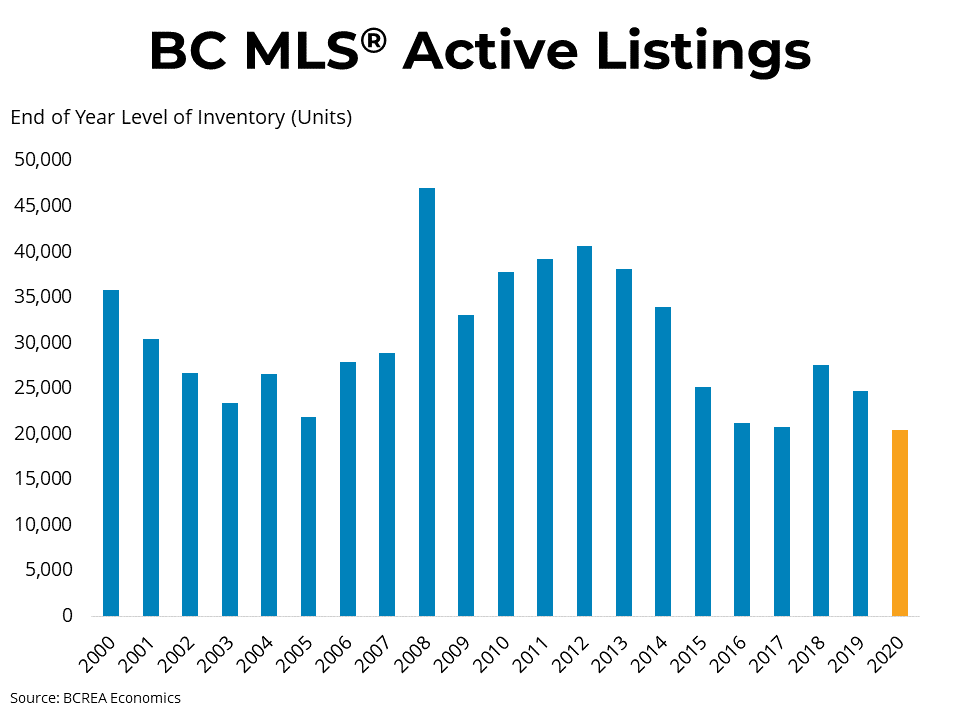
“Housing markets across the province staged a remarkable recovery during the COVID-19 pandemic and recession,” said BCREA Chief Economist Brendon Ogmundson. “We expect considerable momentum heading into 2021.”
A total of 8,268 MLS® residential unit sales were recorded across the province in December, a record for the month and up 57.8 per cent from December 2019. The average MLS® residential price in BC was $847,600, an increase of 12.5 per cent from December 2019. Total sales dollar volume was $7 billion, a 77.5 per cent increase year-over-year.
“While 2021 is expected to get off to a roaring start, the level of supply in the market is near a record low,” added Ogmundson. “That will likely translate to considerable pressure on prices until listings pick-up.”
Total active residential listings were down 16.1 per cent to 20,725 units in December.
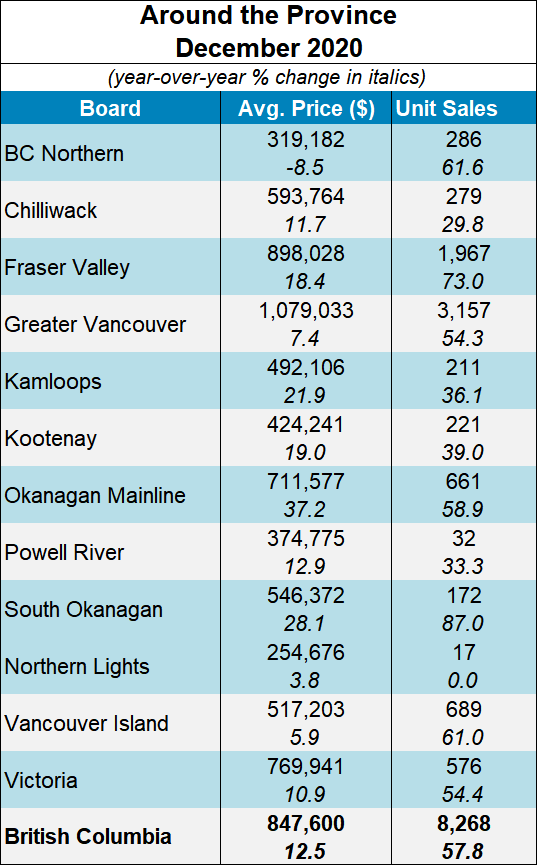
-30-
For more information, please contact:
Brendon Ogmundson
Chief Economist
Direct: 604.742.2796
Mobile: 604.505.6793
Email: [email protected]
To subscribe to receive BCREA publications such as this one, or to update your email address or current subscriptions, click here.
Strong Demand, Dwindling Supply for BC Housing Markets
For the complete news release, including detailed statistics, click here.
Vancouver, BC – June 14, 2021. The British Columbia Real Estate Association (BCREA) reports that a total of 12,638 residential unit sales were recorded by the Multiple Listing Service® (MLS®) in May 2021, an increase of 178.2 per cent over May 2020 when the onset of the COVID-19 pandemic prompted a lockdown of the provincial economy. The average MLS® residential price in BC was $916,340, a 26.2 per cent increase from $726,335 recorded in May 2020. Total sales dollar volume was $11.6 billion, a 251 per cent increase from last year.
“Provincial housing markets continue to calm after peaking in March,” said BCREA Chief Economist Brendon Ogmundson. “The implementation of a stricter mortgage stress test in June may have a minor impact on home sales but we expect strong market activity over the second half of the year.”
Total active residential listings were down 17 per cent year-over-year in May and dipped lower on a seasonally adjusted basis following two prior months of rising active listings.
"On the supply side, markets in the Lower Mainland are seeing a strong supply response, with new listings rising,” said Ogmundson, “however, new listings in markets outside of Metro Vancouver have started to flatten out.”
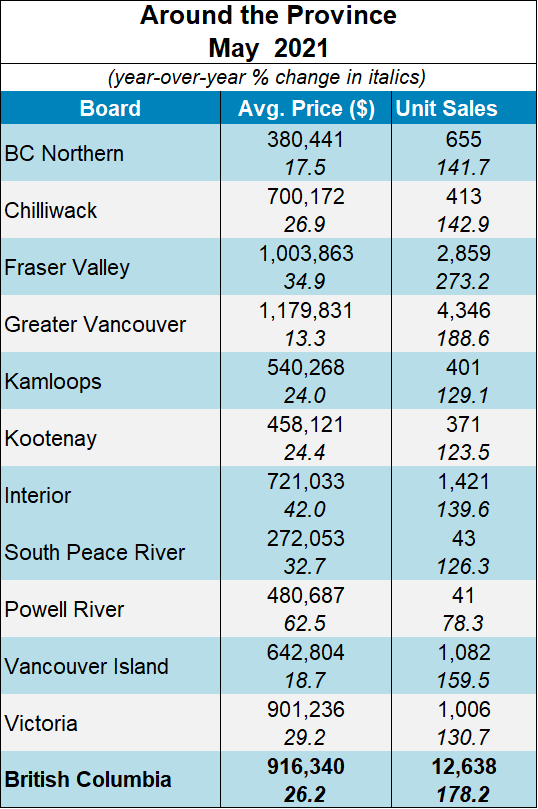
-30-
For more information, please contact:
Brendon Ogmundson
Chief Economist
Direct: 604.742.2796
Mobile: 604.505.6793
Email: [email protected]
Strong First Quarter for BC Housing Markets, But Rising Rates Loom Large
For the complete news release, including detailed statistics, click here.
Vancouver, BC – April 12, 2022. The British Columbia Real Estate Association (BCREA) reports that a total of 11,463 residential unit sales were recorded by the Multiple Listing Service® (MLS®) in March 2022, a decrease of 24.1 per cent from a record March 2021. The average MLS® residential price in BC was $1.096 million, a 15.7 per cent increase from $946,813 recorded in March 2021. Total sales dollar volume was $12.6 billion, a 12.1 per cent decline from the same time last year.
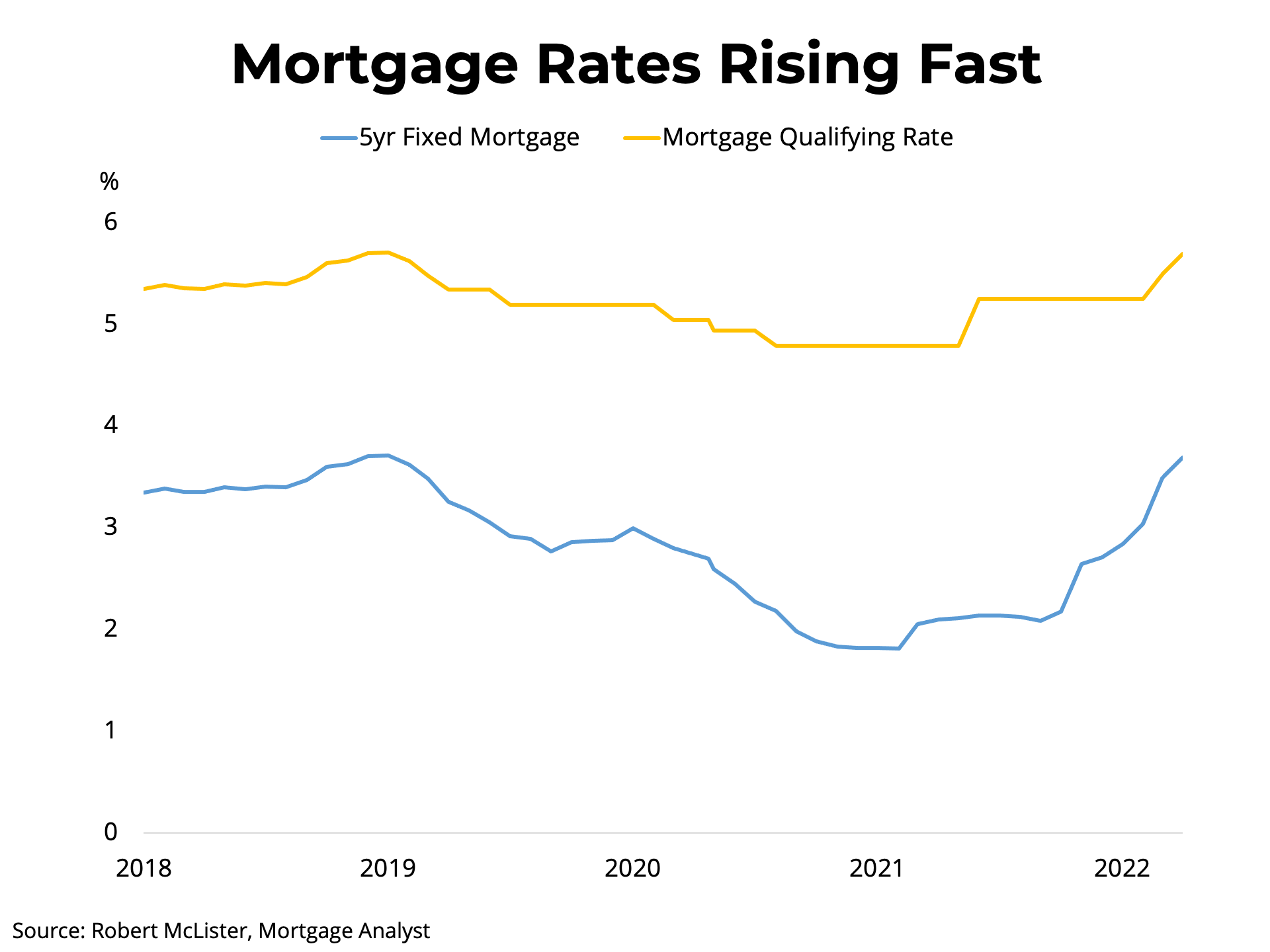
“Home sales in the province continue to moderate from record highs of this time last year,” said BCREA Chief Economist Brendon Ogmundson. “Given the sharp rise in Canadian mortgage rates and expected tightening from the Bank of Canada, activity will likely slow further in the second half of this year.”
Provincial active listings were 12.4 per cent lower than this time last year with the total inventory of homes for sale in the province at under 20,000 units. That level of inventory remains well below the roughly 40,000 listings needed for a balanced market.
Year-to-date, BC residential sales dollar volume was down 4.1 per cent to $28.8 billion, compared with the same period in 2021. Residential unit sales were down 20.1 per cent to 26,577 units, while the average MLS® residential price was up 20 per cent to $1.086 million.
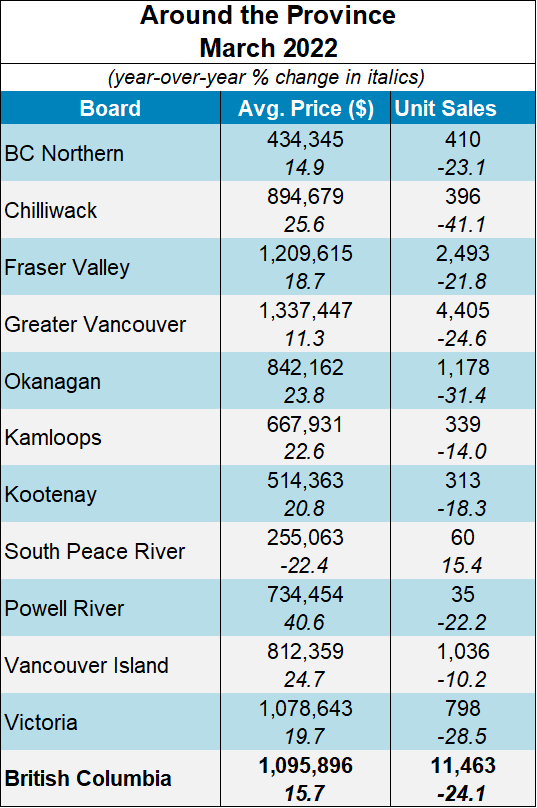
-30-
For more information, please contact:
Brendon Ogmundson
Chief Economist
Direct: 604.742.2796
Mobile: 604.505.6793
Email: [email protected]
Strong Rebound for BC Home Sales in May
For the complete news release, including detailed statistics, click here.
Vancouver, BC – June 14, 2023. The British Columbia Real Estate Association (BCREA) reports that a total of 9,191 residential unit sales were recorded in Multiple Listing Service® (MLS®) systems in May 2023, an increase of 9.9 per cent from May 2022. The average MLS® residential price in BC was $1.02 million up 3 per cent compared to May 2022. The total sales dollar volume was $9.4 billion, representing a 13.2 per cent increase from the same time last year.
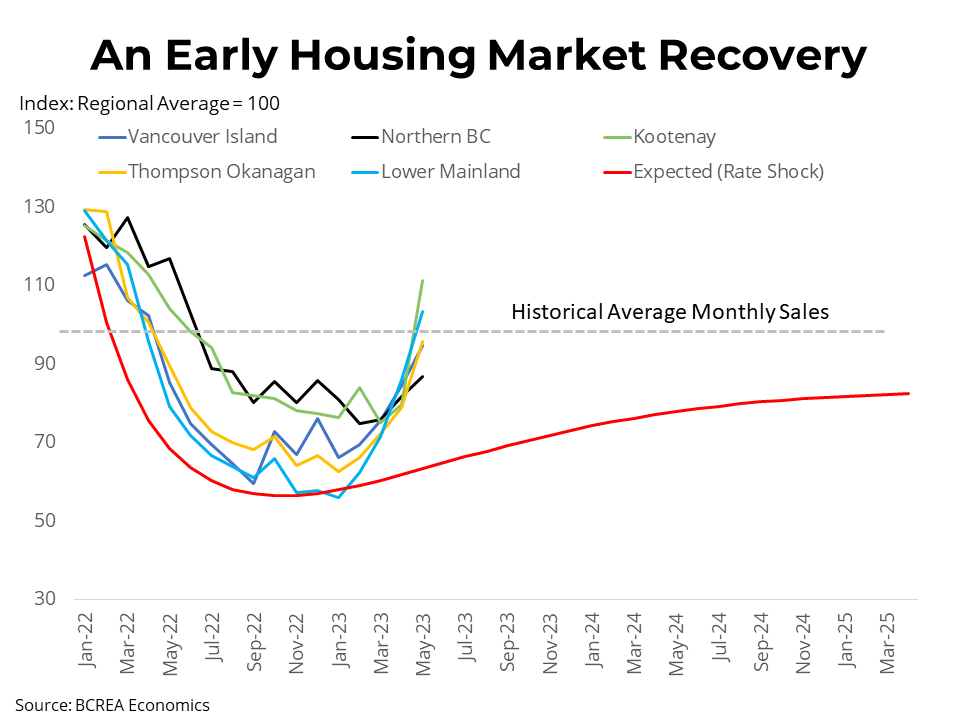
“Home sales in May were surprisingly strong,” said BCREA Chief Economist Brendon Ogmundson. “Normally we’d expect to see a more persistent, negative impact from the last year of rising interest rates on sales. Instead sales staged an early recovery in the spring returning to a normal pace of sales well ahead of schedule.”
The average home price in BC has now recovered much of the decline over the past year and is now back over $1 million for the first time since April 2022.
Year-to-date, BC residential sales dollar volume was down 33.9 per cent to $30.8 billion, compared with the same period in 2022. Residential unit sales were down 28.1 per cent to 31,631 units, while the average MLS® residential price was down 8.2 per cent to $973,085.
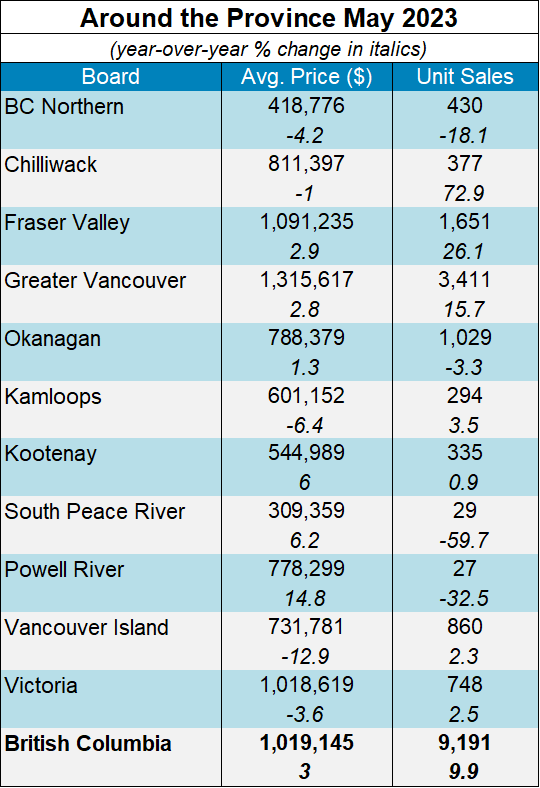
-30-
Strong Recovery Continues for BC Housing Markets
For the complete news release, including detailed statistics, click here.
Vancouver, BC – August 13, 2020. The British Columbia Real Estate Association (BCREA) reports that a total of 10,090 residential unit sales were recorded by the Multiple Listing Service® (MLS®) in July 2020, an increase of 26.6 per cent from July 2019. The average MLS® residential price in BC was $770,810, a 12.9 per cent increase from $682,702 recorded the previous year. Total sales dollar volume in July was $7.8 billion, a 43 per cent increase over 2019.
“The strong recovery in sales activity continued in July,” said BCREA Chief Economist Brendon Ogmundson. “Increased demand for more living space combined with an undersupplied market is producing significant upward pressure on home prices, particularly in the market for single-family homes.”
Active listings remain down significantly year-over-year, creating upward pressure on prices, though increased demand for single-family homes has somewhat skewed average prices in some markets.
Year-to-date, BC residential sales dollar volume was up 8.4 per cent to $32.5 billion, compared with the same period in 2019. Residential unit sales were down 1.4 per cent to 43,718 units, while the average MLS® residential price was up 10 per cent to $754,842.
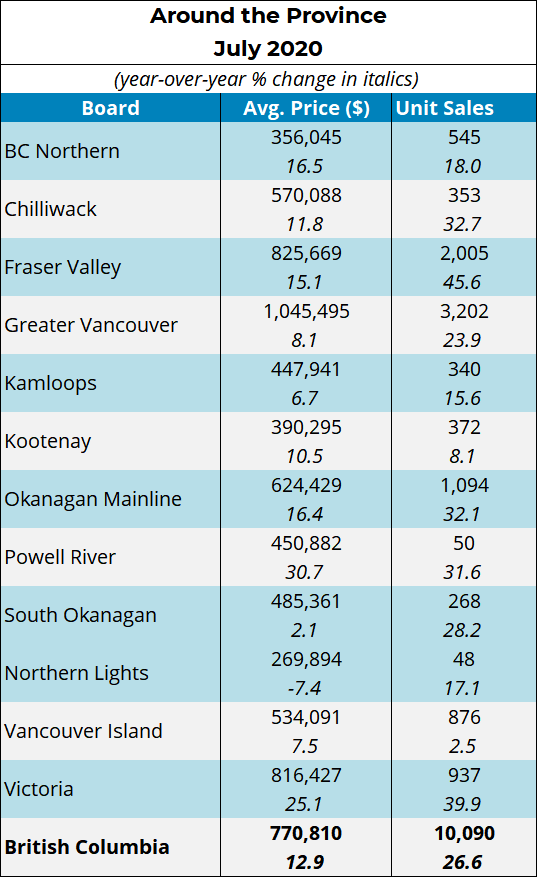
-30-
For more information, please contact:
Brendon Ogmundson
Chief Economist
Direct: 604.742.2796
Mobile: 604.505.6793
Email: [email protected]
To subscribe to receive BCREA publications such as this one, or to update your email address or current subscriptions, click here.
Strong Start to the Summer, But Higher Interest Rates Loom
For the complete news release, including detailed statistics, click here.
Vancouver, BC – July 13, 2023. The British Columbia Real Estate Association (BCREA) reports that a total of 8,740 residential unit sales were recorded in Multiple Listing Service® (MLS®) systems in June 2023, an increase of 21.9 per cent from June 2022. The average MLS® residential price in BC was $991,648, up 4.7 per cent compared to June 2022. The total sales dollar volume was $8.7 billion, representing a 27.6 per cent increase from the same time last year.
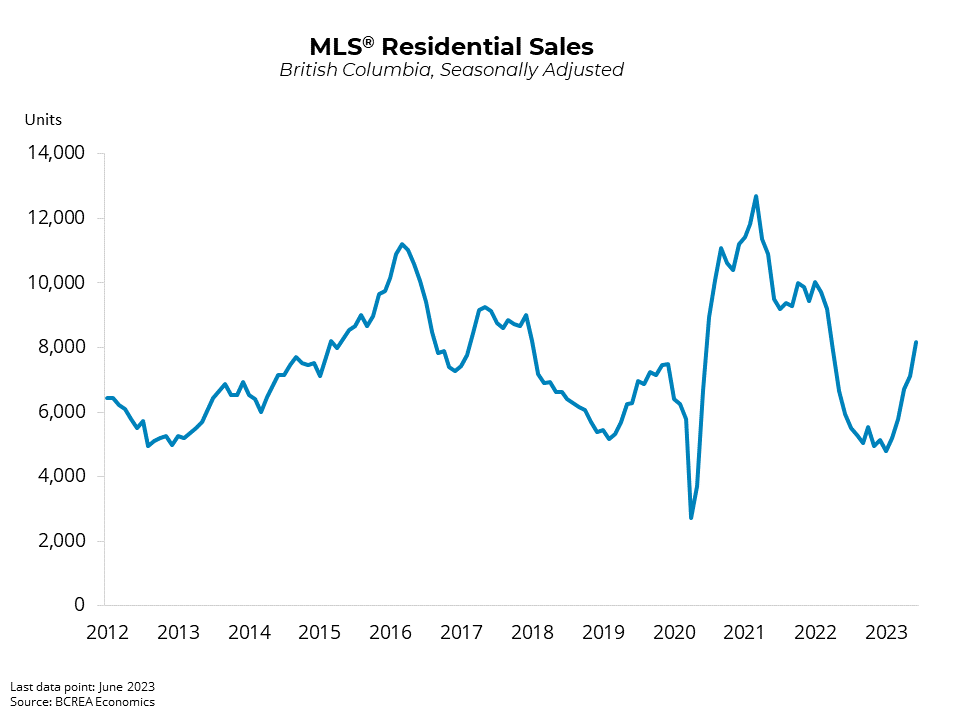
“June home sales continued to outperform expectations, following a very strong rebound in May,” said BCREA Chief Economist Brendon Ogmundson. “However, rising interest rates will likely dampen home sales activity in coming months.”
Active listings in the province were above 30,000 units for the first time since September 2022, but were still down 1.2 per cent compared to this time last year, and essentially flat month-over-month on a seasonally adjusted basis.
Year-to-date BC residential sales dollar volume was down 26.1 per cent to $39.4 billion, compared with the same period in 2022. Residential unit sales were down 21.1 per cent to 40,381 units, while the average MLS® residential price was down 6.4 per cent to $976,885.
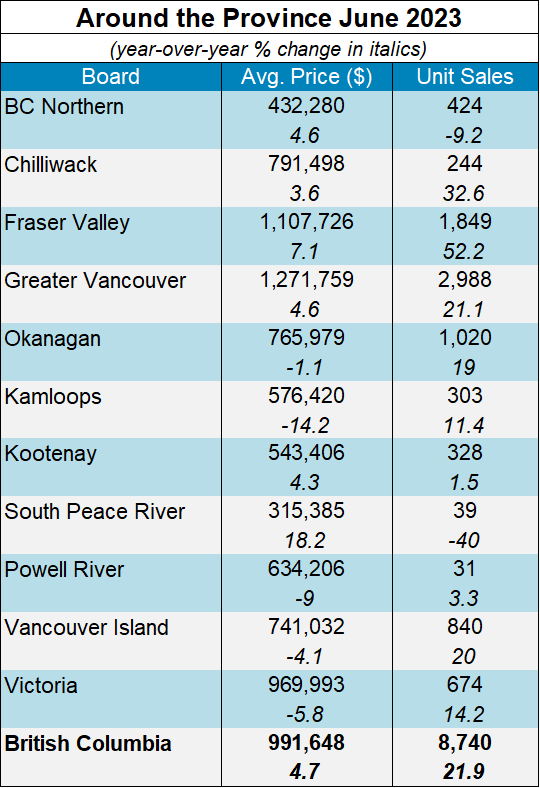
-30-
Stronger Consumer Protection for Healthy Homes
BC needs a provincial framework for remediation to ensure homes that have been used to produce drugs are safe from mould, pesticides and electrical and fire hazards.
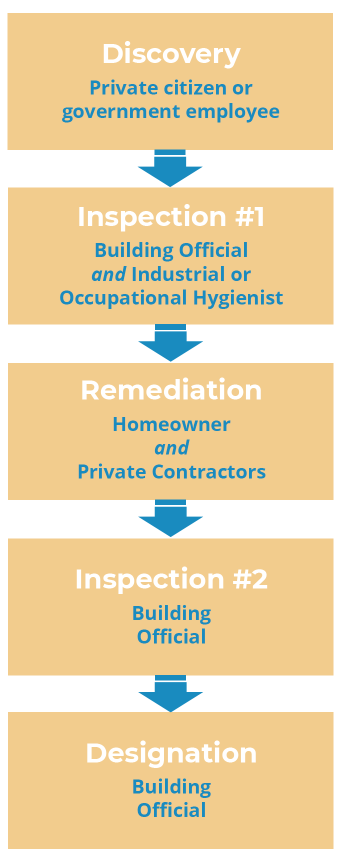
BC's neighbours have made significant strides towards these goals. In Alberta designated officials conduct an inspection, issue an order to vacate and outline the required procedure to remediate a property that was used in drug production. Washington state has remediation guidelines and also certifies workers, supervisors and contractors to clean up illegal drug laboratories. It's time for BC to catch up.
In the spring, MLA Laurie Throness tabled a private member’s bill that he based on BCRE's advocacy, which helped raise awareness of the problem.
We met with Minister of Public Safety and Solicitor General Mike Farnworth. Mr. Farnworth recognizes the importance of BCREA's recommendation and research but wants more buy-in from local governments and other like-minded organizations. We'll use our opportunity at UBCM to garner interest. In the meantime, BCREA plans to meet with Minister of Municipal Affairs and Housing Selina Robinson, asking her to take leadership.
For more information on BCREA's recommendation, read this paper by the University of the Fraser Valley.
For tips on how to safely grow cannabis at home, watch this video by the National Collaborating Centre for Environmental Health.
To subscribe to receive BCREA publications such as this one, or to update your email address or current subscriptions, click here.
Subdivision Plan Not Registered By Completion Date #301
By Gerry Neely
B.A., LL.B.
A decision made January 29, 1999 now gives us three decisions since 1983, each of which involved the sale of a lot to be created upon the registration of a plan of subdivision of a larger parcel. The issue in each case was whether a seller could force the completion of sale where an application to register a subdivision plan was filed prior to the closing date, but new Certificates of Title for the subdivided property were not issued in the name of the seller until after the closing date.
In the 1983 case, the seller’s obligation to register the subdivision plan was found in paragraph 2(b) of the printed form of the Contract of Purchase and Sale, which only required the seller to deliver the application for subdivision to the land title office in registerable form before the completion date. The buyers argued that the seller’s obligation was to have the new Certificates of Title issued by the closing date. This was rejected upon the reasoning that the titles, when registered, were deemed to have been retroactively registered as at the date and time the application for registration was received by the Registrar. (Land Title Act, Section 37)1
The second case, in 1993, which also concerned the paragraph 2(b) clause, was brought by a buyer against his solicitor, alleging negligence for advice that the buyer was not required to complete a purchase because title to the lot being subdivided was not registered in the name of the seller at the closing date. The result differed from the 1983 case because the judge relied upon Section 6 of the Property Law Act, which states that sellers must register their titles before properties can be conveyed to buyers.
The judge held that under the Torrens system of title registration, a seller does not possess a sufficient title to transfer it, until the seller’s name is recorded in the register as the owner of the property involved. The judge concluded that the 1983 decision was correct in ordinary contract law but not where the contract involves the sale of real property. The solicitor’s advice was therefore correct and the buyer’s action was dismissed.2
The 1999 case differed from the other two in that a clause had been added to the Contract of Purchase and Sale which imposed upon the seller the obligation to file the subdivision plan in a timely manner so that on the closing date, the larger parcel would consist of two legal lots. The application to register the two lots with separate legal descriptions and title numbers was still pending at the closing date. Since the seller was unable to deliver title upon the closing date, his breach of Contract enabled the buyer to obtain a return of a $50,000 deposit.
The results of the 1993 and 1999 decisions are a rejection of the conclusion reached in the 1983 case.3
A licensee seeking certainty and flexibility could choose to use the words in the 1999 case for certainty and, as is occasionally tried, to provide flexibility by giving the seller the right to extend the closing date for whatever fixed period of time the parties agree upon.
The contract may provide that the parties will agree upon a new closing date if the subdivision has not been registered by the contract date. If the completion date passes without registration a party wishing to complete the purchase may set a new, reasonable completion date. If the other party chooses to ignore that date, that party is in breach of the contract. For further details see Column #215.4
To subscribe to receive BCREA publications such as this one, or to update your email address or current subscriptions, click here.
Subject Removal #497
When is a party justified in refusing to remove a subject clause?
A subject clause typically benefits one party or another. At common law, that party must, in good faith, make all reasonable efforts to remove their subject clause. In the standard form Contract of Purchase and Sale, the contract terminates if a party fails to give written notice removing their subject clause by the subject removal deadline.
Wording matters, too. One may only refuse to remove a subject clause for a reason tied to the language of the clause. A buyer may not decline to remove her subject to financing clause merely because she's found another property she likes better. According to the Real Estate Council of British Columbia,1
The seller is best served by getting a substantial deposit when the parties first enter the agreement … If the buyer fails to use his or her best efforts to remove the subject clause, the buyer will be in breach of the implied term of the agreement that requires the buyer to act in good faith. If so, the seller may keep the deposit on account of damages … .
In Zhang v. Amaral-Gurgel, the issue was whether the seller breached the contract when she refused to remove her subject clause.2
On October 15, 2016, the seller entered a contract to sell her residential property to the first buyers for $5.8 million, with a $260,000 deposit. The contract included this subject clause:
Subject to the Seller's legal representative / lawyer approving the terms and conditions of the contract on or before October 17, 2016. This condition is for the sole benefit of the Seller.
Shortly before the seller met with her lawyer on October 17, a second buyer submitted a higher offer of $5.968 million, with a $400,000 deposit and an earlier closing date.
The seller showed the lawyer her contract with the first buyers as well as the second buyer's offer. According to the lawyer, the seller's overriding concern was what might happen if the first buyers failed to complete, so the lawyer mainly discussed the seller's legal remedies. The seller never specified any reason for her concern. The lawyer also compared the two deals, but never expressly approved or disapproved the terms and conditions in the seller's contract with the first buyers.
After meeting with her lawyer, the seller sent a counter-offer to the second buyer for $5.98 million ($180,000 more than the first buyers' contract), which the second buyer accepted. Apparently, the contract with the second buyer was not subject to the collapse of the first buyers' deal.
The seller purposely did not communicate with the first buyers until she knew the second buyer had accepted her counter. Then the listing agent told the first buyers' REALTOR® that the seller wouldn't remove her subject to lawyer's approval clause in her contract with the first buyers, but the first buyers refused to accept that their deal was at an end.
Both sets of buyers sued the seller, each claiming to have bought the property.
In the trial of the first buyers' claim, the Supreme Court of British Columbia found the seller failed to act in good faith and use all reasonable efforts to remove her subject clause. The seller breached her agreement with the first buyers by using her subject to lawyer's approval clause to escape the contract to make a better deal with the second buyer. The court ordered the seller to carry out her contract with the first buyers.
Since the first buyers got the property, the second buyer may now claim damages against the seller for breach of that contract.
Zhang reminds a listing licensee in similar circumstances to always make any simultaneous contract with a second buyer subject to confirming in writing the collapse of the seller's deal with the first buyer.
Mike Mangan
B.A., LL.B.
| 1. | Real Estate Council of British Columbia, Professional Standards Manual. | |
| 2. | Zhang v. Amaral-Gurgel, 2017 BCSC 1561. |
Subscribe to Get BCREA CEO Videos Directly to Your Inbox
Since launching in 2024, BCREA's monthly CEO Video With Trevor Koot series has garnered thousands of views and covered topics ranging from BC’s home-flipping tax to the role of speculators in housing development.
To date, you can find these videos on YouTube, as well as on BCREA’s Facebook, LinkedIn, and Instagram accounts. We also created a web archive you can peruse at your leisure.
Now, we’re creating an additional way for series fans to get the videos: a dedicated email subscription. Click the button below, then select "CEO Videos" and click "Sign Up" on our subscription form to receive the videos every month, directly to your inbox, as soon as we post them to YouTube.
BC REALTORS® already automatically receive a quarterly round-up email with the three most recent videos. This new subscription is specifically created for anyone who wants a dedicated email informing them of the latest video.
Sign up today and never miss another BCREA CEO video!
Substantial Instead of Minor Changes to the Condominium Plan; Disclosure Statement – Failure to File Amendment, Material False Statement in the Budget #269
By Gerry Neely
B.A. LL.B
Since many developers are now pre-selling before there is a hole in the ground, their presentations to prospective buyers can only be based upon models, plans and sales brochures portraying the merits of the condominium a prospective buyer may occupy. Inevitably some alterations to the plans are required as construction proceeds. A developer who contracts with a buyer to complete the development substantially in accordance with the plans, illustrations and descriptions, needs flexibility to make these changes. The result is a clause in the contract, which in general permits modifications thought by the developer and the architect to be desirable and reasonable.
The point at which changes by the developer cease to be minor and amount to substantial changes, was the subject of a case which came before the B.C. Court of Appeal in late 1996. A number of buyers refused to complete their purchases of the completed condominium development because of the changes made by the developer. Those changes included: hot water heating to electric baseboard, substitutions of concrete guardrails for glass rails, changes to the lobby and the landscaping and the elimination of five windows in each suite, windows which gave light and views to the east and west sides of a condominium unit.
The developer gave a number of reasons for justifying these changes, including safety, privacy, increased flexibility in the furniture layout and in the efficient use of the kitchen.
Both the trial judge and the Court of Appeal agreed that the changes were not minor and the units were not substantially built in accordance with the plans. The changes amounted to a fundamental breach, which entitled the buyers to rescind the contracts and to obtain repayment of their deposits.1
* * *
What consequences flow from the underestimation by a developer of a condominium project of the initial monthly expenses, compounded by the failure to file an amendment to the disclosure statement, when it should have been evident that the developer’s budgeted figures were false at the time a sale took place?
The disclosure statement was filed in October of 1993 and given unamended to buyers who bought in June of 1995. The disclosure statement indicated a monthly assessment of $129.57 per month, while the evidence at trial was that the monthly maintenance fee in 1995 was approximately $200.
A developer’s obligation under Section 56 of the Real Estate Act, is to file an amendment if any change occurs which has the effect of making a statement in the disclosure statement false or misleading. Not every change requires amendment, only those which if left unchanged would result in a material false statement being made in the disclosure statement.
The judge concluded that the budgeted monthly assessment was a material false statement, upon which the buyers had relied in deciding to purchase their unit, which entitled them to damages.
The buyers had stated that they intended to live in the house for a period of four years and damages of $3,000 were awarded to cover the difference between the stated and actual monthly assessments over that period. An additional $2,000 was given as slight compensation for the possibility that the higher maintenance fee would make it more difficult to sell the condominium.
Section 59 of the Real Estate Act makes a director of the developer company personally liable for a material false statement contained in the disclosure statement. Therefore, damages were awarded against both the developer company and its directors.2
| 1. | Lau v. 1755 Holdings Ltd., 6 R.P.R. (3d) 152. | |
| 2. | Hass v. Tungnan Enterprises Ltd., S.C.B.C., January 24th, 1997. |
To subscribe to receive BCREA publications such as this one, or to update your email address or current subscriptions, click here.
Success of Real Estate Consumer Protection Measures Hinges on Next Steps by BC Government and Real Estate Regulator
Vancouver, BC – May 30, 2022. After reviewing the BC Financial Services Authority (BCFSA) consumer protection recommendations published on May 26, the British Columbia Real Estate Association (BCREA) urges the Ministry of Finance to carefully consider the next steps prior to implementing any of the measures proposed.
While many of the consumer protection recommendations in BCFSA’s report align with recommendations BCREA and the real estate sector made in the white paper, A Better Way Home: Strengthening Consumer Protection in Real Estate, earlier this year, the full suite of measures proposed by the BCFSA, if adopted, would present a significant change to the real estate transaction process and could cause additional strain and confusion for buyers, sellers and others involved.
“We are pleased to see that the regulator agrees with our recommendations to introduce a pre-offer period and make key documents available upon the listing of a property,” says BCREA Chief Executive Officer Trevor Koot. “We all agree that protecting consumers in real estate transactions is extremely important, however, how the Ministry handles these recommendations next will determine the success of any changes.”
The Minister of Finance announced plans for the “cooling-off period” and subsequently tabled the Property Law Amendment Act to enable its implementation without prior research and consultation with the public or the real estate sector and before having its report from BCFSA. The regulator was also not tasked with considering the merits or effectiveness of the “cooling-off period” proposed within its report, leaving it only to consider how, not if, it should be implemented.
“To implement any changes effectively and successfully, it is imperative that Ministry empower BCFSA to carry out the next steps. It is often referred to as an “independent regulator,” yet BCFSA has been directed to research a pre-decided policy without being given latitude to determine whether a ‘cooling-off period’ is an effective mechanism to protect consumers. This is a critical step that has been missed and we consider it vital before moving forward,” Koot adds. “More time, research and consultation with all parties involved in the real estate transaction process – including Realtors – is needed to ensure the nuances of such substantial changes are carefully considered and unintended consequences on consumers are avoided.”
The voice of Realtors is extremely important when making decisions that impact the real estate transaction process. The profession is the closest point of contact with consumers, representing their interests, hearing their questions and concerns and can provide insight that is not available elsewhere.
BCREA, the province’s eight real estate boards and 24,000 Realtors published more than 30 consumer protection recommendations in February. View the report and full list of recommendations at bcrea.bc.ca/whitepaper.
- 30 -
Media contact:
Shaheed Devji
Sr. Communications Specialist
778.847.7424
[email protected]
Suing for Unpaid Deposits #527
Generally speaking, if a buyer breaches a contract for the purchase of real estate and the seller accepts the buyer’s refusal to perform the contract (as known as “repudiation”), an innocent seller is entitled to retain the deposit paid by the buyer under a contract of purchase and sale. But what happens when a buyer breaches a contract before the deposit is due and payable? Is the seller still entitled to the deposit if the transaction collapses due to the buyer’s breach?
In a recent decision, the British Columbia Court of Appeal confirmed that a seller is entitled to an unpaid deposit owing under a contract of purchase and sale for real estate, even if the repudiation of the contract is accepted by the innocent party. In its decision in Argo Ventures v. Choi 1, the Court confirmed that a seller can sue for the unpaid deposit even after it has accepted the repudiation of the contract due to the buyer’s breach or default.
The facts of the case are as follows: In the summer of 2016, the buyers entered into a contract to purchase a property in Port Coquitlam, British Columbia for approximately $6,500,000, with an initial non-refundable deposit of $300,000 due within ten business days. The buyers decided not to complete the purchase, despite there being a binding contract, and failed to provide the deposit within ten business days of acceptance (as set out in the contract). The buyers breached the contract (by stating that they would not complete the purchase) before the date the deposit was due. The seller accepted the buyers’ repudiation of the contract for failure to pay the deposit on time, thereby terminating the contract, and the seller commenced an action for the amount of the unpaid deposit.
On January 25, 2019 the Supreme Court of British Columbia awarded a judgment against the buyers in the amount of $300,000, plus pre-judgment interest and costs. The buyers did not dispute that the deposit was owing on a certain date and that it was unpaid, rather at trial they put forward a defence of non est factum, stating they were unaware of the changes that were made in the counteroffer which were initialed by them. The defence of non est factum was unsuccessful with the Supreme Court as the judge found that the buyers’ mistaken belief regarding the revisions in the counteroffer, as initialed by them, was due to their own carelessness.
On appeal, the buyers stated that the trial judge erred in its decision and they put forward a new argument that the unpaid deposit was not owing and due, as it was forfeited on the repudiation of the contract. The buyers’ argument had two main aspects:
- The deposit was not owing on the date they repudiated the contract (i.e., the repudiation of the contract occurred before the deposit was due); and
- The deposit could not be forfeited to the seller because it was never paid.
On the first point, the court refused the buyers’ argument and relied on the principles set out in Vanvic Enterprises Ltd. v. Mack 2, which state that “where the seller’s right to a non-refundable deposit has accrued before it accepts the buyer’s repudiation, the seller can sue for an amount equal to the unpaid deposit”3.
On the second point, the court refused the buyers’ argument noting that the trial judge did not order the forfeiting of the deposit, but rather an award in damages or debt in an amount equal to the deposit.
Through its decision in Argo Ventures v. Choi, the Court reviewed some important aspects of the law regarding deposits as summarized below:
- Deposits cannot be excessive or unconscionable, and that deposits are an exception to the usual rule against penalties.4
- Even where the seller does not suffer any damages, the deposit is still forfeitable if the buyer is in default or breaches the contract.5
- A seller can still sue for an unpaid deposit owing, even after it has accepted the buyer’s repudiation of the contract.6
A seller can claim an award for either damages or debt for an unpaid deposit owing.7 The Court, through its decision in Argo Ventures v. Choi, has confirmed that regardless of when a deposit is due and payable, an innocent seller will be entitled to the deposit (or a sum equal to the deposit) under a contract for real estate if the buyer breaches the contract (and such repudiation is accepted by the seller), even if the breach by the buyer occurs before the deposit was due and payable. In addition to retaining, or claiming an award for, the deposit, a seller may also sue for any damages suffered that exceed the amount of the deposit. Licensees should always advise their clients to seek independent legal advice for any matters related to breach of contract.
To subscribe to receive BCREA publications such as this one, or to update your email address or current subscriptions, click here.
Summary of Recommendations from A Better Way Home for BC REALTORS®
On February 28, BCREA released a comprehensive white paper titled A Better Way Home: Strengthening Consumer Protection in Real Estate, which includes a set of recommendations for the BC Government on better-protecting consumers in real estate transactions and addressing the root causes of BC's lack of housing affordability.
The white paper was developed in response to the Ministry of Finance's plans to introduce a mandatory "cooling off period" in real estate transactions, announced in November 2021. We are deeply concerned that this decision was made without thorough public consultations with the real estate sector and consumers, a problem statement or supporting rationale.
As the provincial professional association for REALTORS®, we support measures to increase consumer protection in real estate transactions, but it must be done in a way that is evidence-based, regionally nuanced, and considers buyers, sellers and changing market trends. Without these best practices, policies are likely to result in unintended negative consequences for consumers and the market as a whole.
We also know that Realtors, real estate boards and BCREA are uniquely positioned to support the government if they truly wish to improve consumer protection in real estate transactions. Our white paper relies on the profession's access to extensive data, expert analysis on housing market conditions, on-the-ground insights into consumer experience and close working relationships with other housing sector stakeholders to present thoughtful, evidence-based recommendations for a better way home for British Columbians.
Here's what you need to know about A Better Way Home.
Our recommendations fall into four core categories:
- improving housing affordability,
- enhancing consumer protection in transactions,
- evolving the real estate sector, and
- creating a world-leading regulatory structure.
Addressing the root cause: housing supply
Improve housing affordability include implementing supply-side measures and calls to action made by the Development Approvals Process Review and The Expert Panel of Housing Supply and Affordability, establishing a permanent National Housing Roundtable in coordination with the federal government and making infrastructure investments to local government conditionals on Official Community Plans.
Enhancing consumer protection in real estate transactions
Enhance consumer protection in real estate transactions, including implementing a mandatory five business-day "pre-offer period" from the time of listing instead of a "cooling off period." During this pre-offer period, offers cannot be presented, allowing prospective buyers time to conduct due diligence.
Evolving the real estate sector
Continue evolving the real estate sector, include raising qualification standards for new licensees and providing more targeted re-licensing education for managing brokers, implementing a Professional Standing Committee within the BCFSA, modelled after the BC Teachers' Council, to ensure the BCFSA benefits from the on-the-ground professional experienced Realtors when making practice changes.
Creating a world-leading regulatory structure
Raising entry qualification standards for new licensees and provide more targeted re-licensing education for managing brokers ensure high consumer satisfaction. Establishing a Professional Standing Committee within BCFSA, modelled after the BC Teachers' Council also ensures BCFSA benefits from the on-the-ground perspective of experienced Realtors when making practice changes.
You can read the full white paper here and for a summary of the white paper go here. Additional resources dedicated to this initiative can be found here.
If you have any questions or concerns, please email [email protected].
Summer Home Sales Slow to a Simmer
For the complete news release, including detailed statistics, click here.
Vancouver, BC – August 13, 2018. The British Columbia Real Estate Association (BCREA) reports that a total of 7,055 residential unit sales were recorded by the Multiple Listing Service® (MLS®) across the province in July, a 23.9 per cent decrease from the same month last year. The average MLS® residential price in BC was $695,990, down 0.4 per cent from July 2017. Total sales dollar volume was $4.9 billion, a 24.2 per cent decline from July 2017.
 “The BC housing market continues to grapple with the sharp decline in affordability caused by tough new mortgage qualification rules,” said Cameron Muir, BCREA Chief Economist. “However, less frenetic housing demand has created more balanced market conditions in many regions, leading to fewer multiple offers and more choice for consumers.”
Year-to-date, BC residential sales dollar volume was down 18.9 per cent to $37 billion, compared with the same period in 2017. Residential unit sales decreased 20.6 per cent to 50,926 units, while the average MLS® residential price was up 2.1 per cent to $725,639.
-30-
For more information, please contact:
Cameron Muir
Chief Economist
Direct: 604.742.2780
Mobile: 778.229.1884
Email: [email protected]
To subscribe to receive BCREA publications such as this one, or to update your email address or current subscriptions, click here.
Superintendent Adopts New Rules
On April 27, Rule changes concerning English language proficiency requirements, remuneration disclosure and conflicts of interest were finalized. These Rules were part of the consultation the Office of the Superintendent of Real Estate (OSRE) conducted that closed on April 20.

The Rule on remuneration requires that new disclosures to sellers must include a dollar amount, not just a percentage. The Rule on conflict of interest requires that when a conflict arises, licensees must either walk away from both parties or get consent from both parties to end one relationship and continue with the other. These Rules come into effect on June 15, 2018.
The Rule on English language proficiency requirements for new applicants is in effect now.
The proposed Rule that would have created new continuing professional education requirements was not adopted. Instead, OSRE supports the Real Estate Council of British Columbia's decision to require all trading services and rental property management licensees to complete the Rule Changes: Agency and Disclosure course as part of their relicensing education requirements.
The proposed administrative penalties Rule was also not implemented.
Also scheduled to come in effect on June 15 are additional disclosures and the ban on limited dual agency. BCREA continues to advocate for a thorough review of the impending ban on limited dual agency, especially as it impacts small communities and commercial practitioners.
More information:
OSRE Announcement on New Rules
Results of the Public Consultation on Proposed Real Estate Rules
To subscribe to receive BCREA publications such as this one, or to update your email address or current subscriptions, click here.
Supply and Demand: A Quantitative History of BC Home Prices
To view the Market Intelligence Report PDF, click here.
Summary Findings:
- Growth in home prices is a function of many factors and those factors do not always impact prices to the same degree
- Shocks to housing demand and interest rates are the largest contributors to fluctuations in home prices, but provincial and municipal governments have limited to no ability to control these factors
- Policies to increase the overall housing stock and grow the supply of residential listings would be enormously beneficial to controlling future price growth
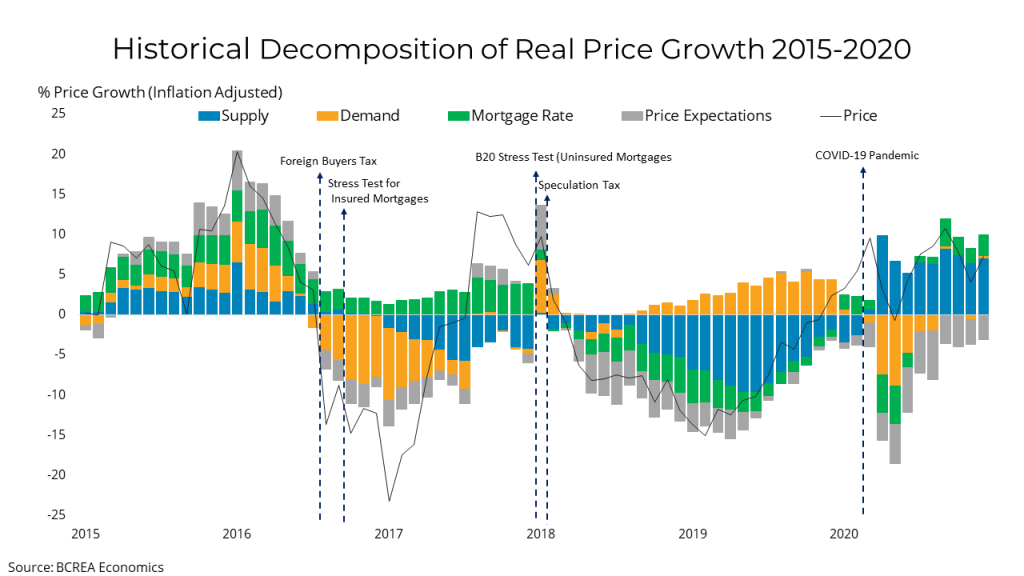
For more information, please contact:
Brendon Ogmundson
Chief Economist
Direct: 604.742.2796
Mobile: 604.505.6793
[email protected]
Kellie Fong
Economist
Direct: 778.357.0831
Mobile: 604-366-6511
[email protected]
Supporting Efficiency and Confidence in Real Estate
BC’s approach to real estate licensing is unique. Since 2016, we've had two regulators:

- The Office of the Superintendent of Real Estate (OSRE) makes rules related to licensing and real estate practice and oversees and directs the operations and activities of the Real Estate Council of British Columbia.
- The Council administers the Real Estate Services Act, regulations, rules and bylaws, and upholds and protects the public interest in relation to the conduct and integrity of licensees.
This co-regulatory system has not worked very well, as noted by the independent review released by Minister of Finance Carole James on September 27. Real Estate Regulatory Structure Review was prepared by lawyer Dan Perrin. He found that the current system is unsustainable, and the central issue is policy development. To fix the situation, the regulatory structure and the process to develop policy must be changed.
The example Mr. Perrin uses to illustrate the policy development challenge is significant changes to real estate practice rules that took effect on June 15, 2018. Mr. Perrin found that OSRE and the Council didn’t collaborate effectively, resulting in inconsistencies between the policy intent of OSRE rules and policy interpretation by the Council.
One of these changes was a ban on the practice of limited dual agency. Limited dual agency occurs when one REALTOR® represents more than one party in a real estate transaction. That can be the buyer and the seller, more than one buyer or a landlord and tenant.
While BCREA supports consumer protection, we understand the ban on limited dual agency is having the opposite effect in many cases. In small communities with very few REALTORS®, consumers are often forced to work with REALTORS® they don’t know, REALTORS® from outside of the area or to simply represent themselves.
And the limited dual agency ban certainly wasn’t designed for the commercial real estate market. People who buy and sell commercial real estate are sophisticated, and they receive advice from a variety of professionals, including lawyers and accountants.
In October, REALTORS® from around the province presented MLAs with solutions to these challenges that will help smooth the transition to the new rules. Giving consumers greater clarity on their rights and giving licensees more certainty and guidance will create the confidence needed to use limited dual agency in cases where it’s in the client’s interest.
BCREA has also made many recommendations to improve our regulatory system—including the need for more input from professionals with practical experience—and we look forward to learning Minister James’s next steps for regulatory reform.
To subscribe to receive BCREA publications such as this one, or to update your email address or current subscriptions, click here.
To subscribe to receive BCREA publications such as this one, or to update your email address or current subscriptions, click here.
Supporting Those Impacted by 2026 BC Wildfires
The staff, directors, and members of the British Columbia Real Estate Association (BCREA) would like to extend our support to those affected by the devastating 2026 BC wildfire season. Many British Columbians have lost homes, and many more have been evacuated.
As efforts to fight and contain the fires continue, the Canadian and BC real estate communities are stepping up to help.
2026 British Columbia Wildfires Appeal
The Canadian Real Estate Association has launched a fundraising campaign in support of the Canadian Red Cross’s 2026 British Columbia Wildfires Appeal.
Donations will support the ongoing relief, recovery, and resilience efforts in response to the wildfires, as well as community preparedness and risk reduction for future all-hazard disaster events within British Columbia. Funds will also be used to support mobilization of response and community partners.
Call for Donations Yields Overwhelming Response
Kim Heizmann, Okanagan REALTOR® and Chair of the BCREA Board of Directors, issued a call for donations to help those impacted by the Bradley Creek wildfire.
After her call went out on Sunday, August 2, 2026, Heizmann received a steady stream of donations that filled her Oakwyn Realty real estate office in Vernon, BC. Volunteers began distributing the items the following day.
For more info on this story, click here.
REALTOR® Resources
Moreover, the fires are causing many practice-related issues and questions for REALTORS®. For those with sector and business-related questions tied to BC wildfires, the Association of Interior REALTORS® is maintaining a dedicated web page with frequently updated resources and information.
Supporting Those Impacted by 2026 BC Wildfires
The staff, directors, and members of the British Columbia Real Estate Association (BCREA) would like to extend our support to those affected by the devastating 2026 BC wildfire season. Many British Columbians have lost homes, and many more have been evacuated.
As efforts to fight and contain the fires continue, the Canadian and BC real estate communities are stepping up to help.
2026 British Columbia Wildfires Appeal
The Canadian Real Estate Association has launched a fundraising campaign in support of the Canadian Red Cross’s 2026 British Columbia Wildfires Appeal.
Donations will support the ongoing relief, recovery, and resilience efforts in response to the wildfires, as well as community preparedness and risk reduction for future all-hazard disaster events within British Columbia. Funds will also be used to support mobilization of response and community partners.
Call for Donations Yields Overwhelming Response
Kim Heizmann, Okanagan REALTOR® and Chair of the BCREA Board of Directors, issued a call for donations to help those impacted by the Bradley Creek wildfire.
After her call went out on Sunday, August 2, 2026, Heizmann received a steady stream of donations that filled her Oakwyn Realty real estate office in Vernon, BC. Volunteers began distributing the items the following day.
For more info on this story, click here.
Supporting Those Impacted by the Tragedy in Tumbler Ridge, BC
The staff, directors, and members of the British Columbia Real Estate Association (BCREA) have been deeply saddened by news of the unspeakable tragedy that occurred in Tumbler Ridge, BC, on Tuesday, February 10, 2026. Our hearts go out to the victims, their families, and everyone else affected in the Tumbler Ridge area and beyond.
In partnership and collaboration with our colleagues at the Canadian Real Estate Association, REALTORS Care®, and BC’s eight regional real estate boards and associations, BCREA is launching a fundraising campaign in support of the Canadian Red Cross’s Tumbler Ridge Tragedy Appeal. Donations will be used to respond to the immediate and emerging needs of impacted individuals and families, and to support the recovery and resiliency of the community.
BCREA encourages BC REALTORS® and anyone else reading this to consider supporting this important cause and all those affected by this tragedy.
Supreme Court of Canada Refuses Leave in Wolastoqey Aboriginal Title Case
On Thursday, May 28, 2026, the Supreme Court of Canada declined an application for leave to appeal in the Wolastoqey Aboriginal title case in New Brunswick. As is typically the case, the Supreme Court did not provide reasons for its decision not to hear the appeal.
While some headlines have suggested that the Supreme Court has ruled on the relationship between Aboriginal title and privately owned land, that is not what occurred. The Supreme Court's decision not to hear the appeal is not a decision on the merits of the case and does not create new jurisprudence. It simply means that the New Brunswick Court of Appeal's decision will remain the final decision in that proceeding.
The outcome is nevertheless significant. The Court of Appeal's decision will likely be relied upon in future Aboriginal title litigation, including ongoing proceedings in British Columbia. In particular, it may make it more difficult for Indigenous groups to obtain declarations of Aboriginal title affecting privately owned land. However, the decision does not resolve broader questions regarding Aboriginal title, including claims involving Crown lands and other interests.
For REALTORS® and their clients, the key takeaway is that this development provides additional clarity regarding how one appellate court has approached these issues, but it should not be viewed as a final resolution of the relationship between Aboriginal title and private property. Aboriginal title remains an evolving area of law, and it remains possible that a future case raising similar issues, including ongoing Aboriginal title proceedings such as the Cowichan litigation in British Columbia, could ultimately be heard by the Supreme Court of Canada, resulting in additional direction from Canada's highest court.
We recognize that discussions regarding Aboriginal title can create uncertainty for property owners, buyers, sellers, and Indigenous communities. This decision provides additional context for those discussions but should be considered within the broader and evolving legal landscape.
To assist REALTORS® in navigating these discussions with clients, the BC Real Estate Association (BCREA) is continuing to develop educational resources, including a new Aboriginal Title and Fee Simple Ownership reference guide that provides a practical overview of the current legal landscape and common questions from consumers. We anticipate distributing these resources early this coming summer.
Furthermore, BCREA CEO Trevor Koot remains available to present at brokerage meetings to provide context and support informed discussion. If you would like to book a speaker on this or any other topic, please click here.
Surveyors – Minimum Fees and Survey Certificates #136
By Gerry Neely
B.A. LL.B.
The Corporation of Land Surveyors of the Province of British Columbia performs a valuable service for all of us and, until recently, at a price fixed by a mandatory minimum tariff. This they were able to do without fear of the Competition Act, because the Land Surveyors Act gave the Corporation power in the administration of its affairs, to set a tariff of fees.
While the provincial statute shielded the surveyors from the hot breath of the Bureau of Competition Policy, it was less successful in maintaining prices among its own members when, in 1986, the minimum fee for a survey certificate jumped from $150 to $200. This caused a degree of heartburn among purchasers, a touch of envy among other provincially unprotected professions, and a minor revolt by a few surveyors who chose to charge the lesser fee.
This breaking of ranks led to an unsuccessful action by the Corporation to muster the defaulters on the $200 line. Unsuccessful, because the Court held that while the Corporation had the power to set a tariff of fees, the provincial legislation did not give it the power to set minimum fees.
Shortly after this decision was pronounced, the Corporation found itself down love-thirty as another judge found a way to introduce into the survey practice more than price competition.
In this case, a company carried on a "computer assisted mapping and drafting service" for its clients. When the fee for a survey certificate was raised to $200, it started doing survey certificates for mortgage companies for $150. This price was attractive, and as the reputation of the Company spread, more solicitors and mortgage companies were prepared to accept its survey certificates.
The Corporation's view was that the Company was trespassing on the Corporation's turf. It brought an action in the Supreme Court of British Columbia to restrain the Company from doing an act which only a land surveyor who is a member in good standing of the Corporation can do under the provisions of the Land Surveyors Act.
The argument on behalf of the Corporation of Land Surveyors was that in preparing the survey certificate, the Company was rendering an opinion as to the legal boundaries of the lot and that such an act is the act of a land surveyor. The judge disagreed with that, saying that in preparing the survey certificates, all that the Company was doing was determining the location of the building "after identifying and locating the corners of the lot and the survey monuments."
It is likely that one or both of these cases will be appealed, having regard to the economic impact these decisions may have upon the surveyors. The conclusions reached by the judges show that special privileges which may have the effect of restraining competition, will be interpreted strictly.1
| 1. | Corporation of Land Surveyors of the Province of British Columbia v. Ifomap Services Incorporated and Wannamaker, SCBC, Victoria Registry 87/2291, March 22, 1989. |
To subscribe to receive BCREA publications such as this one, or to update your email address or current subscriptions, click here.
Sustainable Homes: Understanding What Homebuyers Want
Are homebuyers willing to pay more for a sustainable home than a conventional one? What features do homebuyers value most when it comes to sustainable homes? These are some of the questions students from BCIT’s Sustainable Business Leadership Program are hoping REALTORS® will help them answer by participating in a short online survey.
The survey is open to Realtors until May 14 and consists of 12 questions that should take five to 10 minutes to complete.
Results from the survey will be used to create better education for homebuyers and materials to help Realtors talk to consumers about the benefits of sustainable homes. Click here to participate.
Tackling Housing Affordability in Budget 2018
Housing affordability is a central focus of the provincial budget announced on February 20. The government's 30-point "Homes for BC" plan outlines their approach.

Some of the key points of the plan include:
- Introducing a "speculation tax," charging residential property owners who don't pay income tax in BC, at an annual rate of 0.5 per cent in 2018 and two per cent in 2019 of the assessed value of their property (effective starting in the 2018 tax year)
- Increasing the tax on foreign buyers to 20 per cent, and widening its scope to include the Victoria, Nanaimo, Fraser Valley and Central Okanagan regional districts (effective February 21).
- Increasing the Property Transfer Tax rate in the third tier (over $3 million) to five per cent (up from three per cent) (effective February 21).
- Increasing the provincial school tax on properties with a value over $3 million (beginning in 2019).
- Investing $6.6 billion over the next ten years to increasing the supply of affordable homes.
- Investing an additional $378 million over the next three years to increasing "missing middle" rental stock.
While BCREA welcomes the government's commitment to increasing the supply of affordable homes, we're concerned about the negative impact the additional taxes may have. The proposed taxes do nothing to address the real problem of matching housing supply to demand within a reasonable timeframe, and so BCREA will continue to advocate for these changes in a way that represents the best interests of REALTORS® and their clients.
See the government's 30-point plan here, and BCREA's response here.
To subscribe to receive BCREA publications such as this one, or to update your email address or current subscriptions, click here.
Take Care When Pricing Property #418
By Jennifer Clee
Advising a seller as to an appropriate list price or reasonable sale price is fraught with risk in a hot market. A seller’s euphoria at achieving a sale price beyond wildest expectations quickly dissipates when the property resells shortly after at a significantly higher price, or when sales of comparable properties suggest the property was underpriced. Given the stakes involved, unhappy sellers don’t hesitate in resorting to the courts to seek damages from their REALTORS® for undervaluing their properties.
In determining the liability of the REALTOR® in regard to valuing property, a court will consider the steps taken to investigate market value, the availability of sales information on comparable properties, market conditions, the seller’s sophistication and the nature of the agency relationship with the seller.
A recent decision of the BC Supreme Court (1) considered a claim by a seller against a REALTOR® for allegedly undervaluing the seller’s 9.32-acre parcel of undeveloped land. On his unlisted property, the seller accepted an offer brought by the REALTOR®, signing an exclusive listing agreement and Limited Dual Agency Agreement (LDAA) at the same time.
The seller sued the REALTOR® for breach of contract, breach of fiduciary duty and negligence, complaining the property sold for $400,000 less than its fair market value.
In considering the negligence claim, the court found a duty of care did not arise on the REALTOR®’s part until the seller accepted the buyer’s offer and signed the LDAA. Before that time, there was no agreement, no reliance, nor any relationship between the seller and the REALTOR®. The court found that, even if a duty of care had arisen earlier, the seller failed to establish that it had been breached. Even if the REALTOR®’s analysis of the market value had been wrong, he wasn’t negligent if he met the proper standard of care. As the seller failed to establish the customary standard of care, it wasn’t possible for the court to determine whether the REALTOR® had failed to meet that standard. The negligence claim was dismissed.
The seller complained the REALTOR® had breached his fiduciary duty by failing to disclose a material fact: that the buyer was a developer. The court held the provisions in the LDAA requiring the REALTOR® to act impartially and modifying the REALTOR®’s duty of disclosure superseded any conflicting common law, or obligations set out in the Working With a REALTOR® brochure. The court determined the buyer’s occupation was personal information and was excluded from disclosure by the LDAA. The court also considered there was nothing about the transaction the seller’s principals were incapable of understanding. No breach of fiduciary duty was found, and the court dismissed that claim and the claim for breach of contract.
Of particular interest to REALTORS® may be the seller’s complaint about the ten per cent commission paid to the REALTOR®. The court held that, while a REALTOR® may have a duty to disclose an unusually high commission, the ten per cent commission was neither illegal nor unconscionable. The court found the seller had failed to carefully review the listing agreement clearly communicated to it, and the REALTOR® owed no duty to advise the seller on the reasonableness of his own fee.
When a seller introduces expert evidence as to the appropriate standard of care, a court may find liability on a REALTOR®’s part if the steps taken to value the property are considered insufficient in light of that evidence. In a rising market, when large sums of money can be involved, REALTORS® are well advised to take all available steps to investigate market value and to document those steps in writing.
| 1. |
|
To subscribe to receive BCREA publications such as this one, or to update your email address or current subscriptions, click here.
Take Your Leadership to the Next Level with L200 & L300
BCREA and the Canadian Real Estate Association have partnered to offer Leadership 200 (L200) and Leadership 300 (L300) as interactive virtual courses via Zoom. If you’re involved with your board or BCREA leadership (or you’d like to be!) this is a great opportunity to take these courses online and enhance your leadership skills.
L200 - Becoming a Leader will accelerate your leadership development with tools and techniques that give you the ability to see the big picture. You’ll learn about providing good governance, participating effectively in meetings, and building consensus as you get more involved in association leadership.
This course will be offered via Zoom on July 9, 9:00 am – 12:00 pm PST, and will be facilitated by Trevor Koot, Executive Officer of the Kamloops & District Real Estate Association and the Kootenay Association of REALTORS®.
L300 - Enhancing Leadership Skills will strengthen your executive leadership skills so you can work effectively. This interactive learning experience will help you chair meetings, answer tough questions and advance strategic plans.
This course will be offered via Zoom on July 10, 9:00 am – 12:00 pm PST, and will also be facilitated by Trevor Koot.
Before you take these courses on July 9 and 10, you must first complete L100 - On the Path to Leadership. This online course will provide you with an overview of the not-for-profit industry, its governance and decision-making structures, the various leadership roles, and responsibilities of these roles. L100 is available 24/7 and is free to complete here.
These courses will be eligible for self-directed Professional Development Program (PDP) hours. After successfully completing each class, learners will be able to download a certificate of completion to provide to their board to verify their self-directed PDP hours.
Please note, there is limited availability in each course. For more information, email [email protected].
To subscribe to receive BCREA publications such as this one, or to update your email address or current subscriptions, click here.
Taking a Break for Managing Brokers #579
It can seem that the job of the managing broker is never-ending, as your brokerage requires your oversight and guidance 24/7, and the thought of taking some needed “me time” can seem like a far-off pipe dream. But for all of us, some time to relax and recharge is the key to good mental health. A managing broker needs to ensure they have picked a responsible broker delegate and have given them the tools they need to manage, supervise, and succeed in their absence.
As a disclaimer, this article summarizes and provides guidance based on BC Financial Services Authority (BCFSA) policies with respect to the interpretation of Rule 28 (active management, adequate level of supervision), and these policies are subject to change without notice.
Do You Need a Broker Delegate at All?
If you are connected electronically and can “exercise control” over the brokerage, you may be able to manage the brokerage remotely. However, this is similar to the “decentralized business model” that most of us experienced during COVID-19, which means you will generally be available by Zoom / Teams / and telephone to interact and discuss matters. This is not the preferred approach if you want that relaxing beach or ski holiday or are in a different time zone.
Are You Going to Be Away for More Than a Month?
A broker delegate can be used for short periods, no more than 30 days. If you will be absent for more than 30 days, BCFSA should be contacted as additional policies apply for any longer period of absence.
Who Do You Choose as Your Broker Delegate?
You must appoint a person who is already engaged by your brokerage, and the obvious choices are those who hold an associate broker licence. If one is not available, then it should be another experienced REALTOR® who is licensed for the services they are overseeing (rental, trading, and / or strata) and who is familiar with the Real Estate Services Act (RESA), the Real Estate Services Rules (the Rules), and your brokerage policies. They should be able to navigate the situations that you regularly face in your day-to-day, including the appropriate monitoring of your brokerage trust accounts (wherever your brokerage maintains these).
Provide the Broker Delegate With the Brokerage Rules and Emergency Numbers
Call a meeting with your broker delegate and review the applicable managing broker responsibilities and the brokerage policies and procedures manual. Be sure to cover the following key areas:
- operating in accordance with RESA and the Rules,
- supervising REALTORS®,
- duties to take reasonable steps with knowledge of improper conduct,
- procedures for accounting and records management, and
- providing notices to parties respecting deposits.
Give the broker delegate contact details for both BCFSA Practice Advisors and the brokerage’s legal counsel, who can assist with complex or unforeseen situations.
Inform BCFSA Who Is in Charge
For short-term absences (less than 30 days), inform the BCFSA licensing team by email of the broker delegate, including the following:
- name of the brokerage,
- dates of absence (from / to),
- name of the broker delegate,
- brokerage responsibilities to be delegated, and
- details of the steps taken to ensure that adequate supervision and management of the brokerage will be in place during the absence (a summary of your meeting above).
Note: A copy of this email should also be provided to and acknowledged by your broker delegate for your records.
Debrief Your Broker Delegate on Your Return
After your time in the sun or on the slopes, have a fulsome discussion with your broker delegate and your REALTORS® about what worked and what didn’t during your time away, and keep notes in your file so that the next time you are away, you can have an even better plan in place. Finally, inform BCFSA that you have resumed your management duties inside your brokerage.
Tariff Fears Sideline Buyers in March
For the complete news release, including detailed statistics, click here.
Vancouver, BC – April 14, 2025. The British Columbia Real Estate Association (BCREA) reports that 5,917 residential unit sales were recorded in Multiple Listing Service® (MLS®) Systems in March 2025, down 9.6 per cent from March 2024. The average MLS® residential price in BC in March 2025 was down 4.8 per cent at $963,323 compared to $1,011,965 in March 2024.

The total sales dollar volume was $5.7 billion, a 13.9 per cent decrease from the same time the previous year. BC MLS® unit sales were 35 per cent lower than the ten-year March average.
“Buyers continued to shift back to the sidelines in March,” said BCREA Chief Economist Brendon Ogmundson. “The economic uncertainty surrounding potential tariffs on Canadian goods has some potential buyers hesitant, particularly in the province’s larger markets.”
Year-to-date, BC residential sales dollar volume is down 8.1 per cent to $14.5 billion, compared with the same period in 2024. Residential unit sales are down 5.2 per cent year-over-year at 15,160 units, while the average MLS® residential price is also down 3.1 per cent to $959,400.

Tariff Uncertainty Slows February Housing Activity
For the complete news release, including detailed statistics, click here.
Vancouver, BC – March 11, 2025. The British Columbia Real Estate Association (BCREA) reports that 4,947 residential unit sales were recorded in Multiple Listing Service® (MLS®) Systems in February 2025, down 9.7 per cent from February 2024. The average MLS® residential price in BC in February 2025 was down 2.4 per cent at $964,349 compared to $987,811 in February 2024.

The total sales dollar volume was $4.8 billion, an 11.8 per cent decrease from the same time the previous year. BC MLS® unit sales were 28 per cent lower than the ten-year February average.
“After several months of growing momentum, market activity was hampered in February by the uncertainty surrounding tariffs,” said BCREA Chief Economist Brendon Ogmundson. “Apprehension from prospective buyers will continue amidst this unfortunate trade war but may be somewhat tempered by lower interest rates on the horizon."
Year-to-date, BC residential sales dollar volume is down 4.5 per cent to $8.8 billion, compared with the same period in 2024. Residential unit sales are down 2.8 per cent year-over-year at 9,175 units, while the average MLS® residential price is also down 1.8 per cent to $958,366.

Tax Considerations
In 1789, Benjamin Franklin said, “In this world nothing can be certain but death and taxes.” Over two centuries later, that statement still rings true – especially when you sell your brokerage.
Unlike the sale of a residence, where timing the market can make a big difference, the key to selling your brokerage is early planning. The earlier you start thinking about the tax and legal implications, the better positioned you’ll be to maximize your after-tax return.
Before exploring the method of sale, it is important to ensure your brokerage is prepared for this transition. Preparing early can simplify negotiations, reduce tax surprises, and strengthen buyer confidence. Begin by reviewing your financial statements, trust accounts, and regulatory filings to confirm everything is accurate and current under the Real Estate Services Act (RESA) and BC Financial Services Authority’s (BCFSA) requirements.
Ensure that contracts such as franchise agreements, leases, technology licences, and supplier arrangements can be transferred or assigned to a purchaser without delay. Address any outstanding debts, litigation, or contingent liabilities that may affect valuation or closing timelines. A clean, well-organized business not only streamlines the due diligence process but can also enhance your brokerage’s marketability and final sale price.
The options available to you to minimize taxes were determined years ago when you chose to structure your business as a sole proprietorship, an incorporated business, or a partnership. And, in the case of corporations and partnerships, options may vary if you do not have control.
In general, there are two ways to structure a sale:
- Sale of assets.
- Sale of your ownership interest (shares in the case of a corporation, units in the case of a partnership).
Each of which has different tax consequences. Asset sales are often preferred by buyers because they can choose which assets to purchase and liabilities to assume (if any), whereas share sales are often preferred by sellers because they can lead to more favourable tax treatment, especially if the Lifetime Capital Gains Exemption (LCGE) applies. More on that later.
Availability of the methods above varies by organizational structure and level of control:
| Structure | Sale of Assets | Sale of Shares / Units |
|---|---|---|
| Sole proprietorship | ✅ | |
| Controlling interest in a corporation or partnership | ✅ | ✅ |
| Minority interest in a corporation or partnership | ✅ |
Let’s look at each method in a bit more detail.
Sale of Assets
In an asset sale, the buyer acquires specific assets and liabilities of a business, rather than purchasing the entire company. There are two types of assets that can be acquired:
- Identifiable assets which can be broken down into two sub-types:
- Tangible assets: physical items that often depreciate over time, such as furniture, office equipment, computers, software systems, vehicles, buildings, and leasehold improvements. This also includes assets that don’t depreciate over time, the most common one being land; and
- Intangible assets: non-physical assets such as your brokerage name, franchise agreement, logo, website, domain, trademarks, and client database.
- Goodwill which is the amount paid over and above the fair value of identifiable assets. It represents things like brand reputation, customer loyalty, your team of REALTORS® and support staff, and the established systems and processes that support productivity and client retention.
You and your buyer must agree on and document:
- which assets and liabilities are included in the sale, and by extension, which are excluded;
- the total purchase price; and
- allocation of the purchase price to individual assets or groups of assets.
Potential advantages to selling assets:
- You may wish to retain your corporation along with certain assets and liabilities that don’t form part of the sale.
- You may be able to negotiate a higher selling price for cherry-picked assets.
- You may be able to negotiate a tax-advantaged allocation of the purchase price to non-depreciable assets or goodwill.
- Exclusion of liabilities can simplify your buyer’s due diligence activities, potentially reducing complications.
Potential disadvantages to selling assets:
- There may be a higher tax burden as asset sales are fully taxable and may trigger recapture of depreciation, which is taxed as regular business income.
- Asset sales are more complex. Assets must be individually identified, valued, and transferred.
- If your corporation is no longer required, you may need to wind it down, which involves additional paperwork, time, and costs.
- If your buyer wishes to retain your REALTORS® and employees, they must negotiate new employment contracts.
- Contracts with customers or third parties may not automatically transfer to the buyer, which can affect customer retention, vendor agreements, and employee morale.
Other potential pitfalls:
Purchase price allocation must be handled with care. The Canada Revenue Agency (CRA) recommends that assets or groups of assets are valued at fair market value (FMV); however, they do not require that FMV be used.
The CRA does require that:
- the allocation is commercially reasonable (FMV is often used as evidence of reasonableness), and
- the same allocation is used by both parties (inconsistent allocations can trigger CRA scrutiny).
To avoid unwanted CRA inquiry, ensure that you and your buyer are aligned. Consider using independent valuation experts when you and the buyer can’t agree, or for assets that are difficult to value. Above all, document your process and valuation methodologies in case the CRA wishes to review them.
Sale of Shares
In a share sale, the buyer acquires the shares of the company or units of the partnership that carries on the business of the brokerage, assuming ownership of the company itself, including all its assets and liabilities.
You and your buyer need only agree on the purchase price; however, your buyer’s due diligence process will be more extensive, since they are assuming ownership of all assets and liabilities.
Potential advantages to selling shares / units:
- Tax efficiency: share sales are typically taxed as capital gains, of which only 50 per cent are taxable.
- Tax savings: if your shares are Qualified Small Business Corporation (QSBC) shares, you may be able to claim the LCGE to shield up to $1.25 million of capital gains from tax.
- To qualify as QSBC shares, CRA generally requires that:
- The shares are in a Canadian-controlled private corporation.
- At least 90 per cent of the company’s assets are used to carry on an active business in Canada at the time of sale.
- The shares have been owned by you or a related person for at least 24 months before the sale.
- Meeting these criteria allows the seller to claim the LCGE, potentially reducing or eliminating tax on up to $1.25 million in capital gains.
- To qualify as QSBC shares, CRA generally requires that:
- Business continuity: most vendor agreements, employment contracts, and customer relationships are maintained, resulting in a quicker, cleaner transaction.
Potential disadvantages to selling shares / units:
- Because buyers prefer asset sales, buyer interest or negotiating power may be reduced.
- Added due diligence on the part of the buyer can delay the sale and / or lead to price reductions.
Licensing and Regulatory Continuity
Regardless of how the transaction is structured, the sale of a brokerage does not automatically transfer the managing broker’s licence or meet the requirements of RESA. Each brokerage must have an active managing broker in place at all times to legally provide real estate services. The buyer must ensure that a qualified managing broker is appointed under RESA before operations can continue, and the brokerage must promptly notify BCFSA of the change in ownership and managing broker in accordance with section 24(1)(b) of the Real Estate Services Rules (the Rules).
Just a final reminder that the sale of a brokerage does not alter the requirement that all remuneration continue to be paid through the licensed brokerage as outlined in RESA and the Rules.
The following table provides a high-level comparison between share sales and asset sales, along with the pros and cons for buyers and sellers. It covers tax treatment, liabilities, complexity, legal structure, and other key aspects relevant to business transactions.
| Aspect | Share Sale (Preferred by Seller) | Asset Sale (Preferred by Buyer) |
|---|---|---|
| Tax Treatment for Seller | ✅ Capital gains (may qualify for LCGE) ❌ No capital cost allowance (CCA) recapture benefit | ❌ May trigger recapture of CCA ❌ Some proceeds taxed as income |
| Tax Treatment for Buyer | ❌ No step-up in asset values ❌ Inherits tax attributes | ✅ Can allocate purchase price to depreciable assets ✅ Greater future tax deductions |
| Liabilities | ✅ The seller walks away from liabilities | ✅ The buyer avoids unwanted liabilities ❌ Must identify and exclude specific liabilities |
| Complexity | ✅ Simpler for the seller ✅ No need to transfer individual assets | ❌ More complex due to asset-by-asset transfer ❌ May require third party consents |
| Goods and Services Tax (GST) / Harmonized Sales Tax (HST) Implications | ✅ Generally not applicable | ❌ May apply unless exempted (e.g., Income Tax Act section 167 Election) |
| Due Diligence Requirements | ❌ The buyer must conduct extensive due diligence on the entire company | ✅ Focused due diligence on selected assets |
| Legal Structure | ✅ Transfer of shares; the corporation remains intact | ❌ New legal structure may be needed ❌ Contracts may need to be renegotiated |
| Purchase Price Allocation | ✅ No allocation needed | ❌ Must allocate price among assets ✅ Allows strategic tax planning |
| Goodwill Treatment | ✅ Embedded in share value | ✅ Separately identified and amortizable ❌ May be scrutinized by CRA |
| Employee Continuity | ✅ Employees stay with the corporation | ❌ May need to rehire employees or renegotiate contracts |
Post-Closing Considerations
The work does not end once the sale closes. Managing brokers should plan for an orderly transition to protect clients, licensees, and the brokerage’s reputation. After closing, ensure that all trust accounts, client funds, and transaction records are properly transferred and reconciled. Communicate clearly with staff and licensees about the change in ownership and confirm that new supervisory and compensation arrangements comply with RESA.
All brokerage records must be retained for the prescribed period under RESA and CRA Regulations, even after a sale or wind up. In addition, review GST / HST elections, finalize closing filings, and complete any remaining regulatory notifications to BCFSA. A well-executed post-closing process ensures a seamless handover and reinforces confidence among clients, regulators, and your professional community.
This resource was developed with subject matter experts for BCREA, member boards and associations, compliance officers, managing brokers, and BC REALTORS® for informational purposes only and should not be relied upon as legal or tax advice.
Readers are encouraged to verify the information’s accuracy and relevance, and should consult qualified professionals before acting.
Tax Deductibility of a Real Estate Training Course #133
By Gerry Neely
B.A. LL.B.
A real estate salesperson in Ontario paid $525 in 1985 to attend a four-day course "List More - Sell More," which she found to be useful in increasing her commission income. Her deduction of this amount on her tax return was disallowed and she appealed. Her grounds of appeal were that the disallowance was unfair and inequitable. In addition, everyone she worked with or talked to, who had some knowledge of the subject, including the local office of Revenue Canada, thought that it was a proper deduction.
M.N.R. advanced two principal arguments in opposition to the taxpayer's appeal. The first was that while this amount would likely have been deductible if she was in business, she was not entitled to the deduction because she was an employee. The second was based upon the lack of a provision in the Income Tax Act to allow an employee to deduct training expenses (other than tuition fees) in calculating income from employment.
The judge rejected the first argument because he had a different opinion of the taxpayer's status. He described her, for the purposes of the Income Tax Act, as a special kind of employee - a hybrid between a straight salaried employee and an independent contractor.
The judge went on to say that the right of a commissioned salesperson to deduct expenses from income is found in Section 8 (1) (f) of the Income Tax Act. Once a commissioned salesperson qualifies for the right to deduct expenses, M.N.R. should not put restrictions on deductions except for the unusual restrictions which limit a salesperson's right to take capital cost allowance only upon an automobile or an aircraft. Following this summation, the judge rejected the first argument.
In response to the second argument, the judge asked "How do you distinguish between the courses which result in incurring non-deductible training expenses and those courses for which a deduction can be claimed."
The judge acknowledged that the Minister of National Revenue does have a difficulty in allowing or disallowing a deduction such as the one claimed here. He agreed that "there is probably a wide range of courses, seminars, weekends, etc., to which the term training expenses could be applied." If courses of this kind provide some career or long term benefit, the expense incurred may be a capital expense rather than a current deductible expense.
He resolved the question he posed by referring to the following excerpt from Revenue Canada's own guidelines to taxpayers contained in Interpretation Bulletin 357R:
...Thus, the expenses in connection with any course which gives a credit towards a degree, diploma, professional qualification or similar certificate may not be deducted. On the other hand reasonable expenses in connection with a course which, for example, enables a professional to learn the latest methods of carrying on his profession are allowable.
His decision was that the second sentence in this excerpt applied to the real estate salesperson and that the sum of $525 would be a deductible expense for a business. Based upon his interpretation of her status, it was therefore deductible by the commissioned salesperson, as a current expense. The facts supporting his decision were the salesperson's registration, enrollment, attendance and completion of a course which was recommended and designed to upgrade her skills as a real estate salesperson.
When the salesperson completed her return she filed a statement of her expenses covered by receipts. The claim for deduction of the $525 was not included in this statement. Instead, it was reported on a separate line (213) which indicated that the deduction was "claimable by student only." The judge was satisfied that the salesperson considered herself to be a student but felt that it would have been equally as proper to have included this item in the regular statement of her expenses.
| 1. | Neville v. The Minister of National Revenue,88 D.T.C. 1546 (hearing held August 11, 1988). |
To subscribe to receive BCREA publications such as this one, or to update your email address or current subscriptions, click here.
Teams Consultation: BCREA-Real Estate Board Response
On April 1, BCREA and the ten BC real estate boards made a joint submission to the Office of the Superintendent of Real Estate (OSRE) and the Real Estate Council of British Columbia (RECBC) in response to their consultation on regulating real estate teams.
The regulators’ interest in teams came up as a result of OSRE’s research into the role of managing brokers, which began in 2018. The public consultation on teams, which ended on April 2, included a discussion paper and an online survey.
According to the discussion paper, the aim of OSRE and RECBC is to “establish a stronger regulatory framework for real estate teams, by clarifying existing requirements and practices and updating Real Estate Rules and regulatory guidelines.” If changes to the Real Estate Rules are made, another consultation will take place.
In summer 2020, BCREA and the member boards collected feedback about teams from REALTORS® through focus groups. We also gathered additional insights early in 2021 to help inform our response.
Our submission provides additional background about the reasons teams are formed, offers input on the questions asked in the discussion paper and asks several additional questions. We’re particularly concerned with how teams will be defined, especially what thresholds will be used to determine whether licensees operate as teams. For example, will one co-listing indicate team behaviour? How many open houses? How many vacation coverages? Thresholds that are too low could deter mentoring of new licensees and put more licensees at risk of implied agency.
BCREA looks forward to learning the results of the regulators’ consultation and we stand ready to provide additional input. However, we also urged them to delay any Rule changes until after amalgamation into the BC Financial Services Authority (see this blog post for more information) and the new regulatory structure is firmly in place.
Tenancies, Subject to Existing #101
By Gerry Neely
B.A. LL.B.
Lower interest rates have helped fuel a sharp increase in demand for properties in Victoria and the Lower Mainland, and I trust, throughout the Province. The increased demand has led to fewer listings and that will result in increased prices if demand continues. No one now anticipates that this increased demand will lead to the dramatic rise in value of real estate that occurred in two or three months in the fall of 1980, to be followed only a few months later by a devastating drop.
The drop led a number of desperate vendors or purchasers to repudiate their deals, resulting in lawsuits in which licensees were joined, to their financial dismay. The lesson from this that your Boards would like you to recall, is the necessity of keeping on top of prices and trends. In addition, it may be equally as important to retain the file in which you have placed your notes and other evidence as to how you arrived at value, to refresh your memory if you are called upon to give evidence 18 months to two years after the sale took place. The consequences of not keeping on top of prices are discussed in Legally Speaking columns numbered 74 and 75. As you will see from number 75, it is not enough merely to establish value at the beginning of the listing. It is important to be able to advise your principal during the listing whether or not the price should be revised upward.
* * *
Most Boards' contracts of purchase provide in the printed form that the purchaser offers to purchase the property free of all encumbrances except for easements, rights of way, etc. and except for existing tenancies. In another part of the form, it is agreed that the purchaser is to have possession at a certain time and on a certain date, subject to existing tenancies.
Most lawyers would assume that the tenancies referred to were those in existence at the time the offer to purchase was made and accepted. Occasionally someone would argue that the tenancy referred to was the tenancy in place at the date the purchaser was entitled to possession, rather than the date the offer was made.
A Judge of the Supreme Court of British Columbia has given a decision dealing with this specific point. The facts in the case were that a purchaser made an offer which was accepted, to purchase property free and clear of all encumbrances except those specified, one of which was "an existing tenancy". Further along the printed form provided that the purchaser was to have possession of the property subject to existing tenancies at 12:00 noon January 31, 1981.
The offer was made December 18, 1980 and the vendors promptly leased the property to a tenant who went into possession on December 31, 1980. Happy New Year. The purchaser didn't think so when he discovered not only that the tenant was in possession but that the tenant would oppose any attempt to evict him.
When the purchaser took legal advice and was advised of the cost and time involved in trying to evict the tenant, and when he found that the vendors were not prepared to accept responsibility the purchaser repudiated and demanded the return of his deposit. Not only did the vendors decline to accept this, but they sued for specific performance and damages of almost $90,000.00.
The Judge had no difficulty in giving judgment for the purchaser and awarding damages against the vendors. He stated that they could not create a tenancy which prevented performance of the sale. They created the circumstances which led to its collapse and were unilaterally in breach of the conditions of the sale.
The proposed BCREA standard form of contract was amended to clarify this.
| 1. | Bhayna v. Lam,S.C.B.C. No.C820893, Vancouver Registry. |
To subscribe to receive BCREA publications such as this one, or to update your email address or current subscriptions, click here.
Terrorist Property Reporting
By The AML Shop, Guest Contributor
In this article, we continue our focus on the parts of the anti-money laundering (AML) framework designed to protect Canada from threats to national security as we explore the requirement to report terrorist property to the Financial Transactions and Reports Analysis Centre of Canada (FINTRAC) and other authorities. For more information about Canada’s sanction regime and the fight against sanctions evasion, please read the “Sanctions and Sanctions Evasion” article.
What is a Terrorist Property Report?
While the Proceeds of Crime (Money Laundering) and Terrorist Financing Act is generally thought of as an AML framework, as indicated by its name, the intent of this legislation is also to deprive terrorist actors of the funds that they need to conduct their operations. Consequently, REALTORS® and other reporting entities must submit reports to FINTRAC when they know, or have reason to believe, that they have property in their possession or control that is owned, controlled by, or on behalf of a terrorist or terrorist group. Property is widely defined and can include, but is not limited to, real estate, cash, virtual currency, or securities. The property that a REALTOR® would most likely be in possession of with respect to a real estate deal is a deposit for the purchase of a property.
Terrorist property reports need to be submitted immediately. This means that upon determining that property belongs to or is controlled on behalf of a terrorist actor REALTORS® need to prioritize the submission of the report.
Once a REALTOR® determines that they possess or control property owned or controlled by a terrorist actor, in the absence of written instructions from law enforcement or a judicial authority, it is strictly prohibited to permit further transactions involving that property, including the return of the property itself.
How Do I Know if a Client is a Terrorist?
Canada maintains lists of known bad actors and REALTORS® are currently required to submit terrorist property reports with respect to property owned or controlled by a person listed under the Regulations Establishing a List of Entities under the Criminal Code, or a regulation that is made under the United Nations Act. Now, REALTORS® also need to report property that is owned or controlled by parties listed under regulations created under the Justice for Victims of Corrupt Foreign Officials Act (Sergei Magnitsky Law).
In order to ensure compliance with this obligation, it is essential that REALTORS® screen the names of their clients against the lists maintained under these regulations. This can be accomplished by manually checking client names against the lists, or automatically by using a system that compares client names against the listed names.
How Do Terrorist Property Reports Differ From Suspicious Transaction Reports?
There are notable differences between the requirements for terrorist property reporting and suspicious transaction reporting: Unlike a suspicious transaction report that is filed as a result of a transaction or attempted transaction, the submission of a terrorist property report is predicated on the reporting entity’s possession or control of property.
Additionally, the threshold for submitting a terrorist property report is higher than the suspicious transaction reporting threshold: REALTORS® merely need to have a reasonable suspicion about a money laundering, terrorist financing, or sanctions evasion offence in order to trigger a suspicious transaction report. Prior to submitting a terrorist property report, REALTORS® should be reasonably certain that the property in their possession or control is owned or controlled by a terrorist actor.
Finally, while suspicious transaction reports are submitted electronically via the FINTRAC Web Reporting System , terrorist property reporting forms need to be manually completed and are submitted either by fax or post.
Are There Other Reporting Requirements Related to Terrorist Property?
Upon submitting a terrorist property report to FINTRAC, REALTORS® also need to inform the Royal Canadian Mounted Police and the Canadian Security Intelligence Service about the possession of the terrorist property, as well as submitting a suspicious transaction report to FINTRAC.
If a REALTOR® has not reached the threshold for submitting a terrorist property report but has a reasonable suspicion that property in their possession or control belongs to or is controlled by a terrorist actor, they must only submit a suspicious transaction report.
Are There Any Other Considerations When Determining if Property Needs to be Reported?
If a listed individual owns or controls a legal entity, the property of that legal entity must also be disclosed through a terrorist property report. An individual owns or controls a legal entity if:
- they hold 50 per cent or more of an entity’s shares, ownership interests, or voting rights;
- they are able to change the composition or powers of the Board of Directors; or
- it is reasonable to conclude that the person is able to, directly or indirectly, direct the entity’s activities.
REALTORS® have an important role to play in the protection of Canada’s security. By identifying and reporting property belonging to terrorist actors and denying those actors access to that property, REALTORS® help break terrorist financing channels and inhibit terrorists from carrying out operations.
The article is provided by The AML Shop for BCREA, member boards and associations, compliance officers, managing brokers, and BC REALTORS® for informational purposes only and is based on The AML Shop's understanding of the regulatory and legislative standards in place at the time it was recorded. Those standards and FINTRAC's enforcement of them vary and change over time.
The AML Shop is not a law firm, and this article does not constitute legal advice. This summary may also not be applicable to your specific situation.
We encourage readers to verify the information’s accuracy and relevance before relying on it for professional or legal decisions.
This resource is made available with the generous support of the Real Estate Foundation of BC (REFBC).
REFBC is a philanthropic organization working to advance sustainable, equitable, and socially just land use across BC. REFBC funds projects, connects people, and shares knowledge. Learn more: refbc.ca.
Testing the Waters: Transactions Involving Float Homes #540
Float homes can seem like great options for buyers seeking an affordable waterfront location. However, buyers considering purchasing their first float home may not be aware of some of the differences between such a purchase, and the simple purchase of a boat, or home on land. Here’s an overview of some differences to keep in mind if you want to “test the waters” and get involved in a float home transaction.
Financing and insuring a float home purchase can be more difficult when dealing with lenders or insurers new to this type of housing, requiring additional time and costs to gather the required documentation. Each marina has its own set of rules applicable to communal living issues, akin to homeowners’ associations or Stratas, but which may include unusual restrictions, so obtaining a copy of the rules early is advisable. While the purchase price of a float home may make them seem like a bargain for waterfront property, ongoing expenses such as property tax, moorage, and maintenance costs can be steep. Buyers intending to renovate a float home, or add features such as decks or hot tubs, may encounter limitations in the marina rules, or the structure of the float home itself. Some municipalities have adopted bylaws with specific applicability to float homes moored in their jurisdiction, and such bylaws should be reviewed for any specific considerations.
The exact nature of the interest being conveyed with a float home can vary. Some float home purchases may consist of an assignment of a foreshore lease or sub-lease, and the assignment documents should be prepared by a lawyer familiar with such agreements. Other float homes may be attached to Strata lots, the transfer of which may attract property transfer tax. Further, GST may be applicable to the purchase price of a float home in some circumstances, so it is a good idea to recommend that buyers seek early tax advice, before any agreement for the purchase of the float home is signed.
One of the crucial considerations in purchasing a float home is, unsurprisingly, whether it floats or sinks. Buyers purchasing a float home will wish to obtain an inspection and a marine survey of the float home as a subject condition of any agreement to purchase it. Hiring a specialized inspector and an experienced marine surveyor to review the flotation and structure of the float home are worthwhile expenses. Further, lenders will usually require a recent marine survey in order to provide any financing.
Given the unusual nature of some of the issues described above, completing a float home purchase can take longer, involve more professionals, and include more transaction costs than the usual residential home purchase. Representing first-time float home buyers attracted by the unique waterfront lifestyle can be interesting and rewarding, but dabbling in such transactions can be risky.
Licensees should beware of acting outside their area of expertise, and ensure they have referred their clients to all the appropriate professionals early on. A good starting point reference for buyers and licensees alike is the website of the Floating Home Association of BC, which includes links to the British Columbia Float Home Standard, a list and map of marinas in BC, and lists of float home builders, insurers familiar with float homes, marine surveyors, etc.
Thank You for a Fantastic BCREA Managing Brokers Programming Stream at the 2024 Pacific West Conference!
A special heartfelt thank you to everyone who contributed to making BCREA’s Managing Brokers Programming Stream at the 2024 Pacific West Conference a success. We are grateful for the Real Estate Foundation of BC's sponsorship support and to all the managing brokers who came from across the province to attend. Taking your valuable time away from your brokerage business can be challenging, we appreciate it.
Offering curated presentations by sector leaders, we were honoured to host 23 speakers who discussed top-of-mind topics in the real estate sector. We express gratitude to the outstanding speakers who ensured that every session was crafted to provide attendees with actionable insights and strategies for success in today's ever-changing real estate landscape.
Thank you to:
- Trevor Koot, BCREA Chief Executive Officer; Trevor Hargreaves, BCREA Senior Vice President Government Relations, Marketing & Communications; and Jennifer Lynch, BCREA Vice President Professional Services who explored the strategic direction of the real estate sector and the pivotal role managing brokers play in its evolution in their presentation “Broker Connections – Navigating the Future.”
- Mairon Batista, BCREA Technology Director, whose presentation, “Cyber Security Strategies for Managing Brokers” sponsored by ReallyTrusted Technologies, helped us understand the risks and practices to protect sensitive information and maintain data integrity.
- Michael Scott, BC Financial Services Authority Director Licensing and Registration, who presented “The Essentials of Licensee Suitability” which explored why fitness, suitability, and good reputation are essential to the real estate sector.
- Mark Gifford, Real Estate Foundation of BC Chief Executive Officer; Christopher Hamade, Real Estate Institute of BC Executive Director; Bianca Myddleton, Real Estate Brokers’ Association of BC President; and Anna Solnickova, Real Estate Compensation Fund Corporation Executive Officer for your rapid-fire session on “Who’s Who in Organized Real Estate.” Your presentation helped us understand the role some organizations have in shaping the sector’s integrity.
- Brendon Ogmundson, BCREA Chief Economist, whose presentation, “How Soon is Now? The Outlook for Housing and Affordability in BC,” looked at the drivers of housing affordability and discussed what changes are needed to improve it.
- Leslie Howatt, Real Estate Errors and Omissions Insurance Corporation (REEOIC) Executive Officer; Chris Johnston, REEOIC Staff Lawyer / Claims Manager; and Jude Chow, REEOIC Staff Lawyer for your presentation, “Terrifying Tales from the Trenches: War Stories from E&O” sponsored by Stewart Title Company. In their talk, we heard about real-life examples of mistakes made in past claims and how to avoid these mistakes in the future.
- Ken Hoogstraten, Financial Transactions and Reports Analysis Centre of Canada Security Specialist, who reviewed common indicators for suspicious transaction reporting and emphasized its critical role in safeguarding the integrity of the financial system, and much more in his presentation, “Anti-Money Laundering Compliance Excellence: Enhancing Suspicious Transaction Reporting and Mitigating Risks.”
- Josh Bath, Royal LePage ELITE West Owner / Associate Broker; Arlene Chiang, Oakwyn Realty Partner / Lead Managing Broker; Darren Close, BCREA Past Chair / ReMax Generation, Managing Broker / Owner; Suzie Doratti, Engel & Volkers Okanagan Licensed Partner / Managing Broker; and Michael Ziegler, Newport Realty Ltd. REALTOR® for their discussion on “Biggest Challenges and What to Do About Them.” This talk explored invaluable insights and practical solutions for managing brokers by seasoned managing brokers.
- Janice Myers, Canadian Real Estate Association Chief Executive Officer; Trevor Koot, BCREA Chief Executive Officer; Jeff King, Greater Vancouver REALTORS® Chief Executive Officer; and Baldev Gill, Fraser Valley Real Estate Board Chief Executive Officer for your presentation about “Leading a Proactive Real Estate Sector.” This exclusive panel session covered how visionary leaders anticipate market trends, navigate challenges, and implement forward-thinking strategies to lead a proactive sector.
And, of course, where would we have been without our amazing emcees, Tim Ayres, BCREA Chair; and Kim Heizmann, BCREA REALTOR® Director? Thank you!
Also, our deepest appreciation to the wonderful staff at the Greater Vancouver REALTORS® and Fraser Valley Real Estate Board for putting together a great conference; the BCREA staff who curated our managing brokers programming stream, hosted our tradeshow booth, and offered their expertise at our Managing Broker Support LIVE; our sponsors who supported us; and everyone who attended.
We are grateful to have had you with us at BCREA's Managing Brokers Programming Stream at the 2024 Pacific West Conference!
Thank You for a Remarkable 2023 Managing Brokers’ Conference!
With the 2023 Managing Brokers' Conference wrapped up, we extend our heartfelt gratitude to each and every participant who contributed to making this event a resounding success. Held at the Executive Hotel Vancouver Airport Hotel in Richmond on November 8 - 9, the conference centered around the theme Expanding Professional, providing a unique and immersive experience for managing and associate brokers.
Keynote Speakers: Jennifer Barroll and Hamza Khan
A highlight of this year's conference was the exceptional keynote sessions by Jennifer Barroll and Hamza Khan. Jennifer, with her dynamic background as an actor, media personality, and stand-up comedian, delivered a captivating session on Leadership Life. Her insights into essential communication tools for leaders, coupled with engaging storytelling, left attendees inspired and equipped with practical takeaways for elevating their leadership practices.
Hamza Khan, a multi-award-winning marketer and bestselling author, shared his expertise on navigating nonstop transformation in his session, The Change-Friendly Playbook for Navigating Nonstop Transformation. Attendees were treated to valuable strategies for embracing change, building resilience, and future-proofing their careers and organizations. Together, Jennifer and Hamza unlocked the power of leadership and transformation.
Surprise Speaker: Rick Lewis
Our special surprise speaker, Rick Lewis, added a touch of excitement and inspiration to the conference. With over 2,500 shows under his belt, Rick shared his philosophy on success, innovation, and excellence through intentional rule-breaking. Attendees left the session inspired to challenge hidden rules, identify strategic rule-breaking opportunities, and contribute to the success of their organizations.
Concurrent Sessions: A Wealth of Knowledge
The concurrent sessions offered throughout the conference provided a wealth of knowledge covering a broad spectrum of topics crucial to the real estate industry. From enhancing professionalism to effective compliance, risk management, and market outlook, attendees had the opportunity to tailor their learning experience to their specific needs.
We express gratitude to the outstanding speakers who ensured that every session was crafted to provide attendees with actionable insights and strategies for success in today's ever-changing real estate.
Thank You!
We want to express our sincere appreciation to everyone who attended, our speakers for sharing their expertise, and our sponsors for their invaluable support. The 2023 Managing Brokers' Conference was a celebration of professionalism, knowledge, and connection, and we are grateful to have had you with us.
BCREA is also proud to have donated our conference 50/50 draw earnings to Covenant House Vancouver!
Below is a video testimonial from Managing Broker Sheila Love on her experience at the conference:
[iframe width="560" height="315" src="https://www.youtube.com/embed/zj2Z2fHq3cc" frameborder="0" allowfullscreen style="position:absolute;top:0;left:0;width:100%;height:100%;"][/iframe]We look forward to seeing you at future events as we continue to learn, grow, and shape the future of the real estate industry together.
Thank you for making the 2023 Managing Brokers' Conference an unforgettable experience!
Click here to view photos from the event.
That’s a Wrap! Rave Reviews and Follow-up Resources from the Managing Brokers’ Conference
Conference attendees at BCREA's 2019 Managing Brokers' Conference gave the event rave reviews in a post-event survey. 97 per cent of attendees said they'd attend again, with 83 per cent of attendees rating the event "exceptional” or "very good”.

Program highlights included the Real Estate Errors and Omissions Insurance Corporation's presentation "Why Mistakes Happen…And What You Can Do To Prevent Them” and BCREA's presentation, "Professional Development Program: New Opportunities for REALTORS®”.
Attendees also enjoyed getting to know BCREA's new mobile learning resource EdApp, which was launched as a pilot at the conference.
Presentation slides and answers to attendee's questions submitted throughout the day are now available on REALTOR Link®.
To subscribe to receive BCREA publications such as this one, or to update your email address or current subscriptions, click here.
The Veterans Land Act Requires Special Consideration #13
By Gerry Neely
B.A. LL.B.
A listing given by a veteran who occupies land and improvements under an unregistered Agreement for Sale from the Director, The Veterans Land Act, requires special consideration on the part of the licencee who takes the listing. The reason for this is that the veteran does not have an unfettered right to sell his property. Section 11(5) of the Veterans Land Act provides that a veteran who has entered into a contract with the Director for the purchase of land and improvements may not during the term of that contract, sell, assign or otherwise dispose of the land and improvements, unless payment in full is made to the Director of the cost to the Director of the land and improvements, interest accruing on that sum to the date of payment, and all other amounts owed to the Director by the veteran which are secured by the contract.,
Upon the acceptance by the Veteran of an offer, the usual practice has been to persuade the local V.L.A. officials to requisition a Transfer, to be exchanged for the amount due from the veteran. The success of this practice depends upon a willing vendor and purchaser, because if either declines to proceed, specific performance of the Interim Agreement could not be granted. This is the effect of a decision of the Supreme Court of British Columbia, where a veteran who still owed monies to the Director at the time he accepted an offer for the sale of his property, refused to complete. The Court held that the prohibition against the sale by the veteran, where monies were still owed to the Director, meant that the agreement to sell was invalid. In reaching this decision, the Court followed earlier cases which also had held that similar agreements were invalid because they contravened the Statute.
What should you do, as licencee? Ask the veteran whether he still owes money to the Director, and if he does, try to have him pay in full that debt. However, the veteran may balk at that suggestion, because of his reluctance to lose the low interest rate in the event that the sale isn't made. If so, try and arrange with the veteran to consent to have the Director sell the lands and improvements in accordance with Section 13. If this is done, the validity of a contract entered into between the Director and a purchaser could not be challenged merely because the veteran was still indebted to the Director.
| 1. | Early v. Bland, S.C.B.C., Victoria Registry no. 2895/1979. |
To subscribe to receive BCREA publications such as this one, or to update your email address or current subscriptions, click here.
The 2023 Housing Market was Defined by High Rates and Slow Sales
For the complete news release, including detailed statistics, click here.
Vancouver, BC – January 15, 2024. The British Columbia Real Estate Association (BCREA) reports that 73,109 residential unit sales were recorded by the Multiple Listing Service® (MLS®) in 2023, a 9.2 per cent decline from 80,506 units sold in 2022. The annual average MLS® residential price in BC was $971,144, a 2.6 per cent decrease from $996,943 recorded the previous year. Total sales dollar volume was $71 billion, an 11.5 per cent decline from 2022.
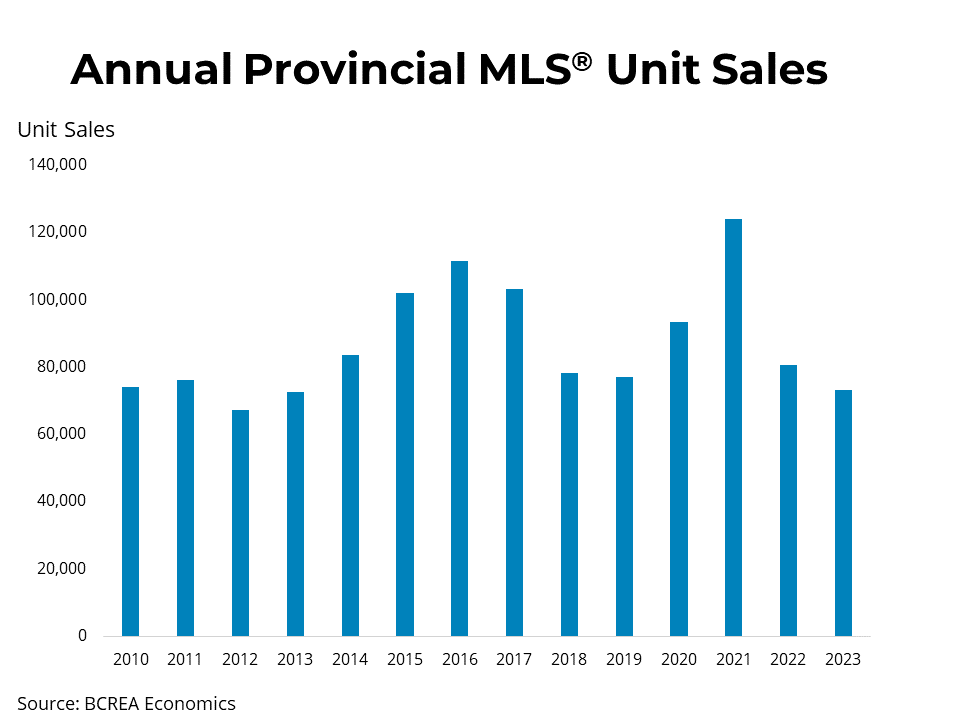
“The highest mortgage rates in over 15 years led to the slowest sales in a decade for BC,” said BCREA Chief Economist Brendon Ogmundson. “With mortgage rates falling to start the year and the potential for Bank of Canada rate cuts on the horizon, the outlook for 2024 appears much brighter.”
A total of 3,596 residential unit sales were recorded in Multiple Listing Service® (MLS®) systems in December 2023, an increase of 2.6 per cent from December 2022. The average MLS® residential price in BC was $965,447 a 6.5 per cent increase from $906,356 recorded in December 2022. Total sales dollar volume was $3.5 billion, a 9.3 per cent increase from the same time last year.
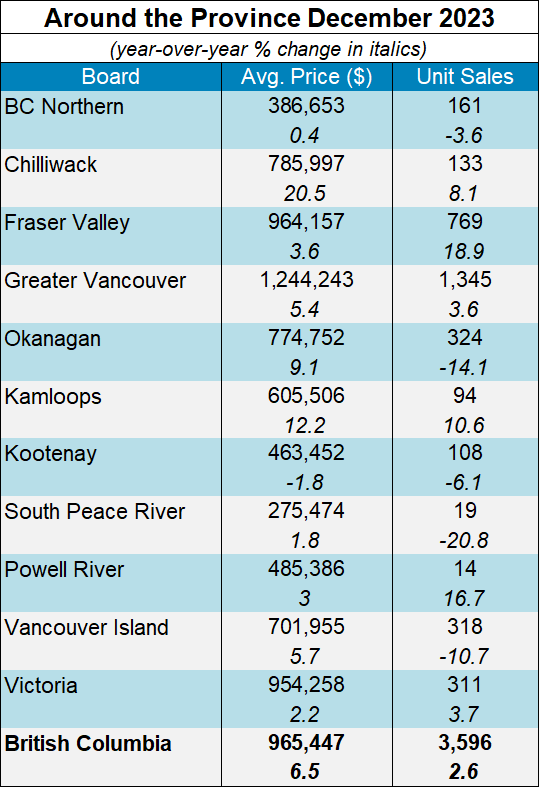
The BC Energy Step Code and What It Means for REALTORS®
In the coming years, new homes in BC are about to get measurably healthier, quieter, more durable, and more energy efficient than those on the resale market, thanks to a regulation called the BC Energy Step Code. BCREA is collaborating with BC Hydro and the Real Estate Foundation of BC to ensure REALTORS® understand the BC Energy Step Code, so they can better advise their clients and meet the growing demand for “high-performance homes.”
What is the BC Energy Step Code?
In short, the BC Energy Step Code sets performance requirements for new construction and groups them into “steps.” Authorities with jurisdiction over the BC Building Code – including local governments – can choose to require or incentivize builders to meet the performance requirements of one or more steps.
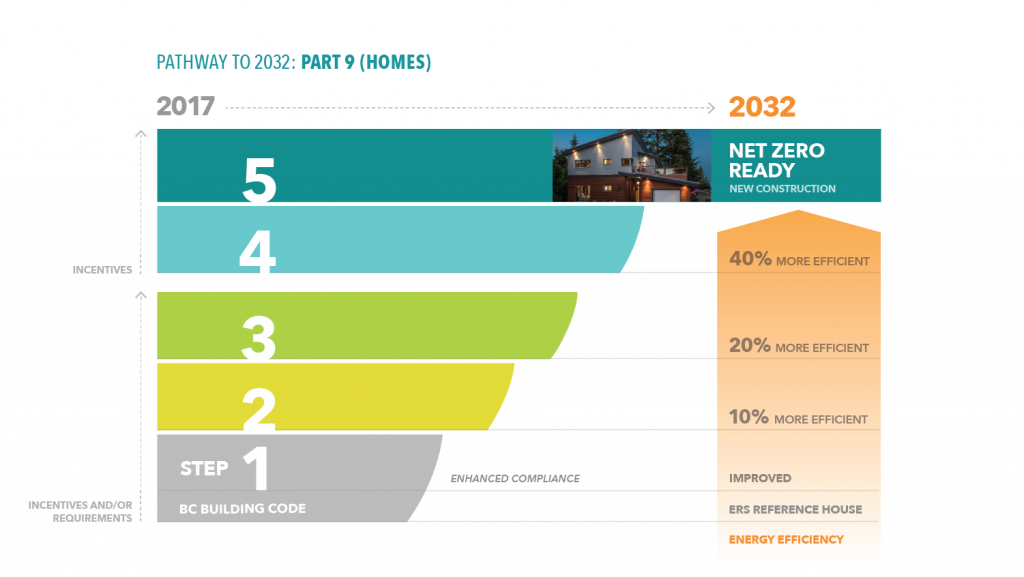
The province has set a goal that by 2032, the BC Building Code will set Step 5 as the base requirement for all new houses. This means new homes will be up to 80 per cent more energy efficient than those built today. The province has also set interim targets and aims to set a base requirement of Step 3 by 2022.
What does this mean for Realtors?
As new homes become healthier, quieter, more durable, and more energy efficient over the coming years, Realtors can help homebuyers make informed decisions by educating them on these benefits. New homebuyers are also showing unprecedented interest in energy-efficient homes and will expect Realtors to be knowledgeable on the subject. In a recent Canadian Home Builders Association national survey, nine out of 10 respondents said they either “really want” or “must have” an energy-efficient home.
As leaders in their communities, Realtors can also act as agents of change by further educating consumers on the benefits of energy-efficient homes. In doing so, Realtors can ensure demand continues to grow for homes that are better for their clients, their communities, and the environment.
How is BCREA here to help?
BCREA is collaborating with BC Hydro to ensure Realtors have the knowledge and resources they need to understand the BC Energy Step Code and to market high-performance homes.
To learn more about the BC Energy Step Code and how you can better serve your clients as it relates to energy efficiency, check out the following resources BCREA has developed with support from BC Hydro:
- BCREA accredited self-paced online course: Energy-Efficient and Sustainable Homes
- Open House by BCREA podcast: Energy-Efficient Homes - Starting the Conversation
- BCREA article in the Georgia Straight: A guide to making homes in B.C. more sustainable and energy-efficient
For more info about the BC Energy Step Code, visit energystepcode.ca.
To subscribe to receive BCREA publications such as this one, or to update your email address or current subscriptions, click here.
The Case of the Absconding Apparent Attorney or, Whose Liability #45
By Gerry Neely
B.A. LL.B.
How would you decide which of two innocent parties, the vendor or the purchaser, should bear the loss which arose when the solicitor acting for the purchaser gave the real estate agent an n.s.f. cheque for the commission of $4,350.00, and then disappeared?
By the agreement signed by the parties, the vendor authorized the purchaser and anyone acting on his behalf "to pay the amount of the commission to the agent out of the cash proceeds of the sale". The vendor then signed a statement of adjustments which authorized the purchaser's solicitor to pay the agent's commission. The vendor believed that the purchaser's lawyer was acting in the vendor's interest and that the arrangement for payment of commission was made for the convenience of the parties. The purchaser gave no thought to the commission arrangements. Finally, both parties assumed that the solicitor was a member in good standing of the law society. Unfortunately he did not hold a certificate to practise and the Law Society insurance did not cover his loss. The vendor paid $3,500.00 to the real estate agent to settle his commission claim, and then sued the purchaser. The dialogue which follows summarizes their arguments:
V: "You still owe me $4,350.00 and I want it now.
P: Forget it, I paid the full purchase price to my solicitor.
V: Yes, but he was your agent, not mine. You appointed him. You were happy to have him accept on your behalf my transfer of title but now you are not prepared to accept responsibility for his failure to pay me the full sale price. Is that fair?
P: Well, is it fair that you want me to pay 105% of the purchase price? You signed the interim agreement and the statement of adjustments and by doing so, you appointed him as your agent to pay the commission. As his principal for that limited purpose, you must bear responsibility for his actions.
V: No, no! It is true that when I authorized your solicitor to pay the commission directly, he became my trustee for that purpose. However he still remained your agent and any failure on his part to properly look after the money you gave him is your responsibility.
P: But look, when the transfer was registered, the money was no longer mine - it was yours, so that it's your money that was lost, not mine. He was your trustee and you must look to him to recover your loss.
V: Whether he held that money in trust for you or for me is immaterial. What is important is that as his principal, you had a duty to see that he lawfully disbursed the money you gave him. Since he failed to do so, you are still liable to me for the balance I haven't received. And more to the point, we wouldn't be in this mess if you hadn't selected him to act for you.
P: Well, on that last point only, I can agree with you."
The Court agreed with the vendor that the solicitor was the agent of the purchaser throughout. The fact that he was a trustee for the vendor for payment of part of the purchase price to meet the agent's commission, did not change the relationship of principal and agent between the purchaser and the solicitor. The court then held that as between two innocent parties, the party who placed the fraudulent person in a position to commit the fraud, must bear the loss. Judgment was given to the vendor the $4,530.000 rather than the sum of $3,500.00 paid to the agent, the court concluding that settlement of the commission claim was a matter apart from the sale and purchase agreement between the vendor and purchaser.
| 1. | Roeder v. Halicki and Clery,28 R.P.R. 61. |
To subscribe to receive BCREA publications such as this one, or to update your email address or current subscriptions, click here.
The Condominium Act – Section 49 #159
By Gerry Neely
B.A. LL.B
This section states that no expenditures in excess of $500 shall be made by a strata council unless: (a) an emergency exists, or (b) the expenditure was set out in the annual budget of the corporation which was approved by the owners at a general meeting, or (c) the owners approve the expenditure by a special resolution.
A company entered into a contract with a property management company acting for a strata corporation for the sale to it of heat saving devices costing $3,200. The property manager did this with the prior approval of the strata council although there was no evidence of a meeting at which formal approval was given by the council.
The expenditure was not included in the budget, no emergency existed and no special resolution approving the expenditure had been submitted to the owners. New property managers were appointed and upon an examination of the contract, the council instructed the property manager to advise the supplier to remove the system. The supplier refused to do so, and the lawsuit followed.
The failure to submit the special resolution to the owners was a breach of Section 49 which the strata corporation relied upon to deny that the contract was valid. The judge remarked that he had found no reported decisions interpreting this section and came to a conclusion with which one might argue, that the contract was valid but voidable at the option of the strata corporation. It could elect to affirm the contract or to avoid it.
Other examples of voidable contracts cited by the judge included contracts entered into by mentally disordered persons or persons affected by drink. Depending upon the circumstances, people who sign contracts when insane or drunk should avoid them until they become lucid or sober.
The judge concluded that the strata council exercised its right to avoid the contract when it gave notice to the supplier to remove its equipment. The result is that instead of bearing the consequences of its own default, the strata corporation was able to use its own omission to defeat the supplier's claim for the purchase price.
What does this decision mean for property managers, strata councils and third parties contracting with a strata corporation? The judge clearly assumed that before incurring this expenditure, the property manager had a responsibility to obtain the approval of the owners by special resolution. Few will argue that a property manager's duty is to be able to provide to council and the owners, advice of the sections of the Condominium Act which affect them, and in particular, those dealing with the strata corporation's finances.
No reference was made to the strata council's responsibility although surely it must be argued that it had an equal responsibility to obtain approval.
What may a future judge do when asked to balance the rights of an innocent supplier against the actions of a careless strata council? A judge might decide that in agreeing to serve as strata council members, they have accepted the responsibility of knowing the principal provisions of the Condominium Act which affect them and the owner.
The Condominium Act relieves a member of a strata council from personal liability in respect of acts done in good faith. However, failure to observe the requirements of Section 49 might be deemed to be bad faith in an action brought by a supplier against members of a strata council who entered into or authorized the execution of a voidable contract.
Finally, as to a supplier dealing with a strata corporation, this judgement says that the supplier cannot assume that a strata council has authority to approve an expenditure of more than $500, or to authorize a property manager to do so. There may be circumstances when a supplier will wish to obtain proof that the expenditure is authorized by the budget or by a special resolution.1
| 1. | Can-Pac Energy Consultants Ltd. v. Carriage Management Inc. and the Owners, Strata Plan VR.201Reasons For Judgement SCBC Vancouver Registry F866241. |
To subscribe to receive BCREA publications such as this one, or to update your email address or current subscriptions, click here.
The Devil is in the Details #496
Judges are often asked to decide between competing versions of events at trial. Lawyers are advocates attempting to persuade the judge that their client's story should be preferred. When making the decision as to which party's version of events to believe, a judge may consider which story makes sense, is logical, has a ring of truth or, very often these days, which story is consistent with the documents. Documents typically don't lie, don't exaggerate, don't have faulty memories and are often more reliable than witnesses.
Whenever a licensee has a claim that's heading to litigation and ultimately will be decided by a judge, the documents can make the difference between winning and losing. Keeping good records at the time events occur, and then making them available to your defence lawyer, may help you win your case.
The Real Estate Council of British Columbia mandates that licensees make and keep certain records, but that's only a start. Licensees are wise to keep records beyond the basic transaction file. This may include faxes, Microsoft Word documents, letters, memoranda and, most importantly, email and text messages. These can be stored electronically with little effort, cost or storage required.
The Provincial Court recently determined a case in favour of a seller's agent in no small measure because of the email and text message records available at trial.1 Madam Justice Janzen held that the seller's agent wasn't liable in a case where a seller claimed the licensee had agreed to a selling price without her authorization.
Each of the parties had very different, and seemingly irreconcilable, versions of several key phone calls and meetings, as well as differing accounts of what instructions were given on price. The email and text messages confirmed what was discussed and when and, despite allegations by the seller that she had been intimidated or coerced by her agent, the records indicated the contrary. The documents assisted the Court in deciding that the licensee's story was to be preferred.
In another recent case, emails and text messages were used to assist the Court in determining whether architectural plans were included in a contract.2 In all versions of the contract, the inclusion of those plans had been manually struck out. However, the fourth and final version of the contract was a bit faded. The buyers maintained that the plans were included; the seller and seller's agent maintained the opposite.
Determining whether or not the strike out was the intention of the parties and whose evidence to believe was no easy task. The strike out was as obvious to the seller and its agent as it was apparently a complete shock and surprise to the buyers. Again, the Court used the email and text message record to tip the scales of justice in favour of the seller and the seller's agent. The records clearly showed no mention of the plans around the time of the contract, but did show a litany of messages well after the contract in which the buyers were looking to purchase the plans. The Court found that the plans were not part of the deal.
Although you may not think the records you keep will be useful, if you ever find yourself in a dispute over facts, they may help you prove your side of the story.
Chris Johnston
B.A., LL.B.
| 1. |
|
|
| 2. | 1029865 B.C. Ltd. v. 1007442 B.C. Ltd., 2017 BCSC 926. |
The Disciplinary Power of Real Estate Boards and Associations #505
A REALTOR®'s conduct is subject to review by a variety of bodies. As agents, their conduct is subject to review by the courts where it is alleged that conduct was negligent, breached contractual requirements or was in breach of their fiduciary duties. As licensees, their conduct is subject to review by the Real Estate Council of BC where it is alleged that conduct was in breach of the Real Estate Services Act or the Real Estate Development and Marketing Act and their accompanying Rules and Regulations.
The third and less often discussed bodies of review are the real estate boards and associations to which REALTORS® belong. Those boards and associations adopt rules, regulations and Codes of Ethics to which each REALTOR® agrees to comply as a condition of membership. These rules, regulations and codes set out standards of conduct to be followed by the members. Complaints between members regarding alleged breaches are investigated and adjudicated internally by members of the boards and associations in accordance with procedures agreed to by the members and set out in the bylaws.
A recent case1 highlighted the process used by one board and the court's review of that process. In this case, two REALTORS® were members of the same real estate board. As a condition of membership in that board, they had both agreed to abide by the bylaws, rules, regulations and Code of Ethics of the board. Within these, the board had laid out an extensive and comprehensive discipline process.
One REALTOR® lodged a complaint against the other, claiming the actions of the other were in breach of the Code of Ethics. The complaint was first reviewed by an investigative panel, which concluded that a breach had occurred. The investigative panel, as per the board's procedures, offered the REALTOR® two disciplinary choices: consent to the findings of the investigative panel or request a hearing. The REALTOR® chose the latter. As per the board's procedures, a hearing panel, which did not contain any members from the investigative panel, was struck and a hearing was held. The hearing panel concluded, on the evidence presented at the hearing, that a breach had occurred and assessed punishment in accordance with the board's bylaws, rules and regulations. The REALTOR® complained but an internal appeal panel, made up of different members, upheld the original decision.
The REALTOR® sought relief from the courts, claiming procedural unfairness had occurred. The court found that that the board had followed its own regulations and that the REALTOR® had received adequate notice and a fair opportunity to be heard before an unbiased panel and the court dismissed the proceedings. In doing so, the judge noted that the matter before her dealt only with the process followed and not the merits of the decision by the hearing panel. The judge accepted that the decision makers did not act in bad faith and that voluntarily incorporated associations are entitled to determine their own procedures.
The REALTOR® appealed the judge's decision and that appeal was dismissed by the BC Court of Appeal. On many of the arguments raised by the appellant, the Court of Appeal adopted a deferential standard toward the board and its procedures. It stated that "the Board has recognized the importance of procedural fairness in the Regulations governing discipline and to which the members have agreed to be bound. As a general proposition, those regulations exemplify a high and rigorous standard of procedural fairness. As the judge found, and I agree, the fundamental requirements of procedural fairness were met in this case, whatever minor errors may have occurred."2
While this decision dealt only with the bylaws, rules and regulations of one real estate board, the bylaws, rules and regulations of the other boards in BC are similar. This decision confirms that where those bylaws, rules and regulations have been adopted by the members who have agreed to abide by them, and when they provide members a fair opportunity to be heard before an unbiased panel, the courts are unlikely to intervene. As such, REALTORS® should be cognizant of the bylaws, rules and regulations of their board and the consequences for breaching them.
Brian TaylorNorton Rose Fulbright LLP
| 1. | Redekop v. Okanagan Mainline Real Estate Board, 2018 BCCA 226. | |
| 2. | Redekop v. Okanagan Mainline Real Estate Board, 2018 BCCA 226, at para. 81. |
Legally Speaking is published monthly. Real estate boards, real estate associations and REALTORS® may reprint this content, provided that credit is given to BCREA by including the following statement: "Copyright British Columbia Real Estate Association. Reprinted with permission." BCREA makes no guarantees as to the accuracy or completeness of this information or the currency of legal information.
To subscribe to receive BCREA publications such as this one, or to update your email address or current subscriptions, click here.
The Duty to Review Contract Terms #467
By Jennifer Clee
B.A., LL.B.
BC courts have accepted that the Limited Dual Agency Agreement (LDAA) limits certain general obligations that a licensee has to their clients. However, licensees must remember that while their duty of loyalty and disclosure are modified by the LDAA, they still owe a duty of “full and fair disclosure of all material circumstances and of everything known to him respecting the subject matter of the contract which would be likely to influence the conduct of the principal.”1 Other general duties of a licensee remain intact when acting in a limited dual agent capacity.
In Pepper’s Produce, the plaintiff company (the buyer) agreed to buy a grocery business operated by the seller. Licensees acting as limited dual agents represented both the buyer and seller. The seller’s lease with the landlord provided that the lease for the grocery premises could not be assigned without the landlord’s written consent. The buyer’s offer was subject to certain conditions, including the landlord approving the purchaser to assume the existing lease by a certain date.
There was a conflict in the evidence as to whether the buyer was to assume the existing lease or enter into a new lease. The evidence at trial was that, at a meeting held prior to subject removal between the principals of the buyer and seller and the landlord, the landlord either agreed verbally on the terms of a new lease, or was agreeable to entering into a new lease. However, the terms were not finalized and the landlord did not testify.
The buyer subsequently removed all subject conditions without entering into either a new lease or obtaining the landlord’s written consent to assign the existing lease. When the completion date arrived without either a new lease or the landlord’s written consent to the assignment, the buyer refused to complete.
Both the buyer and seller claimed the buyer’s $15,000 deposit. Ultimately, the seller settled with the buyer, returning the buyer’s deposit plus $10,000. The buyer also claimed against the licensees for $31,000, allegedly for buying and storing equipment to be used in the business.
The main issue considered by the court was whether the licensee had a duty to advise the buyer against removing the lease subject when no new lease or written consent to assume the existing lease was in place. The court considered the general duties owed by a licensee and acknowledged that the LDAA limited, to some extent, the normal obligations owed by a licensee.
However, the court stated that it found “nothing that excludes the basic duty to fully discuss the terms and effect of a contract, and to at least point out terms that are clearly not in a party’s best interest.”2 The court held that a reasonable licensee would be expected to recommend against removing the lease subject condition until a new lease or proper assignment was in place.
The court also found that the licensee should have known that if the lease was to be for a term of more than three years, only a written agreement would make the agreement binding in light of Section 59 of the Law and Equity Act3 and should have advised the buyer that a verbal agreement with the landlord was insufficient.
Despite finding the licensee to have breached their contractual and agency duties to the buyer, the buyer’s complaint was dismissed, as it was unable to prove damages caused by the licensee’s conduct.
The decision is an important reminder for licensees to:
| i) | fully discuss, and ensure that clients understand, the terms and effects of the documents they sign; and |
| ii) | ensure that all agreements between parties are reduced to writing. |
| 1. |
|
|
| 2. |
|
|
| 3. |
|
To subscribe to receive BCREA publications such as this one, or to update your email address or current subscriptions, click here.
The F Word: Protecting Yourself and Your Clients from Fraud #554
Have you heard of the Instagram influencer Hushpuppi also known as the “Billionaire Gucci Master,” who turned out to be a Nigerian con artist who is currently awaiting sentencing in US jail? You may not be familiar with Hushpuppi, but you should be familiar with the hallmarks of business email compromise fraud and other identity fraud that may come up in your practice. A determined fraudster will look for any weaknesses in your business processes to gain access to confidential information. Fraudsters can then use that information to misappropriate funds, leaving innocent parties and hoodwinked professionals to cover the loss.
Opportunities for fraud may increase when business is conducted electronically, as opposed to face-to-face. For example, scanned copies of identification documents such as passports or driver’s licenses can be fraudulently altered much more easily than physical copies. Such falsified identification could then be used to effect the fraudulent transfer of funds or even of title to a property. A March 2021 Vancouver Sun article discusses such a situation.
According to the article, a fraudster contacted the property manager, impersonating the overseas owner of the property and providing instructions. The fraudster presented a scanned copy of a forged passport to verify the supposed owner’s identity. A real estate agent and a conveyancing lawyer both accepted the forged passport, and the property was listed and sold with the sale proceeds being transferred to the fraudster.
It may be impossible to fully protect against the ever-evolving tactics of sophisticated fraudsters, but there are steps REALTORS® can take to minimize the risk of being the victim of, or unknowingly participating in, fraud. It is important to follow FINTRAC identity verification requirements, and for brokerages to have clear and thorough processes in place for their REALTORS® to follow. These can include situations where REALTORS® are dealing with:
- requests such as changes of contact information for a client, especially if the client lives abroad,
- clients whom you cannot meet face-to-face,
- clients who are not the sole owner named on title, whether they are spouses, family members, or individuals holding powers of attorney for the named owner,
- individuals purporting to represent a corporate client.
REALTORS® should be cautious when dealing with clients who express urgency, contact you at unusual times, or provide unusual instructions such as listing a property for sale for below market value, or not posting “for sale” signage nor posting the property on MLS®.
Civil liability might not always follow, whether because the actual owner eventually endorses the actions of the person purporting to be them, or who is acting on their behalf; or because title insurance or the Land Title and Survey Authority of BC may compensate the rightful owner for their losses.
However, professional discipline consequences can be significant. Licensees found to have breached their duties to act in the best interests of their clients in such circumstances have been subject to orders ranging from thousands of dollars in penalties and enforcement costs to a 30-day suspension. Such penalties have been imposed in situations where a licensee failed to conduct a title search before having a client sign a listing agreement when it turned out the client was not the person on title1; and in situations where once it was determined that the individual the licensee was dealing with was not actually the registered owner, the licensee failed to take steps to verify that an individual had the legal authority to sell the property2.
| 1 | Kong (Re), 2011 CanLII 63098 (BC REC) | |
| 2 | Chiang (Re), 2018 CanLII 59402 (BC REC); Uy (Re), 2018 CanLII 64967 (BC REC) |
| 1 | Kong (Re), 2011 CanLII 63098 (BC REC) | |
| 2 | Chiang (Re), 2018 CanLII 59402 (BC REC); Uy (Re), 2018 CanLII 64967 (BC REC) |
The First Law of Holes #517
Will Rogers defined the first law of holes as follows: “When you find yourself in a hole; stop digging.” A recent discipline decision of the Real Estate Council of British Columbia1 suggests the licensee involved should have taken Mr. Rogers’ advice.
The licensee acted as the designated agent of the seller in the sale of a parcel of land that could be subdivided into two lots. The contracts of purchase and sale (“Contracts”) prepared by the licensee concerning the property contained a condition precedent with respect to municipal approval of the subdivision. Unfortunately, the Contracts did not indicate for whose benefit the condition precedent was included or the date by which it should be removed. Mistake number one.
A couple of months after the execution of the Contracts, the licensee was approached by the buyer who indicated he wished to assign his interest in the Contracts to a third party. The licensee agreed to act as the buyer’s designated agent in the assignment transaction and represented the buyer in the creation and execution of assignment agreements (“Assignments”) with the third party in respect of the proposed subdivided lots. Mistake number two. As the licensee was the agent for the seller, he owed fiduciary obligations to the seller until the completion of the Contracts transaction. By agreeing to act for the buyer in the Assignments transaction he created a conflict of interest between his duties to his seller/client with respect to the Contracts transaction and his buyer/client with respect to the Assignments transaction.
The licensee did not advise his seller/client of his representation of the buyer/client or his involvement in the Assignments transactions. Mistake number three. That information was material to his seller/client and by failing to disclose that information, he breached his fiduciary duty of disclosure to his seller/client.
After the Assignments had been entered into by the buyer/client and the third party, the licensee’s managing broker discovered the conflict and urged the licensee to contact his seller/client and fully disclose the conflict. The licensee did that. His seller/client instructed the licensee to take steps to nullify the Assignments. Rather than following Mr. Rogers’ advice, the licensee took steps to nullify the Assignments, which was clearly against the interests of his buyer/client who had entered into the Assignments. Mistake number four.
Not to be outdone, his buyer/client, having discovered that the third-party assignee was trying to flip the Contracts a second time, instructed him to take steps to nullify the Assignments. Shovel in hand the licensee kept digging, preparing new documents and dealing with deposits. Mistake number five.
The unfortunate but understandable result was a three-month suspension and $5000 fine for the licensee.
One would hope that most licensees would have avoided the conflict in the first place by simply refusing to act as the agent of the buyer in the Assignment transactions and remaining loyal to their seller/client.
However sometimes, as in this case, licensees make mistakes and inadvertently step in a hole. Once a licensee discovers they are in a hole, the best course of action is to stop digging. In this case, once the licensee was advised by his managing broker of the conflict, he should have immediately advised both his seller/client and buyer/client of the conflict and that he could no longer act for either party in the Contracts transaction or the Assignments transaction. He should have also advised both the seller/client and buyer/client to immediately seek independent legal advice, and immediately reported the matter to his insurers. Once he became aware of the hole he was in, picking up a shovel and continuing to dig was the wrong course of action and compounded the licensee’s problems.
Brian Taylor
Norton Rose Fulbright LLP
| 1. | Real Estate Council of British Columbia: Re Gill July 17, 2019. |
To subscribe to receive BCREA publications such as this one, or to update your email address or current subscriptions, click here.
The Home Buyer Rescission Period: What REALTORS® Need to Know Course Now Live!
With the new Home Buyer Rescission Period coming into effect in January 3, 2023, BCREA has developed a new course to support REALTORS® and managing brokers to not only understand the new rules but also apply them in their practice.
(BCREA Access login required)
The Home Buyer Rescission Period: What REALTORS® Need to Know course, will cover the specifics of the new legislation and equip REALTORS® with a strong foundation required to address the needs of their clients. REALTORS® taking this course will particularly find useful the various scenarios that walk through the process of exercising the right of rescission.
After completing this course, learners will be able to:
- identify the key elements of the new legislation, including the length of the rescission period;
- provide required disclosures of the rescission rights to their clients;
- calculate the rescission amount properly;
- explain how the deposits are handled, in accordance with the Regulation;
- fill out appropriate forms in order to be compliant with the new requirements; and
- identify strategies for managing brokers to mitigate risks.
The primary goal of this course is to enhance the standard of professional competency in how REALTORS® assist their clients and protect their best interests during the home buying or home selling experience.
Course Details:
Format: Self-paced online
Launch: December 1, 2022
Where: Available on BCREA’s Hub
Price: $30
Accreditation: One PDP hour
Availability: One year (Expires November 30, 2023)
Do you have questions about the 2023 HBRP and Standard Forms Launch? Visit www.bcrea.bc.ca/forms2023 (BCREA Access login required) for the most current information, or for Professional Development specific emails, contact us at [email protected].
The Homeowner Protection Act: Protect Your Clients and Yourself #470
Licensees who list, offer for sale or sell a home contrary to the provisions of the Homeowner Protection Act1 (the Act) face penalties up to $25,000 per offence ($100,000 for corporations) and/or up to one year imprisonment per offence. Licensees violating the Act also face negligence claims from clients and/or disciplinary action by the Real Estate Council of British Columbia.
The purpose of the Act is to regulate residential construction in BC to increase consumer protection and to improve home construction quality.2 The Act applies to all homes built after July 1, 1999, with or without a building permit. With the exception of new homes built under an “owner builder” exemption,3 the Act requires that all new homes must be built by a licensed residential builder who cannot build, offer for sale or sell a new home unless it is covered by new home warranty insurance by a qualified home warranty provider.
Owner builders need not provide new home warranty coverage from a third party warranty provider but are deemed, under the Act, to provide 2-5-10 warranty coverage. An owner builder cannot offer for sale or sell an owner built home within the first ten years after occupancy without first providing to any prospective buyer either an Owner Builder Declaration and Disclosure Notice (OBDDN) in the case of owner built homes built before November 19, 2007, or an Owner Builder Disclosure Notice (OBDN) in the case of homes built after November 19, 2007. The Homeowner Protection Office (HPO)4 will not issue the OBDN until satisfied that the owner builder has resided in the home for at least 12 months following the issuance of the occupancy permit.5
For the ten year period following the date of occupancy of an owner built home, all subsequent owners must similarly provide the OBDDN or OBDN to potential buyers prior to selling the home.
The type of warranty coverage and the warranty commencement date may well be material to buyers, as the protection afforded by the owner builder statutory warranty is dependant upon the owner builder remaining in the area and being willing and financially capable of honouring the warranty.
Licensees have been recently disciplined for:
- Listing an owner built home for sale prior to expiration of the 12 month residency period.
- Failing to ascertain whether the home was built by a licensed residential builder or an owner builder and failing to include the appropriate term, condition or acknowledgement of receipt in the Contract of Purchase and Sale.
- Listing a new home not covered by new home warranty coverage.
To avoid risks associated with contravening the Act, prior to listing a home for sale or writing an offer for a home less than ten years old, licensees should:
- Determine whether the home was built by a licensed residential builder, or by an authorized owner builder and is capable of being sold, by searching the New Homes Registry or contacting the HPO;
- Confirm that a residential builder’s licence is in good standing and that there is valid warranty coverage for the home by searching the Public Registry of Licensed Builders, the New Homes Registry and/or by contacting the HPO;
- Verify that the owner builder has an OBDDN or OBDN and obtain a copy from the owner builder or HPO;
- Provide copies of all applicable new home policies6 or, in the case of an owner builder, a copy of the OBDDN or OBDN, to prospective buyers; and/or
- Ensure that any offer includes a condition or term requiring production of the new home warranty policy or, in the case of an owner built home, an acknowledgment of receipt of the OBDN, as recommended by the Professional Standards Manual.7
Jennifer Clee
B.A., LL.B.
| 1. |
|
|
| 2. |
|
|
| 3. |
|
|
| 4. | BC Housing. | |
| 5. |
|
|
| 6. |
|
|
| 7. | Real Estate Council of British Columbia, Professional Standards Manual. |
The Homeowner’s Guide to Navigating Wildfire Season
Annual widespread wildfires and flooding have unfortunately become a regular occurrence in BC. In 2023, more than 2.84 million hectares of forest and land burned around the province. Thousands of people were forced to evacuate, and hundreds of homes and structures were lost or damaged.
Undoubtedly, climate change is at the top of many British Columbians’ minds. So much so, that preparing for and mitigating climate change disasters was a top priority for the last federal election.
Extreme events like wildfires can affect you and your home, so we have prepared some resources to help you make informed decisions when buying or selling your home.
Become FireSmart
A recent Intergovernmental Panel on Climate Change report warns that wildfires and extreme weather will worsen if we don’t reduce greenhouse gas emissions. If we keep polluting at the current rate, global temperatures could rise by 1.5 degrees Celsius by 2040. Even if we meet the Paris Agreement targets, temperatures are still expected to rise.
As a homeowner, you must understand the risks and take steps to protect yourself and your community. You can make your home more resilient to wildfires by following the BC Government’s FireSmart guidelines, which help reduce hazards on your property.
Insure Your Property
You must review and update your insurance coverage to prepare for wildfire season. Ensuring you have comprehensive coverage, understanding what your policy covers, creating an inventory of your belongings, keeping important documents safe, and staying informed about wildfire risks in your area are all crucial steps. You can follow our Five Insurance Tips for Wildfire Season to understand the dos and don’ts better.
When selling or purchasing a property that may be vulnerable to natural disasters like wildfires, it's essential to consult your REALTOR®. They can provide you with invaluable information about the site's history, local risks, and effective mitigation measures. REALTORS® are equipped with the expertise and resources to help you make informed decisions and take the necessary precautions to protect your investment and personal safety.
The Impact of the B-20 Stress Test on BC Home Sales in 2018
To view the Market Intelligence Report PDF, click here.
Summary Findings:
- The decline in home sales in 2018 was largely due to market factors like interest rates and affordability
- Without the stress test, home sales in BC would have been about 7,500 sales—or 10% higher—in 2018
- Approximately $500 million in BC economic activity was lost due the B20 stress test
 Home sales across Canada plummeted to
start 2018. The near-coincident
implementation of several new federal and
provincial housing policies designed to temper
BC housing demand has given rise to
competing explanations for what ultimately
caused the downturn. Was it the B20
mortgage stress test? Higher interest rates?
The provincial speculation tax or the
expansion of the foreign buyers’ tax?
Home sales across Canada plummeted to
start 2018. The near-coincident
implementation of several new federal and
provincial housing policies designed to temper
BC housing demand has given rise to
competing explanations for what ultimately
caused the downturn. Was it the B20
mortgage stress test? Higher interest rates?
The provincial speculation tax or the
expansion of the foreign buyers’ tax?
In this Market Intelligence, we will attempt to provide some insight into the causes of the 2018 housing market slowdown.
 Isolating the Impact of the B20 Mortgage
Stress Test
Isolating the Impact of the B20 Mortgage
Stress Test
The coordinated decline in Canadian home
sales, which began immediately after the
implementation of B20, makes that policy a
natural place to look as we investigate the
cause of the housing downturn. The fact that
so many Canadian markets saw home sales
drop sharply to start 2018 indicates a
common factor driving that decline.
Many markets in BC experienced a much deeper and more prolonged decline in home sales than in other Canadian markets, perhaps pointing to provincial polices weighing down sales over and above the impact of the stress test alone. However, when we look at markets across Canada, it appears that the outsized decline in BC may have more to do with relatively stretched affordability in BC compared to the rest of the country. Expensive markets in other areas, most notably those near Toronto, also experienced significant declines in 2018.
 Methodology
The ideal way to identify causation in
economics is to use a controlled
experiment, in which impacts can be
compared between a test group subject to
the new policy and a control group that is
not. Unfortunately, such experiments in
macroeconomics are rare. Since B20
applies across all Canadian market
s, we
do not have a suitable control group to use
as a baseline for comparison. As a next
best solution, we can instead use
econometric modelling to estimate a
baseline of home sales if the stress test
had not been implemented.
 Using BCREA’s workhorse forecasting
modeli, we estimate a 2018 baseline of BC home
sales of 90,500 units, a decline of roughly 13,000 units from 2017. This decline was drivenby market forces such as rising interest rates,
deteriorating affordability and a slowing
economy. Given that home sales in 2018 were
78,346, this means that factors outside of those
explicitly controlled for in the model need to
explain about 12,000 additional lost sales.
Isolating the share of sales lost due to the stress
test is a challenging task. To do so,
we employed both our own forecasting model
and a model of sales fundamentals
developed by the Bank of Canadaii.
Using BCREA’s workhorse forecasting
modeli, we estimate a 2018 baseline of BC home
sales of 90,500 units, a decline of roughly 13,000 units from 2017. This decline was drivenby market forces such as rising interest rates,
deteriorating affordability and a slowing
economy. Given that home sales in 2018 were
78,346, this means that factors outside of those
explicitly controlled for in the model need to
explain about 12,000 additional lost sales.
Isolating the share of sales lost due to the stress
test is a challenging task. To do so,
we employed both our own forecasting model
and a model of sales fundamentals
developed by the Bank of Canadaii.
 Specifically, we tried to isolate the impact of the
stress test using 5 different shock specifications.
These include incorporating B20 as a shock to
an affordability index, a shock to the cost of
borrowing, a policy dummy variable and a shock
to a macroprudential policy indexiii both by itself
and interacted with mortgage ratesiv
. We then
compared dynamic simulations from these
models to our estimated baseline.
Specifically, we tried to isolate the impact of the
stress test using 5 different shock specifications.
These include incorporating B20 as a shock to
an affordability index, a shock to the cost of
borrowing, a policy dummy variable and a shock
to a macroprudential policy indexiii both by itself
and interacted with mortgage ratesiv
. We then
compared dynamic simulations from these
models to our estimated baseline.
We estimate the lost sales due to B20 in 2018 to be a range of 5,300 to 11,500 units, with an average of 7,500 units. On average, we estimate that B20 accounted for about 30% of the total downturn in BC home sales observed in 2018 and cost the province approximately $500 million in spin-off activity related to MLS® home sales v
Notes and References:
i BCREA’s workhorse forecasting model uses a vector error-correction framework in which sales, listings and prices are determined jointly based on a long-run equilibrium relationship and changes in other factors such as interest rates and employment growth.
ii Taylor Webley, “Fundamental Drivers of Existing Home Sales in Canada,” Bank of Canada Staff Discussion Paper, December 2018.
iii This index was constructed based on the IMF’s integrated Macroprudential Policy (iMaPP) database, found here.
iv The methodology here is similar to Aastveit et al., “Economic uncertainty and the effectiveness of monetary policy,” Norges Bank Research Working Paper, June 2013.
v Lost economic activity is derived from estimates of spin-off activity resulting from each MLS sale, found here.
For more information, please contact:
Brendon Ogmundson
Deputy Chief Economist
Direct: 604.742.2796
Mobile: 604.505.6793
[email protected]
Kellie Fong
Economist
Direct: 778.357.0831
Mobile: 604-366-6511
[email protected]
To subscribe to receive BCREA publications such as this one, or to update your email address or current subscriptions, click here.
The Impact of the New BC Limitation Act on Licensees #461
By Jennifer Clee
On June 1, 2013 the new BC Limitation Act1 (new Act) will come into force. The new Act replaces the former Limitation Act2, which came into effect in 1975.
What is the Limitation Act? The Limitation Act sets out how long a person has before he/she must start a civil court proceeding for a legal remedy. "Limitation period" means the period after which a court proceeding cannot be brought with respect to a claim. In other words, if a person fails to start a civil court proceeding against another party for a legal remedy within the specified limitation period, the action will be barred. The Limitation Act is a default regime, meaning that it applies in the absence of another enactment setting the applicable limitation period.
The old Act set out limitations of two, six, and ten years depending on the nature of the claim. The two year limitation period applied to actions involving claims related to injury to person or property and to certain tort actions such as defamation, false imprisonment, malicious prosecution, and trespass. The ten year limitation period applied to claims against personal representatives and trustees in relation to recovery of trust property. The six year limitation period was a catch all period for all remaining claims including breach of contract and negligence claims that did not result in injury to person or property. Under the old Act, the six year limitation period did not start to run until the individual became aware of the potential claim, or when a court considered that a "reasonable person" would have first become aware of the existence of a potential claim.
Under the new Act, rather than having a variety of basic limitation periods, there will be a single two year limitation period for most civil claims, with the exception of civil claims that enforce a monetary judgment, exempted claims and actions that have limitation periods set by other statutes.
Under the new Act, time will start to run for the basic limitation period when a claim has been "discovered". A claim is considered "discovered" on the first day on which the person knew, or reasonably ought to have known, all of the following:
| a) | that injury, loss or damage had occurred; |
| b) | that the injury, loss or damage was caused or contributed to by an act or omission; |
| c) | that the act or omission was that of the person against whom the claim is or may be made; and |
| d) | that, having regard to the nature of the injury, loss or damage, a Court proceeding would be an appropriate means to remedy the injury, loss or damage.3 |
The new Act also sets out discovery rules for special situations involving minors, persons under a disability, and various other different types of claims.
In addition to the replacement of multiple limitation periods with a two year basic limitation period, the new Act will also replace the current ultimate limitation period of 30 years with an ultimate limitation period of 15 years. This means that even if the limitation period established under the Act in respect of a claim has not expired, a court proceeding cannot be commenced with respect to the claim more than 15 years after the day on which the act or omission on which the claim is based took place.
The new Act includes other reforms that will impact the practice of law. The important take-away for licensees, is that under the new Act, most claims brought against professionals, including licensees, will now have to be brought within two years of a claim being "discovered" as set out above and, in any event, no later than 15 years after the event giving rise to the claim.
| 1. |
|
|
| 2. |
|
|
| 3. |
|
To subscribe to receive BCREA publications such as this one, or to update your email address or current subscriptions, click here.
The Importance of Conversations on Mental Health
Mental health is an essential component of our daily lives. Yet, it is still overlooked and stigmatized in society. Many individuals are afraid to seek help or speak up about their struggles with mental illness due to the fear of judgment and discrimination. Those struggles can come from diverse places, not only from the professional scenario: experiences from family, friends, and colleagues can also be a source of worry and distress, and learning how to have those conversations can be a powerful tool.
An issue that hits home
Mental health conversations are important, not only in professional settings but also on a personal level. Sometimes these issues do not affect us directly, but those close to us, creating ripple waves. That's the case of Karen and Chuck Bennett, REALTORS® and long-time residents of Nelson, BC. Their youngest daughter's recent diagnosis of borderline personality disorder prompted them to become more open about their struggles in facing the reality of this issue.
"It can feel lonely when you start living with someone with a mental illness. While understanding the diagnosis, we shared our story and discovered that others are going through similar experiences," Chuck explained. The Bennetts aim to end the stigma surrounding mental health in their community and have organized Start the Conversation, an event to provide students and the community with the opportunity to learn more about mental health and where to find support.
The efforts to bring the topic to the table and make it more acceptable also happen in their professional sphere, "many of the conversations with our team are based on a simple question: How are you really doing? Making mental health a regular topic in our daily conversations is crucial. For many people, it's their kids or someone else they care about who is struggling, and we include it like any other important topic in our meetings to manage our business. At the same time, we are honest with our clients about the times we struggle. So far, everyone has been caring and very understanding. It hurts businesses to hide it more than to show it," Karen explained.
As real estate professionals, starting those conversations can generate some amazing processes and results:
- Reduces stigma around these issues and generates empathy and connection on a more personal level.
- Fosters team support by opening safe spaces to find help from peers and managers.
- Elevates client relationships. REALTORS® are often able to help clients with significant life changes, such as buying or selling a home. Understanding mental health can help empathize with clients' struggles and provide more compassionate and effective support.
- Impacts performance. Regular discussions about mental health can help REALTORS® identify and address issues impacting their work.
Building a more compassionate community can help create a better future and meaningful connections to improve business and relationships.
BCREA Managing Brokers' Community of Practice
Join us on Wednesday, May 10, at 10:00 am PST for the Managing Broker Community of Practice, where Josh Rosenberg, Chuck Bennett, and Karen Bennett will speak about mental health in real estate. Featuring strong advocates for mental health awareness in the demanding real estate profession, this session will provide more awareness of some mental health-related topics and resources Managing Brokers, and REALTORS® may find helpful in navigating various mental health challenges.
Register for this session here (BCREA Access Login required).
The "Start the Conversation" Event
This in-person event will take place on Tuesday, May 9, 2023, in Nelson, BC, in partnership with LV Rogers Secondary School and School District #8. The event features Victoria Maxwell, an award-winning keynote speaker who will encourage those who need help to start conversations with loved ones or professionals. The event will also raise funds for mental health initiatives at the school and the LVR Girls Soccer Team. If you can't attend the event, you can also purchase tickets as donations and let the organizers know so they can share them with other community members. Get your tickets here.
The Importance of Knowing Your Client
To support REALTORS® in their efforts to continue their diligence in updating and educating themselves about anti-money laundering (AML), BCREA has created a new video to help REALTORS® better understand what’s involved with “Knowing Your Client.”
By watching the video, REALTORS® will:
- Better understand the process of identity verification.
- Learn more about the importance of finding out the beneficial ownership structure of their legal entity clients.
- Discover what is involved in politically exposed person determinations.
This video is one of many AML resources that BCREA is creating to help REALTORS® in their fight against money laundering and terrorist financing.
Don't forget to check our other AML resources here for more information on how to ensure compliance with your Proceeds of Crime (Money Laundering) and Terrorist Financing Act obligations.
This resource is made available with the generous support of the Real Estate Foundation of BC (REFBC).
REFBC is a philanthropic organization working to advance sustainable, equitable, and socially just land use across BC. REFBC funds projects, connects people, and shares knowledge. Learn more: refbc.ca.
The Increasing Cost of Misconduct #544
Prior to September 30, 2016 the Real Estate Service Act (Act) limited monetary penalties for brokerages and licensees to $20,000 and $10,000 respectively. However, as of September 30, 2016, the Legislature amended section 43(2)(ii) of the Act to allow for monetary penalties of up to $500,000 in the case of brokerages and $250,000 in any other case. In previous articles, I wondered when we would start to see the impact of these increased penalty limits. A review of the most recent discipline decisions of the BC Financial Services Authority (BCFSA) (formerly the Real Estate Council of BC) suggests that time is now.
Here is a list of some of these recent decisions revealing significant monetary penalties, suspensions and license cancellations:
- A licensee, by way of consent order, was given a six month suspension with a discipline penalty of $16,268 and enforcement expenses of $1,500.1
- A licensee’s license was cancelled with a prohibition against reapplying for a minimum of two years.2 In addition, the licensee was ordered to pay their clients $17,015 in commissions received and a further $1,500 in enforcement expense.
- A licensee whose licence had already been under suspension for four years was prohibited from re-applying for a new license for an additional year, was required to pay a discipline penalty of $45,000 and $50,000 in enforcement expenses.3
- A licensee had their license cancelled with no ability to reapply for five years, a discipline penalty of $23250 and enforcement expenses of $51,563.4
What can be learned from these decisions?
The enforcement expenses of the last two examples were significantly higher because they went to a full hearing rather than resolution by consent order. In the latter two cases, the Discipline Committee posted written reasons for the sanctions and penalties imposed which provide some insight into how appropriate sanctions and penalties are arrived at.
Although the facts and circumstances of each individual discipline case differ, the BCFSA has published Sanction Guidelines which assist individual Discipline Committees in their deliberations and decisions.
The Sanction Guidelines make it clear that the overriding principle behind licensee discipline is the protection of the public by:
- Discouraging misconduct
- Preventing future misconduct by specific licensees through
- corrective measures
- punitive measure
- Preventing future misconduct by other licensees through example
The Sanction Guidelines also suggest that a Discipline Committee may consider a variety of aggravating and mitigating factors including:
- Licensees age and experience
- Discipline history
- Nature and gravity of misconduct
- did misconduct involve fraud, dishonesty or deception
- vulnerability of affected persons
- was conduct knowingly, recklessly or wilfully blind to rules or standards
- duration or pattern of misconduct (ie. isolated or repeated, pervasive or systemic)
- if and to what extent licensee has obtained or attempted to obtain a financial benefit
- Extent of harm to client or public
- If licensee relied on legal or professional advice
- If the licensee has
- acknowledged and accepted responsibility
- voluntarily taken measures to compensate or mitigate impact on others
Consequences are not just monetary
In addition to the discipline cases cited above, there were several qualification hearings where an applicant must convince the BCFSA that they were “of good reputation and suitable to be licensed.” It is apparent from these decisions that becoming licensed again after a period of cancellation is by no means a certainty. One was refused5, and one was accepted on their second attempt with a series of significant restrictions6 (ie. direct supervision, weekly reporting to their managing broker, prior approval of managing broker before providing some real estate services and quarterly reports from managing broker to BCFSA).
It is apparent from these recent decisions that the cost of misconduct is increasing. Of course, the simplest way of avoiding disciplinary problems and the possibility of significant fines, suspensions or even license cancellation is to know the law, the Act and the Real Estate Rules, to keep abreast of changes to BCFSA guidelines and policies and to always conduct yourself in a manner that is beyond reproach, particularly with vulnerable clients and consumers. In addition, it might be instructive to review the BCFSA discipline decisions as they are released to give you an idea of what conduct is unacceptable and what sanctions and penalties you might expect if you engaged in such conduct. Remember that one of the underlying principles of licensee discipline is so that licensees might learn from the mistakes of others.
Finally, if you are found to have conducted yourself inappropriately, acknowledge and accept responsibility for your actions and hope that BCFSA will choose to address your misconduct through corrective rather than punitive measures.
The Language of Condition Removal – “Fulfilled” or “Waived”? #594
Condition removal represents a milestone in any real estate transaction. Until the condition is fulfilled or waived, the contract is binding on the parties; however, some of the obligations of the parties, such as completing the transaction, will be suspended until that condition is either fulfilled or waived.1
This article answers questions like, “What are the best practices for REALTORS® who are completing the Notice of Condition Waiver / Declaration of Fulfillment form?” and “Is it better to ‘waive’ or ‘fulfill’ each condition?”
An Overview of Condition Removal
Subject conditions exist to allow one party to a real estate contract to perform their due diligence (e.g., home inspection) or to ensure another event occurs (e.g., financing approval or home sale) prior to the obligation to complete the real estate contract. These conditions need to be carefully drafted to create clear, legally binding obligations while maintaining the contract’s enforceability. For more discussion on drafting subject conditions, see fellow Legally Speaking author Jude Chow’s article, “Deal or no deal: The cold hard truth about subject conditions.”
Where a condition exists for the benefit of a party, courts will imply a term where the party responsible for fulfilling the condition promises to make a good faith effort to have it done.2
To be effective, the waiver of a condition precedent must be clearly communicated3 to the other contracting party.4 However, the benefiting party must be careful with timing and dates, as failure to provide notice of condition removal will generally result in the end of the contract.5 For more discussion on expired contracts, see Legally Speaking: Past Due: Expired Offers, Expired Contracts, and What to Do With Them #580.
In prior BCREA guidance, the difference between waiver and fulfillment was commonly viewed as a factual statement where fulfilling a condition occurred when the subject party carried out the due diligence (e.g., the buyer had the home inspection), and waiving a condition occurred when the subject party chose not to carry out the due diligence (e.g., the buyer chose not to have a home inspection but proceeded anyway).
As we will explore below, the better practice is that the language chosen should not be purely reflective of the choices made by the buyer and their REALTOR®. Rather, the choice between “waived” or “fulfilled” should be reflective of the representations being made to the other party to the contract.
When Can a Subject Condition Be Waived?
When a subject condition is waived, it means the benefiting party chooses not to enforce the contract requirement, even if the event did not occur as written.
A condition precedent may be waived under the Law and Equity Act,6 if a) the condition benefits that party alone; b) the contract can be performed without the fulfillment of that condition;7 and c) the waiver is made before the time stipulated in the contract.
Critically, the waiver of a condition does not mean that it was not fulfilled by the benefiting party. It simply means that contractually, the benefiting party will not be relying on that condition to terminate the contract.
When Can a Subject Condition Be Fulfilled?
When a condition is fulfilled, it means the benefiting party is declaring that the requirement or event described in the subject clause has been satisfied.
It is a common misconception among REALTORS® that the fulfillment or waiver of subject conditions “removes” the subject condition language from the contract itself; it does not. Condition removal is simply the marking of conditions as being either waived or fulfilled, and the language of the original contract, the amendments, and the subject removal form constitute the entire contract.
Therefore, when a party declares that subject conditions are fulfilled, they are creating an additional representation in the contract to the other party (e.g., that financing has in fact been approved).
For example, a buyer may obtain financing approval and still elect to waive the financing subject. In doing so, the buyer is choosing not to rely on the condition, is proceeding with the closing, and is not making a separate contractual representation that financing has been obtained. By contrast, declaring the condition fulfilled signals to the other party that the requirement described in the subject has been satisfied and may be relied upon as such within the contract.
In the event a firm deal collapses, these “fulfilled” subject conditions create a representation that then may give rise to additional legal grounds for aggrieved parties to make claims of misrepresentation against the defaulting party.
Another common misconception among REALTORS® is assuming that noting that subject conditions are fulfilled is evidence for their own files that the clients have completed the due diligence (e.g., that financing has in fact been obtained).
Remember that the REALTOR® is not a party to the Contract of Purchase and Sale; this is a document between buyer and seller and should be viewed in this context. While it is good practice for REALTORS® to keep a record of due diligence for their clients (e.g., a letter from the broker confirming approval of financing), this should be done generally outside of the contract.
When May “Fulfilled” Be an Appropriate Choice?
Although waiver of subject conditions is commonly used in many cases (as the benefiting party may not intend to make an additional contractual representation), there are instances where the statement that a subject condition is fulfilled may be appropriate, including:
- mutual conditions (those conditions for the benefit of both buyer and seller), especially those that involve a third party (e.g., subdivision or approving officer conditions); or
- conditions that relate directly to other terms, representations or warranties in the contract (e.g., vacant possession and the termination of a tenancy).
Final Thoughts
To wrap up, here is some practical advice on subject condition removal:
- Waiver of subject conditions may be used by buyers’ agents in circumstances where they do not intend to make a representation that the subject condition has been fulfilled and wish to avoid creating additional contractual representations.
- In some cases, fulfillment of subject conditions may be more appropriate than waiving them, particularly where the conditions are mutual (for the benefit of both buyer and seller) or where failing to fulfil one condition may affect other contractual terms or conditions. In such cases, the parties may wish to seek independent legal advice prior to waiving or fulfilling the condition.
- Clearly identify what subject conditions are being waived or fulfilled and ensure this is being communicated unequivocally and within the time required to the other party.
- Have an audit trail that clearly establishes what subject conditions are waived or fulfilled and the timing of delivery of notice.
Ultimately, the choice between waiving or fulfilling should be made with consideration of its effect on the client's contractual position. It is worth noting that the BC Financial Service Authority's current guidance treats waiver and fulfillment as interchangeable options on the standard form; the distinctions drawn in this article arise from contract law principles rather than regulatory direction.
| 1. | Peier v. Cressey Whistler Townhomes Limited Partnership, 2012 BCCA 28. | |
| 2. | Bhasin v. Hrynew, 2014 SCC 71 and Zhang v. Amaral-Gurgel, 2017 BCSC 1561. | |
| 3. | See Bell v. Bisaillon, 2025 ONSC 3965, where the Ontario court held that condition removal was effected by acknowledgement of a text threat and subsequent conduct. | |
| 4. | Sun-Kahn Investments ltd. v. Dalton, 1982 CarswellBC 793 (S.C.). | |
| 5. | Martin v. Ferguson, 2025 BCSC 1251. | |
| 6. | s. 54, Law and Equity Act, R.S.B.C. 1996, c. 253. | |
| 7. | Mill Creek Developments Ltd. v. P & D Logging Ltd., 2008 BCCA 531. |
The Millennium Bug – Will It Y2K-O Us? #299
By Gerry Neely
B.A., LL.B.
Between those whose Y2K predictions are of nuclear bombs accidentally detonating, others who say Y2K is nothing but hype by the media and the Y2K specialist consultants who benefit from compliance work, there are a number of conservative computer system analysts who believe that North America will face disruptions in 2000 from minor system failures. Therefore, it is prudent to anticipate how system failures might affect real estate transactions, and prepare for the consequences of minor disturbances that may delay closing.
It is possible that multiple transactions, where buyers depend upon receiving the proceeds of sale of the buyers’ residences, may collapse because of one Y2K problem in one of the transfers. It is possible that despite its best efforts, the Land Title Office may not be able to process applications for registrations because of a Y2K problem which is external to its operation. It is possible that even if Land Title Office applications are processed, Y2K problems may result in a delay in receipt of mortgage monies or payment out of law firms’ trust accounts of the amounts due to sellers.
While we cannot predict all of the problems, our objectives should be to minimize litigation, hold contracts together and be prepared for questions as to whether the seller or the buyer will bear the cost of remedying a Y2K problem.
When I first started to research material for this column I had thought naively that the most obvious way to avoid a Y2K problem would be to close transactions before January 1, 2000 (a Saturday), and after the first week in January when the minor failures that may occur will have been remedied. However, that date is only one of three dates that may be critical, the other two being September 9, 1999 (9/9/99 may signal the computer to shut down) and February 28, 2000 (a leap year coinciding with the century year).
In addition, a Y2K consultant to the Federal Government has given his opinion that 25 per cent of the likely Y2K computer failures will occur in the last half of this year, that only 8 per cent of the problems will surface immediately following next New Year’s Eve and a further 55 per cent throughout the year 2000.
While this is only one man’s opinion, the uncertainty suggests that we should add to the Contract of Purchase and Sale a clause containing at least the following elements.
Firstly, an agreement that if closing cannot be completed solely because of a Y2K problem which prevents either party from fulfilling its obligations, then an extension of the time for completion, possession and adjustment or a combination of these three would be agreed upon.
Secondly, if the party with the Y2K problem is unable to resolve it, at that party’s cost, within the period of the extension, the other party would have the right to terminate the contract, the deposit would be returned and neither party would have any liability to the other. The commission, would it or would it not, be payable?
We should anticipate whether some of the included items described in paragraph 7 of the Contract of Purchase and Sale may have a Y2K problem. According to the most recent information the usual kitchen appliances are not likely to be affected by Y2K, while alarm systems and "wired" houses may.
Paragraph 7 contains the seller’s warranty that the included items will be in substantially the same condition on possession date as when viewed by the buyer. They may look the same on January 2nd but if they are not in working order it will be difficult to say that they were in substantially the same condition. Should this warranty be modified to exclude a Y2K problem, therefore shifting the cost of remedying it to the buyer?
Should there be a comment added to the Property Disclosure Statement that, while the seller is unaware of a Y2K problem, the seller has made no attempt to determine whether a problem exists. If a contract is entered into in 1999 with closing and possession in January 2000, should the seller accept responsibility for remedying the cost of a Y2K problem which becomes known to the seller after January 1st but before the date of closing?
This column raises more questions than answers, which I intended it to do. I understand that of the number of Y2K books published one is Y2K It’s Too Late and another Panic Now. Don’t buy them. I hope I am right in saying it is not too late and it is too early to panic.
To subscribe to receive BCREA publications such as this one, or to update your email address or current subscriptions, click here.
The New Professional Development Program: Top Five Questions Post-Launch
January 1 marked the transition to the new Professional Development Program (PDP) framework. Now that changes to the program are in effect, REALTORS® are asking great questions about what these changes mean in practice. To start you off on the right foot, we’ve compiled some of the most common questions (with answers) below!
1. Does the new mandatory Anti-Money Laundering course from the Real Estate Council of BC (RECBC) count toward my PDP hours?
No, the new mandatory Anti-Money Laundering course from RECBC does not count toward your PDP hours. Under the new PDP framework, education taken to earn or maintain your licence with RECBC does not count toward your PDP hours. This includes the Legal Update course, the Rule Changes course and the new Anti-Money Laundering course. Information on these courses can be found here.
2. When do my self-directed hours kick in? I took an online course in November of 2019 – can I use this toward my self-directed hours?
Only self-directed learning opportunities taken on or after January 1, 2020 – when the new PDP framework came into effect – can count toward your self-directed PDP hours.
3. Do I have to complete six hours of self-directed learning each licensing cycle to fulfill my PDP requirements?
You must complete a minimum of 18 PDP hours each licensing cycle. At least 12 of these hours must be completed through accredited learning. The remainder can be made up of either self-directed or accredited learning. For example, all three of these scenarios would satisfy your minimum PDP requirements:
| Scenario 1 | Scenario 2 | Scenario 3 |
| Accredited hours: 15 | Accredited hours: 18 | Accredited hours: 12 |
| Self-directed hours: 3 | Self-directed hours: 0 | Self-directed hours: 6 |
| Total = 18 hours | Total = 18 hours | Total = 18 hours |
4. Do I report all of my professional development hours or only the required 18 hours?
We encourage you to report all professional development hours to your board! We know that most REALTORS® go above and beyond the minimum professional development requirements and it's important that this time and effort is acknowledged.
5. Where should I go with questions about my PDP requirements? What about my licensing requirements?
For questions about your PDP requirements, you should contact your local member board. You can find their contact information here. For questions about licensing or any of the mandatory courses (Legal Update, Rule Changes or the new Anti-Money Laundering course), the Real Estate Council of BC can answer your questions. You can find their contact information here.
To subscribe to receive BCREA publications such as this one, or to update your email address or current subscriptions, click here.
The Phantom Recovery: Vibes, Supply Shocks, and the BC Housing Market
To view the latest Market Intelligence report PDF, click here.
Vancouver, BC – July 6, 2026. A long-anticipated rebound in British Columbia’s housing market has failed to materialize this year despite some favourable economic indicators.
In a new Market Intelligence report, entitled “The Phantom Recovery: Vibes, Supply Shocks, and the BC Housing Market,” the BC Real Estate Association (BCREA) explores the complex relationship between household sentiments and current market forces. The report finds that while inflation eased and interest rates began to fall, a series of unexpected disruptions – including trade tensions, energy market volatility, and policy uncertainty – has undermined the market recovery narrative and left households feeling significant economic anxiety.
Summary of Findings
- BC home sales remain historically low – not just due to affordability, but because households feel financially insecure and uncertain about the future, discouraging major purchases.
- Trade disruptions and a surge in oil prices are pushing inflation higher even as growth slows, limiting the Bank of Canada’s ability to cut rates and support housing demand.
- Housing and essential costs have outpaced wage growth since the pandemic, leaving many buyers sidelined even as borrowing costs ease.
- Stronger private investment spending and normalized population growth in 2027 should lead to a recovery in economic growth, which will help restore household confidence.
“Even where the economic data looks stable, households are feeling uncertain and financially vulnerable,” says BCREA Chief Economist Brendon Ogmundson. “That feeling of uncertainty – or, in the parlance of this report, the bad vibes – is a significant factor holding the market back.”
Although some degree of uncertainty and volatility will be present over the next two years, the report concludes, there are some encouraging headwinds for the economy leading into 2027 that should help households feel better about the future and propel market activity back toward historical norms.
For more information, please contact:
Brendon Ogmundson
Chief Economist
Direct: 604.742.2796
Mobile: 604.505.6793
Email: [email protected]
Amit Sidhu
Economist
Direct: 604.677.9345
Email: [email protected]
The Province Goes Big on Housing Policy – A First Look
In April 2023, the provincial government announced the Homes for People plan, which focuses on addressing British Columbia’s urgent housing crisis through four priorities:
- unlocking more homes faster;
- delivering better, more affordable homes;
- helping those with the greatest housing needs; and
- creating a housing market for people rather than speculators.
Fall 2023 has seen numerous federal and provincial policy measures initiated to address the housing crisis, including those in the federal 2023 Fall Economic Statement.
The provincial government has introduced several pieces of housing legislation aiming to fulfill the Homes for People plan priorities. While we eagerly anticipate the opportunity to provide an analysis once the regulatory details are disclosed, below is a summary of what the provincial government has proposed to date.
Short-Term Rentals
On October 16, 2023, Bill 35: Short-Term Rental Accommodations Act was introduced and will change how short-term rentals operate in BC. The legislation focuses on three key areas:
- increasing fines and strengthening tools for local governments;
- returning more short-term rentals to long-term homes; and
- establishing provincial rules and enforcement.
The legislation will not apply to hotels and motels and regulations will exempt additional types of properties not intended to be covered under the scope of the legislation.
Small-Scale, Multi-Unit Housing
The provincial government introduced Bill 44: Housing Statutes (Residential Development) Amendment Act on November 1, 2023, which will permit one secondary suite or laneway home in all BC communities. In most municipalities of more than 5,000 people, the legislation will require bylaws allowing:
- three to four units on single-family zoned or duplex use lots;
- six units on larger single-family zoned or duplex use lots near transit stops with frequent service.
The legislation shifts local planning and zoning processes to happen up front at the Official Community Plan (OCP) stage and will phase out one-off public hearings for housing project rezonings that align with OCPs.
Housing Development Financing
On November 7, 2023, the provincial government introduced Bill 46: Housing Statutes (Development Financing) Amendment Act, which will require local governments to shift to up-front planning processes, pre-zone land for housing, and reduce current rezoning processes. The legislation provides high-growth communities with a development-finance tool called an amenity cost charge, which replaces the community amenity contribution, and will give a more transparent initial understanding of housing project costs. The legislation also proposes changes to the development cost charge/levy mechanism to allow funds from homebuilders to support additional services and infrastructure.
Transit-Oriented Development
The government introduced Bill 47: Housing Statutes (Transit-Oriented Areas) Amendment Act on November 8, 2023, which will require municipal designation of Transit Oriented Development Areas (TOD Areas) near transit hubs, where municipalities will be required to:
- permit housing developments that meet provincial standards for allowable height and density;
- remove restrictive parking minimums and allow parking based on need and demand; and
- utilize the provincial policy manual standards to provide consistent TOD Area development approaches.
Speculation and Vacancy Tax
The provincial government announced the expanded Speculation and Vacancy Tax Regulation to 13 new municipalities on November 22, 2023. Effective January 1, 2024, the speculation and vacancy tax will be applied to the following municipal boundaries:
- Vernon, Coldstream;
- Penticton, Summerland;
- Lake Country, Peachland;
- Courtenay, Comox, Cumberland;
- Parksville, Qualicum Beach;
- Salmon Arm; and
- Kamloops.
Residential property owners in these communities will need to declare for the first time in January 2025 based on how they used their property in 2024. BCREA is closely watching this announcement regarding the topic of exclusions for tourist destinations and will update membership as more detailed legislation becomes available.
While BCREA supports the provincial government’s efforts to improve housing attainability, we strongly endorse the need for more thorough, evidence-based housing policies. This is why BCREA and a diverse collection of housing stakeholders have repeatedly called for the establishment of a permanent housing roundtable to inform government policy and avoid the negative unintended consequences from the siloed consultative approach governments have adopted thus far. We will continue to advocate for the more thoughtful policymaking process needed to alleviate the housing crisis facing British Columbians.
The Provincial Election’s Over – Now What?
Well, wasn’t that an amazing election? OK, perhaps it wasn’t exactly a barn-burner result, and the degree of policy discussion was, shall we say, disappointing. While we don’t know the final results yet (an estimated 500,000 mail-in votes are still to be counted), we do know the NDP will form a majority government.
There are four races where the current margin of victory is less than two per cent of the vote, and six others where the margin is between two and eight per cent. Because we don’t know at this point how many mail-in ballots have been returned in each riding, it’s impossible to tell whether there are enough votes to make a difference, particularly in the latter group. Mail-in votes won’t be counted until November 6 at the earliest, so Premier-elect John Horgan will have to wait a while before he can announce his new cabinet.
There are some significant holes to fill in the cabinet and the biggest one could trigger a musical-chairs-like shift in responsibilities. With Carole James now retired, the first priority for Mr. Horgan has to be filling the Finance Minister slot – which will most likely go to a trusted veteran minister from his previous government. If that person comes from another high-profile ministry (Bruce Ralston? Mike Farnworth? George Heyman? Selina Robinson?), then who will fill their spot? For avid political observers, cabinet predictions are the next “fun activity.” And, speaking of filling seats, let the speculation begin on who will become the next leader of the BC Liberal Party.
This is, however, serious business for BCREA. Particularly in the three ministries that impact us the most – Finance, Municipal Affairs and Housing and Attorney General – BCREA looks forward to working with whoever is named as the minister, though it looks like those initial meetings will be arranged virtually for the foreseeable future.
While housing policy wasn’t a major talking point during the campaign, you can rest assured that BCREA will bring the topic to the ears of the new ministers. The government had many big-ticket items on its plate before the campaign (regulatory shift and the Cullen Commission to name two) that we will pick up with the new government as cabinet members are named and the wheels start to turn again.
To subscribe to receive BCREA publications, or to update your email address or current subscriptions, click here.
The Real Estate Act and the End of the 100% House #23
By Gerry Neely
B.A. LL.B.
Unless a recent decision is reversed on appeal or the Real Estate Act is changed, the 100% house may disappear. This describes the arrangement between an agent and salesperson where the agent receives no part of the commission earned by the salesperson, but, instead, receives a rental or other payment which defrays the agent's costs of keeping open an office. In the case in question, a claim for commission was brought in the name of the agent but on behalf of the salesperson who had obtained the listing agreement, and the offer which resulted in the sale of the listed property. The salesperson rented an office for $100.00 per month from the agent, who was not entitled to share in the salesperson's earnings. The agent gave evidence that it had agreed to have the action brought in its name only on the basis that the salesperson paid all of the legal expenses and agreed to indemnify the agent for any costs that might be incurred. On the basis of this and other evidence, the Court stated that "it is plain that there was no supervision by the agent of the salesperson. There was no control or direction by the agent of the salesperson in his real estate activities. The sales person obtained the listing, he wrote it up, he handled the whole transaction; he was under no contractual obligation to the agent with respect to the way he went about obtaining listings or selling properties. The acceptance of the listing in the name of the agent was, it seems to me, purely a matter of form. This listing was, in fact, obtained by the salesperson in his own right. It could not be said that the salesperson was an agent of the agency. He could only be an agent of the agency if the agency was the principal in this transaction, but, in fact, the salesperson was the principal de facto here. The agency was merely a convenient shell."
Evidence from the office of the Superintendent of Brokers that it did not disapprove of an arrangement described as a 100% house, was insufficient to persuade the Court that the agent in whose name the case was brought had a claim for commission founded upon the activities of the salesperson. The argument for the defence was that under Section 33 of the Real Estate Act, a salesman is prohibited from engaging in a real estate transaction and is prohibited from accepting commission in respect of a real estate transaction, except from the agent who, according to the records of the Superintendent, is his employer. The facts found by the Court did not indicate either an employer-employee or principal-agent relationship between the agency and the salesperson, but only one of landlord and tenant. On the strength of these facts, the Court said that if it were to hold that the agent had a cause of action, the Court's decision would make the provisions of Section 33 worthless. The Judge, therefore, dismissed the plaintiff's claim for commission with costs.
The case is under appeal both as to the facts found by the Court and the law relating to those facts. Had there been more evidence of supervision by the agent of the salesperson's activities, the results might have been different. Had there not only been more supervision, but a sharing of commission, the results would have been different. While the results in this case depend entirely upon the facts found by the Court, it would be prudent for sales persons in the 100% houses to re-examine their contractual and other arrangements. Since the foundation of the relationship between agent and salesperson is based upon the assumption by the agent of responsibility for the actions of the salesperson, the Courts may conclude that the nominal role of the agent in the 100% house does not satisfy the intent of the Real Estate Act.
| 1. | Uptown Realty Ltd. v. Matt's Apartments Ltd., S.C.B.C. 1982 B.C.D. Civil 3784-02. |
To subscribe to receive BCREA publications such as this one, or to update your email address or current subscriptions, click here.
The Real Estate Errors and Omissions Insurance Corporation Provides New Cyber Protection Tools for Free
By Leslie Howatt, Executive Officer, Real Estate Errors and Omissions Insurance Corporation (REEOIC), Guest Contributor
While many of us have heard stories about the perils of cyber criminals going after real estate professionals, we can sometimes be lulled into a false sense of security because we haven’t experienced it ourselves. In the case of a cyber breach, the damage and clean-up associated with this kind of incident is something that none of us ever want to experience first-hand.
But how serious a risk is a cyber breach you might ask?
For real estate agents, imagine you’re waiting for your client’s last-minute instructions to remove subject clauses, and you lose access to all your computer devices.
If you’re managing a brokerage, imagine receiving new banking instructions from your client on where to deposit their funds and unbeknownst to you, you aren’t really communicating with the client. Both scenarios could result in losses to your client and claims against you.
REEOIC (also known as E&O) believes the best protection starts with claim prevention.
This is why we’re excited to introduce a complimentary set of loss prevention tools known as E&O’s Cyber Guard to help individual agents and brokerages protect themselves from cyber criminals.
The Cyber Guard services are powered by DynaRisk, an organization specializing in risk management for the financial services sector, who have refined their cyber security approach into a straightforward step-by-step process designed to help even the most unsavvy computer professional.
Different Plans for Individuals and Brokerages
For individual agents, the protection tools are known as Cyber Xpert and feature:
- Online assessment and a personalized cyber security score.
- Advice to boost your score and manage your risk.
- Dark web monitoring, vulnerability, and router scanning.
For brokerages, the protection is known as Breach Defence and features:
- Proactive scanning and monitoring.
- Employee education and training including phishing simulations, employee awareness scores and actions, IT policy templates, and educational courses.
- An all-in-one risk management tool, expert advice, and assistance on safe practices and management of your internet use.
24/7 Cyber Guard Helpline
Individual agents and brokerages also have access to our new round-the-clock cyber support helpline to help you recover lost accounts, respond to scams, and secure personal and client information.
Get Started Now
These loss prevention tools won’t protect you if you don’t sign up for them! The process is easy and well worth the few minutes it will take for you to get started.
We encourage every agent and brokerage in BC to take advantage of E&O’s Cyber Guard resources.
The Role of REALTORS® in Helping the Government Stop Money Laundering
There are a lot of myths out there about REALTORS®, real estate transactions and money laundering. Unfortunately, the public has nowhere to go get unbiased information about REALTORS®’ roles in identifying criminal activity.
That’s why BCREA has created an infographic for REALTORS® to share with their networks and help consumers understand the role of REALTORS® in helping the government stop money laundering.
Download the infographic here, and feel free to share!
The Section 9 Trap #507
When a residential listing agent receives an offer in the standard form, Contract of Purchase and Sale (CPS), the licensee should always cross-check Section 9 and any related wording against the seller's title. In the CPS, Section 9 promises that at completion the seller will deliver clear title, subject only to the following exceptions:
- subsisting conditions, provisos, restrictions exceptions and reservations, including royalties, contained in the original grant or contained in any other grant or disposition from the Crown,
- registered or pending restrictive covenants and rights-of-way in favour of utilities and public authorities,
- existing tenancies set out in Section 5, if any, and
- except as otherwise set out herein.
This short list omits many commonly occurring non-financial charges, including easements, building schemes, ordinary restrictive covenants and so on. Section 9 requires the seller to remove all financial charges (e.g., any mortgage, judgment or lien) and every non-financial charge not caught by this list of exceptions; this is the Section 9 trap. If the seller's title contains an easement, a building scheme or other non-financial charge not listed in Section 9, the seller must remove that charge. To avoid the trap, a listing agent must identify in the seller's title any non-financial charge that is not already caught by Section 9's list of exceptions, and then add wording in the contract to "otherwise set out" that charge as an agreed exception to clear title.
In a recent case, JBP Developments Ltd. v. Li,1 the seller's title contained a restrictive covenant in favour of British Pacific Properties Ltd. (BPP). Without BPP's prior written approval, the restrictive covenant prohibited the construction, alteration or location of any building, fence or other improvement on the property. There were other significant restrictions too. In the CPS, the buyer agreed to purchase the seller's property for $6.5 million dollars with a $300,000 deposit, subject in part to the buyer approving a title search. But Section 9 was not altered in any way; the contract never mentioned the restrictive covenant. At completion, the seller attempted to deliver title containing the restrictive covenant. The buyer refused to complete, treating the seller's failure to deliver title in accordance with Section 9 as repudiation.
When the seller sued the buyer for damages, including the deposit, the court dismissed the claim. The seller breached the agreement by failing to deliver title in accordance with the contract. It was irrelevant that the buyer had previously approved title. Section 9 promised clear title at completion, subject only to the agreed exceptions. The restrictive covenant was not listed as an exception, so the seller had to remove it. The court said,2
"It would have been a simple matter for the vendor's realtor [sic] to have expanded the exceptions in that Contract clause to include BPP's restrictive covenants. For whatever reason they chose not to alter that term of the Contract."
When a seller's title contains a non-financial charge not listed in Section 9, a proactive listing agent tells the buyer's agent in advance to address the problem in their offer. When writing the offer, the buyer's agent can either expand the list of exceptions to include the relevant charge as an agreed exception to clear title or follow the approach recommended by the Real Estate Council of British Columbia and attach a current title search printout to the offer, as well as the following clause:3
Acknowledgement of Title Clause A
The Buyer acknowledges and accepts that on Completion the Buyer will receive title containing, in addition to any encumbrance referred to in Clause 9 (TITLE) of this contract, any non-financial charge set out in the copy of the title search results that is attached to and forms part of this contract.
If a buyer's offer fails to address the Section 9 trap, the listing agent should warn the seller. Acceptance may obligate the seller to remove one or more non-financial charges from the seller's title by completion, which may be impossible. If the seller cannot deliver title in accordance with the contract, the buyer may walk and sue the seller for damages. To avoid this trap, the seller must counter-offer to expand the list of Section 9 exceptions to include the relevant non-financial charge, thereby excusing the seller from removing it.
What if the seller wishes to accept the offer as presented, despite its Section 9 trap and contrary to the listing agent's advice? The licensee should urge the seller to first seek legal advice, warning the seller what might happen if they ignore the agent's guidance, while confirming all of these communications in writing.
Mike ManganB.A., LL.B.
| 1. | JBP Developments Ltd. v. Li, 2018 B.C.S.C. 209. | |
| 2. | JBP Developments Ltd. v. Li, 2018 B.C.S.C. 209 at para. 54. | |
| 3. | Real Estate Council of British Columbia, Professional Standards Manual. |
Legally Speaking is published monthly. Real estate boards, real estate associations and REALTORS® may reprint this content, provided that credit is given to BCREA by including the following statement: "Copyright British Columbia Real Estate Association. Reprinted with permission." BCREA makes no guarantees as to the accuracy or completeness of this information or the currency of legal information.
To subscribe to receive BCREA publications such as this one, or to update your email address or current subscriptions, click here.
The Seller Wants Out—Notice of Acceptance of Offer Given to Spouse #420
By Edward L. Wilson
When a party wants out of a deal, they often ask their lawyer to review the contract and the circumstances surrounding its making to see if they have a basis for getting out of it. When put under a “lawyer microscope,” the terms of the contract often can’t stand scrutiny. Here’s one that did.
In a recent Ontario case,(1) the lawyer for the seller who wanted out of the contract raised four grounds to argue that the contract was invalid. One of those grounds was that the communication of the acceptance of the counter-offer wasn’t made within the appropriate time period.
The property was owned by a Mrs. Footman, but throughout the negotiations the buyer’s agent dealt with both Mrs. Footman and her husband, who weren’t represented by any real estate agent. When Mrs. Footman’s counter-offer was accepted by the buyer, the buyer’s agent communicated the acceptance by telephone to Mr. Footman. Mr. Footman advised the agent that Mrs. Footman was out of town, but that the accepted contract could be dropped off at their front door, prior to the time given for acceptance in Mrs. Footman’s counter-offer. That was done, but Mrs. Footman didn’t return to her home and didn’t know of the accepted contract until after the time given for acceptance in her counter-offer.
Generally, a contract is formed not just when the offer is accepted, but when that acceptance is communicated by the offeree to the offeror. Therefore, the issue was whether the acceptance of the contract was communicated to the seller within the time provided.
The contract provided that: “This offer, any counter offer, notice of acceptance thereof, or any notice shall be deemed given and received, when hand delivered to the address for service herein . . .” The address for service was the Footman home.
As Mr. Footman had notice of the acceptance of the contract in time, the issue turned on whether Mr. Footman was Mrs. Footman’s agent. The court reviewed the facts in detail: Mr. Footman was present at all meetings with the buyer’s agent, Mr. Footman dominated the discussions and Mr. Footman conducted all of the negotiations on Mrs. Footman’s behalf. The court found a reasonable person who was present at those meetings would have believed Mr. Footman was the agent for Mrs. Footman. The court found Mr. Footman had the ostensible authority(2) on to act on Mrs. Footman’s behalf and had the authority to receive the accepted contract on her behalf.
The court also favourably cited a previous case that held an implied term of any offer is that there would be some person available at the relevant time to receive the acceptance.(3) That means Mrs. Footman couldn’t frustrate the process by making herself unavailable. However, as the court determined Mr. Footman was her agent and she was deemed to have received notice, the court didn’t need to decide this issue.
When dealing with a spouse who isn’t the owner, a REALTOR® should always exercise extreme caution. Often the spouse you’re dealing with doesn’t hold a written power of attorney and you may have to rely on the “ostensible authority” argument. The best practice is that the acceptance of the offer should be communicated to the owner of the property, not the owner’s spouse or agent.
To subscribe to receive BCREA publications such as this one, or to update your email address or current subscriptions, click here.
The Stakeholder Provisions of Section 48 of the Real Estate Act, and the Method of Dealing With a Deposit Where There Is a Dispute Between Parties #135
By Gerry Neely
B.A. LL.B.
The stakeholder provisions of Section 48. of the Real Estate Act are so well known to agents that the disposition of the deposit where there is a dispute between the parties is routinely dealt with. A recent decision supports a reexamination of part of the method suggested on page D-15 of the Professional Standards Handbook for payment of the deposit to one party where a signed release has not been obtained from the other party.
In this case, a down payment of $10,000 was paid to the real estate agent by a purchaser who refused to complete his purchase. The vendor was forced to dispose of her house by exchanging it and some cash for a release of the vendor's indebtedness to a bank. The purchaser sued the agent for the $10,000 deposit. Upon the advice of its lawyer the $10,000 was paid to the purchaser in exchange for a release and the dismissal of the law suit. Subsequently the vendor sued the purchaser for breach of his agreement to buy the land, and sued the agent for breach of duty as a stakeholder.
The agent acknowledged that it had a duty to both parties and based its defense upon the failure of the vendor to vigorously pursue her claim. The judge concluded that payment to the purchaser ignored the rights of the vendor and that this was a breach of Section 48. The vendor was entitled to damages for $10,000 interest and costs. Damages were also awarded against the defaulting purchaser.
Page D-15 refers to the problem the agent faces when it is not possible to obtain written authority from both parties for release of the deposit. It is recommended that reasonable written notice of say, 30 days be given to each party, stating the agents intention to disburse the deposit in the manner described in the notice. The legal basis for this recommendation is that if the party adversely affected ignores the notice or delays in responding to it, and sues the agent for damages, the Court has a discretion to grant equitable relief to the agent by denying the claim if the Court believes that it would be unjust to the agent to award damages.
The reasons for judgment do not reveal whether the agent had given written notice, but the solicitor acting for the successful vendor has stated that the agent was aware of the vendor's intention to seek payment of the deposit. It is not apparent from the reasons for judgment whether the judge was aware of this. This case does not shed any light on what factors a judge would consider where the agent had given notice to the vendor and that notice had been ignored.
What can be said, however, is that since the remedy is discretionary, an agent who gives a notice which is ignored by the vendor and pays the deposit to one party without a signed release from the other party, is at risk. Unless the deposit is small and the risk acceptable, the agent should adopt the procedure referred to on page D-20 for payment of monies into Court.
| 1. | Disher v. Canada Permanent Trust Company and Tehrani, S.C.B.C., Vancouver Registry A861558, December 5, 1988. |
To subscribe to receive BCREA publications such as this one, or to update your email address or current subscriptions, click here.
The Strata Insurance Clause, and Other Ways to Help with Strata Transactions
As a result of recent changes to the strata insurance landscape, BCREA has created a Strata Insurance Clause to help REALTORS® support their clients when entering the strata property marketplace. The clause is now available for REALTORS® to use on WEBForms®, and a guide with more details on how to use the clause is available here.
Significant increases in insurance rates and premiums for some strata title properties have resulted in higher deductibles, increases in strata fees and cost downloads to owners who are responsible for claims. There are a number of factors that have led to these increases such as provisions for insurance as outlined in the Strata Property Act; the high value of properties in BC; the nature of the claims risk for insurers; and fewer insurers in the marketplace.
REALTORS® play an important role in protecting their clients. When it comes to strata title insurance, here are three ways how REALTORS® can help ensure clients are able to make informed decisions when entering the strata property marketplace.
How can REALTORS® best protect their buyers?
1. Discuss Insurance With Your Buyer
It is important to discuss the insurance with a buyer from the outset, in order to equip them with the most information possible when making a decision. BCREA has some great resources to help inform your discussions with clients on the importance of understanding strata insurance.
These resources include:
- Legally Speaking: Liability for Strata Insurance Deductibles – This article, written by Mike Mangan in 2019, help REALTORS® and their clients understand the nuances of who’s on the hook for strata deductibles and when
- Open House by BCREA – On this month’s episode of the Open House by BCREA podcast, Shawn Fehr, Chair of the Board of the Insurance Brokers Association of British Columbia will be the featured guest and will discuss the current strata insurance landscape. The podcast will be released on February 27, and will be available here.
2. Review and Ask for Strata Corporation Insurance Documents
REALTORS® should insist on obtaining a copy of the strata corporation insurance policy or policies. These documents contain valuable information to help inform buyers, including but not limited to premium amounts, deductible amounts, coverage limits and date of expiration of the policy or policies.
Seller’s agents can assist in ensuring the documents are available by requesting them from the Seller at time of listing.
Where these documents may not be available for review in advance of an offer, and to ensure buyers ability to receive satisfactory insurance including any owner’s portion of deductibles payable, the following clause may be added to the contract:
Strata Insurance Clause
Subject to: (A) the Buyer reviewing and approving the terms and rates of the strata corporation’s insurance, including the premium amounts, deductible amounts, and coverage limits thereunder and the date of expiration of such policy or policies; and (B) the Buyer confirming the Buyer’s ability to obtain personal strata owner insurance on terms satisfactory to the Buyer, including coverage for any owner’s portions of deductibles payable under the strata corporation’s insurance, in each case on or before ________________. These conditions are for the sole benefit of the Buyer.
Immediately upon execution and delivery of this Contract of Purchase and Sale by all parties, the Seller or the Seller’s agent, will obtain copies of the strata corporation insurance policy or policies, or a summary of coverages, a cover note or a binder in respect of same, and will immediately, upon receipt, deliver such document(s) or cause such document(s) to be delivered to the Buyer or the Buyer’s agent.
This strata clause is available to REALTORS® through WEBForms® and can be added to transaction kits, and contracts. For more details on how to use the clause, click here.
Remember strata fees only cover the strata corporation’s insurance, therefore strata owners may want to purchase additional insurance to cover their specific needs. Buyers should consult with their insurance providers to ensure their coverage meets their needs which may include coverage for any owner’s portions of deductibles payable under the strata corporation’s insurance, personal property, personal liability, additional living expenses, additional coverages where Strata insurance is inadequate for fixtures installed by the owner/developer, losses to common property, etc.
3. Seek Professional Advice
REALTORS® should always advise buyers to consult with insurance companies and agents who are knowledgeable about strata insurance and other insurance needs that a client may wish to consider when entering the strata marketplace.
An informed buyer is a protected buyer!
To subscribe to receive BCREA publications, or to update your email address or current subscriptions, click here.
The Undedicated Access Road #158
By Gerry Neely
B.A. LL.B
When city folk move to the back country to homestead, they leave behind not only the amenities of urban living such as art galleries, Granville Island and the pizzas on the run to which they have become accustomed, but they also may leave behind the certainties of surveys, registered plans, or dedicated highways. More particularly a dedicated access road.
A recent Court of Appeal decision has left a family in the Rausch Valley in the Cariboo hoping that there will be sufficient money in the highway budget to complete the extension of a public road to their property by October of 1991. They bought a 74 acre parcel along the Fraser River in 1979, having viewed it in the winter by skiing in over a poorly developed road which crossed the neighbour's adjoining quarter section.
The family used the undedicated road without interference, and in October 1983 an agreement gave them yearly rights of renewal. In 1985 a dispute between the parties resulted in the neighbour blocking the road with a DC 7 cat, and the family electing not to renew the agreement because of the dispute.
Not having access to the road, but having access to the courts, the family obtained an injunction to keep the road open until a judge decided what their rights were. The first position taken by the family was that by public use, the road was a public highway. Before a public highway can be established there must be evidence of an intention of the owner to dedicate the road. In addition, the evidence must prove that the road was made available to the public which used it for private or business purposes without the owner taking steps to prevent that use.
While there was evidence before the Court that the road had been used in the early 50's and was not new then, no one could say how long it had been there or when and by whom it was built. There was no evidence of an intention to dedicate the road. There was also little evidence of a general public use of the road sufficient to support an intention to dedicate the road as a public highway. That position failed.
The family then argued they were entitled to an easement of necessity. That seems reasonable - apart from a good well, what is more necessary than road access? The law implies an easement of necessity for road access in very limited circumstances. Firstly, the property sold and the property over which the road crossed had to have been owned by the same person. Secondly, no access by way of dedication, right of way or other enforceable agreement in favour of the property sold was created over the property retained by the owner. Finally, the land requiring the road access must have been the first property sold if the Court is to be able to imply the grant over the property retained by the owner.
Title to the properties of the neighbour and the family had been Crown granted to their predecessors in title in 1917 and 1918 respectively. By disposing of the neighbour's property (the property over which the road crossed) first, the Crown would have been in no position to grant any right of way over it in favour of the first purchaser of the 74 acre parcel. That argument failed.
The final argument was that the family had used the road with the consent of the neighbour. This was evidenced by the 1983 agreement and the readiness of the neighbour to allow the continued use of the road by the family. This exhausted the legal arguments and fortunately it succeeded. The judge decided that this created a license in favour of the family, a license which could be revoked only upon reasonable notice. The trial judge's decision was that the reasonable period of notice would be until a public road was constructed to provide access to the family.
By the time this case reached the B.C. Court of Appeal, there was evidence that the public road would be constructed before October, 1991. The Court of Appeal varied the trial judge's order to provide that access over the neighbour's property would cease October, 1991, or earlier if the public road had been built.1
| 1. | Godbe v. Peterson, 1990 4 W.W.R. 226. |
To subscribe to receive BCREA publications such as this one, or to update your email address or current subscriptions, click here.
The Value of Going Cashless
Cashless deposits aren't mandatory, but they sure are best practice
So your clients have put an offer down on their dream property. The offer is accepted and the next step is to put down the deposit.
 In most cases, your client will already have contacted their bank and lined everything up to make the transfer. But what about when your client is planning on giving a cash deposit?
While your client might have valid reasons for preferring cash, it exposes them—and you and your brokerage—to more risk. There's not only the risk that the offer will fall through if the client can't get to a bank in time to withdraw the cash, there's also the FINTRAC compliance risk and reporting responsibilities of a client using funds whose origins can't be verified. That's why many of BC's brokerages won't accept cash deposits and why BCREA and many of the province's 11 real estate boards have agreed to encourage all BC brokerages to take that approach.
With that in mind, BCREA turned to some of the province's REALTORS® to get their tips on how to set buyer clients up to go cashless. Here's what they had to say:
-
Have the conversation early about a cashless deposit.
This seems simple, but things can get complicated if you delay and your client finds themselves making an offer without the means to pay the deposit on time. Having that conversation early paves the way for a smooth transaction and allows both of you to focus on finding their dream home. -
Be prepared to modify clause 2 in the Contract of Purchase and Sale.
Instead of stipulating that the buyer must pay the deposit with 24 hours of full subject removal; add not to include weekends or holidays. -
Encourage your client to set up a direct deposit.
A REALTOR® doesn't have to complete a Receipt of Funds Record if the deposit doesn't go into your brokerage's trust account. In other words, if the deposit goes directly into the account of the builder, lawyer or notary, or developer, a Receipt of Funds Record does not have to be completed by a REALTOR® acting as the buyer's agent.
To subscribe to receive BCREA publications such as this one, or to update your email address or current subscriptions, click here.
Third-Party Recommendations and REALTOR® Liability #504
Could a licensee be held liable for the poor performance or negligence of another professional such as a home inspector, contractor, or notary public, whom the licensee referred to his or her client?
It depends. Factors to be considered include: whether the licensee conducted any due diligence into the competence or reputation of the referred professional; whether the licensee is in a conflict of interest because of some relationship with the referred professional; and whether the licensee expects to receive a fee or benefit from the referred professional.
There are not many Canadian cases considering this issue, but it has been considered by courts in the United States on many occasions. Interestingly, one factor considered by some courts in the US is whether, when making a referral, the licensee verified that the referred professional had their own insurance coverage under a professional liability insurance policy, to protect the client against any negligence of the referred professional. This factor may not be as important in BC, where a strong consumer protection legislative regime requires most licensed professionals to maintain adequate insurance against liability.
A general duty to exercise reasonable, prudent, diligent care applies. The safest course of action is to allow the client to find his or her own home inspector, contractor, notary public, or other professional. The second safest course of action is to provide the client with a referral service, such as the BC Notaries directory on the BC Notaries website, or the Lawyer Referral Service telephone number, etc.
In smaller communities where there may not be a wide range of such professionals available, licensees may wish to provide the client with a list of local professionals. The Real Estate Council of British Columbia recommends providing at least three names. When providing specific names of professionals, licensees must disclose any conflicts of interest, and should refrain from directly retaining any professionals on behalf of their clients.
In a 2014 Quebec case, the beneficiaries of an estate sued the estate's lawyer for having recommended an estate administrator who turned out to be a fraudster and stole the assets of the estate. The Court found the lawyer not negligent as there was no evidence that he could have discovered the administrator was a fraudster at the time he made the recommendation. The lawyer had heard only positive comments about the administrator from others who had used his services. The Court held the lawyer had given no guarantees with respect to the quality of the administrator's work.1
Similar reasoning was applied in an older BC case concerning the referral by a licensee of a contractor to conduct an inspection of a home for structural soundness on behalf of the buyer. The Court found that the licensee was not negligent as he had no reason to doubt the competence of the contractor, although it turned out the contractor missed patent evidence of rot in the basement foundations. The contractor was found liable even though the buyer had not paid anything for his services.2
Remember that failing to recommend retaining another professional in a situation requiring advice beyond the area of competence of a licensee may also amount to negligence. For example, failing to recommend a septic inspection when a client is considering purchasing a property on a septic system, or failing to recommend that a client seek legal and accounting advice on the best way to structure the purchase of a business, may be negligent. If a licensee suggests retaining the services of another professional and the client declines, licensees should document the client's refusal to do so in writing.
Also remember that if a referral fee is paid to a licensee by anyone, including, for example, a home inspector, mortgage broker, notary public, lawyer, savings institution, or another person providing real estate services, such arrangement must be disclosed in writing to the client pursuant to Real Estate Council Rule 5-11.
The Licensee Practice Manual sets out additional information on paying or receiving referral fees that licensees should be familiar with. With the new Rules restricting dual agency in BC, licensees may be dealing with more referrals than they have in the past and are well advised to be familiar with Council guidelines and Rules.
Oana HyattB.Sc.(Pharm), LL.B.
| 1. | Lands v. Solomon, 2014 QCCS 207, aff'd 2016 QCCA 50. | |
| 2. | Edstrand v. Crest Realty Ltd., [1977] 3 W.W.R. 310 (B.C.S.C.). |
Legally Speaking is published monthly. Real estate boards, real estate associations and REALTORS® may reprint this content, provided that credit is given to BCREA by including the following statement: "Copyright British Columbia Real Estate Association. Reprinted with permission." BCREA makes no guarantees as to the accuracy or completeness of this information or the currency of legal information.
To subscribe to receive BCREA publications such as this one, or to update your email address or current subscriptions, click here.
Three Election Questions REALTORS® Can Ask Candidates
As all parties focus on COVID-19 economic recovery in the lead-up to October’s provincial election, BCREA is advocating for market housing affordability to be a key part of the next government's post-election plans.
For BC’s REALTORS®, meeting with candidates is a great opportunity to ask questions and suggest that the next government focuses on these issues.
Whether you speak with candidates over the phone, through door-to-door campaigning or in virtual all-candidates meetings, you can use the questions below to make sure your candidates understand your priorities. These conversations can also help you decide how you vote!
Here are three questions related to BCREA’s key areas of focus you can ask your candidates:
1. Housing Supply
Everyone is interested in housing affordability. The problem is that it’s so difficult to get new supply, which we all know will help address high prices and rents. The recent Development Approval Process Review report identified several ways for the provincial and local governments to streamline the approval of new housing supply. Will you commit to adopting these measures to fast-track development?
2. Strata Insurance
Strata insurance premiums have gone through the roof. It’s a big problem for a lot of people, without an easy fix. BCREA believes that one further initiative would be providing training for strata council members. Do you support making this training mandatory?
3. Energy Retrofits
During and after our current health crisis, the environmental crisis continues. We see a lot of homeowners spending money on renovations, but not really thinking about energy efficiency. Do you support BCREA’s recommendation to create more voluntary energy efficiency incentives for people who are planning renovations?
The election provides an opportunity to ask candidates about their values and policies to support British Columbians. With your help we can deliver a message that Realtors are advocating for the next government to support policies that encourage economic vitality, provide housing opportunities for all British Columbians, and respect the environment, thereby making the communities we live in stronger.
To subscribe to receive BCREA publications, or to update your email address or current subscriptions, click here.
Three Highlights from Public Polling on BC’s Hot Market
In April’s episode of Open House by BCREA, our monthly podcast for REALTORS®, host Tony Joe and his guest, Research Co. president Mario Canseco, discussed the results of a recent public opinion survey which asked British Columbians about their thoughts on the current hot housing market.
Their conversation – like the poll itself – covers topics ranging from the reasons behind the historically busy market to Realtor practice, and government intervention.
[div id="buzzsprout-player-8430231"][/div] [script src="https://www.buzzsprout.com/831562/8430231-what-does-the-public-really-think-about-the-hot-market.js?container_id=buzzsprout-player-8430231&player=small" type="text/javascript" charset="utf-8"][/script]Here are three highlights from the conversation:
1. Reasons for the hot market
What do British Columbians believe is the main cause of the hot market? Well, 43 per cent, or more than two in five British Columbians, believe that historically low interest rates are at fault. Twenty-nine percent believe the COVID-19 pandemic is the main factor, 18 per cent feel it’s the low supply and only 10 per cent of respondents believe the behaviour of Realtors is the main cause of the market conditions.
2. Consensus on transparency in real estate
As a result of the current hot market conditions, sellers might expect to receive multiple offers on a listing. When it comes to the offer process, 79% of respondents said it is a good idea to have transparency when there are multiple offers. “It is the one thing that is widely supported”, said Canseco.
3. Potential solutions to enter the hot market
While sellers may be enjoying benefits, the state of the current market might be discouraging for buyers. When asked about potential interventions to cool the market, there was a lack of support for raising interest rates. Sixty-five per cent of respondents believe that interest rates should remain low.
There is, however, support for increasing housing supply. As Joe stated, “consumers understand supply is limited and having more supply is a good thing.”
To hear more from host Tony Joe and Research Co. president Mario Canseco about the results of the public opinion survey listen to the full episode here.
Subscribe and follow Open House by BCREA
Do you want to be notified on your smartphone when the latest episode of Open House by BCREA is published? Subscribe on your favourite podcast app, including Apple Podcasts, Google Play, Spotify, Stitcher, and TuneIn.
You can even ask Alexa to "play the podcast Open House by BC.
Three Hundred and Counting #300
By Gerry Neely
B.A., LL.B.
The first Legally Speaking column was published in January 1981 and each succeeding one, issued at intervals of three weeks more or less for eighteen years, has led, somewhat to my amazement, to this column: Number 300. This is a milestone sufficient to look back and answer a question which has been asked from time to time: The reason why the column was started.
While you may think that it started as the result of an assessment by BCREA of an aptitude for scholarly writing and an all-embracing knowledge of all real estate matters, I am afraid you are wrong. I attribute it to "show biz." Sometime in the 1970’s, when the Victoria Real Estate Board hosted a BCREA conference, I was asked, as Board solicitor, to put on a one hour legal seminar as part of the program.
This was in the golden age of real estate board conference skits, defined as short, humorous plays, generally under-rehearsed and rewritten up to the hour of performance, leaving the performers scared skitless as the curtain was raised, resulting in unintentional but obvious mistakes which created a great deal of humour.
I decided that a skit was the vehicle for my part of the program and the format was a trial arising from a buyer’s refusal to complete the purchase of a business, which was described in an innocent-looking conditional contract. The cast of characters included a careless listing agent, a slippery selling agent, a devious seller, an immoral buyer with a hidden agenda and a merciless judge.
The script offered a series of flashbacks so that the audience could see, as the plot developed, all of the misrepresentations, common misunderstandings, missed expectations, and just plain mistakes made by the licensees, which led to the lawsuit in which they were giving evidence. Some of the mistakes were blatant but the education lay in the not-so-obvious problems which were explained by the judge when he summed up the case for the audience.
Sensitivities, sensibilities and political correctness were never a priority with the skits. The business in question was called The Little Red Brick Cathouse Ltd., a name that gave the buyer the defence that he thought he was buying a pet shop. The humour came, partly from the double entendres and the ridiculousness of the plot; most though came from the gallows humour, as the audience of licensees watched their peers start, stop, falter and fail amidst the growing realization, that maybe the players had created a few problems for themselves.
Although there is no obvious link between what I have just described and Legally Speaking, shortly after this skit I was retained by BCREA to review all provincial bills, acts and regulations which might affect the real estate industry. Those were the good old days when all of the government, including the Superintendent of Real Estate, was in Victoria. I then became part of the legislative committee and prepared briefs on behalf of BCREA to various government ministries, an example of which was the first brief made to government in support of The Real Estate Foundation of British Columbia.
Following one meeting with the Superintendent, then-president of BCREA, Ian Dennis, said to me that one of BCREA’s problems was communicating to the members who were paying dues to support BCREA, the good work that was being done on their behalf. I had heard the same complaints at meetings of the Victoria Real Estate Board: "What do we get for our money?"
Members of the Victoria board had also complained that much of the advice they were given about decisions of the court merely stated what the decision was without giving them any insight into the facts that led to the judge’s decision. It was at the meeting with Ian that I proposed writing a Legally Speaking column to give licensees the legal background of decisions and to give BCREA more visibility. He agreed. The rest is history.
While this was not a decision that will rank among anyone’s list of the 100 great achievements of the 20th century, I am told that surveys indicate that the information has been useful to licensees and, from my perspective, apart from the law that I have learned that I might not otherwise have, I have enjoyed the experience.
P.S. The skit concept was part of BCREA’s conventions up until 1992. The plots differed but I fondly recall the Victoria board’s cast of characters who, in 1983, when Mr. Bennett was premier, portrayed the sale of a used car business and in 1991, did justice to the proposed sale by Mr. Vander Zalm of Government House. Many of the actors reprised their roles. With names like Lech and Lusty Ardour, Dudley Doright and Judge Hangemall, it proves that you can get laughs from corn without turning it into whiskey.
To subscribe to receive BCREA publications such as this one, or to update your email address or current subscriptions, click here.
Three Online Courses to Consider During BCREA’s Holiday Promotion
By Ellen Baragon, Guest Contributor
Looking to end the year by brushing up on your skills or getting a head start on 2021 professional development requirements? Register for any of BCREA’s online PDP courses before December 31 and get 20% off the regular price with promo code HOLIDAY20.
Six new online courses were introduced this year, expanding BCREA’s comprehensive online course catalogue. In case you missed it, here are three courses released this year you might be interested in taking:
- Client Engagement Excellence: Negotiating Skills
A revamp of one of our most popular courses, in Negotiating Skills REALTORS® will learn how to improve their negotiating skills and strengthen competencies in agency, disclosure, and ethics. Real estate client engagement expert Gerald Clerx shares his four-step resolution model (The ACRE Formula©) to help guide their clients through fears, frustrations and positional impasses. Realtors hone their negotiation skills to reduce the likelihood of client complaints, Errors and Omissions claims and damaged reputations. Register here. - Client Engagement Excellence: Assessing and Presenting Skills
A perfect pairing to Negotiating Skills is Clerx’s follow-up, Assessing and Presenting Skills. This course gives Realtors the tools to bridge the gap between a client's current reality and their desired outcome. Realtors will learn to recognize their client's preferred style of engagement and how to align it with their client approach. Realtors also learn more effective delivery of client presentations. Register here. - Disclosure in Real Estate
Disclosures in Real Estate delves into the disclosures required by common law, statute law, and the industry's professional standards. Refresh your understanding of how to establish agency, work with unrepresented parties, manage conflicts of interest, offer dual agency, and how to properly gather personal information.
This course also covers mandatory disclosures of property, advertising, and remuneration. Learners of this course will be up to date on Council rules and BCREA’s standard disclosure forms. Register here.
Click here to browse BCREA’s entire online course catalogue and promo code HOLIDAY20 to save 20% off the regular course price until December 31, 2020.
Please note that the courses under promotion are not associated with your member board’s offerings, and are only directly available via BCREA. This offer does not apply to courses delivered virtually via Zoom, WebEx etc.
(BCREA Access login required)
To subscribe to receive BCREA publications such as this one, or to update your email address or current subscriptions, click here.
Three Questions Answered in BCREA’s Property Disclosure Statement (PDS) Online Course
Last month, BCREA updated the Property Disclosure Statement Standard Forms and released an accompanying guide to explain the revisions. Among the changes to these forms was the removal of the term “material” in relation to latent defects, the inclusion of questions about radon gas, and updated language around cannabis.
In tandem with the form updates, the new online course Standard Form Essentials: The Property Disclosure Statement was released.
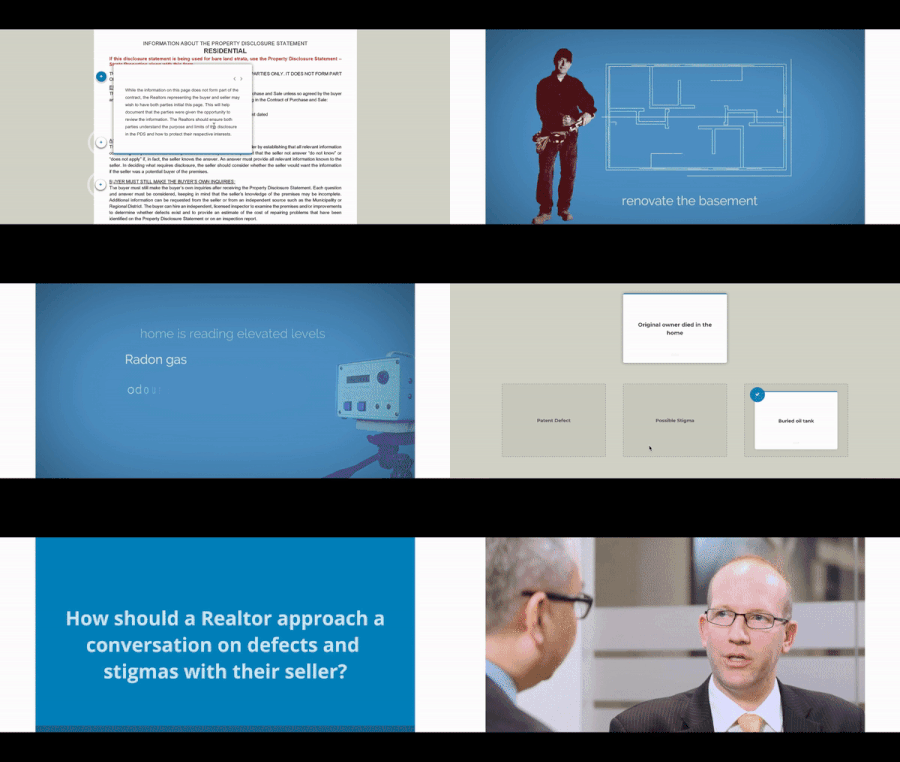
While the PDS guide provides additional details on the April 2020 form changes and why those changes were made, the Standard Form Essentials: The Property Disclosure Statement course offers a deep dive into the Property Disclosure Statement – Residential, specifically, and answers questions on property disclosures, such as:
1. Who is obligated to disclose what?
REALTORS® and sellers have different disclosure obligations. This course clarifies the differences between a seller’s obligation to disclose latent defects under common law and a Realtor’s obligations to disclose material latent defects under the Rules. Patent defects and stigmas are also discussed.
2. How can I use the information contained in the PDS to best serve the interests of my clients?
A good understanding of the PDS standard form is helpful, whether you are representing a buyer or a seller in a transaction. This course provides practical tips, further questions, and additional resources for each question on the Property Disclosure Statement – Residential, including the new questions on radon.
3. What are the new disclosures on radon?
You and your clients might have questions about radon gas. This course provides a high-level overview of what radon is, where radon is found, and what disclosures are required before entering into a conversation on radon gas with your client. Practical tips and clauses included in the course help better protect your buyer’s or seller’s interests and reduce risk.
These are just a few of the key takeaways from the new Standard Form Essentials: The Property Disclosure Statement online course, which earns learners three Professional Development Program hours upon completion.
For more about the course, including a course outline and preview, click here.
To help Realtors use the time during the COVID-19 pandemic to further enhance their skills and look to the future, BCREA has discounted all online courses, including Standard Form Essentials: The Property Disclosure Statement, by 25% until July 31, 2020. This discount is already applied to the price of the course, which has been reduced from $80 to $60.
To subscribe to receive BCREA publications, or to update your email address or current subscriptions, click here.
Three Things to Know About the Land Owner Transparency Act and Registry
On November 30, the Land Owner Transparency Act (LOTA) and Land Owner Transparency Registry (LOTR) will come into effect. With them come new reporting requirements, filed by legal professionals, when an application is made to register an interest in land.
To help REALTORS® and your clients get ready for LOTA and LOTR, here are three things you should know:
- The aims of the Land Owner Transparency Act are to end hidden ownership, crack down on fraud and close loopholes by collecting information about “interest holders,” or parties who don’t have a direct ownership but have a meaningful relationship or indirect ownership in land. This information will be stored in the LOTR, which becomes publicly searchable on April 30, 2021.
- Legal professionals will be responsible for the actual filing of the transparency declarations and transparency reports (if necessary) on behalf of a potential buyer when an application is made to register an interest in land. Realtors should advise clients early on to speak to their conveyancers about these requirements. Realtors should also advise clients to plan for longer closing periods and additional costs for transactions when a buyer is a corporation, partnership or trust, not a resident of Canada, has beneficial owners or has shareholders outside of the country.
- Even owners of properties that don’t change hands in the first year of LOTR are subject to the initial reporting requirements. Properties which currently have interest holders that are corporations, partnerships or trusts are required to file initial transparency reports by November 30, 2021. Realtors should be aware of these requirements and timelines and advise their clients to speak to legal professionals for further details.
To learn more about the Land Owner Transparency Act and Land Owner Transparency Registry and subscribe to updates visit landtransparency.ca. There you will find the Land Owner Transparency Registry Fact Sheet, which is updated regularly and has useful information to help Realtors and your clients become familiar with LOTA and LOTR.
To subscribe to receive BCREA publications such as this one, or to update your email address or current subscriptions, click here.
Three Tips for Managing REALTOR® Risk from Leslie Howatt of E&O
Whether it’s home insurance for homeowners, life insurance for families, or business insurance for business owners, insurance is a big part of life.
Former international soccer star David Beckham reportedly had his legs insured for 195 million dollars. And it makes sense – if you’ve got something you value, you protect it.
But Beckham’s protection of his assets extended beyond having good insurance coverage. Among other things, he spent hours on end training each week to ensure he was in the best physical shape possible to avoid injury.
Beckham’s due diligence can serve as a lesson for REALTORS®, albeit on a slightly smaller scale.
While REALTORS® are equipped with insurance from the Real Estate Errors and Omissions Insurance Corporation (E&O), it’s important they put in the work on a daily basis to represent their clients in the best way possible, and ultimately avoid “injury” to both their clients and themselves.
During Episode 1 of the Open House by BCREA podcast, we explored REALTOR® risk with Leslie Howatt, Executive Officer of E&O. She had a few simple reminders for how REALTORS® can manage risk on a daily basis:
- Know Your Product – There is nothing more important than knowing your product inside out. This means doing your due diligence. From title searches, to accurate details of materials and finishing, and reviewing strata minutes, leaving no stone unturned ensures you have the facts, and no one is left guessing.
- Know Your Client – Clients come with different backgrounds, levels of knowledge, and needs. Some might need more education on what it means to buy into a strata, others might need more understanding of Standard Forms. Knowing the needs of your client, crafting a plan, and having open lines of communication ensures you’re both on the same page during a transaction, and there are no surprises down the road.
- Risk Shift – Sticking to your area of expertise ensures those with the most knowledge in a specific area are the ones carrying out that task. The best example of this is home inspections. There’s a very good reason why home inspectors spend all their time doing home inspections: they’re the experts. REALTORS® should know where they’re experts and where they’re not. And in the latter case, it’s always best to defer to an expert.
An honourable mention goes to having good documentation. While it seems having proper documentation is a given, the importance of this practice cannot be understated if there is a point of confusion during, or after a transaction.
Listen to our entire conversation with Leslie, which includes an exploration of top risk areas and common claims from 2020:
[div id="buzzsprout-player-2612125"][/div] [script src="https://www.buzzsprout.com/831562/2612125-managing-realtor-risk-in-2020.js?container_id=buzzsprout-player-2612125&player=small" type="text/javascript" charset="utf-8"][/script]For more on Episode 1 of Open House by BCREA, click here.
About Open House by BCREA
Open House by BCREA is a monthly podcast where REALTORS® in BC will find the latest real estate news and feature conversations with experts on issues related to real estate practice.
Listen to all episodes here, or subscribe on your favourite podcast app, including Apple Podcasts, Google Play, Spotify, Stitcher, and TuneIn.
To subscribe to receive BCREA publications, or to update your email address or current subscriptions, click here.
Three Ways to Virtually Show a Property During COVID-19
REALTORS® are being challenged to meet obligations to clients who they entered into a business relationship with before social distancing orders came into effect and to meet the needs of new clients who may need to buy or sell despite the pandemic. This means they’re often caught in the crossfire of client expectations and civic duties, particularly when it comes to open houses and showings. While buyers are unlikely to purchase a home without ever seeing it in person, virtual tours are a great way to weed out the “Looky-Loos”. Here are three options to virtually show a property during COVID-19.
Live Video Tour
If you’re representing a buyer, try scheduling a private video tour with a prospective buyer via FaceTime, WhatsApp, Facebook Messenger or Skype. Guide them through the property as you would in person, showing features and engaging with them along the way.
If you’re representing a seller and want to host a more “traditional” open house during which many prospective buyers can view the property at one time, conduct a live broadcast on YouTube Live, Facebook Live, Instagram Live, or scheduling a video conference on Zoom. This showing would happen at a specific time, be promoted in advance, and would allow you to walk through the property while speaking to a larger audience in one go.
Produced Video Tour
Many Realtors have already made a common practice of producing creative video tours of properties with the help of third-party contractors who specialize in multimedia production.
This type of video is often produced with higher quality camera equipment and as a result, provides a professional and appealing view of a property. It also allows Realtors to get in front of the camera, script out what they want to say and ensure nothing is missed when talking about the property. These types of video tours are often produced in conjunction with photos of the property and make for a comprehensive package that gives prospective buyers a good sense of the home without having stepped foot inside.
360-Degree Tours
The most interactive type of virtual showing is likely a 360-degree tour of a property. This option allows prospective buyers to browse the home at their will, progressing through a hallway or entering a room when they’re ready.
Solutions like Matterport offer a way to turn raw 360-degree video into a professional and interactive tour. These types of services range in cost and can be accessed by Realtors and brokerages alike. Many local media production businesses offer the creation of 360-degree tours as a part of their core services.
Realtors, however, can also create 360-degree tours on their own for little to no additional cost. One option is to use your phone to create a 360 photo or use a 360-degree video camera. These photos and video footage can be uploaded to Facebook for an immersive viewing experience.
While for many buyers, nothing will replace stepping into a home and doing their due diligence, using virtual tools to start the showing process is a great alternative.
To subscribe to receive BCREA publications, or to update your email address or current subscriptions, click here.
Time is of the Essence – Affected by “Good Faith” Doctrine #302
By Gerry Neely
B.A., LL.B.
The decision in the Beka v. Share case referred to in the preceding Column #301 was based upon the judge’s conclusion that the parties, by agreeing to fix a new date, had waived time is of the essence.
The "time is of the essence" clause raises another issue that may affect the rights of either the seller or buyer of property that is being subdivided. In each of the 1983 and 1999 decisions referred to in Column #301 actual registration took place within a week or so of the completion date. In neither case was it been argued that the operation of this clause should have been suspended because the delay was minor, registration was foreseeable (and likely inevitable) and therefore the buyer had a duty to act in good faith "to perform a contract honestly made."
This doctrine of good faith has been applied in a number of real estate cases, where buyers put forward technical objections of minor but easily corrected errors, to end their obligations under what was otherwise an enforceable contract. The doctrine allows a court to correct an apparent injustice, if the circumstances make it unjust or inequitable for a party to insist that time is of the essence. If those circumstances are not present then the party not in default is entitled to insist upon his or her legal rights.
A case where the court decided that an injustice would be committed was one involving a seller who had agreed to take back a second mortgage. The application for registration of the mortgage was rejected because it had been executed under power of attorney and the affidavit of the attorney was defective. Market values had increased dramatically and the seller seized this opportunity to instruct his lawyer to terminate the contract. The affidavit was corrected by 6:00 p.m. on the closing date. The seller’s actions were evidence of a lack of good faith which would have made it unjust to allow the seller to rely upon the "time of the essence" clause to terminate the agreement. Therefore the buyer was given an order for specific performance of the contract.1
In an Ontario case, completion was subject to the seller obtaining a building permit which was delayed because of a water pressure problem in a fire hydrant in the subdivision that was quickly rectified. The buyer’s attempt to terminate the contract because time was of the essence was rejected because of the judge’s opinion that the buyer had to act in good faith and allow the seller the few days needed to correct the minor problem.2
A B.C. judge came to a different conclusion based upon a contract that gave the seller the right to 24 extensions of one week each to obtain municipal approval of the services installed by the seller. The seller missed the final deadline by two days. The decision was that since the seller anticipated the problem by contracting for extensions which turned out to be insufficient, it was not unjust to allow the buyer to exercise his legal right upon time being of the essence.3
The contrast between the Ontario and British Columbia cases indicates the difficulty of determining how the application of standards of reasonableness and good faith will be applied in deciding the rights and remedies of the parties to a breached contract.
| 1. |
|
|
| 2. |
|
|
| 3. |
|
To subscribe to receive BCREA publications such as this one, or to update your email address or current subscriptions, click here.
Timing (For Closing, For Payment of a Deposit, or Acceptance of a Counter Offer) #202
By Gerry Neely
B.A., LL.B.
The Ontario practise of closing transactions differs from the practise in British Columbia, but the comments made by a judge in a case where a vendor was seen to be trying to get out of a transaction may compel both vendors and purchasers to refrain from acting in an "arbitrary, capricious or unreasonable manner."
The closing of the purchase of a new home was to take place at the vendor's solicitors' offices at 11:00a.m. The purchasers were entitled to an inspection of the house, but because of deficiencies which the builder had to correct, the inspection was not completed until 3:00 p.m., delaying the closing. The purchasers' funds were in hand and they were ready, willing and able to close, but tender could not be made until the next day. The tender was refused and the vendor advised the purchasers that for another $20,000 they could have the house.
The judge concluded that the vendor had deliberately orchestrated a situation which prevented the purchasers from being able to close on time. He held that both vendors and purchasers owe a duty to each other to honestly perform a contract honestly entered into between them. The vendor's argument that time was of the essence and therefore the purchasers were in breach of the contract fell on deaf ears, because of the judge's finding of bad faith on the part of the vendor.1
***
In another Ontario case, a purchaser refused to agree to an extension of a few hours of the time to close, to enable a vendor to correct a defect the vendor was easily able to do. The vendor was able to tender documents before midnight, but after the registry office had closed. The purchaser refused to complete and lost his deposit on the basis that he had failed to act in good faith and to take all reasonable steps to complete the contract.2
***
An accepted offer to purchase contained a clause requiring the purchaser to pay a $5,000 deposit within 24 hours of acceptance. The contract of purchase showed without amendment that the acceptance was on September 24th. The deposit was paid September 26th. The vendor refused to close and the purchaser sued for specific performance. The purchaser lost because of his failure to pay the deposit within the 24 hour period.
The purchaser tried to argue that as a result of oral discussions with the vendor, the vendor had extended the time for payment of the deposit. There was no ambiguity in the contract and the judge refused to admit oral evidence to contradict the clear written statement that acceptance was September 24th. (Another reason for always getting it in writing.)3
***
A vendor's counter offer required acceptance by the purchaser by 8:00 p.m. on Friday. On Saturday, the purchaser countered the counter offer by accepting all changes except one which increased the deposit to $60,000. The vendor agreed to reduce this to $30,000 provided the deposit was paid to the vendor. All counter offers were made by the agent on the contract of purchase. No deadline was set in the purchaser's counter offer for a vendor's acceptance. The purchaser's counter offer was delivered to the vendor on Saturday together with the deposit cheque. The vendor did not initial the deposit change on the contract, but did accept delivery of the cheque. The bank refused to negotiate the cheque because of a slight error in the name of the payee. It was returned to the purchaser for correction and was delivered to the vendor on Monday.
By then the vendor had faxed a notice of repudiation because of the delay of delivery of the cheque. His argument was that no contract could arise because of the purchaser's failure to accept the terms of the vendor's counter offer on Friday. Quite clearly, the passage of that deadline entitled the vendor to do nothing further. The counter offer revived the contract only if the vendor accepted it. Although the vendor had not initialled the change, the judge held that his conduct in taking the cheque and then asking that it be corrected was evidence of the vendor's acceptance of the purchaser's counter offer.
Damages of $109,000 awarded to the purchaser were based upon the price he had offered to the vendor and the price the vendor obtained upon the sale of the lots.4
To subscribe to receive BCREA publications such as this one, or to update your email address or current subscriptions, click here.
Timing is Everything #482
In today's busy marketplace, there is a greater risk of mistakes being made regarding dates and times in a contract, amendment, or other agreement for the sale or lease of land. It is of critical importance that licensees carefully review agreement terms with their clients to avoid simple, but costly date and/or time errors.
Have you ever written a cheque (I know, a foreign concept these days) in January, and mistakenly put the wrong year? It is not uncommon, particularly around that time of year. While usually the mistake is easily rectified, the consequences to licensees making this mistake on a contract of purchase and sale can be significant.
Consider the following: a buyer writes an offer for a property in October 2015 with a completion date of April 15, 2016. The seller, seeking completion before the New Year, instructs his licensee to counter the buyer's offer changing the completion date to December 15, 2015. The licensee, in changing the completion date to December 15th, neglects to change the year to 2015, leaving the completion date as December 15, 2016. While one would hope the mistake to be quickly acknowledged and rectified by the parties, some buyers will seek to take advantage of the error.
Failing to implement a good diary system may cause a licensee to miss key dates, such as subject removal dates, resulting in a buyer losing the property they desperately wished to buy. Consider this scenario: a buyer wishes to acquire a property to redevelop. The buyer's licensee writes an offer which includes various subject conditions to be waived or removed within 45 days. The licensee fails to contact the buyer prior to the subject removal date with the result that subjects are not waived or removed within time. The seller then maintains the contract is void, exposing the licensee to a claim for damages by the buyer.
Failure to communicate written acceptance of offers or counter-offers within the time specified in the contract may also enable a party to argue the contract is unenforceable. In a recent case, a seller accepted the buyer's counter-offer in writing, but the seller's written acceptance was allegedly not communicated to the buyer within the time specified in the contract. The buyer maintained the contract was unenforceable. Licensees should recall that Section 5-4 of the Real Estate Council Rules requires a licensee to promptly deliver a copy of the signed acceptance of any offer to each of the parties to the contract and to the related brokerage of the licensee.
Confusion regarding the time or date by which a term, condition or other event must occur will also increase the risk of a buyer or seller taking the position that the contract is unenforceable. If an event is to happen within a number of days or a number of hours, care should be taken to document, in writing, when the time period starts to run and end. Failure to clarify the start and end times or dates can result in one of the parties challenging whether an event occurred within the time specified in the contract.
Licensees can avoid lawsuits, professional complaints and harm to their professional reputation by:
- Ensuring subject removal dates and other important dates are properly recorded and tracked;
- Ensuring acceptance of any offer/counter offer within the time specified in the contract and written communication of that acceptance within that time;
- Clarifying the time/date by which an event must occur, be it subject removal, payment of a deposit or compliance of a fundamental term or condition, and ensuring all parties have the same understanding of that time/date, and;
- Ensuring extensions of time are obtained and agreed to in writing by all parties before the original deadline expires.
Jennifer Clee
B.A., LL.B.
| 1. | http://www.recbc.ca/licensee/rules.html#section5-4 . |
Timing is Everything #501
One often hears the phrase “timing is everything.” In a recent case,1 a pair of unfortunate buyers found that out the hard way.
The buyers entered into a Contract of Purchase and Sale (CPS) to acquire a residential property. The parties used the standard form residential CPS, although no REALTORS® were involved. The purchase price was $705,000 with a completion date of April 25. An innocuous clause was added requiring all documents to be lodged for registration by 4:00 pm on the completion date.
Part of the purchase price was to be paid through a mortgage arranged by the buyers. That aspect of the transaction was governed by Clause 13 of the CPS, which provides that the buyer may wait to pay the purchase price to the seller until after the transfer and mortgage documents are registered if: the buyer has made available the portion of the purchase price not secured by the mortgage; the buyer has fulfilled all the new mortgagee’s conditions for funding except lodging the mortgage for registration; and the buyer’s lawyer or notary has undertaken to pay the purchase price upon receipt of the mortgage funds. This conveyancing convention resolves the chicken and egg conundrum whereby the seller does not want the transfer of the property to occur before they are paid; the buyer can’t pay the seller until they receive the mortgage funds from the lender; and the lender won’t release the mortgage funds to the buyer unless the property has been transferred and their mortgage has been registered against title.
On the completion date, the sellers’ notary forwarded the executed transfer documents to the buyers’ notary on the usual undertakings including that the documents were not to be used except in accordance with Clause 13 of the CPS. The sellers’ notary added a further undertaking that the documents were to be returned if the transaction was not registered by 4:00 pm. At 4:00 pm the buyer’s notary had not yet received instructions from the buyers’ mortgagee nor had the buyers delivered the portion of the purchase price not secured by the mortgage. At 4:19 pm the sellers’ notary required the buyers’ notary to return the executed transfers as the buyers had not been in a position to complete the transaction at 4:00 pm. At 5:36 pm the buyers’ notary wrote back indicating they “were ready for registration” and asking that they be allowed to use the transfer documents. That request was refused.
The sellers were going to use the proceeds of sale to purchase another property. With the collapse of the first sale, they had to incur the expense of alternative financing to complete the purchase of the other property.
The buyers’ claim for specific performance of the CPS was dismissed by the court. They argued that had they used either lawyers or REALTORS® in the preparation of the CPS, the contract terms, particularly those dealing with the 4:00 pm deadline and “time is of the essence,” would have been explained to them. That argument was unpersuasive with the court determining that “persons are bound by agreements to which they have put their signature whether they have read the contents or have chosen to leave them unread.”2 In the end, the court held that the terms of the CPS were clear; the buyers were in breach of the CPS by failing to complete the transaction by 4:00 pm and the sellers were entitled to accept that repudiation. The sellers were awarded the amount of money they had expended in alternative financing.
In this case, it is likely the transaction would have completed had it not been for the 4:00 pm clause. Buyers and their REALTORS® should be wary about inserting or accepting clauses which require completion by a specific time on the completion date particularly if a portion of the purchase price is being provided by a mortgagee whose timing they do not control.
Brian TaylorNorton Rose Fulbright LLP
| 1. | Gill v Bal, BCSC 2015. | |
| 2. | Gill v Bal, BCSC 2015, at para. 31 (BCSC). |
Legally Speaking is published monthly. Real estate boards, real estate associations and REALTORS® may reprint this content, provided that credit is given to BCREA by including the following statement: "Copyright British Columbia Real Estate Association. Reprinted with permission." BCREA makes no guarantees as to the accuracy or completeness of this information or the currency of legal information.
To subscribe to receive BCREA publications such as this one, or to update your email address or current subscriptions, click here.
Tips for Using Clauses and Amending Contracts of Purchase and Sale #541
Standard form contracts of purchase and sale are very useful in real estate transactions. They are familiar, well-tested, and cover off all the basics and much more. However, real estate is complicated and the one-size-fits-all approach may not fit every situation. In cases where a standardized contract of purchase and sale does not entirely address the specific needs of the transaction adding terms and conditions – or clauses – can allow parties to conduct due diligence. That said, doing so should be done with care, since improperly drafted clauses can result in unhappy clients, unenforceable contracts and possible disciplinary action.
While changes to contracts may sometimes be required, a good place to start is by using clauses and terms. Regardless, when amending the contract of purchase and sale or crafting a clause, it’s all about the details. A properly crafted term is concise and results in clarity around what is required for a term to be fulfilled and by whom. Below are some guidelines to consider.
Amendments to Contracts
While it may seem simple enough to change contract terms, there are some important guidelines and principles for REALTORS® to keep in mind when drafting a contract or in making amendment.
- Ensure Consistency of Terms Ensure Consistency of Terms
Firstly, no matter what change is being made, contracts need to be clear. Realtors should review the entire contract to make sure that there are no contradictions between the standard term or term that have been added deals. When a contract deals with the same subject matter differently in different places, this creates confusion and leaves room for later disputes. Talk to your managing broker or a lawyer if you have any questions or concerns because improperly worded clauses can result in a discipline complaint or legal action against the real estate licensee. - Use Subject Clauses
The second guideline worth mentioning has to do with subject clauses, also called “conditions precedent”, “conditions”, or “subject conditions” (the terms are interchangeable in this context). These are the most commonly included changes or additions to the standard form contract of purchase and sale, since they will be unique to each transaction. Subject clauses require clear dates by which they must be fulfilled or waived. Lack of clarity on the subject deadline makes it uncertain whether that subject will be enforceable, and in some cases whether the contract itself is binding. - Identify the benefitting party or parties
Subject clauses involves including the following phrase after each subject condition: “This condition is for the sole benefit of the [Buyer/Seller]”. The party named in that phrase – typically the benefitting party – is the party who needs to waive or declare fulfilled the condition before the parties are bound to complete the contract.. Just because a subject term does not specify for whose benefit it is included, that does not mean that the contract can never become binding. However, it means that it is less clear who has the power to determine whether the subject can be waived, leaving room for disputes. It is better to be clear about who benefits from the condition.
Post-Contract Amendments
Post-contract amendments are a distinct category of contract changes because at this point the parties already have an unconditional contract in place. However, that does not mean the terms of that contract cannot be changed if all parties agree.
It’s important to remember, however, that if a contract is being amended after it has been executed, this would result in re-opening the contract, and Realtors should recommend that the parties seek legal advice before doing so.
Until an amendment is finalized and agreed to by both parties, the existing, unamended terms of the contract will remain enforceable. If the amendment is never agreed to then the original terms of the contract of purchase and sale will continue to govern.
Two specific post-contract changes to consider are altering transaction dates and significant amendments. Here are some tips for how to deal with those scenarios.
- Amendment to Transaction Dates
Where amendments are made to applicable dates in the contract, the parties should reiterate in the amendment that time is still of the essence (time is of the essence is one of the standard form contract clauses that makes clear that the parties intend to strictly enforce the dates agreed to). Reiterating this concept helps avoid an argument that timelines under the contract are no longer strictly enforceable since the parties have already agreed to change them, suggesting they are no longer as important. - Significant Amendments
As noted above, amendments are not effective until they are agreed and signed off on by all parties. However, there may be circumstances where the amendments a client is proposing are significant. In those cases, there is sometimes an argument that the party proposing the amendment is signaling that they will not complete the contract on its prior terms, and that may attract legal consequences for breach of contract, or “advance repudiation” in legal terms. Those cases are rare and are avoided if the Realtor presenting the amendment makes clear that their client intends to complete the contract originally negotiated even if the parties do not reach an agreement on the amendment. This can be confirmed in the amendment itself or in a covering email.
They say the only constant is change, but making sure you help your clients make changes in their real estate transactions responsibly will ensure their interests are served well. As always, it is important to talk to your managing broker and considering seeking legal advice when dealing with complex issues.
For more guidance clauses from the BC Financial Services Authority on using clauses, click here.
Title Considerations: The Clause 9 Problem #444
By Jennifer Clee
Clause 9 in the Contract of Purchase and Sale requires a seller to deliver title "free and clear of all encumbrances except subsisting conditions, provisos, restrictions, exceptions and reservations including royalties, contained in the original grant or contained in any other grant or disposition from the Crown, registered or pending restrictive covenants and rights of way in favour of utilities and public authorities, existing tenancies set out in Clause 5, if any, and except as otherwise set out herein."
It is important to note that Clause 9 does not except easements, building schemes or certain other encumbrances from the seller's obligation to clear title. This means that unless the contract specifies those encumbrances to remain on title, the seller is obliged to deliver title clear of any encumbrances not excepted by Clause 9. A listing licensee who fails to address this issue places the seller at risk of being in breach of contract if the seller cannot deliver title clear of the encumbrance.
To prevent sellers covenanting to provide clear title when they are not able to do so, a licensee should list in the contract all encumbrances that are to remain on title at completion. Alternatively, a licensee should use the Acknowledgement of Title Clauses recommended by the Real Estate Council of BC.1
Can a buyer justifiably repudiate the contract if the seller cannot deliver title free and clear of non-financial encumbrances not excepted by Clause 9, or by any other provision in the contract? It depends on the circumstances.
Whether a buyer will be permitted to repudiate the contract will depend on the court's view as to whether the easement will significantly affect the buyer's use and enjoyment of the property.2
In Price v. Malais3, the court found the buyers were entitled to repudiate the Contract of Purchase and Sale when the seller was unable to deliver title free and clear of an easement in favour of the Peachland Irrigation District. The court considered the easement a significant encumbrance because of the extensive size of the easement, and the rights granted to the holder of the easement. The court found, however, that a second easement registered on title in favour of the gas company was so trifling as to not interfere with the buyers' enjoyment of the property and consequently its presence on title would not have justified the buyers' repudiation of the contract.
In Bernard v. Weiss4, buyers of a home in Richmond repudiated their Contract of Purchase and Sale because the seller was unable to deliver title free and clear of certain easements registered against title in favour of hydro, telephone and sewer for the Municipality of Richmond. The court found that the easements were of such a trifling nature that it did not justify the buyers' repudiation. The court stated:
| " …the court determines whether an encumbrance is comparatively trifling or, on the other hand, more major, on the basis of whether it significantly would affect the purchaser's use or enjoyment of the property." |
Any claim for breach of contract against the seller for failing to deliver clear title will undoubtedly result in a claim by the seller against his or her agent for negligence. In Price v. Malais, the sellers successfully sued their agent for failing to mention or note the easement in the contract, and for allowing the seller to covenant to deliver clear title free of the easement.
Licensees are reminded of their obligation to investigate title thoroughly before listing any property for sale, to investigate the nature of any non-financial encumbrances on title and to ensure that the contract specifies all encumbrances that are to remain on title.
| 1. |
|
|
| 2. |
|
|
| 3. |
|
|
| 3. |
|
To subscribe to receive BCREA publications such as this one, or to update your email address or current subscriptions, click here.
Title Insurance – Part 1 of 3 #321
By Gerry Neely
B.A. LL.B
We in British Columbia take pride in our Land Title registration system because we can satisfy ourselves as to the state of title with a 60 second online search, instead of waiting a week or so for a title search, as in the State of Washington. However, our system does have shortcomings. These shortcomings, combined with globalization, international law and accounting firms and the recognition by United States title insurance companies that there is a large untapped market for their products in Canada, have brought title insurance to British Columbia.
Initially, title insurance only covered the loss or damage of a defect in the title stated in the policy, which is discovered subsequent to the issuance of a policy of insurance. Coverage has since been broadened significantly to include loss or damages resulting from encroachments, violations of zoning bylaws, and, in lender’s policies, lack of a valid building permit.
As a result of this added coverage, there will be circumstances in which title insurance may be useful to a buyer of a residential property, or where it may be required by a lender as a condition of approving a mortgage loan secured by residential property. In commercial transactions, title insurance may become part of the usual security taken by a lender.
There are four types of policies, residential owner's/buyer's, residential lender's, commercial owner's/buyer's and commercial lender's policies. Each policy covers specific named risks and insures against losses arising because of defects or events occurring prior to the date the policy was issued. The amount of the insurance is the purchase price of the property or the amount of the mortgage.
The commercial buyer’s policy insures against four basic risks: the title to the interest may be different than stated in the policy; there are defects in the title, including charges, liens or encumbrances; the title is unmarketable; there is no right of access to the land.
In addition to the basic coverage of a residential buyer's policy, an additional 14 different risks are covered. These risks include: a document improperly signed, sealed or delivered, or created through forgery, fraud, duress, incompetence or impersonation; forgery of an instrument after the policy date; defective registration of a document; a restrictive covenant that limits the use of the land; an inability to use the land as a single family residence because it violates a restriction or zoning bylaw; builders liens for materials provided prior to the policy date; and other defects, liens, charges or encumbrances.
To subscribe to receive BCREA publications such as this one, or to update your email address or current subscriptions, click here.
Title Insurance – Part 2 of 3 #322
By Gerry Neely
B.A. LL.B
A lender’s policy, whether residential or commercial, contains the basic risks plus a broader coverage than is provided in the buyer’s policies, referred to in Column 321. Those risks include, interesting enough, the invalidity of the mortgage due to usury laws, encroachments on to or from the insured lands. These risks are more fully described in the policies of title insurance.
The residential policy insurance for one lender contains a total of 24 different insured risks - one of which is for an event that occurs after the policy date, namely, the encroachment upon the insured property of an improvement constructed after the policy date. This is a "post policy date" event, which can only be covered if it is specifically stated to be in effect after the policy date.
Each policy also contains a second area of coverage, and that is the legal fees that may be incurred by the insurance company in the defence of the insured title. These costs could be substantial, particularly for insurance covering commercial properties. The policy does not limit the fees the insurance company may incur and the fees are not deducted from the amount of insurance. The policies give the insurance companies a number of options including paying the claim, defending it, or canceling the policy by paying to the policy holder, or the claimant, the insurance and costs, fees and expenses incurred up to that time.
Under one owner’s policy, the insurance continues during the period the owner retains an interest in the land, or holds a vendor take-back mortgage, or remains liable under a warranty covenant in favour of the buyer of the insured lands. However, the policy does not remain in force for the buyer of the lands or the buyer of the owner’s interest in a take-back mortgage.
Commercial properties include residential properties containing more than four units, mixed use properties, farm properties generating an income, vacant commercial or industrial land and leasehold interests. Exclusions from coverage include defects known to the owner but not disclosed to the insurer prior to closing, expropriation, and environmental issues. A title insurer may insure a known title defect where the risk of loss is acceptable.
According to an industry spokesperson, the advantages of title insurance include: closings are facilitated, particularly where there are no known survey or title defects; known defects can be unwritten and insured; title and off-title searches are eliminated; clients save disbursement costs; and the need for up-to-date survey is eliminated, or there is broader coverage such as coverage for fraud and forgery which is more than an up-to-date survey and title search can provide. For lawyers, the advantage of title insurance is that the liability is shifted from the lawyer to the title insurer.
To subscribe to receive BCREA publications such as this one, or to update your email address or current subscriptions, click here.
Title Insurance – Part 3 of 3 #323
By Gerry Neely
B.A. LL.B
Some banks and credit unions are now requiring title insurance for the refinancing of consumer mortgages. This, according to a bank spokesperson, provides for a more efficient system at less cost. From the lender’s prospective, the benefits of title insurance coverage include: removing concerns over negligence; making the insurance no-fault; providing survey coverage; providing coverage against fraud and forgery; providing bylaw coverage; overcoming the problems of independent legal advice; and including foreclosure defence coverage.
Examples of the advantages of title insurance include the following. A lender wanted a new survey showing all structures located on a large parcel of land in Alberta, but the borrower balked at paying the estimated cost of $14,000. The borrower agreed to provide title insurance at a cost of $2,000 and the lender agreed to accept a boundary survey, which only cost $2,000. Where a lender required a permit from a local authority that had been approved but not issued and wouldn’t be issued for two to four weeks after the date for closing, the title insurer satisfied itself that the permit would be issued and gave title insurance satisfactory to the lender which enabled the closing to take place on time.
There are at least four title insurance companies operating in Vancouver, and another half dozen in Ontario and Alberta. Title insurance companies are regulated by the Federal Government through the office of the Superintendent of Financial Institutions. In addition, they are regulated in British Columbia by the Insurance Council of British Columbia. In accordance with the Financial Institution Act, this council's responsibility is to monitor marketing activities, policy content, and competitive activities to ensure protection to consumers.
Premiums and the terms of coverage for commercial policies are negotiable. While each policy contains a number of similar standard clauses, each policy is different and therefore each needs to be reviewed to determine the coverage each provides. The insurance premium for a residential mortgage lender for a loan of less than $500,000 is approximately $150. The residential owner of the property will pay an extra $50 for a buyer’s policy. A commercial premium for a loan of $1,000,000 is approximately $1,300.
The Torrens system, which is the backbone of our registration system in British Columbia, deals with many of the risks that are insured. However, human error by those professionals using it, as well as a lack of full coverage of losses and legal fees by the Assurance Fund, means that there are circumstances where title insurance may resolve a problem at less cost than other alternatives. One would have to carefully weigh one's circumstances against the cost of covered risks, to determine whether payment of the premium is justified.
From reading the extent of the available information, it appears that title insurance is here to stay in Canada, and that real estate practitioners and lawyers will have to become familiar with it. Ontario lawyers decided to meet the challenge by establishing their own title insurance company. A suggestion was made in a recent Continuing Legal Education Seminar that advising clients with respect to the pros and cons of title insurance will become standard practice, such that failure to do so adequately may constitute negligence on the part of the licensee or lawyer.
To subscribe to receive BCREA publications such as this one, or to update your email address or current subscriptions, click here.
Title Insurance #442
By Jennifer Clee
Occasionally, claims are reported to the Real Estate Errors and Omissions Insurance Corporation (REEOIC) involving complaints by buyers against licensees which might not have been made if those buyers had bought title insurance.
Title insurance is an insurance policy provided by title insurance companies that protects residential or commercial property owners and/or their lenders against losses related to a property's title or ownership.
While each title insurer may offer slightly different coverage, some of the coverage provided by title insurance companies includes: coverage for unknown title defects; survey errors and errors in public records; losses related to improvements made without the requisite building permits (unless made by you); existing liens against the property's title for unpaid debts by the previous owner (utilities, taxes, mortgages or condominium charges registered against the property); real estate fraud and forgery; invalidity of mortgages; and encroachment and unregistered easement issues.
Title insurance will generally not cover known title defects1, environmental hazards, native land claims, matters created, allowed or agreed to by the insured, or matters known to the insured but not disclosed to the title insurer prior to closing (e.g. matters identified in a building inspection).
Title insurance is usually purchased by a buyer at the time of purchase, although it may be purchased anytime after. The insurance cost, generally a one time fee or premium, is usually determined by the property's value and depends upon the chosen provider.
The advantage to licensees of buyers purchasing title insurance is that it shifts liability from the licensee to the title insurer. Consider this scenario: an elderly seller owns a piece of property in a rural area for many years. After obtaining a variance from the governing authority, the seller constructs outbuildings which encroach upon the adjacent property. No record is kept of the variance by the approving authority.
Years later, when selling the property, the seller completes the Property Disclosure Statement indicating that he is unaware of any unregistered encroachments.2 The buyer discovers the encroachment after purchasing the property and incurs a loss in rectifying the issue. A buyer with title insurance would likely be indemnified by the title insurer for any proven loss associated with the violation. A buyer without title insurance would likely sue the seller and licensees involved in the sale to recover losses associated with the undisclosed encroachment.
Here are examples of recent claims paid out to BC homeowners by a major title insurer3:
- Buyer received notice from the City that the basement apartment was built without obtaining required development or building permits. A permit was required to remove or to legalize the apartment. Cost of claim: $239,958.
- Buyer had municipality conduct a site inspection of the property after experiencing plumbing problems. The inspector found numerous problems with the dwelling, as well as illegal gas and plumbing lines, and an unpermitted addition to the garage. The municipality issued an Order to Comply. Cost of claim: $270,797.4
To date, there is no standard industry practice to alert buyers to title insurance availability.
Given the protection that may be afforded to buyers (and indirectly to licensees) who purchase title insurance, licensees may well wish to advise buyers of its availability. This suggestion has already been made to real estate practitioners.5 For more information on title insurance see Legally Speaking issues 321, 322 and 323.
To subscribe to receive BCREA publications such as this one, or to update your email address or current subscriptions, click here.
Title Insurance for Renovations Done Without Permits or Final Approvals; Hazardous Trees and Duty to Inspect #381
By Gerry Neely
B.A. LL.B.
While BC is fortunate to have the Torrens system as the backbone of its land title registrations, some risks not protected by the Land Title Act may be covered by title insurance.1
For example, undisclosed renovations by present or previous owners may not be obvious to a licensee or new buyer. If no permit was obtained, the buyer may only discover the renovations breached the building code when applying for a permit and discovering the breaches must be remedied.
There are conditions for coverage, including:
- that renovations, which existed at the policy date, were done without obtaining the required building permit and the owner is forced to remove or remedy the breach, or can't use the structure for family purposes, and
- where any search, as at the policy date, of local government records required in the normal course of a real estate transaction would have revealed the issuance of a building permit, but no final approval was obtained or there was an outstanding work order or deficiency notice.
These conditions are from a First Canadian Title Insurance policy. Similar coverage may be available from other policy providers. Buyers must weigh their circumstances against the cost of covered risks to determine whether payment of the premium is justified.
* * *
Liabilities arising from trees—such as mistaken or deliberate cutting on a neighbour's property to improve views or sunlight, trees blown down by high winds or roots encroaching on adjoining property—have been the subject of several columns.2 A recent decision examines a different question: whether the common law imposes a duty on landowners to have trees on their properties routinely inspected by an expert to determine if any are hazards.
A waterfront owner lost his dock when a large tree on his neighbour's property fell as a result of a disease that caused root and trunk rot. The tree grew at the top of a steep, forested slope and, while it was clearly visible from the neighbour's house, he was unaware of this defect because it was difficult to access. The repairs cost $35,000.
There was a difference of opinion between the expert witnesses called by each party as to whether the amount of foliage, the discoloured and raised bark and a ten-degree lean toward the dock were evidence of a hazardous tree. However, they did agree that only an expert would have been able to determine that it was diseased, which seems somewhat contradictory given their disagreement. Neither lawyer was able to find precedents containing facts similar to those in this case.
The cases they did provide dealt with trees whose branches hung over a lawn bowling club or were located beside a busy highway or street. In each case, injury from falling trees or limbs had occurred and the landowners were found liable for failing to inspect and call in tree service specialists. From these decisions, the judge found no duty on the part of owners of relatively inaccessible, densely forested land to hire experts to routinely inspect their lands.
The corollary to this is that landowners who live next to busy roads or homes or areas used by the public, and who have reasonable access to the trees on their properties, should inspect them for the signs of disease that justify obtaining expert advice.3
| 1. | Legally Speaking 321 to 323. | |
| 2. | Legally Speaking 112, 124, 173 and 183. | |
| 3. | McNee and McNee v. Northrop,SCBC, Vancouver Registry, Reasons for Judgment, February 18, 2004. |
To subscribe to receive BCREA publications such as this one, or to update your email address or current subscriptions, click here.
Title Property: When to Add a Clause to the Contract of Purchase and Sale
One of the many valuable services provided by REALTORS® is investigating the state of the title on properties when they act on behalf of sellers or work with buyers in a purchase. A thorough title search review will reveal appropriate information the parties need to be aware of, including existing charges on the title.
An important step in the review process is identifying which charges can and cannot be removed from the title by the seller and which will remain on the title when the title is transferred to a buyer in a subsequent transaction.
Section 9 of a Contract of Purchase and Sale (CPS) standard form states that the buyer will obtain title to the property “free and clear of all encumbrances except subsisting conditions, provisos, restrictions exceptions and reservations, including royalties, contained in the original grant or contained in any other grant or disposition from the Crown, registered or pending restrictive covenants and rights-of-way in favour of utilities and public authorities, existing tenancies set out in Section 5…”
It is important for REALTORS® and sellers to be aware of the impact of the above-noted exclusions and the potential consequences of failing to address them appropriately in a CPS. The exclusions include restrictive covenants, easements, rights-of-ways, and building schemes registered on many property titles that, in many cases, cannot be removed from the title by the seller.
If these exclusions are not appropriately addressed in a contract, the buyer could require the seller to remove any such encumbrances from the title as a condition of the contract. As the seller will often not be able to remove some of the charges, the contract may be determined to be unenforceable against a buyer who wishes to exit the contract.
Sellers and their agents do not want to enter an unenforceable contract because they cannot fulfill the contractual obligation to provide a clear title to the property.
Prudent REALTORS® will ensure a CPS contains an appropriate title condition clause, which will include the buyer's acknowledgement and agreement that some registered encumbrances will remain on the property's title after the transaction is completed.
It is crucial to read each subject clause added to a contract to ensure all actions required by that clause, such as marking up and attaching a copy of the title, are followed appropriately.
Two clauses are available on WEBForms® that can be used to obtain agreement from the buyer:
- Buyer satisfaction with title
On the Completion Date, in addition to the encumbrances set out in section 9 of the Contract, title to the Property will be subject to the encumbrances and legal notations expressly indicated to remain on title as shown in the title search that is attached to this Contract.
This clause requires the REALTOR® to physically mark up a copy of the title search and then attach it to the contract.
- Title subject to listed encumbrances
On the Completion Date, in addition to the encumbrances set out in section 9 of the Contract, title to the Property will be subject to:
- [List other encumbrances and legal notations to remain on title];
- […]; and
- […]
set out in the copy of the title search that is attached to this Contract.
This clause requires the REALTOR® to include a written list / description of encumbrances that are to remain.
While either of these clauses can be used, it is important to recognize that the encumbrances which will remain on the title must be clearly identified by either marking up a copy of the title search or listing each encumbrance which will remain on the title.
To Rent or Not To Rent #484
Under the Strata Property Act1 (Act), a strata corporation may pass by-laws prohibiting or restricting the rental of strata units. A rental restriction by-law (RRB) must be filed at the Land Title Office and will take effect:
| I. | immediately upon filing, if filed by the developer prior to the sale of any units; | |
| II. | alternatively, the later of: | |
| i. | one year after the RRB was passed; or, | |
| ii. | where a unit is rented, one year from the date the tenant vacates the unit. | |
Despite a RRB prohibiting or restricting rentals, an owner may rent a strata lot under three scenarios:
- Rental Disclosure Statement
- Family Rental
- Hardship Exemption
A Rental Disclosure Statement (RDS) filed by the developer with the Superintendent of Real Estate will exempt certain units from an existing or future RRB. Whether an owner benefits from the exemption and for how long, will depend upon the rental period specified in the RDS, and the date the developer filed the RDS. A RDS filed before January 1, 2010, will benefit the first owner (i.e. the buyer from the developer) for the length of the rental period. A subsequent buyer will not benefit from the exemption. A RDS filed after January 1, 2010, will benefit the first and subsequent buyers, until the expiration of the rental period.
An owner may rent their strata unit to a family member. A "family member" means a spouse, child or parent, or a parent or child of a spouse. Spouse includes an individual with whom an owner has lived in a common law relationship for two years or more. If the RRB restricts the number or percentage of rentals, units rented to a family member will not be considered in determining whether the limit of rentals specified in the RRB has been reached.
An owner may rent their unit on the basis of hardship. The owner must follow the statutory procedure to apply for the exemption, and must prove hardship. While "hardship" is not defined under the Act, our courts have considered the definition set out in the Shorter Oxford English Dictionary: "hardness of fate or circumstances; severe toil or suffering; extreme privation". The strata must not unreasonably refuse to grant the exemption. A strata's failure to act reasonably or its failure to follow statutory procedure may result in the exemption being granted.
In Strata Corp. LMS3442 v. Storozuk2, the strata sought recovery of $16,450 in fines from the owner, Mr. Storozuk, who had rented his strata unit in breach of a RRB prohibiting rentals which had been passed years after he bought his unit. Mr. Storozuk had bought a lot to build a home and tried to sell his unit to finance the project. When the unit did not sell, he emailed the strata stating he intended to rent his unit.
The strata served Mr. Storozuk with a by-law infraction notice and he responded by asking the strata to consider his earlier email as an application for a hardship hearing, advising that he would attend an upcoming strata council meeting. At the meeting, the strata denied his application as he failed to provide sufficient evidence of financial hardship. The strata confirmed its decision in writing to Mr. Storozuk eight days later, contrary to the statutory requirement to render a written decision within seven days of the hearing. The strata's application for recovery of the fines was consequently dismissed.
This case is a reminder that licensees selling stratas should ascertain their client's position on rentals, provide a copy of any RDS and/or RRB to the client and consider advising the client to seek independent advice regarding the ability to rent.
Jennifer Clee
B.A., LL.B.
| 1. |
|
|
| 2. |
|
To Rescind or Not to Rescind…
The Home Buyer Rescission Period (HBRP) will come into effect on January 3, 2023. Under this new regulation, some buyers for some residential properties will have three clear business days to change their mind, for any reason, and walk away from an accepted Contract of Purchase and Sale.
It’s important for REALTORS® working with buyers to fully understand the obligations of the parties and the consequences when a buyer wishes to exercise this new option to rescind a contract. It is equally important for REALTORS® representing sellers to be able to provide accurate advice and guidance when dealing with offers on properties in which the buyer will have the right to rescind the accepted contract.
If a property is not exempt and falls within the definition of a residential property under the Home Buyer Rescission Period Regulation,a buyer will have the right to rescind the contract by providing a Notice of Rescission to the seller, at the address provided by the seller, within three clear business days after the date on which the contract is created. Should a buyer exercise their right to rescind the contract, they will be required to pay a rescission fee, in the amount of 0.25% of the purchase price, to the seller.
If a buyer exercises their rescission right and a deposit has been paid with the offer, the rescission fee will be paid to the seller from the deposit and the balance of the deposit, if any, will be paid to the buyer without further direction from the parties to the contract. A written release from the parties is not required, and the brokerage can pay out the deposit. If there is no deposit paid with the offer, the buyer will be required to pay the rescission fee to the seller.
REALTORS® will be required to provide competent advice to both buyer and seller clients regarding the options available when negotiating the arrangements for payment of deposits when preparing and presenting offers.
BCREA has worked with the British Columbia Financial Services Authority (BCFSA) to make appropriate changes to standard forms and create a new form required by the HBRP regulations. The new and revised forms will be available through CREA WEBForms® on January 3, 2023.
To help support REALTORS® and managing brokers in understanding the new regulations and how to apply them to practice, BCREA has created a new accredited self-paced training course called: The Home Buyer Rescission Period: What REALTORS® Need to Know, which launched on December 1, 2022.
Access to background information, resources and practice guidance regarding the complexities created by the HBRP is available to REALTORS® on the 2023 Standard Forms & HBRP Resources page at www.bcrea.bc.ca/forms2023 (BCREA Access login required).
Stay tuned for more information and updates as the implementation date for the Home Buyer Rescission Period draws closer.
Too Tight? The Impact of Bank of Canada Tightening on BC Housing Markets
Vancouver, BC – January 18, 2022. The number of home sales in British Columbia is expected to fall and home price growth will moderate because of rising interest rates according to a new report from the British Real Estate Association (BCREA) examining the potential impacts of the Bank of Canada’s rate tightening widely expected this year.
BCREA’s Market Intelligence report, Too Tight? The Impact of Bank of Canada Tightening on BC Housing Markets, was written by the association’s Chief Economist Brendon Ogmundson and explores both the historical impacts of the Bank raising its policy rate and a number of scenarios likely to play out in BC’s housing market as a result.
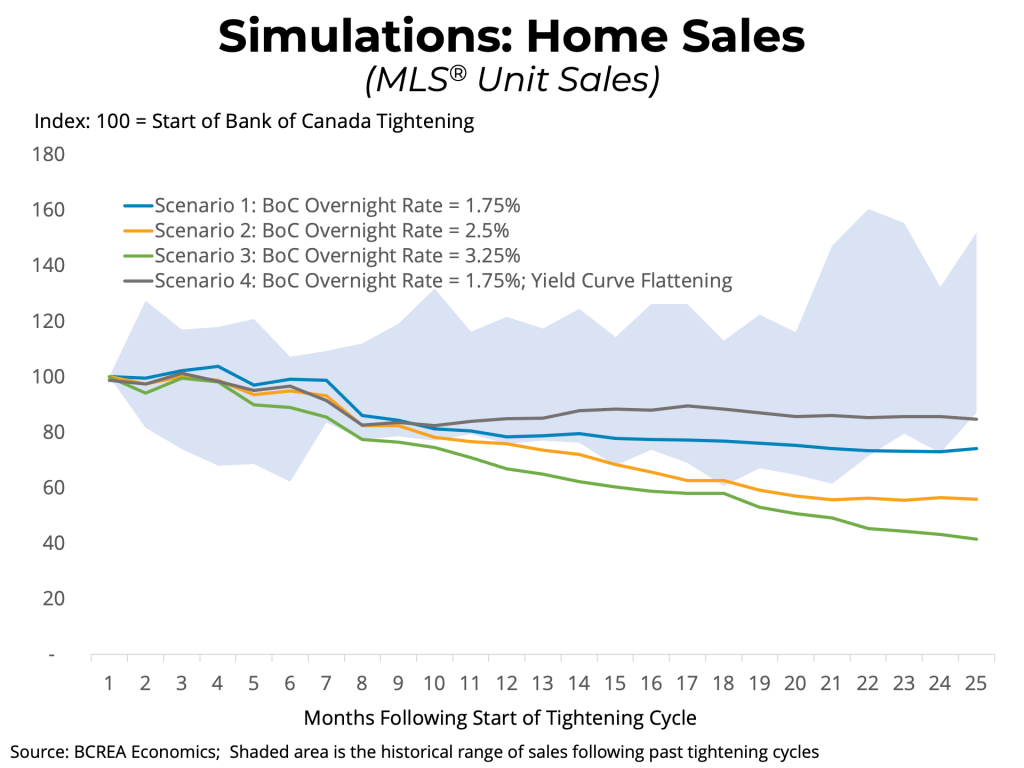
“In the past, Bank of Canada tightening has usually led to falling home sales and flattening home prices, so it wouldn’t be a surprise to see the same happening in the upcoming round of tightening” says Ogmundson. “Based on previous trends and our model simulations for what might be to come with respect to rates, we have outlined a number of likely scenarios in this report.”
The Bank of Canada has signaled that in response to elevated Canadian inflation, it will begin raising its policy rate or “tightening” monetary policy this year. The impact of this type of action on housing markets is generally predictable, however, with BC’s housing markets currently undersupplied with record-low numbers of active listings, the impact on prices may not be as significant.
“With markets so out of balance, we expect home price growth to slow but to what extent depends on the final rate destination for the Bank of Canada and for Canadian mortgage rates,” adds Ogmundson. “Our model simulations show only a minor impact on home prices in the first two years following the Bank raising its overnight rate.”
British Columbia set a new record for home sales last year with 124,854 residential unit sales were recorded by the Multiple Listing Service® (MLS®) in 2021, a 32.8 per cent increase from the 94,001 units sold in 2020. For more economic analysis from the British Columbia Real Estate Association visit bcrea.bc.ca/economics.
Media contact:
Brendon Ogmundson
Chief Economist
Direct: 604.742.2796
Mobile: 604.505.6793
Email: [email protected]
Top Three Questions About the Privacy Notice and Consent Form
Privacy laws in British Columbia require that informed consent is obtained before collecting, using, and disclosing the personal information of individuals. BCREA created the Privacy Notice and Consent form to support REALTORS® in providing disclosure and documenting the informed consent of consumers regarding the collection, use, and disclosure of their personal information. Having a consumer sign and date the form documents that the disclosure has been made and the consumer has consented to the Realtor using their personal information.
To ensure you feel confident when working with the Privacy Notice and Consent form and explaining the form to consumers, you can find answers to three frequently asked questions about the form below. These questions cover using the Privacy Notice and Consent form with unrepresented parties, how often you should complete a new form, and who needs to date and sign the form.
1. Do Realtors need to consider privacy matters when dealing with an unrepresented party? Does an unrepresented party need to sign the Privacy Notice and Consent form?
Any time a Realtor is collecting, using or disclosing personal information from or about a consumer, whether they are a represented or unrepresented party, the Realtor is required to obtain that person’s consent to do so under applicable privacy laws. When obtaining such consent, you must give that person sufficient detail about the purpose of your collection, use and disclosure of that personal information. The Privacy Notice and Consent form may be an appropriate way of making this disclosure and obtaining such consent. However, this should be determined on a case-by-case basis and will depend on the actual purposes for which the personal information is being collected and used.
The Privacy Notice and Consent form is not meant to establish an agency relationship – it is merely a disclosure and consent regarding collection, use and disclosure of personal information. If you intend to create an agency relationship, you should make sure all parties are clear as to the terms of such agency (whether written or verbal) and you must always provide the disclosures required by applicable laws.
2. If privacy of personal information is based on each transaction, does a Realtor need to complete a new Privacy Notice and Consent form for each individual transaction? For example, if a client sells their home and a Realtor is helping them buy another home a week later or if a listing is cancelled and relisted?
If the timeframe for each transaction is short, it could be appropriate to use one Privacy Notice and Consent form for both transactions. However, it would be best practice to complete a new Privacy Notice and Consent form for each transaction, as required uses of personal information and consents may evolve during your relationship with the consumer and ongoing disclosure is encouraged.
3. Why doesn’t the Realtor need to sign the form? Is it only the consumers that need to date it when they sign it or is the Realtor expected to date it as well when they complete it?
The Privacy Notice and Consent form is meant to provide disclosure to and gain consent from a consumer regarding the collection, use and disclosure of the consumer’s personal information. The consumer is required to sign and date the form as evidence that the disclosure has been made and the consumer has consented to the Realtor using the consumer’s personal information. The name of the designated agent and the brokerage should be included in the form as the person receiving the consent, but the Realtor does not need to sign or date the form.
You can find additional resources on the Privacy Notice and Consent form at the links below (BCREA Acces login required):
- Privacy Notice and Consent Form FAQs
- Privacy Notice and Consent Form Webinar
- Sample Brokerage Privacy Policy
- WEBForms®
- Personal Information Protection Act Website
- CREA Privacy Code
For more Standard Forms resources, including training toolkits that offer a comprehensive look into a variety of common standard forms, visit BCREA’s Standard Forms Resource Centre.
To subscribe to receive BCREA publications such as this one, or to update your email address or current subscriptions, click here.
Townhome and Apartment-Style Strata Units – Significantly Unfair Allocation of Expenses and Section Creation #399
By Gerry Neely
B.A. LL.B.
Section 164 of the Strata Property Act (SPA) gives the Supreme Court of BC the authority, upon application by a strata owner or tenant, “to prevent or remedy a significantly unfair action or threatened action by, or decision of, the strata corporation, including the council, in relation to the owner or tenant.” The townhome-style owners referred to in column 392 used this section successfully to reverse a significantly unfair allocation of common expenses that resulted in their paying for services supplied directly to them, and contributing to the cost of the same services supplied to the apartment-style owners.1
A similar remedy was requested in a recent case of a strata corporation comprised of 17 townhomes and 33 apartment-style units, with voting rights of 34 and 64 per cent, respectively. From 1994 (when the strata corporation was created) until the 2005 budget year, the common expenses and contingency reserve funds attributed to each style were allocated to them. The budget recognized that each style had many different expenses.
This changed in 2005 following the strata council’s belated realization that, after January 1, 2002, the SPA had required a budget based solely on unit entitlement. Common expenses were now to be shared 54/46 per cent between apartment-style and townhome-style, respectively, substantially increasing the townhome owners’ common expenses.
Between 2001 and 2003, the existence of “leaky condo syndrome” was confirmed in the buildings. Engineers presented two options for the cost of remedial repairs. A special assessment was required and, because of the unequal costs of the buildings, one style would subsidize the other no matter which option was chosen.
One option would result in an over-contribution of $8,018 by an apartment-style owner, and the other would result in an over-contribution of $20,611 by a townhome owner. Neither option received three-quarters’ majority approval, nor did two separate resolutions to create sections under s. 193 of the SPA. Since neither style could obtain a majority without the defection of some owners from the other style, both sides petitioned the court.
The townhome owners said they faced a significantly unfair allocation of expenses formerly paid by apartment owners, and an unequal treatment of repair costs under a single budget based on unit entitlement. They asked for an order creating a townhome section and an apartment section, under s. 193 of the SPA, based on the historical division of the common expenses between townhome and apartment-style units.
Sectioning would create two corporations with the same powers and duties as the strata corporation. Each section would elect an executive with identical powers and duties, with respect to that particular section, as the strata council had to the strata corporation. This would include the obligation to have a section budget and the power to make rules. The apartment-style owners accepted the division of common expenses, but rejected sectioning, perhaps because of the additional administration and the potential for conflict.
The judge decided significant unfairness did exist, and warranted a remedy. He also decided the rancorous divisions of the previous three years did not bode well for future harmony. He concluded that separating the two groups’ interests justified creating separate townhome and apartment sections, and so ordered.2
| 1. | See column 392 for a discussion of the meaning of “significantly unfair.” | |
| 2. | Chow v. The Owners, Strata Plan LMS 1277, SCBC, Vancouver Registry, Reasons for Judgment, February 28, 2006. |
To subscribe to receive BCREA publications such as this one, or to update your email address or current subscriptions, click here.
Transparency Registers Effective October 1
As of October 1, 2020, all BC companies must maintain transparency registers in their offices along with their other corporate records. A transparency register is a list of all significant individuals connected to the company and the requirement applies to real estate brokerages and personal real estate corporations.
To get started, the BC Government recommends a company review its central securities register and articles to identify significant individuals – that means individuals who have:
- direct or indirect interests in a significant number of shares of the company (25 per cent of shares or 25 per cent of votes), or
- rights to elect, appoint or remove a majority of the directors of the company.
Companies must also include in their transparency registers spouses and relatives who have the same home, if their combined interests meet the requirements to be a significant individual.
Failure to meet the transparency register requirements can result in enforcement action and penalties. Companies may be fined up to $100,000, individuals (shareholders, directors, officers) may be fined up to $50,000.
There’s no need to file the transparency register with government. However, real estate brokerages and personal real estate corporations must make these records available, upon request, to law enforcement, tax authorities and certain regulators.
More information – including sample templates – is available from the BC Government webpage on the topic. The Real Estate Council of British Columbia also published an article about transparency registers in spring 2020.
To subscribe to receive BCREA publications such as this one, or to update your email address or current subscriptions, click here.
Trees Can Be a Nuisance #112
By Gerry Neely
B.A. LL.B
A shade tree that is an object of beauty to the owner of the property upon which the tree stands, may be nothing but a nuisance to the next door neighbour. The neighbour may have to contend with falling leaves, overhanging branches, roots that extend into his drains or the wind driven fall of the tree onto his property.
Since the planting and growth of a tree is a natural use of one's property, what remedies are available to the adjoining neighbour to combat these nuisances? Negligence may come to the neighbour's aid, but the law of nuisance is the principal remedy. Nuisance in this sense refers to a use of one's property which "causes material discomfort and annoyance for the ordinary purposes of life, to a neighbour or to his property."
Can you force the owner of an arbutus tree to cut it down to eliminate the constant raking of both leaves and bark? The answer to that must be no, because a nuisance of this minor nature falls into the rule that there must be a certain amount of give and take, live and let live, between neighbours. The neighbour however may reduce the problem for himself if the arbutus tree overhangs his property. He then has the right to cut that part of the tree which is on his side of the boundary.
What happens where the problem for the neighbour results from the roots of the tree encroaching on the neighbour's property and damage results. Suppose the roots enter the drains and plug them or they damage sidewalks, driveways, or even foundations. Can the owner of the tree say that he is not responsible because he had no reason to believe that the roots were encroaching upon the neighbour's property? This defence to an action for damages has been rejected in several English cases. In one instance, a poplar tree absorbed a large quantity of moisture in the soil under the neighbour's house causing it to sink.1 In these cases, the Courts held that the neighbour had the right not only to cut the roots of the tree causing the damage, but was entitled to an award of damages. In a New Zealand case, the Court not only awarded damages, but directed the owner of the tree to cut it down.
The remaining and most troublesome source of damage is the tree that falls onto the neighbour's home. In one case a windstorm which evidence indicated could occur once every two years, broke off the top portion of a tree approximately 35 feet above the ground, and it fell on the roof of the adjoining home. While the break occurred because of advanced internal decay and ant tunneling, there was no reason for the tree owner to know that the tree was decayed or dangerous and should have been cut down. There was evidence that the neighbour enjoyed the shade provided by the tree which was very close to the property line, and that the neighbourhood in which the two properties were located, was well treed and homes were normally built among the trees.
The Judge decided that there was no liability because the growing of the tree was a natural use of the property. There was no mention in the reasons for judgments of the cases dealing with encroaching roots. It would be possible and perhaps more likely that another Judge in another case, might decide that there is little distinction between the damages created by encroaching roots, and the damages created by a falling tree.2
| 1. | Butler v. Standard Telephones and Cables Ltd. (1939) [1940] 1.K.B. 399, [1940] 1 All E.R. 121 (Eng. K.B.D.). | |
| 2. | Bottoni et al v. Henderson et al, (1978) 90 D.L.R. (3d) 301 (Ont. H.C.). |
To subscribe to receive BCREA publications such as this one, or to update your email address or current subscriptions, click here.
Trevor Koot to Join BCREA as Chief Executive Officer
April 1, 2022—Vancouver, BC. The British Columbia Real Estate Association (BCREA) is pleased to announce the appointment of Trevor Koot as the new Chief Executive Officer (CEO). An experienced business leader with a deep background in organized real estate, Koot will succeed Darlene K. Hyde and assume responsibilities on April 19, 2022. To ensure a smooth transition, Hyde’s last day with BCREA is April 30, 2022. We thank her for more than four years of tireless service and unwavering commitment to serving BC’s eight real estate boards and 24,000 REALTORS® and wish her all the best in her retirement.
Koot brings more than a decade of expertise in organized real estate to BCREA. He served as the CEO of Kamloops and District Real Estate Board (KADREA) for four years and as Executive Officer at the Kootenay Association of REALTORS® (KAR) for three years. Koot was crucial to the successful amalgamation of KADREA and KAR with the Association of Interior REALTORS®, making it the third-largest real estate board in BC. A former managing broker and Realtor himself, he also has a hands-on understanding of the profession’s needs.
“Trevor is known for his innovation, leadership and selfless commitment to serving the real estate sector in BC and beyond,” said Janice Stromar, Chair of BCREA’s Board of Directors. “We are very excited to welcome him to BCREA and are confident that under his leadership, BCREA will continue to evolve to meet the demands of a changing sector.”
Koot also brings an insider’s understanding of global real estate regulation and governance work. He was the Chair of the Saskatchewan Real Estate Commission for five years, where he played a key role in redrafting provincial real estate regulations. He also served as Chair of the Governance Committee at the Association of Real Estate License Law Officials for two years.
“Realtors continue to show resilience and adaptability in the face of constant sector change and I look forward to supporting them in meeting these challenges as BCREA’s CEO,” said Koot. “The sector is aligned like never before and I’m optimistic about the impact BCREA will have in the years to come, working in collaboration with real estate boards and sector partners.”
Koot is currently completing his Master of Business Administration through Royal Roads University and holds a Bachelor of Science from the University of Saskatchewan. He is also a certified Canadian Real Estate Association Leadership/Governance Instructor and holds the Canadian REALTOR® Association Executive designation. He previously served as Kamloops YMCA-YWCA’s Board of Directors Treasurer.
Click here for a photo of Trevor Koot.
Trust as the Foundation of Property Ownership
The recent Cowichan Tribes v. Canada (AG) (2025 BCSC) court decision has prompted significant discussion in BC and across Canada. Some of that discussion has been healthy and respectful, but a large amount of it has been rhetoric and misinformation. The BC Real Estate Association (BCREA) wants to ground our participation in the conversation on one thing: continued trust and confidence in the Torrens system.
BCREA has developed a discussion paper that frames our perspective: Trust as the Foundation of Property Ownership: The Future of Fee-Simple Title and the Torrens System in British Columbia.
This is not a position on the court’s decision, Aboriginal title claim, or the many discussions and decisions that are yet to come in this regard. Rather, it is information and research that can support our efforts and help focus our voice on maintaining trust and confidence, a fundamental aspect of the property title registry system.
We’re sharing this discussion paper today so you can see and understand what is informing our contribution to the conversation.
Join the Webinar: Trust as the Foundation of Property Ownership
On Monday, November 17, 2025, you are invited to join us for the Trust as the Foundation of Property Ownership webinar.
The one-hour webinar aims to provide a legal overview of the Cowichan Tribes v. Canada court decision, the historical context around the decision, and BCREA’s contribution to the conversation, stemming from the Association’s Trust as the Foundation of Property Ownership discussion paper.
Speakers for the webinar include BCREA Chief Executive Officer Trevor Koot, BC Treaty Commissioner George Abbott, and lawyer and policy advisor Sharon G.K. Singh.
While the webinar won’t include a live Q&A, attendees can submit questions in advance via email at [email protected]. Please submit questions by Wednesday, November 12.
Register now and reserve your spot.
Event time: Monday, November 17, 2025, from 10 – 11 am PT
This session is not eligible for self-directed PDP hours.
The session will be recorded and may be made available in the future.
Two ARELLO Awards Highlight BCREA’s Commitment to Service and Excellence
BCREA won two 2024 Association of Real Estate License Law Officials (ARELLO) awards recognizing outstanding communication systems and educational programs related to real estate regulation and practice in North America.
BCREA was recognized with the Affiliate Award - Continuing Education for The REALTOR®’s Guide to Suspicious Transactions course; and the Affiliate Award - Miscellaneous for the Managing Brokers Policies and Procedures Manual Template. Both winners were essential to BCREA’s commitment to providing timely, relevant, and impactful resources to BC’s eight real estate boards and associations and 26,000+ REALTORS®.
The ARELLO Affiliate Awards are presented each year in recognition of outstanding systems and programs that contribute to the real estate profession and promote public protection.
ARELLO is an international organization with a mission to support the administration and enforcement of real estate licence laws. Every year, ARELLO presents awards to members for exemplary leadership in the following categories: Education, Communication, and Affiliate.
Awarded courses, programs, services, and resources must contribute to the real estate sector, promote public protection, and be adapted to benefit licensees and consumers, as well as excel in four areas: concept, methodology, quality, and benefits.
Learn More About the Winners
The REALTOR®'s Guide to Suspicious Transactions
The REALTOR®'s Guide to Suspicious Transactions course provides REALTORS® with practical knowledge of suspicious indicators (red flags) in real estate related to money laundering, terrorist financing, and fraud. This course introduces the four most common fraud types in real estate to enhance REALTORS®’ understanding of why fraud occurs in real estate and how it can be identified. The course also explains how money laundering occurs and what constitutes reasonable grounds to suspect, which is the minimum threshold for reporting a transaction to the Financial Transactions and Reports Analysis Centre of Canada.
Given suspicious transaction reporting in the real estate sector is quite low across Canada, this course is designed to enhance compliance and help REALTORS® protect their clients and brokerages as well as safeguard their communities.
Managing Brokers Policies and Procedures Manual Template
BCREA developed a comprehensive Managing Brokers Policies and Procedures Manual Template in response to the dynamic regulatory landscape that managing brokers face. This template serves as a vital resource for managing brokers and their REALTORS® to ensure they provide exceptional service while adhering to BC’s regulatory framework.
Crafted through extensive research, sector consultation, and feedback from key stakeholders, the manual outlines essential general policies that delineate the responsibilities of managing brokers and REALTORS®. It emphasizes the legal obligations of licensees, promoting a consistent understanding of these responsibilities across all brokerage agents.
The template also offers easily customizable policies tailored to individual brokerage structures, equipping managing brokers with the tools they need to efficiently manage resources and documentation. By utilizing this manual, managing brokers can enhance their operational effectiveness and maintain compliance with regulatory requirements, ultimately fostering a higher standard of service for the public.
Two ARELLO Awards Highlight BCREA’s Commitment to Service and Excellence
BCREA won two 2024 Association of Real Estate License Law Officials (ARELLO) awards recognizing outstanding communication systems and educational programs related to real estate regulation and practice in North America.
BCREA was recognized with the Affiliate Award - Continuing Education category for The REALTOR®’s Guide to Suspicious Transactions course; and the Affiliate Award - Miscellaneous for the Managing Brokers Policies and Procedures Manual Template. Both winners were essential to BCREA’s commitment to providing timely, relevant, and impactful resources to BC’s eight real estate boards and associations and 26,000+ REALTORS®.
The ARELLO Affiliate Awards are presented each year in recognition of outstanding systems and programs that contribute to the real estate profession and promote public protection.
ARELLO is an international organization with a mission to support the administration and enforcement of real estate licence laws. Every year, ARELLO presents awards to members for exemplary leadership in the following categories: Education, Communication, and Affiliate.
Awarded courses, programs, services, and resources must contribute to the real estate sector, promote public protection, and be adapted to benefit licensees and consumers, as well as excel in four areas: concept, methodology, quality, and benefits.
Learn More About the Winners
The REALTOR®'s Guide to Suspicious Transactions
The REALTOR®'s Guide to Suspicious Transactions course provides REALTORS® with practical knowledge of suspicious indicators (red flags) in real estate related to money laundering, terrorist financing, and fraud. This course introduces the four most common fraud types in real estate to enhance REALTORS®’ understanding of why fraud occurs in real estate and how it can be identified. The course also explains how money laundering occurs and what constitutes reasonable grounds to suspect, which is the minimum threshold for reporting a transaction to the Financial Transactions and Reports Analysis Centre of Canada.
Given suspicious transaction reporting in the real estate sector is quite low across Canada, this course is designed to enhance compliance and help REALTORS® protect their clients and brokerages as well as safeguard their communities.
Managing Brokers Policies and Procedures Manual Template
BCREA developed a comprehensive Managing Brokers Policies and Procedures Manual Template in response to the dynamic regulatory landscape that managing brokers face. This template serves as a vital resource for managing brokers and their REALTORS® to ensure they provide exceptional service while adhering to BC’s regulatory framework.
Crafted through extensive research, sector consultation, and feedback from key stakeholders, the manual outlines essential general policies that delineate the responsibilities of managing brokers and REALTORS®. It emphasizes the legal obligations of licensees, promoting a consistent understanding of these responsibilities across all brokerage agents.
The template also offers easily customizable policies tailored to individual brokerage structures, equipping managing brokers with the tools they need to efficiently manage resources and documentation. By utilizing this manual, managing brokers can enhance their operational effectiveness and maintain compliance with regulatory requirements, ultimately fostering a higher standard of service for the public.
U.S. Estate Taxes and the U.S. Vacation Home #212
By Gerry Neely
B.A., LL.B.
The death of a client who owned a U.S. vacation condominium revealed how punitive are U.S. federal estate taxes for Canadian citizens who are not domiciled in the United States. The condo was purchased for $150,000, several years ago, and valued at $180,000 at the date of death. Title was subject to a $90,000 recourse mortgage and the U.S. federal estate tax liability is approximately $33,000.
In a recent article in a publication of the Vancouver Bar Association1, an example was given of a U.S. federal tax of $57,800 levied on a condo valued at $250,000 at the date of death of the Canadian citizen. A U.S. tax credit of $13,000 sheltered the first $60,000 of value, but estate tax rates ranging from 18% to a high of 55% account for such substantial tax liabilities.
One oddity of U.S. estate tax law concerns the distinction made between a recourse and a non-recourse mortgage. The mortgages with which we are familiar are recourse mortgages, which give the mortgagee the right to foreclose against the property and to sue the borrower personally. A non-recourse mortgage limits the mortgagee's rights only to the property.
If the $90,000 mortgage against the client's title had been a non-recourse mortgage, $90,000 would have been deducted from the fair market value of $180,000 leaving only $90,000 to be taxed. As a recourse mortgage however, the $90,000 was treated as a debt of the entire estate of the deceased, which of course included his Canadian assets. The result was that only about 10% of the mortgage or $9,000 was deducted leaving $171,000 to be taxed.
The authors of this article commented that the combination of U.S. estate taxes and Canadian capital gains tax, neither of which can be credited against each other, may lead to a tax liability approaching the fair market value of the property. What estate planning can someone do who would like to have some assets to leave to heirs? The time to do estate planning is before, rather than after the purchase, because unraveling ownership may create a tax liability.
For example, a husband a wife purchasing a condominium would likely be advised to put title in their names as joint tenants to minimize cost and delay upon the transfer of title of the first of them to die. However, this may result in more tax liability upon their successive deaths, than if the property had been registered in their names as tenants in common, and their wills gave the survivor of them a life interest in the deceased's half interest.
Estate planning alternatives include life insurance; joint ownership with spouse and children; gifts; ownership through a sole purpose Canadian corporation. In addition, one can try to obtain a non-recourse mortgage either from relatives or a U.S. financial institution.
The sale of the property during the owners lifetime would reduce tax, but might be unacceptable because that would defeat the purpose for which the vacation home was purchased, and deprive the owner of cash now to benefit heirs later.
The authors of this article suggest that corporate ownership remains the most effective planning technique in most situations, although not without risk. Shares of a Canadian corporation incorporated solely for the purpose of owning the U.S. property are exempt from tax. Rental of the property may result in shareholders benefits being assessed for Canadian income tax purposes and the loss of special status of the Canadian corporation.
These tax planning alternatives involve both U.S. and Canadian consequences which warrant obtaining advice before any purchase is made or if made, before ownership is changed. (For those interested in getting more detailed information, the article is well worth reading. It may be purchased for $4.28 by telephoning Jill Roberts at the office of the Advocate, Vancouver, 925-2122, or by fax at 925-2065.)
To subscribe to receive BCREA publications such as this one, or to update your email address or current subscriptions, click here.
UBCM Endorses Permanent Provincial Housing Policy Roundtable Resolution
Vancouver, BC – September 29, 2025. The Union of BC Municipalities (UBCM) has officially passed a resolution calling for the establishment of a Permanent Provincial Housing Policy Roundtable, a move widely endorsed by local governments, housing organizations, and sector stakeholders across British Columbia.
The resolution, originally brought forward by the North Central Local Government Association, urges the provincial government to convene a standing roundtable that includes representatives from:
- local governments;
- Indigenous housing organizations;
- market and non-market housing groups;
- academic experts; and
- provincial and federal housing ministries.
The goal is to foster collaborative, evidence-based housing policy development that reflects the diverse needs of communities across BC.
The BC Real Estate Association (BCREA) and a growing coalition of housing and community stakeholders support this initiative, reflecting province-wide momentum behind the call for a permanent roundtable. Coalition members include multiple BC municipalities, chambers of commerce, and sector organizations, such as the Aboriginal Housing Management Association, Canadian Mortgage Brokers Association – BC, LandlordBC, and Manufactured Home Park Owners Alliance of British Columbia.
The passing of the UBCM resolution comes at a pivotal time, as BC welcomes new Minister of Housing and Municipal Affairs Christine Boyle. Stakeholders are hopeful that the Minister will act swiftly to implement the roundtable, recognizing the broad support it has received and the urgent need for coordinated policymaking.
“This resolution represents a major step forward in creating inclusive and effective housing policy,” stated Jasroop Gosal, BCREA Government Relations Manager. “We look forward to working with the new Housing Minister and all stakeholders to ensure this roundtable delivers real results for British Columbians.”
The resolution now awaits a formal response and action from the provincial government.
-30-
Learn more:
- Permanent Provincial Housing Policy Roundtable Brief (PDF)
- Permanent Provincial Housing Policy Roundtable FAQ (PDF)
- Permanent Provincial Housing Policy Roundtable Endorsers (PDF)
Quotes from supporters:
Mayor Brad West, City of Port Coquitlam: “This is a common-sense initiative that can make a very positive impact. Government policy will always be better if it is informed by the input of individuals who are on the ground dealing with reality. Our province could benefit greatly from ongoing, direct collaboration from those involved in housing every single day.”
Mayor Sharie Minions, Port Alberni: “As a mayor and a professional with a background in real estate, I see firsthand the urgent need for structural change in how we approach housing in British Columbia. The call for a Permanent Provincial Housing Policy Roundtable is not just timely – it’s essential. Collaborative, evidence-based policy development that includes voices from across the housing continuum is the only way we will create lasting solutions. I fully support this initiative and urge the provincial government to prioritize it. Together, we can build a housing system that is accessible, inclusive, and responsive to the real needs of our communities.”
Mayor Malcolm Brodie, City of Richmond: “Housing remains a priority issue for all British Columbians, and the City of Richmond welcomes and supports initiatives that will encourage and create more options. While Richmond continues to see a steady development of affordable and rental housing, the establishment of a Permanent Provincial Housing Policy Roundtable will create a further avenue for a diverse group of key stakeholders to work together to help address the housing challenge.”
Margaret Pfoh, CEO, Aboriginal Housing Management Association: “We are encouraged to see a permanent provincial housing policy roundtable established that is diverse and inclusive of expert voices from across the housing continuum. It takes broad collaboration and understanding to create processes and policies that ensure those most vulnerable to housing precarity have a place to call home. This is increasingly critical when half the population of BC struggles to afford shelter, including Elders and young people.”
David Hutniak, CEO, LandlordBC: “LandlordBC has been leading and representing the rental housing industry in BC for over 60 years. Our sector provides critical housing for British Columbians and contributes in the order of $10.4 billion annually to the provincial economy. We want to ensure that policy development by all levels of government is informed, inclusive, and effective in addressing the province’s housing challenges, and balances the needs of both renters and rental housing providers. That’s why LandlordBC strongly supports the establishment of a Permanent Provincial Housing Policy Roundtable. This initiative represents a critical step toward fostering collaboration across the housing continuum.”
Diane Koch, Executive Director, Manufactured Home Park Owners’ Alliance of British Columbia: “The Manufactured Home Park Owners’ Alliance of British Columbia (MHPOABC) is pleased to join other coalition members in supporting the BC Permanent Housing Policy Roundtable initiative. We look forward to the possibility of collaborating with other members to help address affordable housing challenges in BC. MHPOABC provides over 24,000 attainable, affordable housing lots in our manufactured home communities to British Columbians and is eager to aid in the development of effective housing policies that will benefit all those British Columbians in need of housing.”
For more information:
Craig Battle
Senior Marketing & Communications Specialist
[email protected]
604.742.2790
UBCM Endorses Permanent Provincial Housing Policy Roundtable Resolution
Vancouver, BC – September 29, 2025. The Union of BC Municipalities (UBCM) has officially passed a resolution calling for the establishment of a Permanent Provincial Housing Policy Roundtable, a move widely endorsed by local governments, housing organizations, and sector stakeholders across British Columbia.
The resolution, originally brought forward by the North Central Local Government Association, urges the provincial government to convene a standing roundtable that includes representatives from:
- local governments;
- Indigenous housing organizations;
- market and non-market housing groups;
- academic experts; and
- provincial and federal housing ministries.
The goal is to foster collaborative, evidence-based housing policy development that reflects the diverse needs of communities across BC.
The BC Real Estate Association (BCREA) and a growing coalition of housing and community stakeholders support this initiative, reflecting province-wide momentum behind the call for a permanent roundtable. Coalition members include multiple BC municipalities, chambers of commerce, and sector organizations, such as the Aboriginal Housing Management Association, Canadian Mortgage Brokers Association – BC, LandlordBC, and Manufactured Home Park Owners Alliance of British Columbia.
The passing of the UBCM resolution comes at a pivotal time, as BC welcomes new Minister of Housing and Municipal Affairs Christine Boyle. Stakeholders are hopeful that the Minister will act swiftly to implement the roundtable, recognizing the broad support it has received and the urgent need for coordinated policymaking.
“This resolution represents a major step forward in creating inclusive and effective housing policy,” stated Jasroop Gosal, BCREA Government Relations Manager. “We look forward to working with the new Housing Minister and all stakeholders to ensure this roundtable delivers real results for British Columbians.”
The resolution now awaits a formal response and action from the provincial government.
-30-
Learn more:
- Permanent Provincial Housing Policy Roundtable Brief (PDF)
- Permanent Provincial Housing Policy Roundtable FAQ (PDF)
- Permanent Provincial Housing Policy Roundtable Endorsers (PDF)
Quotes from supporters:
Mayor Brad West, City of Port Coquitlam: “This is a common-sense initiative that can make a very positive impact. Government policy will always be better if it is informed by the input of individuals who are on the ground dealing with reality. Our province could benefit greatly from ongoing, direct collaboration from those involved in housing every single day.”
Mayor Sharie Minions, Port Alberni: “As a mayor and a professional with a background in real estate, I see firsthand the urgent need for structural change in how we approach housing in British Columbia. The call for a Permanent Provincial Housing Policy Roundtable is not just timely – it’s essential. Collaborative, evidence-based policy development that includes voices from across the housing continuum is the only way we will create lasting solutions. I fully support this initiative and urge the provincial government to prioritize it. Together, we can build a housing system that is accessible, inclusive, and responsive to the real needs of our communities.”
Mayor Malcolm Brodie, City of Richmond: “Housing remains a priority issue for all British Columbians, and the City of Richmond welcomes and supports initiatives that will encourage and create more options. While Richmond continues to see a steady development of affordable and rental housing, the establishment of a Permanent Provincial Housing Policy Roundtable will create a further avenue for a diverse group of key stakeholders to work together to help address the housing challenge.”
Margaret Pfoh, CEO, Aboriginal Housing Management Association: “We are encouraged to see a permanent provincial housing policy roundtable established that is diverse and inclusive of expert voices from across the housing continuum. It takes broad collaboration and understanding to create processes and policies that ensure those most vulnerable to housing precarity have a place to call home. This is increasingly critical when half the population of BC struggles to afford shelter, including Elders and young people.”
David Hutniak, CEO, LandlordBC: “LandlordBC has been leading and representing the rental housing industry in BC for over 60 years. Our sector provides critical housing for British Columbians and contributes in the order of $10.4 billion annually to the provincial economy. We want to ensure that policy development by all levels of government is informed, inclusive, and effective in addressing the province’s housing challenges, and balances the needs of both renters and rental housing providers. That’s why LandlordBC strongly supports the establishment of a Permanent Provincial Housing Policy Roundtable. This initiative represents a critical step toward fostering collaboration across the housing continuum.”
Diane Koch, Executive Director, Manufactured Home Park Owners’ Alliance of British Columbia: “The Manufactured Home Park Owners’ Alliance of British Columbia (MHPOABC) is pleased to join other coalition members in supporting the BC Permanent Housing Policy Roundtable initiative. We look forward to the possibility of collaborating with other members to help address affordable housing challenges in BC. MHPOABC provides over 24,000 attainable, affordable housing lots in our manufactured home communities to British Columbians and is eager to aid in the development of effective housing policies that will benefit all those British Columbians in need of housing.”
For more information:
Craig Battle
Senior Marketing & Communications Specialist
[email protected]
604.742.2790
UFFI WARRANTY – Vendor Warrants That the Building Does Not Contain Urea Formaldehyde Foam Insulation #134
By Gerry Neely
B.A. LL.B.
This is a common warranty given either at the request of the prospective purchaser, or of the mortgage company considering an application by the purchaser for financing. It may also arise, as it does in the Victoria Board area, as part of the information an owner is required to disclose when the owner's residential home is to be listed on MLS®.
While the number of homes insulated with UFFI is small in relation to the total stock of homes, the installation of UFFI was done so many years ago, that a number of those homes are now owned by people who are not aware that their homes were insulated with UFFI. One such person was the homeowner who sold his home in The Pas in Manitoba to a purchaser under an agreement which contained the above warranty. The purchaser's inspection revealed a satisfactory form of insulation in the attic. No inspection was done of the walls, and no representations were made that the walls were insulated.
UFFI was discovered in the walls during renovations by the purchaser. The insulation had been installed by a previous owner and the homeowner who gave the warranty was not aware of its existence. When the purchaser sued the homeowner for damages, liability was not an issue because of the warranty. The only question was how damages were to be measured. One method could have been based upon the cost of removing the UFFI and returning the home to its relative condition at the time of its purchase. Another method of measuring damages would have been to determine the extent to which the existence of UFFI reduced the market value of the house.
The purchaser's claim was based on the cost of removal and restoration. The removal work required the taking off of the existing cedar siding and underlying shiplap, stripping the UFFI from the exposed walls and then following with two applications of scrubbing, neutralizing and vacuuming. The restoration process involved the addition of a vapour barrier and felt paper and the installation of new insulation. Plywood and cladding material were added and new window and door trim completed the exterior of the building.
The evidence established a range of between $10,000 and $20,000 for the cost of this work. The judge rejected firstly the evidence of the lower cost because he didn't think the contractor giving that evidence was sufficiently experienced. He then rejected the claim for the cost of the insulation added to the walls. The purchasers, own evidence was that they did not know whether the walls were insulated. The judge also decided that the vendor should not be liable for the cost of the vapour barrier and felt paper because those items had not been in the home, but had been added. He also decided that the purchaser was not entitled to have at the expense of the vendor, a better, longer lasting exterior. Taking these decisions into account led to an award of damages against the homeowner for $12,500.1
In an earlier Ontario case involving a similar warranty, the homeowner was found to have falsely represented that there was no UFFI in the home. In that case, as a result of the manner in which the Purchaser's solicitor claimed damages, the Purchaser received damages not only for the cost of removal of the UFFI, but damage for the reduced value the house would have even after the UFFI was removed. In addition, the husband and wife purchasers were awarded damages for the emotional turmoil caused by the problems arising from the existence of UFFI. (Husband blamed wife because she wanted to move, and wife blamed husband because he chose the house.) Total damages of $28,000 were awarded, of which $10,000 was for the purchaser's loss of enjoyment of life.2
This case illustrates the risk to a homeowner who wrongly assumes that there is no UFFI in his house, but does it also disclose a potential risk to a listing licensee who asks a homeowner whether there is UFFI or to a selling licensee who asks the homeowner to warrant that there isn't?
If a homeowner says that he doesn't know, a prudent licensee should advise the homeowner that he should satisfy himself one way or the other. If the homeowner doesn't do so, and assumes the risk of giving this warranty, then the licensee should protect himself by confirming in writing the advice given by the licensee to the homeowner.
| 1. | Richardson et al v. Geary et al. 51 Man. R (2d) 70. | |
| 2. | Michele v. Peterkin 37 R.P.R. 173. |
To subscribe to receive BCREA publications such as this one, or to update your email address or current subscriptions, click here.
UFFI Warranty #175
By Gerry Neely
B.A., LL.B.
A recent edition of the Bulletin contained a reminder that because of the risk of liability, licensees should not complete the UFFI disclosure statement on the standard Contract of Purchase and Sale. The timeliness of this reminder of the risks run by a vendor or a licensee who completes a disclosure statement without having certain knowledge that the building does not contain UFFI, is disclosed in a recent decision.
An owner of a duplex purchased in 1983 had obtained from the previous owner a warranty that the house did not contain UFFI. A subsequent appraisal obtained for mortgage purposes contained a comment by the appraiser that upon a cursory inspection, no evidence of UFFI was noted. On the one occasion when the purchaser opened up a wall he had noticed only pink fiberglass insulation. When the owner resold his property in 1989, he signed the disclosure statement in the standard form contract to warrant that the duplex did not contain UFFI.
However, during the course of renovations, the new purchaser discovered that UFFI was present in the lower part of the duplex. The removal of the UFFI led to an action for damages against the former owner.
The warranty was clear and unambiguous and since the purchaser had relied upon it in deciding to buy the duplex, the former owner was liable in damages.
The amount of the damages was based mainly upon the difference in value between the duplex he received (with UFFI), and what he thought he had paid for (no UFFI). Damages in any event would not be less than the cost of removal of the insulation. The new owner said that the cost of removal was $18,750. Another factor in assessing damages was the extent, if any, to which the stigma of UFFI having been in the duplex would reduce its value to a subsequent purchaser. The appraiser acting for the new owner estimated the stigma to be 10% of the value of the property. The appraiser acting for the former owner came to the conclusion that no loss in value could be attributed to, as the judge said "the ghost effect of the removed insulation."
The new owner had to restucco the entire duplex, the cost of which was included in the owner's costs for removal of the insulation. The question of how significantly this improvement to the appearance of the house may have added to its value, was another factor the judge had to consider.
In view of the conflicting evidence of the appraisers and the lack of evidence concerning the potential increase in value of the house, the judge awarded the new owner $25,000 to cover the cost of removal of the UFFI. This amount included a small allowance for the ghost effect on future value which was offset by an even smaller allowance for the extent to which the restuccoing improved the value of the duplex.1
***"Subject to purchaser's satisfactory inspection by November 30, 1990."
Is this a whim and fancy clause (Column 163) or is it a clause which requires the purchaser to act reasonably, in which case a contract exists which is in suspense until the condition precedent is fulfilled.
The clause was added because the prospective purchaser was concerned about problems relating to noise and vibration associated with the heating system. He was sufficiently concerned to employ not only the inspector recommended by the licensee, but also an architect. The architect's opinion was that curing the problem would require costly and disruptive work to be done in the condominium.
The purchaser declined to remove the condition and the vendor retained the deposit of $ 1 00,000, which the purchaser sued to recover. The judge's decision was that the conditional clause fell within those clauses which require the purchaser to act reasonably and honestly in satisfying himself that the condition should not be removed. in reaching this decision, the judge very carefully reviewed the evidence that the purchaser had employed qualified people to do the inspections. He had then considered the results of each inspection and the consequences for him in cost and inconvenience if he proceeded with his purchase.
In effect, the judge said that the purchaser had used his best efforts to satisfy the condition. No separate consideration was necessary to keep the contract open until the condition was removed. The case is useful for its assessment of the actions that a purchaser should take to satisfy himself about the condition of the building in question. 2
| 1. |
|
|
| 2. |
|
To subscribe to receive BCREA publications such as this one, or to update your email address or current subscriptions, click here.
Uncertainty Continues to Hold Back Sales Activity in BC
For the complete news release, including detailed statistics, click here.
Vancouver, BC – June 12, 2025. The British Columbia Real Estate Association (BCREA) reports that 6,945 residential unit sales were recorded in Multiple Listing Service® (MLS®) Systems in May 2025, down 13.5 per cent from May 2024. The average MLS® residential price in BC in May 2025 was down 4.2 per cent at $959,058 compared to $1,001,341 in May 2024.

The total sales dollar volume was $6.7 billion, a 17.1 per cent decrease from the same time the previous year. BC MLS® unit sales were 26 per cent lower than the ten-year May average.
“All regions of BC have seen declining home sales activity through the first five months of the year with more expensive markets slowing the most,” said BCREA Chief Economist Brendon Ogmundson. “Given that uncertainty is the main driver of the slowdown, we should see activity begin to recover as that uncertainty hopefully fades over the second half of the year.”
Year-to-date, BC residential sales dollar volume is down 12.8 per cent to $27.4 billion, compared with the same period in 2024. Residential unit sales are down 9 per cent year-over-year at 28,692 units, while the average MLS® residential price is also down 4.2 per cent to $954,312.

Under the Family Relations Act Property Owned by One Spouse for Business Is Not a Family Asset #19
By Gerry Neely
B.A. LL.B.
Under the Family Relations Act, property owned by only one spouse which is used primarily for business purposes, is not a family asset, unless the other spouse can establish that he or she made a direct or indirect contribution to the acquisition of the property by the other spouse, or to the operation of the business. An indirect contribution is defined to include savings through effective management of household or child rearing responsibilities by the spouse who holds no interest in the property. The disadvantage to the spouse who owns the property used primarily for business purposes, if it is held to be a family asset, is that the other spouse is entitled to an undivided one-half interest in the property. This entitlement is subject to a determination by the Court that having regard to any number of factors, including the duration of the marriage, an equal division would be unfair to one or the other of the spouses. The following brief reports illustrate the factors taken into consideration in giving a wife an interest in a business asset:
- a marriage of 15 years - a fisherman for part of the 15 years during which period his wife went fishing with him six or eight times - for the remainder of the marriage the husband built and operated a shingle mill where the wife was employed doing accounts and other work-the proceeds of sale of the fishboat were used to purchase the mill - the wife's contribution was held to be both indirect through effective household management and child-rearing responsibilities, as well as direct through her work for her husband. The mill was valued at $515,000.00 and she was given 20% of her husband's shares.
- common-law relationship-for one and one-half years followed by marriage in February 1978 and separation in February 1980 prior to the establishment of the relationship, the husband had purchased a 50% interest in a pub - the wife's earnings went into the household expenses, but she made little direct contribution to the business other than when she guaranteed a mortgage taken out to raise funds, in part, for the husband's business - the wife's direct contribution was the guarantee of the loan and her indirect contribution was her childrearing responsibilities. The wife was awarded $87,500.00, which was 10% of the husband's equity in the business.
- marriage of 14 years, during which the wife remained at home and the husband was employed in his father's retail automobile business - a year prior to the separation, the husband cashed investments received through an inheritance to finance his own automobile business - the wife made no direct contribution to the acquisition of the property, and a very minimal contribution to the operation of the business-the Court looked at the whole period of the marriage, rather than the approximate seven month period from the day the business commenced until the final separation, and decided that her household and childrearing responsibilities over that total period produced savings. That indirect contribution resulted in receiving 20% of the business valued at $356,858.00.
In not all cases does the provision by the wife of home and child care amount to an indirect contribution which entitles the wife to a share of business assets. In Blockberger v. Blockberger it was acknowledged that over a 20 year marriage which produced 4 children, the wife had provided effective management of household or childcaring responsibilities. However, the business property she was seeking to share with her husband were shares in a company which the husband had received primarily by way of gift or inheritance from his father. The shares which he purchased were paid for with funds granted to the husband by way of bonus from his Company. In deciding that the wife had not made an indirect contribution to the shares, the Court stated that "It would have made not the slightest difference to his acquisition of the shares if she had been a domestic slattern, a shrew, a neglectful mother, and an alcoholic to boot, instead of the model wife and mother she in fact was."
This case states that there must be a more direct link between the wife's indirect contribution and the acquisition by the spouse of the business property than effective management of household or childcaring responsibilities. Whether it or the earlier reported cases will be followed remains for a higher court decision.
| 1. | Blockberger v. Blockberger,(1981) 23 R.F.L. (2nd) 177. |
To subscribe to receive BCREA publications such as this one, or to update your email address or current subscriptions, click here.
Under the Covers (of Snow) – Winter Real Estate Transaction Considerations #569
As REALTORS® know better than anyone, real estate transactions happen 24/7 in all seasons. However, both buyers and sellers have a few additional considerations to keep in mind when a transaction happens in the winter months; therefore, so do their REALTORS®.
Impact on Property Features and Function
The law still very much recognizes the concept of "caveat emptor," and buyers have a fairly robust obligation to protect their own interests and make whatever investigations about a property they see fit before making an unconditional offer to purchase. That legal doctrine is not impacted by "hot markets" where it is challenging to find the time to do any significant due diligence or where subject conditions are not the norm. In other words, the burden to identify defects does not shift in hot markets to put any greater obligations on sellers or their REALTORS®.
That said, sellers and their REALTORS® have a duty to disclose to buyers any issues or defects that they are or should reasonably be aware of.1 Where knowledge of known defects has been purposely withheld, the doctrine of caveat emptor no longer applies, and the parties who withheld that information may be liable for any resulting damages if a claim is made.2
Wintertime sales may complicate what needs to be disclosed or what can be discovered, given the impact of winter weather. Is snow covering one or more areas of the property, such as a garden, foundation, or roof, that may hide deficiencies? Are there systems such as air conditioning, outdoor pools, water features, or irrigation that do not normally function in the winter? Are certain areas of a property, such as crawlspaces, simply not accessible due to snow, ice, or other winter issues?
Again, a seller and their REALTOR® do not need to disclose anything other than known issues or issues that should reasonably have been discovered in the circumstances because of a seller's experience with a related problem or red flags that reasonably require investigation. However, buyers should be aware that they, or their building inspector, may not be able to collect as much information about a property in the winter, which may result in a failure to identify defects that will only reveal themselves as the weather warms.
Buyers can mitigate against the impact of wintertime limitations by either trying to include warranties by the seller(s) in the Contract of Purchase and Sale as to the working condition and/or maintenance history of specific systems or adding holdbacks on the purchase price to use for repairs if there are significant or potentially costly concerns. These terms require an agreement by the seller, of course, but may be worth raising with the seller or their REALTOR® if the circumstances merit. It is unlikely that most buyers will be aware of or consider these mitigation options; therefore, they will be relying on their REALTOR® to suggest them and advise.
Another way for buyers to potentially discover issues is a careful review of the Property Disclosure Statement with their REALTOR®. Where a seller has disclosed an issue with the property in question, this will likely require follow up questions to determine the scope and impact of the issue, particularly where further testing or inspection is not possible given weather or market factors. For example, a buyer’s REALTOR® can ask for more details about when and how the seller discovered the issue, as well as for any repair estimates, scope of repair work the seller has considered, or prior repair details and cost, if available.
It should be noted that features or systems that generally operate seasonally may also create issues when a property that contains a cold weather system or feature is sold in the summer (heat pump, heated driveway systems, temperature monitoring systems). However, given the prospect of a physical cover over the property in the form of snow or ice, weather-hidden issues may be more likely to arise in the winter months.
Impact on Due Diligence
Another issue to consider, on both the buyer's and the seller's sides, when dealing with wintertime sales is the timing and ability to access due diligence information. Contracts of Purchase and Sale often contain subject conditions requiring disclosure of municipal or other property records held by third parties. They may require authorizations be granted to a buyer or to their REALTOR® to access various records about a property during the buying process. REALTORS® for both buyers and sellers should take care to ensure that their clients are given enough time to provide and/or access the records at issue. Many municipal and other governmental or quasi-governmental offices shut down or operate on reduced hours over the holiday season. Those potential shutdowns should be discussed with clients and considered when determining the appropriate time limits for the provision and access to property records. Market conditions may require a faster due diligence period than what otherwise may be ideal, but REALTORS® should assist their clients in weighing potential winter-related delays against them.
No time is a bad time to buy or sell real estate. However, transactions in the winter involve a few additional considerations to ensure that a property keeps its winter wonderland status after the snow melts.
| 1. | REALTORS® acting for buyers also have a duty to disclose any defects with a property that they are aware of to their clients, though this comes up more often in the context of listing REALTORS® since they are normally more familiar with the property and are in direct communication with those who know the property best – the sellers. | |
| 2. | Sahamis v Lenz, 2014 BCSC 2305. |
Underground Storage Tanks: A Refresher #434
By Jennifer Clee
For properties built before 1957, the presence of an underground oil storage tank (UST) poses significant environmental and financial risk to buyers and sellers. Not only are properties with USTs at risk of oil contamination from leaking or eroding USTs, properties adjacent to the affected properties are at risk as well. Provincial and municipal legislation exists to minimize the risk of contamination and to address the effect of any contamination caused by a UST. The costs associated with compliance with that legislation can be significant and disgruntled buyers or sellers unexpectedly faced with those costs often seek to recover them from their REALTORS®.
The BC Fire Code regulates USTs across the province and twelve local municipalities have bylaws setting out additional requirements governing the removal or in-situ treatment of USTs.1 Removal or remediation can be expensive and costs may vary depending on the location of the UST, the procedures required by the applicable bylaw, and by the contractor retained to do the work. Soil contamination to the property and/or adjacent properties caused by oil leaching from a leaking or eroding UST carries an even greater financial risk. Under Section 45 of the Provincial Environmental Management Act (EMA) and the Contaminated Sites Regulation, owners and previous owners of property designated as a contaminated site are responsible for the remediation of the site, unless exempted under Section 46 of the EMA. Depending on the extent of the contamination and the migration of contamination, soil remediation costs can be in the tens of thousands of dollars.
Given the costs, it is vital that any property at risk of having a UST be investigated for the presence of a UST and possible soil contamination prior to the property being sold. Even where a seller has disclosed knowledge of a UST on the Property Disclosure Statement and provided documentation indicating that the UST has either been removed or treated in-situ, further investigation is likely required as it is the bylaw requirements and/or legislation in effect at the time of the sale which must be complied with, not those in effect when the work was completed.
Given the buyer’s responsibility for investigating a property he/she proposes to purchase, a buyer’s agent should advise their client, in writing, to make any offer on a property at risk of having a UST subject to the buyer’s right to inspect the property for the presence of a UST and to test for soil contamination. Be forewarned however, testing for soils contamination is costly and may take a number of weeks to accomplish.
Given the seller’s obligation to disclose latent defects rendering a property dangerous or unfit for habitation, a seller’s agent should advise the seller of the importance of completing the Property Disclosure Statement accurately and ensuring full disclosure of any information regarding a UST. The seller’s agent may also recommend to the seller that any offer received for the property is made subject to the buyer inspecting for a UST and testing for soil contamination.
The Contract of Purchase and Sale should be drafted to reflect the parties’ intentions as to who will be responsible for investigating the property for a UST, for any costs associated with the removal/treatment of a UST and/or for remediation of the property; whether those costs should be limited and what will occur if the estimated costs of remediation exceed the maximum amount specified.
To avoid future claims against their clients and themselves, REALTORS® would be well advised to recommend, in writing, that their clients seek legal advice prior to contracting to buy or sell a property at risk, and to consult the Licensee Practice Manual. USTs are specifically addressed at pages 168-169 and examples of Health and Environmental Disclosure Clauses are provided at pages 170-171.
| 1. |
|
To subscribe to receive BCREA publications such as this one, or to update your email address or current subscriptions, click here.
Understand Specialized Property Considerations with BCREA’s New <em>Land Types</em> Course Series
Real estate transactions involving specialized property types often require additional research, regulatory awareness, and professional due diligence.
BCREA’s Land Types course series supports REALTORS® in building specialized knowledge related to complex land classifications in British Columbia, including the Islands Trust area, the Agricultural Land Reserve (ALR), and heritage and archaeological properties. These courses strengthen awareness of legislative requirements, land use restrictions, and professional responsibilities, while reinforcing the importance of due diligence and informed client guidance and providing real-world case studies.
There are three self-paced, online courses – each worth one Professional Development Program (PDP) hour – in the series:
- Land Types: Islands Trust;
- Land Types: Agricultural Land Reserve; and
- Land Types: Heritage and Archaeological Sites.
Together, these three courses provide practical insights, legislative context, and real-world applications to help REALTORS® navigate specialized property types with greater confidence.
About the Courses
Land Types: Islands Trust
In Land Types: Islands Trust, learners explore the unique characteristics of the Islands Trust area, including its governance structure, bylaws, and land use considerations that impact real estate transactions.
By taking this course, learners will develop an understanding of:
- the governance structure and regulatory framework of the Islands Trust;
- zoning and development regulations, including official community plans;
- conservation covenants and land use restrictions;
- the importance of First Nations engagement; and
- key considerations related to transportation, access to health care, education, and other services.
Land Types: Agricultural Land Reserve
In Land Types: Agricultural Land Reserve, learners examine the ALR as a provincial land-use zone where agriculture is the priority use and explore the legislation that governs its management and permitted uses.
By taking this course, learners will develop an understanding of:
- the Agricultural Land Commission Act and Agricultural Land Reserve Regulation;
- primary and secondary uses of farmland;
- how to confirm ALR boundaries and zoning using available tools;
- distinctions between First Nations treaty land and non-treaty land;
- considerations for residential structures, tourist accommodation, short-term rentals, and manufactured homes within the ALR; and
- application processes to the Agricultural Land Commission for land use changes.
Land Types: Heritage and Archaeological Sites
In Land Types: Heritage and Archaeological Sites, learners gain specialized knowledge of heritage homes and archaeologically sensitive land in BC, including the legal and regulatory frameworks that govern their preservation and use.
By taking this course, learners will gain the ability to:
- define what is considered heritage, an Indigenous site, and a historic place;
- distinguish between heritage designation and heritage registration;
- understand municipal, provincial, and federal legislation related to heritage sites;
- recognize archaeologically sensitive land, including sites of cultural and historical significance (e.g. ancient villages);
- understand the importance of legal research, coordination with municipal authorities, and client education; and
- consider subdivisions, permits, building codes, and renovation implications.
Whether exploring a single topic through one course or completing the full series, REALTORS® will gain practical knowledge to better navigate specialized property transactions in BC.
Want a quick overview of BCREA’s PDP offerings? Explore our Professional Development Course Promo Videos page here.
Understanding Addendums, Amendments, and Schedules
Every real estate transaction has varying degrees of complexity and often requires supplementary documents. BCREA Standard Forms has created a series of addendums, amendments, and schedules that REALTORS® can use to address the need for further documentation in a prescribed manner while ensuring proper incorporation.
Here is general guidance on the purpose of these documents and the scenarios that warrant their specific use:
Amendments
Amendments aim to alter the original terms set out in a referenced form. It can be completed either at the same time as the form it refers to or after the form has been executed. A common use for amendments is to alter the terms of documents, such as an authority to lease form, the Buyer’s Agency Exclusive Contract, the Exclusive Authority to Lease – Commercial form, the Exclusive Listing Contract, or the Multiple Listing Contract.
Addendums
Addendums provide a method to include additional information necessary to complete a form without altering the terms. The need for an addendum is clearly set out within a form by asking a series of questions that identify if an addendum is needed. REALTORS® may also rely on their familiarity with the nuances of the property type, property location, and the client's needs. A common use for addendums is related to Property Disclosure Statements (PDS), where the seller becomes aware of additional information regarding the original PDS, or in cases where additional information is required for First Nations leasehold lands with a homeowner's association.
Schedules
Schedules provide additional room when a form has insufficient space for necessary information or disclosures. The schedule’s contents require signatures and documentation of each party's acknowledgement, as it makes up a part of the form it references. Schedules ensure there is adequate space for the completion of contracts and are typically associated with various forms, such as a contract of purchase and sale, buyer contracts, listing contracts, and fee agreements.
Key Considerations
When dealing with amendments, addendums, and schedules, consider the following:
- While addendums and schedules are considered by many to be interchangeable, the key difference is that schedules make up a part of the form they apply to. In contrast, addendums serve as a means for additional information.
- Amendments are also referred to as agreements in commercial real estate transactions, and careful consideration should be used when making amendents or agreements in these situations. If an amendment or agreement is required after the contract has been submitted to a lawyer, you may want to consider verifying the preferred method for execution with your legal counsel.
- Legal advice may be required when amendments, addendums, and schedules are used.
By understanding the distinct purposes and appropriate use cases for amendments, addendums, and schedules, REALTORS® can effectively manage the documentation required in real estate transactions, ensuring clarity and legal soundness. If you have any questions about amendments, addendums, or schedules, please visit the Standard Forms page on BCREA Access or email [email protected]
Understanding BC’s New Home Warranty: What REALTORS® Need to Know
Navigating the complexities of BC's new home warranty insurance is crucial for REALTORS® advising clients on buying or selling a newly built property. Understanding how the warranty works, what it covers, and its disclosure obligations will help you guide your clients more effectively. It is the listing REALTOR®'s obligation to know whether a new home warranty covers the property. This knowledge is essential not only for accurate listing and marketing but also for ensuring that potential buyers are fully informed about the warranty coverage and any associated responsibilities.
Here's what you need to know about BC's new home warranty. The 2-5-10 home warranty insurance protects homeowners in the following ways:
At a minimum, home warranty insurance coverage includes:
- Two years on labour and materials (some limits apply),
- Five years on the building envelope, including water penetration, and
- Ten years on the structure of the home.
The two-year labour and materials coverage covers any defect in labour and materials for:
- Twelve months on detached homes and non-common property in strata units (including fee simple homes),
- Fifteen months on the common property of strata buildings, and
- Twenty-four months on all new buildings for defects when related to delivery and distribution systems; defects related to the exterior cladding, caulking, windows, or doors that may lead to detachment or material damage to the new home; coverage for violations of the Building Code that constitute a health or safety risk or is likely to result in damage to the new home; and defects which render the home unfit to live in.
This comprehensive coverage is designed to protect homeowners from a range of construction defects, giving them peace of mind and security in their investment. REALTORS® should be mindful of exemptions in the program for owner-built homes, manufactured homes, hotels, floating homes, and homes on First Nations lands, among others.
It is also important to note the warranty itself contains exclusions, which often include normal wear and tear, damage from homeowner neglect or improper maintenance, and issues arising from renovations or alterations not completed by the original builder.
When advising clients on BC's new home warranty, REALTORS® should emphasize the importance of timely maintenance and understanding the homeowner's obligations under the warranty. Regular upkeep, as outlined in the warranty's maintenance manual, is crucial for preventing claim denials due to neglect or improper care. REALTORS® can add value by guiding their clients to adhere to these maintenance schedules, ensuring the longevity of their warranty coverage. Additionally, REALTORS® should proactively explain that unresolved issues identified in a pre-purchase inspection could impact the warranty's validity, reinforcing the need for a thorough property evaluation before finalizing any transaction.
Common issues with new home warranties that can arise during a transaction will often involve claims that are either approved or denied by the home warranty provider. It's vital for REALTORS® to understand that not all claims against the new home warranty carry mandatory disclosure obligations by the seller. When filling out the BCREA Property Disclosure Statement (PDS), sellers must disclose any warranty claims that relate to material latent defects.
However, if a claim is denied and does not involve a material latent defect, the seller is not obligated to disclose it but may choose to do so under s.5: Additional Comments and/or Explanations of the PDS for transparency. Buyers who want to be made aware of all claims filed against the warranty can request a claim history as part of the subject conditions in their offer.
REALTORS® should also be aware that the warranty stays with the property, does not terminate when the property is sold, and does not need to be transferred, providing continuous protection regardless of ownership changes. Additionally, properties built after a certain date can be searched using the BC Housing New Home Registry to determine whether home warranty coverage applies and who the provider is. This registry is an essential tool for REALTORS® and buyers, ensuring that any due diligence is thoroughly completed.
To ensure a smooth transaction, REALTORS® representing buyers should request the warranty policy documents and the accompanying maintenance manual from the seller. If the seller does not provide this, the home warranty provider can request the documents. This will help them understand the ongoing responsibilities and protections provided under the warranty.
By staying informed about these aspects of the BC new home warranty, REALTORS® can better serve their clients, ensuring they are fully aware of their rights, responsibilities, and the condition of the property they are buying or selling.
For more information, visit BC Housing's website on the New Home Warranty.
Understanding BCFSA’s Updated Clauses: How BCREA Is Supporting REALTORS® in Practice
In early February, the BC Financial Services Authority (BCFSA) released an update to the template clauses used within the BCREA Contract of Purchase and Sale – Residential form. With roughly 100 changes – including additions, deletions, and modifications – REALTORS® may understandably have questions about what this means for practice moving forward.
While BCFSA has advised that inquiries about the clauses themselves should be directed to their Practice Standards Advisors, BCREA is taking several steps to support REALTORS® through this transition.
How BCREA Is Supporting REALTORS®
BCREA is focused on reviewing, clarifying, and communicating the implications of the updated clauses while supporting REALTORS® with timely guidance and resources.
- Reviewing Every Updated Clause
BCREA is conducting a full analysis of the revised clauses and will be providing feedback to BCFSA to help ensure clarity, consistency, and alignment with professional practice.
- Identifying Gaps and Developing Solutions
Some clauses have been removed entirely. We are assessing the impact of those removals and determining whether new BCREA-authored Standard Forms clauses may be required to fill any gaps.
- Updating Professional Development Courses
We are reviewing all affected education materials to determine where updates are needed. Course revisions will follow once BCFSA has finalized any further adjustments stemming from our feedback.
While this work is underway, BCREA is preparing an errata notice to support REALTORS® in navigating the changes. The notice will direct REALTORS® to the updated clauses, clarify that their use is not mandatory, and emphasize that applicability depends on the specific circumstances of each transaction. It will also remind REALTORS® to assess whether the updated clauses are appropriate for a given situation and to consider obtaining legal advice when determining whether a clause should be used.
In the meantime, REALTORS® with questions about the updated clauses can contact the BCFSA’s Practice Standards Advisors at 604-660-3555 or 866-206-3030.
As part of its ongoing assessment of practice implications, BCREA welcomes feedback from REALTORS® to inform member supports and resources by emailing [email protected].
BCREA will continue this work to support REALTORS® and address the practical considerations of the updated clauses.
Understanding Errors and Omissions Insurance Coverage Gaps When Representing Yourself in a Real Estate Transaction
When REALTORS® decide to buy or sell a home they have a personal interest in, it can feel like second nature to take on the role themselves. After all, REALTORS® already know the forms, the process, and the market.
But what many licensees don’t realize is that representing yourself in a real estate transaction comes with a serious insurance gap. The Real Estate Errors and Omissions Insurance Corporation’s (REEOIC) Indemnity Plan does not cover you if you’re acting on your own behalf, even if you follow every disclosure rule in the book.
“Excluse Me?”
Under Exclusion 9 of the plan, coverage does not apply when you, your spouse, or a corporation or legal entity in which either of you has more than a ten per cent direct or indirect interest is buying or selling a property in which you have or may acquire a beneficial interest.
The exclusion is clear and strictly applied. It doesn’t matter if you disclosed your interest to all parties as required under the Real Estate Services Rules. If you get sued for professional negligence related to that transaction, you’re on your own.
That means if a buyer or another party alleges that you misrepresented something, missed a defect, or failed in your duties as a professional, REEOIC will not step in to defend you or pay any judgment. You’ll be responsible for hiring your own lawyer, covering your legal fees, and paying any damages awarded.
Even if the claim is groundless, the cost of defending yourself can easily reach tens of thousands of dollars. The stress, time, and financial strain can far outweigh any perceived benefit of handling the deal yourself.
There’s also a ripple effect that many REALTORS® overlook. If your brokerage is named in the lawsuit, the Indemnity Plan may cover the brokerage under Insuring Agreement 3.6. That said, if REEOIC pays out on the brokerage’s behalf, they have the right to recover that amount from you personally.
In other words, not only will you be paying your own legal bills – you could also end up reimbursing REEOIC for what they pay your brokerage. It’s a lose-lose situation.
A Better Approach
The better approach is to have another licensee represent you in the transaction. By stepping back and allowing someone else to act as your professional advisor, you avoid the coverage exclusion and protect yourself from unnecessary risk (as long as they are not another agent at your brokerage, which operates under a brokerage agency model).
Another REALTOR® can provide objective advice, help you manage the transaction, and ensure you maintain the same level of professionalism you provide to your clients. It also shows good judgment and adherence to best practices, something that can make a difference if a dispute ever arises.
If you’re part of a real estate team, keep in mind that using one of your own team members to list your property is also not recommended. Because you’re part of the team, you must still be listed as a seller’s agent on all disclosures and service agreements.
While your teammates may maintain their coverage as long as they don’t have an ownership interest, the risk of a claim against you, your team, and your brokerage goes up when you’re both the seller and the seller’s agent. It’s simply not worth the exposure.
It’s also important to remember that all other obligations under the Real Estate Services Rules remain fully in force when you represent yourself. This includes the requirement to provide a Disclosure of Interest in Trade form and to meet all other disclosure and conduct standards expected of a licensee.
Representing yourself may seem like an easy way to save on commission or streamline the process, but it’s a decision that can backfire in costly ways. REEOIC coverage is there to protect you when you’re acting as a professional on behalf of others. When you step into the role of client, that protection disappears.
If you’re thinking about buying or selling your own property, treat yourself like any other client and hire a fellow REALTOR® to represent you. It’s the safest and smartest move you can make.
Important note: This article addresses just one specific exclusion under the indemnity plan. For details on all exclusions, consult REEOIC’s website.
Understanding Money Laundering Vulnerabilities
A chain is only as strong as its weakest link
In support of the provincial government's initiatives to curb money laundering in real estate, the British Columbia Real Estate Association (BCREA) has commissioned the consulting firm Deloitte to study residential and commercial transactions.
 The goal of this study is to identify money laundering vulnerabilities throughout the transaction chain—not just when REALTORS® are involved.
Our advocacy actions have earned us a "seat at the table" since July 2018 when Peter German released an independent review of money laundering in Lower Mainland casinos. As the voice of BC's REALTORS®, our commitment to actions such as this study demonstrates the profession's integrity and what REALTORS® are doing to keep the proceeds of organized crime out of real estate. At the same time, we're clearly communicating existing obligations and advocating for careful, meaningful policy changes.
The vulnerability study will also help identify gaps in federal and provincial regulations and highlight opportunities to improve REALTOR® best practices. Deloitte is assessing vulnerabilities throughout both residential and commercial transactions. From the beginning to the end, Deloitte is considering every transaction stage.
Deloitte has now completed their work, and we'll submit our findings to Peter German's Review of Money Laundering and Maureen Maloney's Expert Panel at the end of February.
As money laundering continues to be in the public eye, we're working hard to provide additional resources that dispel the misconceptions around REALTORS® and money laundering while helping REALTORS® better understand and meet their compliance duties. If you haven't seen our latest resource showing how REALTORS® help identify and stop money laundering, click here.
To subscribe to receive BCREA publications such as this one, or to update your email address or current subscriptions, click here.
Understanding Policy Statement 14: Updated Disclosure Requirements for Pre-Sale Developments
Our “Upcoming Changes to Real Estate Development Marketing in BC” article provided a general overview of the recent amendments to the Real Estate Development Marketing Act (REDMA) policy statements. Now, we are diving deeper into the changes, starting with Policy Statement 14.
REDMA aims to promote transparency and consumer protection for buyers purchasing real estate developments in British Columbia. With Policy Statement 14, effective Tuesday, April 1, 2025, new disclosure requirements have been introduced for pre-sale units, which are properties sold before construction is complete. These updates aim to provide buyers with clearer information on risks, contractual terms, and the status of the development at the time of purchase.
One of the key changes is the requirement for developers to include a Summary of Pre-Sale Risks and Buyer Rights form at the beginning of the disclosure statement. This form highlights critical details such as the fact that the property is not yet complete, the buyer's contractual rights, and potential risks associated with pre-sale purchases. Developers must ensure that buyers acknowledge these risks by initialling the form, which serves as proof that the information was provided and ensures buyers understand the implications of their contract and the key protections available to them.
Additionally, developers are required to explain rescission rights specifically to buyers to ensure they are aware of their rights. If a developer files an amendment to the disclosure statement that creates a misrepresentation in the summary form, this is the only time a new summary form must be filed. New summary forms do not need to be filed each time a disclosure statement is amended if no misrepresentation has been created.
The following information still applies to the purchase agreement section of disclosure statements. Developers must still include:
- A copy of the purchase agreement as an exhibit.
- Terms for termination, specifying under what conditions the agreement can be cancelled.
- Extension provisions, including whether either party can require or refuse an extension and whether fees or price increases apply.
- Assignment terms, indicating if buyers are allowed to transfer their contract to another purchaser and whether the developer can charge a fee for this.
- Information on interest payments on deposit monies.
Additionally, developers will no longer be required to provide an acknowledgement on the cover page regarding pre-sale developments after Tuesday, April 1, 2025.
Transitional provisions ensure that pre-existing disclosure statements remain valid if they do not contain misrepresentations and if the only non-compliance is the absence of the new Summary of Pre-Sale Risks and Buyer Rights form.
Going forward, all new or amended disclosure statements filed on or after Tuesday, April 1, 2025, must comply with these updated requirements. The goal of these changes is to improve transparency in pre-sale real estate transactions, ensuring that buyers are fully informed before committing to a purchase. Amended disclosure statements filed prior to Tuesday, April 1, 2025, don’t have to attach a new summary form.
BC Financial Service Authority Resources
- Consumer Disclosure Pre-sale Summary Form webpage
- Summary of Pre-sale Risks and Buyer Rights form
- Frequently Asked Questions – Proposed Consumer Disclosure Form for Pre-sales
- Consumer Guide to Pre-sale Real Estate Purchases
- Consultation Summary Report: Pre-sale Risks and Buyer Rights Summary Form
Questions
Please contact [email protected] for more information.
Understanding Recent Changes to Age Restrictions in Strata Corporations
In late-2022, strata corporations were no longer allowed to make age-restricting bylaws for persons under 55 years old. The intent of this policy was to make more strata units available to more British Columbian families. This means that any current age restrictions under 55+ are unenforceable.
However, as anticipated by BCREA and other stakeholders, the amendments had the unintended negative consequence of restricting more families from accessing strata units, as many units moved from 19+ bylaws to adopting 55+ bylaws.
Since then, exemptions have been expanded, coming into force as of May 1, 2023. These changes create exemptions for children (including adult children), caregivers, as well as spouses or partners who are under 55 years old. The exemption of caregiver is flexible and wide, and can include a nurse, physical therapist, housekeeper, or other person. This means that an occupant, whether owner or tenant with a legacy exemption can have their spouse, partner, or children, including adult children, live with them at any time after the age-restriction bylaw is passed, even if they do not meet the age criteria.
Bylaw enforcement is complaint-driven, meaning that strata councils should require evidence from the complainant before it investigates an alleged bylaw infraction. A hunch may not be enough to trigger an investigation.
BCREA has received many questions from REALTORS® about how these changes will affect their clients. Below are some frequently asked questions and answers related to the strata changes. Please note that the legislation appears to have some ambiguities that may require interpretation by a legal professional.
Can someone under 55 years old buy a strata in a 55+ building and rent it to someone who is over 55 years old?
The Strata Property Act cannot limit ownership, only occupancy. However, the occupant must be 55 or older, unless they are grandfathered in or exempt. For example, a 45-year-old can purchase a unit in a 55+ building, but cannot live there. They can rent to a tenant who is 55+.
Are occupants or renters under 55 years old grandfathered-in?
If the renter was in the unit before the bylaws changed, then they are grandfathered-in and allowed to remain. Existing occupants, whether owners or tenants, are exempt from a new bylaw. The exemption also covers adult children of the occupant or former dependents of current residents moving back home with their parent(s) or caregivers. If the occupant moves out, then the new tenant must be 55+.
What if there is a change in family status for a strata resident who is exempt from the bylaw?
Persons 19 years old or older who reside in a strata unit when a 55+ bylaw is adopted are exempt from the bylaw for the duration of their occupancy. This also includes their families or a change in family status, such as when they have expanded their family with more children or when there is a new spouse or marriage-like relationship.
What evidence can be used to verify age or exemptions?
Evidence can include driver’s licenses, passports, statutory declarations (for caregivers or persons without an ID), credentials, or certifications.
For more information, check out the Canadian Home Owners Association’s presentation in partnership with BC Housing.
Understanding Stock Clauses #5
By Gerry Neely
B.A. LL.B.
In reviewing lengthy legal documents, we may often concentrate on the meat of the agreement (the payments, the rents, the interest rate, etc.) and cast only a fleeting glance at the clauses which are variously described as the stock clauses, the fillers or just "all that bumpf". In doing so, we may miss the significance of the plain meaning of words or phrases which, if not understood or ignored, may cause some painful moments at a later date.
An example of this is the renewal clause found in a lease. Generally, the right of a tenant to renew is subject to his having paid all rents and other monies due to the landlord, and having observed all terms, conditions, covenants and provisions contained in the lease. This obligation on his part may be prefaced by the following words or phrases:
"Having duly paid all rents. . .", or
"Having duly and regularly paid all rents. . .", or
"Having punctually paid all rents. . . "
If you are the tenant and you wish to exercise your right to renew the lease, which of the above wording is most advantageous to you? This question came before the B.C. Court of Appeal in a case where, through an error made by the tenant's bank, the rentals due for a period of three months on the first of each month were not paid on the due date. In the lease which was being examined, the tenant's obligation was to duly and regularly pay the rent. It was agreed that if the tenant's obligation was only to "duly pay the rent", that meant only that there could be no default which had not been remedied at the time the tenant exercised his option to renew, or at the time the new term began. The question then was whether "duly" and "regularly" meant "punctually". If it did, then one day's delay in the payment of any one month's rent over the term of the five year lease would have resulted in the loss of the option to renew. The Court held that duly and regularly did not mean punctual, but what it meant was that the payments had to be made in a uniform and orderly manner which systematically observed the stipulated times for payment or performance, as opposed to casually or intermittently making the payments. In this context, regularly meant substantial but not punctual or exact compliance with the provision of time. The Court held that had it been intended that "one trivial and inadvertent default of one day in the payment of rent would defeat the option to renew", then the word that should have been used was the word "punctually".
From this it is evident that as a landlord, you would prefer that the tenant's right of renewal was based upon his having punctually performed his obligations, while as a tenant, you would prefer to only be required to duly perform your obligations, but prepared to accept an obligation to duly and regularly perform such obligations.
| 1. | McLaughlin v. Bodnarchuk,1957, 8 D.L.R. (2d) 596. |
To subscribe to receive BCREA publications such as this one, or to update your email address or current subscriptions, click here.
Understanding the Conveyancing Process – Part One #581
What happens once a deal goes firm and the conveyancing lawyer or notary is engaged? The conveyancing process is required to complete real estate transactions in BC; however, the process often remains a mystery to many REALTORS®. By understanding the conveyancing process, REALTORS® can proactively address potential challenges, foster better collaboration with lawyers and notaries, and protect their client’s interests. In this first article of a two-part series, we will explore the standard conveyancing process. Part Two will focus on issues that arise during the conveyance process, and how they can be avoided or addressed.
The conveyancing process can be broken down into seven steps:
- Engagement
- Collection of Client Information
- Searches and Due Diligence
- Preparation and Review of Closing Documents
- Client Signing Appointment
- Return of Documents
- Registration and Closing
This article will review each step in the process.
1. Engagement
Engaging a lawyer or notary to represent a buyer or seller in a transaction begins with an initial contact from either the client directly or an introduction from a REALTOR® or mortgage broker. Early engagement of a lawyer or notary is very important to avoid delays and allow time to address any issues that may arise. Once a buyer or seller has confirmed they want to proceed with the services of the lawyer or notary, a client file will be opened, and sometimes a formal engagement letter (also known as a retainer letter) will be sent to the client for review and execution. Not all lawyers or notaries send out formal engagement letters for simple conveyances, however, if they do, this engagement letter will confirm the services they will and will not provide as part of the transaction.
2. Collection of Client Information
The next step involves the collection of information from the client. This information is typically collected electronically by email or fillable web forms. The types of information will vary depending on whether the client is the buyer or seller in the transaction. For all transactions, the lawyer or notary will collect the following information:
- personal information about the client needed to prepare documents and required for client verification purposes. This information includes full legal name, address, birth date, telephone number, and email address;
- request for copies of all contracts and amendments related to the transaction (if the REALTOR® hasn’t already provided them); and
- contact information for the client’s REALTOR®.
When acting for a buyer, the lawyer or notary also needs to collect the following information from the client:
- whether or not the buyer will be obtaining financing, and if so, the name and contact information of their mortgage broker or lender;
- contact information for the client’s insurance advisor; and
- if there is more than one buyer, whether they intend to be registered on title as joint tenants or tenants-in-common.
When acting for a seller, the lawyer or notary must also collect any mortgage or loan reference numbers if there are financial encumbrances to be discharged at closing.
Powers of Attorney
If closing documents will be signed by an attorney appointed by the client through a power of attorney agreement, this needs to be brought to the attention of the lawyer or notary immediately at either step one or two. The lawyer or notary needs to be made aware of this so that they can review the power of attorney agreement and ensure it complies with the requirements of the Land Title Act, and that is can be used for the particular transaction. Additionally, the lawyer or notary needs to register the power of attorney agreement with the Land Title Office as soon as possible. In the past, power of attorney agreements were usually registered just before closing. However, since the Land Title Office requires one to three weeks to review pending filings, there is a chance the power of attorney agreement may be rejected by the Land Title Office. If this rejection or defect notice comes post-closing, it can create significant issues as it will also defect the transfer and mortgage documents filed at closing at the Land Title Office.
3. Searches and Due Diligence
The next step of the conveyancing process involves conducting searches and due diligence. Whether a lawyer or notary acts for a buyer or seller will determine the types of searches and due diligence they perform. Additionally, the location of the property, use of the property, and type of property will also dictate the types of searches and due diligence performed.
When acting for a buyer, the lawyer or notary will collect and perform the following basic searches and due diligence:
- title search and pulling charges from title. Depending on the parameters of the engagement, the lawyer or notary may pull all, some (such as restrictive covenants), or none of the charges on title;
- tax certificate to confirm if there are any property tax arrears or any credits. Depending on the municipality, the tax certificate may also have municipal utility charges, information about the property, and empty homes tax information for properties in the City of Vancouver;
- Strata Form F and Strata Form B (if it is a strata titled property);
- corporate searches (if the buyer or seller is a company). If the buyer is a company, the lawyer or notary will also need to contain the corporate record book;
- request a copy of the insurance binder from the insurance advisor;
- request mortgage instructions from the lender;
- order title insurance (if required); and
- perform a personal property registration search in the name of the seller.
When acting for a seller, the lawyer or notary will collect and perform the following basic searches and due diligence:
- title search;
- personal property registration search (if needed); and
- request any payout statements required to clear title (such as mortgage payout statements and land tax deferment payout statements).
4. Preparation and Review of Closing Documents
The buyer’s lawyer or notary prepares the buyer’s closing documents (including any security documents needed for financing if it is a residential mortgage with an institutional lender). They also prepare the vendor’s closing documents, including the seller’s statement of adjustments. The seller’s lawyer or notary prepares the seller’s order to pay and the documents needed to clear title, such as the discharges for any mortgages and personal property registrations. The seller’s lawyer or notary will also review the seller’s closing documents (as prepared by the buyer’s lawyer) to ensure they are accurate and reflect the terms of the Contract of Purchase and Sale.
5. Client Signing Appointment
The legal representatives will typically meet with their clients two to five business days prior to the completion date to explain and sign the closing documents.
Out of Town Signings
In most instances, clients are able to sign out of province or overseas if they are unable to make it to their lawyer or notary’s office. Buyers obtaining financing should be cautious and confirm that their lender will allow them to sign the mortgage documents out of province. There are specific closing documents that need to be witnessed by a commissioner for taking affidavits as defined in Section 63 of the Evidence Act of BC. An agent may need to act on behalf of the lawyer or notary to verify the client’s identity. As such, clients will typically need to engage the services of an English-speaking notary where they are located to provide such ID verification and witnessing of documents. If a client will be unavailable to sign documents approximately two to five business days prior to the completion date, this must be flagged to their lawyer or notary immediately so that alternative arrangements can be made.
6. Return Documents
The seller’s lawyer or notary then returns the signed vendor’s closing documents to the buyer’s lawyer or notary. These documents are delivered to the buyer’s lawyer on their undertaking not to make use of the documents, unless they have sufficient funds, when combined with any financing, to complete the transaction. Note the buyer’s lawyer can register the transfer documents before receiving the mortgage funds into their trust account, provided all funding conditions have been met. The undertakings between the buyer’s and seller’s lawyers and notaries follow the standard undertakings set by the Canadian Bar Association of British Columbia.
7. Registration and Closing
Once the buyer’s lawyer is satisfied that all the mortgage funding conditions have been met and they are in possession of the balance to close from the buyer, they will proceed with registering the transfer forms and mortgage documents on the completion date. Following the electronic filing of the transfer forms and mortgage (if applicable) at the Land Title Office, the buyer’s lawyer or notary will make the net sale proceeds available to the seller’s lawyer on their undertaking to discharge any non-permitted encumbrances and clear title. The buyer’s lawyer will then report the closing to their client and the brokerages involved.
Summary
It is important for REALTORS® to understand the conveyancing process so they can better serve and protect their clients and address any potential issues early on in the process. This will prevent delays and ensure smoother transactions. REALTORS® need to remember that none of the due diligence carried out by the lawyers and notaries replaces the need for the REALTORS® to do their own due diligence when working with clients during a transaction.
Read part two of this series, which highlights issues that arise during the conveyance process and how they can be avoided.
Understanding the Conveyancing Process – Part Two #583
Part one of this two-article series focused on the conveyancing process and what happens at each step. In part two, we will explore common issues that arise in the conveyancing process and how they can be avoided or addressed.
While there are many issues that can arise during the conveyancing process, this article will focus on the following issues:
- Back-to-back / same-day closings
- Private lenders and commercial loans
- Absence of a corporate record book
- Seller or buyer loses capacity or passes away
- Leasehold properties
- Delays in engaging a lawyer or notary
- Buyer failing to move closing funds in time
- Failure to obtain insurance
Back-to-Back / Same Day Closings
Closing a sale and a purchase on the same day can be very problematic, as the proceeds from the sale are typically needed for the purchase. Sale proceeds often aren’t available until late afternoon or early evening on the closing date. This poses many issues as there may not be enough time to deposit the sale proceeds into trust and complete the purchase on the same day. Additionally, if there are any issues with the sale, such as the closing date needing to be extended by a day or two, or the sale proceeds aren’t received until the morning after closing, then the client won’t have the funds needed to close their purchase on the completion date.
To avoid these issues, it is best practice to stagger the purchase and sale completion dates by at least one to two business days. This buffer allows time for funds to be received and processed, reducing the risk of delays.
Private Lenders and Commercial Loans
When a purchaser is obtaining commercial financing, or financing from a private lender, a separate lawyer will act on behalf of the lender. These types of financing arrangements need to be disclosed to the buyer’s lawyer or notary immediately, as there will be additional pre-funding requirements for the loan that need to be satisfied, and the lender’s lawyer usually requires executed documents returned to them three to five business days prior to the completion date. Additionally, there will be significantly more paperwork for the buyer to sign related to the loan. Some of the pre-funding requirements may require obtaining additional searches and information from third parties, which can take time to request and order.
Absence of a Corporate Record Book
Whenever a buyer or seller is a company, their lawyer or notary will need to obtain the corporate record book (also known as a minute book) to confirm that the company is duly incorporated and legally valid. Additionally, the corporate records will confirm who the shareholders, officers, and directors of the company are. This information is needed for identification purposes, and to complete the forms needed for the transaction. The corporate record book also contains important information regarding what kind of transactions the company can enter into, how they are approved, and the individuals authorized to sign on its behalf.
If a company doesn’t have a corporate record book, then it will need to be re-created prior to the completion date. This re-creation or rectification of the corporate record book can take some time and often requires information to be gathered from the client and the company’s accountant.
REALTORS® should ask their corporate clients if they have a corporate record book, and where it is located. The REALTOR® should also advise them that their lawyer or notary will need to see this corporate records book prior to closing.
Seller or Buyer Loses Capacity or Passes Away
When a party to a transaction loses capacity or passes away prior to closing, it can significantly impact the transaction. In both instances, the party who has lost capacity or passed away is still bound by the contract and is not relieved from completing the transaction.
If a party loses capacity prior to closing, their attorney appointed under an existing enduring Power of Attorney (POA) agreement can act for them. However, this POA agreement needs to be established prior to the person losing capacity. If the buyer loses capacity, their lender may not allow for the loan security documents to be executed by the attorney acting under the POA. If the party who has lost capacity does not have a valid POA agreement in place, then an application must be made to the court to have a committee appointed to act on behalf of the incapacitated person. This process can take time; often more time than is available prior to closing.
If a party passes away prior to closing, their estate is still required to complete the transaction. For the executor of the estate to act on closing of a transaction, a grant of probate must have been received from court. Obtaining a grant of probate can take months if not years. A simple estate often takes approximately six months from the time the information is first gathered for the court application to the date the court delivers the grant of probate. If the deceased passed away without a valid will, then a grant of administration is needed to grant authority for someone to legally act on behalf of the deceased’s estate. This is a very similar process and timeline to obtaining a grant of probate.
In both situations, time is not on anyone’s side. REALTORS® and those close to, or related to, the incapacitated or deceased party must act quickly to determine if someone has the legal authority to act on behalf of the incapacitated or deceased party. Often, an extension of the closing date is needed; however, without a valid POA agreement in the case of an incapacitated person, or a valid will in the case of a deceased party, there may not be anyone to legally agree to the extension.
Although it is an uncomfortable conversation to have, REALTORS® should consider discussing with their clients whether they have valid POA agreements or wills in place in case something happens prior to closing. If the client does not have both in place, the REALTOR® should refer the client to a lawyer or notary for legal advice.
Leasehold Properties
Timing issues with leasehold properties are a very common conveyance issue. Leasehold properties require the execution by three sets of parties on the transfer forms: the lessor, the transferor, and the transferee. Coordinating the execution of all three sets of parties can prove problematic. To add to this issue, some lessors (such as the City of Vancouver) require both the transferor and transferee to execute the transfer forms before submitting the originally signed documents to the lessor for execution. In the case of City of Vancouver leasehold properties, the city currently requires the original transfer forms, executed by the transferor and transferee, to be submitted at least five business days prior to closing.
Some leasehold properties have secondary agreements, or tripartite agreements with lenders, that must be signed along with the transfer forms. This can cause timing issues for signing.
REALTORS® and their clients should immediately advise the lawyer or notary engaged in the transaction that the property is a leasehold property, that way, arrangements can be made to have the closing documents prepared well in advance of closing.
Delays in Engaging a Lawyer or Notary
Clients can sometimes get so wrapped up in receiving an accepted offer, subject removal, and working out the mechanics of their move, that they forget to engage a lawyer or notary early in the process. This can be especially problematic with pre-sales, where closing notices may only be delivered ten days prior to the completion date, or around holidays when lawyers and notaries may have limited capacity to take on files prior to, or during the holidays.
REALTORS® should advise their clients to engage a lawyer or notary immediately after subject removal. If the timeline between subject removal and closing is short (less than three weeks), the REALTOR® should advise their client to reach out to their lawyer or notary prior to subject removal to make them aware of the possible transaction and the compressed timeline.
Buyer Failing to Move Closing Funds in Time
Buyers may need to move funds from investment accounts, savings, family members, or foreign bank accounts in order to complete a purchase. This transfer of funds should occur well in advance of closing in case there are any delays. It can take several business days to liquidate investments or wire funds from foreign jurisdictions. Additionally, funds coming in from others (such as family members) to the buyer’s bank account may be placed on hold for five business days. Buyers often leave the transfer of funds till the last minute, which causes unnecessary stress, and at times, the need for an extension of the closing date (if the seller is amenable).
REALTORS® should advise clients to move any funds needed to close the transaction into the buyer’s bank account approximately one to two weeks prior to the completion date (depending on the nature and source of the funds being moved).
Failure to Obtain Insurance
Property insurance is required in order for the buyer’s mortgage to be funded. Sometimes buyers simply don’t leave enough time for these policies to be bound and put in place, whereas other times, there are factors related to the property or its location that make it uninsurable or more difficult to insure.
Often, buyers will wait too long to try and obtain property insurance. This can result in delays to closings, the need for extension, and occasionally it can collapse a deal. Insurance companies require detailed information regarding the property to determine if they can insure the property. During wildfire season, it is very common for insurers to refuse to insure properties that are within a certain proximity to a fire (typically 100 km as the crow flies to an active fire). Properties that have fireplaces or wood-burning stoves can also be problematic to insure if there isn’t a valid Wood Energy Technology Transfer inspection, or special conditions / exclusions can be placed on the insurance policies that lenders will not accept. Proximity to a fire hall, fire hydrants, and recent natural disasters (such as flooding, wildfires, and landslides) can also impact whether or not an insurer will insure a property. Additionally, the age and state of repair of structural aspects of a property can impact the ability to obtain full replacement insurance policies, which is often required by lenders.
REALTORS® should advise their buyers to request, obtain, and bind insurance policies early on in the conveyancing process. Depending on the type of property and environmental conditions, a subject condition related to the buyer’s ability to obtain insurance may be needed in the Contract of Purchase and Sale. The BCFSA’s Knowledge Base provides specific clauses to address wildfire, property insurance, and wood-burning stoves.
Summary
Many issues can arise during the conveyancing process; however, most can be resolved or avoided by acting early and proactively anticipating potential issues. REALTORS® should advise their clients to engage a lawyer or notary early in a transaction to address and avoid these issues.
Understanding the Home Buyer Rescission Period
The Home Buyer Rescission Period (HBRP) in British Columbia provides homebuyers with a three business day window to rescind a residential property purchase after an offer is accepted. This policy aims to protect buyers by giving them additional time to reconsider their decision without facing undue pressure. However, not all residential properties fall under the scope of this legislation, and certain exemptions apply. As a REALTOR®, understanding the intricacies of HBRP is crucial to guiding your clients through the process effectively.
Under the HBRP, the following types of residential properties are subject to the rescission period:
- detached houses,
- semi-detached houses,
- townhouses,
- apartments in duplexes or other multi-unit dwellings,
- residential strata lots as defined in Section 1(1) of the Strata Property Act,
- manufactured homes affixed to land, or
- cooperative interests that include a right of use or occupation of a dwelling, as defined in the Real Estate Development Marketing Act (REDMA) Section 1.
While these property types are covered, there are specific exemptions where the HBRP does not apply. These include:
- residential real estate property located on leased land,
- leasehold interests in residential real estate property,
- residential real estate property sold at auction,
- residential real estate property sold under a court order or the supervision of a court, or
- any purchase and sale of property under the REDMA where Section 21 applies.
For REALTORS®, recognizing these exemptions is essential to ensuring compliance with the regulations and advising clients accurately. In scenarios where the HBRP does not apply, it is important to communicate this clearly to buyers so they can make informed decisions.
Additionally, REALTORS® should ensure that clients are provided all necessary disclosures, helping them understand their rights and obligations under the law.
Understanding the nuances of the HBRP can also give REALTORS® a competitive advantage. Clients rely on sector professionals to navigate complex regulations, and being able to clearly explain when the rescission period applies and when it does not builds trust and credibility. REALTORS® should proactively educate both buyers and sellers on how these rules impact their transactions, ensuring smoother negotiations and fewer misunderstandings.
Moreover, in cases where clients are purchasing exempt properties, REALTORS® should encourage them to perform thorough due diligence before finalizing any agreements. This includes reviewing contracts carefully, seeking legal advice if needed, and ensuring that financing and inspections are in order before committing to the purchase. Providing such guidance can help clients avoid unexpected pitfalls and strengthen their confidence in the buying process.
By staying well-informed about the HBRP and its exemptions, REALTORS® can better support their clients in navigating the complexities of residential property transactions in British Columbia. Whether representing buyers or sellers, understanding when the rescission period applies and when it does not will help facilitate smoother, more transparent transactions. Keeping up to date with any legislative changes and ensuring that clients are well-prepared enhances the level of service REALTORS® provide, reinforcing their role as trusted advisors in the real estate market.
For more information, visit BCFSA's Knowledge Base, review the exemptions under Section 3 of the Home Buyer Rescission Period Regulation in the Property Law Act, or visit BCREA's HBRP Calculators page.
Understanding the Privacy Notice and Consent Form
Since the Real Estate Services Act Rule changes came into effect last month, there has been some confusion about how and when to use BCREA's new Privacy Notice and Consent form. There have also been questions as to how it differs from the Real Estate Council of British Columbia's disclosure forms that contain a Consumer Privacy Notice. To understand how and when to use these forms, you first need to understand BC laws around privacy, disclosure and consent to collect, use and share personal information.
BC privacy laws require that anyone collecting another person's personal information must have a reasonable purpose for doing so. This purpose must be disclosed and explicit consent must be obtained before collecting, using and sharing another person's personal information. Personal information means any identifiable information about a person, and may include his/her name, address, phone number or financial information. When it comes to real estate, personal information may also include information about someone's property (such as listing and selling price, lease rate, listing term, etc.).
The Council's disclosure forms contain a privacy provision, but it is specific as to the collection of personal information on these forms. It does not cover many other typical purposes a REALTOR® may have for collecting personal information from consumers, such as to help consumers sell, buy or lease real estate.
That's where BCREA's Privacy Notice and Consent form comes in. The Privacy Notice and Consent form provides more detailed information about how personal information collected by a REALTOR® may be used, including other parties it might be shared with (like real estate boards) and how it may be collected (through other standard forms or through government agencies, for example).
BCREA developed the Privacy Notice and Consent form as a tool to make it easier for REALTORS® to disclose why and how they will gather personal information from a consumer. Since privacy laws dictate that consumers must be told – and consent to – how their personal information will be used before this information is collected, REALTORS® should provide the Privacy Notice and Consent form in advance of receiving/collecting personal information through other forms like a Multiple Listing Contract or Contract of Purchase and Sale.
For more information on the Privacy Notice and Consent form, including what to do when a client doesn't give consent or what to do when working with an unrepresented party, click here.
To subscribe to receive BCREA publications such as this one, or to update your email address or current subscriptions, click here.
Unpermitted Work and Buying or Selling a Home
What your clients need to know
Whether your clients are buying or selling a home, unpermitted work—any renovation or modification made to a home for which the appropriate municipal building or other permits were not obtained—can prove to be problematic if not dealt with head-on.

For sellers: disclose, disclose, disclose
As the listing brokerage, you must disclose all known material latent defects about the property. In this context, material latent defects include "a lack of appropriate municipal building and other permits respecting the real estate."
Best practice is to pull building permits prior to listing a property, so that any work completed without the required permits is known about and subsequently disclosed. This will also ensure they are available upon request from a buyer. Although the listing brokerage is authorized to search for this information, you may want to have a discussion with your client beforehand, about the impact it could have on the value of the property if your search uncovers unpermitted work.
For buyers: risks associated with unpermitted work
If your clients are looking to purchase a home, it's very important that they be aware of any unpermitted work on the home, as there are a number of associated risks. If they ever decide to do renovations or improvements—perhaps they are even buying with this intention—work that was completed without the required permits may interfere with their plans. Your client will also take over responsibility for any unpermitted work if they purchase the home, and the onus will fall on them to disclose should they sell down the road. Unpermitted work is also generally not covered by house insurance.
To ensure your client is protected, always ask to see the building permit files. If the current owner is not the original owner, you may have to go to the municipality or regional district to pull the permits. It's a good idea to learn about the rules for accessing permits in your region—it may be that only the seller or selling brokerage can access them.
If unpermitted work has been included in the written disclosure, it will also most likely be reflected in the asking price of the home. If you and your client discover unpermitted work that was not disclosed, this may give way for offer negotiations. Even with a discount, your client may not feel comfortable accepting the risks involved with buying a home with permitting issues or want to take on the effort and cost involved with correcting them. In this case, it may be worth asking the seller to fix the issue. If they won't, your client may want to keep looking.
A note about renovations
If your clients are thinking about doing renovations, remind them of the importance of using a professional contractor and ensuring they have the required permits in place. A great resource for this is the Canadian Home Builders' Association. Learn more about renovating and how to find a reliable professional contractor here.
To subscribe to receive BCREA publications such as this one, or to update your email address or current subscriptions, click here.
Unprecedented Pace of Construction Needed to Offset the Impact of Record Immigration to BC
Vancouver, BC – March 28, 2023. To fully offset a deterioration in housing affordability, new home completions in BC need to increase 25 per cent above their historical average level for the next five years to a record level of about 43,000 completions per year, a new report has revealed.
According to the latest Market Intelligence report from the BC Real Estate Association (BCREA), two significant federal government policies– the Foreign Buyers Ban and record-high immigration targets– will shape housing demand in BC over the next three years.
Summary Findings:
- There is weak evidence that Canada’s Foreign Buyers Ban will achieve its objective of lowering home prices, with an estimated reduction in home sales of 2,400 units in BC over the two-year ban.
- BC will welcome an estimated 217,500 new permanent residents from 2023 to 2025 or 100,500 more new permanent residents than would be expected based on historical average immigration levels. This translates to a 20,500-unit increase in housing demand from new permanent residents.
- The demand impact of the increase in immigration is approximately five times as large as the Foreign Buyers Ban and is estimated to place significant upward pressure on home prices.
“Lowering price growth so that income growth can catch up to prices is integral to improving housing affordability in BC,” says Brendon Ogmundson, BCREA Chief Economist. “In our simulations, an appropriate supply response can offset the negative impact on affordability from an immigration-driven demand shock and if sustained, can achieve a permanent improvement in affordability in BC."
Immigration plays a vital role in the economy by supporting economic growth, creating job opportunities, and bringing diversity to communities. However, as detailed in this report, immigration also adds significantly to housing demand. As the population continues to grow and global migration patterns persist, it is essential to create policies and programs that support and welcome immigrants while addressing the consequent pressures on an already stressed housing market.
“To ease the pressure on the housing market that arises from sudden changes in housing demand, governments can take steps to increase housing supply,” Ogmundson adds, “This can include zoning changes to allow for more housing construction, increasing funding for affordable housing programs, and providing incentives for developers to build more housing units.”
-30-
Click here for the news release PDF.
For more information, please contact:
Brendon Ogmundson
Chief Economist
604.505.6793
[email protected]
Morgan Guo
Media Liaison
778.373.6483
[email protected]
Unregistered Charges, Wood Stoves and Other Matters #41
By Gerry Neely
B.A. LL.B.
From time to time individual licensees or boards write to BCREA to advise them of problems arising in their area which may be of interest to other licensees throughout the Province. In that category, Vancouver Island Real Estate Board has raised the problems relating to wood stoves in homes which are listed for sale. If the wood stove is free-standing and it is not disclosed in the interim agreement that the purchaser's offer includes it, apparently some vendors are taking the stoves with them and thereby depriving the purchaser of what what may be the principal source of heat. The second aspect of a wood stove is the wide variation from community to community of the approvals required for its installation. This may affect the insurability of the premises and, according to Vancouver Island Real Estate Board, many owners are unaware that they have to disclose the fact that they have a wood stove to ensure that their insurance is valid. As an example of the variation in the approval process, in Campbell River the Fire Marshall's approval is required for each installation, while in Duncan approval is given by the local RCMP detachment.
The reason why this point was raised is to draw to the attention of licensees that they may have a responsibility to ensure that approval had been obtained and to confirm that the vendor has insurance coverage so that the purchaser will be able to insure.
In an earlier column we referred to the problem arising from the occasional lack of registration in local Land Title Offices of land taken by the Department of Highways to add to existing roads. The companion problem to this was the possibility of someone owning property across which there was an ungazetted trail or road upon which public funds had been expended in the past. The expenditure of those funds could lead to the dedication of a road, to the dismay of the property owner. Subsequent to that column it became apparent as well that some municipalities were not registering rights of way in favour of the municipality, again posing a potential problem for a purchaser who intended to build or to expand an existing structure. The Victoria Real Estate Board has drawn to the attention of BCREA the problem of licenses and rights of way granted under the Water Act. These need not be registered against the title of land and in fact rarely are. Since the presence of an unregistered underground pipeline or the absence of an apparent source of water to a property may have serious consequences for a purchaser and therefore for a licensee who sold property to the purchaser, a licensee should determine from the vendor and more particularly from the Water Rights Branch of the Provincial Government, whether such licenses or rights of way exist.
Column No. 6 contained a formula for adjusting rates based upon the increase in the Consumer Price Index. The column gave the January, 1980 C.P.I. for Vancouver as 198. A licensee in Kelowna has forwarded to BCREA the new Statistics Canada calculation for the City of Vancouver C.P.I. for 1978 to 1983, which is now based upon 1981 as being the base year which equals 100. Using this basis, the C.P.I. for Vancouver is 1980 was 82.9.
Readjusting the base year seems to provide an easy way of reducing (the perception of) inflation, without the fuss and muss of restraint. Statistics Canada has been asked to provide its formula for adjusting the current C.P.I. calculations to the former C.P.I. calculations, which had as their base year either 1970 or 1971.
To subscribe to receive BCREA publications such as this one, or to update your email address or current subscriptions, click here.
Unsafe premises; Injuries; Occupiers Liability Act #235
By Gerry Neely
B.A., LL.B.
Before the enactment of the Occupiers Liability Act, at common law a landlord renting unfurnished premises owed no duty to his tenant or to any other person entering on those premises. The Act changed the common law to make a landlord who leases unsafe premises liable for damages to person or property, if the landlord agreed to be responsible for maintenance and repair. This liability also applies if the leased premises are covered by the Residential Tenancy Act, which imposes an obligation upon the landlord to comply with health and safety standards.
This subject was discussed in more detail in 1987 in Column #109, but since people continue to fall and sue, examples of 1994 cases in which liability was found or denied may be of general interest to licensees, and of particular interest to those licensees who sell liability insurance.
A shopper entering Woolworths was injured when one of a double door through which she was entering, and which swung both ways, hit her when the door which had been held open swung back beyond the closing position. The hinges were strongly sprung and the dampener intended to control the action of the springs was missing. The tenant was liable, but not the owner because of the tenant's obligation to repair the interior of the building occupied by the customer.
A customer who entered a convenience store fell on a wet spot and the clerk who came to assist her apologized by saying that a previous customer had spilled a drink, but because the staff had been busy they had been unable to clean it up. Not good enough - they were aware of the risk and the woman was entitled to damages.
A woman dancing in a cabaret who slipped on a wet spot on the crowded dance floor could not recover damages against the owner. There was ample evidence that the owner had exercised reasonable care to prevent damage from unusual dangers by putting in place a system to safeguard against drinks being allowed on the floor. The owner's policy of no drinks on the floor was well advertised, patrons carrying drinks were approached by employees and advised that it was not permitted, and the doorman was required to clean up any spills reported on the floor.
The owner of a restaurant in wintry Prince George employed a contractor to daily inspect and sand the restaurant parking lot. The restaurant owner made a point of making sure that this work was done. A woman who fractured her leg after falling on the ice on the lot sued unsuccessfully for damages. She lost because of these steps taken to protect the patrons of the restaurant, over 2,000 of whom had crossed the parking lot within the two weeks preceding the fall without accident.
A woman fell after slipping in a puddle of water in the vegetable section of a grocery store. The system in place required regular sweeping and wet mopping daily. On the day of the fall the sweeping log introduced as evidence, showed that the area had been swept and wet mopped six times during the day, the latest being approximately 35 to 45 minutes before the accident took place. This system was evidence of reasonable care by the store sufficient to defeat the claim for damages.
An occupier may be liable in damages even if an accident occurs off the occupier's property, if the occupier is taking care of that property. That happened when a customer moving from one store to another on the owner's property crossed a grassy area owned by the municipality. The property owner maintained this area by cutting the grass and keeping it clean. This made it liable when the customer stepped into a hidden post hole and injured herself.
A woman slipped and fell on a newly-painted sidewalk that was wet from the rain. The paint was an alkyd base paint in which no sand had been added to roughen the surface. Expert evidence indicated that abrasives of this kind were used in the painting industry to counteract the slickness of the painted surface, evidence which was sufficient to impose liability upon the owner for injuries suffered by the woman.
To subscribe to receive BCREA publications such as this one, or to update your email address or current subscriptions, click here.
Untruthful Property Disclosure Statement Deceitful #364
By Gerry Neely
B.A., LL.B
Paragraph 18 of the Contract of Purchase and Sale excludes liability for misrepresentations made outside it and the Property Disclosure Statement (PDS), when the PDS forms part of the contract. However, it does not protect a party against whom an action for deceit is brought.
This issue is discussed in a case where the seller stated in his PDS that he was unaware of roof leakage or unrepaired damage, and there were no problems with the septic system. These statements were untrue.
The seller had explained water stains by saying they occurred before he repaired the roof. However, when the buyer had it repaired, the roofer found the seller's repairs were minimal and the plywood subsurface, applied over old plywood, was rotten. Before the sale, the septic system failed and the health department gave the seller a special permit to replace it with a 6,000-gallon holding tank. The continued use of the tank was contingent upon the seller advising a buyer of the permit's existence and the health department monitoring the removal of sewage.
The seller attempted to use Paragraph 18 as a defense. It can protect a party against a negligently-made representation of fact, but offers no protection for deceit. In law, that means a person who makes a false statement knowing it is untrue, or not knowing but not caring whether it is true or false. The seller's statements in the PDS fell within this definition of deceit and damages were awarded to the buyer.1
* * *
Legally Speaking 334 examined a case where an unlicensed person was able to enforce payment of a $50,000 finder's fee, despite the prohibition against payment of compensation to unlicensed persons found in s.47 of the Real Estate Act. The finder had introduced the buyer to the sellers, provided financial and other information to prospective buyers, but otherwise left the parties to settle the terms of the purchase agreement. The judge decided that the finder was only a middleman, not an agent or broker, and therefore entitled to payment of the fee.
This decision was appealed unsuccessfully to the British Columbia Court of Appeal, which held the finder did not exercise the same skills as a licensed agent by merely delivering information.2
* * *
The time of year approaches when a homeowner's thoughts turn to cleaning out the eavestroughs, right? And it is helpful to volunteer to hold your neighbour's ladder when he cleans them. Luckily, a promise to perform this volunteer act is one you can withdraw from without liability—except possibly to the relationship.
However, based on English decisions made as far back as 1703, once you start a voluntary act liability for injury may arise if you perform it improperly—say, by walking away from the ladder without warning your neighbour, and he falls.
This happened to a dairy farmer atop a 16-foot ladder standing on a slippery, manure-covered concrete passageway. The volunteer's defence was that his agreement to hold the ladder did not mean he had agreed to hold it for the entire time the farmer was on the ladder. This was rejected, and the volunteer was ordered to pay 30 per cent of the $759,000 damages awarded to the farmer, who sustained severe brain injuries.3
To subscribe to receive BCREA publications such as this one, or to update your email address or current subscriptions, click here.
Upcoming Changes to Real Estate Development Marketing in BC
The BC Financial Services Authority (BCFSA) has announced significant changes impacting real estate developers and purchasers of pre-sale units in British Columbia. These changes, set to take effect in the first half of 2025, aim to provide greater flexibility for developers while ensuring consumers are better informed about pre-sale risks.
Extended Early Marketing Period Pilot Program
A new pilot program under the Real Estate Development Marketing Act will allow developers with projects of 100 or more units to market their developments for up to 18 months before obtaining necessary approvals and financing – an increase from the current 12-month period. This initiative, which launched on Tuesday, February 25, 2025, is designed to address challenges related to rising construction costs and approval delays. Participating developers will be required to report data to BCFSA to assess the impact of this extension.
New Disclosure Form Requirement for Pre-Sales
To help purchasers navigate complex pre-sale agreements, starting Tuesday, April 1, 2025, developers must attach a Summary of Pre-sale Risks and Buyer Rights form to the front of disclosure statements. This form will highlight key provisions and direct buyers to important sections, ensuring they fully understand their commitments before signing an agreement.
Consumer Guide for Pre-Sale Purchasers
BCFSA has also introduced a new consumer guide aimed at educating prospective buyers on the risks involved in purchasing pre-sale units. This resource is designed to improve transparency and empower consumers to make informed decisions.
Stay Tuned for More Details
These changes mark a significant shift in BC’s real estate landscape. Our follow-up blog posts will break down each of these updates in greater depth: the specifics of the pilot program, the new disclosure requirements, and how these changes impact developers, real estate professionals, and buyers. Stay tuned for practical insights and expert analysis on what this means for the future of real estate in BC.
BCFSA Resources
- Consumer Disclosure Pre-sale Summary Form webpage
- Consumer Guide to Pre-sale Real Estate Purchases
- Consultation Summary Report: Pre-sale Risks and Buyer Rights Summary Form
- Frequently Asked Questions – Proposed Consumer Disclosure Form for Pre-sales
- Summary of Pre-sale Risks and Buyer Rights form
Please contact [email protected] for more information.
Update on New Rules Advocacy Work
The new Rules that are scheduled to come into effect on June 15 represent significant changes to real estate practice in BC.

BCREA believes the implementation of the new Rules should be delayed. Regulation is important, but implementing new Rules without allowing time for consumers and licensees to understand the changes is not in anyone's best interest.
We've also advocated for solutions to the ban on limited dual agency. The current exemption doesn't provide enough guidance for REALTORS® in rural and remote communities to be able to use limited dual agency with confidence. On top of that, a new exemption from the ban is needed for commercial transactions, as well.
BCREA Government Relations has actively advocated on behalf of REALTORS® to make sure the voices of real estate professionals are heard. In 2018 alone, BCREA developed a position paper on limited dual agency and met repeatedly with important decision makers including the Minister of Finance and the Superintendent of Real Estate. We also wrote eight letters to the government and regulators, and worked with the real estate boards to organize a REALTOR® call to action in February, which successfully convinced the Superintendent to delay the Rule implementation to June 15 (the original date was March 15). Unfortunately, a further delay appears unlikely.
You can find the materials BCREA has published on our webpage, which is linked below.
This is the first round of major Rule changes coming out of the 2016 Independent Advisory Group report–many more are on the way. BCREA understands a priority for the next set of new Rules is likely to be the practice of managing brokers. To prepare, we have already consulted with managing brokers and presented their feedback to the Superintendent. BCREA will continue to represent the interests of REALTORS® in these discussions.
To subscribe to receive BCREA publications such as this one, or to update your email address or current subscriptions, click here.
UPDATE: 2021 Changes to Your Anti-Money Laundering Obligations
Last updated: June 1, 2021
Overview
New and revised regulatory amendments from the Financial Transactions & Reports Analysis Centre of Canada (FINTRAC) are now in effect and BCREA has created this resource page to help REALTORS® and brokerages understand their new FINTRAC obligations and how to use BC’s Land Owner Transparency Register (LOTR) to better meet Know Your Client and beneficial ownership requirements.
FINTRAC: What's Changed
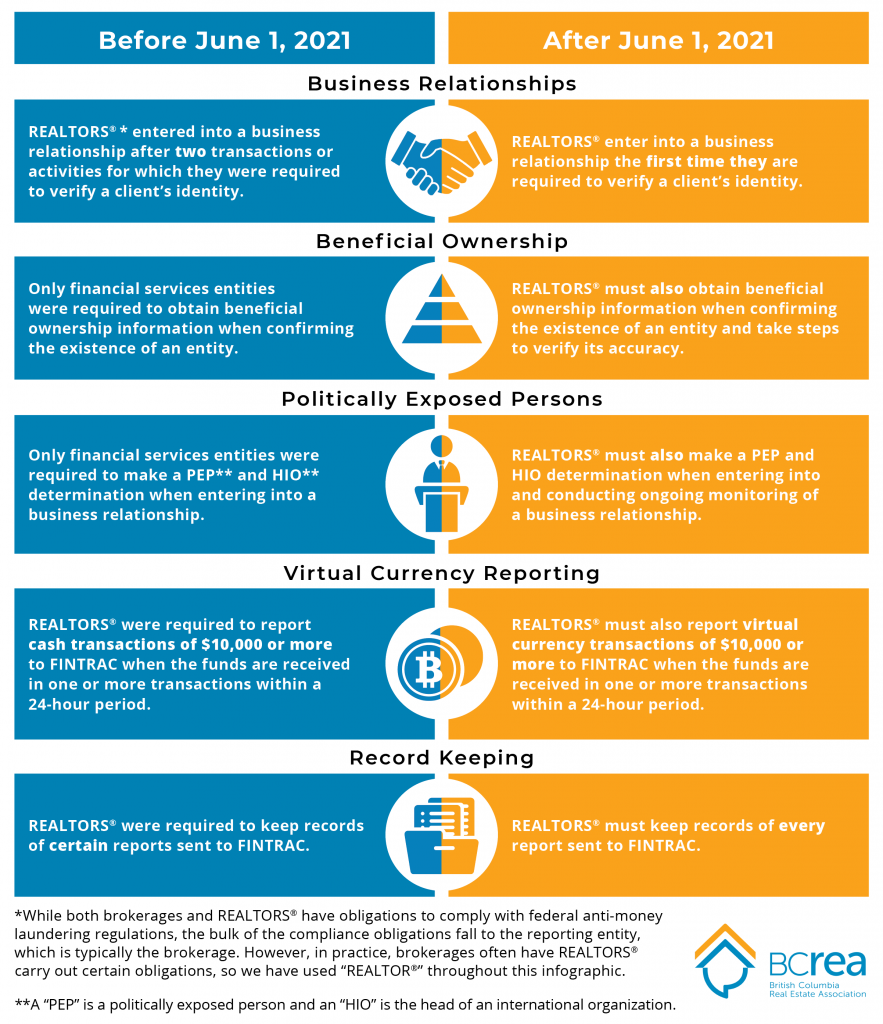
The June 1 FINTRAC amendments have created new or changed existing obligations for all reporting entities (REs) when it comes to:
- beneficial ownership obligations extended to all REs,
- business relationships and ongoing monitoring obligations extended to all REs,
- politically exposed persons obligations extended to all REs,
- changes to certain record keeping obligations,
- new virtual currency obligations for all REs, including submitting Large Virtual Currency Transaction Reports, and
- new and revised definitions.
For real estate sector-specific guidance on the changes, click here to view a high-level summary provided by FINTRAC. The Canadian Real Estate Association (CREA) has also developed a number of sector-specific resources, including an office policy, frequently asked questions and new forms, that you can find on CREA's portal.
- BCREA Resources:
- PODCAST: Explaining the June 1 FINTRAC Changes for REALTORS® (May 2021)
- Blog Series:
- Getting Ready for the June 1 FINTRAC Changes: Business Relationships
- Getting Ready for the June 1 FINTRAC Changes: Beneficial Ownership
- Getting Ready for the June 1 FINTRAC Changes: Politically Exposed Persons - Part 1
- Getting Ready for the June 1 FINTRAC Changes: Politically Exposed Persons - Part 2
- Getting Ready for the June 1 FINTRAC Changes: Virtual Currency Obligations
- CREA Resources:
- FINTRAC Resources:
- New Regulatory Requirements for the Real Estate Sector
- Business relationship requirements
- Beneficial ownership requirements
- Ongoing monitoring requirements
- Politically exposed persons and heads of international organizations guidance for life insurance companies, brokers and agents
- Record keeping requirements for real estate brokers or sales representatives, and real estate developers
- Risk assessment guidance
- Notice on forthcoming regulatory amendments and flexibility
- RECBC Resources:
In fall 2021, we'll be offering an updated version of our Mastering Compliance anti-money laundering training program as well as hosting our first-ever anti-money laundering symposium - stay tuned for more details!
Using LOTR To Meet FINTRAC Requirements
Now that LOTR is publicly searchable, it can be used as a tool to help you meet your anti-money laundering obligations. RECBC has developed guidelines to help you understand when and how to utilize LOTR to assist in fulfilling your AML obligations. You can also find blog posts and a podcast episode from BCREA in the resources section below if you’d like to know more about LOTR and the Land Owner Transparency Act.
- BCREA Resources:
- Land Owner Transparency Registry Publicly Searchable as of April 30, 2021
- Land Owner Transparency Registry Filings Required Beginning November 30
- Three Things to Know About the Land Owner Transparency Act and Registry
- Legally Speaking #533: A Whole Lot to Know About the Land Owner Transparency Act
- PODCAST: Episode 13 - What REALTORS® Need to Know About Land Owner Transparency
- RECBC Resources:
- LOTR Resources:
UPDATE: BC Imposes New Social Restrictions With COVID-19 Cases Rising
UPDATE - December 22, 2021 - This blog post was updated to reflect the revised orders and restrictions announced by the Provincial Health Officer on December 21, 2021.
With the number of new COVID-19 cases rising as a result of the omicron variant, BC's Provincial Health Officer (PHO) Dr. Bonnie Henry announced new public health orders restricting indoor social gatherings and events beginning at 12:00am on Monday, December 20. The PHO also announced additional measures - including the closing of gyms and fitness centres, bars, and a ban on indoor organized gatherings like weddings - which come into effect on December 22, 2021.
For more details on the new orders, click here.
REALTORS® are encouraged to continue to prioritize your own health and safety and the safety of your clients and communities by following these orders in your personal lives and continuing to follow best practices with respect to preventing the spread of COVID-19 in your day-to-day work.
UPDATE: BC’s Home Buyer Rescission Period: Your Questions Answered
The Home Buyer Rescission Period (HBRP), previously known as “Homebuyer Protection Period” and “cooling-off period,” is expected to be implemented province-wide on January 3, 2023. With many details yet to be determined by the BC Government, we have been hearing from REALTORS® with questions. In this post we answer some of those questions.
New or revised questions will be positioned at the top of this page.
What is the Home Buyer Rescission Period (HBRP)?
The HBRP, commonly known as a "rescission period," gives buyers the right to withdraw from a purchase agreement within a specified period of time after an offer is accepted. Without a rescission period, if a buyer wishes to terminate an unconditional contract, they would need to negotiate with the seller and would typically face significant financial penalties or legal ramifications.
What properties will be subject to the HBRP?
The policy will apply to the following types of structures:
- detached homes,
- semi-detached homes,
- townhouses,
- apartments in a duplex or other multi-unit dwellings,
- residential strata lots,
- manufactured homes that are affixed to land, and
- cooperative interests that include a right of use or occupation of a dwelling.
What changes will be made to Standard Forms?
Changes to Standard Forms have been made to enhance REALTOR® effectiveness. The 2023 Regulatory Changes and Standard Forms launch page is available here (BCREA Access login required).
How can I learn more about the HBRP’s details when they are available?
More resources on the Home Buyer Recission Period include:
- November slide deck from the BC Financial Services Authority on the Home Buyer Rescission Period,
- information for licensees,
- guidelines for licensees, and
- consumer guide.
You can follow BCREA’s advocacy news, which will include updates on the HPRP, by subscribing to our Advocacy Update. To do so, please email [email protected].
How can I take BCREA’s Home Buyer Recission Period course?
BCREA will be launching The Home Buyer Rescission Period: What REALTORS® course on December 1, 2022 to assist REALTORS® understand and apply the new rules.
How much is the rescission fee?
Buyers who exercise their right to rescind will have to pay a fee of 0.25% of the purchase price. For a $1,000,000 home, this would result in a $2,500 fee paid to the seller.
To help you calculate the rescission fee, BCREA will launch two HBRP calculators, which will be available on BCREA Access.
What is meant by “three business days?”
The HBRP provides that the buyer must exercise their rescission right within three clear business days. Business days do not include Saturdays, Sundays or holidays. Holidays are defined within the Interpretation Act to include:
- Christmas Day
- December 26
- Family Day
- Good Friday
- Easter Monday
- Victoria Day
- Canada Day
- British Columbia Day
- Labour Day
- National Truth and Reconciliation Day
- Thanksgiving
- Remembrance Day, and
- New Year’s Day
In addition, a day set by the federal or provincial government, such as a day of mourning or celebration, is considered a public holiday.
What are REALTORS®’ requirements to inform their clients?
All real estate licensees must provide general information on the HBRP to all consumers through a form approved by the Superintendent. Licensees must also provide an additional mandatory disclosure at the time of preparing an offer on behalf of, or presenting an offer to a client, containing all of the following notices:
- that the HBRP cannot be waived,
- the rescission period time length,
- the dollar amount of the rescission fee,
- the deposit handling, and
- exemptions
Are brokerages required to retain a copy of a rescission notice?
Yes, brokerages are required to retain copies of notices of rescission that are prepared by or on behalf of a brokerage and served on a seller. Brokerages are also required to retain copies of rescission notices that are received by the brokerage.
How are sellers supposed to receive rescission notice?
Buyers must serve rescission notice to the seller through registered mail, fax, an email with a read receipt or personal service. Rescission notices must contain:
- the address, PID or description of the property,
- the names and signatures of the buyer(s),
- the names of the seller(s), and
- a date of notice.
How does a HBRP impact other subjects in my contract?
Other subjects are unaffected by the HBRP.
What about For Sale by Owner (FSBO) properties?
The HBRP applies to all residential real estate sales, which includes private sales and FSBO properties.
Can the HBRP be waived?
No, the HBRP cannot be waived.
Are there any exemptions?
There are narrow exemptions, including:
- sales of residential real property located on leased land,
- sales of leasehold interest in residential real estate,
- sales at auction,
- sales by way of an Assignment of Contract,
- pre-construction sales of multi-unit development properties, which are already subject to a seven-day rescission period, and
- sales under a court order of supervision of a court.
Will the rescission fee be taken from the deposit?
If a deposit is held in trust, brokerages must release the rescission fee to the seller upon rescission. The balance, if any, is returned to the buyer, despite what may be provided in the contract.
Who will receive the rescission fee?
The rescission fee amount is provided to the seller
Will the Ministry of Finance implement additional consumer protection measures?
In May, BC’s real estate regulator, the BC Financial Services Authority, published an independent report, “Enhancing Consumer Protection in BC’s Real Estate Market” which offered advice and recommendations to the Ministry of Finance to improve consumer protection. There was significant overlap between BCFSA’s advice and BCREA’s “A Better Way Home” paper.
The Ministry of Finance has not indicated whether they will implement additional consumer protection measures within the coming months.
What policies do BCREA recommend to improve consumer protection?
Earlier this year, BCREA published a white paper, “A Better Way Home,” which included more than thirty recommendations to improve consumer protection. BCREA does not support a Home Buyer Rescission Period (HBRP), because it is not likely to have a meaningful impact on consumer protection and may have unintended consequences on affordability.
Update: Changes to the Real Estate Services Act and Move to Single Regulator
On March 9, the BC legislature approved changes to the Real Estate Services Act (RESA) contained in Bill 8: Finance Statutes Amendment Act, 2021. None of the changes will take effect immediately.
Over the next weeks and months, BCREA will work with the regulators to understand the impact of all of the changes and to provide input at every opportunity. This article summarizes a few key amendments.
BCFSA amalgamation
The biggest shift is that the legislation enables the amalgamation of the Office of the Superintendent of Real Estate (OSRE) and the Real Estate Council of British Columbia into the BC Financial Services Authority (BCFSA). Many of the amendments transfer authority for various matters to the BCFSA and the new superintendent (BCFSA CEO Blair Morrison).
Amalgamation is expected to take place this summer, though a firm date hasn’t yet been set.
Real Estate Rules
The BCFSA will have the authority to create and amend the Real Estate Rules (currently, this is done by OSRE). There will be more structure around Rule changes, including approval from the Minister of Finance and compliance with the Regulations Act.
For the first three years, the BCFSA will be able to make minor changes to the Rules without conducting public consultations. Rules that make substantive changes to real estate practice will require the standard minimum 30-day consultation period.
Discipline
Several changes were made to discipline procedures, including:
- Elimination of discipline committees – Discipline hearings are currently carried out by discipline committees. After amalgamation, hearings will be carried out by individual discipline officers (likely lawyers).
- Expanded administrative penalties – Currently, OSRE can designate breaches of the Rules that can be subject to administrative penalties. In the future, this will fall to BCFSA, which will be able to designate offences under RESA and the regulations, as well as the Rules to qualify for administrative penalties. The maximum penalty amount will double from $50,000 (which has been in place since 2016) to $100,000 and the actual amount owed may vary depending on whether a licensee pays the penalty within 30 days.
- Elimination of expiry dates for consent orders – Licensees subject to discipline hearings will be able to negotiate consent orders right up until the time of a hearing (right now, proposals must be submitted to RECBC 21 days before the hearing).
- Elimination of automatic stays of discipline orders – Right now, when a licensee appeals a disciplinary decision to the Financial Services Tribunal, the disciplinary order is automatically stayed (suspended). In the future, that will not be the case, though a licensee or the regulator will have the option to apply for a stay.
BCREA concerns
On March 10, we wrote to Minister of Finance Selina Robinson with significant concerns and requesting further legislative amendments relating to the elimination of discipline committees and the regulator’s authority to remove records during an investigation. We’ll continue to work with the ministry to resolve our concerns.
UPDATE: Conveyancing in the Time of COVID-19 – So Far
This post was updated on April 3, 2020 to include additional information on remote witnessing of affidavits in support of land title applications.
Even with the Land Title and Survey Authority's (LTSA) notice temporarily allowing for affidavits for use in land title applications to be taken remotely (by video), there may still be other documents that your client needs to sign in person with their lawyer or notary.
Speak with their lawyer/notary as soon as possible to determine if that’s the case. If your client is self-isolating or quarantined, ask their lawyer whether arrangements can be made and how these processes work to sign documents.
This follows LTSA's announcement on March 31, 2020 that until further notice, BC lawyers and notaries who represent the parties to a property transaction can temporarily remotely take affidavits for use in land title applications. The full directive from the Land Title and Survey Authority (LTSA) is available here.
Both the Law Society of BC (which regulates lawyers) and the LTSA have published information about land transfer processes.
Because video affidavits may not work in all situations, witnessing documents or taking affidavits can – of course – still be done in person.
The previous accommodation for social distancing by the LTSA still apply for in-person signings. They allow the witness and the party to the transaction to sign identical copies of the same document at the same time so they can avoid having to handle the same physical pages. Speak with a lawyer or notary to learn more about how these processes work.
To subscribe to receive BCREA publications, or to update your email address or current subscriptions, click here.
UPDATE: COVID-19 Recovery Dashboard
The dashboard was last updated on September 28, 2022.
The BCREA Economics team has created the COVID-19 Recovery Dashboard to help REALTORS® monitor BC’s economic recovery. This dashboard focuses on the sectors and activities that have been most significantly impacted by the pandemic and the province’s state of emergency.
To monitor the province’s progress, we benchmark each indicator to February 2020, the month before the pandemic was declared. This dashboard will be updated each month.
- Housing Markets
During August, home sales continued to decline in BC. Starts rose while new listings dropped. Sales fell once again all over the province, with all areas of the province below pre-pandemic levels except for the North. Rental costs in Vancouver and Victoria continue rising and remain elevated relative to most other points since the onset of the pandemic.
[script type="text/javascript"]!function(){"use strict";window.addEventListener("message",(function(e){if(void 0!==e.data["datawrapper-height"]){var t=document.querySelectorAll("iframe");for(var a in e.data["datawrapper-height"])for(var r=0;r<t.length;r++){if(t[r].contentWindow===e.source)t[r].style.height=e.data["datawrapper-height"][a]+"px"}}}))}(); [/script]
[script type="text/javascript"]!function(){"use strict";window.addEventListener("message",(function(e){if(void 0!==e.data["datawrapper-height"]){var t=document.querySelectorAll("iframe");for(var a in e.data["datawrapper-height"])for(var r=0;r<t.length;r++){if(t[r].contentWindow===e.source)t[r].style.height=e.data["datawrapper-height"][a]+"px"}}}))}(); [/script]
[script type="text/javascript"]!function(){"use strict";window.addEventListener("message",(function(e){if(void 0!==e.data["datawrapper-height"]){var t=document.querySelectorAll("iframe");for(var a in e.data["datawrapper-height"])for(var r=0;r<t.length;r++){if(t[r].contentWindow===e.source)t[r].style.height=e.data["datawrapper-height"][a]+"px"}}}))}(); [/script]
- Retail, Restaurant Reservations and Movement
Retail sales declined in July on lower gasoline and clothing sales. Restaurant reservations in Vancouver are back to pre-pandemic levels. In BC, Google’s measure of movement trends is currently just 4 per cent below pre-pandemic levels.
[script type="text/javascript"]!function(){"use strict";window.addEventListener("message",(function(e){if(void 0!==e.data["datawrapper-height"]){var t=document.querySelectorAll("iframe");for(var a in e.data["datawrapper-height"])for(var r=0;r<t.length;r++){if(t[r].contentWindow===e.source)t[r].style.height=e.data["datawrapper-height"][a]+"px"}}}))}(); [/script]
[script type="text/javascript"]!function(){"use strict";window.addEventListener("message",(function(e){if(void 0!==e.data["datawrapper-height"]){var t=document.querySelectorAll("iframe");for(var a in e.data["datawrapper-height"])for(var r=0;r<t.length;r++){if(t[r].contentWindow===e.source)t[r].style.height=e.data["datawrapper-height"][a]+"px"}}}))}(); [/script]
[script type="text/javascript"]!function(){"use strict";window.addEventListener("message",(function(e){if(void 0!==e.data["datawrapper-height"]){var t=document.querySelectorAll("iframe");for(var a in e.data["datawrapper-height"])for(var r=0;r<t.length;r++){if(t[r].contentWindow===e.source)t[r].style.height=e.data["datawrapper-height"][a]+"px"}}}))}(); [/script]
- Jobs and Hours Worked
Although aggregate employment has recovered to pre-pandemic levels in BC, the accommodation & food service sectors remained about 13 per cent below the pre-pandemic level in August. The labour market has served high-income workers much better than low-income workers. Employment in high-income industries is about 10 per cent above pre-pandemic employment levels, while employment in low-income sectors is about 6 per cent below pre-pandemic employment levels.
[script type="text/javascript"]!function(){"use strict";window.addEventListener("message",(function(e){if(void 0!==e.data["datawrapper-height"]){var t=document.querySelectorAll("iframe");for(var a in e.data["datawrapper-height"])for(var r=0;r<t.length;r++){if(t[r].contentWindow===e.source)t[r].style.height=e.data["datawrapper-height"][a]+"px"}}}))}(); [/script]
[script type="text/javascript"]!function(){"use strict";window.addEventListener("message",(function(e){if(void 0!==e.data["datawrapper-height"]){var t=document.querySelectorAll("iframe");for(var a in e.data["datawrapper-height"])for(var r=0;r<t.length;r++){if(t[r].contentWindow===e.source)t[r].style.height=e.data["datawrapper-height"][a]+"px"}}}))}(); [/script]
[script type="text/javascript"]!function(){"use strict";window.addEventListener("message",(function(e){if(void 0!==e.data["datawrapper-height"]){var t=document.querySelectorAll("iframe");for(var a in e.data["datawrapper-height"])for(var r=0;r<t.length;r++){if(t[r].contentWindow===e.source)t[r].style.height=e.data["datawrapper-height"][a]+"px"}}}))}(); [/script]
- Manufacturing and International Trade
Exports, imports, and manufacturing sales all fell in July.
[script type="text/javascript"]!function(){"use strict";window.addEventListener("message",(function(e){if(void 0!==e.data["datawrapper-height"]){var t=document.querySelectorAll("iframe");for(var a in e.data["datawrapper-height"])for(var r=0;r<t.length;r++){if(t[r].contentWindow===e.source)t[r].style.height=e.data["datawrapper-height"][a]+"px"}}}))}(); [/script]
[script type="text/javascript"]!function(){"use strict";window.addEventListener("message",(function(e){if(void 0!==e.data["datawrapper-height"]){var t=document.querySelectorAll("iframe");for(var a in e.data["datawrapper-height"])for(var r=0;r<t.length;r++){if(t[r].contentWindow===e.source)t[r].style.height=e.data["datawrapper-height"][a]+"px"}}}))}(); [/script]
- Business and Consumer Confidences
Business confidence retreated in August, likely on continuing fears related to higher inflation expectations and rising interest rates.
[script type="text/javascript"]!function(){"use strict";window.addEventListener("message",(function(e){if(void 0!==e.data["datawrapper-height"]){var t=document.querySelectorAll("iframe");for(var a in e.data["datawrapper-height"])for(var r=0;r<t.length;r++){if(t[r].contentWindow===e.source)t[r].style.height=e.data["datawrapper-height"][a]+"px"}}}))}(); [/script]
- Tourism
The number of US and non-US tourists rose again in July, with both US and non-US tourists reaching the highest level since the onset of the pandemic.
[script type="text/javascript"]!function(){"use strict";window.addEventListener("message",(function(e){if(void 0!==e.data["datawrapper-height"]){var t=document.querySelectorAll("iframe");for(var a in e.data["datawrapper-height"])for(var r=0;r<t.length;r++){if(t[r].contentWindow===e.source)t[r].style.height=e.data["datawrapper-height"][a]+"px"}}}))}(); [/script]
To subscribe to receive BCREA publications, or to update your email address or current subscriptions, click here.
UPDATE: Dealing with Contracts and Disclosure Requirements (COVID-19 FAQ)
The COVID-19 FAQ was last updated on November 12, 2020.
As the spread of COVID-19 continues to be a health risk and have a significant impact on people’s lives, REALTORS® may be left with questions about how to deal with certain areas of their practice.
BCREA seeks to support you in these unprecedented times. We have created a resource to provide guidance when you're assisting clients with Standard Forms and transaction-related issues.
Contracts, Standard Forms and COVID-19 addresses the most frequently asked questions Realtors have about how to deal with transactions that may be affected by COVID-19. The topics include risk management around quarantines, delays for due diligence and closings and disclosure requirements.
The FAQ has been prepared in consultation with BCREA’s legal counsel and includes questions such as:
- Is there a clause I should consider adding to a contract to protect my clients on potential implications of COVID 19 on the completion of contract?
- My client is in quarantine, can they complete a purchase of real estate? What role can I play and what recommendations can I give to help them complete knowing that I’m not normally involved in closing?
When determining how best to advise on a particular situation, Realtors should remember that the terms of the contract will govern the relationship between parties and the facts unique to their circumstances.
As such, based on legal advice, BCREA will not be creating a COVID-19-specific clause. Any such clause would need to be specific to the unique facts for each transaction in order to be enforceable. Therefore any clause should be created and/or reviewed by legal counsel prior to use and acceptance to ensure any clause is in the best interest of your clients and addresses their particular circumstances.
We recommend that Realtors work with their managing broker and seek legal advice where appropriate.
BCREA reminds managing brokers and Realtors that they should proactively monitor all recommendations of the health authorities and provincial and federal governments in implementing the appropriate precautions and practices to help keep themselves, their co-workers, their clients and the public safe and healthy. These resources include, but are not limited to:
- BC Centre for Disease Control – Latest Updates
- BC Centre for Disease Control – FAQ
- HealthLinkBC
- Government of Canada
- World Health Organization – Latest Updates
- World Health Organization – FAQ
We will continue to monitor the situation as it evolves and will provide updates to this resource as more information becomes available.
For more information and resources related to real estate practice during the COVID-19 pandemic, visit the BCREA COVID-19 resources page.
To subscribe to receive BCREA publications, or to update your email address or current subscriptions, click here.
UPDATE: Extension of BC’s State of Emergency – What it means for REALTORS®
This post, originally titled "Government Announcement on Renters and Landlords - What it Means for Realtors", was updated on May 28, 2020 following the two-week extension of BC's State of Emergency.
On May 27, 2020, Premier John Horgan extended BC's state of emergency until June 9, 2020. This means that the Residential Tenancy Order (RTO), which expires only when the state of emergency is lifted, has also been extended.
The Residential Tenancy Order bans evictions and provides other protections for renters - see below for more information. To avoid a situation where there are a lot of evictions, the provincial government intends to have a transition plan in place before the state of emergency ends. They are well aware of the need for real estate transactions to complete and for buyers to be able to occupy their new homes. BCREA will provide more information as the transition plan develops.
Here is an overview of the order:
Eviction moratorium – Landlords can no longer give a tenant a notice to end the tenancy except in situations where people or the rental unit are at significant risk. However, if a landlord gave a tenant a notice to end the tenancy before March 30, then the notice remains in effect, subject to the dispute resolution process, and an order of possession can still be granted.
This may be complicated in cases where a tenant is under mandatory quarantine, self-isolation or a medical facility. In those cases, it’s advisable to seek legal advice.
Landlord’s right to enter rental unit – A landlord can enter a rental unit for repairs or showings, as long as the tenant consents. Follow the standard procedure of requesting access at least 24 hours in advance, noting the proposed date and time – and be sure to wait for the tenant’s consent. Landlords can enter rental units without tenant consent if there is an emergency in relation to the COVID-19 pandemic and the entry is necessary to protect health, safety or welfare of the landlord, the tenant or other occupants.
Rent freeze – Rent increases set to occur while this order is in effect, including previously announced rent increases set to take effect from March 30 onwards, do not take effect until after the state of emergency has ended. Exceptions for rent increases include if there one or more occupants are added and the tenancy agreement specifies how the rent varies with the number of occupants.
Restricting access to common areas – Landlords can reasonably restrict access to common areas to prevent the spread of COVID-19
More information is available on the Residential Tenancy Branch website.
Rental supplement on the way
Another significant government program to support renters and landlords is the BC-Temporary Rental Supplement Program (BC-TRS). Tenants who have lost or reduced income because of COVID-19 will be eligible to apply for the program through the BC Housing website.
To subscribe to receive BCREA publications, or to update your email address or current subscriptions, click here.
UPDATE: Free FINTRAC Forum to Shine Light on AML Issues and Real Estate Sector
UPDATE: The virtual forum has been extended to April 30, 2022.
The Financial Transactions and Reports Analysis Centre of Canada (FINTRAC) is hosting its first-ever National Real Estate AML/ATF Virtual Forum for real estate sector professionals from February 14 to March 18.
This virtual on-demand forum is a great opportunity to learn more about your AML responsibilities, while gaining a better understanding of FINTRAC and its role in combatting money laundering. Managing brokers will learn how to strengthen their brokerage’s compliance program and what to expect during a compliance examination. Realtors will benefit from a deep dive into how to identify suspicious transactions and submit a suspicious transaction report.
The forum will also include a presentation on FINTRAC intelligence case studies, giving attendees a greater appreciation of the impact real estate professionals can have on keeping illegal funds out of the housing market.
The forum is free. Click here to for more information and to register.
UPDATE: Have Your Say on Changes to Administrative Penalties
The new deadline for this consultation on changes to administrative penalties is November 13, 2020 (announced by the Office of the Superintendent of Real Estate and Real Estate Council of British Columbia on October 27, 2020).
In mid-September, the Office of the Superintendent of Real Estate (OSRE) and the Real Estate Council of BC (RECBC) launched a public consultation on proposed changes to administrative penalties. The objective of the proposed changes is to speed up the outcomes of the regulatory discipline process to allow RECBC to focus more resources on more serious rule infractions. The proposed changes will divert many contraventions from the hearing process and instead subject them to penalties. The number of contraventions subject to penalties will be nearly doubled and penalty amounts will also increase for most contraventions.
BCREA is working with member boards to gather input from REALTORS® and learn from what we hear to provide recommendations to the regulators. We conducted focus groups with Realtors, met with board staff and experts and obtained legal advice.
We’re still drafting our response to the consultation where we will provide comments, questions and recommendations to the regulators. We will advocate for more resources and support for licensees from the regulators to help prevent contraventions or correct unintentional mistakes.
The consultation backgrounder, Questions and Answers, proposed changes and online survey can be found here. The current deadline for submission is October 30. The deadline may be extended, but OSRE cannot announce an extension during an election period. These proposed changes will have a significant impact on the disciplinary process for Realtors. We encourage all Realtors to participate in the consultation by sharing their personal insights and expertise.
To subscribe to receive BCREA publications, or to update your email address or current subscriptions, click here.
UPDATE: Learn Ten Things About LOTR in Under One Minute
Updated on May 12, 2021, to reflect that the Land Owner Transparency Registry is now publicly searchable.
The Land Owner Transparency Registry, or LOTR, is a publicly accessible registry of information about individuals who have an indirect interest in land that is held through corporations, trusts and partnerships. Here are ten things REALTORS® can learn about LOTR in just under one minute:
- LOTR became publicly searchable as of April 30, 2021. You can learn more about how to search LOTR here.
- When an application is made to register or transfer an interest of land as defined by the Land Owner Transparency Act (LOTA), a transparency declaration must be filed by the transferee(s).
- A transferee that is also a reporting body as defined by LOTA – a relevant corporation, a partner of a relevant partnership, or a trustee of a relevant trust – must also file a transparency report.
- Reporting bodies must take reasonable steps to obtain and confirm the accuracy of all required information in the transparency report.
- Transparency reports are generally prepared by lawyers or notaries.
- LOTR provides a tool to help identify if filing a transparency report is required.
- Pre-existing owners that are reporting bodies have until November 30, 2021, to file a transparency report (unless land or interest in land is transferred by this date).
- Public searches of LOTR can be done by name or parcel identifier.
- Information about individuals who are interest holders or settlors that is submitted in a transparency report will not be publicly accessible or at least 90 days after the transparency report is filed.
- The BC land title register is the sole source of up-to-date official and public record of who owns lands, and the charges and interests that relate to the land titles. In contrast, LOTR provides information about individuals who have an indirect interest in land that is held through corporations, trusts and partnerships; information that is not available through a land title search.
If If you'd like to learn more about LOTR and how it impacts your real estate practice, you can visit www.landtransparency.ca and check out the resources below:
- Land Owner Transparency Registry Filings Required Beginning November 30
- Three Things to Know About the Land Owner Transparency Act and Registry
- Legally Speaking #533: A Whole Lot to Know About the Land Owner Transparency Act
- PODCAST: Episode 13 - What REALTORS® Need to Know About Land Owner Transparency
- Community of Practice Recording from April 21
UPDATE: New Form Helps Brokerages Meet Anti-Money Laundering Requirements
UPDATE (March 24, 2021): Minor changes have been made to the Why Do REALTORS® Ask for Your Personal Information consumer video to provide greater clarity on the process for receipt of funds and to update the reference to the Individual Identification Information Record. All other aspects of this video remain unchanged.
In September, BCREA released the BCREA Individual Identification Information Record, a new one-page form created to help REALTORS® and brokerages record the identification of clients and unrepresented parties in low-risk face-to-face transactions. This form supports Realtors and brokerages in meeting anti-money laundering requirements and keeping the proceeds of crime out of BC real estate markets.
The Financial Transactions and Reports Analysis Centre of Canada (FINTRAC) requires brokerages to verify the identity of clients and unrepresented parties who take part in a transaction. The BCREA Individual Identification Information Record can be used in low-risk face-to-face transactions to document identification information, including name, address, date of birth, nature of principal business or occupation, and additional information.
To help you better understand this new form and how it helps you meet your anti-money laundering and FINTRAC requirements, we’ve created a tutorial video for Realtors:
[iframe width="560" height="315" src="https://www.youtube.com/embed/vniuAT7H_hM" frameborder="0" allowfullscreen style="position:absolute;top:0;left:0;width:100%;height:100%;" ][/iframe]We’ve also created a video for you to share with consumers to help them better understand why you require their personal information and how and where that information will be used and stored:
[iframe width="560" height="315" src="https://www.youtube.com/embed/7z2deum-JDM" frameborder="0" allowfullscreen style="position:absolute;top:0;left:0;width:100%;height:100%;" ][/iframe]Finally, we’ve created a toolkit on the Standard Forms Resource Centre to help you get to know the BCREA Individual Identification Information Record. The toolkit includes the downloadable form, an annotated version to guide you in completing the form, an interactive how-to guide, frequently asked questions, practice tips, and additional resources. To access the toolkit, click here (BCREA Access login required).
If you have further questions, please reach out to the BCREA Standard Forms team at [email protected].
To subscribe to receive BCREA publications such as this one, or to update your email address or current subscriptions, click here.
UPDATE: New Video Helps Clients Better Understand the Contract of Purchase and Sale
UPDATE (January 11, 2021): An update has been made to this video at the 11 minute mark to provide greater clarity on acceptance of a Contract of Purchase and Sale concerning counter offers. All other aspects of this video remain unchanged.
The British Columbia Real Estate Association (BCREA) has created a video for REALTORS® to share with their clients to help explain one of the key documents used in a real estate transaction: the Contract of Purchase and Sale (CPS).
Central to any transaction, the CPS outlines the terms and conditions on which a transaction takes place. You can share this video with your clients to help introduce the CPS, so that when they are ready to make or review an offer, they are familiar with the general content of the form.
[iframe width="560" height="315" src="https://www.youtube.com/embed/WD-lF6ywtX8" frameborder="0" allow="accelerometer; autoplay; clipboard-write; encrypted-media; gyroscope; picture-in-picture" allowfullscreen][/iframe]The video provides essential information to help consumers understand the CPS, addressing many common questions they may have, including:
- When does the process begin and when is the Contract of Purchase and Sale used?
- What information is included in the Contract of Purchase and Sale?
- What do the terms in the contract mean?
- And many more
With this new video, Realtors and clients on both sides of the transaction will have a better understanding of the Contract of Purchase and Sale before signing it.
To download the Contract of Purchase and Sale Standard Form, visit WEBForms®.
To subscribe to receive BCREA publications, or to update your email address or current subscriptions, click here.
UPDATE: The Canada Commercial Rent Assistance Program Can Help You And Your Clients
By Ellen Baragon, Guest Contributor
(This post was updated June 2 to include the government of BC's new order preventing landlords who are eligible for CECRA from evicting tenants.)
On Monday, June 1, BC's Minister of Finance Carole James announced a new order under the Emergency Protection Act prohibiting commercial landlords who are eligible for the Canada Emergency Commercial Rent Assistance (CECRA) from evicting tenants due to unpaid rent payments. You can read the order here.
CECRA provides forgivable loans to qualifying commercial property owners to cover 50% of three monthly rent payments to compensate for small business tenants experiencing financial hardship during April and May (retroactive), and June.
"Preventing landlords who are eligible for CECRA from evicting tenants can encourage landlords to apply for the program and give some temporary relief to businesses who have been hardest hit by the pandemic,” said Minister James. The order will remain in effect through to the end of June 2020, in line with the current end-date of CECRA.
How it works
When CECRA was launched on May 25, it included updated eligibility criteria to make it available to property owners who do not hold a mortgage, addressing an oversight identified by the Canadian Real Estate Association (CREA) earlier in May.
CECRA loans will be forgiven if the qualifying property owner agrees to reduce the small business tenants’ rent by at least 75% and not to evict the tenant during the term of the written agreement. The small business tenant would pay the remaining 25% of rent.
However, the qualifying small businesses tenants must:
- pay no more than $50,000 in monthly gross rent per location
- generate no more than $20 million in gross annual revenues
- have experienced at least a 70% decline in pre-COVID-19 revenues, compared to revenues in the same period in 2019, or average of revenues earned in January and February of 2020
The upside and downside of CECRA
The upside is that both sides of the deal get something from this program. The tenant pays only one quarter of their normal monthly rent and the landlord gets 50 per cent of the total rent covered, which may be enough to keep both the landlord and the tenant afloat.
On the downside, the landlord is still short 25% of the rent. However, keeping a good tenant solvent over the longer term is likely preferable to trying to get 100% of the rent and losing the tenant altogether. Also, it's up to the landlord to apply for the CECRA program. But the tenant can make a convincing case to their landlord that the program would benefit both parties.
There’s also a risk if the small business cannot demonstrate that they’ve actually lost the required 70 percent of revenue, because if not, they won’t qualify for CECRA.
How will it work for you and your tenant clients?
Commercial tenants, including Realtors, who can leverage the boost that this rent relief scheme provides, will benefit if they meet the thresholds stipulated by the program, and if they can gain some competitive ground in one of several ways such as:
- recover their business income fairly soon following the pandemic slowdown
- restructure their business to lower overhead costs while increasing efficiency
- establish new market share
- devise ways to attract new clients through marketing and value added benefits
- ably adopt new modes of operating arising from the pandemic, such as social distancing, sanitizing, and whatever remains necessary for public health and safety
What landlord clients need to know about CECRA
Landlords of commercial space may evict tenants who are struggling to pay rent and on the brink of bankruptcy. But, in so doing may face a new set of problems if the landlord:
- receives zero rental income to cover their mortgage and other costs
- continues to pay mortgage payments, property tax, maintenance and other costs
- incurs debt waiting to install new tenants which can typically take 6 months up to 18 months and possibly longer if the economy remains in recovery mode
- rents out a space, for far lower rental income due to the significant competition from other commercial landlords, desperate for tenants in the post-pandemic economy
What is known about CECRA, and all the many other government financial aid programs on tap, is that they were designed over the course of weeks, not months and years as is usually the case. Policy created out of urgent need is bound to have gaps and flaws. That is why it makes sense for commercial business to consult their Realtor to help them come to a decision about the various financial aid programs, such as CECRA.
Realtors’ expertise fills the knowledge gap
Given the complex nature of the CECRA program, business clients should consult with their banks, their lenders, and their accountants to get a complete picture of the risks and benefits of proceeding with the CECRA program. Realtors with commercial expertise can assist by:
- assessing how well CECRA can form part of a strong business plan, or not
- breaking down the numbers for potential scenarios
- helping negotiate the terms of the rental agreements that will be financially viable
- making market projections about the feasibility of their current properties
- supporting any downsizing or restructuring plan for their commercial properties
- looking for prime opportunities to swap out or acquire new properties that may be available during a time when businesses are closing out and owners are looking to make a change
Find out more specific details on the program requirements and how to benefit from it by going to the Canada Mortgage and Housing Corporation website.
To subscribe to receive BCREA publications, or to update your email address or current subscriptions, click here.
UPDATED – BCFSA Becomes Real Estate Regulator on August 1: What You Need to Know
UPDATE: This post was updated on August 1 to include the new BCFSA link to the July 2021 Report from Council. A previous link from the Real Estate Council of BC website no longer exists.
BC's revised Real Estate Services Rules also come into effect on August 1. Click here to learn more. To find more BCFSA real estate resources, click here.
On August 1, 2021, the Real Estate Council of BC (RECBC) and the Office of the Superintendent of Real Estate (OSRE) will be integrated into the BC Financial Services Authority (BCFSA), resulting in one single regulator for real estate in BC. As a result, RECBC and OSRE will no longer exist. There will be no changes to what the BC Real Estate Association (BCREA) and the province’s real estate boards do.
This change is a result of a key recommendation from the Expert Panel on Money Laundering report released in May 2019 and – according to BCFSA – is intended to centralize expertise and provide strengthened consumer protection through a modern, effective, and efficient regulatory framework.
BCFSA intends for there to be little to no disruption to services during the transition period, which begins on August 1. RECBC and OSRE staff will be integrated into BCFSA, resources from the RECBC website will be migrated to an updated BCFSA website, and phone numbers and email addresses will be redirected to BCFSA.
Three things REALTORS® can do to prepare for the regulatory change
1. Watch BCREA's regulatory update video
In this video, BCREA VP Government Relations Trevor Hargreaves gives an overview of the upcoming changes, BCREA’s advocacy work to date and how we can support you during the shift.
[iframe width="560" height="315" src="https://www.youtube.com/embed/L0bcGDrpne8" title="YouTube video player" frameborder="0" allow="accelerometer; autoplay; clipboard-write; encrypted-media; gyroscope; picture-in-picture" allowfullscreen][/iframe]2. Read the Integration Update from RECBC's July 2021 Report from Council
RECBC has published its July 2021 Report from Council, which includes an Integration Update exploring several common questions that might arise as a result of the regulatory change.
3. Review resources from BCREA’s Managing Broker Community of Practice
On July 28, 2021, members of RECBC and OSRE who will be transitioning to senior leadership roles within BCFSA August 1 presented at BCREA’s Managing Broker Community of Practice. During the presentation, guests Erin Seeley, Michael Noseworthy and David Avren highlighted some of the key changes and answered questions from attendees.
(BCREA Access login required)
Support for REALTORS® through regulatory transition
Realtors should visit the new BCFSA website at www.bcfsa.ca, which will be published on August 1 and will include real estate resources previously housed on the RECBC website. If you have additional questions related to this regulatory change, feel free to contact the new regulator, BCFSA, directly.
BCREA will also be updating our resources, including Standard Forms and professional development courses with updated information and new links as soon as possible, prioritizing changes with the most impact on daily real estate practice. Given this is a manual process, we appreciate your patience.
Additionally, links on the main pages of our website will be changed as appropriate and any new publications we produce, such as blog posts, reports, etc., will include relevant new links. We do not plan to change links in all previous blog posts. We appreciate your understanding.
If you have questions or comments about how these changes affect you, please contact the BCREA Government Relations team at [email protected]. You can also reach out to BCREA VP Government Relations Trevor Hargreaves by emailing [email protected] or calling 236.333.4572.
Updated BCREA Course Addresses Changes for Selling Tenant-Occupied Properties
Learn about the recent changes to the Residential Tenancy Act (RTA) and their impact on REALTORS®’ practice by taking BCREA’s Selling Tenant-Occupied Properties (STOP) course. A long-time staple in BCREA’s course catalogue, this instructor-led course was recently updated with new content in both the learner manual and PowerPoint slides, reflecting changes brought upon by Bill 14, the Tenancy Statutes Amendment Act, where applicable.
With new activities, fresh tips, timely cautions, and better organization, the course is now ready for registration.
New legislation
Selling tenant-occupied properties has always been a complex process. However, with the provincial government’s phased approach to implementing Bill 14 this past spring and summer, navigating the terrain of tenant-occupied transactions has become even more challenging. Changes to the RTA include:
- prohibiting personal occupancy evictions for rental buildings with five or more units;
- changing the purchaser’s occupancy period to at least 12 months;
- increasing the notice period for the purchaser’s occupancy to three months;
- lengthening the tenants’ period for disputing an eviction notice due to a purchaser’s occupancy to 21 days; and
- mandating the use of a Residential Tenancy Branch (RTB) web portal to generate the notice of eviction for the purchaser’s occupancy in the form of RTB-32P.
With these changes, it is even more important that REALTORS® understand the potential risks and liabilities involved in tenant-occupied property transactions. The updated STOP course prepares REALTORS® to navigate tenant-occupied property transactions while remaining compliant with new legislation.
Other updates
The course has also been updated with new content, activities, and resources that reflect the complexities of selling a tenant-occupied property. These changes include:
- a module focusing on the RTA and other legislation applicable to the selling of tenant-occupied properties;
- more tips for reading a tenancy agreement as well as other tenancy documents (e.g., the condition inspection report) to identify pertinent information that may impact transactions;
- a renewed emphasis on REALTORS®’ responsibilities to ensure tenants’ safety, security, and privacy during the listing and showing processes; and
- additional guidelines for dealing with uncooperative tenants.
To help put the content into practice, each module begins with a practice scenario. These scenarios, alongside discussion questions, encourage reflection on the interpersonal skills and legislative knowledge required when selling tenant-occupied properties. By engaging with this updated content, REALTORS® will gain the knowledge and skills necessary to manage these complex and often tense situations while protecting their clients’ best interests.
Course details
Like its previous iteration, the updated STOP course guides REALTORS® through the process of selling a tenant-occupied property. Although the basic steps of selling are similar to those of other real estate transactions, they come with additional risks and potential complications due to tenant involvement. These potential liabilities include:
- failure to provide sufficient notice as per the RTA when entering tenant-occupied property;
- miscalculation of completion and possession dates when buyers request vacant possession; and
- failure to deliver vacant possession due to an overholding tenant.
To address these risks, the course not only provides best practices but also emphasizes clear guidelines. By incorporating references to the BC Financial Service Authority’s practice guidelines and the REALTOR® Code, the course underscores the importance of staying within the REALTOR®’s scope of practice and referring clients to experts when necessary. These cautions help protect clients’ best interests and their REALTORS® from liabilities.
Looking for a timely course to fulfill your PDP hours? Want to learn more about the legislation governing tenant-occupied property transactions? If you haven’t yet taken STOP during your PDP cycle, it’s a course that merits exploring. Worth six PDP hours, the updated course is now available for registration. Register here to learn about selling tenant-occupied properties.
Updated BCREA Course Dives Into How to Order, Read, and Understand Title
In BCREA’s newly titled Essentials of Title Search: How to Order, Read, and Understand Title instructor-led course, formerly known as Electronic Title Search, learners will learn how to read and understand title searches and explore revised title search fees within myLTSA, updated yearly by BC Land Title & Survey.
Essentials of Title Search: How to Order, Read, and Understand Title dives into the fundamental “how-tos” of title searching and allows learners to experience reviewing sample titles and charges.
Worth six Professional Development Program hours, this course guides learners in ensuring they are dealing with the person(s) who has/have the right to sell a property, that the property is accurately described, and that all pertinent information is communicated properly to prospective buyers.
Learn how to confidently detect the warning signs of potential problems when reviewing land titles.
Updated CleanBC Roadmap Promises Energy Rating Tool for Homes
This week, the BC Government announced a new CleanBC Roadmap to 2030, with more ambitious commitments to achieve its greenhouse gas (GHG) emissions targets. As a result of additions in the plan related to the real estate sector, REALTORS® should expect conversations around energy efficiency to become an increasingly important part of your day-to-day interaction with clients.
While the CleanBC Roadmap includes a series of new general actions, including an increased carbon tax and an accelerated shift toward active transportation and public transit, the most significant change impacting real estate is new requirements to make all new buildings zero-carbon ready by 2030.
The CleanBC Roadmap also promises a home energy labeling tool, similar to what already exists for appliances or vehicles. This web-based tool will allow people to see how efficient their home is. The implementation of the tool takes into account BCREA’s Government Liaison Days recommendation to coordinate the tool with CleanBC retrofit incentives.
Approaching 2030 and beyond, both of these changes are likely to have an impact on real estate practice, from conversations with clients to the marketing of listings. So, Realtors are encouraged to familiarize themselves with the developments and trends related to energy efficiency.
To learn more about energy efficiency now, check out BCREA’s accredited, self-paced online courses like Energy-Efficient and Sustainable Homes, Healthy Indoor Environments and The BC Energy Step Code: A Primer for Selling Energy-Efficient New Homes.
These courses will equip Realtors with knowledge and information to share with clients to assist them in choosing the home that best fits their needs and meets high standards for energy efficiency.
CleanBC is the provincial government’s plan to reduce BC’s GHG emissions to 40 per cent less than 2007 levels by 2030 and have net-zero emissions by 2050. The plan, first developed in 2018.
BCREA supports the province meeting its GHG targets and has advocated for long-term, widespread investments in financial incentives to help property owners voluntarily retrofit existing buildings. We are encouraged that GHG emissions from buildings have decreased by eight per cent compared to 2007 levels.
We also plan to write to BC’s Minister of Environment and Climate Change, George Heyman, to request that the energy assessment tool is available to owners of all existing homes rather than only at the point of listing. We will also ask that the tool be coordinated with other programs, including local government and private sector programs to allow consumers to easily navigate available incentives.
Updated Course: BCREA Strata Fundamentals – Part One
BCREA’s newly revised Strata Fundamentals – Part One course provides learners with key information to help them navigate the complexities of strata-titled real estate transactions.
Including a refreshed manual with updated information on the recent legislation changes regarding depreciation reports, this long-standing staple in BCREA’s Professional Development library is available as both a self-paced online course and an instructor-led course.
Worth six Professional Development Program hours, Strata Fundamentals – Part One dives into dispelling strata property misconceptions along with understanding newly updated and necessary strata documents.
With numerous documents to review and many stakeholders to manage, strata-titled transactions have a reputation for being highly complex.
There are also plenty of misconceptions about living in a strata property, including the power and limitations of strata corporations, and the assumption that strata-titled properties can be identified just by looking at them from street view. Strata Fundamentals – Part One provides key information, such as best practices for reading strata plans and listing strata properties, to help REALTORS® navigate these tricky transactions.
Legislative Changes
Did you know that strata corporations are no longer permitted to defer obtaining a depreciation report by holding an annual 3/4 vote? What about the new requirements specifying that depreciation reports can only be obtained from six designated professions – can you name all six? Did you know that the deadline for strata corporations to obtain depreciation reports differs depending on where the property is in BC?
Strata Fundamentals – Part One includes this new regulation and the government-mandated timelines for implementing these changes. The course also provides updated checklists of necessary strata documents, including references to engineering reports and insurance policies.
About the Course
The revised course, both the self-paced online and instructor-led versions, has largely retained the wealth of information from the previous Strata Fundamentals – Part One course but with reorganized content for easier accessibility. By the end of this course, learners will understand:
- the legislative and regulatory frameworks impacting strata transactions, including the Strata Property Act;
- the building blocks of a strata-titled property, including its creation, types, and boundaries;
- the best practices for reading bare land and building strata plans;
- how to list strata-titled properties on the MLS®, with a focus on parking stalls and storage lockers;
- strata governance, including the responsibilities of the strata owner, corporation, and council regarding bylaws and other daily operations;
- how to procure and manage strata documents, including identifying red flags; and
- the full strata transaction itself along with the multiple stakeholders involved.
Throughout the course, relevant case studies, practice-focused activities, and useful warnings encourage REALTORS® to apply the content wherever possible.
Register for Strata Fundamentals – Part One in the self-paced format here.
To view upcoming dates for the instructor-led version, see the current course calendar here.
Updated Guidance for Real Estate Practice During COVID-19
UPDATE (January 14, 2021): As the spread of COVID-19 continues to be a concern, restrictions from the Provincial Health Officer (PHO) on social gatherings and non-essential travel, and a requirement for masks in public indoor spaces are still in effect until at least February 5, 2021.
Updated guidance on safer showings from BCREA, the Real Estate Council of BC (RECBC), and the Office of the Superintendent of Real Estate (OSRE) published in December 2020 continues to reflect the extension of these orders and directives.
You can view the updated documents here:
- Safer Showings During BC’s Second Wave
- Safe Practices During BC’s Second Wave: A Checklist for Managing Brokers
We recognize the effort REALTORS® have put in to comply with provincial orders and our guidance and encourage you to continue to practice real estate with health and safety as a top priority.
As BCREA, RECBC, and OSRE continue to work with stakeholders for further clarity on how certain aspects of the orders apply to real estate, we recognize you might find yourself in a situation where you are unsure how to proceed, as the guidance may not be not clear and explicit. In this case, we encourage you to act in accordance with the spirit of the orders, choosing the safest course of action in order to keep our communities safe.
The following list of recommendations, developed in collaboration with RECBC and OSRE, is intended to offer practice guidance on topics Realtors, managing brokers, and your clients may have questions about:
- Wearing Masks During Showings
According to the PHO, masks are required for anyone hosting an in-person showing. However, we strongly recommend brokerages and Realtors require that everyone taking part in a showing – including other Realtors, prospective buyers and occupants – wear masks when viewing a specific property, including all common areas for multi-tenanted properties. - Number of People in a Showing
The maximum number of people allowed in a showing, if physical distancing allows, is six. While guidance from the PHO may not be explicit, this number includes Realtors and occupants. Additionally, if space or the layout does not allow for adequate physical distancing, Realtors should have fewer people in attendance. This number should also extend to people outside the property. There should be no gathering or lining up outside of a home. Consumers booked for a showing should wait in their cars until their assigned time. - Time Between Showings
In order to protect the safety of individuals participating in a showing, including occupants and neighbours, ensure viewings are scheduled at appropriate intervals to allow for sufficient time to clean, sanitize, and ventilate the property between viewings. - Selling Tenant-Occupied Properties
Realtors should pay specific attention to the unique needs of buying and selling tenant-occupied property. As a result, BCREA and RECBC have created specific guidance for Realtors on this topic, which can be viewed here. - Pre-Qualifying Buyers
To limit in-person attendance at showings to only serious buyers, pre-qualify prospective buyers ahead of time and make sure they have familiarized themselves with information about the property available digitally.
We recommend Realtors also keep informed by monitoring provincial health orders, notices, and guidance, exercising caution, and care in all areas to ensure you are doing your part to help curb the spread of COVID-19.
To subscribe to receive BCREA publications such as this one, or to update your email address or current subscriptions, click here.
Updated Online Anti-Money Laundering Course Now Available for REALTORS®
When the final report and recommendations from the Commission of Inquiry into Money Laundering in BC were released earlier this year, there was a clear theme: more can be done in BC when it comes to anti-money laundering.
So, to help REALTORS® better understand anti-money laundering reporting and compliance requirements from the Financial Transactions and Reports Analysis Centre of Canada (FINTRAC), BCREA is offering an updated version of the self-paced online course FINTRAC for REALTORS®: Understanding Canada’s Anti-Money Laundering Laws created by the Canadian Real Estate Association (CREA).
The course introduces what is required by FINTRAC to ensure that Realtors comply with its regulations, laws and the Proceeds of Crime (Money Laundering) and Terrorist Financing Act.
Upon successful completion of this course, learners will earn three accredited PDP hours and will be able to:
- explain the importance of conducting a risk assessment,
- discuss how to review and monitor client risk,
- understand the meaning of “business relationship” and “ongoing monitoring,”
- know general recordkeeping requirements,
- describe how to verify the identity of clients (including individuals and corporations, and other entities), and
- explain when to file reports with FINTRAC, including Suspicious Transaction Reports.
In real estate, REALTORS® are trusted advisors for consumers, so it is more important than ever that you have a strong understanding of FINTRAC’s regulations. By encouraging REALTORS® to take this course, brokers can create a culture of compliance within their brokerage and build upon the brokerage’s own FINTRAC compliance training program.
(BCREA Access Login Required)
NOTE: FINTRAC for REALTORS® is unrelated to Anti-Money Laundering in Real Estate, which is a course offered by the BC Financial Service Authority (BCFSA). The BCFSA course was previously mandatory for all licensees from April 1, 2020, and March 31, 2022. As stated on the BCFSA website, its course “is no longer mandatory for the purposes of relicensing but may be required by BCFSA as part of licence requalification, licensee discipline or for those who would like a refresher.”
Updated Professional Development Course — Economics for REALTORS®: Why You Should Incorporate Economics into Your Practice
In today's competitive market, staying ahead of the curve regarding economic trends is crucial, especially for REALTORS®. As real estate is so intertwined with the broader economy, REALTORS® who understand how to analyze and apply economic trends can incorporate this knowledge into their practice and help their clients make more informed decisions.
With this in mind, BCREA has the Economics for REALTORS®: How to Apply Economic Data and Trends to Help Your Clients course, which has been updated with fresh, updated graphs and information about:
- Inflation and home price expectations,
- Government bond yields and mortgage rates,
- Mortgage rates and home prices,
- Impact of government policy on unit sales, and
- Active listing and home supply ratios.
“REALTORS® can benefit from gaining general knowledge on how the real estate market interacts with the broader economy,” says Brendon Ogmundson, BCREA Chief Economist and course author. “The course is interactive and uses real-world data they can directly relate to their profession.”
What's in it for REALTORS®?
This online self-paced course is worth two PDP hours and discusses economic factors that affect housing supply and demand, the impact of government policies on real estate markets, and refers learners to reports that provide up-to-date information. By the end, learners will be able to:
- Describe how changing supply and demand impact home prices,
- Analyze the impact of government policy on prices and housing affordability,
- Describe various measures of housing supply, and
- Apply market metrics, like the sales-to-active-listings ratio, to gauge the direction of home prices.
The primary goal of this course is to enhance the standard of professional competency in how REALTORS® assist their clients and protect their best interests during the home buying or selling experience, particularly in economics.
Updated Professional Development Program Framework Coming in January 2026
Beginning on Thursday, January 1, 2026, an evolved Professional Development Program (PDP) framework will take effect, bringing a more meaningful and updated approach to REALTOR® learning and professional growth.
The updated framework was developed through an inclusive consultation process with boards and associations, REALTORS®, managing brokers, and education experts.
Key highlights include:
• an increase in three required Professional Development hours from 18 to 21;
• enhanced focus on relevant, practical learning;
• alignment with today’s real estate practices and public expectations; and
• support for REALTOR® professionalism, credibility, and long-term success.
The PDP framework is more than just an update. It’s a commitment to helping REALTORS® thrive and strengthening public trust in the sector.
In collaboration with boards and associations, BCREA has created a Frequently Asked Questions (FAQ) resource that will be updated regularly to address any questions REALTORS® and managing brokers may have. If you have any questions, you think will be beneficial to the FAQ, please send them to [email protected].
To stay informed about the updated PDP framework, please bookmark the Updated PDP Framework Resources page, as it will contain the latest information.
If you have questions regarding the updated PDP framework, please contact [email protected].
Updated Professional Development Program Framework: What Changes Are Coming?
Beginning Thursday, January 1, 2026, an evolved Professional Development Program (PDP) framework will take effect, bringing a fresh, meaningful, and updated approach to REALTOR® learning and professional growth.
This updated framework, carefully developed through an inclusive consultation process with boards and associations, REALTORS®, managing brokers, and education experts, creates a more enhanced PDP that better reflects today’s real estate landscape and public expectations.
Key changes include:
- Increased learning hours: The required PDP hours will rise from 18 to 21 hours.
- More relevant and practical learning: There will be a focus on education that REALTORS® can directly apply in their day-to-day work.
- Alignment with today’s practices: Courses will be designed with current industry realities and client needs in mind.
- Support for professionalism and long-term success: The new PDP will strengthen REALTOR® credibility.
The evolved PDP framework is more than just an update. It reflects a commitment to helping REALTORS® thrive while also reinforcing public trust in the profession. Watch these testimonials from Erica Kavanaugh and Josh Bath, who served on the PDP Task Force behind the creation of the updated framework. In these videos, they share why these changes are a positive step for the future of real estate in British Columbia.
In collaboration with boards and associations, BCREA has created a Frequently Asked Questions (FAQ) resource that will be updated regularly to address any questions REALTORS® and managing brokers may have. If you have any questions you think will be beneficial to the FAQ, please send them to [email protected].
To stay informed about the updated PDP framework, please bookmark the Updated PDP Framework Resources page, as it will contain the latest information.
If you have questions regarding the updated PDP framework, please contact [email protected].
Updated Service Agreement Forms for REALTORS®
When the new Real Estate Services Act Rules came into effect on June 15, 2018, BCREA released new versions of various standard forms available to REALTORS®, including the following service agreements:

- Multiple Listing Contract;
- Exclusive Listing Contract;
- Buyer's Agency Acknowledgment;
- Exclusive Buyer's Agency Contract;
- Authority to Lease;
- Exclusive Authority to Lease; and
- Tenant's Agency Exclusive Contract.
While service agreements entered into before June 15, 2018 using the previous versions of these forms are still valid and continue in force until their terms expire, REALTORS® should be aware that the new versions of these forms are more comprehensive. For example, the new versions include provisions outlining how conflicts of interest may be handled during the term of the agreement and provide for termination of the representation if the REALTOR® and the Brokerage are no longer able to represent the client under Part 5 of the Real Estate Services Act Rules.
REALTORS® who have entered into service agreements prior to June 15, 2018 with terms that are still in effect should consider entering into replacement service agreements with their clients on the new terms set out in the updated versions of the service agreements. The new versions clarify, for consumers and REALTORS® alike, how these issues would be handled under the new rules. This is particularly important for terms that continue for extended periods after June 15, 2018, given that the risk of an issue arising increases with a longer term. Similarly, if a REALTOR® renews a service agreement entered into before June 15, 2018, he or she is encouraged to enter into agreements in the new forms to ensure that such renewals include the new provisions going forward.
To subscribe to receive BCREA publications such as this one, or to update your email address or current subscriptions, click here.
UPDATED: As COVID-19 Case Counts Rise, REALTORS® Should Continue to Prioritize Health and Safety
Update: This post and the Safer Showings documents referenced below were updated on May 5, 2021 to align with Provincial Health Officer orders and directives up to and including April 2021. Real estate professionals must continue to adapt to protect themselves, consumers and communities from COVID-19.
While provincial restrictions do not directly impact REALTORS® ability to conduct business, we encourage you to stay vigilant by prioritizing your clients’ and communities’ health and safety.
Review best practices in our safer showing guidance for Realtors and managing brokers:
As the COVID-19 pandemic continues, explore some of the challenges Realtors are facing and how to turn those into opportunities in the February 2021 episode of Open House by BCREA.
We recommend Realtors also keep informed by monitoring provincial health orders, notices, and guidance, exercising caution, and care in all areas to ensure you are doing your part to help curb the spread of COVID-19.
UPDATED: BCREA Board of Directors Applications Now Being Accepted: What You Need to Know
This post was updated on October 20 to include the Board of Directors virtual information session recording and the latest epsiode from Open House by BCREA podcast.
BCREA is now accepting applications for positions on the BCREA Board of Director for the 2022-23 term. If you are a REALTOR® or member of the public who wants to have a meaningful impact on the future of the real estate profession, consider applying to become a Director.
BCREA is looking for diverse applicants who have experience in the areas of commercial real estate, law, insurance, education, and/or brokerage experience. Successful applicants will be looked to provide wise, thoughtful counsel on a broad range of governance issues. Ideally, you have previous experience on a board and a firm understanding of governance practice, however, this is not mandatory.
How to apply
Applications must be received by Wednesday, December 1, 2021, at 4:00 pm. The BCREA Nominating Committee will then review all applications and short-listed candidates will be contacted to schedule a virtual interview for February 10 or 11, 2022. Short-listed candidates who are not selected will be added to a list of industry leaders to be contacted when the process opens again in the following year.
Resources
Virtual information session
On October 7, 2021, BCREA hosted a virtual information session for REALTORS® and members of the public interested in becoming a member of the BCREA Board of Directors and the application process for the 2022-23 term.
Hosted by the Chair of the BCREA Nominating Committee Anthony Bastiaanssen, who was joined by BCREA Chief Executive Officer Darlene Hyde, current Chair of the BCREA Board of Directors Dan Morrison, and Public Director, Liza Aboud, the webinar addressed several pre-selected questions and included a live Q&A session.
[iframe width="560" height="315" src="https://www.youtube.com/embed/Jqpz79TEEpc" frameborder="0" allowfullscreen style="position:absolute;top:0;left:0;width:100%;height:100%;" ][/iframe]Open House by BCREA podcast
On the latest episode of Open House by BCREA, Past Chair of the BCREA Board and current Chair of the BCREA Nominating Committee Anthony Bastiaanssen discusses volunteering in the real estate sector and becoming a member of the BCREA Board of Directors.
[div id="buzzsprout-player-9249740"][/div][script src="https://www.buzzsprout.com/831562/9249740-serving-on-the-bcrea-board-of-directors.js?container_id=buzzsprout-player-9249740&player=small" type="text/javascript" charset="utf-8"][/script]If you have any further questions regarding becoming a member of the BCREA Board of Directors, please contact the Chair of the BCREA Nominating Committee at [email protected].
UPDATED: CERB & CEWS Still Being Adapted to Meet Needs of All Sectors
This post was updated on April 14 with new information on how REALTORS® qualify for CERB.
The Government of Canada continues to evolve the Canada Emergency Relief Benefit (CERB) and the Canada Emergency Wage Subsidy (CEWS) programs to ensure all business sectors are supported. The most recent changes help ensure Realtors and brokerages can access financial aid during the COVID-19 pandemic.
Accessing CEWS
On April 8, Trudeau announced new details of CEWS that could make it easier for Realtors and brokerages to access the program. CEWS aims to help employers keep and return workers to their payroll by providing a 75-per-cent wage subsidy to eligible employers for up to 12 weeks, retroactive to March 15, 2020.
The most important change for brokerages is that businesses will qualify for CEWS if they show a decline of 15 per cent in March revenue, as opposed to the 30 per cent initially announced.
In addition, businesses will be able to use January and February revenue as a basis to show their comparative loss of revenue, as opposed to the just the same month a year ago. This change may make it easier for new businesses, including brokerages, to qualify for CEWS.
While there is still no firm launch date and more changes are expected, in his April 8 briefing, Trudeau noted the program should be available in three weeks. For more information on CEWS, go to https://www.canada.ca/en/department-finance/economic-response-plan/wage-subsidy.html.
Accessing CERB
When CERB was launched, it was unclear whether you must have stopped working and stopped receiving an income for 14 consecutive days to qualify, or if you qualify if you have stopped receiving an income but continue to work. The Canadian Real Estate Association (CREA) has confirmed that if you stop receiving income for 14 days, even if you have continued working, you can apply, provided you meet the other criteria, which can be found here.
If you’re still unsure or if you have received some income but feel you should still qualify, call the Government of Canada’s toll-free helpline at 1.800.959.8281.
There are seven CERB eligibility periods and you can apply for up to four periods, which don’t have to be consecutive. The main criteria is that you haven’t received any income for at least 14 consecutive days in the period for which you are applying.
If you receive income after you have received a CERB payment, and then stop receiving income again, you will need to re-apply. When you re-apply, you must confirm that for at least 14 days in a row, during the eligibility period you are applying for, you won’t be receiving any income, including federal or provincial benefits related to maternity or paternity leave. You can view the eligibility periods on the CRA’s webpage.
As a Realtor, based on this information, if you know you will have income from a transaction completing on May 1, you cannot apply for the April 12 - May 9 period. However, if you do not have any transactions completing for the May 10 – June 6 period, you may apply again.
Because you can only apply for four periods in total, if you are not facing immediate financial hardship and you’re unsure if you qualify, BCREA recommends waiting to apply until more information becomes available. Applications will be accepted up to December 2, 2020, meaning payouts will be available retroactively for the eligibility periods. If you receive CERB, you will be expected to report the benefit as income when you file your income tax for the 2020 tax year.
One of the key eligibility criteria for CERB is that you have not quit your job voluntarily. Currently, it isn’t clear if surrendering your real estate trading services licence would be considered quitting voluntarily. With that in mind, BCREA advises all Realtors hoping to apply for CERB to maintain their licence until this is clarified.
If you apply for CERB, and discover you’re not eligible, please email Trevor Hargreaves, VP of Government and Stakeholder Relations at the British Columbia Real Estate Association (BCREA). BCREA is collaborating with the Canadian Real Estate Association (CREA) to make government aware of barriers Realtors are facing.
UPDATED: Selling Tenant-Occupied Properties During the COVID-19 Pandemic

Update: This post was updated on May 5, 2021 after a review of suggested protocols. REALTORS® are encouraged to read the updated version below.
Selling a tenant-occupied property is always more complicated than selling an owner-occupied property. Selling a tenant-occupied property during a global pandemic adds another layer of complexity. As a REALTOR®, you have an important role to play in helping to ensure the health and safety of those involved – clients, tenants, members of the public and other real estate professionals.
In addition to following the guidance provided by public health authorities, BC Real Estate Association (BCREA), the Real Estate Council of BC (RECBC) and the Office of the Superintendent of Real Estate (OSRE), WorkSafeBC and your brokerage, please consider the following guidance when selling a tenant-occupied property during the pandemic.
Talk to the seller
- Before listing the tenant-occupied property, talk to the seller and ask them to consider if this is the best time to sell. Discuss the potential impacts on the seller and tenant(s), such as the added stress and potential health and safety concerns of selling during the pandemic. However, be cognisant that personal and financial circumstances may force owners to sell their rental property while the home is still occupied.
- If the seller decides to proceed with the sale, advise them to talk to their tenants before listing the property. The seller’s property is the tenant’s home, and it’s best that the seller gives their tenants advance notice of the listing and tries to work with the tenants to make arrangements that suit everyone’s needs.
- Talk to the seller about virtual options available for marketing and showing the property to reduce the number of in-person showings.
- Discuss what measures need to be in place to ensure safe showings, and who will be responsible for these measures. Document your recommendations and what was agreed to, particularly when it comes to sanitizing and ventilating a property between showings.
- Discuss with the seller who will be responsible for communicating with the tenant regarding showings.
- Plan for dealing with any concerns raised by the tenant under the Residential Tenancy Act and/or any government announcements that may affect the tenancy. Review the current guidance provided by the Residential Tenancy Branch to understand tenant rights and obligations.
- In rare circumstances where owners and tenants can’t reach an agreement, inform owners of resources such as the low-cost mediation services available through Mediate BC. Depending on the nature of the conflict, it may also require legal advice, and/or arbitration at the Residential Tenancy Branch.
Talk to the tenant(s)
- Discuss any concerns the tenant(s) may have with respect to showings and do what you can to ease these concerns. Let them know what safety protocols you have in place to reduce risks during showings (see below) and how you’ve adapted your practices to follow public health orders, guidelines and recommendations.
- Let the tenant(s) know that proper notice for showing will be served to enable access, as per the Residential Tenancy Act, and determine their preference for notifications around showings.
- Stress that if a showing is scheduled and any of the occupants are exhibiting COVID-19 symptoms, have been exposed to COVID-19 or have travelled outside of the country within the last 14 days, to contact you immediately so you can reschedule the viewing.
- Discuss expectations for cleaning and disinfecting the home before a viewing, including door handles, counters, light switches and any other high-touch surfaces. Have the tenant(s) consider leaving lights on and interior doors open (including closets) so all areas prospective buyers may wish to see are accessible. It’s also important to consider proper ventilation by reducing air recirculation and increasing the outdoor air intake as much as possible, as recommended by WorkSafeBC.
Follow suggested safety protocols
Below you will find a list of suggested safety protocols for showing tenant-occupied properties during COVID-19. This list is not exhaustive, and we advise you to follow all guidance provided by public health authorities, BCREA, RECBC and OSRE (including the safer showings guidelines), WorkSafeBC, and your brokerage. Once you have discussed and agreed to safety protocols with the seller, consider including a link to these safety protocols on the MLS® listing. When working with a buyer’s real estate professional, ask them to confirm that the buyer understands and agrees to all safety protocols you have in place, including any brokerage- or property-specific protocols.
- Follow all public health orders issued by the PHO to ensure the health and safety of those involved in the showing, including clients, consumers, tenants and other real estate professionals.
- Allow no more than six people to attend a viewing, including other real estate professionals and occupants, and only if the required physical distancing can be maintained. This limit applies to inside and outside the home, meaning consumers cannot wait on the property if another showing is already underway.
- Ensure viewings are scheduled at appropriate intervals to allow for sufficient time to clean, sanitize, and ventilate the property between viewings.
- Do not allow anyone to attend a showing if they have COVID-19 symptoms, have been exposed to COVID-19 or have travelled outside of the country within the last 14 days.
- Obtain contact information for those attending the showing, where they have provided informed consent to the collection, use and disclosure of their information for the purpose of contact tracing.
- As the real estate professional hosting the showing, wear a mask in accordance with the PHO order. In the spirit of PHO orders and to reduce the spread of COVID-19, we strongly recommend masks also be worn by all individuals present at a showing, both inside the property and in all common areas for multi-tenanted properties, in addition to any other layers of protection that should be considered.
- Require those attending a viewing to use hand sanitizer/disinfectant as they enter and exit the property.
- Request occupants not be present during showings.
- Limit showings to serious buyers only and ensure prospective buyers are pre-qualified and in a position to purchase before requesting a showing.
- Ask that prospective buyers familiarize themselves with the information available on the property, including photos, videos, and 3D floorplans, and have driven past the property before requesting a showing.
- Advise those attending a viewing to avoid touching surfaces in the home unless absolutely necessary, and to avoid using the bathrooms in the home.
- Advise on how showings will be concluded, for example, leaving lights on and windows and interior doors as found to minimize touchpoints in the home.
- Disinfect keys and lockboxes on exiting the home.
Resources
To ensure you have the most current information, please see the following resources:
- BC Centre for Disease Control
- Office of the Provincial Health Officer
- Real estate: Protocols for returning to operation (WorkSafeBC)
- COVID-19 and tenancies (Residential Tenancy Branch)
- Safer Showings During BC’s Second Wave (BCREA, RECBC, OSRE)
- Quarantine Conflict Resolution Service (Mediate BC)
- Landlord BC
To subscribe to receive BCREA publications such as this one, or to update your email address or current subscriptions, click here.
Updates to Property Disclosure Statement Forms
BCREA recently introduced several changes to the Property Disclosure Statement (PDS) forms, including the release of a new "Property No-Disclosure Statement (PNDS) Form" and a revised “Seller’s Disclosure of Material Latent Defects Form,” now known as the “REALTORS®’ Disclosure of Material Latent Defects Form.”
These updates were developed in response to evolving case law, particularly the BC Court of Appeal’s decision in Sewell v. Abadian, which highlighted the risks of creating unintended legal obligations through the way property disclosures are made.
In the case, the seller struck a line through the PDS and wrote in the comments, “Tenanted Property, Owner has never occupied.” Despite the apparent intent not to make any representations, the Court interpreted the struck-out form and comment as a representation, exposing the seller to liability. The case reinforced the need for clarity and consistency in disclosure practices, particularly when sellers choose not to complete the PDS.
Recognizing the significant implications for REALTORS®, sellers, and managing brokers, BCREA worked closely with legal counsel, the Real Estate Errors and Omissions Insurance Corporation (REEOIC), and the Standard Forms Committee to review the case and its broader impact. The changes reflect a collaborative and risk-focused approach to better align form usage with regulatory obligations and evolving case law.
The result is a clearer, more purposeful suite of forms:
- The PNDS offers a dedicated option for sellers who choose not to make representations about the property’s condition, such as in estate sales, foreclosures, or when the seller lacks direct knowledge. It emphasizes the continued obligation to disclose known latent defects.
- The revised “Seller’s Disclosure of Material Latent Defects Form,” now known as the “REALTORS®’ Disclosure of Material Latent Defects Form,” better reflects the REALTOR®’s duty to disclose material latent defects under the Real Estate Services Rules, includes signature blocks for all parties, and outlines steps to take if a seller refuses disclosure.
A key takeaway for managing brokers is the need to reinforce best practices with licensees. Striking out a PDS without a clear intention can lead to misrepresentation claims. The BC Financial Services Authority, REEOIC, and BCREA continue to recommend disclosure as the preferred approach.
As the market and legal landscape evolve, BCREA remains committed to supporting REALTORS® with tools that promote clarity, minimize risk, and protect the interests of clients and licensees alike.
For more about these updates, please visit the July 2025 Standard Forms Launch Resources page.
Updates to the Residential Tenancy Branch Web Portal
The July 2024 implementation of Bill 14 introduced updates for buyers and sellers of tenanted properties under the Residential Tenancy Act. These changes affect how and when notice can be served to obtain vacant possession of a tenanted property. These changes include the requirement for the seller / landlord to generate a Three Month Notice to End Tenancy for Purchaser's Use (RTB-32P) form using the Residential Tenancy Branch (RTB) web portal. Additionally, the legislation imposes stricter penalties for non-compliance or bad-faith evictions.
Through the collaborative efforts between BCREA and RTB, changes take effect on Wednesday, January 22, 2025. Sellers / landlords will no longer be required to upload a copy of the Contract of Purchase and Sale to the web portal. Instead, the RTB has created a new form requiring specific non-confidential information to be uploaded. Furthermore, minor language updates will occur on the web portal to better align it with current practice and requirements of the Residential Tenancy Act.
To increase awareness about the implications of these changes, an information page has been added to the Tenant Occupied Property – Buyer's Notice to Seller for Vacant Possession form. This page outlines the updated requirements for requesting vacant possession, the personal information required to generate notice, and the potential legal and financial penalties for non-compliance.
To support REALTORS® in acting in the best interest of their buyer and seller clients, BCREA has created a range of resources, including informative articles and a specialized course. Access to these resources, along with more information on the Tenant Occupied Property – Buyer's Notice to Seller for Vacant Possession form, are available on BCREA’s January 2025 Standard Forms Release Resources page.
Updating Foreign Buyer Standard Forms Clauses
On February 20, the provincial government announced new tax measures to curb housing affordability in Budget 2018. Part of the measures introduced were to increase the percentage and geographical areas affected by the foreign buyer tax. Unlike the proposed speculation tax, which is still being developed and has a much longer implementation timeline, the changes to the foreign buyer's tax would take effect immediately. As such, BCREA has made adjustments to the relevant Standard Forms clauses we provide for REALTORS® to use in Standard Forms like the Contract of Purchase and Sale.

The revised clause accommodates the following changes:
- The additional Property Transfer Tax for buyers that are foreign entities has increased to 20 per cent from 15 per cent
- The boundaries have been expanded to include the Capital Regional District, the Fraser Valley Regional District, the Regional District of the Central Okanagan, The Regional District of Nanaimo as well as the Greater Vancouver Regional District
- An additional 2 per cent will be paid on the portion of the fair market value that is greater than $3 million
When dealing with buyers that are foreign entities, you should always advise your client to seek independent legal advice with respect to the payment of the Property Transfer Tax.
To subscribe to receive BCREA publications such as this one, or to update your email address or current subscriptions, click here.
Use Your Name Wisely #550
Working in any profession with friends is fun and working in real estate is no exception. It is a business of mentorship, networking and relationship-building where these relationships can turn into tangible benefits in the form of referrals and other business opportunities. However, while the instincts to collaborate and reward your network are well-intentioned, there are limits to how far a REALTOR® should go to help a colleague. A recent BC Financial Services Authority (“BCFSA”) discipline matter highlights that if any party breaches these limits, it may mean consequences for the person who benefited from the assistance and the person who gave it.
In the recent case In the matter of Jaspreet Kaur Gill, BCFSA was addressing events that occurred in 2014. Ms. Gill was first licensed in June 2013, so the conduct occurred while she was new to the profession. In September 2014, another real estate professional obtained an exclusive listing for a property in Williams Lake. That licensee ultimately represented the buyer of that property. Despite not having provided any real estate services to any party, nor having even met any party to the transaction, the brokerage deal sheet listed Ms. Gill as having acted for the seller and having earned an $18,000 listing commission.
Further, the real estate professional completed a record of referral fees indicating that Ms. Gill and the brokerage had received a $45,666 referral fee. That was incorrect; rather, the brokerage had paid the real estate professional a referral fee. Ms. Gill said that the real estate professional told her he would name her individually on the referral record but the referral fee would be paid to someone else. She did not object.
In a second incident in and around November 2014, the same real estate professional entered into a client relationship with two individuals (directors of a corporate property owner). The individual identification information record listed the real estate professional and Ms. Gill as sales representatives. The clients then agreed to trade that property for another rental property. The Contract of Purchase and Sale documenting the trade listed the real estate professional and Ms. Gill as agents for the seller and the buyers as being unrepresented. Despite being aware that the real estate professional was including her name on the contract as an agent and expecting to receive remuneration on the trade, Ms. Gill admitted that she never met nor provided any real estate services to the seller.
An initial conveyancing instruction report named Ms. Gill as the listing agent and the real estate professional as the selling agent, though a later instruction report removed the reference to the other real estate professional. Ms. Gill ultimately received a $24,500 commission through the brokerage despite never having met the buyers or sellers in the transaction. She justified her entitlement to a commission by saying she was providing secretarial and support work to the real estate professional. However, neither she nor the real estate professional could provide any examples of real estate services she had provided to any of the involved clients.
Ms. Gill consented to an order acknowledging she had committed professional misconduct under subsections 35(1) and 35(2) of the Real Estate Services Act, SBC 2004, c 42 (“RESA”), including conduct that was deceptive dealing, contrary to the best interests of the public, undermined public confidence in the real estate profession, and which brought the real estate profession into disrepute. The consent order confirmed that Ms. Gill had intentionally misrepresented material facts by entering into arrangements with the real estate professional to misrepresent her entitlement to a commission on both property transactions despite not having provided any real estate services.
In the end, BCFSA ordered Ms. Gill to pay a discipline penalty of $7,500 and enforcement costs of $1,500. She was also required to complete an ethics in business practice course. While the financial implications of this decision were not extreme, it should be noted that the matter proceeded under the version of s. 43(2) of RESA applicable at the time of the conduct, which set the maximum penalty for a breach at $10,000. That section was amended with effect as of September 30, 2016, to increase the maximum penalty to $250,000, meaning that if the BCFSA were investigating the same conduct today, the potential financial consequences are orders of a much greater magnitude.
The other real estate professional stated in the investigation that Ms. Gill was a new agent and he just wanted to assist her in earning some income. However, even if the motives appear to be altruistic, REALTORS® should take seriously the representations made about their involvement in a transaction. Even with no apparent impact on the clients, intentional and material misrepresentations will be disciplined to protect the profession's integrity. Given the significantly increased maximum potential penalties under RESA, there is more incentive than ever to use your name wisely.
Using CREA’s Health Waiver
Recently the Canadian Real Estate Association (CREA) uploaded a Coronavirus Statement & Consent form to WEBForms® for REALTORS® to use with clients. In signing the form, clients state that they currently don’t have any COVID-19 symptoms and haven’t been in contact with anyone with symptoms.
The person signing the form is also giving the brokerage permission to contact them “about any coronavirus-related developments” in relation to a property that person visits.
To find the form, click on the “Forms” icon on the Webforms® dashboard, which will take you to a list of forms. Click on the heading “COVID Forms”. That will take you to a menu where you can access the Coronavirus Statement & Consent form.
While using this form can help protect you and clients against the spread of COVID-19 and meet WorkSafeBC requirements, keep in mind that one form may not fit all scenarios. If you’re unsure, talk to your managing broker and, above all, be guided by recommendations from public health authorities.
To subscribe to receive BCREA publications, or to update your email address or current subscriptions, click here.
Vacant Possession #495
Vacant possession means no one else is exercising possession rights in the property. Section 5 in the standard form Contract of Purchase and Sale (CPS) promises a buyer vacant possession, unless a REALTOR® otherwise records the presence of a tenant.
Every year, the Real Estate Council of British Columbia (the Council) disciplines REALTORS® for failing to properly record residential tenancy matters in contracts, or to follow up to ensure that tenancy concerns are addressed. The recent British Columbia Supreme Court decision in Aulakh v. Nahal shows how the same errors can expose a REALTOR® to civil liability.1
In Aulakh, the listing REALTOR® knew the residential property included two separate, occupied rental units. Although she apparently asked for copies of the respective tenancy agreements, the sellers did not provide them and the REALTOR® evidently did not pursue the matter.
Acting as a limited dual agent, the REALTOR® used the CPS to write the deal. The purchase price was $2,025,000 with a $100,000 deposit and completion and possession on the same day. At the time, the REALTOR® thought the buyer planned to keep the existing tenants, but she left Section 5 unaltered, making no mention of the tenancies and requiring the seller to deliver vacant possession. The REALTOR® testified to the effect that both sides planned to deal directly with each other concerning the tenants, but never documented this arrangement.
While the sellers also thought the buyer would keep the tenants, the buyer expected vacant possession. During the transaction, the sellers took no steps to end the tenancies and the REALTOR® never inquired about the status of tenancy matters.
On the possession date, the buyer refused to complete upon discovering that the tenants were still residing in the property. In the ensuing litigation, each side accused the other of breaching the contract.
The court found the sellers liable for breach of contract for failing to deliver vacant possession. The sellers claimed it was the REALTOR®'s fault for not properly addressing the tenancies in the contract. The court apportioned liability for the deal's collapse at 75 per cent to the sellers and 25 per cent to the REALTOR®. While the buyer was entitled to the return of his $100,000 deposit, he failed to prove damages. Since the buyer couldn't prove damages, the REALTOR® and her brokerage effectively dodged what might have been a very expensive judgment.
The REALTOR® was negligent for failing to record in the contract her understanding that the buyer would keep the tenants, and failing to confirm that expectation. She was also negligent for failing to record in the CPS that the parties would deal directly with each other regarding the tenants, and failing to follow up before closing to ensure they had.
When listing a property with a residential tenant, the Council expects a REALTOR® to obtain a copy of the tenancy agreement. When preparing an offer, use the Council's Confirmation of Tenancy Details Clause:
The Seller warrants that (tenant's name) is a (type of tenancy); the monthly rent is $ (amount) including (utilities included); payable on (day of the month rent is due) a security deposit of $ (amount) was taken on (date) and the last rental increase was (date).
Alternatively, the REALTOR® may attach a copy of the tenancy agreement to the CPS. The law requires a written tenancy agreement; if a seller only has a verbal agreement with the tenant, the tenancy details clause is especially important.
Regardless of the tenancy choices made by the seller and buyer, the listing REALTOR® must make sure that the CPS, and especially Section 5 (POSSESSION), records the tenancy situation accurately, using standard clauses when appropriate. Whatever the parties' tenancy arrangements, the listing REALTOR® should follow up to verify that all tenancy issues are resolved before completion.
Mike Mangan
B.A., LL.B.
| 1. |
|
Vendor’s Problem With Clearing Title #55
By Gerry Neely
B.A. LL.B.
The standard Interim Agreement form contains a clause requiring the vendor to deliver a title clear of the vendor's financial charges. Generally, the vendor depends upon the receipt of the purchase monies to do this. In all instances where we have a willing vendor and purchaser, cooperation between the conveyancers acting for both parties is usually sufficient to enable the vendor to use the purchaser's money to pay off the mortgages against title. However, where one party wants out of the deal, the vendor's failure to be able to deliver clear title at the date fixed for completion is always advanced as a defense.
Column #36 discussed a Supreme Court of British Columbia case in which a purchaser refused to complete and attempted to rely upon the vendor's inability to clear title as a defense. The court adopted a realistic view of the intentions of the parties and held that while the vendor was willing to complete, her inability to do so within the terms of the Interim Agreement arose entirely from the purchaser's failure to pay to her the purchase monies. The vendor was held to be entitled to specific performance notwithstanding the vendor's failure to deliver a title clear of all financial charges. That case seemed to offer some hope for conveyancers and licencees, but now another decision of the Supreme Court of British Columbia has gone in the opposite direction.
In this most recent case, the vendor attempted to discharge its mortgages by having its solicitor give his undertaking to the purchaser's solicitor, to clear title upon receipt of the purchaser's monies, and, if that proved to be impossible, to return the purchase monies. The purchaser's solicitor, no doubt acting upon his client's instructions, did nothing. The Chief Justice held that it was the vendor's responsibility to clear title and the purchaser was not under an obligation to accept the undertaking given by the vendor's solicitor. The ultimate failure to complete was the responsibility of the vendor and the purchaser was entitled to the return of his deposit.
Since we now have two decisions with opposite results upon substantially the same set of facts, there are two recommendations that one can make to licencees. The first is to include the clause referred to in Column #36, which is repeated below, or one similar to it depending upon the circumstances:
"The purchaser acknowledges that the vendor's obligation to clear title of all financial charges is subject to the vendor's receipt from the purchaser of the purchase price. (It is important to note that this clause will not be suitable for all circumstances. In addition, it does not provide a mechanism for settling how both parties can protect themselves - that is still left to their respective conveyancers to decide.)"
It has been suggested, as well, that there could be added to this clause the following sentence:
"The purchaser agrees to accept the undertaking of a solicitor or a notary acting for the vendor, to clear the title subsequent to completion."
I think that this would be an appropriate sentence to add where the parties know the conveyancers who will be acting in the transaction and know that the conveyancers are prepared to accept undertakings from each other. Otherwise, I would not recommend its use because a decision as to the extent of an undertaking and whether or not to accept it, should not be imposed by the parties upon the conveyancers.
The second recommendation to the licencee is to make the vendor aware of the necessity of immediately employing a conveyancer who can initiate the steps required to make arrangements cooperatively to obtain the release of existing financial charges. The vendor should also be made aware that he may have to arrange interim financing to clear the existing mortgages off title on the date of completion, if his conveyancer can't obtain an agreement to receive funds upon his undertaking to discharge the financial charges.
| 1. | Grewall Farms Ltd. v. Rothe,S.C.B.C., 48 B.C.L.R. 202. |
To subscribe to receive BCREA publications such as this one, or to update your email address or current subscriptions, click here.
Verify Accuracy in Listing Information #421
By Jennifer Clee
Most REALTORS® and members of the public recognize the Multiple Listing Service® (MLS®) as an invaluable tool in the purchase and sale of property. The cooperative sharing of information on properties assists buyers search for suitable homes and sellers maximize the marketing exposure for their properties. Many buyers (and some REALTORS®) believe they may rely on the accuracy of the MLS® information and recover damages against the listing REALTOR® if the MLS® information turns out to be incorrect. Recent case law indicates it isn’t so straightforward.
Every REALTOR® using the MLS® owes a duty to ensure the information supplied to MLS® is accurate. However, mistakes happen for many reasons, which means there’s a risk that the MLS® information on any given property may be inaccurate. Therefore, all information published by the MLS® or the various real estate boards using the MLS® system contains a disclaimer. The purpose of the disclaimer isn’t to relieve a listing agent’s duty to exercise care in regard to the accuracy of the listing information, but to put buyers and their agents on notice that the information contained in the MLS® is specifically not guaranteed, and should be checked if important to the buyer.
In a recent decision of the BC Supreme Court,1 the buyer of a residential property sued the listing REALTOR® as a result of an alleged misrepresentation as to the range of lot size that appeared in the MLS® information for the property. While the dimensions of the lot were accurate, the listing REALTOR® had inadvertently put the property in the wrong square footage category.
The court dismissed the buyer’s claim against the REALTOR® for negligent and/or fraudulent misrepresentation after applying the test for establishing liability for negligent misrepresentation set out in a 1986 BC Court of Appeal decision.2
That test requires a plaintiff to establish each of the following four elements: a false statement negligently made, a duty of care owed by the party making the statement, reasonable reliance on the statement by the recipient and loss suffered as a consequence of that reliance. Failure to establish any one of the four elements is fatal to a claim for negligent misrepresentation.
In this case, the defendant REALTORS® conceded the information in the MLS® was inaccurate but argued successfully that the buyer neither relied, nor reasonably relied, upon the lot size information in the MLS® in deciding to purchase the subject property. The court considered the evidence that the buyer never discussed the size of the lot with the listing REALTOR® and had an opportunity to view the property to determine whether the property suited his needs. The court also relied on a substantial body of law holding that the disclaimer on the MLS® information, whether read by the buyer or not, operated as a clear warning not to rely upon the information, and as confirmation that the provider of the information was not assuming a duty of care.
Buyers’ agents are reminded that it’s the buyer’s ultimate responsibility to investigate a property they propose to purchase.3
As the accuracy of the information in the MLS® is specifically not guaranteed, a buyer should verify any information in the MLS® that’s of concern. A buyer’s agent can protect their client by making their client’s offer subject to the buyer confirming the accuracy of the information with which the buyer is concerned, or by including a specific term or warranty in the Contract of Purchase and Sale.
To subscribe to receive BCREA publications such as this one, or to update your email address or current subscriptions, click here.
Verifying Assessment Data #455
By Jennifer Clee
B.A., LL.B.
It has been customary for licensees to rely upon BC Assessment and MLXchange for the assessed value of properties offered for sale. A recent decision of the BC Supreme Court1 illustrates the danger of licensees relying upon that information without ensuring that the information is current, particularly where the information was generated prior to the expiration of the assessment appeal period.
The case involved the purchase of an East Vancouver condominium in June 2006. The buyers knew the property was a "leaky condo" and purchased it on speculation. The buyers paid $154,000 for the property, $92,000 for repairs and ultimately sold the property for $415,000. The buyers sued the seller's representative and her brokerage for failing to provide accurate property information. The buyers alleged that the seller's agent was negligent in failing to disclose the existence of a 1999 engineering report dealing with water ingress and the significant cost of repairs.
The buyers also claimed that the seller's representative negligently misrepresented the assessed value of the property as $216,000 when it had been reassessed at $83,700. The buyers claimed that the misinformation provided to them by the seller's representative influenced the price they were willing to pay for the property, with the result that they overpaid by $104,000. The buyers argued that the property was only worth $50,000 when they bought it.
The seller's representative (who offered no agency to the buyers) had agreed to provide the buyers with the strata documents normally provided, including the previous two years of strata meeting minutes, engineering reports and the tax assessment information. The seller's representative provided the buyers with a copy of tax information obtained from MLXchange, which indicated the property's assessed value as $216,000. Unbeknownst to the seller's representative, the sellers had appealed the assessment prior to listing the property which resulted in the assessed value of the property being reduced from $216,000 to $83,700. The information on MLXchange had not been updated.
The seller's representative never confirmed the assessment information through BC Assessment, or asked the seller whether they had appealed the property's assessment and the results of that appeal. The court held a reasonable and prudent licensee would have done so, particularly when the buyers had asked for confirmation of the assessed value. The court took into consideration the fact that the initial property assessment issued in January of each year is not considered an "authenticated" assessment, and does not become so until the assessment appeal period has expired.
The court commented that even if the industry practice of Vancouver licensees was not to verify information provided by MLXchange, that practice is not acceptable when a buyer wishes to have the assessed value confirmed. The court consequently found the seller's representative negligent in failing to verify the assessment information with the seller or BC Assessment. The court also found the seller's representative negligent in failing to obtain and provide the buyers with a copy of the 1999 engineering report when she had undertaken to do so. Notwithstanding the court's findings, the buyers' claim against the selling representative was dismissed due to the buyers' inability to prove damage.
Licensees using MLXchange should be aware that there may be a delay in MLXchange receiving, and thus publishing, updated assessment information from BC Assessment. Accordingly, where a buyer wishes to have the assessed value confirmed, licensees seeking to minimize their risk should verify assessment information from MLXchange with BC Assessment, or directly with the seller, to establish whether an appeal has been taken and the result of that appeal.
| 1. | Li v. Ouyang et al, 2012 BCSC 48. |
To subscribe to receive BCREA publications such as this one, or to update your email address or current subscriptions, click here.
VIDEO: Help Your Clients Understand the Buyer’s Agency Exclusive Contract
When working with buyers in a real estate transaction in BC, REALTORS® may choose to use the Buyer’s Agency Exclusive Contract. BCREA has created a new video for you to share with your clients to help them better understand the purpose and content of this common standard form.
The Buyer’s Agency Exclusive Contract outlines the nature of the relationship between the buyer, the buyer’s Realtor and their brokerage. It also highlights the services the brokerage will provide.
This video can be shared with your clients to help introduce the Buyer’s Agency Exclusive Contract, so your clients become familiar with the standard form and can more comfortably and confidently engage in discussion prior to completing the contract.
[iframe width="560" height="315" src="https://www.youtube.com/embed/iY3-l8YW9V0" frameborder="0" allowfullscreen style="position:absolute;top:0;left:0;width:100%;height:100%;" ][/iframe]After watching the video, your clients will have a basic understanding of some of the main terms included in the contract, be more familiar with the purpose of the form, and this can help them to make an informed decision on representation, knowing the rights and responsibilities of each party.
To download the Buyer’s Agency Exclusive Contract, visit WEBForms®.
RELATED:
To subscribe to receive BCREA publications, or to update your email address or current subscriptions, click here.
VIDEO: Help Your Clients Understand the Multiple Listing Contract
BCREA has created a video for REALTORS® to share with clients to help them better understand the Multiple Listing Contract (MLC), which is used in many real estate transactions in BC.
One of two common listing contracts in BC, the MLC is used when a seller engages a Realtor to list their property on the Multiple Listing Service (MLS). The MLC outlines the professional relationship between the Seller, the Seller’s Realtor, and the Seller’s Realtor’s Brokerage and also outlines the terms of the listing and agreement.
You can share this video with your clients to help introduce the MLC, so your clients have the opportunity to familiarize themselves with the standard form and its purpose and contents, helping to facilitate a discussion with your clients and ensuring they are comfortable with the document prior to signing.
[iframe width="560" height="315" src="https://www.youtube.com/embed/I1qpMB_nrzY" frameborder="0" allowfullscreen style="position:absolute;top:0;left:0;width:100%;height:100%;" ][/iframe]After watching the video, clients will be able to clearly identify the purpose of the form and its various parts, including:
- basic listing terms;
- services to be provided by the Seller’s Realtor’s Brokerage;
- remuneration agreements;
- and more.
With this new video, Sellers will have another way to help them better understand the Multiple Listing Contract and the terms and obligations of all parties. Everyone is better protected when they know their right and responsibilities.
To download the Multiple Listing Contract, visit WEBForms®.
To subscribe to receive BCREA publications, or to update your email address or current subscriptions, click here.
VIDEO: Help Your Clients Understand the Property Disclosure Statement
BCREA has created a video for REALTORS® to share with clients to help them better understand the Property Disclosure Statement (PDS).
The PDS is one of the most frequently used standard forms and it allows sellers to disclose facts about the condition of the property so that buyers can make informed decisions when considering purchase a property.
Share this video with your clients to help introduce the PDS, so they can familiarize themselves with the purpose of this standard form, ensuring they are comfortable with the document prior to completing it.
[iframe width="560" height="315" src="https://www.youtube.com/embed/k60Dg7RGU9I" frameborder="0" allowfullscreen style="position:absolute;top:0;left:0;width:100%;height:100%;"][/iframe]After watching the video, your clients will:
- be introduced to examples of disclosure questions;
- walk through how to complete the PDS;
- understand the difference between Latent Defects and Material Latent Defects;
- know the Realtor’s responsibility to disclose Material Latent Defects
- and more.
With this new video, Sellers will understand the benefit of completing the PDS. Everyone is better protected when they know their right and responsibilities.
Realtors can learn more about the different types of Property Disclosure Statements on the new Standard Forms Resource Centre in the following training toolkits (BCREA Access login required):
- Property Disclosure Statement (Land Only) Toolkit
- Property Disclosure Statement (Strata Title Properties)
- Property Disclosure Statement Addendum (Land and Building) Toolkit
- Property Disclosure Statement Residential Toolkit
- Property Disclosure Statement Rural Premises (Land and Building) Toolkit
To subscribe to receive BCREA publications, or to update your email address or current subscriptions, click here.
VIDEO: Home Buyer Rescission Period, What Consumers Need to Know
With the Home Buyer Rescission Period (HBRP) coming into effect on January 3, 2023, BCREA has created a video for REALTORS® to share with their clients to help them understand buyer’s rights during the HBRP.
[iframe width="560" height="315" src="https://www.youtube.com/embed/T3Q6U3PtokI" frameborder="0" allowfullscreen style="position:absolute;top:0;left:0;width:100%;height:100%;"][/iframe]This video will provide an overview of the HBRP and go over how buyers have the right to rescind or cancel their offer to purchase certain types of residential real property within three business days after an offer has been accepted.
REALTORS® must provide their clients with general information about the right of rescission and be prepared for the diverse scenarios they may find while exercising the right of rescission.
By watching the video, your clients will:
- be introduced to the concept of HBRP,
- understand the types of residential property it applies to,
- know the forms and disclosures used in the transaction,
- learn about the exemptions to the right of rescission,
- and more.
Clients are better protected when they know their rights and responsibilities. Don't forget to check our Consumer Videos Playlist here for more information on how to navigate and understand standard forms, contracts, and more.
The Home Buyer Rescission Period: What REALTORS® Need to Know course
To prepare REALTORS® for the multiple cases and scenarios they will encounter with this new regulation, BCREA has created The Home Buyer Rescission Period: What REALTORS® Need to Know course, that covers the specifics of the new legislation and equips REALTORS® with a strong foundation to address the needs of their clients.
Do you have questions about the 2023 Standard Forms Launch and Regulatory Changes? Visit www.bcrea.bc.ca/forms2023 (BCREA Access login required) for the most current information or for Professional Development specific e-mails contact us at [email protected].
Virtual Information Session: Becoming a Member of the BCREA Board of Directors
On October 7, BCREA is hosting a free 30-minute lunchtime information session for REALTORS® and members of the public interested in learning about what it means to be a BCREA Director and the application process for the upcoming term.
Why attend?
If you are interested in having a meaningful impact on the future of the real estate profession, consider applying to become a member of the BCREA Board of Directors. This information session is a great opportunity for REALTORS® and the public to learn more about what it means to be a Director and how to apply.
What to expect
The webinar will address several pre-selected questions and will also include a live Q&A session. It will be hosted by the Chair of the BCREA Nominating Committee Anthony Bastiaanssen, who will be joined by BCREA Chief Executive Officer Darlene Hyde, current Chair of the BCREA Board of Directors Dan Morrison, and Public Director on Liza Aboud.
Registration & webinar details
- Click here to register
- Date: Thursday, October 7, 2021
- Time: 12pm – 12:30pm PST
- Format: Zoom (virtual)
- Cost: None
- Questions: Contact BCREA Communications Assistant Mackenzie Smith at [email protected] for webinar registration related questions or [email protected] for questions about the application process.
Wait, One More Thing – Amending Real Estate Contracts #565
Under BC law, contracts for the purchase and sale of real estate must be in writing to be enforceable. When contracts are in writing, there is generally greater certainty about what terms the parties agreed to. However, just because a contract of purchase and sale is made in writing, it does not mean the contract terms cannot be changed if all parties agree.
Amendments need to be in writing and signed by all parties to the transaction to be effective and clients may require legal advice with respect to amendments, particularly if they are complicated. Until an amendment is finalized and agreed to by both parties, the existing, unamended terms of the contract will remain enforceable. If the amendment is never agreed to then the original terms of the contract of purchase and sale will remain in force.
Timing of Amendments
There are two separate periods where amendments to a contract are generally made: before and after subjects are removed. The process of amending in both cases is the same. However, there are some practical differences between those two periods. Before subjects are removed, the party entitled to declare fulfilled or waive the subject is the one whose actions will determine whether or not the contract becomes firm. In other words, whether or not the parties become bound to complete the deal is in their hands. Parties must make reasonable efforts to remove subject clauses. Therefore, before subjects are removed, and in the absence of a backup offer, the party entitled to do so may have a fair amount of leverage to propose amendments.
Common Amendment Topics
One of the contract amendment issues that may arise pre-subject removal is an attempt by the buyer to obtain a price reduction due to items identified at a property inspection. If there is a subject-to-inspection clause and issues are raised about the quality or construction of the property at issue, then buyers are generally within their rights to try to negotiate a price reduction if they choose. However, they should do so cautiously so as to avoid any unintended consequences. The seller does not have to accept any price reduction, of course, but if they do not agree to negotiate, the seller risks a situation where the buyer does not declare fulfilled or waive subjects, collapsing the deal.
Another issue that can arise at any time is amending contract dates, such as closing or possession dates or the date on which a deposit is due. Before subjects are removed, the subject removal date may also be adjusted by agreement. The standard form Contract of Purchase and Sale includes a "time is of the essence" clause, which confirms that the dates used in the Contract of Purchase and Sale are precise and late performance is unacceptable, even if there is no prejudice. Where parties agree to change one or more of the dates in the contract, the amendment should confirm that time is still of the essence and that all other terms of the contract remain unchanged. Reiterating the time is of the essence concept helps avoid an argument later that the contract dates are no longer important or strictly enforceable despite the parties having agreed to change them in the past.
Included or excluded items are another area where the parties may want to change their bargain after the fact. It is best practice to discuss included or excluded items with both buyer and seller clients before an offer is made or accepted. However, if the parties agree to include or exclude an item later on, an amendment can be drawn up.
Risks to Enforceability
It is important to note that for an amendment to be enforceable, some value must be provided to and from each party. In other words, a party agreeing to a change at the other party's request and/or that is to the other party's benefit must be rewarded for that in some way to make the amendment enforceable. The value does not have to be significant; it can be a small sum of money or a change to another term of the contract that the party accepting the initial change finds beneficial, but some value must be provided. This is one of the specific reasons to refer clients to a lawyer to discuss any amendments to ensure this requirement, called "consideration,” is met.
An attempt to renegotiate a contract is unlikely to risk the enforceability of the original agreement, but it is possible that proposing an amendment will reopen the contract, which may allow either party to walk away from the deal. Because of these potentially serious consequences, you should advise your client to seek legal advice before proposing an amendment, particularly if the amendment proposes a substantial change. If a client claims they will not complete the contract on its current terms and will only complete if an amendment is made, you should immediately recommend they seek legal advice. If the other side of the transaction is advised of that strong position, they may claim the party threatening not to close has breached the contract in advance, which may also threaten the enforceability of the contract.
Warranty By Numbered Company – Bankruptcy – Licensee’s Liability for Failure to Advise Seller to Take Security for the Warranty; Private, Not Public Rights of Way and Paragraph 9 of the Contract Of Purchase and Sale #317
By Gerry Neely
B.A. LL.B
What is a licensee’s duty of care to a client who is negotiating the purchase of a commercial property from a numbered company that agreed to give an unsecured warranty? This was the issue in an Ontario case where the licensee drafted the warranty clause in the contract he prepared for foreign clients who were unfamiliar with commercial real estate purchased in Canada.
The numbered company gave the licensee's client a one-year warranty that the gross rental income would be no less than the amount specified in the contract. However, the warranty became valueless when the company was put into bankruptcy. The clients sued the company, the salesperson and the salesperson’s agent/employer for their $62,000 loss.
According to the expert evidence given by another licensee, a knowledgeable agent would explain the special risks of an unsecured warranty of a numbered company. The knowledgeable licensee would also recommend attempting to obtain security - for example, a vendor take-back mortgage containing a right of set-off against a rental shortfall.
The Ontario salesperson had taken on the role of an advisor who had a duty and the opportunity to protect his client’s interest before the offer was presented. He was held to be negligent for failing to do so. After weighing the evidence to the probability of the company giving security, the agent/employer was held to be liable for only 20 per cent of the judgment.1
* * *
Several licensees have experienced problems recently because of their failure to advise their sellers of the inter-relationship between paragraph 9 (formerly paragraph 1) of the standard form Contract of Purchase and Sale, and the seller’s obligation to deliver a title free and clear of all encumbrances. Paragraph 9 excepts from the obligation to deliver clear title, any rights-of-way and easements in favour of utilities and public authorities. That limited exception leaves the seller with the responsibility of clearing the title of private easements and rights-of-way. A seller’s inability to discharge these private easements gives a reluctant buyer the opportunity to repudiate the contract.
The recommendation of the Real Estate Council of BC to deal with this problem was discussed in column 198. Council recommended that a clause be added to the contract - a clause to confirm that the title would continue to be subject to the specifically named registered encumbrances against title, such as building schemes, restrictive covenants, rights-of-way or easements not in favour of utilities and public authorities, that would remain.
See columns #160, #188, #267 for further information.
| 1. | Wong v. 407527, 26 R.P.R. (3d) p. 262. |
To subscribe to receive BCREA publications such as this one, or to update your email address or current subscriptions, click here.
Water Damages to Owner’s Suite, Strata Corporation not Liable #252
By Gerry Neely
B.A., LL.B.
Over a period of four years a ground floor condominium owner experienced water seeping through the exterior wall of her condominium. The frequency and extent of the seepage was sufficient to result in the growth of fungi and bacteria in the soaked carpet, which led to an asthma-like respiratory condition. This cleared up when the owner vacated the condominium for about a year, while work was being done to correct the problem.
She sued the strata council for damages for the negligent performance by it of its statutory duty to repair and maintain the building. Evidence given at the trial established that the strata council had hired a contractor who failed to remedy the problem; that it then took advice from a friend of the owner who was experienced in maintaining public buildings; that it hired another contractor and overall spent about $20,000. The owner sold her unit on an "as is" basis before the remedial work was completed.
The Condominium Act imposes a duty upon a strata corporation to maintain and repair the exterior of the building, which by definition means the outer half of an outside wall. The steps the strata council took, including taking advice from the friend of the condominium owner, were evidence that the members of the strata council were aware of their statutory duties.
They had acted in good faith when they hired the first contractor and the fact that his attempts were ineffective did not make the strata corporation liable in damages. The judge's conclusion was that the strata corporation had done all that could be reasonably done in the circumstances to carry out its statutory duties.1
***
A forty yearold army hut was substantially converted to anattractive looking rancher, which was falsely advertised as being three years old. The conversion was done without the benefit of building permits, inspections, or an occupancy permit. The listing salesperson may not have been aware of this when the listing was obtained. However, some of the true state of affairs became known tohim when the first contract for the sale of the house was cancelled by agreement between the seller and a previous buyer, when the buyer became aware through advice from someone with local knowledge, that the house's origin had been the old army hut.
The Property Condition Disclosure Statement, which answered "yes" to the question of whether there was a final building inspection and occupancy permit, and "no" to the question concerning awareness of any additions or alterations, had been prepared by the sales representative
Neither it nor the listing contract were altered after the collapse of the first contract. When the next conditional offer was accepted, it was the buyers' afterthought and question to their agent that led the agent to make inquiries at the regional district offices. Although he discovered that no permits had been issued, his clients were prepared to proceed with the purchase if the seller warranted that the home complied with the 1992 building codes which, by addendum, the sellers did.
The buyers' quickly discovered that the house had many structural deficiencies and many building code violations. The sellers were clearly liable in damages to the buyers for the misrepresentations made by them. The defenses of both the listing agent and salesperson were that the listing salesperson had no discussions with the buyers, minimal discussions with their agent in which no representations were made, and that the listing salesperson could not be expected to know the various requirements of the building code.
To the first defense the judge said that the listing salesperson knew, or ought to have known, that any representations would be passed on by the buyer's agent and that there was no difference in effect between communications directly with a party, or with that party's agent.
With respect to the standards a REALTOR should meet, the judge said that care should be taken not to impose standards that are more probably those to be imposed upon architects, builders, engineers or solicitors. However, while a salesperson cannot be expected to know building codes in every respect, he can be expected to know the relationship between the building code and the municipal bylaw which gives rise to building inspections and the necessity for obtaining building permits.
The listing salesperson's failure to check for building permits meant that he became a party to the misrepresentation of the seller that the house complied with the building code. He acted Negligently when he passed on the seller's representations as being true, when he should have known that the representations were untrue. For a house purchased for $80,000, the damages were $70,000 to be paid by the seller, the listing agent and the listing salesperson.
The reasons for judgment did not disclose whether the agent for the buyers suggested they obtain a home inspection. If the buyer's agent did not, should he not have? The judgment in part was based upon the Code of Ethics and the comments contained in Peter Watts' publication of Real Estate Practice and Ethics, 8th Edition, 1992.2
| 1. |
|
|
| 2. |
|
To subscribe to receive BCREA publications such as this one, or to update your email address or current subscriptions, click here.
Water Licenses #87
By Gerry Neely
B.A. LL.B.
The Water Management Branch of the Ministry of Environment has advised BCREA that of the 37,500 active water licenses in the Province, a significant number are in arrears and subject to cancellation. The investigation carried out by the Branch reveals that many purchasers were not advised that a water license existed for the source of water to the property that the individual purchased.
In British Columbia, all water in the Province is the property of the Crown and, with the exception of undersurface water (ground water), its use by an individual may only be established under a license or approval given under the Water Act. The license protects the rights of the users on the basis of a priority resulting from the earliest application to the most recent application, with the highest priority being given to the earliest application.
The license may be cancelled for a number of reasons, but the main reasons are the failure by the licensee to use the water for the purposes authorized under the license for three successive years, or a failure to pay the annual rental for a period of three years.
Many purchasers are not aware of the above and, in fact, mistakenly believe that they own the water because it crosses their property. They are not aware that as the new owner they are responsible for any arrears in the rentals as well as the annual water rental charge.
The Branch suggests that licensees could perform a very useful service by advising prospective purchasers that a water license is required if they are using surface water for domestic or other purposes and that this is the only way that they can protect themselves for the continued use of the water. In addition, since the water license is attached to the property being purchased, the Water Management Branch should be advised of the change of ownership and the address to which any notices, including notice of the annual rental to be paid, should be sent.
The following is repeated as a handy guide for areas in the Province where license information and status of rental payments may be obtained from the appropriate Waste Management offices:
| Vancouver Island Region | ||
| 2569 Kenworth Road Nanaimo, BC V9T 4P7 Tel: 758-3951 | 765 Broughton Street Victoria, BC V8V 1X5 Tel: 387-5981 | |
| Lower Mainland Region | ||
| 10334-152A Street Surrey, BC V3R 7P8 Tel: 584-8822 | ||
| Southern Interior Region | ||
| Kamloops 1259 Dalhousie Drive Kamloops, BC V2C 5Z5 Tel: 374-9717 | Williams Lake 540 Borland Street Williams Lake, BC V2G 1R8 Tel: 398-4531 | Penticton 3547 Skaha Lake Road Penticton, BC V9T 4P7 Tel: 493-8261 |
| Kootenay Region | ||
| 310 Ward Street Nelson, BC V1L 5S4 Tel: 354-6121 |
||
| Northern Region | ||
| Prince George 3rd Flr., 1101-4th Ave. Prince George, BC V2L 3H9 Tel: 565-6011 |
Smithers Bag 5000 Smithers, BC VOJ 2N0 Tel: 847-7211 |
|
To subscribe to receive BCREA publications such as this one, or to update your email address or current subscriptions, click here.
Water Licenses Under the Water Act #246
By Gerry Neely
B.A., LL.B.
The water supply for a newly-created lot came through a pipe from a spring on the parent property, whose owner had consented to the continued use of this water by the purchaser of the lot. However, the lot purchaser did not bother to obtain an easement which would have given him the right to draw water and to maintain and repair the water line in perpetuity.
A subsequent buyer, from the owner of the parent property, brought an action against the lot purchaser for damages for trespass and an order that the pipeline be removed. He received an order for damages to be assessed, but was denied an immediate order for the removal of the pipeline. The basis for the denial were the rights attached to the water license issued to the lot purchaser under the British Columbia Water Act.
This Act gives the provincial government the right to control the use and flow of virtually all water in the province. Throughout the Act, the source of water is referred to as a "stream" which is defined to include lakes, rivers, creeks, springs, ravines, swamps and gulches. The province also has the right to control the use of ground water and water from drilled wells, but as of yet does not do so with one exception. That exception is found in the Water Protection Act, which prohibits the export of water from drilled wells.
There are a number of advantages in having a conditional water license, apart from the authority it gives the holder to take a quantity of water from a source that may be on his neighbour's property. It also authorizes the holder to construct and maintain the pipes and other equipment necessary to bring the water to the holder's property.
If the owner of the property containing the source of water refuses to grant the necessary easement, the holder has the right to commence expropriation proceedings to obtain it. If these proceedings are successful the owner is entitled to compensation.
The Water Act also requires an owner of land over which a water pipe is situated, who intends to interfere with its use, to give no less than six months notice, in writing, of what the owner proposes to do.
The lot purchaser countered the plaintiff's action by starting expropriation proceedings to obtain an easement. The plaintiff had failed to give the required six months' notice and a combination of this failure, together with the notice of expropriation, led to the dismissal of the plaintiff's action to have the water line removed.1
***
Occasionally a contract will be entered into for the purchase of property to be subdivided. Since the time to complete the subdivision may be difficult to know, an "outside" date may be set for completion with an agreement to complete earlier upon registration of the subdivision. In the alternative, a specific date may be set with an agreement that if the subdivision has not taken place by that date, then a new date will be agreed upon between the parties.
When the latter agreement exists, neither party can ignore it if the completion date passes without the subdivision having been created. Both parties, of course, may choose to end the contract either by express agreement, or by doing nothing to fix a new date.
However, if one party wants to complete the purchase, that party must set a new, reasonable, completion date. What is reasonable would depend upon the circumstances and how much further time should be given to the other party to produce money, or documents, or both. ff the party to whom the notice to fix a new completion date ignores it, that party is in breach of the contract.
This happened in a case where a purchaser had agreed to buy a lot for $153,000. Registration of the subdivision was delayed, and the seller fixed a new date for completion which the buyer ignored. The property was re-listed for sale in a falling market and it was sold for $135,000. The original buyer was held to be liable in damages to the seller for $18,000 plus interest and costs.2
***
A building scheme gave the developer the power to modify any of the restrictions with respect to any of the lots as it, in its discretion, decided. Its decision was to be final and binding and not open to question by any owner. The restrictions were intended to establish and maintain a neighbourhood for single-family dwellings, which had been advertised as, "an exceptional rural residential hillside development."
The developer waived the restrictions on a lot it owned enabling it to increase the density of that lot, to be developed in conjunction with adjoining land, also owned by the developer. The purchasers of the other lots objected to this and the developer applied for an order under Section 31 of the Property Law Act for the cancellation of the restrictions on the lot.
One of the arguments of the developer was that the purchasers were aware of the terms of the building scheme before they bought their lots and that by proceeding with their purchases they had knowingly consented to the developer's right to waive the restrictions. The judge refused to accept the argument that there was any implied consent by the purchasers for the removal of the prohibition against multiple family dwellings. The judge also felt that the developer's power, to waive or modify the restrictions, did not extend to the complete removal of all restrictions, notwithstanding the clear wording of the building scheme.3
To subscribe to receive BCREA publications such as this one, or to update your email address or current subscriptions, click here.
Water rights—historical use of water license to be examined at time of application to transfer license #390
By Gerry Neely
B.A. LL.B.
A regional water manager approved the transfer to the Sunshine Coast Regional District (SCRD) of two conditional water licenses issued in 1946 and 1972. This decision was appealed by residents and businesses dependent on the lake water for domestic and recreational purposes, because it would result in the diversion of up to 11,315,000 gallons of water annually. Lake water users had already strongly objected to a previous application by the SCRD for a new license to divert 14 million gallons annually.
They were concerned the annual rainfall would not replace the water used or lost through evaporation or seepage. This would cause water levels to fall, negatively impacting fish and fish habitat, and leading to a drop in property values. They also claimed the two licenses had been unused for years and, if full use was made of them, there would be a 70 per cent increase in water drawn from the lake.
Under s. 19 of the Water Act, a regional manager can approve the transfer of all or part of a license on terms satisfactory to him, following compliance by the applicant with the regional manager’s directions as to whom should receive notice of the transfer application. A regional manager can also waive notice of a transfer if satisfied that no one’s rights will be injuriously affected.
In this case, the regional manager waived notice of the transfer application because the expected diversion of water was within the 11,315,000 permitted by the two licenses, and he would not “revisit a past decision to issue a license unless there is new scientific evidence that warrants a reconsideration of the license.” However, the regional manager was already aware that water users felt they would be injuriously affected by a large diversion of water, and his decision didn’t take this into account.
The regional manager had the power to set minimum lake levels and time to do that, because it would be years before the SCRD needed to draw down the maximum amount permitted by the licenses. He and the SCRD argued the transfer should be approved first and the water users’ concerns would be addressed by the studies done to determine lake levels; however, that didn’t satisfy the users who said guarding lake levels didn’t necessarily address water quality.
The experts called by both sides to give scientific evidence said more studies were needed to determine the impact of the transfer on the lake and its water users. More licenses had been issued since 1946 and 1972, to the extent that no new licenses would be issued because the lake had reached its maximum use potential.
The Environmental Appeal Board decided the time to reassess water quantity and the impact on users occurred when a transfer was considered. It approved a transfer of an amount sufficient to cover the SCRD’s current use shortfall. The regional manager was directed to assess the remaining rights when hydrological, economic, fish and fish habitat studies were complete.
This order is significant because it demonstrates the historical use of a license may warrant a re-examination of the licensing scheme of the lake to avoid water shortages and over-allocation of water, and also justify notice to affected water users of the transfer application.1
| 1. |
|
To subscribe to receive BCREA publications such as this one, or to update your email address or current subscriptions, click here.
Water Sustainability Act – You Have Questions, We Have Answers
At BCREA, we often receive questions from REALTORS® and consumers related to standard forms. We’ve received several great questions about groundwater licensing and the Water Sustainability Act (WSA) as it pertains to the Property Disclosure Statement. Below, you can find three frequently asked questions on the topic, with answers provided by a member of the BC Government’s Living Water Smart team.
1. Where there is a well on a vacant property that is not in use yet, is it considered a domestic water supply and does it require authorization?
“To help answer your question, I’ll provide a bit of background on the scope of the legislation and the authorization of water use:
- The Water Sustainability Act (WSA) states that the province is responsible for all water in streams and all groundwater in BC.
- Water use purposes are described in Section 2 of the WSA. I’ve included the full definition in the legislation of “domestic purpose,” which means the use of water for household purposes by the occupants of, subject to the regulations, one or more private dwellings, other than multi-family apartment buildings, including, without limitation, hotels and strata titled or cooperative buildings, located on a single parcel, including, without limitation, the following uses:
- drinking water, food preparation and sanitation;
- fire prevention
- providing water to animals or poultry kept
- (i) for household use, or
- (ii) as pets;
- irrigation of a garden not exceeding 1000 m2 that is adjoining and occupied with a dwelling.
- A person can divert/use/store vested water only if they have established a right (usually a water licence) or if the diversion or use is authorized under the statute or the regulations.
- WSA Section 6 (4) establishes that a person may divert and beneficially use groundwater from an aquifer for domestic purpose without holding an authorization. In other words, domestic use of groundwater is exempt from licensing requirements.
- An authorization is not needed if a person is not diverting or using water.
- A person who holds an authorization is expected to make “beneficial use” of the water. Rights may be canceled if the licensee fails to make beneficial use of the water for 3 successive years.
Circling back to your original question, in the case of an unused domestic well, a water authorization is not required. If the landowner begins using water, and if that use is consistent with the definition of “domestic purpose” then they are exempt from the requirement to obtain a licence. If they use water for a purpose that is inconsistent with “domestic purpose” then they need to acquire an authorization.”
2. Does the size of the property determine if authorization for a water license is required?
“The size of the lot is not directly relevant to authorization requirements. As an example, if the lot size is 5000 m2 but they irrigate less than 1000m2, then their use would remain consistent with the domestic use purpose under the WSA. If, however, they wanted to irrigate an area exceeding 1000m2, then they would need an authorization (likely either for “irrigation purpose” or “industrial purpose” depending on what they are growing).”
3. What happens when a well is dug but is not used right away (e.g., on a vacant lot)?
“Unused wells that are not properly deactivated or decommissioned pose a threat to an aquifer’s water quality. A well not in use for five years must be deactivated, or decommissioned. If a well has been deactivated for five years, or not in use for ten years, and there is no intent to use the well in the future, the well must be decommissioned. For more information on the requirements to deactivate or decommission a well, please see the Living Water Smart guidance on the Best Management Practices for Decommissioning Water Supply Wells.”
For additional information on groundwater licensing and the legislation, click here.
To apply for a water authorization, please visit FrontCounterBC.
If you have questions on WSA implementation or groundwater licensing, please email the Living Water Smart team at [email protected].
If you have questions on Standard Forms please email BCREA at [email protected].
Way Out of Balance: Housing Supply and Demand During the Pandemic
Vancouver, BC – October 7, 2021. The British Columbia Real Estate Association (BCREA) has published a report quantifying the imbalance between supply and demand in the BC housing market during the COVID-19 pandemic.
BCREA’s recent Market Intelligence report, Way Out of Balance: Housing Supply and Demand During the Pandemic, estimates at the peak of market activity in March 2021, 67,000 buyers were searching for homes across BC while only 24,000 listings were available. Put another way, prospective buyers outnumbered sellers three-to-one and the ratio was more pronounced in regions of the province that experienced significant relocation demand.
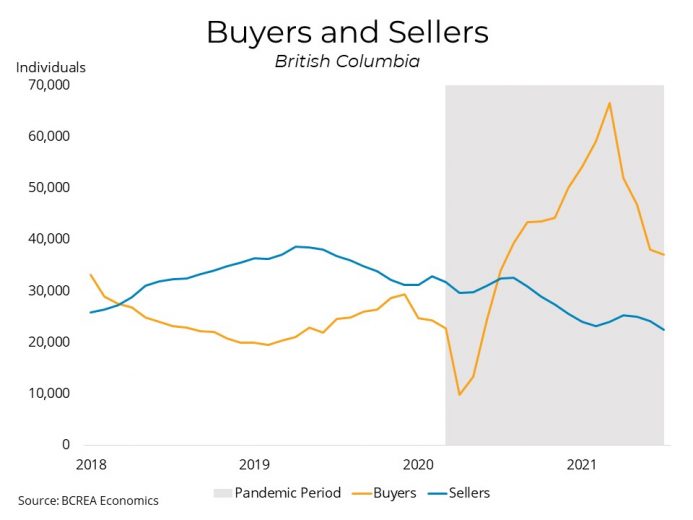
“The conditions we saw at the peak of market activity earlier this year were unprecedented,” says the report’s primary author, BCREA Chief Economist Brendon Ogmundson. “Record-low mortgage rates and the work-from-home environment driving buyers into rural areas were both factors that fueled demand disproportionately as it relates to supply. With sellers looking to stay put in an environment where space at home was at a premium, it made for quite the imbalance.”
In the Fraser Valley, buyers outnumbered sellers by as much as seven-to-one at the height of the market in the spring. This resulted in prices rising nearly 30 per cent, double what was seen in the Greater Vancouver area during the same period. Markets in the interior as well as Vancouver Island saw similar trends, with Victoria earning the title of most undersupplied with a nine-to-one ratio of buyers to sellers.
To be able to reach these conclusions, Ogmundson used a model framework recently developed by researchers at the US Federal Reserve.
“This type of data shows how hard it is for supply to keep up with rapidly changing demand,” Ogmundson adds. “The issue of supply is not a new one in BC, but seeing just how much worse it can get during these types of events highlights the need for a coordinated strategy to significantly increase supply.”
To read the full report click here.
Media contact:
Brendon Ogmundson
Chief Economist
Direct: 604.742.2796
Mobile: 604.505.6793
Email: [email protected]
We’re Investing in You!
*Please note that the Discount Code is no longer available.
With January being a natural time to reflect on the past year and look ahead to the new year, there’s no better time to focus on levelling up skills and investing in the foundations of a successful business.
BCREA is pleased to partner with Greater Vancouver REALTORS® in this “We’re Investing in You” initiative which aims to enable REALTORS® to excel in their practice.
To help REALTORS® support their professional growth, BCREA’s Professional Development team has curated a list of Core Courses to help them build the foundation for success. From now until Monday, March 31, 2025, REALTORS® will receive $25 off registration of the following BCREA courses:
- Contract Law Foundations for REALTORS®
- Disclosures in Real Estate
- Know Your Product: House Structures (Online)
- Standard Form Essentials: The Property Disclosure Statement
Accessing the Discount
- The learner enters the coupon code (see below) in the coupon code line on the course purchase screen.
- The coupon code (see below) can be used more than once, but it only applies to the four courses listed above.
- The coupon code is: 2025BCREA25OFF and is valid from Wednesday, January 1, 2025, to Monday, March 31, 2025.
- Find out more about what Greater Vancouver REALTORS® is offering here.
For more information, or if you have any questions, please contact [email protected].
Webinar Recording: 2021-22 BCREA Directorship Information Session
On November 30, BCREA hosted a virtual information session for individuals interested in learning more about becoming a BCREA REALTOR® or public Director for the 2021-22 term.
The session, held via webinar, was hosted by Chair of the Nominating Committee Tanis Read, a featured BCREA Board of Directors Chair Anthony Bastiaanssen, BCREA CEO Darlene Hyde, and BCREA Director Cory Raven.
The panel answered questions that were submitted in advance and also live in the webinar chat.
The application package will be available by request at your locals boards as well as by emailing [email protected] beginning on December 10, 2020 and applications will be accepted until January 15, 2021. Stay tuned to the BCREA website for more information on the application process.
To subscribe to receive BCREA publications, or to update your email address or current subscriptions, click here.
Webinar Recording: 2022 BCREA Director Applicant Information Session
On October 31, BCREA hosted a virtual information session for individuals interested in learning more about becoming a BCREA REALTOR® or public Director for the 2023-24 term.
The session, held via webinar, was hosted by BCREA CEO Trevor Koot, who was joined by Chair of BCREA Board of Directors, Janice Stromar, and Chair of the Nominating Commitee, Colette Gerber.
The panel answered questions that were submitted in advance and also live in the webinar chat.
[iframe width="560" height="315" src="https://www.youtube.com/embed/C8Nk5Gz-9aA" frameborder="0" allowfullscreen style="position:absolute;top:0;left:0;width:100%;height:100%;"][/iframe]Apply Now
If you are interested in applying to become a BCREA Director, please use one of the application links below.
To apply to be a REALTOR® Director, click here.
To apply to be a public Director, click here.
Note: the deadline to submit your application is Thursday, December 1.
Please contact us at [email protected] If you have any questions.
Webinar Recording: 2023 BCREA Director Applicant Information Session
On November 2, 2023, BCREA hosted a virtual information session for individuals interested in learning about what it means to be a BCREA Director and the application process for the upcoming term.
The session, held via webinar, was hosted by the BCREA Nominating Committee Chair Colette Gerber, who was joined by BCREA Chief Executive Officer Trevor Koot and the BCREA Board of Director Chair Darren Close.
The panel answered questions that were submitted in advance and also live in the webinar chat.
[iframe width="560" height="315" src="https://www.youtube.com/embed/ZnarOUCiAkc" frameborder="0" allowfullscreen style="position:absolute;top:0;left:0;width:100%;height:100%;"][/iframe]
Apply Now
If you are interested in applying to become a BCREA Director, please use one of the application links below.
To apply to be a REALTOR® Director, click here.
To apply to be a Public Director, click here.
**Please note the application was closed on Monday, December 4, 2023.
Please contact us at [email protected] If you have any questions.
Webinar Recording: BC Real Estate and the Election on Our Doorstep
On Wednesday, October 21, BCREA hosted a webinar and panel discussion to explore the impacts of the upcoming provincial election on the BC real estate sector. We discussed the key asks that BCREA and real estate boards will make of any new provincial government; the risks and opportunities for the real estate sector arising from the changing political landscape; and what could happen at the federal level that could impact real estate in BC.
You can watch the webinar recording below:
[iframe width="560" height="315" src="https://www.youtube.com/embed/dqaI6khmpps" frameborder="0" allowfullscreen style="position:absolute;top:0;left:0;width:100%;height:100%;" ][/iframe]Thank you to our moderator, BCREA Chief Executive Officer Darlene Hyde, and our panelists:
- Trevor Hargreaves, Vice President of Government Relations and Stakeholder Engagement, BCREA,
- Linda Kristal, Vice President, Advocacy, Canadian Real Estate Association, and
- Neil Moody, Chief Executive Officer, Canadian Home Builders’ Association of BC.
To subscribe to receive BCREA publications, or to update your email address or current subscriptions, click here.
Webinar Recording: Understanding the June 1 FINTRAC Changes
On June 2, BCREA hosted a free one-hour webinar to help REALTORS® and brokerages understand the new regulatory amendments introduced by the Financial Transactions & Reports Analysis Centre of Canada (FINTRAC) on June 1. Thank you to the over 4,400 Realtors who attended! If you attended the full live session, please allow up to two weeks for your board to process your self-directed PDP hour.
If you missed the webinar, or would like to watch it again, you can find the webinar recording below. Please note, watching the recording does not count toward your PDP hours.
[iframe width="560" height="315" src="https://www.youtube.com/embed/R9YDu6vXOyk" frameborder="0" allowfullscreen style="position:absolute;top:0;left:0;width:100%;height:100%;" ][/iframe]Additional resources
Below are additional resources created by BCREA that will help you navigate your new FINTRAC obligations.
- BCREA Gateway Page: 2021 Changes to Your Anti-Money Laundering Obligations
- BCREA Video Series: Are You Ready for the June 1 FINTRAC Changes?
- BCREA Blog Series: Getting Ready for the June 1 FINTRAC Changes
Open House podcast
On this month's episode of Open House by BCREA, we were joined by Adam Feldman, an Anti-Money Laundering Advisor with The AML Shop. Adam shared an overview of the new and revised anti-money laundering regulations and how they will impact real estate practice.
Webinar: “The End of The Beginning” and BC’s Real Estate Sector & Economy

In just two months, COVID-19 has completely reshaped our society, from our personal and professional lives to our economy and housing market. But to paraphrase Dr. Bonnie Henry, we are only at the end of the beginning. There is more change to come.
Join BCREA on Wednesday, May 27 at 10:00 am PST for the first in a series of webinars on the post-pandemic recovery of the BC real estate sector. This webinar is open to all REALTORS®, real estate boards, and industry professionals, and will focus on the impact of COVID-19 on BC’s real estate sector and the larger economy, and the timing and strength of a post-pandemic recovery.
This webinar will feature an expert panel discussion, moderated by Darlene Hyde, Chief Executive Officer of BCREA, who will be joined by:
- Anita Huberman, Chief Executive Officer, Surrey Board of Trade,
- Hendrik Zessel, Executive Managing Director and Western Canada Leader, Cushman & Wakefield,
- Elton Ash, Regional Executive Vice President, RE/MAX of Western Canada, and
- Brendon Ogmundson, Chief Economist, BCREA.
In this series of discussions on the post-pandemic recovery, we will draw on the expertise from a number of economic, business and brokerage experts. As needs arise, we will offer additional programming over the coming months.
May 27 Panelists
- Brendon Ogmundson: Brendon Ogmundson is the Chief Economist for the BC Real Estate Association. Brendon specializes in macroeconomic forecasting, housing market analysis, and econometric modelling and is responsible for producing forecasts for the BC, Canadian, and US economy and authoring quarterly forecasts for the BC housing market and Canadian mortgage rates. He is also a member of the BC Economic Forecast Council.
- Anita Huberman: Anita Huberman is the Chief Executive Officer of the Surrey Board of Trade, a position she has held for over 14 years. Anita has been with the Surrey Board of Trade for 27 years and is a true trailblazer, advocating for change for business and Surrey at all levels of government. Anita also currently serves on Premier Horgan’s COVID-19 Economic Recovery Task Force.
- Elton Ash: Elton Ash is a long-term affiliate of the RE/MAX organization serving at every level of the franchise system, and currently serves as the Regional Executive Vice President of RE/MAX Western Canada. Elton is also a Certified Real Estate Specialist (Real Estate Institute of Canada), an Accredited Buyer Representative (National Association of Realtors, and licensed as an Associate Broker in BC.
- Hendrik Zessel: As Executive Managing Director and Western Canada Leader, Hendrik Zessel oversees Cushman & Wakefield’s operations in Western Canada, which includes Vancouver, Victoria, Edmonton, and Calgary. Hendrik is a seasoned professional and industry specialist with over 40 years of experience in the Vancouver real estate market and a track record of building and maintaining one of the highest performing offices in the country.
To register for the May 27 webinar on economic recovery, click here.
To subscribe to receive BCREA publications, or to update your email address or current subscriptions, click here.
Webinar: BC Real Estate and the Election on Our Doorstep
Join the BC Real Estate Association (BCREA) on Wednesday, October 21 at 10:00 am PT to explore the impacts of the upcoming provincial election on the BC real estate sector.
During this 75-minute webinar and expert panel discussion, we will review the key asks that BCREA and real estate boards will make of any new provincial government and explore the risks and opportunities for the real estate sector arising from the changing political landscape. We will also have a close look at what could happen at the federal level that could impact real estate in BC.
This webinar will feature an expert panel discussion, moderated by BCREA Chief Executive Officer Darlene Hyde, who will be joined by:
- Trevor Hargreaves, Vice President of Government Relations and Stakeholder Engagement, BCREA,
- Linda Kristal, Vice President, Advocacy, Canadian Real Estate Association (CREA), and
- Neil Moody, Chief Executive Officer, Canadian Home Builders’ Association of BC (CHBA BC).
This webinar is open to all REALTORS®, real estate boards, and industry professionals.
Moderator
- Darlene Hyde has been Chief Executive Officer of BCREA since January 2018. Prior to that, she held senior executive positions with the Commercial Real Estate Development Association of Metro Vancouver and the New Car Dealers Association of BC. Darlene has extensive executive experience in a number of sectors across Canada including financial services, insurance, telecommunications, energy and housing.
Panelists
- Trevor Hargreaves is the Vice President of Government Relations and Stakeholder Engagement for BCREA. He is also an Adjunct Professor at the Sauder School of Business at the University of British Columbia. Prior to his time at BCREA, Trevor was closely involved in Federal trade negotiations within the Canadian agricultural sector tied to NAFTA, TPP and CETA.
- Linda Kristal became CREA's Vice President, Advocacy after serving eight years as Director of Communications. Linda’s career in Ottawa began on Parliament Hill working for an MP, Ministers and the Prime Minister over almost a decade as a political staffer. During that time, she got to see the ins-and-outs of life on the Hill and a bird’s eye view into policy making.
- Neil Moody has led CHBA BC as its CEO since August 2013. During this time, membership has grown by 37% to 2,100 member companies and the association has become the leading provider of builder education and energy efficiency programs. Neil brings an action-based, collaborative approach to advocacy and government relations.
To subscribe to receive BCREA publications, or to update your email address or current subscriptions, click here.
Webinar: Preparing for the Home Buyer Rescission Period, Regulatory and Practice Resources
BC's new Home Buyer Rescission Period (HBRP) for residential real estate property takes effect on January 3, 2023. You can help ensure that you understand and comply with the new requirements and know how to explain them to your clients by registering for the one-hour webinar presented jointly by the BC Financial Services Authority (BCFSA), the British Columbia Real Estate Association (BCREA), and hosted by local real estate boards across the province.
The goal of this webinar is to improve REALTORS'® comprehension of the HBRP, also known as the cooling-off period. Expert speakers Jim McCaughan, Professional Services Manager at BCREA, and Carmen deFoy, Practice Education Manager at BCFSA, will provide an overview of:
- what the HBRP entails,
- how it will impact REALTORS®, buyers and sellers,
- what you need to know about the new disclosure requirements and changes to forms,
- regulatory guidance and forms and responses to frequently asked questions,
- what resources are available to support you and that you can share with clients, and
- much more.
The webinar will include a review of some Frequently Asked Questions and will conclude with a facilitated question-and-answer period.
Look out for information from your real estate board to register and join the session in your area.
Webinar Schedule
- Association of Interior Realtors
Tuesday, November 29 from 10 am to 11 am
- BC Northern Real Estate Board
Tuesday, November 22 from 12 pm to 1 pm
- Chilliwack and District Real Estate Board
Friday, December 2 from 10 am to 11 am
- Fraser Valley Real Estate Board
Tuesday, December 6 from 10 am to 11 am
- Powell River Sunshine Coast Real Estate Board
Friday, November 25 from 10 am to 11 am - Real Estate Board of Greater Vancouver
Thursday, December 1 from 10 am to 11 am - Vancouver Island Real Estate Board
Monday, November 21 from 10 am to 11 am
- Victoria Real Estate Board
Monday, November 28 from 10 am to 11 am
Meet the Speakers
Jim McCaughan is the Professional Services Manager at BCREA. He was first licensed in 1977 as a Sales Associate and became a Broker in 1979. Jim is considered one of the foremost experts on agency in the real estate industry in BC. Jim is a Past-President of the Fraser Valley Real Estate Board and the Chilliwack Real Estate Board. He served six years on the Real Estate Council of BC and eleven years on the Errors & Omissions Insurance Corporation of BC. He was the BCREA 2012-13 President.
Carmen deFoy is the Manager of Practice Education at BC Financial Services Authority, where she develops education programs, professional guidance materials and consumer-focused resources. She leads a team of practice standards advisors who provide advice to hundreds of real estate consumers and industry professionals each month. Carmen holds a BA from Simon Fraser University with a focus in Criminology and Education, a certificate of investigations and enforcement from the Justice Institute of BC and is nearing the completion of her Master of Business Administration at Thompson Rivers University.
Wells, Drilled and Dug; and Dry #242
By Gerry Neely
B.A., LL.B.
Well, well, well - city dwellers who are moving in increasing numbers beyond the limits of city water to purchase rural property and who, if asked to measure a well drink would do so in ounces rather than gallons per minute, are finding that their well being may be well-nigh impossible to achieve because well, let's say it - the well ran dry.
Although paragraph I (i) of the Property Condition Disclosure Statement puts the onus upon the seller to describe the quantity or quality of well water, as a call from an up-country REALTOR indicates, REALTORS can still be drawn into a dispute initiated by a buyer unhappy with the seller's representations concerning the quantity or quality of the well water.
The cases dealing with the potential liability of an agent predate the valuable protection the Property Condition Disclosure Statement (PCDS) offers both buyers and REALTORS. However, the use of the PCDS may not, in the circumstances of a particular case, displace the REALTOR's obligation which has been stated many times by the courts in general terms, "to check the completeness and accuracy of all information which is usual and customary for agents to verify, and all other information as to the completeness and accuracy of which the REALTOR is in doubt."
An example of what a court might expect a REALTOR to do is found in a case in which the agent repeated the seller's representation that the well produced between three and four gallons per minute. According to the judge, the problem for the REALTOR was that she should have know that this statement was untrue.
The REALTOR had the listing for eighteen months and from her local knowledge knew that the water supply from wells in the area was described as spotty. The REALTOR had a clear recollection at the time she took the listing that the seller told her he did not have a well record and did not know what the recovery rate was for the drilled well. It was this prior knowledge that should have made the REALTOR doubt the completeness and accuracy of the information supplied by the seller, an omission which led to liability for both the seller and the agent.1
***
Contrast this decision with a 1985 case, in which the REALTORS were fortunate. The seller had represented that the well was drilled, when in fact it had been dug. The REALTOR accepted this information without checking, but the judge excused the REALTOR's failure to verify the information provided by the seller.
The judge was satisfied that the seller's misrepresentation was so deliberate and intended to mislead, that the seller was guilty of inducing the erroneous conclusion by the REALTOR, which led to an advertisement of the property which the seller knew would be false. For these reasons, he imposed liability upon the seller only.2
It isn't always necessary to have exact information as to the number of gallons per minute the well will produce. In one case, the seller of rural property testified that with reasonable use the seller had an adequate supply of water for his family, guests, and livestock.
The new buyers who moved in with a portable swimming pool, with a capacity of 18,000 gallons, found the supply of water to be inadequate for their purposes.
The disappointed buyer lost an action for damages when the judge concluded that while the water supply was limited, the seller had not misrepresented its adequacy for the uses that were normal for the occupancy of rural property.3
REALTORS should assume that if there were Rural Real Estate Rules, equivalent to Murphy's Law, then rule number one would be:
(a) a farm for sale has a well on it that provided sufficient water over a ten year period, for a family of seven, four horses, 12 cows, 25 pigs, 120 chickens and a number of summer guests who overstayed their welcome.
(b) a REALTOR, who sold the property, can be assured that the well will dry up seven days after the buyer takes possession.
To subscribe to receive BCREA publications such as this one, or to update your email address or current subscriptions, click here.
What Comes After Uncertainty? The Next Phase in BC’s Housing Market
To view the latest Market Intelligence report PDF, click here.
Summary of Findings:
- Uncertainty related to the threat of tariffs has depressed home sales through the first quarter of 2025.
- As that uncertainty subsides, the path of sales activity will depend on the prevailing tariff regime and the ultimate impact of tariffs on the economy.
- A strong monetary policy response from the Bank of Canada could counteract the negative impact of tariffs, leading to a stronger, faster housing market recovery.
The economic uncertainty engendered by the stochastic trade policy of the United States under President Donald Trump has upended what was set to be a return to normalcy in the British Columbia housing market. However, that uncertainty, while still elevated, appears to be subsiding. So, what comes next?
In this Market Intelligence report, we’ll explore some potential scenarios for the BC housing market amidst a cloudier-than-usual outlook.
For more information, please contact:
Brendon Ogmundson
Chief Economist
Direct: 604.742.2796
Mobile: 604.505.6793
Email: [email protected]
Amit Sidhu
Economist
Direct: 604.677.9345
Email: [email protected]
What Does It Take to Be a Practice-Ready REALTOR®?
By Katja Gallagher, Education Coordinator, BCREA
BCREA needs your input concerning the unique needs and challenges of new REALTORS®. Complete our Practice-Ready REALTOR® survey for your chance to win a $100 Amazon gift card!
BCREA has launched the Practice-Ready REALTOR® Research Project that seeks to identify opportunities to better support new entrants into the real estate profession to ensure they have the knowledge, skills and supports needed to succeed. Part of this research includes a province-wide survey.
As Realtors, you have a unique insight into what it takes to be practice-ready either from your own personal experiences, or in your dealings with new Realtors on the other side of a transaction. Your help in identifying the most important elements required in supporting new entrants into the real estate profession to be “practice-ready” will help inform how the profession can support new entrants on their journey while strengthening professionalism within the sector.
Upon completion of the survey Realtors will have the opportunity to enter a draw for the chance to win one of three $100 Amazon gift cards.
The survey will close on Wednesday, June 30.
What Does the COVID-19 Virus Mean for REALTORS®?
The COVID-19 virus is impacting more than people’s health. It’s changing our travel plans, how we do business and the larger economy. REALTORS® also need to adjust to protect themselves and their clients.
The National Association of REALTORS® (NAR) has put together this great resource – we’ve listed some key Q&As below. What’s the most important takeaway?
Don’t panic, stay informed and use your best judgement.
What preventative measures may be taken to reduce the risk of contracting and spreading coronavirus?
The same preventative measures recommended to prevent influenza are also effective in reducing the risk of contracting or spreading coronavirus. These measures include:
- Staying home if you have a fever, cough, shortness of breath or any other cold or flu-like symptom.
- Washing your hands frequently with soap and water for at least 20 seconds. If soap and water aren’t available, use an alcohol-based hand sanitizer.
- Avoiding touching your eyes, nose, and mouth with unwashed hands.
- Avoiding close contact with anyone who is sick.
- Cleaning and disinfecting frequently touched objects and surfaces.
- Covering your mouth and nose with a tissue when you cough or sneeze, or cough or sneeze into your sleeve.
Should I still conduct open houses?
Speak openly and honestly with your seller about the pros and cons of holding an open house. Assess the risk based on your specific location and direct your clients to local and state health authorities for specific information about the severity of the risk in your area. You could also propose alternative marketing opportunities for your seller’s consideration, such as video tours and other methods to virtually tour a property.
If you do hold an open house, consider requiring all visitors to disinfect their hands upon entering the home, and provide alcohol-based hand sanitizers at the entryway, as well as soap and disposable towels in bathrooms. If you decide to do any cleaning at your client’s home, be sure to check with your client in advance about any products you plan to use.
After the open house, recommend that your client clean and disinfect their home, especially commonly touched areas like doorknobs and faucet handles.
I typically drive my clients to showings. May I refuse to drive potential clients to see homes?
Yes. However, be sure that any change to your business practices is applied equally to all clients. You may refuse to drive clients who show signs of illness or reveal recent travel to areas of increased risk of coronavirus, or you may instead decide to stop driving clients in your car altogether, and simply arrange to meet clients at a property. If you do continue to drive clients in your car, it is a good idea to frequently clean and disinfect surfaces like door handles and seat belt latches, and to ask clients to use hand sanitizer when getting in and out of the car.
What precautions should brokers consider taking in their offices?
Brokers should use their best judgment when formulating a plan. First, brokers should implement a mandatory “stay-home” policy for any staff member or agent exhibiting any sign of illness, and depending on where the broker is geographically located, a broker may want to consider imposing a mandatory remote work policy for employees and instructing agents to stay out of the office. In addition, taking measures such as holding virtual meetings or potentially postponing or cancelling in-person meetings or events may be good measures to take to limit close contact between individuals. For travel considerations, review NAR’s “Coronavirus: A Guide for REALTOR® Associations”.
To subscribe to receive BCREA publications, or to update your email address or current subscriptions, click here.
What happens if your client or close contact tests positive for COVID-19?
If being in the midst of a global pandemic wasn’t enough, with BC’s historically busy housing market, REALTORS® are operating under extenuating circumstances and are faced with balancing health and safety with serving their clients best interests.
As a result of COVID-19, you have adapted your practices to ensure your clients and the community at large remains safe. But despite your efforts, we have heard that one question remains on your mind…
…. what happens if one of my clients or someone at a showing tests positive for COVID-19?
We have consulted with public health officials to put together this Q&A for your reference, but before reading further, it is important to know that the information that follows is meant to be informative and helpful but should not substitute guidance from your managing broker and/or public health advice.
If you have questions regarding your practice, contact your managing broker. For questions that require specific public health guidance, contact your doctor and/or call HealthLink BC by dialing 8-1-1.
What happens if my client, someone at a showing or one of their close contacts tests positive for COVID-19?
Once a person tests positive for COVID-19, they will be contacted by public health as soon as possible. An assessment will be completed by phone and will include questions about where the person was in the two weeks before symptoms began or when they got tested. There are also questions about who that person was in contact with during their infectious period, when COVID-19 is transmissible.
Will someone contact me to let me know about the positive test?
A Realtor will only be contacted if they are named as a close contact by the person who tests positive. It is important to know that your client, or anyone who tests positive, is not obligated to share their positive test result with you. It is the responsibility of public health to notify the Realtor of the close contact exposure.
What do I do if I get contacted?
If you are named as a close contact of someone who tests positive for COVID-19 and you are contacted by public health, you will then need to begin to isolate immediately. This might mean leaving work or wherever you might be and heading straight home.
Do I need to contact others if I have potentially been exposed to COVID-19?
If you have not tested positive for COVID-19, you are not required to contact your own close contacts, but you may choose to out of an abundance of caution. Public health officials are responsible for contacting close contacts and advising when to self-isolate.
Should I get tested for COVID-19 if I’m identified as a close contact?
If you develop symptoms after a known exposure, you should get a COVID-19 test. You can find information about accessing and booking a test on the BCCDC website, your local health authority website, or by calling 811.
As part of the contact notification call, public health officials may advise you to get a test even if you are asymptomatic. Otherwise, during isolation, you should be self-monitoring for symptoms.
BCREA recognizes the effort Realtors have made to make the community’s health and safety a top priority during the COVID-19 pandemic. We encourage you to continually review our Safer Showings Guidelines and to stay up to date with public health guidance.
What is “Blind Bidding?” An Introduction for REALTORS®
As a result of competitive market conditions and escalating housing prices, BC’s real estate regulator, the BC Financial Services Authority (BCFSA), is developing a consultation on “blind bidding” to understand whether regulatory changes to real estate transaction could improve protection for homebuyers. This announcement was paired with news in early-November that the BC Government intends to institute a cooling off period for real estate transactions next spring.
Blind bidding has also been discussed federally, where in the recent federal election campaign the Liberal Party promised to create a national Home Buyers’ Bill of Rights that would include a ban on blind bidding.
But what is “blind bidding” and how might it impact you and your clients?
Blind bidding is when home buyers submit offers to sellers and sellers choose not to disclose the details of competing bids. While Canadians are not mandated to use this process to sell their homes, blind bid negotiation is by far the most common in residential real estate. By banning blind bidding, homeowners would be required to use more transparent bidding processes.
While restricting blind bidding would increase transparency within a transaction, it in unclear whether it would improve affordability. In fact, it could have unintended negative consequences for the buyer, potentially worsening BC's pre-existing housing affordability crisis. While the Liberal Party's platform suggests that blind bidding "ultimately drives up home prices," available research and case studies do not support that assertion.
No provinces in Canada have implemented restrictions on blind bidding, however other countries can serve as case studies, with impacts likely to be comparable to Canada. In Sweden, blind bidding has been banned. Open bidding methods are also common in Australia and New Zealand. All three of these countries have also experienced dramatic increases in real estate price growth at rates higher than Canada during the pandemic. While the root causes of increased price growth are the imbalances between supply and demand, restrictions to the bidding process may exacerbate pre-existing problems.
Unfortunately, there are no peer reviewed studies examining bidding rules in the Canadian real estate market, however a report published in October 2021 investigated whether banning blind bidding slows the growth of real estate prices. The report found that while evidence is limited, increased bid transparency would likely lead to higher, rather than lower, prices in a hot real estate market.
Of literature examining other jurisdictions, six studies found transparent bidding practices were associated with higher house prices, while two others found transparent bidding to be associated with lower prices. These varied results are not surprising given different methods in different markets.
Before measures to increase transparency and consumer protection are decided upon and implemented in BC, it's important to first understand its impacts on housing affordability, the regional nuances, the different market conditions in which they would apply and other unintended consequences so Canadians are not negatively affected by the changes.
The BC Government has announced its intent to introduce legislation in spring 2022, mandating a cooling off period for all buyers of residential real estate. We encourage you to learn more here.
In addition, BCFSA is consulting on other consumer protection measures, including:
- a cooling off period,
- mandatory conditions, such as home inspections or financing and
- other practices that may be identified as consumer protection risks.
What is a Cooling Off Period? An Introduction for REALTORS®
The BC Government has announced its intent to introduce legislation in spring 2022 to mandate a cooling off period for buyers of all residential real estate. But what is a "cooling off period" and how might it impact you?
A cooling off period, also known as a "rescission period," gives buyers the right to withdraw from a purchase agreement within a specified period of time after an offer is accepted. Without a cooling off period, if a buyer wishes to terminate a contract for reasons other than those laid out within the terms and conditions, they would need to negotiate with the seller and would typically face significant financial penalties or legal ramifications. It's important to note that the government's resources only mention the cooling off period applying to buyers, there is no mention of it applying to sellers as well.
BC already has a mandatory cooling off period for pre-sale developments. Buyers of strata properties under construction have a seven-day period from the time they receive a copy of a signed purchase contract or acknowledge receiving a disclosure statement where they are allowed to withdraw their offer.
While BC will be the first Canadian jurisdiction to legislate cooling off periods for all residential real estate sales, other countries can serve as case studies. For example, in Australia most states have some sort a cooling off period. Here are some highlights:
- For states that have implemented the policy, the period lasts between two and five business days.
- States have exemptions for mandatory cooling off periods, including but not limited to instances when the home is sold by auction or if the buyer waives the cooling off period.
Some states do not have penalties for terminating the contract within the cooling off period, while others have penalties ranging from $100 up to 0.25 per cent of the purchase price. Penalties are intended to deter potential buyers from making offers without an intent to purchase, which can cause issues for the potential seller. If a 0.25 per cent penalty were to be implemented in BC using an average MLS® price of $913,000, that would result in a $2282.50 penalty.
Existing research suggests that a cooling off period is unlikely to have a significant impact on consumers' decisions. Research by Deakin University found that when 60 consumers were faced with a 48-hour cooling off period, none of them changed their minds when faced with a better alternative. The reason behind this lack of change is called "loss aversion," that the cost of losing something tends to be greater than making equivalent gains. For example, this means that the feeling of losing $100 tends to be greater than the feeling of gaining $100. Within real estate, this means that once a consumer has purchased a house, they are unlikely to change their mind and make use of a cooling off period to terminate the contract, even if given with comparable options at a slightly lower cost.
While the government's goal of a cooling off period is increased transparency, it's worth considering the potential impact the policy could have on BC's housing affordability crisis. If implemented, more buyers would be likely to bid on more properties, potentially causing in increase to housing prices. In BC's extremely low supply conditions, this could increase prices by an additional two to three per cent according to initial research conducted by BCREA.
BC's real estate regulator, the BC Financial Services Authority (BCFSA), is consulting stakeholders on the appropriate length of a cooling off period and whether or not to include penalties for exercising the right to rescission. In addition, the Ministry of Finance has also requested consultation on the following consumer protection policies:
- restricting blind bidding,
- mandatory conditions, such as home inspections or financing, and
- other practices that may be identified as consumer protection risks.
What is a Succession Plan?
A succession plan is your strategy and process for transferring your responsibilities, authority, and business operations to a designated successor upon retirement, stepping down, becoming incapacitated, or leaving your brokerage for any reason.
In British Columbia, your role as managing broker is essential. Under the Real Estate Services Act (RESA), licensees depend on your active oversight to keep their licences in good standing and to ensure the brokerage can legally provide real estate services.
If you suddenly depart without a successor in place, the brokerage must suspend operations, causing transactions to stall and clients to lose representation, both of which can seriously affect the value and reputation of the business.
Succession planning is not something to leave until the last minute. It is a core element of responsible brokerage management. It protects:
- business continuity, ensuring operations and transactions can continue smoothly;
- clients, who rely on stable representation;
- licensees, who depend on your active managing broker status to work; and
- regulatory compliance, which is legally required under RESA.
The need for succession planning is also underscored by the realities of the managing broker landscape in British Columbia. As of December 2025, the ratio of managing brokers to licensees was approximately 1:22, underscoring the significant dependence of many licensees on a relatively small number of managing brokers. In 2025, 72 per cent of managing brokers were over 50 years old, and nearly half planned to leave their roles within six years, pointing to an approaching leadership gap.
For your brokerage, this is more than a staffing issue. It’s a regulatory and operational risk. If there’s no one prepared to step in, your brokerage may have to suspend services, delay transactions, and face client uncertainty.
A well-prepared succession plan can:
- ensure a trained and qualified successor is ready to step in during illness, incapacity, or an unexpected departure;
- build leadership capacity within your brokerage through mentoring and professional development;
- protect and increase the value of your brokerage by safeguarding client relationships and revenue streams; and
- provide peace of mind for you, your team, and your family.
Whether you are new to the managing broker role or nearing retirement, succession planning gives you control over what happens to your brokerage when you’re no longer at the helm. It is a proactive, strategic business tool that protects your legacy, your people, and your clients.
This resource was developed with subject matter experts for BCREA, member boards and associations, compliance officers, managing brokers, and BC REALTORS® for informational purposes only and should not be relied upon as legal or tax advice.
Readers are encouraged to verify the information’s accuracy and relevance, and should consult qualified professionals before acting.
What is InFormBot?
BCREA’s Standard Forms are at the core of real estate transactions in British Columbia. Our Standard Forms are reviewed and revised to help ensure they reflect the latest best practices and comply with current regulations.
InFormBot, first launched on Wednesday, December 1, 2021, was built with new REALTORS® in mind to help them navigate commonly used Standard Forms with confidence. Learn how to use InFormBot in ten easy steps in the "How InFormBot Can Be Used in Your Practice" article.
An interactive tool, InFormBot offers an overview of every stage of a typical residential real estate transaction, including practice tips, videos, and other resources.
Like a chatbot, it is intuitive and easy to use. InFormBot can help REALTORS® with suggestions of commonly used Standard Forms, depending on whether you’re working with a buyer or a seller. The resources and forms that it recommends can be directly accessed via InFormBot.
It was recently updated with the new forms that took effect on Tuesday, November 12, 2024.
Optimized for mobile, tablet, and desktop use, InFormBot can be accessed anytime, anywhere.
If you need help navigating InFormBot or have questions about BCREA Standard Forms, email [email protected].
From now until Friday, May 30, 2025, at 5:45 pm PT, test your knowledge about InFormBot and enter to win free enrolment for one of five three-hour self-paced online Professional Development courses! Take the quiz here.
Stay tuned throughout May 2025 as BCREA continues reintroducing InFormBot with blog and social media posts. Keep an eye on our LinkedIn page for more!
What REALTORS® Need to Know About Peak BC Flooding Season
“How high’s the water, Mama?”
For those who aren’t Johnny Cash fans, the line above comes from his famous song, “Five Feet High and Rising.” It’s about a family’s personal experience with flooding, which, unfortunately, might hit a little too close to home for many in British Columbia.
Like wildfires, which I discussed in a recent blog post, flooding is a fact of life in BC and has been for a long time. From mountainside streams and picturesque rivers to placid lakes and the broad expanse of the ocean, our province is flush with waterfront locations. They’re a source of serenity, but they can also bring great hazards.
As we approach the peak of the spring freshet – the annual surge in river and stream water levels from melting snow and ice – it’s a good time to review flood safety tips and take a closer look at how flood risks are assessed in BC.
Watch the Warnings
Property owners in at-risk areas should monitor the BC River Forecast Centre to anticipate the potential impacts of a high river flow. The Forecast Centre issues three levels of warnings:
- High Streamflow Advisory: River levels are rising or expected to rise rapidly, but no major flooding is expected. Minor flooding in low-lying areas is possible.
- Flood Watch: River levels are rising and will approach or may exceed bankfull. Flooding of areas adjacent to affected rivers may occur.
- Flood Warning: River levels have exceeded bankfull or will exceed bankfull imminently, and flooding of areas adjacent to the rivers affected will result.
You should always be prepared with a “go bag” in case of flooding or wildfires. As warnings escalate, so should your readiness to evacuate.
The Challenges of Flooding Risk Assessment
Those who read my previous blog on wildfires will know about plans for provincial and regional disaster and climate risk and resilience assessments. The challenge of risk assessments is the availability of good data to determine risk levels for local areas and specific properties. In many cases, there are several factors that make up flood risk. Without constantly refreshed data, assessments can become “stale” quite quickly.
For example, one might think that flood risk due to sea level rise should be fairly easy to predict because the change is so gradual and is likely occurring at approximately the same rate along the entire coastline. However, the impact of king tides, which are higher at different points along the coast, and the variable heights of storm surges make such forecasting challenging.
The existence of accurate, current floodplain maps is also a major issue. BCREA’s 2021 study on BC Floodplain Mapping found that over 60 per cent of surveyed municipalities were lacking a current floodplain map, and over half reported that they have little or no in-house flood management expertise.
What’s more, floodplain maps must be kept current, because every flood event can change the hydrodynamics of the previous streambed, and the next set of high waters could be directed in a different path than in past years.
The provincial government has recently launched a much more extensive response to threats from flooding, rolling out the BC Flood Strategy in March 2024. BC Housing has also been working on an initiative called Mobilizing Building Adaption and Reslience. This program seeks to help homeowners protect their properties from the risks associated with climate change.
Flood Insurance and Preparedness
There is also the issue of insurance and financing of properties at risk. As mentioned in my wildfire blog, insurance companies in the United States have already begun restricting renewals of policies in flood-prone areas such as Florida, where multiple hurricanes have resulted in massive insured losses in recent years.
Significant losses in Calgary and Southern Alberta in 2013 ($5 to $6 billion), as well as the 2021 BC atmospheric river ($5 billion estimated), demonstrate the extreme damage potential of major flood events closer to home. However, such abstract numbers do not tell the story of human suffering – homes and valuables destroyed, long rehabilitation / reconstruction times, and, in the worst cases, lives lost.
As with wildfires, reconstruction of damaged properties places additional weight on an already strained building sector, delaying efforts to build sufficient new homes in communities.
For REALTORS®, knowing your area’s level of flooding risk is essential to provide the highest level of service to your clients. While it’s not reasonable to expect every REALTOR® to have their local floodplain map committed to memory, you should know where to find current resources and provide those links to homeowners and prospective purchasers.
What RECBC & OSRE’s Statement on “Heightened Market Activity” Means for REALTORS®
On Friday, April 9th, the Real Estate Council of BC (RECBC) and the Office of the Superintendent of Real Estate (OSRE) released a press statement encouraging British Columbians to be aware of the potential risks and do their research before making an offer on a home. In the release, RECBC’s Chief Executive Officer Erin Seeley offers four tips for consumers:
- Understand the risks of subject-free offers
- Be realistic about what you can afford
- Ask questions to ensure you’re comfortable with the listing price and marketing strategy
- Be prepared in a multiple offer scenario
For REALTORS®, these tips underline the importance of setting expectations and managing risks. Let’s take a closer look at what RECBC’s tips mean for Realtors and how the BCREA Multiple Offers Resource can help you navigate the current heated real estate market.
1. The risks of subject-free offers
In working with buyers, it’s important to have the conversation about the risks of writing offers with limited conditions or that are unconditional early in your relationship. By the time a buyer has seen a property that meets their needs, their excitement may cloud their judgement. Outlining the risks before they’ve gotten emotionally invested in a property positions you as their trusted advisor and helps ensure they understand the risks of not doing their due diligence a before they begin their search.
But it’s not enough to just have those conversations. You should also ask the buyer to confirm in writing that they understand that it would be in their best interest to make their offer subject to:
- Receiving and approving a home inspection;
- Confirming their ability to obtain financing;
- Confirming their ability to arrange fire insurance; and
any other due diligence that’s important to them.
2. Acting in clients’ best interests and what your client can afford
As a Realtor, your role is to know your clients and act in their best interests. Now more than ever, this means helping clients understand current market realities so they can make informed decisions and set realistic expectations. For example, buyers may not realize that the homes they’ve seen listed in their price range on REALTOR.ca could sell for substantially over the listing price.
Be sure to advise them of the importance of doing their due diligence, including speaking to lenders to determine what they can afford. Buyers should also be reminded of the ancillary costs in a transaction.
3. Ensuring clients are comfortable with the listing price and marketing strategy
Prices have been rising so quickly in many parts of the province that even the most recent sales data may not represent current market realities. This can make it challenging for Realtors and sellers to determine an appropriate asking price based on recent sales of similar properties. It’s important to know your client and their needs so you can customize a marketing plan and evaluation specific to their goals. Be sure to discuss different pricing strategies with the seller, including the opportunities and risks of different approaches and how they will consider offers.
4. Being prepared for multiple offer scenarios
Whether you’re representing a buyer or a seller, ensuring all parties involved know what to expect from a multiple offer scenario will help the process go smoothly. In addition to making sure clients understand the practicalities of a particular multiple offer scenario (for example, whether offers will be delayed for presentation, whether bully offers will be considered or if there are any terms attractive to the seller), it’s important that buyers and sellers understand that Realtors have fiduciary duties to the client they represent and how this impacts the information shared during a multiple offer scenario. It may also be helpful to ensure clients understand that Realtors must follow the Real Estate Rules, REALTOR® Code and Board Regulations when it comes to the offer process and multiple offers.
For example, while a buyer may ask their Realtor to inquire how their offer compared against other offers, the seller may not wish to disclose this information and the seller’s Realtor cannot disclose this information without instruction from their client to do so.
Navigating Multiple Offers with BCREA’s Multiple Offers Resource
BCREA has created a Multiple Offers Resource to give Realtors easy access to practical tools to help make multiple offers go smoothly. This 17-page resource includes checklists on what to discuss with buyers and sellers, a Buyer’s Acknowledgement of Information– Recommended Conditions form and a sample letter to buyer’s agent on what to expect in a multiple offer scenario and other resources.
The Multiple Offers Resource is based on BCREA's course Multiple Offers - The Strategies, The Tactics and The Game Plan.
What the Co-Listing Separate Representation Form Means for REALTORS®
By Ellen Baragon, Guest Contributor
BCREA’s Co-Listing Separate Representation form was developed so that multiple sellers who have opposing interests are able to engage different brokerages – or different agents within the same brokerage – to represent their interests in the sale of a property.
The Co-Listing Separate Representation amends certain sections of the Listing Contracts and allows the sellers and their respective brokerages to jointly determine certain terms of the listing such as listing price, remuneration, and the expiration date.
Three steps:
REALTORS® and their brokerages taking a Co-Listing Separate Representation involving multiple sellers should take these three steps:
Step 1. Even before using the Co-Listing Separate Representation form, Realtors should recommend that the sellers get legal advice to ensure their interests are protected, and that this type of co-listing is what they want.
Step 2. After the sellers have had the opportunity to get legal advice and after both sellers have confirmed that this is the type of co-listing that they want, each brokerage involved should enter into separate listing agreements with their respective seller.
Step 3. All of the interested parties – each seller, each brokerage and each designated agent – should then complete and enter collectively into the Co-Listing Separate Representation form . This will amend specific terms in the respective listing agreements to allow for a co-listing agreed to by all of the parties involved, setting out the rights, obligations and expectations of the co-listing parties.
Facts about Co-Listings
Separate Representation versus Joint Representation forms
The Co-Listing Joint Representation form is specifically for joint representation and has the effect of adding another brokerage and designated agent to the listing. It should not be used if the parties are expecting separate representation.
If the sellers do not have common interests or are in the middle of a dispute – such as the breakdown of a family relationship, the sellers may want to consider entering into a Co-Listing Separate Representation form.
Co-Listing Separate Representation form
The Co-Listing Separate Representation form provides that each seller will have a separate listing agreement with their own brokerage and designated agent, modified only to the extent necessary for certain cooperation and joint responsibilities with respect to the listing.
Seller A’s brokerage
The brokerages and sellers together determine which brokerage will be the Seller A’s brokerage. This brokerage will be the “Listing Brokerage” for the purposes of posting the listing the MLS®. Any changes to a co-listed property on the MLS® are only accepted from Seller A’s brokerage.
However, by signing the Co-Listing Separate Representation form, the parties agree that any instructions to amend the co-listing must be made in writing and signed by the managers of both brokerages, prior to posting on the MLS®. If Seller A’s brokerage were to make a change without instructions signed by all parties, it would be breaching the terms of the Co- Listing Separate Representation.
Remuneration in a Co-Listing Separate Representation
The Co-Listing Separate Representation provides places where the parties specify how the listing brokerages’ portion of the remuneration will be split between seller A’s brokerage and the seller B’s brokerage. When the sellers are completing the Co-Listing Separate Representation forms, they should discuss the details of the remuneration agreements and record these accurately on the form.
Realtors should remember they must also make appropriate disclosure of expected remuneration to their clients as set out under the Real Estate Services Act, based on the agreements in the Co-Listing form.
Additional or separate remuneration terms
Parties may pay their designated agent additional remuneration other than as set out in the Co-Listing Separate Representation form. This additional or separate remuneration may be documented in a number of ways such as including it in the “other term” to the Co-Listing Separate Representation form, in a separate commission agreement or otherwise.
If such an arrangement is made outside of the Co-Listing Separate Representation form, the Realtors must properly document this and make disclosure all in accordance with the Rules under the Real Estate Services Act.
Amendments for Cooperation and Joint Responsibilities
The amendments to the separate listing agreements effected by the Co-Listing Separate Representation form include setting an approved marketing plan for the listing, determining who is responsible for the listing, setting the agreed list price, and determining how expenses will be paid/shared between the brokerages. The Co-Listing Separate Representation also specifies what the term of the Co-Listing will be.
Confidentiality and sharing information in a Co-listing
In a Co-Listing Separate Representation form, the sharing of information between the designated agents as it applies to material information about the marketing and the property itself is acceptable. However, the brokerage and designated should not share confidential information about their respective clients without prior consent from their clients.
Should the Schedule A to the listing contract still be required?
The brokerages may still want to include their own Schedule A for their own sellers. But the parties should ensure that any terms and commitments set out in their listing agreement are consistent with the Co-Listing Separate Representation and its terms, especially when the agents represent the clients with opposing interests.
Other forms and disclosures including Property Disclosure Statements (PDS)
All disclosures required under the Real Estate Rules will still be required. All sellers are jointly responsible for the disclosure made about the current state of the property when the Property Disclosure Statement is incorporated into the Contract of Purchase and Sale. Realtors should still also obtain other forms, disclosures and agreements from their clients in a Co-Listing situation, such as a Privacy Notice and Consent, Lockbox Acknowledgement, Consent, Release and Indemnity forms, as applicable.
Get the form
The Co-Listing Separate Representation form is available through WEBForms® (REALTOR Link® login required) for use in transactions.
A PDF and additional resource of the form is available in the Co-Listing Separate Representation form Toolkit accessible via the Standard Forms Resource Centre (REALTOR Link® login required), where you can also find other great standard forms training materials and resources.
To subscribe to receive BCREA publications such as this one, or to update your email address or current subscriptions, click here.
What to Know About BCREA’s Government Liaison Days Happening in May
Government Liaison (GL) Days is an annual event where REALTORS® meet with MLAs across BC, speaking with a united voice to advocate for key housing-related issues and improving Quality of Life in BC communities.
This event has a long history, first taking place in Victoria in 1988. Due to COVID-19, participants won’t be able to meet in-person but will still meet virtually. GL Days is non-partisan to allow participants to focus on policies rather than politics. This approach is an important tool to drive forward smart policy and build strong relationships with politicians.
This year’s sessions will take place virtually on May 4 and 5. During the sessions, Realtors will be oriented on the lobbying materials, trained in effectively meeting with MLAs by video, and provided with a housing market outlook by BCREA Chief Economist Brendon Ogmundson. This year’s speakers will include Attorney General and Minister Responsible for Housing David Eby and Global BC’s Legislative Bureau Chief Keith Baldrey.
In subsequent meetings with their local MLAs, which will take place in the first part of May, participants will advocate for policies that result in more British Columbians reducing their carbon footprints and increasing the impact of energy assessment tools.
BCREA and Realtors are concerned about the Ministry of Finance’s mandate letter requiring Realtors “to provide energy efficiency information on listed homes to incent energy-saving upgrades.” Participants will use their meetings as an opportunity to inform MLAs of a Realtor’s role in a transaction. Recommendations include:
- consult with real estate sector stakeholders and homeowners before requiring energy assessments on existing homes,
- ensure that an energy assessment tool is available to owners of all existing homes, and
- coordinate an energy assessment tool with other programs.
Participants will also advocate for providing more housing opportunities to British Columbians by increasing housing supply. The provincial government can enact policies to streamline the development process, using the government’s 2019 Development Approvals Process Review as a roadmap. Recommendations include:
- empower Official Community Plans to reduce unnecessary public hearings, and
- leverage transportation funding and OCPs to encourage local governments to increase gentle densification.
What We Heard: Strategic Insights from REALTORS® Across BC
Throughout 2024, we’ve been listening. Through the 2024 BC REALTOR® Survey and the REALTOR® Voices: BCREA Listening Tour, BC REALTORS® shared their perspectives on the challenges and opportunities shaping the profession. Now, as we move toward BCREA’s next strategic plan, we’re bringing those insights back to you.
We’re hosting two upcoming sessions to share key themes and takeaways from what we heard and highlight the insights that will help shape the future of real estate in BC. These discussions will help inform joint leadership from across the province as they come together in late March 2025, to start creating BCREA’s new strategic plan.
Upcoming Sessions
Community of Practice for Managing Brokers
February 12 | 10 – 11 am
Register here.
Shaping the Future Together Webinar
February 24 | 1 – 2 pm
Register here.
This is your chance to hear firsthand the strategic insights that will shape the future of real estate in BC and ensure REALTOR® perspectives remain at the forefront of discussions in the sector. As the profession evolves, these insights will help guide leadership in making informed decisions that reflect the realities REALTORS® face every day.
We hope you’ll join us for one of these sessions and look forward to sharing what we’ve learned with you!
What You Need to Know About Peak BC Flooding Season
“How high’s the water, Mama?”
For those who aren’t Johnny Cash fans, the line above comes from his famous song, “Five Feet High and Rising.” It’s about a family’s personal experience with flooding, which, unfortunately, might hit a little too close to home for many in British Columbia.
Like wildfires, which I discussed in a recent blog post, flooding is a fact of life in BC and has been for a long time. From mountainside streams and picturesque rivers to placid lakes and the broad expanse of the ocean, our province is flush with waterfront locations. They’re a source of serenity, but they can also bring great hazards.
As we approach the peak of the spring freshet – the annual surge in river and stream water levels from melting snow and ice – it’s a good time to review flood safety tips and take a closer look at how flood risks are assessed in BC.
Watch the Warnings
Property owners in at-risk areas should monitor the BC River Forecast Centre to anticipate the potential impacts of a high river flow. The Forecast Centre issues three levels of warnings:
- High Streamflow Advisory: River levels are rising or expected to rise rapidly, but no major flooding is expected. Minor flooding in low-lying areas is possible.
- Flood Watch: River levels are rising and will approach or may exceed bankfull. Flooding of areas adjacent to affected rivers may occur.
- Flood Warning: River levels have exceeded bankfull or will exceed bankfull imminently, and flooding of areas adjacent to the rivers affected will result.
You should always be prepared with a “go bag” in case of flooding or wildfires. As warnings escalate, so should your readiness to evacuate.
The Challenges of Flooding Risk Assessment
Those who read my previous blog on wildfires will know about plans for provincial and regional disaster and climate risk and resilience assessments. The challenge of risk assessments is the availability of good data to determine risk levels for local areas and specific properties. In many cases, there are several factors that make up flood risk. Without constantly refreshed data, assessments can become “stale” quite quickly.
For example, one might think that flood risk due to sea level rise should be fairly easy to predict because the change is so gradual and is likely occurring at approximately the same rate along the entire coastline. However, the impact of king tides, which are higher at different points along the coast, and the variable heights of storm surges make such forecasting challenging.
The existence of accurate, current floodplain maps is also a major issue. BCREA’s 2021 study on BC Floodplain Mapping found that over 60 per cent of surveyed municipalities were lacking a current floodplain map, and over half reported that they have little or no in-house flood management expertise.
What’s more, floodplain maps must be kept current, because every flood event can change the hydrodynamics of the previous streambed, and the next set of high waters could be directed in a different path than in past years.
The provincial government has recently launched a much more extensive response to threats from flooding, rolling out the BC Flood Strategy in March 2024. BC Housing has also been working on an initiative called Mobilizing Building Adaptation and Resilience. This program seeks to help homeowners protect their properties from the risks associated with climate change.
Flood Insurance and Preparedness
There is also the issue of insurance and financing of properties at risk. As mentioned in my wildfire blog, insurance companies in the United States have already begun restricting renewals of policies in flood-prone areas such as Florida, where multiple hurricanes have resulted in massive insured losses in recent years.
Significant losses in Calgary and Southern Alberta in 2013 ($5 to $6 billion), as well as the 2021 BC atmospheric river ($5 billion estimated), demonstrate the extreme damage potential of major flood events closer to home. Also, as with wildfires, reconstruction of damaged properties places additional weight on an already strained building sector, potentially elevating costs and delaying efforts to build sufficient new homes in communities.
However, such abstract numbers as the ones mentioned above do not tell the story of human suffering – homes and valuables destroyed, long rehabilitation / reconstruction times, and, in the worst cases, lives lost.
That's why it's as important as ever that we all prepare as well as we can, checking insurance coverage, assessing risks in advance, keeping tabs on flood conditions as they develop, and protecting ourselves and our families in the event of an emergency.
What’s in a Name? Engineering Reports and the PDS #449
By Jennifer A. Clee
B.A., LL.B.
The recent BC Supreme Court decision of Meslin v. Lee1 considers what constitutes an “engineer’s report” for the purpose of disclosure on the Property Disclosure Statement (PDS).
The action involved a condominium sale (the property) that failed to complete. On the completion date, the buyers rescinded the Contract of Purchase and Sale on the basis that the seller had falsely misrepresented on the PDS that there was no engineer's report.
The property was located in a complex that had not experienced any major mechanical or structural problems. However, as the building was over 20 years old and some of the building envelope components were coming to the end of their intended life span, the proactive strata began to consider options for assessing the condition of its building and systems, and to plan future expenditures associated with an aging building.
The strata arranged for Mr. Gioventu, Executive Director of the Condominium Homeowners Association of BC, to speak to the owners regarding the requirements to be met by BC strata corporations in preparing for problems associated with aging buildings. At that presentation, Mr. Gioventu discussed the differences between an engineer's report and a contingency reserve fund study (CRFS). He advised that an engineer's report required invasive testing, had to be prepared by an engineer, and was appropriate when a strata corporation suspected a problem which required the report in anticipation of remedial work.
Mr. Gioventu described a CRFS as a "financial planning tool used before specific problems are known or suspected, to create an appropriate budget to deal with the inevitable failure of building components as they reach the end of their life expectancy," 2 which could be prepared by an accountant, an engineer or other qualified individual.
Shortly after Mr. Gioventu's presentation, the strata hired RDH Building Engineering Ltd. (RDH) to inspect the building and its mechanical systems, as well as prepare a report and 25 year capital plan for the complex. The strata's stated goal was to develop an overall building maintenance plan to allow owners to anticipate their yearly expenses and to ensure the building was maintained in excellent condition. RDH produced a report entitled "Reserve Fund Study and Maintenance Plan."
When the seller listed his property, he completed a PDS and when asked whether an Engineer's Report and/or Building Envelope Analysis was available, he answered "no," given Mr. Gioventu's distinction between an engineering report and a CRFS. The seller believed that he had completed the PDS honestly and accurately.
Just before completion, the buyer learned of the RDH report and after reviewing the report, rescinded the contract. The seller sued the buyers for breach of contract. The Court dismissed the seller's action, holding that the buyer was entitled to rescind the contract as the seller had innocently misrepresented on the PDS that there was no engineer's report. The issue for the Court was what constituted an "engineer's report" for the purpose of disclosure on the PDS.
The Court noted that the term "engineer's report" is not defined in the PDS. As the RDH report was prepared by an engineering firm, the Court found it was clearly an "engineer's report" as referred to on the PDS. The Court stated that there was no reason to depart from the ordinary meaning of the words used on the PDS. Using the ordinary meaning of the words was consistent with the purpose of the PDS, which is to ensure a potential purchaser is well informed about the property to be purchased.
Given Meslin, sellers of strata units completing a PDS should disclose any report prepared by an engineer for the strata concerning the state of the building and the cost of repairs, in addition to any building envelope analyses. Licensees acting for sellers completing a PDS should be alert to this issue and ensure their clients are aware of this decision.
To subscribe to receive BCREA publications such as this one, or to update your email address or current subscriptions, click here.
| 1. |
|
|
| 2. |
|
What’s Next for Housing Policy?
"Housing is the main priority for this government." The Honourable Selina Robinson, Minister of Municipal Affairs and Housing, certainly caught BCREA's attention with that statement!

Minister Robinson joined reps from BCREA and the regional real estate boards on January 31 for a discussion about challenges and opportunities with housing affordability and availability.
On the demand side, the BC Government is looking to address real estate speculation and ways to improve transparency around foreign capital. Ms. Robinson made the clear point that both demand and supply have to be considered, and the government has already committed to 114,000 new affordable rental, non-profit and co-op units over the next ten years, with several recent announcements about modular housing and affordable rental units around the province.
As well as hearing from the Minister, we had the chance to talk about what's happening on the ground. These common themes emerged:
- Recent changes to the Residential Tenancy Act seem to give more rights to tenants than landlords, and could result in fewer units available for rent.
- Incentives are needed for investors to build rental housing.
- Legalizing secondary suites with a focus on safety and minimal bureaucracy will create more supply and help owners with affordability.
- Transportation has a direct connection to Quality of Life and housing.
- Infrastructure investments are critical to increasing housing supply.
- Faster permit approvals in many local governments are needed.
- Increase density along transit corridors.
- Counter NIMBYism by focusing on fair housing and the benefits of diverse neighbourhoods.
We look forward to more conversations with Minister Robinson, and to the provincial housing strategy, which is expected to roll out with the BC Budget in February.
To subscribe to receive BCREA publications such as this one, or to update your email address or current subscriptions, click here.
What’s Up (With the) Dock? #479
By Jennifer Clee
B.A. LL.B.
Waterfront properties with private docks are looking attractive at this time of the year, particularly with the weather we've been enjoying this summer. Licensees involved in the sale of such properties need to be aware of, and inform their clients of, the possibility that any dock or other structures built upon the foreshore (the land between the ordinary high and low water mark), may be non-compliant with the rules and regulations governing their construction and use.
In the past, many waterfront property owners took advantage of the Ministry of Forest, Lands and Natural Resource Operation's lack of interest in, and resources for, the enforcement of the rules and regulations associated with the construction and use of private docks. As a result, many docks were built contrary to the applicable guidelines, including the Private Moorage Guidelines, established by the Province and other levels of government. Some examples of non-compliant docks are those built:
| i) | without Provincial authorization, |
| ii) | with illegal structures, |
| iii) | contrary to local zoning and building regulations, or |
| iv) | contrary to Canadian Coast Guard or Department of Fisheries and Oceans regulations. |
In recent years, the Ministry has devoted new energy and resources to enforcing those rules and regulations to the shock of many waterfront owners who learn that they may lose their dock, or incur significant costs to rectify non-compliance.
The Province owns and regulates nearly all of the foreshore. Formerly, an owner wishing to build a dock or other structures encroaching onto the foreshore applied for a lease or license for a fixed term, typically 10 years. Both of these options involved an application with a fee, as well as rental charges. The license tenure option for private docks and has now been eliminated and replaced with both "general" and "specific" permissions which, unlike leases and or the previous type of license, do not have a fixed term and do not charge rent.
General permission applies to docks less than 24m2 in size located on rivers and lakes. No application is required for such docks. Specific permission is required for any docks larger than 24m2, any small docks that do not qualify for general permission, and all docks located along the coastal foreshore.
When an existing license expires, an owner may apply for specific permission, or a lease, or may be granted general permission to retain the use of the structures. When an existing lease expires, the owner may continue with the lease, or apply for general or specific permission, depending on the size and location of the dock.
Typically, when an owner applies for general or specific permission or to renew a lease for the continuing use of a private dock, the Ministry will review the dock and other foreshore structures for compliance. If the dock or structures could impact aboriginal interests, the Province will also consult with impacted First Nations communities.
If a dock or foreshore structures are found to be non-compliant with the regulations or guidelines in place at the time the structures were built, an owner may have to remove or modify the dock/structures to become compliant. The Ministry will issue Notices of Trespass for any offending structures, requiring removal which can be an extremely bitter pill for buyers of waterfront or semi waterfront properties to swallow.
In order to avoid complaints or lawsuits, licensees acting for sellers or buyers of waterfront properties will wish to:
| i) | investigate the status of any docks or waterfront structures, |
| ii) | avoid making any misrepresentations regarding docks or waterfront structures, |
| iii) | warn clients of the risks associated with non-compliant docks and waterfront structures, or |
| iv) | encourage buyers to exercise due diligence in investigating the issue if important to them. |
For more information, see: http://www2.gov.bc.ca/gov/content/employment-business/natural-resource-use/land-use/crown-land/crown-land-uses/residential-uses/private-moorage.
To subscribe to receive BCREA publications such as this one, or to update your email address or current subscriptions, click here.
When an exclusion clause is not exclusionary #435
In a recent decision, the purchasers of a residential home were awarded over $160,000 in damages from their home inspector for negligence arising out of a pre-purchase inspection.1 That negligence was found was not particularly unusual, but the treatment by the Court of the home inspector’s contract is enlightening.
The Court found that the home inspector had fallen short of the standard expected of a prudent inspector in not discovering rot and moisture, and structural instability in the house. Despite the fact that the home inspection contract provided that the inspection would be “performed in accordance with the Code of Ethics and Standards of Practice of the Canadian Association of Home and Property Inspectors”, the Court found that the standards of the national organization were only guidelines which, even if followed, did not preclude the Court from finding negligence.
Of greater interest, however, is the Court’s treatment of the home inspector’s standard contract which contained a number of exclusions and limitations of liability. For example, Section 9 of the contract was capitalized and in bold and stated:
| “THE INSPECTION AND REPORT ARE NOT INTENDED NOR ARE TO BE USED AS A GUARANTEE OR WARRANTY, EXPRESSED OR IMPLIED, REGARDING THE FUTURE ADEQUACY, PERFORMANCE OR CONDITION OF ANY INSPECTED STRUCTURE, ITEM OR SYSTEM. THE INSPECTOR IS NOT AN INSURER OF ANY INSPECTED CONDITION.” |
The Court dismissed that exclusion by finding that Section 9 did not apply to representations concerning the present adequacy or condition of any inspected structure. The Court concluded that as the representations in the home inspection report in this case were with respect to the current and not the future condition of the house, the exclusion did not apply to protect the home inspector.
By another section of the contract, the parties agreed that, should the home inspector be found liable for any loss or damages arising from his inspection, the liability of the home inspector was limited to the amount of the inspection fee—$450. Despite the fact that the buyers were intelligent, university educated people and had signed the contract, which included a statement that by signing the contract they acknowledged and agreed that they understood and agreed to be bound by the terms of the contract, the Court refused to enforce the limitation of damages clause.
The Court concluded that, as the home inspector knew (or ought to have known) that the buyers intended to rely upon the inspection report, it was incumbent upon the home inspector to draw to the buyers’ attention the exclusion and waiver clauses and to take reasonable steps to apprise the buyers of the onerous terms and to ensure that they read and understood them.
The lesson one can take from this case is that an exclusion clause in a signed contract will not always be effective to protect a professional from their own negligence. An expensive lesson for $450.
| 1. |
|
To subscribe to receive BCREA publications such as this one, or to update your email address or current subscriptions, click here.
When Cooperatives Become Uncooperative #520
When we think of residential occupation, our minds turn to fee simple ownership, strata property ownership or maybe rental occupation. A lesser known but growing form of housing is cooperative housing under the Cooperative Association Act SBC 1999 c.28 (“Act”).
Unlike strata ownership, members of a cooperative do not own a specific unit. Members of the cooperative own shares in the association, and the association in turn owns the housing units occupied by its members. The allocation and occupation of the various units is determined through application of the cooperative’s rules and policies, which are adopted by the members and administrated by the board.
But what happens when one member of the cooperative is unhappy with the rules and policies adopted by their fellow members?
In a recent case1 a Vancouver cooperative owned a number of units spread across thirteen buildings in six locations. The thirty-nine units ranged from bachelor suites to four-bedroom units. Housing allocation was determined by need, based upon the number of persons in a member’s household and the presumption that each person in a member’s household required one bedroom.
Of course, household size naturally grew and shrunk over time creating a tension between growing families needing more bedrooms (“under-housed families”) and shrinking families needing fewer bedrooms (“over-housed families”). The policies generally stated that over-housed families were required to self-report as people moved out and relocate to smaller accommodations, freeing up the larger units for under-housed members. Not surprisingly, some over-housed members had grown attached to their units and were reluctant to relocate. The board of the cooperative had been less than aggressive in enforcing their policies against over-housed members. Evidence indicated that attempts over the years to modify the existing policies regarding under-housed and over-housed families had been contentious and unsuccessful.
Two under-housed members, who had been waiting for a larger unit for seven years, had been unsuccessfully trying to initiate changes to the policies for some time. They eventually commenced a petition under section 156 of the Act claiming that the cooperative association was conducting itself in a manner which was oppressive or unfairly prejudicial to one or more of the members. As part of those proceedings the court ordered that they be allowed to submit a revised policy for consideration by the members. At the same time the directors submitted revisions to the policies which arguably further advantaged over-housed families to the detriment of under-housed families. The claimants’ policy revisions were rejected, and the directors’ policy changes were adopted by a vote of 75% of the members.
In assessing the petition, the Court set out a two-stage test for establishing oppression under the Act:
1. Does the evidence support a reasonable expectation by the claimant as to how they would be treated, and
2. does the evidence establish that the reasonable expectation was violated by conduct falling within the terms “oppression,” “unfair prejudice” or “unfair disregard”?
The cooperative opposed the petition claiming that the court should give deference to the will of the members who had overwhelmingly adopted the revised policies. The court distinguished the oppression remedy thusly: “Nor can the democratic nature of the decision be given the same weight as it is in other contexts. The democratic process is fundamentally majoritarian. The oppression remedy exists in part to protect minorities from certain kinds of democratic decisions even though those decisions are approved by a majority of directors or members.”2 The judge relied upon a BC Court of Appeal decision dealing with the oppression remedy in the Strata Property Act where the court said, “The view that significantly unfair decisions reached through a fair process are insulated from judicial intervention would rob the section of any meaningful purpose.”3
The Court in this case determined that the rules and policies of the cooperative oppressed the claimants specifically and under-housed families in general, and ordered wholesale changes to the rules and policies contrary to the wishes of the majority of members.
This case is instructive for both prospective and existing members of cooperatives. The former must carefully read and understand the rules and policies of the cooperative before joining, as change may be difficult, and existing members must appreciate that simply having a majority of members in agreement may not be enough where a court finds the rules and policies oppressive.
To subscribe to receive BCREA publications such as this one, or to update your email address or current subscriptions, click here.
When Disaster Strikes #490
By Jennifer Clee
B.A., LL.B.
What happens when a property is damaged by fire before completion? Must the buyer complete or can the buyer walk? What if the buyer wants to complete with a price adjustment? A buyer's options will depend upon a myriad of factors including the law, facts, contract terms and the parties' conduct.
In Gill v. Zhang,1 three days before completion, the buyers learned that the property they had contracted to buy had been damaged by fire and could not be repaired before completion. Despite the damage, the buyers still wanted to complete, but with a price adjustment.
The parties' version of the events following discovery of the fire conflicted. The buyers maintained they remained willing to continue with the contract, subject to receiving information from the sellers about the fire and their insurance and negotiating a price adjustment. The sellers did not produce the requested information and refused to discuss any accommodations that would allow the contract to complete, maintaining that the buyers' lawyer had told the sellers the sale would complete with no price change. The sellers advised the buyers to complete or alternatively, consider the contract terminated. The sale did not complete and the buyers sued the sellers for specific performance with abatement of the price.
The Court considered the following issues:
| 1) Whether the sellers breached their obligation to deliver the property in the same condition as when viewed by the buyer (clause 8 of the Contract of Purchase and Sale); |
| 2) Whether the buyers breached their obligation to complete on the completion date (clause 12, which relates to time being of the essence); and |
| 3) Whether specific performance with an abatement of price was an appropriate remedy. |
The Court found that the sellers breached the contract by their inability to deliver the property in accordance with clause 8 and by their failure to act reasonably to address the consequences of the fire.
With respect to the second issue, the Court cited the buyers' options given the sellers' breach: either to affirm the contract (in which case the contract remained in force with all its original terms) or to accept the sellers' repudiation (in which case both parties were relieved of their contractual obligations). The Court acknowledged, as a general principle, the buyers' right to a reasonable opportunity to assess their position and the damage before electing to affirm or to accept the sellers' breach.
It was evident, from the correspondence between the buyers' lawyer and sellers' notary, that the buyers had not accepted the sellers' repudiation, but rather wished to continue with and to affirm the contract subject to receiving more information and to negotiating a price adjustment.
The issue then was whether the buyers had affirmed the contract, rendering the buyers in breach of clause 12 when they did not complete. This issue turned on credibility, given the conflict in the parties' evidence. The Court did not accept the sellers' evidence, finding the buyers had not affirmed the contract, but rather had indicated their intention to affirm with a price adjustment. Consequently, the Court found the buyers had not breached their obligations under the contract and the sellers could not require payment of the balance of the purchase price in circumstances where they were unable to convey what they were required to under the contract.
The Court granted the buyers' application for an order for specific performance with an abatement of the purchase price after the Court accepted the property was sufficiently unique to the buyers.
As Gill illustrates, when a property has suffered damage before completion, a party's conduct can significantly impact their legal rights. Accordingly, if a licensee learns, prior to completion, that a property has been damaged by fire, flood or by some other event, the licensee should immediately advise their client to seek legal advice.
| 1. |
|
When Should a Buyer Agent Measure the Property? #469
By: Mike Mangan, B.A., LL.B.
Must a buyer’s agent verify area measurements? A recent Saskatchewan case illustrates the approach typically taken by the courts and the regulatory authorities.
In Hack v. Rusnak the first-time buyers were a twenty-something couple looking for a first home in a hot market.1 In British Columbia terms, this was a limited dual agency situation; the same brokerage represented the sellers and buyers. Relying on the listing licensee’s information, the buyers’ agent told them that the house was 868 square feet. When later the buyers listed the house for re-sale, they discovered for the first time that it was only 672 square feet and sued the brokerage and its licensees.
The listing licensee never testified at trial, so we do not know how she obtained the 868 square foot figure. At the time, the buyers lived in the 900 square foot home of a relative and wanted a house the same size or bigger, up to 1000 square feet.
In June 2008, the buyers’ agent first showed the house to the buyers. The buyers’ agent apparently had in hand the listing licensee’s data input form, which showed 868 square feet. The buyers’ agent told them that the house felt small to her. To cross-check, the buyers’ agent measured some of the interior rooms, but this did not reveal the overall problem. The buyers did not ask their agent to measure the house; nor did she recommend it.
The buyers’ agent warned them to get an inspection, but apparently said nothing about verifying the square footage. She prepared their offer, subject to inspection and to financing. After some negotiation, the parties entered a contract for the sale of the house for $120,000. One of the buyers attended the inspection but said he did not measure the house himself, because he relied on the real estate agents.
The court found the listing licensee liable for negligent misrepresentation, but dismissed the claim against the buyers’ agent. The buyers claimed that a buyer’s agent must always measure the property, but the court disagreed.
The court found there is no absolute requirement for a buyer’s agent to re-measure every property that they show to the buyer. Rather, in each case, the question is whether the buyer’s agent took reasonable steps to discover facts about the property. Here, there was nothing to suggest that the area figure was critical to the buyers, and no obvious clue suggesting a measurement problem.
The Real Estate Council of British Columbia says that a licensee must act in the best interests of his or her client2 and must, “use reasonable efforts to discover relevant facts respecting any real estate that the client is considering acquiring.”3
According to the Council,
“It is not sufficient for a buyer’s agent to rely on representations regarding room measurements, if, for example, a buyer has indicated that a room must be of a certain size to accommodate the buyer’s furniture. Similarly, for all matters of significance to a buyer, the buyer’s agent should either confirm the information or advise the buyer, in writing, to obtain professional advice.”4
Where an area shortage is alleged, the question is whether in the circumstances it would have been reasonable for the buyer’s agent to verify the measurements. If a buyer makes plain that a property’s size is critical, the buyer’s agent should recommend verifying the measurements and, where appropriate, make the buyer’s offer subject to verifying the area. Alternatively, if something suggests a problem with the area information, the buyer’s agent should take the same steps. If the buyer’s agent does not plan to personally re-measure the property, or to oversee a qualified person to do it, the licensee should obtain the client’s agreement in writing and strongly recommend that the buyer verify the measurement.
| 1. | Hack v. Rusnak, 2013 SKPC 128. | |
| 2. | Real Estate Council of British Columbia Rules, Section 3-3 (a), www.recbc.ca/licensee/rules.html#section3-3. | |
| 3. | Real Estate Council of British Columbia Rules, Section 3-3 (h), www.recbc.ca/licensee/rules.html#section3-3. | |
| 4. | Real Estate Council of British Columbia, “Obligations of a Buyer’s Agent”, online: (2014) Trading Services, 3(b), Professional Standards Manual, www.recbc.ca/psm_section/acting-for-buyers. See also The Canadian Real Estate Association's REALTOR� Code, www.crea.ca/code. |
Where There’s Smoke, There’s Problems: a Few Considerations for Licensees Regarding Second-hand Smoke #558
Second-hand smoke can be the source of much conflict and aggravation in shared living spaces such as strata buildings. While smoking can lead to residential fires and can increase building maintenance costs, more importantly, inhaling smoke is hazardous and there are no safe levels of exposure, for example see Brookes v. The Owners, Strata Plan NW 1890 2021 BCCRT 1181.
It is important for licensees acting for buyers of strata units to understand the buyers’ particular circumstances and needs, including whether the buyers are smokers themselves, have a disability requiring the use of medical cannabis, or have a disability that makes them particularly sensitive to or allergic to smoke.
Buyers who are smokers may not wish to live in buildings where the strata corporations have passed bylaws by 3/4 vote to prohibit smoking in both strata lots and in common or limited common property. It may be quite inconvenient for such buyers to find a place to smoke given provincial legislation (the Tobacco and Vapour Products Control Regulation) which bans smoking not only in common enclosed spaces, but also within 6 meters of a doorway, open window, or air intake; and in any municipalities that have adopted municipal bylaws restricting smoking in public spaces.
Buyers who have a disability (e.g., asthma, COPD, etc.) that makes them particularly sensitive to or allergic to smoke, or buyers who have children, may want to know if there is a no smoking bylaw that applies throughout the building, or whether the strata corporation only has a rule prohibiting smoking or vaping in common or limited common property. If smoking is allowed inside a strata lot, smoke might still travel from inside a neighbouring strata unit through pipe chases or vents and may become a concern to such buyers once they move in. Buyers may wish to inspect the property to identify signs of smoke ingress, prior to committing to purchasing the property. Such buyers may also wish to know whether there is a recent history of smoking bylaw infractions or smoking complaints in other units in the building. It is also good practice to obtain a full set of strata documents including bylaws, rules, and meeting minutes, and to provide the set to the buyers along with written advice to the buyers urging them to review these documents carefully prior to committing to purchase the strata unit.
In the absence of a strata bylaw expressly prohibiting smoking, strata corporations may nonetheless rely on their bylaws generally prohibiting nuisance or unreasonable interference with the rights of other persons to use and enjoy their strata lots or common property.
In some situations, those rights can come into conflict with the strata’s duty to accommodate residents who, for example, smoke cannabis for medical reasons. Note that, at this time, there have been no cases where courts have imposed a duty to accommodate residents with a nicotine addiction.
Having to accommodate residents who smoke cannabis for medical reasons and residents with, for example, asthma, can create complicated scenarios for a strata corporation. The strata corporation will have an increased onus to accommodate any disability and to investigate and address disputes between such owners promptly and fairly.
Real estate professionals licensed as strata managers and providing services for the same should familiarize themselves with recent decisions by the BC Human Rights Tribunal respecting a strata’s duty to accommodate strata lot owners with disabilities, including Leary v. Strata Plan VR1001, 2016 BCHRT 139; Talbot v. Strata Plan LMS 1351, 2017 BCHRT 59; and Bowker v. Strata Plan NWS 2539, 2019 BCHRT 43; as well as with decisions of the Civil Resolution Tribunal such as Cheslock v. The Owners, Strata Plan NW 3158, 2021 BCCRT 712. Strata managers should be careful not to stray outside their area of expertise and may wish to promptly refer any questions regarding the strata’s duty to accommodate disability to experienced strata or human rights lawyers.
Finally, real estate professionals licensed as property managers and providing services for the same, may wish to confirm with landlords whether they wish to ban smoking and vaping altogether in the rental unit as a term of the tenancy agreement. If such a term is included, it should be reviewed with tenants before the tenancy agreement is signed. If the rental unit is a strata unit, property managers should also review the strata bylaws and rules with the prospective tenants. It may be helpful to have a written process for documenting such review if there is ever an issue in the future with tenants who claim not to have been aware of the ban on smoking in the tenancy agreement and/or the strata rules or bylaws.
As always, licensees should take steps to understand their clients’ particular wishes and needs, and to document their inquiries and advice in writing as much as possible.
Where to Find Resources From BCFSA, Real Estate’s New Regulator
On August 1, 2021, the BC Financial Services Authority (BCFSA) became the new regulator for real estate service providers in BC. That means the Real Estate Council of BC (RECBC) and the Office of the Superintendent of Real Estate (OSRE) no longer exist.
BCREA recently published a blog post with a video explaining the change in regulators and a series of resources to help you better navigate the shift. If you haven’t read it, click here.
Still have questions or looking for other resources? We’ve got you covered! Below is a list resources to help REALTORS® with the transition.
- Frequently Asked Questions regarding the change in regulators
BCFSA has published an “Integration Update” which answers a number of common questions related to the change in regulators. From licensing to mandatory forms, education, discipline, contact information and more, this FAQ should help you get up to speed.
Click here to read the Integration Update.
- Resources previously found on RECBC website such as Knowledge Base, Education and Licensing, etc.
Many resources that Realtors have come to expect from RECBC have been moved to the new BCFSA website as the RECBC website no longer exists.
Here is a list of common resources with new links: - Revised Real Estate Services Rules
With RECBC and OSRE ceasing to exist as of August 1, BCFSA – the new regulator of real estate service providers in BC – has renumbered the Real Estate Services Rules and made minor language changes to align with provincial drafting standards.
Click here to learn more about the changes.
- BCFSA social media channels
Stay tuned to the latest news for real estate's new regulator by following BCFSA on social media.
Here are the channels:
Didn’t find what you were looking for? Contact BCFSA with any questions you have.
BCREA would also like to hear about your experience during the transition from RECBC and OSRE to BCFSA. If you have any comments you would like to share, email our Government Relations team at [email protected].
Who Should Verify Zoning? #500
In the recent case Laidar Holdings Ltd. v. Lindt & Sprungli (Canada) Inc., 2018 BCSC 66, the real estate brokerage advising the tenant was found 70 per cent liable for failing to verify the zoning. The tenant had walked away from a lease for commercial premises after the City of Vancouver refused to issue permits for the tenant's proposed use on the basis it did not comply with the applicable zoning. The landlord sued the tenant to recover its losses. The tenant countersued alleging the lease was void, and also blamed the two real estate brokerages (one in Toronto and one in Vancouver) that had assisted it in the lease negotiations.
The landlord's agent and lawyer and the tenant's lawyer and contractor all gave evidence at trial, although they were not sued. The tenant's requirements for the commercial premises were unusual. The tenant required approximately 3,000 sq.ft. of space in an industrial area, of which 1,000 sq.ft. would be for a seasonal chocolate discount retail outlet, and the remaining space for warehousing additional chocolate stock for distribution to other retailers.
The Toronto real estate brokerage had assisted the tenant in locating similar premises in other cities, and was aware of the zoning difficulties in finding suitable premises in those cities. The tenant's Vancouver real estate agent located the subject property on Terminal Avenue. It was zoned I-2 permitting "light industrial uses including but not limited to warehousing, storage, distribution, and wholesale" as well as "automobile retailing (conditional) and servicing." Retail was only allowed as ancillary use, which an expert testified meant up to one-third of the gross floor space.
The tenant's Toronto real estate brokerage prepared the Offer to Lease, assuming and without confirming that the Vancouver agent had confirmed the zoning was appropriate for the tenant's intended use. The Vancouver agent had not confirmed the zoning was appropriate, and assumed that a condition would be included in the Offer to Lease allowing the tenant more time to investigate zoning. This was not done. The tenant's lawyer assumed the real estate brokerages had dealt with the zoning issue.
Upon attempting to obtain permits to renovate the premises, the tenant's contractor was advised the city would not approve retail use for half the space. The tenant chose to walk away from the lease, without making any investigations into what the city would allow, and without attempting to sublet the space or otherwise limit its damages.
The court held that, as between the landlord and the tenant, it was the tenant who bore the risk with respect to zoning for its intended use. Therefore, the tenant was liable for breaching the lease, and was ordered to compensate the landlord. In respect of the tenant's claim against the real estate brokerages, the court held that the Vancouver brokerage was not liable, as he had a very limited role that did not include drafting or negotiating the offer to lease. The Toronto brokerage was 70 per cent liable because it had drafted the Offer to Lease, had assumed without confirming that someone else had verified the zoning was acceptable, and had not made appropriate inquiries as to the zoning nor included any subject conditions to allow the tenant to further investigate zoning. The tenant was 30 per cent liable for its own losses, including being held responsible for the failures of its solicitor and contractor to properly advise it as to zoning.
A REALTOR® acting in a transaction where zoning may be an issue shouldn't simply assume that their client's lawyer or contractor will deal with zoning. It's always good practice to confirm instructions in writing, to document any advice given respecting zoning, and to consider including a subject condition in favour of the tenant or buyer, allowing them time to investigate zoning issues.
Oana HyattB.Sc.(Pharm), LL.B.
Legally Speaking is published monthly. Real estate boards, real estate associations and REALTORS® may reprint this content, provided that credit is given to BCREA by including the following statement: "Copyright British Columbia Real Estate Association. Reprinted with permission." BCREA makes no guarantees as to the accuracy or completeness of this information or the currency of legal information.
To subscribe to receive BCREA publications such as this one, or to update your email address or current subscriptions, click here.
Whose Responsibility is it to Prepare the Transfer Documents? #170
By Gerry Neely
B.A., LL.B.
Paragraph 3 of the Contract of Purchase and Sale states that the purchaser will bear all costs of the conveyance; this is consistent with a number of decisions in the B.C. Supreme Court made between 1975 and 1990 which held that it is the purchaser's obligation to prepare and tender transfer documents.
These decisions did not refer to a 1960 B.C. Court of Appeal decision that Section 27 of the Land Title Act imposed an obligation upon the vendor to prepare and execute a registrable conveyance. This applies unless there is an express agreement to the contrary between the parties. Following the 1960 decision, changes were made to interim agreements to specify that conveyancing documents be prepared at the expense of and by the person designated by the purchaser.
Section 27 was repealed, but replaced in 1979 by a similar section in the Property Law Act, the effect of which (according to the most recent decision on this point) is to impose upon the vendor the obligation to prepare the transfer.
The evidence in a case heard in Vancouver on November 9, 1990, was that the purchaser's lawyer did nothing to indicate to the vendor's lawyer that the purchaser did not wish to proceed. No transfer documents were sent to the vendor's lawyer who assumed that it was not his responsibility to prepare them for delivery to the purchaser.
When the sale collapsed, the vendor sued for forfeiture of the $40,000 deposit and was met by the defense that it was the vendor's obligation to prepare the transfer documents.
The judge acknowledged that the practise in real estate transactions is that the purchaser's solicitor prepare the conveyancing documents. He also acknowledged that this was logical since it was the purchaser who bore the costs and it was the responsibility of the purchaser's solicitor to ensure that the purchaser was getting what he bargained for. He decided, however, that he had no alternative but to follow the Court of Appeal decision of 1960 that the vendor's duty was to prepare, execute and deliver a registrable transfer. Having failed to do so, the vendor was unable to demonstrate its readiness, willingness and ability to complete and the vendor's action for the deposit was dismissed.
The case is under appeal, but until it is reversed or the Contract of Purchase and Sale is changed by addendum or otherwise, the decision will make it difficult for a vendor's conveyancer to anticipate what steps need to be taken to protect the vendor.
Default of this kind is most likely to occur in a falling market, but any indication of reluctance by the purchaser to close means that the vendor's conveyancer must be prepared to tender transfer documents to protect the vendor's interest. A difficult problem for the vendor's conveyancer is posed if there is a very short interval of time between the date instructions are given and the date of closing, or if the purchaser's intentions are concealed until the last moment.
Vendor's lawyers may now have to put the purchaser's conveyancer on notice that if confirmation is not received that the transfer documents will be forthcoming by a certain date, the vendor will prepare them at the purchaser's cost. It is also possible, but one hopes unlikely, that a vendor's lawyer will take the position that he is entitled to prepare the transfer documents on behalf of his client at the purchaser's expense even if the purchaser is willing to complete.1
| 1. |
|
To subscribe to receive BCREA publications such as this one, or to update your email address or current subscriptions, click here.
Why Another Liberal Minority Could Have a Significant Impact on BC Real Estate Sector
When parliament next meets it will look very similar to what it looked like prior to the election, although there may be big changes coming to the real estate sector based on the Liberal Party’s campaign platform. This blog post provides a look at the Liberal party’s policy platforms that, if implemented, could impact BC’s real estate sector.
Overall, BCREA is pleased that all the major parties focused on housing affordability as a key priority within their platforms. In a minority government, there will need to be shared priorities among the parties for government to function. We recognize that as with any campaign platform, we do not expect all the proposals to be implemented.
Along with the Canadian Real Estate Association, we will work with the federal government to prioritize the policies most likely to have a meaningful impact on housing affordability, and we will provide critiques and alternatives to policies expected to be ineffective.
Housing supply
Overall, we were encouraged that all of the main parties focused on the importance of supply this election. The Liberal platform even noted that they intended to support municipalities to combat NIMBYism, which is one of the primary causes preventing development from moving forward.
Positive policies to increase supply within their platform include creating an application-based fund to offer support to municipalities that foster the growth of housing supply and introducing a Multigenerational Home Renovation tax credit for families to add a secondary unit to their home for an immediate or extended family member. We are encouraged by these proposals.
We question whether other supply-side proposals – such as supporting the conversion of office and retail space into market-based housing – will have a meaningful impact. This recommendation is potentially short-sighted in its approach. While it may work in isolated incidents, growing communities will have increased need for office and retail space.
Rental housing
Another area of focus for all political parties was rental housing. The Liberals focused on creating a rent-to-own program for individual families as well as for not-for-profit and co-op owners. These programs have the potential to have a positive impact on homeownership but could be a significant burden administratively.
Another plan to support renters was a commitment to stop “renovictions.” This isn’t anything new for British Columbians who have similar provincial legislation already enacted and, like with the provincial laws, we will advise the government that they should work to ensure the new laws don’t prevent landlords from carrying out renovations that are important for safety or improving energy efficiency.
First-time home buyers
We are supportive of measures suggested to assist First-time home buyers. The First-Time Home-Buyers Tax Credit will be doubled to $1,500 and Canadians under 40 can withdraw up to $40,000 of savings tax-free to put towards their first home purchase. These policies aren’t substantive enough to have a large impact given prices in many BC communities and the competition due to a low number of listings, but we are nonetheless encouraged that they are focused on the right areas.
Demand-side measures
While there has been a shift towards a supply-side focus, all parties still promised to enact measures addressing foreign demand. We will advise against these measures, which are unlikely to have a meaningful impact on housing affordability. They will create barriers for attracting newcomers and foreign investment, and they may result in reciprocal policies in other countries targeting Canadian “foreign” owners.
Measures to address a hot market
The Liberals are also proposing a Home Buyer’s Bill of Rights. We support the principle of increased transparency and consumer protection, but some of the details could be modified to achieve those objectives. For instance, the promise to ban blind bidding has no supporting evidence that it will curb a hot market or improve affordability and more details are needed on establishing an anti-flipping tax, as Canada already has a tax on capital gains for non-principal residences.
We encourage the government to collaborate with the real estate sector before creating and implanting policy changes. Along with CREA and REALTORS®, BCREA is willing and able to provide assistance and consultation to all levels of government to ensure the perspectives of Realtors are heard and policies are informed and evidence-based.
Why It’s Time to Start Thinking About a Radon Gas Test
By Ellen Baragon, Guest Contributor
September 23 is the last opportunity for REALTORS® to attend the BCREA webinar, Radon and Real Estate: Understanding New Developments for Practice in BC. Delivered by the BC Lung Foundation in collaboration with BCREA, the first three instances of this webinar – which earns Realtors two accredited PDP hours upon completion – were well received. Here’s what one Realtor had to say:
“Before the webinar I only knew Radon is a radioactive gas that could cause health issue. I was filling out the PDS (Property Disclosure Statement) with my seller last weekend and I couldn't explain it very well. After taking this webinar, I know more about Radon, why it is important to test the level and the cost associated with testing/mitigation. I think I'm going to test my home!”
If you’re one of the Realtors who attended a BCREA webinar on radon gas this year, you likely recall that as the summer comes to end and with winter around the corner, it’s the ideal time of year to start thinking about a radon gas test.
- Register: Radon and Real Estate – Understanding New Development for Practice in BC – Accredited Webinar (BCREA Access login required)
Timing is everything
Home heating systems are normally turned on and the windows and doors are shut tight during the cold winter months. The resulting warmer indoor atmosphere draws radon gas from surrounding soils to seep inside the home, creating an atmosphere that becomes a health hazard for residents.
This is the kind of information that many British Columbia homeowners—buyers, sellers, and their Realtors—need to know. As many Realtors have learned from the BCREA‘s radon webinars, contamination from radon gas can cause serious illness, including lung cancer. But armed with the right information, the risks of radon gas contamination can be reduced or even prevented.
Taking action on radon with reliable testing
One of the first things that Realtors and their clients should understand about radon gas is the importance of reliable testing. The Take Action on Radon website includes tips about radon testing, which requires at least 91 days before the results can be sent to a lab for a reliable report.
Here are some tips to note:
- Not all radon test kits are created equal – purchase an approved radon test kit online.
- When you purchase a radon test kit, make sure it is a long-term test kit that has been approved by C-NRPP.
- Once you receive your kit, be sure to follow the instructions carefully.
- Order a radon test kit online for convenient delivery to the home from one of these cross-Canada online retailers. Or purchase a test kit in BC here.
- You can also hire a professional to provide and place the test for you.
100 Radon Test Kit Challenge
With the support of Health Canada, and the willingness of community volunteers, the Take Action on Radon program is providing 100 free radon test kits to each municipality participating in the 100 Radon Test Kit Challenge, and distributing them to citizens for a nominal fee.
The 100 Radon Test Kit Challenge is relying on Community Liaisons; volunteers in the community who agree to help lead the 100 Test Kits Program. Read more about where the Radon Test Kit Challenge is already making a difference.
Registration is open for the final two-hour radon gas webinar from 1:00 pm – 3:00 pm on September 23, 2020. The cost of this accredited webinar is $60. Only a few spots remain, so Realtors are encouraged to register now to reserve a spot.
(BCREA Access login required)
To subscribe to receive BCREA publications such as this one, or to update your email address or current subscriptions, click here.
Why Prefabricated Housing Is on the Rise in BC and Canada
In its throne speech on Tuesday, May 27, 2025, the new federal government confirmed a policy promise from the Liberal Party election campaign: the creation of a major initiative to expand the capacity of Canada’s prefabricated housing sector. Backed by $25 billion, the “Build Canada Homes” program intends to fund innovation and capacity building in this sector.
The prefabrication of key building components for assembly at the construction site has the potential to significantly reduce the cost, time requirement, and construction waste of new housing, as well as increase sustainability.
Read on for a breakdown of this rapidly rising sector.
What is Prefabricated Housing?
Not all prefabricated housing or offsite construction options are the same. That makes it important to distinguish between the different types of products and approaches. Here are the two most common:
- “Panelization” is the most basic form, where individual wall, floor, and ceiling panels can be built in a factory and flat-shipped to a site, where they are craned in place and secured. Many builders in BC already use this process.
- “Modular” or “volumetric” construction is the production of modules, which can be anything from individual rooms to entire housing units. These are created in a factory, shipped to the site, and assembled “LEGO-block style.”
In a typical year, BC’s prefabricated housing factories produce about five per cent of the province’s homes. But these facilities are currently operating at a fraction of their capacity, meaning they can produce far more than they do now.
According to Modular BC – an organization dedicated to expanding the overall factory-built home sector in the province – the sector eventually hopes to produce 25 per cent of BC’s housing. That figure seems achievable given the current excess capacity, and the plans of the federal and provincial governments to support expansion.
Government Interest
Build Canada Homes plans to invest in prefabricated home producers to help them automate more of their production lines and hire workers for additional shifts. The program also intends to place bulk orders with manufacturers to enable more consistent production runs and keep staff employed during traditional downtimes.
The provincial government has signalled its support as well. During the fall 2024 election campaign, Premier David Eby announced his intention to “fast track” the growth of the sector to build homes quickly and affordably while creating jobs.
Other Benefits
By building in an environmentally controlled facility, manufacturers can maintain high quality while avoiding the exposure to rain and snow moisture that can plague a traditional construction site. The use of quality-control checks at every step of the production process ensures each home meets building code and energy efficiency standards. Indeed, many units being produced today already meet Energy Step Code 4 levels.
New standardized plans for four- and six-plexes, when combined with the Bill 44 Small Scale Multi-Unit Housing zoning policy, will create the opportunity to quickly and economically bring this type of ground-oriented housing to cities and towns around the province.
Offsite Construction Challenges
Not to say that the rapid uptake of prefabricated homes is without its challenges.
Local governments must embrace plan approval and inspection processes of these homes to ensure that they can be built and installed in a timely manner. To that end, Modular BC has created checklists for building officials at the planning and inspection stages.
Two other concerns are financing and capacity for housing module transportation. For the former, the sector has engaged the Canadian Mortgage and Housing Corporation to assist with updating high-ratio financing procedures. For the latter, the Ministry of Transportation and local governments will need to streamline approvals for very large loads.
Finally, and perhaps most importantly, the homebuying (and renting) public will need to shift their perception of prefabricated housing.
Structures built using offsite construction methods aren’t just for mining camps, trailers, and temporary shelters anymore (though they still hold tremendous value in these sectors). They are high-quality, energy-efficient, cost-effective, and customizable – making them a perfect fit for many buyers and renters in BC.
There will always be a market for on-site stick-frame construction for custom housing, challenging sites, and high-end clients, but for a significant portion of the market, prefabricated homes will be a big part of BC’s housing supply solution.
Wildfires and Climate Change – The New Normal? #561
With the increased frequency and severity of wildfires, flooding, heat domes, and atmospheric rivers in British Columbia over the past decade, climate change is having real-time effects on real estate transactions for REALTORS® and their clients.
Wildfires
We’ve all been watching the wildfires in Alberta these past couple of weeks with bated breath, knowing B.C. is likely in for a significant wildfire season this summer. Wildfires have the potential to impact the completion of real estate transactions. One of the largest issues for completions is the inability of Purchasers to obtain and bind an insurance policy if they are purchasing a property within 25 km - 100 km (depending on the insurer) of a fire of note or close to an out-of-control fire or active fire, or within an alert or evacuation area. The inability to obtain insurance impacts mortgages, with lenders refusing to advance mortgage funds without satisfactory home insurance in place. This can put purchasers in a tricky position where they may not be able to close on their purchase and risk losing the property, their deposit, and being sued for damages in excess of the deposit.
So what can be done to mitigate these issues? Firstly, REALTORS® should advise their purchasers to consult with their mortgage company to ensure a comprehensive understanding of any funding requirements that could potentially impact the transaction.
Secondly, buyers should be advised to seek independent legal advice and guidance specific to their transaction, including tailored clauses and terms that help protect their interests. Finally, REALTORS® working with buyer clients can help safeguard them by inserting subject clauses favouring the buyer's ability to obtain an adequate home insurance quote. Furthermore, they should encourage clients to discuss binding policies with their insurance companies as soon as possible in the transaction (ideally before or in conjunction with the subject removal).
When representing sellers, it’s necessary to advise your clients to maintain their existing insurance coverage until after completion is confirmed in case the deal collapses. You don’t want your seller to be left without home insurance during wildfire season, as they may be unable to bind a new policy. . In cases where sellers encounter unfamiliar clauses or terms in their contract, they should be advised to seek independent legal advice to help ensure that sellers clearly understand the implications and ramifications involved.
Climate change
Weather trends have changed, and extreme meteorological events such as heat domes, atmospheric rivers, flooding, sink holes, and erosion significantly impact real property. Whether it be damage to the exterior or interior of homes, or erosion of land, considerations need to be given on how best to help protect your client’s interests.
Reviewing charges on title and due diligence
Now more than ever, reviewing charges on title to properties and proper due diligence is essential. Many titles throughout B.C. have covenants registered on title which describe the potential for flooding or geotechnical events. These covenants should not be brushed aside but rather should be reviewed in detail and considered. At times, the advice of other professionals, such as geotechnical engineers, may be required. For example, many property titles in B.C. have geotechnical covenants registered against them, which specify the standard at which construction needs to be done, and they often include geotechnical reports outlining risks and requirements for mitigating these risks.
Municipalities are also a good source of information, as they produce many reports regarding flood zones, areas prone to landslides, or how earthquakes will affect different areas.
Property risk mitigation
REALTORS® should also become familiar with home features that may reduce the affects of climate change, such as fire smart yards and building materials1, location and proximity to natural features, and geography, which can pose risks down the road. In more rural areas, access to sustainable sources and supplies of potable water and proximity to fire protection services will become increasingly important.
REALTORS® need to be aware and consider how wildfires and climate change may affect transactions and their client’s property interests.
| 1 | Fire Smart BC | |
Wildfires in British Columbia
According to a recent report by the Intergovernmental Panel on Climate Change (IPCC), wildfires and extreme weather events are likely to become more severe in the future. If current greenhouse gas emission levels remain the same, global temperatures are likely to increase by 1.5 degrees Celsius by 2040. Even if countries meet their Paris Agreement targets, temperatures are still expected to increase.
With the current wildfire season, issues with insurance remain for potential homebuyers. Mortgage companies may not fund mortgages for homes that have not secured insurance. REALTORS® help their clients by reminding them of the importance of home insurance year-round and when buying or selling a home. Realtors remind buyers of the importance of including an insurance clause in their offer of purchase.
Securing home insurance early in the sales process can help mitigate these sales completion risks, as buyers may find it more difficult to secure insurance during a wildfire season, causing delays to the sale. Realtors help sellers by advising them to wait to cancel their home insurance until after a deal is closed so that they can remain protected in case the deal is delayed or collapsed.
Wildfires are a reminder for homeowners to better understand risks and improve adaptation and mitigation measures for themselves and their communities. Homeowners can become more resilient to wildfires by incorporating the BC Government’s FireSmart disciplines to reduce the risk to life and property.
BCREA is advocating for continued improvements to buildings’ energy improvements through more long-term, widespread programs to help property owners voluntarily retrofit existing buildings to reduce greenhouse gas emissions. However, while reducing greenhouse gas emissions remains a top priority to avoid the most extreme forecasts from becoming a reality, British Columbians need to also work towards improving mitigation of the extreme weather events that are all but certain to be coming.
Words Count in a Warranty #466
A warranty is a minor term in a contract and does not go to the root of the agreement between parties. It expresses some lesser obligation. Breach of warranty permits the innocent party to sue for damages, but not to repudiate or rescind the contract.1
When negotiating a real estate purchase, a buyer may ask the seller to warrant in the contract that all the seller’s earlier representations are true. This device converts earlier pre-agreement statements into promises in the contract and the selected wording determines the extent of these promises.
The 0759594 B.C. Ltd.Case2
In 2007, the parties entered a Contract of Purchase and Sale (CPS) to sell 60 acres of land in Salmon Arm to the buyer for $16,700,000. The seller knew that the buyer planned to create a mixed residential and retail development, including a Walmart. Some of the land was in a floodplain and the city had to rezone the property before the buyer could proceed.
Before the parties entered their CPS, the seller provided a document with basic information about the property. The document stated that environmental studies had confirmed that there were no areas of environmental concern and, in principle, that city hall staff supported the necessary re-zoning. As it later turned out, the provincial Riparian Areas Regulation imposed setbacks that significantly limited the site’s development.
In the CPS, the seller gave this Disclosure Warranty, promising that they had disclosed all material facts about the project to the buyer:
3.1 Representations of the Vendor. The Vendor covenants, represents and warrants to and in favour of the Purchaser that ...:
(t) Full Disclosure.
... All material information pertaining to the Purchased Lands is set out in this Agreement or contained in [all of the seller’s documents].
At completion, the buyer held back the last $2,000,000 of the purchase price which would only be payable if the buyer’s rezoning application was denied. After purchasing the property, the rezoning application failed, apparently because of lack of support at city hall and strong public opposition to the proposed Walmart store.
When the buyer failed to pay the remainder of the purchase price, the seller sued the buyer. The buyer counter-claimed, arguing the seller breached their Disclosure Warranty, causing a loss of $3,300,000.
At trial, the court interpreted the Disclosure Warranty to mean that the seller was only required to disclose material facts of which they were aware. The buyer failed to prove that the seller knew about and withheld the information about riparian setbacks and opposition to the proposed Walmart. The court also found that the seller’s remarks about city hall support were not material, given the early stage of matters at the time. The trial court ordered the buyer to pay the unpaid balance of the purchase price and dismissed its claims.
However, the Court of Appeal took a broader view, finding that the Disclosure Warranty promised that all material facts were contained in the seller’s present and future disclosures, even those the seller did not know about. The Disclosure Warranty was not qualified by the phrase, “so far as the Vendor is aware.”
While this may seem harsh, the court said that warranties allocate risk and the parties are free to allocate risk as they see it. The Disclosure Warranty promised that all information to date and any disclosed afterwards would include all material facts, whether the seller knew about them or not.
The Court of Appeal found that the seller breached its Disclosure Warranty. The court set aside the trial judgment in favour of the seller and sent the matter back to trial.
In land deals, the parties are free to distribute risk as they might agree. If a party is willing, as the seller was here, to broadly promise disclosure of everything material, whether the seller knows about it or not, then the courts will enforce that promise even if it might seem unfair to some. REALTORS® can limit such broad assurances with qualifying words, such as, “As far as the party is aware” or “To the best of the party’s knowledge.”
| 1. |
|
|
| 2. |
|
To subscribe to receive BCREA publications such as this one, or to update your email address or current subscriptions, click here.
Workers Compensation Act – The Test for Whether a Salesperson Is an Independent Contractor or Worker #342
By Gerry Neely
B.A. LL.B.
Earlier this year, the British Columbia Real Estate Association (BCREA) circulated a decision made at a hearing by a panel of the appeal division under the Workers Compensation Act. It dealt with the question of whether a real estate salesperson is an independent contractor or a worker within the meaning of the Act.
At stake for the salesperson who had been injured in an automobile accident was the possibility that her action for damages could be dismissed if she were held to be a worker. Her agent joined in the proceedings because of the liability that might be incurred if the appeal panel concluded that she was a worker employed by the agent.
The salesperson worked out of a Sussex office, which was registered with the Workers' Compensation Board (WCB) as the employer for its office staff, but not for the salespersons in the office. Each salesperson paid a flat fee of $175 per month, plus five per cent of commissions, with a minimum of $50 and maximum of $125 per sale.
The extent of control exercised by an employer over an employee is one factor in determining the status of that individual as a worker or independent contractor. The contract between Sussex and the salesperson contained terms - many of which will be familiar to licensees - that gave the agent control over the salesperson (e.g., all listings belonged to the agent; only real estate forms approved by the agent could be used; all printed material was purchased from the agent; advertising needed prior approval, etc).
The contract did not set the salesperson's working hours or her sales goals, limit her right to hire a helper or decide how to get clients. Many of the terms were intended to satisfy the agent's franchise agreement or to meet the requirements of the BC Real Estate Act, the Real Estate Council of British Columbia or the real estate board. Few terms attempted to control how the salesperson carried on her business. That favoured independent contract status.
Another factor may be the significance of the Real Estate Act's definition of a salesperson as an employee of an agent. One appeal panel denied independent contract status because this definition does not allow for a significant degree of independence on important business matters. However, the appeal panel in this case noted the evolution away from the employment mode in the real estate industry. There is less control over salespersons' conduct and a transfer of responsibility to salespeople to generate business and hire staff. The panel also noted that the definition of an employee / worker will differ under different legislation.
In a previous decision, a distinction was made between a salesperson who received all of the commission and paid a flat monthly charge and a salesperson whose service charge was based upon a percentage of commission earned. The significantly greater potential business loss in the first instance suggested an independent contractor and the lesser risk pointed to an employer/worker relationship.
Following that decision, BCREA obtained confirmation from the WCB Director of Assessments that a licensed salesperson who paid no less than $100 per month desk rental and all of his or her other expenses, and worked on a commission basis, would have independent contractor status. This confirmation was subject to the payment and charges to a salesperson reflecting the contract terms.
The panel also referred to the following positive factors which might support independent contractor status. One is the acceptance by the Canadian Customs and Revenue Agency (CCRA) of independent contractors.1 Another is the desirability of maintaining consistency within the WCB system, so the public can plan its business dealings. The panel expressed its reluctance to deviate from the WCB's Assessment Department classification of the salesperson as an independent contractor.
The appeal panel concluded that these factors supported the salesperson's classification of independent contractor. If she had been classified as a worker, the agent would have to pay an amount equivalent to the assessments that would have been levied for the salesperson/worker; would have to pay higher premiums in the future; and, depending upon other claims, might face a higher, risk-based claim.
A salesperson who hires a helper has the same obligation as any other employer, to register as an employer with the WCB. If the helper is injured and the salesperson is unregistered, the salesperson will be liable for the repayment to WCB of benefits paid to the helper, as well as payment of prior amounts that would have been assessed.2
To subscribe to receive BCREA publications such as this one, or to update your email address or current subscriptions, click here.
Working to Make Homes More Affordable for British Columbians
In April, delegates from across the province registered for our 2019 Government Liaison Days, arranging meetings with 64 MLAs, including 11 cabinet ministers. Delegates advocated for policy changes to the Speculation and Vacancy Tax and the federal B-20 stress test to improve market housing affordability.

The Speculation and Vacancy Tax has struggled to meet its intended goal of targeting foreign and domestic speculators who own residences in BC but do not pay taxes here. A large majority of those paying the tax, 63 per cent, are resident British Columbians rather than foreign or out of province speculators.
BCREA recommended that the BC Government set an end date on the Speculation and Vacancy Tax, based on predefined outcomes. The province should specify what is meant by "affordability" and define the desired benchmarks to achieve this goal. Defined benchmarks would provide increased accountability and clearer guidelines for provincial policy goals.
Another affordability issue we advocated for was reconsideration of the B-20 stress test. These federal mortgage lending rules have eroded housing affordability in BC by reducing the purchasing power of families. Home sales have declined more than 45 per cent since implementation of the stress test. BCREA is asking for a review and reconsideration of the stress test, as well as a return to 30-year amortizations for federally insured mortgages. In addition, BCREA has also met with federal MPs and written to the federal Minister of Finance with these recommendations.
Watch BCREA's Deputy Chief Economist here.
To subscribe to receive BCREA publications such as this one, or to update your email address or current subscriptions, click here.
Working With Buyers… Get it in Writing
When a REALTOR® agrees to work with clients, it is prudent to have the nature of the relationship agreed to in writing. This will help to ensure that all parties know what they can expect from each other and what is expected from them.
When working with sellers, a mutually agreeable exclusive contractual relationship is generally negotiated and documented using a listing contract. When working with buyers, REALTORS® should use a Buyer’s Agency Exclusive Contract form when both parties wish to enter into a contractual relationship and agree to work together exclusively. As with a listing contract, this will provide details of the services to be provided and confirm the amount of remuneration payable, when it is earned, and when it becomes payable.
It makes good business sense for REALTORS® to invest their time, energy, and expertise with buyers who are prepared to have a mutually beneficial and exclusive working relationship in the form of a contract. This is commonplace when working with sellers and should also be so with buyers.
REALTORS® are trusted advisors who bring great value to their clients, and it makes sense for both parties to have the protection afforded by a written agreement. Working with buyers without a contract makes it possible to invest valuable time and provide excellent service only to have them buy a property with another REALTOR®. This situation can be avoided by entering into a written contractual relationship.
When a REALTOR® agrees to work with a buyer without a contract, it is strongly recommended that a REALTOR® uses a Buyer Agency Acknowledgment. This form provides the buyer with important information about the level of services that will be provided and contains several important acknowledgements from the buyer regarding the details of the non-exclusive working relationship. These acknowledgments also provide several legal protections to the REALTOR® when working in this situation.
Working with buyers with no documentation other than the Disclosure of Representation in Trading Services form may place REALTORS® in a difficult situation or expose them to risk. A buyer may challenge some aspects of services not provided which were not agreed to by the REALTOR®. Additionally, there is no protection from claims that the buyer did not know that the REALTOR® would be working with other competing buyers and showing them the same properties. These and several other valuable protections are provided for in both the Buyer’s Agency Exclusive Contract and the Buyer Agency Acknowledgment.
Working with Unrepresented Parties #536
Since the restriction on limited dual agency was introduced in 2018, it has become more common for REALTORS® to work with unrepresented parties in a transaction. Dealing with unrepresented parties presents risks to both consumers and Realtors. Realtors should be familiar with the Real Estate Rules for dealing with unrepresented parties so that they understand how to disclose to consumers whether or not they will be representing them. Further, so that they understand the services they can provide to clients and unrepresented parties to help ensure consumers are informed and protected.
Real Estate Rules and forms
When dealing with unrepresented parties, the starting point is to determine when to provide a Disclosure of Representation in Trading Services form, confirming the licensee will deal with the consumer as an unrepresented party. Real Estate Rule 5-10 states that before providing any trading services, a licensee must disclose whether or not they will represent the party as a client. This disclosure must be made on the prescribed form approved by the Real Estate Council of British Columbia (RECBC). Rule 5-10 needs to be read in conjunction with the definition of “trading services” under the Real Estate Services Act (the “Act”), which is very broad and includes the following1:
“…(a) advising on the appropriate price for the real estate;
(b) making representations about the real estate;
(c) finding the real estate for a party to acquire;
(d) finding a party to acquire the real estate;
(e) showing the real estate;
(f) negotiating the price of the real estate or the terms of the trade in real estate;
(g) presenting offers to dispose of or acquire the real estate;
(h) receiving deposit money paid in respect of the real estate”
Based on the definition of “trading services” and the requirements of Rule 5-10, it is imperative to confirm very early on that you will be dealing with the consumer as an unrepresented party, and not as a client under an agency relationship. Licensed real estate professionals must make disclosures to consumers, including disclosures about the services to expect from real estate professionals and the risks of being unrepresented in a real estate transaction.
There are two scenarios, noted in subsection 3 of Rule 5-10, in which a licensee does not need to provide the disclosure of representation in trading services form. These scenarios include situations where a licensee is only hosting an open house or providing factual responses to general questions. However, these two scenarios are further qualified and limited by the requirement that the licensee has not solicited or received information from the party regarding the “party’s motivation, financial qualifications, or needs in respect of real estate.”2 As noted previously, this means that in most instances the requirement to provide the Disclosure of Representation in Trading Services form confirming that you will deal with the consumer as an unrepresented party will likely arise very early on in any communications or dealings with the unrepresented party.
Once the Disclosure of Representation in Trading Services form has been provided and explained, confirming that the licensee will deal with the consumer as an unrepresented party, then the requirements under Rule 5-10.1 are triggered and the licensee must provide a Disclosure of Risks to Unrepresented Parties form to the unrepresented party. This form confirms the risks of being unrepresented, describes the limited amount of assistance and information the licensee can provide to the unrepresented party, and confirms that any information provided by the unrepresented party will not be kept confidential. The form also includes a recommendation for the unrepresented party to seek independent representation regarding the transaction.
Note that even if an offer presented by an unrepresented party may not be as clear or in a standard format typically used in your local market, Rule 5-3.1 states that “unless otherwise instructed by the licensee’s client, a licensee who receives a signed offer to acquire or dispose of real estate must promptly communicate the offer to the relevant party to the trade in real estate.”3
What services can you provide to an unrepresented party?
So what services can you provide to an unrepresented party? Realtors can only provide limited assistance to unrepresented parties such as providing statistics, standard contracts and relevant documents, helping the unrepresented party fill out standard contracts and documents, communicating messages from the unrepresented party to your client, and presenting offers and counteroffers. When assisting the unrepresented party with completing standard contracts or other relevant documents, no advice can be provided to the unrepresented party. It’s very important that Realtors are consistent in their messaging and actions regarding what assistance they can and cannot provide to unrepresented parties to avoid situations of implied agency or complaints and disputes.
Conclusion
Realtors must be aware of the Rules, required forms and types of assistance that can be provided when dealing with unrepresented parties. Early disclosure under Rules 5-10 and where applicable 5-10.1 is key in protecting Realtors and avoiding complaints from consumers. Additionally, it’s important that Realtors are consistent in their messaging to unrepresented parties, and the type of assistance they provide throughout the transaction.
Finally, always recommend to the unrepresented party that they obtain professional advice.
| 1. | Rule 5-10(3). | |
| 2. | Rule 5-10(3). | |
| 3. | See Rule 5-3.1. |
Working With Vulnerable Clients #591
As professional advisors, REALTORS® often encounter clients experiencing various forms of vulnerability, such as diminished capacity, coercion, or abuse. REALTORS® have both ethical and legal duties under BC law and professional regulations related to dealing with vulnerable clients. In this article, we will explore how to identify vulnerabilities, respond appropriately, and use available resources.
Vulnerability in Real Estate
Vulnerability can take many different forms. For example, one may have clients dealing with cognitive decline, mental illness, substance abuse, isolation, language barriers, financial dependency, and trauma. These vulnerabilities can be temporary, intermittent, ongoing, or increasing. Elderly clients in the early stages of Alzheimer’s or dementia may have capacity one day and lack it the next. Likewise, if a client has recently experienced a stressful or traumatic event, this can temporarily impair their judgement until they’ve had a chance to process the event.
This topic is extremely important because vulnerable clients are at risk of exploitation, coercion, or poor decision-making. REALTORS® have the duty to act in their client’s best interest, recognize misconduct, and report abuse to their managing broker or British Columbia Financial Services Authority (BCFSA).1 In BC, several laws exist to protect vulnerable individuals, including:
- Adult Guardianship Act:2 defines abuse and neglect. It also outlines the powers of designated agencies.
- Representation Agreement Act3 and Power of Attorney (POA) Act:4 clarify decision-making authority.
- Public Guardian and Trustee Act:5 establishes the Office of the Public Guardian and Trustee, which is responsible for the protection of adults who cannot manage their own affairs.
Spotting Red Flags
In this article, we will address three common risk areas: capacity issues, coercion and duress, and abuse.
Capacity Issues
Capacity is the ability to understand information and appreciate its impacts and consequences. In BC, legal capacity also requires being 19 years of age or older (the age of majority in BC). Legal capacity needs to be considered on a case-by-case basis with consideration for the specific type of transactions, agreements, and decisions. It should also be noted that legal capacity is different from capacity as determined by a medical provider. To have legal capacity in the real estate context, a client must understand the contract, listing agreement, or any other documents being signed. They must also understand the consequences of their decisions and the implications of entering into any agreements. REALTORS® may need to recommend a legal or medical assessment in these situations.
Red flags for capacity issues include memory loss, confusion, inconsistent statements, or an over-reliance on others. For example, clients may look to others for responses regularly, as opposed to answering on their own. If you spot any of these red flags, start asking your client simple, open-ended questions and see how they respond. You may need to take your client aside to ask these questions independently to ensure they are not relying on cues from those around them to answer the questions. If it’s unclear whether the client has capacity, you may need to recommend that they obtain a legal or medical assessment (although recognizing that the medical assessment may not be indicative of legal capacity). If you don’t believe your client has capacity, you should pause the transaction, consult with your managing broker, and see if there is a valid power of attorney agreement in place.
Coercion and Duress
Coercion or duress is pressure that overrides free will. This pressure can be emotional, financial, reputational, or physical.
Red flags for coercion or duress include your client always deferring to others, seeming afraid or reluctant to speak, and others answering on their behalf or preventing private meetings. If you believe someone may be coercing your client, or your client is acting under duress, you should try to ensure you are having private, independent conversations with your client and only taking instructions directly from them (ideally confirming those instructions in person). You should also confirm that their instructions and actions are voluntary. This often means asking your client open-ended questions, taking a deeper dive into their responses and intentions, and evaluating their answers. You may ultimately need to consider withdrawing if necessary.
Abuse
Abuse can take many forms. A few common examples are elder, domestic, and financial abuse. Elder abuse involves the neglect, control, or exploitation of older adults. This abuse is often perpetrated by family members or caregivers. Domestic abuse can involve physical or emotional abuse. It is typically carried out by members of a household, often at the hands of a spouse, parent, or child. Domestic abuse can be used to force parties into real estate transactions or could involve using housing decisions to control or isolate individuals. Financial abuse can occur in various forms, such as the misuse of a POA, forced sales, or asset stripping.
Red flags to look out for with abuse include unexplained transactions, rapid ownership changes, client confusion, or third-party dominance. If you believe someone may be subject to abuse, be alert and ask neutral questions of the parties and refer the victim to professionals (legal, medical, social workers). If necessary, report to the Public Guardian and Trustee, police, or other agencies.
Best Practices
REALTORS® should develop a toolkit of strategies they can consistently apply to assist them when dealing with vulnerable clients. These strategies include:
- communication tools,
- due diligence and documentation,
- pausing or declining transactions,
- seeking advice from a professional or your managing broker, and
- how and when to report.
Communication Tools
When working with vulnerable clients, it is important to use plain language and avoid jargon. A good strategy for determining if a client understands what is being said is to ask them to paraphrase the information in their own words. Offering to include a trusted advisor in all communications and meetings can also help guard against undue influence.
Due Diligence and Documentation
Documentation is very important when dealing with vulnerable clients. Be sure to document meeting details, including attendees, what was said, and any observations you made. Send a summary to your client of key points that were discussed during the meeting and ask them if they want to clarify or discuss anything further. If necessary and appropriate, bring in a trusted member of your team to meetings and have them record notes as well. Ensure you retain copies of all POAs or assessments you receive during the transaction. When a POA is involved in a transaction, exercise extra caution. Always request and review the original POA document and confirm its authenticity before proceeding. While a detailed POA analysis is beyond the scope of this article, REALTORS® are encouraged to review BCREA’s resource for further guidance.6
Pausing or Declining Transactions
Occasionally, you will need to pause or decline a transaction. If capacity is unclear and no legal representative is available, you will need to pause the transaction until an assessment of your client can be completed. If the assessment determines that the client lacks legal capacity, you will need to determine if a legal representative has been appointed, such as a POA, a committee, or the Public Guardian and Trustee. Depending on the stage of the transaction, you may need to seek assistance in having a legal representative appointed if there isn’t a POA already appointed, or you may need to decline entering into an agency relationship with the client. If coercion or abuse is suspected and remains unresolved, you may need to pause or decline initiating an agency relationship with the client. Additionally, you may need to pause or decline initiating an agency relationship if the client appears at risk and won’t accept support or independent legal advice in the transaction.
Seeking Advice from a Professional or Your Managing Broker
One of the best strategies you can utilize when dealing with vulnerable clients is to discuss the situation with your managing broker. Your managing broker can assist you and ensure you are following the proper procedures while also providing support, guidance, and advice. Depending on the situation, it may be important to obtain advice from a lawyer, social worker, Public Guardian and Trustee, or medical professional.
How and When to Report
The Real Estate Services Rules require you to report misconduct to your managing broker by those in your brokerage, other licensees, and by unlicensed individuals working at a brokerage.7 You also have an ethical duty to report the misconduct of any real estate professional or unlicensed brokerage employee.8 If you believe one of the parties noted above is involved in the misconduct of a vulnerable client, you must report to your managing broker and / or the BCFSA.
If you suspect diminished capacity, coercion and duress, or abuse with any of your clients or transactions, you should speak to your managing broker for guidance and assistance on next steps. You may also want to reach out to other professionals, such as lawyers, social workers, and medical professionals, who may assist you with determining how and when to report.
You must report any suspected illegal activity or risks to safety.
- Emergencies: Call 911.
- Elder abuse or self-neglect: Contact a designated agency under the Adult Guardianship Act (one of the five regional health authorities, Providence Health Care, or Community Living BC).9
- Misuse of POA or representation agreements: Report to the Public Guardian and Trustee.
- Support services:
- Seniors Abuse & Information Line: 1-866-437-1940
- VictimLinkBC: 1-800-563-0808
Conclusion
REALTORS® have a duty to protect vulnerable clients. Early recognition of a concern, clear communication, and collaboration with professionals are key. When in doubt, it is important for REALTORS® to document concerns and seek advice from their managing broker or a professional. Supporting vulnerable clients requires compassion, professionalism, and trust.
Your Home May Not Be Your Castle #468
By: Brian Taylor, Bull Housser LLP.
As cities expand, more people are choosing to live in collective living arrangements. The downtown core, and increasingly the suburbs, are dotted with high rise residential buildings containing hundreds of separate units and their inhabitants. But what remedies are available when one of those inhabitants disturbs the quiet enjoyment of others living in close proximity and, through their behavior, effectively decreases the value of the neighbouring units?
If the building is a rental property, the landlord has the right, under the Residential Tenancy Act, to terminate the tenancy of the offending party if it can be established that the offending party “significantly interfered with or unreasonably disturbed another occupant”1 of the building. The remedies are more complicated if the building is strata titled with each occupant owning their unit.
How does one reconcile the right of quiet enjoyment in collective living arrangements with the principle of property ownership? That issue was recently addressed in a long standing dispute between a strata owner and her son and their strata corporation.
The issue arose from the abusive and annoying behaviour of, primarily, the strata owner’s son, who lived in the unit with his mother, toward a number of neighbouring owners. The strata bylaws set out behavioral standards which were clearly not being met. Numerous meetings, warnings and fines did not change the behaviour. Finally, the strata corporation sought relief from the courts.
In January 2012, the BC Supreme Court issued an order2 requiring the offending strata owner to list the unit for sale and, until it was sold, abide by the strata corporation's rules and refrain from making loud noises or obscene gestures or uttering abusive or obscene comments to other members of the strata development or their families.
That decision was appealed and, in July 2012, the BC Court of Appeal ruled that Section 173 of the Strata Property Act was not broad enough to support a direct order to sell the unit as a result of the bad behaviour. However, the Court left open the question of whether an order for sale could be made as a remedy for failing to abide with an order of the court.3 The Court upheld that part of the order which required the offending parties to refrain from disturbing their neighbours.
In February 2013, the strata corporation returned to BC Supreme Court and argued that the continuing bad behavior of the offending residents was a breach of the court order to refrain from making loud noises, or obscene gestures or uttering any obscene or abusive comments to other members of the strata development or their families. The Court concluded that such continuing behaviour was a breach and found the offending residents to be in contempt.4 The usual penalty for contempt is either a financial penalty or an order of committal or both.
The Court concluded, in light of the offending parties’ financial circumstances, that a financial penalty would likely remain unpaid just as the Strata Corporation’s fines had remained unpaid. The Court was also reluctant to impose a jail sentence. The Court concluded that an order to sell the unit was the appropriate remedy for their contempt of the court order. Not surprisingly that order was appealed and in November 2013 the BC Court of Appeal upheld that decision requiring the unit to be sold.5
This case should be of interest to REALTORS® representing strata owners who see property values being diminished by the conduct of abusive neighbours, as well as licensees involved in property management. It illustrates that there are limits to the concept of “a person’s home is their castle” when that home is part of the collective living arrangements found in a strata property development. However, as indicated by these facts, an order of sale is the last, not first, resort of a strata corporation when dealing with problem owners.